Tag: National Security

  • Why India risks a quantum tech brain drain

    Why India risks a quantum tech brain drain

    Clear career progression would help India’s quantum workforce and avoid a brain drain overseas

    India could lose its best quantum tech talent if the industry doesn’t get its act together.

    Quantum technology has the potential to revolutionise our lives through speeds which once seemed like science fiction.

    India is one of a few nations with national quantum initiatives and it stands on the threshold of potentially enormous technological and social benefits.

    The National Quantum Mission, approved by the national cabinet in April, is a timely government initiative that has the potential to catapult India to a global leader leading in quantum research and technologies if leveraged correctly.

    Its main areas of research are quantum computing, secure quantum communications, quantum sensing and metrology and quantum materials.

    The challenge for India is how it ensures it gets the best out of the mission.

    The benefits of the technology can benefit many aspects of society through processing power, accuracy and speed and can positively impact health, drug research, finance and economics.

    Similarly, quantum security can revolutionise security in strategic communication sectors including defence, banking, health records and personal data.

    Quantum sensors can enable better GPS services through atomic clocks and high-precision imaging while quantum materials research can act as an enabler for more quantum technologies.

    But the Indian quantum ecosystem is still academia-centric.

    India’s Department of Science and Technology had set up a pilot programme on Quantum Enabled Science and Technologies — a precursor to the National Quantum Mission.

    As a result, India has a large number of young and energetic researchers, working at places such as RRI Bangalore, TIFR and IIT Delhi who have put an infrastructure in place for the next generation quantum experiments with capabilities in different quantum technology platforms. These include quantum security through free space, fibres as well-integrated photonics, quantum sensing and metrology.

    The prospects and impact of quantum technologies will be hugely strategic. Predictions suggest quantum computing will have a profound impact on financial services, logistics, transportation, aerospace and automotive, materials science, energy, agriculture, pharmaceuticals and healthcare, and cybersecurity. All of these areas are strategic on macroeconomic and national security scales.

    Even as it has taken significant policy initiative to kickstart research into quantum technologies, India will need to craft a national strategy with a long-term perspective and nurture and develop its research work force.

    Clear career progression would help India’s quantum workforce. The risk of brain drain, where local talent moves overseas for better opportunities, could be a real possibility if different industries which can benefit from the technology fail to recognise its transformative capabilities and how it can help create jobs and opportunities.

    While there are multiple labs working in different quantum sectors, the career path of students and post-doctoral researchers remains unclear as there are not enough positions in the academic sector.

    One problem is industry and academia are competing with each other for quantum research funding which is why equal emphasis on quantum technology development in the industrial sector could help.

    While India does have some quantum start-ups, more lab-to-market innovations which would make the technology practically useful could give the field momentum. Currently, the big industrial firms in India are not yet committed to quantum technology.

    The lack of homegrown technologies like optical, optomechanical and electronic components for precision research is another impediment. Most of these are imported, resulting in financial drain and long delays in research.

    The National Quantum Mission could help fix a number of these problems.

    Hurdles could be turned into opportunities if more start-ups and established industries were to manufacture high-end quantum technology enabling products in India.

    Another major deterrent is the lack of coordination. Multiple efforts to develop and research the technology, across government and start-ups, do not seem to have coherence and still lack maturity. People involved in quantum research are hopeful the mission will help address this.

    Like most other countries, India has witnessed plenty of hype about quantum research. While this may help provide a short-term boost to the field, excessive hype can lead to unrealistic expectations.

    Continuing to build a skilled workforce and a clear career progression plan for those involved in research and development of quantum technologies can help secure India’s future in this space.

    There is a distinction between magic and miracles and while believing in one, one should not start expecting the latter as that can only lead to disappointment in the long run.


    This article was originally published under Creative Commons by 360info™.
     

  • Punjab: On The Boil Again

    Punjab: On The Boil Again

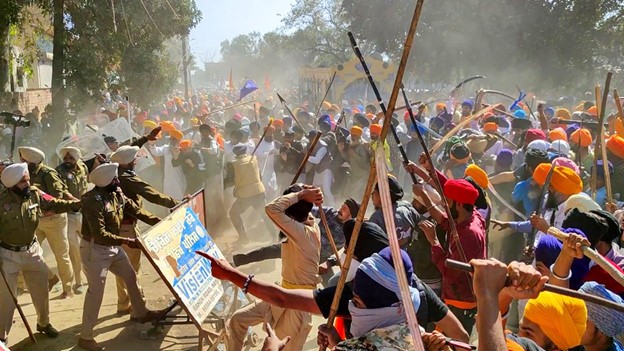
    Punjab—the land of saints and seers, the granary of India, nursery of the nation’s exceptionally gallant soldiers and outstanding sportspersons— appears to be once again, sliding to the brink of militancy largely attributed to religion-based secessionist motivations of a few extremists. That it is also fuelled by Pakistan’s sinister Inter Services Intelligence (ISI) and its well-funded stooges abroad brooks no elaboration.

    It will be prudent to recall that in the late 70s, Pakistan’s military dictator President Gen Zia-ul-Haq had conceived his infamous K-2 strategy (Kashmir and Khalistan) to foment trouble in two of India’s strategic border states of Kashmir and Punjab. Since then, till date, Pakistan has relentlessly strived to plant the seeds of terrorism, religious strife and lawlessness in these border regions. That turmoil and militancy did affect Punjab also in the 80s cannot be denied. Ultimately, the patriotism of the sturdy Sikhs coupled with firm handling by the Centre and state governments and embellished by strong and effective state police leadership under officers like Julio Ribeiro and KPS Gill had curbed the insurgency in Punjab. Those dark days did throw up vital lessons for all stakeholders to imbibe and implement to prevent such recurrences. But as usually happens with most establishments, a sense of déjà vu takes over till the next crisis occurs! The current state in Punjab is no exception.

    [powerkit_button size=”lg” style=”info” block=”true” url=”https://chanakyaforum.com/punjab-on-the-boil-again/” target=”_blank” nofollow=”false”]
    Read More
    [/powerkit_button]

  • Between Two Rocks and a Very Hard Place

    Between Two Rocks and a Very Hard Place

    Leave aside political affiliations and the flag-waving, slogan shouting, adrenaline pumped personas we adopt while watching cricket and ask ourselves a simple question. To what extent are we invested in our country, and what are we willing to sacrifice for its well-being and progress?

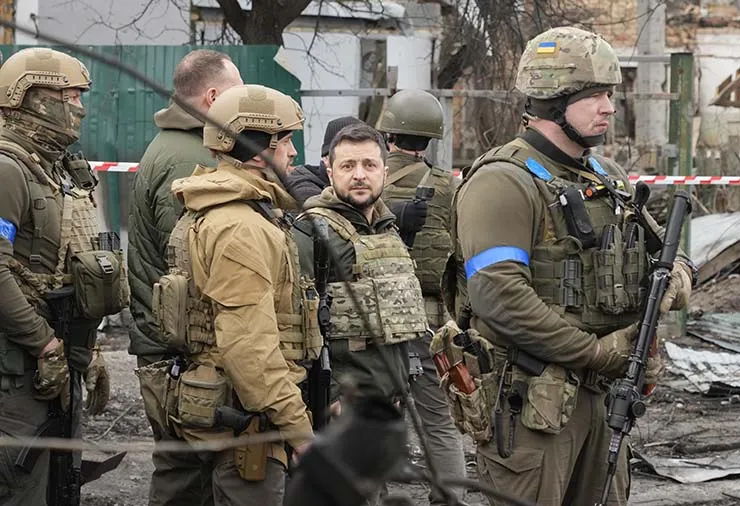
    Ukraine, for example, has a population of about 43 million. More than a fourth of this, mainly women, children and the aged, have been either internally or externally displaced by the ongoing war. By most estimates, over a hundred and fifty thousand are dead or wounded, which includes over 30,000 civilians, and counting. The country’s infrastructure is in ruins and despite this, their leadership, wholly supported by the people, fights on resolutely, with no quarter given or asked for. Determined to fight till they succeed in driving the Russians out of their territory, regardless of the time or toll it takes.

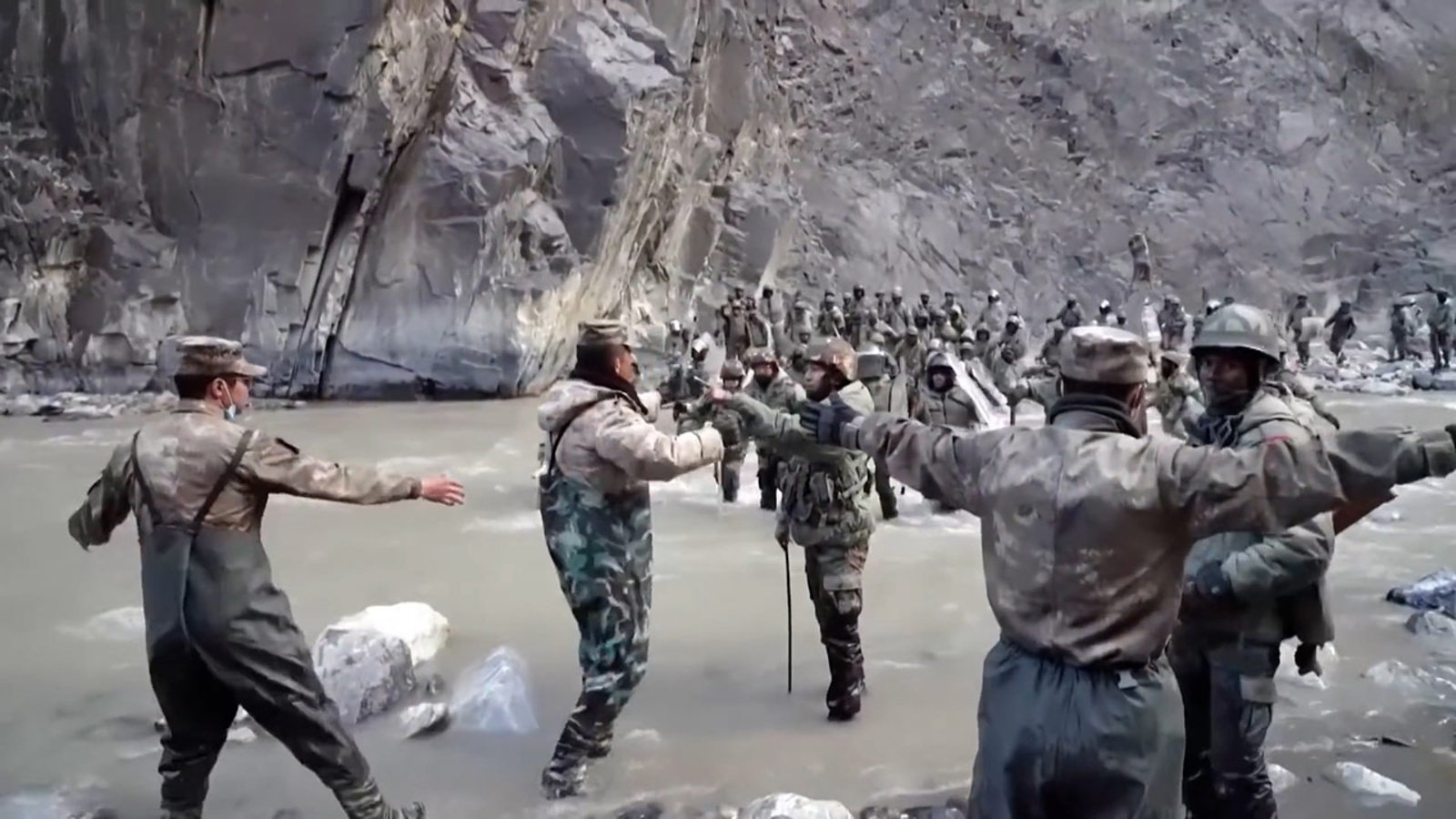
    In sharp contrast, we have lost over a 1000 square kilometres, of what we claim as our sovereign territory in Ladakh, without even putting up a semblance of a fight. What is even more shocking is that our government, for whatever reasons, has yet to publicly acknowledge this loss. Instead, we have had to face the ignominy of the External Affairs Minister, publicly stating that China is far too powerful for us to confront. What does that say about us?

    [powerkit_button size=”lg” style=”info” block=”true” url=”https://timesofindia.indiatimes.com/blogs/para-phrase/between-two-rocks-and-a-very-hard-place/” target=”_blank” nofollow=”false”]
    Read More
    [/powerkit_button]

    Featured Image: Council of Foreign Relations

  • The Fallacy of Handling China with Kid Gloves

    The Fallacy of Handling China with Kid Gloves

    It is apparent that the Modi Government has shown great reluctance to enhance defence expenditure, and instead has been looking for ways and means to curtail spending, as any government should. This is reflected in the manner it has gone about slashing manpower and rehashing recruitment and manpower policies.

    By introducing, what the vast majority consider, a flawed Agnipath Scheme, whose efficacy or otherwise only time will tell. In addition, it has also undertaken a concerted drive towards indigenization of defence procurement. The Russo-Ukrainian conflict has clearly demonstrated rightsizing, reorganisation and reorientation of our military is unavoidable.

    The proposed reduction in strength of the Rashtriya Rifles is indeed a welcome step that requires to be hastened. In fact, following abrogation of Article 370 and reorganisation of Jammu and Kashmir, while many may disagree, the logical follow-up should have been de-notification of AFSPA and withdrawal of the Army from the hinterland.

    [powerkit_button size=”lg” style=”info” block=”true” url=”http://www.indiandefencereview.com/news/the-fallacy-of-handling-china-with-kid-gloves/” target=”_blank” nofollow=”false”]
    Read More
    [/powerkit_button]

  • Indian Armed Forces @75: The Challenges Ahead

    Indian Armed Forces @75: The Challenges Ahead

    India overall, since 1947, has done reasonably well in keeping at bay the many diverse security challenges which came its way. However, the strategic and military lessons from our confrontations, since 1947, must never be forgotten.

    As India completes 75 years of its independence from 200 years of British yoke, there is much to celebrate about and equally much to introspect. Revisiting the functioning with stark honesty of all its institutions and governance structures will produce realistic mid-course corrections and suggest better paths for the nation to traverse. The Indian Armed Forces, unquestionably, one of the few institutions of the nation, which has lived up to its assigned responsibilities with elan and the desired results has much to be proud of. Nevertheless, many emerging aspects, nuances of the nation’s security and well-being have to be factored in and pursued earnestly with vision and resolve. For the nation’s honour, its Armed Forces can never be found wanting.

    By any standards, India is located in one of the most geo-politically troubled regions of the world. That it is surrounded by two consistently anti-India neighbours, China and Pakistan, both individually and collusively posing threats, only aggravates the formidable challenges it has to confront for its security. Both these nations being nuclear powers, synergistically anti-India, also adept at asymmetric warfare makes India’s strategic challenges mind-boggling.

    [powerkit_button size=”lg” style=”info” block=”true” url=”https://thedailyguardian.com/indian-armed-forces-75-the-challenges-ahead/” target=”_blank” nofollow=”false”]
    Read More
    [/powerkit_button]


  • The Bridge on River Chenab

    The Bridge on River Chenab

    “The only way to discover the limits of the possible is to go beyond them into the impossible”

    -Arthur C. Clarke

    Introduction

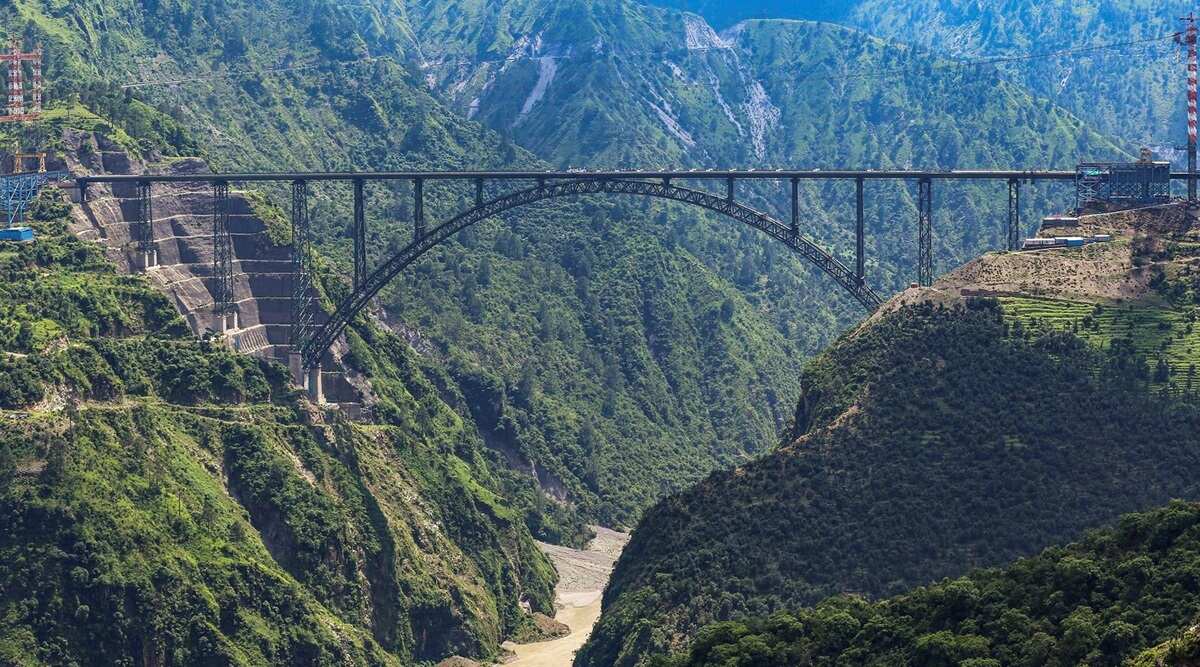
    On 13 Aug 2022, the bridge on the River Chenab in the Reasi District of J&K was finally completed. It was a case of the impossible becoming possible. It all happened because of a very high degree of self-belief of those who planned it and the sincerity of thousands of those who worked hard for the last 18 years.   Indeed, it was the best gift the Indian Railway in general and Indian Engineers, in particular, could give to India on the 76th Independence Day of India. It is also highly symbolic that it is located in the State of J&K and in a way appeared to be a giant step towards the integration of J&K with the rest of the country.

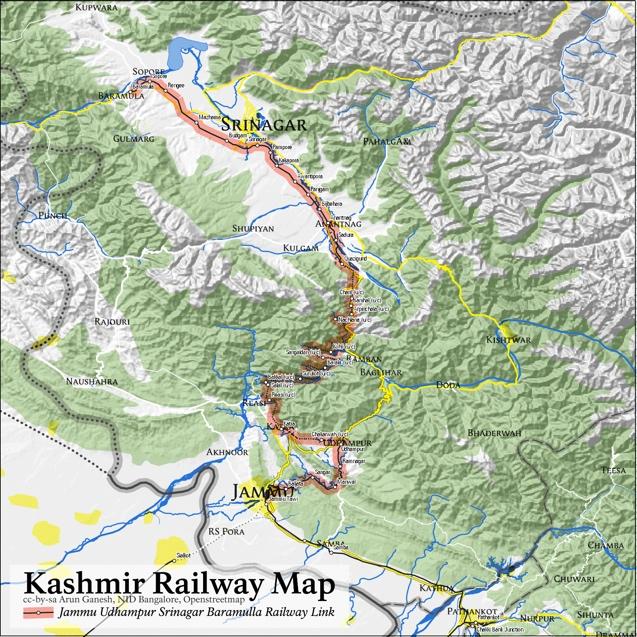
    The Bridge over the River Chenab is part of the Jammu-Udhampur-Baramulla Railway line, which is being constructed. While Sections of Jammu-Udhampur, Udhampur-Katra and Banihal-Baramulla are already completed and opened for traffic, section Katra- Banihal is still not complete. The degree of difficulty in this section is enormous. Besides this Bridge on Chenab (more about it a little later), the Bridge on Anji Khad (which is under construction) and a total of 35 tunnels and 37 bridges make this section of 111 km in the mountainous terrain extremely challenging and an engineering marvel in the making.

    Progress of the Project –  It is a 356 km railway project, starting at Jammu and going up to Baramulla. It was started in 1983 with the objective of connecting Jammu Tawi to Udhampur.  Construction of the route faced natural challenges including major earthquake zones, extreme temperatures and inhospitable terrain.  Finally, in 2005  The 53 km long Jammu–Udhampur section opened after 21 years with 20 tunnels and 158 bridges. The cost of the project had escalated to ₹515 crores from the original estimated cost of ₹50 crores.  In 1994 The railway accepted the necessity to extend the track to Baramulla. However, at that point it was thought that the project will have two disconnected arms; one from Jammu to Udhampur and the second from Qazigund to Baramulla. In 2002 the GoI declared this project to be a national project. This means hereafter, the entire funding will be from the Central Budget. At that time the necessity was also accepted to connect the two disconnected arms. The estimated cost of the project assessed then was   ₹6,000 crore.  In 2008 the 66 km section between Anantnag and Manzhama (outside Srinagar) was opened for traffic. In 2009 this Service was extended to Baramulla. During the same year, the line from Anantnag was extended to Qazigund.

    Also  Around the same time, an extension of the track from Baramulla to Kupwara was proposed, and its survey got completed in 2009. In 2009 itself, work on the section between Katra and Qazigund resumed after a review based on geotechnical studies. In 2011, an 11.215 Km long Banihal Qazigund tunnel across the Pir Panjal Range was completed.  This paved the way for a trial run in Dec 2012 from Banihal to Qazigund. In 2014 the train route from Udhampur to Katra was also operationalised. Now the only missing link in this nationally vital rail line was Katra-Banihal. Finally, in 2018 the GoI approved the extension of the railway line to Kupwara.

    Degree of Difficulty in Katra- Banihal Section – This is a 111 km long stretch. 97.34 km of this stretch will be through tunnels. There are 20 Major (including the bridge across the Chenab river and a bridge on Anji Khad) and 10 minor bridges on this stretch. 

    Bridge Across Chenab

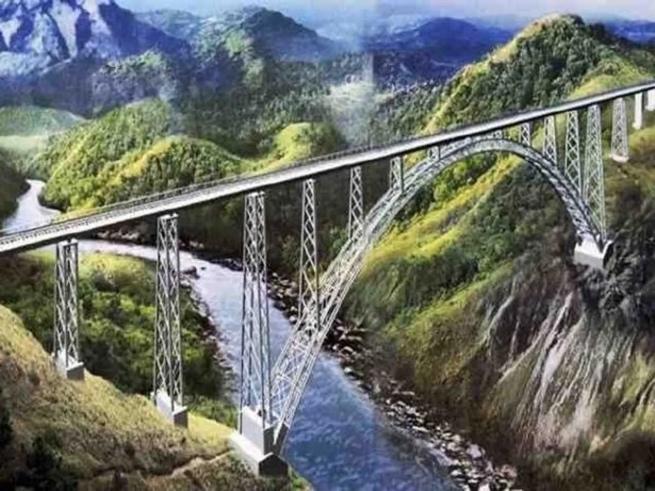
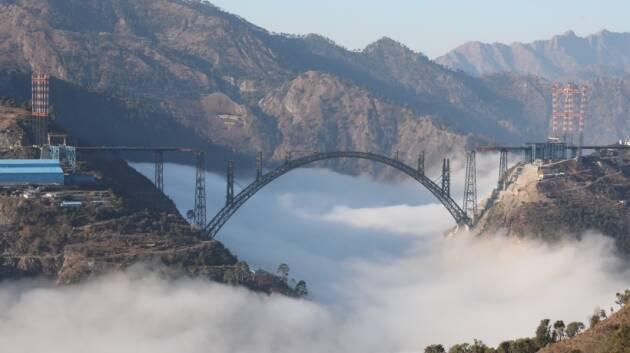
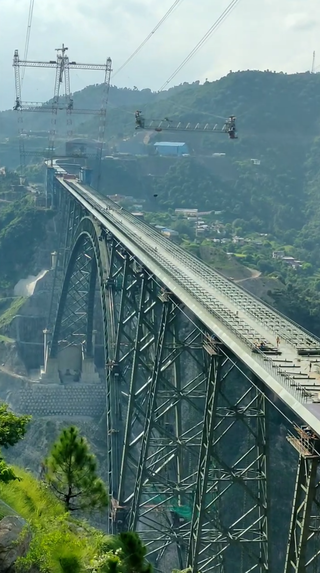
    Location: The Chenab Rail Bridge is a steel and concrete arch bridge between Bakkal and Kauri in the Reasi district of J&K, India.  It needs to be noted that it is the highest railway bridge in the world. After many hick-ups, finally in 2012 excavation of the foundation of the bridge commenced. The tender was with Afcons Infrastructure Limited. The alignment crosses a deep gorge of the Chenab River, which necessitates the construction of a long-span railway bridge with a viaduct for approaches on either side. 

    Details: It is a 785 meters long single arch bridge where the main arch is 467 meters. The total span of the bridge is 1315 meters including a viaduct of 650 meters on the Northern side, Deck height is 359 meters above the river bed and 322 meters above the water surface which is 35 meters more than the height of the Eiffel Tower. The project also entails the construction of 203 km of access roads.  The deck is 13.5 meters wide, where two rail tracks will be available. The total cost of the Bridge is Rs 1486 Crores.


    Design: The steel arch has been planned because the construction of the pillar was difficult and the load had to be distributed. Chords have been provided to cater for the swaying load. The steel structures of the bridge were manufactured in workshops built in the mountains. The workshops had been moved to the building site because there is no proper road network in the challenging terrain. The longest building parts that could be delivered to the site were 12 meters in length. Therefore, four workshops were established in the mountains. Workshops and paint shops were built on both sides of the valley. All steel materials, except for the smallest rolled profiles, were delivered to the mountains as steel boards. The insufficient infrastructure of the area caused additional problems. There was no electricity and the water of the river was not suitable for manufacturing concrete. All electricity had to be produced at the site and the water was delivered from further away in the mountains. The job was also challenging because the track had a curvature in the approach bridge. In this section, the construction stage bearings had been designed in such a way that it was possible to launch the steel deck in the curvature portion as well. The bridge consists of about 25000 tonnes of steel structures, the main portion of which was used for the arch bridge section. It is a unique design and as such none of the Indian codes fully catered for the design validation. Therefore it was decided to follow the BS Code. The design also caters for wind load effects as per wind tunnel tests. It can cater for wind pressure of 1500 Pa. It is a blast resistance design. The design of the decking has been checked for fatigue as per the BS Code. The most important aspect is that it caters for redundancy within the structure, for a lower level of operation during mishaps and against collapse in extreme cases of one-pier failure. The area has high seismicity and the design was planned to withstand earthquakes of the severity of 8 on the Richter Scale. The bridge design is for a rail speed of 100 kmph. This means it can withstand very high-intensity of vibrations. The designed life of the bridge is 120 years and to take care of assessed steel fatigue the fatigue design selected is BS:5400 Part-10. The bridge will be able to withstand a temperature of minus 200C and a wind speed of 266 kmph.

    Team: The viaduct and foundation have been designed by M/s WSP(Finland) and the Arch design has been made by M/s Leonhart, Andra and Partners (Germany), the foundation protection has been designed by IISc Bangalore. The executing agency has been M/s Konkan Railway Corporation Limited.

    Status of Katra-Banihal project

    Although, the construction of Chenab Bridge is a major milestone in the progress of the project, however, still many more landmarks are required to be crossed before the completion of the project. Foremost of them is the Anji Khad bridge which is expected to be ready only by Dec 2022. It is expected that this rail Section will finally be operational by the middle of 2023.

    Conclusion

    The Jammu-Udhampur-Katra-Banihal-Srinagar-Baramulla Rail project is a vital national project which has a major bearing on national security and nation building. It is a matter of pride that Indian Engineers have achieved what at one point had appeared impossible. It will help in the integration of J&K with the rest of the country and will help strategically in many ways. The completion of the project will also give confidence to expeditiously complete other projects of national importance like; the railway line to Leh and the Railway line to Tenga in the North-East.

    End Note:

    1. Conceptual Design of the Chenab Bridge in India by Pekka Pulkkine WSP Finland, S Hopf and A Jutila. Available on Research Gate: https://www.researchgate.net/publication/257725212_Conceptual_Design_of_the_Chenab_Bridge_in_India.

    2. An internet upload: https://byjus.com/current-affairs/chenab-bridge/

    3. A Report by OT Staff, “Once the bridge is completed, it will provide all-weather connectivity between Kashmir and the rest of India” reported on 07 Apr 2021 and uploaded on https://www.outlookindia.com/outlooktraveller/travelnews/story/71397/all-about-the-chenab-bridge

    4. An internet upload: https://en.wikipedia.org/wiki/Jammu–Baramulla_line

    5. An internet upload: https://en.wikipedia.org/wiki/Chenab_Rail_Bridge

    6. An internet upload: https://www.pib.gov.in/PressReleasePage.aspx?PRID=1709652

    7. Zee Media Bureau, “Indian Railways: Delhi-Kashmir, Katra-Banihal train route to open soon, project nears completion” dated 08 Aug 2022 and uploaded on https://zeenews.india.com/railways/indian-railways-delhi-kashmir-katra-banihal-train-route-to-open-soon-project-nears-completion-2494827.html

    Image 1 Credits: Arun Ganesh

    Image 2 Credits: Indian Railways

    Image 3 Credits: Indian Express

    Image 4 Credits: Indian Railways

    Feature Image Credits: The Indian Express

  • Ukraine War: India’s Stature in the Emerging World Order

    Ukraine War: India’s Stature in the Emerging World Order

    The war between Russia and Ukraine has caused a major disruption not only in that region, but the entire world. Power centres are shifting; a new world order is emerging out of this global churn. The world anxiously waits for India to take a more active role in a bid to end hostilities. What will India do?

    India’s firm stand of neutrality about the conflict in Ukraine has attracted considerable attention from the world’s strategic thinkers and governments. In this regard, many see the rise of India as a future pole power of the 21st century, as the current world order has entered a phase of instability, conflict, and competition. The Ukraine war may be the tipping point for the Euro-American dominance in the last three centuries, as a multi-polar world order is emerging, albeit slowly. India’s stature in this world order transformation is critical, as the non-western countries that constitute two-thirds of the world will meticulously observe and monitor it. A careful analysis of the ongoing transformation of the world order amidst the massive cacophony of propaganda and a plethora of biased reports (masquerading as research and academic outputs) is a huge challenge for serious researchers and policymakers.

    [powerkit_button size=”lg” style=”info” block=”true” url=”https://raksha-anirveda.com/ukraine-war-indias-stature-in-the-emerging-world-order/” target=”_blank” nofollow=”false”]
    Read More
    [/powerkit_button]

  • Agnipath Might have Adverse Consequences

    Agnipath Might have Adverse Consequences

    It takes a soldier a long time to emotionally and physically get moulded into his unit groove, become infused with his unit’s ethos and, thus, be prepared to lay down his life for the unit’s honour

    The government this week announced a recruitment model, Agnipath, for the short-term induction of personnel into the armed forces. As a veteran, who has worn the nation’s uniform with pride for 41 years, I wish the new scheme all success. But due to my loyalty to my motherland, shared by all veterans, I also have some misgivings about the new recruitment programme.

    [powerkit_button size=”lg” style=”info” block=”true” url=”https://www.hindustantimes.com/opinion/agnipath-might-have-adverse-consequences-101655393300667.html” target=”_blank” nofollow=”false”]
    Read More
    [/powerkit_button]

  • Snatching Defeat from Victory’s Jaws

    Snatching Defeat from Victory’s Jaws

    “The Govt’s ad hoc approach towards Army recruitment has adversely impacted youngsters, and even the military’s operational preparedness”.

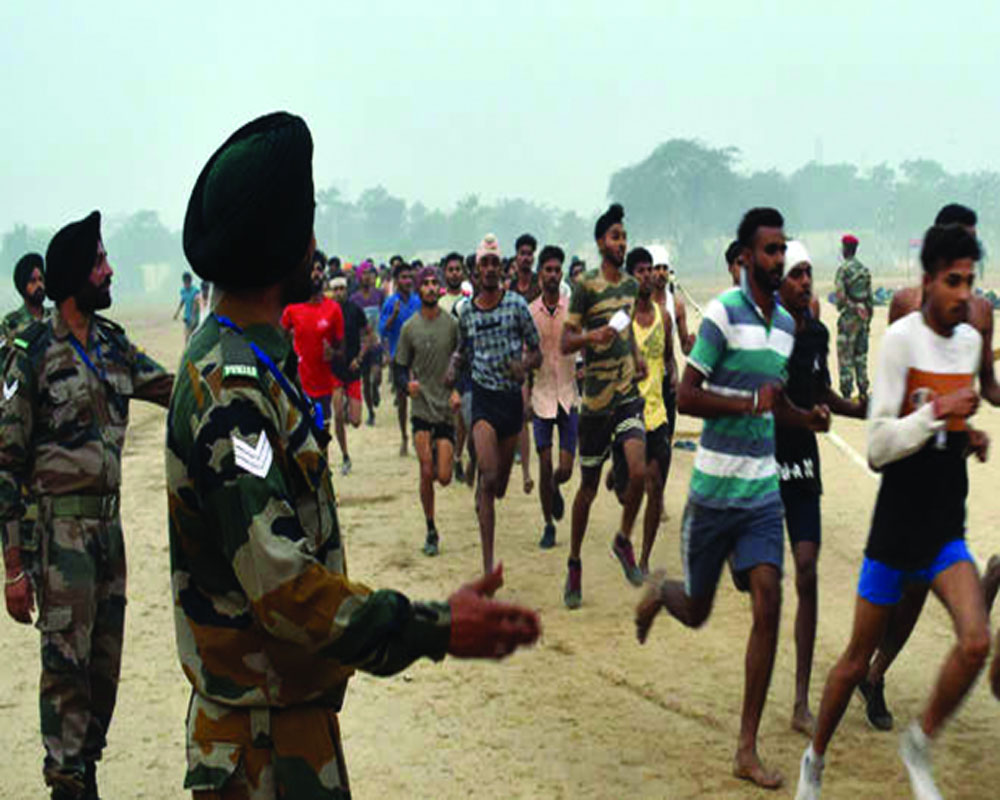
    Recruitment for the Army has been at a standstill over the past two years as the Government contemplates drastic changes in its recruitment pattern and consequently its manpower profile. As recruitment is age-driven, this halt on recruitment has adversely impacted youngsters, mostly from rural areas, who suddenly find themselves stuck in limbo. The tragic suicide by young Pawan of Bhiwani district on becoming overage in the interim says it all.

    But his case is just the tip of an iceberg as over 1 lakh candidates, having cleared the physical tests, are still awaiting conduct of the written exam as time ticks by.

    It has adversely impacted the Army as well. Approximately 50,000 personnel retire annually, which implies that the Army is currently deficient in nearly 10 per cent of its authorised strength. This has impacted operational readiness and will have a knock-on effect on training and manpower management in future. The fact is, it takes 18 months from the time an individual is selected and joins his unit as a trained soldier. Clearly, halting regular recruitment, for whatever reasons, has been an imprudent move that has negatively impacted our national security and should have been avoided at all costs, given the fragile security environment that we confront.

    [powerkit_button size=”lg” style=”info” block=”true” url=”https://www.dailypioneer.com/2022/columnists/snatching-defeat-from-victory—s-jaws.html” target=”_blank” nofollow=”false”]
    Read More
    [/powerkit_button]

  • IAF’s Force Structure: Strategy for Overcoming the Crisis

    IAF’s Force Structure: Strategy for Overcoming the Crisis

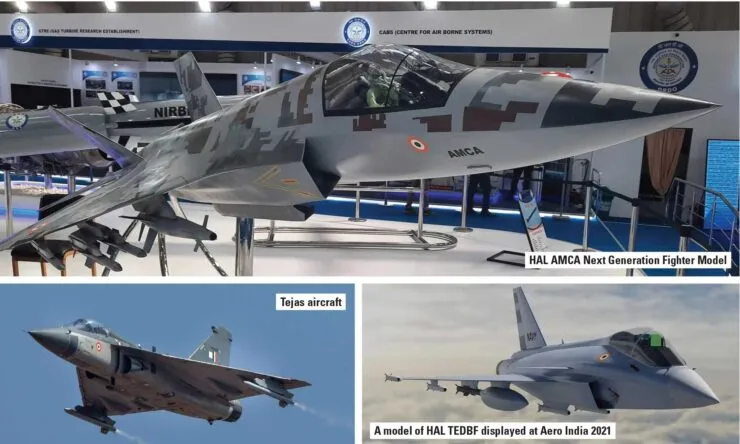
    Aligned with its national security interests, India’s strong geostrategic role-play, amidst the changing world order as a rising military power, aerospace power in particular must be rooted in the Indian industry.

    The ongoing conflict in Ukraine has many cautions for India. War at anytime and anywhere is a human catastrophe and therefore, all efforts to prevent or stop war should not be spared. While the American-led side wants India to take a stand in favour of their position, the Russian side is appreciative of India’s neutral stand. Recent visits by leaders from the USA, UK, EU, and Japan have emphasised the need for India to condemn Russia’s actions in Ukraine.

    What is of concern, however, is the fact that the USA and others stressing their view that India’s excessive dependence on Russia for its military equipment is the reason for its refusal to support their sanctions on Russia. Various officials from the US State Department and the DOD have openly advocated their objective of weaning India’s defence imports from Russia. There lies the real issue.

    India’s defence market is too huge and attractive for Western defence industries, and hence, it is the focus of strategic dialogues of many of these countries with India.

    India’s defence market is too huge and attractive for Western defence industries, and hence, it is the focus of strategic dialogues of many of these countries with India. India has diversified its military procurements in the last three decades to ensure it does not become vulnerable to a single source supply. As a result, India’s defence supplies from Russia, which was as high as 70-75% in the early 2000s came down to a current level of 50-55%. The US has been the biggest gainer in this diversification, garnering nearly $ 22 billion in sales to India in the last 15 years to emerge as its number 1 supplier. The Ukraine conflict and the resultant sanctions are being used by the USA to pressurise India to reduce its imports from Russia. The real objective is to ensure the US and its European allies replace Russia as India’s major if not exclusive supplier of defence equipment. The threat of CAATSA on India’s S-400 air defence missile deal with Russia is a prime example. The crux of the India-USA strategic partnership is really about capturing India’s defence market for the Military-Industrial Complex of the USA.

    [powerkit_button size=”lg” style=”info” block=”true” url=”https://raksha-anirveda.com/iafs-force-structure-strategy-for-overcoming-the-crisis/” target=”_blank” nofollow=”false”]
    Read More
    [/powerkit_button]