Tag: media

  • Propaganda Blitz: How Mainstream Media is Pushing Fake Palestine Stories

    Propaganda Blitz: How Mainstream Media is Pushing Fake Palestine Stories

    Biased media reporting and propaganda with fake news is now a major strategy to create polarised perceptions worldwide. This type of reporting is now led by leading media houses of the West, whose only aim is to create a narrative that suits their foreign policy and economic objectives. Truth is a big casualty in the bargain, along with innocent lives, communities, and nations. The ongoing Israel-Hamas conflict is mired in heavy propaganda. It is important for the world to re-examine the past, extract the truth and history, and the current geopolitical machinations to understand this long-drawn Middle East conflict properly. TPF endeavours to provide, through select articles and accurate analysis, the right analysis and perspective of the Israel-Palestine issue. In the article below, Alan Macleod clearly describes how mainstream media pushes many false narratives to obfuscate the true nature, causes, and victims of the conflict.         – Team TPF


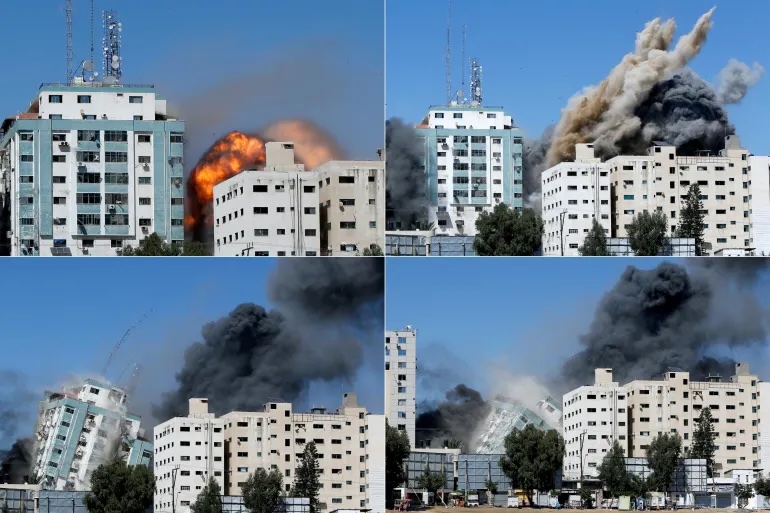
    After Hamas launched a surprise attack on Israel, IDF forces responded with airstrikes, levelling Gazan buildings. The violence so far has claimed the lives of more than 2,500 people. Western media, however, show far more interest and have much greater sympathy with Israeli dead than Palestinian ones and have played their usual role as unofficial spokespersons for the Israeli Defense Forces (IDF).

    EXTRAORDINARY CLAIMS, ZERO EVIDENCE

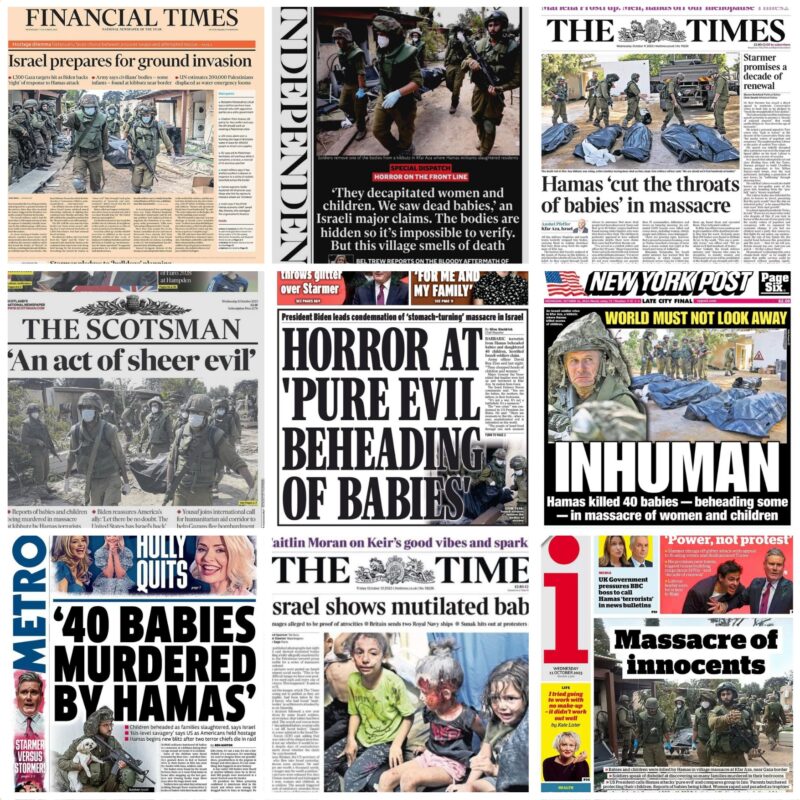
    One case in point is the claim that, during their incursion into southern Israel, Hamas fighters stopped to round up, kill and mutilate 40 Israeli babies, beheading them and leaving their bodies behind.

    The extraordinary assertion was originally reported by the Israeli channel i24 News, which based it on anonymous Israeli military sources. Despite offering no proof whatsoever, this highly inflammatory claim about an enemy made by an active participant in a conflict was picked up and repeated across the world by a host of media (e.g., in the United States by Fox NewsCNNMSNBusiness Insider, and The New York Post)

    Meanwhile, the front pages of the United Kingdom’s largest newspapers were festooned with the story, the press outraged at the atrocity and inviting their readers to feel the same way.

    Extraordinary claims should require extraordinary evidence, and a story like this should have been met with serious skepticism, given who was making the claim. The first question any reporter should have asked was, “Where is the evidence?” Given multiple opportunities to stand by it, the IDF continually distanced itself from the claims. Nevertheless, the story was simply too useful not to publish.
    The decapitated baby narrative was so popular that even President Biden referenced it, claiming to have seen “confirmed” images of Hamas killing children. This claim, however, was hastily retracted by his handlers at the White House, who noted that Biden was simply referencing the i24 News report.

    The story looked even more like a piece of cheap propaganda after it was revealed that the key source for the claim was Israeli soldier David Ben Zion, an extremist settler who had incited race riots against Palestinians earlier this year, describing them as “animals” with no heart who needs to be “wiped out.”

    Manipulating the U.S. public into supporting the war by feeding them atrocity propaganda about mutilating babies has a long history. In 1990, for instance, a girl purporting to be a local nurse was brought before Congress, where she testified that Iraqi Dictator Saddam Hussein’s men had ripped hundreds of Kuwaiti babies from their incubators and left them to die. The story helped whip the American public up into a pro-war fervor. It was later revealed that it was a complete hoax dreamed up by a public relations firm.

    THE MURDERED GIRL WHO CAME BACK TO LIFE

    Another piece of blatantly fake news is the case of Shani Louk. Louk attended the Supernova Festival, ambushed by Hamas. It was widely reported that Hamas murdered her (e.g., Daily MailMarcaYahoo! NewsTMZBusiness Insider), stripped her, and paraded her naked body trophy-like through the streets on the back of a truck. Louk’s case incited global anger and calls for an overwhelming Israeli military response.

    There was only one problem: Louk was later confirmed to be alive and in hospital, a fact that suggests the videos of her on the back of a truck were actually images of people saving her life by taking her to seek medical assistance.

    Few of the outlets irresponsibly publishing these wildly incendiary stories have printed apologies or even retractions. The Los Angeles Times was one exception: after publishing a report claiming that Palestinians had raped Israeli civilians, it later informed readers that “such reports have not been substantiated.”

    LIONIZING ISRAEL, DEHUMANIZING PALESTINIANS

    Few readers, however, see these retractions. Instead, they are left with visceral feelings of anger and disgust towards Hamas, priming them to support Western military action against Palestine or the wider region.

    In case their audiences did not get the message, op-eds and editorials in major newspapers hammered home this idea. The Wall Street Journal ran an op-ed entitled “The Moral Duty to Destroy Hamas”, which insisted to readers that “Israel is entitled to do whatever it takes to uproot this evil, depraved culture that resides next to it.” Thus, the outlet implicitly gave Israel a free pass to carry out whatever war crimes it wished on the civilian population, whether that is using banned chemical weapons, cutting off electricity and water, or targeting ambulances or United Nations officials.

    The National Review’s editorial board was of a similar mind, stating that “Israel needs a long leash to destroy Hamas.” This long leash, they explained, meant giving Israel far more time to carry out the destruction of Gaza. Western leaders would have to refrain from criticizing Israel or calling for calm and peace.

    The message was clear: international unity was paramount at this time. Mere trifles such as war crimes must be overlooked. And while Israel and its people were treated with special sympathy (e.g., Washington Post), the other side was written off as bloodthirsty radicals. While the phrase “Palestinian terrorists” could be found across the media spectrum (e.g., Fox NewsNew York PostNew York Times), its opposite, “Israeli terrorists” was completely absent from corporate media. This, despite casualties on the Palestinian side, outnumbering Israelis.

    Underlining the fact that Israeli lives are deemed more important is the way in which deaths from each side are reported. The BBC, for example, told its readers that Israelis have been “killed” while people in Gaza merely “died,” removing any agency from its perpetrators and almost suggesting their deaths were natural.

    CONTEXT-FREE VIOLENCE

    Missing from most of the reporting was the basic factual background of the attack. Few articles mentioned that Israel was built upon an existing Palestinian state and that most of the inhabitants of Gaza are descended from refugees ethnically cleansed from southern Israel in order to make way for a Jewish state. Also left unmentioned was that Israel controls almost every aspect of Gazan’s life. This includes deciding who can enter or leave the densely populated strip and limiting the import of food, medicine and other crucial goods. Aid groups have called Gaza “the world’s largest open-air prison.” The United Nations has declared the conditions in Gaza to be so bad as to be unlivable.

    One of the principal reasons that this crucial context is not given is that it could influence Western audiences into sympathizing with Palestinians or supporting Palestinian liberation. Giant media corporations are largely owned by wealthy oligarchs or by transnational corporations, both of whom have a stake in preserving the status quo and neither of whom wish to see national liberation movements succeed.

    https://twitter.com/AlanRMacLeod/status/1712797752709566763?ref_src=twsrc%5Etfw%7Ctwcamp%5Etweetembed%7Ctwterm%5E1712797752709566763%7Ctwgr%5Eb05f8d7d7e0b67196918b4e46787442438501a6b%7Ctwcon%5Es1_&ref_url=https%3A%2F%2Fscheerpost.com%2F2023%2F10%2F14%2Fpropaganda-blitz-how-mainstream-media-is-pushing-fake-palestine-stories%2F

    Some media outlets make this explicit. Axel Springer – the enormous German broadcaster that owns Politico – requires its employees to sign its mission statement endorsing “the trans-Atlantic alliance and Israel” and has told any staff members that support Palestine to leave their jobs.

    Other outlets are slightly less overt but nonetheless have Israel red lines that employees cannot cross. CNN fired anchor Marc Lamont Hill for calling for a free Palestine. Katie Halper was fired from The Hill for (accurately) calling Israel an Apartheid state. The Associated Press dismissed Emily Wilder after it became known that she had been a pro-Palestine activist during her college years. And The Guardian sacked Nathan J. Robinson after he made a joke mocking US military aid to Israel. These cases serve as examples to the rest of the journalistic world. The message is that one cannot criticize the Israeli government’s violent apartheid system or show solidarity for Palestine without risking losing their livelihoods.

    Ultimately, then, corporate media play a key role in maintaining the occupation by manipulating public opinion. If the American people were aware of the history and the reality of Israel/Palestine, the situation would be untenable. For those wishing to maintain the unequal state of affairs whereby an apartheid government expels or imprisons its indigenous population, the pen is as important as the sword.


    This article was published earlier in scheerpost.com and is republished under the Creative Commons Attribution-NonCommercial-NoDerivatives 4.0 International license

    Feature Image Credit: aljazeera.com


  • America defeats Germany for the third time in a century

    America defeats Germany for the third time in a century

    This is a very profound article by Michael Hudson, wherein he exposes the real drivers of the conflict in Ukraine – the American Military Industrial Complex; Oil, Gas and Mining Industry; and the FIRE (Finance, Insurance and Real Estate) – the three oligarchs who form the deep state or the national security state that conducts the American foreign policy. To this we can add the fourth – the Big Tech. Clearly, as Paul Kennedy identified more than three decades ago, like all empires of the past, the American Empire has entered an irretrievable imperial overstretch and the consequent decline that would accelerate post the war in Ukraine.

    TPF is happy to republish this excellently analysed article by Michael Hudson under the Creative Commons Attribution-Non Commercial-No Derivatives 4.0 International License. It was published earlier in MRonline.

    The MIC, OGAM and FIRE Sectors Conquer NATO

    My old boss Herman Kahn, with whom I worked at the Hudson Institute in the 1970s, had a set speech that he would give at public meetings. He said that back in high school in Los Angeles, his teachers would say what most liberals were saying in the 1940s and 50s: “Wars never solved anything.” It was as if they never changed anything—and therefore shouldn’t be fought.

    Herman disagreed, and made lists of all sorts of things that wars had solved in world history, or at least changed. He was right, and of course that is the aim of both sides in today’s New Cold War confrontation in Ukraine.

    The question to ask is what today’s New Cold War is trying to change or “solve.” To answer this question, it helps to ask who initiates the war. There always are two sides—the attacker and the attacked. The attacker intends certain consequences, and the attacked looks for unintended consequences of which they can take advantage. In this case, both sides have their dueling sets of intended consequences and special interests.

    the U.S. policy executed by the Clinton and subsequent administrations to wage a new military expansion via NATO has paid a 30-year dividend in the form of shifting the foreign policy of Western Europe and other American allies out of their domestic political sphere into their own U.S.-oriented “national security” blob. NATO has become Europe’s foreign policy-making body, even to the point of dominating domestic economic interests.

    The active military force and aggression since 1991 has been the United States. Rejecting mutual disarmament of the Warsaw Pact countries and NATO, there was no “peace dividend.” Instead, the U.S. policy executed by the Clinton and subsequent administrations to wage a new military expansion via NATO has paid a 30-year dividend in the form of shifting the foreign policy of Western Europe and other American allies out of their domestic political sphere into their own U.S.-oriented “national security” blob (the word for special interests that must not be named). NATO has become Europe’s foreign policy-making body, even to the point of dominating domestic economic interests.

    The recent prodding of Russia by expanding Ukrainian anti-Russian ethnic violence by Ukraine’s neo-Nazi post-2014 Maidan regime was aimed at (and has succeeded in) forcing a showdown in response the fear by U.S. interests that they are losing their economic and political hold on their NATO allies and other Dollar Area satellites as these countries have seen their major opportunities for gain to lie in increasing trade and investment with China and Russia.

    To understand just what U.S. aims and interests are threatened, it is necessary to understand U.S. politics and “the blob,” that is, the government central planning that cannot be explained by looking at ostensibly democratic politics. This is not the politics of U.S. senators and representatives representing their congressional voting districts or states.

    America’s three oligarchies in control of U.S. foreign policy

    It is more realistic to view U.S. economic and foreign policy in terms of the military-industrial complex, the oil and gas (and mining) complex, and the banking and real estate complex than in terms of the political policy of Republicans and Democrats. The key senators and congressional representatives do not represent their states and districts as much as the economic and financial interests of their major political campaign contributors.

    It is more realistic to view U.S. economic and foreign policy in terms of the military-industrial complex, the oil and gas (and mining) complex, and the banking and real estate complex than in terms of the political policy of Republicans and Democrats. The key senators and congressional representatives do not represent their states and districts as much as the economic and financial interests of their major political campaign contributors. A Venn diagram would show that in today’s post-Citizens United world, U.S. politicians represent their campaign contributors, not voters. And these contributors fall basically into three main blocs.
    Three main oligarchic groups that have bought control of the Senate and Congress to put their own policy makers in the State Department and Defense Department.

    First is the Military-Industrial Complex (MIC)—arms manufacturers such as Raytheon, Boeing and Lockheed-Martin, have broadly diversified their factories and employment in nearly every state, and especially in the Congressional districts where key Congressional committee heads are elected. Their economic base is monopoly rent, obtained above all from their arms sales to NATO, to Near Eastern oil exporters and to other countries with a balance of payments surplus. Stocks for these companies soared immediately upon news of the Russian attack, leading a two-day stock market surge as investors recognized that war in a world of cost-plus “Pentagon capitalism” (as Seymour Melman described it) will provide a guaranteed national security umbrella for monopoly profits for war industries. Senators and Congressional representatives from California and Washington traditionally have represented the MIC, along with the solid pro-military South. The past week’s military escalation promises soaring arms sales to NATO and other U.S. allies, enriching the actual constituents of these politicians. Germany quickly agreed to raise its arms spending to over 2% of GDP.

    Monopolizing the Dollar Area’s oil market and isolating it from Russian oil and gas has been a major U.S. priority for over a year now, as the Nord Stream 2 pipeline threatened to link the Western European and Russian economies more tightly together.

    The second major oligarchic bloc is the rent-extracting oil and gas sector, joined by mining (OGAM), riding America’s special tax favoritism granted to companies emptying natural resources out of the ground and putting them mostly into the atmosphere, oceans and water supply. Like the banking and real estate sector seeking to maximize economic rent and maximizing capital gains for housing and other assets, the aim of this OGAM sector is to maximize the price of its energy and raw materials so as to maximize its natural resource rent. Monopolizing the Dollar Area’s oil market and isolating it from Russian oil and gas has been a major U.S. priority for over a year now, as the Nord Stream 2 pipeline threatened to link the Western European and Russian economies more tightly together.

    If oil, gas and mining operations are not situated in every U.S. voting district, at least their investors are. Senators from Texas and other Western oil-producing and mining states are the leading OGAM lobbyists, and the State Department has a heavy oil sector influence providing a national security umbrella for the sector’s special tax breaks. The ancillary political aim is to ignore and reject environmental drives to replace oil, gas and coal with alternative sources of energy. The Biden administration accordingly has backed the expansion of offshore drilling, supported the Canadian pipeline to the world’s dirtiest petroleum source in the Athabasca tar sands, and celebrated the revival of U.S. fracking.

    The foreign policy extension is to prevent foreign countries not leaving control of their oil, gas and mining to U.S. OGAM companies from competing in world markets with U.S. suppliers. Isolating Russia (and Iran) from Western markets will reduce the supply of oil and gas, pushing up prices and corporate profits accordingly.

    The third major oligarchic group is the symbiotic Finance, Insurance and Real Estate (FIRE) sector, which is the modern finance-capitalist successor to Europe’s old post-feudal landed aristocracy living by land rents. With most housing in today’s world having become owner-occupied (although with sharply rising rates of absentee landlordship since the post-2008 wave of Obama Evictions), land rent is paid largely to the banking sector in the form of mortgage interest and debt amortization (on rising debt/equity ratios as bank lending inflates housing prices). About 80 percent of U.S. and British bank loans are to the real estate sector, inflating land prices to create capital gains—which are effectively tax exempt for absentee owners.

    Internationally, the FIRE sector’s aim is to privatize foreign economies (above all to secure the privilege of credit creation in U.S. hands), so as to turn government infrastructure and public utilities into rent seeking monopolies to provide basic services (such as health care, education, transportation, communications and information technology) at maximum prices instead of at subsidized prices to reduce the cost of living and doing business.

    This Wall Street-centered banking and real estate bloc is even more broadly based on a district-by-district basis than the MIC. Its New York senator from Wall Street, Chuck Schumer, heads the Senate, long supported by Delaware’s former Senator from the credit card industry Joe Biden, and Connecticut’s senators from the insurance sector centered in that state. Domestically, the aim of this sector is to maximize land rent and the “capital’ gains resulting from rising land rent. Internationally, the FIRE sector’s aim is to privatize foreign economies (above all to secure the privilege of credit creation in U.S. hands), so as to turn government infrastructure and public utilities into rent seeking monopolies to provide basic services (such as health care, education, transportation, communications and information technology) at maximum prices instead of at subsidized prices to reduce the cost of living and doing business. And Wall Street always has been closely merged with the oil and gas industry (viz. the Rockefeller-dominated Citigroup and Chase Manhattan banking conglomerates).

    The FIRE, MIC and OGAM sectors are the three rentier sectors that dominate today’s post-industrial finance capitalism. Their mutual fortunes have soared as MIC and OGAM stocks have increased. And moves to exclude Russia from the Western financial system (and partially now from SWIFT), coupled with the adverse effects of isolating European economies from Russian energy, promise to spur an inflow into dollarized financial securities

    As mentioned at the outset, it is more helpful to view U.S. economic and foreign policy in terms of the complexes based on these three rentier sectors than in terms of the political policy of Republicans and Democrats. The key senators and congressional representatives are not representing their states and districts as much as the economic and financial interests of their major donors. That is why neither manufacturing nor agriculture play the dominant role in U.S. foreign policy today. The convergence of the policy aims of America’s three dominant rentier groups overwhelms the interests of labor and even of industrial capital beyond the MIC. That convergence is the defining characteristic of today’s post-industrial finance capitalism. It is basically a reversion to economic rent-seeking, which is independent of the politics of labor and industrial capital.

    The dynamic that needs to be traced today is why this oligarchic blob has found its interest in prodding Russia into what Russia evidently viewed as a do-or-die stance to resist the increasingly violent attacks on Ukraine’s eastern Russian-speaking provinces of Luhansk and Donetsk, along with the broader Western threats against Russia.

    The rentier “blob’s” expected consequences of the New Cold War

    As President Biden explained, the current U.S.-orchestrated military escalation (“Prodding the Bear”) is not really about Ukraine. Biden promised at the outset that no U.S. troops would be involved. But he has been demanding for over a year that Germany prevent the Nord Stream 2 pipeline from supplying its industry and housing with low-priced gas and turn to the much higher-priced U.S. suppliers.

    U.S. officials first tried to stop construction of the pipeline from being completed. Firms aiding in its construction were sanctioned, but finally Russia itself completed the pipeline. U.S. pressure then turned on the traditionally pliant German politicians, claiming that Germany and the rest of Europe faced a National Security threat from Russia turning off the gas, presumably to extract some political or economic concessions. No specific Russian demands could be thought up, and so their nature was left obscure and blob-like. Germany refused to authorize Nord Stream 2 from officially going into operation.

    A major aim of today’s New Cold War is to monopolize the market for U.S. shipments of liquified natural gas (LNG)

    A major aim of today’s New Cold War is to monopolize the market for U.S. shipments of liquified natural gas (LNG). Already under Donald Trump’s administration, Angela Merkel was bullied into promising to spend $1 billion building new port facilities for U.S. tanker ships to unload natural gas for German use. The Democratic election victory in November 2020, followed by Ms. Merkel’s retirement from Germany’s political scene, led to cancellation of this port investment, leaving Germany really without much alternative to importing Russian gas to heat its homes, power its electric utilities, and to provide raw material for its fertilizer industry and hence the maintenance of its farm productivity.

    So the most pressing U.S. strategic aim of NATO confrontation with Russia is soaring oil and gas prices, above all to the detriment of Germany. In addition to creating profits and stock market gains for U.S. oil companies, higher energy prices will take much of the steam out of the German economy. That looms as the third time in a century that the United States has defeated Germany—each time increasing its control over a German economy increasingly dependent on the United States for imports and policy leadership, with NATO being the effective check against any domestic nationalist resistance.

    Higher gasoline, heating and other energy prices also will hurt U.S. consumers and those of other nations (especially Global South energy-deficit economies) and leave less of the U.S. family budget for spending on domestic goods and services. This could squeeze marginalized homeowners and investors, leading to further concentration of absentee ownership of housing and commercial property in the United States, along with buyouts of distressed real estate owners in other countries faced with soaring heating and energy costs. But that is deemed collateral damage by the post-industrial blob.

    Food prices also will rise, headed by wheat. (Russia and Ukraine account for 25 percent of world wheat exports.) This will squeeze many Near Eastern and Global South food-deficit countries, worsening their balance of payments and threatening foreign debt defaults.

    Russian raw materials exports may be blocked by Russia in response to the currency and SWIFT sanctions. This threatens to cause breaks in supply chains for key materials, including cobalt, palladium, nickel and aluminum (the production of which consumes much electricity as its major cost—which will make that metal more expensive). If China decides to see itself as the next nation being threatened and joins Russia in a common protest against the U.S. trade and financial warfare, the Western economies are in for a serious shock.

    The long-term dream of U.S. New Cold Warriors is to break up Russia, or at least to restore its Yeltsin/Harvard Boys managerial kleptocracy, with oligarchs seeking to cash in their privatizations in Western stock markets

    The long-term dream of U.S. New Cold Warriors is to break up Russia, or at least to restore its Yeltsin/Harvard Boys managerial kleptocracy, with oligarchs seeking to cash in their privatizations in Western stock markets. OGAM still dreams of buying majority control of Yukos and Gazprom. Wall Street would love to recreate a Russian stock market boom. And MIC investors at happily anticipating the prospect of selling more weapons to help bring all this about.

    Russia’s intentions to benefit from America’s unintended consequences

    What does Russia want? Most immediately, to remove the neo-Nazi anti-Russian core that the Maidan massacre and coup put in place in 2014. Ukraine is to be neutralized, which to Russia means basically pro-Russian, dominated by Donetsk, Luhansk and Crimea. The aim is to prevent Ukraine from becoming a staging ground of U.S.-orchestrated anti-Russian moves a la Chechnya and Georgia.

    Russia’s aim is to dissolve NATO altogether, and then to promote the broad disarmament and denuclearization policies that Russia has been pushing for. Not only will this cut back foreign purchases of U.S. arms, but it may end up leading to sanctions against future U.S. military adventurism

    Russia’s longer term aim is to pry Europe away from NATO and U.S. dominance—and in the process, create with China a new multipolar world order centered on an economically integrated Eurasia. The aim is to dissolve NATO altogether, and then to promote the broad disarmament and denuclearization policies that Russia has been pushing for. Not only will this cut back foreign purchases of U.S. arms, but it may end up leading to sanctions against future U.S. military adventurism. That would leave America with less ability to fund its military operations as de-dollarization accelerates.

    Now that it should be obvious to any informed observer that (1) NATO’s purpose is aggression, not defense, and (2) there is no further territory for it to conquer from the remains of the old Soviet Union, what does Europe get out of continued membership? It is obvious that Russia never again will invade Europe. It has nothing to gain—and had nothing to gain by fighting Ukraine, except to roll back NATO’s proxy expansion into that country and the NATO-backed attacks on Novorossiya.

    Will European nationalist leaders (the left is largely pro-US) ask why their countries should pay for U.S. arms that only put them in danger, pay higher prices for U.S. LNG and energy, pay more for grain and Russian-produced raw materials, all while losing the option of making export sales and profits on peaceful investment in Russia—and perhaps losing China as well?

    The U.S. confiscation of Russian monetary reserves, following the recent theft of Afghanistan’s reserves (and England’s seizure of Venezuela’s gold stocks held there) threatens every country’s adherence to the Dollar Standard, and hence the dollar’s role as the vehicle for foreign exchange savings by the world’s central banks. This will accelerate the international de-dollarization process already started by Russia and China relying on mutual holdings of each other’s currencies.

    Over the longer term, Russia is likely to join China in forming an alternative to the U.S.-dominated IMF and World Bank. Russia’s announcement that it wants to arrest the Ukrainian Nazis and hold a war crimes trial seems to imply an alternative to the Hague court will be established following Russia’s military victory in Ukraine. Only a new international court could try war criminals extending from Ukraine’s neo-Nazi leadership all the way up to U.S. officials responsible for crimes against humanity as defined by the Nuremberg laws.

    Did the American blob actually think through the consequences of NATO’s war?

    It is almost black humor to look at U.S. attempts to convince China that it should join the United States in denouncing Russia’s moves into Ukraine. The most enormous unintended consequence of U.S. foreign policy has been to drive Russia and China together, along with Iran, Central Asia and other countries along the Belt and Road initiative.

    Russia dreamed of creating a new world order, but it was U.S. adventurism that has driven the world into an entirely new order—one that looks to be dominated by China as the default winner

    Russia dreamed of creating a new world order, but it was U.S. adventurism that has driven the world into an entirely new order—one that looks to be dominated by China as the default winner now that the European economy is essentially torn apart and America is left with what it has grabbed from Russia and Afghanistan, but without the ability to gain future support.

    And everything that I have written above may already be obsolete as Russia and the U.S. have gone on atomic alert. My only hope is that Putin and Biden can agree that if Russia hydrogen bombs Britain and Brussels, that there will be a devil’s (not gentleman’s) agreement not to bomb each other.

    With such talk I’m brought back to my discussions with Herman Kahn 50 years ago. He became quite unpopular for writing Thinking about the Unthinkable, meaning atomic war. As he was parodied in Dr. Strangelove, he did indeed say that there would indeed be survivors. But he added that for himself, he hoped to be right under the atom bomb, because it was not a world in which he wanted to survive.

  • Freedom of Speech and Right to Information amidst the Covid-19 Pandemic

    Freedom of Speech and Right to Information amidst the Covid-19 Pandemic

    The global pandemic hit India in March 2020 and Prime Minister Modi announced a 21 day lockdown beginning on 25th March 2020. Since then the lockdown has been extended multiple times as the country grapples with a major public health crisis. Media houses have been on their feet, both literally and metaphorically, as they cover new stories, cases and most importantly, the state response towards the pandemic. The citizenry relies on news reportage to learn more about their government’s approach towards handling this unconventional situation. Media is often regarded as the fourth pillar of democracy meaning it is a supporting figure for democracy to persist and flourish. The pandemic has exposed some paramount inadequacies in the government’s handling of the situation such as lack of a robust public health infrastructure and other issues. The reportage on such instances has often faced backlash from the government resulting in legal notices against the journalists and media houses. India also dropped two places in the World Press Freedom Index making it 142nd in position citing the curfew in Jammu and Kashmir. The watchdog has also issued a warning about the implications of the pandemic, “the looming health crisis could serve as an excuse for governments to take advantage of the fact that politics are on hold, the public is stunned and protests are out of the question, in order to impose measures that would be impossible in normal times” (Scroll Staff, 2020).

    Media is often regarded as the fourth pillar of democracy meaning it is a supporting figure for democracy to persist and flourish.

     Two patterns can be observed with regards to media freedom in India during a time like this; furthering a certain narrative through misinformation and misrepresentation and carrying out state-sponsored propaganda. In this lockdown, the state wants a narrative which eulogizes their efforts during the lockdown and overall handling the situation. However, there are major loopholes in the measures taken by the government which has led to the system failing its most vulnerable class of individuals; the marginalized and the poor. The state has also taken this time to strike upon certain civil liberties and advance their propaganda by curbing dissent.

     Misinformation and misrepresentation of certain communities has been rampant during this time. Nabeela Khan, in an article called Trends in Covid19 misinformation in India for Health Analytics Asia categorizes the spread of misinformation in four waves. First, misinformation about the origin of the virus, this has been debated not just in India but worldwide where they have accused China of producing this virus in a lab and spreading it to use to its advantage. There have also been multiple other theories available online related to consumption of certain meats in China. Second circulation of old images and videos to create fear, in this case the Tablighi Jamaat incident was highlighted immensely and videos from before the pandemic were used to show that ‘Muslims’ in India spread the virus. Third, on ‘cures’ and prevention techniques which is particularly famous on several WhatsApp groups where home-made remedies of lemon, honey, turmeric or any other ‘Ayurvedic’ cures are posted every day. And fourth, on lockdowns in India, where the news of lockdown being extended were spread even before the official announcements were made. Increasingly, there has been excess confusion over the surging numbers in India and whether or not governments give out the exact figures. Additionally, there is no clarity about government aid and funding towards the poor such as the internal migrants in the country.

    Kaye makes an important point as he says that the governments are using the pandemic as a smokescreen to carry forward their agenda and take actions that they have wanted to take for a long time.

    The UN Special Rapporteur David Kaye, talks to The Lawfare Podcast about his latest UN report Disease, pandemics and the freedom of opinion and expression. Kaye makes an important point as he says that the governments are using the pandemic as a smokescreen to carry forward their agenda and take actions that they have wanted to take for a long time. He gives an example from Hungary where the Press is under strict scrutiny of the government. Since the coronavirus is a recent occurrence, there is not a very large body of information available on it. The information keeps changing as cases increase or decrease, as there are multiple waves of it so the orders issued by the government are subject to change. He also particularly criticizes India for its treatment of Jammu and Kashmir since August 2019 and calls it “a real misuse of the situation”.

     Journalists and activists across the world have been arrested during this lockdown and India is no exception to this trend of suppressing free speech. Siddharth Varadarajan, Gautam Navlakha, Anand Teltumbde, Safoora Zargar, Umar Khalid, Dhaval Patel, Supriya Sharma among many others have either been arrested or served notice by the government during the lockdown. These journalists have either been arrested on the grounds of their reportage of the pandemic, during the pandemic or incidents that took place before the pandemic.

     An FIR was lodged against Siddharth Varadarajan, one of the founding editors of The Wire, an acclaimed media house, on the grounds of making unverifiable claims. Varadarajan tweeted on March 31st saying that UP Chief Minister Yogi Adityanath had given a go-ahead for the Ram Navami festival to be held from March 25th to April 2nd, in the middle of the lockdown and Yogi also said that “Lord Rama would protect the devotees from coronavirus”. As a matter of fact, it was Acharya Paramhans who gave out this statement and not CM Adityanath and Varadarajan tweeted a clarification the following day. On April 10, police from Ayodhya showed up at his doorstep in Delhi to serve him notice and his wife Nandini Sundar explained this instance elaborately in her tweets. However, this act only suggests the government’s misuse of power and tactics to pursue a culture of intimidation. It could be argued that the journalist was peddling unverified claims but CM Adityanath in fact supported the decision to have a Ram Navami mela. The Wire has published an elaborate FAQs list on this matter explaining every detail of it. It has also been condemned by the Editors’ Guild of India who have called this episode “an overreaction and an act of intimidation”.

     Journalists and activists such as Gautam Navlakha, Anand Teltumbde, Safoora Zargar, Umar Khalid, Sharjeel Imam etc. have been booked under the UAPA, Unlawful Activities Prevention Act. This Act was formulated as a law in 1967 to prevent any ‘unlawful’ activities or any measures which threatened the integrity and sovereignty of India. In 2004, the UPA government expanded on it further to target terrorist outfits or any organizations harming the state but not individuals. The 2019 Amendment of the Act has entrusted the government with identifying individuals who might be harming the integrity of the state, the definition of which the government decides. The contemporary term used for such people on social media and other platforms is ‘urban naxals’. Student activists and journalists have been booked under this act for protesting against oppressive government laws which promotes a narrative that dissent is by its very nature, ‘anti national’. There have also been cases where activists have been arrested, then granted bail and arrested again based on some other complaint. Safoora Zargar’s case is a particularly complex one in this regard where she was arrested after she was granted bail and was granted bail again recently on humanitarian grounds. Zargar is five months pregnant which was the basis of her bail but the discourse around this has been to release her not because of her pregnancy because dissent is a fundamental right.

    The moment we no longer have a free press, anything can happen. What makes it possible for a totalitarian or any other dictatorship to rule is that people are not informed; how can you have an opinion if you are not informed? If everybody always lies to you, the consequence is not that you believe the lies, but rather that nobody believes anything any longer. This is because lies, by their very nature, have to be changed, and a lying government has constantly to rewrite its own history – Hannah Arendt

     Praveen Swami makes a compelling argument in a FirstPost article about hate speech and freedom of speech. He opines that the response to hate speech is not censorship but plurality where opinions are allowed to coexist. In India, a large part of the Press is controlled and supported by the government leading them to produce streamlined biased news. According to him, alternatives need to come up for hate speech where the dominant narrative does not remain unchallenged.

     To conclude, Hannah Arendt’s cautioning words on freedom of press and misinformation are very relevant today and sounds the alarm bells:

    “The moment we no longer have a free press, anything can happen. What makes it possible for a totalitarian or any other dictatorship to rule is that people are not informed; how can you have an opinion if you are not informed? If everybody always lies to you, the consequence is not that you believe the lies, but rather that nobody believes anything any longer. This is because lies, by their very nature, have to be changed, and a lying government has constantly to rewrite its own history”


    Reference

    Bakshi, Asmita (2020, May 31) From Pinjra Tod to Kashmiri Journalists: What’s the Deal with UAPA?. Livemint. Retrieved from https://www.livemint.com/mint-lounge/features/from-pinjra-tod-to-kashmiri-journalists-what-s-the-deal-with-uapa-11590915249625.html


    Chakma, Suhas (2020, June 22) FIR Against Supriya Sharma is Emblematic of how the Law is Abused to Throttle Press Freedom. The Wire. Retrieved from https://thewire.in/media/supriya-sharma-fir-abuse-law-press-freedom


    Goldsmith, J (Host) (2016, May 16). The Lawfare Podcast: David Kaye on Free Speech During a Pandemic. (Audio podcast episode). In Lawfare. Retrieved from https://www.lawfareblog.com/lawfare-podcast-david-kaye-free-speech-during-pandemic

     Khan, Nabeela (2020, June 12) Trends in Covid19 misinformation in India. Health Asia Analytics. Retrieved from https://www.ha-asia.com/trends-in-covid-19-misinformation-in-india/

     Scroll Staff (2020, April 21) Covid-19: India drops 2 places on World Press Freedom Index, as watchdog warns of pandemic impact. Scroll.in. Retrieved from https://scroll.in/latest/959816/covid-19-india-drops-2-places-on-world-press-freedom-index-as-watchdog-warns-of-pandemics-impact

     Scroll Staff (2017, December 4) Top ten things that Hannah Arendt said that are eerily relevant in today’s times. Scroll.in. Retrieved from https://scroll.in/article/856549/ten-things-hannah-arendt-said-that-are-eerily-relevant-in-todays-political-times

     Swami, Praveen (2020, April 27) Hate speech in the time of a pandemic: Answer to malevolent incendiary language is plurality, not censorship. Firstpost. Retrieved from https://www.firstpost.com/india/hate-speech-in-the-time-of-a-pandemic-answer-to-malevolent-incendiary-language-is-plurality-not-censorship-8295271.html

     The Wire Analysis (2020, April 19) FAQ: What are the UP Police FIRs Against The Wire Actually about? The Wire. Retrieved from https://thewire.in/media/faq-up-police-fir-siddharth-varadarajan


    The views expressed are the author’s own.

    Image Credit: Rhy Design and medium.com