Tag: Manipur

  • Recalibrating India’s Act East Policy: New Realities in Myanmar and Bangladesh

    Recalibrating India’s Act East Policy: New Realities in Myanmar and Bangladesh

    On 23 September 2024, Reuters published a news item quoting unnamed sources that said that India had ‘ invited political and military opponents of Myanmar’s ruling junta to attend a seminar in New Delhi. Even as the lack of corroboration of such a report puts it in the realm of conjecture, it is worthwhile mulling over the motivations or otherwise for such a seminal event to be even contemplated, especially in the light of implications for India’s Act East Policy.


    TPF Occasional Paper: 10/2024

    Recalibrating India’s Act East Policy: New Realities in Myanmar and Bangladesh

    Maj Gen Alok Deb (Retd)
    On 23 September 2024, Reuters published a news item quoting unnamed sources that said that India had ‘ invited political and military opponents of Myanmar’s ruling junta to attend a seminar in New Delhi’[i]. The item went on to specify that the shadow National Unity Government (NUG) and ethnic minority rebels from the states of Chin, Rakhine and Kachin bordering India had been invited to a seminar in mid-November, to be hosted by the Delhi-based Indian Council of World Affairs (ICWA), a foreign policy think tank funded by the Government of India. The piece was also carried by some major Indian newspapers with its origin attributed to Reuters. At the time of writing, there has been no acknowledgement or rebuttal of this report by any government agency. Neither has the ICWA posted this on its website as a forthcoming event. Even as the lack of corroboration of such a report puts it in the realm of conjecture, it is worthwhile mulling over the motivations or otherwise for such a seminal event to be even contemplated, especially in the light of implications for India’s Act East Policy.

    A Summary of India’s Act East Policy

    India’s ‘Act East’ policy of 2014 is an initiative that takes off from its earlier ‘Look East’ policy. ‘Act East’ envisages initiatives at multiple levels with the nations of ASEAN and the wider Indo-Pacific region. These initiatives are to be taken forward through a process of continuous engagement at bilateral, regional and multilateral levels, thereby providing enhanced connectivity in its broadest sense, including political, economic, cultural and people-to-people relations.[ii]

    To successfully implement the ‘Act East’ policy, the Indian government is working to make the North East its strategic gateway to ASEAN. Accordingly, it has increased the allocation for the region’s development by more than four times over the last 10 years.[iii]  The North East is also poised to benefit from initiatives from countries like Japan which earlier this year had proposed developing an industrial hub in Bangladesh with supply chains to the North East, Nepal and Bhutan.[iv]

    As the North East becomes India’s gateway to ASEAN,  the centrality of Myanmar to our Act East becomes apparent. It is the key link in the road connectivity between India’s North East and other ASEAN nations whereby the free flow of inland goods, services and other initiatives to and from these nations to India can be ensured. The success or otherwise of Act East is thus directly affected by the security environment in Myanmar. Instability here will negatively impact our North Eastern states sharing borders with that country. The internal situation in Myanmar therefore becomes an area of prime concern for India, warranting close attention.

    For similar reasons, another neighbour, Bangladesh, is equally important for the success of India’s Act East Policy. India’s North East has benefitted from good ties with Bangladesh, both security-wise and economically. Militancy in the North East has reduced over the last decade and a half. With Bangladesh agreeing to provide access to its ports in the Bay of Bengal for the movement of Indian goods, the North Eastern states have a shorter route to the sea. Additionally, states bordering Bangladesh such as Assam and Meghalaya have developed trade links with that country for mutual benefit. The  BBIN (Bangladesh Bhutan India Nepal) Motor Vehicle Agreement for the Regulation of Passenger, Personal and Cargo Vehicular Traffic was signed in 2015 to ‘ promote safe, economically efficient and environmentally sound road transport in the sub-region andfurther help each country in creating an institutional mechanism for regional integration’  is another mechanism for implementing our Act East and Neighbourhood First policies[v]. The role of Bangladesh here is pivotal.

    State of the Civil War in Myanmar

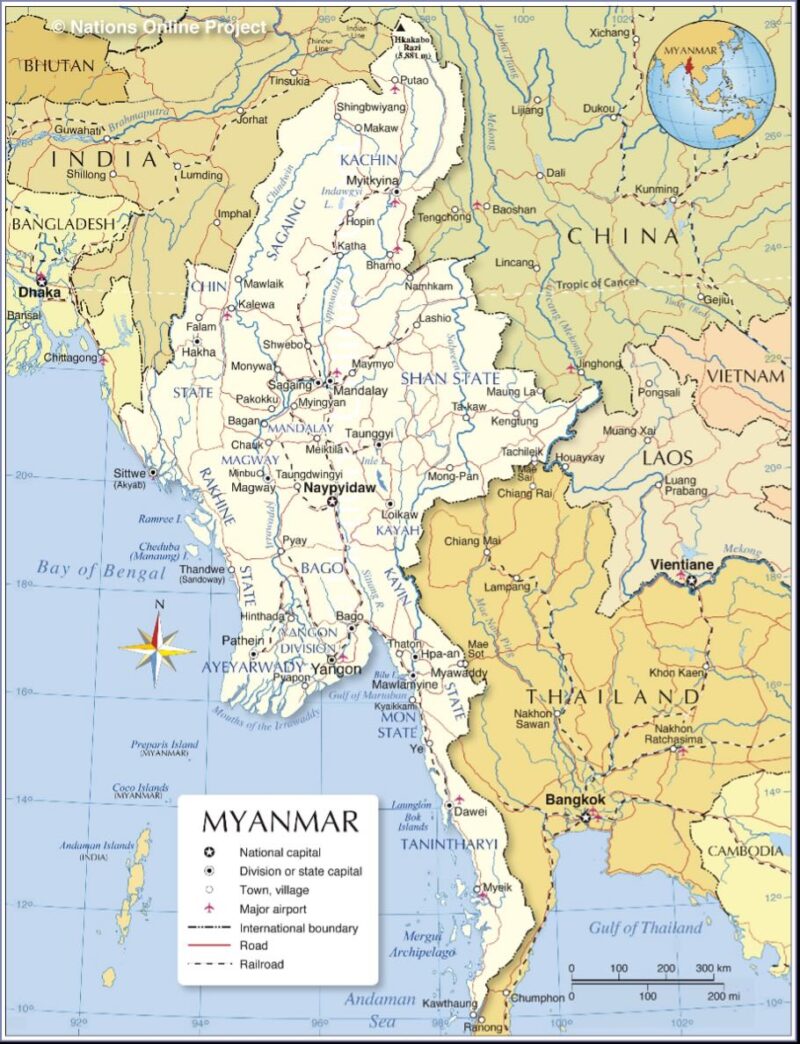
    Fighting in Myanmar is now in its fourth year. The military junta continues to suffer reverses on the battlefield. Large portions of Rakhine State and certain portions of Chin State are now under the control of the Arakan Army (AA). International Crisis Group has recently averred that ‘..in just a few months, the Arakan Army has created the largest area in Myanmar under the control of a non-state armed group – in terms of both size and population – and is now on the verge of securing almost all of Rakhine[vi].

    In Shan state to the North, the Three Brotherhood Alliance (TBA) of three Ethnic Armed Organisations (EAOs) had by December 2023, captured over 20,000 square kilometres of territory, including key border crossings and trade routes between China and Myanmar in Operation 1027[vii].  On 07 March 2024, the Kachin Independence Army (KIA) launched Operation 0307 and successfully captured certain military posts across  Kachin State close to the Chinese border. This forced the Tatmadaw (Myanmar military) to redeploy, further thinning out forces[viii]. Fighting also continues in other states and regions across the country, notably Sagaing and Kayah.

    Associated Press deduces that ‘.. the announcement of the measure on state television amounts to a major, though tacit, admission that the army is struggling to contain the nationwide armed resistance against its rule..’.The Junta has since conscripted Rohingya youth and deployed them against the Rakhines. 

    Notwithstanding these losses, there is no let-up in the Tatmadaw’s efforts to combat the rebels. The Junta has resorted to conscription to stem rising attrition, activating an old law in this regard. Associated Press deduces that ‘.. the announcement of the measure on state television amounts to a major, though tacit, admission that the army is struggling to contain the nationwide armed resistance against its rule..[ix] To further contextualise, the same article stated the rebel National Unity Government’s (NUG) claim that more than 14,000 troops have defected from the military since the 2021 seizure of power. The Junta has since conscripted Rohingya youth and deployed them against the Rakhines. The Chins fear that they too will be acted upon similarly.[x]

    To overcome the asymmetry of force especially in artillery and airpower, the rebels have acquired large numbers of drones. These are being used to bomb military positions, contributing significantly towards the successes of the CNA’s operations[xi].  To summarise, Myanmar’s civil war continues to see-saw with no signs of ebbing. The Junta continues to make periodic peace overtures to the NUG with conditionalities that the latter is unwilling to accept[xii]. With the multiplicity of actors and issues involved, there are no clear indications of how and when the conflict will be resolved.

    Impact of the  Myanmar Conflict on India’s North-East

    The impact of Myanmar’s internal situation on India’s border states has progressively worsened. Initially, after the Junta takeover, it was Mizoram which bore the brunt. The state government citing common ethnicity and humanitarian concerns accepted the influx of Chins from Myanmar as a moral responsibility and initiated rehabilitation measures. These refugees along with earlier refugees from Bangladesh recently joined Kukis from Manipur, number around 44000 and continue to remain in refugee camps.[xiii] The Central government has had to reconcile its policy of preventing infiltration across borders with the societal realities of Mizoram. A positive outcome of this approach is that there has been no violence in Mizoram.

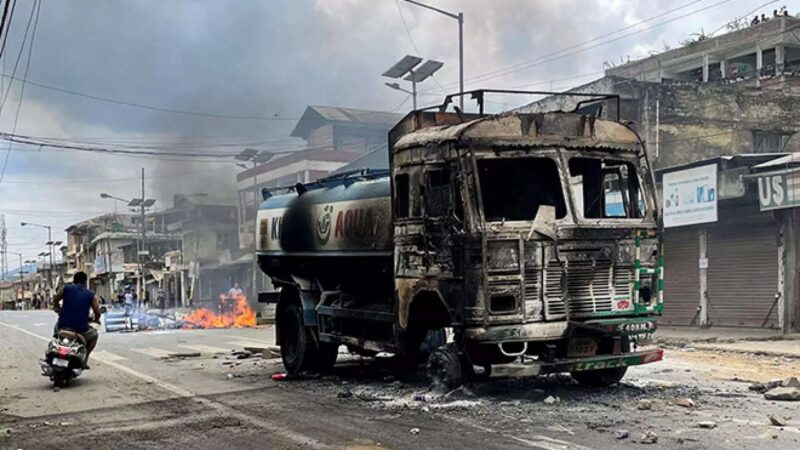
    In Manipur, by September 2024, the 18-month-long ethnic conflict had resulted in over 225 deaths and some 60,000 people displaced.[xiv] The administration has been derided by both sides, more so with recent warnings about impending threats to law and order[xv] followed by retractions[xvi]. People of either community have been uprooted from their homes and moved to safe areas separated by buffer zones guarded by security forces.  So great is the mutual suspicion that on the clamour of the Meiteis to replace the Assam Rifles, two battalions of this central force have been withdrawn and replaced by the Central Reserve Police Force (CRPF), against the wishes of the Kukis[xvii].

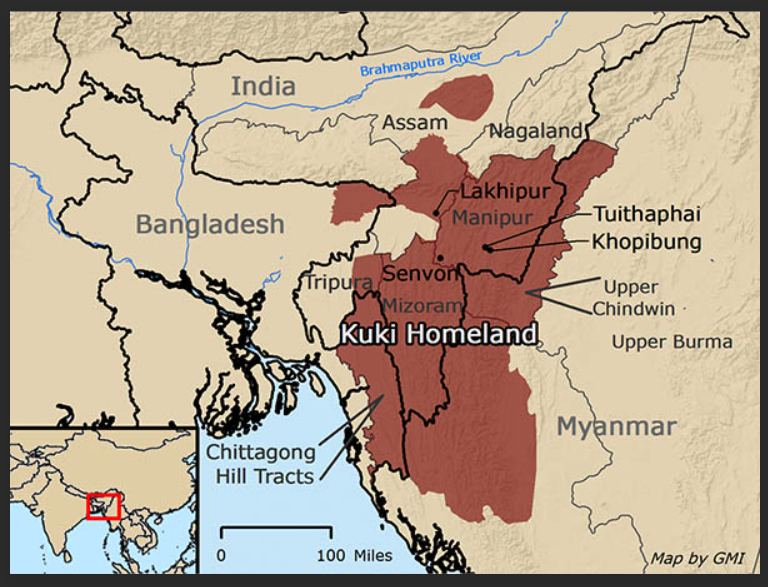
    Voices for an independent ‘Kukiland’ for the Kuki Zo peoples are being raised,[xviii] which are variously interpreted as a demand for greater autonomy within Manipur or for a separate union territory. The current happenings also dredge up the old ghost of ‘Zale’n-gam’ or Kuki nation, comprising the Chin Kuki Zomi peoples (including Mizos) residing across India, Bangladesh and Myanmar. Zale’n- gam has few takers and appears restricted to a YouTube channel[xix]. Today both sides fight each other with a variety of weapons including improvised rockets and drones. Hostage-taking is the latest tactic that has been adopted.[xx]

    Tension between the Nagas of Manipur and other communities is discernible with some reports of violence against the former.[xxi] As of now Nagas have kept out of the Kuki-Meitei dispute; also, other than the insurgent National Socialist Council of Nagaland ( Isak Muviah) faction (NSCN-IM) that is observing a ceasefire with the Centre, no other party has demanded integration of all Naga inhabited areas in India ( Arunachal Pradesh, Assam, Manipur) and Myanmar – the idea of  Greater Nagalim.

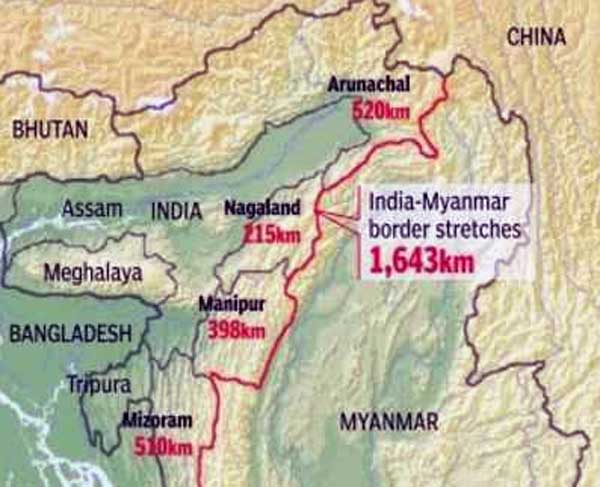
    At the state level, the responses of Mizoram and Manipur to the Myanmar crisis vary. This can be best seen in their reactions to the Centre’s recent notification to fence the entire 1643 Km Myanmar border and its earlier decision to end the Free Movement Regime that permits movement on both sides of the border for up to a distance of 16 km.[xxii]  While the Mizoram government and tribes living in both states oppose the decisions, the Manipur government clamours for its implementation. Currently, only around 30 Km of the border has been fenced.

    Since the Tatmadaw now has limited control over its border areas, it has become imperative for India to commence a structured dialogue with other warring parties in Myanmar’s border regions. This, with a view to restoring the situation in Manipur (and on the border) through mutually acceptable solutions at least for the short to medium term, is necessary. Only then can a modicum of security on the border be guaranteed. This involves navigating a maze of ethnic, religious, historical and societal issues with great sensitivity. The importance of such a dialogue cannot be overemphasised, more so because of recent developments in Bangladesh.

    The Impact of Bangladesh’s ‘Second Liberation’
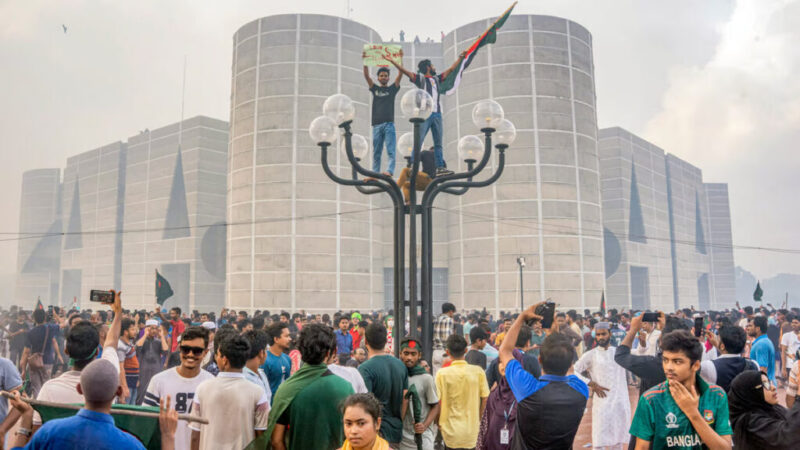
    The events of 5 August 2024  that witnessed the overthrow of Sheikh Hasina’s government have proved to be yet another watershed in India-Bangladesh relations. India has invested more in the India-Bangladesh relationship than with any other neighbour in South Asia. A glance at the website of our Ministry of External Affairs[xxiii], where details of various agreements and summaries from the last Prime Ministerial meeting in Delhi in June 2024 are provided, will suffice to show just how strong and all-encompassing this relationship has become.

    Persons or organisations associated with the previous regime have either fled the country or been placed under arrest and assets confiscated. A few have been killed by mobs. Bank accounts of others have been frozen. Jamaat e Islami which collaborated with the Pakistan Army in 1971 has been resurrected. Extremists with proven murder charges against them have been freed from prison, as have political prisoners.
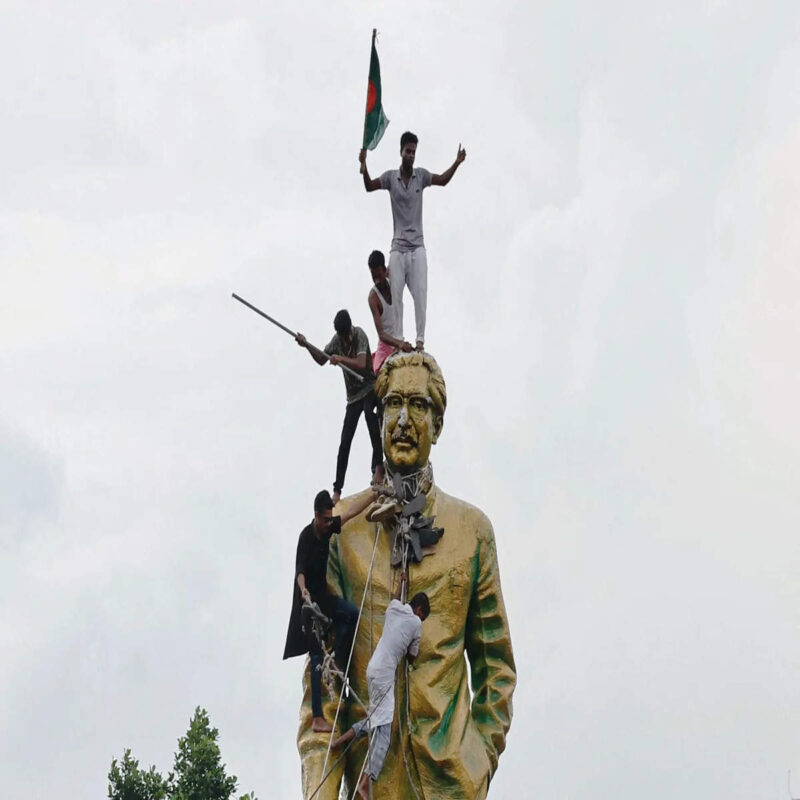
    At the time of writing, it is two months since the interim government headed by Chief Advisor Mohammed Yunus assumed charge.  The country continues to make efforts to reestablish the rule of law. All wings of the armed forces have been given magisterial powers[xxiv]. The functioning of the judiciary, higher civil services, local administration, police, security agencies, banking, economy, and higher education, is under review. Persons or organisations associated with the previous regime have either fled the country or been placed under arrest and assets confiscated. A few have been killed by mobs. Bank accounts of others have been frozen.[xxv] The Jamaat e Islami which collaborated with the Pakistan Army in 1971 has been resurrected. Extremists with proven murder charges against them have been freed from prison, as have political prisoners. Commissions have been set up to suggest reforms in the constitution, electoral system, police, judiciary, public administration and in tackling corruption.  Elections do not seem to be on the horizon yet. The advisers ( as the ministers are currently known) are new faces, not well known in India.

    While this paper does not attempt to be a study of India-Bangladesh relations, the polarised politics in that country coupled with a perception that the misdeeds of Sheikh Hasina’s government were conducted with impunity because of Indian backing, is sure to impact India’s portrayal here.

    With the removal of Sheikh Hasina, the India-Bangladesh relationship is undergoing a major reset. Statements of certain public figures and sentiments of a section of the population in that country suggest that a different perspective on the evolution of Bangladesh as a nation from 1971 onwards is emerging. While this paper does not attempt to be a study of India-Bangladesh relations, the polarised politics in that country coupled with a perception that the misdeeds of Sheikh Hasina’s government were conducted with impunity because of Indian backing, is sure to impact India’s portrayal here. This will make it an arduous task for both countries to go back to the trusted, cooperative and mutually beneficial relationship that existed. As mentioned, the list of achievements for both countries is far too numerous –  settlement of land and oceanic borders,  road, rail and riverine connectivity (including use of ports), economy and business ( both government and private), education including educational scholarships, technology, disaster management, border management, maritime security, military to military cooperation, improved people to people contacts, culture and health. As per records, of the 16 lakh visas issued by India for Bangladesh nationals in 2023, 4.5 lakhs were for medical treatment alone[xxvi]. Economies are so embedded that everyday necessities like onions are exported regularly to Bangladesh ( approximately 6 to 7 lakh tonnes annually).

    Even as the new regime provides assurances on the security of minorities and acknowledges India as an important neighbour, the enthusiasm with which it has interacted with official interlocutors from a host of nations worldwide especially China, Pakistan and the US is noteworthy and indicates where its newfound priorities might lie.

    A parallel reality, however, is that negative perceptions about India have historically found space in sections of Bangladesh’s polity. These have received a huge fillip after the change of regime with even settled agreements prone to misunderstanding. A recent example pertains to a tripartite agreement dating back to the Hasina period whereby electricity is to be imported from Nepal via India to Bangladesh. The agreement was signed in Kathmandu in the first week of  October 2024. Newspaper reports from Bangladesh indicate that there is palpable resentment over the condition that Indian transmission systems inside Indian territory be utilised for this purpose since it increases costs per unit of electricity in Bangladesh.[xxvii] Another issue currently bedevilling relations is the state of minorities in Bangladesh who have faced attacks on their homes, businesses and religious places with some loss of life, since the protests in July. India’s concerns in this regard have been conveyed at the highest level. Even as the new regime provides assurances on the security of minorities and acknowledges India as an important neighbour, the enthusiasm with which it has interacted with official interlocutors from a host of nations worldwide especially China, Pakistan and the US is noteworthy and indicates where its newfound priorities might lie.

    Larger Implications for India

    Bangladesh and Myanmar are pivotal for India’s Act East policy from the security, economic and connectivity angles. The issues pertaining to Myanmar and Manipur have been brought out earlier. A common concern affecting both nations and  India is the Rohingya crisis. Despite international pressure and requests from Bangladesh for China to intercede with Myanmar on its behalf, there has been no positive response from Myanmar. Bangladesh, which currently hosts close to one million refugees,[xxviii] has publicly expressed its inability to accommodate any more Rohingyas and asked for a speedy ‘third country settlement’ [xxix]. A detailed report of the International Crisis Group (ICG) in October 2023[xxx]provides details of activities of militant organisations like the Rohingya Solidarity Organisation (RSO) and Arakan Rohingya Salvation Army (ARSA) which are involved in drug running from Myanmar along with Bangladeshi syndicates for sale of the product in that country. Their participation in violent crime and other illegal activity has become a pressing concern within Bangladesh. Rohingyas have infiltrated into India as well, and have been identified as far North as Jammu. The security implications of such migration for both Bangladesh and India are apparent. The insensitivity of the Myanmar Junta on this account is heightening security risks for India and Bangladesh and merits diplomatic intervention.

    With the situation in Bangladesh evolving by the day, it is prudent for India to take a strategic pause as it weighs its options for pursuing its Act East policy. While giving the new regime in Bangladesh its due, India has to consider the impact of resurgent forces aided by inimical powers that aim to derail the India-Bangladesh relationship beyond repair. Even as both countries attempt to reestablish strong ties, the old adage preached by educated Bangladeshis in the context of support to Sheikh Hasina’s regime that ‘India should not put all its eggs in one basket’ resonates. While Myanmar geographically cannot provide the singular advantages that Bangladesh can, it is time for India to press for securing Myanmar’s cooperation to complete pending projects in that country, such as the Kaladan Multi-Modal Port Project (KMMPP) via Sittwe and Paletwa, that provides an alternate route to our North East, as well as the Trans Asian Highway (TAH) that provides connectivity with the rest of ASEAN, amongst others.

    To summarise, two possible reasons for inviting rebel Myanmar groups to Delhi could be: first, the relative viability of either Bangladesh or Myanmar to help implement the Act East policy in light of the emerging situation in Bangladesh and the state of the civil war in Myanmar. The second, ensuring security on the India-Myanmar border, to prevent aggravating the situation in India’s border states.


    Notes:

    [i] ‘Exclusive: India extends unprecedented invite to Myanmar’s anti-junta forces, sources say’ Wa Lone and Devjyot Ghoshal Reuters September 23, 2024

    [ii] ‘Govt aims to make Northeast gateway of ‘Act East Policy’: President Murmu’ Press Trust of India 27 June 2024.

    [iii] Ibid.

    [iv] ‘Japan to tie landlocked Northeast India with Bangladesh’  Saleem Samad  The Daily Messenger 05 March 2024.

    [v] Press Information Bureau Government of India Ministry of Shipping note dated  10 June 2015

    ‘Bangladesh, Bhutan, India and Nepal (BBIN) Motor Vehicle Agreement for the Regulation of Passenger, Personal and Cargo Vehicular Traffic amongst BBIN’

    [vi]   ‘Breaking Away: The Battle for Myanmar’s Rakhine State Asia Report N°339 | 27 August 2024’ International Crisis Group (Executive Summary).

    [vii]   ‘As Myanmar’s Junta Loses Control in the North, China’s Influence Grows’  Jason Tower, United States Institute for Peace, August 1, 2024.

    [viii] Ibid.

    [ix]   ‘Facing setbacks against resistance forces, Myanmar’s military government activates conscription law ‘ Associated Press, February 12, 2024.

    [x] ‘India’s ‘Forgotten Partition’ and the Myanmar Refugee Crisis’  Swapnarka Arnan The Diplomat  11 May 2024.

    [xi] ‘We killed many … drones are our air force’: Myanmar’s rebels take on the junta from above. Aakash Hassan and Hannah Ellis-Petersen  The Observer 20 January 2024.

    [xii] ‘Armed Groups Snub Myanmar Junta ‘Peace’ Offer’  The Irrawaddy 28 September 2024

    [xiii] ‘Centre provides 1,379 MT rice to Mizoram for Manipur, Myanmar, B’desh refugees’ Morung Express 25 September 2024.

    [xiv] ‘Ethnic violence in India’s Manipur escalates, six killed’  Tora Agarwala Reuters  September 7, 2024

    [xv] ‘900 Kuki militants infiltrated Manipur from Myanmar, says Security Advisor’ India Today NE September 20 2024.

    [xvi] ‘Input on infiltration by 900 Kuki militants could not be substantiated on the ground, says Manipur security advisor’ Vijaita Singh The Hindu 26 September 2024.

    [xvii] ‘Kukis call removal of Assam Rifles from 2 Manipur areas ‘biased, appeasement’, Meiteis call it ‘victory’  Ananya Bhardwaj  The Print 04 August 2024.

    [xviii]‘ Manipur: Kuki-Zo organizations hold rallies, demand separate ‘Kukiland’ for peace  by Northeast News

    August 31, 2024.

    [xix] YouTube channel titled ‘Zalengam Media’.

    [xx] ‘Kuki militants seek release of ‘secessionist’ in Manipur’ Prawesh Lama and Thomas Ngangom Hindustan Times Sep 30, 2024.

    [xxi] ‘Keep us out of your war, Manipur Naga body warns two warring communities’  The Hindu Bureau 06 February 2024

    [xxii] ‘Government sanctions ₹31,000 crore to fence Myanmar border’   The Hindu

    Published – September 18, 2024

    [xxiii] Ministry of External Affairs, Government of India website mea.gov.in.

    [xxiv] ‘Navy, the air force also granted magistracy powers’  The Daily Star September 30 2024

    [xxv] ‘Bank accounts of Joy Putul Bobby frozen’ Dhaka Tribune 30 Sep 2024.

    [xxvi] ‘Indian High Commission in Dhaka, facing protests & threats, returns 20,000 visa applicants’ passports ‘ Ananya Bhardwaj  The Print   29 September 2024.

    [xxvii] ‘Bangladesh delegation in Nepal to sign the contract to import 40 MW electricity’ Dhaka Tribune 30 September 2024.

    [xxviii] Operational Data Portal of the United Nations High Commissioner for Refugees, for Bangladesh.

    [xxix] ‘Bangladesh calls for faster resettlement process for Rohingya’ Ruma Paul  Reuters  September 8, 2024

    [xxx] ‘Rohingya Refugees in Bangladesh: Limiting the Damage of a Protracted Crisis’ International Crisis Group Autumn Update 04 October 20223.


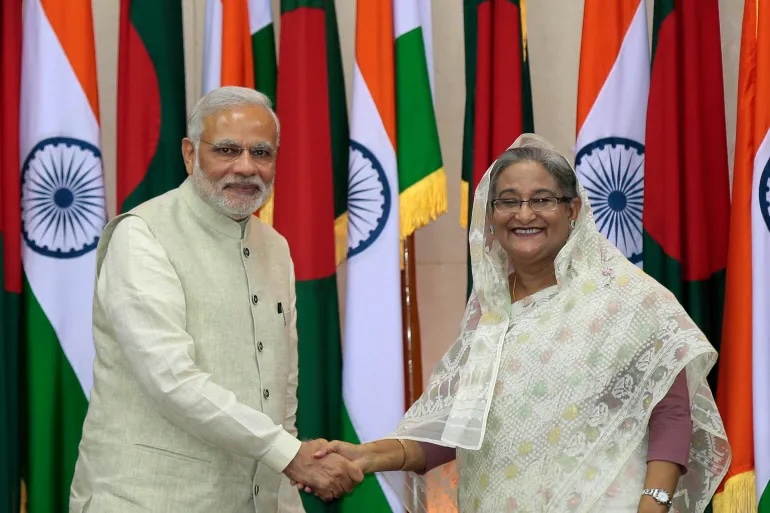
    Feature Image Credit: What does Sheikh Hasina’s resignation mean for India-Bangladesh relations? – aljazeera.com 

    Map Credit: National Online Project

    Bangladesh Parliament Image: The Shattered Identity of a Nation: From Liberation to Chaos – borderlens.com

    Sheikh Mujibur Rahman’s Statue: Bangabandhu to Toppled Statue: Mujibur Rahman’s contested legacy post Bangladesh upheaval – Economic Times
     

  • MYANMAR:  READING THE TEA LEAVES

    MYANMAR: READING THE TEA LEAVES

    On 21 November 2023, India’s Ministry of External Affairs advised Indian citizens to avoid nonessential travel to Myanmar, given the evolving security situation in that country. It further advised that those already living in Myanmar should take precautions and avoid travel to regions affected by violence[i]. Earlier in the same month, UN Secretary-General António Guterres had expressed deep concern at the expansion of conflict in Myanmar[ii] . Both messages highlight the increasingly fragile situation in Myanmar, where two million people are displaced and over 286,000 similarly affected after the current upsurge in fighting[iii].


    Operation 1027 and its Implications

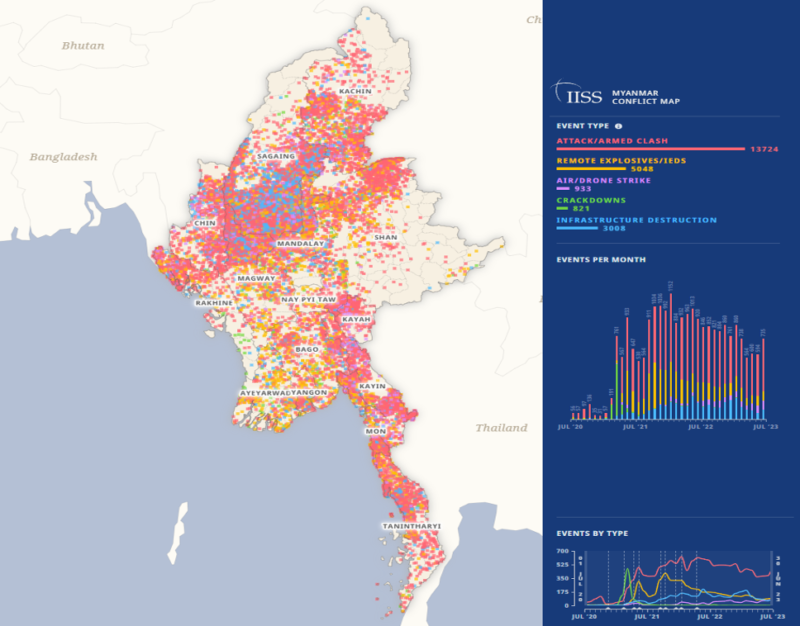
    The map published by the International Institute for Strategic Studies lists the number and type of violent events countrywide until July 2023. Since then, there has been a spike in the level of violence. Most prominent has been the coordinated attack on 27 October on Tatmadaw (Myanmar Army) posts in the Northern portion of Myanmar’s Shan state (see map), near the Chinese border by three Ethnic Armed Organisations (EAOs), assisted by other Peoples’ Defence Militias (PDFs). As per Richard Horsey of the International Crisis Group[i], the attacks, dubbed ‘Operation 1027’ (after the date they commenced), involved several thousand experienced, well-armed fighters attacking multiple army posts simultaneously. These troops owed allegiance to three major EAOs – the Myanmar National Democratic Alliance Army (MNDAA), the Ta’ang National Liberation Army (TNLA) and the Arakan Army ( AA), comprising different ethnicities ( Kokang, Ta’ang and Arakanese, respectively). Of the three, the first two are based in Shan state in the East, while the AA, as the name denotes, is based in Rakhine on Myanmar’s West coast, bordering some portion of the Chittagong Division of Bangladesh. Within two weeks, these three armies dubbed the Three Brotherhood Alliance, had seized several towns along the Chinese border, overrun military bases and captured large stocks of munitions. Specifically, to quote the Asia Times…the key border posts of Chin Swe Haw and Mong Ko were seized along with 80 military and police bases. More than 120 military bases have since been overrun, and sizeable amounts of arms and ammunition seized, including reportedly several 14.5 heavy machine guns (HMGs)…[ii]. ISP Myanmar, a Myanmarese think tank based in Thailand, notes that resupply columns are being ambushed on the main artery from Mandalay, around the area of Kyaukme, as shown on the map below[iii].

    Operation 1027 has created significant disruptions in the Myanmar-China border trade. The current offensive aims to eradicate online gambling and scam call operations from various casinos in the northern portion of  Shan and Kayin states bordering China and Thailand, an objective shared by the Myanmar Government, which is under pressure from China on this matter. Nationals from these countries, along with Chinese criminals, have been identified for their involvement in such illegal activity in concert with local pro-government militias. The rebels’ aim could likely be to gain China’s favour and wrest territory from Tatmadaw’s control[i]. To avoid the bloodshed, many Myanmar nationals are attempting to cross into China. China, whose proposed projects under the China-Myanmar Economic Corridor (CMEC) run through these regions in Northern Shan state, has since called for a ceasefire on this border[ii]. Noteworthy for military analysts, however, is the well-coordinated planning and execution displayed in these successful attacks, demonstrating the growing strength and assertiveness of the EAOs and PDFs operating over large swathes of territory.

     In concert with Operation 1027, EAOs have been equally active in other parts of Myanmar. The Sagaing region North of Mandalay bordering Manipur and Nagaland is witnessing fresh fighting[iii]. A Myanmar Army spokesman is quoted as having admitted that troops were under “heavy assaults from a significant number of armed rebel soldiers” in Shan state in the North, Kayah state in the East and Rakhine state in the West[iv]. In Rakhine, a year-long ceasefire between the Arakan Army and Tatmadaw collapsed, and fighting recommenced. In Kayah state bordering Thailand, a video clip (verified by Reuters) shows wounded Tatmadaw soldiers surrendering to the rebels who offer medical treatment to them. Fighting rages around the state capital, Loikaw, from which the UN has evacuated its personnel[v]. Heavy fighting has taken place in Chin state. The Junta has declared martial law in certain towns in Shan, Chin and Kayah states and Sagaing region.

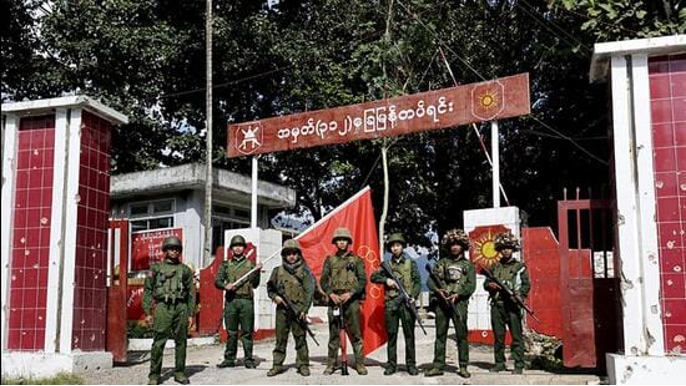
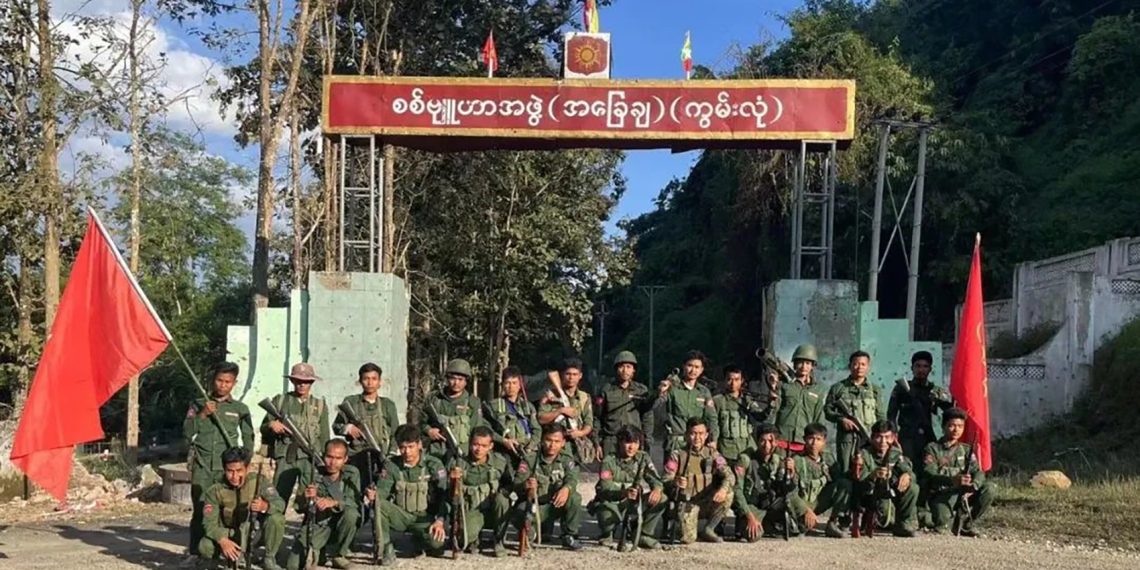
    Members of the Myanmar National Democratic Alliance Army pose for a photograph in front of the seized army’s infantry battalion in Kunlong township in Shan state, Myanmar, on 12 November. (AP). Courtesy: Rezaul H Laskar, Hindustan Times 15 November 2023.

    India’s Concerns

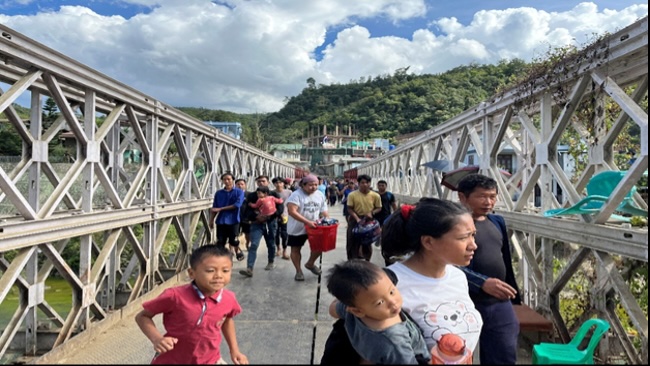
    With the Sagaing region bordering Nagaland and Manipur and Chin state bordering Manipur and Mizoram, the upsurge in violence has become a pressing concern for India, which is already grappling with the crisis in Manipur that has a linkage with Myanmar. In the current crisis in mid-November, Chin rebels overran two Tatmadaw posts on the India-Myanmar border in villages close to the Myanmar border township of Rikhawdar. This is adjacent to India’s Land Customs Station (LCS) at Zokhawthar. The Tiau River forms the boundary crossed by a Bailey bridge (picture below).

    Picture:  Courtesy Reuters

    A fresh flow of refugees (estimates from four to five thousand) has now crossed over to the Indian side to escape the fighting as the Tatmadaw attempts to retake these posts. This influx is in addition to those who crossed over earlier during the coup in February 2021. The capitulation of the Tatmadaw in these bases has also resulted in a unique situation; 74 Myanmar soldiers fled to India with their weapons and surrendered to the Indian authorities, who, at the request of the Myanmar Government, facilitated their return[i].

    All the above issues highlight the highly volatile climate in Myanmar, necessitating the Indian government’s advisory. Sufficient reportage exists to show that the rebel forces under the National Unity Government (NUG) are steadily gaining ground; Gen Min Aung Hlaing, Chairman of the State Administrative Council (SAC) and  de facto head of state conceded early this year that only 198 of the 330 townships are “100 per cent stable,” while the remainder required “security attention.”[ii] This is close to fifty per cent of the country. Clearly, the civil war is entering a more intense phase.

    State of the NUG

     The dynamism of the NUG can be gauged by its creative methods to raise revenues to support its war aims. Some of these mechanisms, based essentially on the buyers’ ( including the diaspora’s) good faith, are zero-interest bonds, real estate auctions of land (including government land taken from civilians – a lakeside villa appropriated by Gen Hlaing was auctioned some time ago), proposed condominiums for later construction, auctioning of mining rights and leases, lotteries, donations and tax collection. It provides primary education, health, justice and law and order in areas under its control. It has launched a digital currency that is run through the open-source blockchain Stellar network73, used through its digital wallet app, NUGPay. It uses commercial quadcopter drones for logistics, has commenced weapons production to include 60mm and 90mm mortars, and is experimenting with 3D printing[iii].

    The NUG’s success in creating such an infrastructure despite the SAC’s depredations and the victories of its forces on the ground over the last two years is testimony to the support it enjoys among the ordinary people, bolstered by sophisticated information operations. The latter includes a Policy Paper of 2021[iv], which enunciates NUG’s efforts to become more inclusive. A beginning has been made by appointing a Rohingya, Aung Kyaw Moe, to a ministerial post. His appointment as the NUG’s Deputy Human Rights Minister is a signal to others, including the UN whose Special Rapporteur for human rights in Myanmar, Tom Andrews, stated this year that ..’ Min Aung Hlaing, who led the genocidal campaign, is now at the head of an illegal and illegitimate military junta that is attacking civilian populations throughout Myanmar. He must be brought to justice and made to answer his crimes…[v]. The NUG Policy Paper promises to bring perpetrators of crimes against Rohingyas to justice and grant citizenship rights to all based on parentage or birth in Myanmar. It also speaks of developing a comprehensive repatriation plan for Rohingyas who have fled Myanmar. Resolving this issue will remove a significant obstacle in ties with Bangladesh, which shelters over one million Rohingyas while looking to curb activities of militant organisations like the Arakan Rohingya Salvation Army (ARSA). The ARSA operates from both sides of the border, using tunnels to move cadres to and fro and has frequently resorted to terrorism.

    Crystal Gazing

    What, then does the future hold for the SAC? The regime is facing multiple sanctions from the West. Citing ongoing violence, it had earlier announced the postponement of elections planned for August 2023 and continues with the state of emergency. It, however, seeks to exploit its geography as an Indian Ocean littoral and land bridge between South and South East Asia to gain strategic advantage. Trade with Russia has increased, and MOUs on cooperation in various infrastructure projects, including nuclear and natural energy, have been signed. Though the CMEC is now moving at a snail’s pace with many impediments and under constant security threats, none of its projects have been cancelled[vi] as has happened elsewhere. Russia and China are also the leading suppliers of advanced weapon systems to Myanmar. Military cooperation has been extended to naval exercises; this month, Myanmar held a three-day maritime security exercise’ with the Russian Navy from 06 November in the Andaman Sea for the first time. Again, on 28 November, two Chinese warships and a resupply vessel have docked in Yangon on a ‘goodwill visit’ to be followed up with exercises. Despite such signalling, there is no guarantee how much support these two countries would provide in an increasingly uncertain climate.

    India’s policy has been one of non-interference in Myanmar’s affairs. It has been feeling its way through the deepening crisis in that country that originated with the coup over two years ago. Government-to-government cooperation continues, with visits by senior Indian dignitaries on essential occasions. Though India does not support the NUG, looking beyond and planning for multiple outcomes is prudent.

    India’s priority is to have peace on the border with Myanmar. Instability here has directly impacted the internal security and societal dynamics of at least two border states. For securing the border, an advanced intelligent fencing system of 100 km along the border ‘is in the pipeline’ while a little over 6 Km has been physically fenced around the border township of Moreh in Manipur[vii]. Fencing the entire 1643 km long border is unlikely to find favour for multiple reasons – costs, physical difficulty, and social and political implications, especially when ethnic kin live on both sides with a Free Movement Regime (FMR) in place that permits movement up to 16 Km inside.

    The other way of securing the border will be through cooperation between the three affected parties – India, the SAC and insurgent groups operating in the vicinity. It is here that India’s leverages can come into play – the goodwill built up with local communities by sheltering and providing succour to those who have come across, and non-interference with activities of the Tatmadaw, including assisting as in the case of the fleeing soldiers. Considering that peace on the border will benefit all three parties, communication at the local level with the insurgents through intermediaries and parallel government-to-government interaction can ensure that guarantees for the same are obtained. This can be combined with rehabilitation projects for those displaced, with Indian assistance.

    Looking beyond the immediate, the difficulty in providing any prognosis for Myanmar should not obscure the fact that it remains among India’s most important neighbours and a vital cog of our Act East policy. With peace prevailing, its role in the development of our North East will only increase, as an overall assessment of the Kaladan Multi-Modal Transit Transport Project’s potential shows. A stable, peaceful and multi-ethnic Myanmar will always remain a  priority for India. In the interim, the need is to contemplate multiple outcomes and plan for eventualities, favourable or otherwise.


    Notes

    [i] ‘29 Myanmarese soldiers repatriated from Mizoram amid border tension’ Statesman News Service Aizawl 20 November 2023.

    [ii] ‘Sustaining Funding for Myanmar’s Spring Revolution’    Stimson Policy Paper  Zachary Abuza   May 17, 2023

    [iii] Ibid.

    [iv] ‘ Policy Position on the Rohingya in Rakhine State’ Republic of the Union of Myanmar National Unity Government June 03 2021.

    [v] ‘UN expert demands accountability for the Rohingya and an end to ‘paralysis of indifference’’ United Nations Human Rights Office of the High Commissioner,  press release 24  August 2023.

    [vi] ‘The Dwindling Prospects For Russian and Chinese-Backed Infrastructure Projects in Myanmar’ Syah Vaghji

    The Diplomat November 09, 2023

    [vii] Government of India Ministry of Home Affairs Annual Report 2022-23  Chapter 3  Border Management para 3.21


    Feature Image: Brotherhood Alliance fighters are seen at the entrance of a regime Army base in Kunlong on Nov 12, 2023/MNDAA – www.irrawaddy.com


  • Migrant or native, we are all out of Africa

    Migrant or native, we are all out of Africa

    No human group can make a concerted claim as regards nativism and try to make an ‘other’ an immigrant, foreigner or outsider

    Why, and how, does Mizoram get involved in the ongoing ethnic (and religious) strife that has been on for over three months in Manipur? The Kukis and Zomis in Manipur are ethnically related to the Mizos, the dominant community in Mizoram. The Mizos, in turn, are ethnically related to the Chins in Myanmar and the Kuki-Chins in Bangladesh.

    Together they all belong to the greater Zo community, speak a similar language, have common ancestry and parallels as regards their cultures and traditions. These latter groups are predominantly Christian and hence have a strong bond with the Mizos in Mizoram, a ‘Christian state’, like Nagaland. The Chief Minister of Mizoram, Zoramthanga, is a Mizo.

    In Manipur, the Meiteis, a Hindu community, are the majority and overwhelmingly numerically dominant. But it is interesting that the Meiteis are found in small numbers in Mizoram too, and many have started fleeing from the state. A similar fleeing of the Kukis from Manipur to Mizoram has happened. Also, there are the Naga groups in different pockets of Manipur. The neighbouring state of Nagaland has 17 officially recognised Naga groups.

    It is exasperating, and quite disquieting, to note the presence of ethnic groups that are dominant in one state, being minorities in a neighbouring state. Such existence has given rise to very foreboding situations and added to the already prevailing ethnic conflicts in India’s North-East.

    It is not just that the Indian states in the region share common borders. There are international borders too in the area, as Bangladesh and Myanmar adjoin the Indian states. Different communities/tribes/groups of people have lived in the regions that are the focus of our discussion for aeons. Such inter-state and international habitations of ethnic groups across states/countries are come across elsewhere in the world too.

    One of the most interesting and classic instances of a single ethnic group, who regard themselves as a single nation, and inhabit more than one country, is that of the Bedouin (found in Syria, Algeria, Morocco, Libya, Egypt, Israel, and so on). Such situations come about because free-ranging groups of people, or partially or fully settled groups of people, got divided into different states or countries because of the coming in of boundaries and division of territories.

    What would have been the scenario if these borders between states and countries had not come up? We would undoubtedly have diverse groups living in enclaves, either quite separated or adjoining each other either as small groups or larger ones, but sans the borders dividing them; the question of majority/minority or dominance/subservience would not, probably, have had the same kind of meaning or effect as has happened due to the drawing of borders between states and countries.

    Borders that formed between enclaves of diverse inhabitants and made groups of people dominant and/or majority groups have resulted in hegemony, where the traditions, customs, practices, and mores of that group have gained significance. These traditions and customs prevail extensively when compared to the practices of the smaller groups in that same area. Invariably, the dominant group makes claims to being the ‘original inhabitants’ and the ‘natives’ of the state/country concerned.

    Quite often co-habitants develop similar institutions and social and cultural practices despite the differences and diversity between them, and this is quite apparent in multicultural societies. Amitav Ghosh argues that “it is … the vitality of the place itself that creates commonalities between the people who dwell in it, no matter what their origin” (The Nutmeg’s Curse, page 221). But sadly, it is the differences that often come to the fore, and similarities remain latent.

    Here, it is pertinent for us to dwell on the facets of claims that groups make as regards being the autochthons and natives of a given state/country. By extension, the non-dominant groups are labelled ‘immigrants’, ‘foreigners’, and ‘outsiders’. Prior to ‘Out of Africa’, and the spread of Homo sapiens to the different parts of the world, somewhere between 80,000 and 50,000 years ago, there were no fully evolved human beings in any part of the world. Subsequent to a group of them leaving Africa, different parts of the Earth got populated gradually.

    All the physiognomic and phenotypical differences that we find among humans today, including skin colour, hair texture, and colour of the eyes came about as a result of where people settled.

    To put it tersely, no human group can make a concerted claim as regards nativism and try to make an ‘other’ an immigrant, foreigner or outsider. Ghosh endorses this when he says “Except for one small part of Africa, nowhere on Earth can people be said to be truly native, in the sense of having come into being on that soil” (The Nutmeg’s Curse, page 221).


    This article was published earlier in Deccan Herald.

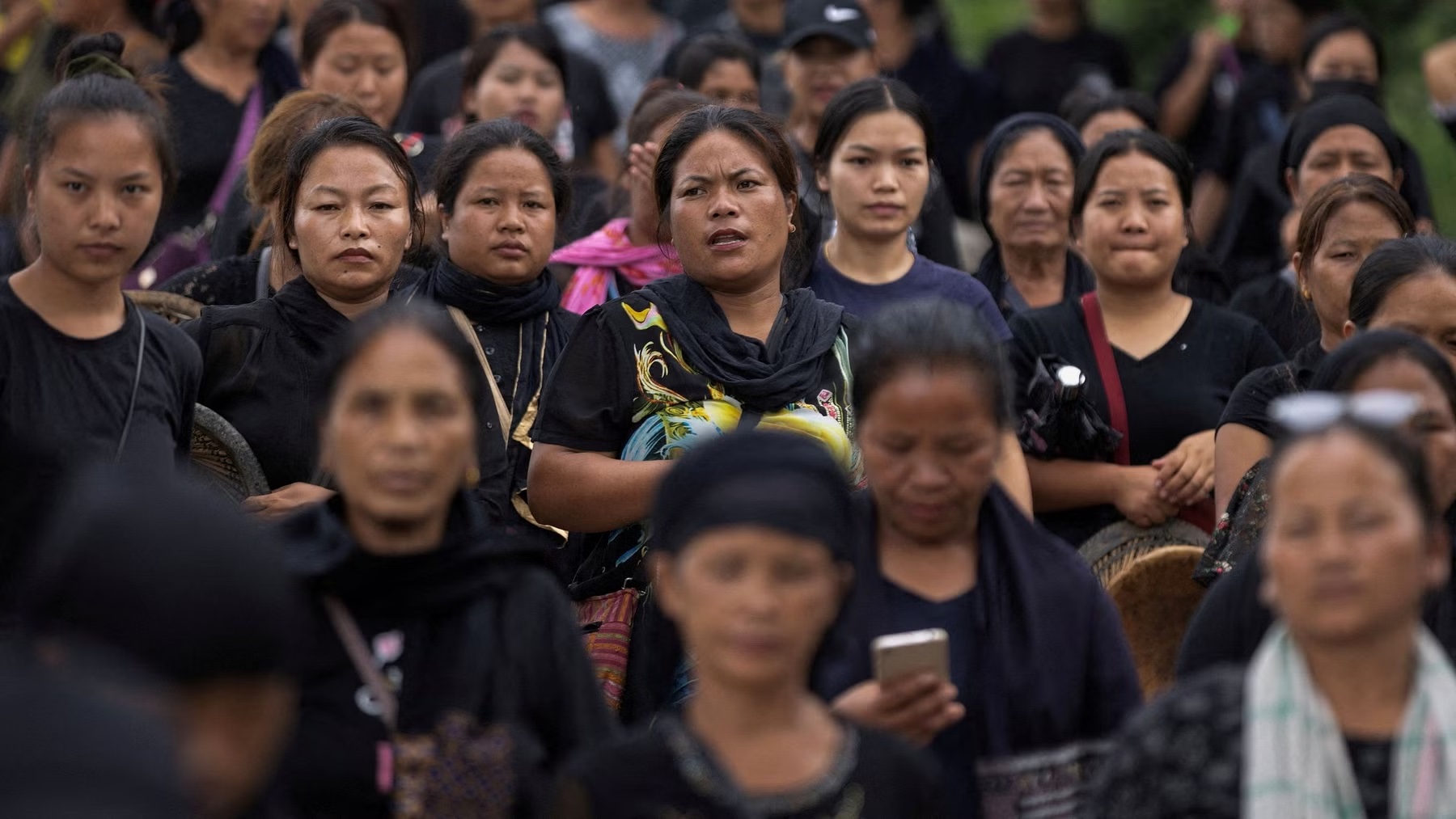
    Feature Image:Kuki women leave after attending a protest against the alleged sexual assault of two tribal women, in Churachandpur district in Manipur. Credit: Retuers Photo


  • Manipur: Into the Abyss

    Manipur: Into the Abyss

    Common sense tells us that all successful businesses are primarily driven by the profits they hope to earn. A possibility only in a peaceful and stable environment where law and order are not an issue. Therefore, the opening of the KFC restaurant at Churachandpur on 5th December last year, was a clear indicator that corporate honchos expected peace and prosperity to prevail in the State, as insurgency, which had lasted over five decades, seemed to have finally run its course.

    There were other indicators of this as well. Earlier, from 1st April 2022, the Central Government had removed the Armed Forces Special Powers Act (AFSPA) from 15 Police Station limits, in six districts. This was followed a year later, on 24th March 2023, with its removal from four more Police Station limits; a total of 19 Police Station limits in seven districts. This implied that neither the Army nor the Assam Rifles could operate in these areas without a formal request for their assistance from the State Administration, or without a magistrate being present.

    [powerkit_button size=”lg” style=”info” block=”true” url=”http://www.indiandefencereview.com/news/manipur-into-the-abyss/” target=”_blank” nofollow=”false”]
    Read More
    [/powerkit_button]
  • Manipur Violence: Understanding North East India is essential for viable Solutions

    Manipur Violence: Understanding North East India is essential for viable Solutions

    Whenever an ethnic clash or terrorist attack occurs in India’s Northeast, there is a beeline of “national media” reporters to the region for a quick report. Many energetic journalists move to the site of the incident to get “firsthand” information while many others air all kinds of” Breaking News” from cities like Guwahati or even from the national capital. In such a situation one can even see the emergence of “experts” who give their views from the comfort of their homes. These experts who had gained experience by serving in the region at some time in their careers do have adequate background knowledge, but they are at times out of sync with the ground realities. Ministers and political leaders also descend on the violence-hit region but many have political agenda and very often end up making unsolicited, unrealistic, and even provocative remarks. This trend is not new and is an increasing tendency for the past several decades.

    Unfortunately, such flying visits do not help. Sometimes such reporting that makes headlines in electronic and print media and is generally accepted as authentic may not convey the ground reality as some inputs may be biased or doctored depending upon the source of the information.


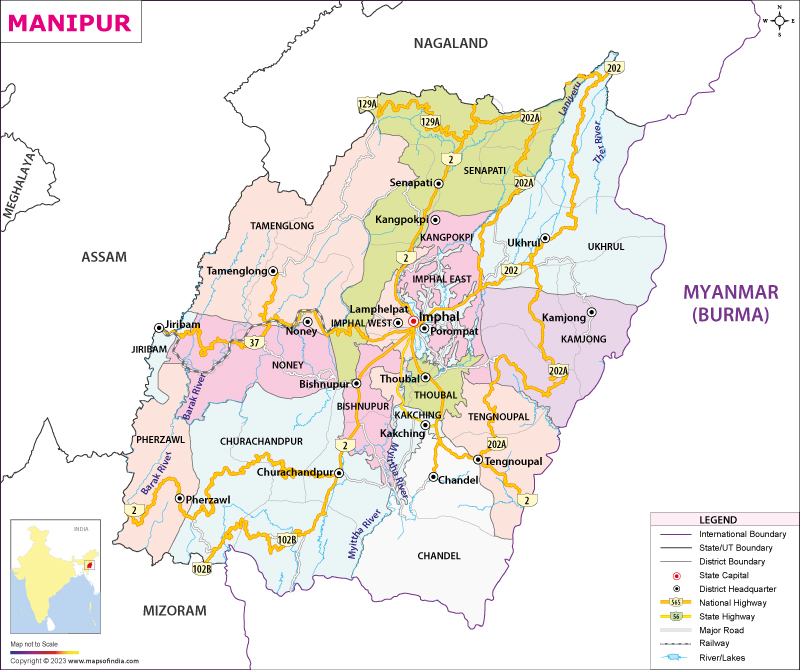
    Unlike other states of the country, the Northeast of India is unique with its cultural and geopolitical characteristics. The region shares 96% of its border internationally with four countries including China, and is an extremely complex region with more than 200 ethnic groups with distinct cultures, food habits, languages, or dialects. Amongst all the northeastern states, Manipur is the most complex state with more than thirty-five ethnic groups. The state shares a large part of its boundary with Myanmar (398 Kilometers) presently ruled by the Military junta.  Manipur also shares a boundary of 96 Km with Mizoram,205 km with Assam and 204km with Nagaland. The state has a diverse demography.  Nagas (24%) and Kukis (16%) are mostly Christians whereas Hindu Meities and Muslims constitute 53% and 6% of the population respectively.

     While India’s border with Pakistan and Bangladesh is fenced, the border with Myanmar is not. There is also a policy of Free Move Regime (FMR) which allows Citizens of both countries to come up to 16 Kilometers within each other’s territory without a visa or passport documentation. Though the aim of FMR is noble as it allows better interaction amongst people who are mostly from the same ethnic tribe,  it is prone to exploitation by militants, as well as smugglers.

    Myanmar military’s operations against rebel groups have forced many tribals particularly Chin-Kuki to enter Indian states particularly Mizoram and Manipur for safety. However, Meities allege that infiltration of Chin-Kuki, as well as rebels to Manipur from Myanmar, is part of a grand design to occupy land and carry out nefarious activities like land grabbing, arms smuggling, drug trafficking etc.  As per an unconfirmed report, approximately 35000 Chin/Kuki refugees from Myanmar have taken shelter in Mizoram and another about 5000 have taken refuge in Manipur.

    The smuggling of drugs, timber, areca nut, cheap Chinese clothes, and electronic items from Myanmar into Manipur and further to other parts of the country is a lucrative business. There is fierce competition to control the lucrative drug trade. While Kuki tribes are primarily involved in poppy cultivation, almost all other ethnic groups are involved in the drug trade in some form or other. It is learnt that fertilizer (urea) provided for distribution to farmers is diverted for poppy cultivation by vested interests with the connivance of Government officials.

     There are a large number of small or big militant groups active in Manipur, each vying for influence and claiming to be the “protectors” of the interest of the respective ethnic groups. Many of these groups, particularly Kuki militant groups, are under Suspension of Operation (SoO) with the Central Government.  Approximately 2000 Kuki militants representing about 26 different Kuki Militant groups are lodged in Designated Camps set up in various Hill districts of the state. The allegations by Meities that the Kuki militants are abetting and instigating Kukis to carry out violence against them cannot be ruled out. Similarly, Kukis allege the involvement of Meitei militants in the ongoing ethnic violence. The ethnic violence which has been continuing since 3rd May 2023 has not seen a substantial reduction despite Union Home Minister Amit Shah and others’ appeal. The Nagas are closely observing the emerging situations. In such a delicate environment all that is needed is just a spark to aggravate an already volatile situation.

    Despite many differences, the various ethnic groups have learnt to live together in Manipur. However, a number of actions in the recent past by the present ruling dispensation in the state has led to resentment amongst tribals mainly Kukis. These include eviction of Kuki encroachers from forest land, action against Kukis involved in poppy cultivation etc.    While these appear to be genuine actions of an elected Government, Kukis feel that they have been deliberately targeted. A section of Meities has now demanded that NRC (National Register of Citizens) should be made for Manipur state as they feel that immigration of Chin/Kukis from Myanmar has substantially increased. Thus, the trust deficit between Kuki and Meities had already reached a peak. It will take substantial effort from everyone from the Government machinery to the common citizen to restore confidence and goodwill amongst the ethnic tribes.

     The direction of the Imphal High Court on 27 March 2023  given out publicly on 19th April directing the Manipur Government to consider  ST status for Meities triggered a  large-scale violence on 3rd May. Incidentally, Muralidaran who was appointed Acting Chief Judge of Manipur High Court on 6th February 2023 had given the very important judgment within two months of his assuming office. The Supreme Court however on 17th May 2023, criticizing the Manipur High Court judgement as ‘factually wrong’, expressed the need to nullify the order of the Manipur High Court. It is worth noting that the President of the country is the constitutional authority vested with the power of declaring a Caste or Tribe as SC or ST. The case to declare Meities as ST was first filed in 2013 (MutumChuramaniMetitei versus the State of Manipur).

    According to the census records of 1891, 1901 and 1931, the Meitei was listed as a Scheduled Tribe, however, since 1951 were removed from the ST list of the Indian Union without any information or communication to the people of Manipur. In 1949, the Ministry of Tribal Affairs, Government of India constituted a minority commission to verify the social status of Meities. There are reasons to believe that many Meities were not keen on the ST tag as they probably felt that they were of a higher class and being accepted as tribal will lower their social status. However, a faction of low caste Meities enjoys OBC and SC status.

    Meities are probably now realizing the folly committed by their elders for not advocating for ST status.  Incidentally, like Nagas and Kukis, Meities are also from Mongoloid genetic backgrounds. However, in the 19th century, under the influence of Bengali Hindus, Meities adopted Hindu culture, accepted Vaishnavism, and hence, are influenced by caste and social stratification patterns.

    The pressure on land in the Manipur valley where other tribes (being ST) could own land as well as enjoy other benefits in terms of education and employment made the present generation of Meities feel insecure.  They realized that only if they were granted ST status could they buy land in the hills or compete in jobs with other tribes. In a civil writ petition filed by a section of Meites in Manipur High Court in April 2022, the High Court on 27th March 2023 had directed the state government to submit the recommendation to the Ministry of Tribal Affairs to include the Meities in the ST list.

    While both the tribes, namely Kukis and Nagas protested on 3rd May against the High Court’s directions, the protest by Kukis turned violent. It is also a singular failure of Biren Singh’s Government for not anticipating the law-and-order breakdown and accordingly taking effective measures to prevent the chaos.

    In Manipur, the tribals enjoy some benefits under Article 371C of the constitution as well as the Manipur Hill Area District Autonomous Council Act of 1972. However, Kukis have been demanding a separate Autonomous Council on similar lines of the Bodoland Territorial Council operative in Bodo-dominated areas of Assam.  Some Kukis have gone to the extent of demanding “Kuki land”, a separate state to be carved out of Manipur.  On the other hand, the demand of the Nagas is for the integration of Naga Areas of Manipur with Nagaland (Greater Nagaland). Therefore, the issues in Manipur are very complex.   Many other tribes in the Northeast have been raising demand either for ST status or Autonomous council or even for separate states.  Hence, the Centre needs to be very cautious in resolving the current Manipur imbroglio as the decisions can have ramifications in the other Northeast states.

    The Central Government, though sincere in its efforts at solving the problems of the Northeast, has made many mistakes in the past simply because of the politicians’ lack of patience to understand the intricacies of the region. One glaring example was the extension of the Ceasefire with NSCN (IM) to the state of Manipur in 2001. The Government had signed a Ceasefire agreement with dominant NSCN (IM) groups in 1997 which was confined to the state of Nagaland. However, under pressure from the NSCN (IM), the Govt in 2001 extended the Ceasefire to Manipur by incorporating the words “Without Territorial Limits”.  The Central Government’s decision, taken without understanding the psyche of Meities and without consulting the Manipur government, led to large-scale violence leading to the killing of thirteen protestors in police firing on 18 June 2001. The Government had no option but to withdraw the Ceasefire from Manipur. However, it took decades to normalize the relations between the Nagas and the Meities.

    Similarly, the “Assam Accord” signed by the Central Government with the All-Assam Student Union (AASU) in 1985 has been a non-starter even after almost forty years of signing the accord. The Assam Accord talks of “Detection, Deletion (from Voters List) and Deportation of illegal Bangladeshis who have entered Assam post-1971.  These illegal Bangladeshis cannot be deported to Bangladesh as there is no deportation agreement with Bangladesh. Moreover, Bangladesh denies that her citizens have infiltrated Assam or any other state. The government has signed an accord which it finds difficult to implement.

    The Manipur situation is becoming tricky with neighbouring state Mizoram getting involved in the Manipur issue. Mizos belonging to Chin tribes just as Kukis are providing all help to their brethren who have taken refuge in that state. Now a section of the people particularly from Mizoram are trying to bring a religious angle to the issue saying that Christians have been deliberately targeted in Manipur.   A section of Mizo politicians is now supporting the Kukis’ demand for Autonomous Council/ separate state that will further complicate the issue. Incidentally, a few newspapers published in Israel have also talked about the safety and security of the Jews in Manipur. Similarly, the role of RSS in the present violence has become conspicuous.

     Both Kukis and Meiteis are attempting to internationalise the issue which is essentially an internal issue of the country. On 30th June 2023, World Kuki-Zo Intellectual Council (WKZIC) submitted a memorandum to the Prime Minister of Israel seeking urgent intervention for the protection of the Kuki people. On 6th July 2023, the US Ambassador to India, Eric Garcetti, stated that the United States is ready to assist India in resolving the current ongoing issue.

     It is creditable that other ethnic tribes, particularly Nagas of Manipur have shown great restraint however, they are concerned about the possible political fallout of the ethnic clashes.  Their concern is that any solution between Kukis and Meities should not in any way put the Nagas in any disadvantageous position.

     The allegation by a section of Meitie leaders that Assam Rifles has been partial to Kukis appears to be politically motivated to malign India’s oldest Para Military Force.  The security forces, particularly the Assam Rifles, have been working round the clock to maintain peace in the state.  Assam Rifles has rescued Meities from Kuki-dominated hill districts and similarly had rescued Kukis from Meitei-dominated valleys. It is hoped that the Central Government does not give in to the demand of some BJP leaders of Manipur to withdraw Assam Rifles from the state. On the contrary, there are allegations that at times Manipur Administration, in particular, the state police have been biased. It is pertinent to note that sizeable arms were looted from many police stations by miscreants which indicates the nexus of police with the miscreants, especially at the lower level.

      Despite Home Minister’s appeal to surrender arms looted from many police stations, only a few have been deposited. COCOMI (Coordinating Committee of Manipur Integrity), in a statement on 07th June 2023, rejected Home Minister Amit Shah’s appeal to surrender looted arms and resolved not to allow Security Forces to launch operations to recover looted weapons. Such actions at this critical time are bound to aggravate the situation. The organization COCOMI has recently declared “Manipuri’s National War against Chin Kuki Narco terrorism”. Terming the entire Chin- Kukis as a narco-terrorist group will further widen the gap.  It is to be noted that the spoils of the drug trade are enjoyed by most of the tribes including smugglers based in places outside the Northeast region,

    The immediate aim, particularly of the Governments at the Centre as well as at the State, should be to win back the trust and confidence of people of all communities.  The civil society, the media and common Meitei as well as the Kuki people must play a responsible role keeping in mind the sensitivities of all communities. Panel discussions are good but putting one tribal group against another in the TV debate will further antagonize the common people. Similarly, people on social media must exercise utmost restraint.   A long-term solution will need great deliberation.  Patience and restraint are the key words at his juncture.


    The views expressed are the author’s own.

  • Consequences of the Manipur Conflagration

    Consequences of the Manipur Conflagration

    By any measure, the situation is bleak and what makes it even worse is the fact that thousands of weapons have been looted from police armouries…

    In the summer of 64 AD, nearly 2000 years ago, Rome, more or less, was completely razed to the ground in a fire that lasted six days. The hapless citizens, in utter frustration, turned on their much-despised Emperor, Nero. He was a patron of the arts, fond of music, with a talent for playing the Cithara or Kithára, an ancient Greek string instrument, not unlike our very own Sitar. Clearly that old and well-known adage “Nero played the fiddle while Rome burned”, was grossly unfair to him, not least, because the fiddle was only invented 1500 years later.

    In a manner of speaking, one cannot avoid but feel that our political establishment has, in many ways, ended up playing the proverbial fiddle as Manipur burns, as the only matters they seemingly have time for, are elections and inaugurations. And burning it is, though one would get a distinctly different impression, if our wonderful mainstream media is to be taken at face value. Fortunately, it seems that after nearly a month of unmitigated violence, they have finally been shamed into at least mentioning violence and Manipur together, though their coverage remains scanty and cursory, to say the least.

    [powerkit_button size=”lg” style=”info” block=”true” url=”http://www.indiandefencereview.com/news/consequences-of-the-manipur-conflagration/” target=”_blank” nofollow=”false”]
    Read More
    [/powerkit_button]