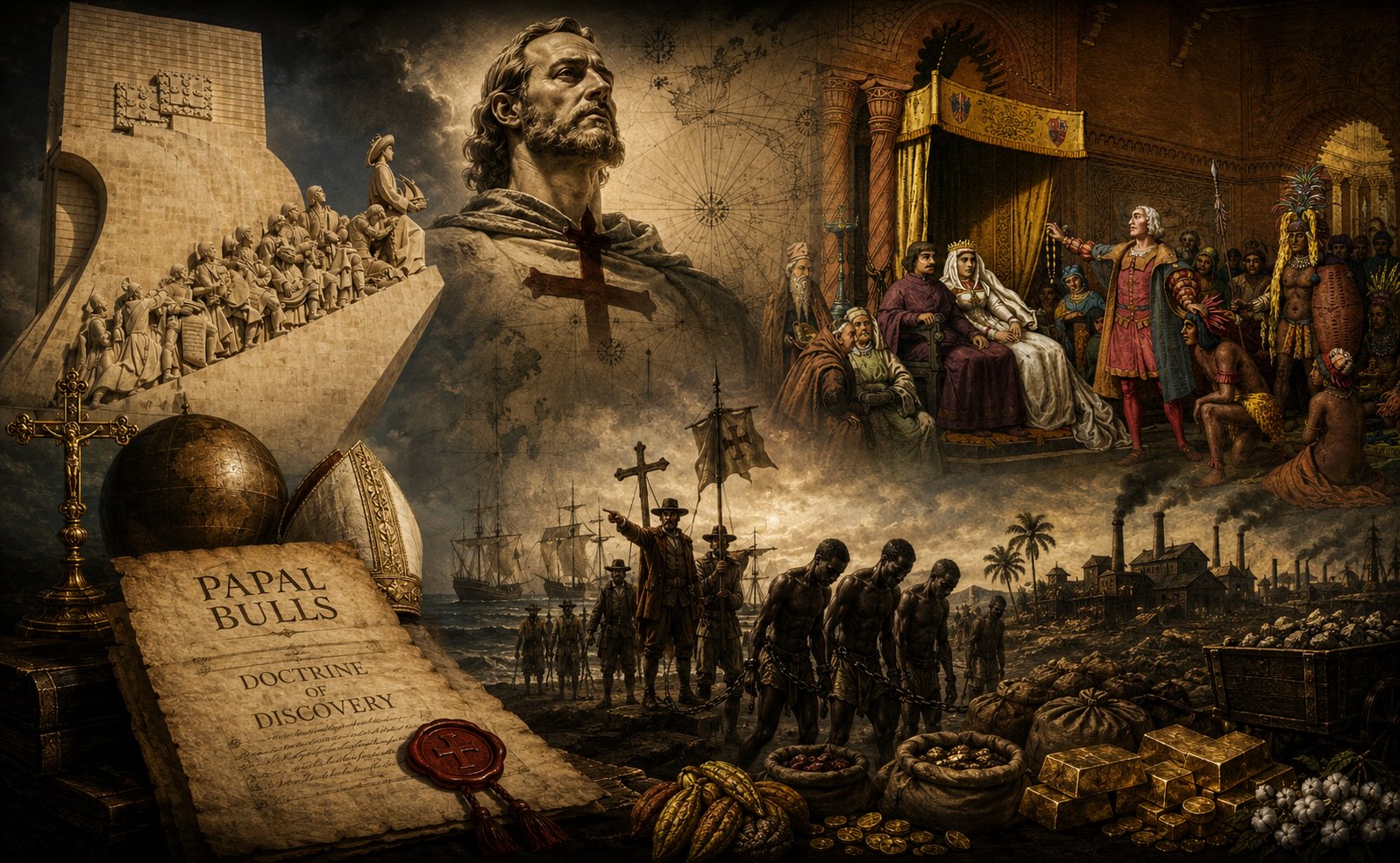
Series: India’s Strategic Choices, Civilisational Responsibilities, and the Contest for the Emerging World Order
This is the second of a three-part prologue to a series on India’s strategic choices, civilisational responsibilities, and the contest for the emerging world order.
Ideological Engine crafted with Religious Endorsement
In my previous post, I traced the material foundations of the current world order — the knowledge borrowed from the Islamic world, the wealth extracted from the Americas, two-thirds of humanity colonised and enslaved. It was the extraction, the enslavement, and the colonial architecture that built Western dominance. But material power alone does not sustain five centuries of global domination. It requires an ideological engine — a moral framework that converts extraction into mission, conquest into duty, and atrocity into the necessary price of civilisation. That engine was exceptionalism. And it was powered by religion.
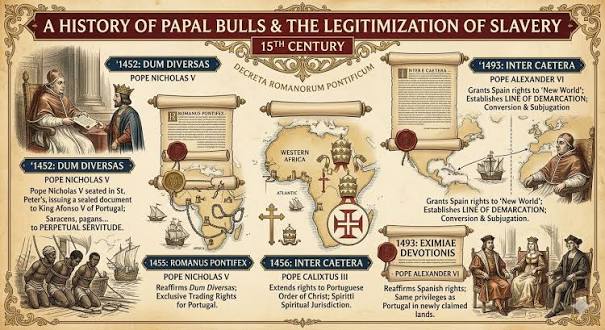
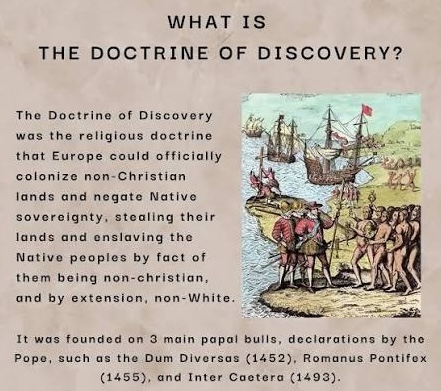
The mechanism was constructed with precision. In 1452, Pope Nicholas V issued the papal bull Dum Diversas, authorising the King of Portugal to “capture, vanquish, and subdue the Saracens, pagans, and any other unbelievers and enemies of Christ” and “reduce their persons to perpetual servitude.” Three years later, Romanus Pontifex extended this authority to conquer the lands of infidels for “the salvation of all”. In 1493, following Columbus’s return from the Americas, Pope Alexander VI issued Inter Caetera — the foundational document of the Doctrine of Discovery — declaring that any land not under Christian rule could be seized, its peoples subjugated, and its resources claimed, in the service of Christianising the world.
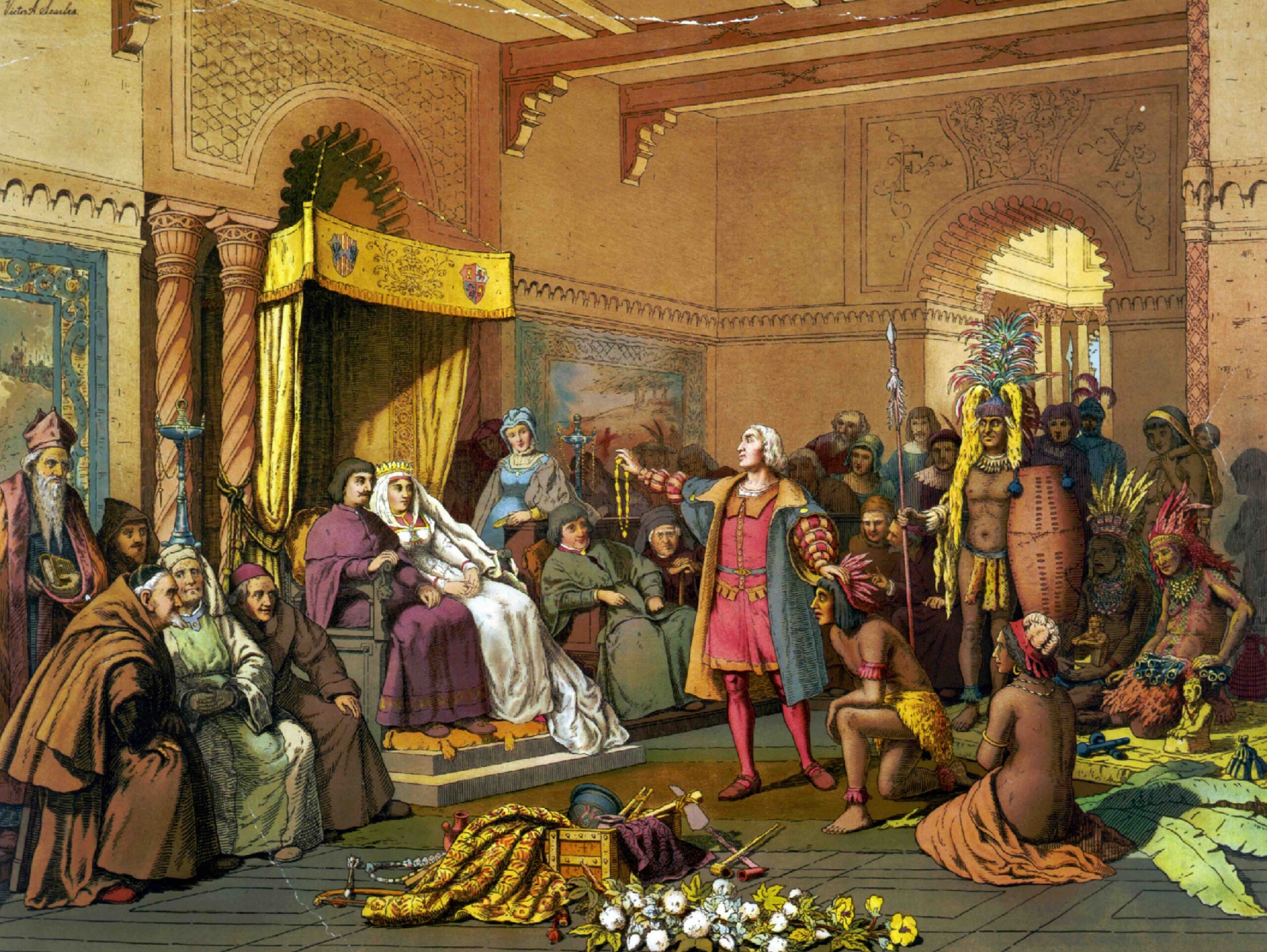
These were not peripheral theological documents. They were the legal and moral architecture of the colonial project, establishing in explicit terms sanctioned by the highest religious authority in the Western world that non-Christians were less than human, that killing them was not a sin, and that converting or enslaving them was a sacred duty. The Doctrine of Discovery was subsequently incorporated into the legal systems of the United States, Canada, Australia, and other settler-colonial states, where it shaped land law, property rights, and indigenous dispossession for centuries. The Vatican formally repudiated the Doctrine of Discovery only in 2023 — more than five centuries after the damage was done.
And here is what makes that repudiation hollow: the doctrine did not stay in the fifteenth century. It became the operating law of the settler-colonial states, and it remains so.
In 1823, the United States Supreme Court, in Johnson v. McIntosh, formally incorporated the Doctrine of Discovery into American law. Chief Justice John Marshall ruled that Indigenous peoples did not own their lands once those lands had been “discovered” by Christian colonists — that discovery itself conferred title on the discovering Christian nation, reducing the original inhabitants to mere occupants on their own soil. Marshall himself conceded the principle was “extravagant.” He made it law regardless. It has never been overturned. Two centuries later, it remains the foundation of all federal Indian law in the United States.
Plenary power — plenitudo potestatis, the fullness of power — is the exact phrase by which the fifteenth-century popes claimed the authority to authorise conquest and enslavement in the first place.
The living force of this doctrine was demonstrated in 2023 — the very year of the Vatican’s repudiation. In Haaland v. Brackeen, the US Supreme Court affirmed the modern form of the doctrine: the “plenary power” of the federal government over Native peoples. The term is not incidental. Plenary power — plenitudo potestatis, the fullness of power — is the exact phrase by which the fifteenth-century Popes claimed the authority to authorise conquest and enslavement in the first place. The Vatican renounced the doctrine in March 2023. Three months later, in June, the highest court of the United States reaffirmed its modern expression as settled law. One institution let go of the fiction. The other continued to build on it.
Terra Nullius and the Concepts of Exceptionalism and Manifest Destiny
The pattern is not confined to the Americas. In Australia, the entire continent was claimed under the doctrine of terra nullius — the legal fiction that the land belonged to no one, that sixty thousand years of continuous Aboriginal civilisation and hundreds of distinct nations simply did not count as habitation. The Australian Constitution, when it came into force in 1901, contained Section 127, which declared that “in reckoning the numbers of the people of the Commonwealth, aboriginal natives shall not be counted.” The original inhabitants of the continent were constitutionally excluded from the population of their own country. That exclusion was not removed until a referendum in 1967. The fiction of terra nullius itself was not overturned until the High Court’s Mabo judgment in 1992 — one hundred and ninety-two years after colonisation began.
The Doctrine of Discovery is not a historical curiosity to be studied and regretted. It is the living legal architecture on which the settler-colonial states were built, and on which — as the events of 2023 demonstrate — they continue to stand. The exceptionalism that authorised conquest in 1452 was not repented and abandoned. It was secularised, constitutionalised, and preserved.
This is the point that must be understood clearly. The Doctrine of Discovery is not a historical curiosity to be studied and regretted. It is the living legal architecture on which the settler-colonial states were built, and on which — as the events of 2023 demonstrate — they continue to stand. The exceptionalism that authorised conquest in 1452 was not repented and abandoned. It was secularised, constitutionalised, and preserved.
This is not a distortion of Christianity. It is the documented institutional expression of a specific tradition within it: the doctrine that one’s own community occupies a uniquely chosen position in the divine order — that the Other is not merely different but lesser, and that this difference legitimates domination.
The same logic operated, in different institutional forms, across other traditions. The conquering caliphates that used the concept of jihad to justify forced conversion were not the whole of Islamic tradition, which contains rich pluralist and humanistic streams. They were the weaponisation of religious exceptionalism by those who held political and military power. Political Zionism, in its most extreme contemporary expressions, follows the same pattern: the theological claim to exclusive divine right over territory and the dehumanisation of non-Jewish populations, ruthlessly visible from the Nakba in 1947-48 to the present conduct of the Gaza war, in full view of the world and with endorsement by the West. It follows the same pattern: religious exceptionalism converted into political licence for dispossession and violence.
The pattern is not one religion. It is a specific logic — the claim to divine chosenness that exempts a community from the moral constraints that apply to others – that has been institutionalised, at different moments and in different traditions, wherever political power has found it useful.
In Western civilisation, this logic found its most durable and consequential expression in American exceptionalism. In 1630, Puritan leader John Winthrop, preparing to establish the Massachusetts Bay Colony, called for the creation of a community that would be “as a City upon a Hill, the eyes of all people upon us.” This was not yet a global claim. It was a theological self-conception: a chosen people, on a divinely appointed errand, under special divine scrutiny. But the seed was planted. Two centuries later, in 1845, John L. O’Sullivan gave it political form: “our manifest destiny to overspread the continent allotted by Providence for the free development of our yearly multiplying millions.” God-given expansion across a continent — regardless of the peoples already living on it — was reframed as destiny, not conquest.
The indigenous peoples of North America experienced what that destiny meant in practice. At Sand Creek in November 1864, a Colorado militia under Colonel John Chivington attacked a Cheyenne and Arapaho village whose chief, Black Kettle, was flying both an American flag and a white flag of truce. Roughly 150 people were killed, the majority of them women, children, and the elderly; the soldiers mutilated the dead and paraded body parts through the streets of Denver. Three separate investigations — two congressional, one military — condemned it as a massacre. Not one man was ever indicted. The campaigns that defined the conquest of the West — villages destroyed, food supplies burned, non-combatants killed as a matter of strategy — were not the excesses of rogue commanders. They were the method.
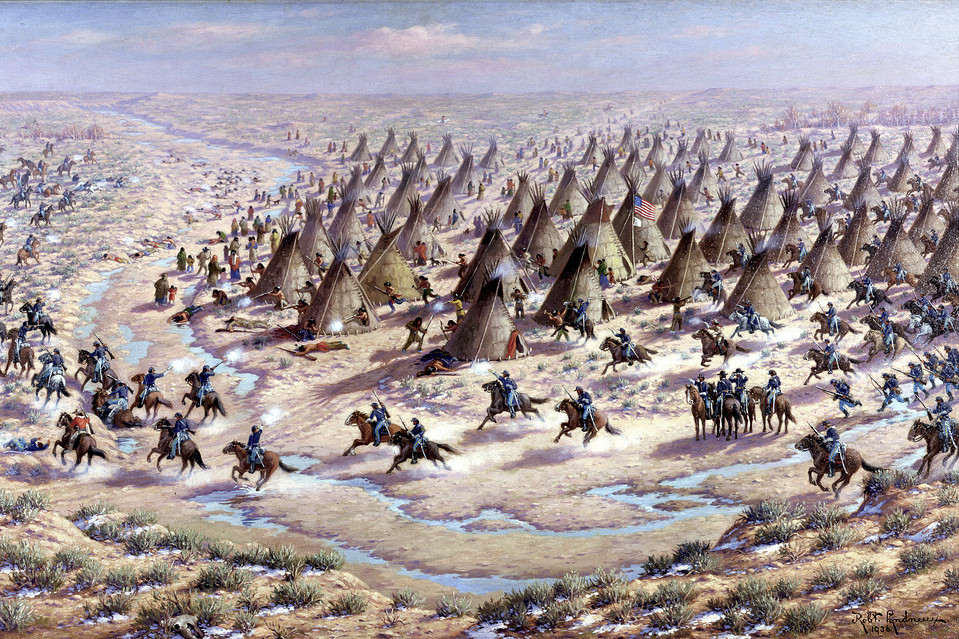
And the men who carried them out were not disgraced but memorialised. George Armstrong Custer, who at dawn on the Washita River in 1868 attacked the village of that same Black Kettle, who had survived Sand Creek and was again seeking peace, killed him and his wife in the assault, while his aggressive forces killed a large number of unarmed women and children. Custer was mythologised into a national hero, his death at the Little Bighorn recast as a noble sacrifice. This is exceptionalism completing its work: not merely committing the atrocity, but converting it, in the national memory, into valour. The conversion of conquest into heroism is not a distortion of the exceptionalist project. It is the project.
It is worth pausing to see precisely how this engine is built, because it reveals something the comfortable version of history conceals. There are two broad models of colonialism, and they are not the same. Extractive colonialism — the Spanish in Peru, the British in India — needs the colonised population alive: to mine the silver, to work the plantations, to pay the taxes. It subjugates.
But settler colonialism, of the kind practised in North America and Australia, does not primarily want the people. It wants the land. And a population that comes to stay on land already inhabited requires something darker than subjugation: it requires removal. The historian Patrick Wolfe named this the ‘logic of elimination’ — the observation that in the settler-colonial project, invasion is not an event but a structure, and the indigenous inhabitant is not a labour force to be exploited but an obstacle to be cleared. This is why the settler variant needed its ideological engine to run at maximum power. To subjugate a people, you need only believe they are lesser. To eliminate them, you must first erase them — conceptually, legally, theologically — before you erase them in fact. Terra nullius, the empty land; the savage without real title; the wilderness awaiting God’s chosen — these were not decorative rhetoric. They were the necessary vocabulary of replacement.
A society that never hears the moral objection is merely benighted. A society that hears it clearly, debates it in its legislature, affirms it in its highest court — and proceeds anyway, in the name of Providence — has not failed to find its conscience. It has chosen to override it. That is what the ideological engine is for: not to fill a silence where conscience is absent, but to drown out a conscience that is present.
And here is the fact that removes every excuse: the conscience was present. It was not that no one knew, or that no one objected. Roger Williams argued in the 1630s that the Crown had no right to grant land it did not own, that it had to be purchased from its actual inhabitants — and he was banished for saying so. The Quaker John Woolman condemned the dispossession on moral grounds a century before it reached the Mississippi. When the Indian Removal Act came before the United States Congress in 1830, it passed by 102 votes to 97 — a bitter, closely fought debate, not a silent consensus. When the Cherokee took their case to the Supreme Court, Chief Justice John Marshall ruled in Worcester v. Georgia that they possessed sovereign rights the state was bound to respect. President Andrew Jackson ignored the ruling and carried out the removal regardless; on the Trail of Tears that followed, thousands died. This is the point that must be held onto. A society that never hears the moral objection is merely benighted. A society that hears it clearly, debates it in its legislature, affirms it in its highest court — and proceeds anyway, in the name of Providence — has not failed to find its conscience. It has chosen to override it. That is what the ideological engine is for: not to fill a silence where conscience is absent, but to drown out a conscience that is present.
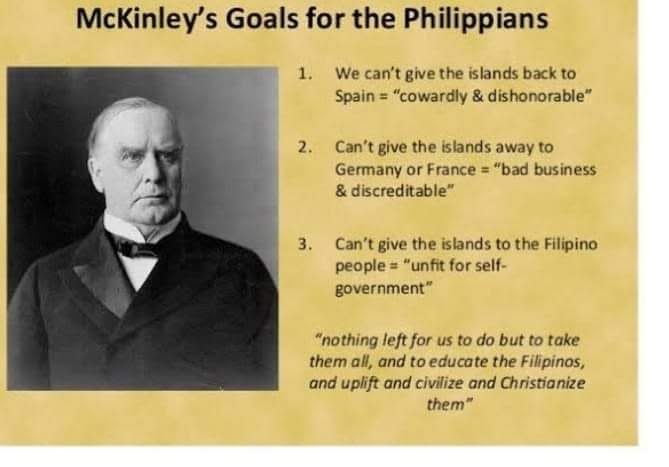
The same logic was exported globally. In 1898, the United States entered the Spanish-American War, having suggested to Filipino independence fighters that it was their ally against Spanish colonial rule. When Spain was defeated, the Philippines was not given its independence. It was purchased for twenty million dollars and then colonised. The Philippine-American War resulted in the deaths of over 20,000 Filipino combatants and as many as 200,000 Filipino civilians through violence, famine, and disease. McKinley called his policy “Benevolent Assimilation.” The Philippines did not receive full independence until 1946 — forty-eight years after the liberation that was promised.
This is the pattern that repeats from Vietnam to Iraq to Afghanistan to Iran: intervention justified as liberation, freedom invoked to mask extraction, and sovereignty violated in the name of the values that sovereignty was supposed to protect.
The Civilisational Alternative
Now consider the contrast. India, China, and Persia are rooted in civilisational traditions that are fundamentally pluralist in their relationship to truth and the divine. Hinduism, Buddhism, Jainism, and Zoroastrianism do not claim exclusive possession of truth. They understand the search for ultimate reality as a path that admits multiple valid routes — that the divine is too vast and complex for any single tradition to comprehend fully. This epistemological humility produces a fundamentally different relationship to the Other: not as a lesser being to be converted or eliminated, but as a fellow traveller on a different path through the same reality — or, in the Tamil saint Vallalar’s image, rivers of many names flowing to a single shoreless ocean.
A tradition whose foundational claim is Ekam Sat Vipra Bahudha Vadanti — truth is one, the wise call it by many names — or the Jain Anekantavada, the many-sidedness of truth, or the Tamil Yaadhum Oorey-Yaavarum Kelir, that every place is home and every person kin, is structurally resistant to exceptionalism, because its highest ideal explicitly denies the premise exceptionalism requires: that a single community owns the truth and stands chosen above the rest.
The distinction I am drawing must be stated carefully, because it is easy to misread as a claim that one civilisation is virtuous and another is wicked. That is not the claim, and it would be false. The impulse to dress conquest in sacred language is close to universal — it appears wherever power seeks to launder its crimes, and no civilisation, India’s included, is innocent of it. Ashoka built his empire by the sword before he turned to the dharma. India’s own caste hierarchy was given cosmic sanction, as I have argued elsewhere in examining the Manusmriti. The human capacity to summon the transcendent in defence of the indefensible is not the property of any one people. What differs is not the impulse to justify but what each tradition installs as its highest principle — and therefore what any justification of atrocity must first overcome. A tradition whose foundational claim is Ekam Sat Vipra Bahudha Vadanti — truth is one, the wise call it by many names — or the Jain Anekantavada, the many-sidedness of truth, or the Tamil Yaadhum Oorey-Yaavarum Kelir, that every place is home and every person kin, is structurally resistant to exceptionalism, because its highest ideal explicitly denies the premise exceptionalism requires: that a single community owns the truth and stands chosen above the rest.
One can still commit atrocity within such a tradition — humans always can — but one cannot easily make the tradition’s own highest principle bless it. A covenantal structure built on a chosen people, an exclusive truth, and a promised land contains that raw material at its theological core. It does not compel atrocity, and most who inherit it are decent people who read it toward mercy — the abolitionists and Roger Williams drew on it too. But the doctrine of chosenness is available to be weaponised in a way that Ekam Sat structurally is not. That is the civilisational difference that matters: not that one people is depraved and another pure, but that traditions differ in whether their deepest ideal resists the engine of exceptionalism or supplies its fuel.
Scholarly analysis consistently describes India’s conduct as just war traditions with no ulterior motive of imperialism or fiscal interest. There is no comparable example in the modern history of any Western military power.
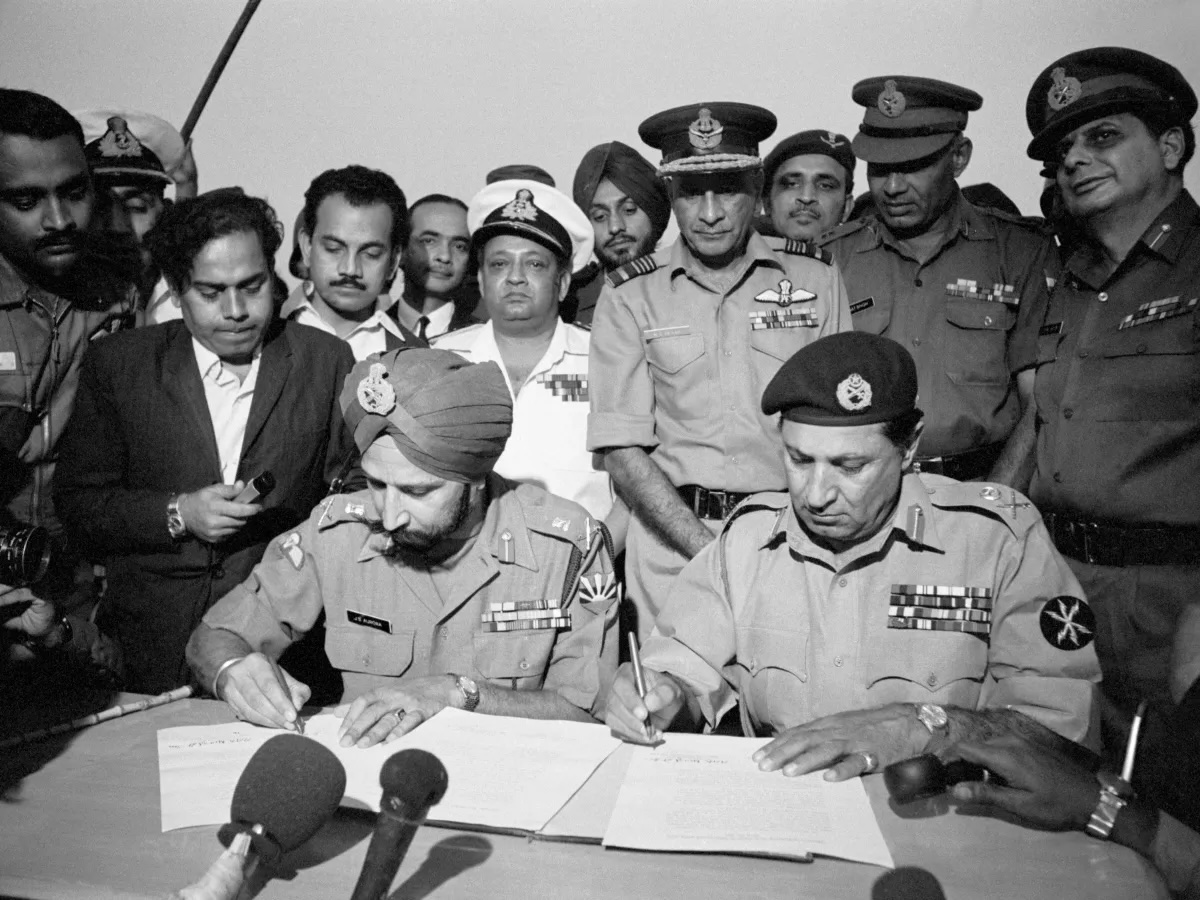
This civilisational disposition is not merely philosophical. It expresses itself in conduct. In December 1971, India made the decision to intervene militarily in East Pakistan in response to one of the most egregious humanitarian catastrophes of the 20th century — the Bangladesh genocide. The intervention was swift and decisive. Indian military forces liberated Bangladesh in thirteen days of formal war. Pakistani forces surrendered on December 16, 1971. The Indian military then withdrew completely. No occupation. No extraction. No installation of a client government. No strategic bases retained. Full sovereignty was transferred immediately to the people of Bangladesh. India returned over 90,000 Pakistani prisoners of war through the Simla Agreement. Scholarly analysis consistently describes India’s conduct as just war traditions with no ulterior motive of imperialism or fiscal interest. There is no comparable example in the modern history of any Western military power.
These are not coincidental differences. They are civilisational ones. The world is now in contest over what the emerging order will be built upon. The declining Western order was built on exceptionalism — the claim to divine chosenness that converts domination into duty, secularised into legal doctrine but never abandoned. The Asian civilisational alternative — pluralist, non-exclusivist, epistemologically humble — offers a different foundation. India’s 1971 conduct is the most precise proof available that this alternative is not merely philosophical. It has been demonstrated operationally.
The question is whether India — in Gaza, in Iran, in the institutions of the emerging world order — is willing to act consistently with the civilisational tradition it inherits.
— This is the second in the series prologue.
Air Marshal M Matheswaran (Retd) is the Founder-President of The Peninsula Foundation (@TPF_Chennai), grounded in the conviction that power without ethics is tyranny — and that India’s civilisational traditions offer the world something Western exceptionalism cannot.
Further Reading:
On the Doctrine of Discovery and the Papal Bulls
Pope Nicholas V, Dum Diversas, 18 June 1452. Full Latin text and English translation: Doctrine of Discovery Project, doctrineofdiscovery.org.
Pope Nicholas V, Romanus Pontifex, 8 January 1455.
Pope Alexander VI, Inter Caetera, 4 May 1493.
Robert J. Miller, Jacinta Ruru, Larissa Behrendt, and Tracey Lindberg, Discovering Indigenous Lands: The Doctrine of Discovery in the English Colonies (Oxford University Press, 2010).
Steven T. Newcomb, Pagans in the Promised Land: Decoding the Doctrine of Christian Discovery (Fulcrum, 2008).
On the Vatican’s 2023 repudiation
Dicastery for Culture and Education and Dicastery for Promoting Integral Human Development, ‘Joint Statement on the Doctrine of Discovery,’ Vatican, 30 March 2023.
On the incorporation and persistence of the Doctrine of Discovery in US law
Johnson v. McIntosh, 21 U.S. (8 Wheat.) 543 (1823).
Haaland v. Brackeen, 599 U.S. 255 (2023).
On the affirmation of ‘plenary power’ over Native peoples as the modern descendant of the Doctrine of Discovery, see the analysis by Peter d’Errico and the essays in the ‘200 Years of Johnson v. M’Intosh’ series, Canopy Forum, 2023.
Robert J. Miller, ‘The Doctrine of Discovery in American Indian Law,’ Idaho Law Review, 42 (2005).
Lindsay G. Robertson, Conquest by Law: How the Discovery of America Dispossessed Indigenous Peoples of Their Lands (Oxford University Press, 2005).
On Australia, terra nullius, and constitutional exclusion
Mabo v. Queensland (No. 2) (1992) 175 CLR 1.
Section 127, Constitution of Australia (repealed by referendum, 1967).
Henry Reynolds, The Law of the Land (Penguin, 1987).
Bain Attwood, Rights for Aborigines (Allen & Unwin, 2003).
On Section 127 and the 1967 referendum: National Museum of Australia, ‘Indigenous Referendum,’ and George Williams’ analysis of the ‘race power’ in Australia’s constitutional history.
On American exceptionalism — Puritan origins and Manifest Destiny
John Winthrop, ‘A Modell of Christian Charity’ (1630).
John L. O’Sullivan, ‘Annexation,’ The United States Magazine and Democratic Review, 17(1), July–August 1845.
Anders Stephanson, Manifest Destiny: American Expansion and the Empire of Right (Hill and Wang, 1995).
Hilde Eliassen Restad, American Exceptionalism: An Idea That Made a Nation and Remade the World (Routledge, 2014).
On the Sand Creek Massacre and the conquest of the Plains
U.S. Congress, Joint Committee on the Conduct of the War, Massacre of the Cheyenne Indians (38th Congress, 2nd Session, 1865).
The contemporary Congressional investigation that condemned the massacre; the primary documentary record.
Ari Kelman, A Misplaced Massacre: Struggling over the Memory of Sand Creek (Harvard University Press, 2013).
Dee Brown, Bury My Heart at Wounded Knee: An Indian History of the American West (Holt, Rinehart & Winston, 1970).
On the Washita (1868), the killing of Black Kettle, and the pattern of village attacks; also on the mythologisation of George Armstrong Custer.
Nathaniel Philbrick, The Last Stand: Custer, Sitting Bull, and the Battle of the Little Bighorn (Viking, 2010).
On the Philippines, 1898–1946
Stanley Karnow, In Our Image: America’s Empire in the Philippines (Random House, 1989).
Paul A. Kramer, The Blood of Government: Race, Empire, the United States, and the Philippines (University of North Carolina Press, 2006).
On India’s 1971 Bangladesh liberation
Srinath Raghavan, 1971: A Global History of the Creation of Bangladesh (Harvard University Press, 2013).
Gary J. Bass, The Blood Telegram: Nixon, Kissinger, and a Forgotten Genocide (Knopf, 2013).
On Asian civilisational pluralism
Amartya Sen, The Argumentative Indian: Writings on Indian History, Culture and Identity (Penguin, 2005).
Wendy Doniger, The Hindus: An Alternative History (Penguin, 2009).
Ramalinga Adigalar (Vallalar), Thiru Arutpa, Sixth Thirumurai, Verse 3907.
The metaphor of the many religions as rivers merging into a single shoreless ocean. See thiruarutpa.org.