Tag: Lockdown

  • Freedom of Speech and Right to Information amidst the Covid-19 Pandemic

    Freedom of Speech and Right to Information amidst the Covid-19 Pandemic

    The global pandemic hit India in March 2020 and Prime Minister Modi announced a 21 day lockdown beginning on 25th March 2020. Since then the lockdown has been extended multiple times as the country grapples with a major public health crisis. Media houses have been on their feet, both literally and metaphorically, as they cover new stories, cases and most importantly, the state response towards the pandemic. The citizenry relies on news reportage to learn more about their government’s approach towards handling this unconventional situation. Media is often regarded as the fourth pillar of democracy meaning it is a supporting figure for democracy to persist and flourish. The pandemic has exposed some paramount inadequacies in the government’s handling of the situation such as lack of a robust public health infrastructure and other issues. The reportage on such instances has often faced backlash from the government resulting in legal notices against the journalists and media houses. India also dropped two places in the World Press Freedom Index making it 142nd in position citing the curfew in Jammu and Kashmir. The watchdog has also issued a warning about the implications of the pandemic, “the looming health crisis could serve as an excuse for governments to take advantage of the fact that politics are on hold, the public is stunned and protests are out of the question, in order to impose measures that would be impossible in normal times” (Scroll Staff, 2020).

    Media is often regarded as the fourth pillar of democracy meaning it is a supporting figure for democracy to persist and flourish.

     Two patterns can be observed with regards to media freedom in India during a time like this; furthering a certain narrative through misinformation and misrepresentation and carrying out state-sponsored propaganda. In this lockdown, the state wants a narrative which eulogizes their efforts during the lockdown and overall handling the situation. However, there are major loopholes in the measures taken by the government which has led to the system failing its most vulnerable class of individuals; the marginalized and the poor. The state has also taken this time to strike upon certain civil liberties and advance their propaganda by curbing dissent.

     Misinformation and misrepresentation of certain communities has been rampant during this time. Nabeela Khan, in an article called Trends in Covid19 misinformation in India for Health Analytics Asia categorizes the spread of misinformation in four waves. First, misinformation about the origin of the virus, this has been debated not just in India but worldwide where they have accused China of producing this virus in a lab and spreading it to use to its advantage. There have also been multiple other theories available online related to consumption of certain meats in China. Second circulation of old images and videos to create fear, in this case the Tablighi Jamaat incident was highlighted immensely and videos from before the pandemic were used to show that ‘Muslims’ in India spread the virus. Third, on ‘cures’ and prevention techniques which is particularly famous on several WhatsApp groups where home-made remedies of lemon, honey, turmeric or any other ‘Ayurvedic’ cures are posted every day. And fourth, on lockdowns in India, where the news of lockdown being extended were spread even before the official announcements were made. Increasingly, there has been excess confusion over the surging numbers in India and whether or not governments give out the exact figures. Additionally, there is no clarity about government aid and funding towards the poor such as the internal migrants in the country.

    Kaye makes an important point as he says that the governments are using the pandemic as a smokescreen to carry forward their agenda and take actions that they have wanted to take for a long time.

    The UN Special Rapporteur David Kaye, talks to The Lawfare Podcast about his latest UN report Disease, pandemics and the freedom of opinion and expression. Kaye makes an important point as he says that the governments are using the pandemic as a smokescreen to carry forward their agenda and take actions that they have wanted to take for a long time. He gives an example from Hungary where the Press is under strict scrutiny of the government. Since the coronavirus is a recent occurrence, there is not a very large body of information available on it. The information keeps changing as cases increase or decrease, as there are multiple waves of it so the orders issued by the government are subject to change. He also particularly criticizes India for its treatment of Jammu and Kashmir since August 2019 and calls it “a real misuse of the situation”.

     Journalists and activists across the world have been arrested during this lockdown and India is no exception to this trend of suppressing free speech. Siddharth Varadarajan, Gautam Navlakha, Anand Teltumbde, Safoora Zargar, Umar Khalid, Dhaval Patel, Supriya Sharma among many others have either been arrested or served notice by the government during the lockdown. These journalists have either been arrested on the grounds of their reportage of the pandemic, during the pandemic or incidents that took place before the pandemic.

     An FIR was lodged against Siddharth Varadarajan, one of the founding editors of The Wire, an acclaimed media house, on the grounds of making unverifiable claims. Varadarajan tweeted on March 31st saying that UP Chief Minister Yogi Adityanath had given a go-ahead for the Ram Navami festival to be held from March 25th to April 2nd, in the middle of the lockdown and Yogi also said that “Lord Rama would protect the devotees from coronavirus”. As a matter of fact, it was Acharya Paramhans who gave out this statement and not CM Adityanath and Varadarajan tweeted a clarification the following day. On April 10, police from Ayodhya showed up at his doorstep in Delhi to serve him notice and his wife Nandini Sundar explained this instance elaborately in her tweets. However, this act only suggests the government’s misuse of power and tactics to pursue a culture of intimidation. It could be argued that the journalist was peddling unverified claims but CM Adityanath in fact supported the decision to have a Ram Navami mela. The Wire has published an elaborate FAQs list on this matter explaining every detail of it. It has also been condemned by the Editors’ Guild of India who have called this episode “an overreaction and an act of intimidation”.

     Journalists and activists such as Gautam Navlakha, Anand Teltumbde, Safoora Zargar, Umar Khalid, Sharjeel Imam etc. have been booked under the UAPA, Unlawful Activities Prevention Act. This Act was formulated as a law in 1967 to prevent any ‘unlawful’ activities or any measures which threatened the integrity and sovereignty of India. In 2004, the UPA government expanded on it further to target terrorist outfits or any organizations harming the state but not individuals. The 2019 Amendment of the Act has entrusted the government with identifying individuals who might be harming the integrity of the state, the definition of which the government decides. The contemporary term used for such people on social media and other platforms is ‘urban naxals’. Student activists and journalists have been booked under this act for protesting against oppressive government laws which promotes a narrative that dissent is by its very nature, ‘anti national’. There have also been cases where activists have been arrested, then granted bail and arrested again based on some other complaint. Safoora Zargar’s case is a particularly complex one in this regard where she was arrested after she was granted bail and was granted bail again recently on humanitarian grounds. Zargar is five months pregnant which was the basis of her bail but the discourse around this has been to release her not because of her pregnancy because dissent is a fundamental right.

    The moment we no longer have a free press, anything can happen. What makes it possible for a totalitarian or any other dictatorship to rule is that people are not informed; how can you have an opinion if you are not informed? If everybody always lies to you, the consequence is not that you believe the lies, but rather that nobody believes anything any longer. This is because lies, by their very nature, have to be changed, and a lying government has constantly to rewrite its own history – Hannah Arendt

     Praveen Swami makes a compelling argument in a FirstPost article about hate speech and freedom of speech. He opines that the response to hate speech is not censorship but plurality where opinions are allowed to coexist. In India, a large part of the Press is controlled and supported by the government leading them to produce streamlined biased news. According to him, alternatives need to come up for hate speech where the dominant narrative does not remain unchallenged.

     To conclude, Hannah Arendt’s cautioning words on freedom of press and misinformation are very relevant today and sounds the alarm bells:

    “The moment we no longer have a free press, anything can happen. What makes it possible for a totalitarian or any other dictatorship to rule is that people are not informed; how can you have an opinion if you are not informed? If everybody always lies to you, the consequence is not that you believe the lies, but rather that nobody believes anything any longer. This is because lies, by their very nature, have to be changed, and a lying government has constantly to rewrite its own history”


    Reference

    Bakshi, Asmita (2020, May 31) From Pinjra Tod to Kashmiri Journalists: What’s the Deal with UAPA?. Livemint. Retrieved from https://www.livemint.com/mint-lounge/features/from-pinjra-tod-to-kashmiri-journalists-what-s-the-deal-with-uapa-11590915249625.html


    Chakma, Suhas (2020, June 22) FIR Against Supriya Sharma is Emblematic of how the Law is Abused to Throttle Press Freedom. The Wire. Retrieved from https://thewire.in/media/supriya-sharma-fir-abuse-law-press-freedom


    Goldsmith, J (Host) (2016, May 16). The Lawfare Podcast: David Kaye on Free Speech During a Pandemic. (Audio podcast episode). In Lawfare. Retrieved from https://www.lawfareblog.com/lawfare-podcast-david-kaye-free-speech-during-pandemic

     Khan, Nabeela (2020, June 12) Trends in Covid19 misinformation in India. Health Asia Analytics. Retrieved from https://www.ha-asia.com/trends-in-covid-19-misinformation-in-india/

     Scroll Staff (2020, April 21) Covid-19: India drops 2 places on World Press Freedom Index, as watchdog warns of pandemic impact. Scroll.in. Retrieved from https://scroll.in/latest/959816/covid-19-india-drops-2-places-on-world-press-freedom-index-as-watchdog-warns-of-pandemics-impact

     Scroll Staff (2017, December 4) Top ten things that Hannah Arendt said that are eerily relevant in today’s times. Scroll.in. Retrieved from https://scroll.in/article/856549/ten-things-hannah-arendt-said-that-are-eerily-relevant-in-todays-political-times

     Swami, Praveen (2020, April 27) Hate speech in the time of a pandemic: Answer to malevolent incendiary language is plurality, not censorship. Firstpost. Retrieved from https://www.firstpost.com/india/hate-speech-in-the-time-of-a-pandemic-answer-to-malevolent-incendiary-language-is-plurality-not-censorship-8295271.html

     The Wire Analysis (2020, April 19) FAQ: What are the UP Police FIRs Against The Wire Actually about? The Wire. Retrieved from https://thewire.in/media/faq-up-police-fir-siddharth-varadarajan


    The views expressed are the author’s own.

    Image Credit: Rhy Design and medium.com
     

  • Life In Post-370 Kashmir: Battling The Pandemic Amid Communications Blockade

    Life In Post-370 Kashmir: Battling The Pandemic Amid Communications Blockade

    When British sovereignty over India lapsed in 1947, Kashmir, the Muslim majority state under the rule of Hindu ruler Maharaja Hari Singh chose to remain independent. However, that independence was short lived as Pakistani raiders invaded Kashmir and Hari Singh turned to India for assistance. India promised to help on the condition that Hari Singh signed the Instrument of Accession, according to which defence, communication and external affairs of the state will be handed over to the Indian administration. Since then Kashmir had enjoyed special status under Article 370 of the Indian Constitution. Under article 370, Kashmir had its own state flag, constitution and autonomy over the internal administration of the state. With Article 370 along with Article 35A, the residents of Jammu and Kashmir lived under a separate set of laws, including those related to citizenship, ownership of property and fundamental rights, as compared to residents of other Indian states.Kashmir has been in the midst of unrest and turmoil for decades, as Pakistan inspired religious fundamentalism led to the growth of terrorism and insurgency. Constant communication and internet ban, and curfew have been part of everyday life for the people of Kashmir. Kashmir accounts for about 60% of the communication and internet ban that happens in India. Internet in the valley was cut off for four months in 2016 following the uprising after the killing of Burhan Wani.
    On 5th August 2019, the BJP-led Indian government, headed by Prime Minister Narendra Modi stripped Kashmir of its special status by revoking Article 370. Home Minister Amit Shah introduced the Jammu and Kashmir Re- organization Bill in the Parliament and was passed with a majority. The ‘Jammu and Kashmir Re-organisation Bill‘ divided the erstwhile Jammu and Kashmir into two Union Territories – Jammu & Kashmir and Ladakh.

    Over the last five decades and more, Article 370 has been hollowed out by various governments that were in power in the erstwhile state.

    Analysis and contention that Article 370, in its present form has been diluted over the years and that it existed just in name is indeed true. Over the last five decades and more, Article 370 has been hollowed out by various governments that were in power in the erstwhile state. Despite this, Article 370 guaranteed the people of Kashmir certain benefits such as exclusive land rights and job reservation among others. With the scrapping of Article 370, people of the valley fear that it will usher in a change in the demographics of the erstwhile state. As J&K loses it special status, people will lose their exclusive land rights, various reservations and other benefits that they enjoyed. There is also a fear among the people that with the scrapping, settler colonization will take place in the valley like it happened in Palestine.Following the announcement, the valley was placed under a lockdown including communication and internet ban. Several political leaders including former chief minister Omar Abdullah and Mehbooba Mufti were placed under house arrest. Opinions of the leaders of the valley were not taken into consideration before the Indian government decided to scrap article 370. Kashmir politics, over the years, has been dominated by narrow selfish interests of political parties and political families, which has led to significant loss of confidence of the people. Continued terrorism and religious fundamentalism has vitiated the atmosphere over decades. In such an environment it is difficult to ascertain peoples’ perception of the government’s action, as self-proclaimed leaders may not reflect the ground situation. The central government, armed with extensive intelligence inputs and analysis, feels that the region’s 1.25 crore people long for economic development, better quality of life, and better opportunities in education and employment. However, imposition of a complete lockdown of the valley for nearly six months may have been counterproductive. The situation became more complicated as the Covid-19 pandemic hit the valley.

    Statistics, however, tell a different story – Jammu and Kashmir did better than several other Indian states including Gujarat, the “model state”, in terms of human development index, infant mortality rate, life expectancy etc.

    Home Minister Amit Shah claimed that Article 370 led to isolation of J&K from the rest of India and was the root cause of armed militancy, poor economic growth, and poverty in the valley. Statistics, however, tell a different story – Jammu and Kashmir did better than several other Indian states including Gujarat, the “model state”, in terms of human development index, infant mortality rate, life expectancy etc. Regarding the statement that Article 370 facilitated militancy in the valley, there has been no evidence to prove the same. However, militants care little about Article 370. There has been no decline in militant activities even after the abrogation of Article 370. Militant attacks and counter-insurgency operations continue at high intensity.The aftermath of the decision saw communication and internet being suspended or curtailed effectively for 9 months. The justification given by the government was to stop the spread of false information and prevent terrorist activities in the valley. This communication blockade was the longest in the history of a democratic country and it cut off Kashmir from the rest of the world. Adverse impact on education has been huge due to the lockdown. As educational institutions remain closed for nearly 8 months, education in the valley has taken a back seat. Even when situation in the valley seemed to return to normalcy, parents were unwilling to send their children to school. As the world was hit with the Covid-19 pandemic, schools and universities across the country and the world have resorted to online classes but that is not the case in Kashmir. It is a challenge for students to use online classes on the 2G network that is currently allowed in the valley. It is practically impossible to load and download the study materials in a 2G network. Even this network, primitive by today’s standards, is often unstable and unreliable.
    In March 2020,exactly after 213 days, internet service i.e. only 2G service, was restored in the valley but it was snapped again on May 6 after security forces closed in on Hizbul Mujahedeen Commander Riyaz Naikoo. The frequent communication blockade is of serious concern at a time when the world is fighting the Covid pandemic. Militant activities continue to disrupt peace and security, as is seen by the latest snapping of internet amid CASO (cordon and search operations) launched by J&K police in Srinagar district. India shuts down internet more than any other democracy in the world.

    It is of utmost importance that the Centre restore high speed internet service in the valley so that people can receive information on Covid-19 in local language and help prevent the spread of the virus.

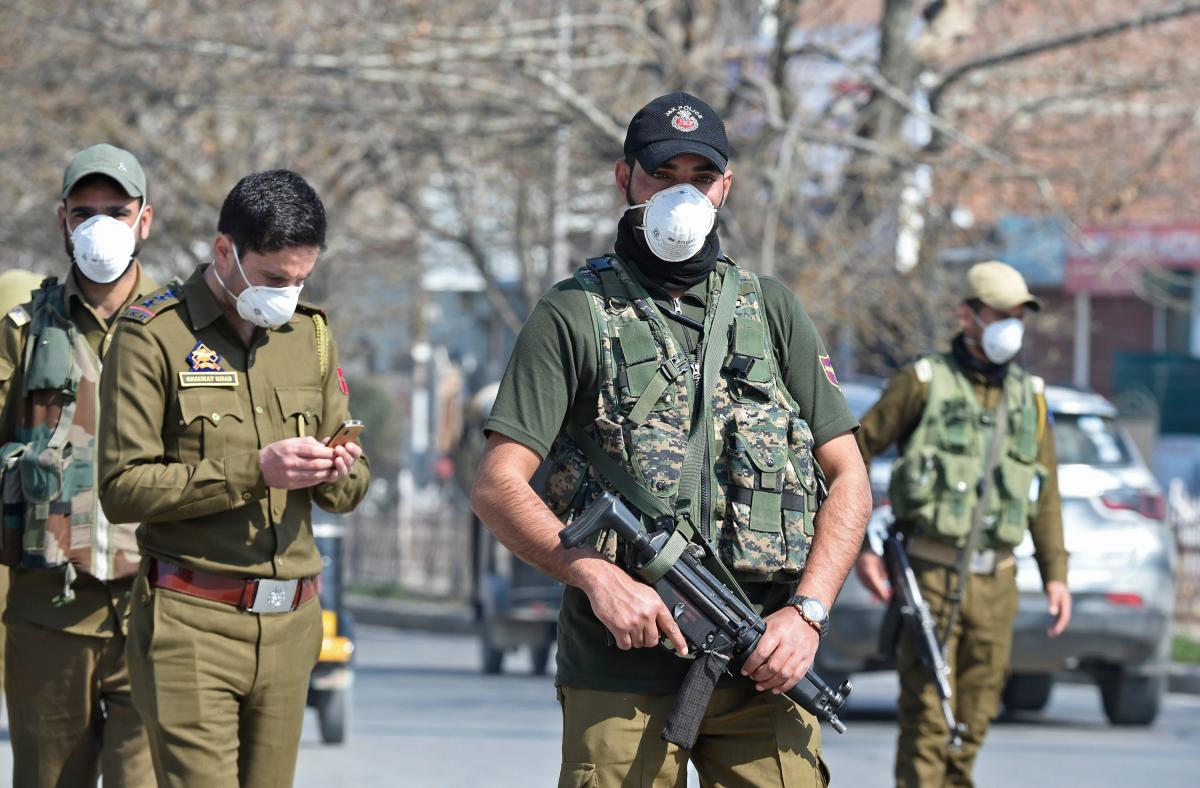
    The valley was declared a red zone as the number of covid cases in the union territory crossed 6424 and recorded 90 deaths. Disruption of communications has made the battle against Covid-19 difficult as it causes delays in taking the necessary steps to fight the pandemic. Even before the internet was snapped on May 6, doctors across the valley faced difficulty in downloading the guidelines issued by WHO. With limited access to internet, healthcare workers across the valley find it difficult to access regular updates, research and announcements regarding the pandemic and accurate tracking of transmission within the region. People support groups are helping each other in this time of crisis. Apart from Covid related restrictions issued via newspapers, radio and SMS, there is no access to campaigns designed for social media. With the lack of reliable information, there is a high possibility for misinformation. It is of utmost importance that the Centre restore high speed internet service in the valley so that people can receive information on Covid-19 in local language and help prevent the spread of the virus.Terrorist and insurgent outfits are revamping their tactics to exploit the pandemic situation and widen the pre-existing schisms. Infiltrations have increased as recent spurt in terrorist encounters indicate. The Covid-19 pandemic has added to the difficult situation in which the people of Kashmir are stuck in. The future of Kashmir looms in darkness due to the pandemic and several other challenges that most states have never and most likely will never experience. Kashmir was shut down through a state imposed lockdown in August 2020. As it was emerging from the lockdown towards normalcy, the pandemic brought about a lockdown that now has the peoples’ consent for the first time. This has turned out to be the world’s longest lockdown. However, the pandemic has provided the government an opportunity to get closer to the people by providing rehabilitation assistance, food supplies, and facilitating educational improvisations amid communications breakdown. Amid the pandemic crisis, the state becomes an test case for democracies across the world for the battle between control for ‘development’ and control of ‘liberty’.Image Credit: Deccan Herald

  • Covid 19: India uses Crisis to bring-in Economic Reforms as Package

    Covid 19: India uses Crisis to bring-in Economic Reforms as Package

    India’s four-phase lockdown of 68 days to deal with the Covid-19 threat has, while slowing the spread of the virus, come at huge economic costs. The lockdown for a vast majority of the people is, undoubtedly, the harshest in the world.

    The coronavirus triggered lockdown and its ensuing series of extensions have disrupted more than 60 percent of economic activities in the country, posing a huge threat to the  economy. The crisis was underway when the global economy was slowing down and India, in particular, had to deal with a poor health care system and an economy already under distress. Unemployment rate is estimated to be around 27 percent post lockdown and has resulted in nearly 12.2 crore people losing their jobs. In addition, a  severe slump in consumer demand is expected to persist for the next few quarters. Almost 85 percent of India’s workforce is engaged in the informal sector – quite naturally the government is under stress to implement effective policy reforms to counter the downturn. 

    In response to the contraction in the economy, the Prime Minister has announced a second round of economic package that stands at roughly around 10 percent of the Gross Domestic Product. The USA and Japan have announced relief packages of 13 and 21 percent of their GDP respectively. In comparison, India has seemingly provided a substantial Rs 20 lakh crore stimulus- highlighting the concept of ‘self-reliance’ as a way forward to deal with the economy post the pandemic. The stimulus package includes previous steps taken by RBI such as moratorium on loan repayments, interest rate cut, etc. In the five tranches of the stimulus package, the Finance Minister has announced a slew of measures to address the structural issues of Indian economy. However, it is estimated that the immediate fiscal boost will be only around 1 percent of GDP and most of the fiscal and monetary policies will attract long term capital with medium run  stabilization of the economy.


    Micro Medium and Small Scale Enterprises 

    Focusing on reviving the small businesses and micro enterprises, under this tranche Rs 3 lakh crore is allocated for collateral free loans for business enterprises. This package is estimated to be around Rs 5.94 lakh crore including RBI measures to improve liquidity in the economy. However, the direct fiscal cost for the government is around Rs 16,500 crore. For the stressed MSME units, the central government is planning to facilitate Rs 20,000 crore as subordinate debt and Rs 50,000 crore through equity infusion. Non Banking Finance Companies (NBFC) that serve the MSMEs will receive Rs 30,000 crore under investment guarantee scheme. While the six broad measures look attractive, the MSME sector in India is dominated by micro enterprises that are largely unregistered. However, these measures will not immediately benefit the micro business units with necessary working capital. Most of the enterprises and small business units are cash strapped and are on the verge of disappearing. Ninety-nine percent of the sector comprises micro enterprises – businesses with less than 10 working employees.

    Most of the enterprises and small business units are cash strapped and are on the verge of disappearing. Ninety-nine percent of the sector comprises micro enterprises – businesses with less than 10 working employees. 

    While the government has taken supply side measures to incentivize businesses, two important challenges remain intact. One, the large number of unregistered micro businesses might not benefit from the credit line offered by the government. Two, if the demand recovers slowly, it is likely the business sector especially small enterprises will suffer despite credit being infused. It is important to note that the supply and demand side has to be revived at the same rate to ensure sustainability of the MSME business. 


    Migrant labourers and Farmers: 

    Second stimulus of the Finance minister’s announcement was focused on migrant labourers and farmers. Close to 150 million internal migrants are present in India according to the latest census report.  Rs 3500 crores is to be spent on migrant labourers not covered under the Public Distribution System (PDS). Rs 5000 crore is set aside to facilitate easy access to street vendors. Funds worth Rs 6000 crore is planned for enhancing employment among adivasis and tribal groups. For the next two months, around 8 crore migrant labourers not covered under PDS will be provided 5kgs of grains per person and 1 kg chana per family in a month. ‘One Nation One Ration Card’ is a welcome move given the leakages present in the PDS, but the national coverage of this scheme is expected only by March 2021.  Additionally, in the National Food Security Act, 2013 , based on the 2011 census data, it is estimated that around 100 million people do not fall under this safety net accounting for growth in population over the past decade. The initiative to record and track the data on unregistered labourers is important for fiscal stimulus response to a COVID hit economy. National portability of ration cards is important but the execution is time consuming and does not address the problem of people being excluded from the ration card system. Universalizing PDS and decentralizing decisions to achieve food security with an efficient supply chain should be an immediate intervention. States with higher migrant labourers and people with less access to PDS should be targeted to universalise food distribution.  Acknowledging the shortcomings of the PDS and food supply channel, an emergency plan to ensure food supply to people below poverty line for the next six months needs to be prioritised.


    ‘One Nation One Ration Card’ is a welcome move given the leakages present in the PDS, but the national coverage of this scheme is expected only by March 2021. 


    Agriculture and Allied activities:

    Under the third tranche of the economic stimulus package, the government has taken bold measures to invest in agriculture and allied activities. Total package announced was worth Rs 1.63 lakh crores – relatively less compared to earlier stimulus packages. The main focus was on enhancing agriculture infrastructure, financing farm gate produce and improving post harvest supply.  A series of other funds were allocated for disease control for animal husbandry, promotion of herbal products and fisheries. Rs 10,000 crore was unveiled to support 2 lakh Micro Food Enterprises on a cluster based approach. 

    Lack of cold storage and supply chain was identified by the government to create an Agriculture Infrastructure Fund of Rs 1 lakh crore. A big push for agriculture reforms was spelled out by the decision to deregulate six commodities including cereals, pulses, oil and vegetables by amending  the Essential Commodity Act, 1955.

    Many experts believe the reforms undertaken were long due for India to enhance productivity of the agriculture  sector. But deregulation of essential products during the time of lockdown with poor food supply chains might not be beneficial especially for marginal farmers.  Almost 92 percent of the Food Supply Chain is controlled by the private sector and most of the farmers are not informed about Minimum Support Price and adopt unscientific farming practices. With liquidity constraint in the economy, demand for essential food is substantial. Factoring the drawbacks of PDS in supplying food items to the bottom section – a high probability of market failure is underway potentially hurting both farmers and consumers. Except for concessional credit for farmers and agriculture loans, the package has  limited scope to reduce the distress faced by the agrarian sector in near future. As far as the reforms are concerned, there was a clear bias towards post harvest investment. However, the productivity and scale of production has been the biggest problem in India that requires effective land reforms. India’s agriculture sector also suffers without adequate investment in Technology and Research & Development. During an unprecedented crisis, Indian government is pushing for big reforms but the structural issues of marginal-land farming are largely ignored. Even as a reform package─it is evident that it is likely to benefit primarily large farmers in the medium term.

    Except for concessional credit for farmers and agriculture loans, the package has  limited scope to reduce the distress faced by the agrarian sector in near future.

     Infrastructure, Defence  & Aerospace 

    Under this package, eight key sectors: coal, minerals, defence production, aerospace management, airports, power distribution, space and atomic energy were in the spotlight. In an effort to boost employment, a proclamation of structural reforms was stated in the fourth  tranche. The coal and mining industry is expected to receive an infrastructure development fund – making the sector self-reliant in production. The Foreign Direct Investment limit in defence has been increased from 49 percent to 74 percent to encourage foreign investment in production. In the aviation industry, India decided to open up 6 airports for auction. Additionally, three airports are to be operated under the Public Private Partnership model. Optimization of air space, building a hub for aircraft maintenance and overhaul are some of the important measures covered under this package. 

    Privatization and Globalization (New Economic Policy, 1991)- COVID-19 crisis has offered a space for the government to initiate certain radical measures to privatise a few industries.

    Private partnerships in the areas of space exploration and atomic energy offers an immense potential for private companies to get incubated for research and development. Sharing an economic pressure similar to the 1991 Balance of Payment crisis that resulted in Liberalization, Privatization and Globalization (New Economic Policy, 1991)- COVID-19 crisis has offered a space for the government to initiate certain radical measures to privatise a few industries. The measures will undoubtedly help the business ecosystem in India to develop in the medium term.  Though there seems to be a claim about substantial job creation this is not likely to happen immediately. 

    Rural Employment & Public Health

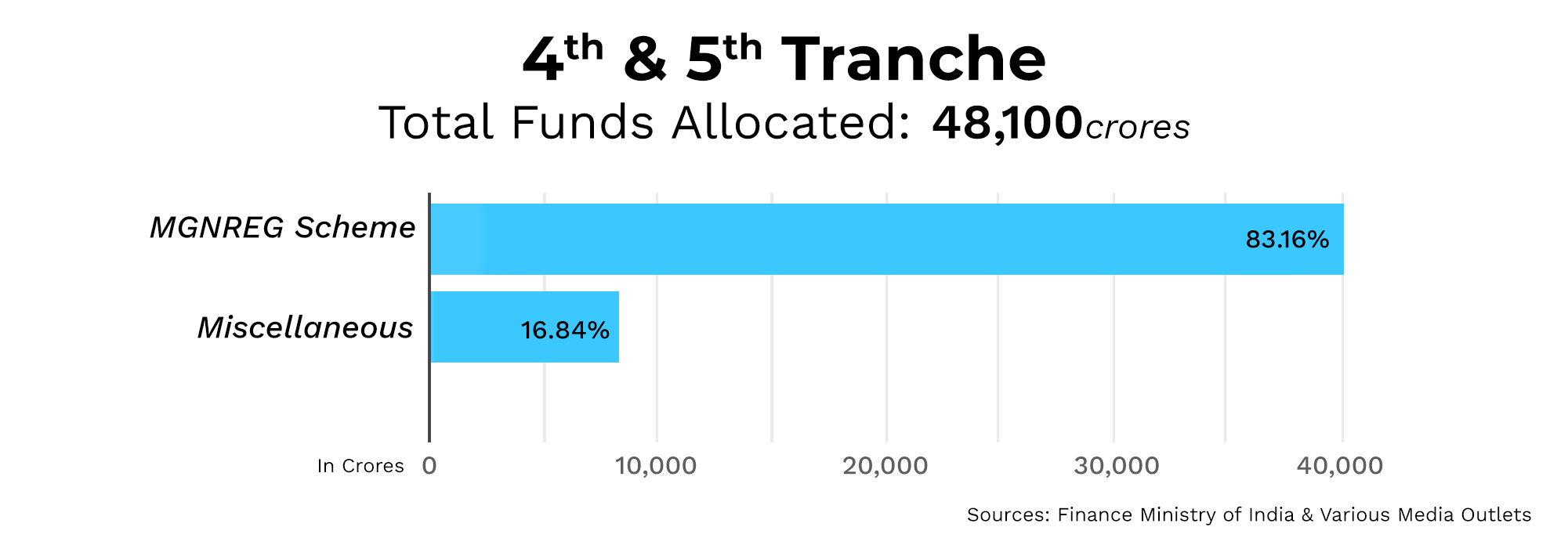
    In the final announcement, Rs 40,000 crore was allotted to Mahatma Gandhi National Rural Employment Guarantee Scheme (MGNREGS) to replace direct transfer from central government to migrant workers. Inadequate data about inter state informal labourers has placed limitations on policy formulation during the time of crisis. Under the Pradhan Mantri Garib Kalyan Yojna, Rs 50 lakh per person insurance cover will be applicable for health professionals. To ensure ease of doing business, non adherence to the Companies’ Act will be decriminalised. The government also committed to increasing health expenditure to face pandemics in the future. The finance minister also encouraged companies to entertain the idea of digital India to conduct meetings and businesses online. 

    The last two announcements together accounted for Rs 48,500 crore and experts criticize that most of them do not provide immediate relief for the people in distress. 

    Conclusion

    India has evidently seized the opportunity during the crisis to introduce reforms to boost the economy in the long run. The reform package undoubtedly is impressive on paper but in terms of immediate support to various sectors in distress it offers little. For example, a large part of the package – Rs 8.04 lakh crore- is additional liquidity injected by monetary policy in the last three months.  An investment bank has predicted that India will face a deeper recession in the short term but the economic stimulus would help the economy after a few quarters. As a consequence the real growth rate is to drop down by 5 percent year-on-year in 2020. Even after a massive package, the situation of poor and middle-class people remains bleak. The reforms might bear fruits in future but deferring the policy response to address current challenges will manifest into huge burden on vulnerable sections of the people. Current economic crisis has undoubtedly offered the central government to take advantage of the weak bargaining power of the stakeholders to push reforms but low attention is paid to immediate distress.

    The author was supported by Ms S P Bharani, on summer internship at TPF.

    Image Credit: Adobe Stock

  • COVID-19: Coronavirus highlights the class divide in India

    COVID-19: Coronavirus highlights the class divide in India

    It would indeed be revealing, as well as quite embarrassing, particularly for the privileged middle and upper classes, if a survey is undertaken to locate and spot the residential blocks in the different cities of India where the instances of COVID-19 cases have occurred. That will also show how and from where the infection is spreading to other people and other localities. It is not at all difficult to do that; mapping through GIS is an easy exercise

    Needless to say, almost all of these cases surely are in the neighborhoods inhabited by the richer and privileged sections of the society, and most of them are those who have a travel history of having been abroad. After their return they have infected those who have come in contact with them.

    Fine, many of them have been isolated or quarantined, if not actually hospitalised, and as a consequence of the lockdown have the extravagance of ‘work from home’ (it is another matter that post-lockdown the TV viewership has increased sharply). Many of them also have the advantage of drawing their regular, guaranteed salary at the end of the month.

    At the other polar opposite of the class edifice, at the bottom of the pyramid, are the multitude of hapless groups of people, sections of our own society, the ‘others’, who for absolutely no fault of theirs, not to talk of any crime committed, have overnight been thrown out of everything — jobs, wages, shelters, source of income, and the like. This was because a nation-wide lockdown was imposed as a result of the overseas excursions of those at the other end (the upper end) of the class hierarchy.

    Besides the urban homeless and the needy, those who have been made to bear the brunt of this lockdown are the migrant labour who have become, during the last few years, a given in most of our cities and town. These migrant workers (aka ‘guest’ workers) are reluctantly accepted in many places; mainly because they come cheap and the ‘locals’ mostly refrain from doing certain kinds of jobs in the vicinity of their own habitations and locales (they may, however, do more demeaning jobs away from their own dwellings, say in West Asia/Gulf or other overseas contexts). These ‘guests’ are now being thrown to the wolves and the weather.

    As the State had no contingent plan for these migrant labour, an institution-created famine-like situation has arisen due to the starvation that they have been facing. After five days of lockdown the central government woke up to the misery of these souls and directed the state governments and the union territories to provide shelter and food to them. In the interim these people had a choice; either starve to death or risk breaking the physical distance barrier and get susceptible to the virus. Hopefully, now that their plight has been highlighted, things will get better for these ‘guests’.

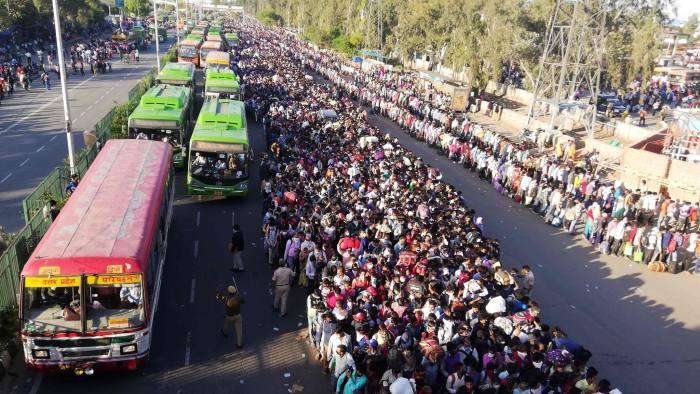
    The luxury of the so-called social distance does not operate in their ambit as lower class habitations as also other allied spaces that pertain to them are extremely dense by definition. Almost all seem to have chosen the option of reaching their respective homes going by the thronging witnessed at bus stops and highway halting points for buses and trucks. However, to no avail as the states in their wisdom have shut all borders for them by suspending all forms of transport.

    During Partition in 1947, people moved due to issues between the two countries. Now the mass movement of people is also because of a partition — a partition between the rich and the poor, within the national borders, across state borders wherein each state is guarding its territory with vehemence. The State has failed utterly on two counts; one, in not anticipating such an event, and second, in not being able to either prevent or combat the movement.

    It is really poignant that the choice is between death by hunger and death by the virus. Given such a choice, the poor feel it is better to die in their native place than in a strange locale. Also, if they do beat starvation death and live, the chances of recovery and survival from the virus appear to be higher even if they are infected. It is death by starvation that is most galling for them as evidenced by empirical responses that are obtained by sources that are interacting with them.

    It is such an unfortunate thing that all crises always seem to impact the poor in the worst negative way possible. Floods, droughts, hurricanes or what have you invariably target the less privileged. It is utterly ironical that the present crisis that has emerged among the upper echelons in India due to Covid-19 too does so.

    It is also pertinent to point out as to how the ilk of the original carriers of the virus, the upper classes, are planning their strategies in combating the absence of their domestics, cooks, drivers as can be ‘seen’ from the debates and dialogue of the resident welfare associations and similar bodies on social media. The dominant narrative is ‘no work, no pay’. Those who say they will pay, are making it sound as if they are achieving martyrdom by their act.

    This article was published earlier by “Moneycontrol

    Views expressed are the author’s own.

    Image Credit: www.ft.com