Tag: Lebanon

  • The End of Pluralism in the Middle East

    The End of Pluralism in the Middle East

    A  truly seismic change in the Middle East has occurred.  At its heart is a devil’s bargain – Turkey and the Gulf States accept the annihilation of the Palestinian nation and the creation of a Greater Israel, in return for the annihilation of the Shia minorities of Syria and Lebanon and the imposition of Salafism across the Eastern Arab world.

    This also spells the end for Lebanon and Syria’s Christian communities. Witness the tearing down of all Christmas decorations, the smashing of all alcohol and the forced imposition of the veil on women when the jihadists — who overthrew the government of Bashar al-Assad on Sunday — first took Aleppo a mere two weeks ago.

    The speed of the collapse of Syria took everybody by surprise. Next, a renewed Israeli attack on Southern Lebanon to coincide with a Salafist invasion of the Bekaa Valley seems inevitable, as the Israelis would obviously wish their border with their new Taliban-style Greater Syrian neighbour to be as far North as possible.

    It could be a race for Beirut, unless the Americans have already organised who gets it.

    It is no coincidence that the attack on Syria started the day of the Lebanon/Israel ceasefire. The jihadist forces do not want to be seen to be fighting alongside Israel, even though they are fighting forces which have been relentlessly bombed by Israel, and in the case of Hezbollah are exhausted from fighting Israel.

    The Times of Israel has no compunction about saying the quiet part out loud, unlike the British media:
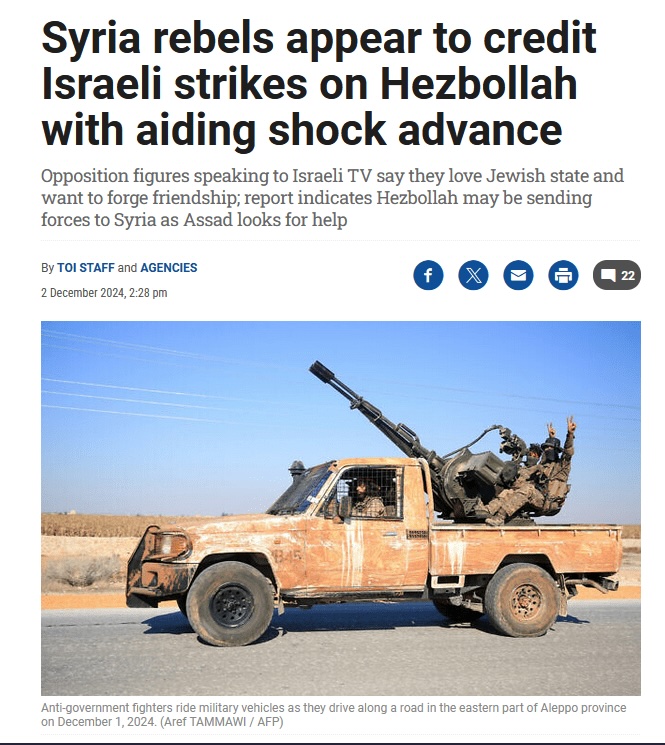
    In fact, Israeli media is giving a lot more truth about the Syrian rebel forces than British and American media. This is another article from The Times of Israel:

    “While HTS officially seceded from Al Qaeda in 2016, it remains a Salafi jihadi organization designated as a terror organization in the US, the EU and other countries, with tens of thousands of fighters.

    Its sudden surge raises concerns that a potential takeover of Syria could transform it into an Islamist, Taliban-like regime – with repercussions for Israel at its south-western border. Others, however, see the offensive as a positive development for Israel and a further blow to the Iranian axis in the region.”

    Contrast this to the U.K. media, which from the Telegraph and Express to The Guardian has promoted the official narrative that not just the same organisations, but the same people responsible for mass torture and executions of non-Sunnis, including Western journalists, are now cuddly liberals.

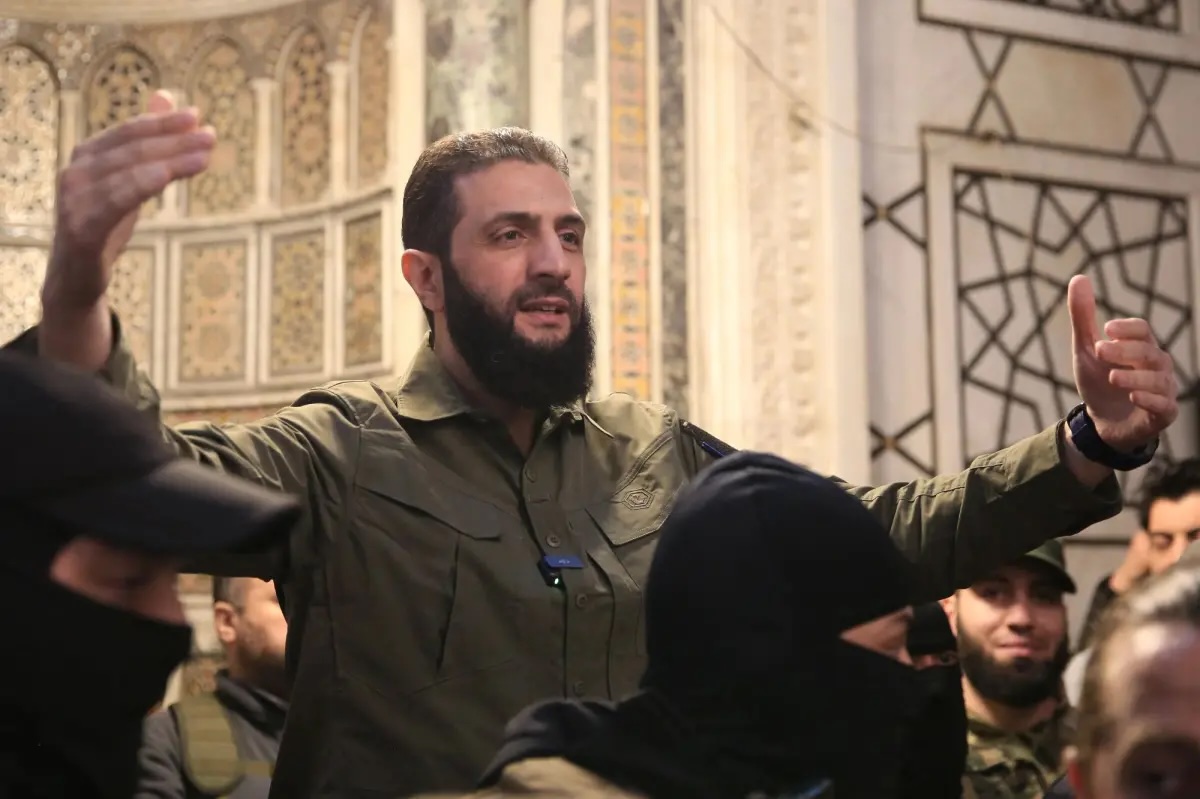
    Nowhere is this more obvious than the case of Abu Mohammad Al-Jolani, sometimes spelt Al-Julani or Al-Golani, who, now nominally in charge in Damascus, is being boosted throughout Western media as a moderate leader. He was the deputy leader of ISIS, and the CIA actually has a $10 million bounty on his head! Yes, that is the same CIA. which is funding and equipping him and giving him air support.

    Supporters of the Syrian rebels still attempt to deny that they have Israeli and U.S. support – despite the fact that almost a decade ago there was open Congressional testimony in the U.S.A. that, to that point, over half a billion dollars had been spent on assistance to Syrian rebel forces, and the Israelis have openly been providing medical and other services to the jihadists and effective air support.

    Violates UK Terrorism Act

    One interesting consequence of this joint NATO/Israel support for the jihadist groups in Syria is a further perversion of domestic rule of law. To take the U.K. as an example, under Section 12 of the Terrorism Act it is illegal to state an opinion that supports, or may lead somebody else to support, a proscribed organisation.

    The abuse of this provision by British police to persecute Palestinian supporters for allegedly encouraging support for proscribed organisations Hamas and Hezbollah is notorious, with even tangential alleged references leading to arrest. Sarah Wilkinson, Richard Medhurst, Asa Winstanley, Richard Barnard and myself are all notable victims, and the persecution has been greatly intensified by Keir Starmer.

    Yet Hay’at Tahrir Al-Sham (HTS) is also a proscribed group in the U.K. But both British mainstream media and British Muslim outlets have been openly promoting and praising HTS – frankly much more openly than I have ever witnessed anyone in the U.K. support Hamas and Hezbollah – and not a single person has been arrested or even warned by U.K. police.
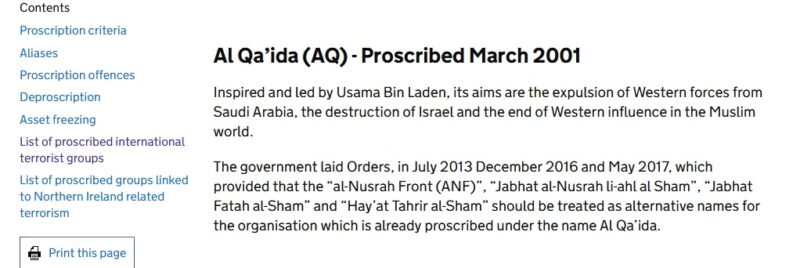


    That in itself is the strongest of indications that Western security services are fully behind the overthrow of the government in Syria.

    For the record, I think it is an appalling law, and nobody should be prosecuted for expressing an opinion either way. But the politically biased application of the law is undeniable.

    When the entire corporate and state media in the West puts out a unified narrative that Syrians are overjoyed to be released by HTS from the tyranny of the Assad regime – and says nothing whatsoever of the accompanying torture and execution of Shias, and destruction of Christmas decorations and icons – it ought to be obvious to everybody where this is coming from.

    Yet – and this is another U.K. domestic repercussion – a very substantial number of Muslims in the U.K. support HTS and the Syrian rebels, because of the funding pumped into U.K. mosques from Saudi and Emirate Salafist sources.

    This is allied to the U.K. security service influence also wielded through the mosques, both by sponsorship programmes and “think tanks” benefiting approved religious leaders, and by the execrable coercive Prevent programme.

    U.K. Muslim outlets that have been ostensibly pro-Palestinian – like Middle East Eye and 5 Pillars – enthusiastically back Israel’s Syrian allies in ensuring the destruction of resistance to the genocide of the Palestinians. Al Jazeera alternates between items detailing dreadful massacre in Palestine, and items extolling the Syrian rebels bringing Israel-allied rule to Syria.

    Among the mechanisms they employ to reconcile this is a refusal to acknowledge the vital role of Syria in enabling the supply of weapons from Iran to Hezbollah. Which supply the jihadists have now cut off, to the absolute delight of Israel, and in conjunction with both Israeli and U.S. air strikes.

    In the final analysis, for many Sunni Muslims both in the Middle East and in the West, the pull seems to be a stronger sectarian hatred of the Shia and the imposition of Salafism, than preventing the ultimate destruction of the Palestinian nation.

    I am not a Muslim. My Muslim friends happen to be almost entirely Sunni. I personally regard the continuing division over the leadership of the religion over a millennium ago as deeply unhelpful and a source of unnecessary continued hate.

    Classic Divide and Rule

    But as a historian, I do know that the Western colonial powers have consciously and explicitly used the Sunni/Shia split for centuries to divide and rule. In the 1830s, Alexander Burnes was writing reports on how to use the division in Sind between Shia rulers and Sunni populations to aid British colonial expansion.

    On May 12, 1838, in his letter from Simla setting out his decision to launch the first British invasion of Afghanistan, British Governor General Lord Auckland included plans to exploit the Shia/Sunni division in both Sind and Afghanistan to aid the British military attack.

    The colonial powers have been doing it for centuries, Muslim communities keep falling for it, and the British and Americans are doing it right now to further their remodelling of the Middle East.

    Simply put, many Sunni Muslims have been brainwashed into hating Shia Muslims more than they hate those currently committing genocide of an overwhelmingly Sunni population in Gaza.

    I refer to the U.K. because I witnessed this first-hand during the election campaign this year in Blackburn [where Murray ran for Parliament.] But the same is true all over the Muslim world. Not one Sunni Muslim-led state has lifted a single finger to prevent the genocide of the Palestinians.

    Their leadership is using anti-Shia sectarianism to maintain popular support for a de facto alliance with Israel against the only groups – Iran, Houthi and Hezbollah – which actually did attempt to give the Palestinians practical support in resistance. And against the Syrian government which facilitated supply.

    The unspoken but very real bargain is this: The Sunni powers will accept the wiping out of the entire Palestinian nation and formation of Greater Israel, in return for the annihilation of the Shia communities in Syria and Lebanon by Israel and forces backed by NATO (including Turkey).

    There are, of course, contradictions in this grand alliance. The United States’ Kurdish allies in Iraq are unlikely to be happy with Turkey’s destruction of Kurdish groups in Syria, which is what Turkish President Recep Tayyip Erdogan gains from Turkey’s very active military role in toppling Syria – in addition to extending Turkish control of oilfields.

    The Iran-friendly Iraqi government will have further difficulty with reconciling the U.S. continuing occupation of swathes of its country, as they realise they are the next target.

    The Lebanese army is under the control of the U.S.A., and Hezbollah must have been greatly weakened to have agreed to the disastrous ceasefire with Israel. Christian fascist militias traditionally allied to Israel are increasingly visible in parts of Beirut, though whether they would be stupid enough to make common cause with jihadists from the North may be open to question.

    But now that Syria has fallen to jihadist rule, I do not rule out Lebanon following very quickly indeed, and being integrated into a Salafist Greater Syria.

    How the Palestinians of Jordan would react to this disastrous turn of events, it is hard to be sure. The British puppet Hashemite Kingdom is the designated destination for ethnically cleansed West Bank Palestinians under the Greater Israel plan.

    What this all potentially amounts to is the end of pluralism in the Levant and its replacement by supremacism. An ethno-supremacist Greater Israel and a religio-supremacist Salafist Greater Syria.

    Unlike many readers, I have never been a fan of the Assad regime or blind to its human rights violations. But what it did undeniably do was maintain a pluralist state where the most amazing historical religious and community traditions – including Sunni (and many Sunni do support Assad), Shia, Alaouites, descendants of the first Christians, and speakers of Aramaic, the language of Jesus – were all able to co-exist.

    The same is true of Lebanon.

    An End of Tolerance

    What we are witnessing is the destruction of that and the imposition of a Saudi-style rule. All the little cultural things that indicate pluralism – from Christmas trees to language classes to winemaking to women going unveiled – have been destroyed in Aleppo and soon perhaps in Damascus and Beirut.

    I do not pretend that there are not genuine liberal democrats among the opposition to Assad. But they have negligible military significance, and the idea that they would be influential in a new government is delusion.

    In Israel, which pretended to be a pluralist state, the mask is off. The Muslim call to prayer has just been banned. Arab minority members of the Knesset have been suspended for criticising Netanyahu and genocide. More walls and gates are built every day, not just in unlawfully occupied territories but in the “state of Israel” itself, to enforce apartheid.

    I confess I once had the impression that Hezbollah was itself a religio-supremacist organisation; the dress and style of its leadership look theocratic.

    Then I came here and visited places like Tyre, which has been under Hezbollah-elected local government for decades, and found that swimwear and alcohol are allowed on the beach and the veil is optional, while there are completely unmolested Christian communities there.

    I will never now see Gaza, but wonder if I might have been similarly surprised by Hamas’s rule.

    It is the United States which is promoting the cause of religious extremism and of the end, all over the Middle East, of a societal pluralism similar to Western norms.

    That is of course a direct consequence of the United States being allied to both the two religio-supremacist centres of Israel and Saudi Arabia.

    It is the U.S.A. which is destroying pluralism, and it is Iran and its allies which defend pluralism. I would not have seen this clearly had I not come here. But once seen, it is blindingly obvious.

    Feature Image: nypost.com

    This article was published earlier in scheerpost.com

    It is republished under the Creative Commons Attribution-NonCommercial-NoDerivatives 4.0 International license.
  • Lebanon’s Food Security Crisis

    Lebanon’s Food Security Crisis

    Security has been a buzzword in the arena of International Politics since the Cold War, and this is widely recognized to be the subject’s genesis as articulated by Barry Buzan and Lene Hansen in their book, The Evolution of International Security Studies. The traditional view of security as largely related to military is the aspect that is given the most prominent focus in discourses on the subject. However, since the 1990s, “societal security” and concepts related to people are broader and sub-concepts such as food security have gained in importance. Food security looks at how much food is available, the access and affordability of food to all people in a country. Food security is also the ability of the country to keep sufficient food available during tough times, such as inflation, disasters, and other such hardships. The Food Climate Research Network speaks of the five factors of food security; availability of food, access to food, utilization of food, stability, and malnutrition. Perhaps food security is one of the most essential forms of security, as the lack of food leads to starvation. This is the reason one hears of bread riots and bread in many protest slogans; ‘bread’ symbolizes food security and represents people’s survival. The economic meltdown of Lebanon and the failure of governance has created a human catastrophe of instability and poverty. The recent Beirut explosion has highlighted not only the failure of the government but a complete breakdown of safety and social security for its common citizens. Under the current circumstances, Lebanon’s food security situation is a major cause for concern.

    Hikes in Food Prices

    Lebanon today is a country with massive debt, income inequality, with much of its revenue going towards servicing of national debts. In addition, Lebanon has been facing high inflation for the last few months, making it very difficult for families to access food. As a result, basic food items are overpriced and in short supply; for instance, a pat of butter costs 9.4 Euros.  Meat, fruits and other commodities have become luxuries for most Lebanese citizens. There are huge breadlines across Lebanon, and many grocery stores cannot afford to buy food to sell to consumers. The COVID-19 crisis has compounded the economic crisis. Prices of eight basic food items have increased by 56%. Lebanon’s food crisis is so grave that parents are bartering their children’s toys and furniture for food online.

     Economic collapse and Food Security

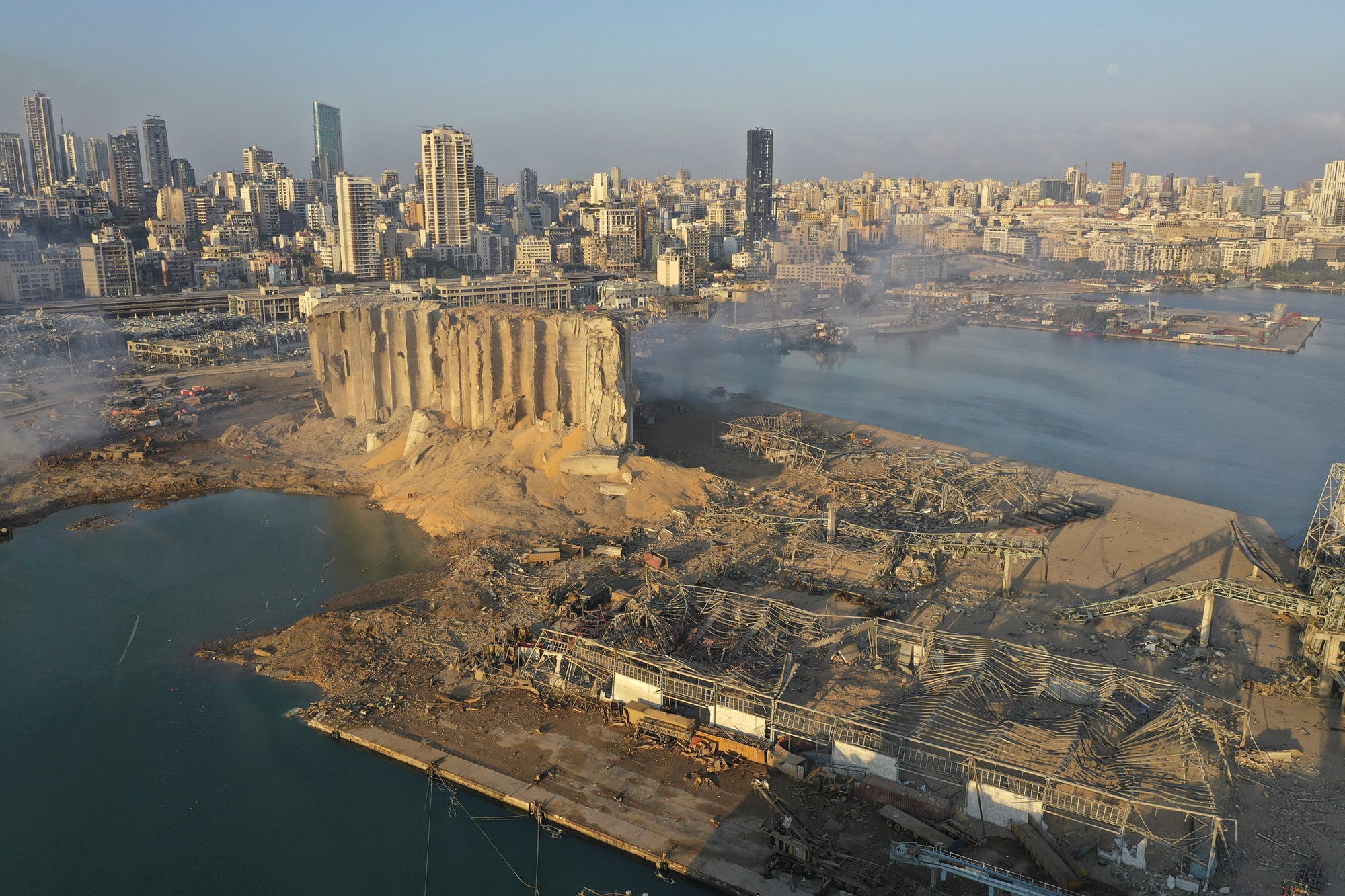
    The most circulated pictures over the last few weeks on media are of the explosion in Beirut and the spillage of grains. This blast occurred because of the unsafe storage of ammonium nitrate and has led to the death of over 200 people, with over 6,000 injured so far. There are many still missing. For Lebanon, this is a triple layer of burden, as the country is fighting a mismanaged economy, a pandemic, and now the horrific aftermath of the explosion. Post the explosion, many countries and global institutions have rushed emergency support by providing minimal aid and funding to facilitate fast recovery from this catastrophe.  While the world has come together to help Lebanon, the situation remains grim because of the shortage of various necessities like medicine and food. The second-largest port in Lebanon, Tripoli has some storage of flour; however, this suffices to cover just one month’s requirements. Beirut port, the largest in Lebanon, is virtually unusable because of the blast. The port infrastructure is severely damaged, thus hurting imports. Lebanon is a country that relies hugely on imports; it imports 85% of its food from outside, making this a major crisis . By one estimate the blast has destroyed 120,000 metric tons of grains, and this could affect food availability as well as sky-rocketing of food prices. The United Nations Food Program reiterated that Lebanon is in a grim situation regarding food security. The current assessment is that the grains can sustain them for less than a month.

    Grim Outlook and Tough Challenges

    The looming food security crisis is a direct fall-out of the economic collapse and multiple crises facing the country. Discontent with the government in Lebanon is not new, since the protests have been on since last October. The explosion and its resulting loss of life and property have triggered waves of protests again, forcing Hassan Diab, the Prime Minister of Lebanon, to step down from his office on 10th August. Decades of poor governance, entrenched kleptocracy, corrupt political class, criminal negligence, incompetence and economic mismanagement have led to the current catastrophe. The former economy minister, Nasser Saidi, says that ‘Lebanon is on the brink of the abyss of depression, with GDP declining by 25% this year, growing unemployment, hyperinflation, and humanitarian disaster with poverty exceeding half the population. The growing food crisis and poverty could lead to famine conditions’. The government will need to address income inequality, large-scale corruption, and the role of foreign players in contributing to the economic collapse.  Financial institutions and other creditors, more often foreign powers, need to suspend debt repayments and allow the Lebanese economy to recoup; since a considerable portion of the revenue goes into debt servicing, which is unsustainable for long.  International funding agencies, while sympathetic to the common peoples’ plight, are hesitant to go ahead with aid due to the poor governance track record of the political class. By some estimates, they put the immediate requirement for humanitarian aid and the cost of rebuilding essential infrastructure post the blast at USD 15 billion. This pales compared to the even bigger mess in the financial system. Ghazi Wazni, the country’s finance minister who quit with the rest of the government last week, has put the total losses in the banking system at $83 billion, and a black hole in the central banking system of $50 billion. The people are displaying discontent over the sectarian politics that have afflicted the country for decades and are the root cause of endemic corruption. Last year’s protests led to a new government in December, which was forced to resign post the explosion.

    Amidst the political crisis, food security is increasingly the major problem in Lebanon for months now. The blast has left 300,000 people homeless.  International Organizations and Civil Society Organizations, Ukraine, Russia, and the United States are enabling and mobilizing food supplies.

    Poverty is the immediate concern; there are already one million Lebanese in poverty, with the likelihood of more than half of the Lebanese population falling into poverty. Food shortages will most likely result in starvation, malnutrition, and death. Looking at the five tenets of food security mentioned above, Lebanon satisfies neither of the five criteria. Lebanon is an example of how decades of factional strife, warlordism, corruption, and power in the hands of the kleptocratic elite can push a country and its people into the abyss of poverty. While resolving Lebanon’s food security crisis is possible through immediate international aid and support, resolving the larger problem of its economic mess and humanitarian catastrophe will need international intervention.

  • Lebanon’s Economic Crisis and Political Unrest

    Lebanon’s Economic Crisis and Political Unrest

    The Lebanon crisis illustrates the outcome of an inefficiently regulated market economy, shaped by long-term instant gratification of economic policies. Economy is run by corrupt institutions with ingrained crony capitalism, bureaucratic regulations and over-reliance on foriegn exchange.

    Lebanon is a free market economy in West Asia, bordered by Syria and Israel and the Mediterranean Sea, and hence, was a frequent recipient of spillovers of unrest and refugee crisis from the neighbouring countries. It is a service-sector dominated (majorly, banks and tourism) economy with a GDP of $56.9 billion─ growth rate of 0.2%, compared to 0.6% the previous year and a workforce of 2.4 million out of which 30 percent include Syrian refugees. The country relies heavily on imports (consumer goods, machinery and equipment etc) with a low dependence on exports (vegetables, non-precious metals and textiles). For years, Lebanon used foreign remittances such as transfers from non-resident Lebanese, foreign deposits and high government loans to balance the trade deficit. Lebanon exchange rate had been kept fixed at 1500 pounds per dollar which was also a fiduciary currency in Lebanon. Thus the higher demand for dollars to fixate the exchange rate, and meet the domestic demand for dollars, is levelled using foreign deposits by offering high yield rates, which had to be further funded by more deposits at even higher interest rates. These faulty policies had sustained the economy until interest payments had snowballed into heavy burden.

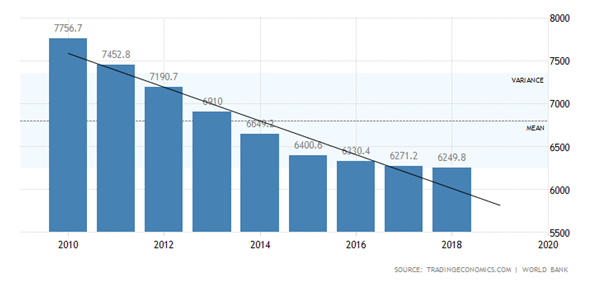
    Figure 1: trend of GDP per capita in Lebanon

    Source: Trading Economics

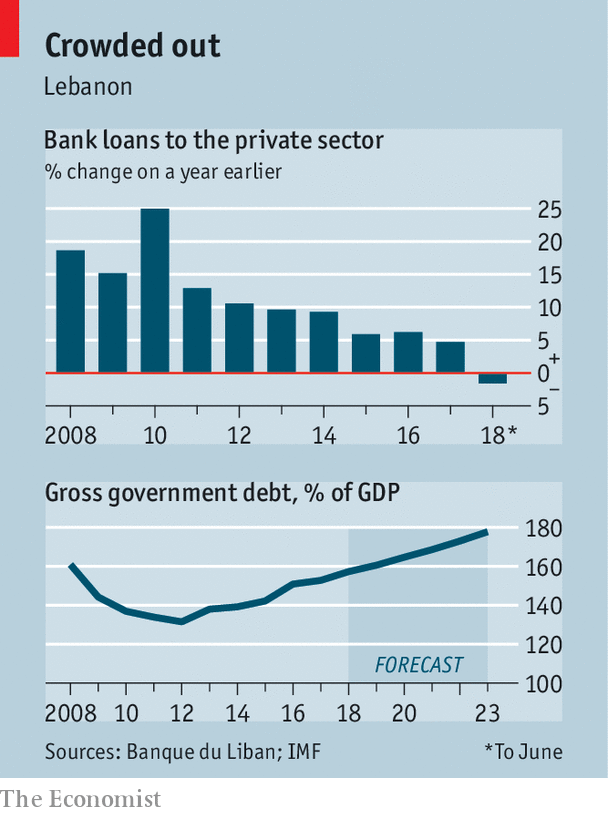
    Lebanese economy is also characterized by high government debt, substantially from domestic banks, borrowed primarily for reconstruction of the economy post civil war (1975-90). Over the years, the government relied more heavily on deficit financing to meet government spending, while the weak governance and corrupt politicians moved along with unfulfilled reforms and poor economic development. There was an underprovision of basic necessities like hassle-free electricity supply, regular water and waste management. On the other hand, crony capitalism had built up, with favours laid out to private businesses which were ultimately owned by rich, exploitative politicians. The debt-to-GDP ratio peaked to 150% by 2019, with a budget deficit of 11.5% of GDP and 50% of the revenues are consumed in debt servicing. This led to an economic crisis, followed by a political crisis, and ultimately snowballed into a financial crisis, rendered vulnerable and  in desperate need of foreign aid to see the day.

    Evidently, though Lebanon crisis started in late 2019, it is the result of long term economic policies mismanaged by corrupt political elite; when the government proposed to tax ‘free-calls in Whatsapp’ to meet the mounting budget deficit in October 2019, protests erupted across the country, catapulting into political unrest and ousting the prime minister. Investors and citizens lost confidence in the system, and led to reducing capital inflows.

    Their sovereign bonds were rated as highly risky assets (probable default),  leading to interest rates as high as 15%. The political uncertainty and the liquidity crunch, led to freezing of external deposits, while the steady domestic and foreign demand for dollars persisted, leading to a shortage of USD. The banks levied restrictions (weekly quotas) on dollar withdrawals, the dollar rate spiked, depreciating the pound, and reducing the purchasing power of the pound. This had squeezed the middle and low income strata the most, draining their last pounds of savings, since their debts substantially constituted dollar repayments. Businesses relying on dollars for most part were affected as the price of imports sky-rocketed, and the oil crunch tightened until the central government stepped in to ease the situation. The condition degraded further by the onset of Coronavirus and the lockdown, which led to widespread unemployment and inflation. The World Bank estimated that 50% of Lebanese population could be pushed below the poverty line by 2020 if immediate action is not taken.

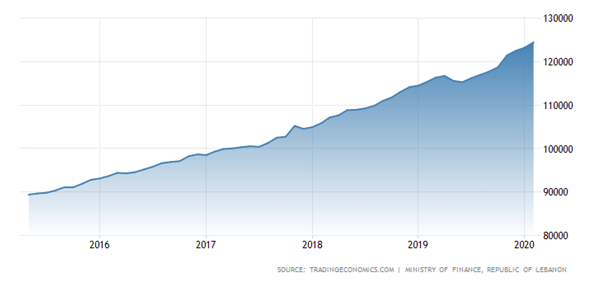
    The debt of Lebanon has built up to 124464 billion LBP, i.e nearly $82 billion and the country has become the 3rd most indebted country in the world. In March 2020, Lebanon government, as a decisive step to prioritize the domestic concerns of the country and retain sustainable foreign exchange reserves in the economy, had defaulted on the Eurobond debt of $1.2 billion for the first time. The ailing economy seeks to restructure the other outstanding debts amounting to $31 billion and has been seeking advice, especially from the IMF on debt restructuring measures. There is a need for an ‘economic rescue plan’ to protect the depositors from this worst economic crisis Lebanon has faced.

    Figure 2: trend of Lebanon government’s debt

    Source: Trading Economics

    Foreign aid from the institutions is a big responsibility, as it would demand austerity measures from the economy that had dwelled in capitalistic pleasures for so long. Though, CEDRE and foreign countries like France and UK have promised ‘soft’ loans to the Lebanese government, economists believe that external aid would be unproductive, and will become an additional debt burden on the already bleeding financial system unless government inculcates greater transparency and accountability to the public, ousting corruption and following through on long-term economic policies with commitment.  Lebanon government is also seeking aid from the IMF. But  this would certainly entail strict reform targets linked to the outflow of credit and hence, is very unlikely.

    For the immediate future, Lebanon’s economic policies should be directed towards increasing  self-reliance in the economy, with higher focus on manufacturing sectors to create employment. Financial policies to stabilize the economy are of primary concern. It is time to make up for the blunders of non-performing investments in the electricity industry. Investments on infrastructural development should be realized and substantial attention should be given to improving  socio-economic conditions of the people. Construction and manufacturing industries should be supported. Actions should be taken to handle the refugee situation, and check the drain of human capital out of the country.   It could be said that Lebanon’s government has a long way to go before it can regain the confidence of its people and the foreign investors in order to stabilize the economy.

    Current Scenario

          Covid 19 has a destructive and deleveraging impact on all the economies, and Lebanon is no exception. The economy is heavily dependent on the service sector, especially tourism, and foreign remittances. The impact of the coronavirus pandemic has been devastating on the money the expats send home, which makes up nearly 12.7% of the GDP, making Lebanon the second-most remittances dependent middle-eastern country, only behind Palestine. Amid the collapsing economy and the disruption triggered by the Covid-19 pandemic, the only certainty is the gathering pace of Lebanon’s political unrest.


    REFERENCES

    https://www.nytimes.com/2019/11/15/world/middleeast/lebanon-protests-economy.html?action=click&module=RelatedLinks&pgtype=Article

    https://www.nytimes.com/2020/05/10/world/middleeast/lebanon-economic-crisis.html

    https://www.trtworld.com/magazine/what-s-behind-lebanon-s-economic-crisis-35874

    https://www.nytimes.com/2020/03/07/world/middleeast/lebanon-debt-financial-crisis.html

    https://www.nytimes.com/2019/12/03/world/middleeast/lebanon-protests-corruption.html?action=click&module=RelatedLinks&pgtype=Article

    https://www.theguardian.com/world/2020/mar/07/lebanon-to-default-on-debt-for-first-time-amid-financial-crisis

    https://www.nytimes.com/2020/03/07/world/middleeast/lebanon-debt-financial-crisis.html

    https://www.nytimes.com/2019/10/23/world/middleeast/lebanon-protests.html

    DATA- https://data.worldbank.org/country/lebanon

    https://www.britannica.com/place/Lebanon/Trade

    https://tradingeconomics.com/lebanon/government-debt


    Image Credit: Adobe Stock

  • Local Protests: A New Status-Quo in Political Lifestyle?

    Local Protests: A New Status-Quo in Political Lifestyle?

    Hong Kong and Chile convulse, Lebanon possibly spiralling into a civil strife, and sanctions induced discontent paralysing Iran, a pattern of global protests is increasingly evident. The global political landscape is currently marked by frequent mass protests, and this wave is geographically much broader and unfolding in countries at different stages of development. Unlike earlier protest movements that aimed at radical political change and revolutionising the existing order, the modern demands abandon this narrative of overthrowing the system instead aiming for democratisation of the established institutions. In other words, the anti-government protests cropping up in various parts are not trying to dismantle the democratic structures but to redefine its scope and depth.

    New Wave of Protests – questioning inept governance

    In contrast to the previous waves of uprising like the Pink Tide in Latin America or the Arab Spring, that was spreading in a particular region with similar agenda, the recent protests are occurring in different zones and is marked by the uniqueness of initial triggers and demands put forth by the protestors. In Lebanon, the discontent was sparked by regressive taxes proposed (mainly Whatsapp tax) but turned into massive demonstrations, transcending sects and classes, calling for a technocratic government in the backdrop of sectarian political regime, widespread corruption and mishandling of the economy. The Yellow Vest movement in France originally against the fuel tax snowballed into nationwide protests to address the socio economic inequalities, stemming from high unemployment and stagnating economy. Protests in Chile against hiked transport fares escalated to countrywide riots revealing the dissatisfaction with the pro rich growth, heavily privatised welfare system and pro market regime. On observation, these isolated protests by themselves can be a defining feature of the current wave of protests, different from the previous waves that were characterised by common contestations.

    Despite being unrelated events with independent agendas, the countries undergoing mass protests share similar trends of inequality and economic downturns. Further scrutiny beyond the seemingly small initial triggers reveal an evident pattern of economic anger and insecurity in these nations. Experts have suggested that Hong Kong’s pro democracy movement is also fuelled by wide income inequality (highest among developed nations), especially in the last 45 years since its handover to the Chinese. The Latin American region, witnessing the most number of countries breaking into sustained protests, is the world’s most unequal zone. In addition to inequality, sustained unrest in states like Colombia, Catalonia to Iraq and Egypt, the protests are driven by slowing economic growth, mounting public debt and austerity measures. Even in populist and authoritarian regimes, citizens are demanding an end to corruption and restoration of democratic rule of law. For instance, long serving, extremely popular, leftist leader Evo Morales was forced to resign in Bolivia after protests erupted accusing him of undermining democracy to extent his rule. There are increasing clashes against repressive democracy in Russia, and revolts against autocrats in Slovenia and Czech Republic.

    Leaderless or smart mobilization?

    Interestingly, a majority of the modern protests are leaderless, led by students and youth. In Hong Kong, the protests are gaining momentum through the active involvement of the students while in Chile the unrest for systematic change was ignited after school students launched a campaign to end the 4 percent subway fare increase. Niall Ferguson noted that this demographic trend of the young leading the demonstrations is a repeat of the 1960s, which like the present had an excess of educated youth over the number of available jobs. Another similarity amongst the protests is the urban-centric mass unrest. According to migration theorists, uncontrolled urbanisation resulting in rural to urban movements is a major cause for the ongoing demonstrations. Pushed into informal settlements in cities, often ignored by authorities and without basic social coverage, the urban area becomes a ground for discontent. For instance, in Haiti the protests began due to gasoline and food scarcity. Therefore, the socio-economic marginalisation of the urban poor is a significant yet overlooked factor that drives people to the streets. This is also compounded by a lack of faith in the government. More than the poor state policies adopted and prevalent corruption, in some protesting nations, there is deep distrust among the citizens. Hong Kongers believe that their government does not have legitimate powers over Beijing, and in countries like Lebanon, Chile or Ecuador, reversal of the initial triggers did not stop the dissenters from demanding a new government.

    The youth bulge and the shrinking economic opportunities only partly explains the global protests. The reach and accessibility of social media and free messaging apps have exploded in the past decade. In addition to acting as a medium to organise and sustain mass protests, these channels are also used to express political frustrations. Unlike before when media had a monopoly over mass reach, individuals and groups have the capacity to mobilise and garner support over specific issues. While the protests seem unconnected, it is possible to see a copycat element in the way protests are carried out. The coverage of news and faster reach makes it possible for protestors to adopt methods of action that were successful elsewhere. It is also harder for states to contain and repress dissenting voices. Thus, the spread of communicative technology and social platforms offer a conducive environment for protests. 

    Social Media enables activism

    The ability of electronic media to break down physical barriers and bring more events to global audiences might be increasing the visibility of protests, which would have otherwise remained local. Data from GEDLT Project, which has been tracking protests around the world from the past 40 years, reveals that the frequency of protests has not significantly increased. However, the intensity and the length of protests have improved. Despite a spike in these political activities wherein citizens are actively mobilising to pursue their demands, there has been a decline in the success rate of protests. A recent study highlights the staggering decline in success rate of protests from 70 percent in 1990s to 30 percent in 2010. Some highlight the “smart” methods adopted by regimes to prevent and suppress clashes like reinforcing loyalty of the elite, infiltrating and dividing the opposition, etc. For instance, in Lebanon, the initially united protests has created anti protest groups that supports the Hezbollah. Governments are also adopting a strategy of blaming foreigners and outsiders to reinforce support from the public. For instance, China is building a narrative of US backed forces disrupting Hong Kong to get an advantage in the ongoing trade war, which has strengthened after US signed a Hong Kong Human Rights and Democracy law. Iran’s authorities are also blaming outsiders, especially the US, for the violence that ensued after state raising gasoline prices by 50 percent.

    Overall, there is an influx in political activism. Global unrests are now spreading and have significant implications for countries everywhere. With electronic media and its potential for mobilisation, it is now easier to bring issues to national discourse. However, while the willingness and ability of mass political activism to recur and cause disruptions have increased manyfold, its success rates have decreased. It may be said that the political frustrations and the current protests will not bring a major transformation in the political structures but rather it is a new status quo in the nature of political lifestyles.  

    Renuka Paul is a Research Analyst with TPF. She holds a masters in Public Policy.

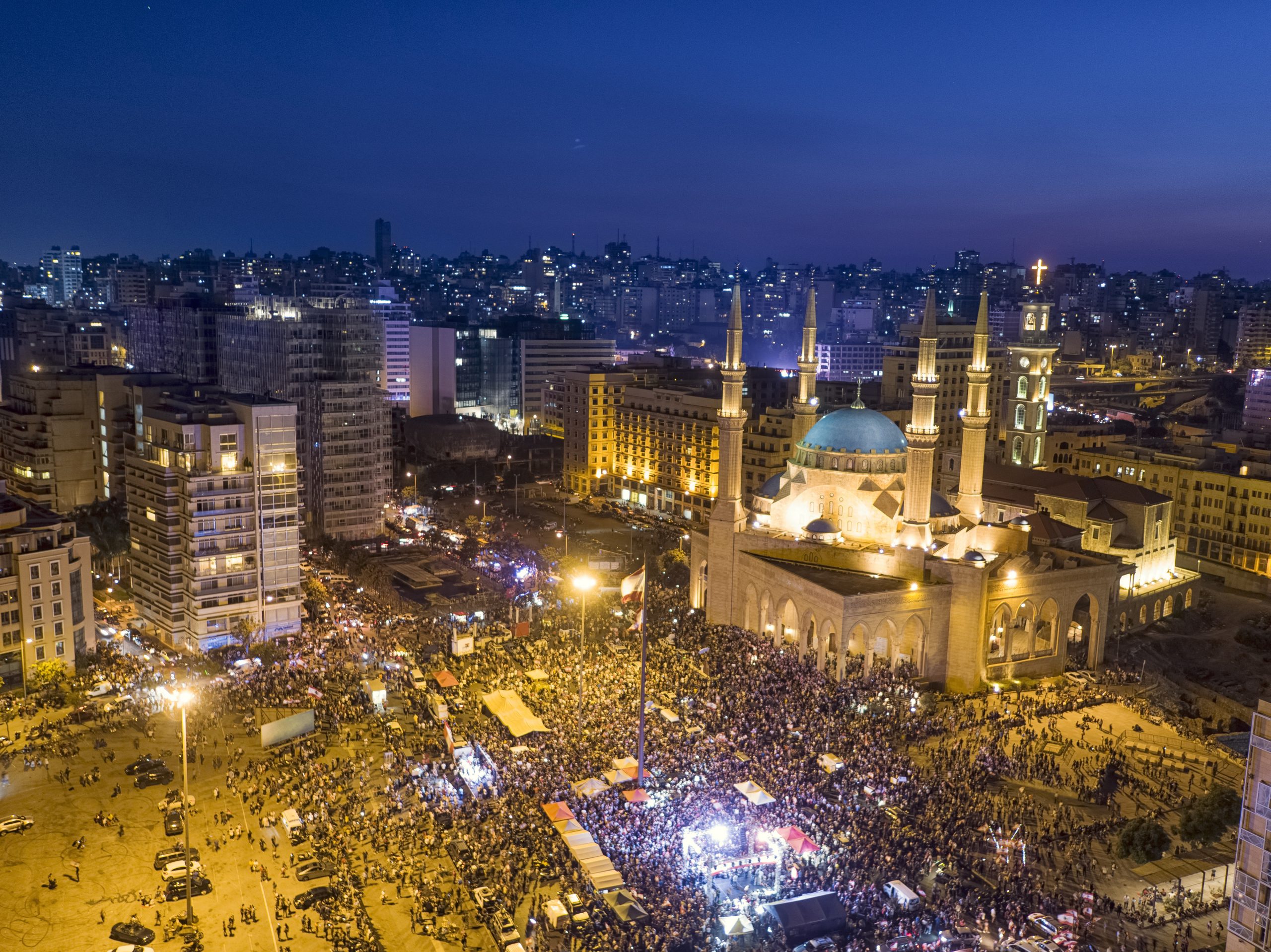
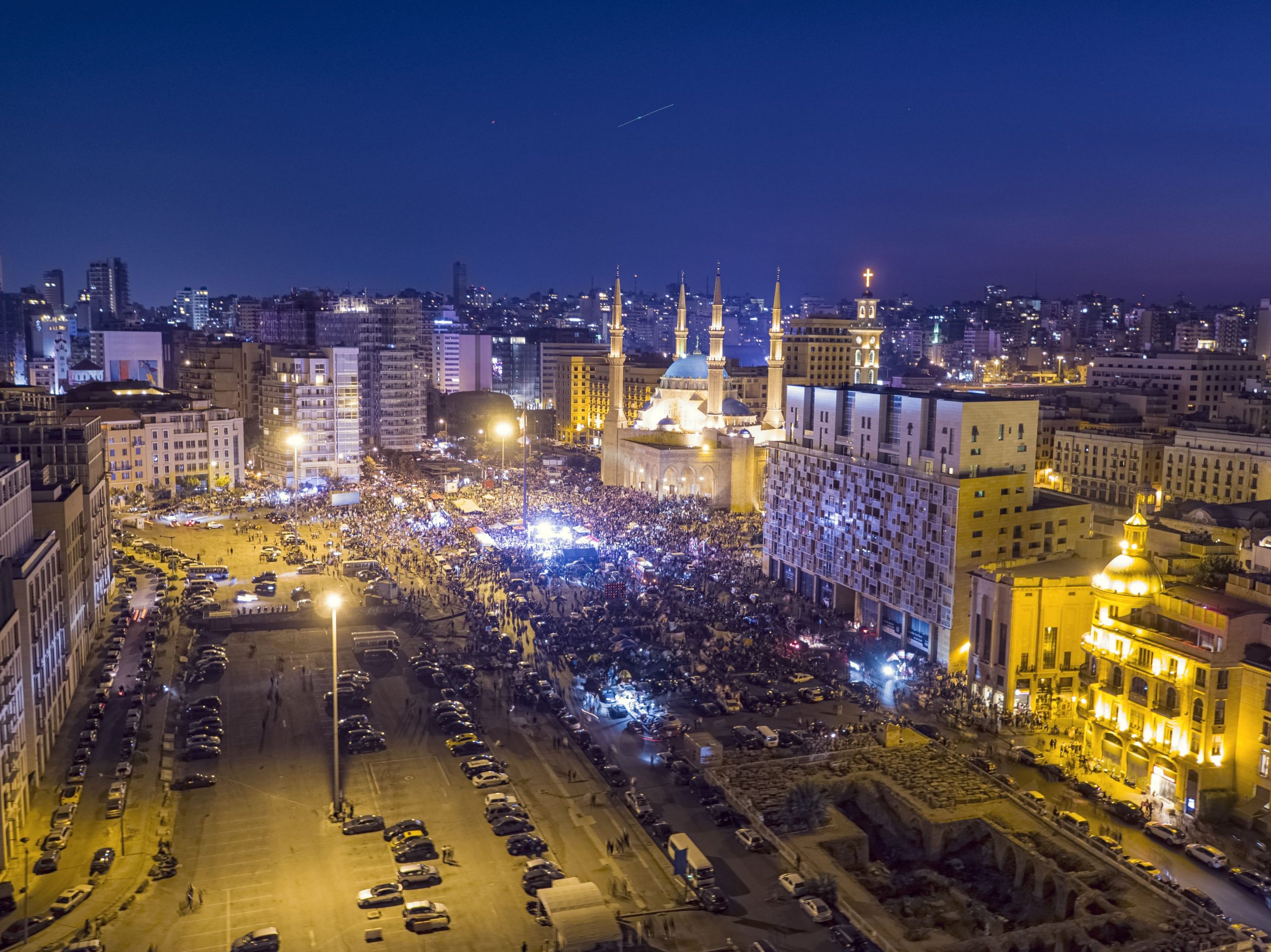
    Image: Aerial night shot of Beirut Downtown, Lebanon during protest against Government, Lebanese revolution – Phot by Ramzi – Licensed from www.stock.adobe.com