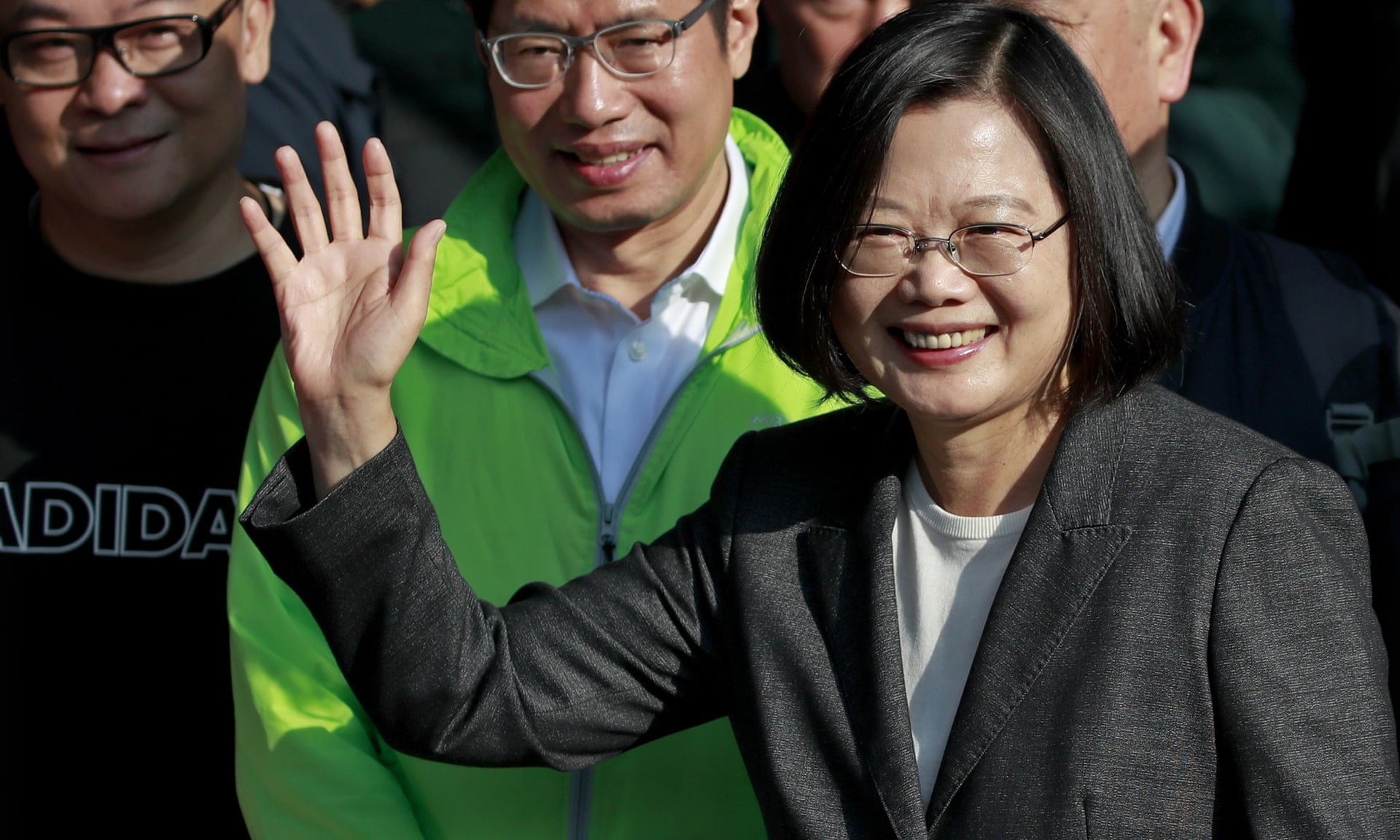
Taiwan’s first female President, Tsai Ing-Wen of the pro-democratic DPP Party won a landslide victory for second term in the national elections held in January. China condemns Tsai’s victory by reiterating its “one country, two systems model.
Election Results: Voice for Democracy and Sovereignty
Taiwan’s president, Tsai Ing-wen won re-election on January 11rth by a historic landslide, a decisive result widely seen as a rebuke to Beijing’s efforts to integrate Taiwan into the ‘one-China’ concept. The DPP (Democratic Progressive Party), rode on Tsai’s popularity and maintained control of the Legislative Yuan, the country’s parliament. DPP has consistently taken a very ‘Taiwan nationalistic’ approach and has been a strong opponent of Beijing’s ‘one-China policy’ and the so-called ‘1992-consensus’. This landslide victory and a second term gives Tsai the power to uphold Taiwan’s commitment to democracy. Taiwanese voted to reject China’s “one country, two systems model” while still maintaining support for Tsai’s stand on the “1992 consensus”, which would dictate the Cross-Strait ties based on “peace, parity, democracy and dialogue”.
On winning the elections, President Tsai remarked – China must ‘face reality’ of Taiwan’s independence and called on China to ‘review’ it’s current policy toward the de facto nation that Beijing claims is part of its territory.
China refuses to acknowledge the victory of pro-democratic forces and maintains that this development would not alter its “one-China” principle. China’s Foreign Ministry stated that “regardless of what happens in Taiwan, the basic facts won’t change: there is only one China in the world and Taiwan is part of China.”
In the voting week, Xi Jinping ushered in a range of measures “to further promote economic and cultural exchanges and cooperation between the two sides of the Taiwan Strait”. Despite these positive announcements, he sent a Chinese aircraft carrier to sail through the Straits to intimidate, should Tsai’s victory initiate a declaration of independence.
The Chinese army also conducted a naval and air force drill on 9-10 February in a threatening attempt to which Washington responded with the US Air Force sending two surveillance planes as an expression of solidarity with Taiwan.
Election results and impact on KMT
In the aftermath of the astounding defeat in January, the opposition KMT has been forced to re-examine its policies and priorities. The party elected Mr Johnny Chiang, a 48-year old lawyer, as its president in March first week. Chiang represents the younger generation who are more focused on separate Taiwan identity, reflecting DPP’s resonance across the young voters. KMT has some serious issues to resolve if it wants to remain relevant in Taiwan. It is constrained by its linkage to the inconvenient history of Taiwan and a support base that is seen as focused on benefitting from cross-Strait engagement, and in some cases, unique access to the CCP through party-to-party ties. The main internal issue is the party’s cross-Strait policy with China, whether 1992 consensus will endure as the foundation for official mechanisms. Chiang is seen as one who will most likely ‘discard’ the 1992 consensus arguing that the consensus has lost its utility and undergone ‘distortion’ when linked with the ‘one country, two systems’ model used in Hong Kong.
Background: 1992 Consensus – discarded by rising Taiwanese identity?
Taiwan was ruled for more than three decades by the nationalist army, the Kuomintang (KMT),which fled to the island in 1949 after being defeated by the Chinese Communist Party (CCP) and created a rival government, the Republic of China, better known as today’s Taiwan. It has since transformed into a multiparty democracy, under a government and political system, completely separate from China’s. KMT’s position stems from the legacy of the Chinese civil war with the CCP, which is a complicated history of KMT and CCP vying to represent ‘one China’ as the ‘Republic of China’ by KMT and the ‘People’s Republic of China’ by CCP. KMT, in view of this history, is seen as the most pro-mainland of Taiwan’s two major political parties. In contrast, the DPP has always maintained much tougher stance with Beijing. It has played a prominent role in democratisation of Taiwan and places greater emphasis on uniqueness of Taiwanese identity and a history of more than 100 years that is separate from that of China’s. From the late 1980s when democratisation of Taiwan began, more and more Taiwanese are embracing a Taiwanese consciousness and favouring independence even though maintaining status quo still remains the majority priority for the moment. Majority of the youth, and 60-70% of Taiwanese are fiercely conscious of their Taiwanese identity, and view Taiwan as an independent and sovereign nation-state. This also means that the idea and legacy of nationalist party’s ROC is seen as impractical, in consonance with geopolitical realities.
The 1992 Consensus, seen as having enabled the growth of Taipei-Beijing cooperation, revolves around the issue of ‘one-China’ interpretation – ‘that there is only one China and that Taipei and Beijing agree to disagree on which government is its legitimate representative’ has been the foundation of cross-Strait relations. It was curated by the KMT and the PRC wherein in principle they agree that there is “One China”. However, the contentious terminology “One China” can be interpreted by either side having accorded its own meaning. The CCP believes “one China” is the “People’s Republic of China,” while Taiwan believes “one China” should mean the ROC established in 1912 and hitherto exists.
The KMT government in 2008-16, led by Ma Ying-jeou used the so-called 1992 Consensus to strengthen economic, trade and cultural relations between Taiwan and PRC. It led to rapid development of economic links and integration with PRC while political issues were kept away. Trade, indirect investment, and travel via Hong Kong grew steadily. By 2014, over 40% of Taiwan’s trade was with the mainland, and some 80% of its foreign direct investment (FDI) went to China; Taiwan businesses operated more than one hundred thousand businesses on the mainland. Taiwan-China two ay trade in 2019 was USD 244.35 billion. The trade balance has, consistently been in Taiwan’s favour.
KMT’s strategy, under Ma’s leadership, focused on reviving Chinese nationalism and was aimed at anchoring Taiwan in the Chinese nation, bridging the gap with PRC, opposing Taiwan independence, favouring reconciliation and eventually unification between the two sides of the Straits. By 2012-13 this approach gave rise to suspicions amongst the Taiwanese about Ma’s rapprochement policy. Paradoxically it strengthened the predominance of Taiwanese identity, which is stronger amongst the youth. This resulted in KMT’s internal fractures in 2012-13, its loss in local elections of 2014, the turbulence of the Sunflower revolution of 2014, and its huge loss to DPP in the presidential elections of 2016.
The ideological battle between the Democratic Progressive Party(DPP) and the Kuomintang (KMT) has persisted since 2016 (when Tsai became President) and the DPP refused to recognise the “1992 consensus”. In 2000, Tsai as the minister of Mainland Affairs Council (MAC) said, “The so-called ‘one China, differing interpretations’ is only a usage by our side to describe the process of the meeting. It is a way of description that the new government can accept, but it does not mean that we have accepted Beijing’s ‘one-China, two models principle.’
Though DPP lost the local elections in 2018 to the pro-China Kuomintang party (KMT), and had no hopes of winning the presidential 2020 elections, Tsai has been trying to replace the Chinese identity with the Taiwanese identity by promising people that the Taiwanese sovereignty will be protected. By articulating “maintenance of status quo”, she indicates that she may not actually pursue outright independence in order to maintain a peaceful environment that helps growth and development; in effect allowing PRC to see it as a support for “One China” in principle and being open to cross-Strait dialogue. But she makes it clear to rest of the world – “we don’t have a need to declare ourselves an independent state. We are an independent country already and we call ourselves the Republic of China, Taiwan.”
Diversifying Economic and Trade Strategies
During her presidency in 2016, she had initiated “new south-bound policy (NSP)” to strengthen relations with selected countries in South and South-East Asia and gain entry into regional blocs. As the US unveiled its Indo-Pacific strategy of Free and Open Indo-Pacific (FOIP), Taiwan saw great benefits in dove-tailing it’s NSP strategy into the Indo-Pacific. The NSP has made notable gains in the first term, and Tsai’s re-election offers great opportunity to diversify the gains in the second term. The Chinese have been aggressively countering this strategy by compelling nations to switch allegiance to China. This had resulted in Taiwan having only close to 16 diplomatic allies which include small nations like Belize and Naru. Despite this, major nations have come around the issue to strengthen ties with Taiwan through economic and cultural centres. Nevertheless, the ‘New South-bound Partnership’ strategy is a conscious effort by Taiwan to reduce its economic dependency on the mainland. Taiwan has aggressively pursued economic partnerships with countries like India, and has encouraged investments by Taiwanese companies. Its investments in South-East Asia has more than doubled in this period.
China has also been accused of meddling with local Taiwanese elections in 2018, according to Wang William Liqiang, a self-identified Chinese spy presently seeking political asylum in Australia. As a counter-strategy and to prevent foreign influence in the country’s elections, Taiwan’s legislature passed the anti-infiltration act on 31 December 2019, which criminalises external meddling. According to MAC Chief Chen Ming-tong, “[the act] aims to counter infiltration”. He added that it acts “as a corrective measure to ensure normal cross-Strait exchanges and reduce politically-motivated infiltration and intervention by Beijing. The Act prevents hostile external powers from engaging, through local collaborators, in illegal lobbying and election campaigning, disrupting rallies and assemblies, and making political donations.”
Rising anti-Chinese sentiment has gained momentum due to the recent protests in Hongkong. Young voters have been deeply influenced by this and are supporting Tsai. This is supplanted by the economic slowdown which affected Taiwan and has divided the Taiwanese voters—those who support the Economic Cooperation Framework Agreement (ECFA) with China and those who don’t.
Taiwan had also altered its economic policy since the election of DPP in 2016, wherein industrial restructuring has resulted in a large businesses (heavy industries) moving to China in order to reduce the labour cost. This has led to an increase in trade and investment in China. However, the catch is that since both governments don’t recognise each other, the Taiwanese companies are exposed to high risk and no dispute settlement is prevalent currently nor is it guided by international norms. China continues to be Taiwan’s largest trading partner, accounting for nearly 30% of the island’s total trade. However, Taiwan’s investment into the mainland has been declining over the last five years, and so also mainland’s investment in Taiwan.
The Future
The ‘one-China policy’ is a zero-sum game between the PRC and the ROC. China has always reiterated that only by accepting China’s authoritarian rule can the Taiwanese people attain prosperity and peace. From the beginning of 2005, the “carrots and sticks” policy has been predominant in the Cross-Strait relations. Since China’s policy has backfired, she is capable of adopting coercive measures—economic crippling, isolation by cutting off diplomatic allies, direct invasion or meddling with internal politics. If Beijing decides to use force, it could spiral into a regional conflict inviting Taiwan’s allies and heavy economic repercussions.
China’s isolation strategy with respect to Taiwan is a constant challenge, which influences majority of the Taiwanese to maintain status quo in current environment. Status quo can mean different things to different people. Chinese president Xi’s aggressive articulation in 2019 of ‘one-China policy’ with respect to Taiwan and the events in Hong Kong has triggered a massive nationalistic fervour in support of democracy and Taiwan identity amongst the younger population.
China has repeatedly said that it will bring Taiwan under its authority by any means necessary, including force. Analysts believe Xi Jinping aims to achieve that by 2049, the deadline for the country to achieve its ‘great rejuvenation’. Beijing’s refusal of renouncing the possible use of force for unification is reflected in the continued military build-up on the Fujian coast. By 2014, PLA had over 1500 ballistic and cruise missiles targeting Taiwan, ten times more than in 2000, and more accurate and destructive than in 2000.
Chinese state media have downplayed President Tsai’s election, but there is no doubt that China considers it as a major setback to its reunification efforts. The election has resulted in a cooling off period for cross-Strait relations, and the global ‘Corona Virus pandemic’ has only added to put this off any priority for some time.
Only time will tell if Taiwan and China manage to engage in dialogue and come to a consensus regarding their irreconcilable differences. As democracy and pro-democratic forces continue to strengthen and sustain Taiwanese identity and nationalism, Taiwan’s functioning as a sovereign independent state is stronger than ever, while Beijing’s strategy of geo-economic boxing-in Taiwan into accepting its ‘one-China’ policy looks less probable. On the other hand, giving legitimacy to Tsai’s government will be a tricky call for many countries as they have to walk a tight rope in order not to rupture relations with China. How different nations recognise and engage with the new Taiwanese government will definitely be a contributing factor in determining Taiwan’s future.