Tag: ISIS

  • On Twenty-fifth Anniversary of 9/11, the Unfinished Task of Counterterrorism

    On Twenty-fifth Anniversary of 9/11, the Unfinished Task of Counterterrorism

    Introduction

    Twenty-five years after the attacks of September 11, 2001, the central question is no longer whether the United States and its allies defeated groups like al-Qaeda and the Islamic State (IS). The more consequential question is whether counterterrorism has kept pace with the transformation of terrorism itself.

    The answer is mixed. The post-9/11 counterterrorism campaign achieved a major strategic success: it prevented another attack on the scale of 9/11 and dismantled much of the infrastructure that had enabled al-Qaeda to operate from a secure sanctuary. Yet terrorism was not eliminated. Instead, it adapted, from centralised organisations to decentralised networks, from fixed training camps to dispersed and virtual infrastructure, from directed operations to self-radicalised individuals, and from global terrorist organisations to increasingly localised insurgencies and criminal-terrorist ecosystems.

    The lesson of the past quarter-century is therefore not that the “war on terror” succeeded or failed. It is that counterterrorism became an evolutionary contest.

    The Transformation After 9/11
    The 9/11 attacks fundamentally altered how terrorism was understood. Before 9/11, terrorism was largely treated as a matter of intelligence, policing, border security and criminal justice. Al-Qaeda demonstrated something different: a non-state organisation could maintain leadership structures, financing, recruitment, training, logistics and communications across borders, while exploiting state sanctuary to mount a sophisticated attack thousands of miles away.

    The response consequently became global and preventive. The United States expanded intelligence collection, aviation and border security, financial sanctions, terrorist-financing controls, international intelligence cooperation, targeted operations, and partnerships with local security forces.

    The strategic principle was straightforward: disrupt terrorism before an attack could occur. Governments sought to intervene at every stage—from radicalisation and recruitment to financing, travel, training, communications and operational planning. This created the concept of pre-emption or preventive strikes, which, however, became problematic going forward.

    That strategy produced substantial results. But it also generated difficult questions about surveillance, civil liberties, executive authority, targeted killing, detention and the legal boundaries of counterterrorism. The challenge for democratic states has always been to prevent terrorism without letting counterterrorism undermine democratic institutions.

    Three strategic phases of counterterrorism

    During the first phase, from 2001 through 2003, the goal was to eliminate al-Qaeda’s safe haven in Afghanistan. The international coalition destroyed training camps and operational infrastructure, killed or drove away senior leaders, and deprived the organisation of the relatively secure environment from which it had planned international operations. Al-Qaeda survived, but its centralised operating model was severely damaged.

    The second phase began with the 2003 invasion of Iraq. The removal of Saddam Hussein created political disintegration, insurgency and sectarian conflict that facilitated the rise of al-Qaeda in Iraq. That organisation eventually evolved into the Islamic State of Iraq and Syria (ISIS). The Iraqi experience demonstrated one of counterterrorism’s most important lessons: military action can eliminate one terrorist ecosystem while inadvertently creating conditions for another.

    The third phase (2011–19) witnessed the killing of Osama bin Laden and the rise of the Islamic State (originally named the Islamic State of Iraq and Syria -ISIS). The death of Bin Laden in 2011 in Abbottabad, Pakistan, further decimated al-Qaeda’s central leadership. IS, created by Abu Bakr al-Baghdadi, however, was a different challenge. Rather than simply conducting terrorist attacks, it sought territory, administration and political authority. At its height, it functioned as a hybrid of a terrorist organisation, insurgency, and proto-state, complete with taxation, administration, military structures, recruitment, propaganda, and financial systems. This created the conditions for a rush of thousands of fighters and civilian cadres from more than 100 countries to serve the purported Islamic State.

    The destruction of the IS caliphate by 2017 demonstrated the effectiveness of conventional military power against territorial terrorist organisations. But it also demonstrated its limitations: defeating territorial control did not eliminate the ideology, networks or organisational capacity that sustained the movement.

    The Terrorist Threat Has Changed
    The most important development since 9/11 has been organisational fragmentation of key terrorist organisations.

    The al-Qaeda of 2001 depended heavily on hierarchy, centralised leadership, training camps, financing and communications. Today’s terrorist environment is dominated by affiliates, provinces, local insurgencies, clandestine networks and independent actors. Al-Qaeda and IS have both become increasingly dependent on regional branches that possess considerable operational autonomy.

    To be sure, decentralisation has made terrorism less efficient but more resilient. Killing a group leader no longer necessarily cripples an organisation. Destroying a geographical base does not eliminate a network that can relocate. Disrupting one communication channel can simply push operatives toward another.

    The geography of terrorism has also changed. In 2001, the Afghanistan-Pakistan region represented the principal centre of gravity for transnational jihadist terrorism. By 2026, significant activity has expanded across Africa, particularly the Sahel, as well as the Middle East, South Asia and other fragile regions. Weak institutions, porous borders, communal conflict, political instability and local grievances provided fertile environments for terrorist organisations.

    From Global Ideology to Local Grievances
    Another important transformation is the increasing fusion of global ideology with local political grievances.

    Contemporary terrorist organisations frequently exploit ethnic tensions, corruption, poverty, state repression, competition over resources, weak governance and political exclusion. This has blurred the distinction between terrorism and insurgency. In many conflict environments, terrorist groups simultaneously operate as armed organisations, criminal enterprises, political actors and providers of limited governance.

    This means counterterrorism cannot be reduced to kinetic operations alone.  Where governments fail to provide security, legitimacy and political order, terrorist organisations can regenerate even after their military defeat.

    The experiences of Iraq and Afghanistan reinforce this point. Military force can disrupt terrorist organisations, but it cannot by itself resolve the political and social conditions that allow violent extremism to regenerate. Governance, legitimacy, economic opportunity and regional diplomacy are therefore not peripheral to counterterrorism; they are part of it.

    The Digital and Lone-Actor Challenge
    The contemporary terrorist threat is also increasingly digital.

    The internet has transformed recruitment, propaganda, communications, fundraising and radicalisation. The shift has been particularly important from “commanded terrorism” to “inspired terrorism.” A terrorist organisation may no longer need to recruit, train and deploy an operative. It can disseminate an ideology, provide encouragement and leave an individual to select the target and method independently.

    This creates a major intelligence challenge. A lone actor may have no international travel history, terrorist bank account, training camp or conventional terrorist communication network. Traditional organisation-focused intelligence can therefore miss individuals who move from online radicalisation to violence.

    Artificial intelligence could intensify this problem. Extremist actors could use automated systems (chatbots) to create propaganda, manipulate audiences, develop persuasive content and radicalise people. Digital ecosystems can also enable polarisation and ideological mobilisation at unprecedented speed.

    Counterterrorism must consequently evolve from simply identifying organisations toward identifying credible pathways to violence while avoiding the dangerous assumption that ideological expression alone constitutes evidence of imminent terrorism.

    What Should Counterterrorism Do Next?

    Twenty-five years of experience suggests several policy priorities.

    First, intelligence must remain the foundation. The greatest achievement since 9/11 has been the ability to disrupt terrorist plots before execution. Intelligence cooperation, financial tracking and international information sharing remain indispensable.

    Second, leadership targeting should remain a tool, not a strategy. Removing terrorist leaders disrupts organisations but rarely eliminates leadership permanently. It must therefore be combined with measures that attack recruitment, financing and organisational regeneration.

    Third, governments must target terrorist ecosystems rather than organisations alone. Financing networks, criminal economies, propaganda systems, local political grievances and permissive environments are increasingly interconnected.

    Fourth, good governance is counterterrorism. Fragile states provide the political and economic space in which terrorist organisations can regenerate. Strengthening legitimate institutions and preventing state collapse should therefore be viewed as preventive counterterrorism.

    Fifth, digital radicalisation requires new methods. Security agencies need capabilities to identify credible pathways from online radicalisation to violence while protecting freedom of expression and avoiding indiscriminate surveillance.

    Finally, democratic resilience must remain central. Terrorist organisations seek more than casualties. They seek fear, polarisation, political overreaction and declining public confidence. A counterterrorism policy that damages the rule of law, institutional legitimacy or social cohesion can inadvertently advance the objectives of terrorists.

    The Unfinished Task
    Twenty-five years after 9/11, the United States is considerably safer from the specific threat posed by the al-Qaeda network that planned the attacks. Its leadership has been decimated, its training camps and logistical, including financial, infrastructure largely destroyed, and its capacity to reproduce a 9/11scale operation has been dramatically reduced.

    But terrorism has adapted.

    From Afghanistan, it has dispersed worldwide – Iraq and Syria and increasingly Africa and other fragile regions. It has shifted from centralised organisations to affiliates, from physical training camps to digital ecosystems, and from tightly controlled operatives to self-directed individuals. Its financing has increasingly diversified into criminal economies.

    The central paradox of the past quarter-century is therefore clear: the world community became better at defeating terrorist organisations, while terrorist organisations became better at surviving defeat.

    The policy objective going forward should accordingly be more realistic than the permanent elimination of terrorism. The goal should be to prevent terrorist organisations from acquiring sanctuary, resources, technology, political opportunity, social legitimacy and organisational capacity necessary to produce another strategic catastrophe.

    That is the unfinished legacy of 9/11: not the elimination of terrorism, but the continuing effort to keep it from becoming a strategic alternative to legitimate political order.

    Feature Image Credit: nypost.com
  • The End of Pluralism in the Middle East

    The End of Pluralism in the Middle East

    A  truly seismic change in the Middle East has occurred.  At its heart is a devil’s bargain – Turkey and the Gulf States accept the annihilation of the Palestinian nation and the creation of a Greater Israel, in return for the annihilation of the Shia minorities of Syria and Lebanon and the imposition of Salafism across the Eastern Arab world.

    This also spells the end for Lebanon and Syria’s Christian communities. Witness the tearing down of all Christmas decorations, the smashing of all alcohol and the forced imposition of the veil on women when the jihadists — who overthrew the government of Bashar al-Assad on Sunday — first took Aleppo a mere two weeks ago.

    The speed of the collapse of Syria took everybody by surprise. Next, a renewed Israeli attack on Southern Lebanon to coincide with a Salafist invasion of the Bekaa Valley seems inevitable, as the Israelis would obviously wish their border with their new Taliban-style Greater Syrian neighbour to be as far North as possible.

    It could be a race for Beirut, unless the Americans have already organised who gets it.

    It is no coincidence that the attack on Syria started the day of the Lebanon/Israel ceasefire. The jihadist forces do not want to be seen to be fighting alongside Israel, even though they are fighting forces which have been relentlessly bombed by Israel, and in the case of Hezbollah are exhausted from fighting Israel.

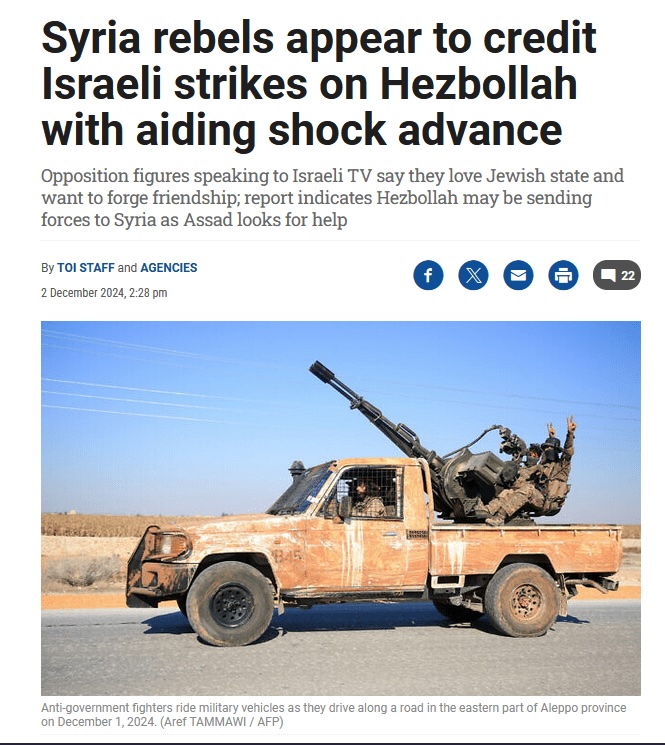
    The Times of Israel has no compunction about saying the quiet part out loud, unlike the British media:

    In fact, Israeli media is giving a lot more truth about the Syrian rebel forces than British and American media. This is another article from The Times of Israel:

    “While HTS officially seceded from Al Qaeda in 2016, it remains a Salafi jihadi organization designated as a terror organization in the US, the EU and other countries, with tens of thousands of fighters.

    Its sudden surge raises concerns that a potential takeover of Syria could transform it into an Islamist, Taliban-like regime – with repercussions for Israel at its south-western border. Others, however, see the offensive as a positive development for Israel and a further blow to the Iranian axis in the region.”

    Contrast this to the U.K. media, which from the Telegraph and Express to The Guardian has promoted the official narrative that not just the same organisations, but the same people responsible for mass torture and executions of non-Sunnis, including Western journalists, are now cuddly liberals.

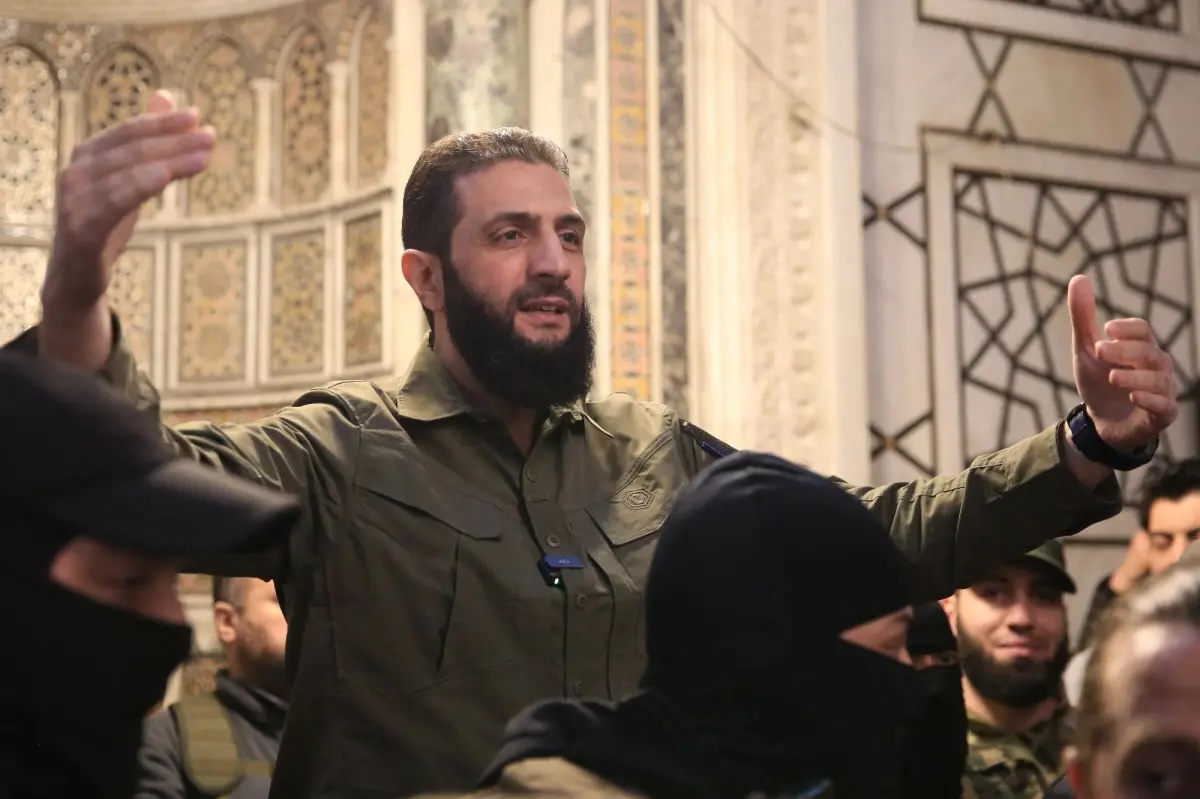
    Nowhere is this more obvious than the case of Abu Mohammad Al-Jolani, sometimes spelt Al-Julani or Al-Golani, who, now nominally in charge in Damascus, is being boosted throughout Western media as a moderate leader. He was the deputy leader of ISIS, and the CIA actually has a $10 million bounty on his head! Yes, that is the same CIA. which is funding and equipping him and giving him air support.

    Supporters of the Syrian rebels still attempt to deny that they have Israeli and U.S. support – despite the fact that almost a decade ago there was open Congressional testimony in the U.S.A. that, to that point, over half a billion dollars had been spent on assistance to Syrian rebel forces, and the Israelis have openly been providing medical and other services to the jihadists and effective air support.

    Violates UK Terrorism Act

    One interesting consequence of this joint NATO/Israel support for the jihadist groups in Syria is a further perversion of domestic rule of law. To take the U.K. as an example, under Section 12 of the Terrorism Act it is illegal to state an opinion that supports, or may lead somebody else to support, a proscribed organisation.

    The abuse of this provision by British police to persecute Palestinian supporters for allegedly encouraging support for proscribed organisations Hamas and Hezbollah is notorious, with even tangential alleged references leading to arrest. Sarah Wilkinson, Richard Medhurst, Asa Winstanley, Richard Barnard and myself are all notable victims, and the persecution has been greatly intensified by Keir Starmer.

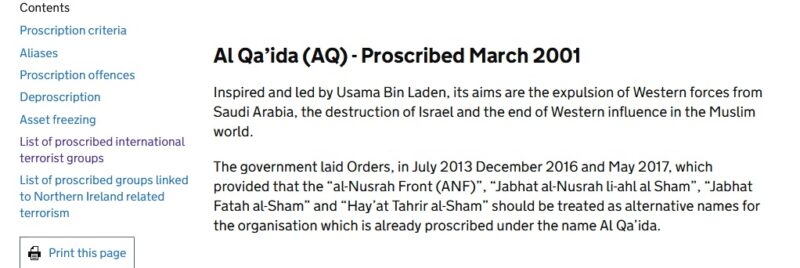
    Yet Hay’at Tahrir Al-Sham (HTS) is also a proscribed group in the U.K. But both British mainstream media and British Muslim outlets have been openly promoting and praising HTS – frankly much more openly than I have ever witnessed anyone in the U.K. support Hamas and Hezbollah – and not a single person has been arrested or even warned by U.K. police.


    That in itself is the strongest of indications that Western security services are fully behind the overthrow of the government in Syria.

    For the record, I think it is an appalling law, and nobody should be prosecuted for expressing an opinion either way. But the politically biased application of the law is undeniable.

    When the entire corporate and state media in the West puts out a unified narrative that Syrians are overjoyed to be released by HTS from the tyranny of the Assad regime – and says nothing whatsoever of the accompanying torture and execution of Shias, and destruction of Christmas decorations and icons – it ought to be obvious to everybody where this is coming from.

    Yet – and this is another U.K. domestic repercussion – a very substantial number of Muslims in the U.K. support HTS and the Syrian rebels, because of the funding pumped into U.K. mosques from Saudi and Emirate Salafist sources.

    This is allied to the U.K. security service influence also wielded through the mosques, both by sponsorship programmes and “think tanks” benefiting approved religious leaders, and by the execrable coercive Prevent programme.

    U.K. Muslim outlets that have been ostensibly pro-Palestinian – like Middle East Eye and 5 Pillars – enthusiastically back Israel’s Syrian allies in ensuring the destruction of resistance to the genocide of the Palestinians. Al Jazeera alternates between items detailing dreadful massacre in Palestine, and items extolling the Syrian rebels bringing Israel-allied rule to Syria.

    Among the mechanisms they employ to reconcile this is a refusal to acknowledge the vital role of Syria in enabling the supply of weapons from Iran to Hezbollah. Which supply the jihadists have now cut off, to the absolute delight of Israel, and in conjunction with both Israeli and U.S. air strikes.

    In the final analysis, for many Sunni Muslims both in the Middle East and in the West, the pull seems to be a stronger sectarian hatred of the Shia and the imposition of Salafism, than preventing the ultimate destruction of the Palestinian nation.

    I am not a Muslim. My Muslim friends happen to be almost entirely Sunni. I personally regard the continuing division over the leadership of the religion over a millennium ago as deeply unhelpful and a source of unnecessary continued hate.

    Classic Divide and Rule

    But as a historian, I do know that the Western colonial powers have consciously and explicitly used the Sunni/Shia split for centuries to divide and rule. In the 1830s, Alexander Burnes was writing reports on how to use the division in Sind between Shia rulers and Sunni populations to aid British colonial expansion.

    On May 12, 1838, in his letter from Simla setting out his decision to launch the first British invasion of Afghanistan, British Governor General Lord Auckland included plans to exploit the Shia/Sunni division in both Sind and Afghanistan to aid the British military attack.

    The colonial powers have been doing it for centuries, Muslim communities keep falling for it, and the British and Americans are doing it right now to further their remodelling of the Middle East.

    Simply put, many Sunni Muslims have been brainwashed into hating Shia Muslims more than they hate those currently committing genocide of an overwhelmingly Sunni population in Gaza.

    I refer to the U.K. because I witnessed this first-hand during the election campaign this year in Blackburn [where Murray ran for Parliament.] But the same is true all over the Muslim world. Not one Sunni Muslim-led state has lifted a single finger to prevent the genocide of the Palestinians.

    Their leadership is using anti-Shia sectarianism to maintain popular support for a de facto alliance with Israel against the only groups – Iran, Houthi and Hezbollah – which actually did attempt to give the Palestinians practical support in resistance. And against the Syrian government which facilitated supply.

    The unspoken but very real bargain is this: The Sunni powers will accept the wiping out of the entire Palestinian nation and formation of Greater Israel, in return for the annihilation of the Shia communities in Syria and Lebanon by Israel and forces backed by NATO (including Turkey).

    There are, of course, contradictions in this grand alliance. The United States’ Kurdish allies in Iraq are unlikely to be happy with Turkey’s destruction of Kurdish groups in Syria, which is what Turkish President Recep Tayyip Erdogan gains from Turkey’s very active military role in toppling Syria – in addition to extending Turkish control of oilfields.

    The Iran-friendly Iraqi government will have further difficulty with reconciling the U.S. continuing occupation of swathes of its country, as they realise they are the next target.

    The Lebanese army is under the control of the U.S.A., and Hezbollah must have been greatly weakened to have agreed to the disastrous ceasefire with Israel. Christian fascist militias traditionally allied to Israel are increasingly visible in parts of Beirut, though whether they would be stupid enough to make common cause with jihadists from the North may be open to question.

    But now that Syria has fallen to jihadist rule, I do not rule out Lebanon following very quickly indeed, and being integrated into a Salafist Greater Syria.

    How the Palestinians of Jordan would react to this disastrous turn of events, it is hard to be sure. The British puppet Hashemite Kingdom is the designated destination for ethnically cleansed West Bank Palestinians under the Greater Israel plan.

    What this all potentially amounts to is the end of pluralism in the Levant and its replacement by supremacism. An ethno-supremacist Greater Israel and a religio-supremacist Salafist Greater Syria.

    Unlike many readers, I have never been a fan of the Assad regime or blind to its human rights violations. But what it did undeniably do was maintain a pluralist state where the most amazing historical religious and community traditions – including Sunni (and many Sunni do support Assad), Shia, Alaouites, descendants of the first Christians, and speakers of Aramaic, the language of Jesus – were all able to co-exist.

    The same is true of Lebanon.

    An End of Tolerance

    What we are witnessing is the destruction of that and the imposition of a Saudi-style rule. All the little cultural things that indicate pluralism – from Christmas trees to language classes to winemaking to women going unveiled – have been destroyed in Aleppo and soon perhaps in Damascus and Beirut.

    I do not pretend that there are not genuine liberal democrats among the opposition to Assad. But they have negligible military significance, and the idea that they would be influential in a new government is delusion.

    In Israel, which pretended to be a pluralist state, the mask is off. The Muslim call to prayer has just been banned. Arab minority members of the Knesset have been suspended for criticising Netanyahu and genocide. More walls and gates are built every day, not just in unlawfully occupied territories but in the “state of Israel” itself, to enforce apartheid.

    I confess I once had the impression that Hezbollah was itself a religio-supremacist organisation; the dress and style of its leadership look theocratic.

    Then I came here and visited places like Tyre, which has been under Hezbollah-elected local government for decades, and found that swimwear and alcohol are allowed on the beach and the veil is optional, while there are completely unmolested Christian communities there.

    I will never now see Gaza, but wonder if I might have been similarly surprised by Hamas’s rule.

    It is the United States which is promoting the cause of religious extremism and of the end, all over the Middle East, of a societal pluralism similar to Western norms.

    That is of course a direct consequence of the United States being allied to both the two religio-supremacist centres of Israel and Saudi Arabia.

    It is the U.S.A. which is destroying pluralism, and it is Iran and its allies which defend pluralism. I would not have seen this clearly had I not come here. But once seen, it is blindingly obvious.

    Feature Image: nypost.com

    This article was published earlier in scheerpost.com

    It is republished under the Creative Commons Attribution-NonCommercial-NoDerivatives 4.0 International license.

  • A Fairy Tale that is The Kerala Story

    A Fairy Tale that is The Kerala Story

    The Kerala Story has been making waves ever since it opened in theatres but its content is far from reality, it is a fantasy at best.

    The central theme of the film revolves around three girls who fell victim to “manipulative conversion” to Islam that practically destroyed their lives. The main protagonist is Shalini Unnikrishnan, a convert to Islam. She narrates her ordeal from her prison in Afghanistan, of how she once wanted to become a nurse but was brainwashed and manipulated by religious vanguards, turned into an ISIS terrorist and sent on her way to Syria.

    It is loosely based on the accounts of three women from Kerala who converted to Islam and travelled with their husbands to join ISIS in Afghanistan between 2016 and 2018, along with two other women and their husbands. Their husbands were killed in the fighting and these women remain in an Afghan prison. Incidentally, only one of these women, Nimisha Nair alias Fathima Isa, was Hindu and married to a Christian, who subsequently converted to Islam as well. The other two women were Christians before their conversion. The Government of India has refused to repatriate them as they remain hardcore adherents of ISIS philosophy, unlike what has been depicted in the movie.

    [powerkit_button size=”lg” style=”info” block=”true” url=”https://www.dailypioneer.com/2023/columnists/a-fairy-tale-that-is-the-kerala-story.html” target=”_blank” nofollow=”false”]
    Read More
    [/powerkit_button]

  • New challenges of global terrorism

    New challenges of global terrorism

    G Parthasarathy                                                                                                  May 23, 2019/Opinion

    The people of Sri Lanka have shown courage, wisdom and resilience in recovering from the traumatic effects of the country’s brutal ethnic conflict between 1983 and 2010. An estimated 47,000 Tamil civilians, 27,000 LTTE members, 50,000 Sinhala civilians, 23,790 Sri Lankan soldiers and 1,500 members of the Indian Peace Keeping Force laid down their lives, during the conflict.

    he Sri Lankan ethnic conflict, however, did not affect the lives of “Indian Tamils” in Southern Sri Lanka, whose ancestors had migrated, as plantation workers, during British rule. There have, however, been recent incidents of religious tensions between the Sinhala Buddhist clergy and radicalised elements in the Muslim minority. Sri Lanka’s relatively small Christian minority, which is peaceful and relatively affluent, had steered clear of getting drawn into any ethnic conflict.

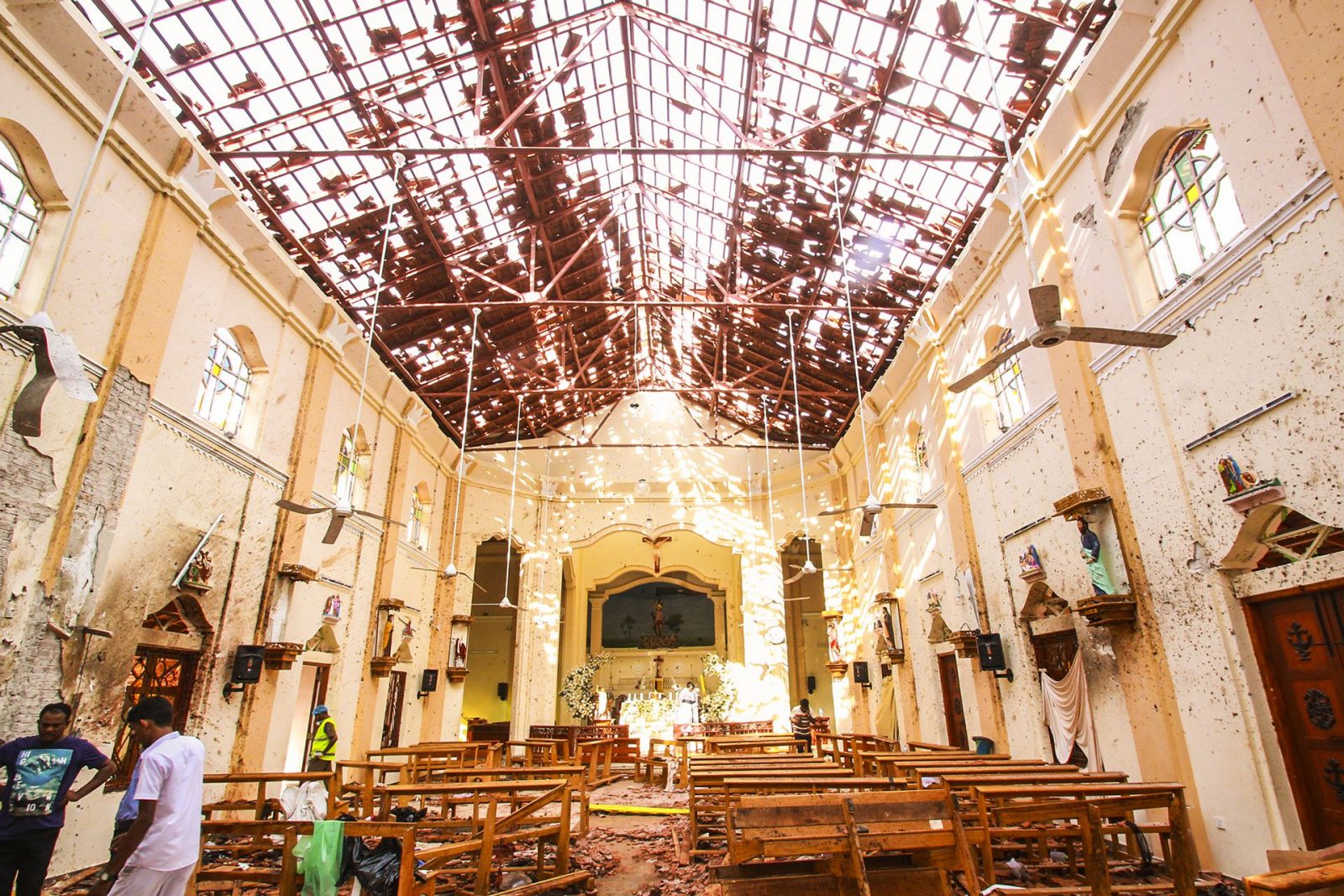
    In these circumstances, the world was shocked to learn that in the midst of holy Easter Sunday church services on April 21, churches in Colombo, Negombo and even the eastern port of Tamil dominated Batticaloa, were hit by bomb explosions.

    Three hotels housing a large number of western tourists in Colombo were also targeted. As many as 253 innocent people perished in the carnage.

    The “Islamic State of Iraq and Syria” (ISIS) soon claimed responsibility for the attack, contradicting President Trump’s claims that the terrorist outfit had been “100 per cent” crushed in Syria. It soon emerged that the mastermind behind the blasts was a rabidly fundamentalist Sri Lankan Tamil, Maulvi Mohammad Zahran Hashim, who was from the town of Kathankudy, in Sri Lanka’s Tamil dominated eastern province.

    Indian intelligence agencies had provided timely warnings to the Sri Lankan Government about an impending terrorist strike by the ISIS. These warnings were not seriously taken note of by the Sri Lanka Government. It is, however, imperative that India keeps in touch discreetly with the Sri Lankan Government. We are evidently seeing the beginnings of long-term internal and regional problems and challenges, as ISIS members disperse and regroup, after being ousted from Iraq and Syria, like Al Qaeda and the Taliban did, after American militarily intervention in Afghanistan.

    As the ISIS targets in Sri Lanka were the country’s peaceful Christian community and western (Christian) tourists, the bomb attacks sent ripples across the West, as the attacks came soon after the massacre of Muslims in New Zealand, during their Sunday prayers.

    Radicalisation drive

    Sri Lanka’s Muslim community, which has done well economically in the Island, has lived in peace with both Buddhist Sinhalas and Hindu Tamils. Recent studies, however, indicate that some years before the bombings, sections of Tamil Muslims from the eastern province were getting radicalised in Saudi Arabia and other Gulf Arab countries.

    Zahran Hashim was one of those so influenced by radical Islamist practices and beliefs. Cutting across ethnic differences, Hashim made common cause with Sinhala Muslims, including two sons of a Muslim business tycoon in Colombo, who had been deeply influenced by the ISIS. Both the sons died in suicide bomb blasts, even as the wife of another bomber detonated explosives in a suicide bombing the same day, resulting in the deaths of three police personnel.

    The Sri Lanka bomb blasts were thus executed by young radicalised Sri Lankan Muslims, cutting across the ethnic divide. Moreover, there are now signs that an estimated 75-100 Indian Muslims, who were with the ISIS in Syria, have dispersed and chosen escape routes, including through Afghanistan and Pakistan. Hashim has also reportedly established close institutional links with a counterpart group in Coimbatore and with people in other parts of Tamil Nadu and Kerala.

    There are now indications that after being forced out of Iraq and Syria, ISIS fighters have now dispersed across Asia, Africa and even to parts of Europe. While the Osama bin Laden-led Al Qaeda made it clear that its struggle was against “Jews and Crusaders,” the ISIS targets all non-Muslims, as was evident from its brutal killings of Indians in Iraq. Moreover, the Al Qaeda operated primarily out of Afghanistan and Pakistan, apart from select Arab countries. Al Qaeda’s leadership was predominantly Arab. It had very few members from other parts of the world.

    The ISIS poses a much more serious challenge to India than the Al Qaeda ever did, primarily because it has recruited its fighters from countries across Europe, Asia and Africa. President George Bush praised India because not a single Indian joined or backed Al Qaeda. But, things are different with ISIS, which regards India as a part of the “Islamic State of Khorasan”. Over 100 Indians are estimated to have joined the ISIS.

    Extending its reach

    The reach of ISIS across India is evident from its links with extremists in Kashmir, apart from those established in the recent past, in Tamil Nadu and Kerala. Radicalisation in our southern States poses new and serious security challenges. ISIS also acknowledges its links with associates, across India’s maritime frontiers in Malaysia, Thailand, the Philippines, Myanmar, Indonesia, Maldives, Saudi Arabia and the UAE. It also has a growing presence in Afghanistan and Pakistan.

    India will also have to take note of the distinct possibility of ISIS attempting to take advantage of tensions arising out of the Rohingya refugee crisis. A senior Myanmar official recently revealed that even as ISIS was losing influence in Iraq and Syria, its supporters were moving into Myanmar’s Rakhine State, where Rohingyas reside. Many Rohingya refugees, now in Bangladesh, could well make common cause with ISIS and with members of Pakistani backed militant outfits like the Jamat-ul-Mujahideen, to destabilise the situation along the common borders of India, Bangladesh and Myanmar. Pakistan has had an abiding interest in destabilising the Sheikh Hasina-led Government in Bangladesh.

    Apart from having to deal with continuing Pakistan sponsored terrorism, India will now also have to keep a watch on challenges that would likely arise from the ISIS, with its emerging presence in the southern States. Like in Sri Lanka, ISIS activities could target selected sections of the population in India, while seeking to radicalise them. They will pose a challenge to internal security in India. Finally, Pakistan could be expected to use the challenges posed by ISIS, to absolve itself of responsibility on actions of its trained jihadis, on Indian soil and in Bangladesh. These issues will hopefully receive careful attention after the general elections.

    The writer is a former High Commissioner to Pakistan. He is a Trustee and Visiting Distinguished fellow of TPF.

    This article was published earlier in The Hindu: BusinessLine.

    Image Credit-Getty through Vox.