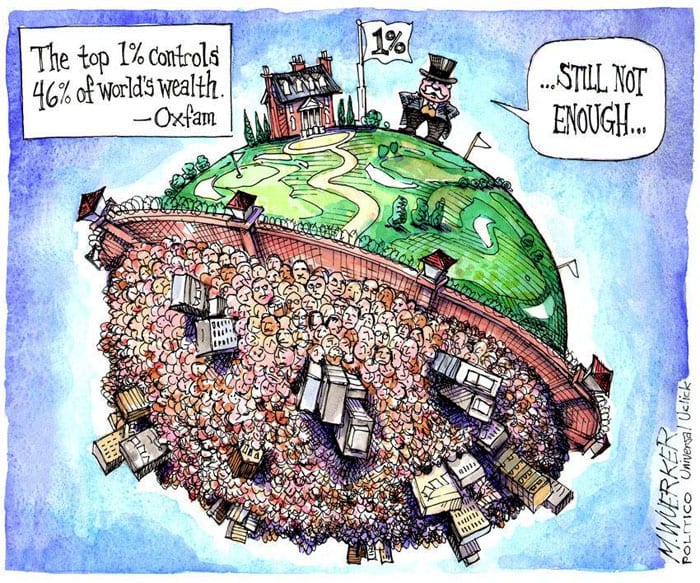
Tag: Inequality

  • The catastrophe of modern capitalism: Inequality as an aim in Neo-Liberal-Ideology

    The catastrophe of modern capitalism: Inequality as an aim in Neo-Liberal-Ideology

    Neoliberalism is the dominant form of capitalism that began in the 1980s as a way to promote global trade and grow all economies. That was a false promise, whereas in essence it supported individuals amassing massive wealth in the name of market forces, at the expense of common man by ensuring states minimise their role and eliminate welfare economics. It ensured least-developed and developing economies remained resource providers to developed economies, exemplifying extraction and exploitation. Neoliberalism is a top down economic policy that does not benefit those who are impoverished. The inequality we see on a global scale is mind-numbing. In 2006, the world’s richest 497 people were worth 3.5 trillion US dollars representing 7% of the world’s GDP. That same year, the world’s lowest income countries that housed 2.4 billion people were worth just 1.4 trillion US dollars, which only represents 3.3% of the world’s GDP. The situation today is far worse as Andreas Herberg-Rothe explains in his critical analysis below. The world is in urgent need of freeing itself from the clutches of neoliberal capitalism. 


    ..neoliberalism contains a general tendency towards an extensive economisation of society. Thus, inequality transcends the economy and becomes the dominant trend in society, as in racism, radical extremism, and hate ideologies in general: Us against the rest, whoever the rest may be.


    Following on from the initial question about Hannah Arendt’s thesis that equality must be confined to the political sphere, we must ask how democracy and human rights can be preserved in the face of social inequality on an extraordinary scale. By the end of this century, 1% of the world’s population will own as much as the “rest” of the other 99%. And already today, only 6 people own more property than 3.6 billion. Let us take a closer look at some of the ideas of the currently dominant neo-liberalism, which sheds some light on the acceptance of these current obscene inequalities. For this ideology, social inequality is a means to greater wealth. However, since it sets no limits on social inequality, it can be used to legitimize even obscene inequalities. We argue that neoliberalism as an ideology is the result of the spread of a specific approach to economic thought that has its roots in the first half of the twentieth century, when Walter Lippmann’s seminal book “An Inquiry into the Principles of the Good Society” (1937), followed by Friedrich August von Hayek’s “The Road to Serfdom” (1944), gave rise to neoliberalism. During the Cold War period, neoliberals gained more and more ground in establishing a global system. With the support of Milton Friedman and his “Chicago Boys,” the first attempt to establish a pure neoliberal economic system took place in Chile under the military dictatorship of General Pinochet in the 1970s. In the last decade of the Cold War, neoliberal architects such as Margaret Thatcher and Ronald Reagan began to impose the new economic model. Since the end of the Cold War, the final development was that neoliberalism became THE hegemonic economic system, as capitalism was de jure allowed to spread unhindered worldwide, and neoliberalism continued on its way to becoming the dominant belief system.

    The critical message in this sense is the following: This process is not limited to an economic dimension – neoliberalism contains a general tendency towards an extensive economisation of society. Thus, inequality transcends the economy and becomes the dominant trend in society, as in racism, radical extremism, and hate ideologies in general: Us against the rest, whoever the rest may be.

    When we talk about global inequality in the era of neoliberalism, we are referring to two other major developments: To this day, inequality between the global North and South persists. While the total amount of poverty has decreased, as seen in the World Bank’s report (2016), there is still a considerable gap between those countries that benefit from the global economy and those that serve as cheap production or commodity areas. The second development takes place in countries that are more exposed to the neoliberal project. In this sense, societies are turning into fragmented communities where the “losers of neoliberalism” are threatened by long-term unemployment, a life of poverty, social and economic degeneration.

    After three decades of intense global neo-liberalism, the result has been a significant increase in social inequalities, polarization and fragmentation of societies (if not the entire world society), not to mention a global financial crisis in 2008 caused by escalating casino capitalism and the policies of a powerful global financial elite.

    We are witnessing a global and drastic discontent of peoples, fears and anger, feelings of marginalization, helplessness, insecurity and injustice. After three decades of intense global neo-liberalism, the result has been a significant increase in social inequalities, polarization and fragmentation of societies (if not the entire world society), not to mention a global financial crisis in 2008 caused by escalating casino capitalism and the policies of a powerful global financial elite. We witness a global and drastic dissatisfaction of the peoples, fears, and anger, the feelings of marginalization, helplessness, insecurity, and injustice. After three decades of intense worldwide Neo-Liberalism, the result significantly intensified social inequalities, polarization, and fragmentation of societies (if not the entire world society), not to mention a global financial crisis in 2008 caused by escalating casino capitalism and the policy of a powerful global finance elite.

    The central critique is that neoliberalism includes social inequality as part of its basic theory. Such capitalism emphasizes the strongest/fittest (parts of society) and uses inequality as a means to achieve more wealth.
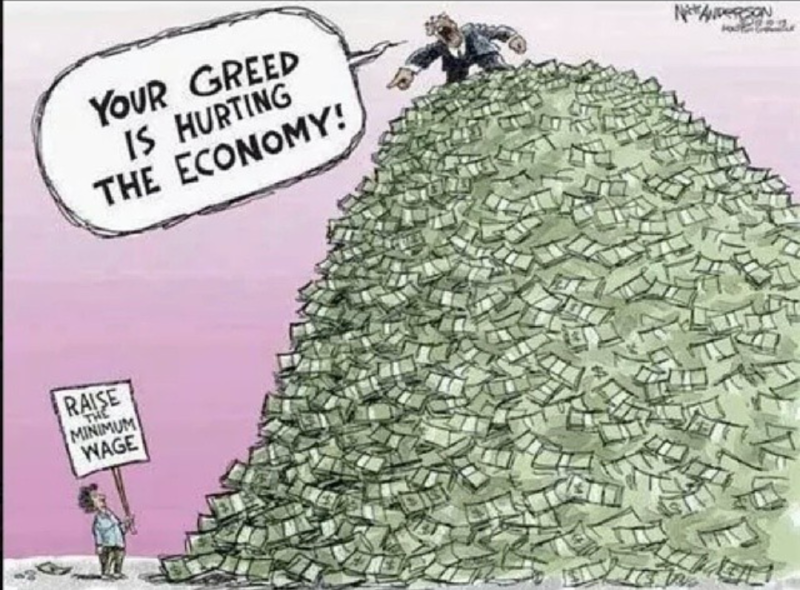
    Remarkably and frighteningly, the situation outlined does not provoke the oppressed, marginalised, and disadvantaged populations to turn against their oppressors and their exploitation. These people tend to sympathize with ideological alternatives, either with more triumphant (right-wing) populist movements and parties or are attracted by radical/fundamentalist religious groups such as the Islamic State. The result is an increase in polarization and violence, and even more protracted wars and religious-ideological disputes. Europe is not exempt from the trend toward obscene social inequality. We also find a polarization between rich and poor, between those who have good starting conditions and those who have little chance of prosperity, between those who are included and those who feel excluded. The fact that Europe has so far largely avoided populist parties gaining administrative power (although we have already witnessed this process in France, Hungary and Poland) may be due to the remnants of the welfare state. In this respect, at least a minimum of financial security remains and limits the neoliberal trend. In the United States, on the other hand, a flawless populist could reach the highest office. The people, stuck in their misery, fear and insecurity, voted for a supposed alternative to the neoliberal establishment, but above all against other social outcasts whom they blamed for their misery. This brings us to the central critique of neoliberalism, a system that has caused fundamental social oddities, the impact of which as an ideology has been highlighted above. The central critique is that neo-liberalism includes social inequality as part of its basic theory. Such capitalism emphasizes the strongest/fittest (parts of society) and uses inequality as a means to achieve more wealth.

    In an interview with the German magazine Wirtschaftswoche, Hayek spoke bluntly about the neoliberal value system: He emphasizes that social inequality, in his view, is not at all unfortunate, but rather pleasant. He describes inequality as something simply necessary (Hayek, 1981). In addition, he defines the foundations of neo-liberalism as the “dethronement of politics” (1981). First, he points out the importance of protecting freedom at all costs (against state control and the political pressure that comes with it). The neoliberals see even a serious increase in inequality as a fundamental prerequisite for more economic growth and the progress of their project. One of the most renowned critics of neoliberalism in Germany, Christoph Butterwegge (2007), sees in this logic a perfidious reversal of the original intentions of Smith’s (reproduced in 2013) inquiry into the wealth of nations in the current precarious global situation. The real capitalism of our time – neoliberalism – sees inequality as a necessity for the functioning of the system. It emphasizes this statement: The more inequality, the better the system works. The hardworking, successful, and productive parts of society (or rather the economy) deserve their wealth, status, and visible advantage over the rest (the part of society that is seen as less strong or less ambitious). The deliberate production of inequality sets in motion a fatal cycle that leads to the current tense global situation and contributes to several intra-societal conflicts.

    The market alone is the regulating mechanism of development and decision-making processes within a society dominated by neo-liberalism, and as such is not politics at all. This brings us closer to the relationship between neoliberalism and democracy. The understanding of democracy in neoliberal theory is, so to speak, different. Principles such as equality or self-determination, which are prominent in the classical understanding of democracy, are rejected. Neo-liberalism strives for a capitalist system without any limits set by the welfare state and even the state as such, in order to shape, enforce and legitimize a society dominated only by the market economy. Meanwhile there are precarious tendencies recognizable, where others than the politically legitimized decision-makers dictate the actual political and social direction (e.g. the extraordinarily strong automobile lobby with VW, BMW and Mercedes in Germany or big global players in the financial sector like the investment company BlackRock). Neoliberalism only seemingly embraces democracy. The elementary democratic goals (protection of fundamental and civil rights and respect for human rights) can no longer be fully realized. Democracy cannot defend itself against neo-liberalism if political decision-makers do not resolutely oppose the neo-liberal zeal for expansion into all areas of society. The dramatic increase in inequality coincides with the failure of the state as an authority of social compensation and adjustment, as neoliberalism eliminates the state as an institution that mediates conflicts in society. To put it in a nutshell: Whereas in classical economic liberalism the state’s role is to protect and guarantee the functioning of the market economy, in neoliberalism the state must submit to the market system.

    Our discussion of neoliberalism here is not about this conceptualization and its history, which would require a separate article. Nevertheless, we want to emphasize that in neo-liberalism, social inequality is a means to achieve more wealth for the few. Therefore, we argue that there must be a flexible but specific limit to social inequality in order to achieve this goal, while excessive inequality is counterproductive.

    As noted above, moderate levels of inequality are not necessarily wrong per se. In a modern understanding, it also contributes to a just society in which merit, better qualifications, greater responsibility, etc. are rewarded. The principle of allowing differences, as used in the theory of the social market economy, is a remarkably positive one when such differentiation leads to the well-being of the majority of people in need. However, neo-liberalism adopts a differentiation that intensifies inequality to a very critical dimension. The current level of social inequality attacks our system of values, endangers essential democracy, and destroys the social fabric of societies. Even if we consider a “healthy” level of inequality to be a valuable instrument for a functioning market society, what has become the neoliberal reality has nothing to do with such an ideal. Neoliberalism implies an antisocial state of a system in which inequality is embedded in society as its driving mechanism. Consequently, we witness a division between rich and poor in times of feudalism. A certain degree of social equalization through the welfare state and a minimum of social security is no longer guaranteed. The typical prerequisites today are flexibility, performance, competitiveness, etc. – In general, we see the total domination of individualism within neo-liberalism, leading to the disintegration of society. In one part of the world, mainly in the Global South, we observe the decline of entire population groups. In contrast, in other parts of the world we see fragmented societies in hybrid globalization and increasing tendencies towards radical (religious) ideologies, violence and war.

    It must be acknowledged that neoliberalism was one of the causes of the rise of the newly industrialized nations, but the overemphasis on individual property also contributes to obscene inequality and thus to the decline of civilized norms.

    The Polish-British sociologist Zygmunt Bauman summed up this problem by comparing it to the slogan of the French Revolution: “Liberté, Egalité, Fraternité”. According to the proponents of the time, each element could only be realized if all three remained firmly together and became like a body with different organs. The logic was as follows: “Liberté could produce Fraternité only in company with Egalité; cut off this medium/mediating postulate from the triad – and Liberté will most likely lead to inequality, and in fact to division and mutual enmity and strife, instead of unity and solidarity. Only the triad in its entirety is capable of ensuring a peaceful and prosperous society, well integrated and imbued with the spirit of cooperation. Equality is therefore necessary as a mediating element of this triad in Bauman’s approach. What he embraces is nothing less than a floating balance between freedom and equality. It must be acknowledged that neoliberalism was one of the causes of the rise of the newly industrialized nations, but the overemphasis on individual property also contributes to obscene inequality and thus to the decline of civilized norms. When real socialism passed into history in 1989 (and rightly so), the obscene global level of social inequality could be the beginning of the end (Bee Gees) of neo-liberalism, centered on the primacy of individual property, which is destroying the social fabric of societies as well as the prospects for democratic development. Individual property is a human right, but it must be balanced with the needs of communities, otherwise it would destroy them in the end.


    Feature Image Credit: cultursmag.com

    Cartoon Image Credit: ‘Your greed is hurting the economy’ economicsocialogy.org
  • Divided World: The UN Condemnation of Russia is endorsed by Countries run by the richest, oldest, Whitest people on Earth but only 41% of the World’s population

    Divided World: The UN Condemnation of Russia is endorsed by Countries run by the richest, oldest, Whitest people on Earth but only 41% of the World’s population

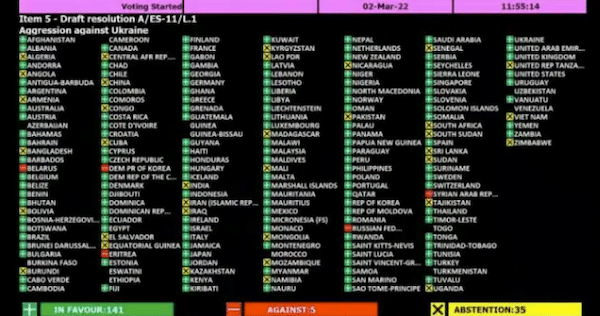
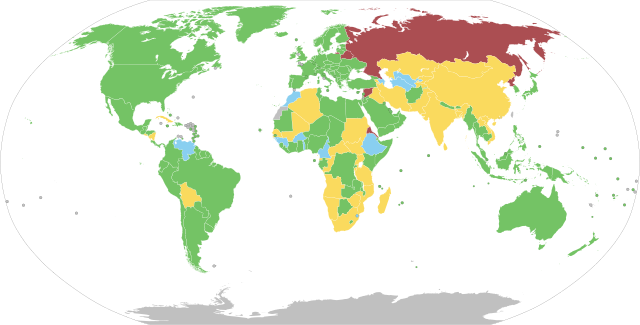
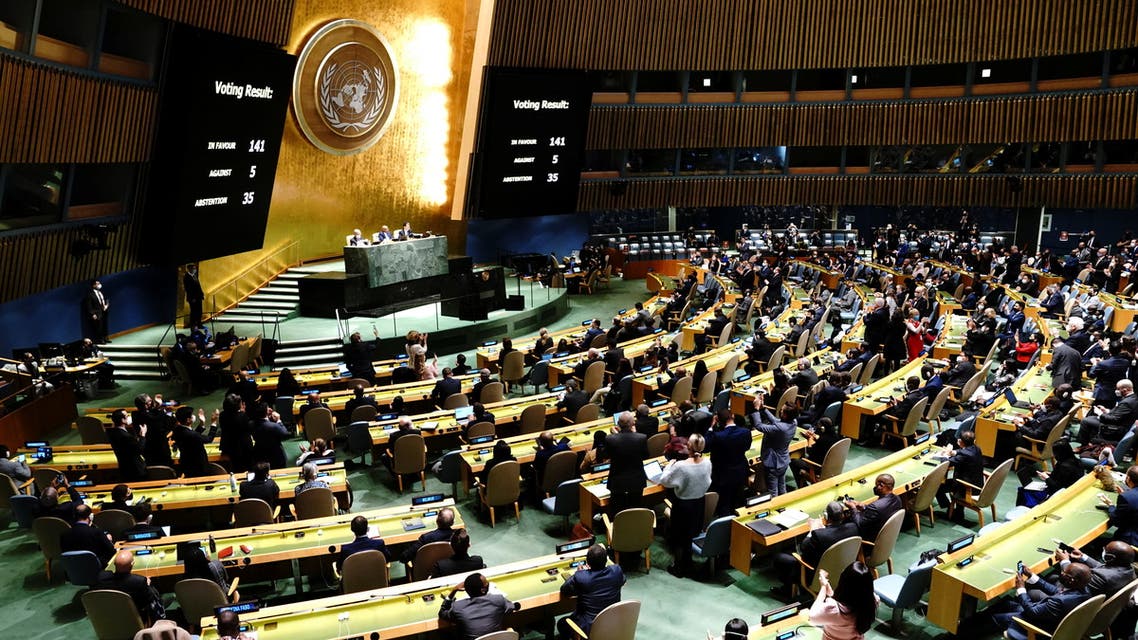
    On March 2 of this year the UN General Assembly met in an Emergency Session to pass a non-binding resolution condemning Russia’s February 24 intervention in Ukraine.1 141 countries voted for the resolution, 5 voted against, 35 abstained, and 12 did not vote. (Reported: Guardian, Al Jazeera, iNews)

    although the war is nominally a conflict between two developed and ethnically white nations, Russia and Ukraine, this UN vote suggests the war may be viewed by much of the world as a fight over the global political and economic system that institutionalizes the imperial hierarchy, the distribution of nations between rich and poor, and global white supremacy


    In the absence of any reliable opinion poll of the world’s 7.9 billion people, this vote may indicate that the majority of humanity sympathizes with Russia in Ukraine. The statistics presented below show that only 41% of the world’s people live in countries that joined the U.S. in voting for the UN resolution.

    This lopsided vote is even more striking if you consider the demographics. Populations represented by governments that did not vote for the resolution are much more likely to include the world’s poorest nations, nations with younger populations, “nations of color,” nations of the Global South, and nations in the periphery of the world economic system.

    To put it another way, although the war is nominally a conflict between two developed and ethnically white nations, Russia and Ukraine, this UN vote suggests the war may be viewed by much of the world as a fight over the global political and economic system that institutionalizes the imperial hierarchy, the distribution of nations between rich and poor, and global white supremacy.


    The UN vote by population

    41% or 34% amounts to a resounding, humiliating defeat for the U.S. on this non-binding UN resolution. Instead it is reported in the west as a U.S. victory and an “overwhelming” worldwide condemnation of Russia.

    Of the world’s 7,934,000,000 people, 59% live in countries that did not support the resolution and only 41% live in countries that did.2 But that last figure drops to 34% outside of the immediate belligerents and their allies: Ukraine, U.S., and NATO countries, and on the other side, Russia, Armenia, Belarus, Kazakhstan, Kyrgystan, and Tajikistan (all the countries of the Collective Security Treaty Organization).

    41% or 34% amounts to a resounding, humiliating defeat for the U.S. on this non-binding UN resolution. Instead it is reported in the west as a U.S. victory and an “overwhelming” worldwide condemnation of Russia.

    The UN vote and GDP per capita

    All the countries in the top third of the GDP per capita (nominal) rankings, including Japan and all the countries of Western Europe and North America, voted for the resolution, Venezuela being the only country in the top third that did not.

    Of the countries that did not vote for the resolution, most are ranked the poorest in the world, and almost none came above the approximate midpoint rank of 98. The exceptions were: Venezuela (58), Russia (68), Equatorial Guinea (73), Kazakhstan (75), China (76) Cuba (82), Turkmenistan (92), South Africa (95), Belarus (97).3

    The UN vote and the core/periphery divide

    Another way to show the wealth divide in the UN vote is by distinguishing core and peripheralcountries. In world-systems theory the surplus value of labor flows disproportionately to the core countries: “The countries of the world can be divided into two major world regions: the ‘core’ and the ‘periphery.’ The core includes major world powers and the countries that contain much of the wealth of the planet. The periphery has those countries that are not reaping the benefits of global wealth and globalization.” (Colin Stief, ThoughtCo.com, 1/21/20)

    The countries usually considered in the core are: Australia, Austria, Belgium, Canada, Denmark, Finland, France, Germany, Greece, Iceland, Ireland, Italy, Japan, Luxembourg, Netherlands, New Zealand, Norway, Portugal, Singapore, Spain, Sweden, Switzerland, United Kingdom, United States.

    The difference here is stark. Every single core country voted for the resolution and every country that did not is either in the periphery or in some cases, like Russia or China, in the semi-periphery.


    The UN vote and median age

    All the countries ranked in the top third of median age rankings, from Monaco (51.1 years) to Iceland (36.5 years), voted for the resolution, with the following exceptions: China (37.4), Russia (39.6), Belarus (40), Cuba (41.5).

    Of the twenty entries with the lowest median ages (15.4 to 18.9), only half voted for the resolution.

    The UN vote and “countries of color”

    Of the 7,934,000,000 people in the world, 1,136,160,000 live in what are usually recognized as “white countries” (consistently or not) with about 14% of the world’s population. Yet “white countries,” by population, represent about 30% of the total vote in favor of the resolution. This “white vote” accounts for every one of the core countries (except Singapore and Japan). Compare: 97% of the population in the countries that did not vote for the resolution live in “countries of color.” Only Russia, Belarus and Armenia (which did not vote for the resolution) have dominant populations classed as “white.”

    Therefore “white countries” are overrepresented in the group that voted for the resolution (30% vs. 14%), and underrepresented in the group that did not (3% vs. 14%).

    Before the intervention

    What follows is a brief sketch of events leading to the February 24 Russian intervention that prompted the UN resolution. It is a history seldom mentioned in the mainstream media, though it is easily found in selected alternative and now-suppressed media. It is presented here as a possible, partial explanation of why the UN resolution had so little support measured by population.

    U.S./NATO has directed aggression toward Russia for decades, advancing NATO forces ever closer to Russia’s western border, ringing Russia with military bases, placing nuclear weapons at ever closer range, and breaching and discarding treaties meant to lessen the likelihood of nuclear war. The U.S. even let it be known, through its planning documents and policy statements, that it considered Ukraine a battlefield on which Ukrainian and Russian lives might be sacrificed in order to destabilize, decapitate and eventually dismember Russia just as it did Yugoslavia. Russia has long pointed out the existential security threat it sees in Ukrainian territory, and it has made persistent, peaceful, yet fruitless efforts over decades to resolve the problem (See Monthly Review’s excellent editors’ note).

    Recent history includes the 2014 U.S.-orchestrated coup in Ukraine, followed by a war of the central government against those in the eastern regions of Donetsk and Lugansk resisting the coup government and its policies. Those policies include a ban on the Russian language, the native tongue of the region and a significant part of the country (ironically, including President Zelensky).

    By the end of 2021 the war had taken 14,000 lives, four-fifths of them members of the resistance or civilian Russian speakers targeted by the government. Through years of negotiations Russia tried and failed to keep the Donetsk and Lugansk regions inside a united Ukraine. After signing the Minsk agreements that would do just that, Ukraine, under tight U.S. control, refused to comply even with step one: to talk with the rebellion’s representatives.

    As to why the intervention happend now, Vyacheslav Tetekin, Central Committee member of Russia’s largest opposition party, the Communist Party of the Russian Federation, explains:

    Starting from December, 2021 Russia had been receiving information about NATO’s plans to deploy troops and missile bases in Ukraine. Simultaneously an onslaught on the Donetsk (DPR) and Lugansk People’s Republics (LPR) was being prepared. About a week before the start of Russia’s operation the plan was uncovered of an offensive that envisaged strikes by long-range artillery, multiple rocket launchers, combat aircraft, to be followed by an invasion of Ukrainian troops and Nazi battalions. It was planned to cut off Donbas from the border with Russia, encircle and besiege Donetsk, Lugansk and other cities and then carry out a sweeping “security cleanup” with imprisonment and killing of thousands of defenders of Donbas and their supporters. The plan was developed in cooperation with NATO. The invasion was scheduled to begin in early March. Russia’s action pre-empted Kiev and NATO, which enabled it to seize strategic initiative and effectively save thousands of lives in the two republics.

    All this may have informed the world’s overwhelming rejection of the U.S.-backed UN resolution condemning Russia, which western media perversely considers a U.S. victory simply because the resolution passed. Never mind that it passed in a voting system where Liechtenstein’s vote carries the same weight as China’s.

    The Global South also knows from bitter experience that unlike the West, neither Russia nor its close partner China habitually engage in bombings, invasions, destabilization campaigns, color revolutions, coups and assassinations against the countries and governments of the Global South. On the contrary, both countries have assisted the development and military defense of such countries, as in Syria, Venezuela, Nicaragua, Cuba, Iran and elsewhere.

    Conclusion

    Just as the imperial core of North America, Europe and Japan does not represent the world in their population numbers, demographics, wealth, or power, neither does the imperial core speak for the world on crucial issues of war, peace, justice, and international law. Indeed the Global South has already spoken to the Global North so many times, in so many ways, with patience, persistence and eloquence, to little avail. Since we in the North have not been able to hear the words, perhaps we can listen to the cry of the numbers.


    Notes:

    1. The resolution “Deplores in the strongest terms the aggression by the Russian Federation against Ukraine in violation of Article 2 (4) of the Charter.” (Article 2 (4) reads: “All Members shall refrain in their international relations from the threat or use of force against the territorial integrity or political independence of any state, or in any other manner inconsistent with the Purposes of the United Nations.”) The resolution also “[d]eplores the 21 February 2022 decision by the Russian Federation related to the status of certain areas of the Donetsk and Luhansk regions of Ukraine as a violation of the territorial integrity and sovereignty of Ukraine and inconsistent with the principles of the Charter.” Beyond Russia, the resolution “[d]eplores the involvement of Belarus in this unlawful use of force against Ukraine, and calls upon it to abide by its international obligations.”
    2. The population of countries voting for the UN resolution is 3,289,310,000. The population of countries voting against the resolution, abstaining, or not voting is 4,644,694,000 (Against: 202,209,000; abstaining: 4,140,546,000; not voting: 301,939,000).
    3. Here are the countries that did not vote for the resolution, with their GDP per capita rankings (the higher the GDP the higher the rank). 5 countries voted against the resolution: Russia 68, Belarus 97, North Korea 154, Eritrea 178, Syria 147. 35 countries abstained: Algeria 119, Angola 128, Armenia 115, Bangladesh 155, Bolivia 126, Burundi 197, Central African Republic 193, China 76, Congo 143, Cuba 82, El Salvador 121, Equatorial Guinea 73, India 150, Iran 105, Iraq 103, Kazakhstan 75, Kyrgyzstan 166, Laos 140, Madagascar 190, Mali 174, Mongolia 118, Mozambique 192, Namibia 102, Nicaragua 148, Pakistan 162, Senegal 160, South Africa 95, South Sudan 168, Sri Lanka 120, Sudan 171, Tajikistan 177, Tanzania 169, Uganda 187, Vietnam 138, Zimbabwe 144. 12 countries did not vote: Azerbaijan 110, Burkina Faso 184, Cameroon 158, Eswatini 117, Ethiopia 170, Guinea 175, Guinea-Bissau 179, Morocco 130, Togo 185, Turkmenistan 92, Uzbekistan 159, Venezuela 58.


    This article was published earlier in MRonline and is republished under the Creative Commons License 4.0.

    Feature Image Credit: Alarabianews.

    Map and Table: Wikipedia

  • PDC 2: Rising Unemployment and Economic Woes: Is India Missing its Demographic Dividend?

    PDC 2: Rising Unemployment and Economic Woes: Is India Missing its Demographic Dividend?

    Peninsula Discussion Club – Past Event

    PDC 2: Rising Unemployment and Economic Woes: Is India missing Demographic Dividend?

    Date: 02 November 2019

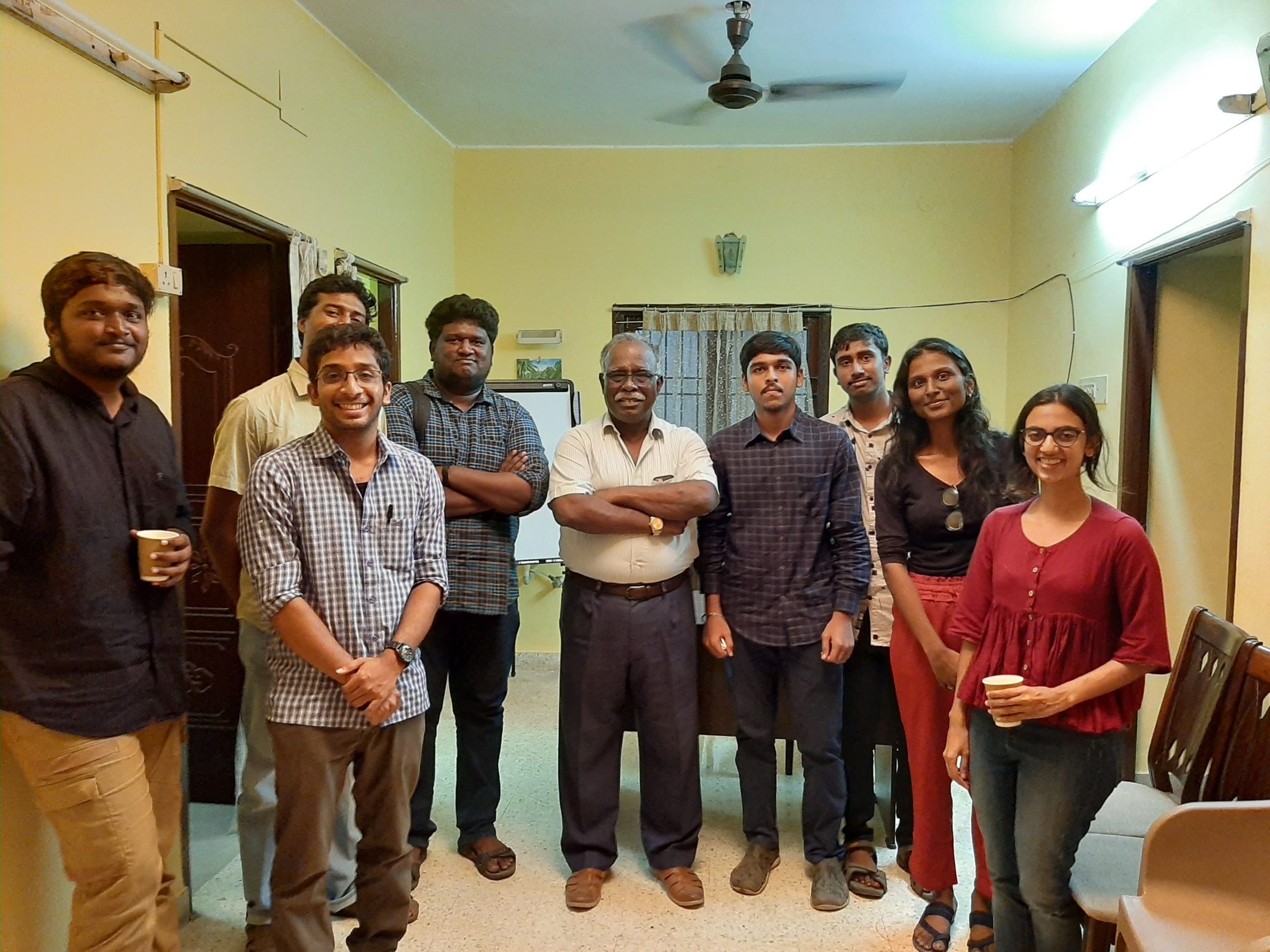
    Speaker: Professor Jothi Sivagnanam PhD, HOD, Dept of Economics, University of Madras

    India has stepped into its demographic dividend and the bulging youth population can possibly be a gift or curse for development. Recent concern over rising unemployment in India has been discussed from various dimensions. ‘Jobless Growth’ in India is evoking debates among economists and policymakers on how to capitalize on the human capital resource. The second discussion of TPF was an attempt to comprehend the looming crisis and identify factors that cause unemployment. Speaker of session, Professor Jothi Sivagnanam highlighted that demonetisation and the poor implementation of GST as the two major blunders that have disrupted the economy to a great extent. This is now causing high rates of unemployment. Poor quality in higher education and reluctance of state to correct the skill mismatch was discussed in detail. India’s growth as a global economic power, and its ability to dominate global markets can only be achieved if it focuses on development of high quality skills in its huge young population. The state has to prioritize developing skills at international standards in order to compete with established players. Participants pointed out the problems of archaic and rigid labour laws that stymie productivity and efficiency. It was pointed out that export oriented policies are vital to generate employment and high skills. In the realm of the fourth industrial revolution, the debate has to move past growth versus development due to the interdependence various sectors of the economy. The professor and one of the participants brought out the importance of balancing industrialization with education and social engineering. For example, Gujarat portrays a pro-business growth model, however, failed to succeed in its welfare policies, and hence, has serious inequalities and social problems. On the other hand Kerala, being socialistic in nature focused on development and failed to create a conducive zone for business development. With states having different characteristics and history, problem of unemployment cannot be treated as a universal problem. There is a substantial increase in the educated unemployment and vulnerability in informal sector. States need to address this by designing better quality education to meet the industry standards and regulate the labour laws. Given this backdrop, other specific issues were discussed during the meet.

    We welcome comments and further discussions on this blog page. Comments will be moderated in order to ensure discussions remain professional and ethical.

    PDC Past Event : 02 Nov 2019

  • Gender Wage Inequality: A Core Problem in Rural Indian Economy

    Gender Wage Inequality: A Core Problem in Rural Indian Economy

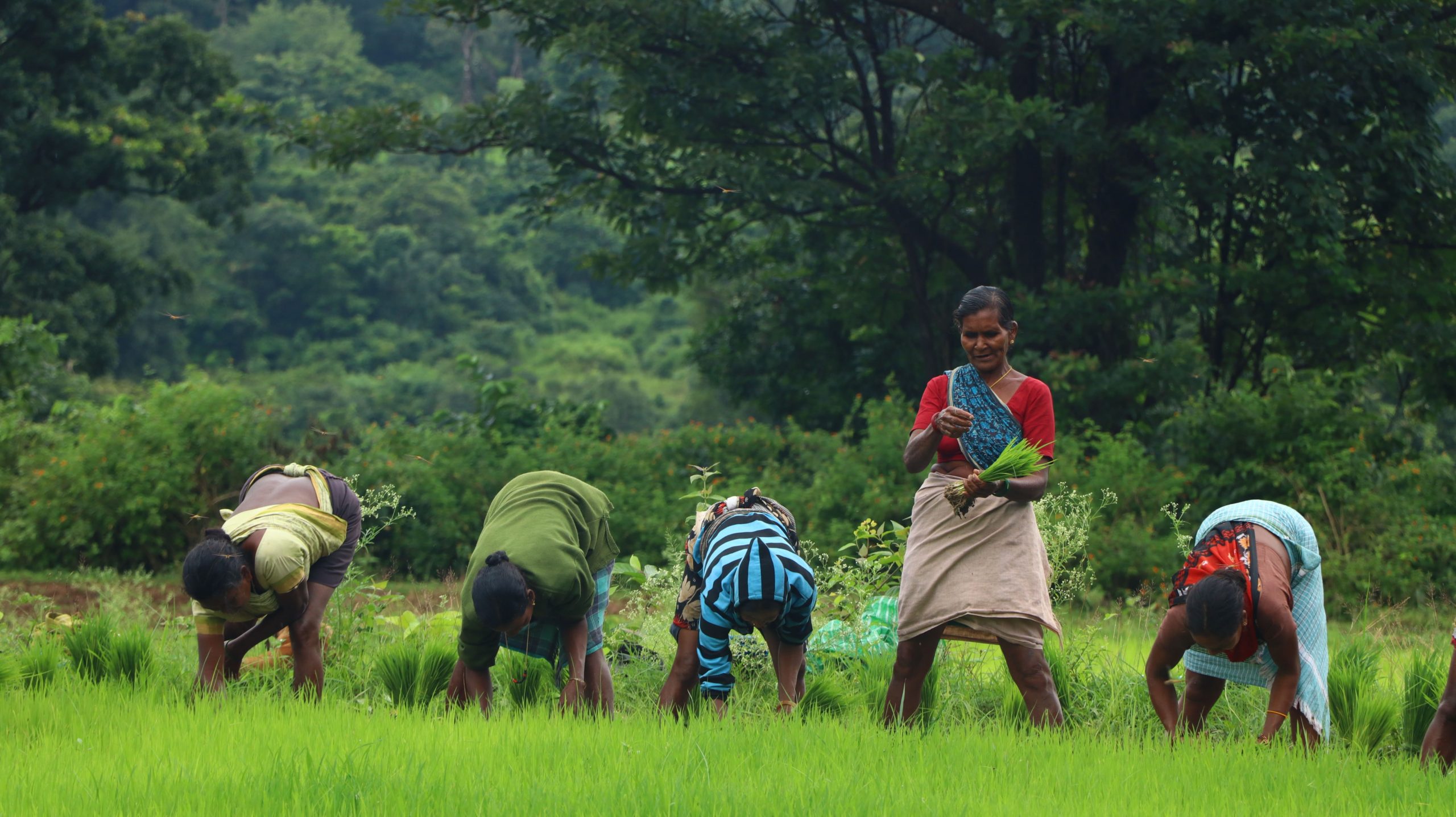
    Growing unemployment rates, inadequate demand and low productivity in rural India is currently drawing significant attention particularly in view of the current economic slowdown. Debates on falling agriculture productivity and consumption in rural areas have partially ignored the gender dimension. The sexual division of labour in a rural production framework arbitrarily sets the female wages lower than men. Declining participation of women in labour force could relate to various socio-economic conditions, a sector wise analysis mirrors an intelligible dynamics of the problem.   Informal rural market already operating below the minimum wage exploits women as they are presumed to have poor bargaining power and social constraints blocking their employment migration tracks. While the dire status of marginal farmers and casual labourers are talked about, economic and social inequality across gender misses the radar.

    Optimism on gender grounds rose after the wage gap between men and women started reducing in rural labour market across India. A closer examination of the wage data among rural labour reveals the complex nature of female labour wages. More importantly, the seeming reduction in  wage gap in actuality is more due to  decline in male wage rates. The overall percentage of women in rural casual labour market has seen a marginal reduction from 35 percent in 1983 to 31 percent in 2017-18. Analysis of informal casual labour market reveals a pattern of women being paid low wages and with no social security schemes resulting in decline in already poor quality of living. Significantly, economic contribution of women is grossly underestimated in the current System of National Accounts (SNA). Time Use Survey captures all unpaid activities of men and women which would be more accurate to calculate. However, the problem of valuation remains an issue, and calculation of woman’s opportunity cost in a rural household is an arduous task.

    Complex pattern of decline in female work participation rate

    Female Workers Participation Rate (FWPR) in rural sector declined from 32 percent in 1972-73 to 17 percent in 2017-18. Studies suggest various reasons could be responsible for a fall in proportion of women in rural work force.  According to Census India 2001 and NSSO 2010, increasing number of women migrate from one rural area to other and round 64 percent of women migrants move because of marriage. A research study in Institute of Asian Studies observed an income effect, U shaped probability curve of female participation with the log of male income in the family. This means more women were working during the times of economic distress to support the family and participation rate gradually reduced with higher income earned by the men. However, with increase in income, there is also a pattern of women working to meet the increased consumption expenditure. Education is also considered an important component contributing to reduced percentage of women in labour force. As literacy rates grow, graduate women are aspiring to get employed in skilled jobs and voluntarily withdraw from the work force. However, proportion of women in primary sector has only declined from 89.7 percent (Krishnaraj & Kanchi, 2008) in 1972 to 83.6 percent in 2004. Evidently, majority of women in rural areas are dependent on primary sector for employment, a drop to 67 percent of men dependent on primary sector for employment is due to their shift to secondary and tertiary sectors. Employment in unorganised sector is beset with low wages, an exploitation by the employers.  Moreover, absence of social security cripples the income earning capacity of women. This deliberately places women in the lower strata of rural economy leading to poor socio-economic living conditions and has a direct impact on their inability to invest in education, health and nutrition.

    Women in informal sector and Poverty in rural India

    India’s rural sector is characterized by a large segment of informal labour force where 90 percent of the population is either self-employed or work for casual wage. Rural areas in particular operate in an informal economy and wages are mostly determined by the labour market where women are inherently considered less productive and paid less than men.

    As of 2011-12, 68 percent of female casual labourers were receiving less than National Minimum Wage of INR 122. Around 47 percent of men in rural India received less than the minimum wage indicating the unreliable nature of rural informal job market. Men, naturally with higher migration possibility, shift to informal urban sector jobs but women are left with depressed wages even as the labour demand remains high. Although the rural urban migration among women is higher than men, 60.8 per cent of women migrating to urban areas are due to marriage. As far as employment is concerned only 2.6 percent of women migrate as opposed to 52.7 percent of men. The decline in women participation in labour force is visible among educated women. Unskilled women in poor households tend to work for daily wages and have not substantially reduced from workforce. In rural India, where casual farm and nonfarm jobs are exploited it makes limited sense to use only wage gap to measure the gender equality.

    Agriculture, evolved from a traditional household structure, supports if not advocates, defined gender roles and discriminates women overtly through economic means. According to the recent NSSO report unemployment rates among rural females has increased from 1.8 percent in 2004-05 to 3.8 percent in 2017-18. However, an average of 5.4 percent of women had reported to be available for additional work in PLFS survey 2017-18. Unemployment is rampant across the country in all sectors but women labour supply for casual jobs especially in poor household still remains high pushing the daily wages further down. Intense land fragmentation has increased the percentage of marginal landowners to 85 percent but the demand for labour has reduced, forcing men to migrate into other sectors. Deepening crisis in agriculture also contributes directly to low wages among residual unskilled women labourers. Effectively the ‘informal labour’ market conditions has become a trap that exploits unskilled women as they are willing to work even at a lower wage rate. In effect, an increase in participation would not guarantee a better standard of living if the market is unregulated and exploitation based on gender continues.

    Why Government measures are only partially effective?

    Government initiatives for the rural economy have led to various policies to increase the income levels of marginal farmers and unskilled labourers. Women participation has been prioritized in such schemes and has shown to reduce poverty among rural households. National workfare program MGNREGS provides employment on demand and has managed to attract many women to participate by claiming to offer equal wages. As the Public employment program also mandates 33 percent of labours to be women, unskilled women are largely entering into the MGNREGS program. For the financial year 2011-12, 48 percent of women are engaged in this program from all the rural districts. However, wage gap exists even in a state intervention program- calculating from Annual Report of PLFS 2017-18, men on an average are reported to earn 152 INR per day while women are paid 143 INR from the state employment guarantee program. Further, in few states like Gujarat, Tamil Nadu, Punjab, Madhya Pradesh, Maharashtra and Telengana casual worker’s (both male and female) wage is below the notified wage for financial year 2017-18. State programs are accused of various leakages and operational inefficiencies, yet the participation remains high indicating a much serious problem in rural labour market. An important long term issue pertaining to state run workfare program is the stagnation of skill levels in rural India.  Women participation in secondary and tertiary sector is low; a possible explanation for unskilled women labourers’ compromise for low wages is because of lack of any other alternative. Skill augmentation is prerequisite to transform from an agrarian to an industrial society. A significant effort needs to be directed in training unskilled work force in rural sector, and government employment program has to be a seasonal support system.

    Skill development and Vocational Training to combat rural poverty

    The national average wage difference between men and women for casual employment other than MGNREGS work is calculated to be 55.02 INR for the year 2017-18 and states like Tamil Nadu, Kerala, Tripura and Andhra Pradesh are observed to have the highest gender wage difference. Ironically, these are the states with female participation (in casual labour force) higher than the national average of 25.5 percent, implying that wages (equal wages) are not the only driving force for influencing labour participation. In rural India, while socially defined roles result in unequal wages in labour market, women’s labour does not seem to follow the traditional backward bending labour supply curve. The natural withdrawal of women from workforce is not as serious as unskilled women remaining in informal sector even with lower wages. Real problem of women in rural economy is their diminishing bargaining power and skill stagnation or non-development of any skills due to informal structure and counterproductive state measures.

     A complete free market approach would deepen the wage difference as rural women are assumed to have low skills and weak bargaining power. State intervention to engage more women in labour market should not be limited to just providing 100 days of employment. Skill enhancement, vocational training demanded by industrial and service sectors needs to be imparted in rural areas. Residual women in rural areas are reserve army of labour available and usually are exploited for reasons given above. The gender wage gap is a consequence of a faulty design by the government and dyed-in-the-wool beliefs of people; solutions lie in the state prioritising proactive measures to reform the unorganized sector and improve market accessibility for women. Unequal remuneration in informal sector is a symptom of a fragile labour market. Women labourers end up bearing weights of both market and state failure with poor skills and low wages.

    Manjari Balu is a Research Analyst with The Peninsula Foundation.

    Image Credit:Photo by vishu vishuma on Unsplash.