By invoking ‘Om Shanti, Shanti Om’ and recalling his ‘Indian DNA,’ President Prabowo Subianto reminded the world of India’s timeless civilisational values. These gestures reflect centuries-old cultural and philosophical bonds between India and East Asia, rooted in peace, harmony, and shared heritage.

When Indonesian President Prabowo Subianto recently concluded his speech at the 80th UN General Assembly with the Sanskrit mantra “Om Shanti, Shanti Om,” it was more than a ceremonial gesture. He called for global peace, justice, and equal opportunity, warning that “human folly, fuelled by fear, racism, hatred, oppression, and apartheid, threatens our common future.” The invocation of Sanskrit highlighted a message of harmony amid global uncertainties and reminded the world of India’s enduring civilisational values.
Earlier, during his visit to India as the chief guest for the Republic Day celebrations, he remarked that he carried “Indian DNA” and pointed to the Sanskrit origins of many Indonesian names, underscoring centuries-old cultural and civilisational connections between India and Southeast Asia.
A Forgotten Dimension of Indian History
India’s historical interactions, however, have often been narrated through the prism of invasions from the Northwest. Colonial historiography deliberately emphasised repeated waves of conquest and plunder—ranging from the Aryan migrations, Persian invasions, Alexander the Great, the Indo-Greeks, Shakas, Kushans, and Hunas, to the Turkic invasions, the establishment of the Delhi Sultanate, the Mughal conquest under Babur, and Ahmad Shah Abdali’s incursions—painting India’s past as one of perpetual defeat and humiliation.
This selective focus on invasions was deliberately designed to keep Indian confidence low, ensuring that generations grew up seeing themselves primarily as victims of history rather than inheritors of a rich and diverse civilisation. Meanwhile, India’s long-standing engagement with East Asia, including trade networks, cultural diffusion, and philosophical exchange, was largely sidelined in colonial and post-colonial narratives. Monumental structures such as Angkor Wat in Cambodia or Borobudur in Indonesia bear testimony to this enduring civilisational conversation, yet these were rarely taught as part of mainstream Indian history.
Another challenge lies in the application of Western theoretical frameworks—such as realism, neorealism, and similar models—to understanding India’s global outlook. These frameworks often assume that every state behaves aggressively, seeking domination and power, and paint all nations with the same brush. China’s “Middle Kingdom” worldview or its quest to reverse its “century of humiliation” may fit this logic, but India’s history and philosophy reflect a markedly different trajectory. With the exception of the Chola naval expeditions, India has rarely sought to invade foreign lands.
India’s worldview is often likened to a lotus, with its various petals—culture, philosophy, ethics, and diplomacy—contributing to harmony, coexistence, and the principle of “live and let live.” Central to this vision is the concept of Vasudhaiva Kutumbakam: the world is one family.
This perspective underpins India’s approach to global engagement, blending ethical statecraft with strategic autonomy. Building on this philosophical foundation, India translates its vision into action through cultural diplomacy, multilateral engagement, and initiatives that promote global cooperation and inclusive development.
During its G20 presidency in 2023, India played a pivotal role in reshaping the summit’s focus toward the challenges faced by the Global South, highlighting issues such as debt restructuring, food security, climate financing, and reforms in multilateral development banks. A landmark achievement was the inclusion of the African Union as a permanent member of the G20, reflecting India’s diplomatic leadership and commitment to amplifying the voices of developing countries.
Alongside this, initiatives such as the International Solar Alliance (ISA), the Coalition for Disaster Resilient Infrastructure (CDRI), Project Mausam, the India-UN Development Partnership Fund, and India’s COVID-19 vaccine diplomacy underscore its dedication to global solidarity, humanitarian support, and sustainable development.
India’s strategic thought is deeply informed by its philosophical heritage. The Arthashastra emphasises practical statecraft and realpolitik, while the Dharmashastra provides the ethical and moral framework guiding those actions.Classical thinkers like Chanakya (Kautilya) emphasised practical governance while aligning with the ethical principles of dharma, balancing power with moral responsibility. As he famously noted, “The duty of a ruler is for the welfare of his people,” highlighting that ethical considerations were central even in matters of statecraft. India’s strategic worldview thus seeks to harmonise national interests with global responsibilities, recognising that ethical governance and long-term security require attention not only to domestic welfare but also to the broader international order.
Religious reformers and spiritual leaders—such as the Buddha, Mahavira, Ramanuja, and Madhva—championed ethics, nonviolence, and universal harmony. Modern visionaries such as Swami Vivekananda, Rabindranath Tagore, and Sri Aurobindo extended these ideas to the global stage, advocating moral leadership, cultural diplomacy, and internationalism. Later thinkers, such as Mahatma Gandhi, Vinoba Bhave, and Jiddu Krishnamurti, emphasised ethical governance, humanistic values, and personal transformation as the foundation for societal and global peace.
This holistic approach—blending practical insights of Arthashastra with ethical guidance of Dharmashastra, informed by centuries of philosophical thought—distinguishes India’s worldview from Western, power-centric models.
Despite these long-standing ties, independent India largely overlooked Southeast Asia for much of its early decades, focusing instead on its immediate security concerns and the dynamics of the Cold War. ASEAN countries leaned toward the United States, while India charted a non-aligned course. While Cold War pressures existed, India largely neglected this crucial region and its maritime dimension. Only in the 1990s, with the introduction of the Look East Policy, did New Delhi consciously reconnect with its eastern neighbourhood. By then, decades of neglect had to be addressed to restore historical relationships, a point noted by scholars who observe that India had “historically left Southeast Asia largely unattended, despite long-standing civilisational links.”
Reviving the Civilisational Link

One of the most potent symbols of India’s engagement with East Asia is Nalanda University. Established in the 5th century CE by Emperor Kumaragupta I, it was the world’s first great residential university, drawing scholars from China, Korea, Japan, Southeast Asia, and beyond. Nalanda offered an interdisciplinary curriculum spanning Buddhist scriptures, logic, grammar, medicine, astronomy, and philosophy, fostering holistic learning long before modern academic disciplines were compartmentalised. Over the centuries, it suffered repeated attacks, culminating in the 1193 CE assault by Bakhtiyar Khilji, which destroyed its nine-story library, Dharmagañja, along with countless manuscripts covering philosophy, medicine, astronomy, and other fields.
Smoke from the burning texts lingered for months, erasing invaluable works across multiple disciplines and causing an irreparable loss to India’s and Asia’s intellectual heritage.

During the inauguration of the new campus in Rajgir, Bihar, on June 19, 2024, Prime Minister Narendra Modi underscored Nalanda’s enduring civilisational legacy. He remarked that while “fire can destroy books, [it] cannot destroy knowledge,” affirming that “Nalanda is not just a name; it is an identity, an honour, a value, a mantra, a pride, and a saga.” Highlighting the significance of the revival, he noted that the new Nalanda “will demonstrate that nations built on strong human values know how to revive history and lay the foundation for a better future.”
External Affairs Minister S. Jaishankar also emphasised Nalanda’s diplomatic and academic importance, noting during the 2024 campus inauguration that the university is actively fostering regional integration through initiatives like the “ASEAN-India University Network” and highlighting that its destruction “marked a downturn in our history”
The modern revival of Nalanda University rekindles its historic spirit of cross-cultural exchange and global engagement. Its contemporary philosophy emphasises integrating traditional wisdom with modern academic disciplines, promoting an interdisciplinary approach that blends Buddhist Studies, Philosophy, Comparative Religion, Ecology, Environmental Studies, and Management Studies. Programs encourage students to engage with original texts, critical interpretations, and contemporary applications, reflecting a holistic understanding of knowledge.

In September 2025, Nalanda University hosted the inaugural three-day East Asia Summit Conclave of Heads of Higher Education Institutions, bringing together over 35 academic leaders from India and ASEAN/EAS countries. The conclave included thematic deliberations, cultural programs, and the signing of MoUs with institutions such as Vietnam National University, the Indian Maritime University, and MAKAIS. A parallel workshop on Energy Efficiency and Lifestyle for Environment (LiFE) further highlighted India’s sustainability agenda. This landmark event reinforced Nalanda’s role as a hub for academic diplomacy, cross-cultural dialogue, and regional integration.
Today, Nalanda’s student body includes participants from ASEAN countries, Africa, and beyond, embodying diversity, dialogue, and shared learning. The university is a living reflection of what India stands for: tolerance, pluralism, and coexistence. Unlike the distorted Western narratives that often portray India as illiberal or intolerant, Nalanda demonstrates that India’s civilisational ethos embraces diversity and intercultural engagement. Its holistic and inclusive approach reinforces India’s soft power and projects a message of peace, coexistence, and intellectual openness.
Nalanda continues to uphold its interdisciplinary ethos, emphasising the interconnectedness of knowledge and fostering collaboration to address contemporary global challenges. In doing so, it revives historical connections with East Asia and exemplifies India’s vision of a world united through learning, dialogue, and mutual respect.
When leaders like the Indonesian president invoke Sanskrit terms or highlight cultural kinship, it is a reminder that India’s story is far richer than the invasion-centric histories emphasised under colonial education. To decolonise our historical imagination, we must foreground India’s ancient engagement with the East, its traditions of non-aggression, and its civilisational ethos of peace and fraternity.

India and its East Asian partners, particularly ASEAN countries, share centuries-old cultural, philosophical, and civilisational bonds that manifest in religion, art, architecture, literature, cuisine, trade, education, and people-to-people exchanges. These living streams of cultural ties continue to enrich both India and Southeast Asia, reflecting a legacy of adaptation, creativity, and mutual influence.
As Michel Foucault argued, power and knowledge are inseparable—knowledge is both shaped by power and a tool through which power operates. History functions in this dynamic, shaping identity, self-perception, and the trajectory of nations. Institutions like Nalanda University, both in its ancient and modern forms, exemplify India’s civilisational vision: fostering interdisciplinary learning, cross-cultural dialogue, and a holistic understanding of knowledge, while promoting a mutual exchange of ideas and practices that enriches both India and its partners.
Reclaiming India’s forgotten ties with the East and recognising the enduring legacy of centres like Nalanda is not only a matter of historical accuracy but also a foundation for building a future grounded in shared heritage, mutual respect, and the vision of Vasudhaiva Kutumbakam—the world as one family.
By nurturing these connections through education, cultural exchange, and inclusive engagement, India and its partners can ensure that history, knowledge, and creativity continue to serve as instruments of peace, cooperation, and shared prosperity across the region.
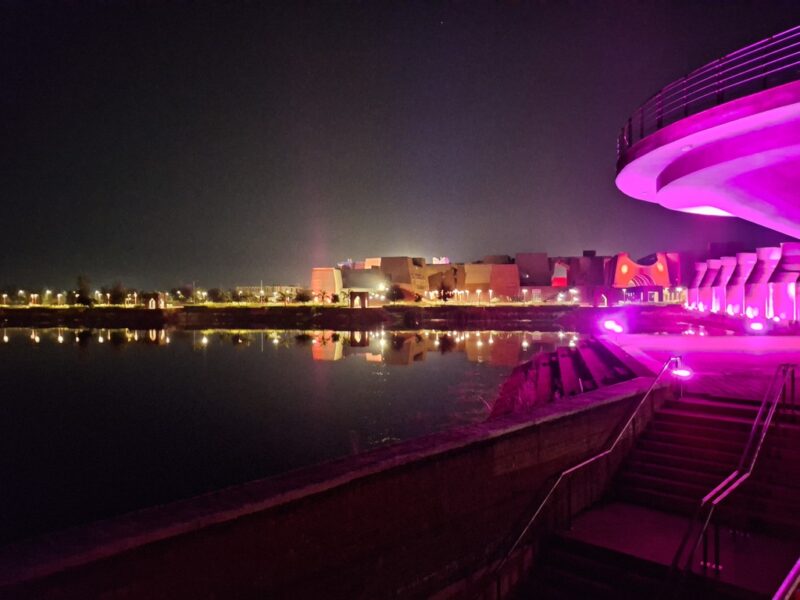
Feature Image Credit: Modern Nalanda University Campus at Night (photo by M Matheswaran)
Indonesian President’s Address at UNGA photo credit: media.un.org
Ancient Nalanda ruins, the Mahabodhi temple, Nalanda campus, and a spectrum of students – Photos Credit: M Matheswaran