Tag: India

  • The Curious Case of Indian Silence over damning UN Human Rights Report on China

    The Curious Case of Indian Silence over damning UN Human Rights Report on China

    Not surprisingly, India has not come out with any condemnation of China for its atrocities in Xinjiang, a classic example of India in recent times trying to steer clear of global contestations.

    Down the ages, the phenomenon of imperial overreach has been prevalent across the world.  The evils for which it gets perpetrated would, by and large, be known to those who succumbed to it for supposedly national aspirations, religious fervour or even self-glory by some megalomaniacs!

    That the country relentlessly aspiring with rapidity to be the next global superpower, China, can be unquestionably placed in the category of an imperialist power brooks no emphasis. China thus, without remorse or any humanitarian considerations pursues its ambitions of forcible, bordering on evil, integration of people of all faiths and regions in its vast nation. Its threat of military intervention in tiny Taiwan in recent months bespeaks China’s hegemonistic ambitions.

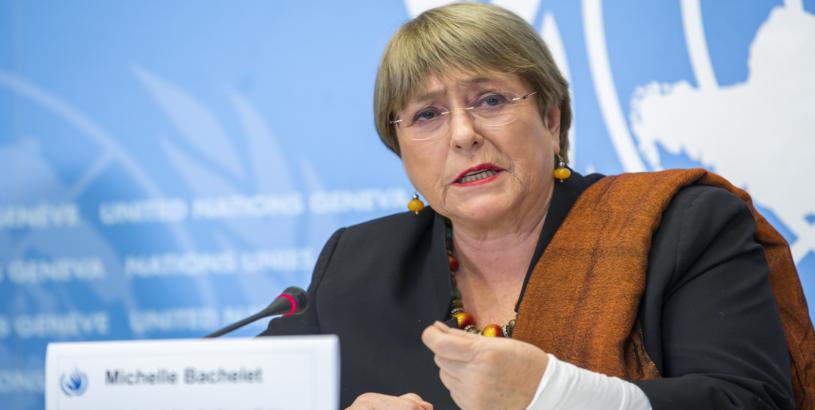
    Though rather late, the UN has rightly condemned China’s woeful human-rights record in its restive Xinjiang province where for the last many years, China has been committing genocide on its Muslim minorities, the Uyghur and Turkic communities. That the world, at large, and the Islamic nations, in particular, have cast a blind eye on this monumental human tragedy conveys, unmistakably, how the sheer pursuit of mere national interests dwarfs humanitarian considerations elsewhere. The significance of the UN Report on Human Rights just released, accordingly, cannot be understated.

    [powerkit_button size=”lg” style=”info” block=”true” url=”https://www.southasiamonitor.org/index.php/indo-pacific-china-watch/curious-case-indian-silence-over-damning-un-human-rights-report-china” target=”_blank” nofollow=”false”]
    Read More
    [/powerkit_button]

  • The Bridge on River Chenab

    The Bridge on River Chenab

    “The only way to discover the limits of the possible is to go beyond them into the impossible”

    -Arthur C. Clarke

    Introduction

    On 13 Aug 2022, the bridge on the River Chenab in the Reasi District of J&K was finally completed. It was a case of the impossible becoming possible. It all happened because of a very high degree of self-belief of those who planned it and the sincerity of thousands of those who worked hard for the last 18 years.   Indeed, it was the best gift the Indian Railway in general and Indian Engineers, in particular, could give to India on the 76th Independence Day of India. It is also highly symbolic that it is located in the State of J&K and in a way appeared to be a giant step towards the integration of J&K with the rest of the country.

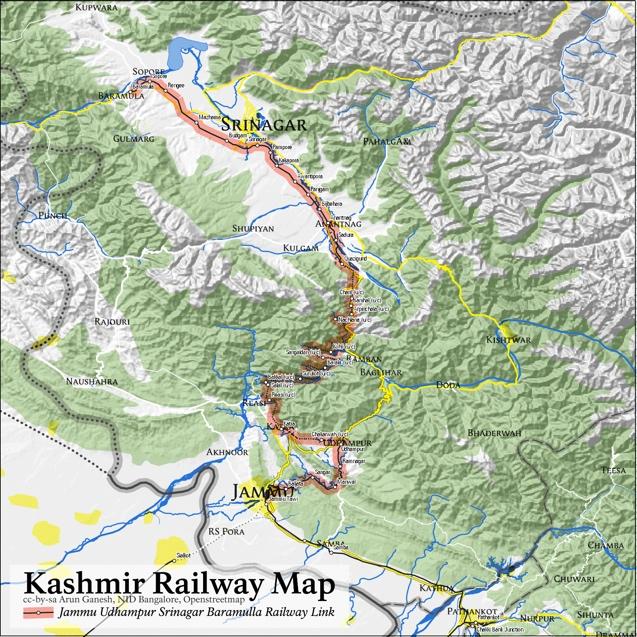
    The Bridge over the River Chenab is part of the Jammu-Udhampur-Baramulla Railway line, which is being constructed. While Sections of Jammu-Udhampur, Udhampur-Katra and Banihal-Baramulla are already completed and opened for traffic, section Katra- Banihal is still not complete. The degree of difficulty in this section is enormous. Besides this Bridge on Chenab (more about it a little later), the Bridge on Anji Khad (which is under construction) and a total of 35 tunnels and 37 bridges make this section of 111 km in the mountainous terrain extremely challenging and an engineering marvel in the making.

    Progress of the Project –  It is a 356 km railway project, starting at Jammu and going up to Baramulla. It was started in 1983 with the objective of connecting Jammu Tawi to Udhampur.  Construction of the route faced natural challenges including major earthquake zones, extreme temperatures and inhospitable terrain.  Finally, in 2005  The 53 km long Jammu–Udhampur section opened after 21 years with 20 tunnels and 158 bridges. The cost of the project had escalated to ₹515 crores from the original estimated cost of ₹50 crores.  In 1994 The railway accepted the necessity to extend the track to Baramulla. However, at that point it was thought that the project will have two disconnected arms; one from Jammu to Udhampur and the second from Qazigund to Baramulla. In 2002 the GoI declared this project to be a national project. This means hereafter, the entire funding will be from the Central Budget. At that time the necessity was also accepted to connect the two disconnected arms. The estimated cost of the project assessed then was   ₹6,000 crore.  In 2008 the 66 km section between Anantnag and Manzhama (outside Srinagar) was opened for traffic. In 2009 this Service was extended to Baramulla. During the same year, the line from Anantnag was extended to Qazigund.

    Also  Around the same time, an extension of the track from Baramulla to Kupwara was proposed, and its survey got completed in 2009. In 2009 itself, work on the section between Katra and Qazigund resumed after a review based on geotechnical studies. In 2011, an 11.215 Km long Banihal Qazigund tunnel across the Pir Panjal Range was completed.  This paved the way for a trial run in Dec 2012 from Banihal to Qazigund. In 2014 the train route from Udhampur to Katra was also operationalised. Now the only missing link in this nationally vital rail line was Katra-Banihal. Finally, in 2018 the GoI approved the extension of the railway line to Kupwara.

    Degree of Difficulty in Katra- Banihal Section – This is a 111 km long stretch. 97.34 km of this stretch will be through tunnels. There are 20 Major (including the bridge across the Chenab river and a bridge on Anji Khad) and 10 minor bridges on this stretch. 

    Bridge Across Chenab

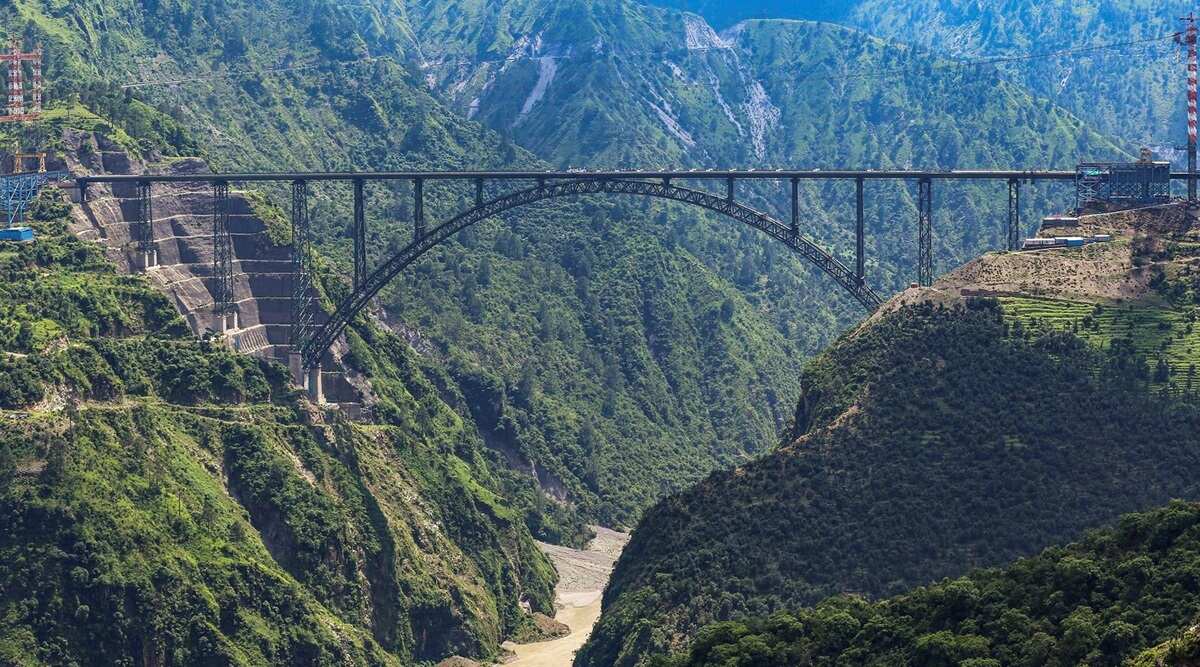
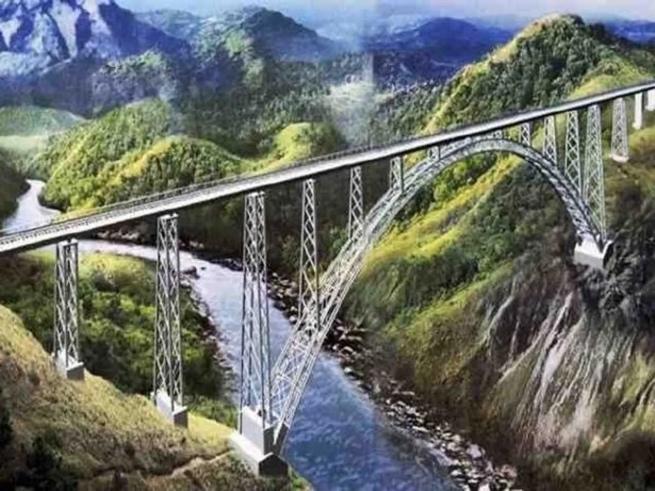
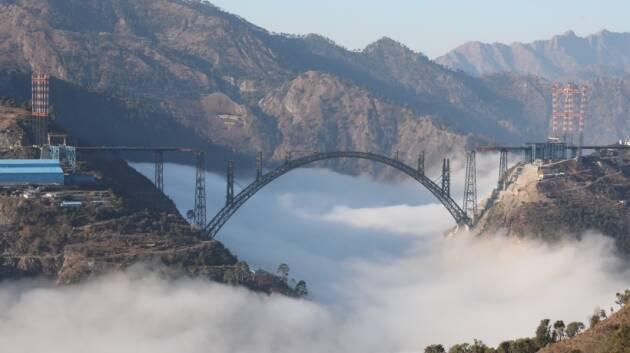
    Location: The Chenab Rail Bridge is a steel and concrete arch bridge between Bakkal and Kauri in the Reasi district of J&K, India.  It needs to be noted that it is the highest railway bridge in the world. After many hick-ups, finally in 2012 excavation of the foundation of the bridge commenced. The tender was with Afcons Infrastructure Limited. The alignment crosses a deep gorge of the Chenab River, which necessitates the construction of a long-span railway bridge with a viaduct for approaches on either side. 

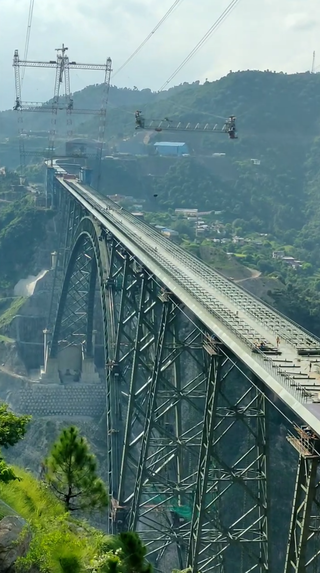
    Details: It is a 785 meters long single arch bridge where the main arch is 467 meters. The total span of the bridge is 1315 meters including a viaduct of 650 meters on the Northern side, Deck height is 359 meters above the river bed and 322 meters above the water surface which is 35 meters more than the height of the Eiffel Tower. The project also entails the construction of 203 km of access roads.  The deck is 13.5 meters wide, where two rail tracks will be available. The total cost of the Bridge is Rs 1486 Crores.


    Design: The steel arch has been planned because the construction of the pillar was difficult and the load had to be distributed. Chords have been provided to cater for the swaying load. The steel structures of the bridge were manufactured in workshops built in the mountains. The workshops had been moved to the building site because there is no proper road network in the challenging terrain. The longest building parts that could be delivered to the site were 12 meters in length. Therefore, four workshops were established in the mountains. Workshops and paint shops were built on both sides of the valley. All steel materials, except for the smallest rolled profiles, were delivered to the mountains as steel boards. The insufficient infrastructure of the area caused additional problems. There was no electricity and the water of the river was not suitable for manufacturing concrete. All electricity had to be produced at the site and the water was delivered from further away in the mountains. The job was also challenging because the track had a curvature in the approach bridge. In this section, the construction stage bearings had been designed in such a way that it was possible to launch the steel deck in the curvature portion as well. The bridge consists of about 25000 tonnes of steel structures, the main portion of which was used for the arch bridge section. It is a unique design and as such none of the Indian codes fully catered for the design validation. Therefore it was decided to follow the BS Code. The design also caters for wind load effects as per wind tunnel tests. It can cater for wind pressure of 1500 Pa. It is a blast resistance design. The design of the decking has been checked for fatigue as per the BS Code. The most important aspect is that it caters for redundancy within the structure, for a lower level of operation during mishaps and against collapse in extreme cases of one-pier failure. The area has high seismicity and the design was planned to withstand earthquakes of the severity of 8 on the Richter Scale. The bridge design is for a rail speed of 100 kmph. This means it can withstand very high-intensity of vibrations. The designed life of the bridge is 120 years and to take care of assessed steel fatigue the fatigue design selected is BS:5400 Part-10. The bridge will be able to withstand a temperature of minus 200C and a wind speed of 266 kmph.

    Team: The viaduct and foundation have been designed by M/s WSP(Finland) and the Arch design has been made by M/s Leonhart, Andra and Partners (Germany), the foundation protection has been designed by IISc Bangalore. The executing agency has been M/s Konkan Railway Corporation Limited.

    Status of Katra-Banihal project

    Although, the construction of Chenab Bridge is a major milestone in the progress of the project, however, still many more landmarks are required to be crossed before the completion of the project. Foremost of them is the Anji Khad bridge which is expected to be ready only by Dec 2022. It is expected that this rail Section will finally be operational by the middle of 2023.

    Conclusion

    The Jammu-Udhampur-Katra-Banihal-Srinagar-Baramulla Rail project is a vital national project which has a major bearing on national security and nation building. It is a matter of pride that Indian Engineers have achieved what at one point had appeared impossible. It will help in the integration of J&K with the rest of the country and will help strategically in many ways. The completion of the project will also give confidence to expeditiously complete other projects of national importance like; the railway line to Leh and the Railway line to Tenga in the North-East.

    End Note:

    1. Conceptual Design of the Chenab Bridge in India by Pekka Pulkkine WSP Finland, S Hopf and A Jutila. Available on Research Gate: https://www.researchgate.net/publication/257725212_Conceptual_Design_of_the_Chenab_Bridge_in_India.

    2. An internet upload: https://byjus.com/current-affairs/chenab-bridge/

    3. A Report by OT Staff, “Once the bridge is completed, it will provide all-weather connectivity between Kashmir and the rest of India” reported on 07 Apr 2021 and uploaded on https://www.outlookindia.com/outlooktraveller/travelnews/story/71397/all-about-the-chenab-bridge

    4. An internet upload: https://en.wikipedia.org/wiki/Jammu–Baramulla_line

    5. An internet upload: https://en.wikipedia.org/wiki/Chenab_Rail_Bridge

    6. An internet upload: https://www.pib.gov.in/PressReleasePage.aspx?PRID=1709652

    7. Zee Media Bureau, “Indian Railways: Delhi-Kashmir, Katra-Banihal train route to open soon, project nears completion” dated 08 Aug 2022 and uploaded on https://zeenews.india.com/railways/indian-railways-delhi-kashmir-katra-banihal-train-route-to-open-soon-project-nears-completion-2494827.html

    Image 1 Credits: Arun Ganesh

    Image 2 Credits: Indian Railways

    Image 3 Credits: Indian Express

    Image 4 Credits: Indian Railways

    Feature Image Credits: The Indian Express

  • Rural Agriculture and the new wave of Migrant Workers to Rural Space

    Rural Agriculture and the new wave of Migrant Workers to Rural Space

    Abstract

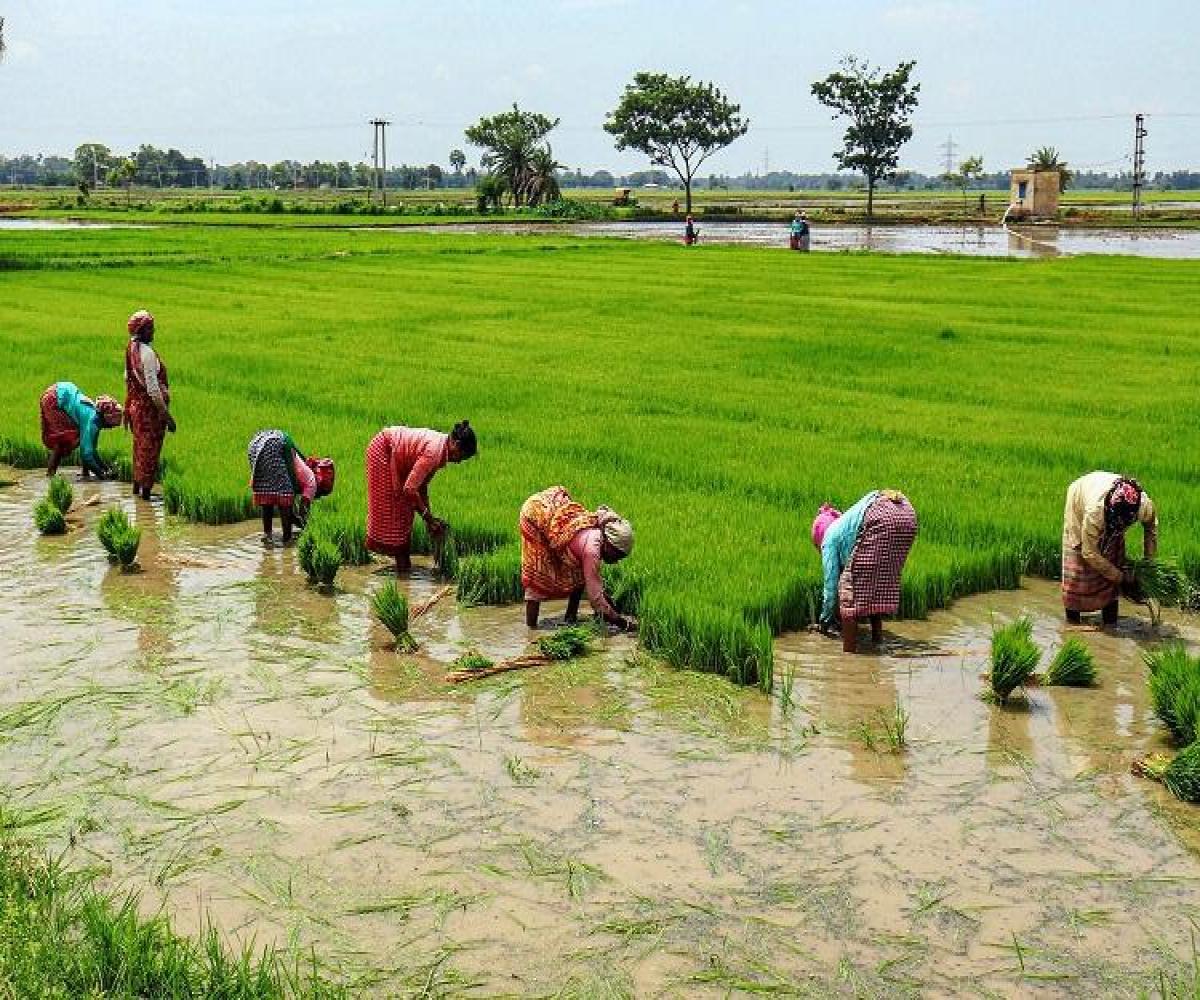
    Home, belongingness, and identity bring comfort to human existence, but local communities are challenged and become highly volatile by the sudden influx of people from different regions in search of livelihood and survival. Some migrate in their quest to find new opportunities in education, employment, and better living conditions from their home state, but some are displaced due to loss of livelihood, low employment, and lack of safety. This article analyses internal migration toward Tamil Nadu. The migrant population in Tamil Nadu accounts for 18.85 lakh according to the 2011 census, whereas other state migrants account for only 6.2% (Radhakrishnan & Vasanth, 2019). Most migration in the past has been towards the cities for chances of better livelihood and stable jobs. However, migrant workers travelling towards rural areas have been increasingly found working as agricultural labourers. S. Irudaya Rajan, a professor at the Centre for Developmental studies in his work, points out the importance of migrants to this economy as there is a constant outflow of the young population, with reservation wages in this region being high (Radhakrishnan & Vasanth, 2019). A report by the Federation of Tamil Nadu Agricultural Association suggests that over 8,67,582 farmers have stopped agricultural practices, and the market has been taken over by private players who require agricultural labourers (Sreemathi, 2019). This demand can attract migrant workers to rural areas. This article examines the migration pattern in Tamil Nadu to understand the inflow and outflow population, the reasons behind the outflow of farmers from the system and the new wave of migrant workers to rural Tamil Nadu.    

    Introduction

    Millions of people move every year hoping for a better livelihood and future, but the reality may be bitter for some. Nine million people have been migrating annually between states as per the Railway’s data from 2011 to 2016. Around 30% of the Indian population represents the varied level of the migrant population (Migration, 2022). Various factors have contributed to migration. The pull factors which attract people towards the destination include better living conditions, better employment, quality education, absence of violence and high wage rates. The push factors, on the other hand, include the lack of welfare activity, discrimination towards a community, lack of employment and lower wage rates. In both instances, economic ambition occupies the centre space. Thus, it is crucial to form a developmental economy for the residing population and the migrating one. The pull factors usually replace the push factors when the socio-economic condition in the country facilitates good life. People have been moving towards cities, hoping to find better employment and livelihood in the globalised world, making cities the hub for development. In Tamil Nadu, the movement toward the city area was triggered by early industrialisation in the 1980s, when manufacturing capacity accounted for around 26% of its GDP, higher than the national average of 15% (Mahambare & Dhanaraj, 2021). The 1990s liberalisation policy created mobility and development by expanding the economic horizons to telecom, software and banking (Migration to Chennai, 2010). This socio-economic mobility has greatly impacted the state’s rural economy and continues to be one of the few contributors to migration from agriculture. In recent times, farmers are selling out their lands and changing their occupations or working as agricultural labourers. The agricultural sector requires a considerable labour population. This demand for labour forces along with the lockdown during the Covid pandemic has fuelled a new wave of migrant workers in rural areas in south India. However, it is essential to study the causes of the movement of the traditional population from the industry, which helps understand the patterns that need to be avoided.

    Migration out of Agriculture

    Agriculture has long been a community practice in Tamil societies, but the migration of farmers continues to challenge the status quo. A report by the Federation of Tamil Nadu Agricultural Association mentions that over 8,67,582 farmers have stopped agricultural practices (Sreemathi, 2019). Lower wage rates, discrimination, heavy workload, lack of welfare and crop failure are the main reasons for displacement. Since the agricultural sector is seasonal, the wages are decided by workdays, seasons, and piece/ quantity rate, which leads to an unsteady wage rate based on the season, with fewer or no jobs in some seasons. People, thus, prefer to work non-farm jobs for a steady income throughout the year. Some have been living as labourers for generations on the farm since only a handful of the population possess larger farmlands. A study by Sato Keiko (2011) traces this class difference, farmland size, and the employment status of migrants from a rural village in Madurai. He points out that the village’s upper-class children with larger farms migrated to the city and acquired white-collar jobs. The middle class and the marginal groups, on the other hand, usually landed in blue-collar jobs.  Interestingly, he notes that the aspiration to educate and climb the socio-economic ladder has recently been high among the latter (Keiko, 2011). This aspiration leads them to migrate to cities and take up factory jobs, which are comparatively better than being engaged as farm labourers. Educational aspiration attempts to shake the traditional class structure and disparity that exists with it. 

    Additionally, only 27.1% adolescent population and 24.18% of the youth population were involved as agricultural labourers in 2014 (Sivakumar, 2014). Another reason for the migration is crop failure induced by unpredictable heavy rainfall and drought. Farmers who cannot profit or make ends meet when the crop collapses, end up falling into debt.  

    More than 85% of people working in the state under MGNREGA are women, higher than the national average of 56% and 28% of the Dalit population (Ramakrishnan, 2017)

    The Mahatma Gandhi Rural Employment Guarantee Act (MGNREGA) Scheme has been argued to be one of the major reasons behind the declining numbers of farm labourers When the scheme started, it provided the rural population with a higher income of Rs. 100 compared to farm jobs which offered Rs. 40 a day (In Tamil Nadu labourers, 2010). MGNREGA acts as a precursor for the high wage rate in agriculture as it competes with the scheme to attract more people for work. In 2020, the wage rate for agriculture labourers had increased to Rs. 392, and the notified MGNREGA stood at Rs. 273, which was lower than the farm wage (Aditi, 2021). However, along with steady wages and less workload, MGNREGA has continued to be a source of economic empowerment for women. It enables pathways to formal financial institutions and personal saving habits – “I would be working like a bonded labourer again under any big landowning agriculturist, if there was no Mahatma Gandhi National Rural Employment Guarantee Scheme (MGNREGS)” (Ramakrishnan, 2017). These interviews collected by Ramakrishnan, senior journalist for The Hindu, shed light on the women’s attitude and discontent toward farm jobs. More than 85% of people working in the state under MGNREGA are women, higher than the national average of 56% and 28% of the Dalit population (Ramakrishnan, 2017). These marginal groups are frequently abused and sexually harassed by employers and landowners. In this regard, MGNREGA has provided them with a space to work with dignity. However, some experts like Vijayanand, former Secretary of the Union Minister of Panchayat Raj, opposed the arguments favouring MGNREGA arguing that the scheme did not provide jobs throughout the year and phased out the jobs in accordance with the lean season (Radhakrishnan, 2017). 

    Involvement of Migrants in Agriculture

    Tamil Nadu is a growing economy which renders a stay to 18.85 lakhs migrants, of which 6.2 % are from other states. The origin states of these migrant workers are Bihar, West Bengal, Odisha, Jharkhand, Chattishgarh and states of Northeast India. Some tribal communities migrated from areas with rich mineral resources like the Santal areas of West Bengal, MP and a few other areas in Jharkhand and Chattisgarh because of the prevalent mining practice and dam building. Also, tribal people were displaced because of the settlement of non-tribals in the region and deforestation. In some areas, low human development indicators have led to their displacement. Apart from these push factors, Tamil Nadu has a lot to offer in terms of its higher wage rates, better living conditions and political, religious and social freedom (Sami, Crossin, Jayapathy, Martin, et al., 2016). Once they migrate to Tamil Nadu through contractors, migrants are channelled to Chennai, Coimbatore, Tiruvallur, Tiruppur, Kancheepuram and Chengalpattu to work in manufacturing factories and construction sites. These migrants fill the state’s requirement for 3D jobs, as Dr Irudaya Rajan from the Tiruvananthapuram Centre for Developmental Studies mentioned (Radhakrishnan & Vasanth, 2019). These jobs are mostly dirty, demeaning and dangerous. Since the wage expectation of the state youth is high, the desperation to take up these jobs is low and job positions are thus occupied by migrant workers (Vasanth & Radhakrishnan, 2019).

    The Periodic Labour Force Survey (PLFS) data from 2018 to 2020 shows a sharp increase in employment in agriculture from 42.5 % in 2018 -19 to 45.6% in 2019-20 (CMIE, 2021)

    In the pre-Covid job market, population movement was constantly moving from rural villages to urban spaces in search of white and blue-collar jobs. However, Covid has shifted the employment market. The Periodic Labour Force Survey (PLFS) data from 2018 to 2020 shows a sharp increase in employment in agriculture from 42.5 % in 2018 -19 to 45.6% in 2019-20 (CMIE, 2021). Most people who changed jobs were formerly employed in construction and manufacturing. While the existing population migrates to cities in search of skilled labour, migrant workers find the farm jobs more appealing. Tamil Nadu provides an average salary of Rs. 392 per day for farm workers, which is higher than the national average of Rs. 348. Most states from which the migrants are displaced have far fewer wage rates; for instance, Jharkhand offered Rs. 258 in 2020 while the wage rate was Rs. 234 in Chhattisgarh (Directorate of Economics and Statistics, 2021). While their movement is unexpected, these migrant populations can contribute to the agricultural sector and rural development, but that cannot be done without good government policies. The GDP contribution of agriculture reduced from 55.3% in the 1950s to 21.8% in the 2000s (Gothoskar, 2021). Most government budgets have little concern for the agricultural economy. Thus, it is essential to implement policies for the existing agrarian population and the migrants. Also, there has been increasing distress caused by the growing movement of the migrants to farmland which continues to be heavily unorganised. Dr Irudaya Rajan, in his interviews, warns that this unexpected surplus labour availability in rural areas cannot accommodate everyone in the existing jobs, which may result in increased poverty and starvation (Nirupama, 2020).

    Furthermore, it backfires on the urban economy once industries open up completely and face a shortage of labour (Viswanathan, 2020). To know the current situation of migrant workers, state-level data collection is needed. Tamil Nadu collected the migrant database only once in 2015, following the fall of the Moulivakkam multistorey building. While Thangam Thennarasu, the Tamil Nadu Minister of Industries, mentioned collecting data on migrant workers in a press release, the agriculture sector was not mentioned (Kumar, 2021). Data collection is vital in formulating policies to accommodate the migrant workers in rural economies and avoid unexpected problems. 

    Measures to be taken

    Since the Agricultural sector offers seasonal employment, other sources of organised employment or schemes to assure livelihood during times of distress should be in place. While farming requires work like ploughing and harvesting, which is to be done all year-round, the revenue can be earned only in a particular season. If affected by climate calamities and crop failure, people are most likely to end up in debt. Hence, it is essential to employ migrants during the off-season and distress times in sustainable jobs. Most agricultural products are exported as raw materials or semi-processed to other countries, and therefore, the MSMEs in the rural areas can be focused on enhancing the exporting sector of agriculture.

    MOUS between states: The Tamil Nadu government has fewer memorandums of understanding (MOUs) on migrants, with focus mainly placed on Sri Lankan refugees. Thus, signing MOUs with the source state can improve the conditions of migrants and help governments to maintain a database of migrants (Sreelakshmi,2021). The databases can help in formulating policies.

    Welfare policies – Rashtriya Swasthya Bima Yojana (RSBY), a central-run health insurance scheme for people working in the unorganised sector and for those below the poverty line, has to be implemented appropriately, and the records should be maintained. Quality schooling for children of migrants working in rural spaces should be provided. Some states have offered regional language subject notebooks and learning kits through MOUs. Tamil Nadu should recruit staff in the favoured language. Further, skill enhancement training for the migrants should be provided.

    Conclusion

    Agriculture and rural development go hand in hand since 70% of rural households depend upon agriculture for their livelihood. Still, there is an increased pattern of traditional farmers moving out of the business and choosing other industries or being employed as agricultural labourers. This shift, accompanied by the Covid lockdown, has triggered an increased flow of migrant population back to farms as agricultural labourers. Unlike industries, the agricultural sector is unorganised and seasonal, making it highly vulnerable. Thus, it becomes essential to build a safety net for the traditional population and the migrants. These migrants, without proper policies and data entries, can be stranded; lacking identity, rights and political representation. Further, this sudden labour surplus cannot be accommodated immediately, creating a labour shortage in urban areas.  It is, thus, important to record migrant workers who return, the sector they are involved in, their security nets and most importantly, their availability in rural agriculture.

    Reference

    Aditi R. (2021, May 16). MGNREGA workers in Tamil Nadu allege underpayment and wage disparity. The times of India. Retrieved from https://timesofindia.indiatimes.com/city/chennai/mgnrega-workers-in-tamil-nadu-allege-underpayment-and-wage-disparity/articleshow/82673961.cms

    Dhanaraj Sowmya & Mahambare Vidya (2021, March 31). Tamil Nadu left Punjab, Bengal far behind. Here’s what it needs to do now. The Print. Retrieved from https://theprint.in/opinion/tamil-nadu-left-punjab-bengal-far-behind-heres-what-it-needs-to-do-now/631213/

    Directorate of Economics and Statistics. (2021). Agricultural wages India: 2019 – 20. Ministry of Agriculture & Farmers welfare. 

    Gothaskar Sujata. (2021, May 12). To Fully Understand the Migrant Worker Crisis, We Need a Larger Perspective. The Wire. Retrieved from https://thewire.in/rights/migrant-worker-crisis-larger-perspective-farm-land-industry

    In Tamil Nadu labourers choosing NREGA over farms. (2010, Nov 29). NDTV. Retrieved from https://www.ndtv.com/india-news/in-tamil-nadu-labourers-choosing-nrega-over-farms-440546

    Keiko Sato. (2011). Employment structure and Rural-Urban Migration in a Tamil Nadu Village: Focusing on difference by economic class. Southeast Asia Studies. Vol.49. Pg.22-51.

    Kumar Vijay. (2021, July 26). Tamil Nadu to create a databank of migrant workers. The Hindu. Retrieved from https://www.thehindu.com/news/national/tamil-nadu/databank-of-migrant-workers-soon-says-tamil-nadu-industries-minister/article35530808.ece

    Migration to Chennai follows industrial growth, but quality. (2010, April 13). The Times of India. Retrieved from https://timesofindia.indiatimes.com/city/chennai/migration-to-chennai-follows-industrial-growth-but-quality-of-life/articleshow/5798687.cms

    Radhakrishnan V & Vasanth B. A. (2019, September 08). Migrants in Tamil Nadu: case of much ado about nothing? The Hindu. Retrieved from https://www.thehindu.com/news/national/tamil-nadu/migrants-in-tamil-nadu-case-of-much-ado-about-nothing/article29364682.ece

    Ramakrishnan T. (2017, February 05). Job scheme, a mixed bag for rural labourers. The Hindu. Retrieved from https://www.thehindu.com/news/national/tamil-nadu/Job-scheme-a-mixed-bag-for-rural-labourers/article17197043.ece

    Sami Bernard. Crossin Sebastian, Jayapathy, Martin. P. O. (2016). A survey on Interstate migrants in Tamil Nadu. LISSTAR & Indian Social Institute. 

    Sivakumar B. (2014, November 02). Most of Tamil Nadu’s adolescents, youth live in rural areas, shows census. The times of India. Retrieved from https://timesofindia.indiatimes.com/city/chennai/most-of-tamil-nadus-adolescents-youth-live-in-rural-areas-shows-census/articleshow/45008956.cms

    Sreelakshmi Anjana. (2021, November 07). Distress Migration: A case study KBK districts in Odisha. The Peninsula Foundation. Retrieved from https://admin.thepeninsula.org.in/2021/11/07/distress-migration-a-case-study-of-kbk-districts-in-odisha/

    Sreemathi M. (2021, November 23). Migrants now enter agri fields in Nellai. The New Indian Express. Retrieved from https://www.newindianexpress.com/states/tamil-nadu/2021/nov/23/migrants-now-enter-agri-fields-in-nellai-2386930.html

    Viswanathan Nirupama. (2020, May 20). We have not factored in Tamil Nadu’s migrant workers in our realm of things: Expert. The new Indian Express. Retrieved from https://www.newindianexpress.com/states/tamil-nadu/2020/may/20/we-have-not-factored-in-tamil-nadus-migrant-workers-in-our-realm-of-things-expert-2145578.html

    Vyas Mahesh. (2021, August 09). Migration from factories to farms. Centre for Monitoring Indian Economy. Retrieved from https://www.cmie.com/kommon/bin/sr.php?kall=warticle&dt=20210809122441&msec=850

    Feature Image Credits: The News Minute
  • At 75, A time to Celebrate and Introspect

    At 75, A time to Celebrate and Introspect

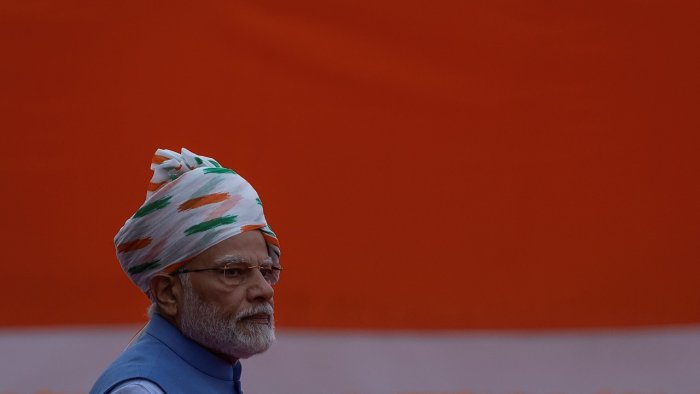
    As modern, democratic India turns 75, it is indeed a time for celebration and introspection

    Addressing the historic session of the Constituent Assembly on the night of 14-15 August 1947, at the cusp of India’s independence, Jawaharlal Nehru voiced the yearning of millions of Indians when, in his matchless eloquence, he declared: “Long years ago, we made a tryst with destiny, and now the time comes when we shall redeem our pledge…At the stroke of the midnight hour, when the world sleeps, India will awake to life and freedom”.

    In what’s considered to be one of the finest speeches of the last century, Nehru also voiced the aspiration of Gandhiji, that their work would not be over till they wiped “every tear from every eye,” adding “this is no time for petty and destructive criticism, no time for ill-will or blaming others. We have to build the noble mansion of free India where all her children may dwell.”

    [powerkit_button size=”lg” style=”info” block=”true” url=”https://www.deccanherald.com/opinion/in-perspective/at-75-a-time-to-celebrate-and-introspect-1136410.html” target=”_blank” nofollow=”false”]
    Read More
    [/powerkit_button]

  • Ukraine War: India’s Stature in the Emerging World Order

    Ukraine War: India’s Stature in the Emerging World Order

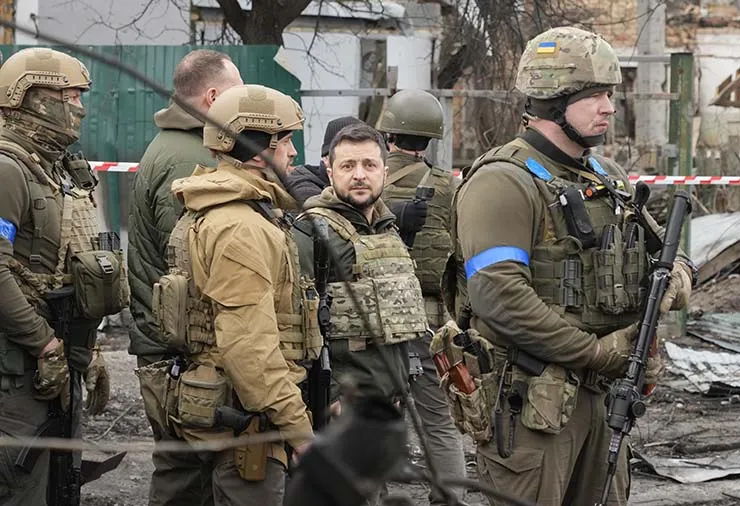
    The war between Russia and Ukraine has caused a major disruption not only in that region, but the entire world. Power centres are shifting; a new world order is emerging out of this global churn. The world anxiously waits for India to take a more active role in a bid to end hostilities. What will India do?

    India’s firm stand of neutrality about the conflict in Ukraine has attracted considerable attention from the world’s strategic thinkers and governments. In this regard, many see the rise of India as a future pole power of the 21st century, as the current world order has entered a phase of instability, conflict, and competition. The Ukraine war may be the tipping point for the Euro-American dominance in the last three centuries, as a multi-polar world order is emerging, albeit slowly. India’s stature in this world order transformation is critical, as the non-western countries that constitute two-thirds of the world will meticulously observe and monitor it. A careful analysis of the ongoing transformation of the world order amidst the massive cacophony of propaganda and a plethora of biased reports (masquerading as research and academic outputs) is a huge challenge for serious researchers and policymakers.

    [powerkit_button size=”lg” style=”info” block=”true” url=”https://raksha-anirveda.com/ukraine-war-indias-stature-in-the-emerging-world-order/” target=”_blank” nofollow=”false”]
    Read More
    [/powerkit_button]

  • Macrovariable Projections in Uncertain Times

    Macrovariable Projections in Uncertain Times

    International factors and faulty data will impact India’s projections of GDP, inflation and balance of payments

    The Fed has raised its benchmark interest rate again by a whopping 0.75%. The Reserve Bank of India has also been forced to raise interest rates further but also take other steps. These decisions in the Monetary Policy Committee (MPC) meeting are based on what the members of the MPC see as the likely course of…

    [powerkit_button size=”lg” style=”info” block=”true” url=”https://www.thehindu.com/opinion/lead/macrovariable-projections-in-uncertain-times/article65747423.ece” target=”_blank” nofollow=”false”]
    Read More
    [/powerkit_button]

  • Indian Economy at 75: Trapped in a Borrowed Development Strategy

    Indian Economy at 75: Trapped in a Borrowed Development Strategy

    In 1947, at the time of Independence, India’s socio-economic parameters were similar to those in countries of South East Asia and China. The level of poverty, illiteracy, and inadequacy of health infrastructure was all similar. Since then, these other countries have progressed rapidly leaving India behind in all parameters. ‘Why is it so?’ should be the big question for every Indian citizen in this time of our 75th anniversary celebrations.


    Introduction

    India at 75 is a mixed bag of development and missed opportunities. The country has achieved much since Independence but a lot remains to be done to become a developed society. The pandemic has exposed India’s deficiencies in stark terms. The uncivilized conditions of living of a vast majority of the citizens became apparent. According to a report by Azim Premji University, 90% of the workers said during the lockdown that they did not have enough savings to buy one week of essentials. This led to the mass migration of millions of people, in trying conditions from cities to the villages, in the hope of access to food and survival.

    Generally, technology-related sectors, pharmaceuticals and some producing essentials in the organized sectors have done well in spite of the pandemic. So, a part of the economy is doing well in spite of adversity but incomes of at least 60% of people at the bottom of the income ladder have declined (PRICE Survey, 2022). The great divide between the unorganized and organized parts of the economy is growing. The backdrop to these developments is briefly presented below.

    Structure and Growth of the Economy

    In 1947, at the time of Independence, India’s socio-economic parameters were similar to those in countries of South East Asia and China. The level of poverty, illiteracy, and inadequacy of health infrastructure was all similar. Since then, these other countries have progressed rapidly leaving India behind in all parameters. So, India has fallen behind relatively in spite of improvements in health services and education, diversification of the economy and development of the industry.

    In 1950, agriculture was the dominant sector with a 55% share of GDP which has now dwindled to about 14%. The share of the services sector has grown rapidly and by 1980 it surpassed the share of agriculture and now it is about 55% of GDP. The Indian economy has diversified production `from pins to space ships’.

    Agriculture grows at a trend rate of a maximum of 4% per annum while the services sector can grow at even 12% per annum. So, there has been a shift in the economy’s composition from agriculture to services, accelerating the growth rate. The average growth rate of the economy between the 1950s and the 1970s was around 3.5%. In the 1980s and 1990s, it increased to 5.4% due to the shift in the composition. There was no acceleration in the growth rate of the economy in the 1990s compared to the 1980s. This rate again increased in the period after 2003 only to decline in 2008-09 due to the global financial crisis. Subsequently, the rate of growth has fluctuated wildly both due to global events and the policy conundrums in India.

    There was the taper tantrum in 2012-13 which cut short the post-global financial crisis recovery. Demonetization in November 2016 adversely impacted growth. That was followed by the structurally flawed GST. These policies administered shocks to the economy. Then came the pandemic in 2020. The economy’s quarterly growth rate had already fallen from 8% in Q4 2017-18 to 3.1% in Q4 2019-20, just before the pandemic hit.

    1980-81 marked a turning point. Prior to that, a drought would lead to a negative rate of growth in agriculture and of the economy as a whole. For instance, due to the drought in 1979-80, the economy declined by 6%. But, that was the last one. After that, a decline in agriculture has not resulted in a negative growth rate for the economy. The big drought of 1987-88 saw the economy grow at 3.4%. After 1980-81, the economy experienced a negative growth rate only during the pandemic which severely impacted the services sector, especially the contact services.

    Employment and Technology Related Issues

    Agriculture employs 45% of the workforce though its share in the economy (14%) has now become marginal. It has been undergoing mechanisation with increased use of tractors, harvester combines, etc., leading to the displacement of labour. Similar is the case in non-agriculture. So, surplus labour is stuck in agriculture leading to massive disguised unemployment.

    India is characterized by disguised unemployment and underemployment.Recent data points to growing unemployment among the educated youth. They wait for suitable work. The result is a low labour force participation rate (LFPR) in India (in the mid-40s) compared to similar other countries (60% plus).The gender dimension of unemployment and the low LFPR is worrying with women the worst sufferers.

    India’s employment data is suspect. The reason is that in the absence of unemployment allowance, people who lose work have to do some alternative work otherwise they would starve. They drive a rickshaw, push a cart, carry a head load or sell something at the roadside. This gets counted as employment even though they have only a few hours of work and are underemployed. So, India is characterized by disguised unemployment and underemployment.

    Recent data points to growing unemployment among the educated youth. They wait for suitable work. The result is a low labour force participation rate (LFPR) in India (in the mid-40s) compared to similar other countries (60% plus). It implies that in India maybe 20% of those who could work have stopped looking for work. No wonder for a few hundred low-grade government jobs, millions of young apply. The gender dimension of unemployment and the low LFPR is worrying with women the worst sufferers.
    These aspects of inadequate employment generation are linked to automation and the investment pattern in the economy. New technologies that are now being used in the modern sectors are labour displacing. For instance, earlier in big infrastructure projects like the construction of roads, one could see hundreds of people working but now big machines are used along with a few workers.

    Further, the organized sectors get most of the investment so little is left for the unorganized sector. This is especially true for agriculture. Thus, neither the organized sector nor agriculture is generating more work. Consequently, entrants to the job market are mostly forced to join the non-agriculture unorganized sector, which in a sense is the residual sector, where the wages are a fraction of the wages in the organized sector. The unorganized sector also acts as a reserve army of labour keeping organized sector wages in check

    Lack of a Living Wage

    To boost profits, the organized sector is increasingly, employing contract labour rather than permanent employees. This is true in both the public and private sectors. So, not only the workers in the unorganized sector, even the workers in the organised sector do not earn a living wage. Thus, most workers have little savings to deal with any crisis. They are unable to give their children a proper education and cannot afford proper health facilities. Most of the children drop out of school and can only do menial jobs requiring physical labour. They cannot obtain a better-paying job and will remain poor for the rest of their lives.

    The Delhi socio-economic survey of 2018 pointed to the low purchasing power of the majority of Indians. It showed that in Delhi, 90% of households spent less than Rs. 25,000 per month, and 98% spent less than Rs. 50,000 per month. Since Delhi’s per capita income is 2.5 times the all India average, deflating the Delhi figures by this factor will approximately yield all India figures. So, 98 per cent of the families would have spent less than Rs.20,000 per month, and 90 per cent less than Rs.10,000 per month. This effectively implies that 90 per cent of families were poor in 2018, if not extremely poor (implied by the poverty line). During the pandemic, many of them lost incomes and were pauperized and forced to further reduce their consumption.

    Unorganized Sector Invisibilized

    In the unorganized sector, labour is not organized as a trade union and therefore, is unable to bargain for higher wages, when prices rise. It constitutes 94% of the workforce and has little social security. No other major world economy has such a huge unorganized sector. No wonder when such a large section of the population faces a crisis in their lives, the economy declines, as witnessed during the pandemic. India’s official rate of growth fell more sharply than that of any other G20 country.

    The micro sector has 99% of the units and 97.5% of the employment of MSME and is unlike the small and medium sectors. The benefits of policies made for the MSME sector do not accrue to the micro units.

    Policymakers largely ignore the unorganized sector. The sudden implementation of the lockdown which put this sector in a deep existential crisis points to that. The micro sector has 99% of the units and 97.5% of the employment of MSME and is unlike the small and medium sectors. The benefits of policies made for the MSME sector do not accrue to the micro units.

    Invisibilization of the unorganized sector in the data is at the root of the problem. Data on this sector become available periodically, called the reference years. In between, it is assumed that this sector can be proxied by the organized sector. This could be taken to be correct when there is no shock to the economy and its parameters remain unchanged.

    Demonetization and the flawed GST administered big shocks to the economy and undermined the unorganized sector. Its link with the organized sector got disrupted. Thus, the methodology of calculating national income announced in 2015 became invalid.

    The implication is that the unorganized sector’s decline since 2016 is not captured in the data. Worse, the growth of the organized sector has been at the expense of the unorganized sector because demand shifted from the latter to the former. It suited the policymakers to continue using the faulty data since that presented a rosy picture of the economy. This also lulled them into believing that they did not need to do anything special to check the decline of the unorganized sector.

    Policy Paradigm Shift in 1947

    Growing unemployment, weak socio-economic conditions, etc., are not sudden developments. Their root lies in the policy paradigm adopted since independence.
    In 1947, the leadership, influenced by the national movement understood that people were not to blame for their problems of poverty, illiteracy and ill-health and could not resolve them on their own. So, it was accepted that in independent India these issues would be dealt with collectively. Therefore, the government was given the responsibility of tackling these issues and given a key role in the economy.

    Simultaneously, the leadership, largely belonging to the country’s elite, was enamoured of Western modernity and wanted to copy it to make India an ’advanced country’. The two paths of Western development then available were the free market and Soviet-style central planning. India adopted a mix of the two with the leading role given to the public sector. This path was chosen also for strategic reasons and access to technology which the West was reluctant to supply. But, this choice also led to a dilemma for the Indian elite. It had to ally with the Soviet Union for reasons of defence and access to technology but wanted to be like Western Europe.

    Both the chosen paths were based on a top-down approach. The assumption was that there would be a trickle down to those at the bottom. People accepted this proposition believing in the wider good of all. Resources were mobilized and investments were made in the creation of big dams and factories (called temples of modern India) that generated few jobs. They not only displaced many people trickle down was minimal. For instance, education spread but mostly benefitted the well-off.

    The Indian economy diversified and grew rapidly. An economy that for 50 years had been growing at about 0.75% grew at about 4% in the 1950s. But, the decline in the death rate led to a spurt in the rate of population growth. So, the per capita income did not show commensurate growth, and poverty persisted. Problems got magnified due to the shortage of food following the drought of 1965-67 and the Wars in 1962 and 1965. The Naxalite movement started in 1967, there was BOP crisis and high inflation in 1972-74 due to the growing energy dependence and the Yom Kippur war. Soon thereafter there was political instability and the imposition of an Emergency in 1975. The country went from crisis to crisis.

    Planning failed due to crony capitalism. The prevailing political economy enabled the business community to systematically undermine policies for their narrow ends by fueling the growth of the black economy.

    The failure of trickle-down and the cornering of the gains of development by a narrow section of people led to growing inequality and people losing faith in the development process. Different sections of the population realized that they needed a share in power to deliver to their group. Every division in society — caste, region, community, etc. — was exploited. The leadership became short-termist and indulged in competitive populism by promising immediate gains.

    The consensus on policies that existed at independence dissipated quickly. Election time promises to get votes were not fulfilled. For instance, PM Morarji Desai said that promises in the Janata Dal manifesto in 1977 were the party’s programme and not the government’s. Such undermining of accountability of the political process has undermined democracy and trust and aggravated alienation.

    Black Economy and Policy Failure

    The black economy has grown rapidly since the 1950s with political, social and economic ramifications. Even though it is at the root of the major problems confronting the country, most analysts ignore it.

    So, the black economy controls politics and to retain power it undermines accountability and weakens democracy.

    It undermines elections and strengthens the hold of vested interests on political parties. The compromised leadership of political parties is open to blackmail both by foreign interests and those in power. When in power it is willing to do the bidding of the vested interests. So, the black economy controls politics and to retain power it undermines accountability and weakens democracy.

    The black economy controls politics and corrupts it to perpetuate itself. The honest and the idealist soon are corrupted as happened with the leadership that emerged from the anti-corruption JP movement in the mid-1970s. Many of them who gained power in the 1990s was accused of corruption and even prosecuted. Proposals for state funding of elections will only provide additional funds but not help clean up politics.

    The black economy can be characterized as ’digging holes and filling them’. It results in two incomes but zero output. There is activity without productivity with investment going to waste. Consequently, the economy grows less than its potential. It has been shown that the economy has been losing 5% growth since the mid-1970s. So, if the black economy had not existed, today the economy could have been 8 times larger and each person would have been that much better off. Thus, development is set back. In 1988, PM Rajiv Gandhi lamented that out of every rupee sent only 15 paisa reaches the ground. P Chidambaram as FM said, `expenditures don’t lead to outcomes’.

    The black economy leads to the twin problem of development. First, black incomes being outside the tax net reduce resource availability to the government. If the black incomes currently estimated at above 60% of GDP could be brought into the tax net, the tax/GDP ratio could rise by 24%. This ratio is around 17% now and is one of the lowest in the world. Further, as direct tax collections rise, the regressive indirect taxes could be reduced, lowering inflation.

    India’s fiscal crisis would also get resolved. The current public sector deficit of about 14% would become a surplus of 10%. This would eliminate borrowings and reduce the massive interest payments (the largest single item in the revenue budget). It would enable an increase in allocations to public education and health to international levels and to infrastructure and employment generation.

    In brief, curbing the black economy would take care of India’s various developmental problems, whether it be lack of trickle-down, poverty, inequality, policy failure, employment generation, inflation and so on. It causes delays in decision-making and a breakdown of trust in society.

    Due to various misconceptions about the black economy, many of the steps taken to curb it have been counterproductive, like demonetization. Dozens of committees and commissions have analysed the issues and suggested hundreds of steps to tackle the problem. Many of them have been implemented, like reduction in tax rates and elimination of most controls but the size of the black economy has grown because of a lack of political will.

    Policy Paradigm Shift in 1991

    Failure of policies led to crisis after crisis in the period leading up to 1990. The blame was put on the policies themselves and not the crony capitalism and black economy that led to their failure. The policies prior to 1990 have been often labelled as socialist. Actually, the mixed economy model was designed to promote capitalism. At best the policies may be labelled as state capitalist and they succeeded in their goal. Private capital accumulated rapidly pre-1990. The Iraq crisis of 1989-90 led to India’s BOP crisis and became the trigger for a paradigm change in policies in favour of capital. The earlier more humane and less unequal path of development was discarded.

    Marketization has led to the ’marginalization of the marginals’, greater inequality and a rise in unemployment.

    In 1991, a new policy paradigm was ushered in. Namely, ’individuals are responsible for their problems and not the collective’. Under this regime, the government’s role in the economy was scaled back and individuals were expected to go to the market for resolving their problems. This may be characterized as ’marketization’. This brought about a philosophical shift in the thinking of individuals and society.

    Marketization has led to the ’marginalization of the marginals’, greater inequality and a rise in unemployment. These policies have promoted ’growth at any cost’ with the cost falling on the marginalized sections and the environment, both of which make poverty more entrenched. So, the pre-existing problems of Indian society have got aggravated in a changed form.

    Poverty is defined in terms of the ’social minimum necessary consumption’ which changes with space and time. Marketization has changed the minimum due to the promotion of consumerism and environmental decay imposing heavy health costs.
    The highly iniquitous NEP is leading to an unstable development environment. The base of growth has been getting narrower leading to periodic crises. Additionally, policy-induced challenges like demonetization, GST, pandemic and now the war in Ukraine have aggravated the situation. These social and political challenges can only grow over time as divisions in society become sharper.

    Weakness in Knowledge Generation

    Why does the obvious not happen in India? No one disagrees that poverty, illiteracy and ill health need to be eliminated. In addition to the problems due to the black economy and top-down approach, India has lagged behind in generating socially relevant knowledge to tackle its problems and make society dynamic.

    Technology has rapidly changed since the end of the Second World War. It is a moving frontier since newer technologies emerge leading to constant change and the inability of the citizens to cope with it. The advanced technology of the 1950s is intermediate or low technology today.

    Literacy needs to be redefined as the ability to absorb the current technology so as to get a decent job. Many routine jobs are likely to disappear soon, like, driver’s jobs as autonomous (self-driving) vehicles appear on the scene. Most banking is already possible through net banking and machines, like, ATMs. Banks themselves are under threat from digital currency.

    So, education is no more about the joy of learning and expanding one’s horizon. No wonder, the scientific temper is missing among a large number of the citizens.

    India’s weakness in knowledge generation is linked to the low priority given to education and R&D. Learning is based substantially on `rote learning’ which does not enable absorption of knowledge and its further development. So, education is no more about the joy of learning and expanding one’s horizon. No wonder, the scientific temper is missing among a large number of the citizens. Dogmas, misconceptions and irrationalities rule the minds of many and they are easily misled. This is politically, socially and economically a recipe for persisting backwardness.

    In spite of policy initiatives regarding education, like, the national education policy in 1968 and 1986, there is deterioration. This is because the milieu of education is all wrong. Policy is in the hands of bureaucrats, politicians or academics with bureaucratized mindsets. So, policies are mechanically framed. Like the idea that ’standards can be achieved via standardization’.

    Learning requires democratization. So, institutions need to be freed from the present feudal and bureaucratic control. Presently, institutions treat dissent as a malaise to be eliminated rather than celebrated. Courses are sought to be copied from foreign universities. JNU is told to be like Harvard or Cambridge. This is a contradiction in terms; originality cannot be copied. Courses copied from abroad tend to be based on the societal conditions there and not Indian conditions. Gandhi had said that the Indian education system is alienating and for many it still is.

    The best minds mostly go abroad and even if they return, they bring with them an alien framework not suited to India. So, as a society, we need to value ideas, prioritize education and R&D and generate socially relevant knowledge.

    Learning is given low priority because ideas are sought to be borrowed from abroad. So, the rulers have little value for institutions that could generate new ideas and inadequate funds are allotted to them. The best minds mostly go abroad and even if they return, they bring with them an alien framework not suited to India. So, as a society, we need to value ideas, prioritize education and R&D and generate socially relevant knowledge.

    Conclusion

    The growth at any cost strategy has been at the expense of the workers and the environment. This has narrowed the base of growth and led to instability in society — politically, socially and economically.

    India is a diverse society and the Indian economy is more complex than any other in the world. This has posed serious challenges to development in the last 75 years but undeniably things are not what they were. The big mistake has been to choose trickle-down policies that have not delivered to a vast number of people who live in uncivilized conditions. Poverty has changed its form and the elite imply that the poor should be grateful for what they have got. They should not focus on growing inequality, especially after 1991, when globalization entered the marketization phase which marginalizes the marginals.

    The growth at any cost strategy has been at the expense of the workers and the environment. This has narrowed the base of growth and led to instability in society — politically, socially and economically. The situation has been aggravated by the recent policy mistakes — demonetization, flawed GST and sudden lockdown. The current war in Ukraine is likely to lead to a new global order which will add to the challenges. The answer to ’why does the obvious not happen’ in India is not just economic but societal. Unless that challenge is met, portents are not bright for India at 75.

    This paper is based substantially on, `Indian Economy since Independence: Persisting Colonial Disruption’, Vision Books, 2013 and `Indian Economy’s Greatest Crisis: Impact of Coronavirus and the Road Ahead’, Penguin Random House, 2020.

    This article was published earlier in Mainstream Weekly.

    Feature Image Credit: Financial Express

    Other Images: DNA India, news18.com,  economictimes, rvcj.com

  • Three Years as a Union Territory: Human Rights in J&K

    Three Years as a Union Territory: Human Rights in J&K

    [powerkit_button size=”lg” style=”info” block=”true” url=”https://admin.thepeninsula.org.in/wp-content/uploads/2022/08/Our-Annual-Report-Human-Rights-JK-2022_compressed-1.pdf” target=”_blank” nofollow=”false”]
    Download
    [/powerkit_button]

    The Forum for Human Rights in Jammu and Kashmir comprises an informal group of concerned citizens who believe that, in the prevailing situation in the former state of Jammu and Kashmir, an independent initiative is required so that continuing human rights violation do not go unnoticed.

    The aim of the Forum is to highlight, report and seek action. It will primarily focus on human rights protected by the constitutions of India and Jammu and Kashmir, as well as those identified in international treaties/instruments which India has ratified. It will research evident violations, and may take suo moto notice of any violation, irrespective of whether or not a formal complaint is received.

    The Forum for Human Rights in Jammu and Kashmir will receive information/materials on human rights violation to its email hrforumjk@gmail.com and through other means, and it may report/forward complaints to relevant authorities with recommendations for action. Please note that this is not an anticipatory body.

    This is the fourth report issued by the Forum. It has largely been compiled local first-hand accounts, governments sources, media accounts (carried in well-established and reputed newspaper or television), and NGO fact-finding reports. The various sources listed above have been fact-checked against each other to ensure the information is as accurate as possible, and only that information has been carried that appears to be well-founded.

    The members of the Forum for Human Rights in Jammu and Kashmir take allegations of inaccuracy, bias, or any other criticism founded in fact, very seriously. Criticism of this nature will be considered and responded in real-time.

    Air Vice Marshal Kapil Kak (Retd) is a Distinguished Fellow and a member of the Governing Council of The Peninsula Foundation (TPF). He is a member of the Forum for Human Rights in Jammu and Kashmir.

    Disclaimer: The views represented herein are those of the Forum and not necessarily reflect the views of The Peninsula Foundation, its staff, or its trustees.

    [powerkit_button size=”lg” style=”info” block=”true” url=”https://admin.thepeninsula.org.in/wp-content/uploads/2022/08/Our-Annual-Report-Human-Rights-JK-2022_compressed-1.pdf” target=”_blank” nofollow=”false”]
    Download
    [/powerkit_button]

  • Gendered Politics at the Local Level: An Analysis of Tamil Nadu

    Gendered Politics at the Local Level: An Analysis of Tamil Nadu

    The institution of panchayat raj, a milestone in the journey of administrative institutions at the grass-root level, is not an exception to proxy candidature, caste-based violation of rights or gendered politics

    The political domain continues to be considered a male bastion, with women in politics often seen as a paradox. The domain is conspicuous by the very low presence of women, with very few of them making it to positions of power. Elizabeth I, Margaret Thatcher, Indira Gandhi, and Golda Meir have often been regarded as minorities in politics despite being some of the most powerful women in domestic and international politics. In the minuscule group of women politicians, ‘self-made’ women are often considered an exception rather than a rule. The political transitions are short-term solutions to break the pattern of exclusion. From the suffragette of the 20th century up till now, feminists have fought a lengthy battle for women’s right to vote and hold office. With the development that is slow and choppy, women continue to be underrepresented in politics, and parliament. While we talk about women’s political participation, it is easy for us to imagine empty seats in the parliament. However, women in India have been involved in politics since pre-independent times even when they had no voting rights. The aspect of politics that has always held an uncertain position in our minds is the relationship between women and politics.

    Constitutional Provision

    The world of urban local politics associated with political decentralisation in India was constitutionalised in 1992 through the 74th Constitutional Amendment. It ensured a reservation of at least one-third of the total number of seats for women. Additionally, for the office of chairperson one-third of the seats are reserved for women in the Urban Local Body (ULB). However, the bill for the reservation of seats for women in parliament has remained pending for years. The Constitution allows 50% of seats to be reserved for women in the local body elections. In Tamil Nadu, the High Court has directed the State Election Commission to ensure that the reservation stays at 50% in ULB as mandated by law.

    Proxy Politics and Tamil Nadu

    Despite the reservation mandated by law, the participation of women in state and national politics has barely improved. Gender inequality, hierarchy, and stigma against women in politics along with structural, social, economic and cultural barriers continue to obstruct women’s effective participation in politics. Within the urban local body, it is witnessed that husbands or male relatives wield actual power and control even though women relatives or wives are the ones elected for the position and appointed officially. Men continue to control the wards while most elected women work as proxies. This is evident in the case of the Tambaram corporation where Nagarajan, husband of DMK councillor Geetha, took the chair on her behalf in official meetings, a clear violation of legislative procedures and law. In such cases, women are shadowed and they are not free to make their own decisions. Proxy politics is rampant at the grassroots level of panchayat and local body elections where women get posts filled with responsibilities but without effective power or control.

    The term ‘proxy women’ needs further elaboration. In the 2022 urban local body elections in Tamil Nadu, while women councillors were elected in accordance with the 50% reservation policy, the actual power and control were exercised by their husbands. Though the Greater Chennai Corporation has a majority of women in elected seats, it is effectively run by men. In a few wards, for instance, in wards number 24 and 34, it was the husbands who were attending to complaints, and deciding over issues, while operating the office. In some wards, husbands address themselves as councillors.  And while people in the ward complain of not having seen their councillor since her election to the post, it is to be noted here that this problem does not end with councillors. Even the top-most positions held by women in the municipal body continue to be dictated by her veteran politician family members or, they are in the hands of the political party itself. 

    Participation in PRI

    The institution of panchayat raj, a milestone in the journey of administrative institutions at the grass-root level, is not an exception to proxy candidature, caste-based violation of rights or gendered politics. Retired IAS officer Ashok Varadhan Shetty stated a case in Dindigul in 2008 where the husband of a woman member of block panchayat was caught participating in council meetings while she stayed at home. Even when the obstacles for women in politics and panchayats in specific are diverse, male dominance automatically tops the list of obstructing women’s participation in politics.

    Theories of Representation

    The gendered pattern of politics in most parts of India is deeply patriarchal with low sex ratio, patrilocal marriage, and patrilineal inheritance, with women being denied access to the public sphere. In Omvedt’s words, “Girls are socialised to be mothers, wives and domestic workers under other’s authority”. As literature explains, women in political bodies argue that mere representation is not sufficient. A formal seat is not the same as active participation. In India, most women are less educated, less exposed, and more dependent, and proxy women are more likely to be seen as token representatives in political organisations.

    Philip’s study of the political representation of women has set up a foundation to shift from ‘politics of ideas’ to ‘politics of presence’. The twin democratic principles of equality in politics and popular control, help in ensuring equal representation of men and women. He has presented four arguments for politics of presence: the importance of symbolic representation; the need to tackle exclusion inherent in ideas of the political party; the need for vigorous support to the disadvantaged groups; and the importance of politics of presence in arriving at policy options.

    Does the concept of proxy politics leave a mark on female politicians alone? Certainly not. Various male politicians act as mere mouthpieces of the political party. Hence, it is not just women who become prey to proxy politics, the practice is widespread at the lower level. But the difference that lies here is men are instructed while women are dominated. Gender equality is, thus, an essential element for the sustainable progress of any nation. The goal of all-round development can be achieved only through equal representation of all genders in various fields. In the Global Gender Gap Report, released by the World Economic Forum, based on the key dimensions of Economic Participation and Opportunity, Educational Attainment, Health, Survival and Political Empowerment, India has ranked 140 out of 156 countries slipping 28 ranks from the 2020 report. It is evident how deep and strong the roots of discrimination in the country are.

    References

    The Constitution 112th Amendment. (n.d.). Amendment to Article 243T of the Constitution to provide for 50 percent reservation for women in Urban Local Bodies. Retrieved August 9, 2022, from https://mohua.gov.in/upload/uploadfiles/files/243T_Constitution_15.pdf

    Mahanta, K. (n.d.). Home | Government of India. Retrieved August 9, 2022, from https://censusindia.gov.in/census.website/

    Menon, J. (2021, October 8). Tamil Nadu: Many women in panchayat race, but will they take the podium? | Chennai News. Times of India. Retrieved August 9, 2022, from https://timesofindia.indiatimes.com/city/chennai/tamil-nadu-many-women-in-panchayat-race-but-will-they-take-the-podium/articleshow/86858818.cms

    Omvedt, G. (n.d.). Women in governance in South Asia. Economic and Political Weekly.

    Phillips, A. (1998). The Politics of Presence. Clarendon Press.

    Sarpanch Pati Culture: DMK’S Women Councillors, Their Proxy Husbands, Relatives Abuse Power in TN. (2022, April 9). Times Now. Retrieved August 9, 2022, from https://www.timesnownews.com/videos/times-now/specials/sarpanch-pati-culture-dmks-women-councillors-their-proxy-husbands-relatives-abuse-power-in-tn-video-90747544

    Tamil Nadu Municipal Laws (Amendment) Act, 2016. (2016, February 27). TAMIL NADU GOVERNMENT GAZETTE. Retrieved August 9, 2022, from http://www.stationeryprinting.tn.gov.in/extraordinary/2016/56-Ex-IV-2.pdf

    Feature Image Credits: The Federal

  • India’s Fighter Aircraft Needs: Strategies in the face of Geopolitical and Economic Crisis

    India’s Fighter Aircraft Needs: Strategies in the face of Geopolitical and Economic Crisis

    Having lost out big time due to short-sighted piecemeal procurements, India’s acquisition process needs an overhaul and improve its track-record. With correct lessons derived and applied diligently, India can truly emerge as a globally competitive defence manufacturer and achieve control over critical technologies

    The ongoing Russia-Ukraine war, now in its fifth month, has major lessons for India and the rest of the world, not only in terms of the future of war and military operations but more importantly on the importance of military capability and technological sovereignty. The war will be studied for its various aspects: the role and effectiveness of air dominance and air defence, Ukrainian use of anti-tank missiles and shoulder-fired missiles, anti-shipping missiles, heavy use of artillery, urban warfare, Russia’s use of long-range and hypersonic precision missiles, it’s artillery dominated grinding nature of the land campaign, use of drones by both sides, communications and the use of satellite networks, and the overbearing influence of ISR. The geopolitical fall-out of the war on India needs to be considered carefully. The comprehensive and large-scale sanctions imposed on Russia are already resulting in a multi-dimensional impact on the rest of the world.

    The USA and its allies have pressurised India to not only denounce Russia’s military action against Ukraine but to go along with their sanctions by severing India’s military armament and energy relationship with Russia. When analysed carefully, we can see that the real objective of their strategy is to severe economic and military-industrial relations of the former Soviet republics with Russia and incorporate them into the western economic system. This has been done successfully in countries like Poland, the Czech Republic, Baltic states, Romania, and now is being attempted in Ukraine. A sanction is an important tool for this strategy. While the war is on in Europe, India’s lucrative defence market has been the primary objective of this strategy ever since 2014 and later when CAATSA was introduced. India has been careful to safeguard its strategic relations with not only Russia but the US and Western Europe as well. The US has gone on record to say that its objective is to wean India away from its reliance on military imports from Russia. The Ukrainian crisis has given a sense of urgency to the USA about its India strategy.

    [powerkit_button size=”lg” style=”info” block=”true” url=”https://raksha-anirveda.com/indias-fighter-aircraft-needsstrategies-in-the-face-of-geopolitical-and-economic-crisis/” target=”_blank” nofollow=”false”]
    Read More
    [/powerkit_button]