Tag: Imperialism

  • The West Will Fall; Fall It Must: A Moral and Civilisational Analysis of Hegemonic Decline and the Imperative of Justice

    The West Will Fall; Fall It Must: A Moral and Civilisational Analysis of Hegemonic Decline and the Imperative of Justice

    Colonial and Imperial culture of greed for wealth, manifested in exploitative and extractive strategies, and an attitude of racial supremacy-endorsed by the Church,  is so deeply entrenched in the West that it has never gone away but has continued in different forms and structures. It is this culture that needs to fall, to truly lead to a world of equality, values and ethics – reflected by the 2000-year old declaration –

    “Yaadhum Oorey, Yavarum Kelir”  – meaning “To us the world is one, All people are Kin”.

    To say the West will fall is neither prophecy nor vindictiveness but the recognition of a historical necessity. Western global dominance — built across six centuries of slavery, colonial extraction, and neocolonial control — rested on the systematic violation of ethical principles that every major civilisation has independently affirmed. Systems founded on extraction and racial hierarchy carry the mechanisms of their own collapse. The decline now visible across economic, diplomatic, and moral indicators is not an accident of geopolitics but a consequence.

    The Peninsula Foundation reads this moment through humanity’s deepest ethical traditions: Thiruvalluvar’s Thirukkural, Kaniyan Poongundranar’s declaration that all places are one and all people kin, Confucian governance by virtue, Platonic justice as harmony, and African Ubuntu — a person is a person through other people, in other words – I am because We are. Arising independently across continents and millennia, they converge on the very principles imperialism negates: universal human dignity, compassionate restraint, justice as social order, and communal interdependence.

    By 2026, even Western institutions will concede the turn. The UN Secretary-General calls for accelerating an inclusive multipolarity; the JPMorgan Centre for Geopolitics describes a multi-speed order in which universal rules no longer bind; at Davos, middle powers spoke of permanent rupture rather than transition. Against this backdrop, the United States Secretary of State stood before the world’s premier security forum and called for the restoration of five centuries of colonial empires.

    The Rubio Confession
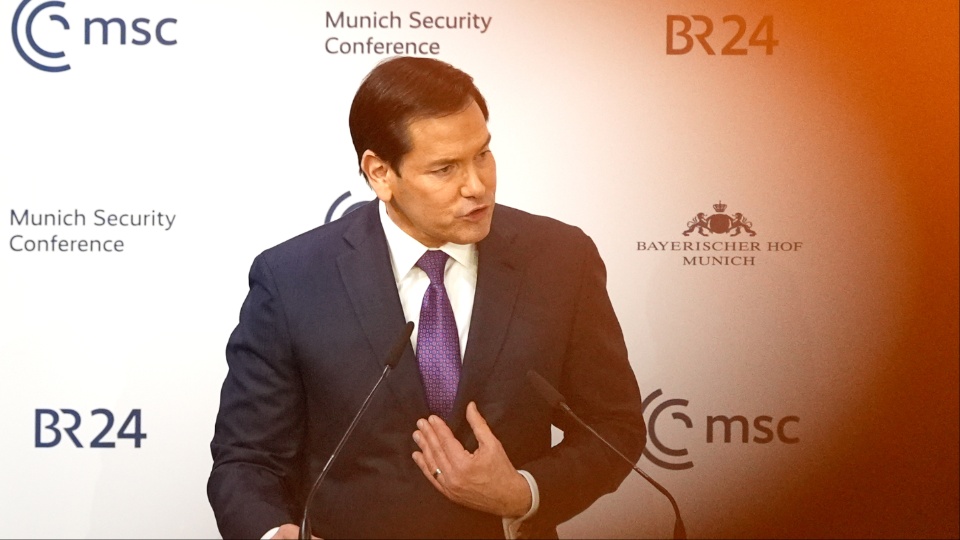
    On 14 February 2026, at the Munich Security Conference, Secretary of State Marco Rubio delivered what critics across the spectrum called the most openly pro-colonial address by a senior Western official this century. He mourned the loss of five centuries of Western imperial expansion; named anti-colonial uprisings as a cause of Western decline; urged European allies to shed their guilt and shame over colonialism; and summoned the West to a new Western century by competing for market share in the economies of the Global South — framing that South not as sovereign nations but as an economic space to be recaptured, that precise colonial and predatory framing.

    This is not merely reprehensible; it is a confession. Facing structural decline, the imperial culture has abandoned even the pretence of moral authority and reverted openly to the logic of domination. Harvard’s Mathias Risse called the speech civilisational panic dressed as statecraft. The Global South’s response was swift: Indian commentary asked whether an American East India Company was coming; Brahma Chellaney saw the restoration of an exclusionary hierarchy; Sanjaya Baru urged India, as the beacon of anti-colonialism, to condemn it with the contempt it deserves.

    The Architecture of Extraction
    Rubio’s call to shed guilt is not only obscene; it is historically false. Utsa Patnaik’s study for Columbia University Press establishes that Britain drained £9.2 trillion — some $45 trillion — from India between 1765 and 1938, seventeen times Britain’s current annual GDP, by compounding India’s intercepted export-surplus earnings at the ordinary rate of opportunity cost.

    India’s gold and foreign-exchange earnings — among the largest in the world — were permanently diverted to London, funding Britain’s industrial revolution, its wars, and its administration, and consuming between a quarter and a third of the central budget.

    The mechanism was an elegant deception. After 1765, the East India Company taxed Indian producers, then used roughly a third of that revenue to buy their goods for export — paying them with their own taxes while acquiring their produce for nothing. The Council Bills system of 1861 industrialised this: foreign buyers paid London in gold and sterling for bills cashable only in rupees, which the colonial government paid out of its own budget. India’s gold and foreign-exchange earnings — among the largest in the world — were permanently diverted to London, funding Britain’s industrial revolution, its wars, and its administration, and consuming between a quarter and a third of the central budget.

    Jason Hickel calculates that rich countries have drained $152 trillion from the Global South since 1960 alone. There is no Western century to restore that was not built on the theft of other civilisations’ wealth — legitimised for six centuries by the Three Cs of civilisation, Christianity, and commerce, and continued after independence through structural-adjustment programmes, an African external debt of $824 billion, and more than 13,000 active US sanctions.

    The result was stark. India held the world’s second-largest export surplus for three decades before 1929, yet per capita income barely moved between 1900 and 1946, because the surplus was siphoned abroad rather than invested at home. Its share of global industrial output collapsed from 25 per cent in 1750 to 2 per cent in 1900. Japan, which kept its earnings, industrialised; India, whose earnings were confiscated, could not. The same logic ran through slavery, which research now confirms accelerated Britain’s industrial revolution — vindicating Marx’s image of capital arriving dripping with blood and dirt. Jason Hickel calculates that rich countries have drained $152 trillion from the Global South since 1960 alone. There is no Western century to restore that was not built on the theft of other civilisations’ wealth — legitimised for six centuries by the Three Cs of civilisation, Christianity, and commerce, and continued after independence through structural-adjustment programmes, an African external debt of $824 billion, and more than 13,000 active US sanctions.

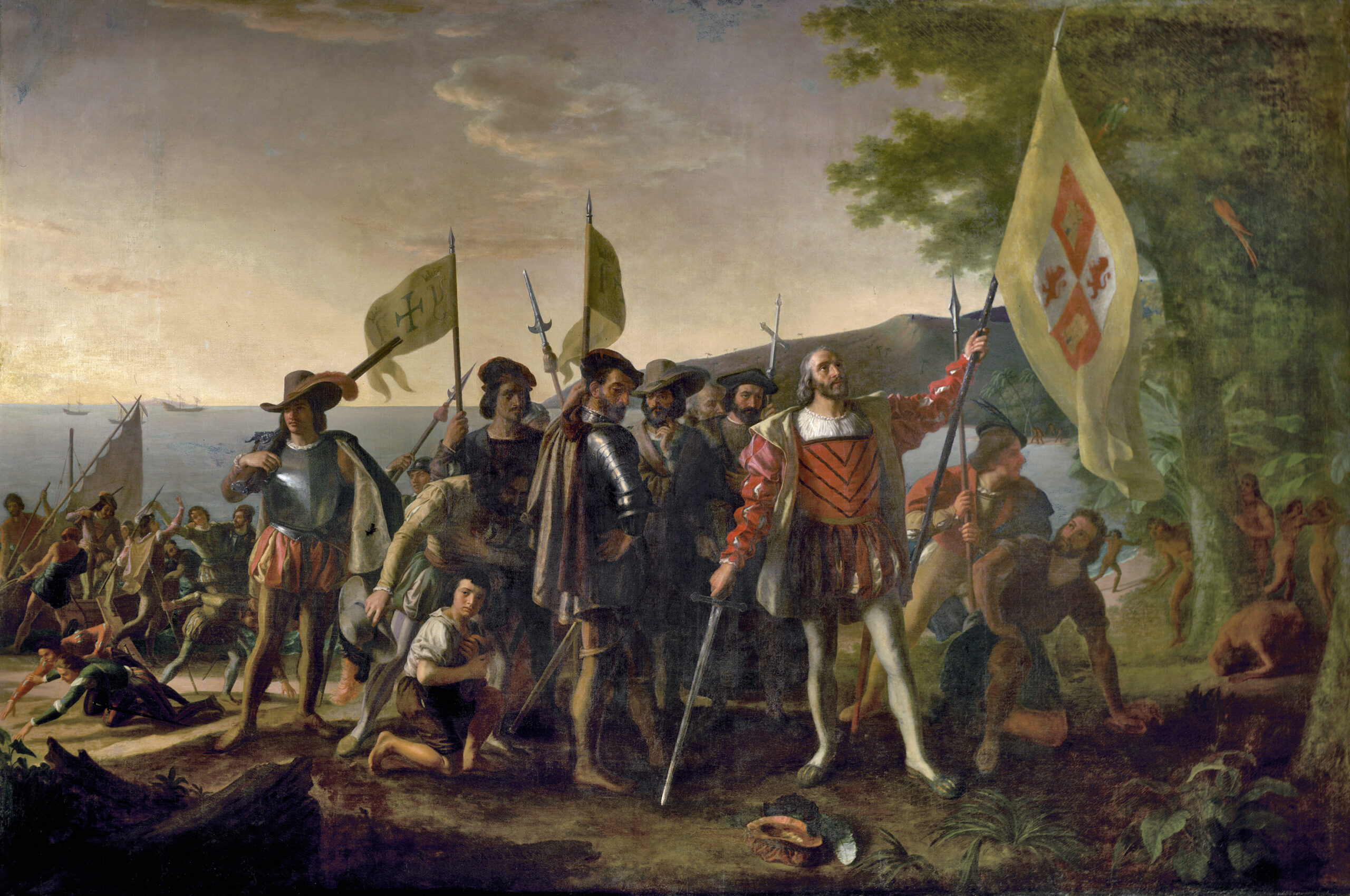
    The sanctifying licence was issued long before the Council Bills, in Rome. A sequence of papal bulls — Nicholas V’s Dum Diversas (1452) and Romanus Pontifex (1455), and Alexander VI’s Inter Caetera (1493), proclaimed the year after Columbus reached the Americas — granted Catholic monarchs the asserted right to “invade, search out, capture, vanquish and subdue” non-Christian peoples, reduce them to perpetual slavery, seize their lands, and partition the non-Christian world between Spain and Portugal. From these decrees grew the Doctrine of Discovery: the claim that lands not inhabited by Christians were free to be “discovered” and their peoples’ sovereignty void. It furnished the racial and civilisational hierarchy — Christian over heathen, European over all others — on which five centuries of conquest were built, dressing the pursuit of gold, land, and labour in the vestments of salvation. The piety was the facade; extraction was the motive. Nor is the point contested by Rome: in 2023 the Vatican formally repudiated the doctrine, conceding the bulls were “linked to political questions” and never expressions of the faith — an admission, five centuries late, that the licence to colonise was always politics wearing the mask of God.

    The Civilisational Verdict

    Every tradition the Foundation invokes condemns this architecture. Thiruvalluvar’s Kural 113 warns that gain wrongly acquired must not be retained even for a day — the exact verdict on a Council Bills system that gave Indians rupees while stealing their gold; his Kural 551 holds a ruler who works injustice crueller than a murderer. Kaniyan Poongundranar’s Yaadhum Oore Yaavarum Kelir dissolves, at its root, the civilisational tribalism Rubio attempts to revive, for exploitation requires first believing that the exploited are not our kin. Confucius taught that legitimacy flows from virtue, not force; Plato named the tyrant as one who turns governance to private enrichment — the shape of a state that declares it will run another nation and seize its oil; and Ubuntu’s relational personhood is negated wherever a system is built to take from people, unawares, what they have earned.

    Risse’s verdict is sharper still: Rubio’s West has no Indigenous peoples, no colonised subjects, no enslaved Africans, no Buchenwald near Weimar — only heroes and temporary setbacks. Such a West has never existed, and cannot be reinvigorated in 2026.

    The New Theatre of Predation

    The doctrine is not rhetorical. In January 2026, the United States bombed Venezuela, abducted its elected president, and announced that US companies would seize its oil while Washington “ran the country” — a clear violation of Article 2(4) of the UN Charter, the International Commission of Jurists held. The same month, it cut off Cuba’s main oil supplier and, through Executive Order 14380, threatened any country that resupplied it, until the UN warned of humanitarian collapse — collective punishment of a civilian population. And in February 2026, the US and Israel launched a full-scale attack on Iran, killing its Supreme Leader, striking over 42,000 civilian sites, and — at a girls’ school in Minab — at least 167 children; the American Society of International Law named it a crime of aggression, and the UN Secretary-General confirmed it contravened international law. As Britain once dressed theft as commerce, the US now dresses resource seizure as law enforcement — the structural logic is identical.

    The Measured Decline

    The economic premise of the Rubio doctrine is fiction. Asia’s share of global GDP reached 55 per cent in 2024, years ahead of projection, and BRICS economies now exceed the G7 at purchasing-power parity. The Global South’s ascent is no Western beneficence but a return to the norm colonialism interrupted — China and India together held half of world income in 1700 before colonialism drove their share below a tenth. A declining West, in truth, needs the Global South to survive.

    Moral authority has collapsed in tandem. Only 39 per cent of Americans now believe the United States is the world’s moral leader, down from 60 per cent in 2017; across Europe, support for Israel has fallen to between 13 and 21 per cent. Above all, Gaza has erased Western moral pretension: independent research estimates roughly 75,200 violent deaths and the displacement of about 90 per cent of the population, as governments that once lectured the world on human rights moved to justify mass killing — not an aberration, as one analysis put it, but an unveiling.

    The Oligarchy Behind the Flag

    Analysing nearly 1,800 US policy decisions, Martin Gilens and Benjamin Page found that economic elites and business groups exert substantial independent influence on policy while ordinary citizens have little or none — a pattern they termed economic-elite domination rather than democracy.

    There is a sharper way to name what must fall. “The West” is not its peoples; it is a structure of concentrated power that governs in their name while serving far narrower interests. Analysing nearly 1,800 US policy decisions, Martin Gilens and Benjamin Page found that economic elites and business groups exert substantial independent influence on policy while ordinary citizens have little or none — a pattern they termed economic-elite domination rather than democracy. Their method has been contested, but elite-skewed influence is widely corroborated.

    The architecture is visible and legal. Since Citizens United (2010), outside US election spending has risen more than twenty-eight-fold — from $144 million in 2008 to over $4.2 billion in 2024 — roughly $1.9 billion of it untraceable “dark money,” a few hundred mega-donors providing the bulk. Oxfam records billionaire wealth at a record $18.3 trillion in 2026, up 81 per cent since 2020; the twelve richest now hold more than the poorest four billion people, and billionaires are four thousand times likelier than ordinary citizens to hold office. Across 66 countries, nearly half of those surveyed say the rich simply buy elections.

    The same convergence runs through the war and information economies. Some $191 million was spent lobbying the US defence sector in 2025, and more than 315 senior officers passed through the revolving door into the top weapons firms between 1995 and 2021 — Eisenhower’s “military-industrial complex” at industrial scale. At the 2025 presidential inauguration, the heads of Amazon, Meta, Apple, Google, and Tesla stood arrayed behind the president — a tableau of what Shoshana Zuboff calls surveillance capitalism, in which control over information becomes a lever over democracy itself, as a Stanford working group chaired by Francis Fukuyama warned.

    None of this requires a secret cabal — only aligned interests, legalised influence, and a public whose consent is manufactured rather than freely given. The decisive point is this: the structure that drains the Global South is the same one that hollows out wages, democracy, and dignity within the West. The dividing line is not West against the rest but concentrated extractive power against the world’s peoples — the Western working majority among them, conscripted to fight its wars and absorb its costs. When we say the West must fall, it is this structure that must fall, and democratic power that must be restored, at home as much as abroad. That is not the elimination of a people; it is the end of their domination by an oligarchy that has long claimed to speak in their name.

    The Self-Defeating Logic of Overreach

    Like the Council Bills before it, the Rubio doctrine carries the mechanism of its own defeat, for each intervention rebounds structurally. The seizure of Russian assets accelerated de-dollarisation; the bombing of Iran united a region against the US–Israel alliance; the abduction of Venezuela’s president hastened Latin America’s diversification away from Washington; the oil siege of Cuba drew unprecedented condemnation. An order that must abduct, blockade, and bomb to assert itself is not ascendant — it is exhausting the legitimacy on which power finally depends.

    The Imperative of Justice

    The fall of Western hegemony opens the possibility of justice but does not guarantee it; the outcome depends on whether rising powers build the multipolar order on genuine ethical foundations rather than replicating what they inherit. That demands sovereign equality without exception — Article 2(4) applied universally, and a Security Council reformed so that no state acts as judge, party, and executor at once. It demands historical accountability: reparative justice through climate finance, debt cancellation, technology transfer, and restitution is not charity but the minimum acknowledgement of documented theft. It demands that the ICJ, ICC, and UN human-rights bodies function without great-power interference; civilisational pluralism against civilisational supremacism; and, finally, democratic renewal within the Western societies themselves, whose peoples are not the authors of empire but among its subjects.

    India is uniquely placed to articulate that alternative. Its inheritance — Thiruvalluvar’s justice, Kaniyan Poongundranar’s universal kinship, and the Gandhian tradition of non-violent resistance to precisely the domination Rubio seeks to revive — is the moral tradition colonialism suppressed but could never extinguish. Against a new Western century of restored hierarchy, the Peninsula Foundation offers the Tamil poet’s ancient answer, as relevant in Munich today as on the banks of the Kaveri two millennia ago:

    Yaadhum Oore, Yaavarum Kelir — to us all towns are one, all people are our kin.

    The West will fall. Fall it must. From its ruins, may justice arise.

    Sources

    THE MULTIPOLAR TRANSITION

    • JPMorgan Centre for Geopolitics — World Rewired: Navigating a Multi-Speed, Multipolar Order
    • United Nations — Secretary-General’s press conference on his 2026 priorities
    • World Economic Forum — Davos 2026: How middle powers are reading the global moment

    THE RUBIO MUNICH SPEECH AND RESPONSES

    • US Department of State — Secretary Rubio at the Munich Security Conference (14 February 2026)
    • The New York Times — In Munich, Rubio Stresses Shared History to Europeans
    • Mathias Risse, Harvard Kennedy School (Carr Center) — A Human-Rights-Based Reply to Marco Rubio’s Munich Speech
    • China-US Focus — American Neo-Colonialism and the Confessional State
    • Chatham House — The West vs the West at the Munich Security Conference
    • India Today — Rubio’s Munich speech signals US colonial competition for the Global South
    • The Wire — Marco Rubio’s Defence of Colonialism Demands a Response from India
    • Firstpost — Rubio’s claim of a Western century is a myth

    COLONIAL EXTRACTION: THE DRAIN AND THE COUNCIL BILLS

    • Utsa Patnaik (Columbia University Press), via Al Jazeera — How Britain stole $45 trillion from India
    • NDTV — How the British Empire robbed India of $45 trillion
    • self_study_history — Drain of Wealth: the Council Bills mechanism
    • COLLECTIVE India — ‘Drain of Wealth’, today
    • Wikipedia — Economy of India under the British Raj (global GDP share)
    • CEPR / VoxEU — Slavery and the British Industrial Revolution
    • Walter Rodney — How Europe Underdeveloped Africa
    • Jason Hickel, via Al Jazeera — Rich countries drained $152tn from the global South since 1960

    THE LICENCE TO COLONISE: PAPAL BULLS, CHRISTIANITY, AND NEOCOLONIALISM

    • Vatican News (2023) — Church defends Indigenous peoples: ‘Doctrine of Discovery’ was never Catholic — the formal repudiation
    • Canadian Museum for Human Rights — The Doctrine of Discovery (papal bulls and their language)
    • Church Life Journal, University of Notre Dame — Papal Condemnation of the Doctrine of Discovery
    • Emory University — The Philosophy of Colonialism: Civilization, Christianity and Commerce
    • Church Mission Society — Mission after George Floyd: on white supremacy, colonialism and world Christianity
    • Catalyst (McGill) — The IMF and World Bank: Neocolonial Domination, Debt Trap and Resistance

    THE CIVILISATIONAL FRAMEWORK

    • Thiruvalluvar, Thirukkural (G.U. Pope translation) — Project Madurai
    • Kaniyan Poongundranar, Purananuru 192 — Kaniyan Pungundranar
    • Confucius, The Analects — LibreTexts, Compact Anthology of World Literature
    • Plato, Republic — Plato’s Theory of Justice
    • Mogobe B. Ramose — African Philosophy Through Ubuntu

    THE OLIGARCHY BEHIND THE FLAG: CONCENTRATED POWER IN THE WEST

    • Martin Gilens & Benjamin I. Page — Testing Theories of American Politics: Elites, Interest Groups, and Average Citizens (2014)
    • Omar S. Bashir (Research & Politics, 2015) — A Review of the ‘Oligarchy’ Result — methodological critique
    • Oxfam International (January 2026) — Resisting the Rule of the Rich: billionaire wealth and political inequality
    • Brennan Center for Justice — Dark Money Hit a Record High of $1.9 Billion in 2024 Federal Races
    • Center for American Progress — Undoing Citizens United and Reining In Super PACs (28-fold rise in outside spending)
    • OpenSecrets — Defense Lobbying Profile ($191m in 2025)
    • Quincy Institute, via Jacobin — The Publicly Funded Defense Contractor Revolving Door (315+ officers)
    • ProMarket (Stigler Center) — The Trends That Defined US Antitrust in 2025 (platform power and modern oligarchy)
    • Shoshana Zuboff — The Age of Surveillance Capitalism (PublicAffairs, 2019)

    VENEZUELA

    • International Commission of Jurists — Territorial sovereignty, the rule of law and human rights must be respected
    • Le Monde — The US intervention in Venezuela violates foundational principles of international law
    • UN Security Council — US action in Venezuela puts sovereignty of states, international law at stake

    CUBA

    • Al Jazeera — US sanctions reshaping life in Cuba: UN rapporteur
    • Baker McKenzie — US declares national emergency on Cuba; Executive Order 14380
    • UN News — Cuba: UN warns of possible humanitarian ‘collapse’ as oil supplies cut

    IRAN

    • American Society of International Law — Statement Regarding the Use of Force Against Iran (2 March 2026)
    • Reuters — Iran’s UN envoy says 1,332 civilians killed in the war
    • Al Jazeera — Iranian government reveals scale of civilian casualties (42,000+ sites damaged)
    • Associated Press — International legal order tested by war in Iran (‘crime of aggression’)

    DECLINE METRICS AND MORAL AUTHORITY

    • Atlantic Council — Piece by piece, the BRICS really are building a multipolar world
    • Mastercard — Welcome to the nuanced reality of the Asian Century
    • Forbes — Americans think the US is losing its moral authority, new poll shows
    • The New Humanitarian — The end of Western values

    GAZA

    • Al Jazeera — Gaza death toll exceeds 75,000 as independent data verify loss
    • OHCHR — End unfolding genocide or watch it end life in Gaza: UN experts
  • Colonial exploitation included heritage theft, and that continues to this day

    Colonial exploitation included heritage theft, and that continues to this day

    Museums and private collectors in the West have prided themselves on the vast collections of heritage treasures, antiquities, and archaeological and epigraphic treasures from across the world. In truth, these are stolen treasures from the non-western world enabled by colonialism and imperialism. It is time the victim nations work towards global policies to ensure these treasures are returned to their original owners. This is truly a massive public policy challenge in global governance and for a fair, equitable, multi-polar world. Professor M A Kalam looks at the continuing theft of India’s heritage treasures.


    The whole idea of establishing a colony was to exploit the resources there and enrich the home coffers. And all colonials—irrespective of whether they were British, Danes, Dutch, Italians, Belgians, Portuguese, Spanish, or American—indulged in this exercise and over a period turned it into a fine art. As ill luck would have it, a host of countries in many parts of the world were less developed than these colonials, particularly in terms of technology, but were very rich and well-endowed in terms of resources of various kinds. Though they possessed natural wealth, they lacked adequate technology and hence were not in a position to resist the onslaught and machinations of different kinds of the technologically-advanced colonials. The resource-rich countries were, in the main, in Asia, Africa and Latin America. Highly developed naval vessels and a state-driven overpowering desire to explore resources in different regions of the world enabled the colonials to adopt different strategies for befriending and subsequently subjugating the peoples of the resource-rich areas.

    Genesis Of Exploitation

    Because of her tremendous naval power, Britain spread its net of exploration quite wide in South Asia and Africa. In India, the British came in as traders established the East India Company and then gradually started flexing their arms and took control of administration and became the rulers of the country. Though they allowed some pockets to be “ruled” by rajas, maharajas, nizams and nawabs, these provinces were not independent in the real sense of the term but were virtually servile to the British, if not their minions, in many ways. That is how the genesis of exploitation took shape in India. Subsequently, there were myriad ways in which colonial exploitation occurred—physical exploitation of the people including sexual abuse and exploitation of labour was one of the forms of that

    Other ways of exploitation were the draining of different kinds of agricultural and forest resources; these included: jute, cotton, sugar, tea, coffee and wheat. The goods developed in British factories were sold back in India for rich benefits. Also, commercial crops like tea, coffee, indigo, opium, cotton, jute, sugarcane and oilseed were introduced and these had impacted their profits tremendously but had different environmental implications in different regions of the country, as plantations always do, due the exercise of clear felling of the forests in almost all cases of extensive plantation activities.

    Repatriating The Kohinoor

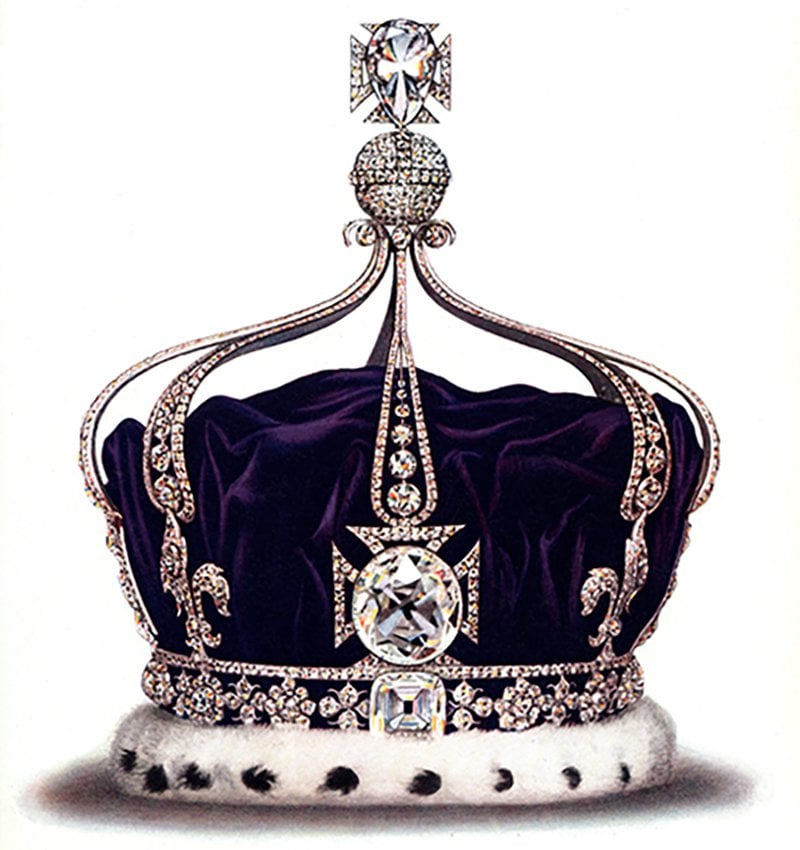
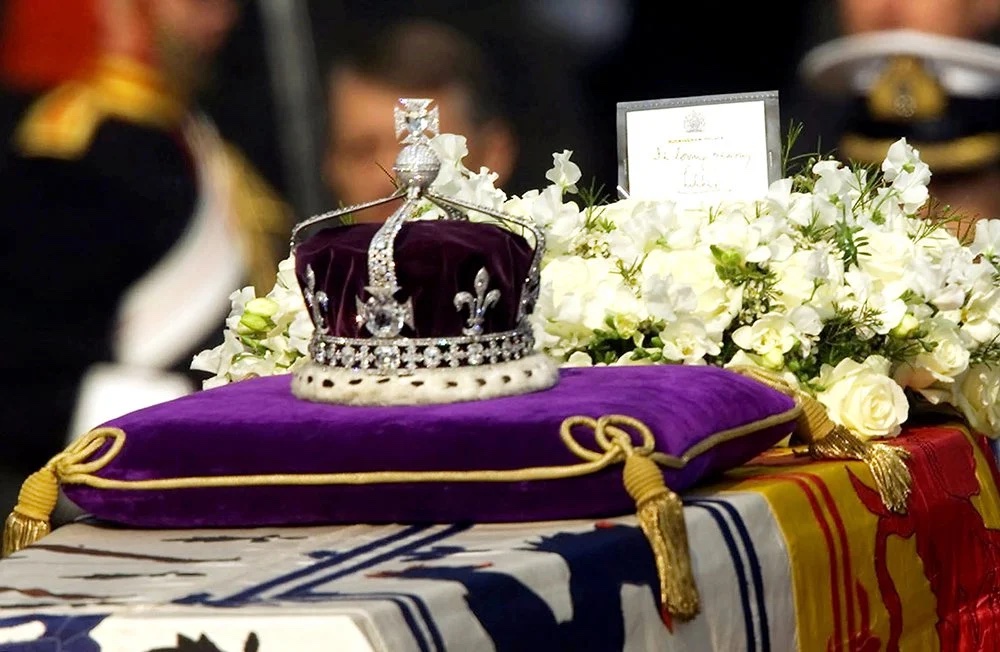
    To top it all, regarding exploitation, was the brazen way in which India’s heritage wealth, antiquities and artefacts, were exported to their home bases, by the colonials, to unabashedly adorn their own museums and galleries. Many of these artefacts were stolen without any hesitation. Today it is being argued that one of the most famous diamonds in the world, the Kohinoor, was not necessarily snatched from the people of India but was offered on a platter to the British as part of the peace treaty of Lahore by the king of Punjab Maharaja Dalip Singh. Arm-twisting gets another name in diplomatic parlance—offer. And the British have the temerity to continue to adorn their crown with the Kohinoor though they refrained from its display on the head of the recently crowned queen, the wife of King Charles III during the latter’s coronation, in a rare diplomatic courtesy, apparently not to provoke the sensibility of the Indian delegation attending the coronation.

    As Rishi Sunak is more loyal than the queen, there is no chance of him taking the initiative in repatriating to India the Kohinoor or the innumerable other artefacts that were stolen/snatched from India and today adorn the British Museum and many other of their galleries.

    Last week the Standing Committee on Transport, Tourism and Culture headed by YSR Congress MP Vijay Sai Reddy, adopted the Report ‘Heritage Theft – The Illegal Trade in Indian Antiquities and the Challenges of Retrieving and Safeguarding Our Tangible Cultural Heritage’. The Committee conferred with the Culture Ministry officials who apparently think that while efforts were being made to bring back the stolen antiquities from different foreign locations, the case of Kohinoor diamond is “contentious since it was surrendered by Maharaja Dalip Singh as part of the 1849 peace treaty with the British”.

    Reversing Colonial Exploitation

    To recapitulate and also to highlight the way in which different forms of exploitation occurred, we can argue that in the first instance, it was human exploitation wherein there was sexual abuse, killings and decimation of populations. The second way was the exploitation of the agricultural and natural resources which can be conceived of as resources that were “consumables” and “non-durables”. The third was the exploitation of the heritage wealth that falls in the realm of non-consumables and durables.

    So, today, when we explore measures that could be thought of in terms of “getting back” things and reversing the impact that colonial exploitation had on India, we can think of some strategies: in the case of the first two, that is human exploitation and the draining of consumables, there can only be reparations if the Britishers’ conscience pricks them enough; or at least unqualified apologies. But in the case of the third, that is the loss of heritage wealth, there can, and should indeed be repatriation of the stolen antiquities.

    A host of “art dealers” in different parts of the country are smuggling out artefacts and antiquities from India, particularly from ancient temples, and at times from museums, on a large scale. Only a fraction of this comes to light.

    Now, talking about the loss of heritage wealth, we also have to bring into the picture the fact that it is happening, quite rampantly, even today though the colonials left the shores years back on India becoming independent. A host of “art dealers” (read thieves) in different parts of the country are smuggling out artefacts and antiquities from India, particularly from ancient temples, and at times from museums, on a large scale. Only a fraction of this comes to light when these items are exhibited in galleries and museums in different parts of the world; often times these are hidden in private collections. India is trying to regain some of this heritage wealth but there seem to be obstacles, at times quite unsurmountable, of the diplomatic and other kinds. Let us hope the Standing Committee on Transport, Tourism and Culture succeeds in its exertions.


    A version of this article was published earlier in moneycontrol.com

    Feature Image Credit: Kohinoor Diamond in Queen’s Crown, now safely kept in the Tower of London. smithsonianmag.com 

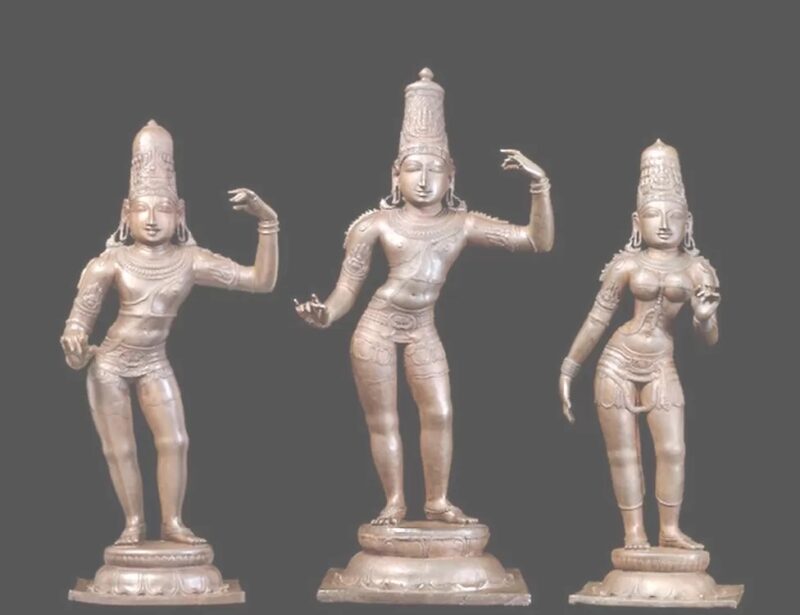
    Picture of Idols: The three 15th century ‘panchaloga’ idols of Shri Rama, Sita, and Laxman were stolen in 1978 from a Vijaynagara era temple (15th Century) in Anandamangalam village in Tamilnadu, India. These were identified and finally restored to India by the UK government in 2020. www.bbc.com


  • Colonial taxes built Britain. That must be taught in lessons on Empire

    Colonial taxes built Britain. That must be taught in lessons on Empire

    UK government ministers want the British Empire’s benefits taught in schools. Don’t let them ignore the death and destruction it inflicted says Professor Gurminder K Bhambra. Her observation is equally if not more important for India and other erstwhile colonies. Britain and other European colonial powers not only looted and decimated Indian economy over three centuries of colonial interaction but their ruthless exploitation led to much of the poverty that has afflicted the global south ever since. This fact of history must be taught extensively in Indian schools. There are many who propagate the fallacy that the British empire was beneficial but the truth that it was ruthlessly exploitative must be taught and researched in a big way. The wealth of the West was built on built on exploitation of Africa, Asia, and Latin America. The West continues to dominate the global economic system and it is inherently exploitative. History teaching and research, from policy and science perspectives, are in dire need for elimination of Western bias.


    Recent weeks have seen a variety of UK government ministers – fromOliver Dowden to Kemi Badenoch to, most recently, education secretary Nadhim Zahawi – both extol the benefits of British Empire and urge the teaching of those benefits. This follows on from the government’s response to the Commission on Race and Ethnic Disparities, which set out the need for a new model curriculum for history which would advise schools on how best to teach these issues. This is all part of the government’s Inclusive Britain strategy which calls on us to acknowledge the rich and complex history of ‘global Britain’.

    In the spirit of this call, I offer one account of the complex, entangled histories of colonial taxation and national welfare that continue to shape modern Britain. Few people know that colonial subjects from the Indian subcontinent paid taxation, including income tax, to the British government in Westminster. Or that that taxation was used to alleviate the conditions of poorer people within Britain at a time when the working class and middle class here were exempt from paying income tax.

    Taxation – and the ways in which it is returned to citizens through welfare – is one of the main ways in which the ‘imagined community’ of the nation comes into being. That is, the relationship between taxes and welfare is part of the process of constructing institutions and the idea of the nation. If we were to recognise that this ‘imagined community’ was built not only through national taxes, but also colonial ones, then how might that change our understanding of what it is to be British today?

    My grandfather, Mohan Singh, was born in 1913 in a small village in the Punjab, in what was then British India. He was four years old when his father, Gurdit Singh, died and 17 when his uncle, Harnam Singh, who had been supporting him, also passed away. My grandfather had planned on attending the Government College in Lahore, but – needing to support his mother and younger sister – he instead spent six months training as a boilermaker. He then got married to Pritam Kaur and travelled to Calcutta to work in a variety of factories, engineering works and rolling mills.

    In 1942, he travelled to the British colony of Kenya – bringing his family over later – and worked for 18 years at the East African Railways and Harbour Company. He spent the last two decades of his life in the UK, working at Chalvey Engineering in Slough as a sheet metal worker before retiring at the age of 65 in Southall, west London.

    Calls to ‘go home’ have been the refrain of right-wing opponents of immigration from at least the 1970s

    Mohan Singh criss-crossed three continents during his lifetime, but he never left the jurisdiction of the British Empire. In his application for registration as a citizen of the UK and Colonies – in the aftermath of the British Nationality Act of 1948 – he wrote: “I was born in British India.” He further noted that he lived and worked in India and Kenya, two countries that were colonies of Britain. It was these connections that confirmed his citizenship and gave him the right to travel to and live in Britain. He duly exercised those rights but, on arrival, he had them called into question by the local population, who were either unaware of them or indifferent.

    Calls to ‘go home’ have been the refrain of right-wing opponents of immigration from at least the 1970s – as well as having been plastered on the sides of vans as part of the UK government’s ‘hostile environment’policies of recent years. They are also implicit in an influential body of scholarly work oriented to questions of belonging and entitlement that argue for priority in public policy to be given to the ‘white working class.’ This is on the basis of them being ‘insiders’ who have contributed through their taxes to the wealth that is disbursed through welfare.

    Former colonial subjects, like my grandfather, are regarded as immigrant outsiders even when they come to the metropole carrying passports of British citizenship. They are not seen to have contributed to the wealth of Britain by paying taxes and they are regarded as unfairly gaining access to the national patrimony. As Geoff Dench, Kate Gavron and Michael Youngwrite in ‘The new East End’: “As newcomers, their families cannot have put much into the system, so they should not be expecting yet to take so much out.”

    Britain established direct rule over India after suppressing the 1857 Indian Mutiny (also known as the First War of Independence). In 1860, it implemented an income tax upon colonial subjects, in part to pay for the costs associated with those revolts. Initially, a 2% rate was imposed on those earning between 200 rupees and 500 rupees a year and a 4% rate on those earning above 500 rupees annually.

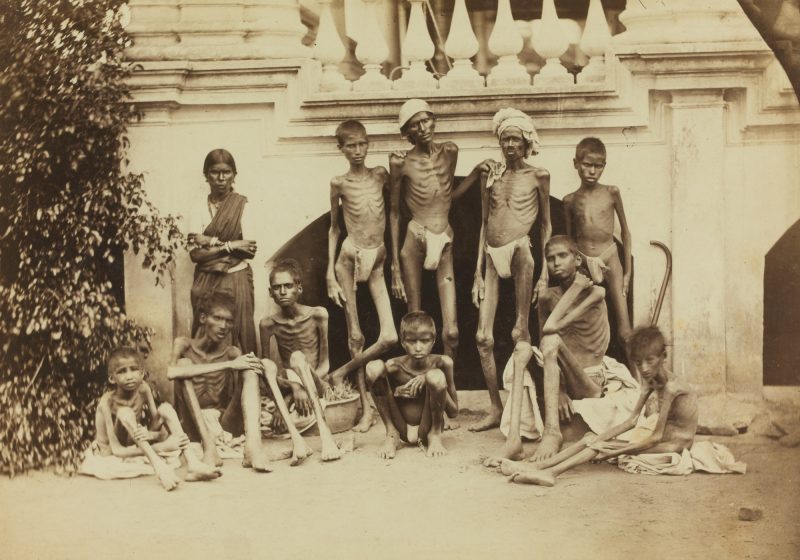
    Famine Genocide 1876-1879 in British Raj Madras, India. Credit: Wikimedia Commons

    The arrival of the British in India – first via the English East India Company and then through direct rule – had brought endemic famine across the subcontinent

    When my grandfather started work in the 1930s, the average wage for a skilled worker in British India was about 40 rupees a month. He was very unlikely to have paid income tax, however, as he would not have earned enough to meet the threshold, which by then was 2,000 rupees a year. Of the amount that was collected, around three-quarters went to the imperial treasury, with only one rupee in a hundred for local purposes. Local purposes included the building of canals and roads, but not the alleviation of poverty, not even in times of catastrophic famine.

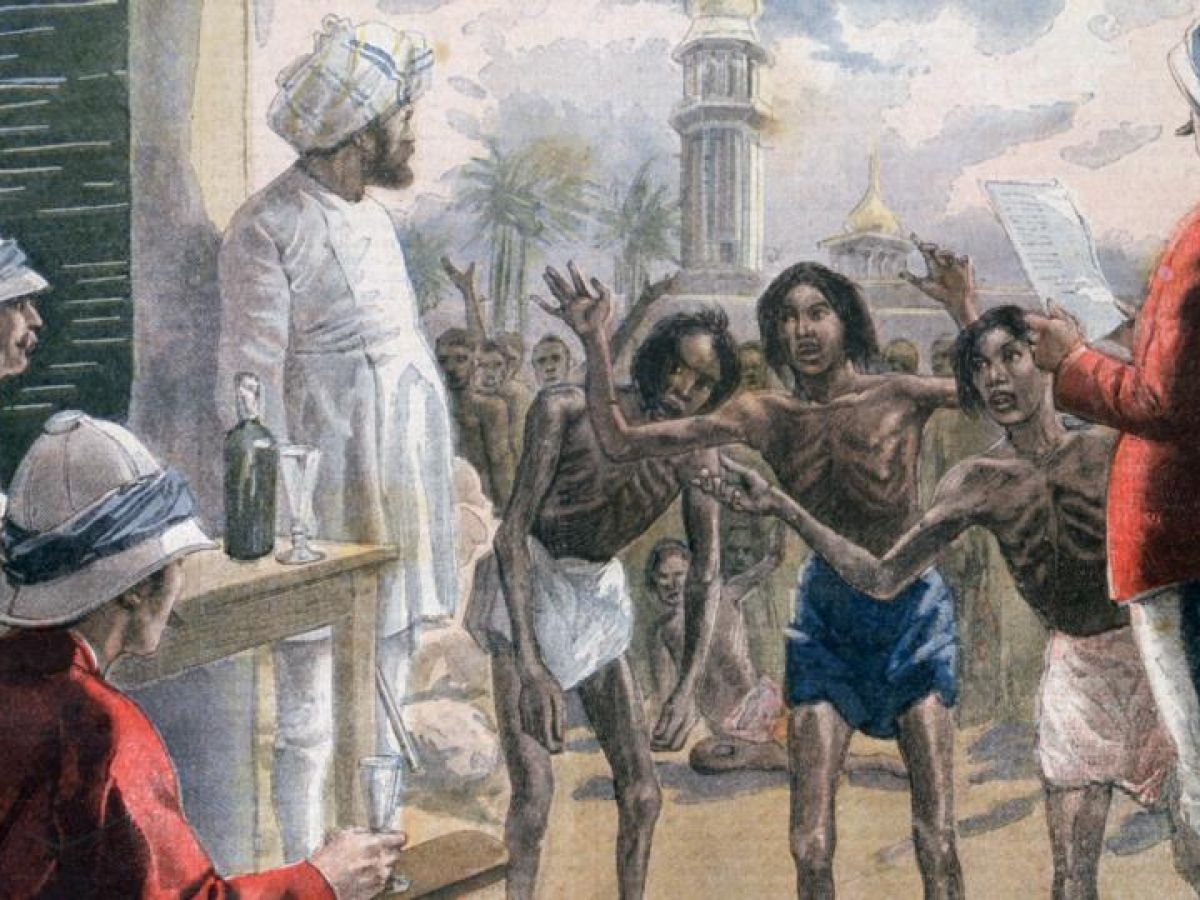
    The arrival of the British in India – first via the English East India Company and then through direct rule – had brought endemic famine across the subcontinent. The 50 years after the implementation of the income tax saw one of the most intense such periods of famine, in which it is estimated over 14 million people died of starvation. This was in the context of grain being exported by rail from the famine regions (including to Britain) and colonial taxes continuing to be collected even in the worst-affected areas.

    In all cases, the demands of ‘sound finance’ trumped those of public health and the primary thing to be avoided was any idea that the poor in India should be maintained at public expense. Ensuring sufficient funds for the ensuing military campaign in Afghanistan – from the taxes paid by colonial subjects for local purposes – was of more importance than using those taxes to alleviate severe hunger and avert the deaths of millions.

    Here, we see quite clearly that the idea of the ‘imagined community’ created through taxation and its redistribution did not include colonial subjects. The taxes that Indians paid to the imperial treasury and to local provinces did not give them any entitlement to the redistribution of that income. Worse, any relief provided during famines was often dependent on undertaking hard labour in camps at a distance from a claimant’s locality.

    The most extreme instance was where the rations provided in return for heavy labour were scarcely above the level required for basic subsistence. The ‘Temple wage’ – named after the lieutenant-governor, Richard Temple, who brought it in – produced lethal results and, as Mike Davis notes in ‘Late Victorian Holocausts’, turned the work camps into extermination camps.

    The death and destruction brought about by the Empire were known at the time. In 1925, Harry Pollitt, the leader of the Boilermakers Union in the UK, stated that the British Empire was drenched in blood. This was in the context of debates at the Trades Union Congress in Scarborough, where a resolution was eventually adopted – by three million votes to 79,000 – against imperialism and in support of the right of self-determination of those who were colonised.

    Such sentiments, however, came up against more hard-nosed understandings concerning the utility of the Empire to those in Britain. As Labour foreign secretary Ernest Bevin proclaimed in Parliament in 1946, “I am not prepared to sacrifice the British Empire, because I know that if the British Empire fell … it would mean that the standard of life of our constituents would fall considerably.”

    Here, Bevin acknowledged that the life of all within Britain was enhanced as a consequence of Empire. However, Empire was overwhelmingly disastrous for the majority of people subject to it. Their standard of life fell considerably as a consequence of colonialism and the famines it produced and, in many, many cases, they lost their lives to it.

    One mode of survival was to move. This is why my grandfather moved from a village in the Punjab to train as a boilermaker in Lahore, before working in Calcutta, Nairobi and London. This is likely why his grandfather before him moved from famine-struck Orissa to Rajasthan to Punjab. These movements tend not to be seen to be part of the histories of Britain, global or otherwise, or of any consequence to understanding Britain or Britishness in the present.

    The forgetting of the Empire involves also the forgetting of the political community – colonial and postcolonial – that was constructed through taxation. Few in Britain today understand the extent to which national projects – from social welfare to cultural institutions such as country houses, museums, and galleries – have been enabled through the taxes paid by former colonial subjects. There is an urgent need for us to recognise our shared histories and account for them.

    One aspect of the ‘culture wars’ is the call to take the views of taxpayers into account when discussing ‘contested histories’. Samir Shah, the chair of London’s Museum of the Home, for example, argued that as heritage bodies are funded by taxpayers’ money, then the views of taxpayers – those he considers the silent majority – ought to be taken more explicitly into account. Given that both colonial subjects and their descendants paid taxes to the government in Westminster, then they/we also have a legitimate stake, in the government’s own terms, in how our shared history is represented. There is a benefit to the teaching of British Empire, but the reality is different from what these ministers suppose.


    This essay was published earlier in openDemocracy and is republished under Creative Commons Attribution – Non Commercial 4.0 International License.


    Feature Image Credit: The Irish Times


  • Divided World: The UN Condemnation of Russia is endorsed by Countries run by the richest, oldest, Whitest people on Earth but only 41% of the World’s population

    Divided World: The UN Condemnation of Russia is endorsed by Countries run by the richest, oldest, Whitest people on Earth but only 41% of the World’s population

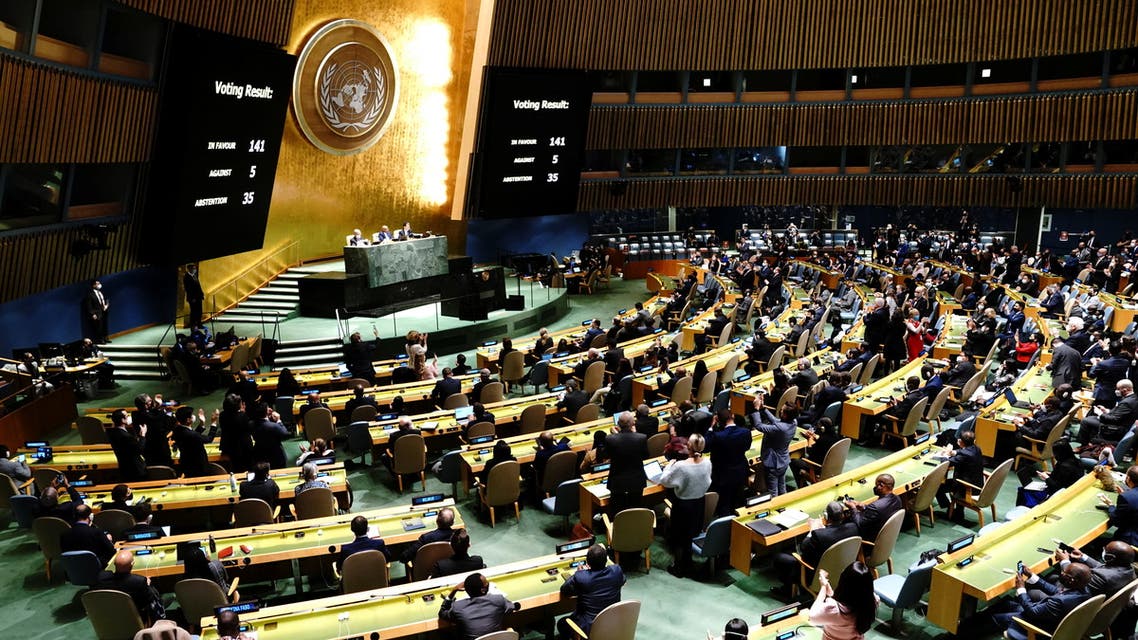
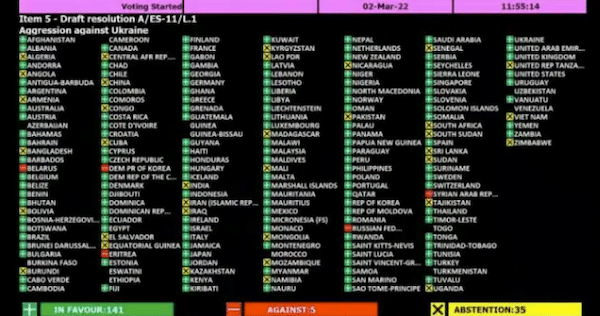
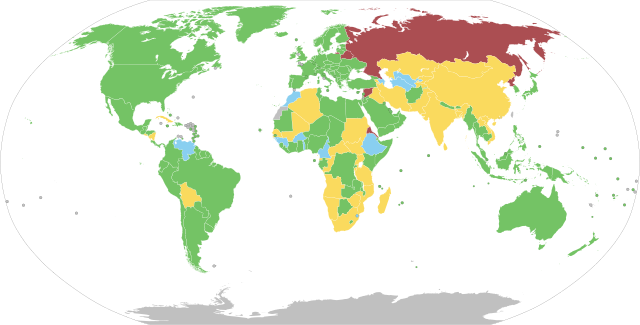
    On March 2 of this year the UN General Assembly met in an Emergency Session to pass a non-binding resolution condemning Russia’s February 24 intervention in Ukraine.1 141 countries voted for the resolution, 5 voted against, 35 abstained, and 12 did not vote. (Reported: Guardian, Al Jazeera, iNews)

    although the war is nominally a conflict between two developed and ethnically white nations, Russia and Ukraine, this UN vote suggests the war may be viewed by much of the world as a fight over the global political and economic system that institutionalizes the imperial hierarchy, the distribution of nations between rich and poor, and global white supremacy


    In the absence of any reliable opinion poll of the world’s 7.9 billion people, this vote may indicate that the majority of humanity sympathizes with Russia in Ukraine. The statistics presented below show that only 41% of the world’s people live in countries that joined the U.S. in voting for the UN resolution.

    This lopsided vote is even more striking if you consider the demographics. Populations represented by governments that did not vote for the resolution are much more likely to include the world’s poorest nations, nations with younger populations, “nations of color,” nations of the Global South, and nations in the periphery of the world economic system.

    To put it another way, although the war is nominally a conflict between two developed and ethnically white nations, Russia and Ukraine, this UN vote suggests the war may be viewed by much of the world as a fight over the global political and economic system that institutionalizes the imperial hierarchy, the distribution of nations between rich and poor, and global white supremacy.


    The UN vote by population

    41% or 34% amounts to a resounding, humiliating defeat for the U.S. on this non-binding UN resolution. Instead it is reported in the west as a U.S. victory and an “overwhelming” worldwide condemnation of Russia.

    Of the world’s 7,934,000,000 people, 59% live in countries that did not support the resolution and only 41% live in countries that did.2 But that last figure drops to 34% outside of the immediate belligerents and their allies: Ukraine, U.S., and NATO countries, and on the other side, Russia, Armenia, Belarus, Kazakhstan, Kyrgystan, and Tajikistan (all the countries of the Collective Security Treaty Organization).

    41% or 34% amounts to a resounding, humiliating defeat for the U.S. on this non-binding UN resolution. Instead it is reported in the west as a U.S. victory and an “overwhelming” worldwide condemnation of Russia.

    The UN vote and GDP per capita

    All the countries in the top third of the GDP per capita (nominal) rankings, including Japan and all the countries of Western Europe and North America, voted for the resolution, Venezuela being the only country in the top third that did not.

    Of the countries that did not vote for the resolution, most are ranked the poorest in the world, and almost none came above the approximate midpoint rank of 98. The exceptions were: Venezuela (58), Russia (68), Equatorial Guinea (73), Kazakhstan (75), China (76) Cuba (82), Turkmenistan (92), South Africa (95), Belarus (97).3

    The UN vote and the core/periphery divide

    Another way to show the wealth divide in the UN vote is by distinguishing core and peripheralcountries. In world-systems theory the surplus value of labor flows disproportionately to the core countries: “The countries of the world can be divided into two major world regions: the ‘core’ and the ‘periphery.’ The core includes major world powers and the countries that contain much of the wealth of the planet. The periphery has those countries that are not reaping the benefits of global wealth and globalization.” (Colin Stief, ThoughtCo.com, 1/21/20)

    The countries usually considered in the core are: Australia, Austria, Belgium, Canada, Denmark, Finland, France, Germany, Greece, Iceland, Ireland, Italy, Japan, Luxembourg, Netherlands, New Zealand, Norway, Portugal, Singapore, Spain, Sweden, Switzerland, United Kingdom, United States.

    The difference here is stark. Every single core country voted for the resolution and every country that did not is either in the periphery or in some cases, like Russia or China, in the semi-periphery.


    The UN vote and median age

    All the countries ranked in the top third of median age rankings, from Monaco (51.1 years) to Iceland (36.5 years), voted for the resolution, with the following exceptions: China (37.4), Russia (39.6), Belarus (40), Cuba (41.5).

    Of the twenty entries with the lowest median ages (15.4 to 18.9), only half voted for the resolution.

    The UN vote and “countries of color”

    Of the 7,934,000,000 people in the world, 1,136,160,000 live in what are usually recognized as “white countries” (consistently or not) with about 14% of the world’s population. Yet “white countries,” by population, represent about 30% of the total vote in favor of the resolution. This “white vote” accounts for every one of the core countries (except Singapore and Japan). Compare: 97% of the population in the countries that did not vote for the resolution live in “countries of color.” Only Russia, Belarus and Armenia (which did not vote for the resolution) have dominant populations classed as “white.”

    Therefore “white countries” are overrepresented in the group that voted for the resolution (30% vs. 14%), and underrepresented in the group that did not (3% vs. 14%).

    Before the intervention

    What follows is a brief sketch of events leading to the February 24 Russian intervention that prompted the UN resolution. It is a history seldom mentioned in the mainstream media, though it is easily found in selected alternative and now-suppressed media. It is presented here as a possible, partial explanation of why the UN resolution had so little support measured by population.

    U.S./NATO has directed aggression toward Russia for decades, advancing NATO forces ever closer to Russia’s western border, ringing Russia with military bases, placing nuclear weapons at ever closer range, and breaching and discarding treaties meant to lessen the likelihood of nuclear war. The U.S. even let it be known, through its planning documents and policy statements, that it considered Ukraine a battlefield on which Ukrainian and Russian lives might be sacrificed in order to destabilize, decapitate and eventually dismember Russia just as it did Yugoslavia. Russia has long pointed out the existential security threat it sees in Ukrainian territory, and it has made persistent, peaceful, yet fruitless efforts over decades to resolve the problem (See Monthly Review’s excellent editors’ note).

    Recent history includes the 2014 U.S.-orchestrated coup in Ukraine, followed by a war of the central government against those in the eastern regions of Donetsk and Lugansk resisting the coup government and its policies. Those policies include a ban on the Russian language, the native tongue of the region and a significant part of the country (ironically, including President Zelensky).

    By the end of 2021 the war had taken 14,000 lives, four-fifths of them members of the resistance or civilian Russian speakers targeted by the government. Through years of negotiations Russia tried and failed to keep the Donetsk and Lugansk regions inside a united Ukraine. After signing the Minsk agreements that would do just that, Ukraine, under tight U.S. control, refused to comply even with step one: to talk with the rebellion’s representatives.

    As to why the intervention happend now, Vyacheslav Tetekin, Central Committee member of Russia’s largest opposition party, the Communist Party of the Russian Federation, explains:

    Starting from December, 2021 Russia had been receiving information about NATO’s plans to deploy troops and missile bases in Ukraine. Simultaneously an onslaught on the Donetsk (DPR) and Lugansk People’s Republics (LPR) was being prepared. About a week before the start of Russia’s operation the plan was uncovered of an offensive that envisaged strikes by long-range artillery, multiple rocket launchers, combat aircraft, to be followed by an invasion of Ukrainian troops and Nazi battalions. It was planned to cut off Donbas from the border with Russia, encircle and besiege Donetsk, Lugansk and other cities and then carry out a sweeping “security cleanup” with imprisonment and killing of thousands of defenders of Donbas and their supporters. The plan was developed in cooperation with NATO. The invasion was scheduled to begin in early March. Russia’s action pre-empted Kiev and NATO, which enabled it to seize strategic initiative and effectively save thousands of lives in the two republics.

    All this may have informed the world’s overwhelming rejection of the U.S.-backed UN resolution condemning Russia, which western media perversely considers a U.S. victory simply because the resolution passed. Never mind that it passed in a voting system where Liechtenstein’s vote carries the same weight as China’s.

    The Global South also knows from bitter experience that unlike the West, neither Russia nor its close partner China habitually engage in bombings, invasions, destabilization campaigns, color revolutions, coups and assassinations against the countries and governments of the Global South. On the contrary, both countries have assisted the development and military defense of such countries, as in Syria, Venezuela, Nicaragua, Cuba, Iran and elsewhere.

    Conclusion

    Just as the imperial core of North America, Europe and Japan does not represent the world in their population numbers, demographics, wealth, or power, neither does the imperial core speak for the world on crucial issues of war, peace, justice, and international law. Indeed the Global South has already spoken to the Global North so many times, in so many ways, with patience, persistence and eloquence, to little avail. Since we in the North have not been able to hear the words, perhaps we can listen to the cry of the numbers.


    Notes:

    1. The resolution “Deplores in the strongest terms the aggression by the Russian Federation against Ukraine in violation of Article 2 (4) of the Charter.” (Article 2 (4) reads: “All Members shall refrain in their international relations from the threat or use of force against the territorial integrity or political independence of any state, or in any other manner inconsistent with the Purposes of the United Nations.”) The resolution also “[d]eplores the 21 February 2022 decision by the Russian Federation related to the status of certain areas of the Donetsk and Luhansk regions of Ukraine as a violation of the territorial integrity and sovereignty of Ukraine and inconsistent with the principles of the Charter.” Beyond Russia, the resolution “[d]eplores the involvement of Belarus in this unlawful use of force against Ukraine, and calls upon it to abide by its international obligations.”
    2. The population of countries voting for the UN resolution is 3,289,310,000. The population of countries voting against the resolution, abstaining, or not voting is 4,644,694,000 (Against: 202,209,000; abstaining: 4,140,546,000; not voting: 301,939,000).
    3. Here are the countries that did not vote for the resolution, with their GDP per capita rankings (the higher the GDP the higher the rank). 5 countries voted against the resolution: Russia 68, Belarus 97, North Korea 154, Eritrea 178, Syria 147. 35 countries abstained: Algeria 119, Angola 128, Armenia 115, Bangladesh 155, Bolivia 126, Burundi 197, Central African Republic 193, China 76, Congo 143, Cuba 82, El Salvador 121, Equatorial Guinea 73, India 150, Iran 105, Iraq 103, Kazakhstan 75, Kyrgyzstan 166, Laos 140, Madagascar 190, Mali 174, Mongolia 118, Mozambique 192, Namibia 102, Nicaragua 148, Pakistan 162, Senegal 160, South Africa 95, South Sudan 168, Sri Lanka 120, Sudan 171, Tajikistan 177, Tanzania 169, Uganda 187, Vietnam 138, Zimbabwe 144. 12 countries did not vote: Azerbaijan 110, Burkina Faso 184, Cameroon 158, Eswatini 117, Ethiopia 170, Guinea 175, Guinea-Bissau 179, Morocco 130, Togo 185, Turkmenistan 92, Uzbekistan 159, Venezuela 58.


    This article was published earlier in MRonline and is republished under the Creative Commons License 4.0.

    Feature Image Credit: Alarabianews.

    Map and Table: Wikipedia