Tag: IMF

  • Cryptos and CBDC: Is the RBI on the Right Track?

    Cryptos and CBDC: Is the RBI on the Right Track?

    “The history of money is entering a new chapter”. The RBI needs to heed this caution and not be defensive.

    Cryptocurrency will be discouraged by the government was the message from the FM during the budget discussion in parliament. There will be heavy taxation and no relief in capital gains for past losses. But, India has to contend with growing use of cryptos in these uncertain times. Russian kleptocrats are reportedly using cryptos to evade sanctions. Ukraine which has been a center for cryptos trading due to its lax rules is now using them to get funds.

    President Joe Biden recently signed an executive order requiring government agencies to assess use of digital currency and cryptos due to their growing importance. The Indian authorities have also been trying to bring legislation to deal with the issue since October 2021. Would the US clarifying its position help India also decide on cryptos?

    The SC has asked the government to clarify its position on the legality of cryptos. The FM in the Budget 2022-23 proposed taxing the capital gains and crypto transactions but did not declare them illegal. The RBI Governor was more expansive in February when he highlighted three things. First, “Private cryptocurrencies are a big threat to our financial and macroeconomic stability”. Second, investors are “investing at their own risk” and finally, “these cryptocurrencies have no underlying (asset)… not even a tulip”. Subsequently, a RBI Deputy Governor called cryptos worse than a Ponzi scheme and suggested that they not be “legitimized”. It is only recently that the RBI has announced that it will float Central Bank Digital Currency (CBDC)

    Difficult to Declare Cryptos Illegal

    The governor calling cryptos as cryptocurrency has unintentionally identified them as a currency. His statements indicate RBI’s worry about its place in the economy’s financial system as cryptos proliferate and become more widely used. This threat emerges from the decentralized character of cryptos based on the Blockchain technology which the Central Banks cannot regulate and which enables enterprising private entities (like, Satoshi Nakamoto initiated Bitcoins in 2009) to float cryptos which can function as assets and money.

    The total valuation of cryptos recently was upward of $2 trillion – more than the value of gold held globally. Undoubtedly, this impacts the financial systems and sovereignty of nations. So, the RBI rather than be defensive needs to think through how to deal with cryptos.

    Cryptos which operate via the net can be banned only if all nations come together. Even then, tax havens may allow cryptos to function defying the global agreement. They have been facilitating flight of capital and illegality in spite of pressures from powerful nations.

    The genie is out of the bottle. The total valuation of cryptos recently was upward of $2 trillion – more than the value of gold held globally. Undoubtedly, this impacts the financial systems and sovereignty of nations. So, the RBI rather than be defensive needs to think through how to deal with cryptos.

    Cryptos as Currency
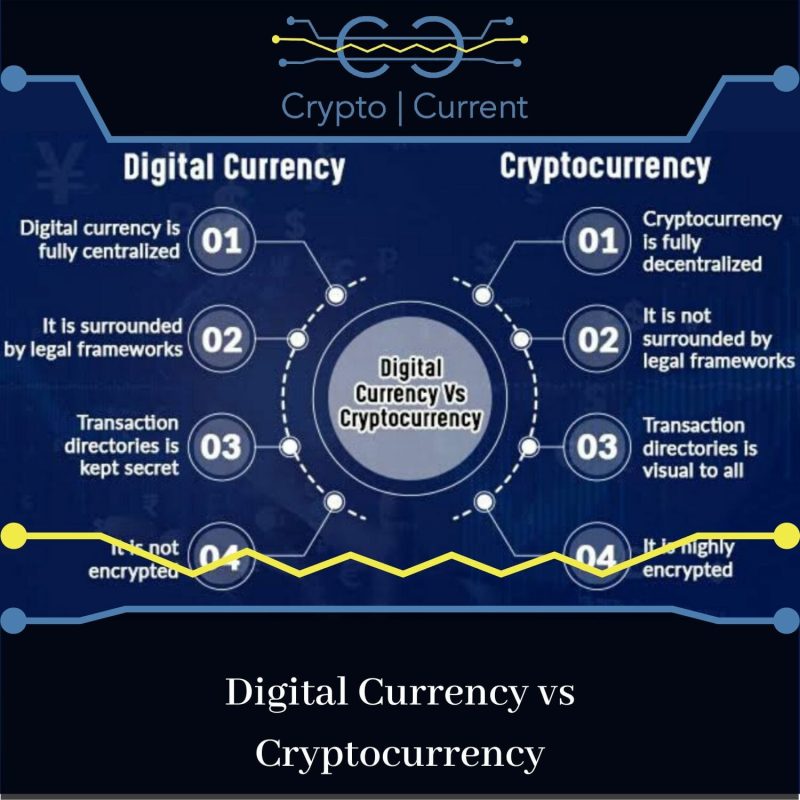
    Source: Crypto-current.co

    Will a CBDC help tackle the emerging problem? Indeed not, since it can only be a fiat currency and not a crypto. However, cryptos can function as money. This difference needs to be understood.

    A currency is a token used in market transactions. Historically, not only paper money but cows and copper coins have been used as tokens since they are useful in themselves. But paper currency is useless till the government declares it to be a fiat currency. Everyone by consensus then accepts it at the value printed on it.

    So, paper currency with little use value derives its value from state backing and not any underlying commodity. Cryptos are a string of numbers in a computer programme and are even more worthless. And, without state backing. So, how do they become acceptable as tokens for exchange?

    Their acceptability to the rich enables them to act as money. Paintings with little use value have high valuations because the collectivity of the rich agrees to it. Cryptos are like that.

    Bitcoin, the most prominent crypto, has been designed to become expensive. Its total number is limited to 21 million and progressively it requires more and more of computer power and energy to produce (called mining like, for gold). As the cost of producing the Bitcoin has risen, its price has increased. This has led to speculative investment which drives the price higher, attracting more people to join. So, since 2009, in spite of wildly fluctuating prices, they have yielded high returns making speculation successful.

    Unlike the Tulip Mania

    The statement that cryptos have no underlying asset, not even a tulip refers to the time when tulip prices rose dramatically before they collapsed. But, tulips could not be used as tokens, while cryptos can be used via the internet. Also, the supply of tulips could expand rapidly as its price went up but the number of Bitcoins is limited.

    So, cryptos acquire value and become an asset which can be transacted via the net. This enables them to function as money. True, transactions using Bitcoins are difficult due to their underlying protocol, but other simpler cryptos are available.

    The different degrees of difficulties underlying cryptos arises from the problem of `double spending’. Fiat currency whether in physical or electronic form has the property that once it is spent, it cannot be spent again, except fraudulently, because it is no more with the spender. But, a software on a computer can be repeatedly used.

    Blockchain and encryption solved the problem by devising protocols like, the `proof of work’ and `proof of stake’. They enable the use of cryptos for transactions. The former protocol is difficult. The latter is simpler but prone to hacking and fraud. Today, thousands of different kinds of cryptos exist – Bitcoin like cryptos, Alt coins and Stable coins. Some of them may be fraudulent and people have lost money.

    CBDC, Unlike Cryptos
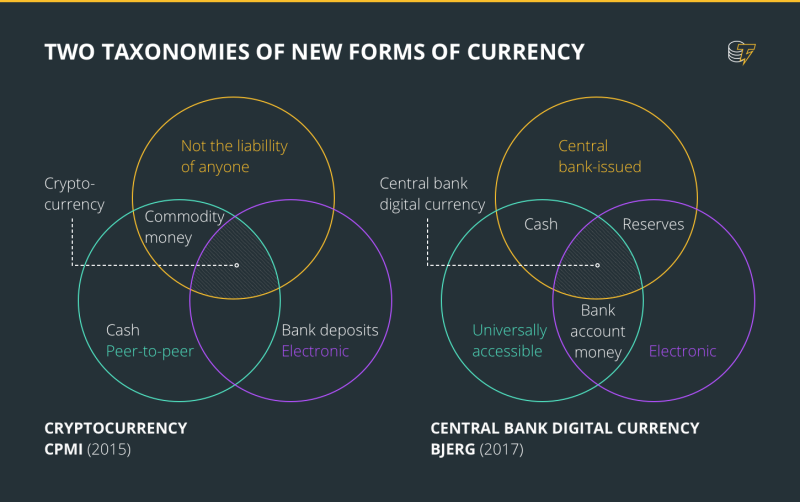
    Source: cointelegraph.com

    Blockchain enables decentralization. That is, everyone on the crypto platform has a say. But, the Central Banks would not want that. Further, they would want a fiat currency to be exclusively issued and controlled by them. But the protocols mentioned above theoretically enable everyone to `mine’ and create currency. So, for CBDC to be in central control, solve the `double spending’ problem and be a crypto (not just a digital version of currency) seems impossible.

    A centralized CBDC will require RBI to validate each transaction – something it does not do presently. Once a currency note is issued, RBI does not keep track of its use in transactions. Keeping track will be horrendously complex which could make the crypto like CBDC unusable unless new secure protocols are designed. No wonder, according to IMF MD, “… around 100 countries are exploring CBDCs at one level or another. Some researching, some testing, and a few already distributing CBDC to the public. … the IMF is deeply involved in it ..”

    Conclusion

    Issuing CBDCs will not only be complicated but presently cannot be a substitute for cryptos which will eventually be used as money. This will impact the functioning of the Central Banks and commercial banks. Further, it is now too late to ban cryptos unless there is global coordination which seems unlikely. The rich who benefit from cryptos will oppose banning them. Can the US work out a solution? The IMF MD has said, “The history of money is entering a new chapter”. The RBI needs to heed this caution and not be defensive.


    Slightly shortened version of this article was published earlier in The Hindu.

    Feature Image Credit: doralfamilyjournal.com
     

  • Lebanon’s Economic Crisis and Political Unrest

    Lebanon’s Economic Crisis and Political Unrest

    The Lebanon crisis illustrates the outcome of an inefficiently regulated market economy, shaped by long-term instant gratification of economic policies. Economy is run by corrupt institutions with ingrained crony capitalism, bureaucratic regulations and over-reliance on foriegn exchange.

    Lebanon is a free market economy in West Asia, bordered by Syria and Israel and the Mediterranean Sea, and hence, was a frequent recipient of spillovers of unrest and refugee crisis from the neighbouring countries. It is a service-sector dominated (majorly, banks and tourism) economy with a GDP of $56.9 billion─ growth rate of 0.2%, compared to 0.6% the previous year and a workforce of 2.4 million out of which 30 percent include Syrian refugees. The country relies heavily on imports (consumer goods, machinery and equipment etc) with a low dependence on exports (vegetables, non-precious metals and textiles). For years, Lebanon used foreign remittances such as transfers from non-resident Lebanese, foreign deposits and high government loans to balance the trade deficit. Lebanon exchange rate had been kept fixed at 1500 pounds per dollar which was also a fiduciary currency in Lebanon. Thus the higher demand for dollars to fixate the exchange rate, and meet the domestic demand for dollars, is levelled using foreign deposits by offering high yield rates, which had to be further funded by more deposits at even higher interest rates. These faulty policies had sustained the economy until interest payments had snowballed into heavy burden.

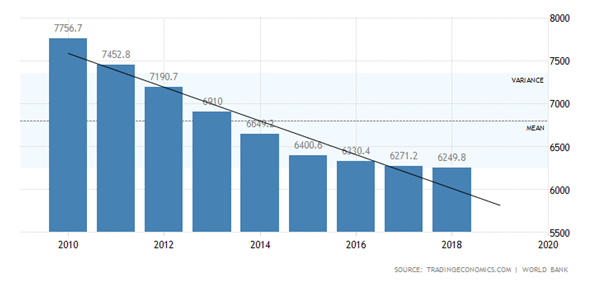
    Figure 1: trend of GDP per capita in Lebanon

    Source: Trading Economics

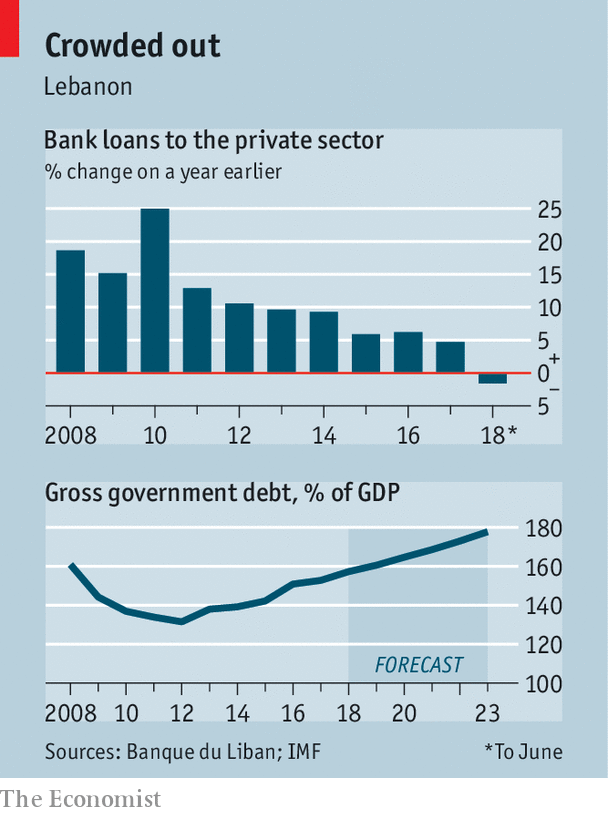
    Lebanese economy is also characterized by high government debt, substantially from domestic banks, borrowed primarily for reconstruction of the economy post civil war (1975-90). Over the years, the government relied more heavily on deficit financing to meet government spending, while the weak governance and corrupt politicians moved along with unfulfilled reforms and poor economic development. There was an underprovision of basic necessities like hassle-free electricity supply, regular water and waste management. On the other hand, crony capitalism had built up, with favours laid out to private businesses which were ultimately owned by rich, exploitative politicians. The debt-to-GDP ratio peaked to 150% by 2019, with a budget deficit of 11.5% of GDP and 50% of the revenues are consumed in debt servicing. This led to an economic crisis, followed by a political crisis, and ultimately snowballed into a financial crisis, rendered vulnerable and  in desperate need of foreign aid to see the day.

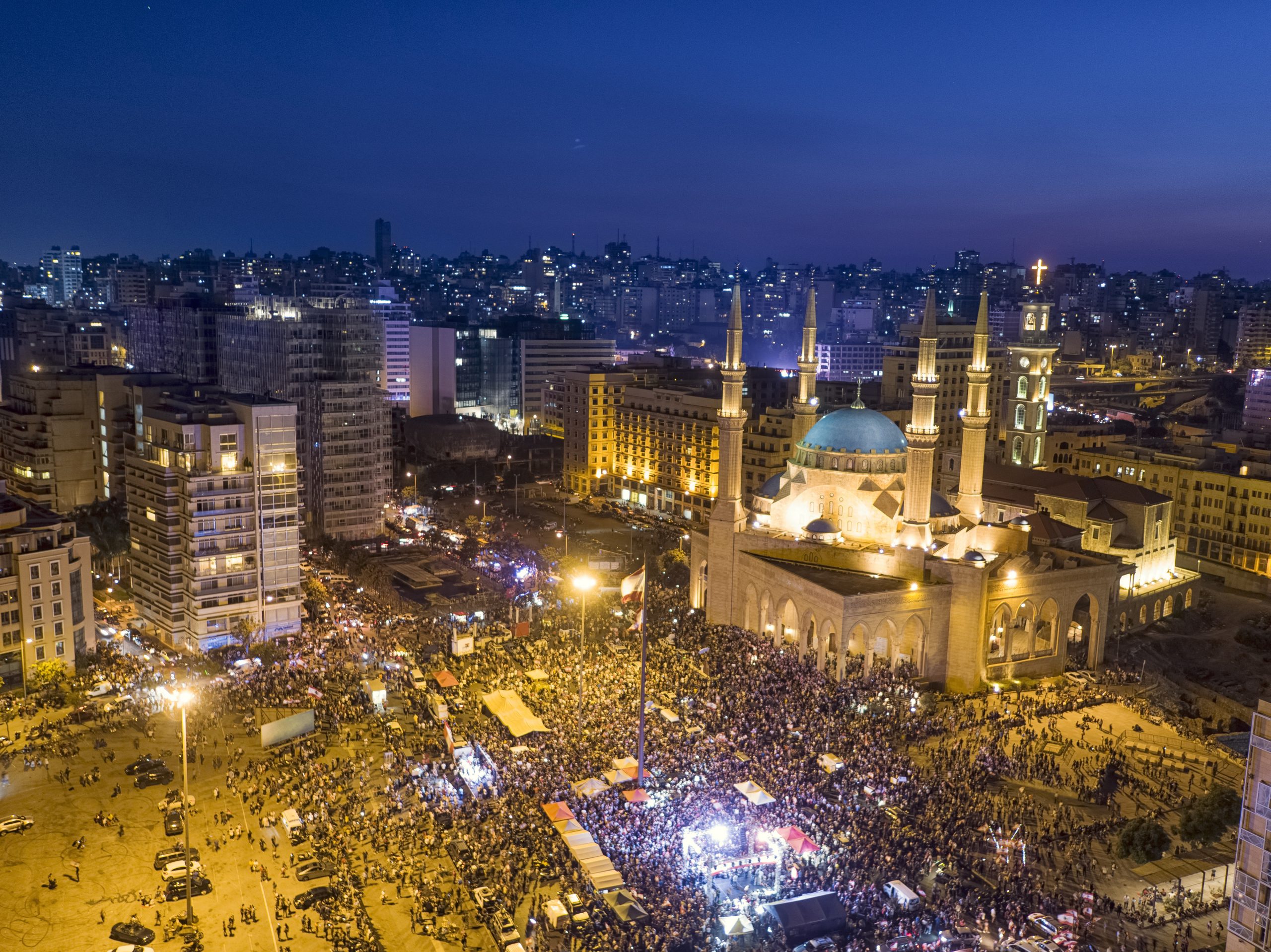
    Evidently, though Lebanon crisis started in late 2019, it is the result of long term economic policies mismanaged by corrupt political elite; when the government proposed to tax ‘free-calls in Whatsapp’ to meet the mounting budget deficit in October 2019, protests erupted across the country, catapulting into political unrest and ousting the prime minister. Investors and citizens lost confidence in the system, and led to reducing capital inflows.

    Their sovereign bonds were rated as highly risky assets (probable default),  leading to interest rates as high as 15%. The political uncertainty and the liquidity crunch, led to freezing of external deposits, while the steady domestic and foreign demand for dollars persisted, leading to a shortage of USD. The banks levied restrictions (weekly quotas) on dollar withdrawals, the dollar rate spiked, depreciating the pound, and reducing the purchasing power of the pound. This had squeezed the middle and low income strata the most, draining their last pounds of savings, since their debts substantially constituted dollar repayments. Businesses relying on dollars for most part were affected as the price of imports sky-rocketed, and the oil crunch tightened until the central government stepped in to ease the situation. The condition degraded further by the onset of Coronavirus and the lockdown, which led to widespread unemployment and inflation. The World Bank estimated that 50% of Lebanese population could be pushed below the poverty line by 2020 if immediate action is not taken.

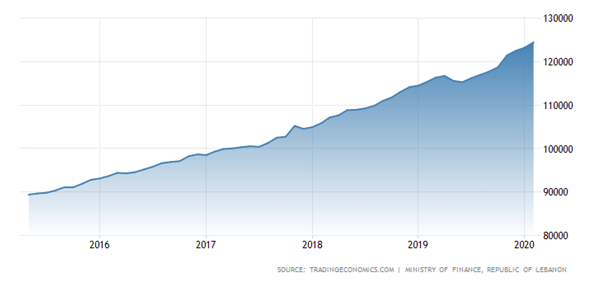
    The debt of Lebanon has built up to 124464 billion LBP, i.e nearly $82 billion and the country has become the 3rd most indebted country in the world. In March 2020, Lebanon government, as a decisive step to prioritize the domestic concerns of the country and retain sustainable foreign exchange reserves in the economy, had defaulted on the Eurobond debt of $1.2 billion for the first time. The ailing economy seeks to restructure the other outstanding debts amounting to $31 billion and has been seeking advice, especially from the IMF on debt restructuring measures. There is a need for an ‘economic rescue plan’ to protect the depositors from this worst economic crisis Lebanon has faced.

    Figure 2: trend of Lebanon government’s debt

    Source: Trading Economics

    Foreign aid from the institutions is a big responsibility, as it would demand austerity measures from the economy that had dwelled in capitalistic pleasures for so long. Though, CEDRE and foreign countries like France and UK have promised ‘soft’ loans to the Lebanese government, economists believe that external aid would be unproductive, and will become an additional debt burden on the already bleeding financial system unless government inculcates greater transparency and accountability to the public, ousting corruption and following through on long-term economic policies with commitment.  Lebanon government is also seeking aid from the IMF. But  this would certainly entail strict reform targets linked to the outflow of credit and hence, is very unlikely.

    For the immediate future, Lebanon’s economic policies should be directed towards increasing  self-reliance in the economy, with higher focus on manufacturing sectors to create employment. Financial policies to stabilize the economy are of primary concern. It is time to make up for the blunders of non-performing investments in the electricity industry. Investments on infrastructural development should be realized and substantial attention should be given to improving  socio-economic conditions of the people. Construction and manufacturing industries should be supported. Actions should be taken to handle the refugee situation, and check the drain of human capital out of the country.   It could be said that Lebanon’s government has a long way to go before it can regain the confidence of its people and the foreign investors in order to stabilize the economy.

    Current Scenario

          Covid 19 has a destructive and deleveraging impact on all the economies, and Lebanon is no exception. The economy is heavily dependent on the service sector, especially tourism, and foreign remittances. The impact of the coronavirus pandemic has been devastating on the money the expats send home, which makes up nearly 12.7% of the GDP, making Lebanon the second-most remittances dependent middle-eastern country, only behind Palestine. Amid the collapsing economy and the disruption triggered by the Covid-19 pandemic, the only certainty is the gathering pace of Lebanon’s political unrest.


    REFERENCES

    https://www.nytimes.com/2019/11/15/world/middleeast/lebanon-protests-economy.html?action=click&module=RelatedLinks&pgtype=Article

    https://www.nytimes.com/2020/05/10/world/middleeast/lebanon-economic-crisis.html

    https://www.trtworld.com/magazine/what-s-behind-lebanon-s-economic-crisis-35874

    https://www.nytimes.com/2020/03/07/world/middleeast/lebanon-debt-financial-crisis.html

    https://www.nytimes.com/2019/12/03/world/middleeast/lebanon-protests-corruption.html?action=click&module=RelatedLinks&pgtype=Article

    https://www.theguardian.com/world/2020/mar/07/lebanon-to-default-on-debt-for-first-time-amid-financial-crisis

    https://www.nytimes.com/2020/03/07/world/middleeast/lebanon-debt-financial-crisis.html

    https://www.nytimes.com/2019/10/23/world/middleeast/lebanon-protests.html

    DATA- https://data.worldbank.org/country/lebanon

    https://www.britannica.com/place/Lebanon/Trade

    https://tradingeconomics.com/lebanon/government-debt


    Image Credit: Adobe Stock

  • POST COVID 19: RE-IMAGINING THE NEW WORLD ORDER

    POST COVID 19: RE-IMAGINING THE NEW WORLD ORDER

    As the world grapples, rather unsuccessfully so far, with its worst pandemic in a century, COVID 19, it would be an understatement that the world, as mankind has known for decades, will ever be the same again! The Coronavirus is not just a medical emergency which has afflicted the entire world, already caused over 125,000  fatalities and  with its rampage  continuing alarmingly,   the socio-economic-political consequences for the world, in the near future, are likely to be as horrendous as the employment of a weapon of mass destruction(WMD).

    Post COVID 19, whenever that period dawns, what the new world order or disorder would be is agitating the minds of governments and analysts the world over. Though it is rather premature today to crystal-gaze as to when the world can rejoice that COVID 19 is now part of history, it is equally imperative for governments and global institutions, the world over, to frankly analyse the ramifications of  the aftermath of such an apocalyptic event. It will be better to be prepared for the after-results now than be found ill-prepared as the world was when this pandemic struck in full surprise and ferocity.

    The onslaught of this coronavirus was indeed a Black Swan event and hence it found the world, including the most powerful nation on the earth, US and most of the technologically advanced nations, like in Europe, grossly under-prepared – a fact that will puzzle future historians. For the uninitiated, a Black Swan event is a metaphor for an unpredictable event that is beyond what is normally expected of a grave situation and is characterized by both extreme rarity and equally severity in occurrence. Events like the Black Death plague which had engulfed the world 600 years back and took a toll of 25 million lives, the Spanish Flu a hundred years back which took millions of lives, the atom bomb attacks on Hiroshima and Nagasaki in Japan by the US Air Force at the near- end of World War II  or the 9/11 terrorist attack on the Twin Towers in the US could be categorized  as Black Swan events.

    Prior to ascertaining through the prism of uncertainty the contours of the “new normal” or the “next normal”, it will be in order to study what all went grievously wrong in the globe’s response to the pandemic. Firstly and, unquestionably, was the emerging superpower China’s total disdain for the fallout of the coronavirus. Reliable reports in the western media point out that as early as 17 Nov 2019, the virus was detected in the Wuhan laboratory in China’s Hubei province. It was attributed to the major animal market of Wuhan which sells dead bats, dogs, cats, fish, seafoods and many other forms of animal produce for the Chinese palate. Once the virus started spreading uncontrollably, it was only on 31 Dec 2019 that China cared to inform the WHO regards the spread of an “abnormal pneumonia”.

    From the beginning of Jan 2020, the pandemic rapidly spread its tentacles to the US and most nations of Europe with devastating effect. Amazingly and regrettably, the US and most nations were rather sluggish in their response mechanisms to combat this dreadful virus. No stringent lockdowns or social/physical distancing or curbs on travel or congregations was enforced—- the tragic results were for all to see with medical systems collapsing and no drugs/vaccines available, no hospital beds or ambulances, as  required, available. It was only that by end Feb/ mid-March some emergency measures were enforced—much too late though. The world expects all fellow nations to share critical information with each other in the event of such emergencies as such viruses do not recognize any international borders.

    In India too, there is a view that we may have been a bit late in enforcing lockdowns and other stringent measures. Nevertheless, PM Narendra Modi’s much awaited 21 days lockdown announced on 24 March (and its subsequent extension till 03 May 2020), though necessary, could have been better implemented with some advance planning. Though the centre and state bureaucracy did step up subsequently to resolve the teething problems, especially of migrant labour, many helpful interventions from well-meaning NGOs, gurdwaras, temples, the public and others, the humanitarian problems have been overcome to a large extent. Overall, the nation’s response, cutting across religious lines, to this medical emergency has been encouraging and embellished with humanitarianism.

    The other major fall-out of the COVID 19 pandemic will, in all certainty, be the catastrophic economic costs the world will have to bear. The IMF has stated that the current crisis is the most horrible in a century and will be likely worse than the “Great Depression” (1929-1939). It visualizes the global GDP to shrink by a whopping 3 percent though it forecasts that next year could witness an improvement. As observed all over the world, stock markets have tumbled to abysmally low levels, production facilities come to virtual shutdowns, staff laid off, air and rail travel shut, supply chains both international and intra-nation disrupted etc. In addition, oil prices have had a dangerously steep decline throwing the world trade and economy out of gear. The US with its financial muscle ultimately, despite being financially badly mauled, is expected to slowly bounce back. President Donald Trump, now in his crucial re-election year, may take some out-of-the box fiscal initiatives to bring the US economy back on track. The ongoing trade war between China and the US may witness contours of a rivalry not witnessed so far. Anyway, China needs to be globally chastised for its unethical practices.

    It will be a natural fall-out for most nations now to take a fresh look at their trade relations with China. Japan has already announced a US $ 2.2 billion package for their industrialists to pull out of China. Others like Taiwan may do so too. Some of the industries moving out of China may prefer to re-locate to India and here is a good chance for India to welcome them here and give a fillip to India’s currently near-stagnant “Make in India” programmes. However, the Indian establishment will have to shed its hollow big talk, traditional lethargic attitudes and genuinely encourage foreign investments into India. India’s private industry is modern, robust, and skilful enough to work together with foreign collaborators.

    The world now must rise and strengthen global institutions like the UN and its various agencies to combat global challenges. No country, however powerful, can exist as an island as witnessed now. Nations like China, notwithstanding its deep pockets, must be cautioned not to disturb the economic equilibrium of the world, most of which is reeking with poverty and under-development. China’s intransigent attitude not even allowing a discussion on the pandemic at the United Nations Security Council last fortnight is unacceptable to the world.

    In the coming years, it is certain that owing to the gruesome after-effects of COVID 19, nations, both the powerful and the poor, are going to take far more seriously their public health preparedness and emergency standard operating procedures. Medical infrastructures, rightly so, demand far greater thought, planning and investments than hithertofore.

    It is well on the cards that even the militarily powerful nations will look into the various nuances of biological warfare. It is now clear to the entire world that a virus can prove to be far more lethal than many megatons of explosives and modern weaponry. According to many western journalists, China may deny its botched-up bio warfare experiment, but it is a matter of time when the bitter truth will unravel. India as a signatory of the Geneva Convention of 1972 (effective since mid-1975) to eschew production and experimentation of  WMDs including bio weapons should not only  use its moral authority to make nations be sincere adherents of existing UN protocols  but, importantly, for its own safety put into place  adequate defensive mechanisms to thwart such challenges. The lessons to be drawn from COVID 19 must be taken seriously. In addition, the UN must draw up contingency plans to prevent, contain and manage and ultimately defeat such likely challenges in the future. It will have to be a synthesis of health, economic, political, and even military measures.

    The new world order, in all likelihood, will be drastically differing, more sobering, additionally fiscally prudent, and conservative and with nations becoming isolationist and inward looking. China’s image and its economy will certainly take a sound beating. Though the pandemic is world-wide and global problems, unquestionably, require global solutions, yet in the coming years we may witness the rise of hyper-nationalism and authoritarianism in most nations including democracies. Nevertheless, as India strives to do its bit to get its economy back on track and takes various prophylactic measures for the future, it must do its bit to strengthen global institutions.

    This article was published earlier in ‘USI – Strategic Perspectives‘. Views expressed are the author’s own.

    Image credit: Tehran Times