Tag: History

  • India’s war on the Mughal Empire

    India’s war on the Mughal Empire

    The profound legacies of the Mughal Empire, forged through a remarkable fusion of Persian and Sanskrit worlds, are now under siege from a mythical vision of India’s past.

    On every 15 August since 1947, India’s Independence Day, the country’s prime minister unintentionally acknowledges the Mughals’ political legacy by delivering a nationwide address from the parapets of the mightiest symbol of Mughal power – Delhi’s massive Red Fort, built in 1648.

    ‘As is true of autocracies everywhere’, wrote David Remnick last April, ‘this Administration demands a mystical view of an imagined past.’  Although Remnick was referring to Trump’s America, something of the same sort could be said of India today. Informed by Hindutva (Hindu-centric) ideals, the country’s governing BJP party imagines a Hindu ‘golden age’ abruptly cut short when Muslim outsiders invaded and occupied an imagined sacred realm, opening a long and dreary ‘dark age’ of anti-Hindu violence and tyranny. In 2014, India’s prime minister declared that India had experienced 1,200 years of ‘slavery’ (ghulami), referring to ten centuries of Muslim rule and two of the British Raj. But whereas the British, in this view, had the good sense to go home, Muslims never left the land they had presumably violated and plundered. To say the least, India’s history has become a political minefield.

    Today’s India would be unrecognisable without the imprint the Mughals had made, and continue to make, on its society and culture. It was they who, for the first time, unified most of South Asia politically.

    Between the early 16th and the mid-18th century, towards the end of those 12 centuries of alleged ‘slavery’, most of South Asia was dominated by the Mughal Empire, a dazzling polity that, governed by a dynasty of Muslims, was for a while the world’s richest and most powerful state. Although it declined precipitously during the century before its liquidation by Queen Victoria in 1858, today’s India would be unrecognisable without the imprint the Mughals had made, and continue to make, on its society and culture. It was they who, for the first time, unified most of South Asia politically. On every 15 August since 1947, India’s Independence Day, the country’s prime minister unintentionally acknowledges the Mughals’ political legacy by delivering a nationwide address from the parapets of the mightiest symbol of Mughal power – Delhi’s massive Red Fort, built in 1648. Much of modern India’s administrative and legal infrastructure was inherited from Mughal practices and procedures. The basis of India’s currency system today, the rupee, was standardised by the Mughals. Indian dress, architecture, languages, art, and speech are all permeated by Mughal practices and sensibilities. It’s hard to imagine Indian music without the sitar, the tabla, or the sarod. Almost any Indian restaurant, whether in India or beyond, will have its tandoori chicken, kebab, biryani, or shahi paneer. One can hardly utter a sentence in a north Indian language without using words borrowed from Persian, the Mughals’ official language. India’s most popular entertainment medium – Bollywood cinema – is saturated with dialogue and songs delivered in Urdu, a language that, rooted in the vernacular tongue of the Mughal court, diffused throughout India thanks to its association with imperial patronage and the prestige of the dynasty’s principal capital, Delhi.

    Yet, despite all this, and notwithstanding the prime minister’s national address at Delhi’s Red Fort, India’s government is engaged in a determined drive to erase the Mughals from public consciousness, to the extent possible. In recent years, it has severely curtailed or even abolished the teaching of Mughal history in all schools that follow the national curriculum. Coverage of the Mughals has been entirely eliminated in Class Seven (for students about 12 years old), a little of it appears in Class Eight, none at all in Classes Nine to 11, and a shortened version survives in Class 12. In 2017, a government tourism brochure omitted any mention of the Taj Mahal, the acme of Mughal architecture and one of the world’s most glorious treasures, completed in 1653. Lawyers in Agra, the monument’s site, have even petitioned the courts to have it declared a Hindu temple.

    Although such radical measures have failed to gain traction, the national government has made more subtle efforts to dissociate the monument from the Mughals and identify it with Hindu sensibilities. For example, authorities have eliminated the initial ‘a’ from the name of one of its surrounding gardens, so that what had been Aram Bagh, the ‘Garden of Tranquility’, is now Ram Bagh, the ‘Garden of Ram’, the popular Hindu deity. This is the same deity to which India’s current government recently dedicated an extravagant temple complex on the site of the Babri Masjid, the mosque in eastern India that the Mughal Empire’s founder had built in 1528, but which a mob of Hindu activists tore down brick by brick in 1992.

    All of this prompts two related questions: how did a rich, Persian-inflected Mughal culture sink such deep roots in today’s India in the first place? And why in recent years has the memory of that culture come under siege?

    Ever since the early 13th century, a series of dynastic houses, known collectively as the Delhi sultanate, had dominated the north Indian plain. The last of these houses, the ethnically Afghan Lodis, was dislodged by one of the most vivid figures in early modern history, Zahir al-Din Babur(1483-1530). In 1526, Babur led an army of mostly free-born Turkish retainers from his base in Kabul, down through the Khyber Pass and onto the wide Indo-Gangetic plain, thereby launching what would become the Mughal Empire.

    As was true for the Delhi sultans, the new polity’s success lay in controlling access to ancient trade routes connecting Delhi and Lahore with Kabul, Balkh, and Central Asian markets, such as Samarkand and Bukhara. For centuries, cotton and other Indian goods moved northwards along this route, while horses – more than a hundred thousand annually, by Babur’s day – moved southwards to markets across South Asia. War horses had long formed the basis of power for Indian states, together with native war elephants. But the larger and stronger horses preferred by Indian rulers had to be continually imported from abroad, especially from Central Asia’s vast, long-feathered grasslands where native herds roamed freely.

    Having established a fledgling kingdom centred on Delhi, Agra and Lahore, Babur bequeathed to his descendants a durable connection to the cosmopolitan world of Timurid Central Asia, a refined aesthetic sensibility, a love of the natural world reflected in his delightful memoir, the Baburnama, and a passion for gardens. Aiming to recreate in India the refreshing paradisiac spaces that he knew from his Central Asian homeland, Babur built gardens across his realm, a practice his descendants would continue, culminating in the Taj Mahal.

    Since he died only four years after reaching India, Babur’s new kingdom merely continued many institutions of the defeated Lodis, such as giving his most trusted retainers land assignments, from which they collected taxes and maintained specified numbers of cavalry for state use. It was Babur’s son Humayun (r. 1530-40, 1555-56) who took the first steps to deepen the roots of Mughal legitimacy in Indian soil, as when he married the daughter of an Indian Muslim landholder rather than a Central Asian Turk, a practice he encouraged his nobles to follow. More importantly, while seated in a raised pavilion (jharokha) that projected from his palace’s outer walls, he would greet the morning’s rising sun and show his face to the public, just as the sun showed itself to him. This followed an ancient practice of Indian rajas that subtly conflated the image of a seated monarch with the icon of a Brahmanical deity, before whom one pays respectful devotion through mutual eye contact (darshan).

    The Mughals became further Indianised during the long reign of Humayun’s son Akbar (r. 1556-1605). Whereas for three centuries the Delhi sultans had struggled to defeat the Rajput warrior clans that dominated north India’s politics, Akbar adopted the opposite policy of absorbing them into his empire as subordinate kings. Nearly all Rajput kings accepted this arrangement, for by doing so they could retain rulership over their ancestral lands while simultaneously receiving high-ranking positions in Akbar’s newly created ruling class – the imperial mansabdars. Their new status also allowed them to operate on an all-India political stage instead of remaining provincial notables. Moreover, they were granted religious freedom, including the right to build and patronise Hindu temples. Over time, there emerged a warrior ethos common to both Mughals and Rajputs that superseded religious identities, allowing the latter to understand Muslim warriors as fellow Rajputs, and even to equate Akbar himself with the deity Rama. For their part, Akbar and his successors, as the Rajputs’ sovereign overlords, acquired regular tribute payments from subordinate dynastic houses, the service of north India’s finest cavalry, access to the sea through Rajasthani trade routes leading to Gujarat’s lucrative markets, and the incorporation of Rajput princesses in the imperial harem.

    Moreover, since Rajput women could become legal wives of the emperor, from Akbar’s time onwards, an emperor’s child by a Rajput mother was eligible for the throne. As a result, Akbar’s son Jahangir (r. 1605-23) was half Rajput, as his mother was a Rajput princess. Jahangir, in turn, married seven daughters of Rajput rulers, one of whom was the mother of his imperial successor Shah Jahan, making the latter biologically three-quarters Rajput.

    This last point proved especially consequential. As more Rajput states submitted to Mughal overlordship, the imperial court swelled into a huge, multi-ethnic and women-centred world in which the Rajput element steadily gained influence over other ethnicities. Moreover, since Rajput women could become legal wives of the emperor, from Akbar’s time onwards, an emperor’s child by a Rajput mother was eligible for the throne. As a result, Akbar’s son Jahangir (r. 1605-23) was half Rajput, as his mother was a Rajput princess. Jahangir, in turn, married seven daughters of Rajput rulers, one of whom was the mother of his imperial successor Shah Jahan, making the latter biologically three-quarters Rajput.

    Inevitably, Rajput mothers in the imperial harem imparted their culture to their offspring, who were raised in the harem world. This allowed Indian sensibilities and values to seep deeply into Mughal imperial culture, reflected in imperial art, architecture, language, and cuisine. At the same time, the absorption of Rajput cavalry in the imperial system allowed native military practices to diffuse throughout the empire’s military culture.

    The Mughals engaged with Sanskrit literary traditions and welcomed Brahmin and Jain scholars to their courts. From the 1580s on, Akbar sponsored Persian translations of the great Sanskrit epics Mahabharata and Ramayana, effectively accommodating Indian thought to Mughal notions of statecraft.

    Like all authentically Indian emperors, moreover, the Mughals engaged with Sanskrit literary traditions and welcomed Brahmin and Jain scholars to their courts. From the 1580s on, Akbar sponsored Persian translations of the great Sanskrit epics Mahabharata and Ramayana, effectively accommodating Indian thought to Mughal notions of statecraft. Whereas the Sanskrit Mahabharata stressed cosmic and social order (dharma), its Persian translation stressed the proper virtues of the king. Similarly, the Sanskrit Ramayana was subtly refashioned into a meditation on Mughal sovereignty, while the epic’s hero, Rama, was associated with Akbar himself, as though the emperor were an avatar of Vishnu.

    Beginning with Akbar, the Mughals also fostered cultural fusions in the domains of medicine and astronomy.  By the mid-17th century, the Mughals’ Greco-Arab (Yunani) medical tradition had become thoroughly Indianised, as Indo-Persian scholars engaged with Indian (Ayurvedic) works on pharmacology and the use of native Indian plants.

    Similarly, from the late 16th century on, Persian-Sanskrit dictionaries allowed Sanskrit scholars to absorb Arabo-Persian ideas that had derived from ancient Greek understandings of the uniformity of nature and laws of motion. That knowledge, together with astronomical tables patronised by Shah Jahan that enabled the prediction of planetary movements, then spread among the Mughal-Rajput ruling class at large.

    The most telling indication of the public’s acceptance of the Mughals as authentically Indian is that in both the 18th and 19th centuries, when the empire faced existential threats from outside, native forces rallied around the Mughal emperor as the country’s sole legitimate sovereign. In 1739, the Persian warlord Nadir Shah invaded India, routed a much larger Mughal army, sacked Delhi, and marched back to Iran with enormous loot, including the symbolically charged Peacock Throne. At this moment, the Marathas, who for decades had fiercely resisted the imposition of Mughal hegemony over the Indian peninsula, realised that the Mughals represented the ultimate symbol of Indian sovereignty and must be preserved at all costs. The Marathas’ chief minister Baji Rao (1700-40) even proposed that all of north India’s political stakeholders form a confederation to support and defend the weakened Mughal dynasty from foreign invaders.

    Similarly, by the mid-19th century, the English East India Company had acquired de facto control over much of the subcontinent, while the reigning Mughal ruler, Bahadur II (r. 1837-57), had been reduced to a virtual prisoner in Delhi’s Red Fort, an emperor in name only. But in 1857, a rebellion broke out when a disaffected detachment of the Company’s own Indian troops massacred their English officers in the north Indian cantonment of Meerut. Seeking support for what they hoped would become an India-wide rebellion, the mutineers then galloped down to Delhi and enthusiastically rallied around a rather bewildered Bahadur II.  Notwithstanding his own and his empire’s decrepit condition, to the rebels, this feeble remnant of the house of Babur still represented India’s legitimate sovereign.

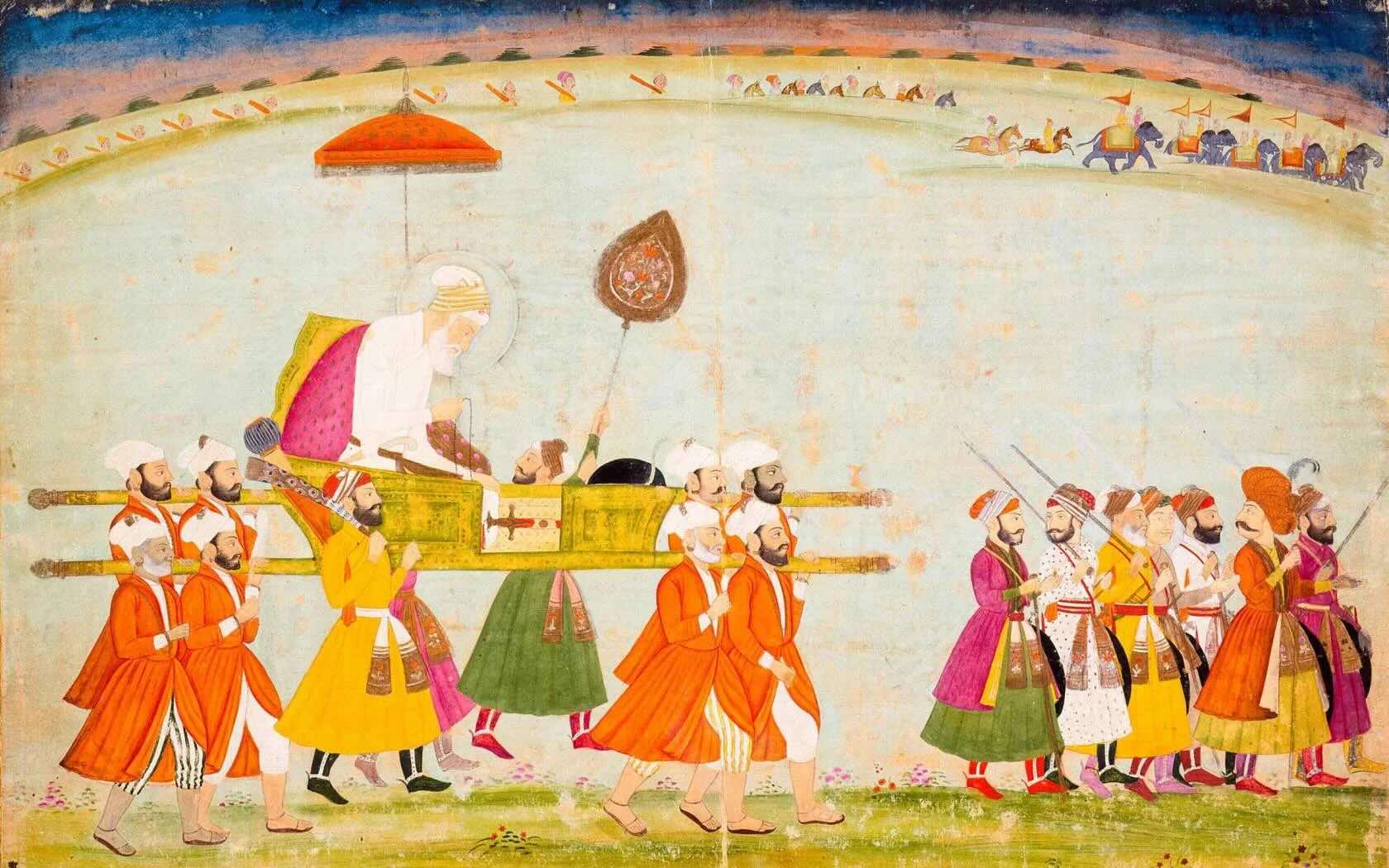
    Through the Mughals’ twilight years, spanning the two incidents mentioned above, one emperor was especially revered in public memory – ‘Alamgir (r. 1658-1707), widely known today by his princely name, Aurangzeb. Upon his death, large and reverential crowds watched his coffin move 75 miles across the Deccan plateau to Khuldabad, a saintly cemetery in present-day Maharashtra. There, the emperor’s body was placed, at his own request, in a humble gravesite open to the sky, quite unlike the imposing monuments built to glorify the memory of his dynastic predecessors (excepting Babur). That simple tomb soon became an object of intense popular devotion. For years, crowds thronged his gravesite, beseeching ‘Alamgir’s intercession with the unseen world, for his saintly charisma (baraka) was believed to cling to his gravesite, just as in life it had clung to his person. For, during his lifetime, the emperor was popularly known as ‘Alamgir zinda-pir, or ‘Alamgir, the living saint’, one whose invisible powers could work magic.

    ‘Alamgir’s status as a saintly monarch continued to grow after his death in 1707. Already in 1709, Bhimsen Saksena, a former imperial official, praised ‘Alamgir for his pious character and his ability to mobilise supernatural power in the empire’s cause. In 1730, another retired noble, Ishwar Das Nagar, credited ‘Alamgir for the exceptional peace, security, and justice that had characterised his long reign. Nagar’s account followed a spate of histories that praised the emperor as a dedicated, even heroic administrator, and his half-century reign as a ‘golden age’ of governmental efficiency.

    Further contributing to ‘Alamgir’s cult was the appearance of hundreds of images depicting the emperor engaged in administration, military activity, or religious devotion. Reflecting the extent of the ‘Alamgir cult, many of these post-1707 paintings were produced not at the imperial court but in north India’s Hindu courts, including those of the Mughals’ former enemies. No other Mughal emperor was so venerated, and for so long a period, as ‘Alamgir.

    Over time, however, Indians gradually came to see the Mughal period – and especially ‘Alamgir’s reign – in an increasingly negative light. As the East India Company attained control over South Asia in the late 18th century, British administrators, being unable as foreigners to deploy a nativist rationale to justify their rule, cited the efficiency, justice, peace and stability that they had brought to their Indian colony. And because the Mughals had immediately preceded the advent of Company rule, those rulers were necessarily construed as having been inefficient and unjust despots in a war-torn and unstable land. The colonial understanding of Muslims and Hindus as homogeneous and mutually antagonistic communities also facilitated aligning colonial policies with the old Roman strategy of divide et impera. More perniciously, the colonial view of the Mughals as alien ‘Mahomedans’ who had oppressed a mainly non-Muslim population reinforced the notion of a native Hindu ‘self’ and a non-native Muslim ‘other’ – constructions that would bear bitter fruit.

    Although originating from within the colonial regime, such ideas gradually percolated into the public domain as the 19th century progressed and Indians became increasingly absorbed in the Raj’s educational and administrative institutions. It was not until the 1880s, with the first stirrings of Indian nationalist sentiment, however, that such colonial tropes became widely politicised. As the possibility of an independent nation took root, Indian nationalists began to look to their own past for models that might inspire and mobilise mass support for their cause. The writing of history soon became a political endeavour, ultimately degenerating into a black-and-white morality play that clearly distinguished heroes from villains. In short, India’s precolonial past became a screen onto which many – though not all – Hindu nationalists projected the tropes of the Hindu self and the Muslim other.

    Between 1912 and 1924, one of India’s most esteemed historians, Jadunath Sarkar, published his five-volume History of Aurangzib, the princely name of ‘Alamgir, who would soon become the most controversial – and ultimately the most hated – ruler of the Mughal dynasty. Sarkar’s study was so detailed, so thoroughly researched, and so authoritative that, in the century following its publication, no other historian even attempted a thorough survey of ‘Alamgir’s reign.

    Importantly, Sarkar wrote against the backdrop of the Great War and a nationalist movement that was just then reaching a fever pitch. In 1905, Lord Curzon, the Viceroy for India, had partitioned Sarkar’s native province of Bengal in half, a cynical divide-and-rule measure that ‘awarded’ Bengali Muslims with their own Muslim-majority province of eastern Bengal. The very next year, there appeared the All-India Muslim League, a political party committed to protecting the interests of India’s Muslims. Meanwhile, the partition of Bengal had provoked a furious protest by Bengali Hindus, leading to India-wide boycotts against British-made goods. Ultimately, the government gave in to Hindu demands and, in 1911, annulled the partition, which only intensified fear and anxiety within India’s Muslim minority community.

    It was in this highly charged political atmosphere that Sarkar worked on his biography of ‘Alamgir. With each successive volume of his study, the emperor was portrayed in darker colours, as were Muslims generally. In the end, Sarkar blamed ‘Alamgir for destroying Hindu schools and temples, thereby depriving Hindus of the ‘light of knowledge’ and the ‘consolations of religion’, and for exposing Hindus to ‘constant public humiliation and political disabilities’. Writing amid the gathering agitation for an independent Indian nation, Sarkar maintained that ‘no fusion between the two classes [Hindus and Muslims] was possible’, adding that while a Muslim might feel that he was in India, he could not feel of India, and that ‘Alamgir ‘deliberately undid the beginnings of a national and rational policy which Akbar [had] set on foot.’

    Perhaps more than any other factor, Sarkar’s negative assessment of ‘Alamgir has shaped how millions have thought about that emperor’s place in Indian history. Since the publication of History of Aurangzib, professional historians have generally shied away from writing about the emperor, as though he were politically radioactive. This, in turn, opened up space in India’s popular culture for demagogues to demonise the Mughal emperor. For millions today, ‘Alamgir is the principal villain in a rogues’ gallery of premodern Indo-Muslim rulers, a bigoted fanatic who allegedly ruined the communal harmony established by Akbar and set India on a headlong course that, many believe, in 1947, culminated in the creation of a separate Muslim state, Pakistan. In today’s vast, anything-goes blogosphere, in social media posts, and in movie theatres, he has been reduced to a cardboard cutout, a grotesque caricature serving as a historical punching bag. A recent example is the film Chhaava, a Bollywood blockbuster that was released on February 14, 2025 and has since rocketed to superstar status. Among films in only their sixth week since release, already by late March, it had grossed the second-largest earnings in Indian cinema history.

    Loosely based on a Marathi novel of the same title, Chhaava purports to tell the story of a pivotal moment in ‘Alamgir’s 25-year campaign to conquer the undefeated states of the Deccan plateau. These included two venerable sultanates, Bijapur and Golkonda, and the newly formed Maratha kingdom, launched in 1674 by an intrepid chieftain and the Mughals’ arch-enemy, Shivaji (r. 1674-80). The film concerns the reign of Shivaji’s elder son and ruling successor, Sambhaji (r. 1680-89), his struggles with Mughal armies, and finally his capture, torture, and execution at ‘Alamgir’s order in 1689.

    The film is not subtle. With its non-stop violence, gratuitous blood and gore, overwrought plot, and black-and-white worldview, the movie turns the contest between Sambhaji and ‘Alamgir into a cartoonish spectacle, like a Marvel Comics struggle between Spiderman and Doctor Doom. Whereas Sambhaji single-handedly vanquishes an entire Mughal army, ‘Alamgir is pure, menacing evil. Mughal armies display over-the-top brutality toward civilians: innocent Indians are hanged from trees, women are sexually assaulted, a shepherdess is burned to death, and so forth.

    In reality, ‘Alamgir is not known to have plundered Indian villages or attacked civilians (unlike the Marathas themselves, whose raids in Bengal alone caused the deaths of some 400,000 civilians in the 1740s). On the other hand, contemporary sources record Sambhaji’s administrative mismanagement, his abandonment by leading Maratha officers inherited from his father reign, his weakness for alcohol and merry-making, and how, instead of resisting Mughal forces sent to capture him, he hid in a hole in his minister’s house, from which he was dragged by his long hair before being taken to ‘Alamgir.

    Historical accuracy is not Chhaava’s strength, nor its purpose. More important are its consequences. Within weeks of its release, the film whipped up public fury against ‘Alamgir and the Mughals. In one venue where the movie was showing, a viewer wearing medieval warrior attire rode into the theatre on horseback; in another, a viewer became so frenzied during the film’s protracted scene of Sambhaji’s torture that he leapt to the stage and began tearing the screen apart.

    Politicians swiftly joined the fray. In early March, a member of India’s ruling BJP party demanded that ‘Alamgir’s grave be removed from Maharashtra, the heartland of the Maratha kingdom. On 16 March, another party member went further, demanding that the emperor’s tomb be bulldozed. The next day, a riot broke out in Nagpur, headquarters for the far-right Rashtriya Swayamsevak Sangh, India’s paramilitary Hindu supremacist organisation. It began when around 100 activists who supported bulldozing ‘Alamgir’s grave burned an effigy of the emperor. In response, a group of the city’s Muslims staged a counter-protest, culminating in violence, personal injuries, the destruction of property, and many arrests. The fevered demand for bulldozing ‘Alamgir’s final resting place, however, is deeply ironic. In 1707, Sambhaji’s son and eventual successor to the Maratha throne, Shahu, travelled 75 miles on foot to pay his pious respects to ‘Alamgir’s tomb.

    In the end, the furore over ‘Alamgir’s gravesite illustrates the temptation to adjust the historical past to conform to present-day political priorities. Indicating the Indian government’s support for Chhaava’s version of history, in late March, India’s governing party scheduled a special screening of the film in New Delhi’s Parliament building for the prime minister, Cabinet ministers, and members of parliament.

    Nor is it only the historical past that is being adjusted to accord with present-day imagination. So is territory. In 2015, the Indian government officially renamed New Delhi’s Aurangzeb Road – so-named when the British had established the city – after a former Indian president. Eight years later, the city of Aurangabad, which Prince Aurangzeb named for himself while governor of the Deccan in 1653, was renamed Sambhaji Nagar, honouring the man the emperor had executed in 1689.

    Such measures align with the government’s broader agenda to scrub from Indian maps place names associated with the Mughals or Islam and replace them with names bearing Hindu associations, or simply to Sanskritise place-names containing Arabic or Persian lexical elements. Examples include: Mustafabad to Saraswati Nagar (2016), Allahabad to Prayagraj (2018), Hoshangabad to Narmadapuram (2021), Ahmednagar to Ahilyanagar (2023), and Karimgunj to Sribhumi (2024). Many more such changes have been proposed – at least 14 in the state of Uttar Pradesh alone – but not yet officially authorised.

    It is said that the past is a foreign country. Truly, one can never fully enter the mindset of earlier generations. But if history is not carefully reconstructed using contemporary evidence and logical reasoning, and if it is not responsibly presented to the public, we risk forever living with a ‘mystical view of an imagined past’ with all its attendant dangers, as Remnick warns.


    This essay was published earlier on www.engelsbergideas.com

    Feature Image Credit: www.engelsbergideas.com
     

  • Indus Waters: Yawning Gap Between Threat and Reality

    Indus Waters: Yawning Gap Between Threat and Reality

    World Bank brokered the IWT between India and Pak after many years of intense negotiations to allocate the waters of the Indus river basin

    The Narendra Modi government has decided to start talks with Pakistan on the Indus Waters Treaty, and rightly so. After the Uri incident, Prime Minister Narendra Modi had said that “blood and water cannot flow together”. The reality, however, is that while flow of blood can be stopped, the water will continue to flow. The geography makes it next to impossible for the waters from the Indus, Chenab and Jhelum. Yet there is reason to revisit this treaty, because of Pakistan’s persistent misuse of the provisions of the IWT that enable it to adopt a dog in the manger attitude to prevent or delay any development of hydel projects on the three rivers that is permitted by the treaty. This must stop.

    The Indus rivers system has a total drainage area exceeding 11,165,000 sq. km. Its estimated annual flow stands at around 207 km3, making it the twenty-first largest river in the world in terms of annual flow. It is also Pakistan’s sole means of sustenance. The British had constructed a complex canal system to irrigate the Punjab region of Pakistan. Partition had left a large part of this infrastructure within Pakistan.

    [powerkit_button size=”lg” style=”info” block=”true” url=”https://www.asianage.com/opinion/columnists/070323/mohan-guruswamy-indus-waters-yawning-gap-between-threat-and-reality.html” target=”_blank” nofollow=”false”]
    Read More
    [/powerkit_button]

  • Mankind as a wholeness – we must comprehend ourselves as a unity in order to survive

    Mankind as a wholeness – we must comprehend ourselves as a unity in order to survive

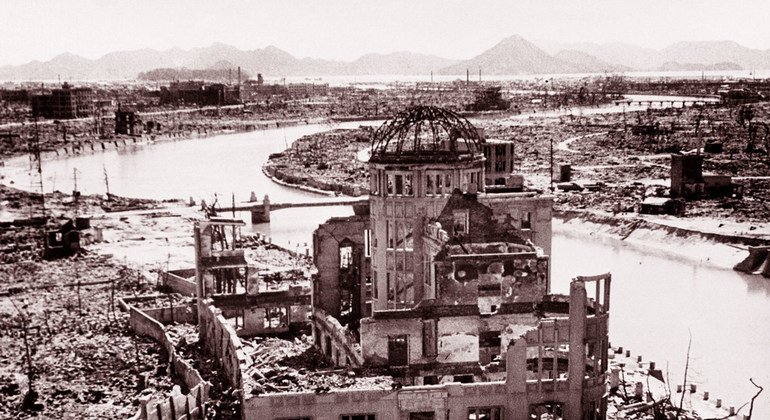
    One might think that mankind has not changed for millennia – we are still antiquated, as Günther Anders had pointed out after his visit to Hiroshima shortly after the atomic bombing. Basically, Anders argued that technical-industrial possibilities have rushed far ahead of comprehension and our moral responsibility – as evidenced in the use of nuclear power, the possibility of self-destruction of humanity during the nuclear arms race (especially in 1983), which was partly prevented only by chance, genetic engineering, and medical possibilities at the beginning and end of life. Add to this climate change and obscene inequality throughout the world.


    Looking at the current explosions of violence on the macro level (Ukraine, Syria, new arms race between the great powers) as well as on the micro level (for example in Central America the Maras) one might think that mankind has not changed for millennia – we are still antiquated, as Günther Anders had pointed out after his visit to Hiroshima shortly after the atomic bombing. Basically, Anders argued that technical-industrial possibilities have rushed far ahead of comprehension and our moral responsibility – as evidenced in the use of nuclear power, the possibility of self-destruction of humanity during the nuclear arms race (especially in 1983), which was partly prevented only by chance, genetic engineering, and medical possibilities at the beginning and end of life. Add to this climate change and obscene inequality throughout the world, we must ask ourselves who we are as humans? How can we explain to our children and grandchildren what we have done for them – or more importantly, not done? Statistically, however, we are living in the most peaceful age in human history to date. The present dominance of the violence topic, of fears and despair as world-politically effective emotions can therefore be a question of the increased and partly medially staged perception – or nevertheless a real setback.  But also, here it could be true that mainly our terms and conceptions are put to the test. For such setbacks primarily question the idea of the linearity of progress, not necessarily progress itself. If we assume the models of a linear ascending progress as in the Enlightenment or in Kant or an equally linear pure history of decay, we cannot integrate contrary developments into our world view – and every contrary development calls the whole model into question. In contrast, models of history based on a cycle (Greek Stoa, Hinduism) are able to capture the constant in change but can only imperfectly explain progress at the societal level. The historical model of a Machiavelli, on the other hand, includes change, but change is always repeated and can best be compared to a sine curve.

    The argument about models of history is by no means abstract, as it appears at first sight. The Marxists as well as Leninists and finally the Stalinists have pursued radical politics with the linear model of progress, just as the idea of the thousand-year Reich had influence on the politics of the National Socialists. Are there alternative models beyond pure decay, equally linear progress, or the assumption that humans do not change after all, or lag behind their technological capabilities in moral and spiritual terms?

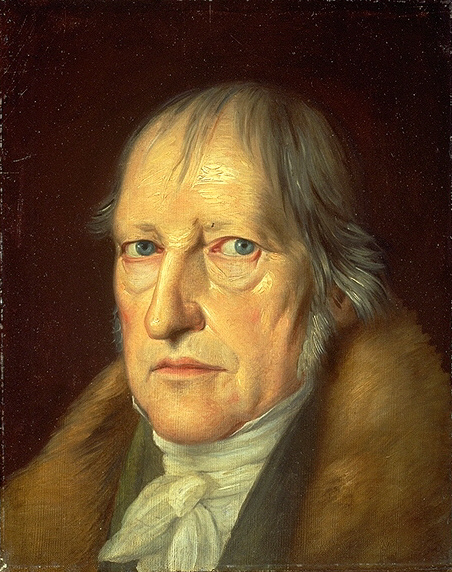
    Models for Understanding History – G W F Hegel

    These positions are not unfounded – however, their absolutization is wrong. As in various psychological (Piaget and Kohlberg) and sociological (Auguste Comte) approaches, the German philosopher Georg W.F. Hegel starts from a stage model in which he develops a progress of world history in the consciousness of freedom. Despite his own Eurocentrism, stage models are in principle capable of countering a pure binary opposition of affirmation or negation of progress in human history. They also do not imply an absolutely inevitable development, as can be seen from the fact that Kohlberg, for example, does not assume that all people reach the highest level, but emphasizes, like all stage theorists, that one cannot skip any of the stages. But Hegel was just not in the tradition of the Enlightenment and Kant, who assumed a linear model of progress, but developed a dialectical sequence of stages, which in my interpretation could best be compared to a sine curve (as in Machiavelli) but erected on an ascending x-axis. In such a model, we can think of the Enlightenment’s idea of progress (in the ascending x-axis) as well as cyclical developments (Machiavelli) of rise and fall, progress, and regress in world history together.

    In this model developed by the author, there is progress, but it is not linear, but itself cyclical. We know such cycles from the business cycle theories in the wake of Kondratieff’s research or also from hegemonic cycles. In contrast to these theoretical approaches, the model of history advocated here is related to a (more or less) slightly ascending x-axis and is derived from Hegel’s conception of becoming at the beginning of his monumental work on the “Science of Logic”, since coming into being and passing away are not completely cancelled out, but a “surplus” arises which goes beyond the infinite coming into being and passing away.  Such a model is on the one hand closed (with respect to the high and low points on the Y-axis), at the same time open on the X-axis and develops “between” its high and low points.

    Hegel’s stage model has itself been a great historical advance; at the same time, we need to go beyond Hegel to overcome his tendency of constructing a systematic closure (which was then taken as an absolute by Marx in a perfect society of communism) in favour of an approach that is at once closed and open. Despite his Eurocentric reductions, Hegel develops a systematic development of the idea of freedom. In his sequence of stages, human history begins with the development of states in which at first only one was free – the ruler, mostly in the figure of the priest-king, who symbolizes the laws of the gods and rule. Still with Plato we find the construction of the philosopher, who must be at the same time king and vice versa. This all-surpassing freedom of the priest-kings is clearly found for Hegel in the pyramids of Egypt. Hegel calls this phase the infancy of history. Greek antiquity, and here especially the city of Athens, is for him the adolescence of world history – the first individualities are formed. The aesthetics of the Greek statues symbolize for him this phase, in which man understands himself as free, when he professes his free polis. In a certain sense, this phase can be understood as that of the aristocracy, because Athens symbolizes the beginning of democracy, but of the approximately 200,000 inhabitants, only about 30,000 were free – slaves, women and metics (“strangers”) were excluded from freedom.

    The focus is no longer on the individual, but on the supra-individual law. Even today, the study of law begins with Roman law (e.g., in dubio pro reo or nulla poene sine lege). Of course, not only Hegel’s choice of words is problematic (e.g., that of “oriental despotism” as the beginning of world history), but also the identification of the fourth stage with the “Germanic period” as the “goal of world history.”

    For Hegel, the manhood of world history is that of the Roman Empire. Here, not the individual but the state has become the supreme purpose and Roman law is developed. The focus is no longer on the individual, but on the supra-individual law. Even today, the study of law begins with Roman law (e.g., in dubio pro reo or nulla poene sine lege). Of course, not only Hegel’s choice of words is problematic (e.g., that of “oriental despotism” as the beginning of world history), but also the identification of the fourth stage with the “Germanic period” as the “goal of world history.” Nevertheless, his characterization is noteworthy. In this stage the state is ordered according to reasonable principles, the individual is completely free because he lives in a reasonable society whose laws he recognizes and to which he can refer. Community and individual are reconciled, the ups and downs of world history (as illustrated in the sine curve) seem to have come to their end and now the real history of mankind begins, a happy time.

    Of course, we know that this was not so, as Hegel assumed – the violent conquest of the world in colonial times, two world wars, Auschwitz, and Hiroshima, the almost self-destruction of mankind in the cold war, all this was still to come. But is Hegel thereby refuting? Or can and perhaps must we continue Hegel?

    Differences to Hegel

     In contrast to Hegel’s conception of world history as a progress in the consciousness of freedom, I argue that this development is a progress in the consciousness and practices of humanity to be a wholenessness. Hereby, I no longer foreground Kant’s four questions concerning the individual human being or even an “I”, but rather transform them into who is humanity, what should we do as humanity, what can we know and hope as humanity? The concept of humanity contains the single individual, but this goes beyond the generalization of the individual as in Kant’s categorical imperative. Also, here the old sentence of Aristotle is valid that the whole is more than the sum of the parts – and so I would like to add, mankind as a wholeness is more than the accumulation of at present over 7.8 billion people. At the same time, humanity is realized in individual human beings; there is no humanity without individual human beings.

    According to the “Out of Africa thesis,” the genus Homo originated in Africa and spread from there to all continents. One of these groups, immodestly calling itself homo sapiens, has not only outlasted all other human species, but has populated even the most distant tip of this earth, moreover, is making its way to other planets of our solar system. Arnold Gehlen’s determination of man (as also already Aristotle) as imperfect, forces mankind to develop more and more. During this time of spreading over the whole planet, however, the individual groups lost contact with each other, because this lasted for millennia and the distances became too great for the time to bridge in shorter periods of time – they became estranged from each other and lived in isolated cultural islands (for example in China, India, in Africa south of the Sahara, the two Americas or also in the more European part of Eurasia as well as in West Asia). With the increasing spread of these initially isolated cultural islands, they came back into contact with each other – which turned out to be peaceful or sometimes warlike. Huntington’s thesis that these contacts were mainly violent underestimates the mutual cultural influences and learning processes. Globalization since European colonization brought humanity into ever closer contact with each other and made it possible for the first time to think of humanity as a wholeness.

     Of course, the setbacks and low blows must not be forgotten – the wars between the great empires, the almost perpetual state of war at the edges of these empires, colonialism, Islamic and Atlantic slavery, racism, two world wars and Auschwitz as a sign of history – but in the end they confirmed the dictum of Goethe and, derived from this, systematized by Hegel as the cunning of history. This is a part of that force which always wills evil and yet creates good. This does not mean to relativize the suffering of countless people. But perhaps we must differentiate and not already take the ideals of the Enlightenment at face value. For this was not only compatible with racism, colonialism, and slavery, two world wars and the Cold War – according to Zygmunt Bauman, these were even direct consequences of a one-sided Enlightenment.

    There is currently a worldwide biologisation of the social in the form of ethnicities, gender antagonisms, nationalism and tribalism (Make America great again by Donald Trump, the Chinese Dream by President Xi Jinping, New Russia by Vladimir Putin, Salafism, right-wing nationalist movements in Europe).

    If, on the other hand, we assume that the impulse of the realization of human rights could actually only fully develop after World War II and the Holocaust, and included all people, not just one’s own ethnic, cultural, or religious group, we are only at the beginning of the realization of human rights. Again, while it is true that there are setbacks at present – in the form of a discourse of “We against the Rest,” the current replacement of global governance by a renationalisation of world politics, the return of tribal thinking to cope with the demands of globalization, this is not the whole picture. It is also true that globalized liquid modernity (Bauman) is leading to the dissolution of all traditional identities including patriarchy as well as consumerism and many states and nations are updating ancient identities because they trust them to outdo even this accelerated transformation, There is currently a worldwide biologisation of the social in the form of ethnicities, gender antagonisms, nationalism and tribalism (Make America great again by Donald Trump, the Chinese Dream by President Xi Jinping, New Russia by Vladimir Putin, Salafism, right-wing nationalist movements in Europe). Nevertheless, while we are simultaneously witnessing the (often violent) dissolution of the old world, we are also experiencing the birth pangs of a new world. After the West defeated the rest of the world in the 19th century, colonised or submerged peoples and civilizations in the 20th century had to learn to live with the victorious West. In the 21st century, the world’s civilizations must finally learn to live with each other.

    In the 1990s, Samuel P. Huntington put forward the much-publicised thesis that the cold war between the ideologically opposed superpowers would be replaced by a similar contest between the world’s civilizations and their respective core states (Russia, India, China, the United States). On the surface, Huntington received more criticism than approval. A closer reading of his approach reveals that he had not drawn up an instruction manual for the “clash of civilizations,” but had formulated a warning to avoid it. The liberal critics, however, emphasized in particular that not only should there not be a clash of civilizations, but also that there could not be, because there was only one civilization in the world, the Western one. The other civilizations mentioned by Huntington are determined by different religions and cultures, but they would not be civilizations. In contrast, the “clash of civilizations” involves a conflict, but the implicit recognition that civilizations other than the Western one exists at all.

    In the 21st century, the world’s civilizations must finally learn to live with each other.

    This recognition of a limited plurality of civilizations makes possible for the first time the thinking, experiencing, and acting of humanity as a wholenessness. In such a wholenessness, opposites, conflicts and even wars are conceivable – from a sociological perspective, conflicts are not opposed to a socialization of humanity (sociology of conflict in the wake of Tönnies and Simmel), even if these bring much suffering with them.  All high religions that emerged between the 7th century B.C. (Judaism, Confucianism, Buddhism, Hinduism, Christianity) and the 7th century A.D. (Islam) formulate an overcoming and renunciation of infinite suffering. This ethicization of transcendence (Jaspers) or also of immanence (Confucianism) contains in its core a perspective of the abolition of suffering, which can be overcome either in transcendence or, with appropriate conduct of life, already in immanence. Suffering, war, and violence are thus no longer accepted as “natural”, but an attempt is made to leave them behind. Although in Hinduism the cycle (symbolized in the wheel) is emphasized – but the goal of life in the different rebirths consists in overcoming this cycle. Therefore, a core message of Hinduism is the statement that the end is good – but if it is not good, it is not the end. While in the “nature religions” like also the Egyptian mythology, before the emergence of these high religions the transcendence was only a mirror of the earthly life, this is explained now to be absolute good – connected with the perspective to orientate the own life at this construction.

    in Hinduism the cycle (symbolized in the wheel) is emphasized – but the goal of life in the different rebirths consists in overcoming this cycle. Therefore, a core message of Hinduism is the statement that the end is good – but if it is not good, it is not the end.

    Here it should not be concealed that this ethicization of the transcendent as well as of immanence can be and has been used to legitimize violence – in direct inversion to Goethe and Hegel we have to acknowledge that the absolutization of the good has also contributed to the legitimization of war and violence in the form: “this is a part of that force which always wants the good and yet creates evil” (Herberg-Rothe). In contrast to positions that attribute the positive sides of religions only to these themselves, the negative ones exclusively to the respective social, political, cultural, and historical circumstances, I assume that the absolutization of the respective ideas contains a tendency to violence. After the western modernity had written the generalization of the presupposed individual on the flags, a new balance of the individual and the communality is to be constructed for a dialogue of the civilizations, which contains at the same time their further development.

    Mankind understood in this way does not include a pure juxtaposition in the sense of a diversity of the civilizations of the world, as this is laid out – despite all remarkable insights – in the conception of a multiplex world or a Global International Relations Theory (Global IRT), both by Amitav Acharya, which is connected only by communication. The conceptions of diversity also do not go beyond mere multiplicity. All these conceptions in the wake of the French post-structuralisms have their strength in the critique as well as overcoming of totalitarian and authoritarian social relations or system constraints and discourses of power. However, since their own approach excludes borders per se, they cannot include any border of their respective approach. Diversity is wonderful and colourful – also the questioning and de-construction of the “normal” following Foucault has been an essential progress, just as tolerance is a moral value to be demanded always. The question, however, is where the limits of tolerance are – we should be far less tolerant of human rights violations, even if the understanding of human rights remains contested in different “cultures.”

    Conclusion

    From Thomas Hobbes we have learned that unlimited freedom leads to war of all against all, civil war.  Freedom must therefore be limited in order to enable people to live together peacefully. But how can freedom be meaningfully limited without oppressing people? Kant’s solution, that my freedom ends where the freedom of the other begins, is a nice metaphor, but far from adequate when two or more parties lay claim to the same good in the broadest sense.  The idea that it is not an oppression of freedom if it is limited only by the freedom of the other is a pure illusion. Even if in the wars and civil wars of the present, the refugee movements and in the worldwide slums, a human life seems to count for little, it must be maintained that all human beings have the same human rights, they are equally endowed with dignity and conscience. Freedom thus finds its limits not primarily in the freedom of others, but, since it is not an abstract freedom, rather one of human beings – thus in their fundamental equality as human beings and thus human rights. Following Hannah Arendt, one can say that freedom does not consist in arbitrariness, but in the right to be different from others. The path of humanity is shown here as self-preservation based in our equality and self-transgression in the freedom to differ from other humans. Such an understanding of the equality of us all as humans seem to contradict all current developments and appears as a kind of wishful thinking. But it is perhaps not just an idea of a better future, but the question how mankind could see itself as a wholeness in order to survive.


    References:

    Acharya, Amitav and Barry Buzan (ed.). Non-Western International Relations Theory: Perspectives on and beyond Asia. New York: Routledge, 2010.

    Anders, Gunther; Christopher John Muller. Prometheanism: technology, digital culture, and human obsolescence. London: Rowman & Littlefield International Ltd., 2016.

    Arendt, Hannah; Danielle Allen and Margaret Canovan. The Human Condition. Chicago: The University of Chicago Press, 2018.

    Arendt, Hannah and Anne Applebaum. The Origins of Totalitarianism. Harcourt: Brace & co, 1951.

    Bauman, Zygment. Modernity and the Holocaust. New York: Cornell University Press, 2000.

    Bauman, Zygment. Born Liquid. Polity Press, 2018.

    Comte, Auguste and Harriet Martineau. The Positive Philosophy of Auguste Comte: Freely translated and condensed by Harriet Martineau. New York: C. Blanchard, 1858.

    Gehlen, Arnold. Man, his Nature and Place in the World. New York: Columbia University Press, 1988.

    Hobbes, Thomas. Leviathan. London: Andrew Crooke, 1651.

    Huntington, Samuel P. The Clash of Civilizations and the Remaking of World Order. New York: Simon & Schuster, 1996.

    Kant, Immanuel; J M D Meiklejohn. Critique of Pure Reason: Tr. from German of Immanuel Kant. London: Bell, 1881.

    Machiavelli, Niccolo. Discourses. S. I.: Open Road Media, 2020. Internet.

    Magen, Nathan H. The Kondratieff Waves. New York: Praeger, 987.

    Marx, Karl and Friedrich Engels; David McLellen. Communist Manifesto. Oxford University Press, 1992.

    Shuman James B., and David Rosenau. The Kondratieff Wave by James B. Shuman and David Rosenau.New York: World Pub, 1972.

    Tonnies, Ferdinand; edited by Jose Harris. Ferdinand Tonnies: Community and Society. Cambridge; Cambridge University Press, 2001.


    Feature Image Credit: NDTV

  • It’s Natural for Humans to be Meat-Eaters, Not Vegetarians

    It’s Natural for Humans to be Meat-Eaters, Not Vegetarians

    Pushing vegetarianism as the norm in India has more to do with identity politics than historical fact

    Historically, there was no way Homo sapiens could have survived without meat. Not that they were aware of the need for proteins or the presence of these in meat, but apart from meat there was hardly anything available for sustenance. If at all they depended on any vegetation and/or fruits and berries that was available, then it was only as a supplement to the meat which dominated their diet.

    [powerkit_button size=”lg” style=”info” block=”true” url=”https://indianexpress.com/article/opinion/columns/its-natural-for-humans-to-be-meat-eaters-not-vegetarians-7864983/” target=”_blank” nofollow=”false”]
    Read More
    [/powerkit_button]

  • America defeats Germany for the third time in a century

    America defeats Germany for the third time in a century

    This is a very profound article by Michael Hudson, wherein he exposes the real drivers of the conflict in Ukraine – the American Military Industrial Complex; Oil, Gas and Mining Industry; and the FIRE (Finance, Insurance and Real Estate) – the three oligarchs who form the deep state or the national security state that conducts the American foreign policy. To this we can add the fourth – the Big Tech. Clearly, as Paul Kennedy identified more than three decades ago, like all empires of the past, the American Empire has entered an irretrievable imperial overstretch and the consequent decline that would accelerate post the war in Ukraine.

    TPF is happy to republish this excellently analysed article by Michael Hudson under the Creative Commons Attribution-Non Commercial-No Derivatives 4.0 International License. It was published earlier in MRonline.

    The MIC, OGAM and FIRE Sectors Conquer NATO

    My old boss Herman Kahn, with whom I worked at the Hudson Institute in the 1970s, had a set speech that he would give at public meetings. He said that back in high school in Los Angeles, his teachers would say what most liberals were saying in the 1940s and 50s: “Wars never solved anything.” It was as if they never changed anything—and therefore shouldn’t be fought.

    Herman disagreed, and made lists of all sorts of things that wars had solved in world history, or at least changed. He was right, and of course that is the aim of both sides in today’s New Cold War confrontation in Ukraine.

    The question to ask is what today’s New Cold War is trying to change or “solve.” To answer this question, it helps to ask who initiates the war. There always are two sides—the attacker and the attacked. The attacker intends certain consequences, and the attacked looks for unintended consequences of which they can take advantage. In this case, both sides have their dueling sets of intended consequences and special interests.

    the U.S. policy executed by the Clinton and subsequent administrations to wage a new military expansion via NATO has paid a 30-year dividend in the form of shifting the foreign policy of Western Europe and other American allies out of their domestic political sphere into their own U.S.-oriented “national security” blob. NATO has become Europe’s foreign policy-making body, even to the point of dominating domestic economic interests.

    The active military force and aggression since 1991 has been the United States. Rejecting mutual disarmament of the Warsaw Pact countries and NATO, there was no “peace dividend.” Instead, the U.S. policy executed by the Clinton and subsequent administrations to wage a new military expansion via NATO has paid a 30-year dividend in the form of shifting the foreign policy of Western Europe and other American allies out of their domestic political sphere into their own U.S.-oriented “national security” blob (the word for special interests that must not be named). NATO has become Europe’s foreign policy-making body, even to the point of dominating domestic economic interests.

    The recent prodding of Russia by expanding Ukrainian anti-Russian ethnic violence by Ukraine’s neo-Nazi post-2014 Maidan regime was aimed at (and has succeeded in) forcing a showdown in response the fear by U.S. interests that they are losing their economic and political hold on their NATO allies and other Dollar Area satellites as these countries have seen their major opportunities for gain to lie in increasing trade and investment with China and Russia.

    To understand just what U.S. aims and interests are threatened, it is necessary to understand U.S. politics and “the blob,” that is, the government central planning that cannot be explained by looking at ostensibly democratic politics. This is not the politics of U.S. senators and representatives representing their congressional voting districts or states.

    America’s three oligarchies in control of U.S. foreign policy

    It is more realistic to view U.S. economic and foreign policy in terms of the military-industrial complex, the oil and gas (and mining) complex, and the banking and real estate complex than in terms of the political policy of Republicans and Democrats. The key senators and congressional representatives do not represent their states and districts as much as the economic and financial interests of their major political campaign contributors.

    It is more realistic to view U.S. economic and foreign policy in terms of the military-industrial complex, the oil and gas (and mining) complex, and the banking and real estate complex than in terms of the political policy of Republicans and Democrats. The key senators and congressional representatives do not represent their states and districts as much as the economic and financial interests of their major political campaign contributors. A Venn diagram would show that in today’s post-Citizens United world, U.S. politicians represent their campaign contributors, not voters. And these contributors fall basically into three main blocs.
    Three main oligarchic groups that have bought control of the Senate and Congress to put their own policy makers in the State Department and Defense Department.

    First is the Military-Industrial Complex (MIC)—arms manufacturers such as Raytheon, Boeing and Lockheed-Martin, have broadly diversified their factories and employment in nearly every state, and especially in the Congressional districts where key Congressional committee heads are elected. Their economic base is monopoly rent, obtained above all from their arms sales to NATO, to Near Eastern oil exporters and to other countries with a balance of payments surplus. Stocks for these companies soared immediately upon news of the Russian attack, leading a two-day stock market surge as investors recognized that war in a world of cost-plus “Pentagon capitalism” (as Seymour Melman described it) will provide a guaranteed national security umbrella for monopoly profits for war industries. Senators and Congressional representatives from California and Washington traditionally have represented the MIC, along with the solid pro-military South. The past week’s military escalation promises soaring arms sales to NATO and other U.S. allies, enriching the actual constituents of these politicians. Germany quickly agreed to raise its arms spending to over 2% of GDP.

    Monopolizing the Dollar Area’s oil market and isolating it from Russian oil and gas has been a major U.S. priority for over a year now, as the Nord Stream 2 pipeline threatened to link the Western European and Russian economies more tightly together.

    The second major oligarchic bloc is the rent-extracting oil and gas sector, joined by mining (OGAM), riding America’s special tax favoritism granted to companies emptying natural resources out of the ground and putting them mostly into the atmosphere, oceans and water supply. Like the banking and real estate sector seeking to maximize economic rent and maximizing capital gains for housing and other assets, the aim of this OGAM sector is to maximize the price of its energy and raw materials so as to maximize its natural resource rent. Monopolizing the Dollar Area’s oil market and isolating it from Russian oil and gas has been a major U.S. priority for over a year now, as the Nord Stream 2 pipeline threatened to link the Western European and Russian economies more tightly together.

    If oil, gas and mining operations are not situated in every U.S. voting district, at least their investors are. Senators from Texas and other Western oil-producing and mining states are the leading OGAM lobbyists, and the State Department has a heavy oil sector influence providing a national security umbrella for the sector’s special tax breaks. The ancillary political aim is to ignore and reject environmental drives to replace oil, gas and coal with alternative sources of energy. The Biden administration accordingly has backed the expansion of offshore drilling, supported the Canadian pipeline to the world’s dirtiest petroleum source in the Athabasca tar sands, and celebrated the revival of U.S. fracking.

    The foreign policy extension is to prevent foreign countries not leaving control of their oil, gas and mining to U.S. OGAM companies from competing in world markets with U.S. suppliers. Isolating Russia (and Iran) from Western markets will reduce the supply of oil and gas, pushing up prices and corporate profits accordingly.

    The third major oligarchic group is the symbiotic Finance, Insurance and Real Estate (FIRE) sector, which is the modern finance-capitalist successor to Europe’s old post-feudal landed aristocracy living by land rents. With most housing in today’s world having become owner-occupied (although with sharply rising rates of absentee landlordship since the post-2008 wave of Obama Evictions), land rent is paid largely to the banking sector in the form of mortgage interest and debt amortization (on rising debt/equity ratios as bank lending inflates housing prices). About 80 percent of U.S. and British bank loans are to the real estate sector, inflating land prices to create capital gains—which are effectively tax exempt for absentee owners.

    Internationally, the FIRE sector’s aim is to privatize foreign economies (above all to secure the privilege of credit creation in U.S. hands), so as to turn government infrastructure and public utilities into rent seeking monopolies to provide basic services (such as health care, education, transportation, communications and information technology) at maximum prices instead of at subsidized prices to reduce the cost of living and doing business.

    This Wall Street-centered banking and real estate bloc is even more broadly based on a district-by-district basis than the MIC. Its New York senator from Wall Street, Chuck Schumer, heads the Senate, long supported by Delaware’s former Senator from the credit card industry Joe Biden, and Connecticut’s senators from the insurance sector centered in that state. Domestically, the aim of this sector is to maximize land rent and the “capital’ gains resulting from rising land rent. Internationally, the FIRE sector’s aim is to privatize foreign economies (above all to secure the privilege of credit creation in U.S. hands), so as to turn government infrastructure and public utilities into rent seeking monopolies to provide basic services (such as health care, education, transportation, communications and information technology) at maximum prices instead of at subsidized prices to reduce the cost of living and doing business. And Wall Street always has been closely merged with the oil and gas industry (viz. the Rockefeller-dominated Citigroup and Chase Manhattan banking conglomerates).

    The FIRE, MIC and OGAM sectors are the three rentier sectors that dominate today’s post-industrial finance capitalism. Their mutual fortunes have soared as MIC and OGAM stocks have increased. And moves to exclude Russia from the Western financial system (and partially now from SWIFT), coupled with the adverse effects of isolating European economies from Russian energy, promise to spur an inflow into dollarized financial securities

    As mentioned at the outset, it is more helpful to view U.S. economic and foreign policy in terms of the complexes based on these three rentier sectors than in terms of the political policy of Republicans and Democrats. The key senators and congressional representatives are not representing their states and districts as much as the economic and financial interests of their major donors. That is why neither manufacturing nor agriculture play the dominant role in U.S. foreign policy today. The convergence of the policy aims of America’s three dominant rentier groups overwhelms the interests of labor and even of industrial capital beyond the MIC. That convergence is the defining characteristic of today’s post-industrial finance capitalism. It is basically a reversion to economic rent-seeking, which is independent of the politics of labor and industrial capital.

    The dynamic that needs to be traced today is why this oligarchic blob has found its interest in prodding Russia into what Russia evidently viewed as a do-or-die stance to resist the increasingly violent attacks on Ukraine’s eastern Russian-speaking provinces of Luhansk and Donetsk, along with the broader Western threats against Russia.

    The rentier “blob’s” expected consequences of the New Cold War

    As President Biden explained, the current U.S.-orchestrated military escalation (“Prodding the Bear”) is not really about Ukraine. Biden promised at the outset that no U.S. troops would be involved. But he has been demanding for over a year that Germany prevent the Nord Stream 2 pipeline from supplying its industry and housing with low-priced gas and turn to the much higher-priced U.S. suppliers.

    U.S. officials first tried to stop construction of the pipeline from being completed. Firms aiding in its construction were sanctioned, but finally Russia itself completed the pipeline. U.S. pressure then turned on the traditionally pliant German politicians, claiming that Germany and the rest of Europe faced a National Security threat from Russia turning off the gas, presumably to extract some political or economic concessions. No specific Russian demands could be thought up, and so their nature was left obscure and blob-like. Germany refused to authorize Nord Stream 2 from officially going into operation.

    A major aim of today’s New Cold War is to monopolize the market for U.S. shipments of liquified natural gas (LNG)

    A major aim of today’s New Cold War is to monopolize the market for U.S. shipments of liquified natural gas (LNG). Already under Donald Trump’s administration, Angela Merkel was bullied into promising to spend $1 billion building new port facilities for U.S. tanker ships to unload natural gas for German use. The Democratic election victory in November 2020, followed by Ms. Merkel’s retirement from Germany’s political scene, led to cancellation of this port investment, leaving Germany really without much alternative to importing Russian gas to heat its homes, power its electric utilities, and to provide raw material for its fertilizer industry and hence the maintenance of its farm productivity.

    So the most pressing U.S. strategic aim of NATO confrontation with Russia is soaring oil and gas prices, above all to the detriment of Germany. In addition to creating profits and stock market gains for U.S. oil companies, higher energy prices will take much of the steam out of the German economy. That looms as the third time in a century that the United States has defeated Germany—each time increasing its control over a German economy increasingly dependent on the United States for imports and policy leadership, with NATO being the effective check against any domestic nationalist resistance.

    Higher gasoline, heating and other energy prices also will hurt U.S. consumers and those of other nations (especially Global South energy-deficit economies) and leave less of the U.S. family budget for spending on domestic goods and services. This could squeeze marginalized homeowners and investors, leading to further concentration of absentee ownership of housing and commercial property in the United States, along with buyouts of distressed real estate owners in other countries faced with soaring heating and energy costs. But that is deemed collateral damage by the post-industrial blob.

    Food prices also will rise, headed by wheat. (Russia and Ukraine account for 25 percent of world wheat exports.) This will squeeze many Near Eastern and Global South food-deficit countries, worsening their balance of payments and threatening foreign debt defaults.

    Russian raw materials exports may be blocked by Russia in response to the currency and SWIFT sanctions. This threatens to cause breaks in supply chains for key materials, including cobalt, palladium, nickel and aluminum (the production of which consumes much electricity as its major cost—which will make that metal more expensive). If China decides to see itself as the next nation being threatened and joins Russia in a common protest against the U.S. trade and financial warfare, the Western economies are in for a serious shock.

    The long-term dream of U.S. New Cold Warriors is to break up Russia, or at least to restore its Yeltsin/Harvard Boys managerial kleptocracy, with oligarchs seeking to cash in their privatizations in Western stock markets

    The long-term dream of U.S. New Cold Warriors is to break up Russia, or at least to restore its Yeltsin/Harvard Boys managerial kleptocracy, with oligarchs seeking to cash in their privatizations in Western stock markets. OGAM still dreams of buying majority control of Yukos and Gazprom. Wall Street would love to recreate a Russian stock market boom. And MIC investors at happily anticipating the prospect of selling more weapons to help bring all this about.

    Russia’s intentions to benefit from America’s unintended consequences

    What does Russia want? Most immediately, to remove the neo-Nazi anti-Russian core that the Maidan massacre and coup put in place in 2014. Ukraine is to be neutralized, which to Russia means basically pro-Russian, dominated by Donetsk, Luhansk and Crimea. The aim is to prevent Ukraine from becoming a staging ground of U.S.-orchestrated anti-Russian moves a la Chechnya and Georgia.

    Russia’s aim is to dissolve NATO altogether, and then to promote the broad disarmament and denuclearization policies that Russia has been pushing for. Not only will this cut back foreign purchases of U.S. arms, but it may end up leading to sanctions against future U.S. military adventurism

    Russia’s longer term aim is to pry Europe away from NATO and U.S. dominance—and in the process, create with China a new multipolar world order centered on an economically integrated Eurasia. The aim is to dissolve NATO altogether, and then to promote the broad disarmament and denuclearization policies that Russia has been pushing for. Not only will this cut back foreign purchases of U.S. arms, but it may end up leading to sanctions against future U.S. military adventurism. That would leave America with less ability to fund its military operations as de-dollarization accelerates.

    Now that it should be obvious to any informed observer that (1) NATO’s purpose is aggression, not defense, and (2) there is no further territory for it to conquer from the remains of the old Soviet Union, what does Europe get out of continued membership? It is obvious that Russia never again will invade Europe. It has nothing to gain—and had nothing to gain by fighting Ukraine, except to roll back NATO’s proxy expansion into that country and the NATO-backed attacks on Novorossiya.

    Will European nationalist leaders (the left is largely pro-US) ask why their countries should pay for U.S. arms that only put them in danger, pay higher prices for U.S. LNG and energy, pay more for grain and Russian-produced raw materials, all while losing the option of making export sales and profits on peaceful investment in Russia—and perhaps losing China as well?

    The U.S. confiscation of Russian monetary reserves, following the recent theft of Afghanistan’s reserves (and England’s seizure of Venezuela’s gold stocks held there) threatens every country’s adherence to the Dollar Standard, and hence the dollar’s role as the vehicle for foreign exchange savings by the world’s central banks. This will accelerate the international de-dollarization process already started by Russia and China relying on mutual holdings of each other’s currencies.

    Over the longer term, Russia is likely to join China in forming an alternative to the U.S.-dominated IMF and World Bank. Russia’s announcement that it wants to arrest the Ukrainian Nazis and hold a war crimes trial seems to imply an alternative to the Hague court will be established following Russia’s military victory in Ukraine. Only a new international court could try war criminals extending from Ukraine’s neo-Nazi leadership all the way up to U.S. officials responsible for crimes against humanity as defined by the Nuremberg laws.

    Did the American blob actually think through the consequences of NATO’s war?

    It is almost black humor to look at U.S. attempts to convince China that it should join the United States in denouncing Russia’s moves into Ukraine. The most enormous unintended consequence of U.S. foreign policy has been to drive Russia and China together, along with Iran, Central Asia and other countries along the Belt and Road initiative.

    Russia dreamed of creating a new world order, but it was U.S. adventurism that has driven the world into an entirely new order—one that looks to be dominated by China as the default winner

    Russia dreamed of creating a new world order, but it was U.S. adventurism that has driven the world into an entirely new order—one that looks to be dominated by China as the default winner now that the European economy is essentially torn apart and America is left with what it has grabbed from Russia and Afghanistan, but without the ability to gain future support.

    And everything that I have written above may already be obsolete as Russia and the U.S. have gone on atomic alert. My only hope is that Putin and Biden can agree that if Russia hydrogen bombs Britain and Brussels, that there will be a devil’s (not gentleman’s) agreement not to bomb each other.

    With such talk I’m brought back to my discussions with Herman Kahn 50 years ago. He became quite unpopular for writing Thinking about the Unthinkable, meaning atomic war. As he was parodied in Dr. Strangelove, he did indeed say that there would indeed be survivors. But he added that for himself, he hoped to be right under the atom bomb, because it was not a world in which he wanted to survive.

  • History – Thailand’s Golden Buddha

    History – Thailand’s Golden Buddha

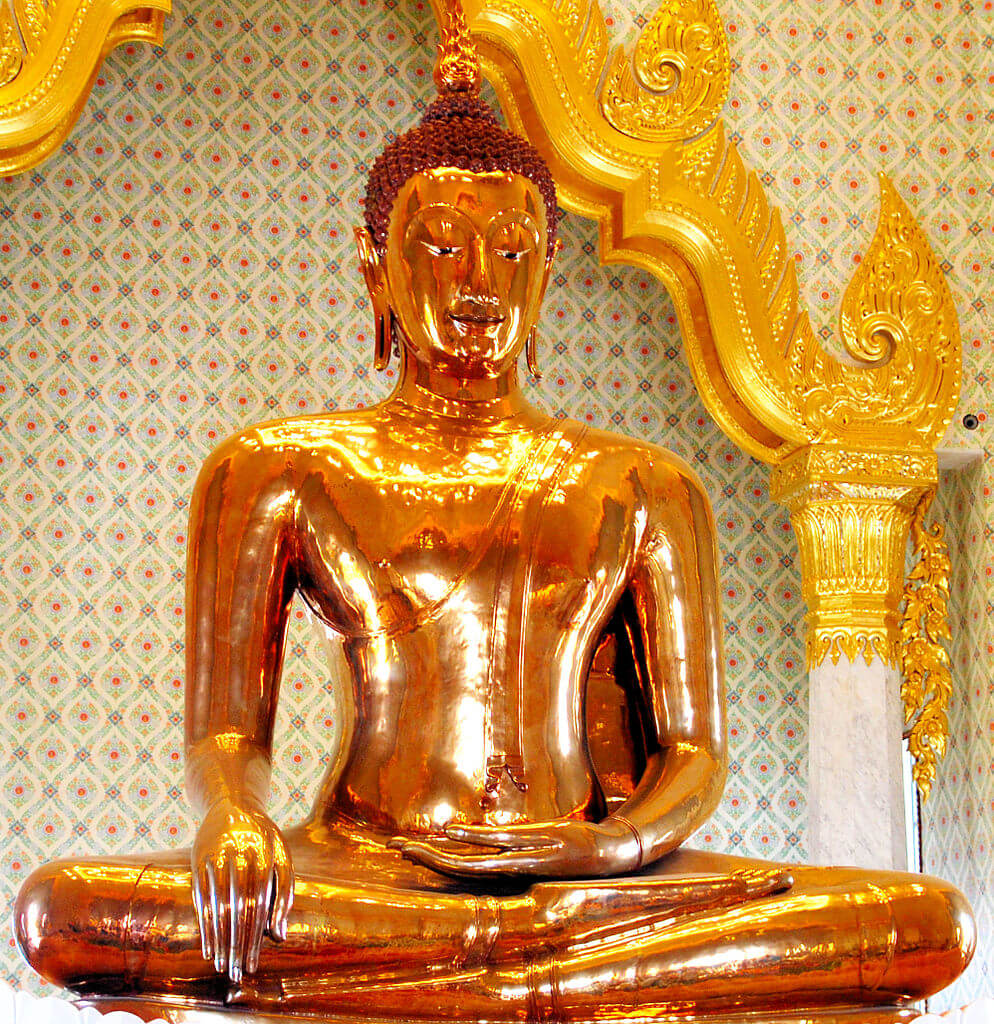
    In the month of May 2007 I was invited to speak at the Mahidol University of Bangkok during the SSEASR Conference. I gave a talk on Yogachara Buddhism there. During this occasion, I had the opportunity to visit various Buddhist temples at Bangkok. They include the magnificent ones like Emerald Buddha, Golden Buddha, Buddha in his Maha nirvana time etc. It is very interesting to note that in the Sanctum Sanctorum of all Buddha temples, while the right side wall is covered with pictures depicting instances in Buddha’s life, the left side has paintings exclusively from Ramayana. For a Thai devotee, Hinduism is as important as Mahayana Buddhism.

    During the visit of one of the temple, I learnt this great truth about ignorance obscuring Reality.

    One of these famous temples has a Buddha icon nearly 17 feet tall, which is known till the beginning of 20th century as “Terracotta Buddha temple” . The temple was established in the 13th century with its huge icon of Buddha, for several centuries it was worshipped by the devotees as “Terracotta Buddha”. One day the authorities decided to shift the Terracotta Buddha image to a place several kilometers away, probably to do some repairs to the temple. They put the Terracotta Buddha on a truck and were moving it. When they were half way through, a heavy downpour started. The rain was so heavy that the clay image of Buddha started dissolving. They tried to protect the image with tarpaulins and umbrellas, but to no effect. There was a very heavy wind which blew away the tarpaulins and umbrellas. Due to the heavy rain, the Buddha icon in clay was dissolving fast. The devotees were grief-stricken. They were wondering whether it would have been wiser to have left the temple un-repaired rather than allowing the centuries old terracotta Buddha icon to get dissolved in the heavy downpour.


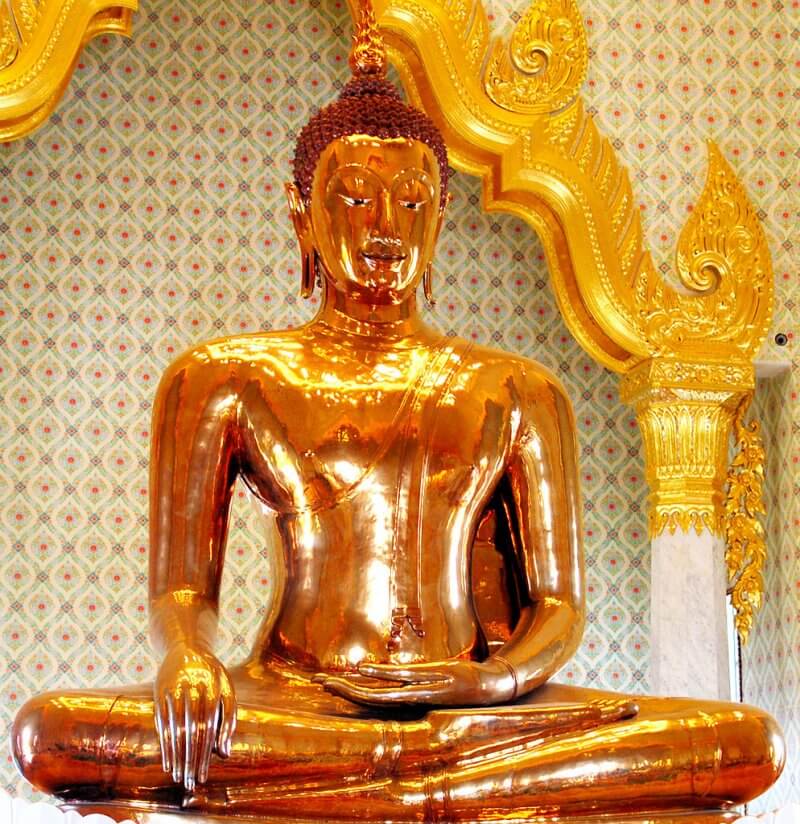
    Presto! A wonderful thing was happening. As the clay was dissolving, from within the clay was emerging a golden Buddha idol! as the idol there was of clay. After a short while all the clay, which was covering the idol got completely dissolved. The people were witnessing the presence of a resplendent “Golden Buddha” appearing before them in all its grandeur.

    What really happened? It was really a golden Buddha at the time of its installation in the 13th century. After some time Thailand was experiencing foreign invasions. Fearing that the invaders would take away the golden image, which was 5.5 tons of solid gold, the devotees covered the image with clay. Thinking that it was only a Terracotta Buddha, the invaders left it untouched. That generation knowing that it was a golden Buddha inside the clay, worshipped Buddha in that form. As many years passed by, the subsequent generations were not aware of this fact. They truly believed in what they saw externally and worshipped it as a Terracotta Buddha only. Thus their minds were conditioned by externalities. Once the clay dissolved what is truly inside came out with all its effulgence. It is today worshipped as the golden Buddha in Bangkok.

    It is happening to all of us everyday, we assume ourselves to be only a body-mind-intellect complex and nothing beyond it. We are conditioned by our awareness of our body, our thinking process and our analysis of the phenomena. These are only externalities within each one of us. It is only a clay that surrounds the wonderful Immanence within us. Within each one of us is the golden Buddha, the great immanent Lord who is also transcendent, he is the great Shiva, who is constantly performing his cosmic dance. In our hearts we not aware of it as our minds are conditioned by what we see, do and think. It is like the Thais seeing only the clay image and concluding it as only terracotta Buddha. As the rain dissolved the clay, the golden icon which is the true-one inside is revealed. Likewise when the spiritual sadhaha and devotion dissolves our mental conditioning, the Lord within ourselves is also revealed. This is the lesson we learn from the Golden Buddha temple.

    The same idea is beautifully explained in Thirumoolar’s Thirumantiram. A sculptor has carved out a beautiful elephant from a block of wood. When you see it as an elephant, you do not see the underlying reality of the wood. When you will be able to see the substratum, the underlying reality of the wood, with which all the objects of carving are made, you do not see the carved elephant; you see the substratum of the wood. Likewise, the ignorance enveloping our minds obscure the ultimate reality within us, when we are graded by the body-mind-intellect complex. When the revelation comes to us through god’s grace and gurus’ teachings coupled with our devotion to Him, the conditioning disappears. The phenomena abide in the ultimate. We experience the Divinity within us.

    Even in the area of management, the story of Golden Buddha has a great relevance. A competent Manager, with a penetrating mind, should be able to see what is the reality hidden in the numerous external information. The external covering only obscures the truth, which you will be able to get through. Once you see the substratum, the ultimate truth is revealed.


    Image Credit: Wikimedia Commons