Tag: Globalisation

  • Globalisation’s Sunset

    Globalisation’s Sunset

    Are we witnessing the end of globalisation and the rise of economic nationalism? Who is responsible for this state of affairs? For many, the villain is clearly the US and its allies in the West. The reason is the rise of China as the world’s manufacturing and technology superpower. China is beating the West at its own game, and the US is shaken by the visible signs of the end of its hegemony and the dominance of the West.  Globalisation is being throttled by the West in a futile attempt to end China’s rise. The result will be catastrophic for the Global South in its aspirations for accelerated development. Former Venezuelan ambassador and Princeton scholar Alfredo Toro Hardy analyses what he sees as the sunset of globalisation.

    Team TPF


    Economic globalisation was the offspring of the neoliberal ideology that prevailed after the collapse of the Soviet Union. The globalisation process took off in the mid-nineties, as was identified by the firm support given to it by leaders such as Bill Clinton and Tony Blair, particularly the former, who commanded the world’s largest economy.
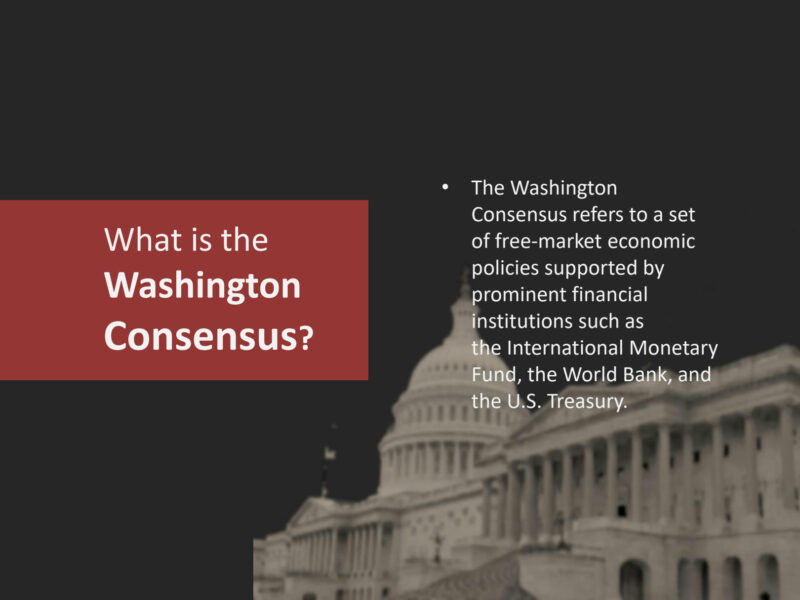
                Its most emblematic expressions would be the Washington Consensus, the creation of the World Trade Organization in 1995, and China’s entry into these organisations in 2001. The first resulted from the convergence of positions between the U.S. Treasury Department and International Financial Organizations based in Washington. It would translate into a ten-point recipe called to set in motion the economic liberalisation of distressed and closed economies, chiefly the previous communist ones. The second involved the global homogenisation of rules in matters as diverse as manufacturing, agriculture, services, labour standards or intellectual property, as well as the abandonment by its members of industrial policies and protectionism. The third represented the insertion into the global labour market of more than a billion human beings whose working costs were but a fraction of those in developed countries. This would be accepted and even promoted by the United States under the assumption that a China open to the world’s economy would eventually open itself to the values of liberal democracy as well.

                The importance of neoliberal ideology, as a determining factor of this process, would be key. As a matter of fact, for a long time the leading force in the world economy, America’s economy, was characterised by its industrial policies, protectionism, and vertical integration of its corporations. The federal government’s industrial policies became a catalyst for economic development, either through direct investments and engagement or through incentives for the private sector to follow a particular course of action. The countless products and services incorporated into the American technological repository resulting from NASA’s R&D efforts exemplify these policies. They still represent the broad shoulders on which the country’s private technological sector stands. Protectionism expressed itself through tariffs and non-tariff barriers to protect domestic production from foreign competition. Vertical integration, on its part, involved direct control by U.S. corporations in their production and distribution channels. Hence, outsourcing did not figure in their strategies. It is worth adding that even President Reagan, despite his deregulatory crusade, supported his country’s industrial policies and imposed protective barriers against Japanese competition (Foroohar, 2022).

    Globalization in question

                For decades, globalisation has represented an unchallenged paradigm. Under its course, China reached the anteroom of world economic supremacy, numerous cheap labour economies, particularly in Asia, emerged strongly, and large corporations relying on the revolutions in information technology, communications and transports outsourced and dispersed their production and services (again mainly in Asia). Actually, it was in the emerging Asian countries where, in nine of every 10 cases, the great beneficiaries of globalisation were concentrated. Moreover, it was estimated that between 2020 and 2030, the global middle class would jump from 3,300 million to 4,900 million people, with 80% of that jump taking place in Asia (Milanovic, 2018, p. 19; OCDE, 2010). However, for some time now, globalisation has been under serious questioning. Among the reasons behind this, the following should be outlined: the emergence of powerful populist movements in the Western World; climate change distortions upon trade and the impact on climate itself, resulting from maritime trade over long distances; and economic and political nationalism in China.

                Populism is, to a large extent, directly related to the immense social upheavals caused by the massive outsourcing of jobs to the cheapest labour economies. In 2000, Clinton predicted that globalisation would allow the export of products without exporting jobs. Exactly the opposite happened, though, seriously affecting the social fabric of the United States and its European counterparts. This significantly eroded their democratic systems. Climate change, with hurricanes, floods, and other incidents, has increased the risk of global supply chains, resulting in annual revenue losses of up to 35% for companies. (McKinsey and Company, 2020).

    Conversely, the massive mobilisation of supertankers worldwide generates up to 14% of the total greenhouse gas emissions affecting the planet. (Prestowitz, 2022). Indeed, “the ultimate buyer [of final products] remained an ocean or a continent away” (O’Neil, 2022, p. 113). In addition, contrary to what American promoters of China’s emergence had suggested, the country’s economic prosperity has led to an increasingly nationalistic and authoritarian model. Far from getting closer to U.S. values, China has emphasised its economic nationalism and geopolitical aggressiveness within the context of a growing rivalry with the United States.

    The triggering elements

                However, even if disappointment with globalisation continued to grow, the triggering elements that would end up clearly tilting the balance against it were still missing. COVID and Russia’s invasion of Ukraine took care of it. Twenty trillion U.S. dollars in goods rely on global supply chains. Especially so as the disaggregation of production translates into millions of components, parts and final manufacturers moving in every direction. (McKinsey and Company, 2020). This vertiginous dissemination of productive processes led to unexpected, sudden, and massive disruptions during the pandemic. As a result, global economic interdependence choked. The endless Zero COVID policy implemented in China, the geographic nerve centre for global trade, exponentially aggravated this situation. The result was none other than inflation that brought to mind the seventies and has not yet been controlled.

                This was joined shortly afterwards by the impact of the invasion of Ukraine by Russia. One that not only disrupted vital energy and food supply chains but fundamentally brought geopolitics back to the global scenario through the main door. As if the emerging Cold War between China and the U.S. had not already been enough to undermine faith in globalisation, events in Ukraine made security the central component of the international order. It was a sort of fall of the Berlin Wall in reverse. One that brought down the relevance of economics and propelled that of politics. Olaf Scholz’s “global zeitenwende” clarified that a new strategic culture and national strategy would become his country’s new priority (Scholtz, 2023). Under such circumstances, placing economic security in distant and potentially hostile hands was no longer a rational option.

    Back to the past
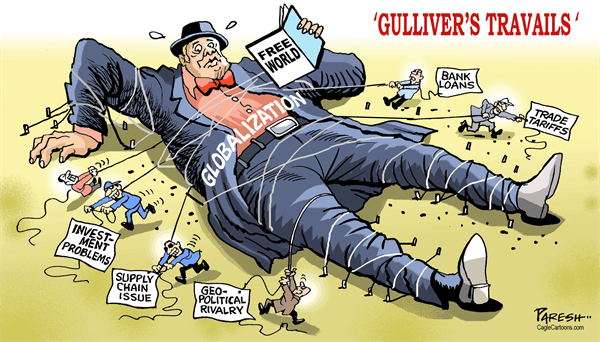
                Not surprisingly, the United States began reverting to policies that preceded globalisation. That is, to industrial policies, to protectionism, and the vertical integration of its corporations. Indeed, before losing the House of Representatives to Republicans in November 2022, Biden’s Democrats passed several laws that embody industrial policies. A perfect example is the so-called energy revolution, with 490 billion dollars being involved in incentives to guide private investment towards generating clean energy sources. It also allowed the federal government to intervene in medicine prices through direct negotiations with the pharmaceutical industry. In the same direction went the laws that stimulated competitiveness and innovation, the superconductors industry, and infrastructural development. In parallel, the “Buy American” policy, subsidies to the domestic industry, and the maintenance of the tariffs imposed by Trump represented an evident protectionist impulse. Meanwhile, American corporations, in tune with these policies and in reaction to the risks of dismembering their production and services on a global scale, are opting for vertical integration and direct control of their activities. This implies, by its very nature, a production centred on the local or the regional.

    Getting back home

                All of the above factors contribute to industries’ onshoring and supply chains. In 2021, of the 709 large U.S. manufacturing corporations consulted, 83% responded that they would very likely or probably return their production operations to the United States. (Ma, 2021). Numerous leading American and foreign corporations are opting to produce in the U.S. to benefit from the new incentives put in motion by the Biden administration. This list includes, among many others, Intel, GM, US Steel, Taiwan Semiconductor Manufacturing (TSMC), Toyota, Samsung and Micron Technology. The amount of their investments, in tens of billions of dollars in many cases, speaks for itself. The motivation behind this impressive move was well reflected in the words of the larger-than-life founder of TSMC, Morris Chang: “Globalization and free trade are almost dead and unlikely to return”. (Cheng, 2022; Doherty and Yardeni, 2022). However, together with this on-shoring move, there are also parallel movements of near-shoring or friendly shoring nature, where manufacturing and supply chains are being circumscribed to neighbours or traditional allies that do not represent a security risk. With the world’s largest economy becoming protectionist, it will be difficult for globalisation to retain its influence, especially as Europe rapidly evolves in the same direction.

    Globalization last hope

                Until recently, an area of globalisation seemed to be relatively protected from these kinds of upheavals: the digital ecosystem. According to a 2016 report, the rapid flows of international trade and finance that characterised the 20th century appear to have flattened (…), yet globalisation has not reversed. Indeed, digital flows are growing very quickly.” (McKinsey Global Institute 2016). However, a few months ago, Brookings published a highly pessimistic report regarding the future of this sector. According to it: “Historically, the arrival of the global web created an opportunity for the interconnection of the world under a global digital ecosystem. However, mistrust between nations has led to the emergence of digital barriers, which imply their focus on controlling their digital sovereignty (…). These developments threaten current forms of interconnectivity, causing high-tech markets to fragment and retract, to varying degrees, upon national states”. (Brookings, 2022). Thus, the last sector of globalisation, which still showed significant dynamism, is also reversing under the impact of geopolitics. Globalisation, no doubt about it, seems to be experiencing sunset.


    References

    Brookings (2022). “The geopolitics of AI and the rise of digital sovereignty”, December 8.

    Cheng, Ting Fang (2022). “TSMC founder Morris Chang says globalization is ‘almost dead’, Nikkei, December 7.

    Doherty, J. and Yardeni, E. (2022). “Onshoring: Back to the USA”, Predicting the Markets, February 5.

    Foroohar, Rana (2022). Homecoming. New York: Crown.

    Ma, Cathy (2021). “83% of North American Manufacturers are Likely to Reshore Their Supply Chains”, Thomas, June 30.

    McKinsey & Company (2020). “Could climate change become the weak link in your supply chain”, August 6.

    McKinsey Global Institute (2016). “Digital Globalization: The New Era of Global Flows”, March.

    Milanovic, Branko (2018). Global Inequality. Cambridge, Mass.: The Belknap Press of Harvard University Press.

    OCDE (2010). “The Emerging Middle Class in Developing Countries”, Working Paper Number 285.

    O’Neil, Shannon K. (2022). The Globalization Myth. New Haven: Yale University Press.

    Prestowitz, Clyde (2022). “Is the U.S. Moving Out from Free Trade? Industrial Policy Comes Full Circle”, Clyde’s Newsletter, December 12.

    Scholz, Olaf (2023). “The Global Zeitenwende”. Foreign Affairs, January/February.


    Feature Image Credit: worldcrunch.com (Globalization as Ideology is Dead and Buried).

    Image Credit: Gulliver’s Travails (Paresh Nath, The Khaleej Times, UAE) www.uncommonthoughts.com
  • From Global Democratisation to the Battle of World Powers? Contradictory Developments in the Present

    From Global Democratisation to the Battle of World Powers? Contradictory Developments in the Present

    Shortly after the democratic revolutions of 1989-1991, Francis Fukuyama wrote his highly influential essay on the end of history- that is, the end of violent history through global democratization.

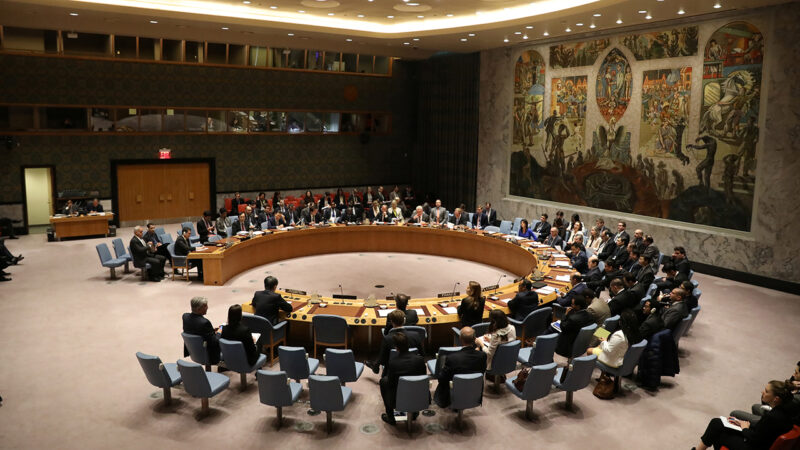
    Members of the United Nations Security Council sit during a meeting on Syria at the United Nations Headquarters in New York City, NY, U.S. April 5, 2017. REUTERS/Shannon Stapleton – RC141DE9DE00. Image credit: world101.cfr.org

    The world has changed so dramatically since the end of the Cold War that it is necessary to look back in order to understand today’s global political situation. In total, there are five different discourses that will be discussed here as representative of historical developments. They range from Fukuyama’s thesis of global democratization to various versions of coming anarchy and global (“new”) civil wars (Kaplan, Kagan, Kaldor, Münkler), Huntington’s clash of civilizations, the concept of global governance and the “rise of the others” (Zakaria, Zhang), a multipolar world of nation-states, and the re-nationalization of world politics. My central thesis is that all five discourses are present in contemporary political conflicts and that we cannot neglect any of them.

    But if you look at the history of democracy, you can almost discover a law of motion of democratic revolutions based on Hannah Arendt’s analysis of the French Revolution. It starts with a democratic revolt against a dictator or colonial rule. Then the revolutionaries become radicalized, civil war breaks out, a new, this time totalitarian ruler takes power, and only after his overthrow does democracy prevail.

    Shortly after the democratic revolutions of 1989-1991, Francis Fukuyama wrote his highly influential essay on the end of history- that is, the end of violent history through global democratization. And his thoughts were very timely. What better confirmation could there be when, in just a few years, the old dictatorships from Berlin to Vladivostok, which only called themselves communist but were not, but rather geriocracies, were swept away in a wave of democratisation. The Arab Spring seemed to confirm his thoughts, as here, too, long-standing dictatorships were overrun by democratic movements virtually overnight, as in Egypt and Tunisia. But even then, there were counter-movements that contradicted the assumed linear process of global democratization. Fukuyama, therefore, had to defend his original thesis and argue that, despite all the setbacks, democracy was still at the end of history. In a way, he was echoing Hannah Arendt’s theory of revolution. The reverses of democratization in Russia, many Arab countries, and the global civil wars have often been cited as cultural – Russia, China, and Middle Eastern Islam were still too culturally authoritarian to allow for genuine democratization. But if you look at the history of democracy, you can almost discover a law of motion of democratic revolutions based on Hannah Arendt’s analysis of the French Revolution. It starts with a democratic revolt against a dictator or colonial rule. Then the revolutionaries become radicalized, civil war breaks out, a new, this time totalitarian ruler takes power, and only after his overthrow does democracy prevail. The French overthrew their king and got the emperor, Napoleon; the Russians revolted against the czar and got Stalin; the Chinese fought against their emperor and got Mao Tse-tung; the Germans overthrew their emperor after their military defeat and got the leader Adolf Hitler. Resistance to colonial rule also often followed this law of democratic movement: the colonial rulers were driven out and replaced by new rulers.

    In the same year that the Soviet Union collapsed, the terrible civil wars in the former Yugoslavia began, the first Chechen war, followed by countless “markets of violence” and so-called new wars, which in a narrower sense were new civil wars and wars of state collapse. Mass rape became a weapon of war to demoralize the enemy, and an almost complete dissolution of the boundaries of violence took on a life of its own, seeming to make any rational resolution of conflicts impossible. Warlords, drug lords, terrorists, child soldiers, and “archaic” warriors who seemed to belong to the past dominated warfare worldwide. Against this backdrop, Western armies were transformed into intervention armies that were supposed to maintain a minimum of order on the borders of the U.S. “liberal empire” in order to prevent global anarchy (Robert Kaplan) or a “world civil war” (Enzensberger) – at least according to Western discourse. From the perspective of the countries affected by these wars of intervention, however, they were wars to maintain their immediate exploitation (especially in Africa), to keep corrupt regimes that collaborated with Western states alive (Arabian Peninsula), or to eliminate those that opposed the West (Iraq, Iran, Afghanistan). In the open spaces of violence and violent markets, high-value illegal goods were traded: Drugs, blood diamonds, human beings (women and child slaves), weapons and rare earths.

    Linked to these wars of intervention was the apparent cultural triumph of the West, which is associated with the term globalisation, but was, in fact, initially an Americanization, the so-called McDonaldization or Mac World. However, this cultural globalization of the American way of life, combined with U.S. wars of intervention, led to a backlash as many societies saw their cultural identity threatened. Taken together, these two factors triggered Samuel Huntington’s concept of the clash of civilizations.

    In their liberal hubris, his Western critics argued that there could be no clash of civilizations because only the West had produced a civilization – the others were religions or cultures, but not civilizations.

     His book has often been misunderstood as a guide to action for the coming war – but in fact, he had written the book to prevent that clash, and he argued for the U.S. to withdraw from small wars around the world because he saw the liberal identity of the U.S. at risk. Perhaps more importantly, he saw non-Western religions not just as cultures but as civilizations that had grown out of their respective religions. In their liberal hubris, his Western critics argued that there could be no clash of civilizations because only the West had produced a civilization – the others were religions or cultures, but not civilizations.

    While globalization initially had the effect of Americanization, in the medium term, it facilitated the “rise of the others” (Zakaria), the great empires and civilizations that had perished under European colonization and Euro-American hegemony. As a result of their initial economic success (Malaysia, Singapore, the Asian Tigers, China, India, the Pacific Rim countries), they no longer sought to imitate Western culture in order to be recognized as equals, but to develop their own identity, which they considered superior to the West. From the point of view of Western discourse, the “others” were, at best, immature children or barbarians – now the West suddenly sees itself in the role of other civilizations, seeing themselves as superior to the West. One expression of this changed self-image was Zahng Weiwei’s book China – The Civilizational State. We are now experiencing a paradoxical situation in which the West is consumed by fear of decline and the dissolution of its own sense of superiority, leading to the rise of right-wing populist and radical right-wing movements; large parts of the Asian world population are filled with hope for a better life, and the Islamic-Arab world is desperate in the face of unfulfilled promises, leading to the radicalization of young people in Islamist movements.

    The concept of global governance was invented at the beginning of the 21st century as a reaction to advancing globalization. The assumption, correct in itself, was that the absence of a democratic world state did not necessarily mean that there was no possibility of at least regulating global problems, subjecting them to rules, if not solving them. Global governance was based on the idea of cooperation between nation-states, non-governmental organizations, globally active institutions, the emerging global civil society, globally active corporations, and global players. However, the resurgence of big states has pushed global governance into the background, just like globalization itself. Some states want to reverse globalization, at least in the economic and political spheres. This applies at least to Western democracies, whose citizens often see themselves as the losers of globalization.

    The relative loss of importance of the Western states and the institutions they helped to create, such as the U.N., cannot be overlooked – the overstretched role of the U.S. as the world’s policeman is due, on the one hand, to its own lack of investment in development and education, and on the other to the rise of others.

    What we are currently experiencing is not simply a multipolar world of great powers, even if there are signs of a renaissance of great power politics. Instead, we are witnessing a contradictory process of the five discourses alluded to here: Democratization, failed states, the clash of civilizations, further globalization, and the renaissance of great power politics. The still existing, but also partly former, Global South is still dependent on cooperation, even if new forms of cooperation are emerging, such as the expansion of the BRICS, which compete politically but cooperate economically. The relative loss of importance of the Western states and the institutions they helped to create, such as the U.N., cannot be overlooked – the overstretched role of the U.S. as the world’s policeman is due, on the one hand, to its own lack of investment in development and education, and on the other to the rise of others. What remains unpredictable is whether the emerging states of the Global South and the former superpower Russia will make the same mistake as the West in its centuries-long quest for hegemony, namely, to see itself as superior to all others. Eurocentrism would be replaced by an equally problematic ethnocentrism, and a nationalist dynamic would be set in motion that would be difficult for states to control. Even if all current developments point to the contrary and we see a return of tribalism in the form of “us versus them – whoever the others are” discourses, the only option left is to revive intercultural dialogue if we do not want to experience “another bloody century” (Colin S. Gray).


    Feature Image Credit: chinausfocus.com

  • Mankind as a wholeness – we must comprehend ourselves as a unity in order to survive

    Mankind as a wholeness – we must comprehend ourselves as a unity in order to survive

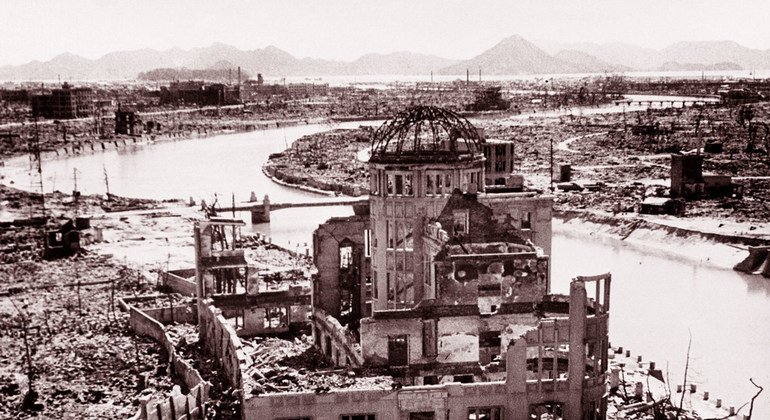
    One might think that mankind has not changed for millennia – we are still antiquated, as Günther Anders had pointed out after his visit to Hiroshima shortly after the atomic bombing. Basically, Anders argued that technical-industrial possibilities have rushed far ahead of comprehension and our moral responsibility – as evidenced in the use of nuclear power, the possibility of self-destruction of humanity during the nuclear arms race (especially in 1983), which was partly prevented only by chance, genetic engineering, and medical possibilities at the beginning and end of life. Add to this climate change and obscene inequality throughout the world.


    Looking at the current explosions of violence on the macro level (Ukraine, Syria, new arms race between the great powers) as well as on the micro level (for example in Central America the Maras) one might think that mankind has not changed for millennia – we are still antiquated, as Günther Anders had pointed out after his visit to Hiroshima shortly after the atomic bombing. Basically, Anders argued that technical-industrial possibilities have rushed far ahead of comprehension and our moral responsibility – as evidenced in the use of nuclear power, the possibility of self-destruction of humanity during the nuclear arms race (especially in 1983), which was partly prevented only by chance, genetic engineering, and medical possibilities at the beginning and end of life. Add to this climate change and obscene inequality throughout the world, we must ask ourselves who we are as humans? How can we explain to our children and grandchildren what we have done for them – or more importantly, not done? Statistically, however, we are living in the most peaceful age in human history to date. The present dominance of the violence topic, of fears and despair as world-politically effective emotions can therefore be a question of the increased and partly medially staged perception – or nevertheless a real setback.  But also, here it could be true that mainly our terms and conceptions are put to the test. For such setbacks primarily question the idea of the linearity of progress, not necessarily progress itself. If we assume the models of a linear ascending progress as in the Enlightenment or in Kant or an equally linear pure history of decay, we cannot integrate contrary developments into our world view – and every contrary development calls the whole model into question. In contrast, models of history based on a cycle (Greek Stoa, Hinduism) are able to capture the constant in change but can only imperfectly explain progress at the societal level. The historical model of a Machiavelli, on the other hand, includes change, but change is always repeated and can best be compared to a sine curve.

    The argument about models of history is by no means abstract, as it appears at first sight. The Marxists as well as Leninists and finally the Stalinists have pursued radical politics with the linear model of progress, just as the idea of the thousand-year Reich had influence on the politics of the National Socialists. Are there alternative models beyond pure decay, equally linear progress, or the assumption that humans do not change after all, or lag behind their technological capabilities in moral and spiritual terms?

    Models for Understanding History – G W F Hegel

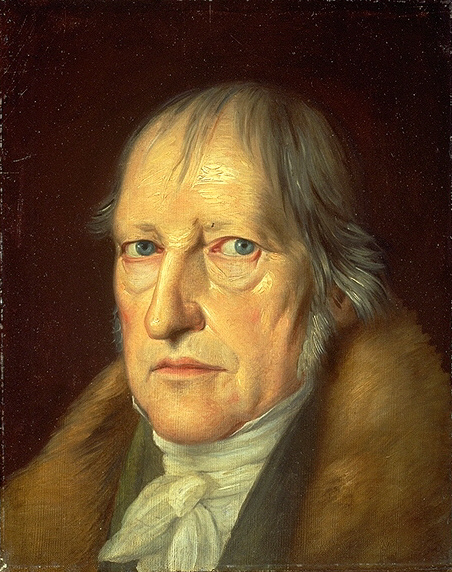
    These positions are not unfounded – however, their absolutization is wrong. As in various psychological (Piaget and Kohlberg) and sociological (Auguste Comte) approaches, the German philosopher Georg W.F. Hegel starts from a stage model in which he develops a progress of world history in the consciousness of freedom. Despite his own Eurocentrism, stage models are in principle capable of countering a pure binary opposition of affirmation or negation of progress in human history. They also do not imply an absolutely inevitable development, as can be seen from the fact that Kohlberg, for example, does not assume that all people reach the highest level, but emphasizes, like all stage theorists, that one cannot skip any of the stages. But Hegel was just not in the tradition of the Enlightenment and Kant, who assumed a linear model of progress, but developed a dialectical sequence of stages, which in my interpretation could best be compared to a sine curve (as in Machiavelli) but erected on an ascending x-axis. In such a model, we can think of the Enlightenment’s idea of progress (in the ascending x-axis) as well as cyclical developments (Machiavelli) of rise and fall, progress, and regress in world history together.

    In this model developed by the author, there is progress, but it is not linear, but itself cyclical. We know such cycles from the business cycle theories in the wake of Kondratieff’s research or also from hegemonic cycles. In contrast to these theoretical approaches, the model of history advocated here is related to a (more or less) slightly ascending x-axis and is derived from Hegel’s conception of becoming at the beginning of his monumental work on the “Science of Logic”, since coming into being and passing away are not completely cancelled out, but a “surplus” arises which goes beyond the infinite coming into being and passing away.  Such a model is on the one hand closed (with respect to the high and low points on the Y-axis), at the same time open on the X-axis and develops “between” its high and low points.

    Hegel’s stage model has itself been a great historical advance; at the same time, we need to go beyond Hegel to overcome his tendency of constructing a systematic closure (which was then taken as an absolute by Marx in a perfect society of communism) in favour of an approach that is at once closed and open. Despite his Eurocentric reductions, Hegel develops a systematic development of the idea of freedom. In his sequence of stages, human history begins with the development of states in which at first only one was free – the ruler, mostly in the figure of the priest-king, who symbolizes the laws of the gods and rule. Still with Plato we find the construction of the philosopher, who must be at the same time king and vice versa. This all-surpassing freedom of the priest-kings is clearly found for Hegel in the pyramids of Egypt. Hegel calls this phase the infancy of history. Greek antiquity, and here especially the city of Athens, is for him the adolescence of world history – the first individualities are formed. The aesthetics of the Greek statues symbolize for him this phase, in which man understands himself as free, when he professes his free polis. In a certain sense, this phase can be understood as that of the aristocracy, because Athens symbolizes the beginning of democracy, but of the approximately 200,000 inhabitants, only about 30,000 were free – slaves, women and metics (“strangers”) were excluded from freedom.

    The focus is no longer on the individual, but on the supra-individual law. Even today, the study of law begins with Roman law (e.g., in dubio pro reo or nulla poene sine lege). Of course, not only Hegel’s choice of words is problematic (e.g., that of “oriental despotism” as the beginning of world history), but also the identification of the fourth stage with the “Germanic period” as the “goal of world history.”

    For Hegel, the manhood of world history is that of the Roman Empire. Here, not the individual but the state has become the supreme purpose and Roman law is developed. The focus is no longer on the individual, but on the supra-individual law. Even today, the study of law begins with Roman law (e.g., in dubio pro reo or nulla poene sine lege). Of course, not only Hegel’s choice of words is problematic (e.g., that of “oriental despotism” as the beginning of world history), but also the identification of the fourth stage with the “Germanic period” as the “goal of world history.” Nevertheless, his characterization is noteworthy. In this stage the state is ordered according to reasonable principles, the individual is completely free because he lives in a reasonable society whose laws he recognizes and to which he can refer. Community and individual are reconciled, the ups and downs of world history (as illustrated in the sine curve) seem to have come to their end and now the real history of mankind begins, a happy time.

    Of course, we know that this was not so, as Hegel assumed – the violent conquest of the world in colonial times, two world wars, Auschwitz, and Hiroshima, the almost self-destruction of mankind in the cold war, all this was still to come. But is Hegel thereby refuting? Or can and perhaps must we continue Hegel?

    Differences to Hegel

     In contrast to Hegel’s conception of world history as a progress in the consciousness of freedom, I argue that this development is a progress in the consciousness and practices of humanity to be a wholenessness. Hereby, I no longer foreground Kant’s four questions concerning the individual human being or even an “I”, but rather transform them into who is humanity, what should we do as humanity, what can we know and hope as humanity? The concept of humanity contains the single individual, but this goes beyond the generalization of the individual as in Kant’s categorical imperative. Also, here the old sentence of Aristotle is valid that the whole is more than the sum of the parts – and so I would like to add, mankind as a wholeness is more than the accumulation of at present over 7.8 billion people. At the same time, humanity is realized in individual human beings; there is no humanity without individual human beings.

    According to the “Out of Africa thesis,” the genus Homo originated in Africa and spread from there to all continents. One of these groups, immodestly calling itself homo sapiens, has not only outlasted all other human species, but has populated even the most distant tip of this earth, moreover, is making its way to other planets of our solar system. Arnold Gehlen’s determination of man (as also already Aristotle) as imperfect, forces mankind to develop more and more. During this time of spreading over the whole planet, however, the individual groups lost contact with each other, because this lasted for millennia and the distances became too great for the time to bridge in shorter periods of time – they became estranged from each other and lived in isolated cultural islands (for example in China, India, in Africa south of the Sahara, the two Americas or also in the more European part of Eurasia as well as in West Asia). With the increasing spread of these initially isolated cultural islands, they came back into contact with each other – which turned out to be peaceful or sometimes warlike. Huntington’s thesis that these contacts were mainly violent underestimates the mutual cultural influences and learning processes. Globalization since European colonization brought humanity into ever closer contact with each other and made it possible for the first time to think of humanity as a wholeness.

     Of course, the setbacks and low blows must not be forgotten – the wars between the great empires, the almost perpetual state of war at the edges of these empires, colonialism, Islamic and Atlantic slavery, racism, two world wars and Auschwitz as a sign of history – but in the end they confirmed the dictum of Goethe and, derived from this, systematized by Hegel as the cunning of history. This is a part of that force which always wills evil and yet creates good. This does not mean to relativize the suffering of countless people. But perhaps we must differentiate and not already take the ideals of the Enlightenment at face value. For this was not only compatible with racism, colonialism, and slavery, two world wars and the Cold War – according to Zygmunt Bauman, these were even direct consequences of a one-sided Enlightenment.

    There is currently a worldwide biologisation of the social in the form of ethnicities, gender antagonisms, nationalism and tribalism (Make America great again by Donald Trump, the Chinese Dream by President Xi Jinping, New Russia by Vladimir Putin, Salafism, right-wing nationalist movements in Europe).

    If, on the other hand, we assume that the impulse of the realization of human rights could actually only fully develop after World War II and the Holocaust, and included all people, not just one’s own ethnic, cultural, or religious group, we are only at the beginning of the realization of human rights. Again, while it is true that there are setbacks at present – in the form of a discourse of “We against the Rest,” the current replacement of global governance by a renationalisation of world politics, the return of tribal thinking to cope with the demands of globalization, this is not the whole picture. It is also true that globalized liquid modernity (Bauman) is leading to the dissolution of all traditional identities including patriarchy as well as consumerism and many states and nations are updating ancient identities because they trust them to outdo even this accelerated transformation, There is currently a worldwide biologisation of the social in the form of ethnicities, gender antagonisms, nationalism and tribalism (Make America great again by Donald Trump, the Chinese Dream by President Xi Jinping, New Russia by Vladimir Putin, Salafism, right-wing nationalist movements in Europe). Nevertheless, while we are simultaneously witnessing the (often violent) dissolution of the old world, we are also experiencing the birth pangs of a new world. After the West defeated the rest of the world in the 19th century, colonised or submerged peoples and civilizations in the 20th century had to learn to live with the victorious West. In the 21st century, the world’s civilizations must finally learn to live with each other.

    In the 1990s, Samuel P. Huntington put forward the much-publicised thesis that the cold war between the ideologically opposed superpowers would be replaced by a similar contest between the world’s civilizations and their respective core states (Russia, India, China, the United States). On the surface, Huntington received more criticism than approval. A closer reading of his approach reveals that he had not drawn up an instruction manual for the “clash of civilizations,” but had formulated a warning to avoid it. The liberal critics, however, emphasized in particular that not only should there not be a clash of civilizations, but also that there could not be, because there was only one civilization in the world, the Western one. The other civilizations mentioned by Huntington are determined by different religions and cultures, but they would not be civilizations. In contrast, the “clash of civilizations” involves a conflict, but the implicit recognition that civilizations other than the Western one exists at all.

    In the 21st century, the world’s civilizations must finally learn to live with each other.

    This recognition of a limited plurality of civilizations makes possible for the first time the thinking, experiencing, and acting of humanity as a wholenessness. In such a wholenessness, opposites, conflicts and even wars are conceivable – from a sociological perspective, conflicts are not opposed to a socialization of humanity (sociology of conflict in the wake of Tönnies and Simmel), even if these bring much suffering with them.  All high religions that emerged between the 7th century B.C. (Judaism, Confucianism, Buddhism, Hinduism, Christianity) and the 7th century A.D. (Islam) formulate an overcoming and renunciation of infinite suffering. This ethicization of transcendence (Jaspers) or also of immanence (Confucianism) contains in its core a perspective of the abolition of suffering, which can be overcome either in transcendence or, with appropriate conduct of life, already in immanence. Suffering, war, and violence are thus no longer accepted as “natural”, but an attempt is made to leave them behind. Although in Hinduism the cycle (symbolized in the wheel) is emphasized – but the goal of life in the different rebirths consists in overcoming this cycle. Therefore, a core message of Hinduism is the statement that the end is good – but if it is not good, it is not the end. While in the “nature religions” like also the Egyptian mythology, before the emergence of these high religions the transcendence was only a mirror of the earthly life, this is explained now to be absolute good – connected with the perspective to orientate the own life at this construction.

    in Hinduism the cycle (symbolized in the wheel) is emphasized – but the goal of life in the different rebirths consists in overcoming this cycle. Therefore, a core message of Hinduism is the statement that the end is good – but if it is not good, it is not the end.

    Here it should not be concealed that this ethicization of the transcendent as well as of immanence can be and has been used to legitimize violence – in direct inversion to Goethe and Hegel we have to acknowledge that the absolutization of the good has also contributed to the legitimization of war and violence in the form: “this is a part of that force which always wants the good and yet creates evil” (Herberg-Rothe). In contrast to positions that attribute the positive sides of religions only to these themselves, the negative ones exclusively to the respective social, political, cultural, and historical circumstances, I assume that the absolutization of the respective ideas contains a tendency to violence. After the western modernity had written the generalization of the presupposed individual on the flags, a new balance of the individual and the communality is to be constructed for a dialogue of the civilizations, which contains at the same time their further development.

    Mankind understood in this way does not include a pure juxtaposition in the sense of a diversity of the civilizations of the world, as this is laid out – despite all remarkable insights – in the conception of a multiplex world or a Global International Relations Theory (Global IRT), both by Amitav Acharya, which is connected only by communication. The conceptions of diversity also do not go beyond mere multiplicity. All these conceptions in the wake of the French post-structuralisms have their strength in the critique as well as overcoming of totalitarian and authoritarian social relations or system constraints and discourses of power. However, since their own approach excludes borders per se, they cannot include any border of their respective approach. Diversity is wonderful and colourful – also the questioning and de-construction of the “normal” following Foucault has been an essential progress, just as tolerance is a moral value to be demanded always. The question, however, is where the limits of tolerance are – we should be far less tolerant of human rights violations, even if the understanding of human rights remains contested in different “cultures.”

    Conclusion

    From Thomas Hobbes we have learned that unlimited freedom leads to war of all against all, civil war.  Freedom must therefore be limited in order to enable people to live together peacefully. But how can freedom be meaningfully limited without oppressing people? Kant’s solution, that my freedom ends where the freedom of the other begins, is a nice metaphor, but far from adequate when two or more parties lay claim to the same good in the broadest sense.  The idea that it is not an oppression of freedom if it is limited only by the freedom of the other is a pure illusion. Even if in the wars and civil wars of the present, the refugee movements and in the worldwide slums, a human life seems to count for little, it must be maintained that all human beings have the same human rights, they are equally endowed with dignity and conscience. Freedom thus finds its limits not primarily in the freedom of others, but, since it is not an abstract freedom, rather one of human beings – thus in their fundamental equality as human beings and thus human rights. Following Hannah Arendt, one can say that freedom does not consist in arbitrariness, but in the right to be different from others. The path of humanity is shown here as self-preservation based in our equality and self-transgression in the freedom to differ from other humans. Such an understanding of the equality of us all as humans seem to contradict all current developments and appears as a kind of wishful thinking. But it is perhaps not just an idea of a better future, but the question how mankind could see itself as a wholeness in order to survive.


    References:

    Acharya, Amitav and Barry Buzan (ed.). Non-Western International Relations Theory: Perspectives on and beyond Asia. New York: Routledge, 2010.

    Anders, Gunther; Christopher John Muller. Prometheanism: technology, digital culture, and human obsolescence. London: Rowman & Littlefield International Ltd., 2016.

    Arendt, Hannah; Danielle Allen and Margaret Canovan. The Human Condition. Chicago: The University of Chicago Press, 2018.

    Arendt, Hannah and Anne Applebaum. The Origins of Totalitarianism. Harcourt: Brace & co, 1951.

    Bauman, Zygment. Modernity and the Holocaust. New York: Cornell University Press, 2000.

    Bauman, Zygment. Born Liquid. Polity Press, 2018.

    Comte, Auguste and Harriet Martineau. The Positive Philosophy of Auguste Comte: Freely translated and condensed by Harriet Martineau. New York: C. Blanchard, 1858.

    Gehlen, Arnold. Man, his Nature and Place in the World. New York: Columbia University Press, 1988.

    Hobbes, Thomas. Leviathan. London: Andrew Crooke, 1651.

    Huntington, Samuel P. The Clash of Civilizations and the Remaking of World Order. New York: Simon & Schuster, 1996.

    Kant, Immanuel; J M D Meiklejohn. Critique of Pure Reason: Tr. from German of Immanuel Kant. London: Bell, 1881.

    Machiavelli, Niccolo. Discourses. S. I.: Open Road Media, 2020. Internet.

    Magen, Nathan H. The Kondratieff Waves. New York: Praeger, 987.

    Marx, Karl and Friedrich Engels; David McLellen. Communist Manifesto. Oxford University Press, 1992.

    Shuman James B., and David Rosenau. The Kondratieff Wave by James B. Shuman and David Rosenau.New York: World Pub, 1972.

    Tonnies, Ferdinand; edited by Jose Harris. Ferdinand Tonnies: Community and Society. Cambridge; Cambridge University Press, 2001.


    Feature Image Credit: NDTV