Introduction
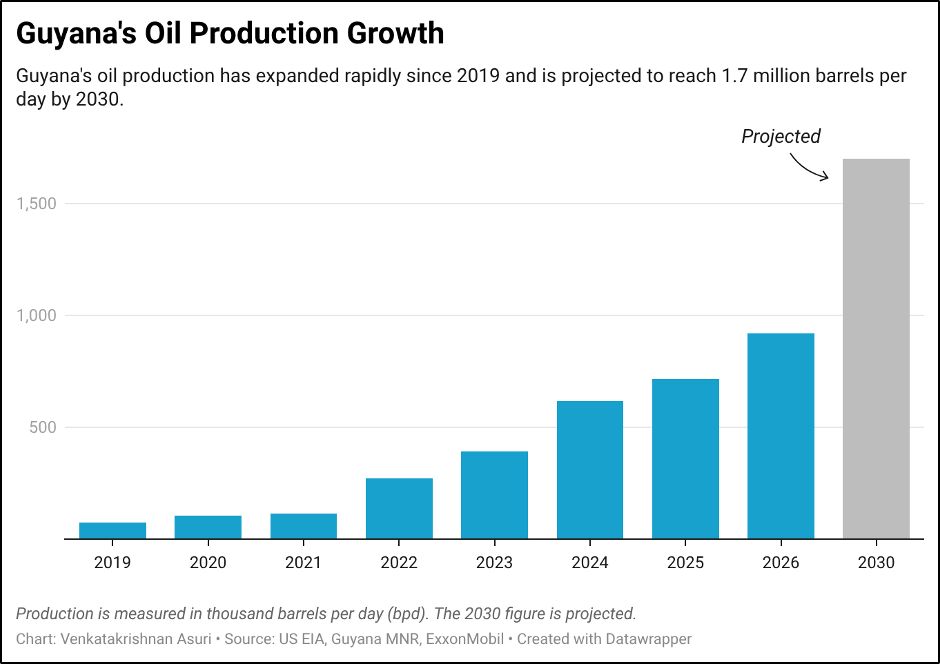
In just five years after oil production began, Guyana has become the world’s largest per-capita oil producer and South America’s second-largest supplier of crude. Daily output now stands at ~926,000 barrels, with recoverable reserves exceeding 11 billion barrels in the Stabroek Block alone. Guyana has recorded a GDP growth of 43.6 per cent in 2024, one of the fastest rates globally. The former British colony has very rapidly transitioned from being a peripheral Caribbean economy to a strategically significant energy producer. This has attracted growing attention from both the United States and China, both seeking to secure economic, political and strategic influence in the world’s newest petro state. The manner in which Georgetown navigates and hedges against great-power competition over its resources shall determine whether its oil wealth translates into prosperity or succumbs to the familiar resource curse.
The Energy Architecture
Guyana’s transition has been remarkably rapid, with commercial oil production commencing in December 2019, within five years after ExxonMobil’s discovery in 2015. The Stabroek consortium, comprising ExxonMobil (45 per cent), Chevron (30 per cent) and China National Offshore Oil Corporation (CNOOC) (25 per cent), has invested billions in developing Guyana’s offshore resources. CNOOC alone has committed approximately $17.7 billion across six projects, making Guyana the company’s largest overseas investment. ExxonMobil projects production to reach 1.7 million barrels per day by 2030, placing Guyana among the world’s major non-OPEC producers.
Guyana’s energy strategy also goes beyond crude extraction. The Guyanese government is pursuing downstream industrialisation through the $2 billion Gas-to-Energy project, which will transport offshore natural gas to a 300-megawatt power plant at Wales. Supported by a $526 million loan from the US Export-Import Bank, it aims to reduce electricity costs and support the development of a domestic manufacturing base. The participation of companies such as TotalEnergies, QatarEnergy and Petronas indicates efforts to broaden the investor base beyond the Stabroek consortium. At the same time, the continued political consensus around the original Stabroek production-sharing agreement between the Guyanese government and the Stabroek consortium has provided a degree of policy predictability through the 2030s.
Washington’s Role
The United States has moved quickly to leverage Guyana’s newfound energy boom into a broader strategic partnership. In March 2026, US Energy Secretary Chris Wright met President Irfaan Ali ahead of the inaugural Shield of the Americas Summit, describing Guyana as “a huge part of this strategy, a very well-governed country with great energy resources”. The summit established the Americas Counter-Cartel Coalition, including Georgetown among a select group of participating Caribbean states. While it has been officially framed as a counter-transnational crime initiative, the initiative reflects broader US efforts to strengthen its security presence in the Caribbean and refocus attention on the Western hemisphere.
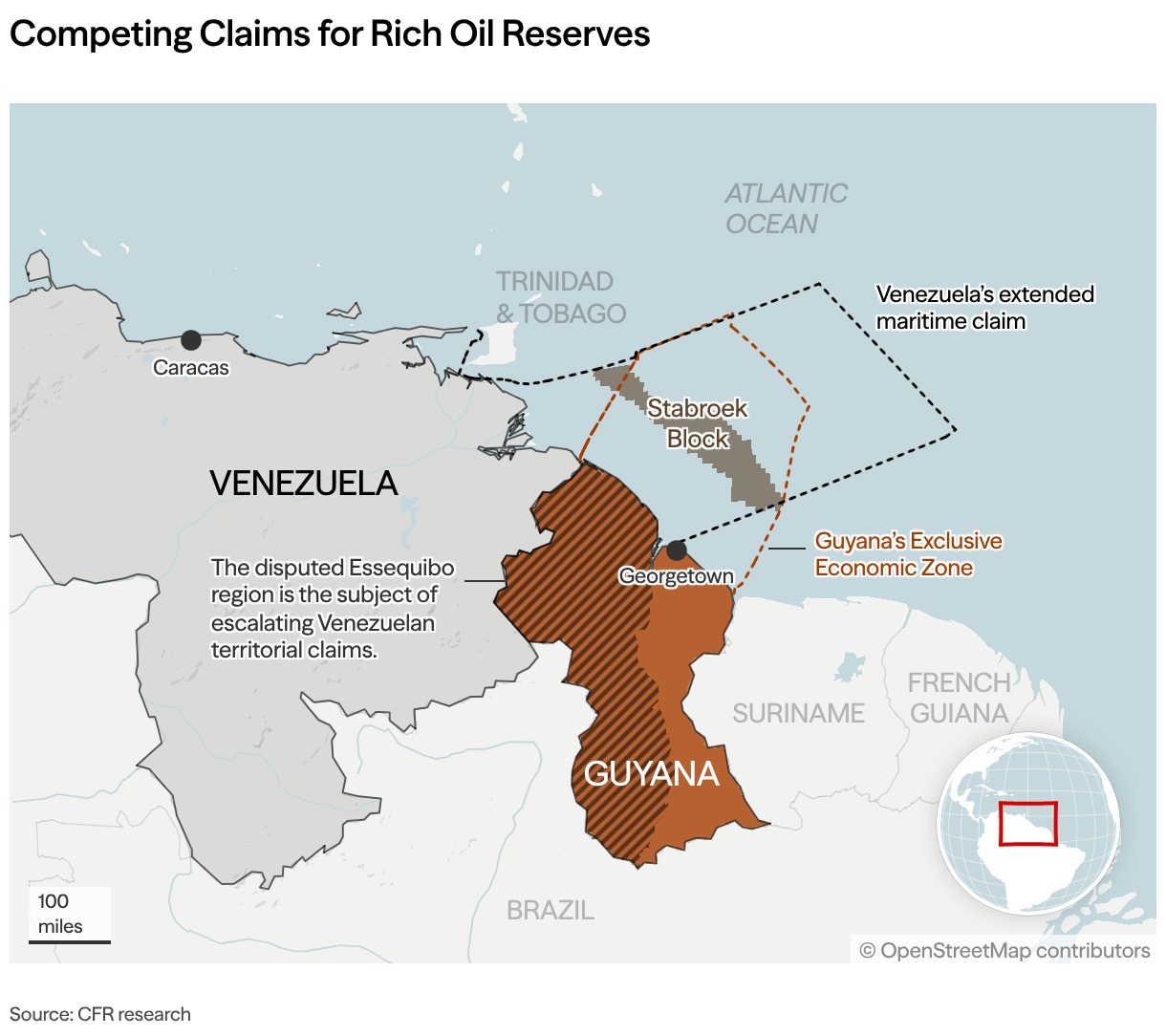
US engagement has also deepened militarily, with the USS Normandy and USS Mahan conducting exercises with the Guyana Defence Force (GDF) in 2025, while US Army Security Force Assistance Brigades have trained GDF units in jungle warfare and engineering since 2022. Washington has also supported the development of coast guard facilities and communications infrastructure, aiming to strengthen Guyana’s security amid continuing tensions over the Essequibo dispute with neighbouring Venezuela. The growing American footprint in Guyana is visible in the consolidation of Washington’s economic and strategic presence across Guyana’s energy, infrastructure and security sectors. Guyana’s strategic value to Washington also lies in its geography, where a sustained American presence in Georgetown helps shape the trajectory of a post-Maduro Venezuela, particularly as the question of whether Caracas drifts back into Beijing’s or Moscow’s orbit remains unresolved through the medium term.
Beijing’s Parallel Track
China’s presence in Guyana differs in scope and character. CNOOC is a passive financial partner in the Stabroek block, earning returns from a basin operated primarily by US energy companies. However, CNOOC has leveraged this expertise, earning secure production-sharing contracts for two offshore blocks in Trinidad and Tobago, citing its experience in Guyana.
For Georgetown, Beijing has emerged as a significant infrastructure and development partner. Guyana signed a Belt and Road Initiative (BRI) memorandum in 2018 and is negotiating a Joint Action Plan. Chinese state entities have financed or constructed major projects, including the expansion of the Cheddi Jagan International Airport, the $260 million Demerara River Bridge, East Coast road upgrades, and the $184 million East Coast rail-highway project. Beyond existing ones, Chinese developmental financing has been associated with prospective projects, including a deep-water harbour and the Amaila Falls hydropower project. Beijing has also provided approximately $36.6 million in debt relief, helping it earn political goodwill without generating the levels of debt distress seen elsewhere in the Caribbean. At the same time, Guyana’s trade asymmetry is visible, with its non-oil exports to China at $17 million in 2022, while imports from China are multiple times higher at $372 million. The Chinese telecom giant Huawei has emerged as a major player in Guyana’s telecommunications sector, drawing scrutiny from Washington on data governance and cybersecurity, amplified by cybersecurity researchers and Guyanese civil society.
Venezuela’s Shadow
For Guyana’s rise, the unresolved Essequibo dispute continues to cast a long shadow, with Caracas having escalated its rhetoric under former Venezuelan president Nicolás Maduro. With Maduro’s removal, the risk of military escalation over the Essequibo has diminished, and the transition government in Caracas is likely to prioritise political stabilisation and economic recovery. However, the medium to long-term challenge for Georgetown remains economic, as Venezuela, which is gradually integrating into global energy markets, will compete with Guyana for the same Gulf Coast refining demand. Guyana’s growth opportunity remains intact, provided that the Caribbean remains within the US security umbrella and the Venezuelan energy sector’s recovery remains gradual.
Guyana’s Balancing
Amid intensifying great power competition, Guyana has sought to pursue multi-alignment. President Irfaan Ali’s re-election in September 2025 has ensured continuity in economic and foreign policy at a critical moment in the country’s growth story. Alongside the expansion of hydrocarbon production, Georgetown has pursued a dual-track approach to balance its oil-led growth by advancing its Low Carbon Development Strategy 2030 using its extensive forest cover to generate revenue through carbon credit mechanisms, including a $750 million agreement with Hess Corporation. At the same time, Georgetown has maintained close security and economic cooperation with the United States, retaining Chinese participation in the energy and infrastructure sectors, and continuing its adherence to Beijing’s One China policy. These policies reflect Guyana’s attempt to advance its economic and strategic objectives pragmatically, while seemingly preserving strategic autonomy by leveraging external partnerships.
The Outlook
By 2030, Guyana’s oil production could reach 1.7 million barrels per day. As the country’s energy sector grows, competition between the United States and China is likely to intensify in areas such as infrastructure and digital connectivity. While souring relations between Guyana and Venezuela increases Georgetown’s security dependence on Washington, a stable regional environment would allow Guyana to pursue a balanced foreign policy and more diversified external partnerships. Ultimately, Guyana is better positioned than other petrostates to convert its hydrocarbon wealth into prosperity, with the Natural Resource Fund Act of 2019 and the Stabroek production-sharing structure indicating a stable economic and institutional architecture that was absent in Venezuela. Georgetown’s deliberate policy of balancing American security cooperation with Chinese infrastructure financing is indicative of a conscious strategy of multi-alignment, rather than succumbing to great power competition that has polarised other petrostates.
Feature Image Credit: panamericanworld.com
Guyana map Credit: cfr.org