M Matheswaran May 23, 2019/Commentary
Over the last two weeks, much has been written about the controversy emanating from the possibility of Pakistan Air Force pilotshaving trained and flown the Rafale aircraft in France. A lot of concern has been expressed about the operational capabilities of the Rafale being compromised. One needs to examine this carefully. A better understanding of technology would make it easy even for the layman to appreciate and deduce from available open source knowledge what modern aircraft are capable of. Given this, one can imagine what a trained and experienced fighter pilot would be capable of deducing, and hence evolve his tactics, by visually observing and studying various parameters of the aircraft, leave alone flying it. Hence, to get a realist perspective of this situation, we need to examine various factors, particularly Qatar-Pakistan relations.
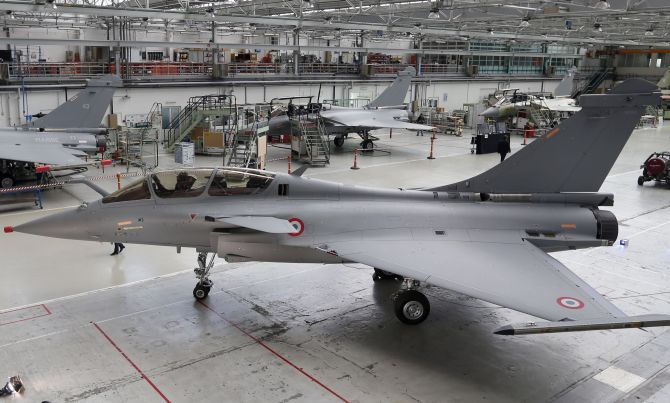
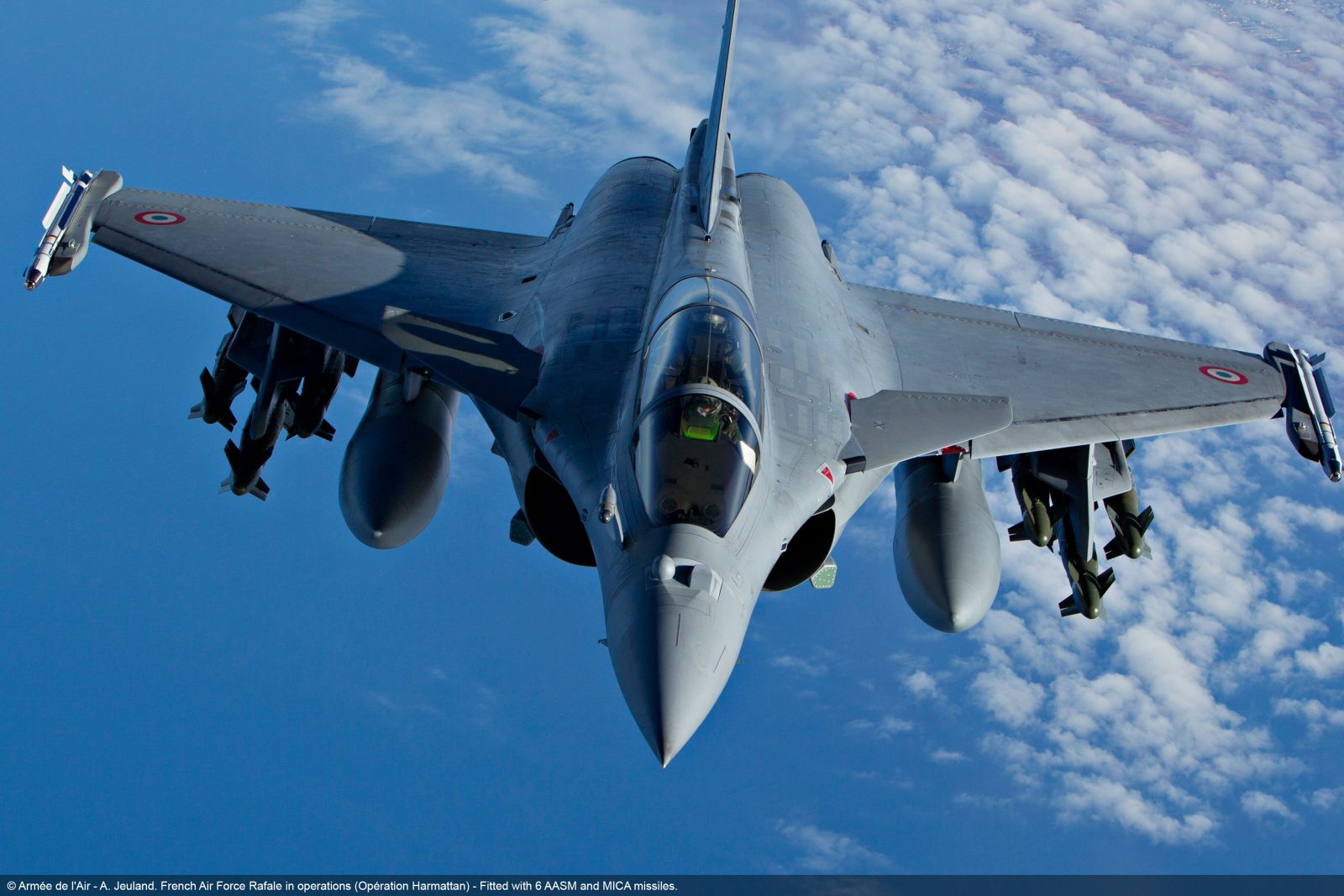
But first take a look at the technical issues. The Rafale is a 4.5 generation aircraft. Its design, in terms of its clean aerodynamics and an optimal design to create minimal radar signature, would make it clear to any professional that this is an aircraft capable of exceptional manoeuvring. It is also an established fact that amongst all 4.5 generation aircraft, there would be very little difference in terms of combat performance. Quite obviously, the most critical elements of the aircraft consist of its sensors, avionics systems, radar, and weapons. Both India and Qatar have contracted for similar version of aircraft, F3R.The systems and weapons have some similarities but also major differences. Modern fighter aircraft are systems intensive and function as system of systems.
Features that are common to both Qatar Air Force and Indian Air Force Rafales are primarily the RBE 2-AA AESA radar, SPECTRA self-protection suite, IFF with full Mode-5/Mode-S compatibility, Elbit’s TARGO-II Helmet Mounted Display System, and some of the most critical weapons such as Meteor BVRAAM, Mica air-to-air missile, and SCALP air-to-ground long-range cruise missile. Anyone who flies the aircraft will, obviously, get to know the full functioning, performance, and envelope of the systems and the weapons. Most critical would be the intimate knowledge of the AESA radar and the important weapons. However, one must understand that deeper technical knowledge of systems like the radar would not be available to Qatar. Given the long-standing relationship between France and Qatar, any high level systems programming and integration would be retained by the French. This has been the practice in the past, and it is so with most Arab countries. Additionally, AESA radar configurations and source codes are highly secure and it would be virtually impossible for anyone to break into it, even if we assume that Pakistani pilots and technicians would make an attempt to do so, which is very unlikely. Weapon envelopes would certainly be known in the course of training on them. Training on systems like SPECTRA, while providing its functional knowledge, does not compromise any security. The crux of SPECTRA lies in its threat library programming, which is exclusive to the host nation, and on response algorithms that will not be open to anyone other than the designer.
Indian Rafales, however, will have significant security measures. These lie in completely different secure communication systems that would be incorporated, and India’s own secure datalink capability that would be incorporated. Qatar Rafales would have the Link-16 compliant datalink systems, which India will never incorporate. As the French Rafales upgrade to F4 status, much of those upgrades may become available to India, and IAF aircraft will become uniquely different and highly secure with its own NCW architecture. In terms of EO designation and Recce pods, Qatar Rafale will have the Lockheed Martin’s Sniper pod while IAF have the well-proven and advanced Litening-4 EO pod integrated. EW capabilities and hence, EW tactics and strategies will be completely different for IAF’s aircraft. Unlike in the past, this contract envisages French cooperation and full access to integrating additional weapons and systems of India’s choice, which will make the aircraft considerably different.
So what should we make of the news about Pakistani pilots flying the Rafale in Qatar and subsequent denial by the French ambassador in India? As for Pakistani pilots sizing up the Rafale against the F-16, it is a non-issue as the two are just not comparable. The upgraded F-16s of PAF is of Block-50 standard at best, and that is clearly one generation behind Rafale. The concern, therefore, is irrelevant.
One must take into account various regional geopolitical issues to get a realist perspective. Qatar is a small country of 2.8 million inhabitants, with nearly 80% of the population located in the capital city of Doha. With highest per capita GDP in the world, Qatar focuses on rapid development towards first world status, and displays its ambitions in playing a geopolitical role, punching well above its weight much like Singapore. Doha has been host to major international events, and will be hosting the FIFA 2022.
Considering that Qatar is a tiny kingdom on the Arabian peninsula, Saudi Arabia has always tried to dominate and control the state as a subordinate. Qatar has successfully dismissed these attempts by breaking out and engaging countries at the global level. It has made itself a major diplomatic player, a generous donor of foreign aid, and a leader in modernising education in the region. It has maintained strong relations with Iran and Turkey as much as with other Islamic states. It has sought to balance different groups and organisations with a moderating influence and has sought to push for peace in the region. These efforts, and the overwhelming popularity of ‘Al Jazeera’ has riled countries like Saudi Arabia, Egypt, Bahrain, and UAE into sanctioning Qatar and curtailing diplomatic relations.
Pakistan, which has very strong relationship with all Arab countries, has maintained a neutral stance in the Qatar-Saudi Arabian dispute, despite strong pressures from Saudi Arabia. Pakistan’s military presence in these countries, in terms of training local forces as well as providing fully deployed troops to augment local defences has been a long-standing practice. Pakistan Air Force pilots have regularly flown for the Air Forces of these states. Hence, access to military resources in terms of operational flying experience on these aircraft has been a huge advantage for PAF. Since the Iraq war in 1991, Qatar has sought to build a significant military capability, its Air Force in particular.
While India and Qatar have excellent relations (Qatar meets nearly 60% of India’s LPG needs), to meet its military training and force requirements Qatar has engaged Pakistan’s services in addition to European and British professionals. All these pilots, essentially mercenary in nature, have become Qatar citizens as well. Qatar has provided air base for US air forces at al-Udeid, 20 miles from Doha. The base services US Central Command, including US forces in Afghanistan and Syria. Qatar addresses Pakistan’s energy security significantly, and both nations have cultivated their relationship carefully. Qatar has allowed Taliban to set up office in its territory and has worked to encourage dialogue with all parties involved in the Afghan conflict. In return, Pakistan has been careful to balance its relations with all gulf countries, and values its engagement with Qatar highly, as the recent visit of Pakistan’s Prime Minister shows.
For a very small state, Qatar is on track to building significant air power capability. After signing initial contract for 24 Rafales with French Dassault in 2015, Qatar placed additional orders for 12 more aircraft, making it a total of 36 Rafales. This was preceded by an earlier order for Boeing’s 36 Qatar advanced-variant Eagles from the USA for $ 12 billion, with an option to increase the order later to 72. In another major deal with BAe, Qatar concluded a contract for supply of 24 Eurofighter Typhoons and 9 Hawk advanced jet trainers, worth over $ 6.6 billion, with first payment made in Sep 2018. For an air force whose strength was just 2100 personnel in 2010 and just 13 Mirage 2000-5 fighters in early 2000s, this build up with three fleets of 4.5 generation aircraft and substantial increase in numbers is unprecedented. Qatar’s decision to go in for a seven-fold increase in its air power capability is curious and there are questions as to how this tiny air force will absorb the massive capabilities in which it is investing. More importantly, it is inevitable that it would need pilots on hire to fly these aircraft. This where the Pakistani relationship comes into focus. In addition work is already underway to increase the infrastructure in terms of building an additional base and expanding existing bases at al-Udeid and Doha.
Pakistani pilots who fly for Qatar air force may do so after being given Qatar citizenship. Unlike India, Pakistan allows dual citizenship passports. It is therefore, quite obvious that Pakistani pilots will fly all these aircraft being procured by Qatar. It is irrelevant whether they have been trained in France on Rafales contracted for Qatar, in all likelihood they would have. India, therefore, would do well to factor this reality in its calculations.
The author is the founder Chairman of TPF, IAF veteran and former Deputy Chief of Integrated Defence Staff. Opinions expressed are the author’s own.
A shorter version of this article was published in Deccan Herald.
Image Credit – rafale.co.in