To lend greater legitimacy to his controversial position, Girard explicitly cites the foremost theorist of warfare, Carl von Clausewitz. In his three treatises on the escalation of war, Clausewitz had indeed argued that mimetic rivalry would degenerate into violence that would destroy lives and even human civilisation were it not for the scapegoat mechanism.
Girard’s tendency toward absolute peacefulness is unrealistic, whereas the religiously legitimised far right seeks to wage the final battle internally and externally. Yet, both refer to the assumption of an impending apocalypse. This is the core of the problem, which leads, on one side, to absolute pacifism and, on the other, to a similarly absolute “battling to the end”.
The media’s focus on the current U.S. president’s personality can easily lead us to overlook deeper, underlying changes. It is well known that French sociologist René Girard plays a significant role in shaping the self-image of Silicon Valley tech billionaires. In particular, his disciple Peter Thiel, founder of Palantir, is advancing this agenda and strongly influencing U.S. Vice President J.D. Vance, whom Thiel financially supported during his campaign. This connection leads to a billionaire-backed far-right movement that sees its legitimacy in a fundamentalistic interpretation of Christianity. This has already been amply documented in numerous U.S. discussions. The rather helpless counterreaction attempts to prove that Girard is merely being exploited and misunderstood. He certainly is—but the central problem is that in his book Battling to the End, Girard describes the approaching apocalypse. To escape it, Girard recommends absolute nonviolence, which he sees as realised in Christianity. Peter Thiel and the other tech billionaires, however, believe that in this approaching apocalypse, one must fight to the bitter end to survive. It is no coincidence that the latest book by the U.S. “Minister of War,” Pete Hegseth, is titled American Crusade. Hegseth compared the rescue of the American pilot at Easter to the resurrection of Christ. Girard is indeed being instrumentalised by Thiel and others. However, the problem is that Girard adopts an apocalyptic approach and appears to justify it scientifically by referring to a reductionist interpretation of Clausewitz, arguably the most significant theorist of war. Only through reference to Clausewitz does Girard’s theory of imitation (mimesis) gain the political explosiveness that would otherwise remain confined to academia.

René Girard’s theories on mimesis, mimetic rivalry, scapegoating, and the role of myth and religion in the emergence of culture provide profound insights into human history and behaviour. So, what is mimetic desire?
Mimetic desire begins with human needs and desires. While needs are biologically rooted, desires are strongly influenced by others. Girard’s identification of the basis of the human problem is simple: most of the things we desire—be they a person, a relationship, an object, an experience, or a feeling—are based on imitation. We develop a desire for these things through our observation of others who desire or possess them, whether consciously or not. This explains the power of advertising—when we see enough people using something, we want it too—as well as the power of celebrity. We want the kind of house, car, clothes, or wife that the rich, famous, and powerful man has.
Children learn through imitation, acquiring language and other skills necessary for social success. By learning the ethos of their culture, they become part of the community and eventually pass it on to the next generation. In this respect, mimesis is unproblematic. However, for Girard, mimesis is also the primary cause of social unrest and violence because mimesis leads to rivalry when people compete for scarce resources. Sometimes, class differences separate the object of rival desire, such as when one harbours a mimetic desire for what the rich possess. In this situation, which Girard calls “external mediation,” violent conflict arising from mimetic rivalry is unlikely. However, in situations of internal mediation, where individuals or groups desire the same thing and are close to one another, the possibility of violence is real.
Girard asserts that this mimetic rivalry is the primary cause of human violence: tribes fight over resources, men for power and wealth, and the contest for power escalates into violence. Examples include tribes fighting over resources, two men desiring the same woman, and envy of another’s wealth, fame, honour, or power escalating into violence.
Girard argues that mimetic rivalry would degenerate into violence that would destroy lives and even human civilisation, were it not for the scapegoat mechanism. By creating a scapegoat, one can blame all of one’s problems on that person and cast them out or sacrifice them, thereby stabilising one’s identity and community. Determining who belongs to a community and who does not reunites it. A famous example is Kaiser Wilhelm II before World War I, who declared, “I no longer know of any parties; I know only Germans.” Anti-Semitism, too, was based on this combination of exclusion and the sacrifice of others; in essence, it is elevated to what appears to be a sacred act.
Girard argues that Jesus’s voluntary sacrificial death broke this scapegoat mechanism once and for all because he took on the sins of the world. However, regardless of any theological assessment, this interpretation clearly does not apply to the Crusades, religious wars of the Middle Ages, colonisation, the two world wars, or the Holocaust. In fact, one could view these events as repetitions of the scapegoat mechanism, where unity is created through the “sacrifice” of others. This raises the fundamental question of whether Christianity is characterised by a particular form of nonviolence, as devout Christians would argue, or by a particular escalation of violence aimed at establishing “eternal peace” on earth, as its universal claim suggests. Historically speaking, societies that saw themselves as Christian have a distinct history of violence (as does Islam, which likewise views itself as fundamentally peaceful). Of course, Christians will say that their religion is fundamentally peaceful and has merely been misunderstood. The victims of colonisation and the Holocaust would disagree. To lend greater legitimacy to his controversial position, Girard explicitly cites the foremost theorist of warfare, Carl von Clausewitz. In his three treatises on the escalation of war, Clausewitz had indeed argued that mimetic rivalry would degenerate into violence that would destroy lives and even human civilisation were it not for the scapegoat mechanism. By constructing a scapegoat, one is made responsible for all one’s own problems and cast out or sacrificed, thereby stabilising one’s own identity and community.
Clausewitz had, in fact, advocated a nearly mimetic position in his three principles regarding the escalation of war. He accompanies the mutual escalation to the extreme at the beginning of his book with the words “the enemy does the same.” He justifies this, on the one hand, by arguing that whoever escalates the spiral of violence gains the upper hand and wins the war. Furthermore, he argues that as long as I have not subdued the enemy, I must fear that he will subdue and defeat me—thus, it is the fear and dread of defeat that compels both adversaries to escalate further and further. Ultimately, it is the mutual striving for power on both sides that leads to this escalation. Furthermore, in parts of his book, Clausewitz regards the absolute and the extreme as the ideal of warfare. To this extent, one could certainly understand Girard.
However, Girard overlooks significant differences. For example, Clausewitz’s three dynamics leading to escalation are followed by three dynamics aimed at moderating war. These dynamics occur on both sides. The crucial point is that the desired post-war political state—and thus peace—already exerts a retroactive influence on the conduct of war.
However, Girard overlooks significant differences. For example, Clausewitz’s three dynamics leading to escalation are followed by three dynamics aimed at moderating war. These dynamics occur on both sides. The crucial point is that the desired post-war political state—and thus peace—already exerts a retroactive influence on the conduct of war. At the end of the first chapter, Clausewitz emphasises that war consists of inherent violence, the interplay of probabilities and chance, and the subordinate nature of war as a political tool. He attributes war to pure reason. Thus, the tendency toward extremes, as interpreted by Girard, is indeed present in Clausewitz; however, it is limited and contained by “pure reason,” with which Clausewitz associates politics. Whether monotheistic religions, which see themselves as peace-loving, harbour a core of violence is a matter of debate. This could be the case when they became state religions, because at that point, they had to legitimise war as an exception. However, religiously motivated war has always brought with it a particular escalation, whether internally or externally. Girard’s tendency toward absolute peacefulness is unrealistic, whereas the religiously legitimised far right seeks to wage the final battle internally and externally. Yet, both refer to the assumption of an impending apocalypse. This is the core of the problem, which leads, on one side, to absolute pacifism and, on the other, to a similarly absolute “battling to the end”.
Rene Girard Image Credit: From the article ” Peter Thiel, René Girard, and Vance’s Moral Conundrum by Jesse Callahan Bryant
Vice President Vance misinterpreted a social scientist and, as a result, converted to Catholicism. If you read JD Vance’s 2020 essay (“How I Joined the Resistance”) about his conversion to Catholicism, you’ll learn that his real moment of spiritual transition from atheist to Catholic oddly came during a 2011 talk that Peter Thiel gave at Yale Law School.
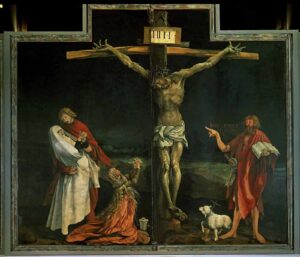
Crucifixion Panel Credit: The Crucifixion, centre panel of the Isenheim Altarpiece (closed view), by Matthias Grünewald, c. 1512–15; in the Musée Unterlinden, Colmar, France. www.britannica.com