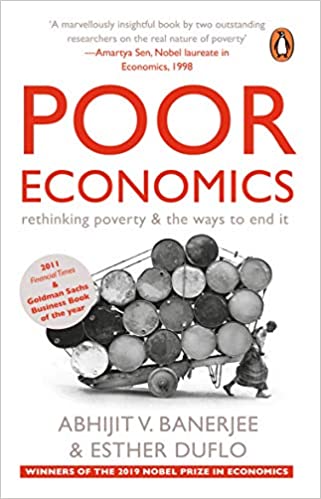
I finished Poor Economics: Rethinking Poverty & the Ways to End it, by Nobel laureates Abhijit Banerjee and Esther Duflo, this past week. Before getting on with the review, it must be said that this is an old book written almost a decade ago. A few suggestions made in the book are now being implemented as government schemes and others by private enterprises. Nevertheless, the book stands the test of time because of its focus on the fundamental approach on how to think about poverty and the factors that help sustain it.
While the extremes are always loud, the truth mostly lies somewhere in between or somewhere that is unrelated to the needless binary. The authors understand this and try to stay away from the one-size-fits-all arguments to bring people out of poverty. Instead, they try to find solutions on a case by case basis, researching the problem on the ground and coming up with specialized and localized solutions. This problem solving is achieved with the help of the numerous Randomized Control Trials (RCTs) that have been done in eighteen countries of the developing world including India, Indonesia and countries in Sub-Saharan Africa.
The book contains ten chapters divided into two sections, namely Private Lives and Institutions. In private lives, the authors dwell on the private problems of poor people including immunization, nutrition, education and so on. And in Institutions, they deal with social institutions of credit facilities, entrepreneurship and the politics of policymaking, which the authors feel, has a tremendous impact on the private lives of the poor.

Early on, they introduce two graphs namely the ‘S-shaped’ graph and the ‘inverted L-shaped’ graph. The S-shaped graph represents a world with a poverty trap which the poor will not be able to get out of unless there is an intervention, through government or foreign aid.
On the other hand, the inverted L-shaped graph represents the worldview which does not believe such a poverty trap exists. This graph posits that there is potential for growth if liberty and markets are allowed to flourish. And that foreign aid will only act as an incentive for the corrupt governments of poor countries to not provide free markets for their people.

Although the book goes on to deal with other problems dealing with poverty, the running theme of the book is the examination of these two graphs with real-life problems faced by the poor. The readers might find themselves marking ‘S’ or ‘L’ on their book at various places (unless you’re a puritan who does not mark their book, in that case, at least you would think of ‘S’ or ‘L’). The authors argue that while there are problems where a poverty trap is obvious, there are also areas where there is no trap per se and therefore even well-intentioned interventions can prove to be counterproductive. They substantiate their claims with an eighteen-country data set which they have collected over the years through field research.
To really answer the question of whether there are poverty traps, we need to know whether the real world is better represented by one graph, or by the other. And we need to make this assessment case by case
The authors tell us stories of Pak Sudarno’s big family of nine children, Ibu Tina’s woes due to a robbery, Jennifer Auma’s saving method and so on. These identified lives help the reader understand the decision-making process of the poor; for example, why a poor family spends money on ‘rich food’ rather than spending money on nutrient-rich food even though their children are malnourished, or why a fruit vendor drinks an extra tea even when he is aware that saving money would mean less high- interest debt. The book goes on to provide insights on various problems including the lack of self-control, poor’s relationship with risk-taking, the present bias leading to undesirable future repercussions and so on.
Although there is no one silver bullet to rid the poor of all their problems, the authors argue that they ‘do know a number of things about how to improve the lives of the poor’. They give us five key lessons to understand the poor better. One, they believe there is a market failure of asymmetric information wherein the poor ‘often lack critical pieces of information’. Two, the poor are responsible for too many aspects of their life; for example, think of drinking water- a poor person has to decide if he has to use chlorine in water as opposed to a richer person for whom clean water is made available by other people, therefore less decision making. Psychological researches say that the quality of the decision erodes if we have to decide so many things (thus successful geniuses and trademark attire).
Three, there are ‘good reasons that some markets are missing for the poor or that they face unfavourable prices’, for example, the poor pay higher rates on their loans. Four, the failures in a poor country have less to do with ‘some grand conspiracy of the elites’ to maintain the status quo and more to do with avoidable flaws in the designing of public policies. And finally, five, a vicious circle of low expectations and low growth.
To make use of these lessons, there has to be dynamic politics willing to get rid of the societal sin of absolute poverty. But the authors argue that politics and governments are, unfortunately, infested with what they call ‘three Is’- Ideology, Ignorance and Inertia. Nevertheless, the authors believe that good policies will help realise good politics. Although one could understand the pragmatism and the optimistic hue of such an argument, bad politics should not be underestimated. Bad politics could stagnate even good policies and create even further problems.
The authors understand the complex issues of poverty and know that there is ‘no lever guaranteed’ to eradicate it. Therefore, they bank on small changes to bring about big effects, for example, one additional year of deworming for kids in Kenya brought about a 20 per cent increase in income when they became adults. In a sense, the book works itself through small steps to bring an understanding of the poor into mainstream policymaking. But as the authors acknowledge, fighting poverty is not a sprint, it is a marathon, one that is worth running. They are willing to commit to the marathon, but will governments of the developing world show such commitment? Such suspicion should last until absolute poverty is completely eradicated.