Tag: Education

  • The Philippines’ History Curriculum: Origins and Repercussions

    The Philippines’ History Curriculum: Origins and Repercussions

    Background

    The Philippines, a twice-colonized archipelago that achieved its complete independence in 1946, is a member of the ASEAN and an essential player in the geopolitics of the Southeast Asia region. Its status is owed mainly to its rapidly growing economy, of which the services industry is the most significant contributor, comprising 61% of its Gross Domestic Product (GDP) (Bajpai, 2022). Services refer to various products – for example, business outsourcing, tourism, and the export of skilled workers, healthcare workers, and labourers in other industries. In recent years, a growing demand for qualified professionals has grown as the economy has grown, thus necessitating more robust educational systems (Bajpai, 2022). Although the Philippines has a high literacy rate, hovering at around 97%, the efficacy of its educational system is often called into question (“Literacy Rate and Educational Attainment”, 2020). Administration oversight, infrastructural deficiencies, and pervasive corruption in the government that seeps into the entities responsible for educational reform are significant issues that legitimize these doubts (Palatino, 2023). However, reforming the current flaws in the system requires an understanding of the basic underlying structure of the country’s educational system as it is today. This fundamental understanding can help clarify specific political trends in the status quo and highlight the importance of proper historical education in developing a nation. Despite its ubiquity in nearly every curriculum, the study of history as a crucial part of the education system is often not prioritized, leading to an underdeveloped understanding of the society’s culture and previous struggles with colonial exploitation. Though it is present in the Philippines’ education today, it continues to change because of its historically dynamic demographic and political atmosphere.

    Origins of the Education System 
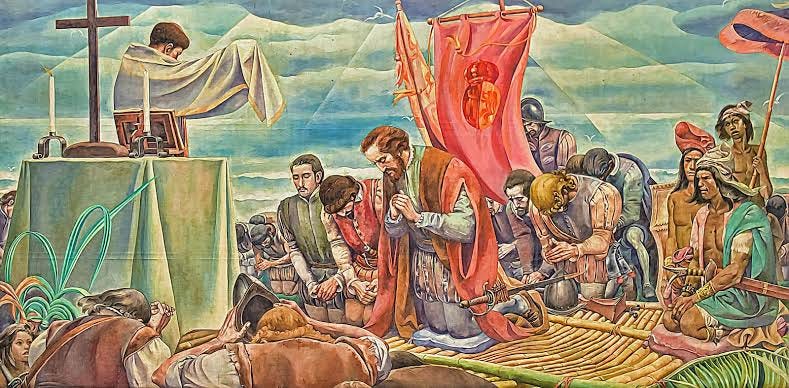
    To begin with, the educational system, and especially the modes of linguistic and history education in the country, have been heavily influenced by the major powers that occupied it – namely, the Spanish Empire and the United States. The impact of these periods of colonization can be seen most significantly in the historical education and consciousness of the general population, as well as the propagation of the English language. The Philippines possesses a great deal of linguistic diversity, especially among indigenous groups – an estimated 170 distinct languages in the country today (Postan, 2020). However, even in pre-colonial times – typically considered by historians to be the years before 1521 – the most common language in the country was Old Tagalog, and other indigenous languages are still spoken today (Stevens, 1999). Records suggest that the Spanish did not forcefully erase indigenous languages spoken in the country. However, they did conduct business and educational institutions in Spanish, leading to the language being used almost exclusively amongst the upper classes – the colonizers, business people in the country, and other influential figures in the empire. Though there were attempts to conduct education in Castilian Spanish, priests and friars responsible for teaching the locals preferred to do so in local languages as it was a more effective form of proselytization. This cemented the reputation of Spanish as a language for the elite, as the language was almost exclusively limited to those chosen to attend prestigious institutions or government missions that operated entirely in Spanish (Gonzales, 2017). In terms of popularising education to expose a broader audience to Christianity, the Spanish also established a compulsory elementary education system. However, restrictions existed based on social class and gender (Musa & Ziatdinov, 2012). Because of this, although the influence of Spanish on local languages can be seen through the borrowing of certain words, indigenous and regional languages were not supplanted to a large extent, though their scripts were Latinised in some instances to make matters more convenient for the Spanish (Gonzales, 2017). However, the introduction of Catholicism to a large segment of the population and a more organized educational system are aspects of Spanish rule that remain in Philippine society today, as do the negative ramifications of the social stratification that was a significant element of its occupation (Herrera, 2015).
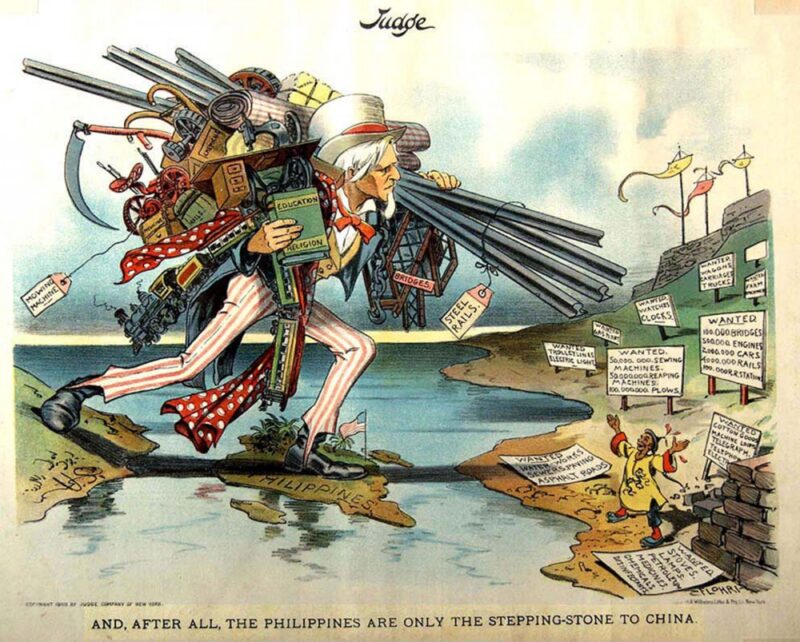
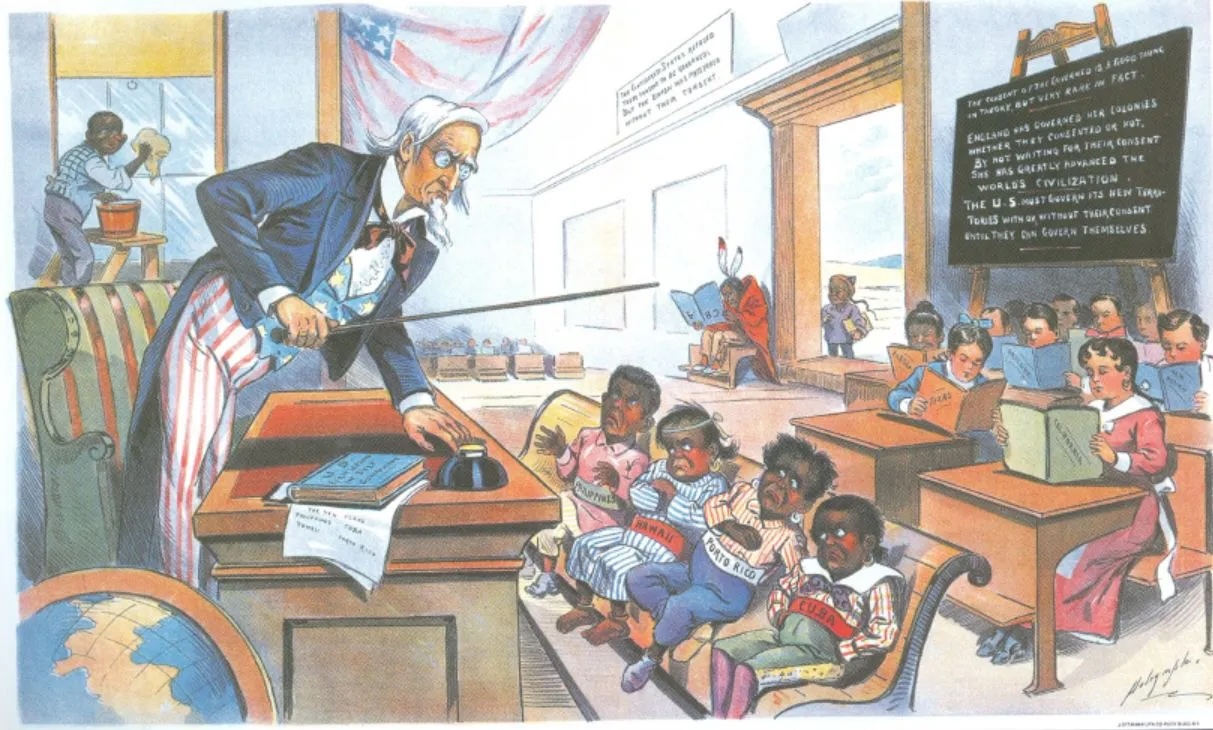
    Uncle Sam, loaded with implements of modern civilization, uses the Philippines as a stepping-stone to get across the Pacific to China (represented by a small man with open arms), who excitedly awaits Sam’s arrival. With the expansionist policy gaining greater traction, the possibility for more imperialistic missions (including to conflict-ridden China) seemed strong. The cartoon might be arguing that such endeavours are worthwhile, bringing education, technological, and other civilizing tools to a desperate people. On the other hand, it could be read as sarcastically commenting on America’s new propensity to “step” on others. “AND, AFTER ALL, THE PHILIPPINES ARE ONLY THE STEPPING-STONE TO CHINA,” in Judge Magazine, 1900 or 1902. Wikimedia.

    In contrast, the American occupation following Spain’s defeat in the Spanish-American War in 1898 significantly changed the country’s linguistic patterns and revolutionized the education system. Upon arriving in the country, the Americans decided to create a public school system in the country, where every student could study for free. However, the medium of instruction was in English, given that they brought teachers from the United States (Casambre, 1982). This differed from the Spanish system in that social class and gender did not influence students’ access to education to the same extent. Furthermore, the Americans brought their own material to the country due to a lack of school textbooks. As the number of schools in the country and the pedagogical influence of American teachers increased, the perception of the Americans’ role as colonizers ultimately changed. Education became a tool to exert cultural influence, leading to the propagation of American ideals like capitalism, in addition to subverting separatist tendencies that were cropping up in the country as one colonizer was replaced by another. It also led to the suppression of knowledge concerning the US’ exploitation of the nation.  Ultimately, the colonizers’ influence on the linguistic and educational landscape of the nation manifests itself in the general population’s understanding of their country’s history.

    The Current History Curriculum

    The social studies curriculum in the Philippines, called Araling Panlipunan (AP), is an interdisciplinary course that combines topics of economics and governance with history, primarily post-colonial history (“K to 12 Gabay Pangkurikulum”, 2016). The topic of World War II takes up nearly 50% of the course, while other aspects of indigenous and pre-colonial history are included to a limited extent (Candelaria, 2021). This act of prioritization is a colonial holdover. Although the Philippines indubitably played a crucial role in the Pacific Theatre during WW II, its massive presence in the AP course signals the nation’s continued alliance with the US and reinforces a mentality amongst the general public that favours it. This bias occurs as a singular American perspective is promoted by the course, wherein the actions of other countries against the Philippines are highlighted. At the same time, the exploitation of the Philippines by the Spanish and Americans is not as widely discussed. For example, although the atrocities committed by the Japanese during World War II are taught extensively as part of the curriculum, the American actions during the Philippine-American War (1899-1902), during which the Americans burned and pillaged entire villages, are not emphasized (Clem, 2016). Furthermore, it leads to the sidelining of historical events that have created the political situation in the country today, such as the issue of the current president being related to the former dictator, Ferdinand Marcos.

    As the course is conducted chronologically, discussions of topics such as the Marcos Regime are left up to teachers’ discretion due to the subject’s controversial nature, given that the dictator’s son is the current president (Santos, 2022). This means that as much or as little time can be spent on it is as decided. Because of the American influence, even citizens who are taught about the atrocities that occurred during the dictatorship are not informed of the support provided to the Marcos dictatorship by the US government. During his presidency, which lasted from 1965 to 1986, the Philippines received significant economic aid from the US government in exchange for the continuation of its military presence in the country, which proved helpful to the US during the Vietnam War as it was able to utilize its bases in Subic Bay and Clark air base(Hawes, 1986). As a result of the necessity of these bases, a 1979 amendment to the 1947 Military Bases Agreement was signed, which increased the US’ fiscal contributions to security assistance. To further support this military objective, the Carter and Reagan administrations showed their diplomatic support to Marcos by visiting the Philippines and inviting him to Washington.

    Additionally, when Marcos was ousted from power in 1986 by the People Power Revolution, he spent his exile in ‘Hawaii’, in the US (Southerl, 1986). Therefore, while the US is credited for introducing democratic principles to the country through its program for expanding education while occupying the archipelago, it also played a significant role in supporting a despotic government that is not as widely acknowledged. Because of this, the Filipino perception of and relationship with the US has been heavily influenced by a lack of awareness amongst the general public about its involvement in a massively corrupt administration.

    Significant Developments 

    Despite the importance of a robust historical education in improving the public’s awareness of their own culture and geopolitical relationships, history as a subject has been transformed into a political tool in the Philippines, twisted when it can be useful and neglected when it does not support an agenda. Various bills passed in the House of Representatives (the lower house of parliament in the Philippines, below the Senate), as well as decisions taken by the Department of Education, have diminished the significance of history in the overall school curriculum and reinforced an American perspective in the historical content that continues to be taught. Department of Education Order 20, signed in 2014, removed Philippines History as a separate subject in high school (Ignacio, 2019). The argument for this decision was that Philippines History would be integrated within the broader AP social studies curriculum under different units, such as the Southeast Asian political landscape. However, educators opposing the abolition of Philippine History as a separate subject state that due to fewer contact hours being allocated for AP in total compared to English, maths, and science, it is unlikely that Philippine history can be discussed in adequate depth, considering the other social science topics mandated by the AP curriculum. In addition, House Bill 9850, which was passed in 2021, requires that no less than 50% of the subject of Philippine history centres around World War II (Candelaria, 2021). The bill’s primary concerns mention that it prioritizes the war over other formative conflicts in the nation’s history, such as the Philippine Revolution against Spain or the Philippine-American War. Furthermore, it requires modifying or reducing discussions surrounding other vital events in the Philippines, such as agrarian reforms and more recent developments like the conflict in Mindanao.

    Both of these policies face significant opposition. For example, a Change.org petition demanding the return of the subject of Philippine history in high schools has garnered tens of thousands of signatures. At the same time, numerous historical experts and teachers have spoken against HB 9850 (Ignacio, 2018). Despite this resistance from academics and teaching professionals, it is unlikely that history will be prioritized unless the general public also learns to inform itself. Around 73% of the total population (approximately 85.16 million people) have access to the internet, of which over 90% are on social media (Kemp, 2023). Because of the large working population in the country, social media companies like Facebook have set up offices there. Programs that offered data-free usage in 2013 have made the Philippines a huge market for Facebook, and many Filipinos trust the news they find on the website more than some mainstream media sources (Quitzon, 2021). Even though internet access is relatively widespread, signifying that information is readily available to the average Filipino, social media, especially Facebook, often functions as a fertile breeding ground for misinformation.

    Repercussions of the History Curriculum
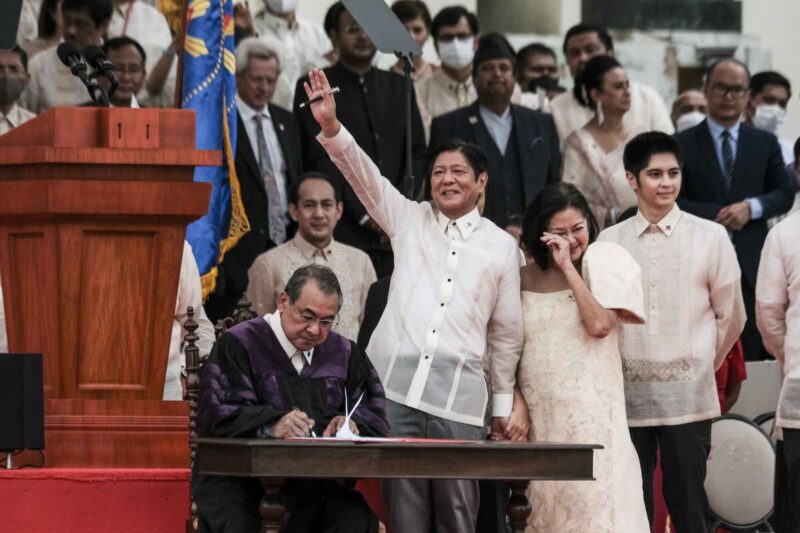
    In recent years, misinformation has become an important political tool to propagate ignorance and manipulate historical and current events to promote specific agendas. The most relevant example was the mass historical revisionism campaign leading to the 2022 general elections (Quitzon, 2021). Given that Bongbong Marcos, Ferdinand Marcos’ son, was running for president alongside vice presidential candidate Sara Duterte (former president Rodrigo Duterte’s daughter), the campaign focused on changing the public perception of both families and their period of rule. Preceding the elections, social media trolls and supporters of the campaign spread videos, doctored images, and fake news that minimized the atrocities and scale of theft that occurred throughout the Marcos regime and the Duterte administration, instead highlighting and exaggerating the perceived benefits they brought to the country. The prioritization of these political agendas is reflected in the history curriculum, as it does not sufficiently cover critical areas of Philippine history that have directly led to the political situation of today and the pre-colonial era that is an inseparable part of Filipino culture.

    Recommended Policy Measures 

    However, another by-product of this absence of consciousness is that the general public is desensitized to poor governance and neocolonialism as their education systems and news sources constantly feed them biased and inaccurate information about the history of their own country and its relationship to others. When dictators are portrayed as good rulers and previous colonizers are portrayed as historical allies, it results in a population that unknowingly votes against its interests as they are unaware of the past events that have shaped the current political atmosphere and the various deficiencies in the system. Considering that these political campaigns rely on the general public not having a solid understanding of historical events, especially those about the martial law era, it is unlikely that politicians will take meaningful steps to improve historical education in the country since they benefit from citizens lacking awareness. As such, the onus must, unfortunately, be placed on the general public to educate themselves on good citizenship and exercise their right to vote at the grassroots level responsibly so that future local politicians and members of parliament may at least be able to encourage the study of history in the government. Additionally, teaching students how to use the internet to conduct reliable research is imperative to reduce misinformation so they can counter the misinformation they find online.

    Conclusion

    In conclusion, the Philippine education system has been shaped by the periods of colonization the country has experienced. This has led to a history curriculum favouring the American perspective and thus disadvantages crucial elements of local history. The consequences of the lack of awareness this has caused in the general public are manifold: it has made them more susceptible to misinformation and historical revisionism. It has worked to the advantage of politicians who take advantage of it. Nevertheless, the Philippines can still reverse this trend by utilizing its high literacy rates and social media presence to promote reliable historical education. They can also push for better historical education policies through petitions and appeals to local government agencies and Senate committees related to education – such as the National Commission for Culture and the Arts (NCCA), the Committee on Basic Education and Culture, and the Committee on Education, Arts and Culture – amongst others (Ignacio, 2018). Overall, there are many deficiencies in the current history education system in the Philippines, but they still coexist with the potential for change. Citizens have the power to advocate and must continue using it to usher forth a more well-informed society and nation.


    References

    Bajpai, Prableen. “Emerging Markets: Analyzing the Philippines’s GDP.” Investopedia, 12 July 2023, www.investopedia.com/articles/investing/091815/emerging-markets-analyzing-philippines-gdp.asp#:~:text=The%20country.

    Casambre, Napoleon. The Impact of American Education in the Philippines. Educational Perspectives, scholarspace.manoa.hawaii.edu/server/api/core/bitstreams/f3bbc11f-f582-4b73-8b84-76cfd27a6f77/content#:~:text=Under%20the%20Americans%2C%20English%20was.

    Clem, Andrew. “The Filipino Genocide.” Series II, vol. 21, 2016, p. 6, scholarcommons.scu.edu/cgi/viewcontent.cgi?article=1138&context=historical-perspectives.

    Constantino, Renato. “The Miseducation of the Filipino.” Journal of Contemporary Asia, vol. 1, no. 1, 1970, eaop.ucsd.edu/198/group-identity/THE%20MISEDUCATION%20OF%20THE%20FILIPINO.pdf.

    Department of Education. K To12 Gabay Pangkurikulum. 2016, www.deped.gov.ph/wp-content/uploads/2019/01/AP-CG.pdf.

    “Education Mass Media | Philippine Statistics Authority | Republic of the Philippines.” Psa.gov.ph, 28 Dec. 2019, psa.gov.ph/statistics/education-mass-media.

    Gonzales, Wilkinson Daniel Wong. “Language Contact in the Philippines.” Language Ecology, vol. 1, no. 2, Dec. 2017, pp. 185–212, https://doi.org/10.1075/le.1.2.04gon.

    Hawes, Gary. “United States Support for the Marcos Administration and the Pressures That Made for Change.” Contemporary Southeast Asia, vol. 8, no. 1, 1986, pp. 18–36, www.jstor.org/stable/25797880.

    Herrera, Dana. “The Philippines: An Overview of the Colonial Era.” Association for Asian Studies, vol. 20, no. 1, 2015, www.asianstudies.org/publications/eaa/archives/the-philippines-an-overview-of-the-colonial-era/.

    Ignacio, Jamaico D. “[OPINION] The Slow Death of Philippine History in High School.” RAPPLER, 26 Oct. 2019, www.rappler.com/voices/ispeak/243058-opinion-slow-death-philippine-history-high-school/.

    —. “We Seek the Return of ‘Philippine History’ in Junior High School and Senior High School.” Change.org, 19 July 2018, www.change.org/p/we-seek-the-return-of-philippine-history-in-junior-high-school-and-senior-high-school.

    John Lee Candelaria. “[OPINION] The Dangers of a World War II-Centered Philippine History Subject.” RAPPLER, 20 Sept. 2021, www.rappler.com/voices/imho/opinion-dangers-world-war-2-centered-philippine-history-subject/.

    Kemp, Simon. “Digital 2023: The Philippines.” DataReportal – Global Digital Insights, 9 Feb. 2023, datareportal.com/reports/digital-2023-philippines#:~:text=Internet%20use%20in%20the%20Philippines.

    Musa, Sajid, and Rushan Ziatdinov. “Features and Historical Aspects of the Philippines Educational System.” European Journal of Contemporary Education, vol. 2, no. 2, Dec. 2012, pp. 155–76, https://doi.org/10.13187/ejced.2012.2.155.

    Quitzon, Japhet. “Social Media Misinformation and the 2022 Philippine Elections.” Center for Strategic & International Studies, 22 Nov. 2021, www.csis.org/blogs/new-perspectives-asia/social-media-misinformation-and-2022-philippine-elections.

    Santos, Franz Jan. “How Philippine Education Contributed to the Return of the Marcoses.” Thediplomat.com, 23 May 2022, thediplomat.com/2022/05/how-philippine-education-contributed-to-the-return-of-the-marcoses/.

    Southerl, Daniel. “A Fatigued Marcos Arrives in Hawaii.” Washington Post, 27 Feb. 1986, www.washingtonpost.com/archive/politics/1986/02/27/a-fatigued-marcos-arrives-in-hawaii/af0d6170-6f42-41cc-aee8-782d4c9626b9/.

    Stevens, J. Nicole. “The History of the Filipino Languages.” Linguistics.byu.edu, 30 June 1999, linguistics.byu.edu/classes/Ling450ch/reports/filipino.html.

    Stout, Aaron P. The Purpose and Practice of History Education: Can a Humanist Approach to Teaching History Facilitate Citizenship Education? 2019, core.ac.uk/download/pdf/275887751.pdf.

    Feature Image Credit: actforum-online.medium.com Filipino Education and the Legacies of American Colonial Rule – Picture from ‘Puck’ Magazine

  • Technological Challenges to Becoming a Developed Country by 2047

    Technological Challenges to Becoming a Developed Country by 2047

    For a developed India, bulkier investment and technological changes are required to keep up in the race with other developed nations. In doing so, the country should not be afraid of failure. After all, Chandrayaan 3 was made possible by the lessons from the failure of Chandrayaan 2.

    THE Prime Minister has set the goal of India becoming a developed country by 2047.

    On the way, India’s Gross Domestic Product (GDP) is soon going to surpass that of Germany and Japan, if the current official rates of growth are maintained.

    In today’s world, projecting five years or 24 years ahead is fraught with challenges. Who could have foreseen the Covid pandemic in 2020 and the war in Ukraine in 2022?

    Successful landing of Chandrayaan 3 near the South Pole of the Moon is undoubtedly a great achievement for the nation. But that does not make India a developed nation.

    Major challenges confront the nation, such as providing good education and healthcare. This can only be achieved if the number of schools and health facilities in rural and semi-rural areas is increased substantially.

    [powerkit_button size=”lg” style=”info” block=”true” url=”https://theleaflet.in/technological-challenges-to-becoming-a-developed-country-by-2047/” target=”_blank” nofollow=”false”]
    Read More
    [/powerkit_button]

  • Indian Ruler’s Predicament Limits their Understanding of Education’s Wider Role

    Indian Ruler’s Predicament Limits their Understanding of Education’s Wider Role

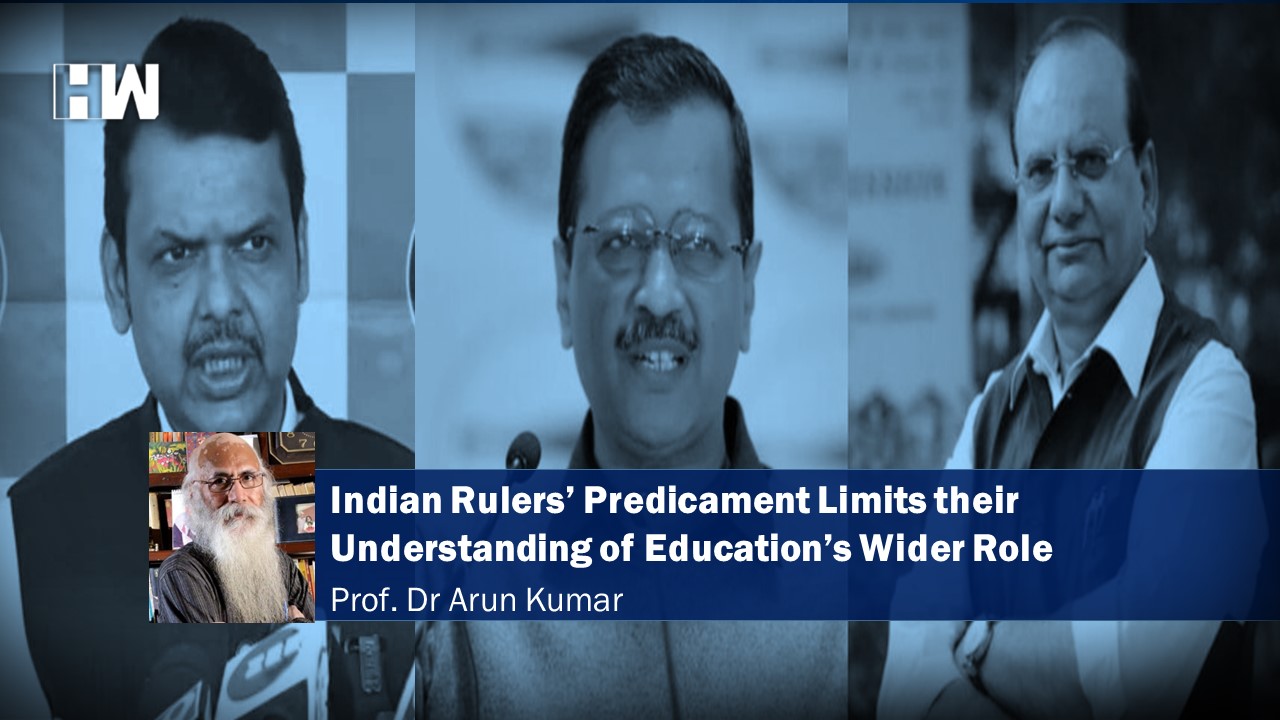
    Mr. Fadnavis, Dy. CM of Maharashtra has exhorted the youth to come forward in foiling the attempts of urban naxals from getting into universities. Since anyone differing from the establishment is being called urban naxal these days, this is a call to curb dissent in the
    universities.

    Earlier, Delhi’s Lt. Governor V K Saxena is reported to have said, “… degreeyan toh padahi ke kharch ki raseedein hoti hain. …” (… degrees are mere receipts of money spent on studies …). This was in response to the Delhi CM, Kejriwal’s reported barb that India needs an “… educated PM for the nation’s well-being”.  So, the educational qualifications of leaders have become an issue.

    These statements reflect the current Indian rulers’ skewed vision of education. For one dissent is not acceptable and for the other education is only about money spent and not the larger role it plays in society.

    [powerkit_button size=”lg” style=”info” block=”true” url=”https://hwnews.in/news/opinion/indian-rulers-predicament-limits-their-understanding-of-educations-wider-role/” target=”_blank” nofollow=”false”]
    Read More
    [/powerkit_button]

  • Inculcating Pride In the People: Can This Be The Way Forward?

    Inculcating Pride In the People: Can This Be The Way Forward?

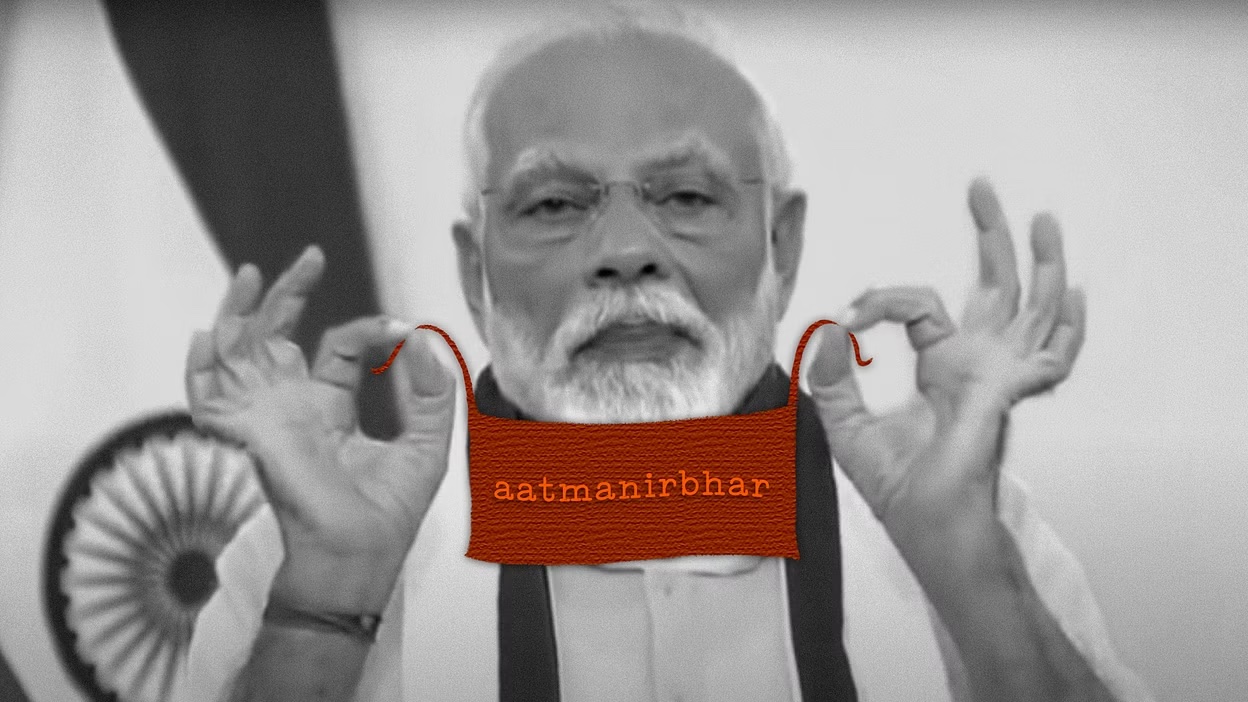
    Atmanirbharta, self-reliance, is a complex idea. India has strived for it since its Independence. Colonial rule had caused a deterioration in India’s socio-economic conditions which led to mass poverty.

    In a recent interview, Mr. Nripen Mishra, Chairperson of the Committee to construct the Ram Janmabhumi Temple said, `Our youth are very sensitive to the call that India must become a big power  … I think we have to inject this … the temple as one more reason for being proud’.

    Clearly, the ruling establishment has set a goal of inculcating a sense of pride among the citizens, especially the youth. Building the grand Ram Janambhumi Temple is one more way of doing that. So were the building of the tallest statue, a grand Central vista, Parliament House, etc..

    Atmanirbharta and Vishwaguru

    The slogans of Atmanirbharta and India as Vishwaguru have been used continuously to inculcate pride. The package of Rs. 22 lakh crore announced in May 2020 soon after the start of the pandemic was called Atmanirbhar. Greater self-reliance is sought by raising customs duties since at least 2017. Reminds one of the 1960s ideas that Indian industries need protection from imports. India is currently heavily dependent on the import of armament. So, indigenous defense production is sought to be increased to reduce this dependence and also to enable exports to earn foreign exchange.

    But, if we are dependent on others for critical supplies, are we already Vishwaguru? Maybe atmanirbharta could make us Vishwaguru in the future. Are we doing the right things to achieve it

    The `Vishwa guru’ status is currently claimed on the basis of soft power, like, yoga and film music. In economic terms we claim to be the fastest-growing large economy and that our production has surpassed that of our colonial master, Britain, to make us the 5th largest world economy. But the true measure of prosperity is per capita income which is abysmally low. For the poor and unemployed what does being vishwaguru mean?

    Premature claims of being vishwaguru breed complacency. Do other nations accept our claim? In January 2021 at WEF the PM announced that the world could learn from India how to handle the pandemic. By March, the country suffered grievously in the second wave.

    Self-Reliance

    Atmanirbharta, self-reliance, is a complex idea. India has strived for it since its Independence. Colonial rule had caused a deterioration in India’s socio-economic conditions which led to mass poverty. India lagged way behind the advanced countries in 1947. To gain independence, the national movement used the idea of self-reliance to raise people’s consciousness against colonization. Gandhi suggested `Swaraj’ or self-rule and said, `There are no people on earth who would not prefer their own bad government to the good government of an alien power’. This idea persisted among the leadership after independence since India had to contend with neo-colonialism and given its backwardness, India depended on other nations for aid, technology, etc.

    The notion of self-reliance had to be differently interpreted in a different context. In a globalizing world, it may be in the nation’s interest to import in a big way and exchange ideas with others. But, if other nations try to capture their markets, as they often do, self-reliance may require protecting the home market.

    Globalization and Atmanirbharta

    Is globalization consistent with Atmanirbharta? Colonization was also globalization. Political independence does not imply insularity but the ability to deal with other nations to serve the national interest. India gained considerable autonomy in policy to pursue a path in its self-interest through industrialization, development of social and physical infrastructure, etc. The public sector and a reasonable technology base were developed to gain a modicum of economic independence. Pressures from the international financial institutions to follow their agenda or to allow consumerism were warded off till 1980.

    The big shift came in 1991 with the new economic policies which were imposed by the IMF as conditionalities. Atmanirbharta which was slowly eroded post the mid-1970s got breached.

    Can Borrowing Lead to Atmanirbharta?

    In a globalizing world, dealing with other nations as equals requires a rapid generation of technology and socially relevant knowledge. This is not possible without a strong education and R&D infrastructure which we are lacking in.

    The government has reversed direction since 2017 and is attempting greater self-reliance. But, is the strategy for achieving it right? In a globalizing world, dealing with other nations as equals requires a rapid generation of technology and socially relevant knowledge. This is not possible without a strong education and R&D infrastructure which we are lacking in. The government claims that the National Education Policy (NEP) 2020 will help in this direction. But its emphasis on inviting the top foreign universities to come to India, something UGC is pushing, can only further undermine indigenous strengths.

    Schemes to get foreign faculty and borrow syllabi from foreign universities have existed but they undermine Indian academia’s autonomy. India has long had faculty members who earned their degrees abroad. If that could not impart dynamism to Indian institutions would the recent steps succeed? The idea that originality can be copied is a contradiction in terms. Even if some good foreign Universities do come, they can only be a shadow of the original.

    It would also relegate Indian institutions and academia to second-rate status. Foreign faculty will only come on privileged terms not available to Indian academics. The lesson for good students would be to go abroad and from there return to Indian institutions. That would deprive Indian institutions of good students for research thereby adversely impacting research in India. Further, India has its own unique problems that are unlikely to be the concerns of foreign institutions and academics.

    The change in focus of Indian institutions would further undermine the generation of relevant knowledge, the absence of which has been a cause of the lack of dynamism in Indian institutions. Indian academics have largely been `derived’ intellectuals, borrowing ideas from the West and recycling them in India. This trend would be reinforced to the detriment of those who were generating socially relevant knowledge because their work would be largely characterized as not of international standard and discounted in recruitment and promotions.

    The disadvantage of a Late Start

    It could be argued that one should not reinvent the wheel; therefore, there is no harm in borrowing ideas from abroad. In growth literature it is called `advantage of a late start’ – technology already developed becomes available to the late starters. A pre-requisite for this strategy to succeed, in a fast changing world, is a strong research environment in the borrowing country. Without that the borrowing country could become permanently dependent, leading to a `disadvantage of a late start’. This is true for most developing countries, including India.

    With NEP 2020, a new experiment has started without addressing the root cause of the failure of earlier policies. Our institutions of higher learning operate in a feudal mode where the autonomy and originality of academics are undermined.

    In India with every pay commission, steps to strengthen teaching and research in institutions of higher education were put into place but they have not delivered in the absence of basic reforms. With NEP 2020, a new experiment has started without addressing the root cause of the failure of earlier policies. Our institutions of higher learning operate in a feudal mode where the autonomy and originality of academics are undermined. Independence in thought is seen as a malaise to be eliminated little realizing that that is the key to new knowledge generation. No wonder, those Indians who deliver when in foreign institutions fail to do so working in India.


    In brief, borrowing from abroad without changing the systems in the country will not lead to atmanirbharta. The deficiencies in our education system need to be rectified before the strategy to borrow can succeed. Are we not putting the cart before the horse when the leadership talks of atmanirbharta while doing everything to curtail originality in thought and seeking compliance with their diktats?

    The slogan of Vishwaguru and atmanirbharta have not yet instilled pride in the nation, how will building a big temple do so? Will the poor and unemployed become proud citizens forgetting their misery? During the colonial period, perhaps religiosity was greater but pride was missing.

    This article was published earlier in hwnews.in
    Views expressed are author’s own.

    Feature Image Credit: newslaundry.com

    Students in Foreign University Image: business-standard.com


  • Undue focus on Hindi can lead to National Isolation and International Seclusion

    Undue focus on Hindi can lead to National Isolation and International Seclusion

    The Committee of Parliament on Official Language’s recommendations that Hindi replace English as the sole language of instruction in central institutions, and that regional languages be used in state universities and other non-central educational institutions will have far-reaching adverse consequences

    Contrary to what is frequently bandied about in certain influential political circles, and nationalist Right-wing cliques, India does not have a national language. The Eighth Schedule of the Constitution of India has a list of 22 languages, which are all designated as ‘official languages’. Hindi is one of those, and so is English.

    It is disconcerting that in the official website of the Committee of Parliament on Official Language we come across the following nomenclature: “Department of Official Language – MHA”! How come? What has happened to the 22 listed and designated languages as official languages that the singular ‘language’ has been adopted here?

    [powerkit_button size=”lg” style=”info” block=”true” url=”https://www.moneycontrol.com/news/opinion/education-undue-focus-on-hindi-can-lead-to-national-isolation-international-seclusion-9392441.html” target=”_blank” nofollow=”false”]
    Read More
    [/powerkit_button]

  • Education in India at 75: The Challenges Facing the System, Students and Teachers

    Education in India at 75: The Challenges Facing the System, Students and Teachers

    While much has been achieved in the field of education in numerical terms since independence, the crisis is in the content.

    Teachers’ Day this year should be the time to review the state of education and the role of teachers in India since Independence. Teaching is said to be the mother of all professions. It is supposed to help build the future of society by preparing the young to take over the reins in the coming years.

    Undoubtedly, compared to 1947, literacy rates and enrolment in schools and colleges have shot up. Building nuclear plants, sending rockets to Mars, production of vaccines, etc. can be listed as the gains of the Indian education system. India becoming the fifth largest economy and home to the third largest number of billionaires in the world may also be listed by the ruling elite as gains of the education system. But, 75 years after Independence, has the nation done what was expected of it?

    The role of education

    The role of higher education is to take the young to the cutting edge of knowledge and help society generate socially relevant knowledge. It is in this respect that India has not done well with few getting to the frontiers of knowledge or generating socially relevant knowledge. Given the population size, even a small per cent is a large absolute number. So, Indians are visible all over the world in top positions. But that represents only the tip of the iceberg.

    [powerkit_button size=”lg” style=”info” block=”true” url=”https://thewire.in/education/education-in-india-at-75-challenges-system-students-teachers” target=”_blank” nofollow=”false”]
    Read More
    [/powerkit_button]

  • Physical Literacy | It’s Time We Stopped Seeing Sports and Education as Strange Bedfellows

    Physical Literacy | It’s Time We Stopped Seeing Sports and Education as Strange Bedfellows

    No concerted effort has been made at any level to treat sports and education as essentially concurrent activities that have to be given equal importance in a significant way

    The Supreme Court bench comprising Justices L Nageswara Rao and BR Gavai gave directions to the Union and state governments on April 25 seeking their views (but refrained from passing a judgment) as regards a suggestion that sports be recognised as a fundamental right, and the various educational entities/institutions (including CBSE, ICSE, and the various state boards) in India be directed that at least 90 minutes daily be devoted to “free play and games” (physical literacy) during school hours.

    This direction came about as a result of a report submitted by senior advocate Gopal Sankarnarayanan in a Public Interest Litigation (PIL). The PIL was filed by Kanishka Pandey, a sports researcher, in the wake of which the court had appointed Sankarnarayanan as an amicus curiae in August 2018.

    [powerkit_button size=”lg” style=”info” block=”true” url=”https://www.moneycontrol.com/news/opinion/physical-literacy-its-time-we-stopped-seeing-sports-and-education-as-strange-bedfellows-8446421.html” target=”_self” nofollow=”false”]
    Read More
    [/powerkit_button]

  • National Education Policy, 2020 – Policy Brief

    National Education Policy, 2020 – Policy Brief

    [powerkit_button size=”lg” style=”info” block=”true” url=”https://admin.thepeninsula.org.in/wp-content/uploads/2022/04/Policy-Brief-NEP-2020.docx-1_compressed-1.pdf” target=”_blank” nofollow=”false”]
    Download – Policy Brief on National Education Policy, 2020
    [/powerkit_button]

    Executive Summary:

    In line with the New Education Policy (NEP) 2020 mandate, the UGC released the draft National Higher Educational Qualifications Framework (NHEQF) in February 2022. Its release has reignited the controversy over the policy that was criticized and even rejected by many state governments. The inclusion of Education in the concurrent list gives overriding powers to the centre. However, the sweeping changes the NEP is set to bring have raised concerns that the states would turn into mere implementing agencies while all the decisions regarding education will be taken by the centre. At the root of the controversy lies the federal structure of India which would be jeopardized by the implementation of the policy. Hence, significant and appropriate amendments to the draft are required to address the grievances of the states.

    What is NEP (2020)?

    The NEP, released in July of 2020 by the Union Government, seeks to overhaul the entire education system of the country by replacing the thirty four-year-old National Policy on Education (1986). In the domain of pre-University education, the new policy aims to transform the curricula structure from 10+2 to 5+3+3+4, mandates the Three Language Formula (TLF), reduces the syllabus to make board exams “easier” and gives thrust to vocational training and skill development. In the realm of higher education, it envisions a single regulator- the Higher Education Council India (HECI)- for Higher Education Institutes (HEIs) by merging UGC, AICTE and other regulatory bodies. The HECI is further divided into four verticals, namely the National Higher Education Regulatory Council (NHERC), National Accreditation Council (NAC), Higher Education Grants Council (HEGI) and General Education Council (GEC). 

    The policy introduces four-year undergraduate programmes with multiple exit options, along with proposing a national Academic Bank of Credit and a national entrance exam for all universities. It further allows higher education to be taught in regional languages. Additionally, it proposes the National Testing Agency (NTA) conduct a “high quality” common entrance test and a common specialized subject exam in sciences, humanities, language, arts, and vocational subjects, at least twice a year. It blurs the distinction between research-oriented and employment-oriented education, emphasizing a multidisciplinary approach to education. Additionally, it proposes facilitation to top global universities to set up campuses in India and to top Indian Universities to establish campuses abroad.

    The policy also touches upon the issue of Adult Education. It proposes strong and innovative government initiatives to achieve 100% adult literacy, educate about critical life skills (including financial literacy, digital literacy, commercial skills, health care and awareness etc.), impart vocational skills and provide basic education to adults. It also ensures providing the necessary infrastructure for adults to facilitate its implementation.  

    Why is it a problem? 

    Since its release, the policy has been opposed by a few states. Though other states have voiced their reservations, none have been as vocal and vehement as Tamil Nadu. 

    • The foremost reason pertains to the Three Language Formula. The policy states that out of the three languages that ought to be taught at the pre-University level, two must be Indian. This leaves the students from the southern states to learn Hindi, along with English and the regional language in their curriculum. The formula was brought forward in 1968 by the then Indira Gandhi government as recommended by Kothari Commission. All states adopted the policy except Tamil Nadu, which continued its two language policy.

    The Three Language Formula finds its explicit mention in Section 4.13 of the Draft policy. In order to promote multilingualism, the draft states that, “The three-language formula will continue to be implemented”. Moreover, a student is given the option to change one of the three languages only once- in Grade 6 or 7. Though the formula has been in continuance since the 1970s, an exclusive emphasis upon it raises eyebrows. The draft further falls short of assuring the states unwilling to implement the formula of any compulsion by the centre, instead offering “greater flexibility” in its implementation. 

    Learning Hindi has always been a controversial issue in Tamil Nadu. The state has seen numerous instances of violence and public protests against the imposition of Hindi. The state has also actively promoted Tamil learning in schools. In 2006, the state enacted Tamil Nadu Tamil Learning Act, making it compulsory for every school operating in the state to teach Tamil. The state government is also opposed to the establishment of Navodaya Schools by the centre in the state.

    • The draft also places an unprecedented emphasis on learning Sanskrit. Section 4.16 stresses the need for learning Sanskrit since most of the Indian other languages attribute “their origins and sources of vocabularies” to it. Section 4.17 emphasizes the importance of classical literature possessed by the language. It thus offers its teaching “at all levels of school and higher education”. Moreover, it promotes the teaching of the language through its classical literature in mathematics, philosophy, grammar, music, politics, medicine, architecture, metallurgy, drama, poetry etc.

    Laying such a huge emphasis upon an archaic language in schools and even HEIs at “all levels” would leave a student burdened with an unnecessary curriculum. Offering courses in Sanskrit to college students, for instance, in non-Hindi speaking states would decrease their grades. Worse still, in Central Universities- mostly dominated by Hindi speakers, such courses will make naked and even exacerbate the language barrier the non-Hindi speaking students face. Further, the postulate that most of the major Indian languages owe their “origins” to Sanskrit is not even remotely true. Additionally, the literature in Sanskrit can be discriminatory against varna, caste or group, especially in social sciences. 

    • However, the major concern relates to the federal structure of India. The policy proposes the establishment of the all-powerful HECI and its verticals. The NHERC, one of its verticals, reserves the power to regulate every facet of HEIs, including financial probity, good governance, and the full online and offline public self-disclosure of all finances, audits, procedures, infrastructure, faculty/staff, courses, and educational outcomes[Section 18.3]. It further envisions a “graded accreditation” system to be given by the NAC, that will “specify phased benchmarks for all HEIs to achieve set levels of quality, self-governance, and autonomy…to attain the highest level of accreditation over the next 15 years” [Section 18.4]. The GECI, another of its verticals, will frame “expected learning outcomes for higher education programmes” and mandate the identification of “specific skills that students must acquire during their academic programmes” [Section 18.6].

    Owing to its vague language, the draft lacks clarity on the extent of jurisdiction of HECI and its verticals. It reserves the power to regulate the faculty/staff, courses, educational outcomes etc., thus infringing upon the state’s rights on reservations and education. Moreover, the students are required to acquire “specific skills” and “learning outcomes” framed by the central government, making it difficult for them to cater to the needs of their respective states. Further, the vocabulary used, such as “good governance”, leaves room for significant manipulation in the future.

    • The policy veritably promotes the centralization of education at every level. For instance, it envisages a nation-wide “high-quality” common aptitude test for admission into the universities, as well as “specialized common subject exams in the sciences, humanities, languages, arts, and vocational subjects” [Section 4.42], which it assumes will reduce the burden on students. Moreover, an all-India test is to be conducted by NTA for admission into pre-service teacher preparation programmes of Teacher Education Institutions (TEIs) [Section 15.7], which it envisions to convert into multidisciplinary institutions [Section 15.4]. Moreover, it places an undue emphasis on centralized vocational training in all schools and HEIs which would be overseen by the National Committee for the Integration of Vocational Education (NCIVE) [Section 16.8]. In the field of academic research, the policy envisions the establishment of the National Research Foundation to provide funding for research [Section 17.9]. Further, it proposes to establish the National Research Foundation (NRF) which is meant to provide funding for research to the institutions, and “undertake major initiatives to seed and grow research at the state universities and other public institutions”[Section 17.9], centralizing disbursement of research-oriented funding. It is further empowered to ensure that the Research Scholars are “constantly made aware of the most urgent national research issues” to allow breakthroughs to be optimally brought into policy [Section 17.11(c)].

    Tamil Nadu’s objection to a country-wide entrance test is premised upon the recommendations of the M. Anandakrishnan committee. Constituted in 2006, it recommended the abolition of the Common Entrance Test (CET) in the state from the academic year 2007-08 (Srinivasan, 2016), due to the unaffordability of the high fees of coaching for the rural and underprivileged students. Furthermore, the NRF is empowered to fund the research on urgent “national” issues, thus again leaving the door ajar for manipulation of their jurisdiction, and depriving state-funded institutions of funding for research on regional issues.

    • The policy seizes the administrative autonomy from both public and private HEIs. It mandates every such institution to establish a Board of Governors (BoG) which would be empowered to govern the institution[Section 19.2], including the selection of leaders of the institution [Section 19.4]. Further, the policy subjugates the BoG to guidelines formulated by NHERC[Section 19.3]. Additionally, it makes it compulsory for every institution to formulate its own Institutional Development Plan [Section 19.5] to strategize its roadmap.

    In subjugating the administrative system of the colleges to a central body, the central government ignores the urban-rural divide and caste-based discrimination entrenched in them. Moreover, drafting the same guidelines for urban, rural, minority etc. institutions would, along with waning their autonomy, undermine the purpose they are meant to serve. 

    • The policy provides multiple exit and entry options to the students pursuing higher education[Section 11.9], along with the creation of an Academic Bank of Credits to digitally store credits earned by the student and different designs of Master’s programmes [Section 11.10].  

    The central government does not contemplate the unintended consequences of the above proposition, especially for the backward communities and female students. It leaves the students of the said groups with multiple exit options but few entry options. Multiple choices of exit will compel such students facing monetary or familial issues to quit their education in the middle. Further, it burdens a teenage student with critical life-changing decisions.  Moreover, the proposed system disallows a student to carry backlogs into the next year, bringing about the apprehension of exacerbation of the dropout rate, which currently stands at 12.6%.

    • Both the draft NHEQF and the draft policy suggest, in multiple instances, that all colleges either become multidisciplinary or merge with existing universities. However, both the documents do not provide any provision regarding how the same will be executed without any monetary assistance. This has raised concerns about many state government colleges becoming defunct due to a lack of finances to become multidisciplinary, thus depriving a large number of students of educational opportunities. 
    • The policy makes no mention of the Reservation System in educational institutions, both in admission and faculty recruitment, making it non-inclusive to all sections of the society. Further, it does not mention the drop-out rates among the backward communities, let alone ways to tackle them. The NEP policy-makers veritably fail to view education as a tool to uplift the poor and backward classes while formulating it.
    • The proposal also lacks a grievance redressal mechanism, either for the states or the institutions regarding any facet of the policy. The institutions and state governments are left with no choice but to follow the guidelines of the would-be central institutions. Institutions failing to comply with the guidelines are feared to become defunct. Moreover, the power of ‘light but tight’ regulation bestowed upon the central bodies also leaves the door ajar for manipulation of their jurisdiction. 

    Tamil Nadu’s response to NEP

    Since early on, Tamil Nadu’s policies have emphasized education as a modus operandi to uplift the backward castes. As early as 1919, certain legislations were in place to encourage and mandate local education authorities to establish schools at places that were accessible to everyone, thus broadening the social base of its educated bracket. The reasons for the Tamil Nadu government opposing NEP are manifold. 

    Tamil Nadu Chief Minister MK Stalin has explicitly stated that the policy will not be implemented in the state. He has called it a policy “for elites” and, if implemented, education “will be confined and limited to a few sections”. The state government has even set up a committee to formulate its own State Education Policy in a bid to replace the NEP. Furthermore, the state plans to implement only some ‘good aspects’ of the central policy (Sathyanarayana, 2021). It claims that the policy negates the efforts of more than a hundred years of social justice aspirations that were carefully envisaged in Tamil Nadu. State Education Minister K. Ponmudi noted that mandating entrance exams for getting admissions to arts and science colleges would affect the students from rural areas.

    Similar concerns were raised by L. Jawahar Nesan, head of the All India Save Education Committee, while complaining that the proposed Academic Bank of Credits (ABC) could result in “students dropping out of higher educational institutions before completing their course”. “The proposed system aims at furthering vocational education and creation of a workforce pool”, he added (“Academics call for the withdrawal of draft”, 2022). The State Platform for Common School System- Tamil Nadu (SPCSS-TN) termed the framework “a crude form of diarchy”(Sathyanarayana, 2022). Regarding the mandatory entrance test akin to NEET, PB Prince Gajendra Babu, General Secretary of the body, said that the students don’t have sufficient time and their family circumstances do not permit them to undergo separate coaching for entrance exams(ibid). In September last year, the Coimbatore-based Aram Seiya Virumbu Trust filed a writ petition in Madras High Court challenging the constitutionality of Section 57 of the 42nd Amendment that brought education in the concurrent list as a response to the policy, whose implementation, the trust alleged, will lead to “autonomy of the states in education be completely taken away thereby striking at the very root of the federal structure”(Imranullah S., 2021).

    The issue of centralization of education has always been a hot potato in the state. Back in 2006, M. Karunanidhi’s government constituted a committee under the chairmanship of M. Anandakrishnan to recommend measures for the abolition of the Common Entrance Test (CET) in the state from the academic year 2007-08. On the recommendations of the committee, the state government terminated its practice of conducting CET for admission into technical and medical courses, making it easier for underprivileged students to pursue the said graduate courses (Rajasekaran, 2021). Other policy decisions taken by the state for similar causes include the 50% ‘in-service’ super speciality seats quota in government medical colleges which was recently upheld by the Supreme Court. Prior to NEET, the quota had provided opportunities to the lower strata of society to enter the colleges which in turn helped the state government in providing an uninterrupted supply of doctors in primary health centres (P.M., 2019). 

    Other States’ Response

    Among other states, West Bengal has most emphatically opposed the implementation of the policy. Within a month of its release, Partha Chatterjee, the state Education Minister, announced the government’s unwillingness to implement the policy in the state “any time soon”, due to its undermining of the federal structure and non-inclusion of Bengali in the list of classical languages(“No NEP 2020 in West Bengal”, 2020). He also said that no one in the state government was consulted for its formulation. Kerala has also protested against the policy in the report of the six-member committee, chaired by Professor Prabhat Patnaik. 

    Delhi Education Minister Manish Sisodia accused the central government of encouraging the privatisation of education and reducing its responsibility as a government to provide quality education to all, while questioning the need to make board exams easier. Chhattisgarh CM Bhupesh Baghel termed it as centralization of education which goes against the federal structure of the country(Sharma, 2020). Rajasthan Education Minister Govind Datasra also criticized the draft for lack of clarity.

    Conclusion

    The policy possesses strong tendencies of centralization of education, contravening federalism as a basic structure of our constitution. It establishes bodies that are empowered to determine policies and curriculum for all educational institutions, including state institutions, with little or no role of the states in formulating them, turning them into mere implementing bodies. Moreover, it imposes teaching of Hindi and Sanskrit in all schools across the country with no consent of the states. The policy violates numerous Supreme Court rulings that have upheld federalism as a basic structure of the constitution. The central government must make significant changes to the draft policy to make it more reflective, just and fair to India’s diversity.

    Recommendations

    • The draft policy is an onslaught on federalism as a basic structure of our constitution. The concerned authorities, while acknowledging the competence of the states in educational planning and execution, and its role as a determinant of their development, must re-draft the policy to omit the provisions that dilute the federal structure.
    • The Three Language Formula must be waived off for the states unwilling to pursue it. Additionally, the students of the states that choose to implement the formula must be given the option to change any of the languages in secondary schooling.
    • In view of the large endemic socio-economic disparity in India, the states must be allowed to formulate their own processes of enrolling the students into higher education. Imposing a central exam on constituents of the backward community might disrupt the smooth process in which they have been uplifted from their backwardness in the last few decades.
    • The proposed provision of multiple exit options in higher education must be reformulated so as to prevent dropouts in the middle of the courses. The policy must also consider instating multiple options to clear backlogs to further reduce the number of dropouts.
    • The colleges must be given more autonomy in deciding their curriculum. To turn a vast number of government colleges into multidisciplinary ones might be expensive for the state governments, which could possibly result in these colleges being permanently closed.
    • The attempts to centralize education must be clamped down to address the grievances of various states. Moreover, the necessary central bodies proposed in the draft must be given adequate representation by all the states.
    • The policy must explicitly uphold the reservation system in educational institutions regarding admissions and jobs.
    • The draft lacks clarity on the extent of jurisdiction of the proposed central bodies. Hence, the government must elaborate on the roles of these institutions
    • The undue emphasis on vocational education must be dialled down. Instead, emphasis must be placed upon academic education and critical thinking.  

    References

    1. “Academics call for withdrawal of draft National Higher Education Qualification Framework”,(2022, March 9) The Hindu. https://www.thehindu.com/news/national/tamil-nadu/academics-call-for-withdrawal-of-draft-national-higher-education-qualification-framework/article65207193.ece
    2. Imranullah S., Mohamed. (2021, September 14) “Case in Madras HC challenges constitutional amendment shifting education from state list to concurrent list” The Hindu. https://www.thehindu.com/news/national/tamil-nadu/case-in-madras-hc-challenges-constitutional-amendment-shifting-education-from-state-list-to-concurrent-list/article36448046.ece
    3. “No NEP 2020 in West Bengal, it undermines role of states: Education minister”(2020, September 7) Livemint. https://www.livemint.com/politics/news/no-nep-2020-in-west-bengal-it-undermines-role-of-states-state-education-minister-11599477761391.html
    4. P.M., Yazhini.(2019, June 8) “Common Entrance Exams Like NEET Ignore India’s Gender and Social Realities”. The Wire. https://thewire.in/education/neet-tamil-nadu-caste-gender
    5. Rajasekaran, Ilangovan.(2021, May 29) “M. Anandakrishnan, an educationist who democratised technical education in Tamil Nadu, passes away”. Frontline. https://frontline.thehindu.com/dispatches/m-anandakrishnan-educationist-who-democratised-technical-education-in-tamil-nadu-passes-away/article34677215.ece
    6. Sathyanarayana, R.(2021, December 30) “Tamil Nadu to accept ‘good aspects’ of National Education Policy”. DT Next. https://www.dtnext.in/News/TopNews/2021/12/30135026/1336439/Tamil-Nadu-to-accept-good-aspects-of-National-Education-.vpf
    7. Sathyanarayana, R.(2022, February 22) “Experts flay draft higher education framework”. DT Next. https://www.dtnext.in/News/TopNews/2022/02/22022833/1354869/Experts-flay-draft-higher-education-framework.vpf
    8.  Sharma, Nidhi. (2020, August 18) “New Education Policy an attempt to centralise education: Opposition-ruled states” The Economic Times. https://economictimes.indiatimes.com/news/politics-and-nation/new-education-policy-an-attempt-to-centralise-education-opposition-ruled-states/articleshow/77604704.cms?from=mdr
    9. Srinivasan, R.(2016). Reservation in Educational Institutions: Who Gains from Abolishing the Common Entrance Test (CET) in Tamil Nadu. The Hindu Centre. https://www.thehinducentre.com/incoming/article23697651.ece/BINARY/Policy%20Watch%20No_3.pdf

    Featured Image: Deloitte

    [powerkit_button size=”lg” style=”info” block=”true” url=”https://admin.thepeninsula.org.in/wp-content/uploads/2022/04/Policy-Brief-NEP-2020.docx-1_compressed-1.pdf” target=”_blank” nofollow=”false”]
    Download – Policy Brief on National Education Policy, 2020
    [/powerkit_button]

  • Governor vs Chief Minister | Political meddling with educational institutions must stop

    Governor vs Chief Minister | Political meddling with educational institutions must stop

    The rather ugly spat between Governor of Kerala Arif Mohammed Khan and Chief Minister Pinarayi Vijayan as regards the latter’s alleged interference in the appointment of vice-chancellors in state universities should not surprise anyone familiar with the Indian academic scene. That the incident has come out in the open, too, should not alarm those with even a semblance of awareness of what goes on in the realm of education in India.

    In almost all states allegations of political intrusion in various appointments in educational institutions have been made, more or less consistently. The only difference this time is that the Governor/Chancellor has expressed his anguish and discomfort, in writing, to the Chief Minister. In many other cases it is the Chief Minsters or their Cabinet colleagues who have alleged that the office of the Governor/Chancellor has intervened in academic appointments.


    Read More

  • India’s Education: Sacrificing Scientific Temper and Academic Rigour for right wing Ideology

    India’s Education: Sacrificing Scientific Temper and Academic Rigour for right wing Ideology

    The Indian governmental apparatus has been making international headlines, but unfortunately not for the most positive of reasons.

    Most recently, the V-Dem institute based in Sweden has raised alarm about the rapidly deteriorating state of Indian democracy. Since 2017, this non-profit research organization has churned out data-heavy global democracy reports. In its 2021 report, it categorized India as an “electoral autocracy” rather than an electoral democracy.

    Considering such harsh international condemnation and national tumult, it is perhaps the need of the hour to analyse the present regime and its mechanisms that pose a threat to the constitutional values and democratic foundation of India. The developments in Education and Academia are a fitting avenue to carry out this analysis.

    Since the Bhartiya Janata Party came to power in 2014, India’s public policy formulation has changed dramatically. Most changes in educational policies can be divided into two categories: the first pertains to changes in educational institutes’ curriculum, and the second pertains to the violation of scientific integrity by advancing exclusively ideology-based interests.

    Changes in Course Content and Curriculum

    In a bid to lessen the pressure on students who had to adapt to an online mode of learning, the Central Board of Secondary Education announced a 30 percent reduction in the curriculum. Although at first glance, this exercise appears to be a rational and ingenious move catered towards the best interest of students, deeper scrutiny of this initiative presents many glaring issues and unveils a covert saffronisation agenda.

    Under this provision, chapters on federalism, secularism, democratic rights need not be taught, Class 10 political science syllabus also saw the removal of chapters such as “popular struggles and movements” and “democracy and diversity”. The content that these themes deal with has raised rightful concerns from critics that these cuts could have a political motivation.

    These omissions have invited considerable disapproval from scholars and experts across fields. Former director of the National Council of Education Research and Training, Krishna Kumar himself commented that the cuts have rendered some remaining topics “incomprehensible.” The removal of topics that many educators argue promote criticality and self-reflection, must compel one to question the motivations of the bureaucratic apparatus’s policies.

    The effort to rewrite textbooks has seen a parallel launch at both national and state levels. In BJP ruled states the administration is openly pursuing to propagate a counter idea of history, elevating the role of ideologically conservative Hindu organizations and subsequently minimizing the educational attention accorded to efforts made to nurture secularism in Free India.

    The state board in Rajasthan, for example, removed all references to Jawaharlal Nehru, India’s first prime minister and champion of a diverse and secular India, while adding numerous references to V.D. Savarkar, a staunch believer of Hindutva ideology. Dr B.R. Ambedkar, a leader of the Dalit community who converted to Buddhism has been referred to as a “Hindu social reformer and his work towards Dalit activism has been grossly minimized. In Gujrat too, as far back as 2000, there was a move that made it compulsory for teachers to attend Sanskrit training camps in preparation for when the subject would be made mandatory.

    The Indian political climate has taken a shape wherein the Bhartiya Janata Party’s government has created a perception of an Idea of India that is exclusionary, theocratic, and intolerant. The analysis of public policies and governmental initiatives thus must proceed in this context and be astutely informed by the idea that the policies of the state are not divorced from the charged Indian political climate. To that end, the association between BJP and the Rashtriya Swayamsevak Sangh can explain much of the government’s political orientation.

    The Rashtriya Swayamsevak Sangh is an ultranationalist organization that has long nurtured the idea of a Hindu Rashtra. The Bhartiya Janata Party, having had its roots in the political wing of RSS shares much of the same core values which invariably determine the shape and implications of the official government policies. The looming perils of such an association have made themselves visible at a variety of junctures in Indian political history from 2014 onwards- a manifestation of the same is abundantly visible in the violation of academic integrity and rigour under the current political regime.

    Violation of Academic Integrity and Scientific Rigour

    The appointment of ideological and political loyalists for important roles in academia is a pattern that the current regime has religiously followed. Without scholarly pedigree to their name, their appointment as heads of such prestigious institutions is a nod to the government’s priorities of installing right-wing stalwarts in arenas requiring objective intellectual leadership.

    This regime’s impact on academia has been one warranting pointed criticism.  The government’s policies have the effect of harbouring anti-intellectualism and in analysing the various policies during this tenure, one can identify a systematic erosion of academic integrity- new heads of acclaimed public institutions to HRD ministers all align with the core ideology of BJP rather than having any significant reputation and merit in education or academia. Simply put, those in important positions within the educational sector have come to occupy these positions only because of their socio-political location and ideological stance.

    Smriti Irani, the HRD minister from 2014-2016 was accused of heavy-handed approach and interference in dealing with the universities and higher education institutions. The controversy over the minister’s academic credentials claim made it worse, and ultimately, she was shifted from the ministry.  Similarly, the appointment of Gajendra Chauhan as the FTII chairman in 2015 was met with scorn and dissatisfaction from students and critics alike who alleged that he clamped down on artistic liberty of the institution and that his political affiliation with BJP landed him the role he was unfit for. In counter to these criticisms, the government has argued, not without some merit, that the past dispensations have neglected various nuances of Indian culture and civilisation under the rubric of liberalism, pseudo-secularism, and Marxist influence.

    The appointment of ideological and political loyalists for important roles in academia is a pattern that the current regime has religiously followed. Sudershan Rao’s appointment as the head of the Indian Council of Historical Researchand Braj Bihari Kumar’s appointment as the head of the Indian Council of Social Sciences were some other governmental decisions that raised grave concerns. Without scholarly pedigree to their name, their appointment as heads of such prestigious institutions is a nod to the government’s priorities of installing right-wing stalwarts in arenas requiring objective intellectual leadership.

    In the present scenario then, the inroads being made into the educational sphere by ultranationalist ethos are a cause of serious concern – be it changes to curriculum or violation of academic integrity through subverting requirements to become institutional heads. Open and overt- these trends all point to the one larger agenda: systematic saffronisation of education.


    Views expressed are those of the author.