Tag: Economic Collapse

  • Lebanon’s Food Security Crisis

    Lebanon’s Food Security Crisis

    Security has been a buzzword in the arena of International Politics since the Cold War, and this is widely recognized to be the subject’s genesis as articulated by Barry Buzan and Lene Hansen in their book, The Evolution of International Security Studies. The traditional view of security as largely related to military is the aspect that is given the most prominent focus in discourses on the subject. However, since the 1990s, “societal security” and concepts related to people are broader and sub-concepts such as food security have gained in importance. Food security looks at how much food is available, the access and affordability of food to all people in a country. Food security is also the ability of the country to keep sufficient food available during tough times, such as inflation, disasters, and other such hardships. The Food Climate Research Network speaks of the five factors of food security; availability of food, access to food, utilization of food, stability, and malnutrition. Perhaps food security is one of the most essential forms of security, as the lack of food leads to starvation. This is the reason one hears of bread riots and bread in many protest slogans; ‘bread’ symbolizes food security and represents people’s survival. The economic meltdown of Lebanon and the failure of governance has created a human catastrophe of instability and poverty. The recent Beirut explosion has highlighted not only the failure of the government but a complete breakdown of safety and social security for its common citizens. Under the current circumstances, Lebanon’s food security situation is a major cause for concern.

    Hikes in Food Prices

    Lebanon today is a country with massive debt, income inequality, with much of its revenue going towards servicing of national debts. In addition, Lebanon has been facing high inflation for the last few months, making it very difficult for families to access food. As a result, basic food items are overpriced and in short supply; for instance, a pat of butter costs 9.4 Euros.  Meat, fruits and other commodities have become luxuries for most Lebanese citizens. There are huge breadlines across Lebanon, and many grocery stores cannot afford to buy food to sell to consumers. The COVID-19 crisis has compounded the economic crisis. Prices of eight basic food items have increased by 56%. Lebanon’s food crisis is so grave that parents are bartering their children’s toys and furniture for food online.

     Economic collapse and Food Security

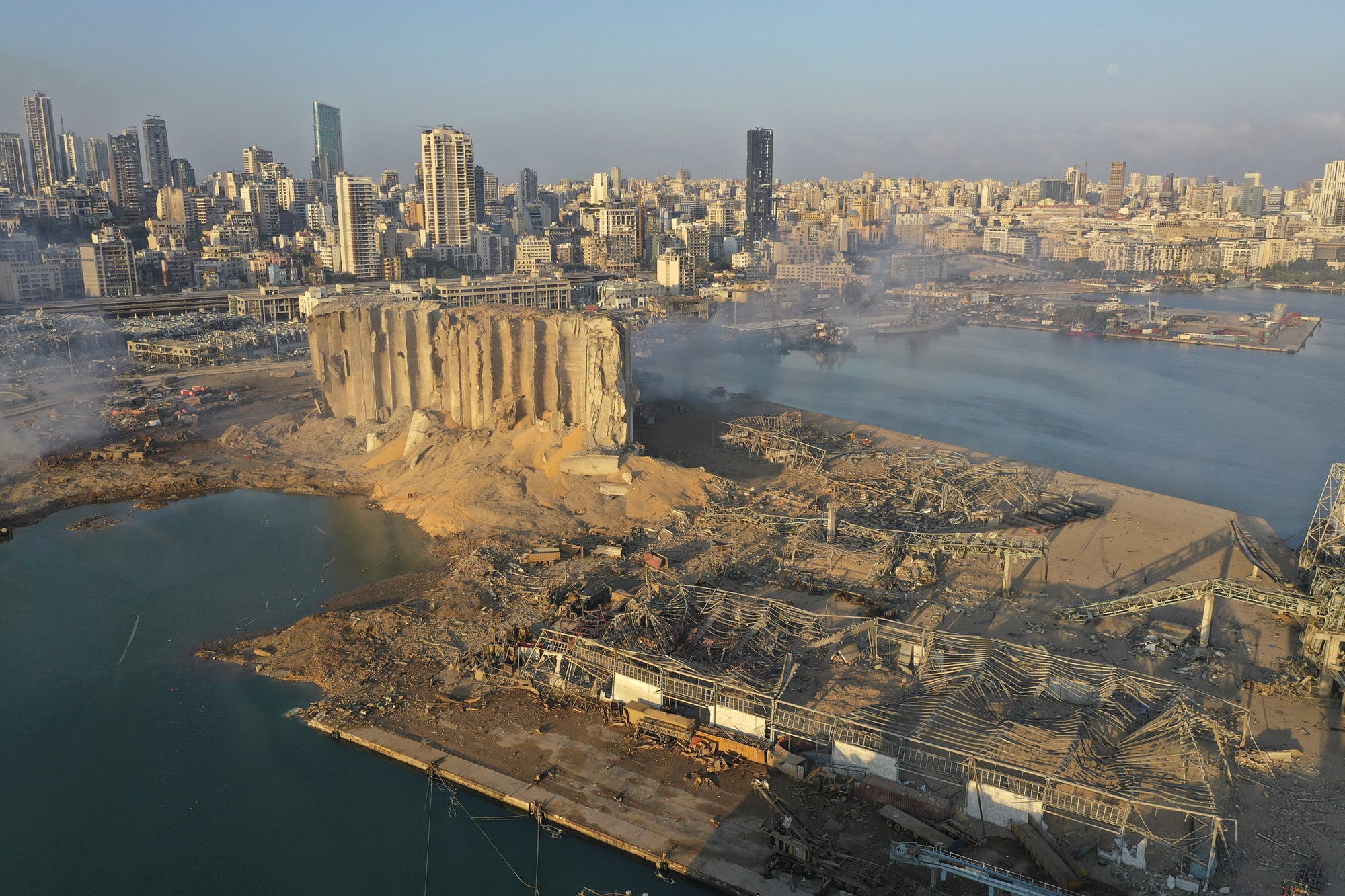
    The most circulated pictures over the last few weeks on media are of the explosion in Beirut and the spillage of grains. This blast occurred because of the unsafe storage of ammonium nitrate and has led to the death of over 200 people, with over 6,000 injured so far. There are many still missing. For Lebanon, this is a triple layer of burden, as the country is fighting a mismanaged economy, a pandemic, and now the horrific aftermath of the explosion. Post the explosion, many countries and global institutions have rushed emergency support by providing minimal aid and funding to facilitate fast recovery from this catastrophe.  While the world has come together to help Lebanon, the situation remains grim because of the shortage of various necessities like medicine and food. The second-largest port in Lebanon, Tripoli has some storage of flour; however, this suffices to cover just one month’s requirements. Beirut port, the largest in Lebanon, is virtually unusable because of the blast. The port infrastructure is severely damaged, thus hurting imports. Lebanon is a country that relies hugely on imports; it imports 85% of its food from outside, making this a major crisis . By one estimate the blast has destroyed 120,000 metric tons of grains, and this could affect food availability as well as sky-rocketing of food prices. The United Nations Food Program reiterated that Lebanon is in a grim situation regarding food security. The current assessment is that the grains can sustain them for less than a month.

    Grim Outlook and Tough Challenges

    The looming food security crisis is a direct fall-out of the economic collapse and multiple crises facing the country. Discontent with the government in Lebanon is not new, since the protests have been on since last October. The explosion and its resulting loss of life and property have triggered waves of protests again, forcing Hassan Diab, the Prime Minister of Lebanon, to step down from his office on 10th August. Decades of poor governance, entrenched kleptocracy, corrupt political class, criminal negligence, incompetence and economic mismanagement have led to the current catastrophe. The former economy minister, Nasser Saidi, says that ‘Lebanon is on the brink of the abyss of depression, with GDP declining by 25% this year, growing unemployment, hyperinflation, and humanitarian disaster with poverty exceeding half the population. The growing food crisis and poverty could lead to famine conditions’. The government will need to address income inequality, large-scale corruption, and the role of foreign players in contributing to the economic collapse.  Financial institutions and other creditors, more often foreign powers, need to suspend debt repayments and allow the Lebanese economy to recoup; since a considerable portion of the revenue goes into debt servicing, which is unsustainable for long.  International funding agencies, while sympathetic to the common peoples’ plight, are hesitant to go ahead with aid due to the poor governance track record of the political class. By some estimates, they put the immediate requirement for humanitarian aid and the cost of rebuilding essential infrastructure post the blast at USD 15 billion. This pales compared to the even bigger mess in the financial system. Ghazi Wazni, the country’s finance minister who quit with the rest of the government last week, has put the total losses in the banking system at $83 billion, and a black hole in the central banking system of $50 billion. The people are displaying discontent over the sectarian politics that have afflicted the country for decades and are the root cause of endemic corruption. Last year’s protests led to a new government in December, which was forced to resign post the explosion.

    Amidst the political crisis, food security is increasingly the major problem in Lebanon for months now. The blast has left 300,000 people homeless.  International Organizations and Civil Society Organizations, Ukraine, Russia, and the United States are enabling and mobilizing food supplies.

    Poverty is the immediate concern; there are already one million Lebanese in poverty, with the likelihood of more than half of the Lebanese population falling into poverty. Food shortages will most likely result in starvation, malnutrition, and death. Looking at the five tenets of food security mentioned above, Lebanon satisfies neither of the five criteria. Lebanon is an example of how decades of factional strife, warlordism, corruption, and power in the hands of the kleptocratic elite can push a country and its people into the abyss of poverty. While resolving Lebanon’s food security crisis is possible through immediate international aid and support, resolving the larger problem of its economic mess and humanitarian catastrophe will need international intervention.
  • Venezuela’s Collapsing Economy: Victim of Geopolitical Games

    Venezuela’s Collapsing Economy: Victim of Geopolitical Games

    Manjari Balu and M Matheswaran                                                                     June 23, 2019/Analysis

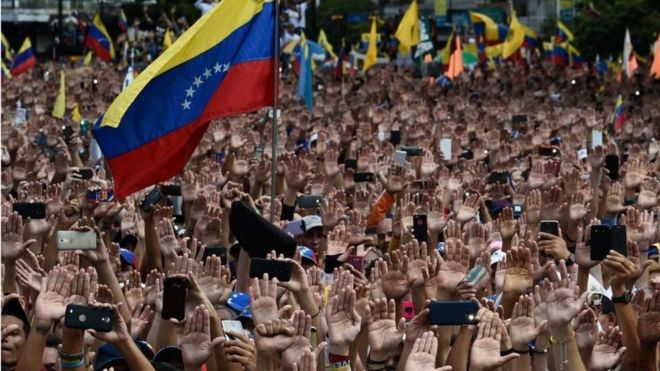
    The collapse of Latin America’s oil-rich country, Venezuela, epitomises the probable debacle of a socialist regime while the geopolitical strategies espouse the power struggle at the cost of the economy. After the death of Hugo Chavez in 2013, Nicolas Maduro, the hand-picked successor of Chavez took overthe office to preserve the “petrostate” status of Venezuela.  USA, backed by Brazil, Canada and many other countries, have recognized the opposition led by Juan Guaido as the interim president and have questioned the legitimacy of the Maduro government. Venezuela’seconomy depends to the extent of 95 per cent on oil exports and the dwindling oil prices in 2014 deepened the latent crisis, an inevitable consequence for a socialist government with illiberal economic agendas. Chavizmo rose to fame with a brand of Bolivarian revolution that promised to reduce poverty and deter the US in interfering in the country’s functioning.

    Economic Collapse: Paradox of Largest Oil Reserves and Economic Mismanagement

    Venezuela is a prime example of what economic mismanagement, impractical socialist measures, and corruption can do to a country that is wealthy with natural resources. At 300, 878 million barrels of proven oil reserves, Venezuela has the largest amount of proven oil reserves in the world. The country’s economy is largely tied to its oil wealth and was one of the richest in Latin America until a few years ago. Economic collapse has led to a huge humanitarian crisisunseen in the country’s modern history. IMF has predicted that Venezuela’s inflation rate will reach 10 million per cent in 2019, becoming one of the worst cases of hyperinflation in modern history.

    TheTransformation Index that evaluates the political and economic transformation of a country, has ranked Venezuela 110 out of 129 nations with a score of 3.27 out of 10. In addition to criticizing the poor state of the economy, it also reported that the state-sanctioned crime rates have spiralled. The current catastrophic economic crisis and political chaos is the result of a pervasive economic mismanagement and an economy rooted in a single commodity, petroleum.

    Inflation was 1,30,000 per cent in 2018 and the economy has contractedby 22.5 per cent, indicating the dire status of the economy. The economic future of the country continues to be bleak and the debate has converged to the geopolitical relevance of the issue. Data on money supply is a key element to understand the inflation rates in an economy and Venezuela has refused to publish money supply data in the past years. A recent data suggests that  12 trillion BsF (Bolivares Fuertes) were printed exposing the economic ruination.

    Initial denial by the Venezuelan government about the crisis never let aid flow in, recent acceptance of humanitarian aidhas tripled the aid budget. With poor socio-economic indicators as a major challenge, Venezuela is further saddled with huge external debt as a problem to be solved by the new dispensation, be it Maduro led government or any other successor. Currently, Venezuela’s external debt stands at  150 per cent of the total GDP.

    American Sanctions, Food Imports, and Falling Aid

    Few consider the problem to be homegrown in Venezuelaand many blame the US for artificially creating the hyperinflation.  The US justified the economic sanctions to bring down Maduro regime and accused him to have caused upheavals since 2014 and the controversies besieging election manipulation by Maduro’s party substantiate the allegation. Political funding for a coup against the regime change in Venezuela was extensively promoted by the Bush administration. The protraction of political interest led to imposition of anti-democratic sanctions,  and reiterates the hegemonic strategy that the US continues to pursue.

    The recent economic sanctions imposed on the state-owned oil company, Petroleos de Venezuela SA (PdVSA)  by the US has exacerbated Venezuela’s problems in its oil production- the output is expected to fall by 33 per cent in 2019. Investigation of Venezuela’s oil production before and after the economic sanctions suggests the production has been on downtrend even before the sanctions.  

    Private investments and productivity in agriculture dropped alarmingly as the socialist government led by Chavez nationalized agribusiness and industries and encouraged food imports.  Seventy per cent of the food requirements were met by imports. According to the United States Department of Agriculture, Venezuela is one of the potential markets for the US to export agricultural produce, and accounted for 21 per cent of total agricultural imports of Venezuela. However, as the economy collapsed, over-dependence on imports for food began to tell. In 2016, food imports fell by 72 per cent and reports state that people have lost an average of 8.6 kgs of weight due to food scarcity.


    China’s Extractive Relationship with Venezuela

    Majority of the loans are from China and Russia and their servicing or repayments are tied with its oil revenue. It is estimated that Venezuela owes around 13.5 billion USD to China as of 2019. Under Chavez leadership, China and Venezuela laid a financial foundation by crafting  “China-Venezuela Joint fund” known as the FCCV. The central bank of China alone loaned 42.5 billion US dollars from 2007-2012 to Venezuela. The compounded bilateral interest incentivized China to support even when the Venezuelan economy faltered in 2014. China further escalated its commercial interest byloaning a sum of $4 billion as cash for oil deal paying little attention to the projected contraction in the Venezuelan economy. In the year 2017, Maduro announced ambitious planning to spend 70 percent of the total budget on social schemes to address food scarcity. While the quixotic socialist paradigm was impressive during Chavez’s tenure the public soon realized the huge dent made in the economy by imprudent  social spending.

    The defensive lending strategy adopted by China post Maduro’s electoral victory shifted the focus of investments to oil and oil-related infrastructure. Although China’s recent intervention in Venezuela’s domestic affairs is evident from the endorsement for Maduro,  oil supply has always been its priority over political rivalry in Venezuela. As China became more sceptical about Venezuela’s ability to repay the loans because of low oil production and the adverse impact of US sanctions, its capital flow to Venezuela shrunk.  Maduro had viewed relations with China to be based on ideological common ground, but China was focused on leveraging its abundant resources, which, in turn, contributed to the crippling of the economy of Venezuela. This asymmetric relationship between Venezuela and China thwarted expectations of Maduro to acquire more credit from China.

    For China, endorsing Maduro is not an option as far as its economic interest is concerned; increasing rebellion of Venezuelan people portends a threat to the Maduro government that could bring in democracy in Venezuela, which could make it a potential defaulter of past debts. The Chinese government is considered culpable for Venezuela’s crisis by many American policymakers, and are accused to have followedthe “debt trap diplomacy”. The investment strategy in Venezuela resembles the Angola model- Chinese government extends credit tied with oil. However, in the case of Venezuela, China is bearing the cost of overestimating the performance of Venezuelan economy.

    Russia’s All-Weather Ties

    As we see a pragmatic China becaming more cautious about the failing economy of Venezuela, Russia’s interest and the relationship go beyond just the commercial narrative. Russia ties with Venezuela are deep-rooted since the time of Chavez, and it has continued to bolster the failing Venezuelan apparatus for clear geopolitical reasons. Vladimir Putin has invested strongly on  Russia’s international image and prestige, especially while rebuilding Russia post the Yeltsin years. The first credit line of arms relations between Russia and Venezuelawas signed in 2006. Although the export of military equipment to Venezuela have reduced drastically by nearly 96 per cent in the past few years, Venezuela has been the largest buyer of Russian arms in the Western Hemisphere with a total estimate of $4 billion during Chavez years. Russia has made consistent efforts to support Maduro by deploying military presence in Caracas even as Venezuela’s economy took a downturn.

    Chavez and Putin deepened their political ties on common grounds of  supporting a multipolar world order, and Chavez expected tangible benefits for Venezuela out of this agreement. Oil deals between both the countries advanced asRussia’s largest crude oil producer, Rosneft, partnered with PdVSA for several projects. Rosneft holds 40 percent shares and plays an instrumental role in pivoting Russia’s foreign policy through sound investments in the West. Venezuela agreed to commit 49.9 percent of its share in Citgo, American subsidiary company in exchange for credit from Rosneft. Russian emphasis on the “strategic” importance of the alliance with Venezuela reveals Russia’s intention to strengthen its geopolitical presence in USA’s backyard. Putin’s domestic political image has become sharper with his strategic take on Venezuela.

    However, sanctions on Venezuela has severely restricted the ability of Rosneft to borrow or invest, thus escalating tensions between Russia and the US.  Much like in Syria, Putin has sent a strong signal to the US by deploying a small contingent of Russian military personnel in Venezuela.

    Pawn on the Chessboard of Great Power Politics

    Venezuela has become the strategic battlegroundfor geopolitical struggle between the USA, Russia, and China. Collapse of the Venezuelan economy does not augur well for China in the long-term. However, China will look to strengthen its ties with Venezuela through economic support as its energy needs have a critical link with Venezuela. USA’s ‘Manroe Doctrine’ and its ‘Roosevelt Corollary’  has fiercely opposed any external powers’ strategic presence in the Western Hemisphere. This policy has led the USA to be an interventionist in Latin American countriessince the 1960s. Not much has changed since then. Chavez’s Venezuela has been a major opponent of US hegemony  Putin’s Russia is looking to strengthen its presence in South America, and support to Venezuela forms the lynchpin of this strategy. While international community looks for peaceful resolution of the rapidly deteriorating situation in Venezuela, geopolitical competition of external players has ensured  power tussle continues in Venezuela. Political Victory of either Maduro or opposition would represent the triumph of their Global supporters, Russia or the USA.  The socialist seed sown by Hugo Chavez is haunting Venezuela with a dented economy and a crisis in leadership. The “Petrostate” desperately needs economic reforms and international support to rebuild its economy. Structural reforms to remove the bottlenecks of growth in the post-crisis period and opportune investments in potential areas would rescue Venezuela in the following years.

    Manjari Balu is a Research Analyst at ‘The Peninsula Foundation’.

    Air Marshal M Matheswaran (retd) is the President of TPF.

    Image Credit: BBC News