Tag: Defence

  • President Trump’s India Visit : Balancing Optics with Substance

    President Trump’s India Visit : Balancing Optics with Substance

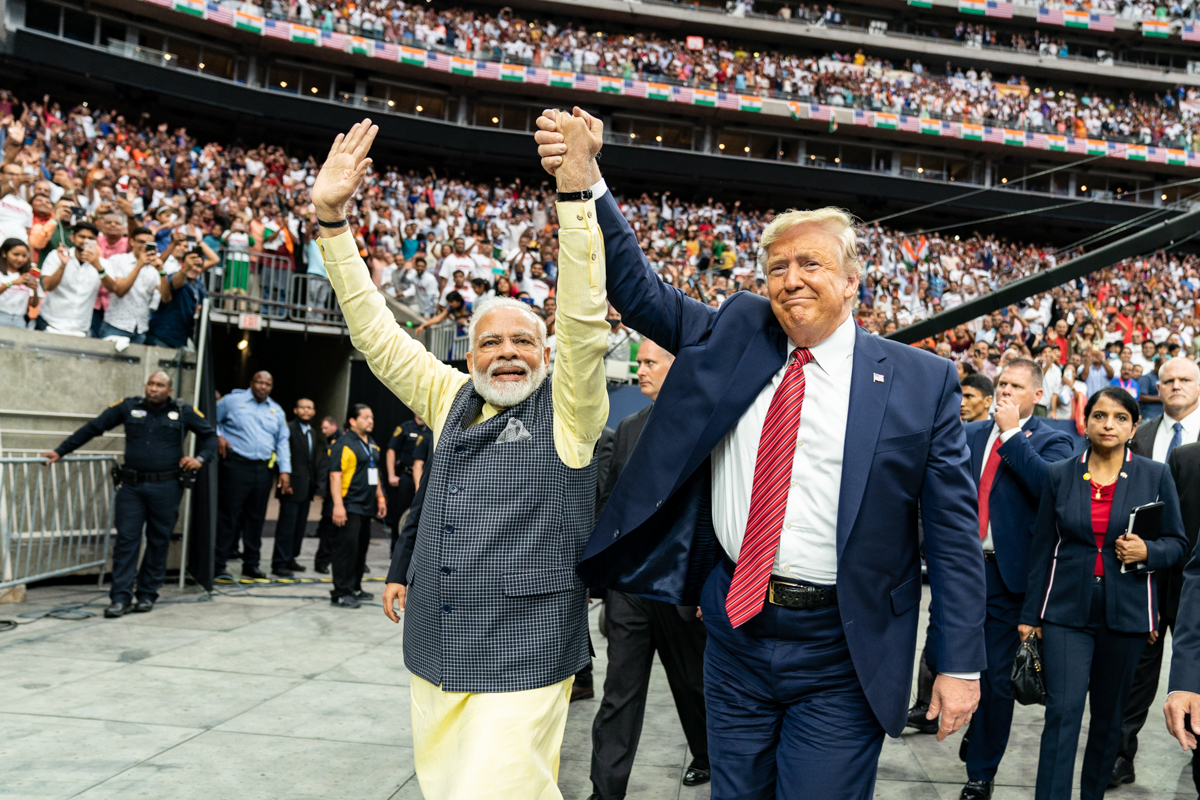
    As President Donald Trump arrives in India today, 24 February 2020,on his maiden official visit to India,  there is significant level of discussions amongst the academics, strategists, and foreign policy experts about whether this visit is more about optics than substantive discussions on strategies and agreements to strengthen the US-India strategic partnership. On arrival the president’s first public engagement is a super spectacle, ‘Namaste Trump’ at the new Motera Stadium in Ahmedabad that will have more than 100,000 people, which is Prime Minister Modi’s way of reciprocating for ‘Howdy, Modi’ at Houston last year. Most opine that while Mr Trump’s visit will be packed with pageantry, it will be light on policy and therefore, unlike previous presidential visits this one may not yield many break-through agreements. There are, however, some important developments that are very unique to the Trump-Modi era when compared to the previous visits of American presidents. Both leaders excel in showmanship and also in projecting strong nationalistic orientation to each one’s domestic constituency. Trump, with his transactional and disruptive approach comes off as more unpredictable when it comes to foreign policy and strategic issues.

    Politics and Showmanship

    It has taken Mr Trump, more than three years since he assumed office to visit India. This could mean that India was not a high priority for the Trump regime in the initial years, or as it turned out India was not the target of Trump’s disruptive strategy that he employed against USA’s traditional allies, China, Russia, and others. The final year of a POTUS term is generally termed as the ‘lame duck year’, where very few presidents have had a good last year and many were hampered by major controversies. It is important to note that India is the first country that President Trump is traveling to after his impeachment trial. There is more to Mr Trump’s India relationship than just this visit. One must remember that he is a shrewd businessman, and even before he became the president, India was already home to the most Trump ventures outside of North-America.  While India’s strategic importance is well recognised by all presidents since Bill Clinton, President Trump’s approach is considerably different than the others. His daughter Ivanka Trump made headlines when she visited Hyderabad, as White House Advisor, for the Global Entrepreneurship Summit in Nov 2017 and the prime minister broke protocol to host a dinner in her honour.

    That the Trump administration has followed a calibrated strategy of recognising and enhancing PM Modi’s image for significant gains to the American defence industry in particular is evident. The current visit, therefore, focuses primarily on strengthening strategic partnership issues in areas such as defence trade, intelligence sharing, counter terrorism, and visa issues. American side may make a token mention about Trump’s offer to facilitate improvement of India-Pakistan talks, China and issues of religious freedom.  However, these will get swamped by the more visible spectacle that will be on display at Ahmedabad and Agra.

    Defence Relationship – the most substantive progress

    India – US defence partnership has progressed significantly over the last decade and a half. The two militaries are exercising together more frequently than ever, and the strategic interactions are moving more towards equitable approach to various aspects. The Trump administration has covered significant ground in nudging India, despite its reluctance, towards partnerships such as the ‘Quad’ and moving towards interoperability by concluding various agreements including the foundational agreements through Defence-Trade-Technology relationship mechanisms.

    Defence trade between the two countries has grown exponentially since 2007. Two major procurements are likely to be signed by the Indian government during this visit: acquisition of 24 Sea-Hawk naval multi-role helicopters (NMRH) from Lockheed Martin worth $ 2.6 billion for the Indian Navy and six AH-64E Apache attack helicopters from Boeing worth $ 930 million for the Indian Army. Both procurements will be through the FMS (Foreign Military Sales) route. Trump administration cleared the decks for enhanced defence cooperation with India by approving India as a major Non-NATO defence partner in 2019, thus smoothening the process for exporting or selling hi-tech weapon systems to India. This is often confused with India becoming a major Non-NATO ally, which is clearly not the case.

    What is clear is that the US has secured major business deals with India to its great advantage, without India gaining much in terms of technology access or industrial production of hi-tech weaponry. The US objective is clearly to wean India away from its heavy dependence on Russian weaponry and secure much broader business relationship with American arms industry. The MIC (military industrial complex) of the USA is clearly focused on India now as its major avenue of business in the 21st century. The Americans were clearly unhappy that India went ahead with S-400 purchase from Russia despite the threat of CAATSA. That India has decided to buy an air defence missile system from the US, again through FMS route, worth $ 1.9 billion seems to be a compensation for such a decision.

    The US-India defence deal will scale $ 20 billion this year after the Trump visit. Many of these weapon system procurements, in terms of numbers, are not of a scale sufficient to create major industrial partnerships for manufacturing. India, however, will need to look at ways and means of acquiring significant technologies from the US through joint ventures, co-design and co-development. Otherwise, there lurks the danger of India being trapped in an all too familiar pattern of buyer-seller relationship rather than as strategic partners.

    Strategic gains?

    The visit’s focus is in areas of trade, defence, counter-terrorism, energy, and co-ordination on regional and global issues. These are areas in which considerable ground has been covered and is a continuing process. The agreement on trade deal, which was keenly expected, has been deferred. With President Trump accusing India of high tariffs and dashing all hopes of a deal before the visit, it is clear that the USA intends to push hard for favourable access to Indian markets for American companies. There are some positives that are emerging. The prospects for increased collaboration in space between ISRO and NASA looks bright.

    The focus of the American side is primarily on Defence trade.  Increase in investments in defence production may become a possibility with major projects in the pipeline. Both Boeing and Lockheed Martin are pushing hard for IAF’s 114 aircraft order, which will be processed under the strategic partnership model of ‘Make in India’ program. This could expand the production run to over 200 aircraft. Similarly, the naval  helicopter (NMRH) procurement has a possibility  of expanding into ‘Make in India’ project for over 100 helicopters. Boeing’s S-76D is a contender for Navy’s utility helicopter procurement under ‘make in India’ program.

    The spectacle of this visit will certainly contribute to both leaders’ constituencies, for President Trump’s re-election campaign and for PM Modi it may divert people’s attention from current issues of flagging economy, Delhi electoral reverses, the Kashmir issue and ongoing protests on CAA and NRC. India however, will need to negotiate hard and leverage the expanding defence business to address technology access and  strengthen Indian industry by enabling them into global supply chain. For this the Indian establishment will need to see well beyond the optics to assess real gains.

    Air Marshal M Matheswaran AVSM VM PhD (retd) is the President of TPF and a former Deputy Chief of the Integrated Defence Staff.

     

  • Blockchain Technology for Indian Defence Sector : Acquisition Process

    Blockchain Technology for Indian Defence Sector : Acquisition Process

                                                         KEY POINTS

    1. Block chain technology brings in transparency, immutability and accountability which can transform the acquisition process into a very scientific, transparent and efficient system.
    2. The benefits derived from implementing blockchain technology would include elimination of subjectivity, bring in accountability, completely eliminate the role of undue influence and middlemen, and will create a level playing field for all players .
    3. Smart contracts using blockchain technology can ensure efficient compliance and enabling greater auditability and real-time identification of responsibility.

    Introduction

    Blockchain technology has become a popular term today invariably because of the benefits it provides in a P2P (peer-to-peer) network like data immutability, irreversibility, accountability and transparency. It was first used by Satoshi Nakamoto, (a pseudonym of a person or a group of people), founder of bitcoins to prevent backdating and data tampering. Blockchain is an incorruptible, decentralized, digital ledger of transactions that can be programmed to record not only exchange of information. Critically, for information to be exchanged between any two nodes within in a blockchain system, all nodes (or most nodes, depending on the structure) must agree that the exchange of information is legitimate. They do this through a variety of methods; either acting as a recognized trusted party or by solving complex cryptographic problems. Once the exchange is accepted, that exchange is written into a shared copy of a digital ledger that contacts all records of transactions that is effectively unchangeable. The benefits blockchain provides has caught the eyes of a lot of people in the world and are looking forward to implementing this technology in almost all fields like healthcare, automobile, defence, banking, agriculture and so on. Countries like China, Russia, America and South Korea are highly interested in implementing this technology in defence and other sectors. One of the key reasons being this technology optimises business processes effectively wherever it is implemented. This paper focuses on the application of blockchain technology in the Indian defence acquisition process focusing on its advantages in its implementation.

    Analysis

    Blockchain technology is a trust-less architecture. ‘Through crypto-economics, users don’t need to trust in any individual or organisation but rather in the theory that humans will behave rationally when correctly incentivised’. Blockchain in defence acquisition process would be a phenomenal game changer as it would lead to faster and quality decision-making because all the parties in the acquisition process are thoroughly informed and committed. Blockchain offers a more secure record of supply chain management and enables greater auditability and real-time identification of responsibility.  Since blockchain acts as an important tool to take major decisions, it pushes all the nodes (participants like Service Headquarters, DRDO-Defence Research and Development Organisation, HQ IDS, Acquisition Wing of MOD, Defence Finance, and so on) in the network to feed high quality and accurate information in the network. It establishes clarity in the process ensuring clarification of responsibilities to all the nodes in the network.

    The inherent security that stems from the nature of immutability and peer-to-peer characteristics of the blockchain lends itself to some critical applications within defence. Successful exploitation of blockchain is dependent on stringent data governance and quality assurance. Once the data is stored on a blockchain it is immutable, and hence, it forces participants to become quality assured with their data/information prior to storage. Quite naturally, it will bring in a culture of professional diligence, accuracy, and integrity. Blockchain works as an immutable record of transactions that do not require to rely on an external authority to validate the authenticity and integrity of the data/information.

    Smart Contracts:      If blockchain technology is taken up in defence acquisition process, smart contracts become an essential part of it. Smart contracts are a set of computer programs on the blockchain that can automatically execute activities when certain conditions are met. They can be viewed as a normal contract with terms and conditions that is converted to a digital script and stored on the blockchain. Since blockchain works on a distributed decision making model and not a central party that is powered to make all the decisions, the process might get complicated at times. To ease this, smart contracts can automate parts of the process that can overcome this complexity. For example, smart contracts can track the transfer of equipment from the vendor to buyer. Once the buyer receives the equipment as per the conditions given in the smart contract, it will automatically expedite the funds to seal the transaction. Besides, smart contracts can eliminate the problems of delayed compliance or non-compliance to contractual issues and vendors’ propensity to contest penalties, a frequent problem in Indian defence contracts. Blockchain based smart contracts are legally fool-proof and hence, compliance is the only way out.,

    Since defence acquisition process and its inner workings function on a parallel basis to save time, the process could be more optimised if blockchain is effected fully.  The whole process can come under blockchain right from generating an RFI, (where it deals with acquiring information about vendor capabilities and their product features for making better buying decisions) till post-contract management. It is also important to recognise the need to invest in creating significant data-bases that store and process volumes of confidential, operational, and industrial information.

    This information can enable creation of verified and immutable data-base on the nation’s production capacity, indigenous technological status to ultimately enabling the decision on imports vs indigenous development, governed by operational requirements of time and relevance. It will also enable the users (military) to have a better mapping of Indian technological capabilities, resulting in more sound formulation of SQRs. Essentially the RFI process should collate:

    1. Production capabilities inside the country.
    2. Technological expertise available within the country for design and development within the required time frame.
    3. Identifying the solution of acquiring technologies through JV route.
    4. Establishing products and technologies available outside the country in the context of our operational requirements.
    5. Production capabilities outside the country.
    6. Armed forces modernisation requirements for enhancing the war fighting capability.

    All of this can be made a holistic process and come under the purview of blockchain technology, which will optimise the whole procedure bringing in accountability, transparency and data immutability that has been the dire need for a long time.

    The whole acquisition process involves multiple departments and stakeholders that interact through multiple meetings, discussions, brainstorming, and final decisions arrived at. Currently all these are controlled through bureaucratic procedures and centralised control . This classical procedure has given room for any number of accusations, scams, and delayed decisions. Blockchain technology overcomes all of these problems as it is based on innovative automation using AI, complete decentralisation, and the very fact that its structure is based on trust-less architecture. Hence, any decision that is committed to is recorded for posterity, and is immutable, transparent, and irrevocable. More importantly, there will no cases of missing files, no cases of mistaken attributability, and the question of illegal modification is simply impossible. While implementation will have technical challenges, blockchain technology will make the system unquestionably transparent, accountable, and of high integrity.

    Transparency is the biggest strength of the blockchain technology, and any attempt at post event modification or tampering with records, is impossible. This tamper-proof benefit offered by blockchain ensures integrity in the acquisition process resulting in trust amongst the nodes in the network.

    Important details in the selection process can be scrutinised even more effectively, for example:

    1. Company’s financial status
    2. Product features and specifications
    3. Annual report
    4. Past contract dealings and so on

    All of this can be witnessed by all the nodes in the network and a sound and swift decision can be made.

    Private Blockchain Network: While the general or public systems can use the public blockchain, the defence sector will necessarily be using the private blockchain network. A private blockchain is a permissioned blockchain. Permissioned networks place restrictions on who is allowed to participate in the network and in what transactions. It works with revealing the identity, role and organisation of the node before adding them to the concerned network, so one can determine whether the information has to be sent to them or not. This makes the nodes accountable to their actions in the process and any signs of actions by them, which can be detrimental, are easily exposed and corrective actions can be initiated. Where parties are culpable, penal actions can be made swift and effective. This type of blockchain is present in private enterprises for swift and sound decision making and meeting compliance requirements. Private and closed blockchain can be implemented within the procurement committee, who are in charge of making decisions regarding supply chain management and acquisition of products and spares across all ranges.

    Conclusion

                   Blockchain will be a total game changer if implemented in our defence acquisition system. By using blockchain technology teams building decentralised projects can take advantage of its most valuable strength – the ability to reach a shared truth that everyone agrees on without intermediaries or a centralised authority. The chain works as an immutable digital ledger. It is not possible to modify any block without changing the entire chain, this makes it highly valuable in what is often, a highly contested and complex defence domain.

    It is also highly beneficial for defence industries for their own functioning, transparency and efficiency. Recognizing the benefits offered by it, countries like the US, China and South Korea have already initiated the process of implementing blockchain in their respective defence industries. Issues like financial mismanagement, mysterious and anonymous order approvals, inability to track orders in supply chain and so on can easily be eliminated.

    Blockchain technology is seriously being looked at or being implemented by many countries in areas of defence and security, blockchain technology in defence, blockchain for military defence, blockchain for aerospace and defence etc.

    The immutability of blockchains allows all participants involved in the network to be confident in the fact that the data written to them hasn’t been tampered with or changed in anyway and that it will be available and accessible far into the future. India’s entrenched bureaucratic structure and its political culture tends to favour archaic and over-centralised systems for vested interests. Given the nature of India’s challenges in areas of defence modernisation, failure of its control over critical technologies, inefficiencies in its defence industries (both private and public), and a high import-dependency for defence equipment, it is imperative to start with innovative technologies like the blockchain to reform its defence architectures, acquisition system in particular. Political will is necessary to initiate this transformation. With the current Government mandate, modernisation in Indian defence being one of the main objectives, initiating it from the acquisition process would be the way to go about it.

    S Swaminathan is a research analyst with TPF. He holds a masters in Defence and Strategic Studies.

    Image Credit:Photo by André François McKenzie on Unsplash