Tag: Consumption

  • Consumption as a Substitute Religion – A Critique of Capitalism

    Consumption as a Substitute Religion – A Critique of Capitalism

    Consumption is becoming the new substitute religion. This is certainly progress for former poor countries, but in the long run it dissolves the cohesion of society and is only apparently covered up by aggressive enemy declarations. The newly industrialised nations should take the dissolution of social cohesion in the West as a warning example.

    With the triumph of neo-liberalism, all forms of identity worldwide are becoming fluid, uncertain or even dissolved. It is true that it was right to leave behind the binary oppositions of Western modernity to “non-modern” societies, which were associated with static, entrenched forms of identity. But the orientation towards models of consumption does not lead to a real pluralisation, but reproduces ever new rigid identities and thinking in tribal opposites: “us against the others”, whoever the others are. The Chinese dream, New Russia, make America great again, the rise of right-wing populism in Europe and the USA, the division of Israeli society and the temporary triumph of the extreme religious right there are all reactions to the dissolution of identities through the transformation of citizens into consumers. Consumption is becoming the new substitute religion. This is certainly progress for former poor countries, but in the long run, it dissolves the cohesion of society and is only apparently covered up by aggressive enemy declarations. The newly industrialised nations should take the dissolution of social cohesion in the West as a warning example.

    If about 6 people have as much property as 3.6 billion “others or in the near future 1% of the world’s population as much as the “remaining” 99%, then this is an absolutely obscene inequality, which we only accept becauseö the ideology of consumption, capitalism and neo-liberalism has become the new world religion. As Walter Benjamin already pointed out, it serves the same basic need as the monotheistic religions. “Then said the Lord unto Moses, Thus shalt thou say unto the children of Israel, Ye have seen that I have spoken unto you from heaven. Ye shall set nothing by my side: silver gods and gold gods ye shall not have.” (Exodus 20:22). “And when the people saw that Moses came not down from the mount so long, they gathered themselves about Aaron, and said unto him, Arise, make us a god to go before us: for we know not what is befallen this man Moses. (…) And Aaron took the gold out of their hand and poured it into a clay mould, and made it a cast calf. Then they said: This is thy God, O Israel, which brought thee up out of the land of Egypt.” (Ex 32:1) We today may think ourselves exalted at the idea of worshipping a golden figure. But in reality, aren’t we merely replacing it with Wall Street or the Frankfurt Stock Exchange, or even globalisation, which is supposed to lead us to the promised land, i.e. prosperity and wealth? It is true that we do not entrust our wives’ and daughters’ earrings to the stock exchange, but often all our savings, individual fates as well as those of entire countries are determined by the price of coffee, bananas and other commodities. Gunter Henn, the architect of the VW Autostadt, one of the new temples, underlined the claim for the creation of meaning by companies: “Who else offers orientation, where does that leave us with our childlike religiosity? The churches are dead, the state is withdrawing, and the ideologues have lost their power. What remains are the companies.”

    This story of the Golden Calf, which was put in the place of God at the very moment when he had revealed his will to the people of Israel in the Ten Commandments, illustrates a fundamental problem of religion, of the religious. For religion is obviously based on a two-way relationship. On the one hand, there is a need for a god or gods to reveal themselves, to show themselves, and on the other hand, there is an ineradicable need, an insatiable human desire for the divine, for the religious. This deep-seated longing can have many different reasons. In the sociology of religion and philosophy, it is described in such a way that religion, the religious, has fundamental functions for individual people as well as human societies, for example, the endurance of the fear of one’s own death, the embedding in communities that outlast death, the giving of meaning to life, the transcending of one’s own boundaries in an ordered whole, the construction of something sacred, untouchable.  The problem that arises from this, however, is that this insatiable longing can obviously also refer to something other than the revealing God, precisely to a golden calf, but also to the God of reason, to one’s own nation or race, to the world-historical mission of the proletariat, or even to science and technology. Science and technology may relegate the religious to the very back seats – often with the sole effect of putting themselves in its place. Carl Schmitt, one of the most important as well as most controversial theorists of political theory, emphasised, for example, that at the beginning of the 20th-century religious belief in God was replaced by religious belief in technology and the omnipotence of man. With regard to National Socialism, this has been proven in many cases, as there was a deliberate and purposeful instrumentalisation of religious practices for party congresses and mass marches – incidentally an essential aspect of why this inhuman ideology could nevertheless be so successful.  “Führer, our daily bread give us today.”

    ‘As Walter Benjamin already noted, capitalism is a pure cult religion that has neither a dogma nor a theology’

    But let’s move on to the gods of the market, consumerism and cult marketing when brand companies and belonging to this community take on cultic, religious proportions. And let’s put it bluntly: This cult marketing appeals to religious feelings much more simply and directly than a reflected faith ever can, religious feelings that at best come to the fore in community experiences at church conventions. Their religious character is also not always overt, since there is an essential difference between consumption, cult marketing and the Christian understanding of religion. Substitute religions are usually polytheistic, but Christianity is monotheistic. For followers of monotheistic religions, polytheistic ones often do not appear as a religion at all, but as something that one shrugs off or is amazed at, but considers oneself to be superior to this preform of religion. Such a view fails to recognise that these polytheistic forms of religion nevertheless serve religious feelings, without which their success is difficult to explain. Moreover, as Walter Benjamin already noted, capitalism is a pure cult religion that has neither a dogma nor a theology – unless one also wants to understand the currently dominant neoclassicism as a substitute religion. A cult religion, in any case, is directly practically oriented, just like the archetypes of pagan religiosity, which practises its rite without God’s word, without revelation. Pagan is to be defined in such a way that the cult takes precedence over the doctrine, which only appears implicitly. Capitalism is a form of neo-paganism, Benjamin concludes.

    Just as religion tries to help life succeed by conveying a meaningful way of living, so advertising tries to do by suggesting to customers that they can only live fulfilled lives or belong to the in-group by buying, owning and using a certain product. It is striking that in many cases advertising no longer presents the real advantages of a product, but values such as friendship. Advertising instrumentalises religious motifs to turn people into customers and customers into brand believers. In doing so, it builds on the religious basis still dormant in the hidden human being, tries to appeal to this sacral subconscious and therefore creates new forms of cult marketing, through which modern man is supposed to find cosy, warm places for his longings. In the spiritual desert of modernity, marketing strategies fill the vacant position of religion with advertising in general and the positions previously held by God and the sacred with products in particular and everything connected with the use of such a product: instead of religious practice, consumption; instead of gods, idols of consumption; instead of churches, temples of consumption; instead of religious faith communities, those of consumption. In this context, belonging to the ingroup is considered constitutive in the choice of brand and ex-communication is threatened in an equally consistent manner if the wrong brand is chosen. The myth created around a brand gives its products a spiritual added value that is supposed to set them apart from the mass of competing products of the same quality.

    Consumerism was aggressively propagated as an alternative and implicitly as a substitute for religion vis-à-vis traditional religions by the media theorist Norbert Bolz in his Consumerist Manifesto. For him, consumerism is the immune system of world society against the virus of fanatical religions. Consumerism promises neither the goal nor the end of history, but “only the ever-new”.  Independent of the implicit and recurring criticism of monotheism, the question arises as to the price that must be paid for the production of the ever-new.

    Not only are quite normal products being elevated far beyond their utility value to cult brands, to a substitute for religion. In the new marketing, the customer is not only king, as it used to be called, but god-like. In largely saturated markets, it is mainly about creating ever-new desires. Customers are told that, compared to whatever they may already have, there are still many, many more possibilities, infinitely new possibilities. This amusement park has not yet been visited, that trip has not yet been taken, this hair shampoo could be cheaper or even better than that one, you can shop better in Frankfurt than in Kassel or vice versa or somewhere else. In the meantime, you can also fly to London in one day to go shopping, “how have you not yet been to Paris to go shopping?”

    The decisive factor is not whether one actually uses this or that offer, but that there are always even better, even fancier POTENTIAL possibilities that one has not yet realised…. “Anything goes” used to be a slogan of resistance against repressive social structures – today it is the symbol for the market of limitless possibilities. Due to this limitlessness of possibilities of consumption, a constant depressive feeling arises in MANY people that they have not yet exhausted any consumption possibilities – and if one were to devote one’s whole life to consumption, there would still be something that would have to be done without.

    This pressure of seemingly limitless possibilities to live like “God in France” is exacerbated for those whose financial possibilities are limited, such as in the case of unemployment, because here the tension between the real limited and the potentially infinite consumption possibilities is particularly great.

    From this tension follows a clinical picture that characterises modern capitalism, our market society, and depression as an awareness of what is potentially possible and what is actually possible. Depression threatens the individual who only resembles himself, just as sin pursues the soul turned towards God or guilt pursues the human being torn apart in conflict. It arises both when the awareness of potential possibilities far exceeds that of the real ones and in those cases where the consumer is called upon to constantly reinvent himself.

    This last problem can be illustrated by a cigarette advertisement that virtually signals the reversal of traditional advertising promises because it boldly states that this particular brand of cigarettes does not taste good to everyone – and that is portrayed as a good thing, according to the slogan. At the same time, of course, this advertising is aimed at the largest possible group of buyers, the more the better. This gives rise to the deliberate paradox that one is all the more an absolutely unique individual if one consumes exactly what everyone is buying.

    The individual here is not something self-evident, born or given by nature, but a laboriously constructed social role. As an individual, man makes himself the cult centre of a religion of uniqueness. That’s why Buddhism is often in vogue today – as a doctrine of self-redemption without a saviour god. And for those who find that too spiritual, self-excitement and self-challenge remain. You take drugs, get high on the body’s own endorphins – or best of all: on the drug “I”. But it would be a misunderstanding to believe that the cult of the ego is a step towards liberating the individual from the shackles of society. In the cult of the ego, the human being is less a sovereign individual than an unhappy prosthetic god. He surrounds himself with auxiliary constructions from the world of fashions, drugs and distractions.

    The emancipation of the sixties and seventies has often freed us from the dramas of guilt and obedience, but it has brought us new dramas of responsibility and action in an uncertain and conflicting world.

    In this invention of a seemingly unique individuality through the consumption of branded products, individuals are overburdened without limits – the customer is no longer king, but god-like in marketing strategies – we fulfil their most secret wishes, everything they desire, there are no limits to their desires. But people remain humans, they are not gods and often break down at this imposition of being equal only to themselves. Only God, who in the Old Testament logically demands that there should be no gods beside Him, is equal only to Himself. The emancipation of the sixties and seventies has often freed us from the dramas of guilt and obedience, but it has brought us new dramas of responsibility and action in an uncertain and conflicting world. Thus, through human self-empowerment and the marketing strategy of the individual responsible only to himself, depressive exhaustion accompanies neurotic anxiety not only on an individual level but could be also witnessed in Western societies as a whole. The alternative to rigid forms of identity and political systems is not consumerism, which only leads to new forms of such ideologies. What is needed is a floating balance of the individual and the community.
  • Budget 2020: Rhetoric vs Reality

    Budget 2020: Rhetoric vs Reality

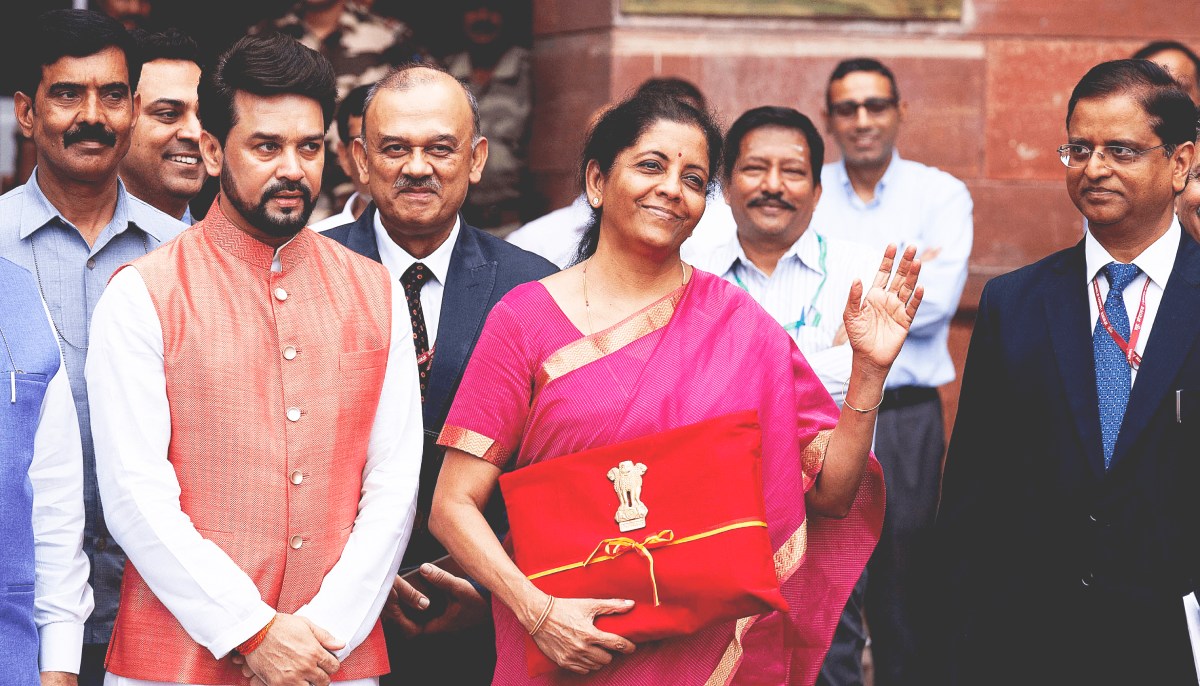
    Sharing structural similarities with the 1991 economic conditions, , the current decline in Indian economy is in desperate need  for radical reforms to energize the growth. Faced with severe fiscal constraints, the optimistic projection of revenue by the government   seems more of a challenge than realistic prospects for economic growth. Tax revenue is expected to fall short by INR 2.5 lakh crores in FY20 as the GDP records an 11- year low of 4.5 %.  As against the target of INR 24.6 lakh crores, there is likely to be a shortfall of INR 2 lakh crores for the current fiscal year. Expenditure cannot only depend on the expected revenue and fall in revenue collection will become a grave concern to achieve the fiscal deficit target set at 3.5 percent .  The budget is expected to balance deficit and growth by laying down a plan for fiscal consolidation and pushing the growth fundamentals. The Finance Minister in her speech mentioned three pillars under which the budgetary allocation has been rationalized. There is a need for deeper examination of budget proposals  beyond the slogans of the budget speech in order to comprehend the government’s long-term economic strategy.

    Aspirational India

    The agriculture sector with poor growth rate yet employing 50 percent of the workforce required significant capital infusion. 2.6 lakh crore has been allocated to agriculture & allied activities out of which 75,000 crores are dedicated to double farmers’ income. In reality, implementing a cash transfer scheme with a huge quantum of finance is a strenuous task facing  challenges on the ground. Schemes such as setting up solar panels and village storage run by Self Help Groups will act as a non monetary support measure. However, infusion of cash in rural credit structure and ease in acquiring credit facilities is largely ignored. The absence of  adequate investment for R & D in agriculture is a major shortfall in the budget. A target to increase the milk production capacity to 108 million tonnes is ambitious, yet no road map has been laid down to enhance the capacity in the current structure.  Weak consumption and high unemployment has contracted rural economic growth but the budget has failed to directly inject finance to increase effective demand. Sharp cuts in MGNREGA budget is giving rise to concerns as the total money in circulation in the economy continues to be low.

    Income insecurity will weaken the consumption demand for a few more quarters, arresting the medium-term growth. Healthcare Sector has been allocated  a total of 67,000 crores which is a significant increase of 10 percent compared to the last budget. The government’s flagship healthcare program, Pradhan Mantri Jan Arogya Yojana or  Ayushman Bharat, is allocated 6,400 crores which is the same as the previous year along with the National Rural Health Mission being allotted 28,000 crores. The Finance Minister has approved a Private-Public Partnership (PPP) between private medical colleges and hospitals in the country. The initiative is aimed to improve the skill levels of enrolled students to export their services abroad. Effectiveness of the PPP model in healthcare will depend on the amount of scrutiny and quality checks placed at the execution stage. Highest decline in funds was for Rashtriya Swasthya Bima Yojana from Rs 156 crores to Rs 29 crores, and Food Safety & Standards Authority of India was reduced to Rs 283.71.

    The draft of National Education Policy in 2019 invited multiple debates but achieving quality education has been the common goal across all levels of education. Human capital investment and skill development has been crucial to the 2020 budget with an allocation of almost 1 lakh crore for education and training. Breakup of funds for education under primary, secondary and higher education was not spelt out.  Finance minister citing the increase in gross enrolment ratio of girls in education has clearly missed the data on falling rates of women in labour force. The narrow lens of viewing enrolment number as a measure  women empowerment has to be revisited to achieve gender equality status. Encouraging apprenticeship and internships in rural areas for engineering and technical graduates is an important mention as the students lack experiential learning. Higher education population stands at around 36.6 million, surging the demand for  institutions offering graduate courses. The Government due to its limited fiscal capacity has allowed private institutions to address the demand for higher education. Despite this opening up tertiary education remains at only 25.8 percent of Gross Enrolment Rate. Quality in higher education is still a distant dream in India and it is important to dedicate funds to improve the quality of higher education in particular.

    Economic Development 

    Under Economic Development, promoting MSME sector and developing infrastructure have been the focus areas. Setting up NIRVIK scheme for higher export credit disbursement and facilitating investment clearance cells is a favourable move for medium and small scale business. Primarily, encouraging potential start-ups to equip their operations  with technology and managerial skills for creating export market demand must take precedence.

    National Logistic Policy is underway to revamp the transport infrastructure and new trains are to be operated under PPP. 100 new airports to be developed under UDAAN scheme is expected to create substantial employment in infrastructure sector. Linking basic Bharatnet services to 1 lakh gram panchayats is a notable initiative to improve the internet connection at local unit level. An exclusive direct investment in disruptive technology and artificial intelligence continues to be absent indicating India’s lag in becoming more competitive. Failure of the ‘Make in India’ initiative to materialize as expected is a relevant evaluation to reframe the fund allocation to accelerate indeginious production. Foreign trade of India presents a grim picture with exports slipping by 1.8 % in the last few months.  Although the political aspect of ditching Regional Comprehensive Economic Cooperation (RCEP) played well, quitting a multilateral trade deal has reduced the scope to upgrade domestic technologies. Frailty of the economy has clearly reduced the incentive for small businesses to invest in production and service despite schemes dedicated for this domain. Entrepreneurship culture in a favourable environment to undertake small businesses with insurance cover should aim at utilizing the existing human and capital resources through upgraded technology. A National Pipeline project has been proposed to ensure public spending on road, irrigation, power (conventional and renewable), railways and housing. Under this project, substantial funds are allocated for roads and least is for rural infrastructure. A prepaid  ‘smart metering’ system is to be substituted for conventional energy meters. On the financial front, tax concessions for corporate companies and foreign investment have been proposed. Reducing income tax slabs cheered the middle class but it has been a necessary and not sufficient condition to push the economy in a growth trajectory. Extension of tax holiday for real estate corporations would not qualify as fiscal stimulus with poor housing demand. As Dr Rathin Roy, economist suggests, either productivity should improve for pushing the demand at existing wage or minimum wage should increase. Decoding his post-Keynesian idea, structural crisis present in India offers much more complexity in practice. Land, labour and capital market reforms are inevitable to catch the growth momentum in the long run. Revising tax structure under Goods & Service Tax (GST) does not count for a structural reform to revive growth and scant attention has been paid for resolving systemic issues using budget as a tool. 

    Caring India

    The last pillar of the budget, emphasizing the importance of national and social security,  allocated funds for marginal groups, senior citizens and women, adopting a populist measure.  Over 6 lakh anganwadi workers are to be given smartphones and the budget estimate for nutritional related programs stands at 35,600 crores. Proposals were made to establish Indian Institute of Heritage and Conservation along with the development of 5 archaeological sites.  Major schemes like PM KISAN, Direct Benefit Transfer, Pradhan Mantri Awas Yojna and ICDS (Integrated Child Development Service) witnessed a jump from revised budget estimates of 2019-20. The Finance Minister in her budget had mentioned a number of schemes aimed at the Environment, Pollution and Climate Change. It includes 4,400 crores for the Clean Air Policy, 460 crores for Pollution Control and 3,100 crores for the Ministry of Environment, Forest and Climate Change. The last budget witnessed reduction in GST rates on Electric Vehicles (EV) and an annual tax reduction of up to 1.5 lakhs on interest paid to purchase EVs. However, the current budget has increased the custom duties to curb the import of cheap materials from China making the vehicles more expensive. National Adaptation Fund for Climate Change (NAFCC) is a central sector scheme set up to support concrete adaptation activities that mitigate the adverse effects of climate change. The Budget missed out on the replenishment of the much-needed NAFCC and has ignored it for two consecutive years. The overall fund allocation for Climate Change and Environment has increased by 5 per cent in the budget. Promoting sustainable business practices at micro levels is a key in tackling climate change. Accommodating the green budget would demand more involvement beyond mere budget allocation, effective plans need to be developed that can constantly track the progress of India’s climate change dialogue and advocacy.

    The defence budget for 2020-21 stands at 3.37 lakh crores, constituting 1.5% of the GDP, excluding pensions. Capital and revenue expenditure is valued at 1.18 and 2.18  lakh crores and pension at 1.33 lakh crores. This will affect several big projects taken up by the armed forces to build capabilities against Pakistan and China as there has been only a marginal increase in capital expenditure compared to previous year (1.08 lakh crores). Armed forces will be forced to cut down on arms and equipment purchases, thereby diluting the state’s priority on national security. However, with adequate government support there is scope for the private sector to bridge  the gap in areas of maintenance and logistics of the armed forces. Corporate tax cuts in the manufacturing sector, strategic disinvestment in Central Public Sector Enterprises (CPSE) and abolition of ‘angel tax’ for start-ups is appreciable. However, more involvement and sincere efforts should be undertaken by the Government to enhance private sector involvement in creating additional funding for developing a robust defence industry and meeting the needs of the armed forces at the same time.

     A recent study by Oxfam reported that 73% of the total wealth is owned by 1% of India’s population, as a result the number of billionaires has increased to 120 in 2019 from nine in 2000. A funding strategy that does not  attend to the growth of income among masses would lead to furthering the inequality and handicap the long term growth of an economy. Budget continues to be a powerful instrument to reallocate resources through fiscal policies and reduce economic inequality in a country. Facing a high risk of missing the demographic dividend, the budget was expected to make radical and structural reforms. Immediate measures to revitalise economic wealth among middle-class and rural residents is the need of the hour. The ostensible budget might garner popularity but the foundation to achieve India’s growth potential remains insufficient. Choice between managing fiscal deficit at the cost of reduced demand and initiating growth at the cost of huge fiscal deficit summarizes budget decisions. Biting the fiscal bullet, the finance ministry has assumed more accountability in explaining every component of expenditure but has failed to provide confidence for a resurgent Indian economy. Micro level assessment reveals a rosy picture but the exercise has undoubtedly choked the Indian economy in the short run.

    Contributions by

    Manjari Balu and Swaminathan S are Research Analysts with TPF.

    Aditya Balakrishna is an Intern with TPF.

    Views expressed are their own.

    Image Courtesy: Sanjay Rawat // www.fortuneindia.com

  • Falling Consumption Expenditure: Need for Labour Market Reforms

    Falling Consumption Expenditure: Need for Labour Market Reforms

    Government withholding consumption expenditure data on the grounds of data quality has stirred many criticisms from economists and other interest groups. Growing concern over falling rural consumption especially amidst economic slowdown has crystallized a categorical debate on the nature of slowdown. Irrespective of the validity of methodology employed, low consumption expenditure can sequel falling growth rates. Slowdown of the automobile industry as a case, sluggish growth and rising unemployment corroborate the unofficial claims on falling consumption expenditure. According to Business Standard report, the average amount spent per month by an individual declined from INR 1501 in 2011-12 to INR 1,446 2017-18. Although falling rural consumption expenditure evinces an economic malaise, issue of inefficient labour market has received less attention. Consumption is considered an important way to assess the health of an economy according to neoclassical economists. Multiple theories on income and consumption relationship are advanced in the field of economics. According to permanent income hypothesis, consumption expenditure varies in relation to the expected future income. In simple terms, an individual’s consumption will be distributed across their lifetime based on the permanent income they are expected to receive. Every theory has reiterated the central role of income in determining the consumption levels of the individuals. 

    Income insecurity in Informal sector

    A study conducted  on consumption spending in Ghana concluded that income and inflation had a long-run relationship on consumption expenditure. The Monthly Per capita Consumption Expenditure (MPCE) in 2011-12 revealed that urban MPCE was higher by 84 percent than rural MPCE. India, operating as a dual economy, considers casual wages and regular salaries as a proxies to study informal and formal sector. The wage differential among salary earning individuals operating in informal and formal sector was higher than casual labourers’ wages. Increasing number of regular employees working in informal sector shifted the concern to penetration of ‘informality’ across the labour market.  Post globalization labour market has theoretically encouraged organized sector but the wage employment in the organized sector has employed more casual labourers with no social security. A new layer of casual labours was created post reforms to cushion the weight from competitive prices. Fragmentation within the organized sector with growing contractual labourers has weakened the expected income levels which could directly affect consumption behaviour. Working-poor in India are highly concentrated in the organized sector as casual labourers and self-employed with a combined share of 51 percent of the total workforce as of 2012.

     A recent report on consumption expenditure points out that rural monthly consumption has fallen by 10 per cent from INR 643 to INR 580 indicating a need to accumulate more income in rural India. The main industries functioning under informal structure were construction, manufacturing and wholesale-trade employing majority of unskilled and semi-skilled labourers. In 2011-12, rural employment contributed 76 percent of total informal sector labourers in the three main sectors. Almost 80 per cent of rural workers are engaged in casual employment and despite a moderate growth in casual wages over the years; it amounted to only 36 percent of a regular worker’s earnings. Increasing share of informal employment within the organized sector coupled with poor social security has reduced expected financial flow of labourers. State induced social spending would propel consumption levels to a limited extent but the underlying crisis in the rural labour market would continue to contract long term consumption expenditure. Total social sector spending as a percentage of GDP has reduced from 2.7 per cent in 2000 to 2 percent in 2014. Reduced government spending and lack of labour market reforms are responsible for poor disposable income in the rural economy. 

    Rural labour market instability

    Casual labourers have constituted consistently 28 percent in Indian rural labour force since 1983. The periodic labour force survey report (2017-18) observed a decline in the share of self-employment in both rural and urban sectors. The unemployment rate in urban sector is 7.3 percent, comparatively higher than rural unemployment rates of 5.8 percent. A major portion of rural labourers are associated with the casual sector in rural areas with unstable income and weak social security. For instance, average earning per day in public workfare programme such as MGNREGA has fluctuating wage rates in rural areas, recording as low as INR 136 in 2018. Such a precarious structure in the labour market has diluted the spending capacity of rural residents in the recent times. According to the usual status in employment, there is a moderate increase in casual labourers and salary earners but the self-employment rates have been on the downtrend. In 1983, 60 percent were self-employed, which has gone down to 57 percent in 2018 despite the attractive loan schemes introduced by the government. 

    Female workers’ earnings play a vital role in determining the consumption health of an economy, a drastic fall in female work participation deserves an in-depth investigation. Falling participation rate could mean either women drop out due to social conditions or due to unavailability of jobs matching their skills. While sufficient literature studying these two areas are available, the first issue can be viewed with scepticism as earnings of men have increased significantly while women’s wages have stagnated. Although overall women in the workforce have reduced, 73 percent of women are engaged in agriculture as primary activity compared to 50 percent of men. A deceleration in agriculture and low investment on public infrastructure in the past few quarters have  decimated the consumption capacity of rural India. Women being the bigger component of agricultural labour force, and with factors of social discrimination, tend to have lower wage rates, thereby contributing significantly to reduced capacity for consumption and expenditure.

    Labour market reforms needed to revive long term consumption

    It would be erroneous to isolate the core economic problem to be categorical- the structural issue or cyclical slowdown can be both demand-side and supply-side driven. The whole economic apparatus is strongly integrated and a supply-side constraint can indirectly choke the demand which would, in turn, weaken the growth. Many economists have recommended the need for structural reforms; labour and capital relations have to be redefined as a measure to redistribute the resources. Further, the labour code on wages, 2019 has invited criticisms on grounds of poor protection for informal labourers and favouring corporate profit. Financial ecosystem requires corporates to make profits but a stagnant reinvestment convulses the cycle. Deepening crisis in the economy is conspicuous and falling consumption reiterates the need for better land and labour reforms. 

    Closer examination of the rural labour structure provides a bleak picture of low-income concomitant with minimum social and economic security, thus seriously impacting rural economic consumption. According to the PLFS report, the percentage of rural regular salaried employees with no job contracts increased from 58 percent in 2004 to 69 percent in 2018. Around 88 percent of rural female casual labourers against 84 percent of rural male casual labourers had no union or association. Absence of union is a proxy for weak bargaining power which eventually distorts the real market wages for the labour. Systematic labour market reform is critical especially for fixing the minimum wages and restructuring the labour market. Failure of manufacturing and service sectors to absorb the excess unskilled labourers from the agricultural sector has posed a major challenge. A short term cash transfer or providing welfare schemes should not be mistaken for structural reform. Enhancing the skill levels of rural labourers so as to enable their displacement to the manufacturing sector would augment employment and income. 

    Effect of demonetisation on the informal rural economy cannot be underestimated; removing 80 percent of currency from the economy damaged small and medium scale businesses operating on cash. ‘Make in India’ has not succeeded in accelerating business entrepreneurship in the country. Only 5 % of the adult population manages to establish a business that survives for longer than 42 months according to Global Entrepreneurship Monitor, a rate that is the lowest in the world. Financial investment in medium scale and small scale industries has been poor due to bureaucratic hurdles and unfavourable business environment leading to world’s highest business discontinuation rate of 26.4 %.

    From the supply side, low reinvestment despite a reduction in interest rate has exacerbated the falling consumption situation. Slowing automobile industry and consistent downtrend in manufacturing have contracted the capacity for employment generation in the industrial sector. CMIE has observed corporate profits to be more volatile than wages in the last two decades. The standard deviation of increased profit was recorded to be 32 percent as compared to 6.3 percent in the wage share. The erratic change in profit component implies entrepreneurs are more likely to be discouraged to invest in a business and play it safe. This invariably allows only the big corporate companies to survive. Low share of labour income in the economy is undoubtedly a structural phenomenon; the state’s apathy to induce private capital investment is detrimental to the labour market as well. 

    Reforms should have distinct rural and urban labour market strategies

    Departing from viewing economy in a political lens, a state must prioritize market reforms especially labour reforms. It is the state’s responsibility to ensure efficient allocation of resources and guarantee economic development and welfare of people. The slogan of ‘minimum government and maximum governance’ can be realised only through radical reforms and policy changes.

    The problem of shrinking consumption in rural areas is an outcome of constraints in the supply-side and unorganized labour market. Mere infusion of money as a solution is neither practical nor sustainable; a long term strategy to improve the structure of the rural economy is necessary to address the current economic crisis. Policies should be directed towards energising the informal sector, provide social security and economic dynamism that accelerates capital formation and induces private investment to support business growth. Consumption levels can be revived by making demand side and supply side changes simultaneously; increasing public gross capital formation and encouraging private investment by improving the investment climate would revive private consumption. A clear distinction has to be drawn between rural and urban labour markets, reforms to monitor the movement and prices will emerge as a structural reform to support both growth and development. 

    Manjari Balu is a Research Analyst with TPF. Views expressed are her own. 

    Image credit: www.newskarnataka.com