Tag: Connectivity

  • The Geopolitical Significance of Chabahar Port to India 

    The Geopolitical Significance of Chabahar Port to India 

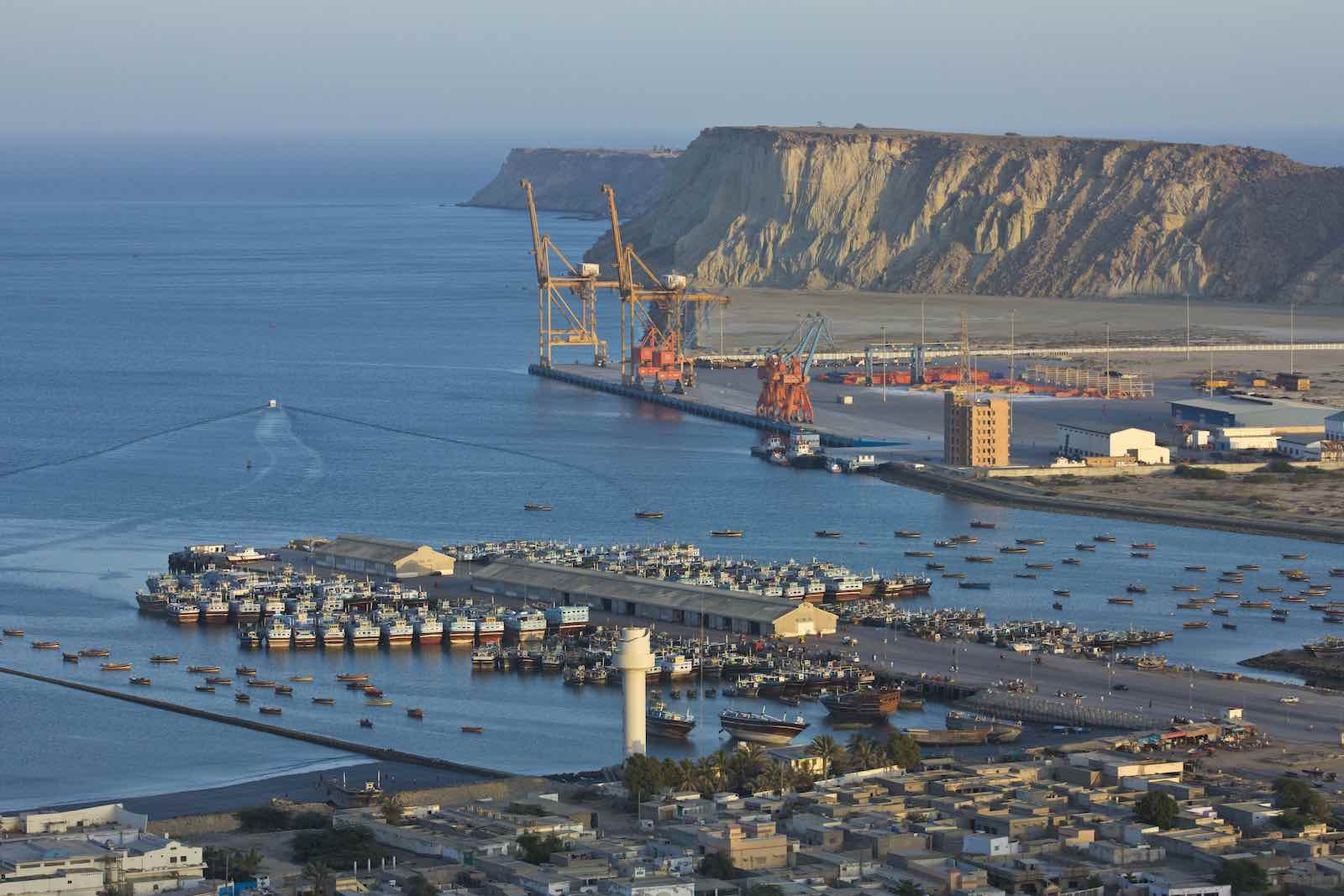
    The port of Chabahar is a seaport in south-eastern Iran, located on the Gulf of Oman, at the mouth of the Strait of Hormuz. It is situated in Sistan-va-Baluchestan, one of Iran’s least developed provinces. Contrary to Bandar Abbas, the busiest port in Iran, Chabahar is a deep-water port with direct access to the Indian Ocean that is outside the Hormuz Strait. It is Iran’s only seaport and consists of two separate ports called Shahid Beheshti and Shahid Kalantari. The last Shah of Iran proposed the port’s development in 1973. Work in Chabahar began when the Shah of Iran, Reza Pahlavi, was in power. The Iranian Revolution of 1979 hindered the development of this port. Following the 1979 Islamic revolution, US firms involved in various infrastructure investments fled the country. The new government took on these projects. The port of Chabahar grew in importance during the Iran-Iraq war of 1983 when ships were hesitant to enter the Strait of Hormuz. The port’s first phase opened during the Iran-Iraq war, when Iran began shifting maritime trade up the east coast toward the Pakistani border to reduce the reliance on Persian Gulf ports which were susceptible to attack by the Iraq Air Force. Chabahar is substantial for its fishing industry and will serve as a major trade hub designed to connect South Asia, Central Asia, and the Middle East. Chabahar can emerge as a potential global trading hub – and an arena for geopolitical competition. Chabahar is vital for both India and Iran to reduce their dependence on the Suez Canal for transporting cargo to Europe. Chabahar is a strategic port from an Indian perspective. Apart from being easily accessible from India’s western coasts, it serves several important functions. For starters, by having access to the port, India can reduce its commute time to Central Asia by one-third. Second, a link between Afghanistan and India could be built without going through Pakistan and this could help the already established diplomatic, security and economic relationship between New Delhi and Kabul. Third, India gains road access to four cities in Afghanistan via Chabahar: Herat, Kandahar, Kabul, and Mazar-e-Sharif. This will help India strengthen its trade with Afghanistan (“Chabahar and Beyond” 2016). However, the Taliban’s return to power in 2021 gives rise to a certain level of uncertainty. The current geopolitical environment, both regional and global, creates opportunities for India to overcome possible uncertainties.

    New Delhi views Chabahar port as a means of bypassing Pakistan’s land routes to gain access to the Afghan and Central Asian markets.

    Being one of the world’s fastest-growing economies, expansion of trade relations and access to new markets is a necessity for India. As an investor, New Delhi views Chabahar port as a means of bypassing Pakistan’s land routes to gain access to the Afghan and Central Asian markets. Pakistan’s Gwadar port is one possible route for India to access Central Asian markets, India has long aimed for alternative routes due to its adversarial relationship with Pakistan (“Chabahar Port: A Step toward Connectivity for India and Afghanistan,” n.d.). Additionally, the port will strengthen relations between India and Iran, which may help counterbalance strong Sino-Pakistani cooperation. According to the Minister of Foreign Affairs (MEA), India and Iran share close historical and civilizational ties, “Our bilateral relations are marked by strong linkages across institutions, cultures and people-to-people ties,” the MEA said in a statement. Afghanistan also seeks to explore new trade routes to reach international markets. It aims to reduce its dependence on Pakistan, which handles most of the Afghan trade due to the country’s landlocked status. 

    Afghanistan is crucial for India’s ‘neighbourhood first’ strategy. India assisted Afghanistan in becoming a full member state of SAARC in 2007. It signed a Preferential Trade Agreement with Kabul in 2003 following the establishment of the interim government post the US’s intervention in 2001. Under the North-South Transport Corridor framework, India, Afghanistan, and Iran signed the Chabahar port agreement in 2003, allowing all three countries to use the Chabahar port as a trade hub. India is working on constructing the Chabahar port primarily to compete with the Gwadar port project and to connect it to Russia’s International North-South Transport Corridor (INSTC). India has already built a 218-km-long road from Delaram to Zaranj (“India Completes Zaranj-Delaram Highway in Afghanistan” 2008) and now plans to connect this road to Chabahar port and deliver goods through this route. India is also keen on using the Chabahar port to connect the oil-rich Central Asian countries by road connectivity via the Milak (Iran) and Zaranj-Dilaram (Afghanistan) roads. For India, the port, which is only 940 kilometers from Mundra in Gujarat, is about more than just facilitating the flow of trade with Afghanistan. Rather, the development of Chabahar is a crucial component of the country’s grand strategy to connect with Central Asia. India’s justification for wanting to develop the Chabahar Port goes beyond its interest in Afghanistan. Enhancing regional trade and connectivity as well as thwarting China’s expanding influence in the Indian Ocean are other top priorities for Indian foreign policy (“What Are India, Iran, and Afghanistan’s Benefits from the Chabahar Port Agreement? Manohar Parrikar Institute for Defense Studies and Analyses,” n.d.).

    Geopolitical Challenges

    The port of Chabahar will be of little use if Afghanistan is not stable. Indian interest in the Chabahar Port, therefore, continues to be closely linked to the geopolitical changes the region is currently experiencing.

    The competition for regional dominance between India and China can be seen in the development of ports in the regions. Indian involvement in the Chabahar port is important in securing India’s interest in the region. A calculative China will seize any opportunity that India might present in the port facility. If China moves in, Indian investments in the Chabahar port may be unfavorably affected (Pant and Mehta, 2018). A significant barrier is the complex nature of India-Iran relations, in which the former does not hold a privileged position. Given India’s priorities in the Middle East, it is unlikely that the relationship with Iran could compete with the comprehensive partnership that China and Pakistan share, which includes a strong defence and security arrangement. Iran may find it challenging to ignore or exclude China, its largest foreign investor, from the Chabahar project. Additionally, China has successfully completed several infrastructure projects in Iran, including the Tehran Metro, and has allocated US$ 1.5 billion through its EXIM Bank for the electrification of the Tehran-Mashhad railway line (“$1.5b China Loan for Iranian Rail Project” 2017).

    Peace and stability in Afghanistan will also impact the performance of the Chabahar Port. The tumultuous security situation in Afghanistan could jeopardise trilateral efforts between India, Iran, and Afghanistan to operate the Chabahar Port facility. And finally, the port of Chabahar will be of little use if Afghanistan is not stable. Indian interest in the Chabahar Port, therefore, continues to be closely linked to the geopolitical changes the region is currently experiencing.

    References

    “$1.5b China Loan for Iranian Rail Project.” 2017. Financial Tribune. July 25, 2017. https://financialtribune.com/articles/economy-domestic-economy/68986/update-15b-china-loan-for-iranian-rail-project.

    Amirthan, Shawn. 2016. “What Are India, Iran, and Afghanistan’s Benefits from the Chabahar Port Agreement?” Strategic Analysis 41 (1): 87–93. https://doi.org/10.1080/09700161.2016.1249184.

    “Chabahar and Beyond.” 2016. Www.thehindubusinessline.com. May 25, 2016. https://www.thehindubusinessline.com/opinion/editorial/chabahar-and-beyond/article8646239.ece.

    “Chabahar Port: A Step toward Connectivity for India and Afghanistan.” n.d. Thediplomat.com. https://thediplomat.com/2019/07/chabahar-port-a-step-toward-connectivity-for-india-and-afghanistan/.

    “India Completes Zaranj-Delaram Highway in Afghanistan.” 2008. Development News from Afghanistan, August 24, 2008. https://afghandevnews.wordpress.com/2008/08/24/india-completes-zaranj-delaram-highway-in-afghanistan/.

    Pant, Harsh V., and Ketan Mehta. 2018. “India in Chabahar.” Asian Survey 58 (4): 660–78. https://doi.org/10.1525/as.2018.58.4.660.

    “What Are India, Iran, and Afghanistan’s Benefits from the Chabahar Port Agreement? Manohar Parrikar Institute for Defence Studies and Analyses.” n.d. Idsa.in. https://idsa.in/strategicanalysis/40_1/india-iran-and-afghanistans-benefits-from-the-chabahar-port-agreement.

    Featured Image Credit: Lowy Institute
  • The Bridge on River Chenab

    The Bridge on River Chenab

    “The only way to discover the limits of the possible is to go beyond them into the impossible”

    -Arthur C. Clarke

    Introduction

    On 13 Aug 2022, the bridge on the River Chenab in the Reasi District of J&K was finally completed. It was a case of the impossible becoming possible. It all happened because of a very high degree of self-belief of those who planned it and the sincerity of thousands of those who worked hard for the last 18 years.   Indeed, it was the best gift the Indian Railway in general and Indian Engineers, in particular, could give to India on the 76th Independence Day of India. It is also highly symbolic that it is located in the State of J&K and in a way appeared to be a giant step towards the integration of J&K with the rest of the country.

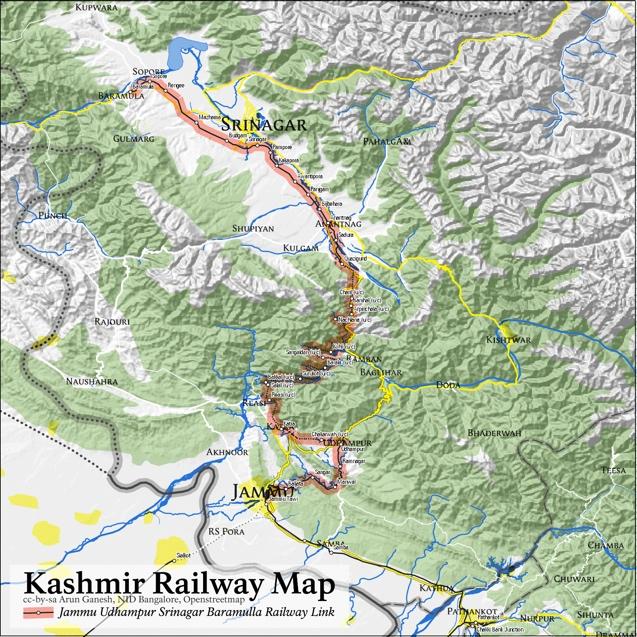
    The Bridge over the River Chenab is part of the Jammu-Udhampur-Baramulla Railway line, which is being constructed. While Sections of Jammu-Udhampur, Udhampur-Katra and Banihal-Baramulla are already completed and opened for traffic, section Katra- Banihal is still not complete. The degree of difficulty in this section is enormous. Besides this Bridge on Chenab (more about it a little later), the Bridge on Anji Khad (which is under construction) and a total of 35 tunnels and 37 bridges make this section of 111 km in the mountainous terrain extremely challenging and an engineering marvel in the making.

    Progress of the Project –  It is a 356 km railway project, starting at Jammu and going up to Baramulla. It was started in 1983 with the objective of connecting Jammu Tawi to Udhampur.  Construction of the route faced natural challenges including major earthquake zones, extreme temperatures and inhospitable terrain.  Finally, in 2005  The 53 km long Jammu–Udhampur section opened after 21 years with 20 tunnels and 158 bridges. The cost of the project had escalated to ₹515 crores from the original estimated cost of ₹50 crores.  In 1994 The railway accepted the necessity to extend the track to Baramulla. However, at that point it was thought that the project will have two disconnected arms; one from Jammu to Udhampur and the second from Qazigund to Baramulla. In 2002 the GoI declared this project to be a national project. This means hereafter, the entire funding will be from the Central Budget. At that time the necessity was also accepted to connect the two disconnected arms. The estimated cost of the project assessed then was   ₹6,000 crore.  In 2008 the 66 km section between Anantnag and Manzhama (outside Srinagar) was opened for traffic. In 2009 this Service was extended to Baramulla. During the same year, the line from Anantnag was extended to Qazigund.

    Also  Around the same time, an extension of the track from Baramulla to Kupwara was proposed, and its survey got completed in 2009. In 2009 itself, work on the section between Katra and Qazigund resumed after a review based on geotechnical studies. In 2011, an 11.215 Km long Banihal Qazigund tunnel across the Pir Panjal Range was completed.  This paved the way for a trial run in Dec 2012 from Banihal to Qazigund. In 2014 the train route from Udhampur to Katra was also operationalised. Now the only missing link in this nationally vital rail line was Katra-Banihal. Finally, in 2018 the GoI approved the extension of the railway line to Kupwara.

    Degree of Difficulty in Katra- Banihal Section – This is a 111 km long stretch. 97.34 km of this stretch will be through tunnels. There are 20 Major (including the bridge across the Chenab river and a bridge on Anji Khad) and 10 minor bridges on this stretch. 

    Bridge Across Chenab

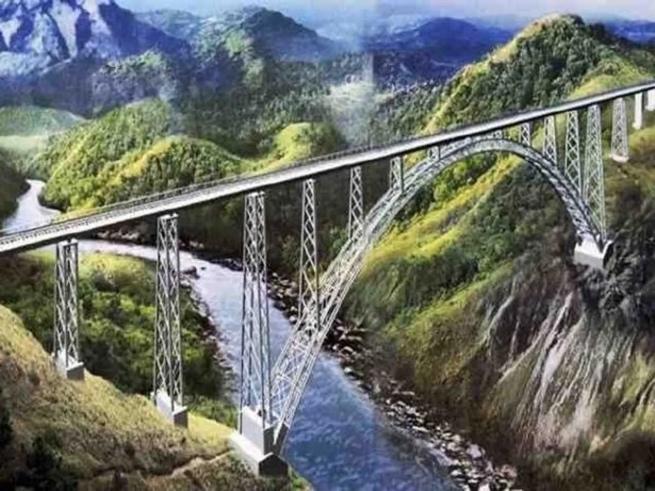
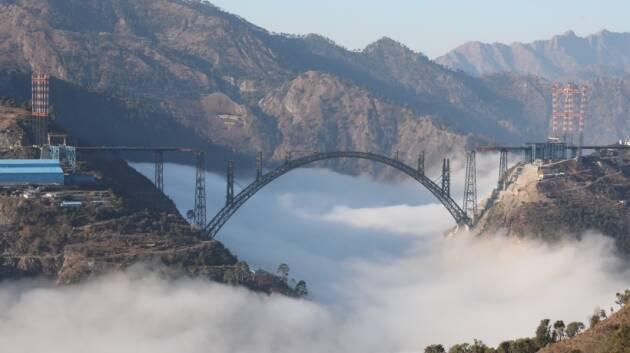
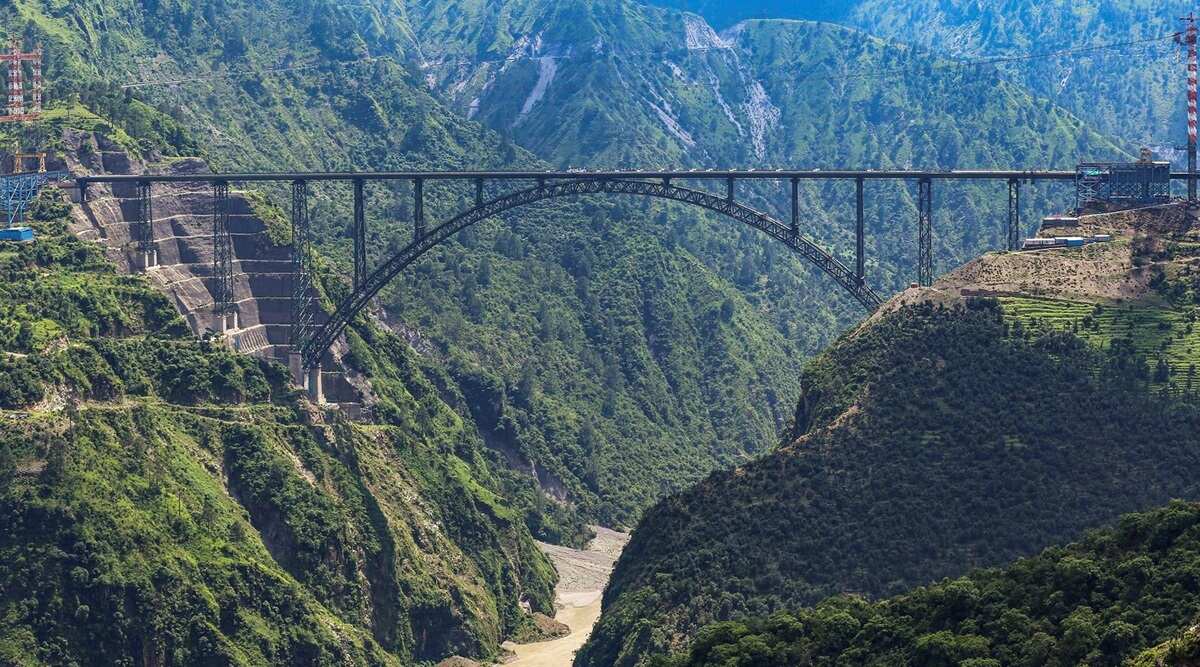
    Location: The Chenab Rail Bridge is a steel and concrete arch bridge between Bakkal and Kauri in the Reasi district of J&K, India.  It needs to be noted that it is the highest railway bridge in the world. After many hick-ups, finally in 2012 excavation of the foundation of the bridge commenced. The tender was with Afcons Infrastructure Limited. The alignment crosses a deep gorge of the Chenab River, which necessitates the construction of a long-span railway bridge with a viaduct for approaches on either side. 

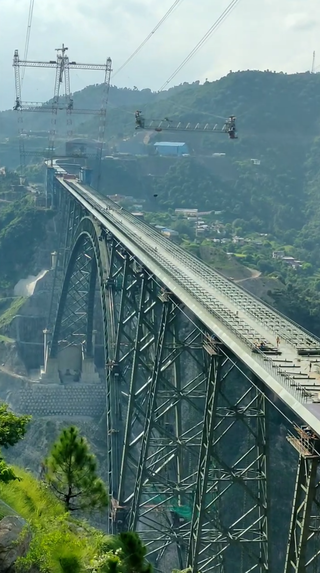
    Details: It is a 785 meters long single arch bridge where the main arch is 467 meters. The total span of the bridge is 1315 meters including a viaduct of 650 meters on the Northern side, Deck height is 359 meters above the river bed and 322 meters above the water surface which is 35 meters more than the height of the Eiffel Tower. The project also entails the construction of 203 km of access roads.  The deck is 13.5 meters wide, where two rail tracks will be available. The total cost of the Bridge is Rs 1486 Crores.


    Design: The steel arch has been planned because the construction of the pillar was difficult and the load had to be distributed. Chords have been provided to cater for the swaying load. The steel structures of the bridge were manufactured in workshops built in the mountains. The workshops had been moved to the building site because there is no proper road network in the challenging terrain. The longest building parts that could be delivered to the site were 12 meters in length. Therefore, four workshops were established in the mountains. Workshops and paint shops were built on both sides of the valley. All steel materials, except for the smallest rolled profiles, were delivered to the mountains as steel boards. The insufficient infrastructure of the area caused additional problems. There was no electricity and the water of the river was not suitable for manufacturing concrete. All electricity had to be produced at the site and the water was delivered from further away in the mountains. The job was also challenging because the track had a curvature in the approach bridge. In this section, the construction stage bearings had been designed in such a way that it was possible to launch the steel deck in the curvature portion as well. The bridge consists of about 25000 tonnes of steel structures, the main portion of which was used for the arch bridge section. It is a unique design and as such none of the Indian codes fully catered for the design validation. Therefore it was decided to follow the BS Code. The design also caters for wind load effects as per wind tunnel tests. It can cater for wind pressure of 1500 Pa. It is a blast resistance design. The design of the decking has been checked for fatigue as per the BS Code. The most important aspect is that it caters for redundancy within the structure, for a lower level of operation during mishaps and against collapse in extreme cases of one-pier failure. The area has high seismicity and the design was planned to withstand earthquakes of the severity of 8 on the Richter Scale. The bridge design is for a rail speed of 100 kmph. This means it can withstand very high-intensity of vibrations. The designed life of the bridge is 120 years and to take care of assessed steel fatigue the fatigue design selected is BS:5400 Part-10. The bridge will be able to withstand a temperature of minus 200C and a wind speed of 266 kmph.

    Team: The viaduct and foundation have been designed by M/s WSP(Finland) and the Arch design has been made by M/s Leonhart, Andra and Partners (Germany), the foundation protection has been designed by IISc Bangalore. The executing agency has been M/s Konkan Railway Corporation Limited.

    Status of Katra-Banihal project

    Although, the construction of Chenab Bridge is a major milestone in the progress of the project, however, still many more landmarks are required to be crossed before the completion of the project. Foremost of them is the Anji Khad bridge which is expected to be ready only by Dec 2022. It is expected that this rail Section will finally be operational by the middle of 2023.

    Conclusion

    The Jammu-Udhampur-Katra-Banihal-Srinagar-Baramulla Rail project is a vital national project which has a major bearing on national security and nation building. It is a matter of pride that Indian Engineers have achieved what at one point had appeared impossible. It will help in the integration of J&K with the rest of the country and will help strategically in many ways. The completion of the project will also give confidence to expeditiously complete other projects of national importance like; the railway line to Leh and the Railway line to Tenga in the North-East.

    End Note:

    1. Conceptual Design of the Chenab Bridge in India by Pekka Pulkkine WSP Finland, S Hopf and A Jutila. Available on Research Gate: https://www.researchgate.net/publication/257725212_Conceptual_Design_of_the_Chenab_Bridge_in_India.

    2. An internet upload: https://byjus.com/current-affairs/chenab-bridge/

    3. A Report by OT Staff, “Once the bridge is completed, it will provide all-weather connectivity between Kashmir and the rest of India” reported on 07 Apr 2021 and uploaded on https://www.outlookindia.com/outlooktraveller/travelnews/story/71397/all-about-the-chenab-bridge

    4. An internet upload: https://en.wikipedia.org/wiki/Jammu–Baramulla_line

    5. An internet upload: https://en.wikipedia.org/wiki/Chenab_Rail_Bridge

    6. An internet upload: https://www.pib.gov.in/PressReleasePage.aspx?PRID=1709652

    7. Zee Media Bureau, “Indian Railways: Delhi-Kashmir, Katra-Banihal train route to open soon, project nears completion” dated 08 Aug 2022 and uploaded on https://zeenews.india.com/railways/indian-railways-delhi-kashmir-katra-banihal-train-route-to-open-soon-project-nears-completion-2494827.html

    Image 1 Credits: Arun Ganesh

    Image 2 Credits: Indian Railways

    Image 3 Credits: Indian Express

    Image 4 Credits: Indian Railways

    Feature Image Credits: The Indian Express