Tag: Congress

  • An Outside View of the US 2024 Presidential Election

    An Outside View of the US 2024 Presidential Election

    What was the voter turnout?

    The big change is that Harris, so far, has lost 9 million voters since 2020, while Trump has gained only 1.2 million. Harris’s count of lost votes will decline as the final votes come in, but the bigger story remains that Harris lost more votes than Trump gained.

    Voter turnout is NOT final, but it is likely between 153 and 156 million, down from 2020 but still the second-highest percentage turnout in 100 years. At a minimum, 107 million adults did not vote (88 million of whom are “eligible” to vote). Thus, 41% or more of the adult population and 36% of the eligible voters did not vote.

    Using the percentage of voter groups who voted for Trump is misleading.  The news remains that the significant change is the loss of Harris voters.

    What were the economic issues?

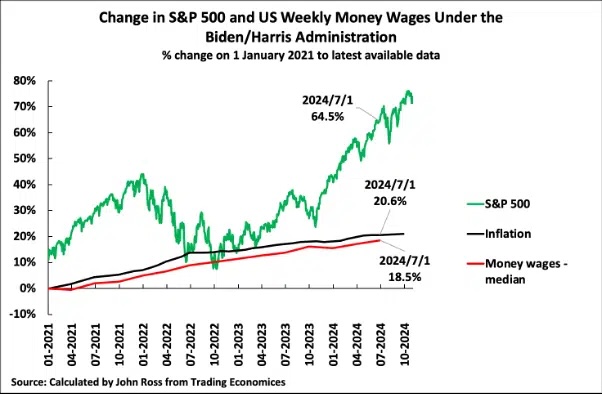
    Daily survival has become a serious problem for the bottom 65% due, specifically, to the inflation of grocery items and increasing mortgage payments and rent. Aggregate figures don’t reflect this reality.

    Workers’ actual standard of living was worse under Biden than under Trump.

    Real wages in the US remain lower than they were a half-century ago.
    Are there differences between Democrats and Republicans?

    US electoral parties are NOT like those in Europe – they have always been a different version of bourgeois electoral systems. Both major US parties are corporations, not parties with memberships, ideologies, and programs. They are designed like a marketplace of individuals preening for the Presidency, much like the Westminster Kennel Club Dog Show, but only held every four years.

    The Democrats turned over their foreign policy to the CNAS group of neo-con warmongers who will now be displaced.

    The Republicans are also not an actual party; Trump proved this, and what is next for Republicans post-Trump is also uncertain.

    What are the class shifts in the US?

    There is a new stratification of the bourgeoisie, with billionaires as a new factor. The increasingly dominant discourse amongst the capitalist class has the wherewithal to exert its influence.

    Fifty Billionaires put 2.5 billion US dollars, 45% of the 5.5 billion total, into the Presidential election. Of this, 1.6 billion went to the Republicans, 750 million to the Democrats, and the rest to both. The total spent on the election, in all races, was 16 billion, a sign of a kleptocracy, not a thriving democracy.
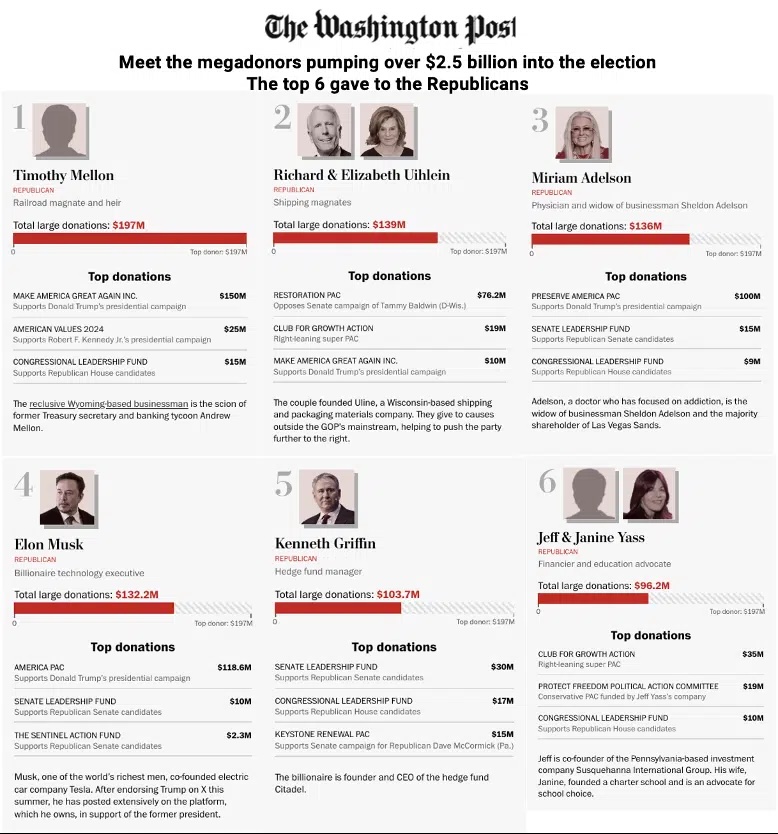
    washingtonpost.com/elections/interactive/2024/biggest-campaign-donors-election-2024

    There is a concerted effort by a section of libertarian tech billionaires, including Thiel and Musk, to have their hands directly on the levers of the state to control the race for global domination of AI. They believe that they alone should control the advances in the AI space for the world and that the initial next step is what is called Artificial General Intelligence (AGI). These megalomaniacs believe this will begin the control of humans by machine intelligence and, perhaps, in their perverse dreams, the end of humanity.

    A growing number of lesser capitalists, such as multimillionaires, are now being lumped into the upper middle class and the wealthiest one-third of voters. One very important trend to note is that in the last fifteen years, the richest one-third have switched allegiance from Republicans to Democrats.

    Why did Harris lose 6 to 9 million votes?

    Workers were worse off, wages did not keep up, and inflation left a long, lingering impact.  Some of the youth vote left for economic reasons. Others were disillusioned and demoralised by the full-throated support of the genocidal war in Gaza by the Democratic Party. Muslims, while a small group, voted for a third party or Trump.

    Despite the fabrications of the Democratic Party corporate handlers, Harris was, in fact, inauthentic, unlikeable, shallow, and could not mask her history as a prosecutor who spent her life attacking the rights of the poor.

    Dissatisfaction with many Western elected parties is growing – Conservative in the UK, Centre Right in France, right-wing in Germany – all thrown out. Biden left a demoralised Democratic Party and left too late.

    Fear-mongering about fascism was core to the rhetoric of the Democrats, even though no one knows what the term means.  Some voters became annoyed at the harassment by the liberals to vote for them since they were the last rail of defence against fascism. Many people did not believe Trump was, in fact, a fascist, nor did they believe that every one of their family members who listened to Trump was a fascist.

    Apathy is growing and remains a real issue.

    Probably over a million stayed at home as they could not stomach the Democratic Party’s gleeful support for Genocide. Trump’s victory in Michigan was certainly due to this issue.

    Harris played to and fawned over the war criminal Dick Cheney, the architect of the invasion of Iraq and a historic right-wing enemy of the Democrats.  We don’t know how many voters left in disgust. 

    Why did Trump gain votes?

    Trump took advantage of working-class dissatisfaction. Even so, he only gained less than 2 million total new votes. There is no evidence of a widescale shift of working-class votes to the Republicans in this election.

    Working-class women voted for local candidates supporting abortion but voted for Trump for economic and other reasons. Others voted on local issues important to them and then voted for Trump as they felt that despite his unsavoury behaviours, he was more committed to “shaking things up”.

    The billionaire class made sure that Trump had ample funds. Elon Musk’s America Pac spent $118 million handling field operations for the Trump campaign, an unusual role for a super PAC.

    From 2008 to 2020, there was a decline in the percentage of voters supporting the Democrats amongst the bottom 1/3 of income earners in the US.
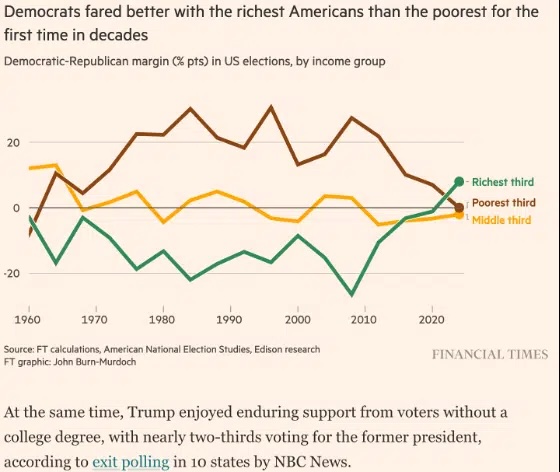
    ft.com/content/6de668c7-64e9-4196-b2c5-9ceca966fe3f


    Too little data is available now to provide a detailed answer about the relatively insignificant number of voters who voted Democrat in 2020 and Republican in 2024.

    What is the assessment of the new cabinet positions announced?

    Trump’s sixteen appointments to date are all vocal supporters of genocide in Palestine. In the United States, there are both Jewish and Christian Zionists. Trump has appointed several Christian Zionists. The majority are China hawks.

    When analysed from a US statecraft point of view, many are extremely underwhelming candidates. These include:

    • Secretary of State: Senator Marco Rubio: He is a rigid, fierce anti-communist.
    • Secretary of Defense: Pete Hegseth, an Army National Guard veteran and Fox News host: He is divisive and has no high-level military experience.
    • Attorney General: Representative Matt Gaetz of Florida: He has no experience in the Department of Justice and has had past legal controversies.
    • Director of National Intelligence: Former Representative Tulsi Gabbard of Hawaii. She has no intelligence background but is perhaps less rigid on international issues, a non-interventionist, and has a friendship with Indian Prime Minister Modi.
    • Ambassador to the United Nations: Representative Elise Stefanik of New York. She is an extreme Zionist, has near zero diplomatic experience, and has focused only on domestic issues, but is loyal to Trump.
    • Secretary of Homeland Security: South Dakota Governor Kristi Noem. She lacks national government experience, and her actions have veered toward radical anti-federalism.

    Due to some of these appointments, US stature in international affairs will likely diminish.

    Trump has brilliantly dismissed the extremely dangerous Pompeo. He has made it clear that few from the first inner group of his cabinet and advisors will return. The world will not miss them. Yet there is little evidence to suggest that Trump has the capacity to lead any group successfully for even an intermediate period. He is known for turning on people and turning them against each other.

    How do we interpret the vote?

    A significant section of the working class understandably abandoned the Democrats in this election.

    There is not a major right-wing shift in US attitudes, but there is a real base for the right.

    The Democratic Party elite is completely divorced from the masses. Parading the loyal royal cultural elite like Taylor Swift, Beyonce, and Bruce Springsteen reeked of wealth, opulence, and tone-deafness.

    Apathy should not be understated. At least 88 million didn’t vote, with a further 19 million disenfranchised.

    Third parties are structurally prevented from winning even a single state in a presidential election. They are structurally locked out of Congress. The United States has locked in a two-party system. Most voters have been captured by this belief.

    Small exceptions to this are wealthy candidates like Ross Perot in 1992 and Robert Kennedy Junior.

    There was huge intimidation at the end against supporters of third-party candidates, which depressed their vote even more than usual. In this just-held election, the Party for Liberation and Socialism Candidate Claudia Cruz received 134,348 votes so far.  Claudia Cruz’s 134 thousand votes is the highest number of votes for an explicit communist in American history. It exceeds the CPUSA’s William Z. Foster’s previous record of 120,000 votes in 1932. The 1932 vote was a higher percentage of the population as the US was smaller in 1932. These facts are a reminder of the long-term campaign of anti-communism within the US.

    Capital is clearly happy with Trump’s win, as evidenced by the November 6th celebration rally on Wall Street. They disagree with the liberal hype that he will bring an end to American society.

    Despite the lies of the liberals, the facts are that Trump formally initiated the New Cold War on China. His inner team are more fiercely anti-China than the Democrats, who are more bound to the Ukraine War.

    Trump has fewer restraints, controlling the Senate, House, Supreme Court, and Presidency.

    He could well launch a Third World War.  It would be a mistake to underestimate this danger.

    Other things people outside the US should know

    There is a tendency in some parts of the Global South to have a simplistic and false analysis that any enemy of the liberals is a friend of the Global South. This is a severely flawed argument. The imperialist far-right is not a good guy, a cultural conservative who wants to protect families and cultural life. Inside the US, conservative culture is tightly tied to slavery and genocide. It is misogynistic, racist, militaristic, and reactionary. We should not confuse the histories of Iran, Turkey, India, Ghana, and China with those of the US.

    Welcoming divisions in the enemy camp is often entirely correct. But Communists, socialists, and true democrats do not support reactionary views and always side with the people, not the far-right ideologues.

    There is also great confusion about MAGA and MAGA-Communism. First, Make America Great Again (MAGA) means returning (the second “A” in MAGA) to the full glory of the US industrial past. But what was that past? It was, in fact, the total economic, political, military, and racial subordination of the peoples of the Global South states to the US. It was the century of humiliation in China. This is not a return to be welcomed by history. MAGA is a profoundly reactionary, unacceptable outcome and concept.

    One of the greatest poets in the United States is Langston Hughes. One of his poems was called “Let America Be America Again.” But this was a parody as the actual statement was made in the refrain, “America Never Was America to Me”. The meaning of this poem was the false portrayal of the United States as ever having a glorious past, which was never true for the slaves or the working class.

    Second, there are a handful of personalities in the US who have taken the great word communism and sullied it with the idea of returning to this falsely idealised America. The old “strong” American industry was built on the backs of low-paid workers in the mines in Africa and elsewhere.

    Desiring a real communist path is a good thing. But tying it to an imperialist past, a past of violence, with reactionary views is the opposite path taken by Lenin, Mao, and Fidel.

    There is also a dangerous tendency to simply reject the liberal concepts of identity politics and embrace the values of far-right conservatism while lacking scientific thinking about the plight of women and other vulnerable groups.

    The CPC led the country in the first national Soviets in Ruijin in the struggle to abolish the prejudices of feudalism and emancipate women and national minorities in China. However, these rights have not yet been achieved in many countries, as there has been no communist revolution.

    True Communism is the path to advancing the overall interests of the working class in all countries, including women, national minorities, and other vulnerable groups.

    The Republican voter base in class-terms is the lower-middle class, which is overwhelmingly white, suburban, rural. It is amplified by fundamentalist Christians and the Republican regional strongholds.

    There are six “ideological” trends, all extreme right, in the Republican camp:

    1. Populist demagogues
    2. Extreme Libertarians
    3. Fanatical Christian-Zionists
    4. Virulent anti-communists
    5. Dangerous AI-obsessed Tech billionaires
    6. Complex conservatives

    The US economy will continue to perform poorly but better than the rest of the West. It will continue to use its dollar hegemony, reinforced with sanctions, to remove hundreds of billions from the Global South and to force Europe, Australia, and Japan to subordinate their economic interests to those of the US.

    The actual US budget for the military was $1.8 trillion last year. Significant cuts seem improbable.

    There is now a permanent Black upper middle class that produces a Black mis-leadership. This mis-leadership group has created two decades of Black war criminals and apologists for empire. The rise of this mis-leadership gang, however, should not overshadow the fact that most blacks remain oppressed and exploited.

    The anti-immigrant politics in the U.S. is directed primarily at undocumented immigrants from Mexico, Central America and the Caribbean.

    But there is a false belief that all immigrants in the US are working class and progressive – it is just not true. An important stratum of non-working-class immigrants in the US are amongst the most virulent defenders of US atrocities in the world.

    There is a belief that there is a conspiracy of some secret group of members of the military and government that decide most things, which they call the Deep State. This is a lazy concept. It denies that all states have a class character and permanent army. In the US, it has been estimated that over 5 million people have security clearance, and many have near-lifetime employment. There is no need for conspiracy theories. The US does have an advanced state that functions on behalf of capital. This state manages the affairs of the often-competing large capitalists and is now increasingly primarily favouring the billionaires amongst the capitalist class. Thus, a better way to see the US State is through the lens of Mao, Lenin, and Marx and not as some inexplicable conspiracy.

    There is a special relationship between the US and Israel, both extreme white-settler states. In the US alone, over 30 House, Senate, and cabinet members are dual citizens of the US and Israel. Israel does not control the US, BUT they are socially a duopoly.

    They are the CORE of Ring 1 of the Global North, the core of the imperialist bloc, along with the UK, Canada, and Australia.

    The long-term trend is clear – bourgeois liberal democracy is failing globally.

    What is the domestic consequence of the vote?

    Since 2016, the very top of the capitalist class has led and mobilised a neo-fascist movement. Increasing levels of force and lawfare will now be used internally inside the US.

    Trump himself is not a fascist per se. He is super-egoistic and believes he can act with near absolute impunity.

    But he is riding on, and a beneficiary of changing class phenomena.

    Fascism is not so much an ideology as a structural class relationship in which the lower-middle class, which has a revanchist ideology, is mobilized by big capital during a period of internal and external disequilibrium.

    The New York Times and Financial Times use the word fascism as a scare tactic to maintain their role and influence in the state. Neo-fascism is a more precise word than fascism at this moment to describe the changes in the US.

    Historically, there are a few things that are necessary to define a fully fascist state in imperialist countries. One is that the state uses methods of control it would typically use only for its colonies and neo-colonies, i.e., extreme widespread violence and force.  The other is that they resort to the overthrow of the constitution.

    The Constitution is unlikely to be changed directly. However, the original Constitution, an eighteenth-century document, has many gaps that can be exploited.

    Radical and extreme legal changes are thus probable. There will be a reversal of 70 years of civil rights.

    Overall, it remains to be seen how far the capitalist class is willing to go.

    State capacity in many areas other than defence and border police will be diminished. Trump 1 saw big cuts in the State Department.  Even with Rubio present, it is unlikely to be refunded to its old level.

    The Billionaires will play a direct role in key tasks, from meeting Zelensky to chain-sawing government departments. Some departments, like Agriculture, Education, and Health and Human Services, are, in fact, decrepit, corrupt and dysfunctional. But a billionaire-led revamp will result in an unsavoury privatized equally dysfunctional capitalist state bureaucracy.

    Trump is committed to a long-term isolationist strategy.  But the US has over 900 military bases abroad. It has fully supported the expansion of Israel’s War in the Middle East, building up its military in the process.

    Trump will not block the infrastructure projects that were voted in during Biden. The US recognises that its lost manufacturing capacity is a strategic deficit in military supply.

    The brunt of the cutbacks will still increase the suffering of the 150 million working-class poor in the US.

    The Left will be even more subjected to severe repression. Rubio is salivating.

    What are the possible international consequences?

    Despite the recent Zelensky meeting, the US will probably push a cease-fire and curtail the Ukraine war. Crimea is off the table. The current military lines will be the starting point. Doing this could reduce the immediate danger of a nuclear war. In April of this year, both Vance and Rubio voted against the 95-billion-dollar US military aid bill for Ukraine.

    With Israel, there are three main possibilities:

    1. Trump curtails Netanyahu and calls for an end to Lebanon, no regime change in Iran, and an unjust peace agreement.
    2. He falls prey to the Christian Zionists and continues Genocide against Palestine.
    3. He goes against his no-war statements and approves an escalation with Iran.

    We don’t know, but option one is not impossible. Trump wants a deal with Saudi Arabia.

    A few days ago, MBS was forced to call it a Genocide, a rare statement from a long-term US ally.

    With China, there are also three possibilities:

    1. Trump says tariffs are his favourite word in the English language and wants to increase them and eliminate domestic taxes.
    2. Rubio and other super China-hating cabinet members push him to escalate.
    3. US national security elements and US tech moguls like Peter Thiel push US military preparations.

    On the question of Taiwan, some in the Global South fall for the liberal messaging soundbite in the West that Trump, the dealmaker, will sell Taiwan for a fee. This would bring strong resistance from the US military and large sections of the anti-communist members of his core group. This is a very unlikely case.

    The world should not be confused if Trump does initiate a ceasefire in Ukraine and pressures Netanyahu to curtail the Genocide. Neither of these actions reverses the long-term trend of the US towards militarization against China. Nothing Trump does will turn around anaemic long-term US economic growth.

    China is still on target to surpass the US in current exchange rate GDP within 10 years.

    The US state is still on a long-term course to use its self-perceived military supremacy to destroy what it perceives as the Eurasian threat. It remains committed to dismembering the Russian Federation and overthrowing the CPC. The imperialists believe this is the path to a thousand-year reign of unilateral power.

    The US will continue, unabated, its strategy of seeking nuclear primacy and what is called the “counterforce” strategy, which plans on the use of a first strike or launch of nuclear weapons. Evidence of these dangerous changes in US military strategy can be seen by their unilateral withdrawal from the following treaties:

    • 2002 (Bush): the Anti-Ballistic Missile (ABM) treaty.
    • 2019 (Trump): the Intermediate Nuclear Forces (INF) treaty
    • 2020 (Trump): the Open Skies treaty

    Tucker Carlson has Trump’s ear for now and is not a proponent of military conflict.

    In 2023, a four-star general, Minihan, claimed that the US would be in a hot war with China in 2025. These are not accidental statements.

    It is unknown if Rubio, some of the far-right libertarians, and CNAS-influenced military forces can overcome Trump’s dislike of military conflict.

    The US is likely to increase its attention on Latin America and increase support for the far right like Bolsonaro and Milei.

    Large-scale aid to Africa is not likely to happen. The Angola railway project is now improbable.

    Final comments

    The US state is still on a long-term course to use its self-perceived military supremacy to destroy the Eurasian threat.

    The US has adopted counterforce and nuclear supremacy as its prime military strategy.

    The threat of war has not changed due to a new administration. Only, perhaps, the speed at which it will be accomplished.

    The economic and political assaults against the US working class will escalate, especially against progressives.

    The state will continue to tighten its grip on the so-called bourgeois democratic freedoms by further restricting voting rights, civil rights, and freedom of speech.


    This article was published earlier on MRonline 
    The article is republished underCreative Commons  Attribution-NonCommercial-NoDerivatives 4.0 International License.

    Creative Commons License


  • An Individual’s Guarantee As Party Manifesto Weakens Democracy, Feeds Instability, Uncertainty

    An Individual’s Guarantee As Party Manifesto Weakens Democracy, Feeds Instability, Uncertainty

    The last decade points to the individualisation of decision making in India leading to huge problems. As can be expected, these go unmentioned in the manifesto – after all the manifesto is supposed to create a feel good factor in the nation. The end result of ‘Modi’s guarantee’ could be contrary to the promises.

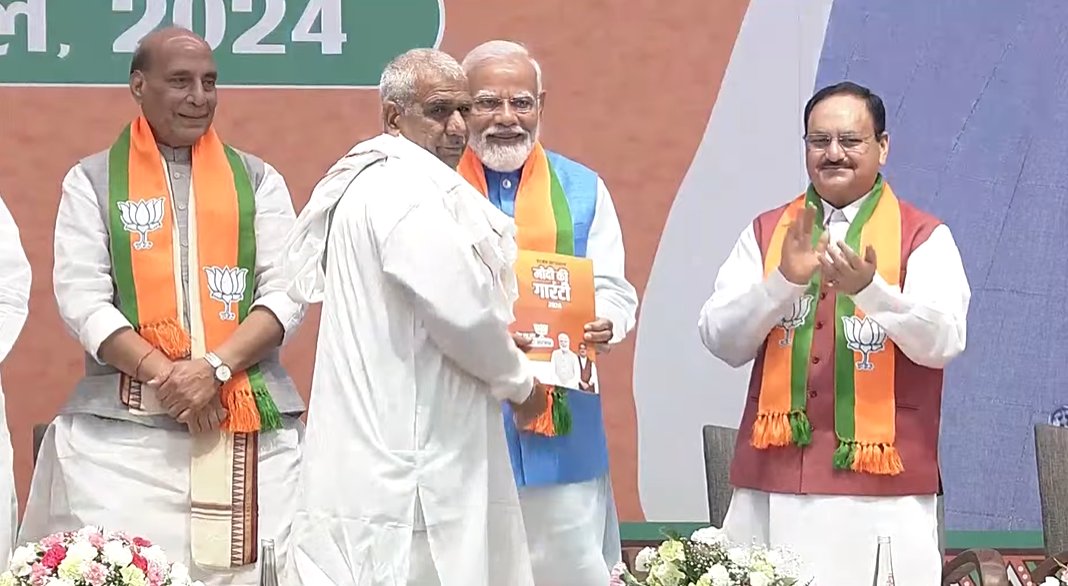
    The Bharatiya Janata Party’s (BJP’s) manifesto titled “Modi ki Guarantee 2024” promises much. It implies a guarantee that soon all will be well because of Narendra Modi. It reflects a) the state of affairs in the BJP and b) its reading of people’s mood.

    It implies that people have more faith in Modi than in the party. Does this reflect the failure of the party? Like in a presidential form of election, vote is sought in the name of a leader, Modi.

    The contrast with the Congress manifesto, titled, `Nyay Patra’, promising justice to all, is stark. The BJP manifesto too promises justice. But, one depends on faith in an individual’s guarantee while the other seeks to deliver through strengthening society’s institutional setting. The instrumentality proposed by the two political parties is diametrically opposite.


    Read More

  • Elections 2024: Modi up a steep & slippery Slope

    Elections 2024: Modi up a steep & slippery Slope


    Be it a democracy or a dictatorship, governments are almost always changed by throwing out the incumbent. The former is called a democratic transition and the latter is inevitably a revolution. Even if it is, as usually is the case, more of the same. India’s electoral process that begins on April 19 will be concluded on June 4 when the results are announced. Most psephologists, commentators, astrologers and bazar gossips are sanguine that Prime Minister Narendra Modi will be easily re-elected to a third successive term. I do not agree with that sanguinity.I think Mr Modi has a hard hill to climb and the slope may be too steep and slippery for him. Look at the objective reality. In 2019, the BJP won 303 seats or almost 56 per cent of the Lok Sabha with 37.4 per cent of the popular vote. This skew is how it usually is in a first-past-the-post system. Even a minority mandate translates into an overwhelming outcome. But the problem with the BJP mandate is that it is concentrated in a minority of states. The saffron mandate is restricted almost entirely to the large Hindi-speaking states (202/235), as well as Maharashtra (41/48) and Karnataka (25/28). It got 268 out of its 303 in just this concentration. Winning these states is not the issue for the BJP. Repeating this performance is.


    Read More

  • Fight Against Corruption Vs Saving Democracy: Which Is Critical?

    Fight Against Corruption Vs Saving Democracy: Which Is Critical?

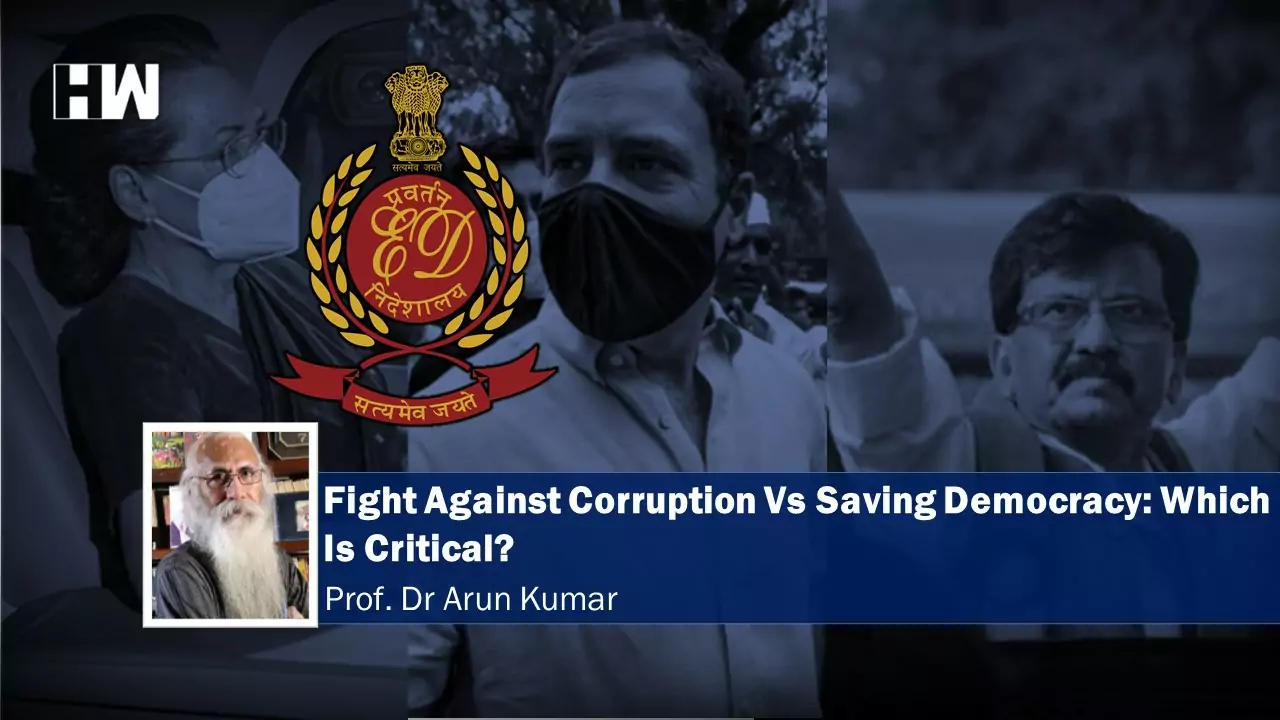
    The ruling party justifies the actions of ED, CBI and Income Tax department by arguing that these are independent agencies. They dismiss the harassment of the opposition leaders and others by calling it a fight against corruption.

    The Supreme Court verdict on the Prevention of Money Laundering Act (PMLA) has sanctified its draconian provisions. The opposition which is facing the brunt of these provisions has criticized the judgment while the ruling dispensation is highly pleased. A seal of approval has been put on the recent actions of the Enforcement Directorate (ED). The provisions of PMLA are such that there is little escape. So, opponents have been arrested/harassed or silenced or have switched sides to join the ruling party which then has toppled governments in the opposition-ruled states. Considering the misuse already visible, the judges could have weighed in on the laws and protected the fundamental rights of the citizens guaranteed by the Constitution.

    The ruling party justifies the actions of ED, CBI and Income Tax department by arguing that these are independent agencies. They dismiss the harassment of the opposition leaders and others by calling it a fight against corruption. No one can deny that wrongdoing has to be punished and corruption impacts the common person adversely. So, reducing corruption is arguably a pro-people policy.

    [powerkit_button size=”lg” style=”info” block=”true” url=”https://hwnews.in/news/opinion/fight-against-corruption-vs-saving-democracy-which-is-critical-ed/” target=”_blank” nofollow=”false”]
    Read More!
    [/powerkit_button]

  • How Representative is the Representative Democracy in India?

    How Representative is the Representative Democracy in India?

    India’s transition from an erstwhile British colony to an independent, sovereign state meant, for her people, a change in their status from being mere subjects to citizens bestowed with adult suffrage. The ultimate authority, therefore, now rests with the citizens. India’s large and complex population made it impossible for this authority to be discharged directly and therefore, the citizens elect their ‘representatives.’ This act of electing their representatives is called ‘elections’ and the set of rules that determine how the elections are conducted and the results ascertained is called the ‘electoral system.’ The electoral system adopted by the Constituent Assembly, through the debates on the constitution for the adoption of the parliamentary democracy, is a variant of the majoritarian system known as the ‘First Past The Post System.’ The fundamental principle underlying the system is that for the candidate, to cement his/her electoral victory, does not need a majority of the votes polled, but only a plurality of votes would suffice. The basis for the decision of the Constituent Assembly members to opt for the FPTP system lies in its simplicity and its promise of producing a stable government. Dr. B.R. Ambedkar when speaking in the assembly said, “Now, I have not the least doubt in my mind that whatever else the future government provides for, whether it relieves the people from the wants from which they are suffering now or not, our future government must do one thing, namely, it must maintain a stable government and maintain law and order. I am therefore very hesitant in accepting any system of election which would damage the stability of the government.”

    Legislative bodies aren’t merely law-making authorities, they are mini societies in themselves that reflect and react to the issues plaguing the citizenry at large. Labelling legislative bodies as mini societies emphasizes the fact that the composition of the representatives reflects the diversity of social groups and shades of opinion present within the country. The divisions and prejudices that exist in the Indian subcontinent based on caste, class, and religion were a primary point of reference for the members of the constituent assembly when debating over whether the various provisions of the constitution would be functional in the country. In this sense, the decision to choose the FPTP system over other electoral formulas signifies an attempt to alleviate the fears of the members of a further divided subcontinent. Yet, as we enter the 75th year of our freedom with entrenched unresolved issues, it brings us back to the question that the constituent members struggled with: how efficient and representative is the present electoral formula?

    Loksabha Elections – 2019

    Regional representation

     A post-election analysis by IndiaVotes showed that the two major alliances – National Democratic Alliance and United Progressive Alliance won 45.2% and 27.5% of votes respectively and the rest was shared among parties including All India Trinamool Congress, Yuvajana Sramika Rythu Congress Party, Biju Janata Dal, Bahujan Samaj Party, Telangana Rashtra Samithi and so on. With 45.2% votes, the NDA led by the BJP satisfied the requirements laid down by the FPTP allowing it to take charge of the government formation. However, what the vote percentage implies is that the current regime isn’t exactly a popular choice given more than fifty percent of the voters chose to vote against them. In their paper ‘Minoritarian Rule: How India’s Electoral System Created The Illusion of a BJP Landslide’, Macdonald and Moussavi call India a “minoritarian” democracy wherein ‘ a plurality of voters selects the majority of representatives in Parliament.’

    Furthermore, the success was concentrated within the states of central and western India which includes- Gujarat, Uttar Pradesh, Rajasthan, Madhya Pradesh, Bihar, Chhattisgarh, Maharashtra, and Jharkhand. These are also few of the states with the highest number of Lok Sabha seats- Gujarat (26), Uttar Pradesh (80), Rajasthan (25), Madhya Pradesh (29), Bihar (40), Chhattisgarh (11), Maharashtra (48) and Jharkhand (14). Given how diverse the country is culturally and linguistically, how do we compensate for the lack of the same in the union government?

    Minority representation

     The total minority representation in the 2019 Lok Sabha stands at 9.2%, including Muslims, Christians, Sikhs, and other religious minorities. This means over 90% of the MP’s are Hindus in a country where the minorities make up 19.3% of the total population (Census 2011).

    Kazi Syed Karimuddin when speaking against the efficacy of the FPTP system in the constituent assembly had feared the dilution of minority representation and had said, “Therefore my submission is that the present system as it stands does not guarantee a majority rule as people commonly suppose and does not guarantee a representation to minorities, not necessarily religious, even the political minorities.”  To this Dr. B.R.Ambedkar felt that while the country may not be ready for a complex electoral formula but to ensure minority representation he suggested reserved constituencies for the minorities as an alternative and in this regard, he said, “If any particular minority represented in this House said that it did not want any reservation, then it would be open to the House to remove the name of that particular minority from the provisions of article 292. If any particular minority preferred that although it did not get a cent percent deal, namely, did not get a separate electorate, but that what it has got in the form of reservation of seats is better than having nothing, then I think it would be just and proper that the minority should be permitted to retain what the Constituent Assembly has already given to it.”

    The Constituent Assembly finally decided on reserved constituencies for the communities of Scheduled Castes and Scheduled Tribes only.

    Reserved constituency

     The constitution has reserved 131 out of 543 seats for Scheduled Castes and Scheduled Tribes (84 for SC’s and 47 for ST’s). In the present Lok Sabha out of the 543 MP’s, 138 come from SC/ST communities implying that only 7 MP’s from SC/ST communities have been elected in unreserved constituencies. The situation would have been grimmer had their representation not been secured through reserved constituencies.

    The major loophole in the practice of securing representation through reserved constituencies with the use of FPTP is that it is the Non-SC/ST communities that majorly get to decide who the representative for the SC/ST communities would be. Given SC/ST populations are spread across regions rather than being concentrated in a few, it is then the dominant communities with their muscle and money power that decide on where the votes go. This keeps outspoken and assertive leaders from marginalized communities outside legislative bodies and in a way excludes these communities and their issues from mainstream political discourse. Hence, Macdonald and Moussavi observe, “District boundaries are therefore fundamentally important. Their shape determines the population size and ideological composition of the electorate facing each party.”

    Mainstream political discourse

     With FPTP’s ‘winners take all’ formula, it so happens that political parties restrict their discourse and activities to the interests of the dominant communities as they become the deciding factor in the contestants getting the plurality of votes. Douglas Amy in her paper ‘Proportional Representation: Empowering Minorities or Promoting Balkanization’ says, “The claim that winner-take-all elections are inherently more capable of bridging political divides does not bear up under scrutiny. For example, the requirement that winning candidates appeal to the majority of voters has done little to discourage factionalism. Indeed, it has merely encouraged candidates to attack minority groups to win over the majority.”

    This has not only further marginalized the already marginalized but also hinders the Socio-Economic and Political progress of the country as spaces for discussing “actual” issues shrink and real development can’t be equated to the progress and well-being of a minute population.

    Effect on voters

    Wastage of votes, a definite consequence of the FPTP system as it often discourages voters from turning up to vote. Furthermore, voters indulge in ‘tactical voting’ wherein instead of voting for a candidate/party who aligns with their values and ideals, they end up voting for one of the major parties or the lesser of the two evils whom they think have more chances of winning. In a way, the voter is making no real impact in the making of the government (Singh & Sharma, 2019).

    Conclusion

    The Law Commission, in their reports in the year 1999 and then again in the year 2015, had recommended that the government look into alternative electoral methods and examine how well they’d work out for the country. However, this has remained a recommendation only on paper with governments taking no active interest in the same. Carles Boix in his paper ‘Setting the Rules of the Game: The Choice of Electoral Systems in Advanced Democracies’ (1999) states that “as long as the electoral arena remains the same, and favours the ruling parties, the electoral system is not changed. If there is a change in electoral dynamics due to the coming of new voters or alterations in voter’s preference, then the ruling party reshapes the electoral setup to suit their choices.” Hence, we still do not see electoral reforms being a part of the mainstream political discourse. However, to make our political system more inclusive, diverse, and efficient, it is about time we give electoral reforms a serious thought.


    References

    Amy, D. J. (1995). Proportional Representation: Empowering Minorities or Promoting Balkanization? The Good Society, 5(2).

    Boix, C. (2000). Setting the Rules of the Game: The Choice of Electoral Systems in Advanced Democracies. SSRN Electronic Journal. Published. https://doi.org/10.2139/ssrn.159213

    Macdonald, G., & Moussavi, B. (2015). Minoritarian Rule: How India’s Electoral System Created The Illusion of a BJP Landslide. Economic and Political Weekly. Published.

    https://www.constitutionofindia.net/constitution_assembly_debates/volume/7/1949-01-04?paragraph_number=186%2C185%2C12%2C176%2C33%2C189%2C170%2C11%2C7%2C5%2C215%2C196%2C195%2C180%2C179%2C177%2C172%2C122%2C102%2C99%2C98%2C97%2C58%2C57%2C54%2C34%2C6%2C4

    https://www.indiavotes.com/alliance/partyWise/17

    https://scroll.in/latest/924583/elections-2019-bjp-alone-got-more-than-half-the-votes-in-13-states-and-union-territories

    https://en.wikipedia.org/wiki/List_of_constituencies_of_the_Lok_Sabha

    https://www.hindustantimes.com/lok-sabha-elections/from-faith-to-gender-and-profession-to-caste-a-profile-of-the-17th-lok-sabha/story-Mnp5M4pRX3aUji1UFFVy2N.html

    https://www.minorityaffairs.gov.in/sites/default/files/MsDP%20%28FAQs%29.pdf

    https://www.indiaspend.com/governance/reservation-scheduled-castes-tribes-representation-social-justice-755256

    https://theprint.in/opinion/17th-lok-sabha-looks-set-to-confirm-ambedkars-fears-no-vocal-dalits-in-parliament/232383/


    Image Credit: www.aa.com.tr 


  • Will the US Revert to ‘Just like in Grand Ma’s Time’ Again?

    Will the US Revert to ‘Just like in Grand Ma’s Time’ Again?

    Category : International Affairs/USA

    Title : Will the US Revert to ‘Just like in Grand Ma’s Time’ Again?

    Author : Andrei Korobkov 11-02-2020

    Donald Trump’s opponents persist in their delusion that his arrival to power was an accident, and if they manage to throw him out of office, history will resume its natural course, and everything will be just like in grandma’s time again. This is a battle between the views of Washington’s elite and the general public resulting in a systemwide crisis. Should the elite further refuse to recognise how serious the crisis has become, and if they will not acquiesce to curtail their ambition and search for compromise, it will be disastrous for the United States and the rest of the world, argues Andrei Korobkov.

    Read More

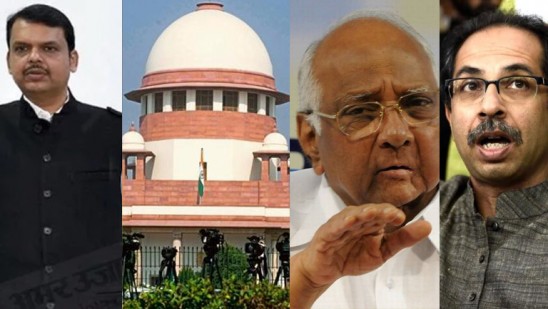
  • ‘Pawar Play’ in Maharashtra

    ‘Pawar Play’ in Maharashtra

    Henry Luis Mencken (1880-1956), well known American journalist and essayist, once wrote “As democracy is perfected, the office of president represents, more and more closely, the inner soul of the people. On some great and glorious day the plain folks of the land will reach their heart’s desire at last and the White House will be adorned by a downright moron.” As we sit back and watch as the Impeachment drama plays out in the United States, one cannot help but marvel at Mr. Mencken prescience. The election of Donald Trump does seem to suggest that the American public has indeed found its inner soul, but as to whether it has really perfected democracy in the process remains questionable.

                Especially, more so, if it was to compare itself to what passes for democracy here. In short order they would then realize the vast distance they have yet to cover to reach true perfection. As a matter of fact, they would do well to follow the ongoing “Pawar Play” in Maharashtra, which incidentally is only the latest manifestation of what perfection in a democracy looks like, and has all the ingredients of a true Bollywood potboiler in the making. That is the only way in which realization would dawn on them that Mencken’s deductions were slightly awry. Invariably in perfect democracies it is not the political leaders who are morons, but the people who voted them to power. That is the fundamental reality we have been confronting ever since Independence, regardless of the political ideologies of the people and parties we vote into power.

                Whatever the host of legal eagles fighting the case in our Supreme Court may say to justify their arguments, and regardless of the conclusions the Hon’ble Court may arrive at, the simple truth of the matter is that for all sides concerned, Maharashtra is too important to lose. To start with the inability to form the government in Maharashtra would not just be a simple loss of face, but utter humiliation for the BJP, and more importantly, for its mentors from Nagpur, located in the heart of the State. If they cannot control their own fiefdom, what control will they exercise tomorrow over the rest of the country, more so given that elections are due in states like Bihar and Jharkhand in the coming months?

                Similarly for the Shiv Sena after having openly cast aside the cloak of morality and gambled everything, including the kitchen sink, in its blatant attempt to go one up and grab the Chief Ministership for Balasaheb’s scion, a loss would spell utter disaster and lead to questions of survivability of the dynasty. For the NCP, and especially the Pawars, being on the winning side is the only hope for redemption for past transgressions. As events have played out, it is now obvious that Pawar the younger was carried away by the brashness of youth and the fact that leadership of the Party would remain just a mirage due to circumstances of birth as long as Pawar the elder had any say in the matter. Finally, for the Congress that continues to be on the ventilator this was an unexpected bonus, a fleeting opportunity to start again.

         While each of these stakeholders has its own particular motivations for their actions, however, the most important aspect  incentive for all in this battle royal for the stewardship of the State is the simple fact that not only is Maharashtra a large state, governing which is undoubtedly prestigious, but also an extremely rich one. It doesn’t exactly require a leap of faith to suggest that whosoever controls the money controls the votes. After all, is that not the very reason that controversy dogs the issue of electoral bonds that were introduced not too long back?

                Leave aside mundane issues of malfeasance, personal greed, overarching ambition and rank opportunism, what is indeed truly astounding to see is the utter lack of constitutional propriety and ethical conduct on the part of those charged with its very protection. For them to let petty loyalties and servility take precedence over self- respect and principled conduct is not just a reflection on how unworthy they are to hold such positions of eminence, but also a shameful blot on our social mores that encourages such people to claw their way up despite lacking an iota of integrity or moral fibre. One cannot but feel embarrassment for the President, a former advocate, who unquestioningly accepts the recommendations of a Prime Minister without the requisite cabinet approval, justified by the use of a most inappropriate rule to cover the lapse. That such a rule can be invoked at the dead of night to swear- in a government at dawn, in the futile hope that it would provide stability, after weeks of confusion, is indeed laughable, if it were not so tragic.

                The Supreme Court’s directions to the newly sworn-in Chief Minister, Devendra Fadnavis, to prove his majority on the floor of the House within two days, set the cat among the pigeons as it left only limited scope for horse trading. It forced him to resign prior to the House being called into session as by that time it was abundantly clear that Mr. Ajit Pawar was in no position to provide the necessary support of the NCP legislators required to gain a majority, as he had promised. It is only now becoming increasingly clear that the ‘Ajit Pawar move’ was in all likelihood, a move conceived by his uncle and leader of the NCP, Mr. Sharad Pawar, to kill two birds with one stone; firstly lure the BJP into withdrawing President’s Rule in the State, which it may otherwise not have done in a hurry, and to force the Congress to reduce its demands in exchange for joining the anti BJP Coalition, Maharashtra Vikas Agadi, under the leadership of Mr. Uddhav Thackeray as Chief Minister.

                Events in Maharashtra only accentuate the utter lack of morality on display on the part of all concerned. If we were to look at the winners and losers that have emerged after this power play, clearly the BJP finds itself stranded by the wayside and has much to introspect, but it is not the only loser, The Shiv Sena may have won itself a reprieve and fulfilled Thackeray’s ambition of being Chief Minister, it has come at a cost, as it appears to have caused grevious damage to its ideological foundations. There is always the possibility that Uddhav may have realized that with the Ayodhya Temple issue having been resolved to a large extent, hard Hindutva is unlikely to be a crowd puller in the coming days and an ideological shift was necessary if the Shiv Sena is to flourish. The Congress continues to be seen as disorganized, lacking leadership, confused and opportunistic, a perception that is unlikely to change until the Gandhi’s are leached out of its organizational structure. Only the NCP appears to have emerged as clear winners, especially Mr. Sharad Pawar, as he will undoubtedly wield the remote control on this coalition government. Off course, all of these shenanigans only reinforce the fact that it has been the people of Maharashtra, who have lost out the most, and were, in Mencken’s words, “moronic” enough to vote these ingrates into power.

    The writer is a military veteran and consultant with the Observer Research Foundation and a Senior Visiting Fellow with The Peninsula Foundation, Chennai. The views expressed are the author’s own.