Tag: Clean Energy

  • The Economics of Clean Energy: Transitioning to Renewables in a Post-COVID Era

    The Economics of Clean Energy: Transitioning to Renewables in a Post-COVID Era

    “the climate emergency is a race we are losing, but it is a race we can win” – Antonio Guterres, UN Secretary General

    Even without a global health pandemic, our world is still facing a crisis of staggering proportions.  In the 21st century the threat of climate change has outweighed almost all the other threats put together. Such is the pressing nature of the issue that it has even prompted re-branding of nomenclature from ‘climate change’ to ‘climate crisis’ – because that is what it is, a crisis. But as the UN secretary general António Guterres points out, “the climate emergency is a race we are losing, but it is a race we can win”.

    In this light, it is high time a discourse on transition to clean energy systems takes centre stage. With climate change progressing at an alarming rate, the need for clean energy has only been compounded.  At a time of great disruption for the world owing to an unprecedented health crisis with severe economic and social ramifications, a transition to renewables could be the way forward. As governments around the world lead COVID-19 recovery efforts, the verdict is clear that we cannot go back to our old systems – a transition to clean energy must be on the forefront of national agendas.  While the road to recovery is long and might take years, it is also the perfect opportunity for governments to accelerate clean energy adoption by putting this transition at the heart of post-COVID-19 social and economic recovery plans.

    While COVID-19 has certainly slowed down this transition by disrupting and delaying several renewable energy expansion and installation projects, the outlook on clean energy still looks very promising. In Q1 2020, global use of renewable energy in all sectors increased by about 1.5% relative to Q1 2019, while the overall share of renewables in global electricity generation jumped to nearly 28% from 26% in Q1 2019. While this does not reflect the impact of COVID-19 on capacity expansion, as the increase in use is largely due to expansion efforts in the preceding years, it is still a positive sign.

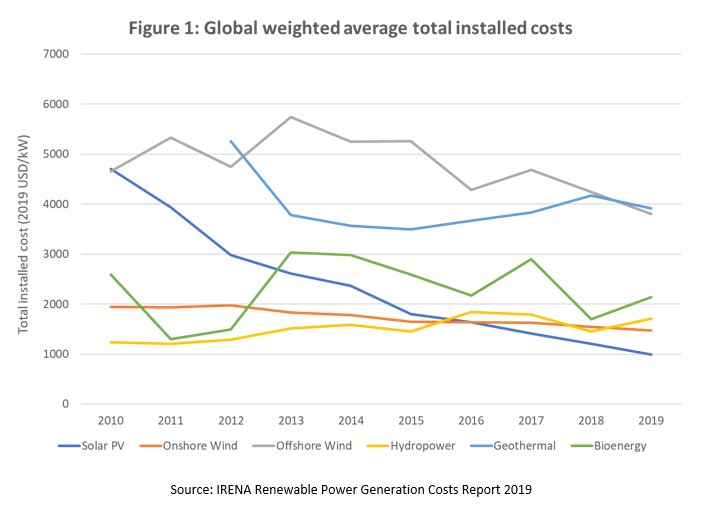
    Solar PV has had the most remarkable fall during this period, with the levelized cost of electricity (LCOE) falling almost 82% over the last decade. Closely following are CSP and On-shore Wind, both of which have fallen 47% and 38% respectively

    Even without factoring in the current global scenario, the rationale for transition has never been more compelling. Over the past decade, the cost of renewables has fallen to record lows (as shown in Figure 1), making it more attractive than ever before to invest in clean energy. Solar PV has had the most remarkable fall during this period, with the levelized cost of electricity (LCOE) falling almost 82% over the last decade. Closely following are CSP and On-shore Wind, both of which have fallen 47% and 38% respectively. Batteries, which have been appraised as one of the key enabling technologies in accelerating the shift to clean energy, have also recorded significantly lower costs in the past couple of years. Battery technologies such as Lithium-ion and Vanadium-flow have long been considered the missing link in ensuring continuity of supply for Wind and Solar generated power, which often depend on the vagaries of the weather. The LCOE for Lithium-Ion batteries has fallen by 35% since 2018, owing to advancements in technology. The only increases in cost have been recorded by Geothermal and Hydropower.
    With the cost of renewables falling, fossil fuel options are looking more and more expensive. According to IRENA (International Renewable Energy Agency), by 2020 Solar PV and onshore wind will be less expensive than the cheapest fossil fuel alternative. In the past, one of the key reasons why fossil fuels such as oil and gas were considered attractive options was because they were highly subsidized and incentivized. The true cost of these non-renewable sources minus the subsidies may well be much higher. The conventional cost of fossil fuels also does not factor in the environmental costs associated with carbon emissions. The extraction and use of these resources are often accompanied by several negative externalities associated with environmental degradation, pollution and global warming. This failure to account for the emissions and their impact has been termed by many as one of the greatest market failures the world has seen.

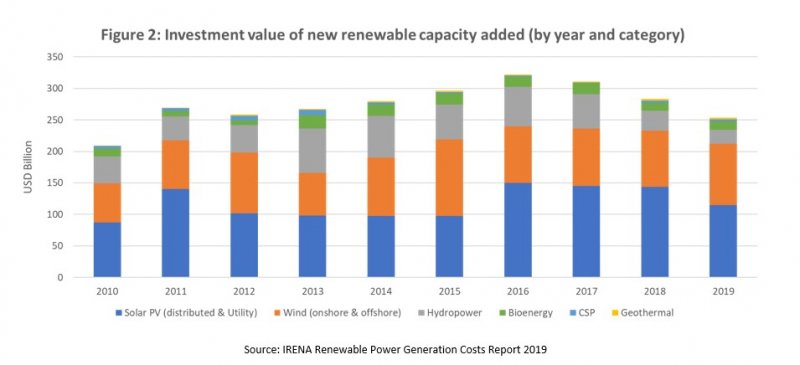
    Thus, falling costs of renewables coupled with the growing pressure on fossil fuels has presented the world with a unique opportunity to accelerate the adoption of clean energy. As governments pump more money into economies as part of COVID recovery efforts, the same level of investments can now yield greater returns owing to falling costs. Globally, investments in renewable capacity and technology have been on the rise and have shown remarkable growth, especially for Solar and Wind. Investments in Solar PV (Utility) in particular have shown astounding growth, increasing over 200% since 2010 to reach $69.4 billion in 2019. Total investments across renewables stands at $253.6 billion, having grown 21% in the last decade.
    While renewable capacity and investments have been growing, so has the demand for electricity. This growth in demand has somewhat offset the impact of transition to renewables. While mainstream adoption of clean energy is still progressing in the right direction, policy makers are worried that the pace of transition is not fast enough to offset growing demands. Unless renewable technology can scale up quickly and bridge the demand-supply gap, this excess demand will inevitably have to be met by fossil fuels.

    The IRENA estimates that investments in clean energy could boost global GDP by close to $98 trillion by 2050

    Despite several roadblocks still existing for large-scale adoption of clean energy to be made feasible, governments and institutions are putting climate action at the forefront now more than ever before. Post COVID-19, as economic recovery consolidates, we cannot afford to put clean energy on the back burner. Across the world, clean energy technologies such as electric vehicles, solar and wind energy are becoming increasingly mainstream. According to a UN report, global investment in renewables is set to triple in the next 10 years. If governments continue to sustain this momentum, the benefits are manifold. The IRENA estimates that investments in clean energy could boost global GDP by close to $98 trillion by 2050. Thus, the rationale is clear and more compelling than ever for a shift to clean energy. The robustness and resilience of economies to future global shocks will be determined by how quickly and effectively they transition to renewables and reduce dependence on fossil fuels.


    References

    [1] The Climate Crisis – A Race We Can Win. (2020). United Nations.

    https://www.un.org/en/un75/climate-crisis-race-we-can-win

    [2] Renewables 2019 – Global Status Report. Ren 21. Retrieved from: https://www.ren21.net/wp-content/uploads/2019/05/gsr_2019_full_report_en.pdf

    [3] Global Energy Review 2020. (2020, April). IEA.

    https://www.iea.org/reports/global-energy-review-2020/renewables

    [4] Renewable Power Generation Costs Report 2019. (2020, June). IRENA. https://www.irena.org/publications/2020/Jun/Renewable-Power-Costs-in-2019

    [5] Henze, V. (2019, March 26). Battery Power’s Latest Plunge in Costs Threatens Coal, Gas. Bloomberg NEF. 

    Battery Power’s Latest Plunge in Costs Threatens Coal, Gas | BloombergNEF (bnef.com)

    [6] Sinha, S. (2020, September 23). How renewable energy can drive a post-COVID recovery. World Economic Forum.

    https://www.weforum.org/agenda/2020/09/renewable-energy-drive-post-covid-recovery/


    Image Credit: AZoCleantech.com
  • Blue Economy: A Prospective Strategy For Sustainable Economy

    Blue Economy: A Prospective Strategy For Sustainable Economy

    Oceans, seas and coastal areas are the world’s largest ecosystems. They play a vital role in the food security and livelihood of billions of people all around the globe and contribute to the economic prosperity of many countries. Marine environments are able to provide jobs as well as nutrition, but increased human and economic interventions due to uncoordinated and not poorly researched development policies can pressurize and threaten the environment in the long-term. The United Nations Conference on sustainable development held in Rio de Janeiro in 2012 coined the concept of Blue Economy, defining the concept as a distinction between socio-economic development and environmental damages, which is the traditional view of global status quo. The concept is aligned with main stream economic activities in the marine and coastal ecosystems while incorporating the need to integrate the conservation and sustainable management of these ecosystems. These include the lowering of greenhouse gases emissions during consumption. A sustainable blue economy is basically a marine/ocean-based economy that contributes to food security, eradication of poverty, employment and income while providing socio-economic benefits for present and future generations. It should encompass the restoration, protection and sustenance of diverse, productive and intrinsic values of the marine and coastal ecosystem. This model should be based primarily on cleaner technologies, renewable energy resources and circular economy for securing economic and social stability by considering the capacity of the planet. Fisheries, shipping and ports, marine-based tourism, seabed mining and marine renewable energy are the main sectors in a blue economy framework.
    A sustainable blue economy is basically a marine/ocean-based economy that contributes to food security, eradication of poverty, employment and income while providing socio-economic benefits for present and future generations.
    Coastal economy includes activities related to employment, output and wages in the coastal ecosystem. Marine economy is the cluster of industries which includes the sectors that focuses on a common market for the final products, using similar technology or labour or similar natural resources. Marine economy can be considered as the subset of coastal economy. The concept of blue economy has multiple interpretations as it covers a variety of activities, locations and sectors.

    Key Economic Benefits

    The key economic issues addressed by the ‘blue economy’ concept are:
    Food Security and Protein Demand: The fisheries sector encompassing aquaculture and plants is a source of considerable amount of proteins, calories and fats which promote food security in a country. Food security can be fully ensured only if the access to food is enhanced by lowering the barriers of trade, reducing food wastage, increasing the availability of nutritious food and providing efficient food distribution system in countries that suffer from deficit. For ensuring a healthy life, a balanced diet of proteins and fats should be supplied. Food basket should consist of a minimum amount of protein intake, and fish is an important source of animal protein. It benefits countries even if they have a lower daily average consumption.Rising Coastal Tourism: A major sector of blue economy is coastal tourism with immense potential for employment and growth in the economy. Developing a focused policy addressing the potential and constraints of the tourism industry can yield concrete results. Scuba diving, bird watching, sea angling, boating, and other segments like hotels, restaurants, water sports have potential for huge investments and can contribute to a robust blue economy in the country.Seaborne Trade: Sea is considered as a cost-effective carbon friendly mode of transportation used widely around the world. 90 % of global trade is done through sea routes. In the blue economy framework, priorities and policies should be towards promoting trade especially through sea routes by making it more systematic and futuristic.Alternative Sources for Energy: If large renewable energy remains untapped in a country, blue economy can be a major source of clean energy. The demand for clean and affordable energy is increasing across the world. Blue economy can be a great source of clean and affordable energy. The Oceans are huge resources for renewable energy, like wave energy, tidal energy, solar energy etc. Exploitation of the oceans can reduce the pressure on finite traditional energy resources.

    India’s Blue Economy Potential

    Blue economy in India can be considered as the total sum of all economic activities that are based and sourced from marine and coastal resources. Deep sea mining, Offshore oil, fisheries contribute majorly towards the country’s blue economy. India has a coastline of about 8118kms and exclusive economic zones that cover almost 2 million sq kms including a continental shelf of 530000 kms. Almost 1.5 million kms of this continental shelf has been explored in the Bay of Bengal and the Arabian Sea. Majority of India’s population are based in coastal metro cities like Chennai, Mumbai and Kolkata. More than a million people are employed in full time coastal fishing activities while more than 1.3 million people are employed in post-harvest fisheries and allied activities. India contributes to more than 10 % of world’s fish varieties. The country ranks second in worldwide fish production with a growth rate of 7 % annually and ranks second in aquaculture activities as well. The Malabar coast, Konkan belt and other coastal areas have shown considerable increase in influx of tourists over the years. Polymetallic nodules and sulphides are two of the major mineral resources that are commercially available in India. India is also an offshore gas giant and the country is trying to substitute terrestrial sources of energy with offshore reserves and renewable sources in the future. The Sagarmala project is considered as a pioneering initiative by the government to steer the country into the path of blue economy. The project was in initiated in 2015, costing around 8700 billion rupees and is proposed to be implemented over 20 years.The Sagarmala project is considered as a pioneering initiative by the government to steer the country into the path of blue economy.To create a sustainable blue economy, significant investments in research and development need to be carried out in accordance with planning and execution of a detailed region-specific blue economy model. Goals for different economic, social and ecological segments as well as respective policies should be integrated in the framework. Governments, social and private organizations and communities should collaborate and contribute to the framework by assigning achievable goals. These goals should be assessed and reported with all the members in the framework so that performance is consistently monitored. Economic instruments like taxes, subsidies, tariff and quotas can be used to internalize the benefits which are both economic and environmental. International, laws, treaties and agreements can help to implement a global blue economy system and network to ease trade and flow of labour. By linking terrestrial economy with marine economy, a sustainable green economy on land can also be developed. Each country should develop its own blue economy framework by recognizing its potential to contribute to and strengthen a sustainable and eco-friendly global economy.

    References

    Asher, M., 2018. India’s Blue Economy Initiatives: Establishing New Growth Nodes and Helping to Address Regional Imbalances.
    Benzaken, D., 2017. Blue Economy in The Indian Ocean Region: Status And Opportunities. S. Rajaratnam School of International Studies.
    Economist Intelligence Unit, 2015. The Blue Economy: Growth, Opportunity And A Sustainable Ocean Economy. Events World Ocean Summit. Economist Intelligence Unit.
    Llewellyn, L., English, S. and Barnwell, S., 2016. A roadmap to a sustainable Indian Ocean blue economy. Journal of the Indian Ocean Region, 12(1), pp.52-66.
    Mohanty, S., Dash, P., Gupta, A. and Gaur, P., 2015. Prospects Of Blue Economy In The Indian Ocean. Research and Information System for Developing Countries.
    Roy, A. (2019, January 11). Blue Economy in the Indian Ocean: Governance Perspectives for sustainable development in the region. Retrieved from https://www.orfonline.org/research/blue-economy-in-the-indian-ocean-governance-perspectives-for-sustainable-development-in-the-region-47449Image Credit: Adobe Stock