Tag: Civil War

  • MYANMAR:  READING THE TEA LEAVES

    MYANMAR: READING THE TEA LEAVES

    On 21 November 2023, India’s Ministry of External Affairs advised Indian citizens to avoid nonessential travel to Myanmar, given the evolving security situation in that country. It further advised that those already living in Myanmar should take precautions and avoid travel to regions affected by violence[i]. Earlier in the same month, UN Secretary-General António Guterres had expressed deep concern at the expansion of conflict in Myanmar[ii] . Both messages highlight the increasingly fragile situation in Myanmar, where two million people are displaced and over 286,000 similarly affected after the current upsurge in fighting[iii].


    Operation 1027 and its Implications

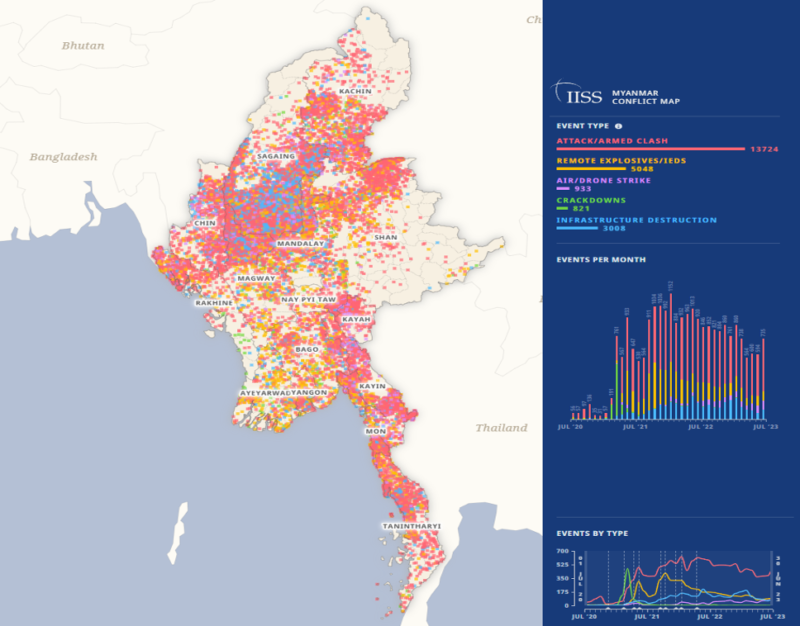
    The map published by the International Institute for Strategic Studies lists the number and type of violent events countrywide until July 2023. Since then, there has been a spike in the level of violence. Most prominent has been the coordinated attack on 27 October on Tatmadaw (Myanmar Army) posts in the Northern portion of Myanmar’s Shan state (see map), near the Chinese border by three Ethnic Armed Organisations (EAOs), assisted by other Peoples’ Defence Militias (PDFs). As per Richard Horsey of the International Crisis Group[i], the attacks, dubbed ‘Operation 1027’ (after the date they commenced), involved several thousand experienced, well-armed fighters attacking multiple army posts simultaneously. These troops owed allegiance to three major EAOs – the Myanmar National Democratic Alliance Army (MNDAA), the Ta’ang National Liberation Army (TNLA) and the Arakan Army ( AA), comprising different ethnicities ( Kokang, Ta’ang and Arakanese, respectively). Of the three, the first two are based in Shan state in the East, while the AA, as the name denotes, is based in Rakhine on Myanmar’s West coast, bordering some portion of the Chittagong Division of Bangladesh. Within two weeks, these three armies dubbed the Three Brotherhood Alliance, had seized several towns along the Chinese border, overrun military bases and captured large stocks of munitions. Specifically, to quote the Asia Times…the key border posts of Chin Swe Haw and Mong Ko were seized along with 80 military and police bases. More than 120 military bases have since been overrun, and sizeable amounts of arms and ammunition seized, including reportedly several 14.5 heavy machine guns (HMGs)…[ii]. ISP Myanmar, a Myanmarese think tank based in Thailand, notes that resupply columns are being ambushed on the main artery from Mandalay, around the area of Kyaukme, as shown on the map below[iii].

    Operation 1027 has created significant disruptions in the Myanmar-China border trade. The current offensive aims to eradicate online gambling and scam call operations from various casinos in the northern portion of  Shan and Kayin states bordering China and Thailand, an objective shared by the Myanmar Government, which is under pressure from China on this matter. Nationals from these countries, along with Chinese criminals, have been identified for their involvement in such illegal activity in concert with local pro-government militias. The rebels’ aim could likely be to gain China’s favour and wrest territory from Tatmadaw’s control[i]. To avoid the bloodshed, many Myanmar nationals are attempting to cross into China. China, whose proposed projects under the China-Myanmar Economic Corridor (CMEC) run through these regions in Northern Shan state, has since called for a ceasefire on this border[ii]. Noteworthy for military analysts, however, is the well-coordinated planning and execution displayed in these successful attacks, demonstrating the growing strength and assertiveness of the EAOs and PDFs operating over large swathes of territory.

     In concert with Operation 1027, EAOs have been equally active in other parts of Myanmar. The Sagaing region North of Mandalay bordering Manipur and Nagaland is witnessing fresh fighting[iii]. A Myanmar Army spokesman is quoted as having admitted that troops were under “heavy assaults from a significant number of armed rebel soldiers” in Shan state in the North, Kayah state in the East and Rakhine state in the West[iv]. In Rakhine, a year-long ceasefire between the Arakan Army and Tatmadaw collapsed, and fighting recommenced. In Kayah state bordering Thailand, a video clip (verified by Reuters) shows wounded Tatmadaw soldiers surrendering to the rebels who offer medical treatment to them. Fighting rages around the state capital, Loikaw, from which the UN has evacuated its personnel[v]. Heavy fighting has taken place in Chin state. The Junta has declared martial law in certain towns in Shan, Chin and Kayah states and Sagaing region.

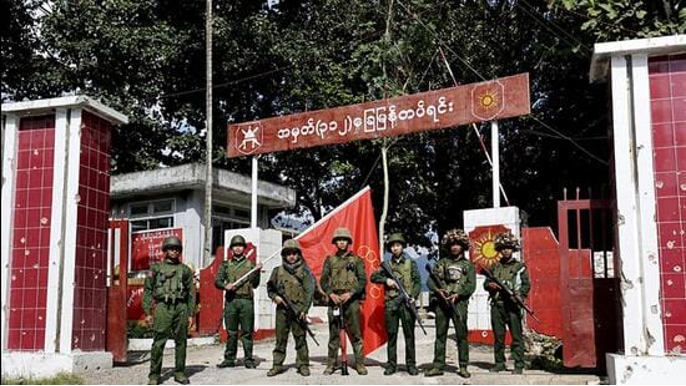
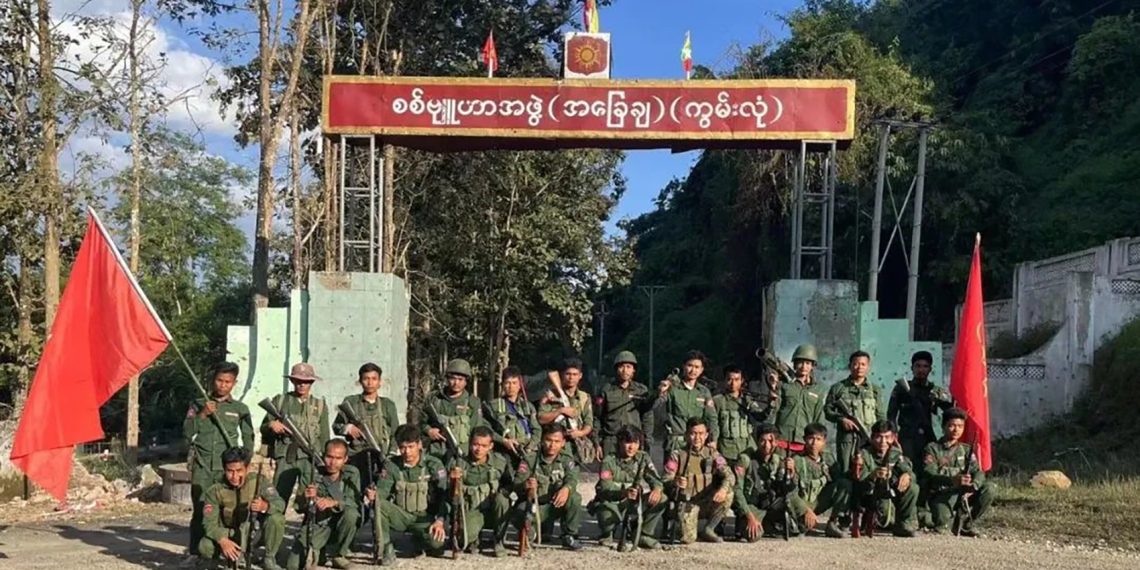
    Members of the Myanmar National Democratic Alliance Army pose for a photograph in front of the seized army’s infantry battalion in Kunlong township in Shan state, Myanmar, on 12 November. (AP). Courtesy: Rezaul H Laskar, Hindustan Times 15 November 2023.

    India’s Concerns

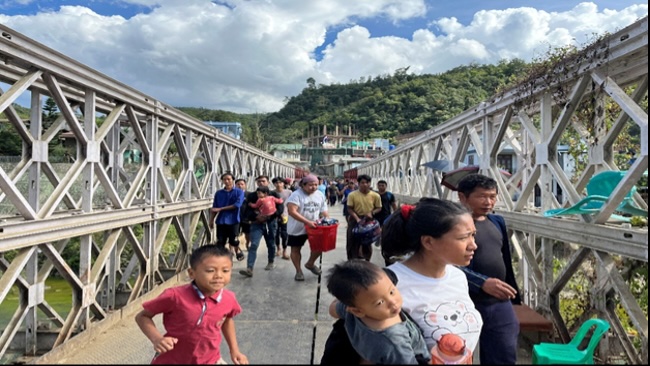
    With the Sagaing region bordering Nagaland and Manipur and Chin state bordering Manipur and Mizoram, the upsurge in violence has become a pressing concern for India, which is already grappling with the crisis in Manipur that has a linkage with Myanmar. In the current crisis in mid-November, Chin rebels overran two Tatmadaw posts on the India-Myanmar border in villages close to the Myanmar border township of Rikhawdar. This is adjacent to India’s Land Customs Station (LCS) at Zokhawthar. The Tiau River forms the boundary crossed by a Bailey bridge (picture below).

    Picture:  Courtesy Reuters

    A fresh flow of refugees (estimates from four to five thousand) has now crossed over to the Indian side to escape the fighting as the Tatmadaw attempts to retake these posts. This influx is in addition to those who crossed over earlier during the coup in February 2021. The capitulation of the Tatmadaw in these bases has also resulted in a unique situation; 74 Myanmar soldiers fled to India with their weapons and surrendered to the Indian authorities, who, at the request of the Myanmar Government, facilitated their return[i].

    All the above issues highlight the highly volatile climate in Myanmar, necessitating the Indian government’s advisory. Sufficient reportage exists to show that the rebel forces under the National Unity Government (NUG) are steadily gaining ground; Gen Min Aung Hlaing, Chairman of the State Administrative Council (SAC) and  de facto head of state conceded early this year that only 198 of the 330 townships are “100 per cent stable,” while the remainder required “security attention.”[ii] This is close to fifty per cent of the country. Clearly, the civil war is entering a more intense phase.

    State of the NUG

     The dynamism of the NUG can be gauged by its creative methods to raise revenues to support its war aims. Some of these mechanisms, based essentially on the buyers’ ( including the diaspora’s) good faith, are zero-interest bonds, real estate auctions of land (including government land taken from civilians – a lakeside villa appropriated by Gen Hlaing was auctioned some time ago), proposed condominiums for later construction, auctioning of mining rights and leases, lotteries, donations and tax collection. It provides primary education, health, justice and law and order in areas under its control. It has launched a digital currency that is run through the open-source blockchain Stellar network73, used through its digital wallet app, NUGPay. It uses commercial quadcopter drones for logistics, has commenced weapons production to include 60mm and 90mm mortars, and is experimenting with 3D printing[iii].

    The NUG’s success in creating such an infrastructure despite the SAC’s depredations and the victories of its forces on the ground over the last two years is testimony to the support it enjoys among the ordinary people, bolstered by sophisticated information operations. The latter includes a Policy Paper of 2021[iv], which enunciates NUG’s efforts to become more inclusive. A beginning has been made by appointing a Rohingya, Aung Kyaw Moe, to a ministerial post. His appointment as the NUG’s Deputy Human Rights Minister is a signal to others, including the UN whose Special Rapporteur for human rights in Myanmar, Tom Andrews, stated this year that ..’ Min Aung Hlaing, who led the genocidal campaign, is now at the head of an illegal and illegitimate military junta that is attacking civilian populations throughout Myanmar. He must be brought to justice and made to answer his crimes…[v]. The NUG Policy Paper promises to bring perpetrators of crimes against Rohingyas to justice and grant citizenship rights to all based on parentage or birth in Myanmar. It also speaks of developing a comprehensive repatriation plan for Rohingyas who have fled Myanmar. Resolving this issue will remove a significant obstacle in ties with Bangladesh, which shelters over one million Rohingyas while looking to curb activities of militant organisations like the Arakan Rohingya Salvation Army (ARSA). The ARSA operates from both sides of the border, using tunnels to move cadres to and fro and has frequently resorted to terrorism.

    Crystal Gazing

    What, then does the future hold for the SAC? The regime is facing multiple sanctions from the West. Citing ongoing violence, it had earlier announced the postponement of elections planned for August 2023 and continues with the state of emergency. It, however, seeks to exploit its geography as an Indian Ocean littoral and land bridge between South and South East Asia to gain strategic advantage. Trade with Russia has increased, and MOUs on cooperation in various infrastructure projects, including nuclear and natural energy, have been signed. Though the CMEC is now moving at a snail’s pace with many impediments and under constant security threats, none of its projects have been cancelled[vi] as has happened elsewhere. Russia and China are also the leading suppliers of advanced weapon systems to Myanmar. Military cooperation has been extended to naval exercises; this month, Myanmar held a three-day maritime security exercise’ with the Russian Navy from 06 November in the Andaman Sea for the first time. Again, on 28 November, two Chinese warships and a resupply vessel have docked in Yangon on a ‘goodwill visit’ to be followed up with exercises. Despite such signalling, there is no guarantee how much support these two countries would provide in an increasingly uncertain climate.

    India’s policy has been one of non-interference in Myanmar’s affairs. It has been feeling its way through the deepening crisis in that country that originated with the coup over two years ago. Government-to-government cooperation continues, with visits by senior Indian dignitaries on essential occasions. Though India does not support the NUG, looking beyond and planning for multiple outcomes is prudent.

    India’s priority is to have peace on the border with Myanmar. Instability here has directly impacted the internal security and societal dynamics of at least two border states. For securing the border, an advanced intelligent fencing system of 100 km along the border ‘is in the pipeline’ while a little over 6 Km has been physically fenced around the border township of Moreh in Manipur[vii]. Fencing the entire 1643 km long border is unlikely to find favour for multiple reasons – costs, physical difficulty, and social and political implications, especially when ethnic kin live on both sides with a Free Movement Regime (FMR) in place that permits movement up to 16 Km inside.

    The other way of securing the border will be through cooperation between the three affected parties – India, the SAC and insurgent groups operating in the vicinity. It is here that India’s leverages can come into play – the goodwill built up with local communities by sheltering and providing succour to those who have come across, and non-interference with activities of the Tatmadaw, including assisting as in the case of the fleeing soldiers. Considering that peace on the border will benefit all three parties, communication at the local level with the insurgents through intermediaries and parallel government-to-government interaction can ensure that guarantees for the same are obtained. This can be combined with rehabilitation projects for those displaced, with Indian assistance.

    Looking beyond the immediate, the difficulty in providing any prognosis for Myanmar should not obscure the fact that it remains among India’s most important neighbours and a vital cog of our Act East policy. With peace prevailing, its role in the development of our North East will only increase, as an overall assessment of the Kaladan Multi-Modal Transit Transport Project’s potential shows. A stable, peaceful and multi-ethnic Myanmar will always remain a  priority for India. In the interim, the need is to contemplate multiple outcomes and plan for eventualities, favourable or otherwise.


    Notes

    [i] ‘29 Myanmarese soldiers repatriated from Mizoram amid border tension’ Statesman News Service Aizawl 20 November 2023.

    [ii] ‘Sustaining Funding for Myanmar’s Spring Revolution’    Stimson Policy Paper  Zachary Abuza   May 17, 2023

    [iii] Ibid.

    [iv] ‘ Policy Position on the Rohingya in Rakhine State’ Republic of the Union of Myanmar National Unity Government June 03 2021.

    [v] ‘UN expert demands accountability for the Rohingya and an end to ‘paralysis of indifference’’ United Nations Human Rights Office of the High Commissioner,  press release 24  August 2023.

    [vi] ‘The Dwindling Prospects For Russian and Chinese-Backed Infrastructure Projects in Myanmar’ Syah Vaghji

    The Diplomat November 09, 2023

    [vii] Government of India Ministry of Home Affairs Annual Report 2022-23  Chapter 3  Border Management para 3.21


    Feature Image: Brotherhood Alliance fighters are seen at the entrance of a regime Army base in Kunlong on Nov 12, 2023/MNDAA – www.irrawaddy.com


  • The Democratic Warrior – Countering Unrestricted Violence with Clausewitz

    The Democratic Warrior – Countering Unrestricted Violence with Clausewitz

    This research paper was originally published in the “African Journal of Terrorism and Insurgency Research (AJoTIR)”, Volume 2, Number 1, April 2021. Pp. 89-106.


    Abstract

    We often find the application of indistinctive, brutal and extraordinary violence by all fighters and soldiers in terrorist, insurgency, and counter-insurgency acts in Africa. This article argues that we need a code of honour for those bearing arms to limit these unrestricted acts of violence, a code of honour that combines military duties with the demands of civil society in the model democratic warrior. The changes to the global system that followed the end of the Cold War are widely regarded as requiring a different kind of soldier for democratic societies. A number of writers have proposed that the new model should be that of the “warrior,” a concept that highlights the psychological and social distinctiveness of those who bear arms. Such men and (rarely) women are often conceived as operating according to a distinctive code of honour that sets them apart from civil society, usually in a positive way. But we know that the concept of honour may also lead to a terrible escalation. So, the task is to reconnect the concepts—warrior and honour—to civil society to de-escalate the ongoing brutal violence in civil wars. There is no honour in killing innocent people. On the contrary, it is perhaps the most egregious act against one’s honour and dignity to torture, violate, or kill the innocent. The concept of the democratic warrior seeks to reinstate honour and dignity to those bearing arms.Keywords: democracy, warrior, civil society, civil war, honour, dignity, terrorism, Clausewitz, wondrous trinity, containing violence.

    Introduction

    At first glance, the concept of the democratic warrior appears contradictory. Indeed, it combines seemingly conflicting value systems in a single concept. Like a magnet or Clausewitz’s favoured model of the unity of polar opposition between attack and defence, a methodology can be formulated to explain how this type of conflicted unity is not necessarily a logical opposition and can be a dynamic interrelationship on a continuum. At one end of the continuum is democratic equality and non-violent conflict resolution, while at the other end is the threat of (and sometimes) violently enforced limitation of war and violence; at one end is a civilized society, while at the other is a subsystem of society whose identity is defined by martial honour.

    The decisive bond that can link the two poles of this dynamic relationship, without eliminating their opposition, is the classical republican virtues, which can lay claim to relative validity in both spheres. Since Plato, the classical virtues have been prudence (wisdom), justice, fortitude, and temperance. Without a specific ethos aimed at the political functioning of the polity, a state can sustain itself only under the conditions of a dictatorship. If republican virtue, which is oriented toward the polity, cannot be directly reconciled with liberal democracy and its focus on the individual, it can take on a completely new significance as a bond linking a democratic society to democratic warriors. For Machiavelli, republican virtue already guarantees both external and internal freedom. In this respect, the necessary though not yet adequate condition of the democratic warrior is to also be a republican soldier. Add to this the limitation of war and violence in a global society to make democratic societies possible. A renewal of the republican virtue is the link between a liberal-democratic society and a warrior ethos.

    The “warrior” is by definition someone who chooses to bear arms and is proficient in their use. In this sense, whatever the distinctive characteristics of the warrior ethos, its institutionalization reflects the same preferences for professionalism, expertise, and individualism that are characteristic of modern society as a whole. Contemporary conditions, it is argued, no longer call for armed masses, but for experts whose willingness to serve in uniform will allow others the freedom not to serve.

    It must be admitted, however, that the concept of the warrior does not call forth associations with modernity, but rather of the “archaic combatant” (Röhl 2005), whose ethos, skills, and experiences set him apart from normal society and in opposition to its basic values, of which the most cherished is, of course, peace. The fact the warrior freely chooses his profession may be consistent with democratic values, but the existence of a “warrior class” uniquely skilled in the use of force, whose values are not those of society as a whole, is scarcely consistent with democratic interests. It is also true that those who serve in today’s democratic armies are called upon to do a great deal more than fight. Although phrases like “armed social worker” undervalue and denigrate the martial qualities that remain foundational to military life, it is true that only a small percentage of men and women in uniform actually fight, and that their duties entail a wide range of activities in which violence plays no part. To those who wish to uphold the warrior spirit, the diverse requirements of modern military missions are liable to hold scant appeal, which may undermine the sense of purpose and identity that drew them to the profession in the first place.

    The discussion that follows seeks to build a bridge between the distinctive ethos of the warrior and the moral and political requirements of democratic societies, using the concept of the “democratic warrior.” It seeks to do justice to the self-image of those who bear arms (a morally distinctive task) while connecting it to the various goals and practices of democratic societies, and the diverse uses to which they put their armed forces. We may begin by noting that a warrior, even in the most traditional terms, is not merely a combatant—a fighter—but has always performed and embodied a range of social, military, and political roles. Our starting point for considering what those roles must be is Clausewitz’s concept of the trinity, a metaphor intended to encompass all types of war, which, by extension, can provide a lens through which the ideal range of characteristics required of the democratic warrior can be envisioned. War itself, as Clausewitz avers, is compounded of primordial passions, an irreducible element of chance, and what he called an element of “subordination” to reason, by which its instrumental character is revealed. When Clausewitz set forth his trinity, he posited that the chief concern of the warrior must be the mastery of chance through intelligence and creativity; and so it remains. Yet there is no reason to suppose that such mastery means that war’s social and political requirements should be ignored. On the contrary, unless they too are mastered, the warriors sent forth by democratic societies cannot represent the values and interests of the communities that depend on them, and of which they remain apart (Herberg-Rothe 2007).

    Soldiers and Warriors

    In both German and English, the word “soldier” (soldat) originally referred to a paid man-at-arms. The term became common in early modern Europe and distinguished those who were paid to fight— primarily in the service of the increasingly powerful territorial states that were then coming to dominate the continent—from members of militias, criminal gangs, volunteer constabulary and local self-defence forces, and other forms of vernacular military organizations. The rise of the soldier was linked to the rise of the state. This connection distinguished him from the “mercenary,” who also fought for pay, but as a private entrepreneur, what we would today call a “contractor.” Standing armies comprised of soldiers were different from and militarily superior to, the feudal hosts of the past, whose fighters served out of customary social obligation and generally possessed neither the discipline nor the martial proficiency that the soldier embodied. Clausewitz highlights these developments briefly in the last book of On War, and portrays them as an advance in political organization and military efficiency (Clausewitz 1984, 587-91).

    The absolute monarchies that made the paid soldier the standard of military excellence in early modern Europe were generally indifferent to the social and political identities of those they paid to fight, though not always. Frederick the Great, for instance, lamented his reliance on foreign troops and believed that his own subjects made better soldiers. “With such troops,” he wrote, “one might defeat the entire world, were not victories as fatal to them as to their enemies” (quoted in Moran 2003, 49). It was, however, only with the French Revolution that a firm expectation was established that a soldier bore arms not merely for pay, but out of personal loyalty to the state, an identity that was in turn supposed to improve his performance on the battlefield. This connection, needless to say, was largely mythical. Most of the men who fought in the armies of the Revolution, and all major European wars since then, are conscripts who would not have chosen to bear arms on behalf of the state if the law had not compelled them to do so. Nevertheless, submission to conscription was itself regarded as an expression of the ideal of citizenship, a concept that, like honour, depends upon the internalization and subjective acceptance by individuals of norms arising within the larger society.

    The French Republic never referred to its soldiers as conscripts, always as volunteers. The success of its armies and those of Napoleon, although transient, insured that “defence of the Fatherland [became] the foundation myth of modern armies”(Sikora 2002). The myth of voluntary sacrifice by the “citizen-soldier” to defend the community proved central to the legitimization of conscript armies, even in societies where democratic values were slow to emerge. In the middle of the nineteenth century, as Frederick Engels observed, conscription was Prussia’s only democratic institution (Frevert 1997, 21).

    It had been introduced in reaction to Prussia’s defeat by Napoleon, whose triumph was owed to the fact that the resources of the entire French nation were at his disposal. The aim of the Prussian military reforms was to accomplish a similar mobilization of social energy for war, but without inciting the revolutionary transformation of society that had made such mobilization possible in France. Prussia was no sovereign nation of citizens, and while the reform of its armed forces helped it to regain its position among the leading states of Europe, their political effect was limited.

    Many of those who promoted reform, including Clausewitz, hoped conscription would contribute to the democratization of Prussia’s armed forces, and, indirectly, of society as a whole. But the moral influence could as easily run the other way, and, as Friedrich Meinecke observed, measures designed to bind army and society together had the effect, in Prussia, of militarizing society instead. Even the Great War did not fully succeed in stripping war of its moral glamour. The supposedly heroic massacre of German troops attacking the British at Langemarck (1914), for instance, remained a staple of right-wing mythology until the end of the Third Reich, by which “our grief for the bold dead is so splendidly surpassed by the pride in how well they knew how to fight and die (Hüppauf, 1993, 56). Alongside this kind of blood-drenched nostalgia, the industrialized warfare exemplified by battles like Verdun (1916) also asserted themselves. Under these circumstances, fighting and dying well acquired some of the aspects of industrialized labour, in which a soldier’s duty expresses itself, not through the mastery of chance as Clausewitz proposed, but through submission to what Ernst Jüngercalled “the storm of steel.”

    It was only after World War II that German soldiers became authentically democratic citizens in uniform. According to Wilfried von Bredow, the creation of the Bundeswehr in 1956 was “one of the Federal Republic of Germany’s most innovative and creative political reforms, fully comparable in its significance to the conception of the social market economy” (Bredow 2000). Its evolution as an integral part of German society has embodied a calculated break with the German past, one that has become even more apparent since the demise of the Soviet Union has shifted the mission of the German army away from national defence and toward expeditionary operations calculated to help maintain regional and global order. As the conscript armies of the past have given way to the professional and volunteer armies of the present, in Germany and elsewhere, the model of the democratic “citizen in uniform” has once again been required to adapt to new conditions.

    It is perhaps slightly paradoxical that as wars have become smaller and more marginal in relation to society as a whole, the ideal of the warrior as an apolitical professional fighter has regained some of its old prominences. Such individuals are thought to embody values different than those of society as a whole, to the point where their loyalties, like their special capabilities in battle, are thought to spring solely from their organization and mutual affiliation. John Keegan, a proponent of the new warrior, explains the rejection of the values of civil society in terms of the psychological impact of violence on those who experience and employ it. War, Keegan argues, reaches into the most secret depths of the human heart, where the ego eliminates rational goals, where pride reigns, where emotions have the upper hand, and instinct rules. One of Keegan’s models of the warrior is the Roman centurion. These officers were soldiers through and through. They entertained no expectation of rising to the governing class, their ambitions were entirely limited to those of success within what could be perceived, for the first time in history, as an esteemed and self-sufficient profession. The values of the Romans professional soldier have not diminished with the passage of time: pride in a distinctly masculine way of life, the good opinion of comrades, satisfaction in the tokens of professional success, and the expectation of an honourable discharge and retirement remain the benchmarks of the warrior’s life (Keegan 1995, 389-391).

    The enthusiasm of Keegan and others for the revival of the warrior ethos is the belief that “honour” can play an important role in limiting violence, far more effective than the proliferation of legal norms that lack the binding psychological validity required to stay the hand of those who actually take life and risk their own. Warriors use force within a customary framework of mutual respect for one another. This is part of what has always been meant by “conventional warfare”, a form of fighting that necessarily includes a dissociation from combatants considered to be illegitimate. How and whether these kinds of customary restraints can be successfully reasserted under contemporary conditions is one of the central problems with which the concept of the democratic warrior must contend. In opposition to Keegan, I think, that the warriors’ code of honour must be related back to civil society, although this is a task which requires bridging a gap and remains a kind of hybrid.

    Old and New Wars

    To judge what kind of “weapon carrier” will be needed in the twenty-first century, we must begin by looking at developments since the end of the East-West conflict. It has proven, broadly speaking, to be a period of rapid social, political, and economic development whose outstanding characteristics are marked by the decline or disappearance of familiar frameworks and inherited values. Thus, one speaks of denationalization, de-politicization, de-militarization, de-civilization, de-territorialization, and delimitation.

    Unsurprisingly, these changes are also supposed to be marked by “new” wars, characterized by the decline of statehood, the rise of privatized violence, the development of civil war economies, and the reappearance of types of combatants thought to be long gone— mercenaries, child soldiers, warlords, and so on. The new types of combatants are in turn associated with rising incidences of suicide bombing, massacre, and other forms of atavistic and irrational violence(Kaldor 1999, Münkler 2004).

    Political and academic discourses have produced a range of new concepts designed to capture these conditions, including privatized war, asymmetrical warfare, small wars, wild wars, low-intensity conflict, post-national wars; wars of globalization on the one hand, and of “global fragmentation” on the other. It is apparent, however, that each of these terms describes only one segment of a complex reality. To some extent, a new type of war is being discovered with each new war. At the same time, these different terms share a common assumption that war now consists mainly of conflicts involving non-state actors on at least one side, and, by extension, that the motivation and goals of such belligerents are likely to prove unfathomable in political terms. The result for some is an approaching anarchy (Kaplan 1994), whose remedy is a revived liberal interventionism, the only principle that seems able to guarantee a modicum of global order (Münkler 2007).

    It is possible, however, that the contemporary diffusion of conflict beyond the confines of the state system is no more than a transitional phase, with particular strong links to those parts of the world—Africa and Central Asia above all—where the challenges of post-imperial social and political adaptation are still especially pronounced. Neither does the fact that the parties to war are non-state actors necessarily mean that such wars lack a political or ideological basis. Such wars may not represent a clash between order and anarchy but between competing conceptions of order (Münkler 2004). While a revived interventionism may indeed be a suitable antidote to anarchy, it is unlikely to do more than aggravate indigenous conflicts over the politics of order – and as it seems at present, it is contributing to the escalation of violence throughout the world. Now, as in the past, violence is not simply a source of disorder. It is also a means of shaping order and providing the basis for community formation.

    It is possible to wonder, in other words, how new the “new wars” actually are. Widespread atavistic and vernacular violence were already prominent features of the Chinese civil war, the Russian civil war, the Armenian genocide, and many other episodes of “old wars”. Those who favour the concept note a number of formal changes that resulted from the disappearance of Soviet-American rivalry, above all a decline in external assistance. The proxy wars of the past have become the civil wars of the present, conducted by parties that must rely on their own efforts to obtain the necessary resources, including illegal trafficking in diamonds, drugs, and women; brutal exploitation of the population; extreme violence as a way of attracting humanitarian assistance that can then be plundered; and the violent acquisition of particularly valuable resources (robber capitalism). These changes may well amplify the social consequences of violence, but do not necessarily deprive it of its instrumental and political character (Schlichte 2006).

    The point of departure for the study by Isabelle Duyvesteyn, for example, is a very broad definition of politics based on Robert Dahl: “any persistent pattern of human relationship that involves, to a significant extent, power, rule or authority” (Duyvesteyn 2005, 9). Duyvesteyn refers especially to the fact that in the fast-developing states she has studied, the differences between economics and politics are not as clear cut as Westerners expect. Struggles that seem to be about the acquisition of resources can be motivated by power politics to obtain a separate constituency. Because the position of power in these conflicts is often determined by the reputation of the leader, what may appear to be personal issues can also be incorporated into a power-political context. Her hypothesis is not that economically, religiously, ethnically, or tribally defined conflicts are masks for politics, but rather that these conflicts remain embedded in a political framework that is understandable to the participants.

    It is also apparent today’s civil wars do not always trend irrevocably toward social and political fragmentation, becoming increasingly privatized until they reach the smallest possible communities, which are held together by only violence itself. The defeat of the Soviets in Afghanistan, for instance, gave rise to a civil war between warlords and individual tribes that appeared to be tending in this direction for a time, only to acquire a new and recognizably ideological shape once the Taliban seized power. This new tendency was confirmed by the Talibans’ willingness to give shelter to al-Qaeda, a global and trans-national organization of almost unlimited ambition, whose attacks upon the United States have in turn embroiled Afghanistan in a conflict about the world order pitting the West against militant Islam. At present, we witness in “Sahelistan” a similar development, but this is not confined to a single state, but to the whole region.

    At a minimum, it seems clear that the new wars, to the extent that they are new, are not all new in the same way. In some, violence does indeed appear to gravitate downwards towards privatized war; in others, however, the movement is upwards, towards supra-state wars of world order. Although these trends are linked in practice, analytically they are distinct. States do still wage wars, but for the most part, they are now doing so not in pursuit of their own particular interests but for reasons related to world order. This is what accounts for the new interest in an American empire and hegemony (Walzer 2003). Nor is America the only state capable of seeking and exercising global influence.

    Russia, China, India and Europe (whose superficial fragmentation masks its concerted economic, regulatory and power-political influence) are all capable of challenging American influence in particular spheres of activity; and one day they may do so in all spheres (Zakaria 2009). In any event, the use of force by strong states in pursuit of world order, whether cooperatively or competitively, is likely to remain the dominant strategic reality for some time to come; a fact that should not be obscured by the simultaneous proliferation of privatized violence on the periphery of the world system.

    Clausewitz’s Trinity as a Coordinate System

    The argument about the newness of new wars is also an argument about the continuing salience of Clausewitz’s understanding of war as, in his words, a “wondrous trinity,” by which primordial violence and the exigencies of combat may finally be subjugated to reason and politics. It is apparent, however, that while the proportions of these three elements may vary, a good deal nowadays, perhaps more so than in some periods in the past, they do not escape the theoretical framework that Clausewitz established. At the same time, his trinity points us towards the essential characteristics of the “democratic warrior,” whose success requires that he masters the multiple sources of tensions that Clausewitz detected in the nature of war itself.

    Clausewitz’s trinity present war as embodying three elements in constant tension with each other: primordial violence, the fuel on which war feeds; the fight between two or more opponents, by which violence is given military effective form; and the community, whose interests, as represented by policy, give war its purpose, and whose existence provides the soldier with his essential identity: as one who fights for something larger than himself. The shifting proportions among these elements that modern war continues to display would not have surprised Clausewitz. On the contrary, he knew that all three would always be present in every war and that a “theory that ignores any one of them . . . would conflict with reality to such an extent that for this reason alone it would be totally useless” (Clausewitz, On War, 1984, 89; see Herberg-Rothe 2007). Each requires exploration if the characteristics of the democratic warrior are to be understood.

    Violence and force

    The most crucial polarity in Clausewitz’s trinity is between the instrumentality of war and the autonomy of violence. Clausewitz noted the tendency of violence to become absolute, and therefore an end in itself, a tendency that was restrained both by the instrumental rationality of policy and, less obviously perhaps, by the skill of the combatants. Clausewitz also notes the paradoxical influences that can attend the use of force at a distance. If combatants are separated from each other in space and time, it may promote relative rationality in the use of force; or it may not, since it introduces the disinhibiting influence of impersonal killing, in which the humanity of the opponent is no longer perceived. Fighting “face-to-face” demands personal aggressiveness and even hatred, which can lead to increasing ferocity in the use of force. At the same time, however, it may make it easier to perceive the opponent as human. A similarly paradoxical logic may arise from the use of expensive weapons versus simple ones. Expensive weapons systems and the highly trained combatants required to use them can lead to a certain limitation of war because these cannot be so easily risked (as was the case, he argued, in the wars of the 18th century). In contrast, wars waged by relatively unskilled combatants employing cheap and simple weapons may be more likely to escalate – as is evident from many of the civil wars in Africa, particularly with child soldiers.

    The Fight

    The most basic reason that the violence of war is prone to escalate is that combatants share a common interest in not being destroyed. In most other respects, however, their interaction is asymmetrical, most profoundly so, as Clausewitz says, in the contrasting aims and methods of attack and defence, which he avers are two very different things. The shape of combat is also influenced by whether war is directed against the opposing will (in effect, a war to change the adversary’s mind)or if it aims at his “destruction.” Clausewitz specifies that by the destruction of the opposing armed forces, he simply means reducing them to such a condition that they can no longer continue the fight. Nevertheless, Clausewitz long favoredNapoleon’s approach to warfare, which emphasized direct attack against the main forces of the enemy. Other forms of fighting are also possible, however, whose aim is to exhaust the enemy’s patience or resources indirectly, rather than confront and defeat his armed forces in the field. The real war, in Clausewitz’s days and in ours, is generally a combination of direct and indirect methods, whose proportions will vary with the interests at stake and the resources available.

    Warring Communities

    When referring to warring communities, we must first differentiate between relatively new communities and those of long-standing. This is because in newly constructed communities, recourse to fighting is liable to play a greater relative role in its relations with adversaries; whereas, in the case of long-standing communities, additional factors come into play. Clausewitz argues that the length of time a group of communities has existed significantly reduces the tendency for escalation because their long-standing interactions will include elements other than war, and each party envision the other’s continued existence once peace is made, a consideration that may moderate the use of force.

    War’s character will also vary depending on whether it aims to preserve the existence of a community or, as in revolutionary crises, to form a new one; whether war is waged in the pursuit of interests, or to maintain and spread the values, norms, and ideals of the particular community (see Herberg-Rothe 2007). Closely related to this contrast, although not exactly congruent with it, is the question of whether the purpose of war lies outside itself or, especially in warring cultures, whether the violence of the fight has independent cultural significance. The social composition of each society and the formal composition of its armed forces (regular armies, conscripts, mercenaries, militias, etc), play an important role here. Summarizing these fundamental differences yields the coordinate system of war and violence shown in the diagram.
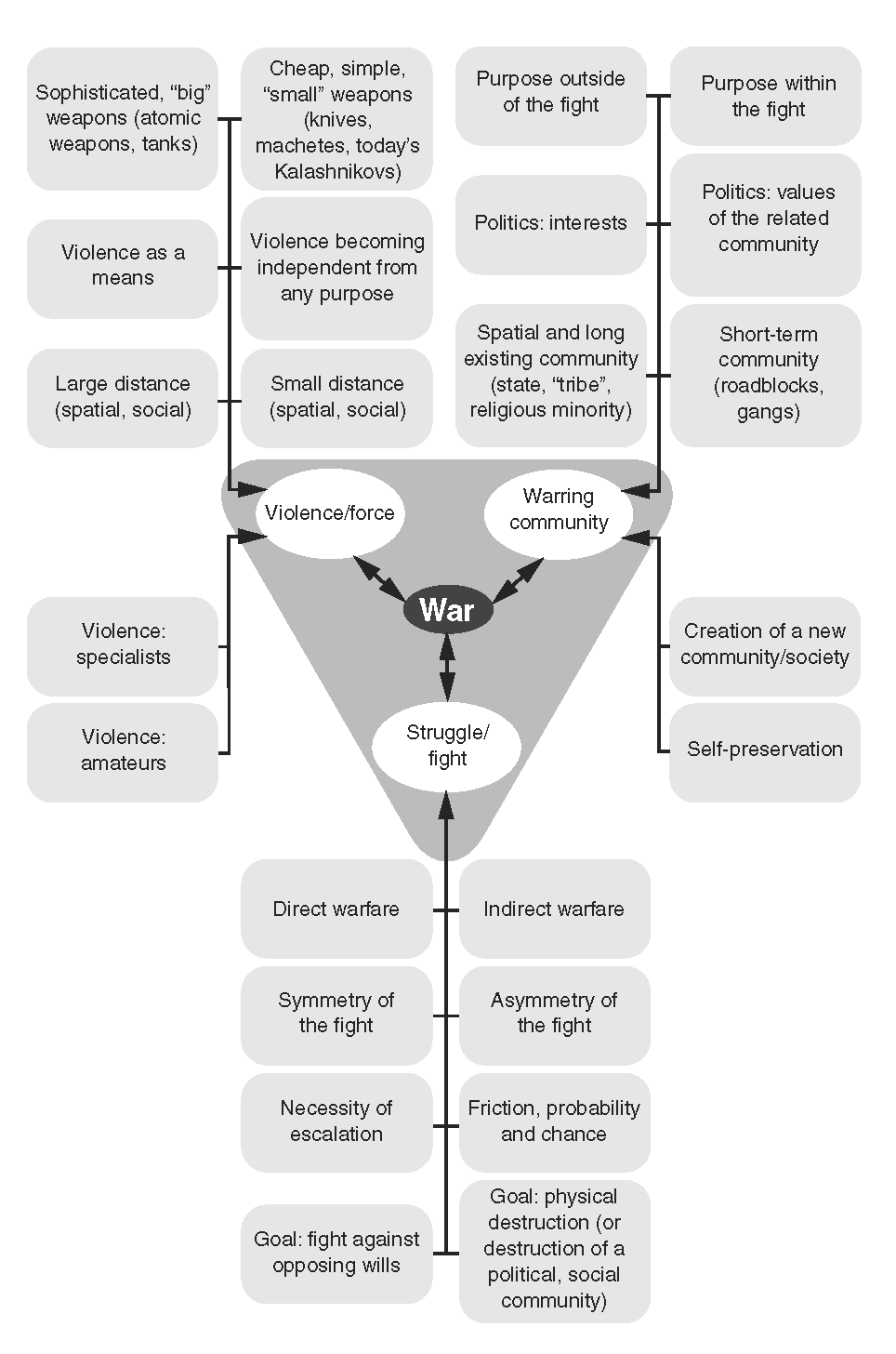
     

    Every war is accordingly defined in terms of its three essential dimensions: violence, combat, and the affiliation of the combatants with a community on whose behalf the combatants act. Historically, these three tendencies within the “wondrous trinity” display almost infinite combinations and multiple, cross-cutting tensions since every war is waged differently. Thus, every war has symmetrical and asymmetrical tendencies, for instance, even when it may appear that only one of these tendencies comes to the fore (Herberg-Rothe 2007).

    The tension between the coordinates of Clausewitz’s trinity may also be heightened by different forms of military organization. Those that feature strict hierarchies of command are perhaps most conducive to the transmission of political guidance to operating forces; whereas what is today called network-centric warfare is characterized by loose and diffuse organizational structures, in which the community’s political will and mandate can no longer be so readily imposed on combatants directly engaged with the enemy. As in the warfare of partisans, networked military organizations place a high value on the political understanding of the individual soldier. It is because of the relative independence of soldiers in network-centric warfare that this type of warfare does not require an “archaic combatant,” but a democratic warrior who has fully internalized the norms of the community for which he fights.

    The Democratic Warrior in the Twenty-first Century

    Even in Clausewitz’s day, war was not the only instrument of policy that state’s possessed, though it was undoubtedly the most central. Today, its centrality is less obvious, even as the complexity of its connections to other forms of state power has increased (Thiele 2009). Combining the different perspectives afforded by foreign, economic, developmental, judicial, domestic, and defence policy permits a global approach to conflict resolution while making the considerations surrounding the use of force more complicated than ever. States now pursue their security through many avenues at once, and all the agencies involved must consciously coordinate, connect, and systematically integrate their goals, processes, structures, and capabilities.

    Given the continuing expansion of the concept of security in recent years, a democratic army needs a specific task and function since its essential purpose—the use of force—can not be dispensed with. There have been those who thought it might be. When the East-West conflict ended, Francis Fukuyama announced the “end of history,” meaning an end to the practice of war and violence (Fukuyama 1992). The triumphant advance of democracy and free markets seemed unstoppable, to the point where it appeared as if the twenty-first century would be an age defined by economics and thus, to a large extent, by peace. These expectations have now been decisively overturned by ongoing massacres and genocide in Africa; by the return of war in Europe (as happened in the former Yugoslavia); by the September 11, 2001 attacks on the United States and, the subsequent wars in Afghanistan and Iraq; the war between Georgia and Russia over South Ossetia in 2008, the civil war in Syria and Iraq and finally the prospect of war to suppress Iran’s nuclear program (itself a profoundly dangerous and destabilizing step, should it become reality).

    In a complete reversal of Fukuyama’s thesis, a struggle against a new brand of Islamic totalitarianism appears to have begun, in which violence has become “unbounded”—because terrorist attacks are potentially ever-present because no end to them is in sight and there is no reason to assume there is any limit to the scale of violence terrorists might employ, including the use of nuclear weapons should they come to possess them. These processes of growing disinhibition must be countered by a new containment policy that limits the expansion of war and violence in the world.

    Two basic assumptions underlie this conception. The first is that the escalation of violence in world society is so multifaceted and differentiated that a single counter-strategy will not suffice. Rather, an overarching perspective is required to decide which measures are suitable in individual cases—without being able to exclude the possibility of terrible errors and miscalculations. The second assumption is that in today’s global society—as has been the case throughout history—many contrary processes are at work. Thus, regard for only one counter-strategy can have paradoxical, unanticipated consequences.

    This can be clarified using the example of democratization. If a general effort at worldwide democratization was the only counter-strategy against the disinhibition of violence and war, the results would almost certainly be counterproductive, not least because the spreading of democracy might itself be a violent process. A one-sided demand for democratic reform without regard for local conditions might, in individual cases, contribute to the creation of anti-democratic movements. The historical experience bears this out. After the First World War, nearly all of the defeated states underwent an initial process of democratization under the tutelage and supervision of the victors. Yet, almost all ended in authoritarian or even totalitarian regimes.

    Thus, the concept of the democratic warrior is not based on imposing democracy by force, but on limiting war and violence to enable the organic development of democratic self-determination. A differentiated counter-strategy of curbing war and violence in the world, with a view to fostering good governance (as a first step toward democratic governance), is the common element shared by humanitarian intervention and the development of a culture of civil conflict management. To this must be added measures to limit the causes of war and violence, such as poverty, oppression, and ignorance. Last but not least, this new form of containment requires effective restraint not just in the proliferation of weapons of mass destruction, but also of small arms, which continue to kill far more people than any other kind of arms.

    The containment of violence does not mean there will be entirely non-violent societies, much less a non-violent world society, in the foreseeable future. All else aside, the goal of completely eliminating violent conflict would ignore the fact that historically speaking, conflicts and their resolution have often furthered human development toward free and democratic ideals—as per the American struggle for independence and the French Revolution. The primary task of politics in the twenty-first century is therefore to radically limit violence and war so that non-violent structures and the mechanisms of the “social world” can have an impact. In this context, democratic warriors have a unique role to play; not as those who impose democracy by force, but as those who make diverse forms of culturally authentic self-determination possible, by curbing and containing war and violence.

    Conclusion

    It must be repeated, the concept of the democratic warrior appears to be contradictory. Indeed, it combines contradictory value systems in a single concept. Nevertheless, to adopt the metaphor favoured by Clausewitz (Herberg-Rothe 2007), the elements of tension in the democratic warrior’s identity can be conceived as the poles of a magnet, whose mutual opposition is not an illusion but is nevertheless a means to a larger, unitary end. It is what creates the magnet: the north pole of a magnet cannot exist alone. At one end of the continuum of the democratic warrior’s identity lies the values of democratic equality and non-violent conflict resolution; at the other, the realization that force itself may sometimes be necessary to limit war. At one end, is a civilized society, and at the other a subsystem of that same society, whose identity is defined by traditional concepts of honour and martial valour.

    As observed at the beginning of this essay, the bonds that link the two poles of this relationship, without eliminating their opposition, are the classical republican virtues, which lay claim to validity in both spheres. It was Plato who defined the classical virtues as intelligence, justice, fortitude, and temperance, which is also are characteristics in the Confucian tradition (Piper 1998 concerning Plato). Without them, a state can sustain itself only under dictatorship. With them, both external and internal freedoms are possible (Llanque 2008). They are the keys to the democratic warrior’s identity, providing the crucial link between the values of liberal-democratic society and those other values—courage, loyalty, self-sacrifice—that have always set the warrior apart.


    References

    Bredow, Wilfried von (2000), Demokratie und Streitkräfte (Wiesbaden: VS publishers, 2000).

    Clausewitz, Carl von (1984), On War. Ed. by Peter Paret and Michael Howard (Oxford: OUP).

    Duyvesteyn, Isabelle (2005), Clausewitz and African War (London: Routledge).

    Frevert, Ute (1997), Die kasernierte Nation (Munich: C. H. Beck, 2001).

    Frevert, Ute(ed.), (1997), Militär und Gesellschaft im 19. und 20. Jahrhundert

    (Stuttgart: Klett–Cotta).

    Fukuyama Francis (1992), The End of History and the Last Man (New York: Free Press).

    Herberg-Rothe, Andreas (2007), Clausewitz’s puzzle (Oxford: OUP). Herberg-Rothe, Andreas (2017), Der Krieg. 2.Edition. (Frankfurt:

    Campus).

    Herberg-Rothe, Andreas and Son, Key-young (2019), Order wars and floating balance. How the rising powers are reshaping our world view in the twenty-first century (New York: Routledge).

    Hüppauf, Bernd (1993), “Schlachtenmythen und die Konstruktion des ‘Neuen Menschen’,” in Keiner fühlt sich hier mehr als Mensch . . . : Erlebnis und Wirkung des ersten Weltkrieges, ed. Gerhard Hirschfeld, et al. (Essen: Klartext, 1993).

    Llanque, Marcus (2008) Politische Ideengeschichte. Ein Gewebe politischer Diskurse (Munich: Oldenbourg.

    Kaldor, Mary (1999), New and Old Wars: Organized Violence in a Global Era

    (Stanford: Stanford University Press).

    Kaplan, Robert (1994), “The Coming Anarchy.”In: Atlantic Monthly no.

    273, 44–76.

    Keegan, John (1995), Kultur des Krieges (Berlin: Rowohlt).

    Kuemmel, Gerhard (2005), Streitkräfte im Einsatz: Zur Soziologie militärischer Interventionen (Baden-Baden: Nomos).

    Moran, Daniel (2003), “Arms and the Concert: The Nation in Arms and the Dilemmas of German Liberalism,” in The People in Arms: Military Myth and National Mobilization since the French Revolution, ed. Daniel Moran and Arthur Waldron(Cambridge: Cambridge University Press).

    Münkler, Herfried (2004), The New Wars (New York: Policy). Münkler, Herfried (2007), Empires (Cambridge:Polity Press).

    Pieper, Josef (1998), Das Viergespann—Klugheit, Gerechtigkeit, Tapferkeit, Maß (Munich: Kösel).

    Röhl, Wolfgang (2005), “Soldat sein mit Leib und Seele. Der Kämpfer als existenzielles Leitbild einer Berufsarmee in EinJob wie jeder andere. Zum Selbst- und Berufsverständnis von Soldaten, ed. Sabine Collmer and Gerhard Kümmel (Baden-Baden:Nomos, 2005) 9–21.

    Schlichte, Klaus (2006), “Staatsbildung oder Staatszerfall. Zum Formwandel kriegerischer Gewalt in der Weltgesellschaft,In: ”Politische Vierteljahresschrift 47, no. 4.

    Sikora, Michael (2003), “Der Söldner,” in Grenzverletzer. Figuren politischer Subversion, ed. Eva Horn, Stefan Kaufmann, and Ulrich Bröckling (Berlin: Kulturverlag Kadmos, 2002).

    Thiele, Ralph (2009), “Trendforschung in der Bundeswehr”. In: Zeitschrift für Sicherheits- und Außenpolitik 2, 1–11.

    Walzer, Michael (2003), “Is there an American Empire?” In: Dissent Magazine 1 (2003), URL; http://www.dissentmagazine.org/menutest/archives/2003/fa03/walzer.htm  last accessed 16. 4. 2020.

    Zakaria, Faared (2009), The Post-American World (New York: W. W. Norton).
     

  • Poverty, Inequality, and Marginalisation as Forms of Structural Violence in Pre-Conflict Syria

    Poverty, Inequality, and Marginalisation as Forms of Structural Violence in Pre-Conflict Syria

    The injustice and inequality built into the structural institutions of the Syrian society can be referred to, what has been called as the ‘structural violence’, by the well-known Norwegian sociologist, Johan Galtung.  

    The ongoing civil war in Syria that has resulted in large-scale loss of lives, and forced displacement of millions across the region, is being seen as one of the bloodiest conflicts of this century. While countries continue to witness the horrors of visible atrocities and war crimes, the underlying layers of structural and cultural violence continue to buttress the egregious brutality which is often more direct, and physical.


    Although the war is often seen as a result of the outburst of pro-democracy protests in 2011, a close examination of the country’s socio-economic structures would enable one to get a detailed insight into the underlying layers of frustration caused due to large-scale poverty, inequality, and marginalisation. One would also find that the relatively peaceful structure, which existed before the protests of 2011, was held intact largely due to the existence of single-party dominance, where one actor (Hafez al-Assad, and later Bashar al-Assad) held all power and authority, while those existing in lower ranks of society continued to lack resources, as well as opportunities to challenge the dominant power.

    The Syrian economic crisis has existed long before the commencement of the civil war.

    The injustice and inequality built into the structural institutions of the Syrian society can be referred to, what has been called as the ‘structural violence’, by the well-known Norwegian sociologist, Johan Galtung.  The violence, here, is reflective of a position “higher up or lower down in a hierarchy of exploitation-repression-alienation”, where the parties involved are determined either to keep the hierarchy intact or to completely obliterate it. In the case of Syria, the deprivation of the most basic and non-negotiable needs, which threatened the citizens’ need for survival, has been the primary cause for aggression to come into existence. The factors that, thus, led to the conflict in Syria can be seen rooted in years of repression, poverty, and lack of representative institutions, which manifested in the form of protests, or the Arab Spring of 2011.

    The Syrian economic crisis has existed long before the commencement of the civil war. Since the beginning of the economic crisis, Syria’s institutional structures have failed to meet the rising needs and rights of its population. In the 1980s, the country was trapped in a downward spiral of a fiscal crisis, as a result of large-scale drought, and due to both, domestic and external factors. The crisis led to high food deficit, and an increase in the cost of living, leading to a rise in patronage networks which provided small circles of elites with profitable businesses. These networks became increasingly popular in real estate and land management, leaving out large sectors of Syria underdeveloped.

    While the country witnessed a decreasing overall debt and a noticeable rise in the GDP in the 2000s, large sections of the population were excluded from benefitting from these growth rates due to differences in wage rates and declining job opportunities. Increasing inequality was reflected in a paper published by the UNDP, which claimed that 65.6% of all labour in Syria belonged to the informal sector in 2010, with Aleppo and Idlib ranking first with over 75% of their workforce belonging to the informal sector. Further, the four years of drought between 2006 and 2011, and the consequent failed economic policies led to a significant decline in the agricultural sector’s output, forcing 2 million to 3 million Syrians into abject poverty.

    Additionally, the oil revenues fell from more than 14% of GDP in the early 2000s to about 4% in 2010 due to depleting reserves. According to a report, overall poverty in Syria in 2007 impacted 33.6% of the population, of which 12.3% were estimated to be living under extreme poverty. Noting the degree of inequality in Syria in 1997, the report found out that the lower 20% of the population had a share of only 8% in expenditure, while the richest 20% of the population share about 41% of the expenditure. The degree of inequality further decreased in 2004. Moreover, the widely disputed region of North-Eastern Syria witnessed highest levels of inequality in 2007, in addition to deprivation of living standards, and worst levels of illiteracy, and access to safe water, just four years before the outbreak of the civil war. The unequal access to resources was also starkly reflected in the housing situation of the country before the war, where over 40% of the population lived under informal housing conditions, – through squatting, or on lands obtained without legal contracts.

    In addition to the economic crisis, Syrians have been the victims of decades-long political repression, in the form of restrictions on freedom of expression, torture, and enforced disappearances. The political institutions have historically been unstable, with three military coups taking place in 1949 alone, followed by one more in 1954, in addition to the Ba’athist-led coups of 1963 and 1966. The Syrian security forces (Mukhabarat) are known to have detained citizens without proper warrants even before 2010, many of whom have reportedly been tortured in prisons. In their attempts to keep the hierarchy of power relations intact, the centralised institutions are known to clamp down on any public demonstrations, with frequent arrests and employment of state violence.

    The conflict which started with citizens demanding their basic needs and rights has been sustained over the years by the involvement of foreign states, and increased state brutality which has been responded to by an increasingly similar, if not equal, force by the rebellion groups.

    Years of conflict have exacerbated the economic crisis, pushing both the state and its citizens, into chaos, with more than 80 per cent of the Syrian population living below the poverty line, with an unemployment rate of at least 55 per cent in 2018. With most of the business networks now being controlled by the selected few elites, the population at large continues to suffer the brunt of both structural, and direct violence.

    The conflict which started with citizens demanding their basic needs and rights has been sustained over the years by the involvement of foreign states, and increased state brutality which has been responded to by an increasingly similar, if not equal, force by the rebellion groups. The country, now, witnesses itself entangled in a cycle of conflict, where the war has led to steep economic deterioration, political repression, and physical violence, which in turn has led to further widespread cataclysm.

    Image Credit: Photo – Aleppo-Syria destruction in 2019 and  Syria Map – Adobe Stock

  • The Geopolitics of Syria’s Reconstruction

    The Geopolitics of Syria’s Reconstruction

    Introduction

    Syria’s territories are controlled by a variety of actors – Al Assad’s regime (with Russia and Iran as its supporters); Kurdish dominated self-administration (with a small number of US troops supporting them); Turkey and its affiliated militias; and the Syrian Salvation Government affiliated to the Hay’at Tahrir al-Sham (HTS), a former al-Qaida offshoot.

    Fragmentation of the state’s territories, as the state lost control of its territories, resulted in the emergence of a network of localised war economies with numerous local and foreign actors being involved. War economies emerged in territories held by Assad’s regime as well as those under the control of various other opposition parties, characterised by an increase in smuggling of goods (among which essential goods, crude oil and arms were popular), extortion, rent seeking for essential services, and taxation of goods at checkpoints established by the warring parties, including local warlords, opposition armed groups or regime’s militias. The Syrian Arab army is also reported to have engaged in rent seeking behaviour through the establishment in recaptured territories (Hinnebusch, 2020).

    Another area of priority for armed opposition groups is the border crossings with Turkey whose access they have sought to control. The Ahrar-Al Sham group, established control over the Bab al-Hawa crossing between 2015-16, and earned around $5 million per month. Armed opposition groups have been involved in conflict with each other over control for border crossings, particularly conflict between Hay’at Tahrir al-Sham (HTS) and Ahrar al-Sham in 2017 (al-Kattan, 2017).

    The Syrian army (that was cross-sectarian) is in crisis of its reducing force size as it is hampered by resistance to conscriptions and many desertions. The Alawite sect was co-opted into the state’s army, political and security apparatus, resulting in tensions along sectarian lines. Another significant development was that those among the pre-war elite who advocated for a political solution based on power sharing were expelled from it, resulting in the contraction of the core to comprise of individuals along sectarian lines. Further, pro-regime militias emerged as pro-government communities were forced to rely on themselves for their defence, leading to a widespread localisation of power to fiefdoms (al-Kattan, 2017).

    The political, economic and security dimensions of the conflict which led to the emergence of war economies has been accompanied by shift of composition of the economy marked by the emergence of ‘war commanders’ and a decentralised elite, who capitalised on evading sanctions, served as middlemen between the armed groups of the state and opposition and established monopoly upon the supply of goods and services.

     These developments further led to the emergence of new centres of power which existed alongside the existing regime that consolidated its power by strengthening its relations with the new elite, army and security sector.

    The domestic dynamics of the Syrian conflict are closely related to a wider geopolitical struggle among regional and external actors who act as patrons for the domestic actors.

    In addition, by portraying itself as a bulwark against radical Islamism and strengthening its relations with influential individuals in minority communities and providing them with disproportionate authority within their societies, the regime’s efforts have redefined existing social hierarchies and co-opted pro-regime minority leaders to power. The regime’s policies, throughout the war, have not only strengthened the neo-patrimonial nature of the State and its relations with its multiple networks but lead to the decentralisation of a system of neo-patrimonialism (Middle East Institute & Etana Syria, 2020).

    The domestic dynamics of the Syrian conflict are closely related to a wider geopolitical struggle among regional and external actors who act as patrons for the domestic actors. The Syrian conflict that began as an internal conflict emerged into a proxy conflict where regional struggle for influence played out between the ‘resistance axis’ comprising of Hamas, Hezbollah and Iran, and Sunni dominated ’moderate’ states comprising of Saudi Arabia, Qatar and Turkey. The latter wished replace the Assad regime that was aligned towards the ‘resistance axis.’ Iran considers the Syrian conflict as threat to its survival and its ability to support Hizbollah against Israel.  The rival axes instrumentalised sectarianism as a part of their discourse and in their support for proxies. However, the interests of those within the Sunni camp clashed (with Turkey and Qatar’s support for the Muslim Brotherhood and Saudi Arabia and UAE against the Muslim Brotherhood and its version of political Islam) resulting in division of the Sunni camp further leading to the division of their proxies (Aita, 2020).

    The global struggle for power between the US and Russia, with the former promoting a liberal world order and advance its hegemonic interests, and the latter interested in increasing its sphere of influence, limiting US intervention while emphasising on state sovereignty. Russian intervention in Syria in support of the Assad regime tilted the power balance in its favour allowing the regime to gain control of its lost territories.

    Image Credit: Al Araby

    US sought to limit direct intervention in Syria while relying on proxies and financial sanctions (that it pursued along with the EU) to pressurise Assad’s regime to compromise to a solution that would promote its interests. Assad’s regime, due to its connection Iran, Shia militas in Iraq and Hezbollah in Lebanon, was able to manage despite the external pressure it faced. US attention and efforts were diverted to controlling ISIS. In 2019, while US withdrew from Northern Syria due Turkish intervention against the Kurdish forces, it announced it would redeploy its forces to the energy reserves in Deir ez-Zor to prevent Assad’s forces or ISIS from gaining control over them (Hinnebusch, 2020).

    The geo-political struggle for influence in the Syrian conflict among regional and global actors, has also transcended into efforts to capitalise on Syria’s post-war reconstruction efforts and business.

    With diversion of US efforts towards constraining ISIS, Russian intervention, growing differences between Saudi and Qatar, Saudi and UAE intervention in Yemen, have all resulted in a gradual withdrawal of the GCC, leading to a rise in the role played by Turkey, Iran and Russia. Turkey’s role and interests evolved from installing a Brotherhood government and targeting the regime to controlling the Syrian Kurdish PYD, which it views as a terrorist organisation. The threat of a confrontation with Moscow in Syria allowed it to participate in the Astana Process and a gradual realignment of its policy with that of Russia’s policy. More recently, Turkey and Russia have brokered a ceasefire deal in Idlib.

    The geo-political struggle for influence in the Syrian conflict among regional and global actors, has also transcended into efforts to capitalise on Syria’s post-war reconstruction efforts and business.

    This paper explores the local, regional and international dimensions of reconstruction and development Syria while analysing the impact the war has had on the political economy of Syria.

    Internal dynamics of Syria’s reconstruction

    The internal dynamics of Syria’s reconstruction are characterised by conflict among Syrian actors (supported by external actors) for resources and instruments that would lead them to strengthen their control. The regime views reconstruction efforts as a means to consolidate its authority and power over the country.

    Image Credit: NYT

    While the efforts made by the regime to consolidate its power and authority served its objectives and reduce the costs of governance, they have led to the decentralisation of political and security apparatus at the local levels. In addition, Iran and Russia continue to establish relations based on patronage with several Syrian clients. The integration of Hezbollah, Iraqi Shi’i militias and Iran’s revolutionary guards, have further loosened the control the regime holds over the security apparatus and strengthened sectarianism.

    The efforts of Assad’s regime have been directed at satisfying its loyalist elite on whom it is vitally dependent to legitimise its authority and power, and to a lesser extent the public.

    The regime sought to prevent local security apparatus from capitalising on their autonomy by incorporating them into the newly established units under centralised defence forces as in the case of the 5th Army Corps, although this was only partially successful. Russian intervention and participation in the conflict allowed it to establish order in the army.  The paucity of manpower further prevents the regime from extending its authority over the entire country, forcing it to continue to depend on its relations with tribal leaders and local warlords (Hinnebusch, 2020).

    The efforts of Assad’s regime have been directed at satisfying its loyalist elite on whom it is vitally dependent to legitimise its authority and power, and to a lesser extent the public. It encouraged its loyalists to participate and reap benefits off the war economies during the war as its authority over its local proxies declined, while the threat of being targeted by the opposition has ensured that the elites remain loyal. With the localisation of war, the regime has strengthened its relations with the elite while consolidating its power by encouraging investment of income and revenues earned through illicit means into the formal economy. The elite, the warlords, who are partners in the conflict are increasingly participating in the formal economy by setting up formal companies and businesses. However, there remains much to be done to fully integrate them into the productive economy, discourage involvement in rent seeking, and to promote the revival of a productive economy (Sinjab, 2017).

    One of the major effects of the conflict and its resulting socio-economic and political patterns has been the lawlessness, that serves as a deterrent to socio, economic and political cohesion, further preventing the investments required for reconstruction.

    Legislation aimed at Reconstruction

    The regime’s economic strategy for reconstruction namely the ‘National Partnership’, enforced in 2016, allows public bodies to form private investment companies while supporting the establishment of private firms.

    Image Credit: BBC

    Private investors are encouraged to investing in the remaining public property allowing the government to retain its influence on the economic movements. This serves the purpose of attracting new investors to invest in lucrative opportunities while the investments serve to support regime’s prime customers and clients. The legislation also enables them to obtain and secure public sector properties at the cost of the state treasury’s finances, thereby raising a doubt regarding the ability of the ‘new elite’ to alter the nature of the enterprise. Another significant measure taken by the regime as part of its reconstruction repertoire are property and urban reconstruction laws, including the Law 66 of 2012 and Law No 10 of 2018, that expropriate land and property from displaced opposition supporters in substandard living conditions and reallocate them to new upscale housing. This is meant to gather the support of the regime’s loyalists. The regime by creating uncertainty about the security of the property could discourage all investors with the exception of a few capitalists (Daher, 2018).

    Despite the fact that restrictions on capital movement makes it very difficult to attract investments into Syria, the Syrian government is implementing policies and schemes to attract financial aid from outside. It intends to tax finance inflows ranging from money sent by expatriates into Syria for humanitarian aid, which must be channelled through NGO’s funded by the regime. It also intends to attract $100 billion worth Syrian currency held outside Syria through tax concessions and by launching the Syrian International Business Association (SIBA) under the auspices of World Bank. Analysts warn about the difficulties associated with investments from other nations. They suspect that given the dispersion of investments, diaspora would find it difficult to compete with loyalists for reconstruction contracts and there may be issues with fraudulent officials and widespread corruption. The assets of those businessmen who left the state have been frozen. Lastly, the US and EU-imposed multilateral sanctions led to Syria being cut off from the international banking system(Aita, 2020).

    The Syrian Government has declared that reconstruction contracts will be granted to its supporters and not countries who supported its opposition. It has also offered concessions in order to attract investments from Russia and Iran, but this may jeopardize Syria’s financial independence in the coming years.

    Reconstruction of Syria would lead to stronger relations with Iran and Russia followed by simultaneous decline in relations with the West (to whoom it exported a major portion of its oil ) and the Arab Gulf. Previous economic partners may engage in reconstruction in areas where there is negligible regime-control. The reconstruction parameters are bound to affect Syria’s social fabric. The gap between the rich and the poor has widened due to the war economy. The rigged economy will put the interests and benefits of the common people in peril.

    Geopolitical Dynamics of Reconstruction

    The geopolitical struggle over reconstruction among competing players at the regional level is centred around increasing one’s own influence, either through direct intervention or proxies. Considering that different parts of Syria is under the control of different parties there is every chance that Syrian reconstruction effort may not be an integrated effort across the nation but rather take the form of parallel reconstruction initiatives across the many different areas of Syria.

    The global geo-economic factors influence whether resources become available for reconstruction and on what terms. Because the powers that are geopolitically strongest on the ground in Syria (Russia, Iran) are geo-economically weaker than those who lost the geopolitical conflict (US, EU, Gulf), the latter are using the capital that they can withhold and obstruct or seek to leverage their contribution to effect the looming winding down of the military conflict on their terms. They, together with the World Bank, are making their participation conditional on a political settlement. Specifically, this will affect whether the regime will be able to reconstitute authority over the country’s territory and its reconstruction, or will be forced into some sort of power-sharing/territorial confederation or, these failing, reconstruction deepens fragmentation. If the parties do not reach a compromise the outcome could be a frozen conflict consolidated by separate and minimalist reconstruction tracks.

    Further, regional and global actors that have not participated in the conflict happen to be economically stronger and have the means to mobilise resources. Their support and resources to fund the reconstruction and development of Syria remain contingent on the ability of Assad’s regime to fulfil their conditions of a political settlement.

    Russia’s Reconstruction Support

    Russia’s role in Syria’s reconstruction have been driven by the benefits a stable Syria could provide it. It has provided Assad’s regime with support in economic and military terms and settled Syria’s debt. Russia also seeks to renew and recoup its pre-war investments in infrastructure and energy sector, and establish new contracts in geo-strategic areas. Assad’s regime has been granted a preferential role in redevelopment of its energy and infrastructure sectors. The state of the Russian economy has made lesser resources available for investment. The risk of investing in Syria due to the political and security climate and the threat of being targeted by US sanctions have led to minimal investment into Syria. The entities that have invested are operated/owned by oligarchs close to Putin, and those under sanctions, for instance, Gennady Tim-Chenko’s construction company (Van Veen, 2020).

    Russia has realised that it lacks the resources to actively finance Syria’s reconstruction effort and instead focussed its efforts on building the state institutions necessary to provide adequate security infrastructure, which is an important pre-condition for any reconstruction effort.

    Russia has realised that it lacks the resources to actively finance Syria’s reconstruction effort and instead focussed its efforts on building the state institutions necessary to provide adequate security infrastructure, which is an important pre-condition for any reconstruction effort. Simultaneously it tried to seek support from the European Union and international organisations to create the necessary infrastructure required to facilitate the return of refugees based out of Europe while ensuring the attainment of a political settlement that helps Bashar Al Assad to stay in power (Daher, 2018).

    Image Credit: NYT

    Russia has also worked with the Assad regime to implement policies aimed at the return of refugees thereby addressing some of the requirements and requests of the European Union. However, Bashar Al Assad has so far only paid lip service to such requests.  For instance a law intended to promote reconstruction projects has been amended under Russian pressure but without any major changes to its provisions and was used to expropriate the property of Syrians who fled abroad.

    Iran’s Role

    Iran has provided Assad’s regime around $16billion worth of financial aid since 2012.It has provided an additional $3.5 million in 2013 which was further extended by $1 billion in 2015 and $6.4 billion and $700million to pro-Iran militias in Syria.   It has expressed its interests in participating in the reconstruction of Syria. Iranian entities were awarded numerous contracts worth millions of dollars to initiate redevelopment of the electricity infrastructure by the central government as well as local governments but are yet to be implemented. The Iranian Revolutionary Guards, who have considerable experience in participating in the reconstruction of Iran after the Iran-Iraq war and own vast construction companies in Iran, have entered into agreements in the sectors of mining and communications. While Iran has stated it would offer $1 billion for reconstruction, the amount it pledged is a minuscule amount of the total funds required. Iran’s participation in Syria’s reconstruction is also likely to be limited due to the impact of US sanctions on its own economy(Van Veen, 2020).

    Diminished role of US, EU and Arab States

    As for regime controlled parts of Syria, Washington moved to block reconstruction funding in these areas. US pundits argued that the regime would inevitably be empowered by reconstruction and should not be rewarded for its brutal repression of the uprising; anti-regime interest groups moved not only to preclude US funding but also to erect obstacles to others participating in reconstruction. In April 2018 the US Congress passed the No Assistance for Assad Act (NAAA) which was designed to prevent any drift from humanitarian assistance to reconstruction stabilization, and according to Faysal Itani, had the effect of ‘killing any World Bank dreams to get funding to operate in Syria’. Indeed, the US has a long history of directing the flow of world financial capital via sanctions, conditionality, etc. for its geopolitical purposes; in Syria, it seeks to manipulate money (geo-economics) to obtain what it could not achieve via geopolitics: specifically, keeping Syria a failed state that would make it a resource-draining burden for Russia and its allies.

    The US has used its influence in North-Eastern Syria, to counter efforts by the Assad regime to consolidate its power over Syria which is a precursor to a “nationally integrated” reconstruction. Establishing control over energy reserves is essential for Assad’s regime to pursue its reconstruction efforts successfully. The US, by controlling reserves in the North-East Syria, has been able to deprive Syria’s access to essential resources.

    US efforts in reconstruction have been motivated by its interests to deter any reconstruction efforts sponsored by the regime through geo-economics measures such as sanctions, when its geo-political efforts have had limited success in motivating Syria and its allies in pursuing a political solution in line with US policy interests.

    The US campaign against ISIS devastated Raqqa but reconstruction there has remained limited to stabilization measures. The Trump administration tried to get the Saudis to assume the burden of reconstruction (asking for $4 billion). The US goal was to start enough reconstruction to deter any move in the area to join regime sponsored reconstruction efforts (Alaaldin et.al., 2018; Burcher, 2018; Harris, 2018; US Congress, 2018;). US efforts at convincing Saudi Arabia to undertake reconstruction efforts have not been successful as the latter offered relatively smaller amount (al-Khateb, 2020).

    US efforts in reconstruction have been motivated by its interests to deter any reconstruction efforts sponsored by the regime through geo-economics measures such as sanctions, when its geo-political efforts have had limited success in motivating Syria and its allies in pursuing a political solution in line with US policy interests.  It simultaneously blocked reconstruction funding directed towards territories under the control of the regime. The Caesar Act, now incorporated into the National Defence Act of 2020, targets investment into Syria, through individuals and businesses coming into the ambit of the UN sanctions (Hinnebusch, 2020).

    While the EU has provided substantial aid to Syrian refugees in Syria’s neighbouring countries, it has made its aid and participation in reconstruction contingent on efforts to reach a political solution that is in accordance with ‘UNSCR 2254 and the Geneva Communique’

    The EU has been affected by the Syrian Conflict due to the influx of refugees and large-scale migration of its citizens to partake in terrorist activities. While the EU has provided substantial aid to Syrian refugees in Syria’s neighbouring countries, it has made its aid and participation in reconstruction contingent on efforts to reach a political solution that is in accordance with ‘UNSCR 2254 and the Geneva Communique’ (Van Veen, 2020).

    Russia is making efforts to broker a political settlement of sorts, with Turkey’s support, to convince EU to invest in reconstruction to enable refugees to return. While the EU seems to be relying on the inability of Syria’s allies to support its funding and thus force Assad to agree to the EU’s conditions, the regime does not seem to be interested in accepting EU conditions and give up its power in return for support of its reconstruction. However, individuals EU states have participated in reconstruction efforts in a limited manner in both the regime-held as well as opposition-held areas.

    Turkey continues to be one of Syria’s top trading partners. Numerous Syrian businessmen who have been exiled have invested in Turkey, around 26% of foreign investment in Turkey in 2014 originated from Syrian businessmen, particularly in its border regions with Syria. While a number of exiled Syrian businessmen supported the opposition, their investment would be instrumental, if mobilised, in territories held by Turkey and its militias at a time when refugees are returning to the region. While the Syrian government is against the participation of Turkey in the reconstruction of Aleppo, Russia’s efforts in mediation would lead Turkey to participate in the reconstruction process. Turkey has invested significantly in establishing institutions facilitating the governance of areas under its control and also in building economic infrastructure in these areas (Daher, 2018).

    While Jordan and Lebanon have expressed interest in participating in the reconstruction of Syria, the resources they can mobilise are limited.  The Gulf countries have, no doubt the resources required for reconstruction, but have made their role in Syria’s reconstruction contingent on withdrawal of Iran and its proxies and in case of some countries, a regime change. The UAE as expressed its interest in participating in Syria’s reconstruction so as to limit Iran’s influence. However, Yazigi (2017) states that reconstruction efforts, in the case of  Lebanon, were contingent on a solution that emphasised upon power-sharing, backed by regional and international actors and substantial financial aid from Saudi Arabia. It is unlikely that either of the two scenarios would play out in the case of Syria.

    China: A Possible Contender?

    the Chinese state considers Al Assad’s regime as a bulwark against terrorism and its relations with the regime an asset in combating Uighurs who are participating on the behalf of terrorists.

    China has expressed its interest in participating in the reconstruction of Syria to advance its interests through investments in economy and geo-strategic areas such as the maritime sector, and to develop and connect its Belt and Road Initiative in the region. Given China’s interests, size and nature of China’s capital, China becomes a viable partner in the reconstruction of Syria.  China conducted a trade fair in 2018, which was attended by 1,000 Chinese companies and witnessed an investment of $2 billion for the reconstruction and development of Syria’s industrial sector. Private investors have been concerned about the widespread corruption in Syria and the threats of being targeted by US sanctions. Moreover, the Chinese state considers Al Assad’s regime as a bulwark against terrorism and its relations with the regime an asset in combating Uighurs who are participating on the behalf of terrorists.

    Conflict Resolution vs Conflict Management

    Given that the warring parties consider the conflict to be more-or-less of a zero-sum game, territorial and social fragmentation of Syria, it would be extremely difficult for them to pursue means to resolve the conflict through creating the need for the conflict to be managed and downsized (Dacrema, 2020). The non-recognition of certain non-state actors by the rival sides and questions regarding the participation of non-state actors in negotiations, which would only serve to legitimise them further, complicates the process of negotiating a solution.

    Temporary Arrangements

    A strategy that would allow for the management of the conflict would be to negotiate temporary agreements and deals. Turkey and Russia have been able to broker temporary ceasefires at multiple instances, throughout the conflict, in the Idlib region. Temporary arrangements would help build confidence among the warring parties in the long run, and reduce the possibility of escalation of war (Dacrema, 2020).

    Conclusion

    Given that the warring parties prefer a status quo in comparison to the resolution of a conflict and value their geo-political and economic interests, it is highly unlikely that parties would push for resolution of the conflict. In consideration of a political stalemate, reconstruction efforts among the warring parties are likely to take place parallelly, as they have played out with the localisation of the conflict. While resources in the territories held by the regime are being diverted to areas that have remained loyal during the conflict and/or areas of strategic importance with areas formerly occupied by opposition forces receiving relatively lesser attention; territories under Turkish control and those held by the Kurdish forces have witnessed efforts aimed at stabilising the territories.

    Russia and EU have the potential and the leverage required to emerge as power brokers in the reconstruction and initiate the process in a manner that promotes social, economic and political cohesion in the long run.

    Russia and EU have the potential and the leverage required to emerge as power brokers in the reconstruction and initiate the process in a manner that promotes social, economic and political cohesion in the long run. The likelihood of being able to convince themselves that the possibility of achieving one’s interests alongside the other is a far better option in comparison to its alternative of a failed state, which threats both their interests. However, their ability to convince their allies and their clients (in this instance, Assad regime is Russia’s client) and the mistrust between both the parties as well as between their allies poses a challenge.

    Russia’s efforts in brokering a constitutional committee for Syria under the aegis of the UN is an indicator of a compromise. Hinnebusch (2020) suggests that “it is not impossible to move incrementally toward a minimalist sort of political settlement that might acquire enough international legitimacy to open the door to some reconstruction funding.” While the likelihood of this occurrence is difficult amid conflicting interests, it cannot be overruled.

    The humanitarian aspects of the conflict and urgent need for reconstruction to alleviate tangible and intangible costs of the conflict have largely been ignored. The warring parties have been preoccupied with advancing and fulfilling their interests at the cost of ordinary Syrians. There is a need for parties to acknowledge and make efforts towards the realisation of the urgency of reconstruction that is vital for securing the social and economic interests of ordinary Syrians. The likelihood of the same, however, is questionable.


    References

    Aita, S. (2020). Reconstruction as a political-economy issue: The case of Syria. Retrieved 28 June 2020, from https://www.thecairoreview.com/tahrir-forum/reconstruction-as-a-political-economy-issue-the-case-of-syria/

    al-Kattan, R. (2017). Retrieved 25 June 2020, from https://www.atlanticcouncil.org/blogs/syriasource/the-economic-case-for-syria-s-stabilisation/

    al-Khateb, K. (2020). US outsources Syria aid to Gulf. Retrieved 4 July 2020, from https://www.al-monitor.com/pulse/originals/2018/08/us-outsources-syria-aid-gulf.html

    Dacrema, E. (2020). Three Concepts to Understand the Future of Syria. Retrieved 25 June 2020, from https://www.oasiscenter.eu/en/what-future-for-postwar-syria

    Daher, J. (2018). The political economic context of Syria’s reconstruction : a prospective in light of a legacy of unequal development. Retrieved 3 July 2020, from https://core.ac.uk/display/162303203

    Hinnebusch, R. (2020). The Battle over Syria’s Reconstruction. Retrieved 1 July 2020, from https://www.globalpolicyjournal.com/articles/development-inequality-and-poverty/battle-over-syrias-reconstruction

    Human Rights Watch. (2019). Rigging the System. Retrieved 25 June 2020, from https://www.hrw.org/report/2019/06/28/rigging-system/government-policies-co-opt-aid-and-reconstruction-funding-syria#_ftn114

    Middle East Institute, & Etana Syria. (2020). Manufacturing Division: The Assad Regime and Minorities in South-west Syria. Retrieved 2 July 2020, from https://www.mei.edu/publications/manufacturing-division-assad-regime-and-minorities-south-west-syria

    Sinjab, L. (2017). How Syria’s War Economy Propels the Conflict. Retrieved 25 June 2020, from https://syria.chathamhouse.org/research/how-syrias-war-economy-propels-the-conflict

    Veen, E. (2020). The geopolitics of Syria’s reconstruction: a case of matryoshka. Retrieved 27 June 2020, from https://www.clingendael.org/publication/geopolitics-syrias-reconstruction-case-matryoshka

    Yazigi, J. (2017). Analysis: No Funds to Foot Syria’s Reconstruction Bill. Retrieved 1 July 2020, from https://www.newsdeeply.com/syria/community/2017/12/04/analysis-no-funds-to-foot-syrias-reconstruction-bill


    Main Image Credit: Palmyra before its destruction by ISIS – www.citymetric.com 


  • China’s support to Syria: In Conflict and Redevelopment

    China’s support to Syria: In Conflict and Redevelopment

    China is looking to ramp up relations with Syria both as part of its strategic Belt and Road Initiative (BRI) but also to take advantage of the multi-billion dollar reconstruction effort that is expected to materialise following the gradual winding down of the war.


    Syria is an ancient civilisation and also an important part of the ancient silk route, with cities such as Palmyra, Aleppo and Damascus playing an important role in trade and travel between the East and the West. While the discovery of a maritime route between Europe and Asia has to some extent diminished its importance in this regard, Syria is still strategically important. China is looking to ramp up relations with Syria both as part of its strategic Belt and Road Initiative (BRI) but also to take advantage of the multi-billion dollar reconstruction effort that is expected to materialise following the gradual winding down of the war.

    China’s non-interference policy is an integral aspect of its involvement and role in the Middle East. During the course of the Syrian war, China has consistently supported the Bashar Al Assad government on the diplomatic front – through the exercise of the veto power against the resolutions introduced in the United Nations Security Council either condemning the Syrian government, calling for ceasefire or for imposing sanctions on suspected war criminals. While negotiating the renewal of border crossings for aid, China agreed on the need for humanitarian assistance but emphasised on state sovereignty. China’s policy of non-interference has served it well in strengthening bilateral relations and advancing its interests.

    One of the reasons for the diplomatic support extended by China to the Syrian government is also the involvement of the Uighur fighters in the Syrian conflict which has greatly bothered China. While it has never got directly involved militarily in the Syrian conflict there are unconfirmed media reports which suggested that China was sharing military intelligence with the Syrian government and also sent its military advisors to Syria to help it in its fight against the rebels. In this sense, it saw Syria as a key player in its fight against religious extremism thereby preventing its export to its own volatile Xinjiang province.

    With the Syrian conflict slowly winding down and Bashar Al Assad’s hold on Syria greatly strengthened more than at any other time since the beginning of the civil war, China is ramping up its diplomatic efforts in Syria  using trade as an important policy tool to ramp up the relations between the two great civilisations.

    Based on Chinese government’s invitation Syria has participated in the second BRI summit held in Beijing in April 2019. Previously in 2018, China held a Trade Fair on Syrian reconstruction projects which was attended by nearly one thousand Chinese companies and which saw investment proposals of nearly USD two billion. The collapse of most of the industry in Syria due to the war has also resulted in a significant increase of cost-effective Chinese imports into Syria ranging from toys to car parts and industrial machinery and equipment.

    China is also leveraging its economic strength fully by using aid as a foreign policy tool. In 2019,  Xinhua reported on the  that an economic cooperation agreement was signed between Syria’s Planning and International Cooperation Commission (PICC) and the Chinese embassy in Damascus. As part of this agreement, a donation will be set aside to fund a series of humanitarian projects as agreed upon by both sides.

    The collapse of most of the industry in Syria due to the war has also resulted in a significant increase of cost-effective Chinese imports into Syria ranging from toys to car parts and industrial machinery and equipment.

    China is expected to be a key player in the international reconstruction and development effort that is expected to take place in Syria due to its strong bilateral ties with not only Syria but also its alignment with Russian and Iranian position on Syria , these two players being the major supporters of Bashar Al Assad’s government in the civil war. While Russia and Iran are surely expected to carve out a large part of the reconstruction contracts between themselves, their capacity to make the huge investments in these projects, estimated to be worth anywhere between USD 200 million to USD 1  trillion is doubtful. This creates the ripe opportunity for China to enter the reconstruction business effort either by themselves or, as is more likely, in partnership with Russian and Iranian governments or businesses.

    Beyond the business opportunities provided by the potential reconstruction of Syria, China is also strategically interested in Syria. China was always interested in securing access to the Ports of Tartus and Latakia on Syria’s Mediterranean coast. Such an access is expected to complement Beijing’s interests in the Greek port Piraeus (COSCO shipping, the Chinese state-owned shipping and logistics services supplier company in the Port authority) and the Israeli port of Haifa, in securing a trade route to Europe. In alignment with these strategic interests, Chinese companies’ area also exploring the possibility of upgrading the deep seaport of Tripoli, Lebanon to allow it to accommodate larger vessels and also the possibility of building a railroad that would connect Beirut and Tripoli in Lebanon to Homs and Aleppo in Syria.

    Beyond the business opportunities provided by the potential reconstruction of Syria, China is also strategically interested in Syria. China was always interested in securing access to the Ports of Tartus and Latakia on Syria’s Mediterranean coast.

    Chinese investments into and trade ties with Syria however, risk the attraction of US sanctions on Syria. The arrest of Meng Wanzhou, Chief Financial Officer of Huawei, , in Canada, based on a request by the United States highlights the extent of these risks. “The Caesar Syria Civilian Protection Act”, also known as “The Caesar Act”, a United States legislation that sanctions the Syrian government, including Syrian president Bashar al-Assad, for war crimes against the Syrian population, parts of which  are now incorporated  in the “National Defense Authorization Act for Fiscal Year 2020” greatly tightened the sanctions environment against the Syrian government and a number of its industries potentially impacting the Chinese investments and trade ties. While China has called for an end to sanctions stating they were “inhuman,” they have been wary of being targeted by sanctions and further straining their relations with the US. However, it is unlikely that the sanctions would have a significant effect on China given the size of China’s economy and its ability to circumvent sanctions while dealing with Iran and North Korea. China, as part of its ‘mask diplomacy,’ is increasingly providing aid to the Syrian government in their efforts against Covid-19. This serves the dual purpose of strengthening China-Syria relations and strengthening China’s narrative of Covid-19.

    To conclude, China has been a staunch supporter of the incumbent Syrian government of Bashar Al Assad during the almost decade long Syrian civil war and is set to reap the benefits from the post-war Syrian reconstruction effort in conjunction with the Russians and the Iranians to advance its interests.

    Image: Middle East Institute