Tag: Accountability

  • Absence of Persons with Impeccable Integrity at the Helm is the Bane of India’s Democracy

    Absence of Persons with Impeccable Integrity at the Helm is the Bane of India’s Democracy

    Gandhiji said that institutions reflect what the people are, and that they cannot function as they are intended to unless those manning them are people of integrity. 

    A Supreme Court Constitution bench recently said that the Chief Election Commissioner should be one “with character” and who would not get “bulldozed” – a self-evident truth. Further, it suggested that the selection committee for the post should consist of an independent person like the Chief Justice of India (‘CJI’). It added that people like bureaucrat and former Chief Election Commissioner late T.N. Seshan, who could act independently, “happen once in a while”.

    Perhaps without meaning to, these comments indict the election commissioners appointed since Seshan’s time. Therefore, they have given voice to recent public concerns about the independence of the institution.

    Integrity of Constitutional Authorities

    Will the CJI’s presence in the committee to appoint the Election Commissioners make a difference? The CJI is a member of the committee to appoint the Director of the Central Bureau of Investigation (CBI). But the Supreme Court itself has called the CBI a “caged parrot”. The problem arises since the party in power would prefer a sympathetic person as an Election Commissioner, not an independent person.

    [powerkit_button size=”lg” style=”info” block=”true” url=”https://theleaflet.in/absence-of-people-with-impeccable-integrity-at-the-helm-is-the-bane-of-indias-democracy/” target=”_blank” nofollow=”false”]
    Read More
    [/powerkit_button]

  • How blockchain can help dismantle corruption in government services

    How blockchain can help dismantle corruption in government services

    As India celebrated its 76th independence day with great fanfare and jubilation, it is time to introspect on the most serious threat to India’s growth and emergence as a world. This threat is corruption, which is internal and societal. Over the 75 years of modern India’s journey, corruption has become endemic in Indian society. Infused by the political culture, corruption has seeped into every aspect of governance, be it the executive, legislature, or judiciary. This is so because an average citizen has come to accept bribing as a routine and inevitable part of daily life. Hence, if India has to eliminate the scourge of corruption it needs a massive transformation of its society. This can come only through the sustained practice of transparency, ruthless accountability, efficiency, and deterrent punishment. Corruption is commonly perceived as related to monetary benefits but it is much more in terms of misuse of power, coercion, disinformation, lack of transparency, non-performance, inefficiency and delay tactics, and the lack of accountability/responsibility. There is a misconception that digitisation will overcome corruption. Unless timelines, tamper-proof records, and transparency are ensured the corrupt will find ways to get around. These are clearly seen in the revenue tax systems, licensing systems, land registration systems etc. Even though these departments have digitised the processes well, there is a proliferation of middlemen linking the client and the department. This can only be eliminated by the right policies that enforce strict timelines, respond to citizens’ complaints, enforce accountability and transparency on the officials and create clarity for the public in the usage of such systems. The adoption of blockchain technologies could go a long way toward eliminating corruption in India. Widespread corruption has been India’s greatest threat and it is never more urgent than now to address this problem through innovative technologies like blockchain.

    TPF republishes this article on ‘Blockchain and Governance’  from the World Economic Forum under the creative commons license 4.0

    TPF Editorial Team

    Key Points

    • Blockchain could increase the fairness and efficiency of government systems while reducing opportunities for corruption;
    • Blockchain could improve the transparency and disclosure of procurement processes, investment in which can be lost to corruption;
    • The emerging technology can also enhance the property and land registry systems, streamlining lengthy processes and protecting people’s rights.

    Governments regularly have to make trade-offs between efficiency and fairness in their services. Unfortunately, choosing one over the other often increases the likelihood of corruption. In efficient systems, the public is largely content to operate within the bounds of that system; inefficient systems cause large numbers of individuals to seek less-than-legal workarounds. Similarly, fair systems engender trust, pride and a sense of community; while unfair systems encourage individuals to seek out illegal alternatives without remorse.

    Occasionally, new technologies come along that offer the opportunity to increase both efficiency and fairness. Blockchain is one such opportunity and it has a variety of use-cases for government applications. Here are two in more detail:

    Blockchain and procurement

    Public procurement is the process of governments acquiring goods, services and works. It represents a significant portion of governmental budgets, accounting for 29% of general government expenditure totalling €4.2 trillion in OECD countries in 2013. With so much money at stake, it is unsurprising that OECD estimates that 10-30% of the investment in publicly funded construction projects may be lost to corruption.

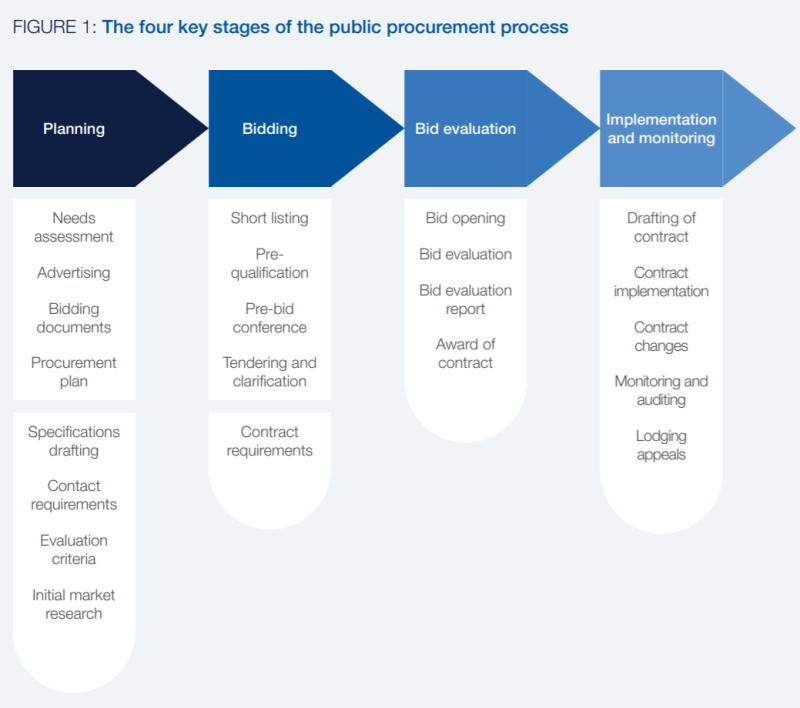
    Public procurement is vulnerable to corruption for a number of reasons. Parties in the procurement process, both on the public and private sides, are induced into corrupt acts by the size of potential financial gains, the close interaction between public officials and businesses, and how easy it is to hide corrupt actions. Blockchain has the potential to protect against these weaknesses at almost every stage of the procurement process.

    In the planning stage, public officials create evaluation criteria by which bidding companies will be judged. In the bidding evaluation stage, public officials assign scores to companies using the evaluation criteria as their rubric. Without transparency, there are many opportunities for compromised public officials to rig the outcome of the evaluation process. Evaluation criteria could be retroactively changed or company bids altered, for example. Blockchain can guarantee any change is public, the original information is retained and there is a record of who made the change.

    Blockchain can also encourage a wider coalition of stakeholders to participate in and monitor procurement cycles. Too often, the most active stakeholders in any given procurement process are the public officials and the businesses directly involved – a potential problem when more than half of all foreign bribery cases likely occur to obtain public procurement contracts. Watchdog organizations, end-users, the media and citizens are discouraged from participating because procurement information is not readily available, untrustworthy, modified and/or delayed. Blockchain can provide an easily accessible, tamper-proof and real-time window into ongoing procurement processes

    Projects integrating blockchain into procurement, such as this pilot programme in Colombia, conclude that “blockchain-based e-procurement systems provide unique benefits related to procedural transparency, permanent record-keeping and honest disclosure.” The Colombia project noted several drawbacks, such as scalability and vendor anonymity, but newer proposals like this one to overhaul India’s public procurement system are taking steps to overcome those and other shortcomings.

    Blockchain and registries

    Land title registries track the ownership of land and property for a given region. Registration titling systems have had important consequences for the economy, leading to “better access to formal credit, higher land values, higher investment in land, and higher income.” Yet they are far from perfect. They are inefficient, for example, closing a property sale can take months and typically consumes 2-5% of the purchase price of a home. Registration systems can act as bottlenecks for land transactions. There are complaints going back to 2015 of England’s Land Registry having six-month transaction delays and similar complaints persisted in 2020.

    The inefficiencies in land titling systems are a major source of corruption. The Organized Crime and Corruption Reporting Project’s 2019 report on land registry corruption in Bangladesh found that obtaining a licence as a deed writer incurs a bribe to the highest-level administrators. Land registry corruption is not restricted to developing regions: in regions with longer histories of legal stability, it simply becomes more complex. Anti-corruption NGO, Global Witness, estimated in 2019 that £100 billion worth of property in England and Wales was secretly owned by anonymous companies registered in tax havens.

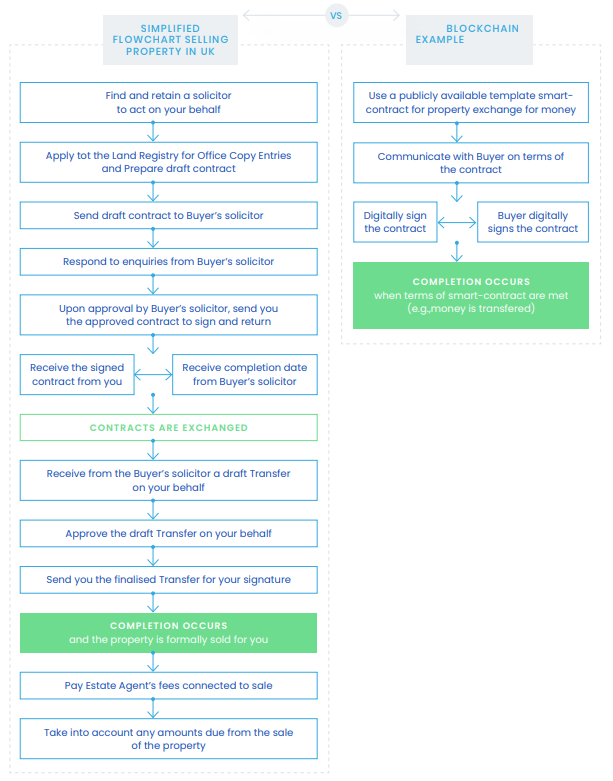
    A good first step to fighting corruption is by cutting down on inefficiencies. Blockchain can streamline much of the process. Take, for example, the number of steps required in the UK for one person to sell the property to another person and compare this with a blockchain-based registry system.

    Some countries are already experiencing positive results. In 2018, Georgia registered more than 1.5 million land titles through their blockchain-based system.

    An urban land registry project underway in Africa uses blockchain to address the problems of digitizing urban land registries. In many densely populated impoverished urban areas, no pre-existing land registry or paper trail exists. Relying on the meagre data available often causes legal disputes. Courts quickly become overwhelmed and digitization efforts stall.

    Blockchain is now being added to the project. To confirm property rights, the new system seeks out and consults community elders. Through a blockchain-based application, those elders receive the authority to confirm the validity of land registry claims. The elders can check directly with residents if they consent to the land assessment. By delegating cryptographically guaranteed authority to respected community members, the quality of the data is improved and the number of land dispute cases handled by the judiciary should decrease. Finally, the remaining cases should resolve faster since the elders’ cryptographic confirmations are admissible as evidence for land dispute resolution.

    The final challenge: Adoption

    The government blockchain-based projects referenced in this article represent just a few of a growing number of pilot or in-production applications of blockchain. This shows that governments are serious about fixing inefficient and unfair services. The potential gains from blockchain are substantial, yet as a new technology, there are many challenges in designing and implementing blockchain-based applications. For large institutions such as governments to deploy blockchain-based applications in a timely fashion and reap the benefits, education and tools are imperative.

  • Fight Against Corruption Vs Saving Democracy: Which Is Critical?

    Fight Against Corruption Vs Saving Democracy: Which Is Critical?

    The ruling party justifies the actions of ED, CBI and Income Tax department by arguing that these are independent agencies. They dismiss the harassment of the opposition leaders and others by calling it a fight against corruption.

    The Supreme Court verdict on the Prevention of Money Laundering Act (PMLA) has sanctified its draconian provisions. The opposition which is facing the brunt of these provisions has criticized the judgment while the ruling dispensation is highly pleased. A seal of approval has been put on the recent actions of the Enforcement Directorate (ED). The provisions of PMLA are such that there is little escape. So, opponents have been arrested/harassed or silenced or have switched sides to join the ruling party which then has toppled governments in the opposition-ruled states. Considering the misuse already visible, the judges could have weighed in on the laws and protected the fundamental rights of the citizens guaranteed by the Constitution.

    The ruling party justifies the actions of ED, CBI and Income Tax department by arguing that these are independent agencies. They dismiss the harassment of the opposition leaders and others by calling it a fight against corruption. No one can deny that wrongdoing has to be punished and corruption impacts the common person adversely. So, reducing corruption is arguably a pro-people policy.

    [powerkit_button size=”lg” style=”info” block=”true” url=”https://hwnews.in/news/opinion/fight-against-corruption-vs-saving-democracy-which-is-critical-ed/” target=”_blank” nofollow=”false”]
    Read More!
    [/powerkit_button]

  • e-SLA and the Delhi Act 2011 (Right of Citizen to Time-bound delivery of Services)- Policy Analysis

    e-SLA and the Delhi Act 2011 (Right of Citizen to Time-bound delivery of Services)- Policy Analysis

    Introduction

    As the functions of the modern welfare state expand and the dependency of citizens on it increases, its services must be delivered in timely manner. To this end, the Delhi government developed a robust policy. Through the Delhi Act of 2011 (Right of Citizen to Time Bound Delivery of Services), referred to as “the Act”, and the Delhi (Right of Citizen to Time Bound Delivery of Services) Rules, 2011 [“the Rules”], it has guaranteed timely delivery of 361 services.[1] Delhi is not the only state to confer such a right. However, in these other states, the enforcement of this right requires physical presence. Delhi has used an e-Service Level Agreement [“e-SLA”] to digitise the entire enforcement process. Digitisation has enabled greater accountability, performance review, and convenience, whilst also reducing the invested time and cost of every stakeholder. Thus, through this e-governance tool, Delhi has developed a ‘new ecology’ for the citizen-state relationship.

    In this paper, I will first provide a primer on both the Act and the e-SLA. In the second section, I will examine the constitutionality of the Act. Last, I will test the Act against the principles of good governance and citizen-centric administration.

    Understanding the Act and e-SLA

    The Act and e-SLA are deeply interrelated. While the Act defines the legal rights, procedures, and obligations, e-SLA is the mechanism for their execution. The Act comprises four major components: defined rights and corresponding liabilities, procedural prescriptions, the delegation of rulemaking, and the monitoring platform.

    Every citizen is conferred with the right to time-bound delivery of services,[2] and a liability of compliance imposed on government servants.[3] In cases of default, the government servant is liable to pay the compensatory cost of ₹10 per day for the period of delay, subject to a maximum of ₹200 per application.[4] Correspondingly, citizens are entitled to recover the compensatory costs.[5]

    The Act makes three different but interrelated procedural prescriptions. First, it provides the appointment process, eligibility criteria, and powers of the “competent officer”.[6] He/she must not be below the rank of Deputy Secretary or its equivalent rank and is empowered to impose a compensatory cost on the defaulting government servant. Second, it establishes the procedure governing fixation of liability.[7] If there is a delay, the aggrieved citizen can approach the competent officer, who immediately pays the cost that has been automatically calculated by e-SLA.[8] At a second stage, the officer issues show-cause notice to the concerned servant. If justifiable grounds exist, then the payment is debited from the government exchequer. Otherwise, it is reimbursed from the concerned servant. Third, it prescribes the appointment process, eligibility criteria, and powers of appellate authority as well as a 30-day time limit for filing an appeal. He/she must not be below the rank of Joint Secretary or its equivalent rank and has final authority on the matter.[9]

    The Act provides for delegation of legislative authority in two senses. There is a power to make rules,[10] and the power to remove difficulties.[11] However, the exercise of these powers is subject to Parliamentary scrutiny.

    It is the duty of departments and local bodies to process the application of every citizen and provide an application number. Furthermore, these authorities are obligated to maintain and update the status of applications online.[12] The e-SLA monitoring system has been designated as an online database.[13] To the government, it provides detailed information on the number of disposed or pending cases, which helps in performance evaluation and corrective measures. To the citizens, it provides online facility to track their applications.[14] The information flow is explained below:
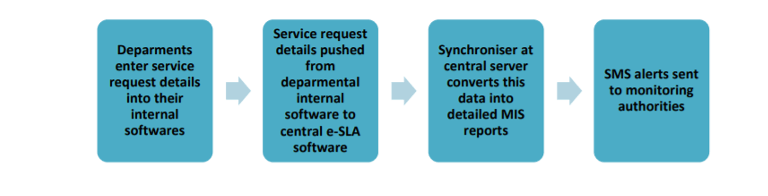
     

    Figure 1: Information flow between government officials under e-SLA
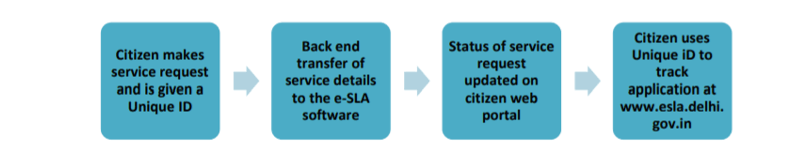
     

    Figure 2: Information flow between government officials and citizens under e-SLA


    Constitutionality of the Act

    The Constitution provides certain safeguards to “civil servants”.[15] At the outset, it must be noted that these employees are only a sub-set of the “government servants” defined in the Act.[16] Thus, the applicable scope of protection, if any, is not to the entire class of employees enumerated in the Act, but only to civil servants.

    The legal issue herein is the constitutionality of imposing a compensation cost on the civil servant. This is a two-fold question:

    1. Whether there is the power to impose such a cost?

    Appropriate legislatures are empowered to regulate the service conditions of civil servants.[17] As the cost relates to a service condition (i.e., timely delivery), the Delhi Legislative Assembly was empowered in imposing it.

    1. If so, has this exercise violated any constitutional safeguard?

    However, this power is subject to constitutional safeguards guaranteed under Article 311.[18] The protection offered under Article 311(2) is exhaustive and with specific reference to the imposition of three penalties: dismissal, removal, and demotion.[19] Accordingly, the imposition of compensatory cost on the civil servant is beyond the scope of three-fold protection offered by Article 311. Thus, no constitutional safeguard has been violated herein.

    As the imposition of compensatory cost on the civil servants is both within the power and compliant with safeguards, it is constitutional.

    Testing the Act against principles of Good Governance and Citizen-Centric Administration

    Governance refers to the process of decision-making, and the process of implementing those decisions.[20] Good governance is when these processes are tested against a normative standard. Citizen-centric administration refers to governance that places citizens at the centre of all administrative functions.[21] In this section, I will use the characteristics of good governance and the principles of citizen-centric administration as a collective standard[22] to analyze the process of formation and implementation of the Act, its Rules, and e-SLA.

    Assessing Compliance in Formation and Implementation

    a) Participatory. In the absence of statutory provisions, the administrative authorities are not bound to comply with any procedural norms, including notice and prior consultation with the interested parties. The Delhi Act, 2011 does not provide for any such consultation or ante-natal publicity. In the process of policy-making, there was participation only from the relevant government ministries and departments. The government did not take any active steps to broaden consultation to stakeholders such as the civic society organizations, labour unions, or even the general public.

    The lack of participatory policy-making has directly impacted its awareness and enthusiasm among citizens. It was found that only 50% of the people know that their unique ID can be used to track their applications online. Further, only 15% of the people used their ID to track their application.[23]

    b) Transparency. The e-SLA allows for complete transparency to the citizen as to the status of all his applications. The information is not only easily comprehensible but also accessible. However, the transparency does not extend to releasing statistics of operations to the public domain. Currently, these statistics, such as the figures on the number of applications, pendency, disposal rate, performing/underperforming departments, are accessible only to government officials.[24]

    c) Responsiveness. The e-SLA system does not provide for any feedback mechanism. Thus, there is no avenue for the citizens availing these services to share their experiences. As feedback is the basis on which the system continually improves, this deficiency hinders the potential effectiveness of e-SLA.[25]

    1. Accountability

    The right to time-bound service delivery through the mechanism of compensatory cost has, in theory, ensured that the government and its officials are accountable to citizens. This is buttressed by the fact that the Act seeks to develop a culture of timely delivery among the government servants by additionally punishing habitual offenders and providing cash incentives for those without a single default in a year.[26] However, the liability of government servant has been capped at ₹200, compared to other state legislation that penalizes in thousands. Further, the cash incentives are only up to ₹5000. Thus, the quantum is inadequate to cause attitudinal changes in the servants.

    Moreover, there is no culture among public servants to hold their non-performing colleagues in disrepute.[27] There is no indication that this non-performance is factored into promotions. Anyhow, such public servants are typically complacent and not seeking promotions. The security of their present job and status is adequate incentive to persist with present behaviour. Thus, promotions and reputational loss among peers are not adequate incentives for performance either.

    Furthermore, by releasing all relevant statistics of operations to the public domain, the government can broaden its accountability. These statistics can be used by stakeholders, such as news and media agencies and policy think-tanks, to supplement the government in identifying issues and corrective measures. This would also pressurize the government to be more proactive.

         2.  Consensus orientation

    Through reasonable and extensively deliberated timelines, the Act sufficiently balances the interests of citizens in securing timely delivery with the government’s limited capacity.

         3.  Effectiveness and Efficiency

    The usage of e-governance to guarantee the right to public service is a revolutionary process reform. This must be gauged at two levels:

    • For the citizen, this system has reduced the number of physical visits required, thus saving time and cost. In a survey, 66.6% reported that they are not required to visit government offices more than once after submitting their applications.[28]
    • For the government, it eliminates systemic errors and inefficiencies.[29] The statistics help in assessing performance and preparing corrective action.[30] However, if the system can track internal departmental processes too, it would allow determining the exact level at which service delivery is being delayed. Furthermore, the Act ignores the quality of timely delivered services.[31] To provide a comprehensive right to public service, the legislature must develop standards to assess the quality of services rendered on time.


        4.  Equitable and Inclusive

    Under the Act, while the citizen is immediately compensated, the government servant is not immediately penalized for default. The procedure allows him/her to provide justified grounds that could excuse liability. For greater inclusivity, the government can prescribe a pro-rata calculation of the penalty. As the amount is automatically calculated by e-SLA, even complex formulas are acceptable.

       5.  Rule of Law

    The Act provides for a fair legal framework and impartial enforcement.

    Conclusion

    Executing the right to time-bound service delivery through an online portal is truly revolutionary. It has emerged as model legislation for other governments. The Act is constitutionally valid. However, when tested against standards of good governance, this policy suffers from problems of non-participation, transparency, responsiveness, accountability, and effectiveness at the government-level. But it scores par excellence on the principles of consensus orientation, effectiveness at the citizen-level, inclusiveness, and rule of law. To embrace the truly revolutionary potential of this policy, the government must make the suggestions recommended in the last section of the paper, vis-à-vis each principle.


    References:

    [1] IANS, ‘245 services brought under Delhi time-bound delivery act’ (Business Standard, 24 August 2014) <https://www.business-standard.com/article/news-ians/245-services-brought-under-delhi-time-bound-delivery-act-114082400707_1.html> accessed 17 January 2021.

    [2] The Act, s. 3.

    [3] The Act, s. 4.

    [4] The Act, s. 7.

    [5] The Act, s. 8.

    [6] The Act, s. 9.

    [7] The Act, s. 10.

    [8] The Rules, r. 4(1).

    [9] The Act, s. 11(1).

    [10] The Act, s. 15.

    [11] The Act, s. 16.

    [12] The Act, s. 5.

    [13] The Rules, r. 2(c).

    [14] Arjun Kapoor & Niranjan Sahoo, India’s Shifting Governance Structure: From Charter of Promises to Services Guarantee (ORF Occasional Paper No 35, 2012).

    [15] Constitution of India 1950, Art. 309, 310, 311.

    [16] The Act, s. 2(g).

    [17] Constitution of India 1950, Art. 309.

    [18] Union of India v. S.P. Sharma (2014) 6 SCC 351.

    [19] Yashomati Ghosh, Textbook on Administrative Law (1st edn, Lexis Nexis 2015) 416.

    [20] UN Economic and Social Commission for Asia and the Pacific, ‘What is Good Governance?’ <http://www. unescap.org/sites/default/files/good-governance.pdf>.

    [21] Ghosh (n 19) 14.

    [22] Second Administrative Reforms Commission, Citizen-Centric Administration (Report No 12, 2009) p. 8.

    [23] Audit of Functioning of Government of Delhi’s e-SLA Scheme, by Management Development Institute, Gurgaon (2012).

    [24] Ibid.

    [25] Rohit Sinha, ‘Delivering on service guarantee: A case of Delhi’s e-SLA’ (ORF, 29 December 2012) <https://www.orfonline.org/research/delivering-on-service-guarantee-a-case-of-delhis-e-sla/> accessed 17 January 2021.

    [26] The Act, s. 12.

    [27] Kapoor & Sahoo (n 14); Amit Chandea & Surbhi Bhatia, The Right of Citizens for Time Bound Delivery of Goods and Services and Redressal of their Grievances Bill, 2011 (CCS, 2015) p. 25-26.

    [28] Sinha (n 25).

    [29] Chandea & Bhatia (n 27).

    [30] Ibid.

    [31] Kapoor & Sahoo (n 14).


    Image Credit: Forbes India