Category: Working Paper

  • Artificial Intelligence vs The Indian Job Market

    Artificial Intelligence vs The Indian Job Market

    Artificial intelligence (AI) has become a ubiquitous presence in our daily lives, transforming the way we operate in the modern era. From the development of autonomous vehicles to facilitating advanced healthcare research, AI has enabled the creation of groundbreaking solutions that were once thought to be unattainable. As more investment is made in this area and more data becomes available, it is expected that AI will become even more powerful in the coming years.

    AI, often referred to as the pursuit of creating machines capable of exhibiting intelligent behaviour, has a rich history that dates back to the mid-20th century. During this time, pioneers such as Alan Turing laid the conceptual foundations for AI. The journey of AI has been marked by a series of intermittent breakthroughs, periods of disillusionment, and remarkable leaps forward. It has also been a subject of much discussion over the past decade, and this trend is expected to continue in the years to come.

    According to a report by Precedence Research, the global artificial intelligence market was valued at USD 454.12 billion in 2022 and is expected to hit around USD 2,575.16 billion by 2032, progressing with a compound annual growth rate (CAGR) of 19% from 2023 to 2032. The Asia Pacific is expected to be the fastest-growing artificial intelligence market during the forecast period, expanding at the highest CAGR of 20.3% from 2023 to 2032. The rising investments by various organisations towards adopting artificial intelligence are boosting the demand for artificial intelligence technology.[1]
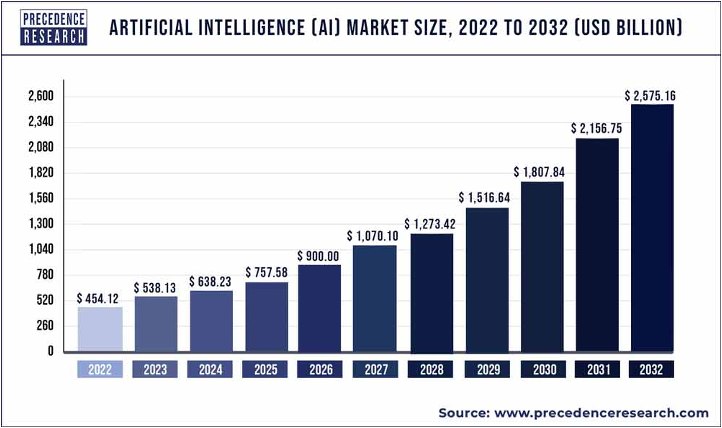
    Figure 1 illustrates a bar graph displaying the upward trajectory of the AI market in recent years, sourced from Precedence Research.

    The Indian government has invested heavily in developing the country’s digital infrastructure. In 2020, The Government of India increased its spending on Digital India to $477 million to boost AI, IoT, big data, cyber security, machine learning, and robotics. The artificial intelligence market is expected to witness significant growth in the BFSI(banking, financial services, and insurance) sectors on account of data mining applications, as there is an increase in the adoption of artificial intelligence solutions in data analytics, fraud detection, cybersecurity, and database systems.
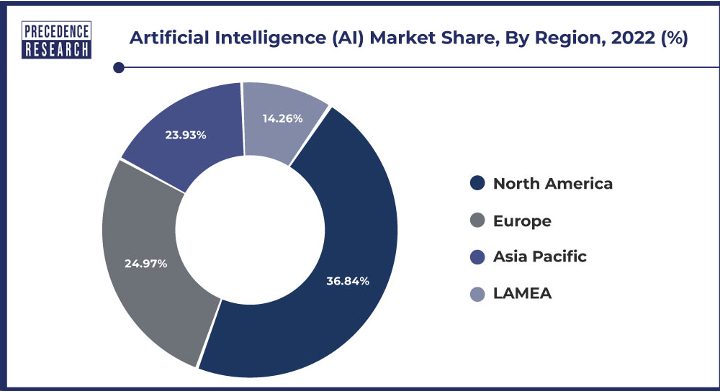
    Figure 2 illustrates a pie chart displaying the distribution of the Artificial Intelligence (AI) market share across various regions in 2022, sourced from Precedence Research.

    Types of AI Systems and Impact on Employment

    AI systems can be divided primarily into three types:

    Narrow AI: This is a specific form of artificial intelligence that executes dedicated tasks with intelligence. It represents the prevailing and widely accessible type of AI in today’s technological landscape.

    General AI: This represents an intelligence capable of efficiently undertaking any intellectual task akin to human capabilities. Aspiration driving the development of General AI revolves around creating a system with human-like cognitive abilities that enables autonomous, adaptable thinking. However, as of now, the realisation of a General AI system that comprehensively emulates human cognition remains elusive.

    Super AI: It is a level of intelligence within systems where machines transcend human cognitive capacities, exhibit superior performance across tasks, and possess advanced cognitive properties. This extends from the culmination of the General AI.

    Artificial intelligence has been incorporated into various aspects of our lives, ranging from virtual assistants on our mobile devices to advancements in customisation, cyber protection, and more. The growth of these systems is swift, and it is only a matter of time before the emergence of general artificial intelligence becomes a reality.

    According to a report by PwC, the global GDP is estimated to be 14% higher in 2030 due to the accelerating development and utilisation of AI, which translates to an additional $15.7 trillion. This growth can be attributed to:

    1. Improvements in productivity resulting from the automation of business processes (including the use of robots and autonomous vehicles).
    2. Productivity gains from businesses integrating AI technologies into their workforce (assisted and augmented intelligence).
    3. Increased consumer demand for AI-enhanced products and services, resulting in personalised and/or higher-quality offerings.

    The report suggests that the most significant economic benefits from AI will likely come from increased productivity in the near future. This includes automating mundane tasks, enhancing employees’ capabilities, and allowing them to focus on more stimulating and value-added work. Capital-intensive sectors such as manufacturing and transport are likely to experience the most significant productivity gains from AI, given that many operational processes in these industries are highly susceptible to automation. (2)

    AI will disrupt many sectors and lead to the creation of many more. A compelling aspect to observe is how the Indian Job Market responds to AI and its looming threat to job security in the future.

    The Indian Job Market

    As of 2021, around 487.9 million people were part of the workforce in India out of 950.2 million people aged 15-64, the second largest after China. While there were 986.5 million people in China aged 15-64, there were 747.9 million people were part of the workforce.

    India’s labour force participation rate (LFPR) at 51.3 per cent was less than China’s 76 per cent and way below the global average of 65 per cent.[3]

    The low LFPR can be primarily attributed to two reasons:

    Lack of Jobs

    To reach its growth potential, India is expected to generate approximately 9 million nonfarm jobs annually until 2030, as per a report by McKinsey & Company. However, analysts suggest that the current rate of job creation falls significantly below this target, with only about 2.9 million nonfarm jobs being added each year from 2013 to 2019. [4]

    During the COVID-19 pandemic, urban unemployment in India surged dramatically, peaking at 20.9% in the April-June 2020 quarter, coinciding with wage decline. Although the unemployment rate has decreased since then, full-time employment opportunities are scarce. Economists highlight a concerning trend where an increasing number of job-seekers, particularly the younger demographic, are turning towards low-paying casual jobs or opting for less stable self-employment options.[5]

     This shift in employment pattern occurs alongside a broader outlook for the Indian economy, which is projected to achieve an impressive growth rate of 6.5% by the fiscal year ending in March 2025. Despite this optimistic growth forecast, the employment landscape appears to be evolving, leading individuals towards less secure and lower-paying work options. This shift raises pertinent concerns about the job market’s quality, stability, and inclusivity, particularly in accommodating the aspirations and needs of India’s burgeoning young workforce.

    Low female labour participation

    In 2021, China boasted an estimated female population of 478.3 million within the 15-64 age bracket, with an active female labour force of approximately 338.6 million. In stark contrast, despite India having a similar demographic size of 458.2 million women in that age group, its female labour force was significantly smaller, numbering only 112.8 million.[6]

    This discrepancy underscores a notable disparity in India’s female labour force participation rate compared to China, despite both countries having sizeable female populations within the working-age bracket.[7]

    Along with unemployment, there was also a crisis of under-employment and the collapse of small businesses, which has worsened since the pandemic.

    AI vs the Indian Job Market

    The presence and implications of AI cast a significant shadow on a country as vast and diverse as India. Amidst the dynamic and often unpredictable labour market, where employment prospects have been uncertain, addressing the impact of AI poses a considerable challenge for employers. Balancing the challenges and opportunities presented by AI while prioritising job security for the workforce is a critical obstacle to overcome.

     The diverse facets of artificial intelligence (AI) and its capacity to transform industries across the board amplify the intricacy of the employment landscape in India. Employers confront the formidable challenge of devising effective strategies to incorporate AI technologies without compromising the livelihoods of their employees.

    As per the findings of the Randstad Work Monitor Survey, a staggering 71% of individuals in India exhibit an inclination towards altering their professional circumstances within the next six months, either by transitioning to a new position within the same organisation or by seeking employment outside it. Furthermore, 23% of the workforce can be classified as passive job seekers, who are neither actively seeking new opportunities nor applying for them but remain open to considering job prospects if a suitable offer arises.

    It also stated that at least half of Indian employees fear losing their jobs to AI, whereas the figure is one in three in developed countries. The growing concern among Indian workers stems from the substantial workforce employed in Business Process Outsourcing (BPO) and Knowledge Process Outsourcing (KPO), which are notably vulnerable to AI automation. Adding to this concern is India’s rapid uptake of AI technology, further accentuating the apprehension among employees.[8]

    India’s role as a global hub for outsourcing and its proficiency in delivering diverse services have amplified the impact of AI adoption. The country has witnessed a swift embrace of AI technologies across various industries, magnifying workers’ concerns regarding the potential ramifications of their job security.

    Goldman Sachs’ report highlights the burgeoning emergence of generative artificial intelligence (AI) and its potential implications for labour dynamics. The rapid evolution of this technology prompts questions regarding a possible surge in task automation, leading to cost savings in labour and amplified productivity. [9]

    The labour market could confront significant disruptions if generative AI delivers its pledged capabilities. Analysing occupational tasks across the US and Europe revealed that approximately two-thirds of the current jobs are susceptible to AI automation. Furthermore, the potential of generative AI to substitute up to one-fourth of existing work further underscores its transformative potential.

     Expanding these estimates on a global scale suggests that generative AI might expose the equivalent of 300 million full-time jobs to automation, signifying the far-reaching impact this technology could have on global labour markets.

    Recent advancements in artificial intelligence (AI) and machine learning have exerted substantial influence across various professions and industries, particularly impacting job landscapes in sectors such as Indian IT, ITeS, BPO, and BPM. These sectors collectively employ over five million people and are India’s primary source of white-collar jobs. [10]

    In a recent conversation with Business Today, Vardhman Jain, the founder and Vice Chairman of Access Healthcare, a Chennai-based BPO, highlighted the forthcoming impact of AI integration on the workplace. Jain indicated that AI implementation may cause customer service to be the sector most vulnerable to initial disruptions.

    Jain pointed out that a substantial portion of services provided by the Indian BPO industry is focused on customer support, including voice and chat functions, data entry, and back-office services. He expounded upon how AI technologies, such as Natural Language Processing, Machine Learning, and Robotic Process Automation, possess the potential to significantly disrupt and automate these tasks within the industry.

    While the discourse surrounding AI often centres on the potential for job displacement, several industry leaders argue that AI will not supplant human labour, but rather augment worker output and productivity.

    At the 67th Foundation Day celebration of the All-India Management Association (AIMA), NR Narayan Murthy, as reported by Business Today, conveyed a noteworthy message by asserting that AI is improbable to supplant human beings, as humans will not allow it to happen.

    Quoting Murthy’s statement from the report, “I think there is a mistaken belief that artificial intelligence will replace human beings; human beings will not allow artificial intelligence to replace them.” The Infosys founder stressed that AI has functioned as an assistive force rather than an outright replacement, enhancing human lives and making them more comfortable.[11]

    McKinsey Global Institute’s study, “Generative AI and the Future of Work in America,” highlighted AI’s capability to expedite economic automation significantly. The report emphasised that while generative AI wouldn’t immediately eliminate numerous jobs, it would enhance the working methods of STEM, creative, business, and legal professionals.[12]

     However, the report also underscored that the most pronounced impact of automation would likely affect job sectors such as office support, customer service, and food service employment.

    While the looming threats posed by AI are undeniable, its evolution is expected to usher in a wave of innovation, leading to the birth of new industries and many job opportunities. This surge in new industries promises employment prospects and contributes significantly to economic growth by leveraging AI capabilities.

    Changing employment Landscape

    Having explored different perspectives and conversations on AI, it has become increasingly evident that the employment landscape is poised for significant transformation in the years ahead. This prompts a crucial enquiry: Will there remain a necessity for human jobs, and are our existing systems equipped to ensure equitable distribution of the benefits fostered by this technology developments?

    • Universal Basic Income

    Universal basic income (UBI) is a social welfare proposal in which all citizens of a given population regularly receive minimum income in the form of an unconditional transfer payment, that is, without a means test or need to work, in which case it would be called guaranteed minimum income.

    Supporters of Universal Basic Income (UBI) now perceive it not only as a solution to poverty, but also as a potential answer to several significant challenges confronting contemporary workers: wage disparities, uncertainties in job stability, and the looming spectre of job losses due to advancements in AI.

    Karl Widerquist, a professor of philosophy at Georgetown University-Qatar and an economist and political theorist, posits that the influence of AI on employment does not necessarily result in permanent unemployment. Instead, he suggests a scenario in which displaced workers shift into lower-income occupations, leading to increased competition and saturation in these sectors.

    According to Widerquist, the initial effects of AI advancements might force white-collar workers into the gig economy or other precarious and low-paying employment. This shift, he fears, could trigger a downward spiral in wages and job security, exacerbating economic inequality.

     He advocates for a Universal Basic Income (UBI) policy as a response to the challenges posed by AI and automation. Widerquist argues that such a policy would address employers’ failure to equitably distribute the benefits of economic growth, fuelled in part by automation, among workers. He sees UBI as a potential solution to counter the widening disparity in wealth distribution resulting from these technological advancements.[13]

    A study conducted by researchers at Utrecht University, Netherlands, from 2017 to 2019 led to the implementation of basic income for unemployed individuals who previously received social assistance. The findings showcase an uptick in labour market engagement. This increase wasn’t solely attributed to the financial support offered by Universal Basic Income (UBI) but also to removing conditions—alongside sanctions for non-compliance—typically imposed on job seekers.[14]

    Specifically, participants exempted from the obligation to actively seek or accept employment demonstrated a higher likelihood of securing permanent contracts, as opposed to the precarious work arrangements highlighted by Widerquist.

     While UBI experiments generally do not demonstrate a significant trend of workers completely exiting the labour market, instances of higher payments have resulted in some individuals reducing their working hours. This nuanced impact showcases the varying effects of UBI on labour participation, highlighting both increased job security for some and a choice for others to adjust their work hours due to enhanced financial stability.

    In exploring the potential for Universal Basic Income (UBI), it becomes evident that while the concept holds promise, its implementation and efficacy are subject to multifaceted considerations. The diverse socioeconomic landscape, coupled with the scale and complexity of India’s population, presents both opportunities and challenges for UBI.

     UBI’s potential to alleviate poverty, enhance social welfare, and address economic disparities in a country as vast and diverse as India is compelling. However, the feasibility of funding such a program, ensuring its equitable distribution, and navigating its impact on existing welfare schemes requires careful deliberation.

    Possible Tax Solutions

    • Robot Tax

    The essence of a robot tax lies in the notion that companies integrating robots into their operations should bear a tax burden given that these machines replace human labour.

     There exist various arguments advocating for a robot tax. Initially, it aimed to safeguard human employment by dissuading firms from substituting humans with robots. Additionally, while companies may prefer automation, imposing a robot tax can generate government revenue to offset the decline in funds from payroll and income taxes. Another crucial argument favouring this tax is rooted in allocation efficiency: robots neither contribute to payroll nor income taxes. Taxing robots at a rate similar to human labour aligns with economic efficiency to prevent distortions in resource allocation.

    In various developed economies, such as the United States, the prevailing taxation system presents a bias toward artificial intelligence (AI) and automation over human workforce. This inclination, fueled by tax incentives, may lead to investments in automation solely for tax benefits rather than for the actual potential increase in profitability. Furthermore, the failure to tax robots can exacerbate income inequality as the share of labor in national income diminishes.

    One possible solution to address this issue is the implementation of a robot tax, which could generate revenue that could be redistributed as Universal Basic Income (UBI) or as support for workers who have lost their jobs due to the adoption of robotic systems and AI and are unable to find new employment opportunities.

    • Digital Tax

    The discourse surrounding digital taxation primarily centers on two key aspects. Firstly, it grapples with the challenge of maintaining tax equity between traditional and digital enterprises. Digital businesses have benefited from favorable tax structures, such as advantageous tax treatment for income derived from intellectual property, accelerated amortization of intangible assets, and tax incentives for research and development. However, there is a growing concern that these preferences may result in unintended tax advantages for digital businesses, potentially distorting investment trajectories instead of promoting innovation.

    Secondly, the issue arises from digital companies operating in countries with no physical presence yet serving customers through remote sales and service platforms. This situation presents a dilemma regarding traditional corporate income tax regulations. Historically, digital businesses paid corporate taxes solely in countries where they maintained permanent establishments, such as headquarters, factories, or storefronts. Consequently, countries where sales occur or online users reside have no jurisdiction over a firm’s income, leading to taxation challenges.

    Several approaches have been suggested to address the taxation of digital profits. One approach involves expanding existing frameworks, for instance, a country may extend its Value-Added Tax (VAT) or Goods and Services Tax (GST) to encompass digital services or broaden the tax base to include revenues generated from digital goods and services. Alternatively, there is a need to implement a separate Digital Service Tax (DST).

    While pinpointing the ultimate solution remains elusive, ongoing experimentation and iterative processes are expected to guide us toward a resolution that aligns with the need for a larger consensus. With each experiment and accumulated knowledge, we move closer to uncovering an approach that best serves the collective requirements.[15]

    Reimagining the Future

    The rise of Artificial Intelligence (AI) stands as a transformative force reshaping the industry and business landscape. As AI continues to revolutionise how we work and interact, staying ahead in this rapidly evolving landscape is not just an option, but a necessity. Embracing AI is not merely about adapting to change; it is also about proactive readiness and strategic positioning. Whether you’re a seasoned entrepreneur or a burgeoning startup, preparing for the AI revolution involves a multifaceted approach encompassing automation, meticulous research, strategic investment, and a keen understanding of how AI can augment and revolutionise your business. PwC’s report lists some crucial steps to prepare one’s business for the future and stay ahead. [16]

    Understand AI’s Impact: Start by evaluating the industry’s technological advancements and competitive pressure. Identify operational challenges AI can address, disruptive opportunities available now and those on the horizon.

    Prioritise Your Approach: Determine how AI aligns with business goals. Assess your readiness for change— are you an early adopter or follower? Consider feasibility, data availability, and barriers to innovation—Prioritise automation and decision augmentation processes based on potential savings and data utilisation.

    Talent, Culture, and Technology: While AI investments might seem high, costs are expected to decrease over time. Embrace a data-driven culture and invest in talent like data scientists and tech specialists. Prepare for a hybrid workforce, combining AI’s capabilities with human skills like creativity and emotional intelligence.

    Establish Governance and Trust: Trust and transparency are paramount. Consider the societal and ethical implications of AI. Build stakeholder trust by ensuring AI transparency and unbiased decision-making. Manage data sources rigorously to prevent biases and integrate AI management with overall technology transformation.

     Getting ready for Artificial Intelligence (AI) is not just about new technology; it is an intelligent strategy. Understanding how AI fits one’s goals is crucial; prioritising where it can help, building the right skills, and setting clear rules are essential. As AI becomes more common, it is not about robots taking over, but humans and AI working together. By planning and embracing AI wisely, businesses can stay ahead and create innovative solutions in the future.

    References:

    [1] Precedence Research. “Artificial Intelligence (AI) Market.” October 2023. Accessed November 14, 2023. https://www.precedenceresearch.com/artificial-intelligence-market

    [2] Pricewaterhouse Coopers (PwC). “Sizing the prize, PwC’s Global Artificial Intelligence Study.” October 2017. Accessed November 14, 2023. https://www.pwc.com/gx/en/issues/data-and-analytics/publications/artificial-intelligence-study.html#:~:text=The%20greatest%20economic%20gains%20from,of%20the%20global%20economic%20impact.

    [3] World Bank. “Labor force, total – India 2021.” Accessed November 12, 2023. https://data.worldbank.org/indicator/SL.TLF.TOTL.IN?locations=IN

    [4] McKinsey & Company. “India’s Turning Point.” August 2020. https://www.mckinsey.com/~/media/McKinsey/Featured%20Insights/India/Indias%20turning%20point%20An%20economic%20agenda%20to%20spur%20growth%20and%20jobs/MGI-Indias-turning-point-Executive-summary-August-2020-vFinal.pdf

    [5] Dugal, Ira. “Where are the jobs? India’s world-beating growth falls short.” Reuters, May 31, 2023. Accessed November 14, 2023. https://www.reuters.com/world/india/despite-world-beating-growth-indias-lack-jobs-threatens-its-young-2023-05-30/

    [6] Government of India. Ministry of Labour and Employment. “Labour and Employment Statistics 2022.” July 2022. https://dge.gov.in/dge/sites/default/files/2022-08/Labour_and_Employment_Statistics_2022_2com.pdf

    [7] Deshpande, Ashwini, and Akshi Chawla. “It Will Take Another 27 Years for India to Have a Bigger Labour Force Than China’s.” The Wire, July 27, 2023. https://thewire.in/labour/india-china-population-labour-force

    [8] Randstad. “Workmonitor Pulse Survey.” Q3 2023. https://www.randstad.com/workforce-insights/future-work/ai-threatening-jobs-most-workers-say-technology-an-accelerant-for-career-growth/

    [9] Briggs, Joseph, and Devesh Kodnani. “The Potentially Large Effects of Artificial Intelligence on Economic Growth.” Goldman Sachs, March 26, 2023. https://www.key4biz.it/wp-content/uploads/2023/03/Global-Economics-Analyst_-The-Potentially-Large-Effects-of-Artificial-Intelligence-on-Economic-Growth-Briggs_Kodnani.pdf

    [10] Chaturvedi, Aakanksha. “‘Might take toll on low-skilled staff’: How AI can cost BPO, IT employees their jobs.” Business Today, April 5, 2023. https://www.businesstoday.in/latest/corporate/story/might-take-toll-on-low-skilled-staff-how-ai-can-cost-bpo-it-employees-their-jobs-376172-2023-04-05

    [11] Sharma, Divyanshi. “Can AI take over human jobs? This is what Infosys founder NR Narayan Murthy thinks.” India Today, February 27, 2023. https://www.indiatoday.in/technology/news/story/can-ai-take-over-human-jobs-this-is-what-infosys-founder-nr-narayan-murthy-thinks-2340299-2023-02-27

    [12] McKinsey Global Institute. “Generative AI and the future of work in America.” July 26, 2023. https://www.mckinsey.com/mgi/our-research/generative-ai-and-the-future-of-work-in-america

    [13] Kelly, Philippa. “AI is coming for our jobs! Could universal basic income be the solution?” The Guardian, November 16, 2022. https://www.theguardian.com/global-development/2023/nov/16/ai-is-coming-for-our-jobs-could-universal-basic-income-be-the-solution

    [14] Utrecht University. “What works (Weten wat werkt).” March 2020. https://www.uu.nl/en/publication/final-report-what-works-weten-wat-werkt

    [15] Merola, Rossana. “Inclusive Growth in the Era of Automation and AI: How Can Taxation Help?” *Frontiers in Artificial Intelligence* 5 (2022). Accessed November 23, 2023. https://www.frontiersin.org/articles/10.3389/frai.2022.867832

    [16]  Rao, Anand. “A Strategist’s Guide to Artificial Intelligence.” PwC, May 10, 2017.https://www.strategy-business.com/article/A-Strategists-Guide-to-Artificial-Intelligence
     

  • Indian Philosophy and religion: Abolishing the caste system as an attempt in Intercultural Philosophy

    Indian Philosophy and religion: Abolishing the caste system as an attempt in Intercultural Philosophy

    We start the year 2023 with an examination of philosophy and society and through it the social evil of caste. The origin of the caste system in Hindu society lies buried in many myths and misconceptions. Caste is often linked by many to the core of Hindu philosophy. This is a deeply flawed understanding. The caste system has been and continues to be a tool of power and economic exploitation by oppressing large segments of the population. It is largely an invention by the clergy to establish their power and domination through rituals and codes and by ascribing to them a forced religious sanctity. As it also becomes convenient to the rulers, caste and class are prevalent in all societies. Philosophy and true religion, as Andreas points out in this working paper,  have had nothing to do with caste or class.                                        – TPF Editorial Team


    Introduction

    Intercultural philosophy is absolutely necessary in order to cope with the current and new phase of hybrid globalization, which is dissolving all kinds of traditional identities. Whereas the current reaction to this process is the development of ideologies centred on the idea of “we against the rest”, whoever the “Rest” might be, we need to construct positive concepts of identity, which does not exclude but include the other. These can be based on the mutual recognition of the civilizations of the world and their philosophies. According to Karl Jaspers the godfather of intercultural philosophy, between the sixth and third century BC the development of great cities, and the development in agriculture and sciences led to a growth of the populace that forced humankind to develop new concepts of thinking. He labelled this epoch as the axial age of world history in which everything turned around. He even argued that in this time the particular human being or human thinking was born with which we still live today – my thesis is that all human religions, civilizations and philosophies share the same problems and questions but did find different solutions.

    A vivid example might be the relationship between happiness and suffering. In the philosophy of the Greek philosopher Aristotle, to achieve eudemonia or happiness in your earthly life was the greatest aim whereas in a popular understanding of Karma, life is characterized by suffering and the aim is to overcome suffering by transcending to Nirvana. You see, the problem is the same, but there are different solutions in various philosophies. Although Jaspers didn’t share the reduction of philosophy and civilization to the European or even German experience and included mainly the Chinese and Indian civilization, he nevertheless excluded the African continent and both Americas, Muslim civilization as well as the much older Egyptian civilization. So, although he enlarged our knowledge and understanding of civilizations his point of reference was still “Western modernity” and within it, the concept of functional differentiation played the major role.

    Another solution is embodied in the belief of the three monotheistic religions, that an omnipotent god is the unifying principle despite all human differentiations and even the differences between the living and the dead, love and hate, between war and peace, men and women, old and young, linear and non-linear understanding of time, beginning and ending, happiness and suffering.  In this belief system, we are inevitably confronted with unsurpassable contrasts, conflicts and contradictions – but an all-powerful and absolute good god is the one who is uniting all these contrasts.

    In principle in Chinese philosophy, we have the same problem – but instead of an all-powerful God, we as humans have the task to live in harmony with the cosmic harmony. So, I really think that we humans share the same philosophical problems – how to explain and overcome death, evil, suffering, and the separation from transcendence. Although Karl Jaspers could be seen as the founding father of intercultural philosophy, I think he put too much emphasis solely on the functional differentiation that an ever-growing populace could live together without violence. In my view, the questions of life and death are running deeper. I would not exclude functional differentiation as one of the driving forces of human development but at least we also need an understanding of human existence that is related to transgressing the contrasts of life.

    In this draft, I would like to give some impressions concerning this same problem based on my limited knowledge of Indian philosophy and religion and try to show that both are opposing the caste system as well as any kind of dogmatism. An Indian student asked me in the run-up to this draft how one could understand Indian philosophy if one had not internalized the idea of rebirth since you are a baby. From her point of view, the whole thinking on the Indian subcontinent is thus determined by the idea of rebirth – this problem will still occupy us in the question of whether the terrible caste system in India is compatible with the original intentions of the Indian religions, whether it can be derived from them or contradicts them. I will try to give a reason for the assumption that Indian philosophy is quite universal and at the same time open to different strands of philosophical thought, retaining its core.

    In its essence, it is about Karma, rebirth, and Moksha. An understanding of Atman and Brahman is essential. Atman is the soul, indestructible, and is part of Brahman (omnipresent God). When Atman continues to reform and refine itself through rebirths aspiring to become one with Brahman, that is Moksha. To attain Moksha is the purpose of each life. Moksha is being one with God…a state where there is no more rebirths. Of course, differences are there in interpreting Atman and Brahman, depending on the Advaita and Dwaita schools of philosophy. Ultimately both narrow down to the same point – Moksha. Karma is the real part. True Karma is about doing your work in life as duty and dispassionately. Understanding that every life form has a purpose, one should go about it dispassionately. Easier said than done. Understanding this is the crux. In an ideal life where one has a full understanding of Karma and performs accordingly, he/she will have no rebirth. Indian philosophy is careful to separate the religious and social practices of the common folks and the high religion.  Hence Caste and hierarchy are not part of the philosophical discourse, although many make the mistake of linking them. Caste, like in any other religion, is a clergy-driven issue for power and economic exploitation.

    Indian Philosophy (or, in Sanskrit, Darshanas), refers to any of several traditions of philosophical thought that originated in the Indian subcontinent, including Hindu philosophy, Buddhist philosophy, and Jain philosophy. It is considered by Indian thinkers to be a practical discipline, and its goal should always be to improve human life. In contrast to the major monotheistic religions, Hinduism does not draw a sharp distinction between God and creation (while there are pantheistic and panentheistic views in Christianity, Judaism, and Islam, these are minority positions). Many Hindus believe in a personal God and identify this God as immanent in creation. This view has ramifications for the science and religion debate, in that there is no sharp ontological distinction between creator and creature. Philosophical theology in Hinduism (and other Indic religions) is usually referred to as dharma, and religious traditions originating on the Indian subcontinent, including Hinduism, Jainism, Buddhism, and Sikhism, are referred to as dharmic religions. Philosophical schools within dharma are referred to as darśana.

    Religion and science

    One factor that unites dharmic religions is the importance of foundational texts, which were formulated during the Vedic period, between ca. 1600 and 700 BCE. These include the Véda (Vedas), which contain hymns and prescriptions for performing rituals, Brāhmaṇa, accompanying liturgical texts, and Upaniṣad, metaphysical treatises. The Véda appeals to a wide range of gods who personify and embody natural phenomena such as fire (Agni) and wind (Vāyu). More gods were added in the following centuries (e.g., Gaṇeśa and Sati-Parvati in the fourth century CE). Ancient Vedic rituals encouraged knowledge of diverse sciences, including astronomy, linguistics, and mathematics. Astronomical knowledge was required to determine the timing of rituals and the construction of sacrificial altars. Linguistics developed out of a need to formalize grammatical rules for classical Sanskrit, which was used in rituals. Large public offerings also required the construction of elaborate altars, which posed geometrical problems and thus led to advances in geometry.

    Classic Vedic texts also frequently used very large numbers, for instance, to denote the age of humanity and the Earth, which required a system to represent numbers parsimoniously, giving rise to a 10-base positional system and a symbolic representation for zero as a placeholder, which would later be imported in other mathematical traditions. In this way, ancient Indian dharma encouraged the emergence of the sciences.

    The relationship between science and religion on the Indian subcontinent is complex, in part because the dharmic religions and philosophical schools are so diverse.

    Around the sixth–fifth century BCE, the northern part of the Indian subcontinent experienced extensive urbanization. In this context, medicine became standardized (āyurveda). This period also gave rise to a wide range of philosophical schools, including Buddhism, Jainism, and Cārvāka. The latter defended a form of metaphysical naturalism, denying the existence of gods or karma. The relationship between science and religion on the Indian subcontinent is complex, in part because the dharmic religions and philosophical schools are so diverse. For example, Cārvāka proponents had a strong suspicion of inferential beliefs, and rejected Vedic revelation and supernaturalism in general, instead favouring direct observation as a source of knowledge. Such views were close to philosophical naturalism in modern science, but this school disappeared in the twelfth century. Nevertheless, already in classical Indian religions, there was a close relationship between religion and the sciences.

    Opposing dogmatism: the role of colonial rule

    The word “Hinduism” emerged in the nineteenth century, and some scholars have argued that the religion did so, too. They say that British colonials, taken aback by what they experienced as the pagan profusion of cults and gods, sought to compact a religious diversity into a single, subsuming entity. Being literate Christians, they looked for sacred texts that might underlay this imputed tradition, enlisting the assistance of the Sanskrit-reading Brahmins. A canon and an attendant ideology were extracted, and with it, Hinduism. Other scholars question this history, insisting that a self-conscious sense of Hindu identity preceded this era, defined in no small part by contrast to Islam.  A similar story could be told about other world religions. We shouldn’t expect to resolve this dispute, which involves the weightings we give to points of similarity and points of difference. And scholars on both sides of this divide acknowledge the vast pluralism that characterized, and still characterizes, the beliefs, rituals, and forms of worship among the South Asians who have come to identify as Hindu.

    Here I would like to mention some of the scriptures in Hinduism: The longest of these is the religious epic, the Mahabharata, which clocks in at some 180000 thousand words, which is ten times the size of the Iliad and the Odyssey of Homer combined. Then there’s the Ramayana, which recounts the heroic attempts of Prince Rama to rescue his wife from a demon king. It has as many verses as the Hebrew bible. The Vedas which are the oldest Sanskrit scriptures include hymns and other magical and liturgical; and the Rig-Veda, the oldest, consists of nearly 11 000 lines of hymns of praise to the gods.

    But the Rig Veda does not only contain hymns of praise of God but a philosophical exposition which can be compared with Hegel’s conceptualization of the beginning in his “Logic”, which is not just about logic in the narrow sense but about being and non-being:

    In the Rig Veda we find the following hymn:

    Nasadiya Sukta (10. 129)

    There was neither non-existence nor existence then;
    Neither the realm of space nor the sky which is beyond;
    What stirred? Where? In whose protection?

    There was neither death nor immortality then;
    No distinguishing sign of night nor of day;
    That One breathed, windless, by its own impulse;
    Other than that there was nothing beyond.

    Darkness there was at first, by darkness hidden;
    Without distinctive marks, this all was water;
    That which, becoming, by the void was covered;
    That One by force of heat came into being.

    Who really knows? Who will here proclaim it?
    Whence was it produced? Whence is this creation?
    Gods came afterwards, with the creation of this universe.
    Who then knows whence it has arisen?

    Whether God’s will created it, or whether He was mute;
    Perhaps it formed itself, or perhaps it did not;
    Only He who is its overseer in highest heaven knows,

    Only He knows, or perhaps He does not know.

    —Rigveda 10.129 (Abridged, Tr: Kramer / Christian)

    Nasadiya Sukta begins rather interestingly, with the statement – “Then, there was neither existence nor non-existence.” It ponders over the when, why and by whom of creation in a very sincere contemplative tone and provides no definite answers. Rather, it concludes that the gods too may not know, as they came after creation. And maybe the supervisor of creation in the highest heaven knows, or maybe even he does not know.

    The philosophical character of this hymn becomes obvious when stating that there was something or someone who created even the gods. This question might be similar to the one that created the big bang thirteen billion years ago. In my view, the Rigveda is the most elaborate Veda opposing any kind of dogmatism, any ideology. Instead, it gives reason for the assumption which is of paramount importance in an ever-changing world, that there is no absolute knowledge, there is an increasing sense of unsureness, and we can’t rely on fixed rules – but that we are responsible for our actions.

    Müller made the term central to his criticism of Western theological and religious exceptionalism (relative to Eastern religions) focusing on a cultural dogma which held “monotheism” to be both fundamentally well-defined and inherently superior to differing conceptions of God.

    The second problem is related to the question of whether this hymn should be interpreted as monotheistic, dualistic or polytheistic. Some scholars like Frederik Schelling have invented the term Henotheism (from, greek ἑνός θεοῦ (henos theou), meaning ‘of one god’) is the worship of a single god while not denying the existence or possible existence of other deities. Schelling coined the word, and Frederik Welcker (1784–1868) used it to depict primitive monotheism in ancient Greeks. Max Müller (1823–1900), a German philologist and orientalist, brought the term into wider usage in his scholarship on the Indian religions, particularly Hinduism whose scriptures mention and praise numerous deities as if they are one ultimate unitary divine essence.  Müller made the term central to his criticism of Western theological and religious exceptionalism (relative to Eastern religions) focusing on a cultural dogma which held “monotheism” to be both fundamentally well-defined and inherently superior to differing conceptions of God.

    Mueller in the end emphasizes that henotheism is not a primitive form of monotheism but a different conceptualization. We find a similar passage in the gospel of John in which it is stated:

    1In the beginning was the Word, and the Word was with God, and the Word was God. 2 He was with God in the beginning. 3 Through him all things were made; without him, nothing was made that has been made. 4 In him was life, and that life was the light of all mankind. 5 The light shines in the darkness, and the darkness has not overcome it.

    It is clearly written that in the beginning there was the word – not God. In the original Greek version of this gospel, the term logos is used, and Hegel made this passage the foundation of his whole philosophy. Closely related to the Rig Veda is the concept of Atman. Ātman (Atma, आत्मा, आत्मन्) is a Sanskrit word which means “essence, breath, soul” and which is for the first time discussed in the Rig-Veda.  Nevertheless, this concept is most cherished in the Upanishads, which are written precisely between the 8th to 5th centuries B.C., the period in which according to Jaspers the axial age began. Again, this concept is an attempt to reconcile the various differentiations which were necessary for the function of a society with an ever-increasing population.

    I want to highlight that Hinduism – in its Vedic and classic variants – did not support the caste system; but that it rigorously opposed it in practice and principle. Even after the emergence of the caste system, Hindu society still saw considerable occupational and social mobility. Moreover, Hinduism created legends to impress on the popular mind the invalidity of the caste system – a fact further reinforced by the constant efflorescence of reform movements throughout history. The caste system survived despite this because of factors that ranged from the socio-economic to the ecological sphere, which helped sustain and preserve the balance among communities in a non-modern world.

    It would be absolutely necessary to demolish the myth that the caste system is an intrinsic part of Hinduism as a religion as well as a philosophy.  Although, there is a historically explainable link between both but not one which I would label a necessary or logical connection. Of course, the proponents of the caste system tried to legitimize the caste system by using references from the ancient scriptures – but as we maintain we must not understand Hinduism just in relation to Dharma if we would understand it just as jati or birth-based social division.

    The myth of the caste system being an intrinsic part of Hinduism is a discourse in the meaning in which Foucault has used this concept as just exercising power.

    I’m not sure whether this interpretation represents the major understanding in India, but I think it might be essential in a globalized world to debunk this only seemingly close relation, which has just a historical dimension and would therefore be a vivid example just of a discursive practice. The myth of the caste system being an intrinsic part of Hinduism is a discourse in the meaning in which Foucault has used this concept as just exercising power.

    This discourse is believed by orthodox elements in Hinduism as well as propagated by elements outside of Hinduism who are trying to proselyte Hindus. I would like to treat this problem a little bit more extensively because it might be used for other religions and civilizations, too, in which suppression and dominance are seemingly legitimized by holy scriptures but by taking a closer look this relation is just a discourse of power.

     Nevertheless, there is a very old text of Hinduism in which the caste system is legitimized. It is called  Manusmṛiti (Sanskrit: मनुस्मृति), also spelt as Manusmruti, is an ancient legal text. It was one of the first Sanskrit texts to have been translated into English in 1794, by Sir William Jones, and was used to formulate the Hindu law by the British colonial government.

    Over fifty manuscripts of the Manusmriti are now known, but the earliest discovered, most translated and presumed authentic version since the 18th century has been the “Calcutta manuscript with Kulluka Bhatta commentary”.

    How did caste come about?

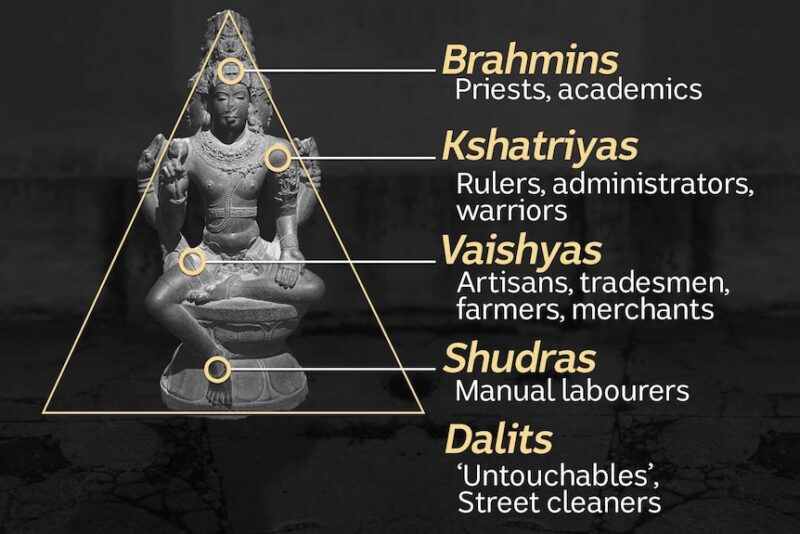
    Manusmriti, widely regarded to be the most important and authoritative book on Hindu law and dating back to at least 1,000 years before Christ was born, seems to “acknowledge and justify the caste system as the basis of order and regularity of society”. The caste system divides Hindus into four main categories – Brahmins, Kshatriyas, Vaishyas and the Shudras. Many believe that the groups originated from Brahma, the Hindu God of creation.

    At the top of the hierarchy were the Brahmins who were mainly teachers and intellectuals and are believed to have come from Brahma’s head. Then came the Kshatriyas, or the warriors and rulers, supposedly from his arms. The third slot went to the Vaishyas, or the traders, who were created from his thighs. At the bottom of the heap were the Shudras, who came from Brahma’s feet and did all the menial jobs. The main castes were further divided into about 3,000 castes and 25,000 sub-castes, each based on their specific occupation. Outside of this Hindu caste system were the achhoots – the Dalits or the untouchables.

    How does caste work?

    For centuries, caste has dictated almost every aspect of Hindu religious and social life, with each group occupying a specific place in this complex hierarchy. Rural communities have long been arranged on the basis of castes – the upper and lower castes almost always lived in segregated colonies, the water wells were not shared, Brahmins would not accept food or drink from the Shudras, and one could marry only within one’s caste. The system bestowed many privileges on the upper castes while sanctioning repression of the lower castes by privileged groups.

    New research shows that hard boundaries between the social groups were only set by British colonial rulers who made caste India’s defining social feature when they used censuses to simplify the system, primarily to create a single society with a common law that could be easily governed.

    Often criticized for being unjust and regressive, it remained virtually unchanged for centuries, trapping people into fixed social orders from which it was impossible to escape. Despite the obstacles, however, some Dalits and other low-caste Indians, such as BR Ambedkar who authored the Indian constitution, and KR Narayanan who became the nation’s first Dalit president, have risen to hold prestigious positions in the country. Historians, though, say that until the 18th Century, the formal distinctions of caste were of limited importance to Indians, social identities were much more flexible, and people could move easily from one caste to another. New research shows that hard boundaries between the social groups were only set by British colonial rulers who made caste India’s defining social feature when they used censuses to simplify the system, primarily to create a single society with a common law that could be easily governed.

    So, the caste system in its strict interpretation is an invention of British rules – of course, it existed already in some form around three thousand years ago. However, it is disputed whether in ancient times it was more of a kind of functional differentiation in the meaning of Karl Jaspers, whereas since colonial times it became a separation boundary between the various groups. I assume that the colonial rulers transformed an existing variety of functional differentiations of identities into strictly separated castes for reasons of securing their rule. As in other colonial rules like in Africa, the colonizers were puzzled by the plurality of social groups, their ability to change from one group to the other and transformed social groups based on functional differentiation into castes and classes to facilitate their own rule. Overcoming the caste system thus involves overcoming colonialism.

  • Understanding the ‘Xi Jinping’ thought on Rule of Law: Future Substance of Lawfare and Challenges in the Indo-Pacific

    Understanding the ‘Xi Jinping’ thought on Rule of Law: Future Substance of Lawfare and Challenges in the Indo-Pacific

    [powerkit_button size=”lg” style=”info” block=”true” url=”https://admin.thepeninsula.org.in/wp-content/uploads/2022/11/Xi-Jinping-Thought-Lawfare_ArpanAChakravarty-1.pdf” target=”_blank” nofollow=”false”]
    Download
    [/powerkit_button]

    Abstract

    Lawfare aims at using the law and legal systems to hurt or discredit opponents or stop them from reaching their political goals. It is seen that the rule of law has been used to shape the future course of the war as an alternative to traditional military means. Regimes worldwide have started using the law to constrain behaviour, contest circumstances, confuse legal precedents, and gain an advantage. In this paper, the author looks at how China uses “lawfare” in its own country, worldwide and lessons for India.

    Introduction

    While the world focused on the conflict between Ukraine and Russia, China and Solomon Island signed an inter-governmental security pact1 which has been raising concerns regarding the rule-based order2 in the Indo-Pacific region. China, as a rising power, is undoubtedly becoming a significant adversary to various countries bordering it, including India; its growth aims at unipolar Asia, which is causing enormous uncertainty in the region.

    Due to this, it becomes important to understand the multipolar distribution of power in the region since the Indo-Pacific is becoming a site for political contestation and the rise of ‘lawfare’. It is seen that in order to contest for leadership, China has been active on the front to demonstrate, influence, and ideate with different nations. It is actively setting rules and terms of compliance for it through a set of carefully crafted strategies of ‘lawfare’.

    This paper seeks to examine the theoretical underpinnings of lawfare, its internal dimension that influences China’s domestic policy, and its external dimension that has a bearing on China’s strategic and international standing, and finally how China uses lawfare to intimidate other nations and what the world can learn from it.

    [powerkit_button size=”lg” style=”info” block=”true” url=”https://admin.thepeninsula.org.in/wp-content/uploads/2022/11/Xi-Jinping-Thought-Lawfare_ArpanAChakravarty-1.pdf” target=”_blank” nofollow=”false”]
    Read the Full Paper
    [/powerkit_button]

  • Women in Afghanistan: The Fight Back

    Women in Afghanistan: The Fight Back

    [powerkit_button size=”lg” style=”info” block=”true” url=”https://admin.thepeninsula.org.in/wp-content/uploads/2022/12/Womens-Right-In-Afghanistan_Hemantika-1.pdf” target=”_blank” nofollow=”false”]
    Download
    [/powerkit_button]

    Introduction:

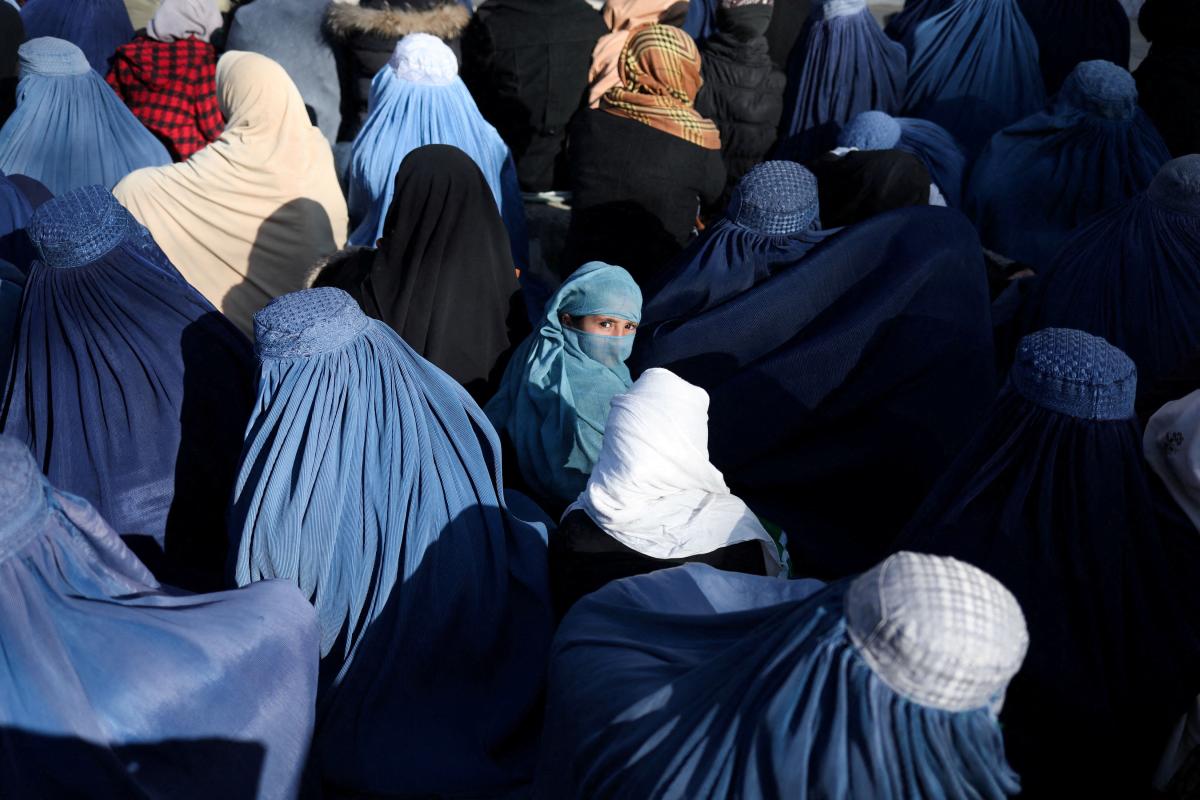
    Women and men undergo varied experiences in the event of an absolute collapse of the socio-political order. When combined with a catastrophic political transformation, their exposure to systemic abuse and violence dramatically increases. The vulnerability of women and their exposure to such violence is much more pronounced compared to what men face. This paper attempts to map the violence and abuse of rights women in Afghanistan are facing under the new Taliban rule after the American withdrawal. It also focusses on their response to the same. 

    Women under Taliban 1.0

    Afghanistan is a multi-ethnic country with a diverse population. Women’s issues have always had a central role in the governance system. From the beginning of the birth of modern-day Afghanistan, different monarchs have played a key role in determining the status of women in society, in line with their Islamic worldview. However, though women were considered inferior to men, they had their share of rights that were in no way meant to keep them confined to their houses. Instead, their free movement was hardly restricted. Covering their heads or wearing a burqa was not mandatory. There were organizations like the Anjuman-I-Himayat-I-Niswan(Organization for Women Protection), which worked to encourage women into reporting any kind of injustice meted to them. 

    After the Soviet invasion of Afghanistan in 1979, women’s rights were further amplified with universities in most cities, especially Kabul admitting them. After the departure of the Soviets in May 1988, the Mujahedeen overturned all that the Soviet Union had stood for, which included women’s rights regarding employment and education. Women were pushed away from public life and forced to wear a burqa. Fewer women were visible on television.

    [powerkit_button size=”lg” style=”info” block=”true” url=”https://admin.thepeninsula.org.in/wp-content/uploads/2022/12/Womens-Right-In-Afghanistan_Hemantika-1.pdf” target=”_blank” nofollow=”false”]
    Download
    [/powerkit_button]

  • On Metaverse & Geospatial Digital Twinning: Techno-Strategic Opportunities for India

    On Metaverse & Geospatial Digital Twinning: Techno-Strategic Opportunities for India

    [powerkit_button size=”lg” style=”info” block=”true” url=”https://admin.thepeninsula.org.in/wp-content/uploads/2022/07/TPF_Working-Paper_MetaGDT-1.pdf” target=”_blank” nofollow=”false”]
    Download
    [/powerkit_button]

    Abstract:

    With the advent of satellite imagery and smartphone sensors, cartographic expertise has reached everyone’s pocket and we’re witnessing a software-isation of maps that will underlie a symbiotic relationship between our physical spaces and virtual environments. This extended reality comes with enormous economic, military, and technological potential. While there exist a range of technical, social and ethical issues still to be worked out – time and tide wait for no one is a metaphor well applied to the Metaverse and its development. This article briefly introduces the technological landscape, and then moves over to a discussion of Geospatial Digital Twinning and its techno-strategic utility and implications. We suggest that India should, continue on the existing dichotomy of Open Series and Defence Series Maps, initiate Geospatial Digital Twins of specific areas of interest as a pilot for the development, testing, and integration of national metaverse standards and rules. Further, a working group in collaboration with a body like NASSCOM needs to be formed to develop the architecture and norms that facilitate Indian economic and strategic interests through the Metaverse and other extended reality solutions.

    Introduction

    Cartographers argue that maps are value-laden images, which do not just represent a geographical reality but also become an essential tool for political discourse and military planning. Not surprisingly then, early scholars had termed cartography as a science of the princes. In fact, the history of maps is deeply intertwined with the emergence of the Westphalian nation-state itself, with the states being the primary sponsors of any cartographic activity in and around their territories[1].
    Earlier the outcome of such activities even constituted secret knowledge, for example, it was the British Military Intelligence HQ in Shimla which ran and coordinated many of the cartographic activities for the British in the subcontinent[2]. Thus, given our post-independence love for Victorian institutions, until 2021 even Google Maps had remained an illegal service in India[3].

    One of the key stressors which brought this long-awaited change in policy was the increased availability of relatively low-cost but high-resolution satellite imagery in open online markets. But this remote sensing is only one of the developments impacting modern mapmaking. A host of varied but converging technologies particularly Artificial Intelligence, advanced sensors, Virtual and Augmented Reality, and the increasing bandwidth for data transmission – are enabling a new kind of map. This new kind of map will not just be a model of reality, but rather a live and immersive simulation of reality. We can call it a Geospatial Digital Twin (GDT) – and it will be a 4D artefact, i.e. given its predictive component and temporal data assimilation, a user could also explore the hologram/VR through time and evaluate possible what-if scenarios.

    [powerkit_button size=”lg” style=”info” block=”true” url=”https://admin.thepeninsula.org.in/wp-content/uploads/2022/07/TPF_Working-Paper_MetaGDT-1.pdf” target=”_blank” nofollow=”false”]
    Read the Full Paper
    [/powerkit_button]

  • The Modernisaton of the PLA during a Time of Crises and Plague

    The Modernisaton of the PLA during a Time of Crises and Plague

    Since the days of Sun-Tzu, China’s military leaders have always been aware that to defeat an enemy at the nation’s gates, you have to maintain a communal armed force: that is, a military force that is an integral part of ordinary peoples’ lives.   However, since the time of the Han dynasty, the military power of the Chinese people has always been intimately associated with the idea of living harmoniously within the realm of Heaven (t’iem). The people have also needed to be willing to accept the authority of the “Son of Heaven” (t’iem-tzu), which means ultimately a supreme personality that will guide the Chinese masses in times of peace and war. In the early twenty-first century, the concept of “Heaven” in the People’s Republic of China is the embodied in the Communist Party of China (CPC) and its current economic power and military influence is well beyond the shores of mainland China and even of east Asia; it can be felt, for example, in South America and in Africa.  Its polar star, Xi Jinping, has emerged as an undisputed, authoritative leader, just as Mao Zedong was – who pioneered China’s modern military theory.  What Xi has done is to take Mao’s theory of warfare and transformed it into a modern conception of a military machine that is both Chinese in concept and Westernized in its pragmatism, military readiness and its deployment.

    From my perspective as a military historian, I would state that the Communist Party of China with its Central Military Commission is a sophisticated parallel to the command and control of the People’s Liberation Army (PLA), which is under the operational control of the Central Military Commission of the CCP Central Committee—the Party’s CMC. The overall Chinese leadership have been aware since the Persian Gulf War of the prowess of the American armed forces against the Iraqi army. It understood then, during that momentous time in history, the urgent need to modernize the Chinese armed forces – much as the Stalin-era Soviet military and political leadership were both impressed with and fearful of the modernization of the emergent Nazi armed forces, which included the army, air force and navy echelons. It can be said unequivocally that Stalin saw the need to prepare for a major regional war with fascist Germany, just as the Chinese leadership is aware that eventually, it will have to wage war against the United States. Unless their American adversary implodes from within, leaving disparate fiefdoms across its landscape, or a new military leadership develops within the United States due to a sophisticated insurrection or military coup and a Second American Civil War ensues, there remains a danger of war between the two nation-states. An America with a fascist government and military hierarchy whose ultimate political desire is to destroy socialist China, despite the possibility of a thermo-nuclear war, is still a possibility.

    The Chinese leadership were undoubtedly grim in their early analysis of what awaited them: if they were not prepared to solidify their armed forces with the capability to withstand violent dissent within their borders as well as to fight a war beyond the Great Wall of China, then their demise or ruin was inevitable. The Chinese leadership, I am sure, has looked closely at the decisions made prior to World War II by Stalin and the Soviet political leadership.  Although eager to strike first against the armies of Hitler, Stalin found himself unable to undertake a “first strike” as Lenin had advocated, and tragedy ensued with the loss of 29 to 30 million Soviet military and civilian lives during the Great Patriotic War. The Chinese leadership is more than aware of what almost mortally wounded the USSR: namely the failure of the Soviet military leadership to prepare quickly enough by modernizing the armed forces in time and by creating a defensive border force that could have blunted more quickly the Nazi tanks and the thousands of German fascist troops that crossed the Minsk or Pripet Marshes through Poland and which tore through the heart of Soviet Russia. The Communist leadership of China know that if it is not ready to confront the United States, let alone its secondary adversary, India, then it is gambling with its very existence. Xi and his military council members are not gamblers when it comes to war; they are strategists who know that to keep Heaven you have to fight for it.

    In my analysis of the contemporary military prowess of the People’s Republic of China, I will address the issues not through a dogmatic application of military theory but instead by looking at recent essays or articles that have arrived at certain conclusions or made particular observations regarding the Chinese military infrastructure, while nevertheless understanding that even the observations in these journals or periodicals that I cite are not facts set in stone. I remember in my youth that Mao Zedong would quote authors, philosophers and poets in his military theory and allude to them in his poetry when writing about military periods in his own life, without losing the inner core of his final analysis of the art of war as it he perceived it during and after the Chinese Revolution.

    In terms of the substance of the Chinese army, it is undergoing a creative build-up, meaning that its military commanders are more focused on quality troops than on simple numbers of servicemen and servicewomen on the battlefield. An essay, written for the Council on Foreign Relations, titled “China’s Modernizing Military”, states:

    “The army is the largest service and was long considered the most important, but its prominence has waned as Beijing seeks to develop an integrated fighting force with first-rate naval and air capabilities. As the other services expanded, the army shrunk to around 975,000 troops, according to the International Institute for Strategic Studies (IISS). Reforms have focused on streamlining its top-heavy command structure; creating smaller, more agile units; and empowering lower-level commanders. The army is also upgrading its weapons. Its lightweight Type 15 tank, for example, came into service in 2018 and allows for engagement in high-altitude areas, such as Tibet.” [1]

    The author of the essay implies that the Chinese military command is more concerned with smaller infantry units and creating lighter tanks (bringing to mind the light French tanks that could outrun the heavier German tanks during the invasion of 1940, but which lacked their firepower). But such light tanks will not necessarily be a powerful weapon against the more powerful American, technologically advanced tanks.  These light tanks are not on par with the modern Russian T-14 Armata, which is “based on a modular combat platform, which can also serve as a basis for other armoured variants such as heavy infantry fighting vehicle (IFV) and armoured personnel carrier (APC)”.[2]  However, the PLA has a powerful heavy tank that is equal in fighting power to the T-72 or the American M1A2 SEP Abrams tank, in that “In comparison to older Chinese-made tanks, the MBT has improved capabilities in terms of protection, power and mobility. It has a crew of three. ZTZ 99 was made to compete with western tanks, while its technology is used to improvise the more economical ZTZ 96. Regiments in China’s Shenyang and Beijing military areas currently deploy the MBT Z”.[3]What is factual in terms of actual combat experience is that the T-72 has seen major combat just as the American Abrams tank has, while the Russian T-14 Armata and the Chinese ZTZ 96 have not been properly put to the test yet on the world’s battlefields. I, therefore, observe that the decisive factor will be the readiness of the PLA, with its modernized air force and navy giving support both in retreat and offensive attacks, depending on what the context requires at a given moment.

    Just over a year ago, the American Department of Defense was quoted by the Brookings Institute recalling its report of twenty years earlier:

    “DoD’s 2000 report assessed that the PLA was slowly and unevenly adapting to the trends in modern warfare. The PLA’s force structure and capabilities focused largely on waging large-scale land warfare along China’s borders. The PLA’s ground, air, and naval forces were sizable but mostly obsolete. Its conventional missiles were generally of short-range and modest accuracy. The PLA’s emergent cyber capabilities were rudimentary; its use of information technology was well behind the curve; and its nominal space capabilities were based on outdated technologies for the day.”[4]

    In this description of the capabilities of the PLA, there was almost a complete dismissal of the fighting ability of the Chinese infantrymen, which should have included an evaluation of its Marine Special Forces. The report had implied that the PLA was basically a mainland Chinese army whose mission was to defend or wage war along its borders and went on to belittle the PLA further by stating with a certain arrogance that:

    “Even if the PRC could produce or acquire modern weapons, the PLA lacked the joint organizations and training needed to field them effectively. The report assessed that the PLA’s organizational obstacles were severe enough that if left unaddressed they would “inhibit the PLA’s maturation into a world-class military force[5].”

    However, Brookings notes, the latest DoD report acknowledges that:

    “The PRC has marshalled the resources, technology, and political will over the past two decades to strengthen and modernize the PLA in nearly every respect[6].”

    Benjamin Brimelow likewise acknowledges the reforms and writes, with less bellicose language and more precision:

    “China’s 11 military regions were restructured into five, the ballistic-missile force became its own branch of the armed forces, and the PLA marine corps, which had been disbanded in 1957, was reestablished.

    “Xi also created the PLA’s Strategic Support Force to support the PLA’s cyber warfare, space warfare, and electronic warfare operations, and the Joint Staff Department, which acts as a commanding organ between all branches of the PLA and the Central Military Commission.

    “Xi has increased the PLA’s budget in an effort to create a world-class military by the year 2050. China is now the second-biggest spender on defence in the world, behind the US, and the largest in Asia.”[7]

    What the author implies in the above quote is that China’s Communist Party leadership and its military leadership is not standing by idly waiting to be destroyed by outside or indeed enemies from within. It is instead advancing – slowly but steadily – in creating an army, air force and navy that will equal and eventually exceed the present United States armed forces in their sophistication and in their deadliness.  While the American army, air force and navy comprise volunteers, the armed forces of the People’s Republic of China are conscripted and are doctrinally trained so that they have a serious commitment to the health and sovereignty of the Chinese motherland. The history of the Chinese Armed Forces is still imbued with the aspirations of the military virtues of the era of Mao although the principles have been changed in accordance with the context of the present period of world history. It would be naïve to think that Chinese troops have the same divisions, disunity and deep racism that exist in the modern United States Army, even though there are thousands of American military servicemen men and women who are sincerely dedicated to the preservation of the United States, despite dissent within the ranks as revealed by the attempted insurrection on January 6th. There were active and former military men and women involved in the violent acts at the Capitol, a clear signal of disunity within the American army as well, although the National Guard seemed committed to preventing the Trump regime from gaining the initiative in creating a populist fascist government.

    It is with caution that I make an observation about China’s navy, which although it has now assumed ascendancy as the world’s largest navy is not necessarily totally capable of defending mainland China or defeating its adversaries on the high seas. However, the American newspaper, The New York Times, has been calm in its assessment of Chinese naval power, explaining it in a balanced way:

    “A modernization program focused on naval and missile forces has shifted the balance of power in the Pacific in ways the United States and its allies are only beginning to digest. While China lags in projecting firepower on a global scale, it can now challenge American military supremacy in the places that matter most to it: the waters around Taiwan and in the disputed South China Sea. That means a growing section of the Pacific Ocean — where the United States has operated unchallenged since the naval battles of World War II — is once again contested territory, with Chinese warships and aircraft regularly bumping up against those of the United States and its allies.”[8]

    I would say that although the Chinese navy has carried out great improvements in the bolstering of its anti-missile ships and nuclear submarines, it still lags seriously behind the United States Navy in terms of quality naval ships, partly because it has yet to achieve strike capabilities comparable to the Seawolf and Virginia class submarines that the United States has not only in the Pacific region but in other far-off oceans and seas as well.  I would suggest that perhaps the strategic goal of the Chinese navy high command is to create large quantities of submarines so as to defeat a potential adversary with more advanced submarine technology. I am reminded in this instance of how Soviet tank designers were able to create and mass-produce T-34 tanks which moved faster on the battlefield and were able to withstand enemy shell hits because of their unique cup-turret design. Although the T-34 was not as sophisticated as the Panzerkampfwagen V or Panther and Tiger tanks created by the German military engineers during World War II, Soviet engineers – like modern China’s military engineers – were pragmatic in their weapon designs.  In any case, the two nations, the United States and the People’s Republic of China, may engage as naval powers in a battle of wills over the disputed islands in the Paracels, and a major naval battle there in the future will decide who not only controls the South China Sea but all the Pacific Ocean territories as well.

    I have attempted in this essay to cover the probabilities or capabilities of the People’s Republic of China’s emerging military strength, which I would more modestly call military maturity rather than “world-class”. It is her modern missile capabilities that I think will be the major deciding factor should a Third World War break out. The American journalist that I mentioned earlier in this essay, Brimelow, said this about Chinese missile capabilities:

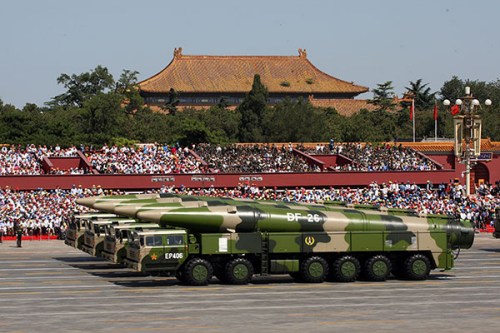
    “The PLA Rocket Force (PLARF) has become one of the most intimidating missile forces in the world. China never signed the Intermediate-range Nuclear Forces Treaty (INF) and was never subject to its limits, so it has been free to invest heavily in ballistic missiles.”[9]

    It is the powerful and continual growth of high-velocity and long-range ballistic missiles within the Chinese arsenal, including the in-depth deployment of intercontinental missiles across mainland China, that the United States, as well as her allies, should actually fear because it is missile firepower with nuclear warheads that will be the deciding factor should a Third World War emerge on the world’s stage.

    The contest for military ascendancy or military parity is not simply a competition between the United States and China, as there are multiple other rivalries across the world’s continents. As China, Russia and other nation-states in the Middle East and South America continue to resist the United States’ hegemonic project for economic and military superiority, political and military tensions will increase between these two multi-polar major competing forces.  Also, because of various other international social factors, including the breakdown of cultural and economic structures that the pandemic in 2020 destroyed on a worldwide basis, there will be a desire to assert the hitherto hidden agenda for emerging nation-states’ independence rather than submitting to the status quo of the self-destructive imperialist powers.  A boldness will emerge in which these nation-states will no longer want to be second-best to Western Europe or to North America.

    Since the Long March, in which the nucleus of the People’s Liberation Army emerged under the guidance of Chairman, Mao Zedong and Zhou Enlai, the first Premier of the People’s Republic of China, there have been at times both steps forward and reversals in terms of the qualitative and quantitative achievements that China’s military strength represents. China showed its resilience and determination in fighting American military forces during the Korean War, revealing that its troops were not intimidated by American troops; during the Vietnam War, Chinese military advisers played a major role in strategy and tactics in helping General Giap and his field commanders to fight a sophisticated war of independence against the United States military armies, particularly at the Battle of Dien Bien Phu.  In 2014, a retired Vietnamese professor, Dao Nguyen Cat, was interviewed by the Xinhua news agency, and “on the occasion of the 60th anniversary of Vietnam’s victory in the Battle of Dien Bien Phu, Cat said that with the rare support of Chinese forces, the Vietnamese troops were able to successfully drive away the French colonial forces from the province of Dien Bien Phu, 300 km northwest of the capital Hanoi”.[10]  Professor Cat, who served as an official of Vietnam’s Central Propaganda Committee at Dien Bien Phu Campaign, Cat was quoted as saying: “Definitely without China’s support, we would have failed to defeat the French colonial masters… They not only gave training courses from the command posts but also went directly to the battlefield to talk with our soldiers. They supplied Vietnam not only weapons but also with food…”[11]  The military advisers and military supplies given by the leadership of the PLA at that time in history, regarding the Vietnam War, known by the Vietnamese people as The American War, reveal that Chinese leadership were moving forward in honing their military skills beyond their borders.

    The reversal of military progress came during the nineteen sixties and late seventies in the form of territorial disputes. First, in March 1969, there was a military clash between the Soviet Union and China: a seven-month undeclared military conflict that occurred near Zhenbao (Damansky) Island on the Ussuri (Wusuli) River, near Manchuria. The conflict between the two Communist nation-states would eventually result in a ceasefire, which led to a return to the status quo; however, a balanced history is yet to be written on how the two parties view each other as ideological threats, all this taking place during the period of the Culture Revolution.  Secondly, the Sino-Vietnamese War was a border war fought between China and Vietnam in early 1979. Rightly or wrongly, China created an offensive attack in response to Vietnam’s actions against the Khmer Rouge in 1978, ending the dominance of the Chinese-backed Khmer Rouge. What is regrettable but not surprising is that two socialist nation-states were unable through diplomacy to decide how to end their dispute regarding the Khmer Rouge’s various mistakes in its destruction of thousands of lives that could have contributed to the Communist cause in Southeast Asia.  However, China then began to gain influence, sending economic aid and military advisors to Africa, including Cuba and Venezuela – which reveals the wise and ancient observation by Sun Tzu who said “To win one hundred victories in one hundred battles is not the acme of skill. To subdue the enemy without fighting is the acme of skill.”  The Chinese Communist Party know how to achieve a military strategy without going to war.

    In May 2020 there was an actual hand-to-hand struggle between Chinese and Indian troops at locations along the Sino-Indian border, including near the disputed Pangong Lake in Ladakh and the Tibet Autonomous Region, and near the border between Sikkim and the Tibet Autonomous Region. During the last days of May 2020, Chinese forces objected to Indian road construction in the Galwan river valley, and there then ensued violent verbal exchanges between the two military camps, resulting in deaths and taking of prisoners on both sides. Although I will not attempt to describe in any detail how each side viewed the territorial dispute, I will say that the complexities between China and India, only reinforce why China is so protective of its borders and why India has chosen the United States as its major ally.  We have read similar accounts in ancient historical texts: Thucydides wrote about it in The War of The Peloponnesians And The Athenians, therefore we should not be surprised that in our own day, these small conflicts can lead to greater military build-up and to territorial jealousies which ensnare two parties or various parties into an eventual war that cannot be quelled, but which rather leads to disaster.

    In closing, I would like to quote the eminent Marxist historian, Domenico Losurdo, who wrote about the People’s Republic of China that “The foundations of the People’s Republic of China, following an epic national liberation struggle, certainly did not result in an immediate end to the situation of danger. To the end… the Korean War… challenged US hegemony in Asia, a memorable lesson…”[12].  This makes clear to me that the epic struggle of the modern Chinese people and the People’s Liberation Army has not yet reached its zenith in world history.


    References:


    [1]  https://www.cfr.org/backgrounder/chinas-modernizing-military

    [2] https://www.army-technology.com/projects/t-14-armata-main-battle-tank/

    [3] https://www.army-technology.com/projects/type99chinese-main/

    [4] https://www.brookings.edu/blog/order-from-chaos/2020/09/04/what-the-pentagons-new-report-on-china-means-for-u-s-strategy-including-on-taiwan/

    [5] Ibid.

    [6] Ibid.

    [7] https://www.businessinsider.com/chinese-military-is-improving-but-us-has-more-combat-experience-2020-7

    [8] https://www.nytimes.com/2018/08/29/world/asia/china-navy-aircraft-carrier-pacific.html

    [9]  https://www.businessinsider.com/chinese-military-is-improving-but-us-has-more-combat-experience-2020-7

    [10] http://www.china.org.cn/world/2014-05/07/content_32317279.htm

    [11]  Ibid.

    [12] Domenico Losurdo, War and Revolution, trans. By Gregory Elliott. New York & London: Verso Books,2015, 257.


    Image Credit: ecns.cn

  • Fighting the Invisible Enemy with Vaccines:  Beginning of the End of the COVID-19 Pandemic

    Fighting the Invisible Enemy with Vaccines: Beginning of the End of the COVID-19 Pandemic

    Fighting the Invisible Enemy with Vaccines Beginning of the End of the COVID-19 Pandemic [powerkit_button size=”lg” style=”info” block=”false” url=”https://admin.thepeninsula.org.in/wp-content/uploads/2021/06/Fighting-the-Invisible-Enemy-with-Vaccines-Beginning-of-the-End-of-the-COVID-19-Pandemic-8-1.pdf” target=”_blank” nofollow=”false”]
    Download
    [/powerkit_button]

    Authors:  Avanti A Srinivasan (1st-year Biology Honors College Student, New Jersey, USA); Keerthika Gnanasegaran (MBBS, Puducherry, India); Vishu Priya (MBBS, Puducherry, India).

    Keywords:

    COVID, Coronavirus disease; COVID-19, SARS-CoV-2, Severe Acute Respiratory Syndrome Corona Virus 2 identified in 2019 that causes COVID; Flattening the curve, The longer it takes for the coronavirus to spread through the population, the more time the health care systems (hospitals) have to prepare and treat patients, but not be overwhelmed by the pandemic; Herd immunity, when most of a population (70-80%) becomes immune to COVID-19, they provide indirect protection to those who are not immune to the disease; Immunity, protection from an infectious disease. If a person is immune to COVID that person can be exposed to the virus without becoming infected; Immunization, the process by which a person becomes protected against an infectious disease by vaccination; Vaccine, a biological preparation or substance (also known as antigen) that is used to stimulate the production of antibodies and provide immunity against COVID-19, without inducing the disease. Vaccines are usually administered by needle injections; Vaccination, the process of introducing a vaccine (prepared from the COVID, its products such as protein or DNA, or a synthetic substitute such as mRNA) to act as an antigen, into the body to induce immunity against COVID-19 disease.

    COVID-19 Pandemic

    Corona Virus disease (COVID-19) was first identified in Wuhan, China, in December 2019. It is caused by Severe Acute Respiratory Syndrome Corona Virus 2 (SARS-CoV-2). The highly contagious coronavirus has spread rapidly around the world exponentially, causing a pandemic.

    As of June 04, 2021, there were over 172,231,339 confirmed cases and 3,703,522 deaths globally according to Johns Hopkins University (JHU) COVID-19 Dashboard. The USA alone has accounted for over 33,327,112 confirmed cases with over 596,444 fatalities reflecting the heavy toll inflicted by the pandemic. India has reported over 28,574,350 confirmed cases and 340,702 deaths, which is likely a low estimate.

    The US Government at the beginning of the pandemic embarked on the “Operation Warp Speed” program to accelerate testing, supply, development, and distribution of safe and effective vaccines, therapeutics, and diagnostics for COVID-19 by January 2021. The program has led to the development of several effective vaccines against COVID-19 by commercial enterprises. The new US administration has focused all its efforts to vaccinate the US population starting January 2021 with the goal of reaching herd immunity by July 4, 2021; it is on its way to successful completion by the target date.

    Initially, the number of confirmed COVID-19 cases reported by India was less, which was probably due to the quick action taken by the Indian Government to implement a total lockdown of the country to control the community spread of the virus. This was a very successful strategy for the short term and helped to flatten the curve and slowed the infection rate (Fig. 1). However, without an effective vaccine, with the Indian economy stagnating, with a population of 1.3 billion most of whom are poor, and a highly mutating virus, mitigation efforts alone proved to be grossly inadequate over the long term.


    Fig 1: USA Center for Disease Control (CDC) graphic on flattening the curve

    Over the past two months, India’s coronavirus daily infections have averaged over 400,000 and 4,000 deaths. They have come down recently, averaging daily infections of less than 200,000 and 2,800 deaths. Vaccinating the Indian population and reaching herd immunity, may be the only option left to fight the invisible enemy and to successfully put an end to the pandemic. India so far has inoculated only about 3% of its 1.3 billion people. India has a long way to go to get 70-80% of its population vaccinated and reach herd immunity.

    What is immunity?

    Humans are constantly exposed to disease-causing pathogens such as viruses, bacteria, fungi, and parasitic worms. Our body has two lines of defence against these threats: innate immunity and adaptive immunity, which together constitute the immune system. Their collective defence against pathogens makes up the immune response. The two components of the immune system interconnect and communicate at chemical and cellular levels to provide powerful protection against pathogens.

    Innate immunity provides an immediate, nonspecific response against any invading pathogen and has no memory of prior exposure to the pathogen. Innate immunity relies on the recognition of certain foreign molecules to stimulate inflammatory responses and phagocytosis. Innate immunity is the first line of defence against pathogens, representing a critical systemic response to prevent infection and maintain homeostasis. It also contributes to the activation of an adaptive immune response. It does not adapt to a specific external stimulus or a prior infection but relies on genetically encoded recognition of molecular patterns.

    The innate immune system recognizes pathogen-associated molecular patterns that are associated with pathogenic organisms but are absent in the host. The patterns are recognized by pattern recognition receptors of phagocytic cells such as toll-like receptor that are found on the cell surface and within the cell on various membrane-bound compartments. Cell surface receptors on macrophages (white blood cells) recognize and bind to surface molecules on the pathogen, activating the macrophage to phagocytize (engulf) the pathogens. Activated macrophages secrete cytokines, which bind to receptors on other host cells to trigger a successful immune response.

    Adaptive (or acquired) immunity is specific; it recognizes individual pathogens and mounts an attack that directly neutralizes or eliminates them and retains a cellular memory of a pathogen; it reacts quickly upon second exposure to the same pathogen. The innate immune system provides some immediate protection against invading pathogens while the more powerful, specific, adaptive response system is mobilized that can take several days. Adaptive immunity, also known as acquired immunity, is a host immune response that is mediated by antigen-specific lymphocytes. Unlike innate immunity, the acquired immunity is highly specific to a particular pathogen, including the development of immunological memory. Like the innate system, the acquired system includes both humoral immunity components and cell-mediated immunity components. T cells differentiate from stem cells in the bone marrow and are carried in the blood to the thymus to generate two types of T cells (helper T cells and cytotoxic T cells) that are involved in adaptive immunity. Humoral immunity arises from B cells that differentiate from stem cells in the bone marrow and are carried in the blood to capillary beds serving the tissues and organs of the lymphatic system. In antibody (humoral)-mediated immunity, B-cell derivatives called plasma cells to secrete antibodies – highly specific protein molecules – that circulate in the blood and lymph recognizing and binding to antigens and clearing them from the body. In cell-mediated immunity, a particular type of T cell becomes activated and, in conjunction with other cells of the immune system, attacks foreign cells directly and kills them. Specific receptors on the plasma membrane of one B cell or T cell (B-cell receptors or T-cell receptors) bind to one specific antigen structure, also known as epitopes (Fig. 2).

    Fig. 2: Structure of B-cell and T-cell receptors

    The adaptive immune response includes four key steps: 1) Antigen encounter and recognition: lymphocytes encounter and recognize an antigen; 2) Lymphocyte activation: lymphocytes are activated by binding to the antigen and divide to produce clones; 3) Antigen clearance: large clones of activated lymphocytes clear the antigen from the body; and 4) Development of immunological memory: memory cells circulate in blood and lymph, prepared for a rapid response in a future encounter of the same pathogen. The entire population of B cells and T cells in the body includes about 100 million different kinds of receptors – enough of a repertoire to recognize and destroy any type of antigen. Importantly, these cells are present even before the body has encountered the antigens.

    Adaptive immunity can be acquired either naturally by infection or by vaccination. Adaptive immunity can be active or passive. Active immunity is acquired through exposure to a pathogen, which triggers the production of antibodies by the immune system. Passive immunity is acquired through the transfer of antibodies or activated T cells derived from an immune host either artificially or through the placenta from the mother.

    What is a vaccine?                                                    

     In 1796, Edward Jenner infected healthy individuals with cowpox, which prompted their immune systems to protect them against smallpox, a more deadly viral disease. Jenner’s technique became the basis for worldwide vaccination against smallpox, which now has been eradicated from the human population. This forms the basis for vaccination against other deadly pathogens.

    An antigen is a foreign molecule that triggers an adaptive immune response. A vaccine is usually made from weakened or killed forms of the microbe, or typically contains an antigen from the disease-causing microorganism such as its toxins, or one of its surface proteins. The antigen stimulates the body’s immune system to recognize it as a threat and destroy it and to further recognize and destroy those microorganisms in a future encounter. Vaccines can be prophylactic (to prevent or ameliorate the effects of a future infection by a pathogen), or therapeutic to fight a disease that has already occurred. The administration of vaccines is called vaccination or inoculation. Vaccination is the most effective way to prevent infectious diseases. Widespread immunity due to vaccination is largely responsible for the worldwide eradication of smallpox and the restriction of diseases such as polio, measles, and tetanus.

    Molecular structure of SARS-CoV-2

    SARS-CoV-2 is a large, enveloped, spherical virus that contains a positive-sense, single-stranded RNA genome (30 kb in size), which is packed inside the nucleocapsid protein (N) and surrounded by an envelope. The RNA genome has a 5′ capped structure and a 3′ poly-A tail. The 5′ terminal two-thirds of the genome encodes a polyprotein, pp1ab, which is further cleaved into 16 non-structural proteins that are involved in genome transcription and replication. The 3′ terminus encodes 3 different structural proteins.

    Membrane proteins (M) and envelope proteins (E) are involved in virus assembly. The M protein (~30 KDa) is the most abundant structural protein in the virion. The E protein (~12 KDa) is found in small quantities within the virion.

    Spike protein (S1) that mediates virus entry into host cells, is the target of all COVID-19 vaccines. The spike protein forms large protrusions from the virus surface, giving it the appearance of having crowns (Fig. 3). Spike protein contains an S1 subunit that is a Receptor Binding Domain (RBD) and a membrane-fusing spike S2 subunit; The entry receptor utilized by SARS-CoV-2 is Angiotensin Converting Enzyme II (ACE II). Upon binding S1 is processed into S2, which induces fusion of the host and viral membranes.

    Fig. 3: Structure of the coronavirus, SARS-CoV-2 that causes COVID-19 [adapted from Centers for Disease Control (CDC) and Prevention, USA].

    COVID-19 viral vector vaccines

    Viral vector vaccines are a modified version of a different virus to deliver instructions to the cell to make the antigen against coronavirus spike protein. People vaccinated with viral vector vaccines gain protection without ever having to risk the serious consequences of getting sick with COVID-19. Several important characteristics of the viral vector need to be pointed out that include: 1) The vector is not the virus that causes COVID-19; it is a different harmless virus that is engineered to carry the gene coding for the spike protein, a harmless piece of the coronavirus. The modified version of the virus will be injected into the body and the cells will produce the spike protein that is found only on the surface of coronavirus. The cells display spike protein on their surface, triggering an immune response against the spike protein antigen. The immune cells produce antibodies and activate T cells to fight off the infection. The net result is the body has learned to recognize spike protein and to protect us against any future infection by the virus that causes COVID-19. The vaccine protects us, without ever having to risk the serious consequences of getting sick with COVID-19. Any temporary discomfort (side effects) experienced by us immediately after getting the vaccine is a natural part of the process and indicates that the vaccine is working to stimulate our immune system. Viral vector vaccines have been around for a while; they are safe and effective. COVID-19 viral vector vaccines were developed using adenoviral vector by two commercial entities, namely AstraZeneca and Johnson & Johnson (Appendix I).

    COVID-19 messenger RNA (mRNA) vaccines

    mRNA vaccines are a new type of vaccine to protect against infectious diseases. To trigger an immune response, most vaccines inject a weakened or inactivated pathogen into our bodies. mRNA vaccines, on the other hand, teach our cells how to make a protein antigen (or even a piece of a protein) within cells to induce an immune response in our bodies. The focus of the mRNA COVID-19 vaccine is to teach cells how to make spike protein, and thereby, trigger an immune response in our bodies. Like the viral vector vaccines, people vaccinated with mRNA COVID-19 vaccines gain protection without ever having to risk the serious consequences of getting sick with COVID-19. The mRNA vaccines are some of the first COVID-19 vaccines that were authorized for emergency use by the US Government. mRNA vaccines can be developed easily in a laboratory using readily available materials. Furthermore, the process of making mRNA vaccines can be readily standardized and scaled up, making vaccine development much faster than the traditional methods of making vaccines. As soon as the genome sequence of the virus that causes COVID-19 became available, scientists began designing the mRNA instructions for cells to build the unique spike protein into an mRNA vaccine. Effective COVID vaccines became available in less than a year to vaccinate the US population from two commercial enterprises, namely Moderna and Pfizer-BioNTech (Appendix II). The US Government has been very successful in administering the COVID-19 vaccines to its population. The USA is on the verge of reaching herd immunity by July 4, 2021. The success of the vaccination effort can be seen from the fact that several states in the USA have started lifting all mandatory mitigation efforts including the mask mandate.

    CDC (USA) Guidelines for Side Effects of COVID-19 Vaccines

    COVID-19 vaccines are highly effective, but they are also “reactogenic”, meaning that they are likely to cause a noticeable immune response or side effects. Side effects may vary with the type of COVID-19 vaccine. The most common side effects include soreness at the site of injection, fatigue, headache, muscle aches, chills, joint pain, and fever (Table 1). The side effects usually last 24 to 48 hours, and no more than a few days. Side effects were more frequent after the second dose in the vaccine trials. These side effects are typical of the inflammation induced by vaccines and are a sign of the body’s immune response to the vaccine. Some people have more severe reactions than others. Side effects have been less frequent and less severe in adults older than 55 years in the vaccine trials.

    The first dose by itself will not provide complete protection, and it will take about seven days after the second dose before one achieves a full protective level of immunity that develops in about 95% of vaccine recipients. If one is exposed to SARS-CoV-2 before this time, it is possible that the person could develop COVID-19. Even once a person has received both doses of the COVID-19 vaccine, it will still be important to continue practising public health mitigation strategies like masks and social distancing until the pandemic is under control and till we know more about how the vaccines prevent transmission. The side effects of the vaccine typically start within 12 to 24 hours of vaccination. If you experience side effects that last beyond 48 hours, you should contact your doctor or medical provider for advice.

    COVID-19 vaccination will help to protect you from getting COVID-19. You may have some side effects, which are normal signs that your body is building protection. Side effects may affect your ability to do daily activities, but they should go away in a few days.

    Common side effects:

    On the arm where you got the shot:

    • Pain
    • Swelling

    Throughout the rest of your body:

    • Fever
    • Chills
    • Fatigue & tiredness
    • Headache

    Helpful tips:

    If you have pain or discomfort, talk to your doctor about taking over-the-counter medications, such as ibuprofen or acetaminophen.

    To reduce pain and discomfort where you got the shot:

    • Apply a clean, cool, wet washcloth over the area.
    • Use or exercise your arm.

    To reduce discomfort from fever:

    • Drink plenty of fluids.
    • Dress lightly.

    When to contact a doctor:

    In most cases, discomfort from fever or pain is normal. Contact your doctor or healthcare provider:

    • If the redness or tenderness where you got the shot increases after 24 hours
    • If your side effects are worrying you or do not seem to be going away after a few days.

    Some things to remember:

    • Side effects may feel like flu and even affect your ability to do daily activities, but they should go away in a few days.
    • With most COVID-19 vaccines, you will need 2 shots for them to work effectively. Get the second shot even if you have side effects after the first shot unless a vaccination provider or your doctor tells you not to get a second shot.
    • It takes time for your body to build protection after any vaccination. COVID-19 vaccines that require 2 shots may not protect you until a week or two after your second shot.

    It is important for everyone to continue using all the tools available to help stop this pandemic as we learn more about how COVID-19 vaccines work in real-world conditions. Cover your mouth and nose with a mask when around others, stay at least 6 feet away from others, avoid crowds, and wash your hands often.​

    SARS-CoV-2 variants

    Viruses are constantly mutating and changing, that includes SARS-CoV-2, the virus that causes COVID-19. These genetic variations occur over time and can lead to the emergence of new variants that may have different properties. The SARS-CoV-2 genome encodes instructions organized as genes, to build the virus. Genomic sequencing allows scientists to identify SARS-CoV-2 and monitor how it changes over time into new variants, understand how these changes affect the characteristics of the virus, and use this information to better understand how it might impact health.

    It is important to monitor circulating viruses for key mutations that happen in important regions of the genome like the gene coding for spike protein. For instance, variants of the spike protein gene sequence can alter the amino acid sequence of the spike protein, which could alter the effectiveness of the antibody treatment and the immunity developed through vaccination. Many mutations do not affect the virus’s ability to spread or cause disease because they do not alter the major proteins involved in infection; eventually, these are outcompeted by variants with mutations that are more beneficial for the virus.

    As per CDC (USA), surveillance of emerging variants can help detect coronavirus variants with:

    • Ability to spread more quickly in people.
    • Ability to cause either milder or more severe disease in people.
    • Ability to evade detection by specific diagnostic tests. 
    • Decreased susceptibility to medical therapies that employ monoclonal antibodies. (Such therapy involves specifically designed antibodies that target regions of the virus to block infection. Because these treatments are more specific than natural immune response-generated antibodies, they may be less effective against variants that emerge).
    • Ability to evade natural or vaccine-induced immunity (Both natural infection with and vaccination against SARS-CoV-2 produces a polyclonal antibody response that targets several parts of the spike protein. The virus would need to accumulate significant mutations in the spike protein to evade immunity induced by vaccines or by natural infection).

    Among these, the ability to evade vaccine-induced immunity would be the most concerning. Several coronavirus variants have evolved mutations to spread more easily, make people sicker, escape immune responses, evade tests, or render treatments ineffective. These are called “variants of concern” by WHO. There are four coronavirus variants that experts around the world are particularly worried about. These variants were first identified in South Africa, the UK, Brazil, and India respectively (Table 2).

    COVID-19 variants of concern

    1) B.1.1.7, first found in the UK (WHO name: Alpha)

    B.1.1.7 was first detected in two people in South-East England. It has been identified in 123 countries worldwide, including the US. It became the most common variant in the US. Tennessee has the highest proportion of B.1.1.7 cases of any state, accounting for 73% of sequenced cases. B.1.1.7 is between 30% to 50% better at spreading from person to person than other coronavirus variants, according to UK scientists. B.1.1.7 could be more deadly. However, two studies published in the Lancet Infectious Diseases and the Lancet Public Health indicated that B.1.1.7 was more infectious, but didn’t cause worse illness in hospitalized patients. COVID-19 vaccines from Pfizer-BioNTech, Moderna, Jonson & Johnson and AstraZeneca all provide protection against B.1.1.7. all provide protection against B.1.1.7.

    2) B.1.351, first identified in South Africa (WHO name: Beta)

    B.1.351 was first detected in South Africa, in samples dating back to the beginning of October 2020. It has been found in 84 countries, including the US. B.1.351 is thought to be 50% more contagious than the original strain. Data suggests that the variant may evade the body’s immune response. Antibodies work best when they bind well to the virus and stop it from entering our cells. The B.1.351 variant has mutations called E484K and K417N at the site where antibodies bind. In lab tests, antibodies produced by Pfizer and Moderna’s COVID-19 vaccines could not bind well to B.1.351, compared to the original coronavirus. In a real-world study, Pfizer’s vaccine was 75% effective at preventing infection of varying severity caused by the variant first found in South Africa, called B.1.351, after two doses. Johnson & Johnson COVID-19 vaccine was 64% effective at preventing COVID-19 in trials in South Africa, where 95% infections are caused by B.1.351, and 72% effective in the US, where B.1.351 accounted for less than 1% of sequenced coronavirus tests. This suggests that vaccines will not become completely useless against variants. Existing vaccines could be updated and tailored to a new variant within weeks or months, or you may require a booster shot.

    3) P.1, first identified in Brazil (WHO name: Gamma)

    The variant found in Brazil was first detected in four people in Japan, who had travelled from Brazil on January 2,. It has been found in 45 countries worldwide, including the US. P.1 is twice as contagious as the original coronavirus. P.1 has similar E484K and K417T mutations as B.1.351, which means it can evade antibody responses. This could be the reason P.1 reinfects people who have already caught coronavirus. A recent study published on April 14 showed that previous coronavirus infection only offered between 54% and 79% of the protection for P.1 than for other virus strains. P.1’s mutations could also mean that vaccines work less well. COVID-19 vaccines from Pfizer and AstraZeneca work against P.1. Johnson & Johnson’s COVID-19 vaccine was 68% effective in trials in Brazil, where the variant is the most common strain, compared with its 72% efficacy in the US, where P.1 at the time accounted for 0.1% of sequenced coronavirus tests.

    4) B.1.617, first identified in India (WHO name: Delta)

    The variant first found in India, B.1.617, is in fact three distinct viruses. Collectively, they have spread to more than 17 countries. All three have been detected in the US. The WHO and UK have designated it a “variant of concern” because it is more infectious than the original virus. The mutations include: L452R, may make the virus more infectious or it may avoid the antibody response; P6814, may make it more infectious; and E848Q, may help the virus avoid the antibody response. Health officials in England recently reported that two doses of the COVID-19 vaccines made by Pfizer-BioNTech or AstraZeneca are highly protective against variants first detected in India and the United Kingdom. The data also underscored the need for two doses, as both vaccines were significantly less effective after only one shot. The vaccines were similarly effective at protecting against the UK variant. Moderna vaccine also appears to protect against COVID variants, B.1.617 and B.1.618 that were first identified in India.

    Moderna reported that its COVID-19 vaccine was 100% effective in a trial involving 3732 adolescents aged 12-17, with no major safety concerns. Among adolescents who received two doses, there were no cases of COVID-19 compared with four cases among those who received a placebo. After only one dose, the vaccine was 93% effective in the age group. Side effects were similar to first reported in earlier studies, including headache, fatigue, body ache, fever and chills. Rare cases of a few adolescents and older teenagers developing myocarditis (mild heart problems) after receiving the COVID-19 vaccines was reported. CDC is investigating whether this is a possible side effect of vaccination or if they are merely a coincidence. The relatively few cases seem to have occurred approximately four days after the second dose of mRNA vaccines made by either Pfizer-BioNTech or Moderna. Symptoms have been more common in males than females. Some rare cases of females developing blood clots after receiving the AstraZeneca vaccine has also been reported. Moreover, it appears that COVID-19 survivors with lingering symptoms can safely be vaccinated against the coronavirus.

    More recently, WHO has named the four variants of concern, known as the UK (B.1.1.7), South Africa (B.1.351), Brazil (P.1) and India (B.1.617.2) with Greek alphabets Alpha, Beta, Gamma, and Delta, respectively.

    “Breakthrough” infections after vaccinations

    Based on roughly 101 million Americans fully vaccinated against COVID-19, CDC reported that breakthrough infections occurred in 0.01% of them. Approximately, 27% of breakthrough infections were asymptomatic, while in 2% of the cases, patients died. The CDC sequence data for virus samples from 555 breakthrough infections indicated that mutated variants of the coronavirus, those were first seen in the UK and South Africa, accounted for 64% of the breakthroughs. Moderna and Pfizer are developing booster shots to combat COVID-19 variants.

    COVID-19 disease & black fungal infection

    A rare and potentially deadly infection by mucormycosis (also known as black fungus), has been observed in several coronavirus patients, or those who have recently recovered from COVID-19, whose immune systems have been weakened by the virus or who have underlying conditions, most notably diabetes. Over 6000 black fungus cases have been reported across India, with hundreds hospitalized and at least 100 dead.

    Black fungus is caused by mould found in damp environments (like soil or compost) and can attack the respiratory tract. It is not contagious and does not spread from person to person. Black fungus commonly affects the sinuses or lungs after a person inhales fungal spores in the air and can also affect the skin following a surface injury like a cut or burn. Symptoms depend on where in the body the fungus is growing but can include facial swelling, fever, skin ulcers and black lesions in the mouth. Black fungus disease begins to manifest as skin infection in the air pockets located behind our forehead, nose, cheekbones, and in between the eyes and teeth. It can then spread to the eyes, lungs and can even spread to the brain. It leads to blackening or discolouration over the nose, blurred or double vision, chest pain, breathing difficulties and coughing of blood. If it is not controlled or treated, the mortality rate could be from 20% to 50%. The mortality rate also depends on which part of the body is affected; it is less deadly for people with sinus infections but more deadly for those with lung infections.

    Immunocompromised people are more susceptible to infection who include COVID-19 patients, diabetic patients, people who take steroids, and those with other comorbidities like cancer or organ transplants. COVID-19 patients are particularly susceptible because not only does the virus affect their immune system, drugs used to treat the disease can also suppress their immune response. Due to these factors, COVID-19 patients face a renewed risk of failing the battle against attacks mounted by the black fungus. This does not mean that every COVID-19 patient will get infected by the black fungus as it is uncommon among those without diabetes. The prevalence of diabetes in India is as high as 12% to 18% of the adult population, especially in urban areas.

    Black fungus is treated with antifungal medicines such as Amphotericin B that is given intravenously. Patients may need up to six weeks of anti-fungal medicine to recover. Their recovery depends on how early the disease was diagnosed and treated. Often, surgery is required to cut away dead or infected tissue. For some patients, this may mean loss of the upper jaw or sometimes even the eye. Black fungus is 70 times more prevalent in India, possibly due to several factors that include: 1) higher rate of “undiagnosed” and “uncontrolled” diabetes; 2) tropical humid climate that promotes fungal growth; and 3) delays in seeking medical attention and diagnosing the disease, and challenges in managing the advanced stage of infection. COVID-19 pandemic has worsened the situation in India, by promoting opportunistic infection by the black fungus.

    Authors personal experience with COVID-19 vaccine side effects

    Avanti Srinivasan (1st-year Biology Honors College Student and working a part-time summer job at Penn Medicine Princeton Health): It is evident that COVID-19 has turned the world upside down. After almost a year of quarantine, death and chaos, the pandemic has also now opened a new era in vaccine development with new technologies. As a college student, when I heard about the vaccine I was delighted as I was ready to return to normalcy and resume my life where I left off one year ago after finishing my senior year of high school. I received the Pfizer-BioNTech COVID-19 vaccine on April 18th, 2021. I was quite nervous before receiving the shot as my friends had warned me about various side effects they felt from the vaccine after getting their first dose. Luckily, unlike many others, I did not feel any side effects from the vaccine. One day after vaccination, I felt a slight pain at the injection site, but this is a common immune response to receiving any vaccine as it shows that our immune system is working properly. Three weeks later, I received my second dose of Pfizer-BioNTech COVID-19 vaccine on May 9th, 2021. Just like the first dose, I did not feel any harsh side effects. The usual pain near the injection site and tiredness were there, but it got better after 2-3 days. Overall, I would encourage everyone to get vaccinated as soon as possible. After receiving both doses of the vaccine, I feel more confident and protected and have resumed normal activities without fear of the coronavirus. I know that even if I do get infected with coronavirus, I will not become seriously ill, as the vaccine will provide me with a layer of protection from the deadly virus. After getting vaccinated I also feel that I am playing my role as a good citizen and community member in my state by helping to prevent the spread of COVID-19. I am also encouraging those around me to get vaccinated and by doing so, we will reach herd immunity at which point we can finally put the pandemic behind us and move forward with our lives.

    Dr Keerthika Gnanasegaran (currently working in a multi-speciality hospital in Pondicherry and an INICET aspirant): I got vaccinated with COVISHIELD at my hospital on March 10, 2021. At first, I was very scared about getting the COVID-19 vaccine. I surfed many websites and got advice from many health care professionals, which convinced me to change my mind about getting vaccinated. One day after vaccination of the first dose, I got injection site pain, severe headache, fever >102⁰ F, and fatigue. I consulted my Chief at the Hospital and he said not to worry and advised me to take a Paracetamol tablet once every 6 hours. The following day, I felt alright except for some mild injection site tenderness. Unfortunately, just before I was about to take my second dose of inoculation, I tested positive for COVID-19. I did not have any symptoms except mild body ache. My father, who is obese, diabetic, and suffers from hypertension, also tested positive for COVID-19 after the first dose of vaccination. He also had only mild body ache and we both were under home isolation. Finally, I realized, getting COVID-19 vaccination very likely prevented us from a serious illness. I plan to get my second dose of COVID-19 vaccination after six weeks. Based on my personal experience, I request and encourage everyone to go ahead, shed their inhibition about getting COVID-19 vaccination.

    Dr Vishnu Priyaa Radjassegarane (a medical student doing her postgraduate studies in Pediatrics in Pondicherry): As a medical student, I came to know about the seriousness of the COVID-19 disease at the hospital. During the early phase of the COVID-19 pandemic, I became infected with the virus, and thankfully I recovered from the infection after treatment. Initially, like many others, I had many doubts regarding the COVID-19 vaccine and was afraid of its side effects. But upon reflecting some more, I decided to get the COVID-19 vaccination done. I reasoned that even if I get reinfected again with the coronavirus, I could avoid a severe illness like getting admitted to ICU or being on a ventilator. I got my first dose of COVISHIELD inoculation on March 15, 2021. With the information that I gathered from my fellow postgraduates regarding the side effects of the vaccine, I took my pain killers prophylactically even before the symptoms could appear. After vaccination, I had some side effects: low-grade fever, injection site pain, myalgia and difficulty in lifting my arm. But these lasted for only 2 days and then subsided. After 6 weeks, I got my second dose of the COVISHIELD vaccine on April 24, 2021. But luckily, I did not experience any side effects after the second dose like the first. After getting the two doses of the COVID-19 vaccine, I feel very confident and safe to go back to work at my hospital, even looking after patients with COVID-19. I will never say that I will not be reinfected with the coronavirus again, but with the COVID-19 vaccination, I feel that I will not get a severe form of the COVID-19 disease that requires oxygen supply or ventilator support. In my opinion, I believe that most of the Pondicherry and Tamil Nadu citizens and the Indian population should be vaccinated as soon as possible to reach herd immunity when we can together put an end to this deadly pandemic and return to our normal life and walk outside confidently without masks.

    Summary

    COVID-19 vaccines offer the best way to fight the invisible enemy and overcome the COVID-19 pandemic. US President Biden has focused all his efforts to get at least 65-70% of the US population vaccinated in the first 180 days of his administration with at least one dose to reach herd immunity. The US is well on its way to successfully achieve this goal by July 4, 2021. Vaccinating the Indian population and reaching herd immunity, may be the only option left for the Indian Government to fight the invisible enemy and to successfully end the deadly COVID-19 pandemic. India so far has inoculated only about 3% of its 1.3 billion people, has a long way to vaccinate 70-80% of its population to reach herd immunity. COVID-19 variants could pose a problem by reducing the effectiveness of the vaccines. This could be addressed by giving booster shots against new COVID-19 variants.

    Acknowledgement

    This article was put together using the information from the Center for Disease Control and Prevention (CDC, USA), World Health Organization (WHO), CNN and from various news articles (too numerous to list them all here). As a disclaimer, we must emphasize that this article is meant to serve solely as an informational resource for the readership. People affected by the coronavirus should consult with their physician for advice and treatment as well as for information about COVID-19 vaccination.

    Table 1: COVID-19 vaccines and their side effects

    Vaccine Status Dosing Efficacy Potential Side Effects
    Pfizer Vaccine has been authorized for emergency use Two doses, delivered three weeks apart 95% effective at preventing serious illness Injection site pain, fatigue, 

    headaches, chills

    Moderna Vaccine has been authorized for emergency use Two doses, delivered four weeks apart 94% effective at preventing serious illness Injection site pain, fatigue, 

    muscle aches, joint pain, 

    headaches, chills

    Johnson & Johnson Awaiting emergency use authorization by the FDA One Dose 72% effective at preventing severe illness Injection site pain, fatigue, 

    headache, muscle pain, joint pain

    Novavax Vaccine trials are ongoing Two doses, delivered three weeks apart Injection site pain, rash, 

    headaches, muscle pain, fever

    Covishield (AstraZeneca/Serum Institute of India) Central Drug Standard Control Organization (CDSCO) India granted Emergency Use Authorization (EUA)  Two doses, delivered 12 to 16 weeks apart 63% effectiveLonger dose intervals with 12 weeks range associated with greater vaccine efficacy Injection site pain, headache, 

    fatigue, myalgia, fever rarely 

    one-sided facial nerve palsies, 

    demyelinating disorders

    Covaxin (Bharat Biotech) Central Drug Standard Control Organization (CDSCO) India granted Emergency Use Authorization (EUA) Two doses, delivered four to six weeks apart 78% effective in preventing serious illness Injection site pain, headache, 

    fatigue, myalgia, fever, body ache, 

    tremors, giddiness, cold, cough


     Table 2: SARS-CoV-2 variants


    Name


    Spike Protein Substitutions First Detected
    B.1.525  

    Spike: A67V, 69del, 70del, 144del, E484K, D614G, Q677H, F888L


    United Kingdom/Nigeria – December 2020

    B.1.526  

    Spike: (L5F*), T95I, D253G, (S477N*), (E484K*), D614G, (A701V*)


    United States (New York) – November 2020

    B.1.526.1  

    Spike: D80G, 144del, F157S, L452R, D614G, (T791I*), (T859N*), D950H


    United States (New York) – October 2020


    B.1.617


    Spike: L452R, E484Q, D614G


    India – February 2021

    B.1.617.1  

    Spike: (T95I), G142D, E154K, L452R, E484Q, D614G, P681R, Q1071H


    India – December 2020

    B.1.617.2  


    Spike: T19R, (G142D), 156del, 157del, R158G, L452R, T478K, D614G, P681R, D950N


    India – December 2020

    B.1.617.3  

    Spike: T19R, G142D, L452R, E484Q, D614G, P681R, D950N


    India – October 2020


    P.2


    Spike: E484K, (F565L*), D614G, V1176F


    Brazil – April 2020


    (*) = detected in some sequences but not all

     Appendix I


    Appendix II


    Editors’ comments

    While it is difficult for any government to be fully prepared for a pandemic that occurs once every hundred years, it is important for a task force to review and put policies in place for future preparedness to deal with such a deadly pandemic. While India had successfully contained the coronavirus infection rate in the short term by mitigation efforts and complete lockdown, it failed to prepare for all possible contingencies, such as the emergence of a deadlier and more contagious COVID-19 variant. Furthermore, failure to curtail large gatherings for religious festivals and election-related activities may also have contributed to the rapid spread of the virus all over the Indian subcontinent. Consequently, the rate of infection soared; the Indian health care system was overwhelmed, leading to increased Indian mortality and morbidity. In hindsight, the Indian Government should have mobilized to vaccinate its population as soon as effective vaccines became available in early January 2021, to reach herd immunity and to make the Indian population immune to COVID-19. Overseas export of vaccines should have been curtailed immediately as the US Government did unilaterally with the export of raw materials (supply chains) needed to make the vaccines.  India, though late and after catastrophic deaths, has ramped up its vaccination program. Vaccine shortages are gradually being addressed. Currently, 20 crores (200 million) people have been vaccinated at least with one shot, which is second only to the US. In terms of percentages, it is low because of the huge Indian population. The Indian government is increasing its efforts to ramp up vaccination to 30 crores (300 million) people a month by August 2021.

    One bright spot that has emerged out of the misery of the pandemic is that it has helped us to recognize and laud the “real” heroes. They are many among us worldwide: doctors, nurses, first responders who risk their own lives to take care of the COVID-19 patients. The young authors of this article are representative of such real heroes worldwide.


    Edited by S Chandrasegaran PhD and M Matheswaran PhD.

    Dr S Chandrasegaran is Professor Emeritus at the Bloomberg School of Public Health, Johns Hopkins University, Baltimore, USA.

    Air Marshal M Matheswaran (Retd) is the President of The Peninsula Foundation. 

  • Side-lining of Palestine Issue:  Threat to Palestinian Rights and Self-determination

    Side-lining of Palestine Issue: Threat to Palestinian Rights and Self-determination

    Over the years, the international concern for the resolution of the Palestinian conflict has been diminishing. Israel has consistently dodged the core issue of returning Palestinian lands (West Bank) they occupied in 1967. Instead, it has continued to create new settlements in the occupied territories. Israel, obviously, has no intention of returning to pre-1967 boundaries; this was clear when the current Prime Minister of Israel, Benjamin Netanyahu, announced his plan to annex the West Bank in May 2020.

    Image Credit: The New Arab

    He deferred its implementation as the normalisation of relations with the United Arab Emirates (UAE) gathered momentum. However, Netanyahu indicated that Israel will “never give up our rights to our land.” (Al Jazeera 2020). The situation and the perception created now is such that not annexing the West Bank would appear to be a concession from Israel.

    As the Arab countries are taking a realistic view in placing their national interests first, Palestine is no longer a priority issue for them.

    This paper looks at how the Palestinian issue is gradually side-lined over the last few decades by the international community. There are four factors that have contributed to this development. First is the increase in conflicts in the Arab world, which has led to fragmentation and disunity in their approach to the resolution of the conflict. As the Arab countries are taking a realistic view in placing their national interests first, Palestine is no longer a priority issue for them. Second is the realisation of the fact that Oslo deal was unfair to start with and how under the guise of negotiations Israel continued to expand settlements and limit any prospect of sovereignty for the Palestinians. The Palestinian authorities hung on to the Oslo deal even though it was flawed, leading to decades of standstill in negotiations. Third, with the rise of the militant groups around the time of 9/11, the Palestinian cause has lost significant sympathies, and Israel’s violent response is seemingly more reasonable in the views of the international community. Fourth, the United States has supported Israel consistently in many issues, keeping Israel on the safe side in international and regional politics, shielding it from any proactive criticism.

    A look at the brief history of the conflict is necessary to explore the four factors mentioned above.

    Brief History of the Conflict

    Palestine was part of the Ottoman Empire until its defeat and collapse World War I. The area became a British protectorate as the result of the armistice of 1919. It coincided with the persecution of the  Jews due to the rise of anti-Semitism across Europe. The 1917 Balfour Declaration by the British government promised the Jews a national home in Palestine. This decision failed to factor the rights of the Palestinians who have lived there for millenniums. Jews began migrating to Palestine in huge numbers despite vehement protestations from the Palestinians leading to the now perennial Israel-Palestinian dispute. As Britain vacated the region post-1945, it abdicated its moral responsibility and left the resolution of the dispute to the United Nations (UN). The withdrawal of the colonial powers and the ensuing chaos in the regions vacated by them is a recurring pattern in decolonization history. The UN tried to divide Palestine into two states; Israel and Palestine, with Jerusalem as a joint capital and an international zone. Neighbouring Arab countries saw this as a residual form of colonialism and went to war in 1948. The war resulted in the catastrophic displacement of thousands of Palestinians. This catastrophe is remembered as Nakba, a day with a lot of historical sentiment across the Arab World (Chomsky and Pappé 2015). Israel won but did not control Gaza or the West Bank. Israel occupied these areas in the six-day war in June 1967. The occupation of the West Bank continues till today, whereas Gaza is now under Hamas. Coupled with all this, there are massive human rights violations against the Palestinians. This includes humiliating Palestinians at checkpoints, arresting without trial, arresting Palestinian children etc. (Chomsky, and Pappé 2015). Moreover, when Palestinians file reports about being harassed by Israeli citizens, it does not get any attention as the conviction rate is only 3% (Oxfam 2019).

    One of the prime demands of the Palestinian struggle is a return to the borders of 1967; so that Palestine can exercise full sovereignty over Gaza and the West Bank. However, Gaza has been economically cut off because Hamas controls it, and there is a huge blockade against it making life in Gaza difficult and miserable. Hamas also attacks Israel, and this has always led the Israel Defence Forces (IDF) into retaliating. Whereas on the West Bank, there are thousands of settlements by Israel, virtually pushing Palestinians out. This settlement strategy is seen as a deliberate move to counter the demographic threat from the larger number of Palestinians inside Israel (Chomsky and Pappé 2015). The obsession with demographic re-engineering has been fundamental to Israel, and it does not intend to change its policy. It also couples this with closing Palestinian places, reducing the Palestinian economic structures present in East Jerusalem (Arafeh et al. 2017) etc. There are currently 8 million Israeli citizens of which 1.2 million are Palestinians (“Palestinian Citizens Of Israel” 2020). They are treated as second-class citizens and many of them are engaged in menial labour

    The fractures in Arab Unity  

    All the West Asian and North African countries were initially pro-Palestine during the cold-war and decolonization era. This could be associated with the Pan-Arab notion present during that period. Many Arab countries had recently secured independence, and the Palestinian injustice was still fresh in their memory. However, losing consistently in these wars was also a demotivator and blow to them; fiscally and otherwise. In the last few decades, several countries have established ties with Israel; Egypt in 1979, Jordan in 1994. This is also the time Pan-Arab spirit declined, and increased conflicts began to emerge amongst many West Asian and North African countries.

    These political conflicts include; countries taking sides in the Iran-Iraq war, funding proxy wars, taking sides on the invasion of Iraq, etc. Furthermore, security threats have been perceived to be heightened in many West Asian and North African countries due to the rise of religious radicalization and the rise of terrorist groups. Arab league relations have also been strained for various reasons, including the Syrian Civil War and over its membership (Reuters 2020).

    More importantly, Saudi Arabia and Iran have their cold war. The United States has exaggerated the Iranian threat, and both Saudi Arabia and Iran covertly fund proxy civil wars across West Asia, be it Yemen or Syria.

    Israel has emerged as a technological and military power in the region. Netanyahu says, “we believe in peace out of strength and we believe in alliances born out of Israel’s value as a technological, financial, defence, and intelligence powerhouse” (The Times of Israel 2020).  Many Arab countries may, therefore, find value in Israel’s technological capabilities. Parallelly, economic conditions in many Arab countries are worsening. Under these circumstances, with deep distrust amongst many Arab states and incentive for countries to be friendly with Israel, normalization of relations with Israel is taking place.

    Arab countries are putting their national interest first, and if the Palestinian issue is seen as an obstruction they have no qualms about relegating it to a side-issue.

    However, a majority of the Arab and Gulf countries still do not officially recognize Israel. This is where the significance of the UAE-Israel and Bahrain-Israel deal comes in. The United States uses these factions within West Asia and North Africa to pursue its agenda with Jared Kushner pushing for normalization. The United Arab Emirates and Bahrain announced decisions to normalize relations with Israel on 12th August and 12th September 2020, respectively. Many of the West Asian countries, Saudi Arabia, in particular, are close allies of the United States. As the USA nudges these countries with incentives,  Palestinian sovereignty or a fair peace treaty no longer seems to be a precondition to establishing ties with Israel. Arab countries are putting their national interest first, and if the Palestinian issue is seen as an obstruction they have no qualms about relegating it to a side-issue.

    Support for Palestine still exists, but it comes in fragments from different countries. It is important to remember that there is no coalition; no pressure; no one group that consistently fights for it.

    Long Term Effects of a Flawed Deal

    One will always remember the picture of the handshake between Yasser Arafat and Yitzhak Rabin facilitated by Bill Clinton while signing the Oslo Accords at Camp David. The Oslo Accords were an extremely publicized affair, and many proclaimed that peace to the decades-old conflict had been reached, but this was far from the truth.

    When the accord was signed in 1993, the Palestine Liberation Organization (PLO) was already weak. Additionally, there was also a general reduction of support for the PLO among Palestinians, as seen by the eruption of the first intifada, which was initially spontaneous (Hassan 2011).

    Image Credit: Aljazeera

    The Oslo accords had several terms and clauses, but it mainly called for the recognition between Israel and the PLO. The accord also stipulated that Israel would end its occupation in Gaza and certain parts of the West Bank (Oxfam 2019). There would be an interim self-governance strategy and, eventually, a shift of power in Gaza and West Bank to the Palestinian Authority (Hassan 2011). An interim period was given so that both sides would have time to “gain trust” with one another.

    The accord showed an ambiguity regarding when Israel would withdraw from Gaza. It did not recognize Israel’s occupation, and neither did it speak of the Palestinian refugees.

    However, there were many flaws with the deal from the beginning. The accord showed an ambiguity regarding when Israel would withdraw from Gaza. It did not recognize Israel’s occupation, and neither did it speak of the Palestinian refugees (Hassan 2011). There was no stringent enforcement of the deal and having no third party accountability also rendered Palestinians vulnerable, as is evident. Furthermore, the Oslo accords did not condemn or mention the human rights violations against the Palestinians (Oxfam 2019).  The flawed nature of the deal began to show signs of rupture from the early days as accounts speak of how, as early as 1994, after the accords were signed, the IDF still had control over most of the West Bank and made no plans to move and were hovering around the edge of Ramallah (Tolan 2018). The fundamental issue here was that the Oslo Accord was signed by two unequal partners with Israel displaying dominant power.

    Therefore, while the buzz around the accords was still on, in reality, Israel continued policing Palestinians and establishing settlements in the West Bank area.

    No matter the initial motive, the Oslo accord, in 2020, can be analyzed as a distraction and cover-up by Israel while they continued their settlements. There is evidence supporting this as today there are 600,000 settlers in West Bank compared to 115,600 in 1993 (Oxfam 2019).

    Another significant issue is that Mahmoud Abbas and the Palestinian Authority (PA) have no framework other than the failed and biased Oslo accords. Owing to the proclamation that this accord would end the conflict, the PA became stuck in this framework. The way forward, as said by researcher Victor Kattan is that “The PA must produce a concrete vision of the state it wants to establish” (Arafeh et al.2017).  This lack of vision by the leaders is one of the reasons for the stagnation in the negotiations. Till today, Abbas and PA threaten to quit the accords and routinely proclaim that the Oslo deal is no longer valid. However, this should have come decades ago, during the second intifada in the year 2000, which illustrated that the Oslo accords were unfavourable towards the Palestinians. It shows the PA’s failure as a representative body, and their approval rate by the Palestinian public has reduced drastically.

    There have been talks to solve the dispute after Oslo deal, for instance, the Taba Summit. However, none have gained the clout or effort that the Oslo deal garnered.

    Militancy

    Ever since the attack of 9/11, the conversation surrounding militancy has increased. Invasion of Afghanistan and Iraq by the United States, a world power, ensured that the world knew the stance of the West on militancy.

    Militancy and violent retaliation by the Palestinians armed groups have been major issues, and the world witnessed the Munich massacre of the Israeli Olympic team in 1972. Furthermore, there have been Palestinian militant factions, which is where organizations such as Hamas come in. The first intifada led to Hamas’ formation and the second intifada helped Hamas gain clout (Uslu and Karatas 2020). Hamas has been deemed a terrorist organization by the United States, the European Union, because of its fundamentalist ideology and use of violence. This also led to the Palestinian struggle to lose sympathies of the international community due to its wariness of militant groups. Hamas takes a more “hard-line” approach towards Israel and is infamous for its rocket attacks against Israel from Gaza and suicide bombings (Uslu and Karatas 2020).  Israel and Hamas are also very wary of negotiating with each other. So far, the only talks between the two groups have been to swap prisoners.

    Many have criticized Hamas for the use of violence, however, Israel and other states cannot condemn the violence being deployed by Hamas, while Israel itself consistently shows violent behaviour towards the Palestinians. Hamas gained clout after the intifadas showed the deplorable conditions of the Palestinians in the occupied territories and Gaza. Termination of aid to Gaza on account of peoples’ support to Hamas has created more problems in terms of economy and livelihood. In the end, it is Palestinian people who suffer the most.

    Pro-Israel Policies of the United States  

    The United States is a close ally of Israel; technologically, financially, and otherwise. Israel, too, provides intelligence and acts as the “eye” of the United States from the West Asian region. The US-Israel relationship was instrumental in limiting the erstwhile Soviet Union’s influence in West Asia during the cold war (Beauchamp 2018). Much of the aid the United States gives to Israel is military aid, and as an important defence ally, Israel receives state-of-the-art weapon systems and intelligence sharing (Congressional Research Service 2019). The US has played a critical role in Israel’s emergence as a technology power and a major arms exporter.

    The United States has used its veto in the security council several times to protect Israel, including when the UN looked at taking action to prevent  Israel’s invasion of Lebanon and to stop the construction of walls inside the West Bank (Zunes 2012).

    The Israel caucus and lobby in the United States is powerful and many pro-Israeli outfits/individuals are major funding sources for Congressional elections (Cook 2018). The American Israel Public Affairs Committee (AIPAC) has financially backed people in the congress, which has influenced the decisions made by many lawmakers. For instance, billionaire, Sheldon Adelson, funded 82 million dollars to Republican’s election and is known for his pro-Israel sentiments. He even pushed for the USA embassy to be moved to Jerusalem from Tel-Aviv and has also proven to be unconcerned about giving Palestinians voting rights in Israel (McGreal 2018).

    The Donald Trump administration has taken the support for Israel one step further. Trump supports Israel in controversial issues that many shy away from addressing due to the politics in West Asia and Palestine’s historical symbolization. Trump came up with a peace deal for Israel and Palestine which was criticized severely and rejected by Palestine as the negotiations did not involve them (Holmes et al. 2020). The fact that Trump did not involve Palestinians in the negotiation shows how one-sided and utterly dismissive he is of the Palestinian authorities and people. The refusal of the right to return for Palestinian refugees, keeping Jerusalem as an undivided capital of Israel, recognizing Israeli settlements are among many reasons why the deal is flawed. The United States also brokered two peace deals in West Asia, the UAE-Israel peace deal first, followed by the Bahrain-Israel deal. It has also has been pushing other Arab countries to normalize relations with Israel (Barrington and Williams 2020).

    The Trump administration also shifted the United States embassy to a contested and occupied Jerusalem in 2018. All the more, this ultimately recognized and legitimised Israel’s occupation of the West Bank. After Trump’s announcement to shift the embassy, Israel’s housing minister declared that Israel was developing 14,000 “new settlement units” in Jerusalem (Arafeh et al. 2017). Mohamoud Abbas also asserted that the United States could not be a reliable mediator after shifting capital to Jerusalem. However, the United States has continued to meddle and create a one-sided mediated plan (Arafeh et al. 2017).

    Trump has also continued to cut out aid for Palestine, which has severe repercussions for Gaza’s already poorly funded city. In 2018, after Palestinians Authorities blamed Trump for being partial, he cut 200 million dollars in economic aid and cut funding to the United Nations Relief Work Agency (UNRWA), the primary network in helping Palestinian refugees (Holmes 2020).

    During the US presidential elections, Netanyahu appealed to evangelical supporters in the United States. In a virtual conference, he said that Trump might give him the green-light to annex certain parts of the West Bank that have religious significance in the Bible (Ravid 2020). The President-Elect Joe Biden has clearly highlighted that he would review these decisions, recognise Palestinians’ right to self-determination and adopt a more balanced approach.

    It is evident that the Trump administration has played a significant role in side-lining the Palestinian issue.

    Looking Ahead

    The Palestine problem has stretched far too long, with many “negotiations” that have failed to address the historical injustice done to the Palestinians. Amidst all this, clashes continue between protestors in Gaza and Israeli forces. While there are mass casualties and acts of aggression on both sides, there is no denial of how poorly Israel has treated Palestinians over the decades. Furthermore, most issues regarding Palestine have been put on the back-burner, however, the Arab League stepped up to condemn the unfair Trump Peace Deal, which is the bare minimum it could have done.

    There needs to be more initiative from the side of the PA to have a more concrete plan for the future of Palestinian sovereignty. The PA is also dominated by older elites, but with changing aspirations of the Palestinians, there need to be more women and younger people in the body.

    Additionally, for Palestinian sovereignty to be achieved, there has to be a major restructuring of the PA. It is clear that PA has been stripped of its power over the years and afflicted with corruption, has not improved the Palestinians’ situation. There needs to be more initiative from the side of the PA to have a more concrete plan for the future of Palestinian sovereignty. The PA is also dominated by older elites, but with changing aspirations of the Palestinians, there need to be more women and younger people in the body.

    There is some importance given to Palestine in the United Nations such as making Palestine as a presiding chair for the G77 or the United Nations Security Council Resolution 2334, which says that “altering the demographic composition, character, and status of the Palestinian Territory occupied since 1967, including East Jerusalem… (is) in violation of international humanitarian law” (SC Res 2334 2016). However, voting pro-Palestinian at some UN resolutions, having Palestinian authorities come over, and reiterating a “two-state solution” is no longer enough. Furthermore, different countries use this issue as a political tool to show their “sentiments.” Instead, there needs to be more proactive international collaboration to fight for Palestinian rights consistently. The Palestinian issue is a fundamental human rights issue and should be urgently addressed before the already minimal fragments of Palestine disappear under Israel.

    References

    “Palestinian Citizens Of Israel”. Institute For Middle East Understanding, 2020, https://imeu.org/topic/category/palestinian-citizens-of-israel. Accessed 25 Sept 2020.
    Al Jazeera. “Netanyahu Says West Bank Annexation Plans Still ‘On The Table’”. 2020,   https://www.aljazeera.com/news/2020/08/13/netanyahu-says-west-bank-annexation-plans-still-on-the-table/. Accessed 12 Sept 2020.
    Arafeh, Nur et al. “Trump, Jerusalem, And The Future Of Palestine – Al-Shabaka”. Al-Shabaka, 2017, https://al-shabaka.org/roundtables/trump-jerusalem-future-palestine/. Accessed 6 Sept 2020.
    Arroyo, Carmen. “Palestinian Children, The True Victims Of The Conflict”. The Wire, 2020, https://thewire.in/world/palestinian-children-true-victims-conflict-israel. Accessed 5 Sept 2020.
    Barrington, Lisa, and Dan Williams. “After UAE-Israel Breakthrough, Kushner Pushes Other Arabs To Go Next”. Reuters, 2020, https://www.reuters.com/article/us-israel-gulf-usa/after-uae-israel-breakthrough-kushner-pushes-other-arabs-to-go-next-idUSKBN25S5QC. Accessed 20 Sept 2020.
    Beauchamp, Zack. “Why Are The US And Israel So Friendly?”. Vox, 2018, https://www.vox.com/2018/11/20/18080080/israel-palestine-us-alliance. Accessed 16 Sept 2020.
    Chomsky, Noam, and Ilan Pappé. On Palestine. Haymarket Books, 2015.
    Congressional Research Service. U.S. Foreign Aid To Israel. Congressional Research Service, Washington D.C, 2019.
    Cook, Jonathan. “Under Trump, The Israel Lobby Is A Hydra With Many Heads”. Middle East Eye, 2018, https://www.middleeasteye.net/opinion/under-trump-israel-lobby-hydra-many-heads. Accessed 7 Sept 2020.
    Hassan, Shamir. “Oslo Accords: The Genesis and Consequences for Palestine.” Social Scientist, vol. 39, no. 7/8, 2011, pp. 65–72. JSTOR, www.jstor.org/stable/41289422. Accessed 30 Sept. 2020.
    Holmes, Oliver et al. “Trump Unveils Middle East Peace Plan With No Palestinian Support”. The Guardian, 2020, https://www.theguardian.com/world/2020/jan/28/donald-trump-middle-east-peace-plan-israel-netanyahu-palestinians. Accessed 1 Sept 2020.
    Holmes, Oliver. “US To Give Palestinians $5M In Coronavirus Aid – 1% Of What Trump Cut”. The Guardian, 2020, https://www.theguardian.com/world/2020/apr/17/us-aid-palestinians-coronavirus-trump-cut. Accessed 22 Sept 2020.
    McGreal, Chris. “Sheldon Adelson: The Casino Mogul Driving Trump’s Middle East Policy”. The Guardian, 2018, https://www.theguardian.com/us-news/2018/jun/08/sheldon-adelson-trump-middle-east-policy. Accessed 17 Sept 2020.
    Oxfam. From Failed To Fair Learning From The Oslo Accords To Foster A New Rights-Based Approach To Peace For Palestinians And Israelis. Oxfam, Oxford, 2019, pp. 3-24, https://oxfamilibrary.openrepository.com/bitstream/handle/10546/620904/bp-failed-to-fair-oslo-accords-011119-en.pdf. Accessed 6 Sept 2020.
    Ravid, Barak. “Netanyahu Presses Trump By Lobbying U.S. Evangelicals To Back Annexation”. Axios, 2020, Accessed 29 Sept 2020.
    Reuters. “No Consensus Yet For Syria Return: Arab League Chief”. 2020, https://in.reuters.com/article/us-mideast-crisis-syria-arabs/no-consensus-yet-for-syria-return-arab-league-chief-idUSKCN1Q014R. Accessed 15 Sept 2020.
    SC Res 2234, UNSC, UN Doc S/RES/2334 (23 December 2016) < https://www.un.org/webcast/pdfs/SRES2334-2016.pdf> accessed 15 September 2020
    The Times of Israel. “PM Said Seeking To Formalize Relations With Saudi Arabia Before Next Election”. 2020, https://www.timesofisrael.com/pm-said-seeking-to-formalize-relations-with-saudi-arabi-before-next-election/. Accessed 24 Sept 2020.
    Tolan, Sandy. “Was Oslo Doomed From The Start?”. The Nation, 2018, https://www.thenation.com/article/archive/was-oslo-doomed-from-the-start/. Accessed 17 Sept 2020.
    Uslu, Nasuh, and Ibrahim Karataş. “Evaluating Hamas’ Struggle in Palestine.” Insight Turkey, vol. 22, no. 1, 2020, pp. 109–124. JSTOR, www.jstor.org/stable/26921171. Accessed 30 Sept. 2020.
    Zunes, Stephen. “Putting The UN Veto In Perspective”. Huffpost, 2012, https://www.huffpost.com/entry/syria-russia-un-veto_b_1267495?guccounter=1. Accessed 21 Sept 2020.
  • BeiDou: China’s Space Flight to Global Dominance

    BeiDou: China’s Space Flight to Global Dominance

    Technological independence and Economic prowess define a ‘Great power’ in today’s Information Age. In an era of rapid technological advancements, China has emerged as an economic and technology juggernaut, rising in stature as a global superpower. Ever since the beginning of Deng Xiaoping’s modernisation strategy, China has invested heavily in its science and technology sector aiming to reduce its dependency on foreign technology. After nearly three decades of the relentless pursuit of technological competence, China has now established itself as a dominant force in innovation and technology. One such milestone because of its relentless pursuit is the establishment of its indigenous Global Navigation Satellite System (GNSS), The BeiDou Navigation Satellite System (BDS). BeiDou marks China’s entry into an elite club of GNSS systems, becoming one of only four global navigation systems worldwide. It cements China’s place as a prominent Space Power and as a potential suitor among countries for future space co-operation. BeiDou will directly rival the Global Positioning System (GPS) of the U.S. and its cheap costs with greater accuracy could bring an end to the monopoly of GPS in the global navigation systems arena.

    Military Objectives

    ‘National security’ is the primary reason for the development of the BDS navigation system. China’s ambition to build an indigenous satellite navigation system stemmed from the “embarrassment” it suffered during the Taiwan strait missile crisis in 1996[1]. It is believed that two of the warning missiles fired by the PLA, close to Taiwan’s Keelung military base, failed to hit the designated target due to the sudden disruption of the GPS. Missiles launched rely on Position Navigation and Timing (PNT) data, provided by a constellation of satellites, to navigate accurately to their designated target. With the BeiDou Navigation System (BDS) online, the Chinese military possesses a military and strategic autonomy and no longer requires to be dependent solely on the GPS for tracking and navigation. BeiDou aims to offer the Chinese PLA with precision-guided missile delivery systems, robust communication systems, enhanced cyber and drone warfare capabilities. Thus, integrating BeiDou into military systems and equipment will enable China to effectively bypass any constraints on GPS imposed by the U.S.[2].

    The BDS navigation system offers signals at a higher bandwidth, thus providing better accuracy than the GPS. Its global position accuracy is under 10 cm in the Asia-Pacific compared to the GPS’s 30cm [3]. BeiDou’s higher accuracy and affordable prices may encourage many countries to consider it as a viable alternative to GPS service provided by the U.S. Many militaries today fear manipulation of the navigation signals by the U.S. in times of conflict, as they are solely reliant on GPS for precision guidance and navigation. The BDS is compatible with GPS, GLONASS & GALILEO navigation systems, thus offering militaries with a fool-proof alternative. This dynamism will be a key strategic asset to any country during conflict situations[4]. One such example of countries moving away from GPS is Pakistan, which is all set to incorporate BeiDou into its civil and military domain as part of its defence and strategic cooperation with China. It gives Pakistan access to precise geospatial data for application in surveying and mapping, construction and scientific studies[5]. With Pakistan on a defence equipment buying spree from China, its military would gradually be fully integrated with the BDS navigation system soon, moving away from its reliance on GPS. This shows China’s pursuit of establishing its indigenous navigation system in the Asian region, putting an end to the GPS hegemony.

    Space Silk Road

    The BeiDou navigation satellite system is of critical importance to China’s Belt and Road Initiative (BRI). The BDS navigation system will ensure accurate navigation capabilities that will complement the Land and Maritime Silk routes, which are a part of the larger Belt and Road Initiative of China. The Space Silk road aims to establish an array of space capabilities including a fully operational space station, ground infrastructure, launch services, satellites, aerospace industries and BDS related industries[6]. It offers a wider dimension to China’s ambitions for BRI and could promote greater growth and development of its space infrastructure and technology. It also promotes civil-military dual-use technologies and provides a platform for enhancing China’s indigenisation in communication, satellite navigation, aerospace and artificial intelligence[7]. It aims to provide the international community with credible alternative infrastructure and promote further cooperation in space-innovation and space-technology. China’s Space Silk Road legitimises its stake as a credible leader in space and a growing superpower in the international system.

    Over 30 countries including Pakistan, Saudi Arabia, Myanmar, Thailand, Laos and Indonesia have already signed agreements with China to integrate the BDS navigational system in the domestic sectors like transportation, communication, etc. They have also allowed the construction of ground stations, which would improve the accuracy and range of the BDS navigation system. The Space Silk road aims to tap into the lucrative satellite navigation industry, its system and components market enabling China to wield greater influence in third countries and their economy[8]. The BDS navigation satellite system is the centrepiece of the Space Silk Road under China’s Belt and Road Initiative and is of massive strategic and geopolitical importance in China’s ambition to establish itself as a global superpower.

    Economic Implications of BeiDou

    It is clear as day that any country that possesses an economic might wields greater influence in the world’s geopolitics. The U.S. has been the dominant force in the world economy until the turn of the 21st century, but not anymore. China’s meteoric rise to economic supremacy is deeply rooted in its aim to knock the U.S. right off their perch and take its place as a global leader in technology innovation and manufacturing. It aims to be the focal point of global manufacturing and offer nations credible and high-tech equipment and exercise a greater foothold in the global markets. ‘Made in China 2025’ espouses this ambition of China to cement its place as a global manufacturing leader in strategic industries like information technology, communication systems, a global navigation system, aerospace, railways, agricultural machinery etc. which are critical to the economic competitiveness and growth in the 21st century[9].

    A major cornerstone of the ‘Made in China 2025’ and the ‘13th 5-year plan’ is to fast-track the commercial applications of the BeiDou navigation satellite system. The Global Navigation Satellite System (GNSS) industry is estimated to be worth US$82.4 billion and is forecast to grow at an average rate of 7% p.a. through 2023 with over 3.6 billion GNSS devices currently in use worldwide. China aims to gain control of this lucrative market, which would give it economic superiority against the U.S. in the GNSS downstream industry and also aims to break the monopoly that the GPS enjoys in the satellite navigation industry. As of 2012, the U.S. led the GNSS downstream industry with a share of 31% followed by Japan 26%, the E.U. 25.8% and China with 7% share. China aims to capture 60% of the domestic GNSS downstream industry and 80% of important applications, becoming globally competitive by 2020. It envisions to build an industrial chain comprising all parts of the GNSS downstream industry ranging from chips, modules, antennae, receivers etc, all compatible with the BDS navigation system. China expects Beidou to have a global market penetration of 60% and attain worldwide coverage by 2020[10].

     In sheer numbers, it projects the GNSS market to grow by US$81.5 billion and have a compounded annual growth rate of 6.6%. Estimated at US$155.1 billion in 2027, the GNSS global market is expected to reach US$228.7 billion by 2027 growing at a CAGR of almost 6% between 2020-2027. The U.S. GNSS market is estimated to be worth US$42 billion in 2020 while China, being the world’s second-largest economy is likely to reach a GNSS market size worth US$47.8 billion in 2027 with a CAGR of 8.6%, effectively getting even with or overtaking the U.S. in the global GNSS market[11]. In a study carried out by a North Carolina based research organization RTI International, sponsored by the U.S. government’s National Institutes of Standards and Technology, between 1984-2017 GPS has generated economic benefits to the tune of US$1.4 trillion. The largest contributing sectors were the telecommunications industry with US$685.9 billion, telematics with US$325 billion and location-based services on smartphones with US$215 billion. It is estimated that losing GPS service business would have a US$1 billion per day impact on the economy[12].

    In a recent report published in the White Paper on the Development of China’s Satellite Navigation and Location Services Industry (2020), released by the GNSS and LBS Association of China, China’s satellite navigation and location-based services industry achieved an output of US$48.58 billion in 2019. The industry’s core sector associates with the development and implementing satellite navigation technology including chips, devices, algorithms, software, navigation data, terminal equipment and infrastructure. The BDS navigation system alone has contributed a whopping 80% of output value generated from these sectors[13]. The sheer scope and economic opportunity in the GNSS sector substantiate China’s dogged persistence to gain control of this industry. As the global navigation satellite systems move towards interoperability soon, BeiDou could lead the race to offer high-tech navigation systems and equipment compatible with GPS, GLONASS, GALILEO to the international community. Implementing the BDS navigation system has bolstered China’s standing in the international community as an economic powerhouse and stands as a testament to the country’s resilience and steadfast vision to become a global superpower and a leader in space.

    BeiDou’s Geopolitical Implications and the Future of Space

    The BeiDou Navigation Satellite System is an important strategic asset for China, in its ambitions to achieve global supremacy and establish itself as a leader in Space. China looks to use BeiDou’s scope and potential to achieve its larger geopolitical and strategic goals in the military and economic domain. On the economic front, this would negatively affect U.S. companies operating in the Chinese markets, as China has taken steps to reward its domestic sector to promote BeiDou and expand its GNSS industry. Effectively, U.S. suppliers would be driven out of the market by the local Chinese suppliers whose equipment would be on par or even better than equipment bought from the West. It would enable China to create a global industrial chain of satellite navigation and telecommunication equipment, which are of the highest quality and at affordable prices, wooing third countries and providing a credible alternative to the Western equipment. This serves well to two of China’s prominent strategic objectives of establishing itself as a leading global economy and driving the U.S. out of the Asian markets.

    Considering heightened U.S. presence in the highly contested South China Sea and China’s lingering territorial disputes with neighbouring countries, BeiDou’s initial deployment in South East Asia offers China strategic advantage and Area Access/Area Denial capabilities. Incorporating the BDS navigation system, possessing greater accuracy than GPS, in both ballistic and cruise missile systems offers China with precision-guided weapons capability, thus acting as an effective deterrent and strategic threat to the U.S. in the region. Greater precision and accuracy implies greater reconnaissance capabilities, digital espionage and enhanced tracking capabilities, thus countries like the U.S. feel BeiDou poses a critical security threat to their national security[14] With the BeiDou navigation satellite system going online, all roads lead to China realizing its dream of an Asia devoid of the West and attaining military autonomy over the U.S., especially in South East Asia.

    The BDS satellite navigation system is the third dimension of China’s strategic Belt and Road Initiative, aiming to achieve global coverage from all fronts. It is an effective foreign policy tool that China can utilise to garner international support and cooperation. With over 130 countries on board China’s BRI project, BeiDou would be a critical asset to attract more countries aboard its ambitious project. Achieving global coverage through BRI, supported by BeiDou, would increase China’s standing in the international community and mark another step towards the end of U.S. dominance in the global geopolitical arena.

    The global ambitions of China with its BeiDou navigation system bring with it a sense of caution and uncertainty in the geopolitical arena. Behind the veil of China’s good Samaritan measures, lie the desires of a power-hungry dragon. The BDS navigation system and its subsequent GNSS downstream industrial chain offer countries lucrative opportunities, but at what cost? Recent patterns would show clearly China’s cut-throat diplomacy with its BRI project. Deceived by vast sums of money in the BRI project, countries who were aboard the project were pushed into a debt-trap by the Chinese, ceding control over their markets and economy to China. BeiDou could be just another tool China could use to seize control of the third country’s markets and strong-arm them to bend to their will and desire.

    In the geopolitical arena of Space, China’s emergence as a space power would no longer give the U.S. leverage that it had been enjoying in the international institutions on discussions and matters on Space technology and governance. BeiDou could be China’s ticket to space superiority. It could give China the upper hand in GNSS discussions and the ability to wield greater influence in Space innovation and technology. History has taught us frequently that once a nation or group of nations achieve technology superiority in any sector, they monopolize it to safeguard their strategic interests and consolidate their position of power. A good example would be the discriminatory Non-Proliferation Treaty which, under the pretext of bringing order in the domain of Nuclear Technology, has only achieved to limit the capabilities and ambitions of aspiring nuclear states driving a wedge between haves and have-nots. The signatory parties themselves show no compliance with the guidelines of the Treaty. Today, there are nine countries having space launch capabilities. China’s place at the top in countries having space capabilities is fast becoming a reality, and its role in the politics of Space presents an interesting conundrum. China’s pattern of unilateral acts of aggression and its zero-sum approach could sow the seeds for its hegemony in Space. BeiDou could be the most important piece for China in the jigsaw of Space, setting the precedent for an interesting future in the geopolitics of Space, possibly tilting the fine margins of power in favour of the Dragon that is poised to take its decisive flight.


    References

    [1] Chan, Minnie. “‘Unforgettable Humiliation’ Led to Development of GPS Equivalent.” South China Morning Post [Hong Kong], 13 Sept. 2009, www.scmp.com/article/698161/unforgettable-humiliation-led-development-gps-equivalent

    [2] Sloane, Heath. “Precision Politics: China’s Answer to GPS Comes Online.” The Diplomat, 7 Apr. 2020, https://thediplomat.com/2020/04/precision-politics-chinas-answer-to-gps-comes-online/

     [3] Woo, Ryan, and Liangping Gao. “China Set to Complete Beidou Network Rivalling GPS in Global Navigation.” Reuters [Beijing], 12 June 2020, www.reuters.com/article/us-space-exploration-china-satellite-idUSKBN23J0I9

    [4] Xiaoci, Deng. “China Completes BDS Navigation System, Reduces Reliance on GPS.” Global Times, 23 June 2020, www.globaltimes.cn/content/1192482.shtml.

    [5] “Pakistan Military to Use Chinese Navigation System BeiDou to Improve Interoperability.” The Economic Times, 21 Aug. 2020, https://economictimes.indiatimes.com/news/defence/pakistan-military-to-use-chinese-navigation-system-beidou-to-improve-interoperability/articleshow/77675471.cms?from=mdr

     [6]  Ibold, Sebastian. “China’s Space Silk Road.” Belt and Road Initiative, 12 Apr. 2018, www.beltroad-initiative.com/space-silk-road.

    [7] Aluf, Dale. “China’s Space Silk Road Reaches Mars and beyond.” Asia Times, 31 July 2020, https://asiatimes.com/2020/07/chinas-space-silk-road-reaches-mars-and-beyond/

    [8] China Briefing. Dezan Shira & Associates, www.china-briefing.com/news/made-in-china-2025-explained. Accessed 4 Nov. 2020.

    [9] United States Chamber of Commerce. “Made in China 2025: Global Ambitions Built on Local Ambitions”. Washington D.C.: 16 March 2017, https://www.uschamber.com/report/made-china-2025-global-ambitions-built-local-protections-0

     [10]  Wilson, Jordan. “China’s Alternative to GPS and its implications for the United States”, U.S. – China Economic and Security Review Commission. 5 January 2017. https://www.uscc.gov/research/chinas-alternative-gps-and-its-implications-united-states

    [11] “Global Global Navigation Satellite System (GNSS) industry.” ReportLinker, July2020, www.reportlinker.com/p05443565/Global-Global-Navigation-Satellite-System-GNSS-Industry.html?utm_source=PRN.

    [12] RTI International, “Economic Benefits of the Global Positioning System”. North Carolina. 31 May 2019. https://www.rti.org/publication/economic-benefits-global-positioning-system-gps

    [13] Global Times. “China’s Satellite Navigation Industry Turned up $49 Billion in 2019.” Global Times, 23 Sept. 2019, www.globaltimes.cn/content/1188659.shtml.

    [14]https://www.uscc.gov/sites/default/files/Research/Staff%20Report_China’s%20Alternative%20to%20GPS%20and%20Implications%20for%20the%20United%20States.pdf