Category: USA

  • India–U.S. Ties Beyond the Trump Show

    India–U.S. Ties Beyond the Trump Show

    With its deep institutional roots and strategic clarity, the India–U.S. relationship is well-positioned to advance further, driven not by transient rhetoric but by enduring common purpose

    U.S. President Donald Trump’s repeated assertions about mediating a ceasefire between India and Pakistan have reignited long-standing apprehensions surrounding external involvement in the Kashmir issue. His remarks, including those referenced during a U.S. court hearing in May 2025—where U.S. Commerce Secretary Howard Lutnick testified that the Trump administration’s trade policies helped avert a potential nuclear confrontation in South Asia—were met with widespread criticism from strategic experts and policymakers alike. New Delhi has remained steadfast in its position: the issue of Jammu and Kashmir is strictly bilateral and not subject to international mediation.

    Diaspora Influence and Institutional Depth

    Despite Trump’s controversial rhetoric, the India–U.S. relationship has matured well beyond the influence of individual leaders. It now stands as a robust, multi-dimensional partnership, underpinned by shared strategic interests, deepening economic ties, and strong people-to-people linkages. This is evident through the formalization of the relationship via key agreements and strategic initiatives. Today, it is regarded as a promising and one of the most consequential partnerships of the 21st century, given its potential to reshape the dynamics of the Indo-Pacific region and beyond. Moreover, this strength is particularly reflected in the vibrant Indian diaspora in the United States—numbering over four million—one of the most educated and affluent immigrant communities in the country, playing an increasingly influential role in shaping policy.


    The diaspora’s clout in U.S. policymaking has grown remarkably. A striking example of this influence was witnessed during the COVID-19 crisis in 2021. At a critical juncture, when the Biden administration had imposed export restrictions on essential medical supplies, Indian-Americans mounted an organized lobbying campaign. Their efforts succeeded in convincing the administration to reverse the ban and dispatch critical medical equipment and raw materials for vaccines to India. This intervention demonstrated the community’s capacity to influence key policy decisions at the highest levels. Their role is not limited to crisis management. The Indian-American community has been instrumental in advancing landmark initiatives such as the U.S.–India civil nuclear agreement, and today, many Indian-Americans serve in influential roles within the U.S. government. This diaspora acts as a cultural and strategic bridge, enhancing bilateral understanding and reinforcing long-term cooperation.

    The evolving India–U.S. partnership is bolstered by a diverse and committed set of stakeholders,including government institutions, private enterprises, think tanks, academic bodies, and civil society in both nations. Crucially, U.S. institutions such as the State Department and Congress continue to regard India as a vital strategic partner, particularly in the context of the Indo-Pacific strategy and broader efforts to counterbalance China’s growing regional influence. These institutions take a long-term, bipartisan approach to India–U.S. relations, one that is grounded in continuity and strategic alignment rather than reactive or transactional impulses, such as those reflected in Trump’s pronouncements.

    Strategic Continuity

    Trump’s leadership style has often been described as transactional, business-oriented, and self-promoting. He frequently projects himself as a master negotiator and dealmaker, but many of his actions suggest otherwise. His tendency to prematurely claim success and take credit has often weakened his own negotiating position, whether in the context of Ukraine, North Korea, Iran, or South Asia. For instance, Trump repeatedly announced breakthroughs in negotiations between Russia and Ukraine that never materialized, thereby weakening his credibility and diminishing his effectiveness as a serious diplomatic actor.

    While Trump’s erratic rhetoric may generate headlines, it is critical not to exaggerate its impact on this deeply rooted relationship. His habitual tendency to seek the spotlight and amplify his personal role in global diplomacy often lacked substantive backing or long-term vision.

    In the case of India and Pakistan, Trump’s attempt to “hyphenate” the relationship—suggesting he could broker a deal between both nations—ignored the decades-long efforts by previous U.S. administrations to de-hyphenate the ties and treat each relationship on its own strategic merits. His statement that “they’ve been fighting for 1,500 years” reveals a superficial understanding of South Asian geopolitics and history. Such remarks reflect a lack of diplomatic nuance and strategic depth.

    In contrast, previous U.S. presidents devoted sustained efforts toward cultivating strategic trust with India—especially in light of their fraught Cold War history and the lingering presence of anti-American sentiment within Indian political and intellectual circles. During this era, American foreign policy toward India embodied a form of strategic altruism, emphasizing long-term engagement grounded in mutual respect rather than immediate concessions or gains. Successive administrations—Republican and Democratic alike, including Trump’s own during his first term—recognized the importance of winning India’s trust, acknowledging its historic skepticism of U.S. intentions and its adherence to a non-aligned foreign policy stance.

    These efforts bore fruit in the form of landmark agreements and growing strategic alignment across a broad spectrum of areas, including defense cooperation, civil nuclear energy, high technology, artificial intelligence, cybersecurity, and counterterrorism. Recent developments—including the Initiative on Critical and Emerging Technologies (iCET), the U.S.–India Major Defense Partnership Framework (2025–2035), the COMPACT Initiative, and collaborations through platforms like INDUS-X and the Artemis Accords—have deepened cooperation. These engagements signify that the India–U.S. partnership is now an essential component of the 21st-century global security and economic architecture.

    the India–U.S. partnership rests on far more stable and enduring foundations: bipartisan consensus within the U.S. strategic establishment, shared democratic values, converging geopolitical interests, and institutional mechanisms that safeguard continuity and progress.

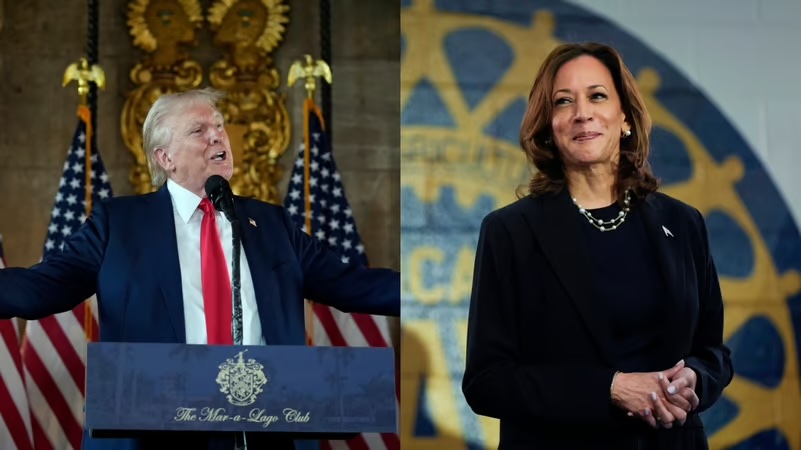
    While Trump’s erratic rhetoric may generate headlines, it is critical not to exaggerate its impact on this deeply rooted relationship. His habitual tendency to seek the spotlight and amplify his personal role in global diplomacy often lacked substantive backing or long-term vision.  Even his relationship with Elon Musk—once a vocal ally who contributed nearly $300 million to pro-Trump political efforts during the 2024 campaign—has deteriorated into public conflict, highlighting the unpredictability of Trump’s leadership style. In stark contrast, the India–U.S. partnership rests on far more stable and enduring foundations: bipartisan consensus within the U.S. strategic establishment, shared democratic values, converging geopolitical interests, and institutional mechanisms that safeguard continuity and progress.

    West Asia dynamics: No Indian shift

    Moreover, recent U.S. gestures toward Pakistan—including inviting Pakistan’s Army Chief to U.S. Army Day celebrations, public praise for its leadership, the release of funds for upgrading the F-16 fleet—and support in securing IMF bailout packages—should be analysed through the lens of broader strategic imperatives, particularly concerning Iran. Amid escalating tensions with Tehran and recent Israeli airstrikes on Iranian targets by its close ally Israel, Washington may be positioning itself for potential regional contingencies and wider escalation. In this context, logistical access to Pakistani military bases—notably Noor Khan Airbase, and other facilities which, according to senior analyst Imtiaz Gul, is already under partial U.S. operational control—could become critical. Pakistan has a history of facilitating U.S. military operations, such as during the War on Terror. Given its proximity to Iran, Pakistan is strategically well-placed to support U.S. initiatives in the region.

    The U.S. may also seek to ensure that Pakistan remains aligned with Western objectives should Israel act unilaterally against Iran. Therefore, recent goodwill gestures by the U.S. toward Pakistan should be interpreted not as a shift away from India, as some within the Indian strategic establishment might fear, but as part of a calculated strategy to secure regional flexibility amid evolving geopolitical uncertainties in West Asia.

    Ultimately, the strength and resilience of the India–U.S. relationship derive from its firm institutional foundation and shared strategic vision. It is largely insulated from the whims of transient political figures. Despite periodic turbulence, the partnership has demonstrated remarkable continuity and adaptability. Key U.S. national security documents—including the Indo‑Pacific Strategy and the National Security Strategy—consistently describe India as a “major defense partner” and an indispensable actor in the effort to balance China’s regional ambitions. These structural commitments ensure that the bilateral relationship remains on a trajectory of deepening cooperation. As articulated in the 2022 U.S. Indo-Pacific Strategy, India is seen as a “like-minded partner and leader in South Asia and the Indian Ocean, active in and connected to Southeast Asia,” and a “driving force of the Quad and a net security provider in the region.”

    Conclusion

    Today, the India–U.S. relationship stands as a beacon of mutual trust, strategic alignment, and forward-looking engagement. Decades of deliberate diplomacy, institutional investment, and cultural linkage have given rise to one of the most promising partnerships of the 21st century. While figures like President Trump may generate momentary uncertainty, they lack the capacity to derail the deep-rooted and multidimensional nature of this partnership. The future of India–U.S. relations remains bright, anchored in shared democratic ideals, strategic complementarity, and a common vision for a free, open, and inclusive Indo-Pacific.

    Feature Image credit: news18.com

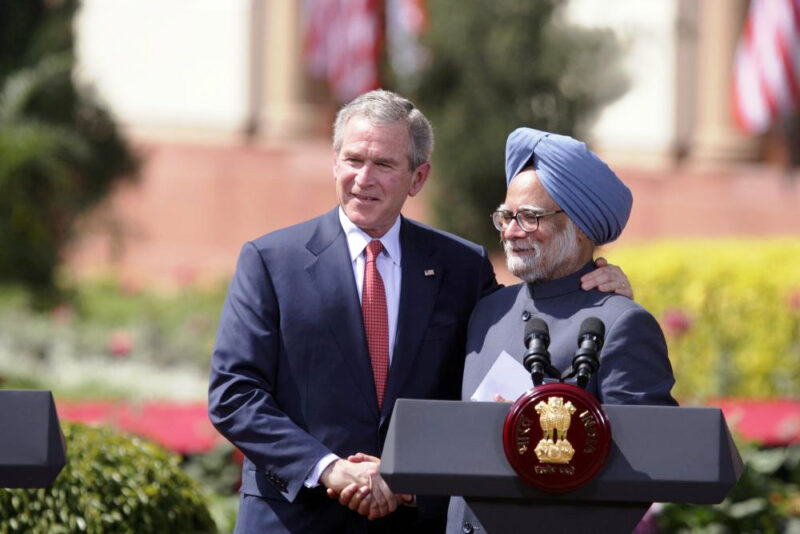
    Image of  President Bush and PM Manmohan Singh: wikipedia India-United States Civil Nuclear Deal.

  • Trump and Musk, Canada, Panama and Greenland, an old Story

    Trump and Musk, Canada, Panama and Greenland, an old Story

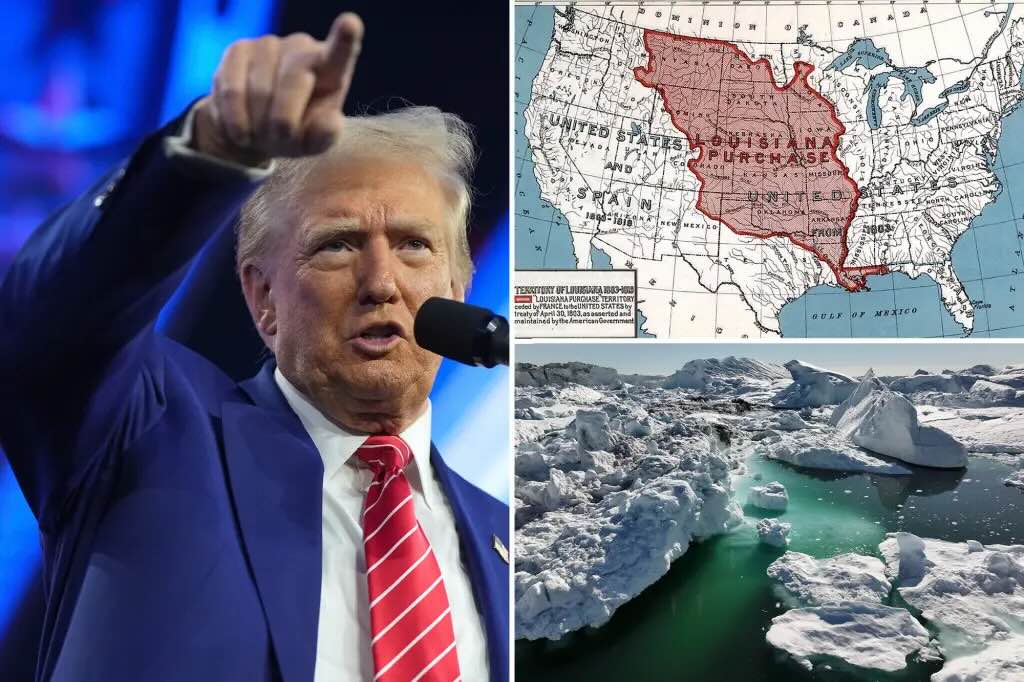
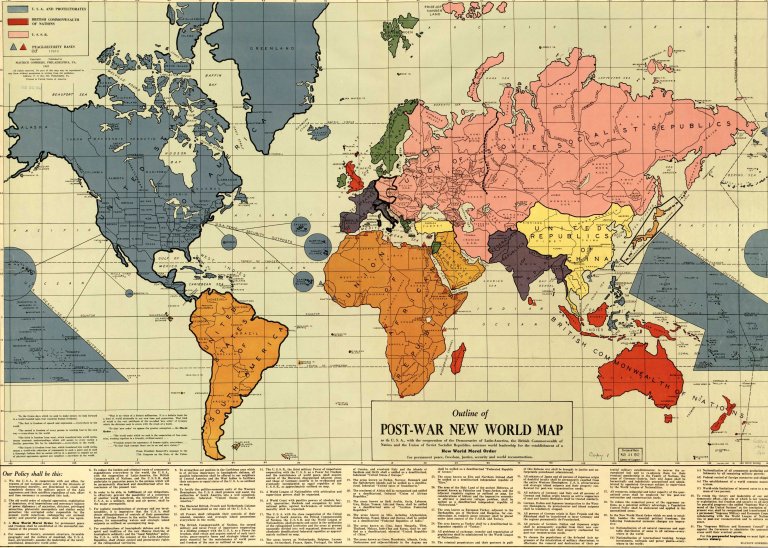
    Re-elected President Donald Trump has mentioned a possible annexation of the Panama Canal, Canada and Greenland. A crazy project that already appeared on a map, imagined in 1941 by a follower of the technocratic movement. However, it was the French branch of this movement that invented the transhumanism dear to Elon Musk, whose grandfather was responsible for the Canadian branch of the technocratic movement.

    When the technocratic movement considered annexing Greenland, it recalled that it is located on the North American continental shelf and based its decision on the importance of its natural resources. It holds precious rare earth minerals [4], as well as uranium, billions of barrels of oil and vast reserves of natural gas, previously inaccessible but increasingly less so.

    The post-World War II world map, drawn by Maurice Gomberg in 1941. The United States extends from Canada to the Panama Canal and includes Greenland.

    The statements of the re-elected US President Donald Trump, before his inauguration, announcing that he intended to buy Greenland (which he had already compared in 2019 to a “big real estate deal”) and to annex both Canada and the Panama Canal have stunned us. No Western leader had made such statements since the Second World War. The US ruling class instead saw it as a “new frontier”, that is to say, new territories where their country could continue its advance.

    The Danish government, on which Greenland depends, has indicated that it is not for sale, that it is an “autonomous territory” owned only by the Greenlanders. German Chancellor Olaf Scholz called for “the principle of the inviolability of borders to apply to all countries… whether it is a very small one, or a very powerful one.” French Foreign Minister Jean-Noël Barrot commented: “There is no doubt that the European Union would not allow other nations of the world to attack its sovereign borders.” British Foreign Secretary David Lamy said Donald Trump “raises concerns about Russia and China in the Arctic, which concern the national economic security” of the United States. These are “legitimate issues.” Finally, for Italian Prime Minister Giorgia Meloni, these statements are “more of a message intended” to “other great powers rather than hostile claims against these countries. These are two territories where in recent years we have seen increasing activism by China. »

    Canadian Prime Minister Justin Trudeau, who was elected as Pierre Trudeau’s son and therefore as a defender of national independence, turned out to be nothing more than a follower of Washington. He therefore had nothing to say about what seems obvious: by joining the United States, his country would have nothing to lose that it has not already lost and everything else to gain. So he resigned.

    Concerning the Panama Canal, Donald Trump had insinuated that it was operated by the Chinese army. Panamanian President José Raúl Mulino responded: “The canal is not controlled, directly or indirectly, by China, the European Community, the United States or any other power. As a Panamanian, I firmly reject any expression that distorts this reality.”

    We will explain here that these ideas of annexation are not new, but date back to the 1929 crisis, and that they correspond to a coherent ideological corpus defended, until last week, by the only multi-billionaire Elon Musk whom we knew rather as an admirer of the Serbian engineer Nicolas Tesla and as a follower of transhumanism.

    During the “Great Depression”, that is to say the Wall Street crisis and the economic storm that followed, all the American and European elites considered that capitalism, in its then form, was definitively dead. Joseph Stalin proposed the Soviet model as the only answer to the crisis, while Benito Mussolini (former representative of Lenin in Italy) proposed, on the contrary, fascism. But in the United States, a third solution was proposed: technocracy.

    Criticizing the traditional reading of supply and demand, the economist Thorstein Veblen was interested in the motivations of buyers. He showed that the man who can afford leisure actually does so to reinforce his social superiority, and must therefore show it. Leisure is therefore not a form of laziness, but “expresses the unproductive consumption of time”. Consequently, in many situations, contrary to popular belief, “The more the price of a good increases, the more its consumption also increases” (Veblen’s paradox). It is therefore not prices, but group behavior and individual motivations that dictate the economy.

    Thorstein Veblen’s iconoclastic thinking gave birth, among others, to Howard Scott’s technocratic movement. He imagined that power should be given neither to capitalists nor to proletarians, but to technicians.

    This movement was exported to France around polytechnicians, notably the esoteric novelist Raymond Abellio (who founded the sect of which François Mitterrand was a member until his death) and Jean Coutrot, the inventor of transhumanism. Little by little, this movement would have engendered in the occult circles of Philippe Pétain’s regime a secret society, the Synarchy.

    Coutrot’s transhumanism foreshadows Elon Musk’s transhumanism. For Coutrot, it was about using technology to go beyond humanism. For Elon Musk, it is more about using technology to change man.

    This movement of ‘technocracy’ is based on a dominant challenge to the functioning of democracies. It professes not to engage in politics and to find technical solutions to all problems.

    Given this lineage, we understand that any reference to technocracy in France is discredited from the start. However, this movement is based on a dominant challenge to the functioning of democracies. It professes not to engage in politics and to find technical solutions to all problems. Whether we like it or not, it is present in the United States in the belief that it is technical progress that will solve everything.

    The fact remains that the technocratic movement, relying on statistical knowledge from the interwar period, was convinced that the North American continent constituted a unit in terms of mineral resources and industries.

    Joshua Haldeman

    The head of the Canadian branch of the movement, chiropractor Joshua Haldeman, was arrested during the Second World War because he defended neutrality towards Nazi Germany. He was indeed pro-Hitler and anti-Semitic [1]. After the war, he settled in South Africa, seduced by its apartheid regime. His grandson is none other than Elon Musk.

    It should be noted that the multi-billionaire’s position within the Trump administration is increasingly contested from within. Thus Steve Bannon was able to declare to Corriere della Sera: “Elon Musk will not have full access to the White House, he will be like any other person. He is really an evil guy, a very bad guy. I made it a personal thing to fire this guy. Before, because he put money in, I was ready to tolerate it, I am no longer ready to tolerate it.” [2].

    Elon Musk

    Maurice Goldberg envisaged a division of the world by civilizations. The United States would have been expanded to include all of North America, from Canada to the Panama Canal, and to many Pacific and Atlantic islands, including the Antilles, Greenland and Ireland.

    Some members of the technocratic movement gave great importance to the post-World War II world map drawn up in 1941 by an anonymous author signing under the pseudonym Maurice Gomberg. However, he envisaged a division of the world by civilizations. The United States would have been expanded to include all of North America, from Canada to the Panama Canal, and to many Pacific and Atlantic islands, including the Antilles, Greenland and Ireland. Like the French Synarchy, this map has been widely discussed in conspiracy circles. However, according to historian Thomas Morarti, quoted by the Irish press [3], this map resonated with President Franklin D. Roosevelt during his “Four Freedoms speech” (freedom of speech, freedom of religion, freedom from want, and freedom from fear) on January 6, 1941. Along the same lines, in 1946, President Harry Truman proposed that US troops not evacuate Greenland, which they had liberated from the Nazis, but buy it for $100 million.

    In 1951, Denmark authorized the establishment of two large US and NATO military bases in Greenland, at Sondreström and Thule. Elements of the US anti-ballistic system have since been installed there. The treaty authorizing these bases was co-signed by Greenland in 2004, that is, after it had acquired its autonomous status.

    In 1968, a US strategic bomber, which was taking part in a routine operation in the context of the Cold War, accidentally crashed near Thule, contaminating the region with a cloud of enriched uranium. It was learned in 1995 that the Danish government had tacitly authorized the United States, in violation of Danish law, to store nuclear weapons on its soil.

    The purchase of Greenland could, therefore, easily take place without money. All that would be required would be for the Pentagon to ensure the protection of Denmark, thus freeing it from a financial burden.

    Donald Trump Jr. and his team “on vacation” in Greenland.

    Giving reality to what seemed to be just empty talk, Donald Trump Jr., the son of the re-elected president, went on vacation to Greenland. Of course, on board a family plane and surrounded by a group of advisors. He did not meet, officially at least, with any political leader. During this trip, the NGO Patriot Polling conducted a survey. The majority of respondents (57.3%) approved of the idea of joining the United States, while 37.4% were against it. Of those surveyed, 5.3% remained undecided. Following the publication of these results, Múte B. Egede gave a press conference in Copenhagen that even if he had not spoken with the Trumps, he was open to “discussions on what unites us. We are ready to discuss. Cooperation is a question of dialogue. Cooperation means that you will work to find solutions.”

    When the technocratic movement considered annexing Greenland, it recalled that it is located on the North American continental shelf and based its decision on the importance of its natural resources. It holds precious rare earth minerals [4], as well as uranium, billions of barrels of oil and vast reserves of natural gas, previously inaccessible but increasingly less so. Rare earths are now almost exclusively available to China. However, they have become essential for high technology, particularly for Tesla cars. These natural reserves are not exploited due to the traditional opposition of the indigenous populations, the Inuit (88% of the population).

    Today, Greenland is above all a strategic issue. It would allow the United States to control the Northern Sea Route, which is now navigable. Since this is currently controlled by Russia and China, a change in the island’s ownership would transform the geopolitical equation. That is why Dmitry Peskov, the Kremlin spokesman, commented: “The Arctic is a zone of our national interests, our strategic interests. We want to preserve the climate of peace and stability in the Arctic zone. We are watching the rather spectacular development of the situation very closely, but so far, thank God, only at the level of statements.”

    References to the technocratic movement may have nothing to do with Musk and Trump, but they should be kept in mind as events unfold.


    Translated from French by Roger Lagasse’


    References:

    [1The International Conspiracy to Establish a World Dictatorship & The Menace to South Africa, Joshua Haldeman. Cité dans «The World According to Elon Musk’s Grandfather», Jill Lepore, The New Yorker, September 19, 2023.

    [3«United mates of America», Tom Prendeville, Irish Mirror.

    [4Greenland is only mentioned once in the Technocracy Study Course. Rare earths were ignored at the time.


    This article was published earlier in Voltairenet.org
    and is republished under Creative Commons (license CC-BY-NC-ND)

    Feature Image Credit: nypost.com

  • An Outside View of the US 2024 Presidential Election

    An Outside View of the US 2024 Presidential Election

    What was the voter turnout?

    The big change is that Harris, so far, has lost 9 million voters since 2020, while Trump has gained only 1.2 million. Harris’s count of lost votes will decline as the final votes come in, but the bigger story remains that Harris lost more votes than Trump gained.

    Voter turnout is NOT final, but it is likely between 153 and 156 million, down from 2020 but still the second-highest percentage turnout in 100 years. At a minimum, 107 million adults did not vote (88 million of whom are “eligible” to vote). Thus, 41% or more of the adult population and 36% of the eligible voters did not vote.

    Using the percentage of voter groups who voted for Trump is misleading.  The news remains that the significant change is the loss of Harris voters.

    What were the economic issues?

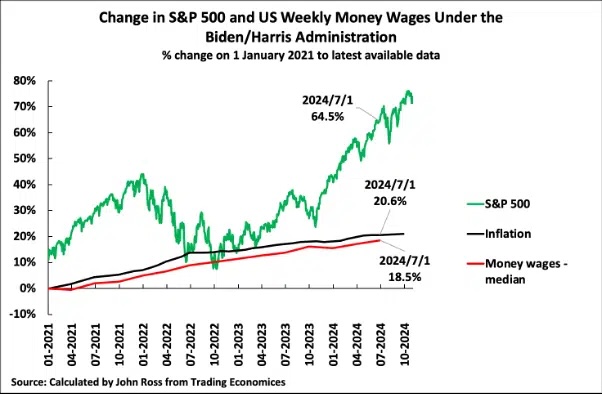
    Daily survival has become a serious problem for the bottom 65% due, specifically, to the inflation of grocery items and increasing mortgage payments and rent. Aggregate figures don’t reflect this reality.

    Workers’ actual standard of living was worse under Biden than under Trump.

    Real wages in the US remain lower than they were a half-century ago.

    Are there differences between Democrats and Republicans?

    US electoral parties are NOT like those in Europe – they have always been a different version of bourgeois electoral systems. Both major US parties are corporations, not parties with memberships, ideologies, and programs. They are designed like a marketplace of individuals preening for the Presidency, much like the Westminster Kennel Club Dog Show, but only held every four years.

    The Democrats turned over their foreign policy to the CNAS group of neo-con warmongers who will now be displaced.

    The Republicans are also not an actual party; Trump proved this, and what is next for Republicans post-Trump is also uncertain.

    What are the class shifts in the US?

    There is a new stratification of the bourgeoisie, with billionaires as a new factor. The increasingly dominant discourse amongst the capitalist class has the wherewithal to exert its influence.

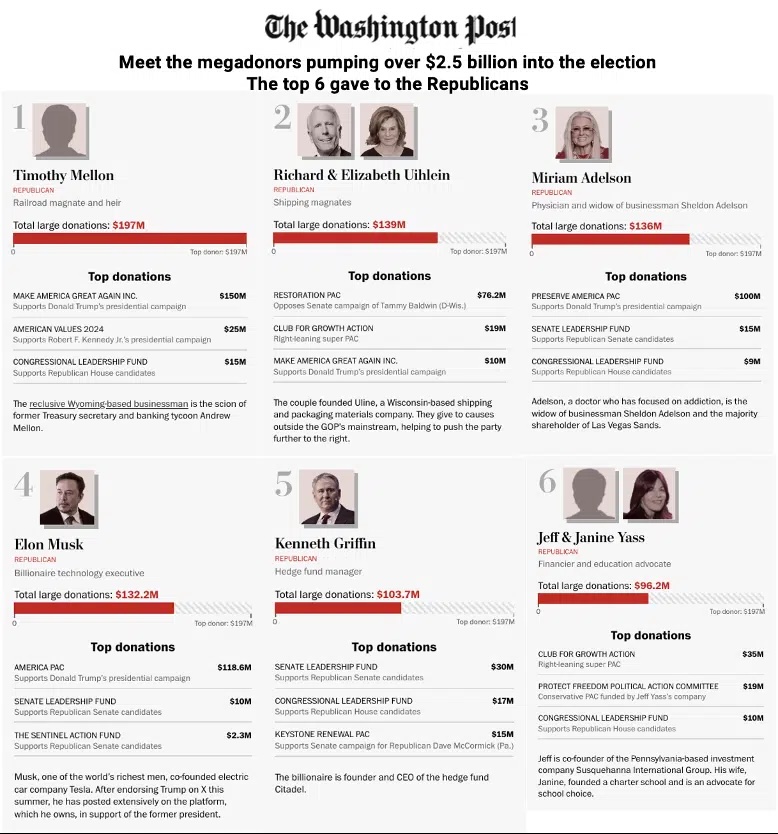
    Fifty Billionaires put 2.5 billion US dollars, 45% of the 5.5 billion total, into the Presidential election. Of this, 1.6 billion went to the Republicans, 750 million to the Democrats, and the rest to both. The total spent on the election, in all races, was 16 billion, a sign of a kleptocracy, not a thriving democracy.

    washingtonpost.com/elections/interactive/2024/biggest-campaign-donors-election-2024

    There is a concerted effort by a section of libertarian tech billionaires, including Thiel and Musk, to have their hands directly on the levers of the state to control the race for global domination of AI. They believe that they alone should control the advances in the AI space for the world and that the initial next step is what is called Artificial General Intelligence (AGI). These megalomaniacs believe this will begin the control of humans by machine intelligence and, perhaps, in their perverse dreams, the end of humanity.

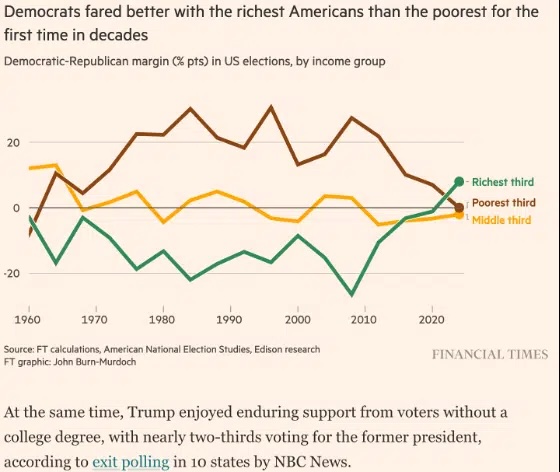
    A growing number of lesser capitalists, such as multimillionaires, are now being lumped into the upper middle class and the wealthiest one-third of voters. One very important trend to note is that in the last fifteen years, the richest one-third have switched allegiance from Republicans to Democrats.

    Why did Harris lose 6 to 9 million votes?

    Workers were worse off, wages did not keep up, and inflation left a long, lingering impact.  Some of the youth vote left for economic reasons. Others were disillusioned and demoralised by the full-throated support of the genocidal war in Gaza by the Democratic Party. Muslims, while a small group, voted for a third party or Trump.

    Despite the fabrications of the Democratic Party corporate handlers, Harris was, in fact, inauthentic, unlikeable, shallow, and could not mask her history as a prosecutor who spent her life attacking the rights of the poor.

    Dissatisfaction with many Western elected parties is growing – Conservative in the UK, Centre Right in France, right-wing in Germany – all thrown out. Biden left a demoralised Democratic Party and left too late.

    Fear-mongering about fascism was core to the rhetoric of the Democrats, even though no one knows what the term means.  Some voters became annoyed at the harassment by the liberals to vote for them since they were the last rail of defence against fascism. Many people did not believe Trump was, in fact, a fascist, nor did they believe that every one of their family members who listened to Trump was a fascist.

    Apathy is growing and remains a real issue.

    Probably over a million stayed at home as they could not stomach the Democratic Party’s gleeful support for Genocide. Trump’s victory in Michigan was certainly due to this issue.

    Harris played to and fawned over the war criminal Dick Cheney, the architect of the invasion of Iraq and a historic right-wing enemy of the Democrats.  We don’t know how many voters left in disgust. 

    Why did Trump gain votes?

    Trump took advantage of working-class dissatisfaction. Even so, he only gained less than 2 million total new votes. There is no evidence of a widescale shift of working-class votes to the Republicans in this election.

    Working-class women voted for local candidates supporting abortion but voted for Trump for economic and other reasons. Others voted on local issues important to them and then voted for Trump as they felt that despite his unsavoury behaviours, he was more committed to “shaking things up”.

    The billionaire class made sure that Trump had ample funds. Elon Musk’s America Pac spent $118 million handling field operations for the Trump campaign, an unusual role for a super PAC.

    From 2008 to 2020, there was a decline in the percentage of voters supporting the Democrats amongst the bottom 1/3 of income earners in the US.

    ft.com/content/6de668c7-64e9-4196-b2c5-9ceca966fe3f


    Too little data is available now to provide a detailed answer about the relatively insignificant number of voters who voted Democrat in 2020 and Republican in 2024.

    What is the assessment of the new cabinet positions announced?

    Trump’s sixteen appointments to date are all vocal supporters of genocide in Palestine. In the United States, there are both Jewish and Christian Zionists. Trump has appointed several Christian Zionists. The majority are China hawks.

    When analysed from a US statecraft point of view, many are extremely underwhelming candidates. These include:

    • Secretary of State: Senator Marco Rubio: He is a rigid, fierce anti-communist.
    • Secretary of Defense: Pete Hegseth, an Army National Guard veteran and Fox News host: He is divisive and has no high-level military experience.
    • Attorney General: Representative Matt Gaetz of Florida: He has no experience in the Department of Justice and has had past legal controversies.
    • Director of National Intelligence: Former Representative Tulsi Gabbard of Hawaii. She has no intelligence background but is perhaps less rigid on international issues, a non-interventionist, and has a friendship with Indian Prime Minister Modi.
    • Ambassador to the United Nations: Representative Elise Stefanik of New York. She is an extreme Zionist, has near zero diplomatic experience, and has focused only on domestic issues, but is loyal to Trump.
    • Secretary of Homeland Security: South Dakota Governor Kristi Noem. She lacks national government experience, and her actions have veered toward radical anti-federalism.

    Due to some of these appointments, US stature in international affairs will likely diminish.

    Trump has brilliantly dismissed the extremely dangerous Pompeo. He has made it clear that few from the first inner group of his cabinet and advisors will return. The world will not miss them. Yet there is little evidence to suggest that Trump has the capacity to lead any group successfully for even an intermediate period. He is known for turning on people and turning them against each other.

    How do we interpret the vote?

    A significant section of the working class understandably abandoned the Democrats in this election.

    There is not a major right-wing shift in US attitudes, but there is a real base for the right.

    The Democratic Party elite is completely divorced from the masses. Parading the loyal royal cultural elite like Taylor Swift, Beyonce, and Bruce Springsteen reeked of wealth, opulence, and tone-deafness.

    Apathy should not be understated. At least 88 million didn’t vote, with a further 19 million disenfranchised.

    Third parties are structurally prevented from winning even a single state in a presidential election. They are structurally locked out of Congress. The United States has locked in a two-party system. Most voters have been captured by this belief.

    Small exceptions to this are wealthy candidates like Ross Perot in 1992 and Robert Kennedy Junior.

    There was huge intimidation at the end against supporters of third-party candidates, which depressed their vote even more than usual. In this just-held election, the Party for Liberation and Socialism Candidate Claudia Cruz received 134,348 votes so far.  Claudia Cruz’s 134 thousand votes is the highest number of votes for an explicit communist in American history. It exceeds the CPUSA’s William Z. Foster’s previous record of 120,000 votes in 1932. The 1932 vote was a higher percentage of the population as the US was smaller in 1932. These facts are a reminder of the long-term campaign of anti-communism within the US.

    Capital is clearly happy with Trump’s win, as evidenced by the November 6th celebration rally on Wall Street. They disagree with the liberal hype that he will bring an end to American society.

    Despite the lies of the liberals, the facts are that Trump formally initiated the New Cold War on China. His inner team are more fiercely anti-China than the Democrats, who are more bound to the Ukraine War.

    Trump has fewer restraints, controlling the Senate, House, Supreme Court, and Presidency.

    He could well launch a Third World War.  It would be a mistake to underestimate this danger.

    Other things people outside the US should know

    There is a tendency in some parts of the Global South to have a simplistic and false analysis that any enemy of the liberals is a friend of the Global South. This is a severely flawed argument. The imperialist far-right is not a good guy, a cultural conservative who wants to protect families and cultural life. Inside the US, conservative culture is tightly tied to slavery and genocide. It is misogynistic, racist, militaristic, and reactionary. We should not confuse the histories of Iran, Turkey, India, Ghana, and China with those of the US.

    Welcoming divisions in the enemy camp is often entirely correct. But Communists, socialists, and true democrats do not support reactionary views and always side with the people, not the far-right ideologues.

    There is also great confusion about MAGA and MAGA-Communism. First, Make America Great Again (MAGA) means returning (the second “A” in MAGA) to the full glory of the US industrial past. But what was that past? It was, in fact, the total economic, political, military, and racial subordination of the peoples of the Global South states to the US. It was the century of humiliation in China. This is not a return to be welcomed by history. MAGA is a profoundly reactionary, unacceptable outcome and concept.

    One of the greatest poets in the United States is Langston Hughes. One of his poems was called “Let America Be America Again.” But this was a parody as the actual statement was made in the refrain, “America Never Was America to Me”. The meaning of this poem was the false portrayal of the United States as ever having a glorious past, which was never true for the slaves or the working class.

    Second, there are a handful of personalities in the US who have taken the great word communism and sullied it with the idea of returning to this falsely idealised America. The old “strong” American industry was built on the backs of low-paid workers in the mines in Africa and elsewhere.

    Desiring a real communist path is a good thing. But tying it to an imperialist past, a past of violence, with reactionary views is the opposite path taken by Lenin, Mao, and Fidel.

    There is also a dangerous tendency to simply reject the liberal concepts of identity politics and embrace the values of far-right conservatism while lacking scientific thinking about the plight of women and other vulnerable groups.

    The CPC led the country in the first national Soviets in Ruijin in the struggle to abolish the prejudices of feudalism and emancipate women and national minorities in China. However, these rights have not yet been achieved in many countries, as there has been no communist revolution.

    True Communism is the path to advancing the overall interests of the working class in all countries, including women, national minorities, and other vulnerable groups.

    The Republican voter base in class-terms is the lower-middle class, which is overwhelmingly white, suburban, rural. It is amplified by fundamentalist Christians and the Republican regional strongholds.

    There are six “ideological” trends, all extreme right, in the Republican camp:

    1. Populist demagogues
    2. Extreme Libertarians
    3. Fanatical Christian-Zionists
    4. Virulent anti-communists
    5. Dangerous AI-obsessed Tech billionaires
    6. Complex conservatives

    The US economy will continue to perform poorly but better than the rest of the West. It will continue to use its dollar hegemony, reinforced with sanctions, to remove hundreds of billions from the Global South and to force Europe, Australia, and Japan to subordinate their economic interests to those of the US.

    The actual US budget for the military was $1.8 trillion last year. Significant cuts seem improbable.

    There is now a permanent Black upper middle class that produces a Black mis-leadership. This mis-leadership group has created two decades of Black war criminals and apologists for empire. The rise of this mis-leadership gang, however, should not overshadow the fact that most blacks remain oppressed and exploited.

    The anti-immigrant politics in the U.S. is directed primarily at undocumented immigrants from Mexico, Central America and the Caribbean.

    But there is a false belief that all immigrants in the US are working class and progressive – it is just not true. An important stratum of non-working-class immigrants in the US are amongst the most virulent defenders of US atrocities in the world.

    There is a belief that there is a conspiracy of some secret group of members of the military and government that decide most things, which they call the Deep State. This is a lazy concept. It denies that all states have a class character and permanent army. In the US, it has been estimated that over 5 million people have security clearance, and many have near-lifetime employment. There is no need for conspiracy theories. The US does have an advanced state that functions on behalf of capital. This state manages the affairs of the often-competing large capitalists and is now increasingly primarily favouring the billionaires amongst the capitalist class. Thus, a better way to see the US State is through the lens of Mao, Lenin, and Marx and not as some inexplicable conspiracy.

    There is a special relationship between the US and Israel, both extreme white-settler states. In the US alone, over 30 House, Senate, and cabinet members are dual citizens of the US and Israel. Israel does not control the US, BUT they are socially a duopoly.

    They are the CORE of Ring 1 of the Global North, the core of the imperialist bloc, along with the UK, Canada, and Australia.

    The long-term trend is clear – bourgeois liberal democracy is failing globally.

    What is the domestic consequence of the vote?

    Since 2016, the very top of the capitalist class has led and mobilised a neo-fascist movement. Increasing levels of force and lawfare will now be used internally inside the US.

    Trump himself is not a fascist per se. He is super-egoistic and believes he can act with near absolute impunity.

    But he is riding on, and a beneficiary of changing class phenomena.

    Fascism is not so much an ideology as a structural class relationship in which the lower-middle class, which has a revanchist ideology, is mobilized by big capital during a period of internal and external disequilibrium.

    The New York Times and Financial Times use the word fascism as a scare tactic to maintain their role and influence in the state. Neo-fascism is a more precise word than fascism at this moment to describe the changes in the US.

    Historically, there are a few things that are necessary to define a fully fascist state in imperialist countries. One is that the state uses methods of control it would typically use only for its colonies and neo-colonies, i.e., extreme widespread violence and force.  The other is that they resort to the overthrow of the constitution.

    The Constitution is unlikely to be changed directly. However, the original Constitution, an eighteenth-century document, has many gaps that can be exploited.

    Radical and extreme legal changes are thus probable. There will be a reversal of 70 years of civil rights.

    Overall, it remains to be seen how far the capitalist class is willing to go.

    State capacity in many areas other than defence and border police will be diminished. Trump 1 saw big cuts in the State Department.  Even with Rubio present, it is unlikely to be refunded to its old level.

    The Billionaires will play a direct role in key tasks, from meeting Zelensky to chain-sawing government departments. Some departments, like Agriculture, Education, and Health and Human Services, are, in fact, decrepit, corrupt and dysfunctional. But a billionaire-led revamp will result in an unsavoury privatized equally dysfunctional capitalist state bureaucracy.

    Trump is committed to a long-term isolationist strategy.  But the US has over 900 military bases abroad. It has fully supported the expansion of Israel’s War in the Middle East, building up its military in the process.

    Trump will not block the infrastructure projects that were voted in during Biden. The US recognises that its lost manufacturing capacity is a strategic deficit in military supply.

    The brunt of the cutbacks will still increase the suffering of the 150 million working-class poor in the US.

    The Left will be even more subjected to severe repression. Rubio is salivating.

    What are the possible international consequences?

    Despite the recent Zelensky meeting, the US will probably push a cease-fire and curtail the Ukraine war. Crimea is off the table. The current military lines will be the starting point. Doing this could reduce the immediate danger of a nuclear war. In April of this year, both Vance and Rubio voted against the 95-billion-dollar US military aid bill for Ukraine.

    With Israel, there are three main possibilities:

    1. Trump curtails Netanyahu and calls for an end to Lebanon, no regime change in Iran, and an unjust peace agreement.
    2. He falls prey to the Christian Zionists and continues Genocide against Palestine.
    3. He goes against his no-war statements and approves an escalation with Iran.

    We don’t know, but option one is not impossible. Trump wants a deal with Saudi Arabia.

    A few days ago, MBS was forced to call it a Genocide, a rare statement from a long-term US ally.

    With China, there are also three possibilities:

    1. Trump says tariffs are his favourite word in the English language and wants to increase them and eliminate domestic taxes.
    2. Rubio and other super China-hating cabinet members push him to escalate.
    3. US national security elements and US tech moguls like Peter Thiel push US military preparations.

    On the question of Taiwan, some in the Global South fall for the liberal messaging soundbite in the West that Trump, the dealmaker, will sell Taiwan for a fee. This would bring strong resistance from the US military and large sections of the anti-communist members of his core group. This is a very unlikely case.

    The world should not be confused if Trump does initiate a ceasefire in Ukraine and pressures Netanyahu to curtail the Genocide. Neither of these actions reverses the long-term trend of the US towards militarization against China. Nothing Trump does will turn around anaemic long-term US economic growth.

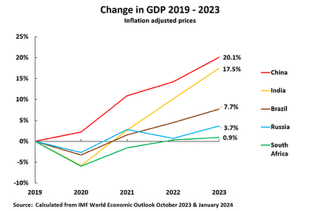
    China is still on target to surpass the US in current exchange rate GDP within 10 years.

    The US state is still on a long-term course to use its self-perceived military supremacy to destroy what it perceives as the Eurasian threat. It remains committed to dismembering the Russian Federation and overthrowing the CPC. The imperialists believe this is the path to a thousand-year reign of unilateral power.

    The US will continue, unabated, its strategy of seeking nuclear primacy and what is called the “counterforce” strategy, which plans on the use of a first strike or launch of nuclear weapons. Evidence of these dangerous changes in US military strategy can be seen by their unilateral withdrawal from the following treaties:

    • 2002 (Bush): the Anti-Ballistic Missile (ABM) treaty.
    • 2019 (Trump): the Intermediate Nuclear Forces (INF) treaty
    • 2020 (Trump): the Open Skies treaty

    Tucker Carlson has Trump’s ear for now and is not a proponent of military conflict.

    In 2023, a four-star general, Minihan, claimed that the US would be in a hot war with China in 2025. These are not accidental statements.

    It is unknown if Rubio, some of the far-right libertarians, and CNAS-influenced military forces can overcome Trump’s dislike of military conflict.

    The US is likely to increase its attention on Latin America and increase support for the far right like Bolsonaro and Milei.

    Large-scale aid to Africa is not likely to happen. The Angola railway project is now improbable.

    Final comments

    The US state is still on a long-term course to use its self-perceived military supremacy to destroy the Eurasian threat.

    The US has adopted counterforce and nuclear supremacy as its prime military strategy.

    The threat of war has not changed due to a new administration. Only, perhaps, the speed at which it will be accomplished.

    The economic and political assaults against the US working class will escalate, especially against progressives.

    The state will continue to tighten its grip on the so-called bourgeois democratic freedoms by further restricting voting rights, civil rights, and freedom of speech.


    This article was published earlier on MRonline 
    The article is republished underCreative Commons  Attribution-NonCommercial-NoDerivatives 4.0 International License.

    Creative Commons License


  • Intelligence: The Crux of Targetted Assassinations

    Intelligence: The Crux of Targetted Assassinations

    The USA has followed targetted assassination strategy since WW II days. It has cooped its allies such as Israel, Australia, and the UK. Targetted killings in the Middle East has been led by Israel with active intelligence support by the USA. With modern ISR capabilities, targets can be monitored or looked for on 24/7 basis for all 365 days of the year. A world that is integrated by common communications protocols and digital standards for ease of normal business becomes vulnerable to intelligence agencies by the same process of commonality. 


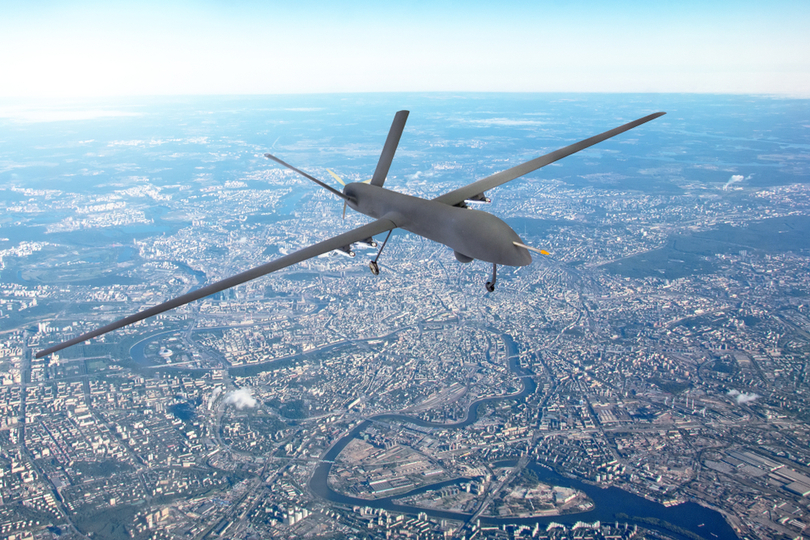
    On July 31, 2022, Osama bin Laden’s successor as the global head of Al Qaeda, Ayman al-Zawahiri, stepped out onto the balcony of his Taliban safe house in Kabul’s tony Wazir Akbar Khan area to catch a breath of fresh air and a bit of sunshine. About 40,000 feet above an American Predator B (aka Reaper MQ-9) drone, loitering to get a glimpse of him, caught him in its camera, and after its operators in Nevada, USA confirmed it with facial identification technology, ordered it to fire its single Hellfire R9X missile. The Hellfire is a small 100 lbs and five feet long air-to-ground missile (AGM) that races down a reflected laser beam with unerring accuracy. It costs about $ 150,000. The R9X, which was developed at the express request of Barack Obama, who wanted to minimise collateral damage due to an explosive charge, is a kinetic weapon that unsheathes multiple blades from its fuselage as it approaches the target at almost 900 mph like a whirling swordsman. Al-Zawahiri didn’t stand a chance.

    The USA and some other countries have bevvies of space satellites orbiting at preselected trajectories to watch over areas of interest. These satellites not only listen to targets but also track them and identify faces and vehicles by their plates. Osama bin Laden never looked up while on his morning walk at his Abbottabad residence but he was recognised by his height and the length of his shadow at the time of the day and by his gait. Al-Zawahari was either careless or underestimated America’s appetite for his head. He still had a $ 25 million reward, appetising enough for any informants.

    The number of active mobile phones worldwide exceeded 15 billion, which means that many people have more than a couple. Of these 7.2 billion are smartphones connecting people with huge reservoirs of information and content. India has 1.28 billion and China has 1.9 billion phones. The USA follows with 327 million and a dysfunctional country like Pakistan has 125 million. Even in countries with little semblance of a government or a state, like Somalia and Afghanistan or Mali or Libya, there are functioning mobile phone networks.

    As of June 30, 2021, there were about 4.86 billion internet users worldwide. Of these 44.8% were in Asia, 21.5% in Europe and 11.4% in all of North America. India was one of the last countries operating a telegraph service and as of end 2021, even that is in the past. Literally, it’s all up in the air now.

    But since data exchanged on cellular and internet networks fly through the ether and not as pulses racing through copper wires, they are easier to net by electronic interception. But these nets catch them in huge numbers. This is where the supercomputers come in. The messages that are netted every moment are run through sieves of sophisticated and complex computer programs that can simultaneously decode, detect and unravel, and by further analyzing the incoming and outgoing patterns of calls and data transfers for the sending and receiving terminals or phones, can with a fair probability of accuracy tell the agency seeking information about what is going on and who is up to what?

    The problem is that since this information also goes through mobile phone networks and Internet Service Providers (ISP), and the data actually gets decoded from electronic blips into voice and digital data, the private players too can gain access to such information.

    A few years ago we had the case of the infamous Amar Singh CDs, which titillated so many with their graphic content and low-brow conversations featuring the likes of Anil Ambani, Jayaprada, Bipasha Basu and some others. Then we had the episode of the Radia tapes where we were privy to the machinations of Tata’s corporate lobbyist in the national capital fixing policy, positioning ministers and string-pulling media stars. But more useful than this, a mobile phone, by nature of its technology, is also a personalised GPS indicator. It tells them where that phone is at any instant it is on. The Al Qaeda terrorist and US citizen Anwar el-Awlaki was blasted by a Hellfire missile fired from a CIA Predator drone flying over Yemen with the coordinates provided by Awlaki’s mobile phone.

    Since a mobile phone is usually with you it tells the network ( and other interested parties) where you are or were, and even where you are headed. If you are on a certain street since it reveals where exactly you are and the direction of your movement, it can tell you where the next pizza place is or where and what is on sale. This is also a breach of privacy, but often useful to you. But if you are up to no good, then a switched-on mobile phone is a certain giveaway.

    That’s what gave away Osama bin Laden in the end. A momentary indiscretion by a trusted courier and bodyguard and a name gleaned from a long-ago water-boarding session was all it took. To know what happened next see “Zero Dark Thirty” by Katherine Bigelow (now on Netflix and YouTube).

    The NSA is all hi-tech. NSA collects intelligence from four geostationary satellites. These satellites track and monitor millions of conversations and the NSA’s banks of high-speed supercomputers process all these messages for certain phrases and patterns of conversations to decide if the persons at either end were worthy of further interest.

    The NSA’s eavesdropping mission includes radio broadcasting, both from various organisations and individuals, the internet, telephone calls, and other intercepted forms of communication. Its secure communications mission includes military, diplomatic, and all other sensitive, confidential or secret government communications. The NSA is all hi-tech. NSA collects intelligence from four geostationary satellites. These satellites track and monitor millions of conversations and the NSA’s banks of high-speed supercomputers process all these messages for certain phrases and patterns of conversations to decide if the persons at either end were worthy of further interest. Link this information with the data from the CIA’s spinning satellites watching the movements of groups, individuals and vehicles, and you have a broad picture of what the people are doing.

    According to the Washington Post, “every day, collections systems at the National Security Agency intercept and store 1.7 billion e-mails, phone calls and other types of communications.” The NSA and CIA together comprise the greatest intelligence-gathering effort in the world. The overall U.S. intelligence budget is now declared to be $62.8 billion.


    Feature Image Credit: E-International Relations

    Article Image Credit: www.twz.com


  • UARCs: The American Universities that Produce Warfighters

    UARCs: The American Universities that Produce Warfighters

    America’s military-industrial complex (MIC) has grown enormously powerful and fully integrated into the Department of Defense of the US Government to further its global influence and control. Many American universities have become research centres for the MIC. Similarly, American companies have research programs in leading universities and educational institutions across the world, for example in few IITs in India. In the article below, Dr Sylvia J. Martin explores the role of University Affiliated Research Centers (UARCs) in the U.S. military-industrial complex. UARCs are institutions embedded within universities, designed to conduct research for the Department of Defense (DoD) and other military agencies. The article highlights how UARCs blur the lines between academic research and military objectives, raising ethical questions about the use of university resources for war-related activities. These centres focus on key areas such as nano-technology, immersive simulations, and weapons systems. For example, the University of South California’s Institute for Creative Technologies (ICT) was created to develop immersive training simulations for soldiers, drawing from both science and entertainment, while universities like Johns Hopkins and MIT are involved in anti-submarine warfare and soldier mobility technologies. Sylvia Martin critically examines the consequences of these relationships, particularly their impact on academic freedom and the potential prioritization of military needs over civilian research. She flags the resistance faced by some universities, like the University of Hawai’i, where concerns about militarisation, environmental damage and indigenous rights sparked protests against their UARCs. As UARCs are funded substantially, it becomes a source of major influence on the university. Universities, traditionally seen as centres for open, unbiased inquiry may become aligned with national security objectives, further entrenching the MIC within academics.

    This article was published earlier in Monthly Review.

    TPF Editorial Team

    UARCs: The American Universities that Produce Warfighters

    Dr Sylvia J Martin

    The University of Southern California (USC) has been one of the most prominent campuses for student protests against Israel’s campaign in Gaza, with students demanding that their university “fully disclose and divest its finances and endowment from companies and institutions that profit from Israeli apartheid, genocide, and occupation in Palestine, including the US Military and weapons manufacturing.”

    Students throughout the United States have called for their universities to disclose and divest from defense companies with ties to Israel in its onslaught on Gaza. While scholars and journalists have traced ties between academic institutions and U.S. defense companies, it is important to point out that relations between universities and the U.S. military are not always mediated by the corporate industrial sector.1 American universities and the U.S. military are also linked directly and organizationally, as seen with what the Department of Defense (DoD) calls “University Affiliated Research Centers (UARCs).” UARCs are strategic programs that the DoD has established at fifteen different universities around the country to sponsor research and development in what the Pentagon terms “essential engineering and technology capabilities.”2Established in 1996 by the Under Secretary of Defense for Research and Engineering, UARCs function as nonprofit research organizations at designated universities aimed to ensure that those capabilities are available on demand to its military agencies. While there is a long history of scientific and engineering collaboration between universities and the U.S. government dating back to the Second World War, UARCs reveal the breadth and depth of today’s military-university complex, illustrating how militarized knowledge production emerges from within the academy and without corporate involvement. UARCs demonstrate one of the less visible yet vital ways in which these students’ institutions help perpetuate the cycle of U.S.-led wars and empire-building.

    The University of Southern California (USC) has been one of the most prominent campuses for student protests against Israel’s campaign in Gaza, with students demanding that their university “fully disclose and divest its finances and endowment from companies and institutions that profit from Israeli apartheid, genocide, and occupation in Palestine, including the US Military and weapons manufacturing.”3  USC also happens to be home to one of the nation’s fifteen UARCs, the Institute of Creative Technology (ICT), which describes itself as a “trusted advisor to the DoD.”4  ICT is not mentioned in the students’ statement, yet the institute—and UARCs at other universities—are one of the many moving parts of the U.S. war machine that are nestled within higher education institutions, and a manifestation of the Pentagon’s “mission creep” that encompasses the arts as well as the sciences.5

    Institute of Creative Technologies – military.usc.edu

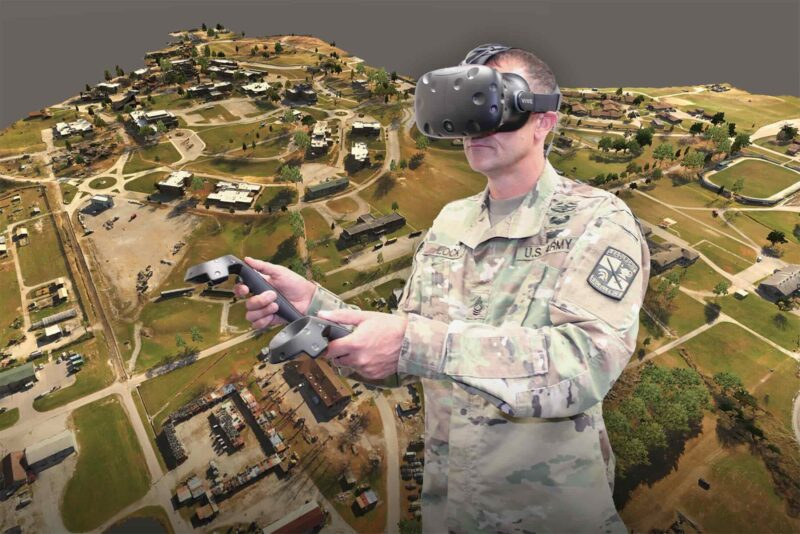
    Significantly, ICT’s remit to develop dual-use technologies (which claim to provide society-wide “solutions”) entails nurturing what the Institute refers to as “warfighters” for the battlefields of the future, and, in doing so, to increase warfighters’ “lethality.6 Established by the DoD in 1999 to pursue advanced modelling and simulation and training, ICT’s basic and applied research produces prototypes, technologies, and know-how that have been deployed for the U.S. Army, Navy, and Marine Corps. From artificial intelligence-driven virtual humans deployed to teach military leadership skills to futuristic 3D spatial visualization and terrain capture to prepare these military agencies for their operational environments, ICT specializes in immersive training programs for “mission rehearsal,” as well as tools that contribute to the digital innovations of global warmaking.7  Technologies and programs developed at ICT were used by U.S. troops in the U.S.-led Global War on Terror. One such program is UrbanSim, a virtual training application initiated in 2006 designed to improve army commanders’ skills for conducting counterinsurgency operations in Iraq and Afghanistan, delivering fictional scenarios through a gaming experience.8  From all of the warfighter preparation that USC’s Institute researches, develops, prototypes, and deploys, ICT boasts of generating over two thousand academic peer-reviewed publications.

    I encountered ICT’s work while conducting anthropological research on the relationship between the U.S. military and the media entertainment industry in Los Angeles.9  The Institute is located not on the university’s main University Park campus but by the coast, in Playa Vista, alongside offices for Google and Hulu. Although ICT is an approximately thirty-minute drive from USC’s main campus, this hub for U.S. warfighter lethality was enabled by an interdisciplinary collaboration with what was then called the School of Cinema-Television and the Annenberg School for Communications, and it remains entrenched within USC’s academic ecosystem, designated as a unit of its Viterbi School of Engineering, which is located on the main campus.10  Given the presence and power of UARCs at U.S. universities, we can reasonably ask: What is the difference between West Point Military Academy and USC, a supposedly civilian university? The answer, it seems, is not a difference in kind, but in degree. Indeed, universities with UARCs appear to be veritable military academies.

    What Are UARCs?

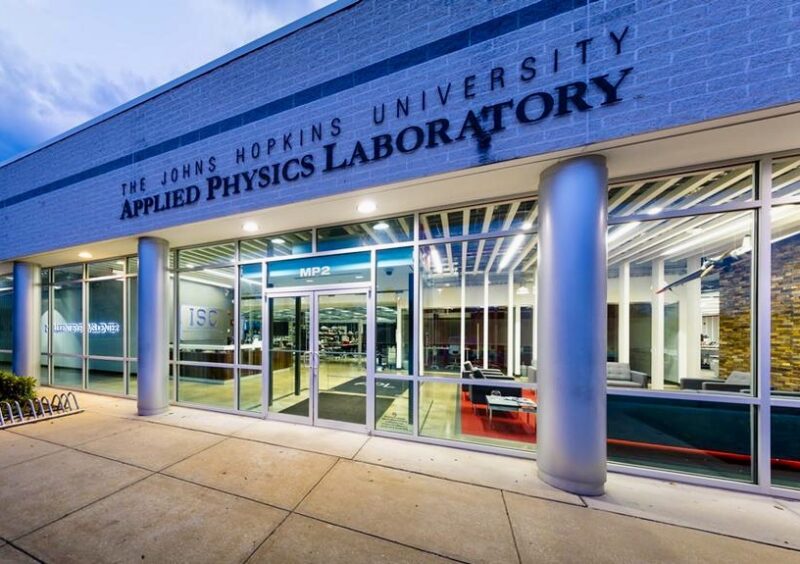
    UARCs are similar to federally funded research centres such as the Rand Corporation; however, UARCs are required to be situated within a university, which can be public or private.11  The existence of UARCs is not classified information, but their goals, projects, and implications may not be fully evident to the student bodies or university communities in which they are embedded, and there are differing levels of transparency among them about their funding. DoD UARCs “receive sole source funds, on average, exceeding $6 million annually,” and may receive other funding in addition to that from their primary military or federal sponsor, which may also differ among the fifteen UARCs.12  In 2021, funding from federal sources for UARCs ranged “from as much as $831 million for the Johns Hopkins University Applied Physics Lab to $5 million for the University of Alaska Geophysical Detection of Nuclear Proliferation.”13  Individual UARCs are generally created after the DoD’s Under Secretary of Defense for Research and Engineering initiates a selection process for the proposed sponsor, and typically are reviewed by their primary sponsor every five years for renewed contracts.14  A few UARCs, such as Johns Hopkins University’s Applied Physics Lab and the University of Texas at Austin’s Applied Research Lab, originated during the Second World War for wartime purposes but were designated as UARCs in 1996, the year the DoD formalized that status.15

    UARCs are supposed to provide their sponsoring agency and, ultimately, the DoD, access to what they deem “core competencies,” such as MIT’s development of nanotechnology systems for the “mobility of the soldier in the battlespace” and the development of anti-submarine warfare and ballistic and guided missile systems at Johns Hopkins University.16  Significantly, UARCs are mandated to maintain a close and enduring relationship with their military or federal sponsor, such as that of ICT with the U.S. Army. These close relationships are intended to facilitate the UARCs’ “in-depth knowledge of the agency’s research needs…access to sensitive information, and the ability to respond quickly to emerging research areas.”17  Such an intimate partnership for institutions of higher learning with these agencies means that the line between academic and military research is (further) blurred. With the interdisciplinarity of researchers and the integration of PhD students (and even undergraduate interns) into UARC operations such as USC’s ICT, the question of whether the needs of the DoD are prioritized over those of an ostensibly civilian institute of higher learning practically becomes moot: the entanglement is naturalized by a national security logic.

    Table 1 UARCs: The American Universities that Produce Warfighters

    Primary Sponsor University UARC Date of Designation (*original year established)
    Army University of Southern California Institute of Creative Technologies 1999
    Army Georgia Institute of Technology Georgia Tech Research Institute 1996 (*1995)
    Army Massachusetts Institute of Technology Institute for Soldier Nanotechnologies 2002
    Army University of California, Santa Barbara Institute for Collaborative Biotechnologies 2003
    Navy Johns Hopkins University Applied Physics Laboratory 1996 (*1942)
    Navy Pennsylvania State University Applied Research Laboratory 1996 (*1945)
    Navy University of Texas at Austin Applied Research Laboratories 1996 (*1945)
    Navy University of Washington Applied Physics Laboratory 1996 (*1943)
    Navy University of Hawai’i Applied Research Laboratory 2004
    Missile Defense Agency Utah State University Space Dynamics Laboratory 1996
    Office of the Under Secretary of Defense for Intelligence and Security University of Maryland, College Park Applied Research Laboratory for Intelligence and Security 2017 (*2003)
    Under Secretary of Defense for Research and Engineering Stevens Institute of Technology Systems Engineering Research Center 2008
    U.S. Strategic Command University of Nebraska National Strategic Research Institute 2012
    Department of the Assistant Secretary of Defense (Threat Reduction and Control) University of Alaska Fairbanks Geophysical Detection of Nuclear Proliferation 2018
    Air Force Howard University Research Institute for Tactical Autonomy 2023
    Sources: Joan Fuller, “Strategic Outreach—University Affiliated Research Centers,” Office of the Under Secretary of Defense (Research and Engineering), June 2021, 4; C. Todd Lopez, “Howard University Will Be Lead Institution for New Research Center,” U.S. Department of Defense News, January 23, 2023.

    A Closer Look

    The UARC at USC is unique from other UARCs in that, from its inception, the Institute explicitly targeted the artistic and humanities-driven resources of the university. ICT opened near the Los Angeles International Airport, in Marina del Rey, with a $45 million grant, tasked with developing a range of immersive technologies. According to the DoD, the core competencies that ICT offers include immersion, scenario generation, computer graphics, entertainment theory, and simulation technologies; these competencies were sought as the DoD decided that they needed to create more visually and narratively compelling and interactive learning environments for the gaming generation.18  USC was selected by the DoD not just because of the university’s work in science and engineering but also its close connections to the media entertainment industry, which USC fosters from its renowned School of Cinematic Arts (formerly the School of Cinema-Television), thereby providing the military access to a wide range of storytelling talents, from screenwriting to animation. ICT later moved to nearby Playa Vista, part of Silicon Beach, where the military presence also increased; by April 2016, the U.S. Army Research Lab West opened next door to ICT as another collaborative partner, further integrating the university into military work.19  This university-military partnership results in “prototypes that successfully transition into the hands of warfighters”; UARCs such as ICT are thus rendered a crucial link in what graduate student worker Isabel Kain from the Researchers Against War collective calls the “military supply chain.”20

    universities abandon any pretence to neutrality once they are assigned UARCs, as opponents at the University of Hawai’i at Mānoa (UH Mānoa) asserted when a U.S. Navy-sponsored UARC was designated for their campus in 2004. UH Mānoa faculty, students, and community members repeatedly expressed their concerns about the ethics of military research conducted on their campus, including the threat of removing “researchers’ rights to refuse Navy directives”

    USC was touted as “neutral ground” from which the U.S. Army could help innovate military training by one of ICT’s founders in his account of the Institute’s origin story.21  Yet, universities abandon any pretence to neutrality once they are assigned UARCs, as opponents at the University of Hawai’i at Mānoa (UH Mānoa) asserted when a U.S. Navy-sponsored UARC was designated for their campus in 2004. UH Mānoa faculty, students, and community members repeatedly expressed their concerns about the ethics of military research conducted on their campus, including the threat of removing “researchers’ rights to refuse Navy directives.”22  The proposed UARC at UH Mānoa occurred within the context of university community resistance to U.S. imperialism and militarism, which have inflicted structural violence on Hawaiian people, land, and waters, from violent colonization to the 1967 military testing of lethal sarin gas in a forest reserve.23 Hawai’i serves as the base of the military’s U.S. Indo-Pacific Command, where “future wars are in development,” professor Kyle Kajihiro of UH Mānoa emphasizes.24

    Writing in Mānoa Now about the proposed UARC in 2005, Leo Azumbuja opined that “it seems like ideological suicide to allow the Navy to settle on campus, especially the American Navy.”25 A key player in the Indo-Pacific Command, the U.S. Navy has long had a contentious relationship with Indigenous Hawaiians, most recently with the 2021 fuel leakage from the Navy’s Red Hill fuel facility, resulting in water contamination levels that the Hawai’i State Department of Health referred to as “a humanitarian and environmental disaster.”26  Court depositions have since revealed that the Navy knew about the fuel leakage into the community’s drinking water but waited over a week to inform the public, even as people became ill, making opposition to its proposed UARC unsurprising, if not requisite.27  The detonation of bombs and sonar testing that happens at the biennial international war games that the U.S. Navy has hosted in Hawai’i since 1971 have also damaged precious marine life and culturally sacred ecosystems, with the sonar tests causing whales to “swim hundreds of miles, rapidly change their depth (sometimes leading to bleeding from the eyes and ears), and even beach themselves to get away from the sounds of sonar.”28  Within this context, one of the proposed UARC’s core competencies was “understanding of [the] ocean environment.”29

    In a flyer circulated by DMZ Hawaii, UH Mānoa organizers called for universities to serve society, and “not be used by the military to further their war aims or to perfect ways of killing or controlling people.”30  Recalling efforts in previous decades on U.S. campuses to thwart the encroachment of military research, protestors raised questions about the UARC’s accountability and transparency regarding weapons production within the UH community. UH Mānoa’s strategic plan during the time that the Navy’s UARC was proposed and executed (2002–2010) called for recognition of “our kuleana (responsibility) to honour the Indigenous people and promote social justice for Native Hawaiians” and “restoring and managing the Mānoa stream and ecosystem”—priorities that the actions of the U.S. Navy disregarded.31  The production of knowledge for naval weapons within the auspices of this public, land-grant institution disrupts any pretension to neutrality the university may purport.

    while the UH administration claimed that the proposed UARC would not accept any classified research for the first three years, “the base contract assigns ‘secret’ level classification to the entire facility, making the release of any information subject to the Navy’s approval,” raising concerns about academic freedom, despite the fanfare over STEM and rankings

    Further resistance to the UARC designation was expressed by the UH Mānoa community: from April 28 to May 4, 2005, the SaveUH/StopUARC Coalition staged a six-day campus sit-in protest, and later that year, the UH Mānoa Faculty Senate voted 31–18 in favour of asking the administration to reject the UARC designation.32  According to an official statement released by UH Mānoa on January 23, 2006, at a university community meeting with the UH Regents in 2006, testimony from opponents to the UARC outnumbered supporters, who, reflecting the neoliberal turn of universities, expressed hope that their competitiveness in science, technology, engineering, and mathematics (STEM) would advance with a UARC designation, and benefit the university’s ranking.33  Yet in 2007, writing in DMZ Hawaii, Kajihiro clarified that while the UH administration claimed that the proposed UARC would not accept any classified research for the first three years, “the base contract assigns ‘secret’ level classification to the entire facility, making the release of any information subject to the Navy’s approval,” raising concerns about academic freedom, despite the fanfare over STEM and rankings.34  However, the campus resistance campaign was unsuccessful, and in September 2007, the UH Regents approved the Navy UARC designation. By 2008, the U.S. Navy-sponsored Applied Research Laboratory UARC at UH Mānoa opened.

    “The Military Normal”

    Yet with the U.S. creation of the national security state in 1947 and its pursuit of techno-nationalism since the Cold War, UARCs are direct pipelines to the intensification of U.S. empire

    UH Mānoa’s rationale for resistance begs the question: how could this university—indeed, any university—impose this military force onto its community? Are civilian universities within the United States merely an illusion, a deflection from education in the service of empire? What anthropologist Catherine Lutz called in 2009 the ethos of “the military normal” in U.S. culture toward its counterinsurgency wars in Iraq and Afghanistan—the commonsensical, even prosaic perspective on the inevitability of endless U.S.-led wars disseminated by U.S. institutions, especially mainstream media—helps explain the attitude toward this particular formalized capture of the university by the DoD.35  Defense funding has for decades permeated universities, but UARCs perpetuate the military normal by allowing the Pentagon to insert itself through research centres and institutes in the (seemingly morally neutral) name of innovation, within part of a broader neoliberal framework of universities as “engines” and “hubs,” or “anchor” institutions that offer to “leverage” their various forms of capital toward regional development in ways that often escape sustained scrutiny or critique.36  The normalization is achieved in some cases given that UARCs such as ICT strive to serve civilian needs as well as military ones with dual-use technologies and tools. Yet with the U.S. creation of the national security state in 1947 and its pursuit of techno-nationalism since the Cold War, UARCs are direct pipelines to the intensification of U.S. empire. Some of the higher-profile virtual military instructional programs developed at ICT at USC, such as its Emergent Leader Immersive Training Environment (ELITE) system, which provides immersive role-playing to train army leaders for various situations in the field, are funnelled to explicitly military-only learning institutions such as the Army Warrant Officer School.37

    The fifteenth and most recently created UARC, at Howard University in 2023—the first such designation for one of the historically Black colleges and universities (HBCUs)—boasts STEM inclusion

    The military normal generates a sense of moral neutrality, even moral superiority. The logic of the military normal, the offer of STEM education and training, especially through providing undergraduate internships and graduate training, and of course funding, not only rationalizes the implementation of UARCs, but ennobles it. The fifteenth and most recently created UARC, at Howard University in 2023—the first such designation for one of the historically Black colleges and universities (HBCUs)—boasts STEM inclusion.38  Partnering with the U.S. Air Force, Howard University’s UARC is receiving a five-year, $90 million contract to conduct AI research and develop tactical autonomy technology. Its Research Institute for Tactical Autonomy (RITA) leads a consortium of eight other HCBUs. As with the University of Hawai’i, STEM advantages are touted by the UARC, with RITA’s reach expanding in other ways: it plans to supplement STEM education for K–12 students to “ease their path to a career in the fields of artificial intelligence, cybersecurity, tactical autonomy, and machine learning,” noting that undergraduate and graduate students will also be able to pursue fully funded research opportunities at their UARC. With the corporatization of universities, neoliberal policies prioritize STEM for practical reasons, including the pursuit of university rankings and increases in both corporate and government funding. This fits well with increased linkages to the defence sector, which offers capital, jobs, technology, and gravitas. In a critique of Howard University’s central role for the DoD through its new UARC, Erica Caines at Black Agenda Reportinvokes the “legacies of Black resistance” at Howard University in a call to reduce “the state’s use of HBCUs.”39  In another response to Howard’s UARC, another editorial in Black Agenda Report draws upon activist Kwame Ture’s (Stokely Carmichael’s) autobiography for an illuminative discussion about his oppositional approach to the required military training and education at Howard University during his time there.40

    With their respectability and resources, universities, through UARCs, provide ideological cover for U.S. war-making and imperialistic actions, offering up student labour at undergraduate and graduate levels in service of that cover. When nearly eight hundred U.S. military bases around the world are cited as evidence of U.S. empire and the DoD requires research facilities to be embedded within places of higher learning, it is reasonable to expect that university communities—ostensibly civilian institutions—ask questions about UARC goals and operations, and how they provide material support and institutional gravitas to these military and federal agencies.41  In the case of USC, ICT’s stated goal of enhancing warfighter lethality runs counter to current USC student efforts to strive for more equitable conditions on campus and within its larger community (for example, calls to end “land grabs,” and “targeted repression and harassment of Black, Brown and Palestinian students and their allies on and off campus”) as well as other reductions in institutional harms.42  The university’s “Minor in Resistance to Genocide”—a program pursued by USC’s discarded valedictorian Asna Tabassum—also serves as mere cover, a façade, alongside USC’s innovations for warfighter lethality.

    the Hopkins Justice Collective at Johns Hopkins University recently proposed a demilitarization process to its university’s Public Interest Investment Advisory Committee that cited Johns Hopkins’s UARC, Applied Physics Lab, as being the “sole source” of DoD funding for the development and testing of AI-guided drone swarms used against Palestinians in 2021

    Many students and members of U.S. society want to connect the dots, as evident from the nationwide protests and encampments, and a push from within the academy to examine the military supply chain is intensifying. In addition to Researchers Against War members calling out the militarized research that flourishes in U.S. universities, the Hopkins Justice Collective at Johns Hopkins University recently proposed a demilitarization process to its university’s Public Interest Investment Advisory Committee that cited Johns Hopkins’s UARC, Applied Physics Lab, as being the “sole source” of DoD funding for the development and testing of AI-guided drone swarms used against Palestinians in 2021.43  Meanwhile, at UH Mānoa, the struggle continues: in February 2024, the Associated Students’ Undergraduate Senate approved a resolution requesting that the university’s Board of Regents terminate UH’s UARC contract, noting that UH’s own president is the principal investigator for a $75 million High-Performance Computer Center for the U.S. Air Force Research Laboratory that was contracted by the university’s UARC, Applied Research Laboratory.44  Researchers Against War organizing, the Hopkins Justice Collective’s proposal, the undaunted UH Mānoa students, and others help pinpoint the flows of militarized knowledge—knowledge that is developed by UARCs to strengthen warfighters from within U.S. universities, through the DoD, and to different parts of the world.45

    Notes

    1. Jake Alimahomed-Wilson et al., “Boeing University: How the California State University Became Complicit in Palestinian Genocide,” Mondoweiss, May 20, 2024; Brian Osgood, “U.S. University Ties to Weapons Contractors Under Scrutiny Amid War in Gaza,” Al Jazeera, May 13, 2024.
    2. Collaborate with Us: University Affiliated Research Center,” DevCom Army Research Laboratory, arl.devcom.army.mil.
    3. USC Divest From Death Coalition, “Divest From Death USC News Release,” April 24, 2024.
    4. USC Institute for Creative Technologies, “ICT Overview Video,” YouTube, 2:52, December 12, 2023.
    5. Gordon Adams and Shoon Murray, Mission Creep: The Militarization of U.S. Foreign Policy?(Washington DC: Georgetown University Press, 2014).
    6. USC Institute for Creative Technologies, “ICT Overview Video”; USC Institute for Creative Technologies, Historical Achievements: 1999–2019 (Los Angeles: University of Southern California, May 2021), ict.usc.edu.
    7. Yuval Abraham, “‘Lavender’: The AI Machine Directing Israel’s Bombing Spree in Gaza,” +972 Magazine.
    8. “UrbanSim,” USC Institute for Creative Technologies.
    9. Sylvia J. Martin, “Imagineering Empire: How Hollywood and the U.S. National Security State ‘Operationalize Narrative,’” Media, Culture & Society 42, no. 3 (April 2020): 398–413.
    10. Paul Rosenbloom, “Writing the Original UARC Proposal,” USC Institute for Creative Technologies, March 11, 2024.
    11. Susannah V. Howieson, Christopher T. Clavin, and Elaine M. Sedenberg, “Federal Security Laboratory Governance Panels: Observations and Recommendations,” Institute for Defense Analyses—Science and Technology Policy Institute, Alexandria, Virginia, 2013, 4.
    12. OSD Studies and Federally Funded Research and Development Centers Management Office (FFRDC), Engagement Guide: Department of Defense University Affiliated Research Centers (UARCs) (Alexandria, Virginia: OSD Studies and FFRDC Management Office, April 2013), 5.
    13. Christopher V. Pece, “Federal Funding to University Affiliated Research Centers Totaled $1.5 Billion in FY 2021,” National Center for Science and Engineering Statistics, National Science Foundation, 2024, ncses.nsf.gov.
    14. “UARC Customer Funding Guide,” USC Institute for Creative Technologies, March 13, 2024.
    15. Federally Funded Research and Development Centers (FFRDC) and University Affiliated Research Centers (UARC),” Department of Defense Research and Engineering Enterprise, rt.cto.mil.
    16. OSD Studies and FFRDC Management Office, Engagement Guide.
    17. Congressional Research Service, “Federally Funded Research and Development Centers (FFDRCs): Background and Issues for Congress,” April 3, 2020, 5.
    18. OSD Studies and FFRDC Management Office, Engagement Guide, 18.
    19. Institute for Creative Technologies (ICT),” USC Military and Veterans Initiatives, military.usc.edu.
    20. USC Institute for Creative Technologies, Historical Achievements: 1999–2019, 2; Linda Dayan, “‘Starve the War Machine’: Workers at UC Santa Cruz Strike in Solidarity with Pro-Palestinian Protesters,” Haaretz, May 21, 2024.
    21. Richard David Lindholm, That’s a 40 Share!: An Insider Reveals the Origins of Many Classic TV Shows and How Television Has Evolved and Really Works (Pennsauken, New Jersey: Book Baby, 2022).
    22. Leo Azambuja, “Faculty Senate Vote Opposing UARC Preserves Freedom,” Mānoa Now, November 30, 2005.
    23. Deployment Health Support Directorate, “Fact Sheet: Deseret Test Center, Red Oak, Phase I,” Office of the Assistant Secretary of the Defense (Health Affairs), health.mil.
    24. Ray Levy Uyeda, “U.S. Military Activity in Hawai’i Harms the Environment and Erodes Native Sovereignty,” Prism Reports, July 26, 2022.
    25. Azambuja, “Faculty Senate Vote Opposing UARC Preserves Freedom.”
    26. Kyle Kajihiro, “The Militarizing of Hawai’i: Occupation, Accommodation, Resistance,” in Asian Settler Colonialism, Jonathon Y. Okamura and Candace Fujikane, eds. (Honolulu: University of Hawai’i Press, 2008), 170–94; “Hearings Officer’s Proposed Decision and Order, Findings of Fact, and Conclusions of Law,” Department of Health, State of Hawaii vs. United States Department of the Navy, no. 21-UST-EA-02 (December 27, 2021).
    27. Christina Jedra, “Red Hill Depositions Reveal More Details About What the Navy Knew About Spill,” Honolulu Civil Beat, May 31, 2023.
    28. “Does Military Sonar Kill Marine Wildlife?,” Scientific American, June 10, 2009.
    29. Joan Fuller, “Strategic Outreach—University Affiliated Research Centers,” Office of the Under Secretary of Defense (Research and Engineering), June 2021, 4.
    30. DMZ Hawaii, “Save Our University, Stop UARC,” dmzhawaii.org.
    31. University of Hawai’i at Mānoa, Strategic Plan 2002–2010: Defining Our Destiny, 8–9.
    32. Craig Gima, “UH to Sign Off on Navy Center,” Star Bulletin, May 13, 2008.
    33. University of Hawai’i at Mānoa, “Advocates and Opponents of the Proposed UARC Contract Present Their Case to the UH Board of Regents,” press release, January 23, 2006.
    34. Kyle Kajihiro, “The Secret and Scandalous Origins of the UARC,” DMZ Hawaii, September 23, 2007.
    35. Catherine Lutz, “The Military Normal,” in The Counter-Counterinsurgency Manual, or Notes on Demilitarizing American Society, The Network of Concerned Anthropologists, ed. (Chicago: Prickly Paradigm Press, 2009).
    36. Anne-Laure Fayard and Martina Mendola, “The 3-Stage Process That Makes Universities Prime Innovators,” Harvard Business Review, April 19, 2024; Paul Garton, “Types of Anchor Institution Initiatives: An Overview of University Urban Development Literature,” Metropolitan Universities 32, no. 2 (2021): 85–105.
    37. Randall Hill, “ICT Origin Story: How We Built the Holodeck,” Institute for Creative Technologies, February 9, 2024.
    38. Brittany Bailer, “Howard University Awarded $90 Million Contract by Air Force, DoD to Establish First-Ever University Affiliated Research Center Led by an HCBU,” The Dig, January 24, 2023, thedig.howard.edu.
    39. Erica Caines, “Black University, White Power: Howard University Covers for U.S. Imperialism,” Black Agenda Report, February 1, 2023.
    40. Editors, “Howard University: Every Black Thing and Its Opposite, Kwame Ture,” The Black Agenda Review (Black Agenda Report), February 1, 2023.
    41. David Vine, Base Nation: How U.S. Military Bases Abroad Harm America and the World (New York: Metropolitan Books, 2015).
    42. USC Divest from Death Coalition, “Divest From Death USC News Release”; “USC Renames VKC, Implements Preliminary Anti-Racism Actions,” Daily Trojan, June 11, 2020.
    43. Hopkins Justice Collective, “PIIAC Proposal,” May 4, 2024.
    44. Bronson Azama to bor.testimony@hawaii.edu, “Testimony for 2/15/24,” February 15, 2024, University of Hawai’i; “UH Awarded Maui High Performance Computer Center Contract Valued up to $75 Million,” UH Communications, May 1, 2020.
    45. Isabel Kain and Becker Sharif, “How UC Researchers Began Saying No to Military Work,” Labor Notes, May 17, 2024.


    Feature Image: Deep Space Advanced Radar Capability (DARC) at Johns Hopkins Advanced Physical Laborotory, A UARC facility – www.jhuapl.edu

  • China and the US: Conventional and Nuclear Military Strategies

    China and the US: Conventional and Nuclear Military Strategies

    Occasional Paper: 9/2024

    China and the US: Conventional and Nuclear Military Strategies

    Abstract

    China’s military strategy focuses on developing asymmetric capabilities to counter the United States’ technological advantages and superior military budget by investing in precision missiles, advanced targeting systems, and system destruction warfare. The US initiated the Defence Innovation Initiative to prioritise autonomous learning systems and high-speed projectiles; however, it diminished under the Trump administration, leaving the US reliant on legacy weapons systems vulnerable to new-generation autonomous and hypersonic weapons. Despite China’s advancements, the US maintains a significant advantage in nuclear warheads, with 5,800 compared to China’s 320 in 2020, consistent with Mao’s “minimum deterrent” strategy. While China’s nuclear arsenal primarily comprises strategic weapons, the US possesses both tactical and strategic types. The US complacency regarding China’s military challenge may stem from its nuclear superiority; however, as China progresses technologically, the US risks falling behind by relying on outdated weapons systems, often maintained due to their economic significance in key congressional districts.

    Key Words: #nuclear warheads, #hypersonic weapons, #precision weapons, #asymmetric capabilities, #system destruction warfare, #autonomous learning systems 


    Introduction

    Since the beginning of the millennium, China has decided to outsmart the United States’ military strength through a very particular strategy. It aimed at overcoming America’s technological advantages and much superior military budget by investing significant resources in asymmetrical capabilities. As Mark Leonard wrote, China was attempting to become an “asymmetric superpower” outside the realm of conventional military power (Leonard, 2008, p. 106).

    Asymmetric superpower

    Conscious that the Soviet Union had driven itself into bankruptcy by accepting a ruinous competition for military primacy with the US, China looked for cheaper ways to compete. As a result, it invested billions in an attempt to make a generational leap in military capabilities, able to neutralize and trump America’s superior conventional forces. In other words, instead of rivalling the United States on its own game, it searched to engage it in a different game altogether. It was the equivalent of what companies like Uber, Netflix, Airbnb or Spotify did in relation to the conventional economic sectors with which they competed. A novel by P.W. Singer and August Cole depicts how, through surprise and a whole array of asymmetric weapons, China defeats the superior forces of the United States (Singer and Cole, 2016).

    In essence, these weapons are dual-focused. On the one hand, they emphasize long and intermediate-range precision missiles and advanced targeting systems, able to penetrate battle network defences during the opening stages of a conflict. On the other hand, they aim at systems destruction warfare, able to cripple the US’ command, control, communication and intelligence battle network systems. The objective in both cases is to target the US’ soft spots with weapons priced at a fraction of the armaments or systems that they strive to destroy or render useless. The whole notion of asymmetric weapons, indeed, is based on exploiting America’s military weaknesses (like its dependence on information highways or space satellites) while neutralizing its strengths (like its fleet of aircraft carriers). Michael Pillsbury describes this situation in graphic terms: “For two decades, the Chinese have been building arrows designed to find a singular target – the Achilles’ heel of the United States” (Pillsbury, 2015, p. 196).

    America’s military legacy systems

    To counter China’s emerging military threat, the Obama administration put in motion what it called the Defence Innovation Initiative. This was also known as the Third Offset Strategy, as it recalled two previous occasions in the 1950s and the 1970s when, thanks to its technological leaps, the US could overcome the challenges posed by the Soviet military. Recognizing that the technological superiority, which had been the foundation of US military dominance for years, was not only eroding but was being challenged by China, the Pentagon defined a series of areas to be prioritized. Among them were the following: Autonomous learning systems, human-machine collaborative decision-making, network-enabled autonomous weapons, and high-speed projectiles (Ellman, Samp and Coll, 2017).

    However, as with many other initiatives representing the Obama legacy, this one began fading into oblivion with Trump’s arrival to power. As a result, the vision of significantly modernizing America’s military forces also faded (McLeary, 2017). This implied reverting to the previous state of affairs, which still lingers nowadays. In Raj M. Shah and Christopher M. Kirchhoff’s words: “We stand at the precipice of an even more consequential revolution in military affairs today. A new way of war is bearing down on us. Artificial-intelligence-powered autonomous weapons are going global. And the US military is not ready for them (…). Yet, as this is happening, the Pentagon still overwhelmingly spends its dollars on legacy weapons systems. It continues to rely on an outmoded and costly technical production system to buy tanks, ships and aircraft carriers that a new generation of weapons – autonomous and hypersonic – can demonstrably kill” (Shah and Kirchhoff, 2024).

    Legacy systems -aircraft carriers, fighter jets, tanks – are deliberately manufactured in key congressional districts around the country so that the argument over whether a weapons system is needed gets subsumed by the question of whether it produces jobs

    Indeed, as Fareed Zakaria put it: “The United States defence budget is (…) wasteful and yet eternally expanding (…). And the real threats of the future -cyberwar, space attacks- require different strategies and spending. Yet, Washington continues to spend billions on aircraft carriers and tanks” (Zakaria, 2019). A further quote explains the reason for this dependence on an ageing weapons inventory: “Legacy systems -aircraft carriers, fighter jets, tanks – are deliberately manufactured in key congressional districts around the country so that the argument over whether a weapons system is needed gets subsumed by the question of whether it produces jobs” (Sanger, 2024, p. 193). Hence, while China’s military advances towards a technological edge, America’s seems to be losing both focus and fitness.

    Minimum deterrence nuclear strategy

    Perhaps this American complacency concerning China’s disruptive weapons and overall military challenge could be explained by an overreliance on its nuclear superiority. Indeed, in 2020, in the comparison of nuclear warheads, the United States possessed overwhelming superiority with 5,800 against China’s 320 (Arms Control Association, 2020). This was consistent with the legacy of Mao’s “minimum deterrent” strategy. Within the above count, two kinds of nuclear weapons are involved – tactical and strategic. The former, with smaller explosive capacity, are designed for use in battlefields. With a much larger capacity, the latter aims at vital targets within the enemy’s home front. In relation to tactical nuclear weapons, America’s superiority is total, as China doesn’t have any. Nonetheless, in terms of long-range, accuracy, and extensive numbers, China’s conventional ballistic missiles (like the DF-26, also known as the Guam killer) can become an excellent match to the US’ tactical nuclear weapons (Roblin, 2018). The big difference between both countries, thus, is centred on America’s overwhelming superiority in strategic nuclear warheads.

    China’s minimum deterrent nuclear strategy was based on the assumption that, within cost-benefit decision-making, a limited nuclear force, able to target an adversary’s strategic objectives, could deter a superior nuclear force. This required retaliatory strike capacities that can survive a first enemy attack. In China’s case, this is attainable through road-mobile missiles that are difficult to find and destroy, and by way of missiles based on undetectable submarines. Moreover, Beijing’s hypersonic glide vehicle -whose prototype was successfully tested in July 2021- follows a trajectory that American systems cannot track. All of these impose restraint in the use of America’s more extensive arsenal and undermine its ability to carry out nuclear blackmail.

    there is no US defence that “could block” China’s hypersonic glide vehicle “not just because of its speed but also due to its ability to operate within Earth’s atmosphere and to change its altitude and direction in an unpredictable manner while flying much closer to the Earth’s surface”

    For the above aim, Beijing has developed new nuclear ballistic missiles, cruise missiles, and a sea-based delivery system. These include the DF-41 solid-fuel road-mobile intercontinental ballistic missile (with a range of 15,000 kilometres) or the submarine-launched JL-3 solid-fuel ballistic missile (whose range is likely to exceed 9,000 kilometres). To launch the JL-3 missiles, China counts with four Jin-class nuclear submarines, with an upgraded fifth under construction, each armed with twelve nuclear ballistic missiles (Huang, 2019; Panda, 2018). On top of that, there is no US defence that “could block” China’s hypersonic glide vehicle “not just because of its speed but also due to its ability to operate within Earth’s atmosphere and to change its altitude and direction in an unpredictable manner while flying much closer to the Earth’s surface” (Sanger, 2024, p. 190). All of this shows that America’s overwhelming superiority in terms of strategic nuclear warheads results in more theoretical than practical. What might justify a first American strategic nuclear strike on the knowledge that a Chinese retaliatory one could destroy New York, Chicago, Los Angeles, or all of the three together?

    Matching the US’ overkill nuclear capacity

    Being an asymmetric superpower while sustaining a minimum but highly credible deterrent nuclear strategy implied much subtility in terms of military thinking. One, in tune with the best Chinese traditions exemplified by Sun Tsu’s The Art of War and Chan-Kuo T’se’s Stratagems of the Warring States. However, in this regard, as in many others, Xi Jinping is sowing rigidity where subtility and flexibility prevailed. A perfect example of this is provided by its intent to match the US in terms of strategic nuclear warheads. In David E. Sanger’s words: “But now, it seemed apparent, Chinese leaders had changed their minds. Xi declared that China must ‘establish a strong strategic deterrence system’. And satellite images from near the cities of Yumen and Hami showed that Xi was now ready to throw Mao’s ‘minimum deterrent’ strategy out of the window” (Sanger, 2024, p. 200).

    Three elements attest to the former. Firstly, 230 launching silos are under construction in China. Secondly, these silos are part of a larger plan to match the US’ “triad” of land-launched, air-launched, and sea-launched nuclear weapons. Thirdly, it is estimated that by 2030, China will have an arsenal of 1,000 strategic nuclear weapons, which should reach 1,500 by 2035. The latter would imply equalling the Russian and the American nuclear strategic warheads (Sanger, 2024, p. 197; Cooper, 2021; The Economist, 2021; Hadley, 2023). 

    Xi Jinping is thus throwing overboard the Chinese capability to neutralize America’s strategic nuclear superiority at a fraction of its cost, searching to match its overkill capacity. In essence, nuclear arms seek to fulfil two main objectives. In the first place, intimidating or dissuading into compliance a given counterpart. In the second place, deterring by way of its retaliatory capacity, any first use of nuclear weapons by a counterpart.

    As seen, the second of those considerations was already guaranteed through its minimum deterrence strategy. In relation to the first, China already enjoys a tremendous dissuading power and the capacity to neutralize intimidation in its part of the world. Indeed, it holds firm control over the South China Sea. This is for three reasons. First, through its possession and positioning there, of the largest Navy in the world. Second, by way of the impressive firepower of its missiles, which includes the DF21/CSS-5, capable of sinking aircraft carriers more than 1,500 miles away. Third, via the construction and militarization of 27 artificial islands in the Paracel and Spratly archipelagos. All of this generates an anti-access and denial of space synergy, capable of being activated at any given time against hostile maritime forces. In other words, China cannot be intimidated into compliance by the United States in the South China Sea scenario (Fabey, 2018, pp. 228-231). Nor, in relation to Taiwan, could America’s superior nuclear forces dissuade Beijing to invade if it so decides. The US, indeed, would not be willing to trade the obliteration of Los Angeles or any other of its major cities by going nuclear in the defence of Taiwan.

    Simultaneously confronting two gunfighters

    It was complicated enough during the Cold War to defend against one major nuclear power. The message of the new [Chinese] silos was that now the United States would, for the first time in its history, must think about defending in the future against two major nuclear powers with arsenals roughly the size of Washington’s – and be prepared for the possibility that they might decide to work together

    Matching the US’ nuclear overkill capacity will not significantly alter the strategic equation between both countries. If anything, it would only immobilize in easy-to-target silos, the bulk of its strategic nuclear force. However, Xi’s difficult-to-understand decision makes more sense if, instead of thinking of two nuclear powers, we were to think of a game of three. This would entail a more profound strategic problem for the United States that David E. Sanger synthesizes: “It was complicated enough during the Cold War to defend against one major nuclear power. The message of the new [Chinese] silos was that now the United States would, for the first time in its history, must think about defending in the future against two major nuclear powers with arsenals roughly the size of Washington’s – and be prepared for the possibility that they might decide to work together” (Sanger, 2024, p. 201). This working together factor should be seen as the new normal, as a revisionist block led by China and Russia confronts America’s system of alliances and its post-WWII rules-based world order.

    Although the United States could try to increase the number of its nukes, nothing precludes its two competitors from augmenting theirs as well, with the intention of maintaining an overwhelming superiority. According to Thomas Schelling, leading Game Theory scholar and Economics Nobel Prize winner, the confrontation between two nuclear superpowers, in parity conditions, was tantamount to that of two far-west gunfighters: Whoever shot first had the upper hand. This is because it can destroy a significant proportion of its counterpart’s nuclear arsenal (Fontaine, 2024). In the case in point, Uncle Sam would have to simultaneously confront two gunfighters, each matching his skills and firepower. Although beyond a certain threshold, there wouldn’t seem to exist a significant difference in the capacity of destruction involved, nuclear blackmail could be imposed upon the weakest competitor. In this case, the United States.

    Conclusion

    From an American perspective, overreliance on its challenged nuclear power makes no sense. Especially if it translates into a laid-back attitude in relation to the current technological revolution in conventional warfare. If Washington doesn’t go forward with a third offset military strategy, it could find itself in an extremely vulnerable position. Just two cases can exemplify this. Aircraft carriers are becoming obsolete as a result of the Chinese DF21-CSS5 missile, able to sink them 1,500 miles away, in the same manner in which war in Ukraine is showing the obsolescence of modern tanks when faced with portable Javelins and drones. If the US is not able to undertake a leap forward in conventional military weapons and systems, it will be overcome by its rivals in both conventional and nuclear forces. For Washington, no doubt about it, this is an inflexion moment.


    References:

    Arms Control Association (2020). “Nuclear weapons: Who has what at a glance”, August.

    Cooper, Helene (2021). “China could have 1,000 nuclear warheads by 2030, Pentagon says”. The New York Times, November 3.

    Ellman, Jesse, Samp, Lisa, Coll, Gabriel (2017). “Assessing the Third Offset Strategy”. Center for Strategic & International Studies, CSIS, March.

    Fabey, Michael (2018) Crashback: The Power Clash Between US and China in the Pacific. New York: Scribner.

    Fontaine, Phillipe (2024). “Commitment, Cold War, and the battles of self: Thomas Schelling on Behavior Control”. Journal of the Behavioral Sciences, April.

    Hadley, Greg (2023). “China Now Has More ICBM Launchers than the US”. Air & Space Forces Magazine. February 7.

    Huang, Cary (2019). “China’s show of military might risk backfiring”. Inkstone, October 19.

    Leonard, Mark (2008). What Does China Think? New York: HarperCollins.

    McLeary, Paul (2017). “The Pentagon’s Third Offset May be Dead, But No One Knows What Comes Next”. Foreign Policy, December 18.

    Panda, Ankit (2018). “China conducts first test of new JL-3 submarine-launched ballistic missile”. The Diplomat, December 20.

    Pillsbury, Michael (2015). The Hundred-Year Marathon. New York: Henry Holt and Company.

    Roblin, Sebastien (2018). “Why China’s DF-26 Missile is a Guam Killer”. The National Interest, November 9.

    Sanger, David E. (2024). New York: Crown Publishing Books.

    Shah, Raj M. and Kirchhoff, Christopher M. (2024). “The US Military is not Ready for the New Era of Warfare”. The New York Times, September 13.

    Singer, P.W. and Cole, August (2016). Ghost Fleet: A Novel of the Next World War. Boston: Eamon Dolan Book.

    The Economist (2021). “China’s nuclear arsenal has been extremely modest, but that is changing”, November 20.

    Zakaria, Fareed (2019). “Defense spending is America’s cancerous bipartisan consensus”. The Washington Post, July 18.


    Feature Image Credit: NikkeiAsia

    Text Image: AsiaTimes.com

  • The United States as an Empire in Decline: A Talk by Jeremy Kuzmarov

    The United States as an Empire in Decline: A Talk by Jeremy Kuzmarov

    The Peninsula Foundation organised a webinar titled ” World Order Turmoil: The Reality of American Empire” on the 19th of January 2024. The main talk was given by the Chief Guest Jermey Kuzmarow and further comments was provided by the Discussant, Mohan Guruswamy. The event led to excellent discussions with critical comments from both the speakers. The discussions were moderated by Air Marshal M Matheswaran, President-TPF.

    Jeremy Kuzmarov is Managing editor of CovertAction Magazine and author of five books on U.S. foreign policy. His website can be accessed here. Mohan Guruswamy is our Governing Council member and a Distinguished Fellow and a prolific writer on economics, security, and geopolitics.


    Given below is the text of jeremy Kuzmarow’s talk, along with questions and answers.
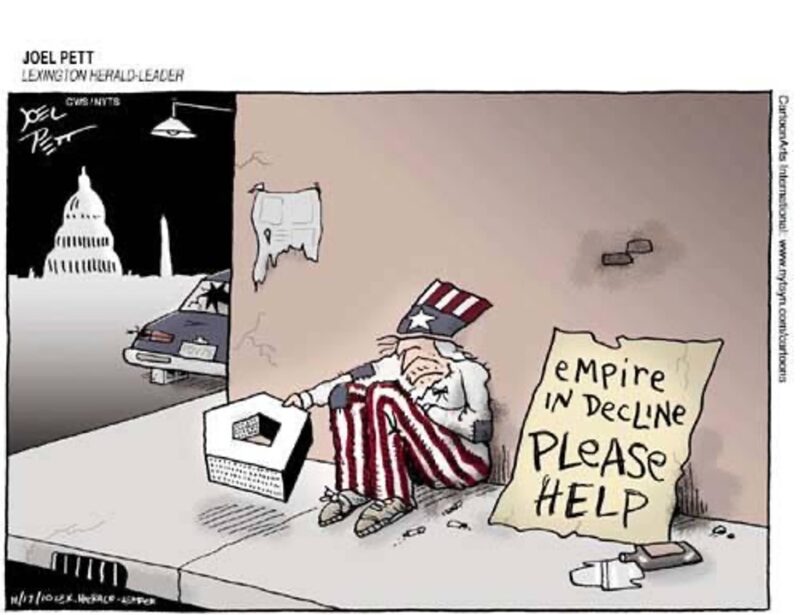
     

    (Source: tunnelwall.blogspot.com)

    In September, I attended a talk sponsored by the Tulsa Committee on Foreign Relations by an inside-the-beltway pundit named Ali Wyne, a former senior fellow at the pro-NATO Atlantic Council and David Rockefeller fellow at the elitist Trilateral Commission.

    Wyne told the audience in so many words that the sun had not yet set on the American empire; that the Biden administration was outmaneuvering the evil Putin in Ukraine; and that the U.S. was still a beacon of hope for the rest of humanity.

    Toward the end, Wyne personalized the talk, discussing how his family had migrated to the U.S. from Pakistan with nothing, and that through hard work he was able to achieve the American dream.

    But Wyne seemed oblivious to the fact that that dream is increasingly unreachable for the majority of people in an increasingly stratified society marred by a decline in civilian manufacturing and public services and skyrocketing education costs.

    Wyne also failed to point out that the American dream historically was achieved at the expense of Third World nations that were looted by U.S. corporations, and by endless wars that killed millions of people.

    Wyne’s delusional worldview is underscored in a new book by Fadi Lama, Why the West Can’t Win: From Bretton Woods to a Multipolar World (Atlanta: Clarity Press, 2023), which shows that the American Century has ended and that a new multipolar world order has been established in which economic dynamism lies primarily in the East.

    Lama is an international adviser for the European Bank for Reconstruction and Development (EBRD) and geopolitical consultant with a Ph.D. in mechanical engineering from the Georgia Institute of Technology (Georgia Tech).
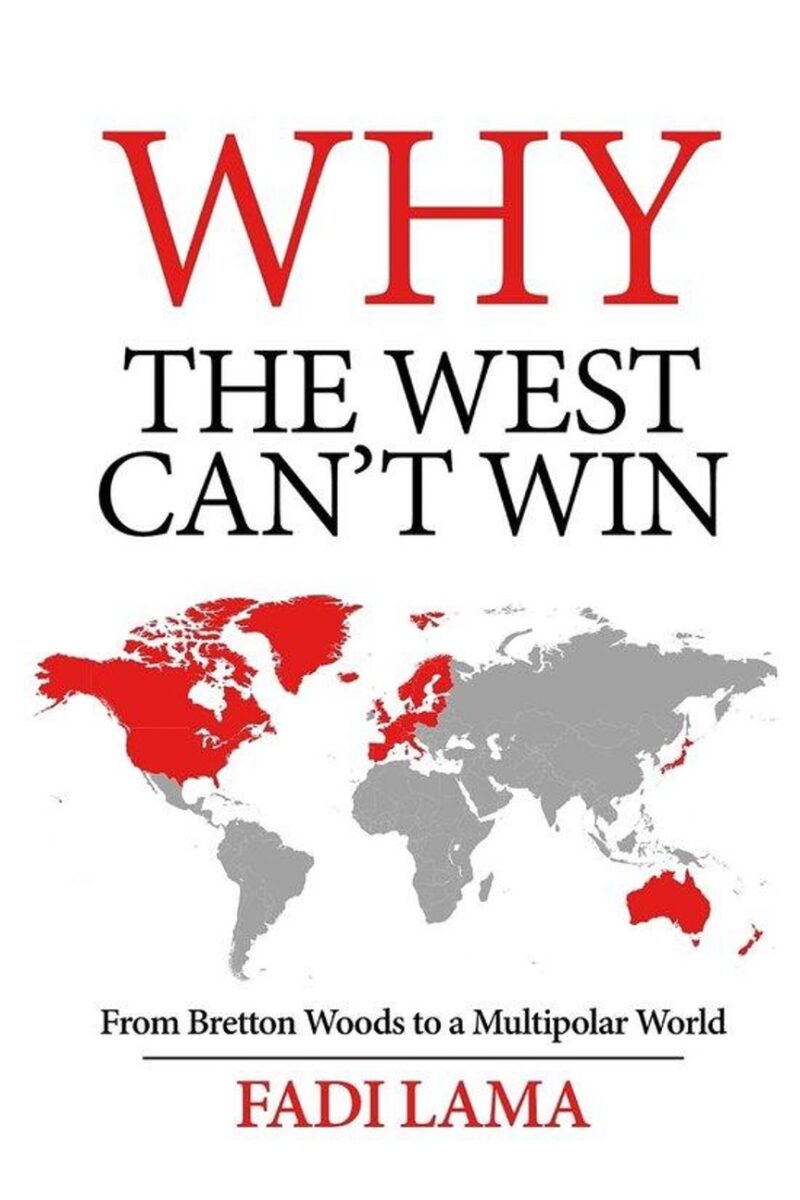
    He points out at the beginning of his book that in 1500, prior to the era of Western colonialism, there was a relatively fair political-economic world order with a close equilibrium between population and wealth generation. But by the end of World War II, the West accounted for only 30% of global population but 60% of global Gross Domestic Product (GDP).

    When many colonized nations gained their independence, the West imposed a neo-colonial framework that enabled their resources to be exploited by Western multinational corporations.

    Some countries on the front lines of the Cold War, such as West Germany, Japan and South Korea, were allowed unhindered development as part of a geopolitical strategy designed to keep them within the Western orbit and curb the advance of Communism. However, being pseudo-independent states, when the political necessity was removed, they were cut back to size.

    The liberation of China in the 1949 Communist-led revolution (an event known in the U.S. as the “loss of China”) was a historical turning point that began to reverse the Western monopolization of wealth and power and set the stage for the re-empowerment of the Global South.

    By 2017, China—known as the “sick man of Asia” in the 19th century following its de facto colonization of Great Britain following the Opium War—was the world’s number one economy with its real goods production amounting to 24% of global real goods production.

    Under CCP leadership, China regained its sovereignty and lifted 770 million people out of poverty, with homelessness now being practically non-existent.

    According to Lama, China’s staggering economic success resulted from a centralized political system in which commercial banking was dominated by the public sector. Central bank financial and monetary policies were further put under the control of the Chinese government, which implemented policies serving the national interest rather than those of the Western financial oligarchy.

    China’s economic success contrasts markedly with the growing economic stagnation in Western countries and the U.S. resulting from the neo-liberal economic model in which the private sector is elevated above the public sector.

    By 2014, the top 0.1% in the U.S. owned as many assets as the bottom 90%, an obscene inequality ratio accompanied by a dramatic rise in poverty, which had been reduced massively in China under more socialist-oriented policies.

    China’s superior state-centric economic model is currently being followed by Russia which has withstood record U.S. sanctions under Vladimir Putin’s leadership through a renewed commitment to economic autarky (self-sufficiency) and investment in local industries and technologies.

    Following the collapse of the Soviet Union, U.S. strategic planners saw a golden opportunity to reduce Russia’s status to that of a fourth-rate power and to enable the plunder of its bountiful natural resources.

    The overzealous policies backfired, however, pushing Russia into alliance with China that signifies the birth of a new multi-polar world order that holds the potential to restore the global economic parity from 1500—before Western colonization took root.

    Lama emphasizes the fact that Russia now provides food aid in Afghanistan and Africa and fertilizer to poor countries, and has forged growing relations with both China and Iran, the latter having gained independence from Western colonial tutelage in 1979 when the Shah was overthrown.

    Lama finds significant economic synergy and growing win-win cooperation in the economic, cultural, scientific and military fields between China, Russia and Iran, which he says are “de facto allies in the struggle for a ‘Fair World.’”

    Russia and China today are leading the way in space exploration, clean energy technologies as well as cutting-edge missile technologies at a time that U.S. weapons systems are proving to be extraordinarily costly and inefficient owing to a Byzantine Pentagon contracting system and under-skilled workforce due to the skyrocketing costs of higher education.

    Today’s shifting power balance can be compared with 1997 when “‘the empire’ had control over three of the top four energy reserves: Venezuela was a U.S. vassal, Russian energy resources were under control of the Money Powers (Western financial oligarchs) via their proxy Russian oligarchs, and Saudi Arabia was a compliant U.S. tributary. Of the top four, only Iranian reserves were out of the Money Powers’ control.”

    By 2022, Lama writes, “the Empire had lost control of the top three reserves, Venezuela, Iran and Russia, while Saudi Arabia is no longer as compliant as it was in 1997.”

    What happened in the interim was a period of heightened military intervention and imperial overreach resulting in a counter-mobilization that signifies the end of the era of Western empires dating back to the 16th century.

    Bretton Woods: From Military to Financial Colonialism

    The imperial framework after World War II was established through the Bretton Woods economic system, which Lama says was designed to “lock countries into a financial structure controlled by the West.”

    Lama writes that this structure “requires central bank governors be independent of their governments, but dependent on rules established by the Bank for International Settlements (BIS), at the top of the pyramid in the Bretton Woods system.

    Established in 1930 to handle reparations payments imposed on Germany at the Versailles Conference after World War I, BIS had helped finance Hitler’s rise to power and was owned by central banks, setting policies for them that directly influenced the global economy.

    Franklin D. Roosevelt had proposed liquidating the BIS due to its cooperation with Nazi Germany, though the resolution that he sponsored to that effect at the July 1944 Bretton Woods Conference at which the post-World War II monetary and political global structure was being set, was revoked after Roosevelt’s death.
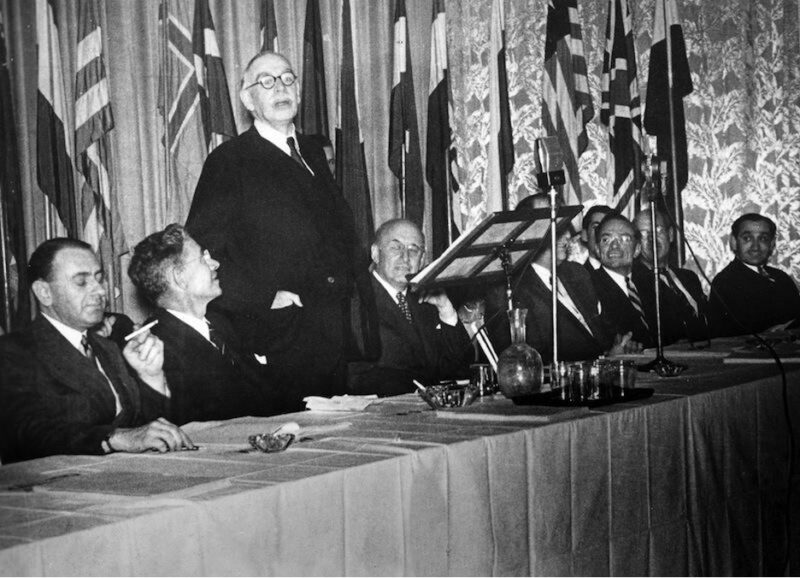
    John Maynard Keynes addressing the July 1944 Bretton Woods Conference in New Hampshire. [Source: centerforfinancialstability.org

    According to Lama, when some newly decolonized countries tried to adopt an alternative economic arrangement to Bretton Woods, their leaders (Togo’s Sylvanus Olympio, Egypt’s Nasser; Indonesia’s Sukarno; Democratic Republic of Congo’s Lumumba; Iran’s Mossadegh; Ecuador’s Jaime Roldos; Panama’s Omar Torrijos) were eliminated by wars, coups or assassinations [over a 25-year span].

    Economic hit men would descend on developing countries offering loans for infrastructure projects whose real purpose was to plunge these countries into debt so they would become dependent on foreign creditors and their economies could be restructured along neo-liberal lines and in the service of multi-national corporations.

    A pillar of the Bretton Woods system was that the U.S. dollar was established as the international trade currency, which was convertible into gold at the fixed rate of $35 per ounce of gold.

    With the decline of U.S. competitiveness in the 1960s, the Nixon administration froze the convertibility of the U.S. dollar in gold and, instead, made it convertible to oil, provided that oil was sold only in U.S. dollars.

    This led to a dramatic increase in the price of oil and petrodollar arrangement with Saudi Arabia by which the U.S. provided military protection and weapons to the Saudis in exchange for the promise of them trading their oil in U.S. dollars and using income from oil to buy U.S. Treasury bills. Interest on these sales was then spent by the U.S. Department of the Treasury on infrastructure projects in Saudi Arabia to be executed by U.S. companies.

    The fact that other countries had to hold reserves in U.S. dollars to cover their oil imports allowed the U.S. to incur high trade deficits bred by deindustrialization in the neo-liberal era without causing a depreciation of the U.S. dollar.

    However, this is no longer sustainable in the long term and Russia and China are spearheading a shift in the global economy by which oil and other commodities are no longer being traded in U.S. dollars, ushering in the end of the American Century.

    The Money Power

    Lama’s book includes discussion of the growth of the Western financial oligarchy, or what he calls the Money Power, who are the major shareholders of the leading hedge funds (BlackRock, Vanguard and State Street) and have become the absolute rulers over society.

    According to Lama, the Money Power is well placed to control elections in Western democracies and control mass media in all its forms, print, TV and social media platforms.

    They support free trade agreements designed to usurp what little is left of national sovereignty and a neo-liberal vulture economy in which all aspects of the economy are privatized in order to maximize corporate profits.

    The U.S. decline has been fueled by the Money Power’s recognition that maintaining a strong manufacturing base was no longer necessary when trade deficits could be offset by currency manipulation owing to Nixon’s convertibility of the U.S. dollar to oil and the trade in oil around the world in U.S. dollars.

    The U.S. economy is increasingly dominated by the financial sector which flourishes at the expense of other vital economic sectors, leading to the high wealth concentration and impoverishment of society made worse by austerity measures entailing cutbacks in social and other government services.

    Russophobia, Sinophobia and the End of an Era

    The intense Russophobia cultivated in the U.S. media over the last decade is the result of the Money Power’s lust for Russia’s immense wealth, which it was starting to gain access to in the 1990s before Vladimir Putin reasserted national control over Russia’s economy.

    The anti-Russia propaganda has had the greatest impact on the educated classes, as 77% of Americans with post-graduate degrees considered Russia an enemy in a March 2022 poll, compared to 66% with high school education or less.

    Russophobia has been combined with an ascendant Islamophobia and Sinophobia, whose purpose is to mobilize public support for confronting the troika of powers (Russia, Iran and China), which threaten Western hegemony.

    According to Lama, if a date were to be identified for the end of the U.S. empire, it would be January 8, 2020, when Iran avenged the assassination of General Qasem Soleimani by attacking a U.S. air base in Iraq and displaying Iran’s weapons capability.

    Afterwards, the U.S. Central Command (Centcom) significantly relocated its headquarters from Doha, Qatar, just 125 miles from Iranian shores, to safety in Tampa, Florida.

    While the current U.S. war in Gaza has created a renewed pretext for expanded U.S. military intervention in the Middle East, Lama’s book makes clear that the U.S. could not win a war against Iran for regime change.

    Contrary to Wyne’s analysis, the U.S. has also been outmaneuvered in Ukraine, whose army is in a state of disrepair after a failed counteroffensive. It is further being outmaneuvered by China, which is winning hearts and minds through the Belt and Road Initiative (BRI) that provides low-interest loans to countries for infrastructural development with no strings attached.

    In sum, the Great Game for world domination appears to be up and the Money Power has lost. That is why they are behaving so erratically in manufacturing crisis after crisis as they desperately attempt to sustain a fading world order defined by profound inequality and injustice. For the rest of my talk, I will try and further answer some of the questions that were posed prior to the seminar:

    Question 1) This dealt with consistent U.S. war making as a tool in which the US tried to sustain its hegemony, and growing pushback with the rise of BRICS, Shanghai Cooperation Organization and Rise of China? How will all this shape the future world order?

    Answer: There is the threat of a world war breaking out provoked by the U.S. as the U.S. cannot tolerate geopolitical competition or being relegation to a second rate power, and will respond violently—as it is already doing. Currently, the U.S. is provoking wars simlutaneously with Russia, China and the Middle East, with catastrophic consequences already for the people of Ukraine, Russia and Gaza. The great Australian journalist John Pilger produced a documentary in 2016 warning about the U.S. military buildup in the Asia Pacific and coming war with China, which would be catastrophic for everyone involved.

    It is instructive to look back in history to the 1930s when Japan challenged U.S. and Western empires in the Asia Pacific with the establishment of the Greater Economic Co-Prosperity Sphere. This challenge and effort by Japan to establish an alternative yen bloc in Southeast Asia and to supplant the Western colonial powers led directly to the Pacific War. Records from the time reveal how the U.S. manuevered Japan into firing the first shot (an explicit goal of U.S. policy as outlined by Secretary of State Henry Stimson) by imposing a naval buildup in the South China sea and crippling oil embargo that threatened to cut off Japan’s oil supply and undermine its empire in the Asia-Pacific.

    There is evidence that FDR knew about the impending Pearl Harbor attacks but allowed them to take place because the American public would only support military intervention if America were attacked and the attack was made to look like a sneak attack by a dastardly enemy.

    History could easily repeat itself today; the U.S. military is in fact preparing for war in the Asia Pacific; building a new military base in Micronesia in the middle of the Pacific Ocean, and training soldiers in jungle warfare in Hawaii while studying military battles in the Pacific War, like the Battle of Guadalcanal.

    Gen. Charles A. Flynn, the commander of U.S. Army Pacific, was quoted in The New York Times stating that China had been on “an incremental, insidious and irresponsible path for decades.” Now more than ever, the “total Army,” he said, needs to prioritize relevant Pacific experience.
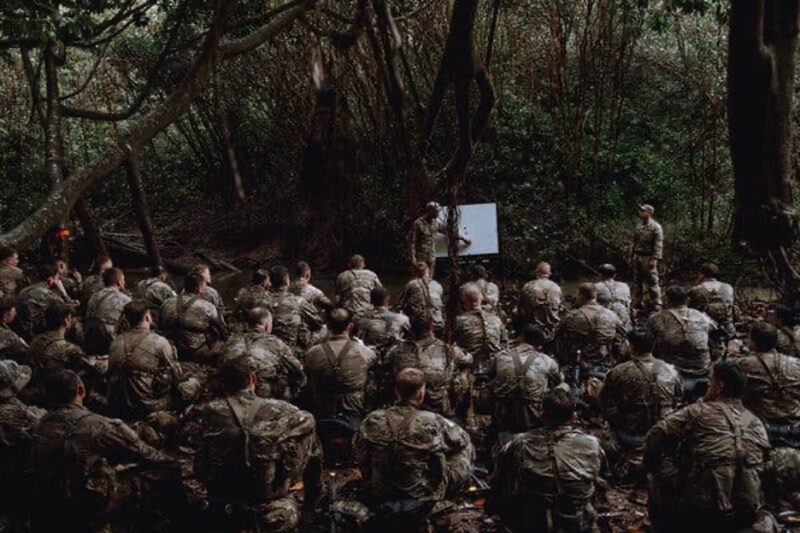
    U.S. soldiers being trained to fight a 21st Century Pacific War—this time against China. [Source: nytimes.com]

    After provoking a war with China, like with Japan in World War II, the U.S. would surely make it look like China started it and that it was somehow innocent. This has been a feature of US imperial wars going back to the era of the Indian Wars.

    Question 2: The first half of the 20th century was essentially a contest of empires. The two World Wars were fundamentally European wars or a contest of colonial empires. While the European empires were destroyed, the gain was for the U.S. as it emerged as the most powerful actor.

    Answer: Agreed. I would add that the U.S. defeated the Japanese empire in the Pacific theater of World War II, which enabled the U.S. to establish a chain of military bases in the Asia Pacific as a linchpin of U.S. imperialism. U.S. strategic planners had long considered the Asia Pacific key to world domination because of its economic vitality and rich resources and geography and this is why the U.S. cannot accept any rival powers there, including Japan, and now China.

    Question 3: Did the U.S. foresee this and plan its rise to a position as the pre-eminent power ensuring the destruction of the European powers?

    Answer: Yes, absolutely. As one example of dispacing European empires, I was just reading a book about U.S. policy in Congo in the 1960s by David Gibbs, The Political Economy of Third World Intervention. The book showed how U.S. mining tycoons (Maurice Templesman and Harold Hochschild) came to oppose Belgian colonialism so American corporations could replace Belgian ones in controlling and profiting from Congo’s lucrative mineral wealth. Templesman and Hochschild financed CIA front organizations and supported the murder of Patrice Lumumba who wanted to nationalize Congo’s mines after independence. They cultivated very close ties with Joseph Mobutu; Lumumba’s replacement and murderer, who cultivated the image of a Pan-Africanist devoted to African culture, but who sold out Congo and its economy to foreign interests. The CIA funded Mobutu’s security apparatus so he could crush a secessionist movement in the diamond rich Katanga province backed by the Belgians. The goal was for Mobutu to consolidate his control over Congo and for U.S. corporations to take over the mines from Belgians in Katanga. Here is U.S. neocolonialism at work, and muscling out of the Europeans.

    Question 4: The U.S.-led post-1945 world order rests on its control of the three pillars – political, economic, and security ( Allies/Vassals, Economic Control through Bretton Woods systems + USD as the global reserve currency, and the UN Security Council+NATO). Is Western Europe an Ally of the US or is it an unequal relationship?

    Answer: I would say its an ally of the U.S. to a point, as we see from the example of the Belgians in Congo. Many Europeans are starting to question alliance with the U.S. and whether the US has the best interests of European countries in mind. The U.S. involvement in Ukraine and destruction of the Nordstream II pipeline, for example, has been deterimental to European economies, including especially that of Germany that relied on cheap Russian natural gas imports. With the destruction of the pipeline, they were forced to purchase natural gas at a much higher cost from the Middle East and from U.S. natural gas suppliers in Texas and elsewhere who were financing politicians in the U.S. that supported the copious military aid to Ukraine along with the weapons contractors. European countries historically benefited from trade with Russia, so the war in Ukraine has generally hurt their economies and it is not clear for how much longer their populations will put up with this and just go along with the New Cold War.

    Question 5: Decolonisation was superficial as the U.S.-led West retained much of the colonial and imperial controls. Is it right to say that the U.S., in effect, has been an expanding empire since the American-Spanish War? The Cold War was a check on the American expansion.

    Answer: Decolonization was indeed superficial as the U.S. used clandestine and sometimes not so clandestine means toinfluence and control postcolonial leaders across much of the Third World and to sustain neocolonial economic relationships where Third World countries exported raw materials to the West and purchased products that were manufactured there, or had their resources owned and controlled by U.S. corporations.

    I would suggest that the U.S. was an expanding empire from the formation of the country. Historian Richard Van Alstyne wrote an important book in 1960 entitled The Rising American Empire. The book shows how the American founding fathers all conceived of the U.S. as an empire and had ambitions of eclipsing the British and Roman empires at their height. Van Alstyne also addresses how the pacification of the Native Americans and takeover of their resources and land and massacre of those who resisted previewed what the U.S. would do to other peoples around the world.
    As far as the Cold War, my book, The Russians are Coming, Again with John Marciano shows that rather than being a check on U.S. expansion, the Cold War served to validate heightened U.S. intervention across the Third World under the pretext of fighting and combatting communism. In fact the real communist threat, as Noam Chomsky has emphasized, was a threat to U.S. business interests and ability to encourage development of an alternative state-centered model of governance that would prevent corporate pillage and the kind of neoloconial arrangements that prevailed quite widely in this period and beyond.

    Question 6: The end of the Cold War and American unipolar dominance unleashed the push for the American Empire—through GWOT and a series of wars.

    Answer: Absolutely: We have the U.S. empire on steroids with the Global War on Terror. It has given a pretext for the U.S. to invade and bomb many Middle-Eastern countries. And it has been totally ridden with contradictions, as the U.S. has supported leading terrorist states like Saudi Arabia and committed large scale terrorist acts based on standard definitions of terrorism as acts of violence targeting civilians with the purpose of affecting a political goal or political change.

                                                                                                                                                              Source: goodreads.com

    Question 7: NATO Expansion – conflict with Russia and anti-China strategy – a clear case of imperial overstretch and suicidal?

    Answer: Yes I think so. Back in 1996, George Kennan, the father of the containment strategy and original Cold War, warned about NATO expansion, stating: that NATO expansion would amount to a “strategic blunder of epic proportions” and the “most fateful error of American policy in the entire post-Cold War era,” as it would “inflame the nationalistic, anti-Western and militaristic tendencies in Russian opinion, restore the atmosphere of the cold war to East-West relations,” and “impel Russian foreign policy in a direction decidedly not to our liking.”

    Kennan’s prediction proved to be true and look where we are today: in a new Cold War, with the U.S. having torn up the arms control treaties of the 1980s; initiated a proxy war with Russia that could lead to a full-blown war between the two countries and nuclear conflict. If the latter transpires, the NATO expansion surely will have been suicidal. Already it is diverting badly needed resources towards the military and a senseless new arms race, much like in the original cold war, where it produced heavy deficits and Third World type living conditions in the U.S. with astronimical inequality levels, underfunded edcuation and health care system, and abysmally poor public services, including in areas like mental health treatment, and programs to assist the homeless. One consequence is the extremely high crime rates in the U.S. and overcrowded prisons.
    George F. Kennan: if only U.S. leaders in the 1990s and 2000s had listened to him [Source: artsandculture.google.com

    As far as China, the provocations by the Biden administration may be even more insane than with regards to Russia, as a) the U.S. depends on Chinese purchasing of U.S. debt; b) the U.S. economy is quite dependant on China’s; and c) China has superior military technology capabilities that would give it the edge in any war with the U.S.

    Charles Freeman is a retired diplomat who served as Nixon’s translator when he famously visited China in theearly 1970s to reestablish U.S. diplomatic relations during the Cold War. Freeman told me when I interviewed him that China was in no way a military threat to the U.S., but the U.S. sees it as a threat because its economy has been growing and slowly surpassing that of the U.S. The U.S., however, should not view China as a threat of any kind, and should consider its economic growth an opportunity for the U.S. if it tried to harness China’s economic growth to its own. This would mesh well with the win-win strategy advocated for by Chinese Premer Xi Jinping in which China and the U.S. would cooperate to mutual economic benefit.
    Charles Freeman [Source: globaltimes.cn]

    Instead, the U.S. has sought to a) encircle China militarily, b) arm Taiwan to the teeth in violation of the “One China” policy and incite Taiwanese separatist elements, c) try and undermine Chinese interests throughout Southeast Asia, and d) provoke it by launching drone surveillance missions over its borders and in Chinese controlled waters off Taiwan, and e) sailing U.S. naval ships in Chinese waters.

    This is in addition to a) the propaganda directed against China in the U.S., b) the persecution of Chinese scientists; c) support for separatist elements in Xinjiang and Tibet; and d) the waging of an economic war on China and efforts to sabotage China’s economy—a policy that had been pursued by the FDR administration against Japan that directly provoked war with it.

    Question 8: Are current wars in Ukraine and Gaza—a sign of major turbulence in the World Order?

    Answer: Yes absoutely. These wars were both easily avoidable and were a direct result of U.S. foreign policy and its extremism.

    1. In the case of Ukraine, the U.S. was intent on using Ukraine as a battering ram directed against Russia. The U.S. orchestrated the 2014 Maidan coup and empowered and armed far right, Russophobic elements who triggered the war with Russia by a) attacking the ethnic Russian population in Eastern Ukraine; and b) reneging on any commitments in the Minsk peace agreements that would have given greater autonomy to the Luhansk and Donetsk provinces. The U.S. aim was similar to Afghanistan in the 1980s where they wanted to draw the Russians into a military quagmire and trap and discredit Putin and cripple his regime by ratcheting up economic sanctions against him (which it was believed would create disaffection with his rule and trigger a movement for regime change). This strategy was born of desperation because Putin was succeeding in strengthening Russia and blocking the neoconservative designs to control Eurasia and its rich oil and gas reserves, which was only possible with a weakened Russia.
    2. Gaza: The U.S. has long used Israel as an outpost of its power in the Middle East, recently establishing secret military bases in the Negev. The neocons in Washington have long sought regime change in Iran and see Israel as their vehicle to help achieve that. They also wanted regime change in Syria and to ensure Israeli control over the Golan Heights, where oil reserves have been discovered. U.S. weapons have emboldened hardliners in Israel and enabled Israeli aggression in Gaza and now Lebanon with disastrous human costs for the civilian population that people are comparing to a new Holocaust.

    Question 9:  With the rise of China, India, and the BRICS—is this a Power Transition moment?

    Answer: Yes. We are seeing major historical changes in real-time. China’s achievements through the One Belt, One Road initiative were so impressive they led to a copycat effort by the Biden and Boris Johnson admiinistrations that never really got off the ground. The SCO is enabling countries also to get around the World Bank and IMF by offering loans with no strings attached. China’s rise is epitlmized by its trading alliance with Russia and influence throughout Africa, where China is clearly winning the Great Game. While Chinese labor practices may be bad in many places, China is bringing tangible benefits to African countries through the building of impressive infrastructure, whereas all the U.S. offers is drone bases and IMF structural adjustment programs that push economic austerity measures and reinforce social inequality.

    Question 10: Is this a sign of the end of Western dominance of the last 500 years?

    Answer: I believe that yes, we are seeing major historical shifts. It may take some more time as empires often do have lasting power and can linger on even when their legitimacy has been eroded, but change is coming about.

    Question 11: In its entire history, the USA has been at war for all but 15-20 years. Is the USA a war-mongering state?

    Answer: Sadly, yes. It goes back to the founding of the country as a settler colonial state rooted in the military conquest and genocide of the Native Americans. The colonial mentality is so deep that the U.S. names a lot of its weapons systems after native tribes that were vanquished, like the Apache helicopter for example. The Operation to kill Osama bin Laden was called Operation Geronimo after the Apache chief who was vanquished in the 19th century. Noam Chomsky once asked; imagine the nazis had won World War II, and named weapons: “gypsys” and ‘Jews.”
    [Source: telegraph.co.uk]

    This reflects something rotten at the core of imperialism and a deep imperial mentality that is hard to vanquish and is passed on generation after generation. This mentality and the war like culture in the U.S. is seen in a hero worship of soldiers and the military at sporting events, and in the denigration and marginalization of peace activists in popular and intellectual culture.

    That the military culture is a largely top down phenomenon though should be emphasized as since Vietnam, the U.S. government has dared not reintroduce the draft, lest it face a societal revolt remniscent of the 1960s counter-culture movement. So a lot of Americans see through the lies and are not so hawkish—that’s why the government has to distance the public from the wars; lie to them repeatedly about what they are all about; and develop new technologies and AI that could ensure a reliance on machines in fighting wars rather than the American people who often see through the lies and will protest an unjust war—particularly if there are a large number of U.S. ground troops potentially being put in harms way (like in Vietnam).

    Question 12: What is the future of 21st century world order? Barry Posan says the era of Superpower is over. Has the multipolar world emerged? what would be its shape?

    Answer: I think we are indeed seeing the birth of a new multipolar world order in which the center of economic power in the world increasingly lies in the East and in which China is a powerhouse and Southeast Asia is a key motor of economic growth in the Global economy. The U.S. is sliding more towards authoritarianism and potentially even a civil war, and may be further weakened by domestic unrest as it loses its economic supremacy and the U.S. dollar ceases to be a main currency of global trade. U.S. military interventions may focus more on South America and Mexico (which some Republicans want to bomb now to stem the immigration tide) and the U.S. army may have to be deployed more often to contain domestic unrest and right wing estremists/neofascists and to control armies of homeless people who are a product of a failed economic model.

    Related to the last question about U.S. adaptation to the new realities, a great danger is that the U.S. won’t accept reality, and will attempt to violently reimpose its hegemony, triggering a new Pacific War or world war that would result in millions of deaths.

    The recent escalation of conflict in Ukraine and the Middle East as well as U.S. saber rattling towards China and over Taiwan, makes this threat all too real and ominous.

    Feature Image Credit: iai.tv

  • China’s economy is still far out growing the U.S. – contrary to Western media “fake news”

    China’s economy is still far out growing the U.S. – contrary to Western media “fake news”

    GDP data for China, the U.S., and the other G7 countries for the year 2023 has now been published. This makes possible an accurate assessment of China’s, the U.S., and major economies performance—both in terms of China’s domestic goals and international comparisons. There are two key reasons this is important.

    • First for China’s domestic reasons: to achieve a balanced estimate of China’s socialist economic situation and therefore the tasks it faces.
    • Second, because the U.S. has launched a quite extraordinary propaganda campaign, including numerous straightforward factual falsifications, to attempt to conceal the real international economic facts.

    The factual situation is that China’s economy, as it heads into 2024, has far outgrown all other major comparable economies. This reality is in total contradiction to claims in the U.S. media. This in turn, therefore, demonstrates the extraordinary distortions and falsifications in the U.S. media about this situation. It confirms that, with a few honourable exceptions, Western economic journalism is primarily dominated by, in some cases quite extraordinary, “fake news” rather than any objective analysis. Both for understanding the economic situation, and the degree of distortion in the U.S. media, it is therefore necessary to establish the facts of current international developments

    China’s growth targets

    Starting with China’s strategic domestic criteria, it has set clear goals for its economic development over the next period which will complete its transition from a “developing” to a “high-income” economy by World Bank international standards. In precise numbers, in 2020’s discussion around the 14th Five Year plan, it was concluded that for China by 2035: “It is entirely possible to double the total or per capita income”. Such a result would mean China decisively overcoming the alleged “middle income trap” and, as the 20th Party Congress stated, China reaching the level of a “medium-developed country by 2035”.

    In contrast, a recent series of Western reports, widely used in anti-China propaganda, claim that China’s economy will experience sharp slowdown and will fail to reach its targets.

    Self-evidently which of these outcomes is achieved is of fundamental importance for China’s entire national rejuvenation and construction of socialism—as Xi Jinping stated, China’s: “path takes economic development as the central task, and brings along economic, political, cultural, social, ecological and other forms of progress.” But the outcome also affects the entire global economy—for example, a recent article by the chair of Rockefeller International, published in the Financial Times, made the claim that what was occurring was China’s “economy… losing share to its peers”. The Wall Street journal asserted: “China’s economy limps into 2024” whereas in contrast the U.S. was marked by a “resilient domestic economy.” The British Daily Telegraph proclaimed China has a “stagnant economy”. The Washington Postheadlined that: “Falling inflation, rising growth give U.S. the world’s best recovery” with the article claiming: “in the United States… the surprisingly strong economy is outperforming all of its major trading partners.” This is allegedly because: “Through the end of September, it was more than 7 percent larger than before the pandemic. That was more than twice Japan’s gain and far better than Germany’s anaemic 0.3 percent increase.” Numerous similar claims could be quoted from the U.S. media.

    U.S. use of “fake news”

    Reading U.S. media claims on these issues, and comparing them to the facts. it is impossible to avoid the conclusion that what is involved is deliberate “fake news” for propaganda purposes—as will be seen, the only alternative explanation is that it is disgracefully sloppy journalism that should not appear in supposedly “quality” media. For example, it is simply absurdly untrue, genuinely “fake news”, that the U.S. is “outperforming all of its major trading partners”, or that China has a “stagnant economy”. Anyone who bothers to consult the facts, an elementary requirement for a journalist, can easily find out that such claims are entirely false—as will be shown in detail below.

    To first give an example regarding U.S. domestic reports, before dealing with international aspects, a distortion of U.S. economic growth in 2023 was so widely reported in the U.S. media that it is again hard to avoid the conclusion that this was a deliberate misrepresentation to present an exaggerated view of U.S. economic performance. Factually, the U.S. Bureau of Economic Analysis, the U.S. official statistics agency for economic growth, reported that U.S. GDP in 2023 rose by 2.5%—for comparison China’s GDP increased by 5.2%. But a series of U.S. media outlets, starting with the Wall Street Journal, instead proclaimedthat the “U.S. economy grew 3.1% over the last year”.

    This “fake news” on U.S. growth was created by statistical “cherry picking”. In this case comparing only the last quarter of 2023 with the last quarter of 2022, which was an increase of 3.1%, but not by taking GDP growth in the year as a whole “last year”. But U.S. growth in the earlier part of 2023 was far weaker than in the 4th quarter—year on year growth in the 1stquarter was only 1.7% and in the 2nd quarter only 2.4%. Taking into account this weak growth in the first part of the year, and stronger growth in the second, U.S. growth for the year as a whole was only 2.5%—not 3.1%. As it is perfectly easy to look up the actual annual figure, which was precisely published by the U.S. statistical authorities, it is hard to avoid the conclusion that this was a deliberate distortion in the U.S. media to falsely present a higher U.S. growth rate in 2023 than the reality.

    It may be noted that even if U.S. GDP growth had been 3.1% then China’s was much higher at 5.2%. But the real data makes it transparently clear that China’s economy grew more than twice as fast as the U.S. in 2023—showing at a glance that claims that the U.S. is “outperforming all of its major trading partners”, or that China has a “stagnant economy” were entirely “fake news”.

    Many more examples of U.S. media false claims could be given, but the best way to see the overall situation is to systematically present the overall facts of growth in the major economies.

    What China has to do to achieve its 2035 goals

    Turning first to assessing China’s economic performance, compared to its own strategic goals of doubling GDP and per capita GDP between 2020 and 2035, it should be noted that in 2022 China’s population declined by 0.1% and this fall is expected to continue—the UN projects China’s population will decline by an average 0.1% a year between 2020 and 2035. Therefore, in economic growth terms, the goal of doubling GDP growth to 2035 is slightly more challenging than the per capita target and will be concentrated on here—if China’stotal GDP goal is achieved then the per capita GDP one will necessarily be exceeded.

    To make an international comparison of China’s growth projections compared with the U.S., the U.S. Congressional Budget Office (CBO), responsible for the official growth projections for the U.S. economy on which its government’s policies rely, estimates there will be 1.8% annual average U.S. GDP growth between 2023 and 2023—with this falling to 1.6% from 2034 onwards. This figure is slightly below the current U.S. 12-year long term annual average GDP growth of 2.3%—12 being the number of years from 2023 to 2035. To avoid any suggestion of bias against the U.S., and in favour of China, in international comparisons here the higher U.S. number of 2.3% will be used.

    The results of such figures are that if China hits its growth target for 2035, and the U.S. continues to grow at 2.3%, then between 2020 and 2035 China’s economy will grow by 100% and the U.S. by 41%—see Figure 1. Therefore, from 2020 to 2035, China’s economy would grow slightly more than two and a half times as fast as the U.S.

    The strategic consequences of China’s economic growth rate

    The international implications of any such growth outcomes were succinctly summarised by Martin Wolf, chief economics commentator of the Financial Times. If China’s economy continues to grow substantially faster than Western ones, and it achieves the status of a “medium-developed country by 2035”, then, in addition to achieving high domestic living standards, China’s will become by far the world’s largest economy. As Wolf put it: “The implications can be seen in quite a simple way. According to the IMF, China’s gross domestic product per head (measured at purchasing power) was 28 per cent of U.S. levels in 2022. This is almost exactly half of Poland’s relative GDP per head… Now, suppose its [China’s] relative GDP per head doubled, to match Poland’s. Then its GDP would be more than double that of the U.S. and bigger than that of the U.S. and EU together.” By 2035 such a process would not be completed on the growth rates already given, and measuring by Wolf’s chosen measure of purchasing power parities (PPPs) China’s economy by 2035 would be 60% bigger than that of the U.S. But even that would make China by far the world’s largest economy.

    Wolf equally accurately notes that the only way that such an outcome would be prevented from occurring is if China’s economy slows down to the growth rate of a Western economy such as the U.S. Clearly, if China’s economic growth slows to that of a Western economy, then, naturally, China will never catch up with the West—it will necessarily simply stay the same distance behind. Therefore. as Wolf accurately puts it the outcomes are:

    What is the economic future of China? Will it become a high-income economy and so, inevitably, the largest in the world for an extended period, or will it be stuck in the ‘middle income’ trap, with growth comparable to that of the U.S.?

    The progress in achieving China’s strategic economic goals

    Turning to the precise figure required to achieve China’s 2035 target, China’s goal of doubling GDP required average annual growth of at least 4.7% a year between 2020 and 2035. So far China, as Figure 1 shows, is ahead of this goal—annual average growth in 2020-2022 was 5.7%, meaning that from 2023-2035 annual average 4.6% growth is now required.

    China’ 5.2% GDP increase in 2023 therefore once again exceeded the required 4.6% growth rate to achieve its 2035 goal—as shown in Figure 1. From 2020 to 2023 the required total increase in China’s GDP to hit its 2035 target was 14.9%, whereas in fact its growth was 17.5%. This is in line with the 45-year record since 1978’s Reform and Opening Up, during which entire period the medium/long term targets set by China have always been exceeded.

    Therefore. to summarise, there is no sign whatever in 2023, or indeed in the period since 2020, that China will fail to meet its target of doubling GDP between 2020 and 2035—China is ahead of this target. Such a 4.6% growth rate would easily ensure China becomes a high-income economy by World Bank criteria well before 2035—the present criteria for this being per capita income of $13,846.

    It should be noted, as discussed in in detail below, that a clear international conclusion flows from this necessary 4.6% annual average growth rate for China to achieve its strategic goals. It means that China must continue to grow much faster than the Western economies throughout this period to 2035—that is in line with China’s current trend. However, if China were to slow down to the growth rate of a Western economy, then it will fail to achieve its strategic goals to 2035, may not succeed in becoming a high income economy, and will necessarily remain the same distance behind the West as now. The implications of this will be considered below.

    Systematic comparisons not “cherry picking”

    Having considered China’s performance in 2023 terms of achieving its own domestic strategic goals we will now turn to actual results and a comparison of China with other international economies. This immediately shows the factual absurdity, the pure “fake news” of claims such as that the U.S. has “the world’s best recovery“ and “the United States… is outperforming all of its major trading partners.” On the contrary China has continued to far outgrow the U.S. economy not only in 2023 but in the entire last period. China’s outperformance of the other major Western economies, the G7, is even greater that of the U.S.

    Entirely misleading claims regarding such international comparisons, used for propaganda as opposed to serious analysis, are sometimes made because data is taken from extremely short periods of time which are taken out of context—unrepresentative statistical “cherry picking” or, as Lenin put it, a statistical “dirty business”. Such a method is always erroneous, but it is particularly so during periods which were affected by the impact of the Covid pandemic as these caused extremely violent short-term economic fluctuations related to lock downs and similar measures. China’s assertion of superior growth is based on its overall performance, not an absurd claim that it outperforms every other economy, on every single measure, in every single period! Therefore, in making international comparisons, the most suitable period to take is that for since the beginning of the pandemic up to the latest available GDP data. As comparison of China with the U.S. is the most commonly made one, and particularly concentrated on by the U.S. media campaign, this will be considered first.

    China’s and the U.S.’s growth in 2023

    It was already noted that in 2023 China’s GDP grew by 5.2% and the U.S. by 2.5%—China’s economy growing more than twice as fast as the U.S. But it should also be observed that 2023 was an above trend growth year for the U.S.—U.S. annual average growth over a 12-year period is only 2.3% and over a 20-year period it is only 2.1%. Therefore, although in 2023 China’s economy grew more than twice as fast as the U.S., that figure is actually somewhat flattering for the U.S. Figure 2shows that in the overall period since the beginning of the pandemic China’s economy has grown by 20.1% and the U.S. by 8.1%—that is China’s total GDP growth since the beginning of the pandemic was two and half times greater than the U.S. China’s annual average growth rate was 4.7% compared to the US’s 2.0%.

    Economic performance of China and the three major global economic centres

    Turning to wider international comparisons than the U.S. such data immediately shows the extremely negative situation in most “Global North” economies and China’s great outperformance of them. To start by analysing this in the broadest terms, Figure 3 shows the developments in the world’s three largest economic centres—China, the U.S., and the Eurozone. These three together account for 57% of world GDP at current exchange rates and 46% in purchasing power parities (PPPs). No other economic centre comes close to matching their weight in the world economy.

    Regarding the relative performance of these three major economic centres, at the time of writing data has not been published for the Euro Area for the whole year of 2023 —which would be the ideal comparison. However, it has been published for the the Euro area for the four quarters of 2023 individually and trends can be calculated on that basis. These show that In the four years to the 4th quarter of 2023, covering the period since the beginning of the pandemic, China’s economy has grown by 20.1%, the U.S. by 8.2%, and the Eurozone by 3.0%. China’s economy therefore grew by two and a half times as fast as the U.S. while the situation of the Eurozone could accurately be described as extremely negative with annual average GDP growth in the last four years of only 0.7%.

    Such data again makes it immediately obvious that claims in the Western media that China faces economic crisis, and the Western economies are doing well is entirely absurd—pure fantasy propaganda disconnected from reality.

    Relative performance of China and the G7

    Turning to analysing individual countries, then comparing China to all G7 states, i.e. the major advanced economies, shows the situation equally clearly—see Figure 4. Data for China and all G7 economies has now been published for the whole of 2023. The huge outperformance by China of all the major advanced economies is again evident.

    Over the four years since the beginning of the pandemic China’s economy grew by 20.1%, the U.S. by 8.1%, Canada by 5.4%, Italy by 3.1%, the UK by 1.8%, France by 1.7%, Japan by 1.1% and Germany by 0.7%.

    In the same period China’s economy therefore grew two and a half times as fast as the U.S., almost four times as fast as Canada, almost seven times as fast as Italy, 11 times as fast as the UK, 12 times as fast as France, 18 times as fast as Japan and almost 29 times as fast as Germany.

    In terms of annual average GDP growth during this period China’s was 4.7%, the U.S. 2.0%, Canada 1.3%, Italy 0.8%, the UK 0.4%, France 0.4%, Japan 0.3% and Germany 0.2%.

    It may therefore be seen that China’s economy far outperformed the U.S., while the performance of all other major G7 economies may be quite reasonably described as extremely negative—all having annual average economic growth rates of around or even under 1%.

    Comparison of China to developing economies

    A comparison using the IMF’s January 2024 projections can also be made to the major developing economies—the BRICS. Figure 5 shows this, using the factual result for China and the IMF projections for the other countries. Over the period since the start of the pandemic, from 2019-2023, China’s GDP grew by 20.1%, India by 17.5%, Brazil by 7.7%, Russia by 3.7% and South Africa by 0.9%.

    This data confirms that the major Global South economies are growing faster than most of the major Global North economies, which is part of the rise of the Global South and draws attention to the good performance of India. But China grew more than two and half times more than all the BRICS economies except India—China’s growth was 15% greater than India’s. It should be noted that India is at a far lower stage of development than the other BRICS economies—all the others fall in the World Bank classification of upper middle-income economies whereas India falls into the lower middle income group.

    Comparison of China’s growth to Western economies

    Finally, this outperformance by China casts light on what is necessary to achieve its own 2035 strategic targets. China’s 4.6% growth rate necessary to meet these goals means that it must continue to maintain a growth rate far higher than Western economies—Figure 6 shows this in overall terms in addition to individual comparisons given to major economies above. Whereas China must achieve an annual average 4.6% growth rate the median growth rate of high income “Western” economies is only 1.9%, the U.S. is 2.3%, and the median for developing economies is 3.0%.That is, to achieve its 2035 goals China must grow twice as fast as the long term trend of the U.S., almost two and a half times as fast as the median for high income economies, and more than 50% faster than the median for developing economies. As already seen, China is more than achieving this.

    But such facts immediately show why it is an extremely misleading when proposals are made that China should move towards the macro-economic structure of a Western economy. If China adopts the structure of a Western economy then, of course, China will slow down to the same growth rate as Western economies—and therefore fail to achieve its 2035 economic goals. China will be precisely stuck in the negative outcome of the situation accurately diagnosed by Martin Wolf.

    What is the economic future of China? Will it become a high-income economy and so, inevitably, the largest in the world for an extended period, or will it be stuck in the ‘middle income’ trap, with growth comparable to that of the U.S.?

    Conclusion

    In conclusion, it addition to objectively analysing 2023’s economic results, it is also necessary in the light of this factual situation to make a remark regarding Western, in particular U.S. “journalism”.

    None of the data given above is secret, all is available from public readily accessible sources. In many cases it does not even require any calculations and simply published data can be used. But the U.S. media and journalists report information that is systematically misleading and in many cases simply untrue. While it lagged China in creating economic growth the U.S. was certainly the world leader in creating “fake economic news”! What was the reason, what attitude should be taken to it?

    First, to avoid accusations of distortion, it should be stated that there were a small handful of Western journalists who refused to go along with this type of distortion and fake news. For example Chris Giles, the Financial Times economics commentator, in December, sharply attacked “an absurd way to compare economies… among people who should know better.” Giles did not do this because of support for China but because, quite rightly, he warned that spreading false or distorted information led to serious errors by countries doing so: “Coming from the UK, which lost its top economic dog status in the late 19th century but still has some delusions of grandeur, I can understand American denialism… But ultimately, bad comparisons foster bad decisions.” But the overwhelming majority of U.S. and Western journalists continued to spread fake news. Why?

    First, the fact that identical distortions and false information appeared absolutely simultaneously across a very wide range of media makes it clear that undoubtedly U.S. intelligence services were involved in creating it—i.e. part of the misrepresentation and distortions were entirely deliberate and conscious, aimed at disguising the real situation.

    Second, another part was merely sloppy journalism—that is journalists who could not be bothered to check facts.

    Third, supporting both of these factors was “white Western arrogance”—an arrogant assumption, rooted in centuries of European and European descended countries dominating the world, that the West must be right. Therefore, such arrogance made it impossible to acknowledge or report the clear facts that China’s economy is far outperforming the West.

    But whether it was conscious distortion, sloppy journalism, or conscious or unconscious arrogance, in all these cases no respect should be given to the Western “quality” media. It is not trying to find out the truth, which is the job of journalism, it is simply spreading false propaganda.

    It remains a truth that if a theory and the real world don’t coincide there are only two courses that can be taken. The first, that of a sane person, is to abandon the theory. The second, that of a dangerous one, is to abandon the real world—precisely the danger that Chris Giles pointed to. What has been appearing in the Western media about international economic comparisons regarding China is precisely abandonment of the real world in favour of systematic fake news.


    This article was published earlier in mronline.org and is republished under Creative Commons Attribution-Non Commercial-No Derivatives 4.0 International License

    Feature Image Credit: China will continue to lead global growth in 2024 – globaltimes.cn

  • Trump followed four years later by Trump: Would America’s trustiness and system of alliances survive?

    Trump followed four years later by Trump: Would America’s trustiness and system of alliances survive?

    Ambassador Alfredo Toro Hardy examines, in this excellently analysed paper, the self-created problems that have contributed to America’s declining influence in the world. As he rightly points out, America helped construct the post-1945 world order by facilitating global recovery through alliances, and mutual support and interweaving the exercise of its power with international institutions and legal instruments. The rise of neoconservatism following the end of the Cold War, particularly during the Bush years from 2000 to 2008, led to American exceptionalism, unipolar ambitions, and the failure of American foreign policy.  Obama’s Presidency was, as Zbigniew Brezinski said, a second chance for restoring American leadership but those gains were nullified in Donald Trump’s 2016-20 presidency leading to the loss of trust in American Leadership. In a final analysis that may be questionable for some, Ambassador Alfredo sees Biden’s administration returning to the path of liberal internationalism and recovering much of the lost trust of the world.  His fear is that it may all be lost if Trump returns in 2024.                               – Team TPF


    TPF Occasional Paper   9/2023    

    Trump followed four years later by Trump: Would America’s trustiness and system of alliances survive?


    According to Daniel W. Drezner: “Despite four criminal indictments, Donald Trump is the runaway frontrunner to win the GOP nomination for president. Assuming he does, current polling shows a neck-and-neck race between Trump and Biden in the general election. It would be reckless for other leaders to dismiss the possibility of a second Trump term beginning on January 20, 2025. Indeed, the person who knows this best is Biden himself. In his first joint address to Congress, Biden said that in a conversation with world leaders, he has ‘made it known that America is back’, and their responses have tended to be a variation of “but for how long?”. [1]

    A bit of historical context

    In order to duly understand the implications of a Trump return to the White House, a historical perspective is needed. Without context, it is difficult to comprehend the meaning of the “but for how long?” that worries so many around the world. Let’s, thus, go back in time.

    Under its liberal internationalist grand vision, Washington positioned itself at the top of a potent hegemonic system. One, allowing that its leadership could be sustained by the consensual acquiescence of others. Indeed, through a network of institutions, treaties, mechanisms and initiatives, whose creation it promoted after World War II, the United States was able to interweave the exercise of its power with international institutions and legal instruments. Its alliances were a fundamental part of that system. On the other side of the Iron Curtain, though, the Soviet Union established its own system of alliances and common institutions.

                In the 1970s, however, America’s leadership came into question. Two reasons were responsible for it. Firstly, the Vietnam War. The excesses committed therein and America’s impotence to prevail militarily generated great discomfort among several of its allies. Secondly, the crisis of the Bretton Woods system. As a global reserve currency issuer, the stability of the U.S. currency was fundamental. In a persistent way, though, Washington had to run current account deficits to fulfil the supply of dollars at a fixed parity with gold. This impacted the desirability of the dollar, which in turn threatened its position as a reserve currency issuer. When a run for America’s gold reserves showed a lack of trust in the dollar, President Nixon decided in 1971 to unhook the value of the dollar from gold altogether.

                Notwithstanding these two events, America’s leadership upon its alliance system would remain intact, as there was no one else to face the Soviet threat. However, when around two decades later the Soviet Union imploded, America’s standing at the top would become global for the same reason: There was no one else there. Significantly, the United States’ supremacy was to be accepted as legitimate by the whole international community because, again, it was able to interweave the exercise of its power with international institutions and legal instruments.

    Inexplicable under the light of common sense

                In 2001, however, George W. Bush’s team came into government bringing with them an awkward notion about the United States’ might. Instead of understanding that the hegemonic system in place served their country’s interests perfectly well, the Bush team believed that such a system had to be rearranged in tandem with America’s new position as the sole superpower. As a consequence, they began to turn upside down a complex structure that had taken decades to build.

    The Bush administration’s world frame became, indeed, a curious one. It believed in unconditional followers and not in allies’ worthy of respect; it believed in ad hoc coalitions and “with us or against us” propositions where multilateral institutions and norms had little value; it believed in the punishment of dissidence and not in the encouragement of cooperation; it believed in preventive action prevailing over international law.

    In proclaiming the futility of cooperative multilateralism, which in their perspective just constrained the freedom of action of America’s might, they asserted the prerogatives of a sole superpower. The Bush administration’s world frame became, indeed, a curious one. It believed in unconditional followers and not in allies’ worthy of respect; it believed in ad hoc coalitions and “with us or against us” propositions where multilateral institutions and norms had little value; it believed in the punishment of dissidence and not in the encouragement of cooperation; it believed in preventive action prevailing over international law. Well-known “neoconservatives” such as Charles Krauthammer, Robert Kagan, and John Bolton, proclaimed America’s supremacy and derided countries not willing to follow its unilateralism.

                But who were these neoconservatives? They were the intellectual architects of Bush’s foreign policy, who saw themselves as the natural inheritors of the foreign policy establishment of Truman’s time. The one that had forged the fundamental guidelines of America’s foreign policy during the Cold War, in what was labelled as the “creation”. In their view, with the United States having won the Cold War, a new creation was needed. Their beliefs could be summed up as diplomacy if possible, force if necessary; U.N. if possible, ad hoc coalitions, unilateral action, and preemptive strikes if necessary. America, indeed, should not be constrained by accepted rules, multilateral institutions, or international law. At the same time, the U.S.’ postulates of freedom and democracy, expressions of its exceptionalism, entailed the right to propitiate regime change whenever necessary, in order to preserve America’s security and the world order.

    Bogged down in Iraq and Afghanistan, while deriding and humiliating so many around the world, America’s neoconservatives undressed the emperor. By taking off his clothes, they made his frailties visible for everyone to watch.

    Inexplicable, under the light of common sense, the Bush team disassociated power from the international structures and norms that facilitated and legitimized its exercise. As a consequence, America moved from being the most successful hegemonic power ever to becoming a second-rate imperial power that proved incapable of prevailing in two peripheral wars. Bogged down in Iraq and Afghanistan, while deriding and humiliating so many around the world, America’s neoconservatives undressed the emperor. By taking off his clothes, they made his frailties visible for everyone to watch.

                At the beginning of 2005, while reporting a Pew Research Center poll, The Economist stated that the prevailing anti-American sentiment around the world was greater and deeper than at any other moment in history. The BBC World Service and Global Poll Research Partners, meanwhile, conducted another global poll in which they asked, “How do you perceive the influence of the U.S. in the world?”. The populations of some of America’s traditional allies gave an adverse answer in the following percentages: Canada 60%; Mexico 57%; Germany 54%; Australia 52%; Brazil 51%; United Kingdom 50%. With such a negative perception among Washington’s closest allies, America’s credibility was in tatters.[2]

             Is the liberal international order ending? what is next? dailysabah.com

     While Bush’s presidency was reaching its end, Zbigniew Brzezinski wrote a pivotal book that asserted that the United States had lost much of its international standing. This felt, according to the book, particularly disturbing. Indeed, as a result of the combined impact of modern technology and global political awakening, that speeded up political history, what in the past took centuries to materialize now just took decades, whereas what before had taken decades, now could materialize in a single year. The primacy of any world power was thus faced with immense pressures of change, adaptation and fall. Brzezinski believed, however, that although America had deeply eroded its international standing, a second chance was still possible. This is because no other power could rival Washington’s role. However, recuperating the lost trust and legitimacy would be an arduous job, requiring years of sustained effort and true ability. The opportunity of this second chance should not be missed, he insisted, as there wouldn’t be a third one. [3]

    A second chance

                Barak Obama did certainly his best to recover the space that had been lost during the preceding eight years. That is, the U.S.’s leading role within a liberal internationalist structure. However, times had changed since his predecessor’s inauguration. In the first place, a massive financial crisis that had begun in America welcomed Obama, when he arrived at the White House. This had increased the international doubts about the trustiness of the country. In the second place, China’s economy and international position had taken a huge leap ahead during the previous eight years. Brzezinski’s notion that no other power could rival the United States was rapidly evolving. As a result, Obama was left facing a truly daunting challenge.

                To rebuild Washington’s standing in the international scene, Obama’s administration embarked on a dual course of action. He followed, on the one hand, cooperative multilateralism and collective action. On the other hand, he prioritized the U.S.’ presence where it was most in need, avoiding unnecessary distractions as much as possible. Within the first of these aims, Obama seemed to have adhered to Richard Hass’ notion that power alone was simple potentiality, with the role of a successful foreign policy being that of transforming potentiality into real influence. Good evidence of this approach was provided through Washington’s role in the Paris Agreement on Climate Change, in the Joint Comprehensive Plan of Action in relation to Iran, in the NATO summits, in the newly created G20, and in the summits of the Americas, among many other instances. By not becoming too overbearing, and by respecting other countries’ points of view, the Obama Administration played a leading influence within the context of collective action. Although theoretically being one among many, the United States always played the leading role.[4]

    Within this context, Obama’s administration followed a coalition-building strategy. The Trans-Pacific Partnership represented the economic approach to the pivot and aimed at building an association covering forty per cent of the global economy. There, the United States would be the first among equals. As for the security approach to the pivot, the U.S. Navy repositioned its forces within the Pacific and the Atlantic oceans.

                To prioritize America’s presence where it was most needed, Obama turned the attention to China and the Asia-Pacific. While America was focusing on the Middle East, China enjoyed a period of strategic opportunity. His administration’s “pivot to Asia” emerged as a result. This policy had the dual objective of building economic prosperity and security, within that region. Its intention was countering, through facts, the notion that America was losing its staying power in the Pacific. Within this context, Obama’s administration followed a coalition-building strategy. The Trans-Pacific Partnership represented the economic approach to the pivot and aimed at building an association covering forty per cent of the global economy. There, the United States would be the first among equals. As for the security approach to the pivot, the U.S. Navy repositioned its forces within the Pacific and the Atlantic oceans. From a roughly fifty-fifty correlation between the two oceans, sixty per cent of its fleet was moved to the Pacific. Meanwhile, the U.S. increased joint exercises and training with several countries of the region, while stationing 2,500 marines in Darwin, Australia. As a result of the pivot, many of China’s neighbours began to feel that there was a real alternative to this country’s overbearing assertiveness.[5]

                Barak Obama was on a good track to consolidating the second chance that Brzezinski had alluded to. His foreign policy helped much in regaining international credibility and standing for his country, and the Bush years began to be seen as just a bump on the road of America’s foreign policy. Unfortunately, Donald Trump was the next President. And Trump coming just eight years after Bush, was more than what America’s allies could swallow.

    Dog-eat-dog foreign policy

                The Bush and Trump foreign policies could not be put on an equal footing, though. The abrasive arrogance of Bush’s neoconservatives, however distasteful, embodied a school of thought in matters of foreign policy. One, characterized by a merger between exalted visions of America’s exceptionalism and Wilsonianism. Francis Fukuyama defined it as Wilsionanism minus international institutions, whereas John Mearsheimer labelled it as Wilsionanism with teeth. Although overplaying conventional notions to the extreme, Bush’s foreign policy remained on track with a longstanding tradition. Much to the contrary, Trump’s foreign policy, according to Fareed Zakaria, was based on a more basic premise– The world was largely an uninteresting place, except for the fact that most countries just wanted to screw the United States. Trump believed that by stripping the global system of its ordering arrangements, a “dog eat dog” environment would emerge. One, in which his country would come up as the top dog. His foreign policy, thus, was but a reflection of gut feelings, sheer ignorance and prejudices.[6]

                Trump derided multilateral cooperation and preferred a bilateral approach to foreign relations. One, in which America could exert its full power in a direct way, instead of letting it dilute by including others in the decision-making process. Within this context, the U.S.’ market leverage had to be used to its full extent, to corner others into complying with Washington’s positions. At the same time, he equated economy and national security and, as a consequence, was prone to “weaponize” economic policies. Moreover, he premised on the use of the American dollar as a bullying tool to be used to his country’s political advantage. Not only China but some of America’s main allies as well, were targeted within this approach. Dusting off Section 323 of the 1962 Trade Expansion Act, which allowed tariffs on national security grounds, Trump imposed penalizations in every direction. Some of the USA’s closest allies were badly affected as a result.

                Given Trump’s contempt for cooperative multilateralism, but also aiming at erasing Obama’s legacy, an obsessive issue with him, he withdrew the U.S. from the Trans-Pacific Partnership, from the Paris Agreement on Climate Change, and from the Joint Comprehensive Plan of Action in relation to Iran. He also withdrew his country from other multilateral institutions, such as the United Nations’ Human Rights Commission and, in the middle of the Covid 19 pandemic, from the World Health Organization. Trump threatened to cut funding to the U.N., waged a largely victorious campaign to sideline the International Criminal Court, and brought the World Trade Organization to a virtual standstill. Even more, he did not just walk away from the Joint Comprehensive Plan of Action, in relation to Iran, but threatened its other signatories to impose sanctions on them if, on the basis of the agreement, they continued to trade with Iran.

    Trump followed a transactional approach to foreign policy in which principles and allies mattered little, and where trade and money were prioritized over security considerations.

                Trump followed a transactional approach to foreign policy in which principles and allies mattered little, and where trade and money were prioritized over security considerations. In 2019, he asked Japan to increase fourfold its annual contribution for the privilege of hosting 50,000 American troops in its territory, while requesting South Korea to pay 400 percent more for hosting American soldiers. This, amid China’s increasing assertiveness and North Korea’s continuous threats. In his relations with New Delhi, a fundamental U.S. ally within any containment strategy to China, he subordinated geostrategic considerations to trade. On the premise that India was limiting American manufacturers from access to its market, Trump threatened this proud nation with a trade war.[7]

                Irritated because certain NATO member countries were not spending enough on their defence, Trump labelled some of Washington’s closest partners within the organization as “delinquents”. He also threatened to reduce the U.S.’ participation in NATO, calling it “obsolete”, while referring to Germany as a “captive of Russia”. At the same time, Trump abruptly cancelled a meeting with the Danish Prime Minister, because she was unwilling to discuss the sale of Greenland to the United States. This, notwithstanding the fact that this was something expressively forbidden by the 1975 Helsinki Final Act, represents the cornerstone of European stability. The European Union, in his view, was not a fundamental ally, but a competitor and an economic foe. Deliberately, Trump antagonized European governments, including that of London at the time, by cheering Brexit. Meanwhile, he imposed tariffs on steel and aluminium on many of its closest partners and humiliated Canada and Mexico by imposing upon them a tough renegotiation of NAFTA. One, whose ensuing accord did not bring significant changes. Moreover, he fractured the G7, a group integrated by Washington’s closest allies, leaving the United States standing alone on one side with the rest standing on the other.

    In June 2018, Donald Tusk, President of the European Council, expressed his bewilderment at seeing that the rules-based international order was being challenged precisely by its main architect and guarantor– the United States. Financial Times columnist Martin Wolf summoned up all of this, by expressing that under Trump the U.S. had become a rogue superpower.

                Unsurprisingly, thus, America’s closest allies reached the conclusion that they could no longer trust it. Several examples attested to this. In November 2017, Canberra’s White Paper on the security of Asia expressed uncertainty about America’s commitment to that continent. In April 2018, the United Kingdom, Germany and France issued an official statement expressing that they would forcefully defend their interests against the U.S.’ protectionism. On May 10, 2018, Angela Merkel stated in Aquisgran that the time in which Europe could trust America was over. On May 31, 2018, Justin Trudeau aired Canada’s affront at being considered a threat to the United States. In June 2018, Donald Tusk, President of the European Council, expressed his bewilderment at seeing that the rules-based international order was being challenged precisely by its main architect and guarantor– the United States. In November 2019, in an interview given to The Economist, Emmanuel Macron stated that the European countries could no longer rely on the United States, which had turned its back on them. Financial Times columnist Martin Wolf summoned up all of this, by expressing that under Trump the U.S. had become a rogue superpower.[8]

    The return of liberal internationalism

    Politically and geopolitically Biden rapidly went back to the old premises of liberal internationalism. Cooperative multilateralism and collective action were put back in place, and alliances became, once again, a fundamental part of America’s foreign policy. 

               As mentioned, George W. Bush followed a few years later by Donald Trump was more than what America’s allies could handle. Fortunately for that country, and for its allies, Trump failed to be re-elected in 2020, and Joe Biden came to power. True, the latter’s so-called foreign policy for the middle classes kept in place some of Trump’s international trade policies. However, politically and geopolitically he rapidly went back to the old premises of liberal internationalism. Cooperative multilateralism and collective action were put back in place, and alliances became, once again, a fundamental part of America’s foreign policy.  Moreover, Biden forcefully addressed some of his country’s main economic deficiencies, which had become an important source of vulnerability in its rivalry with China. In sum, Biden strengthened the United States’ economy, its alliances, and its international standing.

                Notwithstanding the fact that Biden had to fight inch by inch with a seemingly unconquerable opposition, while continuously negotiating with two reluctant senators from his own party, he was able to pass a group of transformational laws. Among them, are the Infrastructure Investment and Job Act, the CHIPS and Science Act and the Inflation Reduction Act. Together, these legislations allow for a government investment of a trillion dollars in the modernization of the country’s economy and its re-industrialization, including the consolidation of its technological leadership, the updating of its infrastructures and the reconversion of its energy matrix towards clean energy. Private investments derived from such laws would be gigantic, with the sole CHIPS Act having produced investment pledges of more than 100 billion dollars. This projects, vis-à-vis China’s competition, an image of strength and strategic purpose. Moreover, before foes and friends, these accomplishments prove that the U.S. can overcome its legislative gridlocks, in order to modernize its economy and its competitive standing.

                Meanwhile, Washington’s alliances have significantly strengthened. In Europe, Russia’s invasion of Ukraine and Washington’s firm reaction to it had important consequences. While the former showed to its European allies that America’s leadership was still indispensable, the latter made clear that the U.S. had the determination and the capacity to exercise such leadership. Washington has indeed led in response to the invasion, in the articulation of the alliances and the revitalization of NATO, in sanctions on Russia, and in the organization of the help provided to Ukraine. It has also been Kyiv’s main source of support in military equipment and intelligence, deciding at each step of the road what kind of armament should be supplied to the Ukrainian forces. In short, before European allies that had doubted Washington’s commitments to its continent, and of the viability of NATO itself, America proved to be the indispensable superpower.

                Meanwhile, American alliances in the Indo-Pacific have also been strengthened and expanded, with multiple initiatives emerging as a result. As the invasion of Ukraine made evident the return of geopolitics by the big door, increasing the fears of China’s threat to regional order, Washington has become for many the essential partner. America’s security umbrella has proved to be for them a fundamental tool in containing China’s increasing arrogance and disregard for international law and jurisprudence. Among the security mechanisms or initiatives created or reinforced under its stewardship are an energized Quad; the emergence of AUKUS; NATO’s approach to the Indo-Pacific region; the tripartite Camp David’s security agreement between Japan, South Korea and the U.S.; a revamped defence treaty with The Philippines; an increased military cooperation with Australia; and Hanoi’s growing strategic alignment with Washington. On the economic side, we find the Indo-Pacific Economic Framework for Prosperity and the freshly emerged Partnership for Global Infrastructure and Investment & India-Middle East-Europe Economic Corridor.

    Enough would be enough

                Although the Global South has proved to be particularly reluctant to fall back under the security leadership of the superpowers, Washington has undoubtedly become the indispensable partner for many in Europe and the Indo-Pacific. Thanks to Biden, the United States has repositioned itself on the cusp of a potent alliance system, regaining credibility and vitality. What would happen, thus, if he is defeated in the 2024 elections and Trump regains the White House? In 2007, Brzezinski believed, as mentioned, that although America had deeply eroded its international standing, a second chance was still possible. Actually, with Biden (and thanks in no small part to the Russian invasion and China’s pugnacity), the U.S. got an unexpected third chance. But definitively, enough would be enough. Moreover, during Trump’s first term in office, a professional civil service and an institutional contention wall (boosted by the so-called “adults in the room”), may have been able to keep at bay Trump’s worst excesses. According to The Economist, though, that wouldn’t be the case during a second term, where thousands of career public servants would be fired and substituted by MAGA followers. The deconstruction of the so-called “deep State” would be the aim to be attained, which would translate into getting rid of anyone who knows how to get the job done within the Federal Government. Hence, for America’s allies, Trump’s nightmarish first period would pale in relation to a second one. Trump followed four years later by Trump, no doubt about it, would shatter America’s trustiness, credibility, international standing, and its system of alliances. [9]

    Notes:

    [1] “Bracing for Trump 2.0”, Foreign Affairs, September 5, 2023

    [2] The Economist, 19th February, 2005; Walt, Stephen M, Taming American Power, New York: W.W. Norton and Company, 2005, p.72.

    [3] Second Chance, New York: Basic Books, 2007, p. 191, 192, 206.

    [4] Hass, Richard, “America and the Great Abdication”, The Atlantic, December 28, 2017.

    [5] Campbell, Kurt, The Pivot, New York: Twelve, 2016, pp. 11-28.

    [6] Steltzer, Irwin, Neoconservatism, London: Atlantic Books, 2004, pp. 3-28; Fukuyama, Francis, “After the Neoconservatives”, London: Profile Books, 2006, p. 41; Zakaria, Farid, “The Self-Destruction of American Power”, Foreign Affairs, July-August 2019.

    [7] World Politics Review, “Trump works overtime to shake down alliances in Asia and appease North Korea”, October 14, 2019.

    [8] White, Hugh, “Canberra voices fears”, The Strait Time, 25 November, 2017; Breuninger, Kevin, “Canada announces retaliatory tariffs”, CNBC, May 31, 2018; The Economist, “Emmanuel Macron warns Europe”, November 7th, 2019; Kishore Mahbubani, Has China Won? New York: Public Affairs, 2020, p. 56; Cooley, Alexander and Nexon, Daniel, Exit from Hegemony , Oxford: Oxford University Press, 2020, p. 70.

    [9]  The Economist, “Preparing the way: The alarming plans for Trump’s second term”, July 15th, 2023.


    Feature Image Credit: livemint.com

    Cartoon Credit: seltzercreativegroup.com

  • The US economic war on China

    The US economic war on China

    The anti-China policies come out of a familiar playbook of US policy-making. The aim is to prevent economic and technological competition from a major rival.

    China’s economy is slowing down. Current forecasts put China’s GDP growth in 2023 at less than 5%, below the forecasts made last year and far below the high growth rates that China enjoyed until the late 2010s. The Western press is filled with China’s supposed misdeeds: a financial crisis in the real estate market, a general overhang of debt, and other ills. Yet much of the slowdown is the result of US measures that aim to slow China’s growth. Such US policies violate World Trade Organization rules and are a danger to global prosperity. They should be stopped.
    The anti-China policies come out of a familiar playbook of US policy-making. The aim is to prevent economic and technological competition from a major rival. The first and most obvious application of this playbook was the technology blockade that the US imposed on the Soviet Union during the Cold War. The Soviet Union was America’s declared enemy and US policy aimed to block Soviet access to advanced technologies.

    At the end of the 1980s and early 1990s, the US deliberately sought to slow Japan’s economic growth. This may seem surprising, as Japan was and is a US ally. Yet Japan was becoming “too successful,” as Japanese firms outcompeted US firms in key sectors, including semiconductors, consumer electronics, and automobiles.

    The second application of the playbook is less obvious, and in fact, is generally overlooked even by knowledgeable observers. At the end of the 1980s and early 1990s, the US deliberately sought to slow Japan’s economic growth. This may seem surprising, as Japan was and is a US ally. Yet Japan was becoming “too successful,” as Japanese firms outcompeted US firms in key sectors, including semiconductors, consumer electronics, and automobiles. Japan’s success was widely hailed in bestsellers such as Japan as Number One by my late, great colleague, Harvard Professor Ezra Vogel.
    In the mid-to-late 1980s, US politicians limited US markets to Japan’s exports (via so-called “voluntary” limits agreed with Japan) and pushed Japan to overvalue its currency. The Japanese Yen appreciated from around 240 Yen per dollar in 1985 to 128 Yen per dollar in 1988 and 94 Yen to the dollar in 1995, pricing Japanese goods out of the US market. Japan went into a slump as export growth collapsed. Between 1980 and 1985, Japan’s exports rose annually by 7.9 percent; between 1985 and 1990, export growth fell to 3.5 percent annually; and between 1990 and 1995, to 3.3 percent annually. As growth slowed markedly, many Japanese companies fell into financial distress, leading to a financial bust in the early 1990s.

    In the mid-1990s, I asked one of Japan’s most powerful government officials why Japan didn’t devalue the currency to re-establish growth. His answer was that the US wouldn’t allow it.

    Now the US is taking aim at China. Starting around 2015, US policymakers came to view China as a threat rather than a trade partner. This change of view was due to China’s economic success. China’s economic rise really began to alarm US strategists when China announced in 2015 a “Made in China 2025” policy to promote China’s advancement to the cutting edge of robotics, information technology, renewable energy, and other advanced technologies. Around the same time, China announced its Belt and Road Initiative to help build modern infrastructure throughout Asia, Africa and other regions, largely using Chinese finance, companies, and technologies.

    After winning the 2016 election on an anti-China platform, Trump imposed unilateral tariffs on China that clearly violated WTO rules. To ensure that WTO would not rule against the US measures, the US disabled the WTO appellate court by blocking new appointments.

    The US dusted off the old playbook to slow China’s surging growth. President Barrack Obama first proposed to create a new trading group with Asian countries that would exclude China, but presidential candidate Donald Trump went further, promising outright protectionism against China. After winning the 2016 election on an anti-China platform, Trump imposed unilateral tariffs on China that clearly violated WTO rules. To ensure that WTO would not rule against the US measures, the US disabled the WTO appellate court by blocking new appointments. The Trump Administration also blocked products from leading Chinese technology companies such as ZTE and Huawei and urged US allies to do the same.

    When President Joe Biden came to office, many (including me) expected Biden to reverse or ease Trump’s anti-China policies. The opposite happened. Biden doubled down, not only maintaining Trump’s tariffs on China but also signing new executive orders to limit China’s access to advanced semiconductor technologies and US investments. American firms were advised informally to shift their supply chains from China to other countries, a process labelled “friend-shoring” as opposed to offshoring. In carrying out these measures, the US completely ignored WTO principles and procedures.

    The US strongly denies that it is in an economic war with China, but as the old adage goes, if it looks like a duck, swims like a duck, and quacks like a duck, it’s probably a duck. The US is using a familiar playbook, and the Washington politicians are invoking martial rhetoric, calling China an enemy that must be contained or defeated.

    The results are seen in a reversal of China’s exports to the US. In the month that Trump came into office, January 2017, China accounted for 22 per cent of US merchandise imports. By the time Biden came into office in January 2021, China’s share of US imports had dropped to 19 per cent. As of June 2023, China’s share of US imports had plummeted to 13 per cent. Between June 2022 and June 2023, US imports from China fell by a whopping 29 per cent.

    Of course, the dynamics of China’s economy are complex and hardly driven by China-US trade alone. Perhaps China’s exports to the US will partly rebound. Yet Biden seems unlikely to ease trade barriers with China in the lead-up to the 2024 election.

    Unlike Japan in the 1990s, which was dependent on the US for its security, and so followed US demands, China has more room for maneuver in the face of US protectionism. Most importantly, I believe, China can substantially increase its exports to the rest of Asia, Africa, and Latin America, through policies such as expanding the Belt and Road Initiative. My assessment is that the US attempt to contain China is not only wrongheaded in principle but destined to fail in practice. China will find partners throughout the world economy to support a continued expansion of trade and technological advances.


    Feature Image Credit: The limits of US-China Economic Rivalry www.setav.org