Category: Transportation & Infrastructure

  • The Bridge on River Chenab

    The Bridge on River Chenab

    “The only way to discover the limits of the possible is to go beyond them into the impossible”

    -Arthur C. Clarke

    Introduction

    On 13 Aug 2022, the bridge on the River Chenab in the Reasi District of J&K was finally completed. It was a case of the impossible becoming possible. It all happened because of a very high degree of self-belief of those who planned it and the sincerity of thousands of those who worked hard for the last 18 years.   Indeed, it was the best gift the Indian Railway in general and Indian Engineers, in particular, could give to India on the 76th Independence Day of India. It is also highly symbolic that it is located in the State of J&K and in a way appeared to be a giant step towards the integration of J&K with the rest of the country.
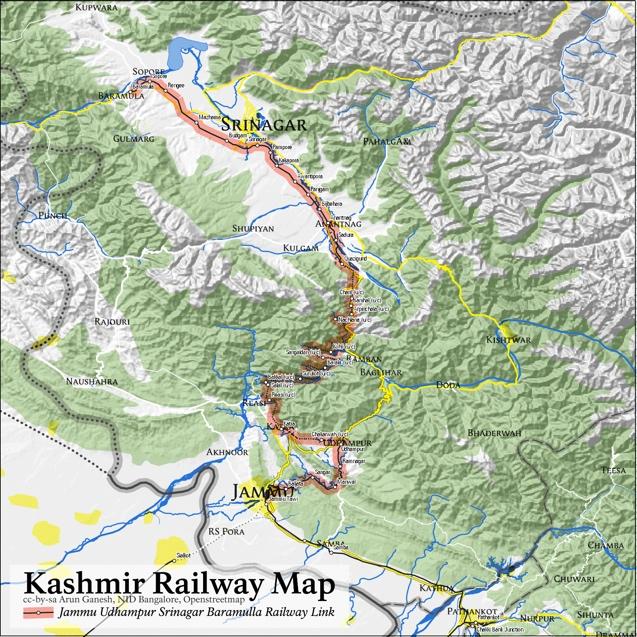
    The Bridge over the River Chenab is part of the Jammu-Udhampur-Baramulla Railway line, which is being constructed. While Sections of Jammu-Udhampur, Udhampur-Katra and Banihal-Baramulla are already completed and opened for traffic, section Katra- Banihal is still not complete. The degree of difficulty in this section is enormous. Besides this Bridge on Chenab (more about it a little later), the Bridge on Anji Khad (which is under construction) and a total of 35 tunnels and 37 bridges make this section of 111 km in the mountainous terrain extremely challenging and an engineering marvel in the making.

    Progress of the Project –  It is a 356 km railway project, starting at Jammu and going up to Baramulla. It was started in 1983 with the objective of connecting Jammu Tawi to Udhampur.  Construction of the route faced natural challenges including major earthquake zones, extreme temperatures and inhospitable terrain.  Finally, in 2005  The 53 km long Jammu–Udhampur section opened after 21 years with 20 tunnels and 158 bridges. The cost of the project had escalated to ₹515 crores from the original estimated cost of ₹50 crores.  In 1994 The railway accepted the necessity to extend the track to Baramulla. However, at that point it was thought that the project will have two disconnected arms; one from Jammu to Udhampur and the second from Qazigund to Baramulla. In 2002 the GoI declared this project to be a national project. This means hereafter, the entire funding will be from the Central Budget. At that time the necessity was also accepted to connect the two disconnected arms. The estimated cost of the project assessed then was   ₹6,000 crore.  In 2008 the 66 km section between Anantnag and Manzhama (outside Srinagar) was opened for traffic. In 2009 this Service was extended to Baramulla. During the same year, the line from Anantnag was extended to Qazigund.

    Also  Around the same time, an extension of the track from Baramulla to Kupwara was proposed, and its survey got completed in 2009. In 2009 itself, work on the section between Katra and Qazigund resumed after a review based on geotechnical studies. In 2011, an 11.215 Km long Banihal Qazigund tunnel across the Pir Panjal Range was completed.  This paved the way for a trial run in Dec 2012 from Banihal to Qazigund. In 2014 the train route from Udhampur to Katra was also operationalised. Now the only missing link in this nationally vital rail line was Katra-Banihal. Finally, in 2018 the GoI approved the extension of the railway line to Kupwara.

    Degree of Difficulty in Katra- Banihal Section – This is a 111 km long stretch. 97.34 km of this stretch will be through tunnels. There are 20 Major (including the bridge across the Chenab river and a bridge on Anji Khad) and 10 minor bridges on this stretch. 

    Bridge Across Chenab
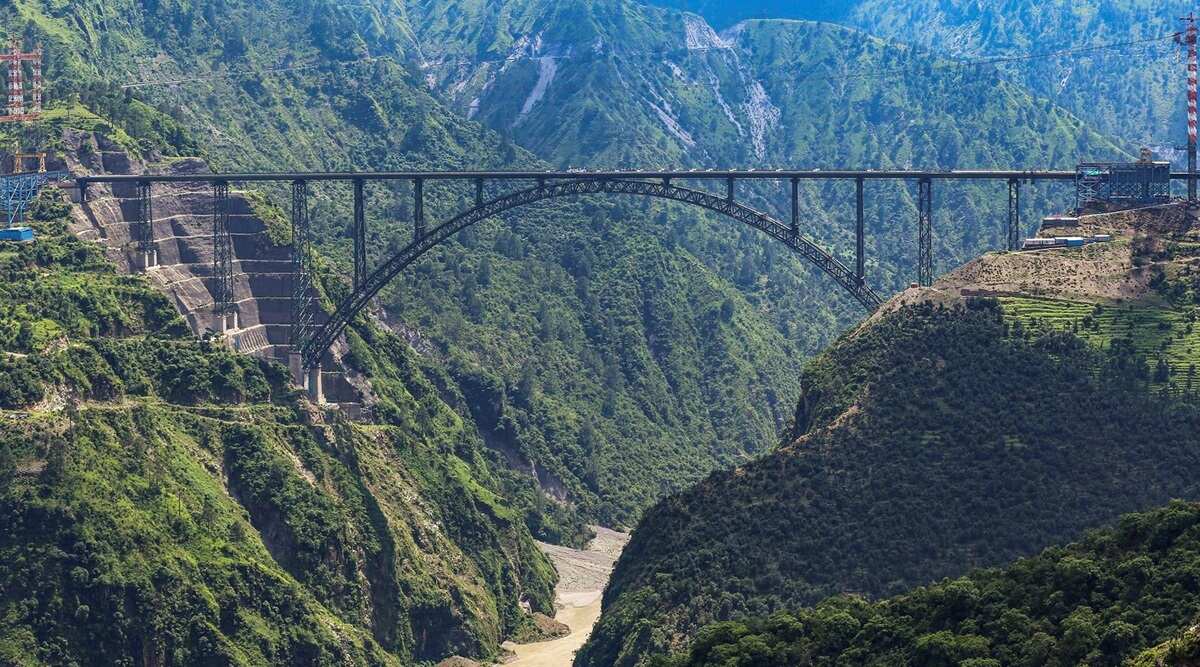
    Location: The Chenab Rail Bridge is a steel and concrete arch bridge between Bakkal and Kauri in the Reasi district of J&K, India.  It needs to be noted that it is the highest railway bridge in the world. After many hick-ups, finally in 2012 excavation of the foundation of the bridge commenced. The tender was with Afcons Infrastructure Limited. The alignment crosses a deep gorge of the Chenab River, which necessitates the construction of a long-span railway bridge with a viaduct for approaches on either side. 

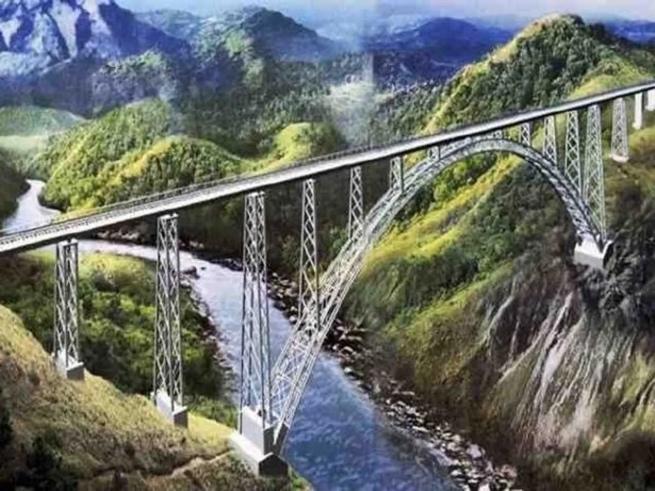
    Details: It is a 785 meters long single arch bridge where the main arch is 467 meters. The total span of the bridge is 1315 meters including a viaduct of 650 meters on the Northern side, Deck height is 359 meters above the river bed and 322 meters above the water surface which is 35 meters more than the height of the Eiffel Tower. The project also entails the construction of 203 km of access roads.  The deck is 13.5 meters wide, where two rail tracks will be available. The total cost of the Bridge is Rs 1486 Crores.
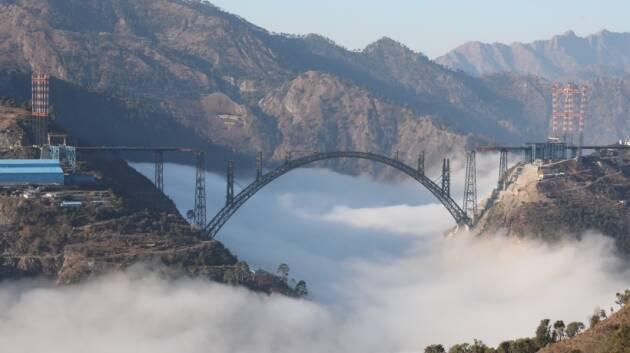
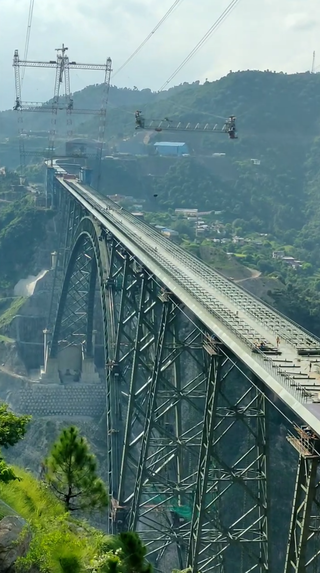
     

    Design: The steel arch has been planned because the construction of the pillar was difficult and the load had to be distributed. Chords have been provided to cater for the swaying load. The steel structures of the bridge were manufactured in workshops built in the mountains. The workshops had been moved to the building site because there is no proper road network in the challenging terrain. The longest building parts that could be delivered to the site were 12 meters in length. Therefore, four workshops were established in the mountains. Workshops and paint shops were built on both sides of the valley. All steel materials, except for the smallest rolled profiles, were delivered to the mountains as steel boards. The insufficient infrastructure of the area caused additional problems. There was no electricity and the water of the river was not suitable for manufacturing concrete. All electricity had to be produced at the site and the water was delivered from further away in the mountains. The job was also challenging because the track had a curvature in the approach bridge. In this section, the construction stage bearings had been designed in such a way that it was possible to launch the steel deck in the curvature portion as well. The bridge consists of about 25000 tonnes of steel structures, the main portion of which was used for the arch bridge section. It is a unique design and as such none of the Indian codes fully catered for the design validation. Therefore it was decided to follow the BS Code. The design also caters for wind load effects as per wind tunnel tests. It can cater for wind pressure of 1500 Pa. It is a blast resistance design. The design of the decking has been checked for fatigue as per the BS Code. The most important aspect is that it caters for redundancy within the structure, for a lower level of operation during mishaps and against collapse in extreme cases of one-pier failure. The area has high seismicity and the design was planned to withstand earthquakes of the severity of 8 on the Richter Scale. The bridge design is for a rail speed of 100 kmph. This means it can withstand very high-intensity of vibrations. The designed life of the bridge is 120 years and to take care of assessed steel fatigue the fatigue design selected is BS:5400 Part-10. The bridge will be able to withstand a temperature of minus 200C and a wind speed of 266 kmph.

    Team: The viaduct and foundation have been designed by M/s WSP(Finland) and the Arch design has been made by M/s Leonhart, Andra and Partners (Germany), the foundation protection has been designed by IISc Bangalore. The executing agency has been M/s Konkan Railway Corporation Limited.

    Status of Katra-Banihal project

    Although, the construction of Chenab Bridge is a major milestone in the progress of the project, however, still many more landmarks are required to be crossed before the completion of the project. Foremost of them is the Anji Khad bridge which is expected to be ready only by Dec 2022. It is expected that this rail Section will finally be operational by the middle of 2023.

    Conclusion

    The Jammu-Udhampur-Katra-Banihal-Srinagar-Baramulla Rail project is a vital national project which has a major bearing on national security and nation building. It is a matter of pride that Indian Engineers have achieved what at one point had appeared impossible. It will help in the integration of J&K with the rest of the country and will help strategically in many ways. The completion of the project will also give confidence to expeditiously complete other projects of national importance like; the railway line to Leh and the Railway line to Tenga in the North-East.

    End Note:

    1. Conceptual Design of the Chenab Bridge in India by Pekka Pulkkine WSP Finland, S Hopf and A Jutila. Available on Research Gate: https://www.researchgate.net/publication/257725212_Conceptual_Design_of_the_Chenab_Bridge_in_India.

    2. An internet upload: https://byjus.com/current-affairs/chenab-bridge/

    3. A Report by OT Staff, “Once the bridge is completed, it will provide all-weather connectivity between Kashmir and the rest of India” reported on 07 Apr 2021 and uploaded on https://www.outlookindia.com/outlooktraveller/travelnews/story/71397/all-about-the-chenab-bridge

    4. An internet upload: https://en.wikipedia.org/wiki/Jammu–Baramulla_line

    5. An internet upload: https://en.wikipedia.org/wiki/Chenab_Rail_Bridge

    6. An internet upload: https://www.pib.gov.in/PressReleasePage.aspx?PRID=1709652

    7. Zee Media Bureau, “Indian Railways: Delhi-Kashmir, Katra-Banihal train route to open soon, project nears completion” dated 08 Aug 2022 and uploaded on https://zeenews.india.com/railways/indian-railways-delhi-kashmir-katra-banihal-train-route-to-open-soon-project-nears-completion-2494827.html

    Image 1 Credits: Arun Ganesh

    Image 2 Credits: Indian Railways

    Image 3 Credits: Indian Express

    Image 4 Credits: Indian Railways

    Feature Image Credits: The Indian Express
  • Infrastructure development is high priority for Vietnam-Lao PDR relations

    Infrastructure development is high priority for Vietnam-Lao PDR relations

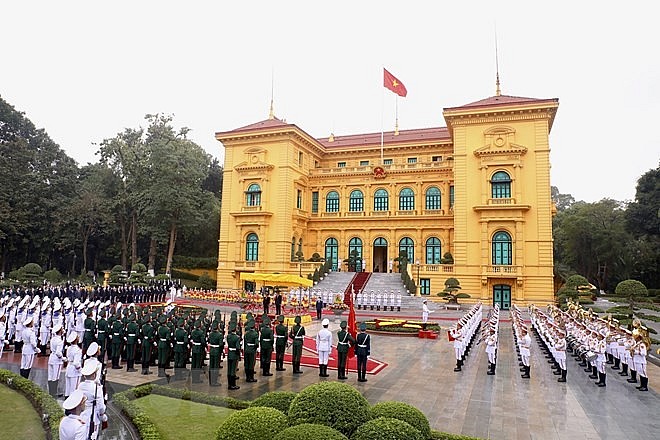
    The year 2022 is singularly important for Vietnam-Lao PDR relations. It marks the 60th anniversary of the bilateral diplomatic relations, and 45 years of the Vietnam-Laos Treaty of Amity and Cooperation. Both sides have accorded high priority to the current year, and Prime Minister Pham Minh Chinh extended the invitation to Lao Prime Minister Phankham Viphavanh to visit to commemorate the above events.  Accordingly, Prime Minister Viphavanh is in Vietnam and is leading a high-level delegation.

    Prime Minister Pham Minh Chinh, according to reports, will also co-chair the 44th meeting of the Vietnam-Laos Inter-Governmental Committee and launch the Vietnam-Laos Solidarity and Friendship Year 2022. This would help to “get a better understanding of each other’s socio-economic situation, development orientations and external policies” particularly during the ongoing COVID-19 pandemic.

    The visit is also intended to boost Vietnam-Laos cooperation strategy for the 2021-2030 period and the five-year cooperation plan for the 2021-2025 period that are now into the second year and involve bilateral engagements in multiple domains such as politics, diplomacy, security-defence, economy, science-technology, culture, and education-training.

    COVID-19 would be high on the agenda of both leaders given that the pandemic is impacting their countries. They are in the midst of the fourth wave with 8,236 and 354,075 active cases (as of 05 Jan 2022) respectively.

    In December 2021, the Lao government announced opening up of the country for trade and tourism in three phases: First phase – January 1, 2022; Second phase – April 1, 2022; and the Third phase July 1, 2022. In the first phase, 17 countries, including Vietnam and many neighbouring ASEAN countries, besides some European countries, China, the US, Australia and Canada would be welcomed. The Lao economy is impacted by COVID-19 and was projected to grow at 3 per cent, a figure lower than 4 per cent as approved by the Laotian National Assembly. This attributed to the pandemic and prolonged lockdowns that disrupted economic activities and companies, retail and wholesale shops had to shut down.

    Leaders in Vientiane recognize the importance of regional development particularly in the Cambodia-Laos-Vietnam Development Triangle Area (CLV-DTA)

    Vietnam and Lao PDR are also engaged in major connectivity projects. Lao is a landlocked country and ports in Vietnam provide the country access to the sea to engage in international seaborne commerce.

    Last year, during President Nguyen Xuan Phuc visit to Laos, 14 agreements spanning a wide range of issues were signed. The leaders agreed to fast-track joint projects including Vung Ang No.1, 2, 3 port projects, the Hanoi-Vientiane Expressway, Vientiane-Vung Ang Railway, Lao-Vietnam Friendship Park in Vientiane, Nongkhang Airport and hospitals in Lao Houaphan and Xiangkhouang Provinces.

    One of their flagship joint projects is the 1,450 kilometres long East-West Economic Corridor (EWEC). It is a road-building project and is supported by the Asia Development Bank (ADB). Its western leg includes Thailand, and in the east, it terminates at the Vietnamese port of Da Nang which is a major gateway to the Pacific.

    Similarly, the 555 kilometres railway link (452 kilometres in Laos and 103 kilometres in Ha Tinh central province in Vietnam) between Vientiane and the Vietnamese deep-water port of Vung Ang is important. It gives Laos yet another access to the sea. Importantly, it is being jointly developed and Laos would hold a 60% stake in the project, and Vietnam with 40%.

    China is also engaged in connectivity projects in Laos. In December 2021, after six years of construction, the Laos-China Railway project was finally operationalized. It is a complex project and includes 61 kilometres of bridges and 198 kilometres of tunnels and reduce travel time between Vientiane to the Chinese border from 15 hours by road to four hours. It will be operated by the Laos-China Railway Co., a joint venture between China Railway group and two other Chinese government-owned companies with a 70% stake and a Laotian state company with 30%.

    Vietnam offers Laos an alternative to Chinese infrastructure investments and it ranks third among investors in Lao with total investments of US$ 5.16 billion in 209 projects. There are fears that the Chinese funded projects do not generate economic benefits for Laos, instead these only benefit China.

    There are geopolitical dynamics at play in the CLV-DTA that are targeted against China, and Cambodia and Laos acknowledge Vietnam’s leadership

    Vietnam cannot match up with the Chinese investments in Laos, but leaders in Vientiane recognize the importance of regional development particularly in the Cambodia-Laos-Vietnam Development Triangle Area (CLV-DTA). Vietnam for example has invested nearly US$ 4 billion in Cambodia and as noted above over US$ 5 billion in Laos. It is fair to assume that there are geopolitical dynamics at play in the CLV-DTA that are targeted against China, and Cambodia and Laos acknowledge Vietnam’s leadership.

    Images Credit: Vietnam times

  • China’s support to Syria: In Conflict and Redevelopment

    China’s support to Syria: In Conflict and Redevelopment

    China is looking to ramp up relations with Syria both as part of its strategic Belt and Road Initiative (BRI) but also to take advantage of the multi-billion dollar reconstruction effort that is expected to materialise following the gradual winding down of the war.


    Syria is an ancient civilisation and also an important part of the ancient silk route, with cities such as Palmyra, Aleppo and Damascus playing an important role in trade and travel between the East and the West. While the discovery of a maritime route between Europe and Asia has to some extent diminished its importance in this regard, Syria is still strategically important. China is looking to ramp up relations with Syria both as part of its strategic Belt and Road Initiative (BRI) but also to take advantage of the multi-billion dollar reconstruction effort that is expected to materialise following the gradual winding down of the war.

    China’s non-interference policy is an integral aspect of its involvement and role in the Middle East. During the course of the Syrian war, China has consistently supported the Bashar Al Assad government on the diplomatic front – through the exercise of the veto power against the resolutions introduced in the United Nations Security Council either condemning the Syrian government, calling for ceasefire or for imposing sanctions on suspected war criminals. While negotiating the renewal of border crossings for aid, China agreed on the need for humanitarian assistance but emphasised on state sovereignty. China’s policy of non-interference has served it well in strengthening bilateral relations and advancing its interests.

    One of the reasons for the diplomatic support extended by China to the Syrian government is also the involvement of the Uighur fighters in the Syrian conflict which has greatly bothered China. While it has never got directly involved militarily in the Syrian conflict there are unconfirmed media reports which suggested that China was sharing military intelligence with the Syrian government and also sent its military advisors to Syria to help it in its fight against the rebels. In this sense, it saw Syria as a key player in its fight against religious extremism thereby preventing its export to its own volatile Xinjiang province.

    With the Syrian conflict slowly winding down and Bashar Al Assad’s hold on Syria greatly strengthened more than at any other time since the beginning of the civil war, China is ramping up its diplomatic efforts in Syria  using trade as an important policy tool to ramp up the relations between the two great civilisations.

    Based on Chinese government’s invitation Syria has participated in the second BRI summit held in Beijing in April 2019. Previously in 2018, China held a Trade Fair on Syrian reconstruction projects which was attended by nearly one thousand Chinese companies and which saw investment proposals of nearly USD two billion. The collapse of most of the industry in Syria due to the war has also resulted in a significant increase of cost-effective Chinese imports into Syria ranging from toys to car parts and industrial machinery and equipment.

    China is also leveraging its economic strength fully by using aid as a foreign policy tool. In 2019,  Xinhua reported on the  that an economic cooperation agreement was signed between Syria’s Planning and International Cooperation Commission (PICC) and the Chinese embassy in Damascus. As part of this agreement, a donation will be set aside to fund a series of humanitarian projects as agreed upon by both sides.

    The collapse of most of the industry in Syria due to the war has also resulted in a significant increase of cost-effective Chinese imports into Syria ranging from toys to car parts and industrial machinery and equipment.

    China is expected to be a key player in the international reconstruction and development effort that is expected to take place in Syria due to its strong bilateral ties with not only Syria but also its alignment with Russian and Iranian position on Syria , these two players being the major supporters of Bashar Al Assad’s government in the civil war. While Russia and Iran are surely expected to carve out a large part of the reconstruction contracts between themselves, their capacity to make the huge investments in these projects, estimated to be worth anywhere between USD 200 million to USD 1  trillion is doubtful. This creates the ripe opportunity for China to enter the reconstruction business effort either by themselves or, as is more likely, in partnership with Russian and Iranian governments or businesses.

    Beyond the business opportunities provided by the potential reconstruction of Syria, China is also strategically interested in Syria. China was always interested in securing access to the Ports of Tartus and Latakia on Syria’s Mediterranean coast. Such an access is expected to complement Beijing’s interests in the Greek port Piraeus (COSCO shipping, the Chinese state-owned shipping and logistics services supplier company in the Port authority) and the Israeli port of Haifa, in securing a trade route to Europe. In alignment with these strategic interests, Chinese companies’ area also exploring the possibility of upgrading the deep seaport of Tripoli, Lebanon to allow it to accommodate larger vessels and also the possibility of building a railroad that would connect Beirut and Tripoli in Lebanon to Homs and Aleppo in Syria.

    Beyond the business opportunities provided by the potential reconstruction of Syria, China is also strategically interested in Syria. China was always interested in securing access to the Ports of Tartus and Latakia on Syria’s Mediterranean coast.

    Chinese investments into and trade ties with Syria however, risk the attraction of US sanctions on Syria. The arrest of Meng Wanzhou, Chief Financial Officer of Huawei, , in Canada, based on a request by the United States highlights the extent of these risks. “The Caesar Syria Civilian Protection Act”, also known as “The Caesar Act”, a United States legislation that sanctions the Syrian government, including Syrian president Bashar al-Assad, for war crimes against the Syrian population, parts of which  are now incorporated  in the “National Defense Authorization Act for Fiscal Year 2020” greatly tightened the sanctions environment against the Syrian government and a number of its industries potentially impacting the Chinese investments and trade ties. While China has called for an end to sanctions stating they were “inhuman,” they have been wary of being targeted by sanctions and further straining their relations with the US. However, it is unlikely that the sanctions would have a significant effect on China given the size of China’s economy and its ability to circumvent sanctions while dealing with Iran and North Korea. China, as part of its ‘mask diplomacy,’ is increasingly providing aid to the Syrian government in their efforts against Covid-19. This serves the dual purpose of strengthening China-Syria relations and strengthening China’s narrative of Covid-19.

    To conclude, China has been a staunch supporter of the incumbent Syrian government of Bashar Al Assad during the almost decade long Syrian civil war and is set to reap the benefits from the post-war Syrian reconstruction effort in conjunction with the Russians and the Iranians to advance its interests.

    Image: Middle East Institute