Category: TPF Occasional Paper

  • Between Western Universalism and Cultural Relativism

    Between Western Universalism and Cultural Relativism

    TPF Occassional Paper – 01/2025

    Between Western Eurocentric Universalism and Cultural Relativism: Mutual Recognition of the Civilisations of the Earth as precondition for the Survival of Mankind


    Andreas Herberg-Rothe

    In the 19th century, the Europeans conquered the whole world; in the 20th century, the defeated nations and civilizations had to live with the victorious West; in the 21st century, the civilizations of the earth must finally learn to live together.

    The Universal Declaration of Human Rights was codified by the United Nations in 1948. But the academic debate on the universality of the norms on which it is based is far from over. The question remains whether there are universal values other than those of the West. Western values alone are often implicitly regarded as universal. But whether this is scientifically justifiable is more than debatable. At the same time, few participants in the debate seriously doubt the need for universal human dignity.

    In the current debate, the binary positions of relativism and universalism are in a stalemate. A way out of this dichotomy would have to withstand the charge of ethnocentrism as well as particular relativism. Neither should dimensions of power and colonialism be ignored, nor should inhumane practices such as torture, humiliation and sexual violence be relativised by reference to another ‘culture’. If a universal approach is to be found, it should not be implicitly Westernised. This is a criticism of existing approaches, particularly in postcolonial theory.

    Historically, ethnocentrism, as a mere description of a state of affairs, has developed into a justification of ‘cultural superiority’ and, as a consequence, of oppression and exploitation.

    It is about the justifiability of universal norms on the one hand, and the inevitability of particular justifications of norms on the other. Historically, ethnocentrism, as a mere description of a state of affairs, has developed into a justification of ‘cultural superiority’ and, as a consequence, of oppression and exploitation. An initially unconscious preference for and belief in one’s own (cultural) perspective, the unquestioned truth and correctness of one’s own norms, values and patterns of behaviour, did not develop into ‘live and let live’. This form of ethnocentrism rejects the acceptance of cultural differences and represents an attitude that legitimises the destruction of the foreigner as a legitimate consequence of one’s own superiority. This, of course, refers mainly to the long-standing colonisation of supposedly ‘inferior’ peoples by European states and the associated cultural appropriation and cultural destruction or exploitation. These practices were morally legitimised on the basis of the conviction that one’s own way of life was superior to all other ways of life, not only militarily and politically, but also cognitively and morally. Ideologically, this argument is based on various elements, including the proselytising idea of the Christian message of salvation, the idea of the ‘progress’ of Western civilisation over other cultures and the idea of ‘racial doctrine’.

    In reaction to this unreflected, chauvinistic ethnocentrism, two main currents of contradiction developed: universalism and relativism. Universalism ‘assumes that it is possible to find standards of value that apply across cultural boundaries and are universally valid’, while the relativist position, in the absence of the possibility of an ‘extra-cultural’, objective judgement of a situation, all cultures, with everything that belongs to them, are ascribed the same value.

    Universalism

    The argumentative basis of Western universalism is the assumed fundamental equality of all human beings – both in their intellectual capacity (cognitive) and in their materiality (normative), which leads to a general insight into certain universal norms. The most obvious example of this is universal human rights, whose need for universality is clear from their very name.

    The cognitive premise of this kind of universalism goes back to the Enlightenment and the idea that all human beings have, in principle, the same cognitive capacities, even if they differ in individual cases. Only on this basis can the premise of normative universalism in the Enlightenment be realised. But this leads to various problems, paradoxes and points of criticism, because this conception is based on a particular understanding of rationality that is rooted in the thinking of Western modernity. For example, it excludes any kind of holism, although this conceptualisation is by no means irrational, but represents a different kind of rationality.

    The apparent paradox of the uniqueness of each culture lies in the claim to universality that all cultures are of equal value. We can therefore speak neither of a universalism that is purely independent of culture, nor of a norm that can be attributed to only one culture.

    One frequently pursued solution to the tension between universal norms, which nonetheless originate in only one culture, and different culturally determined norms has been to search for what is common to all cultures. This approach, which in itself goes further, was pursued above all in the project of the ‘global ethic’, which sought the common foundations of all religions. Western modern universalism had thus abandoned its claim to all-encompassing universality and limited itself to a kind of ‘core norms’. Instead of questioning specific cultural practices, the focus is on the fundamental premises of human coexistence. In my view, this project was doomed to failure after the initial euphoria, because the commonalities were based on an ever-increasing abstraction. This leads to two fundamental difficulties: the unresolved problem of drawing boundaries between different forms of norms, and the justification of particular norms on the basis of the universal assumption that all cultural norms are in principle equal. The apparent paradox of the uniqueness of each culture lies in the claim to universality that all cultures are of equal value. We can therefore speak neither of a universalism that is purely independent of culture, nor of a norm that can be attributed to only one culture.

    Strong normative relativism represents a ‘normative statement that all normative systems are fully justified in their diversity’ – a paradox since this is a statement with a claim to universal validity. In contrast, weak normative relativism is derived from the impossibility of universally valid normative statements, which merely means a ‘non-evaluability’ of normative systems  The demarcation between concrete social norms  is therefore very difficult

    Because of the difficulty of justifying strongly normative positions, ‘differentiated’ theories of relativism argue from a ‘weakened position’, albeit at the expense of unambiguity due to the lack of demarcation. Culture is then understood as ‘dynamic and hybrid’, while ‘normative overlaps’ are recognised without doubting the fundamental relativity of all norms.

    Paradoxical structure

    Relativism does not provide a ‘ground zero’ from which to make generally valid statements – this rules out the possibility of relativism being universally valid in itself, as well as the possibility of relativism being regarded as a ‘universal truth’.  Relativism cannot, therefore, justify itself out of itself, which it has in common with other theoretical currents in the age of postmodern critique (Herberg-Rothe 2025). Moreover, it does not necessarily apply universally, but can be limited in time or place: So the undecidability of normative conflicts might appear to be a particularly obvious contemporary phenomenon, without it being true for all times and places that normative conflicts are fundamentally undecidable. This concept of decidable and undecidable questions is based on the position of Heinz von Foerster’s radical constructivism. In his desperate attempt to leave behind all only apparent objectivity and the subjectivity of all norms, he resorts to a binary opposition between objectivity (in mathematics) and subjectivity.

    Due to the equivalence of all cultural standpoints and the lack of presupposed values, no well-founded criticism can take place, which makes relativism normatively arbitrary in relation to itself. Neither the persecution of minorities nor discrimination can be legitimately criticised if this is seen as a cultural particularity. The norm of ‘absolute tolerance of cultural differences’ is both empirically untenable and logically inconsistent, since here too there is a claim to universal validity. However, this point of criticism already presupposes the premise of universalism that there are conditions that are worthy of criticism despite their culture-specific justification.

    The observed norms and values appear to be specific responses to specific social problems but are in no way connected to the supposed ‘essence’ of a culture, as culture itself is perceived as hybrid, fluid and contradictory – instead of judging inhumane practices of one’s own culture, it is about understanding. In this context, the post-colonial reality should also be mentioned, in which there are no longer any cultures without interference.

    Relativism in its weakened form has moved away from normative statements. In the absence of a judgmental dimension, it no longer makes a statement about tolerance towards certain cultural practices. The observed norms and values appear to be specific responses to specific social problems but are in no way connected to the supposed ‘essence’ of a culture, as culture itself is perceived as hybrid, fluid and contradictory – instead of judging inhumane practices of one’s own culture, it is about understanding. In this context, the post-colonial reality should also be mentioned, in which there are no longer any cultures without interference.

    In order to be able to criticise on the basis of relativism in human practices despite all these objections, two possibilities need to be mentioned:  1. to establish ‘qualified norms’ without further justification in order to criticise on the basis of them, and 2. to practise a particular, culturally immanent criticism – of one’s own cultural norms on the basis of other norms of one’s own culture. For example, there are numerous culturalist justifications for gender equality, “general” human rights or democracy, which shows that a culturally immanent and particular critique of domination does not necessarily have to differ in content from a universalist critique (see for example Molla Sadra in Herberg-Rothe 2023). Both solutions are in no way ideal, because in the first attempt, we encounter a hidden enthnocentrism, and in the latter, the problem arises between contrasting norms within one culture.

    Covert Westernisation and reverse Ethnocentrism

    Relativism is also a theory of Western origin, which can be seen in the Western-influenced ‘idea of tolerance’ – but this point also applies mainly to a normatively strongly interpreted relativism.  Inverse ethnocentrism, on the other hand, means ‘labelling everything foreign as right’.

    What underlies both, universalism and relativism, is the struggle for knowledge: which norms can be taken for granted? Or, more philosophically, what can we know? Both positions have argumentative shortcomings that are not easily remedied.

    Knowledge is closely linked to power (the power to define, to enforce, to disseminate or to withhold knowledge) and thus to domination and often to violence. This connection is expressed in social tensions between the legitimation of domination and the subversion of existing conditions.

    The use of human rights to achieve social change raises the question of “whether this process is not itself, in terms of knowledge, a bureaucratic, almost classically ethnocentric process with an imperial claim to universality’ that spreads ‘Western culture’ and its models of action globally’.

    Transnational encounters since the colonial era have steadily increased due to globalisation and require reassessment. The use of human rights to achieve social change raises the question of “whether this process is not itself, in terms of knowledge, a bureaucratic, almost classically ethnocentric process with an imperial claim to universality’ that spreads ‘Western culture’ and its models of action globally’. At the same time, this process opens up a dialogue beyond culturally determined borders, which we must be aware in order to transcend them.

    How could this stalemate between ethno Universalism and cultural relativism be overcome, at least in perspective?

     A new approach to practical intercultural philosophy

    Intercultural philosophy can play an important role in this process of mutual recognition among the civilizations of the earth. Since Karl Jaspers, the godfather of intercultural philosophy, acknowledged the existence of four different civilizations (Holenstein 2004, Jaspers 1949), immense progress has been made in understanding the different approaches. Nevertheless, all civilizations have asked themselves the same question but have found different answers. Cross-cultural philosophy is thus possible because we as human beings ask the same questions (Mall 2014). For example, in terms of being born, living and dying, between immanence and transcendence, between the individual and the community, between our limited capacities and the desire for eternity, the relationship between us as animals and the ethics that constitute us as human beings – our ethical beliefs may be different, but all civilizations have an ethical foundation. In fact, I would argue that it is ethics that distinguishes us from animals, not our intellect (Eiedat 2013 about Islamic ethics). We may realize the full implications of this proposition when we relate it to the development of artificial intelligence.

    Detour via Clausewitz

    An alternative solution to the problem raised by Lyotard suggests another dialectic, as implicitly developed by Carl von Clausewitz based on his analysis of attack and defence. The approach of Clausewitz is insofar of paramount importance because it presupposes neither a primacy of identity in relation to difference, contrast, and conflict, nor to the reverse as in the conceptualizations of the post-structuralists (Herberg-Rothe 2007, Herberg-Rothe/Son 2018) or the adherents of a purified Western modernity in the concepts of Habermas and Giddens. In contrast to binary opposites, Clausewitz’s model of the “true logical opposition and its identity,” a structure-forming “field” (something like a magnetic field) allows us to think of manifold mediations as well as differences between opposites. If we formulate such an opposition in the framework of a two-valued logic (which formulates the opposition with the help of a negation or an adversarial opposition), there is a double contradiction on both sides of the opposition. From the assumption of the truth of one pole follows with necessity the truth of the other, although the other formulates the adversarial opposition of the first and vice versa. Hegel’s crucial concepts such as being and nothingness, coming into being and passing away, quantity and quality, beginning and ending, matter and idea are such higher forms of opposition which, when determined within the framework of a two-valued logic, lead to logical contradictions. Without taking into account the irrevocable opposites and their unity, a “pure thinking of difference” leads either to “hyper-binary” systems (such as the relation of system and lifeworld, of constructivism and realism) or to unconscious absolutizations of new mythical identities (such as Lyotard’s notion of plasma as well as Derrida’s chora).

    Clausewitz’s “true logical opposition” and its identity enables the thinking of a model in which the opposites remain irrevocable, but at the same time, in contrast to binary opposites

    1. both remain in principle equally determining; this model is therefore neither dualistic nor monistic, but cancels this opposition in itself and sets it anew at a new level.;
    2. structure a “field” of multiple unities and differences;
    3. enable a conceptualization, in which the opposites have a structure-forming effect, but do not exist as identities detached from one another,
    4. and in which there are irrevocable boundaries between opposites and differences, which at the same time, however, are historically socially distinct. The concrete drawing of boundaries is thus contingent, without the existence of a boundary as such being able to be abolished (Herberg-Rothe 2007, 2019 and Herberg-Rothe/Son 2018). Clearly, in the, albeit limited, model of a magnet neither the south nor north pole exists as identity, a (violent) separation between both even leads to a duplication of the model. At the same time, both poles are structures forming a magnetic field, without a priority for either side. And finally, Clausewitz’s model of the true logical opposition goes beyond the one of polarity, because it additionally allows us to think of manifold forms of transitions from one pole to the other (Herberg-Rothe 2007, Herberg-Rothe/Son 2018).

    This conception of an “other” dialectic is also the methodological precondition of thinking “between” Lyotard and Hegel (Herberg-Rothe 2005). It treatises above all categories such as mostly asymmetrical transitions and reversals as well as the “interspace” (Arendt) between opposites. With such an understanding of dialectics, it is possible to understand the apparent contradiction between the rejection of the highest meta-meta-language and the fact that the language used in this critique, theory, is itself this actually excluded “highest” level of language, not as a logical contradiction, but as a performative one. Such performative contradictions between what a proposition, statement, etc., says and what it is are at the heart of Hegel’s notion of dialectic. Of all things, Hegel’s criticized and rejected form of dialectic makes it possible to conceive of these contradictions not as “logical” ones, but as ones that ground, but also force, further development as distinct from mythical ways out. This form of dialectic, however, contains at the same time the demonstration of a principle of development without conclusion and thus puts Hegel’s “great logic” as “thoughts of God before the creation of the world” in its place (Hegel Preface to the Science of Logic, Wdl I, Werke 5). Nevertheless, these performative contradictions should also not be absolutized, they are just one aspect of a different dialectics.

       Although I advocate the development of an intercultural philosophy as part of transnational governance and mutual recognition among the civilizations of the earth, I would like to highlight the main problem, at least from my point of view. Aristotle already asked the crucial question of whether the whole is more than the sum of its parts. If I understand Islamic philosophy correctly, it starts from the assumption that the whole is indeed more than the sum of its parts – one could call this position a holistic approach (Baggini 2018). In contrast, Western thought is characterized by the approach of replacing the whole precisely by the sum of its parts. We might call this an atomistic approach – only the number of electrons, neutrons, distinguishes atoms etc. In terms of holism, I would argue that the task might be to distinguish the whole from mere hierarchies – in terms of the concept of harmony in Confucianism, I would argue that true harmony is associated with a balance of hierarchical and symmetrical social and international relations. Instead of the false assumption in Western approaches that we could transform all hierarchical relationships into symmetrical ones, we need to strike a balance between the two. Harmony does not mean absolute equality in the meaning of sameness but implies a lot of tension. Harmony can be characterized by unity with difference, and difference with unity, as already mentioned (Herberg-Rothe/Son 2018). I sometimes compare this perspective to a wave of water in a sea: if there are no waves, the sea dies; if the waves are tsunamis, they are destructive to society.

    I start from the following fivefold distinction of thinking, based on the fundamental contrasts of life (while Baggini 2018 and Jaspers 1949, for example, reduce different ways of thinking largely to the development of functional differentiation).

    1. Attraction and repulsion, closeness and distance, equality and freedom, love and hate,
    2. Beginning and ending (birth and death, finiteness – infinity),
    3. Happiness and suffering (in Greek and Indian philosophy
    4. Part-whole (individual-community, immanence-transcendence, holism-hierarchies).
    5. Knowledge (experience, positive sciences, extended sense impressions,

    and method – mathematics and logic) versus feeling/the concept of intuition, belief.

    The listed methodological approaches try to cope with unity and opposition. In my opinion, they are also necessary approaches and can be seen as differentiations within the idea of polarity.

    Differentiations in thinking

    1. Either – or systems, = Western modern thought, concentration on the method (since Descartes and Kant, Vienna Circle, Tarski), democracy, individualism, in Islam Ibn Sina and Ibn Khaldun, in Chinese thought the tradition of Han Fei and Li Se; Yan 2011, Zhang 2012).
    2. As well as – Daoism, early Confucianism, but also New Age approaches, Heißenberg’s uncertainty principle, and dialectics.
    3. Neither-Nor enables the construction of “being-in-between”; Plato’s metaxis plus Indian logic, the whole concept of diversity, difference thinking, de-constructivism, the post-structuralism, post-colonialism
    4. system thinking, structuralism – here I struggle with the distinction between holism (in the Islamic worldview) and pure hierarchies (in Islam Al Ghazali); inherent logic of systems (Luhmann) and functional differentiation; in Eastern philosophies, we find this approach mainly in highlighting spiritual approaches
    5. process thinking – in ethics this can be found e.g. in utilitarianism, stage theories (Piaget, Kohlberg; Hegel’s world history as the progress of freedom consciousness), Hegel’s becoming at the beginning of his “logic” as “surplus” of coming into being and passing away; cycle systems; enlightenment; Dharma religions, in China, Mohism.

    While there are probably already worked out methods for points 1, 4 and 5, I lack such for 2 and 3, which are always in danger of expressing arbitrariness. This becomes especially clear in the mysticism of the New Age movement.

    How can this fivefold distinction be derived from one model, which is not a totalizing approach (Mall 2014)? For this purpose I use  again the simplified model of polarity. This method is elaborated in my Clausewitz interpretation of his wondrous trinity and the dialectic of attack and defense (Herberg-Rothe 2007 and 2019).

    Differences in polarity as a unifying model.

    1. Either-Or systems: Each of the two poles is either a north or a south pole (= tertium non datur). We find those approaches in mathematics, logic, rationality and methods in general; such conceptualizations are also to be found in zero-sum games – what one side gains, the other loses (rationality, if then Systems, in Cina Lli Si and Han Fei);
    2. As well As (earlier Confucius, Daoism): the magnet as unity consists of the opposites of both poles and the magnet “is” both north pole and south pole. This is analyzed in detail in my Clausewitz interpretation on the basis of war as unity and irrevocable opposition of attack and defence. We find this thinking, especially in Chinese ideas of win-win solutions. Here, competition and conflict in one area do not exclude cooperation in another (Herberg-Rothe 2007, Chinese version 2020.)
    3. Neither North nor South pole exist as identities (Plato’s metaxis, Indian thought) – they are rather dynamic movements in between the opposites (see in detail again Clausewitz’s concept of attack and defense; this understanding is the methodological basis of diversity; Herberg-Rothe 2007; see the French theorists of post-structuralism).
    4. Structure (system theories, Islamic holism): North pole and south pole “construct” a magnetic field outside and inside the materiality of the magnet, a non-material structure.
    5. Process thinking: Here the simplified example of the magnet finds its end – but can be understood beyond the physical analogy easily as movement from the south pole to the north pole and “always further” (sine curve on an ascending x-axis). In this sense, Already Hegel had considered the discovery of polarity as of infinite importance but criticized it because in this model the idea of transition from one pole to the other was missing (Herberg-Rothe 2000 and 2007). Molla Sadra (1571-1636), the most important philosopher of the School of Isfahan, elaborated this progressive circular movement particularly clearly. Although he is mainly regarded as an existential philosopher who denies any essence, he actually postulated a kind of progressive circle as the decisive essence (for an overview see Yousefi 2016, for more details see Rizvi 2021).

    A unifying model – Virtuous Concentric Circles

    Starting from the premise that Western thinking is shaped by the billiard model of international relations and that of all other civilizations by concentric circles and cycles (Herberg-Rothe/Son 2018), the aim is to work out how extensively both models determine our thinking in the respective cultural sphere in order to develop a perspective that includes both sides. In doing so, I do not assume one-dimensional causes for violent action, nor do I assume pure diversity without any explanation of causes. Instead, I work in perspective with virtuous and vicious circles – in these circles, there are several causes, but they are not unconnected to each other but are integrated into a cycle. So far, this methodological approach has probably been applied mainly in the Sahel Syndrome. The methodological approach would involve trying to break vicious circles and transform them into virtuous circles – this is where I would locate the starting point of a new approach to intercultural philosophy.

    Ideally, a virtuous circular perspective would look like this:

    1. Understanding of discourses on how conflicts with cultural/religious differences are justified/articulated.
    2. Attribution of these differences to different concepts of civilization.
    3. Mutual recognition of the same issues in different ways of thinking.
    4. Self-knowledge not only as religion or culture, but as a civilization.
    5. the self-commitment to one’s own civilizational standards, norms (Jaspers 1949 and Katzenstein 2009) etc., which can also contribute to the management of intra-societal and international conflicts.

    At the infinite end of this process would be a kind of mutual recognition of the civilizations of the earth, accompanied by their self-commitment to their own civilizational norms. My colleague Peng Lu from Shanghai University has made the following suggestion: In the 19th century, the Europeans conquered the whole world; in the 20th century, the defeated nations and civilizations had to live with the victorious West; in the 21st century, the civilizations of the earth must finally learn to live together.  This is in my view the task of the century. Solving the problem of ethno-universalism and cultural relativism has nothing to do with wishful thinking, but is the precondition for the survival of humankind in the twenty-first century, unless we want to repeat the catastrophes of the twentieth century on a larger scale.

    References: 

    Baggini, Julian (2018), How the World Thinks. A global history of philosophy. Granta: London.

    Clausewitz, Carl von (2004) On War. Edited and translated by Michael Howard and Peter Paret. Princeton: Princeton University Press

    Fukuyama, Francis (2018), Against Identity Politics. The new tribalism and the crisis of democracy. In Foreign Affairs, Sept./Oct. Retrieved from: https://www.foreignaffairs.com/articles/americas/2 018-08-14/against-identity-politics; last accessed, Oct. 3, 2018, 10.21.

    Herberg-Rothe, Andreas (2003/2017), Der Krieg. 2nd ed., Campus: Frankfurt.

    Herberg-Rothe, Andreas and Son, Key-young (2018), Order wars and floating balance. How the rising powers are reshaping our worldview in the twenty-first century. Routledge: New York.

    Herberg-Rothe, Andreas (2023) Toleration and mutual recognition in hybrid Globalization. In: International Studies Journal, Tehran, Print version: September 2023; Volume 20, Issue 2 – Serial Number 78; pp 51-80.

    Also published Online: URL: https://www.isjq.ir/article_178740.html?lang=en; last access 4.11. 2023.

    Herberg-Rothe, Andreas (2024), Lyotard versus Hegel. The violent end of postmodernity. In: Philosophy and Sociology. Belgrade 2024/2025 (forthcoming)

    Jaspers, Karl (1949), Vom Ursprung und Ziel der Geschichte. Munich: Piper 1949 (numerous follow-up editions).

    Katzenstein, Peter J (2009). Civilizations in World Politics. Pluralist and pluralist perspectives. Routledge: New York

    Li, Chenyang (2022), “Chinese Philosophy as a World Philosophy”. In: Asian Studies, September 2022,  pp. 39-58.

    Yan, Xuetong. Ancient Chinese thought, modern Chinese power. Princeton: Princeton University Press, 2011.

    Zakaria, Fareed (2008), The Post-American World, New York/London: W. W. Norton, 2008.

    Zhang, Wei-Wei (2012), The China Wave: Rise of a Civilizing State. Hackensack: World Century Publishing Corporation.


    Feature Image Credit: www.ft.com
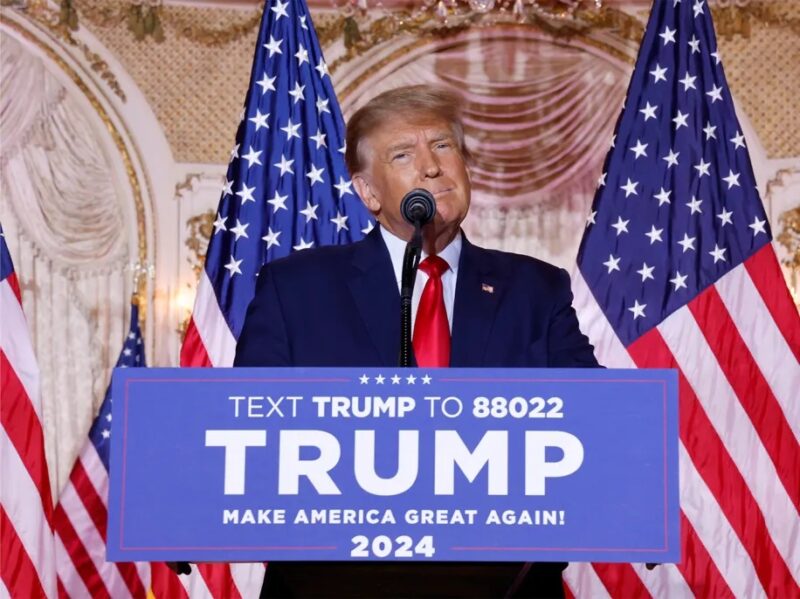
  • Trump followed four years later by Trump: Would America’s trustiness and system of alliances survive?

    Trump followed four years later by Trump: Would America’s trustiness and system of alliances survive?

    [powerkit_button size=”lg” style=”info” block=”false” url=”https://admin.thepeninsula.org.in/wp-content/uploads/2024/12/OCP-5-1-Trump-followed-four-years-later-by-Trump-website.pdf” target=”_blank” nofollow=”false”]
    Download
    [/powerkit_button]
  • Women in Afghanistan : The Fight Back

    Women in Afghanistan : The Fight Back

    [powerkit_button size=”lg” style=”info” block=”false” url=”https://admin.thepeninsula.org.in/wp-content/uploads/2024/12/OCP-4-1-Women-in-Afghanistan-website.pdf” target=”_blank” nofollow=”false”]
    Download
    [/powerkit_button]
  • Is Singularity Here ?

    Is Singularity Here ?


    [powerkit_button size=”lg” style=”info” block=”false” url=”https://admin.thepeninsula.org.in/wp-content/uploads/2024/12/OCP-3-1-Is-Singularity-Here-website.pdf” target=”_blank” nofollow=”false”]
    Download
    [/powerkit_button]
  • India and Myanmar: Two Years After The Coup

    India and Myanmar: Two Years After The Coup


    [powerkit_button size=”lg” style=”info” block=”false” url=”https://admin.thepeninsula.org.in/wp-content/uploads/2024/12/OCP-1-1-India-and-Myanmar-website-1.pdf” target=”_blank” nofollow=”false”]
    Download
    [/powerkit_button]
  • Indian Philosophy and Religion

    Indian Philosophy and Religion


    [powerkit_button size=”lg” style=”info” block=”false” url=”https://admin.thepeninsula.org.in/wp-content/uploads/2024/12/OCP-2-1-Indian-Philosophy-and-Religion-website-1.pdf” target=”_blank” nofollow=”false”]
    Download
    [/powerkit_button]
  • Recalibrating India’s Act East Policy: New Realities in Myanmar and Bangladesh

    Recalibrating India’s Act East Policy: New Realities in Myanmar and Bangladesh

    On 23 September 2024, Reuters published a news item quoting unnamed sources that said that India had ‘ invited political and military opponents of Myanmar’s ruling junta to attend a seminar in New Delhi. Even as the lack of corroboration of such a report puts it in the realm of conjecture, it is worthwhile mulling over the motivations or otherwise for such a seminal event to be even contemplated, especially in the light of implications for India’s Act East Policy.


    TPF Occasional Paper: 10/2024

    Recalibrating India’s Act East Policy: New Realities in Myanmar and Bangladesh

    Maj Gen Alok Deb (Retd)

    On 23 September 2024, Reuters published a news item quoting unnamed sources that said that India had ‘ invited political and military opponents of Myanmar’s ruling junta to attend a seminar in New Delhi’[i]. The item went on to specify that the shadow National Unity Government (NUG) and ethnic minority rebels from the states of Chin, Rakhine and Kachin bordering India had been invited to a seminar in mid-November, to be hosted by the Delhi-based Indian Council of World Affairs (ICWA), a foreign policy think tank funded by the Government of India. The piece was also carried by some major Indian newspapers with its origin attributed to Reuters. At the time of writing, there has been no acknowledgement or rebuttal of this report by any government agency. Neither has the ICWA posted this on its website as a forthcoming event. Even as the lack of corroboration of such a report puts it in the realm of conjecture, it is worthwhile mulling over the motivations or otherwise for such a seminal event to be even contemplated, especially in the light of implications for India’s Act East Policy.

    A Summary of India’s Act East Policy

    India’s ‘Act East’ policy of 2014 is an initiative that takes off from its earlier ‘Look East’ policy. ‘Act East’ envisages initiatives at multiple levels with the nations of ASEAN and the wider Indo-Pacific region. These initiatives are to be taken forward through a process of continuous engagement at bilateral, regional and multilateral levels, thereby providing enhanced connectivity in its broadest sense, including political, economic, cultural and people-to-people relations.[ii]

    To successfully implement the ‘Act East’ policy, the Indian government is working to make the North East its strategic gateway to ASEAN. Accordingly, it has increased the allocation for the region’s development by more than four times over the last 10 years.[iii]  The North East is also poised to benefit from initiatives from countries like Japan which earlier this year had proposed developing an industrial hub in Bangladesh with supply chains to the North East, Nepal and Bhutan.[iv]

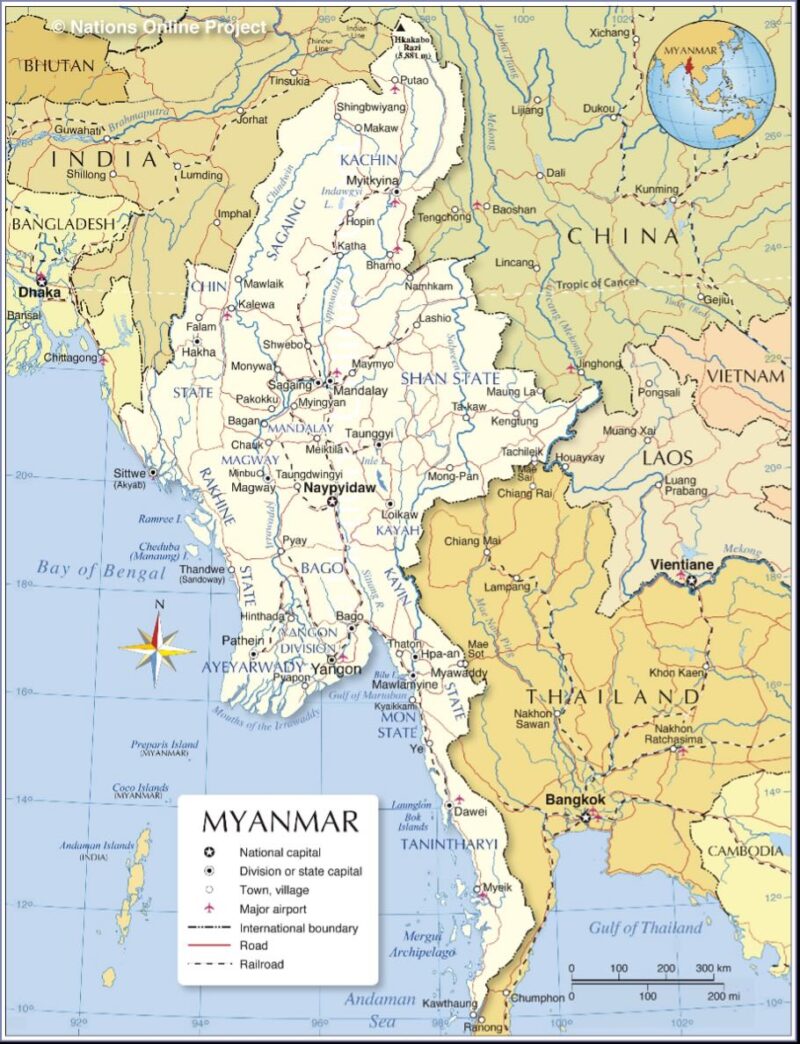
    As the North East becomes India’s gateway to ASEAN,  the centrality of Myanmar to our Act East becomes apparent. It is the key link in the road connectivity between India’s North East and other ASEAN nations whereby the free flow of inland goods, services and other initiatives to and from these nations to India can be ensured. The success or otherwise of Act East is thus directly affected by the security environment in Myanmar. Instability here will negatively impact our North Eastern states sharing borders with that country. The internal situation in Myanmar therefore becomes an area of prime concern for India, warranting close attention.

    For similar reasons, another neighbour, Bangladesh, is equally important for the success of India’s Act East Policy. India’s North East has benefitted from good ties with Bangladesh, both security-wise and economically. Militancy in the North East has reduced over the last decade and a half. With Bangladesh agreeing to provide access to its ports in the Bay of Bengal for the movement of Indian goods, the North Eastern states have a shorter route to the sea. Additionally, states bordering Bangladesh such as Assam and Meghalaya have developed trade links with that country for mutual benefit. The  BBIN (Bangladesh Bhutan India Nepal) Motor Vehicle Agreement for the Regulation of Passenger, Personal and Cargo Vehicular Traffic was signed in 2015 to ‘ promote safe, economically efficient and environmentally sound road transport in the sub-region andfurther help each country in creating an institutional mechanism for regional integration’  is another mechanism for implementing our Act East and Neighbourhood First policies[v]. The role of Bangladesh here is pivotal.

    State of the Civil War in Myanmar

    Fighting in Myanmar is now in its fourth year. The military junta continues to suffer reverses on the battlefield. Large portions of Rakhine State and certain portions of Chin State are now under the control of the Arakan Army (AA). International Crisis Group has recently averred that ‘..in just a few months, the Arakan Army has created the largest area in Myanmar under the control of a non-state armed group – in terms of both size and population – and is now on the verge of securing almost all of Rakhine[vi].

    In Shan state to the North, the Three Brotherhood Alliance (TBA) of three Ethnic Armed Organisations (EAOs) had by December 2023, captured over 20,000 square kilometres of territory, including key border crossings and trade routes between China and Myanmar in Operation 1027[vii].  On 07 March 2024, the Kachin Independence Army (KIA) launched Operation 0307 and successfully captured certain military posts across  Kachin State close to the Chinese border. This forced the Tatmadaw (Myanmar military) to redeploy, further thinning out forces[viii]. Fighting also continues in other states and regions across the country, notably Sagaing and Kayah.

    Associated Press deduces that ‘.. the announcement of the measure on state television amounts to a major, though tacit, admission that the army is struggling to contain the nationwide armed resistance against its rule..’.The Junta has since conscripted Rohingya youth and deployed them against the Rakhines. 

    Notwithstanding these losses, there is no let-up in the Tatmadaw’s efforts to combat the rebels. The Junta has resorted to conscription to stem rising attrition, activating an old law in this regard. Associated Press deduces that ‘.. the announcement of the measure on state television amounts to a major, though tacit, admission that the army is struggling to contain the nationwide armed resistance against its rule..[ix] To further contextualise, the same article stated the rebel National Unity Government’s (NUG) claim that more than 14,000 troops have defected from the military since the 2021 seizure of power. The Junta has since conscripted Rohingya youth and deployed them against the Rakhines. The Chins fear that they too will be acted upon similarly.[x]

    To overcome the asymmetry of force especially in artillery and airpower, the rebels have acquired large numbers of drones. These are being used to bomb military positions, contributing significantly towards the successes of the CNA’s operations[xi].  To summarise, Myanmar’s civil war continues to see-saw with no signs of ebbing. The Junta continues to make periodic peace overtures to the NUG with conditionalities that the latter is unwilling to accept[xii]. With the multiplicity of actors and issues involved, there are no clear indications of how and when the conflict will be resolved.

    Impact of the  Myanmar Conflict on India’s North-East

    The impact of Myanmar’s internal situation on India’s border states has progressively worsened. Initially, after the Junta takeover, it was Mizoram which bore the brunt. The state government citing common ethnicity and humanitarian concerns accepted the influx of Chins from Myanmar as a moral responsibility and initiated rehabilitation measures. These refugees along with earlier refugees from Bangladesh recently joined Kukis from Manipur, number around 44000 and continue to remain in refugee camps.[xiii] The Central government has had to reconcile its policy of preventing infiltration across borders with the societal realities of Mizoram. A positive outcome of this approach is that there has been no violence in Mizoram.

    In Manipur, by September 2024, the 18-month-long ethnic conflict had resulted in over 225 deaths and some 60,000 people displaced.[xiv] The administration has been derided by both sides, more so with recent warnings about impending threats to law and order[xv] followed by retractions[xvi]. People of either community have been uprooted from their homes and moved to safe areas separated by buffer zones guarded by security forces.  So great is the mutual suspicion that on the clamour of the Meiteis to replace the Assam Rifles, two battalions of this central force have been withdrawn and replaced by the Central Reserve Police Force (CRPF), against the wishes of the Kukis[xvii].

    Voices for an independent ‘Kukiland’ for the Kuki Zo peoples are being raised,[xviii] which are variously interpreted as a demand for greater autonomy within Manipur or for a separate union territory. The current happenings also dredge up the old ghost of ‘Zale’n-gam’ or Kuki nation, comprising the Chin Kuki Zomi peoples (including Mizos) residing across India, Bangladesh and Myanmar. Zale’n- gam has few takers and appears restricted to a YouTube channel[xix]. Today both sides fight each other with a variety of weapons including improvised rockets and drones. Hostage-taking is the latest tactic that has been adopted.[xx]

    Tension between the Nagas of Manipur and other communities is discernible with some reports of violence against the former.[xxi] As of now Nagas have kept out of the Kuki-Meitei dispute; also, other than the insurgent National Socialist Council of Nagaland ( Isak Muviah) faction (NSCN-IM) that is observing a ceasefire with the Centre, no other party has demanded integration of all Naga inhabited areas in India ( Arunachal Pradesh, Assam, Manipur) and Myanmar – the idea of  Greater Nagalim.

    At the state level, the responses of Mizoram and Manipur to the Myanmar crisis vary. This can be best seen in their reactions to the Centre’s recent notification to fence the entire 1643 Km Myanmar border and its earlier decision to end the Free Movement Regime that permits movement on both sides of the border for up to a distance of 16 km.[xxii]  While the Mizoram government and tribes living in both states oppose the decisions, the Manipur government clamours for its implementation. Currently, only around 30 Km of the border has been fenced.

    Since the Tatmadaw now has limited control over its border areas, it has become imperative for India to commence a structured dialogue with other warring parties in Myanmar’s border regions. This, with a view to restoring the situation in Manipur (and on the border) through mutually acceptable solutions at least for the short to medium term, is necessary. Only then can a modicum of security on the border be guaranteed. This involves navigating a maze of ethnic, religious, historical and societal issues with great sensitivity. The importance of such a dialogue cannot be overemphasised, more so because of recent developments in Bangladesh.

    The Impact of Bangladesh’s ‘Second Liberation’

    The events of 5 August 2024  that witnessed the overthrow of Sheikh Hasina’s government have proved to be yet another watershed in India-Bangladesh relations. India has invested more in the India-Bangladesh relationship than with any other neighbour in South Asia. A glance at the website of our Ministry of External Affairs[xxiii], where details of various agreements and summaries from the last Prime Ministerial meeting in Delhi in June 2024 are provided, will suffice to show just how strong and all-encompassing this relationship has become.

    Persons or organisations associated with the previous regime have either fled the country or been placed under arrest and assets confiscated. A few have been killed by mobs. Bank accounts of others have been frozen. Jamaat e Islami which collaborated with the Pakistan Army in 1971 has been resurrected. Extremists with proven murder charges against them have been freed from prison, as have political prisoners.

    At the time of writing, it is two months since the interim government headed by Chief Advisor Mohammed Yunus assumed charge.  The country continues to make efforts to reestablish the rule of law. All wings of the armed forces have been given magisterial powers[xxiv]. The functioning of the judiciary, higher civil services, local administration, police, security agencies, banking, economy, and higher education, is under review. Persons or organisations associated with the previous regime have either fled the country or been placed under arrest and assets confiscated. A few have been killed by mobs. Bank accounts of others have been frozen.[xxv] The Jamaat e Islami which collaborated with the Pakistan Army in 1971 has been resurrected. Extremists with proven murder charges against them have been freed from prison, as have political prisoners. Commissions have been set up to suggest reforms in the constitution, electoral system, police, judiciary, public administration and in tackling corruption.  Elections do not seem to be on the horizon yet. The advisers ( as the ministers are currently known) are new faces, not well known in India.

    While this paper does not attempt to be a study of India-Bangladesh relations, the polarised politics in that country coupled with a perception that the misdeeds of Sheikh Hasina’s government were conducted with impunity because of Indian backing, is sure to impact India’s portrayal here.

    With the removal of Sheikh Hasina, the India-Bangladesh relationship is undergoing a major reset. Statements of certain public figures and sentiments of a section of the population in that country suggest that a different perspective on the evolution of Bangladesh as a nation from 1971 onwards is emerging. While this paper does not attempt to be a study of India-Bangladesh relations, the polarised politics in that country coupled with a perception that the misdeeds of Sheikh Hasina’s government were conducted with impunity because of Indian backing, is sure to impact India’s portrayal here. This will make it an arduous task for both countries to go back to the trusted, cooperative and mutually beneficial relationship that existed. As mentioned, the list of achievements for both countries is far too numerous –  settlement of land and oceanic borders,  road, rail and riverine connectivity (including use of ports), economy and business ( both government and private), education including educational scholarships, technology, disaster management, border management, maritime security, military to military cooperation, improved people to people contacts, culture and health. As per records, of the 16 lakh visas issued by India for Bangladesh nationals in 2023, 4.5 lakhs were for medical treatment alone[xxvi]. Economies are so embedded that everyday necessities like onions are exported regularly to Bangladesh ( approximately 6 to 7 lakh tonnes annually).

    Even as the new regime provides assurances on the security of minorities and acknowledges India as an important neighbour, the enthusiasm with which it has interacted with official interlocutors from a host of nations worldwide especially China, Pakistan and the US is noteworthy and indicates where its newfound priorities might lie.

    A parallel reality, however, is that negative perceptions about India have historically found space in sections of Bangladesh’s polity. These have received a huge fillip after the change of regime with even settled agreements prone to misunderstanding. A recent example pertains to a tripartite agreement dating back to the Hasina period whereby electricity is to be imported from Nepal via India to Bangladesh. The agreement was signed in Kathmandu in the first week of  October 2024. Newspaper reports from Bangladesh indicate that there is palpable resentment over the condition that Indian transmission systems inside Indian territory be utilised for this purpose since it increases costs per unit of electricity in Bangladesh.[xxvii] Another issue currently bedevilling relations is the state of minorities in Bangladesh who have faced attacks on their homes, businesses and religious places with some loss of life, since the protests in July. India’s concerns in this regard have been conveyed at the highest level. Even as the new regime provides assurances on the security of minorities and acknowledges India as an important neighbour, the enthusiasm with which it has interacted with official interlocutors from a host of nations worldwide especially China, Pakistan and the US is noteworthy and indicates where its newfound priorities might lie.

    Larger Implications for India

    Bangladesh and Myanmar are pivotal for India’s Act East policy from the security, economic and connectivity angles. The issues pertaining to Myanmar and Manipur have been brought out earlier. A common concern affecting both nations and  India is the Rohingya crisis. Despite international pressure and requests from Bangladesh for China to intercede with Myanmar on its behalf, there has been no positive response from Myanmar. Bangladesh, which currently hosts close to one million refugees,[xxviii] has publicly expressed its inability to accommodate any more Rohingyas and asked for a speedy ‘third country settlement’ [xxix]. A detailed report of the International Crisis Group (ICG) in October 2023[xxx]provides details of activities of militant organisations like the Rohingya Solidarity Organisation (RSO) and Arakan Rohingya Salvation Army (ARSA) which are involved in drug running from Myanmar along with Bangladeshi syndicates for sale of the product in that country. Their participation in violent crime and other illegal activity has become a pressing concern within Bangladesh. Rohingyas have infiltrated into India as well, and have been identified as far North as Jammu. The security implications of such migration for both Bangladesh and India are apparent. The insensitivity of the Myanmar Junta on this account is heightening security risks for India and Bangladesh and merits diplomatic intervention.

    With the situation in Bangladesh evolving by the day, it is prudent for India to take a strategic pause as it weighs its options for pursuing its Act East policy. While giving the new regime in Bangladesh its due, India has to consider the impact of resurgent forces aided by inimical powers that aim to derail the India-Bangladesh relationship beyond repair. Even as both countries attempt to reestablish strong ties, the old adage preached by educated Bangladeshis in the context of support to Sheikh Hasina’s regime that ‘India should not put all its eggs in one basket’ resonates. While Myanmar geographically cannot provide the singular advantages that Bangladesh can, it is time for India to press for securing Myanmar’s cooperation to complete pending projects in that country, such as the Kaladan Multi-Modal Port Project (KMMPP) via Sittwe and Paletwa, that provides an alternate route to our North East, as well as the Trans Asian Highway (TAH) that provides connectivity with the rest of ASEAN, amongst others.

    To summarise, two possible reasons for inviting rebel Myanmar groups to Delhi could be: first, the relative viability of either Bangladesh or Myanmar to help implement the Act East policy in light of the emerging situation in Bangladesh and the state of the civil war in Myanmar. The second, ensuring security on the India-Myanmar border, to prevent aggravating the situation in India’s border states.


    Notes:

    [i] ‘Exclusive: India extends unprecedented invite to Myanmar’s anti-junta forces, sources say’ Wa Lone and Devjyot Ghoshal Reuters September 23, 2024

    [ii] ‘Govt aims to make Northeast gateway of ‘Act East Policy’: President Murmu’ Press Trust of India 27 June 2024.

    [iii] Ibid.

    [iv] ‘Japan to tie landlocked Northeast India with Bangladesh’  Saleem Samad  The Daily Messenger 05 March 2024.

    [v] Press Information Bureau Government of India Ministry of Shipping note dated  10 June 2015

    ‘Bangladesh, Bhutan, India and Nepal (BBIN) Motor Vehicle Agreement for the Regulation of Passenger, Personal and Cargo Vehicular Traffic amongst BBIN’

    [vi]   ‘Breaking Away: The Battle for Myanmar’s Rakhine State Asia Report N°339 | 27 August 2024’ International Crisis Group (Executive Summary).

    [vii]   ‘As Myanmar’s Junta Loses Control in the North, China’s Influence Grows’  Jason Tower, United States Institute for Peace, August 1, 2024.

    [viii] Ibid.

    [ix]   ‘Facing setbacks against resistance forces, Myanmar’s military government activates conscription law ‘ Associated Press, February 12, 2024.

    [x] ‘India’s ‘Forgotten Partition’ and the Myanmar Refugee Crisis’  Swapnarka Arnan The Diplomat  11 May 2024.

    [xi] ‘We killed many … drones are our air force’: Myanmar’s rebels take on the junta from above. Aakash Hassan and Hannah Ellis-Petersen  The Observer 20 January 2024.

    [xii] ‘Armed Groups Snub Myanmar Junta ‘Peace’ Offer’  The Irrawaddy 28 September 2024

    [xiii] ‘Centre provides 1,379 MT rice to Mizoram for Manipur, Myanmar, B’desh refugees’ Morung Express 25 September 2024.

    [xiv] ‘Ethnic violence in India’s Manipur escalates, six killed’  Tora Agarwala Reuters  September 7, 2024

    [xv] ‘900 Kuki militants infiltrated Manipur from Myanmar, says Security Advisor’ India Today NE September 20 2024.

    [xvi] ‘Input on infiltration by 900 Kuki militants could not be substantiated on the ground, says Manipur security advisor’ Vijaita Singh The Hindu 26 September 2024.

    [xvii] ‘Kukis call removal of Assam Rifles from 2 Manipur areas ‘biased, appeasement’, Meiteis call it ‘victory’  Ananya Bhardwaj  The Print 04 August 2024.

    [xviii]‘ Manipur: Kuki-Zo organizations hold rallies, demand separate ‘Kukiland’ for peace  by Northeast News

    August 31, 2024.

    [xix] YouTube channel titled ‘Zalengam Media’.

    [xx] ‘Kuki militants seek release of ‘secessionist’ in Manipur’ Prawesh Lama and Thomas Ngangom Hindustan Times Sep 30, 2024.

    [xxi] ‘Keep us out of your war, Manipur Naga body warns two warring communities’  The Hindu Bureau 06 February 2024

    [xxii] ‘Government sanctions ₹31,000 crore to fence Myanmar border’   The Hindu

    Published – September 18, 2024

    [xxiii] Ministry of External Affairs, Government of India website mea.gov.in.

    [xxiv] ‘Navy, the air force also granted magistracy powers’  The Daily Star September 30 2024

    [xxv] ‘Bank accounts of Joy Putul Bobby frozen’ Dhaka Tribune 30 Sep 2024.

    [xxvi] ‘Indian High Commission in Dhaka, facing protests & threats, returns 20,000 visa applicants’ passports ‘ Ananya Bhardwaj  The Print   29 September 2024.

    [xxvii] ‘Bangladesh delegation in Nepal to sign the contract to import 40 MW electricity’ Dhaka Tribune 30 September 2024.

    [xxviii] Operational Data Portal of the United Nations High Commissioner for Refugees, for Bangladesh.

    [xxix] ‘Bangladesh calls for faster resettlement process for Rohingya’ Ruma Paul  Reuters  September 8, 2024

    [xxx] ‘Rohingya Refugees in Bangladesh: Limiting the Damage of a Protracted Crisis’ International Crisis Group Autumn Update 04 October 20223.


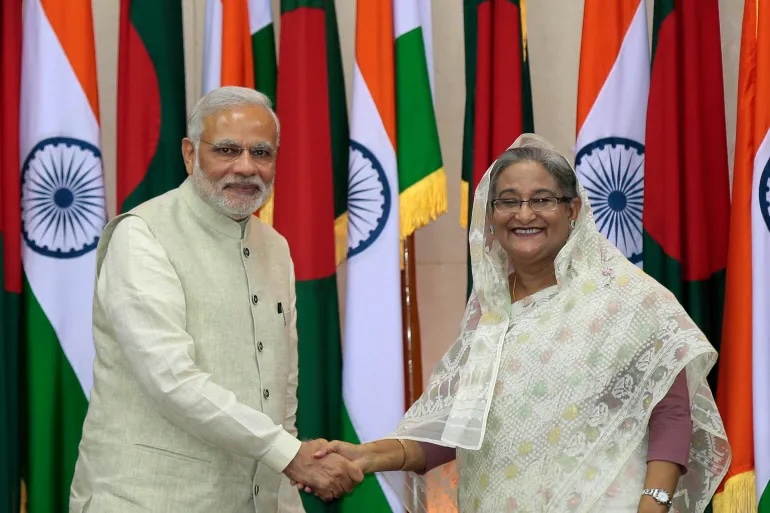
    Feature Image Credit: What does Sheikh Hasina’s resignation mean for India-Bangladesh relations? – aljazeera.com 

    Map Credit: National Online Project

    Bangladesh Parliament Image: The Shattered Identity of a Nation: From Liberation to Chaos – borderlens.com

    Sheikh Mujibur Rahman’s Statue: Bangabandhu to Toppled Statue: Mujibur Rahman’s contested legacy post Bangladesh upheaval – Economic Times


  • China and the US: Conventional and Nuclear Military Strategies

    China and the US: Conventional and Nuclear Military Strategies

    Occasional Paper: 9/2024

    China and the US: Conventional and Nuclear Military Strategies

    Abstract

    China’s military strategy focuses on developing asymmetric capabilities to counter the United States’ technological advantages and superior military budget by investing in precision missiles, advanced targeting systems, and system destruction warfare. The US initiated the Defence Innovation Initiative to prioritise autonomous learning systems and high-speed projectiles; however, it diminished under the Trump administration, leaving the US reliant on legacy weapons systems vulnerable to new-generation autonomous and hypersonic weapons. Despite China’s advancements, the US maintains a significant advantage in nuclear warheads, with 5,800 compared to China’s 320 in 2020, consistent with Mao’s “minimum deterrent” strategy. While China’s nuclear arsenal primarily comprises strategic weapons, the US possesses both tactical and strategic types. The US complacency regarding China’s military challenge may stem from its nuclear superiority; however, as China progresses technologically, the US risks falling behind by relying on outdated weapons systems, often maintained due to their economic significance in key congressional districts.

    Key Words: #nuclear warheads, #hypersonic weapons, #precision weapons, #asymmetric capabilities, #system destruction warfare, #autonomous learning systems 


    Introduction

    Since the beginning of the millennium, China has decided to outsmart the United States’ military strength through a very particular strategy. It aimed at overcoming America’s technological advantages and much superior military budget by investing significant resources in asymmetrical capabilities. As Mark Leonard wrote, China was attempting to become an “asymmetric superpower” outside the realm of conventional military power (Leonard, 2008, p. 106).

    Asymmetric superpower

    Conscious that the Soviet Union had driven itself into bankruptcy by accepting a ruinous competition for military primacy with the US, China looked for cheaper ways to compete. As a result, it invested billions in an attempt to make a generational leap in military capabilities, able to neutralize and trump America’s superior conventional forces. In other words, instead of rivalling the United States on its own game, it searched to engage it in a different game altogether. It was the equivalent of what companies like Uber, Netflix, Airbnb or Spotify did in relation to the conventional economic sectors with which they competed. A novel by P.W. Singer and August Cole depicts how, through surprise and a whole array of asymmetric weapons, China defeats the superior forces of the United States (Singer and Cole, 2016).

    In essence, these weapons are dual-focused. On the one hand, they emphasize long and intermediate-range precision missiles and advanced targeting systems, able to penetrate battle network defences during the opening stages of a conflict. On the other hand, they aim at systems destruction warfare, able to cripple the US’ command, control, communication and intelligence battle network systems. The objective in both cases is to target the US’ soft spots with weapons priced at a fraction of the armaments or systems that they strive to destroy or render useless. The whole notion of asymmetric weapons, indeed, is based on exploiting America’s military weaknesses (like its dependence on information highways or space satellites) while neutralizing its strengths (like its fleet of aircraft carriers). Michael Pillsbury describes this situation in graphic terms: “For two decades, the Chinese have been building arrows designed to find a singular target – the Achilles’ heel of the United States” (Pillsbury, 2015, p. 196).

    America’s military legacy systems

    To counter China’s emerging military threat, the Obama administration put in motion what it called the Defence Innovation Initiative. This was also known as the Third Offset Strategy, as it recalled two previous occasions in the 1950s and the 1970s when, thanks to its technological leaps, the US could overcome the challenges posed by the Soviet military. Recognizing that the technological superiority, which had been the foundation of US military dominance for years, was not only eroding but was being challenged by China, the Pentagon defined a series of areas to be prioritized. Among them were the following: Autonomous learning systems, human-machine collaborative decision-making, network-enabled autonomous weapons, and high-speed projectiles (Ellman, Samp and Coll, 2017).

    However, as with many other initiatives representing the Obama legacy, this one began fading into oblivion with Trump’s arrival to power. As a result, the vision of significantly modernizing America’s military forces also faded (McLeary, 2017). This implied reverting to the previous state of affairs, which still lingers nowadays. In Raj M. Shah and Christopher M. Kirchhoff’s words: “We stand at the precipice of an even more consequential revolution in military affairs today. A new way of war is bearing down on us. Artificial-intelligence-powered autonomous weapons are going global. And the US military is not ready for them (…). Yet, as this is happening, the Pentagon still overwhelmingly spends its dollars on legacy weapons systems. It continues to rely on an outmoded and costly technical production system to buy tanks, ships and aircraft carriers that a new generation of weapons – autonomous and hypersonic – can demonstrably kill” (Shah and Kirchhoff, 2024).

    Legacy systems -aircraft carriers, fighter jets, tanks – are deliberately manufactured in key congressional districts around the country so that the argument over whether a weapons system is needed gets subsumed by the question of whether it produces jobs

    Indeed, as Fareed Zakaria put it: “The United States defence budget is (…) wasteful and yet eternally expanding (…). And the real threats of the future -cyberwar, space attacks- require different strategies and spending. Yet, Washington continues to spend billions on aircraft carriers and tanks” (Zakaria, 2019). A further quote explains the reason for this dependence on an ageing weapons inventory: “Legacy systems -aircraft carriers, fighter jets, tanks – are deliberately manufactured in key congressional districts around the country so that the argument over whether a weapons system is needed gets subsumed by the question of whether it produces jobs” (Sanger, 2024, p. 193). Hence, while China’s military advances towards a technological edge, America’s seems to be losing both focus and fitness.

    Minimum deterrence nuclear strategy

    Perhaps this American complacency concerning China’s disruptive weapons and overall military challenge could be explained by an overreliance on its nuclear superiority. Indeed, in 2020, in the comparison of nuclear warheads, the United States possessed overwhelming superiority with 5,800 against China’s 320 (Arms Control Association, 2020). This was consistent with the legacy of Mao’s “minimum deterrent” strategy. Within the above count, two kinds of nuclear weapons are involved – tactical and strategic. The former, with smaller explosive capacity, are designed for use in battlefields. With a much larger capacity, the latter aims at vital targets within the enemy’s home front. In relation to tactical nuclear weapons, America’s superiority is total, as China doesn’t have any. Nonetheless, in terms of long-range, accuracy, and extensive numbers, China’s conventional ballistic missiles (like the DF-26, also known as the Guam killer) can become an excellent match to the US’ tactical nuclear weapons (Roblin, 2018). The big difference between both countries, thus, is centred on America’s overwhelming superiority in strategic nuclear warheads.

    China’s minimum deterrent nuclear strategy was based on the assumption that, within cost-benefit decision-making, a limited nuclear force, able to target an adversary’s strategic objectives, could deter a superior nuclear force. This required retaliatory strike capacities that can survive a first enemy attack. In China’s case, this is attainable through road-mobile missiles that are difficult to find and destroy, and by way of missiles based on undetectable submarines. Moreover, Beijing’s hypersonic glide vehicle -whose prototype was successfully tested in July 2021- follows a trajectory that American systems cannot track. All of these impose restraint in the use of America’s more extensive arsenal and undermine its ability to carry out nuclear blackmail.

    there is no US defence that “could block” China’s hypersonic glide vehicle “not just because of its speed but also due to its ability to operate within Earth’s atmosphere and to change its altitude and direction in an unpredictable manner while flying much closer to the Earth’s surface”

    For the above aim, Beijing has developed new nuclear ballistic missiles, cruise missiles, and a sea-based delivery system. These include the DF-41 solid-fuel road-mobile intercontinental ballistic missile (with a range of 15,000 kilometres) or the submarine-launched JL-3 solid-fuel ballistic missile (whose range is likely to exceed 9,000 kilometres). To launch the JL-3 missiles, China counts with four Jin-class nuclear submarines, with an upgraded fifth under construction, each armed with twelve nuclear ballistic missiles (Huang, 2019; Panda, 2018). On top of that, there is no US defence that “could block” China’s hypersonic glide vehicle “not just because of its speed but also due to its ability to operate within Earth’s atmosphere and to change its altitude and direction in an unpredictable manner while flying much closer to the Earth’s surface” (Sanger, 2024, p. 190). All of this shows that America’s overwhelming superiority in terms of strategic nuclear warheads results in more theoretical than practical. What might justify a first American strategic nuclear strike on the knowledge that a Chinese retaliatory one could destroy New York, Chicago, Los Angeles, or all of the three together?

    Matching the US’ overkill nuclear capacity

    Being an asymmetric superpower while sustaining a minimum but highly credible deterrent nuclear strategy implied much subtility in terms of military thinking. One, in tune with the best Chinese traditions exemplified by Sun Tsu’s The Art of War and Chan-Kuo T’se’s Stratagems of the Warring States. However, in this regard, as in many others, Xi Jinping is sowing rigidity where subtility and flexibility prevailed. A perfect example of this is provided by its intent to match the US in terms of strategic nuclear warheads. In David E. Sanger’s words: “But now, it seemed apparent, Chinese leaders had changed their minds. Xi declared that China must ‘establish a strong strategic deterrence system’. And satellite images from near the cities of Yumen and Hami showed that Xi was now ready to throw Mao’s ‘minimum deterrent’ strategy out of the window” (Sanger, 2024, p. 200).

    Three elements attest to the former. Firstly, 230 launching silos are under construction in China. Secondly, these silos are part of a larger plan to match the US’ “triad” of land-launched, air-launched, and sea-launched nuclear weapons. Thirdly, it is estimated that by 2030, China will have an arsenal of 1,000 strategic nuclear weapons, which should reach 1,500 by 2035. The latter would imply equalling the Russian and the American nuclear strategic warheads (Sanger, 2024, p. 197; Cooper, 2021; The Economist, 2021; Hadley, 2023). 

    Xi Jinping is thus throwing overboard the Chinese capability to neutralize America’s strategic nuclear superiority at a fraction of its cost, searching to match its overkill capacity. In essence, nuclear arms seek to fulfil two main objectives. In the first place, intimidating or dissuading into compliance a given counterpart. In the second place, deterring by way of its retaliatory capacity, any first use of nuclear weapons by a counterpart.

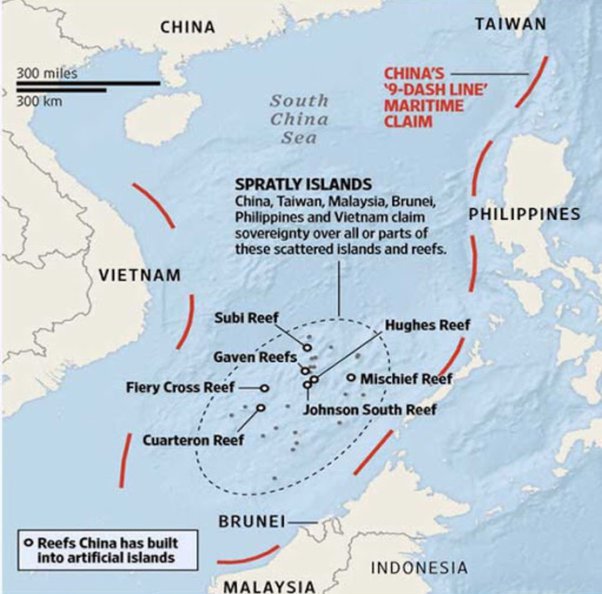
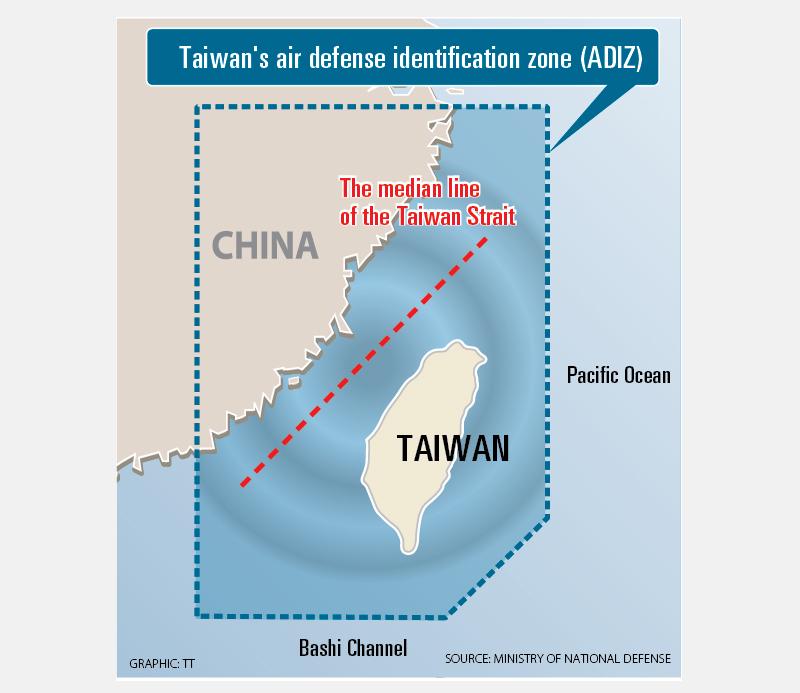
    As seen, the second of those considerations was already guaranteed through its minimum deterrence strategy. In relation to the first, China already enjoys a tremendous dissuading power and the capacity to neutralize intimidation in its part of the world. Indeed, it holds firm control over the South China Sea. This is for three reasons. First, through its possession and positioning there, of the largest Navy in the world. Second, by way of the impressive firepower of its missiles, which includes the DF21/CSS-5, capable of sinking aircraft carriers more than 1,500 miles away. Third, via the construction and militarization of 27 artificial islands in the Paracel and Spratly archipelagos. All of this generates an anti-access and denial of space synergy, capable of being activated at any given time against hostile maritime forces. In other words, China cannot be intimidated into compliance by the United States in the South China Sea scenario (Fabey, 2018, pp. 228-231). Nor, in relation to Taiwan, could America’s superior nuclear forces dissuade Beijing to invade if it so decides. The US, indeed, would not be willing to trade the obliteration of Los Angeles or any other of its major cities by going nuclear in the defence of Taiwan.

    Simultaneously confronting two gunfighters

    It was complicated enough during the Cold War to defend against one major nuclear power. The message of the new [Chinese] silos was that now the United States would, for the first time in its history, must think about defending in the future against two major nuclear powers with arsenals roughly the size of Washington’s – and be prepared for the possibility that they might decide to work together

    Matching the US’ nuclear overkill capacity will not significantly alter the strategic equation between both countries. If anything, it would only immobilize in easy-to-target silos, the bulk of its strategic nuclear force. However, Xi’s difficult-to-understand decision makes more sense if, instead of thinking of two nuclear powers, we were to think of a game of three. This would entail a more profound strategic problem for the United States that David E. Sanger synthesizes: “It was complicated enough during the Cold War to defend against one major nuclear power. The message of the new [Chinese] silos was that now the United States would, for the first time in its history, must think about defending in the future against two major nuclear powers with arsenals roughly the size of Washington’s – and be prepared for the possibility that they might decide to work together” (Sanger, 2024, p. 201). This working together factor should be seen as the new normal, as a revisionist block led by China and Russia confronts America’s system of alliances and its post-WWII rules-based world order.

    Although the United States could try to increase the number of its nukes, nothing precludes its two competitors from augmenting theirs as well, with the intention of maintaining an overwhelming superiority. According to Thomas Schelling, leading Game Theory scholar and Economics Nobel Prize winner, the confrontation between two nuclear superpowers, in parity conditions, was tantamount to that of two far-west gunfighters: Whoever shot first had the upper hand. This is because it can destroy a significant proportion of its counterpart’s nuclear arsenal (Fontaine, 2024). In the case in point, Uncle Sam would have to simultaneously confront two gunfighters, each matching his skills and firepower. Although beyond a certain threshold, there wouldn’t seem to exist a significant difference in the capacity of destruction involved, nuclear blackmail could be imposed upon the weakest competitor. In this case, the United States.

    Conclusion

    From an American perspective, overreliance on its challenged nuclear power makes no sense. Especially if it translates into a laid-back attitude in relation to the current technological revolution in conventional warfare. If Washington doesn’t go forward with a third offset military strategy, it could find itself in an extremely vulnerable position. Just two cases can exemplify this. Aircraft carriers are becoming obsolete as a result of the Chinese DF21-CSS5 missile, able to sink them 1,500 miles away, in the same manner in which war in Ukraine is showing the obsolescence of modern tanks when faced with portable Javelins and drones. If the US is not able to undertake a leap forward in conventional military weapons and systems, it will be overcome by its rivals in both conventional and nuclear forces. For Washington, no doubt about it, this is an inflexion moment.


    References:

    Arms Control Association (2020). “Nuclear weapons: Who has what at a glance”, August.

    Cooper, Helene (2021). “China could have 1,000 nuclear warheads by 2030, Pentagon says”. The New York Times, November 3.

    Ellman, Jesse, Samp, Lisa, Coll, Gabriel (2017). “Assessing the Third Offset Strategy”. Center for Strategic & International Studies, CSIS, March.

    Fabey, Michael (2018) Crashback: The Power Clash Between US and China in the Pacific. New York: Scribner.

    Fontaine, Phillipe (2024). “Commitment, Cold War, and the battles of self: Thomas Schelling on Behavior Control”. Journal of the Behavioral Sciences, April.

    Hadley, Greg (2023). “China Now Has More ICBM Launchers than the US”. Air & Space Forces Magazine. February 7.

    Huang, Cary (2019). “China’s show of military might risk backfiring”. Inkstone, October 19.

    Leonard, Mark (2008). What Does China Think? New York: HarperCollins.

    McLeary, Paul (2017). “The Pentagon’s Third Offset May be Dead, But No One Knows What Comes Next”. Foreign Policy, December 18.

    Panda, Ankit (2018). “China conducts first test of new JL-3 submarine-launched ballistic missile”. The Diplomat, December 20.

    Pillsbury, Michael (2015). The Hundred-Year Marathon. New York: Henry Holt and Company.

    Roblin, Sebastien (2018). “Why China’s DF-26 Missile is a Guam Killer”. The National Interest, November 9.

    Sanger, David E. (2024). New York: Crown Publishing Books.

    Shah, Raj M. and Kirchhoff, Christopher M. (2024). “The US Military is not Ready for the New Era of Warfare”. The New York Times, September 13.

    Singer, P.W. and Cole, August (2016). Ghost Fleet: A Novel of the Next World War. Boston: Eamon Dolan Book.

    The Economist (2021). “China’s nuclear arsenal has been extremely modest, but that is changing”, November 20.

    Zakaria, Fareed (2019). “Defense spending is America’s cancerous bipartisan consensus”. The Washington Post, July 18.


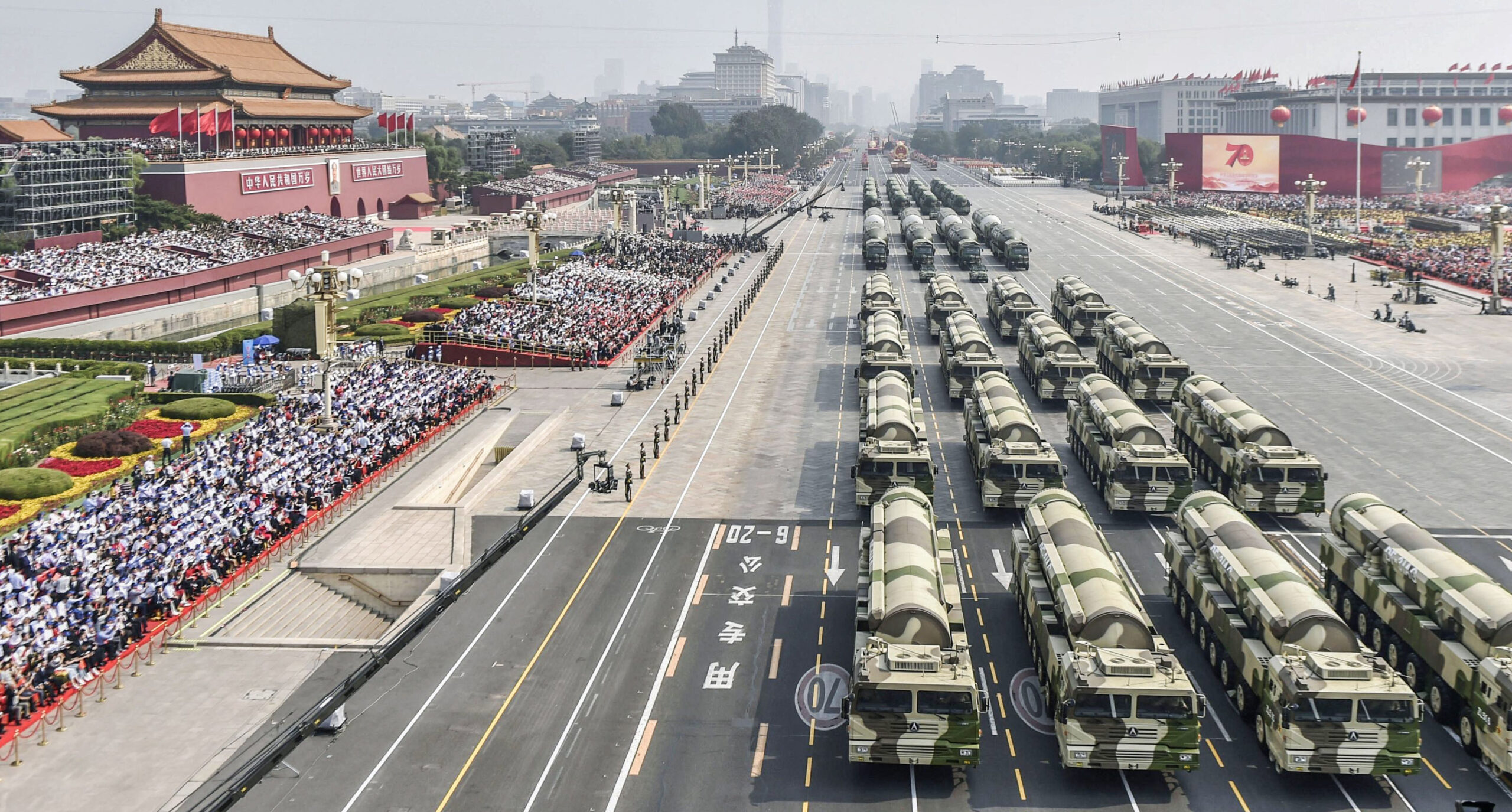
    Feature Image Credit: NikkeiAsia

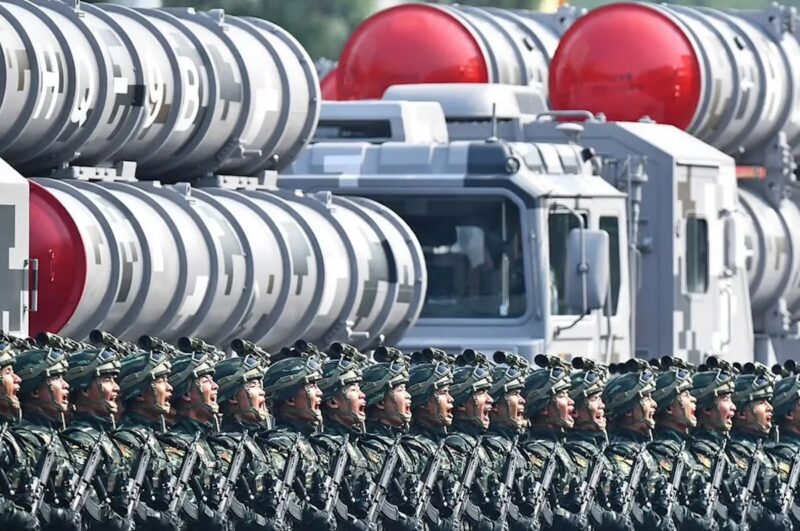
    Text Image: AsiaTimes.com

  • Xi Jinping: Assessing his Foreign Policy

    Xi Jinping: Assessing his Foreign Policy

    All foreign policies must aim at attaining purpose, credibility, and efficiency. Purpose defines the main objectives that the country wishes to achieve through its international relations. Credibility comes from international recognition of its actions in this field. And efficiency allows implementation, at the lowest possible cost, of the desired purpose. These three notions, although interwoven and influencing each other, keep their own specificity.

             How does Xi Jinping’s foreign policy qualify in these three areas?

    Purpose

    Its purpose, in tune with that of the Chinese Communist Party before his arrival to power, is sufficiently clear. By 2049, the centenary of the founding of the People’s Republic, China should have achieved a prominence commensurate to its glorious past. According to former Australian Prime Minister Kevin Rudd, China marches towards the perception of its global destiny with a clear strategy in mind. Such destiny is none other than the resurrection of its historical glory (Rudd, 2017). Projects such as the Chinese Dream of National Rejuvenation, Made in China 2025, and the Belt and Road Initiative, converge in defining concrete goals that lead in that direction. This includes China’s “Great Unification” with Taiwan, the consolidation of a hegemonic position within the South China Sea, making China the epicentre of an Asian-led world economic order, and creating a global infrastructure and transportation network with China at its head. Xi Jinping visualizes the next ten to fifteen years as a window of opportunity to shift China’s correlation of power with the United States. Hence, Beijing seeks the convergence of energies and political determination towards this window of opportunity. The strategic compass of Xi’s foreign policy could not be more precise. Few countries show a clearer sense of its purpose.

    Credibility

             His foreign policy credibility presents a more mixed result. Vis-à-vis the Western World and several of its neighbours, China’s credibility is at a very low point. However, the situation is different in relation to the Global South, where Xi’s foreign policy promotes four interconnected initiatives to expand China’s influence. Besides the Belt and Road, whose objective is creating a China-led global infrastructure and transportation network, there is also the Global Development Initiative, the Global Security Initiative, and the Global Civilization Initiative. The first, the Global Development Initiative, aims to contrast the unequal distribution of benefits that characterize the West-led development projects with the inclusiveness and balanced nature of this China-led multilateral development project [Hass, 2023]. The other two initiatives, global security and global civilization, present rational and balanced options clearly differentiated from America’s overbearing approach to these areas. In the former case, China’s proposal promotes harmonious solutions to differences among countries through dialogue and consultation [Chaziza, 2023]. The Global Civilization Initiative, on its side, fosters cooperation and interchange between different civilizations, whereby the heterogeneity of cultures and the multiplicity of identities is fully respected [Hoon and Chan, 2023].

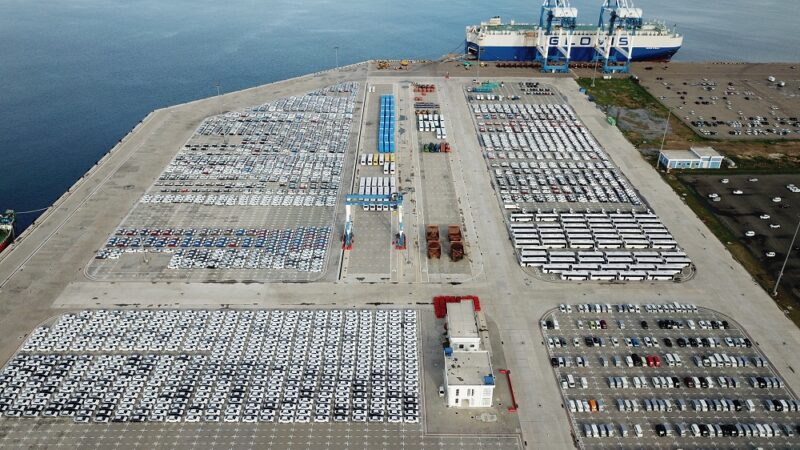
    The Hambantota Port in Sri Lanka is one of thousands project that China has helped finance in recent years – Image Credit: The Brussels Times (The so-called China’s debt-trap is a narrative trap).

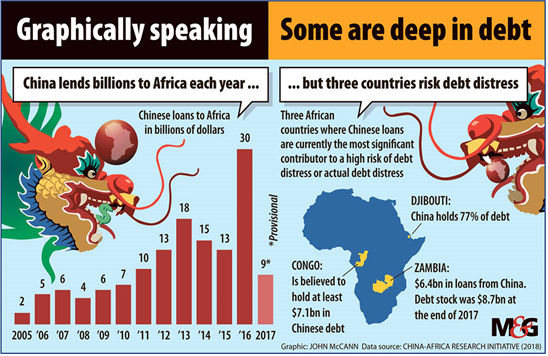
           However, three dark areas emerge in Beijing’s credibility with respect to the Global South. Number one is the frustration prevailing in many of these smaller and underdeveloped nations, resulting from the contradiction between China’s openness as a lender and its severity as a creditor. This has given rise to the suspicion of a hidden agenda on its part and has led to the coining of the phrase “debt trap diplomacy”. Number two derives from the arrogance shown by Beijing towards the rights of several of its weakest neighbours, disregarding international law. This seems to delineate a tributary vision of its relations with them. Although this only affects China’s neighbourhood, it projects a haughtiness that contradicts its formulations about a more harmonious, equitable and inclusive world order. Number three is the apparent contradiction between Beijing’s proclamation regarding the value of the heterogeneity of cultures and the diversity of identities and its treatment of non-Han Chinese minorities at home. A feature susceptible to reproducing itself abroad. All the above generates a distance between words and deeds that casts a shadow of doubt concerning China’s sincerity. Hence, even within the Global South, China’s credibility shows a mixed result.

    Efficiency

    Finally, there is the area of efficiency. It is a very complex one, particularly given China’s over-ambitious purpose. It must be said that until 2008, Beijing succeeded in rising as a significant power without alarming neighbours or the rest of the world. It even attained the geopolitical miracle of doing so without alarming the United States. Indeed, few countries have made such a systematic and conscious effort to project a constructive international image as China has done to this date. This included the notion of “peaceful rise”, which implied a path different from that followed by Germany before World War I and Japan during World War II when they tried to overhaul the international political landscape. China’s path, on the contrary, relied upon reciprocity and the search for mutual benefit with other countries. It was a brilliant soft power marketing strategy that gave China huge goodwill dividends (Cooper Ramo, 2007).

    “Observe carefully; secure our position; cope with affairs calmly; hide our capacities and bide time; be good at maintaining a low profile; and never claim leadership” – Deng Xioping

    Regarding its reunification with Taiwan, it relied on “one country, two systems” and the economic benefits of their interconnection as the obvious means to propitiate their joining together. Regarding its maritime disputes in the South China Sea, after having deferred the resolution of this issue to a more propitious moment, it proposed a Code of Conduct to handle it in the least contentious possible manner. In general, similar approach was evident in Beijing’s handling of various contentious issues.  Beijing’s leadership followed Deng Xiaoping’s advice to his successors: “Observe carefully; secure our position; cope with affairs calmly; hide our capacities and bide time; be good at maintaining a low profile; and never claim leadership” (Kissinger, 2012, p. 441).

    “Like Europe, it has many twenty-first century qualities. Its leaders preach a doctrine of stability and social harmony. Its military talks more about soft than hard power. Its diplomats call for multilateralism rather than unilateralism. And its strategy relies more on trade than war to forge alliances and conquer new parts of the world” – Mark Leonard on China in 2008

    Writing in 2008, before the change towards a more assertive foreign policy materialized, Mark Leonard said about China: “Like Europe, it has many twenty-first century qualities. Its leaders preach a doctrine of stability and social harmony. Its military talks more about soft than hard power. Its diplomats call for multilateralism rather than unilateralism. And its strategy relies more on trade than war to forge alliances and conquer new parts of the world” (Leonard, 2008, p. 109). This phrase encapsulates well how China was perceived worldwide, including by the Western World. Not surprisingly, a 2005 world survey on China by the BBC stated that most countries in five continents held a favourable view of that nation. Even more significant was the fact that even China’s neighbours viewed it favourably (Oxford Analytica, 2005). It was a time when all doors opened to China.

    2008 represented a turning point. The convergence of several events that year changed China’s perception of its foreign policy role, making it more assertive. Among such events the most significant was the global economic crisis of 2008, the worst crisis since 1929, resulting from America’s financial excesses; other important events were the sweeping efficiency with which China avoided contagion; the fact that China’s economic growth was the fundamental factor in preserving the world from a major economic downturn; and the boost to Chinese self-esteem after the highly successful Beijing Olympic games of that year. In sum, the time in which China had to keep hiding its strengths seemed to have ended.

    Although this turning point materialized under Hu Jintao, changes accelerated dramatically after Xi Jinping’s ascend to power. He not only sharpened the edges of the country’s foreign policy but made it more aggressive, even reckless. Xi’s eleven years’ tenure in office has translated into a proliferation of international trouble spots. His overreach and overbearing style misfired, generating a concerted and strong reaction against China. As a result, the costs linked to attaining China’s purpose have skyrocketed. This deserves a more detailed analysis of China’s foreign policy efficiency under Xi.

    Intimidatory policies and actions

             Xi Jinping’s intimidatory policies and actions on international affairs have been extensive, bringing with them immense resistance.

    After dusting off a plan that had remained on paper for years, Xi decided to build seven artificial islands on top of the South China Sea coral reefs. After assuring President Obama they would not be militarized, he proceeded otherwise. Contravening international maritime law, he assigned 12 nautical miles of Territorial Sea and 200 miles of Exclusive Economic Zone to these artificial outposts.

    Under the protection of the People’s Liberation Navy, an oil rig was built in the waters claimed by Vietnam as its EEZ. Disrespecting the International Court of Justice’s ruling about the Philippines’ waters in the South China Sea, China has forcefully enforced its exclusionary presence in them. China’s Coast Guard is now authorized to use lethal force against foreign vessels operating within maritime areas under its jurisdiction claims. This, notwithstanding that China’s claimed jurisdiction, goes far beyond what is recognized by the U.N. Convention on the Law of the Sea or the International Court of Justice while disputed by several other countries.

    The People’s Liberation Army (PLA) began to ignore the median line in the Taiwan Strait, which it had respected for decades. Frequent and increasingly bold incursions within Taiwan’s Air Defence Identification Zone and reiterated calls to the PLA to prepare for war in Taiwan have become the new normal. The Senkaku-Diaoyu islands, disputed with Japan, have been declared one of China’s core interests, thus closing the door to a negotiated solution. This has translated into the systematic incursion of Chinese maritime law enforcement ships and planes into the territorial and contiguous maritime space of these islands, currently occupied by Japan. Beijing unilaterally imposed an Air Defence Identification Zone over two-thirds of the East China Sea, forcing foreign aircraft to identify themselves under threat of “defensive measures” by the PLA Air Force.

             Since 2017, China has reneged on the quite borders with India and engaged in a series of border skirmishes. It has resorted to intrusions into border regions under dispute resulting in a major skirmish in Ladakh with significant casualties, the first since 1987. In 2023, China released an official standard map showing India’s state of Arunachal Pradesh in Northeast India and Askai Chin plateau in the Indian territory of Ladakh in the west, as official parts of its territory, despite India’s objections. At the same time, it renamed 11 places in Arunachal Pradesh with Chinese names. When South Korea decided to deploy the US Army’s THAAD (Terminal High-Altitude Area Defence) ballistic missile defence, as protection against the growing North Korean threat, China put in motion an economic boycott of South Korean products and services. When Australia and New Zealand protested against Chinese interference in their domestic political systems, Beijing openly threatened to impose economic sanctions on governments or private actors criticising China’s behaviour. A few years later, it effectively banned most Australian exports when Canberra proposed an international scientific investigation on the origins of COVID-19. When Canada detained Huawei’s heiress, Meng Wanzhou, answering an American judicial request, Beijing jailed and presented accusations against two Canadian businessmen based in China (releasing them hours after Meng was released).

    Antagonizing Americans and Europeans

             Xi’s rhetoric in relation to the U.S. has been highly aggressive. Reversing the terms of Deng Xiaoping’s advice to his successors to hide China’s strengths while bidding for right time, Xi has alerted America about its intent to challenge and displace it as the foremost power soon. He has repeatedly referred; to the primacy of China in the emerging world order as its most important objective, to the next ten to fifteen years as the inflexion point when a change in the correlation of power between the two countries should be taking place, to the need to overcome the U.S.’ technological leadership, to the necessity for the PLA to ready itself to wage and win wars, and to the next ten years as a time of confrontation and dangerous storms.

    Xi Jinping starts his European tour in Paris on May6, 2024, his first in five years as China-EU trade relation have hit a low. Picture Source: Sky News.

             China’s actions have also antagonized the Europeans. These relate to China’s refusal to use the term “invasion” when referring to Russia’s actions in Ukraine; supporting the arguments provided by Russia concerning the causes of the war; placing the responsibility of the conflict on the US and the NATO; abstaining from voting in the U.N. on the West’s resolutions against Russia; demonstrating its strong strategic relations with Russia that is described as “partnership without limits”; the conduct of military exercises with Russia while war rages on in Ukraine; and providing indirect support for Russia’s war effort through surveillance drones, computer chips, and other critical components for its defence industry. Though all of the above are sovereign decisions of China, Europe, as China’s major trading partner, expects some support to their position and a neutral approach to the conflict from China.

    For the most part, Beijing’s above foreign policy actions were duly accompanied by a bellicose so-called “wolf warrior diplomacy”. It aggressively reacted to perceived criticism of the Chinese government.

    Domestic actions impacting its Image Abroad

    However, with its aggressive display in the international arena, some domestic actions have negatively permeated abroad. Brushing aside Deng Xiaoping’s commitment to respect Hong Kong’s autonomy for a period of fifty years, Xi reclaimed complete jurisdiction over such territory since his arrival to power. Within a process of actions and reactions, accelerated by the progressive strangulation of Hong Kong’s liberties, Beijing finally imposed a National Security Law over the territory. This ended the Hong Kong Basic Law, which guaranteed its autonomy. By burying the principle of “one country, two systems” established by Deng, Beijing was, at the same time, closing out any possibility of Taiwan’s willing accession to the People’s Republic. Henceforward, only force may accomplish that result.

    On the other hand, the brutal Sinicization of Xinjiang Province has shaken the liberal conscience of Western countries, with particular reference to Europe. The Uyghur population re-education camps have been compared to the Soviet’s Gulag. Beijing’s combative reaction to any foreign criticism in this regard, has compounded China’s image crisis in Europe.

    Any remaining trace of the so-called peaceful emergence of China has completely disappeared under Xi Jinping. Under his rudder, China has brought to the limelight a revisionist and tributary vision of the international order. Not surprisingly, interwoven policies and decisions emanating from different geographical points have been converging to contain China. In an unnecessary way, Beijing under Xi has been instrumental in multiplying the barriers to realising its purpose.

    Keeping China at bay

    The number of initiatives to keep China at bay has multiplied. Its list includes the following. The U.S., Japan, Australia and India created a strategic quadrilateral forum known as the Quad, which is none other than a factual alliance aimed at the containment of China. More formally, Australia, the United Kingdom, and the United States gave birth to a strategic military alliance with the same goal. On its side, Japan and Australia signed a security cooperation agreement.

    Leaving aside its restrained post-war defence policy, Japan doubled its defence budget to 2 per cent of its GDP. This will transform Japan to number three position worldwide regarding military expenditure, just behind the U.S. and China. Within the same context, Japan and the U.S. established a joint command of its military forces while agreeing to create a shared littoral force equipped with the most modern anti-ship missiles. Meanwhile, Japan is set to arm itself with state-of-the-art missiles. Overcoming their longstanding mutual mistrust, Japan and South Korea, jointly with the U.S., established a trilateral framework to promote a rules-based Indo-Pacific region. On the same token, Japan, the Philippines, and the U.S. held a first-ever trilateral summit aimed at defence cooperation and economic partnership. They pledged to protect freedom of navigation and overflight in the South China and East China Seas. Several joint naval exercises have taken place in the South China Sea to defend the principle of freedom of navigation, with France participating in the latest one.

    After several fruitless years of attempting to mollify China’s position concerning their maritime dispute in the South China Sea, the Philippines decided to renew its Mutual Defence Treaty with the U.S., which had elapsed in 2016. Meanwhile, most Southeast and East Asian countries on China’s periphery are rapidly increasing their military spending while  still continuing to support the U.S. security umbrella. Although pledging to remain neutral, even Vietnam, a traditional de facto ally of China, decided to upgrade its diplomatic relations with Washington to the highest level.

    America’s several decades policy of “strategic ambiguity” in relation to Taiwan evaporates as a result of China’s increasing threats and harassment to the island. On top of unambiguous support to Taipei by the President and the Congress, the Pentagon has formulated a military doctrine for  Taiwan’s defence in case of invasion. The idea of defending Taiwan if invaded is also taking shape in Japan.

    The European Union adhered to the U.S., the United Kingdom and Canada in sanctioning the Chinese authorities involved in human rights abuses in Xinjiang (the first such European sanction since Tiananmen in 1989). Equally, and for the same reasons, the European Parliament refused to ratify the long-time negotiated investment agreement between China and the European Union. China’s aggressive reaction to such a decision only toughened the European position further. Significantly, European contacts with Taiwan have increased as its democratic nature, and China’s harassment of it are providing a new light on the subject. In that context, the European Parliament officially received Taiwan’s Minister of Foreign Affairs.

    A gigantic containment Bloc

    France and Germany sent warships to navigate the South China Sea in defiance of Beijing’s claimed ownership of 90 per cent of the Sea. NATO’s updated “Strategic Concept” document, which outlines primary threats to the alliance, identified China for the first time as a direct threat to its security: “The People’s Republic of China’s (PRC) stated ambitions and coercive policies challenge our interests, security and values (…) It strives to subvert the rules-based international order, including in the Space, Cyber and Maritime domains (…)The deepening strategic partnership between the People’s Republic of China and the Russian Federation and their mutually reinforcing attempts to undercut the rules-based international order run counter to our values and interests” (NATO, 2022). Not surprisingly, NATO’s last summit included the heads of state and governments of Australia, New Zealand, Japan and South Korea.

    As a result of Xi Jinping’s actions and policies, China is now being subjected to a gigantic geostrategic containment force—a true block integrated by nations and organizations from four continents. For a country like China, which traditionally identified with political subtlety and enjoyed universal goodwill until not so long ago, this change in its strategic environment is not a small development. Xi’s calculations that acting boldly had become possible as China was powerful enough, its economy big enough, its neighbours dependent on it, and the U.S. resolve as uncertain have proved wrong and grossly misfired. At this point, China’s conundrum might leave China with few options short of war. According to former Australian Prime Minister Kevin Rudd, the 2020s have become the “decade of living dangerously”, as, within it, a war between China and the U.S. will most probably erupt (Rudd, 2022, chapter 16).

    In sum

    An evaluation of Xi Jinping’s foreign policy, using the notions of purpose, credibility, and efficiency as bases, would present the following result. Its purpose is crystal clear, which translates into a high mark. Credibility, on its part, shows mixed results: Not entirely unsatisfactory nor satisfactory. In terms of efficiency, though, Xi Jinping has openly failed. The lack of efficiency associated with his outreach adversely affects the attainment of China’s foreign policy purpose, creating countless barriers to its fulfilment. This lack of efficiency affects the country’s credibility as well. The downturn has been dramatic when comparing the current situation of China’s foreign policy to the one that prevailed before 2008 and, more precisely, to Xi Jinping’s ascension to power.


    References:

    Chaziza, M. (2023) “The Global Security Initiative: China’s New Security Architecture for the Gulf”, The Diplomat, May 5.

    Cooper Ramo, J. (2007). Brand China. London: The Foreign Policy Centre.

    Hass, R. (2023) “China’s Response to American-led ‘Containment and Suppression’”, China Leadership Monitor, Fall, Issue 77.

    Hoon, C.Y. and Chan, Y.K., (2023) “Reflections on China’s Latest Civilisation Agenda”, Fulcrum, 4 September.

    Kissinger, H. (2012). On China. New York: Penguin Books.

    Leonard, M. (2008). What Does China Think? New York: Public Affairs.

    NATO (2022). “NATO 2022 Strategic Concept”, June 29.

    Oxford Analytica (2005). “Survey on China”, September 20th.

    Rudd, K. (2022). The Avoidable War. New York: Public Affairs.

    Rudd, K. (2017). “Xi Jinping offers a long-term view of China’s ambitions”, Financial Times, October 23.


    Feature Image: bloomberg.com – Xi Jinping on visit to Belgrade, Serbia on 07 May 2024 (Xi says China will “never forget” the U.S. bombing of its Embassy)

  • Trump followed four years later by Trump: Would America’s trustiness and system of alliances survive?

    Trump followed four years later by Trump: Would America’s trustiness and system of alliances survive?

    Ambassador Alfredo Toro Hardy examines, in this excellently analysed paper, the self-created problems that have contributed to America’s declining influence in the world. As he rightly points out, America helped construct the post-1945 world order by facilitating global recovery through alliances, and mutual support and interweaving the exercise of its power with international institutions and legal instruments. The rise of neoconservatism following the end of the Cold War, particularly during the Bush years from 2000 to 2008, led to American exceptionalism, unipolar ambitions, and the failure of American foreign policy.  Obama’s Presidency was, as Zbigniew Brezinski said, a second chance for restoring American leadership but those gains were nullified in Donald Trump’s 2016-20 presidency leading to the loss of trust in American Leadership. In a final analysis that may be questionable for some, Ambassador Alfredo sees Biden’s administration returning to the path of liberal internationalism and recovering much of the lost trust of the world.  His fear is that it may all be lost if Trump returns in 2024.                               – Team TPF


    TPF Occasional Paper   9/2023    

    Trump followed four years later by Trump: Would America’s trustiness and system of alliances survive?


    According to Daniel W. Drezner: “Despite four criminal indictments, Donald Trump is the runaway frontrunner to win the GOP nomination for president. Assuming he does, current polling shows a neck-and-neck race between Trump and Biden in the general election. It would be reckless for other leaders to dismiss the possibility of a second Trump term beginning on January 20, 2025. Indeed, the person who knows this best is Biden himself. In his first joint address to Congress, Biden said that in a conversation with world leaders, he has ‘made it known that America is back’, and their responses have tended to be a variation of “but for how long?”. [1]

    A bit of historical context

    In order to duly understand the implications of a Trump return to the White House, a historical perspective is needed. Without context, it is difficult to comprehend the meaning of the “but for how long?” that worries so many around the world. Let’s, thus, go back in time.

    Under its liberal internationalist grand vision, Washington positioned itself at the top of a potent hegemonic system. One, allowing that its leadership could be sustained by the consensual acquiescence of others. Indeed, through a network of institutions, treaties, mechanisms and initiatives, whose creation it promoted after World War II, the United States was able to interweave the exercise of its power with international institutions and legal instruments. Its alliances were a fundamental part of that system. On the other side of the Iron Curtain, though, the Soviet Union established its own system of alliances and common institutions.

                In the 1970s, however, America’s leadership came into question. Two reasons were responsible for it. Firstly, the Vietnam War. The excesses committed therein and America’s impotence to prevail militarily generated great discomfort among several of its allies. Secondly, the crisis of the Bretton Woods system. As a global reserve currency issuer, the stability of the U.S. currency was fundamental. In a persistent way, though, Washington had to run current account deficits to fulfil the supply of dollars at a fixed parity with gold. This impacted the desirability of the dollar, which in turn threatened its position as a reserve currency issuer. When a run for America’s gold reserves showed a lack of trust in the dollar, President Nixon decided in 1971 to unhook the value of the dollar from gold altogether.

                Notwithstanding these two events, America’s leadership upon its alliance system would remain intact, as there was no one else to face the Soviet threat. However, when around two decades later the Soviet Union imploded, America’s standing at the top would become global for the same reason: There was no one else there. Significantly, the United States’ supremacy was to be accepted as legitimate by the whole international community because, again, it was able to interweave the exercise of its power with international institutions and legal instruments.

    Inexplicable under the light of common sense

                In 2001, however, George W. Bush’s team came into government bringing with them an awkward notion about the United States’ might. Instead of understanding that the hegemonic system in place served their country’s interests perfectly well, the Bush team believed that such a system had to be rearranged in tandem with America’s new position as the sole superpower. As a consequence, they began to turn upside down a complex structure that had taken decades to build.

    The Bush administration’s world frame became, indeed, a curious one. It believed in unconditional followers and not in allies’ worthy of respect; it believed in ad hoc coalitions and “with us or against us” propositions where multilateral institutions and norms had little value; it believed in the punishment of dissidence and not in the encouragement of cooperation; it believed in preventive action prevailing over international law.

    In proclaiming the futility of cooperative multilateralism, which in their perspective just constrained the freedom of action of America’s might, they asserted the prerogatives of a sole superpower. The Bush administration’s world frame became, indeed, a curious one. It believed in unconditional followers and not in allies’ worthy of respect; it believed in ad hoc coalitions and “with us or against us” propositions where multilateral institutions and norms had little value; it believed in the punishment of dissidence and not in the encouragement of cooperation; it believed in preventive action prevailing over international law. Well-known “neoconservatives” such as Charles Krauthammer, Robert Kagan, and John Bolton, proclaimed America’s supremacy and derided countries not willing to follow its unilateralism.

                But who were these neoconservatives? They were the intellectual architects of Bush’s foreign policy, who saw themselves as the natural inheritors of the foreign policy establishment of Truman’s time. The one that had forged the fundamental guidelines of America’s foreign policy during the Cold War, in what was labelled as the “creation”. In their view, with the United States having won the Cold War, a new creation was needed. Their beliefs could be summed up as diplomacy if possible, force if necessary; U.N. if possible, ad hoc coalitions, unilateral action, and preemptive strikes if necessary. America, indeed, should not be constrained by accepted rules, multilateral institutions, or international law. At the same time, the U.S.’ postulates of freedom and democracy, expressions of its exceptionalism, entailed the right to propitiate regime change whenever necessary, in order to preserve America’s security and the world order.

    Bogged down in Iraq and Afghanistan, while deriding and humiliating so many around the world, America’s neoconservatives undressed the emperor. By taking off his clothes, they made his frailties visible for everyone to watch.

    Inexplicable, under the light of common sense, the Bush team disassociated power from the international structures and norms that facilitated and legitimized its exercise. As a consequence, America moved from being the most successful hegemonic power ever to becoming a second-rate imperial power that proved incapable of prevailing in two peripheral wars. Bogged down in Iraq and Afghanistan, while deriding and humiliating so many around the world, America’s neoconservatives undressed the emperor. By taking off his clothes, they made his frailties visible for everyone to watch.

                At the beginning of 2005, while reporting a Pew Research Center poll, The Economist stated that the prevailing anti-American sentiment around the world was greater and deeper than at any other moment in history. The BBC World Service and Global Poll Research Partners, meanwhile, conducted another global poll in which they asked, “How do you perceive the influence of the U.S. in the world?”. The populations of some of America’s traditional allies gave an adverse answer in the following percentages: Canada 60%; Mexico 57%; Germany 54%; Australia 52%; Brazil 51%; United Kingdom 50%. With such a negative perception among Washington’s closest allies, America’s credibility was in tatters.[2]

             Is the liberal international order ending? what is next? dailysabah.com

     While Bush’s presidency was reaching its end, Zbigniew Brzezinski wrote a pivotal book that asserted that the United States had lost much of its international standing. This felt, according to the book, particularly disturbing. Indeed, as a result of the combined impact of modern technology and global political awakening, that speeded up political history, what in the past took centuries to materialize now just took decades, whereas what before had taken decades, now could materialize in a single year. The primacy of any world power was thus faced with immense pressures of change, adaptation and fall. Brzezinski believed, however, that although America had deeply eroded its international standing, a second chance was still possible. This is because no other power could rival Washington’s role. However, recuperating the lost trust and legitimacy would be an arduous job, requiring years of sustained effort and true ability. The opportunity of this second chance should not be missed, he insisted, as there wouldn’t be a third one. [3]

    A second chance

                Barak Obama did certainly his best to recover the space that had been lost during the preceding eight years. That is, the U.S.’s leading role within a liberal internationalist structure. However, times had changed since his predecessor’s inauguration. In the first place, a massive financial crisis that had begun in America welcomed Obama, when he arrived at the White House. This had increased the international doubts about the trustiness of the country. In the second place, China’s economy and international position had taken a huge leap ahead during the previous eight years. Brzezinski’s notion that no other power could rival the United States was rapidly evolving. As a result, Obama was left facing a truly daunting challenge.

                To rebuild Washington’s standing in the international scene, Obama’s administration embarked on a dual course of action. He followed, on the one hand, cooperative multilateralism and collective action. On the other hand, he prioritized the U.S.’ presence where it was most in need, avoiding unnecessary distractions as much as possible. Within the first of these aims, Obama seemed to have adhered to Richard Hass’ notion that power alone was simple potentiality, with the role of a successful foreign policy being that of transforming potentiality into real influence. Good evidence of this approach was provided through Washington’s role in the Paris Agreement on Climate Change, in the Joint Comprehensive Plan of Action in relation to Iran, in the NATO summits, in the newly created G20, and in the summits of the Americas, among many other instances. By not becoming too overbearing, and by respecting other countries’ points of view, the Obama Administration played a leading influence within the context of collective action. Although theoretically being one among many, the United States always played the leading role.[4]

    Within this context, Obama’s administration followed a coalition-building strategy. The Trans-Pacific Partnership represented the economic approach to the pivot and aimed at building an association covering forty per cent of the global economy. There, the United States would be the first among equals. As for the security approach to the pivot, the U.S. Navy repositioned its forces within the Pacific and the Atlantic oceans.

                To prioritize America’s presence where it was most needed, Obama turned the attention to China and the Asia-Pacific. While America was focusing on the Middle East, China enjoyed a period of strategic opportunity. His administration’s “pivot to Asia” emerged as a result. This policy had the dual objective of building economic prosperity and security, within that region. Its intention was countering, through facts, the notion that America was losing its staying power in the Pacific. Within this context, Obama’s administration followed a coalition-building strategy. The Trans-Pacific Partnership represented the economic approach to the pivot and aimed at building an association covering forty per cent of the global economy. There, the United States would be the first among equals. As for the security approach to the pivot, the U.S. Navy repositioned its forces within the Pacific and the Atlantic oceans. From a roughly fifty-fifty correlation between the two oceans, sixty per cent of its fleet was moved to the Pacific. Meanwhile, the U.S. increased joint exercises and training with several countries of the region, while stationing 2,500 marines in Darwin, Australia. As a result of the pivot, many of China’s neighbours began to feel that there was a real alternative to this country’s overbearing assertiveness.[5]

                Barak Obama was on a good track to consolidating the second chance that Brzezinski had alluded to. His foreign policy helped much in regaining international credibility and standing for his country, and the Bush years began to be seen as just a bump on the road of America’s foreign policy. Unfortunately, Donald Trump was the next President. And Trump coming just eight years after Bush, was more than what America’s allies could swallow.

    Dog-eat-dog foreign policy

                The Bush and Trump foreign policies could not be put on an equal footing, though. The abrasive arrogance of Bush’s neoconservatives, however distasteful, embodied a school of thought in matters of foreign policy. One, characterized by a merger between exalted visions of America’s exceptionalism and Wilsonianism. Francis Fukuyama defined it as Wilsionanism minus international institutions, whereas John Mearsheimer labelled it as Wilsionanism with teeth. Although overplaying conventional notions to the extreme, Bush’s foreign policy remained on track with a longstanding tradition. Much to the contrary, Trump’s foreign policy, according to Fareed Zakaria, was based on a more basic premise– The world was largely an uninteresting place, except for the fact that most countries just wanted to screw the United States. Trump believed that by stripping the global system of its ordering arrangements, a “dog eat dog” environment would emerge. One, in which his country would come up as the top dog. His foreign policy, thus, was but a reflection of gut feelings, sheer ignorance and prejudices.[6]

                Trump derided multilateral cooperation and preferred a bilateral approach to foreign relations. One, in which America could exert its full power in a direct way, instead of letting it dilute by including others in the decision-making process. Within this context, the U.S.’ market leverage had to be used to its full extent, to corner others into complying with Washington’s positions. At the same time, he equated economy and national security and, as a consequence, was prone to “weaponize” economic policies. Moreover, he premised on the use of the American dollar as a bullying tool to be used to his country’s political advantage. Not only China but some of America’s main allies as well, were targeted within this approach. Dusting off Section 323 of the 1962 Trade Expansion Act, which allowed tariffs on national security grounds, Trump imposed penalizations in every direction. Some of the USA’s closest allies were badly affected as a result.

                Given Trump’s contempt for cooperative multilateralism, but also aiming at erasing Obama’s legacy, an obsessive issue with him, he withdrew the U.S. from the Trans-Pacific Partnership, from the Paris Agreement on Climate Change, and from the Joint Comprehensive Plan of Action in relation to Iran. He also withdrew his country from other multilateral institutions, such as the United Nations’ Human Rights Commission and, in the middle of the Covid 19 pandemic, from the World Health Organization. Trump threatened to cut funding to the U.N., waged a largely victorious campaign to sideline the International Criminal Court, and brought the World Trade Organization to a virtual standstill. Even more, he did not just walk away from the Joint Comprehensive Plan of Action, in relation to Iran, but threatened its other signatories to impose sanctions on them if, on the basis of the agreement, they continued to trade with Iran.

    Trump followed a transactional approach to foreign policy in which principles and allies mattered little, and where trade and money were prioritized over security considerations.

                Trump followed a transactional approach to foreign policy in which principles and allies mattered little, and where trade and money were prioritized over security considerations. In 2019, he asked Japan to increase fourfold its annual contribution for the privilege of hosting 50,000 American troops in its territory, while requesting South Korea to pay 400 percent more for hosting American soldiers. This, amid China’s increasing assertiveness and North Korea’s continuous threats. In his relations with New Delhi, a fundamental U.S. ally within any containment strategy to China, he subordinated geostrategic considerations to trade. On the premise that India was limiting American manufacturers from access to its market, Trump threatened this proud nation with a trade war.[7]

                Irritated because certain NATO member countries were not spending enough on their defence, Trump labelled some of Washington’s closest partners within the organization as “delinquents”. He also threatened to reduce the U.S.’ participation in NATO, calling it “obsolete”, while referring to Germany as a “captive of Russia”. At the same time, Trump abruptly cancelled a meeting with the Danish Prime Minister, because she was unwilling to discuss the sale of Greenland to the United States. This, notwithstanding the fact that this was something expressively forbidden by the 1975 Helsinki Final Act, represents the cornerstone of European stability. The European Union, in his view, was not a fundamental ally, but a competitor and an economic foe. Deliberately, Trump antagonized European governments, including that of London at the time, by cheering Brexit. Meanwhile, he imposed tariffs on steel and aluminium on many of its closest partners and humiliated Canada and Mexico by imposing upon them a tough renegotiation of NAFTA. One, whose ensuing accord did not bring significant changes. Moreover, he fractured the G7, a group integrated by Washington’s closest allies, leaving the United States standing alone on one side with the rest standing on the other.

    In June 2018, Donald Tusk, President of the European Council, expressed his bewilderment at seeing that the rules-based international order was being challenged precisely by its main architect and guarantor– the United States. Financial Times columnist Martin Wolf summoned up all of this, by expressing that under Trump the U.S. had become a rogue superpower.

                Unsurprisingly, thus, America’s closest allies reached the conclusion that they could no longer trust it. Several examples attested to this. In November 2017, Canberra’s White Paper on the security of Asia expressed uncertainty about America’s commitment to that continent. In April 2018, the United Kingdom, Germany and France issued an official statement expressing that they would forcefully defend their interests against the U.S.’ protectionism. On May 10, 2018, Angela Merkel stated in Aquisgran that the time in which Europe could trust America was over. On May 31, 2018, Justin Trudeau aired Canada’s affront at being considered a threat to the United States. In June 2018, Donald Tusk, President of the European Council, expressed his bewilderment at seeing that the rules-based international order was being challenged precisely by its main architect and guarantor– the United States. In November 2019, in an interview given to The Economist, Emmanuel Macron stated that the European countries could no longer rely on the United States, which had turned its back on them. Financial Times columnist Martin Wolf summoned up all of this, by expressing that under Trump the U.S. had become a rogue superpower.[8]

    The return of liberal internationalism

    Politically and geopolitically Biden rapidly went back to the old premises of liberal internationalism. Cooperative multilateralism and collective action were put back in place, and alliances became, once again, a fundamental part of America’s foreign policy. 

               As mentioned, George W. Bush followed a few years later by Donald Trump was more than what America’s allies could handle. Fortunately for that country, and for its allies, Trump failed to be re-elected in 2020, and Joe Biden came to power. True, the latter’s so-called foreign policy for the middle classes kept in place some of Trump’s international trade policies. However, politically and geopolitically he rapidly went back to the old premises of liberal internationalism. Cooperative multilateralism and collective action were put back in place, and alliances became, once again, a fundamental part of America’s foreign policy.  Moreover, Biden forcefully addressed some of his country’s main economic deficiencies, which had become an important source of vulnerability in its rivalry with China. In sum, Biden strengthened the United States’ economy, its alliances, and its international standing.

                Notwithstanding the fact that Biden had to fight inch by inch with a seemingly unconquerable opposition, while continuously negotiating with two reluctant senators from his own party, he was able to pass a group of transformational laws. Among them, are the Infrastructure Investment and Job Act, the CHIPS and Science Act and the Inflation Reduction Act. Together, these legislations allow for a government investment of a trillion dollars in the modernization of the country’s economy and its re-industrialization, including the consolidation of its technological leadership, the updating of its infrastructures and the reconversion of its energy matrix towards clean energy. Private investments derived from such laws would be gigantic, with the sole CHIPS Act having produced investment pledges of more than 100 billion dollars. This projects, vis-à-vis China’s competition, an image of strength and strategic purpose. Moreover, before foes and friends, these accomplishments prove that the U.S. can overcome its legislative gridlocks, in order to modernize its economy and its competitive standing.

                Meanwhile, Washington’s alliances have significantly strengthened. In Europe, Russia’s invasion of Ukraine and Washington’s firm reaction to it had important consequences. While the former showed to its European allies that America’s leadership was still indispensable, the latter made clear that the U.S. had the determination and the capacity to exercise such leadership. Washington has indeed led in response to the invasion, in the articulation of the alliances and the revitalization of NATO, in sanctions on Russia, and in the organization of the help provided to Ukraine. It has also been Kyiv’s main source of support in military equipment and intelligence, deciding at each step of the road what kind of armament should be supplied to the Ukrainian forces. In short, before European allies that had doubted Washington’s commitments to its continent, and of the viability of NATO itself, America proved to be the indispensable superpower.

                Meanwhile, American alliances in the Indo-Pacific have also been strengthened and expanded, with multiple initiatives emerging as a result. As the invasion of Ukraine made evident the return of geopolitics by the big door, increasing the fears of China’s threat to regional order, Washington has become for many the essential partner. America’s security umbrella has proved to be for them a fundamental tool in containing China’s increasing arrogance and disregard for international law and jurisprudence. Among the security mechanisms or initiatives created or reinforced under its stewardship are an energized Quad; the emergence of AUKUS; NATO’s approach to the Indo-Pacific region; the tripartite Camp David’s security agreement between Japan, South Korea and the U.S.; a revamped defence treaty with The Philippines; an increased military cooperation with Australia; and Hanoi’s growing strategic alignment with Washington. On the economic side, we find the Indo-Pacific Economic Framework for Prosperity and the freshly emerged Partnership for Global Infrastructure and Investment & India-Middle East-Europe Economic Corridor.

    Enough would be enough

                Although the Global South has proved to be particularly reluctant to fall back under the security leadership of the superpowers, Washington has undoubtedly become the indispensable partner for many in Europe and the Indo-Pacific. Thanks to Biden, the United States has repositioned itself on the cusp of a potent alliance system, regaining credibility and vitality. What would happen, thus, if he is defeated in the 2024 elections and Trump regains the White House? In 2007, Brzezinski believed, as mentioned, that although America had deeply eroded its international standing, a second chance was still possible. Actually, with Biden (and thanks in no small part to the Russian invasion and China’s pugnacity), the U.S. got an unexpected third chance. But definitively, enough would be enough. Moreover, during Trump’s first term in office, a professional civil service and an institutional contention wall (boosted by the so-called “adults in the room”), may have been able to keep at bay Trump’s worst excesses. According to The Economist, though, that wouldn’t be the case during a second term, where thousands of career public servants would be fired and substituted by MAGA followers. The deconstruction of the so-called “deep State” would be the aim to be attained, which would translate into getting rid of anyone who knows how to get the job done within the Federal Government. Hence, for America’s allies, Trump’s nightmarish first period would pale in relation to a second one. Trump followed four years later by Trump, no doubt about it, would shatter America’s trustiness, credibility, international standing, and its system of alliances. [9]

    Notes:

    [1] “Bracing for Trump 2.0”, Foreign Affairs, September 5, 2023

    [2] The Economist, 19th February, 2005; Walt, Stephen M, Taming American Power, New York: W.W. Norton and Company, 2005, p.72.

    [3] Second Chance, New York: Basic Books, 2007, p. 191, 192, 206.

    [4] Hass, Richard, “America and the Great Abdication”, The Atlantic, December 28, 2017.

    [5] Campbell, Kurt, The Pivot, New York: Twelve, 2016, pp. 11-28.

    [6] Steltzer, Irwin, Neoconservatism, London: Atlantic Books, 2004, pp. 3-28; Fukuyama, Francis, “After the Neoconservatives”, London: Profile Books, 2006, p. 41; Zakaria, Farid, “The Self-Destruction of American Power”, Foreign Affairs, July-August 2019.

    [7] World Politics Review, “Trump works overtime to shake down alliances in Asia and appease North Korea”, October 14, 2019.

    [8] White, Hugh, “Canberra voices fears”, The Strait Time, 25 November, 2017; Breuninger, Kevin, “Canada announces retaliatory tariffs”, CNBC, May 31, 2018; The Economist, “Emmanuel Macron warns Europe”, November 7th, 2019; Kishore Mahbubani, Has China Won? New York: Public Affairs, 2020, p. 56; Cooley, Alexander and Nexon, Daniel, Exit from Hegemony , Oxford: Oxford University Press, 2020, p. 70.

    [9]  The Economist, “Preparing the way: The alarming plans for Trump’s second term”, July 15th, 2023.


    Feature Image Credit: livemint.com

    Cartoon Credit: seltzercreativegroup.com