Category: Terrorism

  • Kashmir at a Crossroads: Pahalgam Terror Attack Amid Democratic Gains

    Kashmir at a Crossroads: Pahalgam Terror Attack Amid Democratic Gains

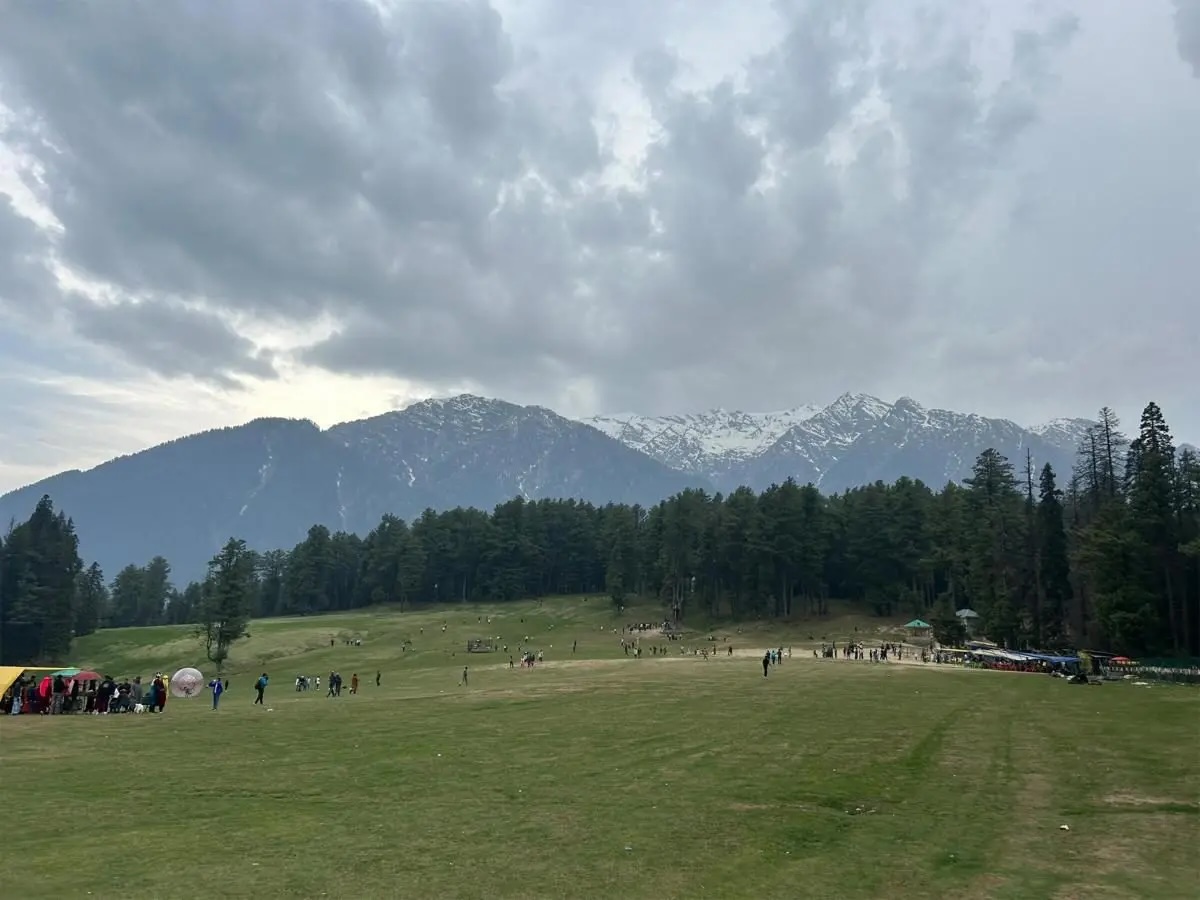
    The recent deadly terror attack on April 22 in Phalgham, near the Baisaran Valley, in which 26 innocent people were killed and more than a dozen others injured, has served as a stark reminder that external threats—particularly Pakistan-backed terrorism—remain a grave challenge to the region’s hard-won stability.

    Jammu and Kashmir is witnessing a remarkable and unprecedented political shift. In a development that would have seemed unimaginable a few years ago, many separatist groups, historically associated with anti-India activities, have abandoned their secessionist stance and re-entered the democratic mainstream. This transformation is not sudden—it reflects years of sustained government outreach, targeted policy reforms, and a persistent invitation to dialogue. Together, these efforts have fostered an environment of relative peace, reshaping public sentiment and political engagement across the valley. However, the recent deadly terror attack on April 22 in Phalgham, near the Baisaran Valley, in which 26 innocent people were killed and more than a dozen others injured, has served as a stark reminder that external threats—particularly Pakistan-backed terrorism—remain a grave challenge to the region’s hard-won stability.

    In a significant turn of events in April 2024, key factions of the Hurriyat Conference, such as the J&K Tahreeqi Isteqlal and J&K Tahreek-l-Istiqamat, publicly renounced separatism and embraced the democratic process. Their decision marks a critical shift in the political discourse of the region, challenging long-standing narratives of alienation and conflict. Union Home Minister Amit Shah hailed this move, declaring, “Under the Modi government, separatism is breathing its last, and the triumph of unity is echoing across Kashmir.” The reintegration of these groups into the democratic fold indicates the success of New Delhi’s long-term outreach and governance initiatives, as well as the strengthening of its position on the global stage regarding Jammu & Kashmir.

    the candidacy of individuals such as Sayar Ahmad Reshi (Kulgam), Aijaz Ahmad Mir (Zainapora), Talat Majeed (Pulwama), Mohammad Sikandar Malik (Bandipora), and Farooq Ahmad Genie (Beerwah) sent a powerful message—both domestically and internationally—of a growing trust in democratic processes and a shift away from violence.

    The 2024 Assembly elections further illustrated this transformation. Over 25 former militants, separatists, and members of the banned Jamaat-e-Islami contested as independent candidates. Although none of them secured a win, the candidacy of individuals such as Sayar Ahmad Reshi (Kulgam), Aijaz Ahmad Mir (Zainapora), Talat Majeed (Pulwama), Mohammad Sikandar Malik (Bandipora), and Farooq Ahmad Genie (Beerwah) sent a powerful message—both domestically and internationally—of a growing trust in democratic processes and a shift away from violence.

    Central to this transformation is the 2019 abrogation of Article 370. While Article 370 did not cause terrorism, it fostered a psychological and political sense of separateness. Its existence reinforced a feeling of isolation, suggesting that Jammu and Kashmir was distinct from the rest of India and that its political destiny remained unsettled, thereby encouraging subnational identity and sentiments of exclusion. Local political elites often exploited this narrative of exclusivity and exceptionalism for their political objectives, constantly telling people that Jammu and Kashmir had a “special relationship” with the Union of India, having its own constitution, flag, and national anthem. This exacerbated the sense of alienation and fueled anti-India sentiment.

    Article 370 served as a protective shield for corrupt politicians and bureaucrats from central investigation agencies, as it limited the powers of these agencies, allowing corruption to flourish unabatedly. On the global stage, Article 370 was utilised as a geostrategic tool against India.

    Moreover, domestically, the real benefits of Article 370 never reached the common people. Instead, it supported the interests of a few influential political families, such as the likes of the Muftis and the Abdullahs, etc., while the ordinary citizen continued to face hardship and underdevelopment. Additionally, Article 370 served as a protective shield for corrupt politicians and bureaucrats from central investigation agencies, as it limited the powers of these agencies, allowing corruption to flourish unabatedly. On the global stage, Article 370 was utilised as a geostrategic tool against India. References to Jammu & Kashmir’s semi-autonomous status and its separate flag and constitution created a misleading impression internationally—that it was some foreign territory under Indian occupation. Many significant powers often utilised this narrative to exert pressure on India and further their geopolitical objectives.

    Since its removal, the region has witnessed measurable progress. Terrorist incidents have plummeted by 81%—from 228 in 2018 to just 43 in 2023. Civilian and security force casualties have similarly declined. Stone pelting, once a near-daily occurrence, has disappeared entirely, with 2,654 such incidents in 2010 dropping to zero by 2023. Hartals and forced shutdowns have become a thing of the past. Educational outcomes have also improved. The number of colleges has risen from 94 to 147. Prestigious institutions such as IIT, IIM, and AIIMS have been established. Medical colleges increased from four to eleven, and the region now boasts 15 nursing colleges. Medical seat availability has grown from 500 to over 1,300.

    The region’s Gross State Domestic Product (GSDP) has more than doubled—from ₹1 lakh crore in 2014–15 to ₹2.27 lakh crore in 2022–23. In tourism, a record 2.36 crore visitors arrived in 2024, including over 65,000 foreign tourists.

    Economically, Jammu and Kashmir is undergoing a boom. Investments surged from ₹297 crore in 2019–20 to ₹2,153 crore in 2022–23, with another ₹6,000 crore in the pipeline. The region’s Gross State Domestic Product (GSDP) has more than doubled—from ₹1 lakh crore in 2014–15 to ₹2.27 lakh crore in 2022–23. In tourism, a record 2.36 crore visitors arrived in 2024, including over 65,000 foreign tourists. Global events like the G20 Tourism Working Group meeting and the Legends League Cricket (LLC) have put Jammu and Kashmir on the international map. Infrastructure development is progressing rapidly. Mega projects such as the USBRL Tunnel 50, Z-Morh Tunnel, and the iconic Chenab Rail Bridge—the highest in the world—are transforming connectivity. The Vande Bharat train now connects Katra with Srinagar. Symbolising civic normalcy, the Muharram procession returned to Srinagar in 2024 after a 34-year ban.
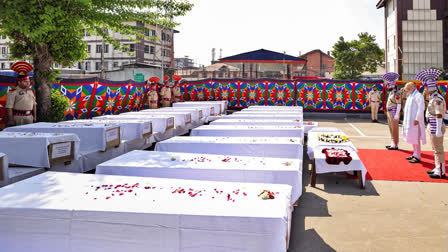
    However, the recent Pahalgam terror attack is a stark reminder that Pakistan continues to act as the primary external disruptor of peace and progress in Jammu & Kashmir. Despite the undeniable local yearning for peace and development, Pakistan’s strategic objective to “bleed India with a thousand cuts” remains unchanged. Its support for terrorism and infiltration undermines the region’s stability.

    Pakistan’s proxy war not only attempts to destabilise India but also hampers the development trajectory of Jammu & Kashmir, which had been flourishing in education, infrastructure, and economic growth.

    The attack, which targeted civilians and spread fear among tourists, has had immediate consequences: many tourists have cancelled bookings, impacting the Valley’s booming tourism sector. It reflects how Pakistan’s proxy war not only attempts to destabilise India but also hampers the development trajectory of Jammu & Kashmir, which had been flourishing in education, infrastructure, and economic growth.

    While local recruitment into militancy has declined and radicalisation has significantly reduced, Pakistan’s designs persist. Security agencies have reported the presence of 35–40 foreign terrorists operating in small groups in the Jammu division, with recent attacks in Reasi, Kathua, and Kishtwar proving that infiltration is now affecting eight out of ten districts. New Delhi must now recalibrate its approach. While the ecosystem-based strategy addressing governance, development, and security has yielded positive outcomes, the Pakistan problem requires a distinct strategic lens. Counterterrorism efforts must be intensified, international diplomacy must expose Pakistan’s continued support for terror, and internal resilience must be strengthened to protect gains made post-Article 370.

    In conclusion, nearly six years after the abrogation of Article 370, Jammu & Kashmir has indeed embarked on a transformative journey. But the road ahead must account for persistent external threats. The people of the region overwhelmingly desire peace, progress, and integration—but Pakistan’s continued interference demands a more robust, strategic, and multidimensional response.
  • The End of Pluralism in the Middle East

    The End of Pluralism in the Middle East

    A  truly seismic change in the Middle East has occurred.  At its heart is a devil’s bargain – Turkey and the Gulf States accept the annihilation of the Palestinian nation and the creation of a Greater Israel, in return for the annihilation of the Shia minorities of Syria and Lebanon and the imposition of Salafism across the Eastern Arab world.

    This also spells the end for Lebanon and Syria’s Christian communities. Witness the tearing down of all Christmas decorations, the smashing of all alcohol and the forced imposition of the veil on women when the jihadists — who overthrew the government of Bashar al-Assad on Sunday — first took Aleppo a mere two weeks ago.

    The speed of the collapse of Syria took everybody by surprise. Next, a renewed Israeli attack on Southern Lebanon to coincide with a Salafist invasion of the Bekaa Valley seems inevitable, as the Israelis would obviously wish their border with their new Taliban-style Greater Syrian neighbour to be as far North as possible.

    It could be a race for Beirut, unless the Americans have already organised who gets it.

    It is no coincidence that the attack on Syria started the day of the Lebanon/Israel ceasefire. The jihadist forces do not want to be seen to be fighting alongside Israel, even though they are fighting forces which have been relentlessly bombed by Israel, and in the case of Hezbollah are exhausted from fighting Israel.

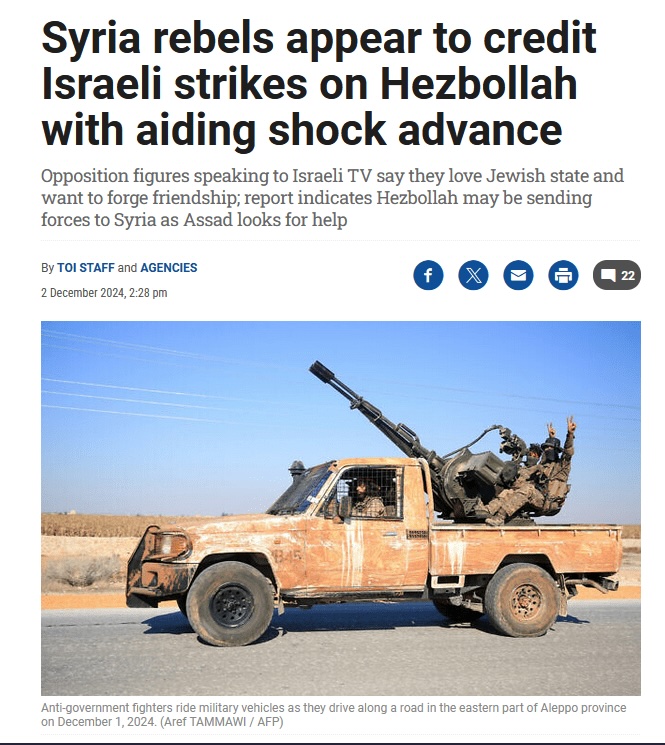
    The Times of Israel has no compunction about saying the quiet part out loud, unlike the British media:

    In fact, Israeli media is giving a lot more truth about the Syrian rebel forces than British and American media. This is another article from The Times of Israel:

    “While HTS officially seceded from Al Qaeda in 2016, it remains a Salafi jihadi organization designated as a terror organization in the US, the EU and other countries, with tens of thousands of fighters.

    Its sudden surge raises concerns that a potential takeover of Syria could transform it into an Islamist, Taliban-like regime – with repercussions for Israel at its south-western border. Others, however, see the offensive as a positive development for Israel and a further blow to the Iranian axis in the region.”

    Contrast this to the U.K. media, which from the Telegraph and Express to The Guardian has promoted the official narrative that not just the same organisations, but the same people responsible for mass torture and executions of non-Sunnis, including Western journalists, are now cuddly liberals.

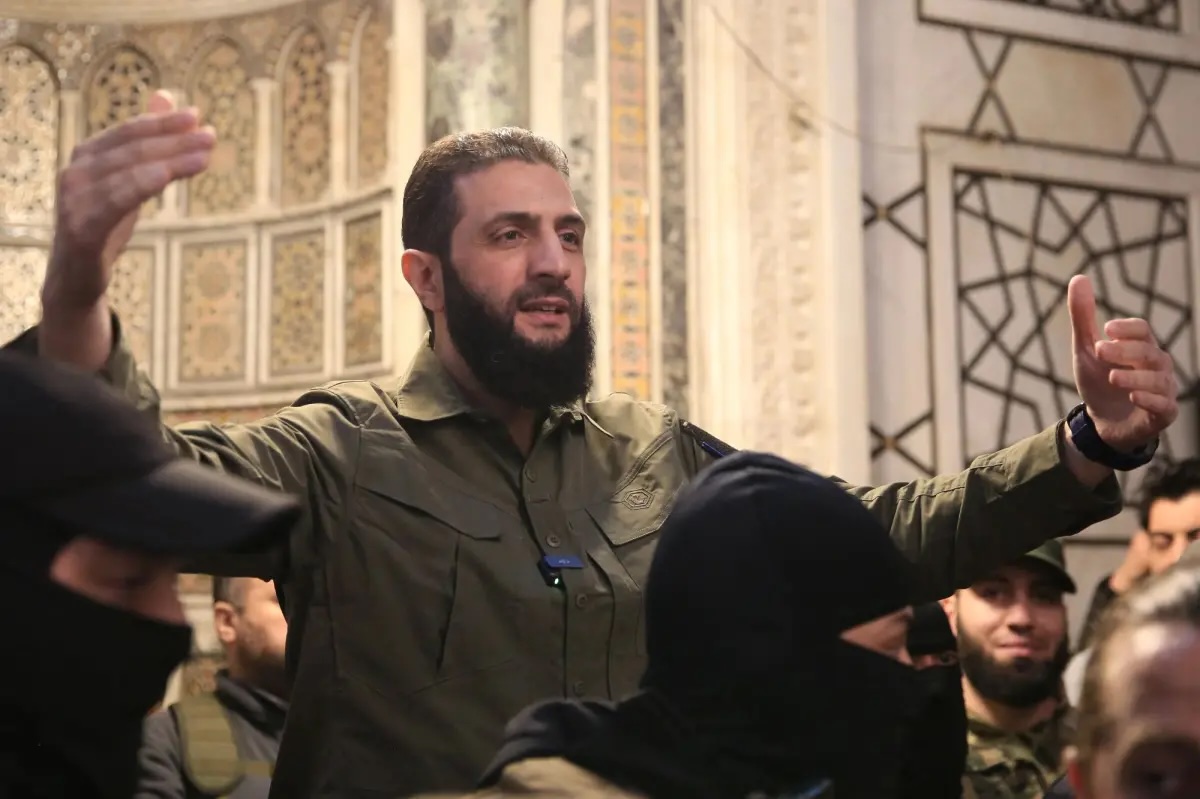
    Nowhere is this more obvious than the case of Abu Mohammad Al-Jolani, sometimes spelt Al-Julani or Al-Golani, who, now nominally in charge in Damascus, is being boosted throughout Western media as a moderate leader. He was the deputy leader of ISIS, and the CIA actually has a $10 million bounty on his head! Yes, that is the same CIA. which is funding and equipping him and giving him air support.

    Supporters of the Syrian rebels still attempt to deny that they have Israeli and U.S. support – despite the fact that almost a decade ago there was open Congressional testimony in the U.S.A. that, to that point, over half a billion dollars had been spent on assistance to Syrian rebel forces, and the Israelis have openly been providing medical and other services to the jihadists and effective air support.

    Violates UK Terrorism Act

    One interesting consequence of this joint NATO/Israel support for the jihadist groups in Syria is a further perversion of domestic rule of law. To take the U.K. as an example, under Section 12 of the Terrorism Act it is illegal to state an opinion that supports, or may lead somebody else to support, a proscribed organisation.

    The abuse of this provision by British police to persecute Palestinian supporters for allegedly encouraging support for proscribed organisations Hamas and Hezbollah is notorious, with even tangential alleged references leading to arrest. Sarah Wilkinson, Richard Medhurst, Asa Winstanley, Richard Barnard and myself are all notable victims, and the persecution has been greatly intensified by Keir Starmer.

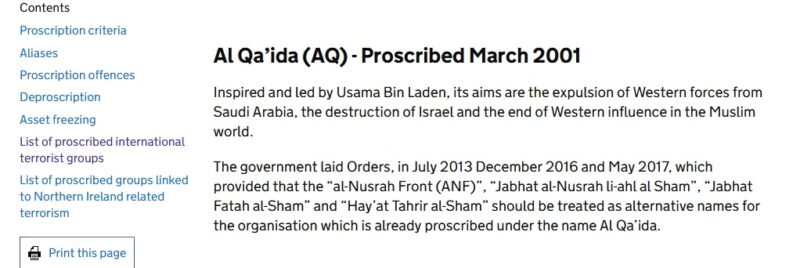
    Yet Hay’at Tahrir Al-Sham (HTS) is also a proscribed group in the U.K. But both British mainstream media and British Muslim outlets have been openly promoting and praising HTS – frankly much more openly than I have ever witnessed anyone in the U.K. support Hamas and Hezbollah – and not a single person has been arrested or even warned by U.K. police.


    That in itself is the strongest of indications that Western security services are fully behind the overthrow of the government in Syria.

    For the record, I think it is an appalling law, and nobody should be prosecuted for expressing an opinion either way. But the politically biased application of the law is undeniable.

    When the entire corporate and state media in the West puts out a unified narrative that Syrians are overjoyed to be released by HTS from the tyranny of the Assad regime – and says nothing whatsoever of the accompanying torture and execution of Shias, and destruction of Christmas decorations and icons – it ought to be obvious to everybody where this is coming from.

    Yet – and this is another U.K. domestic repercussion – a very substantial number of Muslims in the U.K. support HTS and the Syrian rebels, because of the funding pumped into U.K. mosques from Saudi and Emirate Salafist sources.

    This is allied to the U.K. security service influence also wielded through the mosques, both by sponsorship programmes and “think tanks” benefiting approved religious leaders, and by the execrable coercive Prevent programme.

    U.K. Muslim outlets that have been ostensibly pro-Palestinian – like Middle East Eye and 5 Pillars – enthusiastically back Israel’s Syrian allies in ensuring the destruction of resistance to the genocide of the Palestinians. Al Jazeera alternates between items detailing dreadful massacre in Palestine, and items extolling the Syrian rebels bringing Israel-allied rule to Syria.

    Among the mechanisms they employ to reconcile this is a refusal to acknowledge the vital role of Syria in enabling the supply of weapons from Iran to Hezbollah. Which supply the jihadists have now cut off, to the absolute delight of Israel, and in conjunction with both Israeli and U.S. air strikes.

    In the final analysis, for many Sunni Muslims both in the Middle East and in the West, the pull seems to be a stronger sectarian hatred of the Shia and the imposition of Salafism, than preventing the ultimate destruction of the Palestinian nation.

    I am not a Muslim. My Muslim friends happen to be almost entirely Sunni. I personally regard the continuing division over the leadership of the religion over a millennium ago as deeply unhelpful and a source of unnecessary continued hate.

    Classic Divide and Rule

    But as a historian, I do know that the Western colonial powers have consciously and explicitly used the Sunni/Shia split for centuries to divide and rule. In the 1830s, Alexander Burnes was writing reports on how to use the division in Sind between Shia rulers and Sunni populations to aid British colonial expansion.

    On May 12, 1838, in his letter from Simla setting out his decision to launch the first British invasion of Afghanistan, British Governor General Lord Auckland included plans to exploit the Shia/Sunni division in both Sind and Afghanistan to aid the British military attack.

    The colonial powers have been doing it for centuries, Muslim communities keep falling for it, and the British and Americans are doing it right now to further their remodelling of the Middle East.

    Simply put, many Sunni Muslims have been brainwashed into hating Shia Muslims more than they hate those currently committing genocide of an overwhelmingly Sunni population in Gaza.

    I refer to the U.K. because I witnessed this first-hand during the election campaign this year in Blackburn [where Murray ran for Parliament.] But the same is true all over the Muslim world. Not one Sunni Muslim-led state has lifted a single finger to prevent the genocide of the Palestinians.

    Their leadership is using anti-Shia sectarianism to maintain popular support for a de facto alliance with Israel against the only groups – Iran, Houthi and Hezbollah – which actually did attempt to give the Palestinians practical support in resistance. And against the Syrian government which facilitated supply.

    The unspoken but very real bargain is this: The Sunni powers will accept the wiping out of the entire Palestinian nation and formation of Greater Israel, in return for the annihilation of the Shia communities in Syria and Lebanon by Israel and forces backed by NATO (including Turkey).

    There are, of course, contradictions in this grand alliance. The United States’ Kurdish allies in Iraq are unlikely to be happy with Turkey’s destruction of Kurdish groups in Syria, which is what Turkish President Recep Tayyip Erdogan gains from Turkey’s very active military role in toppling Syria – in addition to extending Turkish control of oilfields.

    The Iran-friendly Iraqi government will have further difficulty with reconciling the U.S. continuing occupation of swathes of its country, as they realise they are the next target.

    The Lebanese army is under the control of the U.S.A., and Hezbollah must have been greatly weakened to have agreed to the disastrous ceasefire with Israel. Christian fascist militias traditionally allied to Israel are increasingly visible in parts of Beirut, though whether they would be stupid enough to make common cause with jihadists from the North may be open to question.

    But now that Syria has fallen to jihadist rule, I do not rule out Lebanon following very quickly indeed, and being integrated into a Salafist Greater Syria.

    How the Palestinians of Jordan would react to this disastrous turn of events, it is hard to be sure. The British puppet Hashemite Kingdom is the designated destination for ethnically cleansed West Bank Palestinians under the Greater Israel plan.

    What this all potentially amounts to is the end of pluralism in the Levant and its replacement by supremacism. An ethno-supremacist Greater Israel and a religio-supremacist Salafist Greater Syria.

    Unlike many readers, I have never been a fan of the Assad regime or blind to its human rights violations. But what it did undeniably do was maintain a pluralist state where the most amazing historical religious and community traditions – including Sunni (and many Sunni do support Assad), Shia, Alaouites, descendants of the first Christians, and speakers of Aramaic, the language of Jesus – were all able to co-exist.

    The same is true of Lebanon.

    An End of Tolerance

    What we are witnessing is the destruction of that and the imposition of a Saudi-style rule. All the little cultural things that indicate pluralism – from Christmas trees to language classes to winemaking to women going unveiled – have been destroyed in Aleppo and soon perhaps in Damascus and Beirut.

    I do not pretend that there are not genuine liberal democrats among the opposition to Assad. But they have negligible military significance, and the idea that they would be influential in a new government is delusion.

    In Israel, which pretended to be a pluralist state, the mask is off. The Muslim call to prayer has just been banned. Arab minority members of the Knesset have been suspended for criticising Netanyahu and genocide. More walls and gates are built every day, not just in unlawfully occupied territories but in the “state of Israel” itself, to enforce apartheid.

    I confess I once had the impression that Hezbollah was itself a religio-supremacist organisation; the dress and style of its leadership look theocratic.

    Then I came here and visited places like Tyre, which has been under Hezbollah-elected local government for decades, and found that swimwear and alcohol are allowed on the beach and the veil is optional, while there are completely unmolested Christian communities there.

    I will never now see Gaza, but wonder if I might have been similarly surprised by Hamas’s rule.

    It is the United States which is promoting the cause of religious extremism and of the end, all over the Middle East, of a societal pluralism similar to Western norms.

    That is of course a direct consequence of the United States being allied to both the two religio-supremacist centres of Israel and Saudi Arabia.

    It is the U.S.A. which is destroying pluralism, and it is Iran and its allies which defend pluralism. I would not have seen this clearly had I not come here. But once seen, it is blindingly obvious.

    Feature Image: nypost.com

    This article was published earlier in scheerpost.com

    It is republished under the Creative Commons Attribution-NonCommercial-NoDerivatives 4.0 International license.

  • The beginning of the end of Israel

    The beginning of the end of Israel

    One year later, the flames of genocide still burn, but after decades of persecution and bloodshed, we may well be seeing the beginning of the end of the settler-colonial project in Palestine.

    We have reached a grim milestone. A full year of gruesome Israeli mass murder. A year of epic Palestinian suffering.

    A year of direct Western complicity. A year of continuous media incitement. A year of shameful inaction by international institutions.

    For twelve months, we have seen relentless persecution of human rights defenders across the West, solely for peacefully opposing genocide and apartheid.

    And fifty-two weeks of a horrified global public helplessly witnessing on their screens the first live-streamed genocide in history.

    The carnage of this past year is unprecedented. The destruction is almost unimaginable.

    Still, this genocide will end. The Palestinian people and their besieged nation will undoubtedly emerge from the ashes of genocide, recover, and reassert their inalienable rights in their ancient homeland.

    But international institutions and the global human rights system will be left bruised and battered.

    The political capital expended by the US empire and the broader West in defence of the slaughter, as well as their global standing and reputation, will never be recouped.

    And, almost certainly, this year of cruelty and lawlessness will mark the beginning of the end for the Zionist project in Palestine and, therefore, of the state of Israel as we know it.

    A formula for disaster

    Of course, neither the genocide nor the current wave of slaughter of Palestinians started in October of 2023. The systematic massacre, purging, and erasure of the indigenous Palestinian people began in earnest with the Nakba of 1947-48, and it has not ceased since that bloody beginning.

    And the genocidal threat was always obvious. Any thinking person could see, even prior to the establishment of the state of Israel, that the Zionist project of the West was a formula for disaster.

    First, at the very historic moment when colonialism was being dismantled around the world, and global human rights rules were being adopted at the United Nations, the West carved out an exception for Palestine.

    It was at this moment that Zionist forces chose to attack Palestine, murder and terrorize its population, chase many survivors away in terror, and begin the erasure of the indigenous people, and their replacement with a European settler colony founded by foreign invaders and radicalized by a deeply racist and fundamentally violent political ideology.

    The colony was to be sustained at the barrel of a gun by waging constant war both against the Indigenous people and against the neighbouring states.

    A colonial education system and a media ecosystem were built to dehumanize the Indigenous and neighbouring peoples and to instil a supremacist ideology into the settler population.

    The settler state, its economy, and its society were thoroughly militarized, enlisting all adults in the project of state violence, arming it to the teeth, including with nuclear, chemical, and biological weapons, and even integrating the field-testing of new weapons on captive civilian populations as part of the business model of the colony’s arms industry.

    They ring-fenced the entire project with western-guaranteed impunity, carving out an exception to the application of all rules of international law.

    And they built an all-encompassing machinery of repression, including laws, policies, practices, and technologies to ensure the constant subjugation, dehumanization, and persecution of the indigenous Palestinian people.

    The toxic cocktail was complete.

    Maintaining Western support

    Of course, an artificially imposed European colony in the heart of the Middle East, which is necessarily maintained by force, could never become self-sufficient. Rather, it has always, and will always, rely on massive support from Western states, especially the US. Maintaining that vital support was to become a key goal of the Israeli state and its transnational network of proxy groups.

    As such, in the intervening years, the Israeli regime adopted a strategy of incremental genocide, with simmering persecution and dispossession, punctuated by periodic full-blown massacres and marked by a continuous march of expansion.

    It was a pace, tried and true over 75 years, with which the regime’s Western sponsors were comfortable, allowing them to continue unbroken the flow of military, economic, and diplomatic support without significant domestic pressure at home.

    And it allowed like-minded media corporations, decade after decade, to continuously disseminate pro-Israel propaganda as a smokescreen to obscure the horrific realities being perpetrated against the indigenous people on the ground.

    Expedited genocide

    But when Israel’s current ultra-Zionist government took power last year, it immediately abandoned the strategy of incremental genocide.

    In its place, it moved to expedited genocide (beginning with waves of ethnic cleansing in occupied Jerusalem and the West Bank), betting that its Western sponsors (and their captured politicians and complicit media) would not dare (or care) to take the steps necessary to stop it, even when it launched wholesale civilian slaughter in Gaza.

    They were right.

    So much so that Western countries like the U.S., UK, Germany, and others quickly moved beyond mere acquiescence for the genocide and into direct complicity and participation in it.

    As a result, one year later, we are witnessing unprecedented bloodshed in the region, and the broader world is in deep trouble.

    Axis of Genocide

    Thus, Israel is not alone in its march of terror. It is accompanied, in lockstep, by what has been called the Axis of Genocide.

    Four members of that Axis, Israel, the U.S., the UK, and France, are nuclear-armed states. A fifth, Germany, is a serial genocide perpetrator and a major European economic power. Three (the U.S., UK, and France) have veto power in the UN Security Council.

    Adding to the danger, all of its members share a common ideological grounding in militarism, colonialism, white supremacy, and political Zionism. Most have the stain of genocide on their historical records.

    All have political systems that are deeply compromised and corrupted by the influence of the weapons industry, the billionaire class, and the Israeli lobby. And all are marked by profound societal levels of Islamophobia, anti-Arab racism, and anti-Palestinian bigotry.

    And, in defence of a single, small, oppressive, and violent settler colony in the Middle East, all have quickly abandoned the entire edifice of international law and international institutions built up since the end of the Second World War, and which they once claimed as part of their brand.

    As recent history has shown, these biases, linkages, and incentives have become a formula not only for genocide in Palestine but for catastrophe on a global scale.

    Breaking bones and records

    And, indeed, the cost of Western-secured Israeli impunity has been shockingly high.

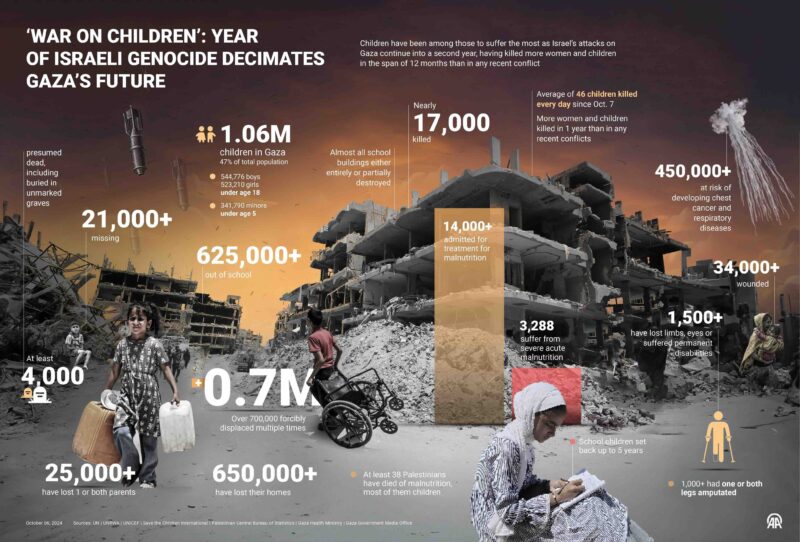
    Image Credit: @anadoluagency

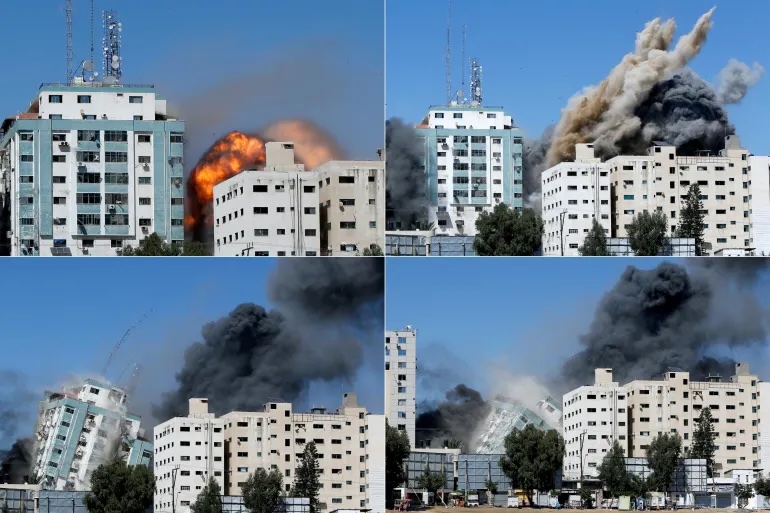
    In one year, Israel has set new records for the pace of civilian killing, the rate of destruction of civilian infrastructure, the killing of children, the killing of medical personnel, the killing of journalists, the killing of humanitarian workers, and the killing of UN staff.

    The depravity of Israel’s actions has shocked the world. Collective punishment, a chain of massacres, summary executions, torture camps, systematic sexual violence, starvation tactics, imposed disease, the direct targeting of small children with sniper rifles, and the blocking of humanitarian aid to facilitate starvation.

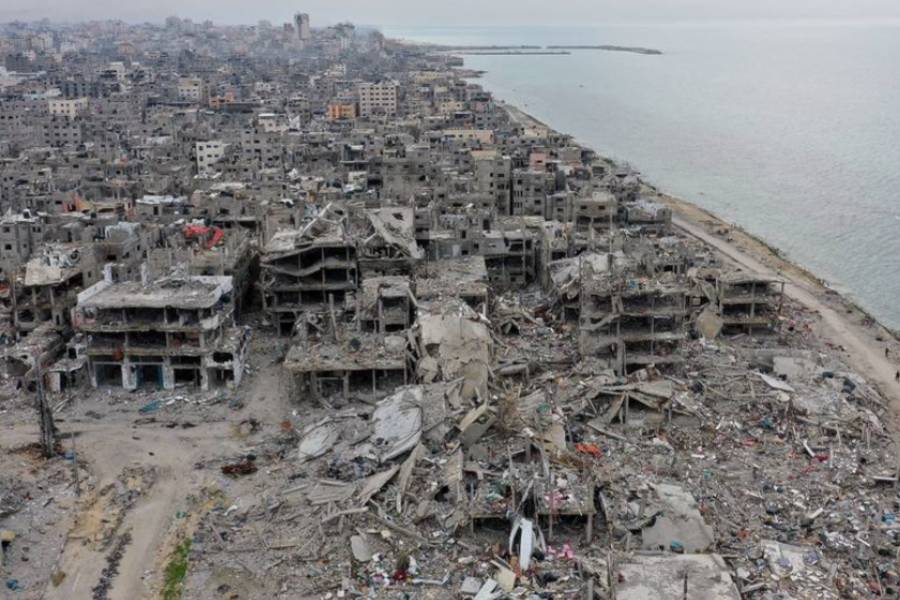
    We have all seen the images. The methodic eradication of whole neighbourhoods, schools, hospitals, universities, food stores, shelters, refugee camps, agricultural fields, and even cemeteries.

    The mangled bodies of Palestinians, the fear-filled eyes of the children, the terror as bombs fall on bread lines. The cold-blooded murder of innocents, of defenceless children like Hind Rajab, trapped in the family car, terrified for hours and then slaughtered by Israeli soldiers, and of thousands of others like her.

    And we have seen the cold, cruel laughter of the Israeli soldiers, the deranged chants of violent Israeli settlers, the genocidal pledges of Israeli political and military leaders.

    The promise of the Prime Minister to wipe out the Palestinians “like Amalek”, a biblical verse that calls for Israel to “utterly destroy all that they have and spare them not; but slay both man and woman, infant and suckling, ox and sheep, camel and ass.”

    The calls of Israeli leaders to perpetrate another Nakba, to raze Gaza to the ground, to make no distinction between civilians and fighters. To “bury them.”

    And, by now, we have all memorized the familiar barbarous pattern of Israel’s crimes: target civilians and civilian infrastructure, then target the rescue workers who come to help, then celebrate in Hebrew but switch to English to claim that they were all terrorists, human shields, or collateral damage, then reload and do it again.

    The accumulated criminal guilt of the Israeli perpetrators and their complicit Western partners is staggering. But so too is the historic moral lapse of the wider world, both those who have defended the genocide and those who have remained silent as it has been carried out with their tax dollars, with their government’s political support, or in their name.

    Today, everyone knows. No one can say they were not warned before the catastrophe. And no one can say they did not know of the horrors that followed, broadcast in real-time to all of us.

    Seventy-six blood-soaked years into this colonial enterprise, it is clear to all who will see that what the West has constructed in the heart of the Middle East is not an enlightened project, but rather a rampaging Frankenstein monster that threatens to drag the indigenous Palestinian people, the region, and the world into a conflagration from which it may not recover for generations.

    The darkness spreads

    How long the rampage can be sustained is an open question. But there will undoubtedly be much more darkness before the dawn.

    Israel, drunk with Western-backed impunity, even as it continues its genocide in Palestine, is now spreading its attacks across the region and leaving mountains of bodies and rivers of blood in its wake.

    In a matter of weeks, it has waged terror attacks with booby-trapped communication devices in Lebanon, assassinated leaders across the region, launched military attacks on Gaza, the West Bank, Lebanon, Syria, Iraq, Iran, and Yemen, has invaded Lebanese territory, and is now seeking to draw its U.S. sponsor into an all-out regional war of conquest and domination.

    For their part, collaborationist governments in the West show little appetite for reining in the rampaging monster that they themselves created in the Middle East, and to which they continue to provide endless flows of arms, money, intelligence, diplomatic cover, legal exceptionalism, and a heretofore impenetrable cocoon of impunity.

    When the reckoning comes, as it must, the accountability of both Israel and its Western accomplices must be secured, lest these horrors be repeated in an endless cycle of atrocity, impunity, and recidivism.

    Israeli impunity is coming to an end

    But there are flickering lights in the darkness, and they are growing.

    The just cause of Palestine and the steadfastness of her people have inspired millions around the world to stand up and fight back. The civilized world is now more mobilized than it has been in generations to oppose the horrific evil unleashed on the world by Israel and its Western sponsors.

    More and more people are escaping from the distorting matrix of Western corporate media and turning to independent media and first-hand sources on social media, delivering a powerful blow to the controlled, pro-Israel narrative of official Western institutions.

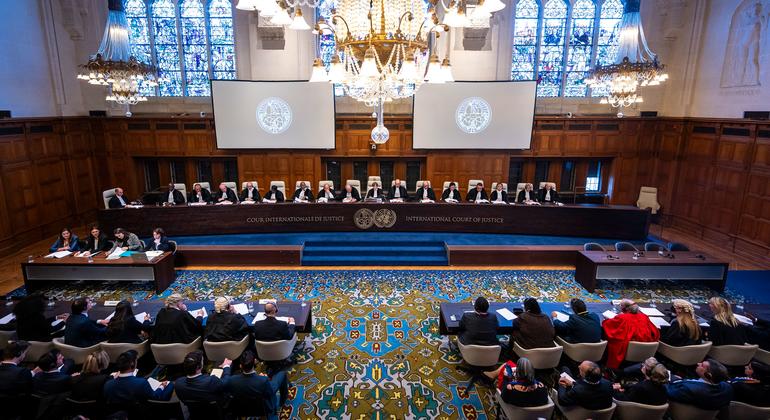
    Today, Israel is on trial for genocide at the World Court, and its leaders are the subject of arrest warrant requests at the International Criminal Court for crimes against humanity, including extermination.

    The ICJ has already issued a series of provisional anti-genocide measures against Israel, and a growing list of countries is lining up behind Palestine and South Africa in the genocide case against Israel.

    A dedicated international tribunal is under discussion at the UN. Cases have already been brought in national courts around the world, and more are certain to follow. Plans are also underway to mandate an international anti-apartheid body to focus on Israel.

    In the meantime, the United Nations, its independent human rights mechanisms, and the leading international, Palestinian, and Israeli human rights organizations have all collected massive quantities of evidence, have strongly condemned Israel for its shocking criminality, and are working to ensure accountability.

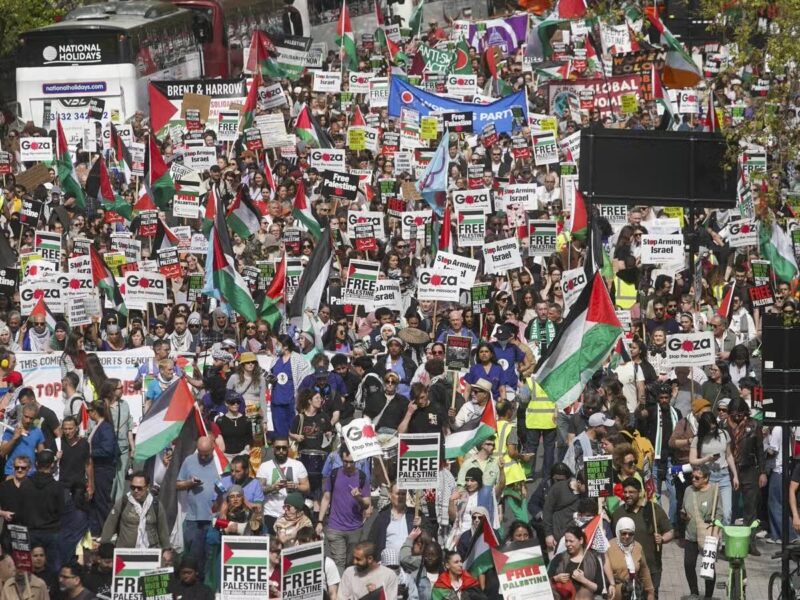
    Mass demonstrations against Israel are not only daily occurrences in capitals around the globe, but they are actually growing, undeterred by the often-brutal efforts (especially of Western governments) to suppress them.

    The ICJ has declared the obligation of all states to cut off all recognition, aid, investment, trade, weapons, and support of any kind with Israel’s colonial project in the occupied Palestinian territory.

    Israel is increasingly isolated on the global stage. And the global movement for boycott, divestment and sanctions is growing with every passing day.

    In other words, the age of Israeli impunity is coming to an end, despite the best efforts of the U.S., the UK, Germany, and other complicit Western states.

    And we may well be seeing, after decades of endless persecution and bloodshed, the beginning of the end of the European settler-colonial project in Palestine.

    One year later, the flames of genocide still burn. At this tragic moment, it is hard to see through the smoke that obscures the path forward. But white supremacist settler colonialism was defeated in South Africa, Rhodesia, Namibia, and Algeria. It will be defeated in Israel too. Through struggle and solidarity, with law and politics, in resistance and resilience, this will end.


    Feature Image Credit: Palestinian Return Center

    This article was published earlier in mondoweiss.net

  • Houthi’s attacks in the Red Sea: What does this mean for the world?

    Houthi’s attacks in the Red Sea: What does this mean for the world?

    The Houthis started in the 1990s as an armed group in Yemen, fighting against corruption. They belong to a community called Zaidis, who are a part of the Shia-Muslim minority. Along with Hamas and Hezbollah, the Houthis have declared themselves to be a part of the Iranian-led “axis of resistance” against Israel, the US, and the larger West.1 The Houthis have been attacking commercial ships passing through the lower Red Sea, and this has dramatically increased since mid-November in retaliation to Israel’s bombardment of Gaza. Due to these events, the Red Sea trade route is significantly affected, impacting the flow of global trade and having the potential to cause further damage. With ships attacked and stranded in one of the leading shipping routes of the world, countries seem to find themselves in yet another geopolitical fix. As the war continues between Israel and Gaza, the Red Sea has become a renewed hotspot for geopolitical and military tensions.

    Situated between Africa and West Asia, the Red Sea is a seawater entrance to the Indian Ocean in the south and goes through the Gulf of Aden and the Bab El Mandeb Strait, meeting the Gulf of Suez in the north. Countries like the US, France, Japan, and China have military bases in the region, including in Djibouti and many along the Horn of Africa, with considerable deployment of ships, weapons, and personnel. Establishing such bases conveys how critical it is to have control of the area as a measure of regional power and as a way of asserting their dominance internationally. Big players, including the Cold War rivals, have long struggled to gain presence and influence in West Asia. Having a military and economic presence in Africa with proximity to the Red Sea was necessary, for it provides access to almost 12% of the world’s trade, including nearly 40% of the trade between Europe and Asia.

    Until recently, the Houthis had been targeting ships heading towards Israel or ones that Israelis owned. However, recent developments showing attacks on ships bound for Israel with flags of various countries have raised grave concerns for global trade and security in the immediate future. The US, along with countries like the UK, France, and Bahrain, have tried to stop Houthi attacks on ships passing through the Red Sea under what Washington calls the “Operation Prosperity Guardian”. On the first day of the new year, The US military released a statement conveying that they killed at least 10 Houthi rebels and sabotaged three Houthi ships. Although the US was successful in deterring the Houthis from their attempt to attack, it did not do much to stop the group from being involved in disrupting peaceful navigation through the Red Sea.

    Private shipping companies such as Maersk, CMA CGM, Hapag-Lloyd, and MSC have begun to avoid using the Red Sea route due to the imminent threat from Houthis.3  The ongoing supply chain disruption caused by the COVID-19 pandemic and Russia’s invasion of Ukraine could further escalate due to the Red Sea crisis and cause severe concerns for world trade and consumer goods supply. With the suspension of trade via the Suez Canal, traffic through the Red Sea has dropped by 35%.4  The Houthis have raised the shipping cost internationally, imposing additional costs on commerce when trouble at the Panama Canal due to low water levels has already made shipping more complicated and central banks worry about a new inflationary spike. While trade hasn’t wholly stopped, most ships can choose the longer but safer route around Africa through the Cape of Good Hope to reach Europe and Asia from either side. This option imposes significant costs on shipping and, therefore, to consumers and affects local states in the region if the Houthi “blockade” persists. In the worst-case scenario, crude oil prices would rise in 2024 if oil shipments through the canal were stopped entirely, and this could cause a significant disturbance.

    Image Credit: washingtoninstitute.org

    Surprisingly, though, Russian ships have enjoyed free navigation through the Red Sea. Russian ships travel to Asia through the Black Sea, connecting to the Mediterranean Sea, passing through the Suez Canal and the Red Sea, and joining the Indian Ocean. With sanctions from Europe and the US amid the war in Ukraine, Russia cannot afford to lose its markets in Asia, particularly India and China, since these two countries buy almost 90% of Russia’s oil exports.5  The free navigation of Russian ships could possibly be due to its close relationship with Iran or due to the adoption of a similar stance with the Houthis on the war between Israel and Gaza. In the unlikely scenario that Russia does not have access to the Red Sea, it leaves them with the only other option of travelling through the Cape of Good Hope, adding 8,900 kilometres with an additional two weeks of travel. Such delays in oil shipments and a highly possible hike in price may prompt countries like India and China to start looking for other alternatives to their oil requirement, given the pre-existing energy crisis. Most probable alternatives include Saudi Arabia and other Gulf countries that do not need to pass the Red Sea to reach the Indian Ocean and thus Asian markets since they have ports in the Persian Gulf with access to the Arabian Sea.

    The disruption in trade has caused an impact on Indian imports and exports as well. Indian exports traverse the Indian Ocean and reach the Suez Canal through the Arabian Sea to reach European markets. Trade between India and Europe has been rising, at an all-time high in 2022, with goods traded worth $130 Billion.6   As of 2021, India engaged in trade worth $200 Billion through the Suez Canal, making the EU one of India’s main export destinations, with a Free trade agreement in the talks.7  India also procures its oil from Russia using the Suez Canal and the Red Sea. A slowdown or possible pause of oil imports may cause severe concerns amid the ongoing energy crisis. At such a juncture for the Indian economy, if the situation persists, trade will likely take a hit along with India’s domestic economy. If the condition fails to change decisively, the higher fees and the expense of prolonged travel duration will also put inflationary pressure on the global economy and India.

    The Houthis will most likely continue to put pressure on Israel to stop its onslaught in Gaza, and they are likely to keep attacking until they reach their goal. By taking control of the Red Sea and indirectly and directly hurting countries irrespective of their size and power, Houthis pressurize the international community to, in turn, put pressure on Israel. This also means that the group is unlikely to agree on any other way of settlement. Not only does this fall on Israel to stop their attacks but also on the US since the latter has always portrayed itself as a peace negotiator in the Middle East and, therefore, has the responsibility to restore order in the region. The Houthis possess a plethora of Iranian-supplied weaponry, ranging from precision drones to anti-ship cruise and ballistic missiles that can strike a moving vessel hundreds of kilometres away. What makes the Houthis more dangerous is the enormous stockpile that can help them continue their campaign indefinitely.

    The attacks have also prompted an unanticipated return of Somali piracy in international seas. As a result, increased expenses are now a worry for merchant shipping lines and seafarer safety for governments worldwide. The ship Lila Norfolk, under the Liberian flag and carrying six Filipinos and fifteen Indians, was taken over by Somali pirates on January 4th, 2024. The Indian navy had already deployed four warships patrolling the Indian Ocean, including INS Chennai, which was involved in the rescue operation during the recent highjack of ship Lila Norfolk. Even though the Indian Navy’s intervention allowed for the sailors’ rescue, it caused further concerns for India’s security and economy. The spill over of these attacks onto the Indian Ocean may threaten India’s security.

    Countries must monitor developments in the Red Sea and, for India, the Indian Ocean. Although India has not joined any Western-led operations on this matter, the country must push the international community to ensure freedom of navigation and the territorial integrity of countries over their sea is upheld under the UN Convention on the Law of the Seas.


    References

    [1] Who are the Houthi rebels and why are they attacking Red Sea ships? (2023, December 23). BBC News. https://www.bbc.com/news/world-middle-east-67614911

    [2] Yerushalmy, J. (2023, December 19). Red Sea crisis explained: what is happening and what does it mean for global trade? The Guardian.

    [3] A new Suez crisis threatens the world economy. (2023, December 16). The Economist. https://www.economist.com/international/2023/12/16/a-new-suez-crisis-threatens-the-world-economy

    [4] Graham, R., Murray, B., & Longley, A. (2023, December 19). Houthi Red Sea Attacks Start Shutting Down Merchant Shipping. Bloomberg.com. https://www.bloomberg.com/news/articles/2023-12-18/houthi-attacks-start-shutting-down-red-sea-merchant-shipping

    [5] Russia: crude oil shipments by destination 2023 | Statista. (2023, September 14). Statista. https://www.statista.com/statistics/1350506/russia-crude-oil-shipments-by-destination/

    [6] I. (n.d.). First India-EU Trade and Technology Council: Significant Milestone in India-EU Relations – Indian Council of World Affairs (Government of India). https://www.icwa.in/show_content.php?lang=1&level=3&ls_id=9416&lid=6112#:~:text=The%20EU%20is%20India’s%202nd,EU%20total%20trade%20in%20goods.

    [7] Ibid.


    Feature Image Credit: dailynewsegypt.com

  • Propaganda Blitz: How Mainstream Media is Pushing Fake Palestine Stories

    Propaganda Blitz: How Mainstream Media is Pushing Fake Palestine Stories

    Biased media reporting and propaganda with fake news is now a major strategy to create polarised perceptions worldwide. This type of reporting is now led by leading media houses of the West, whose only aim is to create a narrative that suits their foreign policy and economic objectives. Truth is a big casualty in the bargain, along with innocent lives, communities, and nations. The ongoing Israel-Hamas conflict is mired in heavy propaganda. It is important for the world to re-examine the past, extract the truth and history, and the current geopolitical machinations to understand this long-drawn Middle East conflict properly. TPF endeavours to provide, through select articles and accurate analysis, the right analysis and perspective of the Israel-Palestine issue. In the article below, Alan Macleod clearly describes how mainstream media pushes many false narratives to obfuscate the true nature, causes, and victims of the conflict.         – Team TPF


    After Hamas launched a surprise attack on Israel, IDF forces responded with airstrikes, levelling Gazan buildings. The violence so far has claimed the lives of more than 2,500 people. Western media, however, show far more interest and have much greater sympathy with Israeli dead than Palestinian ones and have played their usual role as unofficial spokespersons for the Israeli Defense Forces (IDF).

    EXTRAORDINARY CLAIMS, ZERO EVIDENCE

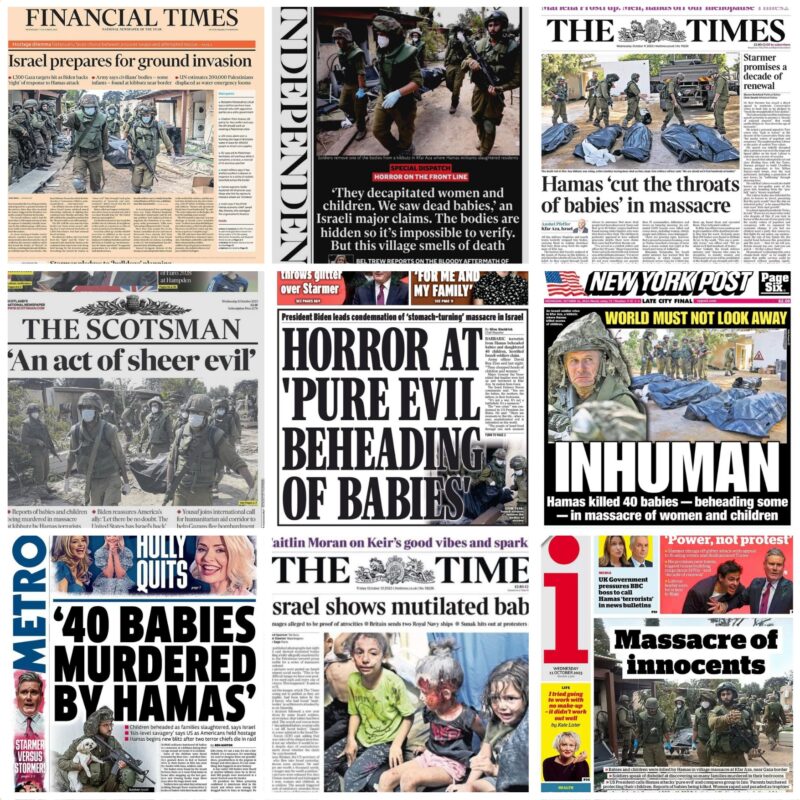
    One case in point is the claim that, during their incursion into southern Israel, Hamas fighters stopped to round up, kill and mutilate 40 Israeli babies, beheading them and leaving their bodies behind.

    The extraordinary assertion was originally reported by the Israeli channel i24 News, which based it on anonymous Israeli military sources. Despite offering no proof whatsoever, this highly inflammatory claim about an enemy made by an active participant in a conflict was picked up and repeated across the world by a host of media (e.g., in the United States by Fox NewsCNNMSNBusiness Insider, and The New York Post)

    Meanwhile, the front pages of the United Kingdom’s largest newspapers were festooned with the story, the press outraged at the atrocity and inviting their readers to feel the same way.

    Extraordinary claims should require extraordinary evidence, and a story like this should have been met with serious skepticism, given who was making the claim. The first question any reporter should have asked was, “Where is the evidence?” Given multiple opportunities to stand by it, the IDF continually distanced itself from the claims. Nevertheless, the story was simply too useful not to publish.

    The decapitated baby narrative was so popular that even President Biden referenced it, claiming to have seen “confirmed” images of Hamas killing children. This claim, however, was hastily retracted by his handlers at the White House, who noted that Biden was simply referencing the i24 News report.

    The story looked even more like a piece of cheap propaganda after it was revealed that the key source for the claim was Israeli soldier David Ben Zion, an extremist settler who had incited race riots against Palestinians earlier this year, describing them as “animals” with no heart who needs to be “wiped out.”

    Manipulating the U.S. public into supporting the war by feeding them atrocity propaganda about mutilating babies has a long history. In 1990, for instance, a girl purporting to be a local nurse was brought before Congress, where she testified that Iraqi Dictator Saddam Hussein’s men had ripped hundreds of Kuwaiti babies from their incubators and left them to die. The story helped whip the American public up into a pro-war fervor. It was later revealed that it was a complete hoax dreamed up by a public relations firm.

    THE MURDERED GIRL WHO CAME BACK TO LIFE

    Another piece of blatantly fake news is the case of Shani Louk. Louk attended the Supernova Festival, ambushed by Hamas. It was widely reported that Hamas murdered her (e.g., Daily MailMarcaYahoo! NewsTMZBusiness Insider), stripped her, and paraded her naked body trophy-like through the streets on the back of a truck. Louk’s case incited global anger and calls for an overwhelming Israeli military response.

    There was only one problem: Louk was later confirmed to be alive and in hospital, a fact that suggests the videos of her on the back of a truck were actually images of people saving her life by taking her to seek medical assistance.

    Few of the outlets irresponsibly publishing these wildly incendiary stories have printed apologies or even retractions. The Los Angeles Times was one exception: after publishing a report claiming that Palestinians had raped Israeli civilians, it later informed readers that “such reports have not been substantiated.”

    LIONIZING ISRAEL, DEHUMANIZING PALESTINIANS

    Few readers, however, see these retractions. Instead, they are left with visceral feelings of anger and disgust towards Hamas, priming them to support Western military action against Palestine or the wider region.

    In case their audiences did not get the message, op-eds and editorials in major newspapers hammered home this idea. The Wall Street Journal ran an op-ed entitled “The Moral Duty to Destroy Hamas”, which insisted to readers that “Israel is entitled to do whatever it takes to uproot this evil, depraved culture that resides next to it.” Thus, the outlet implicitly gave Israel a free pass to carry out whatever war crimes it wished on the civilian population, whether that is using banned chemical weapons, cutting off electricity and water, or targeting ambulances or United Nations officials.

    The National Review’s editorial board was of a similar mind, stating that “Israel needs a long leash to destroy Hamas.” This long leash, they explained, meant giving Israel far more time to carry out the destruction of Gaza. Western leaders would have to refrain from criticizing Israel or calling for calm and peace.

    The message was clear: international unity was paramount at this time. Mere trifles such as war crimes must be overlooked. And while Israel and its people were treated with special sympathy (e.g., Washington Post), the other side was written off as bloodthirsty radicals. While the phrase “Palestinian terrorists” could be found across the media spectrum (e.g., Fox NewsNew York PostNew York Times), its opposite, “Israeli terrorists” was completely absent from corporate media. This, despite casualties on the Palestinian side, outnumbering Israelis.

    Underlining the fact that Israeli lives are deemed more important is the way in which deaths from each side are reported. The BBC, for example, told its readers that Israelis have been “killed” while people in Gaza merely “died,” removing any agency from its perpetrators and almost suggesting their deaths were natural.

    CONTEXT-FREE VIOLENCE

    Missing from most of the reporting was the basic factual background of the attack. Few articles mentioned that Israel was built upon an existing Palestinian state and that most of the inhabitants of Gaza are descended from refugees ethnically cleansed from southern Israel in order to make way for a Jewish state. Also left unmentioned was that Israel controls almost every aspect of Gazan’s life. This includes deciding who can enter or leave the densely populated strip and limiting the import of food, medicine and other crucial goods. Aid groups have called Gaza “the world’s largest open-air prison.” The United Nations has declared the conditions in Gaza to be so bad as to be unlivable.

    One of the principal reasons that this crucial context is not given is that it could influence Western audiences into sympathizing with Palestinians or supporting Palestinian liberation. Giant media corporations are largely owned by wealthy oligarchs or by transnational corporations, both of whom have a stake in preserving the status quo and neither of whom wish to see national liberation movements succeed.

    https://twitter.com/AlanRMacLeod/status/1712797752709566763?ref_src=twsrc%5Etfw%7Ctwcamp%5Etweetembed%7Ctwterm%5E1712797752709566763%7Ctwgr%5Eb05f8d7d7e0b67196918b4e46787442438501a6b%7Ctwcon%5Es1_&ref_url=https%3A%2F%2Fscheerpost.com%2F2023%2F10%2F14%2Fpropaganda-blitz-how-mainstream-media-is-pushing-fake-palestine-stories%2F

    Some media outlets make this explicit. Axel Springer – the enormous German broadcaster that owns Politico – requires its employees to sign its mission statement endorsing “the trans-Atlantic alliance and Israel” and has told any staff members that support Palestine to leave their jobs.

    Other outlets are slightly less overt but nonetheless have Israel red lines that employees cannot cross. CNN fired anchor Marc Lamont Hill for calling for a free Palestine. Katie Halper was fired from The Hill for (accurately) calling Israel an Apartheid state. The Associated Press dismissed Emily Wilder after it became known that she had been a pro-Palestine activist during her college years. And The Guardian sacked Nathan J. Robinson after he made a joke mocking US military aid to Israel. These cases serve as examples to the rest of the journalistic world. The message is that one cannot criticize the Israeli government’s violent apartheid system or show solidarity for Palestine without risking losing their livelihoods.

    Ultimately, then, corporate media play a key role in maintaining the occupation by manipulating public opinion. If the American people were aware of the history and the reality of Israel/Palestine, the situation would be untenable. For those wishing to maintain the unequal state of affairs whereby an apartheid government expels or imprisons its indigenous population, the pen is as important as the sword.


    This article was published earlier in scheerpost.com and is republished under the Creative Commons Attribution-NonCommercial-NoDerivatives 4.0 International license

    Feature Image Credit: aljazeera.com


  • The Atomic Executioner’s Lament

    The Atomic Executioner’s Lament

    While the world focuses on the trials and travails of the scientists who invented the atomic bomb, little attention is paid to the hard positions taken by the nuclear executioners, the men called upon to drop these bombs in time of war.


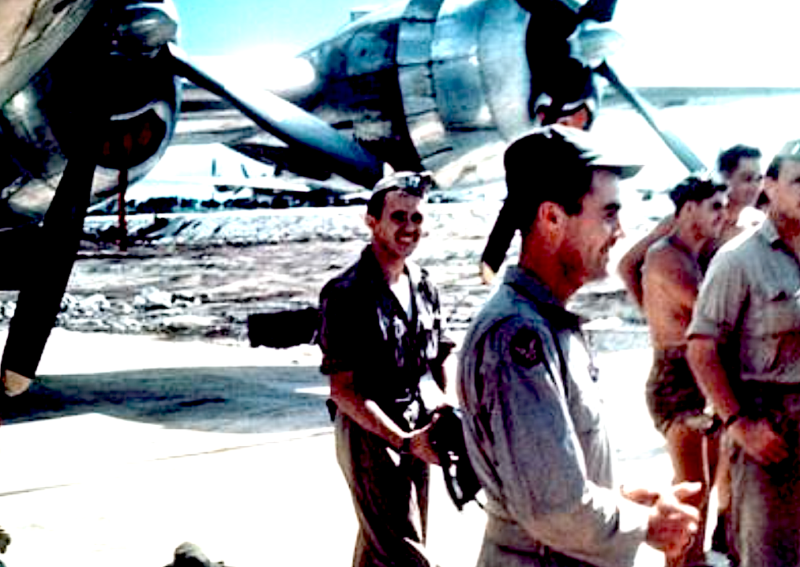
    Crew of the Enola Gay, returning from their atomic bombing mission over Hiroshima, Japan. At center is navigator Capt. Theodore Van Kirk; to the right, in foreground, is flight commander Col. Paul Tibbetts. (Wikimedia Commons, Public domain)


    There is an interesting scene in Chris Nolan’s film Oppenheimer, one which could easily get lost in the complexity of telling the story of the man considered to be the father of the American atomic bomb, J. Robert Oppenheimer.

    The Trinity test of the first nuclear device has been successfully completed, and Oppenheimer is watching as two men in military uniform are packing up one of Oppenheimer’s “gadgets” for shipment out of Los Alamos to an undisclosed destination.

    Oppenheimer talks to them about the optimum height for the detonation of the weapon above ground, but is cut off by one of the soldiers, who, smiling, declares “We’ve got it from here.”

    Such men existed, although the scene in the movie — and the dialogue — was almost certainly the product of a scriptwriter’s imagination. The U.S. military went to great lengths to keep the method of delivery of the atomic bomb a secret, not to be shared with either Oppenheimer or his scientists.

    Formed on March 6, 1945, the 1st Ordnance Squadron, Special (Aviation) was part of the 509th Composite Group, commanded by then-Lieutenant Colonel Paul Tibbets. Prior to being organized into the 1st Ordnance Squadron, the men of the unit were assigned to a U.S. Army ordnance squadron stationed a Wendover, Utah, where Tibbets and the rest of the 509th Composite Group were based.

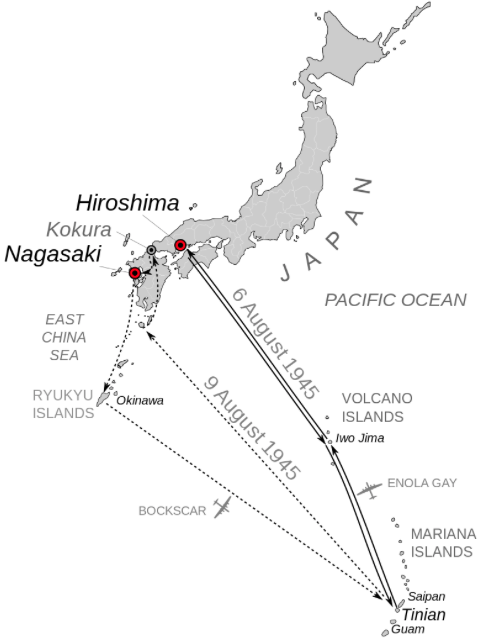
    Mission map for the bombings of Hiroshima and Nagasaki, Aug. 6 and Aug. 9, 1945. Scale is not consistent due to the curvature of the Earth. Angles and locations are approximate. Kokura was included as the original target for Aug. 9 but weather obscured visibility; Nagasaki was chosen instead. (Mr.98, Wikimedia Commons, Public domain)
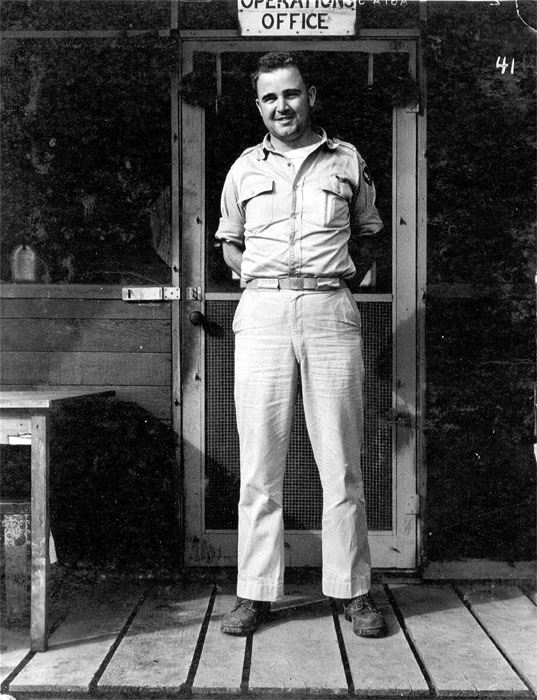
    While Oppenheimer and his scientists designed the nuclear device, the mechanism of delivery — the bomb itself — was designed by specialists assigned to the 509th. It was the job of the men of the 1st Ordnance Squadron to build these bombs from scratch.

    The bomb dropped on Hiroshima by Paul Tibbets, flying a B-29 named the Enola Gay, was assembled on the Pacific Island of Tinian by the 1st Ordnance Squadron.

    Concerned about the possibility of the B-29 crashing on takeoff, thereby triggering the explosive charge that would send the uranium slug into the uranium core (the so-called gun device), the decision was made that the final assembly of the bomb would be done only after the Enola Gay took off.

    One of the 1st Ordnance Squadron technicians placed the uranium slug into the bomb at 7,000 feet over the Pacific Ocean.

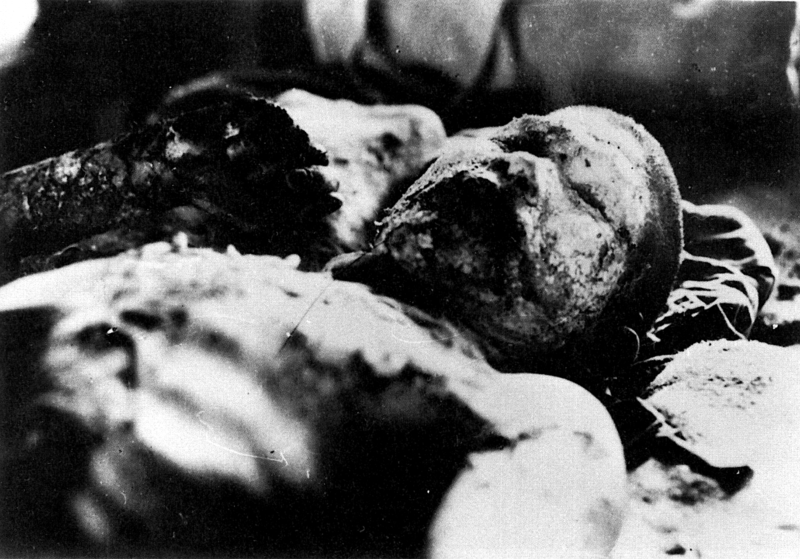
    The bomb worked as designed, killing more than 80,000 Japanese in an instant; hundreds of thousands more died afterwards from the radiation released by the weapon.

    For the pilot and crew of the Enola Gay, there was no remorse over killing so many people. “I knew we did the right thing because when I knew we’d be doing that I thought, yes, we’re going to kill a lot of people, but by God we’re going to save a lot of lives,’ Tibbets recounted to Studs Terkel in 2002. He added:

    “We won’t have to invade [Japan]. You’re gonna kill innocent people at the same time, but we’ve never fought a damn war anywhere in the world where they didn’t kill innocent people,” Tibbets told Terkel. “If the newspapers would just cut out the shit: ‘You’ve killed so many civilians.’ That’s their tough luck for being there.

    An atomic bomb victim with burns, Ninoshima Quarantine Office, Aug. 7, 1945. (Onuka Masami, Wikimedia Commons, Public domain)

    Major Charles Sweeney, the pilot of Bockscar, the B-29 that dropped the second American atomic bomb on the city of Nagasaki on Aug. 9, 1945, held similar convictions about his role in killing 35,000 Japanese instantly.

    “I saw these beautiful young men who were being slaughtered by an evil, evil military force,” Sweeney recounted in 1995. “There’s no question in my mind that President Truman made the right decision.” However, Sweeney noted, “As the man who commanded the last atomic mission, I pray that I retain that singular distinction.”

    History records the remorse felt by Oppenheimer and his Soviet counterpart, Andrei Sakharov, and the punishment they both suffered at the hands of their respective governments. They suffered from designer’s remorse, a regret — stated after the fact — that what they had built should not be used, but somehow locked away from the world, as if the Pandora’s Box of nuclear weaponization had never been opened.

    Having designed their respective weapons, however, both Oppenheimer and Sakharov lost control of their creations, turning them over to military establishments which did not participate in the intellectual and moral machinations of bringing such a weapon into existence, but rather the cold, hard reality of using these weapons to achieve a purpose and goal which, as had been the case for Tibbets and Sweeney, seemed justified.

    Ignoring the Executioner

    Brigadier General Charles W. Sweeney, pilot of the aircraft that dropped the atomic bomb on Nagasaki. (Public domain, Wikimedia Commons)

    This is the executioners’ lament, a contradiction of emotions where the perceived need for justice outweighs the costs associated.

    While the world focuses on the trials and travails of Oppenheimer and Sakharov, they remain silent about the hard positions taken by the nuclear executioners, the men called upon to drop these bombs in time of war.  There have only been two such men, and they remained resolute in their judgement that it was the right thing to do.

    The executioner’s lament is overlooked by most people involved in supporting nuclear disarmament. This is a mistake, because the executioner, as was pointed out to Oppenheimer by the men of the 1stOrdnance Squadron, is in control.

    They possess the weapons, and they are the ones who will be called upon to deliver the weapons. Their loyalty and dedication to the task are constantly tested in order to ensure that, when the time comes to execute orders, they will do so without question.

    Image of a younger Petrov from a family album.
    (Stanislav Petrov’s Personal Library, Wikimedia Commons, CC0)


    Those opposed to nuclear weapons often point to the example of Stanislav Petrov, a former lieutenant colonel of the Soviet Air Defense Forces who, in 1983, twice made a decision to delay reporting the suspected launch of U.S. missiles towards the Soviet Union, believing (rightly) that the launch detection was a result of malfunctioning equipment.

    But the fact is that Petrov was an outlier who himself admitted that had another officer been on duty that fateful day, they would have reported the American missile launches per protocol.

    Those who will execute the orders to use nuclear weapons in any future nuclear conflict will, in fact, execute those orders. They are trained, like Tibbets and Sweeney, to believe in the righteousness of their cause.

    Dmitry Medvedev, the former Russian prime minister and president who currently serves as the deputy chairman of the Russian National Security Council, has publicly warned the Western supporters of Ukraine that Russia would “have to” use nuclear weapons if Ukrainian forces were to succeed in their goal of recapturing the former territories of Ukraine that have been claimed by Russia in the aftermath of referenda held in September 2022.

    “Imagine,” Medvedev said, “if the offensive, which is backed by NATO, was a success and they tore off a part of our land, then we would be forced to use a nuclear weapon according to the rules of a decree from the president of Russia. There would simply be no other option.”

    Some in the West view Medvedev’s statement to be an empty threat; U.S. President Joe Biden said last month that there is no real prospect of Russian President Vladimir Putin ordering the use of nuclear weapons against either Ukraine or the West.

    “Not only the West, but China and the rest of the world have said: ‘don’t go there,’ ” Biden said following the NATO Summit in Vilnius.

    Ignoring Russian Doctrine

    But Biden, like other doubters, emphasizes substance over process, denying the role played by the executioner in implementing justice defined on their terms, not that of those being subjected to execution.

    Russia has a nuclear doctrine that mandates that nuclear weapons are to be used “when the very existence of the state is put under threat.” According to Medvedev, “there would simply be no other option,” ironically noting that “our enemies should pray” for a Russian victory, as the only way to make sure “that a global nuclear fire is not ignited.”

    The Russians who would execute the orders to launch nuclear weapons against the West would be operating with the same moral clarity as had Paul Tibbets and Charles Sweeney some 88 years ago. The executioner’s lament holds that they will be saddened by their decision but convinced that they had no other choice.

    Proving them wrong will be impossible because, unlike the war with Japan, where the survivors were given the luxury of reflection and accountability, there will be no survivors in any future nuclear conflict.

    The onus, therefore, is on the average citizen to get involved in processes that separate the tools of our collective demise — nuclear weapons — from those who will be called upon to use them.

    Meaningful nuclear disarmament is the only hope humankind has for its continued survival.

    The time to begin pushing for this is now, and there is no better place to start than on Aug. 6, 2023 — the 78th anniversary of the bombing of Hiroshima, when like-minded persons will gather outside the United Nations to begin a dialogue about disarmament that will hopefully resonate enough to have an impact of the 2024 elections.


    This article was published earlier in consortiumnews.com

    The views expressed are the author’s own.

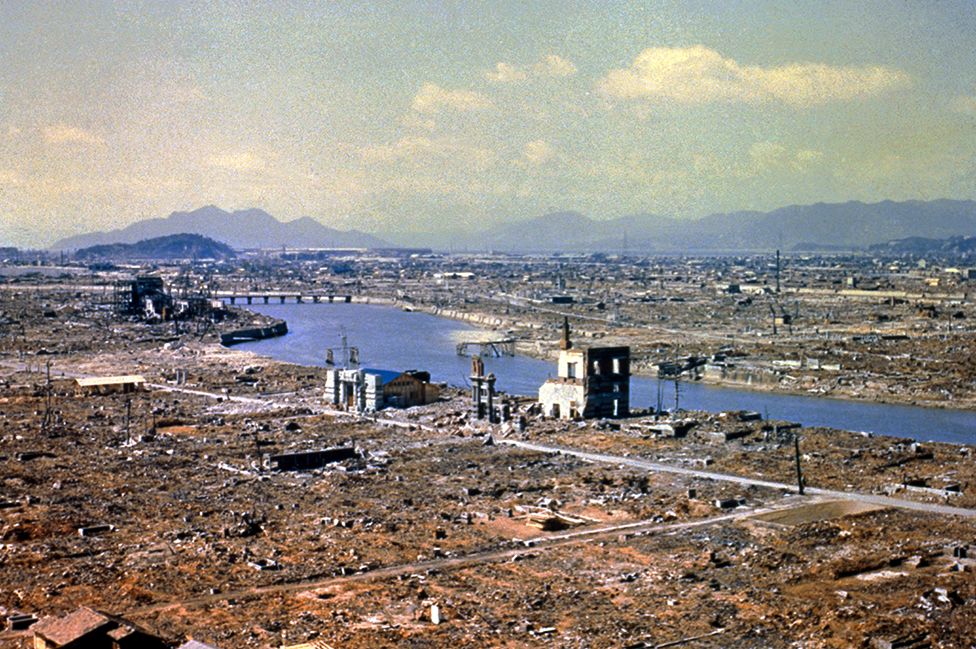
    Feature Image: The devastated city of Hiroshima after the atomic bomb blast – bbc.com

  • From Civil Wars to Gang Wars

    From Civil Wars to Gang Wars

    Depending on the context, these uprooted and redundant young people can become terrorists, child soldiers, members of youth gangs that dominate the suburbs from Paris to Rio, drug cartels, mafia gangs, or human traffickers.

    With the end of the Cold War in 1991, interstate war seemed to have said goodbye. But even then, there was no end of history, as Francis Fukuyama had assumed. Instead, interstate war was largely replaced by wars of intervention in weak states and civil wars. At the latest since the war in Ukraine, however, interstate war is back on the agenda and a new arms race has begun – the wars of the present have been nationalized. What is often overlooked, however, is that civil wars have not completely ceased to exist but have been replaced by gang wars. This will be analyzed here using the example of South American gangs, but it applies equally to large parts of Africa, Iraq, or Southeast Asia.

    A Brief Review

    In order to analyze this, a brief review is necessary. After the fall of the USSR, a return to the Middle Ages was diagnosed in security policy, and a return to pre-modern weapon carriers such as child soldiers, warlords, and private security companies. After the attacks of September 11, the fight against a new totalitarianism, this time Islamist, seemed imminent, and the “war on terror” was proclaimed. Meanwhile, China and Russia have re-emerged as serious rivals to the U.S., at least militarily, and a new arms race is on the horizon. The U.S. has been weakened by its lost wars in Afghanistan and Iraq, which even the much-vaunted and overestimated military-technological revolution could not stop.

    While in the 19th century the Western states conquered the whole world, in the 20th century the defeated empires and civilizations had to learn to live with the victorious West, and now the resurgent empires and the West have to learn to live with each other.

    Are there long-term trends in this rapid succession of different experiences and analyses of violent events? Two immediately come to mind: the “rise of the others,” as the influential US columnist Fareed Zakaria has called it, that is, the resurgence of the great empires and civilizations submerged by European colonization and US hegemony. These are primarily China and India, but also Russia and the littoral states of the North Pacific. In short, world affairs are shifting from the North Atlantic to the North Pacific. Whereas the entire 20th century was dominated by the North Atlantic littoral states (with the exception of Japan), in the 21st century there are at least two such centers: the North Atlantic littoral states and the North Pacific littoral states.  Here, the United States has the unbeatable geostrategic advantage of being located on both oceans. These former great empires and civilizations have almost one goal: to no longer be considered underdeveloped or backward by the states of the West, but as equals. While in the 19th century the Western states conquered the whole world, in the 20th century the defeated empires and civilizations had to learn to live with the victorious West, and now the resurgent empires and the West have to learn to live with each other.

    more and more people are becoming aware that Western modernity has a Janus face.   What is the hallmark of Western modernity: human rights, democracy and the emancipation of women, or colonialism, racism, two world wars?

    While until well into the 20th century many assumptions were that the values of Western modernity would spread throughout the world, more and more people are becoming aware that Western modernity has a Janus face.   What is the hallmark of Western modernity: human rights, democracy and the emancipation of women, or colonialism, racism, two world wars? And even Auschwitz was not carried out by “barbarians” but by the Germans, of all people, who are often associated abroad with Goethe, Schiller, Bach, Beethoven, and Mozart.  The opposing interpretations either argue that this is regrettable but has nothing to do with the nature of the West. And conversely, critics of the West argue just as one-sidedly that Western values are just empty words, and that the reality of Western politics is characterized by colonialism and racism. And Donald Trump’s current polemic against female Democratic Party politicians with immigrant backgrounds is racist, colonialist, and hostile to women. And the fact that there has been no outcry from the liberal West against this polemic may even indicate a concealed complicity because we Europeans also come to terms with racist and colonialist stereotypes. Donald Trump’s racism can be summed up in the simple formula: Make America white again. People of a different skin color or origin are only tolerated as long as they fit into the new hierarchy.

    Racist polemics like those of the new right in Europe, of White Power in the U.S., or even of Bolsonaro’s movement in Brazil can really only be understood against a backdrop of fundamental insecurity and grievance. The West feels deeply offended that the “others” who were always seen as less developed no longer want to copy it, and full of fear that they could even overtake the West. Fear rules the politics of the West, fear of the end of its feeling of superiority and of the fact that nothing could then be left if one no longer feels superior to the others.  Freely according to the motto: I am nothing, I can do nothing, but I am German – and this shows its ugly grimace in hate speech and violent outbursts. But we are not alone in this respect. For alongside the resurgence of the Others, which is significant in terms of world politics, civil wars around the world are turning into gang wars – the political community is disintegrating into ever new gangs. This has not been adequately perceived in the West until today because we have not been able to describe this process adequately with our conceptual system. In Western thought, the paradigm of Thomas Hobbes from the 17th century is still valid. It states that in a theoretically constructed state of nature, which always occurs when there is no longer a functioning state, the “state of nature” of the “war of all against all” occurs. In this conception, everyone is absolutely free and has a right to everything he can take, provided he has the power to do so. This life, however, according to Hobbes, is full of violence and fear eats the soul. To overcome this self-destructive “state of nature,” all individuals transfer all violence to a single sovereign, who in return provides them with protection and security. In this simple construction the modern state was born, secured by the state monopoly of violence. Here, only the state has a right to legitimately exercise violence, and non-state violence is criminalized.

    Gang Wars

    What is not included in this construction are gangs – groups of mostly young men left over from the civil wars since the end of the Cold War, uprooted in the refugee movements, or who have lost their identity in the dramatic transformation process we trivialize as globalization. Depending on the context, these uprooted and redundant young people can become terrorists, child soldiers, members of youth gangs that dominate the suburbs from Paris to Rio, drug cartels, mafia gangs, or human traffickers. The context varies, but the cause is the same everywhere: these young people feel marginalized, superfluous, and uprooted. Approaches that have analyzed related global violence have almost always emphasized individual violence or violent enrichment. Of course, there are civil war economies, markets of violence, and state collapse, including “new wars” (Kaldor and Münkler) characterized by the privatization and economization of violence and asymmetric warfare against the weakest in societies. In such markets of violence, people are traded first and foremost, and about 79% of them are women and children, but also weapons, drugs, rare earths, and the well-known blood diamonds as a synonym for precious stones. In many countries, however, violent gangs play at least as large a role.

    A characteristic feature of these gangs is that they are not exclusively concerned with private enrichment through violence, but paradoxically give their members a sense of identity and even home through their violence. This paradox is not provided for in our conceptual system for understanding violence.  Islamist terrorism can in no way be attributed to the pursuit of material interests. It is true that the Islamic State also used oil and that the Taliban dominate the opium trade in the Golden Crescent between Iran, Afghanistan and Pakistan. This only proves that there is a link between political and economic struggles, not that the struggles for recognition and identity in these organizations are economically determined. This means that there is still a link between violence and the market, perhaps it has just become more “invisible”, more visible at the micro level. Macro-violence, on the other hand, is increasingly characterized by struggles for identity and recognition.

    If we say there is a transition to a global war of all against all, I think there is a global transition to gang wars. These may or may not be youth gangs. Drug cartels and mafia organizations can also be based on gang structures. Of course, economic interests play an important role here, but I doubt that cohesion is guaranteed by economic interests alone. One example is the Japanese Yakuza. What are gangs?  A gang is a group that originally formed spontaneously and socializes and integrates its members through fighting and conflict. Typical behaviors include meeting in person, hanging out and occupying public space, traveling in a group, and having a high propensity for conflict – such as rocker groups.

    Many children, adolescents, and young adults in Central and South America are active members of youth gangs called “maras” or “pandillas”.

    The result of this behavior is the development of a distinct tradition, an unreflective internal structure, an esprit de corps, paradoxically solidarity and morality within the group, and a sense of belonging to a unified territory.  The leader must constantly maintain a threatening gesture against his own and also constantly rekindle the waning enthusiasm of his followers; in other words, respect for him must be constantly maintained. Many children, adolescents, and young adults in Central and South America are active members of youth gangs called “maras” or “pandillas”.

    After the end of the civil wars in Nicaragua in 1990, El Salvador in 1992, and Guatemala in 1996, there was a forced migration of illegal immigrants from the U.S. to their home countries, including the deportation of Central American-born members of street gangs formed in the U.S. to their parents’ home countries.  These young people had fled poverty and civil war, formed criminal gangs (maras) primarily on the West Coast of the U.S., and were now forced to return to their home countries, which they may never have seen. Back in Latin America, the mareros regrouped and received a large influx of both young people looking for direction and demobilized security forces and guerrillas (there were about 40,000 of them at the time).

    The most important aspects of a Latin American gang member’s life are honor, drugs, and violence. This is what a pandillero’s entire daily life revolves around, and in most cases, it also determines the when, how, and why of his death. In the gangs, there is a certain code of honor that states that gang solidarity and reputation are more important than anything else.  In a sense, the honor of the gang becomes the transcendence of the members, as the collective as such is religiously exalted and the individual counts for less and less. The individual is obligated to kill unconditionally for the honor of the group or die himself. There is also a paradoxical construction in another point: on the one hand, there is an absolute hierarchy, on the other hand, there is a feeling of being a gang: “We rule the barrio so that no one tells us what to do. If someone does, we silence them. You submit because we are many. We young people rule.  The response of the pandillero in a world where he is nothing is to attack, to dominate the barrio, to submit because he is submitted, to define a territory because he lives in uprootedness, to join an institution that gives identity because he lacks it. The pandillero strives to dominate in an environment that excludes him.

    Whoever belongs to a pandilla must not only master the exercise of violence, but must also be able to accept the suffering of violence. The initiation rituals for men and women are different: men must allow themselves to be beaten by existing members of the gang for a certain period of time, which varies from gang to gang, while women must allow themselves to be raped by any member of the gang. The unimaginable extent of violence in Central American youth gangs is an indication that gangs cannot be attributed to interests alone, for although these interests may be predominant in the exercise of violence, they are unlikely to play a role in voluntary submission to the group, self-sacrifice for it, and endurance of violence. Rather, the recognition by group members of having endured violence is the central aspect of one’s identity and loyalty to the gang. This is the too often overlooked connection between the wars of states and parastatal organizations (IS, Hamas, Hezbollah, Iran’s Revolutionary Guards) and the violence that takes place on a mass but individual level (Hobbes, war of all against all). They cannot be attributed to either level, but are the intermediate realm, the hybrid between the two.

    Feature Image: Salvadoran left wing revolutionary group Farabundo Marti National Liberation Front

  • The US retreat from Afghanistan: Looking back on an ill-conceived peace deal and a hasty withdrawal

    The US retreat from Afghanistan: Looking back on an ill-conceived peace deal and a hasty withdrawal

    Under an agreement signed on February 29, 2020, between Qatar, The US and the Taliban, the US agreed to withdraw all its troops within 14 months of signing the accord. In return, the Taliban pledged to prevent any terrorist group from operating in Afghanistan against the US and its allies. The pact also envisaged a prisoner swap, the start of intra-Afghan dialogue and sanction removals against the Taliban. But, as we have seen, the peace deal accelerated the collapse of the Afghan state on which the US spent trillions of dollars.

    Trump also permitted the US chief negotiator Zalmay Khalilzad to place the withdrawal of US forces on the negotiating table with the Taliban, throwing away their biggest bargaining chip. The Taliban themselves seemed surprised that the US put the withdrawal of US troops on the negotiating table.

    The US started the peace talks with four specific goals. An end to violence by declaring a ceasefire, an Intra-Afghan political settlement, Taliban renunciation of Al-Qaeda and long-term presence of intelligence assets and special operation forces in Afghanistan for counterterrorism operations, and a timeline for US troops withdrawal[1]. However, with the presidential elections approaching in 2020, Trump was being increasingly restless and wanted a quicker exit. So, to accelerate talks, the long-standing demand for the presence of special operation forces in a counterterrorism mission along with inter-Afghan led peace talks were jettisoned. Trump also permitted the US chief negotiator Zalmay Khalilzad to place the withdrawal of US forces on the negotiating table with the Taliban, throwing away their biggest bargaining chip. The Taliban themselves seemed surprised that the US put the withdrawal of US troops on the negotiating table.

    The US committed itself to a set of measurable commitments, while the Taliban did not. The idea was to create an environment of good faith. However, the Taliban never reciprocated the ‘good faith’ shown by the US, except to ensure safe passage for the retreating US troops. Once the deal was struck, violence increased in the country.

    The Taliban never agreed to a ceasefire or a political settlement. While the intra-afghan dialogue was a part of the deal struck between the Taliban and the US, there was a lack of progress, with the Afghan government and the Taliban blaming each other for the impasse. Violence escalated by almost 50% after the start of the intra-afghan dialogue.

    The peace deal also included a prisoner swap agreement where the Taliban would release up to 1000 prisoners and the Afghan government release up to 5000 prisoners. The Afghan government asked the Taliban prisoners for a written guarantee that they would not return to the battlefield. However, thousands immediately rejoined the insurgency. The Taliban commander, Maulawi Talib, who led a Taliban assault on the capital of Helmand, Lashkargah, was one among the 5000 prisoners released. There was an uptick in violence after the prisoner swap was completed. Afghan officials said the agreement went through only because of pressure from Washington.

    The Taliban proved reluctant to break ties with Al-Qaeda, too, according to a UNSC report. Under the peace deal, the Taliban agreed not to allow al-Qaeda or any other extremist group to operate in areas under their control. However, the Taliban needs allies and Al-Qaeda is one reliable ally. Further, the Haqqani network, an integral part of the Taliban, is known to harbour close links with Al-Qaeda. While stopping a future terrorist attack emanating from Afghanistan will be in the Taliban’s interests, it is unlikely they will break relations with Al-Qaeda after years of close collaboration.

    It was clear from the beginning that the viability of the agreement depended on the US willingness to call off the withdrawal in the future if the Taliban renegade on their promises. But that decision fell to president Biden, who has always made it clear that Afghanistan is a lost cause.

    When Biden came to power, the situation in Afghanistan was deteriorating. The choice he had, according to Biden himself, was to either expand US presence or follow through with the agreement. The dilemma was a result of poor policies pursued during the trump era. The US has been bogged down in Afghanistan for 20 years, and the resolve of president Biden to not escalate meant that the US followed through with the agreement. The peace talks became a cover for complete US disengagement.

    The US withdrawal accelerated the collapse of the Afghan state. The uncertainty of the Doha talks demoralized the Afghan military, who saw it as a deal between the Taliban and the US that guaranteed Taliban victory.

    With the collapse of morale, everything that was rotting started collapsing as well.  Around 30000 troops existed on paper, but the numbers were inflated due to a phenomenon called ‘ghost’ soldiers – soldiers on the official payroll but who never showed up for fighting. There were reports that the soldier was not paid and there were not enough supplies.

    Jack Watling, a research fellow for land warfare and military sciences at the Royal United Services Institute in London, said that the Afghan military collapse was not a reflection of military capability, but a reflection of a collapse in the will to fight.

    In truth, ever since the surge in troops authorized by the Obama administration right after coming to power, what every successive US President wanted was an orderly withdrawal from Afghanistan. The most baffling thing is that the US resorted to negotiation when its leverage was the weakest. Perhaps, in hindsight, greater efforts could have been made during the time of President Obama to find a peaceful solution to the conflict.

    In the end, it was more of a retreat than a withdrawal. The US made concrete measurable commitments while the Taliban made promises, which they can now afford to renegade on.

    The scenes in Kabul airport was anything but orderly. More than 2000 marines had to be brought in to secure the Kabul airport as the Taliban rolled into Kabul for the first time since 2001. “The past 17 days have seen our troops execute the largest airlift in U.S. history, evacuating over 120,000 U.S. citizens, citizens of our allies, and Afghan allies of the United States,” the US president said in the statement. An attack by the Islamic State in Khorasan Province (ISKP) on Kabul airport killed 13 U.S. service members and 170 Afghans.

    In the end, it was more of a retreat than a withdrawal. The US made concrete measurable commitments while the Taliban made promises, which they can now afford to renegade on.


    [1] Pg. 667, carter


    Feature Image Credit: www.npr.org

  • The Game of Thrones in Kabul: Taliban’s 2nd Innings

    The Game of Thrones in Kabul: Taliban’s 2nd Innings

    The trajectory of politics in the volatile region of Afghanistan and its neighbourhood is in flux. A month has gone by since the Taliban rebels swept into the capital and occupied the Presidential Palace in Kabul on August 15. Many faces in the interim government announced by the Taliban are globally designated, terrorists. Till now there are only scanty details about the Taliban’s plans for governance. As the Taliban is an integrated group of multiple tribal power centres, there are conflicting views given by different factions. The hard-line zealots are looking to reimpose their harshly interpreted version of the Sharia laws. The graffiti on the walls are being erased across Afghan towns. Music is muted. Schools and cultural institutions are currently shut. The Taliban has changed the name of the democratic state to the name during Taliban 1.0, an  Islamic Emirate of Afghanistan, a theological state where democracy has no place.

    Surprising everyone, the Taliban announced their ministerial portfolios and postponed the swearing-in ceremony that was planned for September 9, the 20th anniversary of the 9/11 terror attacks. Mullah Hassan Akhund has been named the prime minister. Whether he is acceptable to all the factions is still in doubt. The Haqqani group, a virulent anti-Indian faction, has garnered powerful ministries. The Interior Ministry will be headed by Alhaj Mullah Sirajuddin Haqqani of the Haqqani Network, while Taliban co-founder Mullah Abdul Ghani Baradar has been accredited with the portfolio of the deputy prime minister.

    Sirajuddin Haqqani is long designated as a global terrorist by the US.  The cabinet is likely to expand later. The leaders are yet to come up with some heavyweight names including the judiciary chief. The Islamic Emirate of Afghanistan will be under the supreme leadership of Sheikh Haibatullah Akhundzada. He was head of Sharia courts under the Taliban 1.0 regime from 1996 to 2001 and was responsible for the harsh and brutal interpretation and implementation of Sharia law.  Molvi Muhammad Yaqoob is in charge of the Ministry of Defence, while Molvi Ameer Khan Muttaqi is announced as the Foreign Minister.

     Four Haqqani leaders are allocated portfolios in the cabinet. The tussle between the Haqqani and Yaqoob factions is already public. The Haqqani network intends to retain complete control of Kabul and thus dominate Afghanistan while the Yaqoob faction led by Mullah Baradar, with their power centre in Kandahar, favours an inclusive government featuring the minorities as well. The Haqqani faction functions with the full support of Pakistan and is masterminded by the ISI. This factional feud could spill out to weaken the Taliban ultimately.

    The Taliban’s cabinet doesn’t reflect the ethnic diversity of Afghanistan, and nearly half the strength consists of members from the previous government in 1996-2001. A slew of challenges has already emerged for the new regime. The first is the problem of recognition and legitimacy by the general population and non-voter citizens across the state. The second challenge will be ensuring inclusive governance, claiming undisputed leadership across the territory, as well as dealing with Al Qaida and the Islamic State Khorasan. Economic reconstruction of the devastated economy, coupled with achieving diplomatic recognition by the global community is the major challenge.

    Afghanistan is known for its mosaic culture. In Article 4 of the Afghan Constitution, 14 major ethnic groups are recognized. Apart from the major populace belonging to Pashtun, Tajik, Hazara and Uzbek, there are ethnic minorities like Turkmen, Baluch, Pashai, Nuristani, Aymaq, Arab, Qirghiz, Qizilbash, Gujur,  Brahui. There are also micro-ethnic settlements across the state.

    Taliban has neither showed empathy towards the minorities nor respected the constitution. Out of the thirty-three ministers and high-level names in the Taliban’s cabinet, two appointees are Tajik (Qari Din Mohammad Hanif, Minister of Economic Affairs and Qari Faseehuddin, Army Chief), and only one name is Uzbek (Molvi Abdul Salam Hanafi, Second deputy to PM). Despite a considerable Hazara demography, no ministry is allocated to anyone belonging to Hazaras or even Shia Islam. .

    Women make up almost half of the 40 million Afghan population. Significantly, no female candidate is projected as a minister in the newly formed ministry. Even though Abdul Baqi Haqqani, the Higher Education Minister clarified that females will be permitted to pursue higher education, there are serious concerns over girls’ education. During the Taliban’s incumbency between 1996-2001, girls and women were barred from attending classes and working outside. The Taliban has renamed the Women’s Affairs Ministry the Ministry of Vice and Virtue.

    After the collapse of Amrullah Saleh led interim government in Panjshir, Afghanistan is being ruled by only one incumbent – The Taliban. But Amrullah Saleh and Ahmed Massoud have formed the Government in Exile in Dushanbe, Tajikistan. With this announcement, the global community is likely to recognize only one among the two- the government of the Islamic Republic of Afghanistan in Exile and the Taliban-led Islamic Emirate of Afghanistan.


    In order to alter the negative global perception towards them, the Taliban will have to ensure civic rights, human rights and women’s right to work and study. Establishing political stability and non-violence should be clearly demonstrated. To continue ruling poverty-stricken, strife-torn and war-ravaged Afghanistan, the Taliban will have to work on better external engagements within their ideological frameworks. The United Nations and European Union will continue to engage the Taliban on humanitarian grounds, provided the Taliban works to ensure hope and optimism. Through an official communique to Secretary-General on September 15, the Taliban nominated Mohammad Suhail Shaheen and appealed for the UN representation of the Taliban.

    Aid and trade – these two remain the most significant challenges for the Taliban. Apart from the Islamic states like Pakistan, Iran, Qatar and Turkey, the Taliban has been engaging Russia and China for their support. Under these circumstances, Pakistan is expected to negotiate with the Taliban on Haqqani’s power and control in the provinces along the Durand line. Bringing Tehrik-e-Taliban (Pakistan) under control will be a challenge for Islamabad. Pakistan’s military establishment will seek to cut commercial channels between Afghanistan and India and gains in favour of Pakistan.  India continues its wait and watch policy towards considering diplomatic or political links with the Taliban.

    The tussle for power and dominance between the main factions may spawn severe political instability and civil war. The perennial inter-tribe rivalries across the provinces of Afghanistan will complicate the issues further. [TPF]

    Image Credit: inews.co.uk

  • The United States Must Airdrop Aid to the Blockaded Regions of Afghanistan

    The United States Must Airdrop Aid to the Blockaded Regions of Afghanistan

    With the Afghan economy is on the verge of collapse, the United Nations has warned that half of the population in Afghanistan needs humanitarian aid. While the U.S. military’s combat operations in Afghanistan have come to an end, Washington has pledged to remain engaged with the country through diplomacy, development, and humanitarian aid. After the sudden collapse of the U.S.-backed government on August 15, 2021, the Taliban swiftly seized 33 of Afghanistan’s 34 provinces –  the last standing is Panjshir. As Panjshir leads the resistance, it has also become a safe refuge for many Afghans escaping the wrath of the Taliban.

    The Panjshir Valley is surrounded by magnificent mountains and a roaring river at its heart. It has historically been an unconquered territory, be it against the Soviet Union in the 1970s or the Taliban in the 1990s. The current resistance force is led by Mr. Ahmad Massoud, the son of the legendary anti-Soviet freedom fighter Ahmad Shah Massoud, who was tragically assassinated by al-Qaeda in collaboration with the Taliban two days before the horrific attacks of 9/11. Mr. Ahmad Massoud is now leading the National Resistance Front (NRF) of Afghanistan, alongside Vice President Mr. Amrullah Saleh, who has proclaimed himself as care-taker President in the absence of President Ashraf Ghani, who has fled the country.

    While people across the country suffer from the shortage of food and basic needs, the situation in Panjshir is dire as the NRF and Taliban are fighting tooth and nail. Notably, several of Massoud’s closest aides have been killed, allegedly by Pakistan’s drones, and there is an active blockade imposed on the valley by the Taliban. The NRF’s attempts to negotiate a peace deal with the Taliban, which included some level of autonomy for Panjshir under a decentralized Islamic democratic system were rebuffed. The Taliban insists on a centralized and puritanical theocracy with the group as the dominant power at the center.  While both sides have sustained casualties, reports indicate a devastating toll on the civilian population.

    The Panjshir valley has been surrounded by the Taliban from all entry points, and they have callously enforced an active blockade, inhibiting humanitarian relief from reaching the afflicted. Internet and telephone communication lines have been cut off for several days. Mr. Saleh has appealed to the international community for humanitarian assistance, but his pleas for help have fallen on deaf ears. The Taliban has confirmed the blockade, by saying that due to fighting goods and food items have not entered the province for some four days but promised to reopen the supply lines. The Taliban also claimed to have captured the entire province, including the capital Bazarak. However, the NRF reports resumption of fierce fighting across the province. This is at a time when Ahmad Massoud has called for a national uprising which has inspired some movements in other provinces. Additionally, several women have also participated in protesting for their rights in cities like Kabul, Herat, and Mazar e Sharif.

    Many amongst the ranks of the NRF are former members of the Afghanistan National Defense and Security Forces (ANDSF). They have risked their lives fighting alongside American troops against al-Qaeda, the Taliban, and the Islamic State Khorasan, and many feel abandoned while they continue to resist. While we do not know a lot about the intensity of the issue due to complete media blackout, some with access on the ground report of the catastrophic humanitarian crisis is unfolding in places like Panjshir and Andarab, a district in neighboring Baghlan province. Upwards of a quarter of a million civilians are trapped in these areas,  and desperately need “food supplies, including baby formula, rice, wheat, and other perishables” and medicine.

    While the U.S. military’s combat mission has ended in Afghanistan,  America and its allies can provide critical assistance through humanitarian aid as originally planned. Some small amount of aid from the United Arab Emirates and Bahrain have reached Kabul, but a lot more needs to be done to prevent the catastrophe that the United Nations has warned about. One of the quickest ways to get aid across the country would be through airdropping. The US has conducted several airdrop missions in the past including one in 2014 in Iraq. The US should start with airdropping the much-needed supplies in areas such as Panjshir and other regions where the Taliban has imposed blockades. This can bring great relief to the people in need. Delays in delivering humanitarian aid could risk the lives of many people from starvation and medical attention.

    Image Credit: www.foreignpolicy.com