Category: Syria

  • The End of Pluralism in the Middle East

    The End of Pluralism in the Middle East

    A  truly seismic change in the Middle East has occurred.  At its heart is a devil’s bargain – Turkey and the Gulf States accept the annihilation of the Palestinian nation and the creation of a Greater Israel, in return for the annihilation of the Shia minorities of Syria and Lebanon and the imposition of Salafism across the Eastern Arab world.

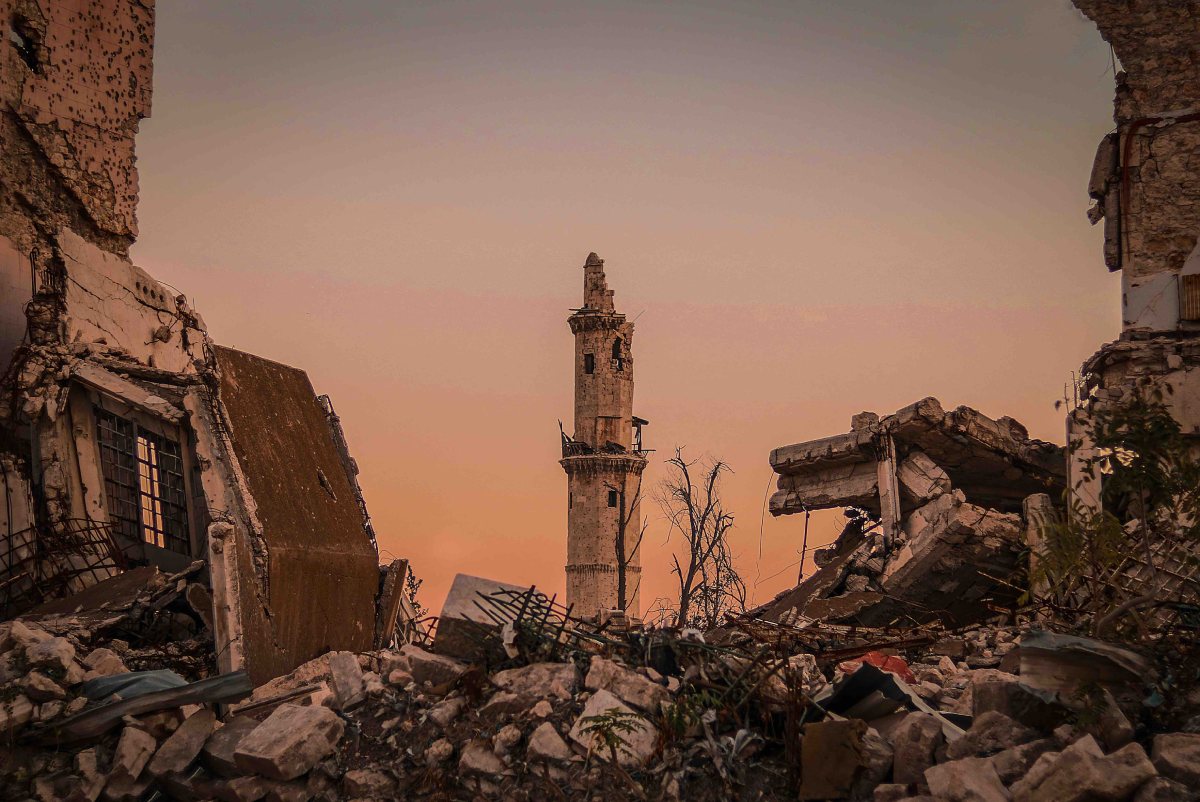
    This also spells the end for Lebanon and Syria’s Christian communities. Witness the tearing down of all Christmas decorations, the smashing of all alcohol and the forced imposition of the veil on women when the jihadists — who overthrew the government of Bashar al-Assad on Sunday — first took Aleppo a mere two weeks ago.

    The speed of the collapse of Syria took everybody by surprise. Next, a renewed Israeli attack on Southern Lebanon to coincide with a Salafist invasion of the Bekaa Valley seems inevitable, as the Israelis would obviously wish their border with their new Taliban-style Greater Syrian neighbour to be as far North as possible.

    It could be a race for Beirut, unless the Americans have already organised who gets it.

    It is no coincidence that the attack on Syria started the day of the Lebanon/Israel ceasefire. The jihadist forces do not want to be seen to be fighting alongside Israel, even though they are fighting forces which have been relentlessly bombed by Israel, and in the case of Hezbollah are exhausted from fighting Israel.

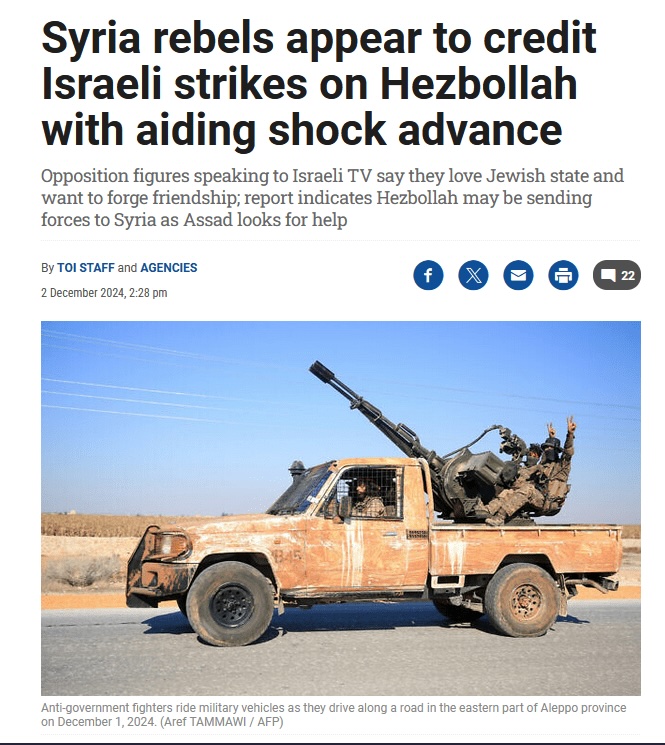
    The Times of Israel has no compunction about saying the quiet part out loud, unlike the British media:

    In fact, Israeli media is giving a lot more truth about the Syrian rebel forces than British and American media. This is another article from The Times of Israel:

    “While HTS officially seceded from Al Qaeda in 2016, it remains a Salafi jihadi organization designated as a terror organization in the US, the EU and other countries, with tens of thousands of fighters.

    Its sudden surge raises concerns that a potential takeover of Syria could transform it into an Islamist, Taliban-like regime – with repercussions for Israel at its south-western border. Others, however, see the offensive as a positive development for Israel and a further blow to the Iranian axis in the region.”

    Contrast this to the U.K. media, which from the Telegraph and Express to The Guardian has promoted the official narrative that not just the same organisations, but the same people responsible for mass torture and executions of non-Sunnis, including Western journalists, are now cuddly liberals.

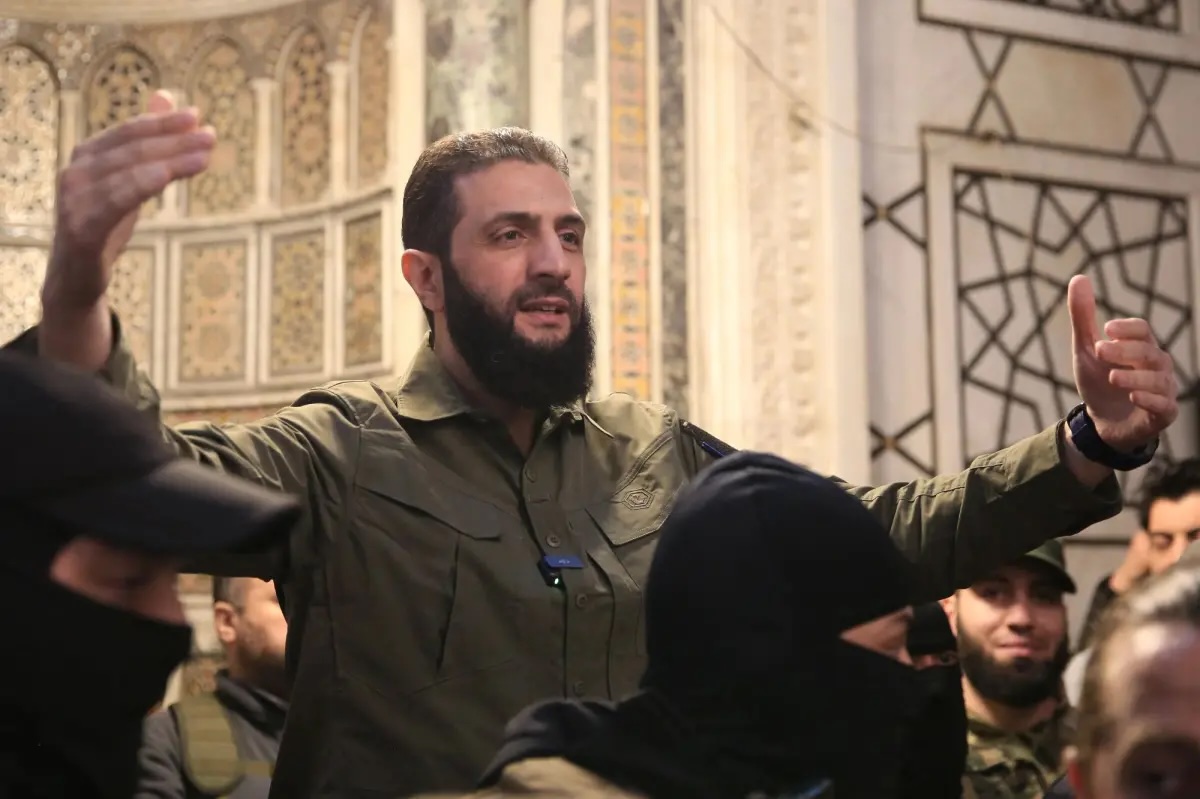
    Nowhere is this more obvious than the case of Abu Mohammad Al-Jolani, sometimes spelt Al-Julani or Al-Golani, who, now nominally in charge in Damascus, is being boosted throughout Western media as a moderate leader. He was the deputy leader of ISIS, and the CIA actually has a $10 million bounty on his head! Yes, that is the same CIA. which is funding and equipping him and giving him air support.

    Supporters of the Syrian rebels still attempt to deny that they have Israeli and U.S. support – despite the fact that almost a decade ago there was open Congressional testimony in the U.S.A. that, to that point, over half a billion dollars had been spent on assistance to Syrian rebel forces, and the Israelis have openly been providing medical and other services to the jihadists and effective air support.

    Violates UK Terrorism Act

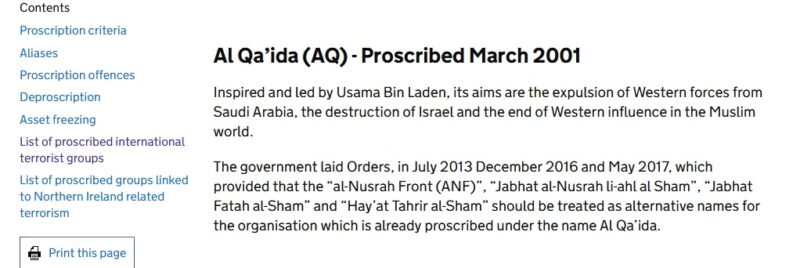
    One interesting consequence of this joint NATO/Israel support for the jihadist groups in Syria is a further perversion of domestic rule of law. To take the U.K. as an example, under Section 12 of the Terrorism Act it is illegal to state an opinion that supports, or may lead somebody else to support, a proscribed organisation.

    The abuse of this provision by British police to persecute Palestinian supporters for allegedly encouraging support for proscribed organisations Hamas and Hezbollah is notorious, with even tangential alleged references leading to arrest. Sarah Wilkinson, Richard Medhurst, Asa Winstanley, Richard Barnard and myself are all notable victims, and the persecution has been greatly intensified by Keir Starmer.

    Yet Hay’at Tahrir Al-Sham (HTS) is also a proscribed group in the U.K. But both British mainstream media and British Muslim outlets have been openly promoting and praising HTS – frankly much more openly than I have ever witnessed anyone in the U.K. support Hamas and Hezbollah – and not a single person has been arrested or even warned by U.K. police.


    That in itself is the strongest of indications that Western security services are fully behind the overthrow of the government in Syria.

    For the record, I think it is an appalling law, and nobody should be prosecuted for expressing an opinion either way. But the politically biased application of the law is undeniable.

    When the entire corporate and state media in the West puts out a unified narrative that Syrians are overjoyed to be released by HTS from the tyranny of the Assad regime – and says nothing whatsoever of the accompanying torture and execution of Shias, and destruction of Christmas decorations and icons – it ought to be obvious to everybody where this is coming from.

    Yet – and this is another U.K. domestic repercussion – a very substantial number of Muslims in the U.K. support HTS and the Syrian rebels, because of the funding pumped into U.K. mosques from Saudi and Emirate Salafist sources.

    This is allied to the U.K. security service influence also wielded through the mosques, both by sponsorship programmes and “think tanks” benefiting approved religious leaders, and by the execrable coercive Prevent programme.

    U.K. Muslim outlets that have been ostensibly pro-Palestinian – like Middle East Eye and 5 Pillars – enthusiastically back Israel’s Syrian allies in ensuring the destruction of resistance to the genocide of the Palestinians. Al Jazeera alternates between items detailing dreadful massacre in Palestine, and items extolling the Syrian rebels bringing Israel-allied rule to Syria.

    Among the mechanisms they employ to reconcile this is a refusal to acknowledge the vital role of Syria in enabling the supply of weapons from Iran to Hezbollah. Which supply the jihadists have now cut off, to the absolute delight of Israel, and in conjunction with both Israeli and U.S. air strikes.

    In the final analysis, for many Sunni Muslims both in the Middle East and in the West, the pull seems to be a stronger sectarian hatred of the Shia and the imposition of Salafism, than preventing the ultimate destruction of the Palestinian nation.

    I am not a Muslim. My Muslim friends happen to be almost entirely Sunni. I personally regard the continuing division over the leadership of the religion over a millennium ago as deeply unhelpful and a source of unnecessary continued hate.

    Classic Divide and Rule

    But as a historian, I do know that the Western colonial powers have consciously and explicitly used the Sunni/Shia split for centuries to divide and rule. In the 1830s, Alexander Burnes was writing reports on how to use the division in Sind between Shia rulers and Sunni populations to aid British colonial expansion.

    On May 12, 1838, in his letter from Simla setting out his decision to launch the first British invasion of Afghanistan, British Governor General Lord Auckland included plans to exploit the Shia/Sunni division in both Sind and Afghanistan to aid the British military attack.

    The colonial powers have been doing it for centuries, Muslim communities keep falling for it, and the British and Americans are doing it right now to further their remodelling of the Middle East.

    Simply put, many Sunni Muslims have been brainwashed into hating Shia Muslims more than they hate those currently committing genocide of an overwhelmingly Sunni population in Gaza.

    I refer to the U.K. because I witnessed this first-hand during the election campaign this year in Blackburn [where Murray ran for Parliament.] But the same is true all over the Muslim world. Not one Sunni Muslim-led state has lifted a single finger to prevent the genocide of the Palestinians.

    Their leadership is using anti-Shia sectarianism to maintain popular support for a de facto alliance with Israel against the only groups – Iran, Houthi and Hezbollah – which actually did attempt to give the Palestinians practical support in resistance. And against the Syrian government which facilitated supply.

    The unspoken but very real bargain is this: The Sunni powers will accept the wiping out of the entire Palestinian nation and formation of Greater Israel, in return for the annihilation of the Shia communities in Syria and Lebanon by Israel and forces backed by NATO (including Turkey).

    There are, of course, contradictions in this grand alliance. The United States’ Kurdish allies in Iraq are unlikely to be happy with Turkey’s destruction of Kurdish groups in Syria, which is what Turkish President Recep Tayyip Erdogan gains from Turkey’s very active military role in toppling Syria – in addition to extending Turkish control of oilfields.

    The Iran-friendly Iraqi government will have further difficulty with reconciling the U.S. continuing occupation of swathes of its country, as they realise they are the next target.

    The Lebanese army is under the control of the U.S.A., and Hezbollah must have been greatly weakened to have agreed to the disastrous ceasefire with Israel. Christian fascist militias traditionally allied to Israel are increasingly visible in parts of Beirut, though whether they would be stupid enough to make common cause with jihadists from the North may be open to question.

    But now that Syria has fallen to jihadist rule, I do not rule out Lebanon following very quickly indeed, and being integrated into a Salafist Greater Syria.

    How the Palestinians of Jordan would react to this disastrous turn of events, it is hard to be sure. The British puppet Hashemite Kingdom is the designated destination for ethnically cleansed West Bank Palestinians under the Greater Israel plan.

    What this all potentially amounts to is the end of pluralism in the Levant and its replacement by supremacism. An ethno-supremacist Greater Israel and a religio-supremacist Salafist Greater Syria.

    Unlike many readers, I have never been a fan of the Assad regime or blind to its human rights violations. But what it did undeniably do was maintain a pluralist state where the most amazing historical religious and community traditions – including Sunni (and many Sunni do support Assad), Shia, Alaouites, descendants of the first Christians, and speakers of Aramaic, the language of Jesus – were all able to co-exist.

    The same is true of Lebanon.

    An End of Tolerance

    What we are witnessing is the destruction of that and the imposition of a Saudi-style rule. All the little cultural things that indicate pluralism – from Christmas trees to language classes to winemaking to women going unveiled – have been destroyed in Aleppo and soon perhaps in Damascus and Beirut.

    I do not pretend that there are not genuine liberal democrats among the opposition to Assad. But they have negligible military significance, and the idea that they would be influential in a new government is delusion.

    In Israel, which pretended to be a pluralist state, the mask is off. The Muslim call to prayer has just been banned. Arab minority members of the Knesset have been suspended for criticising Netanyahu and genocide. More walls and gates are built every day, not just in unlawfully occupied territories but in the “state of Israel” itself, to enforce apartheid.

    I confess I once had the impression that Hezbollah was itself a religio-supremacist organisation; the dress and style of its leadership look theocratic.

    Then I came here and visited places like Tyre, which has been under Hezbollah-elected local government for decades, and found that swimwear and alcohol are allowed on the beach and the veil is optional, while there are completely unmolested Christian communities there.

    I will never now see Gaza, but wonder if I might have been similarly surprised by Hamas’s rule.

    It is the United States which is promoting the cause of religious extremism and of the end, all over the Middle East, of a societal pluralism similar to Western norms.

    That is of course a direct consequence of the United States being allied to both the two religio-supremacist centres of Israel and Saudi Arabia.

    It is the U.S.A. which is destroying pluralism, and it is Iran and its allies which defend pluralism. I would not have seen this clearly had I not come here. But once seen, it is blindingly obvious.

    Feature Image: nypost.com

    This article was published earlier in scheerpost.com

    It is republished under the Creative Commons Attribution-NonCommercial-NoDerivatives 4.0 International license.

  • What Ukraine needs to learn from Afghanistan about proxy wars

    What Ukraine needs to learn from Afghanistan about proxy wars

    The greatest enemy of economic development is war. If the world slips further into global conflict, our economic hopes and our very survival could go up in flames. The Bulletin of the Atomic Scientists has moved the hands of the Doomsday Clock to a mere 90 seconds to midnight. The world’s biggest economic loser in 2022 was Ukraine, where the economy collapsed by 35% according to the International Monetary Fund. The war in Ukraine could end soon, and economic recovery could begin, but this depends on Ukraine understanding its predicament as a victim of a US-Russia proxy war that broke out in 2014.

    The US has been heavily arming and funding Ukraine since 2014 with the goal of expanding Nato and weakening Russia. America’s proxy wars typically rage for years and even decades, leaving battleground countries like Ukraine in rubble.

    Unless the proxy war ends soon, Ukraine faces a dire future. Ukraine needs to learn from the horrible experience of Afghanistan to avoid becoming a long-term disaster. It could also look to the US proxy wars in Vietnam, Cambodia, Lao PDR, Iraq, Syria, and Libya.

    Starting in 1979, the US armed the mujahideen (Islamist fighters) to harass the Soviet-backed government in Afghanistan. As president Jimmy Carter’s national security advisor Zbigniew Brzezinski later explained, the US objective was to provoke the Soviet Union to intervene, in order to trap the Soviet Union in a costly war. The fact that Afghanistan would be collateral damage was of no concern to US leaders.

    The Soviet military entered Afghanistan in 1979 as the US hoped, and fought through the 1980s. Meanwhile, the US-backed fighters established al-Qaeda in the 1980s, and the Taliban in the early 1990s. The US “trick” on the Soviet Union had boomeranged.

    In 2001, the US invaded Afghanistan to fight al-Qaeda and the Taliban. The US war continued for another 20 years until the US finally left in 2021. Sporadic US military operations in Afghanistan continue.

    Afghanistan lies in ruins. While the US wasted more than $ 2 trillion of US military outlays, Afghanistan is impoverished, with a 2021 GDP below $400 per person! As a parting “gift” to Afghanistan in 2021, the US government seized Afghanistan’s tiny foreign exchange holdings, paralysing the banking system.

    The proxy war in Ukraine began nine years ago when the US government backed the overthrow of Ukraine’s president Viktor Yanukovych. Yanukovych’s sin from the US viewpoint was his attempt to maintain Ukraine’s neutrality despite the US desire to expand Nato to include Ukraine (and Georgia). America’s objective was for Nato countries to encircle Russia in the Black Sea region. To achieve this goal, the US has been massively arming and funding Ukraine since 2014.

    The American protagonists then and now are the same. The US government’s point person on Ukraine in 2014 was Assistant Secretary of State Victoria Nuland, who today is Undersecretary of State. Back in 2014, Nuland worked closely with Jake Sullivan, president Joe Biden’s national security adviser, who played the same role for vice president Biden in 2014.

    The US overlooked two harsh political realities in Ukraine. The first is that Ukraine is deeply divided ethnically and politically between Russia-hating nationalists in western Ukraine and ethnic Russians in eastern Ukraine and Crimea.

    The second is that Nato enlargement to Ukraine crosses a Russian redline. Russia will fight to the end, and escalate as necessary, to prevent the US from incorporating Ukraine into Nato.

    The US repeatedly asserts that Nato is a defensive alliance. Yet Nato bombed Russia’s ally Serbia for 78 days in 1999 in order to break Kosovo away from Serbia, after which the US established a giant military base in Kosovo. Nato forces similarly toppled Russian ally Moammar Qaddafi in 2011, setting off a decade of chaos in Libya. Russia certainly will never accept Nato in Ukraine.

    At the end of 2021, Russian president Vladimir Putin put forward three demands to the US: Ukraine should remain neutral and out of Nato; Crimea should remain part of Russia; and the Donbas should become autonomous in accord with the Minsk II Agreement.

    The Biden-Sullivan-Nuland team rejected negotiations over Nato enlargement, eight years after the same group backed Yanukovych’s overthrow. With Putin’s negotiating demands flatly rejected by the US, Russia invaded Ukraine in February 2022.

    In March 2022, Ukraine’s president Volodymyr Zelensky seemed to understand Ukraine’s dire predicament as a victim of a US-Russia proxy war. He declared publicly that Ukraine would become a neutral country, and asked for security guarantees. He also publicly recognised that Crimea and Donbas would need some kind of special treatment.

    Israel’s prime minister at that time, Naftali Bennett, became involved as a mediator, along with Turkey. Russia and Ukraine came close to reaching an agreement. Yet, as Bennett has recently explained, the US “blocked” the peace process.

    Since then, the war has escalated. According to US investigative reporter Seymour Hersh, US agents blew up the Nord Stream pipelines in September, a claim denied by the White House. More recently, the US and its allies have committed to sending tanks, longer-range missiles, and possibly fighter jets to Ukraine.

    The basis for peace is clear. Ukraine would be a neutral non-Nato country. Crimea would remain home to Russia’s Black Sea naval fleet, as it has been since 1783. A practical solution would be found for the Donbas, such as a territorial division, autonomy, or an armistice line.

    Most importantly, the fighting would stop, Russian troops would leave Ukraine, and Ukraine’s sovereignty would be guaranteed by the UN Security Council and other nations. Such an agreement could have been reached in December 2021 or in March 2022.

    Above all, the government and people of Ukraine would tell Russia and the US that Ukraine refuses any longer to be the battleground of a proxy war. In the face of deep internal divisions, Ukrainians on both sides of the ethnic divide would strive for peace, rather than believing that an outside power will spare them the need to compromise.
    Feature Image Credit: politico.eu

    This article was published earlier in dailymaverick.co.za and is republished with the permission of the author.

  • Understanding the Syrian Civil War through Galtung’s Conflict Theory

    Understanding the Syrian Civil War through Galtung’s Conflict Theory

    Introduction

    As the founder of the discipline of Peace and Conflict Studies, Johan Vincent Galtung has outspokenly advocated for a world without nuclear weapons and has placed the focus of his research on scientific terminologies and methods to understand and deal with conflicts. Having coined the term “peace research”, Galtung has devoted much of his time in formulating the influential and unique ‘transcend approach’, wherein the focus is on peace, rather than security. He has advocated for a model that is holistic and is based on deep understanding and dialogue with one party at a time.

    Having coined the term “peace research”, Galtung has devoted much of his time in formulating the influential and unique ‘transcend approach’, wherein the focus is on peace, rather than security.

    The underlying cause of any violence, according to Galtung, is an unresolved conflict, one that has not been transformed or transcended, due to the existence of incompatible goals. If the goals are among the four basic needs of survival, well-being, identity, or freedom, the conflict is then concluded to be deep, and most difficult to resolve if left unattended. It is important to remember that a conflict does not progress linearly, but rather goes around in a circle, through a cycle of non-violence, to violence, then to post-violence, and likely back to violence again if it fails to be resolved.

    The escalation of a conflict to a violent level is largely a result of disequilibrium among the actors or parties involved, leading to polarization and dehumanization of the Other, and finally reflected in their aggression, the output of which is violence. What follows violence is traumatization, and consequently acts of revenge (Galtung, 2010), leading the cycle of conflict back to its first level.

    Galtung’s Notion of Conflict

    Johan Galtung, in his book, ‘Peace by Peaceful Means (1996)’, defined conflict as a “triadic construct” (pg.71), consisting of three important factors – Attitudes, Behaviour, and Contradictions.

    While both, Attitudes (A) and Contradiction (B), reflect the latent, subconscious level of conflict, Behaviour (B), on the other hand, is always manifest and reflects how people consciously act when confronted with contradictions and hostile attitudes and assumptions. Behaviour may thus be seen as an act of violence, both physical and verbal.

    Attitudes and assumptions may include the person’s perceptions about an actor or an institution; his/her emotions – how s/he feels about the actor/institution involved; and what s/he wants or expects from the given actor/institution. Thus, attitudes may include sexist beliefs about women or discriminatory attitudes towards minorities.

    Contradictions, on the other hand, refer to the content of the conflict, the incompatibility between the goals. It may include a territorial dispute between two or more actors over a single piece of territory, as in the case of Israel and Palestine, or as in the case of multiple parties laying claim to the same group of islets in the South China Sea. In the case of structural or indirect conflict, the contradictions may refer to the disequilibrium in the positions of parties involved, as in the case of inequality between different classes.

    A conflict, according to Galtung, could start from any of the three points of the triangle. It could start from point (A), wherein the actor’s hostile attitude could be in disharmony with those of other actors, leading to contradiction, and later reflected in violent behaviour.  A conflict may also start from point (B), where the actors involved may develop capacities or inclination towards negative/aggressive behaviour, which may get stimulated when a contradiction comes along.

    Galtung further divides the conflicts into actor/direct conflicts and structural/ indirect conflicts. The main point of departure between the two lies in their categorization into manifest, and latent levels. In a direct conflict, both attitudes and contradictions are manifest, that is, they are conscious and overt, the actor being aware of them at all times.

    However, the same does not apply when one takes into account the structural or indirect conflicts. Here, both attitudes and contradictions are latent, that is, they are subconscious and the actor is unaware of them. This is not to say that the contradictions or the incompatibilities are non-existent, rather only that the actor involved finds himself/herself completely unaware of such contradictions.

    Types of Violence

    While stating that the two types of violence – Direct and Structural, are to be considered as the starting point of any strategy for a peaceful resolution, Galtung also defined a third category of violence, namely, the Cultural Violence.

    Direct violence is an event that is often quick and visible, reflecting the capabilities and intentions of actors to engage in a conflict. It includes a victim and a perpetrator and can be seen explicitly in societies. Structural violence, on the other hand, is a process that is slow and often invisible. It refers to the injustice and inequality built into the structural institutions of the society. It is reflective of a position “higher up or lower down in a hierarchy of exploitation-repression-alienation” (Galtung 2012, pg.12), where the parties involved are determined either to keep the hierarchy intact or to completely obliterate it.

    An example of structural violence, as seen from a top-down approach would include colonial aspirations of the European nations. In the case of India and the British empire, the aggression from top existed in the form of material exploitation at the hands of the latter. It became visible once the natives demonstrated their will to oppose colonialism and break the hierarchy of exploitation. The same holds for the Indian caste system, wherein the structural violence, in the form of exploitation and marginalization, has remained intact because of the capability of those higher up, namely the Brahmins, to maintain the disequilibrium in positions between themselves and the communities they perceive to be lower than them.

    The Indian caste system, wherein the structural violence, in the form of exploitation and marginalization, has remained intact because of the capability of those higher up, namely the Brahmins, to maintain the disequilibrium in positions between themselves and the communities they perceive to be lower than them.

    Cultural violence refers to those “aspects of culture that can be used to legitimize or justify both, structural and direct violence” (Galtung: 1990, pg.291). It renders the use of violence as acceptable in society and makes it okay for actors to use violence without making them feel guilty. In a brilliant example, Galtung talks about how the internalization of culture makes it morally easier for actors to employ violence, such as in the interpretation in case of murder on behalf of one’s country being seen as right (Galtung: 1990, pg.292). In the case of direct and structural violence faced by immigrants, it is the culture that allows for such violence to be tolerated. The cultural violence, in this case, justifies the indirect and direct violence by dehumanizing the immigrants and portraying them as thugs or aliens. It allows societies to tolerate policies of forced child-separation while continuing to deny them equitable means of living.

    Escalation of conflicts into violence

    Violence is most often an outcome of deprivation of needs. The more basic and non-negotiable the needs, the likelier chance there is for aggression to come into existence. While classifying the basic needs into four broad categories of survival, welfare, freedom, and identity, Galtung warns his readers against prioritizing any one need over the others. To put survival above freedom and identity, would result in repression and alienation (Galtung, 1985), failing to end structural and cultural violence.

    When the goal of an actor (A) is incompatible with that of an actor (B), such that it obstructs the attainment of the goal by the actor (B), the pursuit of such goals would then most likely result in frustration among both actors, the consequence of which would be a polarisation of the two extremes. Polarisation would imply a zero-sum game, where the scope of transcendence is low, and the likely outcome is a position of no compromise. Because the contradiction in goals is absolute, the victory of the actor (A) would thus necessarily imply the loss of actor (B).

    Polarisation, accompanied by the dehumanization of the Other, may galvanize into hostility and hatred, manifesting itself into aggressive behaviour, finally resulting in escalation. The conflict, however, does not stop at violence. What follows violence, is traumatization of the victims harmed by violence, breeding acts of revenge (Galtung 2010, pg.16).

    In an actor conflict, the polarization between the two sides can almost immediately lead to direct violence. This is because actor (A), who has incompatible goals with actor (B), can easily identify the object/ subject of obstruction of attainment of its goals. Therefore, what follows is violent behaviour by actor (A) towards actor (B).

    On the other hand, in a structural conflict, polarisation may result in acute disequilibrium between rank positions of members in a society. However, Galtung in his essay on the “Structural Theory of Aggression” argues that violence is unlikely to occur unless all methods of maintaining equilibrium have been tried and unless culture facilitates violence wherein those lower down are constantly reminded of their position and their consequent mistreatment (Galtung 1964, pg.99).

    A system of injustice or inequity which refuses to break the hierarchy of oppression and exploitation would likely result in frustration, the outburst of which would be reflected in the form of violence. The often-visible Naxalite violence in India can be seen as a result of deep-rooted structural violence, wherein the parties involved have suffered exploitation and marginalization due to unequal economic development and inequitable distribution of resources for years.

    the genocide that took place against the members of the Rohingya community in Myanmar is a crude example of direct violence. 

    On the other hand, the genocide that took place against the members of the Rohingya community in Myanmar is a crude example of direct violence. They claimed to have been living in the State since the 9th century but were eventually labelled as Bangladeshi Immigrants. Years of discrimination (structural violence) and hatred (attitudes, assumptions/ cultural violence) led to their ethnic cleansing (direct violence). They were murdered, raped, and evicted from their homeland. It only took one law, which rendered them stateless, for the majority of Myanmar to consider them as sub-humans, and readily accept the atrocities committed against them.

    Syrian Conflict through Galtung’s Conflict Theory

    The civil war in Syria is, unfortunately, an example of one of the bloodiest conflicts of this century. The war is often seen as a result of the outburst of pro-democracy protests in 2011, under the appellation of the Arab Spring.

    However, when approached from Galtung’s conflict theory, the conflict can be divided into three categories of violence. First, what we have been witnessing is the horror of direct violence in Syria, as a consequence of years of repression, facilitated by the government’s violent response towards the peaceful protesters in 2011. Second, the structural violence in the form of decades of economic restraints and systemic corruption, which exacerbated the existing poverty and inequality amongst the citizens.  Further, four years of drought between 2006 and 2011, and the consequent failed economic policies forced 2 million to 3 million Syrians into abject poverty (Polk, 2013). The dwindling Syrian economy and infrastructure finally led to the deprivation of the basic need of welfare and threatened their need for survival, resulting in frustration. Third is the cultural violence that has helped in sustaining the ongoing violence, in the form of distortion, denial, and dehumanization of the victims of violence has helped Assad and his foreign allies in continuing the mass murder of Syrians. Here, the sanitization of language is of key importance, where the attempts of distortion of reality often end up in changing the moral colour of violence, as argued by Galtung, wherein violence from being unacceptable starts to be tolerated without question.

    Direct Violence in Syria

    Syrians have been victims of decades-long political repression, in the form of restrictions on freedom of speech and expression, torture and enforced disappearances. The political institutions have historically been unstable, with three military coups taking places in 1949 alone followed by one more in 1954, in addition to the Ba’athist-led coups of 1963 and 1966. The Syrian security forces (Mukhabarat) are known to have detained citizens without proper warrants even before 2010, many of whom have reportedly been tortured in prisons (Human Rights Watch, 2010). In their attempts to keep the hierarchy of power relations intact, the centralised institutions are known to clamp down on any public demonstrations, with frequent arrests and employment of state violence.

    several actors are involved in perpetrating the more visible, direct violence, and it is clear that the Syrian conflict cannot be looked at as a conflict solely between the state and armed rebellion groups.

    In 2011, fifteen school-going children, all under the age of seventeen, were reportedly arrested and tortured for writing anti-graffiti on a wall, leading to the protests of 2011. The government responded by opening fire on the peaceful protestors, killing four civilians (Macleod, 2011). More than 400,000 people have died because of the Syrian conflict since 2011, with 5 million seeking refuge abroad and over 6 million displaced internally (World Bank). This section identifies several actors involved in perpetrating the more visible, direct violence, and contends that the Syrian conflict cannot be looked at as a conflict solely between the state and armed rebellion groups. It would also be myopic to look at the conflict entirely from the perspective of sectarian divisions, given that each rebellion group has a different motive, and is being backed by several different actors.

    While soldiers supporting the Syrian president and the opposition armed groups continue to remain prominent actors, recent years have seen the rise of Islamic State, Al-Qaeda and their affiliated members. The war has also seen a large-scale presence of two categories of foreign actors – those supporting the Syrian regime (Iran, and Russia), and those who continue to be the key rebel supporters (US, Turkey, and Saudi Arabia). All of these actors have their motives and intentions of being engaged in the war. While Iran sees Syria as its primary ally and a transit point for Hezbollah, Russia thinks of Syria as its last remaining stronghold. The United States and Saudi Arabia, on the other hand, are driven by their intentions to maintain the regional balance of power away from the Iranian axis of influence. Meanwhile, Turkey continues to battle the spill-over effect of the thousands of Syrian refugees who continue to cross over the border to Turkey.

    The anti-government groups based in Ghouta, including Jaysh al-Islam, Ahrar al-Sham and Faylaq al-Rahmane, have killed and mutilated hundreds of civilians in indiscriminate attacks on Damascus. These armed groups have also regularly arrested and tortured civilians in Douma, including members of religious minority groups. Hay’at Tahrir al-Sham (HTS), an Al-Qaeda affiliate present in Idlib, has carried out arrests and kidnappings that targeted local political opponents and journalists, while also continuously interfering with humanitarian access and aid distribution in areas under its control (CSIS).

    Cultural Violence in Syria

    The cultural violence in Syria, like elsewhere, is most often perpetrated in the form of sanitization of language, where years of structural violence are termed as mere discrimination, and where civilians are seen as mere targets to be killed. A few years ago, in an attempt of distorting reality, the Russian media described a Syrian documentary on Helmet volunteers in Aleppo as a “thinly disguised Al Qaeda promotional vehicle” (Hamad, 2018).  Such attempts of distortion aim at normalizing even the most brutal violence. In the case of Russia, these attempts help in legitimizing its airstrikes, even when the number of civilians that have been killed in these strikes surpass the number of the ISIS members it sought to target. According to a report, approximately four thousand civilians have been killed by Russian airstrikes as opposed to 2758 ISIS members (Armstrong & Richter, 2016).

    Additionally, cultural violence in the form of ideology and religion has helped to sustain violence in the region. Religion, here, has acted as a form of cultural violence, where the fight is between the ‘Chosen’ and the ‘Unchosen’. In Syria, this fight has taken the form of sectarian divisions between the minority Alawi community and the majority Sunni population. The legitimisation of violence at the hands of the state is rooted in its fight against ‘extremism’, which depends upon the promulgation of the narrative that all rebel forces have the same ulterior motive -of building an intolerant Islamic caliphate. State’s reliance on its alleged effort to curb extremism has allowed its forces to justify the use of heavy artillery, the bombardment of residential places, and the subsequent massacres. Another factor that helps explain the sustenance of violence, is its normalization – where violence is seen as natural, and a part of everyday life. Decades of repression in Syria have helped to normalize torture, and rampant arrests and restrictions.

    Structural Violence in Syria

    While countries continue to witness the horrors of visible atrocities and war crimes, the underlying layers of structural violence continue to buttress the egregious brutality which is often more direct, and physical. Although the war is often seen as a result of the outburst of pro-democracy protests in 2011, a close examination of the country’s socio-economic structures would enable one to get a detailed insight into the underlying layers of frustration caused due to large-scale poverty, inequality, and marginalisation.

    One would also find that the relatively peaceful structure, which existed before the protests of 2011, was held intact largely due to the existence of single-party dominance, where one actor (Hafez al-Assad, and later Bashar al-Assad) held all power and authority, while those existing in lower ranks of society continued to lack resources, as well as opportunities to challenge the dominant power. The injustice and inequality built into the structural institutions of the Syrian society can be referred to, what has been called as the ‘structural violence’, by Johan Galtung. The violence, here, is reflective of a position “higher up or lower down in a hierarchy of exploitation-repression-alienation”, where the parties involved are determined either to keep the hierarchy intact or to completely obliterate it.

    In the case of Syria, the deprivation of the most basic and non-negotiable needs, which threatened the citizens’ need for survival, has been the primary cause for aggression to come into existence. The factors that, thus, led to the conflict in Syria can be seen rooted in years of repression, poverty, and lack of representative institutions, which manifested in the form of protests, or the Arab Spring of 2011. The Syrian economic crisis has existed long before the commencement of the civil war. Since the beginning of the economic crisis, Syria’s institutional structures have failed to meet the rising needs and rights of its population. In the 1980s, the country was trapped in a downward spiral of a fiscal crisis, as a result of large-scale drought, and due to both, domestic and external factors. The crisis led to high food deficit, and an increase in the cost of living, leading to a rise in patronage networks which provided small circles of elites with profitable businesses. These networks became increasingly popular in real estate and land management, leaving out large sectors of Syria underdeveloped. While the country witnessed a decreasing overall debt and a noticeable rise in the GDP in the 2000s, large sections of the population were excluded from benefitting from these growth rates due to differences in wage rates and declining job opportunities. Increasing inequality was reflected in a paper published by the UNDP, which claimed that 65.6% of all labour in Syria belonged to the informal sector in 2010, with Aleppo and Idlib ranking first with over 75% of their workforce belonging to the informal sector (UNDP, 2018).

    Years of conflict have exacerbated the economic crisis, pushing both the state and its citizens, into chaos, with more than 80 per cent of the Syrian population living below the poverty line, with an unemployment rate of at least 55 per cent in 2018.

    Additionally, the oil revenues fell from more than 14% of GDP in the early 2000s to about 4% in 2010 due to depleting reserves. According to a report, overall poverty in Syria in 2007 impacted 33.6% of the population, of which 12.3% were estimated to be living under extreme poverty. Noting the degree of inequality in Syria in 1997, the report found out that the lower 20% of the population had a share of only 8% in expenditure, while the richest 20% of the population share about 41% of the expenditure (Abu-Ismail, Abdel-Gadir & El-Laithy). Moreover, the widely disputed region of North-Eastern Syria witnessed highest levels of inequality in 2007, in addition to deprivation of living standards, and worst levels of illiteracy, and access to safe water, just four years before the outbreak of the civil war. The unequal access to resources was also starkly reflected in the housing situation of the country before the war, where over 40% of the population lived under informal housing conditions, – through squatting, or on lands obtained without legal contracts (Goulden, 2011).

    Years of conflict have exacerbated the economic crisis, pushing both the state and its citizens, into chaos, with more than 80 per cent of the Syrian population living below the poverty line, with an unemployment rate of at least 55 per cent in 2018. With most of the business networks now being controlled by the selected few elites, the population at large continues to suffer the brunt of both structural, and direct violence.

    Conclusion

    This paper has attempted to explain the theory of conflict, as proposed by Johan Galtung. In doing so, it has referred to six primary sources of the author. It has taken into account Galtung’s two triangles of conflict. First, the attitudes-behaviour-contradiction triangle, which seeks to explain the notion of conflict, and demonstrates how a conflict consists of all three, with attitudes and contradictions existing at the latent level, manifesting themselves into violent behaviour which is conscious and visible. The second triangle divides violence into three broad categories of direct violence, structural violence, and cultural violence, and demonstrates how the latter two facilitate and bring about direct violence. This paper has also attempted to employ Galtung’s theory of conflict to explain the civil war in Syria, where it has identified the three categories of violence and has tried to apply the theory into practice. The conflict, which started with citizens demanding their basic needs and rights has been sustained over the years by the involvement of foreign states, and increased state brutality which has been responded to by an increasingly similar, if not equal, force by the rebellion groups. The country, now, witnesses itself entangled in a cycle of conflict, where the war has led to steep economic deterioration, political repression, and physical violence, which in turn has led to further widespread cataclysm.


    References

    Abu-Ismail, K., Abdel-Gadir, A., & El-Laithy, H. (n.d.). Arab Development Challenges Report Background Paper 2011/15. Retrieved September 28, 2020, from https://www.undp.org/content/dam/rbas/doc/poverty/BG_15_Poverty%20and%20Inequality%20in%20Syria_FeB.pdf
    Armstrong, M., & Richter, F. (2016, October 20). Infographic: People Killed By Russian Airstrikes In Syria. Retrieved September 30, 2020, from https://www.statista.com/chart/6311/people-killed-by-russian-airstrikes-in-syria/
    CSIS. (n.d.). Hay’at Tahrir al-Sham (HTS). Retrieved September 28, 2020, from https://www.csis.org/programs/transnational-threats-project/terrorism-backgrounders/hayat-tahrir-al-sham-hts
    Employment and Livelihood Support in Syria: UNDP in Syria. (2018, August). Retrieved September 28, 2020, from https://www.sy.undp.org/content/syria/en/home/library/Employment_and_Livelihood_Support_in_Syria.html
    Galtung, J. (1964). A Structural Theory of Aggression. Journal of Peace Research, 1(2), 95-119. doi:10.1177/002234336400100203
    Galtung, J. (1985). Twenty-Five Years of Peace Research: Ten Challenges and Some Responses. Journal of Peace Research, 22(2), 141-158. doi:10.1177/002234338502200205
    Galtung, J. (1990). Cultural Violence. Journal of Peace Research, 27(3), 291-305. doi:10.1177/0022343390027003005
    Galtung, J. (1996). Conflict Theory. In Peace by peaceful means: Peace and conflict, developmentment and civilization(pp. 71-73). Thousand Oaks, CA: Sage.
    Galtung, J. (2010). Peace by peaceful conflict transformation – the TRANSCEND approach. In C. Webel & J. Galtung (Authors), Handbook of peace and conflict studies (pp. 15-16). London: Routledge.
    Galtung, J. (2012). Peace and Conflict Studies as Political Activity. In T. Matyók, J. Senehi, & S. Byrne (Authors), Critical issues in peace and conflict studies: Theory, practice, and pedagogy (pp. 12-13). Lanham, Maryland.: Lexington Books.
    Goulden, R. (2011). Housing, Inequality, and Economic Change in Syria. British Journal of Middle Eastern Studies,38(2), 187-202. doi:10.1080/13530194.2011.581817
    Hamad, S. (2018, March 09). The dehumanisation of Syria’s victims facilitates war crimes. Retrieved July 26, 2020, from https://www.trtworld.com/opinion/the-dehumanisation-of-syria-s-victims-facilitates-war-crimes-15802
    Human Rights Watch. (2010, July 16). Syria: Al-Asad’s Decade in Power Marked by Repression. Retrieved September 28, 2020, from https://www.hrw.org/news/2010/07/16/syria-al-asads-decade-power-marked-repression
    Polk, W. (2013, December 10). Understanding Syria: From Pre-Civil War to Post-Assad. Retrieved July 26, 2020, from https://www.theatlantic.com/international/archive/2013/12/understanding-syria-from-pre-civil-war-to-post-assad/281989/
    Macleod, H. (2011, April 26). How schoolboys began the Syrian revolution. Retrieved September 30, 2020, from https://www.cbsnews.com/news/how-schoolboys-began-the-syrian-revolution/
    Massari, P. (2013, September 10). Religion and Conflict in Syria. Retrieved July 26, 2020, from https://hds.harvard.edu/news/2013/09/10/religion-and-conflict-syria
    World Bank. (n.d.). The World Bank In Syrian Arab Republic. Retrieved September 30, 2020, from https://www.worldbank.org/en/country/syria/overview
     
    Image: Adobe Stock
     

  • Poverty, Inequality, and Marginalisation as Forms of Structural Violence in Pre-Conflict Syria

    Poverty, Inequality, and Marginalisation as Forms of Structural Violence in Pre-Conflict Syria

    The injustice and inequality built into the structural institutions of the Syrian society can be referred to, what has been called as the ‘structural violence’, by the well-known Norwegian sociologist, Johan Galtung.  

    The ongoing civil war in Syria that has resulted in large-scale loss of lives, and forced displacement of millions across the region, is being seen as one of the bloodiest conflicts of this century. While countries continue to witness the horrors of visible atrocities and war crimes, the underlying layers of structural and cultural violence continue to buttress the egregious brutality which is often more direct, and physical.


    Although the war is often seen as a result of the outburst of pro-democracy protests in 2011, a close examination of the country’s socio-economic structures would enable one to get a detailed insight into the underlying layers of frustration caused due to large-scale poverty, inequality, and marginalisation. One would also find that the relatively peaceful structure, which existed before the protests of 2011, was held intact largely due to the existence of single-party dominance, where one actor (Hafez al-Assad, and later Bashar al-Assad) held all power and authority, while those existing in lower ranks of society continued to lack resources, as well as opportunities to challenge the dominant power.

    The Syrian economic crisis has existed long before the commencement of the civil war.

    The injustice and inequality built into the structural institutions of the Syrian society can be referred to, what has been called as the ‘structural violence’, by the well-known Norwegian sociologist, Johan Galtung.  The violence, here, is reflective of a position “higher up or lower down in a hierarchy of exploitation-repression-alienation”, where the parties involved are determined either to keep the hierarchy intact or to completely obliterate it. In the case of Syria, the deprivation of the most basic and non-negotiable needs, which threatened the citizens’ need for survival, has been the primary cause for aggression to come into existence. The factors that, thus, led to the conflict in Syria can be seen rooted in years of repression, poverty, and lack of representative institutions, which manifested in the form of protests, or the Arab Spring of 2011.

    The Syrian economic crisis has existed long before the commencement of the civil war. Since the beginning of the economic crisis, Syria’s institutional structures have failed to meet the rising needs and rights of its population. In the 1980s, the country was trapped in a downward spiral of a fiscal crisis, as a result of large-scale drought, and due to both, domestic and external factors. The crisis led to high food deficit, and an increase in the cost of living, leading to a rise in patronage networks which provided small circles of elites with profitable businesses. These networks became increasingly popular in real estate and land management, leaving out large sectors of Syria underdeveloped.

    While the country witnessed a decreasing overall debt and a noticeable rise in the GDP in the 2000s, large sections of the population were excluded from benefitting from these growth rates due to differences in wage rates and declining job opportunities. Increasing inequality was reflected in a paper published by the UNDP, which claimed that 65.6% of all labour in Syria belonged to the informal sector in 2010, with Aleppo and Idlib ranking first with over 75% of their workforce belonging to the informal sector. Further, the four years of drought between 2006 and 2011, and the consequent failed economic policies led to a significant decline in the agricultural sector’s output, forcing 2 million to 3 million Syrians into abject poverty.

    Additionally, the oil revenues fell from more than 14% of GDP in the early 2000s to about 4% in 2010 due to depleting reserves. According to a report, overall poverty in Syria in 2007 impacted 33.6% of the population, of which 12.3% were estimated to be living under extreme poverty. Noting the degree of inequality in Syria in 1997, the report found out that the lower 20% of the population had a share of only 8% in expenditure, while the richest 20% of the population share about 41% of the expenditure. The degree of inequality further decreased in 2004. Moreover, the widely disputed region of North-Eastern Syria witnessed highest levels of inequality in 2007, in addition to deprivation of living standards, and worst levels of illiteracy, and access to safe water, just four years before the outbreak of the civil war. The unequal access to resources was also starkly reflected in the housing situation of the country before the war, where over 40% of the population lived under informal housing conditions, – through squatting, or on lands obtained without legal contracts.

    In addition to the economic crisis, Syrians have been the victims of decades-long political repression, in the form of restrictions on freedom of expression, torture, and enforced disappearances. The political institutions have historically been unstable, with three military coups taking place in 1949 alone, followed by one more in 1954, in addition to the Ba’athist-led coups of 1963 and 1966. The Syrian security forces (Mukhabarat) are known to have detained citizens without proper warrants even before 2010, many of whom have reportedly been tortured in prisons. In their attempts to keep the hierarchy of power relations intact, the centralised institutions are known to clamp down on any public demonstrations, with frequent arrests and employment of state violence.

    The conflict which started with citizens demanding their basic needs and rights has been sustained over the years by the involvement of foreign states, and increased state brutality which has been responded to by an increasingly similar, if not equal, force by the rebellion groups.

    Years of conflict have exacerbated the economic crisis, pushing both the state and its citizens, into chaos, with more than 80 per cent of the Syrian population living below the poverty line, with an unemployment rate of at least 55 per cent in 2018. With most of the business networks now being controlled by the selected few elites, the population at large continues to suffer the brunt of both structural, and direct violence.

    The conflict which started with citizens demanding their basic needs and rights has been sustained over the years by the involvement of foreign states, and increased state brutality which has been responded to by an increasingly similar, if not equal, force by the rebellion groups. The country, now, witnesses itself entangled in a cycle of conflict, where the war has led to steep economic deterioration, political repression, and physical violence, which in turn has led to further widespread cataclysm.

    Image Credit: Photo – Aleppo-Syria destruction in 2019 and  Syria Map – Adobe Stock

  • The Geopolitics of Syria’s Reconstruction

    The Geopolitics of Syria’s Reconstruction

    Introduction

    Syria’s territories are controlled by a variety of actors – Al Assad’s regime (with Russia and Iran as its supporters); Kurdish dominated self-administration (with a small number of US troops supporting them); Turkey and its affiliated militias; and the Syrian Salvation Government affiliated to the Hay’at Tahrir al-Sham (HTS), a former al-Qaida offshoot.

    Fragmentation of the state’s territories, as the state lost control of its territories, resulted in the emergence of a network of localised war economies with numerous local and foreign actors being involved. War economies emerged in territories held by Assad’s regime as well as those under the control of various other opposition parties, characterised by an increase in smuggling of goods (among which essential goods, crude oil and arms were popular), extortion, rent seeking for essential services, and taxation of goods at checkpoints established by the warring parties, including local warlords, opposition armed groups or regime’s militias. The Syrian Arab army is also reported to have engaged in rent seeking behaviour through the establishment in recaptured territories (Hinnebusch, 2020).

    Another area of priority for armed opposition groups is the border crossings with Turkey whose access they have sought to control. The Ahrar-Al Sham group, established control over the Bab al-Hawa crossing between 2015-16, and earned around $5 million per month. Armed opposition groups have been involved in conflict with each other over control for border crossings, particularly conflict between Hay’at Tahrir al-Sham (HTS) and Ahrar al-Sham in 2017 (al-Kattan, 2017).

    The Syrian army (that was cross-sectarian) is in crisis of its reducing force size as it is hampered by resistance to conscriptions and many desertions. The Alawite sect was co-opted into the state’s army, political and security apparatus, resulting in tensions along sectarian lines. Another significant development was that those among the pre-war elite who advocated for a political solution based on power sharing were expelled from it, resulting in the contraction of the core to comprise of individuals along sectarian lines. Further, pro-regime militias emerged as pro-government communities were forced to rely on themselves for their defence, leading to a widespread localisation of power to fiefdoms (al-Kattan, 2017).

    The political, economic and security dimensions of the conflict which led to the emergence of war economies has been accompanied by shift of composition of the economy marked by the emergence of ‘war commanders’ and a decentralised elite, who capitalised on evading sanctions, served as middlemen between the armed groups of the state and opposition and established monopoly upon the supply of goods and services.

     These developments further led to the emergence of new centres of power which existed alongside the existing regime that consolidated its power by strengthening its relations with the new elite, army and security sector.

    The domestic dynamics of the Syrian conflict are closely related to a wider geopolitical struggle among regional and external actors who act as patrons for the domestic actors.

    In addition, by portraying itself as a bulwark against radical Islamism and strengthening its relations with influential individuals in minority communities and providing them with disproportionate authority within their societies, the regime’s efforts have redefined existing social hierarchies and co-opted pro-regime minority leaders to power. The regime’s policies, throughout the war, have not only strengthened the neo-patrimonial nature of the State and its relations with its multiple networks but lead to the decentralisation of a system of neo-patrimonialism (Middle East Institute & Etana Syria, 2020).

    The domestic dynamics of the Syrian conflict are closely related to a wider geopolitical struggle among regional and external actors who act as patrons for the domestic actors. The Syrian conflict that began as an internal conflict emerged into a proxy conflict where regional struggle for influence played out between the ‘resistance axis’ comprising of Hamas, Hezbollah and Iran, and Sunni dominated ’moderate’ states comprising of Saudi Arabia, Qatar and Turkey. The latter wished replace the Assad regime that was aligned towards the ‘resistance axis.’ Iran considers the Syrian conflict as threat to its survival and its ability to support Hizbollah against Israel.  The rival axes instrumentalised sectarianism as a part of their discourse and in their support for proxies. However, the interests of those within the Sunni camp clashed (with Turkey and Qatar’s support for the Muslim Brotherhood and Saudi Arabia and UAE against the Muslim Brotherhood and its version of political Islam) resulting in division of the Sunni camp further leading to the division of their proxies (Aita, 2020).

    The global struggle for power between the US and Russia, with the former promoting a liberal world order and advance its hegemonic interests, and the latter interested in increasing its sphere of influence, limiting US intervention while emphasising on state sovereignty. Russian intervention in Syria in support of the Assad regime tilted the power balance in its favour allowing the regime to gain control of its lost territories.

    Image Credit: Al Araby

    US sought to limit direct intervention in Syria while relying on proxies and financial sanctions (that it pursued along with the EU) to pressurise Assad’s regime to compromise to a solution that would promote its interests. Assad’s regime, due to its connection Iran, Shia militas in Iraq and Hezbollah in Lebanon, was able to manage despite the external pressure it faced. US attention and efforts were diverted to controlling ISIS. In 2019, while US withdrew from Northern Syria due Turkish intervention against the Kurdish forces, it announced it would redeploy its forces to the energy reserves in Deir ez-Zor to prevent Assad’s forces or ISIS from gaining control over them (Hinnebusch, 2020).

    The geo-political struggle for influence in the Syrian conflict among regional and global actors, has also transcended into efforts to capitalise on Syria’s post-war reconstruction efforts and business.

    With diversion of US efforts towards constraining ISIS, Russian intervention, growing differences between Saudi and Qatar, Saudi and UAE intervention in Yemen, have all resulted in a gradual withdrawal of the GCC, leading to a rise in the role played by Turkey, Iran and Russia. Turkey’s role and interests evolved from installing a Brotherhood government and targeting the regime to controlling the Syrian Kurdish PYD, which it views as a terrorist organisation. The threat of a confrontation with Moscow in Syria allowed it to participate in the Astana Process and a gradual realignment of its policy with that of Russia’s policy. More recently, Turkey and Russia have brokered a ceasefire deal in Idlib.

    The geo-political struggle for influence in the Syrian conflict among regional and global actors, has also transcended into efforts to capitalise on Syria’s post-war reconstruction efforts and business.

    This paper explores the local, regional and international dimensions of reconstruction and development Syria while analysing the impact the war has had on the political economy of Syria.

    Internal dynamics of Syria’s reconstruction

    The internal dynamics of Syria’s reconstruction are characterised by conflict among Syrian actors (supported by external actors) for resources and instruments that would lead them to strengthen their control. The regime views reconstruction efforts as a means to consolidate its authority and power over the country.

    Image Credit: NYT

    While the efforts made by the regime to consolidate its power and authority served its objectives and reduce the costs of governance, they have led to the decentralisation of political and security apparatus at the local levels. In addition, Iran and Russia continue to establish relations based on patronage with several Syrian clients. The integration of Hezbollah, Iraqi Shi’i militias and Iran’s revolutionary guards, have further loosened the control the regime holds over the security apparatus and strengthened sectarianism.

    The efforts of Assad’s regime have been directed at satisfying its loyalist elite on whom it is vitally dependent to legitimise its authority and power, and to a lesser extent the public.

    The regime sought to prevent local security apparatus from capitalising on their autonomy by incorporating them into the newly established units under centralised defence forces as in the case of the 5th Army Corps, although this was only partially successful. Russian intervention and participation in the conflict allowed it to establish order in the army.  The paucity of manpower further prevents the regime from extending its authority over the entire country, forcing it to continue to depend on its relations with tribal leaders and local warlords (Hinnebusch, 2020).

    The efforts of Assad’s regime have been directed at satisfying its loyalist elite on whom it is vitally dependent to legitimise its authority and power, and to a lesser extent the public. It encouraged its loyalists to participate and reap benefits off the war economies during the war as its authority over its local proxies declined, while the threat of being targeted by the opposition has ensured that the elites remain loyal. With the localisation of war, the regime has strengthened its relations with the elite while consolidating its power by encouraging investment of income and revenues earned through illicit means into the formal economy. The elite, the warlords, who are partners in the conflict are increasingly participating in the formal economy by setting up formal companies and businesses. However, there remains much to be done to fully integrate them into the productive economy, discourage involvement in rent seeking, and to promote the revival of a productive economy (Sinjab, 2017).

    One of the major effects of the conflict and its resulting socio-economic and political patterns has been the lawlessness, that serves as a deterrent to socio, economic and political cohesion, further preventing the investments required for reconstruction.

    Legislation aimed at Reconstruction

    The regime’s economic strategy for reconstruction namely the ‘National Partnership’, enforced in 2016, allows public bodies to form private investment companies while supporting the establishment of private firms.

    Image Credit: BBC

    Private investors are encouraged to investing in the remaining public property allowing the government to retain its influence on the economic movements. This serves the purpose of attracting new investors to invest in lucrative opportunities while the investments serve to support regime’s prime customers and clients. The legislation also enables them to obtain and secure public sector properties at the cost of the state treasury’s finances, thereby raising a doubt regarding the ability of the ‘new elite’ to alter the nature of the enterprise. Another significant measure taken by the regime as part of its reconstruction repertoire are property and urban reconstruction laws, including the Law 66 of 2012 and Law No 10 of 2018, that expropriate land and property from displaced opposition supporters in substandard living conditions and reallocate them to new upscale housing. This is meant to gather the support of the regime’s loyalists. The regime by creating uncertainty about the security of the property could discourage all investors with the exception of a few capitalists (Daher, 2018).

    Despite the fact that restrictions on capital movement makes it very difficult to attract investments into Syria, the Syrian government is implementing policies and schemes to attract financial aid from outside. It intends to tax finance inflows ranging from money sent by expatriates into Syria for humanitarian aid, which must be channelled through NGO’s funded by the regime. It also intends to attract $100 billion worth Syrian currency held outside Syria through tax concessions and by launching the Syrian International Business Association (SIBA) under the auspices of World Bank. Analysts warn about the difficulties associated with investments from other nations. They suspect that given the dispersion of investments, diaspora would find it difficult to compete with loyalists for reconstruction contracts and there may be issues with fraudulent officials and widespread corruption. The assets of those businessmen who left the state have been frozen. Lastly, the US and EU-imposed multilateral sanctions led to Syria being cut off from the international banking system(Aita, 2020).

    The Syrian Government has declared that reconstruction contracts will be granted to its supporters and not countries who supported its opposition. It has also offered concessions in order to attract investments from Russia and Iran, but this may jeopardize Syria’s financial independence in the coming years.

    Reconstruction of Syria would lead to stronger relations with Iran and Russia followed by simultaneous decline in relations with the West (to whoom it exported a major portion of its oil ) and the Arab Gulf. Previous economic partners may engage in reconstruction in areas where there is negligible regime-control. The reconstruction parameters are bound to affect Syria’s social fabric. The gap between the rich and the poor has widened due to the war economy. The rigged economy will put the interests and benefits of the common people in peril.

    Geopolitical Dynamics of Reconstruction

    The geopolitical struggle over reconstruction among competing players at the regional level is centred around increasing one’s own influence, either through direct intervention or proxies. Considering that different parts of Syria is under the control of different parties there is every chance that Syrian reconstruction effort may not be an integrated effort across the nation but rather take the form of parallel reconstruction initiatives across the many different areas of Syria.

    The global geo-economic factors influence whether resources become available for reconstruction and on what terms. Because the powers that are geopolitically strongest on the ground in Syria (Russia, Iran) are geo-economically weaker than those who lost the geopolitical conflict (US, EU, Gulf), the latter are using the capital that they can withhold and obstruct or seek to leverage their contribution to effect the looming winding down of the military conflict on their terms. They, together with the World Bank, are making their participation conditional on a political settlement. Specifically, this will affect whether the regime will be able to reconstitute authority over the country’s territory and its reconstruction, or will be forced into some sort of power-sharing/territorial confederation or, these failing, reconstruction deepens fragmentation. If the parties do not reach a compromise the outcome could be a frozen conflict consolidated by separate and minimalist reconstruction tracks.

    Further, regional and global actors that have not participated in the conflict happen to be economically stronger and have the means to mobilise resources. Their support and resources to fund the reconstruction and development of Syria remain contingent on the ability of Assad’s regime to fulfil their conditions of a political settlement.

    Russia’s Reconstruction Support

    Russia’s role in Syria’s reconstruction have been driven by the benefits a stable Syria could provide it. It has provided Assad’s regime with support in economic and military terms and settled Syria’s debt. Russia also seeks to renew and recoup its pre-war investments in infrastructure and energy sector, and establish new contracts in geo-strategic areas. Assad’s regime has been granted a preferential role in redevelopment of its energy and infrastructure sectors. The state of the Russian economy has made lesser resources available for investment. The risk of investing in Syria due to the political and security climate and the threat of being targeted by US sanctions have led to minimal investment into Syria. The entities that have invested are operated/owned by oligarchs close to Putin, and those under sanctions, for instance, Gennady Tim-Chenko’s construction company (Van Veen, 2020).

    Russia has realised that it lacks the resources to actively finance Syria’s reconstruction effort and instead focussed its efforts on building the state institutions necessary to provide adequate security infrastructure, which is an important pre-condition for any reconstruction effort.

    Russia has realised that it lacks the resources to actively finance Syria’s reconstruction effort and instead focussed its efforts on building the state institutions necessary to provide adequate security infrastructure, which is an important pre-condition for any reconstruction effort. Simultaneously it tried to seek support from the European Union and international organisations to create the necessary infrastructure required to facilitate the return of refugees based out of Europe while ensuring the attainment of a political settlement that helps Bashar Al Assad to stay in power (Daher, 2018).

    Image Credit: NYT

    Russia has also worked with the Assad regime to implement policies aimed at the return of refugees thereby addressing some of the requirements and requests of the European Union. However, Bashar Al Assad has so far only paid lip service to such requests.  For instance a law intended to promote reconstruction projects has been amended under Russian pressure but without any major changes to its provisions and was used to expropriate the property of Syrians who fled abroad.

    Iran’s Role

    Iran has provided Assad’s regime around $16billion worth of financial aid since 2012.It has provided an additional $3.5 million in 2013 which was further extended by $1 billion in 2015 and $6.4 billion and $700million to pro-Iran militias in Syria.   It has expressed its interests in participating in the reconstruction of Syria. Iranian entities were awarded numerous contracts worth millions of dollars to initiate redevelopment of the electricity infrastructure by the central government as well as local governments but are yet to be implemented. The Iranian Revolutionary Guards, who have considerable experience in participating in the reconstruction of Iran after the Iran-Iraq war and own vast construction companies in Iran, have entered into agreements in the sectors of mining and communications. While Iran has stated it would offer $1 billion for reconstruction, the amount it pledged is a minuscule amount of the total funds required. Iran’s participation in Syria’s reconstruction is also likely to be limited due to the impact of US sanctions on its own economy(Van Veen, 2020).

    Diminished role of US, EU and Arab States

    As for regime controlled parts of Syria, Washington moved to block reconstruction funding in these areas. US pundits argued that the regime would inevitably be empowered by reconstruction and should not be rewarded for its brutal repression of the uprising; anti-regime interest groups moved not only to preclude US funding but also to erect obstacles to others participating in reconstruction. In April 2018 the US Congress passed the No Assistance for Assad Act (NAAA) which was designed to prevent any drift from humanitarian assistance to reconstruction stabilization, and according to Faysal Itani, had the effect of ‘killing any World Bank dreams to get funding to operate in Syria’. Indeed, the US has a long history of directing the flow of world financial capital via sanctions, conditionality, etc. for its geopolitical purposes; in Syria, it seeks to manipulate money (geo-economics) to obtain what it could not achieve via geopolitics: specifically, keeping Syria a failed state that would make it a resource-draining burden for Russia and its allies.

    The US has used its influence in North-Eastern Syria, to counter efforts by the Assad regime to consolidate its power over Syria which is a precursor to a “nationally integrated” reconstruction. Establishing control over energy reserves is essential for Assad’s regime to pursue its reconstruction efforts successfully. The US, by controlling reserves in the North-East Syria, has been able to deprive Syria’s access to essential resources.

    US efforts in reconstruction have been motivated by its interests to deter any reconstruction efforts sponsored by the regime through geo-economics measures such as sanctions, when its geo-political efforts have had limited success in motivating Syria and its allies in pursuing a political solution in line with US policy interests.

    The US campaign against ISIS devastated Raqqa but reconstruction there has remained limited to stabilization measures. The Trump administration tried to get the Saudis to assume the burden of reconstruction (asking for $4 billion). The US goal was to start enough reconstruction to deter any move in the area to join regime sponsored reconstruction efforts (Alaaldin et.al., 2018; Burcher, 2018; Harris, 2018; US Congress, 2018;). US efforts at convincing Saudi Arabia to undertake reconstruction efforts have not been successful as the latter offered relatively smaller amount (al-Khateb, 2020).

    US efforts in reconstruction have been motivated by its interests to deter any reconstruction efforts sponsored by the regime through geo-economics measures such as sanctions, when its geo-political efforts have had limited success in motivating Syria and its allies in pursuing a political solution in line with US policy interests.  It simultaneously blocked reconstruction funding directed towards territories under the control of the regime. The Caesar Act, now incorporated into the National Defence Act of 2020, targets investment into Syria, through individuals and businesses coming into the ambit of the UN sanctions (Hinnebusch, 2020).

    While the EU has provided substantial aid to Syrian refugees in Syria’s neighbouring countries, it has made its aid and participation in reconstruction contingent on efforts to reach a political solution that is in accordance with ‘UNSCR 2254 and the Geneva Communique’

    The EU has been affected by the Syrian Conflict due to the influx of refugees and large-scale migration of its citizens to partake in terrorist activities. While the EU has provided substantial aid to Syrian refugees in Syria’s neighbouring countries, it has made its aid and participation in reconstruction contingent on efforts to reach a political solution that is in accordance with ‘UNSCR 2254 and the Geneva Communique’ (Van Veen, 2020).

    Russia is making efforts to broker a political settlement of sorts, with Turkey’s support, to convince EU to invest in reconstruction to enable refugees to return. While the EU seems to be relying on the inability of Syria’s allies to support its funding and thus force Assad to agree to the EU’s conditions, the regime does not seem to be interested in accepting EU conditions and give up its power in return for support of its reconstruction. However, individuals EU states have participated in reconstruction efforts in a limited manner in both the regime-held as well as opposition-held areas.

    Turkey continues to be one of Syria’s top trading partners. Numerous Syrian businessmen who have been exiled have invested in Turkey, around 26% of foreign investment in Turkey in 2014 originated from Syrian businessmen, particularly in its border regions with Syria. While a number of exiled Syrian businessmen supported the opposition, their investment would be instrumental, if mobilised, in territories held by Turkey and its militias at a time when refugees are returning to the region. While the Syrian government is against the participation of Turkey in the reconstruction of Aleppo, Russia’s efforts in mediation would lead Turkey to participate in the reconstruction process. Turkey has invested significantly in establishing institutions facilitating the governance of areas under its control and also in building economic infrastructure in these areas (Daher, 2018).

    While Jordan and Lebanon have expressed interest in participating in the reconstruction of Syria, the resources they can mobilise are limited.  The Gulf countries have, no doubt the resources required for reconstruction, but have made their role in Syria’s reconstruction contingent on withdrawal of Iran and its proxies and in case of some countries, a regime change. The UAE as expressed its interest in participating in Syria’s reconstruction so as to limit Iran’s influence. However, Yazigi (2017) states that reconstruction efforts, in the case of  Lebanon, were contingent on a solution that emphasised upon power-sharing, backed by regional and international actors and substantial financial aid from Saudi Arabia. It is unlikely that either of the two scenarios would play out in the case of Syria.

    China: A Possible Contender?

    the Chinese state considers Al Assad’s regime as a bulwark against terrorism and its relations with the regime an asset in combating Uighurs who are participating on the behalf of terrorists.

    China has expressed its interest in participating in the reconstruction of Syria to advance its interests through investments in economy and geo-strategic areas such as the maritime sector, and to develop and connect its Belt and Road Initiative in the region. Given China’s interests, size and nature of China’s capital, China becomes a viable partner in the reconstruction of Syria.  China conducted a trade fair in 2018, which was attended by 1,000 Chinese companies and witnessed an investment of $2 billion for the reconstruction and development of Syria’s industrial sector. Private investors have been concerned about the widespread corruption in Syria and the threats of being targeted by US sanctions. Moreover, the Chinese state considers Al Assad’s regime as a bulwark against terrorism and its relations with the regime an asset in combating Uighurs who are participating on the behalf of terrorists.

    Conflict Resolution vs Conflict Management

    Given that the warring parties consider the conflict to be more-or-less of a zero-sum game, territorial and social fragmentation of Syria, it would be extremely difficult for them to pursue means to resolve the conflict through creating the need for the conflict to be managed and downsized (Dacrema, 2020). The non-recognition of certain non-state actors by the rival sides and questions regarding the participation of non-state actors in negotiations, which would only serve to legitimise them further, complicates the process of negotiating a solution.

    Temporary Arrangements

    A strategy that would allow for the management of the conflict would be to negotiate temporary agreements and deals. Turkey and Russia have been able to broker temporary ceasefires at multiple instances, throughout the conflict, in the Idlib region. Temporary arrangements would help build confidence among the warring parties in the long run, and reduce the possibility of escalation of war (Dacrema, 2020).

    Conclusion

    Given that the warring parties prefer a status quo in comparison to the resolution of a conflict and value their geo-political and economic interests, it is highly unlikely that parties would push for resolution of the conflict. In consideration of a political stalemate, reconstruction efforts among the warring parties are likely to take place parallelly, as they have played out with the localisation of the conflict. While resources in the territories held by the regime are being diverted to areas that have remained loyal during the conflict and/or areas of strategic importance with areas formerly occupied by opposition forces receiving relatively lesser attention; territories under Turkish control and those held by the Kurdish forces have witnessed efforts aimed at stabilising the territories.

    Russia and EU have the potential and the leverage required to emerge as power brokers in the reconstruction and initiate the process in a manner that promotes social, economic and political cohesion in the long run.

    Russia and EU have the potential and the leverage required to emerge as power brokers in the reconstruction and initiate the process in a manner that promotes social, economic and political cohesion in the long run. The likelihood of being able to convince themselves that the possibility of achieving one’s interests alongside the other is a far better option in comparison to its alternative of a failed state, which threats both their interests. However, their ability to convince their allies and their clients (in this instance, Assad regime is Russia’s client) and the mistrust between both the parties as well as between their allies poses a challenge.

    Russia’s efforts in brokering a constitutional committee for Syria under the aegis of the UN is an indicator of a compromise. Hinnebusch (2020) suggests that “it is not impossible to move incrementally toward a minimalist sort of political settlement that might acquire enough international legitimacy to open the door to some reconstruction funding.” While the likelihood of this occurrence is difficult amid conflicting interests, it cannot be overruled.

    The humanitarian aspects of the conflict and urgent need for reconstruction to alleviate tangible and intangible costs of the conflict have largely been ignored. The warring parties have been preoccupied with advancing and fulfilling their interests at the cost of ordinary Syrians. There is a need for parties to acknowledge and make efforts towards the realisation of the urgency of reconstruction that is vital for securing the social and economic interests of ordinary Syrians. The likelihood of the same, however, is questionable.


    References

    Aita, S. (2020). Reconstruction as a political-economy issue: The case of Syria. Retrieved 28 June 2020, from https://www.thecairoreview.com/tahrir-forum/reconstruction-as-a-political-economy-issue-the-case-of-syria/

    al-Kattan, R. (2017). Retrieved 25 June 2020, from https://www.atlanticcouncil.org/blogs/syriasource/the-economic-case-for-syria-s-stabilisation/

    al-Khateb, K. (2020). US outsources Syria aid to Gulf. Retrieved 4 July 2020, from https://www.al-monitor.com/pulse/originals/2018/08/us-outsources-syria-aid-gulf.html

    Dacrema, E. (2020). Three Concepts to Understand the Future of Syria. Retrieved 25 June 2020, from https://www.oasiscenter.eu/en/what-future-for-postwar-syria

    Daher, J. (2018). The political economic context of Syria’s reconstruction : a prospective in light of a legacy of unequal development. Retrieved 3 July 2020, from https://core.ac.uk/display/162303203

    Hinnebusch, R. (2020). The Battle over Syria’s Reconstruction. Retrieved 1 July 2020, from https://www.globalpolicyjournal.com/articles/development-inequality-and-poverty/battle-over-syrias-reconstruction

    Human Rights Watch. (2019). Rigging the System. Retrieved 25 June 2020, from https://www.hrw.org/report/2019/06/28/rigging-system/government-policies-co-opt-aid-and-reconstruction-funding-syria#_ftn114

    Middle East Institute, & Etana Syria. (2020). Manufacturing Division: The Assad Regime and Minorities in South-west Syria. Retrieved 2 July 2020, from https://www.mei.edu/publications/manufacturing-division-assad-regime-and-minorities-south-west-syria

    Sinjab, L. (2017). How Syria’s War Economy Propels the Conflict. Retrieved 25 June 2020, from https://syria.chathamhouse.org/research/how-syrias-war-economy-propels-the-conflict

    Veen, E. (2020). The geopolitics of Syria’s reconstruction: a case of matryoshka. Retrieved 27 June 2020, from https://www.clingendael.org/publication/geopolitics-syrias-reconstruction-case-matryoshka

    Yazigi, J. (2017). Analysis: No Funds to Foot Syria’s Reconstruction Bill. Retrieved 1 July 2020, from https://www.newsdeeply.com/syria/community/2017/12/04/analysis-no-funds-to-foot-syrias-reconstruction-bill


    Main Image Credit: Palmyra before its destruction by ISIS – www.citymetric.com 


  • China’s support to Syria: In Conflict and Redevelopment

    China’s support to Syria: In Conflict and Redevelopment

    China is looking to ramp up relations with Syria both as part of its strategic Belt and Road Initiative (BRI) but also to take advantage of the multi-billion dollar reconstruction effort that is expected to materialise following the gradual winding down of the war.


    Syria is an ancient civilisation and also an important part of the ancient silk route, with cities such as Palmyra, Aleppo and Damascus playing an important role in trade and travel between the East and the West. While the discovery of a maritime route between Europe and Asia has to some extent diminished its importance in this regard, Syria is still strategically important. China is looking to ramp up relations with Syria both as part of its strategic Belt and Road Initiative (BRI) but also to take advantage of the multi-billion dollar reconstruction effort that is expected to materialise following the gradual winding down of the war.

    China’s non-interference policy is an integral aspect of its involvement and role in the Middle East. During the course of the Syrian war, China has consistently supported the Bashar Al Assad government on the diplomatic front – through the exercise of the veto power against the resolutions introduced in the United Nations Security Council either condemning the Syrian government, calling for ceasefire or for imposing sanctions on suspected war criminals. While negotiating the renewal of border crossings for aid, China agreed on the need for humanitarian assistance but emphasised on state sovereignty. China’s policy of non-interference has served it well in strengthening bilateral relations and advancing its interests.

    One of the reasons for the diplomatic support extended by China to the Syrian government is also the involvement of the Uighur fighters in the Syrian conflict which has greatly bothered China. While it has never got directly involved militarily in the Syrian conflict there are unconfirmed media reports which suggested that China was sharing military intelligence with the Syrian government and also sent its military advisors to Syria to help it in its fight against the rebels. In this sense, it saw Syria as a key player in its fight against religious extremism thereby preventing its export to its own volatile Xinjiang province.

    With the Syrian conflict slowly winding down and Bashar Al Assad’s hold on Syria greatly strengthened more than at any other time since the beginning of the civil war, China is ramping up its diplomatic efforts in Syria  using trade as an important policy tool to ramp up the relations between the two great civilisations.

    Based on Chinese government’s invitation Syria has participated in the second BRI summit held in Beijing in April 2019. Previously in 2018, China held a Trade Fair on Syrian reconstruction projects which was attended by nearly one thousand Chinese companies and which saw investment proposals of nearly USD two billion. The collapse of most of the industry in Syria due to the war has also resulted in a significant increase of cost-effective Chinese imports into Syria ranging from toys to car parts and industrial machinery and equipment.

    China is also leveraging its economic strength fully by using aid as a foreign policy tool. In 2019,  Xinhua reported on the  that an economic cooperation agreement was signed between Syria’s Planning and International Cooperation Commission (PICC) and the Chinese embassy in Damascus. As part of this agreement, a donation will be set aside to fund a series of humanitarian projects as agreed upon by both sides.

    The collapse of most of the industry in Syria due to the war has also resulted in a significant increase of cost-effective Chinese imports into Syria ranging from toys to car parts and industrial machinery and equipment.

    China is expected to be a key player in the international reconstruction and development effort that is expected to take place in Syria due to its strong bilateral ties with not only Syria but also its alignment with Russian and Iranian position on Syria , these two players being the major supporters of Bashar Al Assad’s government in the civil war. While Russia and Iran are surely expected to carve out a large part of the reconstruction contracts between themselves, their capacity to make the huge investments in these projects, estimated to be worth anywhere between USD 200 million to USD 1  trillion is doubtful. This creates the ripe opportunity for China to enter the reconstruction business effort either by themselves or, as is more likely, in partnership with Russian and Iranian governments or businesses.

    Beyond the business opportunities provided by the potential reconstruction of Syria, China is also strategically interested in Syria. China was always interested in securing access to the Ports of Tartus and Latakia on Syria’s Mediterranean coast. Such an access is expected to complement Beijing’s interests in the Greek port Piraeus (COSCO shipping, the Chinese state-owned shipping and logistics services supplier company in the Port authority) and the Israeli port of Haifa, in securing a trade route to Europe. In alignment with these strategic interests, Chinese companies’ area also exploring the possibility of upgrading the deep seaport of Tripoli, Lebanon to allow it to accommodate larger vessels and also the possibility of building a railroad that would connect Beirut and Tripoli in Lebanon to Homs and Aleppo in Syria.

    Beyond the business opportunities provided by the potential reconstruction of Syria, China is also strategically interested in Syria. China was always interested in securing access to the Ports of Tartus and Latakia on Syria’s Mediterranean coast.

    Chinese investments into and trade ties with Syria however, risk the attraction of US sanctions on Syria. The arrest of Meng Wanzhou, Chief Financial Officer of Huawei, , in Canada, based on a request by the United States highlights the extent of these risks. “The Caesar Syria Civilian Protection Act”, also known as “The Caesar Act”, a United States legislation that sanctions the Syrian government, including Syrian president Bashar al-Assad, for war crimes against the Syrian population, parts of which  are now incorporated  in the “National Defense Authorization Act for Fiscal Year 2020” greatly tightened the sanctions environment against the Syrian government and a number of its industries potentially impacting the Chinese investments and trade ties. While China has called for an end to sanctions stating they were “inhuman,” they have been wary of being targeted by sanctions and further straining their relations with the US. However, it is unlikely that the sanctions would have a significant effect on China given the size of China’s economy and its ability to circumvent sanctions while dealing with Iran and North Korea. China, as part of its ‘mask diplomacy,’ is increasingly providing aid to the Syrian government in their efforts against Covid-19. This serves the dual purpose of strengthening China-Syria relations and strengthening China’s narrative of Covid-19.

    To conclude, China has been a staunch supporter of the incumbent Syrian government of Bashar Al Assad during the almost decade long Syrian civil war and is set to reap the benefits from the post-war Syrian reconstruction effort in conjunction with the Russians and the Iranians to advance its interests.

    Image: Middle East Institute