Category: Russia

  • Vietnam and Russia Commit to Engagements across Domains

    Vietnam and Russia Commit to Engagements across Domains

    Vietnamese President Nguyen Xuan Phuc has completed a “very successful and meaningful” visit to Russia with both sides making commitments to reinforce the comprehensive strategic partnership that spans multifaceted engagements across domains. Vietnam figures prominently in the Russian foreign policy and their bonhomie is best demonstrated by the fact that President Vladimir Putin has visited the country five times, a number more than any other country.

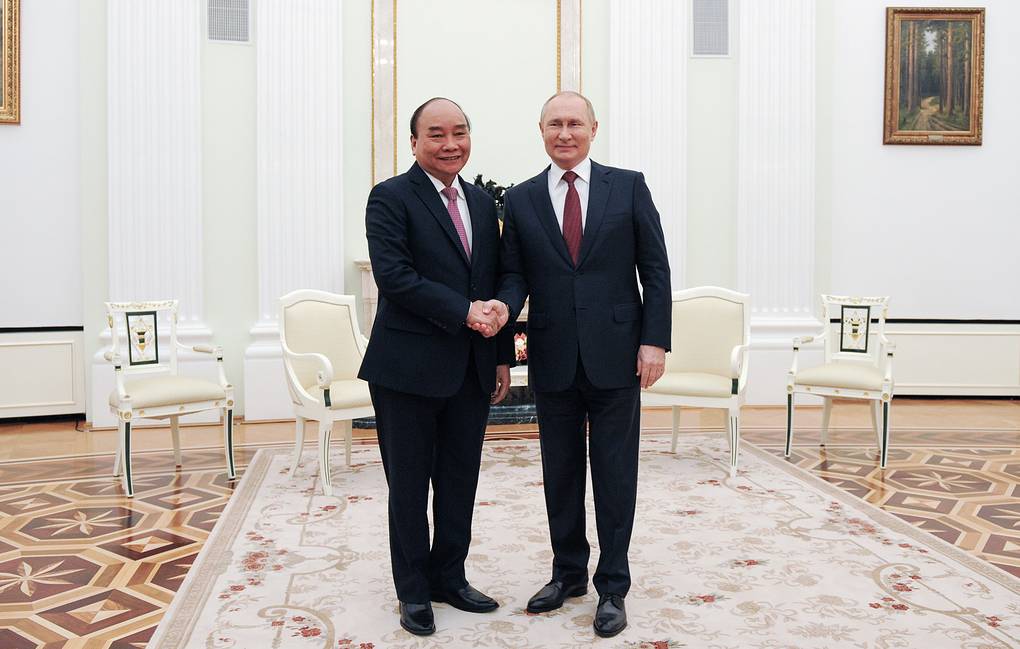
    Russian President Vladimir Putin and President of Vietnam Nguyen Xuan Phuc made a statement in the wake of their talks in Moscow – “The relations of comprehensive strategic partnership between the Russian Federation and the Socialist Republic of Vietnam are based upon years-long traditions of friendship and mutually beneficial cooperation, laid down by the previous generations. They have been tested by time, they are not affected by conjuncture oscillations, and serve as an example of mutually respectful cooperation that corresponds to the basic interests of the two countries”

    President Nguyen Xuan Phuc’s visit to Russia merits attention from at least five perspectives. First at the politico-diplomatic levels: both sides have a common understanding of international issues; they endorse a multipolar world order; guided by the principles of resolving major conflicts in the world through diplomacy based on respect for international law. Moscow also acknowledges the increasing role of the ASEAN and Vietnam as important Member State. Russia has also agreed to “explore promising areas of cooperation” within the framework of the ASEAN Outlook for Indo-Pacific.

    Second, the Vietnam-Russia bilateral trade has made significant strides. Their bilateral trade reached US$4.05 billion in the first ten months of 2020 and Russia ranked 24 among 129 countries and territories investing in Vietnam. Russia plans to increase its offshore energy business in the country and the joint statement notes that “creation of favourable conditions for the expansion of activities of Russian and Vietnamese oil and gas companies in the territories of the two states and the implementation of joint projects in third countries in accordance with international law, including the 1982 UN Convention on the Law of the Sea, and the national legislation of Russia and Vietnam”;  however, it is important to mention that there are frequent standoffs. For instance, there was a major standoff in the Vanguard Bank involving 50 Vietnamese and 40 Chinese vessels over the operations of the drilling rig Hakuryu 5 operated by Russia’s Rosneft in Vietnam’s oil and gas Block 06-01.

    Third, their bilateral defence and security cooperation is well established and in September this year, Russian Foreign Minister Sergey Lavrov and his Vietnamese counterpart Bui Thanh Son announced plans to ramp up military-technical cooperation including setting up a centre for nuclear science and technologies in Vietnam. Vietnamese military has acquired Russian origin naval and air platforms (Kilo Class submarines and SU-30MKK fighter jets) and the bilateral trade in arms increased from US$ 293 million (1993-99) to US$ 6514 million (1999-2018) and constituted nearly 84 per cent of all its military purchases.

    Fourth is about the COVID-19 pandemic that continues to rage in the world and its new variant Omicron bringing new fears. Vietnam has been impacted severely by the pandemic and has recently begun to open up. The US and China have provided it with vaccines. During President of Vietnam Nguyen Xuan Phuc visit to Russia, the  Russian Direct Investment Fund has signed an agreement for the “expansion of cooperation with partners in Vietnam aimed at the production of the Russian Sputnik V vaccine” involving the Russian pharmaceutical company Binnopharm Group and Vietnam’s T&T GROUP. RDIF, leading to creating a full-cycle production of Sputnik V in Vietnam.

    Fifth is the US-led Indo Pacific initiatives that clearly target China.  It merits mention that the joint statement issued at the end of the Summit notes that Russia and Vietnam “do not enter alliances and do not sign agreements with third countries to carry out actions that harm each other’s independence, sovereignty, territorial integrity and basic interests,” and that “the development of Russian-Vietnamese relations is not aimed against any third side.”

    Vietnam has no plans to align with the US’ Indo Pacific strategy or any US initiatives that target China even though it has disputes with China in the South China Sea. Russia has stayed clear of the South China Sea disputes and has not supported China. It is conscious that it enjoys cordial relations with the majority of the ASEAN Member States.

    Meanwhile, the Russian Navy recently conducted joint exercises with the ASEAN navies including the Vietnamese Navy. The Russian ambassador to the ASEAN has stated that the exercises were about “peace, stability and prosperity in the region,” and the Indonesian first fleet commander said the exercise “enhance the interoperability and understanding between the Russian and ASEAN militaries”. Interestingly, these exercises are also being viewed as signalling ASEAN’s principle of non-alignment, particularly in current times of high regional tensions given that the ASEAN navies held similar exercises with the PLA Navy. The ASEAN Member States routinely conduct bilateral military-naval exercises with the navies of the US, Japan, Australia, India, France and the UK.

    Vietnam has adopted a pragmatic foreign policy and successive leadership have successfully managed tensions in the South China Sea. Likewise, Russia has major stakes in augmenting regional stability which provides for crucial convergences between Hanoi and Moscow.


    Feature Image Credit: tass.com
  • What Putin nemesis Alexei Navalny is, and what he is not

    What Putin nemesis Alexei Navalny is, and what he is not

    Anatol Lieven highlights America’s blundering tendency to view world personalities in typically American lens, ignoring the realities of them being citizens of their countries and focusing on their national interests . He uses the examples of Russia’s Navalny and Myanmar’s Aung San Suu Kyi to make his point emphatically. His analysis is relevant to other countries as well. 

    This article was published earlier in Responsible Statecraft

    It is very human and natural to admire courage and resolution — these are qualities that Russian opposition leader Alexei Navalny possesses to a quite remarkable degree. It is also natural to sympathize with suffering — and Navalny has suffered and very nearly died for his beliefs and goals. And of course it is natural to feel disgust with the increasingly criminal behavior of the Putin administration in Russia.

    However, admiration, sympathy and disgust are emotions, not arguments or analysis, and should be employed with great caution in the formulation of state policy.

    In his confirmation hearings, now-Secretary of State Anthony Blinken pledged Biden administration support for Navalny and called him “a voice for millions and millions of Russians.” Statements by the U.S. embassy in Moscow on the Navalny movement have come very close to calling for the end of the present Russian government.

    Recent weeks have seen a tremendous outpouring of American sympathy for Navalny and his movement against the Putin administration. In his confirmation hearings, now-Secretary of State Anthony Blinken pledged Biden administration support for Navalny and called him “a voice for millions and millions of Russians.” Statements by the U.S. embassy in Moscow on the Navalny movement have come very close to calling for the end of the present Russian government. The semi-official American Radio Free Europe/Radio Liberty is openly and passionately supportive of Navalny’s movement. Richard Haas, President of the Council on Foreign Relations, proposed that Navalny be awarded the Nobel Peace Prize.

    Such overt U.S. support is not wise. In the first place, it may actually hurt the cause of progressive reform in Russia. The Russian government, like those of Iran and China, has relentlessly propagated the idea that the opposition is being backed if not bankrolled by Washington in order to weaken their countries; and indeed, Russian liberals have done themselves terrible damage by allowing themselves to be cast as representatives of the West, not of the Russian people.

    The second, very familiar problem is the hypocrisy involved. In the latest volume of President Obama’s memoirs, “A Promised Land,” he describes how Hillary Clinton — who relentlessly presented herself in public as an advocate of spreading democracy — argued that Washington should support Egyptian President Hosni Mubarak’s brutal 2011 crackdown on Arab Spring opposition protests on the grounds that he was a U.S. ally and his fall would lead to chaos and Islamist revolution. In her early public statements, as well, she warned against hastening Mubarak’s exit.

    In proposing Navalny for the Nobel Peace Prize, Haas seems to have forgotten the last time the honor was given to an opposition politician.

    An even greater problem presents itself when one looks at the actual politics of some of the opposition figures who draw such waves of American and Western enthusiasm. In proposing Navalny for the Nobel Peace Prize, Haas seems to have forgotten the last time the honor was given to an opposition politician. The award to Aung San Suu Kyi in 1991 was supposed to be for “her non-violent struggle for democracy and human rights… one of the most extraordinary examples of civil courage in Asia in recent decades.”

    After Suu Kyi joined the government in Myanmar she’s been damned in the West for her failure to prevent or condemn the savage state persecution of Myanmar’s Rohingya minority, and most of her human rights awards (though not the Nobel prize itself) have been revoked.

    After Suu Kyi joined the government in Myanmar she’s been damned in the West for her failure to prevent or condemn the savage state persecution of Myanmar’s Rohingya minority, and most of her human rights awards (though not the Nobel prize itself) have been revoked. What her previous Western admirers are not doing — what they almost never do — is to ask themselves why they so completely misunderstood her before.

    But she is a Burmese politician, not a Western democratic leader, and in building her up as a liberal heroine, the Western media and activists willfully ignored not just the political realities of Myanmar, but her own Burmese nationalist antecedents.  

    (Just in the last 48 hours, Suu Kyi has been detained in an apparent military takeover of her democratically elected government and Biden is predictably mulling over his options for reviewing sanctions and taking “appropriate action.”)

    Like Navalny, Suu Kyi is indeed an exceptionally brave and determined human being and in her way a fine leader; just as Navalny might make a fine Russian president. But she is a Burmese politician, not a Western democratic leader, and in building her up as a liberal heroine, the Western media and activists willfully ignored not just the political realities of Myanmar, but her own Burmese nationalist antecedents.

    There are two factors at work here. The first is a basic human one. Courage, like hard work and self-sacrifice, is a quality that it is humanly impossible not to admire, but the possession of it says absolutely nothing at all about the goals to which they are put. All the leaders of the ghastly totalitarian revolutions of the 20th century were exceptionally brave and determined men.

    The second factor relates to some enduring and seemingly incorrigible flaws in most Western reporting and analysis. One of them is the tendency to personalize issues, whereby “Putin” is used as a synonym for the whole Russian state, and “Navalny” is now being presented as a synonym for the entire, enormously disparate Russian opposition. The merest glance at the groups represented at the pro-Navalny demonstrations reveals that together with genuine liberal democrats, there are also numerous Communists and extreme nationalists whose anti-Western positions are much more extreme and reckless than those of Putin himself. As Aleksandr Baunov of the Carnegie Moscow Centre has written:

    Saturday’s protests were undeniably anti-regime, anti-elite and anti-corruption but not necessarily liberal, pro-Western and pro-democracy. It’s not surprising that such protests frighten not only the authorities, but also successful members of society: even those who don’t consider themselves supporters of the regime.

    In their blind demonization of Putin, and consequent sanctification of Navalny, Western commentators seem to be implicitly assuming that should Navalny win power (which he almost certainly will not), Russia’s foreign policy would change radically in a pro-Western direction. This is nonsense. Navalny’s supporters are backing him out of (entirely justified) fury at Russian state corruption, lawlessness, and economic failure, not to change foreign policy. Every independent opinion poll has suggested that Putin’s foreign and security policies have enjoyed overwhelming public support; and above all, there is very little in Navalny’s own record to suggest that he would change them.

    As a 2013 essay by Robert Coalson in The Atlantic documented, Navalny supported the Russian war with Georgia in 2008. He has expressed strongly ethno-nationalist attitudes towards the Caucasian minorities in Russia, and previously made opposition to illegal immigration a key part of his platform. In October 2014 he suggested to a reporter that if he became president he would not return Crimea, which was annexed by Russia earlier that year, to Ukraine (though he also said in that same interview that, “It’s not in the interests of Russians to seize neighboring republics, it’s in their interests to fight corruption, alcoholism and so on — to solve internal problems.”

    Rather like Donald Trump concerning American interventionism, Navalny has strongly condemned Russian military intervention in the Middle East on the grounds of cost and irrelevance to real Russian interests; but (as with Trump), that does not necessarily say much about what he would actually do if in power. Apart from anything else, Russia, like the U.S., has a foreign and security establishment “Blob” with firmly established and deeply held collective views on Russia’s vital interests.

    It is to remind Americans that he is a Russian politician, not an American one; that he will respond to Russian realities, not Washington fantasies; and that in the end, U.S. administrations will have to deal with whatever government is in power in Moscow.

    To recall this is not to condemn Navalny. It is to remind Americans that he is a Russian politician, not an American one; that he will respond to Russian realities, not Washington fantasies; and that in the end, U.S. administrations will have to deal with whatever government is in power in Moscow. Russian governments will defend Russian interests, along lines that are mostly quite predictable if one knows Russian history and culture. The sooner we realize this, and stop setting up plaster saints in the hope that they will perform miracles, the better for U.S. foreign policy overall.


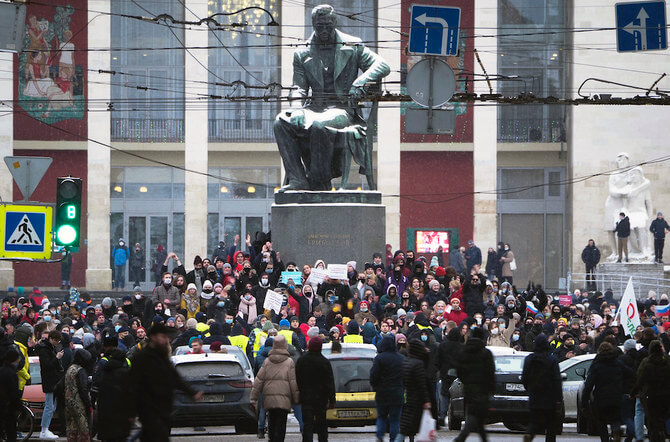
    Feature Image – Protesters gather near a monument of Russian playwright Alexander Griboyedov during a protest against the jailing of opposition leader Alexei Navalny in St. Petersburg, Russia, Sunday, Jan. 31, 2021. www.arabnews.com
    Image – 
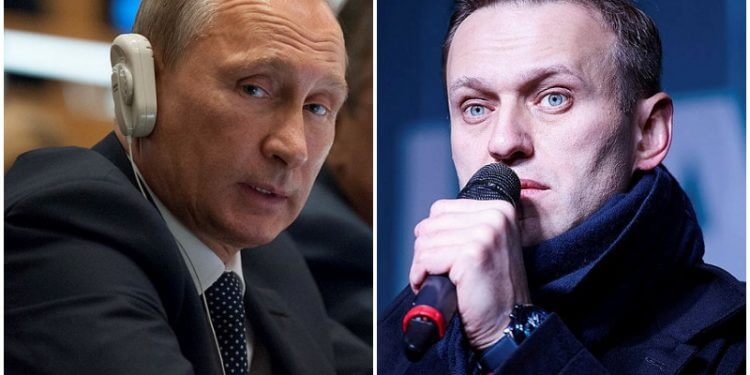
    Navalny and Putin: www.hilltimes.com
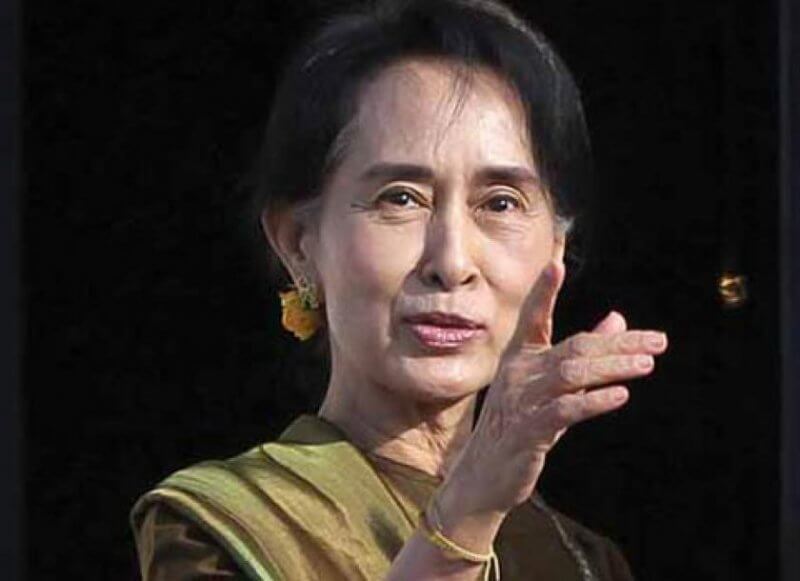
    Image – Aung San Suu Kyi: www.mmtimes.com