Category: Russia – Ukraine Conflict Analysis

  • The End of War in Ukraine: A Tough Road Ahead

    The End of War in Ukraine: A Tough Road Ahead

    The war, which began when NATO leaders dismissed Russia’s demand for security guarantees from the West, was intended as a way for Russia to reclaim its power and prestige on the global stage while strengthening its security in the region. Neither of these objectives has been achieved, nor will they be with Ukraine’s defeat. The war quickly escalated into a proxy conflict between Moscow and the collective West, with significant losses on both sides.

    Given that President Putin has recently signed an order to draft 160,000 additional soldiers with the goal of “finishing off” the Ukrainian resistance, the Russia-Ukraine war is far from a definitive resolution. Nonetheless, it is never too early to begin considering the options for a successful post-war settlement and the potential to transform the US-advocated ceasefire (if it ever materializes) into a lasting peace.


    Unfortunately, neither side of the conflict has presented anything even remotely resembling a plan for a sustainable, acceptable post-war settlement. The war, which began when NATO leaders dismissed Russia’s demand for security guarantees from the West, was intended as a way for Russia to reclaim its power and prestige on the global stage while strengthening its security in the region. Neither of these objectives has been achieved, nor will they be with Ukraine’s defeat. The war quickly escalated into a proxy conflict between Moscow and the collective West, with significant losses on both sides. Russia’s international security situation is now worse than it was before the war began, and this will remain the case for some time, regardless of what happens in Ukraine.

    Ukraine, in fact, is fighting a losing battle. Its leaders are sacrificing the country in the midst of a geopolitical rivalry involving Russia, Europe, and the USA. If Ukraine accepts a Trump-mediated deal with Russia, it will lose four regions occupied by Russian forces since 2022, agree to the annexation of Crimea, and abandon any hopes of NATO membership in the future. If Ukraine is defeated on the battlefield, it will lose its independence and be forced to submit to what Russian leaders refer to as demilitarization and denazification—essentially, a regime change and the reconstitution of Ukrainian governance.

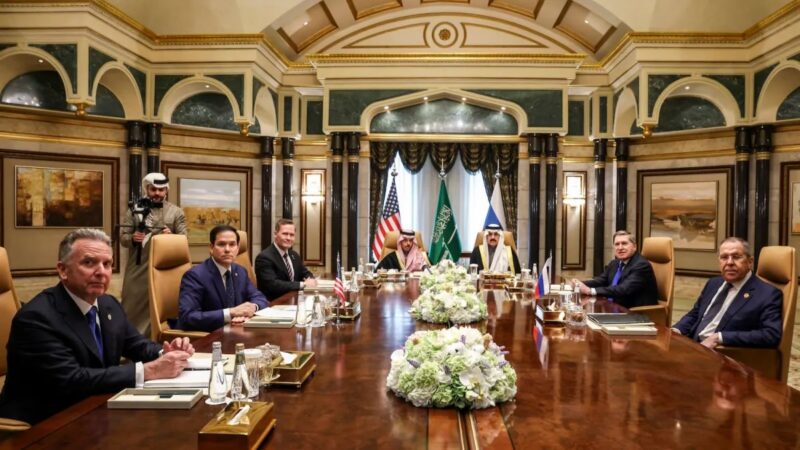
    With no realistic prospect of pushing Russian forces out of the country and with the increasing likelihood of an exploitative “resources plus infrastructure” deal imposed by Washington, Ukraine risks losing not only its state sovereignty but any semblance of international agency. If Ukraine’s role in a post-war settlement, as envisioned in the Saudi negotiations, is reduced to either a Russian-occupied territory or a de facto resource colony of the United States, such a “settlement” would merely serve as an interlude between two wars, offering no lasting resolution to the conflict.

    As the Kremlin proposes placing Ukraine under external governance and the White House demands control over all of Ukraine’s natural resource income for several years—along with a perpetual share of that revenue—the process of transforming Ukraine into a non-self-governing territory accelerates. However, Russia also faces setbacks. Despite Putin’s efforts to halt NATO’s expansion and push the alliance back to its 1997 military posture, NATO has grown closer to Russia’s borders, with formerly neutral Sweden and Finland joining the alliance in direct response to Russia’s invasion of Ukraine. Trump’s previous alignment with Putin prompted EU leaders to agree to a substantial €800 billion increase in defence spending, while French President Macron proposed extending France’s nuclear deterrent to protect all of Europe from potential Russian threats. This may lead to France positioning its nuclear-capable jets in Poland or Estonia, and its ballistic-missile submarines in the Baltic Sea. The British nuclear deterrent is already committed to NATO policy, and it is not unimaginable that some or all of the UK’s nuclear submarines could be deployed closer to Russia’s borders. A UK contribution to a European nuclear umbrella, along with the creation of a low-yield variant of existing nuclear capabilities, would further erode Russia’s already fragile security.

    Putin’s proposal for the external governance of Ukraine reveals Russia’s deep vulnerabilities, which the full occupation of Ukraine would soon expose. A collapse of Ukrainian statehood and the need to occupy the entire country would require Russia to maintain an occupation force of several hundred thousand troops, while also assuming responsibility for law enforcement, security, state administration, essential services, and more. Rebuilding Ukraine’s devastated southeast would cost billions of dollars, and efforts to restore the entire former Ukrainian nation are simply beyond Russia’s capacity. Meanwhile, the guerrilla warfare that the Ukrainians will inevitably intensify in response to Russia’s territorial expansion will further drain the occupiers’ resources.

    The end of the war would mark a slowdown in the military-industrial complex that has driven Russia’s economic growth in recent years. Additionally, the ongoing militarization of society, the rise of nationalist totalitarianism, and the enormous costs of occupying the “new territories” highlight the Pyrrhic nature of Russia’s supposed “victory.”

    Despite the Kremlin’s bravado, Russia’s economy and society have been significantly weakened by the war. With the key interest rate at 21 percent, annual inflation at 10 percent, dwindling welfare fund reserves, and an estimated 0.5 to 0.8 million casualties (killed and wounded) on the battlefield, it’s unclear how much longer Putin can stave off economic decline and maintain reluctant public support for his administration. The end of the war would mark a slowdown in the military-industrial complex that has driven Russia’s economic growth in recent years. Additionally, the ongoing militarization of society, the rise of nationalist totalitarianism, and the enormous costs of occupying the “new territories” highlight the Pyrrhic nature of Russia’s supposed “victory.” The best possible settlement from Russia’s perspective—leaving a rump Ukraine that is independent, self-sufficient, and friendly—is simply out of reach. The remaining options will only delay the inevitable second round of hostilities.

    Finally, the Western proposals for post-war settlements are either unsustainable or outright counterproductive. This is perplexing, given that the war has cost Europe dearly, and it should be in the EU’s interest to see it end as soon as possible. While predictions of seeing the Russian economy in tatters have not materialized, Europe now faces an imminent financial crisis. With the EU economy growing by less than 1 percent in 2024, while Russia’s economy grows 4.5 times faster, it’s time for those like President Macron of France—who advocate continuing the war with extensive European military and financial support—to reconsider their stance.

    However, this is not happening. Instead, EU leaders are urging Russia to agree to an “immediate and unconditional ceasefire on equal terms, with full implementation,” under the threat of new sanctions and the redoubling of Europe’s support for Ukraine.

    This approach is counterproductive and likely to strengthen Russia’s resolve. Beyond the fact that continued support for Ukraine’s war effort will further strain the already fragile budgets of the supporting states, insisting that Ukraine fight to the bitter end is both practically and morally indefensible. At the same time, abandoning Ukraine to face Russia alone could lead to the collapse of Ukrainian statehood. In either case, the collective West loses.

    A negotiated settlement, as proposed by President Trump, is a lesser evil under the current circumstances. Yes, it’s a suboptimal solution that could embolden Putin, harm Ukraine, deepen the divide between Russia and Europe, and create new challenges for international security.

    Yet, the preservation of Ukrainian statehood would be ensured. Death and destruction would cease. Europe’s economy would recover, and the global economy would see a boost. The risk of nuclear war in Europe would fade away. The need for European citizens to stockpile 72 hours’ worth of supplies, as per the European Commission’s recent guidance, might become less of a priority for the already-intimidated European citizens.

    European leaders should consider working alongside Trump, Putin, and Zelensky to craft a balanced, negotiated solution that accounts for the interests of all sides. Even if everyone must make sacrifices, it is better than losing everything. 

    While any path out of this war will be difficult, the strategy of threatening Russia with harsher sanctions, forming “coalitions of the willing,” and creating EU nuclear-armed forces will not make it any easier. Instead, European leaders should consider working alongside Trump, Putin, and Zelensky to craft a balanced, negotiated solution that accounts for the interests of all sides. Even if everyone must make sacrifices, it is better than losing everything.

    Feature Image Credit: www.pbs.org

  • The War in Ukraine Was Provoked—and Why That Matters to Achieve Peace

    The War in Ukraine Was Provoked—and Why That Matters to Achieve Peace

    By recognizing that the question of NATO enlargement is at the center of this war, we understand why U.S. weaponry will not end this war. Only diplomatic efforts can do that.

    George Orwell wrote in 1984 that “Who controls the past controls the future: who controls the present controls the past.” Governments work relentlessly to distort public perceptions of the past. Regarding the Ukraine War, the Biden administration has repeatedly and falsely claimed that the Ukraine War started with an unprovoked attack by Russia on Ukraine on February 24, 2022. In fact, the war was provoked by the U.S. in ways that leading U.S. diplomats anticipated for decades in the lead-up to the war, meaning that the war could have been avoided and should now be stopped through negotiations.

    Recognizing that the war was provoked helps us to understand how to stop it. It doesn’t justify Russia’s invasion. A far better approach for Russia might have been to step up diplomacy with Europe and with the non-Western world to explain and oppose U.S. militarism and unilateralism. In fact, the relentless U.S. push to expand NATO is widely opposed throughout the world, so Russian diplomacy rather than war would likely have been effective.

    The Biden team uses the word “unprovoked” incessantly, most recently in Biden’s major speech on the first-year anniversary of the war, in a recent NATO statement, and in the most recent G7 statement. Mainstream media friendly to Biden simply parrot the White House. TheNew York Times is the lead culprit, describing the invasion as “unprovoked” no fewer than 26 times, in five editorials, 14 opinion columns by NYT writers, and seven guest op-eds!

    There were in fact two main U.S. provocations. The first was the U.S. intention to expand NATO to Ukraine and Georgia in order to surround Russia in the Black Sea region by NATO countries (Ukraine, Romania, Bulgaria, Turkey, and Georgia, in counterclockwise order). The second was the U.S. role in installing a Russophobic regime in Ukraine by the violent overthrow of Ukraine’s pro-Russian President, Viktor Yanukovych, in February 2014. The shooting war in Ukraine began with Yanukovych’s overthrow nine years ago, not in February 2022 as the U.S. government, NATO, and the G7 leaders would have us believe.

    The key to peace in Ukraine is through negotiations based on Ukraine’s neutrality and NATO non-enlargement.

    Biden and his foreign policy team refuse to discuss these roots of the war. To recognize them would undermine the administration in three ways. First, it would expose the fact that the war could have been avoided, or stopped early, sparing Ukraine its current devastation and the U.S. more than $100 billion in outlays to date. Second, it would expose President Biden’s personal role in the war as a participant in the overthrow of Yanukovych, and before that as a staunch backer of the military-industrial complex and very early advocate of NATO enlargement. Third, it would push Biden to the negotiating table, undermining the administration’s continued push for NATO expansion.

    The archives show irrefutably that the U.S. and German governments repeatedly promised to Soviet President Mikhail Gorbachev that NATO would not move “one inch eastward” when the Soviet Union disbanded the Warsaw Pact military alliance. Nonetheless, U.S. planning for NATO expansion began early in the 1990s, well before Vladimir Putin was Russia’s president. In 1997, national security expert Zbigniew Brzezinski spelled out the NATO expansion timeline with remarkable precision.

    U.S. diplomats and Ukraine’s own leaders knew well that NATO enlargement could lead to war. The great US scholar-statesman George Kennan called NATO enlargement a “fateful error,” writing in the New York Times that, “Such a decision may be expected to inflame the nationalistic, anti-Western and militaristic tendencies in Russian opinion; to have an adverse effect on the development of Russian democracy; to restore the atmosphere of the cold war to East-West relations, and to impel Russian foreign policy in directions decidedly not to our liking.”

    President Bill Clinton’s Secretary of Defense William Perry considered resigning in protest against NATO enlargement. In reminiscing about this crucial moment in the mid-1990s, Perry said the following in 2016: “Our first action that really set us off in a bad direction was when NATO started to expand, bringing in eastern European nations, some of them bordering Russia. At that time, we were working closely with Russia and they were beginning to get used to the idea that NATO could be a friend rather than an enemy … but they were very uncomfortable about having NATO right up on their border and they made a strong appeal for us not to go ahead with that.”

    In 2008, then U.S. Ambassador to Russia, and now CIA Director, William Burns, sent a cable to Washington warning at length of grave risks of NATO enlargement: “Ukraine and Georgia’s NATO aspirations not only touch a raw nerve in Russia, they engender serious concerns about the consequences for stability in the region. Not only does Russia perceive encirclement, and efforts to undermine Russia’s influence in the region, but it also fears unpredictable and uncontrolled consequences which would seriously affect Russian security interests. Experts tell us that Russia is particularly worried that the strong divisions in Ukraine over NATO membership, with much of the ethnic-Russian community against membership, could lead to a major split, involving violence or at worst, civil war. In that eventuality, Russia would have to decide whether to intervene; a decision Russia does not want to have to face.”

    Ukraine’s leaders knew clearly that pressing for NATO enlargement to Ukraine would mean war. Former Zelensky advisor Oleksiy Arestovych declared in a 2019 interview “that our price for joining NATO is a big war with Russia.”

    Nuland makes clear on the call that she was coordinating closely with then Vice President Biden and his national security advisor Jake Sullivan, the same Biden-Nuland-Sullivan team now at the center of U.S. policy vis-à-vis Ukraine.

    During 2010-2013, Yanukovych pushed neutrality, in line with Ukrainian public opinion. The U.S. worked covertly to overthrow Yanukovych, as captured vividly in the tape of then U.S. Assistant Secretary of State Victoria Nuland and U.S. Ambassador Geoffrey Pyatt planning the post-Yanukovych government weeks before the violent overthrow of Yanukovych. Nuland makes clear on the call that she was coordinating closely with then Vice President Biden and his national security advisor Jake Sullivan, the same Biden-Nuland-Sullivan team now at the center of U.S. policy vis-à-vis Ukraine.

    After Yanukovych’s overthrow, the war broke out in the Donbas, while Russia claimed Crimea. The new Ukrainian government appealed for NATO membership, and the U.S. armed and helped restructure the Ukrainian army to make it interoperable with NATO. In 2021, NATO and the Biden Administration strongly recommitted to Ukraine’s future in NATO.

    In the immediate lead-up to Russia’s invasion, NATO enlargement was center stage. Putin’s draft US-Russia Treaty (December 17, 2021) called for a halt to NATO enlargement. Russia’s leaders put NATO enlargement as the cause of war in Russia’s National Security Council meeting on February 21, 2022. In his address to the nation that day, Putin declared NATO enlargement to be a central reason for the invasion.

    Historian Geoffrey Roberts recently wrote: “Could war have been prevented by a Russian-Western deal that halted NATO expansion and neutralised Ukraine in return for solid guarantees of Ukrainian independence and sovereignty? Quite possibly.” In March 2022, Russia and Ukraine reported progress towards a quick negotiated end to the war based on Ukraine’s neutrality. According to Naftali Bennett, former Prime Minister of Israel, who was a mediator, an agreement was close to being reached before the U.S., U.K., and France blocked it.

    While the Biden administration declares Russia’s invasion to be unprovoked, Russia pursued diplomatic options in 2021 to avoid war, while Biden rejected diplomacy, insisting that Russia had no say whatsoever on the question of NATO enlargement. And Russia pushed diplomacy in March 2022, while the Biden team again blocked a diplomatic end to the war.

    By recognizing that the question of NATO enlargement is at the center of this war, we understand why U.S. weaponry will not end this war. Russia will escalate as necessary to prevent NATO enlargement to Ukraine. The key to peace in Ukraine is through negotiations based on Ukraine’s neutrality and NATO non-enlargement. The Biden administration’s insistence on NATO enlargement to Ukraine has made Ukraine a victim of misconceived and unachievable U.S. military aspirations. It’s time for the provocations to stop, and for negotiations to restore peace to Ukraine.

    This article was published earlier in commondreams.org and is republished under Creative Commons(CC BY-NC-ND 3.0).

    Feature Image Credit: columbian.com

  • ‘World War 3 has already started’ between US and Russia/China, argues French scholar

    ‘World War 3 has already started’ between US and Russia/China, argues French scholar

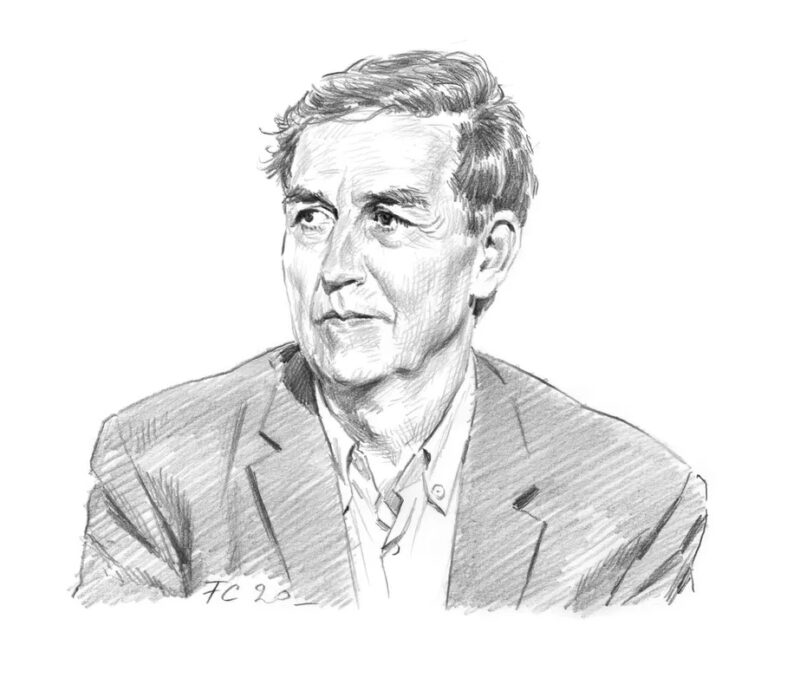
    Ben Norton reviews the interview given by the prominent French Scholar, Emmanuel Todd. The interview was in French and published in the major French newspaper ‘Le Figaro’. Emmanuel Todd argues the Ukraine proxy war is the start of WWIII, and is “existential” for both Russia and the US “imperial system”, which has restricted the sovereignty of Europe, making Brussels into Washington’s “protectorate”. 

    America is fragile. The resistance of the Russian economy is pushing the American imperial system toward the precipice. No one had expected that the Russian economy would hold up against the “economic power” of NATO. I believe that the Russians themselves did not anticipate it –  Emmanuel Todd

    A prominent French intellectual has written a book arguing that the United States is already waging World War Three against Russia and China.

    He also warned that Europe has become a kind of imperial “protectorate”, which has little sovereignty and is essentially controlled by the US.

    Emmanuel Todd is a widely respected anthropologist and historian in France.

    In 2022, Todd published a book titled “The Third World War Has Started” (“La Troisième Guerre mondiale a commencé” in French). At the moment, it is only available in Japan.

    But Todd outlined the main arguments he made in the book in a French-language interview with the major newspaper Le Figaro, conducted by the journalist Alexandre Devecchio.

    According to Todd, the proxy war in Ukraine is “existential” not only for Russia, but also for the United States.

    The US “imperial system” is weakening in much of the world, he observed, but this is leading Washington to “strengthen its hold on its initial protectorates”: Europe and Japan.

    This means that “Germany and France had become minor partners in NATO”, Todd said, and NATO is really a “Washington-London-Warsaw-Kiev” bloc.

    US and EU sanctions have failed to crush Russia, as Western capitals had hoped, he noted. This means that “the resistance of the Russian economy is pushing the American imperial system toward the precipice”, and “the American monetary and financial controls of the world would collapse”.

    The French public intellectual pointed to UN votes concerning Russia, and cautioned that the West is out of touch with the rest of the world.

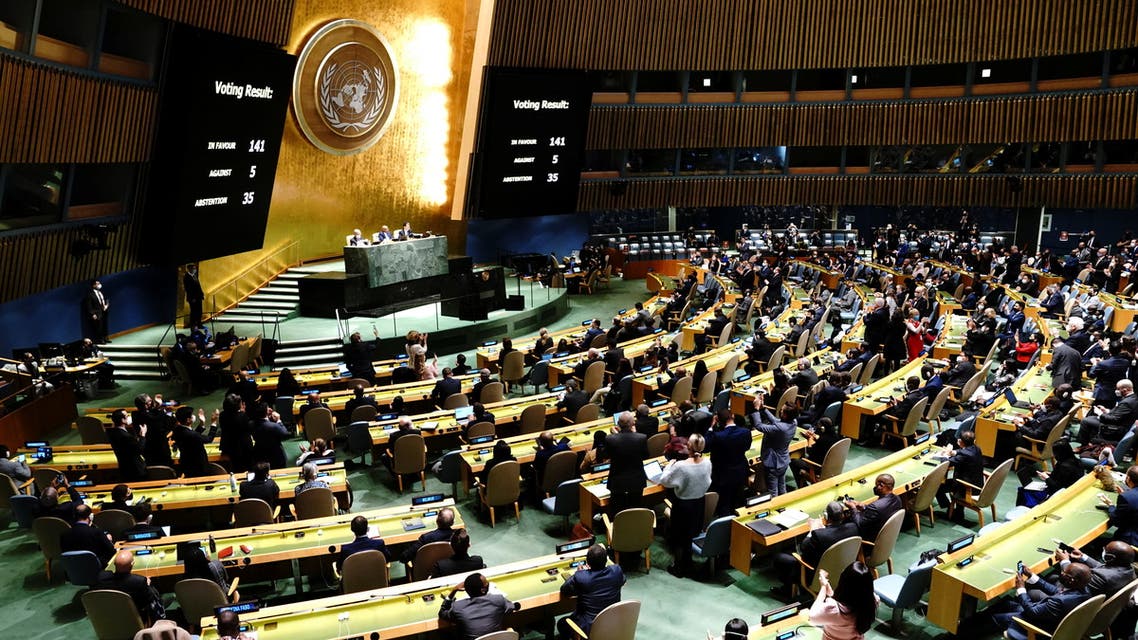
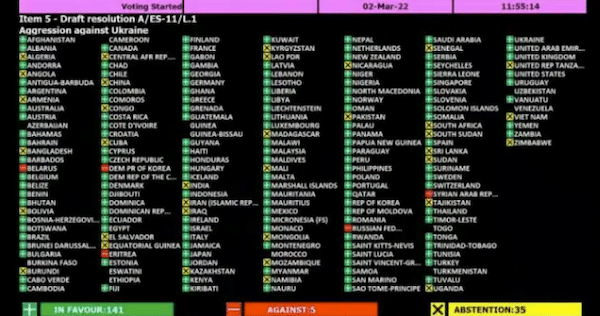
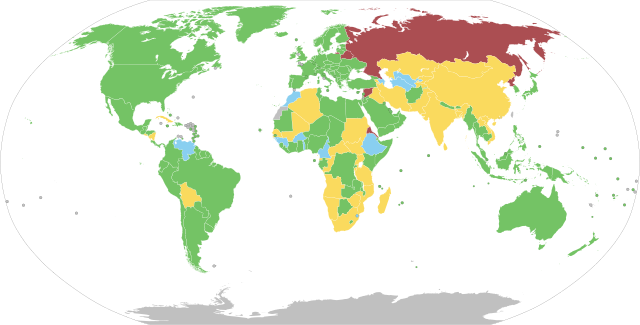
    “Western newspapers are tragically funny. They don’t stop saying, ‘Russia is isolated, Russia is isolated’. But when we look at the votes of the United Nations, we see that 75% of the world does not follow the West, which then seems very small”, Todd observed.

    He also criticized the GDP metrics used by Western neoclassical economists for downplaying the productive capacity of the Russian economy, while simultaneously exaggerating that of financialized neoliberal economies like in the United States.

    In the Le Figaro interview, Todd argued (all emphasis added):

    This is the reality, World War III has begun. It is true that it started ‘small’ and with two surprises. We went into this war with the idea that the Russian army was very powerful and that its economy was very weak.

    It was thought that Ukraine was going to be crushed militarily and that Russia would be crushed economically by the West. But the reverse happened. Ukraine was not crushed militarily even if it lost 16% of its territory on that date; Russia was not crushed economically. As I speak to you, the ruble has gained 8% against the dollar and 18% against the euro since the day before the start of the war.

    So there was a sort of misunderstanding. But it is obvious that the conflict, passing from a limited territorial war to a global economic confrontation, between the whole of the West on the one hand and Russia backed by China on the other hand, has become a war world. Even if military violence is low compared to that of previous world wars.

    The newspaper asked Todd if he was exaggerating. He replied, “We still provide weapons. We kill Russians, even if we don’t expose ourselves. But it remains true that we Europeans are above all economically engaged. We also feel our true entry into war through the inflation and shortages”.

    Todd understated his case. He didn’t mention the fact that, after the US sponsored the coup that overthrew Ukraine’s democratically elected government in 2014, setting off a civil war, the CIA and Pentagon immediately began training Ukrainian forces to fight Russia.

    The New York Times has acknowledged that the CIA and special operations forces from numerous European countries are on the ground in Ukraine. And the CIA and a European NATO ally are even carrying out sabotage attacks inside Russian territory.

    Nevertheless, in the interview, Todd continued:

    Putin made a big mistake early on, which is of immense sociohistorical interest. Those who worked on Ukraine on the eve of the war considered the country not as a fledgling democracy, but as a society in decay and a ‘failed state’ in the making.

    I think the Kremlin’s calculation was that this decaying society would crumble at the first shock, or even say ‘welcome Mom’ to holy Russia. But what we have discovered, on the contrary, is that a society in decomposition, if it is fed by external financial and military resources, can find in war a new type of balance, and even a horizon, a hope. The Russians could not have foreseen it. No one could.

    Todd said he shares the view of Ukraine of US political scientist John Mearsheimer, a realist who has criticized Washington’s hawkish foreign policy.

    Mearsheimer “told us that Ukraine, whose army had been taken over by NATO soldiers (American, British and Polish) since at least 2014, was therefore a de facto member of NATO, and that the Russians had announced that they would never tolerate a NATO member Ukraine,” Todd said.

    For Russia, this is there a war that is “from their point of view defensive and preventative,” he conceded.

    “Mearsheimer added that we would have no reason to rejoice in the eventual difficulties of the Russians because, since this is an existential question for them, the harder it was, the harder they would hit. The analysis seems to hold true.”

    Germany and France had become minor partners in NATO and were not aware of what was going on in Ukraine on the military level. French and German naivety has been criticized because our governments did not believe in the possibility of a Russian invasion. True, but because they did not know that Americans, British and Poles could make Ukraine be able to wage a larger war. The fundamental axis of NATO now is Washington-London-Warsaw-Kiev.

    However, Todd argued that Mearsheimer “does not go far enough” in his analysis. The US political scientist has overlooked how Washington has restricted the sovereignty of Berlin and Paris, Todd said:

    Germany and France had become minor partners in NATO and were not aware of what was going on in Ukraine on the military level. French and German naivety has been criticized because our governments did not believe in the possibility of a Russian invasion. True, but because they did not know that Americans, British and Poles could make Ukraine be able to wage a larger war. The fundamental axis of NATO now is Washington-London-Warsaw-Kiev.

    Mearsheimer, like a good American, overestimates his country. He considers that, if for the Russians the war in Ukraine is existential, for the Americans it is nothing but a power “game” among others. After Vietnam, Iraq and Afghanistan, one debacle more or less… What does it matter?

    The basic axiom of American geopolitics is: ‘We can do whatever we want because we are sheltered, far away, between two oceans, nothing will ever happen to us’. Nothing would be existential for America. Insufficiency of analysis which today leads Biden to a series of reckless actions.

    America is fragile. The resistance of the Russian economy is pushing the American imperial system toward the precipice. No one had expected that the Russian economy would hold up against the “economic power” of NATO. I believe that the Russians themselves did not anticipate it.

    The French public intellectual went on in the interview to argue that, by resisting the full force of Western sanctions, Russia and China pose a threat to “the American monetary and financial controls of the world”.

    This, in turn, challenges the US status as the issuer of the global reserve currency, which gives it the ability to maintain a “huge trade deficit”:

    If the Russian economy resisted the sanctions indefinitely and managed to exhaust the European economy, while it itself remained backed by China, the American monetary and financial controls of the world would collapse, and with them the possibility for United States to fund its huge trade deficit for nothing.

    This war has therefore become existential for the United States. No more than Russia, they cannot withdraw from the conflict, they cannot let go. This is why we are now in an endless war, in a confrontation whose outcome must be the collapse of one or the other.

    Todd warned that, while the United States is weakening in much of the world, its “imperial system” is “strengthening its hold on its initial protectorates”: Europe and Japan.

    He explained:

    Everywhere we see the weakening of the United States, but not in Europe and Japan because one of the effects of the retraction of the imperial system is that the United States strengthens its hold on its initial protectorates.

    If we read [Zbigniew] Brzezinski (The Grand Chessboard), we see that the American empire was formed at the end of the Second World War by the conquest of Germany and Japan, which are still protectorates today. As the American system shrinks, it weighs more and more heavily on the local elites of the protectorates (and I include all of Europe here).

    The first to lose all national autonomy will be (or already are) the English and the Australians. The Internet has produced human interaction with the United States in the Anglosphere of such intensity that its academic, media and artistic elites are, so to speak, annexed. On the European continent we are somewhat protected by our national languages, but the fall in our autonomy is considerable, and rapid.

    As an example of a moment in recent history when Europe was more independent, Todd pointed out, “Let us remember the war in Iraq, when Chirac, Schröder and Putin held joint press conferences against the war” – referring to the former leaders of France (Jacques Chirac) and Germany (Gerhard Schröder).

    The interviewer at Le Figaro newspaper, Alexandre Devecchio, countered Todd asking, “Many observers point out that Russia has the GDP of Spain. Aren’t you overestimating its economic power and resilience?”

    Todd criticized the overreliance on GDP as a metric, calling it a “fictional measure of production” that obscures the real productive forces in an economy:

    War becomes a test of political economy, it is the great revealer. The GDP of Russia and Belarus represents 3.3% of Western GDP (the US, Anglosphere, Europe, Japan, South Korea), practically nothing. One can ask oneself how this insignificant GDP can cope and continue to produce missiles.

    The reason is that GDP is a fictional measure of production. If we take away from the American GDP half of its overbilled health spending, then the “wealth produced” by the activity of its lawyers, by the most filled prisons in the world, then by an entire economy of ill-defined services, including the “production” of its 15 to 20 thousand economists with an average salary of 120,000 dollars, we realize that an important part of this GDP is water vapor.

    War brings us back to the real economy, it allows us to understand what the real wealth of nations is, the capacity for production, and therefore the capacity for war.

    Todd noted that Russia has shown “a real capacity to adapt”. He attributed this to the “very large role for the state” in the Russian economy, in contrast to the US neoliberal economic model:

    If we come back to material variables, we see the Russian economy. In 2014, we put in place the first important sanctions against Russia, but then it increased its wheat production, which went from 40 to 90 million tons in 2020. Meanwhile, thanks to neoliberalism, American wheat production, between 1980 and 2020, went from 80 to 40 million tons.

    Russia has therefore a real capacity to adapt. When we want to make fun of centralized economies, we emphasize their rigidity, and when we glorify capitalism, we praise its flexibility.

    The Russian economy, for its part, has accepted the rules of operation of the market (it is even an obsession of Putin to preserve them), but with a very large role for the state, but it also derives its flexibility from training engineers, who allow the industrial and military adaptations.

    This point is similar to what economist Michael Hudson has argued – that although Moscow’s economy is no longer socialist, like that of the Soviet Union was, the Russian Federation’s state-led industrial capitalism clashes with the financialized model of neoliberal capitalism that the United States has tried to impose on the world.


    The Peninsula Foundation is happy to republish this article with the permission of the author, Ben Norton.

    The article was published earlier in geopoliticaleconomy.com

    Feature Image Credit: newstatesman.com

    Portrait Sketch of Emmanuel Todd: Fabien Clairefond


  • Putin’s statements suggest the Ukraine conflict could last for years

    Putin’s statements suggest the Ukraine conflict could last for years

    Most likely, the fighting will continue into 2023, and quite probably beyond, until either Moscow or Kiev is exhausted, or one side claims a decisive victory. For the US, Ukraine is a matter of principle; for the Kremlin, the matter is simply existential – the conflict with the West is not about Ukraine, but about the fate of Russia itself.

    Last week, Russian President Vladimir Putin commented, during a meeting with soldiers’ mothers, that he now regards the Minsk agreements of 2014 and 2015 as a mistake. This confession was stark in the context of the possibility of peace negotiations to end the fighting in Ukraine.

    Russian President Vladimir Putin commented, during a meeting with soldiers’ mothers, that he now regards the Minsk agreements of 2014 and 2015 as a mistake.

    It is worth remembering that in 2014, Putin acted on a mandate from the Russian parliament to use military force “in Ukraine,”not just in Crimea. In fact, Moscow did save the cities of Donetsk and Lugansk from being overrun by Kyiv’s army, and defeated Ukraine’s forces, but rather than clearing the whole region of Donbass, Russia stopped, and agreed to a cease-fire brokered in Minsk by Germany and France.

    Putin explained to the mothers that at the time, Moscow did not know for sure the sentiments of the Donbass population affected by the conflict, and hoped that Donetsk and Lugansk could somehow be reunited with Ukraine on the conditions laid down in Minsk. Putin might have added – and his own actions, as well as conversations with then-Ukrainian President Pyotr Poroshenko, confirm it – that he was prepared to give the new Kyiv authorities a chance to settle the issue and rebuild a relationship with Moscow. Until rather late in the game, Putin also hoped that he could still work things out with the Germans and the French, and the US leadership.

    Admissions of mistakes are rare among incumbent leaders, but they are important as indicators of lessons they have learned.

    Admissions of mistakes are rare among incumbent leaders, but they are important as indicators of lessons they have learned. This experience has apparently made Putin decide not that the decision to launch the special military operation last February was wrong, but that eight years before, Moscow should not have put any faith in Kyiv, Berlin, and Paris, and instead should have relied on its own military might to liberate the Russian-speaking regions of Ukraine.

    In other words, agreeing to a Minsk-style ceasefire now would be another mistake which would allow Kyiv and its backers to better prepare to resume fighting at the time of their choosing.

    The Russian leader realizes, of course, that many nations in the non-West, those who refused to join the anti-Russian sanctions coalition and profess neutrality on Ukraine, have called for an end to hostilities. From China and India to Indonesia and Mexico, these countries, while generally friendly toward Russia, see their economic prospects being impaired by a conflict that pits Russia against the united West. The Western media also promote the message that global energy and food security is suffering because of Moscow’s actions. Russia’s arguments and protestations to the contrary have only limited impact since Russian voices are rarely heard on Middle Eastern, Asian, African, or Latin American airwaves.

    Be that as it may, Moscow cannot ignore the sentiments of the larger part of humanity, which is now increasingly referred to in Russian expert circles as the Global Majority. Hence, official Russian statements that Moscow is open for dialogue without preconditions. However, any Russian delegation to talks would have to take into account the recent amendments to the country’s Constitution, which name the four former Ukrainian regions of Donetsk, Lugansk, Kherson, and Zaporozhye as part of the Russian Federation. As Foreign Minister Sergey Lavrov has put it, Russia will only negotiate on the basis of existing geopolitical realities. It should be noted that the Kremlin has not retracted the objectives of the military operation, which include the demilitarization and denazification of Ukraine, which means ridding the state and society of ultra-nationalist, anti-Russian elements.

    As for Kyiv, it has gone back and forth on the issue. Having nearly reached a peace agreement with Moscow in late March, it later reversed course to continue fighting (the Russians believe this was done on Western advice). Having achieved operational successes on the battlefield this past fall, Ukrainian President Vladimir Zelensky had all contacts with the Kremlin formally banned and formulated extreme demands which he addressed to Putin’s successors, whenever they may emerge. For the West, this was bad from the perspective of public relations, and Zelensky was asked to make it appear as if he was open for talks, but in reality, nothing changed.

    The reality is that the principal parties involved in the conflict in Ukraine, namely Washington and Moscow, do not consider the present, or the near future, as a good time for negotiations.

    The reality is that the principal parties involved in the conflict in Ukraine, namely Washington and Moscow, do not consider the present, or the near future, as a good time for negotiations. From the US perspective, despite the unprecedented sanctions imposed on Russia by the West and the recent setbacks that the Russian Army has experienced in Kharkov and Kherson, Moscow is far from being defeated on the battlefield or destabilized domestically. From the Kremlin’s perspective, any truce or peace that leaves Ukraine as an ‘anti-Russia’, hostile state, is tantamount to a defeat with highly negative consequences.

    Instead, both sides believe they can win. The West, of course, has vastly superior resources in virtually every field that it can use in Ukraine. But Russia is working to mobilize its own substantial reserves in both manpower and the economy.

    Where Moscow has an advantage is in escalatory dominance. For the US, Ukraine is a matter of principle; for the Kremlin, the matter is simply existential – the conflict with the West is not about Ukraine, but about the fate of Russia itself.


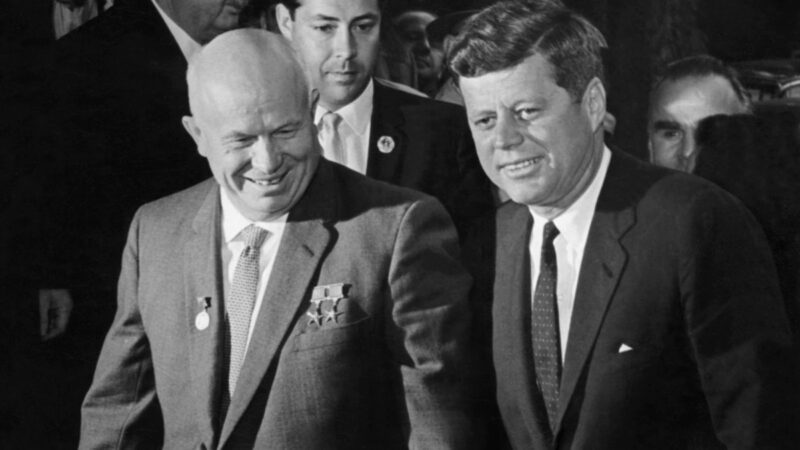
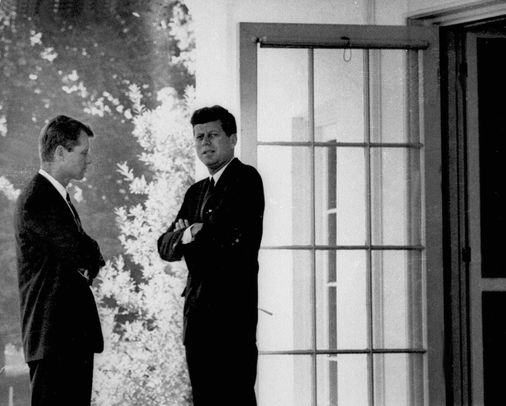
    It looks as if the war will continue into 2023, and possibly beyond that. Talks will probably not start before either side is prepared to concede due to exhaustion, or because both parties have reached an impasse. In the meantime, the death toll will continue to mount, pointing to the essential tragedy of major power politics. In the fall of 1962, then-US President John F. Kennedy was ready to walk to the edge of the nuclear precipice in order to prevent the Soviet Union from turning Cuba into its missile base. Sixty years later, Russian President Vladimir Putin ordered a military action to make sure that Ukraine does not become an unsinkable aircraft carrier for America.

    Whatever Soviet leader Nikita Khrushchev thought about his right to counter US missiles pointed at Moscow from Turkey with weapons of his own targeting Washington and New York from Cuba (with Havana’s consent), and whatever successive US presidents thought about their right to expand the NATO military bloc to include Ukraine (at Kyiv’s wish), there is always a horrendous price to pay for the failure to take into account the rival power’s security interests.


    There is a lesson to be learned from this. Whatever Soviet leader Nikita Khrushchev thought about his right to counter US missiles pointed at Moscow from Turkey with weapons of his own targeting Washington and New York from Cuba (with Havana’s consent), and whatever successive US presidents thought about their right to expand the NATO military bloc to include Ukraine (at Kyiv’s wish), there is always a horrendous price to pay for the failure to take into account the rival power’s security interests. Cuba went down in history as a narrow success for common sense. Ukraine is an ongoing story, with its outcome still hanging in the balance.

    Feature Image: rt.com

    Image: Khrushchev and Kennedy – rferl.org

    Image: Robert and Jack Kennedy – bostonglobe.com – The most important lesson of the Cuban Missile crisis.

  • Russia: The Migration Dimension of the War in Ukraine

    Russia: The Migration Dimension of the War in Ukraine

    Abstract

    The Russian invasion of Ukraine on February 24, 2022 has drastically changed both the internal situation in the Russian Federation (RF) and the country’s relationship with the international community. The impact of these developments is multidimensional and has a significant human dimension, including the formation of new migration flows marked by high shares of young people, males, and members of various elite groups. The elite migrant flow generally includes four major categories of migrants: academic personnel, highly skilled workers (including representatives of professional, business, creative, and athletic elites), students, and so-called investment migrants.

    Economic Impact

    Shrinking economic output1 and the withdrawal of numerous transnational companies from the RF have threatened the jobs and livelihoods of a large segment of the Russian population, hurting first and foremost its elite segments. Indeed, the introduction of new sanctions cut the long-term international ties established in the economic, political, academic, artistic, and athletic spheres, to name just a few, impacting the lives of millions of people, chief among them the representatives of various professional, business, academic, cultural, and athletic elites.

    This negative impact has been aggravated by both the transborder transfers of transnational corporations’ offices and the flight of numerous Russian businesses, as well as individual enterpreneurs, to locations outside the RF. These movements, mostly economically and professionally motivated, have been supplemented by the emigration of people opposing the war as a matter of principle.

    Second Wave Exceeds First

    The second wave of emigration, significantly larger than the first, formed as a direct consequence of the declaration by Russian President Vladimir Putin on September 21 of a 300,000-strong “partial” mobilization and the subsequent announcement by RF Defense Minister Sergei Shoigu that up to 25 million Russian citizens might be eligible for mobilization orders—an announcement that de facto involved in the war the majority of the RF’s population (between the potential reservists and their family members). These developments and the subsequent mishandling of the mobilization process, marked by disorganization and numerous widely reported instances of corruption and abuse, acted as additional push factors of migration, which took on an increasingly politicized character.

    Thus, the migration flow in 2022 has essentially consisted of two—separate and consecutive—subflows. These are far from the only large-scale population movements in post-Soviet Russian history: they follow the “brain drain” of the 1990s and the smaller in scale but consistent population movements of the first two decades of the current century. Yet there are huge differences between the current developments and previous trends.

    Historical Perspective

    Russia saw its position in the global migration chain change drastically after the dissolution of the USSR in 1991. In its aftermath, the RF quickly became an active participant in the globalization process, following the general trend among those states that were previously the centers of multinational empires: the United Kingdom, France, Spain, Portugal, the Netherlands, Belgium, and especially the territorially contiguous empires (Germany, Austria, and Turkey) have received, since their empires’ collapse, considerable migrant flows of two major types. The first wave was the permanent—and mostly politically motivated—return migration of the representatives of the former “imperial” nation to their ethnic homelands (the Britons, French, Spaniards, Turks, etc.). They were soon followed by migrants from developing countries—primarily the former colonies of the metropole. These were people who spoke its language, knew its culture, and could rely on the support there of their long-established ethnic diasporas.

    As a result, Russia—previously one of the most isolated countries in the world—quickly became, after 1991, the center of a vast Eurasian migration system that was one of the four largest in the world (alongside those in North America; Western Europe; and the Middle East, centered on the Persian Gulf). By 2010, more than 12 million RF residents (about 8.5% of its population) had been born outside the country. In 2015, Russia ranked third in the world—after India and Mexico—in terms of its number of emigrants: 10.5 million.2 While most of these migrants moved within the post-Soviet space, in 1991–2005 alone, more than 1.3 million Russian citizens obtained permits for permanent emigration to the West.3 Overall, the number of those who were born in Russia but currently live in countries outside the former USSR is estimated at approximately 3,000,000.4

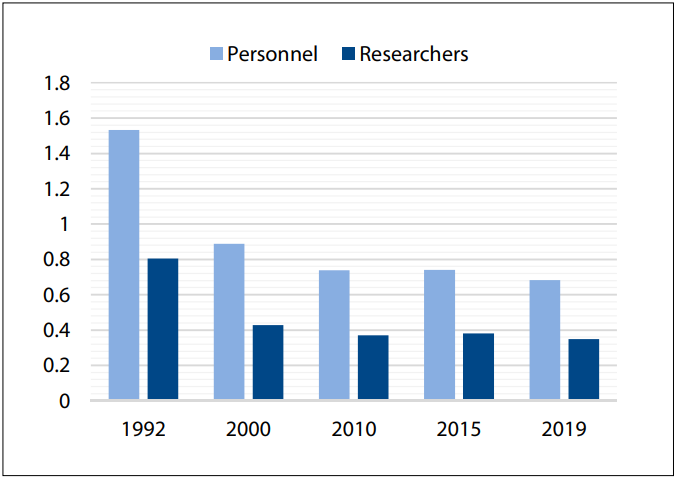
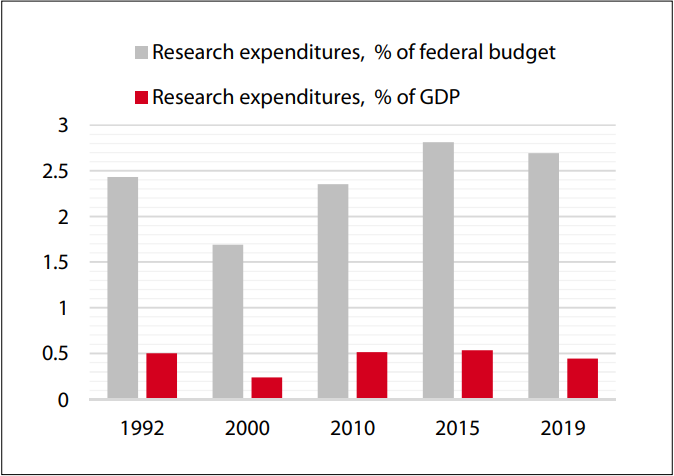
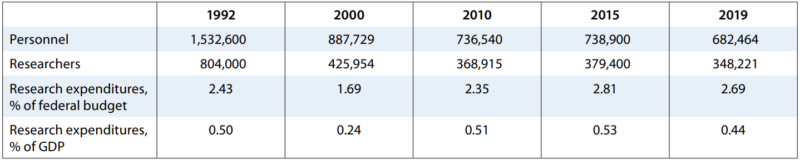
    This flow was generated by both the “pull” and “push” factors of migration. In the case of emigration outside the post-Soviet region, an important role was played by the liberalization of the migration regime and the emergence of opportunities to work and study abroad; higher living standards; prospects for professional growth; and the genearally welcoming atmosphere for Russian scholars, students, and professionals at that time. “Push” factors included the economic and political instability in Russia, specifically the rapid degradation of Russian state-run industry and of the academic sphere. Research expenditure as a share of Russian GDP was 0.50% in 1992 and 0.24% in 2000 (representing 2.43% and 1.69% of the federal budget, respectively). During this period (1992–2000), the number of those employed by the academic institutions fell from 1,532,000 to 887,729 (a 42% drop), while the number of researchers declined from 804,000 to 425,954 (a 47% drop).5

    With the economic and political stabilization of the early Putin years, budgetary expenditures increased, peaking in 2015 at 2.81% of the federal budget (0.53% of GDP).

    These processes led to the formation of significant elite Russian diasporas in the major receiving countries. Already by 2010–11, more than 660,000 university educated Russians were living abroad, putting the RF into the category of states with large elite diasporas (300,000 to 1,000,000 migrants with a university degree)—along with such countries as Mexico, South Korea, Vietnam, Iran, Taiwan, Morocco, and Colombia.6 Of particular importance was the massive emigration of Russian scholars and educators: I previously estimated the size of this elite diaspora at about 300,000–350,000 in 2012, including, as of 2015, approximately 56,000 students studying abroad. The academic flow was heavily dominated by basic and technical sciences experts, while specialists in social sciences and the humanities accounted for just 6.1% of the total in 2002–03.7 The flow was also skewed geographically toward the two highly developed Global North regions of North America and Western Europe, which respectively accounted for 30.4% and 42.4% of the intellectual migration flow. The largest receiving countries were the United States (28.7%) and Germany (19%); these two states also held first and second place, respectively, among receiving countries in practically all academic subfields.8

    With the economic and political stabilization of the early Putin years, budgetary expenditures increased, peaking in 2015 at 2.81% of the federal budget (0.53% of GDP). This served to slow down the academic personnel decline and the elite outflow: between 2000 and 2019, the number of those employed in the academic sphere declined from 887,729 to 682,464 (or by 23.1%), while the number of researchers fell from 425,954 to 348,221 (or by 18.2%9 —see Figures 1a and 1b below and Table 1 on p. 11). While the number of Russian students studying abroad remained relatively stable at 50,000–60,000, the RF during that period rebuilt its position as one of the leading hubs for international students—ranking sixth in the world behind the US, the UK, Australia, France, and Germany.10 Their numbers grew steadily, from 153,800 in 2010/2011 to 298,000 in the 2019/2020 academic year.11

    Figure 1a: Russian R&D Dynamics, 1992–2019: Personnel (mln.)

    Figure 1b: Russian R&D Dynamics, 1992–2019: Expenditures

    Source: Federal’naia sluzhba gosudarstvennoi statistiki, “Rossiia v Tsifrakh—2020,” 2021, https://gks.ru/bgd/regl/b20_11/Main.htm; Federal’naia sluzhba gosudarstvennoi statistiki, Rossiiskii Statisticheskii ezhegodnik 2009 (Moscow, 2009), 543, 553; Federal’naia sluzhba gosudarstvennoi statistiki, Rossiiskii Statisticheskii ezhegodnik 2020 (Moscow, 2020), 495–6, https://rosstat.gov.ru/storage/mediabank/Ejegodnik_2020.pdf; Gosudarstvennyi komitet Rossiiskoi Federatsii po statistike, Rossiiskii Statisticheskii ezhegodnik 2003 (Moscow, 2003), 531.

    Russia, while losing its elite migrants to the more developed countries of the Global North, was at least partially substituting for their loss with immigration from less developed states, primarily those in the post-Soviet space.

    Overall, it could be concluded that Russia transformed in the early 2000s from the country in deep economic and social crisis—and source of massive elite outflows— that it had been in the 1990s into a state with a moderate level of development that played multiple roles in the world migration chain: both sending and receiving migrants as well as acting as a migrant transit country. Russia, while losing its elite migrants to the more developed countries of the Global North, was at least partially substituting for their loss with immigration from less developed states, primarily those in the post-Soviet space. The impact of the “pull” factors of migration increased, while that of the “push” factors decreased, at least in relative terms.

    After the Invasion

    This multiplicity of roles was for the most part retained by the RF after the first invasion of Ukraine in 2014 (even under the conditions of the expanding sanctions
    regime) and during the general decline of migration activity worldwide as a result of COVID-19 restrictions. Yet the events of 2022 have drastically changed the migration environment, returning it to a crisis level, with the “push” factors of migration (such as the deteriorating political situation, sharp disagreements with governmental policies among certain segments of society, the unwillingness of many to serve in the RF military, the fear of losing jobs and sources of income, etc.) coming to the forefront.

    When it comes to the contrast between current migration flows and previous post-Soviet flows, the following points should be noted:

    • The 2022 migration waves are defined primarily by “push” factors, which have frequently forced people to leave even in the absence of adequate preparation
      (previous experience of work or study abroad, personal or professional networks) or clear prospects in destination countries.
    • Migration in 2022 is frequently directed toward smaller and economically weaker countries than in the 1990s, including those in Eastern Europe, the post-Soviet space (Central Asia, the Caucasus), and the Persian Gulf, as well as Turkey and Mongolia. This may lead to the reversal of the trends that have dominated (especially elite) migration patterns in Central Eurasia for the last three decades. This reversal, which has important symbolic value, may create significant long-term labor-market and demographic problems for the RF.
    • In contrast to previous migration waves, the current ones are marked by their hectic, spontaneous character and the heavy presence in the flow of young people working in the IT and business sectors, who are relatively flexible and could either seek jobs or create private-sector businesses. At the same time, there is also a significant share of people, especially within the academic bloc, who hold Humanities and Social Sciences degrees and have very limited prospects of finding jobs that correspond to their qualifications. Thus, even under the current crisis conditions, substantial return migration can be expected.
    • In 2022, movement is further complicated by the heritage of the COVID-19 pandemic and the new limitations resulting from the 2022 sanctions— these are related to the blocking of RF-issued credit cards, the break-up of direct transportation links with most European countries, complications with getting visas, and frequently prohibitive airfare rates. An additional complication is presented by the recent proposals, in a number of Western countries, to arrest RF citizens or confiscate their property.
    • A particular feature of the 2022 flows has been their “explosive,” emergency character, marked by very high intensity in the initial weeks and a relatively
      quick decline thereafter.

    There also exist visible differences between the flow that followed the developments of February 2022 and the flow that followed the events of September 2022. In particular,

    • A noticeable discrepancy exists in terms of their scale and gender structure. The first flow was on the order of 100,000–150,000 people and was relatively balanced in gender terms, frequently including whole families with children. The second, which followed Putin’s mobilization announcement, has been heavily dominated by young males. This in itself poses significant problems for Russia’s demographic and economic future.
    • The first flow was directed, first and foremost, toward all the countries neighboring Russia. The current one, meanwhile, is taking place under the conditions of
      changing public attitudes and governmental policies toward RF citizens, even those who oppose Putin’s actions. This dynamic could lead to general change in the direction of migration flows.
    • The flow of the first half of 2022 was marked by heavy presence of foreign citizens and people with dual citizenship or other legal status, who moved to the countries where they held such status. The participants in the current flow, who are primarily RF citizens, face additional legal problems in receiving countries by comparison.
    • The original flow included large numbers of people who worked in the RF offices of transnational companies that relocated, along with their personnel, to other countries. These people had some social guarantees, had experience of work for a TNC, and could rely on their companies’ support. People emigrating in the newest waves lack these opportunities.
    • The large-scale arrival of migrants in countries with relatively weak infrastructure and limited economic capacity (the states of the Baltic, the Transcaucasus, and Central Asia) has put significant pressure on these states’ economies and labor markets. Successive waves of migrants will therefore increasingly  encounter competition, economic hardship, and negative public attitudes.

    While there exist huge discrepancies in the estimates of migration flows made by various entities—both governmental agencies and non-governmental organization —in Russia as well as the receiving states, it is clear that the most recent flow has been much larger than the one in the first half of 2022. The most frequently cited figure is on the order of 700,000 people.12 How-ever, a major problem is that most estimates rely on the statistical data of the national border guard services, which report the number of border crossings in a particular period of time without accounting for repeat crossings, return migration, movement to the third countries, “shuttle” activities, irregular migration, etc.13 Because of these limitations, it is likely that the overall number of migrants in the “second wave” is currently in the range of 350,000–450,000. Thus, the overall number of migrants who have left the RF in the two urgent and chaotic waves of 2022 can be estimated at about 500,000. Even this figure represents a substantial potential loss for a country—particularly one like Russia that was already experiencing population decline.14 It is a special concern considering the skewed gender, age, and qualification structure of those currently leaving the RF.

    Table 1: Russian R&D Dynamics, 1992–2019

    Source: Federal’naia sluzhba gosudarstvennoi statistiki, “Rossiia v Tsifrakh—2020,” 2021, https://gks.ru/bgd/regl/b20_11/Main.htm; Federal’naia sluzhba gosudarstvennoi statistiki, Rossiiskii Statisticheskii ezhegodnik 2009 (Moscow, 2009), 543, 553; Federal’naia sluzhba gosudarstvennoi statistiki, Rossiiskii Statisticheskii ezhegodnik 2020 (Moscow, 2020), 495–6, https://rosstat.gov.ru/storage/mediabank/Ejegodnik_2020.pdf; Gosudarstvennyi komitet Rossiiskoi Federatsii po statistike, Rossiiskii Statisticheskii ezhegodnik 2003 (Moscow, 2003), 531.

    While these factors represent some very important arguments for putting an immediate end to the military action, it is clear that demographic, labor market, and socio-economic considerations are of minor significance for Vladimir Putin. More than that, following Alexander Lukashenka’s example in Belarus following the protests there in 2020, the RF leadership could perceive the current migration outflows as politically useful, ridding it of opponents to the war and regime and further weakening the country’s civil society. Thus, the disastrous 2022 policies might continue, aggravating both the domestic socio-economic situation and the RF’s position in the world.

    References:

    1. In particular, Russia’s industrial output in September 2022 was 9% of that in September 2021 (Federal’naia Sluzhba Gosudarstvennoi Statistiki, “Operativnye Pokazateli,” 2022, https://rosstat.gov.ru/).
    2. United Nations Department of Economic and Social Affairs, Population Division, Trends in International Migration Stock: The 2015 Revi- sion (New York: United Nations, 2015).
    3. Anatolii Vishnevskii, , Naseleniie Rossii 2003-2004: Odinnadtsatyi-dvenadtsatyi ezhegodnyi demograficheskii doklad (Moscow: Nauka, 2006), 325.
    4. “‘Meduza’ ob emigratsii iz Rossii,” Demoscope 945–6 (17–30 May 2022), http://www.demoscope.ru/weekly/2022/0945/gazeta01.php.
    5. Federal’naia sluzhba gosudarstvennoi statistiki, “Rossiia v Tsifrakh—2020,” 2021, https://gks.ru/bgd/regl/b20_11/Main.htm; Gosudarst- vennyi komitet Rossiiskoi Federatsii po statistike, Rossiiskii Statisticheskii ezhegodnik 2003 (Moscow, 2003),
    6. This group is second to that of countries with extra-large diasporas (more than 1,000,000 people). As of 2015, that group included India (2,080,000), China (1,655,000), the Philippines, the UK, and See Irina Dezhina, Evgeny Kuznetsov, and Andrei Korobkov, Raz- vitie Sotrudnichestva s Russkoiazychnoi Diasporoi: Opyt, Problemy, Perspektivy (Moscow, 2015), http://russiancouncil.ru/upload/Report- Scidiaspora-23-Rus.pdf, 18.
    7. V. Korobkov and Zh. A. Zaionchkovskaya, “Russian Brain Drain: Myths and Reality,” Communist and Post-Communist Studies 45, no. 3-4 (September-December 2012): 332.
    8. , 335–6. See also Andrei Korobkov, “Russian Academic Diaspora: Its Scale, Dynamics, Structural Characteristics, and Ties to the RF,” in Migration from the Newly Independent States: 25 Years After the Collapse of the USSR, ed. Mikhail Denisenko, Salvatore Strozza, and Matthew Light (New York: Springer, 2020), 299–322.
    9. Federal’naia sluzhba gosudarstvennoi statistiki, “Rossiia v Tsifrakh—2020;” Federal’naia sluzhba gosudarstvennoi statistiki, Rossiiskii Stat- isticheskii ezhegodnik 2020 (Moscow, 2020), 495–6, https://rosstat.gov.ru/storage/mediabank/Ejegodnik_2020.pdf.
    10. “Mezhdunarodnye studenty,” Unipage, 2019, https://unipage.net/ru/student_statistics.
    11. Federal’naia sluzhba gosudarstvennoi statistiki, “Rossiia v Tsifrakh—2020;” Federal’naia sluzhba gosudarstvennoi statistiki, Rossiiskii Stat- isticheskii ezhegodnik 2020, 206, https://rosstat.gov.ru/storage/mediabank/Ejegodnik_2020.pdf.
    12. See, for instance, “Forbes: posle ob”iavleniia mobilizatsii Rossiiu pokinuli primerno 700 chelovek,” Kommersant, October 4, 2022, https://www.kommersant.ru/doc/5594533.
    13. For example, the Interior Ministry of Kazakhstan reported at the beginning of October that in the wake of the mobilization announcement by Vladimir Putin on September 21, 2022, more than 200,000 people had crossed the country’s border with Russia, of whom just seven had been deported back to the At the same time, this report noted that 147,000 of them had already left Kazakhstan within a period of less than two weeks. See Mikhail Rodionov, “V Kazakhstan s 21 sentiabria v”ekhali bolee 200 tysiach rossiian. Deportirovali semerykh,” Gazeta. ru, October 4 2022, https://www.gazeta.ru/politics/2022/10/04/15571807.shtml.
    14. In 2019, the fertility rate in Russia was 1.504. See Federal’naia sluzhba gosudarstvennoi statistiki, “Rossiia v Tsifrakh—2020;” Federal’naia sluzhba gosudarstvennoi statistiki, Rossiiskii Statisticheskii ezhegodnik 2020, 103.

    This article was originally published at the Center for Security Studies (CSS)

    Featured Image Credits: Politico

  • TPF Analysis Series on Russia – Ukraine Conflict #2

    TPF Analysis Series on Russia – Ukraine Conflict #2

    [powerkit_button size="lg" style="info" block="true" url="https://admin.thepeninsula.org.in/2022/03/29/tpf-analysis-series-on-russia-ukraine-conflict/" target="_blank" nofollow="false"]
    The First Paper of the Series – TPF Analysis Series on Russia – Ukraine Conflict #1
    [/powerkit_button]

    What’s in Ukraine for Russia? 

    In a press conference marking his first year in office, President Biden, on the question of Russia invading Ukraine, remarked that such an event would, “be the most consequential thing that’s happened in the world, in terms of war and peace, since World War Two”. [1] It has now been two months since Russia officially launched its “special military operation” in Ukraine, which the US and its allies consider an unjustified invasion of a sovereign state. The conflict in the Eurasian continent has drawn global attention to Europe and US-Russia tensions have ratcheted to levels that were prevalent during the Cold War. The conflict has also raised pertinent questions on understanding what exactly are Russian stakes in Ukraine and the latter’s role in the evolving security architecture of Europe. The second paper in this series will delve into these questions.

    The current Russian position stems from the experience that Russia, and Putin, gained while dealing with the West on a host of issues, not least of which was NATO expansion.

    The Ties that Bind

    An examination of post-Soviet history reveals that Russian preoccupation with security threats from NATO is not embedded in Russian geopolitics; instead, it has been reported that, early on, Russia was even agreeable to joining the military alliance. The current Russian position stems from the experience that Russia, and Putin, gained while dealing with the West on a host of issues, not least of which was NATO expansion. A line of argument sympathetic to Russia is President Putin’s contention that terms dictated to Russia during the post-Cold War settlements were unfair. The claim is a reference to Secretary of State James Baker’s statement on the expansion of NATO, “not an inch of NATO’s present military jurisdiction will spread in an eastern direction”, in 1990 in a candid conversation with Mikhael Gorbachev on the matter of reunification of Germany. [2] It could be argued that it is this commitment and subsequent violation through expansions of NATO is one of the main causes of the current conflict. 

    At the root of the problem was Russia’s security concerns – regarding both traditional and hybrid security – that ultimately led to the centralisation of power after a democratic stint under Yeltsin. Accordingly, Putin had put it in late 1999, “A strong state for Russia is not an anomaly, or something that should be combated, but, on the contrary, the source and guarantor of order, the initiator and the main driving force of any changes”. [3]

    Historically being a land power, Russia has viewed Ukraine as a strategically critical region in its security matrix. However, as the central control of Moscow weakened in the former USSR, the nationalist aspirations of the Ukrainian people began to materialise and Ukraine played a crucial role, along with the Russian Federation and Belarus, in dissolving the former Soviet Union. The two countries found themselves on opposite sides on extremely fundamental issues, such as security, economic partnership, post-Soviet order, and, not least, sovereignty. In Belovezh, in early December of 1991, when Russian President Boris Yeltsin, Ukrainian President Leonid Kravchuk and Belarusian leader Stanislav Shushkevich met to dissolve the USSR, major disagreements regarding the transitional phase and future of the republics erupted. Yeltsin expressed his desire for some sort of central control of the republics, whereas Kravchuk was vehemently opposed to any arrangement that might compromise his country’s sovereignty. Later, at the foundational ceremony of the Commonwealth of Independent States (CIS), he stressed a common military, the most potent rejection of which came from Kravchuk. [4]

    Source: Wikimedia Commons

    The elephant in the room, however, was the status of Sevastopol, which housed the headquarters of the Black Sea Fleet. Yeltsin was quoted saying that “The Black Sea Fleet was, is and will be Russia’s. No one, not even Kravchuk will take it away from Russia”. [5] Though the issue was soon temporarily resolved –with the two countries dividing the fleet equally amongst themselves, it continued to dominate and sour their relationship. Russia, as the successor state of the USSR, wanted the base and the entire fleet in its navy. Yeltsin even offered gas at concessional rates to Ukraine if it handed over the city and nuclear weapons to Russia. The issue remained unresolved until the 1997 Friendship Treaty under which Ukraine granted Moscow the entire fleet and leased Sevastopol to Russia until 2017 (later extended).

    Ukraine, under Kravchuk and, later, Leonid Kuchma, struggled to tread a tightrope between Russia and the European Union. On one hand, it was economically knit with former Soviet Republics, and on the other, it was actively looking to get economic benefits from the EU. However, soon a slide towards the west was conspicuous. In 1994, it preferred a Partnership and Cooperation Agreement with the EU over CIS Customs Union, which was a Russian initiative. Later, in 1996, it declined to join a new group consisting of former Soviet Republics ‘On Deepening Integration’, scuttling the initiative, since its purpose was to bring Ukraine back into the Russian fold. [6] By 1998, the Kuchma government had formulated a ‘Strategy of Integration into the European Union’. [7]

    Nuclear weapons were another point of contention between the two. Ukraine was extremely reluctant to give up its arsenal, citing security threats from Russia. Kravchuk received a verbal ‘security guarantee’ from the US which forced Russia to “respect the independence, sovereignty, and territorial integrity of each nation” [8] in exchange for surrendering Ukraine’s nuclear weapons. 

    Notwithstanding the disputes, there was a great deal of cooperation between the two, especially after Kuchma’s re-election in 1999. Kuchma’s hook-up with authoritarianism distanced Kyiv from Brussels and brought it closer to Moscow. Ukraine agreed to join Russian initiatives of the Eurasian Economic Community as an observer and Common Economic Space as a full member. At home as well, his support in the eastern parts of the country, where ethnic Russians dwelled, increased dramatically, as evident in the 2002 Parliamentary Elections. [9] However, the bonhomie was soon disrupted by a single event.

    The Orange Revolution was Russia’s 9/11. [10] It dramatically altered Russian thinking on democracy and its ties with the West. It raised the prospect in Russia that Ukraine might be lost completely. It further made them believe the colour revolutions in former Soviet republics were CIA toolkits for regime change. More importantly, it made the Russians apprehensive of a similar revolution within their borders. As a result, the distrust between Russia and the West, and Russia and Ukraine grew considerably. As a nationalist, Victor Yushchenko formulated policies that directly hurt Russian interests. The two countries fought ‘Gas Wars’ in 2006 and 2009, which made both the EU and Russia uncomfortable with Ukraine as a gas transit country. Furthermore, Yushchenko bestowed the title of ‘Hero of Ukraine’ upon Stepan Bandera, a Nazi collaborator and perpetrator of the Holocaust, a decision that surely did not go well with Moscow.

    Geoeconomics: Ukraine as a Gas Transit Country

    The current war is the worst in Europe since the Second World War. Still, Ukraine continues to transit Russian gas through its land, Russia continues to pay for it, and Western Europe continues to receive the crucial resource. The war has shattered all the big bets on Russian dependence on Ukraine for delivering gas to Western Europe and has renewed the discourse on reducing European energy dependence on Russia. Since the EU imports 40% of its gas from Russia, almost a quarter of which flows through Ukraine, Kyiv has had leverage in dealing with Russians in the past. It has been able to extract favourable terms by either stopping or diverting gas for its own domestic use at a time of heightened tensions between Ukraine and Russia. As a result, the EU was directly drawn into the conflict between them, infructuating Moscow’s pressure tactics for a long.

    Moscow has made numerous attempts in the past to bypass Ukraine by constructing alternate pipelines. Nord Stream, the most popular of them, was conceived in 1997, as an attempt to decrease the leverage of the transit states. The pipeline was described as the “Molotov-Ribbentrop Pipeline” by Polish Defence Minister Radoslaw Sirkosi for the geoeconomic influence it gave to Russia. [11] Another project – the South Stream – was aimed at providing gas to the Balkans, and through it to Austria and Italy. The pipeline was conceived in the aftermath of the Orange Revolution and its construction was motivated by geoeconomics, rather than economic viability. It would have led to Russia bypassing Ukraine in delivering gas to the Balkans and Central Europe, thus seizing its significant leverage, and relegating it to vulnerable positions in which Moscow could have eliminated the gas subsidies Ukraine was being provided. [12]As a result of economic unviability, the project was abandoned in 2014.

    To a certain extent, the European Union has been complicit in making matters worse for Russia. For instance, during the 2009 ‘Gas War’ – that began due to Ukraine’s non-payment of gas debt to Russia – instead of holding Ukraine accountable, the EU countries blamed Russia for the gas crisis in Europe and asked Russia to resume gas supply to Ukraine. Later, realising the importance of Ukraine as a transit country, it reached an agreement with Kyiv that “recognized the importance of the further expansion and modernization of Ukraine’s gas transit system as an indispensable pillar of the common European energy infrastructure, and the fact that Ukraine is a strategic partner for the EU gas sector”. The agreement excluded Russia as a party, which saw it as undermining the collaboration between itself and Ukraine, and injuring its influence on the country. [13] The Russian grievance becomes even more palpable when we view the significant gas subsidies it has provided to Ukraine for more than two decades. 

    Similarly, the EU countries viewed Nord Stream 2 from a geostrategic and geo-economic perspective. In December last year, German Economic Affairs Minister Robert Habeck warned Russia of halting Nord Stream 2 if it attacks Ukraine. German Chancellor Olaf Scholz was quoted saying that he would do ‘anything’ to ensure that Ukraine remains a transit country for Russian gas. [14] In fact, the pipeline – that is set to double the capacity of gas delivered to the EU – has faced opposition from almost all Western European countries, the US, the EU as well as Ukraine, which has described it as ‘A dangerous Geopolitical Weapon’. [15] The pipeline had raised concerns amongst Ukrainians of losing a restraining factor on Moscow’s behaviour. [16] However, with the pipeline still inoperable, the Kremlin has already made the restraining factor ineffective.

    The Security Objective

    The Russian Federation is a country which spreads from the European Continent to Asia. In this giant nation, the hospitable region where people live is mainly on the European side, which also comprises main cities like St. Petersburg, Volgograd and the Capital City Moscow. Throughout history, Russia has seen invasions by Napoleon as well as Hitler, and the main area through which these invasions and wars happened was through Ukrainian land which gave them direct access to Russia – due to the lack of any geographical barriers. It was certainly a contributing factor towards the initial success of these invasions. Today, we might understand these events as Russia’s sense of vulnerability and insecurity if history is any indicator. 

    The Russian Federation also follows a similar approach to ensuring its security, survival and territorial integrity. Russia’s interest in Ukraine is as much geopolitical as cultural. Since Russians and Ukrainians were intrinsically linked through their culture and language, Ukraine quickly came to be seen as Russian land, with Ukrainians being recognized as ‘Little Russians’ (Kubicek, 2008), as compared to the “Great Russians”. They were consequently denied the formation of a distinct Ukrainian identity. Putin gave substance to this sentiment as, according to a US diplomatic cable leak, he had “implicitly challenged the territorial integrity of Ukraine, suggesting that Ukraine was an artificial creation sewn together from the territory of Poland, the Czech Republic, Romania, and especially Russia in the aftermath of the Second World War” during a Russia-NATO Council meeting. [17]

    Crimea and much of eastern Ukraine are ethnically Russian and desire closer ties with Russia. But moving further west, the people become increasingly cosmopolitan and it is mostly this population that seeks greater linkage with the Western European countries and membership into the EU and NATO. This in addition to the Euro Maidan protests is what Putin has used to justify the annexation of Crimea in 2014. The other security consideration was the threat it faced from the likelihood of NATO establishing a base in Crimea given its own presence in Sevastopol in the Black Sea. 

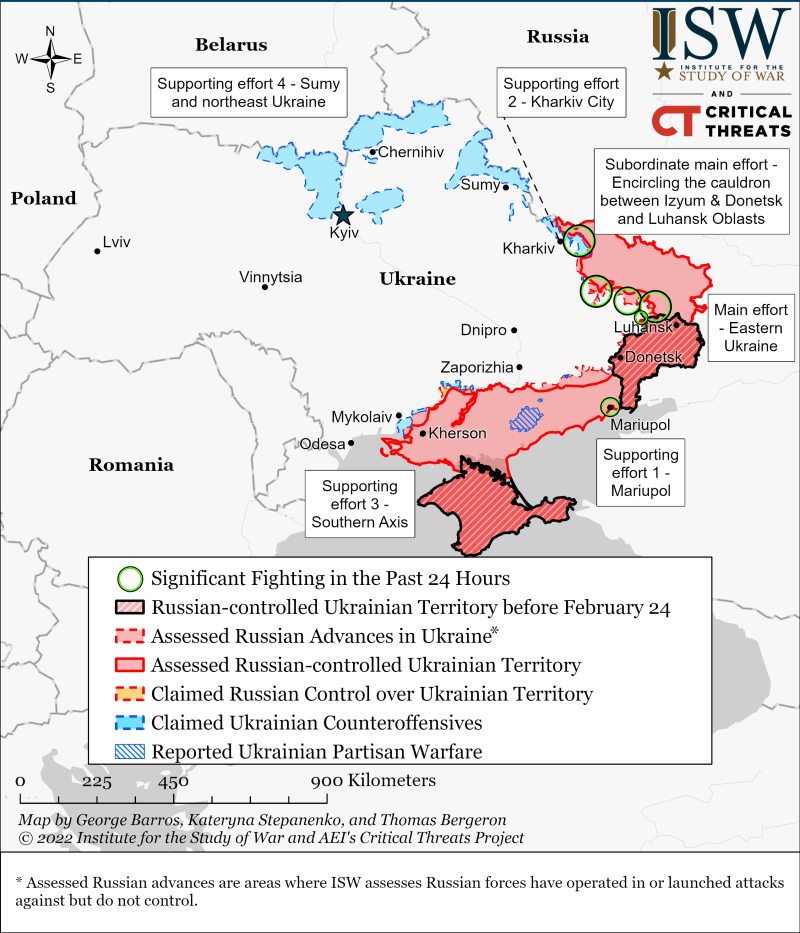
    In the current scenario, the second phase of Russian Military operation in the East and South has shown us the larger vulnerabilities Moscow has which are being countered through control of certain points in the region. By liberating the Donbass region in the east, Russia plans to create a buffer zone between itself and the west to stop future aggression and keep enemies at bay. But the extension of this buffer zone all the way to Odessa is indicative of other strategic considerations. Mariupol in the south of Ukraine is one of the many extended strategic points Russia now controls leading us to ask just why Mariupol is a game-changer in this conflict?

    The port city of Mariupol is a small area geographically, but it provides the land bridge for the Russian forces in the Crimean Peninsula to join the Military operation in the Donbas region. Moreover, it gives Russia a land bridge to Crimea from the Russian Mainland. According to General Sir Richard Barrons, former Commander of UK Joint Forces Command, Mariupol is crucial to Russia’s offensive movement, – “When the Russians feel they have successfully concluded that battle, they will have completed a land bridge from Russia to Crimea and they will see this a major strategic success.” [18]

    Source: ISW (Assessment on 09 May, 2022)

    If the port city of Mariupol is important for the creation of a land corridor, then the Sea of Azov which is adjacent to it is even more important due to its strategic position. [19] The three geopolitical reasons why this sea is important are as follows:

    1. The Sea of Azov is a major point for the economic and military well-being of Ukraine. Proximity to the frontlines of the Donbass region where the fighting between Ukrainian forces and Pro-Russian separatists is taking place makes the control of this sea vital to the Russian military as it helps weaken Ukrainian defence in the region via control of the Kerch Strait.
    2. Controlling the Sea of Azov is strategically important for Russia, to maintain its control in the Crimean Peninsula, which allows Moscow to resupply its forces through the Strait of Kerch.
    3. Finally, it also involves Eurasian politics into why Russia needs to control this region and here the discussion of the Volga-Don canal which links the Caspian Sea with the Sea of Azov comes to the fore. Russia has always used this canal to move warships between the Caspian Sea to the Black Sea and project its power in both regions. Moreover, Russia sees this connection as a significant strategic advantage in any future crisis.

    If Mariupol and the Sea of Azov are considered the most important strategically valuable features by Russia, there also exists the crucial points of Kherson and Odessa which will give Russia complete dominance of the Ukrainian coast line, thus giving larger access and control in the Black Sea region that has the potential to be militarised in the future in conflicts with the West. Moreover, it gives Russia a land corridor to Transnistria which is a Pro-Russian separatist area in Moldova and an opening into the Romanian border through Odessa, thus balancing the build-up of NATO forces in the region. 

    Conclusion

    The Ukrainian crisis is as much the West’s doing as Russia’s and an ear sympathetic to the Russian narrative might even say that the West took advantage of Russia when it was vulnerable immediately following the collapse of the Soviet Union in negotiations regarding the German state reunification and NATO enlargement.

    The bottom line is that, presently, Putin views NATO as an existential security threat to the Russian state and sees the US and its allies’ support of Ukraine as a challenge. Ukraine’s membership in the EU and NATO is a non-starter for Russia and pitting a Ukraine, that has a symbiotic relationship with Russia at all levels, against a slightly diminished but still formidable great power will have consequences for the security architecture and geopolitics of the region.  The Ukrainian crisis is as much the West’s doing as Russia’s and an ear sympathetic to the Russian narrative might even say that the West took advantage of Russia when it was vulnerable immediately following the collapse of the Soviet Union in negotiations regarding the German state reunification and NATO enlargement. On some level, NATO countries recognize the fact that Ukraine and Georgia can never be allowed membership into the North Atlantic alliance because the alternative of wilfully ignoring Russia’s security and national interests is just a recipe for disaster and might just launch the region into the single biggest armed conflict since World War 2. 

    References:

    [1] The White House. (2022, January 20). Remarks by president Biden in the press conference. https://www.whitehouse.gov/briefing-room/speeches-remarks/2022/01/19/remarks-by-president-biden-in-press-conference-6/

    [2] Savranskaya, S., Blanton, T. S., & Zubok, V. (2010). Masterpieces of history: The peaceful end of the Cold War in Europe, 1989. Central European University Press.

    [3] Putin, Vladimir. “Rossiya na Rubezhe Tysyacheletii,” Nesavisimaya Gazeta, December 30, 1999, quoted in D’Anieri, Paul (2019). Ukraine and Russia: From Civilized Divorce to Uncivil War. Cambridge University Press.

    [4] Ibid

    [5] Rettie, J. and James Meek, “Battle for Soviet Navy,” The Guardian, January 10, 1992

    [6] Ibid, no. iii

    [7] Solchanyk, R., Ukraine and Russia: The Post-Soviet Transition. Rowman and Littlefield Publishers. 2000.

    [8] Goldgeier, J. and Michael McFaul. “Power and Purpose: U.S. Policy Toward Russia after the Cold War”, Brookings Institution Press, 2003

    [9] Ibid, no. iii

    [10]  The comment was made by Gleb Pavlovskii, a Russian Political Scientist. quoted in Ben Judah (2013), Fragile Empire: How Russia Fell In and Out of Love with Vladimir Putin. New Haven, CT: Yale University Press, p. 85.

    [11] Ibid, no. iii

    [12] Wigell, M. and  A. Vihma, Geopolitics versus geoeconomics: the case of Russia’s geostrategy and its effects on the EU. International Affairs, 92: 605-627. May 6, 2016

    [13] Ibid, no. iii

    [14] Harper, J. (2021, December 23). Nord stream 2: Who wins, who loses? Deutsche Welle. https://www.dw.com/en/nord-stream-2-who-wins-who-loses/a-60223801

    [15] Ukraine: Nord stream 2 a ‘dangerous geopolitical weapon’. (2021, August 22). DW.COM. https://www.dw.com/en/ukraine-nord-stream-2-a-dangerous-geopolitical-weapon/a-58950076

    [16] Pifer, S. “Nord Stream 2: Background, Objectives and Possible Outcomes”, Brookings, April 2021 https://www.brookings.edu/research/nord-stream-2-background-objections-and-possible-outcomes/

    [17] WikiLeaks. (2008, August 14). UKRAINE, MAP, AND THE GEORGIA-RUSSIA CONFLICT, Canonical ID:08USNATO290_ahttps://wikileaks.org/plusd/cables/08USNATO290_a.html

    [18] Gardner, F. (2022, March 21). Mariupol: Why Mariupol is so important to Russia’s plan. BBC News. https://www.bbc.com/news/world-europe-60825226

    [19] Blank, S. (2018, November 6). Why is the Sea of Azov so important? Atlantic Council. https://www.atlanticcouncil.org/blogs/ukrainealert/why-is-the-sea-of-azov-so-important/

    Featured Image Credits: Financial Times

    [powerkit_button size="lg" style="info" block="true" url="https://admin.thepeninsula.org.in/2022/03/29/tpf-analysis-series-on-russia-ukraine-conflict/" target="_blank" nofollow="false"]
    TPF Analysis Series on Russia – Ukraine Conflict #1
    [/powerkit_button]

  • Does Facial Recognition Tech in Ukraine’s War Bring Killer Robots Nearer?

    Does Facial Recognition Tech in Ukraine’s War Bring Killer Robots Nearer?

    Clearview AI is offering its controversial tech to Ukraine for identifying enemy soldiers – while autonomous killing machines are on the rise

    Technology that can recognise the faces of enemy fighters is the latest thing to be deployed to the war theatre of Ukraine. This military use of artificial intelligence has all the markings of a further dystopian turn to what is already a brutal conflict.

    The US company Clearview AI has offered the Ukrainian government free use of its controversial facial recognition technology. It offered to uncover infiltrators – including Russian military personnel – combat misinformation, identify the dead and reunite refugees with their families.

    To date, media reports and statements from Ukrainian government officials have claimed that the use of Clearview’s tools has been limited to identifying dead Russian soldiers in order to inform their families as a courtesy. The Ukrainian military is also reportedly using Clearview to identify its own casualties.

    This contribution to the Ukrainian war effort should also afford the company a baptism of fire for its most important product. Battlefield deployment will offer the company the ultimate stress test and yield valuable data, instantly turning Clearview AI into a defence contractor – potentially a major one – and the tool into military technology.

    If the technology can be used to identify live as well as dead enemy soldiers, it could also be incorporated into systems that use automated decision-making to direct lethal force. This is not a remote possibility. Last year, the UN reported that an autonomous drone had killed people in Libya in 2020, and there are unconfirmed reports of autonomous weapons already being used in the Ukrainian theatre.

    Our concern is that hope that Ukraine will emerge victorious from what is a murderous war of aggression may cloud vision and judgement concerning the dangerous precedent set by the battlefield testing and refinement of facial-recognition technology, which could in the near future be integrated into autonomous killing machines.

    To be clear, this use is outside the remit of Clearview’s current support for the Ukrainian military; and to our knowledge Clearview has never expressed any intention for its technology to be used in such a manner. Nonetheless, we think there is real reason for concern when it comes to military and civilian use of privately owned facial-recognition technologies.

    Clearview insists that its tool should complement and not replace human decision-making. A good sentiment but a quaint one

    The promise of facial recognition in law enforcement and on the battlefield is to increase precision, lifting the proverbial fog of war with automated precise targeting, improving the efficiency of lethal force while sparing the lives of the ‘innocent’.

    But these systems bring their own problems. Misrecognition is an obvious one, and it remains a serious concern, including when identifying dead or wounded soldiers. Just as serious, though, is that lifting one fog makes another roll in. We worry that for the sake of efficiency, battlefield decisions with lethal consequences are likely to be increasingly ‘blackboxed’ – taken by a machine whose working and decisions are opaque even to its operator. If autonomous weapons systems incorporated privately owned technologies and databases, these decisions would inevitably be made, in part, by proprietary algorithms owned by the company.

    Clearview rightly insists that its tool should complement and not replace human decision-making. The company’s CEO also said in a statement shared with openDemocracy that everyone who has access to its technology “is trained on how to use it safely and responsibly”. A good sentiment but a quaint one. Prudence and safeguards such as this are bound to be quickly abandoned in the heat of battle.

    Clearview’s systems are already used by police and private security operations – they are common in US police departments, for instance. Criticism of such use has largely focused on bias and possible misidentification of targets, as well as over-reliance on the algorithm to make identifications – but the risk also runs the other way.

    The more precise the tool actually is, the more likely it will be incorporated into autonomous weapons systems that can be turned not only on invading armies but also on political opponents, members of specific ethnic groups, and so on. If anything, improving the reliability of the technology makes it all the more sinister and dangerous. This doesn’t just apply to privately owned technology, but also to efforts by states such as China to develop facial recognition tools for security use.

    Outside combat, too, the use of facial recognition AI in the Ukrainian war carries significant risks. When facial recognition is used in the EU for border control and migration purposes – and it is, widely – it is public authorities that are collecting the sensitive biomarker data essential to facial recognition, the data subject knows that it is happening and EU law strictly regulates the process. Clearview, by contrast, has already repeatedly fallen foul of the EU’s GDPR (General Data Protection Regulation) and has been heavily sanctioned by data security agencies in Italy and France.

    If privately owned facial recognition technologies are used to identify Ukrainian citizens within the EU, or in border zones, to offer them some form of protective status, a grey area would be established between military and civilian use within the EU itself. Any such facial recognition system would have to be used on civilian populations within the EU. A company like Clearview could promise to keep its civil and military databases separate, but this would need further regulation – and even then would pose the question as to how a single company can be entrusted with civil data which it can easily repurpose for military use. That is in fact what Clearview is already offering the Ukrainian government: it is building its military frontline recognition operation on civil data harvested from Russian social media records.

    Then there is the question of state power. Once out of the box, facial recognition may prove simply too tempting for European security agencies to put back. This has already been reported in the US where the members of the New York Police Department are reported to have used Clearview’s tool to circumvent data protection and privacy rules within the department and to have installed Clearview’s app on private devices in violation of NYPD policy.

    This is a particular risk with relation to the roll-out and testing in Ukraine. If Ukrainian accession to the European Union is fast-tracked, as many are arguing it should be, it will carry into the EU the use of Clearview’s AI as an established practice for military and potentially civilian use, both initially conceived without malice or intention of misuse, but setting what we think is a worrying precedent.

    The Russian invasion of Ukraine is extraordinary in its magnitude and brutality. But throwing caution to the wind is not a legitimate doctrine for the laws of war or the rules of engagement; this is particularly so when it comes to potent new technology. The defence of Ukraine may well involve tools and methods that, if normalised, will ultimately undermine the peace and security of European citizens at home and on future fronts. EU politicians should be wary of this. The EU must use whatever tools are at its disposal to bring an end to the conflict in Ukraine and to Russian aggression, but it must do so ensuring the rule of law and the protection of citizens.

    This article was published earlier in openDemocracy, and is republished under Creative Commons Licence

    Feature Image Credit: www.businessinsider.in

  • The Military Situation in Ukraine

    The Military Situation in Ukraine

    Understanding the war in Ukraine is a challenge as all the available information is mired in Western Propaganda. However, there are sane voices of scholars like John Mearsheimer and a small group of excellent professionals and military veterans who provide extremely accurate analysis to ensure we get the true picture of this geopolitical contest between Russia and the US and NATO. Jacques Baud is a former Colonel of the General Staff, intelligence expert in NATO, and ex-member of the Swiss intelligence, and specialist on Eastern countries.

    In this excellent analysis, Jacques Baud brings out how the US and NATO have created conditions for the war and are using Ukraine as the sacrificial pawn in their proxy war against Russia. Jacques Baud demolishes the West’s propaganda about Russia’s invasion of Ukraine on Feb 24th and traces the start of the war to Feb 16th by the US and NATO.  Contrary to the American propaganda, he sees Putin as the master strategist. The end of this conflict will usher in a new multi-polar world order, in which the West may cease to be the rule maker.

    TPF is immensely happy to republish this article through the gracious courtesy of Centre Francaise de Recherche sure le Renseignement

    Capitulation – 1946 painting by Soviet Artist Pyotr Aleksandrovich Krivonogov, a veteran of The Great Patriotic War


    PART ONE: ON THE ROAD TO WAR

    For years, from Mali to Afghanistan, I worked for peace and risked my life for it. It is therefore not a question of justifying the war, but of understanding what led us to it. I note that the “experts” who take turns on the television sets analyze the situation based on dubious information, most often hypotheses turned into facts, and therefore we no longer manage to understand what is happening. That’s how you create panic.

    The problem is not so much who is right in this conflict, but how our leaders make their decisions.

    Let’s try to examine the roots of the conflict. It starts with those who for the past eight years have been talking to us about “separatists” or “independence” from the Donbas. It’s wrong. The referendums conducted by the two self-proclaimed republics of Donetsk and Luhansk in May 2014 were not ”  independence ” (независимость) referendums, as some unscrupulous journalists claimed, but ”  self-determination  ” or ”  autonomy (самостоятельность). The term “pro-Russian” suggests that Russia was a party to the conflict, which was not the case, and the term “Russian speakers” would have been more honest. Moreover, these referendums were conducted against the advice of Vladimir Putin.

    In fact, these republics did not seek to separate from Ukraine, but to have a statute of autonomy guaranteeing them the use of the Russian language as an official language. Because the first legislative act of the new government resulting from the overthrow of President Yanukovych, was the abolition, on February 23, 2014, of the Kivalov-Kolesnichenko law of 2012 which made Russian an official language. A bit as if putschists decided that French and Italian would no longer be official languages ​​in Switzerland.

    This decision causes a storm in the Russian-speaking population. This resulted in fierce repression against the Russian-speaking regions (Odesa, Dnepropetrovsk, Kharkov, Lugansk and Donetsk) which began in February 2014 and led to a militarization of the situation and a few massacres (in Odesa and Mariupol, for the most important). At the end of summer 2014, only the self-proclaimed republics of Donetsk and Lugansk remained.

    At this stage, too rigid and stuck in a doctrinaire approach to the operational art, the Ukrainian staff suffered the enemy without succeeding in imposing themselves. Examination of the course of the fighting in 2014-2016 in the Donbas shows that the Ukrainian general staff systematically and mechanically applied the same operational plans. However, the war waged by the autonomists was then very close to what we observed in the Sahel: very mobile operations carried out with light means. With a more flexible and less doctrinaire approach, the rebels were able to exploit the inertia of the Ukrainian forces to “trap” them repeatedly.

    In 2014, I am at NATO, responsible for the fight against the proliferation of small arms, and we are trying to detect Russian arms deliveries to the rebels in order to see if Moscow is involved. The information that we receive then comes practically all from the Polish intelligence services and does not “match” with the information from the OSCE: in spite of rather crude allegations, we do not observe any delivery of arms and materials Russian military.

    The rebels are armed thanks to the defections of Russian-speaking Ukrainian units which cross over to the rebel side. As the Ukrainian failures progressed, the entire tank, artillery or anti-aircraft battalions swelled the ranks of the autonomists. This is what drives the Ukrainians to commit to the Minsk Accords.

    But, just after signing the Minsk 1 Accords, Ukrainian President Petro Poroshenko launched a vast anti-terrorist operation (ATO/Антитерористична операція) against Donbas. Bis repetita placent: poorly advised by NATO officers, the Ukrainians suffered a crushing defeat at Debaltsevo which forced them to commit to the Minsk 2 Agreements…

    It is essential to recall here that the Minsk 1 (September 2014) and Minsk 2 (February 2015) Agreements provided for neither the separation nor the independence of the Republics, but their autonomy within the framework of Ukraine. Those who have read the Accords (they are very, very, very few) will find that it is written in full that the status of the republics was to be negotiated between Kyiv and the representatives of the republics, for an internal solution in Ukraine.

    This is why since 2014, Russia has systematically demanded their application while refusing to be a party to the negotiations, because it was an internal matter for Ukraine. On the other side, the Westerners – led by France – have systematically tried to replace the Minsk Accords with the “Normandy format”, which put Russians and Ukrainians face to face. However, let us remember, there were never any Russian troops in the Donbas before February 23-24, 2022. Moreover, OSCE observers have never observed the slightest trace of Russian units operating in the Donbas. Thus, the US intelligence map published by the Washington Post on December 3, 2021, does not show Russian troops in Donbas.

    In October 2015, Vasyl Hrytsak, director of the Ukrainian Security Service (SBU), confessed that only 56 Russian fighters had been observed in the Donbas. It was even comparable to that of the Swiss going to fight in Bosnia during the weekends, in the 1990s, or the French who are going to fight in Ukraine today.

    The Ukrainian army was then in a deplorable state. In October 2018, after four years of war, Ukraine’s chief military prosecutor Anatoly Matios said that Ukraine had lost 2,700 men in the Donbas: 891 from disease, 318 from traffic accidents, 177 from other accidents, 175 from poisoning (alcohol, drugs), 172 from careless handling of weapons, 101 from breaches of safety rules, 228 from murder and 615 from suicide.

    In fact, the army is undermined by the corruption of its cadres and no longer enjoys the support of the population. According to a UK Home Office report, when reservists were called up in March-April 2014, 70% did not show up for the first session, 80% for the second, 90% for the third and 95% for the fourth. In October/November 2017, 70% of callers did not show up during the “  Autumn 2017  ” callback campaign. This does not include suicides and desertions(often for the benefit of the autonomists) which reach up to 30% of the workforce in the ATO zone. Young Ukrainians refuse to go and fight in the Donbas and prefer emigration, which also explains, at least partially, the country’s demographic deficit.

    The Ukrainian Ministry of Defense then turned to NATO to help it make its armed forces more “attractive”. Having already worked on similar projects within the framework of the United Nations, I was asked by NATO to participate in a program intended to restore the image of the Ukrainian armed forces. But it’s a long process and the Ukrainians want to go quickly.

    Thus, to compensate for the lack of soldiers, the Ukrainian government resorted to paramilitary militias. They are essentially made up of foreign mercenaries, often far-right activists. As of 2020, they constitute around 40% of Ukraine’s forces and number around 102,000 men according to Reuters. They are armed, financed and trained by the United States, Great Britain, Canada and France. There are more than 19 nationalities – including Swiss.

    Western countries have therefore clearly created and supported Ukrainian far-right militias. In October 2021, the Jerusalem Post sounded the alarm by denouncing the Centuria project. These militias have been operating in the Donbas since 2014, with Western support. Even if we can discuss the term “Nazi”, the fact remains that these militias are violent, convey a nauseating ideology and are virulently anti-Semitic. Their anti-Semitism is more cultural than political, which is why the adjective “Nazi” is not really appropriate. Their hatred of the Jew comes from the great famines of the years 1920-1930 in Ukraine, resulting from the confiscation of crops by Stalin in order to finance the modernization of the Red Army. However, this genocide – known in Ukraine as the Holodomor – was perpetrated by the NKVD (predecessor of the KGB) whose upper echelons of leadership were mainly made up of Jews. That is why, today, Ukrainian extremists are asking Israel to apologize for the crimes of communism, as the Jerusalem Post reports. We are therefore a long way from a “  rewriting of history  ” by Vladimir Putin.

    These militias, stemming from the far-right groups that led the Euromaidan revolution in 2014, are made up of fanatical and brutal individuals. The best known of these is the Azov regiment, whose emblem is reminiscent of that of the 2nd SS Das Reich Panzer Division, which is the object of real veneration in Ukraine, for having liberated Kharkov from the Soviets in 1943, before perpetrating the massacre of Oradour-sur-Glane in 1944, in France.

    Among the famous figures of the Azov regiment was the opponent Roman Protassevich, arrested in 2021 by the Belarusian authorities following the case of RyanAir flight FR4978. On May 23, 2021, there is talk of the deliberate hijacking of an airliner by a MiG-29 – with Putin’s agreement, of course – to arrest Protassevich, although the information then available does not confirm this scenario in any way.

    But it must then be shown that President Lukashenko is a thug and Protassevich a “journalist” in love with democracy. However, a rather edifying investigation produced by an American NGO in 2020, highlighted Protassevich’s far-right militant activities. Western conspiracy then sets in motion and unscrupulous media “groom” his biography. Finally, in January 2022, the ICAO report is published and shows that despite some procedural errors, Belarus acted in accordance with the rules in force and that the MiG-29 took off 15 minutes after the RyanAir pilot decided to land in Minsk. So no Belarus plot and even less with Putin. Ah!… One more detail: Protassevich,cruelly tortured by Belarusian police, is now free. Those who would like to correspond with him can go to his Twitter account.

    The labelling of “Nazi” or “neo-Nazi” given to Ukrainian paramilitaries is considered Russian propaganda. Perhaps; but that is not the opinion of The Times of Israel, the Simon Wiesenthal Center or the Counterterrorism Center at West Point Academy. But this remains debatable, because, in 2014, Newsweek magazine seemed to associate them with… the Islamic State. A choice!

    So the West supports and continues to arm militias that have been guilty of numerous crimes against civilian populations since 2014: rape, torture and massacres. But while the Swiss government has been very quick to impose sanctions against Russia, it has not adopted any against Ukraine, which has been slaughtering its own population since 2014. In fact, those who defend the rights of the men in Ukraine have long condemned the actions of these groups, but have not been followed by our governments. Because, in reality, we are not trying to help Ukraine, but to fight Russia.

    The integration of these paramilitary forces into the National Guard was not at all accompanied by a “denazification”, as some claim. Among the many examples, that of the insignia of the Azov Regiment is edifying:
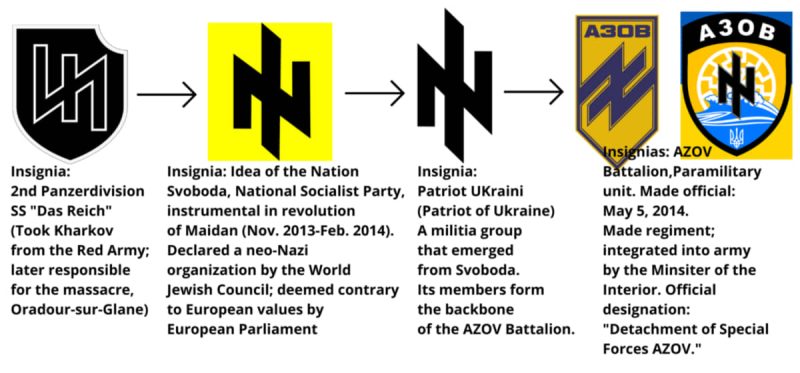
     

    In 2022, very schematically, the Ukrainian armed forces fighting the Russian offensive are structured as:

    – Army, subordinate to the Ministry of Defence: it is articulated in 3 army corps and composed of manoeuvre formations (tanks, heavy artillery, missiles, etc.).

    – National Guard, which depends on the Ministry of the Interior and is articulated in 5 territorial commands.

    The National Guard is therefore a territorial defence force that is not part of the Ukrainian army. It includes paramilitary militias, called ”  volunteer battalions” (добровольчі батальйоні), also known by the evocative name of ”  retaliatory battalions  “, composed of infantry. Mainly trained for urban combat, they now ensure the defence of cities such as Kharkov, Mariupol, Odesa, Kyiv, etc.

    PART II: THE WAR

    The former head of the Warsaw Pact forces in the Swiss strategic intelligence service, I observe with sadness – but not astonishment – ​​that our services are no longer in a position to understand the military situation in Ukraine. The self-proclaimed “experts” who parade across our screens wirelessly relay the same information modulated by the assertion that Russia – and Vladimir Putin – is irrational. Let’s take a step back.

    • THE OUTBREAK OF WAR

    Since November 2021, the Americans have constantly brandished the threat of a Russian invasion against Ukraine. However, the Ukrainians do not seem to agree. Why?

    We have to go back to March 24, 2021. On that day, Volodymyr Zelensky issued a decree for the reconquest of Crimea and began to deploy his forces towards the south of the country. Simultaneously, several NATO exercises were conducted between the Black Sea and the Baltic Sea, accompanied by a significant increase in reconnaissance flights along the Russian border. Russia then conducts a few exercises to test the operational readiness of its troops and show that it is following the evolution of the situation.

    Things calm down until October-November with the end of the ZAPAD 21 exercises, whose troop movements are interpreted as a reinforcement for an offensive against Ukraine. However, even the Ukrainian authorities refute the idea of ​​Russian preparations for a war and Oleksiy Reznikov, Ukrainian Minister of Defense declares that there has been no change on its border since the spring.

    In violation of the Minsk Accords, Ukraine is conducting aerial operations in Donbas using drones, including at least one strike against a fuel depot in Donetsk in October 2021. The American press points this out, but not the Europeans and no one condemns these violations.

    In February 2022, events rush. On February 7, during his visit to Moscow, Emmanuel Macron reaffirms to Vladimir Putin his attachment to the Minsk Accords, a commitment he will repeat after his interview with Volodymyr Zelensky the next day. But on February 11, in Berlin, after 9 hours of work, the meeting of the political advisers of the leaders of the ”  Normandy format  “ ends, without a concrete result: the Ukrainians still and always refuse to apply the Accordsof Minsk, apparently under pressure from the United States. Vladimir Putin then notes that Macron has made empty promises to him and that the West is not ready to enforce the Accords, as they have been doing for eight years.

    Ukrainian preparations in the contact zone continue. The Russian Parliament is alarmed and on February 15 asks Vladimir Putin to recognize the independence of the Republics, which he refuses.

    On February 17, President Joe Biden announces that Russia will attack Ukraine in the coming days. How does he know? Mystery… But since the 16th, the artillery shelling of the populations of Donbas has increased dramatically, as shown by the daily reports of OSCE observers. Naturally, neither the media, nor the European Union, nor NATO, nor any Western government reacts and intervenes. We will say later that this is Russian disinformation. In fact, it seems that the European Union and some countries purposely glossed over the massacre of the people of Donbas, knowing that it would provoke Russian intervention.

    At the same time, there are reports of acts of sabotage in the Donbas. On January 18, Donbas fighters intercept saboteurs equipped with Western equipment and speaking Polish seeking to create chemical incidents in Gorlivka. They could be CIA mercenaries, led or “advised” by Americans and made up of Ukrainian or European fighters, to carry out sabotage actions in the Donbas Republics.
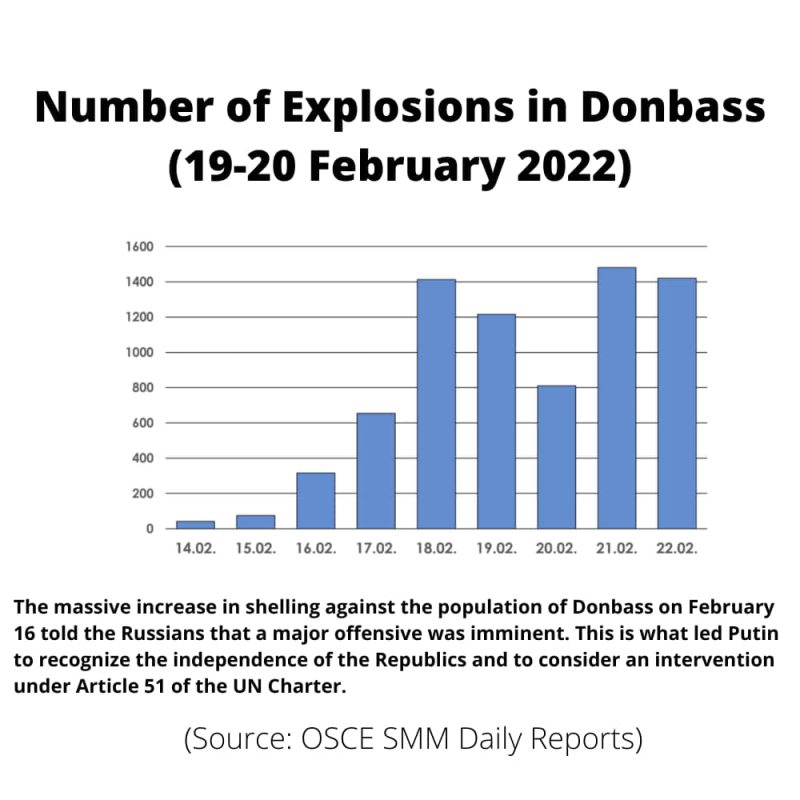
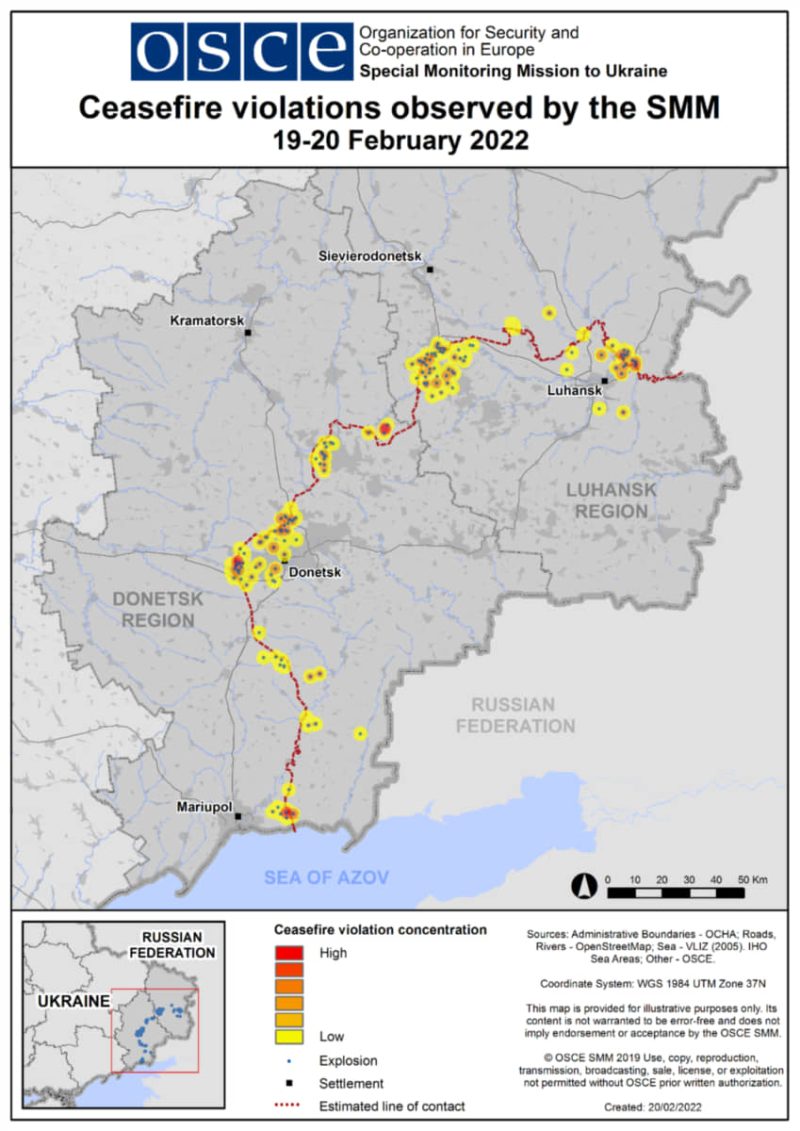
    In fact, as early as February 16, Joe Biden knows that the Ukrainians have begun to shell the civilian populations of Donbas, putting Vladimir Putin in front of a difficult choice: to help Donbas militarily and create an international problem or to sit idly by and watch the Russian speakers. from the Donbas being run over.

    If he decides to intervene, Vladimir Putin can invoke the international obligation of “  Responsibility To Protect  ” (R2P). But he knows that whatever its nature or scale, the intervention will trigger a shower of sanctions. Therefore, whether its intervention is limited to the Donbas or whether it goes further to put pressure on the West for the status of Ukraine, the price to be paid will be the same. This is what he explains in his speech on February 21.

    That day, he acceded to the request of the Duma and recognized the independence of the two Republics of Donbas and, in the process, he signed treaties of friendship and assistance with them.

    The Ukrainian artillery bombardments on the populations of Donbas continued and, on February 23, the two Republics requested military aid from Russia. On the 24th, Vladimir Putin invokes Article 51 of the United Nations Charter which provides for mutual military assistance within the framework of a defensive alliance.

    In order to make the Russian intervention totally illegal in the eyes of the public, we deliberately obscure the fact that the war actually started on February 16th. The Ukrainian army was preparing to attack the Donbas as early as 2021, as certain Russian and European intelligence services were well aware… The lawyers will judge.

    In his speech on February 24, Vladimir Putin stated the two objectives of his operation: to “demilitarize” and “denazify” Ukraine. It is therefore not a question of seizing Ukraine, nor even, in all likelihood, of occupying it and certainly not of destroying it.

    From there, our visibility on the progress of the operation is limited: the Russians have excellent security of operations (OPSEC) and the detail of their planning is not known. But fairly quickly, the course of operations makes it possible to understand how the strategic objectives were translated into the operational plan.

    – Demilitarization:

    . ground destruction of Ukrainian aviation, air defence systems and reconnaissance assets;

    . neutralization of command and intelligence structures (C3I), as well as the main logistics routes in the depth of the territory;

    . encirclement of the bulk of the Ukrainian army massed in the southeast of the country.

    – Denazification:

    . destruction or neutralization of volunteer battalions operating in the cities of Odesa, Kharkov and Mariupol, as well as in various facilities on the territory.

    • THE “DEMILITARIZATION”

    The Russian offensive proceeds in a very “classic” manner. At first – as the Israelis had done in 1967 – with the destruction on the ground of the air forces in the very first hours. Then, we witness a simultaneous progression on several axes according to the principle of “flowing water”: we advance wherever resistance is weak and we leave the cities (very voracious in troops) for later. To the north, the Chernobyl plant is occupied immediately to prevent acts of sabotage. The images of Ukrainian and Russian soldiers jointly guarding the plant are naturally not shown…

    The idea that Russia is trying to take over Kyiv, the capital, to eliminate Zelensky, typically comes from the West: this is what they did in Afghanistan, Iraq, Libya and what they wanted to do in Syria with the help of the Islamic State. But Vladimir Putin never intended to take down or overthrow Zelensky. On the contrary, Russia seeks to keep him in power by pushing him to negotiate by encircling Kyiv. He had refused to do so far to apply the Minsk Accords, but now the Russians want to obtain Ukraine’s neutrality.

    Many Western commentators marvelled that the Russians continued to seek a negotiated solution while conducting military operations. The explanation is in the Russian strategic conception, since Soviet times. For Westerners, war begins when politics ceases. However, the Russian approach follows a Clausewitzian inspiration: war is the continuity of politics and one can pass fluidly from one to the other, even during combat. This creates pressure on the opponent and pushes him to negotiate.

    From an operational point of view, the Russian offensive was an example of its kind: in six days, the Russians seized a territory as vast as the United Kingdom, with a speed of advance greater than what the Wehrmacht made in 1940.

    The bulk of the Ukrainian army was deployed in the south of the country for a major operation against Donbas. This is why the Russian forces were able to encircle it from the beginning of March in the “cauldron” between Slavyansk, Kramatorsk and Severodonetsk, by a thrust coming from the east via Kharkov and another coming from the south from the Crimea. The troops of the Republics of Donetsk (DPR) and Lugansk (RPL) complete the action of the Russian forces with a push from the East.

    At this stage, the Russian forces are slowly tightening the noose, but are no longer under time pressure. Their objective of demilitarization is practically achieved and the residual Ukrainian forces no longer have an operational and strategic command structure.

    The “slowdown” that our “experts” attribute to poor logistics is only the consequence of having achieved the objectives set. Russia does not seem to want to engage in an occupation of the whole Ukrainian territory. In fact, it seems rather that Russia is trying to limit its advance to the country’s linguistic border.

    Our media speak of indiscriminate bombardments against civilian populations, particularly in Kharkov, and Dantesque images are broadcast on a loop. However, Gonzalo Lira, a Latin American who lives there, presents us with a calm city on March 10, and on March 11. Admittedly, it’s a big city and you can’t see everything, but that seems to indicate that we are not in the total war that we are being served continuously on our screens.

    As for the Republics of Donbas, they have “liberated” their own territories and are fighting in the city of Mariupol.

    • “DENAZIFICATION”

    In cities like Kharkov, Mariupol and Odesa, defence is provided by paramilitary militias. They know that the objective of “denazification” is aimed primarily at them.

    For an attacker in an urbanized area, civilians are a problem. This is why Russia seeks to create humanitarian corridors to empty the cities of civilians and leave only the militias in order to fight them more easily.

    Conversely, these militias seek to keep civilians in the cities in order to dissuade the Russian army from coming to fight there. This is why they are reluctant to implement these corridors and do everything so that Russian efforts are in vain: they can thus use the civilian population as “human shields”. Videos showing civilians trying to leave Mariupol and being beaten up by fighters from the Azov regiment are naturally carefully censored here.

    On Facebook, the Azov group was considered in the same category as the Islamic State and subject to the platform’s ”  dangerous individuals and organizations policy  “. It was therefore forbidden to glorify him, and the “posts” that were favourable to him were systematically banned. But on February 24, Facebook changed its policy and allowed posts favourable to the militia. In the same spirit, in March, the platform authorizes, in the former Eastern European countries, calls for the murder of Russian soldiers and leaders. So much for the values ​​that inspire our leaders, as we will see.

    Our media propagate a romantic image of popular resistance. It is this image that has led the European Union to finance the distribution of arms to the civilian population. It is a criminal act. In my role as chief of doctrine for peacekeeping operations at the UN, I worked on the issue of the protection of civilians. We then saw that violence against civilians took place in very specific contexts. Especially when weapons abound and there are no command structures.

    Now, these command structures are the essence of armies: their function is to channel the use of force according to an objective. By arming citizens in a haphazard fashion as is currently the case, the EU turns them into combatants, with the attendant consequences: potential targets. Moreover, without command, without operational goals, the distribution of arms inevitably leads to settling of scores, banditry and actions that are more deadly than effective. War becomes a matter of emotions. Force becomes violence. This is what happened in Tawarga (Libya) from August 11 to 13, 2011, where 30,000 black Africans were massacred with weapons parachuted (illegally) by France. Moreover, the British Royal Institute for Strategic Studies(RUSI) sees no added value in these arms deliveries.

    Moreover, by delivering arms to a country at war, one exposes oneself to being considered as a belligerent. The Russian strikes on March 13, 2022, against the Mykolaiv airbase follow Russian warnings that weapons transports would be treated as hostile targets.

    The EU repeats the disastrous experience of the Third Reich in the last hours of the Battle of Berlin. War should be left to the military and when one side has lost, it should be admitted. And if there is to be resistance, it must imperatively be led and structured. However, we are doing exactly the opposite: we are pushing citizens to go and fight and at the same time, Facebook is allowing calls for the murder of Russian soldiers and leaders. So much for the values ​​that inspire us.

    In some intelligence services, this irresponsible decision is seen as a way of using the Ukrainian population as cannon fodder to fight Vladimir Putin’s Russia. This kind of murderous decision had to be left to the colleagues of Ursula von der Leyen’s grandfather. It would have been wiser to engage in negotiations and thus obtain guarantees for the civilian populations than to add fuel to the fire. It’s easy to be combative with other people’s blood…

    • MARIUPOL MATERNITY

    It is important to understand beforehand that it is not the Ukrainian army that ensures the defence of Mariupol, but the Azov militia, composed of foreign mercenaries.

    In its summary of the situation on March 7, 2022, the Russian UN mission in New York states that ”  Residents report that the Ukrainian armed forces have expelled the personnel of the Natal Hospital No. 1 from the city of Mariupol and have installed a shooting station inside the establishment. »

    On March 8, the independent Russian media Lenta.ru published the testimony of civilians from Mariupol who said that the maternity hospital was taken over by the militias of the Azov regiment, and chased out the civilian occupants, threatening them with their weapons. They thus confirm the statements of the Russian ambassador a few hours earlier.

    The Mariupol hospital occupies a dominant position, perfectly adequate for installing anti-tank weapons and for observation. On March 9, Russian forces hit the building. According to CNN, there are 17 injured, but the footage shows no casualties on the premises and there is no evidence that the reported casualties are related to this strike. We talk about children, but in reality, we see nothing. It may be true, but it may be false… Which does not prevent EU leaders from seeing it as a war crime … Which allows Zelensky, just afterwards, to claim a no-fly zone over Ukraine…

    In reality, we don’t know exactly what happened. But the sequence of events tends to confirm that the Russian forces struck a position of the Azov regiment and that the maternity ward was then free of all civilians.

    The problem is that the paramilitary militias that ensure the defence of cities are encouraged by the international community not to respect the customs of war. It seems that the Ukrainians have re-enacted the scenario of the maternity hospital in Kuwait City in 1990, which had been completely staged by the firm Hill & Knowlton for the amount of 10.7 million dollars in order to convince the United Nations Security Council to intervene in Iraq for Operation Desert Shield/Storm.

    Western politicians have also accepted strikes against civilians in Donbas for eight years, without adopting any sanctions against the Ukrainian government. We have long since entered into a dynamic where Western politicians have agreed to sacrifice international law to their objective of weakening Russia .

    PART THREE: CONCLUSIONS

     As a former intelligence professional, the first thing that strikes me is the total absence of Western intelligence services in representing the situation for a year. In Switzerland, the services have been criticized for not having provided a correct picture of the situation. In fact, it seems that all over the Western world, the services have been overwhelmed by the politicians. The problem is that it is the politicians who decide: the best intelligence service in the world is useless if the decision-maker does not listen to it. This is what happened during this crisis.

    That said, while some intelligence services had a very precise and rational image of the situation, others clearly had the same image as that propagated by our media. In this crisis, the services of the countries of the “new Europe” played an important role. The problem is that, by experience, I found that they were extremely bad on the analytical level: doctrinaire, they do not have the intellectual and political independence necessary to appreciate a situation with a military “quality”. It is better to have them as enemies than as friends.

    Then, it seems that in some European countries, politicians have deliberately ignored their services to respond ideologically to the situation. This is why this crisis has been irrational from the start. It will be observed that all the documents that have been presented to the public during this crisis have been presented by politicians on the basis of commercial sources…

    Some Western politicians obviously wanted there to be a conflict. In the United States, the attack scenarios presented by Anthony Blinken to the Security Council were only the fruit of the imagination of a Tiger Team working for him  : he did exactly like Donald Rumsfeld in 2002, who thus “bypassed” the CIA and other intelligence services that were far less assertive about Iraqi chemical weapons.

    The dramatic developments we are witnessing today have causes we knew about, but refused to see:

    – on the strategic level, the expansion of NATO (which we have not dealt with here);

    – on the political level, the Western refusal to implement the Minsk Agreements;

    – and on the operational level, the continuous and repeated attacks on the civilian populations of Donbass for years and the dramatic increase at the end of February 2022.

    In other words, we can naturally deplore and condemn the Russian attack. But WE (that is to say: the United States, France and the European Union in the lead) have created the conditions for a conflict to break out. We show compassion for the Ukrainian people and the two million refugees . It’s good. But if we had had a modicum of compassion for the same number of refugees from the Ukrainian populations of Donbass massacred by their own government and who have been accumulating in Russia for eight years, none of this would probably have happened.
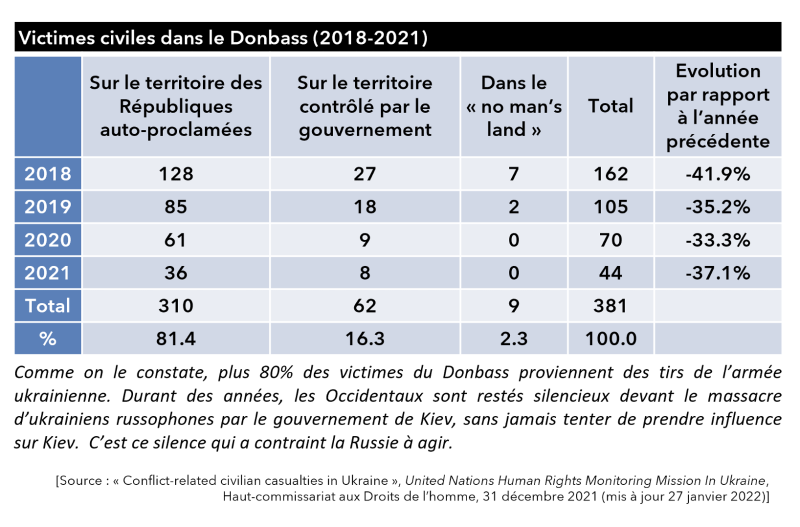
     

    Whether the term “genocide” applies to the abuses suffered by the populations of Donbass is an open question. This term is generally reserved for larger cases (Holocaust, etc.), however, the definition given by the Genocide Convention is probably broad enough to apply. Lawyers will appreciate.

    Clearly, this conflict has led us into hysteria. Sanctions seem to have become the preferred tool of our foreign policies. If we had insisted that Ukraine respect the Minsk Accords, which we negotiated and endorsed, none of this would have happened. The condemnation of Vladimir Putin is also ours. There is no point in whining after the fact, we had to act before. However, neither Emmanuel Macron (as guarantor and as a member of the UN Security Council), nor Olaf Scholz, nor Volodymyr Zelensky have respected their commitments. Ultimately, the real defeat is that of those who have no voice.

    The European Union was unable to promote the implementation of the Minsk agreements, on the contrary, it did not react when Ukraine bombarded its own population in the Donbass. Had she done so, Vladimir Putin would not have needed to react. Absent from the diplomatic phase, the EU distinguished itself by fueling the conflict. On February 27, the Ukrainian government agrees to start negotiations with Russia. But a few hours later, the European Union voted a budget of 450 million euros to supply arms to Ukraine, adding fuel to the fire. From there, the Ukrainians feel that they will not need to come to an agreement. The resistance of the Azov militias in Mariupol will even causea raise of 500 million euros for weapons .

    In Ukraine, with the blessing of Western countries, those who are in favor of a negotiation are eliminated. This is the case of Denis Kireyev, one of the Ukrainian negotiators, assassinated on March 5 by the Ukrainian secret service (SBU) because he is too favorable to Russia and is considered a traitor. The same fate is reserved for Dmitry Demyanenko, former deputy head of the main directorate of the SBU for Kiev and its region, assassinated on March 10 , because too favorable to an agreement with Russia: he is killed by the Mirotvorets militia (”  Peacemaker  “). This militia is associated with the Mirotvorets website which lists the ”  enemies of Ukraine”, with their personal data, address and telephone numbers, so that they can be harassed or even eliminated  ; a punishable practice in many countries, but not in Ukraine . The UN and some European countries have demanded its closure… refused by the Rada.

    Eventually, the price will be high, but Vladimir Putin will likely achieve the goals he set for himself. Its ties with Beijing have solidified. China emerges as a mediator of the conflict, while Switzerland enters the list of enemies of Russia. The Americans must ask Venezuela and Iran for oil to get out of the energy impasse in which they have gotten themselves: Juan Guaido leaves the scene definitively and the United States must pitifully reverse the sanctions imposed on their enemies.

    Western ministers who seek to collapse the Russian economy and make the Russian people suffer , even calling for the assassination of Putin, show (even if they partially reversed the form of their remarks, but not on bottom!) that our leaders are no better than those we hate. Because, sanctioning Russian athletes from the Para-Olympic Games or Russian artists has absolutely nothing to do with a fight against Putin.

    So, therefore, we recognize that Russia is a democracy since we consider that the Russian people are responsible for the war. If not, then why are we trying to punish an entire population for the fault of one? Remember that collective punishment is prohibited by the Geneva Conventions…

    The lesson to be drawn from this conflict is our sense of variable geometry humanity. If we were so attached to peace and to Ukraine, why didn’t we encourage her more to respect the agreements that she had signed and that the members of the Security Council had approved?

    Media integrity is measured by their willingness to work under the terms of the Munich Charter. They had succeeded in propagating hatred of the Chinese during the Covid crisis and their polarized message leads to the same effects against the Russians . Journalism is stripping itself more and more of professionalism to become militant…

    As Goethe said: “  The greater the light, the darker the shadow  ”. The more the sanctions against Russia are excessive, the more the cases where we have done nothing highlight our racism and our servility. Why has no Western politician reacted to the strikes against the civilian populations of Donbass for eight years?

    After all, what makes the conflict in Ukraine more blameworthy than the war in Iraq, Afghanistan or Libya? What sanctions have we adopted against those who have deliberately lied before the international community to wage unjust, unjustified, unjustifiable and murderous wars? Did we try to “make suffer” the American people who had lied to us (because it is a democracy!) before the war in Iraq? Have we even adopted a single sanction against the countries, companies or politicians who are fueling the conflict in Yemen, considered the ”  worst humanitarian disaster in the world  “? Have we sanctioned the countries of the European Union who practice the most abject torture on their territory for the benefit of the United States?

    To ask the question is to answer it… and the answer is not glorious.


    Feature Image Credit: Raising the Flag over Reichstag – iconic photo in 1945 by Yevegny Khaldei – kosmofoto.com 
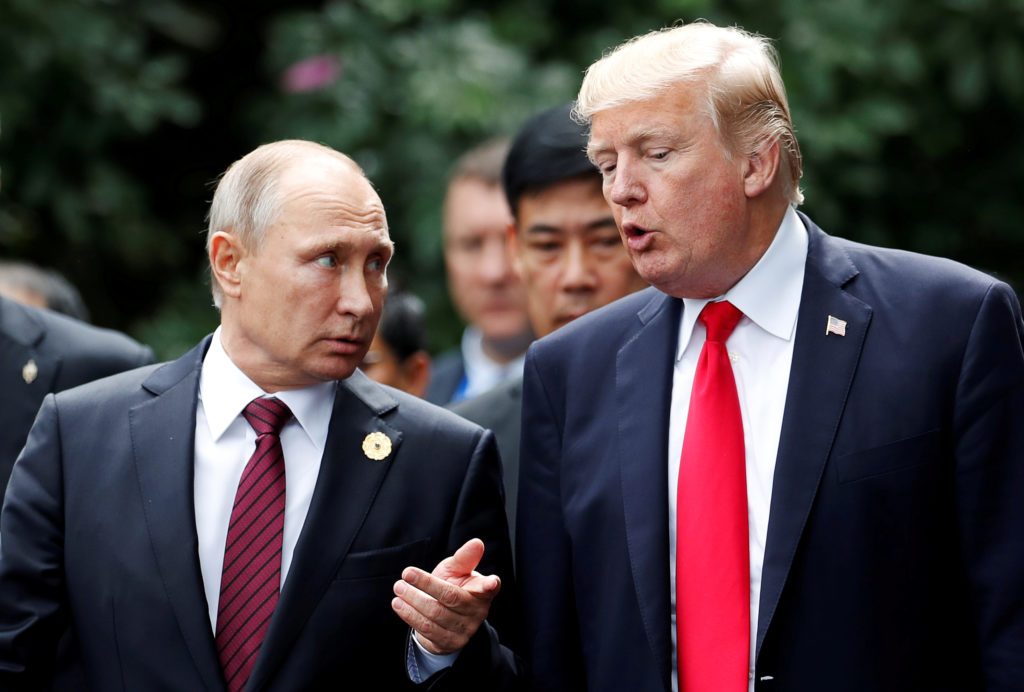
     

  • Washington Accuses Russia of Committing War Crimes in Ukraine: Terrible and True, But What About US War Crimes?

    Washington Accuses Russia of Committing War Crimes in Ukraine: Terrible and True, But What About US War Crimes?

    This article is republished from Antiwar.com with permission.

    Nothing can justify this terrible toll and Moscow’s attack. However, those who judge the moral conduct of others should be measured by the same standard. Which raises the question of war crimes committed by the US in its many conflicts.

    Washington appears intent on making Russia’s war on Ukraine into a moral crusade. Pentagon spokesman John Kirby last week declared that “we’re certainly seeing clear evidence that the Russian military is conducting war crimes.”

    Any large-scale conflict is going to kill civilians, some directly in combat, others from the impact of war’s destructive impact on a modern society. Thus, Russian attacks on Ukrainian cities such as Mariupol cannot help but kill civilians. Last week the UN Office of the High Commissioner for Human Rights estimated 953 dead and 1557 injured Ukrainian civilians. But that is merely the number of victims whose death can be confirmed.

    OHCHR reported that it “believes that the actual figures are considerably higher, especially in Government-controlled territory and especially in recent days, as the receipt of information from some locations where intense hostilities have been going on has been delayed and many reports are still pending corroboration. This concerns, for example, Mariupol and Volnovakha (Donetsk region), Izium (Kharkiv region), Sievierodonetsk and Rubizhne (Luhansk region), and Trostianets (Sumy region), where there are allegations of numerous civilian casualties. These figures are being further corroborated and are not included in the above statistics.”

    And if war criminals were routinely prosecuted, Americans would be in the dock as well as Russians.

    Nothing can justify this terrible toll and Moscow’s attack. However, those who judge the moral conduct of others should be measured by the same standard. Which raises the question of war crimes committed by the US in its many conflicts. American forces may attempt to fight “cleaner” wars than does Russia, but even so no one should have any illusion about the high civilian cost of Washington’s interventions. Innocent people die, some directly, many indirectly. And if war criminals were routinely prosecuted, Americans would be in the dock as well as Russians.

    Consider Washington’s widespread drone war. One terrible strike made last August when Americans were withdrawing from Afghanistan wiped out a family, including seven kids. It was a terrible mistake, but the US was culpable. Reported the New York Times: “Military officials said they did not know the identity of the car’s driver when the drone fired, but deemed him suspicious because of how they interpreted his activities that day, saying that he possibly visited an ISIS safe house and, at one point, loaded what they thought could be explosives into the car.” [Italics added] Upon this litany of unproved suppositions, which turned out to be wild speculation, Washington acted like a terrorist and wiped him out along with all those around him.

    Such mistakes are common because America relies on such “signature” strikes, based on interpretating the actions of people typically hundreds or thousands of miles away. Noted the New York Times: “Every independent investigation of the strikes has found far more civilian casualties than administration officials admit. Gradually, it has become clear that when operators in Nevada fire missiles into remote tribal territories on the other side of the world, they often do not know who they are killing, but are making an imperfect best guess.”

    Afghanistan has been a major focus of America’s drone war. A detailed investigation in 2015 by two media organizations and a foundation concluded that drone strikes had killed 3852 people, 476 of whom were civilians. That’s a civilian kill rate of 12.4 percent, better than untargeted air or artillery strikes, but still much higher than claimed by Washington.

    According to journalist Emran Feroz: “Afghanistan is the most drone-bombed country in the world. The United States dropped more bombs on Afghanistan in 2019 than in any other years since the Defense Department began keeping track in 2006. According to new figures released by the U.S. military, at least 7,423 bombs and other munitions were dropped on the country in 2019, a nearly eight-fold increase from 2015 and an average of 20 bombs a day.”

    He described another drone attack that apparently went awry: “Ordinary Afghans say it has happened to them many times and never – not once – has it made news anywhere outside Afghanistan. Last November, an American Reaper drone targeted a group of villagers in the mountainous area of Afghanistan’s southeastern province of Paktia and killed seven of them. Paktia has long been home to Taliban militants, but local residents say all the victims were civilians, including three women and one child. They had gone to the remote area to graze their cattle and collect wood. Suddenly, they were dead.”

    Another cost of the drone war: creating new terrorists who target Americans. Waging war on Muslims around the world makes a lot of enemies, some of whom strike back.

    For instance, Pakistani-American Faisal Shahzad attempted to set off a bomb in Times Square in response to Washington’s drone campaign. He explainedto the court in 2010: “I want to plead guilty 100 times because unless the United States pulls out of Afghanistan and Iraq, until they stop drone strikes in Somalia, Pakistan and Yemen and stop attacking Muslim lands, we will attack the United States and be out to get them.” The judge asked him why he was willing to kill kids. He explained: “When the drones hit, they don’t see children.” Hence, Shahzad concluded that “I am part of the answer to the US killing the Muslim people.”

    America’s anti-ISIS bombing campaign also killed civilians in prodigious numbers. NPR reported on the work of New York Times correspondent David Philipps, who said “the United States’ air war against ISIS seems to have been particularly brutal on innocent civilians in Syria. In recent stories, Philipps reports that a top-secret unit of the US military was allowed to pick targets for drone attacks and bombing runs with little oversight, and that as the conflict wore on, it increasingly sidestepped rules to protect noncombatants, ordering airstrikes that killed farmers in their fields, children in the street and families fleeing combat.”

    According to Philipps, the military counted 1400 dead civilians “during the four years of the war. And they were very confident that those numbers were real and that outside organizations like Human Rights Watch that were reporting numbers that were many times higher were being unreasonable. But once we looked under the hood at how it worked, we found that, you know, time and time again, their accounts were just seriously flawed.”

    The Times explained that it “worked with journalist Azmat Khan, who went to dozens and dozens of these sites on the ground and talked to people who were there and compared what they said to what the military’s own records said and found repeatedly that there was a gulf between them.” For instance, Human Rights Watch estimated some 7000 dead civilians. A toll that dwarfs the number of civilian dead in Ukraine, where the US is blaming Russia for committing war crimes.

    The US also has armed Saudi Arabia and United Arab Emirates, helping them wreak death and destruction against Yemen, the poorest nation in the Mideast. No participant in this civil war, which was internationalized by the Saudis and Emiratis, looks good. However, most casualties and damage are a result of the royal regimes’ air attacks and effective blockade, which has resulted in mass malnutrition, immiseration, and disease.

    President Joe Biden once criticized the Kingdom of Saudi Arabia and its pernicious role in the Yemen war. Like so many of his predecessors, however, he has since effectively turned US policy over to Riyadh and Abu Dhabi, continuing to sell them weapons and deploying US forces to help protect them from retaliation for their continuing attacks on Yemeni civilians. A year after the president took office the war is heating back up in Yemen.

    Reported the Yemen Data Project: “January 2022 was the most violent month in the Saudi-led air war in Yemen in more than five years. Yemen Data Project recorded 139 civilian deaths and 287 civilians injured in Saudi coalition airstrikes in January, taking the casualty toll to over 19,000 civilians killed and injured since Saudi Arabia launched its bombing campaign in Yemen in March 2015. Not since October 2016 have more civilian casualties been recorded in a single month in the air war. Saudi-led coalition airstrikes caused more civilian harm in the first month of 2022 than in the two previous years combined.”

    The UN Group of Eminent International and Regional Experts on Yemenrevealed that civilians were routinely targeted by the Saudi and Emirati royals. Victims included “civilians shopping at markets, receiving care in hospitals, or attending weddings and funerals; children on buses; fishers in boats; migrants seeking a better life; individuals strolling through their neighborhoods; and people who were at home.”

    Widespread air attacks also wrecked basic infrastructure, with catastrophic consequences for health, nutrition, commerce, and safety. The United Nations Development Program reported:

    “By comparing the current reality in Yemen to a scenario where no conflict ever occurred, we can provide an estimate of the total death count – the number of deaths caused both directly and indirectly from the conflict. By doing so, we found that by the end of 2021, Yemen’s conflict will lead to 377,000 deaths – nearly 60 per cent of which are indirect and caused by issues associated with conflict like lack of access to food, water, and healthcare. These deaths are overwhelmingly made up of young children who are especially vulnerable to under and malnutrition. In 2021, a Yemeni child under the age of five dies every nine minutes because of the conflict. This is a significant increase since our 2019 report, Assessing the Impact of War on Development in Yemen, that – through the same assessment – found this to be approximately every 12 minutes.”

    In 2021, a Yemeni child under the age of five dies every nine minutes because of the conflict.

    The experts’ group also found devastating impact: “Protracted conflict, disease outbreaks, the COVID-19 pandemic, flooding, import restrictions, an economic and fuel crisis, and limited humanitarian aid have made everyday life in Yemen unbearable for many. According to the Office for the Coordination of Humanitarian Affairs, around 20.7 million people in Yemen currently require some form of humanitarian and protection assistance. More than 16.2 million of them will face significant food insecurity this year. Additionally, international funding has fallen far short of the required levels to address the humanitarian crisis.”

    Harm from this kind of warfare goes even further. Last fall the experts’ group observed that “Living in a country subjected to an average of 10 airstrikes per day has left millions feeling far from safe. Although the frequency and intensity of airstrikes have fluctuated over the last four years, the Group of Eminent Experts has continued to observe their devastating impact on civilians.”

    “The civilian death toll from Saudi Arabia’s disastrous air war over Yemen was steadily rising in 2016 when the State Department’s legal office in the Obama administration reached a startling conclusion: Top American officials could be charged with war crimes for approving bomb sales to the Saudis and their partners. Four years later, more than a dozen current and former US officials say the legal risks have only grown as President Trump has made selling weapons to Saudi Arabia, the United Arab Emirates and other Middle East nations a cornerstone of his foreign policy.”

    Assessing Washington’s moral blame in aiding the royal aggressors is easy. The legal case is more difficult, but the State Department already made the connection. It warned previous administrations that US officials were committing war crimes. The New York Times reported: “The civilian death toll from Saudi Arabia’s disastrous air war over Yemen was steadily rising in 2016 when the State Department’s legal office in the Obama administration reached a startling conclusion: Top American officials could be charged with war crimes for approving bomb sales to the Saudis and their partners. Four years later, more than a dozen current and former US officials say the legal risks have only grown as President Trump has made selling weapons to Saudi Arabia, the United Arab Emirates and other Middle East nations a cornerstone of his foreign policy.”

    Washington intervened in Libya’s civil war more than a decade ago to promote regime change under cover of helping to protect civilians from the Khadafy government. The country that was the most developed and wealthiest in Africa was bombed to stone age by the US and NATO.

    There is much more to criticize in US policy. Rural Afghanistan suffered desperately for years as a battleground between the US and Taliban, causing many residents to turn toward the insurgents. Washington intervened in Libya’s civil war more than a decade ago to promote regime change under cover of helping to protect civilians from the Khadafy government. Hopes for a better future remained unfulfilled as contending factions subsequently fought for control and now squabble over plans to hold elections.

    Russia deserves to be criticized and held accountable for its increasingly brutal military campaign in Ukraine. However, Washington would have more credibility to judge if its message wasn’t do as I say, not as a I do. US officials should come clean internationally and admit when they have failed in their obligation to protect human rights, including in wartime. Next time they shouldn’t just promise to do better. They should do so.


  • Divided World: The UN Condemnation of Russia is endorsed by Countries run by the richest, oldest, Whitest people on Earth but only 41% of the World’s population

    Divided World: The UN Condemnation of Russia is endorsed by Countries run by the richest, oldest, Whitest people on Earth but only 41% of the World’s population

    On March 2 of this year the UN General Assembly met in an Emergency Session to pass a non-binding resolution condemning Russia’s February 24 intervention in Ukraine.1 141 countries voted for the resolution, 5 voted against, 35 abstained, and 12 did not vote. (Reported: Guardian, Al Jazeera, iNews)

    although the war is nominally a conflict between two developed and ethnically white nations, Russia and Ukraine, this UN vote suggests the war may be viewed by much of the world as a fight over the global political and economic system that institutionalizes the imperial hierarchy, the distribution of nations between rich and poor, and global white supremacy


    In the absence of any reliable opinion poll of the world’s 7.9 billion people, this vote may indicate that the majority of humanity sympathizes with Russia in Ukraine. The statistics presented below show that only 41% of the world’s people live in countries that joined the U.S. in voting for the UN resolution.

    This lopsided vote is even more striking if you consider the demographics. Populations represented by governments that did not vote for the resolution are much more likely to include the world’s poorest nations, nations with younger populations, “nations of color,” nations of the Global South, and nations in the periphery of the world economic system.

    To put it another way, although the war is nominally a conflict between two developed and ethnically white nations, Russia and Ukraine, this UN vote suggests the war may be viewed by much of the world as a fight over the global political and economic system that institutionalizes the imperial hierarchy, the distribution of nations between rich and poor, and global white supremacy.


    The UN vote by population

    41% or 34% amounts to a resounding, humiliating defeat for the U.S. on this non-binding UN resolution. Instead it is reported in the west as a U.S. victory and an “overwhelming” worldwide condemnation of Russia.

    Of the world’s 7,934,000,000 people, 59% live in countries that did not support the resolution and only 41% live in countries that did.2 But that last figure drops to 34% outside of the immediate belligerents and their allies: Ukraine, U.S., and NATO countries, and on the other side, Russia, Armenia, Belarus, Kazakhstan, Kyrgystan, and Tajikistan (all the countries of the Collective Security Treaty Organization).

    41% or 34% amounts to a resounding, humiliating defeat for the U.S. on this non-binding UN resolution. Instead it is reported in the west as a U.S. victory and an “overwhelming” worldwide condemnation of Russia.

    The UN vote and GDP per capita

    All the countries in the top third of the GDP per capita (nominal) rankings, including Japan and all the countries of Western Europe and North America, voted for the resolution, Venezuela being the only country in the top third that did not.

    Of the countries that did not vote for the resolution, most are ranked the poorest in the world, and almost none came above the approximate midpoint rank of 98. The exceptions were: Venezuela (58), Russia (68), Equatorial Guinea (73), Kazakhstan (75), China (76) Cuba (82), Turkmenistan (92), South Africa (95), Belarus (97).3

    The UN vote and the core/periphery divide

    Another way to show the wealth divide in the UN vote is by distinguishing core and peripheralcountries. In world-systems theory the surplus value of labor flows disproportionately to the core countries: “The countries of the world can be divided into two major world regions: the ‘core’ and the ‘periphery.’ The core includes major world powers and the countries that contain much of the wealth of the planet. The periphery has those countries that are not reaping the benefits of global wealth and globalization.” (Colin Stief, ThoughtCo.com, 1/21/20)

    The countries usually considered in the core are: Australia, Austria, Belgium, Canada, Denmark, Finland, France, Germany, Greece, Iceland, Ireland, Italy, Japan, Luxembourg, Netherlands, New Zealand, Norway, Portugal, Singapore, Spain, Sweden, Switzerland, United Kingdom, United States.

    The difference here is stark. Every single core country voted for the resolution and every country that did not is either in the periphery or in some cases, like Russia or China, in the semi-periphery.


    The UN vote and median age

    All the countries ranked in the top third of median age rankings, from Monaco (51.1 years) to Iceland (36.5 years), voted for the resolution, with the following exceptions: China (37.4), Russia (39.6), Belarus (40), Cuba (41.5).

    Of the twenty entries with the lowest median ages (15.4 to 18.9), only half voted for the resolution.

    The UN vote and “countries of color”

    Of the 7,934,000,000 people in the world, 1,136,160,000 live in what are usually recognized as “white countries” (consistently or not) with about 14% of the world’s population. Yet “white countries,” by population, represent about 30% of the total vote in favor of the resolution. This “white vote” accounts for every one of the core countries (except Singapore and Japan). Compare: 97% of the population in the countries that did not vote for the resolution live in “countries of color.” Only Russia, Belarus and Armenia (which did not vote for the resolution) have dominant populations classed as “white.”

    Therefore “white countries” are overrepresented in the group that voted for the resolution (30% vs. 14%), and underrepresented in the group that did not (3% vs. 14%).

    Before the intervention

    What follows is a brief sketch of events leading to the February 24 Russian intervention that prompted the UN resolution. It is a history seldom mentioned in the mainstream media, though it is easily found in selected alternative and now-suppressed media. It is presented here as a possible, partial explanation of why the UN resolution had so little support measured by population.

    U.S./NATO has directed aggression toward Russia for decades, advancing NATO forces ever closer to Russia’s western border, ringing Russia with military bases, placing nuclear weapons at ever closer range, and breaching and discarding treaties meant to lessen the likelihood of nuclear war. The U.S. even let it be known, through its planning documents and policy statements, that it considered Ukraine a battlefield on which Ukrainian and Russian lives might be sacrificed in order to destabilize, decapitate and eventually dismember Russia just as it did Yugoslavia. Russia has long pointed out the existential security threat it sees in Ukrainian territory, and it has made persistent, peaceful, yet fruitless efforts over decades to resolve the problem (See Monthly Review’s excellent editors’ note).

    Recent history includes the 2014 U.S.-orchestrated coup in Ukraine, followed by a war of the central government against those in the eastern regions of Donetsk and Lugansk resisting the coup government and its policies. Those policies include a ban on the Russian language, the native tongue of the region and a significant part of the country (ironically, including President Zelensky).

    By the end of 2021 the war had taken 14,000 lives, four-fifths of them members of the resistance or civilian Russian speakers targeted by the government. Through years of negotiations Russia tried and failed to keep the Donetsk and Lugansk regions inside a united Ukraine. After signing the Minsk agreements that would do just that, Ukraine, under tight U.S. control, refused to comply even with step one: to talk with the rebellion’s representatives.

    As to why the intervention happend now, Vyacheslav Tetekin, Central Committee member of Russia’s largest opposition party, the Communist Party of the Russian Federation, explains:

    Starting from December, 2021 Russia had been receiving information about NATO’s plans to deploy troops and missile bases in Ukraine. Simultaneously an onslaught on the Donetsk (DPR) and Lugansk People’s Republics (LPR) was being prepared. About a week before the start of Russia’s operation the plan was uncovered of an offensive that envisaged strikes by long-range artillery, multiple rocket launchers, combat aircraft, to be followed by an invasion of Ukrainian troops and Nazi battalions. It was planned to cut off Donbas from the border with Russia, encircle and besiege Donetsk, Lugansk and other cities and then carry out a sweeping “security cleanup” with imprisonment and killing of thousands of defenders of Donbas and their supporters. The plan was developed in cooperation with NATO. The invasion was scheduled to begin in early March. Russia’s action pre-empted Kiev and NATO, which enabled it to seize strategic initiative and effectively save thousands of lives in the two republics.

    All this may have informed the world’s overwhelming rejection of the U.S.-backed UN resolution condemning Russia, which western media perversely considers a U.S. victory simply because the resolution passed. Never mind that it passed in a voting system where Liechtenstein’s vote carries the same weight as China’s.

    The Global South also knows from bitter experience that unlike the West, neither Russia nor its close partner China habitually engage in bombings, invasions, destabilization campaigns, color revolutions, coups and assassinations against the countries and governments of the Global South. On the contrary, both countries have assisted the development and military defense of such countries, as in Syria, Venezuela, Nicaragua, Cuba, Iran and elsewhere.

    Conclusion

    Just as the imperial core of North America, Europe and Japan does not represent the world in their population numbers, demographics, wealth, or power, neither does the imperial core speak for the world on crucial issues of war, peace, justice, and international law. Indeed the Global South has already spoken to the Global North so many times, in so many ways, with patience, persistence and eloquence, to little avail. Since we in the North have not been able to hear the words, perhaps we can listen to the cry of the numbers.


    Notes:

    1. The resolution “Deplores in the strongest terms the aggression by the Russian Federation against Ukraine in violation of Article 2 (4) of the Charter.” (Article 2 (4) reads: “All Members shall refrain in their international relations from the threat or use of force against the territorial integrity or political independence of any state, or in any other manner inconsistent with the Purposes of the United Nations.”) The resolution also “[d]eplores the 21 February 2022 decision by the Russian Federation related to the status of certain areas of the Donetsk and Luhansk regions of Ukraine as a violation of the territorial integrity and sovereignty of Ukraine and inconsistent with the principles of the Charter.” Beyond Russia, the resolution “[d]eplores the involvement of Belarus in this unlawful use of force against Ukraine, and calls upon it to abide by its international obligations.”
    2. The population of countries voting for the UN resolution is 3,289,310,000. The population of countries voting against the resolution, abstaining, or not voting is 4,644,694,000 (Against: 202,209,000; abstaining: 4,140,546,000; not voting: 301,939,000).
    3. Here are the countries that did not vote for the resolution, with their GDP per capita rankings (the higher the GDP the higher the rank). 5 countries voted against the resolution: Russia 68, Belarus 97, North Korea 154, Eritrea 178, Syria 147. 35 countries abstained: Algeria 119, Angola 128, Armenia 115, Bangladesh 155, Bolivia 126, Burundi 197, Central African Republic 193, China 76, Congo 143, Cuba 82, El Salvador 121, Equatorial Guinea 73, India 150, Iran 105, Iraq 103, Kazakhstan 75, Kyrgyzstan 166, Laos 140, Madagascar 190, Mali 174, Mongolia 118, Mozambique 192, Namibia 102, Nicaragua 148, Pakistan 162, Senegal 160, South Africa 95, South Sudan 168, Sri Lanka 120, Sudan 171, Tajikistan 177, Tanzania 169, Uganda 187, Vietnam 138, Zimbabwe 144. 12 countries did not vote: Azerbaijan 110, Burkina Faso 184, Cameroon 158, Eswatini 117, Ethiopia 170, Guinea 175, Guinea-Bissau 179, Morocco 130, Togo 185, Turkmenistan 92, Uzbekistan 159, Venezuela 58.


    This article was published earlier in MRonline and is republished under the Creative Commons License 4.0.

    Feature Image Credit: Alarabianews.

    Map and Table: Wikipedia