Category: Research

  • GM insect-resistant Bt cotton boosted India’s crop yields? Differing Experts

    GM insect-resistant Bt cotton boosted India’s crop yields? Differing Experts

    India was the world’s leading cotton and textile producer for millenniums. In the 1990s the traditional ‘desi’ variety of cotton was upstaged by imported hybrid cotton varities in the hopes of increased production and profits. They soon became vulnerable to pests and resulted in increased use of fertilisers and pesticides, thus increasing the production costs. The failure of hubrid cotton led to the introduction of Bt cotton in 2002 as India’s first genetically modified crop. GM crops have been strongly opposed by increasing believers of traditional agriculture and scientists, possibly for very good reasons. India’s cotton production has quadrupled by 2010 and proponents of GM crops have attributed this to Bt cotton. This has been hotly contested. The recent assertion in favour of Bt cotton by Dr Ramesh Chander of Niti Aayog, early this year, has come under scathing criticism in an article by Professor Andrew Paul Gutierrez, Dr. Hans R.Herren, and Dr. Peter E.Kenmore  as also by Sujatha Byravan. The claims by the advocates of GM crops and Bt cotton were questioned in a well-researched article early this year by scientists K R Kranthi and G D Stone. This article counters their arguements.

                                                                                                                                                                                                        – TPF
    This article was originally posted on the non-profit GeneticLiteracyProject.org website.

    Authors: Cameron English, Jon Entine, and Matin Qaim

    Was the introduction of transgenic (GMO) cotton seeds to India in 2002 the beginning of the renaissance of the country’s then struggling cotton industry? Or was it a non-event, hyped by biotechnology advocates, especially agro-businesses, to bolster the case for a technology struggling for public acceptance?

    After years of farmers losing crops to tobacco budworms, cotton bollworms and pink bollworms, costing billions of dollars a year in losses, Monsanto developed insect-resistant Bt cotton in the early 1990s. The engineered crop has become widespread since its commercial release in China and the United States in 1996, followed by its introduction to India in 2002.

    Within just a few years, India’s troubled cotton industry had done a 180, emerging as one of the world’s largest producers of GMO cotton, as exports boomed, helping to fuel India’s rapid rise as an emerging nation. But not everyone accepts this version of events. Agricultural biotechnology critics maintain that the success of Bt cotton was more smoke and mirrors than science, a story deceptively promoted by the beleaguered agricultural biotechnology industry and its supporters

    Competing research conclusions

    The Bt cotton debate was reignited this year following the publication of contrasting scholarly analyses, one challenging the success narrative and several others defending it. The latest volley of criticism was launched in March when Indian entomologist K. R. Kranthi and Washington University anthropologist Glenn Davis Stone wrote a scathing analysis of Bt cotton success claims in Nature Plants, an article widely disseminated by the global media. Reviewing 20 years of data, the authors claimed that the dramatic success of India’s first (and only) GMO crop was largely hype, and may have even been a failure. According to Stone in a press release put out by Washington University in St. Louis:

    Yields in all crops [in India] jumped in 2003, but the increase was especially large in cotton,” Stone said. “But Bt cotton had virtually no effect on the rise in cotton yields because it accounted for less than 5% of India’s cotton crop at the time.
    Now farmers in India are spending more on seeds, more on fertilizer and more on insecticides …. Our conclusion is that Bt cotton’s primary impact on agriculture will be its role in making farming more capital-intensive — rather than any enduring agronomic benefits.

    That led to a rebuke by long-time scholars in the field. In early May, four scientists at the South East Asia Biotechnology Center in New Dehli weighed in with their own take down in the open access Cold Spring Harbor Laboratory Publication bioRxiv, concluding:

    This study [Kranthi and Stone] conspicuously ignores positive shifts that occurred with Bt adoption at reduced real cost of production in all states resulting in large welfare benefits netting out increased cost of cultivation. [The fallacy] associated with increasing yield trends even before [the] introduction of Bt cotton as claimed by Kranthi and Stone does not stand [up to] scrutiny of increasing yield trends from 2002-03 to 2009-10, with some years showing significant yield dips due to drought [only] to bounce back …. in 2017-18. The ignorance of drought impact tends to attribute the yield reduction entirely [to] the failure of Bt technology.

    In June, GLP published a detailed critique by plant geneticist Deepak Pental, who wrote:

    The article’s authors claim to have carried out ‘a new analysis of unprecedented scope, time depth and detail’ on cotton cultivation in India to find the real reasons behind the doubling of yields between 2000 and 2006, followed by yield stagnation. While the avowed goal of the analysis is to set the record right on the contribution of the Bt trait to cotton cultivation in India, the real purpose of the report is to cast doubts on the utility of GE technologies.

    Most recently, a number of scientists who have crunched the data responded sharply to the Stone-Kranthi hypothesis in letters published in Nature Plants. One of the most prominent is Ian Plewis, an emeritus professor at the University of Manchester in England, who has written extensively on debunked claims that the introduction of Bt cotton led to a surge in farmer suicides in India. Last year, he analyzed much of the same data cited by Stone and Kranthi in a paper in the Review of Agrarian Studies, arriving at a much more nuanced conclusion.

    The conclusions from these analyses are mixed. The more expensive Bt hybrid seeds have lowered insecticide costs in all three States, but only in Rajasthan did yields increase. An important message of this paper is that conclusions about the effectiveness of Bt cotton are more nuanced than many researchers and commentators recognise. The paper does not refute the assertions about the success of Bt cotton, but it does show that the benefits are not evenly distributed across India.

    In a letter to the journal, Plewis  challenged Kranthi’s and Stone’s methodology.

    Kranthi and Stone do not present state-wide analyses of insecticide use, relying instead on unpublished market research data for India as a whole. Their assertion that farmers are spending more on insecticide than they were before the introduction of Bt is not supported by my analyses which are based on publicly available data and show that the technology reduced the proportion of farmers’ costs going to insecticides in all three states.
    Kranthi and Stone make some important points but their approach prevents them from reaching soundly based assessments of the long-term impacts of Bt cotton on Indian farmers in different states.

    Other critics were equally challenging of their data. In a letter originally published in Nature Plants, agricultural economist Matin Qaim, who has been writing about the impacts of Bt cotton in India since its introduction, jumped into the fray:

    Kranthi and Stone’s attempt to analyze long-term effects of Bt cotton is laudable, as the effects of the technology can change over time due to evolving pest populations and other dynamics. However, their claim that Bt contributed little to the yield increases observed in India between 2002 and 2008 is unconvincing ….

    Strong arguments on both sides. What do the facts say? Let’s separate the cotton from the sharp ends of the boll.

    What is Bt cotton?

    Bt seeds produce over 200 different Bt toxins, each harmful to different insects. Bt cotton is an insect-resistant transgenic crop (GMO) designed to combat many destructive insects, most notably the bollworm. It was created by genetically altering the cotton genome to express a natural, non-pathogenic microbial protein from the bacterium Bacillus thuringiensis that is found in the soil. Bt in its natural and transgenic forms has been extensively evaluated and found to be safe to all higher animals tested. Bt has been used as an insecticide in organic farming since the middle of the 20th century.

    Screen Shot at PM
    Bollworm resistance to Bt cotton problematic for farmers worldwide.

    Traditionally, pesticides have been used to combat the cotton bollworm. However, in developing nations like India, the expense of using large amounts of pesticide is often too high for marginal farmers. Bt cotton was developed with the intention of reducing the amount of pesticide needed for cotton cultivation, thereby reducing production costs for farmers, environmental impact, and the pesticide exposure of applicators, often women and children.

    Numerous independent studies have attributed anywhere from 14-30% of the cotton yield increase in India to the cultivation of Bt seeds. Five years after the introduction of Bt cotton, a professor at Jawaharlal Nehru University and visiting fellow at Centre de Sciences Humaines, New Delhi would write in the Wall Street Journal about India’s recently flagging cotton production: “By 2007-08, India became the largest producer of cotton with the largest acreage under Bt cotton in the world, pushing China into second place.” Many scientists and news organizations cited the surge in production of Indian cotton as one of the clearest GMO success stories.

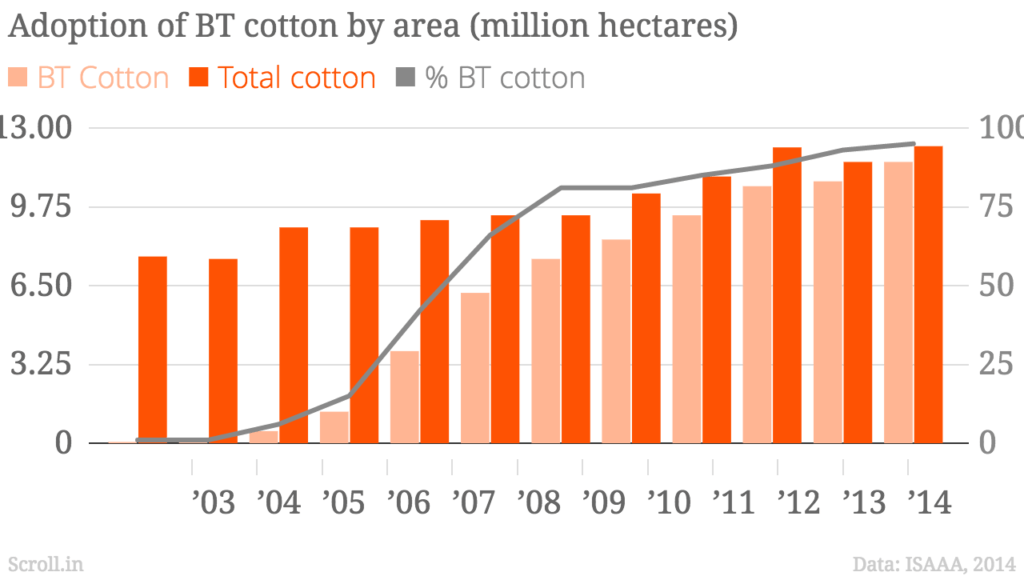
    After its introduction, within a decade, Bt cotton accounted for more than 95% of all cotton cultivation in India, as yields increased.

    zjoyqkdyts
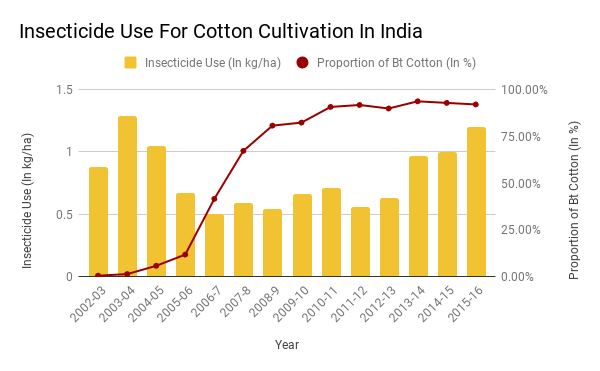
    During that same period marking a 55% rise in yields, overall use of insecticides remained below absolute levels from 2003, while per- hectare usage dropped precipitously.

    chart
    Source: KR Kranthi (December 2016), News reports from Reuters, Financial Express

    Stone’s critique and pink bollworm resistance

    Despite its initial success, Bt cotton seed is more costly than non-transgenic (but lower yielding) varieties, making it a target for some critics who are skeptical of crop biotechnology. One of those longtime skeptics is Washington University professor Stone. Stone is part of a cohort of scholars and activists, including Indian-philosopher Vandana Shiva, which fervently believes that the Indian Green Revolution that dramatically reduced hunger and is credited with saving more than a billion lives was a failure.

    As far back as 2012, Stone challenged a plethora of studies generally supporting the view behind the success of India’s Bt cotton crops and the resurrection of the nation’s once-threatened cotton industry. Stone looked at the data from a cultural anthropology perspective and saw more hype than substance. Writing in his influential paper in 2012, “Constructing Facts: Bt Cotton Narratives in India,” Stone maintained, “We simply cannot say how Bt seed has affected cotton production in India.”  The “triumph narrative” of Bt cotton in India, he claimed, “flows mainly from economists and the biotech industry (and its academic allies)” in “industry-journal authentication systems” (peer-reviewed journals), which “serve the interests of their constituent parties.” The arrangement is a “cosy alliance between GM manufacturers and ostensibly independent researchers,” he added.

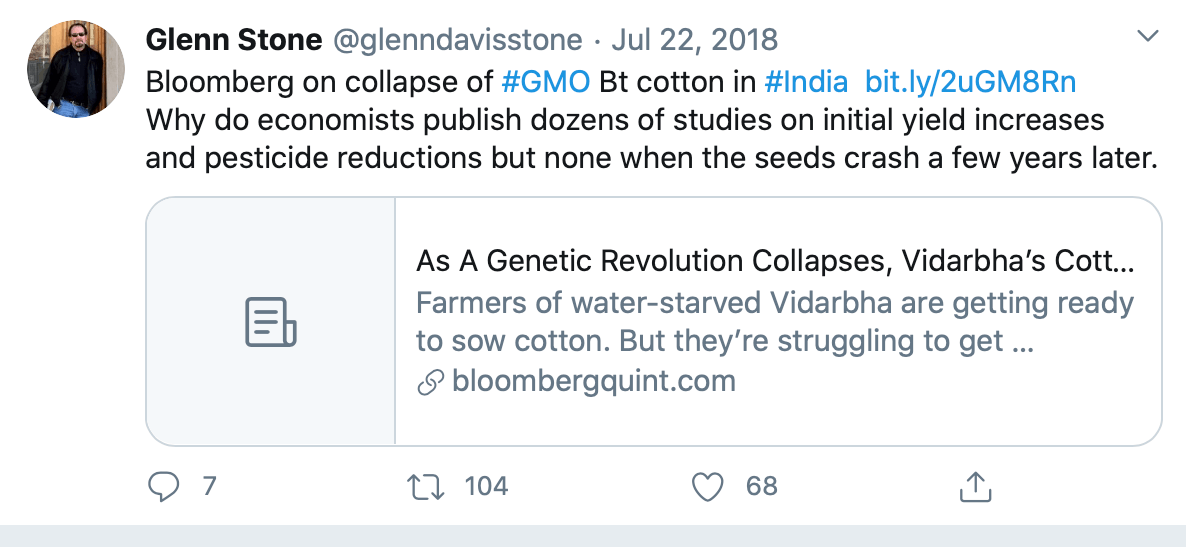
    Problems emerged in 2017, as the pink bollworm ravaged cotton crops in India, suggesting the pest had developed resistance. A January 2018 study released by Central Institute of Cotton Research (CICR) showed how the proportion of pink bollworm on green bolls of Bt cotton plants in Maharashtra, Gujarat and Madhya Pradesh rose from 5.71 percent in 2010 to 73.82 percent in 2017. GMO-skeptic Stone tweeted a link to a scathing article in Bloomberg, sarcastically asking why GMO supporters seemed to be ignoring the Bt’s failure in India.screen shot at pm

    As reporter Mark Lynas noted in an analysis for the Cornell Alliance for Science, the debate is nuanced than either pro or anti factions often maintain. The Bloomberg report did notice that similar problems have not turned up in Australia and China, where Bt cotton is grown, suggesting the resistance may be unique to conditions in India. Lynas interviewed Ronald Herring, author of numerous peer-reviewed papers on the impacts of Bt cotton in India. He acknowledged the reality of the problem, but suggested the issue was murky. The problem could be linked to a variety of issues, including the use of counterfeit Bt seeds, which are rampant in India, or the fact that many financially-pressed Indian farmers abandoned the recommended rotations of a second crop, which can be less profitable than the cash-crop cotton.

    Bt cotton has had an up and down history in India. From 2002 to 2009, cotton production, productivity and acreage grew steadily. Soon, the pink bollworm began developing resistance. Studies between 2013 and 2015 of Indian Council of Agricultural Research and CICR concluded that pink bollworm had developed resistance to Bollgard-II. Insecticide use shot up to levels not seen in a decade.

    Vijay Paranjape, the associate director of the USAID-funded Bt brinjal project in Bangladesh, and an expert in Bt cotton in India, told Lynas that the problem was largely focused in one region, Vidarbha. “[T]here is some pattern to it that could be due to [poor] agronomic practices being followed,” in that area. In other words, the facts are complicated.

    Another Bt expert, Srinivasan Ramasamy, then a visiting scientist at Cornell University, told Lynas: “I don’t agree that Bt cotton has failed in India.” Ramasamy, he said, pointed out that Bt cotton “was developed against three different bollworms — Helicoverpa armigeraEarias spp. and Pectinophora gossypiella” (the latter is pink bollworm).

    Bt cotton effectively reduced these bollworms, except the pink bollworm, that too in Maharashtra only. If the other two species remained as a major threat, the pesticide use might have been several-folds higher than the current use. Hence, Bt cotton has contributed to pesticide reduction.

    Stone’s disputations and Qaim’s response

    This nuanced history of course is often not reflected in the commentaries, or even academic studies, by supporters of GMO crops. Setbacks are often portrayed by hardened critics as absolute failures.

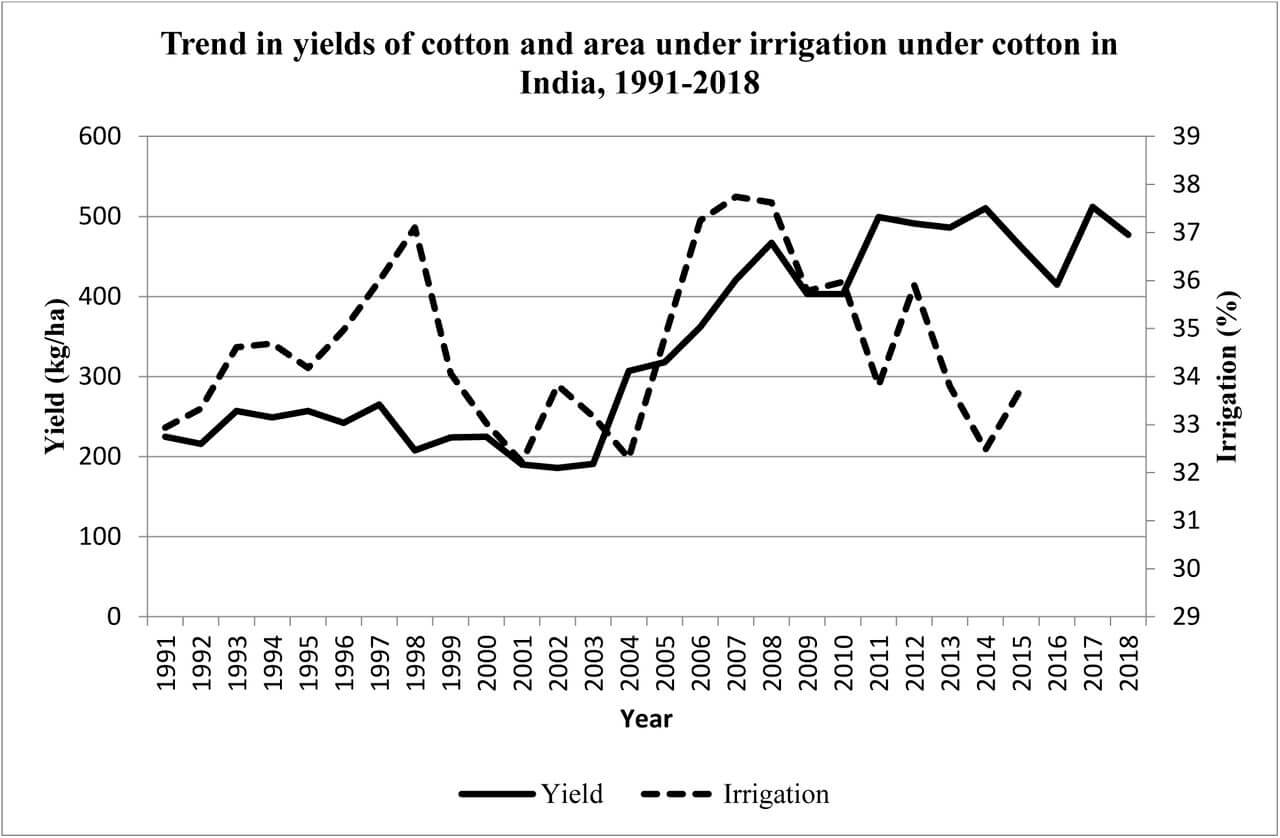
    Jump to 2020, and Stone, joined by K. R. Kranthi, the former director of India’s Central Institute for Cotton Research and now the head of a technical division at the Washington-based International Cotton Advisory Committee, reemerged as a sharp critic of Bt cotton—though the success narrative appears even stronger now. Since 2012, water usage has dropped sharply in Indian while Bt cotton yields have continued to climb, and are at or near historic highs, up more than 150% since the early 2000s.
    f large

    Despite these numbers, Kranthi and Stone argued that “the largest production gains came prior to widespread [Bt] seed adoption and must be viewed in line with changes in fertilization practices and other pest population dynamics.” They also cited the pink bollworm’s evolved resistance to Bt insecticide and the threat posed by other pests that are impervious to the insecticidal power of Bt cotton.

    Qaim found these arguments lacking, however. Building on previous scholarship, the agricultural economist explains that, when other relevant factors are accounted for, Bt cotton did indeed boost crop yields in India. Here are his conclusions:

    The agronomic and socioeconomic effects of insect-resistant Bacillus thuringiensis (Bt) cotton in India have long been debated. In their recent Perspective article, Kranthi and Stone [1] used 20 years of data to analyze associations between the adoption of Bt cotton, crop yields and insecticide use, claiming that Bt technology had little yield effects and did not produce any enduring benefits.

    Here, I argue that the methods used by Kranthi and Stone are not suitable to make statements about causal effects, so their conclusions are misleading. As earlier studies showed [2–7], Bt cotton has contributed to sizeable yield gains and important benefits for cotton farmers and the environment. Kranthi and Stone’s attempt to analyze long-term effects of Bt cotton is laudable, as the effects of the technology can change over time due to evolving pest populations and other dynamics.

    However, their claim that Bt contributed little to the yield increases observed in India between 2002 and 2008 is unconvincing, as this part of their analysis looks at the same time period that was also analyzed previously by other authors with more precise microlevel data and better methodologies [7,8]. Kranthi and Stone use simple graphical analysis to compare time trends for Bt adoption, fertilizer use and yield at national and state levels.

    Comparing the graphs, they find a stronger correspondence between the fertilizer and yield trends than between the Bt adoption and yield trends. Thus, they conclude that the observed yield increases were primarily due to the higher use of fertilizer and other inputs, and not to Bt technology. The problem is that such a simple graphical comparison of time trends is inappropriate to analyze causal effects. Crop yields may increase because of more fertilizer or because of better pest control through the adoption of insect-resistant Bt varieties. It is also possible that some farmers decided to use more fertilizer because of Bt adoption. Many other factors, such as changes in irrigation, other inputs and technologies, agronomic practices, training of farmers or simple weather fluctuations may also affect cotton yields and broader socioeconomic benefits.

    In principle, Kranthi and Stone acknowledge these complexities but they do nothing to control for any of the confounding factors. Previous studies used microlevel data and more sophisticated statistical techniques to control for confounding factors and possible bias, hence leading to more reliable effect estimates. Kathage and Qaim [7] used panel data collected between 2002 and 2008 from over 500 randomly selected cotton farms in four states of India. They used statistical differencing techniques and controlled for the use of fertilizer, irrigation, pesticides, agronomic practices and many other factors, including location and time trends, to deal with selection bias and cultivation bias.

    screenshot bt cotton yields and farmers benefits qaim natureplants pdf

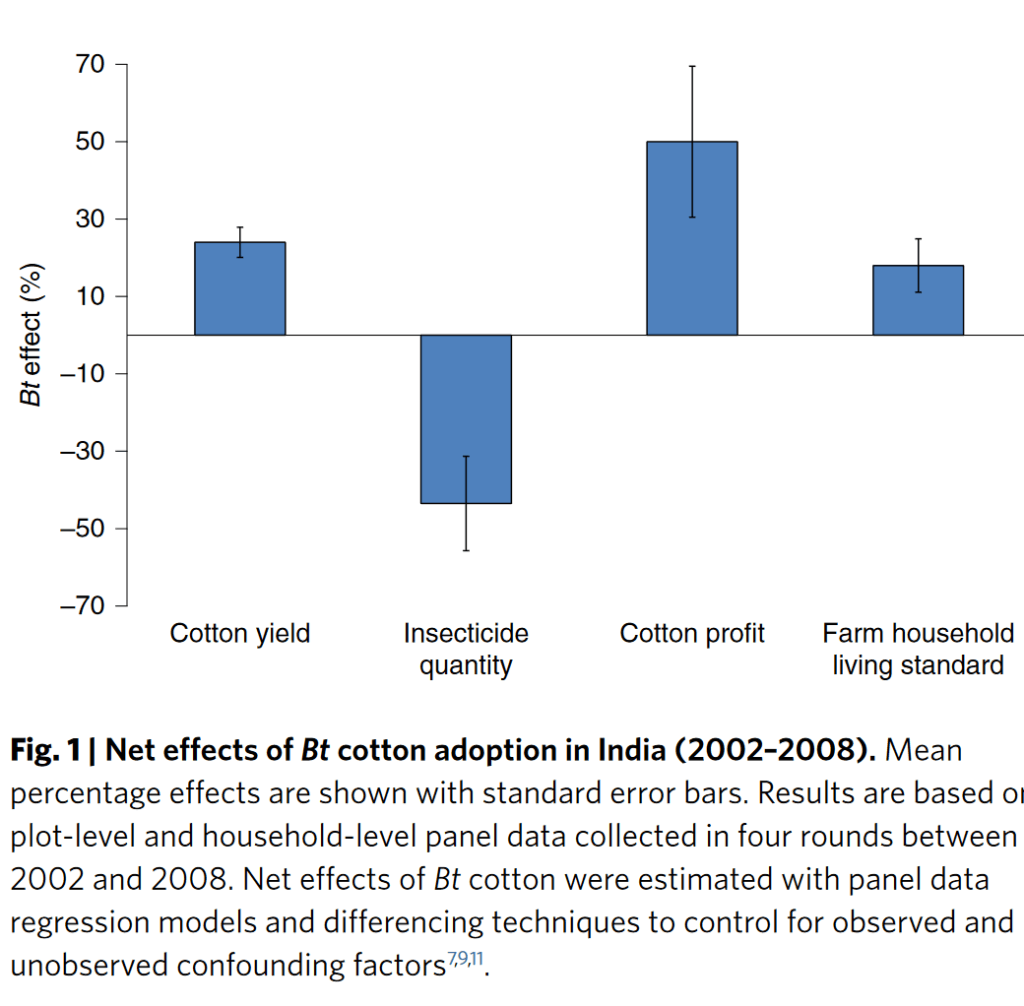
    Results showed that—after controlling for all other factors—Bt adoption had increased cotton yields by 24%, farmers’ profits by 50% and farm household living standards by 18%, with no indication that the benefits were fading during the 2002–2008 period. The same data also revealed that chemical insecticide quantities declined by more than 40% through Bt adop-tion, with the largest reductions in the most toxic active ingredients previously sprayed to control the American bollworm [9–11].

    There are not many other examples from India or elsewhere where a single technology has caused agronomic, economic and environmental benefits in a similar magnitude.Against this background, Kranthi and Stone’s statement that “the surge in yields has been uncritically attributed to Bt seed” is not correct. Of course, there are other factors that contributed to the observed doubling of yields between 2002 and 2008 but the 24% estimate by Kathage and Qaim is the net effect of Bt technology after controlling for other factors [7]. Using longer-term data but inap-propriate methodologies to challenge earlier results, as Kranthi and Stone do in their article, is not convincing. Bt cotton has increased yields through better pest control and has benefited adopting farm-ers in India and several other developing countries [12–14].

    References
    1. Kranthi, K. R. & Stone, G. D. Long-term impacts of Bt cotton in India. Nat. Plants6, 188–196 (2020).
    2. Datta, S. et al. India needs genetic modification technology in agriculture. Curr. Sci.117, 390–394 (2019).
    3. Qaim, M. The economics of genetically modified crops. Annu. Rev. Resour. Econ.1, 665–693 (2009). Bt cotton, yields and farmers’ benefitsMatin Qaim ✉arising from K. R. Kranthi and G. D. Stone Nature Plants https://doi.org/10.1038/s41477-020-0615-5 (2020)–70–50–30–1010305070Cotton yieldInsecticidequantityCotton profitFarm householdliving standardBt effect (%)Fig. 1 |Net effects of Bt cotton adoption in India (2002–2008). Mean percentage effects are shown with standard error bars. Results are based on plot-level and household-level panel data collected in four rounds between 2002 and 2008. Net effects of Bt cotton were estimated with panel data regression models and differencing techniques to control for observed and unobserved confounding factors 7,9,11 Nature Plants| www.nature.com/natureplants matters arisingNature PlaNts
    4. Crost, B., Shankar, B., Bennett, R. & Morse, S. Bias from farmer self-selection in genetically modified crop productivity estimates: evidence from Indian data. J. Agric. Econ.58, 24–36 (2007).
    5. Qaim, M., Subramanian, A., Naik, G. & Zilberman, D. Adoption of Bt cotton and impact variability: insights from India. Rev. Agric. Econ.28, 48–58 (2006).
    6. Subramanian, A. & Qaim, M. The impact of Bt cotton on poor households in rural India. J. Dev. Stud.46, 295–311 (2010).
    7. Kathage, J. & Qaim, M. Economic impacts and impact dynamics of Bt(Bacillus thuringiensis) cotton in India. Proc. Natl Acad. Sci. USA109, 11652–11656 (2012).
    8. Krishna, V., Qaim, M. & Zilberman, D. Transgenic crops, production risk and agrobiodiversity. Eur. Rev. Agric. Econ.43, 137–164 (2016).
    9. Krishna, V. V. & Qaim, M. Bt cotton and sustainability of pesticide reductions in India. Agric. Syst.107, 47–55 (2012).
    10. Veettil, P. C., Krishna, V. V. & Qaim, M. Ecosystem impacts of pesticide reductions through Bt cotton adoption. Aust. J. Agric. Resour. Econ.61, 115–134 (2017).
    11. Kouser, S. & Qaim, M. Impact of Bt cotton on pesticide poisoning in smallholder agriculture: a panel data analysis. Ecol. Econ.70, 2105–2113 (2011).
    12. Ali, A. & Abdulai, A. The adoption of genetically modified cotton and poverty reduction in Pakistan. J. Agric. Econ.61, 175–192 (2010).
    13. Qiao, F. Fifteen years of Bt cotton in China: the economic impact and its dynamics. Wo r l d D e v.70, 177–185 (2015).
    14. Qaim, M. Role of new plant breeding technologies for food security and sustainable agricultural development. Appl. Econ. Perspect. Policy42, 129–150 (2020)
    Matin Qaim is a professor in the Department of Agricultural Economics and Rural Development at the University of Goettingen in Germany. Visit his website. Follow Matin on Twitter @MatinQaim
    The letter was originally published in Nature Plants and has been republished here with permission. Nature Plants can be found on Twitter @NaturePlants
    Cameron English is a Science writer and the Managing Editor at Genetic Literacy Project.
    Jon Entine is a renowned journalist, author, though-leader and the Founder and Executive Director of the Genetic Literacy Project.
    This article is republished from the Genetic Literacy project under the Creative Commons 4.0

    Image Credit: GLP and India Times

  • Understanding the Syrian Civil War through Galtung’s Conflict Theory

    Understanding the Syrian Civil War through Galtung’s Conflict Theory

    Introduction

    As the founder of the discipline of Peace and Conflict Studies, Johan Vincent Galtung has outspokenly advocated for a world without nuclear weapons and has placed the focus of his research on scientific terminologies and methods to understand and deal with conflicts. Having coined the term “peace research”, Galtung has devoted much of his time in formulating the influential and unique ‘transcend approach’, wherein the focus is on peace, rather than security. He has advocated for a model that is holistic and is based on deep understanding and dialogue with one party at a time.

    Having coined the term “peace research”, Galtung has devoted much of his time in formulating the influential and unique ‘transcend approach’, wherein the focus is on peace, rather than security.

    The underlying cause of any violence, according to Galtung, is an unresolved conflict, one that has not been transformed or transcended, due to the existence of incompatible goals. If the goals are among the four basic needs of survival, well-being, identity, or freedom, the conflict is then concluded to be deep, and most difficult to resolve if left unattended. It is important to remember that a conflict does not progress linearly, but rather goes around in a circle, through a cycle of non-violence, to violence, then to post-violence, and likely back to violence again if it fails to be resolved.

    The escalation of a conflict to a violent level is largely a result of disequilibrium among the actors or parties involved, leading to polarization and dehumanization of the Other, and finally reflected in their aggression, the output of which is violence. What follows violence is traumatization, and consequently acts of revenge (Galtung, 2010), leading the cycle of conflict back to its first level.

    Galtung’s Notion of Conflict

    Johan Galtung, in his book, ‘Peace by Peaceful Means (1996)’, defined conflict as a “triadic construct” (pg.71), consisting of three important factors – Attitudes, Behaviour, and Contradictions.

    While both, Attitudes (A) and Contradiction (B), reflect the latent, subconscious level of conflict, Behaviour (B), on the other hand, is always manifest and reflects how people consciously act when confronted with contradictions and hostile attitudes and assumptions. Behaviour may thus be seen as an act of violence, both physical and verbal.

    Attitudes and assumptions may include the person’s perceptions about an actor or an institution; his/her emotions – how s/he feels about the actor/institution involved; and what s/he wants or expects from the given actor/institution. Thus, attitudes may include sexist beliefs about women or discriminatory attitudes towards minorities.

    Contradictions, on the other hand, refer to the content of the conflict, the incompatibility between the goals. It may include a territorial dispute between two or more actors over a single piece of territory, as in the case of Israel and Palestine, or as in the case of multiple parties laying claim to the same group of islets in the South China Sea. In the case of structural or indirect conflict, the contradictions may refer to the disequilibrium in the positions of parties involved, as in the case of inequality between different classes.

    A conflict, according to Galtung, could start from any of the three points of the triangle. It could start from point (A), wherein the actor’s hostile attitude could be in disharmony with those of other actors, leading to contradiction, and later reflected in violent behaviour.  A conflict may also start from point (B), where the actors involved may develop capacities or inclination towards negative/aggressive behaviour, which may get stimulated when a contradiction comes along.

    Galtung further divides the conflicts into actor/direct conflicts and structural/ indirect conflicts. The main point of departure between the two lies in their categorization into manifest, and latent levels. In a direct conflict, both attitudes and contradictions are manifest, that is, they are conscious and overt, the actor being aware of them at all times.

    However, the same does not apply when one takes into account the structural or indirect conflicts. Here, both attitudes and contradictions are latent, that is, they are subconscious and the actor is unaware of them. This is not to say that the contradictions or the incompatibilities are non-existent, rather only that the actor involved finds himself/herself completely unaware of such contradictions.

    Types of Violence

    While stating that the two types of violence – Direct and Structural, are to be considered as the starting point of any strategy for a peaceful resolution, Galtung also defined a third category of violence, namely, the Cultural Violence.

    Direct violence is an event that is often quick and visible, reflecting the capabilities and intentions of actors to engage in a conflict. It includes a victim and a perpetrator and can be seen explicitly in societies. Structural violence, on the other hand, is a process that is slow and often invisible. It refers to the injustice and inequality built into the structural institutions of the society. It is reflective of a position “higher up or lower down in a hierarchy of exploitation-repression-alienation” (Galtung 2012, pg.12), where the parties involved are determined either to keep the hierarchy intact or to completely obliterate it.

    An example of structural violence, as seen from a top-down approach would include colonial aspirations of the European nations. In the case of India and the British empire, the aggression from top existed in the form of material exploitation at the hands of the latter. It became visible once the natives demonstrated their will to oppose colonialism and break the hierarchy of exploitation. The same holds for the Indian caste system, wherein the structural violence, in the form of exploitation and marginalization, has remained intact because of the capability of those higher up, namely the Brahmins, to maintain the disequilibrium in positions between themselves and the communities they perceive to be lower than them.

    The Indian caste system, wherein the structural violence, in the form of exploitation and marginalization, has remained intact because of the capability of those higher up, namely the Brahmins, to maintain the disequilibrium in positions between themselves and the communities they perceive to be lower than them.

    Cultural violence refers to those “aspects of culture that can be used to legitimize or justify both, structural and direct violence” (Galtung: 1990, pg.291). It renders the use of violence as acceptable in society and makes it okay for actors to use violence without making them feel guilty. In a brilliant example, Galtung talks about how the internalization of culture makes it morally easier for actors to employ violence, such as in the interpretation in case of murder on behalf of one’s country being seen as right (Galtung: 1990, pg.292). In the case of direct and structural violence faced by immigrants, it is the culture that allows for such violence to be tolerated. The cultural violence, in this case, justifies the indirect and direct violence by dehumanizing the immigrants and portraying them as thugs or aliens. It allows societies to tolerate policies of forced child-separation while continuing to deny them equitable means of living.

    Escalation of conflicts into violence

    Violence is most often an outcome of deprivation of needs. The more basic and non-negotiable the needs, the likelier chance there is for aggression to come into existence. While classifying the basic needs into four broad categories of survival, welfare, freedom, and identity, Galtung warns his readers against prioritizing any one need over the others. To put survival above freedom and identity, would result in repression and alienation (Galtung, 1985), failing to end structural and cultural violence.

    When the goal of an actor (A) is incompatible with that of an actor (B), such that it obstructs the attainment of the goal by the actor (B), the pursuit of such goals would then most likely result in frustration among both actors, the consequence of which would be a polarisation of the two extremes. Polarisation would imply a zero-sum game, where the scope of transcendence is low, and the likely outcome is a position of no compromise. Because the contradiction in goals is absolute, the victory of the actor (A) would thus necessarily imply the loss of actor (B).

    Polarisation, accompanied by the dehumanization of the Other, may galvanize into hostility and hatred, manifesting itself into aggressive behaviour, finally resulting in escalation. The conflict, however, does not stop at violence. What follows violence, is traumatization of the victims harmed by violence, breeding acts of revenge (Galtung 2010, pg.16).

    In an actor conflict, the polarization between the two sides can almost immediately lead to direct violence. This is because actor (A), who has incompatible goals with actor (B), can easily identify the object/ subject of obstruction of attainment of its goals. Therefore, what follows is violent behaviour by actor (A) towards actor (B).

    On the other hand, in a structural conflict, polarisation may result in acute disequilibrium between rank positions of members in a society. However, Galtung in his essay on the “Structural Theory of Aggression” argues that violence is unlikely to occur unless all methods of maintaining equilibrium have been tried and unless culture facilitates violence wherein those lower down are constantly reminded of their position and their consequent mistreatment (Galtung 1964, pg.99).

    A system of injustice or inequity which refuses to break the hierarchy of oppression and exploitation would likely result in frustration, the outburst of which would be reflected in the form of violence. The often-visible Naxalite violence in India can be seen as a result of deep-rooted structural violence, wherein the parties involved have suffered exploitation and marginalization due to unequal economic development and inequitable distribution of resources for years.

    the genocide that took place against the members of the Rohingya community in Myanmar is a crude example of direct violence. 

    On the other hand, the genocide that took place against the members of the Rohingya community in Myanmar is a crude example of direct violence. They claimed to have been living in the State since the 9th century but were eventually labelled as Bangladeshi Immigrants. Years of discrimination (structural violence) and hatred (attitudes, assumptions/ cultural violence) led to their ethnic cleansing (direct violence). They were murdered, raped, and evicted from their homeland. It only took one law, which rendered them stateless, for the majority of Myanmar to consider them as sub-humans, and readily accept the atrocities committed against them.

    Syrian Conflict through Galtung’s Conflict Theory

    The civil war in Syria is, unfortunately, an example of one of the bloodiest conflicts of this century. The war is often seen as a result of the outburst of pro-democracy protests in 2011, under the appellation of the Arab Spring.

    However, when approached from Galtung’s conflict theory, the conflict can be divided into three categories of violence. First, what we have been witnessing is the horror of direct violence in Syria, as a consequence of years of repression, facilitated by the government’s violent response towards the peaceful protesters in 2011. Second, the structural violence in the form of decades of economic restraints and systemic corruption, which exacerbated the existing poverty and inequality amongst the citizens.  Further, four years of drought between 2006 and 2011, and the consequent failed economic policies forced 2 million to 3 million Syrians into abject poverty (Polk, 2013). The dwindling Syrian economy and infrastructure finally led to the deprivation of the basic need of welfare and threatened their need for survival, resulting in frustration. Third is the cultural violence that has helped in sustaining the ongoing violence, in the form of distortion, denial, and dehumanization of the victims of violence has helped Assad and his foreign allies in continuing the mass murder of Syrians. Here, the sanitization of language is of key importance, where the attempts of distortion of reality often end up in changing the moral colour of violence, as argued by Galtung, wherein violence from being unacceptable starts to be tolerated without question.

    Direct Violence in Syria

    Syrians have been victims of decades-long political repression, in the form of restrictions on freedom of speech and expression, torture and enforced disappearances. The political institutions have historically been unstable, with three military coups taking places in 1949 alone followed by one more in 1954, in addition to the Ba’athist-led coups of 1963 and 1966. The Syrian security forces (Mukhabarat) are known to have detained citizens without proper warrants even before 2010, many of whom have reportedly been tortured in prisons (Human Rights Watch, 2010). In their attempts to keep the hierarchy of power relations intact, the centralised institutions are known to clamp down on any public demonstrations, with frequent arrests and employment of state violence.

    several actors are involved in perpetrating the more visible, direct violence, and it is clear that the Syrian conflict cannot be looked at as a conflict solely between the state and armed rebellion groups.

    In 2011, fifteen school-going children, all under the age of seventeen, were reportedly arrested and tortured for writing anti-graffiti on a wall, leading to the protests of 2011. The government responded by opening fire on the peaceful protestors, killing four civilians (Macleod, 2011). More than 400,000 people have died because of the Syrian conflict since 2011, with 5 million seeking refuge abroad and over 6 million displaced internally (World Bank). This section identifies several actors involved in perpetrating the more visible, direct violence, and contends that the Syrian conflict cannot be looked at as a conflict solely between the state and armed rebellion groups. It would also be myopic to look at the conflict entirely from the perspective of sectarian divisions, given that each rebellion group has a different motive, and is being backed by several different actors.

    While soldiers supporting the Syrian president and the opposition armed groups continue to remain prominent actors, recent years have seen the rise of Islamic State, Al-Qaeda and their affiliated members. The war has also seen a large-scale presence of two categories of foreign actors – those supporting the Syrian regime (Iran, and Russia), and those who continue to be the key rebel supporters (US, Turkey, and Saudi Arabia). All of these actors have their motives and intentions of being engaged in the war. While Iran sees Syria as its primary ally and a transit point for Hezbollah, Russia thinks of Syria as its last remaining stronghold. The United States and Saudi Arabia, on the other hand, are driven by their intentions to maintain the regional balance of power away from the Iranian axis of influence. Meanwhile, Turkey continues to battle the spill-over effect of the thousands of Syrian refugees who continue to cross over the border to Turkey.

    The anti-government groups based in Ghouta, including Jaysh al-Islam, Ahrar al-Sham and Faylaq al-Rahmane, have killed and mutilated hundreds of civilians in indiscriminate attacks on Damascus. These armed groups have also regularly arrested and tortured civilians in Douma, including members of religious minority groups. Hay’at Tahrir al-Sham (HTS), an Al-Qaeda affiliate present in Idlib, has carried out arrests and kidnappings that targeted local political opponents and journalists, while also continuously interfering with humanitarian access and aid distribution in areas under its control (CSIS).

    Cultural Violence in Syria

    The cultural violence in Syria, like elsewhere, is most often perpetrated in the form of sanitization of language, where years of structural violence are termed as mere discrimination, and where civilians are seen as mere targets to be killed. A few years ago, in an attempt of distorting reality, the Russian media described a Syrian documentary on Helmet volunteers in Aleppo as a “thinly disguised Al Qaeda promotional vehicle” (Hamad, 2018).  Such attempts of distortion aim at normalizing even the most brutal violence. In the case of Russia, these attempts help in legitimizing its airstrikes, even when the number of civilians that have been killed in these strikes surpass the number of the ISIS members it sought to target. According to a report, approximately four thousand civilians have been killed by Russian airstrikes as opposed to 2758 ISIS members (Armstrong & Richter, 2016).

    Additionally, cultural violence in the form of ideology and religion has helped to sustain violence in the region. Religion, here, has acted as a form of cultural violence, where the fight is between the ‘Chosen’ and the ‘Unchosen’. In Syria, this fight has taken the form of sectarian divisions between the minority Alawi community and the majority Sunni population. The legitimisation of violence at the hands of the state is rooted in its fight against ‘extremism’, which depends upon the promulgation of the narrative that all rebel forces have the same ulterior motive -of building an intolerant Islamic caliphate. State’s reliance on its alleged effort to curb extremism has allowed its forces to justify the use of heavy artillery, the bombardment of residential places, and the subsequent massacres. Another factor that helps explain the sustenance of violence, is its normalization – where violence is seen as natural, and a part of everyday life. Decades of repression in Syria have helped to normalize torture, and rampant arrests and restrictions.

    Structural Violence in Syria

    While countries continue to witness the horrors of visible atrocities and war crimes, the underlying layers of structural violence continue to buttress the egregious brutality which is often more direct, and physical. Although the war is often seen as a result of the outburst of pro-democracy protests in 2011, a close examination of the country’s socio-economic structures would enable one to get a detailed insight into the underlying layers of frustration caused due to large-scale poverty, inequality, and marginalisation.

    One would also find that the relatively peaceful structure, which existed before the protests of 2011, was held intact largely due to the existence of single-party dominance, where one actor (Hafez al-Assad, and later Bashar al-Assad) held all power and authority, while those existing in lower ranks of society continued to lack resources, as well as opportunities to challenge the dominant power. The injustice and inequality built into the structural institutions of the Syrian society can be referred to, what has been called as the ‘structural violence’, by Johan Galtung. The violence, here, is reflective of a position “higher up or lower down in a hierarchy of exploitation-repression-alienation”, where the parties involved are determined either to keep the hierarchy intact or to completely obliterate it.

    In the case of Syria, the deprivation of the most basic and non-negotiable needs, which threatened the citizens’ need for survival, has been the primary cause for aggression to come into existence. The factors that, thus, led to the conflict in Syria can be seen rooted in years of repression, poverty, and lack of representative institutions, which manifested in the form of protests, or the Arab Spring of 2011. The Syrian economic crisis has existed long before the commencement of the civil war. Since the beginning of the economic crisis, Syria’s institutional structures have failed to meet the rising needs and rights of its population. In the 1980s, the country was trapped in a downward spiral of a fiscal crisis, as a result of large-scale drought, and due to both, domestic and external factors. The crisis led to high food deficit, and an increase in the cost of living, leading to a rise in patronage networks which provided small circles of elites with profitable businesses. These networks became increasingly popular in real estate and land management, leaving out large sectors of Syria underdeveloped. While the country witnessed a decreasing overall debt and a noticeable rise in the GDP in the 2000s, large sections of the population were excluded from benefitting from these growth rates due to differences in wage rates and declining job opportunities. Increasing inequality was reflected in a paper published by the UNDP, which claimed that 65.6% of all labour in Syria belonged to the informal sector in 2010, with Aleppo and Idlib ranking first with over 75% of their workforce belonging to the informal sector (UNDP, 2018).

    Years of conflict have exacerbated the economic crisis, pushing both the state and its citizens, into chaos, with more than 80 per cent of the Syrian population living below the poverty line, with an unemployment rate of at least 55 per cent in 2018.

    Additionally, the oil revenues fell from more than 14% of GDP in the early 2000s to about 4% in 2010 due to depleting reserves. According to a report, overall poverty in Syria in 2007 impacted 33.6% of the population, of which 12.3% were estimated to be living under extreme poverty. Noting the degree of inequality in Syria in 1997, the report found out that the lower 20% of the population had a share of only 8% in expenditure, while the richest 20% of the population share about 41% of the expenditure (Abu-Ismail, Abdel-Gadir & El-Laithy). Moreover, the widely disputed region of North-Eastern Syria witnessed highest levels of inequality in 2007, in addition to deprivation of living standards, and worst levels of illiteracy, and access to safe water, just four years before the outbreak of the civil war. The unequal access to resources was also starkly reflected in the housing situation of the country before the war, where over 40% of the population lived under informal housing conditions, – through squatting, or on lands obtained without legal contracts (Goulden, 2011).

    Years of conflict have exacerbated the economic crisis, pushing both the state and its citizens, into chaos, with more than 80 per cent of the Syrian population living below the poverty line, with an unemployment rate of at least 55 per cent in 2018. With most of the business networks now being controlled by the selected few elites, the population at large continues to suffer the brunt of both structural, and direct violence.

    Conclusion

    This paper has attempted to explain the theory of conflict, as proposed by Johan Galtung. In doing so, it has referred to six primary sources of the author. It has taken into account Galtung’s two triangles of conflict. First, the attitudes-behaviour-contradiction triangle, which seeks to explain the notion of conflict, and demonstrates how a conflict consists of all three, with attitudes and contradictions existing at the latent level, manifesting themselves into violent behaviour which is conscious and visible. The second triangle divides violence into three broad categories of direct violence, structural violence, and cultural violence, and demonstrates how the latter two facilitate and bring about direct violence. This paper has also attempted to employ Galtung’s theory of conflict to explain the civil war in Syria, where it has identified the three categories of violence and has tried to apply the theory into practice. The conflict, which started with citizens demanding their basic needs and rights has been sustained over the years by the involvement of foreign states, and increased state brutality which has been responded to by an increasingly similar, if not equal, force by the rebellion groups. The country, now, witnesses itself entangled in a cycle of conflict, where the war has led to steep economic deterioration, political repression, and physical violence, which in turn has led to further widespread cataclysm.


    References

    Abu-Ismail, K., Abdel-Gadir, A., & El-Laithy, H. (n.d.). Arab Development Challenges Report Background Paper 2011/15. Retrieved September 28, 2020, from https://www.undp.org/content/dam/rbas/doc/poverty/BG_15_Poverty%20and%20Inequality%20in%20Syria_FeB.pdf
    Armstrong, M., & Richter, F. (2016, October 20). Infographic: People Killed By Russian Airstrikes In Syria. Retrieved September 30, 2020, from https://www.statista.com/chart/6311/people-killed-by-russian-airstrikes-in-syria/
    CSIS. (n.d.). Hay’at Tahrir al-Sham (HTS). Retrieved September 28, 2020, from https://www.csis.org/programs/transnational-threats-project/terrorism-backgrounders/hayat-tahrir-al-sham-hts
    Employment and Livelihood Support in Syria: UNDP in Syria. (2018, August). Retrieved September 28, 2020, from https://www.sy.undp.org/content/syria/en/home/library/Employment_and_Livelihood_Support_in_Syria.html
    Galtung, J. (1964). A Structural Theory of Aggression. Journal of Peace Research, 1(2), 95-119. doi:10.1177/002234336400100203
    Galtung, J. (1985). Twenty-Five Years of Peace Research: Ten Challenges and Some Responses. Journal of Peace Research, 22(2), 141-158. doi:10.1177/002234338502200205
    Galtung, J. (1990). Cultural Violence. Journal of Peace Research, 27(3), 291-305. doi:10.1177/0022343390027003005
    Galtung, J. (1996). Conflict Theory. In Peace by peaceful means: Peace and conflict, developmentment and civilization(pp. 71-73). Thousand Oaks, CA: Sage.
    Galtung, J. (2010). Peace by peaceful conflict transformation – the TRANSCEND approach. In C. Webel & J. Galtung (Authors), Handbook of peace and conflict studies (pp. 15-16). London: Routledge.
    Galtung, J. (2012). Peace and Conflict Studies as Political Activity. In T. Matyók, J. Senehi, & S. Byrne (Authors), Critical issues in peace and conflict studies: Theory, practice, and pedagogy (pp. 12-13). Lanham, Maryland.: Lexington Books.
    Goulden, R. (2011). Housing, Inequality, and Economic Change in Syria. British Journal of Middle Eastern Studies,38(2), 187-202. doi:10.1080/13530194.2011.581817
    Hamad, S. (2018, March 09). The dehumanisation of Syria’s victims facilitates war crimes. Retrieved July 26, 2020, from https://www.trtworld.com/opinion/the-dehumanisation-of-syria-s-victims-facilitates-war-crimes-15802
    Human Rights Watch. (2010, July 16). Syria: Al-Asad’s Decade in Power Marked by Repression. Retrieved September 28, 2020, from https://www.hrw.org/news/2010/07/16/syria-al-asads-decade-power-marked-repression
    Polk, W. (2013, December 10). Understanding Syria: From Pre-Civil War to Post-Assad. Retrieved July 26, 2020, from https://www.theatlantic.com/international/archive/2013/12/understanding-syria-from-pre-civil-war-to-post-assad/281989/
    Macleod, H. (2011, April 26). How schoolboys began the Syrian revolution. Retrieved September 30, 2020, from https://www.cbsnews.com/news/how-schoolboys-began-the-syrian-revolution/
    Massari, P. (2013, September 10). Religion and Conflict in Syria. Retrieved July 26, 2020, from https://hds.harvard.edu/news/2013/09/10/religion-and-conflict-syria
    World Bank. (n.d.). The World Bank In Syrian Arab Republic. Retrieved September 30, 2020, from https://www.worldbank.org/en/country/syria/overview
     
    Image: Adobe Stock
     

  • InsurTech In India

    InsurTech In India

    It is not an unknown to anyone that the third, or Digital, Revolution, and the Fourth- The Technological Revolution has transformed the world order and the way daily activities are conducted. From a linear to an exponential growth rate of the revolutions, all the sectors- minor and major have seen unprecedented changes. The financial sector, though slow and cautious, is not an exception to these transformations.

    FinTech, or Financial Technology is the integration of technology into the offering of financial service to improve and automate their delivery and usage. Regular activities like online transfer of money to purchase of equity through an online platform come under the umbrella of Fintech. The Global Fintech Market has been valued at $127.66 bn by 2018 and was estimated (before COVID) to grow at 24.7% per annum. India is the 3rd largest fintech centre with FinTech investments of nearly $3.7 bn.

    Financial systems globally have incorporated certain level of digitalization and have experienced growth. One of the major markets that were perceived to have huge potential for Fintech investments is Insurance. Reducing vulnerability to financial loss, mobilization of funds and capital formation, and funding of infrastructural (or long term) projects had made the Insurance sector attractive for both demand-side and supply side parties for centuries, essentially making it a necessary financial instrument. Given this, the insurance penetration in the world is still quite low, and this industry is perceived as ripe for disruption and innovation by the FinTech Start-Ups.

    Insurtech, coined in 2010, is a combination of insurance and Fintech i.e. exploiting the wave of the digital revolution to improve insurance provision, innovation, and cost reduction. Insurtech employs artificial intelligence for customization of insurance products, simplification of pricing and underwriting for the products, cost reduction through disintermediation and automation, easy and quick settlement of claims and provide a platform for innovation. For example, claim settlement in motor insurance could be automized and made digital intensive, by uploading photographs of the accident and relevant documents to verify the claim, and online processing and approval of the claim. Blockchain technology would be of critical here for collaboration and common sharing of data and transactions with other insurance players, to avoid fraud by customer( for example, repetitive claims). Use of technology would also enable extending of services to those previously left out of the system.

    Why InsurTech?

    Say for example, in health insurance, an insurer would obtain only point-in-time data (through medical tests) about the policyholder which is not completely sufficient to make accurate risk assessment and underwriting. Once the customer is on-boarded, there is no effective way an insurer could know or keep track of the risk entailed in activities of the agent. That is the problem of moral hazard[1] which is a most relevant in case of motor insurance (at the individual level) or marine insurance (at the institutional level). InsurTech extract information from repositories like Big Data, BlockChain[2][3] or information records of Technology-driven devices (IoT devices like wearables and trackers) to maintain a regular stream of data that enables them to price the risk better and provide appropriate incentives to customers’ to reduce their risk exposure.

    For example, Pedometers to count steps walked in a day, fitness devices that capture heartbeat, oxygen intake, blood pressure etc, or even information recorded by smartphones (sometimes linked to the wearables) is used as input data that helps insurers to gain better insights(to a limited extent)  into the behavioural pattern of the policyholder. This is additional information available to the tech-driven InsurTechs that gives them an edge over the conventional insurance companies in assessing the risk more accurately. The analysis could be utilized to motivate customers to maintain good health by providing incentives like health-score based reduction in premium or other tangible benefits like discounts on health products, free subscriptions etc.

    There are several types of innovations[4] that fall within the scope of InsurTech—Digital platforms, Internet of Things (IoT), Big Data Comparators, Robo Adviser, Machine Learning, Artificial Intelligence, Blockchain, P2P (peer to peer), Usage-based and so on. India, being one of the largest smartphone users could take advantage of the Existing mobile and digital penetration to extend the outreach of insurance products (life, health, pension schemes) into untapped segments in the country- like youth and low-income customers.

    Risk assessment, underwriting and Fraud detection is done by the analysis of the accumulated data using Artificial intelligence and Machine Learning techniques. Artificial intelligence (AI) refers to the simulation of human intelligence in machines that are programmed to think like humans and mimic their actions. Machine Learning (ML), [5]a subset of Artificial Intelligence, is the science and engineering of making machines ‘learn’ by finding patterns in data in an automated manner, using sophisticated methods and algorithms.

    So how does Insurtech aspire to be the face of the insurance market?

    With the digital revolution and rapid increase in the use of mobile phones, insurtech sees an opportunity to reach out to its customers in a fast and convenient way. Data resources like Big data and SaaS, about the customers collected from multiple sources could be employed to draw better inference from raw data and target the pool of potential customers. Unlike traditional insurance, Artificial Intelligence (AI) and Machine Learning(ML) could be used to develop chat bots and multiply interaction between agent and customer for assessing and customize the products in line with their needs. New Technologies (like Robotic process automation) could be used to reduce human intervention and automate the mundane activities like underwriting the contracts, claim settlement and also reducing operational costs. Moreover, AI and ML enable fraud detection from the pattern of activities of the customer. Unlike established insurers, insurtech have the flexibility to steer clear of legacy products and provide tailor-made products for the customers according to their needs and demand.

    Incumbents, or the established insurers, are viewing this as an opportunity and catalyst of innovation rather than a threat to their market penetration and customer acquisition. Collaboration of incumbents with the nascent start ups is a win-win situation, with the integration of best of both the worlds- the established infrastructure and market share of incumbents and innovative products, niche targeting and better pricing by employing AI and ML algorithms of the Insurtech.

    Insurtech in the World

                US homes nearly half of the InsurTech start-ups, followed by UK and India, and is an avenue for 63% of the insurtech investments.


    Source: InsurTech 2020 , Research Insights by Imaginea


                Some of the innovative on-demand insurance products launched by Insurtech around the world include-

    • MANGO: a Mexican- retirement and life insurance intermediary, for obtaining life insurance in minutes without excessive paperwork and confusing coverages.
    • Go Girl: women-only drivers insurance. It involves lower premiums for good drivers, free courtesy car repairs and an inbuilt accident and theft insurance. Complete transaction is conducted online.
    • VisitorCoverage: a travel medical insurance for only non-US citizens. It also provides insurance for public emergency health screening including Covid-19 and other tests.
    • Fizzy: an mobile insurance for delays in flights for 2hours or more
    • Dapp: Etherisc, a Munich Based insurance platform , offers a crop insurance, providing an instant payout of insurance in case of flood or drought.
    • AgUnity and Etherisc, a austalian start up to provide insurance covers directly to farmers to reduce the last mile challenges in providing insurance to customers who need it.

    InsurTech in India

    Currently, there are 24 life insurance and 39 non- life insurance companies in India (incumbents). In spite of that, India with a population of 121 billion has less that 4% (3.7% to GDP) of insurance penetration and a lapsation rate (unpaid premium for >6 months) as high as 20% compared to 15-20% in other Asian countries. As of 2017, at least 75% or 988 million Indians do not have life cover and 56% of population do not have any significant health coverage (out of 44%, 26% are covered by Rashtriya Swasthya Bima Yojana and only 8% by insurers).

    Incidentally, Indian insurance industry for a long time has relied on one-size-fits-all insurance products in the market, but now the dynamics of the insurance market are changing. Innovative products like usage-based insurance, micro insurance and on-demand insurance are flooding the Indian market. The large section of uninsured population is a candy store of opportunities for competent start ups that are in search of potential markets.

    • Usage based insurance: insurance products with low premium, paid periodically based on usage like pay-per-mile auto insurance; individual habits-based life insurance.
    • Need – based insurance: based on specific needs of the customer like theft insurance when away from home, theft insurance for valuables in the rented house. IRCTC travel insurance – in collaboration with ICICI Lombard, Royal Sundaram and Shriram general. Paytm launches a e-wallet insurance, refunding money stolen or accessed unauthorized.
    • Sachet-size insurance: provision of products like insurance against dengue (dengue insurance) to accident and life insurance, at a low premium rates is the agenda of this insurance.  Toffee Insurance – gurgoan based insurance start up, offers insurance against cycle theft and mosquito related diseases for a premium starting from Rs 20.

    [innovative ideas like Tinder-Date-Gone-Bad insurance to cover for restaurant bills and gift expenses are all our millennials and Gen X need to mobilize some cash for insurance].

    These are the some of the innovative products tailor-made for its customers according to their needs and economy. The primary incentive behind these innovations is to create an environment where customers are introduced to the benefits of insurance, who would ultimately vouch for the long-term insurances.

    Paytm which has users mostly in Tier II and Tier III cities has partnered with insurers to provide insurance services like premium payment and policy renewal and has  launched PayTm Insurance in early 2020, tying up with leading insurance firms in india. Amazon and Flipkart have collaborated with ACKO and AEGON LIFE respectively to provide Point-of-Sale insurance(for example, insurance on electronics). Ola provides commutation insurance for the rides at Rs 1. IRDA and the incumbents have viewed this disruption as an opportunity to improve penetration and provision of service. Collaboration with incumbents would also reduce barriers to trade for the emerging start ups and would provide financial support for more innovations. IRDA granted licenses to AKCO, DIGIT INSURANCE, COCO by DHFL and reliance health insurance to work as “neo-insurers”; a sandbox was established for the initial testing of new innovations before launching them into the market; guidelines and regulations were laid down for the functioning of insurtech, under the supervision of IRDA.

    Though at nascent stage, Insurtech has already attracted $3 billion investments worldwide. India has attracted nearly $183 million investments, as of 2019.


    Source: Predictions, BusinessToday.in 


    Source: Predictions

    IRDAI on Insurtech

                IRDA is the Insurance Regulatory and Development Authority of India. The demand for linking wearables to product designing by the insurers prompted the setting up of a working group to look into the new innovations and wearables. The main purpose/aim of working committee was to make recommendations for supervisory and regulatory frameworks for InsurTech.

    What should be the Regulator’s role in encouraging innovation”[6]       

    IRDA working committee has recognized that customers’ needs have evolved over time which cannot be fulfilled by traditional insurance alone. IRDA subsequently acknowledged that use of technology will, not only aid in new innovations and better service provision, but also helps insurers assess risk better, develop new business models, processes and products, through the use of data collected through various devices (for example: IoT[7] devices in the automobile to assess policyholders’ driving behaviour, which are recorded as data points). Insurers are embracing innovations with focus on data analytics, and sophisticated data models that help the identify, understand and quantify risk.
    Nevertheless, IRDA also acknowledged that this data capture poses several threats and challenges to the insurer and the customer. IRDA recognized the need for a regulator to understand the fast moving innovations in the sector, and develop proper knowledge and skills that foster Insurtech, simultaneously protecting the customers’ interests. In its report, it has made some recommendations regarding supervisory and regulatory framework with respect to InsurTech – Risk assessment, risk Improvement, product design and product pricing.

    For a better insight into the status quo of InsurTech worldwide, IRDA working committee looked into the variety of measures insurance regulatory bodies in other countries have observed.

    • Financial Conduct Authority (UK): FCA has taken initiative to look out for upcoming start ups and understand their potential problems, alongside with providing direct support (advisory support and clearing regulatory ambiguities); it has established a sandbox for pilot testing of new products on live customers on a small scale.
    • BaFin, Germany: it has adopted a technologically neutral position, i.e no special treatment is accorded to InsurTech owing to their innovative nature. Regulations to the insurers are strictly based on the functions performed by them.
    • Mexico: Regulators felt it is too early for developing separate regulations for Insurtech and they would be supervised under the existing regulations.

    Notable observations

    “From purchasing a policy to raising a claim, the process is time consuming, resource driven, and paper intensive. Technology can address these concerns and make the customer experience very smooth and hassle free.”

    “Digital technology could extend the reach coverage into largely untapped areas such as lower income segments, by reducing costs and allowing businesses to engage with customers in more compelling and relevant ways”

    “The use of technology has an impact on product design and the efficiency of inclusive insurance delivery.”

    “The consent of the customer to share data is a must for participation in such products.”

    “Insurers may be allowed to capture data as per their product requirements, but within the scope of insurance and underwriting need.”

    “The provider shall capture and give the insurance companies only the specified information, and the privacy of data arrangement will be directly between the insured and the provider.”

    “Insurers shall develop robust internal monitoring mechanisms to ensure that data leakages do not take place as this data could be misused for monetary benefits (e.g., sending promotional offers to customer based on his location etc.).”

    “The products can evolve and be tested in a sandbox environment before fully going live and a transition strategy should be proposed for when the proposed product exits the sandbox environment.”

                 Working Committee insisted on maintaining transparency and follow protocol for data collection, data usage and data sharing with third parties. It suggested that there is a need for portability/ sharing of data between the insurers. They could employ block chain technology unto this purpose.

    IRDA permits the insurers to offer discounts or offers to the customer based on the data collected. Premium and other benefits like discounts or subsidized or free health services  could be determined by the performance, progress, and consistency in individual’s (say health) score arrived at by analysing data obtained from single or multiple sources.

    Data Mining and Security

    Data collection could be done through proprietary or third party services. However,

    • Consent and customer access: The insurer should provide the details of the data collected to the customer and he should have access to this data (on a portal etc). There should be complete transparency about the data collected (should be as per/after his consent) and the benefits bestowed.
    • Usage: The usage of data should be as per the notice given to the customers. Regulations have to provide appropriate safeguards against data misuse
    • Disclosure: Insurer should not share the data with any third party, except for analytical services, provided they(analytical firms) satisfy the framework laid down.
    • BlockChain: BlockChain is an effective way to ensure transparency and security (encrypted records-blocks which are resistant to modification of data) which makes them ideal for recording of events and transactions. This is an ideal platform to ensure security and sharing to data among insurers.

    Concerns

    • It is important to maintain a right balance between protection of policyholders’ interest and promoting innovation.
    • There is a chance that some segment of populated may be rendered commercially uninsurable. Risk granulation might worsen the affordability and exclusion of certain sections in the society.
    • Innovations might disrupt the traditional risk pooling mechanism of the incumbents
    • Technology might disrupt the conventional business models of the insurers. There is a possibility of minimized engagement (integration) between insurers and customers.
    • Data insecurity is a prominent challenge.
    • Overreliance on technology could be a threat.
    • Supervisors ought to develop adequate technical resources, knowledge and skills to make sure there are no lapses.

    Recommendations

    • Insurers should perform a cost-benefit analysis, because the cost is ultimately borne by policyholders
    • (As mentioned) Product pricing and premium reviews, incentives to customers can be based on data collected through devices.
    • Such products must be tested in the sandbox before launch in the market.
    • Provision for adding wearbles data pricing for existing products. Details of usage of wearble devices should be a part of product filing.

    Interview

                InsurTech is still newbie. I found it more appropriate to  interview  few analysts who have hands on experience in the insurance market and have worked, supervised or studied about InsurTech and InsurTech start ups.

    I have interviewed 4 analysts

    Dr Sahil: A medical graduate(Cancer Biology) who ventured into Insurance sector. He is a experienced professional with an in-depth knowledge of healthcare and Insurance industry. Had the opportunity to be a part of 4 startups Currently working as a Director in a new and upcoming zen space of Insurtech- Meta InsurTech.

    Aparajit Bhattacharya: Senior-level Insurance professional experienced as Business Head of public and private companies. He is also a seasoned executive with an in-depth understanding of emerging technologies and their commercial applications, also having international business expertise, having conducted business in South Asia, Nigeria. Motivated self-starter who earned multiple sales achievement awards during the early career, as well as sustained recognition for Co-Founded Start-Up- Insure First.

    Rahul Mathur: He has completed his Master’s degree from the University of Warwick. He worked as a  Insurance Product Manager at Laka Insurance focused on product development, strategy and research. Presently, he is based in London working as a consulting analyst for a Start-up lead at the London chapter of Accenture’s FinTech Innovation Lab. He is also an Ambassador for Asia Insurtech Podcast, Asia’s first podcast dedicated to InsurTech and innovation in insurance featuring entrepreneurs, thought leaders and investors.

    Neerav:  Senior-level insurance professional.

    1. Where does insurTech stand today in India?

    Dr.Sahil:  InsurTech is basically employing AI and ML methods, and other technological tools, that reduce human intervention and processing time and increases efficiency in the insurance sector processes. InsurTech can help in early and easy, simplified purchase, processing and settlement of claims. According to me, we haven’t really reached that stage yet. Currently, we are in a behavioural changing phase, through digitalization of insurance Claims processing is still paper intensive (physical documents). The farthest we have gone so far is the approval of sandbox for testing products. But we are still behind in R&D and new products are yet to come out.

    Aparajit: InsurTech is a mix of insurance and technology. Though AI seems like a catchy concept, it hasn’t entered insurance globally. Presently, InsurTech is majorly dominated by Cloud-Based API. In the coming decade, more insurtech start ups and intermediaries will subscribe to using blockchain to automate activities more than AI.

    Neerav: InsuTech is mainly AI driven ecosystem that aids in reducing human intervention, cost and time, and improves accuracy. It cannot be regarded as a separate field. It has touched all areas in insurance so far, from risk analysis to price determination. But we are certainly slower than some countries like Singapore which have been using more advanced technologies.

    Rahul: More incumbents are willing to engage with Start ups to do business for example- partnerships with Riskcovry for distribution via APIs. Situations have changed for the insurance industry. Digit has scaled to $313M GWP for FY20 via commercial lines business. Private players are laying an active role in insurance. InsurTech has penetrated almost all areas in insurance including risk analysis, and price determination.

    1. What has been the Biggest success of InsurTech so far? What more could be done?


    Dr.Sahil: Sandbox is a appaudable success. New products are entering markets right now. But country needs to be more adaptable. As a premium- driven economy, we are attracted to cheaper premium products, which defeats the purpose of insurance. Awareness is still a big challenges in India.

    Aparajit:  One of the major successes is digital customer onboarding ( and acquisition) . Social media and search engines are creating awareness. Specially after covid, awareness about insurance (mostly health) has increased. InsurTech also created a excellent API culture for customer acquisition.

    Secondly, Sandbox is a commendable breakthrough, indicating that regulator is working on creating a conducive environment for growth of insurtechs. IRDA is also promoting e-commerce sales in Insurance. In Additional, various business-to-business start ups that work on administration, customer onboarding have also developed. These are some appreciable successes so far.

    Neerav: Insurers in India have become more adaptive to change and are more open to suggestions, new technologies and actively building internal infrastructure. They are looking for ultimate outcome.

    Rahul: Biggest success of InsurTech so far is lowering operational cost resulting in lower premiums (e.g.how). Secondly, B2B2C (business to business to customer) distribution via new affinity channels like e-commerce and payments apps entering into insurance (Patym premium payment). Incumbents have realized the need for change and “innovation”. As more InsurTechs enter the space, incumbents are becoming increasingly comfortable working alongside Technology companies (they are starting to appoint “Heads of Innovation” and create standalone teams for new affinity)

    1. What do you think are the niche areas that InsurTech could cater to?

    Dr.Sahil: There are numerous opputunities for InsurTech. There are numerous pools of customers that need to be insured. So the questionhere shifs to what should be done by the insurtechs to tap into these pools. To achieve these oppurtunities, Increased interaction between insurers, early processing and common data repository are 3 component areas that needs work on initially. For example, in case of health insurance, digital recording of medical report results, prescriptions and OPD slips saves huge amount of processing time (even for third party administrator) for the customer. Moreover, creating a central repository of relevant data, accessible to all insurers, would avoid be beneficial.

    Aparajit: India is one of the fastest growing insurance markets in the world. Yet,it has less than 4% penetration. InsurTech is an necessary means of reaching out to less insured tier II and tier III cities, which entails high capital costs if done in the traditional way. Secondly, unorganized sector workers are more likely uninsured for most part. Insurtech could bridge this gap through digital customer onboarding, virtual distribution of policies, e- kyc etc Digital Customer acquisition, identity verification (through e- Aadhaar), quick accessing of product details as per customer needs etc could be done without the need for physical infrastructure. Thus, API driven InsurTech would be the key to solve the low penetration problem in India.

    Neerav : there are two  types of distributors-  retail and corporate. Corporate have broadly foussed on launching Apps say, a wellness app for pharmacy buying and telecalls. Gradually, it will be expanding to other customers (retails). The main focus would be on customers in tier II cities and rural areas, rather than in metrocities.

    Rahul: InsurTech has prospective future in Drone insurance. The upcoming use for electrical vehicles opens up doors for new product- electrical vehicles insurance. InsurTech also has huge scope in Micro insurance and insurance in sharing economy. 

    1. Personal Data Security is one of the biggest challenges India is facing. How are the new Start ups assuring the customer data safety?

    Dr.Sahil: InsurTech is all about data. And Tech doesn’t happen overnight. It has various layers that need to be designed before a robust technology takes form.

    1. Functionality or purpose of the innovation
    2. Independence in the working
    3. The Load taking capacity
    4. Security measures

    Younger population currently prefers hassle free processing through digital platform, hence data security is not the first thing on mind. This is surely a big challenge, but this is a task for a later stage. Moreover, In India, Most insurtechs are intermediaries and the essential processes like underwriting, policy issue, claim settlement are done at the insurers’ end. So in ideal situations, insurers should be responsible for Data security. Alternatively, Government, a more informed member, should take responsibility to ensure data security and measures in case of a data leak where parties involved are punished.

    Aparajit: InsurTechs abide by the data safety protocols, system audits reports and security protocols mandated by IRDA. Mostly all the Servers are located in india, which reduces risk to considerable extent. However, data threat is very much of a real problem and IRDA will come up with new measures in due course of time to tackle this effectively.

    Neerav : Big companies are mainly following European data security standards and

    Guidelines and hence are legally insulated. But in practical sense, there are still gaps. Risk prevails. Challenges are there but we will figure out more ways. Infact, this isone of the many reasons, incumbents are hesitant to invest in newbies.

    Rahul: Typically, start-ups are built on AWS[8] or MS Azure or GCP(cloud based platforms) which comes with in-built security features  that incumbents who use on-premise services would not have access to. Moreover, Incumbents tend to be more vulnerable since they are the targets of cyber criminals owing to the size of their operations. Typically, leading InsurTech companies with increasing investments (Series A/B) have a full-service cyber security team (but this varies by company).

    1. How can we increase the awareness about Insurance in India?

    Dr.Sahil: Agents, more often than not, focus on appraisal and incentives. Similarly, customers are concerned with cheaper premium with more benefits. Improving customer welfare is hardly talked about. This is a consequence of lack of awareness. Insurer should focus on post sales engagement. Inception of a chat bot or common call centre, agnostic touch point not represented by any one company could be a innovative start.

    Aparajit: Social media and search engines playing a major role in creating awareness- like  insurance specific pages on facebook, Linkedin. API culture of InsuTech also actively creates awareness. For the benefit of customers, simplification and bullet pointing the terms and conditions in policy underwriting is a suggestion.

    Neerav: Most effective way is ‘word of mouth’. Customers will do away with agents, only if they see a better alternative in new technology. Though Advertising is effective promotion, it has a limited impact. Lack of awareness has negatively impacted customers’ welfare for a long time.

    1. In my opinion, one of the implications of digital insurance is lesser personal contact and more digital interaction between the agents and the customers. Do you think this could transform into challenge in any context?

    Dr.Sahil: As mentioned before, Agent is certainly more concerned about his benefits. Post sale of product, subsequent contact with agent will be for claim processing and settlement or maturity. thus, evidently, it is more profitable to be more interactive with the insurer. Most queries by the clients are not complex or tech related (like clauses of a claim) and could be answered by Chatbots. Chatbots infact make his process more efficient- make it phygital- physical person plus digital model. Many Insurers like policy bazaar, HDFC have already employed this technology. Is time agents also adapt to this change.

    Aparajit: Unlike popular belief, digitalization can infact improve the productivity of Agent if taken advantage of. Typically, an Agent could contact 2-3 clients per day, given the distance and time factor. Digital arrangement is cost effective in the sense that it reduces transaction costs and travelling time, increases agent productivity and outreach.  Tier II and III cities are becoming with active on online platforms and are looking for online modes of communication. Voice and video could become the new mode of communication, the new normal.

    Neerav: Not really. This was a problem of past. On the contrary, InsurTech could make huge difference in Tier II and III cities which are highly dependent on agents. InsurTech would promote awareness, and provide more transparent information and advice unlike an agent. Agents could still be a source of contact forsecond opinion, but InsurTech could replace agents at primary level.

    Rahul: It is difficult to say certainly. For more established agents/brokers who own large books, they might just return to business as usual The younger generation of agents & brokers might accept the support that digital platform provides (lower commissions but higher volume) since they are less embedded in the “old ways”. It is also important to consider that customers at different points in their life would want different levels of service ranging from digital to Face-to-Face.

    1. IRDA has been welcoming to the changes in the sector. Do you think there is more to be done?

    Dr.Sahil: IRDA has done a great job so far in welcoming InsurTech into the country and establishing the sandbox. But It has to move beyond the role of a regulator and expand its capabilities in technology and insurtech.

    Aparajit:  Yes, there is a lot of scope for IRDA as a regulator. But the pace has been set, which is a progressive step. Finance ministry and IRDA could promote digitalization and modrenization in LIC.

    Neerav: No. IRDA has been very supportive and cautious. As long as the product quality meets the standards, IRDA would approve and promote the product and the firm. Although, may be Public sector firms in the economy could be given a nudge by the government and IRDA.

    Rahul: Sandbox is a good starting point and  Standardization of clauses, exclusions and claim settlements in Health is a welcome move. However, there is a  Lack of clarity on policy wordings and interpretation which makes it harder for brokers/customers to compare products on features beyond price. In addition, there is a need for Centrally pooled underwriting capacity for innovation. This is a global problem where any start-up or platform which requires “product innovation” in insurance has to chase multiple carriers. Similar to how the IRDA used to operate the Third-Party motor pool, it should consider operating an innovation pool for capacity (application system like Sandbox)

    1. Covid 19 is the biggest pandemic any country has faced so far. Yet, it is believed that Covid could in fact accelerate digitalization. Do you believe that? Do you think this holds true for India? What will be its short term and long term impacts?

     Dr.Sahil: Covid has succeded in driving a behavioural change in the customers. People have become more adaptive to digitalization of processes. This could be a long lasting effect. Yet, this seems to a  very limited group, expansion of which depends on the InsurTechs now. However, In my opinion, InsurTech per se is covid independent.

    Aparajit:

    Traditionally, There are 4 distribition channels for insurance- bancassurance, agency, direct sales and brokers and corporate agents. Prior to Covid, agency and bancassurance owned  major market share and digital platforms have less than 5% contribution. But currently, with  bancassurance and agency which are not technologically prepared, are shut and digital platforms have taken their place. Policy bazaar’s business has increased by 30% due to their digital front which is certainly going to sustain even when bancasssurance and agents revive. Thus, in this way, InsurTech will be efficient, removing manual and menial (repetitive) works. Some jobs would become obsolete, and those employees could be used for other human intensive activities. Though motor and travel insurance companies have expected short term losses, these can be recovered as the industry revives.  Insurtech was initially met with scepticism. Adopting digitalization was considered “optional”. Covid has certain ways exposed the inefficiencies in the industry. It is now a question of how fast industry can adopt technology for the long term benefit.

    Neerav: Covid infact has a multifold effect on the industry. It could change the business is done by the insurers. Gradually, a virtual work culture may develop, where client meetings are held digitally. This is entail large cost benefits.  Smaller cities and towns are moving towards digital payments and service, which has become a necessity now. It also achieving a gradual behavioural change and adaptation to technology. Insurance industry will see a change

    Rahul: Some B2B InsurTechs (like policybazaar.com, Metamophsys) have seen several inquiries come in and sales cycles shorten. Executives understood the limitations of not having digital capabilities to administer policies, renewals and claims remotely, and incumbents are inclining rapidly towards digital operations. This effect is bound to remain for a long period. Moreover, Awareness of the importance of health insurance is likely to remain. Health Insurance was one of the few segments to maintain positive YoY growth in April and May 2020)

                Presently, nearly 60- 65%  of population in India is young. They would form a major share of insurance demand in the forthcoming years and InsurTech and incumbents should be prepared for this. Demand for Renters policies and gadget protection policies will increase rapidly. Health Insurance also holds more oppurtunities for innovation and disruption. A more customer centric approach will pave the way for InsurTech.

    Evidently, Insurtech needs to happen as it is an effective way to create awareness among customers, for them to look beyond return on investment or fear. Insurance is a precaution against an eventuality and should be considered a long term investment.

    Appendix

    List of InsurTechs in India

    India: InsureTech Acitivity (Sorted by Type and then Alphabetical Order)
    Name Type Description Founded in Location
    Konsult Enabler Mobile app offering health consultations with potential insurance leads 2015 Delhi
    SatSure Enabler Crop damage assessment service 2015 Bangalore
    Trak N Tell Enabler A leading telematics solution provider 2009 Delhi
    BharatSaves Enabler Online insurace shopping by Google N/A Bangalore
    Xceedance Enabler Insurance analytics and consulting to P&C carriers 2013 Bangalore
    Senseforth Enabler Conversational AI – has developed SPOK, an email bot HDFC Life Insurance 2012 Bangalore
    Ask Arvi Enabler Health Insurance Assistant / Conversational AI 2017 Mumbai
    Girnar Software Intermediary IT company offering mobile and web solutions. Operators of CarDekho.com car buying portal 2007 Jaipur
    Demyto Intermediary A portal for car services with the ability to request an insurance quote 2015 Pune
    EasyPolicy Intermediary Life and P&C insurance comparison site 2011 Noida
    Wishfin Intermediary Insurance and finance marketplace, formerly known as Deal4Loans 2015 Delhi
    Pickme India Intermediary Gadget insurance 2011 Mumbai
    YuMiGo Intermediary Travel insurance aggregator 2015 Delhi
    Turtlemint Intermediary Insurance aggregator with online quotes and form assist 2015 Mumbai
    RenewBuy Intermediary Car insurance aggreagtor 2015 Noida
    Coverfox Intermediary Insurance aggregator with online quotes and form assist 2013 Mumbai
    ETInsure Intermediary Insurance aggregator with online quotes and form assist 2016 Delhi
    121Policy Intermediary Insurance aggregator with online quotes and form assist 2016 Kolkata
    GIBL Intermediary Insurance aggregator with online quotes 2013 Kolkata
    GramCover Intermediary An insurance marketplace for the rural sector. 2016 Delhi
    PolicyMantra Intermediary Insurance aggregator with online quotes and form assist 2010 Mumbai
    PolicyBazaar Intermediary Insurance aggregator with online quotes and form assist 2008 Gurgaon
    CarDekho Intermediary Car search portal that also provides online car insurance quotes (Subsidiary of Girnar) 2016 Gurgaon
    PolicyBoss Intermediary Online insurance aggregator 2003 Mumbai
    Acko General Insurance Primary India’s first online insurance company 2017 Mumbai

     
    References

    [1] Moral Hazard is the case where the insured assumes more risk, since the burden of the loss is borne by someone else( insurer)

    [2] Blockchain or distributed registry technology is a digital ledger that stores active transaction data without intermediate control by using a consensus system to validate transactions. Blockchain operates on a principle of transparency for fixed record keeping.

    [3] InsurTech -Working Group Findings & Recommendations (IRDA)

    [4] InsurTech -Working Group Findings & Recommendations (IRDA)

    [5] InsurTech -Working Group Findings & Recommendations (IRDA)

    [6] InsurTech -Working Group Findings & Recommendations (IRDA)

    [7] Internet of Things

    [8] Amazon Web Services

     
    This is a working paper. Comments are welcome and can be forwarded to aqf19surya@mse.ac.in
     

  • Creation of Statelessness in India: an Analysis of the Crisis and the way Forward

    Creation of Statelessness in India: an Analysis of the Crisis and the way Forward

    Introduction

    Over the last few decades, migration has become a global norm. Although a substantial part of the global population migrates for economic and personal reasons, it is undeniable that migration as a phenomenon is exacerbated by factors such as armed conflicts, ethnic or politico-social tensions, climate change and others. The effect that migration has on global economic, social and political transformations is widely recognized.[1] Naturally, in contrast to migration policies, all States have specific laws to regulate the acquisition of nationality by birth, descent and/or naturalization. While most of us realise the significance of the concept of nationality, we tend to overlook the fact that inclusion by nationality often brings the phenomenon of statelessness with it. In this context, the latest developments in the Indian laws regulating nationality raise several social and legal conundrums. However, the lack of any legal framework on statelessness or India’s abstinence from signing the 1954 Convention relating to the Status of Stateless Persons or the 1961 Convention on the Reduction of Statelessness is a clear indication of India’s unpreparedness to deal with the potential long-term consequences of its new laws.

    Deprivation of Citizenship and Statelessness in the Contemporary Era

    The concepts of nationality and citizenship have attracted great attention for raising several contemporary politico-legal and social issues. Citizenship confers an identity on an individual within a particular state. Consequently, a citizen is able to derive rights and is assigned obligations by virtue of this identity.[2] Political Philosopher, Hannah Arendt, terms this as “the right to have rights”.[3] Citizenship is what entitles a citizen to the full membership of rights, a democratic voice and territorial residence. While we understand the significance of being a citizen of a country, we often fail to ponder upon the consequences of losing it. Immanuel Kant argues that citizenship by naturalisation is a sovereign privilege and the obverse side of such privilege is the loss of citizenship or “denationalisation”.[4] Arendt has also identified the twin phenomena of “political evil” and “statelessness”.[5]

    This condition of statelessness is not only a harmful condition which makes the person vulnerable to violation of human rights, but it also works in delegitimising a person in the socio-legal order of a State.

    An introspect into the right to have the right to a nationality goes on to throw light on the issue of statelessness. Although history has proven the existence of both de facto and de jure statelessness, this chapter is only concerned with de jure statelessness, specifically within the Indian context. The Convention Relating to the Status of Stateless Persons defines a “stateless person” as ‘a person who is not considered as a national by any State under the operation of its law’.[6] This condition of statelessness is not only a harmful condition which makes the person vulnerable to violation of human rights, but it also works in delegitimising a person in the socio-legal order of a State.[7] The number of stateless persons globally in the year 2018 was 3.9 million.[8] This number is still regarded as a conservative under-estimation owing to the fact that most of the affected population reside precariously within the society and most countries do not calculate comprehensive statistics of stateless persons within their territory. UNHCR estimates at least a global figure of 10 million stateless persons globally.[9]

    Statelessness hinders the day-to-day life of a person by depriving them of access to the most rudimentary rights like education, employment or health care to name a few.  It may be attributed to multiple causes inter-alia discrimination, denationalization, lack of documentation, climate change, forced migration, conflict of laws, boundary disputes, state succession and administrative practices.[10] Discrimination based on ethnicity, race, religion or language has been a constant cause of statelessness globally. Currently, at least 20 countries uphold laws which can deny or deprive a person of their nationality in a discriminatory manner.[11] Statelessness tends to exaggerate impact of discrimination and exclusion that minority groups might already be facing. It widens the gap between communities thus deepening their exclusion.[12]  The phenomenon of statelessness has been the more prominent in South and South East Asian countries. The Hill Tamil repatriates in India from Sri Lanka and the Burmese refugees in Cambodia are examples of Asian Stateless populations who are vulnerable to human rights abuses. The 1954 Convention relating to the Status of Stateless Persons and the 1961 Convention on the Reduction of Statelessness are the two most important conventions addressing this issue. The former has 94 parties and 23 signatories, and the latter has 75 parties and only 5 signatories. Albeit international legal norms on the issue of statelessness have restrained the States’ denationalisation power, it has however not erased the use of discrimination as a tool for denationalization.[13] This has been particularly relevant in the case of naturalization of nationals from Muslim-majority countries.[14]  It can be argued that India’s Citizenship Amendment Act has also joined this bandwagon.

    Interplay of the NRC and Citizenship Amendment Act, 2019

    The Citizenship Amendment Act which was passed by the Indian Parliament on 11th December 2019 has caused a lot of uproar and outbreak of protests all over the country. This Act has attracted wide international condemnation[15] for being discriminatory[16], arbitrary and unconstitutional.[17] Before we go on to scrutinise the role of Citizenship Amendment Act in statelessness creation, an analysis of the National Register of Citizens (NRC) is warranted. The NRC process has been the source of several issues regarding migration, citizenship and polarisation of political support in the state of Assam. It has culled out a distinct space in mobilising the political discourse in Assam specifically during the 2014 and 2019 parliamentary elections.[18]

    The NRC is a register containing names of Indian Citizens. This register was prepared for the very first time in the year 1951 based on the data collected during census. This process was done subsequent to various groups[19] causing agitation in Assam over the non-regulation of immigrant inflow into the region. This resulted in resorting to laws like the Foreigners Act, 1946 and Foreigners (Tribunal) Order, 1939. The contrast in India’s approach to disregard the aforementioned laws to accommodate people escaping violence in West Pakistan[20] is to be noted here.  The NRC process in Assam determines illegal migrants based on their inability to prove the nexus between their documented ancestral legacy to the Indian State. The NRC process defined such illegal immigrants irrespective of their religious affinity. The cut-off date used to determine a person’s ability to prove ancestral legacy was set to March 24, 1971 which is in line with Bangladesh’s war of liberation.

    Despite the criticisms and drawbacks, the NRC process is  in fact a much needed exercise in the State of Assam. Owing to its shared border with Bangladesh, Assam has been the gateway for refugees, economic and illegal migrants who come to India.

    As Assam has been a hub for labour migration right from the colonial era, the ethnic Assamese have been insecure about the potential demographic shifts in favour of the ethnic Bengali migrants, for a long time.[21] This concern was exacerbated by the mass influx of Bengali migrants after the birth of Bangladesh. This mass migration which aggravated the already anti-immigrant sentiment culminated in a student-led movement in the 1970s and 1980s.[22] A series of protests broke out in the Assam to pressure the government to identify and expel illegal immigrants. In the year 1985, the Union government and the AASU signed the Assam Accord by which the government assured the establishment of a mechanism to identify “foreigners who came to Assam on or after March 25, 1971” and subsequently take practical steps to expel them.[23] Consequent to a Public Interest Litigation[24] filed in 2009. In the year 2014, the Supreme Court assumed the role of monitoring the process of updating the NRC to identify Indian citizens residing in Assam in accordance with the Citizenship Act of 1955. The very first draft of the process was published in December 2017 and 1.9 million people were left out of the register from a population of 3.29 million people in Assam.[25] In August 31, 2019, the final list was published which left out 4 million residents from the NRC.[26] Neither drafts of the NRC specifically mention the religion or community of the non-included applicants, although certain commentators[27] and media outlets[28] have alleged  that five out of nine Muslim-majority districts of Assam had the maximum number of rejections of applicants.[29] Out of the 4 million applications which were excluded from the final list, 0.24 applicants have been put on ‘hold’. These people belong to categories: D (doubtful) voters, descendants of D-voters, people whose cases are pending at Foreigners Tribunals and descendants of these persons.[30] The NRC process has for long attracted mixed reviews. Scholars have suggested that the process has been an arbitrary one that is aimed more at exclusion[31] than inclusion.[32] It has also been regarded as an expensive process, the brunt of which is borne substantially by the people of India.[33] Despite the criticisms and drawbacks, the NRC process is  in fact a much needed exercise in the State of Assam. Owing to its shared border with Bangladesh, Assam has been the gateway for refugees, economic and illegal migrants who come to India. This not only led to the cultural identity crises of Assamese people but it also significantly influenced the political operations in the State.[34] It is also important to note that, owing to the absence of a concrete refugee law in place and due to the general population’s lack of awareness about refugees in India, the distinction between refugees, illegal migrants and economic migrants often get muddled. This is reflected in the anti-migration narrative that brews in the State. Although we maintain that the NRC process is not necessarily a communal exercise, it does have seem to have such repercussions when read together with the Citizenship Amendment Act which was passed by the Indian Parliament last year.

    The Preamble of the Indian Constitution recognises the India as a secular state. This has also been reiterated in landmark Supreme Court decisions, whereby the principle of secularism has been recognised as one of the basic structures of the Constitution.Therefore, the fact that the Citizenship Amendment Act discriminates migrants based on their religion, makes is fundamentally unconstitutional.

    According to the Indian citizenship Act of 1955, an “illegal migrant” is a foreigner who enters India without a valid passport or such other prescribed travel documentation.[35] The Citizenship Amendment Act, amends this definition. The Citizenship Amendment Act, 2019 is not just discriminatory, but it also goes against the basic principles of the Constitution of India. This Act provides that ‘any person belonging to Hindu, Sikh, Buddhist, Jain, Parsi or Christian community for Afghanistan, Bangladesh or Pakistan’, who entered into India on or before December 31, 2014 who have been exempted by the central government by the Passport Act, 1920 or the Foreigners Act 1946, shall not be treated as an illegal migrant.[36] Further, the Act has reduced the aggregate period of residence to qualify for naturalization from 11 years to 5 years for the aforementioned communities.[37] This Act has attracted worldwide criticism from various human rights groups and international organizations. The alleged raison d’etre for the Act is two fold – the alleged religious persecution of minorities in the three Muslim-majority countries mentioned before and rectifying the misdeeds of partition.[38] However, on a careful scrutiny, both these reasons fail to stand the test of rationale and reasonableness. Firstly, it has to be noted that prima facie the Act violates Art.14 of the Indian Constitution by specifically enacting a law that discriminates based on a person’s religion. Documented evidence of persecution of the Islamic minority sects such as the Shias[39] [40], Baloch[41] and Ahmadis[42] [43] in Pakistan, Bangladesh and Afghanistan is existent. Therefore, the contention that people belonging to Islamic sects would not have faced persecution in Muslim-majority countries is misconceived and simply wrong. Unlike Israel[44], India does not have a ‘Law of Return’. The Preamble of the Indian Constitution recognises the India as a secular state. This has also been reiterated in landmark Supreme Court decisions, whereby the principle of secularism has been recognised as one of the basic structures of the Constitution.[45] Therefore, the fact that the Citizenship Amendment Act discriminates migrants based on their religion, makes is fundamentally unconstitutional.

    Further, the Act seems to operate vis-à-vis three Muslim-majority countries. However, India hosts a large number of refugees and migrants from other neighbouring countries also, particularly Myanmar, Nepal, China and Sri Lanka.[46]There has been no clarification rendered as to the rationale behind including only Pakistan, Afghanistan and Bangladesh. Finally, unlike the cut-off date mentioned in the Assam Accord, the date of December 31, 2014 lacks rationale and therefore comes across as arbitrary. While the NRC process is already criticised for being exclusionary, the effect of NRC combined with the operation of provisions of the Citizenship Amendment Act seems to benefit the non-Muslim communities mentioned in the Act while disadvantaging the Muslim migrants whose names did not figure in the list. This essentially pushes the latter into a predicament of statelessness. It has to be noted here that this legislation is not merely discriminatory, but also wildly inconsistent with India’s obligations under International law.

    India’s Approach to Statelessness in the Past

    The outcome of NRC-CAA is not the first time India had to deal with the issue of statelessness. India has taken steps to mitigate the risks and consequences of statelessness in the past. The situation of enclave dwellers being a key example. Chittmahal or enclaves are pieces of land that belonged to East Pakistan (now Bangladesh), yet remained in India, and vice versa. After the India-Pakistan partition in 1947 and the boundary limitations thenceforth, the enclave dwellers were essentially cut-off from access to their country of nationality as they were surrounded by foreign land, eventually pushing them into a state of de facto statelessness. Therefore, crossing borders for daily engagements became an illegal activity.[47] The hostility that ensued from the Partition reflected in the control of these enclaves. In the year 1952, both countries tightened visa policies, making their borders rigid. This trapped the enclave dwellers in a state of virtual lockdown.[48]Despite the sovereignty shift in 1971, with the creation of the independent nation state of Bangladesh, the plight of enclave dwellers remained unaddressed. On the other hand, the Bangladeshi enclave dwellers in India also lived under the constant fear of being arrested under the Foreigners Act of 1946.[49] The very first headcount in enclaves was conducted by state authorities only in the year 2011.[50] After decades of failed negotiations between India and Bangladesh, a Land-Boundary Agreement  was finally implemented on 31 July 2015 at the Indo-Bangladesh border.[51] Despite this being a significant step towards progress, several scholars[52] have noted the continuity of the plight of erstwhile enclave-dwellers even after the Land-Boundary Agreement.[53] Since census had never been conducted in these area, the issue of identity crisis is quite prominent. Enclave dwellers are reported to own false voter ID cards and educational documents to “avoid becoming an illegal migrant”.[54] At this point, it is important to note the potential effects of an NRC process being implemented in the State of West Bengal (as promised by the ruling government) and its implications for enclave-dwellers. The identity crisis already existing within the enclaves, the errors in their identity cards, the threat of being suspected as a foreigner has been exacerbated by the looming NRC-CAA process.[55]

    Another group of people that was forced to face the plight of statelessness due to the post-colonial repercussions, are the Hill Tamils from Sri Lanka. The Shrimavo-Shastri Pact of 1964 and the subsequent Shrimavo- Gandhi Pact 1974 were significant steps taken towards addressing the problems of the Hill Tamils.[56] However, there are a group of Hill Tamils who are stateless or at a risk of becoming stateless in India. The change in legislation in Sri Lanka, their displacement to India and their lack of birth registration and documentation has continued to add to their plight.[57] Despite qualifying for citizenship by naturalization under Sec.5 of the Citizenship Act, the fact that the Amendment Act has overlooked the plight of Hill Tamils is disappointing.[58]

    In 1964, owing to the construction of the Kaptai hydroelectric project over the river Karnaphuli,  the Chakmas and Hajongs were displaced and forced to migrate to India from the Chittagong Hill Tracts of East Pakistan (now Bangladesh).[59] Although the Indian government encouraged them to settle in the Area of North East Frontier Agency (now Arunachal Pradesh), they have not been granted citizenship. With neither States claiming them as nationals, these indigenous people have essentially been pushed into a state of de jure statelessness. In the case of Committee for Citizenship Rights of the Chakmas of Arunachal Pradesh (CCRCAP) v The State of Arunachal Pradesh, the apex court upheld the rights of the Chakmas to be protected by the State of Arunachal Pradesh under Art. 21 of the Indian Constitution and also said that they “have a right to be granted citizenship subject to the procedure being followed”.[60]Now, the Citizenship Amendment Act would help in materialising the right to be granted citizenship of the Chakmas as upheld by the Supreme Court.

    Just the fact that the CAA offers comfort and chaos respectively depending on the religious inclinations of the stateless populations in India, is a major red flag.

    India has undeniably taken various steps towards protection of refugee populations and mitigating the risks of statelessness under several circumstances. In the year 1995, India also became a member of the UNHCR Executive Committee and has been playing an important part in reformulating international legal instruments concerning refugees and stateless persons. However, despite assuming such a pivotal position in the Executive Committee, the fact that India lacks a framework regulating the treatment meted out to refugees and stateless persons, thereby resulting in the absolute reliance of socio-politically motivated ad-hoc governmental policies, is worth criticising. Just the fact that the CAA offers comfort and chaos respectively depending on the religious inclinations of the stateless populations in India, is a major red flag.

    International and National Legal Framework on Statelessness in India

    The definition and standard of treatment for a Stateless person is enumerated in the 1954 Convention relating to the Status of Stateless Persons.[61] This convention is the most comprehensive codification of the rights of stateless persons yet. It seeks to ensure the fundamental human rights of a person and freedom from discrimination against stateless persons. Although the Convention does not entitle a stateless person to acquire the nationality of a specific state, it does require state parties to take steps towards facilitating their naturalization and integration.[62] On the other hand, the 1961 Convention on Reduction of Statelessness provides a directive to States for the prevention and reduction of statelessness.[63] However, as India is a party to neither conventions, as in the case of refugees, we are left to resort to other international human rights instruments that India has signed and ratified.

    The Universal Declaration of Human Rights, although a non-binding instrument, has been recognised for contributing to customary international human rights. Art. 15 of the UDHR provides that ‘everyone has the right to a nationality’[64] and that ‘no one shall be arbitrarily deprived of his nationality’.[65] Although the principles enshrined under the UDHR are not legally binding, it is pertinent to note that the CAA directly contravenes the right to nationality mentioned above. Further, the International Covenant on Civil and Political Rights, 1966 mandates the parties to the convention to ensure that the rights recognized in the Covenant be upheld without any discrimination of any kind in terms of race, colour, sex, language, political or other opinion, national or social origin, property, birth or other status.[66] The Convention also guarantees the right of every child to acquire a nationality.[67]The Convention provides that State parties must ensure the protection of the rights of stateless people, without discrimination including under the law.[68] Despite having acceded to the Convention on April 10, 1979, by virtue of enacting the Citizenship Amendment Act and the operational effects of the NRC process combined with the Act is in clear violation of India’s obligations under the ICCPR.

    Art. 12(4) of the ICCPR can be used particularly in favour of India’s obligations to protect stateless persons. Art. 12(4) states that, ‘No one shall be arbitrarily deprived of the right to enter his own country’. The phrase ‘no one’ under this provision allows scope for inclusion of nationals and aliens within its ambit. Therefore, we ought to analyse the phrase ‘own country’ in order to determine the beneficiaries of this provision. The General Comments of the Human Rights Committee remain the most authoritative interpretation of the ICCPR that is available to State Parties. With regard to Art. 12(4) of the Covenant, the General Comment reiterates that the phrase ‘own country’ does not refer to the concept of nationality alone. It also includes individuals who by virtue of their special ties or claims in relation to a given country, cannot be considered an alien.[69]The General Comment specifically mentions that this interpretation is to be applied in case where nationals of a country are stripped of their nationality in violation of international law.[70] It also states that the interpretation of Art. 12(4) might be read to include with its scope, ‘stateless persons arbitrarily deprived of the right to acquire the nationality of the country of such residence’.[71] In order to understand the concept of special ties and claims as mentioned in the General Comment on Art. 12(4), we may also refer to the concept of ‘genuine and effective link’ as dealt by the International Court of Justice in the Nottebohm Case.[72] The ICJ upheld that although different factors are taken into consideration in every case, the elements of “habitual residence of the individual concerned”, “the centre of his interests” i.e. “his family ties, his participation in public life, attachment shown by him for a given country and inculcated in his children, etc.”[73] are significant in determining a “genuine and effective link” between the individual and the State in question. In India, the people who are facing or at a risk of facing the plight of statelessness are long term residents in India who may be both religiously and ethnically similar to Indian communities and therefore maintain a socio-cultural relationship with India.[74] Under such circumstances, the individuals in question evidently qualify for protection from arbitrary deprivation of the right to enter their own country (India), under Art. Art. 12(4) of the ICCPR.

    Further, by denying citizenship or nationality to people based on religion, India risks effectively excluding stateless persons from the loop of human rights itself. This also goes on to violate India’s commitments under the International Covenant on Economic, Social and Cultural Rights, 1966. Besides Section 3 of the Indian Citizenship Act[75] which deprives a child Indian citizenship by birth in case of either of his parents being an illegal immigrant, the NRC process has also rendered several children Stateless. This violates India’s obligations under the United Nations Convention on the Rights of a Child (CRC), to which India has acceded. Article 7 of the Convention mandates state parties to provide nationality to the children immediately after birth.[76]Thus, the Indian citizenship policy runs contrary to a number of international legal obligations of India. Article 51(c) of the Indian Constitution mandates the government to foster respect for international law and treaty obligations.

    Despite the very evident gap in India’s legal framework on statelessness, Indian Courts have not dealt with the issue in detail. Nevertheless, the Courts have taken innovative approaches to avoid the occurrence of statelessness by applying principles of equity and justice.[77] In the case of Namgyal Dolkar vs. Government of India[78], in 2011, the Delhi High Court upheld, as per Sec.3 of the Citizenship Act that people born in India cannot be denied citizenship and the right to nationality based on their description in the identity certificate. In the case of Sheikh Abdul Aziz vs. NCT of Delhi[79], a ‘foreigner’ in India was detained in Kashmir for entering the country illegally. He was later shifted to the Tihar Central Jail to await deportation proceedings. The deportation proceedings were not executed for several years. In the year 2014, on the basis of the Delhi High Court’s direction to identify the nationality of the Individual, the state identified him to be stateless. Consequently, the State declared that the petitioner could approach the passport office to acquire identification papers and thereby apply for a long-term visa later on.[80] While this case indicates the role of Indian judiciary in identifying and providing relief to stateless persons, it also serves as an illustration of the attitude of the State towards stateless persons. This can be alluded to the fact that a concrete legal framework or mechanism to deal with stateless persons and the data and awareness on stateless persons is practically non-existent. The impact of such lacuna is also evident in the NRC-CAA process in Assam.

    Plight of Stateless People in Assam

    Although the Indian Ministry of External Affairs has communicated that the people excluded from the final draft of NRC would not be put in detention centres until their case is decided by the Foreigners Tribunal[81], the future of people whose cases are rejected by the Tribunal has been left mysteriously evaded. The Detention centres in Assam were originally intended for short-term detention of undocumented immigrants. In the case of Harsh Mander vs. Union of India[82], the Supreme Court of India dealt with important legal questions on the condition of detention centres and indefinite detention of ‘foreigners’. The government of Assam presented a plan to secure the monitored release foreigners who had been in detention centres more than five years on paying a hefty deposit and signing a bond. Ironically, this case which was filed to draw the attention of the apex court to the inhumane conditions in detention centres in Assam, turned into exhortation[83] to the government to work proactively on deporting individuals.[84] Although India does not have any legislation to protect stateless people from being deported to regularise their status or grant them citizenship, it does have legislation in place to deport illegal migrants. The Illegal Migrants (Determination by Tribunal) Act 1983, which gave the migrants a right to appeal and placed the burden of proof on the government was declared ultra vires by the Supreme Court of India in 2005 and is no longer valid.[85] In the Harsh Mander case, the Supreme Court directed “the Union of India to enter into necessary discussions with the Government of Bangladesh to streamline the procedure of deportation”[86]. Deportation, however, is not a unilateral exercise. Such processes usually follow negotiations and bilateral agreements for the readmission of nations of relevant country.[87] There has been no documented of India entering into diplomatic talks with Bangladesh regarding the issue of statelessness. Also, as recently as October 2017, it has been reported that the Bangladesh Information Minister, Hasanull Haq Inu denied any unauthorised migration from Bangladesh to Assam in the past 30 years.[88] According to the data produced before the Parliament, over 117,000 people have been declared foreigners by the Foreigners Tribunal in Assam up to March 31, 2019, of whom only four have been deported until now. Across the six detention centres in Goalpara, Kokrajhar, Silchar, Dibrugarh, Jorhat and Tezpur in Assam, 1005 people reportedly remain jailed according to the data produced before the Assam Legislative Assembly on July 29, 2019.[89] As detention camps are located within the jail premises, persons marked as illegal immigrants are locked up along with those jailed for criminal offences or who are undertrial. The country’s largest detention camp in the Goalpara district of western Assam, in addition to 10 proposed camps in the state.[90] In the case of P. Ulaganathan vs. The Government of India[91], the Madras High Court deciding on a case concerning the plight of Sri Lankan Hill Tamils in India who have been held in detention camps for about 35 years, upheld that, “keeping them under surveillance and severely restricted conditions and in a state of statelessness for such a long period certainly offends their rights under Article 21 of the Constitution of India”.[92] In the absence of any bilateral agreement dealing with deportation of the stateless persons who are allegedly Bangladeshi nationals, the detention of illegal immigrants seems short-sighted and ill-planned. Additionally, the lack of adequate documentation also makes it unlikely for the individuals to be deported to neighbouring countries in the near future. In addition to the apex court’s ratio in the P. Ulaganathan case on long periods of detention of stateless people, such an indefinite period of detention also violates India’s obligations under the ICCPR to uphold right to life,[93]right to dignity in detention[94] and the right against arbitrary deprivation of the right to enter his own country.[95]In their Guidelines on the Applicable Criteria and Standards relating to the Detention of Asylum-Seekers and Alternatives to Detention, the UN High Commissioner on Refugees emphasize the importance of setting a definite period of detention. The Guideline states that, without a cap on the period of detention, it can become prolonged and indefinite, especially for stateless asylum-seekers.[96] In the absence of any legal regulation of detention of the people who are rendered stateless in India, the UNHCR guidelines on detention might serve as a good starting point. Although the guidelines explicitly state that they only apply to asylum seekers and stateless persons who are seeking asylum, it also states that the standards enshrined therein may apply mutatis mutandis to others as well.[97]

    Conclusion: The Way Forward

    Customary international law has placed certain limitations on a state’s power of conferment of citizenship. Article 1 of the Hague Convention 1930, states that “it is for each state to determine under its own law who are its nationals. This law shall be recognised by other states in so far as it is consistent with international conventions, International custom, and the principles of law generally recognised with regard to nationality”.[98] As explained above, this is not the case with regard to the NRC-CAA process in India. Firstly, in order to deal with the problem of statelessness in India, it is absolutely necessary to identify and acknowledge the gravity of it. The data on the number of stateless persons in India is practically non-existent. It is important for the government to undertake efforts to facilitate data collection on stateless persons in India. This would not only help in mapping the extent of the problem, but it would also facilitate legal professionals, researchers, humanitarian works and practitioners to reach out and offer help where necessary.

    Also, the presence of half-information and non-existence on specific data on the number of stateless persons and government policies vis-à-vis their treatment has allowed room for over-reliance on media sources and resulting confusion and frenzy. It might be important for the government to establish information hubs accessible to the common public to demystify data on statelessness and the rights that stateless persons are entitled to in India.  A database of legal professionals, human rights activists and government representatives should be available in all such places. This would go a long way in reducing unlawful and illegal detention. It would also force the government into exercising transparency in their detention policies.

    the combined effect of NRC and the Citizenship Amendment Act seems to be exclusionary and discriminatory. The Act is violative of the Indian constitutional principles and India’s international legal obligations.

    The absolute lack of a national and international legal framework on statelessness operating in India is a major drawback. While the rights enshrined under the international bill of human rights and other human rights instruments that India is a party to may be referred, it is not sufficient to fill the lacuna. This absence of a concrete legal framework may leave room for adverse predicaments such as arbitrary detention, human rights abuses, trafficking and forced displacement. Especially considering the number of people who have been disenfranchised by the latest draft of the NRC, the need for a law promising the basic human rights of the people who are rendered stateless is dire. India has also abstained from ratifying the First Optional Protocol to the ICCPR 1976 and has thereby denied its people the access to the Individual Complaints Mechanism of the UNHRC. The International Court of Justice which is also vested with the power to address ICCPR violations, cannot investigate into the issue of India’s discriminatory and exclusionary Citizenship law as it is a sovereign act of the State.[99] Without the same being disputed by one or more States, the ICJ cannot exercise its power in this case.[100]

    Finally, as explained above, the combined effect of NRC and the Citizenship Amendment Act seems to be exclusionary and discriminatory. The Act is violative of the Indian constitutional principles and India’s international legal obligations. While reviewing the purpose and objective of the Citizenship Amendment Act is important, it is also important for the government to undertake negotiations with the Bangladesh government on the plight of the people who would soon be stateless. The indefinite detention of “foreigners” without a long-term plan in place, would result in grave human rights violations and would also be an expensive affair for India.

    Image Credit: opiniojuris.org 


    Notes

    [1] See generally IOM, WORLD MIGRATION REPORT 2020 (IOM, Geneva, 2019), available at https://publications.iom.int/system/files/pdf/wmr_2020.pdf , [accessed on 15 Feb 2020].

    [2] See generally Emmanuel Kalechi Iwuagwu, The Concept of Citizenship: Its Application and Denial in the Contemporary Nigerian Society, INTERNATIONAL JOURNAL OF RESEARCH IN ARTS AND SOCIAL SCIENCES, Vol. 8 No. 1.

    [3] Seyla Benhabib, THE RIGHTS OF OTHERS – ALIENS, RESIDENTS AND CITIZENS, (Cambridge University Press, Cambridge, 2004) P. 49-52

    [4] Ibid at P. 49

    [5] Ibid at P. 49, 50

    [6] Art. 1, Convention relating to the Status of Stateless Persons, 1954.

    [7] David Owen, On the Right to Have Nationality Rights: Statelessness, Citizenship and Human Rights, NETHERLANDS INTERNATIONAL LAW REVIEW 2018, (65),  P. 301.

    [8] Supra note 1, P. 47.

    [9] Lily Chen et al, UNHCR Statistical Reporting on Statelessness, UNHCR STATISTICS TECHNICAL SERIES 2019, available at https://www.unhcr.org/5d9e182e7.pdf, [accessed on 17 Feb 2020].

    [10] See generally Nafees Ahmad, The Right to Nationality and the Reduction of Statelessness- The Responses of the International Migration Law Framework, GRONINGEN JOURNAL OF INTERNATIONAL LAW, Vol. 5 No. 1.

    [11] UNHCR, “This is our Home”- Stateless Minorities and their search for citizenship, UNHCR STATELESSNESS REPORT 2017, available athttps://www.unhcr.org/ibelong/wp-content/uploads/UNHCR_EN2_2017IBELONG_Report_ePub.pdf, P. 1, [accessed on 17 Feb 2020].

    [12] Ibid

    [13] Mathew J. Gibney, Denationalization and Discrimination, JOURNAL OF ETHNIC AND MIGRATION STUDIES 2019, available at https://doi:10.1080/1369183X.2018.1561065 [accessed on 17 Feb 2020].

    [14] Antje Ellermann, Discrimination in Migration and Citizenship, JOURNAL OF ETHNIC AND MIGRATION STUDIES 2019, available at https://www.tandfonline.com/doi/pdf/10.1080/1369183X.2018.1561053?needAccess=true, P. 7, [accessed on 17 Feb 2020].

    [15] Human Rights Watch, India: Citizenship Bill Discriminates Against Muslims, (11 Dec, 2019),  available at https://www.hrw.org/news/2019/12/11/india-citizenship-bill-discriminates-against-muslims, [accessed on 18 Feb 2020].

    [16]OHCHR, Press briefing on India, (13 Dec, 2019), available at https://www.ohchr.org/EN/NewsEvents/Pages/DisplayNews.aspx?NewsID=25425&LangID=E, [accessed on 18 Feb 2020].

    [17] USCIRF, USCIRF Raises Serious Concerns and Eyes Sanctions Recommendations for Citizenship Amendment Bill in India, Which Passed Lower House Today, (09 Dec, 2019), available at https://www.uscirf.gov/news-room/press-releases-statements/uscirf-raises-serious-concerns-and-eyes-sanctions, [accessed on 18 Feb 2020].

    [18] Manogya Loiwal, India Today, Assam NRC and BJP’s challenge: The votebank politics of NRC,  (31 Aug, 2019), available at https://www.indiatoday.in/india/story/assam-nrc-bjp-challenge-votebank-politics-1593711-2019-08-31, [accessed on 18 Feb 2020].

    [19]All Assam Students Union (AASU) and All Assam Gan Sangram Parishad (AAGSP) were the major groups involved in this movement.

    [20] Sanjay Barbora, National Register of Citizens: Politics and Problems in Assam, E-JOURNAL OF THE INDIAN SOCIOLOGICAL SOCIETY 2019, (3)2, available at  http://app.insoso.org/ISS_journal/Repository/Article_NRC.pdf, P. 14, [accessed on 19 Feb 2020].

    [21]Harrison Akins, The Religious Freedom Implications of the National Register of Citizens in India, USCIRF ISSUE BRIEF:INDIA 2019, available at https://www.uscirf.gov/sites/default/files/2019%20India%20Issue%20Brief%20- %20Religious%20Freedom%20Implications.pdf, P.1, [accessed on 19 Feb 2020].

    [22] Ibid at P.2.

    [23] Assam Accord, Clause 5.8, available at https://assamaccord.assam.gov.in/portlets/assam-accord-and-its-clauses, [accessed on 19 Feb 2020].

    [24] Assam Public Works v Union of India and Ors. [Writ Petition (Civil) No. 274 of 2009]

    [25] Alok Prasanna Kumar, National Register of Citizens and the Supreme Court, LAW & SOCIETY 2018, (53)29, available at https://www.academia.edu/37909102/National_Register_of_Citizens_and_the_Supreme_Court, P. 11, [accessed on 19 Feb 2020].

    [26]Tora Agarwala, The Indian Express, Assam Citizenship List: Names missing in NRC final draft, 40 ;akh ask what next,  (30 Jul 2018), available at https://indianexpress.com/article/north-east-india/assam/assam-citizenship-list-names-missing-in-nrc-final-draft-40-lakh-ask-what-next-5283663/, [accessed on 20 Feb 2020].

    [27] Amit Ranjan, Assam’s National Register of Citizenship: Background, Process and Impact of the Final Draft, ISAS WORKING PAPER 2018, No. 306, available at https://www.isas.nus.edu.sg/wp-content/uploads/2018/09/ISAS-Working-Papers-No.-306-Assams-National-Register-of-Citizenship.pdf, P.2, [accessed on 20 Feb 2020].

    [28] Sangeeta Barooah Pisharoty, The Wire, Both the BJP and the Trinamool Congress are Stirring the Communal Pot in Assam, (05 Aug 2018), available at https://thewire.in/politics/bjp-tmc-nrc-assam-communalism

    [29] Supra note 27, [accessed on 20 Feb 2020].

    [30]Abhishek Saha, The Indian Express, Assam NRC List: No person will be referred to Foreiners’ Tribunal or sent to detention centre based on final draft, (30 Jul 2018),  https://indianexpress.com/article/north-eastindia/assam/assam-nrc-list-final-draft-foreigners-tribunal-detention-centre-5282652/, [accessed on 20 Feb 2020].

    [31] Ditilekha Sharma, Determination of Citizenship through Lineage in the Assam NRC is Inherently Exclusionary, ECONOMIC AND POLITICAL WEEKLY, Apr 2019, available at https://www.epw.in/node/154137/pdf, [accessed on 20 Feb 2020].

    [32] Angshuman Choudhury, National Register of Citizens (NRC): A Synonym for Deep Anxiety, THE CITIZEN , 2019, available at https://www.academia.edu/40257016/National_Register_of_Citizens_NRC_A_Synonym_for_Deep_Anxiety, P. 3, [accessed on 20 Feb 2020].

    [33] Anusaleh Shariff, ‘National Register of Indian Citizens’ (NRIC) – Does the Assam Experience help Mainland States?, ECONOMIC AND POLITICAL WEEKLY, 2019, available at  https://www.researchgate.net/publication/337366837_’National_Register_of_Indian_Citizens’_NRIC_-_Does_the_Assam_Experience_help_Mainland_States, P. 18, [accessed on 20 Feb 2020].

    [34] Supra note 27 at P. 8-11.

    [35] The Citizenship Act 1955, No.57 of 1955, Sec. 2(1) (b).

    [36] The Citizenship (Amendment) Act, No. 47 of 2019, Sec. 2.

    [37] The Citizenship (Amendment) Act, No. 47 of 2019, Sec. 6.

    [38] Narendar Nagarwal, Global Implications of India’s Citizenship Amendment Act 2019, (Jan 2020), available at https://www.researchgate.net/publication/338673204_Global_Implications_of_India’s_Citizenship_Amendment_Act_2019, P. 3, [accessed on 2 Mar 2020].

    [39] Human Rights Watch, “We are the Walking Dead” – Killings of Shia Hazara in Balochistan, Pakistan, Jun 2014, available athttps://www.hrw.org/sites/default/files/reports/pakistan0614_ForUplaod.pdf, [accessed on 2 Mar 2020].

    [40] Anon, The State of Minorities in Afghanistan, SOUTH ASIA STATE OF MINORITIES REPORT 2018, available at http://www.misaal.ngo/wp-content/uploads/2019/02/afghanistan.pdf, P. 282, [accessed on 2 Mar 2020].

    [41] Human Rights Watch, “We can Torture, Kill, or Keep Your for Years” – Enforced Disappearances by Pakistam Security Forces in Balochistan, Jul 2011, available at https://www.hrw.org/sites/default/files/reports/pakistan0711WebInside.pdf, [accessed on 2 Mar 2020].

    [42]UK: Home Office, Country of Origin Information Report, Aug 2019, available at  https://www.refworld.org/cgi-bin/texis/vtx/rwmain?page=search&docid=5209feb94&skip=0&query=Ahmediyas%20&coi=PAK, P. 142, [accessed on 2 Mar 2020].

    [43] Human Rights Watch, History of the Ahmadiyya Community, n.d., available at https://www.hrw.org/reports/2005/bangladesh0605/3.htm, [accessed on 2 Mar 2020].

    [44] The Law of Return, 1950 in Israel established Israel as Jewish State based on the Zionist Philosophy which is also reflected in their citizenship policies.

    [45] Keshavananda Bharati v State of Kerela, AIR 1973 SC 1461

    [46] Supra note 38.

    [47] Deboleena Sengupta, What Makes A Citizen: Everyday Life in India-Bangladesh Enclaves, ECONOMIC AND POLITICAL WEEKLY (53), 15 Sep 2018, available at https://www.epw.in/engage/article/chhit-spaces-a-look-at-life-and-citizenship-in-india-bangladesh-enclaves [accessed on 17 Mar 2020].

    [48] Prachi Lohia, Forum Asia, Erstwhile enclaves in India: A post-LBA Analysis, 10 Dec 2019, available at https://www.forum-asia.org/uploads/wp/2019/12/Enclave-Report-Final-2.pdf, P. 7, [accessed on 17 Mar 2020].

    [49] Ibid

    [50] Ibid

    [51] For the current state of erstwhile enclave-dwellers in India, see supra note 48 and also Prasun Chaudhari, The TelegraphThe same old story in Chittmahal, (12 May 2019), available at https://www.telegraphindia.com/india/the-same-old-story-in-chhitmahal/cid/1690343 [accessed on 17 Mar 2020].

    [52] Supra note 48.

    [53] Sreeparna Banerjee et al., The 2015 India-Bangladesh Land Boundary Agreement: Identifying Constraints and Exploring Possibilities in Cooh Behar, ORF OCCASIONAL PAPER, Jul 2017, P.5, available at https://www.orfonline.org/wp-content/uploads/2017/07/ORF_OccasionalPaper_117_LandBoundary.pdf  [accessed on 17 Mar 2020].

    [54] Ibid.

    [55] Supra note 48, P. 45.

    [56] V. Suryanarayanan, Challenge of Statelessness- The Indian Response, IIC Occasional Publication  (88), , (n.d.), available at http://www.iicdelhi.nic.in/writereaddata/Publications/636694277561224320_Occasional%20Publication%2088.pdf, P. 3, [accessed on 17 Mar 2020].

    [57] See UNHCR, Submission by the United Nations High Commissioner for Refugees: UPR 27th Sessions, Aug 2016, available at https://www.refworld.org/cgi-bin/texis/vtx/rwmain?page=search&docid=5a12b5420&skip=0&query=stateless&coi=IND, P. 2, [accessed on 17 Mar 2020].

    [58] Supra note 56, P. 16.

    [59] Mahanirban Calcutta Research Group, Executive Summary of the Report on ‘The State of Being Stateless: A Case Study of the Chakmas of Arunachal Pradesh, (n.d.), available at http://www.mcrg.ac.in/Statelessness.pdf [accessed on 17 Mar 2020].

    [60] Committee for Citizenship Rights of the Chakmas of Arunachal Pradesh (CCRCAP) v The State of Arunachal Pradesh, [WRIT PETITION (CIVIL) NO.510 OF 2007]

    [61] Convention relating to the Status of Stateless Persons 1954, Art. 1, 7.

    [62] Convention relating to the Status of Stateless Persons 1954, Art. 32.

    [63]  See generally Convention on Reduction of Statelessness 1961.

    [64] The Universal Declaration of Human Rights, 1945, Art. 15(1).

    [65] The Universal Declaration of Human Rights, 1945, Art. 15(2).

    [66] International Covenant on Civil and Political Rights 1966, Art. 2.

    [67] International Covenant on Civil and Political Rights 1966, Art. 24

    [68] International Covenant on Civil and Political Rights 1966, Art. 26

    [69] CCPR General Comment No. 27: Article 12(Freedom of Movement), (Nov 2, 1999), ¶ 20 available at https://www.refworld.org/pdfid/45139c394.pdf

    [70] Ibid

    [71] Supra note 69.

    [72] Liechtenstein v. Guatemala (Nottebohm Case) 1955

    [73] Ibid, Second Phase, Judgment, I.C.J. reports 1955, Rep 4.

    [74] Unnati Ghia, Suddenly Stateless: International law Implications of India’s New Citizenship Law, OPINIO JURIS, Feb 5, 2020, available at http://opiniojuris.org/2020/02/05/suddenly-stateless-international-law-implications-of-indias-new-citizenship-law/ [accessed on 16 Mar 2020].

    [75] The Citizenship Act, 1955, Act  No.  57  of  1955,  Sec. 3.

    [76] Convention  on  the  Rights  of  the  Child 1989, Art. 7.

    [77] Sitharamam Kakarala, India and the Challenge of Statelessness – A Review of the Legal Framework relating to Nationality, 2012, available at  http://nludelhi.ac.in/download/publication/2015/India%20and%20the%20Challenges%20of%20Statelessness.pdf, P. 61, [accessed on 5 Mar 2020].

    [78] Namgyal Dolkar vs. Government of India, [Writ Petition (Civil) 12179/2009]

    [79] Sheikh Abdul Aziz v. NCT of Delhi, [Writ Petition (Criminal) 1426/2013]

    [80] Aneesha Mathur, The Indian Express, ‘Stateless man’ to get visa, ID to stay in India, (29 May 2014), available at https://indianexpress.com/article/cities/delhi/stateless-man-to-get-visa-id-to-stay-in-india/, [accessed on 5 Mar 2020].

    [81]Indian Ministry of External Affairs, Statement by MEA on National Register of Citizens in Assam, (02 Sep 2019), available at https://www.mea.gov.in/Speeches-Statements.htm?dtl/31782/Statement+by+MEA+on+National+Register+of+Citizens+in+Assam, [accessed on 5 Mar 2020].

    [82] Harsh Mander v Union of India, [Writ Petition (Civil) No.1045/2018].

    [83] Colin Gonsalves, Human Rights Law Network, Stateless and Marginalised in Assam, (18 Sep 2019), available at https://hrln.org/reporting_publications/nrc-violates-constitutional-morality-principles-of-international-law/, [accessed on 6 Mar 2020].

    [84] Supra note 82.

    [85] Sarbananda Sonawal v. Union of India, [Writ Petition (civil) 131 of 2000]

    [86] Supra note 82.

    [87] See generally, the Shrimavo-Shastri Accord, 1964 (1992).

    [88]Sanjib Baruah, The Indian Express, Stateless in Assam, (19 Jan 2018), available at https://epaper.indianexpress.com/c/25513604, [accessed on 10 Mar 2020].

    [89]The Economic Times, 1.17 lakh people declared as foreigners by tribunals in Assam,  (16 Jul 2019), available at https://economictimes.indiatimes.com/news/politics-and-nation/1-17-lakh-people-declared-as-foreigners-by-tribunals-in-assam/articleshow/70244101.cms?from=mdr, [accessed on 10 Mar 2020].

    [90] Nazimuddin Siddique, Inside Assam’s Detention Camps: How the Current Citizenship Crisis Disenfranchises Indians, ECONOMIC AND POLITICAL WEEKLY (55)7, Feb 2020, available at  https://www.epw.in/engage/article/inside-assams-detention-camps-how-current, [accessed on 10 Mar 2020].

    [91] P.Ulaganathan vs The Government Of India, [Writ Petition (MD)No.5253 of 2009]

    [92] Ibid

    [93] International Covenant on Civil and Political Rights 1966, Art. 6.

    [94] International Covenant on Civil and Political Rights 1966, Art. 10.

    [95] International Covenant on Civil and Political Rights 1966, Art. 12(4)

    [96] UNHCR, Detention Guidelines – Guidelines on the Applicable Criteria and Standards relating to the Detention of Asylum-Seekers and Alternatives to Detention 2012, available at https://www.unhcr.org/publications/legal/505b10ee9/unhcr-detention-guidelines.html, P. 26, [accessed on 17 Mar 2020].

    [97] Ibid, P. 8.

    [98] Nafees Ahmad, The Right to Nationality and the Reduction of Statelessness – The Responses of the International Migration Law Framework, GRONINGEN JOURNAL OF INTERNATIONAL LAW (5)1, Sep 2017, available at https://www.researchgate.net/publication/320244117_The_Right_to_Nationality_and_the_Reduction_of_Statelessness_-_The_Responses_of_the_International_Migration_Law_Framework, P. 3, [accessed on 16 Mar 2020].

    [99] Supra note 74.

    [100] International Court of Justice, Frequently Asked Questions, available at https://www.icj-cij.org/en/frequently-asked-questions , [accessed on 16 Mar 2020].
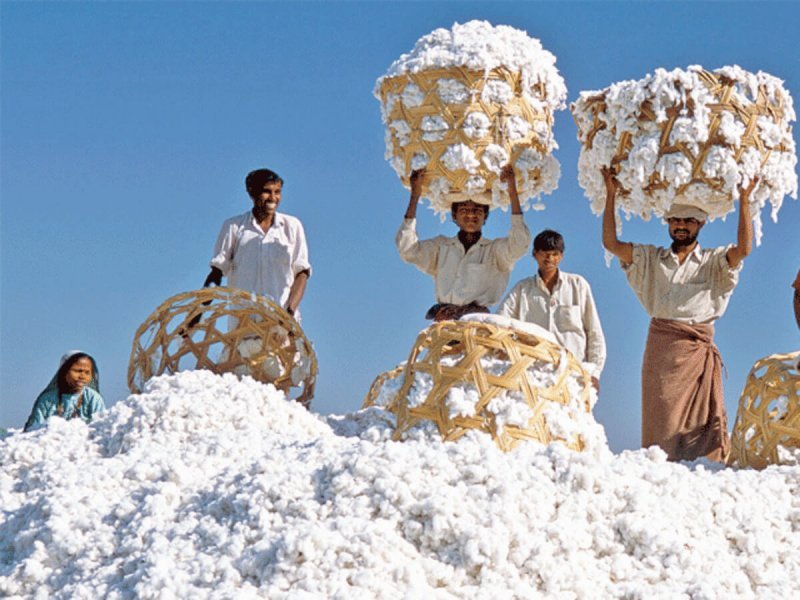

  • The Geopolitics of Syria’s Reconstruction

    The Geopolitics of Syria’s Reconstruction

    Introduction

    Syria’s territories are controlled by a variety of actors – Al Assad’s regime (with Russia and Iran as its supporters); Kurdish dominated self-administration (with a small number of US troops supporting them); Turkey and its affiliated militias; and the Syrian Salvation Government affiliated to the Hay’at Tahrir al-Sham (HTS), a former al-Qaida offshoot.

    Fragmentation of the state’s territories, as the state lost control of its territories, resulted in the emergence of a network of localised war economies with numerous local and foreign actors being involved. War economies emerged in territories held by Assad’s regime as well as those under the control of various other opposition parties, characterised by an increase in smuggling of goods (among which essential goods, crude oil and arms were popular), extortion, rent seeking for essential services, and taxation of goods at checkpoints established by the warring parties, including local warlords, opposition armed groups or regime’s militias. The Syrian Arab army is also reported to have engaged in rent seeking behaviour through the establishment in recaptured territories (Hinnebusch, 2020).

    Another area of priority for armed opposition groups is the border crossings with Turkey whose access they have sought to control. The Ahrar-Al Sham group, established control over the Bab al-Hawa crossing between 2015-16, and earned around $5 million per month. Armed opposition groups have been involved in conflict with each other over control for border crossings, particularly conflict between Hay’at Tahrir al-Sham (HTS) and Ahrar al-Sham in 2017 (al-Kattan, 2017).

    The Syrian army (that was cross-sectarian) is in crisis of its reducing force size as it is hampered by resistance to conscriptions and many desertions. The Alawite sect was co-opted into the state’s army, political and security apparatus, resulting in tensions along sectarian lines. Another significant development was that those among the pre-war elite who advocated for a political solution based on power sharing were expelled from it, resulting in the contraction of the core to comprise of individuals along sectarian lines. Further, pro-regime militias emerged as pro-government communities were forced to rely on themselves for their defence, leading to a widespread localisation of power to fiefdoms (al-Kattan, 2017).

    The political, economic and security dimensions of the conflict which led to the emergence of war economies has been accompanied by shift of composition of the economy marked by the emergence of ‘war commanders’ and a decentralised elite, who capitalised on evading sanctions, served as middlemen between the armed groups of the state and opposition and established monopoly upon the supply of goods and services.

     These developments further led to the emergence of new centres of power which existed alongside the existing regime that consolidated its power by strengthening its relations with the new elite, army and security sector.

    The domestic dynamics of the Syrian conflict are closely related to a wider geopolitical struggle among regional and external actors who act as patrons for the domestic actors.

    In addition, by portraying itself as a bulwark against radical Islamism and strengthening its relations with influential individuals in minority communities and providing them with disproportionate authority within their societies, the regime’s efforts have redefined existing social hierarchies and co-opted pro-regime minority leaders to power. The regime’s policies, throughout the war, have not only strengthened the neo-patrimonial nature of the State and its relations with its multiple networks but lead to the decentralisation of a system of neo-patrimonialism (Middle East Institute & Etana Syria, 2020).

    The domestic dynamics of the Syrian conflict are closely related to a wider geopolitical struggle among regional and external actors who act as patrons for the domestic actors. The Syrian conflict that began as an internal conflict emerged into a proxy conflict where regional struggle for influence played out between the ‘resistance axis’ comprising of Hamas, Hezbollah and Iran, and Sunni dominated ’moderate’ states comprising of Saudi Arabia, Qatar and Turkey. The latter wished replace the Assad regime that was aligned towards the ‘resistance axis.’ Iran considers the Syrian conflict as threat to its survival and its ability to support Hizbollah against Israel.  The rival axes instrumentalised sectarianism as a part of their discourse and in their support for proxies. However, the interests of those within the Sunni camp clashed (with Turkey and Qatar’s support for the Muslim Brotherhood and Saudi Arabia and UAE against the Muslim Brotherhood and its version of political Islam) resulting in division of the Sunni camp further leading to the division of their proxies (Aita, 2020).

    The global struggle for power between the US and Russia, with the former promoting a liberal world order and advance its hegemonic interests, and the latter interested in increasing its sphere of influence, limiting US intervention while emphasising on state sovereignty. Russian intervention in Syria in support of the Assad regime tilted the power balance in its favour allowing the regime to gain control of its lost territories.

    Image Credit: Al Araby

    US sought to limit direct intervention in Syria while relying on proxies and financial sanctions (that it pursued along with the EU) to pressurise Assad’s regime to compromise to a solution that would promote its interests. Assad’s regime, due to its connection Iran, Shia militas in Iraq and Hezbollah in Lebanon, was able to manage despite the external pressure it faced. US attention and efforts were diverted to controlling ISIS. In 2019, while US withdrew from Northern Syria due Turkish intervention against the Kurdish forces, it announced it would redeploy its forces to the energy reserves in Deir ez-Zor to prevent Assad’s forces or ISIS from gaining control over them (Hinnebusch, 2020).

    The geo-political struggle for influence in the Syrian conflict among regional and global actors, has also transcended into efforts to capitalise on Syria’s post-war reconstruction efforts and business.

    With diversion of US efforts towards constraining ISIS, Russian intervention, growing differences between Saudi and Qatar, Saudi and UAE intervention in Yemen, have all resulted in a gradual withdrawal of the GCC, leading to a rise in the role played by Turkey, Iran and Russia. Turkey’s role and interests evolved from installing a Brotherhood government and targeting the regime to controlling the Syrian Kurdish PYD, which it views as a terrorist organisation. The threat of a confrontation with Moscow in Syria allowed it to participate in the Astana Process and a gradual realignment of its policy with that of Russia’s policy. More recently, Turkey and Russia have brokered a ceasefire deal in Idlib.

    The geo-political struggle for influence in the Syrian conflict among regional and global actors, has also transcended into efforts to capitalise on Syria’s post-war reconstruction efforts and business.

    This paper explores the local, regional and international dimensions of reconstruction and development Syria while analysing the impact the war has had on the political economy of Syria.

    Internal dynamics of Syria’s reconstruction

    The internal dynamics of Syria’s reconstruction are characterised by conflict among Syrian actors (supported by external actors) for resources and instruments that would lead them to strengthen their control. The regime views reconstruction efforts as a means to consolidate its authority and power over the country.

    Image Credit: NYT

    While the efforts made by the regime to consolidate its power and authority served its objectives and reduce the costs of governance, they have led to the decentralisation of political and security apparatus at the local levels. In addition, Iran and Russia continue to establish relations based on patronage with several Syrian clients. The integration of Hezbollah, Iraqi Shi’i militias and Iran’s revolutionary guards, have further loosened the control the regime holds over the security apparatus and strengthened sectarianism.

    The efforts of Assad’s regime have been directed at satisfying its loyalist elite on whom it is vitally dependent to legitimise its authority and power, and to a lesser extent the public.

    The regime sought to prevent local security apparatus from capitalising on their autonomy by incorporating them into the newly established units under centralised defence forces as in the case of the 5th Army Corps, although this was only partially successful. Russian intervention and participation in the conflict allowed it to establish order in the army.  The paucity of manpower further prevents the regime from extending its authority over the entire country, forcing it to continue to depend on its relations with tribal leaders and local warlords (Hinnebusch, 2020).

    The efforts of Assad’s regime have been directed at satisfying its loyalist elite on whom it is vitally dependent to legitimise its authority and power, and to a lesser extent the public. It encouraged its loyalists to participate and reap benefits off the war economies during the war as its authority over its local proxies declined, while the threat of being targeted by the opposition has ensured that the elites remain loyal. With the localisation of war, the regime has strengthened its relations with the elite while consolidating its power by encouraging investment of income and revenues earned through illicit means into the formal economy. The elite, the warlords, who are partners in the conflict are increasingly participating in the formal economy by setting up formal companies and businesses. However, there remains much to be done to fully integrate them into the productive economy, discourage involvement in rent seeking, and to promote the revival of a productive economy (Sinjab, 2017).

    One of the major effects of the conflict and its resulting socio-economic and political patterns has been the lawlessness, that serves as a deterrent to socio, economic and political cohesion, further preventing the investments required for reconstruction.

    Legislation aimed at Reconstruction

    The regime’s economic strategy for reconstruction namely the ‘National Partnership’, enforced in 2016, allows public bodies to form private investment companies while supporting the establishment of private firms.

    Image Credit: BBC

    Private investors are encouraged to investing in the remaining public property allowing the government to retain its influence on the economic movements. This serves the purpose of attracting new investors to invest in lucrative opportunities while the investments serve to support regime’s prime customers and clients. The legislation also enables them to obtain and secure public sector properties at the cost of the state treasury’s finances, thereby raising a doubt regarding the ability of the ‘new elite’ to alter the nature of the enterprise. Another significant measure taken by the regime as part of its reconstruction repertoire are property and urban reconstruction laws, including the Law 66 of 2012 and Law No 10 of 2018, that expropriate land and property from displaced opposition supporters in substandard living conditions and reallocate them to new upscale housing. This is meant to gather the support of the regime’s loyalists. The regime by creating uncertainty about the security of the property could discourage all investors with the exception of a few capitalists (Daher, 2018).

    Despite the fact that restrictions on capital movement makes it very difficult to attract investments into Syria, the Syrian government is implementing policies and schemes to attract financial aid from outside. It intends to tax finance inflows ranging from money sent by expatriates into Syria for humanitarian aid, which must be channelled through NGO’s funded by the regime. It also intends to attract $100 billion worth Syrian currency held outside Syria through tax concessions and by launching the Syrian International Business Association (SIBA) under the auspices of World Bank. Analysts warn about the difficulties associated with investments from other nations. They suspect that given the dispersion of investments, diaspora would find it difficult to compete with loyalists for reconstruction contracts and there may be issues with fraudulent officials and widespread corruption. The assets of those businessmen who left the state have been frozen. Lastly, the US and EU-imposed multilateral sanctions led to Syria being cut off from the international banking system(Aita, 2020).

    The Syrian Government has declared that reconstruction contracts will be granted to its supporters and not countries who supported its opposition. It has also offered concessions in order to attract investments from Russia and Iran, but this may jeopardize Syria’s financial independence in the coming years.

    Reconstruction of Syria would lead to stronger relations with Iran and Russia followed by simultaneous decline in relations with the West (to whoom it exported a major portion of its oil ) and the Arab Gulf. Previous economic partners may engage in reconstruction in areas where there is negligible regime-control. The reconstruction parameters are bound to affect Syria’s social fabric. The gap between the rich and the poor has widened due to the war economy. The rigged economy will put the interests and benefits of the common people in peril.

    Geopolitical Dynamics of Reconstruction

    The geopolitical struggle over reconstruction among competing players at the regional level is centred around increasing one’s own influence, either through direct intervention or proxies. Considering that different parts of Syria is under the control of different parties there is every chance that Syrian reconstruction effort may not be an integrated effort across the nation but rather take the form of parallel reconstruction initiatives across the many different areas of Syria.

    The global geo-economic factors influence whether resources become available for reconstruction and on what terms. Because the powers that are geopolitically strongest on the ground in Syria (Russia, Iran) are geo-economically weaker than those who lost the geopolitical conflict (US, EU, Gulf), the latter are using the capital that they can withhold and obstruct or seek to leverage their contribution to effect the looming winding down of the military conflict on their terms. They, together with the World Bank, are making their participation conditional on a political settlement. Specifically, this will affect whether the regime will be able to reconstitute authority over the country’s territory and its reconstruction, or will be forced into some sort of power-sharing/territorial confederation or, these failing, reconstruction deepens fragmentation. If the parties do not reach a compromise the outcome could be a frozen conflict consolidated by separate and minimalist reconstruction tracks.

    Further, regional and global actors that have not participated in the conflict happen to be economically stronger and have the means to mobilise resources. Their support and resources to fund the reconstruction and development of Syria remain contingent on the ability of Assad’s regime to fulfil their conditions of a political settlement.

    Russia’s Reconstruction Support

    Russia’s role in Syria’s reconstruction have been driven by the benefits a stable Syria could provide it. It has provided Assad’s regime with support in economic and military terms and settled Syria’s debt. Russia also seeks to renew and recoup its pre-war investments in infrastructure and energy sector, and establish new contracts in geo-strategic areas. Assad’s regime has been granted a preferential role in redevelopment of its energy and infrastructure sectors. The state of the Russian economy has made lesser resources available for investment. The risk of investing in Syria due to the political and security climate and the threat of being targeted by US sanctions have led to minimal investment into Syria. The entities that have invested are operated/owned by oligarchs close to Putin, and those under sanctions, for instance, Gennady Tim-Chenko’s construction company (Van Veen, 2020).

    Russia has realised that it lacks the resources to actively finance Syria’s reconstruction effort and instead focussed its efforts on building the state institutions necessary to provide adequate security infrastructure, which is an important pre-condition for any reconstruction effort.

    Russia has realised that it lacks the resources to actively finance Syria’s reconstruction effort and instead focussed its efforts on building the state institutions necessary to provide adequate security infrastructure, which is an important pre-condition for any reconstruction effort. Simultaneously it tried to seek support from the European Union and international organisations to create the necessary infrastructure required to facilitate the return of refugees based out of Europe while ensuring the attainment of a political settlement that helps Bashar Al Assad to stay in power (Daher, 2018).

    Image Credit: NYT

    Russia has also worked with the Assad regime to implement policies aimed at the return of refugees thereby addressing some of the requirements and requests of the European Union. However, Bashar Al Assad has so far only paid lip service to such requests.  For instance a law intended to promote reconstruction projects has been amended under Russian pressure but without any major changes to its provisions and was used to expropriate the property of Syrians who fled abroad.

    Iran’s Role

    Iran has provided Assad’s regime around $16billion worth of financial aid since 2012.It has provided an additional $3.5 million in 2013 which was further extended by $1 billion in 2015 and $6.4 billion and $700million to pro-Iran militias in Syria.   It has expressed its interests in participating in the reconstruction of Syria. Iranian entities were awarded numerous contracts worth millions of dollars to initiate redevelopment of the electricity infrastructure by the central government as well as local governments but are yet to be implemented. The Iranian Revolutionary Guards, who have considerable experience in participating in the reconstruction of Iran after the Iran-Iraq war and own vast construction companies in Iran, have entered into agreements in the sectors of mining and communications. While Iran has stated it would offer $1 billion for reconstruction, the amount it pledged is a minuscule amount of the total funds required. Iran’s participation in Syria’s reconstruction is also likely to be limited due to the impact of US sanctions on its own economy(Van Veen, 2020).

    Diminished role of US, EU and Arab States

    As for regime controlled parts of Syria, Washington moved to block reconstruction funding in these areas. US pundits argued that the regime would inevitably be empowered by reconstruction and should not be rewarded for its brutal repression of the uprising; anti-regime interest groups moved not only to preclude US funding but also to erect obstacles to others participating in reconstruction. In April 2018 the US Congress passed the No Assistance for Assad Act (NAAA) which was designed to prevent any drift from humanitarian assistance to reconstruction stabilization, and according to Faysal Itani, had the effect of ‘killing any World Bank dreams to get funding to operate in Syria’. Indeed, the US has a long history of directing the flow of world financial capital via sanctions, conditionality, etc. for its geopolitical purposes; in Syria, it seeks to manipulate money (geo-economics) to obtain what it could not achieve via geopolitics: specifically, keeping Syria a failed state that would make it a resource-draining burden for Russia and its allies.

    The US has used its influence in North-Eastern Syria, to counter efforts by the Assad regime to consolidate its power over Syria which is a precursor to a “nationally integrated” reconstruction. Establishing control over energy reserves is essential for Assad’s regime to pursue its reconstruction efforts successfully. The US, by controlling reserves in the North-East Syria, has been able to deprive Syria’s access to essential resources.

    US efforts in reconstruction have been motivated by its interests to deter any reconstruction efforts sponsored by the regime through geo-economics measures such as sanctions, when its geo-political efforts have had limited success in motivating Syria and its allies in pursuing a political solution in line with US policy interests.

    The US campaign against ISIS devastated Raqqa but reconstruction there has remained limited to stabilization measures. The Trump administration tried to get the Saudis to assume the burden of reconstruction (asking for $4 billion). The US goal was to start enough reconstruction to deter any move in the area to join regime sponsored reconstruction efforts (Alaaldin et.al., 2018; Burcher, 2018; Harris, 2018; US Congress, 2018;). US efforts at convincing Saudi Arabia to undertake reconstruction efforts have not been successful as the latter offered relatively smaller amount (al-Khateb, 2020).

    US efforts in reconstruction have been motivated by its interests to deter any reconstruction efforts sponsored by the regime through geo-economics measures such as sanctions, when its geo-political efforts have had limited success in motivating Syria and its allies in pursuing a political solution in line with US policy interests.  It simultaneously blocked reconstruction funding directed towards territories under the control of the regime. The Caesar Act, now incorporated into the National Defence Act of 2020, targets investment into Syria, through individuals and businesses coming into the ambit of the UN sanctions (Hinnebusch, 2020).

    While the EU has provided substantial aid to Syrian refugees in Syria’s neighbouring countries, it has made its aid and participation in reconstruction contingent on efforts to reach a political solution that is in accordance with ‘UNSCR 2254 and the Geneva Communique’

    The EU has been affected by the Syrian Conflict due to the influx of refugees and large-scale migration of its citizens to partake in terrorist activities. While the EU has provided substantial aid to Syrian refugees in Syria’s neighbouring countries, it has made its aid and participation in reconstruction contingent on efforts to reach a political solution that is in accordance with ‘UNSCR 2254 and the Geneva Communique’ (Van Veen, 2020).

    Russia is making efforts to broker a political settlement of sorts, with Turkey’s support, to convince EU to invest in reconstruction to enable refugees to return. While the EU seems to be relying on the inability of Syria’s allies to support its funding and thus force Assad to agree to the EU’s conditions, the regime does not seem to be interested in accepting EU conditions and give up its power in return for support of its reconstruction. However, individuals EU states have participated in reconstruction efforts in a limited manner in both the regime-held as well as opposition-held areas.

    Turkey continues to be one of Syria’s top trading partners. Numerous Syrian businessmen who have been exiled have invested in Turkey, around 26% of foreign investment in Turkey in 2014 originated from Syrian businessmen, particularly in its border regions with Syria. While a number of exiled Syrian businessmen supported the opposition, their investment would be instrumental, if mobilised, in territories held by Turkey and its militias at a time when refugees are returning to the region. While the Syrian government is against the participation of Turkey in the reconstruction of Aleppo, Russia’s efforts in mediation would lead Turkey to participate in the reconstruction process. Turkey has invested significantly in establishing institutions facilitating the governance of areas under its control and also in building economic infrastructure in these areas (Daher, 2018).

    While Jordan and Lebanon have expressed interest in participating in the reconstruction of Syria, the resources they can mobilise are limited.  The Gulf countries have, no doubt the resources required for reconstruction, but have made their role in Syria’s reconstruction contingent on withdrawal of Iran and its proxies and in case of some countries, a regime change. The UAE as expressed its interest in participating in Syria’s reconstruction so as to limit Iran’s influence. However, Yazigi (2017) states that reconstruction efforts, in the case of  Lebanon, were contingent on a solution that emphasised upon power-sharing, backed by regional and international actors and substantial financial aid from Saudi Arabia. It is unlikely that either of the two scenarios would play out in the case of Syria.

    China: A Possible Contender?

    the Chinese state considers Al Assad’s regime as a bulwark against terrorism and its relations with the regime an asset in combating Uighurs who are participating on the behalf of terrorists.

    China has expressed its interest in participating in the reconstruction of Syria to advance its interests through investments in economy and geo-strategic areas such as the maritime sector, and to develop and connect its Belt and Road Initiative in the region. Given China’s interests, size and nature of China’s capital, China becomes a viable partner in the reconstruction of Syria.  China conducted a trade fair in 2018, which was attended by 1,000 Chinese companies and witnessed an investment of $2 billion for the reconstruction and development of Syria’s industrial sector. Private investors have been concerned about the widespread corruption in Syria and the threats of being targeted by US sanctions. Moreover, the Chinese state considers Al Assad’s regime as a bulwark against terrorism and its relations with the regime an asset in combating Uighurs who are participating on the behalf of terrorists.

    Conflict Resolution vs Conflict Management

    Given that the warring parties consider the conflict to be more-or-less of a zero-sum game, territorial and social fragmentation of Syria, it would be extremely difficult for them to pursue means to resolve the conflict through creating the need for the conflict to be managed and downsized (Dacrema, 2020). The non-recognition of certain non-state actors by the rival sides and questions regarding the participation of non-state actors in negotiations, which would only serve to legitimise them further, complicates the process of negotiating a solution.

    Temporary Arrangements

    A strategy that would allow for the management of the conflict would be to negotiate temporary agreements and deals. Turkey and Russia have been able to broker temporary ceasefires at multiple instances, throughout the conflict, in the Idlib region. Temporary arrangements would help build confidence among the warring parties in the long run, and reduce the possibility of escalation of war (Dacrema, 2020).

    Conclusion

    Given that the warring parties prefer a status quo in comparison to the resolution of a conflict and value their geo-political and economic interests, it is highly unlikely that parties would push for resolution of the conflict. In consideration of a political stalemate, reconstruction efforts among the warring parties are likely to take place parallelly, as they have played out with the localisation of the conflict. While resources in the territories held by the regime are being diverted to areas that have remained loyal during the conflict and/or areas of strategic importance with areas formerly occupied by opposition forces receiving relatively lesser attention; territories under Turkish control and those held by the Kurdish forces have witnessed efforts aimed at stabilising the territories.

    Russia and EU have the potential and the leverage required to emerge as power brokers in the reconstruction and initiate the process in a manner that promotes social, economic and political cohesion in the long run.

    Russia and EU have the potential and the leverage required to emerge as power brokers in the reconstruction and initiate the process in a manner that promotes social, economic and political cohesion in the long run. The likelihood of being able to convince themselves that the possibility of achieving one’s interests alongside the other is a far better option in comparison to its alternative of a failed state, which threats both their interests. However, their ability to convince their allies and their clients (in this instance, Assad regime is Russia’s client) and the mistrust between both the parties as well as between their allies poses a challenge.

    Russia’s efforts in brokering a constitutional committee for Syria under the aegis of the UN is an indicator of a compromise. Hinnebusch (2020) suggests that “it is not impossible to move incrementally toward a minimalist sort of political settlement that might acquire enough international legitimacy to open the door to some reconstruction funding.” While the likelihood of this occurrence is difficult amid conflicting interests, it cannot be overruled.

    The humanitarian aspects of the conflict and urgent need for reconstruction to alleviate tangible and intangible costs of the conflict have largely been ignored. The warring parties have been preoccupied with advancing and fulfilling their interests at the cost of ordinary Syrians. There is a need for parties to acknowledge and make efforts towards the realisation of the urgency of reconstruction that is vital for securing the social and economic interests of ordinary Syrians. The likelihood of the same, however, is questionable.


    References

    Aita, S. (2020). Reconstruction as a political-economy issue: The case of Syria. Retrieved 28 June 2020, from https://www.thecairoreview.com/tahrir-forum/reconstruction-as-a-political-economy-issue-the-case-of-syria/

    al-Kattan, R. (2017). Retrieved 25 June 2020, from https://www.atlanticcouncil.org/blogs/syriasource/the-economic-case-for-syria-s-stabilisation/

    al-Khateb, K. (2020). US outsources Syria aid to Gulf. Retrieved 4 July 2020, from https://www.al-monitor.com/pulse/originals/2018/08/us-outsources-syria-aid-gulf.html

    Dacrema, E. (2020). Three Concepts to Understand the Future of Syria. Retrieved 25 June 2020, from https://www.oasiscenter.eu/en/what-future-for-postwar-syria

    Daher, J. (2018). The political economic context of Syria’s reconstruction : a prospective in light of a legacy of unequal development. Retrieved 3 July 2020, from https://core.ac.uk/display/162303203

    Hinnebusch, R. (2020). The Battle over Syria’s Reconstruction. Retrieved 1 July 2020, from https://www.globalpolicyjournal.com/articles/development-inequality-and-poverty/battle-over-syrias-reconstruction

    Human Rights Watch. (2019). Rigging the System. Retrieved 25 June 2020, from https://www.hrw.org/report/2019/06/28/rigging-system/government-policies-co-opt-aid-and-reconstruction-funding-syria#_ftn114

    Middle East Institute, & Etana Syria. (2020). Manufacturing Division: The Assad Regime and Minorities in South-west Syria. Retrieved 2 July 2020, from https://www.mei.edu/publications/manufacturing-division-assad-regime-and-minorities-south-west-syria

    Sinjab, L. (2017). How Syria’s War Economy Propels the Conflict. Retrieved 25 June 2020, from https://syria.chathamhouse.org/research/how-syrias-war-economy-propels-the-conflict

    Veen, E. (2020). The geopolitics of Syria’s reconstruction: a case of matryoshka. Retrieved 27 June 2020, from https://www.clingendael.org/publication/geopolitics-syrias-reconstruction-case-matryoshka

    Yazigi, J. (2017). Analysis: No Funds to Foot Syria’s Reconstruction Bill. Retrieved 1 July 2020, from https://www.newsdeeply.com/syria/community/2017/12/04/analysis-no-funds-to-foot-syrias-reconstruction-bill


    Main Image Credit: Palmyra before its destruction by ISIS – www.citymetric.com