Category: Research Paper

  • The Democratic Warrior – Countering Unrestricted Violence with Clausewitz

    The Democratic Warrior – Countering Unrestricted Violence with Clausewitz

    This research paper was originally published in the “African Journal of Terrorism and Insurgency Research (AJoTIR)”, Volume 2, Number 1, April 2021. Pp. 89-106.


    Abstract

    We often find the application of indistinctive, brutal and extraordinary violence by all fighters and soldiers in terrorist, insurgency, and counter-insurgency acts in Africa. This article argues that we need a code of honour for those bearing arms to limit these unrestricted acts of violence, a code of honour that combines military duties with the demands of civil society in the model democratic warrior. The changes to the global system that followed the end of the Cold War are widely regarded as requiring a different kind of soldier for democratic societies. A number of writers have proposed that the new model should be that of the “warrior,” a concept that highlights the psychological and social distinctiveness of those who bear arms. Such men and (rarely) women are often conceived as operating according to a distinctive code of honour that sets them apart from civil society, usually in a positive way. But we know that the concept of honour may also lead to a terrible escalation. So, the task is to reconnect the concepts—warrior and honour—to civil society to de-escalate the ongoing brutal violence in civil wars. There is no honour in killing innocent people. On the contrary, it is perhaps the most egregious act against one’s honour and dignity to torture, violate, or kill the innocent. The concept of the democratic warrior seeks to reinstate honour and dignity to those bearing arms.Keywords: democracy, warrior, civil society, civil war, honour, dignity, terrorism, Clausewitz, wondrous trinity, containing violence.

    Introduction

    At first glance, the concept of the democratic warrior appears contradictory. Indeed, it combines seemingly conflicting value systems in a single concept. Like a magnet or Clausewitz’s favoured model of the unity of polar opposition between attack and defence, a methodology can be formulated to explain how this type of conflicted unity is not necessarily a logical opposition and can be a dynamic interrelationship on a continuum. At one end of the continuum is democratic equality and non-violent conflict resolution, while at the other end is the threat of (and sometimes) violently enforced limitation of war and violence; at one end is a civilized society, while at the other is a subsystem of society whose identity is defined by martial honour.

    The decisive bond that can link the two poles of this dynamic relationship, without eliminating their opposition, is the classical republican virtues, which can lay claim to relative validity in both spheres. Since Plato, the classical virtues have been prudence (wisdom), justice, fortitude, and temperance. Without a specific ethos aimed at the political functioning of the polity, a state can sustain itself only under the conditions of a dictatorship. If republican virtue, which is oriented toward the polity, cannot be directly reconciled with liberal democracy and its focus on the individual, it can take on a completely new significance as a bond linking a democratic society to democratic warriors. For Machiavelli, republican virtue already guarantees both external and internal freedom. In this respect, the necessary though not yet adequate condition of the democratic warrior is to also be a republican soldier. Add to this the limitation of war and violence in a global society to make democratic societies possible. A renewal of the republican virtue is the link between a liberal-democratic society and a warrior ethos.

    The “warrior” is by definition someone who chooses to bear arms and is proficient in their use. In this sense, whatever the distinctive characteristics of the warrior ethos, its institutionalization reflects the same preferences for professionalism, expertise, and individualism that are characteristic of modern society as a whole. Contemporary conditions, it is argued, no longer call for armed masses, but for experts whose willingness to serve in uniform will allow others the freedom not to serve.

    It must be admitted, however, that the concept of the warrior does not call forth associations with modernity, but rather of the “archaic combatant” (Röhl 2005), whose ethos, skills, and experiences set him apart from normal society and in opposition to its basic values, of which the most cherished is, of course, peace. The fact the warrior freely chooses his profession may be consistent with democratic values, but the existence of a “warrior class” uniquely skilled in the use of force, whose values are not those of society as a whole, is scarcely consistent with democratic interests. It is also true that those who serve in today’s democratic armies are called upon to do a great deal more than fight. Although phrases like “armed social worker” undervalue and denigrate the martial qualities that remain foundational to military life, it is true that only a small percentage of men and women in uniform actually fight, and that their duties entail a wide range of activities in which violence plays no part. To those who wish to uphold the warrior spirit, the diverse requirements of modern military missions are liable to hold scant appeal, which may undermine the sense of purpose and identity that drew them to the profession in the first place.

    The discussion that follows seeks to build a bridge between the distinctive ethos of the warrior and the moral and political requirements of democratic societies, using the concept of the “democratic warrior.” It seeks to do justice to the self-image of those who bear arms (a morally distinctive task) while connecting it to the various goals and practices of democratic societies, and the diverse uses to which they put their armed forces. We may begin by noting that a warrior, even in the most traditional terms, is not merely a combatant—a fighter—but has always performed and embodied a range of social, military, and political roles. Our starting point for considering what those roles must be is Clausewitz’s concept of the trinity, a metaphor intended to encompass all types of war, which, by extension, can provide a lens through which the ideal range of characteristics required of the democratic warrior can be envisioned. War itself, as Clausewitz avers, is compounded of primordial passions, an irreducible element of chance, and what he called an element of “subordination” to reason, by which its instrumental character is revealed. When Clausewitz set forth his trinity, he posited that the chief concern of the warrior must be the mastery of chance through intelligence and creativity; and so it remains. Yet there is no reason to suppose that such mastery means that war’s social and political requirements should be ignored. On the contrary, unless they too are mastered, the warriors sent forth by democratic societies cannot represent the values and interests of the communities that depend on them, and of which they remain apart (Herberg-Rothe 2007).

    Soldiers and Warriors

    In both German and English, the word “soldier” (soldat) originally referred to a paid man-at-arms. The term became common in early modern Europe and distinguished those who were paid to fight— primarily in the service of the increasingly powerful territorial states that were then coming to dominate the continent—from members of militias, criminal gangs, volunteer constabulary and local self-defence forces, and other forms of vernacular military organizations. The rise of the soldier was linked to the rise of the state. This connection distinguished him from the “mercenary,” who also fought for pay, but as a private entrepreneur, what we would today call a “contractor.” Standing armies comprised of soldiers were different from and militarily superior to, the feudal hosts of the past, whose fighters served out of customary social obligation and generally possessed neither the discipline nor the martial proficiency that the soldier embodied. Clausewitz highlights these developments briefly in the last book of On War, and portrays them as an advance in political organization and military efficiency (Clausewitz 1984, 587-91).

    The absolute monarchies that made the paid soldier the standard of military excellence in early modern Europe were generally indifferent to the social and political identities of those they paid to fight, though not always. Frederick the Great, for instance, lamented his reliance on foreign troops and believed that his own subjects made better soldiers. “With such troops,” he wrote, “one might defeat the entire world, were not victories as fatal to them as to their enemies” (quoted in Moran 2003, 49). It was, however, only with the French Revolution that a firm expectation was established that a soldier bore arms not merely for pay, but out of personal loyalty to the state, an identity that was in turn supposed to improve his performance on the battlefield. This connection, needless to say, was largely mythical. Most of the men who fought in the armies of the Revolution, and all major European wars since then, are conscripts who would not have chosen to bear arms on behalf of the state if the law had not compelled them to do so. Nevertheless, submission to conscription was itself regarded as an expression of the ideal of citizenship, a concept that, like honour, depends upon the internalization and subjective acceptance by individuals of norms arising within the larger society.

    The French Republic never referred to its soldiers as conscripts, always as volunteers. The success of its armies and those of Napoleon, although transient, insured that “defence of the Fatherland [became] the foundation myth of modern armies”(Sikora 2002). The myth of voluntary sacrifice by the “citizen-soldier” to defend the community proved central to the legitimization of conscript armies, even in societies where democratic values were slow to emerge. In the middle of the nineteenth century, as Frederick Engels observed, conscription was Prussia’s only democratic institution (Frevert 1997, 21).

    It had been introduced in reaction to Prussia’s defeat by Napoleon, whose triumph was owed to the fact that the resources of the entire French nation were at his disposal. The aim of the Prussian military reforms was to accomplish a similar mobilization of social energy for war, but without inciting the revolutionary transformation of society that had made such mobilization possible in France. Prussia was no sovereign nation of citizens, and while the reform of its armed forces helped it to regain its position among the leading states of Europe, their political effect was limited.

    Many of those who promoted reform, including Clausewitz, hoped conscription would contribute to the democratization of Prussia’s armed forces, and, indirectly, of society as a whole. But the moral influence could as easily run the other way, and, as Friedrich Meinecke observed, measures designed to bind army and society together had the effect, in Prussia, of militarizing society instead. Even the Great War did not fully succeed in stripping war of its moral glamour. The supposedly heroic massacre of German troops attacking the British at Langemarck (1914), for instance, remained a staple of right-wing mythology until the end of the Third Reich, by which “our grief for the bold dead is so splendidly surpassed by the pride in how well they knew how to fight and die (Hüppauf, 1993, 56). Alongside this kind of blood-drenched nostalgia, the industrialized warfare exemplified by battles like Verdun (1916) also asserted themselves. Under these circumstances, fighting and dying well acquired some of the aspects of industrialized labour, in which a soldier’s duty expresses itself, not through the mastery of chance as Clausewitz proposed, but through submission to what Ernst Jüngercalled “the storm of steel.”

    It was only after World War II that German soldiers became authentically democratic citizens in uniform. According to Wilfried von Bredow, the creation of the Bundeswehr in 1956 was “one of the Federal Republic of Germany’s most innovative and creative political reforms, fully comparable in its significance to the conception of the social market economy” (Bredow 2000). Its evolution as an integral part of German society has embodied a calculated break with the German past, one that has become even more apparent since the demise of the Soviet Union has shifted the mission of the German army away from national defence and toward expeditionary operations calculated to help maintain regional and global order. As the conscript armies of the past have given way to the professional and volunteer armies of the present, in Germany and elsewhere, the model of the democratic “citizen in uniform” has once again been required to adapt to new conditions.

    It is perhaps slightly paradoxical that as wars have become smaller and more marginal in relation to society as a whole, the ideal of the warrior as an apolitical professional fighter has regained some of its old prominences. Such individuals are thought to embody values different than those of society as a whole, to the point where their loyalties, like their special capabilities in battle, are thought to spring solely from their organization and mutual affiliation. John Keegan, a proponent of the new warrior, explains the rejection of the values of civil society in terms of the psychological impact of violence on those who experience and employ it. War, Keegan argues, reaches into the most secret depths of the human heart, where the ego eliminates rational goals, where pride reigns, where emotions have the upper hand, and instinct rules. One of Keegan’s models of the warrior is the Roman centurion. These officers were soldiers through and through. They entertained no expectation of rising to the governing class, their ambitions were entirely limited to those of success within what could be perceived, for the first time in history, as an esteemed and self-sufficient profession. The values of the Romans professional soldier have not diminished with the passage of time: pride in a distinctly masculine way of life, the good opinion of comrades, satisfaction in the tokens of professional success, and the expectation of an honourable discharge and retirement remain the benchmarks of the warrior’s life (Keegan 1995, 389-391).

    The enthusiasm of Keegan and others for the revival of the warrior ethos is the belief that “honour” can play an important role in limiting violence, far more effective than the proliferation of legal norms that lack the binding psychological validity required to stay the hand of those who actually take life and risk their own. Warriors use force within a customary framework of mutual respect for one another. This is part of what has always been meant by “conventional warfare”, a form of fighting that necessarily includes a dissociation from combatants considered to be illegitimate. How and whether these kinds of customary restraints can be successfully reasserted under contemporary conditions is one of the central problems with which the concept of the democratic warrior must contend. In opposition to Keegan, I think, that the warriors’ code of honour must be related back to civil society, although this is a task which requires bridging a gap and remains a kind of hybrid.

    Old and New Wars

    To judge what kind of “weapon carrier” will be needed in the twenty-first century, we must begin by looking at developments since the end of the East-West conflict. It has proven, broadly speaking, to be a period of rapid social, political, and economic development whose outstanding characteristics are marked by the decline or disappearance of familiar frameworks and inherited values. Thus, one speaks of denationalization, de-politicization, de-militarization, de-civilization, de-territorialization, and delimitation.

    Unsurprisingly, these changes are also supposed to be marked by “new” wars, characterized by the decline of statehood, the rise of privatized violence, the development of civil war economies, and the reappearance of types of combatants thought to be long gone— mercenaries, child soldiers, warlords, and so on. The new types of combatants are in turn associated with rising incidences of suicide bombing, massacre, and other forms of atavistic and irrational violence(Kaldor 1999, Münkler 2004).

    Political and academic discourses have produced a range of new concepts designed to capture these conditions, including privatized war, asymmetrical warfare, small wars, wild wars, low-intensity conflict, post-national wars; wars of globalization on the one hand, and of “global fragmentation” on the other. It is apparent, however, that each of these terms describes only one segment of a complex reality. To some extent, a new type of war is being discovered with each new war. At the same time, these different terms share a common assumption that war now consists mainly of conflicts involving non-state actors on at least one side, and, by extension, that the motivation and goals of such belligerents are likely to prove unfathomable in political terms. The result for some is an approaching anarchy (Kaplan 1994), whose remedy is a revived liberal interventionism, the only principle that seems able to guarantee a modicum of global order (Münkler 2007).

    It is possible, however, that the contemporary diffusion of conflict beyond the confines of the state system is no more than a transitional phase, with particular strong links to those parts of the world—Africa and Central Asia above all—where the challenges of post-imperial social and political adaptation are still especially pronounced. Neither does the fact that the parties to war are non-state actors necessarily mean that such wars lack a political or ideological basis. Such wars may not represent a clash between order and anarchy but between competing conceptions of order (Münkler 2004). While a revived interventionism may indeed be a suitable antidote to anarchy, it is unlikely to do more than aggravate indigenous conflicts over the politics of order – and as it seems at present, it is contributing to the escalation of violence throughout the world. Now, as in the past, violence is not simply a source of disorder. It is also a means of shaping order and providing the basis for community formation.

    It is possible to wonder, in other words, how new the “new wars” actually are. Widespread atavistic and vernacular violence were already prominent features of the Chinese civil war, the Russian civil war, the Armenian genocide, and many other episodes of “old wars”. Those who favour the concept note a number of formal changes that resulted from the disappearance of Soviet-American rivalry, above all a decline in external assistance. The proxy wars of the past have become the civil wars of the present, conducted by parties that must rely on their own efforts to obtain the necessary resources, including illegal trafficking in diamonds, drugs, and women; brutal exploitation of the population; extreme violence as a way of attracting humanitarian assistance that can then be plundered; and the violent acquisition of particularly valuable resources (robber capitalism). These changes may well amplify the social consequences of violence, but do not necessarily deprive it of its instrumental and political character (Schlichte 2006).

    The point of departure for the study by Isabelle Duyvesteyn, for example, is a very broad definition of politics based on Robert Dahl: “any persistent pattern of human relationship that involves, to a significant extent, power, rule or authority” (Duyvesteyn 2005, 9). Duyvesteyn refers especially to the fact that in the fast-developing states she has studied, the differences between economics and politics are not as clear cut as Westerners expect. Struggles that seem to be about the acquisition of resources can be motivated by power politics to obtain a separate constituency. Because the position of power in these conflicts is often determined by the reputation of the leader, what may appear to be personal issues can also be incorporated into a power-political context. Her hypothesis is not that economically, religiously, ethnically, or tribally defined conflicts are masks for politics, but rather that these conflicts remain embedded in a political framework that is understandable to the participants.

    It is also apparent today’s civil wars do not always trend irrevocably toward social and political fragmentation, becoming increasingly privatized until they reach the smallest possible communities, which are held together by only violence itself. The defeat of the Soviets in Afghanistan, for instance, gave rise to a civil war between warlords and individual tribes that appeared to be tending in this direction for a time, only to acquire a new and recognizably ideological shape once the Taliban seized power. This new tendency was confirmed by the Talibans’ willingness to give shelter to al-Qaeda, a global and trans-national organization of almost unlimited ambition, whose attacks upon the United States have in turn embroiled Afghanistan in a conflict about the world order pitting the West against militant Islam. At present, we witness in “Sahelistan” a similar development, but this is not confined to a single state, but to the whole region.

    At a minimum, it seems clear that the new wars, to the extent that they are new, are not all new in the same way. In some, violence does indeed appear to gravitate downwards towards privatized war; in others, however, the movement is upwards, towards supra-state wars of world order. Although these trends are linked in practice, analytically they are distinct. States do still wage wars, but for the most part, they are now doing so not in pursuit of their own particular interests but for reasons related to world order. This is what accounts for the new interest in an American empire and hegemony (Walzer 2003). Nor is America the only state capable of seeking and exercising global influence.

    Russia, China, India and Europe (whose superficial fragmentation masks its concerted economic, regulatory and power-political influence) are all capable of challenging American influence in particular spheres of activity; and one day they may do so in all spheres (Zakaria 2009). In any event, the use of force by strong states in pursuit of world order, whether cooperatively or competitively, is likely to remain the dominant strategic reality for some time to come; a fact that should not be obscured by the simultaneous proliferation of privatized violence on the periphery of the world system.

    Clausewitz’s Trinity as a Coordinate System

    The argument about the newness of new wars is also an argument about the continuing salience of Clausewitz’s understanding of war as, in his words, a “wondrous trinity,” by which primordial violence and the exigencies of combat may finally be subjugated to reason and politics. It is apparent, however, that while the proportions of these three elements may vary, a good deal nowadays, perhaps more so than in some periods in the past, they do not escape the theoretical framework that Clausewitz established. At the same time, his trinity points us towards the essential characteristics of the “democratic warrior,” whose success requires that he masters the multiple sources of tensions that Clausewitz detected in the nature of war itself.

    Clausewitz’s trinity present war as embodying three elements in constant tension with each other: primordial violence, the fuel on which war feeds; the fight between two or more opponents, by which violence is given military effective form; and the community, whose interests, as represented by policy, give war its purpose, and whose existence provides the soldier with his essential identity: as one who fights for something larger than himself. The shifting proportions among these elements that modern war continues to display would not have surprised Clausewitz. On the contrary, he knew that all three would always be present in every war and that a “theory that ignores any one of them . . . would conflict with reality to such an extent that for this reason alone it would be totally useless” (Clausewitz, On War, 1984, 89; see Herberg-Rothe 2007). Each requires exploration if the characteristics of the democratic warrior are to be understood.

    Violence and force

    The most crucial polarity in Clausewitz’s trinity is between the instrumentality of war and the autonomy of violence. Clausewitz noted the tendency of violence to become absolute, and therefore an end in itself, a tendency that was restrained both by the instrumental rationality of policy and, less obviously perhaps, by the skill of the combatants. Clausewitz also notes the paradoxical influences that can attend the use of force at a distance. If combatants are separated from each other in space and time, it may promote relative rationality in the use of force; or it may not, since it introduces the disinhibiting influence of impersonal killing, in which the humanity of the opponent is no longer perceived. Fighting “face-to-face” demands personal aggressiveness and even hatred, which can lead to increasing ferocity in the use of force. At the same time, however, it may make it easier to perceive the opponent as human. A similarly paradoxical logic may arise from the use of expensive weapons versus simple ones. Expensive weapons systems and the highly trained combatants required to use them can lead to a certain limitation of war because these cannot be so easily risked (as was the case, he argued, in the wars of the 18th century). In contrast, wars waged by relatively unskilled combatants employing cheap and simple weapons may be more likely to escalate – as is evident from many of the civil wars in Africa, particularly with child soldiers.

    The Fight

    The most basic reason that the violence of war is prone to escalate is that combatants share a common interest in not being destroyed. In most other respects, however, their interaction is asymmetrical, most profoundly so, as Clausewitz says, in the contrasting aims and methods of attack and defence, which he avers are two very different things. The shape of combat is also influenced by whether war is directed against the opposing will (in effect, a war to change the adversary’s mind)or if it aims at his “destruction.” Clausewitz specifies that by the destruction of the opposing armed forces, he simply means reducing them to such a condition that they can no longer continue the fight. Nevertheless, Clausewitz long favoredNapoleon’s approach to warfare, which emphasized direct attack against the main forces of the enemy. Other forms of fighting are also possible, however, whose aim is to exhaust the enemy’s patience or resources indirectly, rather than confront and defeat his armed forces in the field. The real war, in Clausewitz’s days and in ours, is generally a combination of direct and indirect methods, whose proportions will vary with the interests at stake and the resources available.

    Warring Communities

    When referring to warring communities, we must first differentiate between relatively new communities and those of long-standing. This is because in newly constructed communities, recourse to fighting is liable to play a greater relative role in its relations with adversaries; whereas, in the case of long-standing communities, additional factors come into play. Clausewitz argues that the length of time a group of communities has existed significantly reduces the tendency for escalation because their long-standing interactions will include elements other than war, and each party envision the other’s continued existence once peace is made, a consideration that may moderate the use of force.

    War’s character will also vary depending on whether it aims to preserve the existence of a community or, as in revolutionary crises, to form a new one; whether war is waged in the pursuit of interests, or to maintain and spread the values, norms, and ideals of the particular community (see Herberg-Rothe 2007). Closely related to this contrast, although not exactly congruent with it, is the question of whether the purpose of war lies outside itself or, especially in warring cultures, whether the violence of the fight has independent cultural significance. The social composition of each society and the formal composition of its armed forces (regular armies, conscripts, mercenaries, militias, etc), play an important role here. Summarizing these fundamental differences yields the coordinate system of war and violence shown in the diagram.
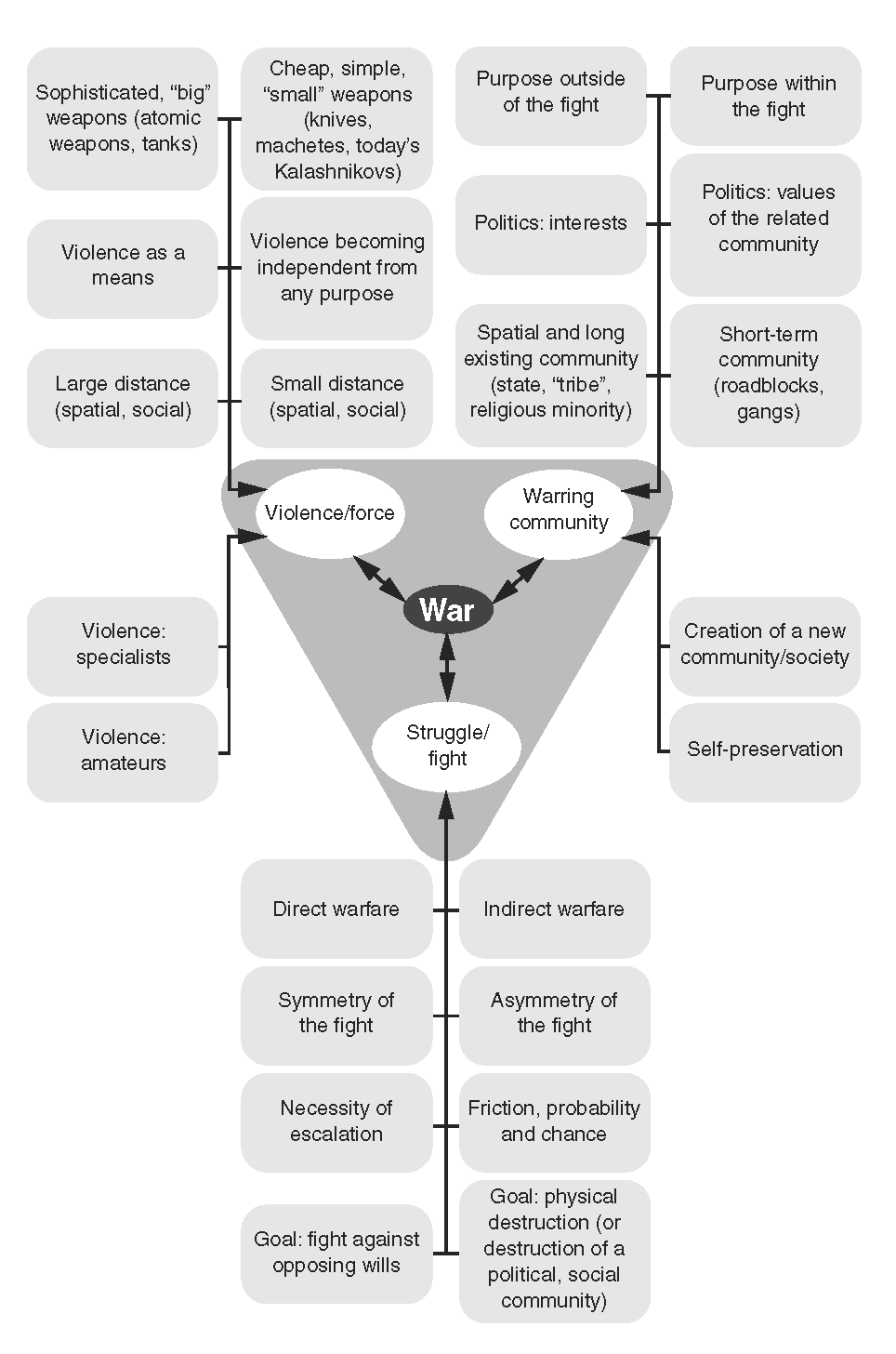
     

    Every war is accordingly defined in terms of its three essential dimensions: violence, combat, and the affiliation of the combatants with a community on whose behalf the combatants act. Historically, these three tendencies within the “wondrous trinity” display almost infinite combinations and multiple, cross-cutting tensions since every war is waged differently. Thus, every war has symmetrical and asymmetrical tendencies, for instance, even when it may appear that only one of these tendencies comes to the fore (Herberg-Rothe 2007).

    The tension between the coordinates of Clausewitz’s trinity may also be heightened by different forms of military organization. Those that feature strict hierarchies of command are perhaps most conducive to the transmission of political guidance to operating forces; whereas what is today called network-centric warfare is characterized by loose and diffuse organizational structures, in which the community’s political will and mandate can no longer be so readily imposed on combatants directly engaged with the enemy. As in the warfare of partisans, networked military organizations place a high value on the political understanding of the individual soldier. It is because of the relative independence of soldiers in network-centric warfare that this type of warfare does not require an “archaic combatant,” but a democratic warrior who has fully internalized the norms of the community for which he fights.

    The Democratic Warrior in the Twenty-first Century

    Even in Clausewitz’s day, war was not the only instrument of policy that state’s possessed, though it was undoubtedly the most central. Today, its centrality is less obvious, even as the complexity of its connections to other forms of state power has increased (Thiele 2009). Combining the different perspectives afforded by foreign, economic, developmental, judicial, domestic, and defence policy permits a global approach to conflict resolution while making the considerations surrounding the use of force more complicated than ever. States now pursue their security through many avenues at once, and all the agencies involved must consciously coordinate, connect, and systematically integrate their goals, processes, structures, and capabilities.

    Given the continuing expansion of the concept of security in recent years, a democratic army needs a specific task and function since its essential purpose—the use of force—can not be dispensed with. There have been those who thought it might be. When the East-West conflict ended, Francis Fukuyama announced the “end of history,” meaning an end to the practice of war and violence (Fukuyama 1992). The triumphant advance of democracy and free markets seemed unstoppable, to the point where it appeared as if the twenty-first century would be an age defined by economics and thus, to a large extent, by peace. These expectations have now been decisively overturned by ongoing massacres and genocide in Africa; by the return of war in Europe (as happened in the former Yugoslavia); by the September 11, 2001 attacks on the United States and, the subsequent wars in Afghanistan and Iraq; the war between Georgia and Russia over South Ossetia in 2008, the civil war in Syria and Iraq and finally the prospect of war to suppress Iran’s nuclear program (itself a profoundly dangerous and destabilizing step, should it become reality).

    In a complete reversal of Fukuyama’s thesis, a struggle against a new brand of Islamic totalitarianism appears to have begun, in which violence has become “unbounded”—because terrorist attacks are potentially ever-present because no end to them is in sight and there is no reason to assume there is any limit to the scale of violence terrorists might employ, including the use of nuclear weapons should they come to possess them. These processes of growing disinhibition must be countered by a new containment policy that limits the expansion of war and violence in the world.

    Two basic assumptions underlie this conception. The first is that the escalation of violence in world society is so multifaceted and differentiated that a single counter-strategy will not suffice. Rather, an overarching perspective is required to decide which measures are suitable in individual cases—without being able to exclude the possibility of terrible errors and miscalculations. The second assumption is that in today’s global society—as has been the case throughout history—many contrary processes are at work. Thus, regard for only one counter-strategy can have paradoxical, unanticipated consequences.

    This can be clarified using the example of democratization. If a general effort at worldwide democratization was the only counter-strategy against the disinhibition of violence and war, the results would almost certainly be counterproductive, not least because the spreading of democracy might itself be a violent process. A one-sided demand for democratic reform without regard for local conditions might, in individual cases, contribute to the creation of anti-democratic movements. The historical experience bears this out. After the First World War, nearly all of the defeated states underwent an initial process of democratization under the tutelage and supervision of the victors. Yet, almost all ended in authoritarian or even totalitarian regimes.

    Thus, the concept of the democratic warrior is not based on imposing democracy by force, but on limiting war and violence to enable the organic development of democratic self-determination. A differentiated counter-strategy of curbing war and violence in the world, with a view to fostering good governance (as a first step toward democratic governance), is the common element shared by humanitarian intervention and the development of a culture of civil conflict management. To this must be added measures to limit the causes of war and violence, such as poverty, oppression, and ignorance. Last but not least, this new form of containment requires effective restraint not just in the proliferation of weapons of mass destruction, but also of small arms, which continue to kill far more people than any other kind of arms.

    The containment of violence does not mean there will be entirely non-violent societies, much less a non-violent world society, in the foreseeable future. All else aside, the goal of completely eliminating violent conflict would ignore the fact that historically speaking, conflicts and their resolution have often furthered human development toward free and democratic ideals—as per the American struggle for independence and the French Revolution. The primary task of politics in the twenty-first century is therefore to radically limit violence and war so that non-violent structures and the mechanisms of the “social world” can have an impact. In this context, democratic warriors have a unique role to play; not as those who impose democracy by force, but as those who make diverse forms of culturally authentic self-determination possible, by curbing and containing war and violence.

    Conclusion

    It must be repeated, the concept of the democratic warrior appears to be contradictory. Indeed, it combines contradictory value systems in a single concept. Nevertheless, to adopt the metaphor favoured by Clausewitz (Herberg-Rothe 2007), the elements of tension in the democratic warrior’s identity can be conceived as the poles of a magnet, whose mutual opposition is not an illusion but is nevertheless a means to a larger, unitary end. It is what creates the magnet: the north pole of a magnet cannot exist alone. At one end of the continuum of the democratic warrior’s identity lies the values of democratic equality and non-violent conflict resolution; at the other, the realization that force itself may sometimes be necessary to limit war. At one end, is a civilized society, and at the other a subsystem of that same society, whose identity is defined by traditional concepts of honour and martial valour.

    As observed at the beginning of this essay, the bonds that link the two poles of this relationship, without eliminating their opposition, are the classical republican virtues, which lay claim to validity in both spheres. It was Plato who defined the classical virtues as intelligence, justice, fortitude, and temperance, which is also are characteristics in the Confucian tradition (Piper 1998 concerning Plato). Without them, a state can sustain itself only under dictatorship. With them, both external and internal freedoms are possible (Llanque 2008). They are the keys to the democratic warrior’s identity, providing the crucial link between the values of liberal-democratic society and those other values—courage, loyalty, self-sacrifice—that have always set the warrior apart.


    References

    Bredow, Wilfried von (2000), Demokratie und Streitkräfte (Wiesbaden: VS publishers, 2000).

    Clausewitz, Carl von (1984), On War. Ed. by Peter Paret and Michael Howard (Oxford: OUP).

    Duyvesteyn, Isabelle (2005), Clausewitz and African War (London: Routledge).

    Frevert, Ute (1997), Die kasernierte Nation (Munich: C. H. Beck, 2001).

    Frevert, Ute(ed.), (1997), Militär und Gesellschaft im 19. und 20. Jahrhundert

    (Stuttgart: Klett–Cotta).

    Fukuyama Francis (1992), The End of History and the Last Man (New York: Free Press).

    Herberg-Rothe, Andreas (2007), Clausewitz’s puzzle (Oxford: OUP). Herberg-Rothe, Andreas (2017), Der Krieg. 2.Edition. (Frankfurt:

    Campus).

    Herberg-Rothe, Andreas and Son, Key-young (2019), Order wars and floating balance. How the rising powers are reshaping our world view in the twenty-first century (New York: Routledge).

    Hüppauf, Bernd (1993), “Schlachtenmythen und die Konstruktion des ‘Neuen Menschen’,” in Keiner fühlt sich hier mehr als Mensch . . . : Erlebnis und Wirkung des ersten Weltkrieges, ed. Gerhard Hirschfeld, et al. (Essen: Klartext, 1993).

    Llanque, Marcus (2008) Politische Ideengeschichte. Ein Gewebe politischer Diskurse (Munich: Oldenbourg.

    Kaldor, Mary (1999), New and Old Wars: Organized Violence in a Global Era

    (Stanford: Stanford University Press).

    Kaplan, Robert (1994), “The Coming Anarchy.”In: Atlantic Monthly no.

    273, 44–76.

    Keegan, John (1995), Kultur des Krieges (Berlin: Rowohlt).

    Kuemmel, Gerhard (2005), Streitkräfte im Einsatz: Zur Soziologie militärischer Interventionen (Baden-Baden: Nomos).

    Moran, Daniel (2003), “Arms and the Concert: The Nation in Arms and the Dilemmas of German Liberalism,” in The People in Arms: Military Myth and National Mobilization since the French Revolution, ed. Daniel Moran and Arthur Waldron(Cambridge: Cambridge University Press).

    Münkler, Herfried (2004), The New Wars (New York: Policy). Münkler, Herfried (2007), Empires (Cambridge:Polity Press).

    Pieper, Josef (1998), Das Viergespann—Klugheit, Gerechtigkeit, Tapferkeit, Maß (Munich: Kösel).

    Röhl, Wolfgang (2005), “Soldat sein mit Leib und Seele. Der Kämpfer als existenzielles Leitbild einer Berufsarmee in EinJob wie jeder andere. Zum Selbst- und Berufsverständnis von Soldaten, ed. Sabine Collmer and Gerhard Kümmel (Baden-Baden:Nomos, 2005) 9–21.

    Schlichte, Klaus (2006), “Staatsbildung oder Staatszerfall. Zum Formwandel kriegerischer Gewalt in der Weltgesellschaft,In: ”Politische Vierteljahresschrift 47, no. 4.

    Sikora, Michael (2003), “Der Söldner,” in Grenzverletzer. Figuren politischer Subversion, ed. Eva Horn, Stefan Kaufmann, and Ulrich Bröckling (Berlin: Kulturverlag Kadmos, 2002).

    Thiele, Ralph (2009), “Trendforschung in der Bundeswehr”. In: Zeitschrift für Sicherheits- und Außenpolitik 2, 1–11.

    Walzer, Michael (2003), “Is there an American Empire?” In: Dissent Magazine 1 (2003), URL; http://www.dissentmagazine.org/menutest/archives/2003/fa03/walzer.htm  last accessed 16. 4. 2020.

    Zakaria, Faared (2009), The Post-American World (New York: W. W. Norton).
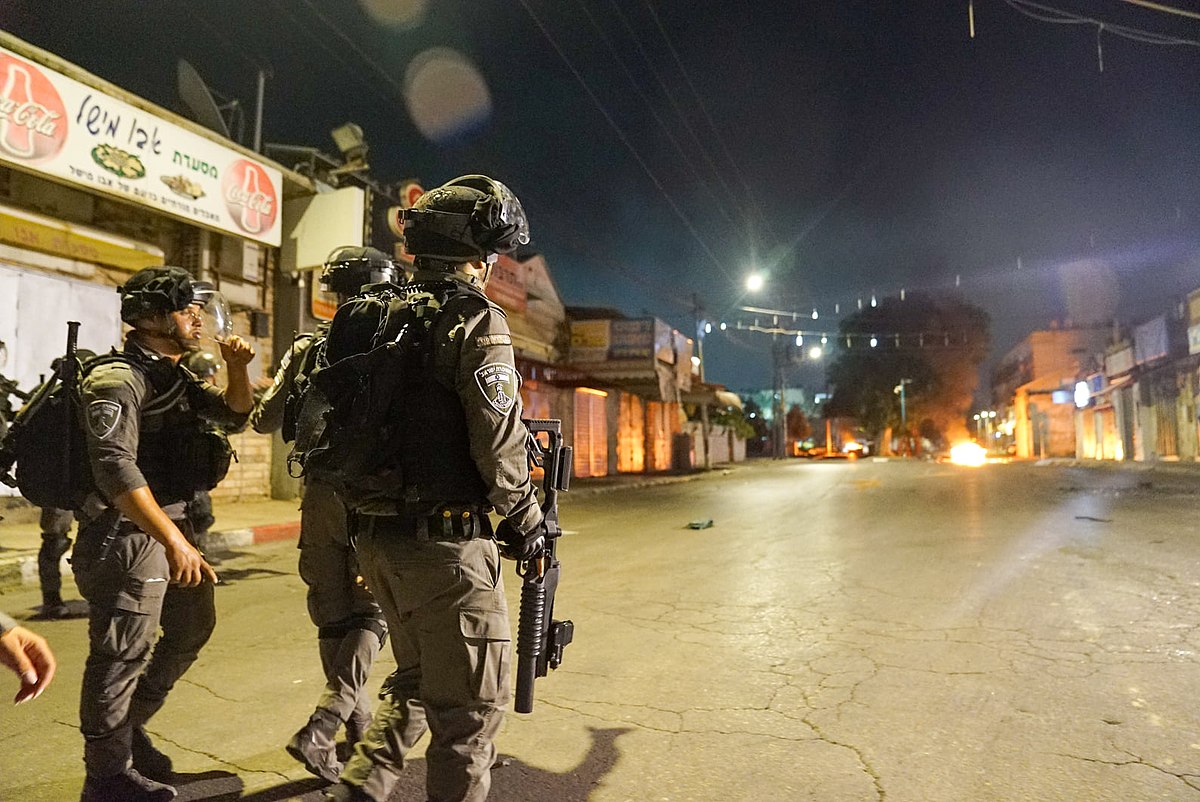
     

  • Lessons from Gaza

    Lessons from Gaza

    The latest round of fighting between Israel and Palestinians within Israel and the Gaza Strip ended on Friday 21 May under an Egypt brokered ceasefire. Already categorised in the media as the Fourth Gaza War[1], the 11-day conflict left 232 Palestinians including 65 children killed and more than 1,900 wounded in aerial bombardments[2]. Israeli authorities put their death toll as 12, with hundreds injured due to rocket attacks while claiming to have killed at least 160 combatants[3]. One Indian civilian caregiver too lost her life in the line of duty.

    Patrick Kingsley’s piece in the New York Times provides a view of a series of events from early April that led to the current conflict[4]. Several avoidable actions in Jerusalem, such as cutting off loudspeakers at the Al Aqsa mosque on the first day of Ramadan to prevent Jerusalem Day celebrations at the Western Wall from being disturbed, closing off a popular plaza at the Damascus Gate where the faithful gather after prayers leading to nightly protests, and orders for the evacuation of Palestinian families from their homes as per existing law (an act seen by Palestinians as a precursor to their removal from East Jerusalem, the proposed capital of an independent Palestine) followed by clashes between Jews and Arabs –  together provided multiple triggers for the violence, aggravated further by Jewish right-wing groups marching through Jerusalem shouting provocative slogans.

    As the demonstrations gathered momentum with more Palestinians rallying in support of the families facing eviction, the order was stayed by Israel’s Supreme Court. The cancellation of elections to the Palestinian National Authority (PNA) by President Mahmoud Abbas added another element of uncertainty to the situation, fuelled by suspicion over his intent. The final straw was another police raid on the Al Aqsa Mosque on the last Friday of Ramadan and sealing off access to the mosque the next day. Sensing a cue, Hamas commenced rocket fire the following Monday from Gaza.

    International Crisis Group opines that ‘this occasion is the first since the September 2000 intifada when Palestinians have responded simultaneously and on such a massive scale throughout much of the combined territory of Israel-Palestine to the cumulative impact of military occupation, repression, dispossession and systemic discrimination[5]. It further goes on to explain how the dynamic of this conflict differs from earlier ones. Central to this is the role of Hamas – in terms of military capability through an expanded long-range rocket arsenal which has exponentially enhanced its ability to terrorize Israel’s civilian population, as also its political ambitions in trying to negotiate the future of Jerusalem as leverage for subsequent resolution of the Palestinian issue, instead of confining itself to Gaza. Tellingly, it also named its rocket offensive ‘Sword of Jerusalem’.

    The second noteworthy issue is about clashes in cities and townships across Israel and the West Bank, between Israeli Jews, Israeli Arabs and Palestinians leading to loss of life and property, something that had never happened since the Second Intifada. A state of emergency was declared in certain areas[6], and Israeli President Reuven Rivlin was constrained to warn of the danger of civil war[7]. Thirdly, as per United Nations Interim Force in Lebanon (UNIFIL) press releases of 17 and 19 May, rockets were fired on both days from South Lebanon across the Blue Line into Israel. Israeli artillery shelled the launch sites in retaliation. Also, Iranian complicity with Hamas was indicated when Israel downed an armed explosive drone, assessed to have been launched from either Syria or Iraq[8]. This raised the spectre of a wider conflict – the deepest fear of a nation-state surrounded by inimical neighbours, some of whom along with other non-state terrorist organisations refuse to recognize its right to exist.

    Strategic and military aspects of this short conflict along with outcomes warrant analysis to provide a glimpse of the way ahead. Though President Biden announced that Israel had agreed to a mutual unconditional ceasefire, it is unclear what Hamas’s final stand on the matter was. More so, since it had set two conditions for a ceasefire: that Israeli forces stop incursions into the Al-Aqsa compound, and desist from evacuating Palestinian residents from East Jerusalem. No guarantees appear to have been received on these.

    It appears, therefore, that since Hamas’s strategic aim of positioning itself as the champion of Palestinians through offensive action has been achieved, it could claim victory despite the high human, material and infrastructural cost. Israel has also claimed victory, by ensuring maintenance of the status quo along its borders and ensuring the security of its citizens at minimal cost, though with a perceptible fraying of its internal fabric. However prominent Israelis have criticized their government for lacking strategy and acting in ‘default mode’ in responding to Hamas in the same manner for the last 15 years[9].

    Essentially, this was a conflict characterized by tremendous force asymmetry between opposing sides.

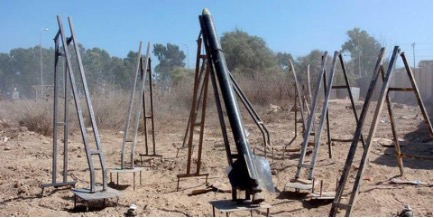
    It is in the military domain that some interesting conclusions are drawn. This conflict did not witness any hand to hand fighting or launch of physical assaults, though Israel did use tanks and artillery against Hamas targets. Essentially, this was a conflict characterized by tremendous force asymmetry between opposing sides. The main weapon that Hamas used was unguided rockets of various ranges and dimensions.  While in earlier days these were received from Iran or other allies across the Egyptian border at Sinai or smuggled in through sea, Hamas has developed sufficient expertise to develop its systems, using primitive technology and materials such as steel tubing and chemicals for making explosives. Israeli estimates suggested that ‘most of Hamas’s arsenal of 5,000 to 6,000 rockets can strike somewhere between the Gaza border communities and 40-55 km. away.’[10] Other estimates posit that Hamas now has rockets with ranges of 200 km or more, some with warheads carrying hundreds of kilograms of TNT and shrapnel. Raw construction material even uses detritus from Israeli missiles, with three rocket manufacturing factories rumoured to be existing inside Gaza[11]. Overall, Hamas fired around 4,360 rockets during the 11-day campaign, including a sizeable number that fell short, inside the Gaza Strip itself[12]. The long-range versions permitted engagement of targets from just outside the Strip to as far North as Jerusalem.

    Hamas Qassam rocket ready for launch.    Photo and description: Forbes May 12, 2021


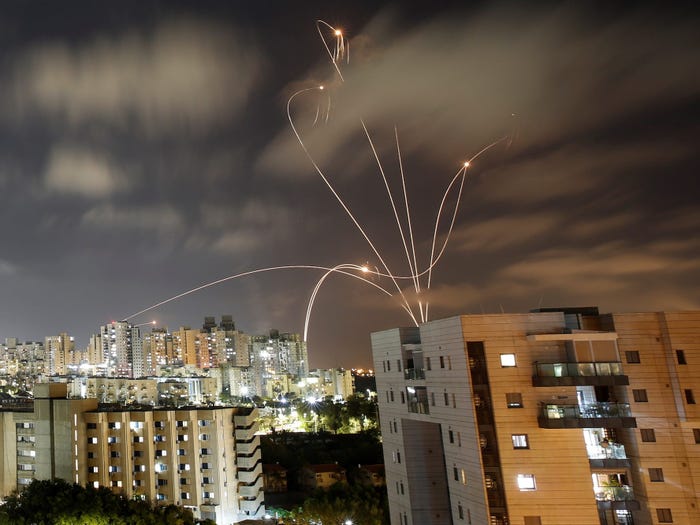
    Iron Dome carrying out intercepts – Image Credit: Businessinsider

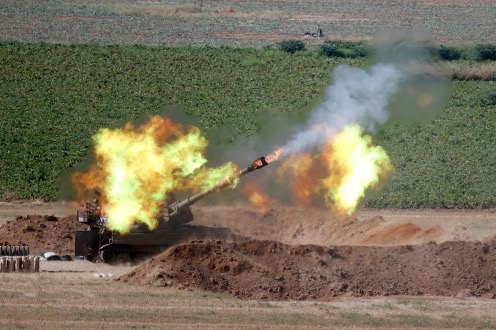
    The Israeli response on the other hand was a combination of air power and ground-based air defence with the firepower of tanks and artillery – all state-of-the-art weapon systems with latest generation cutting edge technology, including Israeli variant F 16s, F 15 Air Defence aircraft and F 35 Stealth fighters. Videos of Israeli strikes are testimony to their effectiveness. Israel too gave its campaign a symbolic name ‘Guardian of the Walls’. The Iron Dome Missile Defence System proved its worth with engineers continuously upgrading its algorithms to improve interception capability against larger rocket salvos. This has enabled Iron Dome to intercept one of the largest barrages fired ever – of around 130 rockets towards Tel Aviv on 11 May. Despite attempts to saturate the system, Iron Dome was able to neutralize the majority, permitting only a handful to get through[13]. However, limitations of Iron Dome are becoming apparent- Israeli security officials estimate that opponents like Hezbollah can fire over 1,000 rockets per day from a stockpile of over 150,000[14], which could overwhelm its capabilities. Also, Israeli IFF (Identification Friend or Foe) techniques were shown to be wanting, as the downing of a Skylark reconnaissance drone by Iron Dome friendly fire indicates[15]

    Israeli soldiers fire a 155mm self-propelled howitzer towards the Gaza Strip from their position along the border with the Palestinian enclave on May 16, 2021. Photo: AFP/Jack Guez

    asymmetric warfare thrives on a logic of its own, where the intelligent application of limited resources by the weak ensures some degree of military success

    The above instance is a singular example of an asymmetry arising from one side’s lack of sophisticated warfighting equipment or access to technology being compensated for by sheer force of numbers, to defeat or stalemate superior enemy systems. Operations Research analysts have worked out a ratio of one Israeli dying for every 206 rockets reaching Israel in the first four days of fighting, with at least 134 rockets hitting populated areas[16]. Israeli military sources put the accuracy of these rockets at around 15 per cent. Though many fell in open areas, their deterrent effect was enough for Israelis to descend into their bomb shelters[17], thereby proving that even today, asymmetric warfare thrives on a logic of its own, where the intelligent application of limited resources by the weak ensures some degree of military success. This, despite a situation where most of the Artificial Intelligence, networked communication, quantum computing and precision standoff capability was on one side – though one could grant some level of technology available to Hamas, through its research laboratories in the Strip and inputs from Iran. Adding another dimension to such asymmetry in the larger context however is the history of injustice perpetrated on Palestinians over the years, providing strong psychological motivation in favour of any opponent of Israel.

    Coming to the issue of outcomes, it is apparent that notwithstanding the asymmetry in capability, Hamas’s strategy has paid off. Having realized that the situation during Ramadan (created by Israel mostly through application of a purely law and order cum security template) was tailor-made for exploitation, it made Jerusalem the focus of its campaign, escaping in one go from the confines of Gaza.

    With Palestinians rallying to its cause, resultant unrest in Israel and the West Bank and some support from Hezbollah in Lebanon, it was able to create a narrative in its favour. Notwithstanding its designation as a terrorist organization by the US, EU, UK and many other nations, it has garnered huge political capital, enabling it to rival the current Palestinian leadership as reports of Palestinians carrying green Hamas flags in cities on the West Bank, where the PNA traditionally holds sway, indicate[18]. The stark difference in respective casualty figures also helped, once again raising the issue of ‘proportionate vis a vis disproportionate response’, against the backdrop of repeated injustice to Palestinians over the last 70 years.

    The IDF on the other hand worked efficiently with their usual precision, taking out as many targets as possible from their prepared lists, including networks of tunnels, headquarters, senior Hamas commanders and research infrastructure in the minimum amount of time. Without a doubt, Israel is a clear winner in military terms.

    This conclusion however begs the larger question of whether military victory alone can decide winners and losers in world geopolitics. At the time of writing US Secretary of State, Blinken is on a four-day visit to the region, to interact with leaders of Israel, the PNA, Jordan and Egypt to strengthen foundations for a durable ceasefire. President Biden has signalled that West Asia is back on his agenda: in a hugely symbolic gesture, the US has announced its decision to reopen its Consulate in East Jerusalem and promised $32 million worth of aid to the UN in Gaza. White House spokesperson Jen Psaki has called this part of America’s efforts to rebuild ties with the Palestinians.

    Whether this effort will be to purely manage a crisis or look for a permanent solution is unclear. The latter venture will require creative thinking by Israel, Palestinians and their neighbours and a shift from absolute positions which have shackled the region for over 70 years.  In that eventuality, a fresh look at the Two-State Solution guaranteeing the right of both nations to exist as sovereign states might yet provide the alternative. Reverting to the status quo of April 2021 will not.


    Notes:

    [1] ‘Daily Chart. The Israel-Palestine conflict has claimed 14,000 lives since 1987’   The Economist  18 May 2021

    [2] ‘Israel-Hamas truce begins after 11 days of fighting, Palestinians celebrate’   Reuters 21 May 2021

    [3] Ibid.

    [4] ‘After Years of Quiet, Israeli-Palestinian Conflict Exploded. Why Now? ‘  Patrick Kingsley, The New York Times 15 May 2021

    [5] ‘The Israel-Palestine Crisis: Causes, Consequences, Portents’   International Crisis Group  14 May 2021

    [6] International Crisis Group 14 May 2021

    [7] ‘Israeli president warns of civil war as Jews, Arabs clash over Gaza’   Rami Ayyub  Reuters  13 May 2021

    [8] ‘Netanyahu: Drone shot down earlier this week was Iranian UAV armed with explosives’   Judah Ari Gross  The Times of Israel 20 May 2021

    [9] Maj Gen Giora Eiland Retired, former head of Israel’s National Security Council in comments to Crisis Group 14 May 2021

    [10] ‘What do Hamas and PIJ have in their rocket arsenals? – analysis’  Yonah Jeremy Bob The Jerusalem Post 11 May 2021

    [11] ‘Israel’s Gaza challenge: stopping metal tubes turning into rockets’ Arshad Mohammed, Jonathan Saul, John Irish and Parisa Hafezi, Reuters 24 May 2021.

    [12] Ibid.

    [13] ‘How Israel and Hamas returned to armed conflict’  The Economist  22 May 2021

    [14] ‘Is Iron Dome effective against Hamas rockets as originally thought?’  Yonah Jeremy Bob  The Jerusalem Post  14 May 2021.

    [15] ‘Iron Dome Shot Down an Israeli Drone During Israel-Gaza Fighting’ Yaniv Kubovich Haaretz 25 May 2021.

    [16] ‘Gaza’s rocket technology challenges Israeli defenses’  Michael J Armstrong  Asia Times 18 May 2021

    [17] ‘Israel’s Gaza challenge: stopping metal tubes turning into rockets’  Reuters 24 May 2021.

    [18] ‘Israel and Hamas Begin Cease-Fire in Gaza Conflict’  Iyad Abuheweila and Adam Rasgon  The New York Times 21 May 2021


    Image Credit: Wikipedia


  • Online Justice and the Pandemic: Impact on Procedure

    Online Justice and the Pandemic: Impact on Procedure


    Abstract

    The move towards digitization of the judiciary and the adoption of video-conferencing preceded the pandemic. However, the pandemic has necessitated their mainstream adoption. While Indian courts have been prompt in issuing their SOPs, these have been inadequate due to their non-implementation and the inability of traditional legal tools to address unprecedented procedural issues, emerging from the mainstreaming of video conferencing.

    Firstly, there are due process concerns, centred around inadequate hosting platforms, sub-standard organizational practices, inefficient ancillary processes, and non-inclusive technical requirements. Secondly, there is a lack of accountability and transparency because of derogation from the rule of open court, without any effective alternative measures. Thirdly, there are privacy concerns as regards unauthorized participation, the secrecy of data exchanged, and commercial exploitation of data.

    Adopting a design-based approach not only addresses areas conventional legal tools can’t, but also improves efficiency and automates compliance. To this end, several technological and organizational design changes are suggested that can be made to effectively address emerging procedural issues.

    Keywords: online justice, virtual courts, pandemic, design-based approach, digitization, standard operating procedure.


    Introduction

    The unprecedented COVID-19 pandemic has necessitated social distancing to be the norm. To this end, courts, across the world, have started resolving disputes through virtual conferencing. While limited physical hearings with rigorous rules have commenced,[i] our courts have limited infrastructural capacity to house adequate daily hearings. Additionally, the surge in COVID-19 cases and the wait for a vaccine mean that virtual conferencing is nevertheless here to stay. The pandemic has decreased the average disposal rates of high courts by 50% and subordinate courts by 70%,[ii] with pendency in the Supreme Court increasing by 3,287 cases.[iii]

    Therefore, at this point, it is opportune to realize that the revolutionary potential of virtual courts can help improve judicial efficiency. Apart from facilitating remote access to justice, virtual courts are cost-effective and time-effective, reduce carbon footprint and the employment of dilatory tactics by parties.[iv] These benefits are particularly important given that annually one billion people require basic access to justice, but close to 30 per cent of them do not even take action.[v] Moving forward, this access to justice problem has to be solved through Information & Communications Technology (“ICT”), which will render courts to function as a ‘service’ and not a ‘place’.[vi] In cognizance of this, India launched the e-Court Mission Mode Project (“MMP”), to implement ICT in the Indian judiciary in 3 phases over 5 years.[vii]

    However, this increasing change in the medium of our court processes will inevitably impact civil procedure in unprecedented ways. A survey found that 44.7% of participants experienced technical difficulty during the hearing, with a majority feeling that remote hearings were overall worse than physical hearings and less effective in terms of facilitating participation.[viii] The skill and digital divide will further compound power imbalances among parties, and thus their access to justice.[ix]

    In light of this, it is important to understand the adequacy of the current response plans from the Court and governments. Therefore, in this paper, I will enumerate the legal and policy developments in India on virtual courts, both pre and post COVID-19. Subsequently, I will critically analyse these developments to elucidate implementational failures, and three procedural concerns: impact on due process, accountability and transparency, and privacy. Recognizing the inadequacy of legal tools in addressing these concerns, ultimately, I will utilize a technological and organizational design-based approach to propose solutions.

    Tracing Legal and Policy Developments on Virtual Courts

    India’s attempts to digitize the judiciary and associated processes predate the pandemic. However, the scale of impact has certainly increased since virtual conferencing has now become the dominant norm. Therefore, in this section, I will analyse how law and policy on virtual courts have evolved. However, before we proceed, it must be noted that virtual courts are broader than just virtual conferencing. Other than virtual conferencing, related processes of digitisation and automation, like e-filing and e-listing, need to be implemented alongside.

    Pre-Pandemic:                      In February 2007, the government approved the Supreme Court E-Committee’s (“E-Committee”) strategic action plan to implement ICT in the Indian judiciary in 3 phases over 5 years.[x] It was co-opted as a ‘Mission Mode Project’ of the National e-Governance Plan,[xi] with the objective of re-engineering processes to enhance judicial productivity, and make the system more affordable, accessible, cost-effective, transparent and accountable. To this end, it launched 4 services: automation of case management, online provision of judicial/administrative services, information gateways between courts and government, and creation of judicial data grids.[xii]

    Virtual courts, and associated processes, have found recognition and regulation in jurisprudence too. In State of Maharashtra v Dr Praful Desai, the Supreme Court allowed video conferencing for the recording of evidence.[xiii] It even observed that technological developments have enabled the possibility of virtual courts. This position has found, subsequently, substantial affirmation.[xiv] Courts have allowed video conferencing on conditions of health[xv] and geographical proximity.[xvi] However, under the revised position, parties cannot resolve matrimonial conflict through video conferencing.[xvii]

    To safeguard these proceedings, courts have issued numerous guidelines. These include authenticating the identity of the witness and examiner, administration of the oath, acquainting non-party witnesses with the case, recording demeanour of witnesses on-screen, notarization of witness testimony/statement, and bearing of costs.[xviii] When video-conferencing is global, the foreign party must record evidence in the presence of an Indian embassy officer member.[xix]

    Post-Pandemic:         To comply with social distancing guidelines, the Supreme Court passed an order, under Article 142 of the Constitution, to suspend the physical hearing.[xx] However, recognizing the importance of access to justice, it identified the duty of courts to use ICT like video-conferencing for dispensation of justice, in urgent matters. Accordingly, it issued directions: empowering itself and all high courts to adopt measures for the functioning of video-conferencing, instructing district courts to follow their respective high courts, for providing videoconference facilities and an amicus curia to the deprived, prohibiting recording of hearing without the mutual consent of parties, and requiring prompt reporting of technical glitches during the video call.

    Pursuant to this, the apex court issued its standard operating procedure (“SOP”) mentioning the instructions for joining/conduct during virtual hearings and the technical requirements as well as the procedure for listing, mentioning, and e-filing.[xxi] Parties can choose between getting virtual links or availing the facility in the Court’s premises. However, only two appearance links and one viewing link is provided to parties. While the hearings are hosted on the “Vidyo” platform available either as a desktop application or on Android or iOS app store, parties are advised against using mobile phones for connectivity reasons. Communication between the registry and participants happens through private WhatsApp groups, with links being shared 30 minutes prior. Parties are forbidden from sharing these links, engaging in indecorous conduct, and recording the hearings. Furthermore, they are expected to ‘mute’ themselves, except when making submissions or responding to questions from the bench, and must ‘raise hand’ to indicate an intention to speak. The Court has also mandated the use of e-filing even if parties file physically at the registry and reduced the cost of filing by half, thus promoting digitization.[xxii]

    Currently, virtual hearings are inaccessible to the public, but limited journalists can attend the Court’s physical video-conferencing room, to report on cases. The Court has now started hearing non-urgent matters too.[xxiii] The E-Committee has also resolved to institutionalize technology even after the pandemic ends.[xxiv]

    While high courts can employ their own rules, 11 of them have adopted the model rules developed by the E-Committee.[xxv] Even those with unique rules broadly convey the same instructions,[xxvi] with the only difference being the hosting platform. The most popular is Vidyo, followed by Zoom, Jitsi, and Cisco Webex.[xxvii] However, pursuant to the Union Ministry of Home Affairs’ advisory declaring Zoom as unsafe, most high courts discontinued using it.[xxviii] Remarkably, the Delhi High Court issued comprehensive legislative rules covering not just the aforementioned matters, but also the procedure for service of summons, examination of persons, sharing of documents, and access to legal aid. It statutorily establishes a “remote point coordinator”, entrusted with ensuring seamless functioning and ingenuity of the hearing.[xxix]

    However, other than Chandigarh District Court and a few others, district courts have failed to organize virtual hearings, given their infrastructure limitations.[xxx] Most tribunals are following the procedure established by the apex court.[xxxi]

    Critically Analyzing Indian Developments on Virtual Courts

    The Mission Mode Project

    The implementation of Phase-II of the MMP has been sluggish, with only 3477 courtrooms having video-conferencing, and 14443 more courtrooms requiring this facility.[xxxii] 2992 sites are yet to still get WAN connectivity.[xxxiii] Only states like Delhi, Karnataka and Madhya Pradesh have started the digitisation of both disposed and pending case records in the high courts and district courts.[xxxiv] E-filing is currently available only in four high courts,[xxxv] and in the NGT, NCLAT, and ITAT.[xxxvi] Even in these courts, only 50-600 cases were instituted through e-filings, as against the 1.9 lakh cases instituted through regular filings.[xxxvii] Despite listing being digital, the process involves significant human input, rather than the use of algorithms.[xxxviii] The implementation of this project will further stagnate because courts have been instructed to utilize their unused funds from Phase-II for meeting immediate needs.[xxxix]

    The failure in technology up-gradation is also at the litigant and advocate’s end. The internet penetration in India is only 40%.[xl] 30% of the population lacks basic literacy, and nearly 90% lack digital literacy.[xli] At least 50% of advocates, mostly at the district and lower levels, do not own relevant devices and lack the requisite skills for virtual proceedings.[xlii] Thus, there is a clear digital, connectivity, and skill divide.

    Evaluating SOPs- Emerging Legal Issue

    • Due Process

    The paradigm shift consequent to virtual hearings has raised numerous unprecedented due process concerns. The smoothness of accessing and using virtual court facilities, along with available facilities, has an inextricable impact on one’s right to properly present their case.

    Technical Issues with the Platform:                       The most popular platform, Vidyo has received an extremely negative response. Reportedly, the platform frequently crashes,[xliii] and participants struggle to log in or are automatically logged out during court proceedings due to bandwidth issues with the platform. There were also difficulties in re-joining the hearing, once logged out.[xliv]

    The screen sharing feature on Vidyo is ineffective, and thus advocates are precluded from even presenting documents before the bench.[xlv] There is also no means for the attorney and client to engage in private discussion during the hearings.[xlvi] The Control Room is tasked with managing the entire process flow. In several cases, advocates have complained of not being unmuted, despite raising their hands, or their chat messages going unread, thus affecting their opportunity to present arguments. This is especially the case in matters involving a large number of parties.[xlvii]

    This adverse impact is compounded since there is no clarity on who to contact for technical issues.[xlviii] The authorities provided in the SOP are extremely unresponsive. Moreover, links for hearings are shared last minute, with communications on WhatsApp being inefficiently followed.[xlix]

    The Court has been ignorant of these technical inefficiencies, passing adverse orders against at least 19 advocates who were unable to attend/connect due to technical issues.[l]

    Issues with Associated Digital Process:      The processes of e-listing and e-filing are not user-friendly and unnecessarily verbose.[li] Under the current e-listing mechanism, there is uncertainty over acknowledgement of their filings, because the diary numbers are not immediately generated. Even the procedure for curing defects is inefficient, voluminous, and confusing. There is also a delay in the listing of matters, despite pleas of urgency in petitions.[lii] Support from the Registry in this regard is inadequate. There is also a need for improving coordination between sections of the Registry, with procedures being more consistent and transparent.[liii]

    Furthermore, court records are not fully digitized, and when so, they cannot be remotely accessed in a centralized server.[liv]

    Technical Requirements as Impediments:             The minimum technical requirements determine who can even access the platform, and therefore, determine who even has the opportunity to present their case, to begin with. Presently, the SOP of all Indian courts require a minimum of 2 MBPS broadband connection or 4G connections, and the onus is on the participant to ensure seamless connectivity. Given that 20% of the internet users in India are still dependent on 2G and 3G,[lv] this directly leads to their exclusion. Even digitally advanced nations like Singapore have stipulated 3G as the minimum requirement.[lvi] Moreover, even the 4G connections in India are relatively slow, with no service provider crossing the 70% LTE threshold.[lvii]

    Even in data-intensive platforms like Skype, the minimum download speed requirement for a high-quality video call is only 400 KBPS, with group calls of up to 3 people supported at 512 KBPs, and 5 people at 2 MBPS.[lviii]

    Additionally, all video-conferencing platforms have only been made available as desktop apps, or on Android or iOS app stores. The over 55 million users with KaiOS, operating mostly on Jio Phones,[lix] are denied access to videoconferencing, despite their phones supporting video calls.

    (Dis)Comfort with Virtual Testimony and Demeanour Assessment:      The process of testimony, along with cross-examination, are in themselves strenuous for witnesses. The unfamiliar nature of virtual conferences can cause severe anxiety among witnesses while appearing, especially if they’re children, foreigners, or persons with disabilities.[lx]

    During video conferencing, courts are allowed to assess the credibility of parties through their demeanour.[lxi] This is problematic because in a virtual setting it is extremely difficult for the judge to accurately understand the body language and emotions of the witness.[lxii] Studies find that one’s social and economic background has a heavy correlation with one’s perception, which plays out in the form of subtle choices like lighting and camera angles.[lxiii] Given these inaccurate and disproportionate adverse impacts, demeanour assessment during virtual hearings must be disallowed.

    • Transparency and Accountability

    The Supreme Court has repeatedly recognized the importance of the rule of ‘open court’ in preserving and promoting accountability and transparency, and thus guaranteeing a fair trial.[lxiv] Presently, virtual hearings are not recorded, except for witness testimony in some cases,[lxv] even by the court. While theoretically limited journalists are allowed to attend these hearing, this is severely inadequate because this facility is accessible only to reporters who can make it to the Supreme Court’s video-conferencing chamber. Moreover, no such facility has been provided in most high courts. Therefore, there is no effective means of ensuring even a shadow of public pressure, which would bind the judge’s actions. This is contrary to jurisdictions like the UK, Australia, and Singapore where public participation has been allowed through live links or even live streaming.[lxvi]

    Virtual conferencing presents an opportunity to eliminate the practical physical, informational, and temporal barriers to open courts. If hearings are online and broadcasted, then a large number of people can access them. For instance, over 3,500 people viewed a YouTube live stream of oral arguments taking place in the Kansas Supreme Court over Zoom. The digital landscape can even house much more people than the court logistically can.[lxvii]

    However, we must be mindful that live streaming for virtual hearings is distinct from the cameras in the courtroom context.[lxviii] In the latter, even if live streaming is not allowed, the public and media can anyway access the trial. However, if there is no public access to virtual hearings, which entirely supplant in-person proceedings, only then participants to the proceedings have knowledge of events.

    Livestreaming virtual proceedings do raise some legitimate privacy concerns because there is a loss of ‘practical obscurity’. This concept recognizes that there is a privacy interest in the information that is not secret but is otherwise difficult to obtain.[lxix] Public online hearings could make access to personal data easier because the process of transferring information from physical documents to a digital format will not have to be done.

    • Privacy;

    There are serious concerns regarding video-conferencing platforms, which are apps owned by foreign companies. The terms of use of these apps mandate cross-border transfer, and the business model of most of these companies involves selling their consumer’s data.[lxx] Therefore, there is the risk of commercial exploitation of data, either for general profiling of the individual or blackmailing them.[lxxi] This is indicated by the Globe24h.com incident, wherein a Romanian man downloaded judgements in bulk and indexed them so they would be optimized on Google results. Then, he charged people for removing embarrassing personal information from this website.

    The biggest privacy challenges stem from authentication of the participants to the video conference and security of the data exchanged over the platform.[lxxii] Furthermore, the weak data security features of Vidyo and Zoom render them susceptible to unauthorized third-party access.[lxxiii] Inadequate training among Control Room members has also resulted in them engaging in risky practices, like using non-updated versions of the software, thus compromising privacy.[lxxiv]Such weaknesses may allow parties to illicitly obtain information to the detriment of their opponents, which they wouldn’t have gotten under civil discovery.

    There is a petition before the Supreme Court that argues that transfer of such judicial and government data prima facie impacts national security, and violates laws such as the Public Records Act, 1993, and the Official Secrets Act, 1923.[lxxv]

    Utilizing a Design-based Approach

    The courts have so far used conventional legal tools to address the concerns of due process, accountability, and data security. There are inherent limitations to these tools, in that the scope of control is merely through prescriptions, which may not necessarily be followed.[lxxvi] The shift to video-conferencing leads to the emergence of unprecedented issues, which the law itself cannot redress.[lxxvii] On the other hand, using design as a policy tool not only expands the scope of control over the participants but ensures mandatory compliance due to technological automation.[lxxviii] Moreover, as an interdisciplinary and innovative approach, design-based approaches allow anticipation of risks and baking of countermeasures into the systems and operations, throughout the entire lifecycle of the product/service.[lxxix] Notably, this approach extends to only technological operation, but to organizational practices too.[lxxx]

    Therefore, in this section, I will propose design-based changes that need to be implemented to address the aforementioned challenges to civil justice.

    ·      Due Process

    The Platform:                        To address the aforementioned technical issues, there is a need for designing certain features onto the video-conferencing platform. Alike UK, USA, Australia, and Singapore, there must be designated and accessible icons for a private waiting room and a private pop-up chatbox.[lxxxi] During such private communication, the court proceedings must be paused, and no ex-parte discussion must occur. A more nuanced and effective screen sharing option must be introduced, wherein on clicking a designated button, the documents are first shared with the judge(s). Once approved, then this must be shared with other parties. Once any button has been clicked,[lxxxii] there should be a real-time notification that pops up in the centre of the court staff and/or judge’s screens. When participants are kept in the waiting room before the commencement of the hearing, real-time updates should be provided via the chat option. This is similar to the practice in Singapore, where constant updates are provided during the pre-hearing stage.[lxxxiii]

    Given the extent of concerns from Vidyo, courts must move towards adopting a different platform altogether. In the medium-term, they can use Cisco Webex,[lxxxiv] or Microsoft teams given that most of these features exist herein. However, if the court intends to mainstream video-conferencing, it must indigenously develop its platform that consolidates best practices. Thankfully, the Supreme Court has started moving in this direction by inviting tenders for “a comprehensive plan for video conference hearings including hardware and support”.[lxxxv]

    Organisational Practice;                      The video-conferencing screen must contain a help button, which opens a pop-up window that shows a user guide with relevant features available to a participant at their access level. If a participant finds this inadequate, there must be a support button, which allows them to connect to a helpline number. Most importantly, there should be designated officers assigned to each court who uninterruptedly serve as single points of contact.[lxxxvi]Before the platform is re-designed, the coordinators/members of the Control Room must be trained to be more proactive and responsive to the process flow. Anyhow, given peculiar circumstances, courts must largely refrain from passing adverse orders against litigants/advocates claiming to miss hearing due to technical issues.

    Associated Digital Processes:                       Unlike the current system which relies on the physical generation and sharing of links, courts can publish the links for different virtual courts along with the cause list or send automated e-mails to advocates in advance. This will improve efficiency, and reduce anxiety for advocates.[lxxxvii]

    As for e-filing, the Delhi High Court’s model should be adopted nationally.[lxxxviii] The only substantial information that required manual entry is the details of the parties. Thereafter, the entire case file can be uploaded as a single PDF. Even the diary numbers are immediately generated. For curing of defects, advocates are only be required to submit the entire final PDF file, as against separately uploading each page on which defect is secured.

    Technical Requirements;     The video-conferencing platforms must also be available for KaiOS users. Additionally, the bandwidth requirement can be lowered to 512 KBPS or 1 MBPS. To provide access to litigants with lower speeds, the court can always reduce the number of participants on an ad-hoc basis, when required. Even in the worst case, to ensure wider inclusivity, courts can adopt the practice that one bench of the Delhi High Court did. Parties can be asked to submit a 15-minute-long video clip of their arguments within a week of the order. Thereafter, within a week, they must be asked to submit an additional brief note along with a 10-minute-long video clip in rebuttal.[lxxxix]

    ·      Transparency and Accountability

    All virtual hearings should be recorded and stored using cryptography by the courts for a limited period. Additionally, voice-to-text transmission tools can be used for text records of hearings. To preserve privacy, automated redaction software can be used, which automatically redacts sensitive data fields. This is similar to the approach of certain courts like Florida, Pennsylvania, and Michigan.[xc]

    While live streaming promotes greater accountability, there are privacy concerns, as outlined earlier. These concerns can be balanced using the following three-fold approach: (1) Where the case does not involve sensitive information or witnesses, then these can be live-streamed;[xci] (2) When this cannot be done, limited broadcasting can be followed in two ways. While live-streaming is permitted, subsequent dissemination of the hearing, especially by media, is prohibited.[xcii] While public broadcasting may be forbidden, a screen at the courthouse can be provided where these proceedings are broadcasted for people at the court to view;[xciii] and (3) Providing a separate viewing room were advocates, journalists, and CSOs can observe and report on court proceedings, without participating in them.

    Lastly, to promote public awareness the digital portals of court websites must be regularly updated with weekly operational summaries of the working of the court and relevant policy updates, like in the UK.[xciv]

    ·      Privacy

    Technological Design;          The platform must generate unique meeting IDs, which expire after a limited time. The entry to the hearing must be verified using two-factor authentication. This entails OTP verification in addition to entering the unique ID and password of the meeting. The host must have the option of “locking” the meeting once all participants have joined, to ensure unauthorized entry does not subsequently take place.[xcv] All communication on the platform must be end-to-end encrypted using SSL/TLS, which will obfuscate the message and prevent third parties from accessing personal data. Even the entire video session must be encrypted. The servers storing the data must be secure to prevent any end-point vulnerabilities. To this end, advanced threat protection features can be used to protect against sophisticated malware or hacking attempts.[xcvi] Developing an indigenous government-backed platform will also mitigate concerns of data commercialization.

    Organisational Design:        Human errors still contribute to data leaks, despite advanced security designs.[xcvii] Thus, a safe user policy needs to be developed. Participants must be instructed to not connect through unsecured WiFi, or use weak password codes. The video-conferencing software must be routinely updated to ensure only the latest version is used. The coordinators/members of the Control Room must be trained on the necessary steps and contingency plans they must adopt to secure privacy.

    Conclusion

    The move towards digitization of the judiciary and the adoption of video-conferencing preceded the pandemic. However, the pandemic has necessitated their mainstream adoption. Indian courts have been prompt in issuing their SOPs, but these have been inadequate due to non-implementation and the inability of traditional legal tools to address unprecedented procedural issues, emerging from the mainstreaming of video conferencing.

    Firstly, there are due process concerns, centred around inadequate hosting platforms, sub-standard organizational practices, inefficient ancillary processes, and non-inclusive technical requirements. Secondly, there is a lack of accountability and transparency because of derogation from the rule of open court, without any effective alternative measures. Thirdly, there are privacy concerns as regards unauthorized participation, the secrecy of data exchanged, and commercial exploitation of data.

    Adopting a design-based approach not only addresses areas conventional legal tools can’t, but also improves efficiency and automates compliance. To this end, several technological and organizational design changes, as suggested, can be made to effectively address emerging procedural issues.


    End Notes:

    [i] PTI, ‘Supreme Court to begin physical hearing of cases in limited manner, releases SOP’ (The Print, 31 August 2020` <https://theprint.in/judiciary/supreme-court-to-begin-physical-hearing-of-cases-in-limited-manner-releases-sop/492699/> accessed 14 January 2021.

    [ii] Sruthisagar Yamunan, ‘Covid impact: Cases disposed of by High Courts drop by half, district courts by 70%’ (Scroll, 4 September 2020) <https://scroll.in/article/971860/covid-impact-cases-disposed-by-high-courts-drop-by-half-district-courts-by-70> accessed 14 January 2021.

    [iii] ‘Court Data: Quantifying the Effect of COVID-19’ (Supreme Court Observer, 29 April 2020) <https://www.scobserver.in/court-by-numbers?court_by_number_id=quantifying-the-effect-of-covid-19> accessed 14 January 2021; Given that the National Judicial Data Grid does not provide statistics on pendency for the Supreme Court, calculating impact on pendency due to COVID-19 is tricky. One metric that can be used is number of judgements delivered, which was 88 in March 2020, the same as March 2018, i.e., when the swine flu outbreak paralyzed the court. While this doesn’t accurately account for situational peculiarities, it provides an indication that the court has managed to fair well, by its own past metric. This discussion is notwithstanding the general impact the pandemic will have on case institution and disposal in the apex court.

    [iv] Nikitha, ‘Impact of Video Conferencing on Court Proceedings with Respect to Litigants and Lawyers’ (BnB Legal, 14 August 2020) <https://bnblegal.com/article/impact-of-video-conferencing-on-court-proceedings-with-respect-to-litigants-and-lawyers/> accessed 14 January 2021.

    [v] Richard Susskind, Online Courts and the Future of Justice (OUP 2019) 27.

    [vi] Anuradha Mukherjee, Amita Katragadda, Ayushi Singhal, & Shubhankar Jain, ‘From the Gavel to the Click: COVID 19 poised to be the inflection point for Online Courts in India’ <https://corporate.cyrilamarchandblogs.com/2020/04/gavel-to-click-covid-19-online-courts-in-india/> accessed 14 January 2021.

    [vii] Ibid; ‘Indian Courts and e-Governance initiative’ (Vikaspedia) <https://vikaspedia.in/e-governance/online-legal-services/how-do-i-do> accessed 14 January 2021.

    [viii] Dr Natalie Byrom, Sarah Beardon, & Dr Abby Kendrick, ‘The impact of COVID-19 measures on the civil justice system’ (2020) Civil Justice Council, 9 <https://www.judiciary.uk/wp-content/uploads/2020/06/CJC-Rapid-Review-Final-Report-f.pdf> accessed 14 January 2021.

    [ix] ‘Standing Committee Report Summary’ (PRS Legislative Research, September 2020) <https://www.prsindia.org/report-summaries/functioning-virtual-courts> accessed 14 January 2021.

    [x] Shalini Seetharam & Sumathi Chandrashekaran, ‘E-Courts in India: From Policy Formulation to Implementation’ (2016) Vidhi Center for Legal Policy, 6-8 <https://vidhilegalpolicy.in/wp-content/uploads/2019/05/eCourtsinIndia_Vidhi.pdf> accessed 14 January 2021; Vikaspedia (n 7).

    [xi] Seetharam (n 10) 8-9.

    [xii] Phase-II of the project already contemplates video-conferencing and recording facility for courts and jails. So far, as many as 3,388 court complexes and 16,755 court rooms across India have been computerised, with video-conferencing equipment available in 3,240 court complexes and 1,272 jails, see: Mukherjee (n 6).

    [xiii] (2003) 4 SCC 601.

    [xiv] Twentieth Century Fox Film v NRI Film Production Associates AIR (2003) Kar 148; Amitabh Bagchi v Ena Bhagchi AIR (2005) Cal 11; Sujay Mitra v State of West Bengal (2015) SCC Online Cal 1191.

    [xv] Alcatel India Limited v Koshika Telecom Ltd (2004) SCC Online Del 705.

    [xvi] Bodala Murali Krishna v Smt Badola Prathim AIR (2007) AP 43; Dr. Kunal Saha v Dr. Sukumar Mukhurjee (2006) SCC Online NCDRC 35.

    [xvii] Santini v Vijaya Venketesh (2018) 1 SCC 62.

    [xviii] Bagchi (n 14).

    [xix] Desai (n 13).

    [xx] Suo Motu Writ Petition (Civil) No. 5/2020; Jai Brunner & Balu Nair, ‘Switching to Video’ (Supreme Court Observer, 6 April 2020) <https://www.scobserver.in/the-desk/switching-to-video> accessed 14 January 2021.

    [xxi] ‘Standard Operating Procedure for Ld. Advocate/Party-in-person for e-Filing, Mentioning, Listing and Video Conferencing Hearing’ (Supreme Court of India, 4 July 2020) <http://scobserver-production.s3.amazonaws.com/uploads/ckeditor/attachments/477/SOP_04072020.pdf> accessed 14 January 2021.

    [xxii] SCO Editorial Team, ‘COVID Coverage: Court’s Functioning’ (Supreme Court Observer, 28 July 2020) <https://www.scobserver.in/the-desk/covid-coverage-court-s-functioning> accessed 14 January 2021.

    [xxiii] Ibid.

    [xxiv] ‘Use of technology must be institutionalised even after Lockdown: Justice Chandrachud in video conference with HC judges manning E-committees’ (Bar and Bench, 4 April 2020) <https://www.barandbench.com/news/use-of-technology-must-be-institutionalised-even-after-lockdown-justice-chandrachud-in-video-conference-with-hc-judges-manning-e-committees> accessed 14 January 2021.

    [xxv] Debayan Roy, ‘Supreme Court allows High Courts to frame own rules for virtual hearings, says media access “should only be for output and not input”’ (Bar and Bench, 26 October 2020) <https://www.barandbench.com/news/litigation/supreme-court-allows-high-courts-to-frame-own-rules-for-virtual-hearings> accessed 14 January 2021.

    [xxvi] The main changes involve differing instructions for differing e-filing and e-listing. Others are minor additions in instructions relating to conduct during the hearing, and differing steps, for differing platforms, for joining a video-conference using the virtual link.

    [xxvii] Amulya Ashwathappa, Arunav Kaul, Chockalingam Muthian, et al, ‘Video Conferencing in Indian Courts: A Pathway to the Justice Platform’ (2020) Daksh Whitepaper Series on Next Generation Justice Platform Paper 4, 62-67 <https://dakshindia.org/wp-content/uploads/2020/06/Paper-4-_Video-Conferencing-in-Indian-Courts.pdf> accessed 14 January 2021.

    [xxviii] ‘Impact of COVID19 on functioning of the Indian Judiciary – Weekly Update on Virtual Courts’ (Khaitan & Co, 4 May 2020) <https://www.khaitanco.com/thought-leaderships/Impact-of-COVID19-on-functioning-of-the-Indian-Judiciary-Weekly-Update-on-Virtual-Courts-1242020_2042020> accessed 14 January 2021.

    [xxix] Notification No. 325/Rules/DHC dated 1 June 2020.

    [xxx] Gautam Kagalwala, ‘Just Virtually’ (India Business Law Journal, 19 August 2020) <https://law.asia/video-conferencing-lockdown/> accessed 14 January 2021.

    [xxxi] PTI, ‘NCLAT issues standard operating procedure for virtual hearings from June 1’ (Financial Express, 30 May 2020) <https://www.financialexpress.com/industry/nclat-issues-standard-operating-procedure-for-virtual-hearings-from-june-1/1976249/> accessed 14 January 2021; For ITAT and NGT, see: Nikitha (n 4).

    [xxxii] Department Related Parliamentary Standing Committee on Personnel, Public Grievances, Law and Justice, Functioning of Virtual Courts(Rajya Sabha 2020, 103) 15.

    [xxxiii] Ibid.

    [xxxiv] Amulya Ashwathappa, ‘The Parliamentary Standing Committee On Virtual Courts In India’ (Daksh, 16 September 2020) <https://dakshindia.org/the-parliamentary-standing-committee-on-virtual-courts-in-india/> accessed 14 January 2021.

    [xxxv] These are the High Courts in Delhi, Bombay, Punjab and Haryana, and Madhya Pradesh.

    [xxxvi] Ashwathappa (n 27) 17.

    [xxxvii] Deepika Kinhal, Ameen Jauhar, Tarika Jain, et al, ‘Virtual Courts in India’ (2020) Vidhi Center for Legal Policy Strategy Paper, 20 <https://vidhilegalpolicy.in/wp-content/uploads/2020/05/20200501__Strategy-Paper-for-Virtual-Courts-in-India_Vidhi-1.pdf> accessed 14 January 2021.

    [xxxviii] Ashwathappa (n 27) 18.

    [xxxix] Bar and Bench (n 24).

    [xl] Digbijay Mishra & Madhav Chanchani, ‘For the first time, India has more rural net users than urban’ (The Times of India, 6 May 2020) <https://timesofindia.indiatimes.com/business/india-business/for-the-first-time-india-has-more-rural-net-users-than-urban/articleshow/75566025.cms> accessed 14 January 2021.

    [xli] Ashwathappa (n 27) 20.

    [xlii] Murali Krishnan & Smriti Kak Ramachandran, ‘House panel backs e-courts’ (Hindustan Times, 12 September 2020) <https://www.hindustantimes.com/india-news/house-panel-backs-e-courts/story-F5GNGVNcYT3dTHHdx4uMHJ.html> accessed 14 January 2021.

    [xliii] Dipak Mondal, ‘Coronavirus lockdown: Fear of data security over video-conference apps Indian courts use’ (Business Today, 7 May 2020) <https://www.businesstoday.in/current/economy-politics/coronavirus-lockdown-fear-of-data-security-over-video-conference-apps-indian-courts-use/story/403154.html> accessed 14 January 2021.

    [xliv] Murali Krishnan, ‘Supreme Court should migrate from Vidyo app: Survey’ (Hindustan Times, 23 September 2020) <https://www.hindustantimes.com/india-news/supreme-court-should-migrate-from-vidyo-app-survey/story-S5mMZD3K29bYTfoUvZUi2J.html> accessed 14 January 2021.

    [xlv] Bhabna Das, D. Abhinav Rao, Harsh Parashar, et al, ‘Survey Report on the Virtual Systems Adopted by the Hon’ble Supreme Court’ (29 August 2020) <https://images.assettype.com/barandbench/2020-09/05eb71ca-d07f-4ef1-9e6c-9d49ae0f64eb/Survey_Report_on_Virtual_Courts_System_adopted_by_SC.pdf> accessed 14 January 2021.

    [xlvi] Krishnan (n 44).

    [xlvii] Das (n 45).

    [xlviii] Krishnan (n 44).

    [xlix] Das (n 45).

    [l] Ibid

    [li] Ibid

    [lii] Krishnan (n 44).

    [liii] Das (n 45).

    [liv] Kagalwala (n 30).

    [lv] Sandhya Keelrey, ‘Internet access across India in 2019, by type of mobile network’ (Statista, 16 October 2020) <https://www.statista.com/statistics/1115260/india-internet-connection-by-type-of-network-mobile/> accessed 14 January 2021.

    [lvi] Neeraj Arora, ‘Serving Justice in COVID-19 Pandemic, only option is Virtual Court: an Indian Prospective’ (2020) Cyber Research and Innovation Society, 34 <https://cyberpandit.org/wp-content/uploads/2020/04/Virtual-Court-Room_HandBook.pdf> accessed 14 January 2021.

    [lvii] ‘State of Mobile Networks: India’ (Open Signal, April 2018) <https://www.opensignal.com/reports/2018/04/india/state-of-the-mobile-network> accessed 14 January 2021.

    [lviii] ‘How much bandwidth does Skype need?’ (Skype) <https://support.skype.com/en/faq/FA1417/how-much-bandwidth-does-skype-need> accessed 14 January 2021.

    [lix] Simon Sharwood, ‘India’s contact-tracing app unleashes KaiOS on feature phones’ (The Register, 17 May 2020) <https://www.theregister.com/2020/05/17/contact_tracing_on_feature_phones/#:~:text=Aarogya%20Setu%20App%20is%20now,join%20the%20fight%20against%20COVID19.&text=Jio%20currently%20offers%20two%20phones,Blackberry-like%20%2440%20model%202> accessed 14 January 2021.

    [lx] Arunav Kaul, ‘Examining The Use Of Video Conferencing In Indian Courts’ (Daksh, 30 April 2020) <https://dakshindia.org/examining-the-use-of-video-conferencing-in-indian-courts/> accessed 14 January 2021.

    [lxi] Paragraph 8.6, Notification No. 325/Rules/DHC dated 1 June 2020.

    [lxii] Nikitha (n 4).

    [lxiii] Meredith Rossner & David Tait, ‘Courts are moving to video during coronavirus, but research shows it’s hard to get a fair trial remotely’ (The Conversation, 8 April 2020) <https://theconversation.com/courts-are-moving-to-video-during-coronavirus-but-research-shows-its-hard-to-get-a-fair-trial-remotely-134386> accessed 14 January 2021.

    [lxiv] Naresh Shridhar v State of Maharashtra (1966) 3 SCR 744 [The primary dispute arose out of a civil defamation case filed against the petitioner, who was a journalist, by the Thackerys. The petitioner challenged the lower courts decision on the ground of its in-camera nature. The Court affirmed the importance of open courts in ensuring objective and fair administration of justice as well as preservation and growth of our democracy. Subsequently, it examined the cases where exceptions can be made, such as in rape trials or matrimonial disputes.]; Swapnil Tripathi v Supreme Court of India (2018) 10 SCC 639 [The petitioners, as public-spirited persons, petitioned the Court to direct that cases of national and constitutional importance must be live streamed in a manner accessible to the public. The Court recognized the importance of open justice in ensuring accountability, transparency, and freedom of speech. As an extension of this principle, it noted that live streaming should be allowed. It then amended its own rules, and provided detailed guidelines on live streaming.]

    [lxv] Paragraph 8.9, Notification No. 325/Rules/DHC dated 1 June 2020.

    [lxvi] Mukherjee (n 6).

    [lxvii] Amy Salyzyn, ‘“Trial by Zoom”: What Virtual Hearings Might Mean for Open Courts, Participant Privacy and the Integrity of Court Proceedings’ (Slaw, 17 April 2020) <http://www.slaw.ca/2020/04/17/trial-by-zoom-what-virtual-hearings-might-mean-for-open-courts-participant-privacy-and-the-integrity-of-court-proceedings/> accessed 14 January 2021; While the Supreme Court has expressed support for limited livestreaming matters of constitutional/national importance in Swapnil Tripathi v Supreme Court of India (n 63), nothing has ever come of this, see: Parliamentary Standing Committee Report (n 32) 7-10.

    [lxviii] Salyzyn (n 67).

    [lxix] Jane Bailey & Jacquelyn Burkell, ‘Revisiting the Open Court Principle in an Era of Online Publication: Questioning Presumptive Public Access to Parties’ and Witnesses’ Personal Information’ (2017) 48(1) Ottawa LR 147, 167-178.

    [lxx] Arora (n 56) 44.

    [lxxi] Graeme Hamilton, ‘How a now-defunct Romanian website exposed tension between privacy and openness in Canadian courts’ (National Post, 6 April 2017) <https://nationalpost.com/news/canada/how-a-now-defunct-romanian-website-exposed-tension-between-privacy-and-openness-in-canadian-courts> accessed 14 January 2021.

    [lxxii] Arora (n 56) 23.

    [lxxiii] Arora (n 56) 23-24.

    [lxxiv] Ibid.

    [lxxv] Mondal (n 43).

    [lxxvi] Woodrow Hartzog, Privacy’s Blueprint: The Battle to Control Design of New Technologies (HUP 2018) 7-11.

    [lxxvii] Ibid.

    [lxxviii] Ibid.

    [lxxix] Ann Cavoukian, ‘Privacy by Design: The 7 Foundational Principles, Implementation and Mapping of Fair Information Practices’ (Information and Privacy Commissioner, 2011) <https://iapp.org/media/pdf/resource_center/pbd_implement_7found_principles.pdf> accessed 14 January 2021.

    [lxxx] Ibid.

    [lxxxi] Ashwathappa (n 27) 28.

    [lxxxii] This could include the ‘raise hand’ or ‘screen share’ or ‘text in chat box or ‘request to move to private breakout room’.

    [lxxxiii] Arora (n 56) 34-36.

    [lxxxiv] In a survey, this emerged as the most popular choice among advocates of the Supreme Court.

    [lxxxv] Krishnan (n 44).

    [lxxxvi] Das (n 45).

    [lxxxvii] Ibid.

    [lxxxviii] Practice Direction for Electronic Filing in the High Court of Delhi, accessible at http://delhihighcourt.nic.in/writereaddata/upload/Notification/NotificationFile_LC0S0PP0.PDF.

    [lxxxix] Ashish Prasad & Rohit Sharma, ‘Delhi HC’s VC Hearing Rules – Taking the Virtual Courts System Forward’ (Law Street India, 5 June 2020) <http://www.lawstreetindia.com/experts/column?sid=398> accessed 14 January 2021.

    [xc] Ashwathappa (n 27) 46.

    [xci] Colette Allen, ‘Open justice and remote court hearings under the UK’s Coronavirus Act’ (International Bar Association 2020).

    [xcii] This is similar to the position taken up by the Canadian Supreme Court in Canadian Broadcasting Corporation v Attorney General of Canada[2011] 1 SCR 19 [In this case, Stephen Dufour was charged with aiding suicide, and at his trial a video, containing a statement by him, was admitted as evidence. Journalists were permitted to view the film. But the Canadian Broadcasting Corporation petitioned the Court requesting that it should be allowed to broadcast this video. It denied this request but held that this is not a blanket rule. In granting this request, factors such as “the serenity of the hearing, trial fairness, and the fair administration of justice” should be considered. Most importantly, it noted that there is a difference in having to testify in open court and having said testimony telecasted into the houses of Canadians.].

    [xciii] This is similar to what the New York City Court has done, see: Jamiles Lartey, ‘The Judge Will See You On Zoom, But The Public Is Mostly Left Out’ (The Marshall Project, 13 April 2020) <https://www.themarshallproject.org/2020/04/13/the-judge-will-see-you-on-zoom-but-the-public-is-mostly-left-out> accessed 14 January 2021.

    [xciv] Jeff Galway & Dr. Urs Hoffmann-Nowotny, ‘Impact of COVID-19 on Court Operations & Litigation Practice’ (International Bar Association Litigation Committee 2020) 33.

    [xcv] Arora (n 56) 23-24.

    [xcvi] Nate Lord, ‘What is Advanced Threat Protection (ATP)?’ (Digital Guardian, 17 July 2020) <https://digitalguardian.com/blog/what-advanced-threat-protection-atp> accessed 14 January 2021.

    [xcvii] Arora (n 56) 31-33.

  • Retrofit Winglets for Wind Turbines

    Retrofit Winglets for Wind Turbines

    Retrofit Winglets for Wind Turbines

    Vijay Matheswaran1 and L Scott Miller2
    Wichita State University, Wichita, KS 67260
    Patrick J Moriarty3
    National Renewable Energy Laboratory, Golden, CO 80401

    The benefits of using winglets on wind turbines has been well documented. However, adding winglets to wind turbine blades leads to significant increases in blade root bending moments, requiring expensive structural reinforcement with cost and weight drawbacks. A unique design philosophy for retrofitting winglets on existing wind turbines is presented. These retrofit winglets offer an increase in power produced without the need for structural reinforcement. Predicted performance and cost benefits are illustrated via a study using the NREL 5MW reference wind turbine. The addition of winglets resulted in a 2.45% increase in Coefficient of Power (Cp) and 1.69% increase in Annual Energy Production (AEP).

    Nomenclature

    Cp = coefficient of power

    V¥ = freestream velocity

    𝑟i = blade section radius

    𝜃t = blade section twist

    𝐼$ = Initial Cost per year

    𝑀$ = Annual Operating Expense

    Et = Annual Energy Output

    I. Introduction

    The idea of winglets on wind turbines is one that has been periodically explored in the past few decades. The earliest studies incorporating blade tip devices on wind turbines were done by Gyatt and Lissamann1. Drawing from advanced tip shapes that were being applied to fixed wing aircraft to reduce drag, the authors tested four tip designs on a 25kW Carter Wind Turbine in San Gorgonio Pass, California. Further studies were carried out in subsequent decades. Van Bussel2 developed a simple momentum theory for blade winglet configurations. Imamura et al.3 analyzed the effects on winglets on wind turbines using a free-wake vortex lattice method. Guanna and Johansen4 developed a free wake lifting line model to compute the effects of winglets, comparing it with CFD results obtained using EllipSys3D. Johansen and Sorenson5 did further studies on increasing power coefficient with the use of winglets, showing that adding winglets definitely changes the downwash distribution, leading to an increase in the power produced by a wind turbine.

    While the benefit of adding winglets has been well documented, there are drawbacks to adopting the traditional method of doing so. The addition of large, heavy winglets to maximize aerodynamic benefit leads to significant increases in root bending moments. Imamura et al.6 analyzed the effects of winglets on wind turbine blades using a free-wake vortex lattice method. Their study showed that a winglet at an 80°cant angle and height of 10% of the rotor radius resulted in a 10% increase in the blade root flapwise bending moment. This situation may require blade structural reinforcement, making winglets an expensive and often infeasible proposition. In order to address this, a novel design philosophy has been developed, allowing the use of retrofit winglets that offer an increase in power produced, but without the need to structurally reinforce the blade. This paper outlines the design philosophy, tools

    used and results from initial simulations.

    II. Design Philosophy for Retrofit Winglets

    The key differentiator between this study and prio winglet studies is the design philosophy: designing a lightweight winglet at minimum cost that, while providing an improvement in the turbine’s Coefficient of Power (Cp), does not require blade structural reinforcement. Such a winglet does not seek to maximize Cp, but rather minimize blade bending moments with an acceptable increase in Cp. This is accomplished by balancing the centrifugal force and aerodynamic normal force generated by the winglet. Balancing forces minimizes increases in blade root bending moment, negating the need for an exceptionally strong winglet and allowing it to be light, and requiring noreinforcement of the main blade. Savings in weight are strongly related to cost, so a lighter winglet implies a cheaper, more cost effective one. Accordingly, the best winglet is not one that offers the maximum increase in Cp, but rather offers an increase in Cp while ensuring forces are balanced within a threshold. Figure 1 presents a freebody diagram of the retrofit winglet. A qualitative plot highlighting the design philosophy and the optimal design space is presented in Figure 2. To be able to guage the effects of winglets developed using the mentioned design philosophy, it was decided to use the NREL 5MW wind turbine7 as a reference turbine, and implement a vortex lattice method and cost function to evaluate aerodynamic efficacy and feasibility. The NREL 5MW reference wind turbine is a conceptual three-bladed upwind turbine that was primarily designed to support concept studies. It is heavily based on the Repower 5MW wind turbine; however, in cases where detailed information is not available, data from publicly available conceptual studies is used.

    1 PhD Candidate, Department of Aerospace Engineering, AIAA Student Member

    2Professor and Chair, Department of Aerospace Engineering, AIAA Associate Fellow

    3Team Lead, Wind Plant Aerodynamics, AIAA Member


    Click here for access to the Paper

  • GM insect-resistant Bt cotton boosted India’s crop yields? Differing Experts

    GM insect-resistant Bt cotton boosted India’s crop yields? Differing Experts

    India was the world’s leading cotton and textile producer for millenniums. In the 1990s the traditional ‘desi’ variety of cotton was upstaged by imported hybrid cotton varities in the hopes of increased production and profits. They soon became vulnerable to pests and resulted in increased use of fertilisers and pesticides, thus increasing the production costs. The failure of hubrid cotton led to the introduction of Bt cotton in 2002 as India’s first genetically modified crop. GM crops have been strongly opposed by increasing believers of traditional agriculture and scientists, possibly for very good reasons. India’s cotton production has quadrupled by 2010 and proponents of GM crops have attributed this to Bt cotton. This has been hotly contested. The recent assertion in favour of Bt cotton by Dr Ramesh Chander of Niti Aayog, early this year, has come under scathing criticism in an article by Professor Andrew Paul Gutierrez, Dr. Hans R.Herren, and Dr. Peter E.Kenmore  as also by Sujatha Byravan. The claims by the advocates of GM crops and Bt cotton were questioned in a well-researched article early this year by scientists K R Kranthi and G D Stone. This article counters their arguements.

                                                                                                                                                                                                        – TPF
    This article was originally posted on the non-profit GeneticLiteracyProject.org website.

    Authors: Cameron English, Jon Entine, and Matin Qaim

    Was the introduction of transgenic (GMO) cotton seeds to India in 2002 the beginning of the renaissance of the country’s then struggling cotton industry? Or was it a non-event, hyped by biotechnology advocates, especially agro-businesses, to bolster the case for a technology struggling for public acceptance?

    After years of farmers losing crops to tobacco budworms, cotton bollworms and pink bollworms, costing billions of dollars a year in losses, Monsanto developed insect-resistant Bt cotton in the early 1990s. The engineered crop has become widespread since its commercial release in China and the United States in 1996, followed by its introduction to India in 2002.

    Within just a few years, India’s troubled cotton industry had done a 180, emerging as one of the world’s largest producers of GMO cotton, as exports boomed, helping to fuel India’s rapid rise as an emerging nation. But not everyone accepts this version of events. Agricultural biotechnology critics maintain that the success of Bt cotton was more smoke and mirrors than science, a story deceptively promoted by the beleaguered agricultural biotechnology industry and its supporters

    Competing research conclusions

    The Bt cotton debate was reignited this year following the publication of contrasting scholarly analyses, one challenging the success narrative and several others defending it. The latest volley of criticism was launched in March when Indian entomologist K. R. Kranthi and Washington University anthropologist Glenn Davis Stone wrote a scathing analysis of Bt cotton success claims in Nature Plants, an article widely disseminated by the global media. Reviewing 20 years of data, the authors claimed that the dramatic success of India’s first (and only) GMO crop was largely hype, and may have even been a failure. According to Stone in a press release put out by Washington University in St. Louis:

    Yields in all crops [in India] jumped in 2003, but the increase was especially large in cotton,” Stone said. “But Bt cotton had virtually no effect on the rise in cotton yields because it accounted for less than 5% of India’s cotton crop at the time.
    Now farmers in India are spending more on seeds, more on fertilizer and more on insecticides …. Our conclusion is that Bt cotton’s primary impact on agriculture will be its role in making farming more capital-intensive — rather than any enduring agronomic benefits.

    That led to a rebuke by long-time scholars in the field. In early May, four scientists at the South East Asia Biotechnology Center in New Dehli weighed in with their own take down in the open access Cold Spring Harbor Laboratory Publication bioRxiv, concluding:

    This study [Kranthi and Stone] conspicuously ignores positive shifts that occurred with Bt adoption at reduced real cost of production in all states resulting in large welfare benefits netting out increased cost of cultivation. [The fallacy] associated with increasing yield trends even before [the] introduction of Bt cotton as claimed by Kranthi and Stone does not stand [up to] scrutiny of increasing yield trends from 2002-03 to 2009-10, with some years showing significant yield dips due to drought [only] to bounce back …. in 2017-18. The ignorance of drought impact tends to attribute the yield reduction entirely [to] the failure of Bt technology.

    In June, GLP published a detailed critique by plant geneticist Deepak Pental, who wrote:

    The article’s authors claim to have carried out ‘a new analysis of unprecedented scope, time depth and detail’ on cotton cultivation in India to find the real reasons behind the doubling of yields between 2000 and 2006, followed by yield stagnation. While the avowed goal of the analysis is to set the record right on the contribution of the Bt trait to cotton cultivation in India, the real purpose of the report is to cast doubts on the utility of GE technologies.

    Most recently, a number of scientists who have crunched the data responded sharply to the Stone-Kranthi hypothesis in letters published in Nature Plants. One of the most prominent is Ian Plewis, an emeritus professor at the University of Manchester in England, who has written extensively on debunked claims that the introduction of Bt cotton led to a surge in farmer suicides in India. Last year, he analyzed much of the same data cited by Stone and Kranthi in a paper in the Review of Agrarian Studies, arriving at a much more nuanced conclusion.

    The conclusions from these analyses are mixed. The more expensive Bt hybrid seeds have lowered insecticide costs in all three States, but only in Rajasthan did yields increase. An important message of this paper is that conclusions about the effectiveness of Bt cotton are more nuanced than many researchers and commentators recognise. The paper does not refute the assertions about the success of Bt cotton, but it does show that the benefits are not evenly distributed across India.

    In a letter to the journal, Plewis  challenged Kranthi’s and Stone’s methodology.

    Kranthi and Stone do not present state-wide analyses of insecticide use, relying instead on unpublished market research data for India as a whole. Their assertion that farmers are spending more on insecticide than they were before the introduction of Bt is not supported by my analyses which are based on publicly available data and show that the technology reduced the proportion of farmers’ costs going to insecticides in all three states.
    Kranthi and Stone make some important points but their approach prevents them from reaching soundly based assessments of the long-term impacts of Bt cotton on Indian farmers in different states.

    Other critics were equally challenging of their data. In a letter originally published in Nature Plants, agricultural economist Matin Qaim, who has been writing about the impacts of Bt cotton in India since its introduction, jumped into the fray:

    Kranthi and Stone’s attempt to analyze long-term effects of Bt cotton is laudable, as the effects of the technology can change over time due to evolving pest populations and other dynamics. However, their claim that Bt contributed little to the yield increases observed in India between 2002 and 2008 is unconvincing ….

    Strong arguments on both sides. What do the facts say? Let’s separate the cotton from the sharp ends of the boll.

    What is Bt cotton?

    Bt seeds produce over 200 different Bt toxins, each harmful to different insects. Bt cotton is an insect-resistant transgenic crop (GMO) designed to combat many destructive insects, most notably the bollworm. It was created by genetically altering the cotton genome to express a natural, non-pathogenic microbial protein from the bacterium Bacillus thuringiensis that is found in the soil. Bt in its natural and transgenic forms has been extensively evaluated and found to be safe to all higher animals tested. Bt has been used as an insecticide in organic farming since the middle of the 20th century.

    Screen Shot at PM
    Bollworm resistance to Bt cotton problematic for farmers worldwide.

    Traditionally, pesticides have been used to combat the cotton bollworm. However, in developing nations like India, the expense of using large amounts of pesticide is often too high for marginal farmers. Bt cotton was developed with the intention of reducing the amount of pesticide needed for cotton cultivation, thereby reducing production costs for farmers, environmental impact, and the pesticide exposure of applicators, often women and children.

    Numerous independent studies have attributed anywhere from 14-30% of the cotton yield increase in India to the cultivation of Bt seeds. Five years after the introduction of Bt cotton, a professor at Jawaharlal Nehru University and visiting fellow at Centre de Sciences Humaines, New Delhi would write in the Wall Street Journal about India’s recently flagging cotton production: “By 2007-08, India became the largest producer of cotton with the largest acreage under Bt cotton in the world, pushing China into second place.” Many scientists and news organizations cited the surge in production of Indian cotton as one of the clearest GMO success stories.

    After its introduction, within a decade, Bt cotton accounted for more than 95% of all cotton cultivation in India, as yields increased.

    zjoyqkdyts
    During that same period marking a 55% rise in yields, overall use of insecticides remained below absolute levels from 2003, while per- hectare usage dropped precipitously.

    chart
    Source: KR Kranthi (December 2016), News reports from Reuters, Financial Express

    Stone’s critique and pink bollworm resistance

    Despite its initial success, Bt cotton seed is more costly than non-transgenic (but lower yielding) varieties, making it a target for some critics who are skeptical of crop biotechnology. One of those longtime skeptics is Washington University professor Stone. Stone is part of a cohort of scholars and activists, including Indian-philosopher Vandana Shiva, which fervently believes that the Indian Green Revolution that dramatically reduced hunger and is credited with saving more than a billion lives was a failure.

    As far back as 2012, Stone challenged a plethora of studies generally supporting the view behind the success of India’s Bt cotton crops and the resurrection of the nation’s once-threatened cotton industry. Stone looked at the data from a cultural anthropology perspective and saw more hype than substance. Writing in his influential paper in 2012, “Constructing Facts: Bt Cotton Narratives in India,” Stone maintained, “We simply cannot say how Bt seed has affected cotton production in India.”  The “triumph narrative” of Bt cotton in India, he claimed, “flows mainly from economists and the biotech industry (and its academic allies)” in “industry-journal authentication systems” (peer-reviewed journals), which “serve the interests of their constituent parties.” The arrangement is a “cosy alliance between GM manufacturers and ostensibly independent researchers,” he added.

    Problems emerged in 2017, as the pink bollworm ravaged cotton crops in India, suggesting the pest had developed resistance. A January 2018 study released by Central Institute of Cotton Research (CICR) showed how the proportion of pink bollworm on green bolls of Bt cotton plants in Maharashtra, Gujarat and Madhya Pradesh rose from 5.71 percent in 2010 to 73.82 percent in 2017. GMO-skeptic Stone tweeted a link to a scathing article in Bloomberg, sarcastically asking why GMO supporters seemed to be ignoring the Bt’s failure in India.screen shot at pm

    As reporter Mark Lynas noted in an analysis for the Cornell Alliance for Science, the debate is nuanced than either pro or anti factions often maintain. The Bloomberg report did notice that similar problems have not turned up in Australia and China, where Bt cotton is grown, suggesting the resistance may be unique to conditions in India. Lynas interviewed Ronald Herring, author of numerous peer-reviewed papers on the impacts of Bt cotton in India. He acknowledged the reality of the problem, but suggested the issue was murky. The problem could be linked to a variety of issues, including the use of counterfeit Bt seeds, which are rampant in India, or the fact that many financially-pressed Indian farmers abandoned the recommended rotations of a second crop, which can be less profitable than the cash-crop cotton.

    Bt cotton has had an up and down history in India. From 2002 to 2009, cotton production, productivity and acreage grew steadily. Soon, the pink bollworm began developing resistance. Studies between 2013 and 2015 of Indian Council of Agricultural Research and CICR concluded that pink bollworm had developed resistance to Bollgard-II. Insecticide use shot up to levels not seen in a decade.

    Vijay Paranjape, the associate director of the USAID-funded Bt brinjal project in Bangladesh, and an expert in Bt cotton in India, told Lynas that the problem was largely focused in one region, Vidarbha. “[T]here is some pattern to it that could be due to [poor] agronomic practices being followed,” in that area. In other words, the facts are complicated.

    Another Bt expert, Srinivasan Ramasamy, then a visiting scientist at Cornell University, told Lynas: “I don’t agree that Bt cotton has failed in India.” Ramasamy, he said, pointed out that Bt cotton “was developed against three different bollworms — Helicoverpa armigeraEarias spp. and Pectinophora gossypiella” (the latter is pink bollworm).

    Bt cotton effectively reduced these bollworms, except the pink bollworm, that too in Maharashtra only. If the other two species remained as a major threat, the pesticide use might have been several-folds higher than the current use. Hence, Bt cotton has contributed to pesticide reduction.

    Stone’s disputations and Qaim’s response

    This nuanced history of course is often not reflected in the commentaries, or even academic studies, by supporters of GMO crops. Setbacks are often portrayed by hardened critics as absolute failures.

    Jump to 2020, and Stone, joined by K. R. Kranthi, the former director of India’s Central Institute for Cotton Research and now the head of a technical division at the Washington-based International Cotton Advisory Committee, reemerged as a sharp critic of Bt cotton—though the success narrative appears even stronger now. Since 2012, water usage has dropped sharply in Indian while Bt cotton yields have continued to climb, and are at or near historic highs, up more than 150% since the early 2000s.
    f large

    Despite these numbers, Kranthi and Stone argued that “the largest production gains came prior to widespread [Bt] seed adoption and must be viewed in line with changes in fertilization practices and other pest population dynamics.” They also cited the pink bollworm’s evolved resistance to Bt insecticide and the threat posed by other pests that are impervious to the insecticidal power of Bt cotton.

    Qaim found these arguments lacking, however. Building on previous scholarship, the agricultural economist explains that, when other relevant factors are accounted for, Bt cotton did indeed boost crop yields in India. Here are his conclusions:

    The agronomic and socioeconomic effects of insect-resistant Bacillus thuringiensis (Bt) cotton in India have long been debated. In their recent Perspective article, Kranthi and Stone [1] used 20 years of data to analyze associations between the adoption of Bt cotton, crop yields and insecticide use, claiming that Bt technology had little yield effects and did not produce any enduring benefits.

    Here, I argue that the methods used by Kranthi and Stone are not suitable to make statements about causal effects, so their conclusions are misleading. As earlier studies showed [2–7], Bt cotton has contributed to sizeable yield gains and important benefits for cotton farmers and the environment. Kranthi and Stone’s attempt to analyze long-term effects of Bt cotton is laudable, as the effects of the technology can change over time due to evolving pest populations and other dynamics.

    However, their claim that Bt contributed little to the yield increases observed in India between 2002 and 2008 is unconvincing, as this part of their analysis looks at the same time period that was also analyzed previously by other authors with more precise microlevel data and better methodologies [7,8]. Kranthi and Stone use simple graphical analysis to compare time trends for Bt adoption, fertilizer use and yield at national and state levels.

    Comparing the graphs, they find a stronger correspondence between the fertilizer and yield trends than between the Bt adoption and yield trends. Thus, they conclude that the observed yield increases were primarily due to the higher use of fertilizer and other inputs, and not to Bt technology. The problem is that such a simple graphical comparison of time trends is inappropriate to analyze causal effects. Crop yields may increase because of more fertilizer or because of better pest control through the adoption of insect-resistant Bt varieties. It is also possible that some farmers decided to use more fertilizer because of Bt adoption. Many other factors, such as changes in irrigation, other inputs and technologies, agronomic practices, training of farmers or simple weather fluctuations may also affect cotton yields and broader socioeconomic benefits.

    In principle, Kranthi and Stone acknowledge these complexities but they do nothing to control for any of the confounding factors. Previous studies used microlevel data and more sophisticated statistical techniques to control for confounding factors and possible bias, hence leading to more reliable effect estimates. Kathage and Qaim [7] used panel data collected between 2002 and 2008 from over 500 randomly selected cotton farms in four states of India. They used statistical differencing techniques and controlled for the use of fertilizer, irrigation, pesticides, agronomic practices and many other factors, including location and time trends, to deal with selection bias and cultivation bias.

    screenshot bt cotton yields and farmers benefits qaim natureplants pdf

    Results showed that—after controlling for all other factors—Bt adoption had increased cotton yields by 24%, farmers’ profits by 50% and farm household living standards by 18%, with no indication that the benefits were fading during the 2002–2008 period. The same data also revealed that chemical insecticide quantities declined by more than 40% through Bt adop-tion, with the largest reductions in the most toxic active ingredients previously sprayed to control the American bollworm [9–11].

    There are not many other examples from India or elsewhere where a single technology has caused agronomic, economic and environmental benefits in a similar magnitude.Against this background, Kranthi and Stone’s statement that “the surge in yields has been uncritically attributed to Bt seed” is not correct. Of course, there are other factors that contributed to the observed doubling of yields between 2002 and 2008 but the 24% estimate by Kathage and Qaim is the net effect of Bt technology after controlling for other factors [7]. Using longer-term data but inap-propriate methodologies to challenge earlier results, as Kranthi and Stone do in their article, is not convincing. Bt cotton has increased yields through better pest control and has benefited adopting farm-ers in India and several other developing countries [12–14].

    References
    1. Kranthi, K. R. & Stone, G. D. Long-term impacts of Bt cotton in India. Nat. Plants6, 188–196 (2020).
    2. Datta, S. et al. India needs genetic modification technology in agriculture. Curr. Sci.117, 390–394 (2019).
    3. Qaim, M. The economics of genetically modified crops. Annu. Rev. Resour. Econ.1, 665–693 (2009). Bt cotton, yields and farmers’ benefitsMatin Qaim ✉arising from K. R. Kranthi and G. D. Stone Nature Plants https://doi.org/10.1038/s41477-020-0615-5 (2020)–70–50–30–1010305070Cotton yieldInsecticidequantityCotton profitFarm householdliving standardBt effect (%)Fig. 1 |Net effects of Bt cotton adoption in India (2002–2008). Mean percentage effects are shown with standard error bars. Results are based on plot-level and household-level panel data collected in four rounds between 2002 and 2008. Net effects of Bt cotton were estimated with panel data regression models and differencing techniques to control for observed and unobserved confounding factors 7,9,11 Nature Plants| www.nature.com/natureplants matters arisingNature PlaNts
    4. Crost, B., Shankar, B., Bennett, R. & Morse, S. Bias from farmer self-selection in genetically modified crop productivity estimates: evidence from Indian data. J. Agric. Econ.58, 24–36 (2007).
    5. Qaim, M., Subramanian, A., Naik, G. & Zilberman, D. Adoption of Bt cotton and impact variability: insights from India. Rev. Agric. Econ.28, 48–58 (2006).
    6. Subramanian, A. & Qaim, M. The impact of Bt cotton on poor households in rural India. J. Dev. Stud.46, 295–311 (2010).
    7. Kathage, J. & Qaim, M. Economic impacts and impact dynamics of Bt(Bacillus thuringiensis) cotton in India. Proc. Natl Acad. Sci. USA109, 11652–11656 (2012).
    8. Krishna, V., Qaim, M. & Zilberman, D. Transgenic crops, production risk and agrobiodiversity. Eur. Rev. Agric. Econ.43, 137–164 (2016).
    9. Krishna, V. V. & Qaim, M. Bt cotton and sustainability of pesticide reductions in India. Agric. Syst.107, 47–55 (2012).
    10. Veettil, P. C., Krishna, V. V. & Qaim, M. Ecosystem impacts of pesticide reductions through Bt cotton adoption. Aust. J. Agric. Resour. Econ.61, 115–134 (2017).
    11. Kouser, S. & Qaim, M. Impact of Bt cotton on pesticide poisoning in smallholder agriculture: a panel data analysis. Ecol. Econ.70, 2105–2113 (2011).
    12. Ali, A. & Abdulai, A. The adoption of genetically modified cotton and poverty reduction in Pakistan. J. Agric. Econ.61, 175–192 (2010).
    13. Qiao, F. Fifteen years of Bt cotton in China: the economic impact and its dynamics. Wo r l d D e v.70, 177–185 (2015).
    14. Qaim, M. Role of new plant breeding technologies for food security and sustainable agricultural development. Appl. Econ. Perspect. Policy42, 129–150 (2020)
    Matin Qaim is a professor in the Department of Agricultural Economics and Rural Development at the University of Goettingen in Germany. Visit his website. Follow Matin on Twitter @MatinQaim
    The letter was originally published in Nature Plants and has been republished here with permission. Nature Plants can be found on Twitter @NaturePlants
    Cameron English is a Science writer and the Managing Editor at Genetic Literacy Project.
    Jon Entine is a renowned journalist, author, though-leader and the Founder and Executive Director of the Genetic Literacy Project.
    This article is republished from the Genetic Literacy project under the Creative Commons 4.0

    Image Credit: GLP and India Times

  • Forecasting Unemployment Rate during the Pandemic

    Forecasting Unemployment Rate during the Pandemic

    Forecasting
    Forecasting, in simpler terms, is a process of predicting future values of a variable based on past data and other variables that are related to the variable being forecasted. For example, values of future demand for tickets for a particular airline company depend on past sales and the price of its tickets.
    Time-series data is used for forecasting purposes. According to Wikipedia ‘A time series is a series of data points indexed in time order. Most commonly, a time series is a sequence taken at successive equally spaced points in time. Thus, it is a sequence of discrete-time data.’ An example of time series data for monthly airline passengers is given below:

    Figure 1


    More technically, it is modelled through a stochastic process, Y(t). In a time series data, we are interested in estimating values for Y(t+h) using the information available at time t.  
    Unemployment rate
    Unemployment is the proportion of people in the labour force who are willing and able to work but are unable to find work. It is an indicator of the health of the economy because it provides a timely measure of the state of labour market and hence, overall economic activities. In wake of the impact of Covid-19 on economic activities throughout the world, unemployment rate analysis and forecasts have become paramount in assessing economic conditions.
    In India, unemployment rates have been on the higher end in recent times. According to data released by Statistics Ministry, unemployment rate for FY18 was 6.1%, the highest in 45 years. It is no co-incidence that GDP rates have also been declining successively for the past few years. The shock that Covid-19 has given to the economy has only worsened our situation. The unemployment rate rose to 27.1% as a whopping 121.5 million were forced out of work.
     

    Figure 2


    Source: CMIE
    Methodology
    The data used to forecast unemployment rates was sourced from CMIE website, which surveys over 43,000 households to generate monthly estimates since January 2016. The data has 56 monthly observations ranging from January 2016 to August 2020, data before 2016 was not available.
    Four popular econometric forecasting models (ARIMA, Naïve, Exponential Smoothing, Holt’s winter method) were used and the best performing model was chosen to forecast unemployment till December 2020.
    The forecasting models were programmed in R. The relevant codes are available upon request with the author. The Dicky-Fuller test and the Chow test for structural breaks were conducted using STATA, results of which are presented further in the article.
    Before beginning the analysis, I believe that the limitations of the analysis should be mentioned:

    • The sample size of 56 observations is not sufficient for a thorough analysis, ideally the sample size should have been 2-3 times larger than the available data. Smaller sample sizes lead to skewed forecasting results which are prone to errors.
    • The unemployment data from CMIE is an estimate and is a secondary source. In India, primary data is only collected once in 3-4 years, thus the forecasting results are only as good as the source of the data.
    • This is a univariate analysis, an Okun’s law based analysis of Unemployment rate as a function of GDP (output) and past trends would have been more suitable. However, since GDP data is only available quarterly and there are only 56 monthly observations available, it would have rendered the analysis insignificant with only 19 quarterly observations.
    • Forecasting being based on past trends, is prone to errors. The negative shock provided by Covid-19 to the economies worldwide has made it all the more difficult to forecast. A Bloomberg study analysed over 3,200 forecasts by IMF since 1999 and found that over 93% of the forecasts underestimated or overestimated the results with a mean error of 2 percentage points.

     
    Checking the stationarity of data
    In order to model build a model, we need to make sure that the series is stationary. For intuitively checking the stationarity, I plotted the data over time as indicated in Figure 2 above. I also plotted the correlograms (autocorrelations versus time lags) as shown in Figure 8 and 9 in appendix. The plot of data over time indicate varying mean, variance and covariance. The ACF and PACF plot show that autocorrelations function are persistent indefinitely.
    We perform the Augmented Dickey Fuller test at 2 lags. Result of the ADF test is shown in Table 1 below. The test statistic is insignificant at 5 per cent and the p-value is 0.1709, which is more than the accepted benchmark of 0.05. We fail to reject the null hypothesis of non-stationarity. We conclude that our series is non-stationary.

    Dicky-Fuller test on raw data

    Table 1

    —– Interpolated Dickey-Fuller —–
    Test statistic 1% critical value 5% critical value 10%critical value
    Z(t) -2.303 -3.576 -2.928 -2.599


    MacKinnon approximate p-value for Z(t) = 0.1709

    Converting the non-stationary series into stationary

    In order to transform the non-stationary series into stationary, we use differencing method (computing difference between consecutive observations).
    We plot the data over time, ACF and PACF again as shown in Figure 5 below and figure 10 and 11 in appendix, respectively. From the figures, we can intuitively say that the transformed series is stationary. Further, we used Augmented Dickey-Fuller tests to ascertain the stationary of our series. Table 2 shows the result of the ADF test. The test statistic is significant at 1,5 and 10 per cent levels and the p-value is less than 0.05. We reject the null hypothesis of non-stationarity of our series. The tests confirm that the series is stationary.
     

    Dicky-Fuller test on first difference data

    Table 2

    —– Interpolated Dickey-Fuller —–
    Test statistic 1% critical value 5% critical value 10%critical value
    Z(t) -5.035 -3.576 -2.928 -2.599

    MacKinnon approximate p-value for Z(t) = 0.0000


    Figure 3


    Naïve model
    Naïve models are the simplest of forecasting models and provide a benchmark against which other more sophisticated models can be compared. Thus, a Naïve model serves as an ideal model to start any comparative analysis with. In a naive model, the forecasted values are simply the values of the last observation. It is given by
    y^t+h|t=yt.
    Forecast results from Naïve method are presented below in figure 4 and table1.
     

    Figure 4


    Table 1


    Point forecast Lo 80 High 80 Low 95 High 95
    Sept 8.35 4.861900 11.83810 3.0154109 13.68459
    Oct 8.35 3.417081 13.28292 0.8057517 15.89425
    Nov 8.35 2.308433 14.39157 -0.8897794 17.58978
    Dec 8.35 1.373799 15.32620 -2.3191783 19.01918

     
    Box-Jenkins Approach
     

    1. Identification of ARIMA (p, d, q) model

     
    The data was split into training and testing dataset in 80:20 ratio. The training data was used for estimating the model, while the model was tested on the remaining 20 percent data. This is done in order to forecast the future values of the time series data.
    p, d and q in (p, d, q) stand for number of lags, difference and moving average respectively.
    The model best fitting the data was (0,1,3) as its Akaike Information Criterion (AIC) was the lowest amongst all the possible combinations of the order of the ARIMA model.
    The residuals from Arima model were found to be normally distributed, with a mean of 0.09 and zero correlation. This causes a bias in the estimates. To solve the problem of bias, we will add 0.09 to all forecasts. The ACF and line graph of residuals is attached in the appendix.
    After identification and estimation, several diagnostic tests were conducted to check if there were any uncaptured information in the model. Results of the diagnostics tests have been omitted from the article in interest of length.
     

    1. Forecasting

     
    The model that has been constructed was used to forecast unemployment rates for the next four months. The results are presented below in figure 5 and table 2.
     

    Figure 5


    Table 2


    Point forecast Lo 80 High 80 Low 95 High 95
    Sept 9.04 5.978858 11.93987 4.401073 13.51765
    Oct 9.77 5.183039 14.1951 2.797671 16.58054
    Nov 10.3 5.364191 15.06267 2.797157 17.62971
    Dec 10.3 5.280182 15.14668   2.668678   17.75819

     
    Exponential Smoothing method
    It is one of the most popular classic forecasting models. It gives more weight to recent values and works best for short term forecasts when there is no trend or seasonality in dataset. The model is given by:
    Ŷ(t+h|t) = ⍺y(t) + ⍺(1-⍺)y(t-1) + ⍺(1-⍺)²y(t-2) + …
    with 0<<1
    As observed in the model, recent time periods have more weightage in the model and the weightage keeps decreasing exponentially as we go further back in time.
    The ⍺  is the smoothing factor here whose value was chosen to be 0.9 since it had the lowest RMSE among all other values.
    The forecast results are presented below:
     

    Figure 6


    Table 3


    Point forecast Lo 80 High 80 Low 95 High 95
    Sept 8.30 4.739288 11.87260 2.8512134 13.76068
    Oct 8.30 3.507498 13.10439 0.9673541 15.64454
    Nov 8.30 2.532806 14.07908 -0.5233096 17.13520
    Dec 8.30 1.700403 14.91149 -1.7963595   18.40825

     
    Holt Winters’ method
    The simple exponential function cannot be used effectively for data with trends. Holt-Winters’ exponential smoothing method is a better suited model for data with trends. This model contains a forecast equation and two smoothing equations. The linear model is given by:
    yt+h = lt + hbt
    l= αyt + (1-α)lt-1
    bt = β(lt-lt-1)+ (1-β)bt-1
    where, lt is the level (smoothed value).
    h is the number of steps ahead.
    bt is the weighted average of the trend.
    Just like the simple exponential smoothing method, lt shows that it is a weighted average of yt
    The α  is the smoothing factor here whose value was chosen to be 0.99 and  the β  value 0.0025 since they had the lowest RMSE among all other values.
    The forecast results are presented below:
     

    Figure 7


    Table 4


    Point forecast Lo 80 High 80 Low 95 High 95
    Sept 8.34 4.749288 11.9326 2.84121 13.84
    Oct 8.33 3.24 13.4243 0.54541 16.11977
    Nov 8.32 2.0800 14.5678 -1.2253 17.87316
    Dec 8.31 1.0963 15.53419 -2.725103   19.35565

     
    Evaluation
    To compare the models the two parameters chosen are:

    • Root mean square error (RMSE)
    • Mean absolute error (MAE)

    MAE is a measure of mean error in a set of observations/predictions. RMSE is the square root of the mean of squared differences between prediction and actual observation. RMSE is more useful when large errors are not desirable and MAE is useful otherwise.
    RMSE and MAE statistics for all the models are presented below:

    Naive ARIMA Exp Smoothing Holt Winters’
    RMSE 2.72 2.24 2.73 2.7
    MAE 1.05 1.034 1.06 1.05

     
    From the table it is clear that ARIMA/Box Jenkins method has both the lowest RMSE and MAE among the models under consideration while Exponential smoothing method has the highest MAE and RMSE among all.
    Therefore, the unemployment rate forecasts as per the Box Jenkins method for the next four months are:
     

    Sept 9.04
    Oct 9.77
    Nov 10.3
    Dec 10.3

     
    The way ahead?

    • The unemployment rate is expected to rise in the coming months. This is a bad sign for an economy that is already suffering.
    • With GDP forecasts getting lower and lower for the current financial year, the govt needs to act quick to mitigate the potential damage.
    • It is impossible to correctly ascertain the total impact of covid-19 on the economy and the range of the impact, but it is safe to say that we will be seeing the effects for a long time to come in some form or other.
    • We might see more and more people slip into poverty, depression, increased domestic violence and with potentially long term impact on human development parameters like child mal-nutrition, enrolment rates etc among other things.

    Some possible solutions

    1. Expansionary monetary policy: It is a common tool of dealing with high unemployment rate in the short term. Under expansionary monetary policy, the central bank reduces the rate of interest on which it lends money to the banks, subsequently the banks lower their rates which leads to a higher amount of loans being taken by business owners. This extra capital helps businesses to hire more workers and expand production, which in turn reduces unemployment rate.
    2. Expansionary fiscal policy: Under expansionary fiscal policy the government increases its spending, particularly in the infra-structure sector. It spends more money to build dams, roads, bridges, highways etc. This increased spending leads to an increase in employment as these projects require labour.
    3. Expand the scope of NREGS to urban areas permanently and a higher minimum wage for all : NREGS has proved to be really effective in alleviating poverty, improving quality of life and decreasing unemployment rate in rural areas. Given the unprecedented circumstances, the govt can consider expanding its scope to urban areas, so that it could provide employment to the millions of unemployed workers there. This increase in expenditure could also help the govt revive consumer demand, which is essential if we want to help the GDP get back on track.
    4. A stimulus package aimed at putting money into the hands of the poor :

    The govt should also consider providing at least a one-time transfer of funds to people just like the US govt did. Such a transfer of putting money directly into the hands of the poor is the most effective way of reviving consumer demand in the economy and many economists around the world have been calling for such a plan to be implemented. There is no better way of increasing consumer expenditure other than putting money into the hands of cash-starved people.
     
    Appendix:
     

    Figure 8


    Figure 9


    Figure 10


    Figure 11


    Figure 12


    Figure 13


  • Contemporary and Upcoming Issues In the Field of Intellectual Property Rights

    Contemporary and Upcoming Issues In the Field of Intellectual Property Rights

    1.1   Contemporary Issues: IP Awareness and Drug Price Caps

    1.1.1. Introduction

    The realm of intellectual property (IP) rights has been in existence and been a driving force for novelty and innovation for centuries and can be dated back to at least 500 BC when a state in Greece provided protection for 1 year to innovators of ‘a new refinement in luxury’, ensuring innovators can monopolize and reap benefits out of their innovations.[i] That being the case, the first international convention (known as the ‘Paris Convention’) was enforced much later in the year 1883, establishing a union for the protection of ‘industrial property’. Since then, we have seen rapid growth in the field of IP rights. It goes without saying that till the time entrepreneurs are incorporating companies, innovators are inventing technology or artists are creating their works of art and/or literature, the domain of IP will only progress further.

    Although the evolution of international IP regime has been rapid and the laws have become a lot more complicated than they initially were, it appears that we have only scratched the surface of the extent and reach of IP rights. It cannot be stressed enough that IP rights are crucial to every company, creator and inventor since it ensures that their rights and interests are protected and gives them the right to claim relief against any violation.

    Insofar as the Indian IP regime is concerned, we have seen a gradual but crucial development in our laws which has now motivated not only foreign corporations to seek IP protection in India but has also supported start-ups in seeking protection of their IP to the extent that these enterprises have the liberty to seek the protection of their IP at significantly reduced fees (barring copyright and geographical indications). The Indian Intellectual Property Office (IPO) has also taken measures to promote e-filing by reducing costs associated therewith and improving its e-filing system/mechanism. However, the issues arise when start-ups and small enterprises seek to register their IP and are unaware of these common, but cost-effective mechanisms in place.

    Besides, our intellectual property policies (especially patent policies) have been a subject matter of criticism for a long time at a global stage due to the government’s intervention in the enforcement of patent rights. One of the primary concerns for foreign corporations and organizations have been related to working of patented inventions in India and the issue of compulsory licensing.

    1.1.2. Lack of Awareness of Intellectual Property Rights

    Launched by the Government of India in 2014, the ‘Make in India’ project has motivated entrepreneurs to establish their business with the help of government funding and foreign direct investments (FDI) of up to 100%.[ii] This step has led to a boost in people exploiting their entrepreneurial skills to establish a successful business (in most cases). Although the Make in India project also focuses on the importance of IP rights by attempting to educate the entrepreneurial minds of the importance and benefits of their IP, it appears that small businesses are yet to benefit from the IP aspect of the project. These businesses/start-ups do not realize the importance of their IP and tend to often misuse violate another’s. This leads to the institution of a lawsuit seeking infringement (or passing off) against such businesses by big corporations and since defending such Suits is an expensive and time-consuming process, it becomes an uphill task for the entrepreneurs to defend the Suits and run their business effectively. Entrepreneurs are often misinformed and miseducated of the basics of IP by professionals who do not have an expertise in the area of IP law, which leads them to believe that their acts of adopting an identical or deceptively similar trademark would go unnoticed or would not constitute infringement or passing off. Due to their lack of knowledge in the domain of IP and lack of proper guidance by professionals, these entrepreneurs tend to believe that: –

    • Adopting an identical mark (intentionally) in a different class does not constitute infringement or passing off;
    • Adopting a similar mark in the same (or allied and cognate) class does not constitute infringement or passing off;
    • Even if the competing marks are identical or deceptively similar, filing a trademark application with a user claim would give them a defensible stand against the true proprietor’s claim.

    Needless to say, these are some of the common misconceptions which lead to a claim of infringement or passing off being raised by true proprietors of the marks. Also, the possibility of the Court of law imposing damages and/or costs on a defendant cannot be ruled out either. In such a scenario, due to the limited funding of these start-ups, they are often forced to reconsider their entire business strategy in-line with the pending lawsuit. This can, however, be avoided if the entrepreneurs are either well-educated in the field of IP law or take necessary steps to ensure that they receive proper guidance regarding risks involved in registration and use of their mark, from a professional with expertise in the field of IP laws. Instances of start-ups adopting a similar or identical mark of a big corporation/start-up are quite common nowadays with some of the known cases being instituted by ‘Bookmyshow’ against ‘Bookmyoffer’, ‘Shaadi.com’ seeking relief against use of ‘Secondshaadi.com’, ‘Naukri.com’ suing ‘naukrie.com’, etc.[iii]

    In instances involving the pharmaceutical industry, the issue becomes far severe since adopting a similar or identical mark can result not only in infringement of IP but can only be extremely harmful to the patients/consumers. Unlike any other consumable item, patients/consumers are at much greater risk if they consume wrong medication and such instances where corporations adopt a similar or identical mark for its pharmaceutical drug, the consequence can be fatal to the extent that it may even lead to death. In one such famous instance in India where the Defendant was a repeated/hardened infringer, the High Court of Bombay while imposing exemplary costs of INR 1.5 crores stated “Drugs are not sweets. Pharmaceutical companies which provide medicines for the health of the consumers have a special duty of care towards them. These companies have a greater responsibility towards the general public. However, nowadays, the corporate and financial goals of such companies cloud the decision of its executives whose decisions are incentivized by profits, more often than not, at the cost of public health. This case is a perfect example of just that”.

    Another issue these entrepreneurs/start-ups tend to face in the realm of IP law is vis-a-vis use of copyrighted material without knowledge/intention to infringe upon someone else’s IP rights. For instance, when start-ups launch their online portals, they tend to use images/GIFs or music for their videos which are copyrighted and use thereof without permission is illegal. On account of lack of knowledge of IP laws and consequences of such misuse, they often violate rights residing in the copyrighted work and are then subject to either a legal notice from the owner/proprietor of the copyrighted material or a lawsuit before the Court of law.

    The United States of America’s (USA) Chamber of Global Innovation Policy Center (GIPC) which promotes innovation and creativity through intellectual property standards, in its 2019 list of countries performing in the field of IP law, places India at a substantially low rank of 40 out of 53[iv] which indicates that USA considers India as a major threat when it comes to development and investment the field of IP rights in India (especially in the field of patents). Additionally, India also lacks in the number of patent applications filed before the Indian Patent Office, averaging at around 9,500 filings per year, compared to 2,69,000 filings in the USA.[v] One of the primary reason behind this difference might have something to do with India’s lack of support towards the encouragement of IP protection, especially for start-ups.

    1.1.3. Raising Awareness on Intellectual Property Laws for Entrepreneurs

    With almost 50% of litigations within the domain of IP pertaining to trademark infringement and passing off,[vi] entrepreneurs and small businesses must take the following necessary steps to ensure that their rights and interests in their business are protected: –

    • Entrepreneurs/Business owners must entrust lawyers/law firms specializing in the field of IP rights to advise and prosecute their trademark applications;
    • Understand or attempt to understand each and every step involved in prosecuting and registering a trademark application and participate in discussions leading to every step taken in the prosecution of their IP; and,
    • Approach IP lawyers/law firms to get a gist of importance of IP protection along-with freedom to use a mark either before registering it or using the said mark for goods in classes not forming part of the trademark registration.

    It is also the duty of IP lawyers/law firms to promote IP protection for entrepreneurs and small businesses by organizing interactive sessions with new and/or domestic clients and providing competitive charges for prosecuting and enforcing IP rights of these entrepreneurs and businesses.

    Statistics reflect that majority of IP infringement cases in India involve a small enterprise being unaware of the basics of IP rights and therefore, using an IP that is either deceptively similar or virtually identical to a registered and/or well-known IP.[vii] Often businesses expanding their presence in the online portal (either through their website or a social media page) use copyrighted material without realizing that their use of the same would tantamount infringement.   Raising awareness of the importance of IP and consequences of infringement (and passing off) would ensure that start-ups avoid misusing an IP belonging to someone else.

    1.1.4. The imposition of Price Caps on pharmaceutical drugs in India and its work-around

    One of the primary reasons why the USA considers India’s IP regime a major threat has something to do with India’s patent laws, especially vis-à-vis the pharmaceutical industry. Albeit the US Trade Representative (USTR) last year stated that the USA is attempting to restrict patentability for new pharmaceutical drugs which are “essentially mere discoveries of a new form of a known substance which does not result in enhancement of the known efficacy of that substance ….. machine or apparatus” (which is identical to Section 3(d) of the Indian Patents Act, 1970),[viii] it still considers India as a threat to its IP regime, especially due of India’s patent laws.

    To better understand the problems faced in the Indian pharmaceutical industry, it would be prudent to point out that unlike developed nations, the Indian government (through its Patents Act and policies) keeps strict control over the drug pricing with an intention to make healthcare (specifically medication) accessible amongst all States and income groups. This can especially be observed in pharmaceutical drugs for cancer and diabetes medication. The Government of India has imposed strict price restrictions for its pharmaceutical drugs, thereby diluting IP rights and causing a severe impact on IP valuation of those pharmaceutical drugs.[ix]Although the impact might seem insignificant to consumers since they benefit from these price reductions, making cancer medicines 90% cheaper due to price control would not make IP holders happy or promote invention. Simply put, once the government slashes prices of pharmaceutical drugs intending to make them easily accessible to the majority of patients, it severely impacts the profit margin of the pharmaceutical industries, forcing them to invest more into the industry of generic drug manufacturers because of a bigger profit margin and lesser costs, rather than invest into inventing new drugs, which might although tackle a currently incurable disease (or a curable disease more effectively), but would at the same time, lead the corporation into losses. These price cuts would also force the pharmaceutical corporations to compromise on the quality of drugs which might, in a longer run, have a severe impact on healthcare.

    India’s investment in its healthcare sector has been a major concern since the Indian States ideally spend as low as 1.3% of their gross domestic product (GDP) on healthcare which results in a substantial increase in out-of-pocket expenses and placement of poor healthcare mechanisms.[x] India’s heavy reliance on generic drugs supporting the lesser privileged consumers has been expressed as a concern by the USTR[xi] and global pharmaceutical giants to the extent that investors and pharmaceutical corporations have restricted their investment into the Indian pharmaceutical industry since their price margin would result in government either forcing price caps on the drugs or implement compulsory licensing for the expensive and life-saving drugs.

    As stated above, this approach of placing price caps towards the Indian and global (vis-à-vis their sale of drugs in India) pharmaceutical industry has a major impact on India’s patent laws since it affects innovation, and since innovation is an essential part of the invention in the healthcare sector, pharmaceutical industries tend to focus more on generic drug production, profit from out-of-pocket expenses of consumers/patients, hospitalization costs, etc.[xii] The imposition of price caps has shown to have no significant improvement in accessibility of pharmaceutical drugs.

    Although the imposition of price caps is necessary for a developing nation, the same should be practiced to a limited extent. For instance, instead of capping the price of a pharmaceutical drug and dropping its price by 90%, the price caps should be dependent on the situation and need for the drug. For instance, cancer and diabetes medication are in high requirements in India[xiii] (and other nations) and therefore, the government can impose price caps and reduce the cost of the drugs by 50%. Insofar as other (less crucial/critical) pharmaceutical drugs are concerned, the government can either refrain from price caps or impose a price cap of a maximum of 20%. This would not only promote investment in innovating patented drugs but would also increase FDI in the Indian pharmaceutical sector, thereby permitting Indian pharmaceutical corporations to invent new and possibly better pharmaceutical drugs.

    At the same time, a concerned person always reserves their right under Section 84(1)[xiv] of the Indian Patents Act, 1970 to request for issuance of a compulsory license (after the expiry of three years from the date of grant of the patent) against the said pharmaceutical drug in case it does not comply with the guidelines issued under Section 83[xv]  of the afore-mentioned Act like in the case of Bayer Corporation v. Union of India.[xvi] In essence, the Indian government must invest more in its healthcare sector policies to reduce out-of-pocket expenses incurred by patients/consumers and reduce the price caps by a significant amount to promote innovation in the field of patent laws, especially in the pharmaceutical sector.

    1.2. A Global Upcoming Issue: Impact of Use/Commercialization of Artificial Intelligence on Intellectual Property Rights

    1.2.1. Introduction

    “Can machines think?” – Alan Turing, 1950

    A few years after Alan Mathiso Turing, a renowned English mathematician, cryptanalyst and computer scientist played a pivotal role in defeating Hitler’s Nazi Germany, he wrote a paper titled ‘Computing Machinery and Intelligence’ (1950) where he asked a simple, yet intriguing question: “Can machines think?”. His paper and subsequent research established the basis of what we refer to as ‘Artificial Intelligence’ (AI) or machine learning/intelligence. Fast forward to today, the concept of AI has become a lot more complex than what had been imagined by researchers around half a century ago. AI or a machine which reflects the ability to think and act in as close of a manner as a human mind is as of date, an exciting new development in the field of technology.

    From ‘The Turin Test’ in the year 1950 to creation of Sophia, a humanoid robot created by Hanson Robotics in the year 2016, technology, especially in the field of AI has progressed at a drastic rate, with some of the major developments being the creation of Google’s Home device (2016), Apple’s virtual assistant ‘Siri’ (2011), Microsoft’s virtual assistant ‘Cortana’ (2014), Amazon’s home assistant ‘Alexa’ (2014), etc. occurring in the past decade (2010 to 2019) itself. It is safe to say that with this progress, it is not far-fetched to assume that we may soon see the age of commercialization of much smarter versions of currently existing machine learning devices. The technology relating to AI has seen explosive growth in recent times with the number of patent applications for technologies relating to AI exceeding 1,00,000.[xvii]

    Today, AI can be dissected into two types of intelligence, namely:

    • Weak AI: This is a more common type of AI which is used amongst major corporations like Google, Apple, Microsoft, etc. and although it is being used widely, its abilities are limited to performing tasks that it has been trained to perform. Such AI can store data and present it to the consumer upon enquiry or on need-basis. However, the algorithms do not permit this AI to think and act in a manner a human mind would and therefore, this AI does not pose a threat within the domain of IP.
    • Strong AI: Unlike weak AI, this form of AI would perform more cognitive functions that imitate a human mind more closely as against weak AI. Even though weak AI is known to perform basic functions more efficiently (when compared to humans), the strong AI will not only perform those basic functions of a weak AI but also will also perform more complex tasks such as inventing or creating a new IP (like a new copyrightable sound or video or a unique design, etc.).

    To a certain extent, researchers worry about the consequences of AI in case its goals end up being misaligned to ours. But at this stage, AI seems to be more promising than dangerous, especially in the field of healthcare and agriculture which is a critical industry for India.

    Needless to say, corporations are investing a lot of resources to develop this field of technology which is said to have revolutionary impacts including prediction of epidemics, advanced disaster warnings and damage prevention methods, increased productivity in all industries, etc. The possibilities and benefits (and in many cases, risks) of AI are innumerable and at the current rate of its development, it will quite possibly be overwhelming. Regardless of its pros and cons, commercialization of AI is inevitable and therefore, this raises a material question: Do we have the appropriate laws in place to tackle issues arising out of commercialization (or use) of AI? The answer, unfortunately, is no.

    1.2.2. The Current Scenario

    Being an upcoming digital frontier, it is apparent that AI will have a huge impact on our current laws and practices. For instance, our current world IP regime only permits a ‘person’ to be a proprietor and/or owner of an IP (see Naruto v. Slater[xviii]) which implies that any form of IP that is generated/invented by an AI cannot be a subject matter of registration. However, a recent decision by the Chinese Court wherein a tech giant ‘Tencent’ claimed copyright infringement against a local financial news company overwork created by its Dreamwriter robot might reflect a contrary view. The Court in the said case held that an article generated by AI is protectable under Chinese copyright law.[xix] Holding a contrary view, the European Patent Office (EPO) in the case pertaining to patent applications filed by ‘DABUS’ an AI technology, gave a finding similar to the Naruto case wherein it held that application has to be filed by a human being.[xx] Professor Ryan Abbott along-with his multi-disciplinary team at the University of Surrey had filed (through their AI called DABUS) the first-ever patent application without a human inventor[xxi] indicating that the move towards AI-based IP filing is underway, however, given that the laws are currently not in place, the application was, unfortunately, refused.

    Although an old principle, the Courts around the world at times rely (either directly or indirectly) on the principle of “sweat of the brow”, which indicates the inventor’s effort and hard work invested in creating an IP. However, the application of the said principle becomes rather complicated when the issue of IP generated by AI comes into the picture. At the same time, the commercialization of AI might also lead to dilution of IP rights, given that the possibility of AI being better and quicker at generating IP than human beings cannot be ruled out. Undoubtedly, AI might eventually be considered as a ‘smarter’ variant of a human inventor since an AI would require a significantly less amount of time and effort to generate a registrable IP. Apart from the ones already mentioned above, several unknown issues are likely to arise upon commercialization of AI (to generate IP) and there is a dire need to highlight and resolve these issues at the earliest.

    The World Intellectual Property Organization (WIPO) has recently taken an initiative to invite public feedback on possible impacts of AI on the world IP regime[xxii] by conducting press conferences to tackle the impending issues vis-à-vis IP laws upon commercialization or use of AI. Although the topic of discussion during the previous conference was somewhat restricted to Patent laws and did not tackle IP laws holistically, the next round of sessions might emphasize on all IP laws and be more holistic towards progress. Needless to say, AI will impact our IP regime all the way from the creation of an IP to valuation, commercialization, transfer/assignment, etc. thereof, which would require a complete overhaul of our current laws in order to inculcate and appreciate the investment (in terms of time and costs) and labour involved in the creation of the AI, as well as use/transfer/assignment of an IP generated by that AI.

    1.2.3. India’s Approach towards Artificial Intelligence

    India has seen rapid growth in its information technology (IT) sector which has further contributed to other primary sectors like agricultural sector, healthcare sector, etc. by developing various mechanisms such as a system for online trading or integrated crop management system (amongst other things). It is safe to say that technology has a big role to play in India’s growth. Apart from the agricultural industry, the software industry has played a pivotal role in India’s move towards becoming the fastest-growing trillion-dollar economy.[xxiii]

    Being amongst the most profitable investment jurisdictions, India has recently been a hub for tech-related start-ups. Understanding the importance of technology, Indian entrepreneurs, along-with government support, have started to invest heavily in the technology field and with the help of FDI, there has been a substantial boom in the field of technology. Since other fields such as agriculture, healthcare and education are all somewhat dependent on this field, the scope of AI transforming all the other sectors through the tech sector is clearly perceivable.

    As discussed earlier, India’s healthcare sector is in a dire need for investment and development and on account of lack of funding and need to make medication accessible, reliance on AI would drastically reduce costs incurred in labour, research and development, trials, etc., which would eventually reduce the costs of pharmaceutical drugs themselves, thereby impacting the final sale price of the drug. Reliance on AI (by developing the tech sector) would extinguish the need for State governments to invest heavily in their healthcare programmes. Although the current investment might not cut it, a substantial investment, in that case, would not be required. AI support in the development and marketing of pharmaceutical drugs, thereby reducing the overall costs and increasing production and sale would also invite more FDI in India’s healthcare sector. This will also eventually make healthcare more accessible in less developed regions in India. Statistics indicate that healthcare is majorly accessible/available in limited States/Cities like Bengaluru, Chennai, Gurugram, etc.[xxiv] while cities like Singrauli continue to suffer.[xxv] With the major impediment of drug pricing out of the way, access to healthcare will become more of a focus and would eventually thrive with AI support.

    Insofar as the agricultural sector is concerned, the same plays an essential role in our developing economy. According to a report issued by India Brand Equity Foundation (IBEF), around 58% of Indian population relies on India’s agricultural sector with a contribution of an estimated $265.51 billion (approximately INR 18.55 lakh crore) of gross value added to its economy (in Financial Year 2019).[xxvi] This implies that majority of the lesser developed States and Cities in India rely solely on production and sale of their agricultural produce.[xxvii] With an FDI inflow of up to 100% and an increasing reliance on technology, the sector keeps looking for methods to increase crop yields in a cost-effective manner. Having said that, the agricultural sector still faces some major issues like weather instability and fluctuations, condition of agricultural labourers, poor farming techniques, inadequate irrigation facilities, etc.[xxviii]  Unlike the healthcare sector, the agricultural sector is already witnessing the impact of AI from companies like Microsoft India and Intello Labs which have introduced mechanisms to maximize crop yield and reduce wastage/infestation. For instance, Microsoft India has introduced an AI-based sowing app which determines and informs the farmers of the best time to sow their crop based on analysis of climate data for the specific area and amount of rainfall and soil moisture the crops have received.[xxix]  Farmers can benefit from these AI-based apps without spending any additional costs on installing sensors.

    Indian (and foreign) tech industries have already played an important role in providing ease of business through reliance on weak AI and therefore, if India invests and conducts thorough research into strong AI, the implications of AI can be countless. However, since research and investment in the field of strong AI are extremely limited in India, commercialization thereof seems far-fetched as of date. Due to lack of expertise in the field of AI, it has been difficult to conduct research and yield any result. Colleges/Universities often refrain from investing in the field of AI research due to lack of participation and heavy research costs. Also, since the education system in the majority of institutions is somewhat traditional, graduates (or post-graduates) lack the required skill set to work in this technical field.[xxx]

    In contrast, however, the Chinese government is already taking steps to become a leader in the AI space by 2030s. It has adopted a three-step method which involves appreciating AI-based applications by the year 2020, making cutting edge breakthroughs in the said field by 2025 and leading in the industry by 2030. To support this process, a Chinese Court has already ruled in favour of AI-generated copyright work in its decision favouring Tencent,[xxxi] a tech company focusing on communication and social platforms. Since India (through its tech industry) has started taking steps to work towards its AI technology (albeit weak AI for now) and has also entrusted its think-tank ‘NITI (National Institution for Transforming India ) Aayog’ for assistance in such development through the National Program on AI,[xxxii] we hope to see India catch-up to tech giants like China, USA and Europe.

    1.2.4. Development of Intellectual Property Laws on Artificial Intelligence: An Indian Perspective

     Since WIPO has only recently started discussing the implications of AI on global IP laws, the member states of WIPO are yet to come out with laws pertaining to AI-based IP. While beginning its public consultation process on AI and IP policy, Director General of WIPO Mr Francis Gurry said: “Artificial intelligence is set to radically alter the way in which we work and live, with great potential to help us solve common global challenges, but it is also prompting policy questions and challenges,”.[xxxiii]  On December 13, 2019 WIPO also published ‘Draft Issues Paper on Intellectual Property Policy and Artificial Intelligence’ with an intent to invite feedback/opinion on the most pressing issues IP policymakers will face in the near future. One of the most crucial questions where jurisdictions conflict is whether AI can be an inventor/owner of an IP. While the EPO held that an AI cannot be the inventor of a patent application, the Chinese Court observed the contrary, holding that an AI can be an inventor of a copyrightable subject matter. Apart from the issues arising vis-à-vis prosecution of such applications (assuming an AI can be an inventor/originator of an IP), another important issue would pertain to enforcement by or against IP owned by an AI. For instance, if an AI generates a copyrightable subject matter which is deceptively similar or identical to a copyrighted matter, against whom will a Suit claiming infringement and damages lie? Further, in case of a finding against the AI wherein damages have been awarded, will the AI be expected to bear the damages or the owner of the AI? To answer these complex questions, WIPO has invited inputs from member States on issues (not exhaustive) published on December 13, 2019.[xxxiv]

    In view afore-mentioned development, India should establish a team of technical and legal (IP) experts to review the current laws and issues drafted by the WIPO Secretariat, draft possible answers to the issues and suggest required amendments to our current laws to inculcate rights of AI in the best way possible and then discuss the same at a larger stage, i.e., at the 25th Session of the WIPO Committee on Development and Intellectual Property (CDIP). Until now, India’s role/participation in WIPO’s sessions/meetings has been passive and considering how AI would impact its various sectors, especially the agricultural and healthcare sector (a sector which needs an improvement), India must play an active role in the development of IP laws to support AI. Given the fact that India is one of the fastest-growing economies and one of its cities is also considered as the ‘Silicon Valley’ of India,[xxxv] commercialization/use of AI would greatly benefit its economy to the extent that it would substantially reduce labour costs and at the same time, benefit a lot of entrepreneurs in the tech industry. Additionally, AI would also be crucial for government offices as it would greatly reduce delay in processing time and errors. For instance, the use of AI in Indian Intellectual Property Offices would enable machines to review applications for basic defects such as non-filing of an essential document or improper authentication, etc. In case strong AI is adopted by these departments, it would also enable machines to raise basic objections on applications and upon clearance thereof, advertise or register the same, thereby reducing significant costs and time.

    It goes without saying that AI is the next big thing in the field of technology and once it is commercialized at a large scale, it is going to have a huge impact on our laws (especially IP laws). Given India’s interests and possible benefits in the field of AI, its involvement in the development of our current IP regime is pivotal.


    Notes

    [i] Jeff Williams, The Evolution of Intellectual Property, Law Office of Jeff Williams PLLC; link: https://txpatentattorney.com/blog/the-history-of-intellectual-property(published on November 11, 2015).

    [ii] Foreign Direct Investment, published by Make in India; link: http://www.makeinindia.com/policy/foreign-direct-investment.

    [iii] Top 17 Startup Legal Disputes, published by Wazzeer; link: https://wazzeer.com/blog/top-17-startup-legal-disputes (published on May 02, 2017).

    [iv] GIPC IP Index 2020, published by Global Innovation Policy Center; link: https://www.theglobalipcenter.com/ipindex2020-details/?country=in.

    [v] Darrell M. West, India-U.S. relations: Intellectual property rights, Brookings India; link: https://www.brookings.edu/opinions/india-u-s-relations-intellectual-property-rights (published on June 04, 2016).

    [vi] Thehasin Nazia & Rajarshi Choudhuri, The Problem of IPR Infringement in India’s Burgeoning Startup Ecosystem, IPWatchdog; link: https://www.ipwatchdog.com/2019/11/16/problem-ipr-infringement-indias-burgeoning-startup-ecosystem/id=116019 (published on November 16, 2019).

    [vii] Press Trust of India, Absence of legal awareness root cause of rights’ deprivation, Business Standard, Nagpur; link: https://www.business-standard.com/article/pti-stories/absence-of-legal-awareness-root-cause-of-rights-deprivation-119081800664_1.html (published on August 18, 2019).

    [viii] Kristina M. L. Acri née Lybecker, India’s Patent Law is No Model for the United States: Say No to No Combination Drug Patents Act, IP Watch Dog; link: https://www.ipwatchdog.com/2019/06/26/indias-patent-law-no-model-united-states/id=110727 (published on June 26, 2019).

    [ix] Amir Ullah Khan, India’s drug price fix is hurting healthcare, Live Mint; link: https://www.livemint.com/politics/policy/india-s-drug-price-fix-is-hurting-healthcare-11572334594083.html (published on October 29, 2019).

    [x] Ibid.

    [xi] E Kumar Sharma, Hard bargaining ahead, Business Today; link: https://www.businesstoday.in/magazine/focus/us-to-pressure-india-change-intellectual-property-ipr-regime/story/214440.html (published on February 01, 2015).

    [xii] Amir, supra note 9 at __(page No.)__.

    [xiii] Key diabetes, anti-cancer drugs among 92 in price-ceiling list, published by ET Bureau, The Economic Times; link: https://economictimes.indiatimes.com/industry/healthcare/biotech/pharmaceuticals/key-diabetes-anti-cancer-drugs-among-92-in-price-ceiling-list/articleshow/65433283.cms?from=mdr (published on August 17, 2018).

    [xiv] Section 84(1) of the Patents Act, 1970 :-

    Compulsory licenses –

    (1) At any time after the expiration of three years from the date of the 170 [grant] of a patent, any person interested may make an application to the Controller for grant of compulsory license on patent on any of the following grounds, namely:-

    (a) that the reasonable requirements of the public with respect to the patented invention have not been satisfied, or

    (b) that the patented invention is not available to the public at a reasonably affordable price, or

    (c) that the patented invention is not worked in the territory of India.

    [xv] Section 83 of the Patents Act, 1970:-

    General principles applicable to working of patented inventions –

    Without prejudice to the other provisions contained in this Act, in exercising the powers conferred by this Chapter, regard shall be had to the following general considerations, namely;-

    (a) that patents are granted to encourage inventions and to secure that the inventions are worked in India on a commercial scale and to the fullest extent that is reasonably practicable without undue delay;

    (b) that they are not granted merely to enable patentees to enjoy a monopoly for the importation of the patented article;

    (c) that the protection and enforcement of patent rights contribute to the promotion of technological innovation and to the transfer and dissemination of technology, to the mutual advantage of producers and users of technological knowledge and in a manner conducive to social and economic welfare, and to a balance of rights and obligations;

    (d) that patents granted do not impede protection of public health and nutrition and should act as instrument to promote public interest specially in sectors of vital importance for socio-economic and technological development of India;

    (e) that patents granted do not in any way prohibit Central Government in taking measures to protect public health;

    (f) that the patent right is not abused by the patentee or person deriving title or interest on patent from the patentee, and the patentee or a person deriving title or interest on patent from the patentee does not resort to practices which unreasonably restrain trade or adversely affect the international transfer of technology; and

    (g) that patents are granted to make the benefit of the patented invention available at reasonably affordable prices to the public.

    [xvi] Special Leave to Appeal (C) No(S). 30145 of 2014.

    [xvii] Ryan N. Phelan, Artificial Intelligence & the Intellectual Property Landscape, Marshall Gerstein & Borun LLP, published by Lexology; link: https://www.lexology.com/library/detail.aspx?g=8c2b5986-95bb-4e8e-9057-e4481bfaa471 (published on September 14, 2019).

    [xviii] No. 16-15469 (9th Cir. 2018).

    [xix] Stefano Zaccaria, AI-written articles are copyright-protected, rules Chinese court, World Intellectual Property Review (WIPR); published on January 10, 2020 (link:https://www.worldipreview.com/news/ai-written-articles-are-copyright-protected-rules-chinese-court-19102).

    [xx] EPO refuses DABUS patent applications designating a machine inventor, European Patent Office; link: https://www.epo.org/news-issues/news/2019/20191220.html(published on December 20, 2019).

    [xxi] Laura Butler, World first patent applications filed for inventions generated solely by artificial intelligence, University of Surrey; published on 01 August, 2019 (link: https://www.surrey.ac.uk/news/world-first-patent-applications-filed-inventions-generated-solely-artificial-intelligence).

    [xxii] WIPO Begins Public Consultation Process on Artificial Intelligence and Intellectual Property Policy, published by World Intellectual Property Organization (WIPO); PR/2019/843; published on December 13, 2019 (link: https://www.wipo.int/pressroom/en/articles/2019/article_0017.html).

    [xxiii] Caleb Silver, The Top 20 Economies in the World, Investopedia; link: https://www.investopedia.com/insights/worlds-top-economies/#5-india (published on November 19, 2019).

    [xxiv] Akriti Bajaj, Working towards building a healthier India, Invest India; link: https://www.investindia.gov.in/sector/healthcare (published on January 18, 2020).

    [xxv] Leroy Leo, Niti Aayog calls healthcare system a ‘sinking ship,’ urges private participation in Ayushman Bharat, Live Mint; link: https://www.livemint.com/news/india/niti-aayog-calls-healthcare-system-a-sinking-ship-urges-private-participation-in-ayushman-bharat-11574948865389.html (published on November 29, 2019).

    [xxvi] Agriculture in India: Information About Indian Agriculture & Its Importance, Indian Brand Equity Foundation (IBEF); link: https://www.ibef.org/industry/agriculture-india.aspx (published on November 2019).

    [xxvii] Ayushman Baruah, Artificial Intelligence in Indian Agriculture – An Industry and Startup Overview, Emerj; link: https://emerj.com/ai-sector-overviews/artificial-intelligence-in-indian-agriculture-an-industry-and-startup-overview (published on November 22, 2019).

    [xxviii] Vidya Sethy, Top 13 Problems Faced by Indian Agriculture, Your Article Library; link: http://www.yourarticlelibrary.com/agriculture/top-13-problems-faced-by-indian-agriculture/62852.

    [xxix] Ibid.

    [xxx] Neha Dewan, In the race for AI supremacy, has India missed the bus?, The Economic Times; link: https://economictimes.indiatimes.com/small-biz/startups/features/in-the-race-for-ai-supremacy-has-india-missed-the-bus/articleshow/69836362.cms (published on June 19, 2019).

    [xxxi] Rory O’Neill and Stefano Zaccaria,

    AI-written articles are copyright-protected, rules Chinese court, World Intellectual Property Review (WIPR); link: https://www.worldipreview.com/news/ai-written-articles-are-copyright-protected-rules-chinese-court-19102 (published on January 10, 2020).

    [xxxii] National Strategy On Artificial Intelligence, published by NITI Aayog; link: https://niti.gov.in/national-strategy-artificial-intelligence.

    [xxxiii] WIPO Begins Public Consultation Process on Artificial Intelligence and Intellectual Property Policy, PR/2019/843, World Intellectual Property Organization (WIPO), Geneva; link: https://www.wipo.int/pressroom/en/articles/2019/article_0017.html (published on December 13, 2019).

    [xxxiv] WIPO Secretariat, WIPO Conversation on Intellectual Property (IP) and Artificial Intelligence (AI), Second Session, WIPO/IP/AI/2/GE/20/1, World Intellectual Property Organization (WIPO); link: https://www.wipo.int/edocs/mdocs/mdocs/en/wipo_ip_ai_ge_20/wipo_ip_ai_2_ge_20_1.pdf (published on December 13, 2019).

    [xxxv] Bangalore, published by Wikipedia; link: https://en.wikipedia.org/wiki/Bangalore (last updated on February 07, 0220).


    Image Credit: WIPO

  • Creation of Statelessness in India: an Analysis of the Crisis and the way Forward

    Creation of Statelessness in India: an Analysis of the Crisis and the way Forward

    Introduction

    Over the last few decades, migration has become a global norm. Although a substantial part of the global population migrates for economic and personal reasons, it is undeniable that migration as a phenomenon is exacerbated by factors such as armed conflicts, ethnic or politico-social tensions, climate change and others. The effect that migration has on global economic, social and political transformations is widely recognized.[1] Naturally, in contrast to migration policies, all States have specific laws to regulate the acquisition of nationality by birth, descent and/or naturalization. While most of us realise the significance of the concept of nationality, we tend to overlook the fact that inclusion by nationality often brings the phenomenon of statelessness with it. In this context, the latest developments in the Indian laws regulating nationality raise several social and legal conundrums. However, the lack of any legal framework on statelessness or India’s abstinence from signing the 1954 Convention relating to the Status of Stateless Persons or the 1961 Convention on the Reduction of Statelessness is a clear indication of India’s unpreparedness to deal with the potential long-term consequences of its new laws.

    Deprivation of Citizenship and Statelessness in the Contemporary Era

    The concepts of nationality and citizenship have attracted great attention for raising several contemporary politico-legal and social issues. Citizenship confers an identity on an individual within a particular state. Consequently, a citizen is able to derive rights and is assigned obligations by virtue of this identity.[2] Political Philosopher, Hannah Arendt, terms this as “the right to have rights”.[3] Citizenship is what entitles a citizen to the full membership of rights, a democratic voice and territorial residence. While we understand the significance of being a citizen of a country, we often fail to ponder upon the consequences of losing it. Immanuel Kant argues that citizenship by naturalisation is a sovereign privilege and the obverse side of such privilege is the loss of citizenship or “denationalisation”.[4] Arendt has also identified the twin phenomena of “political evil” and “statelessness”.[5]

    This condition of statelessness is not only a harmful condition which makes the person vulnerable to violation of human rights, but it also works in delegitimising a person in the socio-legal order of a State.

    An introspect into the right to have the right to a nationality goes on to throw light on the issue of statelessness. Although history has proven the existence of both de facto and de jure statelessness, this chapter is only concerned with de jure statelessness, specifically within the Indian context. The Convention Relating to the Status of Stateless Persons defines a “stateless person” as ‘a person who is not considered as a national by any State under the operation of its law’.[6] This condition of statelessness is not only a harmful condition which makes the person vulnerable to violation of human rights, but it also works in delegitimising a person in the socio-legal order of a State.[7] The number of stateless persons globally in the year 2018 was 3.9 million.[8] This number is still regarded as a conservative under-estimation owing to the fact that most of the affected population reside precariously within the society and most countries do not calculate comprehensive statistics of stateless persons within their territory. UNHCR estimates at least a global figure of 10 million stateless persons globally.[9]

    Statelessness hinders the day-to-day life of a person by depriving them of access to the most rudimentary rights like education, employment or health care to name a few.  It may be attributed to multiple causes inter-alia discrimination, denationalization, lack of documentation, climate change, forced migration, conflict of laws, boundary disputes, state succession and administrative practices.[10] Discrimination based on ethnicity, race, religion or language has been a constant cause of statelessness globally. Currently, at least 20 countries uphold laws which can deny or deprive a person of their nationality in a discriminatory manner.[11] Statelessness tends to exaggerate impact of discrimination and exclusion that minority groups might already be facing. It widens the gap between communities thus deepening their exclusion.[12]  The phenomenon of statelessness has been the more prominent in South and South East Asian countries. The Hill Tamil repatriates in India from Sri Lanka and the Burmese refugees in Cambodia are examples of Asian Stateless populations who are vulnerable to human rights abuses. The 1954 Convention relating to the Status of Stateless Persons and the 1961 Convention on the Reduction of Statelessness are the two most important conventions addressing this issue. The former has 94 parties and 23 signatories, and the latter has 75 parties and only 5 signatories. Albeit international legal norms on the issue of statelessness have restrained the States’ denationalisation power, it has however not erased the use of discrimination as a tool for denationalization.[13] This has been particularly relevant in the case of naturalization of nationals from Muslim-majority countries.[14]  It can be argued that India’s Citizenship Amendment Act has also joined this bandwagon.

    Interplay of the NRC and Citizenship Amendment Act, 2019

    The Citizenship Amendment Act which was passed by the Indian Parliament on 11th December 2019 has caused a lot of uproar and outbreak of protests all over the country. This Act has attracted wide international condemnation[15] for being discriminatory[16], arbitrary and unconstitutional.[17] Before we go on to scrutinise the role of Citizenship Amendment Act in statelessness creation, an analysis of the National Register of Citizens (NRC) is warranted. The NRC process has been the source of several issues regarding migration, citizenship and polarisation of political support in the state of Assam. It has culled out a distinct space in mobilising the political discourse in Assam specifically during the 2014 and 2019 parliamentary elections.[18]

    The NRC is a register containing names of Indian Citizens. This register was prepared for the very first time in the year 1951 based on the data collected during census. This process was done subsequent to various groups[19] causing agitation in Assam over the non-regulation of immigrant inflow into the region. This resulted in resorting to laws like the Foreigners Act, 1946 and Foreigners (Tribunal) Order, 1939. The contrast in India’s approach to disregard the aforementioned laws to accommodate people escaping violence in West Pakistan[20] is to be noted here.  The NRC process in Assam determines illegal migrants based on their inability to prove the nexus between their documented ancestral legacy to the Indian State. The NRC process defined such illegal immigrants irrespective of their religious affinity. The cut-off date used to determine a person’s ability to prove ancestral legacy was set to March 24, 1971 which is in line with Bangladesh’s war of liberation.

    Despite the criticisms and drawbacks, the NRC process is  in fact a much needed exercise in the State of Assam. Owing to its shared border with Bangladesh, Assam has been the gateway for refugees, economic and illegal migrants who come to India.

    As Assam has been a hub for labour migration right from the colonial era, the ethnic Assamese have been insecure about the potential demographic shifts in favour of the ethnic Bengali migrants, for a long time.[21] This concern was exacerbated by the mass influx of Bengali migrants after the birth of Bangladesh. This mass migration which aggravated the already anti-immigrant sentiment culminated in a student-led movement in the 1970s and 1980s.[22] A series of protests broke out in the Assam to pressure the government to identify and expel illegal immigrants. In the year 1985, the Union government and the AASU signed the Assam Accord by which the government assured the establishment of a mechanism to identify “foreigners who came to Assam on or after March 25, 1971” and subsequently take practical steps to expel them.[23] Consequent to a Public Interest Litigation[24] filed in 2009. In the year 2014, the Supreme Court assumed the role of monitoring the process of updating the NRC to identify Indian citizens residing in Assam in accordance with the Citizenship Act of 1955. The very first draft of the process was published in December 2017 and 1.9 million people were left out of the register from a population of 3.29 million people in Assam.[25] In August 31, 2019, the final list was published which left out 4 million residents from the NRC.[26] Neither drafts of the NRC specifically mention the religion or community of the non-included applicants, although certain commentators[27] and media outlets[28] have alleged  that five out of nine Muslim-majority districts of Assam had the maximum number of rejections of applicants.[29] Out of the 4 million applications which were excluded from the final list, 0.24 applicants have been put on ‘hold’. These people belong to categories: D (doubtful) voters, descendants of D-voters, people whose cases are pending at Foreigners Tribunals and descendants of these persons.[30] The NRC process has for long attracted mixed reviews. Scholars have suggested that the process has been an arbitrary one that is aimed more at exclusion[31] than inclusion.[32] It has also been regarded as an expensive process, the brunt of which is borne substantially by the people of India.[33] Despite the criticisms and drawbacks, the NRC process is  in fact a much needed exercise in the State of Assam. Owing to its shared border with Bangladesh, Assam has been the gateway for refugees, economic and illegal migrants who come to India. This not only led to the cultural identity crises of Assamese people but it also significantly influenced the political operations in the State.[34] It is also important to note that, owing to the absence of a concrete refugee law in place and due to the general population’s lack of awareness about refugees in India, the distinction between refugees, illegal migrants and economic migrants often get muddled. This is reflected in the anti-migration narrative that brews in the State. Although we maintain that the NRC process is not necessarily a communal exercise, it does have seem to have such repercussions when read together with the Citizenship Amendment Act which was passed by the Indian Parliament last year.

    The Preamble of the Indian Constitution recognises the India as a secular state. This has also been reiterated in landmark Supreme Court decisions, whereby the principle of secularism has been recognised as one of the basic structures of the Constitution.Therefore, the fact that the Citizenship Amendment Act discriminates migrants based on their religion, makes is fundamentally unconstitutional.

    According to the Indian citizenship Act of 1955, an “illegal migrant” is a foreigner who enters India without a valid passport or such other prescribed travel documentation.[35] The Citizenship Amendment Act, amends this definition. The Citizenship Amendment Act, 2019 is not just discriminatory, but it also goes against the basic principles of the Constitution of India. This Act provides that ‘any person belonging to Hindu, Sikh, Buddhist, Jain, Parsi or Christian community for Afghanistan, Bangladesh or Pakistan’, who entered into India on or before December 31, 2014 who have been exempted by the central government by the Passport Act, 1920 or the Foreigners Act 1946, shall not be treated as an illegal migrant.[36] Further, the Act has reduced the aggregate period of residence to qualify for naturalization from 11 years to 5 years for the aforementioned communities.[37] This Act has attracted worldwide criticism from various human rights groups and international organizations. The alleged raison d’etre for the Act is two fold – the alleged religious persecution of minorities in the three Muslim-majority countries mentioned before and rectifying the misdeeds of partition.[38] However, on a careful scrutiny, both these reasons fail to stand the test of rationale and reasonableness. Firstly, it has to be noted that prima facie the Act violates Art.14 of the Indian Constitution by specifically enacting a law that discriminates based on a person’s religion. Documented evidence of persecution of the Islamic minority sects such as the Shias[39] [40], Baloch[41] and Ahmadis[42] [43] in Pakistan, Bangladesh and Afghanistan is existent. Therefore, the contention that people belonging to Islamic sects would not have faced persecution in Muslim-majority countries is misconceived and simply wrong. Unlike Israel[44], India does not have a ‘Law of Return’. The Preamble of the Indian Constitution recognises the India as a secular state. This has also been reiterated in landmark Supreme Court decisions, whereby the principle of secularism has been recognised as one of the basic structures of the Constitution.[45] Therefore, the fact that the Citizenship Amendment Act discriminates migrants based on their religion, makes is fundamentally unconstitutional.

    Further, the Act seems to operate vis-à-vis three Muslim-majority countries. However, India hosts a large number of refugees and migrants from other neighbouring countries also, particularly Myanmar, Nepal, China and Sri Lanka.[46]There has been no clarification rendered as to the rationale behind including only Pakistan, Afghanistan and Bangladesh. Finally, unlike the cut-off date mentioned in the Assam Accord, the date of December 31, 2014 lacks rationale and therefore comes across as arbitrary. While the NRC process is already criticised for being exclusionary, the effect of NRC combined with the operation of provisions of the Citizenship Amendment Act seems to benefit the non-Muslim communities mentioned in the Act while disadvantaging the Muslim migrants whose names did not figure in the list. This essentially pushes the latter into a predicament of statelessness. It has to be noted here that this legislation is not merely discriminatory, but also wildly inconsistent with India’s obligations under International law.

    India’s Approach to Statelessness in the Past

    The outcome of NRC-CAA is not the first time India had to deal with the issue of statelessness. India has taken steps to mitigate the risks and consequences of statelessness in the past. The situation of enclave dwellers being a key example. Chittmahal or enclaves are pieces of land that belonged to East Pakistan (now Bangladesh), yet remained in India, and vice versa. After the India-Pakistan partition in 1947 and the boundary limitations thenceforth, the enclave dwellers were essentially cut-off from access to their country of nationality as they were surrounded by foreign land, eventually pushing them into a state of de facto statelessness. Therefore, crossing borders for daily engagements became an illegal activity.[47] The hostility that ensued from the Partition reflected in the control of these enclaves. In the year 1952, both countries tightened visa policies, making their borders rigid. This trapped the enclave dwellers in a state of virtual lockdown.[48]Despite the sovereignty shift in 1971, with the creation of the independent nation state of Bangladesh, the plight of enclave dwellers remained unaddressed. On the other hand, the Bangladeshi enclave dwellers in India also lived under the constant fear of being arrested under the Foreigners Act of 1946.[49] The very first headcount in enclaves was conducted by state authorities only in the year 2011.[50] After decades of failed negotiations between India and Bangladesh, a Land-Boundary Agreement  was finally implemented on 31 July 2015 at the Indo-Bangladesh border.[51] Despite this being a significant step towards progress, several scholars[52] have noted the continuity of the plight of erstwhile enclave-dwellers even after the Land-Boundary Agreement.[53] Since census had never been conducted in these area, the issue of identity crisis is quite prominent. Enclave dwellers are reported to own false voter ID cards and educational documents to “avoid becoming an illegal migrant”.[54] At this point, it is important to note the potential effects of an NRC process being implemented in the State of West Bengal (as promised by the ruling government) and its implications for enclave-dwellers. The identity crisis already existing within the enclaves, the errors in their identity cards, the threat of being suspected as a foreigner has been exacerbated by the looming NRC-CAA process.[55]

    Another group of people that was forced to face the plight of statelessness due to the post-colonial repercussions, are the Hill Tamils from Sri Lanka. The Shrimavo-Shastri Pact of 1964 and the subsequent Shrimavo- Gandhi Pact 1974 were significant steps taken towards addressing the problems of the Hill Tamils.[56] However, there are a group of Hill Tamils who are stateless or at a risk of becoming stateless in India. The change in legislation in Sri Lanka, their displacement to India and their lack of birth registration and documentation has continued to add to their plight.[57] Despite qualifying for citizenship by naturalization under Sec.5 of the Citizenship Act, the fact that the Amendment Act has overlooked the plight of Hill Tamils is disappointing.[58]

    In 1964, owing to the construction of the Kaptai hydroelectric project over the river Karnaphuli,  the Chakmas and Hajongs were displaced and forced to migrate to India from the Chittagong Hill Tracts of East Pakistan (now Bangladesh).[59] Although the Indian government encouraged them to settle in the Area of North East Frontier Agency (now Arunachal Pradesh), they have not been granted citizenship. With neither States claiming them as nationals, these indigenous people have essentially been pushed into a state of de jure statelessness. In the case of Committee for Citizenship Rights of the Chakmas of Arunachal Pradesh (CCRCAP) v The State of Arunachal Pradesh, the apex court upheld the rights of the Chakmas to be protected by the State of Arunachal Pradesh under Art. 21 of the Indian Constitution and also said that they “have a right to be granted citizenship subject to the procedure being followed”.[60]Now, the Citizenship Amendment Act would help in materialising the right to be granted citizenship of the Chakmas as upheld by the Supreme Court.

    Just the fact that the CAA offers comfort and chaos respectively depending on the religious inclinations of the stateless populations in India, is a major red flag.

    India has undeniably taken various steps towards protection of refugee populations and mitigating the risks of statelessness under several circumstances. In the year 1995, India also became a member of the UNHCR Executive Committee and has been playing an important part in reformulating international legal instruments concerning refugees and stateless persons. However, despite assuming such a pivotal position in the Executive Committee, the fact that India lacks a framework regulating the treatment meted out to refugees and stateless persons, thereby resulting in the absolute reliance of socio-politically motivated ad-hoc governmental policies, is worth criticising. Just the fact that the CAA offers comfort and chaos respectively depending on the religious inclinations of the stateless populations in India, is a major red flag.

    International and National Legal Framework on Statelessness in India

    The definition and standard of treatment for a Stateless person is enumerated in the 1954 Convention relating to the Status of Stateless Persons.[61] This convention is the most comprehensive codification of the rights of stateless persons yet. It seeks to ensure the fundamental human rights of a person and freedom from discrimination against stateless persons. Although the Convention does not entitle a stateless person to acquire the nationality of a specific state, it does require state parties to take steps towards facilitating their naturalization and integration.[62] On the other hand, the 1961 Convention on Reduction of Statelessness provides a directive to States for the prevention and reduction of statelessness.[63] However, as India is a party to neither conventions, as in the case of refugees, we are left to resort to other international human rights instruments that India has signed and ratified.

    The Universal Declaration of Human Rights, although a non-binding instrument, has been recognised for contributing to customary international human rights. Art. 15 of the UDHR provides that ‘everyone has the right to a nationality’[64] and that ‘no one shall be arbitrarily deprived of his nationality’.[65] Although the principles enshrined under the UDHR are not legally binding, it is pertinent to note that the CAA directly contravenes the right to nationality mentioned above. Further, the International Covenant on Civil and Political Rights, 1966 mandates the parties to the convention to ensure that the rights recognized in the Covenant be upheld without any discrimination of any kind in terms of race, colour, sex, language, political or other opinion, national or social origin, property, birth or other status.[66] The Convention also guarantees the right of every child to acquire a nationality.[67]The Convention provides that State parties must ensure the protection of the rights of stateless people, without discrimination including under the law.[68] Despite having acceded to the Convention on April 10, 1979, by virtue of enacting the Citizenship Amendment Act and the operational effects of the NRC process combined with the Act is in clear violation of India’s obligations under the ICCPR.

    Art. 12(4) of the ICCPR can be used particularly in favour of India’s obligations to protect stateless persons. Art. 12(4) states that, ‘No one shall be arbitrarily deprived of the right to enter his own country’. The phrase ‘no one’ under this provision allows scope for inclusion of nationals and aliens within its ambit. Therefore, we ought to analyse the phrase ‘own country’ in order to determine the beneficiaries of this provision. The General Comments of the Human Rights Committee remain the most authoritative interpretation of the ICCPR that is available to State Parties. With regard to Art. 12(4) of the Covenant, the General Comment reiterates that the phrase ‘own country’ does not refer to the concept of nationality alone. It also includes individuals who by virtue of their special ties or claims in relation to a given country, cannot be considered an alien.[69]The General Comment specifically mentions that this interpretation is to be applied in case where nationals of a country are stripped of their nationality in violation of international law.[70] It also states that the interpretation of Art. 12(4) might be read to include with its scope, ‘stateless persons arbitrarily deprived of the right to acquire the nationality of the country of such residence’.[71] In order to understand the concept of special ties and claims as mentioned in the General Comment on Art. 12(4), we may also refer to the concept of ‘genuine and effective link’ as dealt by the International Court of Justice in the Nottebohm Case.[72] The ICJ upheld that although different factors are taken into consideration in every case, the elements of “habitual residence of the individual concerned”, “the centre of his interests” i.e. “his family ties, his participation in public life, attachment shown by him for a given country and inculcated in his children, etc.”[73] are significant in determining a “genuine and effective link” between the individual and the State in question. In India, the people who are facing or at a risk of facing the plight of statelessness are long term residents in India who may be both religiously and ethnically similar to Indian communities and therefore maintain a socio-cultural relationship with India.[74] Under such circumstances, the individuals in question evidently qualify for protection from arbitrary deprivation of the right to enter their own country (India), under Art. Art. 12(4) of the ICCPR.

    Further, by denying citizenship or nationality to people based on religion, India risks effectively excluding stateless persons from the loop of human rights itself. This also goes on to violate India’s commitments under the International Covenant on Economic, Social and Cultural Rights, 1966. Besides Section 3 of the Indian Citizenship Act[75] which deprives a child Indian citizenship by birth in case of either of his parents being an illegal immigrant, the NRC process has also rendered several children Stateless. This violates India’s obligations under the United Nations Convention on the Rights of a Child (CRC), to which India has acceded. Article 7 of the Convention mandates state parties to provide nationality to the children immediately after birth.[76]Thus, the Indian citizenship policy runs contrary to a number of international legal obligations of India. Article 51(c) of the Indian Constitution mandates the government to foster respect for international law and treaty obligations.

    Despite the very evident gap in India’s legal framework on statelessness, Indian Courts have not dealt with the issue in detail. Nevertheless, the Courts have taken innovative approaches to avoid the occurrence of statelessness by applying principles of equity and justice.[77] In the case of Namgyal Dolkar vs. Government of India[78], in 2011, the Delhi High Court upheld, as per Sec.3 of the Citizenship Act that people born in India cannot be denied citizenship and the right to nationality based on their description in the identity certificate. In the case of Sheikh Abdul Aziz vs. NCT of Delhi[79], a ‘foreigner’ in India was detained in Kashmir for entering the country illegally. He was later shifted to the Tihar Central Jail to await deportation proceedings. The deportation proceedings were not executed for several years. In the year 2014, on the basis of the Delhi High Court’s direction to identify the nationality of the Individual, the state identified him to be stateless. Consequently, the State declared that the petitioner could approach the passport office to acquire identification papers and thereby apply for a long-term visa later on.[80] While this case indicates the role of Indian judiciary in identifying and providing relief to stateless persons, it also serves as an illustration of the attitude of the State towards stateless persons. This can be alluded to the fact that a concrete legal framework or mechanism to deal with stateless persons and the data and awareness on stateless persons is practically non-existent. The impact of such lacuna is also evident in the NRC-CAA process in Assam.

    Plight of Stateless People in Assam

    Although the Indian Ministry of External Affairs has communicated that the people excluded from the final draft of NRC would not be put in detention centres until their case is decided by the Foreigners Tribunal[81], the future of people whose cases are rejected by the Tribunal has been left mysteriously evaded. The Detention centres in Assam were originally intended for short-term detention of undocumented immigrants. In the case of Harsh Mander vs. Union of India[82], the Supreme Court of India dealt with important legal questions on the condition of detention centres and indefinite detention of ‘foreigners’. The government of Assam presented a plan to secure the monitored release foreigners who had been in detention centres more than five years on paying a hefty deposit and signing a bond. Ironically, this case which was filed to draw the attention of the apex court to the inhumane conditions in detention centres in Assam, turned into exhortation[83] to the government to work proactively on deporting individuals.[84] Although India does not have any legislation to protect stateless people from being deported to regularise their status or grant them citizenship, it does have legislation in place to deport illegal migrants. The Illegal Migrants (Determination by Tribunal) Act 1983, which gave the migrants a right to appeal and placed the burden of proof on the government was declared ultra vires by the Supreme Court of India in 2005 and is no longer valid.[85] In the Harsh Mander case, the Supreme Court directed “the Union of India to enter into necessary discussions with the Government of Bangladesh to streamline the procedure of deportation”[86]. Deportation, however, is not a unilateral exercise. Such processes usually follow negotiations and bilateral agreements for the readmission of nations of relevant country.[87] There has been no documented of India entering into diplomatic talks with Bangladesh regarding the issue of statelessness. Also, as recently as October 2017, it has been reported that the Bangladesh Information Minister, Hasanull Haq Inu denied any unauthorised migration from Bangladesh to Assam in the past 30 years.[88] According to the data produced before the Parliament, over 117,000 people have been declared foreigners by the Foreigners Tribunal in Assam up to March 31, 2019, of whom only four have been deported until now. Across the six detention centres in Goalpara, Kokrajhar, Silchar, Dibrugarh, Jorhat and Tezpur in Assam, 1005 people reportedly remain jailed according to the data produced before the Assam Legislative Assembly on July 29, 2019.[89] As detention camps are located within the jail premises, persons marked as illegal immigrants are locked up along with those jailed for criminal offences or who are undertrial. The country’s largest detention camp in the Goalpara district of western Assam, in addition to 10 proposed camps in the state.[90] In the case of P. Ulaganathan vs. The Government of India[91], the Madras High Court deciding on a case concerning the plight of Sri Lankan Hill Tamils in India who have been held in detention camps for about 35 years, upheld that, “keeping them under surveillance and severely restricted conditions and in a state of statelessness for such a long period certainly offends their rights under Article 21 of the Constitution of India”.[92] In the absence of any bilateral agreement dealing with deportation of the stateless persons who are allegedly Bangladeshi nationals, the detention of illegal immigrants seems short-sighted and ill-planned. Additionally, the lack of adequate documentation also makes it unlikely for the individuals to be deported to neighbouring countries in the near future. In addition to the apex court’s ratio in the P. Ulaganathan case on long periods of detention of stateless people, such an indefinite period of detention also violates India’s obligations under the ICCPR to uphold right to life,[93]right to dignity in detention[94] and the right against arbitrary deprivation of the right to enter his own country.[95]In their Guidelines on the Applicable Criteria and Standards relating to the Detention of Asylum-Seekers and Alternatives to Detention, the UN High Commissioner on Refugees emphasize the importance of setting a definite period of detention. The Guideline states that, without a cap on the period of detention, it can become prolonged and indefinite, especially for stateless asylum-seekers.[96] In the absence of any legal regulation of detention of the people who are rendered stateless in India, the UNHCR guidelines on detention might serve as a good starting point. Although the guidelines explicitly state that they only apply to asylum seekers and stateless persons who are seeking asylum, it also states that the standards enshrined therein may apply mutatis mutandis to others as well.[97]

    Conclusion: The Way Forward

    Customary international law has placed certain limitations on a state’s power of conferment of citizenship. Article 1 of the Hague Convention 1930, states that “it is for each state to determine under its own law who are its nationals. This law shall be recognised by other states in so far as it is consistent with international conventions, International custom, and the principles of law generally recognised with regard to nationality”.[98] As explained above, this is not the case with regard to the NRC-CAA process in India. Firstly, in order to deal with the problem of statelessness in India, it is absolutely necessary to identify and acknowledge the gravity of it. The data on the number of stateless persons in India is practically non-existent. It is important for the government to undertake efforts to facilitate data collection on stateless persons in India. This would not only help in mapping the extent of the problem, but it would also facilitate legal professionals, researchers, humanitarian works and practitioners to reach out and offer help where necessary.

    Also, the presence of half-information and non-existence on specific data on the number of stateless persons and government policies vis-à-vis their treatment has allowed room for over-reliance on media sources and resulting confusion and frenzy. It might be important for the government to establish information hubs accessible to the common public to demystify data on statelessness and the rights that stateless persons are entitled to in India.  A database of legal professionals, human rights activists and government representatives should be available in all such places. This would go a long way in reducing unlawful and illegal detention. It would also force the government into exercising transparency in their detention policies.

    the combined effect of NRC and the Citizenship Amendment Act seems to be exclusionary and discriminatory. The Act is violative of the Indian constitutional principles and India’s international legal obligations.

    The absolute lack of a national and international legal framework on statelessness operating in India is a major drawback. While the rights enshrined under the international bill of human rights and other human rights instruments that India is a party to may be referred, it is not sufficient to fill the lacuna. This absence of a concrete legal framework may leave room for adverse predicaments such as arbitrary detention, human rights abuses, trafficking and forced displacement. Especially considering the number of people who have been disenfranchised by the latest draft of the NRC, the need for a law promising the basic human rights of the people who are rendered stateless is dire. India has also abstained from ratifying the First Optional Protocol to the ICCPR 1976 and has thereby denied its people the access to the Individual Complaints Mechanism of the UNHRC. The International Court of Justice which is also vested with the power to address ICCPR violations, cannot investigate into the issue of India’s discriminatory and exclusionary Citizenship law as it is a sovereign act of the State.[99] Without the same being disputed by one or more States, the ICJ cannot exercise its power in this case.[100]

    Finally, as explained above, the combined effect of NRC and the Citizenship Amendment Act seems to be exclusionary and discriminatory. The Act is violative of the Indian constitutional principles and India’s international legal obligations. While reviewing the purpose and objective of the Citizenship Amendment Act is important, it is also important for the government to undertake negotiations with the Bangladesh government on the plight of the people who would soon be stateless. The indefinite detention of “foreigners” without a long-term plan in place, would result in grave human rights violations and would also be an expensive affair for India.

    Image Credit: opiniojuris.org 


    Notes

    [1] See generally IOM, WORLD MIGRATION REPORT 2020 (IOM, Geneva, 2019), available at https://publications.iom.int/system/files/pdf/wmr_2020.pdf , [accessed on 15 Feb 2020].

    [2] See generally Emmanuel Kalechi Iwuagwu, The Concept of Citizenship: Its Application and Denial in the Contemporary Nigerian Society, INTERNATIONAL JOURNAL OF RESEARCH IN ARTS AND SOCIAL SCIENCES, Vol. 8 No. 1.

    [3] Seyla Benhabib, THE RIGHTS OF OTHERS – ALIENS, RESIDENTS AND CITIZENS, (Cambridge University Press, Cambridge, 2004) P. 49-52

    [4] Ibid at P. 49

    [5] Ibid at P. 49, 50

    [6] Art. 1, Convention relating to the Status of Stateless Persons, 1954.

    [7] David Owen, On the Right to Have Nationality Rights: Statelessness, Citizenship and Human Rights, NETHERLANDS INTERNATIONAL LAW REVIEW 2018, (65),  P. 301.

    [8] Supra note 1, P. 47.

    [9] Lily Chen et al, UNHCR Statistical Reporting on Statelessness, UNHCR STATISTICS TECHNICAL SERIES 2019, available at https://www.unhcr.org/5d9e182e7.pdf, [accessed on 17 Feb 2020].

    [10] See generally Nafees Ahmad, The Right to Nationality and the Reduction of Statelessness- The Responses of the International Migration Law Framework, GRONINGEN JOURNAL OF INTERNATIONAL LAW, Vol. 5 No. 1.

    [11] UNHCR, “This is our Home”- Stateless Minorities and their search for citizenship, UNHCR STATELESSNESS REPORT 2017, available athttps://www.unhcr.org/ibelong/wp-content/uploads/UNHCR_EN2_2017IBELONG_Report_ePub.pdf, P. 1, [accessed on 17 Feb 2020].

    [12] Ibid

    [13] Mathew J. Gibney, Denationalization and Discrimination, JOURNAL OF ETHNIC AND MIGRATION STUDIES 2019, available at https://doi:10.1080/1369183X.2018.1561065 [accessed on 17 Feb 2020].

    [14] Antje Ellermann, Discrimination in Migration and Citizenship, JOURNAL OF ETHNIC AND MIGRATION STUDIES 2019, available at https://www.tandfonline.com/doi/pdf/10.1080/1369183X.2018.1561053?needAccess=true, P. 7, [accessed on 17 Feb 2020].

    [15] Human Rights Watch, India: Citizenship Bill Discriminates Against Muslims, (11 Dec, 2019),  available at https://www.hrw.org/news/2019/12/11/india-citizenship-bill-discriminates-against-muslims, [accessed on 18 Feb 2020].

    [16]OHCHR, Press briefing on India, (13 Dec, 2019), available at https://www.ohchr.org/EN/NewsEvents/Pages/DisplayNews.aspx?NewsID=25425&LangID=E, [accessed on 18 Feb 2020].

    [17] USCIRF, USCIRF Raises Serious Concerns and Eyes Sanctions Recommendations for Citizenship Amendment Bill in India, Which Passed Lower House Today, (09 Dec, 2019), available at https://www.uscirf.gov/news-room/press-releases-statements/uscirf-raises-serious-concerns-and-eyes-sanctions, [accessed on 18 Feb 2020].

    [18] Manogya Loiwal, India Today, Assam NRC and BJP’s challenge: The votebank politics of NRC,  (31 Aug, 2019), available at https://www.indiatoday.in/india/story/assam-nrc-bjp-challenge-votebank-politics-1593711-2019-08-31, [accessed on 18 Feb 2020].

    [19]All Assam Students Union (AASU) and All Assam Gan Sangram Parishad (AAGSP) were the major groups involved in this movement.

    [20] Sanjay Barbora, National Register of Citizens: Politics and Problems in Assam, E-JOURNAL OF THE INDIAN SOCIOLOGICAL SOCIETY 2019, (3)2, available at  http://app.insoso.org/ISS_journal/Repository/Article_NRC.pdf, P. 14, [accessed on 19 Feb 2020].

    [21]Harrison Akins, The Religious Freedom Implications of the National Register of Citizens in India, USCIRF ISSUE BRIEF:INDIA 2019, available at https://www.uscirf.gov/sites/default/files/2019%20India%20Issue%20Brief%20- %20Religious%20Freedom%20Implications.pdf, P.1, [accessed on 19 Feb 2020].

    [22] Ibid at P.2.

    [23] Assam Accord, Clause 5.8, available at https://assamaccord.assam.gov.in/portlets/assam-accord-and-its-clauses, [accessed on 19 Feb 2020].

    [24] Assam Public Works v Union of India and Ors. [Writ Petition (Civil) No. 274 of 2009]

    [25] Alok Prasanna Kumar, National Register of Citizens and the Supreme Court, LAW & SOCIETY 2018, (53)29, available at https://www.academia.edu/37909102/National_Register_of_Citizens_and_the_Supreme_Court, P. 11, [accessed on 19 Feb 2020].

    [26]Tora Agarwala, The Indian Express, Assam Citizenship List: Names missing in NRC final draft, 40 ;akh ask what next,  (30 Jul 2018), available at https://indianexpress.com/article/north-east-india/assam/assam-citizenship-list-names-missing-in-nrc-final-draft-40-lakh-ask-what-next-5283663/, [accessed on 20 Feb 2020].

    [27] Amit Ranjan, Assam’s National Register of Citizenship: Background, Process and Impact of the Final Draft, ISAS WORKING PAPER 2018, No. 306, available at https://www.isas.nus.edu.sg/wp-content/uploads/2018/09/ISAS-Working-Papers-No.-306-Assams-National-Register-of-Citizenship.pdf, P.2, [accessed on 20 Feb 2020].

    [28] Sangeeta Barooah Pisharoty, The Wire, Both the BJP and the Trinamool Congress are Stirring the Communal Pot in Assam, (05 Aug 2018), available at https://thewire.in/politics/bjp-tmc-nrc-assam-communalism

    [29] Supra note 27, [accessed on 20 Feb 2020].

    [30]Abhishek Saha, The Indian Express, Assam NRC List: No person will be referred to Foreiners’ Tribunal or sent to detention centre based on final draft, (30 Jul 2018),  https://indianexpress.com/article/north-eastindia/assam/assam-nrc-list-final-draft-foreigners-tribunal-detention-centre-5282652/, [accessed on 20 Feb 2020].

    [31] Ditilekha Sharma, Determination of Citizenship through Lineage in the Assam NRC is Inherently Exclusionary, ECONOMIC AND POLITICAL WEEKLY, Apr 2019, available at https://www.epw.in/node/154137/pdf, [accessed on 20 Feb 2020].

    [32] Angshuman Choudhury, National Register of Citizens (NRC): A Synonym for Deep Anxiety, THE CITIZEN , 2019, available at https://www.academia.edu/40257016/National_Register_of_Citizens_NRC_A_Synonym_for_Deep_Anxiety, P. 3, [accessed on 20 Feb 2020].

    [33] Anusaleh Shariff, ‘National Register of Indian Citizens’ (NRIC) – Does the Assam Experience help Mainland States?, ECONOMIC AND POLITICAL WEEKLY, 2019, available at  https://www.researchgate.net/publication/337366837_’National_Register_of_Indian_Citizens’_NRIC_-_Does_the_Assam_Experience_help_Mainland_States, P. 18, [accessed on 20 Feb 2020].

    [34] Supra note 27 at P. 8-11.

    [35] The Citizenship Act 1955, No.57 of 1955, Sec. 2(1) (b).

    [36] The Citizenship (Amendment) Act, No. 47 of 2019, Sec. 2.

    [37] The Citizenship (Amendment) Act, No. 47 of 2019, Sec. 6.

    [38] Narendar Nagarwal, Global Implications of India’s Citizenship Amendment Act 2019, (Jan 2020), available at https://www.researchgate.net/publication/338673204_Global_Implications_of_India’s_Citizenship_Amendment_Act_2019, P. 3, [accessed on 2 Mar 2020].

    [39] Human Rights Watch, “We are the Walking Dead” – Killings of Shia Hazara in Balochistan, Pakistan, Jun 2014, available athttps://www.hrw.org/sites/default/files/reports/pakistan0614_ForUplaod.pdf, [accessed on 2 Mar 2020].

    [40] Anon, The State of Minorities in Afghanistan, SOUTH ASIA STATE OF MINORITIES REPORT 2018, available at http://www.misaal.ngo/wp-content/uploads/2019/02/afghanistan.pdf, P. 282, [accessed on 2 Mar 2020].

    [41] Human Rights Watch, “We can Torture, Kill, or Keep Your for Years” – Enforced Disappearances by Pakistam Security Forces in Balochistan, Jul 2011, available at https://www.hrw.org/sites/default/files/reports/pakistan0711WebInside.pdf, [accessed on 2 Mar 2020].

    [42]UK: Home Office, Country of Origin Information Report, Aug 2019, available at  https://www.refworld.org/cgi-bin/texis/vtx/rwmain?page=search&docid=5209feb94&skip=0&query=Ahmediyas%20&coi=PAK, P. 142, [accessed on 2 Mar 2020].

    [43] Human Rights Watch, History of the Ahmadiyya Community, n.d., available at https://www.hrw.org/reports/2005/bangladesh0605/3.htm, [accessed on 2 Mar 2020].

    [44] The Law of Return, 1950 in Israel established Israel as Jewish State based on the Zionist Philosophy which is also reflected in their citizenship policies.

    [45] Keshavananda Bharati v State of Kerela, AIR 1973 SC 1461

    [46] Supra note 38.

    [47] Deboleena Sengupta, What Makes A Citizen: Everyday Life in India-Bangladesh Enclaves, ECONOMIC AND POLITICAL WEEKLY (53), 15 Sep 2018, available at https://www.epw.in/engage/article/chhit-spaces-a-look-at-life-and-citizenship-in-india-bangladesh-enclaves [accessed on 17 Mar 2020].

    [48] Prachi Lohia, Forum Asia, Erstwhile enclaves in India: A post-LBA Analysis, 10 Dec 2019, available at https://www.forum-asia.org/uploads/wp/2019/12/Enclave-Report-Final-2.pdf, P. 7, [accessed on 17 Mar 2020].

    [49] Ibid

    [50] Ibid

    [51] For the current state of erstwhile enclave-dwellers in India, see supra note 48 and also Prasun Chaudhari, The TelegraphThe same old story in Chittmahal, (12 May 2019), available at https://www.telegraphindia.com/india/the-same-old-story-in-chhitmahal/cid/1690343 [accessed on 17 Mar 2020].

    [52] Supra note 48.

    [53] Sreeparna Banerjee et al., The 2015 India-Bangladesh Land Boundary Agreement: Identifying Constraints and Exploring Possibilities in Cooh Behar, ORF OCCASIONAL PAPER, Jul 2017, P.5, available at https://www.orfonline.org/wp-content/uploads/2017/07/ORF_OccasionalPaper_117_LandBoundary.pdf  [accessed on 17 Mar 2020].

    [54] Ibid.

    [55] Supra note 48, P. 45.

    [56] V. Suryanarayanan, Challenge of Statelessness- The Indian Response, IIC Occasional Publication  (88), , (n.d.), available at http://www.iicdelhi.nic.in/writereaddata/Publications/636694277561224320_Occasional%20Publication%2088.pdf, P. 3, [accessed on 17 Mar 2020].

    [57] See UNHCR, Submission by the United Nations High Commissioner for Refugees: UPR 27th Sessions, Aug 2016, available at https://www.refworld.org/cgi-bin/texis/vtx/rwmain?page=search&docid=5a12b5420&skip=0&query=stateless&coi=IND, P. 2, [accessed on 17 Mar 2020].

    [58] Supra note 56, P. 16.

    [59] Mahanirban Calcutta Research Group, Executive Summary of the Report on ‘The State of Being Stateless: A Case Study of the Chakmas of Arunachal Pradesh, (n.d.), available at http://www.mcrg.ac.in/Statelessness.pdf [accessed on 17 Mar 2020].

    [60] Committee for Citizenship Rights of the Chakmas of Arunachal Pradesh (CCRCAP) v The State of Arunachal Pradesh, [WRIT PETITION (CIVIL) NO.510 OF 2007]

    [61] Convention relating to the Status of Stateless Persons 1954, Art. 1, 7.

    [62] Convention relating to the Status of Stateless Persons 1954, Art. 32.

    [63]  See generally Convention on Reduction of Statelessness 1961.

    [64] The Universal Declaration of Human Rights, 1945, Art. 15(1).

    [65] The Universal Declaration of Human Rights, 1945, Art. 15(2).

    [66] International Covenant on Civil and Political Rights 1966, Art. 2.

    [67] International Covenant on Civil and Political Rights 1966, Art. 24

    [68] International Covenant on Civil and Political Rights 1966, Art. 26

    [69] CCPR General Comment No. 27: Article 12(Freedom of Movement), (Nov 2, 1999), ¶ 20 available at https://www.refworld.org/pdfid/45139c394.pdf

    [70] Ibid

    [71] Supra note 69.

    [72] Liechtenstein v. Guatemala (Nottebohm Case) 1955

    [73] Ibid, Second Phase, Judgment, I.C.J. reports 1955, Rep 4.

    [74] Unnati Ghia, Suddenly Stateless: International law Implications of India’s New Citizenship Law, OPINIO JURIS, Feb 5, 2020, available at http://opiniojuris.org/2020/02/05/suddenly-stateless-international-law-implications-of-indias-new-citizenship-law/ [accessed on 16 Mar 2020].

    [75] The Citizenship Act, 1955, Act  No.  57  of  1955,  Sec. 3.

    [76] Convention  on  the  Rights  of  the  Child 1989, Art. 7.

    [77] Sitharamam Kakarala, India and the Challenge of Statelessness – A Review of the Legal Framework relating to Nationality, 2012, available at  http://nludelhi.ac.in/download/publication/2015/India%20and%20the%20Challenges%20of%20Statelessness.pdf, P. 61, [accessed on 5 Mar 2020].

    [78] Namgyal Dolkar vs. Government of India, [Writ Petition (Civil) 12179/2009]

    [79] Sheikh Abdul Aziz v. NCT of Delhi, [Writ Petition (Criminal) 1426/2013]

    [80] Aneesha Mathur, The Indian Express, ‘Stateless man’ to get visa, ID to stay in India, (29 May 2014), available at https://indianexpress.com/article/cities/delhi/stateless-man-to-get-visa-id-to-stay-in-india/, [accessed on 5 Mar 2020].

    [81]Indian Ministry of External Affairs, Statement by MEA on National Register of Citizens in Assam, (02 Sep 2019), available at https://www.mea.gov.in/Speeches-Statements.htm?dtl/31782/Statement+by+MEA+on+National+Register+of+Citizens+in+Assam, [accessed on 5 Mar 2020].

    [82] Harsh Mander v Union of India, [Writ Petition (Civil) No.1045/2018].

    [83] Colin Gonsalves, Human Rights Law Network, Stateless and Marginalised in Assam, (18 Sep 2019), available at https://hrln.org/reporting_publications/nrc-violates-constitutional-morality-principles-of-international-law/, [accessed on 6 Mar 2020].

    [84] Supra note 82.

    [85] Sarbananda Sonawal v. Union of India, [Writ Petition (civil) 131 of 2000]

    [86] Supra note 82.

    [87] See generally, the Shrimavo-Shastri Accord, 1964 (1992).

    [88]Sanjib Baruah, The Indian Express, Stateless in Assam, (19 Jan 2018), available at https://epaper.indianexpress.com/c/25513604, [accessed on 10 Mar 2020].

    [89]The Economic Times, 1.17 lakh people declared as foreigners by tribunals in Assam,  (16 Jul 2019), available at https://economictimes.indiatimes.com/news/politics-and-nation/1-17-lakh-people-declared-as-foreigners-by-tribunals-in-assam/articleshow/70244101.cms?from=mdr, [accessed on 10 Mar 2020].

    [90] Nazimuddin Siddique, Inside Assam’s Detention Camps: How the Current Citizenship Crisis Disenfranchises Indians, ECONOMIC AND POLITICAL WEEKLY (55)7, Feb 2020, available at  https://www.epw.in/engage/article/inside-assams-detention-camps-how-current, [accessed on 10 Mar 2020].

    [91] P.Ulaganathan vs The Government Of India, [Writ Petition (MD)No.5253 of 2009]

    [92] Ibid

    [93] International Covenant on Civil and Political Rights 1966, Art. 6.

    [94] International Covenant on Civil and Political Rights 1966, Art. 10.

    [95] International Covenant on Civil and Political Rights 1966, Art. 12(4)

    [96] UNHCR, Detention Guidelines – Guidelines on the Applicable Criteria and Standards relating to the Detention of Asylum-Seekers and Alternatives to Detention 2012, available at https://www.unhcr.org/publications/legal/505b10ee9/unhcr-detention-guidelines.html, P. 26, [accessed on 17 Mar 2020].

    [97] Ibid, P. 8.

    [98] Nafees Ahmad, The Right to Nationality and the Reduction of Statelessness – The Responses of the International Migration Law Framework, GRONINGEN JOURNAL OF INTERNATIONAL LAW (5)1, Sep 2017, available at https://www.researchgate.net/publication/320244117_The_Right_to_Nationality_and_the_Reduction_of_Statelessness_-_The_Responses_of_the_International_Migration_Law_Framework, P. 3, [accessed on 16 Mar 2020].

    [99] Supra note 74.

    [100] International Court of Justice, Frequently Asked Questions, available at https://www.icj-cij.org/en/frequently-asked-questions , [accessed on 16 Mar 2020].

  • Genetic Engineering Key To Developing COVID-19 Vaccine

    Genetic Engineering Key To Developing COVID-19 Vaccine

    Scientists throughout the world are engaged in a herculean effort to develop a vaccine for the COVID-19 virus that has killed hundreds of thousands of people and decimated global economic activity. Without such a vaccine, normal life as we knew it before the pandemic began is unlikely to return any time soon.

    The key to such a vaccine is genetic engineering, which has already resulted in the development of several successful vaccines.

    The key to such a vaccine is genetic engineering, which has already resulted in the development of several successful vaccines. The active ingredients for the HPV (Human Papillomavirus Virus) vaccine, for example, are proteins produced from genetically modified bacteria. The hepatitis B vaccine, Erevebo, a vaccine for Ebola, manufactured by Merck, and the rotavirus vaccine are other examples of GE vaccines. A genetically modified rabies vaccine has been created for dogs and cattle.With these successes in mind, experts anticipate that recent advancements in genetic engineering could substantially shorten the development timeline for a COVID-19 vaccine. It takes on average ten to fifteen years to develop a vaccine, and the most rapidly developed vaccine was a mumps immunization, which still required four years to develop from collecting viral samples to licensing a drug in 1967.

    Time is clearly of the essence as there is the potential for a second wave of COVID-19 infections in the fall and winter, which would have further negative implications for public health and the global economy. The sooner we have a vaccine, the better off we’ll be, though serious logistical challenges remain.

    The Vaccine Race Begins

    On January 10, 2020, Chinese scientists greatly aided the vaccine development effort by publishing the genome of the novel coronavirus, SARS-COV-2. The virus is widely believed to have originated in bats near the city of Wuhan, China. It then jumped to another species, which was consumed by humans at the wet markets of Wuhan or came into direct contact with humans in some other way.

    After examining the genome, Dan Barouch, the Director of Virology and Vaccine research at Beth Israel Deaconess Medical Center in Boston, said, “I realized immediately that no one would be immune to it,” underscoring the importance of quickly developing an effective immunization.

    More than 120 possible vaccines are in various stages of development throughout the world, most of which are gene based with the hope that an effective and safe vaccine can be produced by the end of 2020 or early in 2021. This would be an astonishing accomplishment. By comparison, the Ebola vaccine, which is also genetically engineered, took five years to develop.Ken Frazier, the Chief Executive of Merck, which is working on a vaccine for COVID-19, has tried to dampen down expectations for a quick breakthrough, saying the goal to develop a vaccine within the next 12-18 months is “very aggressive. It is not something I would put out there that I would want to hold Merck to …vaccines should be tested in very large clinical trials that take several months if not years to compete. You want to make sure that when you put a vaccine into millions if not billions of people, it is safe.”
    Peter Bach, the Director of the Center for Health Policy and Outcomes at Memorial Sloan Kettering, added, “To get a vaccine by 2021 would be like drawing multiple inside straights in a row.”

    Genetic Engineering Is Our Best Bet

    To create a genetically engineered vaccine, scientists are utilizing information from the genome of the COVID-19 virus to create blueprint antigens (a toxin or other foreign substance which provokes an immune response that produces antibodies), which consists of DNA or RNA molecules that contain genetic instructions. The DNA or RNA would be injected into human cells where upon it is hoped the cell will use those instructions to create an immune response. If this type of vaccine is developed, it could offer protection for many years as the COVID-19 virus does not appear to mutate as quickly as influenza, though this critical variable could change in the future.
    RNA vaccines are considered to be better at stimulating the immune system to create antibodies. They also create a more potent immune response and therefore require a lower dosage. However, they are less stable than DNA vaccines, which can withstand higher temperatures; RNA vaccines, though, can be degraded by heat and thus need to be kept frozen or refrigerated.

    The DNA or RNA would be injected into human cells where upon it is hoped the cell will use those instructions to create an immune response. If this type of vaccine is developed, it could offer protection for many years as the COVID-19 virus does not appear to mutate as quickly as influenza, though this critical variable could change in the future.

    The Risks Of Moving Quickly

    Vaccine development is traditionally a lengthy process because researchers have to confirm that the drug is reasonably safe and effective. After the basic functionality of a vaccine is confirmed in a lab culture, it is tested on animals to assess its safety and determine if it provokes an immune response. If the vaccine passes that test, it is then tested on a small group of people in a phase one trial to see if it is safe, then in a phase two trial on a larger group of people. And if it passes those hurdles, a larger scale phase three trial is designed, which would involve at least 10,000 people.

    These trials are necessary because trying to develop a vaccine quickly can compromise its safety and efficacy. For example, the US government rushed a mass immunization program to prevent a swine These trials are necessary because trying to develop a vaccine quickly can compromise its safety and efficacy. For example, the US government rushed a mass immunization program to prevent a swine flu epidemic in 1976 that may have caused an increase in the number of reported cases of Guillain-Barre Syndrome, which can cause paralysis, respiratory arrest and death. The pandemic never materialized, though widespread public concern about flu immunization did.

    Many Challenges Remain

    Historically, the odds of producing a safe and effective vaccine are small, with just six percent of vaccines under development ever making it to the market. There are many diseases and viruses for which there are no vaccines (for example HIV/AIDS, Zika, Epstein-Barr and the common cold, among many others), even though great efforts have been made to develop them. Therefore, despite the gigantic efforts of drug companies and governments to produce a COVID-19 vaccine in the shortest possible period, there is no guarantee they will be successful.
    epidemic in 1976 that may have caused an increase in the number of reported cases of Guillain-Barre Syndrome, which can cause paralysis, respiratory arrest and death. The pandemic never materialized, though widespread public concern about flu immunization did.Soumya Swaminathan, the chief scientist for the World Health Organization said that an “optimistic scenario” is one in which tens of millions of doses could be produced and initially distributed to health care workers. Mass immunizations could begin in 2022, but to inoculate the world and “defeat” COVID-19 could take four to five years. She added, however, that this outcome “depended upon whether the virus mutates, whether it becomes more or less virulent, more or less transmittable.”
    epidemic in 1976 that may have caused an increase in the number of reported cases of Guillain-Barre Syndrome, which can cause paralysis, respiratory arrest and death. The pandemic never materialized, though widespread public concern about flu immunization did.

    The COVID-19 virus highlights just how vulnerable humankind is to the natural world, which periodically produces pandemics such as the Spanish flu, the Bubonic plague, Polio and Asian flu that have the ability to kill many millions of people.

    Assuming the virus doesn’t mutate, there are many logistical challenges that could slow mass immunization once a vaccine is developed. There is no precedent for scaling up a vaccine to potentially several billion doses. To do so would require a great deal of investment in vaccine production facilities throughout the world. Manufacturers would also have to scale up the production of vials, syringes, band aids and refrigeration units for temperature-sensitive vaccines.
    epidemic in 1976 that may have caused an increase in the number of reported cases of Guillain-Barre Syndrome, which can cause paralysis, respiratory arrest and death. The pandemic never materialized, though widespread public concern about flu immunization did.Additionally, it is not known if the vaccine would require one or two doses to confer immunity, or if it would have to be re-administered every few years. We would also have to determine how a vaccine would be shared internationally. There would clearly be tremendous pressure for any country that developed a vaccine to use it domestically before sharing it with other nations. It’s also possible that the race to develop a COVID-19 vaccine could siphon off dollars and manpower dedicated to developing treatments and vaccines for other deadly diseases.
    epidemic in 1976 that may have caused an increase in the number of reported cases of Guillain-Barre Syndrome, which can cause paralysis, respiratory arrest and death. The pandemic never materialized, though widespread public concern about flu immunization did.Among the most difficult public policy questions we’ll have to face, would the vaccine be made mandatory? The possibility has already triggered push back from vaccine skeptics who view such a policy as a threat to their “inalienable sovereignty” as free individuals.
    epidemic in 1976 that may have caused an increase in the number of reported cases of Guillain-Barre Syndrome, which can cause paralysis, respiratory arrest and death. The pandemic never materialized, though widespread public concern about flu immunization did.The COVID-19 virus highlights just how vulnerable humankind is to the natural world, which periodically produces pandemics such as the Spanish flu, the Bubonic plague, Polio and Asian flu that have the ability to kill many millions of people. Despite the inevitable challenges and trade-offs we face, the new tools of genetic engineering offer us the best chance of controlling, and possibly eliminating, the outbreak of future pandemics.
    This article is published earlier on 23 June 2020 in Genetic Literacy Project.
    This article, with images, is reproduced under ‘Fair Use of Articles & Images’ policy of GLP – https://geneticliteracyproject.org

  • Responding to COVID-19: A Framework for Analysis

    Responding to COVID-19: A Framework for Analysis

    Beginning December 2019 in Wuhan in China’s Hubei province, Coronavirus (Covid -19) has overwhelmed the healthcare systems and affecting education, travels, events and the economies worldwide. Governments all over have taken or bracing themselves to take extraordinary measures to contain the threat. In some countries, the measures taken to contain the epidemic appear as putting the nation under a state of siege. Some governments are adapting rather extreme measures – complete lock-down of the cities, the provinces and even the country itself, school closures, travel ban, cancellation of flights. Questions are being asked about how much freedom we are prepared to give up, for how long and onto whose hands?

    The paper argues that with threats and vulnerabilities transcending national boundaries and challenging most advanced knowledge and information systems in this era of intense globalization, the need for harsh and often draconian measures can hardly be over emphasized. At the same time there could be problems and unwelcome consequences in putting too much power in the hands of the governments dealing with the threat for an indefinite period of time. In view of this, the securitization framework as put forth by the Copenhagen School could be a better tool to deal with situations of unexpected crises such as what SARS epidemic proved it to be or what Covid-19 would inevitably entail.

    This paper is originally published in Vol 7 No 5 (2020): Advances in Social Sciences Research Journal and is republished by TPF under the Creative Commons Attribution 4.0 International Licence.

    Download Full Research Paper