Category: Research Essay

  • UARCs: The American Universities that Produce Warfighters

    UARCs: The American Universities that Produce Warfighters

    America’s military-industrial complex (MIC) has grown enormously powerful and fully integrated into the Department of Defense of the US Government to further its global influence and control. Many American universities have become research centres for the MIC. Similarly, American companies have research programs in leading universities and educational institutions across the world, for example in few IITs in India. In the article below, Dr Sylvia J. Martin explores the role of University Affiliated Research Centers (UARCs) in the U.S. military-industrial complex. UARCs are institutions embedded within universities, designed to conduct research for the Department of Defense (DoD) and other military agencies. The article highlights how UARCs blur the lines between academic research and military objectives, raising ethical questions about the use of university resources for war-related activities. These centres focus on key areas such as nano-technology, immersive simulations, and weapons systems. For example, the University of South California’s Institute for Creative Technologies (ICT) was created to develop immersive training simulations for soldiers, drawing from both science and entertainment, while universities like Johns Hopkins and MIT are involved in anti-submarine warfare and soldier mobility technologies. Sylvia Martin critically examines the consequences of these relationships, particularly their impact on academic freedom and the potential prioritization of military needs over civilian research. She flags the resistance faced by some universities, like the University of Hawai’i, where concerns about militarisation, environmental damage and indigenous rights sparked protests against their UARCs. As UARCs are funded substantially, it becomes a source of major influence on the university. Universities, traditionally seen as centres for open, unbiased inquiry may become aligned with national security objectives, further entrenching the MIC within academics.

    This article was published earlier in Monthly Review.

    TPF Editorial Team

    UARCs: The American Universities that Produce Warfighters

    Dr Sylvia J Martin

    The University of Southern California (USC) has been one of the most prominent campuses for student protests against Israel’s campaign in Gaza, with students demanding that their university “fully disclose and divest its finances and endowment from companies and institutions that profit from Israeli apartheid, genocide, and occupation in Palestine, including the US Military and weapons manufacturing.”

    Students throughout the United States have called for their universities to disclose and divest from defense companies with ties to Israel in its onslaught on Gaza. While scholars and journalists have traced ties between academic institutions and U.S. defense companies, it is important to point out that relations between universities and the U.S. military are not always mediated by the corporate industrial sector.1 American universities and the U.S. military are also linked directly and organizationally, as seen with what the Department of Defense (DoD) calls “University Affiliated Research Centers (UARCs).” UARCs are strategic programs that the DoD has established at fifteen different universities around the country to sponsor research and development in what the Pentagon terms “essential engineering and technology capabilities.”2Established in 1996 by the Under Secretary of Defense for Research and Engineering, UARCs function as nonprofit research organizations at designated universities aimed to ensure that those capabilities are available on demand to its military agencies. While there is a long history of scientific and engineering collaboration between universities and the U.S. government dating back to the Second World War, UARCs reveal the breadth and depth of today’s military-university complex, illustrating how militarized knowledge production emerges from within the academy and without corporate involvement. UARCs demonstrate one of the less visible yet vital ways in which these students’ institutions help perpetuate the cycle of U.S.-led wars and empire-building.

    The University of Southern California (USC) has been one of the most prominent campuses for student protests against Israel’s campaign in Gaza, with students demanding that their university “fully disclose and divest its finances and endowment from companies and institutions that profit from Israeli apartheid, genocide, and occupation in Palestine, including the US Military and weapons manufacturing.”3  USC also happens to be home to one of the nation’s fifteen UARCs, the Institute of Creative Technology (ICT), which describes itself as a “trusted advisor to the DoD.”4  ICT is not mentioned in the students’ statement, yet the institute—and UARCs at other universities—are one of the many moving parts of the U.S. war machine that are nestled within higher education institutions, and a manifestation of the Pentagon’s “mission creep” that encompasses the arts as well as the sciences.5

    Institute of Creative Technologies – military.usc.edu

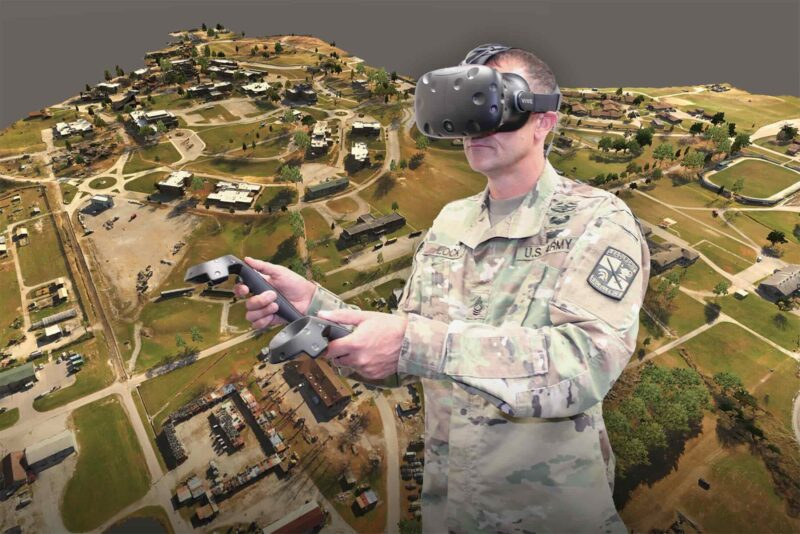
    Significantly, ICT’s remit to develop dual-use technologies (which claim to provide society-wide “solutions”) entails nurturing what the Institute refers to as “warfighters” for the battlefields of the future, and, in doing so, to increase warfighters’ “lethality.6 Established by the DoD in 1999 to pursue advanced modelling and simulation and training, ICT’s basic and applied research produces prototypes, technologies, and know-how that have been deployed for the U.S. Army, Navy, and Marine Corps. From artificial intelligence-driven virtual humans deployed to teach military leadership skills to futuristic 3D spatial visualization and terrain capture to prepare these military agencies for their operational environments, ICT specializes in immersive training programs for “mission rehearsal,” as well as tools that contribute to the digital innovations of global warmaking.7  Technologies and programs developed at ICT were used by U.S. troops in the U.S.-led Global War on Terror. One such program is UrbanSim, a virtual training application initiated in 2006 designed to improve army commanders’ skills for conducting counterinsurgency operations in Iraq and Afghanistan, delivering fictional scenarios through a gaming experience.8  From all of the warfighter preparation that USC’s Institute researches, develops, prototypes, and deploys, ICT boasts of generating over two thousand academic peer-reviewed publications.

    I encountered ICT’s work while conducting anthropological research on the relationship between the U.S. military and the media entertainment industry in Los Angeles.9  The Institute is located not on the university’s main University Park campus but by the coast, in Playa Vista, alongside offices for Google and Hulu. Although ICT is an approximately thirty-minute drive from USC’s main campus, this hub for U.S. warfighter lethality was enabled by an interdisciplinary collaboration with what was then called the School of Cinema-Television and the Annenberg School for Communications, and it remains entrenched within USC’s academic ecosystem, designated as a unit of its Viterbi School of Engineering, which is located on the main campus.10  Given the presence and power of UARCs at U.S. universities, we can reasonably ask: What is the difference between West Point Military Academy and USC, a supposedly civilian university? The answer, it seems, is not a difference in kind, but in degree. Indeed, universities with UARCs appear to be veritable military academies.

    What Are UARCs?

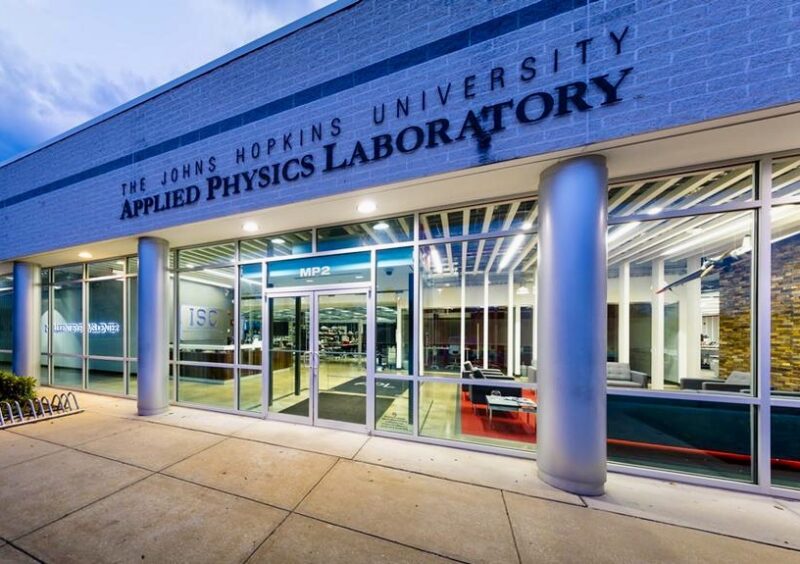
    UARCs are similar to federally funded research centres such as the Rand Corporation; however, UARCs are required to be situated within a university, which can be public or private.11  The existence of UARCs is not classified information, but their goals, projects, and implications may not be fully evident to the student bodies or university communities in which they are embedded, and there are differing levels of transparency among them about their funding. DoD UARCs “receive sole source funds, on average, exceeding $6 million annually,” and may receive other funding in addition to that from their primary military or federal sponsor, which may also differ among the fifteen UARCs.12  In 2021, funding from federal sources for UARCs ranged “from as much as $831 million for the Johns Hopkins University Applied Physics Lab to $5 million for the University of Alaska Geophysical Detection of Nuclear Proliferation.”13  Individual UARCs are generally created after the DoD’s Under Secretary of Defense for Research and Engineering initiates a selection process for the proposed sponsor, and typically are reviewed by their primary sponsor every five years for renewed contracts.14  A few UARCs, such as Johns Hopkins University’s Applied Physics Lab and the University of Texas at Austin’s Applied Research Lab, originated during the Second World War for wartime purposes but were designated as UARCs in 1996, the year the DoD formalized that status.15

    UARCs are supposed to provide their sponsoring agency and, ultimately, the DoD, access to what they deem “core competencies,” such as MIT’s development of nanotechnology systems for the “mobility of the soldier in the battlespace” and the development of anti-submarine warfare and ballistic and guided missile systems at Johns Hopkins University.16  Significantly, UARCs are mandated to maintain a close and enduring relationship with their military or federal sponsor, such as that of ICT with the U.S. Army. These close relationships are intended to facilitate the UARCs’ “in-depth knowledge of the agency’s research needs…access to sensitive information, and the ability to respond quickly to emerging research areas.”17  Such an intimate partnership for institutions of higher learning with these agencies means that the line between academic and military research is (further) blurred. With the interdisciplinarity of researchers and the integration of PhD students (and even undergraduate interns) into UARC operations such as USC’s ICT, the question of whether the needs of the DoD are prioritized over those of an ostensibly civilian institute of higher learning practically becomes moot: the entanglement is naturalized by a national security logic.

    Table 1 UARCs: The American Universities that Produce Warfighters

    Primary Sponsor University UARC Date of Designation (*original year established)
    Army University of Southern California Institute of Creative Technologies 1999
    Army Georgia Institute of Technology Georgia Tech Research Institute 1996 (*1995)
    Army Massachusetts Institute of Technology Institute for Soldier Nanotechnologies 2002
    Army University of California, Santa Barbara Institute for Collaborative Biotechnologies 2003
    Navy Johns Hopkins University Applied Physics Laboratory 1996 (*1942)
    Navy Pennsylvania State University Applied Research Laboratory 1996 (*1945)
    Navy University of Texas at Austin Applied Research Laboratories 1996 (*1945)
    Navy University of Washington Applied Physics Laboratory 1996 (*1943)
    Navy University of Hawai’i Applied Research Laboratory 2004
    Missile Defense Agency Utah State University Space Dynamics Laboratory 1996
    Office of the Under Secretary of Defense for Intelligence and Security University of Maryland, College Park Applied Research Laboratory for Intelligence and Security 2017 (*2003)
    Under Secretary of Defense for Research and Engineering Stevens Institute of Technology Systems Engineering Research Center 2008
    U.S. Strategic Command University of Nebraska National Strategic Research Institute 2012
    Department of the Assistant Secretary of Defense (Threat Reduction and Control) University of Alaska Fairbanks Geophysical Detection of Nuclear Proliferation 2018
    Air Force Howard University Research Institute for Tactical Autonomy 2023
    Sources: Joan Fuller, “Strategic Outreach—University Affiliated Research Centers,” Office of the Under Secretary of Defense (Research and Engineering), June 2021, 4; C. Todd Lopez, “Howard University Will Be Lead Institution for New Research Center,” U.S. Department of Defense News, January 23, 2023.

    A Closer Look

    The UARC at USC is unique from other UARCs in that, from its inception, the Institute explicitly targeted the artistic and humanities-driven resources of the university. ICT opened near the Los Angeles International Airport, in Marina del Rey, with a $45 million grant, tasked with developing a range of immersive technologies. According to the DoD, the core competencies that ICT offers include immersion, scenario generation, computer graphics, entertainment theory, and simulation technologies; these competencies were sought as the DoD decided that they needed to create more visually and narratively compelling and interactive learning environments for the gaming generation.18  USC was selected by the DoD not just because of the university’s work in science and engineering but also its close connections to the media entertainment industry, which USC fosters from its renowned School of Cinematic Arts (formerly the School of Cinema-Television), thereby providing the military access to a wide range of storytelling talents, from screenwriting to animation. ICT later moved to nearby Playa Vista, part of Silicon Beach, where the military presence also increased; by April 2016, the U.S. Army Research Lab West opened next door to ICT as another collaborative partner, further integrating the university into military work.19  This university-military partnership results in “prototypes that successfully transition into the hands of warfighters”; UARCs such as ICT are thus rendered a crucial link in what graduate student worker Isabel Kain from the Researchers Against War collective calls the “military supply chain.”20

    universities abandon any pretence to neutrality once they are assigned UARCs, as opponents at the University of Hawai’i at Mānoa (UH Mānoa) asserted when a U.S. Navy-sponsored UARC was designated for their campus in 2004. UH Mānoa faculty, students, and community members repeatedly expressed their concerns about the ethics of military research conducted on their campus, including the threat of removing “researchers’ rights to refuse Navy directives”

    USC was touted as “neutral ground” from which the U.S. Army could help innovate military training by one of ICT’s founders in his account of the Institute’s origin story.21  Yet, universities abandon any pretence to neutrality once they are assigned UARCs, as opponents at the University of Hawai’i at Mānoa (UH Mānoa) asserted when a U.S. Navy-sponsored UARC was designated for their campus in 2004. UH Mānoa faculty, students, and community members repeatedly expressed their concerns about the ethics of military research conducted on their campus, including the threat of removing “researchers’ rights to refuse Navy directives.”22  The proposed UARC at UH Mānoa occurred within the context of university community resistance to U.S. imperialism and militarism, which have inflicted structural violence on Hawaiian people, land, and waters, from violent colonization to the 1967 military testing of lethal sarin gas in a forest reserve.23 Hawai’i serves as the base of the military’s U.S. Indo-Pacific Command, where “future wars are in development,” professor Kyle Kajihiro of UH Mānoa emphasizes.24

    Writing in Mānoa Now about the proposed UARC in 2005, Leo Azumbuja opined that “it seems like ideological suicide to allow the Navy to settle on campus, especially the American Navy.”25 A key player in the Indo-Pacific Command, the U.S. Navy has long had a contentious relationship with Indigenous Hawaiians, most recently with the 2021 fuel leakage from the Navy’s Red Hill fuel facility, resulting in water contamination levels that the Hawai’i State Department of Health referred to as “a humanitarian and environmental disaster.”26  Court depositions have since revealed that the Navy knew about the fuel leakage into the community’s drinking water but waited over a week to inform the public, even as people became ill, making opposition to its proposed UARC unsurprising, if not requisite.27  The detonation of bombs and sonar testing that happens at the biennial international war games that the U.S. Navy has hosted in Hawai’i since 1971 have also damaged precious marine life and culturally sacred ecosystems, with the sonar tests causing whales to “swim hundreds of miles, rapidly change their depth (sometimes leading to bleeding from the eyes and ears), and even beach themselves to get away from the sounds of sonar.”28  Within this context, one of the proposed UARC’s core competencies was “understanding of [the] ocean environment.”29

    In a flyer circulated by DMZ Hawaii, UH Mānoa organizers called for universities to serve society, and “not be used by the military to further their war aims or to perfect ways of killing or controlling people.”30  Recalling efforts in previous decades on U.S. campuses to thwart the encroachment of military research, protestors raised questions about the UARC’s accountability and transparency regarding weapons production within the UH community. UH Mānoa’s strategic plan during the time that the Navy’s UARC was proposed and executed (2002–2010) called for recognition of “our kuleana (responsibility) to honour the Indigenous people and promote social justice for Native Hawaiians” and “restoring and managing the Mānoa stream and ecosystem”—priorities that the actions of the U.S. Navy disregarded.31  The production of knowledge for naval weapons within the auspices of this public, land-grant institution disrupts any pretension to neutrality the university may purport.

    while the UH administration claimed that the proposed UARC would not accept any classified research for the first three years, “the base contract assigns ‘secret’ level classification to the entire facility, making the release of any information subject to the Navy’s approval,” raising concerns about academic freedom, despite the fanfare over STEM and rankings

    Further resistance to the UARC designation was expressed by the UH Mānoa community: from April 28 to May 4, 2005, the SaveUH/StopUARC Coalition staged a six-day campus sit-in protest, and later that year, the UH Mānoa Faculty Senate voted 31–18 in favour of asking the administration to reject the UARC designation.32  According to an official statement released by UH Mānoa on January 23, 2006, at a university community meeting with the UH Regents in 2006, testimony from opponents to the UARC outnumbered supporters, who, reflecting the neoliberal turn of universities, expressed hope that their competitiveness in science, technology, engineering, and mathematics (STEM) would advance with a UARC designation, and benefit the university’s ranking.33  Yet in 2007, writing in DMZ Hawaii, Kajihiro clarified that while the UH administration claimed that the proposed UARC would not accept any classified research for the first three years, “the base contract assigns ‘secret’ level classification to the entire facility, making the release of any information subject to the Navy’s approval,” raising concerns about academic freedom, despite the fanfare over STEM and rankings.34  However, the campus resistance campaign was unsuccessful, and in September 2007, the UH Regents approved the Navy UARC designation. By 2008, the U.S. Navy-sponsored Applied Research Laboratory UARC at UH Mānoa opened.

    “The Military Normal”

    Yet with the U.S. creation of the national security state in 1947 and its pursuit of techno-nationalism since the Cold War, UARCs are direct pipelines to the intensification of U.S. empire

    UH Mānoa’s rationale for resistance begs the question: how could this university—indeed, any university—impose this military force onto its community? Are civilian universities within the United States merely an illusion, a deflection from education in the service of empire? What anthropologist Catherine Lutz called in 2009 the ethos of “the military normal” in U.S. culture toward its counterinsurgency wars in Iraq and Afghanistan—the commonsensical, even prosaic perspective on the inevitability of endless U.S.-led wars disseminated by U.S. institutions, especially mainstream media—helps explain the attitude toward this particular formalized capture of the university by the DoD.35  Defense funding has for decades permeated universities, but UARCs perpetuate the military normal by allowing the Pentagon to insert itself through research centres and institutes in the (seemingly morally neutral) name of innovation, within part of a broader neoliberal framework of universities as “engines” and “hubs,” or “anchor” institutions that offer to “leverage” their various forms of capital toward regional development in ways that often escape sustained scrutiny or critique.36  The normalization is achieved in some cases given that UARCs such as ICT strive to serve civilian needs as well as military ones with dual-use technologies and tools. Yet with the U.S. creation of the national security state in 1947 and its pursuit of techno-nationalism since the Cold War, UARCs are direct pipelines to the intensification of U.S. empire. Some of the higher-profile virtual military instructional programs developed at ICT at USC, such as its Emergent Leader Immersive Training Environment (ELITE) system, which provides immersive role-playing to train army leaders for various situations in the field, are funnelled to explicitly military-only learning institutions such as the Army Warrant Officer School.37

    The fifteenth and most recently created UARC, at Howard University in 2023—the first such designation for one of the historically Black colleges and universities (HBCUs)—boasts STEM inclusion

    The military normal generates a sense of moral neutrality, even moral superiority. The logic of the military normal, the offer of STEM education and training, especially through providing undergraduate internships and graduate training, and of course funding, not only rationalizes the implementation of UARCs, but ennobles it. The fifteenth and most recently created UARC, at Howard University in 2023—the first such designation for one of the historically Black colleges and universities (HBCUs)—boasts STEM inclusion.38  Partnering with the U.S. Air Force, Howard University’s UARC is receiving a five-year, $90 million contract to conduct AI research and develop tactical autonomy technology. Its Research Institute for Tactical Autonomy (RITA) leads a consortium of eight other HCBUs. As with the University of Hawai’i, STEM advantages are touted by the UARC, with RITA’s reach expanding in other ways: it plans to supplement STEM education for K–12 students to “ease their path to a career in the fields of artificial intelligence, cybersecurity, tactical autonomy, and machine learning,” noting that undergraduate and graduate students will also be able to pursue fully funded research opportunities at their UARC. With the corporatization of universities, neoliberal policies prioritize STEM for practical reasons, including the pursuit of university rankings and increases in both corporate and government funding. This fits well with increased linkages to the defence sector, which offers capital, jobs, technology, and gravitas. In a critique of Howard University’s central role for the DoD through its new UARC, Erica Caines at Black Agenda Reportinvokes the “legacies of Black resistance” at Howard University in a call to reduce “the state’s use of HBCUs.”39  In another response to Howard’s UARC, another editorial in Black Agenda Report draws upon activist Kwame Ture’s (Stokely Carmichael’s) autobiography for an illuminative discussion about his oppositional approach to the required military training and education at Howard University during his time there.40

    With their respectability and resources, universities, through UARCs, provide ideological cover for U.S. war-making and imperialistic actions, offering up student labour at undergraduate and graduate levels in service of that cover. When nearly eight hundred U.S. military bases around the world are cited as evidence of U.S. empire and the DoD requires research facilities to be embedded within places of higher learning, it is reasonable to expect that university communities—ostensibly civilian institutions—ask questions about UARC goals and operations, and how they provide material support and institutional gravitas to these military and federal agencies.41  In the case of USC, ICT’s stated goal of enhancing warfighter lethality runs counter to current USC student efforts to strive for more equitable conditions on campus and within its larger community (for example, calls to end “land grabs,” and “targeted repression and harassment of Black, Brown and Palestinian students and their allies on and off campus”) as well as other reductions in institutional harms.42  The university’s “Minor in Resistance to Genocide”—a program pursued by USC’s discarded valedictorian Asna Tabassum—also serves as mere cover, a façade, alongside USC’s innovations for warfighter lethality.

    the Hopkins Justice Collective at Johns Hopkins University recently proposed a demilitarization process to its university’s Public Interest Investment Advisory Committee that cited Johns Hopkins’s UARC, Applied Physics Lab, as being the “sole source” of DoD funding for the development and testing of AI-guided drone swarms used against Palestinians in 2021

    Many students and members of U.S. society want to connect the dots, as evident from the nationwide protests and encampments, and a push from within the academy to examine the military supply chain is intensifying. In addition to Researchers Against War members calling out the militarized research that flourishes in U.S. universities, the Hopkins Justice Collective at Johns Hopkins University recently proposed a demilitarization process to its university’s Public Interest Investment Advisory Committee that cited Johns Hopkins’s UARC, Applied Physics Lab, as being the “sole source” of DoD funding for the development and testing of AI-guided drone swarms used against Palestinians in 2021.43  Meanwhile, at UH Mānoa, the struggle continues: in February 2024, the Associated Students’ Undergraduate Senate approved a resolution requesting that the university’s Board of Regents terminate UH’s UARC contract, noting that UH’s own president is the principal investigator for a $75 million High-Performance Computer Center for the U.S. Air Force Research Laboratory that was contracted by the university’s UARC, Applied Research Laboratory.44  Researchers Against War organizing, the Hopkins Justice Collective’s proposal, the undaunted UH Mānoa students, and others help pinpoint the flows of militarized knowledge—knowledge that is developed by UARCs to strengthen warfighters from within U.S. universities, through the DoD, and to different parts of the world.45

    Notes

    1. Jake Alimahomed-Wilson et al., “Boeing University: How the California State University Became Complicit in Palestinian Genocide,” Mondoweiss, May 20, 2024; Brian Osgood, “U.S. University Ties to Weapons Contractors Under Scrutiny Amid War in Gaza,” Al Jazeera, May 13, 2024.
    2. Collaborate with Us: University Affiliated Research Center,” DevCom Army Research Laboratory, arl.devcom.army.mil.
    3. USC Divest From Death Coalition, “Divest From Death USC News Release,” April 24, 2024.
    4. USC Institute for Creative Technologies, “ICT Overview Video,” YouTube, 2:52, December 12, 2023.
    5. Gordon Adams and Shoon Murray, Mission Creep: The Militarization of U.S. Foreign Policy?(Washington DC: Georgetown University Press, 2014).
    6. USC Institute for Creative Technologies, “ICT Overview Video”; USC Institute for Creative Technologies, Historical Achievements: 1999–2019 (Los Angeles: University of Southern California, May 2021), ict.usc.edu.
    7. Yuval Abraham, “‘Lavender’: The AI Machine Directing Israel’s Bombing Spree in Gaza,” +972 Magazine.
    8. “UrbanSim,” USC Institute for Creative Technologies.
    9. Sylvia J. Martin, “Imagineering Empire: How Hollywood and the U.S. National Security State ‘Operationalize Narrative,’” Media, Culture & Society 42, no. 3 (April 2020): 398–413.
    10. Paul Rosenbloom, “Writing the Original UARC Proposal,” USC Institute for Creative Technologies, March 11, 2024.
    11. Susannah V. Howieson, Christopher T. Clavin, and Elaine M. Sedenberg, “Federal Security Laboratory Governance Panels: Observations and Recommendations,” Institute for Defense Analyses—Science and Technology Policy Institute, Alexandria, Virginia, 2013, 4.
    12. OSD Studies and Federally Funded Research and Development Centers Management Office (FFRDC), Engagement Guide: Department of Defense University Affiliated Research Centers (UARCs) (Alexandria, Virginia: OSD Studies and FFRDC Management Office, April 2013), 5.
    13. Christopher V. Pece, “Federal Funding to University Affiliated Research Centers Totaled $1.5 Billion in FY 2021,” National Center for Science and Engineering Statistics, National Science Foundation, 2024, ncses.nsf.gov.
    14. “UARC Customer Funding Guide,” USC Institute for Creative Technologies, March 13, 2024.
    15. Federally Funded Research and Development Centers (FFRDC) and University Affiliated Research Centers (UARC),” Department of Defense Research and Engineering Enterprise, rt.cto.mil.
    16. OSD Studies and FFRDC Management Office, Engagement Guide.
    17. Congressional Research Service, “Federally Funded Research and Development Centers (FFDRCs): Background and Issues for Congress,” April 3, 2020, 5.
    18. OSD Studies and FFRDC Management Office, Engagement Guide, 18.
    19. Institute for Creative Technologies (ICT),” USC Military and Veterans Initiatives, military.usc.edu.
    20. USC Institute for Creative Technologies, Historical Achievements: 1999–2019, 2; Linda Dayan, “‘Starve the War Machine’: Workers at UC Santa Cruz Strike in Solidarity with Pro-Palestinian Protesters,” Haaretz, May 21, 2024.
    21. Richard David Lindholm, That’s a 40 Share!: An Insider Reveals the Origins of Many Classic TV Shows and How Television Has Evolved and Really Works (Pennsauken, New Jersey: Book Baby, 2022).
    22. Leo Azambuja, “Faculty Senate Vote Opposing UARC Preserves Freedom,” Mānoa Now, November 30, 2005.
    23. Deployment Health Support Directorate, “Fact Sheet: Deseret Test Center, Red Oak, Phase I,” Office of the Assistant Secretary of the Defense (Health Affairs), health.mil.
    24. Ray Levy Uyeda, “U.S. Military Activity in Hawai’i Harms the Environment and Erodes Native Sovereignty,” Prism Reports, July 26, 2022.
    25. Azambuja, “Faculty Senate Vote Opposing UARC Preserves Freedom.”
    26. Kyle Kajihiro, “The Militarizing of Hawai’i: Occupation, Accommodation, Resistance,” in Asian Settler Colonialism, Jonathon Y. Okamura and Candace Fujikane, eds. (Honolulu: University of Hawai’i Press, 2008), 170–94; “Hearings Officer’s Proposed Decision and Order, Findings of Fact, and Conclusions of Law,” Department of Health, State of Hawaii vs. United States Department of the Navy, no. 21-UST-EA-02 (December 27, 2021).
    27. Christina Jedra, “Red Hill Depositions Reveal More Details About What the Navy Knew About Spill,” Honolulu Civil Beat, May 31, 2023.
    28. “Does Military Sonar Kill Marine Wildlife?,” Scientific American, June 10, 2009.
    29. Joan Fuller, “Strategic Outreach—University Affiliated Research Centers,” Office of the Under Secretary of Defense (Research and Engineering), June 2021, 4.
    30. DMZ Hawaii, “Save Our University, Stop UARC,” dmzhawaii.org.
    31. University of Hawai’i at Mānoa, Strategic Plan 2002–2010: Defining Our Destiny, 8–9.
    32. Craig Gima, “UH to Sign Off on Navy Center,” Star Bulletin, May 13, 2008.
    33. University of Hawai’i at Mānoa, “Advocates and Opponents of the Proposed UARC Contract Present Their Case to the UH Board of Regents,” press release, January 23, 2006.
    34. Kyle Kajihiro, “The Secret and Scandalous Origins of the UARC,” DMZ Hawaii, September 23, 2007.
    35. Catherine Lutz, “The Military Normal,” in The Counter-Counterinsurgency Manual, or Notes on Demilitarizing American Society, The Network of Concerned Anthropologists, ed. (Chicago: Prickly Paradigm Press, 2009).
    36. Anne-Laure Fayard and Martina Mendola, “The 3-Stage Process That Makes Universities Prime Innovators,” Harvard Business Review, April 19, 2024; Paul Garton, “Types of Anchor Institution Initiatives: An Overview of University Urban Development Literature,” Metropolitan Universities 32, no. 2 (2021): 85–105.
    37. Randall Hill, “ICT Origin Story: How We Built the Holodeck,” Institute for Creative Technologies, February 9, 2024.
    38. Brittany Bailer, “Howard University Awarded $90 Million Contract by Air Force, DoD to Establish First-Ever University Affiliated Research Center Led by an HCBU,” The Dig, January 24, 2023, thedig.howard.edu.
    39. Erica Caines, “Black University, White Power: Howard University Covers for U.S. Imperialism,” Black Agenda Report, February 1, 2023.
    40. Editors, “Howard University: Every Black Thing and Its Opposite, Kwame Ture,” The Black Agenda Review (Black Agenda Report), February 1, 2023.
    41. David Vine, Base Nation: How U.S. Military Bases Abroad Harm America and the World (New York: Metropolitan Books, 2015).
    42. USC Divest from Death Coalition, “Divest From Death USC News Release”; “USC Renames VKC, Implements Preliminary Anti-Racism Actions,” Daily Trojan, June 11, 2020.
    43. Hopkins Justice Collective, “PIIAC Proposal,” May 4, 2024.
    44. Bronson Azama to bor.testimony@hawaii.edu, “Testimony for 2/15/24,” February 15, 2024, University of Hawai’i; “UH Awarded Maui High Performance Computer Center Contract Valued up to $75 Million,” UH Communications, May 1, 2020.
    45. Isabel Kain and Becker Sharif, “How UC Researchers Began Saying No to Military Work,” Labor Notes, May 17, 2024.


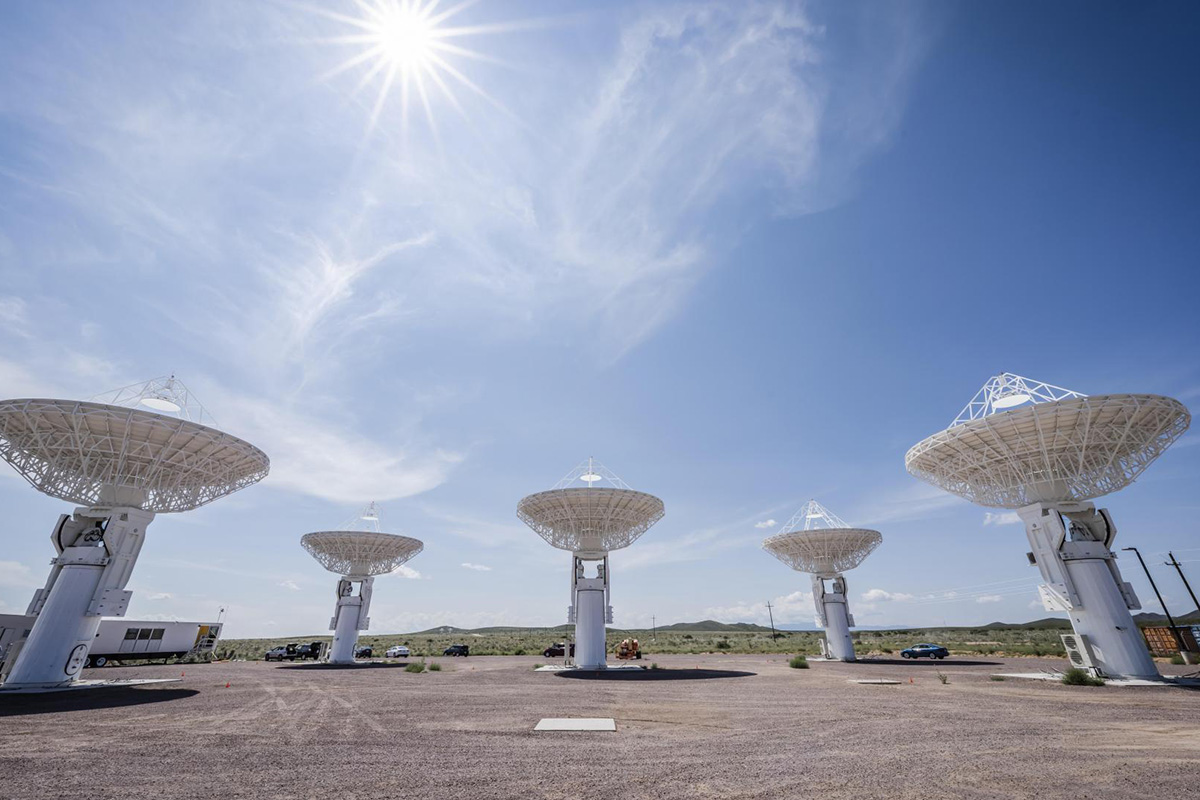
    Feature Image: Deep Space Advanced Radar Capability (DARC) at Johns Hopkins Advanced Physical Laborotory, A UARC facility – www.jhuapl.edu

  • China’s economy is still far out growing the U.S. – contrary to Western media “fake news”

    China’s economy is still far out growing the U.S. – contrary to Western media “fake news”

    GDP data for China, the U.S., and the other G7 countries for the year 2023 has now been published. This makes possible an accurate assessment of China’s, the U.S., and major economies performance—both in terms of China’s domestic goals and international comparisons. There are two key reasons this is important.

    • First for China’s domestic reasons: to achieve a balanced estimate of China’s socialist economic situation and therefore the tasks it faces.
    • Second, because the U.S. has launched a quite extraordinary propaganda campaign, including numerous straightforward factual falsifications, to attempt to conceal the real international economic facts.

    The factual situation is that China’s economy, as it heads into 2024, has far outgrown all other major comparable economies. This reality is in total contradiction to claims in the U.S. media. This in turn, therefore, demonstrates the extraordinary distortions and falsifications in the U.S. media about this situation. It confirms that, with a few honourable exceptions, Western economic journalism is primarily dominated by, in some cases quite extraordinary, “fake news” rather than any objective analysis. Both for understanding the economic situation, and the degree of distortion in the U.S. media, it is therefore necessary to establish the facts of current international developments

    China’s growth targets

    Starting with China’s strategic domestic criteria, it has set clear goals for its economic development over the next period which will complete its transition from a “developing” to a “high-income” economy by World Bank international standards. In precise numbers, in 2020’s discussion around the 14th Five Year plan, it was concluded that for China by 2035: “It is entirely possible to double the total or per capita income”. Such a result would mean China decisively overcoming the alleged “middle income trap” and, as the 20th Party Congress stated, China reaching the level of a “medium-developed country by 2035”.

    In contrast, a recent series of Western reports, widely used in anti-China propaganda, claim that China’s economy will experience sharp slowdown and will fail to reach its targets.

    Self-evidently which of these outcomes is achieved is of fundamental importance for China’s entire national rejuvenation and construction of socialism—as Xi Jinping stated, China’s: “path takes economic development as the central task, and brings along economic, political, cultural, social, ecological and other forms of progress.” But the outcome also affects the entire global economy—for example, a recent article by the chair of Rockefeller International, published in the Financial Times, made the claim that what was occurring was China’s “economy… losing share to its peers”. The Wall Street journal asserted: “China’s economy limps into 2024” whereas in contrast the U.S. was marked by a “resilient domestic economy.” The British Daily Telegraph proclaimed China has a “stagnant economy”. The Washington Postheadlined that: “Falling inflation, rising growth give U.S. the world’s best recovery” with the article claiming: “in the United States… the surprisingly strong economy is outperforming all of its major trading partners.” This is allegedly because: “Through the end of September, it was more than 7 percent larger than before the pandemic. That was more than twice Japan’s gain and far better than Germany’s anaemic 0.3 percent increase.” Numerous similar claims could be quoted from the U.S. media.

    U.S. use of “fake news”

    Reading U.S. media claims on these issues, and comparing them to the facts. it is impossible to avoid the conclusion that what is involved is deliberate “fake news” for propaganda purposes—as will be seen, the only alternative explanation is that it is disgracefully sloppy journalism that should not appear in supposedly “quality” media. For example, it is simply absurdly untrue, genuinely “fake news”, that the U.S. is “outperforming all of its major trading partners”, or that China has a “stagnant economy”. Anyone who bothers to consult the facts, an elementary requirement for a journalist, can easily find out that such claims are entirely false—as will be shown in detail below.

    To first give an example regarding U.S. domestic reports, before dealing with international aspects, a distortion of U.S. economic growth in 2023 was so widely reported in the U.S. media that it is again hard to avoid the conclusion that this was a deliberate misrepresentation to present an exaggerated view of U.S. economic performance. Factually, the U.S. Bureau of Economic Analysis, the U.S. official statistics agency for economic growth, reported that U.S. GDP in 2023 rose by 2.5%—for comparison China’s GDP increased by 5.2%. But a series of U.S. media outlets, starting with the Wall Street Journal, instead proclaimedthat the “U.S. economy grew 3.1% over the last year”.

    This “fake news” on U.S. growth was created by statistical “cherry picking”. In this case comparing only the last quarter of 2023 with the last quarter of 2022, which was an increase of 3.1%, but not by taking GDP growth in the year as a whole “last year”. But U.S. growth in the earlier part of 2023 was far weaker than in the 4th quarter—year on year growth in the 1stquarter was only 1.7% and in the 2nd quarter only 2.4%. Taking into account this weak growth in the first part of the year, and stronger growth in the second, U.S. growth for the year as a whole was only 2.5%—not 3.1%. As it is perfectly easy to look up the actual annual figure, which was precisely published by the U.S. statistical authorities, it is hard to avoid the conclusion that this was a deliberate distortion in the U.S. media to falsely present a higher U.S. growth rate in 2023 than the reality.

    It may be noted that even if U.S. GDP growth had been 3.1% then China’s was much higher at 5.2%. But the real data makes it transparently clear that China’s economy grew more than twice as fast as the U.S. in 2023—showing at a glance that claims that the U.S. is “outperforming all of its major trading partners”, or that China has a “stagnant economy” were entirely “fake news”.

    Many more examples of U.S. media false claims could be given, but the best way to see the overall situation is to systematically present the overall facts of growth in the major economies.

    What China has to do to achieve its 2035 goals

    Turning first to assessing China’s economic performance, compared to its own strategic goals of doubling GDP and per capita GDP between 2020 and 2035, it should be noted that in 2022 China’s population declined by 0.1% and this fall is expected to continue—the UN projects China’s population will decline by an average 0.1% a year between 2020 and 2035. Therefore, in economic growth terms, the goal of doubling GDP growth to 2035 is slightly more challenging than the per capita target and will be concentrated on here—if China’stotal GDP goal is achieved then the per capita GDP one will necessarily be exceeded.

    To make an international comparison of China’s growth projections compared with the U.S., the U.S. Congressional Budget Office (CBO), responsible for the official growth projections for the U.S. economy on which its government’s policies rely, estimates there will be 1.8% annual average U.S. GDP growth between 2023 and 2023—with this falling to 1.6% from 2034 onwards. This figure is slightly below the current U.S. 12-year long term annual average GDP growth of 2.3%—12 being the number of years from 2023 to 2035. To avoid any suggestion of bias against the U.S., and in favour of China, in international comparisons here the higher U.S. number of 2.3% will be used.

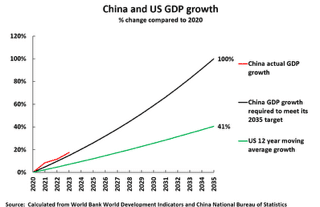
    The results of such figures are that if China hits its growth target for 2035, and the U.S. continues to grow at 2.3%, then between 2020 and 2035 China’s economy will grow by 100% and the U.S. by 41%—see Figure 1. Therefore, from 2020 to 2035, China’s economy would grow slightly more than two and a half times as fast as the U.S.

    The strategic consequences of China’s economic growth rate

    The international implications of any such growth outcomes were succinctly summarised by Martin Wolf, chief economics commentator of the Financial Times. If China’s economy continues to grow substantially faster than Western ones, and it achieves the status of a “medium-developed country by 2035”, then, in addition to achieving high domestic living standards, China’s will become by far the world’s largest economy. As Wolf put it: “The implications can be seen in quite a simple way. According to the IMF, China’s gross domestic product per head (measured at purchasing power) was 28 per cent of U.S. levels in 2022. This is almost exactly half of Poland’s relative GDP per head… Now, suppose its [China’s] relative GDP per head doubled, to match Poland’s. Then its GDP would be more than double that of the U.S. and bigger than that of the U.S. and EU together.” By 2035 such a process would not be completed on the growth rates already given, and measuring by Wolf’s chosen measure of purchasing power parities (PPPs) China’s economy by 2035 would be 60% bigger than that of the U.S. But even that would make China by far the world’s largest economy.

    Wolf equally accurately notes that the only way that such an outcome would be prevented from occurring is if China’s economy slows down to the growth rate of a Western economy such as the U.S. Clearly, if China’s economic growth slows to that of a Western economy, then, naturally, China will never catch up with the West—it will necessarily simply stay the same distance behind. Therefore. as Wolf accurately puts it the outcomes are:

    What is the economic future of China? Will it become a high-income economy and so, inevitably, the largest in the world for an extended period, or will it be stuck in the ‘middle income’ trap, with growth comparable to that of the U.S.?

    The progress in achieving China’s strategic economic goals

    Turning to the precise figure required to achieve China’s 2035 target, China’s goal of doubling GDP required average annual growth of at least 4.7% a year between 2020 and 2035. So far China, as Figure 1 shows, is ahead of this goal—annual average growth in 2020-2022 was 5.7%, meaning that from 2023-2035 annual average 4.6% growth is now required.

    China’ 5.2% GDP increase in 2023 therefore once again exceeded the required 4.6% growth rate to achieve its 2035 goal—as shown in Figure 1. From 2020 to 2023 the required total increase in China’s GDP to hit its 2035 target was 14.9%, whereas in fact its growth was 17.5%. This is in line with the 45-year record since 1978’s Reform and Opening Up, during which entire period the medium/long term targets set by China have always been exceeded.

    Therefore. to summarise, there is no sign whatever in 2023, or indeed in the period since 2020, that China will fail to meet its target of doubling GDP between 2020 and 2035—China is ahead of this target. Such a 4.6% growth rate would easily ensure China becomes a high-income economy by World Bank criteria well before 2035—the present criteria for this being per capita income of $13,846.

    It should be noted, as discussed in in detail below, that a clear international conclusion flows from this necessary 4.6% annual average growth rate for China to achieve its strategic goals. It means that China must continue to grow much faster than the Western economies throughout this period to 2035—that is in line with China’s current trend. However, if China were to slow down to the growth rate of a Western economy, then it will fail to achieve its strategic goals to 2035, may not succeed in becoming a high income economy, and will necessarily remain the same distance behind the West as now. The implications of this will be considered below.

    Systematic comparisons not “cherry picking”

    Having considered China’s performance in 2023 terms of achieving its own domestic strategic goals we will now turn to actual results and a comparison of China with other international economies. This immediately shows the factual absurdity, the pure “fake news” of claims such as that the U.S. has “the world’s best recovery“ and “the United States… is outperforming all of its major trading partners.” On the contrary China has continued to far outgrow the U.S. economy not only in 2023 but in the entire last period. China’s outperformance of the other major Western economies, the G7, is even greater that of the U.S.

    Entirely misleading claims regarding such international comparisons, used for propaganda as opposed to serious analysis, are sometimes made because data is taken from extremely short periods of time which are taken out of context—unrepresentative statistical “cherry picking” or, as Lenin put it, a statistical “dirty business”. Such a method is always erroneous, but it is particularly so during periods which were affected by the impact of the Covid pandemic as these caused extremely violent short-term economic fluctuations related to lock downs and similar measures. China’s assertion of superior growth is based on its overall performance, not an absurd claim that it outperforms every other economy, on every single measure, in every single period! Therefore, in making international comparisons, the most suitable period to take is that for since the beginning of the pandemic up to the latest available GDP data. As comparison of China with the U.S. is the most commonly made one, and particularly concentrated on by the U.S. media campaign, this will be considered first.

    China’s and the U.S.’s growth in 2023

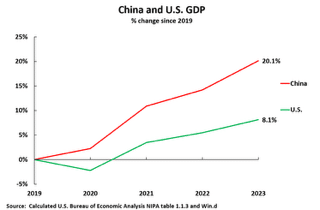
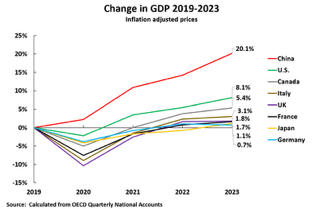
    It was already noted that in 2023 China’s GDP grew by 5.2% and the U.S. by 2.5%—China’s economy growing more than twice as fast as the U.S. But it should also be observed that 2023 was an above trend growth year for the U.S.—U.S. annual average growth over a 12-year period is only 2.3% and over a 20-year period it is only 2.1%. Therefore, although in 2023 China’s economy grew more than twice as fast as the U.S., that figure is actually somewhat flattering for the U.S. Figure 2shows that in the overall period since the beginning of the pandemic China’s economy has grown by 20.1% and the U.S. by 8.1%—that is China’s total GDP growth since the beginning of the pandemic was two and half times greater than the U.S. China’s annual average growth rate was 4.7% compared to the US’s 2.0%.

    Economic performance of China and the three major global economic centres

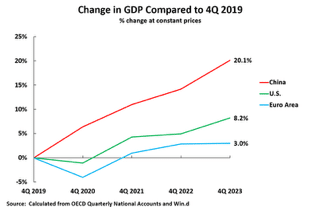
    Turning to wider international comparisons than the U.S. such data immediately shows the extremely negative situation in most “Global North” economies and China’s great outperformance of them. To start by analysing this in the broadest terms, Figure 3 shows the developments in the world’s three largest economic centres—China, the U.S., and the Eurozone. These three together account for 57% of world GDP at current exchange rates and 46% in purchasing power parities (PPPs). No other economic centre comes close to matching their weight in the world economy.

    Regarding the relative performance of these three major economic centres, at the time of writing data has not been published for the Euro Area for the whole year of 2023 —which would be the ideal comparison. However, it has been published for the the Euro area for the four quarters of 2023 individually and trends can be calculated on that basis. These show that In the four years to the 4th quarter of 2023, covering the period since the beginning of the pandemic, China’s economy has grown by 20.1%, the U.S. by 8.2%, and the Eurozone by 3.0%. China’s economy therefore grew by two and a half times as fast as the U.S. while the situation of the Eurozone could accurately be described as extremely negative with annual average GDP growth in the last four years of only 0.7%.

    Such data again makes it immediately obvious that claims in the Western media that China faces economic crisis, and the Western economies are doing well is entirely absurd—pure fantasy propaganda disconnected from reality.

    Relative performance of China and the G7

    Turning to analysing individual countries, then comparing China to all G7 states, i.e. the major advanced economies, shows the situation equally clearly—see Figure 4. Data for China and all G7 economies has now been published for the whole of 2023. The huge outperformance by China of all the major advanced economies is again evident.

    Over the four years since the beginning of the pandemic China’s economy grew by 20.1%, the U.S. by 8.1%, Canada by 5.4%, Italy by 3.1%, the UK by 1.8%, France by 1.7%, Japan by 1.1% and Germany by 0.7%.

    In the same period China’s economy therefore grew two and a half times as fast as the U.S., almost four times as fast as Canada, almost seven times as fast as Italy, 11 times as fast as the UK, 12 times as fast as France, 18 times as fast as Japan and almost 29 times as fast as Germany.

    In terms of annual average GDP growth during this period China’s was 4.7%, the U.S. 2.0%, Canada 1.3%, Italy 0.8%, the UK 0.4%, France 0.4%, Japan 0.3% and Germany 0.2%.

    It may therefore be seen that China’s economy far outperformed the U.S., while the performance of all other major G7 economies may be quite reasonably described as extremely negative—all having annual average economic growth rates of around or even under 1%.

    Comparison of China to developing economies

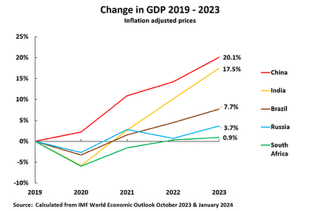
    A comparison using the IMF’s January 2024 projections can also be made to the major developing economies—the BRICS. Figure 5 shows this, using the factual result for China and the IMF projections for the other countries. Over the period since the start of the pandemic, from 2019-2023, China’s GDP grew by 20.1%, India by 17.5%, Brazil by 7.7%, Russia by 3.7% and South Africa by 0.9%.

    This data confirms that the major Global South economies are growing faster than most of the major Global North economies, which is part of the rise of the Global South and draws attention to the good performance of India. But China grew more than two and half times more than all the BRICS economies except India—China’s growth was 15% greater than India’s. It should be noted that India is at a far lower stage of development than the other BRICS economies—all the others fall in the World Bank classification of upper middle-income economies whereas India falls into the lower middle income group.

    Comparison of China’s growth to Western economies

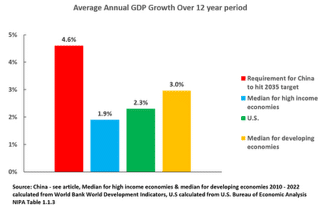
    Finally, this outperformance by China casts light on what is necessary to achieve its own 2035 strategic targets. China’s 4.6% growth rate necessary to meet these goals means that it must continue to maintain a growth rate far higher than Western economies—Figure 6 shows this in overall terms in addition to individual comparisons given to major economies above. Whereas China must achieve an annual average 4.6% growth rate the median growth rate of high income “Western” economies is only 1.9%, the U.S. is 2.3%, and the median for developing economies is 3.0%.That is, to achieve its 2035 goals China must grow twice as fast as the long term trend of the U.S., almost two and a half times as fast as the median for high income economies, and more than 50% faster than the median for developing economies. As already seen, China is more than achieving this.

    But such facts immediately show why it is an extremely misleading when proposals are made that China should move towards the macro-economic structure of a Western economy. If China adopts the structure of a Western economy then, of course, China will slow down to the same growth rate as Western economies—and therefore fail to achieve its 2035 economic goals. China will be precisely stuck in the negative outcome of the situation accurately diagnosed by Martin Wolf.

    What is the economic future of China? Will it become a high-income economy and so, inevitably, the largest in the world for an extended period, or will it be stuck in the ‘middle income’ trap, with growth comparable to that of the U.S.?

    Conclusion

    In conclusion, it addition to objectively analysing 2023’s economic results, it is also necessary in the light of this factual situation to make a remark regarding Western, in particular U.S. “journalism”.

    None of the data given above is secret, all is available from public readily accessible sources. In many cases it does not even require any calculations and simply published data can be used. But the U.S. media and journalists report information that is systematically misleading and in many cases simply untrue. While it lagged China in creating economic growth the U.S. was certainly the world leader in creating “fake economic news”! What was the reason, what attitude should be taken to it?

    First, to avoid accusations of distortion, it should be stated that there were a small handful of Western journalists who refused to go along with this type of distortion and fake news. For example Chris Giles, the Financial Times economics commentator, in December, sharply attacked “an absurd way to compare economies… among people who should know better.” Giles did not do this because of support for China but because, quite rightly, he warned that spreading false or distorted information led to serious errors by countries doing so: “Coming from the UK, which lost its top economic dog status in the late 19th century but still has some delusions of grandeur, I can understand American denialism… But ultimately, bad comparisons foster bad decisions.” But the overwhelming majority of U.S. and Western journalists continued to spread fake news. Why?

    First, the fact that identical distortions and false information appeared absolutely simultaneously across a very wide range of media makes it clear that undoubtedly U.S. intelligence services were involved in creating it—i.e. part of the misrepresentation and distortions were entirely deliberate and conscious, aimed at disguising the real situation.

    Second, another part was merely sloppy journalism—that is journalists who could not be bothered to check facts.

    Third, supporting both of these factors was “white Western arrogance”—an arrogant assumption, rooted in centuries of European and European descended countries dominating the world, that the West must be right. Therefore, such arrogance made it impossible to acknowledge or report the clear facts that China’s economy is far outperforming the West.

    But whether it was conscious distortion, sloppy journalism, or conscious or unconscious arrogance, in all these cases no respect should be given to the Western “quality” media. It is not trying to find out the truth, which is the job of journalism, it is simply spreading false propaganda.

    It remains a truth that if a theory and the real world don’t coincide there are only two courses that can be taken. The first, that of a sane person, is to abandon the theory. The second, that of a dangerous one, is to abandon the real world—precisely the danger that Chris Giles pointed to. What has been appearing in the Western media about international economic comparisons regarding China is precisely abandonment of the real world in favour of systematic fake news.


    This article was published earlier in mronline.org and is republished under Creative Commons Attribution-Non Commercial-No Derivatives 4.0 International License

    Feature Image Credit: China will continue to lead global growth in 2024 – globaltimes.cn

  • Strategies: hierarchy or balancing Purpose, Aims and Means?

    Strategies: hierarchy or balancing Purpose, Aims and Means?

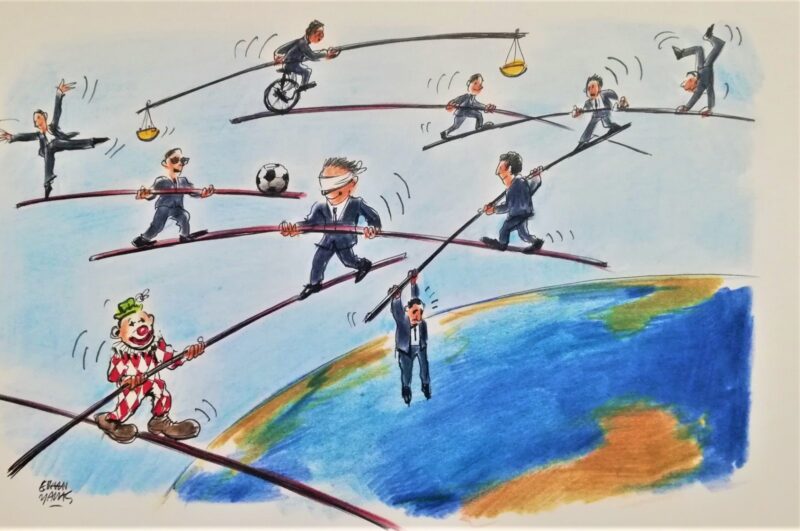
    At the beginning of his famous first chapter, Clausewitz defines war as mentioned above within a hierarchy of purpose, aims, and means. His renowned formula is related to this definition. At the end of the same chapter, nevertheless, he introduces the consequences for the theory of war from this initial reasoning about the nature of war and states: “Our task, therefore, is to develop a theory that maintains a balance between these three tendencies, like an object suspended between three magnets”


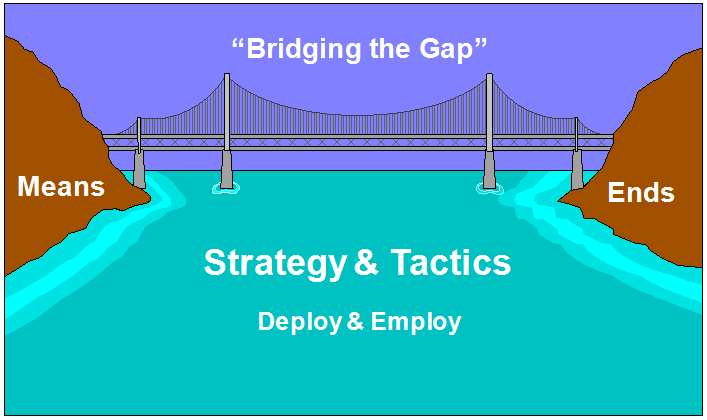
    Strategy Bridge
    “The Strategy Bridge concept leads to battle-centric warfare and the primacy of tactics over strategy.”

    At the outset, I would like to emphasise that in war and in violent action, justifiable ends do not legitimate all means. But I won’t solely treat the means applied by Hamas on October 7th, nor that of the Israel defence forces afterwards. Nevertheless, if someone argued that the ends justify all means, this would have to be applied to both sides. I want to highlight more principal arguments concerning the ‘end-aims-means’ relationship by contrasting a mere hierarchical approach, which is, in my view, leading to a reversal of ends and means, and a floating balance of them. The task of coming to a proper appreciation of Clausewitz’s thoughts on strategy is actually to combine a hierarchical structure with that of a floating balance. This article examines the relation of purpose, aims and means in Clausewitz’s theory and highlights that this relation is methodologically comparable to the floating balance of Clausewitz’s trinity. Modern strategic thinking is characterised by the end, way (aim), means relationship and the concept of the ‘way’ as the shortest possible connection between ends and means  (consider, for instance, Colin Gray’s concept of a strategy bridge[1]). This notion stems from a very early text of Clausewitz: ‘As a result each war is raised as an independent whole, whose entity lies in the last purpose whose diversity lies in the available means, and whose art therein exists, to connect both through a range of secondary and associated actions in the shortest way.’

    Nevertheless, here we can detect the fundamental difference in many of Clausewitz’s interpretations, which understand strategy as the shortest way of connecting purpose and means (battle and combat). Within this quote, Clausewitz speaks of war as an independent whole, a notion which he later rejects fervently.   A central distinction is the concept to which the means attaches: the Taoist tradition and Sun Tzu hold that the means connects directly to the political purpose of the war; in contrast, for Clausewitz, the means attaches to an intermediary aim within a war, which must be sequentially achieved prior to the fulfilment of the war’s political purpose. The distinctive feature of the Taoist tradition is that strategy as a “way” effectively becomes tactics, in the sense that there exists no “strategic” aim, in the meaning of an intermediate military “strategic” war aim inserted between the political purpose of the war and tactical combat.

    Battle-centric Warfare: Winning battles and losing the War

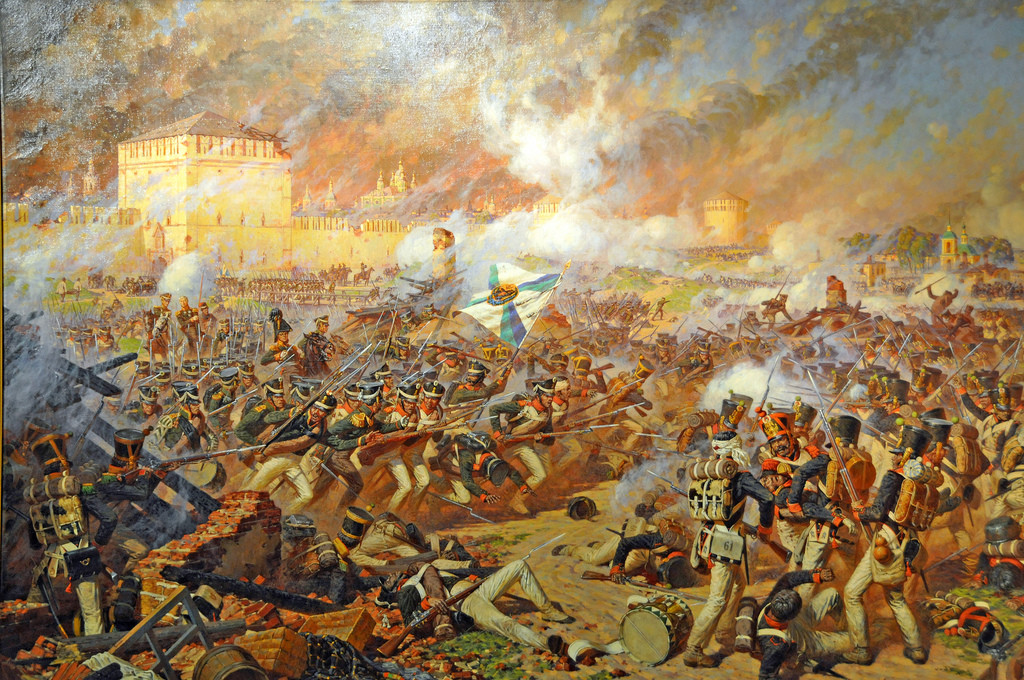
    If strategy is nothing else than the direct way of linking the political purpose with the means, understood as combat, this understanding results in a ‘battle-centric’ concept of warfare that privileges tactical outcomes. One might attribute the loss of the Vietnam War, as well as the defeat of the US in Afghanistan and Iraq, to this misunderstanding about battle. In the early 1980s, Colonel Harry G. Summers Jr wrote a most influential work about the faults made in the Vietnam War. He observed that the US Army won every battle in Vietnam but finally lost the war. Summers recounts an exchange between himself and a former North Vietnamese Army officer some years after the war. It went something like this: Summers: ‘You never defeated us in the field.’ NVA Officer: ‘That is true. It is also irrelevant.’ [2]Winning battles does not necessarily lead to winning the war, and not only in this case. The same point can be made about Napoleon’s campaign in Russia. Napoleon won all the battles against the Russian army but lost the campaign. It was precisely this observation that led Clausewitz to denounce battle-centric warfare.

    ‘War is thus an act of force to compel our enemy to do our will,’ Clausewitz wrote at the beginning of his famous first chapter of On War (75).[3] ‘Force … is thus the means of war; to impose our will on the enemy is its purpose’, he continued. ‘To secure that purpose, we must make the enemy defenceless, which, in theory, is the true aim of warfare. That aim takes the place of the purpose, discarding it as something not actually part of war’ (75). This seemingly simple sentence reveals the core problem: what does it mean that the aim ‘takes the place’ (in German: vertritt) of the purpose? Are they identical or different? To put it bluntly, At the beginning of his famous first chapter, Clausewitz defines war as mentioned above within a hierarchy of purpose, aims, and means. His renowned formula is related to this definition. At the end of the same chapter, nevertheless, he introduces the consequences for the theory of war from this initial reasoning about the nature of war and states: “Our task, therefore, is to develop a theory that maintains a balance between these three tendencies, like an object suspended between three magnets” (89).[4] In relation to the concept of strategy, we must combine a hierarchical understanding of the purpose-aims-means-rationality with that of a floating balance of all three.

    Presenting any of these elements as an absolute would be artificially to delimit the analysis of war, as the components are interdependent. Clausewitz’s solution is the ‘trinity’, in which he defined war by different, even opposing, tendencies, each with its own rules. Nevertheless, since war is ‘put together’ in this concept of three tendencies, it is necessary to consider how these tendencies interact and conflict simultaneously rather than one being absolute. Clearly, if we go to war, there is a purpose for that war, and different purposes for war are possible. Each of these possible purposes is connected with different achievable military aims, and finally, each aim can be achieved by various means. The question, therefore, is whether all three are incorporated into a hierarchy or whether their relationship must be understood as a floating balance among them.

    Purpose, Aims, and Means in War

    Clausewitz explains this dynamic relationship of purpose, aims and means in war in Chapter Two of Book One. At the beginning of Book One, Chapter Two, Clausewitz writes that ‘if for a start we inquire into the [aim] of any particular war, which must guide military action if the political purpose is to be properly served, we find that the [aim] of any war can vary just as much as its political purpose and its actual circumstances’ (90). The consequence of this proposition is that not every aim and means serves a given purpose. The problem of the relationship between purpose and aims is that each element of the purpose-aims-means construct has a rationality of its own, which Clausewitz emphasises in his proposition that war has its own grammar, although not its own logic. He writes, for example, ‘we can now see that in war many roads lead to success, and that they do not all involve the opponent’s outright defeat.’ Clausewitz then summarises that there exists a wide range of possible ways (94) to reach the aim of war and that it would be a mistake to think of these shortcuts as rare exceptions (94). For example, Clausewitz wrote: ‘It is possible to increase the likelihood of success without defeating the enemy’s forces. I refer to operations that have direct political repercussions, that are designed in the first place to disrupt the opposing alliance’ (emphasis in the original) (92).[5]Another prominent example, Clausewitz emphasised, was the warfare of Frederick the Great. He would never have been able to defeat Austria in the Seven Years’ War if his aim had been the outright defeat of Austria. Clausewitz concludes if he had tried to fight in this manner, ‘he would unfailingly have been destroyed himself.’ (94). After explaining other strategies besides the destruction of the enemy armed forces, he concludes that all we need to do for the moment is to admit the general possibility of their existence, the likelihood of deviating from the basic concept of war under the pressure of particular circumstances (99). But the main conclusion is that in war, many roads may lead to success – but the reverse is true, too, not all means are neither guaranteeing success nor are legitimate.[6]

    But the main conclusion is that in war, many roads may lead to success – but the reverse is true, too, not all means are neither guaranteeing success nor are legitimate.

    Why is that so?   Although Clausewitz finishes Chapter 2 of Book I with the notion that the ‘wish to annihilate the enemy’s forces is the first-born son of war’ (99), he emphasises that at a later stage and by degrees’ we shall see what other kinds of strategies can achieve in war’ (99). Nevertheless, he gives us two clues in this chapter. First, that war is not an independent whole but – an extension of the political sphere: that war has its own grammar but not its own logic.[7] Second, in my interpretation of Clausewitz, the difference between attack and defence represents a distinction between self-preservation and gaining advantages in warfare. Already in Chapter Two, he articulates the ‘distinction that dominates the whole of war: the difference between attack and defence. We shall not pursue the matter now, but let us just say this: that from the negative purpose [comes?] all the advantages, all the more effective forms, of fighting, and that in it is expressed the dynamic relationship between the magnitude and the likelihood of success’ (94).

    My thesis is that Clausewitz is trying to combine the Aristotelian difference between poieses and praxis in his writings – an instrumental view of war for political purposes with the performance of the conduct of war, not just with the execution of the political will. Whereas for the early Clausewitz, the ‘purpose’ is a moment within the war, he later opposes this position, emphasising that this purpose is located outside of the actual warfare. With this differentiation of purposes in war and the purpose of war, Clausewitz covers a fundamental difference between various forms of action, which was initially developed by Aristotle and remains even today. The practical philosophy of Aristotle is based on the basic distinction of techne, as based on poiesis and phronesis, and praxis, based on performance and practical knowledge. Techne is technical, instrumental knowledge.

    In contrast, phronesis or praxis of action can be characterised as performance in warfare. If we compare different purposes for going to war with each other, we are close to what Max Weber called the “value rationality” of purposes. Although Max Weber sometimes seems to overemphasise the difference between the rationality of purposes and military aims, his differentiation is useful to shed light on Clausewitz’s theory. Value rationality is primarily about the relationship of different purposes to one another, which can be classified into a hierarchy of purposes. The subordination of warfare to the shaping of international order, as Clausewitz puts it, is ‘value-rational’ as defined by Max Weber. By contrast, “action rationality” is a principle of action exclusively oriented to achieving a particular military aim through the most effective means and rational consideration of possible consequences and side effects.

                Clausewitz initially makes a two-fold distinction between the purpose-aims-means relationship: first, as a value rationality, in which we find a hierarchical relationship starting from the purpose at the top, with aims and means subordinated respectively; second, as a process rationality, in which the military aim as the object of practical action is the output of the purpose-aim-means relationship.

    He made this distinction at times only implicitly based on the different connotations of the concept of purpose. In part, Clausewitz differentiates between the purpose of war and the purpose in war. He used the same terms throughout, providing various contents from which this distinction could be deduced. Henceforth we need to have a further look at his use of terms and concepts.

    Beginning with his earliest writings, Clausewitz asserted that war has a purpose. In his Strategie (Strategy), written in 1804, he wrote that the ‘purpose of the war’ can be: ‘Either to destroy the enemy completely, to remove their sovereignty, or to prescribe the conditions for peace.’ The destruction of the enemy forces is the ‘more present purpose’ of war. If the purpose of war, however, is the destruction of the enemy forces, is it a purpose that is realised within warfare?[8]  The problem is that the destruction of the enemy moves from being a means to an aim in and of itself. In contrast to such an understanding of the purpose-aims-means rationality, for Clausewitz, the military aim within the war is an intermediary dimension between purpose and means. In his later writings, Clausewitz replaces the term’ purpose in war’ through the terms’ aims’ and ‘goals in warfare’ [(he uses the same German term Ziel for both aim and goal).

    The late Clausewitz emphasises that the purpose of war lies outside the boundaries of the art of warfare. He argues that one must always consider peace as the achievement of the purpose and the end of the business of war. (215) ‘Even more generally, the consideration of the use of force, which was necessary for warfare, affects the resolution for peace. As the war is not an act of blind passion but is required for the political purpose to prevail, this value must determine the size of our own sacrifices. Once the amount of force and thus the extent of the applied force is being so large that the value of the political purpose was no longer held in balance, the violence must be abandoned, and peace be the result.’ (217)

    Additionally, one has to take into account the counter-actions of the opponent. Clausewitz emphasises this difference in his chapter about the theory of war, Book Two: ‘The essential difference is that war is not an exercise of the will directed at inanimate matter, as in the case with the mechanical arts, or at matter which is animate but yielding, as in the case with the human mind and emotions in the fine art. In war, the will is directed at an animate object that reacts’. (149). Hence, Clausewitz’s final achievement is not a strategy that could be applied to all kinds of war but a reflection on the art of warfare, the performance of warfare within a political purpose.

    If, as it seems to Clausewitz, the purpose of war lies outside of warfare and war is determined only as means for this purpose, then a technical, instrumental understanding of the war is thereby intended. But this is not the whole of Clausewitz. He also emphasises praxis, performance and practical knowledge. If the purpose lies within warfare, this does not contain a complete identity of the goal of martial action with its execution. In this case too, the purpose is not war for war’s sake. My conclusion is that Clausewitz is really trying to combine the Aristotelian difference between poieses and praxis in his writings – an instrumental view of war for political purposes with the performance of the conduct of war, not just with the execution of the political will.

    Further dimensions of the concept of Purpose in Clausewitz

    According to Herfried Münkler, Clausewitz makes a distinction between an existential and instrumental view of war. If purpose exists at the top of a hierarchy in the purpose-aims-means relationship, there is an assumption that war is instrumental, in the sense that there is a choice between different purposes, thus identifying the purpose in terms of Max Weber’s value rationality. However, if war is “existential”, in that the only purpose is the survival of the state, the hierarchy of the relationship is reversed, as the means by which the enemy is defeated gains primacy, which accords with a process of rationality. Clausewitz summarised the difference between both concepts of purpose: ‘Where there is a choice of purpose, one may consider and note the means, and where only one purpose may be, the available means are the right ones.’[9]

    A pure process of rationality can lead to the fact that the military aim and means of warfare become the purpose in themselves. It is for characterising war in this manner, as an instrument facing inwards on itself, rather than outwards to a wider political purpose, that the early Clausewitz can be criticised. He adopted the Napoleonic model from Jena, trying to seize its successes systematically and, without considering the social background of France, to generalise it as an abstraction. In his critique of Clausewitz, Keegan wrote that the military develops war cultures, which correspond with their social environment. If, however, war is seen as purely instrumental and the connection to this environment is cut, then the danger of blurring the military boundaries threatens potentially endless violence. In this view, the roots of Clausewitz’s image of war refer back to the origins of the modern age, which was characterised by the full possession of civil rights, the general right to vote and compulsory military service, all of which completed the portrait of the citizen soldier and the ‘battle scenes’ of the people’s army.

    The question for today is whether the revolution in military affairs as well as fourth and fifth-generation warfare (5th generation warfare is partisan warfare applied by states or state-like entities like Hamas) are tempting to a primacy of the means and aims over meaningful purposes, a primacy of tactics over strategy and the ‘art of war’, which is in Clausewitz’s view even surpassing strategy.

    The French model was, in fact, adapted for the Prussian circumstances: a revolutionary people’s army in the service of the raison d’ état – but without ‘republic’ (meaning a democratically constituted system of government). In this form, Clausewitz’s theory was proved and began to be used later for multiple purposes. It started its triumphant advance through the general staff throughout the war ministries of the world. In Keegan’s view, the result of this process was the general armament of Europe in the 19th century and its excessive increase in the 20th century.[10] Keegan left unmentioned that Clausewitz’s theory of war had yet to be bisected to fulfil this function, especially by the German general staff in the First World War. Nevertheless, his criticism revealed a fundamental problem of modern war: the separation of potential options for warfare from socially meaningful purposes. In World War I, tactics replaced strategy.

    Although the understanding of the strategy of the early Clausewitz was, in fact, one of an aim or goal independent from the political realm within warfare, the definition of purpose of the later Clausewitz is based on the political purpose outside of warfare. There are still passages in the final version of On War in which Clausewitz does not differentiate clearly between purpose and aims. The question for today is whether the revolution in military affairs as well as fourth and fifth-generation warfare (5th generation warfare is partisan warfare applied by states or state-like entities like Hamas) are tempting to a primacy of the means and aims over meaningful purposes, a primacy of tactics over strategy and the ‘art of war’, which is in Clausewitz’s view even surpassing strategy.


    Notes:

    [1]   The relevant discussions may be found in the following books: Echevarria, A. 2007. Clausewitz and Contemporary War. Oxford: Oxford University Press; Gray, C. 1999. Modern Strategy. Oxford: Oxford University Press; Herberg-Rothe, A. 2007. Clausewitz’s Puzzle: The Political Theory of War. Oxford: Oxford University Press; Keegan, J. 1994. A History of Warfare. London and New York: Vintage; Simpson, E. 2012. War from the Ground Up: Twenty-First Century Combat as Politics. London: Hurst; Strachan, H. 2007. Clausewitz’s OnWar. Atlantic Monthly Press, New York; von Ghyczy, T., Bassford, C. and von Oetinger, B. Clausewitz on strategy. Inspiration and insight from a master strategist. Hoboken: Wiley; Heuser, B., 2010, The Evolution of Strategy: Thinking War from Antiquity to the Present. Cambridge: Cambridge University Press; Heuser, Beatrice 2010, The Strategy Makers: Thoughts on War and Society from Machiavelli to Clausewitz. Praeger Security International:

    [2]   For details, see Herberg-Rothe, Andreas, Clausewitz’s puzzle. Oxford University Press: Oxford 2007. Clausewitz, Carl von; 1990.  Schriften, Aufsätze, Studien, Briefe, vol. 2, ed. W. Hahlweg. Göttingen: Vandenhoeck&Ruprecht.; Clausewitz, Carl von, 1992. Historical and Political Writings, ed. P. Paret and D. Moran, 1992. Princeton, NJ: Princeton University Press; Clausewitz, Carl von,  Politische Schriften [Political Literature], ed. H. Rothfels. Munich: Drei Masken Verlag.  1922.

    [3]   The numbers in brackets are references to Clausewitz, Carl von, On War. Translated and edited by Peter Paret and Michael Howard. Princeton: Princeton University Press 1984. As translation is a highly tricky process, I have tried to make some translations of my own only in some cases, especially in trying to distinguish the German terms „Zweck“ and „Ziel“. These terms have been translated as purpose, object, objective, ends, and as aims, goals and sometimes even ways by Howard and Paret. My main intention in this article is to distinguish between purpose and aims. It might be that the great variety of the translations has contributed to the underestimation of the difference between the purpose of the war and the goal within the war. Although they are closely connected with each other, I follow Clausewitz’s assertion that the same purpose could be reached by pursuing different goals.

    [4]   With this notion, we can explain the difference between Clausewitz’s real concept of the trinity and trinitarian warfare, which is not directly a concept of Clausewitz, but an argument made by Harry Summers, Martin van Creveld and Mary Kaldor. In trinitarian warfare, the three tendencies of war are understood as a hierarchy, whereas  Clausewitz describes his understanding of their relationship as a floating balance In my view, each war is differently composed of the three aspects of applying force, the struggle or fight of the armed forces and the fighting community the fighting forces belong to; based on this interpretation I define war as the violent struggle of communities; see Herberg-Rothe, Clausewitz’s puzzle.

    [5]   This reference seems to strengthen the difference made by Emile Simpson between the use of armed force within a military domain that seeks to establish military conditions for a political solution on one side and the use of armed force that directly seeks political as opposed to specifically military outcomes; Simpson, War from the ground up, p. 1.

    [6]   The confusion about the difference between Zweck (purpose) of and Ziel (aims) in warfare concerning Clausewitz might be additionally caused by his own insufficient differentiation in this chapter.

    [7]   For Clausewitz’s concept of Policy and politics, see Herberg-Rothe, Clausewitz’s puzzle, chapter 6.

    [8]           Clausewitz, Carl von, Strategie aus dem Jahre 1804 mit Zusätzen von 1808 und 1809 (Strategy from the Year 1804 with Additions from 1808 and 1809). In EB, Verstreute Kleine Schriften (Small Scattered Writings), pp. 3-61, here pp. 20-21.

    [9]   Clausewitz, Carl von, Historisch-politische Aufzeichnungen von 1809 (Historical-Political Records of 1809). In: Clausewitz, Carl von, Politische Schriften (Political Literature), p. 76.

    [10]         . Keegan, Kultur des Krieges (The Culture of War), in particular, p. 543; Naumann, Friedrich, An den Ufern des Oxos (On the banks of the Oxos). John Keegan corrects Carl von Clausewitz. In: Frankfurter Rundschau from 17.6.98, p. ZB 4.


    Feature Photo Credit: Dennis Jarvis – War on the Rocks

  • The Philippines’ History Curriculum: Origins and Repercussions

    The Philippines’ History Curriculum: Origins and Repercussions

    Background

    The Philippines, a twice-colonized archipelago that achieved its complete independence in 1946, is a member of the ASEAN and an essential player in the geopolitics of the Southeast Asia region. Its status is owed mainly to its rapidly growing economy, of which the services industry is the most significant contributor, comprising 61% of its Gross Domestic Product (GDP) (Bajpai, 2022). Services refer to various products – for example, business outsourcing, tourism, and the export of skilled workers, healthcare workers, and labourers in other industries. In recent years, a growing demand for qualified professionals has grown as the economy has grown, thus necessitating more robust educational systems (Bajpai, 2022). Although the Philippines has a high literacy rate, hovering at around 97%, the efficacy of its educational system is often called into question (“Literacy Rate and Educational Attainment”, 2020). Administration oversight, infrastructural deficiencies, and pervasive corruption in the government that seeps into the entities responsible for educational reform are significant issues that legitimize these doubts (Palatino, 2023). However, reforming the current flaws in the system requires an understanding of the basic underlying structure of the country’s educational system as it is today. This fundamental understanding can help clarify specific political trends in the status quo and highlight the importance of proper historical education in developing a nation. Despite its ubiquity in nearly every curriculum, the study of history as a crucial part of the education system is often not prioritized, leading to an underdeveloped understanding of the society’s culture and previous struggles with colonial exploitation. Though it is present in the Philippines’ education today, it continues to change because of its historically dynamic demographic and political atmosphere.
    Origins of the Education System 

    To begin with, the educational system, and especially the modes of linguistic and history education in the country, have been heavily influenced by the major powers that occupied it – namely, the Spanish Empire and the United States. The impact of these periods of colonization can be seen most significantly in the historical education and consciousness of the general population, as well as the propagation of the English language. The Philippines possesses a great deal of linguistic diversity, especially among indigenous groups – an estimated 170 distinct languages in the country today (Postan, 2020). However, even in pre-colonial times – typically considered by historians to be the years before 1521 – the most common language in the country was Old Tagalog, and other indigenous languages are still spoken today (Stevens, 1999). Records suggest that the Spanish did not forcefully erase indigenous languages spoken in the country. However, they did conduct business and educational institutions in Spanish, leading to the language being used almost exclusively amongst the upper classes – the colonizers, business people in the country, and other influential figures in the empire. Though there were attempts to conduct education in Castilian Spanish, priests and friars responsible for teaching the locals preferred to do so in local languages as it was a more effective form of proselytization. This cemented the reputation of Spanish as a language for the elite, as the language was almost exclusively limited to those chosen to attend prestigious institutions or government missions that operated entirely in Spanish (Gonzales, 2017). In terms of popularising education to expose a broader audience to Christianity, the Spanish also established a compulsory elementary education system. However, restrictions existed based on social class and gender (Musa & Ziatdinov, 2012). Because of this, although the influence of Spanish on local languages can be seen through the borrowing of certain words, indigenous and regional languages were not supplanted to a large extent, though their scripts were Latinised in some instances to make matters more convenient for the Spanish (Gonzales, 2017). However, the introduction of Catholicism to a large segment of the population and a more organized educational system are aspects of Spanish rule that remain in Philippine society today, as do the negative ramifications of the social stratification that was a significant element of its occupation (Herrera, 2015).

    Uncle Sam, loaded with implements of modern civilization, uses the Philippines as a stepping-stone to get across the Pacific to China (represented by a small man with open arms), who excitedly awaits Sam’s arrival. With the expansionist policy gaining greater traction, the possibility for more imperialistic missions (including to conflict-ridden China) seemed strong. The cartoon might be arguing that such endeavours are worthwhile, bringing education, technological, and other civilizing tools to a desperate people. On the other hand, it could be read as sarcastically commenting on America’s new propensity to “step” on others. “AND, AFTER ALL, THE PHILIPPINES ARE ONLY THE STEPPING-STONE TO CHINA,” in Judge Magazine, 1900 or 1902. Wikimedia.
    In contrast, the American occupation following Spain’s defeat in the Spanish-American War in 1898 significantly changed the country’s linguistic patterns and revolutionized the education system. Upon arriving in the country, the Americans decided to create a public school system in the country, where every student could study for free. However, the medium of instruction was in English, given that they brought teachers from the United States (Casambre, 1982). This differed from the Spanish system in that social class and gender did not influence students’ access to education to the same extent. Furthermore, the Americans brought their own material to the country due to a lack of school textbooks. As the number of schools in the country and the pedagogical influence of American teachers increased, the perception of the Americans’ role as colonizers ultimately changed. Education became a tool to exert cultural influence, leading to the propagation of American ideals like capitalism, in addition to subverting separatist tendencies that were cropping up in the country as one colonizer was replaced by another. It also led to the suppression of knowledge concerning the US’ exploitation of the nation.  Ultimately, the colonizers’ influence on the linguistic and educational landscape of the nation manifests itself in the general population’s understanding of their country’s history.

    The Current History Curriculum

    The social studies curriculum in the Philippines, called Araling Panlipunan (AP), is an interdisciplinary course that combines topics of economics and governance with history, primarily post-colonial history (“K to 12 Gabay Pangkurikulum”, 2016). The topic of World War II takes up nearly 50% of the course, while other aspects of indigenous and pre-colonial history are included to a limited extent (Candelaria, 2021). This act of prioritization is a colonial holdover. Although the Philippines indubitably played a crucial role in the Pacific Theatre during WW II, its massive presence in the AP course signals the nation’s continued alliance with the US and reinforces a mentality amongst the general public that favours it. This bias occurs as a singular American perspective is promoted by the course, wherein the actions of other countries against the Philippines are highlighted. At the same time, the exploitation of the Philippines by the Spanish and Americans is not as widely discussed. For example, although the atrocities committed by the Japanese during World War II are taught extensively as part of the curriculum, the American actions during the Philippine-American War (1899-1902), during which the Americans burned and pillaged entire villages, are not emphasized (Clem, 2016). Furthermore, it leads to the sidelining of historical events that have created the political situation in the country today, such as the issue of the current president being related to the former dictator, Ferdinand Marcos.

    As the course is conducted chronologically, discussions of topics such as the Marcos Regime are left up to teachers’ discretion due to the subject’s controversial nature, given that the dictator’s son is the current president (Santos, 2022). This means that as much or as little time can be spent on it is as decided. Because of the American influence, even citizens who are taught about the atrocities that occurred during the dictatorship are not informed of the support provided to the Marcos dictatorship by the US government. During his presidency, which lasted from 1965 to 1986, the Philippines received significant economic aid from the US government in exchange for the continuation of its military presence in the country, which proved helpful to the US during the Vietnam War as it was able to utilize its bases in Subic Bay and Clark air base(Hawes, 1986). As a result of the necessity of these bases, a 1979 amendment to the 1947 Military Bases Agreement was signed, which increased the US’ fiscal contributions to security assistance. To further support this military objective, the Carter and Reagan administrations showed their diplomatic support to Marcos by visiting the Philippines and inviting him to Washington.

    Additionally, when Marcos was ousted from power in 1986 by the People Power Revolution, he spent his exile in ‘Hawaii’, in the US (Southerl, 1986). Therefore, while the US is credited for introducing democratic principles to the country through its program for expanding education while occupying the archipelago, it also played a significant role in supporting a despotic government that is not as widely acknowledged. Because of this, the Filipino perception of and relationship with the US has been heavily influenced by a lack of awareness amongst the general public about its involvement in a massively corrupt administration.

    Significant Developments 

    Despite the importance of a robust historical education in improving the public’s awareness of their own culture and geopolitical relationships, history as a subject has been transformed into a political tool in the Philippines, twisted when it can be useful and neglected when it does not support an agenda. Various bills passed in the House of Representatives (the lower house of parliament in the Philippines, below the Senate), as well as decisions taken by the Department of Education, have diminished the significance of history in the overall school curriculum and reinforced an American perspective in the historical content that continues to be taught. Department of Education Order 20, signed in 2014, removed Philippines History as a separate subject in high school (Ignacio, 2019). The argument for this decision was that Philippines History would be integrated within the broader AP social studies curriculum under different units, such as the Southeast Asian political landscape. However, educators opposing the abolition of Philippine History as a separate subject state that due to fewer contact hours being allocated for AP in total compared to English, maths, and science, it is unlikely that Philippine history can be discussed in adequate depth, considering the other social science topics mandated by the AP curriculum. In addition, House Bill 9850, which was passed in 2021, requires that no less than 50% of the subject of Philippine history centres around World War II (Candelaria, 2021). The bill’s primary concerns mention that it prioritizes the war over other formative conflicts in the nation’s history, such as the Philippine Revolution against Spain or the Philippine-American War. Furthermore, it requires modifying or reducing discussions surrounding other vital events in the Philippines, such as agrarian reforms and more recent developments like the conflict in Mindanao.

    Both of these policies face significant opposition. For example, a Change.org petition demanding the return of the subject of Philippine history in high schools has garnered tens of thousands of signatures. At the same time, numerous historical experts and teachers have spoken against HB 9850 (Ignacio, 2018). Despite this resistance from academics and teaching professionals, it is unlikely that history will be prioritized unless the general public also learns to inform itself. Around 73% of the total population (approximately 85.16 million people) have access to the internet, of which over 90% are on social media (Kemp, 2023). Because of the large working population in the country, social media companies like Facebook have set up offices there. Programs that offered data-free usage in 2013 have made the Philippines a huge market for Facebook, and many Filipinos trust the news they find on the website more than some mainstream media sources (Quitzon, 2021). Even though internet access is relatively widespread, signifying that information is readily available to the average Filipino, social media, especially Facebook, often functions as a fertile breeding ground for misinformation.

    Repercussions of the History Curriculum

    In recent years, misinformation has become an important political tool to propagate ignorance and manipulate historical and current events to promote specific agendas. The most relevant example was the mass historical revisionism campaign leading to the 2022 general elections (Quitzon, 2021). Given that Bongbong Marcos, Ferdinand Marcos’ son, was running for president alongside vice presidential candidate Sara Duterte (former president Rodrigo Duterte’s daughter), the campaign focused on changing the public perception of both families and their period of rule. Preceding the elections, social media trolls and supporters of the campaign spread videos, doctored images, and fake news that minimized the atrocities and scale of theft that occurred throughout the Marcos regime and the Duterte administration, instead highlighting and exaggerating the perceived benefits they brought to the country. The prioritization of these political agendas is reflected in the history curriculum, as it does not sufficiently cover critical areas of Philippine history that have directly led to the political situation of today and the pre-colonial era that is an inseparable part of Filipino culture.

    Recommended Policy Measures 

    However, another by-product of this absence of consciousness is that the general public is desensitized to poor governance and neocolonialism as their education systems and news sources constantly feed them biased and inaccurate information about the history of their own country and its relationship to others. When dictators are portrayed as good rulers and previous colonizers are portrayed as historical allies, it results in a population that unknowingly votes against its interests as they are unaware of the past events that have shaped the current political atmosphere and the various deficiencies in the system. Considering that these political campaigns rely on the general public not having a solid understanding of historical events, especially those about the martial law era, it is unlikely that politicians will take meaningful steps to improve historical education in the country since they benefit from citizens lacking awareness. As such, the onus must, unfortunately, be placed on the general public to educate themselves on good citizenship and exercise their right to vote at the grassroots level responsibly so that future local politicians and members of parliament may at least be able to encourage the study of history in the government. Additionally, teaching students how to use the internet to conduct reliable research is imperative to reduce misinformation so they can counter the misinformation they find online.

    Conclusion

    In conclusion, the Philippine education system has been shaped by the periods of colonization the country has experienced. This has led to a history curriculum favouring the American perspective and thus disadvantages crucial elements of local history. The consequences of the lack of awareness this has caused in the general public are manifold: it has made them more susceptible to misinformation and historical revisionism. It has worked to the advantage of politicians who take advantage of it. Nevertheless, the Philippines can still reverse this trend by utilizing its high literacy rates and social media presence to promote reliable historical education. They can also push for better historical education policies through petitions and appeals to local government agencies and Senate committees related to education – such as the National Commission for Culture and the Arts (NCCA), the Committee on Basic Education and Culture, and the Committee on Education, Arts and Culture – amongst others (Ignacio, 2018). Overall, there are many deficiencies in the current history education system in the Philippines, but they still coexist with the potential for change. Citizens have the power to advocate and must continue using it to usher forth a more well-informed society and nation.


    References

    Bajpai, Prableen. “Emerging Markets: Analyzing the Philippines’s GDP.” Investopedia, 12 July 2023, www.investopedia.com/articles/investing/091815/emerging-markets-analyzing-philippines-gdp.asp#:~:text=The%20country.

    Casambre, Napoleon. The Impact of American Education in the Philippines. Educational Perspectives, scholarspace.manoa.hawaii.edu/server/api/core/bitstreams/f3bbc11f-f582-4b73-8b84-76cfd27a6f77/content#:~:text=Under%20the%20Americans%2C%20English%20was.

    Clem, Andrew. “The Filipino Genocide.” Series II, vol. 21, 2016, p. 6, scholarcommons.scu.edu/cgi/viewcontent.cgi?article=1138&context=historical-perspectives.

    Constantino, Renato. “The Miseducation of the Filipino.” Journal of Contemporary Asia, vol. 1, no. 1, 1970, eaop.ucsd.edu/198/group-identity/THE%20MISEDUCATION%20OF%20THE%20FILIPINO.pdf.

    Department of Education. K To12 Gabay Pangkurikulum. 2016, www.deped.gov.ph/wp-content/uploads/2019/01/AP-CG.pdf.

    “Education Mass Media | Philippine Statistics Authority | Republic of the Philippines.” Psa.gov.ph, 28 Dec. 2019, psa.gov.ph/statistics/education-mass-media.

    Gonzales, Wilkinson Daniel Wong. “Language Contact in the Philippines.” Language Ecology, vol. 1, no. 2, Dec. 2017, pp. 185–212, https://doi.org/10.1075/le.1.2.04gon.

    Hawes, Gary. “United States Support for the Marcos Administration and the Pressures That Made for Change.” Contemporary Southeast Asia, vol. 8, no. 1, 1986, pp. 18–36, www.jstor.org/stable/25797880.

    Herrera, Dana. “The Philippines: An Overview of the Colonial Era.” Association for Asian Studies, vol. 20, no. 1, 2015, www.asianstudies.org/publications/eaa/archives/the-philippines-an-overview-of-the-colonial-era/.

    Ignacio, Jamaico D. “[OPINION] The Slow Death of Philippine History in High School.” RAPPLER, 26 Oct. 2019, www.rappler.com/voices/ispeak/243058-opinion-slow-death-philippine-history-high-school/.

    —. “We Seek the Return of ‘Philippine History’ in Junior High School and Senior High School.” Change.org, 19 July 2018, www.change.org/p/we-seek-the-return-of-philippine-history-in-junior-high-school-and-senior-high-school.

    John Lee Candelaria. “[OPINION] The Dangers of a World War II-Centered Philippine History Subject.” RAPPLER, 20 Sept. 2021, www.rappler.com/voices/imho/opinion-dangers-world-war-2-centered-philippine-history-subject/.

    Kemp, Simon. “Digital 2023: The Philippines.” DataReportal – Global Digital Insights, 9 Feb. 2023, datareportal.com/reports/digital-2023-philippines#:~:text=Internet%20use%20in%20the%20Philippines.

    Musa, Sajid, and Rushan Ziatdinov. “Features and Historical Aspects of the Philippines Educational System.” European Journal of Contemporary Education, vol. 2, no. 2, Dec. 2012, pp. 155–76, https://doi.org/10.13187/ejced.2012.2.155.

    Quitzon, Japhet. “Social Media Misinformation and the 2022 Philippine Elections.” Center for Strategic & International Studies, 22 Nov. 2021, www.csis.org/blogs/new-perspectives-asia/social-media-misinformation-and-2022-philippine-elections.

    Santos, Franz Jan. “How Philippine Education Contributed to the Return of the Marcoses.” Thediplomat.com, 23 May 2022, thediplomat.com/2022/05/how-philippine-education-contributed-to-the-return-of-the-marcoses/.

    Southerl, Daniel. “A Fatigued Marcos Arrives in Hawaii.” Washington Post, 27 Feb. 1986, www.washingtonpost.com/archive/politics/1986/02/27/a-fatigued-marcos-arrives-in-hawaii/af0d6170-6f42-41cc-aee8-782d4c9626b9/.

    Stevens, J. Nicole. “The History of the Filipino Languages.” Linguistics.byu.edu, 30 June 1999, linguistics.byu.edu/classes/Ling450ch/reports/filipino.html.

    Stout, Aaron P. The Purpose and Practice of History Education: Can a Humanist Approach to Teaching History Facilitate Citizenship Education? 2019, core.ac.uk/download/pdf/275887751.pdf.

    Feature Image Credit: actforum-online.medium.com Filipino Education and the Legacies of American Colonial Rule – Picture from ‘Puck’ Magazine

  • MYANMAR:  READING THE TEA LEAVES

    MYANMAR: READING THE TEA LEAVES

    On 21 November 2023, India’s Ministry of External Affairs advised Indian citizens to avoid nonessential travel to Myanmar, given the evolving security situation in that country. It further advised that those already living in Myanmar should take precautions and avoid travel to regions affected by violence[i]. Earlier in the same month, UN Secretary-General António Guterres had expressed deep concern at the expansion of conflict in Myanmar[ii] . Both messages highlight the increasingly fragile situation in Myanmar, where two million people are displaced and over 286,000 similarly affected after the current upsurge in fighting[iii].


    Operation 1027 and its Implications

    The map published by the International Institute for Strategic Studies lists the number and type of violent events countrywide until July 2023. Since then, there has been a spike in the level of violence. Most prominent has been the coordinated attack on 27 October on Tatmadaw (Myanmar Army) posts in the Northern portion of Myanmar’s Shan state (see map), near the Chinese border by three Ethnic Armed Organisations (EAOs), assisted by other Peoples’ Defence Militias (PDFs). As per Richard Horsey of the International Crisis Group[i], the attacks, dubbed ‘Operation 1027’ (after the date they commenced), involved several thousand experienced, well-armed fighters attacking multiple army posts simultaneously. These troops owed allegiance to three major EAOs – the Myanmar National Democratic Alliance Army (MNDAA), the Ta’ang National Liberation Army (TNLA) and the Arakan Army ( AA), comprising different ethnicities ( Kokang, Ta’ang and Arakanese, respectively). Of the three, the first two are based in Shan state in the East, while the AA, as the name denotes, is based in Rakhine on Myanmar’s West coast, bordering some portion of the Chittagong Division of Bangladesh. Within two weeks, these three armies dubbed the Three Brotherhood Alliance, had seized several towns along the Chinese border, overrun military bases and captured large stocks of munitions. Specifically, to quote the Asia Times…the key border posts of Chin Swe Haw and Mong Ko were seized along with 80 military and police bases. More than 120 military bases have since been overrun, and sizeable amounts of arms and ammunition seized, including reportedly several 14.5 heavy machine guns (HMGs)…[ii]. ISP Myanmar, a Myanmarese think tank based in Thailand, notes that resupply columns are being ambushed on the main artery from Mandalay, around the area of Kyaukme, as shown on the map below[iii].

    Operation 1027 has created significant disruptions in the Myanmar-China border trade. The current offensive aims to eradicate online gambling and scam call operations from various casinos in the northern portion of  Shan and Kayin states bordering China and Thailand, an objective shared by the Myanmar Government, which is under pressure from China on this matter. Nationals from these countries, along with Chinese criminals, have been identified for their involvement in such illegal activity in concert with local pro-government militias. The rebels’ aim could likely be to gain China’s favour and wrest territory from Tatmadaw’s control[i]. To avoid the bloodshed, many Myanmar nationals are attempting to cross into China. China, whose proposed projects under the China-Myanmar Economic Corridor (CMEC) run through these regions in Northern Shan state, has since called for a ceasefire on this border[ii]. Noteworthy for military analysts, however, is the well-coordinated planning and execution displayed in these successful attacks, demonstrating the growing strength and assertiveness of the EAOs and PDFs operating over large swathes of territory.

     In concert with Operation 1027, EAOs have been equally active in other parts of Myanmar. The Sagaing region North of Mandalay bordering Manipur and Nagaland is witnessing fresh fighting[iii]. A Myanmar Army spokesman is quoted as having admitted that troops were under “heavy assaults from a significant number of armed rebel soldiers” in Shan state in the North, Kayah state in the East and Rakhine state in the West[iv]. In Rakhine, a year-long ceasefire between the Arakan Army and Tatmadaw collapsed, and fighting recommenced. In Kayah state bordering Thailand, a video clip (verified by Reuters) shows wounded Tatmadaw soldiers surrendering to the rebels who offer medical treatment to them. Fighting rages around the state capital, Loikaw, from which the UN has evacuated its personnel[v]. Heavy fighting has taken place in Chin state. The Junta has declared martial law in certain towns in Shan, Chin and Kayah states and Sagaing region.

    Members of the Myanmar National Democratic Alliance Army pose for a photograph in front of the seized army’s infantry battalion in Kunlong township in Shan state, Myanmar, on 12 November. (AP). Courtesy: Rezaul H Laskar, Hindustan Times 15 November 2023.

    India’s Concerns

    With the Sagaing region bordering Nagaland and Manipur and Chin state bordering Manipur and Mizoram, the upsurge in violence has become a pressing concern for India, which is already grappling with the crisis in Manipur that has a linkage with Myanmar. In the current crisis in mid-November, Chin rebels overran two Tatmadaw posts on the India-Myanmar border in villages close to the Myanmar border township of Rikhawdar. This is adjacent to India’s Land Customs Station (LCS) at Zokhawthar. The Tiau River forms the boundary crossed by a Bailey bridge (picture below).

    Picture:  Courtesy Reuters

    A fresh flow of refugees (estimates from four to five thousand) has now crossed over to the Indian side to escape the fighting as the Tatmadaw attempts to retake these posts. This influx is in addition to those who crossed over earlier during the coup in February 2021. The capitulation of the Tatmadaw in these bases has also resulted in a unique situation; 74 Myanmar soldiers fled to India with their weapons and surrendered to the Indian authorities, who, at the request of the Myanmar Government, facilitated their return[i].

    All the above issues highlight the highly volatile climate in Myanmar, necessitating the Indian government’s advisory. Sufficient reportage exists to show that the rebel forces under the National Unity Government (NUG) are steadily gaining ground; Gen Min Aung Hlaing, Chairman of the State Administrative Council (SAC) and  de facto head of state conceded early this year that only 198 of the 330 townships are “100 per cent stable,” while the remainder required “security attention.”[ii] This is close to fifty per cent of the country. Clearly, the civil war is entering a more intense phase.

    State of the NUG

     The dynamism of the NUG can be gauged by its creative methods to raise revenues to support its war aims. Some of these mechanisms, based essentially on the buyers’ ( including the diaspora’s) good faith, are zero-interest bonds, real estate auctions of land (including government land taken from civilians – a lakeside villa appropriated by Gen Hlaing was auctioned some time ago), proposed condominiums for later construction, auctioning of mining rights and leases, lotteries, donations and tax collection. It provides primary education, health, justice and law and order in areas under its control. It has launched a digital currency that is run through the open-source blockchain Stellar network73, used through its digital wallet app, NUGPay. It uses commercial quadcopter drones for logistics, has commenced weapons production to include 60mm and 90mm mortars, and is experimenting with 3D printing[iii].

    The NUG’s success in creating such an infrastructure despite the SAC’s depredations and the victories of its forces on the ground over the last two years is testimony to the support it enjoys among the ordinary people, bolstered by sophisticated information operations. The latter includes a Policy Paper of 2021[iv], which enunciates NUG’s efforts to become more inclusive. A beginning has been made by appointing a Rohingya, Aung Kyaw Moe, to a ministerial post. His appointment as the NUG’s Deputy Human Rights Minister is a signal to others, including the UN whose Special Rapporteur for human rights in Myanmar, Tom Andrews, stated this year that ..’ Min Aung Hlaing, who led the genocidal campaign, is now at the head of an illegal and illegitimate military junta that is attacking civilian populations throughout Myanmar. He must be brought to justice and made to answer his crimes…[v]. The NUG Policy Paper promises to bring perpetrators of crimes against Rohingyas to justice and grant citizenship rights to all based on parentage or birth in Myanmar. It also speaks of developing a comprehensive repatriation plan for Rohingyas who have fled Myanmar. Resolving this issue will remove a significant obstacle in ties with Bangladesh, which shelters over one million Rohingyas while looking to curb activities of militant organisations like the Arakan Rohingya Salvation Army (ARSA). The ARSA operates from both sides of the border, using tunnels to move cadres to and fro and has frequently resorted to terrorism.

    Crystal Gazing

    What, then does the future hold for the SAC? The regime is facing multiple sanctions from the West. Citing ongoing violence, it had earlier announced the postponement of elections planned for August 2023 and continues with the state of emergency. It, however, seeks to exploit its geography as an Indian Ocean littoral and land bridge between South and South East Asia to gain strategic advantage. Trade with Russia has increased, and MOUs on cooperation in various infrastructure projects, including nuclear and natural energy, have been signed. Though the CMEC is now moving at a snail’s pace with many impediments and under constant security threats, none of its projects have been cancelled[vi] as has happened elsewhere. Russia and China are also the leading suppliers of advanced weapon systems to Myanmar. Military cooperation has been extended to naval exercises; this month, Myanmar held a three-day maritime security exercise’ with the Russian Navy from 06 November in the Andaman Sea for the first time. Again, on 28 November, two Chinese warships and a resupply vessel have docked in Yangon on a ‘goodwill visit’ to be followed up with exercises. Despite such signalling, there is no guarantee how much support these two countries would provide in an increasingly uncertain climate.

    India’s policy has been one of non-interference in Myanmar’s affairs. It has been feeling its way through the deepening crisis in that country that originated with the coup over two years ago. Government-to-government cooperation continues, with visits by senior Indian dignitaries on essential occasions. Though India does not support the NUG, looking beyond and planning for multiple outcomes is prudent.

    India’s priority is to have peace on the border with Myanmar. Instability here has directly impacted the internal security and societal dynamics of at least two border states. For securing the border, an advanced intelligent fencing system of 100 km along the border ‘is in the pipeline’ while a little over 6 Km has been physically fenced around the border township of Moreh in Manipur[vii]. Fencing the entire 1643 km long border is unlikely to find favour for multiple reasons – costs, physical difficulty, and social and political implications, especially when ethnic kin live on both sides with a Free Movement Regime (FMR) in place that permits movement up to 16 Km inside.

    The other way of securing the border will be through cooperation between the three affected parties – India, the SAC and insurgent groups operating in the vicinity. It is here that India’s leverages can come into play – the goodwill built up with local communities by sheltering and providing succour to those who have come across, and non-interference with activities of the Tatmadaw, including assisting as in the case of the fleeing soldiers. Considering that peace on the border will benefit all three parties, communication at the local level with the insurgents through intermediaries and parallel government-to-government interaction can ensure that guarantees for the same are obtained. This can be combined with rehabilitation projects for those displaced, with Indian assistance.

    Looking beyond the immediate, the difficulty in providing any prognosis for Myanmar should not obscure the fact that it remains among India’s most important neighbours and a vital cog of our Act East policy. With peace prevailing, its role in the development of our North East will only increase, as an overall assessment of the Kaladan Multi-Modal Transit Transport Project’s potential shows. A stable, peaceful and multi-ethnic Myanmar will always remain a  priority for India. In the interim, the need is to contemplate multiple outcomes and plan for eventualities, favourable or otherwise.


    Notes

    [i] ‘29 Myanmarese soldiers repatriated from Mizoram amid border tension’ Statesman News Service Aizawl 20 November 2023.

    [ii] ‘Sustaining Funding for Myanmar’s Spring Revolution’    Stimson Policy Paper  Zachary Abuza   May 17, 2023

    [iii] Ibid.

    [iv] ‘ Policy Position on the Rohingya in Rakhine State’ Republic of the Union of Myanmar National Unity Government June 03 2021.

    [v] ‘UN expert demands accountability for the Rohingya and an end to ‘paralysis of indifference’’ United Nations Human Rights Office of the High Commissioner,  press release 24  August 2023.

    [vi] ‘The Dwindling Prospects For Russian and Chinese-Backed Infrastructure Projects in Myanmar’ Syah Vaghji

    The Diplomat November 09, 2023

    [vii] Government of India Ministry of Home Affairs Annual Report 2022-23  Chapter 3  Border Management para 3.21


    Feature Image: Brotherhood Alliance fighters are seen at the entrance of a regime Army base in Kunlong on Nov 12, 2023/MNDAA – www.irrawaddy.com


  • Trump followed four years later by Trump: Would America’s trustiness and system of alliances survive?

    Trump followed four years later by Trump: Would America’s trustiness and system of alliances survive?

    Ambassador Alfredo Toro Hardy examines, in this excellently analysed paper, the self-created problems that have contributed to America’s declining influence in the world. As he rightly points out, America helped construct the post-1945 world order by facilitating global recovery through alliances, and mutual support and interweaving the exercise of its power with international institutions and legal instruments. The rise of neoconservatism following the end of the Cold War, particularly during the Bush years from 2000 to 2008, led to American exceptionalism, unipolar ambitions, and the failure of American foreign policy.  Obama’s Presidency was, as Zbigniew Brezinski said, a second chance for restoring American leadership but those gains were nullified in Donald Trump’s 2016-20 presidency leading to the loss of trust in American Leadership. In a final analysis that may be questionable for some, Ambassador Alfredo sees Biden’s administration returning to the path of liberal internationalism and recovering much of the lost trust of the world.  His fear is that it may all be lost if Trump returns in 2024.                               – Team TPF


    TPF Occasional Paper   9/2023    

    Trump followed four years later by Trump: Would America’s trustiness and system of alliances survive?


    According to Daniel W. Drezner: “Despite four criminal indictments, Donald Trump is the runaway frontrunner to win the GOP nomination for president. Assuming he does, current polling shows a neck-and-neck race between Trump and Biden in the general election. It would be reckless for other leaders to dismiss the possibility of a second Trump term beginning on January 20, 2025. Indeed, the person who knows this best is Biden himself. In his first joint address to Congress, Biden said that in a conversation with world leaders, he has ‘made it known that America is back’, and their responses have tended to be a variation of “but for how long?”. [1]

    A bit of historical context

    In order to duly understand the implications of a Trump return to the White House, a historical perspective is needed. Without context, it is difficult to comprehend the meaning of the “but for how long?” that worries so many around the world. Let’s, thus, go back in time.

    Under its liberal internationalist grand vision, Washington positioned itself at the top of a potent hegemonic system. One, allowing that its leadership could be sustained by the consensual acquiescence of others. Indeed, through a network of institutions, treaties, mechanisms and initiatives, whose creation it promoted after World War II, the United States was able to interweave the exercise of its power with international institutions and legal instruments. Its alliances were a fundamental part of that system. On the other side of the Iron Curtain, though, the Soviet Union established its own system of alliances and common institutions.

                In the 1970s, however, America’s leadership came into question. Two reasons were responsible for it. Firstly, the Vietnam War. The excesses committed therein and America’s impotence to prevail militarily generated great discomfort among several of its allies. Secondly, the crisis of the Bretton Woods system. As a global reserve currency issuer, the stability of the U.S. currency was fundamental. In a persistent way, though, Washington had to run current account deficits to fulfil the supply of dollars at a fixed parity with gold. This impacted the desirability of the dollar, which in turn threatened its position as a reserve currency issuer. When a run for America’s gold reserves showed a lack of trust in the dollar, President Nixon decided in 1971 to unhook the value of the dollar from gold altogether.

                Notwithstanding these two events, America’s leadership upon its alliance system would remain intact, as there was no one else to face the Soviet threat. However, when around two decades later the Soviet Union imploded, America’s standing at the top would become global for the same reason: There was no one else there. Significantly, the United States’ supremacy was to be accepted as legitimate by the whole international community because, again, it was able to interweave the exercise of its power with international institutions and legal instruments.

    Inexplicable under the light of common sense

                In 2001, however, George W. Bush’s team came into government bringing with them an awkward notion about the United States’ might. Instead of understanding that the hegemonic system in place served their country’s interests perfectly well, the Bush team believed that such a system had to be rearranged in tandem with America’s new position as the sole superpower. As a consequence, they began to turn upside down a complex structure that had taken decades to build.

    The Bush administration’s world frame became, indeed, a curious one. It believed in unconditional followers and not in allies’ worthy of respect; it believed in ad hoc coalitions and “with us or against us” propositions where multilateral institutions and norms had little value; it believed in the punishment of dissidence and not in the encouragement of cooperation; it believed in preventive action prevailing over international law.

    In proclaiming the futility of cooperative multilateralism, which in their perspective just constrained the freedom of action of America’s might, they asserted the prerogatives of a sole superpower. The Bush administration’s world frame became, indeed, a curious one. It believed in unconditional followers and not in allies’ worthy of respect; it believed in ad hoc coalitions and “with us or against us” propositions where multilateral institutions and norms had little value; it believed in the punishment of dissidence and not in the encouragement of cooperation; it believed in preventive action prevailing over international law. Well-known “neoconservatives” such as Charles Krauthammer, Robert Kagan, and John Bolton, proclaimed America’s supremacy and derided countries not willing to follow its unilateralism.

                But who were these neoconservatives? They were the intellectual architects of Bush’s foreign policy, who saw themselves as the natural inheritors of the foreign policy establishment of Truman’s time. The one that had forged the fundamental guidelines of America’s foreign policy during the Cold War, in what was labelled as the “creation”. In their view, with the United States having won the Cold War, a new creation was needed. Their beliefs could be summed up as diplomacy if possible, force if necessary; U.N. if possible, ad hoc coalitions, unilateral action, and preemptive strikes if necessary. America, indeed, should not be constrained by accepted rules, multilateral institutions, or international law. At the same time, the U.S.’ postulates of freedom and democracy, expressions of its exceptionalism, entailed the right to propitiate regime change whenever necessary, in order to preserve America’s security and the world order.

    Bogged down in Iraq and Afghanistan, while deriding and humiliating so many around the world, America’s neoconservatives undressed the emperor. By taking off his clothes, they made his frailties visible for everyone to watch.

    Inexplicable, under the light of common sense, the Bush team disassociated power from the international structures and norms that facilitated and legitimized its exercise. As a consequence, America moved from being the most successful hegemonic power ever to becoming a second-rate imperial power that proved incapable of prevailing in two peripheral wars. Bogged down in Iraq and Afghanistan, while deriding and humiliating so many around the world, America’s neoconservatives undressed the emperor. By taking off his clothes, they made his frailties visible for everyone to watch.

                At the beginning of 2005, while reporting a Pew Research Center poll, The Economist stated that the prevailing anti-American sentiment around the world was greater and deeper than at any other moment in history. The BBC World Service and Global Poll Research Partners, meanwhile, conducted another global poll in which they asked, “How do you perceive the influence of the U.S. in the world?”. The populations of some of America’s traditional allies gave an adverse answer in the following percentages: Canada 60%; Mexico 57%; Germany 54%; Australia 52%; Brazil 51%; United Kingdom 50%. With such a negative perception among Washington’s closest allies, America’s credibility was in tatters.[2]

             Is the liberal international order ending? what is next? dailysabah.com

     While Bush’s presidency was reaching its end, Zbigniew Brzezinski wrote a pivotal book that asserted that the United States had lost much of its international standing. This felt, according to the book, particularly disturbing. Indeed, as a result of the combined impact of modern technology and global political awakening, that speeded up political history, what in the past took centuries to materialize now just took decades, whereas what before had taken decades, now could materialize in a single year. The primacy of any world power was thus faced with immense pressures of change, adaptation and fall. Brzezinski believed, however, that although America had deeply eroded its international standing, a second chance was still possible. This is because no other power could rival Washington’s role. However, recuperating the lost trust and legitimacy would be an arduous job, requiring years of sustained effort and true ability. The opportunity of this second chance should not be missed, he insisted, as there wouldn’t be a third one. [3]

    A second chance

                Barak Obama did certainly his best to recover the space that had been lost during the preceding eight years. That is, the U.S.’s leading role within a liberal internationalist structure. However, times had changed since his predecessor’s inauguration. In the first place, a massive financial crisis that had begun in America welcomed Obama, when he arrived at the White House. This had increased the international doubts about the trustiness of the country. In the second place, China’s economy and international position had taken a huge leap ahead during the previous eight years. Brzezinski’s notion that no other power could rival the United States was rapidly evolving. As a result, Obama was left facing a truly daunting challenge.

                To rebuild Washington’s standing in the international scene, Obama’s administration embarked on a dual course of action. He followed, on the one hand, cooperative multilateralism and collective action. On the other hand, he prioritized the U.S.’ presence where it was most in need, avoiding unnecessary distractions as much as possible. Within the first of these aims, Obama seemed to have adhered to Richard Hass’ notion that power alone was simple potentiality, with the role of a successful foreign policy being that of transforming potentiality into real influence. Good evidence of this approach was provided through Washington’s role in the Paris Agreement on Climate Change, in the Joint Comprehensive Plan of Action in relation to Iran, in the NATO summits, in the newly created G20, and in the summits of the Americas, among many other instances. By not becoming too overbearing, and by respecting other countries’ points of view, the Obama Administration played a leading influence within the context of collective action. Although theoretically being one among many, the United States always played the leading role.[4]

    Within this context, Obama’s administration followed a coalition-building strategy. The Trans-Pacific Partnership represented the economic approach to the pivot and aimed at building an association covering forty per cent of the global economy. There, the United States would be the first among equals. As for the security approach to the pivot, the U.S. Navy repositioned its forces within the Pacific and the Atlantic oceans.

                To prioritize America’s presence where it was most needed, Obama turned the attention to China and the Asia-Pacific. While America was focusing on the Middle East, China enjoyed a period of strategic opportunity. His administration’s “pivot to Asia” emerged as a result. This policy had the dual objective of building economic prosperity and security, within that region. Its intention was countering, through facts, the notion that America was losing its staying power in the Pacific. Within this context, Obama’s administration followed a coalition-building strategy. The Trans-Pacific Partnership represented the economic approach to the pivot and aimed at building an association covering forty per cent of the global economy. There, the United States would be the first among equals. As for the security approach to the pivot, the U.S. Navy repositioned its forces within the Pacific and the Atlantic oceans. From a roughly fifty-fifty correlation between the two oceans, sixty per cent of its fleet was moved to the Pacific. Meanwhile, the U.S. increased joint exercises and training with several countries of the region, while stationing 2,500 marines in Darwin, Australia. As a result of the pivot, many of China’s neighbours began to feel that there was a real alternative to this country’s overbearing assertiveness.[5]

                Barak Obama was on a good track to consolidating the second chance that Brzezinski had alluded to. His foreign policy helped much in regaining international credibility and standing for his country, and the Bush years began to be seen as just a bump on the road of America’s foreign policy. Unfortunately, Donald Trump was the next President. And Trump coming just eight years after Bush, was more than what America’s allies could swallow.

    Dog-eat-dog foreign policy

                The Bush and Trump foreign policies could not be put on an equal footing, though. The abrasive arrogance of Bush’s neoconservatives, however distasteful, embodied a school of thought in matters of foreign policy. One, characterized by a merger between exalted visions of America’s exceptionalism and Wilsonianism. Francis Fukuyama defined it as Wilsionanism minus international institutions, whereas John Mearsheimer labelled it as Wilsionanism with teeth. Although overplaying conventional notions to the extreme, Bush’s foreign policy remained on track with a longstanding tradition. Much to the contrary, Trump’s foreign policy, according to Fareed Zakaria, was based on a more basic premise– The world was largely an uninteresting place, except for the fact that most countries just wanted to screw the United States. Trump believed that by stripping the global system of its ordering arrangements, a “dog eat dog” environment would emerge. One, in which his country would come up as the top dog. His foreign policy, thus, was but a reflection of gut feelings, sheer ignorance and prejudices.[6]

                Trump derided multilateral cooperation and preferred a bilateral approach to foreign relations. One, in which America could exert its full power in a direct way, instead of letting it dilute by including others in the decision-making process. Within this context, the U.S.’ market leverage had to be used to its full extent, to corner others into complying with Washington’s positions. At the same time, he equated economy and national security and, as a consequence, was prone to “weaponize” economic policies. Moreover, he premised on the use of the American dollar as a bullying tool to be used to his country’s political advantage. Not only China but some of America’s main allies as well, were targeted within this approach. Dusting off Section 323 of the 1962 Trade Expansion Act, which allowed tariffs on national security grounds, Trump imposed penalizations in every direction. Some of the USA’s closest allies were badly affected as a result.

                Given Trump’s contempt for cooperative multilateralism, but also aiming at erasing Obama’s legacy, an obsessive issue with him, he withdrew the U.S. from the Trans-Pacific Partnership, from the Paris Agreement on Climate Change, and from the Joint Comprehensive Plan of Action in relation to Iran. He also withdrew his country from other multilateral institutions, such as the United Nations’ Human Rights Commission and, in the middle of the Covid 19 pandemic, from the World Health Organization. Trump threatened to cut funding to the U.N., waged a largely victorious campaign to sideline the International Criminal Court, and brought the World Trade Organization to a virtual standstill. Even more, he did not just walk away from the Joint Comprehensive Plan of Action, in relation to Iran, but threatened its other signatories to impose sanctions on them if, on the basis of the agreement, they continued to trade with Iran.

    Trump followed a transactional approach to foreign policy in which principles and allies mattered little, and where trade and money were prioritized over security considerations.

                Trump followed a transactional approach to foreign policy in which principles and allies mattered little, and where trade and money were prioritized over security considerations. In 2019, he asked Japan to increase fourfold its annual contribution for the privilege of hosting 50,000 American troops in its territory, while requesting South Korea to pay 400 percent more for hosting American soldiers. This, amid China’s increasing assertiveness and North Korea’s continuous threats. In his relations with New Delhi, a fundamental U.S. ally within any containment strategy to China, he subordinated geostrategic considerations to trade. On the premise that India was limiting American manufacturers from access to its market, Trump threatened this proud nation with a trade war.[7]

                Irritated because certain NATO member countries were not spending enough on their defence, Trump labelled some of Washington’s closest partners within the organization as “delinquents”. He also threatened to reduce the U.S.’ participation in NATO, calling it “obsolete”, while referring to Germany as a “captive of Russia”. At the same time, Trump abruptly cancelled a meeting with the Danish Prime Minister, because she was unwilling to discuss the sale of Greenland to the United States. This, notwithstanding the fact that this was something expressively forbidden by the 1975 Helsinki Final Act, represents the cornerstone of European stability. The European Union, in his view, was not a fundamental ally, but a competitor and an economic foe. Deliberately, Trump antagonized European governments, including that of London at the time, by cheering Brexit. Meanwhile, he imposed tariffs on steel and aluminium on many of its closest partners and humiliated Canada and Mexico by imposing upon them a tough renegotiation of NAFTA. One, whose ensuing accord did not bring significant changes. Moreover, he fractured the G7, a group integrated by Washington’s closest allies, leaving the United States standing alone on one side with the rest standing on the other.

    In June 2018, Donald Tusk, President of the European Council, expressed his bewilderment at seeing that the rules-based international order was being challenged precisely by its main architect and guarantor– the United States. Financial Times columnist Martin Wolf summoned up all of this, by expressing that under Trump the U.S. had become a rogue superpower.

                Unsurprisingly, thus, America’s closest allies reached the conclusion that they could no longer trust it. Several examples attested to this. In November 2017, Canberra’s White Paper on the security of Asia expressed uncertainty about America’s commitment to that continent. In April 2018, the United Kingdom, Germany and France issued an official statement expressing that they would forcefully defend their interests against the U.S.’ protectionism. On May 10, 2018, Angela Merkel stated in Aquisgran that the time in which Europe could trust America was over. On May 31, 2018, Justin Trudeau aired Canada’s affront at being considered a threat to the United States. In June 2018, Donald Tusk, President of the European Council, expressed his bewilderment at seeing that the rules-based international order was being challenged precisely by its main architect and guarantor– the United States. In November 2019, in an interview given to The Economist, Emmanuel Macron stated that the European countries could no longer rely on the United States, which had turned its back on them. Financial Times columnist Martin Wolf summoned up all of this, by expressing that under Trump the U.S. had become a rogue superpower.[8]

    The return of liberal internationalism

    Politically and geopolitically Biden rapidly went back to the old premises of liberal internationalism. Cooperative multilateralism and collective action were put back in place, and alliances became, once again, a fundamental part of America’s foreign policy. 

               As mentioned, George W. Bush followed a few years later by Donald Trump was more than what America’s allies could handle. Fortunately for that country, and for its allies, Trump failed to be re-elected in 2020, and Joe Biden came to power. True, the latter’s so-called foreign policy for the middle classes kept in place some of Trump’s international trade policies. However, politically and geopolitically he rapidly went back to the old premises of liberal internationalism. Cooperative multilateralism and collective action were put back in place, and alliances became, once again, a fundamental part of America’s foreign policy.  Moreover, Biden forcefully addressed some of his country’s main economic deficiencies, which had become an important source of vulnerability in its rivalry with China. In sum, Biden strengthened the United States’ economy, its alliances, and its international standing.

                Notwithstanding the fact that Biden had to fight inch by inch with a seemingly unconquerable opposition, while continuously negotiating with two reluctant senators from his own party, he was able to pass a group of transformational laws. Among them, are the Infrastructure Investment and Job Act, the CHIPS and Science Act and the Inflation Reduction Act. Together, these legislations allow for a government investment of a trillion dollars in the modernization of the country’s economy and its re-industrialization, including the consolidation of its technological leadership, the updating of its infrastructures and the reconversion of its energy matrix towards clean energy. Private investments derived from such laws would be gigantic, with the sole CHIPS Act having produced investment pledges of more than 100 billion dollars. This projects, vis-à-vis China’s competition, an image of strength and strategic purpose. Moreover, before foes and friends, these accomplishments prove that the U.S. can overcome its legislative gridlocks, in order to modernize its economy and its competitive standing.

                Meanwhile, Washington’s alliances have significantly strengthened. In Europe, Russia’s invasion of Ukraine and Washington’s firm reaction to it had important consequences. While the former showed to its European allies that America’s leadership was still indispensable, the latter made clear that the U.S. had the determination and the capacity to exercise such leadership. Washington has indeed led in response to the invasion, in the articulation of the alliances and the revitalization of NATO, in sanctions on Russia, and in the organization of the help provided to Ukraine. It has also been Kyiv’s main source of support in military equipment and intelligence, deciding at each step of the road what kind of armament should be supplied to the Ukrainian forces. In short, before European allies that had doubted Washington’s commitments to its continent, and of the viability of NATO itself, America proved to be the indispensable superpower.

                Meanwhile, American alliances in the Indo-Pacific have also been strengthened and expanded, with multiple initiatives emerging as a result. As the invasion of Ukraine made evident the return of geopolitics by the big door, increasing the fears of China’s threat to regional order, Washington has become for many the essential partner. America’s security umbrella has proved to be for them a fundamental tool in containing China’s increasing arrogance and disregard for international law and jurisprudence. Among the security mechanisms or initiatives created or reinforced under its stewardship are an energized Quad; the emergence of AUKUS; NATO’s approach to the Indo-Pacific region; the tripartite Camp David’s security agreement between Japan, South Korea and the U.S.; a revamped defence treaty with The Philippines; an increased military cooperation with Australia; and Hanoi’s growing strategic alignment with Washington. On the economic side, we find the Indo-Pacific Economic Framework for Prosperity and the freshly emerged Partnership for Global Infrastructure and Investment & India-Middle East-Europe Economic Corridor.

    Enough would be enough

                Although the Global South has proved to be particularly reluctant to fall back under the security leadership of the superpowers, Washington has undoubtedly become the indispensable partner for many in Europe and the Indo-Pacific. Thanks to Biden, the United States has repositioned itself on the cusp of a potent alliance system, regaining credibility and vitality. What would happen, thus, if he is defeated in the 2024 elections and Trump regains the White House? In 2007, Brzezinski believed, as mentioned, that although America had deeply eroded its international standing, a second chance was still possible. Actually, with Biden (and thanks in no small part to the Russian invasion and China’s pugnacity), the U.S. got an unexpected third chance. But definitively, enough would be enough. Moreover, during Trump’s first term in office, a professional civil service and an institutional contention wall (boosted by the so-called “adults in the room”), may have been able to keep at bay Trump’s worst excesses. According to The Economist, though, that wouldn’t be the case during a second term, where thousands of career public servants would be fired and substituted by MAGA followers. The deconstruction of the so-called “deep State” would be the aim to be attained, which would translate into getting rid of anyone who knows how to get the job done within the Federal Government. Hence, for America’s allies, Trump’s nightmarish first period would pale in relation to a second one. Trump followed four years later by Trump, no doubt about it, would shatter America’s trustiness, credibility, international standing, and its system of alliances. [9]

    Notes:

    [1] “Bracing for Trump 2.0”, Foreign Affairs, September 5, 2023

    [2] The Economist, 19th February, 2005; Walt, Stephen M, Taming American Power, New York: W.W. Norton and Company, 2005, p.72.

    [3] Second Chance, New York: Basic Books, 2007, p. 191, 192, 206.

    [4] Hass, Richard, “America and the Great Abdication”, The Atlantic, December 28, 2017.

    [5] Campbell, Kurt, The Pivot, New York: Twelve, 2016, pp. 11-28.

    [6] Steltzer, Irwin, Neoconservatism, London: Atlantic Books, 2004, pp. 3-28; Fukuyama, Francis, “After the Neoconservatives”, London: Profile Books, 2006, p. 41; Zakaria, Farid, “The Self-Destruction of American Power”, Foreign Affairs, July-August 2019.

    [7] World Politics Review, “Trump works overtime to shake down alliances in Asia and appease North Korea”, October 14, 2019.

    [8] White, Hugh, “Canberra voices fears”, The Strait Time, 25 November, 2017; Breuninger, Kevin, “Canada announces retaliatory tariffs”, CNBC, May 31, 2018; The Economist, “Emmanuel Macron warns Europe”, November 7th, 2019; Kishore Mahbubani, Has China Won? New York: Public Affairs, 2020, p. 56; Cooley, Alexander and Nexon, Daniel, Exit from Hegemony , Oxford: Oxford University Press, 2020, p. 70.

    [9]  The Economist, “Preparing the way: The alarming plans for Trump’s second term”, July 15th, 2023.


    Feature Image Credit: livemint.com

    Cartoon Credit: seltzercreativegroup.com

  • Beyond Unipolarity and the Euro–American Horizons of IR Thought: Reflections on the Emergent World Order

    Beyond Unipolarity and the Euro–American Horizons of IR Thought: Reflections on the Emergent World Order

    Abstract

    Amidst the continuing conflict in Ukraine, Russian President Vladimir Putin made a notable pronouncement of the end of the US-led unipolar world and the rise of multipolar world order. Against this backdrop of the debate on polarity, my research paper seeks to address the following questions. To what extent have global institutions, mainstream IRT (International Relations Theory) and academia as well as policies reflected if not reinforced Euro-American norms and interests? Does this purported shift to multipolarity require a shift in institutional and theoretical practices reflecting the broad concerns of the Global South? Using global and regional case studies like India (especially in regard to the representation within academia and the glass ceiling affecting institutional practices like Young Professionals Programme), I draw from critical and post-colonial theoretical IR frameworks to argue for a comprehensive reform of the prevalent global institutional and theoretical structures. 

    Introduction

    The Euro-American hegemony runs very deep, pervading a range of institutions, norms, global practices, knowledge and even academic teaching practices.

    The month of February this year witnessed one of the most defining moments of the post-Cold war era. Marking a major escalation of the simmering conflict that began with the insurgency in Eastern Ukraine in 2014, Russia invaded Ukraine resulting in thousands of casualties and millions of refugees.[1] This conflict inevitably has given rise to a wide range of debates in the global arena, including global governance, institutions, conflict and security. In this regard, one of the most interesting debates that have seen a resurgence is the question of the future of the world order. 

    The notion of a shift to multipolar world order has emerged as a prominent theme in the wake of this crisis. This is best exemplified by Vladimir Putin in his address to the St Petersburg International Economic Forum Plenary session, “a multipolar system of international relations is now being formed. It is an irreversible process; it is happening before our eyes and is objective in nature.” It is indeed widely recognised that the brief period of unipolarity, dominated by the US, following the end of the Cold War, has given way to the era of multipolar world order, characterised by ‘new powerful and increasingly assertive centres.’ [2] However, even as this shift to multipolarity seems almost deterministic, there persist legitimate questions on the conduciveness of the current world order to the emergence of these multiple power-centres. 

    Against this backdrop, my work shall be organised as follows. I commence with a discussion on the shift towards multipolarity, providing the conceptual capital of notions like power and polarity. This shall be followed by my argument that the current global order, exemplified in its norms, institutions, and intellectual resources, fall severely short of the expectations required of the multipolar world order. To illustrate this point, I draw from the case study of India, in particular. I conclude by providing some prescriptions necessary for the transition to multipolarity to be meaningful. Towards this pursuit, I draw from critical post-colonial theoretical frameworks, employing secondary literature review as the overarching method.

    Shifts towards multipolarity

    Before proceeding to the premise of the shift towards multipolarity, a few conceptual clarifications are in order. Polarity in this context is understood as the modes of distribution of power in the international system. Typically, it is classified as unipolar (e.g. US hegemony in the post-Cold-War era), bipolar (e.g. Russia-US dominance during the Cold War era) and multipolar (e.g. Europe during the pre-World War era). [3] While there are myriad debates on what constitutes power in the global landscape, I draw from the useful typology provided most famously by Joseph Nye – hard, soft, and smart power. Hard power is often described as the typical carrot and stick approach, involving coercion and is often measured in terms of “population size, territory, geography, natural resources, military force, and economic strength.” On the other hand, soft power is described as the ability to influence state preference using intangible attributes like “attractive personality, culture, political values, institutions, and policies” resulting in the perception of legitimacy or moral authority. Smart power is often understood as the instrumental deployment of a combination of both to secure political ends.[4] 

    The end of the Cold War era, prematurely lauded as the end of history by a scholar, resulted in a brief unipolar moment of US hegemony. As Putin puts it, the US was the predominant power with a limited group of allies which resulted in “all business practices and international relations … interpreted solely in the interests of this power.”[2]  However, a range of factors in the twenty-first century led to a crisis in American leadership. The interventionist atrocities carried out in the wake of the September 11 attacks as well as the crisis of global capitalism during the financial crisis of 2008 led to a crisis in American leadership.[5] This period also saw the emergence of new powers like the BRICS nations, who posed a serious challenge to the notion of unipolarity.[3] 

    As Amitav Acharya and Burry Buzan argue, this diffusion of power has resulted in the ‘rise of the rest’ characterised by the absence of a single superpower. Instead, a number of great and regional powers have emerged with their respective institutions and models of growth. Such a world order is also shaped by a greater role accorded to non-state actors including global organisations, corporations, and social movements as well as non-state actors.[6] Thus, the current global landscape is often termed as multipolar, multi-civilizational and multiplex offering myriad opportunities and benefits for states.[7] The crisis in Ukraine has only bolstered this multipolar moment even further. Consider India as a case in point. The likes of the U.S. (and even China) have competed for India’s affection and India’s seemingly pro-Russia stance has not prevented Delhi’s deeper engagement with her counterparts in the West. These initiatives can only enhance India’s great power status, resulting in potentially a higher degree of multipolarity.[8]

    Thus, even as there is an increasing scholarly and policy-based consensus on the shift towards multipolarity, there remain important reservations on whether the current global arena is equipped to deal with the seismic shifts posed by the emergent world order. In other words, does this purported shift to multipolarity require a shift in institutional and theoretical practices reflecting the broad concerns of the Global South? In the next section, I answer in the affirmative, arguing that the dominant norms, institutions, and intellectual resources are broadly skewed towards the preservation of Euro-American hegemony. 

    The maintenance of Euro-American hegemony: norms, institutions, and academia

    The exercise of U.S. hegemonic power involved the projection of a set of norms and their embrace by elites in other nations.

    Drawing from Persaud, I argue that dominant powers forge an “academic/foreign policy/security ‘complex’ dedicated to the maintenance of a hegemonic world order.” [9] Such a complex is constituted by an intricate network of norms, institutions and theoretical/ intellectual practices which seek to uphold the status quo. In this section, I examine each of these aspects in detail.

    Consider norms, in the first instance. Norms can be defined broadly as the “collective expectations for the proper behaviour of actors.”[10] When certain norms which serve certain interests are considered as general interests, it results in hegemony. The dominant powers socialise and hegemonise other countries into an ideological worldview that best serves their interests. In other words, actors have to orient themselves according to a ‘logic of appropriateness’ framed by these intersubjective notions. In the post World War era, the Roosevelt-led US administration projected a series of norms and principles guided by liberal multilateralism, to shape the post-war international order. Such a form of ‘institutional materiality’ posited a clear separation between the political and the economic realm. The embrace of these norms outside the US occurred through various modes of socialisation including external inducement (e.g. Britain and France), direct intervention and internal reconstruction (e.g. Germany and Japan) as well as military and economic dominance.[11] 

    The exercise of U.S. hegemonic power involved the projection of a set of norms and their embrace by elites in other nations. Socialisation did occur since U.S. leaders were largely successful in inducing other nations to buy into this normative order. But the processes through which socialisation occurred varied from nation to nation. In Britain and France, shifts in norms were accomplished primarily by external inducement; in Germany and Japan, they resulted from direct intervention and internal reconstruction. In all cases, the spread of norms of liberal multilateralism was heavily tied to U.S. military and economic dominance. [11]

    Such norms are often manipulated (and flouted) to their advantage. For example, consider the liberal norm of conditional sovereignty, linked to human rights, spearheaded by the likes of the US and many countries in Western Europe. Assuming the primacy of the individual over the state, it has legitimised intervention on ‘humanitarian’ grounds. However, the execution of these norms has been far more uniform as best exemplified in their differential application in the wake of the atrocities in Kosovo and Rwanda. An intra-state conflict resulting in a humanitarian crisis in Kosovo precipitated a successful multilateral intervention. However, the same decisiveness was starkly absent with regard to a similar (if not greater) conflict in Rwanda which resulted in almost 800,000 casualties and more than two million refugees. Multiple studies have traced the rationale of intervention to the “strategic interests in Europe’s future and the NATO alliance.” Rwanda on the other hand was considered peripheral to the national interests of either Western Europe or the US.[12] This substantiates the argument that the norm of ‘humanitarian intervention’ is often tied more to brutal national interests rather than the protection of human rights.

    A range of global norms, ranging from economic norms, dealing with the management of finance, to those dealing with water governance has been shown to be skewed towards the interests of great powers rather than participative in nature.

    Consider another instance. The Liberal International Order (LIO) asserts the concept of ‘conditional sovereignty’ where sovereign nation-states are bound to look after their entire populations. A failure to that end invites interference and comments from other nation-states and external agencies. This norm has been pushed forward and spearheaded by first-world countries like the US and Western Europe, much to their advantage. Contrary to this, the neo-Westphalian order is a proponent of the ‘classical sovereignty’ model where nation-states are sovereign within their own territory to administer in any manner they want, obviously with a necessary reverence to human rights, but others are not authorized to interfere in the same. China and other authoritarian regimes have been advocating for the same. So, while the LIO talks about the equality of every individual, the neo-Westphalian order focuses more on the equality of all nation-states.[13] Similarly, a range of global norms, ranging from economic norms, dealing with the management of finance, to those dealing with water governance has been shown to be skewed towards the interests of great powers rather than participative in nature. 

    Similarly, Cox and Gill have argued how global governance through institutions play a critical role in maintaining hegemony.[14] The multilateral institutions which the US had created both in the political and economic realm have played a critical role in the sustenance of Euro-American (and especially the U.S.) dominance. In other words, even as the international world order shifts to a multipolar one, it has not exactly been accompanied by multilateralism.[15] While multilateralism puts forward the interests of multiple states, most so-called multilateral institutions reflect and reinforce prevailing power configurations. 

    Consider the United Nations, for instance. It cannot be a mere coincidence that the UN has been ineffectual against most of the contemporary global challenges like climate change, the pandemic etc. when it has not been responsive to the reality of the increasing number of power centres in the multipolar world order.[16] The most glaring evidence is the UNSC. Despite an increasing number of voices on the rise of Asia, Africa, and Latin America, the P5 includes only one representative from Asia (which is China) and no members from either Africa or Latin America. In addition, while there has been more than a threefold rise in UN membership, the number of non-permanent seats has only risen from 11 to 15. Even at the administrative levels, the lack of non-western representation is indeed a concern. Besides the absence of a UNSC permanent seat, it is also disheartening to see that it has been years since the Young Professionals Program has been held for the likes of India.

    These same institutions are often undermined by the likes of the US, under the facade of NATO. Consider the harrowing intervention in Libya. The NATO intervention on supposedly ‘humanitarian’ grounds in 2011 led to the death of Muamar Gaddafi, violating the legal structures of the UN charter in the process and resulting in a proxy war. The result has been a prolonged state of near-anarchy characterised by arbitrary detentions, executions, mass killings and kidnappings. [17]

    The WTO is plagued with similar issues. While it ostensibly reflects the ‘global’ norm of neoliberal free trade, it is “structured and ordered to promote monopolistic competition rather than genuine free trade. These institutional roadblocks include the exclusion of developing countries from several informal decision-making sessions, lack of transparency, coercive decision-making in meetings involving developing countries, astronomical costs involved in Dispute settlement Understanding and so on. The result is that the Western countries have an overwhelming advantage against their counterparts from the Global South. [18]

    Lastly, as highlighted earlier, the international policy making apparatus cannot be divorced from the intellectual resources churned by IR academia. Zvobgo, in an insightful piece, has argued how the big three of IR theory – realism, liberalism and constructivism – are built on Eurocentric, raced and racist foundations.[19] The role of imperial policymakers in shaping contemporary IR knowledge has been well acknowledged. Kwaku Danso and Kwesi Aninghave argued about the prevalence of methodological whiteness, which projects White experience as a universal experience.[20] It is no coincidence that the principles of the Westphalian treaty are not significantly different from those underlying the current UN charter. Acharya has argued that racism was integral to the emergence of the US-led world order exemplified in the scant focus on colonialism in UNDHR as well as the “privileging of sovereign equality’ over ‘racial equality.’[21] 

    These forms of methodological whiteness have had devastating impacts across the world. The projection and the forceful projection of the Weberian state as the fundamental unit of security and conflict management has resulted in disastrous policy-level consequences in Africa which have always been characterised by a range of hybrid political systems beyond the nation-state.[20] Similarly, much of the problematic policies carried out today based on the binaries of ‘developed’ v/s ‘developing’ nations have direct continuities with the legacy of empire and race reflected in dichotomies like ‘civilised v/s uncivilised’. 

    There also exists historical amnesia of racism in academia, whether in terms of representation or teaching practices. For example, in the US, only 8% of the faculty identify themselves as Black or Latino. Similarly, the configurations of colonialism and racism in building the modern world order are either glossed over or overlooked in most academia.[19] Indian academia is a case in point. As Behera argues, despite the strong tradition of Indian independent IR thought as well as the long history of colonialism, Indian IR has imbibed a definite set of givens including  “the infallibility of the Indian state modelled after the Westphalian nation-state as well as a thorough internalization of the philosophy of political realism and positivism.[22] Rohan Mukherjee, for instance, has highlighted an unpublished survey of IR faculty within India wherein the majority self-identified as either liberal or realist.[23]

    Thus, the Euro-American hegemony runs very deep, pervading a range of institutions, norms, global practices, knowledge and even academic teaching practices. In the next section, I conclude by outlining certain prescriptions for a future world order which responds to and is far more conducive to the inevitable multipolar shifts. 

    Conclusion

    India has umpteen intellectual resources from Gita and the Sangam literature to stellar modern political philosophers like Gandhi, Tagore and so on, which need to be strategically combined with contemporary IR notions and questions of security, justice and so on.

    This paper first established the backdrop of the shift towards multipolarity within the world order by outlining the myriad modes of power through which the ‘Rest’ has caught up with the ‘West.’ In the succeeding section, I demonstrated how a range of norms, institutions and intellectual practices had been historically constructed to maintain Euro-American hegemony as well as promote the interests of the West. In such a world order, certain parochial interests have masqueraded themselves as common or global interests. In the concluding section, I outline certain prescriptions which have become necessary for a more equitable, multi-civilisational world order. 

    Institutions like the UN require urgent and seismic reforms reflecting the interests of emerging power centres. The number of seats within the Permanent and non-permanent seats must be expanded to include more nation-states from Asia, Africa and Latin America. A revitalisation of the UNGA is highly overdue and requires a focussed and timely debate on the problems of the highest priority at any given time through rationalization of its agenda. [24] Similarly, the proposed WTO reforms, which seeks to move away from multilateralism to impose plurilateralism, should be opposed at all costs. [25]

    As Zvobjo puts it eloquently, how IR is taught perpetuates the inequalities which are detailed above. Besides the dominant IR triumvirate, there needs to be an increased focus on critical perspectives as well as increased engagement with the uncomfortable questions of race, empire, colour, and caste.[19] This should be complemented by more diversity in terms of representation within academia. In India specifically, there needs to be increased efforts to construct Indian or South Asian IR notions. India has umpteen intellectual resources from Gita and the Sangam literature to stellar modern political philosophers like Gandhi, Tagore and so on, which need to be strategically combined with contemporary IR notions and questions of security, justice and so on. However, as Mallavarapu reminds us, care needs to be taken to ensure they can address existing inequities in the world order without succumbing or falling prey to jingoism or nativism.[26]

    References

    [1] Alex Leeds Matthews, Matt Stiles, Tom Nagorski, and Justin Rood, ‘The Ukraine War in data’, Grid, August 4, 2022

    https://www.grid.news/story/global/2022/08/04/the-ukraine-war-in-data-12-million-people-driven-from-their-homes/

    [2] Address to participants of 10th St Petersburg International Legal Forum, President of Russia, June 30, 2022

    http://en.kremlin.ru/events/president/news/68785

    [3]Andrea Edoardo Varisco, ’Towards a Multi-Polar International System: Which Prospects for Global Peace?’, E-International Relations, June 3, 2013.

    https://www.e-ir.info/2013/06/03/towards-a-multi-polar-international-system-which-prospects-for-global-peace/

    [4]Aigerim Raimzhanova, ‘Power in IR: hard, soft and smart’, Institute for Cultural Diplomacy and the University of Bucharest, December 2015

    http://www.culturaldiplomacy.org/academy/content/pdf/participant-papers/2015-12_annual/Power-In-Ir-By-Raimzhanova,-A.pdf

    [5]Ashraf, N. (2020). Revisiting international relations legacy on hegemony: The decline of American hegemony from comparative perspectives. Review of Economics and Political Science

    [6] Kukreja, Veena. “India in the Emergent Multipolar World Order: Dynamics and Strategic Challenges.” India Quarterly 76, no. 1 (2020): 8-23.

    [7] Ashok Kumar Beheria, ‘Ask an Expert’, IDSA, April 1, 2020. 

    https://idsa.in/askanexpert/world-moving-towards-multipolarity-akbehuria

    [8]Derek Grossman, ‘Modi’s Multipolar Moment Has Arrived’, RAND blog, June 6, 2022

    https://www.rand.org/blog/2022/06/modis-multipolar-moment-has-arrived.html

    [9]Persaud, Randolph B. “Ideology, socialization and hegemony in Disciplinary International Relations.” International Affairs 98, no. 1 (2022): 105-123.

    [10]Shannon, Vaughn P. “International Norms and Foreign Policy.” Oxford Research Encyclopedia of Politics (2017).

    [11]Ikenberry, G. John, and Charles A. Kupchan. “Socialization and hegemonic power.” International organization 44, no. 3 (1990): 283-315.

    [12] Tracy Kuperus, ‘Kosovo And Rwanda: Selective Interventionism?’, Centre for Public Justice

    https://www.cpjustice.org/public/page/content/kosovo_and_rwanda

    [13] Falit Sijariya, ‘Democratizing Norms: Jaishankar’s Comments and the Challenge to US Hegemony’, April 22, 2022

    https://thegeopolitics.com/democratizing-norms-jaishankars-comments-and-the-challenge-to-us-hegemony/

    [14] Overbeek, Henk. “Global governance, class, hegemony.” Contending Perspectives on Global Governance: Coherence and Contestation 39 (2005).

    [15] Tourangbam, Monish. “The UN and the Future of Multilateralism in a Multipolar World.” Indian Foreign Affairs Journal 14, no. 4 (2019): 301-308.

    [16] The UN Turns Seventy-Five. Here’s How to Make it Relevant Again, Council on Foreign Relations, Sep 14, 2020.

    https://www.cfr.org/councilofcouncils/global-memos/un-turns-seventy-five-heres-how-make-it-relevant-again

    [17] Ademola Abbas, ‘Assessing NATO’s involvement in Libya’, United Nations University, 27 October 2011

    https://unu.edu/publications/articles/assessing-nato-s-involvement-in-libya.html

    Lansana Gberi, ‘Forgotten war: a crisis deepens in Libya but where are the cameras?’, Africa Renewal, December 2017 – March 2018

    https://www.un.org/africarenewal/magazine/december-2017-march-2018/forgotten-war-crisis-deepens-libya-where-are-cameras

    [18] Ed Yates, ‘The WTO Has Failed as a Multilateral Agency in Promoting International Trade’,E-International Relations, April 29, 2014

    https://www.e-ir.info/2014/04/29/the-wto-has-failed-as-a-multilateral-agency-in-promoting-international-trade/

    [19] Kelebogile Zvobgo, ‘Why Race Matters in International Relations’, Foreign Policy, June 19, 2020

    https://foreignpolicy.com/2020/06/19/why-race-matters-international-relations-ir/

    [20]Danso, Kwaku, and Kwesi Aning. “African experiences and alternativity in International Relations theorizing about security.” International Affairs 98, no. 1 (2022): 67-83.

    [21]Acharya, Amitav. “Can Asia lead? Power ambitions and global governance in the twenty-first century.” International affairs 87, no. 4 (2011): 851-869.

    [22]Behera, Navnita Chadha. “Re-imagining IR in India.” In Non-Western international relations theory, pp. 102-126. Routledge, 2009.

    [23]Rohan Mukherjee https://mobile.twitter.com/rohan_mukh/with_replies

    [24]United Nations Reform: Priority Issues for Japan, Ministry of Foreign Affairs Japan, January 2006

    https://www.mofa.go.jp/policy/un/reform/priority.html

    [25]Abhijit Das, ‘Reform the WTO: do not deform it’, the Hindu Business Line, December 1, 2021

    https://www.thehindubusinessline.com/opinion/reform-the-wto-do-not-deform-it/article37792701.ece

    [26]Shahi, Deepshikha, and Gennaro Ascione. “Rethinking the absence of post-Western International Relations theory in India:‘Advaitic monism’as an alternative epistemological resource.” European Journal of International Relations 22, no. 2 (2016): 313-334.

    Feature Image Credits: Foreign Affairs

  • The Tamils Are The Original Inhabitants Of Sri Lanka

    The Tamils Are The Original Inhabitants Of Sri Lanka

    Many of history writing across the world is heavily influenced by nationalist narratives, religion, mythologies, and dominant accounts. However, it is now possible to re-establish past histories with the assistance of modern science through the use of anthropology, genetics, linguistics, etc. Sri Lanka’s history is intimately tied to that of the subcontinent, more particularly the Peninsula and Tamilnadu. Justice C M Wigneswaran provides a very incisive analysis of the island nation’s origins.

    Ruwanwalisay Temple at Anuradhapura – Image Credit: M Matheswaran

    Someone asked me; We read in the press your response to a question recently. You seem to be making sweeping statements about the Sinhalese. As far as we know the Sinhalese were the original inhabitants of this Island and the Tamils came in the 10th Century AD after the Chola Conquest. What proof have you about what you say?

    My response was; Professor Wijeyanayake from London like many other Sinhala Scholars wrote in the Sunday Observer of 17th November 1996 as follows- “The Origin of the Sinhala Race is in Lanka. There is no scientific evidence of Indians originating in India who spoke Sinhala”. Sinhalese are those who speak the Sinhala Language. Of course these days there are Sinhalese who have forgotten their mother language and have embraced other languages like English and French in their countries of emigration. But in early times the Sinhalese would have been those who spoke the Sinhala Language mainly. Without the Sinhala Language, there could have been no Sinhalese.

    When did the Sinhala Language come into being?

    The earliest Sinhala work was Siyabaslakara around 848 CE (9th Century AD). The next was Dhampiya-atuva Gatapadayo which came out around 918 CE (10th Century AD). Pali words are used both in a modified and pure form quite heavily in this latter work. The first Sinhala grammar Sidath Sangaraya belongs to the 13th Century AD. The inscriptions before the 7th Century AD do not mention Sinhala as a language and ethnicity of the people. The term “Sihala” (Lion in Pali) occurs for the first time in the Dipawansa (5th Century AD). Only once is the term coming up to say the Island was known as Sihala on account of the presence of Lions.

    In the Mahawansa the term Sihala appears twice. But there is no reference to the people called Sinhalese nor the Language called Sinhala. R.A.L.H. Gunawardana in his book “The People of the Lion: The Sinhala Identity and ideology in History and Historiography” (Sri Lanka Journal of the Humanities Vol V:1-2 (1979)) claims that before the 12th Century AD the Sinhala identity did not cover a whole people in Sri Lanka but only a small ruling class. This meant even by the 12th Century AD Sinhala had not become a full-fledged people’s language yet. What you have been fed to believe as per your question is pseudo-history created before the 1970s.

    After the 1970s even Sinhala historians have begun to doubt the story of Sri Lanka’s history starting with the coming of Vijaya from North India. Now our history books do not start with the coming of Vijaya as before. They start with the Stone Age civilization which was long prior to (the fictitious) Vijaya landing in Sri Lanka. Our history books now accept that permanent settlements, agriculture, use of skills, use of iron, urbanisation etc took place in this Island before the coming of (the fictitious) Vijaya. It is interesting to note that none of the books on the ancient history of any of the States in North India refers to the emigration of a person called Vijaya with 700 followers from their shores at any time in their ancient history. So now we start history from dates anterior to the coming of (the fictitious) Vijaya. Historically it is more plausible to believe that Mahawamsa written in Pali was a fiction written for the glorification of Buddhism. In fact, the author mentions so at the end of every stanza.

    But so far our Sinhala historians have not officially identified who these people who lived in this country before the coming of (the fictitious) Vijaya were. This is because any attempt, to tell the truth, will be beneficial to the Tamils and the pseudo-history of the Sinhalese hitherto purveyed would get exposed! I am told there was pressure recently to prevent the author of “Demala Baudhayo” bringing out a reprint of his book.

    The importance of the 1970s and the post-1970s period lies in the fact that scientific archaeological research began to take place here from then on. Not only that, our local researchers were helped by erudite foreign archaeologists from France, Germany, Britain and USA together with UNESCO experts. The pseudo-Sinhala Buddhist historians found it difficult to make progress due to this.

    A view of the Twin tanks: Archaelogical site at Anuradhapura – Photo Credit: M Matheswaran

    There is now archaeological evidence that pre-historic Stone Age people lived on this Island from over 125000 years ago according to excavations made in Iranaimadu in Kilinochchi District and in certain areas in Southern Sri Lanka. Dr Siran Deraniyagala brought these matters out, through his researches.

    The Stone Age could be generally divided into three periods 1. Paleolithic (Old Stone Age) (Before 10000 BC) 2. Mesolithic (Middle Stone Age) (Between 10000 BC and 8000 BC) 3. Neolithic (New Stone Age) (from 8000 BC to 3000BC). (Greek – lithos – Stone). But in certain regions, the Mesolithic period may have started even before 10000 BC.

    There is evidence that from 30000 years ago the Mesolithic people lived in our Hill Country as well as the Low Lands. About 75 evidences have been unearthed. Also, there is evidence to show that majority of these Mesolithic people lived mainly in the Northern and Eastern parts of Sri Lanka. They led a nomadic life. Their advancement in civilization is perceivable from the findings in caves, hills and on level ground.

    Thus the idea that the early inhabitants of Sri Lanka came from North India is now not accepted. It is agreed that long before the time of Mahawamsa, Sri Lanka enjoyed a culture similar to South India and those ancients were the progenitors of the present Sinhalese and Tamils.

    They attribute close similarities in lifestyle between these people and those who lived in the South of present Tamil Nadu. These are confirmed by experts in the fields of archaeology, humanities, philology and history. About 200 words found in the Tamil Language spoken by these people were taken into the Sinhala language later.

    It has been authoritatively said that the stone implements used by our Mesolithic people were the same as those used in Thirunelveli District in South India. According to Professor Indrapala, this civilization spread from South India to North Sri Lanka and thereafter spread to other parts of Sri Lanka.

    Around 3000 years ago early Iron Age was introduced to this Island. There too we see very close similarities between what was found in Southern Tamil Nadu and Sri Lanka. Vimala Begley who conducted researches in Kantharodai in the 1970s concluded that those who inhabited the Jaffna Peninsula in ancient times had very close relationship with the Southern part of present Tamil Nadu.

    Their cultural affinity in Sri Lanka extended from Kantharodai up to Puttalam. Pomparipu in the Puttalam District especially had very close resemblance to what is found in Kantharodai. Professor Sudarshan Seneviratne too has confirmed this finding. Professor Indrapala too confirms that the culture of the Stone Age people in Sri Lanka came within the ambit of the South Indian cultural ambience of that time.

    Thus the idea that the early inhabitants of Sri Lanka came from North India is now not accepted. It is agreed that long before the time of Mahawamsa, Sri Lanka enjoyed a culture similar to South India and those ancients were the progenitors of the present Sinhalese and Tamils. Professor Senaka Bandaranayake has said that these ancients had no ethnic differences but only cultural differences. These differences he says could have existed even before the time of the visit of the so-called Vijaya to the Island. If we examine the culture and life habits of the ancient Stone Age people they had a habit of inscribing their name or the names of those who shaped the clay pots and utensils, on them. This habit is seen to have existed both in South India and Sri Lanka during that period. This habit is not visible in any other part of India. These writings on clay pots have been unearthed in Tamil Nadu and in Anuradhapura. Anuradhapura pots belong to a period over 2750 years ago. The writings on pots have been identified as Tamil letters in the Tamil Language. Writing started in North India only about 2300 years ago. But both in Tamil Nadu and Sri Lanka these writings have been found to exist much earlier. Now historians believe that the art of writing went from the South to North India.

    Recent Keeladi excavations in Madurai, South India has shown evidence of a civilization anterior to all others in India. Thus, before the introduction of Buddhism to Sri Lanka, the fact that the progenitors of the present Sinhalese and the Tamils lived here, has been accepted scientifically. The recent DNA tests confirmed this.

    When we examine the writings in Sinhala, Professor Fernando, Professor Saddha Mangala Karunaratne and Professor Ariya Abeysinghe have said that before the North Indian Prakrit was introduced with Buddhism into Sri Lanka, the Script similar to the South Indian Script was available in Sri Lanka. We could gather from their researches that Tamil Script and Tamil Language and Dravidian words were in use in Sri Lanka before Sinhala Language came into use. That is why I boldly said the language of our ancients was Tamil and the original indigenous population of Sri Lanka were Tamil.

    Buddhism spread in this Island from the 3rd Century BC onwards. Over 1500 identified inscriptions confirm this. These inscriptions have Brahmi script from North India plus Tamil Script inscribed on them. There was no Sinhala script nor Sinhala language nor Sinhalese people then. Thus it is clear that the Tamil Language was in use in Sri Lanka prior to the introduction of Buddhism and before the introduction of the North Indian Brahmi Script.

    Even though Professor Paranavithana tried to identify the North Indian Prakrit as an old Sinhala Script and tried to show wherever Prakrit was in use the Sinhalese lived there, this statement of the Professor is now not accepted because with the spread of Buddhism, the Prakrit script too spread all over South and South East Asia and was in use for over 700 years as the script of inscriptions. Prakrit was not old Sinhala. If it was, the Sinhala language should have been spoken in other South East Asian countries too.

    But in Tamil Nadu the language of the Buddhist inscriptions was Tamil. If we examine the 1500 Brahmi inscriptions in Sri Lanka even though Northern Brahmi was generally used, in addition, many Tamil words were also used. Specially the names of individual Tamils were referred to in Tamil. Relationships among individuals were referred to in the Tamil Language. Place names have been written in Tamil. Even titles of Tamil rulers were written in Tamil. This shows the existence of the Tamil language in Sri Lanka before the introduction of Buddhism and hence Tamils were the original inhabitants of this Island at the time Buddhism was introduced.

    If we examine the evolution of the Sinhala language we have a parallel in the evolution of Malayalam. The present Kerala was part of Tamil-speaking regions in Tamil Nadu. They were ruled by Chera Kings. The transformation of Tamil to Malayalam took place due to the heavy influence of Sanskrit from the 10th  Century AD on the Tamil language. Tamil plus Sanskrit brought in Malayalam. Hence I referred to a new language in the offing in Chennai today. Tamil plus English might produce Tamilish in 25 to 50 years.

    Similarly, the introduction of the Pali language in Sri Lanka as the language of Buddhism when it mixed with the local Tamil language it developed into a new language called Sinhalese around the 6th or 7thCentury AD.

    The evidence for this could be found in Sigiriya. Sigiriya inscriptions of 5th Century AD portray early Sinhalese not yet developed into a proper language. Thus there is no evidence that the Sinhala language existed before the 7th Century AD. The Sinhala Script has developed due to the mixing of Brahmi letters with the Pallava period grantha letters.

    The Sinhala literature like Rajavaliya and Poojavaliya belongs to the 13th Century AD.

    Your question contains a reference to the Tamils coming here only during the Chola conquest in 10thCentury. There had been Tamils living on this Island from a long, long time ago. May be from the time of the Lemurian Continent which is now under the Indian Ocean. The earliest Tamil Sangam period and the Second Sangam period (Muthal Sangam and Idai Sangam) have been referred to in the last Sangam period (Kadai Sangam) literature and the literary works of the earlier Sangam Periods are referred to in the Kadai Sangam literature. Tamil is one of the earliest languages of this World if not the earliest. There have been Pandya, Pallava, and Chola conquests of Sri Lanka from ancient times. Thus there have been waves of Tamil intrusions. But the original Tamils of Sri Lanka have been occupying this Country from over 3000 years ago. The present tendency to refer to Buddhism as that of the Sinhalese and Hinduism as that of the Tamils is erroneous. When religions are introduced into a Country they are not introduced to be followed only by particular races. When Buddhism was introduced into this Island there were no Sinhalese. Thus the Tamil King Devanampiya Theesan got converted to Buddhism.

    There is considerable evidence to show the existence of Tamil Buddhists in Pali literature and Brahmic inscriptions. Tamil Kings were given the titles Buddha thasan and Buddhadevan when they supported Buddhism and Buddhist causes.

    Up to 15 th or 16 th  Century there were Tamil Buddhists according to Pali literature. The inscriptions of Nainatheevu in North Sri Lanka refer to Tamil Buddhists. Professor Sunil Ariyaratne in his “Demala Baudhayo” refers to Tamil Buddhists.

    In recent times Sinhalese portraying themselves as Buddhists and Tamils as Hindus have brought about polarization says Professor Pushparatnam. This could have been avoided he says.

    When I was living in the old Anuradhapura Town in the 1940s there were Tamils who owned lots of lands around Nuwara Wewa who were more or less Demala Baudhayos. Even I used to go to Ruwanwelisaya and Mahabodhi to worship with my parents (both Hindus). We joined the Buddhists who came from nearby villages to do “Pongal” during Poson. Buddhist philosophy influenced me considerably. Together with Dr Adikaram and others, we were votaries of Philosopher J. Krishnamurthi whose teachings were close to Buddhist philosophy. Of course, later, Hindu Saints were able to point out the limitations of the Buddhist philosophy to me.

    Professor Pushparatnam has said even the Mahawansa is a useful reference Book to prove the existence of Tamils at the time of the arrival of Vijaya.

    Mahawansa refers to 700 Tamil Brides from Madurai together with 1000 Tamil families employed in 18 professions being brought down to Sri Lanka on Vijaya’s request. That means more Tamil families came into the Country from Madurai than the 701 who came from elsewhere! This is according to the Mahawansa!

    Even the so-called statement of Dushta Gamini that the Tamils are on one side and the sea on the other side refers to the existence of a large amount of Tamils in the country at that time says Professor Pushparatnam. Ellalan was a Tamil King thus how could anyone say Tamils for the first time arrived at the time of the Chola conquest in the 10th century AD?

    Finally a word about Homeland of the Tamils. Before the Bakthi Cult was born in Tamil Nadu there is evidence of Tamils living outside the North and East as well. Pali Literature and certain inscriptions refer to the presence and influence of Tamils in Anuradhapura.

    Before Independence, the influence of Tamils in Anuradhapura was considerable in the Old Town. The new Town was constructed, one is forced to deduce, to reduce and negate the Tamil influence in Anuradhapura.

    Mahawansa refers to 32 Petty Tamil Kings Dutugemunu had to overcome before reaching Ellalan’s Capital. Coins of that period have been unearthed which point to Tamil presence from South to North. There are Tamil letters in those Coins. Names of Tamil Petty Kings are found in some of them. After the Bakthi Cult prospered in the North and East many Tamils living in other parts of Sri Lanka preferred to go to the North and East since the famous Hindu Temples lay there. This was a time when Jainism and Buddhism were beginning to go out of vogue due to the re-emergence of Saivaism consequent to the Bakthi Cult. The Thevarams of Nayanmars in South India referred to Thiruketheeswaram and Thirukoneswaram in Sri Lanka.

    Especially there is reference to Trincomalee being a full-fledged Saivite Tamil City. When the Cholas were ruling from Polonnaruwa their commercial outlet was Trincomalee. The North and East were distinct areas of Tamil habitation during the Chola Rule. The Jaffna Kingdom was consequent and subsequent to the Chola Rule. From the 13th Century to the 17th Century the Jaffna Kingdom existed. Puttalam came under the rule of the Jaffna King. Udapu is still a Tamil Village.

    When the Dutch during their rule brought out Coins they referred to the North and East separately and had them minted in Tamil. Thus the North and East were the homelands of the Tamils.

    To conclude – the Tamils were the Original inhabitants of this Island and there have been several waves of Tamil conquest but they only added to the Original indigenous Tamils who continued to live here from pre-historic times. Chola conquest was only one such intrusion from South India. Sinhala Language and Sinhala Race are very recent chronologically though the Sinhalese and the Tamils have had common progenitors from ancient times.

    Feature Image: Kandy Temple Precincts – Photo Credit: M Matheswaran

    This article was published earlier in Colombo Telegraph.

  • Hegemonic Regionalism (Indo-Pacific concept): As opposed to locally based Regional Cooperation (ASEAN and Bay of Bengal)

    Hegemonic Regionalism (Indo-Pacific concept): As opposed to locally based Regional Cooperation (ASEAN and Bay of Bengal)

    The late embracing of the Indo-Pacific concept by the United States further supports the position that it is being employed as a strategic instrument to counter a rising power and a potential challenger to its global quasi-hegemonic power position.

    Based on a consideration of capabilities, the United States is currently the only country that can be described as a potential global hegemon. Certainly, there are a number of other countries that have the potential, based on their capabilities, of being candidates to become regional hegemons. Notably, China is among them, but Japan, India, and Brazil are also potential candidates, though their individual capacities vary widely and one could argue, based on capacities, that China takes the lead among them. With the implication that China becomes the main target of the de facto global hegemon, the other potential contenders must be kept in sight, as well. While most recent academic and non-academic discussions about global power transfer are focusing on rising countries, on potential challengers to the existing global hegemon, China in particular, a focus on how the existing quasi-global hegemon, the United States, is reacting to challenges to its dominance, to preserve its leading position and influence, seems almost completely missing. This lack of emphasis constitutes a rather critical issue, because when we focus on global or regional power competition, what should be of interest to analysts is not only the behaviour and strategy of a rising county, i.e., a potential challenger to an existing hegemon, but also to analyse the response of the existing hegemon, as well. After all, when it comes to issues of global and regional stability, the actions of both the existing hegemon and the potential challenger must be taken into account.

    There is no doubt that an existing hegemon does not just ‘sit back’ and watch when its influence is challenged by a new contender for power. Even a declining hegemon will try to challenge a rising power contender, consequently, the potential for instability within the international system arises not only from a rising power but also from the actions of the country which possesses a quasi-hegemonic position, trying to defend its power position. In one of his earlier and most influential works, Mearsheimer (2001) points out that great powers always aim to maximise their share of power and are in constant competition with other power contenders, with the aim of maximising their own power. Therefore, the rise of a new competitor occurs in a dynamic context between the established and the rising hegemon. Ikenberry (2014) points out that, as the overwhelmingly global power once concentrated within the United States dispersed with the arrival of new power challengers in different parts of the world, new struggles over global rules and institutions are emerging. At the very least, as emphasised by Mearsheimer (2013), great powers do not trust one another, as they worry about other countries’ capabilities and intentions.

    Not without reason, Mearsheimer (2013) argues that the United States did not and does not tolerate peer competitors, adding that the United States has demonstrated this clearly during the twentieth century.

    For these reasons, we cannot expect that a hegemon will stay inactive when watching the rise of potential challengers. An established great power, holding an almost global hegemonic position as the United States does, has the capacity to respond to the challenges arising from power contenders, and there are clear indications, past and present, that it will act to preserve its dominant power position, even within an international system that has become more multilateral in comparison with the Cold War period. Not without reason, Mearsheimer (2013) argues that the United States did not and does not tolerate peer competitors, adding that the United States has demonstrated this clearly during the twentieth century. One just has to remember that in the late 1980s, when Japan was close to economically overtaking the United States. at the global level, various United States administrations actively worked against it, refusing Japan more decision-making rights within international organisations like the World Bank and the International Monetary Fund, even though Japan had become a major donor to both organisations. Obviously, the previous Japanese challenge to the United States’ dominance was only economic. Neither will the United States allow other challengers to succeed in undermining its dominant position, even in distant regional settings. Mearsheimer (2001) reminds us that the dominant power will act at the regional level to ensure that no challenge to its own global position will take place, since the crucial task is to block potential peer competitors, even within distant regional settings.

    When evaluating the influence of a hegemon it is worth remembering that this goes beyond a focus on military capabilities, even though such capabilities are essential, and include the hegemon’s ability to disguise its ambitions and interests by pretending that it provides global public goods, which in reality satisfy primarily its own interests. More importantly, as pointed out by Griffiths, O’Callaghan and Roach (2002), all hegemonic states enjoy ‘structural power’, which permits the hegemon to occupy a central position within its own system, as well as shape other states’ preferences. As emphasised by Kupchan (2014), a hegemon also strives to generate a normative and ideological dominance, in support of its power dominance. Indeed, Gilpin, in his seminal influential work on war and change, emphasises that a major power aims to create social structures to serve its hegemonic interests, consequently supporting its domineering position with rules, institutions, and organisational principles, supporting, indeed screening and protecting, its power position with normative dominance (Gilpin 1981).

    one can also reasonably assume that when a hegemonic country introduces a new geopolitical or regional concept of space, such as the Indo-Pacific framework, will be of foremost importance to its own strategy of dominance. Indeed, the Indo-Pacific framework signals the re-mapping of geopolitical space, with little, if any, historical relevance.

    By considering these arguments describing the behaviour of a typical hegemonic power, it is rather consistent to assume that a country, such as the United States, which holds a nearly global like hegemonic position, will use its position and capabilities to support its own power position in different regional settings so as to ward off any potential competitor. For this reason, one can also reasonably assume that when a hegemonic country introduces a new geopolitical or regional concept of space, such as the Indo-Pacific framework, will be of foremost importance to its own strategy of dominance. Indeed, the Indo-Pacific framework signals the re-mapping of geopolitical space, with little, if any, historical relevance. From a historical perspective, the Indian and Pacific Oceans have been perceived as separate maritime spaces. What marries them into one geopolitical space is an invented geopolitical strategy facilitating the strategic power interests of the existing hegemon. What is more, a hegemon or hegemon-like state will not introduce or favour a new geopolitical concept if it goes against its own strategic interests.

    Indeed, from a United States perspective, the Indo-Pacific strategy not only re-strengthens, at least from a hegemonic perspective, its role within the older geopolitical concept of Asia-Pacific, but now extends this influence, from a conceptual perspective, to include the Indian Ocean, as well. One can further argue that the adoption of the Indo-Pacific approach by the United States comes at a time when we can observe considerable changes in the power configuration within East Asia (which encompasses Northeast and Southeast Asia) and to a lesser extent within South Asia. Certain changes in the regional power configuration, namely the rise of China – not only as an economic but increasingly as a military and especially as a maritime power – generate considerable challenges from the perspective of hegemonic power competition. While the strategic challenge that China, as a rising power, generates to the United States quasi hegemonic position is so far limited to a regional challenge, instead of a global challenge, still, based on hegemony theory, the existing hegemon cannot allow such a challenge to take place.

    The late embracing of the Indo-Pacific concept by the United States further supports the position that it is being employed as a strategic instrument to counter a rising power and a potential challenger to its global quasi-hegemonic power position. We may remember that the origin of the Indo-Pacific concept is associated with the previous Japanese Prime Minister Shinzo Abe and his ‘Free and Open Indo-Pacific’ concept. Shinzo Abe mentioned it as early as 2007 when addressing the Indian parliament and began frequently restating it from 2016 onwards. This was part of his intention that Japan should take a more active role in East Asia and beyond. As such, the Indo-Pacific concept was born out of the political-strategic considerations of a regional actor within East Asia. Only later, around 2018, did the United States become considerably interested in the concept, at a time when the potential challenges from rising countries increased – not only from China; one may also consider India’s rise in this context. In 2018, the United States administration even changed the name of its Pacific Command to United States Indo-Pacific Command to highlight its changing geopolitical perspective and to address the increasing regional challenges it faced from a rising China. Not without reason was the replacement of the previous Asia-Pacific concept with the Indo-Pacific concept aimed at integrating India, another rising power in Asia, more firmly with the hegemonic interests of the United States. In academic terms, one could argue that this may represent a strategy of accommodation, in which an existing hegemon accommodates a rising power by offering political and strategic space for that country. It is a strategy the United States followed previously with China until China started to become a too fundamental strategic challenge to the United States hierarchic position. One may wonder if this may also happen to India, once India becomes too powerful to be contained within a United States hegemonic project. However, for the time being, India seems to feel quite comfortable within the geopolitical space it has been offered by the existing quasi-global hegemon. As revealed by Paul T.V (2016) the strategy of accommodation is not only quite a challenging undertaking – as the hegemon has to offer political status, leadership responsibilities, and even a sphere of influence to a rising country – but in the long run the implications are that this will weaken, if not undermine, the hegemon’s own position, thus indicating the limitation of such a strategy. After all, a hegemon is rather unwilling to give up its dominant position voluntarily, though a strategy of accommodation may buy some time and allow it to employ a strategy of divide-and-rule by offering support to a potential weaker power contender when addressing the challenges of a more powerful contender. There can be no less doubt that the ongoing border conflicts between India and China and the emerging regional power competition between them facilitate India’s readiness to become increasingly enveloped in a stronger relationship with the United States which, by the way, contradicts India’s previous entrenched national strategy of non-alignment in global power politics. Consequently, drafting India into its power orbit enhances the United States’ strategic influence in regions where it is not even a resident power, like East, Southeast, or South Asia.

    There can be no less doubt that the ongoing border conflicts between India and China and the emerging regional power competition between them facilitate India’s readiness to become increasingly enveloped in a stronger relationship with the United States which, by the way, contradicts India’s previous entrenched national strategy of non-alignment in global power politics.

    Therefore, a hegemonic state will try to manipulate even distant regional settings in its favour, to arrest the rise of potential challengers to its dominant position, even by facilitating the introduction of a new geopolitical concept, like the Indo-Pacific, which ignores local perceptions of regional cooperation dynamics, the Bay of Bengal approach or ASEAN. While there are some claims that the Indo-Pacific approach does not represent a challenge to ASEAN, a position that is widely disputed, the more specific issue is that the Indo-Pacific approach does not contribute or offer support to those local-based regional cooperation processes from a conceptual perspective. Therefore, while one has to recognise that more recent regional cooperation processes within the Bay of Bengal are less dynamic for the time being, it does not mean that such a regional cooperation process is altogether missing. As stated by Amrith (2013), Asian economic connections led to renewed interest in the Bay of Bengal as a focus for regional cooperation. Indeed, BIMSTEC[1] which was established in 1997, does provide focus on regional cooperation.

    BIMSTEC creates political space for economic cooperation by addressing common challenges like underdevelopment. Consequently, offering a strategic vision for national development to its member countries, a focus fundamentally different from the geopolitical outlook of the Indo-Pacific regional hegemonic project, with its focus on military and especially maritime power distribution. Another crucial difference is that, while the Indo-Pacific strategy is a rather recent invention, regional recognition of the Bay of Bengal as a particular and unique geographic location for regional cooperation, particularly as a centre for trade and cultural migration, goes back centuries, if not millennia. As such, the Bay of Bengal commands a rich history as a historically recognised cultural and trade-inspired region. Yet, with geopolitical concepts based on hegemonic interests, such home-grown sources of regional cooperation are not recognised or supported only if they would fit the interests of the hegemon. It is evident that the Indo-Pacific concept, from a conceptual perspective, also ignores the ASEAN regional cooperation process. As such, the Indo-Pacific approach represents an artificial strategic overlay, not linked with local beads regional cooperation dynamics, even when a regional cooperation process is very well established, as is the case with ASEAN. With regard to the Indo-Pacific concept, ASEAN’s statement on the Indo-Pacific (ASEAN Outlook on the Indo-Pacific 2019) clearly indicates that the perception of the Indo-Pacific area is a contiguous geographic space is misleading and not appropriate, even though the two geopolitical spaces are geographically connected. Indeed, while the Bay of Bengal and the ASEAN regional cooperation favour regional cooperation characterised by horizontal relationships, facilitating the cooperation of countries within the region to address common challenges, the Indo-Pacific approach represent a vertical power arrangement, where a dominant power is projecting its influence onto the regional level.

    However, it should not come as too much of a surprise that a hegemon’s regional strategy, which primarily focuses on supporting its own power interests, has little to say about regional cooperation processes initiated by the people living in that region. Indeed, a global acting hegemon has only a limited interest in the empowerment of independent regional cooperation projects, since they could signal the creation of a more independent political sphere. As Mearsheimer (2013) asserts, based on its superior standing and its need to defend this position, a hegemon has always an inclination to interfere in and re-order the political outlook of even distant regions. We may take into consideration what Mearsheimer (2013) made earlier, that the United States will ensure that it will dominate the commanding heights in Asia. For all these reasons, the Indo-Pacific approach should be recognised as the newest geopolitical strategy supporting the United States’ hegemonic position in Asia.

    Bibliography

    Mearsheimer, John J (2001) The Tragedy of Great Power Politics (2001), W.W Norton & Company: New York

    Mearsheimer, John J (2013) Structural Realism. In: Dunne T, Kurki M., Smith S (eds) International Relations Theories Discipline and Diversity, 3rd ed., Oxford University Press: Oxford. pp. 77-93

    Ikenberry, G. J. (2014) Introduction: power, order, and change in world politics. In: Ikenberry, G. J. (ed.) Power, order, and change in world politics. Cambridge, Cambridge University Press, pp.1-16.

    Griffiths, M, O’Callaghan T, Roach S T (2002) International Relations: The Key Concepts 2nd; Martin Griffiths, Routledge

    Kupchan, C. A. (2014) Unpacking hegemony: the social foundations of hierarchical order. In: Ikenberry, G. J. (ed.) Power, order, and change in world politics. Cambridge, University Press Cambridge, pp. 19-60.

    Gilpin, R. (2010) War and Change in World Politics, Cambridge University Press: Cambridge.

    Paul T.V. (2016) The accommodation of rising powers in world politics. In: Paul, T. V. (ed.) Accommodating rising powers past, present, and future. Cambridge, Cambridge University Press, pp. 3 32.

    Amrith, S. S. (2013) Crossing the Bay of Bengal: The furies of nature and the fortunes of migrants By Sunil S. Amrith Cambridge, MA: Harvard University Press.

    ASEAN Outlook on the Indo-Pacific 2019, available at: https://asean.org/asean-outlook-on-the-indo-pacific/

    Notes

    [1] BIMSTEC has seven members: Thailand, Myanmar, Bangladesh, India, Bhutan, Nepal, and Sri Lanka.

    Feature Image credit: War on the Rocks

  • The Dark Side of Sindhi Nationalism in Pakistan

    The Dark Side of Sindhi Nationalism in Pakistan

    “If Sindhudesh is created, the feudal lords will kill us”1.

    These were the words of the late veteran Sindhi leader Rasool Baksh Palijo. As a Marxist, he had fully dedicated himself to the popular causes, fighting for the constitutional and legal rights of Bengalis, Balochs, Sindhis and minorities. His almost life-long antagonism to Sindhi Secessionism underlines the structural problems plaguing the province of Sindh, caste being at the centre of it. The problems have manifested themselves politically in numerous instances, beginning with the separation of Sindh from Bombay Province in 1936, and the Pakistan Movement itself. After the Partition, the Ashrafiya-Savarna alliance2 –which views the Sindhi society in terms of non-antagonistic Hindu-Muslim binary, while comfortably brushing casteism under the carpet– has been at the forefront of this. In fact, the alliance is a recent (re)construction, which happened as a result of the marginalisation of Ashraf Sindhis at the hands of Mohajir and Punjabi elites that began immediately after independence. Similarly, Sindh’s turn to Sufism, which mostly took place in the colonial era3, and was later adopted by Sindhi Secessionists as one of the most defining identities of the Sindhi nation, itself has its underpinnings in the caste system. It is then no surprise that a section of Sindhis –mostly of the lower castes– has opposed the idea of Sindhudesh.

    For the last few years, Indians have been at the receiving end of the BJP-sponsored narrative of Pakistan being on the brink of breaking up into four or five states, one of them being Sindhudesh. Indian Sindhis (like myself) are thrilled with such conceptions. Little is known about the sociological background of the Sindhi National Movement. A look into that might answer why the movement has not succeeded politically. In this article, I discuss the cases of two communities that have largely stayed out of the nationalist movement: the Haris and Dalits.

    Are Sindhis Casteless people?

    The vehement assertion, especially by the Sindhi diaspora, of Sindhis being casteless is remotely the truth. Sindhis, both Hindus and Muslims, practise the caste system as religiously as the rest of the Indian society.

    The vehement assertion, especially by the Sindhi diaspora, of Sindhis being casteless is remotely the truth. Sindhis, both Hindus and Muslims, practise the caste system as religiously as the rest of the Indian society. In Muslims, the Syeds –who claim to be descendants of Prophet Muhammad– occupy the top-most strata, followed by other Ashrafis belonging to Central Asian, Iranian and Arab descent, as well as the Balochs and Pathans communities. The Pirs or spiritual leaders, who have wielded considerable political power during the colonial period, also largely fall into the upper castes. They are followed by Waderas and Sammats who constitute the landowning class, that has traditionally wielded the socio-economic power in rural Sindh. Then there is the Hari community, composed of landless labourers. Among Hindus, there are, among others, the Brahmins, Rajputs, Amils – the civil servant caste, Bhaibands – the caste of businessmen, and Dalits. While most Amils and Bhaibands migrated to India after the partition, some Brahmins, Rajputs and Dalit pockets remain intact. Some districts –Tharparkar, Tando Allahyar and Mirpurkhas– have a huge population of Dalits.

    Around 59 upper castes –both Muslim and Hindu– and 22 feudal families make up the ruling class in rural Sindh.4 Since Pakistan has no custom of caste census, we do not know how much they are over-represented in its political institutions. However, an analysis by Ghulam Hussein in his paper Understanding Hegemony of Caste in Political Islam and Sufism in Sindh, Pakistan states that the Dalit community is highly underrepresented in Sindh Provincial Assembly –with only one out of nine reserved seats for minorities going to a Dalit; though the number is higher in local bodies. After the partition, as analysed by Hussein, the Syeds were the beneficiaries of the Hindu Migration to India as far as representation in the assemblies is concerned, since they occupied most of the seats vacated by Caste Hindus. The number of Scheduled Castes representatives, however, remained the same as that before the partition, despite them becoming the majority within the minority. Similarly, Pasmanda Muslims, that are unacknowledged by Pakistan to be existent, are also under-represented. Furthermore, more than a quarter of Sindh’s Members of Provincial Assembly (MPAs) in the 12th Assembly were professional landlords5.

    Casteism makes no appearance in Sindhi nationalist debates. One argument given by the Sindhi nationalists is that being a predominantly Islamic society, caste is non-existent among Sindhis.

    Casteism makes no appearance in Sindhi nationalist debates. One argument given by the Sindhi nationalists is that being a predominantly Islamic society, caste is non-existent among Sindhis. Instead, many ‘progressive’ Sindhi writers have displayed sympathy for the working classes instead of the lower castes. For Hindu communities, though they acknowledge the presence of caste, they quickly turn towards the benefits of reservation. Hussein writes, “In the Sindhi nationalist historical imaginary, casteism does not seem as problematic as sectarianism, religious bigotry and ethnolinguistic discord”6. In some instances, the Sindhi community as a whole is presented as Untouchables within Pakistan, thereby drawing a parallel between oppression of the Dalits and state oppression of Sindhi Secessionists/Nationalists7.

    The Rural Setting of Sindh: The oppression of the Hari Community

    Mohammed Ibrahim Joyo, another Marxist leader of Sindh during the colonial era, in his short book, Save Sind, Save the Continent (From Feudal Lords, Capitalists and their Communalisms), wrote about the exploitative nature of the rural setting dominated by Pirs, Waderas and Syeds. He, much like Palijo, identifies the local Syeds, Pirs, Hindu moneylenders, Zamindars etc., and not the Europeans, as the real enemies of the people of Sindh. For him, the Zamindars and Jagirdars, present themselves as “semi-gods to their peasant slaves”. Their only mission in life is to “vitiate the entire social fabric of life around”. “Periodically, they bestir themselves and make themselves available for snatching votes and forcing consent from the people, so that they could rule over them ‘democratically’”. For the Haris, he writes, ‘‘the only duty they know is to work like bullocks for their landlords and money-lenders, to touch the feet of their Zamindar-Masters and Pirs, and worship them literally as living gods, and lastly to instruct their children to do likewise’’8

    Ghulam Murtaza Syed (hereafter referred to as Syed), the Father of Sindhi Nationalism and a product of the ruling class in Sindh, attributes the setting to the administrative measures of the colonisers, which led to coming into “existence [of] a limited new hierarchy of fat landlords, absentee, indifferent, unenlightened and in some cases oppressive and tyrannical”9. “The great community of peasants became a crowd of ‘tenants at will’ without any permanent or substantial stake in its own occupation.” Syed, in his speeches and writings, is heavily critical of the established elite and seems to favour the upliftment of the conditions of the Haris. He places a ‘potentiality for evil’10 upon the Zamindars, who are involved in most of the crimes, some of which include kidnapping the women of the Haris.

    Despite the concern shown by Syed in his disquisitions, many Sindhi leaders remained suspicious and mistrustful of him. Though Palijo, Joyo and a few other leftist Sindhi leaders were once his companions, and despite them having some ideological affinities with him, they were largely opposed to his goals. They viewed Islam and the notion of Social Justice it emanates as a panacea of all social ills, as opposed to Syed who detested, at least after 1973, the role of religion in a modern state. They, nonetheless, remained on good personal terms with Syed. Their antipathy to Syed’s ideas stemmed, among others, from his personal conduct. Despite all the sympathetic speeches and writings, Syed continued to behave as an Ashrafiya, wearing white clothes to display his purity and detachment from worldly matters. The peasants who worked for the leader regularly touched his feet to ask for favours11.

    Hamida Khuhro, another associate of Syed to later part ways, describes it as ‘Syedism’, which, according to her, was his first and most constant ideology12. It is similar to the politics of patronage that characterises the entire subcontinent, but with some Sindhi blend of reverence of Syeds and Pirs. As per Oskar Vekaaik, author of Reforming Mysticism: Sindhi Separatist Intellectuals in Pakistan, Syed was brought up with the idea of Syed as a spiritual hero to the Hari working for him. “Rather than the people of flesh and blood working on his fields, however, he soon took the Hari as an abstract or imagined category including all landless Muslim peasants in Sindh. He saw the Haris as an exploited and backward people, who needed to be freed and uplifted. To him, this was the main task of the Syed”13.

    The province of Sindh is (in)famous for being one of the last strongholds of feudalism. During the British conquest of Sindh in 1843, the province had one of the most repressive feudal systems in the entire subcontinent. The British, having no coherent and consistent agrarian policy –they first introduced the ryotwari system only to abandon it later– didn’t endeavour to undo the socio-economic control of Waderas. These Waderas performed, and still do, many functions in rural Sindh, including quasi-judicial and tax collection. The system served the limited purpose of the British to collect taxes and transportation of raw materials. Charles Napier even regarded them as Sindh’s natural aristocracy. Thus, the dovetailed interests of Waderas and the British led the landlord class to flourish14. The power of Waderas grew so much during British rule that at the time of partition, around 80% of the province’s arable land was owned by them.15

    To be fair, the concerns of the Hari community did occupy, though didn’t dominate, some mainstream Sindhi political debates. Syed, as one of the proponents of their upliftment, has been a vocal critic of their oppression. Other leaders, such as Hyder Baksh Jatoi, M.A. Khuhro, etc. had built their careers on issues of Haris. However, the social background of Sindhi Nationalist leaders, and their daily actions that go against their words, have prevented the landless labourers from supporting their cause. This is corroborated by what Imdad Qazi, Secretary-General of the Communist Party of Pakistan, told Hussein in an interview, “Marxists, both Leninists and Maoists, parted ways with the nationalists in the 1970s. When the barrage-lands were allotted to peasants, Nationalists stood with Marxists, but when Marxists spoke about land reforms, Nationalists left us”16

    It is, thus, the rural setting of Sindh which makes leaders like Palijo suspicious of, and even antagonistic to, the intentions of Sindhi secessionists. The Syed-Pir-Wadera alliance which has continuously exploited the Haris for centuries has made them committed, though dissenting, citizens of Pakistan.

    Manifestation of Nationalism

    The predilection of Sindhi nationalists towards Ashrafiya-Savarna symbolism is conspicuous. For instance, in his book, and otherwise as well, Paigham-e-Latif, G.M. Syed not only declared Shah Abdul Latif Bhittai, a Syed, as the national poet of Sindh but went as far as to justify his own genealogical superiority by tracing his lineage to the late mediaeval poet17. Furthermore, in his book A Nation in Chains- Sindhudesh, he first propounded the idea of Raja Dahir, the Brahmin king during the invasion led by Muhammad bin Qasim in 711 AD, as a national hero (which was a response to the state-sponsored narrative of tracing the history of Pakistan to the invasion).18

    The issues were taken up by Sindhi nationalists who also represent the Ashrafiya-Savarna bias. Take for instance the issue of religious conversion of Sindhi Hindus. By confining their opposition to conversion under the bracket of religious freedom, they conveniently bypass their Dalit identity –since most of the converted people are Dalits– thereby serving Savarna Hindu causes. Another example is the incursion of Punjabis and Army personnel (Pakistan has a policy of allocating land to retired army men) which is, perhaps, most detested by Sindhi nationalists. Punjabis, who have been migrating and settling in Sindh for more than a century, and have developed agricultural practices that yield more than those employed by Sindhi feudal lords, are seen as a major threat to Ashrafiya domination. Thus, the issue of Punjabis settling in rural Upper Sindh becomes one of the most potent rallying points.

    Sufism is perhaps the most defining feature of Sindhi Nationalism. Nationalists project Sindh as a land of Sufi saints, with some figures, such as Lal Shahbaz Qalandar, being identified with the Sindhi nation itself. Sufism, however, is used as a soft power by the Syeds to perpetuate their domination.

    Sufism is perhaps the most defining feature of Sindhi Nationalism. Nationalists project Sindh as a land of Sufi saints, with some figures, such as Lal Shahbaz Qalandar, being identified with the Sindhi nation itself. Sufism, however, is used as a soft power by the Syeds to perpetuate their domination. The Pirs, most of whom are Syeds and local agents of Sufism, have traditionally had more power than the local Mulla. Their huge following has given them enormous influence over the lives of ordinary people. In fact, to be a be-Pir, or without a Pir, was traditionally seen as tantamount to being a non-believer. With such hegemonic power of Sufism of the local Pirs –described as Political Sufism– renders irrelevant caste one of the most important factors in micropolitics. Sufism, furthermore, augments the power of the Syeds, who already have huge amounts of land gifted to them by successive rulers, including the British.19

    Conclusion

    Since the death of G.M. Syed in 1995, the Sindhudesh Movement has been dying out. Since then, the movement has suffered blows from the Pakistani Army that, among others, led to the poisoning (most probably by ISI) of Bashir Ahmad Qureshi in 2012. Moreover, it stands divided, with numerous factions of Syed’s Jeay Sindh Mahaz propping up since the 1980s. However, the core support bank of the movement –the rural Syed, Pirs and Waderas remain, more or less, supportive of the movement. Though electorally, they desert the nationalists and vote for Bhutto’s People’s Party of Pakistan. The movement, however, still remains less popular amongst the Haris and Dalits. The latter has been deemed politically absent by the nationalists. The former, though appearing in nationalist discourses, have been disenchanted with their conduct, which contradicts their words. The writers and leaders of the movement have carefully projected their struggle narrowly against the actions of, what they deem as, Punjabi-dominated Pakistan. Their concerns regarding the injustices being done by the state far outweigh the concerns for the injustices they themselves have been unleashing upon their fellow Sindhis for centuries.

    References

    1. “Biggest problem is structural: Palijo” The Dawn, August 19, 2003

    https://www.dawn.com/news/135713/biggest-problem-is-structural-palijo

    2. The term is borrowed from Hussain, Ghulam. “Appropriation of Caste Spaces in Pakistan: The Theo-Politics of Short Stories in Sindhi Progressive Literature” Religions 10, no. 11: 627. 2019 https://doi.org/10.3390/rel10110627

    3. Boivin, Michel. The Sufi Paradigm and the Makings of a Vernacular Knowledge in Colonial India: The Case of Sindh (1851–1929). Palgrave Macmillan. 2020

    4. Hussain, Ghulam. “Understanding Hegemony of Caste in Political Islam and Sufism in Sindh, Pakistan”. Journal of Asian and African Studies Vol 1 Issue 30. 2019

    5. Kronstadt K. A. “Pakistan’s Sindh province”. Congressional Research Service. 2015. October 29 https://sgp.fas.org/crs/row/sindh.pdf

    6. Hussain, Ghulam.. “Appropriation of Caste Spaces in Pakistan: The Theo-Politics of Short Stories in Sindhi Progressive Literature” Religions 10, no. 11: 627. 2019 https://doi.org/10.3390/rel10110627

    7. Ibid.

    8. Joyo, Ibrahim M. Save Sind, Save the Continent (From Feudal Lords, Capitalists and their Communalisms). Karachi. 1946.

    9. Ibid

    10. Ibid.

    11. Verkaaik, Oskar. “Reforming Mysticism: Sindhi Separatist Intellectuals in Pakistan.” International Review of Social History, vol. 49, 2004, pp. 65–86. JSTOR, http://www.jstor.org/stable/26405524. Accessed 6 Jun. 2022.

    12. Ibid.

    13. Ibid

    14. “Sind and Its Pirs up to 1843.” Sufi Saints and State Power: The Pirs of Sind, 1843–1947, by Sarah F. D. Ansari, Cambridge University Press, Cambridge, 1992, pp. 9–35.

    15. Kronstadt K. A. “Pakistan’s Sindh province”. Congressional Research Service. Washington D.C. 2015. October 29. https://sgp.fas.org/crs/row/sindh.pdf

    16. Hussain, Ghulam. “Ethno-Nationality of Caste in Pakistan: Privileged Caste Morality in Sindhi Progressive Literature and Politics”. Critical Sociology. 2021. 48(1):127-149

    17. Ibid

    18. Syed, Ghulam M. A Nation in Chains- Sindhudesh. 1974.

    19. Ansari, Sarah F.D. Sufi Saints and State Power: The Pirs of Sind, 1843–1947, Cambridge University Press, Cambridge, 1992.