
The crash of Boeing 787 Dreamliner of Air India 171 flight (Ahmedabad to London), minutes after takeoff, led to the death of all onboard, save for the miraculous escape of one passenger. Over the last two decades, a series of accidents and failures has put a big question mark on Boeing’s work ethic and the reliability and safety of its planes. The Expose on the Boeing 737 Max fiasco have effectively driven Boeing’s reputation into the mud. The accident investigation into the AI-171 has raised a maelstrom of doubts, questions, and protests over the investigation’s reliability, as the preliminary report indirectly insinuated possible pilot error. This resembles Boeing’s influence in earlier investigations of accidents involving the 737 Max.
Rachel Chitra is an investigative journalist who has worked at outlets such as Reuters, Forbes, and The Times of India, and was a Reuters Fellow (2021). Her reporting has uncovered issues with PM Cares Fund, CAA, migrant deaths during the COVID-19 lockdown, among other issues. Her investigative work has been cited by media outlets such as the BBC and GIJN, the Opposition in Parliament, and submitted as evidence before the Supreme Court. She has recently published a four-part investigative series for The Federal and an in-depth analysis for Frontline on the Air India 171 crash and its safety implications. This article raises very pertinent observations on India’s aviation safety.
In the 15-page preliminary report, AAIB refers to fuel, fuel quantity, fuel control switches, fuel cut-off, or fuel-related behaviour at least 19 times, repeatedly steering interpretation toward a fuel-switch narrative.
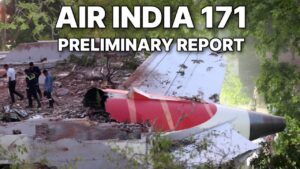
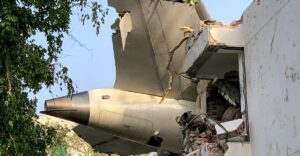
Nearly everyone on board Air India flight AI-171 died within seconds after take-off.
In 32 seconds – one of the shortest flights in history.
AI 171’s crew included Roshni Songhare, Saineeta Chakravarty, Shradha Dhavan, Aparna Mahadik, Maithili Patil, Manisha Thapa, Nganthoi Kongbrailatpam Sharma, Lamnunthem Singson, along with Deepak Pathak and Irfan Shaikh — men and women who had trained for years for a life in aviation. Many at the very beginning of their careers. Their goals, dreams and ambition – gone in 32 seconds like it was for the passengers on board – the elderly, infants, couples, entire families.
The deadliest aviation disaster in India’s history, and the first fatal crash of a Boeing 787 Dreamliner.
When tragedies of this scale occur, aviation investigations exist for one reason: to establish what failed, so it cannot happen again. Not to assign blame. Not to protect reputations. But to interrogate systems with enough honesty that future lives are spared.
Yet six months after the crash, the official preliminary report into AI-171 raises a more disturbing possibility: that the investigation itself may be structured to prevent the most dangerous safety question from ever being asked.
That question is this: Did the aircraft’s engine computer FADEC command a fuel cutoff seconds after liftoff — because flight computers went to “on ground” logic in the air?
That question begins with a single line buried in the report’s take-off sequence.
At 08:08:39 UTC, Air India flight AI-171 left the ground.
The Aircraft Accident Investigation Bureau (AAIB) states this explicitly in its preliminary report: “The aircraft air/ground sensors transitioned to air mode, consistent with liftoff at 08:08:39 UTC.”
That sentence is the most important technical fact in the entire document.
And it is never returned to again.
Every subsequent line of the AAIB report is structured to ensure the reader does not ask the only question that matters after 08:08:39 UTC:
Did the aircraft remain in “air mode” digitally after liftoff — or did it revert to “on-ground” logic while physically airborne?
The AAIB report does not answer this question. It does not even acknowledge that it exists.
And this matters because the engine computer — FADEC — is permitted to command a hard fuel cutoff only under two circumstances: engine overspeed protection, or Thrust Control Malfunction Accommodation (TCMA) — a protection mode that gets triggered only if the aircraft’s systems believe it is on the ground.
TCMA is activated only when four conditions are simultaneously met: the aircraft is classified as on ground, airspeed is below 200 knots, altitude is below 17,500 feet, and commanded thrust (selected N1) exceeds a defined threshold.
AI-171 met every one of those conditions seconds after liftoff — if, as the evidence suggests, its flight-control logic briefly reverted from air mode to on-ground mode while the aircraft was physically airborne. And if AI 171 did meet TCMA conditions, it becomes highly likely that this plane had a FADEC-commanded fuel cutoff.
So now let’s go into how the AAIB’s narrative is hard at work to steer us away from the possibility of such an occurrence by looking first at the take-off sequence.
How the real sequence begins — before the narrative takes over
The AAIB’s own timeline establishes a clean, uneventful take-off sequence:
- 08:08:33 UTC — V1 reached at 153 knots IAS
- 08:08:35 UTC — Vr reached at 155 knots IAS
- 08:08:39 UTC — air/ground sensors transition to air mode (liftoff)
Up to this point, there is no anomaly. The aircraft is airborne, committed to flight, and operating within normal take-off parameters.
Everything that follows occurs after the aircraft is already in the air.
“Maximum recorded airspeed”: the first linguistic sleight of hand
The AAIB then writes:
“The aircraft achieved the maximum recorded airspeed of 180 knots IAS at about 08:08:42 UTC…”
This line does two things simultaneously:
- It introduces the phrase “maximum recorded”, not “maximum achieved.”
- It uses IAS, a pilot-facing parameter, not the true air speed (TAS) or calibrated airspeed (CAS) — which is the calculated/synthesised value used by FADEC to command thrust with fuel control.
In an aircraft still at take-off thrust, basic physics dictates that acceleration cannot stop instantaneously. As Newton’s First Law of Motion states: “An object will remain at rest or in uniform motion unless acted upon by an external force.”
At the point in time, the AAIB identifies as the aircraft’s “maximum recorded airspeed” — 180 knots IAS at about 08:08:42 UTC — no such external braking force is identified. Even if fuel flow were interrupted at that instant, the aircraft’s mass and momentum would require it to continue accelerating briefly, not plateau abruptly.
A sudden halt at a “maximum recorded” value, therefore, is not evidence of the plane’s true “top airspeed.” It is more consistent with interrupted recording, logic disturbance, or power loss due to an electrical failure — precisely the kind of upstream event the AAIB does not interrogate. Instead, the report immediately pivots away.
The pivot: fuel becomes the “event”
The very next sentence reads:
“…and immediately thereafter, the Engine 1 and Engine 2 fuel cutoff switches transitioned from RUN to CUTOFF position one after another with a time gap of 01 sec.”
From this moment on, the report’s framing is locked.
Fuel is now the main actor.
In the 15-page preliminary report, AAIB refers to fuel, fuel quantity, fuel control switches, fuel cut-off, or fuel-related behaviour at least 19 times, repeatedly steering interpretation toward a fuel-switch narrative.
This matters because fuel is downstream in a modern fly-by-wire aircraft. Fuel flow is not an independent cause; it is something commanded — by pilots, by automation, or by protection logic.
And the report never interrogates the command path that resulted in fuel cutoff.
Was it the fuel getting cut off? Or the autothrottle?
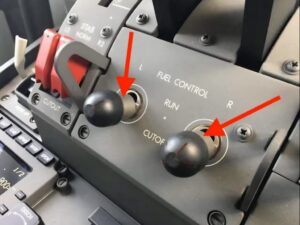
Immediately after describing the fuel cutoff switches, the AAIB inserts a single paraphrased cockpit line:
“In the cockpit voice recording, one of the pilots is heard asking the other why did he cut off. The other pilot responded that he did not do so.”
The transcript does not say fuel.
It does not say switch.
It does not say engine.
“Cutoff” is an effect, not a system.
But by placing this sentence directly beneath the fuel-switch paragraph — after saturating the report with fuel references — the AAIB ensures that the reader supplies the missing noun.
And readers think there was a fuel switch being cut off – when, for all we know, First Officer Clive Kunders could have been referring to the autothrottle, given the pre-existing electrical failures on the flight. And his question could’ve very well have been “Why did it cut off? – the “it” was lost in the blizzard of chimes and warnings from EICAS.
So when the AAIB report gives us a paraphrased sentence about the cockpit conversation without context and data, it becomes damning. And as a petition in the Supreme Court puts it – “it’s narrative framing, not real evidence.”
A Flight-Control Failure the AAIB Leaves Out — By Design
Independent reporting and maintenance records show that AI-171 had already experienced a flight-critical failure two hours before the crash — one that directly involves the electrical architecture that the AAIB avoids examining.
What the AAIB report also ensures is that the reader does not know that this aircraft did not enter take-off roll in a clean, stable flight-control state.
Independent reporting and maintenance records show that AI-171 had already experienced a flight-critical failure two hours before the crash — one that directly involves the electrical architecture that the AAIB avoids examining.
On the aircraft’s previous flight, AI 423 Delhi to Ahmedabad, AAIB report says, “the crew logged a Pilot Defect Report (PDR) for the status message “STAB POS XDCR” — a failure involving the stabilizer position transducer…troubleshooting was carried out “as per the FIM” by Air India’s on-duty Aircraft Maintenance Engineer, and the aircraft was released back to service at 06:40 UTC (12.10 PM IST).”
What the report does not say — but what maintenance logs make clear — is that it wasn’t just a problem with the transducer or sensor – but with the entire right horizontal stabilizer electric motor control unit (EMCU). The entire unit failed and had to be replaced along with its wiring and sensors.
And as per the maintenance log, this condition was detected by all three Flight Control Modules (FCMs). In other words, a flight-critical component under FCM command failed, was troubleshot, and the aircraft was returned to service.
Then comes more crucial evidence, where again AAIB preserves a blanket silence.
Precisely 15 minutes before take-off at 1:23 PM IST (7:53 UTC), all three Flight Control Modules (FCMs) – left, right and centre – started reporting faults, as per data from the plane’s satellite transmissions or ACARS data.
That context is essential because this evidence has been presented to the Supreme Court. This aspect is discussed in an interview with Barkha Dutt on Mojo Story, where the sequence of pre-existing electrical and flight-control faults was publicly laid out. This was also summarised on LinkedIn.
And this is where the Indian media should ask itself why aviation-safety evidence is being left to circulate on LinkedIn? What are the forces at play that prevent the publication of this evidence as front-page news?
Why do we celebrate Netflix’s Downfall: The Case Against Boeing without imbibing its most uncomfortable lesson? That the reckoning happened only because Ethiopia bypassed Washington and took the black boxes to Europe, straight to EASA and Airbus. Today, the AAIB has done the exact opposite — flying to Washington in December to sit with the NTSB and Boeing for spectral analysis of the cockpit audio.
If Ethiopia had done what India did, it’s highly doubtful there would be any Netflix film today about Boeing. And it’s also highly doubtful that Indian pilot Bhavye Suneja and his Ethiopian counterparts, Yared Getachew and Ahmednur Mohammed Omar would’ve been vindicated.
Because in crashes, it’s not just evidence that matters – but the location. Where is the evidence getting interpreted? As this can be the deciding factor in whether the truth emerges at all.
In today’s vacuum of reporting on the Air India crash, manufacturers and operators are winning by default — not because the evidence is weak, but because it is not being examined or amplified.
And you can see this broader failure of scrutiny play out in the AAIB’s own preliminary report — not through what is stated, but through what is selectively reported.
How the AAIB Curates Evidence to Signal ‘Nothing Went Wrong’
The most revealing part of the AAIB report is not what it says, but when it chooses to quote digital data and when it avoids it.
When digital data supports “normal flight,” AAIB quotes EAFR
- Flap handle: “Firmly seated in the 5-degree flap position, consistent with a normal take-off flap setting…position was confirmed from EAFR.”
- Thrust levers: “Both thrust levers were found near the aft (idle) position. However, the EAFR data revealed that the thrust levers remained forward (take-off thrust) until the impact.”
These citations do important narrative work. They tell the reader:
- configuration was normal,
- thrust was commanded,
- no stall,
- no obvious mishandling.
When digital data would expose air/ground logic, AAIB stops quoting EAFR

Now compare that to how the report handles systems that determine ground vs air logic:
- “The landing gear lever was in DOWN position.”
- “The reverser levers were in the stowed position.”
- “The wiring from the TO/GA switches and autothrottle disconnect switches were visible, but heavily damaged.”
These are physical post-crash descriptions, not digital states.
The report does not quote:
- digital gear logic,
- reverser command status,
- TO/GA engagement state,
- autothrottle logic state,
- flight-control mode transitions.
Yet these are precisely the parameters that would reveal whether the aircraft temporarily reverted to “on-ground” logic while airborne.
The AAIB report by giving us EAFR data on thrust levers in forward and not EAFR data on “thrust reversers” is playing on the information asymmetry. Because not many people, even in the aviation world, are aware that GE and Safran changed the Boolean gating condition on the 70 GEnx engines (left engine GEnx-1B70/75/P2 and right engine GEnx-1B70/P2) to “OR”.
For these engines, either forward thrust “OR” thrust reversers can be in “IDLE” for TCMA to activate.
So, in its desire to divert attention away from the possibility of a TCMA-driven FADEC cutoff, what the AAIB report has inadvertently ended up doing is proving pilot innocence with its selective referencing of black box data. Because if “thrust” was in forward from take-off till crash – it clearly proves pilot integrity and pilot intent; no matter what the system decided otherwise.
Why “on-ground logic in the air” explains the entire sequence
Boeing flight-control computers are known to reboot under certain electrical fault conditions. And the FAA warned about this possibility as early as 2016. On reboot, systems enter a fail-safe default state — on-ground logic — before reassessing air/ground status.
If this occurs after liftoff:
- autothrottle and TO/GA can disengage,
- thrust-logic protections can be triggered,
- FADEC can command fuel reduction or cutoff under TCMA
- cockpit indications can freeze or reset.
This is not speculation. It is documented system behaviour.
And it is the only mechanism that coherently explains:
- normal liftoff at 08:08:39,
- sudden loss of thrust logic seconds later,
- asymmetric engine recovery
- a cockpit exchange centred on “cutoff”
- Seemingly “normal” pitch attitude and configuration with catastrophic energy loss.
RAT: Precision – where safe, Vagueness – where dangerous
Now, let’s look at how the report mentions emergency power, i.e. the behaviour of the Ram Air Turbine (RAT). The AAIB states that the RAT hydraulic pump began supplying hydraulic power at 08:08:47 UTC — a precise timestamp.
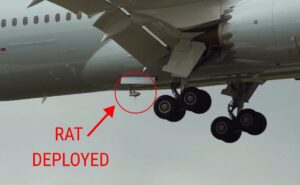
Yet the AAIB does not give the time for when the RAT deployed, noting only that it appears on CCTV “during the initial climb immediately after lift-off.” In this dark fairytale, time seems selectively unavailable: CCTV footages have no timestamps, the EAFR remembers only some RAT functions but not others. And the moment when RAT started generating electrical power is when AAIB would like us to believe the EAFR turned human and suffered from short-term amnesia.
The omission of the RAT deployment timestamp is crucial. As in the normal course of events, emergency power, i.e. the RAT, would deploy after the main engines failed. But if RAT deployed when engines were still running, that shows this plane has some underlying electrical disturbance. It also points more towards systems failure than pilot error.
So, the AAIB uses precision when it does not threaten the fuel narrative. Vagueness appears when it might.
FADEC: When the AAIB report stops investigating and starts teaching
After documenting the switch transitions and relight attempts, the AAIB writes:
“When fuel control switches are moved from CUTOFF to RUN while the aircraft is inflight, each engine’s full authority dual engine control (FADEC) automatically manages a relight…”
This sentence is not investigative. It is protective.
Rather than stating what FADEC actually did on AI-171, the report retreats into training manual language, describing how FADEC typically functions — and even mislabeling it as “dual” rather than “digital.” The effect is deliberate: it allows the AAIB to discuss FADEC without committing to any factual finding about its behaviour in this crash.
In a case now before the Supreme Court, that distinction matters. By giving a generic system description for a specific event, the AAIB has plausible deniability.
If evidence later emerges that FADEC commanded the fuel cutoff, AAIB can shield itself in the Supreme Court by arguing that it never asserted how FADEC behaved on AI 171 but only talked about how it is designed to behave. This rhetorical move shields the engine-control system from scrutiny at precisely the point where it needs the most investigation.
This is not a neutral drafting choice. It is how responsibility is deferred without being denied.
The concealment pattern is quite clear, as the AAIB report:
- States the aircraft entered air mode at 08:08:39 UTC.
- Never examines whether it stayed there.
- Uses EAFR data when it supports “normal take-off”.
- Avoids EAFR data when it would expose air/ground logic
- Documents that the aft EAFR’s wiring and connectors were charred — despite the tail section being largely intact — yet offers no causal analysis whatsoever
- Withholds any forensic findings on soot or residue from the aft EAFR, even though such analysis could distinguish between post-impact fire and a pre-impact electrical arc — a distinction central to determining whether a systems failure occurred before dual engine shutdown
- Repeats fuel references to steer interpretation
- Inserts an ambiguous cockpit conversation
- Substitutes system description for system behaviour when discussing FADEC.
- Concludes with “no recommended actions” for manufacturers.
This is not a neutral omission. It is narrative architecture.
Conclusion: The Human Cost of What This Report Is Written to Hide
Once the aircraft is acknowledged to be airborne at 08:08:39 UTC, every downstream question should interrogate system logic continuity. The AAIB report does not do that.
And this is not an abstract failure.
It has a human face.
That face belongs to 88-year-old Pushkaraj Sabharwal — a former senior official of India’s Directorate General of Civil Aviation. He gave a lifetime of service to an institution that’s today failed his son – Captain Sumeet Sabharwal; with an AAIB report that’s high on omission and as high on “weaponising selective disclosure of data” – as he puts it.
At 88, Mr. Sabharwal should have been at peace; in retirement. Instead, he is in court, fighting.
Fighting not only for his dead son, but also for First Officer Clive Kunders and for the 258 other families who lost a loved one in the first fatal crash of a Dreamliner.
After 30 years with the DGCA, he knows better than us how accident investigations are supposed to work. And he is asking the right questions. The hard ones like “Why is AAIB giving Boeing and GE a seat at the very table investigating their planes and equipment? Why give them a clean chit?”
As a former DGCA official, he knows when questions are being avoided, when systems are being protected, and when language is being used to create deniability rather than truth.
He is watching a preliminary report used to shape public perception before facts are fully disclosed.
And he is fighting it. Because, as he says, this is about data and due process.
It is about whether the truth still matters when it is inconvenient.
Accident investigation is not a bureaucratic exercise. It is a nation’s promise to the dead that their lives will mean something — that lessons will be learned honestly, and that safety will not be sacrificed, as he says to “commercial interests.”
For India — a founding member of the International Civil Aviation Organisation — this is not acceptable.
Unless India corrects the course of its investigation, AI-171 will be remembered not only as a catastrophic systems failure in flight, but as a catastrophic failure on the ground — in the very institutions entrusted with the truth.
For 260 families, this is not justice.
For global aviation, this is not safety.
As there are still 1,100 Dreamliners with the same electrical architecture that continue to fly unreviewed and unexamined.
Because among the people who had faith and trust in India’s aviation regulator to keep our skies safe – were Roshni Songhare, Saineeta Chakravarty, Shradha Dhavan, Aparna Mahadik, Maithili Patil, Manisha Thapa, Nganthoi Kongbrailatpam Sharma, Lamnunthem Singson, Deepak Pathak and Irfan Shaikh – the crew of AI 171 who’d engaged in flight safety demonstrations just a few minutes before the crash.
Feature Image Credit: thenewsminute.com