Category: Afghanistan

  • As the US exits Afghanistan, who is there to tame Taliban?

    As the US exits Afghanistan, who is there to tame Taliban?

    Sometimes, the best way to triumph over an enemy is to quit the game. In an attempt to honour his election campaign promise of bringing the American soldiers back home, President Trump announced the complete withdrawal of American troops from Afghanistan and Iraq. About eight thousand six hundred remaining boys in boots will return from Afghanistan by Christmas this year. The Taliban, whom American forces have been fighting for the last two decades, is now a closed-door dialogue partner of the White House. The arch-rivals in the eerie battleground are now facing off each other in opulent hotels.

    In Doha, the Afghan government caught up with the Taliban at the much-awaited intra-Afghan peace talk, held in September

    In the two-decade-long war, America has paid enormously in currency, diplomacy, and defence. It has cost the US exchequer almost $2 trillion. Several efforts to bring peace have gone in vain. Ultimately, Washington has successfully brought the Taliban and the Afghan government to talk to each other. The two belligerent parties are now engaged in the tete-a-tete. In Doha, the Afghan government caught up with the Taliban at the much-awaited intra-Afghan peace talk, held in September. Despite several attempts, an agreement between the Taliban and the Afghan government could not take place earlier as the bellicose force never recognized the legitimacy of the elected government in Afghanistan. In the eyes of the Taliban, the incumbent in Kabul remains a puppet government of the Western powers. What contrasts the most between the present administration and the earlier Talibani rule is their diametrically opposite ideologies. Whereas the present system in Afghanistan runs democratically, the Taliban believes in the Islamic Sharia law. The battle is now between democracy and theocracy.

    The ongoing peace process is a continuum of American mediation between the Taliban and the Afghan government since February 2020.  White House is nearing an imminent peace deal with the Taliban as they are no longer deeply interested in Afghanistan. Washington’s priority is now countering China’s growing influence.

    In the previous peace talks, the western states sat with the Taliban, disdaining the Afghan government. Even Russia’s attempts failed to produce any fruitful results in favour of Afghanistan. One of the major reasons for the failure is about diluting the Afghan government authority. The Afghan government never endorsed the efforts of foreign nations in the Afghan peace negotiations, in which the Afghan government itself is side-lined. Afghan government affirmed that any kind of peace deal would not be entertained as the legitimate government was not a part of it as it was a clear violation of Afghan sovereignty.  Afghan government took the issue to the United Nations and accused Pakistan of bypassing it in peace talks with the Taliban.

    a large area of Afghanistan and its people are under the Taliban’s control. The Taliban is collecting taxes from the citizens to exercise their undisputed rule.

    Unlike the previous attempts, the intra-Afghan dialogue has raised much hope among the Afghans, the Government, and the international community. But both parties are likely to face many tough challenges to achieve the desired outcome.  The Taliban has already violated the agreement with the United States that resulted in the death of Afghan civilians and army personnel but stresses that it is continuing with the ceasefire. It is possible that by claiming to maintain the ceasefire the Taliban is trying to put pressure on the Afghan government. Despite this hostile situation, the Afghan government has agreed to negotiate with the Taliban mainly for two reasons. First, most of the International Security Assistance Forces and North Atlantic Treaty Organization (NATO) forces have left Afghanistan. The Afghan security forces have neither the training nor the institutional mechanism to provide security to its people. Second, a large area of Afghanistan and its people are under the Taliban’s control. The Taliban is collecting taxes from the citizens to exercise their undisputed rule.

    Unlike the previous peace processes, the current one does not rely much on foreign countries. But the peace deal is likely to affect Afghanistan’s external relations adversely. If the Taliban reverts to its Islamic radicalism, Afghanistan may lose billions of foreign aid it has been receiving since the last decade for the reconstruction of the country. The Afghan government worries that the premature departure of American troops may have a negative impact on international assistance.

    Although both parties agreed to negotiate on the peace deal, there is dissatisfaction within the cadres of the parties. In the recent elections, the two Presidential contestants each claimed electoral victory. A power-sharing arrangement was concluded where Ashraf Ghani is the President and Abdullah Abdullah exercises power as the chairperson of the High Council for National Reconciliation. On the Taliban side, many leaders do not support the peace process as they believe that they could win the Afghan war by military means. They consider  Pentagon’s departure from Afghanistan as a sign of their victory.

    The Taliban continues to maintain its contact with the Al-Qaeda, according to a UN security council report. The US -Taliban agreement of February demands a complete divorce between the Taliban and the Al-Qaeda.  UN reports and the violation of ceasefire show that the Taliban is not adhering to the agreement. Once the peace deal is completed, the Taliban could take advantage of the absence of US troops in Afghanistan and renege on their commitments by maintaining close ties with the Al Qaeda, Haqqani Network, and the other extremist groups. The training camps of these Islamist terrorist groups are being used by Pakistan based terror outfits like Lashkar and Jaish-e-Mohammed. When Soviet troops left Afghanistan in 1989, insurgency and terrorism increased in Kashmir. It saw a drastic fall when Washington waged war on Taliban and other Islamist extremist groups.

    If the Sharia law returns to Afghanistan, all the democratic rights and the freedom that the Afghan people have seen since the last decade, are likely to be lost.

    The consequences would be grave if the peace deal doesn’t fetch the desired results. The peace deal is necessary for the Afghan government in maintaining peace and stability in Afghanistan. If the Sharia law returns to Afghanistan, all the democratic rights and the freedom that the Afghan people have seen since the last decade, are likely to be lost. Even if a peace deal fructifies, it may not ensure peace for every section of society. During the previous Taliban rule, the fundamental rights of women- ranging from education to employment, were denied. Women had to live a sub-human life. At present, women hold 28 percent of the total seats in the parliament. So, if the Sharia law is enacted again, it will deny the basic rights of Afghan women. Millions of Afghan refugees in neighbouring Iran, Pakistan, and elsewhere in European countries cannot hope to return home. The host countries, however, have started sending back the Afghan refugees forcefully amid instability.

    Afghanistan is a country of over a hundred ethnic groups, tribes, non-Muslims, and other communities. Most ethnic groups have a conflict with each other. In recent times, the Taliban attacked the non-Muslim communities, especially Hindus and Sikhs. The Ministry of External Affairs of India facilitated the travels of a few Hindu families to India. Even after the Afghan government concludes a peace deal with the Taliban, conflicts may continue and peace may still be elusive. The effectiveness of the peace deal will depend on the commitments of each party.

    European countries do not have the military or economic strength to prosecute overseas conflicts. The internal mechanism of NATO is weaker than before. And after the Brexit deal, the fragmented European union lacks the political will to intervene in the war-torn state. China’s interests in Afghanistan are mostly commercial. Infrastructures or projects under Belt and Road Initiative can’t be built amid the carnage. China has the political, financial, and military strength to fill the void, after the complete withdrawal of the US forces. The Chinese financial contribution in Afghanistan is a clear sign that the country has a long-term strategy in the region. This apart, China has security concerns as well in Afghanistan. The rise of extremist movements in Afghanistan is likely to impact security in China, especially in Xinjiang province. In recent years, China has increased its military ties with Afghanistan. In the absence of the American troops, Afghanistan may consider China as possible support.

    Once the US exits, Kabul will have an option to raise the peace issue in the Shanghai Cooperation Organization (SCO). The SCO can be the main military and economic block in Asia. Except for Turkmenistan, all the bordering countries of Afghanistan and other major players in South Asia have either members-status or observer status at the SCO. It can certainly play a very effective role as the peacemaker providing its members, each with considerably different stakes in Afghanistan can get their act together.

    The Taliban in the Afghan government would provide political leverage to Pakistan over India.

    If the Taliban assumes power, India-Afghanistan bonhomie will turn frosty. Unlike other countries, the Indian government never supported the Taliban. India has been a staunch supporter of Afghan-led, Afghan controlled and Afghan-owned peace deal. Pakistan has always been supportive of the Taliban as it serves its strategic interests. The Taliban in the Afghan government would provide political leverage to Pakistan over India. Seeing that it has been left out of the Afghan peace talks, it appears that India is coming around to talk to the Taliban.

    Afghans are exhausted from bloodshed in the last few decades. The region has turned into a breeding ground for Islamic State in Khorasan, Al-Qaeda, and other terrorist groups. A stable and democratic Afghan government is necessary for maintaining peace in the South Asian region. As the effectiveness of SAARC continues to be hampered by India-Pakistan animosity, other South Asian states, Organization of Islamic Cooperation member states, and other Islamic states like Saudi Arabia or Turkey should act to restrain the Taliban and pave the way for peace in Afghanistan.


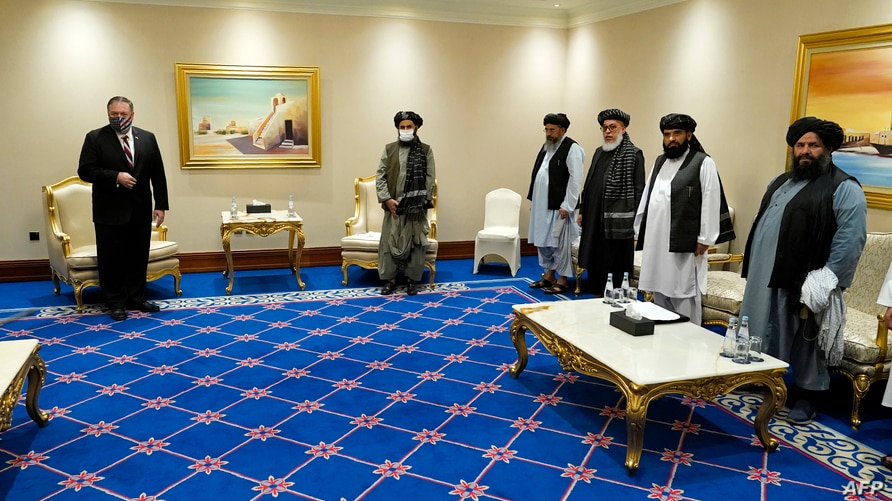
    Image: US Secretary of State Mike Pompeo meets with Taliban’s Mullah Abdul Ghani Baradar and members of his negotiating team. Credit: www.voanews.com
     

  • Reflections on “Peace” in Afghanistan: Leaving a Misguided War and Choosing Not to Look Back

    Reflections on “Peace” in Afghanistan: Leaving a Misguided War and Choosing Not to Look Back

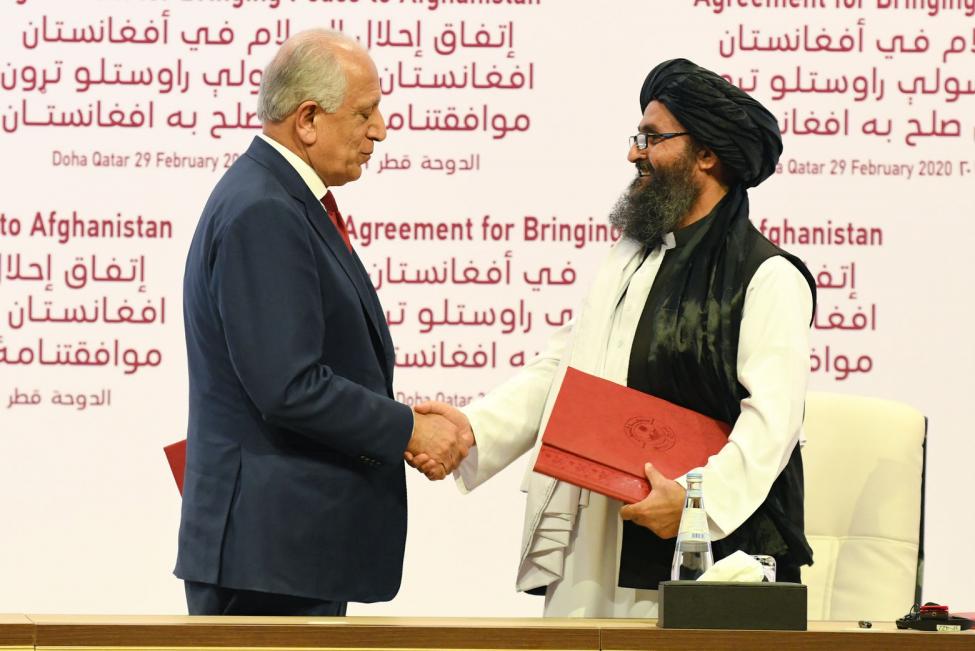
    Kahlil Gibran, the Lebanese-American poet, artist, writer and philosopher, famously said ‘History does not repeat itself except in the minds of those who do not know history’. In today’s generation very few know and understand history, and so it is most likely that very few will see that the recent US-Taliban peace deal has an eerie resemblance to the end stage of the Vietnam war. US Special envoy, Zalmay Khalilzad and Taliban political chief, Mullah Abdul Ghani Baradar signed a ‘historic’ peace deal on February 29, 2020 in Doha, capital of Qatar  paving the way for ending two decades of American military fighting in Afghanistan and their return. In the context of the US-Taliban peace deal that raises more questions than answers, TPF revisits an article written by Andrew J Bacevich few months ago. Comparing the two similar situations (US-Vietcong deal and US-Taliban deal) in a very incisive analysis, Andrew Bacevich raises very relevant observations. Effectively this means that the US is exiting after conceding defeat to the Taliban and abandoning the Afghan government that it supported all this while. It would be only a matter of time before the Taliban, with active support from Pakistan, dismantles whatever semblance of stable governance and democracy that has been built over the last 15 years in war-torn Afghanistan. TPF

    This article was first published in “TomDispatch.com”    The Peninsula Foundation is happy to republish this article with permission from ‘TomDispatch.com’.  TPF  

    Andrew J Bacevich

    When the conflict that the Vietnamese refer to as the American War ended in April 1975, I was a U.S. Army captain attending a course at Fort Knox, Kentucky. In those days, the student body at any of our Army’s myriad schools typically included officers from the Army of the Republic of Vietnam (ARVN).

    Since ARVN’s founding two decades earlier, the United States had assigned itself the task of professionalizing that fledgling military establishment. Based on a conviction that the standards, methods, and ethos of our armed forces were universally applicable and readily exportable, the attendance of ARVN personnel at such Army schools was believed to contribute to the professionalizing of the South Vietnamese military.

    Evidence that the U.S. military’s own professional standards had recently taken a hit — memories of the My Lai massacre were then still fresh — elicited no second thoughts on our part. Association with American officers like me was sure to rub off on our South Vietnamese counterparts in ways that would make them better soldiers. So we professed to believe, even while subjecting that claim to no more scrutiny than we did the question of why most of us had spent a year or more of our lives participating in an obviously misbegotten and misguided war in Indochina.

    For serving officers at that time one question in particular remained off-limits (though it had been posed incessantly for years by antiwar protestors in the streets of America): Why Vietnam? Prizing compliance as a precondition for upward mobility, military service rarely encourages critical thinking.

    On the day that Saigon, the capital of the Republic of Vietnam, fell and that country ceased to exist, I approached one of my ARVN classmates, also a captain, wanting at least to acknowledge the magnitude of the disaster that had occurred. “I’m sorry about what happened to your country,” I told him.

    I did not know that officer well and no longer recall his name. Let’s call him Captain Nguyen. In my dim recollection, he didn’t even bother to reply. He simply looked at me with an expression both distressed and mournful. Our encounter lasted no more than a handful of seconds. I then went on with my life and Captain Nguyen presumably with his. Although I have no inkling of his fate, I like to think that he is now retired in Southern California after a successful career in real estate. But who knows?

    All I do know is that today I recall our exchange with a profound sense of embarrassment and even shame. My pathetic effort to console Captain Nguyen had been both presumptuous and inadequate. Far worse was my failure — inability? refusal? — to acknowledge the context within which that catastrophe was occurring: the United States and its armed forces had, over years, inflicted horrendous harm on the people of South Vietnam.

    In reality, their defeat was our defeat. Yet while we had decided that we were done paying, they were going to pay and pay for a long time to come.

    Rather than offering a fatuous expression of regret for the collapse of his country, I ought to have apologized for having played even a minuscule role in what was, by any measure, a catastrophe of epic proportions. It’s a wonder Captain Nguyen didn’t spit in my eye.

    I genuinely empathized with Captain Nguyen. Yet the truth is that, along with most other Americans, soldiers and civilians alike, I was only too happy to be done with South Vietnam and all its troubles. Dating back to the presidency of Dwight D. Eisenhower, the United States and its armed forces had made a gargantuan effort to impart legitimacy to the Republic of Vietnam and to coerce the Democratic Republic of Vietnam to its north into giving up its determination to exercise sovereignty over the entirety of the country. In that, we had failed spectacularly and at a staggering cost.

    “Our” war in Indochina — the conflict we chose to call the Vietnam War — officially ended in January 1973 with the signing in Paris of an “Agreement Ending the War and Restoring Peace in Vietnam.” Under the terms of that fraudulent pact, American prisoners of war were freed from captivity in North Vietnam and the last U.S. combat troops in the south left for home, completing a withdrawal begun several years earlier. Primary responsibility for securing the Republic of Vietnam thereby fell to ARVN, long deemed by U.S. commanders incapable of accomplishing that mission.

    Meanwhile, despite a nominal cessation of hostilities, approximately 150,000 North Vietnamese regulars still occupied a large swathe of South Vietnamese territory — more or less the equivalent to agreeing to end World War II when there were still several German panzer tank divisions lurking in Belgium’s Ardennes Forest. In effect, our message to our enemy and our ally was this: We’re outta here; you guys sort this out. In a bit more than two years, that sorting-out process would extinguish the Republic of Vietnam.

    Been There, Done That

    The course Captain Nguyen and I were attending in the spring of 1975 paid little attention to fighting wars like the one that, for years, had occupied the attention of my army and his. Our Army, in fact, was already moving on. Having had their fill of triple-canopy jungles in Indochina, America’s officer corps now turned to defending the Fulda Gap, the region in West Germany deemed most hospitable to a future Soviet invasion. As if by fiat, gearing up to fight those Soviet forces and their Warsaw Pact allies, should they (however improbably) decide to take on NATO and lunge toward the English Channel, suddenly emerged as priority number one. At Fort Knox and throughout the Army’s ranks, we were suddenly focused on “high-intensity combined arms operations” — essentially, a replay of World War II-style combat with fancier weaponry. In short, the armed forces of the United States had reverted to “real soldiering.”

    And so it is again today. At the end of the 17th year of what Americans commonly call the Afghanistan War — one wonders what name Afghans will eventually assign it — U.S. military forces are moving on. Pentagon planners are shifting their attention back to Russia and China. Great power competition has become the name of the game. However we might define Washington’s evolving purposes in its Afghanistan War — “nation building,” “democratization,” “pacification” — the likelihood of mission accomplishment is nil. As in the early 1970s, so in 2019, rather than admitting failure, the Pentagon has chosen to change the subject and is once again turning its attention to “real soldiering.”

    Remember the infatuation with counterinsurgency (commonly known by its acronym COIN) that gripped the national security establishment around 2007 when the Iraq “surge” overseen by General David Petraeus briefly ranked alongside Gettysburg as a historic victory? Well, these days promoting COIN as the new American way of war has become, to put it mildly, a tough sell. Given that few in Washington will openly acknowledge the magnitude of the military failure in Afghanistan, the incentive for identifying new enemies in settings deemed more congenial becomes all but irresistible.

    Only one thing is required to validate this reshuffling of military priorities. Washington needs to create the appearance, as in 1973, that it’s exiting Afghanistan on its own terms. What’s needed, in short, is an updated equivalent of that “Agreement Ending the War and Restoring Peace in Vietnam.”

    Until last weekend, the signing of such an agreement seemed imminent. Donald Trump and his envoy, former ambassador to Afghanistan Zalmay Khalilzad, appeared poised to repeat the trick that President Richard Nixon and National Security Advisor Henry Kissinger pulled off in 1973 in Paris: pause the war and call it peace. Should fighting subsequently resume after a “decent interval,” it would no longer be America’s problem.  Now, however, to judge by the president’s Twitter account — currently the authoritative record of U.S. diplomacy — the proposed deal has been postponed, or perhaps shelved, or even abandoned altogether.  If National Security Advisor John Bolton has his way, U.S. forces might just withdraw in any case, without an agreement of any sort being signed.

    Based on what we can divine from press reports, the terms of that prospective Afghan deal would mirror those of the 1973 Paris Accords in one important respect. It would, in effect, serve as a ticket home for the remaining U.S. and NATO troops still in that country (though for the present only the first 5,000of them would immediately depart). Beyond that, the Taliban was to promise not to provide sanctuary to anti-American terrorist groups, even though the Afghan branch of ISIS is already firmly lodged there. Still, this proviso would allow the Trump administration to claim that it had averted any possible recurrence of the 9/11 terror attacks that were, of course, planned by Osama bin Laden while residing in Afghanistan in 2001 as a guest of the Taliban-controlled government. Mission accomplished, as it were.

    Back in 1973, North Vietnamese forces occupying parts of South Vietnam neither disarmed nor withdrew. Should this new agreement be finalized, Taliban forces currently controlling or influencing significant swaths of Afghan territory will neither disarm nor withdraw. Indeed, their declared intention is to continue fighting.

    In 1973, policymakers in Washington were counting on ARVN to hold off Communist forces. In 2019, almost no one expects Afghan security forces to hold off a threat consisting of both the Taliban and ISIS. In a final insult, just as the Saigon government was excluded from U.S. negotiations with the North Vietnamese, so, too, has the Western-installed government in Kabul been excluded from U.S. negotiations with its sworn enemy, the Taliban.

    A host of uncertainties remain.  As with the olive branches that President Trump has ostentatiously offered to Russia, China, and North Koea, this particular peace initiative may come to naught — or, given the approach of the 2020 elections, he may decide that Afghanistan offers his last best hope of claiming at least one foreign policy success. One way or another, in all likelihood, the deathwatch for the U.S.-backed Afghan government has now begun. One thing only is for sure. Having had their fill of Afghanistan, when the Americans finally leave, they won’t look back. In that sense, it will be Vietnam all over again.

    What Price Peace?

    However great my distaste for President Trump, I support his administration’s efforts to extricate the United States from Afghanistan. I do so for the same reason I supported the Paris Peace Accords of 1973. Prolonging this folly any longer does not serve U.S. interests. Rule number one of statecraft ought to be: when you’re doing something really stupid, stop. To my mind, this rule seems especially applicable when the lives of American soldiers are at stake.

    In Vietnam, Washington wasted 58,000 of those lives for nothing. In Afghanistan, we have lost more than 2,300 troops, with another 20,000 wounded, again for next to nothing. Last month, two American Special Forces soldiers were killed in a firefight in Faryab Province. For what?

    That said, I’m painfully aware of the fact that, on the long-ago day when I offered Captain Nguyen my feeble condolences, I lacked the imagination to conceive of the trials about to befall his countrymen. In the aftermath of the American War, something on the order of 800,000 Vietnamese took to open and unseaworthy boats to flee their country. According to estimates by the United Nations High Commissioner for Refugees, between 200,000 and 400,000 boat people died at sea. Most of those who survived were destined to spend years in squalid refugee camps scattered throughout Southeast Asia. Back in Vietnam itself, some 300,000 former ARVN officers and South Vietnamese officials were imprisoned in so-called reeducation camps for up to 18 years. Reconciliation did not rank high on the postwar agenda of the unified country’s new leaders.

    Meanwhile, for the Vietnamese, north and south, the American War has in certain ways only continued. Mines and unexploded ordnance left from that war have inflicted more than 100,000 casualties since the last American troops departed. Even today, the toll caused by Agent Orange and other herbicides that the U.S. Air Force sprayed with abandon over vast stretches of territory continues to mount. The Red Cross calculates that more than one million Vietnamese have suffered health problems, including serious birth defects and cancers as a direct consequence of the promiscuous use of those poisons as weapons of war.

    For anyone caring to calculate the moral responsibility of the United States for its actions in Vietnam, all of those would have to find a place on the final balance sheet. The 1.3 million Vietnamese admitted to the United States as immigrants since the American War formally concluded can hardly be said to make up for the immense damage suffered by the people of Vietnam as a direct or indirect result of U.S. policy.

    As to what will follow if Washington does succeed in cutting a deal with the Taliban, well, don’t count on President Trump (or his successor for that matter) welcoming anything like 1.3 million Afghan refugees to the United States once a “decent interval” has passed. Yet again, our position will be: we’re outta here; you guys sort this out.

    Near the end of his famed novel, The Great Gatsby, F. Scott Fitzgerald described two of his privileged characters, Tom and Daisy, as “careless people” who “smashed up things and creatures” and then “retreated back into their money or their vast carelessness” to “let other people clean up the mess they had made.” That description applies to the United States as a whole, especially when Americans tire of a misguided war. We are a careless people. In Vietnam, we smashed up things and human beings with abandon, only to retreat into our money, leaving others to clean up the mess in a distinctly bloody fashion.

    Count on us, probably sooner rather than later, doing precisely the same thing in Afghanistan.

    Image Credit: www.upi.com