Category: New World Order

  • The Ideological Engine: Exceptionalism, Religion, and the Civilisational Alternative

    The Ideological Engine: Exceptionalism, Religion, and the Civilisational Alternative

    Series: India’s Strategic Choices, Civilisational Responsibilities, and the Contest for the Emerging World Order

    This is the second of a three-part prologue to a series on India’s strategic choices, civilisational responsibilities, and the contest for the emerging world order.

    Ideological Engine crafted with Religious Endorsement

    In my previous post, I traced the material foundations of the current world order — the knowledge borrowed from the Islamic world, the wealth extracted from the Americas, two-thirds of humanity colonised and enslaved. It was the extraction, the enslavement, and the colonial architecture that built Western dominance. But material power alone does not sustain five centuries of global domination. It requires an ideological engine — a moral framework that converts extraction into mission, conquest into duty, and atrocity into the necessary price of civilisation. That engine was exceptionalism. And it was powered by religion.
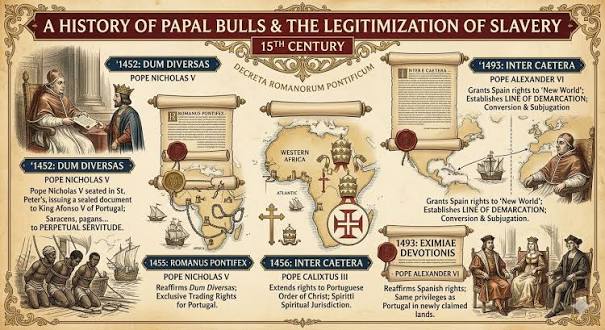
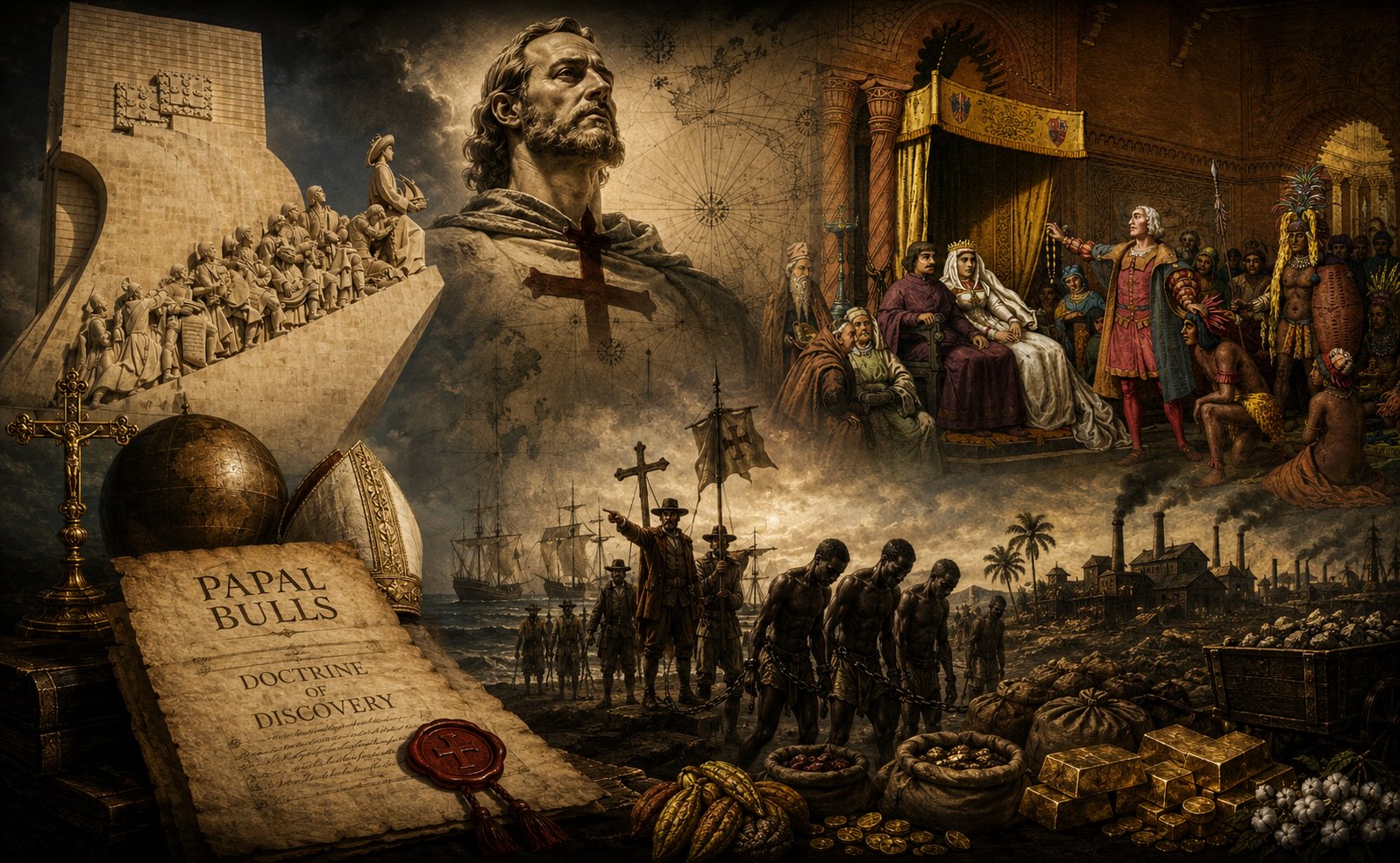
    The mechanism was constructed with precision. In 1452, Pope Nicholas V issued the papal bull Dum Diversas, authorising the King of Portugal to “capture, vanquish, and subdue the Saracens, pagans, and any other unbelievers and enemies of Christ” and “reduce their persons to perpetual servitude.” Three years later, Romanus Pontifex extended this authority to conquer the lands of infidels for “the salvation of all”. In 1493, following Columbus’s return from the Americas, Pope Alexander VI issued Inter Caetera — the foundational document of the Doctrine of Discovery — declaring that any land not under Christian rule could be seized, its peoples subjugated, and its resources claimed, in the service of Christianising the world.
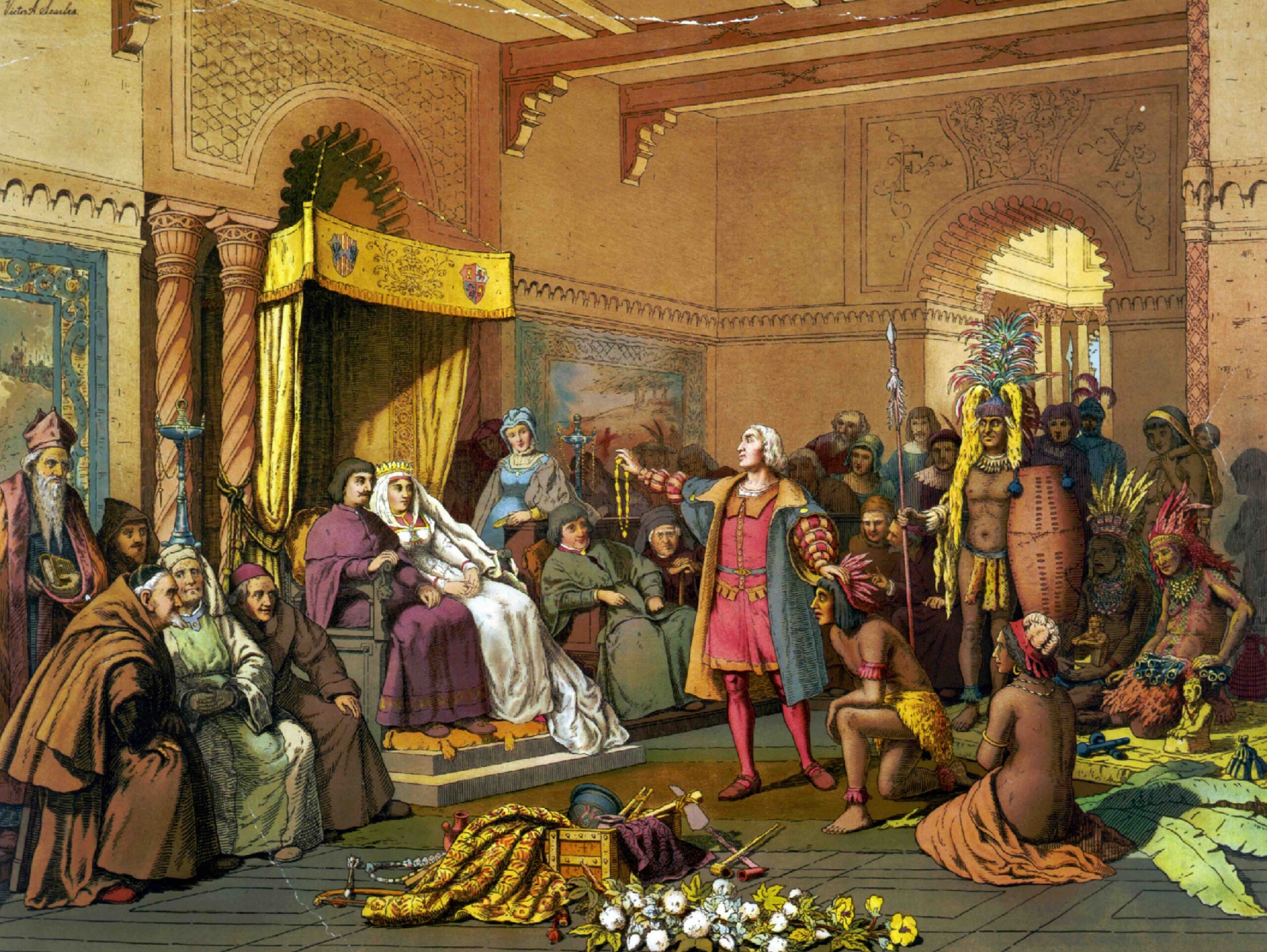
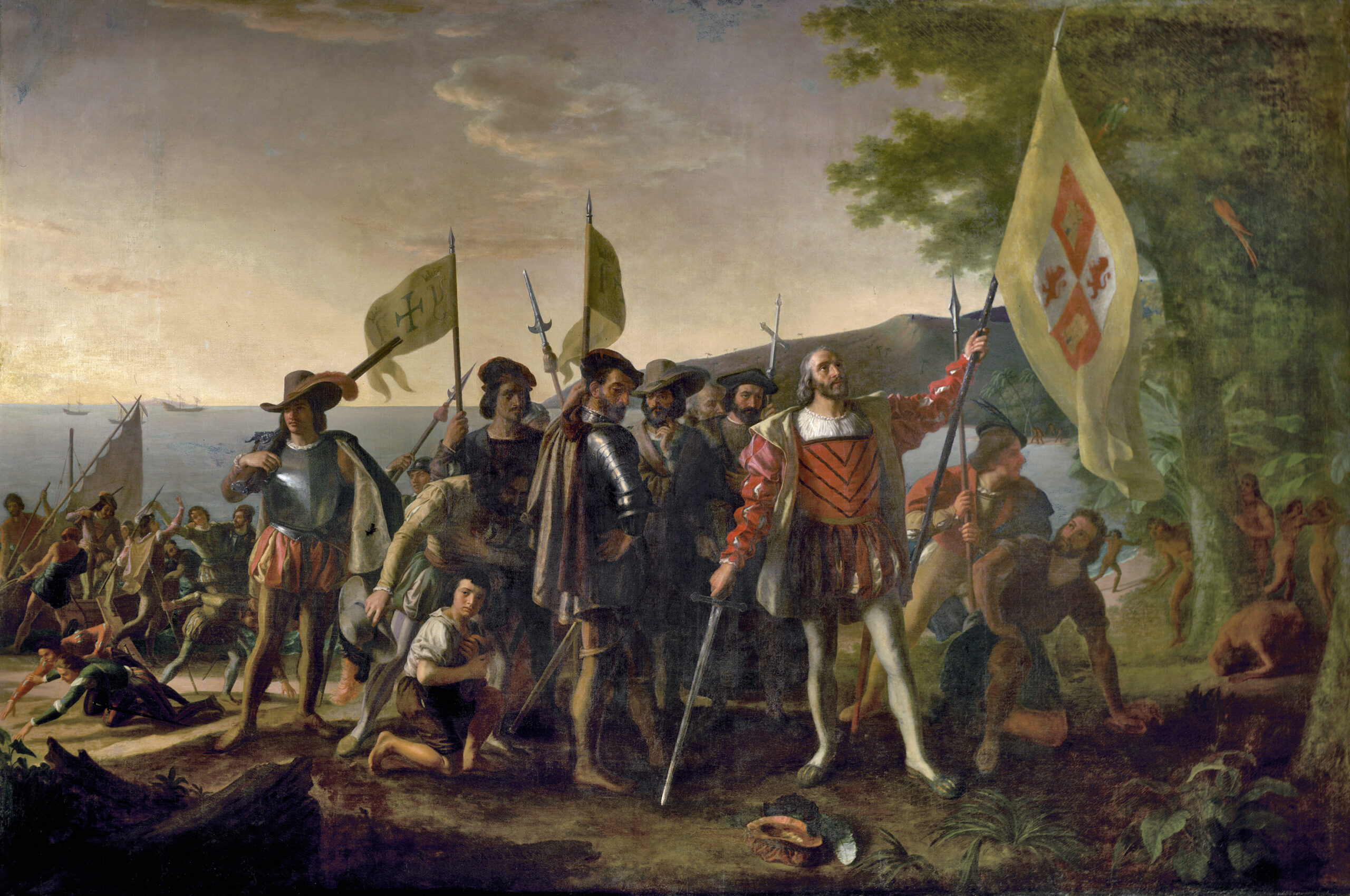
    Columbus at the court of Barcelona. Christopher Columbus standing before the King and Queen of Spain, presenting Indians and treasures from the New World, 1493. (Newscom TagID: whphotos146159.jpg) [Photo via Newscom]

    These were not peripheral theological documents. They were the legal and moral architecture of the colonial project, establishing in explicit terms sanctioned by the highest religious authority in the Western world that non-Christians were less than human, that killing them was not a sin, and that converting or enslaving them was a sacred duty. The Doctrine of Discovery was subsequently incorporated into the legal systems of the United States, Canada, Australia, and other settler-colonial states, where it shaped land law, property rights, and indigenous dispossession for centuries. The Vatican formally repudiated the Doctrine of Discovery only in 2023 — more than five centuries after the damage was done.

    And here is what makes that repudiation hollow: the doctrine did not stay in the fifteenth century. It became the operating law of the settler-colonial states, and it remains so.

    In 1823, the United States Supreme Court, in Johnson v. McIntosh, formally incorporated the Doctrine of Discovery into American law. Chief Justice John Marshall ruled that Indigenous peoples did not own their lands once those lands had been “discovered” by Christian colonists — that discovery itself conferred title on the discovering Christian nation, reducing the original inhabitants to mere occupants on their own soil. Marshall himself conceded the principle was “extravagant.” He made it law regardless. It has never been overturned. Two centuries later, it remains the foundation of all federal Indian law in the United States.

    Plenary power — plenitudo potestatis, the fullness of power — is the exact phrase by which the fifteenth-century popes claimed the authority to authorise conquest and enslavement in the first place.

    The living force of this doctrine was demonstrated in 2023 — the very year of the Vatican’s repudiation. In Haaland v. Brackeen, the US Supreme Court affirmed the modern form of the doctrine: the “plenary power” of the federal government over Native peoples. The term is not incidental. Plenary power — plenitudo potestatis, the fullness of power — is the exact phrase by which the fifteenth-century Popes claimed the authority to authorise conquest and enslavement in the first place. The Vatican renounced the doctrine in March 2023. Three months later, in June, the highest court of the United States reaffirmed its modern expression as settled law. One institution let go of the fiction. The other continued to build on it.

    Terra Nullius and the Concepts of Exceptionalism and Manifest Destiny

    The pattern is not confined to the Americas. In Australia, the entire continent was claimed under the doctrine of terra nullius — the legal fiction that the land belonged to no one, that sixty thousand years of continuous Aboriginal civilisation and hundreds of distinct nations simply did not count as habitation. The Australian Constitution, when it came into force in 1901, contained Section 127, which declared that “in reckoning the numbers of the people of the Commonwealth, aboriginal natives shall not be counted.” The original inhabitants of the continent were constitutionally excluded from the population of their own country. That exclusion was not removed until a referendum in 1967. The fiction of terra nullius itself was not overturned until the High Court’s Mabo judgment in 1992 — one hundred and ninety-two years after colonisation began.

    The Doctrine of Discovery is not a historical curiosity to be studied and regretted. It is the living legal architecture on which the settler-colonial states were built, and on which — as the events of 2023 demonstrate — they continue to stand. The exceptionalism that authorised conquest in 1452 was not repented and abandoned. It was secularised, constitutionalised, and preserved.
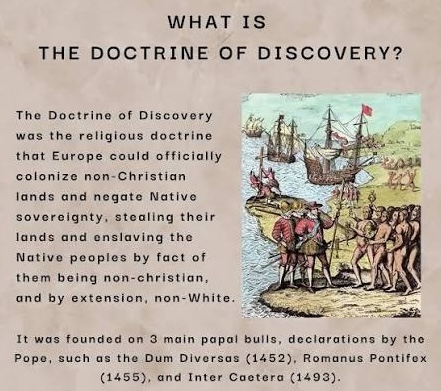
    This is the point that must be understood clearly. The Doctrine of Discovery is not a historical curiosity to be studied and regretted. It is the living legal architecture on which the settler-colonial states were built, and on which — as the events of 2023 demonstrate — they continue to stand. The exceptionalism that authorised conquest in 1452 was not repented and abandoned. It was secularised, constitutionalised, and preserved.

    This is not a distortion of Christianity. It is the documented institutional expression of a specific tradition within it: the doctrine that one’s own community occupies a uniquely chosen position in the divine order — that the Other is not merely different but lesser, and that this difference legitimates domination.

    The same logic operated, in different institutional forms, across other traditions. The conquering caliphates that used the concept of jihad to justify forced conversion were not the whole of Islamic tradition, which contains rich pluralist and humanistic streams. They were the weaponisation of religious exceptionalism by those who held political and military power. Political Zionism, in its most extreme contemporary expressions, follows the same pattern: the theological claim to exclusive divine right over territory and the dehumanisation of non-Jewish populations, ruthlessly visible from the Nakba in 1947-48 to the present conduct of the Gaza war, in full view of the world and with endorsement by the West. It follows the same pattern: religious exceptionalism converted into political licence for dispossession and violence.

    The pattern is not one religion. It is a specific logic — the claim to divine chosenness that exempts a community from the moral constraints that apply to others – that has been institutionalised, at different moments and in different traditions, wherever political power has found it useful.

    In Western civilisation, this logic found its most durable and consequential expression in American exceptionalism. In 1630, Puritan leader John Winthrop, preparing to establish the Massachusetts Bay Colony, called for the creation of a community that would be “as a City upon a Hill, the eyes of all people upon us.” This was not yet a global claim.  It was a theological self-conception: a chosen people, on a divinely appointed errand, under special divine scrutiny. But the seed was planted. Two centuries later, in 1845, John L. O’Sullivan gave it political form: “our manifest destiny to overspread the continent allotted by Providence for the free development of our yearly multiplying millions.” God-given expansion across a continent — regardless of the peoples already living on it — was reframed as destiny, not conquest.

    The indigenous peoples of North America experienced what that destiny meant in practice. At Sand Creek in November 1864, a Colorado militia under Colonel John Chivington attacked a Cheyenne and Arapaho village whose chief, Black Kettle, was flying both an American flag and a white flag of truce. Roughly 150 people were killed, the majority of them women, children, and the elderly; the soldiers mutilated the dead and paraded body parts through the streets of Denver. Three separate investigations — two congressional, one military — condemned it as a massacre. Not one man was ever indicted. The campaigns that defined the conquest of the West — villages destroyed, food supplies burned, non-combatants killed as a matter of strategy — were not the excesses of rogue commanders. They were the method.
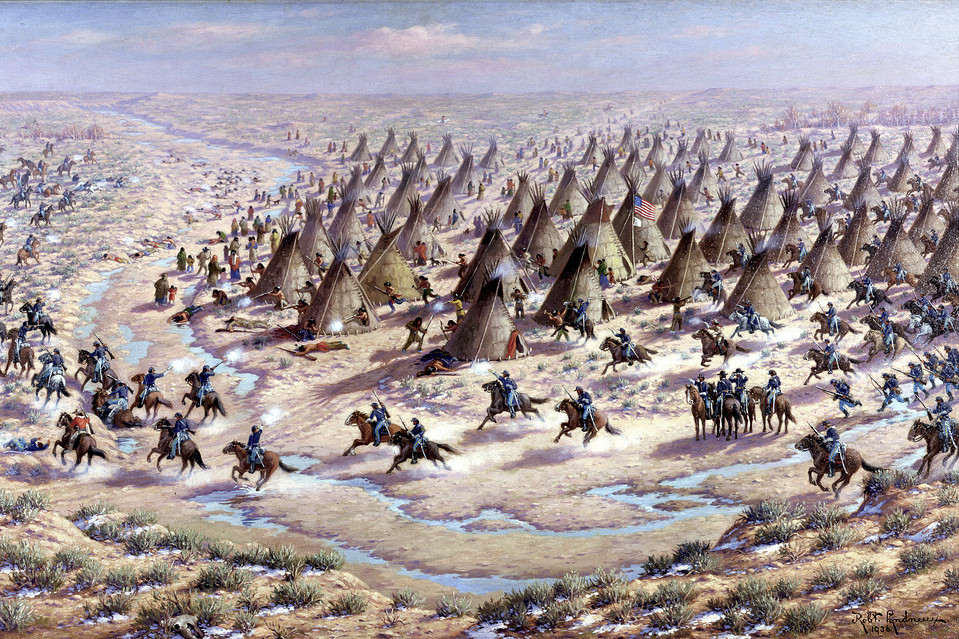
    And the men who carried them out were not disgraced but memorialised. George Armstrong Custer, who at dawn on the Washita River in 1868 attacked the village of that same Black Kettle, who had survived Sand Creek and was again seeking peace, killed him and his wife in the assault,  while his aggressive forces killed a large number of unarmed women and children. Custer was mythologised into a national hero, his death at the Little Bighorn recast as a noble sacrifice. This is exceptionalism completing its work: not merely committing the atrocity, but converting it, in the national memory, into valour. The conversion of conquest into heroism is not a distortion of the exceptionalist project. It is the project.

    It is worth pausing to see precisely how this engine is built, because it reveals something the comfortable version of history conceals. There are two broad models of colonialism, and they are not the same. Extractive colonialism — the Spanish in Peru, the British in India — needs the colonised population alive: to mine the silver, to work the plantations, to pay the taxes. It subjugates.

    But settler colonialism, of the kind practised in North America and Australia, does not primarily want the people. It wants the land. And a population that comes to stay on land already inhabited requires something darker than subjugation: it requires removal. The historian Patrick Wolfe named this the ‘logic of elimination’ — the observation that in the settler-colonial project, invasion is not an event but a structure, and the indigenous inhabitant is not a labour force to be exploited but an obstacle to be cleared. This is why the settler variant needed its ideological engine to run at maximum power. To subjugate a people, you need only believe they are lesser. To eliminate them, you must first erase them — conceptually, legally, theologically — before you erase them in fact. Terra nullius, the empty land; the savage without real title; the wilderness awaiting God’s chosen — these were not decorative rhetoric. They were the necessary vocabulary of replacement.

    A society that never hears the moral objection is merely benighted. A society that hears it clearly, debates it in its legislature, affirms it in its highest court — and proceeds anyway, in the name of Providence — has not failed to find its conscience. It has chosen to override it. That is what the ideological engine is for: not to fill a silence where conscience is absent, but to drown out a conscience that is present.
    And here is the fact that removes every excuse: the conscience was present. It was not that no one knew, or that no one objected. Roger Williams argued in the 1630s that the Crown had no right to grant land it did not own, that it had to be purchased from its actual inhabitants — and he was banished for saying so. The Quaker John Woolman condemned the dispossession on moral grounds a century before it reached the Mississippi. When the Indian Removal Act came before the United States Congress in 1830, it passed by 102 votes to 97 — a bitter, closely fought debate, not a silent consensus. When the Cherokee took their case to the Supreme Court, Chief Justice John Marshall ruled in Worcester v. Georgia that they possessed sovereign rights the state was bound to respect. President Andrew Jackson ignored the ruling and carried out the removal regardless; on the Trail of Tears that followed, thousands died. This is the point that must be held onto. A society that never hears the moral objection is merely benighted. A society that hears it clearly, debates it in its legislature, affirms it in its highest court — and proceeds anyway, in the name of Providence — has not failed to find its conscience. It has chosen to override it. That is what the ideological engine is for: not to fill a silence where conscience is absent, but to drown out a conscience that is present.

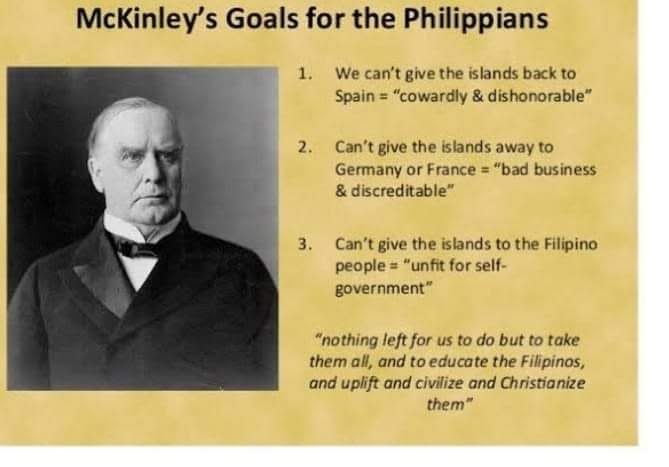
    The same logic was exported globally. In 1898, the United States entered the Spanish-American War, having suggested to Filipino independence fighters that it was their ally against Spanish colonial rule. When Spain was defeated, the Philippines was not given its independence. It was purchased for twenty million dollars and then colonised. The Philippine-American War resulted in the deaths of over 20,000 Filipino combatants and as many as 200,000 Filipino civilians through violence, famine, and disease. McKinley called his policy “Benevolent Assimilation.” The Philippines did not receive full independence until 1946 — forty-eight years after the liberation that was promised.

    This is the pattern that repeats from Vietnam to Iraq to Afghanistan to Iran: intervention justified as liberation, freedom invoked to mask extraction, and sovereignty violated in the name of the values that sovereignty was supposed to protect.

    The Civilisational Alternative 

    Now consider the contrast. India, China, and Persia are rooted in civilisational traditions that are fundamentally pluralist in their relationship to truth and the divine. Hinduism, Buddhism, Jainism, and Zoroastrianism do not claim exclusive possession of truth. They understand the search for ultimate reality as a path that admits multiple valid routes — that the divine is too vast and complex for any single tradition to comprehend fully. This epistemological humility produces a fundamentally different relationship to the Other: not as a lesser being to be converted or eliminated, but as a fellow traveller on a different path through the same reality — or, in the Tamil saint Vallalar’s image, rivers of many names flowing to a single shoreless ocean.

    A tradition whose foundational claim is Ekam Sat Vipra Bahudha Vadanti — truth is one, the wise call it by many names — or the Jain Anekantavada, the many-sidedness of truth, or the Tamil Yaadhum Oorey-Yaavarum Kelir, that every place is home and every person kin, is structurally resistant to exceptionalism, because its highest ideal explicitly denies the premise exceptionalism requires: that a single community owns the truth and stands chosen above the rest.

    The distinction I am drawing must be stated carefully, because it is easy to misread as a claim that one civilisation is virtuous and another is wicked. That is not the claim, and it would be false. The impulse to dress conquest in sacred language is close to universal — it appears wherever power seeks to launder its crimes, and no civilisation, India’s included, is innocent of it. Ashoka built his empire by the sword before he turned to the dharma. India’s own caste hierarchy was given cosmic sanction, as I have argued elsewhere in examining the Manusmriti. The human capacity to summon the transcendent in defence of the indefensible is not the property of any one people. What differs is not the impulse to justify but what each tradition installs as its highest principle — and therefore what any justification of atrocity must first overcome. A tradition whose foundational claim is Ekam Sat Vipra Bahudha Vadanti — truth is one, the wise call it by many names — or the Jain Anekantavada, the many-sidedness of truth, or the Tamil Yaadhum Oorey-Yaavarum Kelir, that every place is home and every person kin, is structurally resistant to exceptionalism, because its highest ideal explicitly denies the premise exceptionalism requires: that a single community owns the truth and stands chosen above the rest.

    One can still commit atrocity within such a tradition — humans always can — but one cannot easily make the tradition’s own highest principle bless it. A covenantal structure built on a chosen people, an exclusive truth, and a promised land contains that raw material at its theological core. It does not compel atrocity, and most who inherit it are decent people who read it toward mercy — the abolitionists and Roger Williams drew on it too. But the doctrine of chosenness is available to be weaponised in a way that Ekam Sat structurally is not. That is the civilisational difference that matters: not that one people is depraved and another pure, but that traditions differ in whether their deepest ideal resists the engine of exceptionalism or supplies its fuel.
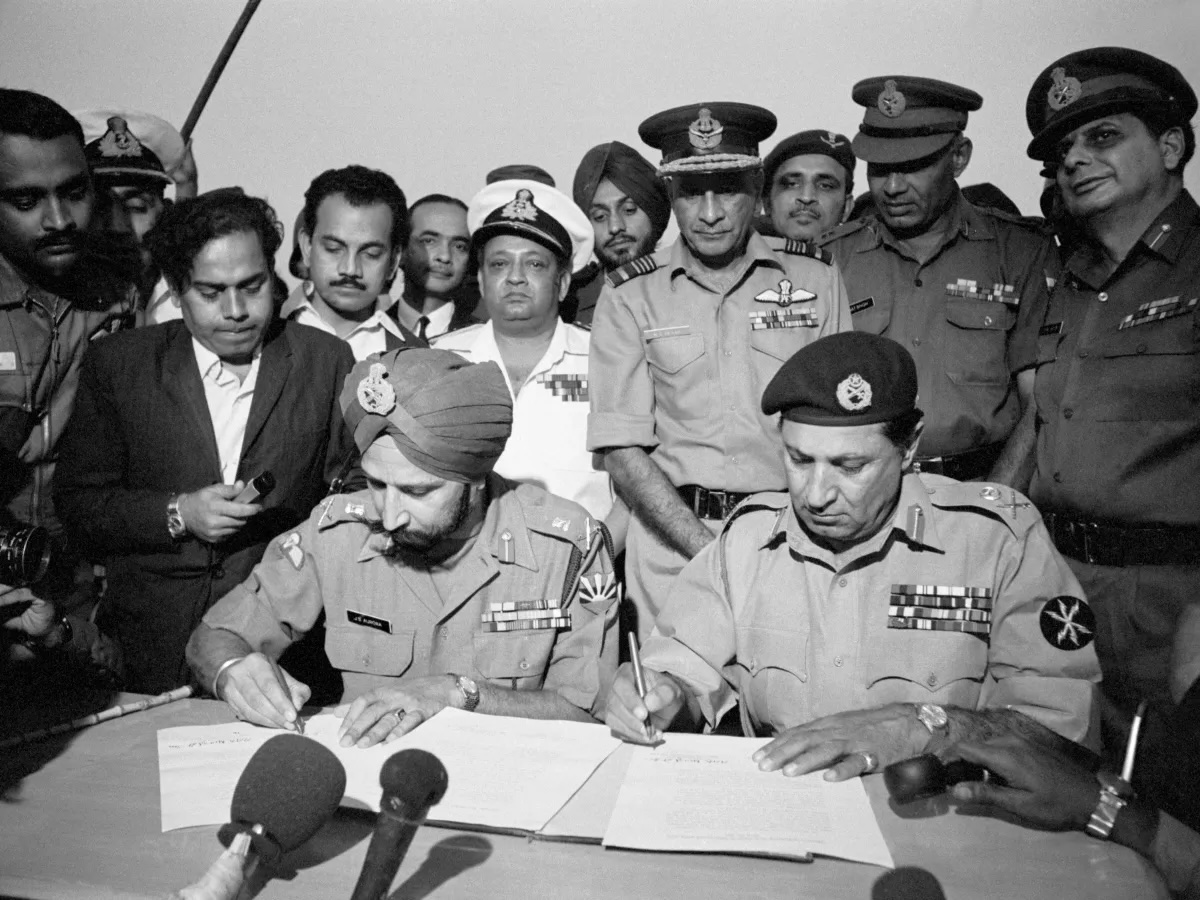
    Scholarly analysis consistently describes India’s conduct as just war traditions with no ulterior motive of imperialism or fiscal interest. There is no comparable example in the modern history of any Western military power.

    This civilisational disposition is not merely philosophical. It expresses itself in conduct. In December 1971, India made the decision to intervene militarily in East Pakistan in response to one of the most egregious humanitarian catastrophes of the 20th century — the Bangladesh genocide. The intervention was swift and decisive. Indian military forces liberated Bangladesh in thirteen days of formal war. Pakistani forces surrendered on December 16, 1971. The Indian military then withdrew completely. No occupation. No extraction. No installation of a client government. No strategic bases retained. Full sovereignty was transferred immediately to the people of Bangladesh. India returned over 90,000 Pakistani prisoners of war through the Simla Agreement. Scholarly analysis consistently describes India’s conduct as just war traditions with no ulterior motive of imperialism or fiscal interest. There is no comparable example in the modern history of any Western military power.

    These are not coincidental differences. They are civilisational ones. The world is now in contest over what the emerging order will be built upon. The declining Western order was built on exceptionalism — the claim to divine chosenness that converts domination into duty, secularised into legal doctrine but never abandoned. The Asian civilisational alternative — pluralist, non-exclusivist, epistemologically humble — offers a different foundation. India’s 1971 conduct is the most precise proof available that this alternative is not merely philosophical. It has been demonstrated operationally.

    The question is whether India — in Gaza, in Iran, in the institutions of the emerging world order — is willing to act consistently with the civilisational tradition it inherits.

    — This is the second in the series prologue.

    Air Marshal M Matheswaran (Retd) is the Founder-President of The Peninsula Foundation (@TPF_Chennai), grounded in the conviction that power without ethics is tyranny — and that India’s civilisational traditions offer the world something Western exceptionalism cannot.


    Further Reading:

    On the Doctrine of Discovery and the Papal Bulls

    Pope Nicholas V, Dum Diversas, 18 June 1452. Full Latin text and English translation: Doctrine of Discovery Project, doctrineofdiscovery.org.

    Pope Nicholas V, Romanus Pontifex, 8 January 1455.

    Pope Alexander VI, Inter Caetera, 4 May 1493.

    Robert J. Miller, Jacinta Ruru, Larissa Behrendt, and Tracey Lindberg, Discovering Indigenous Lands: The Doctrine of Discovery in the English Colonies (Oxford University Press, 2010).

    Steven T. Newcomb, Pagans in the Promised Land: Decoding the Doctrine of Christian Discovery (Fulcrum, 2008).

    On the Vatican’s 2023 repudiation

    Dicastery for Culture and Education and Dicastery for Promoting Integral Human Development, ‘Joint Statement on the Doctrine of Discovery,’ Vatican, 30 March 2023.

    On the incorporation and persistence of the Doctrine of Discovery in US law

    Johnson v. McIntosh, 21 U.S. (8 Wheat.) 543 (1823).

    Haaland v. Brackeen, 599 U.S. 255 (2023).

    On the affirmation of ‘plenary power’ over Native peoples as the modern descendant of the Doctrine of Discovery, see the analysis by Peter d’Errico and the essays in the ‘200 Years of Johnson v. M’Intosh’ series, Canopy Forum, 2023.

    Robert J. Miller, ‘The Doctrine of Discovery in American Indian Law,’ Idaho Law Review, 42 (2005).

    Lindsay G. Robertson, Conquest by Law: How the Discovery of America Dispossessed Indigenous Peoples of Their Lands (Oxford University Press, 2005).

    On Australia, terra nullius, and constitutional exclusion

    Mabo v. Queensland (No. 2) (1992) 175 CLR 1.

    Section 127, Constitution of Australia (repealed by referendum, 1967).

    Henry Reynolds, The Law of the Land (Penguin, 1987).

    Bain Attwood, Rights for Aborigines (Allen & Unwin, 2003).

    On Section 127 and the 1967 referendum: National Museum of Australia, ‘Indigenous Referendum,’ and George Williams’ analysis of the ‘race power’ in Australia’s constitutional history.

    On American exceptionalism — Puritan origins and Manifest Destiny

    John Winthrop, ‘A Modell of Christian Charity’ (1630).

    John L. O’Sullivan, ‘Annexation,’ The United States Magazine and Democratic Review, 17(1), July–August 1845.

    Anders Stephanson, Manifest Destiny: American Expansion and the Empire of Right (Hill and Wang, 1995).

    Hilde Eliassen Restad, American Exceptionalism: An Idea That Made a Nation and Remade the World (Routledge, 2014).

    On the Sand Creek Massacre and the conquest of the Plains

    U.S. Congress, Joint Committee on the Conduct of the War, Massacre of the Cheyenne Indians (38th Congress, 2nd Session, 1865).

    The contemporary Congressional investigation that condemned the massacre; the primary documentary record.

    Ari Kelman, A Misplaced Massacre: Struggling over the Memory of Sand Creek (Harvard University Press, 2013).

    Dee Brown, Bury My Heart at Wounded Knee: An Indian History of the American West (Holt, Rinehart & Winston, 1970).

    On the Washita (1868), the killing of Black Kettle, and the pattern of village attacks; also on the mythologisation of George Armstrong Custer.

    Nathaniel Philbrick, The Last Stand: Custer, Sitting Bull, and the Battle of the Little Bighorn (Viking, 2010).

    On the Philippines, 1898–1946

    Stanley Karnow, In Our Image: America’s Empire in the Philippines (Random House, 1989).

    Paul A. Kramer, The Blood of Government: Race, Empire, the United States, and the Philippines (University of North Carolina Press, 2006).

    On India’s 1971 Bangladesh liberation

    Srinath Raghavan, 1971: A Global History of the Creation of Bangladesh (Harvard University Press, 2013).

    Gary J. Bass, The Blood Telegram: Nixon, Kissinger, and a Forgotten Genocide (Knopf, 2013).

    On Asian civilisational pluralism

    Amartya Sen, The Argumentative Indian: Writings on Indian History, Culture and Identity (Penguin, 2005).

    Wendy Doniger, The Hindus: An Alternative History (Penguin, 2009).

    Ramalinga Adigalar (Vallalar), Thiru Arutpa, Sixth Thirumurai, Verse 3907.

    The metaphor of the many religions as rivers merging into a single shoreless ocean. See thiruarutpa.org.
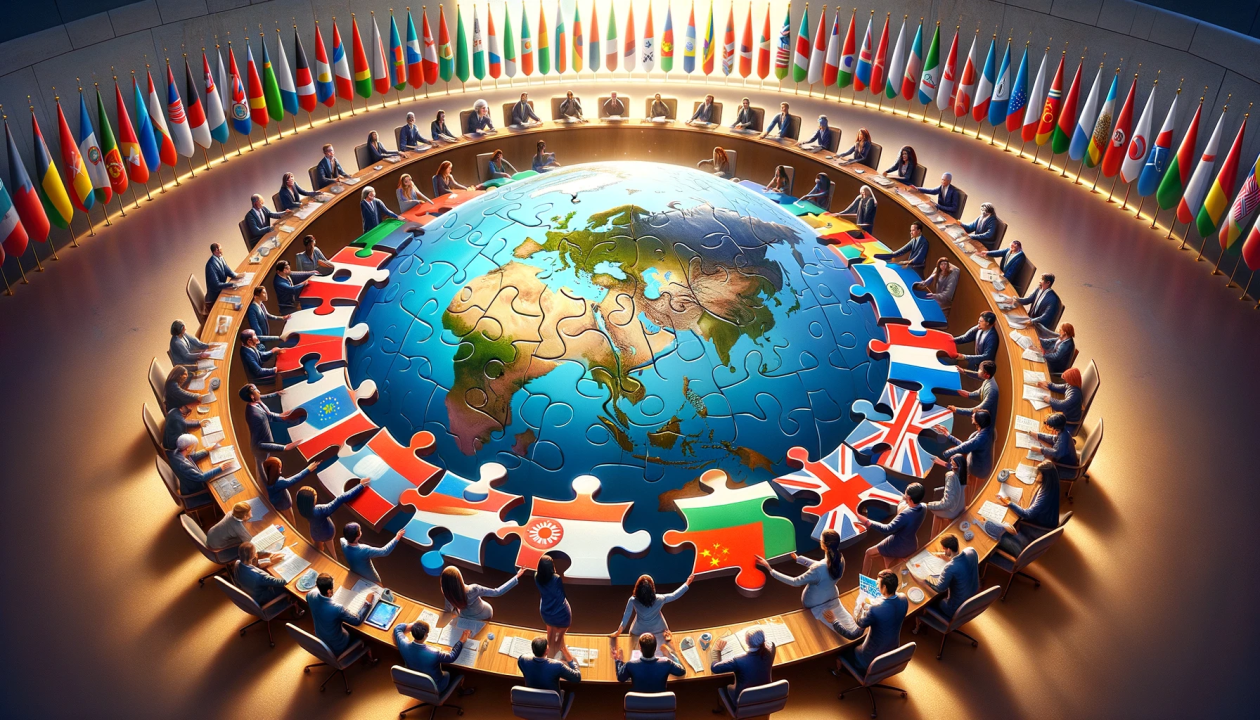
     

  • The World Order we Inherited — and Why it must Change

    The World Order we Inherited — and Why it must Change

    This is the first in a series on India’s strategic choices, civilisational responsibilities, and the contest for the emerging world order.

    The Material Foundations of Western Power


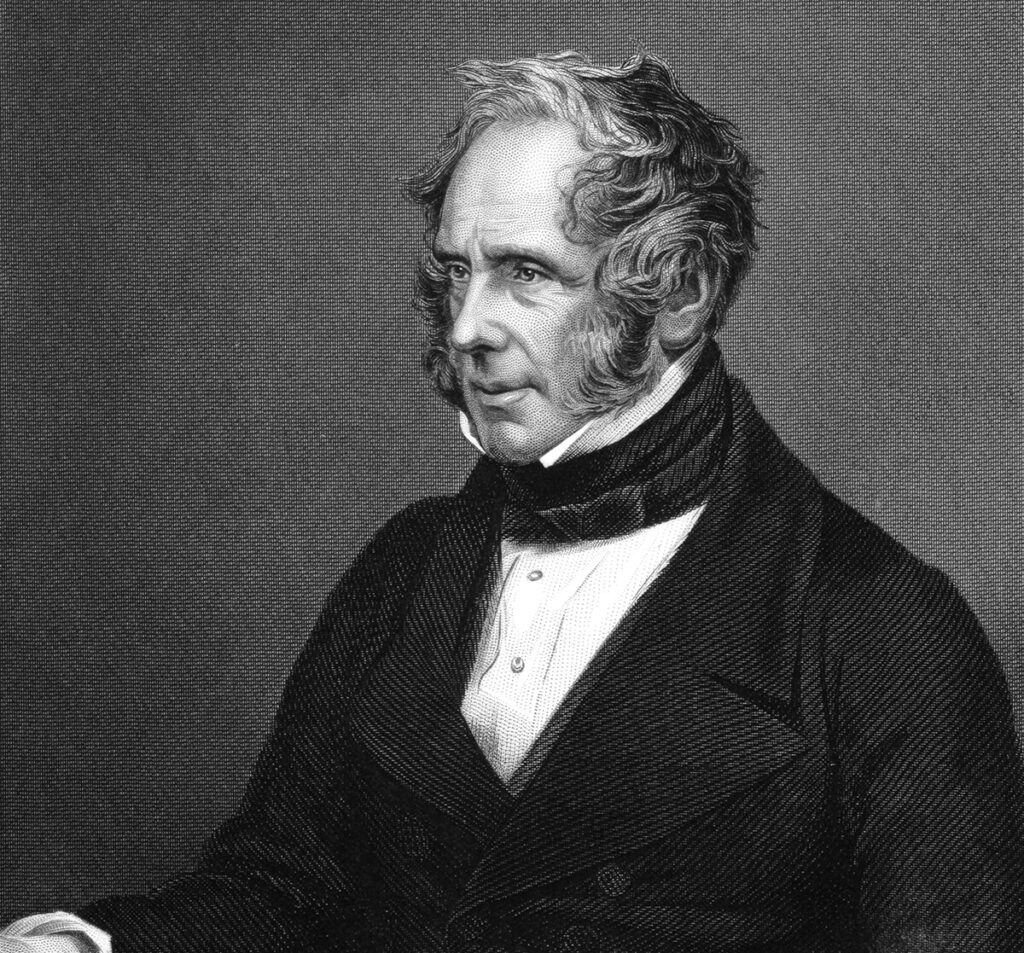
    The world of strategists is familiar with the quote of Lord Palmerston, Britain’s nineteenth-century Prime Minister. He famously declared: “There are no permanent friends or enemies, only permanent interests.”

    Lord Palmerston

    As a description of statecraft, this is not wrong. Every civilisation that has endured has pursued its interests — including the ones this series will spend considerable space defending. Kautilya’s Rajamandala is, at its core, a theory of interest-based alignment. The Cholas sailed across the Bay of Bengal to protect Tamil trading interests. No serious tradition of statecraft has ever pretended that interest does not matter, and none should.

    The question worth asking is not whether interests are permanent. It is whether anything else is.

    Palmerston’s formulation, taken as a complete theory of how a state should conduct itself — not as one true observation among several, but as the only thing that needs ever to be consulted — becomes something different. It becomes a licence. If interest is permanent and nothing else is, then ethical limits on how interest is pursued are, by definition, temporary: honoured when convenient, discarded when not. That is not realism. That is realism with the safety catch removed.

    This is the civilisational fork in the road, and four hundred years of history show which branch the dominant powers took — and still take.

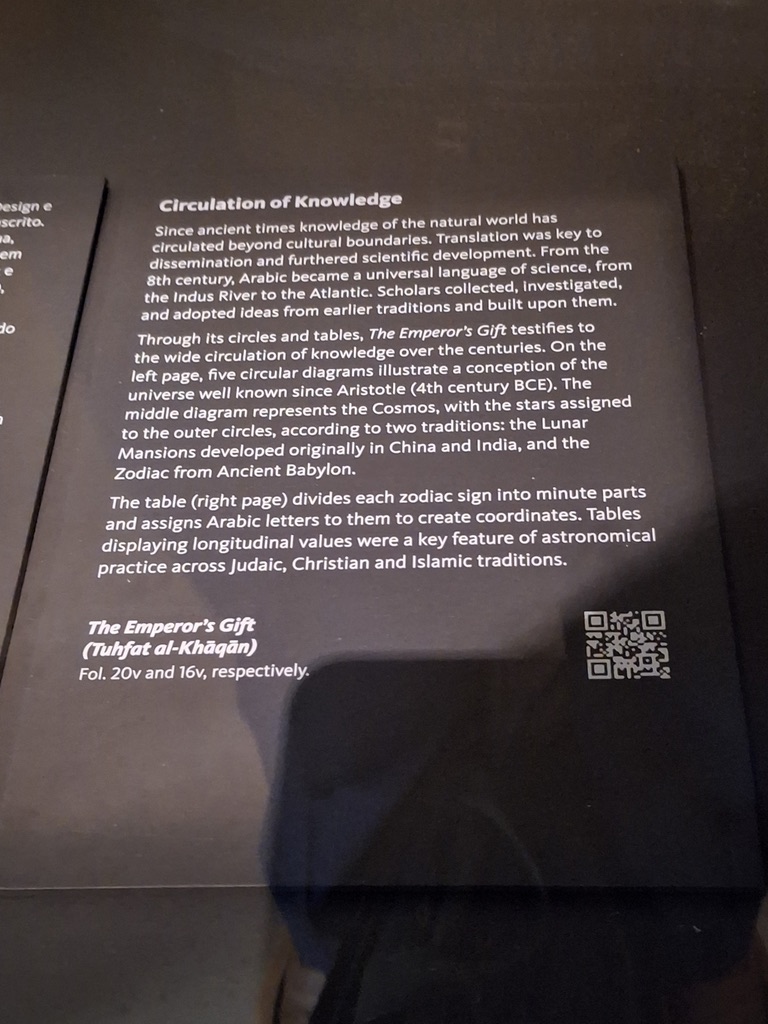
    The Islamic Golden Age — spanning roughly the 8th to the 14th century — was one of the greatest intellectual achievements in human history. Scholars at Baghdad’s House of Wisdom undertook a systematic, state-sponsored project of translation and synthesis: gathering the accumulated knowledge of Greece, Persia, India, and China, translating it into Arabic, and building upon it with original contributions in mathematics, astronomy, medicine, philosophy, optics, and chemistry. Avicenna’s Canon of Medicine became a foundational text in European universities. Averroes’ commentaries on Aristotle shaped medieval European philosophy.

    Exhibit in Gulbenkian Museum, Lisbon – Photo by Author

    Europe in the early medieval period was not the centre of the world. It was its periphery — impoverished, fragmented, and in the grip of what its own historians call the Dark Ages. While Europe’s literacy rates collapsed and theological conformity suppressed inquiry, something extraordinary was unfolding in Baghdad, Cordoba, and Cairo. The Islamic Golden Age — spanning roughly the 8th to the 14th century — was one of the greatest intellectual achievements in human history. Scholars at Baghdad’s House of Wisdom undertook a systematic, state-sponsored project of translation and synthesis: gathering the accumulated knowledge of Greece, Persia, India, and China, translating it into Arabic, and building upon it with original contributions in mathematics, astronomy, medicine, philosophy, optics, and chemistry. Avicenna’s Canon of Medicine became a foundational text in European universities. Averroes’ commentaries on Aristotle shaped medieval European philosophy. The numeral system through which all modern mathematics operates — including the zero — came to Europe through the Arabic transmission of Indian mathematics. This was not borrowing. It was the rescue and synthesis of civilisational knowledge — and without it, the European Renaissance would have had no foundation on which to build.

    The numeral system through which all modern mathematics operates — including the zero — came to Europe through the Arabic transmission of Indian mathematics. This was not borrowing. It was the rescue and synthesis of civilisational knowledge — and without it, the European Renaissance would have had no foundation on which to build.

    Europe’s intellectual reawakening in the 14th and 15th centuries drew directly on this Islamic transmission. The Renaissance, together with the gunpowder revolution and the state system formalised at the Peace of Westphalia in 1648, gave European civilisation (viewing it as a single civilisation may not be truly appropriate – disparate kingdoms, fused by the race for maritime trade dominance and military conquest – Italian, Spanish, Portuguese, Dutch, French, British, Russian, etc.) something it had never possessed before: military-technological superiority, organised state power, and the bureaucratic capacity to project both across the world.

    This wealth — extracted through conquest, forced indigenous labour, and the systematic destruction of existing civilisations — capitalised the European empires that would go on to colonise two-thirds of the world

    Columbus – Truth vs Myth

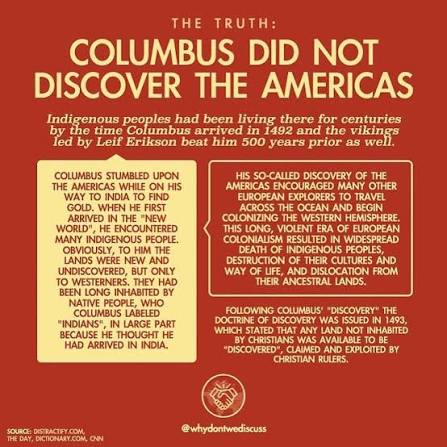
    The rise of the West that followed the maritime route discoveries of Columbus and Vasco da Gama needs to be understood correctly, devoid of the myths built around them. The West celebrates them, but the truth is they were plunderers who unleashed the genocidal expansion of the West. This truth is now being brought out by brilliant and unbiased historians such as Howard Zinn and Utsa Patnaik. Howard Zinn writes – ” what Columbus did to the Arawaks of the Bahamas, Cortés did to the Aztecs of Mexico, Pizarro to the Incas of Peru, and the English settlers of Virginia and Massachusetts to the Powhatans and the Pequots. They used the same tactics, and for the same reasons – the frenzy in the early capitalist states of Europe for gold, for slaves, for products of the soil, to pay for the bondholders and stockholders of the expeditions, to finance the monarchical bureaucracies rising in Western Europe, to spur the growth of the new money economy rising out of feudalism…These were the violent beginnings of an intricate system of technology, business, politics, and culture that would dominate the world for the next five centuries.”

    What followed was not a story of civilisational achievement. It was a story of extraction on a scale without precedent in human history — extraction conducted on the understanding that, once interest was engaged, nothing else needed to be weighed. From the Americas alone, Spanish colonial mining operations extracted approximately 150,000 metric tonnes of silver between 1500 and 1800 — representing 80 to 90 per cent of global silver production over three centuries. By 1600, 25,000 tonnes of silver had crossed the Atlantic. This wealth — extracted through conquest, forced indigenous labour, and the systematic destruction of existing civilisations — capitalised the European empires that would go on to colonise two-thirds of the world. The Atlantic slave trade transported an estimated twelve to fifteen million Africans into forced labour over three centuries.

    The British were ruthless in pursuing their interests at the expense of the people and the geography of their colonial empire, particularly in India. The economy under the British Raj was not a system of governance or development – it was a system of systematic wealth extraction unprecedented in scale and duration. From 1765 (when Robert Clive obtained the Diwani Rights, that is, the right to collect taxes and revenue, from the Mughal emperor as a result of the Battle of Buxar) to 1947 – 182 years – Britain drained India’s wealth through every possible mechanism. The scale of this drain was staggering. Britain extracted the equivalent of about $45 trillion (in current dollar terms) from India during its colonial rule. This wasn’t accidental impoverishment or the natural result of economic evolution. This was deliberate policy, implemented systematically through revenue extraction, deindustrialisation, trade manipulation, and infrastructural control.


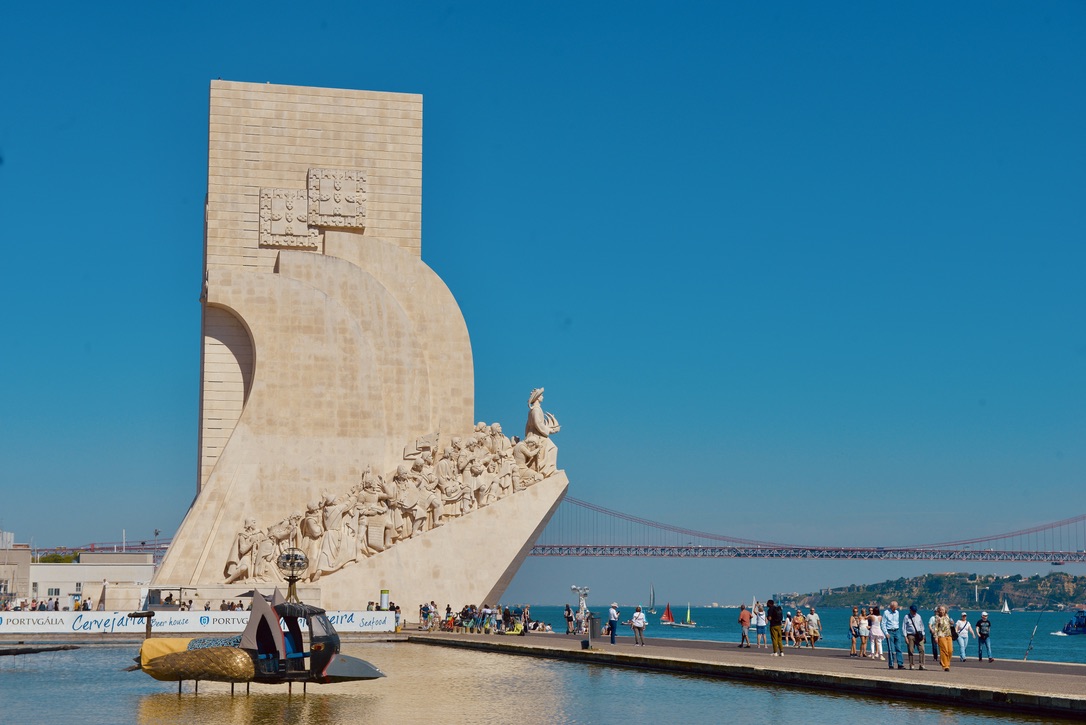
    500-year Commemoration of Vasco-da-Gama’s voyage to India -Lisbon – defining moments of colonialism. Photo by Author
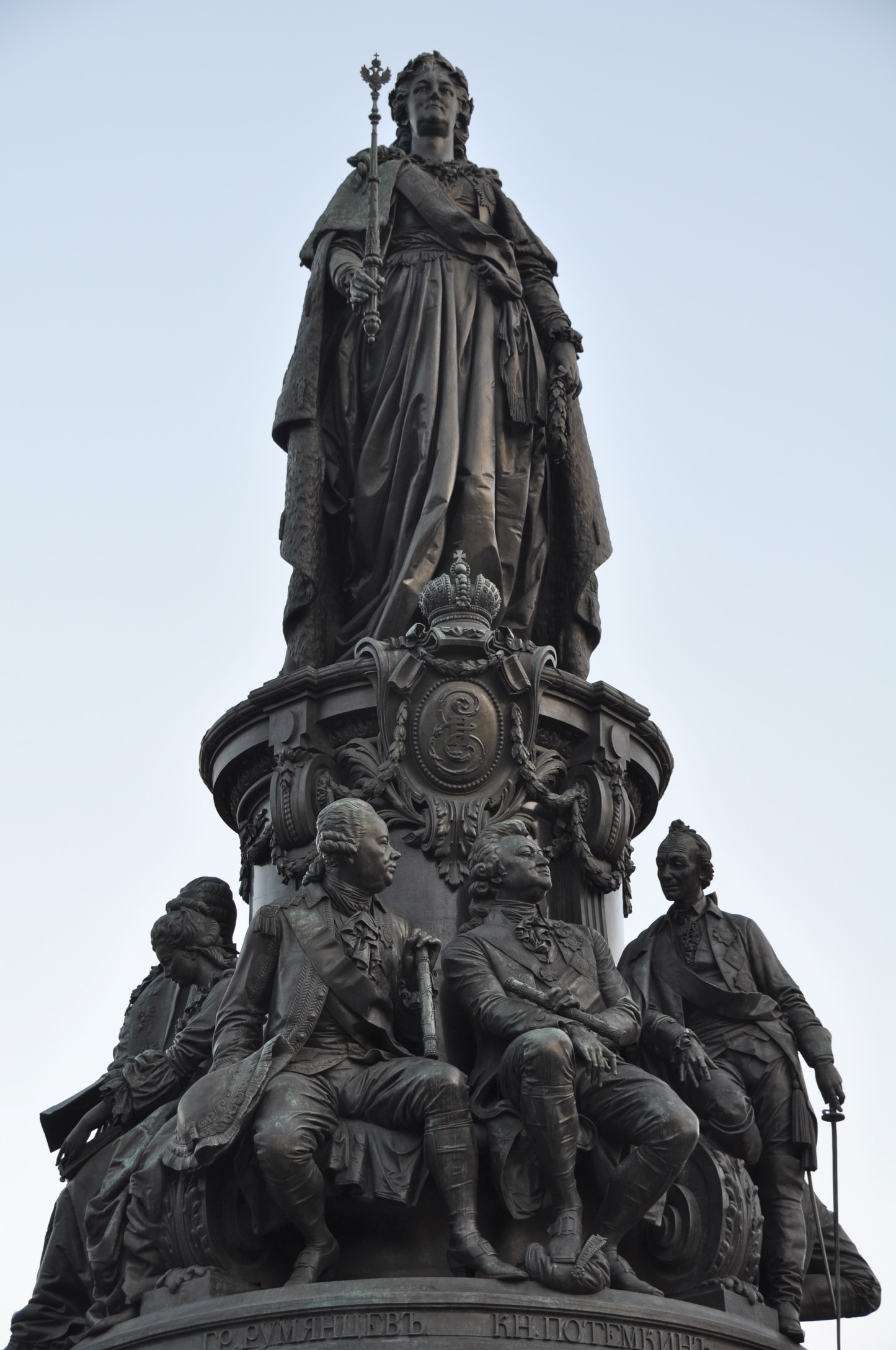
    The Russian empire was equally consumed by Western Europe’s passion for colonies. Catherine the Great, Russian Empress and originally a German princess, was a ruthless expansionist of the Russian Empire. However, Russia differed significantly from Western colonialism. Catherine the Great’s Statue in St. Petersburg. Photo by Author.

    None of this was an aberration from Western values. It was the expression of them. Palmerston’s formulation was not a description of how all states behave. It was a justification for a specific civilisational approach: that power exists to be exercised without ethical constraint, that the strong may do what they will, and that the legitimating language of civilisation, Christianity, and later human rights, are instruments of justification rather than a genuine limits on conduct.

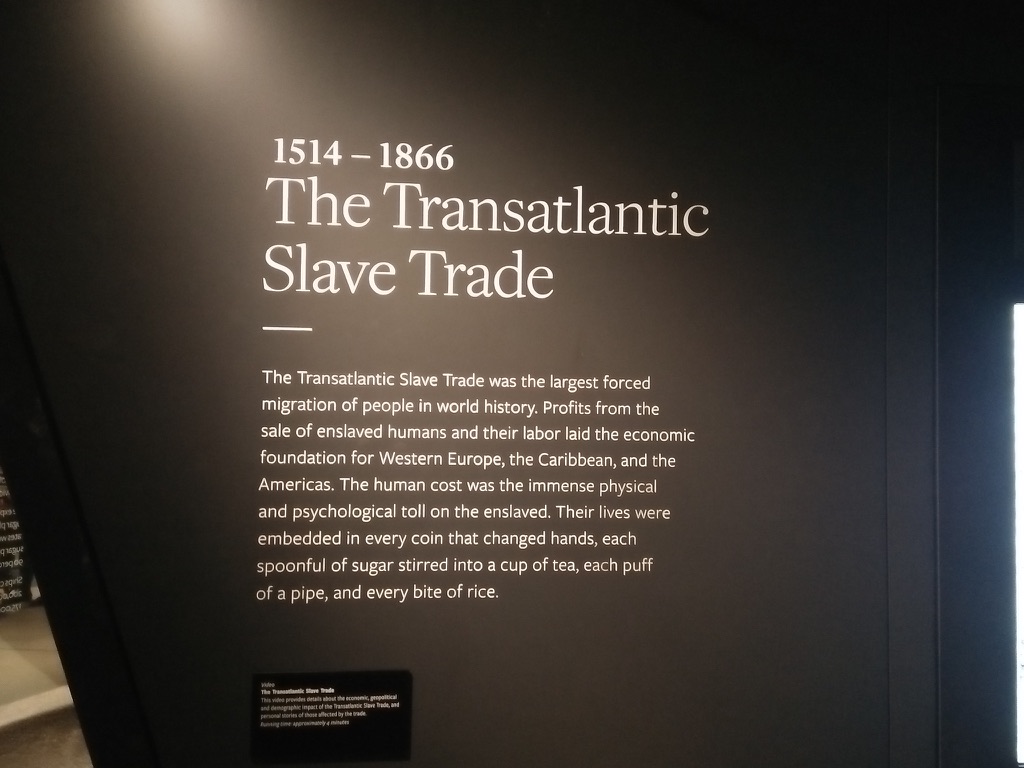
    Slavery was the most crucial contributor to the West’s development. This was a critical element of the transatlantic world. exhibit in the African American Museum, Washington, D.C. Photo by Author.

    The Berlin Conference of 1884–85 is its most clinical illustration. Otto von Bismarck convened the European powers to divide Africa between them. Not a single African leader was present. A request by the Sultan of Zanzibar to attend was dismissed. The Congo basin — a territory larger than Western Europe, home to millions of people with ancient civilisations, cultures, and governance systems — was assigned as the personal property of Belgian King Leopold II, one of the vilest European monarchs in human history. In the years that followed, hundreds of thousands of Congolese were worked to death on rubber plantations. Those who failed their quotas had their hands amputated. Leopold accumulated one of the largest personal fortunes in history from the proceeds.

    This was not an exceptional act of cruelty. It was Palmerston’s formulation taken to its logical and undiluted conclusion.

    Whatever the merits claimed for each individually, taken together they represent the same formula: interest declared permanent, leading to the ruthless pursuit of national interests; ethical limits declared situational, that is, practically irrelevant.

    The pattern did not end with empire. It changed vocabulary. The wars launched and led by the United States since 2001 — in Afghanistan, Iraq, Libya, Syria and beyond — were conducted in the language of security, liberation, and the defence of human rights. By the most careful independent estimates, their costs have run into the hundreds of thousands of civilian lives, and their stated justifications have repeatedly diverged from their actual outcomes. Whatever the merits claimed for each individually, taken together they represent the same formula: interest declared permanent, leading to the ruthless pursuit of national interests; ethical limits declared situational, that is, practically irrelevant. The vocabulary had changed since 1884. The structure of the choice had not.

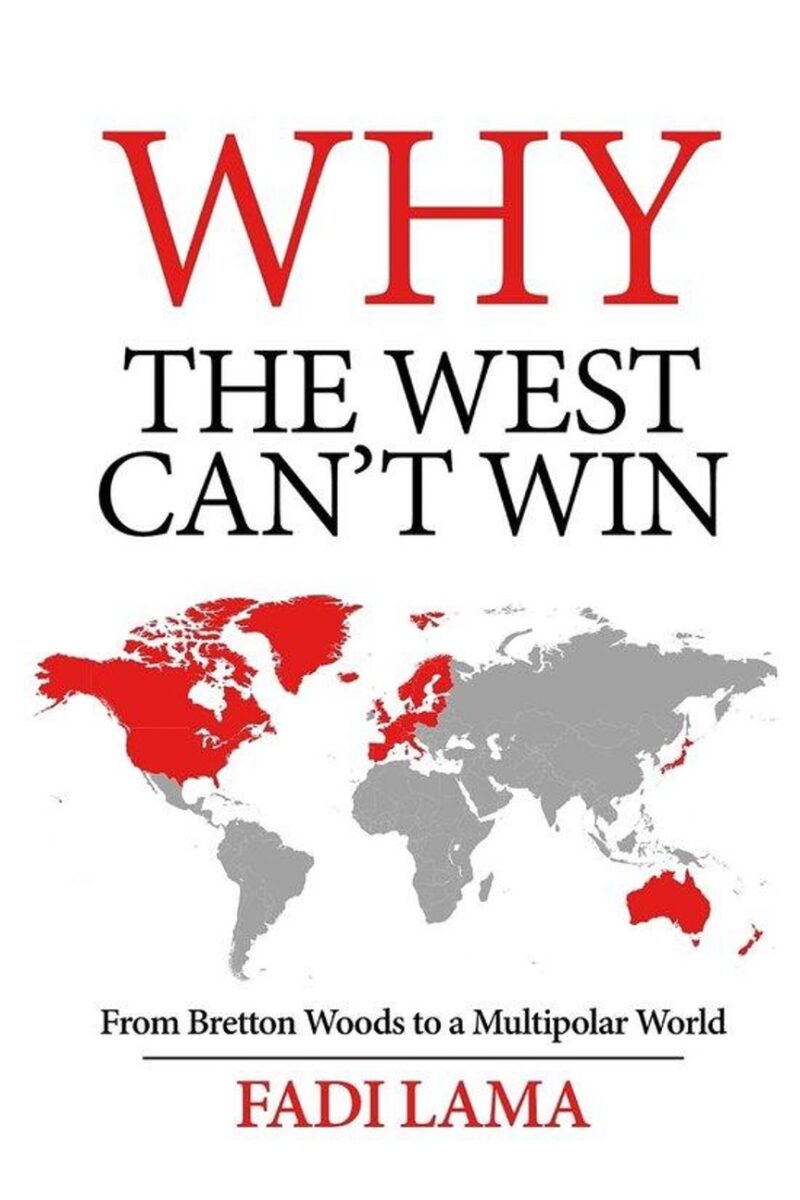
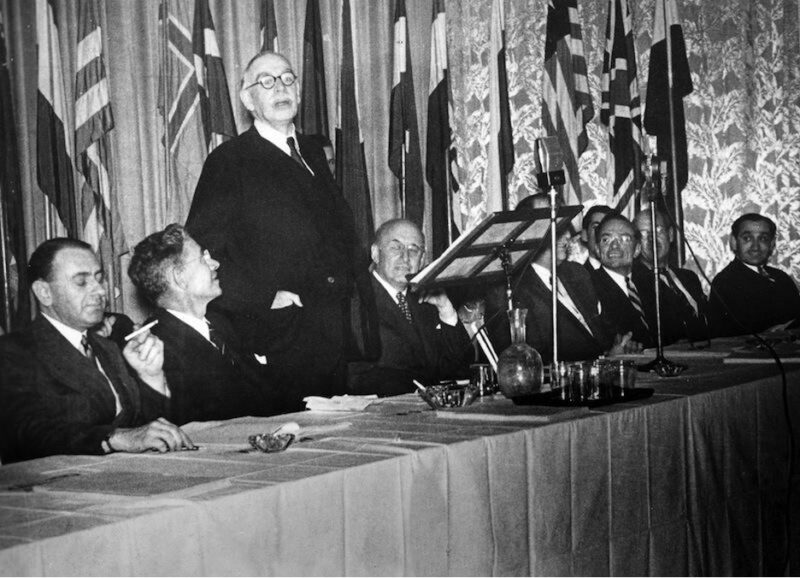
    The economic register tells the same story. The formal end of colonialism did not end the system. It adapted it. The International Monetary Fund and World Bank, established at Bretton Woods in 1944, became the institutional mechanisms through which the global south’s economic policies were directed from Washington. Structural adjustment programmes imposed fiscal austerity, market liberalisation, and debt dependency on nations that had barely emerged from colonial rule.

    Francophone West Africa became perhaps the most striking contemporary illustration of this persistence. Fourteen countries continued to use the CFA franc — a currency whose reserves were held in the French Treasury, whose exchange rate was set in Paris, and whose monetary sovereignty had never been genuinely transferred since formal independence. Long-term analysis tells the structural story: The Ivory Coast reached its peak in income per capita in 1978, in less than two decades after independence. It then stagnated over the next fifty years. Niger reached its highest level in 1965 — the year of independence. Seven decades of formal sovereignty. Not a single decade of genuine economic progress. France’s control was not only monetary. It was political and military. French intelligence maintained deep ties with governing elites. French military bases ensured that no elected government that moved too far from French interests would survive. The system corrupted the democratic process itself.

    When Thomas Sankara became President of Burkina Faso in 1983 and attempted to secure genuine sovereignty — nationalising land, refusing IMF debt, building schools and healthcare, and articulating a vision of African self-reliance — he was assassinated in 1987. French agents were present in the capital the following day. Blaise Compaoré, who replaced him, immediately reversed every policy of sovereignty and ruled for 27 years. When a popular uprising removed him in 2014, French troops exfiltrated him to the Ivory Coast. He was later convicted in absentia by a Burkinabe court and sentenced to life imprisonment for Sankara’s murder. The system did not merely extract wealth. It murdered the leaders who sought to end the extraction.

    “Anything that maintains us in slavery, we will break those bonds” – Captain Ibrahim Traore

    Then, between 2021 and 2023, something changed. A new generation of young, educated, patriotic military officers — shaped by Sankara’s tradition — moved. Mali, Burkina Faso, and Niger formed the Alliance of Sahel States, expelled French and American military forces, and announced their intention to abandon the CFA franc entirely. Burkina Faso’s Captain Ibrahim Traore declared: “Anything that maintains us in slavery, we will break those bonds.” These are not coups in the traditional sense. They are the consequence of a system that used democratic institutions as a mechanism of foreign control for seven decades. As I write this essay, Burkina Faso officially severed all diplomatic relations with France on June 26, 2026. The African nation’s Communications Minister announced the decision on national television, stating that the essential conditions for mutual respect, trust, and non-interference were absent. President Ibrahim Traore accused Paris of harbouring “neo-colonial ambitions,” backing terrorist groups, and acting against Burkinabe interests. African countries are rising against the strangulating control of the West and its neo-colonialism of the last seven decades.

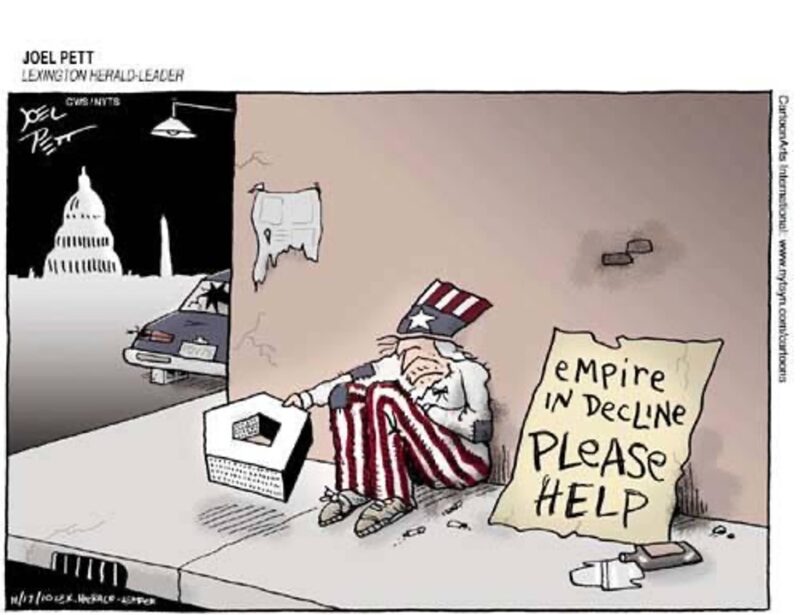
    This is the order that India inhabits. This is the order India is being asked to join as a rising power. The contest for a new world order is not simply a geopolitical competition between states. It is a civilisational question —not the one Palmerston’s critics often imagine. The question is not whether a rising power will have permanent interests. Of course it will, and should. The question is whether it will articulate, with equal permanence and equal seriousness, the ethical limits within which those interests are pursued — limits that hold even when honouring them is costly.

    India has the history, the philosophy, and the standing to make that commitment. The question is whether it has the will.

    Further Reading:

    On Palmerston’s statement and interest-based statecraft

    Lord Palmerston, Speech to the House of Commons, 1 March 1848. Hansard, House of Commons Debates, vol. 97, cols. 66–123.

    Kautilya, Arthashastra, Books VI–VII (Mandala theory of interstate relations). Trans. R.P. Kangle, The Kautiliya Arthashastra, 3 vols. (University of Bombay, 1960–65).

    On the Islamic Golden Age and knowledge transmission to Europe

    George Saliba, Islamic Science and the Making of the European Renaissance (MIT Press, 2007).

    Jonathan Lyons, The House of Wisdom: How the Arabs Transformed Western Civilisation (Bloomsbury, 2009).

    Dimitri Gutas, Greek Thought, Arabic Culture: The Graeco-Arabic Translation Movement in Baghdad and Early ‘Abbasid Society (Routledge, 1998).

    Georges Ifrah, The Universal History of Numbers (Wiley, 2000). On the transmission of Hindu-Arabic numerals, including the zero.

    On colonial extraction — the Americas

    Dennis O. Flynn and Arturo Giráldez, ‘Cycles of Silver: Global Economic Unity through the Mid-18th Century,’ Journal of World History, 13(2), 2002.

    Source for the 150,000-tonne / 80–90% global silver production estimates, 1500–1800.

    Earl J. Hamilton, American Treasure and the Price Revolution in Spain, 1501–1650 (Harvard University Press, 1934).

    Foundational source for the c. 25,000-tonne figure by 1600.

    On the Atlantic slave trade

    David Eltis and David Richardson, Atlas of the Transatlantic Slave Trade (Yale University Press, 2010).

    The Slave Voyages Database, Emory University. slavevoyages.org.

    Basis for the 12–15 million estimate.

    On the Berlin Conference and the Congo Free State

    Adam Hochschild, King Leopold’s Ghost: A Story of Greed, Terror, and Heroism in Colonial Africa (Houghton Mifflin, 1998).

    S.E. Crowe, The Berlin West African Conference, 1884–1885 (Longmans, 1942).

    Matthew Craven, ‘Between Law and History: The Berlin Conference of 1884–1885 and the Logic of Free Trade,’ London Review of International Law, 3(1), 2015.

    On the Sultan of Zanzibar’s exclusion.

    On post-2001 conflicts and civilian costs

    Costs of War Project, Watson Institute for International and Public Affairs, Brown University. costsofwar.org.
    Cumulative estimates of direct and indirect deaths in post-9/11 wars (Afghanistan, Iraq, Pakistan, Syria, Yemen).

    Iraq Body Count project. iraqbodycount.org.
    Independent database of documented civilian deaths in Iraq since 2003.

    Gilbert Burnham et al., ‘Mortality after the 2003 invasion of Iraq: a cross-sectional cluster sample survey,’ The Lancet, 368(9545), 2006.

    One of several widely-cited epidemiological estimates; cited to indicate the range of credible estimates rather than to adjudicate between methodologies.

    On Bretton Woods, the IMF/World Bank, and structural adjustment

    Eric Helleiner, Forgotten Foundations of Bretton Woods: International Development and the Making of the Postwar Order (Cornell University Press, 2014).

    Ngaire Woods, The Globalizers: The IMF, the World Bank, and Their Borrowers (Cornell University Press, 2006).

    On the CFA franc and Francophone West Africa

    Fanny Pigeaud and Ndongo Samba Sylla, Africa’s Last Colonial Currency: The CFA Franc Story (Pluto Press, 2021).

    World Bank, World Development Indicators (databank.worldbank.org).

    Basis for the Ivory Coast (1978 peak) and Niger (1965 peak) GDP per capita figures.

    On Thomas Sankara and Blaise Compaoré

    Ernest Harsch, Thomas Sankara: An African Revolutionary (Ohio University Press, 2014).

    On the French intelligence presence following the 1987 coup: reporting by Jeune Afrique and Radio France Internationale (RFI), 1987.

    On Compaoré’s 2014 exfiltration: Reuters and Agence France-Presse, October 2014.

    On Compaoré’s conviction: ‘Burkina Faso: Blaise Compaoré sentenced to life in prison over Thomas Sankara’s assassination.’ Reuters, 6 April 2022.

    On the Alliance of Sahel States (2021–2024)

    Formation of the Alliance of Sahel States, September 2023, and withdrawal from ECOWAS, January 2024: Reuters, Al Jazeera, and AfricaNews coverage, 2023–2024.

    Captain Ibrahim Traoré, ‘Anything that maintains us in slavery, we will break those bonds.’ Public addresses, widely reported across pan-African and international media, 2023–2024.

    On the closure of the US drone facility at Agadez, Niger: ‘Niger orders US military to leave the country.’ BBC News, 17 March 2024.

    Air Marshal M Matheswaran (Retd) is the Founder-President of The Peninsula Foundation (@TPF_Chennai), an independent policy research think tank in Chennai, rooted in the conviction that governance must serve conscience and that the world order India helps shape must be grounded in ethics, not merely in interests.

  • The West Will Fall; Fall It Must: A Moral and Civilisational Analysis of Hegemonic Decline and the Imperative of Justice

    The West Will Fall; Fall It Must: A Moral and Civilisational Analysis of Hegemonic Decline and the Imperative of Justice

    Colonial and Imperial culture of greed for wealth, manifested in exploitative and extractive strategies, and an attitude of racial supremacy-endorsed by the Church,  is so deeply entrenched in the West that it has never gone away but has continued in different forms and structures. It is this culture that needs to fall, to truly lead to a world of equality, values and ethics – reflected by the 2000-year old declaration –

    “Yaadhum Oorey, Yavarum Kelir”  – meaning “To us the world is one, All people are Kin”.

    To say the West will fall is neither prophecy nor vindictiveness but the recognition of a historical necessity. Western global dominance — built across six centuries of slavery, colonial extraction, and neocolonial control — rested on the systematic violation of ethical principles that every major civilisation has independently affirmed. Systems founded on extraction and racial hierarchy carry the mechanisms of their own collapse. The decline now visible across economic, diplomatic, and moral indicators is not an accident of geopolitics but a consequence.

    The Peninsula Foundation reads this moment through humanity’s deepest ethical traditions: Thiruvalluvar’s Thirukkural, Kaniyan Poongundranar’s declaration that all places are one and all people kin, Confucian governance by virtue, Platonic justice as harmony, and African Ubuntu — a person is a person through other people, in other words – I am because We are. Arising independently across continents and millennia, they converge on the very principles imperialism negates: universal human dignity, compassionate restraint, justice as social order, and communal interdependence.

    By 2026, even Western institutions will concede the turn. The UN Secretary-General calls for accelerating an inclusive multipolarity; the JPMorgan Centre for Geopolitics describes a multi-speed order in which universal rules no longer bind; at Davos, middle powers spoke of permanent rupture rather than transition. Against this backdrop, the United States Secretary of State stood before the world’s premier security forum and called for the restoration of five centuries of colonial empires.

    The Rubio Confession

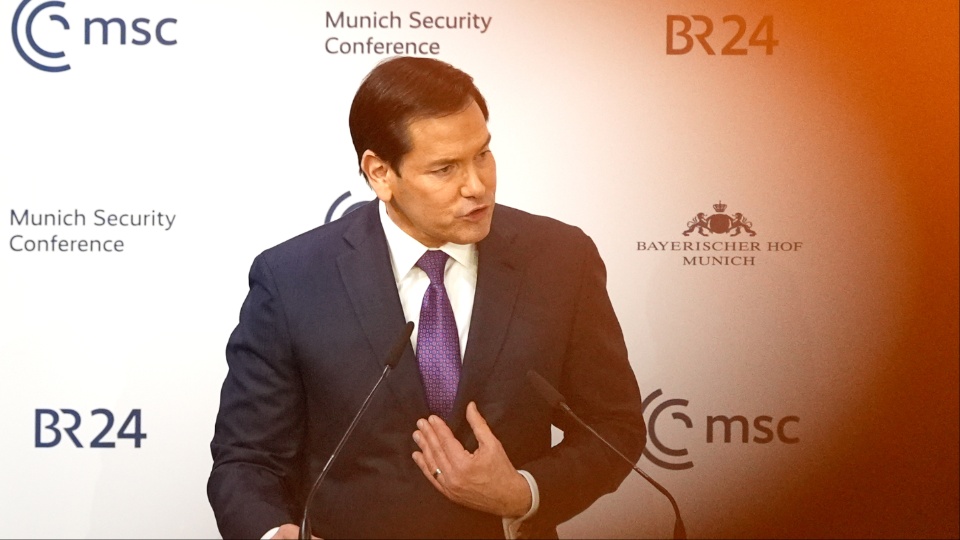
    On 14 February 2026, at the Munich Security Conference, Secretary of State Marco Rubio delivered what critics across the spectrum called the most openly pro-colonial address by a senior Western official this century. He mourned the loss of five centuries of Western imperial expansion; named anti-colonial uprisings as a cause of Western decline; urged European allies to shed their guilt and shame over colonialism; and summoned the West to a new Western century by competing for market share in the economies of the Global South — framing that South not as sovereign nations but as an economic space to be recaptured, that precise colonial and predatory framing.
    This is not merely reprehensible; it is a confession. Facing structural decline, the imperial culture has abandoned even the pretence of moral authority and reverted openly to the logic of domination. Harvard’s Mathias Risse called the speech civilisational panic dressed as statecraft. The Global South’s response was swift: Indian commentary asked whether an American East India Company was coming; Brahma Chellaney saw the restoration of an exclusionary hierarchy; Sanjaya Baru urged India, as the beacon of anti-colonialism, to condemn it with the contempt it deserves.
    The Architecture of Extraction

    Rubio’s call to shed guilt is not only obscene; it is historically false. Utsa Patnaik’s study for Columbia University Press establishes that Britain drained £9.2 trillion — some $45 trillion — from India between 1765 and 1938, seventeen times Britain’s current annual GDP, by compounding India’s intercepted export-surplus earnings at the ordinary rate of opportunity cost.

    India’s gold and foreign-exchange earnings — among the largest in the world — were permanently diverted to London, funding Britain’s industrial revolution, its wars, and its administration, and consuming between a quarter and a third of the central budget.

    The mechanism was an elegant deception. After 1765, the East India Company taxed Indian producers, then used roughly a third of that revenue to buy their goods for export — paying them with their own taxes while acquiring their produce for nothing. The Council Bills system of 1861 industrialised this: foreign buyers paid London in gold and sterling for bills cashable only in rupees, which the colonial government paid out of its own budget. India’s gold and foreign-exchange earnings — among the largest in the world — were permanently diverted to London, funding Britain’s industrial revolution, its wars, and its administration, and consuming between a quarter and a third of the central budget.

    Jason Hickel calculates that rich countries have drained $152 trillion from the Global South since 1960 alone. There is no Western century to restore that was not built on the theft of other civilisations’ wealth — legitimised for six centuries by the Three Cs of civilisation, Christianity, and commerce, and continued after independence through structural-adjustment programmes, an African external debt of $824 billion, and more than 13,000 active US sanctions.

    The result was stark. India held the world’s second-largest export surplus for three decades before 1929, yet per capita income barely moved between 1900 and 1946, because the surplus was siphoned abroad rather than invested at home. Its share of global industrial output collapsed from 25 per cent in 1750 to 2 per cent in 1900. Japan, which kept its earnings, industrialised; India, whose earnings were confiscated, could not. The same logic ran through slavery, which research now confirms accelerated Britain’s industrial revolution — vindicating Marx’s image of capital arriving dripping with blood and dirt. Jason Hickel calculates that rich countries have drained $152 trillion from the Global South since 1960 alone. There is no Western century to restore that was not built on the theft of other civilisations’ wealth — legitimised for six centuries by the Three Cs of civilisation, Christianity, and commerce, and continued after independence through structural-adjustment programmes, an African external debt of $824 billion, and more than 13,000 active US sanctions.

    The sanctifying licence was issued long before the Council Bills, in Rome. A sequence of papal bulls — Nicholas V’s Dum Diversas (1452) and Romanus Pontifex (1455), and Alexander VI’s Inter Caetera (1493), proclaimed the year after Columbus reached the Americas — granted Catholic monarchs the asserted right to “invade, search out, capture, vanquish and subdue” non-Christian peoples, reduce them to perpetual slavery, seize their lands, and partition the non-Christian world between Spain and Portugal. From these decrees grew the Doctrine of Discovery: the claim that lands not inhabited by Christians were free to be “discovered” and their peoples’ sovereignty void. It furnished the racial and civilisational hierarchy — Christian over heathen, European over all others — on which five centuries of conquest were built, dressing the pursuit of gold, land, and labour in the vestments of salvation. The piety was the facade; extraction was the motive. Nor is the point contested by Rome: in 2023 the Vatican formally repudiated the doctrine, conceding the bulls were “linked to political questions” and never expressions of the faith — an admission, five centuries late, that the licence to colonise was always politics wearing the mask of God.

    The Civilisational Verdict

    Every tradition the Foundation invokes condemns this architecture. Thiruvalluvar’s Kural 113 warns that gain wrongly acquired must not be retained even for a day — the exact verdict on a Council Bills system that gave Indians rupees while stealing their gold; his Kural 551 holds a ruler who works injustice crueller than a murderer. Kaniyan Poongundranar’s Yaadhum Oore Yaavarum Kelir dissolves, at its root, the civilisational tribalism Rubio attempts to revive, for exploitation requires first believing that the exploited are not our kin. Confucius taught that legitimacy flows from virtue, not force; Plato named the tyrant as one who turns governance to private enrichment — the shape of a state that declares it will run another nation and seize its oil; and Ubuntu’s relational personhood is negated wherever a system is built to take from people, unawares, what they have earned.

    Risse’s verdict is sharper still: Rubio’s West has no Indigenous peoples, no colonised subjects, no enslaved Africans, no Buchenwald near Weimar — only heroes and temporary setbacks. Such a West has never existed, and cannot be reinvigorated in 2026.

    The New Theatre of Predation

    The doctrine is not rhetorical. In January 2026, the United States bombed Venezuela, abducted its elected president, and announced that US companies would seize its oil while Washington “ran the country” — a clear violation of Article 2(4) of the UN Charter, the International Commission of Jurists held. The same month, it cut off Cuba’s main oil supplier and, through Executive Order 14380, threatened any country that resupplied it, until the UN warned of humanitarian collapse — collective punishment of a civilian population. And in February 2026, the US and Israel launched a full-scale attack on Iran, killing its Supreme Leader, striking over 42,000 civilian sites, and — at a girls’ school in Minab — at least 167 children; the American Society of International Law named it a crime of aggression, and the UN Secretary-General confirmed it contravened international law. As Britain once dressed theft as commerce, the US now dresses resource seizure as law enforcement — the structural logic is identical.

    The Measured Decline

    The economic premise of the Rubio doctrine is fiction. Asia’s share of global GDP reached 55 per cent in 2024, years ahead of projection, and BRICS economies now exceed the G7 at purchasing-power parity. The Global South’s ascent is no Western beneficence but a return to the norm colonialism interrupted — China and India together held half of world income in 1700 before colonialism drove their share below a tenth. A declining West, in truth, needs the Global South to survive.

    Moral authority has collapsed in tandem. Only 39 per cent of Americans now believe the United States is the world’s moral leader, down from 60 per cent in 2017; across Europe, support for Israel has fallen to between 13 and 21 per cent. Above all, Gaza has erased Western moral pretension: independent research estimates roughly 75,200 violent deaths and the displacement of about 90 per cent of the population, as governments that once lectured the world on human rights moved to justify mass killing — not an aberration, as one analysis put it, but an unveiling.

    The Oligarchy Behind the Flag

    Analysing nearly 1,800 US policy decisions, Martin Gilens and Benjamin Page found that economic elites and business groups exert substantial independent influence on policy while ordinary citizens have little or none — a pattern they termed economic-elite domination rather than democracy.

    There is a sharper way to name what must fall. “The West” is not its peoples; it is a structure of concentrated power that governs in their name while serving far narrower interests. Analysing nearly 1,800 US policy decisions, Martin Gilens and Benjamin Page found that economic elites and business groups exert substantial independent influence on policy while ordinary citizens have little or none — a pattern they termed economic-elite domination rather than democracy. Their method has been contested, but elite-skewed influence is widely corroborated.

    The architecture is visible and legal. Since Citizens United (2010), outside US election spending has risen more than twenty-eight-fold — from $144 million in 2008 to over $4.2 billion in 2024 — roughly $1.9 billion of it untraceable “dark money,” a few hundred mega-donors providing the bulk. Oxfam records billionaire wealth at a record $18.3 trillion in 2026, up 81 per cent since 2020; the twelve richest now hold more than the poorest four billion people, and billionaires are four thousand times likelier than ordinary citizens to hold office. Across 66 countries, nearly half of those surveyed say the rich simply buy elections.

    The same convergence runs through the war and information economies. Some $191 million was spent lobbying the US defence sector in 2025, and more than 315 senior officers passed through the revolving door into the top weapons firms between 1995 and 2021 — Eisenhower’s “military-industrial complex” at industrial scale. At the 2025 presidential inauguration, the heads of Amazon, Meta, Apple, Google, and Tesla stood arrayed behind the president — a tableau of what Shoshana Zuboff calls surveillance capitalism, in which control over information becomes a lever over democracy itself, as a Stanford working group chaired by Francis Fukuyama warned.

    None of this requires a secret cabal — only aligned interests, legalised influence, and a public whose consent is manufactured rather than freely given. The decisive point is this: the structure that drains the Global South is the same one that hollows out wages, democracy, and dignity within the West. The dividing line is not West against the rest but concentrated extractive power against the world’s peoples — the Western working majority among them, conscripted to fight its wars and absorb its costs. When we say the West must fall, it is this structure that must fall, and democratic power that must be restored, at home as much as abroad. That is not the elimination of a people; it is the end of their domination by an oligarchy that has long claimed to speak in their name.

    The Self-Defeating Logic of Overreach

    Like the Council Bills before it, the Rubio doctrine carries the mechanism of its own defeat, for each intervention rebounds structurally. The seizure of Russian assets accelerated de-dollarisation; the bombing of Iran united a region against the US–Israel alliance; the abduction of Venezuela’s president hastened Latin America’s diversification away from Washington; the oil siege of Cuba drew unprecedented condemnation. An order that must abduct, blockade, and bomb to assert itself is not ascendant — it is exhausting the legitimacy on which power finally depends.

    The Imperative of Justice

    The fall of Western hegemony opens the possibility of justice but does not guarantee it; the outcome depends on whether rising powers build the multipolar order on genuine ethical foundations rather than replicating what they inherit. That demands sovereign equality without exception — Article 2(4) applied universally, and a Security Council reformed so that no state acts as judge, party, and executor at once. It demands historical accountability: reparative justice through climate finance, debt cancellation, technology transfer, and restitution is not charity but the minimum acknowledgement of documented theft. It demands that the ICJ, ICC, and UN human-rights bodies function without great-power interference; civilisational pluralism against civilisational supremacism; and, finally, democratic renewal within the Western societies themselves, whose peoples are not the authors of empire but among its subjects.

    India is uniquely placed to articulate that alternative. Its inheritance — Thiruvalluvar’s justice, Kaniyan Poongundranar’s universal kinship, and the Gandhian tradition of non-violent resistance to precisely the domination Rubio seeks to revive — is the moral tradition colonialism suppressed but could never extinguish. Against a new Western century of restored hierarchy, the Peninsula Foundation offers the Tamil poet’s ancient answer, as relevant in Munich today as on the banks of the Kaveri two millennia ago:

    Yaadhum Oore, Yaavarum Kelir — to us all towns are one, all people are our kin.

    The West will fall. Fall it must. From its ruins, may justice arise.

    Sources

    THE MULTIPOLAR TRANSITION

    • JPMorgan Centre for Geopolitics — World Rewired: Navigating a Multi-Speed, Multipolar Order
    • United Nations — Secretary-General’s press conference on his 2026 priorities
    • World Economic Forum — Davos 2026: How middle powers are reading the global moment

    THE RUBIO MUNICH SPEECH AND RESPONSES

    • US Department of State — Secretary Rubio at the Munich Security Conference (14 February 2026)
    • The New York Times — In Munich, Rubio Stresses Shared History to Europeans
    • Mathias Risse, Harvard Kennedy School (Carr Center) — A Human-Rights-Based Reply to Marco Rubio’s Munich Speech
    • China-US Focus — American Neo-Colonialism and the Confessional State
    • Chatham House — The West vs the West at the Munich Security Conference
    • India Today — Rubio’s Munich speech signals US colonial competition for the Global South
    • The Wire — Marco Rubio’s Defence of Colonialism Demands a Response from India
    • Firstpost — Rubio’s claim of a Western century is a myth

    COLONIAL EXTRACTION: THE DRAIN AND THE COUNCIL BILLS

    • Utsa Patnaik (Columbia University Press), via Al Jazeera — How Britain stole $45 trillion from India
    • NDTV — How the British Empire robbed India of $45 trillion
    • self_study_history — Drain of Wealth: the Council Bills mechanism
    • COLLECTIVE India — ‘Drain of Wealth’, today
    • Wikipedia — Economy of India under the British Raj (global GDP share)
    • CEPR / VoxEU — Slavery and the British Industrial Revolution
    • Walter Rodney — How Europe Underdeveloped Africa
    • Jason Hickel, via Al Jazeera — Rich countries drained $152tn from the global South since 1960

    THE LICENCE TO COLONISE: PAPAL BULLS, CHRISTIANITY, AND NEOCOLONIALISM

    • Vatican News (2023) — Church defends Indigenous peoples: ‘Doctrine of Discovery’ was never Catholic — the formal repudiation
    • Canadian Museum for Human Rights — The Doctrine of Discovery (papal bulls and their language)
    • Church Life Journal, University of Notre Dame — Papal Condemnation of the Doctrine of Discovery
    • Emory University — The Philosophy of Colonialism: Civilization, Christianity and Commerce
    • Church Mission Society — Mission after George Floyd: on white supremacy, colonialism and world Christianity
    • Catalyst (McGill) — The IMF and World Bank: Neocolonial Domination, Debt Trap and Resistance

    THE CIVILISATIONAL FRAMEWORK

    • Thiruvalluvar, Thirukkural (G.U. Pope translation) — Project Madurai
    • Kaniyan Poongundranar, Purananuru 192 — Kaniyan Pungundranar
    • Confucius, The Analects — LibreTexts, Compact Anthology of World Literature
    • Plato, Republic — Plato’s Theory of Justice
    • Mogobe B. Ramose — African Philosophy Through Ubuntu

    THE OLIGARCHY BEHIND THE FLAG: CONCENTRATED POWER IN THE WEST

    • Martin Gilens & Benjamin I. Page — Testing Theories of American Politics: Elites, Interest Groups, and Average Citizens (2014)
    • Omar S. Bashir (Research & Politics, 2015) — A Review of the ‘Oligarchy’ Result — methodological critique
    • Oxfam International (January 2026) — Resisting the Rule of the Rich: billionaire wealth and political inequality
    • Brennan Center for Justice — Dark Money Hit a Record High of $1.9 Billion in 2024 Federal Races
    • Center for American Progress — Undoing Citizens United and Reining In Super PACs (28-fold rise in outside spending)
    • OpenSecrets — Defense Lobbying Profile ($191m in 2025)
    • Quincy Institute, via Jacobin — The Publicly Funded Defense Contractor Revolving Door (315+ officers)
    • ProMarket (Stigler Center) — The Trends That Defined US Antitrust in 2025 (platform power and modern oligarchy)
    • Shoshana Zuboff — The Age of Surveillance Capitalism (PublicAffairs, 2019)

    VENEZUELA

    • International Commission of Jurists — Territorial sovereignty, the rule of law and human rights must be respected
    • Le Monde — The US intervention in Venezuela violates foundational principles of international law
    • UN Security Council — US action in Venezuela puts sovereignty of states, international law at stake

    CUBA

    • Al Jazeera — US sanctions reshaping life in Cuba: UN rapporteur
    • Baker McKenzie — US declares national emergency on Cuba; Executive Order 14380
    • UN News — Cuba: UN warns of possible humanitarian ‘collapse’ as oil supplies cut

    IRAN

    • American Society of International Law — Statement Regarding the Use of Force Against Iran (2 March 2026)
    • Reuters — Iran’s UN envoy says 1,332 civilians killed in the war
    • Al Jazeera — Iranian government reveals scale of civilian casualties (42,000+ sites damaged)
    • Associated Press — International legal order tested by war in Iran (‘crime of aggression’)

    DECLINE METRICS AND MORAL AUTHORITY

    • Atlantic Council — Piece by piece, the BRICS really are building a multipolar world
    • Mastercard — Welcome to the nuanced reality of the Asian Century
    • Forbes — Americans think the US is losing its moral authority, new poll shows
    • The New Humanitarian — The end of Western values

    GAZA

    • Al Jazeera — Gaza death toll exceeds 75,000 as independent data verify loss
    • OHCHR — End unfolding genocide or watch it end life in Gaza: UN experts
  • Navigating Geopolitical Turbulence in a Fragmented International System

    Navigating Geopolitical Turbulence in a Fragmented International System

    The old world order is not returning; the international system is structurally transforming into a fragmented multipolar reality. In this age of disorder, flexible institutions and reformist leadership—exemplified by India—are essential to sustain global governance.

    The 56th World Economic Forum Annual Meeting took place in Davos-Klosters, Switzerland, from January 19 to 23, 2026, under the theme “A Spirit of Dialogue.” The forum brought together global political, business, and intellectual leaders at a moment when the international order is not merely under strain but undergoing a deeper structural transformation. Discussions at Davos underscored a shared recognition that dialogue in today’s fractured global environment is not a sentimental ideal but a strategic necessity—particularly amid intensifying geopolitical competition, accelerating technological disruption, economic fragmentation, and the growing limitations of established institutional frameworks. Significantly, the conversations reflected a broader shift in global thinking, moving away from nostalgia for a stable post–Cold War order toward an urgent search for more flexible and adaptive forms of global governance capable of managing uncertainty, fragmentation, and persistent conflict.

    The contemporary international system is undergoing an unprecedented degree of geopolitical turbulence. Institutions such as the United Nations and other global governance mechanisms—established in the aftermath of the Second World War—were designed to manage conflict and promote cooperation within the structural realities of that era. Today, however, the assumptions underpinning these institutions no longer align with prevailing geopolitical conditions, rendering many of them increasingly ineffective and disconnected from contemporary realities. This growing institutional disconnect is inseparable from deeper structural changes in the global system itself. As Zack Cooper, a Senior Fellow at the American Enterprise Institute, notes in his Stimson Center essay “An American Strategy for a Multipolar World”, “a multipolar world is now unavoidable, with legacy powers increasingly accompanied by a number of rising powers… this is a much more complex system than the multipolar dynamic that existed in Europe after the Congress of Vienna… today’s multipolar system is highly fragmented along regional and functional lines.” This observation captures the core challenge of the present international system: it is not merely shifting in power distribution, but fundamentally transforming in structure and complexity.

    From Bipolarity to Fragmentation

    The post–Second World War order was shaped initially by Cold War bipolarity and later by a brief unipolar moment following the end of the Cold War. In contrast, the current system is marked by fragmentation, instability, and a gradual transition toward multipolarity. Historically, periods of power transition—particularly multipolar configurations—have been associated with heightened uncertainty, miscalculation, and conflict. The present environment reflects this pattern, as competing power centres and overlapping crises push the international system toward persistent volatility.

    In this volatile context, states are increasingly adopting hedging strategies to manage risks and vulnerabilities. From Europe to Asia and beyond, countries are diversifying partnerships, avoiding rigid alignments, and seeking strategic flexibility. This behaviour is neither anomalous nor irrational; rather, it is a structural response to systemic uncertainty. Such adaptive behaviour, however, is itself a symptom of deeper structural instability in the international system.

    As many scholars, most notably Kenneth Waltz, have long argued, an emerging multipolar order tends to be among the most unstable configurations in international politics, marked by heightened risks of conflict, miscalculation, and escalation. With multiple powers competing simultaneously and no clear hegemon capable of stabilising the system, the international order becomes increasingly fragile and prone to error. The contemporary system appears to be operating on this edge, shaped by overlapping crises and rival power centres.

    Compounding this instability is the rapid emergence of critical and disruptive technologies, advanced weapons platforms, cyber capabilities, and artificial intelligence. These developments further intensify volatility by lowering barriers to conflict, accelerating escalation dynamics, and complicating traditional deterrence frameworks. International experts at a 2025 conference warned that such technologies are “eroding present deterrence frameworks” and could destabilise the global security order without a global regulatory consensus. Similarly, the World Economic Forum’s Global Cybersecurity Outlook 2025 notes that “cybersecurity is entering an era of unprecedented complexity,” as the rapid adoption of AI without adequate safeguards creates far-reaching security risks requiring multilateral cooperation.

    While some observers attribute current turbulence primarily to political leaders such as Donald Trump, this interpretation is overly simplistic. Trump’s policies may have accelerated existing trends, but they are not the root cause. The deeper drivers lie in structural shifts within the international system and in long-term transformations within American domestic politics that have altered the foundations of US global engagement.

    Davos and the Recognition of a New World Order

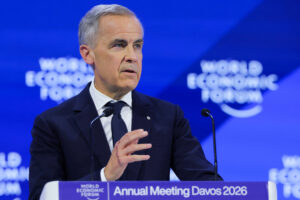
    These concerns have been openly acknowledged by global leaders at the World Economic Forum. Canadian Prime Minister Mark Carney, speaking at Davos, argued that “the old world order is not coming back,” cautioning against nostalgia-driven policymaking and warning that the global system is undergoing a rupture rather than a smooth transition. He further observed that economic interdependence has increasingly been weaponised and warned middle powers that “if you are not at the table, you are on the menu.” Such remarks reflect a growing recognition that disorder, competition, and power asymmetries are now embedded features of the international system.

    Similarly, World Economic Forum President Børge Brende highlighted the depth of uncertainty confronting the global order, noting that “the political, geopolitical, and macroeconomic landscape is shifting under our feet.” Emphasising the limits of unilateralism and rigid frameworks, Brende stressed that “dialogue is a necessity, not a luxury,” reinforcing the idea that cooperation must persist even in an era of fragmentation. These statements underline a critical point: the challenge today is not the absence of institutions, but their inability to adapt to changing geopolitical realities.

    French President Emmanuel Macron further reinforced this diagnosis at Davos by warning of a “shift towards a world without rules, where international law is trampled underfoot and where the law of the strongest prevails.” His remarks underscore the erosion of the post–Second World War multilateral framework under the pressure of returning imperial ambitions, coercive diplomacy, and unilateral action. Macron’s warning reflects a broader concern that global politics is increasingly shaped by power rather than norms. At the same time, he rejected intimidation as an organising principle of international relations, stating that “we prefer respect to bullies,” and called for effective multilateralism—one that is reformed and updated rather than dismantled.

    Reforming Global Governance for an Age of Disorder

    Against this backdrop, the central question is how states can navigate such geopolitical turbulence. A rigid, blueprint-based institutional approach—reminiscent of Cold War–era frameworks—is no longer viable. What is required instead are flexible, adaptive institutions capable of absorbing shocks, accommodating diverse interests, and operating under conditions of persistent uncertainty. Since traditional multilateralism is increasingly strained, it is essential to recognise that disorder itself is likely to remain a defining feature of the contemporary international system.

    Any effort to design or reform institutions must therefore begin with this recognition. Fragmentation and regionalisation—particularly through minilateral and issue-based coalitions—are inevitable outcomes of a multipolar environment. However, this does not eliminate the need for global cooperation. Rather, it demands cooperation frameworks that are flexible, inclusive, and responsive to evolving geopolitical realities. Institutions must be capable of adapting to shifting power balances rather than attempting to impose outdated structures on a transformed system. In these tough times, the world requires greater cooperation and coordinated action, because the challenges we face—such as climate change, cyber threats, economic instability, and regional conflicts—are global in nature and cannot be solved through isolated national approaches.

    Another limitation in current thinking is the tendency to interpret global politics solely through the lens of US–China rivalry. While great power competition undeniably shapes the international environment, such a narrow focus underestimates the agency of middle and regional powers. Many states actively shape outcomes, norms, and institutions rather than merely reacting to great power pressures. Effective institutional design must therefore reflect this distributed agency and avoid reducing global politics to a binary rivalry.

    Equally important is the need to move beyond linear and deterministic thinking. The contemporary world is characterised by non-linear dynamics, uncertainty, and complex interactions. Predicting the future exclusively through the lens of past patterns—particularly those rooted in liberal or Cold War assumptions—is increasingly misleading. Institutional responses must be grounded in realism, flexibility, and adaptability rather than static or idealised models of order.

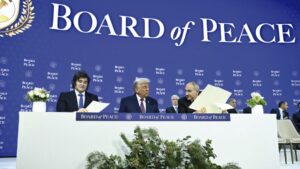
    Recent initiatives such as Donald Trump’s proposal for a “Board of Peace,” driven largely by personal leadership and transactional logic, illustrate the limitations of personality-centric approaches to global governance. Given their temporary nature and the likelihood of reversal under future administrations, such initiatives lack durability. Moreover, such proposals are often unrepresentative and do not reflect the realities of the international system; they are based on authoritarian-style solutions rather than broad-based legitimacy, consensus, and institutional resilience. In contrast, reforming existing institutions—particularly the United Nations—offers a more sustainable path forward. Reforms that reflect contemporary geopolitical realities would enhance the UN’s relevance without undermining its foundational principles.

    India’s Reformist Approach to Global Governance

    India’s approach to global governance is particularly instructive in this context. When India criticises the United Nations or other global institutions, its objective is not to dismantle them but to reform them. This distinguishes India from countries such as China and Russia, which often seek to replace existing structures with alternative, and frequently anti-Western, institutional arrangements. India positions itself not as an anti-Western power, but as a non-Western one—committed to liberal democracy, pluralism, and engagement with existing global frameworks. As India’s Ministry of External Affairs has emphasised, “the architecture of global governance in 2025 for the future cannot be written in ink from 1945,” highlighting the need to update institutions rather than replace them.

    This distinction is crucial. India has significantly benefited from the existing international order, and its economic transformation since the post-1991 reforms has been largely enabled by the stability, access to global markets, and investment flows that the post-World War II system provided. Consequently, India has little incentive to support a China-centric alternative. Reforming the current system, rather than replacing it, aligns with India’s long-term strategic interests. Moreover, India’s leadership and participation in forums such as the SCO and BRICS have played a stabilising role. Without India’s presence, these platforms could easily evolve into explicitly anti-Western blocs. India’s foreign policy is best understood as reformist rather than revisionist, acting as a bridge between the West and the Global South; as Chatham House notes, India seeks to “change the international order from within rather than overthrow it.” Yet many Western policymakers fail to understand India’s global vision and often categorise it alongside other revisionist powers, viewing India narrowly through a bilateral prism or primarily as a counterweight to China. This misreading overlooks India’s broader role as an independent norm-shaping power.

    In light of these dynamics, the most effective strategy for navigating contemporary geopolitical turbulence lies in reforming and revitalising existing institutions rather than constructing entirely new ones based on rigid, blueprint-style thinking. A blueprint approach assumes that we can predict the future and design institutions accordingly—an assumption that is inherently flawed because the future is always uncertain and unknowable. Institutions must therefore be designed to capture the reality of moving from the known to the unknown and to adapt continuously as new challenges emerge. They must be made flexible, resilient, and responsive to disorder rather than designed to eliminate it. Accepting instability as a structural condition—and designing mechanisms of cooperation accordingly—offers the best chance of sustaining global governance in an increasingly fragmented world.


    Feature Image Credit: www.byarcadia.org

  • Positioning Sri Lanka in an Emerging Multipolar World Order

    Positioning Sri Lanka in an Emerging Multipolar World Order

     Summary 

    Sri Lanka sits at a strategic crossroads, with geography that positions it at the heart of global trade and regional security. Yet economic vulnerability, political inconsistency, and limited strategic clarity have constrained its influence. As global power fragments and the Global South rises, the island faces a choice: remain reactive and peripheral or leverage its location, strengthen its economy, and build stable institutions to become a neutral logistics hub, a trusted diplomatic partner, and an active contributor to the emerging multipolar order. Acting decisively now will transform strategic opportunity into lasting national influence. 

    Over the past four years, geopolitical, economic, and technological shifts have progressed at a pace unmatched in the previous three decades. The world we face today is fundamentally different from the one we knew before. War has returned to Europe, shattering the assumption that major interstate conflict on the continent was a thing of the past. The Middle East is once again engulfed in overlapping crises that draw in both regional actors and global powers. Across Africa—from the Sahel to the Horn—coups, insurgencies, and persistent violence are eroding state institutions and deepening humanitarian emergencies. The impact of Trump’s tariffs threatened many sectors globally.

    At the same time, trust in multilateral institutions, long the guardians of global order, is fading. The UN struggles to act decisively, the WTO is weakened, and even climate negotiations are increasingly shaped by national interests rather than collective responsibility. The consensus that once underpinned global cooperation is fragmenting. 

    Meanwhile, technological disruption is accelerating competition. Artificial intelligence, quantum computing, and strategic supply chains have become the new battlegrounds for influence. Nations no longer compete only for territory or ideology; they compete for data, minerals, energy, and technological dominance. 

    The post–Cold War optimism that once promised a borderless world of global democracy and free markets has evaporated. In its place has emerged an era defined by political fragmentation, economic rivalry, and strategic competition. Great-power tensions are rising, regional blocs are hardening, and smaller states are being compelled to navigate an increasingly complex and divided international landscape. 

    The rules-based order that emerged after World War II is weakening, and neither the United States nor China can dictate the future alone. Instead, a triangular contest among the global West, global East, and the global South is shaping a new geopolitical reality. 

    In addition, the Indo-Pacific has become the central arena of strategic competition between the United States and China. As China expands its economic reach, military power, and political influence, the U.S. seeks to uphold a free, open, and rules-based regional order. This rivalry now shapes security, diplomacy, trade, and technology across the entire region, with flashpoints such as the Taiwan Strait and the South China Sea posing the greatest risks of confrontation and global economic disruption. 

    Where does Sri Lanka stand 

    Sri Lanka is a small island nation, but one with a singular and powerful advantage: its geography. Positioned at the center of the world’s busiest East–West maritime corridor, the island lies along sea lanes that carry nearly two-thirds of global oil shipments and almost half of all container traffic. In an era when supply chains, shipping routes, and energy pathways are becoming strategic assets in their own right, Sri Lanka’s location is not merely convenient—it is consequential.

    This makes the island strategically valuable to every major power. For India, Sri Lanka’s stability is essential to security in its immediate neighbourhood and to its ambitions in the wider Indian Ocean. For China, the island is a vital node in the Belt and Road Initiative, linking the maritime silk route to broader trade and energy networks. For the United States, Sri Lanka is central to its Indo-Pacific strategy, where freedom of navigation, open sea lanes, and counter-balancing rival influences are paramount. 

    Beyond the great powers, there is a range of middle powers, which includes Japan, the UAE, Saudi Arabia, South Korea, and even Turkey. These countries are deepening economic, maritime, and diplomatic engagement across the Indian Ocean. Their interests converge on Sri Lanka not merely because of geography, but because of the island’s potential as a stable partner, a logistical hub, and a platform for regional connectivity. Collectively, these factors position Sri Lanka as not just a nation-state but a geopolitical crossroads, where the interests of global and regional actors meet, overlap, and at times compete. 

    Yet, despite this inherent strategic value, Sri Lanka continues to struggle in transforming geography into meaningful geopolitical influence. The island’s location offers an extraordinary opportunity, but opportunity alone does not translate into power. 

    Policy inconsistency—driven by frequent political turnover, short-term decision-making, and competing domestic priorities—has created persistent uncertainty that discourages long-term investment and undermines Sri Lanka’s international credibility. At the same time, an overly cautious geopolitical posture, often bordering on indecision, has prevented the country from defining a clear strategic identity in the Indian Ocean. 

    As a result, Sri Lanka has too often been a reactor rather than an actor: responding to external pressures instead of anticipating them, accommodating the interests of major powers instead of assertively advancing its own. Although global actors are drawn to the island because of its strategic location, Sri Lanka has not consistently leveraged that interest to secure lasting economic, diplomatic, or security advantages. 

    The task ahead is to break this cycle. Sri Lanka must transition from being merely a geographical point of convergence to becoming a strategic participant capable of shaping outcomes that affect its future. This requires strengthening the domestic economic base, setting coherent long-term foreign policy priorities, and building the institutional stability needed to negotiate with confidence. Only then can Sri Lanka convert its location into lasting influence—anchoring its long-term security, enhancing its prosperity, and securing a respected place within a rapidly reordering world. 

    For countries like Sri Lanka, the challenge is to navigate this environment with careful diplomatic balance—leveraging economic opportunities from both the U.S. and China while preserving strategic autonomy and avoiding undue dependency. At the same time, Sri Lanka’s trade-driven economy relies heavily on stable, rules-based maritime routes across the Indian Ocean and the wider Indo-Pacific, making regional peace and open sea lanes essential for national economic stability. 

    The Weak Link in Sri Lanka’s Strategy. 

    The 2022 economic crisis significantly weakened Sri Lanka’s geopolitical standing. A nation’s foreign policy is only as strong as the economic foundation beneath it. When an economy collapses, sovereignty is not formally lost, but it is quietly constrained. Sri Lanka’s reliance on external lenders, bilateral creditors, and major-power investments has narrowed its strategic flexibility and limited its ability to negotiate from a position of strength. 

    Instead of shaping regional agendas, we increasingly find ourselves adjusting to those set by others. Unless Sri Lanka restores economic resilience and rebuilds fiscal credibility, the country risks becoming a pawn in a larger great power contest rather than a strategic actor capable of advancing its own interests. 

    Real impact on Sri Lanka 

    The Trump administration’s imposition of tariffs on Sri Lankan exports functioned as a form of trade restriction rather than a targeted sanction or financial embargo. Nevertheless, the measures had material implications for the country’s economy. The garment sector, which constitutes the backbone of Sri Lanka’s foreign-exchange earnings and employment, was particularly exposed. Given that the United States represents a significant share of Sri Lanka’s export market, the tariffs threatened to impede post-2022 economic recovery and constrain critical foreign-exchange inflows. Beyond immediate economic effects, the episode highlights Sri Lanka’s structural vulnerability to shifts in global trade policy, revealing a broader strategic challenge: without enhanced economic resilience and proactive engagement in international trade frameworks, Sri Lanka risks being perpetually reactive rather than an influential actor in the global economic system. 

    The Global South Is Rising 

    One of the most consequential geopolitical shifts of our time is the emergence of middle powers within the Global South as influential actors in global affairs. Countries such as India, Brazil, Saudi Arabia, South Africa, Turkey, Nigeria, Indonesia, and Mexico are no longer peripheral participants in a system dominated by the West. They possess the economic weight, demographic scale, technological ambition, and diplomatic confidence to reshape global institutions, from trade and finance to climate governance and security frameworks. 

    This rise is visible everywhere. India is now the world’s fastest-growing major economy and a central player in the G20 and Indo-Pacific. Brazil shapes global environmental and agricultural policy. Saudi Arabia and the UAE are redefining energy geopolitics and investing heavily across Asia and Africa. South Africa and Nigeria influence continental politics, peacekeeping, and resource diplomacy. Turkey has become a pivotal actor in West Asia, Central Asia, and global mediation efforts. Together, these countries are forming new coalitions, from BRICS+ to the G20’s expanded role, challenging the old North–South divide and demanding a more equitable international order. 

    And yet, amid this global transformation, Sri Lanka remains largely absent from the strategic conversation. We participate in international forums, but seldom shape their agendas. We attend summits, but rarely articulate a coherent long-term national strategy. The country possesses clear potential, but lacks the strategic clarity and diplomatic consistency required to convert that potential into influence. 

    Sri Lanka belongs to the Global South by geography, history, and shared developmental challenges—but not yet by strategic weight or leadership. At a time when emerging powers across Asia, Africa, and Latin America are redefining global governance, Sri Lanka risks remaining on the sidelines. Unless we strengthen our capacity to articulate priorities, build alliances, and engage proactively, we may become spectators in a moment when others are reshaping the international order. 

    If the Global South continues its ascent as current economic, demographic, and diplomatic trends indicate, it will become a decisive force in global negotiations on climate, trade, energy, technology, and security. The question then becomes: Where will Sri Lanka stand? We must choose whether to meaningfully align with this emerging bloc, articulate our own national priorities, and build partnerships that reflect our strengths or risk being left behind, irrelevant in a world that is rapidly reorganising itself. 

    Opportunities in the New Disorder 

    Disorder brings danger, but it also brings opportunity. History shows that moments of global turbulence create openings for small, agile states to elevate their influence. Finland, Singapore, Qatar, and the UAE are prime examples—nations that turned geography, diplomacy, and strategic clarity into disproportionate global relevance. They became connectors, mediators, hubs, and conveners at a time when great powers were distracted by rivalry. Sri Lanka, too, possesses the attributes to rise in this emerging landscape, if we choose to act with purpose. 

    As a Maritime and Logistics Hub, Sri Lanka sits along the world’s most important East–West maritime highway, yet has not fully realised the potential of this position. With the right investment climate, regulatory consistency, and diplomatic balance, the island can become an efficient, neutral logistics hub serving all blocs: West, East, and South. This includes strengthening ports, aviation links, and digital infrastructure to support regional supply chains and trans-shipment networks. 

    As a Diplomatic Bridge in the Indian Ocean Geopolitics in the Indo-Pacific is increasingly defined by competition, mistrust, and strategic ambiguity. Amid this environment, Sri Lanka can offer what few others can: a neutral, trusted venue for dialogue, confidence-building, and conflict prevention. By convening maritime security forums, climate adaptation roundtables, and regional economic dialogues, Sri Lanka can redefine itself as a facilitator rather than a battleground for competing interests. This diplomatic role, rooted in neutrality and credibility, can become a cornerstone of the island’s long-term relevance. 

    The global transition to clean energy is rewriting economic and political priorities across continents. Sri Lanka’s hydropower, solar, and wind capacity create an opportunity to position the country as a renewable energy partner for the region. Expanding grid connectivity, attracting green financing, and partnering on technology transfers can anchor national energy security while forging deeper alliances with both great powers and rising middle powers as a Renewable Energy Partner. 

    As the Global South demands a fairer international order, Sri Lanka has the opportunity to join voices calling to democratise global governance, from the UN Security Council to the IMF and World Bank. Smaller nations deserve equitable representation and greater institutional responsiveness. By aligning with reform-oriented coalitions, Sri Lanka can gain diplomatic visibility and credibility that far exceeds its size, as a Voice for Reform in Global Institutions. 

    But seizing these opportunities requires qualities we have not consistently demonstrated: political stability, coherent foreign policy, and economic credibility. These are the foundations upon which successful small states build influence, and they are the areas where Sri Lanka has repeatedly stumbled. If Sri Lanka can correct this trajectory, through disciplined governance, strategic clarity, and long-term national planning, then the disorder of today’s world need not be a threat. Instead, it can become the opening through which the island finally realises its potential as a regional connector, a diplomatic actor, and a resilient nation in a rapidly changing global order. 

    The Path Forward 

    Choosing Influence Over Vulnerability Sri Lanka must urgently embrace a new strategic mindset built on five pillars: Balanced Foreign Policy, Avoiding entanglement in rival blocs. Economic Transformation, Strengthening the economy to regain autonomous decision-making. Indian Ocean Strategy, Leveraging geography as a national asset, not a bargaining chip. Institutional Reform, building trustworthy governance that inspires investor and diplomatic confidence. Most importantly engagement with the Global South, positioning Sri Lanka as an active contributor to the emerging world order. The next decade will determine the shape of global power for a generation. If Sri Lanka hesitates, the world will move forward without us. 

    A Moment of Choice 

    Sri Lanka stands at a historic juncture. We possess strategic advantages that many nations envy, yet economic vulnerabilities limit our choices. The world is being reordered, messily, rapidly, irreversibly. The question is not simply Where does Sri Lanka stand today? The real question is: Where will Sri Lanka choose to stand tomorrow? In a world drifting toward rivalry and fragmentation, Sri Lanka must choose to be not a pawn, but a purposeful small power—neutral, stable, connected, and confident. This is our moment to reclaim agency. If we fail, the new world order will be written around us, not with us. The choice before us is stark, to remain a spectator in a world that is rapidly changing—or to step forward, with clarity and purpose, as a nation that shapes its own destiny. 

    References: 

    Alexander Stubb, The West’s Last Chance How to Build a New Global Order Before It’s Too Late January/February 2026 Published on December 2, 2025 https://www.foreignaffairs.com/ 

    Rizwie, Rukshana; Athas, Iqbal; Hollingsworth, Julia “Rolling power cuts, violent protests, long lines for basics: Inside Sri Lanka’s unfolding economic crisis” (3 April 2022). 

    Wignaraja, Ganeshan (16 February 2025). “Sri Lanka struggles to deliver a new era of post-crisis growth | East Asia Forum”. East Asia Forum. Retrieved 29 July 2025. 

    https://www.bloomberg.com/news/articles/2022-03-17/shock-waves-from-the-war-in-ukraine-threaten-to-swamp-sri-lanka 

    https://www.reuters.com/markets/rates-bonds/sri-lankas-ambitious-governance-macro-linked-bonds-2024-12-17/#:~:text=LONDON%2C%20Dec%2017%20(Reuters),ever%20arranged%20in%20a%20restructuring. 

    https://www.voanews.com/a/india-feels-the-squeeze-in-indian-ocean-with-chinese-projects-in-neighborhood-/6230845.html 

    Reuters+2isas.nus.edu.sg+2 

    https://www.business-humanrights.org/en/latest-news/tracking-impact-of-us-tariffs-on-apparel-footwear-supply-chains-wpftc/ 

    Author:

    Air Chief Marshal Gagan Bulathsinghala RWP RSP VSV USP MPhil MSc FIM  ndc psc.

    Formerly Commander Sri Lanka Air Force & Ambassador to Afghanistan

    Director, Charisma Energy
    Director, Strategic Development, WKV Group 
    President, Association of Retired Flag Rank Officers
    Senior Fellow South Asia Foresight Network
     

    Feature Image Credit: ndtv.com


  • What International Order?

    What International Order?

    The recently concluded BRICS summit confirms the process of inevitable transformation of the international order. The US-led West, since the fall of the USSR, has increasingly demonstrated intolerance to their view of the world. The ongoing conflicts in UKraine and Gaza has exposed their duplicity and the entire Global South have come to realise the anamolies in international order and the so-called rules-based system. The West’s unabashed support to Israel’s genocide and babarism in Gaza, despite their peoples’ opposition makes the claims of democracy and humanism in the West sound hollow. Thierry Meyssan dealt incisively with this duplicity of the West, primarily the Ango-Saxon powers, in his speech last year in Magdeburg (Germany), at the conference organized by the magazine Compact, “Amitie avec la Russie”, on November 4, 2023.

    We reproduce the text of Thierry Meyssan’s speech, translated by Roger Lagasse’, and published earlier in voltairenet.org

    In it, he explains what, in his view, constitutes the fundamental difference between the two conceptions of the world order now clashing from the Donbass to Gaza: that of the Western bloc and that to which the rest of the world refers. The question is not whether this order should be dominated by one power (unipolar) or by a group of powers (multipolar), but whether or not it should respect the sovereignty of each. He draws on the history of international law, as conceived by Tsar Nicholas II and Nobel Peace Prize winner Léon Bourgeois.

    – Team TPF

    BRICS Summit 2024 in Kazan, Russia, October 23,2024. Sputnik . Photo hosting agency brics-russia2024.ru

    What International Order?

    Thierry Meyssan

    We’ve seen NATO’s crimes, but why affirm our friendship with Russia? Isn’t there a risk of Russia behaving tomorrow like NATO does today? Are we not substituting one form of slavery for another?

    To answer this question, I would draw on my successive experience as advisor to five heads of state. Everywhere, Russian diplomats have told me: you’re on the wrong track: you’re committed to putting out one fire here, while another has started elsewhere. The problem is deeper and broader.

    I would therefore like to describe the difference between a world order based on rules and one based on international law. This is not a linear story, but a struggle between two worldviews – a struggle we must continue.

    In the 17th century, the Treaties of Westphalia established the principle of state sovereignty. Each is equal to the others, and no one may interfere in the internal affairs of others. For centuries, these treaties governed relations between the present-day Länder, as well as between European states. They were reaffirmed by the Congress of Vienna in 1815 when Napoleon I was defeated.

    On the eve of the First World War, Tsar Nicholas II convened two International Peace Conferences (1899 and 1907) in The Hague to “seek the most effective means of assuring all peoples the benefits of a real and lasting peace”. Together with Pope Benedict XV, he prepared them on the basis of canon law, not the law of the strongest. After two months of deliberation, 27 states signed the final proceedings. The president of the French Radical [Republican] Party, Léon Bourgeois, presented his thoughts [1] on the mutual dependence of states and their interest in uniting despite their rivalries.

    At the instigation of Léon Bourgeois, the Conference created an International Court of Arbitration to settle disputes by legal means rather than by war. According to Bourgeois, states would only agree to disarm when they had other guarantees of security.

    The final text instituted the notion of “the duty of States to avoid war”… by resorting to arbitration.

    At the instigation of one of the Tsar’s ministers, Frédéric Fromhold de Martens, the Conference agreed that, during armed conflict, populations and belligerents must remain under the protection of the principles resulting from “the usages established between civilized nations, the laws of humanity and the dictates of public conscience”. In short, the signatories undertook to stop behaving like barbarians.

    This system only works between civilized states that honour their signatures and are accountable to public opinion. It failed, in 1914, because states had lost their sovereignty by entering into defense treaties that required them to go to war automatically in certain circumstances that they could not assess for themselves.

    Léon Bourgeois’s ideas gained ground, but met with opposition, including from his rival in Georges Clemenceau’s Radical Party. Clemenceau did not believe that public opinion could prevent wars. Nor did the Anglo-Saxons, U.S. President Woodrow Wilson and British Prime Minister Lloyd George. At the end of the First World War, these three men substituted the might of the victors for the fledgling international law. They shared the world and the remnants of the Austro-Hungarian, German and Ottoman empires. They blamed Germany alone for the massacres, denying their own. They imposed disarmament without guarantees. To prevent the emergence of a rival to the British Empire in Europe, the Anglo-Saxons began to pit Germany against the USSR, and secured France’s silence by assuring her that she could plunder the defeated Second Reich. In a way, as the first President of the Federal Republic, Theodor Heuss, put it, they organized the conditions for the development of Nazism.

    As they had agreed among themselves, the three men reshaped the world in their own image (Wilson’s 14 points, the Sykes-Picot agreements, the Balfour Declaration). They created the Jewish homeland of Palestine, dissected Africa and Asia, and tried to reduce Turkey to its minimum size. They organized all the current disorders in the Middle East.

    Yet it was on the basis of the ideas of the late Nicholas II and Léon Bourgeois that the League of Nations (League) was established after the First World War, without the participation of the United States, which thus officially rejected any idea of International Law. However, the League also failed. Not because the United States refused to join, as some say. That was their right. But firstly, because it was incapable of re-establishing strict equality between states, as the United Kingdom was opposed to considering colonized peoples as equals. Secondly, it did not have a common army. And finally, because the Nazis massacred their opponents, destroyed German public opinion, violated the Berlin signature and did not hesitate to behave like barbarians.

    As early as the Atlantic Charter in 1942, the new U.S. President, Franklin Roosevelt, and the new British Prime Minister, Winston Churchill, set themselves the common goal of establishing a world government at the end of the conflict. The Anglo-Saxons, who imagined they could rule the world, did not, however, agree amongst themselves on how to go about it. Washington did not wish London to meddle in its affairs in Latin America, while London had no intention of sharing the hegemony of the Empire over which “the sun never set”. During the war, the Anglo-Saxons signed numerous treaties with Allied governments, including those in exile, which they hosted in London.

    Incidentally, the Anglo-Saxons failed to defeat the Third Reich, and it was the Soviets who overthrew it and took Berlin. Joseph Stalin, First Secretary of the CPSU, was opposed to the idea of a world government, and an Anglo-Saxon one at that. All he wanted was an organization capable of preventing future conflicts. In any case, it was Russian conceptions that gave birth to the system: that of the United Nations Charter, at the San Francisco conference.

    In the spirit of the Hague Conferences, all UN member states are equal. The Organization includes an internal tribunal, the International Court of Justice, responsible for settling disputes between its members. However, in the light of previous experience, the five victorious powers have a permanent seat on the Security Council, with a veto. Given that there was no trust between them (the Anglo-Saxons had planned to continue the war with the remaining German troops against the USSR) and that it was unknown how the General Assembly would behave, the various victors wanted to ensure that the UN would not turn against them (the USA had committed appalling war crimes by dropping two atomic bombs against civilians, while Japan… was preparing its surrender to the Soviets). But the great powers did not understand the veto in the same way. For some, it was a right to censor the decisions of others; for others, it was an obligation to take decisions unanimously.

    Except that, right from the start, the Anglo-Saxons didn’t play ball: an Israeli state declared itself (May 14, 1948) before its borders had been agreed, and the UN Secretary-General’s special envoy to oversee the creation of a Palestinian state, Count Folke Bernadotte, was assassinated by Jewish supremacists under the command of Yitzhak Shamir. Moreover, the seat on the Security Council allocated to China, in the context of the end of the Chinese Civil War, was given to Chiang Kai-shek’s Kuomintang and not to Beijing. The Anglo-Saxons proclaimed the independence of their Korean zone of occupation as the “Republic of Korea” (August 15, 1948), created NATO (April 4, 1949), and then proclaimed the independence of their German zone of occupation as “Federal Germany” (May 23, 1949).

    The USSR considered itself fooled, and slammed the door (“empty seat” policy). The Georgian Joseph Stalin had mistakenly believed that the veto was not a right of censure, but a condition of unanimity of the victors. He thought he could block the organization by boycotting it.

    The Anglo-Saxons interpreted the text of the Charter they had drafted and took advantage of the Soviets’ absence to place “blue helmets” on the heads of their soldiers and wage war on the North Koreans (June 25, 1950) in the “name of the international community” (sic). Finally, on August 1, 1950, the Soviets returned to the UN after an absence of six and a half months.

    The North Atlantic Treaty may be legal but NATO’s rules of procedure violate the UN Charter. It places the Allied armies under Anglo-Saxon command. Its Commander-in-Chief, the SACEUR, is necessarily an American officer. According to its first Secretary General, Lord Ismay, the Alliance’s real aim was neither to preserve the peace nor to fight the Soviets, but to “keep the Americans in, the Russians out and the Germans under control” [2]. In short, it was the armed wing of the world government that Roosevelt and Churchill wanted to create. It was in pursuit of this goal that President Joe Biden ordered the sabotage of the Nord Stream gas pipeline linking Russia and Germany.

    At the Liberation, MI6 and OPC (the future CIA) secretly set up a stay-behind network in Germany. They placed thousands of Nazi leaders in this network, helping them to escape justice. Klaus Barbie, who tortured French Resistance coordinator Jean Moulin, became the first commander of this shadow army. The network was then incorporated into NATO, where it was greatly reduced. It was then used by the Anglo-Saxons to interfere in the political life of their supposed allies, who were in reality their vassals.

    Joseph Goebbels’ former collaborators created the Volksbund für Frieden und Freiheit. With the help of the USA, they persecuted German communists. Later, NATO’s stay-behind agents were able to manipulate the extreme left to make it detestable. A case in point is the Bader gang. But as these men were arrested, the stay-behind came and murdered them in prison, before they could stand trial and speak out. In 1992, Denmark spied on Chancellor Angela Merkel on NATO instructions, just as in 2022, Norway, another NATO member, helped the USA sabotage Nord Stream…

    Returning to international law, things gradually returned to normal, until in 1968, during the Prague Spring, the Ukrainian Leonid Brezhnev did in Central Europe what the Anglo-Saxons were doing everywhere else: he forbade the USSR’s allies to choose an economic model other than their own.

    With the dissolution of the USSR, things began to get worse. The US Undersecretary of Defense, Paul Wolfowitz, drew up a doctrine according to which, to remain masters of the world, the United States had to do everything in its power to prevent the emergence of a new rival, starting with the European Union. It was in application of this idea that Secretary of State James Baker imposed the enlargement of the European Union to include all the former states of the Warsaw Pact and the USSR. By expanding in this way, the Union deprived itself of the possibility of becoming a political entity. It was again in application of this doctrine that the Maastricht Treaty placed the EU under NATO’s protection. And it is still in the application of this doctrine that Germany and France are paying for and arming Ukraine.

    Then came Czech-US professor Josef Korbel. He proposed that the Anglo-Saxons should dominate the world by rewriting international treaties. All that was needed, he argued, was to substitute Anglo-Saxon law, based on custom, for the rationality of Roman law. In this way, in the long term, all treaties would give the advantage to the dominant powers: the United States and the United Kingdom, linked by a “special relationship”, in the words of Winston Churchill. Professor Korbel’s daughter, Democrat Madeleine Albright, became Ambassador to the UN, then Secretary of State. Then, when the White House passed into Republican hands, Professor Korbel’s adopted daughter, Condoleeza Rice, succeeded her as National Security Advisor, then Secretary of State. For two decades, the two “sisters” [3]patiently rewrote the main international texts, ostensibly to modernize them, but in fact to change their spirit.

    Today, international institutions operate according to Anglo-Saxon rules, based on previous violations of international law. This law is not written in any code, since it is an interpretation of custom by the dominant power. Every day, we substitute unjust rules for International Law and violate our own signature.

    For example:

    • When the Baltic States were created in 1990, they made a written commitment to preserve the monuments to the sacrifices of the Red Army. The destruction of these monuments is therefore a violation of their own signature.
    • Finland made a written commitment in 1947 to remain neutral. Joining NATO is therefore a violation of its own signature.
    • On October 25, 1971, the United Nations adopted Resolution 2758 recognizing Beijing, not Taiwan, as the sole legitimate representative of China. As a result, Chiang Kai-shek’s government was expelled from the Security Council and replaced by that of Mao Zedong. Consequently, China’s recent naval manoeuvres in the Taiwan Strait do not constitute aggression against a sovereign state, but the free deployment of its forces in its own territorial waters.
    • The Minsk agreements were intended to protect Russian-speaking Ukrainians from harassment by “integral nationalists”. France and Germany vouched for them before the Security Council. But, as Angela Merkel and François Hollande have said, neither of them had any intention of implementing them. Their signatures are worthless. If it had been otherwise, there would never have been a war in Ukraine.

    The perversion of International Law reached a peak with the appointment, in 2012, of the American Jeffrey Feltman as Director of Political Affairs. From his office in New York, he oversaw the Western war on Syria. Using the institutions of peace to wage war [4].

    Until the United States threatened it by stockpiling weapons on its border, the Russian Federation respected all the commitments it had signed or that the Soviet Union had signed. The Nuclear Non-Proliferation Treaty (NPT) obliges the nuclear powers not to spread their nuclear arsenals around the world. The United States, in violation of its signature, has been stockpiling atomic bombs in five vassal countries for decades. They train allied soldiers in the handling of these weapons at the Kleine Brogel base in Belgium, the Büchel base here in Germany (Rhineland-Palatinate), the Aviano and Ghedi bases in Italy, the Volkel base in the Netherlands and the Incirlik base in Turkey.

    Then they say, by virtue of their coups de force, that this has become the custom.
    Now, the Russian Federation, considering itself under siege after a US nuclear bomber flew over the Gulf of Finland, has also played with the Non-Proliferation Treaty and installed atomic bombs on the territory of Belarus. Of course, Belarus is not Cuba. Placing Russian nuclear bombs there changes nothing. It’s just a message sent to Washington: if you want to re-establish the Law of the Strongest, we can accept that too, except that, from now on, we’re the strongest. Note that Russia has not violated the letter of the Treaty, as it is not training the Belarusian military in these weapons, but it has taken liberties with the spirit of the Treaty.

    As Léon Bourgeois explained in the last century, to be effective and lasting, disarmament treaties must be based on legal guarantees. It is therefore urgent to return to international law, failing which we will plunge headlong into a devastating war.

    Our honour and our interest lie in re-establishing international law. It’s a fragile construction. If we want to avoid war, we must re-establish it, and we can be sure that Russia thinks as we do, that it will not violate it.

    Or we can support NATO, which brought its 31 defence ministers together in Brussels on October 11 to listen to their Israeli counterpart announce, via videoconference, that he was going to raze Gaza to the ground. And none of our ministers, including Germany’s Boris Pistorius, dared to speak out against the planning of this mass crime against civilians. The honour of the German people has already been betrayed by the Nazis, who ultimately sacrificed you. Don’t let yourselves be betrayed again, this time by the Social Democratic Party and the Greens.

    We don’t have to choose between two overlords, but to protect peace, from the Donbass to Gaza, and, ultimately, to defend International Law.


    Source: “What international order?”, by Thierry Meyssan, Translation Roger Lagassé, Voltaire Network, 7 November 2023, www.voltairenet.org/article219965.html

    Republished under Creative Commons CC-BY-NC-ND

    Feature Image Credit: ‘Imagine a World free from the Oppression of a US-led global Order’ – www.scmp.com


  • China has achieved escape velocity: it is now unstoppable

    China has achieved escape velocity: it is now unstoppable

    The 21st century is shaping up to be the Asian, Eurasian, and Chinese century.

    While the Hegemon spent at least $7 trillion – and counting – on unwinnable Forever Wars, China is spending $1 trillion in an array of Belt and Road Initiative (BRI) projects across the Global South: the emphasis is digital/transportation connectivity corridors. Geoeconomic imperatives intertwined with rising geopolitical influence.

    The four-day, twice-a-decade plenum of the Communist Party of China that took place last week in Beijing, designing an economic road map all the way to 2029, was a stunning affair in more ways than one.

    Let’s start with continuity – and stability. There’s no question after the plenum that Xi Dada, or The Big Panda, will stay on the helm until 2029 – the end of the current five-year economic drive.

    And if Xi is healthy enough, he will stay until 2035: the fateful and uber-game-changing target year for China to exhibit a GDP per capita of $30,000, with massive worldwide reverberations.

    Here, we see the confluence between the progression of “socialism with Chinese characteristics” and the defining contours, if not of a Pax Sinica, at least of the non-Hegemon-centric, multi-nodal world (italics mine).

    The proverbial U.S. Think Tankland/Sinophobia axis has been hysterical on China not being able to sustain a 5% a year growth rate for the next few years – the target once again stressed at the plenum.

    The Chinese themselves have not bothered about the growth rate for a long time, since in 2018 they switched to a strategy of so-called qualitative development, that is, not at the expense of traditional industries, but on the basis of high technologies and the creation of new areas, such as the production of new energy sources and artificial intelligence.

    A Russian analysis by the Center for Geopolitical Forecasts makes a crucial point: “The Chinese themselves have not bothered about the growth rate for a long time, since in 2018 they switched to a strategy of so-called qualitative development, that is, not at the expense of traditional industries, but on the basis of high technologies and the creation of new areas, such as the production of new energy sources and artificial intelligence.”

    That’s the rationale behind Made in China 2025 – which is being implemented at breakneck speed: high-tech development leading the way towards a “high-level socialist market economy”, to be consolidated by 2025 and fully constructed by 2035.

    The next step will be to attain the status of “modernized socialist power” by 2049, at the 100th anniversary of the People’s Republic of China (PRC).

    The plenum proved once more that “socialism with Chinese characteristics” – or, for the recalcitrant, Chinese-modified capitalism – is “people-centric”. The supreme values are national interest and the people’s interests – attested by the fact that large private corporations remain under the strategic control of the CPC.

    It’s idle to try to find in the final communique at the end of the plenum any restrictions on private capital on the path to “universal prosperity”. The key point is that the role of capital should always be subordinated to the concept of “socialism with Chinese characteristics”.

    Watch the reform ship steadily sailing

    Everything is explained here in nearly didactic terms, chronicling the birth of the “Decision of the CPC Central Committee on further comprehensive deepening of reforms to promote Chinese modernization”.

    What is now already referred to colloquially all across China as “The Decision” spreads across 15 parts and 60 articles, divided into three main sections, proposing more than 300 important reforms.

    “The Decision”, in full, has not yet been published; only the road map of how Beijing planners got there. Of course, this is no mere policy paper; it’s a quintessentially CPC-style dissertation in which the details of economic and political measures are obscured by clouds of images and metaphors.

    Take a look, for instance, at this passage:

    “To ensure that the reform ship sails forward steadily, the ‘Decision’ proposes that further comprehensive deepening of reform must implement the “six principles”: adhere to the party’s overall leadership, adhere to the people-centred approach, adhere to the principle of maintaining the integrity and promoting innovation, adhere to system building as the main line, adhere to the comprehensive rule of law, and adhere to a systematic approach.”

    Most of the “Decision” – 6 parts in a total of 13 – is about economic reform. Will China pull it off? Of course, it will.

    Just look at the precedents. In 1979, the Little Helmsman Deng Xiaoping started to transform a nation of farmers and peasants into a well-oiled machine of efficient industrial workers. Along the way, GDP per capita was multiplied by no less than 30 times.

    Now, the ramifications of Made in China 2025 are turning a nation of factory workers into a nation of engineers. Of 10,5 million university graduates a year, a third are engineers.

    The emphasis on AI has led, among other examples, to the automobile industry being able to produce a $9,000 EV in complete automation and make a profit. China is already a global leader in EVs (BYD building plants in Brazil, Thailand, Turkey, Hungary), solar power, drones, telecom infrastructure (Huawei, ZTE), steel, shipbuilding – and soon, also semiconductors (thank you, Trump sanctions).

    While the Hegemon spent at least $7 trillion – and counting – on unwinnable Forever Wars, China is spending $1 trillion in an array of Belt and Road Initiative (BRI) projects across the Global South: the emphasis is digital/transportation connectivity corridors. Geoeconomic imperatives intertwined with rising geopolitical influence.

    Hegemon hysteria aside, the fact is the Chinese economy will grow by a whopping $1.7 trillion only in 2024. That is more than in all but the last three years – because of the Covid effect.

    And Beijing borrowed exactly zero yuan for this growth. The U.S. economy, by comparison, may grow by $300 billion in 2024, but Washington had to borrow $3.3 trillion for that to happen.

    Researcher Geoff Roberts has compiled a very useful list of what China is doing right.

    And when it comes to the nitty gritty, the numbers are staggering. Here are just a few, apart from GDP growth:

    • Foreign goods trade is up 6.1% to $2.9 trillion year-on-year.
    • The trade surplus is at $85 billion, up 12% compared to 2023.
    • ASEAN trade is up by 10.5% to $80 billion; China is the number one trade partner of individual ASEAN members.
    • China had a record crop of 150 million tons of cereal grains.
    • The courier sector handled 80 billion parcels, up 23% year-on-year.
    • SMIC is the world’s number two pure-play foundry after Taiwan’s TSMC.
    • China Telecom paid $265 million for 23% of QuantumCTek, the patenter of Micius, the world’s first quantum communications satellite.
    • Commercial aerospace launched 39% of China’s 26 rockets.
    • Invention patents rose 43% to 524,000. China is the first country with 4 million domestic invention patents in force.
    • Baidu’s 1,000 robotaxis in Wuhan will break even in Q4 and will be profitable next year.
    • China has 47% of the world’s top AI talent. It added no less than 2000 AI courses to school and college curricula since 2019.
    • On world-class institutions doubling as research leaders, 7 out of 10 are Chinese, including the top one: the Chinese Academy of Sciences, ahead of Harvard.

    Exceptionalist China “experts” believe their own fantasy that the U.S. allied with occupied Japan, Germany and South Korea would be able to match and surpass China’s pull with the Global Majority, because they have more resources and more capital.

    Nonsense. Even more nonsense is to believe that the Hegemon’s NATO “partners” – as in vassals – will follow the leader in creating cutting-edge technology.

    The high-speed train that matters has already left the station. The 21st century is shaping up to be the ‘Asian, Eurasian, and Chinese’ century.


    Feature Image Credit: The Diplomat

    The article is republished from the Strategic Culture Foundation.

  • The Perils and Promise of the Emerging Multipolar World

    The Perils and Promise of the Emerging Multipolar World

    The world economy is experiencing a deep process of economic convergence, according to which regions that once lagged the West in industrialisation are now making up for lost time.

    We are therefore entering a post-hegemonic, multipolar world.

    The World Bank’s release on May 30 of its latest estimates of national output (up to the year 2022) offers an occasion to reflect on the new geopolitics. The new data underscore the shift from a U.S.-led world economy to a multipolar world economy, a reality that U.S. strategists have so far failed to recognize, accept, or admit.The World Bank figures make clear that the economic dominance of the West is over. In 1994, the G7 countries (Canada, France, Germany, Italy, Japan, U.K., U.S.) constituted 45.3% of world output, compared with 18.9% of world output in the BRICS countries (Brazil, China, Egypt, Ethiopia, India, Iran, Russia, South Africa, United Arab Emirates). The tables have turned. The BRICS now produce 35.2% of world output, while the G7 countries produce 29.3%.

    As of 2022, the largest five economies in descending order are China, the U.S., India, Russia, and Japan. China’s GDP is around 25% larger than the U.S.’ (roughly 30% of the U.S. GDP per person but with 4.2 times the population). Three of the top five countries are in the BRICS, while two are in the G7. In 1994, the largest five were the U.S., Japan, China, Germany, and India, with three in the G7 and two in the BRICS.

    The core U.S.-led alliance, which includes the U.S., Canada, U.K., European Union, Japan, Korea, Australia, and New Zealand, was 56% of world output in 1994, but now is only 39.5%. As a result, the U.S. global influence is waning.
    As the shares of world output change, so too does global power. The core U.S.-led alliance, which includes the U.S., Canada, U.K., European Union, Japan, Korea, Australia, and New Zealand, was 56% of world output in 1994, but now is only 39.5%. As a result, the U.S. global influence is waning. As a recent vivid example, when the U.S.-led group introduced economic sanctions on Russia in 2022, very few countries outside the core alliance joined. As a result, Russia had little trouble shifting its trade to countries outside the U.S.-led alliance.
    The world economy is experiencing a deep process of economic convergence, according to which regions that once lagged the West in industrialization in the 19th and 20th centuries are now making up for lost time. Economic convergence actually began in the 1950s as European imperial rule in Africa and Asia came to an end. It has proceeded in waves, starting first in East Asia, then roughly 20 years later India, and for the coming 20-40 years in Africa.These and some other regions are growing much faster than the Western economies since they have more “headroom” to boost GDP by rapidly raising education levels, boosting workers’ skills, and installing modern infrastructure, including universal access to electrification and digital platforms. The emerging economies are often able to leapfrog the richer countries with state-of-the-art infrastructure (e.g., fast intercity rail, 5G, modern airports and seaports) while the richer countries remain stuck with aging infrastructure and expensive retrofits. The IMF’s World Economic Outlook projects that the emerging and developing economies will average growth of around 4% per year in the coming five years, while the high-income countries will average less than 2% per year.

    It’s not only in skills and infrastructure that convergence is occurring. Many of the emerging economies, including China, Russia, Iran, and others, are advancing rapidly in technological innovations as well, in both civilian and military technologies.

    China’s capacity for innovation and low-cost production is underpinned by enormous R&D spending and its vast and growing labor force of scientists and engineers.

    China clearly has a large lead in the manufacturing of cutting-edge technologies needed for the global energy transition, including batteries, electric vehicles, 5G, photovoltaics, wind turbines, fourth generation nuclear power, and others. China’s rapid advances in space technology, biotechnology, nanotechnology, and other technologies is similarly impressive. In response, the U.S. has made the absurd claim that China has an “overcapacity” in these cutting-edge technologies, while the obvious truth is that the U.S. has a significant under-capacity in many sectors. China’s capacity for innovation and low-cost production is underpinned by enormous R&D spending and its vast and growing labor force of scientists and engineers.

    Despite the new global economic realities, the U.S. security state still pursues a grand strategy of “primacy,” that is, the aspiration of the U.S. to be the dominant economic, financial, technological, and military power in every region of the world. The U.S. is still trying to maintain primacy in Europe by surrounding Russia in the Black Sea region with NATO forces, yet Russia has resisted this militarily in both Georgia and Ukraine. The U.S. is still trying to maintain primacy in Asia by surrounding China in the South China Sea, a folly that can lead the U.S. into a disastrous war over Taiwan. The U.S. is also losing its standing in the Middle East by resisting the united call of the Arab world for recognition of Palestine as the 194th United Nations member state.

    Yet primacy is certainly not possible today, and was hubristic even 30 years ago when U.S. relative power was much greater. Today, the U.S. share of world output stands at 14.8%, compared with 18.5% for China, and the U.S. share of world population is a mere 4.1%, compared with 17.8% for China.
    The trend toward broad global economic convergence means that U.S. hegemony will not be replaced by Chinese hegemony. Indeed, China’s share of world output is likely to peak at around 20% during the coming decade and thereafter to decline as China’s population declines. Other parts of the world, notably including India and Africa, are likely to show a large rise in their respective shares of global output, and with that, in their geopolitical weight as well.

    We are therefore entering a post-hegemonic, multipolar world. It too is fraught with challenges. It could usher in a new “tragedy of great power politics,” in which several nuclear powers compete—in vain—for hegemony. It could lead to a breakdown of fragile global rules, such as open trade under the World Trade Organization. Or, it could lead to a world in which the great powers exercise mutual tolerance, restraint, and even cooperation, in accord with the U.N. Charter, because they recognize that only such statecraft will keep the world safe in the nuclear age.


    This article was published earlier in commondreams

    Feature Image Credit: The World Financial Review

  • Xi Jinping: Assessing his Foreign Policy

    Xi Jinping: Assessing his Foreign Policy

    All foreign policies must aim at attaining purpose, credibility, and efficiency. Purpose defines the main objectives that the country wishes to achieve through its international relations. Credibility comes from international recognition of its actions in this field. And efficiency allows implementation, at the lowest possible cost, of the desired purpose. These three notions, although interwoven and influencing each other, keep their own specificity.

             How does Xi Jinping’s foreign policy qualify in these three areas?

    Purpose

    Its purpose, in tune with that of the Chinese Communist Party before his arrival to power, is sufficiently clear. By 2049, the centenary of the founding of the People’s Republic, China should have achieved a prominence commensurate to its glorious past. According to former Australian Prime Minister Kevin Rudd, China marches towards the perception of its global destiny with a clear strategy in mind. Such destiny is none other than the resurrection of its historical glory (Rudd, 2017). Projects such as the Chinese Dream of National Rejuvenation, Made in China 2025, and the Belt and Road Initiative, converge in defining concrete goals that lead in that direction. This includes China’s “Great Unification” with Taiwan, the consolidation of a hegemonic position within the South China Sea, making China the epicentre of an Asian-led world economic order, and creating a global infrastructure and transportation network with China at its head. Xi Jinping visualizes the next ten to fifteen years as a window of opportunity to shift China’s correlation of power with the United States. Hence, Beijing seeks the convergence of energies and political determination towards this window of opportunity. The strategic compass of Xi’s foreign policy could not be more precise. Few countries show a clearer sense of its purpose.

    Credibility

             His foreign policy credibility presents a more mixed result. Vis-à-vis the Western World and several of its neighbours, China’s credibility is at a very low point. However, the situation is different in relation to the Global South, where Xi’s foreign policy promotes four interconnected initiatives to expand China’s influence. Besides the Belt and Road, whose objective is creating a China-led global infrastructure and transportation network, there is also the Global Development Initiative, the Global Security Initiative, and the Global Civilization Initiative. The first, the Global Development Initiative, aims to contrast the unequal distribution of benefits that characterize the West-led development projects with the inclusiveness and balanced nature of this China-led multilateral development project [Hass, 2023]. The other two initiatives, global security and global civilization, present rational and balanced options clearly differentiated from America’s overbearing approach to these areas. In the former case, China’s proposal promotes harmonious solutions to differences among countries through dialogue and consultation [Chaziza, 2023]. The Global Civilization Initiative, on its side, fosters cooperation and interchange between different civilizations, whereby the heterogeneity of cultures and the multiplicity of identities is fully respected [Hoon and Chan, 2023].

    The Hambantota Port in Sri Lanka is one of thousands project that China has helped finance in recent years – Image Credit: The Brussels Times (The so-called China’s debt-trap is a narrative trap).

           However, three dark areas emerge in Beijing’s credibility with respect to the Global South. Number one is the frustration prevailing in many of these smaller and underdeveloped nations, resulting from the contradiction between China’s openness as a lender and its severity as a creditor. This has given rise to the suspicion of a hidden agenda on its part and has led to the coining of the phrase “debt trap diplomacy”. Number two derives from the arrogance shown by Beijing towards the rights of several of its weakest neighbours, disregarding international law. This seems to delineate a tributary vision of its relations with them. Although this only affects China’s neighbourhood, it projects a haughtiness that contradicts its formulations about a more harmonious, equitable and inclusive world order. Number three is the apparent contradiction between Beijing’s proclamation regarding the value of the heterogeneity of cultures and the diversity of identities and its treatment of non-Han Chinese minorities at home. A feature susceptible to reproducing itself abroad. All the above generates a distance between words and deeds that casts a shadow of doubt concerning China’s sincerity. Hence, even within the Global South, China’s credibility shows a mixed result.

    Efficiency

    Finally, there is the area of efficiency. It is a very complex one, particularly given China’s over-ambitious purpose. It must be said that until 2008, Beijing succeeded in rising as a significant power without alarming neighbours or the rest of the world. It even attained the geopolitical miracle of doing so without alarming the United States. Indeed, few countries have made such a systematic and conscious effort to project a constructive international image as China has done to this date. This included the notion of “peaceful rise”, which implied a path different from that followed by Germany before World War I and Japan during World War II when they tried to overhaul the international political landscape. China’s path, on the contrary, relied upon reciprocity and the search for mutual benefit with other countries. It was a brilliant soft power marketing strategy that gave China huge goodwill dividends (Cooper Ramo, 2007).

    “Observe carefully; secure our position; cope with affairs calmly; hide our capacities and bide time; be good at maintaining a low profile; and never claim leadership” – Deng Xioping

    Regarding its reunification with Taiwan, it relied on “one country, two systems” and the economic benefits of their interconnection as the obvious means to propitiate their joining together. Regarding its maritime disputes in the South China Sea, after having deferred the resolution of this issue to a more propitious moment, it proposed a Code of Conduct to handle it in the least contentious possible manner. In general, similar approach was evident in Beijing’s handling of various contentious issues.  Beijing’s leadership followed Deng Xiaoping’s advice to his successors: “Observe carefully; secure our position; cope with affairs calmly; hide our capacities and bide time; be good at maintaining a low profile; and never claim leadership” (Kissinger, 2012, p. 441).

    “Like Europe, it has many twenty-first century qualities. Its leaders preach a doctrine of stability and social harmony. Its military talks more about soft than hard power. Its diplomats call for multilateralism rather than unilateralism. And its strategy relies more on trade than war to forge alliances and conquer new parts of the world” – Mark Leonard on China in 2008

    Writing in 2008, before the change towards a more assertive foreign policy materialized, Mark Leonard said about China: “Like Europe, it has many twenty-first century qualities. Its leaders preach a doctrine of stability and social harmony. Its military talks more about soft than hard power. Its diplomats call for multilateralism rather than unilateralism. And its strategy relies more on trade than war to forge alliances and conquer new parts of the world” (Leonard, 2008, p. 109). This phrase encapsulates well how China was perceived worldwide, including by the Western World. Not surprisingly, a 2005 world survey on China by the BBC stated that most countries in five continents held a favourable view of that nation. Even more significant was the fact that even China’s neighbours viewed it favourably (Oxford Analytica, 2005). It was a time when all doors opened to China.

    2008 represented a turning point. The convergence of several events that year changed China’s perception of its foreign policy role, making it more assertive. Among such events the most significant was the global economic crisis of 2008, the worst crisis since 1929, resulting from America’s financial excesses; other important events were the sweeping efficiency with which China avoided contagion; the fact that China’s economic growth was the fundamental factor in preserving the world from a major economic downturn; and the boost to Chinese self-esteem after the highly successful Beijing Olympic games of that year. In sum, the time in which China had to keep hiding its strengths seemed to have ended.

    Although this turning point materialized under Hu Jintao, changes accelerated dramatically after Xi Jinping’s ascend to power. He not only sharpened the edges of the country’s foreign policy but made it more aggressive, even reckless. Xi’s eleven years’ tenure in office has translated into a proliferation of international trouble spots. His overreach and overbearing style misfired, generating a concerted and strong reaction against China. As a result, the costs linked to attaining China’s purpose have skyrocketed. This deserves a more detailed analysis of China’s foreign policy efficiency under Xi.

    Intimidatory policies and actions

             Xi Jinping’s intimidatory policies and actions on international affairs have been extensive, bringing with them immense resistance.

    After dusting off a plan that had remained on paper for years, Xi decided to build seven artificial islands on top of the South China Sea coral reefs. After assuring President Obama they would not be militarized, he proceeded otherwise. Contravening international maritime law, he assigned 12 nautical miles of Territorial Sea and 200 miles of Exclusive Economic Zone to these artificial outposts.

    Under the protection of the People’s Liberation Navy, an oil rig was built in the waters claimed by Vietnam as its EEZ. Disrespecting the International Court of Justice’s ruling about the Philippines’ waters in the South China Sea, China has forcefully enforced its exclusionary presence in them. China’s Coast Guard is now authorized to use lethal force against foreign vessels operating within maritime areas under its jurisdiction claims. This, notwithstanding that China’s claimed jurisdiction, goes far beyond what is recognized by the U.N. Convention on the Law of the Sea or the International Court of Justice while disputed by several other countries.

    The People’s Liberation Army (PLA) began to ignore the median line in the Taiwan Strait, which it had respected for decades. Frequent and increasingly bold incursions within Taiwan’s Air Defence Identification Zone and reiterated calls to the PLA to prepare for war in Taiwan have become the new normal. The Senkaku-Diaoyu islands, disputed with Japan, have been declared one of China’s core interests, thus closing the door to a negotiated solution. This has translated into the systematic incursion of Chinese maritime law enforcement ships and planes into the territorial and contiguous maritime space of these islands, currently occupied by Japan. Beijing unilaterally imposed an Air Defence Identification Zone over two-thirds of the East China Sea, forcing foreign aircraft to identify themselves under threat of “defensive measures” by the PLA Air Force.

             Since 2017, China has reneged on the quite borders with India and engaged in a series of border skirmishes. It has resorted to intrusions into border regions under dispute resulting in a major skirmish in Ladakh with significant casualties, the first since 1987. In 2023, China released an official standard map showing India’s state of Arunachal Pradesh in Northeast India and Askai Chin plateau in the Indian territory of Ladakh in the west, as official parts of its territory, despite India’s objections. At the same time, it renamed 11 places in Arunachal Pradesh with Chinese names. When South Korea decided to deploy the US Army’s THAAD (Terminal High-Altitude Area Defence) ballistic missile defence, as protection against the growing North Korean threat, China put in motion an economic boycott of South Korean products and services. When Australia and New Zealand protested against Chinese interference in their domestic political systems, Beijing openly threatened to impose economic sanctions on governments or private actors criticising China’s behaviour. A few years later, it effectively banned most Australian exports when Canberra proposed an international scientific investigation on the origins of COVID-19. When Canada detained Huawei’s heiress, Meng Wanzhou, answering an American judicial request, Beijing jailed and presented accusations against two Canadian businessmen based in China (releasing them hours after Meng was released).

    Antagonizing Americans and Europeans

             Xi’s rhetoric in relation to the U.S. has been highly aggressive. Reversing the terms of Deng Xiaoping’s advice to his successors to hide China’s strengths while bidding for right time, Xi has alerted America about its intent to challenge and displace it as the foremost power soon. He has repeatedly referred; to the primacy of China in the emerging world order as its most important objective, to the next ten to fifteen years as the inflexion point when a change in the correlation of power between the two countries should be taking place, to the need to overcome the U.S.’ technological leadership, to the necessity for the PLA to ready itself to wage and win wars, and to the next ten years as a time of confrontation and dangerous storms.

    Xi Jinping starts his European tour in Paris on May6, 2024, his first in five years as China-EU trade relation have hit a low. Picture Source: Sky News.

             China’s actions have also antagonized the Europeans. These relate to China’s refusal to use the term “invasion” when referring to Russia’s actions in Ukraine; supporting the arguments provided by Russia concerning the causes of the war; placing the responsibility of the conflict on the US and the NATO; abstaining from voting in the U.N. on the West’s resolutions against Russia; demonstrating its strong strategic relations with Russia that is described as “partnership without limits”; the conduct of military exercises with Russia while war rages on in Ukraine; and providing indirect support for Russia’s war effort through surveillance drones, computer chips, and other critical components for its defence industry. Though all of the above are sovereign decisions of China, Europe, as China’s major trading partner, expects some support to their position and a neutral approach to the conflict from China.

    For the most part, Beijing’s above foreign policy actions were duly accompanied by a bellicose so-called “wolf warrior diplomacy”. It aggressively reacted to perceived criticism of the Chinese government.

    Domestic actions impacting its Image Abroad

    However, with its aggressive display in the international arena, some domestic actions have negatively permeated abroad. Brushing aside Deng Xiaoping’s commitment to respect Hong Kong’s autonomy for a period of fifty years, Xi reclaimed complete jurisdiction over such territory since his arrival to power. Within a process of actions and reactions, accelerated by the progressive strangulation of Hong Kong’s liberties, Beijing finally imposed a National Security Law over the territory. This ended the Hong Kong Basic Law, which guaranteed its autonomy. By burying the principle of “one country, two systems” established by Deng, Beijing was, at the same time, closing out any possibility of Taiwan’s willing accession to the People’s Republic. Henceforward, only force may accomplish that result.

    On the other hand, the brutal Sinicization of Xinjiang Province has shaken the liberal conscience of Western countries, with particular reference to Europe. The Uyghur population re-education camps have been compared to the Soviet’s Gulag. Beijing’s combative reaction to any foreign criticism in this regard, has compounded China’s image crisis in Europe.

    Any remaining trace of the so-called peaceful emergence of China has completely disappeared under Xi Jinping. Under his rudder, China has brought to the limelight a revisionist and tributary vision of the international order. Not surprisingly, interwoven policies and decisions emanating from different geographical points have been converging to contain China. In an unnecessary way, Beijing under Xi has been instrumental in multiplying the barriers to realising its purpose.

    Keeping China at bay

    The number of initiatives to keep China at bay has multiplied. Its list includes the following. The U.S., Japan, Australia and India created a strategic quadrilateral forum known as the Quad, which is none other than a factual alliance aimed at the containment of China. More formally, Australia, the United Kingdom, and the United States gave birth to a strategic military alliance with the same goal. On its side, Japan and Australia signed a security cooperation agreement.

    Leaving aside its restrained post-war defence policy, Japan doubled its defence budget to 2 per cent of its GDP. This will transform Japan to number three position worldwide regarding military expenditure, just behind the U.S. and China. Within the same context, Japan and the U.S. established a joint command of its military forces while agreeing to create a shared littoral force equipped with the most modern anti-ship missiles. Meanwhile, Japan is set to arm itself with state-of-the-art missiles. Overcoming their longstanding mutual mistrust, Japan and South Korea, jointly with the U.S., established a trilateral framework to promote a rules-based Indo-Pacific region. On the same token, Japan, the Philippines, and the U.S. held a first-ever trilateral summit aimed at defence cooperation and economic partnership. They pledged to protect freedom of navigation and overflight in the South China and East China Seas. Several joint naval exercises have taken place in the South China Sea to defend the principle of freedom of navigation, with France participating in the latest one.

    After several fruitless years of attempting to mollify China’s position concerning their maritime dispute in the South China Sea, the Philippines decided to renew its Mutual Defence Treaty with the U.S., which had elapsed in 2016. Meanwhile, most Southeast and East Asian countries on China’s periphery are rapidly increasing their military spending while  still continuing to support the U.S. security umbrella. Although pledging to remain neutral, even Vietnam, a traditional de facto ally of China, decided to upgrade its diplomatic relations with Washington to the highest level.

    America’s several decades policy of “strategic ambiguity” in relation to Taiwan evaporates as a result of China’s increasing threats and harassment to the island. On top of unambiguous support to Taipei by the President and the Congress, the Pentagon has formulated a military doctrine for  Taiwan’s defence in case of invasion. The idea of defending Taiwan if invaded is also taking shape in Japan.

    The European Union adhered to the U.S., the United Kingdom and Canada in sanctioning the Chinese authorities involved in human rights abuses in Xinjiang (the first such European sanction since Tiananmen in 1989). Equally, and for the same reasons, the European Parliament refused to ratify the long-time negotiated investment agreement between China and the European Union. China’s aggressive reaction to such a decision only toughened the European position further. Significantly, European contacts with Taiwan have increased as its democratic nature, and China’s harassment of it are providing a new light on the subject. In that context, the European Parliament officially received Taiwan’s Minister of Foreign Affairs.

    A gigantic containment Bloc

    France and Germany sent warships to navigate the South China Sea in defiance of Beijing’s claimed ownership of 90 per cent of the Sea. NATO’s updated “Strategic Concept” document, which outlines primary threats to the alliance, identified China for the first time as a direct threat to its security: “The People’s Republic of China’s (PRC) stated ambitions and coercive policies challenge our interests, security and values (…) It strives to subvert the rules-based international order, including in the Space, Cyber and Maritime domains (…)The deepening strategic partnership between the People’s Republic of China and the Russian Federation and their mutually reinforcing attempts to undercut the rules-based international order run counter to our values and interests” (NATO, 2022). Not surprisingly, NATO’s last summit included the heads of state and governments of Australia, New Zealand, Japan and South Korea.

    As a result of Xi Jinping’s actions and policies, China is now being subjected to a gigantic geostrategic containment force—a true block integrated by nations and organizations from four continents. For a country like China, which traditionally identified with political subtlety and enjoyed universal goodwill until not so long ago, this change in its strategic environment is not a small development. Xi’s calculations that acting boldly had become possible as China was powerful enough, its economy big enough, its neighbours dependent on it, and the U.S. resolve as uncertain have proved wrong and grossly misfired. At this point, China’s conundrum might leave China with few options short of war. According to former Australian Prime Minister Kevin Rudd, the 2020s have become the “decade of living dangerously”, as, within it, a war between China and the U.S. will most probably erupt (Rudd, 2022, chapter 16).

    In sum

    An evaluation of Xi Jinping’s foreign policy, using the notions of purpose, credibility, and efficiency as bases, would present the following result. Its purpose is crystal clear, which translates into a high mark. Credibility, on its part, shows mixed results: Not entirely unsatisfactory nor satisfactory. In terms of efficiency, though, Xi Jinping has openly failed. The lack of efficiency associated with his outreach adversely affects the attainment of China’s foreign policy purpose, creating countless barriers to its fulfilment. This lack of efficiency affects the country’s credibility as well. The downturn has been dramatic when comparing the current situation of China’s foreign policy to the one that prevailed before 2008 and, more precisely, to Xi Jinping’s ascension to power.


    References:

    Chaziza, M. (2023) “The Global Security Initiative: China’s New Security Architecture for the Gulf”, The Diplomat, May 5.

    Cooper Ramo, J. (2007). Brand China. London: The Foreign Policy Centre.

    Hass, R. (2023) “China’s Response to American-led ‘Containment and Suppression’”, China Leadership Monitor, Fall, Issue 77.

    Hoon, C.Y. and Chan, Y.K., (2023) “Reflections on China’s Latest Civilisation Agenda”, Fulcrum, 4 September.

    Kissinger, H. (2012). On China. New York: Penguin Books.

    Leonard, M. (2008). What Does China Think? New York: Public Affairs.

    NATO (2022). “NATO 2022 Strategic Concept”, June 29.

    Oxford Analytica (2005). “Survey on China”, September 20th.

    Rudd, K. (2022). The Avoidable War. New York: Public Affairs.

    Rudd, K. (2017). “Xi Jinping offers a long-term view of China’s ambitions”, Financial Times, October 23.


    Feature Image: bloomberg.com – Xi Jinping on visit to Belgrade, Serbia on 07 May 2024 (Xi says China will “never forget” the U.S. bombing of its Embassy)

  • The United States as an Empire in Decline: A Talk by Jeremy Kuzmarov

    The United States as an Empire in Decline: A Talk by Jeremy Kuzmarov

    The Peninsula Foundation organised a webinar titled ” World Order Turmoil: The Reality of American Empire” on the 19th of January 2024. The main talk was given by the Chief Guest Jermey Kuzmarow and further comments was provided by the Discussant, Mohan Guruswamy. The event led to excellent discussions with critical comments from both the speakers. The discussions were moderated by Air Marshal M Matheswaran, President-TPF.

    Jeremy Kuzmarov is Managing editor of CovertAction Magazine and author of five books on U.S. foreign policy. His website can be accessed here. Mohan Guruswamy is our Governing Council member and a Distinguished Fellow and a prolific writer on economics, security, and geopolitics.


    Given below is the text of jeremy Kuzmarow’s talk, along with questions and answers.


    (Source: tunnelwall.blogspot.com)

    In September, I attended a talk sponsored by the Tulsa Committee on Foreign Relations by an inside-the-beltway pundit named Ali Wyne, a former senior fellow at the pro-NATO Atlantic Council and David Rockefeller fellow at the elitist Trilateral Commission.

    Wyne told the audience in so many words that the sun had not yet set on the American empire; that the Biden administration was outmaneuvering the evil Putin in Ukraine; and that the U.S. was still a beacon of hope for the rest of humanity.

    Toward the end, Wyne personalized the talk, discussing how his family had migrated to the U.S. from Pakistan with nothing, and that through hard work he was able to achieve the American dream.

    But Wyne seemed oblivious to the fact that that dream is increasingly unreachable for the majority of people in an increasingly stratified society marred by a decline in civilian manufacturing and public services and skyrocketing education costs.

    Wyne also failed to point out that the American dream historically was achieved at the expense of Third World nations that were looted by U.S. corporations, and by endless wars that killed millions of people.

    Wyne’s delusional worldview is underscored in a new book by Fadi Lama, Why the West Can’t Win: From Bretton Woods to a Multipolar World (Atlanta: Clarity Press, 2023), which shows that the American Century has ended and that a new multipolar world order has been established in which economic dynamism lies primarily in the East.

    Lama is an international adviser for the European Bank for Reconstruction and Development (EBRD) and geopolitical consultant with a Ph.D. in mechanical engineering from the Georgia Institute of Technology (Georgia Tech).

    He points out at the beginning of his book that in 1500, prior to the era of Western colonialism, there was a relatively fair political-economic world order with a close equilibrium between population and wealth generation. But by the end of World War II, the West accounted for only 30% of global population but 60% of global Gross Domestic Product (GDP).

    When many colonized nations gained their independence, the West imposed a neo-colonial framework that enabled their resources to be exploited by Western multinational corporations.

    Some countries on the front lines of the Cold War, such as West Germany, Japan and South Korea, were allowed unhindered development as part of a geopolitical strategy designed to keep them within the Western orbit and curb the advance of Communism. However, being pseudo-independent states, when the political necessity was removed, they were cut back to size.

    The liberation of China in the 1949 Communist-led revolution (an event known in the U.S. as the “loss of China”) was a historical turning point that began to reverse the Western monopolization of wealth and power and set the stage for the re-empowerment of the Global South.

    By 2017, China—known as the “sick man of Asia” in the 19th century following its de facto colonization of Great Britain following the Opium War—was the world’s number one economy with its real goods production amounting to 24% of global real goods production.

    Under CCP leadership, China regained its sovereignty and lifted 770 million people out of poverty, with homelessness now being practically non-existent.

    According to Lama, China’s staggering economic success resulted from a centralized political system in which commercial banking was dominated by the public sector. Central bank financial and monetary policies were further put under the control of the Chinese government, which implemented policies serving the national interest rather than those of the Western financial oligarchy.

    China’s economic success contrasts markedly with the growing economic stagnation in Western countries and the U.S. resulting from the neo-liberal economic model in which the private sector is elevated above the public sector.

    By 2014, the top 0.1% in the U.S. owned as many assets as the bottom 90%, an obscene inequality ratio accompanied by a dramatic rise in poverty, which had been reduced massively in China under more socialist-oriented policies.

    China’s superior state-centric economic model is currently being followed by Russia which has withstood record U.S. sanctions under Vladimir Putin’s leadership through a renewed commitment to economic autarky (self-sufficiency) and investment in local industries and technologies.

    Following the collapse of the Soviet Union, U.S. strategic planners saw a golden opportunity to reduce Russia’s status to that of a fourth-rate power and to enable the plunder of its bountiful natural resources.

    The overzealous policies backfired, however, pushing Russia into alliance with China that signifies the birth of a new multi-polar world order that holds the potential to restore the global economic parity from 1500—before Western colonization took root.

    Lama emphasizes the fact that Russia now provides food aid in Afghanistan and Africa and fertilizer to poor countries, and has forged growing relations with both China and Iran, the latter having gained independence from Western colonial tutelage in 1979 when the Shah was overthrown.

    Lama finds significant economic synergy and growing win-win cooperation in the economic, cultural, scientific and military fields between China, Russia and Iran, which he says are “de facto allies in the struggle for a ‘Fair World.’”

    Russia and China today are leading the way in space exploration, clean energy technologies as well as cutting-edge missile technologies at a time that U.S. weapons systems are proving to be extraordinarily costly and inefficient owing to a Byzantine Pentagon contracting system and under-skilled workforce due to the skyrocketing costs of higher education.

    Today’s shifting power balance can be compared with 1997 when “‘the empire’ had control over three of the top four energy reserves: Venezuela was a U.S. vassal, Russian energy resources were under control of the Money Powers (Western financial oligarchs) via their proxy Russian oligarchs, and Saudi Arabia was a compliant U.S. tributary. Of the top four, only Iranian reserves were out of the Money Powers’ control.”

    By 2022, Lama writes, “the Empire had lost control of the top three reserves, Venezuela, Iran and Russia, while Saudi Arabia is no longer as compliant as it was in 1997.”

    What happened in the interim was a period of heightened military intervention and imperial overreach resulting in a counter-mobilization that signifies the end of the era of Western empires dating back to the 16th century.

    Bretton Woods: From Military to Financial Colonialism

    The imperial framework after World War II was established through the Bretton Woods economic system, which Lama says was designed to “lock countries into a financial structure controlled by the West.”

    Lama writes that this structure “requires central bank governors be independent of their governments, but dependent on rules established by the Bank for International Settlements (BIS), at the top of the pyramid in the Bretton Woods system.

    Established in 1930 to handle reparations payments imposed on Germany at the Versailles Conference after World War I, BIS had helped finance Hitler’s rise to power and was owned by central banks, setting policies for them that directly influenced the global economy.

    Franklin D. Roosevelt had proposed liquidating the BIS due to its cooperation with Nazi Germany, though the resolution that he sponsored to that effect at the July 1944 Bretton Woods Conference at which the post-World War II monetary and political global structure was being set, was revoked after Roosevelt’s death.

    John Maynard Keynes addressing the July 1944 Bretton Woods Conference in New Hampshire. [Source: centerforfinancialstability.org

    According to Lama, when some newly decolonized countries tried to adopt an alternative economic arrangement to Bretton Woods, their leaders (Togo’s Sylvanus Olympio, Egypt’s Nasser; Indonesia’s Sukarno; Democratic Republic of Congo’s Lumumba; Iran’s Mossadegh; Ecuador’s Jaime Roldos; Panama’s Omar Torrijos) were eliminated by wars, coups or assassinations [over a 25-year span].

    Economic hit men would descend on developing countries offering loans for infrastructure projects whose real purpose was to plunge these countries into debt so they would become dependent on foreign creditors and their economies could be restructured along neo-liberal lines and in the service of multi-national corporations.

    A pillar of the Bretton Woods system was that the U.S. dollar was established as the international trade currency, which was convertible into gold at the fixed rate of $35 per ounce of gold.

    With the decline of U.S. competitiveness in the 1960s, the Nixon administration froze the convertibility of the U.S. dollar in gold and, instead, made it convertible to oil, provided that oil was sold only in U.S. dollars.

    This led to a dramatic increase in the price of oil and petrodollar arrangement with Saudi Arabia by which the U.S. provided military protection and weapons to the Saudis in exchange for the promise of them trading their oil in U.S. dollars and using income from oil to buy U.S. Treasury bills. Interest on these sales was then spent by the U.S. Department of the Treasury on infrastructure projects in Saudi Arabia to be executed by U.S. companies.

    The fact that other countries had to hold reserves in U.S. dollars to cover their oil imports allowed the U.S. to incur high trade deficits bred by deindustrialization in the neo-liberal era without causing a depreciation of the U.S. dollar.

    However, this is no longer sustainable in the long term and Russia and China are spearheading a shift in the global economy by which oil and other commodities are no longer being traded in U.S. dollars, ushering in the end of the American Century.

    The Money Power

    Lama’s book includes discussion of the growth of the Western financial oligarchy, or what he calls the Money Power, who are the major shareholders of the leading hedge funds (BlackRock, Vanguard and State Street) and have become the absolute rulers over society.

    According to Lama, the Money Power is well placed to control elections in Western democracies and control mass media in all its forms, print, TV and social media platforms.

    They support free trade agreements designed to usurp what little is left of national sovereignty and a neo-liberal vulture economy in which all aspects of the economy are privatized in order to maximize corporate profits.

    The U.S. decline has been fueled by the Money Power’s recognition that maintaining a strong manufacturing base was no longer necessary when trade deficits could be offset by currency manipulation owing to Nixon’s convertibility of the U.S. dollar to oil and the trade in oil around the world in U.S. dollars.

    The U.S. economy is increasingly dominated by the financial sector which flourishes at the expense of other vital economic sectors, leading to the high wealth concentration and impoverishment of society made worse by austerity measures entailing cutbacks in social and other government services.

    Russophobia, Sinophobia and the End of an Era

    The intense Russophobia cultivated in the U.S. media over the last decade is the result of the Money Power’s lust for Russia’s immense wealth, which it was starting to gain access to in the 1990s before Vladimir Putin reasserted national control over Russia’s economy.

    The anti-Russia propaganda has had the greatest impact on the educated classes, as 77% of Americans with post-graduate degrees considered Russia an enemy in a March 2022 poll, compared to 66% with high school education or less.

    Russophobia has been combined with an ascendant Islamophobia and Sinophobia, whose purpose is to mobilize public support for confronting the troika of powers (Russia, Iran and China), which threaten Western hegemony.

    According to Lama, if a date were to be identified for the end of the U.S. empire, it would be January 8, 2020, when Iran avenged the assassination of General Qasem Soleimani by attacking a U.S. air base in Iraq and displaying Iran’s weapons capability.

    Afterwards, the U.S. Central Command (Centcom) significantly relocated its headquarters from Doha, Qatar, just 125 miles from Iranian shores, to safety in Tampa, Florida.

    While the current U.S. war in Gaza has created a renewed pretext for expanded U.S. military intervention in the Middle East, Lama’s book makes clear that the U.S. could not win a war against Iran for regime change.

    Contrary to Wyne’s analysis, the U.S. has also been outmaneuvered in Ukraine, whose army is in a state of disrepair after a failed counteroffensive. It is further being outmaneuvered by China, which is winning hearts and minds through the Belt and Road Initiative (BRI) that provides low-interest loans to countries for infrastructural development with no strings attached.

    In sum, the Great Game for world domination appears to be up and the Money Power has lost. That is why they are behaving so erratically in manufacturing crisis after crisis as they desperately attempt to sustain a fading world order defined by profound inequality and injustice. For the rest of my talk, I will try and further answer some of the questions that were posed prior to the seminar:

    Question 1) This dealt with consistent U.S. war making as a tool in which the US tried to sustain its hegemony, and growing pushback with the rise of BRICS, Shanghai Cooperation Organization and Rise of China? How will all this shape the future world order?

    Answer: There is the threat of a world war breaking out provoked by the U.S. as the U.S. cannot tolerate geopolitical competition or being relegation to a second rate power, and will respond violently—as it is already doing. Currently, the U.S. is provoking wars simlutaneously with Russia, China and the Middle East, with catastrophic consequences already for the people of Ukraine, Russia and Gaza. The great Australian journalist John Pilger produced a documentary in 2016 warning about the U.S. military buildup in the Asia Pacific and coming war with China, which would be catastrophic for everyone involved.

    It is instructive to look back in history to the 1930s when Japan challenged U.S. and Western empires in the Asia Pacific with the establishment of the Greater Economic Co-Prosperity Sphere. This challenge and effort by Japan to establish an alternative yen bloc in Southeast Asia and to supplant the Western colonial powers led directly to the Pacific War. Records from the time reveal how the U.S. manuevered Japan into firing the first shot (an explicit goal of U.S. policy as outlined by Secretary of State Henry Stimson) by imposing a naval buildup in the South China sea and crippling oil embargo that threatened to cut off Japan’s oil supply and undermine its empire in the Asia-Pacific.

    There is evidence that FDR knew about the impending Pearl Harbor attacks but allowed them to take place because the American public would only support military intervention if America were attacked and the attack was made to look like a sneak attack by a dastardly enemy.

    History could easily repeat itself today; the U.S. military is in fact preparing for war in the Asia Pacific; building a new military base in Micronesia in the middle of the Pacific Ocean, and training soldiers in jungle warfare in Hawaii while studying military battles in the Pacific War, like the Battle of Guadalcanal.

    Gen. Charles A. Flynn, the commander of U.S. Army Pacific, was quoted in The New York Times stating that China had been on “an incremental, insidious and irresponsible path for decades.” Now more than ever, the “total Army,” he said, needs to prioritize relevant Pacific experience.

    U.S. soldiers being trained to fight a 21st Century Pacific War—this time against China. [Source: nytimes.com]

    After provoking a war with China, like with Japan in World War II, the U.S. would surely make it look like China started it and that it was somehow innocent. This has been a feature of US imperial wars going back to the era of the Indian Wars.

    Question 2: The first half of the 20th century was essentially a contest of empires. The two World Wars were fundamentally European wars or a contest of colonial empires. While the European empires were destroyed, the gain was for the U.S. as it emerged as the most powerful actor.

    Answer: Agreed. I would add that the U.S. defeated the Japanese empire in the Pacific theater of World War II, which enabled the U.S. to establish a chain of military bases in the Asia Pacific as a linchpin of U.S. imperialism. U.S. strategic planners had long considered the Asia Pacific key to world domination because of its economic vitality and rich resources and geography and this is why the U.S. cannot accept any rival powers there, including Japan, and now China.

    Question 3: Did the U.S. foresee this and plan its rise to a position as the pre-eminent power ensuring the destruction of the European powers?

    Answer: Yes, absolutely. As one example of dispacing European empires, I was just reading a book about U.S. policy in Congo in the 1960s by David Gibbs, The Political Economy of Third World Intervention. The book showed how U.S. mining tycoons (Maurice Templesman and Harold Hochschild) came to oppose Belgian colonialism so American corporations could replace Belgian ones in controlling and profiting from Congo’s lucrative mineral wealth. Templesman and Hochschild financed CIA front organizations and supported the murder of Patrice Lumumba who wanted to nationalize Congo’s mines after independence. They cultivated very close ties with Joseph Mobutu; Lumumba’s replacement and murderer, who cultivated the image of a Pan-Africanist devoted to African culture, but who sold out Congo and its economy to foreign interests. The CIA funded Mobutu’s security apparatus so he could crush a secessionist movement in the diamond rich Katanga province backed by the Belgians. The goal was for Mobutu to consolidate his control over Congo and for U.S. corporations to take over the mines from Belgians in Katanga. Here is U.S. neocolonialism at work, and muscling out of the Europeans.

    Question 4: The U.S.-led post-1945 world order rests on its control of the three pillars – political, economic, and security ( Allies/Vassals, Economic Control through Bretton Woods systems + USD as the global reserve currency, and the UN Security Council+NATO). Is Western Europe an Ally of the US or is it an unequal relationship?

    Answer: I would say its an ally of the U.S. to a point, as we see from the example of the Belgians in Congo. Many Europeans are starting to question alliance with the U.S. and whether the US has the best interests of European countries in mind. The U.S. involvement in Ukraine and destruction of the Nordstream II pipeline, for example, has been deterimental to European economies, including especially that of Germany that relied on cheap Russian natural gas imports. With the destruction of the pipeline, they were forced to purchase natural gas at a much higher cost from the Middle East and from U.S. natural gas suppliers in Texas and elsewhere who were financing politicians in the U.S. that supported the copious military aid to Ukraine along with the weapons contractors. European countries historically benefited from trade with Russia, so the war in Ukraine has generally hurt their economies and it is not clear for how much longer their populations will put up with this and just go along with the New Cold War.

    Question 5: Decolonisation was superficial as the U.S.-led West retained much of the colonial and imperial controls. Is it right to say that the U.S., in effect, has been an expanding empire since the American-Spanish War? The Cold War was a check on the American expansion.

    Answer: Decolonization was indeed superficial as the U.S. used clandestine and sometimes not so clandestine means toinfluence and control postcolonial leaders across much of the Third World and to sustain neocolonial economic relationships where Third World countries exported raw materials to the West and purchased products that were manufactured there, or had their resources owned and controlled by U.S. corporations.

    I would suggest that the U.S. was an expanding empire from the formation of the country. Historian Richard Van Alstyne wrote an important book in 1960 entitled The Rising American Empire. The book shows how the American founding fathers all conceived of the U.S. as an empire and had ambitions of eclipsing the British and Roman empires at their height. Van Alstyne also addresses how the pacification of the Native Americans and takeover of their resources and land and massacre of those who resisted previewed what the U.S. would do to other peoples around the world.

    As far as the Cold War, my book, The Russians are Coming, Again with John Marciano shows that rather than being a check on U.S. expansion, the Cold War served to validate heightened U.S. intervention across the Third World under the pretext of fighting and combatting communism. In fact the real communist threat, as Noam Chomsky has emphasized, was a threat to U.S. business interests and ability to encourage development of an alternative state-centered model of governance that would prevent corporate pillage and the kind of neoloconial arrangements that prevailed quite widely in this period and beyond.

    Question 6: The end of the Cold War and American unipolar dominance unleashed the push for the American Empire—through GWOT and a series of wars.

    Answer: Absolutely: We have the U.S. empire on steroids with the Global War on Terror. It has given a pretext for the U.S. to invade and bomb many Middle-Eastern countries. And it has been totally ridden with contradictions, as the U.S. has supported leading terrorist states like Saudi Arabia and committed large scale terrorist acts based on standard definitions of terrorism as acts of violence targeting civilians with the purpose of affecting a political goal or political change.

                                                                                                                                                              Source: goodreads.com

    Question 7: NATO Expansion – conflict with Russia and anti-China strategy – a clear case of imperial overstretch and suicidal?

    Answer: Yes I think so. Back in 1996, George Kennan, the father of the containment strategy and original Cold War, warned about NATO expansion, stating: that NATO expansion would amount to a “strategic blunder of epic proportions” and the “most fateful error of American policy in the entire post-Cold War era,” as it would “inflame the nationalistic, anti-Western and militaristic tendencies in Russian opinion, restore the atmosphere of the cold war to East-West relations,” and “impel Russian foreign policy in a direction decidedly not to our liking.”

    Kennan’s prediction proved to be true and look where we are today: in a new Cold War, with the U.S. having torn up the arms control treaties of the 1980s; initiated a proxy war with Russia that could lead to a full-blown war between the two countries and nuclear conflict. If the latter transpires, the NATO expansion surely will have been suicidal. Already it is diverting badly needed resources towards the military and a senseless new arms race, much like in the original cold war, where it produced heavy deficits and Third World type living conditions in the U.S. with astronimical inequality levels, underfunded edcuation and health care system, and abysmally poor public services, including in areas like mental health treatment, and programs to assist the homeless. One consequence is the extremely high crime rates in the U.S. and overcrowded prisons.

    George F. Kennan: if only U.S. leaders in the 1990s and 2000s had listened to him [Source: artsandculture.google.com

    As far as China, the provocations by the Biden administration may be even more insane than with regards to Russia, as a) the U.S. depends on Chinese purchasing of U.S. debt; b) the U.S. economy is quite dependant on China’s; and c) China has superior military technology capabilities that would give it the edge in any war with the U.S.

    Charles Freeman is a retired diplomat who served as Nixon’s translator when he famously visited China in theearly 1970s to reestablish U.S. diplomatic relations during the Cold War. Freeman told me when I interviewed him that China was in no way a military threat to the U.S., but the U.S. sees it as a threat because its economy has been growing and slowly surpassing that of the U.S. The U.S., however, should not view China as a threat of any kind, and should consider its economic growth an opportunity for the U.S. if it tried to harness China’s economic growth to its own. This would mesh well with the win-win strategy advocated for by Chinese Premer Xi Jinping in which China and the U.S. would cooperate to mutual economic benefit.

    Charles Freeman [Source: globaltimes.cn]

    Instead, the U.S. has sought to a) encircle China militarily, b) arm Taiwan to the teeth in violation of the “One China” policy and incite Taiwanese separatist elements, c) try and undermine Chinese interests throughout Southeast Asia, and d) provoke it by launching drone surveillance missions over its borders and in Chinese controlled waters off Taiwan, and e) sailing U.S. naval ships in Chinese waters.

    This is in addition to a) the propaganda directed against China in the U.S., b) the persecution of Chinese scientists; c) support for separatist elements in Xinjiang and Tibet; and d) the waging of an economic war on China and efforts to sabotage China’s economy—a policy that had been pursued by the FDR administration against Japan that directly provoked war with it.

    Question 8: Are current wars in Ukraine and Gaza—a sign of major turbulence in the World Order?

    Answer: Yes absoutely. These wars were both easily avoidable and were a direct result of U.S. foreign policy and its extremism.

    1. In the case of Ukraine, the U.S. was intent on using Ukraine as a battering ram directed against Russia. The U.S. orchestrated the 2014 Maidan coup and empowered and armed far right, Russophobic elements who triggered the war with Russia by a) attacking the ethnic Russian population in Eastern Ukraine; and b) reneging on any commitments in the Minsk peace agreements that would have given greater autonomy to the Luhansk and Donetsk provinces. The U.S. aim was similar to Afghanistan in the 1980s where they wanted to draw the Russians into a military quagmire and trap and discredit Putin and cripple his regime by ratcheting up economic sanctions against him (which it was believed would create disaffection with his rule and trigger a movement for regime change). This strategy was born of desperation because Putin was succeeding in strengthening Russia and blocking the neoconservative designs to control Eurasia and its rich oil and gas reserves, which was only possible with a weakened Russia.
    2. Gaza: The U.S. has long used Israel as an outpost of its power in the Middle East, recently establishing secret military bases in the Negev. The neocons in Washington have long sought regime change in Iran and see Israel as their vehicle to help achieve that. They also wanted regime change in Syria and to ensure Israeli control over the Golan Heights, where oil reserves have been discovered. U.S. weapons have emboldened hardliners in Israel and enabled Israeli aggression in Gaza and now Lebanon with disastrous human costs for the civilian population that people are comparing to a new Holocaust.

    Question 9:  With the rise of China, India, and the BRICS—is this a Power Transition moment?

    Answer: Yes. We are seeing major historical changes in real-time. China’s achievements through the One Belt, One Road initiative were so impressive they led to a copycat effort by the Biden and Boris Johnson admiinistrations that never really got off the ground. The SCO is enabling countries also to get around the World Bank and IMF by offering loans with no strings attached. China’s rise is epitlmized by its trading alliance with Russia and influence throughout Africa, where China is clearly winning the Great Game. While Chinese labor practices may be bad in many places, China is bringing tangible benefits to African countries through the building of impressive infrastructure, whereas all the U.S. offers is drone bases and IMF structural adjustment programs that push economic austerity measures and reinforce social inequality.

    Question 10: Is this a sign of the end of Western dominance of the last 500 years?

    Answer: I believe that yes, we are seeing major historical shifts. It may take some more time as empires often do have lasting power and can linger on even when their legitimacy has been eroded, but change is coming about.

    Question 11: In its entire history, the USA has been at war for all but 15-20 years. Is the USA a war-mongering state?

    Answer: Sadly, yes. It goes back to the founding of the country as a settler colonial state rooted in the military conquest and genocide of the Native Americans. The colonial mentality is so deep that the U.S. names a lot of its weapons systems after native tribes that were vanquished, like the Apache helicopter for example. The Operation to kill Osama bin Laden was called Operation Geronimo after the Apache chief who was vanquished in the 19th century. Noam Chomsky once asked; imagine the nazis had won World War II, and named weapons: “gypsys” and ‘Jews.”

    [Source: telegraph.co.uk]

    This reflects something rotten at the core of imperialism and a deep imperial mentality that is hard to vanquish and is passed on generation after generation. This mentality and the war like culture in the U.S. is seen in a hero worship of soldiers and the military at sporting events, and in the denigration and marginalization of peace activists in popular and intellectual culture.

    That the military culture is a largely top down phenomenon though should be emphasized as since Vietnam, the U.S. government has dared not reintroduce the draft, lest it face a societal revolt remniscent of the 1960s counter-culture movement. So a lot of Americans see through the lies and are not so hawkish—that’s why the government has to distance the public from the wars; lie to them repeatedly about what they are all about; and develop new technologies and AI that could ensure a reliance on machines in fighting wars rather than the American people who often see through the lies and will protest an unjust war—particularly if there are a large number of U.S. ground troops potentially being put in harms way (like in Vietnam).

    Question 12: What is the future of 21st century world order? Barry Posan says the era of Superpower is over. Has the multipolar world emerged? what would be its shape?

    Answer: I think we are indeed seeing the birth of a new multipolar world order in which the center of economic power in the world increasingly lies in the East and in which China is a powerhouse and Southeast Asia is a key motor of economic growth in the Global economy. The U.S. is sliding more towards authoritarianism and potentially even a civil war, and may be further weakened by domestic unrest as it loses its economic supremacy and the U.S. dollar ceases to be a main currency of global trade. U.S. military interventions may focus more on South America and Mexico (which some Republicans want to bomb now to stem the immigration tide) and the U.S. army may have to be deployed more often to contain domestic unrest and right wing estremists/neofascists and to control armies of homeless people who are a product of a failed economic model.

    Related to the last question about U.S. adaptation to the new realities, a great danger is that the U.S. won’t accept reality, and will attempt to violently reimpose its hegemony, triggering a new Pacific War or world war that would result in millions of deaths.

    The recent escalation of conflict in Ukraine and the Middle East as well as U.S. saber rattling towards China and over Taiwan, makes this threat all too real and ominous.

    Feature Image Credit: iai.tv