The Indian Constitution is not merely a legal document. It is a civilisational achievement, and arguably the most important moral document India has ever produced — more consequential than any scripture, because it carries the binding force of law and the democratic legitimacy of a sovereign people’s collective commitment to one another.
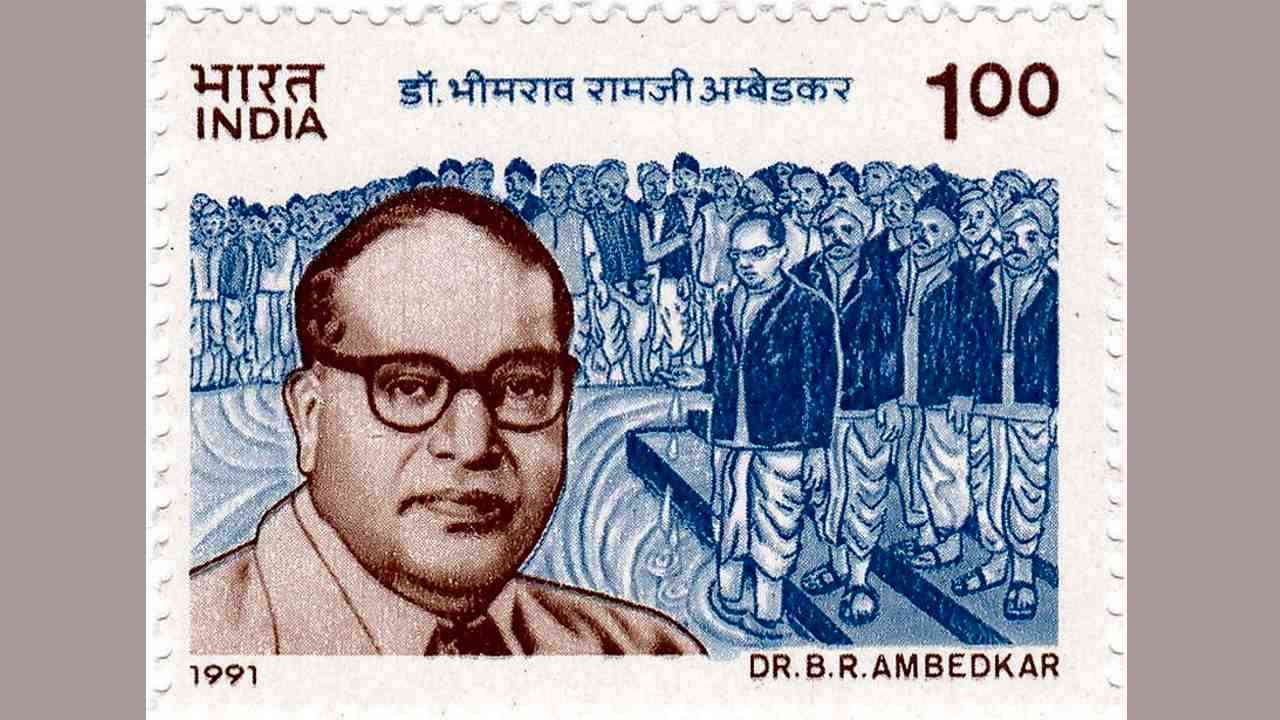
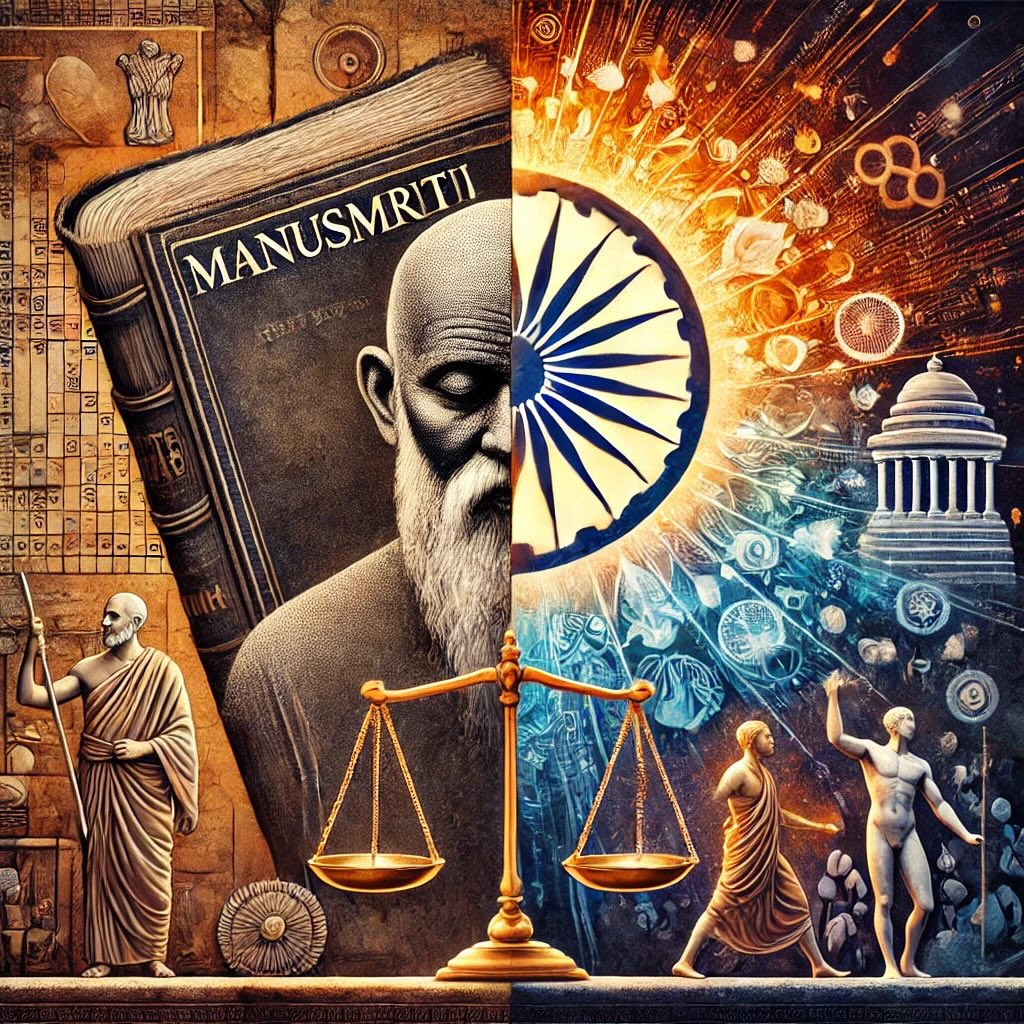
On 25 December 1927, in the small coastal town of Mahad in Maharashtra, Dr B.R. Ambedkar stood before a specially constructed pyre and set fire to a copy of the Manusmriti. It was not an act of rage. It was an act of civilisational critique — the most deliberate and consequential symbolic gesture in the history of India’s struggle for human dignity.
The Manusmriti — the Laws of Manu, composed between approximately 200 BCE and 200 CE — is a Dharmashastra, a text of social and legal prescription that codifies a system of human inequality so comprehensive and so absolute that it assigns worth, rights, duties, and punishments on the basis of birth alone. It is not a text that merely reflects the prejudices of its era. It is a text that systematises those prejudices into an architecture of oppression — and then claims divine sanction for it.
Its prescriptions are worth stating plainly, because the groups that invoke its authority today rarely quote them. A Shudra, the Manusmriti declares, is created to serve the three higher varnas. Even if emancipated by his master, he is not released from servitude, “since that is innate in him — who can set him free from it?” A Shudra who dares to recite the Vedas shall have hot molten lead poured into his ears. A Shudra who presumes to sit on the same seat as his superior shall be branded and banished.
On women, the text is equally explicit: “In childhood, a female must be protected by her father; in youth, by her husband; when her lord is dead, by her sons. A woman should never be independent.” Women and Shudras are grouped together in multiple passages — as categories of humanity requiring permanent supervision, incapable of autonomy, and unfit for learning.
The Manusmriti does not merely describe inequality. It prescribes it as sacred duty — ordained by creation, enforced by punishment, and justified by divine law. It is, by any ethical standard that takes human dignity seriously, a blasphemy against it.
These are not peripheral verses. They are the structural logic of the text. The Manusmriti does not merely describe inequality. It prescribes it as sacred duty — ordained by creation, enforced by punishment, and justified by divine law. It is, by any ethical standard that takes human dignity seriously, a blasphemy against it. This is what Ambedkar understood — and what he burned.
But Ambedkar did not stop at rejection. He built the answer. The Indian Constitution, which Ambedkar went on to draft as Chairman of the Drafting Committee and which was adopted on 26 January 1950, is the most comprehensive and systematic repudiation of the Manusmriti’s vision of human society that any civilisation has ever produced. Every foundational provision of the Constitution is the precise negation of a Manusmriti prescription.
Where the Manusmriti assigns human worth by birth, Article 14 guarantees equality before the law to every person. Where it prescribes differential punishment by caste, Article 15 prohibits discrimination on grounds of religion, race, caste, sex, or place of birth. Where it declares that a Shudra is created to serve, Article 17 abolishes untouchability in all its forms and makes its practice a punishable offence. Where it assigns women to perpetual dependency, Articles 15 and 16 guarantee equal rights and opportunities regardless of gender. Where it reserves learning for the upper castes, the Constitution establishes education as a fundamental right for all.
The Constitution does not merely reject caste. It replaces the entire ontological framework of the Manusmriti — the idea that human beings are born into fixed, divinely ordained hierarchies — with a radically different proposition: that sovereignty resides in the people, that every citizen carries equal dignity, and that the state exists to serve all of them without distinction. This is not merely a legal document. It is a civilisational achievement, and arguably the most important moral document India has ever produced — more consequential than any scripture, because it carries the binding force of law and the democratic legitimacy of a sovereign people’s collective commitment to one another.
Which brings us to the present. There are political forces in India today that invoke the Manusmriti — not always openly, but through the framework of social hierarchy and caste assertion it codifies — and regard the Constitution’s egalitarianism not as India’s greatest moral achievement but as an obstacle, an imposition of Western liberal values on an ancient civilisation. This argument must be met head-on, because it is both historically false and civilisationally dangerous.
The Constitution is as Indian as the Rigveda. It is more Indian than the Manusmriti, which codifies a hierarchy that India’s own deepest philosophical traditions — the Upanishadic teaching that the Atman is one in all beings, the Thirukkural’s insistence on a common human dignity, the Tamil Sangam’s declaration that every person is kin — explicitly reject.
First, the Constitution is not a Western import. It was drafted by an Indian — among the most intellectually formidable Indians of the 20th century — who drew not only on Western constitutional traditions but on the Buddhist principles of liberty, equality, and fraternity, on the Bhakti movement’s radical egalitarianism, and on his own lived experience as a Dalit denied water from a public well because of his birth. The Constitution is as Indian as the Rigveda. It is more Indian than the Manusmriti, which codifies a hierarchy that India’s own deepest philosophical traditions — the Upanishadic teaching that the Atman is one in all beings, the Thirukkural’s insistence on a common human dignity, the Tamil Sangam’s declaration that every person is kin — explicitly reject.
Second, to elevate the Manusmriti above the Constitution is not a defence of Hindu civilisation. It is its betrayal. Hindu civilisation at its greatest has always been characterised by philosophical openness and the recognition that truth cannot be confined to a single text. The Manusmriti is not the tradition. It is a single prescriptive text from a single period — and it is contradicted by the tradition’s own deepest currents.
Third — and this is the point that must be made most clearly — the Indian Constitution is the instrument through which India chose, as a sovereign people, to become something better than its worst historical inheritance. Every nation has texts and traditions that codify inequality. What distinguishes a civilisation is not the absence of such texts but the courage to repudiate them and the wisdom to build something better. Ambedkar gave India both: the courage to burn the Manusmriti, and the wisdom to write the Constitution.
The choice India faces today is the same one Ambedkar posed in 1927, and the same one the Constituent Assembly resolved in 1950: whether India’s social and political order will be governed by a text that assigns human worth by birth — or by a document that declares, with the full force of democratic sovereignty, that every Indian citizen is born equal, lives equal, and deserves equal dignity, opportunity, and protection under the law. That is not a political question. It is a civilisational one. And for those of us who believe in India’s civilisational greatness — in the Rigveda’s declaration that truth has many names, in the Thirukkural’s universalism, in the Sangam poet’s conviction that every person is kin — the answer is not in doubt.
The Constitution is not the enemy of Hindu civilisation. It is its finest modern expression.
Air Marshal M Matheswaran (Retd) is the Founder-President of The Peninsula Foundation (@TPF_Chennai), an independent policy research think tank in Chennai, grounded in the conviction that India’s civilisational greatness lies in its pluralism — and that the Indian Constitution is its most important institutional guarantee.
This essay is a companion to the third article in the prologue in the series ‘India’s Strategic Choices and Civilisational Responsibilities,’ published at thepeninsula.org.in.
Further Reading:
On the Manusmriti
Patrick Olivelle, Manu’s Code of Law: A Critical Edition and Translation of the Manava-Dharmasastra (Oxford University Press, 2005).
The authoritative modern critical edition and translation; source for all verse citations in this essay.
Wendy Doniger and Brian K. Smith, trans., The Laws of Manu (Penguin, 1991).
On Ambedkar and the Mahad Satyagraha
B.R. Ambedkar, Writings and Speeches, vols. 1–17 (Government of Maharashtra, 1979–2003).
Christophe Jaffrelot, Dr Ambedkar and Untouchability: Analysing and Fighting Caste (Hurst, 2005).
Eleanor Zelliot, Ambedkar’s World: The Making of Babasaheb and the Dalit Movement (Navayana, 2013).
On the Mahad Satyagraha and the Manusmriti burning of 25 December 1927.
On the Indian Constitution
Granville Austin, The Indian Constitution: Cornerstone of a Nation (Oxford University Press, 1966).
Granville Austin, Working a Democratic Constitution (Oxford University Press, 1999).
Rohit De, A People’s Constitution: The Everyday Life of Law in the Indian Republic (Princeton University Press, 2018).
On Ambedkar’s intellectual sources
B.R. Ambedkar, The Buddha and His Dhamma (1957; repr. Oxford University Press, 2011).
On the grounding of the Constitution’s egalitarian principles in Buddhist philosophy and the Bhakti tradition.
On Hindu philosophical pluralism
Rigveda, 1.164.46: Ekam Sat Vipra Bahudha Vadanti.
Series: India’s Strategic Choices, Civilisational Responsibilities, and the Contest for the Emerging World Order
This is the second of a three-part prologue to a series on India’s strategic choices, civilisational responsibilities, and the contest for the emerging world order.
Ideological Engine crafted with Religious Endorsement
In my previous post, I traced the material foundations of the current world order — the knowledge borrowed from the Islamic world, the wealth extracted from the Americas, two-thirds of humanity colonised and enslaved. It was the extraction, the enslavement, and the colonial architecture that built Western dominance. But material power alone does not sustain five centuries of global domination. It requires an ideological engine — a moral framework that converts extraction into mission, conquest into duty, and atrocity into the necessary price of civilisation. That engine was exceptionalism. And it was powered by religion.
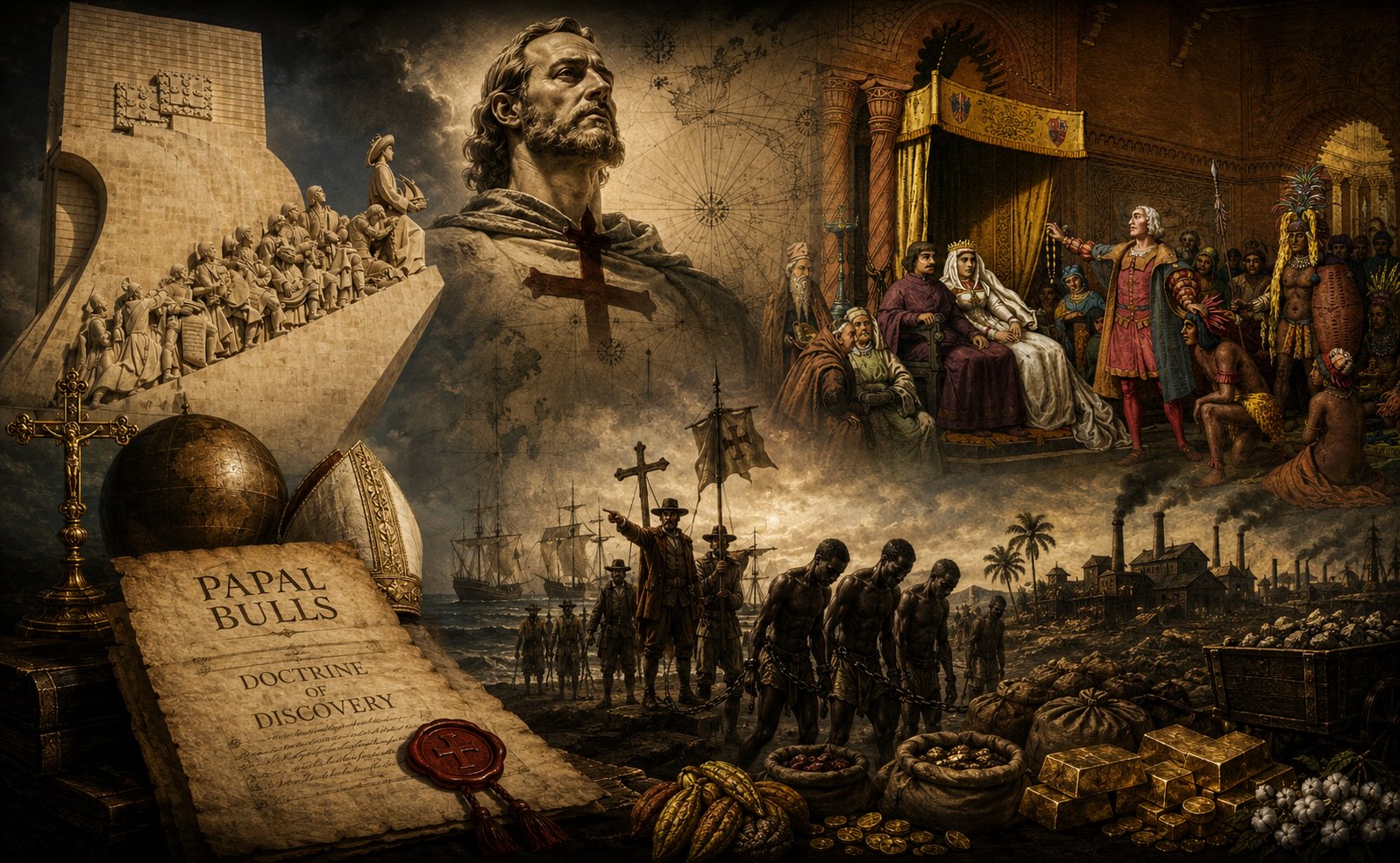
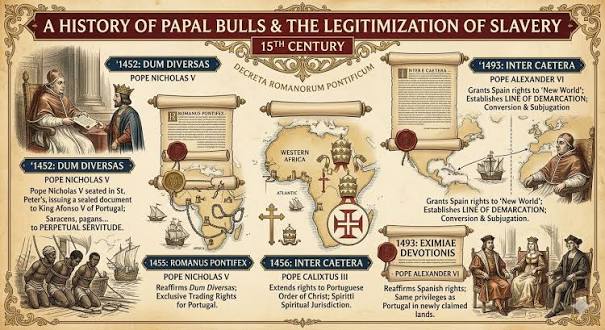
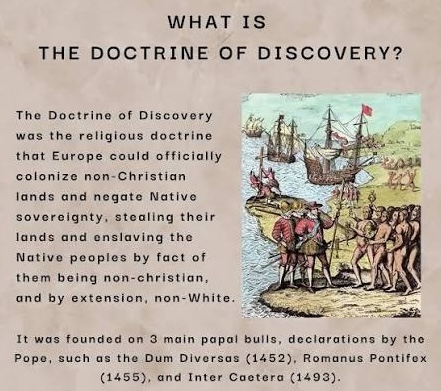
The mechanism was constructed with precision. In 1452, Pope Nicholas V issued the papal bull Dum Diversas, authorising the King of Portugal to “capture, vanquish, and subdue the Saracens, pagans, and any other unbelievers and enemies of Christ” and “reduce their persons to perpetual servitude.” Three years later, Romanus Pontifex extended this authority to conquer the lands of infidels for “the salvation of all”. In 1493, following Columbus’s return from the Americas, Pope Alexander VI issued Inter Caetera — the foundational document of the Doctrine of Discovery — declaring that any land not under Christian rule could be seized, its peoples subjugated, and its resources claimed, in the service of Christianising the world.
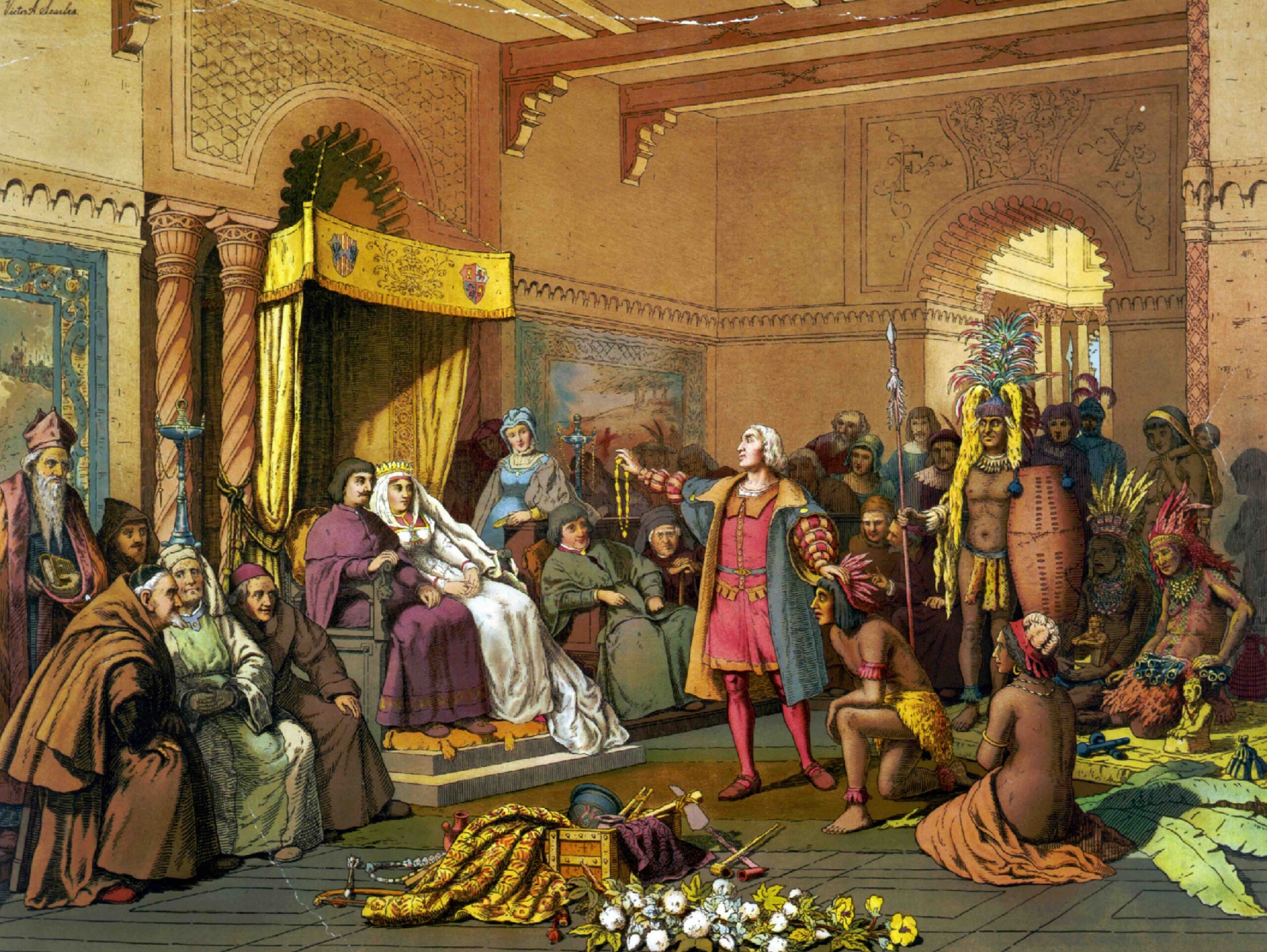
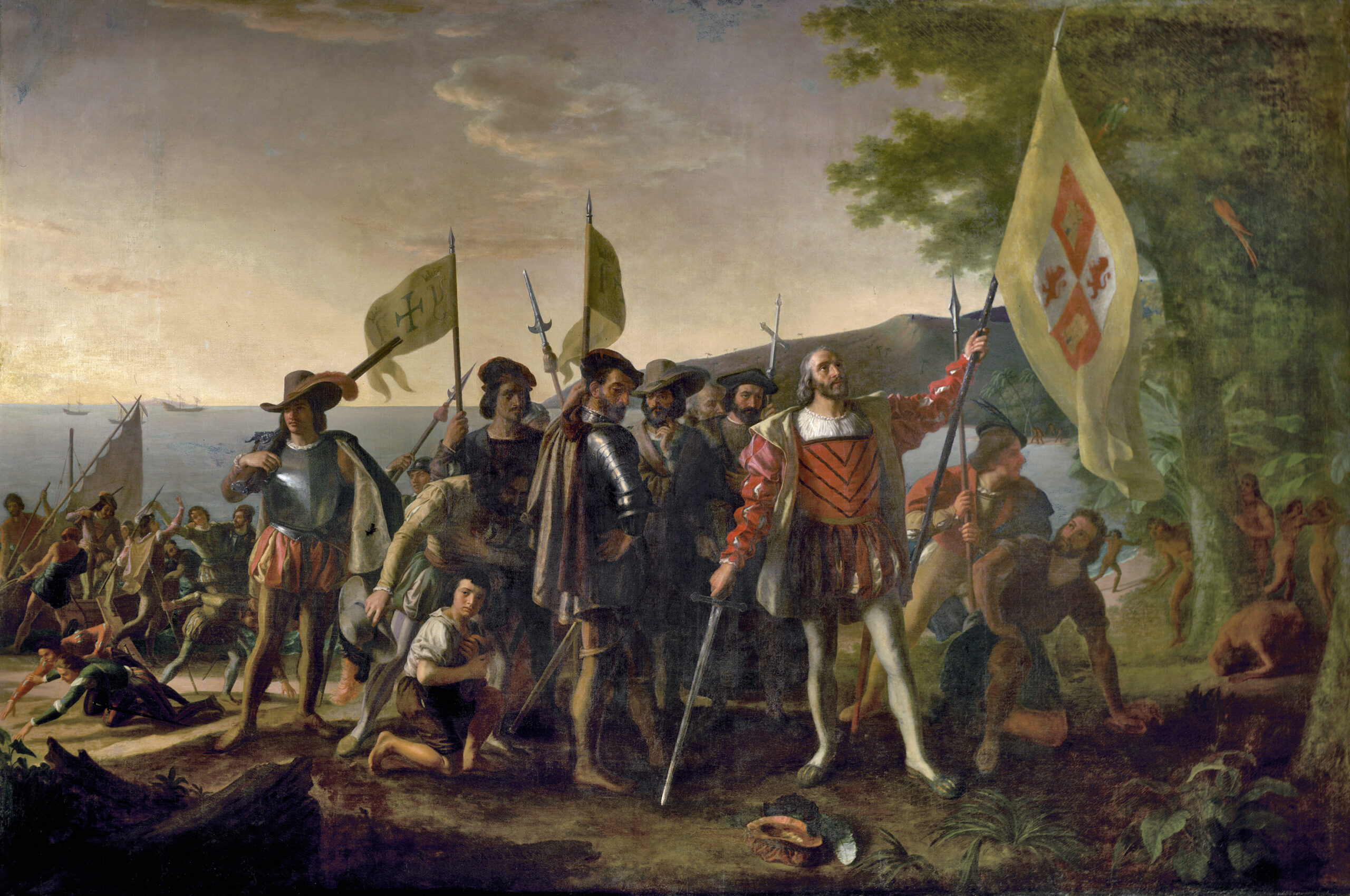
Columbus at the court of Barcelona. Christopher Columbus standing before the King and Queen of Spain, presenting Indians and treasures from the New World, 1493. (Newscom TagID: whphotos146159.jpg) [Photo via Newscom]
These were not peripheral theological documents. They were the legal and moral architecture of the colonial project, establishing in explicit terms sanctioned by the highest religious authority in the Western world that non-Christians were less than human, that killing them was not a sin, and that converting or enslaving them was a sacred duty. The Doctrine of Discovery was subsequently incorporated into the legal systems of the United States, Canada, Australia, and other settler-colonial states, where it shaped land law, property rights, and indigenous dispossession for centuries. The Vatican formally repudiated the Doctrine of Discovery only in 2023 — more than five centuries after the damage was done.
And here is what makes that repudiation hollow: the doctrine did not stay in the fifteenth century. It became the operating law of the settler-colonial states, and it remains so.
In 1823, the United States Supreme Court, in Johnson v. McIntosh, formally incorporated the Doctrine of Discovery into American law. Chief Justice John Marshall ruled that Indigenous peoples did not own their lands once those lands had been “discovered” by Christian colonists — that discovery itself conferred title on the discovering Christian nation, reducing the original inhabitants to mere occupants on their own soil. Marshall himself conceded the principle was “extravagant.” He made it law regardless. It has never been overturned. Two centuries later, it remains the foundation of all federal Indian law in the United States.
Plenary power — plenitudo potestatis, the fullness of power — is the exact phrase by which the fifteenth-century popes claimed the authority to authorise conquest and enslavement in the first place.
The living force of this doctrine was demonstrated in 2023 — the very year of the Vatican’s repudiation. In Haaland v. Brackeen, the US Supreme Court affirmed the modern form of the doctrine: the “plenary power” of the federal government over Native peoples. The term is not incidental. Plenary power — plenitudo potestatis, the fullness of power — is the exact phrase by which the fifteenth-century Popes claimed the authority to authorise conquest and enslavement in the first place. The Vatican renounced the doctrine in March 2023. Three months later, in June, the highest court of the United States reaffirmed its modern expression as settled law. One institution let go of the fiction. The other continued to build on it.
Terra Nullius and the Concepts of Exceptionalism and Manifest Destiny
The pattern is not confined to the Americas. In Australia, the entire continent was claimed under the doctrine of terra nullius — the legal fiction that the land belonged to no one, that sixty thousand years of continuous Aboriginal civilisation and hundreds of distinct nations simply did not count as habitation. The Australian Constitution, when it came into force in 1901, contained Section 127, which declared that “in reckoning the numbers of the people of the Commonwealth, aboriginal natives shall not be counted.” The original inhabitants of the continent were constitutionally excluded from the population of their own country. That exclusion was not removed until a referendum in 1967. The fiction of terra nullius itself was not overturned until the High Court’s Mabo judgment in 1992 — one hundred and ninety-two years after colonisation began.
The Doctrine of Discovery is not a historical curiosity to be studied and regretted. It is the living legal architecture on which the settler-colonial states were built, and on which — as the events of 2023 demonstrate — they continue to stand. The exceptionalism that authorised conquest in 1452 was not repented and abandoned. It was secularised, constitutionalised, and preserved.
This is the point that must be understood clearly. The Doctrine of Discovery is not a historical curiosity to be studied and regretted. It is the living legal architecture on which the settler-colonial states were built, and on which — as the events of 2023 demonstrate — they continue to stand. The exceptionalism that authorised conquest in 1452 was not repented and abandoned. It was secularised, constitutionalised, and preserved.
This is not a distortion of Christianity. It is the documented institutional expression of a specific tradition within it: the doctrine that one’s own community occupies a uniquely chosen position in the divine order — that the Other is not merely different but lesser, and that this difference legitimates domination.
The same logic operated, in different institutional forms, across other traditions. The conquering caliphates that used the concept of jihad to justify forced conversion were not the whole of Islamic tradition, which contains rich pluralist and humanistic streams. They were the weaponisation of religious exceptionalism by those who held political and military power. Political Zionism, in its most extreme contemporary expressions, follows the same pattern: the theological claim to exclusive divine right over territory and the dehumanisation of non-Jewish populations, ruthlessly visible from the Nakba in 1947-48 to the present conduct of the Gaza war, in full view of the world and with endorsement by the West. It follows the same pattern: religious exceptionalism converted into political licence for dispossession and violence.
The pattern is not one religion. It is a specific logic — the claim to divine chosenness that exempts a community from the moral constraints that apply to others – that has been institutionalised, at different moments and in different traditions, wherever political power has found it useful.
In Western civilisation, this logic found its most durable and consequential expression in American exceptionalism. In 1630, Puritan leader John Winthrop, preparing to establish the Massachusetts Bay Colony, called for the creation of a community that would be “as a City upon a Hill, the eyes of all people upon us.” This was not yet a global claim. It was a theological self-conception: a chosen people, on a divinely appointed errand, under special divine scrutiny. But the seed was planted. Two centuries later, in 1845, John L. O’Sullivan gave it political form: “our manifest destiny to overspread the continent allotted by Providence for the free development of our yearly multiplying millions.” God-given expansion across a continent — regardless of the peoples already living on it — was reframed as destiny, not conquest.
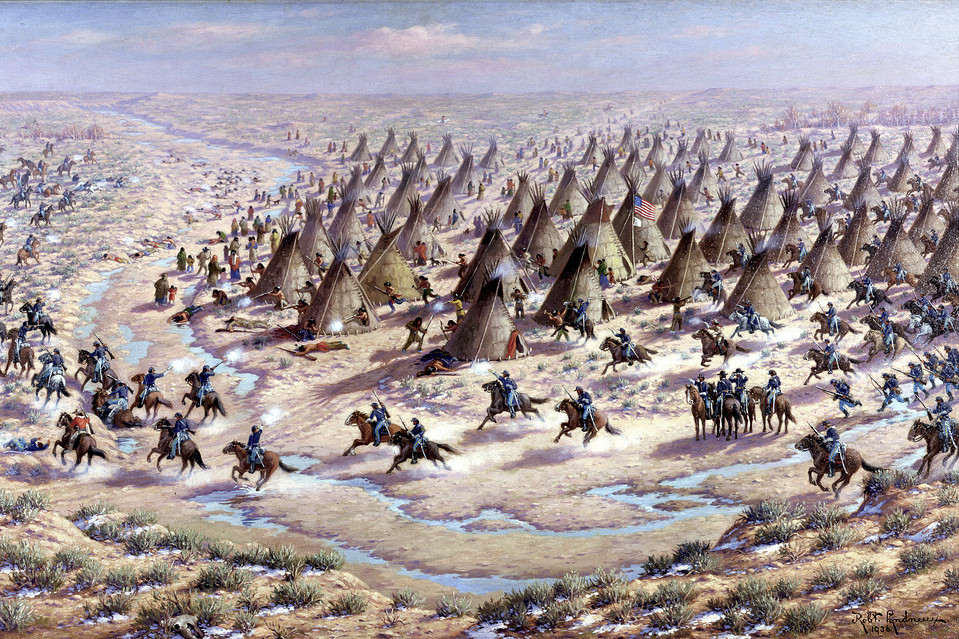
The indigenous peoples of North America experienced what that destiny meant in practice. At Sand Creek in November 1864, a Colorado militia under Colonel John Chivington attacked a Cheyenne and Arapaho village whose chief, Black Kettle, was flying both an American flag and a white flag of truce. Roughly 150 people were killed, the majority of them women, children, and the elderly; the soldiers mutilated the dead and paraded body parts through the streets of Denver. Three separate investigations — two congressional, one military — condemned it as a massacre. Not one man was ever indicted. The campaigns that defined the conquest of the West — villages destroyed, food supplies burned, non-combatants killed as a matter of strategy — were not the excesses of rogue commanders. They were the method.
And the men who carried them out were not disgraced but memorialised. George Armstrong Custer, who at dawn on the Washita River in 1868 attacked the village of that same Black Kettle, who had survived Sand Creek and was again seeking peace, killed him and his wife in the assault, while his aggressive forces killed a large number of unarmed women and children. Custer was mythologised into a national hero, his death at the Little Bighorn recast as a noble sacrifice. This is exceptionalism completing its work: not merely committing the atrocity, but converting it, in the national memory, into valour. The conversion of conquest into heroism is not a distortion of the exceptionalist project. It is the project.
It is worth pausing to see precisely how this engine is built, because it reveals something the comfortable version of history conceals. There are two broad models of colonialism, and they are not the same. Extractive colonialism — the Spanish in Peru, the British in India — needs the colonised population alive: to mine the silver, to work the plantations, to pay the taxes. It subjugates.
But settler colonialism, of the kind practised in North America and Australia, does not primarily want the people. It wants the land. And a population that comes to stay on land already inhabited requires something darker than subjugation: it requires removal. The historian Patrick Wolfe named this the ‘logic of elimination’ — the observation that in the settler-colonial project, invasion is not an event but a structure, and the indigenous inhabitant is not a labour force to be exploited but an obstacle to be cleared. This is why the settler variant needed its ideological engine to run at maximum power. To subjugate a people, you need only believe they are lesser. To eliminate them, you must first erase them — conceptually, legally, theologically — before you erase them in fact. Terra nullius, the empty land; the savage without real title; the wilderness awaiting God’s chosen — these were not decorative rhetoric. They were the necessary vocabulary of replacement.
A society that never hears the moral objection is merely benighted. A society that hears it clearly, debates it in its legislature, affirms it in its highest court — and proceeds anyway, in the name of Providence — has not failed to find its conscience. It has chosen to override it. That is what the ideological engine is for: not to fill a silence where conscience is absent, but to drown out a conscience that is present.
And here is the fact that removes every excuse: the conscience was present. It was not that no one knew, or that no one objected. Roger Williams argued in the 1630s that the Crown had no right to grant land it did not own, that it had to be purchased from its actual inhabitants — and he was banished for saying so. The Quaker John Woolman condemned the dispossession on moral grounds a century before it reached the Mississippi. When the Indian Removal Act came before the United States Congress in 1830, it passed by 102 votes to 97 — a bitter, closely fought debate, not a silent consensus. When the Cherokee took their case to the Supreme Court, Chief Justice John Marshall ruled in Worcester v. Georgia that they possessed sovereign rights the state was bound to respect. President Andrew Jackson ignored the ruling and carried out the removal regardless; on the Trail of Tears that followed, thousands died. This is the point that must be held onto. A society that never hears the moral objection is merely benighted. A society that hears it clearly, debates it in its legislature, affirms it in its highest court — and proceeds anyway, in the name of Providence — has not failed to find its conscience. It has chosen to override it. That is what the ideological engine is for: not to fill a silence where conscience is absent, but to drown out a conscience that is present.
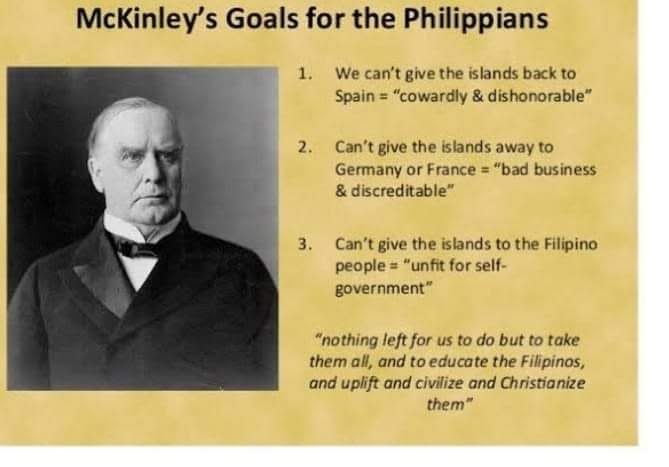
The same logic was exported globally. In 1898, the United States entered the Spanish-American War, having suggested to Filipino independence fighters that it was their ally against Spanish colonial rule. When Spain was defeated, the Philippines was not given its independence. It was purchased for twenty million dollars and then colonised. The Philippine-American War resulted in the deaths of over 20,000 Filipino combatants and as many as 200,000 Filipino civilians through violence, famine, and disease. McKinley called his policy “Benevolent Assimilation.” The Philippines did not receive full independence until 1946 — forty-eight years after the liberation that was promised.
This is the pattern that repeats from Vietnam to Iraq to Afghanistan to Iran: intervention justified as liberation, freedom invoked to mask extraction, and sovereignty violated in the name of the values that sovereignty was supposed to protect.
The Civilisational Alternative
Now consider the contrast. India, China, and Persia are rooted in civilisational traditions that are fundamentally pluralist in their relationship to truth and the divine. Hinduism, Buddhism, Jainism, and Zoroastrianism do not claim exclusive possession of truth. They understand the search for ultimate reality as a path that admits multiple valid routes — that the divine is too vast and complex for any single tradition to comprehend fully. This epistemological humility produces a fundamentally different relationship to the Other: not as a lesser being to be converted or eliminated, but as a fellow traveller on a different path through the same reality — or, in the Tamil saint Vallalar’s image, rivers of many names flowing to a single shoreless ocean.
A tradition whose foundational claim is Ekam Sat Vipra Bahudha Vadanti — truth is one, the wise call it by many names — or the Jain Anekantavada, the many-sidedness of truth, or the Tamil Yaadhum Oorey-Yaavarum Kelir, that every place is home and every person kin, is structurally resistant to exceptionalism, because its highest ideal explicitly denies the premise exceptionalism requires: that a single community owns the truth and stands chosen above the rest.
The distinction I am drawing must be stated carefully, because it is easy to misread as a claim that one civilisation is virtuous and another is wicked. That is not the claim, and it would be false. The impulse to dress conquest in sacred language is close to universal — it appears wherever power seeks to launder its crimes, and no civilisation, India’s included, is innocent of it. Ashoka built his empire by the sword before he turned to the dharma. India’s own caste hierarchy was given cosmic sanction, as I have argued elsewhere in examining the Manusmriti. The human capacity to summon the transcendent in defence of the indefensible is not the property of any one people. What differs is not the impulse to justify but what each tradition installs as its highest principle — and therefore what any justification of atrocity must first overcome. A tradition whose foundational claim is Ekam Sat Vipra Bahudha Vadanti — truth is one, the wise call it by many names — or the Jain Anekantavada, the many-sidedness of truth, or the Tamil Yaadhum Oorey-Yaavarum Kelir, that every place is home and every person kin, is structurally resistant to exceptionalism, because its highest ideal explicitly denies the premise exceptionalism requires: that a single community owns the truth and stands chosen above the rest.
One can still commit atrocity within such a tradition — humans always can — but one cannot easily make the tradition’s own highest principle bless it. A covenantal structure built on a chosen people, an exclusive truth, and a promised land contains that raw material at its theological core. It does not compel atrocity, and most who inherit it are decent people who read it toward mercy — the abolitionists and Roger Williams drew on it too. But the doctrine of chosenness is available to be weaponised in a way that Ekam Sat structurally is not. That is the civilisational difference that matters: not that one people is depraved and another pure, but that traditions differ in whether their deepest ideal resists the engine of exceptionalism or supplies its fuel.
Scholarly analysis consistently describes India’s conduct as just war traditions with no ulterior motive of imperialism or fiscal interest. There is no comparable example in the modern history of any Western military power.
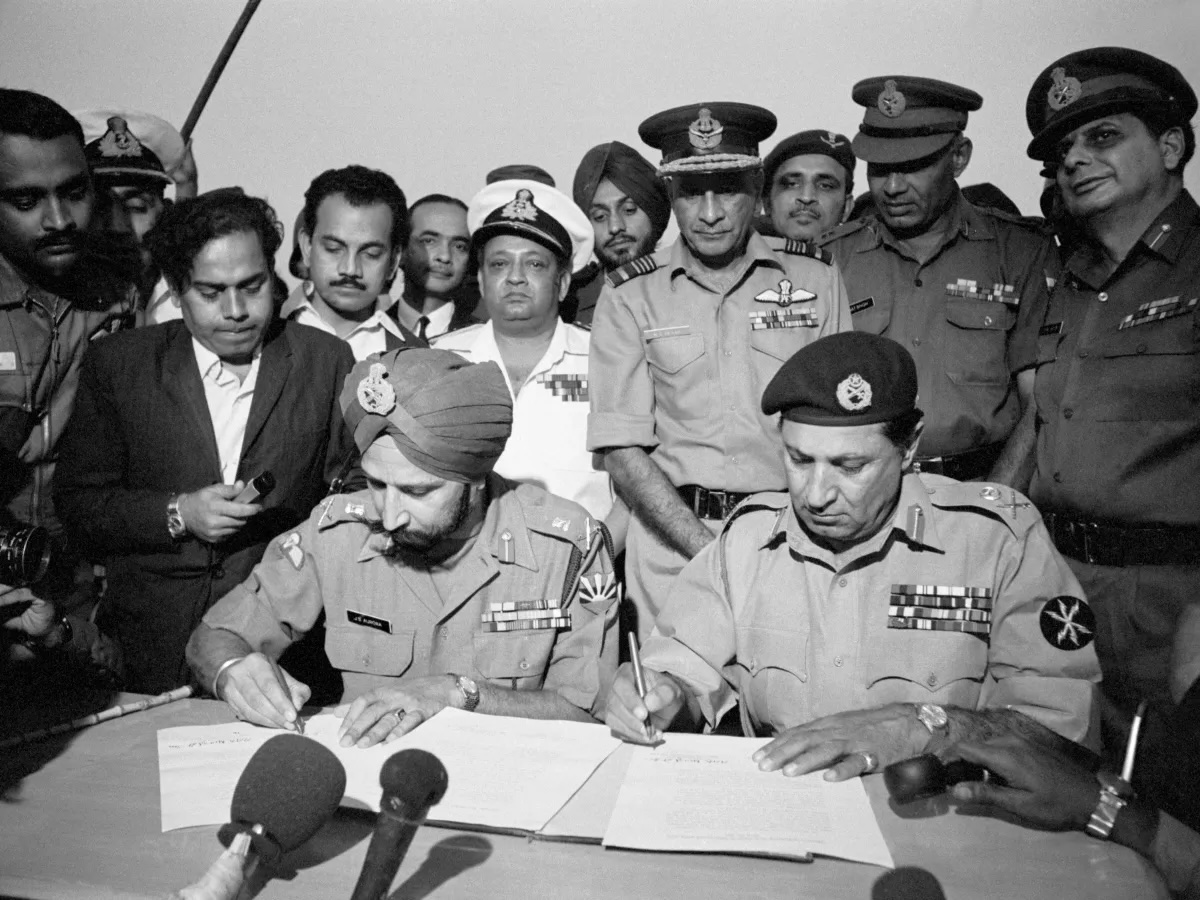
This civilisational disposition is not merely philosophical. It expresses itself in conduct. In December 1971, India made the decision to intervene militarily in East Pakistan in response to one of the most egregious humanitarian catastrophes of the 20th century — the Bangladesh genocide. The intervention was swift and decisive. Indian military forces liberated Bangladesh in thirteen days of formal war. Pakistani forces surrendered on December 16, 1971. The Indian military then withdrew completely. No occupation. No extraction. No installation of a client government. No strategic bases retained. Full sovereignty was transferred immediately to the people of Bangladesh. India returned over 90,000 Pakistani prisoners of war through the Simla Agreement. Scholarly analysis consistently describes India’s conduct as just war traditions with no ulterior motive of imperialism or fiscal interest. There is no comparable example in the modern history of any Western military power.
These are not coincidental differences. They are civilisational ones. The world is now in contest over what the emerging order will be built upon. The declining Western order was built on exceptionalism — the claim to divine chosenness that converts domination into duty, secularised into legal doctrine but never abandoned. The Asian civilisational alternative — pluralist, non-exclusivist, epistemologically humble — offers a different foundation. India’s 1971 conduct is the most precise proof available that this alternative is not merely philosophical. It has been demonstrated operationally.
The question is whether India — in Gaza, in Iran, in the institutions of the emerging world order — is willing to act consistently with the civilisational tradition it inherits.
— This is the second in the series prologue.
Air Marshal M Matheswaran (Retd) is the Founder-President of The Peninsula Foundation (@TPF_Chennai), grounded in the conviction that power without ethics is tyranny — and that India’s civilisational traditions offer the world something Western exceptionalism cannot.
Further Reading:
On the Doctrine of Discovery and the Papal Bulls
Pope Nicholas V, Dum Diversas, 18 June 1452. Full Latin text and English translation: Doctrine of Discovery Project, doctrineofdiscovery.org.
Pope Nicholas V, Romanus Pontifex, 8 January 1455.
Pope Alexander VI, Inter Caetera, 4 May 1493.
Robert J. Miller, Jacinta Ruru, Larissa Behrendt, and Tracey Lindberg, Discovering Indigenous Lands: The Doctrine of Discovery in the English Colonies (Oxford University Press, 2010).
Steven T. Newcomb, Pagans in the Promised Land: Decoding the Doctrine of Christian Discovery (Fulcrum, 2008).
On the Vatican’s 2023 repudiation
Dicastery for Culture and Education and Dicastery for Promoting Integral Human Development, ‘Joint Statement on the Doctrine of Discovery,’ Vatican, 30 March 2023.
On the incorporation and persistence of the Doctrine of Discovery in US law
Johnson v. McIntosh, 21 U.S. (8 Wheat.) 543 (1823).
Haaland v. Brackeen, 599 U.S. 255 (2023).
On the affirmation of ‘plenary power’ over Native peoples as the modern descendant of the Doctrine of Discovery, see the analysis by Peter d’Errico and the essays in the ‘200 Years of Johnson v. M’Intosh’ series, Canopy Forum, 2023.
Robert J. Miller, ‘The Doctrine of Discovery in American Indian Law,’ Idaho Law Review, 42 (2005).
Lindsay G. Robertson, Conquest by Law: How the Discovery of America Dispossessed Indigenous Peoples of Their Lands (Oxford University Press, 2005).
On Australia, terra nullius, and constitutional exclusion
Mabo v. Queensland (No. 2) (1992) 175 CLR 1.
Section 127, Constitution of Australia (repealed by referendum, 1967).
Henry Reynolds, The Law of the Land (Penguin, 1987).
Bain Attwood, Rights for Aborigines (Allen & Unwin, 2003).
On Section 127 and the 1967 referendum: National Museum of Australia, ‘Indigenous Referendum,’ and George Williams’ analysis of the ‘race power’ in Australia’s constitutional history.
On American exceptionalism — Puritan origins and Manifest Destiny
John Winthrop, ‘A Modell of Christian Charity’ (1630).
John L. O’Sullivan, ‘Annexation,’ The United States Magazine and Democratic Review, 17(1), July–August 1845.
Anders Stephanson, Manifest Destiny: American Expansion and the Empire of Right (Hill and Wang, 1995).
Hilde Eliassen Restad, American Exceptionalism: An Idea That Made a Nation and Remade the World (Routledge, 2014).
On the Sand Creek Massacre and the conquest of the Plains
U.S. Congress, Joint Committee on the Conduct of the War, Massacre of the Cheyenne Indians (38th Congress, 2nd Session, 1865).
The contemporary Congressional investigation that condemned the massacre; the primary documentary record.
Ari Kelman, A Misplaced Massacre: Struggling over the Memory of Sand Creek (Harvard University Press, 2013).
Dee Brown, Bury My Heart at Wounded Knee: An Indian History of the American West (Holt, Rinehart & Winston, 1970).
On the Washita (1868), the killing of Black Kettle, and the pattern of village attacks; also on the mythologisation of George Armstrong Custer.
Nathaniel Philbrick, The Last Stand: Custer, Sitting Bull, and the Battle of the Little Bighorn (Viking, 2010).
On the Philippines, 1898–1946
Stanley Karnow, In Our Image: America’s Empire in the Philippines (Random House, 1989).
Paul A. Kramer, The Blood of Government: Race, Empire, the United States, and the Philippines (University of North Carolina Press, 2006).
On India’s 1971 Bangladesh liberation
Srinath Raghavan, 1971: A Global History of the Creation of Bangladesh (Harvard University Press, 2013).
Gary J. Bass, The Blood Telegram: Nixon, Kissinger, and a Forgotten Genocide (Knopf, 2013).
On Asian civilisational pluralism
Amartya Sen, The Argumentative Indian: Writings on Indian History, Culture and Identity (Penguin, 2005).
Wendy Doniger, The Hindus: An Alternative History (Penguin, 2009).
This is the first in a series on India’s strategic choices, civilisational responsibilities, and the contest for the emerging world order.
The Material Foundations of Western Power
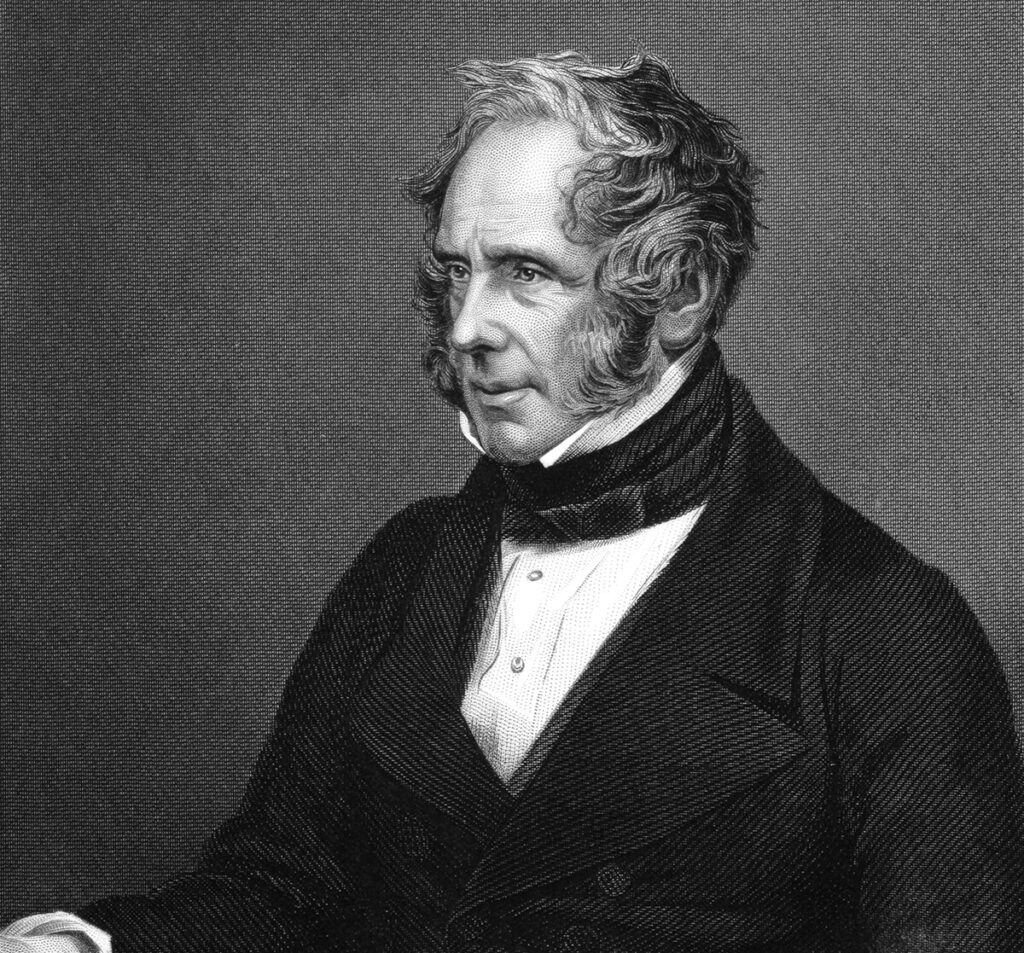
The world of strategists is familiar with the quote of Lord Palmerston, Britain’s nineteenth-century Prime Minister. He famously declared: “There are no permanent friends or enemies, only permanent interests.”
Lord Palmerston
As a description of statecraft, this is not wrong. Every civilisation that has endured has pursued its interests — including the ones this series will spend considerable space defending. Kautilya’s Rajamandala is, at its core, a theory of interest-based alignment. The Cholas sailed across the Bay of Bengal to protect Tamil trading interests. No serious tradition of statecraft has ever pretended that interest does not matter, and none should.
The question worth asking is not whether interests are permanent. It is whether anything else is.
Palmerston’s formulation, taken as a complete theory of how a state should conduct itself — not as one true observation among several, but as the only thing that needs ever to be consulted — becomes something different. It becomes a licence. If interest is permanent and nothing else is, then ethical limits on how interest is pursued are, by definition, temporary: honoured when convenient, discarded when not. That is not realism. That is realism with the safety catch removed.
This is the civilisational fork in the road, and four hundred years of history show which branch the dominant powers took — and still take.
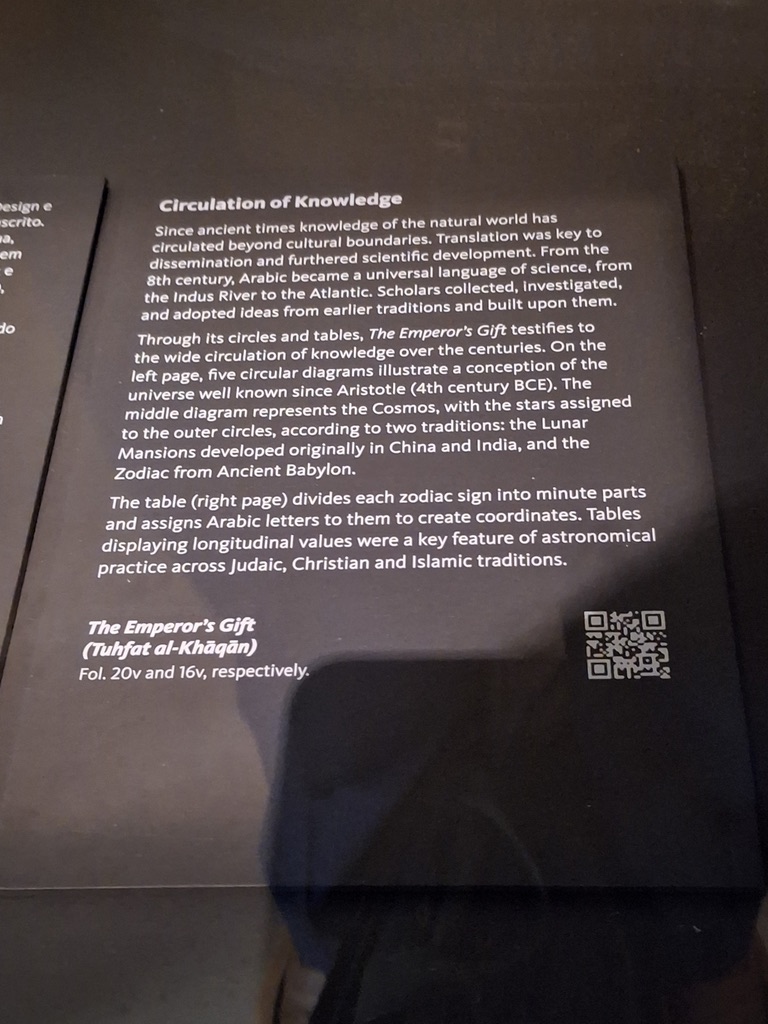
The Islamic Golden Age — spanning roughly the 8th to the 14th century — was one of the greatest intellectual achievements in human history. Scholars at Baghdad’s House of Wisdom undertook a systematic, state-sponsored project of translation and synthesis: gathering the accumulated knowledge of Greece, Persia, India, and China, translating it into Arabic, and building upon it with original contributions in mathematics, astronomy, medicine, philosophy, optics, and chemistry. Avicenna’s Canon of Medicine became a foundational text in European universities. Averroes’ commentaries on Aristotle shaped medieval European philosophy.
Exhibit in Gulbenkian Museum, Lisbon – Photo by Author
Europe in the early medieval period was not the centre of the world. It was its periphery — impoverished, fragmented, and in the grip of what its own historians call the Dark Ages. While Europe’s literacy rates collapsed and theological conformity suppressed inquiry, something extraordinary was unfolding in Baghdad, Cordoba, and Cairo. The Islamic Golden Age — spanning roughly the 8th to the 14th century — was one of the greatest intellectual achievements in human history. Scholars at Baghdad’s House of Wisdom undertook a systematic, state-sponsored project of translation and synthesis: gathering the accumulated knowledge of Greece, Persia, India, and China, translating it into Arabic, and building upon it with original contributions in mathematics, astronomy, medicine, philosophy, optics, and chemistry. Avicenna’s Canon of Medicine became a foundational text in European universities. Averroes’ commentaries on Aristotle shaped medieval European philosophy. The numeral system through which all modern mathematics operates — including the zero — came to Europe through the Arabic transmission of Indian mathematics. This was not borrowing. It was the rescue and synthesis of civilisational knowledge — and without it, the European Renaissance would have had no foundation on which to build.
The numeral system through which all modern mathematics operates — including the zero — came to Europe through the Arabic transmission of Indian mathematics. This was not borrowing. It was the rescue and synthesis of civilisational knowledge — and without it, the European Renaissance would have had no foundation on which to build.
Europe’s intellectual reawakening in the 14th and 15th centuries drew directly on this Islamic transmission. The Renaissance, together with the gunpowder revolution and the state system formalised at the Peace of Westphalia in 1648, gave European civilisation (viewing it as a single civilisation may not be truly appropriate – disparate kingdoms, fused by the race for maritime trade dominance and military conquest – Italian, Spanish, Portuguese, Dutch, French, British, Russian, etc.) something it had never possessed before: military-technological superiority, organised state power, and the bureaucratic capacity to project both across the world.
This wealth — extracted through conquest, forced indigenous labour, and the systematic destruction of existing civilisations — capitalised the European empires that would go on to colonise two-thirds of the world
Columbus – Truth vs Myth
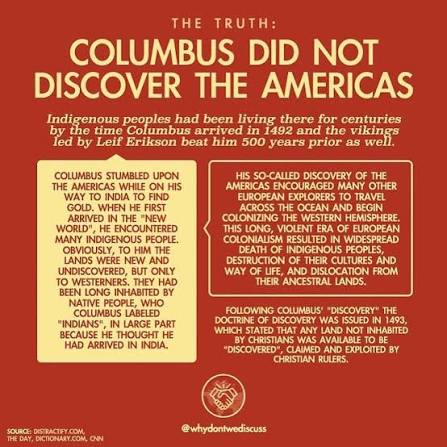
The rise of the West that followed the maritime route discoveries of Columbus and Vasco da Gama needs to be understood correctly, devoid of the myths built around them. The West celebrates them, but the truth is they were plunderers who unleashed the genocidal expansion of the West. This truth is now being brought out by brilliant and unbiased historians such as Howard Zinn and Utsa Patnaik. Howard Zinn writes – ” what Columbus did to the Arawaks of the Bahamas, Cortés did to the Aztecs of Mexico, Pizarro to the Incas of Peru, and the English settlers of Virginia and Massachusetts to the Powhatans and the Pequots. They used the same tactics, and for the same reasons – the frenzy in the early capitalist states of Europe for gold, for slaves, for products of the soil, to pay for the bondholders and stockholders of the expeditions, to finance the monarchical bureaucracies rising in Western Europe, to spur the growth of the new money economy rising out of feudalism…These were the violent beginnings of an intricate system of technology, business, politics, and culture that would dominate the world for the next five centuries.”
What followed was not a story of civilisational achievement. It was a story of extraction on a scale without precedent in human history — extraction conducted on the understanding that, once interest was engaged, nothing else needed to be weighed. From the Americas alone, Spanish colonial mining operations extracted approximately 150,000 metric tonnes of silver between 1500 and 1800 — representing 80 to 90 per cent of global silver production over three centuries. By 1600, 25,000 tonnes of silver had crossed the Atlantic. This wealth — extracted through conquest, forced indigenous labour, and the systematic destruction of existing civilisations — capitalised the European empires that would go on to colonise two-thirds of the world. The Atlantic slave trade transported an estimated twelve to fifteen million Africans into forced labour over three centuries.
The British were ruthless in pursuing their interests at the expense of the people and the geography of their colonial empire, particularly in India. The economy under the British Raj was not a system of governance or development – it was a system of systematic wealth extraction unprecedented in scale and duration. From 1765 (when Robert Clive obtained the Diwani Rights, that is, the right to collect taxes and revenue, from the Mughal emperor as a result of the Battle of Buxar) to 1947 – 182 years – Britain drained India’s wealth through every possible mechanism. The scale of this drain was staggering. Britain extracted the equivalent of about $45 trillion (in current dollar terms) from India during its colonial rule. This wasn’t accidental impoverishment or the natural result of economic evolution. This was deliberate policy, implemented systematically through revenue extraction, deindustrialisation, trade manipulation, and infrastructural control.
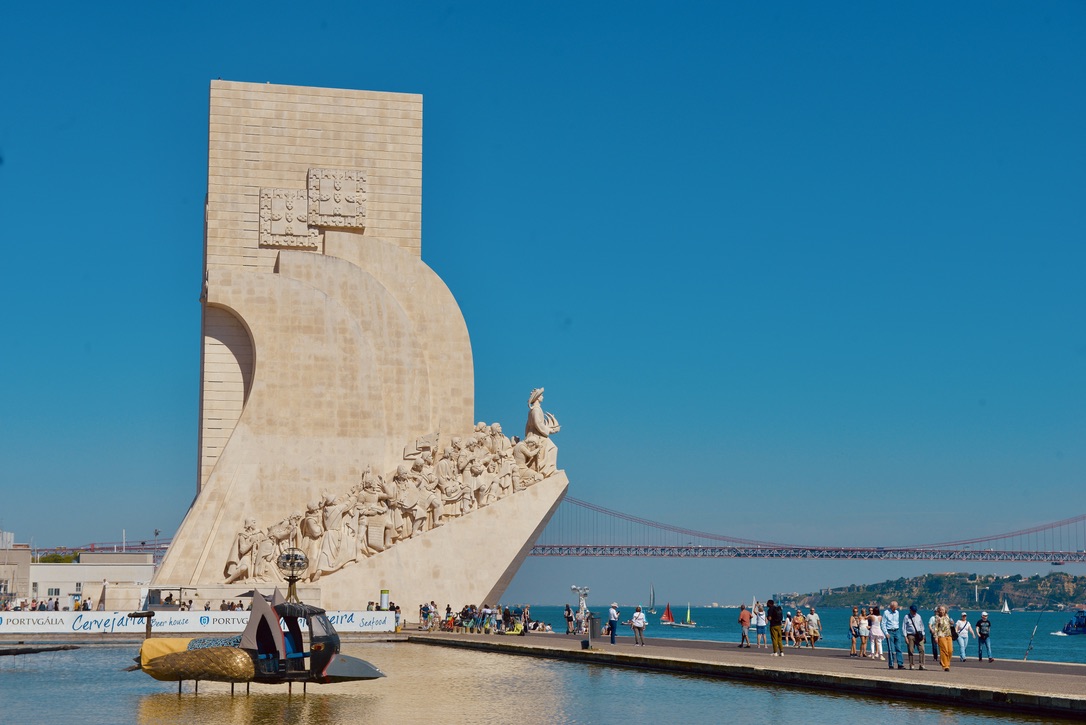
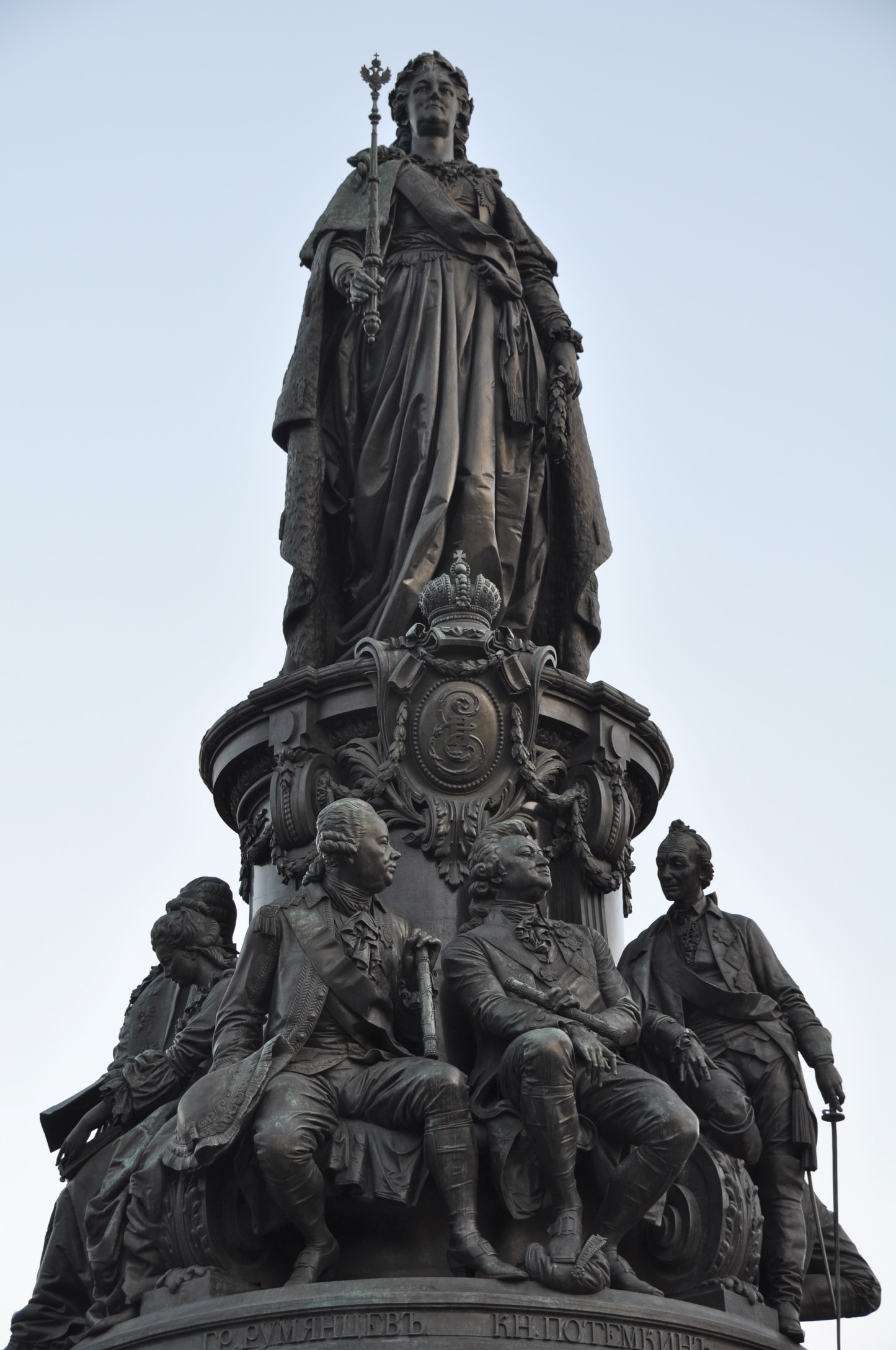
500-year Commemoration of Vasco-da-Gama’s voyage to India -Lisbon – defining moments of colonialism. Photo by AuthorThe Russian empire was equally consumed by Western Europe’s passion for colonies. Catherine the Great, Russian Empress and originally a German princess, was a ruthless expansionist of the Russian Empire. However, Russia differed significantly from Western colonialism. Catherine the Great’s Statue in St. Petersburg. Photo by Author.
None of this was an aberration from Western values. It was the expression of them. Palmerston’s formulation was not a description of how all states behave. It was a justification for a specific civilisational approach: that power exists to be exercised without ethical constraint, that the strong may do what they will, and that the legitimating language of civilisation, Christianity, and later human rights, are instruments of justification rather than a genuine limits on conduct.
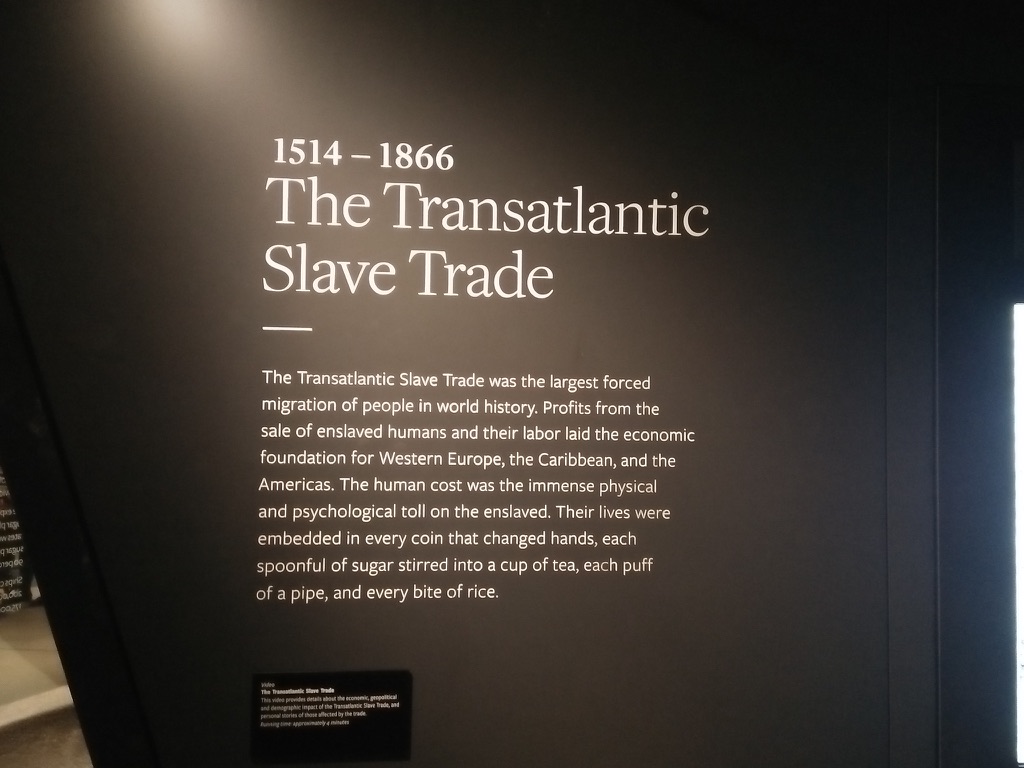
Slavery was the most crucial contributor to the West’s development. This was a critical element of the transatlantic world. exhibit in the African American Museum, Washington, D.C. Photo by Author.
The Berlin Conference of 1884–85 is its most clinical illustration. Otto von Bismarck convened the European powers to divide Africa between them. Not a single African leader was present. A request by the Sultan of Zanzibar to attend was dismissed. The Congo basin — a territory larger than Western Europe, home to millions of people with ancient civilisations, cultures, and governance systems — was assigned as the personal property of Belgian King Leopold II, one of the vilest European monarchs in human history. In the years that followed, hundreds of thousands of Congolese were worked to death on rubber plantations. Those who failed their quotas had their hands amputated. Leopold accumulated one of the largest personal fortunes in history from the proceeds.
This was not an exceptional act of cruelty. It was Palmerston’s formulation taken to its logical and undiluted conclusion.
Whatever the merits claimed for each individually, taken together they represent the same formula: interest declared permanent, leading to the ruthless pursuit of national interests; ethical limits declared situational, that is, practically irrelevant.
The pattern did not end with empire. It changed vocabulary. The wars launched and led by the United States since 2001 — in Afghanistan, Iraq, Libya, Syria and beyond — were conducted in the language of security, liberation, and the defence of human rights. By the most careful independent estimates, their costs have run into the hundreds of thousands of civilian lives, and their stated justifications have repeatedly diverged from their actual outcomes. Whatever the merits claimed for each individually, taken together they represent the same formula: interest declared permanent, leading to the ruthless pursuit of national interests; ethical limits declared situational, that is, practically irrelevant. The vocabulary had changed since 1884. The structure of the choice had not.
The economic register tells the same story. The formal end of colonialism did not end the system. It adapted it. The International Monetary Fund and World Bank, established at Bretton Woods in 1944, became the institutional mechanisms through which the global south’s economic policies were directed from Washington. Structural adjustment programmes imposed fiscal austerity, market liberalisation, and debt dependency on nations that had barely emerged from colonial rule.
Francophone West Africa became perhaps the most striking contemporary illustration of this persistence. Fourteen countries continued to use the CFA franc — a currency whose reserves were held in the French Treasury, whose exchange rate was set in Paris, and whose monetary sovereignty had never been genuinely transferred since formal independence. Long-term analysis tells the structural story: The Ivory Coast reached its peak in income per capita in 1978, in less than two decades after independence. It then stagnated over the next fifty years. Niger reached its highest level in 1965 — the year of independence. Seven decades of formal sovereignty. Not a single decade of genuine economic progress. France’s control was not only monetary. It was political and military. French intelligence maintained deep ties with governing elites. French military bases ensured that no elected government that moved too far from French interests would survive. The system corrupted the democratic process itself.
When Thomas Sankara became President of Burkina Faso in 1983 and attempted to secure genuine sovereignty — nationalising land, refusing IMF debt, building schools and healthcare, and articulating a vision of African self-reliance — he was assassinated in 1987. French agents were present in the capital the following day. Blaise Compaoré, who replaced him, immediately reversed every policy of sovereignty and ruled for 27 years. When a popular uprising removed him in 2014, French troops exfiltrated him to the Ivory Coast. He was later convicted in absentia by a Burkinabe court and sentenced to life imprisonment for Sankara’s murder. The system did not merely extract wealth. It murdered the leaders who sought to end the extraction.
“Anything that maintains us in slavery, we will break those bonds” – Captain Ibrahim Traore
Then, between 2021 and 2023, something changed. A new generation of young, educated, patriotic military officers — shaped by Sankara’s tradition — moved. Mali, Burkina Faso, and Niger formed the Alliance of Sahel States, expelled French and American military forces, and announced their intention to abandon the CFA franc entirely. Burkina Faso’s Captain Ibrahim Traore declared: “Anything that maintains us in slavery, we will break those bonds.” These are not coups in the traditional sense. They are the consequence of a system that used democratic institutions as a mechanism of foreign control for seven decades. As I write this essay, Burkina Faso officially severed all diplomatic relations with France on June 26, 2026. The African nation’s Communications Minister announced the decision on national television, stating that the essential conditions for mutual respect, trust, and non-interference were absent. President Ibrahim Traore accused Paris of harbouring “neo-colonial ambitions,” backing terrorist groups, and acting against Burkinabe interests. African countries are rising against the strangulating control of the West and its neo-colonialism of the last seven decades.
This is the order that India inhabits. This is the order India is being asked to join as a rising power. The contest for a new world order is not simply a geopolitical competition between states. It is a civilisational question —not the one Palmerston’s critics often imagine. The question is not whether a rising power will have permanent interests. Of course it will, and should. The question is whether it will articulate, with equal permanence and equal seriousness, the ethical limits within which those interests are pursued — limits that hold even when honouring them is costly.
India has the history, the philosophy, and the standing to make that commitment. The question is whether it has the will.
—
Further Reading:
On Palmerston’s statement and interest-based statecraft
Lord Palmerston, Speech to the House of Commons, 1 March 1848. Hansard, House of Commons Debates, vol. 97, cols. 66–123.
Kautilya, Arthashastra, Books VI–VII (Mandala theory of interstate relations). Trans. R.P. Kangle, The Kautiliya Arthashastra, 3 vols. (University of Bombay, 1960–65).
On the Islamic Golden Age and knowledge transmission to Europe
George Saliba, Islamic Science and the Making of the European Renaissance (MIT Press, 2007).
Jonathan Lyons, The House of Wisdom: How the Arabs Transformed Western Civilisation (Bloomsbury, 2009).
Dimitri Gutas, Greek Thought, Arabic Culture: The Graeco-Arabic Translation Movement in Baghdad and Early ‘Abbasid Society (Routledge, 1998).
Georges Ifrah, The Universal History of Numbers (Wiley, 2000). On the transmission of Hindu-Arabic numerals, including the zero.
On colonial extraction — the Americas
Dennis O. Flynn and Arturo Giráldez, ‘Cycles of Silver: Global Economic Unity through the Mid-18th Century,’ Journal of World History, 13(2), 2002.
Source for the 150,000-tonne / 80–90% global silver production estimates, 1500–1800.
Earl J. Hamilton, American Treasure and the Price Revolution in Spain, 1501–1650 (Harvard University Press, 1934).
Foundational source for the c. 25,000-tonne figure by 1600.
On the Atlantic slave trade
David Eltis and David Richardson, Atlas of the Transatlantic Slave Trade (Yale University Press, 2010).
The Slave Voyages Database, Emory University. slavevoyages.org.
Basis for the 12–15 million estimate.
On the Berlin Conference and the Congo Free State
Adam Hochschild, King Leopold’s Ghost: A Story of Greed, Terror, and Heroism in Colonial Africa (Houghton Mifflin, 1998).
S.E. Crowe, The Berlin West African Conference, 1884–1885 (Longmans, 1942).
Matthew Craven, ‘Between Law and History: The Berlin Conference of 1884–1885 and the Logic of Free Trade,’ London Review of International Law, 3(1), 2015.
On the Sultan of Zanzibar’s exclusion.
On post-2001 conflicts and civilian costs
Costs of War Project, Watson Institute for International and Public Affairs, Brown University. costsofwar.org.
Cumulative estimates of direct and indirect deaths in post-9/11 wars (Afghanistan, Iraq, Pakistan, Syria, Yemen).
Iraq Body Count project. iraqbodycount.org.
Independent database of documented civilian deaths in Iraq since 2003.
Gilbert Burnham et al., ‘Mortality after the 2003 invasion of Iraq: a cross-sectional cluster sample survey,’ The Lancet, 368(9545), 2006.
One of several widely-cited epidemiological estimates; cited to indicate the range of credible estimates rather than to adjudicate between methodologies.
On Bretton Woods, the IMF/World Bank, and structural adjustment
Eric Helleiner, Forgotten Foundations of Bretton Woods: International Development and the Making of the Postwar Order (Cornell University Press, 2014).
Ngaire Woods, The Globalizers: The IMF, the World Bank, and Their Borrowers (Cornell University Press, 2006).
On the CFA franc and Francophone West Africa
Fanny Pigeaud and Ndongo Samba Sylla, Africa’s Last Colonial Currency: The CFA Franc Story (Pluto Press, 2021).
World Bank, World Development Indicators (databank.worldbank.org).
Basis for the Ivory Coast (1978 peak) and Niger (1965 peak) GDP per capita figures.
On Thomas Sankara and Blaise Compaoré
Ernest Harsch, Thomas Sankara: An African Revolutionary (Ohio University Press, 2014).
On the French intelligence presence following the 1987 coup: reporting by Jeune Afrique and Radio France Internationale (RFI), 1987.
On Compaoré’s 2014 exfiltration: Reuters and Agence France-Presse, October 2014.
On Compaoré’s conviction: ‘Burkina Faso: Blaise Compaoré sentenced to life in prison over Thomas Sankara’s assassination.’ Reuters, 6 April 2022.
On the Alliance of Sahel States (2021–2024)
Formation of the Alliance of Sahel States, September 2023, and withdrawal from ECOWAS, January 2024: Reuters, Al Jazeera, and AfricaNews coverage, 2023–2024.
Captain Ibrahim Traoré, ‘Anything that maintains us in slavery, we will break those bonds.’ Public addresses, widely reported across pan-African and international media, 2023–2024.
On the closure of the US drone facility at Agadez, Niger: ‘Niger orders US military to leave the country.’ BBC News, 17 March 2024.
—
Air Marshal M Matheswaran (Retd) is the Founder-President of The Peninsula Foundation (@TPF_Chennai), an independent policy research think tank in Chennai, rooted in the conviction that governance must serve conscience and that the world order India helps shape must be grounded in ethics, not merely in interests.
Colonial and Imperial culture of greed for wealth, manifested in exploitative and extractive strategies, and an attitude of racial supremacy-endorsed by the Church, is so deeply entrenched in the West that it has never gone away but has continued in different forms and structures. It is this culture that needs to fall, to truly lead to a world of equality, values and ethics – reflected by the 2000-year old declaration –
“Yaadhum Oorey, Yavarum Kelir” – meaning “To us the world is one, All people are Kin”.
To say the West will fall is neither prophecy nor vindictiveness but the recognition of a historical necessity. Western global dominance — built across six centuries of slavery, colonial extraction, and neocolonial control — rested on the systematic violation of ethical principles that every major civilisation has independently affirmed. Systems founded on extraction and racial hierarchy carry the mechanisms of their own collapse. The decline now visible across economic, diplomatic, and moral indicators is not an accident of geopolitics but a consequence.
The Peninsula Foundation reads this moment through humanity’s deepest ethical traditions: Thiruvalluvar’s Thirukkural, Kaniyan Poongundranar’s declaration that all places are one and all people kin, Confucian governance by virtue, Platonic justice as harmony, and African Ubuntu — a person is a person through other people, in other words – I am because We are. Arising independently across continents and millennia, they converge on the very principles imperialism negates: universal human dignity, compassionate restraint, justice as social order, and communal interdependence.
By 2026, even Western institutions will concede the turn. The UN Secretary-General calls for accelerating an inclusive multipolarity; the JPMorgan Centre for Geopolitics describes a multi-speed order in which universal rules no longer bind; at Davos, middle powers spoke of permanent rupture rather than transition. Against this backdrop, the United States Secretary of State stood before the world’s premier security forum and called for the restoration of five centuries of colonial empires.
The Rubio Confession
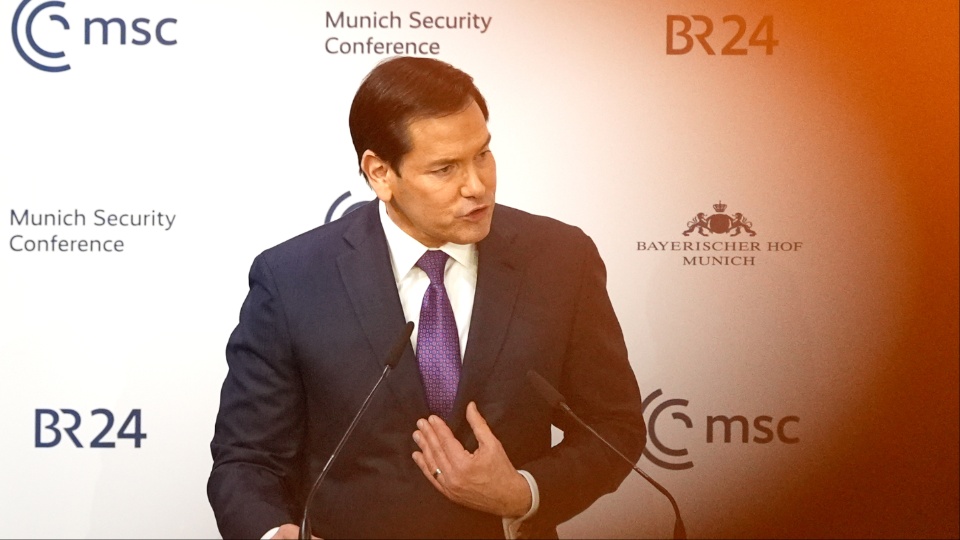
On 14 February 2026, at the Munich Security Conference, Secretary of State Marco Rubio delivered what critics across the spectrum called the most openly pro-colonial address by a senior Western official this century. He mourned the loss of five centuries of Western imperial expansion; named anti-colonial uprisings as a cause of Western decline; urged European allies to shed their guilt and shame over colonialism; and summoned the West to a new Western century by competing for market share in the economies of the Global South — framing that South not as sovereign nations but as an economic space to be recaptured, that precise colonial and predatory framing.
This is not merely reprehensible; it is a confession. Facing structural decline, the imperial culture has abandoned even the pretence of moral authority and reverted openly to the logic of domination. Harvard’s Mathias Risse called the speech civilisational panic dressed as statecraft. The Global South’s response was swift: Indian commentary asked whether an American East India Company was coming; Brahma Chellaney saw the restoration of an exclusionary hierarchy; Sanjaya Baru urged India, as the beacon of anti-colonialism, to condemn it with the contempt it deserves.
The Architecture of Extraction
Rubio’s call to shed guilt is not only obscene; it is historically false. Utsa Patnaik’s study for Columbia University Press establishes that Britain drained £9.2 trillion — some $45 trillion — from India between 1765 and 1938, seventeen times Britain’s current annual GDP, by compounding India’s intercepted export-surplus earnings at the ordinary rate of opportunity cost.
India’s gold and foreign-exchange earnings — among the largest in the world — were permanently diverted to London, funding Britain’s industrial revolution, its wars, and its administration, and consuming between a quarter and a third of the central budget.
The mechanism was an elegant deception. After 1765, the East India Company taxed Indian producers, then used roughly a third of that revenue to buy their goods for export — paying them with their own taxes while acquiring their produce for nothing. The Council Bills system of 1861 industrialised this: foreign buyers paid London in gold and sterling for bills cashable only in rupees, which the colonial government paid out of its own budget. India’s gold and foreign-exchange earnings — among the largest in the world — were permanently diverted to London, funding Britain’s industrial revolution, its wars, and its administration, and consuming between a quarter and a third of the central budget.
Jason Hickel calculates that rich countries have drained $152 trillion from the Global South since 1960 alone. There is no Western century to restore that was not built on the theft of other civilisations’ wealth — legitimised for six centuries by the Three Cs of civilisation, Christianity, and commerce, and continued after independence through structural-adjustment programmes, an African external debt of $824 billion, and more than 13,000 active US sanctions.
The result was stark. India held the world’s second-largest export surplus for three decades before 1929, yet per capita income barely moved between 1900 and 1946, because the surplus was siphoned abroad rather than invested at home. Its share of global industrial output collapsed from 25 per cent in 1750 to 2 per cent in 1900. Japan, which kept its earnings, industrialised; India, whose earnings were confiscated, could not. The same logic ran through slavery, which research now confirms accelerated Britain’s industrial revolution — vindicating Marx’s image of capital arriving dripping with blood and dirt. Jason Hickel calculates that rich countries have drained $152 trillion from the Global South since 1960 alone. There is no Western century to restore that was not built on the theft of other civilisations’ wealth — legitimised for six centuries by the Three Cs of civilisation, Christianity, and commerce, and continued after independence through structural-adjustment programmes, an African external debt of $824 billion, and more than 13,000 active US sanctions.
The sanctifying licence was issued long before the Council Bills, in Rome. A sequence of papal bulls — Nicholas V’s Dum Diversas (1452) and Romanus Pontifex (1455), and Alexander VI’s Inter Caetera (1493), proclaimed the year after Columbus reached the Americas — granted Catholic monarchs the asserted right to “invade, search out, capture, vanquish and subdue” non-Christian peoples, reduce them to perpetual slavery, seize their lands, and partition the non-Christian world between Spain and Portugal. From these decrees grew the Doctrine of Discovery: the claim that lands not inhabited by Christians were free to be “discovered” and their peoples’ sovereignty void. It furnished the racial and civilisational hierarchy — Christian over heathen, European over all others — on which five centuries of conquest were built, dressing the pursuit of gold, land, and labour in the vestments of salvation. The piety was the facade; extraction was the motive. Nor is the point contested by Rome: in 2023 the Vatican formally repudiated the doctrine, conceding the bulls were “linked to political questions” and never expressions of the faith — an admission, five centuries late, that the licence to colonise was always politics wearing the mask of God.
The Civilisational Verdict
Every tradition the Foundation invokes condemns this architecture. Thiruvalluvar’s Kural 113 warns that gain wrongly acquired must not be retained even for a day — the exact verdict on a Council Bills system that gave Indians rupees while stealing their gold; his Kural 551 holds a ruler who works injustice crueller than a murderer. Kaniyan Poongundranar’s Yaadhum Oore Yaavarum Kelir dissolves, at its root, the civilisational tribalism Rubio attempts to revive, for exploitation requires first believing that the exploited are not our kin. Confucius taught that legitimacy flows from virtue, not force; Plato named the tyrant as one who turns governance to private enrichment — the shape of a state that declares it will run another nation and seize its oil; and Ubuntu’s relational personhood is negated wherever a system is built to take from people, unawares, what they have earned.
Risse’s verdict is sharper still: Rubio’s West has no Indigenous peoples, no colonised subjects, no enslaved Africans, no Buchenwald near Weimar — only heroes and temporary setbacks. Such a West has never existed, and cannot be reinvigorated in 2026.
The New Theatre of Predation
The doctrine is not rhetorical. In January 2026, the United States bombed Venezuela, abducted its elected president, and announced that US companies would seize its oil while Washington “ran the country” — a clear violation of Article 2(4) of the UN Charter, the International Commission of Jurists held. The same month, it cut off Cuba’s main oil supplier and, through Executive Order 14380, threatened any country that resupplied it, until the UN warned of humanitarian collapse — collective punishment of a civilian population. And in February 2026, the US and Israel launched a full-scale attack on Iran, killing its Supreme Leader, striking over 42,000 civilian sites, and — at a girls’ school in Minab — at least 167 children; the American Society of International Law named it a crime of aggression, and the UN Secretary-General confirmed it contravened international law. As Britain once dressed theft as commerce, the US now dresses resource seizure as law enforcement — the structural logic is identical.
The Measured Decline
The economic premise of the Rubio doctrine is fiction. Asia’s share of global GDP reached 55 per cent in 2024, years ahead of projection, and BRICS economies now exceed the G7 at purchasing-power parity. The Global South’s ascent is no Western beneficence but a return to the norm colonialism interrupted — China and India together held half of world income in 1700 before colonialism drove their share below a tenth. A declining West, in truth, needs the Global South to survive.
Moral authority has collapsed in tandem. Only 39 per cent of Americans now believe the United States is the world’s moral leader, down from 60 per cent in 2017; across Europe, support for Israel has fallen to between 13 and 21 per cent. Above all, Gaza has erased Western moral pretension: independent research estimates roughly 75,200 violent deaths and the displacement of about 90 per cent of the population, as governments that once lectured the world on human rights moved to justify mass killing — not an aberration, as one analysis put it, but an unveiling.
The Oligarchy Behind the Flag
Analysing nearly 1,800 US policy decisions, Martin Gilens and Benjamin Page found that economic elites and business groups exert substantial independent influence on policy while ordinary citizens have little or none — a pattern they termed economic-elite domination rather than democracy.
There is a sharper way to name what must fall. “The West” is not its peoples; it is a structure of concentrated power that governs in their name while serving far narrower interests. Analysing nearly 1,800 US policy decisions, Martin Gilens and Benjamin Page found that economic elites and business groups exert substantial independent influence on policy while ordinary citizens have little or none — a pattern they termed economic-elite domination rather than democracy. Their method has been contested, but elite-skewed influence is widely corroborated.
The architecture is visible and legal. Since Citizens United (2010), outside US election spending has risen more than twenty-eight-fold — from $144 million in 2008 to over $4.2 billion in 2024 — roughly $1.9 billion of it untraceable “dark money,” a few hundred mega-donors providing the bulk. Oxfam records billionaire wealth at a record $18.3 trillion in 2026, up 81 per cent since 2020; the twelve richest now hold more than the poorest four billion people, and billionaires are four thousand times likelier than ordinary citizens to hold office. Across 66 countries, nearly half of those surveyed say the rich simply buy elections.
The same convergence runs through the war and information economies. Some $191 million was spent lobbying the US defence sector in 2025, and more than 315 senior officers passed through the revolving door into the top weapons firms between 1995 and 2021 — Eisenhower’s “military-industrial complex” at industrial scale. At the 2025 presidential inauguration, the heads of Amazon, Meta, Apple, Google, and Tesla stood arrayed behind the president — a tableau of what Shoshana Zuboff calls surveillance capitalism, in which control over information becomes a lever over democracy itself, as a Stanford working group chaired by Francis Fukuyama warned.
None of this requires a secret cabal — only aligned interests, legalised influence, and a public whose consent is manufactured rather than freely given. The decisive point is this: the structure that drains the Global South is the same one that hollows out wages, democracy, and dignity within the West. The dividing line is not West against the rest but concentrated extractive power against the world’s peoples — the Western working majority among them, conscripted to fight its wars and absorb its costs. When we say the West must fall, it is this structure that must fall, and democratic power that must be restored, at home as much as abroad. That is not the elimination of a people; it is the end of their domination by an oligarchy that has long claimed to speak in their name.
The Self-Defeating Logic of Overreach
Like the Council Bills before it, the Rubio doctrine carries the mechanism of its own defeat, for each intervention rebounds structurally. The seizure of Russian assets accelerated de-dollarisation; the bombing of Iran united a region against the US–Israel alliance; the abduction of Venezuela’s president hastened Latin America’s diversification away from Washington; the oil siege of Cuba drew unprecedented condemnation. An order that must abduct, blockade, and bomb to assert itself is not ascendant — it is exhausting the legitimacy on which power finally depends.
The Imperative of Justice
The fall of Western hegemony opens the possibility of justice but does not guarantee it; the outcome depends on whether rising powers build the multipolar order on genuine ethical foundations rather than replicating what they inherit. That demands sovereign equality without exception — Article 2(4) applied universally, and a Security Council reformed so that no state acts as judge, party, and executor at once. It demands historical accountability: reparative justice through climate finance, debt cancellation, technology transfer, and restitution is not charity but the minimum acknowledgement of documented theft. It demands that the ICJ, ICC, and UN human-rights bodies function without great-power interference; civilisational pluralism against civilisational supremacism; and, finally, democratic renewal within the Western societies themselves, whose peoples are not the authors of empire but among its subjects.
India is uniquely placed to articulate that alternative. Its inheritance — Thiruvalluvar’s justice, Kaniyan Poongundranar’s universal kinship, and the Gandhian tradition of non-violent resistance to precisely the domination Rubio seeks to revive — is the moral tradition colonialism suppressed but could never extinguish. Against a new Western century of restored hierarchy, the Peninsula Foundation offers the Tamil poet’s ancient answer, as relevant in Munich today as on the banks of the Kaveri two millennia ago:
Yaadhum Oore, Yaavarum Kelir — to us all towns are one, all people are our kin.
The West will fall. Fall it must. From its ruins, may justice arise.
Sources
THE MULTIPOLAR TRANSITION
JPMorgan Centre for Geopolitics — World Rewired: Navigating a Multi-Speed, Multipolar Order
United Nations — Secretary-General’s press conference on his 2026 priorities
World Economic Forum — Davos 2026: How middle powers are reading the global moment
THE RUBIO MUNICH SPEECH AND RESPONSES
US Department of State — Secretary Rubio at the Munich Security Conference (14 February 2026)
The New York Times — In Munich, Rubio Stresses Shared History to Europeans
Mathias Risse, Harvard Kennedy School (Carr Center) — A Human-Rights-Based Reply to Marco Rubio’s Munich Speech
China-US Focus — American Neo-Colonialism and the Confessional State
Chatham House — The West vs the West at the Munich Security Conference
India Today — Rubio’s Munich speech signals US colonial competition for the Global South
The Wire — Marco Rubio’s Defence of Colonialism Demands a Response from India
Firstpost — Rubio’s claim of a Western century is a myth
COLONIAL EXTRACTION: THE DRAIN AND THE COUNCIL BILLS
Utsa Patnaik (Columbia University Press), via Al Jazeera — How Britain stole $45 trillion from India
NDTV — How the British Empire robbed India of $45 trillion
self_study_history — Drain of Wealth: the Council Bills mechanism
COLLECTIVE India — ‘Drain of Wealth’, today
Wikipedia — Economy of India under the British Raj (global GDP share)
CEPR / VoxEU — Slavery and the British Industrial Revolution
Walter Rodney — How Europe Underdeveloped Africa
Jason Hickel, via Al Jazeera — Rich countries drained $152tn from the global South since 1960
THE LICENCE TO COLONISE: PAPAL BULLS, CHRISTIANITY, AND NEOCOLONIALISM
Vatican News (2023) — Church defends Indigenous peoples: ‘Doctrine of Discovery’ was never Catholic — the formal repudiation
Canadian Museum for Human Rights — The Doctrine of Discovery (papal bulls and their language)
Church Life Journal, University of Notre Dame — Papal Condemnation of the Doctrine of Discovery
Emory University — The Philosophy of Colonialism: Civilization, Christianity and Commerce
Church Mission Society — Mission after George Floyd: on white supremacy, colonialism and world Christianity
Catalyst (McGill) — The IMF and World Bank: Neocolonial Domination, Debt Trap and Resistance
THE CIVILISATIONAL FRAMEWORK
Thiruvalluvar, Thirukkural (G.U. Pope translation) — Project Madurai
By invoking ‘Om Shanti, Shanti Om’ and recalling his ‘Indian DNA,’ President Prabowo Subianto reminded the world of India’s timeless civilisational values. These gestures reflect centuries-old cultural and philosophical bonds between India and East Asia, rooted in peace, harmony, and shared heritage.
When Indonesian President Prabowo Subianto recently concluded his speech at the 80th UN General Assembly with the Sanskrit mantra “Om Shanti, Shanti Om,” it was more than a ceremonial gesture. He called for global peace, justice, and equal opportunity, warning that “human folly, fuelled by fear, racism, hatred, oppression, and apartheid, threatens our common future.” The invocation of Sanskrit highlighted a message of harmony amid global uncertainties and reminded the world of India’s enduring civilisational values.
Earlier, during his visit to India as the chief guest for the Republic Day celebrations, he remarked that he carried “Indian DNA” and pointed to the Sanskrit origins of many Indonesian names, underscoring centuries-old cultural and civilisational connections between India and Southeast Asia.
A Forgotten Dimension of Indian History
India’s historical interactions, however, have often been narrated through the prism of invasions from the Northwest. Colonial historiography deliberately emphasised repeated waves of conquest and plunder—ranging from the Aryan migrations, Persian invasions, Alexander the Great, the Indo-Greeks, Shakas, Kushans, and Hunas, to the Turkic invasions, the establishment of the Delhi Sultanate, the Mughal conquest under Babur, and Ahmad Shah Abdali’s incursions—painting India’s past as one of perpetual defeat and humiliation.
This selective focus on invasions was deliberately designed to keep Indian confidence low, ensuring that generations grew up seeing themselves primarily as victims of history rather than inheritors of a rich and diverse civilisation. Meanwhile, India’s long-standing engagement with East Asia, including trade networks, cultural diffusion, and philosophical exchange, was largely sidelined in colonial and post-colonial narratives. Monumental structures such as Angkor Wat in Cambodia or Borobudur in Indonesia bear testimony to this enduring civilisational conversation, yet these were rarely taught as part of mainstream Indian history.
Another challenge lies in the application of Western theoretical frameworks—such as realism, neorealism, and similar models—to understanding India’s global outlook. These frameworks often assume that every state behaves aggressively, seeking domination and power, and paint all nations with the same brush. China’s “Middle Kingdom” worldview or its quest to reverse its “century of humiliation” may fit this logic, but India’s history and philosophy reflect a markedly different trajectory. With the exception of the Chola naval expeditions, India has rarely sought to invade foreign lands.
India’s worldview is often likened to a lotus, with its various petals—culture, philosophy, ethics, and diplomacy—contributing to harmony, coexistence, and the principle of “live and let live.” Central to this vision is the concept of Vasudhaiva Kutumbakam: the world is one family.
This perspective underpins India’s approach to global engagement, blending ethical statecraft with strategic autonomy. Building on this philosophical foundation, India translates its vision into action through cultural diplomacy, multilateral engagement, and initiatives that promote global cooperation and inclusive development.
During its G20 presidency in 2023, India played a pivotal role in reshaping the summit’s focus toward the challenges faced by the Global South, highlighting issues such as debt restructuring, food security, climate financing, and reforms in multilateral development banks. A landmark achievement was the inclusion of the African Union as a permanent member of the G20, reflecting India’s diplomatic leadership and commitment to amplifying the voices of developing countries.
Alongside this, initiatives such as the International Solar Alliance (ISA), the Coalition for Disaster Resilient Infrastructure (CDRI), Project Mausam, the India-UN Development Partnership Fund, and India’s COVID-19 vaccine diplomacy underscore its dedication to global solidarity, humanitarian support, and sustainable development.
India’s strategic thought is deeply informed by its philosophical heritage. The Arthashastra emphasises practical statecraft and realpolitik, while the Dharmashastra provides the ethical and moral framework guiding those actions.Classical thinkers like Chanakya (Kautilya) emphasised practical governance while aligning with the ethical principles of dharma, balancing power with moral responsibility. As he famously noted, “The duty of a ruler is for the welfare of his people,” highlighting that ethical considerations were central even in matters of statecraft. India’s strategic worldview thus seeks to harmonise national interests with global responsibilities, recognising that ethical governance and long-term security require attention not only to domestic welfare but also to the broader international order.
Religious reformers and spiritual leaders—such as the Buddha, Mahavira, Ramanuja, and Madhva—championed ethics, nonviolence, and universal harmony. Modern visionaries such as Swami Vivekananda, Rabindranath Tagore, and Sri Aurobindo extended these ideas to the global stage, advocating moral leadership, cultural diplomacy, and internationalism. Later thinkers, such as Mahatma Gandhi, Vinoba Bhave, and Jiddu Krishnamurti, emphasised ethical governance, humanistic values, and personal transformation as the foundation for societal and global peace.
This holistic approach—blending practical insights of Arthashastra with ethical guidance of Dharmashastra, informed by centuries of philosophical thought—distinguishes India’s worldview from Western, power-centric models.
Despite these long-standing ties, independent India largely overlooked Southeast Asia for much of its early decades, focusing instead on its immediate security concerns and the dynamics of the Cold War. ASEAN countries leaned toward the United States, while India charted a non-aligned course. While Cold War pressures existed, India largely neglected this crucial region and its maritime dimension. Only in the 1990s, with the introduction of the Look East Policy, did New Delhi consciously reconnect with its eastern neighbourhood. By then, decades of neglect had to be addressed to restore historical relationships, a point noted by scholars who observe that India had “historically left Southeast Asia largely unattended, despite long-standing civilisational links.”
Reviving the Civilisational Link
One of the most potent symbols of India’s engagement with East Asia is Nalanda University. Established in the 5th century CE by Emperor Kumaragupta I, it was the world’s first great residential university, drawing scholars from China, Korea, Japan, Southeast Asia, and beyond. Nalanda offered an interdisciplinary curriculum spanning Buddhist scriptures, logic, grammar, medicine, astronomy, and philosophy, fostering holistic learning long before modern academic disciplines were compartmentalised. Over the centuries, it suffered repeated attacks, culminating in the 1193 CE assault by Bakhtiyar Khilji, which destroyed its nine-story library, Dharmagañja, along with countless manuscripts covering philosophy, medicine, astronomy, and other fields.
Smoke from the burning texts lingered for months, erasing invaluable works across multiple disciplines and causing an irreparable loss to India’s and Asia’s intellectual heritage.
During the inauguration of the new campus in Rajgir, Bihar, on June 19, 2024, Prime Minister Narendra Modi underscored Nalanda’s enduring civilisational legacy. He remarked that while “fire can destroy books, [it] cannot destroy knowledge,” affirming that “Nalanda is not just a name; it is an identity, an honour, a value, a mantra, a pride, and a saga.” Highlighting the significance of the revival, he noted that the new Nalanda “will demonstrate that nations built on strong human values know how to revive history and lay the foundation for a better future.”
External Affairs Minister S. Jaishankar also emphasised Nalanda’s diplomatic and academic importance, noting during the 2024 campus inauguration that the university is actively fostering regional integration through initiatives like the “ASEAN-India University Network” and highlighting that its destruction “marked a downturn in our history”
The modern revival of Nalanda University rekindles its historic spirit of cross-cultural exchange and global engagement. Its contemporary philosophy emphasises integrating traditional wisdom with modern academic disciplines, promoting an interdisciplinary approach that blends Buddhist Studies, Philosophy, Comparative Religion, Ecology, Environmental Studies, and Management Studies. Programs encourage students to engage with original texts, critical interpretations, and contemporary applications, reflecting a holistic understanding of knowledge.
In September 2025, Nalanda University hosted the inaugural three-day East Asia Summit Conclave of Heads of Higher Education Institutions, bringing together over 35 academic leaders from India and ASEAN/EAS countries. The conclave included thematic deliberations, cultural programs, and the signing of MoUs with institutions such as Vietnam National University, the Indian Maritime University, and MAKAIS. A parallel workshop on Energy Efficiency and Lifestyle for Environment (LiFE) further highlighted India’s sustainability agenda. This landmark event reinforced Nalanda’s role as a hub for academic diplomacy, cross-cultural dialogue, and regional integration.
Today, Nalanda’s student body includes participants from ASEAN countries, Africa, and beyond, embodying diversity, dialogue, and shared learning. The university is a living reflection of what India stands for: tolerance, pluralism, and coexistence. Unlike the distorted Western narratives that often portray India as illiberal or intolerant, Nalanda demonstrates that India’s civilisational ethos embraces diversity and intercultural engagement. Its holistic and inclusive approach reinforces India’s soft power and projects a message of peace, coexistence, and intellectual openness.
Nalanda continues to uphold its interdisciplinary ethos, emphasising the interconnectedness of knowledge and fostering collaboration to address contemporary global challenges. In doing so, it revives historical connections with East Asia and exemplifies India’s vision of a world united through learning, dialogue, and mutual respect.
When leaders like the Indonesian president invoke Sanskrit terms or highlight cultural kinship, it is a reminder that India’s story is far richer than the invasion-centric histories emphasised under colonial education. To decolonise our historical imagination, we must foreground India’s ancient engagement with the East, its traditions of non-aggression, and its civilisational ethos of peace and fraternity.
India and its East Asian partners, particularly ASEAN countries, share centuries-old cultural, philosophical, and civilisational bonds that manifest in religion, art, architecture, literature, cuisine, trade, education, and people-to-people exchanges. These living streams of cultural ties continue to enrich both India and Southeast Asia, reflecting a legacy of adaptation, creativity, and mutual influence.
As Michel Foucault argued, power and knowledge are inseparable—knowledge is both shaped by power and a tool through which power operates. History functions in this dynamic, shaping identity, self-perception, and the trajectory of nations. Institutions like Nalanda University, both in its ancient and modern forms, exemplify India’s civilisational vision: fostering interdisciplinary learning, cross-cultural dialogue, and a holistic understanding of knowledge,while promoting a mutual exchange of ideas and practices that enriches both India and its partners.
Reclaiming India’s forgotten ties with the East and recognising the enduring legacy of centres like Nalanda is not only a matter of historical accuracy but also a foundation for building a future grounded in shared heritage, mutual respect, and the vision of Vasudhaiva Kutumbakam—the world as one family.
By nurturing these connections through education, cultural exchange, and inclusive engagement, India and its partners can ensure that history, knowledge, and creativity continue to serve as instruments of peace, cooperation, and shared prosperity across the region.
Feature Image Credit: Modern Nalanda University Campus at Night (photo by M Matheswaran) Indonesian President’s Address at UNGA photo credit: media.un.org Ancient Nalanda ruins, the Mahabodhi temple, Nalanda campus, and a spectrum of students – Photos Credit: M Matheswaran
Between Western Eurocentric Universalism and Cultural Relativism: Mutual Recognition of the Civilisations of the Earth as precondition for the Survival of Mankind
Andreas Herberg-Rothe
In the 19th century, the Europeans conquered the whole world; in the 20th century, the defeated nations and civilizations had to live with the victorious West; in the 21st century, the civilizations of the earth must finally learn to live together.
The Universal Declaration of Human Rights was codified by the United Nations in 1948. But the academic debate on the universality of the norms on which it is based is far from over. The question remains whether there are universal values other than those of the West. Western values alone are often implicitly regarded as universal. But whether this is scientifically justifiable is more than debatable. At the same time, few participants in the debate seriously doubt the need for universal human dignity.
In the current debate, the binary positions of relativism and universalism are in a stalemate. A way out of this dichotomy would have to withstand the charge of ethnocentrism as well as particular relativism. Neither should dimensions of power and colonialism be ignored, nor should inhumane practices such as torture, humiliation and sexual violence be relativised by reference to another ‘culture’. If a universal approach is to be found, it should not be implicitly Westernised. This is a criticism of existing approaches, particularly in postcolonial theory.
Historically, ethnocentrism, as a mere description of a state of affairs, has developed into a justification of ‘cultural superiority’ and, as a consequence, of oppression and exploitation.
It is about the justifiability of universal norms on the one hand, and the inevitability of particular justifications of norms on the other. Historically, ethnocentrism, as a mere description of a state of affairs, has developed into a justification of ‘cultural superiority’ and, as a consequence, of oppression and exploitation. An initially unconscious preference for and belief in one’s own (cultural) perspective, the unquestioned truth and correctness of one’s own norms, values and patterns of behaviour, did not develop into ‘live and let live’. This form of ethnocentrism rejects the acceptance of cultural differences and represents an attitude that legitimises the destruction of the foreigner as a legitimate consequence of one’s own superiority. This, of course, refers mainly to the long-standing colonisation of supposedly ‘inferior’ peoples by European states and the associated cultural appropriation and cultural destruction or exploitation. These practices were morally legitimised on the basis of the conviction that one’s own way of life was superior to all other ways of life, not only militarily and politically, but also cognitively and morally. Ideologically, this argument is based on various elements, including the proselytising idea of the Christian message of salvation, the idea of the ‘progress’ of Western civilisation over other cultures and the idea of ‘racial doctrine’.
In reaction to this unreflected, chauvinistic ethnocentrism, two main currents of contradiction developed: universalism and relativism. Universalism ‘assumes that it is possible to find standards of value that apply across cultural boundaries and are universally valid’, while the relativist position, in the absence of the possibility of an ‘extra-cultural’, objective judgement of a situation, all cultures, with everything that belongs to them, are ascribed the same value.
Universalism
The argumentative basis of Western universalism is the assumed fundamental equality of all human beings – both in their intellectual capacity (cognitive) and in their materiality (normative), which leads to a general insight into certain universal norms. The most obvious example of this is universal human rights, whose need for universality is clear from their very name.
The cognitive premise of this kind of universalism goes back to the Enlightenment and the idea that all human beings have, in principle, the same cognitive capacities, even if they differ in individual cases. Only on this basis can the premise of normative universalism in the Enlightenment be realised. But this leads to various problems, paradoxes and points of criticism, because this conception is based on a particular understanding of rationality that is rooted in the thinking of Western modernity. For example, it excludes any kind of holism, although this conceptualisation is by no means irrational, but represents a different kind of rationality.
The apparent paradox of the uniqueness of each culture lies in the claim to universality that all cultures are of equal value. We can therefore speak neither of a universalism that is purely independent of culture, nor of a norm that can be attributed to only one culture.
One frequently pursued solution to the tension between universal norms, which nonetheless originate in only one culture, and different culturally determined norms has been to search for what is common to all cultures. This approach, which in itself goes further, was pursued above all in the project of the ‘global ethic’, which sought the common foundations of all religions. Western modern universalism had thus abandoned its claim to all-encompassing universality and limited itself to a kind of ‘core norms’. Instead of questioning specific cultural practices, the focus is on the fundamental premises of human coexistence. In my view, this project was doomed to failure after the initial euphoria, because the commonalities were based on an ever-increasing abstraction. This leads to two fundamental difficulties: the unresolved problem of drawing boundaries between different forms of norms, and the justification of particular norms on the basis of the universal assumption that all cultural norms are in principle equal. The apparent paradox of the uniqueness of each culture lies in the claim to universality that all cultures are of equal value. We can therefore speak neither of a universalism that is purely independent of culture, nor of a norm that can be attributed to only one culture.
Strong normative relativism represents a ‘normative statement that all normative systems are fully justified in their diversity’ – a paradox since this is a statement with a claim to universal validity. In contrast, weak normative relativism is derived from the impossibility of universally valid normative statements, which merely means a ‘non-evaluability’ of normative systems The demarcation between concrete social norms is therefore very difficult
Because of the difficulty of justifying strongly normative positions, ‘differentiated’ theories of relativism argue from a ‘weakened position’, albeit at the expense of unambiguity due to the lack of demarcation. Culture is then understood as ‘dynamic and hybrid’, while ‘normative overlaps’ are recognised without doubting the fundamental relativity of all norms.
Paradoxical structure
Relativism does not provide a ‘ground zero’ from which to make generally valid statements – this rules out the possibility of relativism being universally valid in itself, as well as the possibility of relativism being regarded as a ‘universal truth’. Relativism cannot, therefore, justify itself out of itself, which it has in common with other theoretical currents in the age of postmodern critique (Herberg-Rothe 2025). Moreover, it does not necessarily apply universally, but can be limited in time or place: So the undecidability of normative conflicts might appear to be a particularly obvious contemporary phenomenon, without it being true for all times and places that normative conflicts are fundamentally undecidable. This concept of decidable and undecidable questions is based on the position of Heinz von Foerster’s radical constructivism. In his desperate attempt to leave behind all only apparent objectivity and the subjectivity of all norms, he resorts to a binary opposition between objectivity (in mathematics) and subjectivity.
Due to the equivalence of all cultural standpoints and the lack of presupposed values, no well-founded criticism can take place, which makes relativism normatively arbitrary in relation to itself. Neither the persecution of minorities nor discrimination can be legitimately criticised if this is seen as a cultural particularity. The norm of ‘absolute tolerance of cultural differences’ is both empirically untenable and logically inconsistent, since here too there is a claim to universal validity. However, this point of criticism already presupposes the premise of universalism that there are conditions that are worthy of criticism despite their culture-specific justification.
The observed norms and values appear to be specific responses to specific social problems but are in no way connected to the supposed ‘essence’ of a culture, as culture itself is perceived as hybrid, fluid and contradictory – instead of judging inhumane practices of one’s own culture, it is about understanding. In this context, the post-colonial reality should also be mentioned, in which there are no longer any cultures without interference.
Relativism in its weakened form has moved away from normative statements. In the absence of a judgmental dimension, it no longer makes a statement about tolerance towards certain cultural practices. The observed norms and values appear to be specific responses to specific social problems but are in no way connected to the supposed ‘essence’ of a culture, as culture itself is perceived as hybrid, fluid and contradictory – instead of judging inhumane practices of one’s own culture, it is about understanding. In this context, the post-colonial reality should also be mentioned, in which there are no longer any cultures without interference.
In order to be able to criticise on the basis of relativism in human practices despite all these objections, two possibilities need to be mentioned: 1. to establish ‘qualified norms’ without further justification in order to criticise on the basis of them, and 2. to practise a particular, culturally immanent criticism – of one’s own cultural norms on the basis of other norms of one’s own culture. For example, there are numerous culturalist justifications for gender equality, “general” human rights or democracy, which shows that a culturally immanent and particular critique of domination does not necessarily have to differ in content from a universalist critique (see for example Molla Sadra in Herberg-Rothe 2023). Both solutions are in no way ideal, because in the first attempt, we encounter a hidden enthnocentrism, and in the latter, the problem arises between contrasting norms within one culture.
Covert Westernisation and reverse Ethnocentrism
Relativism is also a theory of Western origin, which can be seen in the Western-influenced ‘idea of tolerance’ – but this point also applies mainly to a normatively strongly interpreted relativism. Inverse ethnocentrism, on the other hand, means ‘labelling everything foreign as right’.
What underlies both, universalism and relativism, is the struggle for knowledge: which norms can be taken for granted? Or, more philosophically, what can we know? Both positions have argumentative shortcomings that are not easily remedied.
Knowledge is closely linked to power (the power to define, to enforce, to disseminate or to withhold knowledge) and thus to domination and often to violence. This connection is expressed in social tensions between the legitimation of domination and the subversion of existing conditions.
The use of human rights to achieve social change raises the question of “whether this process is not itself, in terms of knowledge, a bureaucratic, almost classically ethnocentric process with an imperial claim to universality’ that spreads ‘Western culture’ and its models of action globally’.
Transnational encounters since the colonial era have steadily increased due to globalisation and require reassessment. The use of human rights to achieve social change raises the question of “whether this process is not itself, in terms of knowledge, a bureaucratic, almost classically ethnocentric process with an imperial claim to universality’ that spreads ‘Western culture’ and its models of action globally’. At the same time, this process opens up a dialogue beyond culturally determined borders, which we must be aware in order to transcend them.
How could this stalemate between ethno Universalism and cultural relativism be overcome, at least in perspective?
A new approach to practical intercultural philosophy
Intercultural philosophy can play an important role in this process of mutual recognition among the civilizations of the earth. Since Karl Jaspers, the godfather of intercultural philosophy, acknowledged the existence of four different civilizations (Holenstein 2004, Jaspers 1949), immense progress has been made in understanding the different approaches. Nevertheless, all civilizations have asked themselves the same question but have found different answers. Cross-cultural philosophy is thus possible because we as human beings ask the same questions (Mall 2014). For example, in terms of being born, living and dying, between immanence and transcendence, between the individual and the community, between our limited capacities and the desire for eternity, the relationship between us as animals and the ethics that constitute us as human beings – our ethical beliefs may be different, but all civilizations have an ethical foundation. In fact, I would argue that it is ethics that distinguishes us from animals, not our intellect (Eiedat 2013 about Islamic ethics). We may realize the full implications of this proposition when we relate it to the development of artificial intelligence.
Detour via Clausewitz
An alternative solution to the problem raised by Lyotard suggests another dialectic, as implicitly developed by Carl von Clausewitz based on his analysis of attack and defence. The approach of Clausewitz is insofar of paramount importance because it presupposes neither a primacy of identity in relation to difference, contrast, and conflict, nor to the reverse as in the conceptualizations of the post-structuralists (Herberg-Rothe 2007, Herberg-Rothe/Son 2018) or the adherents of a purified Western modernity in the concepts of Habermas and Giddens. In contrast to binary opposites, Clausewitz’s model of the “true logical opposition and its identity,” a structure-forming “field” (something like a magnetic field) allows us to think of manifold mediations as well as differences between opposites. If we formulate such an opposition in the framework of a two-valued logic (which formulates the opposition with the help of a negation or an adversarial opposition), there is a double contradiction on both sides of the opposition. From the assumption of the truth of one pole follows with necessity the truth of the other, although the other formulates the adversarial opposition of the first and vice versa. Hegel’s crucial concepts such as being and nothingness, coming into being and passing away, quantity and quality, beginning and ending, matter and idea are such higher forms of opposition which, when determined within the framework of a two-valued logic, lead to logical contradictions. Without taking into account the irrevocable opposites and their unity, a “pure thinking of difference” leads either to “hyper-binary” systems (such as the relation of system and lifeworld, of constructivism and realism) or to unconscious absolutizations of new mythical identities (such as Lyotard’s notion of plasma as well as Derrida’s chora).
Clausewitz’s “true logical opposition” and its identity enables the thinking of a model in which the opposites remain irrevocable, but at the same time, in contrast to binary opposites
both remain in principle equally determining; this model is therefore neither dualistic nor monistic, but cancels this opposition in itself and sets it anew at a new level.;
structure a “field” of multiple unities and differences;
enable a conceptualization, in which the opposites have a structure-forming effect, but do not exist as identities detached from one another,
and in which there are irrevocable boundaries between opposites and differences, which at the same time, however, are historically socially distinct. The concrete drawing of boundaries is thus contingent, without the existence of a boundary as such being able to be abolished (Herberg-Rothe 2007, 2019 and Herberg-Rothe/Son 2018). Clearly, in the, albeit limited, model of a magnet neither the south nor north pole exists as identity, a (violent) separation between both even leads to a duplication of the model. At the same time, both poles are structures forming a magnetic field, without a priority for either side. And finally, Clausewitz’s model of the true logical opposition goes beyond the one of polarity, because it additionally allows us to think of manifold forms of transitions from one pole to the other (Herberg-Rothe 2007, Herberg-Rothe/Son 2018).
This conception of an “other” dialectic is also the methodological precondition of thinking “between” Lyotard and Hegel (Herberg-Rothe 2005). It treatises above all categories such as mostly asymmetrical transitions and reversals as well as the “interspace” (Arendt) between opposites. With such an understanding of dialectics, it is possible to understand the apparent contradiction between the rejection of the highest meta-meta-language and the fact that the language used in this critique, theory, is itself this actually excluded “highest” level of language, not as a logical contradiction, but as a performative one. Such performative contradictions between what a proposition, statement, etc., says and what it is are at the heart of Hegel’s notion of dialectic. Of all things, Hegel’s criticized and rejected form of dialectic makes it possible to conceive of these contradictions not as “logical” ones, but as ones that ground, but also force, further development as distinct from mythical ways out. This form of dialectic, however, contains at the same time the demonstration of a principle of development without conclusion and thus puts Hegel’s “great logic” as “thoughts of God before the creation of the world” in its place (Hegel Preface to the Science of Logic, Wdl I, Werke 5). Nevertheless, these performative contradictions should also not be absolutized, they are just one aspect of a different dialectics.
Although I advocate the development of an intercultural philosophy as part of transnational governance and mutual recognition among the civilizations of the earth, I would like to highlight the main problem, at least from my point of view. Aristotle already asked the crucial question of whether the whole is more than the sum of its parts. If I understand Islamic philosophy correctly, it starts from the assumption that the whole is indeed more than the sum of its parts – one could call this position a holistic approach (Baggini 2018). In contrast, Western thought is characterized by the approach of replacing the whole precisely by the sum of its parts. We might call this an atomistic approach – only the number of electrons, neutrons, distinguishes atoms etc. In terms of holism, I would argue that the task might be to distinguish the whole from mere hierarchies – in terms of the concept of harmony in Confucianism, I would argue that true harmony is associated with a balance of hierarchical and symmetrical social and international relations. Instead of the false assumption in Western approaches that we could transform all hierarchical relationships into symmetrical ones, we need to strike a balance between the two. Harmony does not mean absolute equality in the meaning of sameness but implies a lot of tension. Harmony can be characterized by unity with difference, and difference with unity, as already mentioned (Herberg-Rothe/Son 2018). I sometimes compare this perspective to a wave of water in a sea: if there are no waves, the sea dies; if the waves are tsunamis, they are destructive to society.
I start from the following fivefold distinction of thinking, based on the fundamental contrasts of life (while Baggini 2018 and Jaspers 1949, for example, reduce different ways of thinking largely to the development of functional differentiation).
Attraction and repulsion, closeness and distance, equality and freedom, love and hate,
Beginning and ending (birth and death, finiteness – infinity),
Happiness and suffering (in Greek and Indian philosophy
Knowledge (experience, positive sciences, extended sense impressions,
and method – mathematics and logic) versus feeling/the concept of intuition, belief.
The listed methodological approaches try to cope with unity and opposition. In my opinion, they are also necessary approaches and can be seen as differentiations within the idea of polarity.
Differentiations in thinking
Either – or systems, = Western modern thought, concentration on the method (since Descartes and Kant, Vienna Circle, Tarski), democracy, individualism, in Islam Ibn Sina and Ibn Khaldun, in Chinese thought the tradition of Han Fei and Li Se; Yan 2011, Zhang 2012).
As well as – Daoism, early Confucianism, but also New Age approaches, Heißenberg’s uncertainty principle, and dialectics.
Neither-Nor enables the construction of “being-in-between”; Plato’s metaxis plus Indian logic, the whole concept of diversity, difference thinking, de-constructivism, the post-structuralism, post-colonialism
system thinking, structuralism – here I struggle with the distinction between holism (in the Islamic worldview) and pure hierarchies (in Islam Al Ghazali); inherent logic of systems (Luhmann) and functional differentiation; in Eastern philosophies, we find this approach mainly in highlighting spiritual approaches
process thinking – in ethics this can be found e.g. in utilitarianism, stage theories (Piaget, Kohlberg; Hegel’s world history as the progress of freedom consciousness), Hegel’s becoming at the beginning of his “logic” as “surplus” of coming into being and passing away; cycle systems; enlightenment; Dharma religions, in China, Mohism.
While there are probably already worked out methods for points 1, 4 and 5, I lack such for 2 and 3, which are always in danger of expressing arbitrariness. This becomes especially clear in the mysticism of the New Age movement.
How can this fivefold distinction be derived from one model, which is not a totalizing approach (Mall 2014)? For this purpose I use again the simplified model of polarity. This method is elaborated in my Clausewitz interpretation of his wondrous trinity and the dialectic of attack and defense (Herberg-Rothe 2007 and 2019).
Differences in polarity as a unifying model.
Either-Or systems: Each of the two poles is either a north or a south pole (= tertium non datur). We find those approaches in mathematics, logic, rationality and methods in general; such conceptualizations are also to be found in zero-sum games – what one side gains, the other loses (rationality, if then Systems, in Cina Lli Si and Han Fei);
As well As (earlier Confucius, Daoism): the magnet as unity consists of the opposites of both poles and the magnet “is” both north pole and south pole. This is analyzed in detail in my Clausewitz interpretation on the basis of war as unity and irrevocable opposition of attack and defence. We find this thinking, especially in Chinese ideas of win-win solutions. Here, competition and conflict in one area do not exclude cooperation in another (Herberg-Rothe 2007, Chinese version 2020.)
Neither North nor South pole exist as identities (Plato’s metaxis, Indian thought) – they are rather dynamic movements in between the opposites (see in detail again Clausewitz’s concept of attack and defense; this understanding is the methodological basis of diversity; Herberg-Rothe 2007; see the French theorists of post-structuralism).
Structure (system theories, Islamic holism): North pole and south pole “construct” a magnetic field outside and inside the materiality of the magnet, a non-material structure.
Process thinking: Here the simplified example of the magnet finds its end – but can be understood beyond the physical analogy easily as movement from the south pole to the north pole and “always further” (sine curve on an ascending x-axis). In this sense, Already Hegel had considered the discovery of polarity as of infinite importance but criticized it because in this model the idea of transition from one pole to the other was missing (Herberg-Rothe 2000 and 2007). Molla Sadra (1571-1636), the most important philosopher of the School of Isfahan, elaborated this progressive circular movement particularly clearly. Although he is mainly regarded as an existential philosopher who denies any essence, he actually postulated a kind of progressive circle as the decisive essence (for an overview see Yousefi 2016, for more details see Rizvi 2021).
A unifying model – Virtuous Concentric Circles
Starting from the premise that Western thinking is shaped by the billiard model of international relations and that of all other civilizations by concentric circles and cycles (Herberg-Rothe/Son 2018), the aim is to work out how extensively both models determine our thinking in the respective cultural sphere in order to develop a perspective that includes both sides. In doing so, I do not assume one-dimensional causes for violent action, nor do I assume pure diversity without any explanation of causes. Instead, I work in perspective with virtuous and vicious circles – in these circles, there are several causes, but they are not unconnected to each other but are integrated into a cycle. So far, this methodological approach has probably been applied mainly in the Sahel Syndrome. The methodological approach would involve trying to break vicious circles and transform them into virtuous circles – this is where I would locate the starting point of a new approach to intercultural philosophy.
Ideally, a virtuous circular perspective would look like this:
Understanding of discourses on how conflicts with cultural/religious differences are justified/articulated.
Attribution of these differences to different concepts of civilization.
Mutual recognition of the same issues in different ways of thinking.
Self-knowledge not only as religion or culture, but as a civilization.
the self-commitment to one’s own civilizational standards, norms (Jaspers 1949 and Katzenstein 2009) etc., which can also contribute to the management of intra-societal and international conflicts.
At the infinite end of this process would be a kind of mutual recognition of the civilizations of the earth, accompanied by their self-commitment to their own civilizational norms. My colleague Peng Lu from Shanghai University has made the following suggestion: In the 19th century, the Europeans conquered the whole world; in the 20th century, the defeated nations and civilizations had to live with the victorious West; in the 21st century, the civilizations of the earth must finally learn to live together. This is in my view the task of the century. Solving the problem of ethno-universalism and cultural relativism has nothing to do with wishful thinking, but is the precondition for the survival of humankind in the twenty-first century, unless we want to repeat the catastrophes of the twentieth century on a larger scale.
References:
Baggini, Julian (2018), How the World Thinks. A global history of philosophy. Granta: London.
Clausewitz, Carl von (2004) On War. Edited and translated by Michael Howard and Peter Paret. Princeton: Princeton University Press
Fukuyama, Francis (2018), Against Identity Politics. The new tribalism and the crisis of democracy. In Foreign Affairs, Sept./Oct. Retrieved from: https://www.foreignaffairs.com/articles/americas/2 018-08-14/against-identity-politics; last accessed, Oct. 3, 2018, 10.21.
Herberg-Rothe, Andreas (2003/2017), Der Krieg. 2nd ed., Campus: Frankfurt.
Herberg-Rothe, Andreas and Son, Key-young (2018), Order wars and floating balance. How the rising powers are reshaping our worldview in the twenty-first century. Routledge: New York.
Herberg-Rothe, Andreas (2023) Toleration and mutual recognition in hybrid Globalization. In: International Studies Journal, Tehran, Print version: September 2023; Volume 20, Issue 2 – Serial Number 78; pp 51-80.
Despite all the real political problems we face, it is essential for the twenty-first century to defend the equality of all people, regardless of biological differences such as gender or ethnicity. It is not our biology that defines us as human beings, but our morality.
According to Dominique Moisi, the Western states are consumed with fear of decline, the Islamic-Arab world is full of despair at unfulfilled promises, and East and Southeast Asia are full of hope for a better life. These global political sentiments are largely responsible for the escalation of conflicts, the disintegration of social cohesion and the spread of violence.
More than 50 years ago, a cultural revolution from the left shook the whole world. In the USA, there were demonstrations against the Vietnam War, and the hippie movement gathered hundreds of thousands in search of a new lifestyle and attitude to life. Flower, power, love was the motto of the legendary Woodstock. In Germany, young people turned against old traditions and the concealment of their parents’ and grandparents’ guilt under fascism. But here, too, the double face of the youth movement became apparent: when they celebrated the North Vietnamese leader Ho Chi Minh in their demonstrations, they were in no way aware of the political practice in North Vietnam. This process was even more dramatic during the Chinese Cultural Revolution when the youth were mobilised to ultimately legitimise the claim to power of the “Great Leader” Mao-TseTong. The lesson of that period was that a cultural revolution must precede political change. For some time now, a cultural revolution from the right has been following this pattern. It is characterised on the one hand by social developments in polarised societies, and on the other by a targeted and strategic discourse on the part of the new right. Without underestimating the importance of personalities such as former and newly elected President Trump, as well as Erdogan in Turkey and Putin in Russia (and many others) for this development, they have only been able to achieve such success because they have tapped into the “zeitgeist”. According to Dominique Moisi, the Western states are consumed with fear of decline, the Islamic-Arab world is full of despair at unfulfilled promises, and East and Southeast Asia are full of hope for a better life. These global political sentiments are largely responsible for the escalation of conflicts, the disintegration of social cohesion and the spread of violence.
In the Western world, instead of recognising the equality of other civilisations, nations and states, the “others” were blamed for the loss of the “white man’s” superiority. The ideology of the white man’s burden to educate the uneducated and indigenous peoples of the world, developed at the beginning of the last century, was revived after the fall of the Soviet Union, but could no longer be sustained with the rise of the others and the newly industrialised nations. However, a dilemma arose – if the success of the others was attributed to them, they would be strengthened and the whites would be even less able to maintain their own sense of superiority. So people looked for internal others to blame for their own decline. This is at the heart of the cultural revolution from the right. It is explained by the fear of no longer being able to maintain the supposed superiority of the “white man” if, for example, a country like Indonesia (i.e. no longer just Japan and China) overtakes Germany’s gross domestic product around 2030. Meanwhile, the US, Germany and many other European countries are not only no longer relatively superior, but parts of the US, for example, are at levels that used to be ascribed only to developing countries. And scapegoats are easy to find and, above all, interchangeable – sometimes it can be emancipated women, migrants, the “elites”, the Chinese, Africans, African-Americans, or anyone who is different. Trump’s statement that migrants are taking “black jobs” from US Americans reveals the core of this ideology: the MAGA movement is the best illustration of this development. Despite Trump’s irrationality and narrow-mindedness, “Make America Great Again” can only take hold if many people fear decline or have already experienced it. Like the masterminds of the cultural revolution on the right, they are trying to conquer the more rural regions first.
The reference to ethnic pluralism is also one of the defining characteristics of the New Right. The right of all cultures and ethnic groups to exist is unconditionally recognised, but only as long as people remain among themselves or on the territory intended for them. Trump’s idea of expelling millions of Latinos after winning the election corresponds perfectly with the German right’s idea of enforcing re-migration. In Germany, Carl Schmitt and Martin Heidegger, Ernst Jünger and Oswald Spengler, and even Nietzsche, are relativised in order to legitimise the cultural revolution of the right. Antonio Gramsci, actually a progressive Marxist, whose concept of achieving cultural hegemony in the “pre-political space” is pursued by the Right as “metapolitics”, gains central importance.
At its core, however, the new right is about undermining human equality – in its view, we are only equal to our own nation or religion and gender. This exclusionary equality only with one’s own kind is at the heart of the right’s cultural revolution, whose ideal model is itself based on hierarchical notions, a graded dignity. Such attempts to undo the gains of the struggle for equality in a counter-revolution can be found all over the world – whether in nationalism, ethnocentrism, misogyny, cultural relativism (“they just have a different culture”) or thinly veiled racism.
The only thing “new” about this right-wing movement is that it uses different terms. The New Right concentrates on the “battle for the heads”, leaving the battles for the streets and, in some cases, the parliaments to other groups of the extreme right. The storming of the Capitol and the German Bundestag were such actions of the extreme right. It must be admitted that the whole world is in turmoil. At its core, however, the new right is about undermining human equality – in its view, we are only equal to our own nation or religion and gender. This exclusionary equality only with one’s own kind is at the heart of the right’s cultural revolution, whose ideal model is itself based on hierarchical notions, a graded dignity. Such attempts to undo the gains of the struggle for equality in a counter-revolution can be found all over the world – whether in nationalism, ethnocentrism, misogyny, cultural relativism (“they just have a different culture”) or thinly veiled racism. It is also marked by the revival of toxic masculinity (Raewen Connel) through the MAGA movement and in particular Trump’s enthusiasm for the wrestling mentality and martial arts. Opinions can be divided on these as sports, but they have no place in politics and point to an absolutely exaggerated and violent masculinity that Trump embodies. These political discourses are used to win elections in the West. In one sentence, the New Right shifts the concept of the democratic people to the ethno-religious people.
When the few people of Pegida (Patriotic Europeans to defend the Abendland) in Germany shout into the camera: “We are the people”, they are turning the slogan of the democratic revolution of 1989 into an ethno-nationalist revolution. From the mid-nineteenth century to the mid-twentieth century, we have witnessed this transformation from the democratic to the ethnic concept of the people. Despite all the real political problems we face, it is essential for the twenty-first century to defend the equality of all people, regardless of biological differences such as gender or ethnicity. It is not our biology that defines us as human beings, but our morality.