Category: HomepageSlider

  • The Game of Thrones in Kabul: Taliban’s 2nd Innings

    The Game of Thrones in Kabul: Taliban’s 2nd Innings

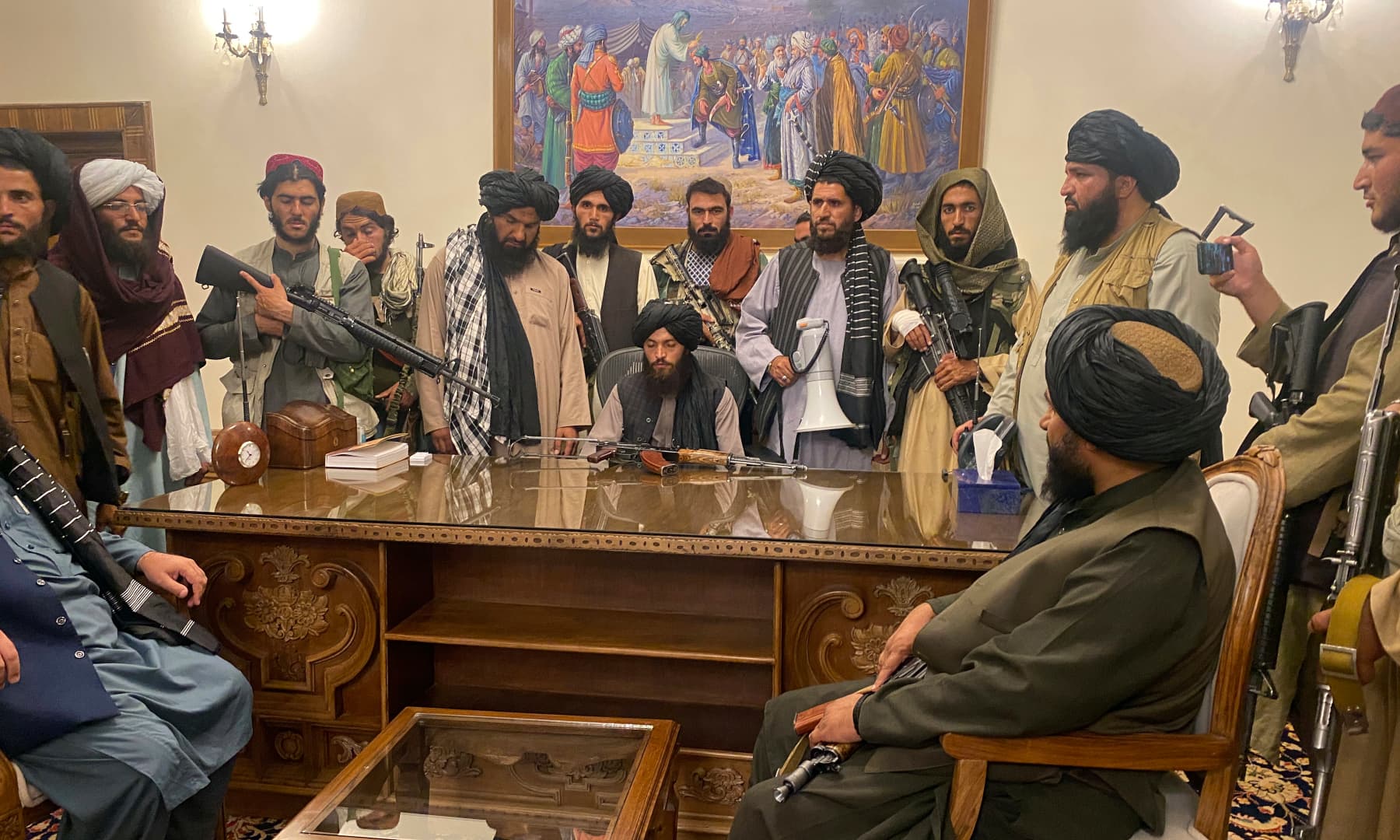
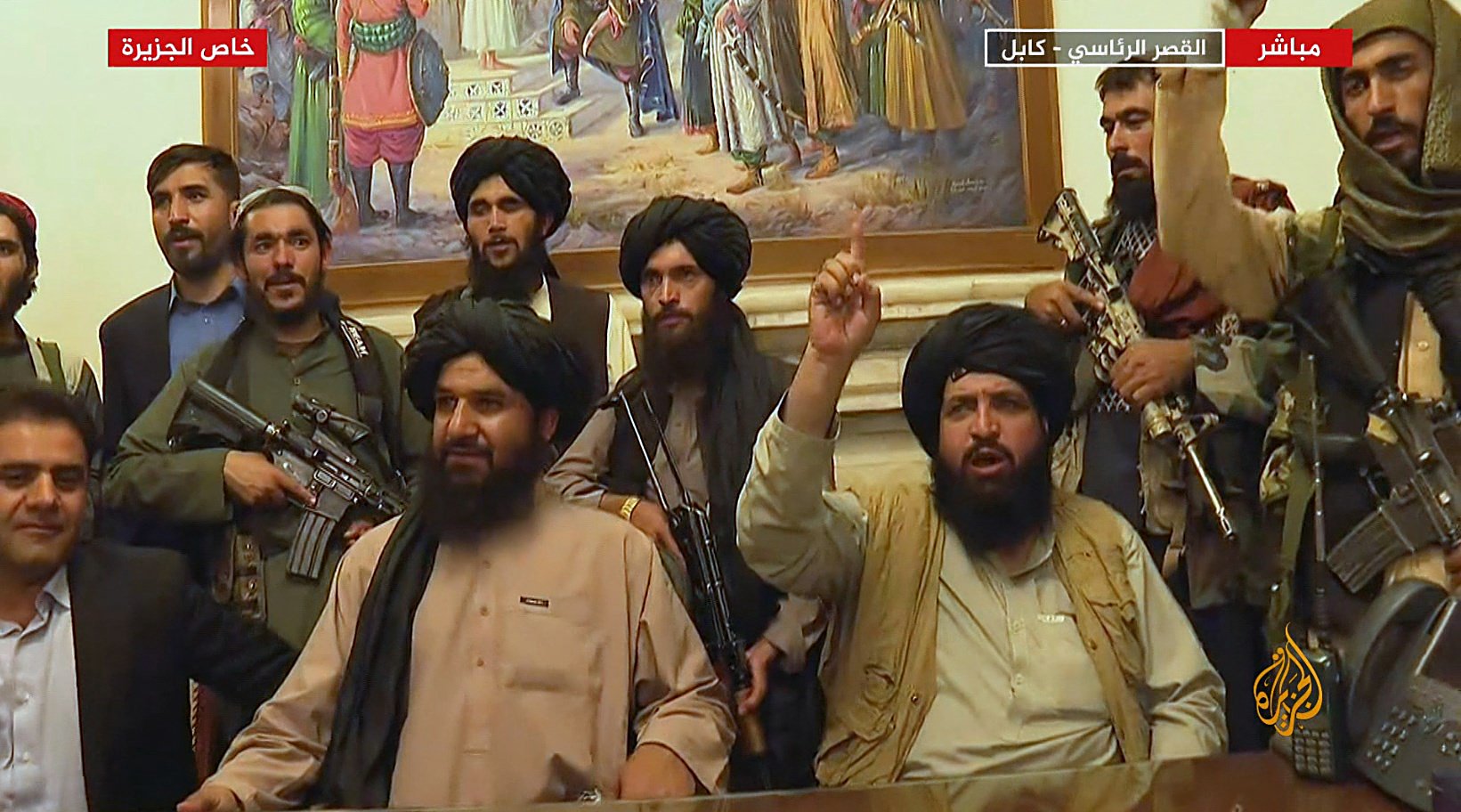
    The trajectory of politics in the volatile region of Afghanistan and its neighbourhood is in flux. A month has gone by since the Taliban rebels swept into the capital and occupied the Presidential Palace in Kabul on August 15. Many faces in the interim government announced by the Taliban are globally designated, terrorists. Till now there are only scanty details about the Taliban’s plans for governance. As the Taliban is an integrated group of multiple tribal power centres, there are conflicting views given by different factions. The hard-line zealots are looking to reimpose their harshly interpreted version of the Sharia laws. The graffiti on the walls are being erased across Afghan towns. Music is muted. Schools and cultural institutions are currently shut. The Taliban has changed the name of the democratic state to the name during Taliban 1.0, an  Islamic Emirate of Afghanistan, a theological state where democracy has no place.

    Surprising everyone, the Taliban announced their ministerial portfolios and postponed the swearing-in ceremony that was planned for September 9, the 20th anniversary of the 9/11 terror attacks. Mullah Hassan Akhund has been named the prime minister. Whether he is acceptable to all the factions is still in doubt. The Haqqani group, a virulent anti-Indian faction, has garnered powerful ministries. The Interior Ministry will be headed by Alhaj Mullah Sirajuddin Haqqani of the Haqqani Network, while Taliban co-founder Mullah Abdul Ghani Baradar has been accredited with the portfolio of the deputy prime minister.

    Sirajuddin Haqqani is long designated as a global terrorist by the US.  The cabinet is likely to expand later. The leaders are yet to come up with some heavyweight names including the judiciary chief. The Islamic Emirate of Afghanistan will be under the supreme leadership of Sheikh Haibatullah Akhundzada. He was head of Sharia courts under the Taliban 1.0 regime from 1996 to 2001 and was responsible for the harsh and brutal interpretation and implementation of Sharia law.  Molvi Muhammad Yaqoob is in charge of the Ministry of Defence, while Molvi Ameer Khan Muttaqi is announced as the Foreign Minister.

     Four Haqqani leaders are allocated portfolios in the cabinet. The tussle between the Haqqani and Yaqoob factions is already public. The Haqqani network intends to retain complete control of Kabul and thus dominate Afghanistan while the Yaqoob faction led by Mullah Baradar, with their power centre in Kandahar, favours an inclusive government featuring the minorities as well. The Haqqani faction functions with the full support of Pakistan and is masterminded by the ISI. This factional feud could spill out to weaken the Taliban ultimately.

    The Taliban’s cabinet doesn’t reflect the ethnic diversity of Afghanistan, and nearly half the strength consists of members from the previous government in 1996-2001. A slew of challenges has already emerged for the new regime. The first is the problem of recognition and legitimacy by the general population and non-voter citizens across the state. The second challenge will be ensuring inclusive governance, claiming undisputed leadership across the territory, as well as dealing with Al Qaida and the Islamic State Khorasan. Economic reconstruction of the devastated economy, coupled with achieving diplomatic recognition by the global community is the major challenge.

    Afghanistan is known for its mosaic culture. In Article 4 of the Afghan Constitution, 14 major ethnic groups are recognized. Apart from the major populace belonging to Pashtun, Tajik, Hazara and Uzbek, there are ethnic minorities like Turkmen, Baluch, Pashai, Nuristani, Aymaq, Arab, Qirghiz, Qizilbash, Gujur,  Brahui. There are also micro-ethnic settlements across the state.

    Taliban has neither showed empathy towards the minorities nor respected the constitution. Out of the thirty-three ministers and high-level names in the Taliban’s cabinet, two appointees are Tajik (Qari Din Mohammad Hanif, Minister of Economic Affairs and Qari Faseehuddin, Army Chief), and only one name is Uzbek (Molvi Abdul Salam Hanafi, Second deputy to PM). Despite a considerable Hazara demography, no ministry is allocated to anyone belonging to Hazaras or even Shia Islam. .

    Women make up almost half of the 40 million Afghan population. Significantly, no female candidate is projected as a minister in the newly formed ministry. Even though Abdul Baqi Haqqani, the Higher Education Minister clarified that females will be permitted to pursue higher education, there are serious concerns over girls’ education. During the Taliban’s incumbency between 1996-2001, girls and women were barred from attending classes and working outside. The Taliban has renamed the Women’s Affairs Ministry the Ministry of Vice and Virtue.

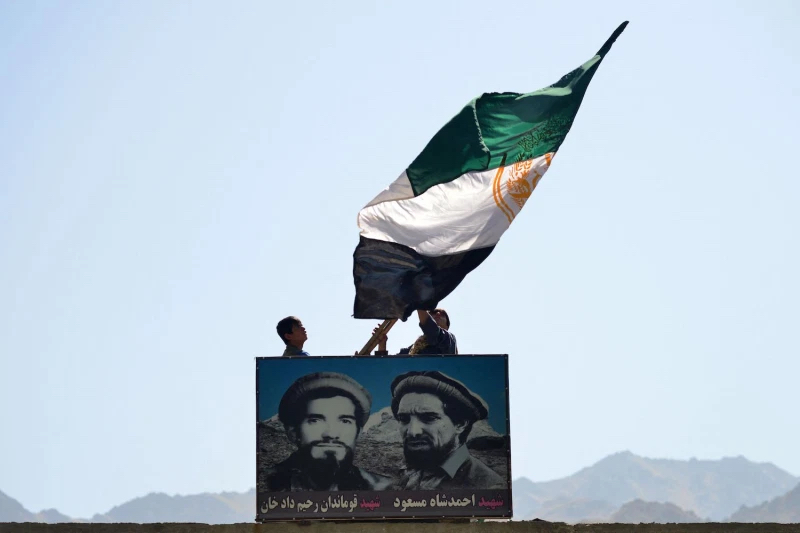
    After the collapse of Amrullah Saleh led interim government in Panjshir, Afghanistan is being ruled by only one incumbent – The Taliban. But Amrullah Saleh and Ahmed Massoud have formed the Government in Exile in Dushanbe, Tajikistan. With this announcement, the global community is likely to recognize only one among the two- the government of the Islamic Republic of Afghanistan in Exile and the Taliban-led Islamic Emirate of Afghanistan.


    In order to alter the negative global perception towards them, the Taliban will have to ensure civic rights, human rights and women’s right to work and study. Establishing political stability and non-violence should be clearly demonstrated. To continue ruling poverty-stricken, strife-torn and war-ravaged Afghanistan, the Taliban will have to work on better external engagements within their ideological frameworks. The United Nations and European Union will continue to engage the Taliban on humanitarian grounds, provided the Taliban works to ensure hope and optimism. Through an official communique to Secretary-General on September 15, the Taliban nominated Mohammad Suhail Shaheen and appealed for the UN representation of the Taliban.

    Aid and trade – these two remain the most significant challenges for the Taliban. Apart from the Islamic states like Pakistan, Iran, Qatar and Turkey, the Taliban has been engaging Russia and China for their support. Under these circumstances, Pakistan is expected to negotiate with the Taliban on Haqqani’s power and control in the provinces along the Durand line. Bringing Tehrik-e-Taliban (Pakistan) under control will be a challenge for Islamabad. Pakistan’s military establishment will seek to cut commercial channels between Afghanistan and India and gains in favour of Pakistan.  India continues its wait and watch policy towards considering diplomatic or political links with the Taliban.

    The tussle for power and dominance between the main factions may spawn severe political instability and civil war. The perennial inter-tribe rivalries across the provinces of Afghanistan will complicate the issues further. [TPF]

    Image Credit: inews.co.uk
  • Narcotic Jihad | Can science and reason defeat religious polarisation in Kerala?

    Narcotic Jihad | Can science and reason defeat religious polarisation in Kerala?

    It is surprising that in today’s Kerala the well-educated religious lot, who are expected to have had a smattering of science, and who are expected to be the ones who see reason, are the ones who are raising the bogeys of ‘love jihad’ and ‘narcotic jihad’.

    Bertrand Russell, the great mathematician-philosopher and polymath had famously held that “Religion is something left over from the infancy of our intelligence; it will fade away as we adopt reason and science as our guidelines”. When we reflect on Russell’s quotation and introspect the religious realm in India per se, not to talk about contemporary events in Kerala, it is quite disconcerting and distressing; and a few crucial issues ensue from there.

    First and foremost, either Russell was wrong in his assertion as regards the fading away of religion in the wake of the adoption of reason and science by humans, or his understanding and definition of ‘religion’, ‘intelligence’, ‘reason’, and ‘science’ were at variance with the general, and usually acceptable, notions/definitions that are prevalent in civic society at large.

    It is rather surprising that in today’s Kerala the well-educated religious lot, the clergy, who are expected to have had a smattering of science, and who are expected to be the ones who see reason, are the ones who are raising the bogeys of ‘love jihad’ and ‘narcotic jihad’, notwithstanding the fact that probes by different agencies, including the National Investigation Agency, have debunked such allegations.

    The clergy concerned, particularly the bishop of Pala and other priest(s) who have indulged in such rhetoric, may not necessarily have played on into the hands of the Sangh Parivar, but have certainly touched the hearts and endeared themselves to the latter to the extent that the latter are ecstatic. Also, they have, along with other Right-wing groups, extolled the bishop of Pala, and have extended their support to him.

    However, something that has been very heartening and positive in this dark and murky scenario has been the bold and defiant stand of a group of nuns who not only spoke out against the bishop but also walked out of the mass of the priest who preached hate by going to the extent of beseeching his flock to boycott Muslims traders as also Muslim autorickshaw drivers.

    One would not have been surprised if insinuations and allegations of ‘love jihad’ and ‘narcotic jihad’ were made by Right-wing extremist groups because it is, inevitably, their wont to do so. But coming from the clergy in a state which has historically seen relatively amicable and amiable relations between Muslims and Christians wherein they have prospered together, belies logic.

    Pre-Islamic Arab contact with Kerala and the rest of the west coast of India dates back to the ‘Before Christ’ era, which gradually transformed into the Islamic one from the seventh century AD onwards.

    The oldest mosque to be built in the Indian subcontinent was the Cheramaan Juma Mosque in Methala, Thrissur district, in 629 CE. It is significant to point out that the north-centric way of looking at and referring to Islam in India by certain historians is quite misplaced. By the time Islam made any impact in the northwest and north of India, full-fledged Islamic societies had been formed in Kerala that extended beyond and along the Coromandel Coast in Tamil Nadu and spread towards South East Asia.

    Similarly, the Christian connection and the advent of Christianity in Kerala go back to 52 CE. For centuries, these religious groups, namely, Christians and Muslims, have coexisted and inhabited common spaces all over Kerala, along with the pre-existing indigenous communities. Also, there has been a high degree of acculturation between the various religious groups in terms of language, food, clothing, and other cultural practices including in the religious realm.

    There were, no doubt, skirmishes between the Christians and Muslims with the arrival of the Portuguese during the late fifteenth and early sixteenth century, but these have to be treated more as aberrations for economic gains than something that disturbed the overall ambiance of peace and communal harmony. The erstwhile situation as regards peaceful coexistence between the different religious communities prevailed in Kerala in spite of quite a few communal riots in other parts of India, both before and after the Independence.

    It is felt in some circles in Kerala that due to the COVID-19 pandemic and the restrictions as regards congregations, the footfalls have declined to result in drastically reduced revenues in the churches, and that has made some clergy feel insecure; and one way of getting back the faithful could be to polarise the communities in the expectation that would help in consolidating their own followers.

    Of late, the anti-Muslim rant that has emanated in Kerala is not confined to the borders of the state. The overt and manifest support in social media and through videos, for Israel’s bombing of Gaza during the recent conflict vis-à-vis the Palestinians, too, is, at one level quite disturbing, and at another level, points to the mindset that such perpetrators are embedded in.

    The proclivity to reduce the Palestinian identity to just a Muslim/Islamic one is one of the most irrational ways of looking at a people and explicating their ethnicity. Christian Palestinians too are at the forefront in their resistance to Israeli imperialism, and the occupation of Palestine. The well-known academic and crusader for peace, late Professor Edward Said, was one such.

    This article was published earlier in moneycontrol.com

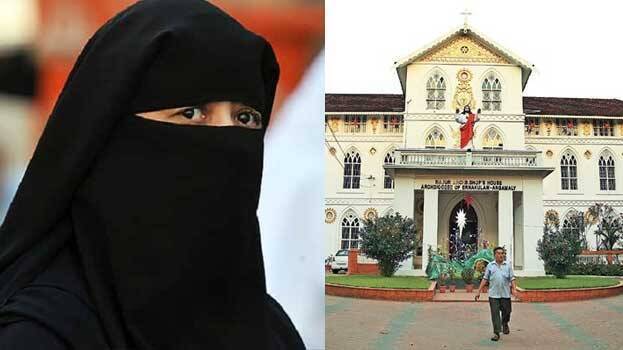
    Featured Image: keralakaumudi.com

  • Does ASEAN Need a New Approach to Code of Conduct for the South China Sea?

    Does ASEAN Need a New Approach to Code of Conduct for the South China Sea?

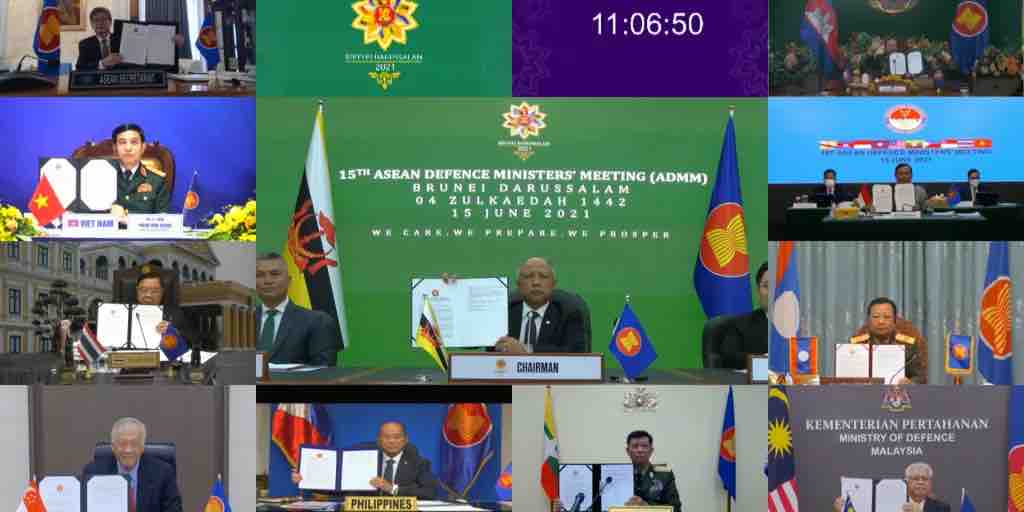
    Reference to Declaration on the Conduct of Parties in the South China Sea (DOC), Guidelines for the Implementation of the DOC, and formulations such as early adoption of a Code of Conduct in the South China Sea (COC) have featured in the ASEAN Chairman’s Statement of East Asia Summit Foreign Ministers’ Meeting since 2013 when Brunei Darussalam had held the Chairmanship of the ASEAN. These references were reiterated, and the section relating to the South China Sea in the ASEAN Chairman’s Statement for the 11th East Asia Summit Foreign Ministers’ Meeting in August 2021 under the leadership of Brunei Darussalam, is no different.

    While the Chinese intent is a welcome development, its new “Maritime Traffic Safety Law of the People’s Republic of China” (MTSL) that came into effect on 01 September 2021, has caused turbulence among the claimant States.

    Meanwhile, China’s Ministry of Foreign Affairs Statement of 5 August 2021 notes that a new goal has been set by China under which Beijing and ASEAN would “refrain from unilateral actions that aggravate tensions and widen differences, or using force or threat of force in particular”. While the Chinese intent is a welcome development, its new “Maritime Traffic Safety Law of the People’s Republic of China” (MTSL) that came into effect on 01 September 2021, has caused turbulence among the claimant States. As per the MTSL guidelines and procedures, vessels must “report the name, call sign, current position, next port of call and even estimated time of arrival to Chinese authorities”.

    The Philippines has decided to “ignore” the new Chinese Regulations and Philippine Defence Secretary Delfin Lorenzana has clarified his country’s stand on the issue that “we do not honour those laws by the Chinese within the West Philippine Sea because we consider that we have the sovereign right within this waters. So we will not recognise this law of the Chinese,” The Vietnamese Foreign Ministry too has reiterated strict compliance with the 1982 UNCLOS “when promulgating documents of domestic law related to the sea”.

    The Pentagon has accused China of “Unlawful and sweeping maritime claims, including in the South China Sea, pose a serious threat to the freedom of the seas, including the freedoms of navigation and overflight, free trade and unimpeded lawful commerce, and the rights and interests of the South China Sea and other littoral nations,” and the Defense Department spokesman has stated that the country will “ continue to fly, sail and operate wherever international law allows,”

    By all counts, an early conclusion of CoC in the South China Sea is only wishful given that the idea has been on the table for over two and a half decades since 1996. At that time there was euphoria among ASEAN foreign ministers that a CoC in the South China Sea could be the “foundation for long term stability in the area and foster understanding among claimant countries.”

    There is now a view that it is time to change the “objective from coming up with a comprehensive CoC”; instead, ASEAN and China must work towards “incremental development of a series of agreements” that could “eventually become the CoC in the future”

    The ASEAN has made earnest efforts and continues to negotiate a legally binding CoC but its finalization has eluded it. There is now a view that it is time to change the “objective from coming up with a comprehensive CoC”; instead, ASEAN and China must work towards “incremental development of a series of agreements” that could “eventually become the CoC in the future”. This can be achieved by developing “more realistic” and “smaller accords” that can help “de-escalate potential contentious situations”.

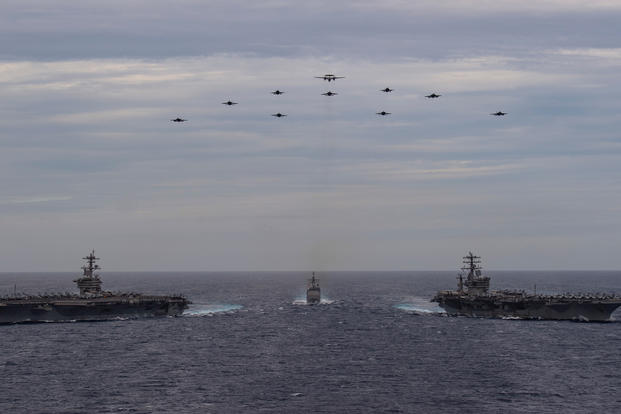
    The above argument merits attention for at least two important reasons. First, the South China Sea is simmering due to US-China military contestations. The US Navy continues to engage in exercises and the current deployment in the South China Sea by USS Carl Vinson Carrier Strike Group and Air Wing of the Future is a reflection of the US’ commitment to field “combat-ready force to protect and defend the collective maritime interests of the U.S. and its regional allies and partners”. Also, the US Navy has conducted FONOPs relentlessly and is now joined by the US Coast Guard. The Quad Member States have also dispatched their warships to the South China Sea for Malabar Naval exercises and the European navies led by France and Britain are operating in the region. These multi-nation naval manoeuvers have prompted China to respond through similar actions and the PLA Navy and the Air Force are persistently deployed in the region. This ‘state of affairs’ will continue.

    Second, there is a view that while the CoC should necessarily be consistent with the 1982 UNCLOS and should not “prejudice legitimate rights and interests of nations not a party to discussions,” this assessment can potentially trigger clamour among other stakeholders who have politico-diplomatic, economic and strategic interests in the region and have vehemently argued for a rules-based system and have challenged China’s expansive claims in the South China Sea as also its non-adherence to the 2016 PCA ruling.

    Under such circumstances, there are no incentives for China and it is deliberately delaying the finalization of the COC; it prefers to pursue a “business as usual” approach causing immense insecurity in the minds of the claimant States. Meanwhile, there is now a sense of urgency among the ASEAN Member States to finalize the CoC and their “patience” is wearing thin.


    Feature Image Credit: Nikkei Asia

  • Bonded Labour in India: Prevalent, Yet Overlooked

    Bonded Labour in India: Prevalent, Yet Overlooked

    In 1976, India stood out as the first country in South Asia to enact legislation prohibiting bonded labour. However, the system has not been uprooted owing to the different barriers posed by socio-cultural norms and administrative and legislative incompetency. The country’s most vulnerable and disadvantaged sections of society are at risk of being trapped into such a form of modern slavery. The prevalence of this system over the decades necessitates the need to understand the root causes of the emergence of such bonded labour situations and why it is still prevalent in the country.

    Bonded labour in India

    The Bonded Labour System Abolition Act (1976) defines a bonded labour system as a relationship evolved out of a debtor-creditor agreement. It is identified as a form of forced labour where the debtor comes into an agreement, oral or written, with the creditor and receives a loan amount in exchange for his labour or that of his family members. The obligation need not just be an economic consideration such as a loan or an advance amount received from the creditor. People also become bonded with social, customary, hereditary or caste obligations and often agree to enter service with no wages or for nominal wages. The labourer finds it difficult to settle the debt amount as the provided wages are too low even to meet their basic sustenance needs. Eventually, they end up in the same form of labour again and again. Thus their choice to join such a system is out of distress or coercion to some extent. They may also be restricted from switching to another job or to ask for the provision of minimum wages given the conditions of the contract and the lack of awareness of their rights.

    Indebtedness is identified as a major trigger for people to join as bonded labour, especially migrants from poor rural households. However, the need for money arises out of the existing disadvantages in society that these communities are subjected to. Caste, unequal distribution of resources, increased dependence on agriculture, low levels of education and food insecurity pushes them into such unfree labour choices.

    We can identify that this system was prevalent in the country from the pre-colonial era characterised by class hierarchies. Such class hierarchies and high caste exploitations are continuing to function even in this democratic era and consequently, has pushed certain groups of the society to be economically weaker; weak in terms of assets, income and bargaining power. Globalisation and industrialisation have only resulted in the further exclusion of such groups of labour from mainstream jobs.  Indebtedness is identified as a major trigger for people to join as bonded labour, especially migrants from poor rural households. However, the need for money arises out of the existing disadvantages in society that these communities are subjected to. Caste, unequal distribution of resources, increased dependence on agriculture, low levels of education and food insecurity pushes them into such unfree labour choices. Owing to these social and economic factors, marginalised communities in the lower strata of the society, especially the women and children, are trapped in such a system.

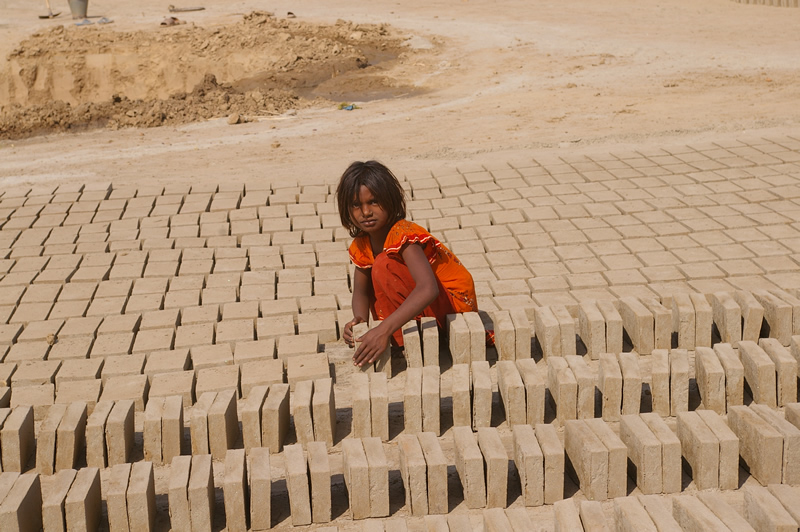
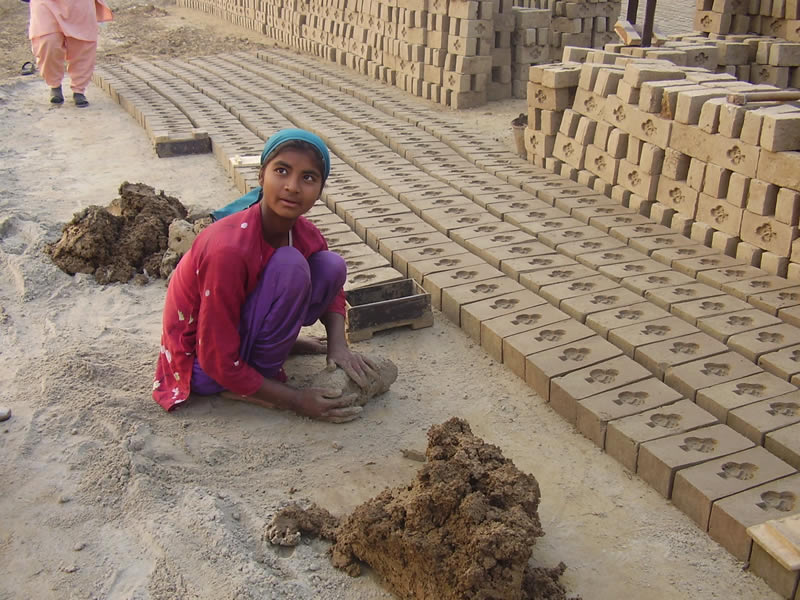
    Over the years, the system of bonded labour has existed and evolved under different names and forms across India. Bonded labour arising out of traditionally accustomed social relations is one of the oldest forms and is still prevalent in the country. For example, the system of “jajamani” wherein the workers receive food grains in exchange for working as barbers and washermen for the upper caste. Labourers in agriculture, seasonal inter and intrastate migrants and child labour in informal sectors of brick kiln, rice mills, quarries, domestic work etc. are the other areas where debt bondage is currently more persistent. There has been a considerable shift from traditional debt bondage relation to aneo-bondage labour system among migrant workers. The former was characterised by an element of patronage amongst the considerable amount of exploitation. However the latter is at a higher tone of exploitation and eliminates patronage relations. This has made employers deny the responsibility of employee’s welfare and the labourers have lost the minimum livelihood security which they had secured under the patronage system. The neo-bondage system is further manipulated by the role of intermediaries.

    Thus, with structural transformation in the economy, the system of bonded labour has evolved into a much worse form of exploitation in the country and specifically marginal and backward communities are the main victims of this system.

    Interventions to abolish bonded labour

    Upon identifying the prevalence and exploitation of bonded labour in the pre-independence era, constitutional provisions prohibiting forced labour were assigned under Article 23. Under the Directive Principle of State Policy, Article 42 and 43 ensured fair and humane working conditions and living wages to workers.

    Post-independence, legislation against bonded labour was enacted at a regional level.  Orissa, Rajasthan and Kerala were the first states to enact state legislation against bonded labour.  In 1954, India ratified the International labour organization (ILO) Convention on forced labour (C029). Despite the constitutional provisions, regional and international interventions in bonded labour, construction and implementation of a uniform law took time.

    In 1976, the Bonded Labour System (Abolition) Act was enacted to abolish any form of bonded labour system arising out of debt, customary or hierarchical obligations. In brief, the act has identified and defined bonded labour, provided for extinguishment of past or existing debt, established duties of district magistrate in implementing the provisions of the act, sanctioned the state governments to form a vigilance committee in each district to guide and ensure competent implementation of the act by the magistrate and stated the penal actions against those compelling people into bonded labour. The act was amended in 1985 to bring contract and migrant workers under its ambit.

    In 1978, a new centrally sponsored scheme for Rehabilitation of Bonded Labour was enacted to provide financial assistance to the state government for rehabilitating rescued bonded labourers, to conduct surveys, evaluation studies and awareness campaigns across districts. In 2016, the government restructured the scheme. The restructuring involved an increase in the provision of funds to bonded labour for rehabilitation and to states for conducting surveys. Under the restructured scheme, rescued bonded labour is only provided with the full amount of financial assistance after the conviction of the accused and a Bonded Labour Rehabilitation Fund corpus was to be created at every district.

    The interplay of caste-based exploitation and subsequent impoverishment in terms of resources and assets combined with underdeveloped rural areas devoid of standard education, health and employment opportunities push marginalised people into bonded labour.

    Why and how does the system still sustain?

    Many factors contributing to the prevalence of bonded labour continue to prevail despite after years of legislative action to abolish the same. The interplay of caste-based exploitation and subsequent impoverishment in terms of resources and assets combined with underdeveloped rural areas devoid of standard education, health and employment opportunities push marginalised people into bonded labour. Such an environment accompanied by the inept implementation of legislations and schemes further aids in sustaining bonded labour systems.

    BLS(A) act 1976 failed to be effectively implemented owing to apathy, corruption, lack of administrative and political will. The vigilance committees were often defunct and working for the employer. The act was criticised on the grounds that it stated only mediocre and minor punitive actions and the rates of prosecution were also low. Moreover, some states remain in denial of accepting the existence of bonded labour. This indifference results in the loss of comprehensive data on bonded labour hindering the further implementation of provisions of the act.

    The Central Sector Scheme for Rehabilitation of Bonded Labour also has its loopholes. After the restructuring of the scheme, financial aid is provided only after the accused is convicted and convictions are rare owing to poor implementation of the BLS(A) Act and the absence of a review of cases. Thus, in most cases the rescued labourers do not receive the full financial aid they are entitled to immediately after the rescue. Often, it takes years to receive the full amount or may not even receive any.

    The situation is even grave as the rescued labourers have asymmetric knowledge of the rights and entitlements they can avail themselves of. Even when they are fully aware, most of them lack the will to attain these entitlements due to the dismal behaviour of officials and delayed processes.

    Moving towards Abolishment

    First and foremost, recognition and acceptance of the prevalence of bonded labour should be ensured. Only then the bonded labourers could be identified, rescued and rehabilitated effectively. The collection of comprehensive data is essential for further implementation of the provisions of the legislation. Also apart from the vigilance committee, a new committee composed of the magistrate, members of the marginalised communities, NGO’s and other civil bodies working in the field would enable to get a more comprehensive view of the issues in the sector.

    From a long term perspective, there is a need to address the caste induced structural inequalities. One way through which this could be attained is through land redistribution.

    Mere financial aid is not sufficient for the rescued labourers to foster a livelihood plan. The Human rights law network suggests the same and recommends a comprehensive rehabilitation package providing for education and job security.

    From a long term perspective, there is a need to address the caste induced structural inequalities. One way through which this could be attained is through land redistribution. Apart from this, the government should also focus on skill development and training of rural poor, especially migrants caught up in bonded labour. Varied skills can enhance their employment opportunities and provide more freedom to move towards other areas of work.


    References

    1. B.L.S., A. (2020, June 30). Telangana: Two Years After Rescue From Bonded Labour, 12 Tribals Receive Compensation. The Wire. https://thewire.in/rights/telangana-bonded-labour-rescue-tribals-compensation
    2. Breman, J. (2010). Neo-bondage: A fieldwork-based account. International Labor and Working-Class History78(1), 48-62. https://www.jstor.org/stable/40931303
    3. Gabra, L. (2021, March 21). Will Bonded Labor in India Ever Come To An End? BORGEN. https://www.borgenmagazine.com/bonded-labor-in-india/
    4. Human Rights Law Network. (n.d.). Release and Rehabilitation of Bonded Labour — HRLN. Human Rights Law Network (HRLN). Retrieved August 15, 2021, from https://hrln.org/initiative/release-and-rehabilitation-of-bonded-labour
    5. Human Rights Watch. (n.d.). Small Change. Human Rights Watch (HRW). Retrieved August 6, 2021, from https://www.hrw.org/reports/2003/india/India0103-05.htm
    6. J, S. (2019, September 15). Rescue of bonded labourers up, convictions rare. Times of India Blog. https://timesofindia.indiatimes.com/blogs/tracking-indian-communities/rescue-of-bonded-labourers-up-convictions-rare/
    7. Khan, J. A. (2019, April 30). How effective are the Policies for Rehabilitations of Bonded Labour in India? CBGA India. https://www.cbgaindia.org/blog/effective-policies-rehabilitations-bonded-labour-india/
    8. Mantri, G., & Suresh, H. (2020, January 31). The News Minute | Delve. The News Minute. https://www.thenewsminute.com/article/it-s-2020-bonded-labour-still-reality-india-here-s-why-116977.
    9. Molfenter, C. (2013). Overcoming bonded labour and slavery in South Asia: the implementation of anti-slavery laws in India since its abolition until today. Südasien-Chronik-South Asia Chronicle3, 358-82. https://edoc.hu-berlin.de/bitstream/handle/18452/9122/358.pdf?sequence=1&isAllowed=y
    10. Murugesan, D (2018). HANDBOOK ON BONDED LABOUR. NATIONAL HUMAN RIGHTS COMMISSION (NHRC), New Delhi. https://nhrc.nic.in/sites/default/files/Hand_Book_Bonded_Labour_08022019.pdf
    11. NCABL. (2016). Joint Stakeholders’ Report on Situation of Bonded Labour in India for Submission to United Nations Universal Periodic Review III. NATIONAL COALITION FOR ABOLITION OF BONDED LABOUR (NCABL), Bhubaneswar Odisha. https://www.upr-info.org/sites/default/files/document/india/session_27_-_may_2017/js34_upr27_ind_e_main.pdf
    12. Prasad, K. K. (2015). Use of the Term’Bonded Labour’ is a Must in the Context of India. Anti-Trafficking Review, (5), 162.
    13. Sabhapathi, V. (2020, June 11). An Analysis of Bonded Labour System in India. Legal Bites – Law And Beyond. https://www.legalbites.in/bonded-labour-system-in-india/
    14. S, B. (2016, April 2). Caught in a vicious cycle of bonded labour. The Hindu. https://www.thehindu.com/news/national/karnataka/caught-in-a-vicious-cycle-of-bonded-labour/article7720754.ece
    15. Sethia, S. The Changing Nature of Bonded Labour in India.
    16. Srivastava, R. S. (2005). Bonded labour in India: Its incidence and pattern.https://www.ilo.org/wcmsp5/groups/public/—ed_norm/—declaration/documents/publication/wcms_081967.pdf 

    17. THE BONDED LABOUR SYSTEM (ABOLITION) ACT, 1976. (ACT NO. 19 OF 1976). (India). https://labour.gov.in/sites/default/files/TheBondedLabourSystem(Abolition)Act1976.pdf


    Image Credits: starfishasia.com

  • The United States Must Airdrop Aid to the Blockaded Regions of Afghanistan

    The United States Must Airdrop Aid to the Blockaded Regions of Afghanistan

    With the Afghan economy is on the verge of collapse, the United Nations has warned that half of the population in Afghanistan needs humanitarian aid. While the U.S. military’s combat operations in Afghanistan have come to an end, Washington has pledged to remain engaged with the country through diplomacy, development, and humanitarian aid. After the sudden collapse of the U.S.-backed government on August 15, 2021, the Taliban swiftly seized 33 of Afghanistan’s 34 provinces –  the last standing is Panjshir. As Panjshir leads the resistance, it has also become a safe refuge for many Afghans escaping the wrath of the Taliban.

    The Panjshir Valley is surrounded by magnificent mountains and a roaring river at its heart. It has historically been an unconquered territory, be it against the Soviet Union in the 1970s or the Taliban in the 1990s. The current resistance force is led by Mr. Ahmad Massoud, the son of the legendary anti-Soviet freedom fighter Ahmad Shah Massoud, who was tragically assassinated by al-Qaeda in collaboration with the Taliban two days before the horrific attacks of 9/11. Mr. Ahmad Massoud is now leading the National Resistance Front (NRF) of Afghanistan, alongside Vice President Mr. Amrullah Saleh, who has proclaimed himself as care-taker President in the absence of President Ashraf Ghani, who has fled the country.

    While people across the country suffer from the shortage of food and basic needs, the situation in Panjshir is dire as the NRF and Taliban are fighting tooth and nail. Notably, several of Massoud’s closest aides have been killed, allegedly by Pakistan’s drones, and there is an active blockade imposed on the valley by the Taliban. The NRF’s attempts to negotiate a peace deal with the Taliban, which included some level of autonomy for Panjshir under a decentralized Islamic democratic system were rebuffed. The Taliban insists on a centralized and puritanical theocracy with the group as the dominant power at the center.  While both sides have sustained casualties, reports indicate a devastating toll on the civilian population.

    The Panjshir valley has been surrounded by the Taliban from all entry points, and they have callously enforced an active blockade, inhibiting humanitarian relief from reaching the afflicted. Internet and telephone communication lines have been cut off for several days. Mr. Saleh has appealed to the international community for humanitarian assistance, but his pleas for help have fallen on deaf ears. The Taliban has confirmed the blockade, by saying that due to fighting goods and food items have not entered the province for some four days but promised to reopen the supply lines. The Taliban also claimed to have captured the entire province, including the capital Bazarak. However, the NRF reports resumption of fierce fighting across the province. This is at a time when Ahmad Massoud has called for a national uprising which has inspired some movements in other provinces. Additionally, several women have also participated in protesting for their rights in cities like Kabul, Herat, and Mazar e Sharif.

    Many amongst the ranks of the NRF are former members of the Afghanistan National Defense and Security Forces (ANDSF). They have risked their lives fighting alongside American troops against al-Qaeda, the Taliban, and the Islamic State Khorasan, and many feel abandoned while they continue to resist. While we do not know a lot about the intensity of the issue due to complete media blackout, some with access on the ground report of the catastrophic humanitarian crisis is unfolding in places like Panjshir and Andarab, a district in neighboring Baghlan province. Upwards of a quarter of a million civilians are trapped in these areas,  and desperately need “food supplies, including baby formula, rice, wheat, and other perishables” and medicine.

    While the U.S. military’s combat mission has ended in Afghanistan,  America and its allies can provide critical assistance through humanitarian aid as originally planned. Some small amount of aid from the United Arab Emirates and Bahrain have reached Kabul, but a lot more needs to be done to prevent the catastrophe that the United Nations has warned about. One of the quickest ways to get aid across the country would be through airdropping. The US has conducted several airdrop missions in the past including one in 2014 in Iraq. The US should start with airdropping the much-needed supplies in areas such as Panjshir and other regions where the Taliban has imposed blockades. This can bring great relief to the people in need. Delays in delivering humanitarian aid could risk the lives of many people from starvation and medical attention.

    Image Credit: www.foreignpolicy.com 

  • The Fall of Kabul and dealing with the Taliban 2.0

    The Fall of Kabul and dealing with the Taliban 2.0

    The debacle of the democratic apparatus in Afghanistan was inevitable. After pumping billions in aid and significant bloodshed, the US government ended its longest war in defeat, the war in Afghanistan under the euphemism of ‘Global War on Terror’. Right after occupying the White House, the Biden administration has followed the path of its predecessors and commanded the complete withdrawal of troops from Afghanistan. The 2020 – Doha peace agreement between the US government and the Taliban brought a scant number of outcomes. Even during the presence of international forces in Afghanistan, the Taliban leaders disrespected the peace agreement and violated significant features of the agreement – that is a ceasefire. Following the agreement, over 5000 prisoners belonging to the separatist groups- were released by the Afghan government, under pressure from the US. Quite naturally, these prisoners were back with their militant outfits, thus strengthening the Taliban’s fighting capability.

    As of now, India has not taken any part in the peace negotiations with the Taliban. One of the major reasons is in the past the Indian government has never recognised the Taliban as a legitimate actor and vouched for a peace negotiation that should be Afghan-led, Afghan controlled and Afghan-owned. Currently, there are speculations about the likely power structure and composition of the government in Afghanistan, but it is quite clear the Taliban will govern the country by Sharia law. At this time of fast transition, the countries in South Asia are seeking to gain diplomatic leverage in the situation.

    India has a huge stake in Afghanistan’s reconstruction. In 2016 Indian Prime Minister and Afghan President Ashraf Ghani inaugurated the Salma dam project in Afghanistan. This 200 million dollar project is part of the larger developmental approach of the Indian government to Afghanistan. But recently, the equipment of the Salma dam was captured by the Taliban. In this scenario, it is unlikely that the Dam project will receive further Indian logistical support in future. Similarly, uncertainty beleaguers the Chabahar Project. India was one of the largest bilateral donors to Afghanistan during the war on terror. It ranges from infrastructure building to the promotion of democracy and small development projects. Almost $3 billion has been invested in and on Afghanistan in capacity building, education, infrastructure and security counts. This developmental commitment has made India the most dependable country and strategic partner for Afghanistan so far. However, now that the Taliban is in full control, the Indian government needs to find a diplomatic solution on how to go ahead with the various projects and commitments in Afghanistan.

    Except for Panjshir province, the entire country is under Taliban control. The president, head of the state, has left the country. Led by interim President Amrullah Saleh and Ahamad Masoud, the Resistance Force from Panjshir Valley is fiercely fighting against the Taliban. Under such circumstances, the conservative approach of the Indian government, as it has begun to talk to the Taliban, could ruin the decades’ long reputation and developmental efforts in Afghanistan. India has legitimate concerns in Afghanistan and should protect its interests carefully. The absence of the US forces and elected Afghan government makes the task very difficult for the government of India. In the past, the Indian government cooperated with the elected Afghan government based on their shared interests and values of democracy, freedom, rule of law and respect for human rights. But the past approach may not work anymore under the Taliban leadership. In the past, the Ministry of External Affairs stated that it is in touch with ‘various stakeholders’ in Afghanistan and other regional countries. Indian officials believe that a ‘double’ peace’ i.e. one within Afghanistan and around the country is necessary for the region. To ensure safety for the Indians living in Afghanistan, the government has already evacuated all Indians employed by the Indian embassy. India has also started emergency E-visa facilities for Afghan citizens. With regard to the diplomatic relationship with the Taliban, the government is following a ‘wait and watch policy with its extended neighbour. The Taliban leadership has announced that they would like to have good relations with the Indian government and access to the Indian market through Pakistan. The Taliban also wants these two countries to resolve their issues as its interests are linked to the two countries. The government of India is yet to respond. The Afghan media personnel, translators, performance artists, civilians are being hunted down by the Taliban soldiers. In this scenario, India will carefully assess the situation and the reliability of the Taliban to make its further move.

    While India is still on the horns of a dilemma over the direct dialogue with the Taliban, India’s arch-rival Pakistan is busy re-establishing its hold and is trying to isolate India diplomatically from the region. Pakistan was one of the first countries to recognise the Taliban as a legitimate actor in the 90s. Last year, the government of Pakistan welcomed an Afghan Taliban delegation led by Mullah Abdul Ghani Baradar. In the meeting, Pakistan showed their support for peace and blamed India as a spoiler of peace in the war-torn country. But reports suggest otherwise. According to the US Defense Intelligence Agency, Pakistan harbours Taliban leaders along with other insurgent groups such as the Haqqani network, Jaish-e-Mohammed and Laskar-e-Taiba. Such groups have the potential to disrupt the security and stability in South Asia. The report also says that the strategic objective of the Pakistan government is to counter the Indian influence in Afghanistan. In a recent interview, Pakistan foreign affairs minister Shah Mahmood Qureshi said that the violence in Afghanistan led to a refugee exodus to Pakistan but they cannot take more refugees. Last year, the High Council for National Reconciliation leader Abdullah Abdullah said that Pakistan holds the key role in the Afghan peace process and India should keep their profile low in the Afghan situation.

    As the Taliban emerges in its second avatar while reframing its extremist Islamic ideology, China is poised to become the critical player in the region.  Under a slew of conditions negotiated with the Taliban, China will enhance its role through rapid investments and enabling Afghanistan to integrate into its Belt and Road Initiative. An unstable, dry and war-torn Afghanistan doesn’t offer any attractive economic proposition at the moment. As the economic challenges loom on the Taliban government, it can’t simply sustain on drugs. The Taliban have to rely on China, Pakistan and some Central Asian republics to rebuild its economy. Afghanistan’s unexploited mineral wealth, worth a trillion or more, is a great opportunity for the Taliban to leverage economic gains by engaging China, Iran, Russia, and Turkey. An alliance of China, Pakistan, Iran or Turkey may lead to the marginalisation of India’s role and effectiveness in Afghanistan.

    Whether India will recognize the Taliban is not clear yet but India can’t simply meditate either. Under India’s presidency, the UN Security Council passed Resolution 2593 on Afghanistan. Chairing a session India’s Foreign Secretary Harsh V Shringla has clarified that India won’t tolerate if Afghan territory turns into a sanctuary of terrorists and threat for the neighbouring states. Apart from human rights, Shringla emphasized Women’s participation in society.

    India along with its all partners should advocate for strict observation of the Taliban led governance. Having invested over $3 billion over the last two decades in the reconstruction of Afghanistan, India’s considerable contribution cannot be ignored. The recent meeting between India’s envoy Deepak Mittal and the Taliban’s foreign minister-designate Stanekzai at the Taliban’s request signals a possibility for a changed approach and environment from that of the Taliban 1.0. India’s immediate priority should be the safe evacuation of the Indian origin people and stranded Afghans.


    Image Credit: www.dawn.com

  • Politics and the Military don’t gel

    Politics and the Military don’t gel

    It would be in the interest of the political establishment to desist from politicising the military. Creating an uncontrollable monster, that will go on to bite the hand that feeds it, is nothing but sheer stupidity.

    The former President of the United States, Donald Trump, has always had the reputation of being a man of questionable moral and ethical integrity with close connections to the radical right. Yet, there were those who voted for him in 2016 because they genuinely believed that he was the lesser of the two evils, and strongly felt that only an “outsider” like him was capable of draining the “Washington Swamp”, a phrase alluding to the seemingly all-pervasive corruption surrounding the Washington power elite. They would certainly have been disappointed by his insipid performance as President, especially the extent of his chicanery and selfishness. These have been laid bare in a recent book by two Pulitzer Prize-winning Washington Post journalists, investigative staff writer Carol Leonnig and former White House Bureau Chief Philip Rucker, on Trump’s final year in power, titled “I Alone Can Fix It”. A fitting sequel, and as perceptive and illuminating, is “A Very Stable Genius”.

    One of the most fascinating aspects of their latest book pertains to the manner in which the Chairman of the Joint Chiefs of Staff, General Mark Milley, responded to President Trump’s brazen attempts to overturn the election results by peddling his “Big Lie” that the elections had been “stolen” by the Democrats resorting to widespread fraud. Despite his legal challenges being summarily dismissed, he continues to peddle these allegations to this day. There can be little doubt that his incitement of his supporters culminated in a violent but abortive attempt on January 6 to disrupt proceedings at Capitol Hill to formalise the election results.

    Prior to this, one may recall, General Milley had been excoriated by military veterans, politicians and the media for having unwittingly dragged the military into politics by being present, in uniform, at Trump’s infamous “Bible photo op” at the St John’s Church, immediately after peaceful protestors had been forcefully evicted while demonstrating for racial equality. Indeed, that he then went on to tender a public apology for his error of judgement speaks volumes of his forthrightness, integrity and strength of character.

    On Trump’s attempts to cling to power through force, General Milley reportedly told his colleagues in the Joint Chiefs: “They may try, but they’re not going to f@@###g succeed…You can’t do this without the military. You can’t do this without the CIA and the FBI. We’re the ones with the guns.” His actions have lessons that our military leadership would do well to imbibe. 

    He then initiated action to ensure that the military was not dragged into the political sphere, despite Trump having appointed his own lackeys to key positions within the Pentagon. If the authors are to be believed, he went so far as to compare Trump to Hitler and refer to the January 6 insurrection as the “Reichstag Moment” for the US. On Trump’s attempts to cling to power through force, he reportedly told his colleagues in the Joint Chiefs: “They may try, but they’re not going to f@@###g succeed…You can’t do this without the military. You can’t do this without the CIA and the FBI. We’re the ones with the guns.”

    His actions have lessons that our military leadership would do well to imbibe. It is inconceivable that our senior military hierarchy can, or ever will, adopt such a confrontational attitude towards the leadership of a democratically elected Government, whatever be the provocation, or however unconstitutional be their actions. The aloofness displayed by the military during the 1977 Emergency is a case in point. True, there have been the likes of General Thimmayya, Field Marshal Manekshaw and a few more of that vintage who have displayed spine and opposed Government directions, but these have been few and far between, and restricted only to professional matters within their purview. Moreover, till recently, the military’s senior leadership has been quite circumspect in ensuring that its actions were completely unbiased, apolitical, secular and within constitutional parameters. In fact, it was their adherence to such behaviour that made the military the most popular and respected institution within the country.

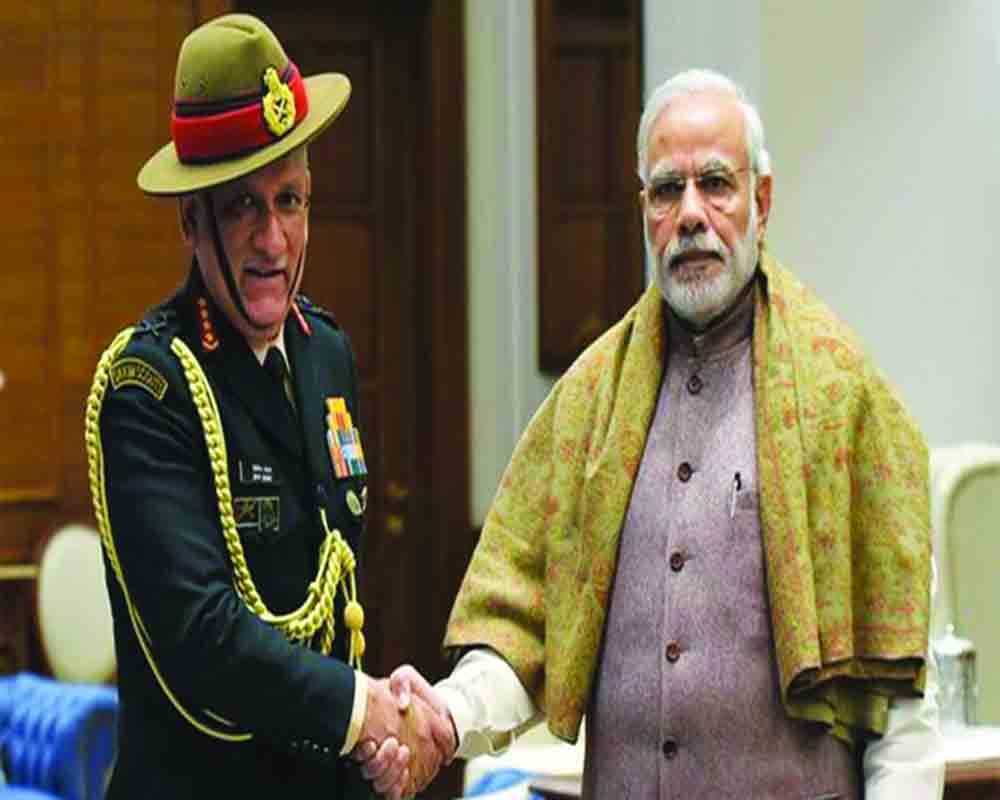
    Unfortunately, while the bulk of our military remains apolitical and secular, the actions and public statements of the Chief of Defence Staff, General Bipin Rawat, have created perceptions that the military’s senior leadership has become excessively politicised. Then there is the fact that some very senior officers have taken the plunge into active politics immediately on shedding their uniform.

    While some within the ruling elite may see this turn of events as advantageous to their ideological cause, and in fact encourage this shift within the military hierarchy through the process of “deep selection”, as some allege, they may well be biting off more than they can chew. If there is anything to learn from history, it is that once the military gets sucked into politics, it will not be satisfied acting as a mere handmaiden of those in power. As General Milley so eloquently put it, they are the ones with the guns! We just need to look closely at our own neighbourhood for examples.

    The Government and the legislative would do well to put rules in place that prevent members of the military and even the Civil Services from joining politics without an appropriate cooling- off period.

    It would be in the interest of the political establishment to desist from politicising the military. Creating an uncontrollable monster, that will go on to bite the hand that feeds it, is nothing but sheer stupidity. The Government and the legislative would do well to put rules in place that prevent members of the military and even the Civil Services from joining politics without an appropriate cooling- off period. That would go a long way in insulating them, especially the military, from politics.

    This article was published earlier in the pioneer.

    The views expressed are those of the author.

    Feature Image: www.dailypioneer.com

  • Harmony – the soft power of the East-Asian civilizations

    Harmony – the soft power of the East-Asian civilizations

    To date, the Western understanding of freedom as liberation still seems to be the hegemonic discourse. But as we know from Thomas Hobbes excessive freedom is leading to civil wars – and the ideology of unlimited freedom in the market economy and over excessive consumption is burning the world in climate change.

    East Asia and South-East Asia are emerging as the world’s largest economic powerhouse and perhaps even as a technological superpower.  Nevertheless, a deeper understanding of the consequences of this process will remain elusive, unless we squarely look at the puzzles surrounding the norms and preferences of major East Asian states. In contrast to the Western neo-liberal model, which puts excessive emphasis on individual freedom leading in the Western countries to the dissolution of the social fabric of the societies, there is an authoritarian temptation to maintain social cohesion in light of the dramatic social transformation worldwide. But mere authoritarianism is not compatible with the progress of societies because it does lack the incentive to rise above your current situation. We all know we started to live in a new world different from what we used to. But it is still early to name or define this Chameleon-like world of incessant transformation. Western triumphalism, perhaps understandable after the end of the Cold War, was long gone. Perhaps, we are destined to live in limbo for the near future. In order to cope with this process, East Asia needs not only economic and technological progress but also the soft power of ideas. To date, the Western understanding of freedom as liberation still seems to be the hegemonic discourse. But as we know from Thomas Hobbes excessive freedom is leading to civil wars – and the ideology of unlimited freedom in the market economy and over excessive consumption is burning the world in climate change.

    Harmony in the Confucian tradition is also not a fixed status, but the task is to harmonize the contrasts and opposites.

    An alternative value system might be the Confucian and East Asian concepts of harmony.  Harmony is not sameness but implies tensions like those in a symphony. In music, we find a lot of contrasts for example in a symphony of Beethoven but at the same time, we enjoy the harmony of the whole composition. Already in the first very old appearances of the concept of harmony, it is related to the singing of birds and music in general. Harmony is therefore related to the balancing of contrasts. Harmony in the Confucian tradition is also not a fixed status, but the task is to harmonize the contrasts and opposites. And of course, a part of harmony is related to freedom, but unrestricted freedom is not the ultimate goal. The question, therefore, is how to limit unrestricted freedom without suppressing the people? The answer might be to harmonize and balance freedom with equality.

    The question, therefore, is how to limit unrestricted freedom without suppressing the people? The answer might be to harmonize and balance freedom with equality.

    As in a symphony, real harmony is achieved when we are able to balance the contrasts of life: between the whole and the part, being born and dying, the individual and the community, between freedom and equality. We could compare such a balance with a water wave. If there are no movements and waves at all, the sea is dying – if it is a Tsunami the waves are destructive for the individual and the community. Harmony is superseding the Western discourse of absolute freedom because in a harmonious society freedom is not abandoned but a part of the greater whole.  Neither the authoritarian rule nor excessive freedom should be the alternative for world order in the twenty-first century – what we desperately need in a burning world is a harmony or floating balance between and within our societies as well as us as individuals.


    Feature Image: The Idea of Harmony wsimag.com

  • Religion and Governance: An Important Lesson from India’s History

    Religion and Governance: An Important Lesson from India’s History

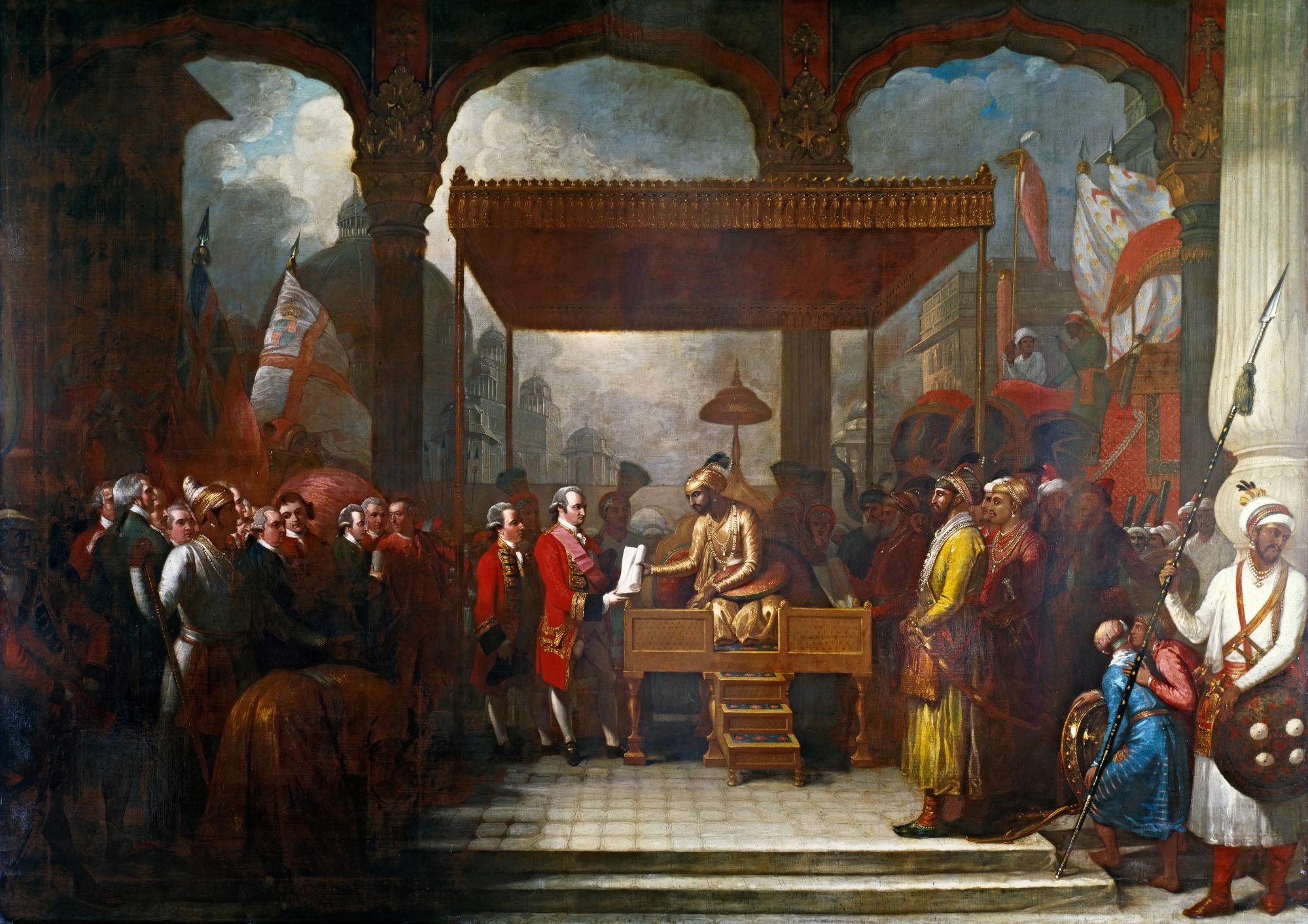
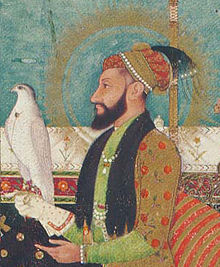
    The fortunes of India had irrevocably changed on May 29, 1658, when two Indian armies clashed on the dusty fields of Samugarh, near Agra. India’s history changed forever. Aurangzeb’s victory over his brother Dara Shikoh marked the beginning of Islamic bigotry in India that not only alienated the Hindus but also the much more moderate Sufis and Shias as well.

    Aurangzeb’s narrow Sunni beliefs were to make India the hotbed of Muslim fundamentalists, long before the Wahabis of Saudi Arabia sponsored the fanatics of the Taliban and the Islamic State. It was not only a battle for the Mughal throne but also a battle for the very soul of India

    Aurangzeb’s victory here and other successful campaigns resulted in the creation of the greatest and biggest imperial India till then. But the seeds of India’s collapse were sowed.

    In 1620 India had the world’s greatest national income, over a third of it, and was its greatest military power as well. It was the envy of Europe. The European traders came to seek Indian goods for their markets. But no sooner was the iron hand of Aurangzeb no more that his imperial India began to disintegrate. The iron hand that ruled by dividing rather than uniting and that sought to impose a hierarchy by theological preferences gave rise to much discordance. But for Aurangzeb, Shivaji Bhonsle might have remained a minor western Indian feudatory? There are important lessons to be learned from all this for those who rule and seek to rule India.

    The weakening central rule and profit-seeking peripheral kingdoms allowed European trading posts to be established. Weakening regimes led to the trading posts raising armed guards. Soon the overseas trading companies began warring each other and with so many minor states now free to make their destinies joining hands with one or the other it was the Europeans who got gradually got established. The Anglo-French wars of the Carnatic were fought by Indian armies beefed up by trading company levies. The East India Company of the British ultimately prevailed and the French, Dutch, Portuguese and Danish got reduced to pockets.

    A hundred years later, in 1757, the era of total foreign supremacy over India began when the East India Company’s troops drawn from South India and officered by English company executives defeated the army of Nawab Siraj-ud-Daulah at Plassey (Palashi) in Bengal, with the now usual mix of superior drilling, resolute leadership and a bit of treachery. At a crucial time, Mir Jaffar and his troops crossed over. India lay prostrate before Robert Clive.

    Within a decade, on August 12, 1765, Clive obtained a firman from the then Mughal Emperor, Shah Alam, granting the Diwani of Bengal, Bihar, and Odisha to the Company. A Muslim contemporary indignantly exclaims that so great a “transaction was done and finished in less time than would have been taken up in the sale of a jackass”. By this deed the Company became the real sovereign ruler of 30 million people, yielding a revenue of four millions sterling. The John Company grew from strength to strength, and by 1857 the Grand Mughal was reduced to his fort conducting poetry soirees. It was the golden age of Urdu poetry.

    The events of 1857 led to the formal establishment of India as a directly ruled colony of the British empire. It was yet another epochal event. India changed, for the better and for the worse. Once again India absorbed from outsiders, as it absorbed from the Dravidians, Aryans, Greeks, Persians, Kushans, Afghans, Uzbeks, and all those who came to seek their fortunes here. The British were the only ones who came to take away its vast wealth in a systematic manner. The wealth taken from India to a great extent financed the Industrial Revolution in England.

    From then to another epochal year ending with seven took ninety years. In 1947, India became independent. Its GDP is now the world’s third-biggest. In a few decades, it could conceivably become its biggest. But have we learned any lessons from history?

    Given its abject failures on the economic front, the BJP/RSS regime in New Delhi is now pushing India towards a Hindutva nationhood, by seeking to victimise a minority for the perceived wrongs and slights of the past. An intolerant religion can never be the basis of nationhood and national unity in India. The legacy of Aurangzeb tells us that. Aurangzeb had created the greatest empire that India had seen since Ashoka the Great. But it didn’t take very long for it to dissipate. In the hundred years that followed, a foreign mercantile company gained control over all of India.

    The BJP under Narendra Modi might keep gaining electoral dominion over all or most of India. But has the BJP learned any lessons from history? Does the PM  want to become the Hindu Aurangzeb? What is worrisome is that we know well that history is not Narendra Modi’s forte.


    This article was published earlier in Deccan Chronicle. The opinions expressed in the article are the author’s personal views and do not reflect TPF’s institutional position or analysis.

    Featured Image: Shah Alam conveying the grant of the Diwani to Lord Clive. en.wikipedia.org

  • Elections and Democracy: Germany’s Mixed Member Proportional System

    Elections and Democracy: Germany’s Mixed Member Proportional System

    It is now well-established that the First Past The Post system of elections followed in Indian democracy is thoroughly unsuited to Indian conditions, as it is more feudal and less of democracy. The German mixed system is better suited to India to ensure a more representative system of elections and accountability.   

    When it comes to choosing an electoral formula, the world often takes extreme positions which range between any variant of the Majoritarian System or that of the Proportional Representation. Proportional representation, to a great extent, has been an apt choice for ethnically divided societies with scholars such as Arend Lijphart asserting that it would strengthen the consociational approach in the political system. Yet, it has been criticized for the unstable governments it may produce and its inability to connect a voter with its representative. On the other hand, Majoritarian systems while praised for their simplicity and ability to produce stable governments, lack inclusivity, and induce tactical voting due to wastage of votes. However, the Parliamentary Council of Germany structured a mid-point for the two extremes to meet, which was initially considered provisional but has remained unchanged. It follows the Mixed-Member Proportional System.

    The Mixed-Member Proportional System combines First Past The Post (FPTP) system (Majoritarian System) with Closed-Party List System (Proportional Representation) and thereby, enables the formation of a Government that is inclusive, stable, and remains connected with the voters.

    Understanding how MMP works in Germany

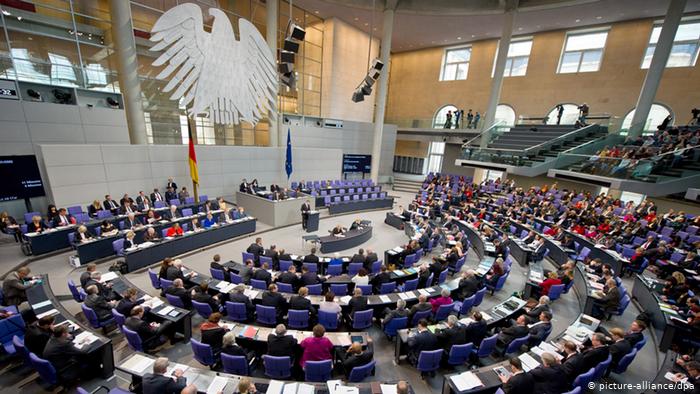
     The Bundestag (the German Parliament), elected for a four-year term, has 598 seats, distributed among the 16 federal states in proportion to the states’ voting population. Out of the 598 seats, 299 seats are filled through the FPTP system and the other 299 through the Closed-Party List System. This means that every voter has two votes on the day of the election: a constituency vote and a party-list vote. The first vote of electors decides the 299 representatives to be elected through the FPTP system, won based on a plurality of votes, and the second vote decides the proportional number of seats each party would get in the national assembly.

    Once the FPTP seats are filled, the second votes are totalled. Those parties that obtained 5% of votes at the national level or have three representatives elected directly through the single-member constituencies are considered for the allocation of PR seats. The PR seats are allotted in proportion to each party’s vote share using the Sainte-Laguë formula.

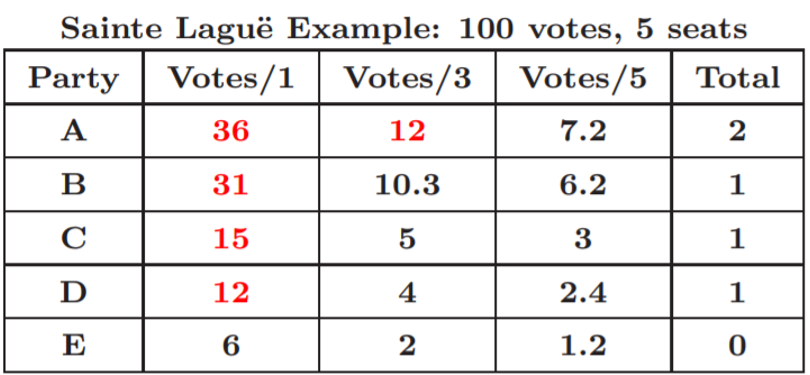
    The Sainte-Laguë formula divides the parties’ total votes using a series of divisors (i.e., 1,3,5,7,9….) to form a table of averages. The seats are then allotted to the parties with the highest averages in the table.

    source: Washington university

    Furthermore, these allotted seats are then subtracted from the respective party’s FPTP seats, and the remaining seats are the actual number of party-list seats allocated in the Bundestag. Often, the number of seats allocated to a party through FPTP is greater than those allocated through the Party List and these surplus seats are then kept by the party leading to an increase in the number of seats in the Bundestag for that governing year.

    Implications of the electoral formula

    • Electoral participation

    Over the years, scholars have suggested that Proportional Representation tends to increase the voter turnout in a country. This is said to stem from the fact that the disproportionality between the number of votes received and seats allotted is significantly lower thereby reducing vote wastage, which encourages more voters to go and vote. Unlike FPTP’s ‘winner takes all’ formula, PR provides a chance to even smaller parties to secure their representation in the legislative council. This encourages their support base to vote and at the same time provides an incentive to the party to not limit their campaigning to specific areas (Blais & Carty, 1990). Germany’s electoral participation was 78.5% in 1949 and escalated to 86%, 87.8%, 86.8%, 91%… in successive elections. The lowest turnout was in 2009 with 70.8% and escalated slightly to 76.2% in 2017.

    • Gallagher index

    The Gallagher index created by Michael Gallagher is a statistical analysis methodology used to measure an electoral system’s relative disproportionality between votes received and seats allotted in a legislature. While countries following the PR system do generally tend to do well, Arend Lijphart points out that the German system, which is a mixed system, does exceedingly well compared to pure PR variants.

    Germany scored an average of 1.95 in the 2017 national elections and has consistently maintained a low average in terms of disproportionality in comparison to others. Their highest average was 7.83 for the year 2013. On the other hand, countries that continue to use FPTP such as Canada, Bangladesh, and India record pretty averages of 12.01 (2015), 21.38 (2001), and 16.06 (2019) respectively.

    • Representation

     PR systems generally enable conditions for a more representative legislative council because political parties no longer restrict their discourse and activities to the interests of the dominant communities, given winning a plurality of votes is no longer a deciding factor in their pursuit to secure a seat in the parliament. This provides an incentive for them to look appealing to a larger voter base.

    Germany has seen a steady increase in the percentage of women representatives in the Parliament, starting from 7% in 1949 to 31% in 2017. The need to encourage ethnic minorities to cast a vote provides an incentive to political parties to field candidates who are non-German in origin, and this has enabled the participation of candidates originating from Turkey, Poland, Austria, Romania, and so on.

    • Effects on the Far-Right

    Lisa Harrison in her paper ‘Maximizing Small Party Potential: The Effects of Electoral System Rules on the Far Right in German Sub-National Elections’ writes that far-right or extremist parties see limited success at the national level elections, but they may play a significant role at the sub-national level elections. A major hindrance that keeps these far-right parties away from the Bundestag is Germany’s minimum threshold of votes policy, which allows only those parties that have won 5% votes or 3 FPTP seats to claim representation in the parliament.

    This however changed in 2017 when Alternative for Germany became the first nationalist far-right party to secure seats in the German Parliament since World War II. They received 12.6% of votes, translating into 94 seats in the Bundestag. The rise of the party coincides with the rise of hate crimes against immigrants. In March 2021, it was reported that Germany’s domestic intelligence forces have kept the party under surveillance on the suspicion of trying to undermine the democratic constitution.

     Conclusion

    Electoral systems don’t come up in a vacuum. Rather, they are selected and implemented within the socio-political conditions of a particular nation. This implies that there is no electoral system that is universally applicable. Depending upon the suitability, countries could either side with the Majoritarian system or the Proportional Representation system or could apply both, as in the case of Germany. Germany’s Mixed-Member Proportional System catered to the needs of a constituent assembly which was divided over the question of an apt electoral system and at the same time has continued to do the two things that the constituent members hoped for, maintain stability and remain inclusive.

    As India enters the 75th year of its independence, and as the world’s largest democracy, its electoral experiences of the last seven decades point to the unsuitability of the present FPTP system. Given the large population and the diversity of India, the FPTP system has proved to be a complete failure. The FPTP system does not truly reflect the principle of “one person one vote”, according to which each ballot should have ‘equal force’ in the sense of the share of seats in the parliament. Indian elections system has resulted in a skewed system of vote-bank politics, endemic corruption, and the feared majoritarian tyranny in the name of democracy.  The German model of a mix of Proportional Representation and the FPTP system is what India needs at this to revive and strengthen its democracy.


    References:

    Gallagher, M., & Mitchell, P. (2008). The Politics of Electoral Systems (Illustrated ed.). Oxford University Press.

    Zittel, T. (2017). Electoral systems in context: Germany. Oxford Handbooks Online. Published.

    https://doi.org/10.1093/oxfordhb/9780190258658.013.37

    https://www.statista.com/statistics/753732/german-elections-voter-turnout/

    https://www.tcd.ie/Political_Science/people/michael_gallagher/ElSystems/Docts/ElectionIndices.pdf

    https://blogs.lse.ac.uk/europpblog/2017/09/21/measuring-the-diversity-of-each-partys-candidates-in-the-german-election/

    https://www.statista.com/statistics/753494/seat-distribution-bundestag-germany/

    https://www.thehindu.com/news/international/how-serious-is-germanys-far-right-problem/article30952770.ece

    https://www.reuters.com/article/us-germany-security-afd-idUSKBN2AV1M3


    Feature Image: angusreid.org