Category: History and Heritage

  • The power of poetry in politics and indigenous people of India

    The power of poetry in politics and indigenous people of India

    O ancestral spirits!
    How now do we escape,
    From the conspiracies of time,
    Concocted on the flames
    That from the sweltering earth rise?
    Where all is slowly being roasted alive,
    The air, the forests, and the soil,
    And man – in body and in mind?

    – Lament in Songs (Geeton Ke Bilaap) through Jacinta Kerketta

    A profound political philosopher of ancient Athens whose administrational academics left people in admiration and aghast protested against poets and critiqued poetries. He feared the passion or public emotion evoked by poets, and he reckoned that rational thought could be ravaged by public passion.

    “For a poet is an airy thing, winged and holy, and he is not able to make poetry until he becomes inspired and goes out of his mind and his intellect is no longer in him.”

    ― Plato

    Poetry is one of the ancient art forms, the earliest kinds of poems were recited and passed on orally before the evolution of scripts. Administrative and ancestral accounts were more merely to remember due to the poem’s rhythmic and repetitious nature.

    Influence of poetry in politics

    Through triumph and terror or from pain to power, poetry allows people to paint different shades of human emotions. Poetry has served as a significant tool to convey meanings and messages since the beginning. It is also used as a channel to cast awareness on sound socio-economic concerns and personify political questions. Poems play a pivotal role in collective resonation to specific themes and it embraces the efficiency of words which could be serene as a sea or sharp as a sword.

    In the year 1821 Percy Bysshe Shelley wrote eloquently in his essay A Defence of Poetry that the poet creates humane values and imagines the forms that shape the social order and“Poets are the unacknowledged legislators of the world.” Political poetries pave a path to discuss injustice in the societies and build a bridge between the emotive expression of the state administrators and its citizens. Political poetries are not definitive they are not bureaucratic blueprints or literary balms either, they imprint the cyclic endurance of the past, present, and future. They massively represent the public’s fear and anguish or equip the endangered with empowerment.

    Adrienne Rich compellingly stated in a commentary that –

    “I’m both a poet and one of the “everybodies” of my country. I live with manipulated fear, ignorance, cultural confusion and social antagonism huddling together on the faultline of an empire”.


    Profile and position of indigenous people of India

    Histories have created many poets and many poets have influenced histories, traditionally archiving their histories through songs, folklore, and myths. Adivasis have aced their way through their ancestral accounts accumulation. Adivasis are folks who function their lives through flourishing flora and fauna encapsulated with enriching cultures and practices and lives among the areas of the Indian sub-continent. Adivasi is a common term that was coined in the 1930s to address the indigenous groups of India, while the legal term ”scheduled tribes” is used in the constitution. They are the most prehistoric inhabitants of the sub-continent who are a heterogeneous group with diverse ethnicity and linguistics. Post the Aryan intervention the Adivasis began to trade with people of the plains, it was during the mid-eighteenth century that the indigenous people of the east revolted against the political British and its intrusive regulation upon the mainlands of the indigenous folks.

    This renounced the defenceless position of the land and its people. Even, today the Adivasis encounter various forms of social discrimination, political power lash, and remain economically stagnant.

    Balance between battles and banquets- Political poetries of the past and the present

    Songs, myths, and folklore revolving around landscapes, political relations among the Adivasis or with the non-Adivasis, human emotions were all oral histories being passed on to the next generation. The stories of Adivasis were massively written by people who did not belong to the Adivasi community, the literary endeavours of the tribes were not adequately acknowledged due to the lack of recognition of languages amongst the state. The poems written by the poets or writers of the community have an extensive influence over the political lives of Adivasis in terms of the political periphery.  In most poems by the Adivasis, the muscles of metaphors were majorly merged with nature or the environment. The largest of them are written in their indigenous languages like Kotas, Santali, and Ho & others where some are translated to other vernacular languages and some are not. Many political poetries raise questions against the havoc harboured by a biased notion of “progress”. The following are a few poetical works of indigenous people of India which brought out Adivasi’s political proximity.

    The editor of Chandini Magazine, Susheela Samad was one of the earliest Adivasi writers in the 1920s, where two of her poetry were published in the 1940s. In the year 1960 several stories of Alice Ekka were published in the Adivasi Patrika who was also the first female Adivasi writer.
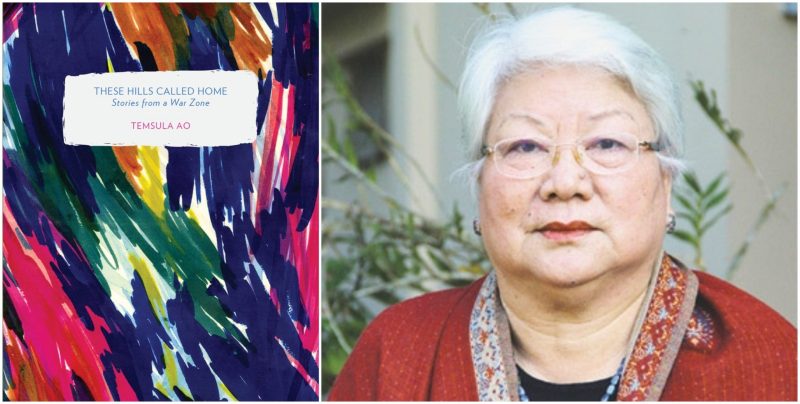
    The very famous Temsüla Ao an Ao Naga tribal poet and an ethnographer who worked on Oral histories published plenty of poetry from 1988 to 2007 shedding light on the word “song” in all her titles emphasizing the essence of poems in tribal song culture and expressing the voices of her community against land & cultural alienation.

    Referring to the violence in the valley, the poet says

      ” But to-day

       I no longer know my hills,

       The birdsong is gone,

       Replaced by the staccato

       Of sophisticated weaponry. ” (“My Hills” 19-23)

    The poet laments the loss of peace and verdure in her region.

    The director of Adivasi Bhasha Shodh Sansthan (Tribal Language Research Institute) Ushakiran Atram is a Koitur poet and a writer who held compelling narratives on patriarchal injustice and political vocalization from a woman’s scope of the lens.

    “Bata maan, main kiski hun? Baba-Bhaiya ki? Mere Shauhar ki? Sawkaar-Ranger-Patil ki? Jameendaar-Darzi-Sonaarki? Kiski hun main?”—Tell me, mother, whose am I? Father’s or brother’s? My husband’s? Moneylenders-Rangers-Patils? Landlords-Tailors-Goldsmiths? Whose am I?

    the mentioned poem is from one of her books named ‘Motiyarin’ A Gonti term which means a position given to a woman leader who supervises the overall activities in Gotul.

    “Unless you speak their dialect, you’re an outsider,” says Lakshmanan who accompanied Tamil Nadu Pazhankudi Makkal Sangam, a movement that worked for indigenous welfare. In 2010, he also wrote an anthology of poems titled ‘Odiyan’ which means the evil spirit through which he paints the colours of pain and anguish of the Irular community which was partly in their language.
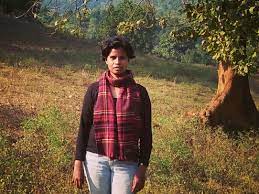
     

    Jacinda Kerketta a young poet and a journalist of the Oraon tribe raises questions about the standpoint on “development” on tribal lands, In the poem “Oh Shahar” (Oh City) she writes

    Leaving behind their homes,

    Their soil, their bales of straw,

    Fleeing the roof over their heads, they often ask,

    O, City!

    Are you ever wrenched by the very roots?

    In the name of so-called progress?

    The author brings out the intensity of anthropocentrism imposed upon the Adivasi arena and all her poems do not victimize their position instead evokes thought-provoking questions.
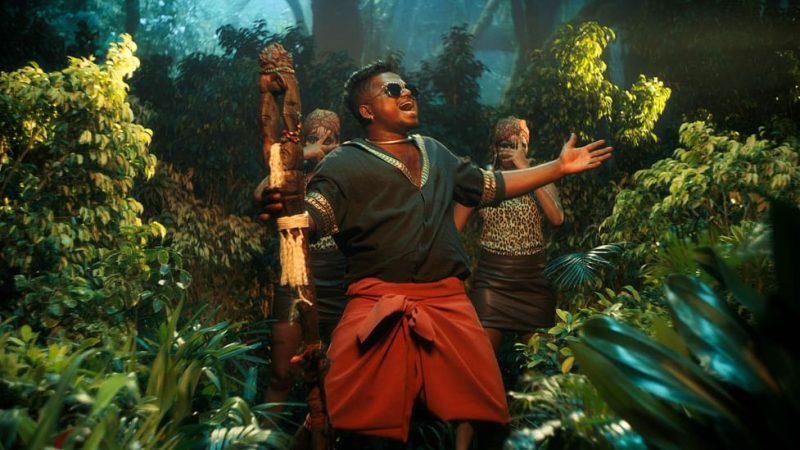


    Recently, Arivu a resounding rapper and a political poet brought out many problematic political practices of history and the present against his community through his album called ‘Therukural’ (voices of the streets), and in 2021 the song “Enjoy Enjaami” which is a blend of Rap and ‘oppari'(lament song sung during mourning )took over the stage of multi-media, the artist poetically and politically protested in all his works intending to enlighten the traces of civilization before caste and issues of inequality.


    Waharu Sonavane, a Bhilli poet and an activist whose “Stage” was an icebreaker that questioned the leadership of a major movement – Narmada Bachao Andolan and indigenous representation in bearing the torch.
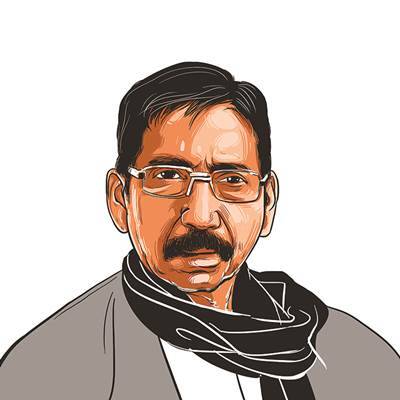


    Will the mainstream history intersect Adivasi’s ancestral accounts? or will they contradict? Poetical poems fade along with time, they lose their essence of eventual happenings but strikingly hold the public psychology of the period. Political poems of indigenous tribes of India pose their position into viewing history from a different lens – meaning to revisit the history not just from conventional collectives but also to learn from our oral archives, songs and stories.

    The following poem was written by Waharu Sonavane; translated by Bharat Patankar, Gail Omvedt, and Suhas Paranjape –

    Stage

     We didn’t go to the stage,

    nor were we called.

    With a wave of the hand

    we were shown our place.

    There we sat

    and were congratulated,

    and “they”, standing on the stage,

    kept on telling us of our sorrows.

    Our sorrows remained ours,

    they never became theirs.

    When we whispered out doubts

    they perked their ears to listen,

    and sighing,

    tweaking our ears,

    told us to shut up,

    apologize; or else…


    Feature Image Credit: www.climatescorecard.org
  • Dagshai And Kasauli – The Afghanistan Connection

    Dagshai And Kasauli – The Afghanistan Connection

    With Afghanistan, the Taliban, and the for-ever conflict grabbing the headlines across the world over the last few months, it is well to recognise that the histories of India and Afghanistan are intertwined from time immemorial. Anand Sethi digs into the 19th and 20th-century history to bring out some fascinating connections between Dagshai in Himachal Pradesh and Afghanistan – Team TPF

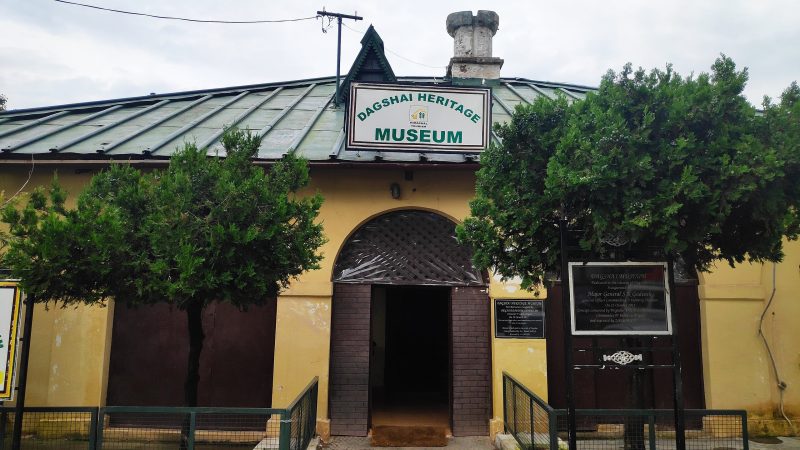
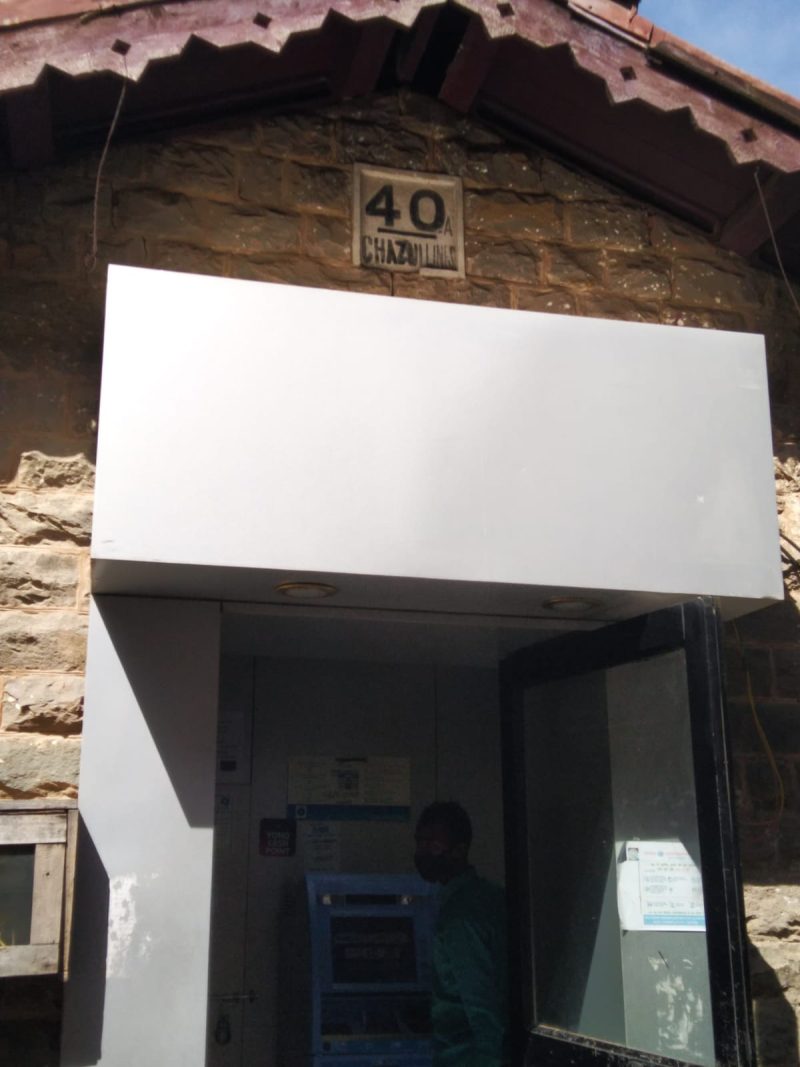
    The Automatic Teller Machine (ATM) in Dagshai Cantonment is quite unique. Set up some 14 years ago at the instance of a dynamic Commanding Officer of the then Gorkha Rifles Battalion stationed in Dagshai, the ATM is housed in a smallish, stand-alone, colonial-era stone-built sloped roof hutment which most likely served as an extension of the kitchen facilities for a cluster of similarly constructed nearby barracks. It is quite unique. It communicates with the infrastructure by means of a huge, floor-mounted, satellite dish antenna. Given the nearly non – existent banking facilities, this ATM has served as our ‘go-to’ facility to withdraw cash for our personal expenses during the exasperating COVID times!

    On normal working times and days, with the troops busy with their official duties, there is usually only a rare person ahead of one at the ATM. Social distancing is the least of the problems here. However, on this particular day a few months back there were two persons ahead of me to use the ATM. This prompted a little ‘walkabout’ to while away the time and to maintain social distancing. While returning I noticed that there was some inscription or lettering on a whitish background near the top of the hutment but quite obscured due to the collection of grime, mud, rainwater stains that had accumulated over many years. Upon completing the ATM transaction I managed to clamber up and did a vigorous cleaning of the inscription.  What emerged was the signage: ’40 A GHAZNI LINES’. This was quite incredible! There has never been any mention of Dagshai having had a ‘Ghazni Lines’. Certainly not in any maps or documents painstakingly collected over the years by me for our ‘Dagshai Jail Museum’. Evidently, some Regiment(s) had gone from Dagshai to fight in the battles at Ghazni during the Afghan wars (or stationed in Dagshai afterward), received their ‘Battle Honours’ there.

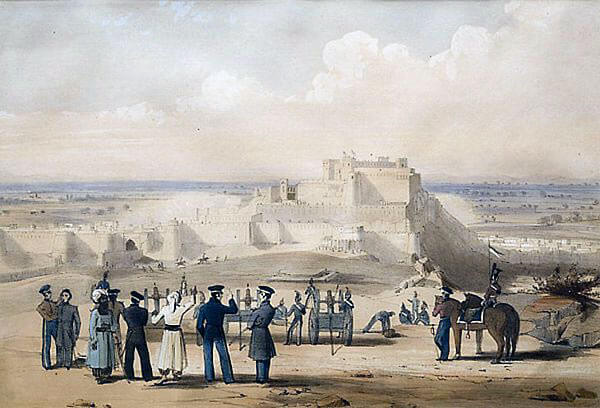
    Research conducted indicates that no formations linked with Dagshai were involved in the Battle of Ghazni (‘Ghuznee’) in September 1842. However, two Regiments with clear Dagshai connections were very much in the ‘Battle Order’ during the First Battle of Ghazni in July 1839 (Gen. Sir John Keane versus Hyder Khan). Both received the Ghazni Battle Honours. One was the 1st Bengal Fusiliers who had been stationed in Dagshai during the tumultuous period of 1856 – 57. They of course had the dubious distinction of having as one of their Officers the ‘infamous’ (Brevet) Major William Hodson (whose portrait hangs amongst the ‘infamous Dagshaiites’ in our Jail Museum), the one who in 1857 apprehended Bahadur Shah Zafar and killed the royal princes. However, it is somewhat doubtful that the 1st Bengal Fusiliers had the Ghazni Lines in Dagshai named after their Battle Honours. The unit was away from Dagshai for a large part of their stay doing duties in and around Delhi during the 1857 ‘troubles’.

    The most likely formation to have the Ghazni Lines in Dagshai named after them would thus be the 2ndRegiment of Foot (Queen’s Royal West Surrey – the Queen, in this case, being Queen Catherine of Braganza, wife of King Charles II), presently operating as the Princess of Wales Royal Regiment.  This was the second senior-most line Regiment (after the Royal Scots) in the regular British Army. (The 1stBengal Fusiliers, on the other hand, was a formation of the East India Company’s Army, during their Dagshai stay). They were first garrisoned in Dagshai in 1870 -71. They not only took part in the 1839 battle at Ghazni but also got Battle Honours at the Battle of Khelat later that year. The Regimental History of the 2nd Regiment of Foot carries this interesting piece – “The formidable Ghazni fortress protected by thick 60 feet high walls prevented a major problem especially due to the lack of heavy artillery. The capture of Ghazni fortress was made possible only because Mohan Lal, a Kashmiri interpreter, spy, and assistant to the Political Officer Captain Sir Alexander Burnes, managed to discover that one of the gates to the fortress was somehow left poorly defended”. An interesting trivia about the 2nd Regiment of Foot – they were the only British Regiment where the Officers were allowed to remain seated while drinking the Loyal Toast to the Monarch. Apparently, this was so because the Regiment had been attached to the Royal Navy for a period of time and adopted the Navy’s tradition of sitting!

    The case for the 2nd Regiment of Foot for having set up Dagshai’s Ghazni Lines gets strengthened by the fact that they returned to Dagshai for the period 1895 – 96.  The Regiment went back to fight in Afghanistan in 1897, this time in Tirah (now in Khyber Pakhtunkhwa, Pakistan) before being garrisoned in Peshawar in 1902. They returned to Dagshai in 1916 for a short third spell in the garrison.

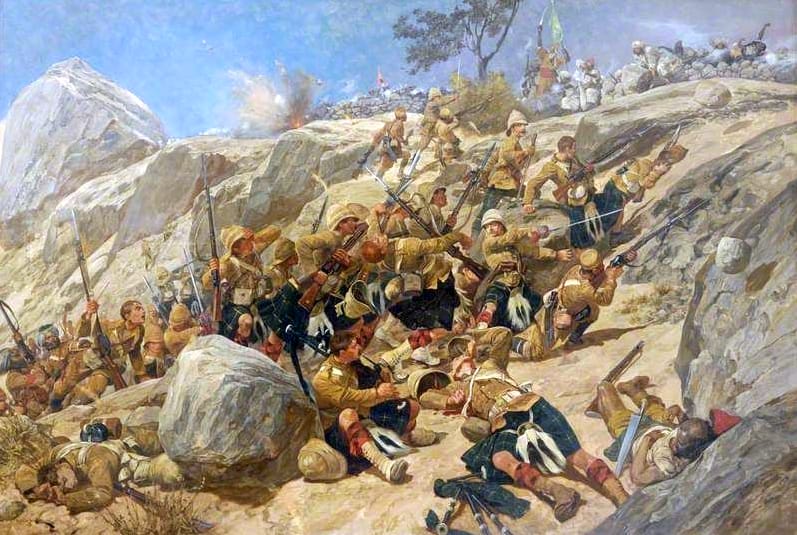
    Arguably, the Regiment with Dagshai as well as old Afghanistan links would be the Gordon Highlanders (earlier the 92nd Regiment of Foot). First stationed in Dagshai in 1860, the Regiment acquired as their Regimental Tune (still is the Regimental Tune and my mobile phone caller tune), the now-classic Pipes and Drums composition “Dagshai Hills” in 9/8 format march by the famous John Wallace. The Gordons fought in the Second Afghan War (1878 – 80) and saw action at Charasaib, Sherpur, and Kandahar where they took part in a winning battle after marching 320 miles from Kabul in just 23 days.

    The greatest battle achievement of the Gordons, however, was at Dargai (near Tirah and now part of Pakistan’s Kabul Pakhtunkhwa). In 1897 the heights at Dargai were held by a strong contingent of Afridi tribesmen. As part of the Tirah campaign, at the time the 21 valiant soldiers of the 36th Battalion (Now 4th Sikhs) of the Sikh Regiment were putting up their heroic stand at Saragarhi, the Gordons were tasked to capture the Dargai height at all costs. On October 20th, 1897 the Gordon Highlanders, with their flanks protected by the Gurkhas and Sikhs, attacked the Afridi-held hilltop redoubt. Despite numerous attempts, the Gordon’s were unable to take the height and had suffered numerous casualties. The Commanding Officer called out to his Pipers, led by Sergeant Piper George Findlater to keep playing ‘Dagshai Hills’ until the hill was taken. Findlater, despite being shot all over his body and bleeding profusely kept on playing the Regimental Tune until Dargai Hill was captured.

    For his extraordinary valour, Piper Findlater was awarded the Victoria Cross which he received in person from Queen Victoria. A huge painting to commemorate this famous battle hangs in the Officers Mess room of the Gordon Highlanders in Aberdeen, Scotland.  A large replica is available to view in our Dagshai Jail Museum along with other exhibits related to the Gordon Highlanders. The Pipe Bands of every formation that gets posted to Dagshai learns to play ‘Dagshai Hills’ and is played at the beginning of the Army Band display at the annual ‘Dagshai Concert’.

    Several of the formations garrisoned in Kasauli (then ‘Kussowlie’) also took part in the various Afghan Wars. Most notable amongst these were the Somerset Light Infantry (action at Jalalabad), 9th Regiment of Foot – Norfolks (action at Kabul), 66th Regiment – King’s Royal Rifles (action at Maiwand), and the 8thKing’s Regiment of Foot (action in the Kurram Valley). However, Kasauli’s Afghanistan connection is predominantly that of the famous Warburton family.

    During the First Afghan War in 1839 when the Bengal and Bombay Divisions of the East India Company (‘John Company’) Army along with some formations of regular British Army troops in India, in support of the ousted Shah Shuja, attacked Afghanistan in an attempt to retake Afghanistan from the ‘usurper’ Amir Dost Mohammed Khan’s forces and their allied tribal warriors.

    Amongst the ‘John Company’ troops was a 27-year-old Lt. Robert Warburton of the 6th Battalion, Bengal Foot Artillery. During the war, Lt. Robert Warburton found himself imprisoned in an Afghan lockup near the famous Buddhist site of Bamyan. A young lady named Shah Jahan Begum Durrani, a niece of Shah Shujah as well as that of Amir Dost Mohammed Khan was married (apparently against her wishes) to Sardar Faiz Talab Khan, a senior advisor to Dost Mohammed, and had a son (named Jahandad Khan) born from him in August 1840. Dost Mohammed and Faiz Talab Khan fled Kabul late in 1839 as the British troops advanced. Dost Muhammad was later to be exiled to Mussoorie.

    What ensued seems like scenes from a potboiler Hindi movie. Apparently, Shah Jahan Begum had met Lt. Robert Warburton in Kabul before she was married off. Clearly, as it turned out, Shah Jahan Begum had already become fond of Robert and this may have been the reason that she was hastily married off against her wishes. With her husband, Sardar Faiz Talib Khan having left along with Amir Dost Mohammed, Shah Jahan Begum managed to get hold of a few of her Durrani tribesmen and went hastily to Bamyan.

    At Bamyan, she and her Durrani followers somehow managed to free Robert Warburton from custody and hastily fled, escorted by the Durrani tribesmen. Somewhere during this daring escape, in November of 1840, Lt. Robert Warburton and Shah Jahan Begum got officially married. A son (also named Robert Warburton) was born to them in July 1842 whilst they were still holed up in Ghilzai (aka ‘Khilji’) fort. By early 1843 the four of them, Lt. Warburton, Shah Jahan Begum, Jahandad Khan, and little Robert Warburton) somehow managed to sneak into Peshawar. On arrival in Peshawar Lt. Robert Warburton officially adopted young Jahandad Khan and had him renamed John Paul Warburton.

    In 1864 John Paul Warburton joined the Punjab Police. Over the next few years, he had a spectacular career as a highly efficient Police Officer busting many criminal gangs and putting into jail scores of offenders. For his efforts, John Paul Warburton (aka Jahandad Khan) became popularly known all across Punjab as ‘Button Saheb – Controller of Devils”. From 1864 through 1900 when he retired, ‘Button Saheb’ had successful postings at Karnal, Delhi, Ludhiana, etc. In a rare eulogy, the famous Rudyard Kipling wrote – “He is supposed to have the gift of invisibility and executive control over many devils.” Needless to say, Kipling’s character Strickling (“Plain Tales From The Hills”) is based on Button Saheb. The then government in appreciation of his services gifted John Paul Warburton a large piece of land in Gujranwala District. This town with its own mainline railway station still exists in Pakistan as ‘Warburton’.

    From 1900 through 1909 Button Saheb served as the Special Advisor to the Patiala State Police with the rank of Inspector General. On his finally quitting service in 1909 John Paul Warburton along with his family came to live in Kasauli after having acquired ‘Gilbert House’ (presently the residence of the Brigade Commander and the former home of the historic figure  Maj. General Walter Raleigh Gilbert. In 1919 Button Saheb tragically died in the driveway of ‘Gilbert House’ after he fell off his favourite horse which had been ‘disturbed’ by his grandchildren and friends playing nearby.

    John Paul Warburton and his wife Mary Meakins had seven children. His youngest son’s (Robert Paul) granddaughter, Pamela Warburton (aka Durrani Warburton) was the last of the family to occupy ‘Gilbert House’. Old-time residents of Kasauli still talk about the regal style that Durrani Warburton lived in and especially about her going around Kasauli in an ornate Rickshaw pulled by fully liveried bearers.

    Durrani or Dani Warburton occupied ‘Gilbert House’ in Kasauli until 1943. She never married but was reputed to be a spectacular tennis player having been Punjab Singles Champion five times. Durrani Warburton did yeoman community service through the years of World War II and for her efforts was awarded the title of ‘Kaiser –i- Hind’.

    The senior Robert Warburton died in Peshawar on Nov. 10th, 1863. Button Saheb’s half-brother, Col. Sir Robert Warburton Jr, KCIE, also joined the Royal Artillery. Later he went on to found the ‘Khyber Rifles’ and died in April 1899 in Kensington, London.

    Needless to say, there have been other individuals and families that have Dagshai / Kasauli – Afghanistan connections. Most notably of course being Rudyard Kipling and the three redoubtable Lawrence brothers. But let this wait for another piece someday.

  • Narcotic Jihad | Can science and reason defeat religious polarisation in Kerala?

    Narcotic Jihad | Can science and reason defeat religious polarisation in Kerala?

    It is surprising that in today’s Kerala the well-educated religious lot, who are expected to have had a smattering of science, and who are expected to be the ones who see reason, are the ones who are raising the bogeys of ‘love jihad’ and ‘narcotic jihad’.

    Bertrand Russell, the great mathematician-philosopher and polymath had famously held that “Religion is something left over from the infancy of our intelligence; it will fade away as we adopt reason and science as our guidelines”. When we reflect on Russell’s quotation and introspect the religious realm in India per se, not to talk about contemporary events in Kerala, it is quite disconcerting and distressing; and a few crucial issues ensue from there.

    First and foremost, either Russell was wrong in his assertion as regards the fading away of religion in the wake of the adoption of reason and science by humans, or his understanding and definition of ‘religion’, ‘intelligence’, ‘reason’, and ‘science’ were at variance with the general, and usually acceptable, notions/definitions that are prevalent in civic society at large.

    It is rather surprising that in today’s Kerala the well-educated religious lot, the clergy, who are expected to have had a smattering of science, and who are expected to be the ones who see reason, are the ones who are raising the bogeys of ‘love jihad’ and ‘narcotic jihad’, notwithstanding the fact that probes by different agencies, including the National Investigation Agency, have debunked such allegations.

    The clergy concerned, particularly the bishop of Pala and other priest(s) who have indulged in such rhetoric, may not necessarily have played on into the hands of the Sangh Parivar, but have certainly touched the hearts and endeared themselves to the latter to the extent that the latter are ecstatic. Also, they have, along with other Right-wing groups, extolled the bishop of Pala, and have extended their support to him.

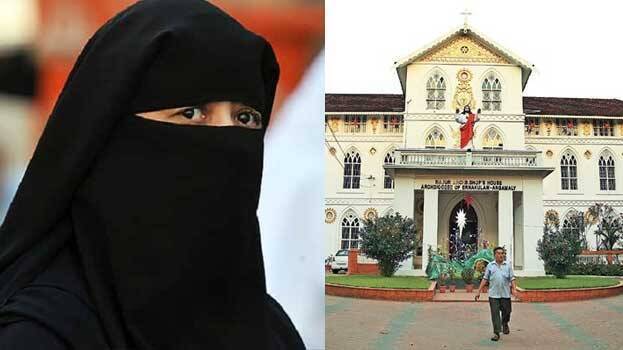
    However, something that has been very heartening and positive in this dark and murky scenario has been the bold and defiant stand of a group of nuns who not only spoke out against the bishop but also walked out of the mass of the priest who preached hate by going to the extent of beseeching his flock to boycott Muslims traders as also Muslim autorickshaw drivers.

    One would not have been surprised if insinuations and allegations of ‘love jihad’ and ‘narcotic jihad’ were made by Right-wing extremist groups because it is, inevitably, their wont to do so. But coming from the clergy in a state which has historically seen relatively amicable and amiable relations between Muslims and Christians wherein they have prospered together, belies logic.

    Pre-Islamic Arab contact with Kerala and the rest of the west coast of India dates back to the ‘Before Christ’ era, which gradually transformed into the Islamic one from the seventh century AD onwards.

    The oldest mosque to be built in the Indian subcontinent was the Cheramaan Juma Mosque in Methala, Thrissur district, in 629 CE. It is significant to point out that the north-centric way of looking at and referring to Islam in India by certain historians is quite misplaced. By the time Islam made any impact in the northwest and north of India, full-fledged Islamic societies had been formed in Kerala that extended beyond and along the Coromandel Coast in Tamil Nadu and spread towards South East Asia.

    Similarly, the Christian connection and the advent of Christianity in Kerala go back to 52 CE. For centuries, these religious groups, namely, Christians and Muslims, have coexisted and inhabited common spaces all over Kerala, along with the pre-existing indigenous communities. Also, there has been a high degree of acculturation between the various religious groups in terms of language, food, clothing, and other cultural practices including in the religious realm.

    There were, no doubt, skirmishes between the Christians and Muslims with the arrival of the Portuguese during the late fifteenth and early sixteenth century, but these have to be treated more as aberrations for economic gains than something that disturbed the overall ambiance of peace and communal harmony. The erstwhile situation as regards peaceful coexistence between the different religious communities prevailed in Kerala in spite of quite a few communal riots in other parts of India, both before and after the Independence.

    It is felt in some circles in Kerala that due to the COVID-19 pandemic and the restrictions as regards congregations, the footfalls have declined to result in drastically reduced revenues in the churches, and that has made some clergy feel insecure; and one way of getting back the faithful could be to polarise the communities in the expectation that would help in consolidating their own followers.

    Of late, the anti-Muslim rant that has emanated in Kerala is not confined to the borders of the state. The overt and manifest support in social media and through videos, for Israel’s bombing of Gaza during the recent conflict vis-à-vis the Palestinians, too, is, at one level quite disturbing, and at another level, points to the mindset that such perpetrators are embedded in.

    The proclivity to reduce the Palestinian identity to just a Muslim/Islamic one is one of the most irrational ways of looking at a people and explicating their ethnicity. Christian Palestinians too are at the forefront in their resistance to Israeli imperialism, and the occupation of Palestine. The well-known academic and crusader for peace, late Professor Edward Said, was one such.

    This article was published earlier in moneycontrol.com

    Featured Image: keralakaumudi.com

  • Religion and Governance: An Important Lesson from India’s History

    Religion and Governance: An Important Lesson from India’s History

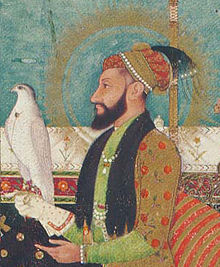
    The fortunes of India had irrevocably changed on May 29, 1658, when two Indian armies clashed on the dusty fields of Samugarh, near Agra. India’s history changed forever. Aurangzeb’s victory over his brother Dara Shikoh marked the beginning of Islamic bigotry in India that not only alienated the Hindus but also the much more moderate Sufis and Shias as well.

    Aurangzeb’s narrow Sunni beliefs were to make India the hotbed of Muslim fundamentalists, long before the Wahabis of Saudi Arabia sponsored the fanatics of the Taliban and the Islamic State. It was not only a battle for the Mughal throne but also a battle for the very soul of India

    Aurangzeb’s victory here and other successful campaigns resulted in the creation of the greatest and biggest imperial India till then. But the seeds of India’s collapse were sowed.

    In 1620 India had the world’s greatest national income, over a third of it, and was its greatest military power as well. It was the envy of Europe. The European traders came to seek Indian goods for their markets. But no sooner was the iron hand of Aurangzeb no more that his imperial India began to disintegrate. The iron hand that ruled by dividing rather than uniting and that sought to impose a hierarchy by theological preferences gave rise to much discordance. But for Aurangzeb, Shivaji Bhonsle might have remained a minor western Indian feudatory? There are important lessons to be learned from all this for those who rule and seek to rule India.

    The weakening central rule and profit-seeking peripheral kingdoms allowed European trading posts to be established. Weakening regimes led to the trading posts raising armed guards. Soon the overseas trading companies began warring each other and with so many minor states now free to make their destinies joining hands with one or the other it was the Europeans who got gradually got established. The Anglo-French wars of the Carnatic were fought by Indian armies beefed up by trading company levies. The East India Company of the British ultimately prevailed and the French, Dutch, Portuguese and Danish got reduced to pockets.

    A hundred years later, in 1757, the era of total foreign supremacy over India began when the East India Company’s troops drawn from South India and officered by English company executives defeated the army of Nawab Siraj-ud-Daulah at Plassey (Palashi) in Bengal, with the now usual mix of superior drilling, resolute leadership and a bit of treachery. At a crucial time, Mir Jaffar and his troops crossed over. India lay prostrate before Robert Clive.

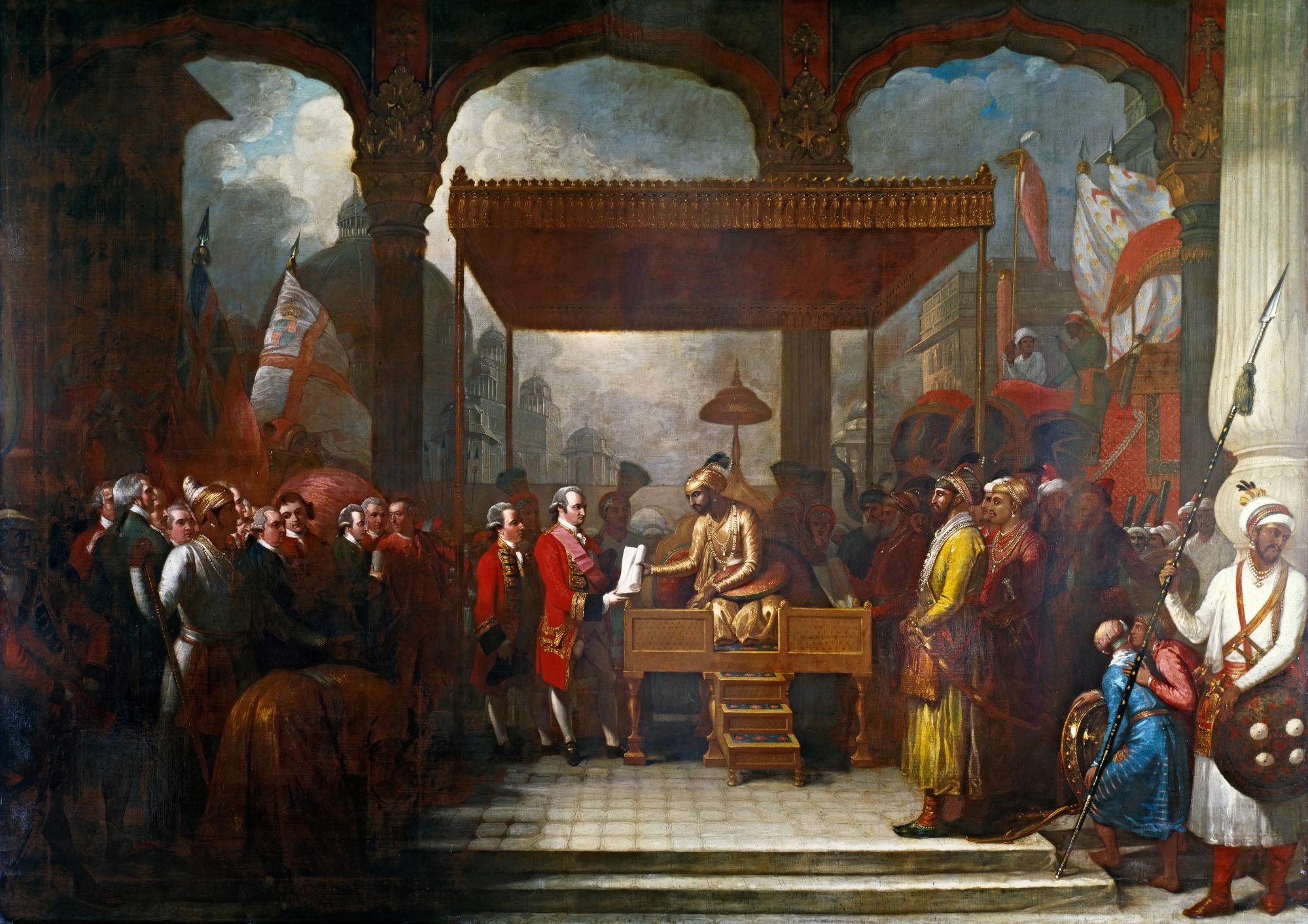
    Within a decade, on August 12, 1765, Clive obtained a firman from the then Mughal Emperor, Shah Alam, granting the Diwani of Bengal, Bihar, and Odisha to the Company. A Muslim contemporary indignantly exclaims that so great a “transaction was done and finished in less time than would have been taken up in the sale of a jackass”. By this deed the Company became the real sovereign ruler of 30 million people, yielding a revenue of four millions sterling. The John Company grew from strength to strength, and by 1857 the Grand Mughal was reduced to his fort conducting poetry soirees. It was the golden age of Urdu poetry.

    The events of 1857 led to the formal establishment of India as a directly ruled colony of the British empire. It was yet another epochal event. India changed, for the better and for the worse. Once again India absorbed from outsiders, as it absorbed from the Dravidians, Aryans, Greeks, Persians, Kushans, Afghans, Uzbeks, and all those who came to seek their fortunes here. The British were the only ones who came to take away its vast wealth in a systematic manner. The wealth taken from India to a great extent financed the Industrial Revolution in England.

    From then to another epochal year ending with seven took ninety years. In 1947, India became independent. Its GDP is now the world’s third-biggest. In a few decades, it could conceivably become its biggest. But have we learned any lessons from history?

    Given its abject failures on the economic front, the BJP/RSS regime in New Delhi is now pushing India towards a Hindutva nationhood, by seeking to victimise a minority for the perceived wrongs and slights of the past. An intolerant religion can never be the basis of nationhood and national unity in India. The legacy of Aurangzeb tells us that. Aurangzeb had created the greatest empire that India had seen since Ashoka the Great. But it didn’t take very long for it to dissipate. In the hundred years that followed, a foreign mercantile company gained control over all of India.

    The BJP under Narendra Modi might keep gaining electoral dominion over all or most of India. But has the BJP learned any lessons from history? Does the PM  want to become the Hindu Aurangzeb? What is worrisome is that we know well that history is not Narendra Modi’s forte.


    This article was published earlier in Deccan Chronicle. The opinions expressed in the article are the author’s personal views and do not reflect TPF’s institutional position or analysis.

    Featured Image: Shah Alam conveying the grant of the Diwani to Lord Clive. en.wikipedia.org

  • Lest We Forget: The Forgotten Army

    Lest We Forget: The Forgotten Army

    Military history records the fighting at Nyaung U, Irrawaddy as in the words of Slim himself, “the longest opposed river crossing of World War 2”. Dhillon and his men, despite being hugely outnumbered, with no air cover or artillery, held their ground from February 4th to February 11th, 1945.


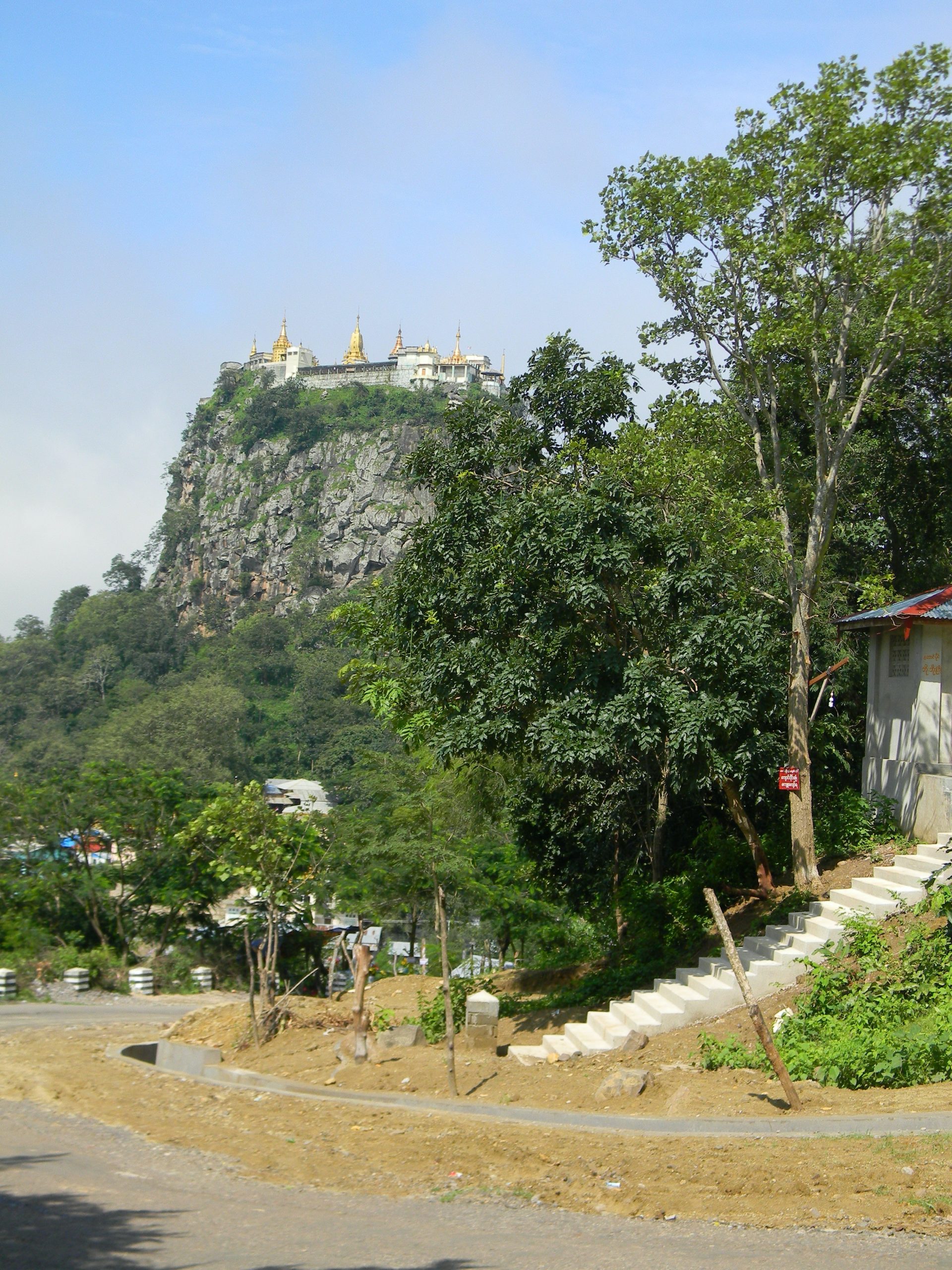
    Mt. Popa (Photo on left) is in the heart of Myanmar (old Burma). It is like a largish pimple on an otherwise smooth cheek. It is the only hill, steep from all sides in an otherwise flat terrain. It is now an extinct volcano.

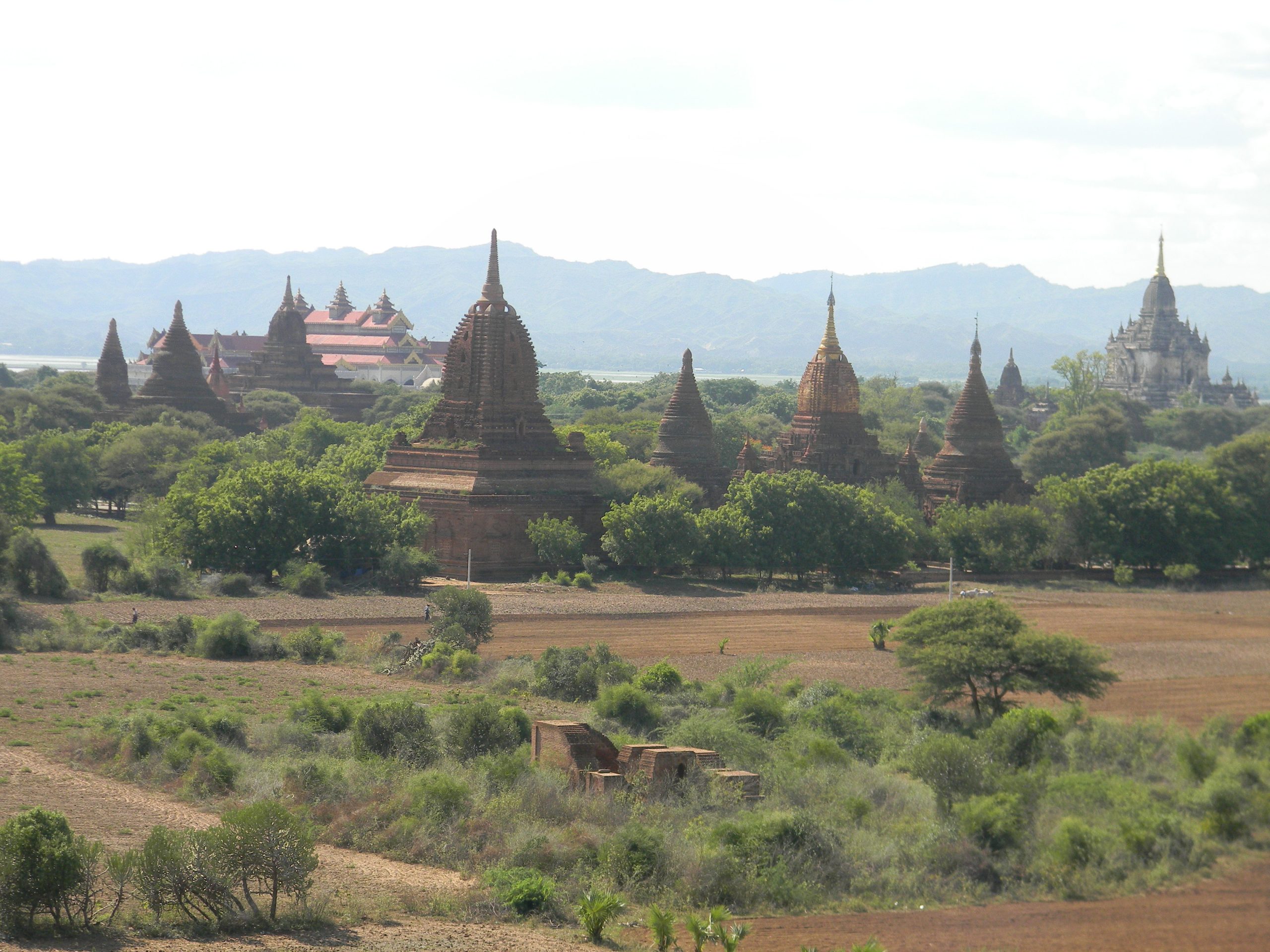
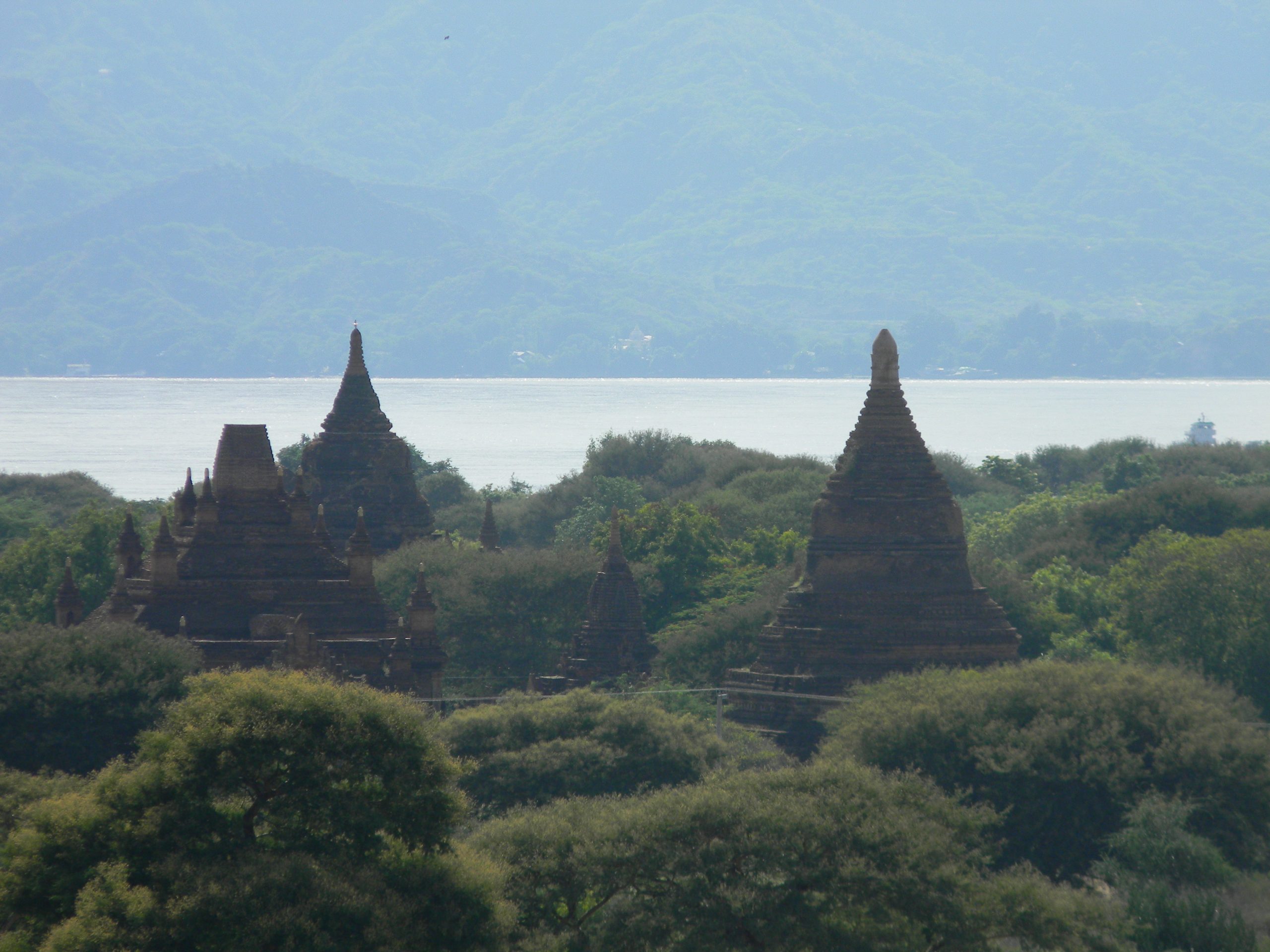
    My wife and I arrive at Mt. Popa from Yangon (Rangoon) after an interesting plane ride on a rickety old aircraft to Nyaung U, the airport of the ancient capital city of Bagan (two Photos as below) the city of the four thousand Pagodas).  We then take a taxi (non A/C) ride over a terribly bumpy road partially running alongside a massive pipeline being laid by the Chinese to transport oil from the Myanmar coast to South China.

    Bagan

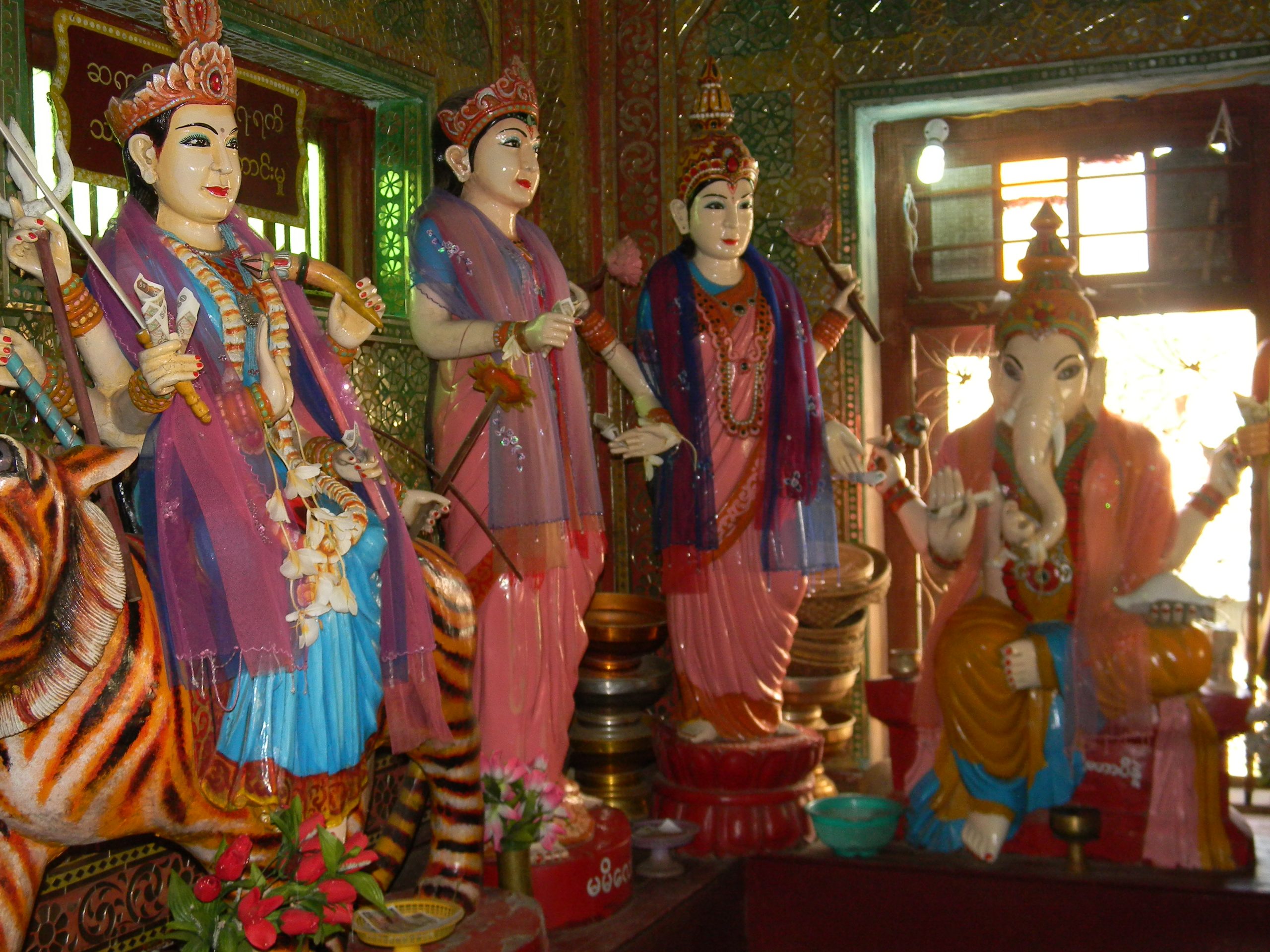
    We are not at Mt. Popa as the regular tourist or as pilgrims to the holy sites around. We do however go and seek blessings from the deity (Photo as below) at the base of the mountain. The deity is much like some in India – it seeks offerings only in the form of liquor.

    Deity at Mt Popa

    The blessings we seek, hopefully will enable us to find an elusive little place called LEGYI. It is in the region nearby but sadly is not marked on a map. The tourist office in Yangon do not know about it. I, fortunately, had some idea about its whereabouts gleaned from the records of my late Uncle (Col. Prem Sahgal) and late Aunt (Capt. Lakshmi Sahgal) of the INA –  Indian National Army (Azad Hind Fauj). Their home in Kanpur was called ‘Legyi House’.

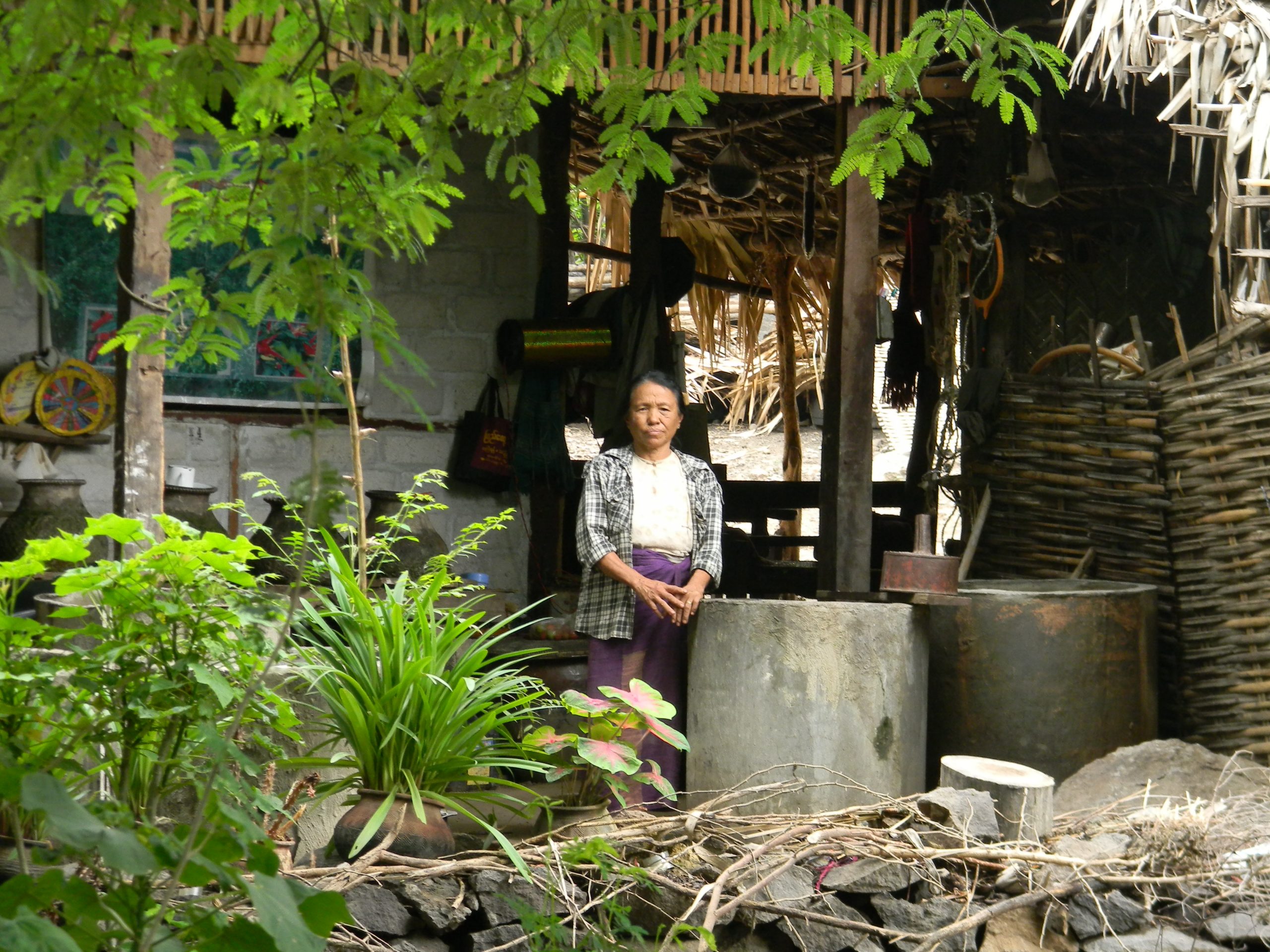
    We drive on from Mt. Popa on a small road in the general direction of the Irrawaddy River and Mandalay. Our guide makes the driver stop every few kilometres to ask about Legyi but in vain. Finally at the crossroads of a small village the guide talks to a little old lady. Amazingly the old lady (Photo on the left) knows where the place is. It is right next to her ancestral home. It is the place, as the old lady said, ‘where this great battle took place many years ago’. She asks where we are from. On being told that we are from India she castigates us. The Japanese come regularly bearing the favourite foods and music of their soldier ancestors but no Indians. Apparently we are the first Indians there after the ‘big battle’ in February 1945!

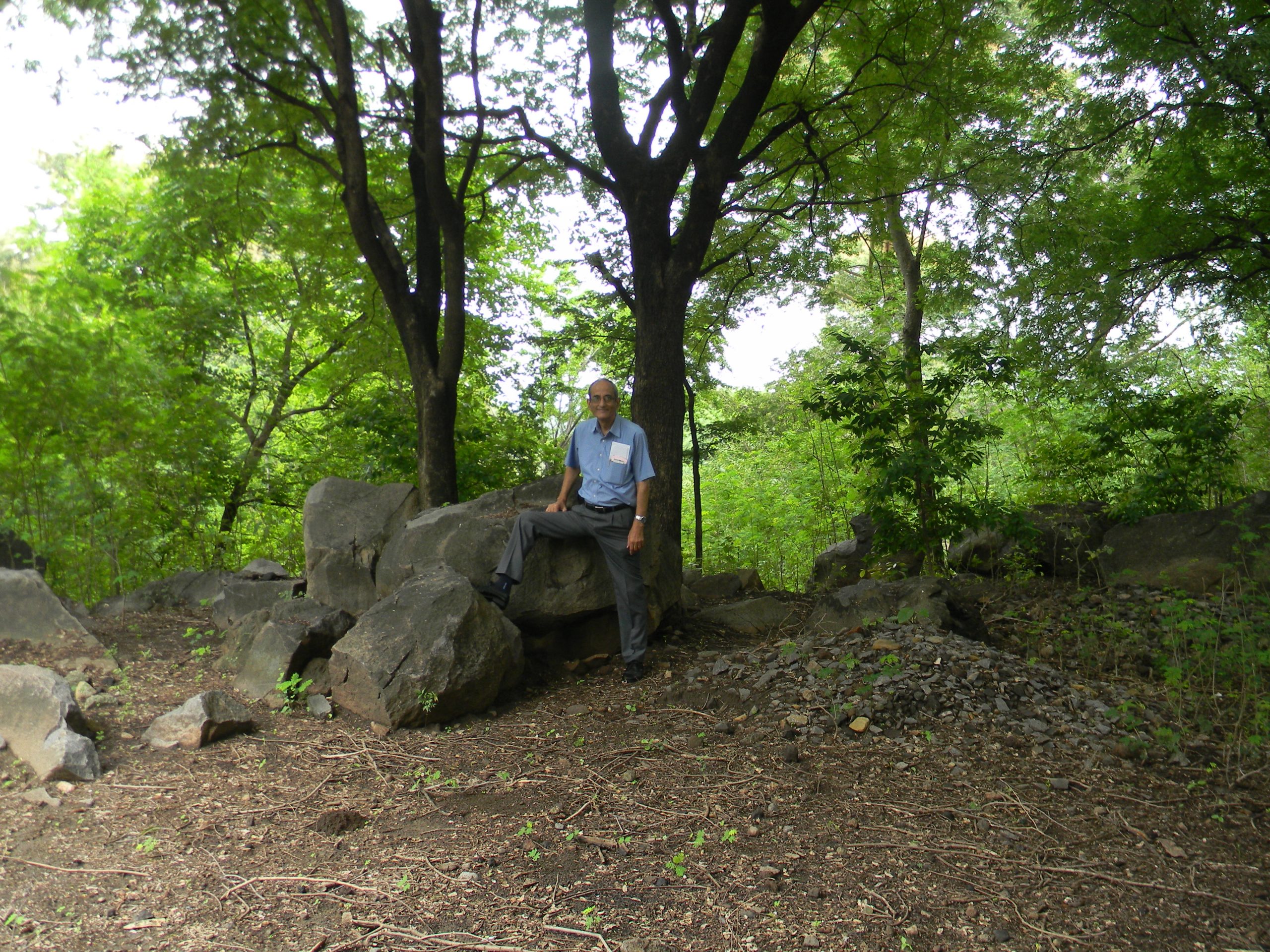
    Legyi (Photos as below) is the small knoll of a battleground where one of the battalions of  INA’s  2nd Infantry Regiment (under the command of Col. Prem Sahgal) troops valiantly held their ground for days against repeated attacks by formations of the overwhelming might of (then) General Slim’s massive 14th Army. With no Air Force cover or artillery, and with an almost non – existent supply line, they should have been easily wiped out in a matter of hours. Yet they held ground for over a week. They fought valiantly and inflicted huge casualties, largely with the use of guerrilla tactics making Legyi arguably the INA’s most successful battle action.

    Author at Legyi

    Just before the ferocious fighting took place at Legyi, some 50 kilometers north east, just beyond modern day Nyaung U airport, another notable encounter took place.  Two battalions of the INA were tasked to delay and frustrate the imminent attempt by Gen. Messervy’s 7th Indian Division, part of Slim’s 14th Army, to make the crossing of the Irrawaddy River. With 1200 men these battalions, under the Command of Col. Gurbaksh Singh Dhillon, had the daunting task of stalling to the absolute limit the crossing of the river by some 30,000 troops amassed on the river’s western bank. Military history records the fighting at Nyaung U, Irrawaddy as in the words of Slim himself, “the longest opposed river crossing of World War 2”. Dhillon and his men, despite being hugely outnumbered, with no air cover or artillery, held their ground from February 4th to February 11th, 1945.

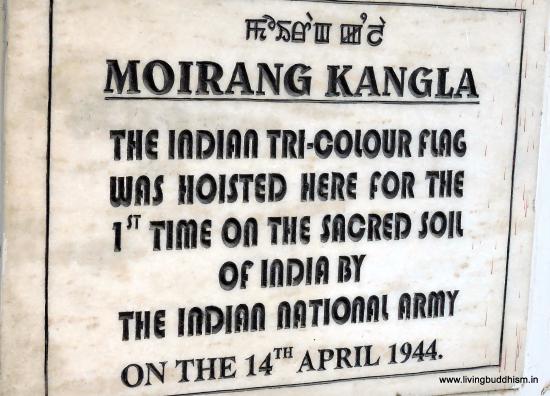
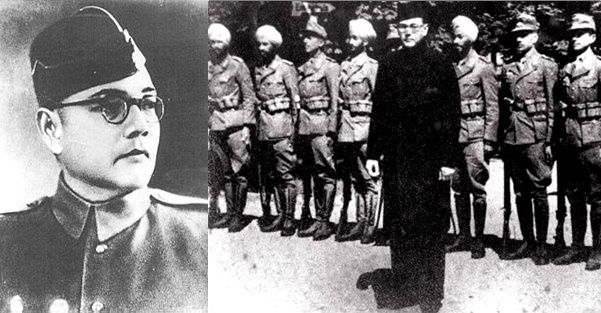
    Lest it be forgotten the INA, starting from Farrer Park Race Course in Singapore went all the way up and crossed the Indian border fighting to plant the National Flag at Imphal, much as the British tried to deride this valiant army.

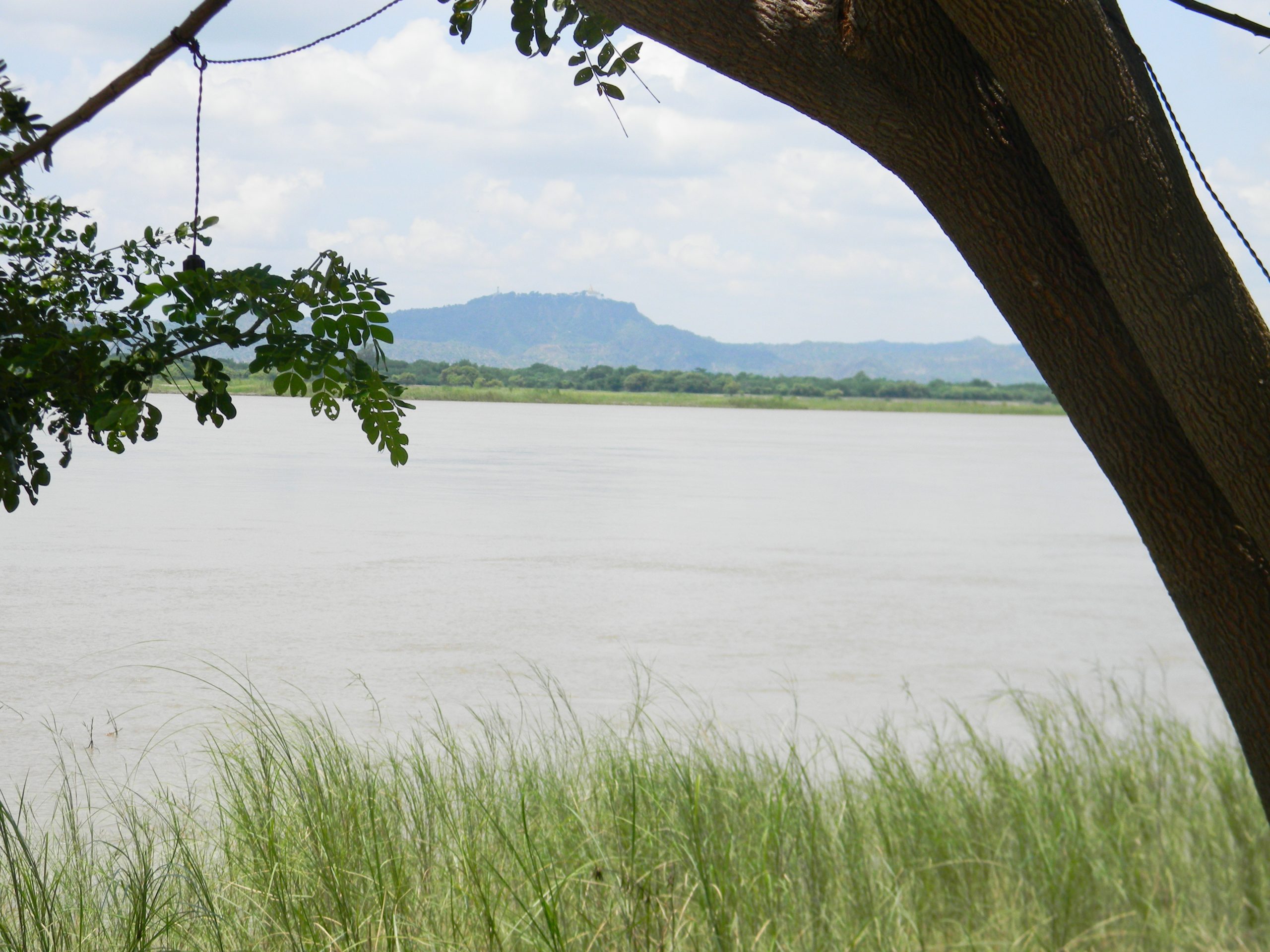
    When we, on our visit, reached the eastern bank of the Irrawaddy at Nyaung U (Photo on left) from Legyi we could visualise what a herculean task Dhillon and his men had performed. The river there is enormous in width. It is rapid flowing, almost torrential. The massive Brahmaputra at Guwahati is not even half that. How did the small force manage to fight back all the frontal and outflanking assaults?

    The INA actions at Legyi and Nyaung U are perhaps the best examples of what a truly secular force comprising Hindu, Muslim, Sikhs, Christians, the lot under the command of Indian officers can achieve when they fight for the cause of the country – in this case, Independence. Lest it be forgotten the INA, starting from Farrer Park Race Course in Singapore went all the way up and crossed the Indian border fighting to plant the National Flag at Imphal, much as the British tried to deride this valiant army.

    Let us recall, it was on February 17, 1942, that the Indian officers and men of Lt General Arthur Percival’s army in the then Malaya marched into Farrer Park Stadium under the command of the senior most Indian officer, Col Zaman Kiani. There were no British officers and men with them. Gen Percival and his army had ceded Singapore to the conquering Japanese two days earlier. The British officers decided that they would surrender separately at Changi. The Indians troops were ordered to surrender by themselves at Farrer Park, pretty much abandoned to their own fate by their British colleagues. After their surrender, they were separately incarcerated at Neesoon Camp in Seletar. Peter Ward Fay writes in The Forgotten Army: India’s Armed Struggle for Independence: “Much later, in the chorus of anger and embarrassment that rose among Englishmen on the subject of the INA, no one was heard to suggest that Percival should have refused to let himself and his colleagues be separated from their brothers in arms, the Indian officers.” This was to be a crucial factor in what ensued.

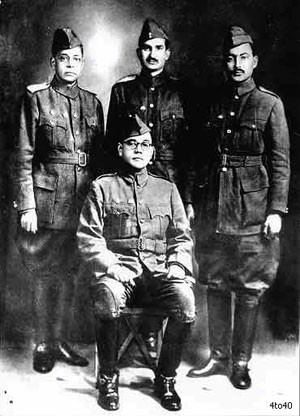
    For their valiant stand against Slim’s 14th Army, Sahgal and Dhillon along with their superior officer, Gen. Shah Nawaz Khan were placed under arrest. They were to be made examples of for their audacity! After the termination of hostilities at the end of the war the three were brought to Delhi and incarcerated in a remote part of the Red Fort awaiting a Court Martial to be held within the premises of the Fort.

    This, for the usually astute British, was quite a blunder. First to select for trial a Hindu, a Sikh and a Muslim (exemplifying INA’s secular make up and credentials) and then to hold the trial in Delhi’s Red Fort, the very icon that Netaji Subhash Chandra Bose, the Supreme Commander, had projected as the goal to be attained. Worse, the trial would be held in the same premises where India’s last Emperor Bahadur Shah Zafar was tried, sentenced and deported to Rangoon where he died. The symbolism perhaps had somehow escaped the colonial rulers.

    Also that independent undivided India’s first Government, with Netaji Subhash Chandra Bose having taken his oath as its first Prime Minister had been formed in Singapore. News now came in that the National flag had already been hoisted at Imphal and at Port Blair in the Andamans. Free India’s first currency notes and stamps had been issued. The nation was in uproar!

    When the curtain of secrecy was finally lifted and the ‘INA Red Fort Trial’ began, the populace finally got to know about the INA, the extraordinary fight by its men as well as women. Also that independent undivided India’s first Government, with Netaji Subhash Chandra Bose having taken his oath as its first Prime Minister had been formed in Singapore. News now came in that the National flag had already been hoisted at Imphal and at Port Blair in the Andamans. Free India’s first currency notes and stamps had been issued. The nation was in uproar!

    Many of the then leading politicians with legal backgrounds volunteered to lead the legal defence team – Nehru, Katju, Patel et al. My grandfather, a sitting Judge of the Punjab High Court, applied and received leave of absence to supervise the legal defence arrangements for the ‘Lal Qila 3’. He rejected the offers by the politico lawyers. Instead he opted for the one he thought was quite simply the best legal mind of the country – Bhulabhai Desai. He would be the lead attorney.

    The then Advocate General, Sir Nowshirman Engineer for the prosecution argued that the three accused had committed treason by violating the oath they had taken on being inducted as officers into the British Indian Army. Bhulabhai Desai in defence argued for some ten hours over a period of two days. Firstly, he claimed, the so called oath of office became invalid when Gen. Percival and the British Officers decided to surrender separately at Changi in Singapore and ordered all Indians to go to the surrender ceremony at the Farrer Park Race Course.

    Equally importantly Bhulabhai Desai argued (1) that an enslaved nation had the legal right to engage in military action to free itself from a foreign coloniser (2) That the INA fought on the behalf of a properly constituted Government of free India recognised by other international governments, and (3) That the INA was a properly constituted disciplined army, managed entirely be competent Indian Officers with this army having its own uniforms, ranks, ethos, and ‘regalia’.

    To put it succinctly what Bhulabhai Desai told the Court Martial was that it was as a sovereign nation with a recognised Government in place, that India had declared war on Britain and sent its Army i.e. the INA, to fight.

    To put it succinctly what Bhulabhai Desai told the Court Martial was that it was as a sovereign nation with a recognised Government in place, that India had declared war on Britain and sent its Army i.e. the INA, to fight. Hence under International Law the Indian National Army had the status of a legitimate ‘belligerent’. Accordingly the defendants could in no case be tried for treason or other offences under a Penal Code based on British ‘Municipal Law’, as Desai put it.

    To quote from Bhulabhai’s arguments, he stated “….The position now is that international law has reached this stage that if liberty and democracy are to have any meaning all over the world, and not merely just for a part of it, and this is not politics, it is law – any war made for the purpose of liberating oneself from foreign yoke is completely justified by modern international law. And it will be a travesty of justice if we were to be told as a result of any decision arrived at here or otherwise, that the Indian may go as a soldier to fight for freedom of England against Germany, for England against Italy, for England against Japan, and yet a stage may not be reached when a free Indian State may not wish to free itself from any country including England itself.”[1]

    Whether these lucid arguments had any real effect on the senior British Officers sitting on the Court Martial Bench and influenced their decision, we do not quite know. The final sentence against the three defendants whilst finding them guilty of treason did not go as far as delivering death sentences. The three brave officers were dismissed from service and forfeited any pay and allowances due.

    At the news of the release of Shah Nawaz Khan, Prem Saghal and Gurbaksh Singh Dhillon from their detention cells in the Red Fort there were massive and jubilant countrywide celebrations. The colonial administration, we now know, took due notice – not only of the exploits of the INA, the nationwide consternation during the Red Fort trial and jubilations at its end, but also of the Naval Mutiny at (then) Bombay and the Air Force Mutiny at Karachi around the same time.

    “…..Gandhi is not a problem. We can deal with him and handle him. The Congress is also not a problem. We can easily deal with them. But now that India and Indians know about the INA as also about the mutinies in the Royal Indian Navy and the Royal Indian Air Force, the Indians know that we have lost the love of the Indian Armed Forces. It is time to leave India!” …. note to the Viceroy, Field Marshal Wavell from the then Commander-in-Chief in India, Field Marshal Sir Claude Achinleck 

    Deep down in the 4th basement level in a temperature and humidity controlled hall of the British Library near Euston Station, London are stored the ‘India Office Records’. These records are pretty nearly everything that the British colonial rulers had with them in India and transported them back ‘in toto’ before Aug. 15th, 1947. Amongst these records is a document penned by the Commander in Chief in India – Field Marshall Sir Claude Auchinleck. It is a Memo to the then Viceroy – Field Marshall Wavell. The purport of this extraordinary memorandum is that “…..Gandhi is not a problem. We can deal with him and handle him. The Congress is also not a problem. We can easily deal with them. But now that India and Indians know about the INA as also about the mutinies in the Royal Indian Navy and the Royal Indian Air Force, the Indians know that we have lost the love of the Indian Armed Forces. It is time to leave India!” As Alex von Tunzelmann writes in his excellent book[2] “… neither Gandhi nor Congress party agitations forced British hands. It was…. the possibility of full scale military revolt due to the influence of Subhas Bose (and the INA) which led to the British exit from India.

    And yet generations of young Indian students in schools and colleges are still being taught that it was Gandhi and the Congress that got India’s independence!! They are still being taught that Nehru was India’s first Prime Minister. Yes he was but that of ‘DIVIDED INDIA’. The record shows that it was Subhash Chandra Bose – Netaji, who was the first Prime Minister – OF AN UNDIVIDED INDIA.

    JAI HIND!


     References

    [1] “Two Historic Trials in Red Fort” – Moti Ram; Roxy Print Press, 1946.

    [2] “Indian Summer: The Secret History of the End of an Empire”; Alex von Tunzelmann;


    All colour photos by the author. 

  • Liquid globalization and inter-civilizational Dialogue

    Liquid globalization and inter-civilizational Dialogue

    The Western world is not only in relative decline, but also faces the inevitable ‘rise of the rest’ (Zakaria), as well as an increasing level of instability and unruliness in many parts of the world. Although there has already been a lot of research in post-colonial studies and intercultural communication, the binary code between the imaginary West and the multiplicity of non-Western approaches was yet to be resolved. Given the relative decline of the West, the dissolution of identities throughout the world, and the rise of the newly industrialized nations, there is an imminent urgency to address and overcome this binary code because it is not only situated in discourses but also manifested itself in all our living environment and within ourselves.

    This approach is based on the assumption that the West, as well as the non-Western world, have their shares of dark sides in history. When it comes to the Western world, we cannot deny brutal colonialism, the religious wars, the two world wars, Auschwitz, and the sheer luck of averted atomic world war, which would have destroyed all living being. On the other side, there is often an unbearable degree of intra-societal violence in the Non-Western World. – peoples in a lot of countries face a living hell. For them, hell is not an afterlife. They experience it already in their own life.

    As we are all living on one planet featuring more connectivity, we become more and more aware that there cannot be any more islands of prosperity, peace and well-being within a sea of violence, hatred, extreme poverty, and the dissolution of the fabric of societies. In some parts of the world, they experience something very close to the Hobbesian war of all against all, or Carl Schmitt’s never-ending civil wars between communities.

    In order to cope with these developments, a dialogue about the civilization foundations of our world society is needed. I explicitly use the concept of civilization in the footsteps of Karl Jaspers, Shmuel Eisenstadt and Peter J. Katzenstein, because civilizations are much more inclusive than religions. This is particularly clear with civilizations that descended from religions. In my view, the contrast is based on that of the Western billiard game model versus the model of concentric circles. Of course, we can easily differentiate these models. For example, when the balls in the billiard game attract each other, we are in the theoretical domain of idealism and cooperation; if they push off each other we are in the realm of competition, conflict and war. And, of course, if the balls cooperate, we are in the realm of all kinds of institutionalism. But the main concept in this model is the importance of rule and methods. The model of concentric circles on the other side can be distinguished by the relation of centre, semi-centre, semi-periphery and periphery (by slight modification of proximity and distance to the centre). In case that we have a transfer of goods, people, ideas, raw materials from the periphery to the centre we label this imperialism, the other way round, from the centre to the periphery I’m tempted to judge this as a form of civilization.

    Traditional forms of societies can be explained by overlapping circles of politics, societal relations, economy, economy and the environment:


    In such a traditional society there is a great correspondence and overlapping of the different spheres – identity is based on an ostensible core and seems to be related to culturally determined values that were handed over from generation to generation.

    A “modern” society (first modernity, Ulrich Beck) to the contrary can be characterized by the assumption that the different circles are much lesser overlapping, they are forming different spheres which have their laws and logics – we may label this a kind of functional differentiation (Niklas Luhmann) and it could either be characterized by the interaction and different functions of the organs of a body or the Olympic Rings.

    The spheres in which these rings are overlapping are the institutions in modern societies like the state, the political system, law and the judicial system, the church as an institution, labour unions and civil society.

    In liquid globalization and as a result of military interventions, civil wars, these rings of political, social, economic, and cultural and security spheres are separated from one another and could no longer be held together by a core identity.


    Within this model, there is a sphere that remains blank and could be characterized as a kind of emptiness. In such an understanding the social fabric is increasingly dissolved and especially the young generation is set free from all social norms. This concept is able to overcome the binary alternative which characterizes the discussion about the causes of terrorism, whether these actions are either related to an aggressive ideology or the social disintegration in societies and failed states, as in the ring of fire around Europe, mainly in the Arab-Islamic states, but also in Africa as a whole. It also explains why identity and recognition count so much in a lot of conflicts throughout the world.

    Based on this concept it becomes obvious that this emptiness can be filled with different content, for example with radical ideologies, private enrichments, drug, weapons and human trafficking, but also with the recourse to ethnic and even tribal identities, masculinity and patriarchy and finally violence itself which gives the excluded, superfluous (population growth) and uprooted young generation in these countries and regions the feeling not to be absolute powerless but all-powerful.

    The rise of the others in a globalized world is inevitable (Zakaria) – our task is to develop forms of recognition that centre on the civilizational foundations of Islam, Buddhism/Taoism, Confucianism, Christianity and Hinduism and African kinds of solidarity.

    The alternative to such a violent filling of the emptiness caused by liquid globalization is the mutual recognition of the civilizations of the earth. The rise of the others in a globalized world is inevitable (Zakaria) – our task is to develop forms of recognition that centre on the civilizational foundations of Islam, Buddhism/Taoism, Confucianism, Christianity and Hinduism and African kinds of solidarity. Only by recognizing their civilizational achievements, the uprooted, excluded and superfluous people of the world, which are the vast majority of mankind, can build an identity by their own in fluid globalization.

    Assuming that we all are already living in such spheres which are not overlapping, producing a kind of emptiness, the two different solutions might be to solve this problem by constructing a core as identity, which leads to thinking in categories of we against the rest of the far-right, whereas a different attempt would be to develop a discourse in which identity is constructed as a kind of floating (Clausewitz) and progressing (Hegel) balance or harmony (Confucius), understood as unity with difference and difference with unity.

  • Tamil Civilisation and the Lost Land of Lemuria/Kumari Kandam

    Tamil Civilisation and the Lost Land of Lemuria/Kumari Kandam

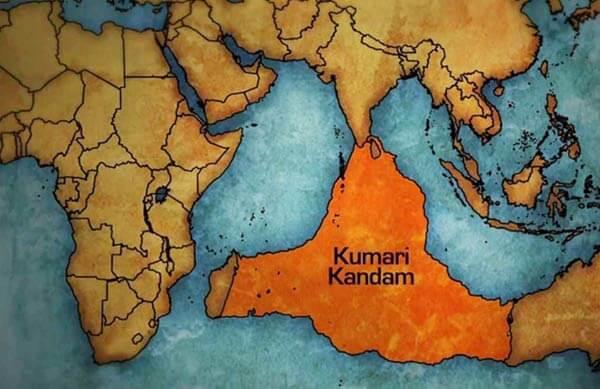
    Lemuria came to be identified as Kumari Kandam, the ancestral homeland of the Tamils, lost to the ravaging ocean in the distant past, due to what is called “Kadal Kol” in Tamil.

    The concept of the lost land of Lemuria hitherto a talking point in the west finds a new focus and interest in the study of the origins of Tamil Civilisation at the beginning of the 20th century. This was a direct result of the new consciousness of the ethnic and linguistic identity that emerged in Tamil speaking regions of South India. By the Tamil enthuse Lemuria came to be recast as the birthplace of the Tamil civilization. It came to be identified as Kumari Kandam, the ancestral homeland of the Tamils, lost to the ravaging ocean in the distant past, due to what is called “Kadal Kol” in Tamil.

    Tamil Nadu Government, during January 1981 at the Fifth International Conference of Tamil Studies held in Madurai, screened a documentary named “Kumari Kandam” both in Tamil and English. The documentary, produced with the financial support of the Tamil Nadu Government,  traced the roots of Tamil, its literature and culture, to the very beginning of time in Lemuria otherwise known as Kumari Kandam in Tamil. In this documentary, the Paleo history of the world is anchored around Tamil land and language. Thus Sclater’s[1] lost land of Lemuria was re-established in the timeless collective consciousness as a catastrophic loss of prelapsarian Tamil past. Even earlier to this, in 1879 Geological Survey of India brought out in the manual of GRGl, a discussion on the Mesozoic land bridge between Southern India and Africa. Dr.D.N. Wadia, a famed Professor of Geology, mentioned in 1990 “The evidence from which the above conclusion regarding an Indo-African land connection is drawn, is so strong and so many-sided that the differences of opinion that exist among geologists appertain to the main conclusion being accepted as one of the settled facts in the geography of this part of the world.[2]

    E.M. Forster in his famed novel ” A Passage to India “ (1984) begins his stunning stanza line “The Ganges, though flowing from the foot of Vishnu through, Siva’s hair, is not an ancient stream. Geology, looking further than religion, knows of a time when neither the river nor the Himalayas that nourished it existed, and an ocean flowed over the holy places of Hindustan. The mountains rose, their debris silted up the ocean, the gods took their seats on them and contrived the river, and the India we call immemorial came into being. But India is far older than anything in the world”.[3]

    In the ethnology chapter of the Manual, Maclean brought the findings of Ernest Haeckel about Lemuria as a primeval home of man. Maclean also draws a further conclusion from the German Biologist’s theory of the origin of various traces of mankind on the submerged Lemuria continent and reiterated that it was the primaeval home of the ancestors of India and Ceylon.

    Thus the fabled Kumari Kandam, which was based on Tamil Literary tradition, so far can receive immediate credibility through western studies. The foundation for this claim was laid by Charles D. Maclean Book “The Manual of the Administration of the Madras Presidency” published in 1835” Mr Maclean was an Officer of Indian Civil Services. In the ethnology chapter of the Manual, Maclean brought the findings of Ernest Haeckel about Lemuria as a primeval home of man. Maclean also draws a further conclusion from the German Biologist’s theory of the origin of various traces of mankind on the submerged Lemuria continent and reiterated that it was the primaeval home of the ancestors of India and Ceylon.[4] He suggested that Southern India was once the passage ground by which the ancient progenitors of northern and Mediterranean races proceeded to the parts of the globe which they now inhabit from Lemuria.[5]

    However, there is a distinct difference in perception of the Lemuria inhabitants from the point of view of Western Scholars and the Tamil enthuse. According to Western Scholars, the primitive inhabitants of Lemuria are barely human and do not represent the trace of civilization. However, the Tamil scholars hold Lemuria or Kumari Kantam as the birthplace of the Tamil Language and cradle of Tamil Civilisation. The antiquity of the Tamil language got a boost with the publication of Campbell’s Book “The competitive grammar of Dravidian Langauge”. J. Nellai swami Pillai wrote in the journal “The Light of Truth” or “Siddantha Deepika” that if you can believe in the tradition of there having been a vast continent south of Cape Comorin, all humanity and civilization flowed east and west and north, then there can be nothing strange in our regarding the Tamilians as the remnants of a pre-diluvian race. Even the existing works in Tamil speak of three separate floods which completely swamped the extreme southern shores and carried off with them all its literary treasures of ages.[6]

    Nella Swami Pillai gives a cautious conclusion that his theory stands on no serious historical or scientific evidence. The same was enthusiastically taken up fully by a well-known Tamil scholar Maraimalai Adigal.

    Though the name Lemuria came into the Tamil world only in 1903, it started gaining significance among the Tamil populous. Shri V.G.Suryanarayana Sastri started using the name Kumarinadu in his book “Tamilmoliyin varalaru. Thiru T.V.Kalyanasundaram the famous Congress Nationlist, and a noted Tamil scholar wrote emphatically that the Lemuria of “Western Scholars” like Ernst Haeckel and Scott Elliot was none other than the Kumarinadu of Tamil literature”.[7]

    The very name Kumari is suggestive of the pristine chastity and everlasting youth of the Tamil land. Later the legends linked the Devi Temple at Kanyakumari to Kumari Kantam or Kumar Nadu. The Kumari Kantam as mentioned in the old Tamil classics, has no reference to the Mesozoic continent of the Indian ocean. There is no reference to the old boundaries of Asiatic tablelands. The Tamil literature speaks of them as the original inhabitants of the great territory opened by two seas on the East and West, by Venkata hills and submerged rivers Pakruli and Kumari on the South.[8] Scholars like Somasundara Bharathi and others also invented hackers’ concept of Lemuria being the cradle of mankind, which implies that the ancient Tamil region is the birthplace of human beings and the Tamils were the first humans.

    Kumari Kantam was having a breadth of 700 kavatam south of Cape Cameron containing 49 principalities, 2 rivers called Pakruli and Kumari flowed there and it also had a hill called Kumari Koodu. The major cities in Kumari Kantam were Thenmadurai and Kapatapuram.

    The features of Kumari Kantam were referred to by Adiyarku Nallar, the commenter of Silapathikaram. Kumari Kantam was having a breadth of 700 kavatam south of Cape Cameron containing 49 principalities, 2 rivers called Pakruli and Kumari flowed there and it also had a hill called Kumari Koodu. The major cities in Kumari Kantam were Thenmadurai and Kapatapuram. This is also referred to in Tholkappia Orrai of Ilam Pooranar Nachinarkku Iniyan Perasiriyar.

    The Tamil Scholars, V.G. Suryanaryana Sastri and Abraham Pandithar lament the loss of works such as Mudunarai, Mudukurugu, etc, which had been swallowed by the ocean. These are derived from the fact that several poems in the Sangam anthology of later age refer to oceanic threat and consequent loss of lands and lives.

    The Tamil Scholar K.Anna Poorni delineates the extent of Kumari Kantam as she concludes in Tamilagham “ Today, the Tamilnadu that we inhabit consists of 12 districts within its limits. A few centuries ago. Cranach and a part of the Telugu land were part of Tamilnadu. Some thousands of years ago, the northern limit of Tamilnadu extended to the Vindhya mountain and the southern limit extended 700 Kavatam to the south of Cape Kumari which included regions such as Panainatu, mountains such as Kumari Kotu and Mani Malai, cities such as Muttur and Kapatapuram and rivers such as Pahruli. All these were seized by the ocean, so say scholars. That today’s the Indian Ocean was once upon a time a vast landmass and that that is where the man first appears has been stated by several scholars such as Ernst Haeckel and Scott Elliot in their books, History of Creation and Lost Lemuria. The landmass called Lemuria is what Tamilians call Kumarinadu. That which is remaining after this ancient landmass was seized by the ocean is the Tamil Motherland in which we reside today with pride.


    References

    [1] Philip Lutley Sclater was a zoologist and naturalist who studied extensively the presence of fauna and other species in different regions. He found that more than 30 species of Lemur monkeys inhabited Madagascar while they were hardly to be found in Africa but were seen in lesser number of species in India. Explaining the anomalies of the Mammal fauna of Madagascar, Sclater propounded that the Lemurs must have inhabited a lost continent in the Indian Ocean. Termed ‘Lemuria, this continent must have extended across the Indian Ocean and the Indian Peninsula to the further side of the Bay of Bengal and over the great islands of the Indian Archipelago. David Bressan, ‘A Geologists’ Dream: The lost continent of Lemuria’ in www.blogs.thescientificamerican.com

    [2] Wadia D.N. 1919, Geology of India for students, London: Macmillan – 1939, Geology of India, 2nd ed. London: Macmillan.

    [3] E.M.Forster, “A passage to India”: Harcourt Brace, New York 1984, pp 135-136.

    [4] Maclean Charles. D. “The Manual of the Administration of the Madras Presidency”, Vol.I, Asian Educational Publication, pp-33-43.

    [5] Ibid 111.

    [6] Nella Swami Pillai. J, “Ancient Tamil Civilisation in the light of truth” or Siddhanta Deepika. No. 5, pp 109-113.

    [7] T.V.Kalyanasundaram, “Indiyavum viduthalaiyum”, Charu Printing Press, Madras, P 106.

    [8] Sesha Iyengar K.G. Chera King of the Sangam Period, 1937, pp 658.

  • History – Thailand’s Golden Buddha

    History – Thailand’s Golden Buddha

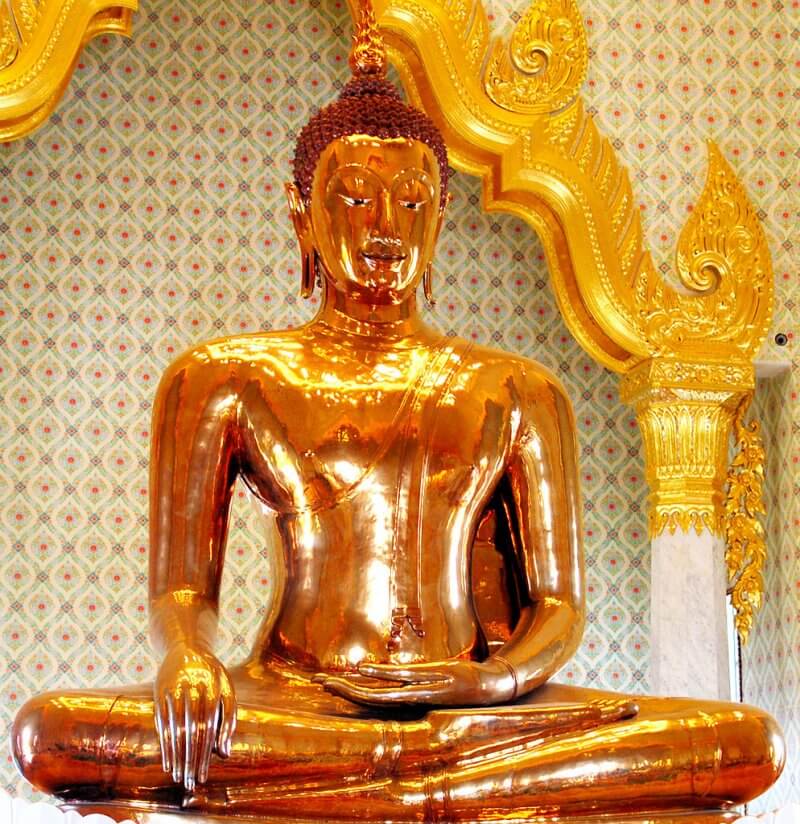
    In the month of May 2007 I was invited to speak at the Mahidol University of Bangkok during the SSEASR Conference. I gave a talk on Yogachara Buddhism there. During this occasion, I had the opportunity to visit various Buddhist temples at Bangkok. They include the magnificent ones like Emerald Buddha, Golden Buddha, Buddha in his Maha nirvana time etc. It is very interesting to note that in the Sanctum Sanctorum of all Buddha temples, while the right side wall is covered with pictures depicting instances in Buddha’s life, the left side has paintings exclusively from Ramayana. For a Thai devotee, Hinduism is as important as Mahayana Buddhism.

    During the visit of one of the temple, I learnt this great truth about ignorance obscuring Reality.

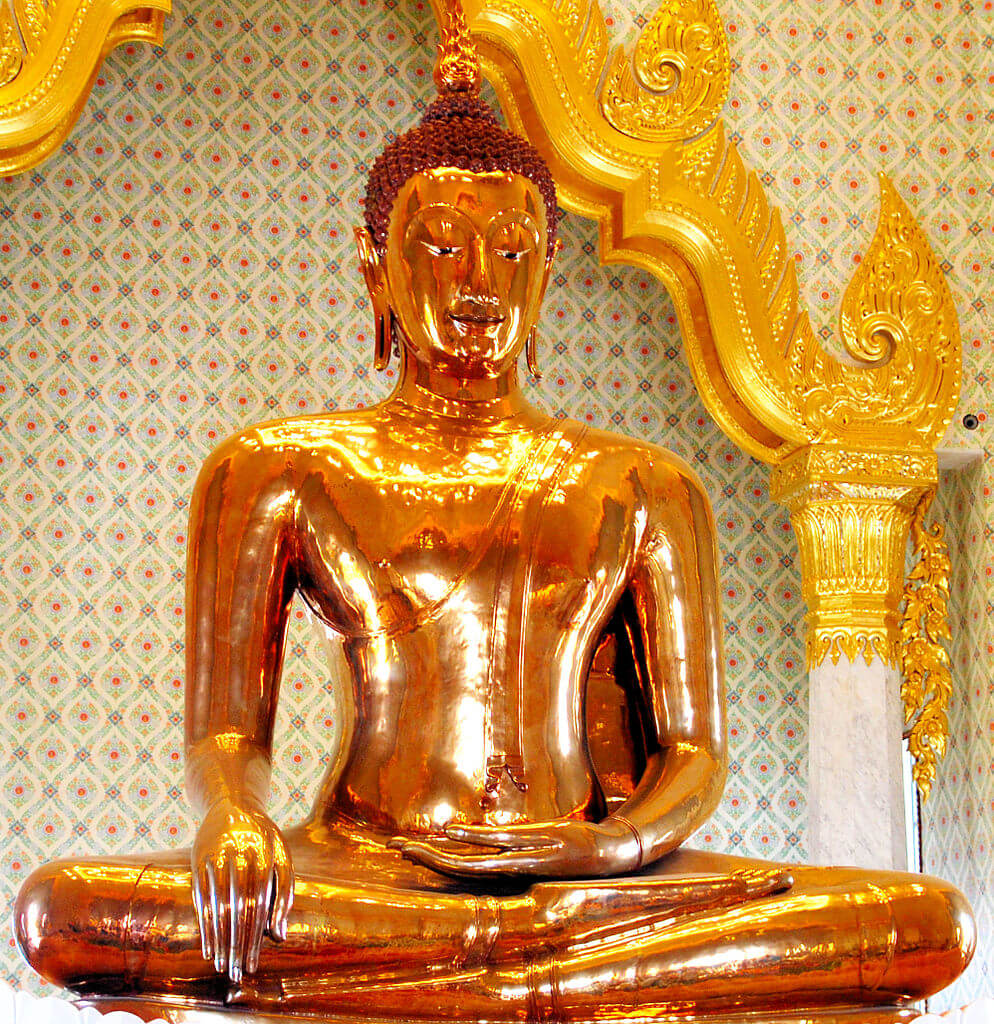
    One of these famous temples has a Buddha icon nearly 17 feet tall, which is known till the beginning of 20th century as “Terracotta Buddha temple” . The temple was established in the 13th century with its huge icon of Buddha, for several centuries it was worshipped by the devotees as “Terracotta Buddha”. One day the authorities decided to shift the Terracotta Buddha image to a place several kilometers away, probably to do some repairs to the temple. They put the Terracotta Buddha on a truck and were moving it. When they were half way through, a heavy downpour started. The rain was so heavy that the clay image of Buddha started dissolving. They tried to protect the image with tarpaulins and umbrellas, but to no effect. There was a very heavy wind which blew away the tarpaulins and umbrellas. Due to the heavy rain, the Buddha icon in clay was dissolving fast. The devotees were grief-stricken. They were wondering whether it would have been wiser to have left the temple un-repaired rather than allowing the centuries old terracotta Buddha icon to get dissolved in the heavy downpour.


    Presto! A wonderful thing was happening. As the clay was dissolving, from within the clay was emerging a golden Buddha idol! as the idol there was of clay. After a short while all the clay, which was covering the idol got completely dissolved. The people were witnessing the presence of a resplendent “Golden Buddha” appearing before them in all its grandeur.

    What really happened? It was really a golden Buddha at the time of its installation in the 13th century. After some time Thailand was experiencing foreign invasions. Fearing that the invaders would take away the golden image, which was 5.5 tons of solid gold, the devotees covered the image with clay. Thinking that it was only a Terracotta Buddha, the invaders left it untouched. That generation knowing that it was a golden Buddha inside the clay, worshipped Buddha in that form. As many years passed by, the subsequent generations were not aware of this fact. They truly believed in what they saw externally and worshipped it as a Terracotta Buddha only. Thus their minds were conditioned by externalities. Once the clay dissolved what is truly inside came out with all its effulgence. It is today worshipped as the golden Buddha in Bangkok.

    It is happening to all of us everyday, we assume ourselves to be only a body-mind-intellect complex and nothing beyond it. We are conditioned by our awareness of our body, our thinking process and our analysis of the phenomena. These are only externalities within each one of us. It is only a clay that surrounds the wonderful Immanence within us. Within each one of us is the golden Buddha, the great immanent Lord who is also transcendent, he is the great Shiva, who is constantly performing his cosmic dance. In our hearts we not aware of it as our minds are conditioned by what we see, do and think. It is like the Thais seeing only the clay image and concluding it as only terracotta Buddha. As the rain dissolved the clay, the golden icon which is the true-one inside is revealed. Likewise when the spiritual sadhaha and devotion dissolves our mental conditioning, the Lord within ourselves is also revealed. This is the lesson we learn from the Golden Buddha temple.

    The same idea is beautifully explained in Thirumoolar’s Thirumantiram. A sculptor has carved out a beautiful elephant from a block of wood. When you see it as an elephant, you do not see the underlying reality of the wood. When you will be able to see the substratum, the underlying reality of the wood, with which all the objects of carving are made, you do not see the carved elephant; you see the substratum of the wood. Likewise, the ignorance enveloping our minds obscure the ultimate reality within us, when we are graded by the body-mind-intellect complex. When the revelation comes to us through god’s grace and gurus’ teachings coupled with our devotion to Him, the conditioning disappears. The phenomena abide in the ultimate. We experience the Divinity within us.

    Even in the area of management, the story of Golden Buddha has a great relevance. A competent Manager, with a penetrating mind, should be able to see what is the reality hidden in the numerous external information. The external covering only obscures the truth, which you will be able to get through. Once you see the substratum, the ultimate truth is revealed.


    Image Credit: Wikimedia Commons

  • Trade during the Sangam Age: Exploring the Sangam literature and Keezhadi excavations

    Trade during the Sangam Age: Exploring the Sangam literature and Keezhadi excavations

    The sculpted marvels which bejewel the ancient temples all across Tamil Nadu stand testimony to the magnificence of Sangam age (3rd century BC to 3rd century AD) and the prolific artistic innovations which are characteristic of that period. But that’s not all there is to it. Matching the artistic and cultural fervour, trade activities were also at an all-time high during the Sangam age. Evidentiating this claim, the Sangam literature chronicles details of all the fine merchandise which were produced in Ancient Tamilakam. Building up on their strengths, the Tamils ventured into lands far and wide, establishing trading associations in foreign countries, some of which till date retain imprints of their existence. Coupled with manifest cultural similarities, archaeological and inscriptional evidence add on to the credibility of Sangam literature by making a strong case for the existence of an extensive trade between Tamilakam and the rest of the Old World.

    Sangam Literature: Valuable source of Information on Trade

    Pattinappalai, one of the poems (301 lines in ‘Vanji’ meter and Asiriyapa/Akaval meter) in Pattuppāṭṭu which is a corpus of ten poems, talks in great detail about Kaveripoompattinam, the capital city of the Early Cholas.

    Even though only half of what is claimed to have been created remains, the Sangam literature is too big a chunk to be thoroughly studied in a short time. There might still be parts of it that are waiting to be looked into. But of what has been discovered, the details pertinent to trade can predominantly be found in three major literary works, namely Pattuppāṭṭu, Silappatikaram and its sequel Manimekalai. Pattinappalai, one of the poems (301 lines in ‘Vanji’ meter and Asiriyapa/Akaval meter) in Pattuppāṭṭu which is a corpus of ten poems, talks in great detail about Kaveripoompattinam, the capital city of the Early Cholas. The port of Puhar / Kaveripoompattinam had ” an abundance of horses brought over the seas, sacks of black pepper brought overland in carts, gemstones and gold from the northern mountains, and sandalwood and eaglewood from the Western hills, pearls from the southern seas and coral from the eastern seas, grains from the regions of Ganga and Kaveri, food grains from Eelam (Sri Lanka) and products from Burma and other rare and great commodities.”

    A description of the port warehouses of Kaveripoompattinam in Pattuppattu is revealing of the flourishing trade – “Like the monsoon season when clouds absorb ocean waters and come down as rains on mountains, limitless goods for export come from inland and imported goods arrive in ships. Fierce, powerful tax collectors are at the warehouses collecting taxes and stamping the Chola tiger symbols on goods that are to be exported.”

    Silappatikaram and Manimekalai, on the other hand, talk about the cities of Madurai, Puhar and Kanchipuram, which served as major centres for cloth weaving, from whence fine quality fabrics were manufactured and exported through the Coromandel Coast. Silk, cotton and wool are some of the fabrics which are mentioned to have been exported from the coast. The epics also present a vivid description of the urban market scenes. The details paint the picture of a buzzing market where trade was carried out in a variety of supreme quality products, starting from agricultural products like black pepper, food grains, areca nuts, white sugar, eaglewood to luxury commodities like gold, pearls, gems, jewels, coral and silk, among other things. In fact, the urban markets are said to have had a separate street dedicated to food grains alone. So high was the demand for food grains that despite having close to eighteen indigenous varieties, grains also had to be imported from other countries in exchange for white salt. Likewise, the demand for aromatic products were too high to be met by home-gown eagle woods and sandalwoods, resulting in the import of the same from South East Asian countries, particularly from China and Indonesia.

    Tamilakam: Maritime Trade hub-centre between the East and the West

    Both literary and archaeological evidence have time and again reaffirmed one another; the merchants of Tamilakam had traded with the East and the West with equal flair. While there is a substantial amount foreign and native literature, and archaeological findings to assert the latter, there is relatively less evidence to support the former. And not only did Tamilakam engage in direct trade with the West, but because all products from Southeast Asia had to be sent through ports along the coast of South India, Tamilakam also acted as the hub-centre for the trade between the East and the West.

    Commodities from Tamilakam had a great demand in Rome. Black pepper, cardamom, pearls and gemstones, especially Beryl which was mined from sites in Kodumanal, Padiyur and Vaniyampadi, were highly sought after in Rome.

    With regard to the West, Tamil merchants have had a long-standing trade relationship with the Egyptians and the Romans. Beginning from the period when Alexandria was the centre of Mediterranean commerce, trade with the West extended well into the time when Rome assumed dominance and became the centre-stage of Mediterranean economy. Trade with Tamilakam was in fact a deciding factor in the question of dominance in sea trade. The Arabs held ground against the competing Romans by monopolizing the knowledge regarding direct sea route to India and information about the source markets in India. Nevertheless, eventually the Romans established direct trade links with India and Rome became the largest market ground for Indian products. Commodities from Tamilakam had a great demand in Rome. Black pepper, cardamom, pearls and gemstones, especially Beryl which was mined from sites in Kodumanal, Padiyur and Vaniyampadi, were highly sought after in Rome.


    Picture: Interpretation map from ‘The Periplus of the Erythraean Sea”.

    In the interpretations of a historical document called ‘The Periplus of the Erythraean Sea, originally authored by a Greek Navigator in the 1st century, there is said to have been  mentions of a marketplace called Poduk’e in the historical text . G.W.B. Hunting Ford, a historian, has postulated that this place might have been Arikamedu, a location two miles away from modern day Pondicherry.  Hunting Ford also notes that Roman pottery have been excavated in Arikamedu and that these evidence point at the possibility that this region might have been a trading centre for Roman goods in the 1st century AD. Arikamedu, known as Poduk’e in the Greco-Roman world was a manufacturing hub of textiles particularly of Muslin clothes, fine terracotta objects, jewelleries from beads of precious and semi-precious stones, glass and gold. The city had an extensive glass bead manufacturing facilities and is considered as “mother of all bead centres” in the world. Most of their production were aimed for export.

    Picture: Arikamedu – credit: Wikipedia

    Arikamedu, known as Poduk’e in the Greco-Roman world was a manufacturing hub of textiles particularly of Muslin clothes, fine terracotta objects, jewelleries from beads of precious and semi-precious stones, glass and gold. The city had an extensive glass bead manufacturing facilities and is considered as “mother of all bead centres” in the world.

    Descriptions of Puhar, Korkai, Muziris and Arikamedu in Sangam literature indicate extensive presence of Yavanas’ (foreigners) settlements in port cities on account of trade. Pattinapalai describes the port activities and the Chola customs revenue system in detail.

    Keezhadi: Evidences of  Industrial and Trade Centre

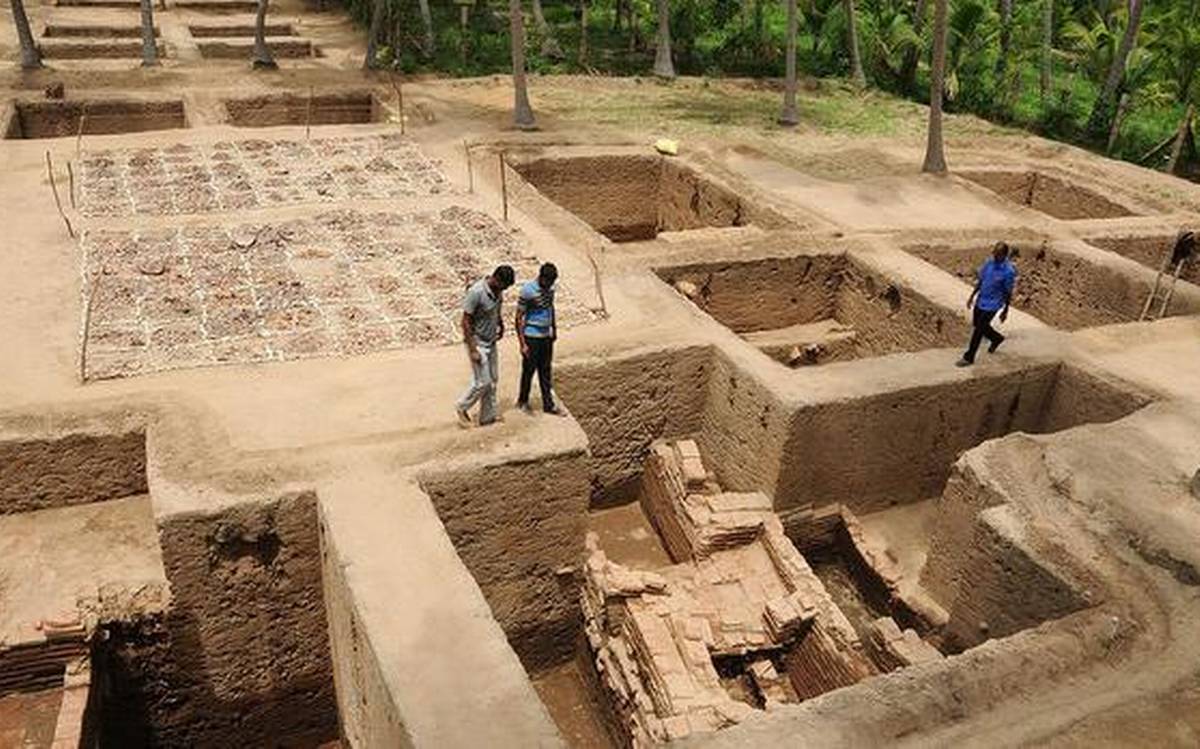
     In addition to these, the Keezhadi excavation, conducted by the Archaeological Survey of India in 2016, has unearthed around 13000 antiquities like shells, glass beads, rusted old coins, weapons, pottery of various kinds and iron tools, belonging to the Sangam age. Among the fine quality red and black ware bowls excavated in the region, are the Roman roulette wares which evidentiate the existence of trade links between the Tamils and Romans. Moreover, seven furnaces were discovered at the site and these, according to the archaeologists, are an indication of the possibility that the site might have been a textile unit and settlers in the region might have been involved in industrial activities.

    Keezhadi findings places the Sangam age to an even earlier period starting from 6th century BC. As per Amarnath Ramakrishna, who led the first two phases of excavations, Keezhadi site was one among the 100 sites of possible human habitation shortlisted for excavation. Discovery of Tamil Brahmi inscriptions and graffiti that date back to earliest times as compared to any other findings in India. Quite obviously, Keezhadi points to the potential of a huge trading and manufacturing habitation and a distinct civilization – the Tamil Vaigai River Valley Civilisation. The Sangam literature is rich and a huge treasure trove of information that needs to be researched extensively.


    Picture: Australian seaboard, Statue of Garuda and Tamil Inscriptions, symbolising maritime culture – Credit: ancient-origins.net

    Maritime Trade in Tamilakam: A Core Activity

    Several artefacts with Tamil Brahmi inscriptions have been excavated in foreign countries as well. In Thailand, potsherd with Brahmi inscriptions were unearthed. Likewise, Cheena Kazhakam ( Chinese gold coins) were discovered in Srivijaya (modern day Sumatra in Indonesia) and Kadaram (modern day Kedah in Malaysia), places which were under the occupation of the Cholas.

    The aforementioned evidence when correlated with the inscriptional evidence, found in foreign lands about Tamil trading settlements, will help in the historical reconstruction of the maritime trade links of Ancient Tamilakam and will attest to the extensive nature of trade carried out by the Tamils during the Sangam age.


    References

     Mukund, Kanakalatha. The Trading World of the Tamil Merchant: Evolution of Merchant Capitalism in the Coromandel. Orient Blackswan, 1999. https://books.google.co.in/books?id=tjXdDYChdGsC&lpg=PP1&pg=PP1#v=onepage&q&f=false.

    Mukund, Kanakalatha. The World of the Tamil Merchants. Portfolio Books Limited, 2015. https://books.google.co.in/books?id=Bha2eLqMPWcC&lpg=PT6&ots=tw2qDuzDlf&dq=trade during sangam age kanakalatha mukund&pg=PT5#v=onepage&q=trade during sangam age kanakalatha mukund&f=false.

    “Roman Trade with India.” Roman Trade with India – New World Encyclopedia. Accessed June 24, 2020. https://www.newworldencyclopedia.org/entry/Roman_trade_with_India#cite_ref-31.

    Kannan, Gokul. “Keezhadi Excavation Points to Vaigai River Civilisation in Sangam Period.” Deccan Chronicle. October 1, 2016. Accessed June 24, 2020. https://www.google.com/amp/s/www.deccanchronicle.com/amp/nation/in-other-news/011016/keezhadi-excavation-points-to-vaigai-river-civilisation-in-sangam-period.html.

    Annamalai, S. “Uncovered: Pandyas-Romans Trade Link.” The Hindu. May 16, 2017. Accessed June 24, 2020. https://www.google.com/amp/s/www.thehindu.com/news/national/tamil-nadu/archaeological-excavation-in-sivaganga-uncovers-pandya-roman-trade-links/article10879282.ece/amp

    Saju, M.T. “Tamil Trade Ships That Sailed to Foreign Shores.” Times of India. March 29, 2018. Accessed June 24, 2020. https://www.google.com/amp/s/timesofindia.indiatimes.com/blogs/tracking-indian-communities/tamil-trade-ships-that-sailed-to-foreign-shore

    Main Image: Keezhadi Excavation Site – Credit – ASI

  • India-China Trade In Ancient Times: Southern Silk Route

    India-China Trade In Ancient Times: Southern Silk Route

    To follow the Silk Road is to follow a ghost. It flows through the heart of Asia, but it has officially vanished leaving behind the pattern of its restlessness: counterfeit borders, unmapped peoples. The road forks and wanders wherever you are. It is not a single way, but many: a web of choices.

    Colin Thubron, Shadow of the Silk Road.

    Introduction

    India and China, two Asian giants, share a lot of similarities in terms of history and culture. Both countries represent age old civilizations and unique history. Cultural and economic ties between the two countries date back to about 2000 years ago. The Silk Route, which is an ancient network of trade routes, formally established by the Han Dynasty, served as a connection between the two countries. It was also through this route that Buddhism spread to China and East Asia from India. The routes were more than just trade routes; it was the carrier of ideas, innovations, inventions, discoveries, myths and many more.
    The earliest mention of China can be found in the Indian text “Arthashastra” which was written by Kautilya in the fourth century BC. Kautilya made a remark about Cinapattasca Cinabhumjia (Cinapatta is a product of China)[1]. Whereas, the earliest mention of India in Chinese records dates between 130 and 125 BC. Zhang Qian, a Chinese envoy to Central Asia, referred to India as Shendu, in his report about India to Emperor Wu of the Han dynasty.
    This article will look into the ancient trade route that existed between South Western China and India’s North East region via Myanmar and the future of the trade route.

    Ancient trade links between India and China

    Shiji, which is the first Chinese dynastic history, compiled between 104 and 87 BCE talks about the existence of a trading route between India and South West China. According to Chinese records, Emperor Wu of the Han dynasty, tried to establish a trade route from Changan, the Chinese capital to North East India through Yunnan and adjoining areas. However, the rulers of Yunnan were against the idea of establishing a direct trade between India and China and Emperor Wu failed to establish the trade route. Even though the trade route failed to take off, the trade in Cinapatta and Chinese square bamboo continued without any hindrance.

    Political Geography of the Southern Silk Route

    The Southern Silk route (SSR), one of the least studied overland route, is a trade route which is about 2000 km long and linked East and North East India with Yunnan Province of China via Myanmar. This is a relatively unknown, ancient trade route that is considered a part of the larger web of Silk Roads. This route existed before the Central Asian Silk route became popular. This trade route between Eastern India and China came to be known during the early 3rd century BCE, and it became popular by the 2nd century BCE. By 7th century AD various other branches of the SSR emerged to create web of trading routes.
    Traders carried silk from Yunnan through Myanmar, across India and joined the main silk route in Afghanistan. In addition, silk was also transported from South West China through the Shan states and North Myanmar into East India and then down to the Coromandel Coast.
    The Qing dynasty which ruled China from 1644-1912, recorded the cross cultural exchanges that took place across SSR. This route contributed to cultural exchanges between China and the West. It also promoted interactions among different nationalities.
    Indian sources have failed to provide abundant evidence about the SSR and the interaction that took place across this route but there is enough evidence that indicates that trade and migration did take place in the Eastern India-Upper Myanmar-Yunnan region. For example, modern scholars believed that the Tai Ahoms were originally from Yunnan but they migrated to North East India and founded a small kingdom around 13th century, which grew to become the powerful Ahom Kingdom of Assam.
    The areas through which the SSR passed were inhabited by various ethnic groups whose political, social and economic organizations were primitive and backward. As a result, the safety of the route was often questioned. Archeological evidences have been found along the Southern banks of Brahmaputra up to Myanmar border, which shows that trade did exist along this route.
    The main items that were exported from China via this route included Silk, Sichuan cloth, Bamboo walking sticks, ironware and other handicrafts items. Sichuan, a South Western province was the main source of silk. Glass beads, jewels, emeralds etc were some of the items that were imported to China.
    Another important trade route is the South West Silk route or the Sikkim Silk route, which connected Yunnan, and India through Tibet. A section of the route from Lhasa crossing Chumbi Valley, Nathu La Pass connected to the Tamralipta Port (present day Tamluk in West Bengal). From the Tamralipta port, this trade route took to the sea to traverse to Sri Lanka, Bali, Java and other parts of the Far East. Another section of the route crossed Myanmar and entered India through Kamrup (Assam) and connected the ports of Bengal and present day Bangladesh.
    Over time, the Southern Silk Route lost its prominence and it was in 1885 that it re- emerged as a strategic link as the British tried to control some parts of the route in order to access and gain control over Southern China.
    The strategic importance of the route increased during World War II. In 1945, Ledo Road or Stilwell Road was constructed from Ledo, Assam to Kunming, Yunnan to supply aid and troops to China for the war with Japan. Ledo Road is the shortest land route between North East India and South West China. However, after the war the road was left unused and in 2010, BBC reported that much of the Ledo road has been swallowed up by jungle.
    The Assam-Myanmar-Yunnan road is very difficult to traverse not only in the present times but also during the ancient times. However, despite the hard conditions, it is through this route that a golden triangle of drug trafficking, movement of terrorist and smuggling functions today.

    Future Potential: Reviving the Southern Silk Route Economy

    North-East India and the Yunnan province share many similarities. Both are landlocked as well as under developed regions. Both are home to a large number of ethnic groups and have witnessed secessionist movement from time to time. Apart from this, Yunnan and North East India are geographically isolated from their political capitals.
    Yunnan and North East India, home to rich varieties of subtropical fruits with high nutritional values and medicinal plants, can cooperate and transform the hills of North East India and South West China into plantations, factories, laboratories to produce processed food products and lifesaving drugs that can find a huge market in developing and developed countries.
    In a bid to revive the Southern Silk route, Bangladesh, China, India and Myanmar, signed the Kunming Initiative, a sub-regional organization, in 1999. This initiative was replaced by the Bangladesh-China-India-Myanmar Economic Corridor (BCIM-EC) in 2015. The BCIM-EC was announced by China as a part of its Belt-Road Initiative, which has been boycotted by India since the beginning. In 2019, the BCIM-EC was dropped from the list of 35 projects that are to be undertaken under BRI, indicating that China has disreagrded the project. However, in the same year India has sought to keep the BCIM-EC project alive.
    If the BCIM-EC project does take place, it will reduce the travel time, cut transportation cost, open up markets, provide way for joint exploration and development of natural resources and create production bases along the way. Before the BCIM-EC takes off, it is important to develop the roadways infrastructure of India’s North East region.
    Even though the BCIM-EC promises to elevate the economic conditions of the backward North-East region of India, it has not gained sufficient steam as both China and India have different apprehensions. China sees India’s reluctance to support BRI as the barrier for any progress in the project. Given the current stand-off in Ladakh, India’s apprehensions about China seeking to exploit the insurgent groups operating in the region gains significance. Either way realizing the Southern Silk Road as a viable project in the form of BCIM-Economic Corridor looks distant now.
    [1]Haraprasad Ray, “Southern Silk Route: A Perspective,” in The Southern Silk Route : Historical Links and Contemporary Convergences (Routledge, 2019).

    References

    Ray, Haraprasad. “Southern Silk Route: A Perspective.” Essay. In The Southern Silk Route: Historical Links and Contemporary Convergences. Routledge, 2019.
    “Continental and Maritime Silk Routes: Prospects of India- China Co-operations.” In Proceedings of the 1st ORF-ROII Symposium. Kunming, 2015.
    Mukherjee, Rila. “Routes into the Present.” Essay. In Narratives, Routes and Intersections in Pre-Modern Asia, 37–40. Routledge, 2017.
    UNESCO. Accessed June 20, 2020. https://en.unesco.org/silkroad/content/did-you-know-great-silk-roads.
    “The Silk Route.” Accessed June 21, 2020. http://www.sikkimsilkroute.com/about-silk-route/.
    Ray, Haraprasad. Introduction. In North East India’s Place in India-China Relations and Its Future Role in India’s Economy, n.d.
    Chowdhury, Debasish Roy. “’Southern Silk Road’ Linking China and India Seen as Key to Boosting Ties.” South China Morning Post, October 23, 2013.
    “China Wants to Revive ‘Southern Silk Road’ with India.” The Times of India, June 9, 2013.

    Image: Stilwel Road from Ledo in Northeast India to Kunming in Yunnan province, China