Category: Federalism & Constitutionalism

  • “And Now to some serious Governance”

    “And Now to some serious Governance”

    A time comes for each leader and government to rise above pettiness, discarding ill will and hatred towards all. For the BJP, now uniquely in its third term, this is the time to show the nation that it is a party with a difference. For the opposition equally, this is the time to cooperate with the government on critical issues impacting the country.  


    Since my retirement from active service, I have avoided politics and political writings like the plague, but the avoidable happenings of the past few months have caused me, like am sanguine would have to millions of our countrymen, pain and a sense of despair.

    India has conducted over 18   general elections to its Parliament since 1952 with a lot of fury and vibrancy, but the Lok Sabha 2024 general elections were indeed an example of abysmally low-level politics transcending our better senses.

            How the world’s largest democracy indulged in its Lok Sabha 2024 elections was hardly complimenting to it considering the unquestionable fact that among the emerging nations in the world, call it from the Global South, the conduct of our elections showed some among those participating in poor light. Between competing political parties, enlightened debates and mutual civility were sadly lacking.   India has conducted over 18   general elections to its Parliament since 1952 with a lot of fury and vibrancy, but the Lok Sabha 2024 general elections were indeed an example of abysmally low-level politics transcending our better senses. India, which carries a fair amount of moral authority and is considered an example of a true and vibrant democracy, cannot let its hallowed image be sullied attributable to the selfish electoral games of some of its political leaders. The party in power at the Centre, the principal Opposition party and all those regional parties at the helm in the states have to display adequate maturity and a modicum of propriety and civility towards each other and not politicize each and every aspect of governance or national issues impacting India. The opposition, as it shows the mirror to the government on critical issues of governance, must not criticise each and every act of the government as a matter of routine.

             With the outcome of the general elections now done and dusted and the previous BJP government back in power, albeit with a clear reduction in its seats tally from 303 down to 240, it must get down to the exacting business of good governance from the Centre. That the same government, with its experience of the last ten continuous years in power, fielding more or less the same faces in the Cabinet in critical ministries and importantly serviced by the same bureaucrats should have, relatively speaking, not such an arduous task in governance. However, the thrust for fair, equitable, and sensitive handling of all critical matters across the nation has to come from the top political leadership. All our states must never feel discrimination by the Centre, especially in financial allocations urgently required for developmental works and disaster management. Additionally, the new government must take stern measures to keep rising inflation and unnecessary governmental expenditure under check before the economy takes a severe nose-dive.

             The Modi government, with the continuous experience of the last ten years, will have more than a good idea of the systemic improvements required and about areas needing additional financial resources and effort. It is unnecessary to worry too much about criticisms from the opposition but to carry on regardless in developmental works, without fear or favour, and with impartiality towards all the states in the true spirit of federalism. A time comes for each leader and government to rise above pettiness, discarding ill will and hatred towards all. For the BJP, now uniquely in its third term, this is the time to show the nation that it is a party with a difference. For the opposition equally, this is the time to cooperate with the government on critical issues impacting the country.

             New Delhi’s hands will be full of the nation’s diverse and formidable challenges, requiring attention and effectiveness. On the foreign policy front, India will have to walk the tightrope of maintaining strategic autonomy and sustaining its good relations with both the US and Russia. However, as it determinedly confronts an overly assertive China, India needs to use its economic clout and sophisticated diplomacy to get its South Asian neighbourhood closer to it and each other, avoiding the debt trap diplomacy and financial machinations of China.

    The number of terror-related incidents in J&K has gone up substantially in the last three months, and Pakistan will have to be kinetically chastened.

          India must, at the appropriate level, convey to China that their confrontationist attitude towards us will be harmful to the Chinese, too and may propel India to rethink its existing Tibet policy. Nevertheless, India must maintain the utmost vigil along the 3485 km Line of Actual Control/ IB, which it shares with  China. Meanwhile, Pakistan once again needs to be cautioned against stepping up terror activities in J&K  or elsewhere in the Indian hinterland. India is in full knowledge of Pakistan’s many fault lines. Still, it has refrained from exploiting these, and Pakistan must also cooperate in ensuring a peaceful and prosperous South Asian neighbourhood independent of China’s wily stratagems. The number of terror-related incidents in J&K has gone up substantially in the last three months, and Pakistan will have to be kinetically chastened.

    Meanwhile, India’s preparations to successfully improve its security capabilities to confront a two-front war must go ahead with realism and an unfailing determination. Measures to augment capital expenditure for major defence acquisitions must be identified. Transformative defence reforms like the introduction of integrated theatre commands will need the attention of the Centre. In addition, India must take all steps to restore peace in our restive NE states.

             The Modi government has come in for some criticism abroad on its human rights record and dealings with its Muslim population. This unjust criticism must be dealt with judiciously and with maturity. India’s overall inclusiveness and celebration of its diversity are unique examples for the entire world, especially the nations of the Global South. We must never deviate or be even seen to shift from this noble orientation.

    Reduction of the yawning gap between the countless ultra-rich and those millions in abject poverty is essential as we boast of becoming the 5th largest economy in the world. The many human indices where we are faltering also need to be addressed.

             As economic strength is the pillar that propels and sustains progress, the Modi government must take measures to improve our economic health. Reduction of the yawning gap between the countless ultra-rich and those millions in abject poverty is essential as we boast of becoming the 5th largest economy in the world. The many human indices where we are faltering also need to be addressed.

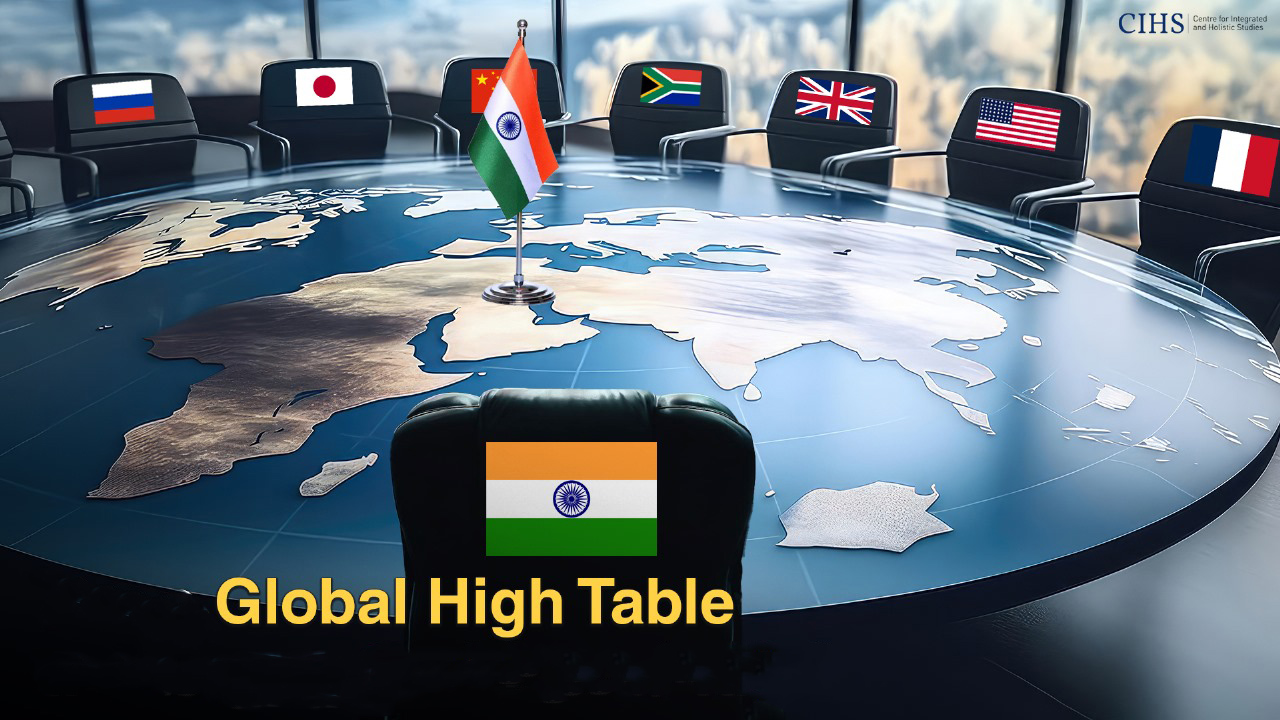
             By all yardsticks, India is deservingly on the cusp of acquiring a seat on the global high table. Let us not squander away this golden opportunity by internal squabbling but instead work together in addressing crucial issues that affect our nation; we must seize this opportunity.

    Feature Image Credit:  vskbharat.com    

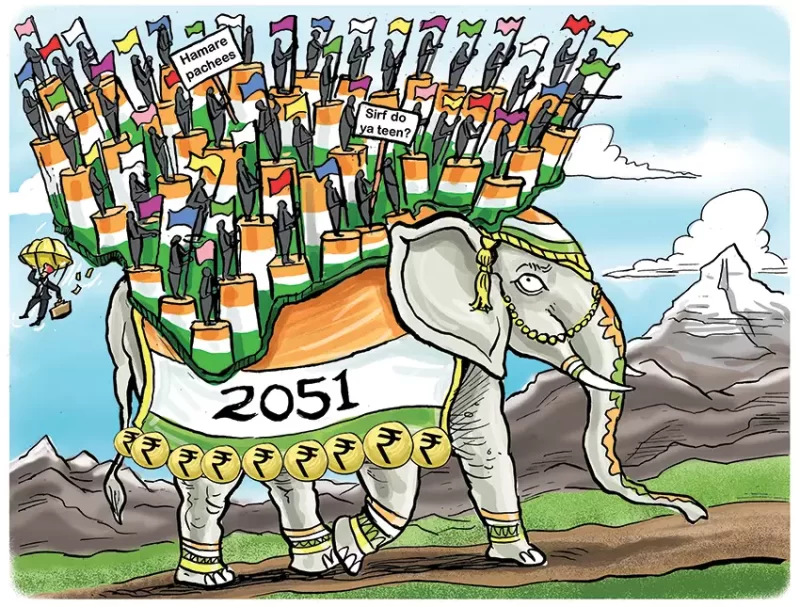
    Cartoon Credit: Times of India

  • The Centre is notional, the States the real entities

    The Centre is notional, the States the real entities

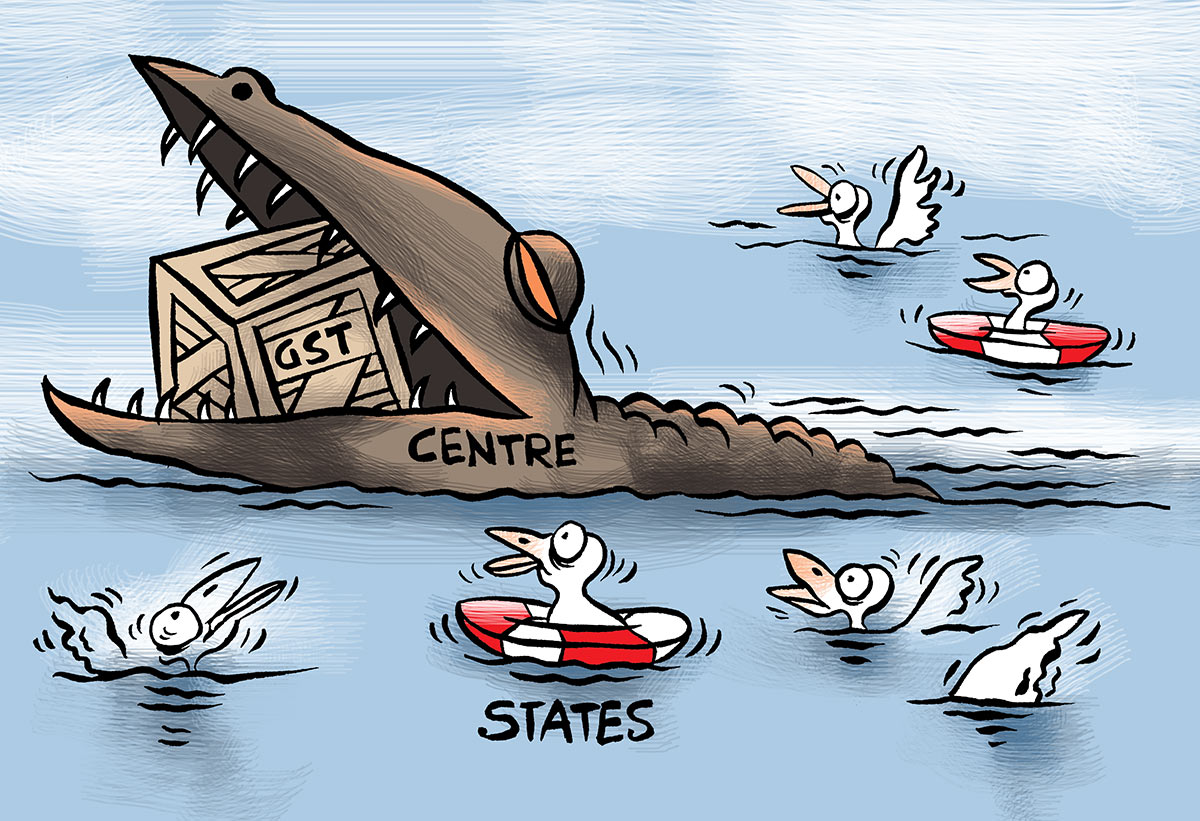
    Utilisation of the country’s resources needs to be decided jointly by the Centre and the States. The changed political situation after the general election makes this feasible.

    The results of the general election 2024 have thrown up a surprise. They portend greater democratisation in the country, with the regional parties doing well. These parties will share space on the ruling party benches as well as on the Opposition side in Parliament. This will help strengthen federalism, which is so crucial for a diverse nation such as India. It was badly fraying until recently.
    Centre-State relations became contentious during the general election campaign. The idea of’ 400 par’, ‘one nation, one election’, and the Prime Minister threatening that the corrupt (i.e., Opposition leaders) would soon be in jail were perceived as threats to the Opposition-ruled States.
    The Opposition-ruled States have been complaining about step-motherly treatment by the Centre. Protests have been held in Delhi and the State capitals. The Supreme Court of India has said that ‘a steady stream of States are compelled to approach it against the Centre’. Kerala has complained about the inadequate transfer of resources, Karnataka about drought relief and West Bengal about funds for the Mahatma Gandhi National Rural Employment Guarantee Scheme (MGNREGS). The attempt seems to be to show the Opposition-ruled States in a bad light.
    The Supreme Court, expressing its helplessness, recently said that Centre-State issues need to be sorted out amicably. When the Bharatiya Janata Party came to power in 2014, it had talked of cooperative federalism. The introduction of the Goods and Services Tax (GST) in 2017 was an example of this when some States that had reservations about it eventually agreed to its rollout. But that was the last of it. With federalism fraying, discord has grown between the Centre and the Opposition-ruled States.
    There is huge diversity among the States—Assam is unlike Gujarat, and Himachal Pradesh is very different from Tamil Nadu. A common approach is not conducive to the progress of such diverse States. They need greater autonomy to address their issues in their own unique ways. This is both democracy and federalism. So, a dominant Centre forcing its will on the States, leading to the deterioration in Centre-State relations, does not augur well for India.

    Financing and conflict is one issue
    States face three broad kinds of issues. Some of them can be dealt with by each State without impacting other States, such as education, health, and social services. But infrastructure and water sharing require States to come to an agreement. Issues such as currency and defence require a common approach. The last two kinds of issues require a higher authority, in the form of the Centre, to bring about coordination and optimality.
    Expenditures have to be financed to achieve goals, and that results in conflict. Revenue has to be raised through taxes, non-tax sources and borrowings. The Centre has been given a predominant role in raising resources due to its efficiency in collecting taxes centrally. Among the major taxes, personal income tax (PIT), corporation tax, customs duty and excise duty are collected by the Centre. GST is collected by both the Centre and the States and shared. So, the Centre controls most of the resources, and they have to be devolved to the States to enable them to fulfil their responsibilities.

    The Centre sets up the Commission and has mostly set its terms of reference. This introduces a bias in favour of the Centre and becomes a source of conflict between the Centre and the States.

    A Finance Commission is appointed to decide on the devolution of funds from the Centre to the States and the share of each State. The Centre sets up the Commission and has mostly set its terms of reference. This introduces a bias in favour of the Centre and becomes a source of conflict between the Centre and the States. Further, there has been an implicit bias in the Commissions that the States are not fiscally responsible. This reflects the Centre’s bias — that the States are not doing what they should and that they make undue demands on the Centre.
    The States also pitch their demands high to try and get a larger share of the revenues. They tend to show lower revenue collection and higher expenditures in the hope that there will be a greater allocation from the Commission. The Commission becomes an arbiter, and the States the supplicants.

    Inter-State tussles, Centre-State relations
    The States cannot have a common position as they are at different stages of development and with vastly different resource positions. The rich States have more resources, while the poor ones need more resources in order to develop faster and also play catch up. So, the Finance Commission is supposed to devolve proportionately more funds to the poorer States. Unfortunately, despite the efforts of the 15 Finance Commissions so far, the gap still remains wide.
    The rich States, which contribute more and get proportionately less, have resented this. What they forget is that the poorer States provide them the market, which enables them to grow faster. The poorer States also lose much of their savings which leak out to the rich States, accelerating their development. It is often said that as Mumbai contributes a bulk of the corporate and income taxes, it should get more. But this is because Mumbai is the financial capital. So, the big corporations are based there and pay their tax in Mumbai. More revenue is contributed in an accounting sense, and not that production is taking place in Mumbai.
    The Centre allocates resources to the States in two ways. First, on account of the Finance Commission award. Second, the Centre is notional, while the States are real. So, all expenditures by the Centre are in some State. The amount spent in each State is also a transfer. This becomes another source of conflict. Expenditures lead to jobs and prosperity in a State. Benefits accrue in proportion to the funds spent. As a result, each State wants more expenditure in its territory. The Centre can play politics in the allocation of schemes and projects. For instance, it is accused of favouring Gujarat and Uttar Pradesh. The Opposition-ruled States have for long complained of step-motherly treatment.
    To get more resources, the States have to fall in line with the Centre’s diktat. This has taken a new form when the call is for a ‘double engine ki sarkar’, i.e. for the same political party to be governing at the Centre and the States. It is an admission that the Opposition-ruled States will be at a disadvantage. This undermines the autonomy of the States and also weakens federalism.

    State autonomy is not to be confused with freedom to do anything. It is circumscribed by the need to function within a national framework for the wider good. It implies a fine balance between the common and the diverse.

    Issues in federalism
    The Sixteenth Finance Commission has begun work. It should try to reverse fraying federalism and strengthen the spirit of India as a ‘Union of States’. This is not only a political task but also an economic one. The Commission could suggest that there is even-handed treatment of all the States by the Centre and also less friction among the rich and poor States when proportionately more resources are transferred to poor States so as to keep rising inequality in check.
    The issue of governance, both at the Centre and in the States, needs to be flagged. It determines investment productivity and the pace of development. Corruption and cronyism lead to resources being wasted and a loss of social welfare.
    To reduce the domination of the Centre over the States, the devolution of resources from the Centre to the States could be raised substantially from its current level of 41%. The Centre’s role could be curtailed. For instance, the Public Distribution System and MGNREG Scheme are joint schemes, but the Centre asserts that it be given credit. It has penalised States that have not done so.

    The Centre is notional and constitutionally created, while States and local bodies are the real entities where economic activity occurs and resources are generated.

    The Centre’s undue assertiveness undermines federalism. Funds with the Centre are public funds collected from the States and spent in the States. The Centre is notional and constitutionally created, while States and local bodies are the real entities where economic activity occurs and resources are generated. The States have agreed to the Centre’s constitutional position, but that does not make them supplicants for their own funds.

    It is time that the utilisation of the country’s resources is jointly decided by the Centre and the States on the basis of being equal partners. This has become more feasible with the changed political situation after the results of the 2024 general election.


    This article was published earlier in The Hindu.

    Feature Image Credit: rediff.com


  • Migrant or native, we are all out of Africa

    Migrant or native, we are all out of Africa

    No human group can make a concerted claim as regards nativism and try to make an ‘other’ an immigrant, foreigner or outsider

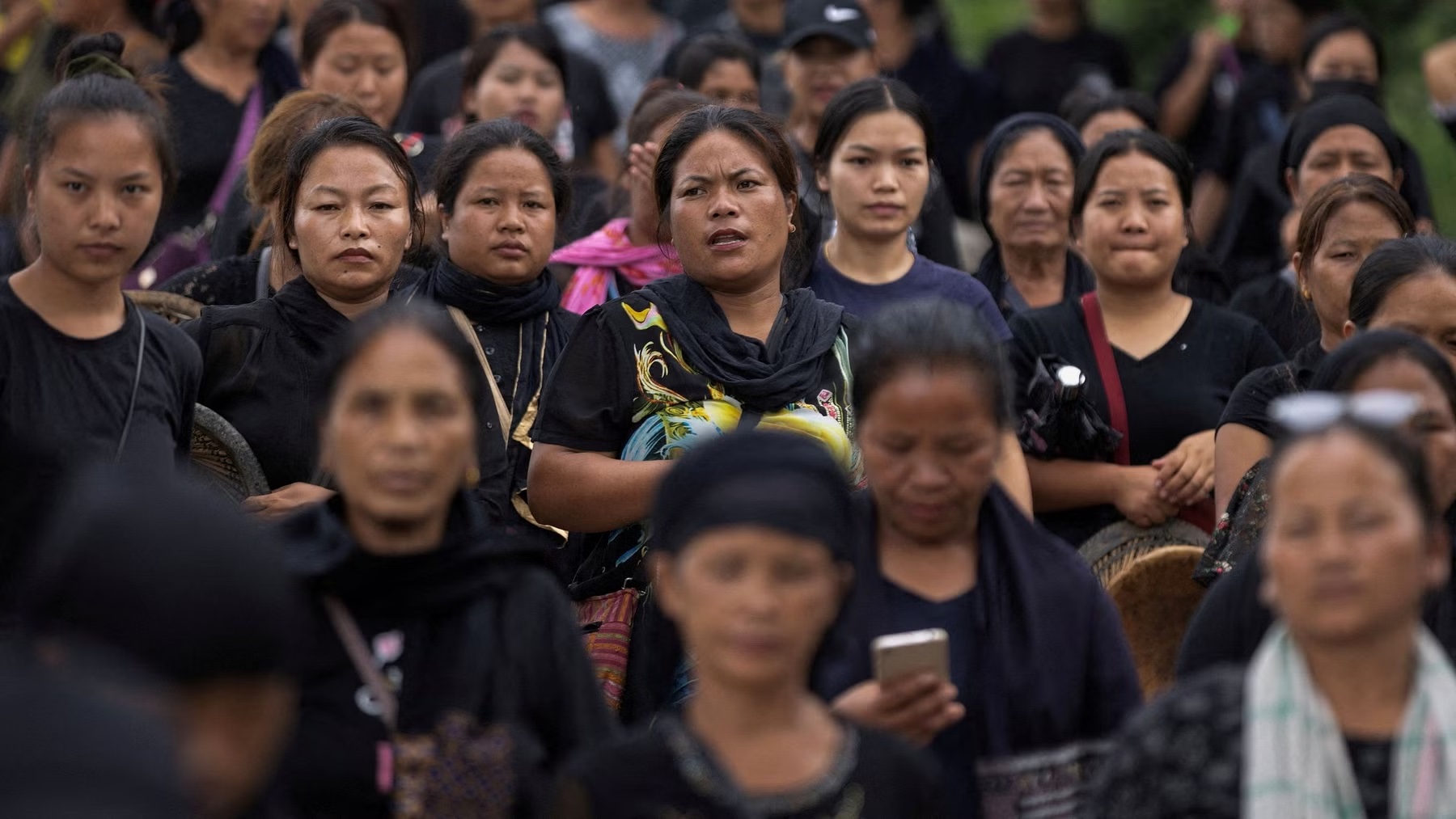
    Why, and how, does Mizoram get involved in the ongoing ethnic (and religious) strife that has been on for over three months in Manipur? The Kukis and Zomis in Manipur are ethnically related to the Mizos, the dominant community in Mizoram. The Mizos, in turn, are ethnically related to the Chins in Myanmar and the Kuki-Chins in Bangladesh.

    Together they all belong to the greater Zo community, speak a similar language, have common ancestry and parallels as regards their cultures and traditions. These latter groups are predominantly Christian and hence have a strong bond with the Mizos in Mizoram, a ‘Christian state’, like Nagaland. The Chief Minister of Mizoram, Zoramthanga, is a Mizo.

    In Manipur, the Meiteis, a Hindu community, are the majority and overwhelmingly numerically dominant. But it is interesting that the Meiteis are found in small numbers in Mizoram too, and many have started fleeing from the state. A similar fleeing of the Kukis from Manipur to Mizoram has happened. Also, there are the Naga groups in different pockets of Manipur. The neighbouring state of Nagaland has 17 officially recognised Naga groups.

    It is exasperating, and quite disquieting, to note the presence of ethnic groups that are dominant in one state, being minorities in a neighbouring state. Such existence has given rise to very foreboding situations and added to the already prevailing ethnic conflicts in India’s North-East.

    It is not just that the Indian states in the region share common borders. There are international borders too in the area, as Bangladesh and Myanmar adjoin the Indian states. Different communities/tribes/groups of people have lived in the regions that are the focus of our discussion for aeons. Such inter-state and international habitations of ethnic groups across states/countries are come across elsewhere in the world too.

    One of the most interesting and classic instances of a single ethnic group, who regard themselves as a single nation, and inhabit more than one country, is that of the Bedouin (found in Syria, Algeria, Morocco, Libya, Egypt, Israel, and so on). Such situations come about because free-ranging groups of people, or partially or fully settled groups of people, got divided into different states or countries because of the coming in of boundaries and division of territories.

    What would have been the scenario if these borders between states and countries had not come up? We would undoubtedly have diverse groups living in enclaves, either quite separated or adjoining each other either as small groups or larger ones, but sans the borders dividing them; the question of majority/minority or dominance/subservience would not, probably, have had the same kind of meaning or effect as has happened due to the drawing of borders between states and countries.

    Borders that formed between enclaves of diverse inhabitants and made groups of people dominant and/or majority groups have resulted in hegemony, where the traditions, customs, practices, and mores of that group have gained significance. These traditions and customs prevail extensively when compared to the practices of the smaller groups in that same area. Invariably, the dominant group makes claims to being the ‘original inhabitants’ and the ‘natives’ of the state/country concerned.

    Quite often co-habitants develop similar institutions and social and cultural practices despite the differences and diversity between them, and this is quite apparent in multicultural societies. Amitav Ghosh argues that “it is … the vitality of the place itself that creates commonalities between the people who dwell in it, no matter what their origin” (The Nutmeg’s Curse, page 221). But sadly, it is the differences that often come to the fore, and similarities remain latent.

    Here, it is pertinent for us to dwell on the facets of claims that groups make as regards being the autochthons and natives of a given state/country. By extension, the non-dominant groups are labelled ‘immigrants’, ‘foreigners’, and ‘outsiders’. Prior to ‘Out of Africa’, and the spread of Homo sapiens to the different parts of the world, somewhere between 80,000 and 50,000 years ago, there were no fully evolved human beings in any part of the world. Subsequent to a group of them leaving Africa, different parts of the Earth got populated gradually.

    All the physiognomic and phenotypical differences that we find among humans today, including skin colour, hair texture, and colour of the eyes came about as a result of where people settled.

    To put it tersely, no human group can make a concerted claim as regards nativism and try to make an ‘other’ an immigrant, foreigner or outsider. Ghosh endorses this when he says “Except for one small part of Africa, nowhere on Earth can people be said to be truly native, in the sense of having come into being on that soil” (The Nutmeg’s Curse, page 221).


    This article was published earlier in Deccan Herald.

    Feature Image:Kuki women leave after attending a protest against the alleged sexual assault of two tribal women, in Churachandpur district in Manipur. Credit: Retuers Photo


  • For Democracy to be real and vibrant it needs  people with impeccable Integrity at the Helm

    For Democracy to be real and vibrant it needs people with impeccable Integrity at the Helm

    Democracy at its core is the power of the people. But all over the world, it is becoming anything but that. Truly the fear is that democracy is dying, as most nations that call themselves democracies are in effect controlled by capitalist oligarchs and majoritarian fascists. The power of money and vested interests have vitiated democratic processes worldwide. Michael Hudson calls the USA, once the beacon of democracy, a deep state controlled by three main oligarchic groups: Military Industrial Complex (MIC); Oil, Gas, and Mining (OGAM); and Finance, Insurance, and Real Estate (FIRE).  Add the new emerging giant group – Big Tech – as the fourth. The UK, the world’s oldest parliamentary system, is in shambles as a democracy. India, seen as the world’s largest democracy, is heading the majoritarian way. Majoritarianism is not democracy but tyranny. This is what the Father of the Nation had to say about democracy at the height of the freedom struggle:

    My notion of democracy is that under it the weakest should have the same opportunity as the strongest….No country in the world today shows any but patronising regard for the weak….Western democracy, as it functions today, is diluted fascism….True democracy cannot be worked by twenty men sitting at the centre. It has to be worked from below by the people of every village.”    – Mahatma Gandhi

    His words could not have been more apt for the times we live in. This quote is placed in the Sabarmati Ashram. One wonders how many take a moment to stop by to read it carefully and take in the import of his words. The Mahatma is the shining example of personal integrity, character, and moral courage. Since democracy is primarily driven by people and politics, it is vital that those at the helm of governance display impeccable integrity to ensure real democracy.

    Professor Arun Kumar PhD, an eminent economist and our adjunct Distinguished Fellow, writes eloquently on the subject and says ‘absence of persons with impeccable integrity is the bane of India’s democracy’. TPF is happy to republish this article.

    A version of this article was published earlier in theleaflet.in

    TPF Editorial Team


    Gandhiji said that institutions reflect what the people are, and that they cannot function as they are intended to unless those manning them are people of integrity.


    A Supreme Court Constitution bench recently said that the Chief Election Commissioner should be one “with character” and who would not get “bulldozed” – a self-evident truth. Further, it suggested that the selection committee for the post should consist of an independent person like the Chief Justice of India (‘CJI’). It added that people and bureaucrats like the former Chief Election Commissioner late T.N. Seshan, who could act independently, “happen once in a while”.

    Perhaps without meaning to, these comments indict the election commissioners appointed since Seshan’s time. Therefore, they have given voice to recent public concerns about the independence of the institution.

    Integrity of Constitutional authorities

    Will the CJI’s presence in the committee to appoint the Election Commissioners make a difference? The CJI is a member of the committee to appoint the Director of the Central Bureau of Investigation (‘CBI’). But the Supreme Court itself has called the CBI a “caged parrot”. The problem arises since the party in power would prefer a sympathetic person as an Election Commissioner, not an independent person.

    The appointment of Supreme Court judges has become contentious, with the judges and the Union Law Minister currently at loggerheads. Judges themselves have talked of pressures and counter pressures from within and from the government. Appointments of some who are seen to be inconvenient have been withheld. Earlier this week, a division bench of the Supreme Court mentioned that by delaying appointments, good people are dissuaded from becoming judges. It is suspected that the appointment of certain judges is delayed so that they do not become CJI in due course of time. It appears that pliability is a desirable attribute to becoming a judge.

    The Supreme Court, by raising the issue of the appointment of the Election Commissioner, has also brought into question the integrity of the Prime Minister (‘PM’), who is key to the appointment. Thus, doubt has been raised about the country’s constitutional authorities, including the judiciary. The executive, in any case, does the bidding of the political masters. So, where are the people of integrity in the corridors of power in India?

    Defining integrity

    Institutions can run as they ought to only if they are manned by people with integrity. Its absence from the top down is a societal challenge. Mahatma Gandhi in ‘Hind Swaraj’ (Indian Home Rule), more than a century back, said, “As are the people, so is their Parliament.” Since the Parliament is key to the functioning of a democracy, this flaw afflicts institutions down the line.

    PMs heading the government are political persons. Since politics is about power, they try everything to keep themselves and their party in power. Their election depends on the support of vested interests who fund both them and their party and therefore, dominate the working of the party. So, staying in power is a high stake business which requires manipulation of the systems in their favour.

    The Supreme Court, by raising the issue of appointment of the Election Commissioner, has brought into question the integrity of the Prime Minister, who is key to the appointment. Thus, doubt has been raised about the country’s constitutional authorities, including the judiciary. 

    There is then a separation of the interest of the nation, and of the party and its head, the PM. Consequently, for the party, integrity means that which serves its interest, which is not necessarily what the nation needs. This separation is what Gandhi implies in Hind Swaraj. No wonder, it is only a rare PM who has the moral integrity to select independent people for important Constitutional positions like the Election Commission and the judiciary.

    Politicians go through years of such conditioning before becoming PMs and it becomes their second nature. It cannot be expected to change upon becoming the PM. The opposition in a democracy is supposed to check the misuse of power. But the leaders of the opposition also go through the same conditioning as leaders of the ruling party and therefore, act no differently. Politicians often pride themselves on managing conflicts by making compromises and accepting the manipulation of power. So, politicians take a pliable stand, based on the chair they occupy – in power or out of it.

    Gandhi on parliamentary democracy

    Gandhi, commenting on the British Parliamentary democracy in Hind Swaraj, wrote, “The Prime Minister is more concerned about his power than about the welfare of Parliament … [and] upon securing the success of his party.” He added that they may be considered to be honest “because they do not take what is generally known as bribes… [but] …they certainly bribe the people with honours.” Therefore, “… they neither have real honesty nor a living conscience”.

    Regarding the Members of Parliament who could keep the PM in check, he wrote, “… Members are hypocritical and selfish. Each thinks of his own little interest. … Members vote for their party without a thought.” Regarding the media, another institution that could help check misuse of public authority by creating public awareness, he wrote that they “are often dishonest. The same fact is differently interpreted … according to the party in whose interest they are edited.” Gandhi was also scathing about the legal profession when he wrote, “… the profession teaches immorality …”.

    Gandhi was pointing to the fundamental flaws in the functioning of democracies. It also applies in the current Indian context. He was pointing to weak public accountability of those in power since public awareness was low. The public has little choice but to accept the existing imperfect political system. The British Parliamentary democracy may be the best available system, but it is highly flawed and its defects appear more starkly in weak democracies like that in India.

    We may be called the largest democracy in the world and we have succeeded in preserving it in the last 75 years, but it is frayed, as made clear by the current political problems facing us.

    Feudal attitudes and democracy

    Indian democracy’s weakness is a result of the persistence of feudal consciousness among a majority who easily accept authority. This is true even in institutions of higher education, where people are expected to be the most conscious. Most of these institutions are headed by academics with a bureaucratised mindset, who expect compliance and treat dissent as a malaise to be eradicated. In turn, they yield to politicians and bureaucrats.

    A feudal system has its own concept of integrity. The ruler’s interest is broadly the nation’s interest. This congruity breaks in a parliamentary democracy where the consciousness is feudal. In such a case, integrity as defined by national interest is likely to be subverted, as is visible in India.

    In 1947, India with its feudal consciousness ingrained and copied parliamentary democracy, not because people were ready for it, but because the leadership desired it since they wanted to copy Western modernity. People blindly accepted it since it came from their leaders, not because they understood it. Liberality at the top frayed post mid-1960s, as retaining power became more difficult and leaders turned increasingly authoritarian. So, while retaining the façade of democracy, it increasingly got hollowed out.

    In 1947, India with its feudal consciousness ingrained and copied parliamentary democracy, not because people were ready for it, but because the leadership desired it since they wanted to copy Western modernity. People blindly accepted it since it came from their leaders, not because they understood it.

    The political economy also pushed policies that marginalised the majority in the interest of the few. The black economy grew rapidly, making elections formalistic and draining them of their representational character. Most importantly, the rulers realized that neither the people ask for liberality nor do they demand accountability from leadership.

    Need for accountability at the top

    Accountability has to come from the top, whether in politics or in the government or the courts. It is not going to automatically come about without public pressure. A few freebies are enough to divert public attention. So, is accountability a luxury when basic issues are many?

    The lack of integrity in public life is costly. The nation’s energy is diverted. Reforms favouring the marginalised are circumvented. Laws are framed ostensibly to improve matters, but when the spirit is not willing they fail to deliver. Perfect laws are not possible, since human ingenuity can circumvent any law. The result is more complex laws and growing cynicism.

    What Gandhi pointed out is playing itself out in India. He said institutions reflect what the people are, and that they cannot function as they are intended to unless those manning them are people of integrity. But, can people with integrity emerge when it is missing all around, feudal consciousness pervades and people bend to authority?

    Reform requires us to resolve the contradiction between parliamentary democracy and the prevailing feudal consciousness. This cannot happen from above. It requires the transformation of the people’s consciousness – Gandhi’s unfinished agenda.


    Opinions expressed are those of the author.

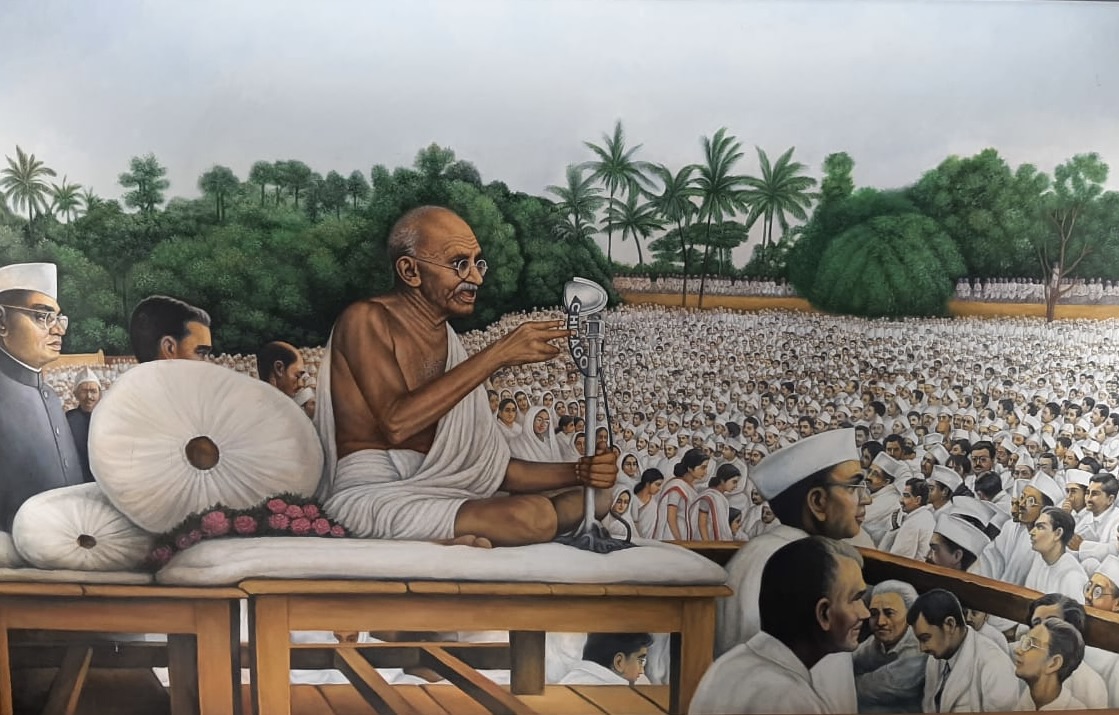
    Feature Image Credit: Gandhi in a public address – Painting at Sabarmati Ashram.
  • National Education Policy, 2020 – Policy Brief

    National Education Policy, 2020 – Policy Brief

    [powerkit_button size=”lg” style=”info” block=”true” url=”https://admin.thepeninsula.org.in/wp-content/uploads/2022/04/Policy-Brief-NEP-2020.docx-1_compressed-1.pdf” target=”_blank” nofollow=”false”]
    Download – Policy Brief on National Education Policy, 2020
    [/powerkit_button]

    Executive Summary:

    In line with the New Education Policy (NEP) 2020 mandate, the UGC released the draft National Higher Educational Qualifications Framework (NHEQF) in February 2022. Its release has reignited the controversy over the policy that was criticized and even rejected by many state governments. The inclusion of Education in the concurrent list gives overriding powers to the centre. However, the sweeping changes the NEP is set to bring have raised concerns that the states would turn into mere implementing agencies while all the decisions regarding education will be taken by the centre. At the root of the controversy lies the federal structure of India which would be jeopardized by the implementation of the policy. Hence, significant and appropriate amendments to the draft are required to address the grievances of the states.

    What is NEP (2020)?

    The NEP, released in July of 2020 by the Union Government, seeks to overhaul the entire education system of the country by replacing the thirty four-year-old National Policy on Education (1986). In the domain of pre-University education, the new policy aims to transform the curricula structure from 10+2 to 5+3+3+4, mandates the Three Language Formula (TLF), reduces the syllabus to make board exams “easier” and gives thrust to vocational training and skill development. In the realm of higher education, it envisions a single regulator- the Higher Education Council India (HECI)- for Higher Education Institutes (HEIs) by merging UGC, AICTE and other regulatory bodies. The HECI is further divided into four verticals, namely the National Higher Education Regulatory Council (NHERC), National Accreditation Council (NAC), Higher Education Grants Council (HEGI) and General Education Council (GEC). 

    The policy introduces four-year undergraduate programmes with multiple exit options, along with proposing a national Academic Bank of Credit and a national entrance exam for all universities. It further allows higher education to be taught in regional languages. Additionally, it proposes the National Testing Agency (NTA) conduct a “high quality” common entrance test and a common specialized subject exam in sciences, humanities, language, arts, and vocational subjects, at least twice a year. It blurs the distinction between research-oriented and employment-oriented education, emphasizing a multidisciplinary approach to education. Additionally, it proposes facilitation to top global universities to set up campuses in India and to top Indian Universities to establish campuses abroad.

    The policy also touches upon the issue of Adult Education. It proposes strong and innovative government initiatives to achieve 100% adult literacy, educate about critical life skills (including financial literacy, digital literacy, commercial skills, health care and awareness etc.), impart vocational skills and provide basic education to adults. It also ensures providing the necessary infrastructure for adults to facilitate its implementation.  

    Why is it a problem? 

    Since its release, the policy has been opposed by a few states. Though other states have voiced their reservations, none have been as vocal and vehement as Tamil Nadu. 

    • The foremost reason pertains to the Three Language Formula. The policy states that out of the three languages that ought to be taught at the pre-University level, two must be Indian. This leaves the students from the southern states to learn Hindi, along with English and the regional language in their curriculum. The formula was brought forward in 1968 by the then Indira Gandhi government as recommended by Kothari Commission. All states adopted the policy except Tamil Nadu, which continued its two language policy.

    The Three Language Formula finds its explicit mention in Section 4.13 of the Draft policy. In order to promote multilingualism, the draft states that, “The three-language formula will continue to be implemented”. Moreover, a student is given the option to change one of the three languages only once- in Grade 6 or 7. Though the formula has been in continuance since the 1970s, an exclusive emphasis upon it raises eyebrows. The draft further falls short of assuring the states unwilling to implement the formula of any compulsion by the centre, instead offering “greater flexibility” in its implementation. 

    Learning Hindi has always been a controversial issue in Tamil Nadu. The state has seen numerous instances of violence and public protests against the imposition of Hindi. The state has also actively promoted Tamil learning in schools. In 2006, the state enacted Tamil Nadu Tamil Learning Act, making it compulsory for every school operating in the state to teach Tamil. The state government is also opposed to the establishment of Navodaya Schools by the centre in the state.

    • The draft also places an unprecedented emphasis on learning Sanskrit. Section 4.16 stresses the need for learning Sanskrit since most of the Indian other languages attribute “their origins and sources of vocabularies” to it. Section 4.17 emphasizes the importance of classical literature possessed by the language. It thus offers its teaching “at all levels of school and higher education”. Moreover, it promotes the teaching of the language through its classical literature in mathematics, philosophy, grammar, music, politics, medicine, architecture, metallurgy, drama, poetry etc.

    Laying such a huge emphasis upon an archaic language in schools and even HEIs at “all levels” would leave a student burdened with an unnecessary curriculum. Offering courses in Sanskrit to college students, for instance, in non-Hindi speaking states would decrease their grades. Worse still, in Central Universities- mostly dominated by Hindi speakers, such courses will make naked and even exacerbate the language barrier the non-Hindi speaking students face. Further, the postulate that most of the major Indian languages owe their “origins” to Sanskrit is not even remotely true. Additionally, the literature in Sanskrit can be discriminatory against varna, caste or group, especially in social sciences. 

    • However, the major concern relates to the federal structure of India. The policy proposes the establishment of the all-powerful HECI and its verticals. The NHERC, one of its verticals, reserves the power to regulate every facet of HEIs, including financial probity, good governance, and the full online and offline public self-disclosure of all finances, audits, procedures, infrastructure, faculty/staff, courses, and educational outcomes[Section 18.3]. It further envisions a “graded accreditation” system to be given by the NAC, that will “specify phased benchmarks for all HEIs to achieve set levels of quality, self-governance, and autonomy…to attain the highest level of accreditation over the next 15 years” [Section 18.4]. The GECI, another of its verticals, will frame “expected learning outcomes for higher education programmes” and mandate the identification of “specific skills that students must acquire during their academic programmes” [Section 18.6].

    Owing to its vague language, the draft lacks clarity on the extent of jurisdiction of HECI and its verticals. It reserves the power to regulate the faculty/staff, courses, educational outcomes etc., thus infringing upon the state’s rights on reservations and education. Moreover, the students are required to acquire “specific skills” and “learning outcomes” framed by the central government, making it difficult for them to cater to the needs of their respective states. Further, the vocabulary used, such as “good governance”, leaves room for significant manipulation in the future.

    • The policy veritably promotes the centralization of education at every level. For instance, it envisages a nation-wide “high-quality” common aptitude test for admission into the universities, as well as “specialized common subject exams in the sciences, humanities, languages, arts, and vocational subjects” [Section 4.42], which it assumes will reduce the burden on students. Moreover, an all-India test is to be conducted by NTA for admission into pre-service teacher preparation programmes of Teacher Education Institutions (TEIs) [Section 15.7], which it envisions to convert into multidisciplinary institutions [Section 15.4]. Moreover, it places an undue emphasis on centralized vocational training in all schools and HEIs which would be overseen by the National Committee for the Integration of Vocational Education (NCIVE) [Section 16.8]. In the field of academic research, the policy envisions the establishment of the National Research Foundation to provide funding for research [Section 17.9]. Further, it proposes to establish the National Research Foundation (NRF) which is meant to provide funding for research to the institutions, and “undertake major initiatives to seed and grow research at the state universities and other public institutions”[Section 17.9], centralizing disbursement of research-oriented funding. It is further empowered to ensure that the Research Scholars are “constantly made aware of the most urgent national research issues” to allow breakthroughs to be optimally brought into policy [Section 17.11(c)].

    Tamil Nadu’s objection to a country-wide entrance test is premised upon the recommendations of the M. Anandakrishnan committee. Constituted in 2006, it recommended the abolition of the Common Entrance Test (CET) in the state from the academic year 2007-08 (Srinivasan, 2016), due to the unaffordability of the high fees of coaching for the rural and underprivileged students. Furthermore, the NRF is empowered to fund the research on urgent “national” issues, thus again leaving the door ajar for manipulation of their jurisdiction, and depriving state-funded institutions of funding for research on regional issues.

    • The policy seizes the administrative autonomy from both public and private HEIs. It mandates every such institution to establish a Board of Governors (BoG) which would be empowered to govern the institution[Section 19.2], including the selection of leaders of the institution [Section 19.4]. Further, the policy subjugates the BoG to guidelines formulated by NHERC[Section 19.3]. Additionally, it makes it compulsory for every institution to formulate its own Institutional Development Plan [Section 19.5] to strategize its roadmap.

    In subjugating the administrative system of the colleges to a central body, the central government ignores the urban-rural divide and caste-based discrimination entrenched in them. Moreover, drafting the same guidelines for urban, rural, minority etc. institutions would, along with waning their autonomy, undermine the purpose they are meant to serve. 

    • The policy provides multiple exit and entry options to the students pursuing higher education[Section 11.9], along with the creation of an Academic Bank of Credits to digitally store credits earned by the student and different designs of Master’s programmes [Section 11.10].  

    The central government does not contemplate the unintended consequences of the above proposition, especially for the backward communities and female students. It leaves the students of the said groups with multiple exit options but few entry options. Multiple choices of exit will compel such students facing monetary or familial issues to quit their education in the middle. Further, it burdens a teenage student with critical life-changing decisions.  Moreover, the proposed system disallows a student to carry backlogs into the next year, bringing about the apprehension of exacerbation of the dropout rate, which currently stands at 12.6%.

    • Both the draft NHEQF and the draft policy suggest, in multiple instances, that all colleges either become multidisciplinary or merge with existing universities. However, both the documents do not provide any provision regarding how the same will be executed without any monetary assistance. This has raised concerns about many state government colleges becoming defunct due to a lack of finances to become multidisciplinary, thus depriving a large number of students of educational opportunities. 
    • The policy makes no mention of the Reservation System in educational institutions, both in admission and faculty recruitment, making it non-inclusive to all sections of the society. Further, it does not mention the drop-out rates among the backward communities, let alone ways to tackle them. The NEP policy-makers veritably fail to view education as a tool to uplift the poor and backward classes while formulating it.
    • The proposal also lacks a grievance redressal mechanism, either for the states or the institutions regarding any facet of the policy. The institutions and state governments are left with no choice but to follow the guidelines of the would-be central institutions. Institutions failing to comply with the guidelines are feared to become defunct. Moreover, the power of ‘light but tight’ regulation bestowed upon the central bodies also leaves the door ajar for manipulation of their jurisdiction. 

    Tamil Nadu’s response to NEP

    Since early on, Tamil Nadu’s policies have emphasized education as a modus operandi to uplift the backward castes. As early as 1919, certain legislations were in place to encourage and mandate local education authorities to establish schools at places that were accessible to everyone, thus broadening the social base of its educated bracket. The reasons for the Tamil Nadu government opposing NEP are manifold. 

    Tamil Nadu Chief Minister MK Stalin has explicitly stated that the policy will not be implemented in the state. He has called it a policy “for elites” and, if implemented, education “will be confined and limited to a few sections”. The state government has even set up a committee to formulate its own State Education Policy in a bid to replace the NEP. Furthermore, the state plans to implement only some ‘good aspects’ of the central policy (Sathyanarayana, 2021). It claims that the policy negates the efforts of more than a hundred years of social justice aspirations that were carefully envisaged in Tamil Nadu. State Education Minister K. Ponmudi noted that mandating entrance exams for getting admissions to arts and science colleges would affect the students from rural areas.

    Similar concerns were raised by L. Jawahar Nesan, head of the All India Save Education Committee, while complaining that the proposed Academic Bank of Credits (ABC) could result in “students dropping out of higher educational institutions before completing their course”. “The proposed system aims at furthering vocational education and creation of a workforce pool”, he added (“Academics call for the withdrawal of draft”, 2022). The State Platform for Common School System- Tamil Nadu (SPCSS-TN) termed the framework “a crude form of diarchy”(Sathyanarayana, 2022). Regarding the mandatory entrance test akin to NEET, PB Prince Gajendra Babu, General Secretary of the body, said that the students don’t have sufficient time and their family circumstances do not permit them to undergo separate coaching for entrance exams(ibid). In September last year, the Coimbatore-based Aram Seiya Virumbu Trust filed a writ petition in Madras High Court challenging the constitutionality of Section 57 of the 42nd Amendment that brought education in the concurrent list as a response to the policy, whose implementation, the trust alleged, will lead to “autonomy of the states in education be completely taken away thereby striking at the very root of the federal structure”(Imranullah S., 2021).

    The issue of centralization of education has always been a hot potato in the state. Back in 2006, M. Karunanidhi’s government constituted a committee under the chairmanship of M. Anandakrishnan to recommend measures for the abolition of the Common Entrance Test (CET) in the state from the academic year 2007-08. On the recommendations of the committee, the state government terminated its practice of conducting CET for admission into technical and medical courses, making it easier for underprivileged students to pursue the said graduate courses (Rajasekaran, 2021). Other policy decisions taken by the state for similar causes include the 50% ‘in-service’ super speciality seats quota in government medical colleges which was recently upheld by the Supreme Court. Prior to NEET, the quota had provided opportunities to the lower strata of society to enter the colleges which in turn helped the state government in providing an uninterrupted supply of doctors in primary health centres (P.M., 2019). 

    Other States’ Response

    Among other states, West Bengal has most emphatically opposed the implementation of the policy. Within a month of its release, Partha Chatterjee, the state Education Minister, announced the government’s unwillingness to implement the policy in the state “any time soon”, due to its undermining of the federal structure and non-inclusion of Bengali in the list of classical languages(“No NEP 2020 in West Bengal”, 2020). He also said that no one in the state government was consulted for its formulation. Kerala has also protested against the policy in the report of the six-member committee, chaired by Professor Prabhat Patnaik. 

    Delhi Education Minister Manish Sisodia accused the central government of encouraging the privatisation of education and reducing its responsibility as a government to provide quality education to all, while questioning the need to make board exams easier. Chhattisgarh CM Bhupesh Baghel termed it as centralization of education which goes against the federal structure of the country(Sharma, 2020). Rajasthan Education Minister Govind Datasra also criticized the draft for lack of clarity.

    Conclusion

    The policy possesses strong tendencies of centralization of education, contravening federalism as a basic structure of our constitution. It establishes bodies that are empowered to determine policies and curriculum for all educational institutions, including state institutions, with little or no role of the states in formulating them, turning them into mere implementing bodies. Moreover, it imposes teaching of Hindi and Sanskrit in all schools across the country with no consent of the states. The policy violates numerous Supreme Court rulings that have upheld federalism as a basic structure of the constitution. The central government must make significant changes to the draft policy to make it more reflective, just and fair to India’s diversity.

    Recommendations

    • The draft policy is an onslaught on federalism as a basic structure of our constitution. The concerned authorities, while acknowledging the competence of the states in educational planning and execution, and its role as a determinant of their development, must re-draft the policy to omit the provisions that dilute the federal structure.
    • The Three Language Formula must be waived off for the states unwilling to pursue it. Additionally, the students of the states that choose to implement the formula must be given the option to change any of the languages in secondary schooling.
    • In view of the large endemic socio-economic disparity in India, the states must be allowed to formulate their own processes of enrolling the students into higher education. Imposing a central exam on constituents of the backward community might disrupt the smooth process in which they have been uplifted from their backwardness in the last few decades.
    • The proposed provision of multiple exit options in higher education must be reformulated so as to prevent dropouts in the middle of the courses. The policy must also consider instating multiple options to clear backlogs to further reduce the number of dropouts.
    • The colleges must be given more autonomy in deciding their curriculum. To turn a vast number of government colleges into multidisciplinary ones might be expensive for the state governments, which could possibly result in these colleges being permanently closed.
    • The attempts to centralize education must be clamped down to address the grievances of various states. Moreover, the necessary central bodies proposed in the draft must be given adequate representation by all the states.
    • The policy must explicitly uphold the reservation system in educational institutions regarding admissions and jobs.
    • The draft lacks clarity on the extent of jurisdiction of the proposed central bodies. Hence, the government must elaborate on the roles of these institutions
    • The undue emphasis on vocational education must be dialled down. Instead, emphasis must be placed upon academic education and critical thinking.  

    References

    1. “Academics call for withdrawal of draft National Higher Education Qualification Framework”,(2022, March 9) The Hindu. https://www.thehindu.com/news/national/tamil-nadu/academics-call-for-withdrawal-of-draft-national-higher-education-qualification-framework/article65207193.ece
    2. Imranullah S., Mohamed. (2021, September 14) “Case in Madras HC challenges constitutional amendment shifting education from state list to concurrent list” The Hindu. https://www.thehindu.com/news/national/tamil-nadu/case-in-madras-hc-challenges-constitutional-amendment-shifting-education-from-state-list-to-concurrent-list/article36448046.ece
    3. “No NEP 2020 in West Bengal, it undermines role of states: Education minister”(2020, September 7) Livemint. https://www.livemint.com/politics/news/no-nep-2020-in-west-bengal-it-undermines-role-of-states-state-education-minister-11599477761391.html
    4. P.M., Yazhini.(2019, June 8) “Common Entrance Exams Like NEET Ignore India’s Gender and Social Realities”. The Wire. https://thewire.in/education/neet-tamil-nadu-caste-gender
    5. Rajasekaran, Ilangovan.(2021, May 29) “M. Anandakrishnan, an educationist who democratised technical education in Tamil Nadu, passes away”. Frontline. https://frontline.thehindu.com/dispatches/m-anandakrishnan-educationist-who-democratised-technical-education-in-tamil-nadu-passes-away/article34677215.ece
    6. Sathyanarayana, R.(2021, December 30) “Tamil Nadu to accept ‘good aspects’ of National Education Policy”. DT Next. https://www.dtnext.in/News/TopNews/2021/12/30135026/1336439/Tamil-Nadu-to-accept-good-aspects-of-National-Education-.vpf
    7. Sathyanarayana, R.(2022, February 22) “Experts flay draft higher education framework”. DT Next. https://www.dtnext.in/News/TopNews/2022/02/22022833/1354869/Experts-flay-draft-higher-education-framework.vpf
    8.  Sharma, Nidhi. (2020, August 18) “New Education Policy an attempt to centralise education: Opposition-ruled states” The Economic Times. https://economictimes.indiatimes.com/news/politics-and-nation/new-education-policy-an-attempt-to-centralise-education-opposition-ruled-states/articleshow/77604704.cms?from=mdr
    9. Srinivasan, R.(2016). Reservation in Educational Institutions: Who Gains from Abolishing the Common Entrance Test (CET) in Tamil Nadu. The Hindu Centre. https://www.thehinducentre.com/incoming/article23697651.ece/BINARY/Policy%20Watch%20No_3.pdf

    Featured Image: Deloitte

    [powerkit_button size=”lg” style=”info” block=”true” url=”https://admin.thepeninsula.org.in/wp-content/uploads/2022/04/Policy-Brief-NEP-2020.docx-1_compressed-1.pdf” target=”_blank” nofollow=”false”]
    Download – Policy Brief on National Education Policy, 2020
    [/powerkit_button]

  • Change in IAS (Cadre) Rules – Policy Brief

    Change in IAS (Cadre) Rules – Policy Brief

    [powerkit_button size=”lg” style=”info” block=”true” url=”https://admin.thepeninsula.org.in/wp-content/uploads/2022/02/Change-in-IAS-Cadre-Rules-1.pdf” target=”_blank” nofollow=”false”]
    Download – Change in IAS (Cadre) Rules
    [/powerkit_button]
    Executive Summary:

    The Centre’s proposal to amend the IAS Cadre Rules has sent shockwaves through the State governments and the bureaucratic community. Although the Centre already has the preponderance of power over the State government, it has always been the convention to depute All India Services (AIS) officers with the concurrence of the State government(s) and the Central government and the consent of the officer concerned. By providing overriding powers to the Central government, the proposal poses a fundamental risk to the federal structure of the Constitution. Not only should the proposal be recalled, but the annual intake of the IAS officers should be increased to address the issue of staff shortage, while recruiting suitable personnel from other Central Civil Services. The empanelment process also needs to be reformed to ensure transparency, objectivity and to uphold the principles of natural justice.

    The Centre’s proposal is a reflection of the long overdue need for the complete overhaul and reform of the Indian civil service system. These piecemeal amendments and a myriad of executive orders are not only unproductive to the civil service system but also counterproductive to the basic structure of the Constitution. A high-level committee should be established to undertake a holistic study to reform the Indian civil service system not only to bring in better performance and accountability but more importantly, to get rid of the colonial legacy once and for all.

    What is it?

    Deputation of IAS officers is governed under Rule 6 of The Indian Administrative Service (Cadre) Rules, 1954. Rule 6(1) mandates that the deputation of cadre officers to the Centre must be done with the concurrence of the concerned State government(s) and the Central government.

    The provision to Rule 6(1) states that in case of any disagreement, the Central government’s decision will prevail, and the State governments shall give effect to it.

    The proposal attempts to amend the Central Deputation rules by giving overriding powers to the Centre to transfer and post Cadre officers without the consent of the State government.

    Proposed Amendments (Singh, 2022)

    1. ‘Within a specified time’

    The proposal amends the proviso mandating the State governments to give effect to the final decision of the Central government within a specified time as decided by the Central government.

    2. ‘Officer shall stand relieved’

    In case, a State government delays a cadre officer’s deputation to the Centre and does not give effect to the Central government’s decision within a specified time, the concerned ‘officer shall stand relieved from the cadre from the date as may be specified by the Central government’.

    3. ‘Number of officers’

    Another change proposed is that the actual number of officers to be deputed to the Centre shall be decided by the Central government in consultation with the State government which is required to provide a list of eligible names.

    4. ‘Public interest’

    In a specific situation, if the need arises for the services of a cadre officer to be utilized by the Central government in the public interest, the State governments shall give effect to it within a specified time.

    The abovementioned amendments were sent to the State governments in a letter dated 12th January 2022 by the Department of Personnel and Training (DoPT) seeking comments until 25th January. The DoPT had earlier sent three similar letters (dated 20th,27th December and 6th January) which were strongly opposed by six States (including BJP ruled States) (Singh, 2022). As of now, more than 7 States have written to the DoPT opposing the proposed changes and other states such as Maharashtra, Kerala and Tamil Nadu have also raised their opposition. The CMs of Chhattisgarh and Rajasthan have also written to the PM opposing the proposed amendments to the cadre rules.

    Why is it a problem?

    The proposed amendments are essentially an attack on the federal structure of our Constitution since it derogates the State government’s power in posting and transferring its cadre officers without its consent. In spite of the rules giving preponderance of power to the Centre, it has always been the convention to depute officers to the Centre in concurrence with the State governments and the consent of the officer concerned (Dhingra, 2021).

    Mamata Banerjee, the CM of West Bengal wrote a strongly worded letter to the PM opposing this move and calling it a ‘unilateral decision’ which was ‘historically unprecedented and wholly unconstitutional’.

    The trigger for this move by the Centre is most likely the result of the tussle between the Centre and West Bengal over former IAS officer Mr. Alapan Bandhopadhyay. Given his experience in handling the Covid-19 crisis as the Chief Secretary of West Bengal, the State government had requested the Centre to extend his tenure and the latter acceded by extending his term for 3 months (24th May 2021). However, the Centre on 28th May 2021 did a complete 180° and issued an order to Mr. Bandhopadhyay informing him that he has been placed with the Government of India ‘with immediate effect’. Following this, the State government opposed the order and did not relieve him and the concerned officer also opted to retire from the services and is now appointed as the advisor to the CM. The Centre then issued a show-cause notice to Mr. Bandhopadhyay for his failure to report to the DoPT. There have been other similar tussles in the past between the Centre and Tamil Nadu government (2001) and West Bengal government (2020) (Agnihotri, 2021), but when the States refused to relieve the concerned IPS officers, the Centre upheld the convention of State government concurrence and did not insist on deputing them anyway.

    Shortage of officers in the Centre

    The DoPT cites the shortage of AIS officers in Union Ministries as the driving factor for these proposed amendments since the ‘States are not sponsoring an adequate number of officers for Central Deputation’. While this is true, it is pertinent to note that State governments also have been suffering from a shortage of officers, especially during the pandemic and have requested the DoPT multiple times to increase the cadre strength of IAS officers (West Bengal, Rajasthan, Bihar).

    Senior IPS officers advise that the problem of shortage of AIS officers has been perennial and does not warrant a knee-jerk reaction at the cost of violating the basic structure of our Constitution. The problem of shortage must be seen as secondary to upholding the federal structure especially since there are other ways to address this problem without seizing the State governments’ authority. While only AIS officers come under the common purview of both the Central and State governments, there are other Central Services with ample human resources over which the Central government has sole authority and the shortage can be filled by deputing these Central services officers.

    The Empanelment Process

    The empanelment process of AIS officers in India has been infested with executive arbitrariness and a lack of transparency. The procedure for empanelment is laid down in the Central Staffing Scheme which does not have any legislative sanction and is instead governed by a slew of Executive Orders (E.O), the primary dated 5th Jan 1996 (NO.36/77/94-EO(SM-I)). The flawed Annual Confidential Report system was replaced by the Annual Performance Appraisal Reports (APAR) system following a Supreme Court ruling to ensure more transparency.

    However, the additional layer of review with the 360° appraisal system or the Multi-Source Feedback system introduced by PM Modi in April 2015 allows the panel to override the recommendations of the APAR system.

    The 92nd Report of the Department-Related Parliamentary Standing Committee on Personnel, Public Grievances, Law and Justice in 2017
    reprimanded the 360° system for its opacity and lack of objectivity, thereby leaving the empanelment process ‘susceptible to manipulation’. Former Upper-level Secretaries have also been critical about the 360° system due to its

    ▪ Lack of transparency
    ▪ Absence of an appeal process
    ▪ Susceptible to bias and discrimination.
    (MS, 2018)

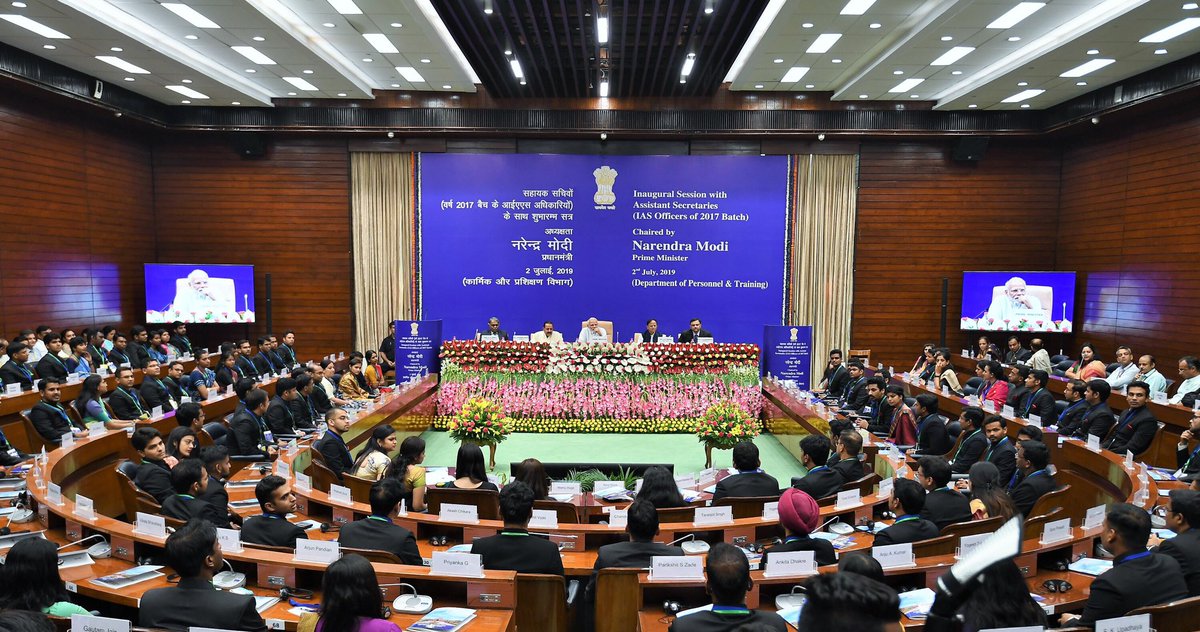
    The absence of legal backing for the empanelment procedure has led to the arbitrary exercise of power by the executive. Usually, officers start their career after training in State cadres and it would take up to 9 years for an officer to occupy Central government positions. But the present government has started a practice of appointing newly recruited officers, fresh from training, as Assistant Secretaries in the Union Ministries. Although this move was said to increase exposure for the new officers, it also may as easily be detrimental to their careers. This new pattern, initiated by the Modi govt, is characterised by a lack of transparency and establishing a core group of loyalist officers at the cost of building experience, knowledge, and performance. The loyalty of the officers of the civil services must be to the Constitution alone and not to any political party or even government of the day if it violates the constitutional provisions.

    Already, the AIS officers are in a bind where the State government and Central government are governed by opposing parties. The lack of fairness in the empanelment process has further discouraged and disheartened officers from Central Deputation. Although salaries and incentives remain the same, the State governments use transfers and postings as de facto punishment for AIS officers who do not follow suit with the State government’s decisions. Similarly, the Central government beguiles AIS officers with the temptation of post-retirement postings. The proposed amendments grant overreaching powers to the Central government which could be used to harass and corrupt an
    unwilling officer.

    Conclusion:

    In conclusion, the proposed amendments derogate the consent of State governments and the officer concerned. This not only gives rise to a lack of transparency and increased bias, but also has the potential to disintegrate the delicate federal structure that has been upheld since Independence. The Supreme Court has on many occasions emphasized that federalism is a part of the basic structure of our Constitution, and even a Constitutional amendment cannot do away with it. The Supreme Court has also affirmed cooperative federalism as a ‘cherished Constitutional goal’. Therefore, the Central government must look at other ways to overcome the issue of staff shortage, without granting itself overarching powers in direct violation of the Constitution.

    Recommendations:

    ▪ Recall the proposal amending the IAS (Cadre) Rules which will fundamentally damage India’s federal structure, thereby undermining national integrity and security.

    ▪ Shortage of officers can be addressed, in the short term, by recruiting suitable personnel from other Central Services such as IRS, Indian Defence Accounts service, Customs, etc. Alternatively, well-known professional experts in various fields can be inducted at senior positions, which will not only address the shortage but also the need for professional competence and experience in specialist departments as against the oft raised complaint of generalist nature of the IAS.

    ▪ Keeping in mind the demands of the Covid-19 pandemic, increase the annual intake of IAS officers to address the shortfall of 22 per cent in IAS posts.

    ▪ Increase Lateral recruitment for Central posts on a contract basis in the short term.

    ▪ The empanelment process, especially the 360° Appraisal system must be completely reformed to ensure equal opportunity and better transparency.

    ▪ The Centre’s proposal is a reflection of the long overdue need for the complete overhaul and reform of the Indian civil service system. These piecemeal amendments and a myriad of executive orders are not only unproductive to the civil service system but also counterproductive to the basic structure of the Constitution. A high-level committee should be established to undertake a holistic study to reform the Indian civil service system not only to bring in better performance and accountability but more importantly, to get rid of the colonial legacy once and for all.

    References:

    1. Agnihotri, S. (2021, June 4). Centre’s tussle with Bengal over chief secretary Reeks of uncooperative federalism. The Wire. Retrieved January 25, 2022, from https://thewire.in/politics/centres-tusslewith-bengal-over-chief-secretary-reeks-of-uncooperative-federalism

    2. Dev Dutt v. Union of India & Ors., (2008) 8 SCC 725

    3. Dhingra, S. (2021, June 7). Centre vs states, rules vs convention – who really controls IAS officers. ThePrint. Retrieved January 26, 2022, from https://theprint.in/india/governance/centre-vs-statesrules-vs-convention-who-really-controls-ias-officers/672013/

    4. Mishra, N. (2021, June 7). Explained: Chief secretary appointment controversy. TheLeaflet. Retrieved January 25, 2022, from https://www.theleaflet.in/explained-chief-secretary-appointmentcontroversy/

    5. MS, N. (2018, August 29). Why India’s civil servants are disaffected with the 360-degree empanelment process for top central government posts. The Caravan. Retrieved January 25, 2022, from https://caravanmagazine.in/government-policy/why-indias-civil-servants-disaffected-with-360-degree-empanelment

    6. Rajya Sabha, 92nd Report, Appraisal and Empanelment of Civil Servants under the Central Government, Department-Related Parliamentary Standing Committee on Personnel, Public Grievances, Law and Justice, August 2017, available at http://164.100.47.5/newcommittee/reports/EnglishCommittees/Committee%20on%20Personnel,%20PublicGrievances,%20Law%20and%20Justice/92.pdf

    7. Saxena, N. C. (2022, January 24). Who should control where IAS officers serve? The Wire. Retrieved January 25, 2022, from https://thewire.in/government/who-should-control-where-ias-officers-serve

    8. Singh, V. (2022, January 20). States weigh options on IAS cadre rule changes. The Hindu. Retrieved January 25, 2022, from https://www.thehindu.com/news/national/states-weigh-options-on-iascadre-rule-changes/article38293886.ece

    9. The Quint, Centre proposes new IAS Cadre Rules: What are they? why are they being opposed? (2022, January 21). Retrieved January 25, 2022, from https://www.thequint.com/news/india/ias-cadrerules-mamata-banerjee-narendra-modi-centre-states#read-more

    10. Yadav, S. (2022, January 22). Explained: IAS officers and central posting. The Indian Express. Retrieved January 25, 2022, from https://indianexpress.com/article/explained/ias-cadre-rules-amendmentswest-bengal-explained-7734310/

    Featured Image: Press Information Bureau (PIB)

    [powerkit_button size=”lg” style=”info” block=”true” url=”https://admin.thepeninsula.org.in/wp-content/uploads/2022/02/Change-in-IAS-Cadre-Rules-1.pdf” target=”_blank” nofollow=”false”]
    Download – Change in IAS (Cadre) Rules
    [/powerkit_button]
  • The South: Where the Chariots stopped in the Past

    The South: Where the Chariots stopped in the Past

    There is no apparent reason why Dr. John Jackson (1835-1911), a 19th-century Yorkshire-born British Psychologist should be of any interest to us in the 21st India. Yet, he is important in order to understand what is happening to the BJP’s misplaced ambitions in India south of the Vindhyas.

    First about Dr. Jackson. He was the first scientist to come up with the answer as to why mariners experience directional disorientation when they sail on vast seas. This navigational impairment, described by Jackson as ‘topological agnosia’ (literally, loss of knowledge about directions) was caused in his analysis by a distortion in an individual’s memory. An individual afflicted by this agnosia is found unable to remember to a destination known to him to be able to recall important landmarks seen a long time ago. Among the patients that Jackson studied were some women who knew where the London Bridge was, but they did not know how to go there from their homes. In their memory, the ‘little maps’ were forgotten, though the larger maps were inscribed in their brain. European colonial expansion was distinctly marked by this disorientation. When it was spreading south of Europe, the colonial powers thought of the south as ‘east’ and built a strong binary between the west and the east.

    Topological Agnosia is the term that can most accurately describe the BJP’s ‘Mission South.’ In order to understand why the party that feels so much at home in the Hindi heartland in the north should feel so unsure of its direction in the south, we need to look at the context within which its foundations were laid. Obviously, one has to refer to the shaping of the core ideas of the Hindutva ideology. It is not necessary to state that at its heart is the dubious and non-scientific theory of ‘Aryans as a Master Race’. This idea was in circulation among some of the 19th century European linguists. They imagined that what was initially proposed as the name of a language (‘Indo-Aryan’) was in fact the name of a community (or a race). Some of them went to the length of proving that the Aryans resided in remote ancient times in North Europe. Karl Plenka actually gave a homeland for this imagined master race, unquestioningly assuming that the master race was the master race of the pure Aryans.

    Besides, the traditions of spirituality and worship developed in the south for the last three millennia have their own distinct and syncretic trajectories which do not easily gel with the RSS-VHP idea of Hinduism. Besides, as Basavanna, Akkamma, Periyar, Phule, Shahu, and Ambedkar so ably demonstrate, a larger majority of the people south of the Vindhyas have reason to find the exclusionary and myopic social and cultural interpretations of history entirely repugnant.

    Adolf Hitler

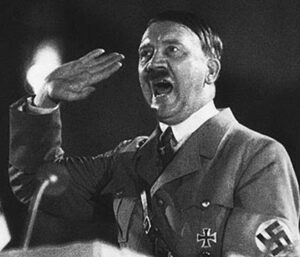
    In the third decade of the 20th century, Adolf Hitler made these theories the foundation of his ‘National Socialism’ and the associated drive for ‘racial purification.’ The founders of the RSS in India were his contemporaries and shared his enthusiasm for the theory of Aryan supremacy. Though completely unscientific in terms of the history of the people of India, the RSS, and the BJP like to believe that someday in the future they will be able to establish the supremacy of the (imaginary) Aryans over the diverse peoples in the Indian subcontinent, the south included. To aid this wishful aspiration, the RSS has brought in a misconstrued idea of what constitutes being Hindu. However, the Indian sub-continent South of the Vindhyas has a long history of resistance to the domination from the north. Besides, the traditions of spirituality and worship developed in the south for the last three millennia have their own distinct and syncretic trajectories which do not easily gel with the RSS-VHP idea of Hinduism. Besides, as Basavanna, Akkamma, Periyar, Phule, Shahu, and Ambedkar so ably demonstrate, a larger majority of the people south of the Vindhyas have reason to find the exclusionary and myopic social and cultural interpretations of history entirely repugnant. It is not a surprise, therefore, that despite desperate efforts by the VHP and RSS throughout the twentieth century, their general support base in the southern states had remained nominal.

    This has changed since 2014. The current regime has displayed an unmatched zeal in intimidating political leaders by using the ED, the CBI, and troll gangs. It has displayed a skill in the use of post-truth and propaganda for generating popular opinion as never before. The erosion of media and the collapse of institutions that are expected to uphold constitutional values and constitutional arrangements to safeguard democracy has apparently increased the chance of success for BJP’s south mission. Besides, the use of funds for party-swapping is a trick that the BJP has mastered well. All these factors—the use of muscle, official machinery, money, intimidation, and propaganda—have made the south more vulnerable to the divisive, exclusionary, and myopic nationalism of the BJP.

    Yet, it would be naïve to believe that countering the Hindutva and Pseudo-Nationalism onslaught would be possible by mouthing our worn-out phrases and analysis related to class-based or caste-based understanding of India in the third decade of the 21st century.

    Countering the flawed ideas of nationalism and the exclusionary notion of dharma is an urgent need for the people, language-communities and the political parties south of the Vindhyas. Probably, it is them alone who are now left with the capacity to do so, since the ‘Hindi, Hindu, Hindustan’ tune has overpowered the people and the northern ‘heartland-states’. Yet, it would be naïve to believe that countering the Hindutva and Pseudo-Nationalism onslaught would be possible by mouthing our worn-out phrases and analysis related to class-based or caste-based understanding of India in the third decade of the 21st century. Also, being fiercely against any geographical, linguistic or social factionalism, we have to reinvent our politics and political terminology. Remaining entirely within the framework of the Constitution, one very powerful message that the Southern States and people can give to the rest of India is that of federalism.

    The Constitution describes the country as a union of states’ and its provisions are oriented towards keeping this union intact and integrated by respecting the difference and diversity.

    The Constitution describes the country as a union of states’ and its provisions are oriented towards keeping this union intact and integrated by respecting the difference and diversity. Hence, our insistence on the principle of federalism would also mean our insistence on constitutional values. It would reiterate the need for recognizing and respecting diversities and, therefore, rejecting the Hindutva agenda of the RSS-BJP. This understanding, if shared by the communities, movements, language groups, political parties, theological sects, and cultural-industries in the states south of the Vindhyas, can—together—stop the BJP where it should be stopped and reverse the fortunes of fascism in India. We all owe it to India, our sacred nation. We also owe it to the great tradition of civilization that the south has built over the past millennia.

    The opinions expressed are personal views of the author.

    This article was published earlier in gaurilankeshnews.com

  • Understanding the Catalonian Crisis through the Relative Deprivation theory

    Understanding the Catalonian Crisis through the Relative Deprivation theory

    On 1st October 2017, people in Catalonia, a semi-autonomous region in Spain, held a referendum in which 90 percent of those who participated sought to break away from the Spanish state and create the independent Republic of Catalonia. This referendum which endorsed independence was declared illegal by the Spanish government. This declaration was based on a ruling by the Constitutional Court, and the results of the referendum were also not taken seriously by the international community. Since then, Catalonia has remained politically deadlocked. While the Spanish government and the leaders of the separatist movement in Catalonia have participated in discussions and formal talks have been opened in 2020, there has been no resolution to this festering political crisis.

    A deep sense of relative deprivation has entered the minds of the Catalan people wherein they feel that the Spanish identity has been given more prominence in comparison to their Catalan identity.

    This desire for independence as expressed by the people of Catalonia did not emerge suddenly but had been simmering for an extended period. The social mobilisation occurred because of the frustration that they have as a result of a lack of representation of their culture and language within the Spanish state. The hostility shown to demands of more autonomy and representation has also led to more anger. A deep sense of relative deprivation has entered the minds of the Catalan people wherein they feel that the Spanish identity has been given more prominence in comparison to their Catalan identity.

    While there is a long history of oppression and centralisation, the recent turmoil, however, started in 2010 when the Spanish Constitutional Court quashed a law passed by the regional parliament of Catalonia which updated the autonomous government’s statute. This statute dating to 1979 mapped the relations between Catalonia and the rest of Spain. The court rejected articles in the statute that put the Catalan language above the Spanish language and any articles that referred to Catalonia as a nation rather than as a region.

    This article seeks to understand the reason behind the Catalonian crisis using the relative deprivation model put forth by Ted Gurr. This model has been used to clarify how cultural and linguistic suppression of the Catalan people has led to collective turmoil.

    Relative Deprivation Model of Gurr

    Gurr’s relative deprivation model states that when a sense of deprivation emerges in a group in relation to another group, then it can lead to collective violence or dissatisfaction. Gurr uses a psychological approach to explain why anger or frustration caused by a sense of deprivation is a motivating instrument that can make people more inclined towards aggression.

    The term relative deprivation is used by Gurr who defines it as “actor’s perception of discrepancy between their value expectations (the goods and conditions of the life to which they believe they are justifiably entitled) and their value capabilities (the amounts of those goods and conditions that they think they can get and keep)”. Thus, if there is a discrepancy between what people in a group believe they should get and what they do get then, it leads to frustration, disturbance, and a sense of deprivation. The greater the gap between the expectations of the people and reality, the higher the magnitude for aggression and civil strife. One important thing to note here is that the sense of deprivation is always in relation or comparison to another group.

    Gurr further states that the magnitude of the civil strife or dissatisfaction is dependent on the intensity of the sense of deprivation among the people of the group. As per the relative deprivation theory, there are certain factors or societal variables that have an impact on the relationship between deprivation and the ensuing civil strife. These societal variables include:  (a) coercive potential (of the government to put off the conflict), (b) institutionalisation (the extent to which societal structures may offer non-violent means for expressing dissatisfaction to the social group with the perceived deprivation), (c) social facilitation (that further facilitate strife) and lastly, (d) legitimacy of the political regime in which all this occurs.

    Applying the Relative Deprivation Model to the Catalonian situation

     By applying this theory to the Catalonian crisis, it is easy to see how the deprivation of the Catalan culture, language, and history frustrated the Catalan people and led to the unprecedented social mobilisation for independence from the Spanish state. The people of Catalonia are unsatisfied and angry with the way their culture and particularly, their language, is being slowly eroded as compared to the relevance and status accorded to the Spanish language.

    The Catalan people consider their language to be the principal element of their identity and believe that it is the ‘rallying cry of their solidarity’. The sidelining of their language is seen as an affront to their identity.

    Language is seen as a crucial distinguishing feature by the Catalan people and the speakers of Castilian Spanish. Many people living in Catalonia also want the Catalan language to be officially recognised by the European Union and put on par with the Spanish language even outside the country settings, which has not happened. The reversal of the statute that allowed for the exercise of Catalan language over the Spanish language in the region has brought the identity discord in the open. The Catalan people consider their language to be the principal element of their identity and believe that it is the ‘rallying cry of their solidarity’. The sidelining of their language is seen as an affront to their identity.

    The economic state of affairs further accentuates their anger over the under-representation of their language in museums, government offices, libraries, and all official channels of the central government in Madrid. Catalonia is one highly prosperous part of Spain but many in Catalonia feel that they are bearing the brunt of the high taxes and austerity measures for the rest of the country’s needs with whom they have little in common.

    Conclusion:

    Ted Gurr’s relative deprivation theory states that when a group of people feel that they are deprived of something, whether economically, socially or politically, in comparison to another group of people, they will feel frustrated and that frustration can lead to violence. The Catalonian crisis, when understood using this model, provides an incredibly accurate picture of how the suppression of one’s language and history can result in political strife.

    The Catalonian situation is quite similar to that of Scotland in the United Kingdom. People in Scotland are also quite proud of their distinct language (Gaelic), traditions and also have a strong sense of independent spirit which they believe is curtailed by the Westminster government. Scotland’s Prime Minister, Nicola Sturgeon, recently indicated that she would pursue another referendum for independence in the coming year as support for an independent government has increased steadfastly in 2020 with the pandemic exposing the cracks in the current system.

    For both Catalonia and Scotland, the model followed in the erstwhile USSR in terms of accommodation of identities can provide a way forward or represent a comparatively better model of governance. Under Lenin’s leadership, striking flexibility with respect to the various countries encompassed within the Soviet Union in terms of expression of their individual nationalities was displayed. Lenin used a degree of accommodation towards peripheral nationalist tendencies displayed by the non-Russian states as he believed it to be a pragmatic solution. While political autonomy remained elusive to the non-Russian states, the accommodation of their national identities meant that they were somewhat satisfied. The Soviet state itself encouraged the use of local languages in schools and universities and even in the local administrative offices.


    References:

    “A Year Later: An Update on the Catalonian Independence Movement.” Columbia Journal of Transnational Law, 27 Nov. 2018, jtl.columbia.edu/a-year-later-an-update-on-the-catalonian-independence-movement/.

    “Catalonia: From Secessionism to Secession?” E-International Relations, www.e-ir.info/2016/01/15/catalonia-from-secessionism-to-secession/.

    “Catalonia: Past and Future.” Jacobin, www.jacobinmag.com/2017/10/catalonia-independence-franco-spain-nationalism.

    Gurr, Ted. “A causal model of civil strife: A comparative analysis using new indices.” American political science review 62.4 (1968): 1104-1124.

    Gurr, Ted Robert. “Why Men Rebel Redux: How Valid Are Its Arguments 40 Years On?” E-international Relations 17 (2011).

    Huddleston, R. Joseph. “The Roots of the Catalan Independence Crisis.” Foreign Affairs, Foreign Affairs Magazine, 30 Oct. 2017, www.foreignaffairs.com/articles/spain/2017-10-30/roots-catalan-independence-crisis.

    Marinzel, Anastazia. “Catalonia: The quest for independence from Spain.” (2014).

    “Scotland: Nicola Sturgeon Aims for 2021 Independence Vote.” The Indian Express, 1 Dec. 2020, indianexpress.com/article/world/scotland-nicola-sturgeon-aims-for-2021-independence-vote-7075166/


    Image Credit: “Catalonia is not Spain” by SBA73 is licensed under CC BY-SA 2.0