
[sc name=”donte”]
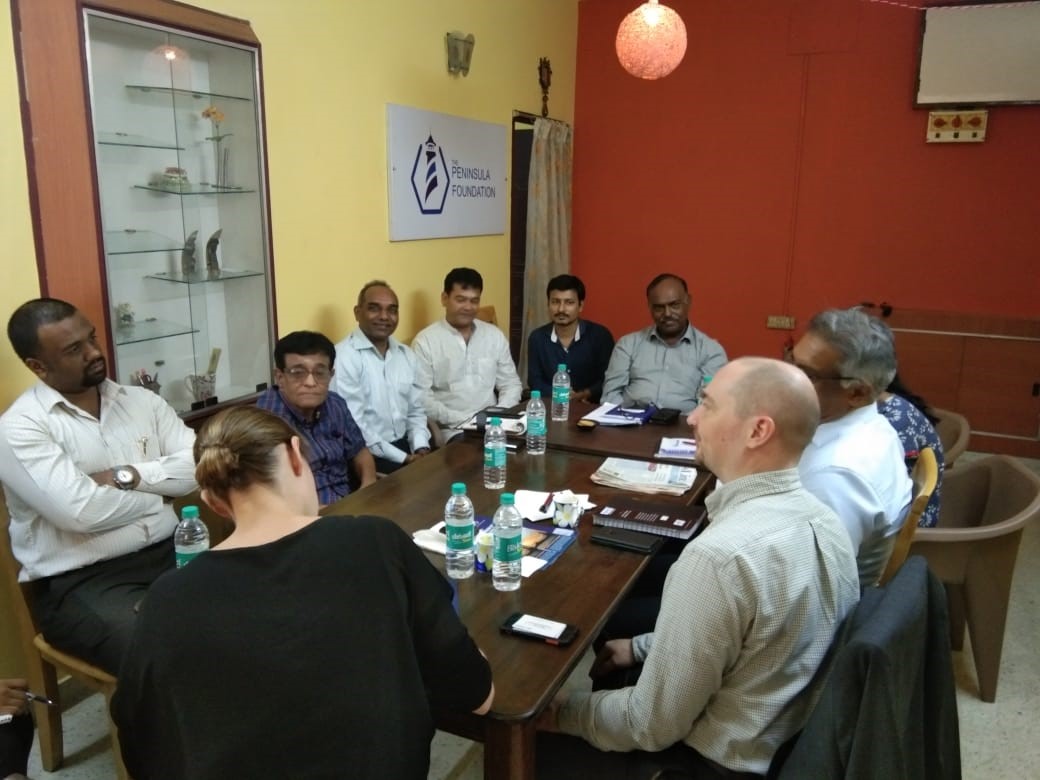
A formal interactive session on Maritime Security was organized in The Peninsula Foundation (TPF), Chennai on September 11, 2019 in collaboration with the United States Consulate, Chennai. The Consulate facilitated the visit of Mr Geoffrey Wessels, Officer for Trade and Connectivity, US Embassy, New Delhi. He was accompanied by Ms Sara Greengrass, Economic Officer, US Consulate, Chennai and Mr George Mathew, Economic Specialist, US Consulate, Chennai. The meeting was aimed to gather perspectives on security challenges faced in the Indo-Pacific region.
Various recent geopolitical developments relating to maritime security, especially in the Indian Ocean Region, were discussed. Development of India’s relations with ASEAN countries and New Delhi’s need to ensure safety in the sea were explored. There was consensus on the concerns against China’s consistent rise in the Asia Pacific and its practice of debt-trap strategy, as in Sri Lanka, while implementing its ambitious One Belt – One Road project across Asia, and the need for India’s maritime security to be prioritized. Ms Sara stressed on environment security in the Indian Ocean due to overfishing and initiatives of USA to minimize maritime non-conventional threats to India. Primarily, the discussion aimed at finding a common ground between India and the US to deal with China. Representatives of TPF elaborated about their perspectives on Beijing and commented on possible collaboration between India and the USA. The session was informative and fruitful; we thank the US consulate for the arrangement and encourage such interactions in the future.
[sc name=”donte”]
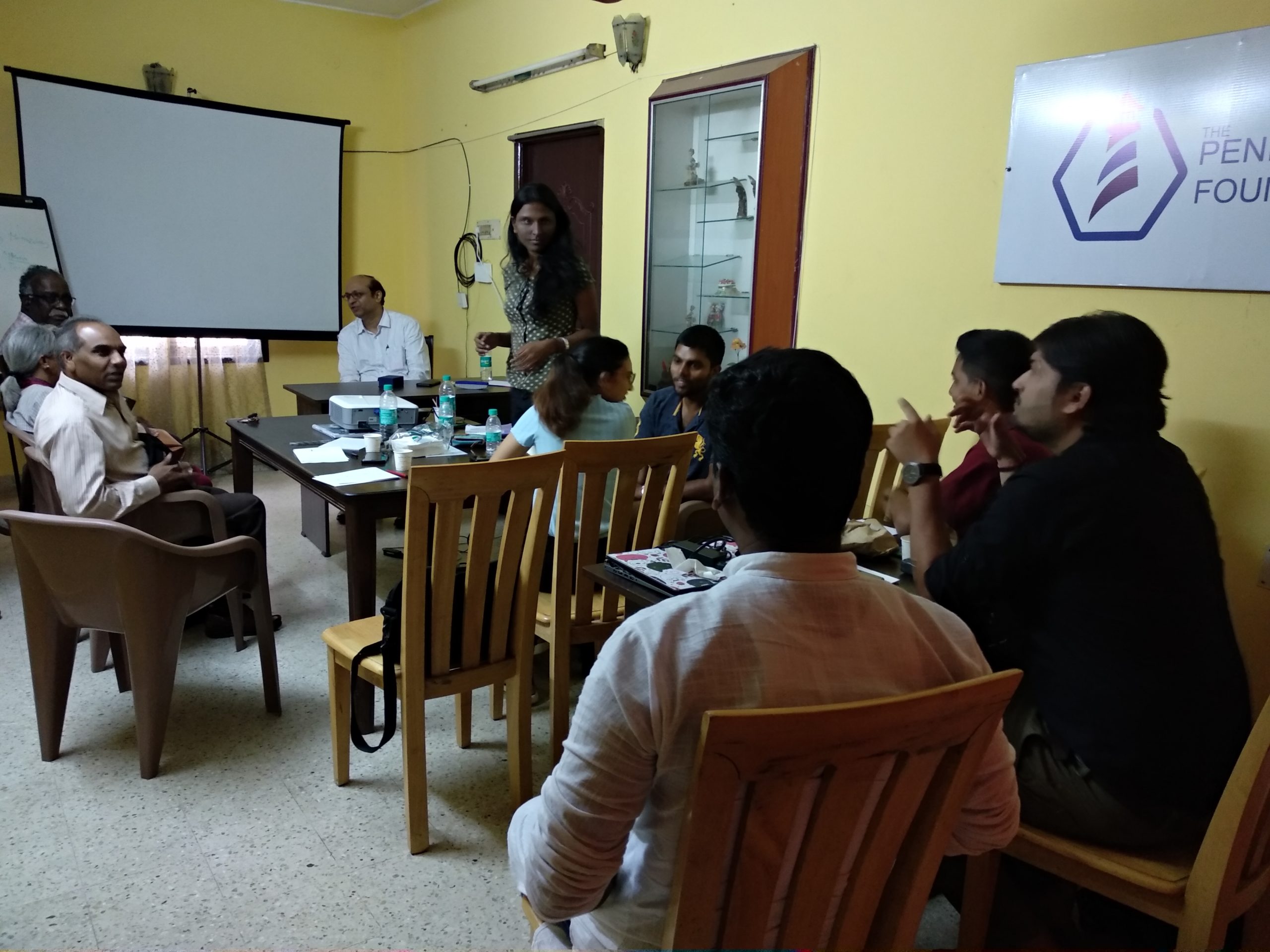
A full-day workshop on “Research Methodology in Social Sciences” was organised by TPF on August 22, 2019. The objective was to facilitate close interaction between the expert and researchers for better understanding of advanced research methods and tools. The one day event was successfully conducted by Dr S Venkatraman, Senior Consultant at UNESCO and International Consultant at ADB. Dr S Venkatraman holds M Phil from Cambridge University and PhD from London School of Economics. The workshop was designed to equip young research scholars with a conceptual understanding of the various research methods, tools and techniques.
The event began at 10:30 am and was attended by post graduates, PhD scholars and professors from Chennai. The key sessions of the day included identification of a research problem that is relevant and useful, developing appropriate research method and tools for analysis, and drawing conclusions according to established standards for wider acceptability of the research work. Post lunch, Dr Venkatraman covered the research process by citing examples from the field of education. By narrowing down the research theme, focussing further to an issue and later arriving at a research question, it helped in gathering a better understanding of how to choose a research topic. Following this, he explained how to arrive at a suitable research design for data collection and analysis by using sources, both primary and secondary. The day concluded at 5:00 pm with a small discussion on why and how to build a core research specialisation areas.
[sc name=”donte”]
TPF Team August 19, 2019/Conference
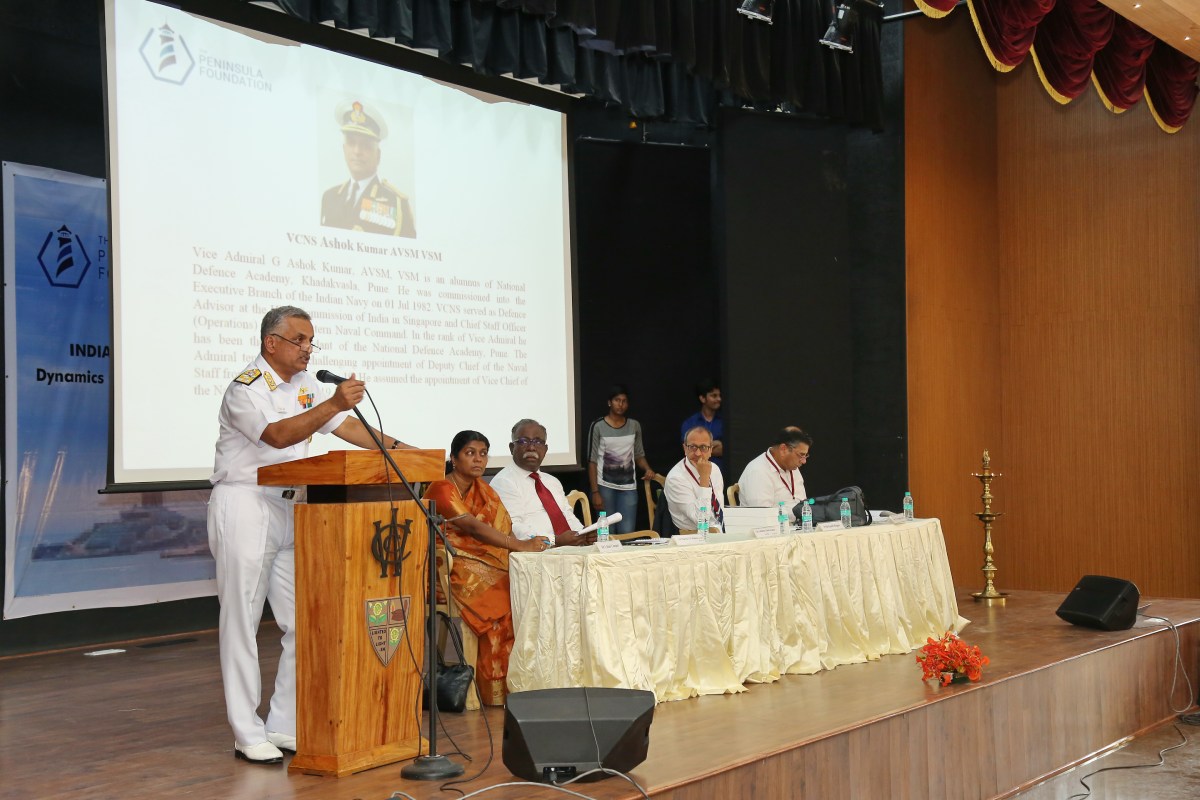
The Peninsula Foundation held its first international conference titled “India and the Indian Ocean Region: Dynamics of Geopolitics, Security and Global Commons” on the 12thand 13thof July at the Women’s Christian College, Chennai. Fifteen papers authored by research scholars from various institutions and backgrounds were presented during the course of the two-day conference comprising five sessions.The inaugural address was delivered by the Chief Guest, Vice Admiral N Ashok Kumar AVSM VSM, Vice Chief of Naval Staff (VCNS). In an eloquent speech, the VCNS highlighted the growing importance of the Indian Ocean Region and the need to debate and discuss issues relating to chokepoints and the trade routes. He spoke about historical evidence of the criticality of the trade routes in the Indian Ocean Region (IOR), and related it to the present context of ship movements in vital sea lanes of communications (SLOCs) that are vital for economic growth of countries in the Asia-Pacific Region. India’s geographic location gives it a dominant strategic position, as seventy-five percent of international shipping links go through the IOR. He pointed out that China is deeply focussed on safeguarding its interests in the IOR since more than seventy percent of its energy requirements are dependent on Indian Ocean sea lanes. Stressing on the importance of the IOR, the VCNS highlighted the vulnerability of chokepoints and the need to ensure freedom of the seas.
The keynote address was delivered by Professor Kanti Prasad Bajpai, Vice Dean and Wilmar Professor of Asian Studies at the Lee Kuan Yew School of Public Policy, National University of Singapore. He focused on the contemporary understanding of the term ‘region’ and its context with regards to geopolitics and international relations, stating that when we refer to a region in the geopolitical context, we essentially refer to a zone of conflict, a war-zone or an area of potential conflict. Thus, South Asia often implies the India-Pakistan conflict, Middle East or West Asia the Arab-Israeli conflict, or the conflict between North and South Korea when talking about Korea as a region. Similarly, the Indian Ocean region is one of geopolitical contest amongst the great powers. It is a strategically important region where interdependence is inevitable amongst the nations that have vested interests in the IOR.
Professor Bajpai further elucidated the fundamentals of trade development in the region and substantiated a case for the IOR as a strategic zone, citing the consistency with which external powers compete to control the region. He highlighted the three forms of culture that govern or define power positions in the IOR: classical culture, popular culture and strategic culture. India, aspiring to position itself as an important player in the region, has to evaluate the choices that are available to it: accept one dominant power to manage the region in a rule-based order or actively participate in the dialogue for a negotiated order that can be achieved through multilateral trade agreements. In conclusion, Professor Bajpai raised questions to be addressed in the upcoming sessions. The inaugural session ended with a special lecture on the cultural legacies of the Asia-Pacific Region, delivered by Indian classical dancer and Padma Bhushan awardee, Dr Padma Subrahmanyam.
Session One: ‘Indian Ocean: Culture, Civilizations and Connectivity’
The topic of the first session chaired by Cmde. C. Uday Bhaskar, Director of the Society for Policy Studies (SPS), was ‘Indian Ocean: Culture, Civilizations and Connectivity’. The speakers discussed the history, culture and impact of trade on the IOR. G Padmaja, an independent researcher, emphasised India’s maritime heritage and argued that policies do not move beyond mere talk with respect to the IOR. Dr Vijay Sakhuja, Trustee of The Peninsula Foundation, stated that the IOR is the busiest trade route in terms of development and commodity exchange. He elucidated the importance of digital shipping and the scope of 5G technology and reliance on Artificial Intelligence in driving the trading ecosystem. The third speaker Dr D Dhanuraj, Chairman, Centre for Public Policy Research (CPPR), explored the idea of the modern political economy influencing the flow of men and commodities, and talked about the possibility of India reclaiming its rights over the IOR.
Session Two: ‘Power Politics in the IOR: Geostrategies and Geo-economics’
Through his paper “Competing Pivots in the Indian Ocean Region”, Dr Lawrence Prabhakar, Associate Professor, Madras Christian College, highlighted that the region can be constructed and contested through a maritime mandala that goes beyond security and economic factors to include cultural, governance, transnational and other aspects. Dr Arvind Kumar, HOD, Department of Geopolitics, Manipal University, in his paper “Stability of Trade and Commerce: Energy Corridor” discussed the potential of energy resources in the IOR and the need to include energy security as a significant feature in global trade and growth drive. In his paper titled “China’s BRI: Responses in the IOR and Implications for Regional Order”, Dr Jabin Jacob, Associate Professor, Shiv Nadar University, focussed on smaller nations affected by the Belt and Road Initiative and the responses by the Chinese government. Chairperson Dr TCA Raghavan, DG, ICWA, summarised the session by observing that the actions of regional states cannot be categorised as malicious but are rather reactions to Indian and Chinese policies over time.
Session Three: India’s Strategic Interests in the IOR
In the final session of the day, speakers discussed maritime security, power projections and evolving ties with littoral states in the region. The session was chaired by Vice Admiral Shekhar Sinha (retd), Trustee, India Foundation. Cmde Somen Bannerjee, of Vivekananda International Foundation, pointed out in his paper titled “Maritime Security and Power Projections” that China is set to become the biggest power in the IOR in the next fifteen years. He also discussed the need for India to strategize power projection as a necessary course of action in order to secure importance on the global stage. Through his paper, “Strategic Partnerships: India & ASEAN”, Ambassador Antonio Chiang brought to attention the strategic partnership between Taiwan and China, and the implications of China’s rise to power on Taiwan. Group Captain PB Nair spoke about the role of the Indian Air Force (IAF) in the context of the IOR, providing assistance in navigating sea routes, and the significance of Artificial Intelligence (AI) technology in carrying out sea operations.
Day Two: Panel Discussion on India’s Approaches in the IOR
Day Two commenced with a panel discussion on India’s strategic approaches in the IOR, its aspirations and the contradictions. The panel consisted of Dr TCA Raghavan, Ambassador Antonio Chiang, Lt Gen S.L. Narasimhan, Cmde Uday Bhaskar and Professor Kanti Bajpai. The session, moderated by Air Marshal M Matheswaran, addressed three main points: the power struggle in Asia, India’s inadequate investment with regard to being a rising power, and India’s engagement with multilateral institutions.
The discussion focussed on the ramifications of Chinese economic power and military strength in the region, its effect on India’s policies, as well as the need for utilization of soft power and soft balancing techniques by smaller countries to level the international playing field.
With regard to India’s investment activities, Dr TCA Raghavan mentioned that ineptness in domestic spheres would spill over and reflect in international projects.
On the topic of India’s engagement in multilateral institutions, Professor Kanti Bajpai noted that while it cannot be said that India doesn’t deliver, there is a certain level of ambiguity about what the expectations are. The delay in finalising the Regional Comprehensive Economic Partnership (RCEP) was discussed; Lt Gen S L Narasimhan explored the reason behind India’s hesitancy to the agreement, stating that RCEP only covered the free movement of goods and not of services. Thus, India being a service-strong nation would be at a disadvantage.
With regard to China’s technological advancements and its potential economic superpower status, Ambassador Chiang stated that intellectual power would be a game-changer for India. He noted that China resorts to hard and fast action for solving problems as opposed to the kind of strategic decision-making employed by India.
Session Four: International Cooperation and Global Commons
Session Four of the conference was chaired by Dr Joshua Thomas, Deputy Director at the North Eastern Regional Centre of the Indian Council of Social Science Research (ICSSR). The first speaker, Dr Suba Chandran, spoke on the topic of “Cultural Legacies & Competing Zones of Influence: India, China and External Powers.” His talk addressed two questions: who the actors are and their nature of influence, and how India can respond. Embracing our shared religious and cultural history and strengthening the education system in India were among the measures suggested by Dr Chandran to build bridges and enable India to assume a more central position of power in the region. Rear Admiral S Shrikande presented a paper on the subject of “International Institutions: SLOCs, Chokepoints, Freedom of Navigation”, and shared insights on the United Nations Convention on the Law of the Sea (UNCLOS). The final speaker of the session, Rear Admiral K Swaminathan, spoke on India’s role as a net security provider in the region, and mentioned several instances of the Indian Navy providing assistance to neighbours in times of need and contributing to preserving international security. While Dr Chandran spoke about cultural connectivity across countries in the IOR through a ‘Bring East Policy’, the naval officers emphasised on the need for connectivity, capacity and credibility in the international sphere.
Session Five: Transnational Issues, Threats and Challenges in the IOR
In his paper titled “International and Regional Cooperation in Disaster Management”, Air Vice Marshal Ashutosh Dixit underlined the vital role played by the UN and Armed forces in mitigating the risks of disasters. While the UN plays a multifaceted role of being the interface between local and international responders, it is most often the armed forces that promptly and efficiently mobilize resources to the disaster-struck nation, as their reach has no limitations. Dr Arabinda Acharya, Associate Professor, National Defense University, Washington DC, in his paper “Non Traditional Security Threats: Piracy, Maritime Terrorism, Climate Change, Illegal Unreported and Unregulated (IUU) Fishing, Illegal Immigration, and Smuggling of Arms and Drugs” explored challenges to good order at sea and proposed investment in resources to thwart non-state actors on land so as to reduce their power at sea. Through his paper, “India and the Blue Economy: Evolving Partnerships,” Dr R P Pradhan, Associate Professor at BITS Pilani, Goa Campus, emphasised the critical role of the Big Push Theory in developing the blue economy. Investing in strategic assets such as seaports similar to China, Indonesia, South Korea, etc. is vital for realising India’s aspirations for a larger role in the region. In his closing remarks, Lt General SL Narasimhan, Director General, Centre for Contemporary Chinese Studies, Ministry of External Affairs, emphasised the need for states and regional organizations to collaborate rather than compete in order to address challenges that transcend national borders.
Lastly, in his valedictory address, Dr TCA Raghavan identified crucial points with respect to the theme of the conference, including the difference between military and diplomatic thinking, and strategic and tactical strength. Dr Raghavan stressed the need for developing dialogue forums and intergovernmental organisations in the Arabian Sea littoral with countries such as Saudi Arabia, Yemen and Iran, among others, to focus on pressing issues in the region.
[sc name=”donte”]
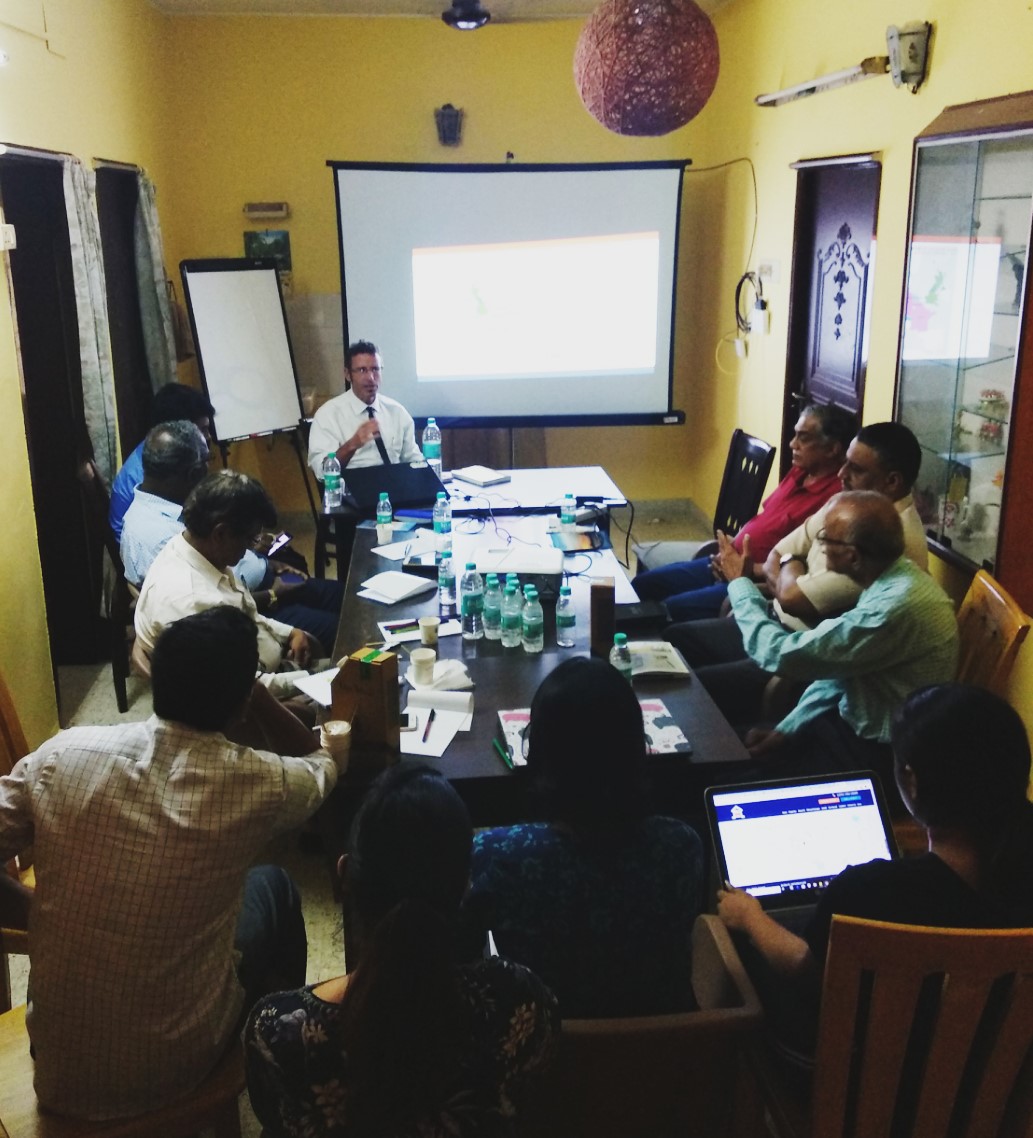
Special Guest : Dr Alan J Kuperman LBJ School of Public Affairs, University of Texas, Austin
Dr.Alan J. Kuperman, chair of the Graduate Studies Committee of the LBJ School’s Global Policy Studies program, University of Texas visited The Peninsula Foundation on 5th of August. He was accompanied by Dr D Subachandran, Professor & Dean, NIAS Bangalore who also facilitated the visit. The discussion centred around global nuclear issues with respect to non-proliferation and nuclear safety in the context of plutonium-based nuclear energy development practices. Dr Alan Kuperman’s presentation was based on the results of a significant research program conducted by him under the NPPP (Nuclear Proliferation Prevention Project). The outcome of the project is his edited volume ‘Plutonium for Energy? Explaining the Global Decline of MOX’. His views drew extensively from his book. The interactive session commenced with Dr Kuperman presenting the stages of plutonium, recycling effects and further elaboration on “Plutonium for Energy” as it is the first-ever comparative research project on “mixed oxide” (MOX) fuel – containing both plutonium and uranium – used in light-water nuclear power reactors. The project explores the manufacture and use of such MOX fuel in the seven main countries that have done so: Belgium, France, Germany, Japan, the Netherlands, Switzerland, and the United Kingdom.

Plutonium as the fuel for nuclear energy evolved from the perceived advantages of its closed fuel cycle that would have done away with or reduced the complexities and hazards of having to address long period storage of increasing amounts SNF (Spent Nuclear Fuel) from Uranium-based nuclear (thermal) reactors. According to the study this is a misconception, and he projected that Plutonium is a controversial fuel for three major reasons: Plutonium from reprocessing can be used to make nuclear weapons; it is carcinogenic and so a huge health hazard; and is a very costly process that makes it uneconomical. The main focus of this line of argument was non-proliferation, and the need to make countries move away from plutonium cycle so as to eliminate nuclear weapons possibility, including the possibility of terrorist angle. Participants raised questions about countries like India, which can exploit its vast reserves of Thorium through closed fuel cycle for energy while also addressing their security concerns. The countries selected in the study do not represent a viable model for countries like India and China. Pakistan is already focused extensively on plutonium cycle. Hence, it was pointed out, decision on this issue would be complex for India. One of the primary objectives of the study is also to inform ongoing decision-making in East Asia – including China, Japan, and South Korea – about whether to recycle plutonium for energy.
[sc name=”donte”]
TPF Conference
“India and the Indian Ocean Region: Dynamics of Geopolitics, Security, and Global Commons”
Venue: WCC, Chennai
Speakers
Inaugural Session (9:00 to 10:45)

Dr Lilian Jasper
Dr Lilian Jasper
Welcome Address

Air Marshal M Matheswaran
Air Marshal M Matheswaran AVSM VM PhD (Retd)
Presidential Address and Overview

Vice Admiral Ashok Kumar
Vice Admiral Ashok Kumar AVSM VSM Vice Chief of Naval Staff
Inaugural Address

Prof Kanti Bajpai
Prof Kanti Bajpai
Key Note Address
Topic: Historical and Cultural Dynamism of the Indian Ocean
Topic: Cargos and Commodities: Then and Now
Topic: Impact of Trade and Migration Flows: Past and Present
Topic: Competing Pivots: China, US, Japan, Russia, India and the EU
Topic: Geopoltics of Energy in the IOR
Topic: China’s BRI: Contrasting Responses
Topic: India’s Maritime Security and Power Projection
Topic: Strategic Partnerships: India and ASEAN
Topic: Air and Space: Dimension of India’s IOR Strategy
Gold Sponsors
Event Sponsors
Speakers
Panel Discussion (9:00 to 11:00)
Topic – India’s Strategic Approaches in IOR: Between Aspirations and Contradictions
Topic: Cultural Legacies and Competing for Zones of Influence: India, China and External Powers
Topic: International Institutions: SLOCs, Chokepoints, Freedom of Navigation
Topic: India’s Ability to Provide Net Security and Balance Global Public Goods
Topic: India and the Blue Economy: Evolving Partnerships
Topic: Non Traditional Security Threats: Piracy, Maritime Terrorism, Climate Change, Illegal, Unreported and Unregulated (IUU) Fishing, Illegal Immigration, and Smuggling of Arms and Drugs
Topic: International and Regional Cooperation in Disaster Management
Topic: President’s Introduction
Topic: Valedictory Address
Topic: Vote of Thanks
[sc name=”donte”]
Special Guest: Dr Vasanthi Vasudev
The Peninsula Foundation organised a round table discussion on Education policy and the status of primary education in Tamil Nadu. TPF invited Dr Vasanthi Vasudev, a leading educationist in Chennai, to chair the discussions. The discussions were initiated by TPF as a prelude to formulating a research project for analysis of primary education in India in terms of right to education for children, children enrolment, school education policy effectiveness, learning outcomes, drop-out rates, teaching methodologies, school infrastructure, motivational aspects, noon-meal schemes, financial issues, family environmental impacts etc. The plan is to undertake Tamil Nadu as a case study. Dr Vasanthi elaborated on importance of local language as the medium of instruction and methodologies that should enable identification of aptitudes and focus on child’s strengths. School environmental issues and social practices and rigid mentalities, particularly in rural regions, were bound to have mostly adverse impact on child’s education. She highlighted the insidious entry of caste recognitions in school and gave the examples relating to ineffectiveness of noon-meal schemes in schools. Of course, administrative apathy added to the problems. The discussion provided valuable inputs to the development of the project proposal.
[sc name=”donte”]

Center for Women’s Studies & Department of History
Women’s Christian College, Chennai
& The Peninsula Foundation, Chennai
cordially invite you to the Inauguration of the
National Seminar
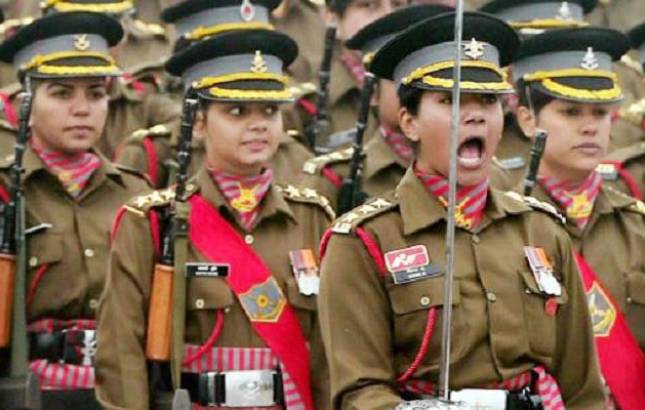
Women in Indian Armed Forces:
Changing Contexts and Transformations
On 8th March 2018 at 9.00 a.m.
at the Auditorium (Centenary Building)
Inaugural Address
Dr. C. Joshua Thomas
Coordinator, ASEAN Studies Centre &, Deputy Director,
ICSSR North Eastern Regional Centre, NEHU Campus, Meghalaya
Keynote Address
Air Marshal (Retd.) Dr. M. Matheswaran
Former Deputy Chief, Integrated Defence Staff (Air),
South Block, Govt of India, New Delhi
Chairman The Peninsula Foundation, Chennai
Special Address
Lt. Gen. (Retd.) Vinod G. Khandare
Former Director General Defence Intelligence Agency, New Delhi
Sponsored by
Indian Council for Social Science Research,
New Delhi & Southern Regional Centre, Hyderabad

[sc name=”donte”]
Past Events July 24, 2018 The Military-Industrial Component of the U.S.-India Partnership
JULY 24, 2018 | 12:15 PM
Please join the Stimson South Asia program for a conversation with Air Marshal M. Matheswaran, the former Deputy Chief of the Integrated Defence Staff in the Indian Ministry of Defence, who will talk about the military-industrial component of the U.S.-India partnership. Joanna Spear, Associate Professor of International Affairs at the Elliott School, and Benjamin Schwartz, Head of the Aerospace and Defense Program at the U.S.-India Business Council, will serve as discussants. Sameer Lalwani of the Stimson Center will moderate.
WHAT: An on-the-record discussion with Air Marshal M. Matheswaran on the military-industrial component of the U.S.-India partnership.
WHERE: The Stimson Center, 1211 Connecticut Avenue, NW, 8th Floor, Washington DC, 20036
WHEN: Tuesday, July 24 from 12.15 to 2 pm. Lunch will be served at 12.15 and the discussion will begin at 12.30.
RSVP: Click here to RSVP for the event.
FOLLOW: @StimsonCenter on Twitter for event news and use #StimsonNow to join the conversation
Featuring:
Sameer Lalwani, Senior Associate and Co-Director, South Asia Program, Stimson Center (moderator)
Sameer Lalwani is a Senior Associate and Co-Director of the South Asia Program at the Stimson Center where he researches nuclear deterrence, inter-state rivalry, and counter/insurgency. He is also an Adjunct Professor at the George Washington University’s Elliott School and a Contributing Editor to War on the Rocks.
Air Marshal M. Matheswaran, former Deputy Chief of the Integrated Defence Staff, Indian Ministry of Defence
Air Marshal M. Matheswaran retired from the Indian Air Force in 2014 after nearly 39 years of military service. In his last appointment, he was the Deputy Chief of the Integrated Defence Staff for 23 months at the tri-service headquarters in the Ministry of Defence, India. Since then, he has held defense and aerospace consulting positions at Hindustan Aeronautics Limited and Reliance Defence. He is the Founder, Chairman, and President of the Peninsula Foundation, a think-tank for security policy research.
Benjamin Schwartz, Head, Aerospace & Defense, U.S.-India Business Council
Benjamin Schwartz leads the U.S.-India Business Council’s Defense and Aerospace program where he advocates for pro-trade policies before officials in the Indian and American governments. He previously served in a range of positions within the U.S. national security community, including at the Department of State, the Department of Energy, and the Department of Defense, where he was Director for India in the Office of the Secretary of Defense.
Joanna Spear, Associate Professor of International Affairs, George Washington University.
Joanna Spear is Associate Professor of International Affairs and Director of the FAO Regional Sustainment Initiative at the Elliott School of International Affairs at George Washington University. Her areas of focus include U.S. and UK arms sales policies, U.S. counter-proliferation policies, and transatlantic relations. In 2012, she was a Senior Visiting Fellow at Institute of Defence Studies and Analyses New Delhi, working on India’s arms import policies and offset strategies.
[sc name=”donte”]
M Matheswaran August 19, 2018
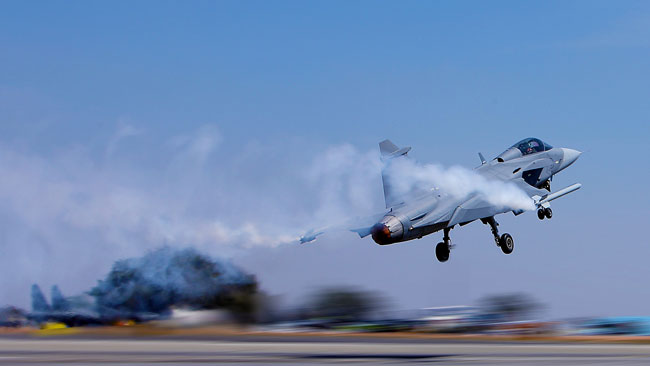
As a follow-up on the ‘Make in India’ strategy in the defence sector, the Government of India has announced its intensions to set up two defence corridors, one in Tamilnadu and another in Uttar Pradesh.The idea of defence corridors is a very sensible one. However, the challenges to it should not be underestimated. The economic viability and success of the defence corridor plan lies in its careful implementation through well thought out cluster strategy.
[sc name=”donte”]