Category: European Union

  • What Ukraine needs to learn from Afghanistan about proxy wars

    What Ukraine needs to learn from Afghanistan about proxy wars

    The greatest enemy of economic development is war. If the world slips further into global conflict, our economic hopes and our very survival could go up in flames. The Bulletin of the Atomic Scientists has moved the hands of the Doomsday Clock to a mere 90 seconds to midnight. The world’s biggest economic loser in 2022 was Ukraine, where the economy collapsed by 35% according to the International Monetary Fund. The war in Ukraine could end soon, and economic recovery could begin, but this depends on Ukraine understanding its predicament as a victim of a US-Russia proxy war that broke out in 2014.

    The US has been heavily arming and funding Ukraine since 2014 with the goal of expanding Nato and weakening Russia. America’s proxy wars typically rage for years and even decades, leaving battleground countries like Ukraine in rubble.

    Unless the proxy war ends soon, Ukraine faces a dire future. Ukraine needs to learn from the horrible experience of Afghanistan to avoid becoming a long-term disaster. It could also look to the US proxy wars in Vietnam, Cambodia, Lao PDR, Iraq, Syria, and Libya.

    Starting in 1979, the US armed the mujahideen (Islamist fighters) to harass the Soviet-backed government in Afghanistan. As president Jimmy Carter’s national security advisor Zbigniew Brzezinski later explained, the US objective was to provoke the Soviet Union to intervene, in order to trap the Soviet Union in a costly war. The fact that Afghanistan would be collateral damage was of no concern to US leaders.

    The Soviet military entered Afghanistan in 1979 as the US hoped, and fought through the 1980s. Meanwhile, the US-backed fighters established al-Qaeda in the 1980s, and the Taliban in the early 1990s. The US “trick” on the Soviet Union had boomeranged.

    In 2001, the US invaded Afghanistan to fight al-Qaeda and the Taliban. The US war continued for another 20 years until the US finally left in 2021. Sporadic US military operations in Afghanistan continue.

    Afghanistan lies in ruins. While the US wasted more than $ 2 trillion of US military outlays, Afghanistan is impoverished, with a 2021 GDP below $400 per person! As a parting “gift” to Afghanistan in 2021, the US government seized Afghanistan’s tiny foreign exchange holdings, paralysing the banking system.

    The proxy war in Ukraine began nine years ago when the US government backed the overthrow of Ukraine’s president Viktor Yanukovych. Yanukovych’s sin from the US viewpoint was his attempt to maintain Ukraine’s neutrality despite the US desire to expand Nato to include Ukraine (and Georgia). America’s objective was for Nato countries to encircle Russia in the Black Sea region. To achieve this goal, the US has been massively arming and funding Ukraine since 2014.

    The American protagonists then and now are the same. The US government’s point person on Ukraine in 2014 was Assistant Secretary of State Victoria Nuland, who today is Undersecretary of State. Back in 2014, Nuland worked closely with Jake Sullivan, president Joe Biden’s national security adviser, who played the same role for vice president Biden in 2014.

    The US overlooked two harsh political realities in Ukraine. The first is that Ukraine is deeply divided ethnically and politically between Russia-hating nationalists in western Ukraine and ethnic Russians in eastern Ukraine and Crimea.

    The second is that Nato enlargement to Ukraine crosses a Russian redline. Russia will fight to the end, and escalate as necessary, to prevent the US from incorporating Ukraine into Nato.

    The US repeatedly asserts that Nato is a defensive alliance. Yet Nato bombed Russia’s ally Serbia for 78 days in 1999 in order to break Kosovo away from Serbia, after which the US established a giant military base in Kosovo. Nato forces similarly toppled Russian ally Moammar Qaddafi in 2011, setting off a decade of chaos in Libya. Russia certainly will never accept Nato in Ukraine.

    At the end of 2021, Russian president Vladimir Putin put forward three demands to the US: Ukraine should remain neutral and out of Nato; Crimea should remain part of Russia; and the Donbas should become autonomous in accord with the Minsk II Agreement.

    The Biden-Sullivan-Nuland team rejected negotiations over Nato enlargement, eight years after the same group backed Yanukovych’s overthrow. With Putin’s negotiating demands flatly rejected by the US, Russia invaded Ukraine in February 2022.

    In March 2022, Ukraine’s president Volodymyr Zelensky seemed to understand Ukraine’s dire predicament as a victim of a US-Russia proxy war. He declared publicly that Ukraine would become a neutral country, and asked for security guarantees. He also publicly recognised that Crimea and Donbas would need some kind of special treatment.

    Israel’s prime minister at that time, Naftali Bennett, became involved as a mediator, along with Turkey. Russia and Ukraine came close to reaching an agreement. Yet, as Bennett has recently explained, the US “blocked” the peace process.

    Since then, the war has escalated. According to US investigative reporter Seymour Hersh, US agents blew up the Nord Stream pipelines in September, a claim denied by the White House. More recently, the US and its allies have committed to sending tanks, longer-range missiles, and possibly fighter jets to Ukraine.

    The basis for peace is clear. Ukraine would be a neutral non-Nato country. Crimea would remain home to Russia’s Black Sea naval fleet, as it has been since 1783. A practical solution would be found for the Donbas, such as a territorial division, autonomy, or an armistice line.

    Most importantly, the fighting would stop, Russian troops would leave Ukraine, and Ukraine’s sovereignty would be guaranteed by the UN Security Council and other nations. Such an agreement could have been reached in December 2021 or in March 2022.

    Above all, the government and people of Ukraine would tell Russia and the US that Ukraine refuses any longer to be the battleground of a proxy war. In the face of deep internal divisions, Ukrainians on both sides of the ethnic divide would strive for peace, rather than believing that an outside power will spare them the need to compromise.
    Feature Image Credit: politico.eu

    This article was published earlier in dailymaverick.co.za and is republished with the permission of the author.

  • Ukraine War Tolls Death Knell for NATO

    Ukraine War Tolls Death Knell for NATO

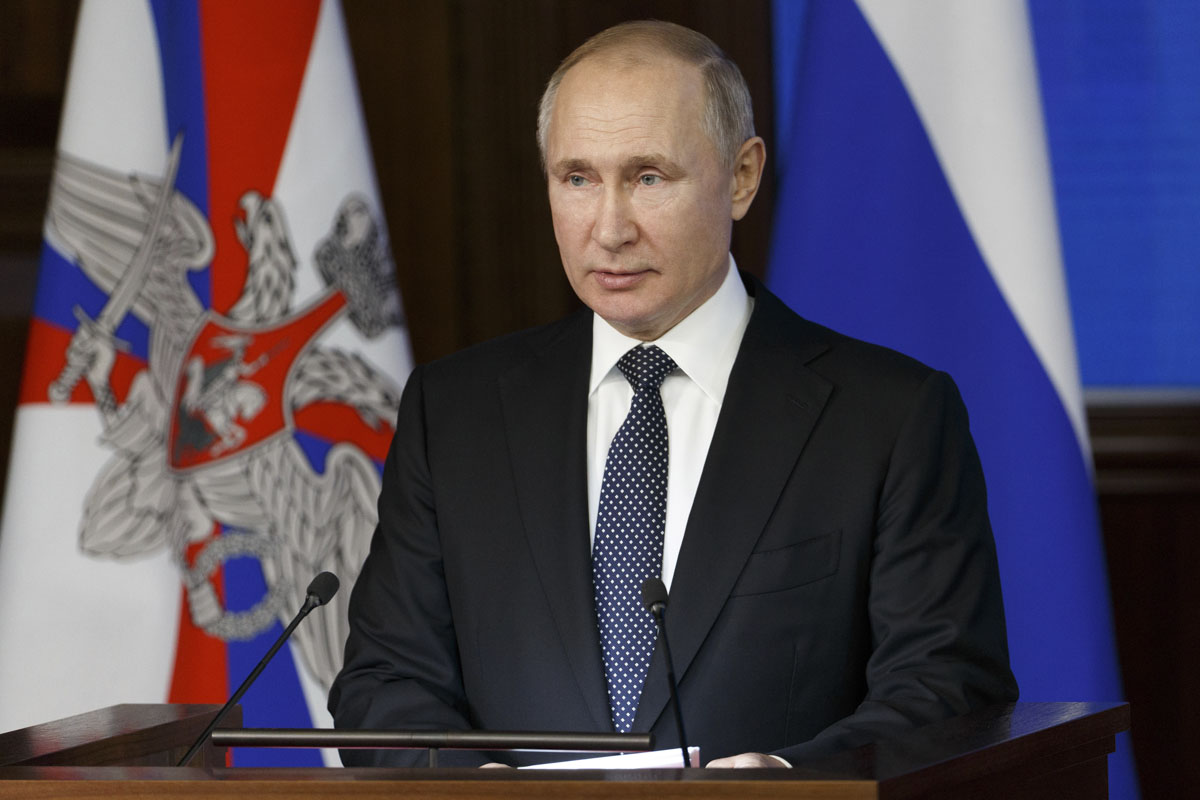
    President Vladimir Putin addressed an expanded meeting of the Russian Defence Ministry Board, Moscow on Dec. 21, 2022

    The defining moment in US President Joe Biden’s press conference at the White House last Wednesday, during President Zelensky’s visit, was his virtual admission that he is constrained in the proxy war in Ukraine, as European allies don’t want a war with Russia. 

    To quote Biden, “Now, you say, ‘Why don’t we just give Ukraine everything there is to give?’  Well, for two reasons. One, there’s an entire Alliance that is critical to stay with Ukraine.  And the idea that we would give Ukraine material that is fundamentally different than is already going there would have a prospect of breaking up NATO and breaking up the European Union and the rest of the world… I’ve spent several hundred hours face-to-face with our European allies and the heads of state of those countries, making the case as to why it was overwhelmingly in their interest that they continue to support Ukraine… They understand it fully, but they’re not looking to go to war with Russia.  They’re not looking for a third World War.”

    Biden realised at that point that “I probably already said too much” and abruptly ended the press conference. He probably forgot that he was dwelling on the fragility of Western unity.

    The whole point is that the western commentariat largely forgets that Russia’s core agenda is not about territorial conquest — much as Ukraine is vital to Russian interests —but about NATO expansion. And that has not changed.

    Every now and then President Putin revisits the fundamental theme that the US consistently aimed to weaken and dismember Russia. As recently as last Wednesday, Putin invoked the Chechen war in the 1990s — “the use of international terrorists in the Caucasus, to finish off Russia and to split the Russian Federation… They [US]claimed to condemn al-Qaeda and other criminals, yet they considered using them on the territory of Russia as acceptable and provided all kinds of assistance to them, including material, information, political and any other support, notably military support, to encourage them to continue fighting against Russia.”

    Putin has a phenomenal memory and would have been alluding to Biden’s careful choice of William Burns as his CIA chief. Burns was Moscow Embassy’s point person for Chechnya in the 1990s! Putin has now ordered a nationwide campaign to root out the vast tentacles that the US intelligence planted on Russian soil for internal subversion. Carnegie, once headed by Burns, has since shut down its Moscow office, and the Russian staff fled to the West!

    The leitmotif of the expanded meeting of the Board of the Defence Ministry in Moscow on Wednesday, which Putin addressed, was the profound reality that Russia’s confrontation with the US is not going to end with the Ukraine war. Putin exhorted the Russian top brass to “carefully analyse” the lessons of the Ukraine and Syrian conflicts.

    Importantly, Putin said, “We will continue maintaining and improving the combat readiness of the nuclear triad. It is the main guarantee that our sovereignty and territorial integrity, strategic parity and the general balance of forces in the world are preserved. This year, the level of modern armaments in the strategic nuclear forces has already exceeded 91 per cent. We continue rearming the regiments of our strategic missile forces with modern missile systems with Avangard hypersonic warheads.”

    Equally, Defence Minister Sergei Shoigu proposed at Wednesday’s meeting a military build-up “to bolster Russia’s security,” including:

    • Creation of a corresponding group of forces in Russia’s northwest to counter Finland and Sweden’s induction as NATO members;
    • Creation of two new motorised infantry divisions in the Kherson and Zaporozhya regions, as well as an army corps in Karelia, facing the Finnish border;
    • Upgrade of 7 motorised infantry brigades into motorised infantry divisions in the Western, Central and Eastern military districts, and in the Northern Fleet;
    • Addition of two more air assault divisions in the Airborne Forces;
    • Provision of a composite aviation division and an army aviation brigade with 80-100 combat helicopters within each combined arms (tank) army;
    • Creation of 3 additional air division commands, eight bomber aviation regiments, one fighter aviation regiment, and six army aviation brigades;
    • Creation of 5 district artillery divisions, as well as super-heavy artillery brigades for building artillery reserves along the so-called strategic axis;
    • Creation of 5 naval infantry brigades for the Navy’s coastal troops based on the existing naval infantry brigades;
    • Increase in the size of the Armed Forces to 1.5 million service personnel, with 695,000 people serving under contract.

    Putin summed up: “We will not repeat the mistakes of the past… We are not going to militarise our country or militarise the economy… and we will not do things we do not really need, to the detriment of our people and the economy, the social sphere. We will improve the Russian Armed Forces and the entire military component. We will do it calmly, routinely and consistently, without haste.”

    If the neocons in the driving seat in the Beltway wanted an arms race, they have it now. The paradox, however, is that this is going to be different from the bipolar Cold War era arms race.

    If the US intention was to weaken Russia before confronting China, things aren’t working that way. Instead, the US is getting locked into a confrontation with Russia and the ties between the two big powers are at a breaking point. Russia expects the US to roll back NATO’s expansion, as promised to the Soviet leadership in 1989.

    The neocons had expected a “win-win” in Ukraine: Russian defeat and a disgraceful end to Putin’s presidency; a weakened Russia, as in the 1990s, groping for a new start; consolidation of western unity under a triumphant America; a massive boost in the upcoming struggle with China for supremacy in the world order; and a New American Century under the “rules-based world order”.

    But instead, this is turning out to be a classic Zugzwang in the endgame — to borrow from German chess literature — where the US is under obligation to make a move on Ukraine but whichever move it makes will only worsen its geopolitical position.

    Biden has understood that Russia cannot be defeated in Ukraine; nor are Russian people in any mood for an insurrection. Putin’s popularity is soaring high, as Russian objectives in Ukraine are being steadily realised. Thus, Biden is getting a vague sense, perhaps, that Russia isn’t exactly seeing things in Ukraine as a binary of victory and defeat, but is gearing up for the long haul to sort out NATO once and for all.

    The transformation of Belarus as a “nuclear-capable” state carries a profound message from Moscow to Brussels and Washington. Biden cannot miss it. (See my blog NATO nuclear compass rendered unavailing, Indian Punchline, Dec. 21, 2022

    Logically, the option open to the US at this point would be to disengage. But that becomes an abject admission of defeat and will mean the death knell for NATO, and Washington’s transatlantic leadership goes kaput. And, worse still, major west European powers — Germany, France and Italy — may start looking for a modus vivendi with Russia. Above all, how can NATO possibly survive without an “enemy”?

    Clearly, neither the US nor its allies are in a position to fight a continental war. But even if they are, what about the emerging scenario in the Asia-Pacific, where the “no limits” partnership between China and Russia has added an intriguing layer to the geopolitics?

    The neocons in the Beltway have bitten more than what they could chew. Their last card will be to push for a direct US military intervention in the Ukraine war under the banner of a “coalition of the willing.” 


    This commentary was published earlier on the author’s website – indianpunchline.com

    Feature Image Credit: Ministry of Defense of the Russian Federation


  • Beyond Unipolarity and the Euro–American Horizons of IR Thought: Reflections on the Emergent World Order

    Beyond Unipolarity and the Euro–American Horizons of IR Thought: Reflections on the Emergent World Order

    Abstract

    Amidst the continuing conflict in Ukraine, Russian President Vladimir Putin made a notable pronouncement of the end of the US-led unipolar world and the rise of multipolar world order. Against this backdrop of the debate on polarity, my research paper seeks to address the following questions. To what extent have global institutions, mainstream IRT (International Relations Theory) and academia as well as policies reflected if not reinforced Euro-American norms and interests? Does this purported shift to multipolarity require a shift in institutional and theoretical practices reflecting the broad concerns of the Global South? Using global and regional case studies like India (especially in regard to the representation within academia and the glass ceiling affecting institutional practices like Young Professionals Programme), I draw from critical and post-colonial theoretical IR frameworks to argue for a comprehensive reform of the prevalent global institutional and theoretical structures. 

    Introduction

    The Euro-American hegemony runs very deep, pervading a range of institutions, norms, global practices, knowledge and even academic teaching practices.

    The month of February this year witnessed one of the most defining moments of the post-Cold war era. Marking a major escalation of the simmering conflict that began with the insurgency in Eastern Ukraine in 2014, Russia invaded Ukraine resulting in thousands of casualties and millions of refugees.[1] This conflict inevitably has given rise to a wide range of debates in the global arena, including global governance, institutions, conflict and security. In this regard, one of the most interesting debates that have seen a resurgence is the question of the future of the world order. 

    The notion of a shift to multipolar world order has emerged as a prominent theme in the wake of this crisis. This is best exemplified by Vladimir Putin in his address to the St Petersburg International Economic Forum Plenary session, “a multipolar system of international relations is now being formed. It is an irreversible process; it is happening before our eyes and is objective in nature.” It is indeed widely recognised that the brief period of unipolarity, dominated by the US, following the end of the Cold War, has given way to the era of multipolar world order, characterised by ‘new powerful and increasingly assertive centres.’ [2] However, even as this shift to multipolarity seems almost deterministic, there persist legitimate questions on the conduciveness of the current world order to the emergence of these multiple power-centres. 

    Against this backdrop, my work shall be organised as follows. I commence with a discussion on the shift towards multipolarity, providing the conceptual capital of notions like power and polarity. This shall be followed by my argument that the current global order, exemplified in its norms, institutions, and intellectual resources, fall severely short of the expectations required of the multipolar world order. To illustrate this point, I draw from the case study of India, in particular. I conclude by providing some prescriptions necessary for the transition to multipolarity to be meaningful. Towards this pursuit, I draw from critical post-colonial theoretical frameworks, employing secondary literature review as the overarching method.

    Shifts towards multipolarity

    Before proceeding to the premise of the shift towards multipolarity, a few conceptual clarifications are in order. Polarity in this context is understood as the modes of distribution of power in the international system. Typically, it is classified as unipolar (e.g. US hegemony in the post-Cold-War era), bipolar (e.g. Russia-US dominance during the Cold War era) and multipolar (e.g. Europe during the pre-World War era). [3] While there are myriad debates on what constitutes power in the global landscape, I draw from the useful typology provided most famously by Joseph Nye – hard, soft, and smart power. Hard power is often described as the typical carrot and stick approach, involving coercion and is often measured in terms of “population size, territory, geography, natural resources, military force, and economic strength.” On the other hand, soft power is described as the ability to influence state preference using intangible attributes like “attractive personality, culture, political values, institutions, and policies” resulting in the perception of legitimacy or moral authority. Smart power is often understood as the instrumental deployment of a combination of both to secure political ends.[4] 

    The end of the Cold War era, prematurely lauded as the end of history by a scholar, resulted in a brief unipolar moment of US hegemony. As Putin puts it, the US was the predominant power with a limited group of allies which resulted in “all business practices and international relations … interpreted solely in the interests of this power.”[2]  However, a range of factors in the twenty-first century led to a crisis in American leadership. The interventionist atrocities carried out in the wake of the September 11 attacks as well as the crisis of global capitalism during the financial crisis of 2008 led to a crisis in American leadership.[5] This period also saw the emergence of new powers like the BRICS nations, who posed a serious challenge to the notion of unipolarity.[3] 

    As Amitav Acharya and Burry Buzan argue, this diffusion of power has resulted in the ‘rise of the rest’ characterised by the absence of a single superpower. Instead, a number of great and regional powers have emerged with their respective institutions and models of growth. Such a world order is also shaped by a greater role accorded to non-state actors including global organisations, corporations, and social movements as well as non-state actors.[6] Thus, the current global landscape is often termed as multipolar, multi-civilizational and multiplex offering myriad opportunities and benefits for states.[7] The crisis in Ukraine has only bolstered this multipolar moment even further. Consider India as a case in point. The likes of the U.S. (and even China) have competed for India’s affection and India’s seemingly pro-Russia stance has not prevented Delhi’s deeper engagement with her counterparts in the West. These initiatives can only enhance India’s great power status, resulting in potentially a higher degree of multipolarity.[8]

    Thus, even as there is an increasing scholarly and policy-based consensus on the shift towards multipolarity, there remain important reservations on whether the current global arena is equipped to deal with the seismic shifts posed by the emergent world order. In other words, does this purported shift to multipolarity require a shift in institutional and theoretical practices reflecting the broad concerns of the Global South? In the next section, I answer in the affirmative, arguing that the dominant norms, institutions, and intellectual resources are broadly skewed towards the preservation of Euro-American hegemony. 

    The maintenance of Euro-American hegemony: norms, institutions, and academia

    The exercise of U.S. hegemonic power involved the projection of a set of norms and their embrace by elites in other nations.

    Drawing from Persaud, I argue that dominant powers forge an “academic/foreign policy/security ‘complex’ dedicated to the maintenance of a hegemonic world order.” [9] Such a complex is constituted by an intricate network of norms, institutions and theoretical/ intellectual practices which seek to uphold the status quo. In this section, I examine each of these aspects in detail.

    Consider norms, in the first instance. Norms can be defined broadly as the “collective expectations for the proper behaviour of actors.”[10] When certain norms which serve certain interests are considered as general interests, it results in hegemony. The dominant powers socialise and hegemonise other countries into an ideological worldview that best serves their interests. In other words, actors have to orient themselves according to a ‘logic of appropriateness’ framed by these intersubjective notions. In the post World War era, the Roosevelt-led US administration projected a series of norms and principles guided by liberal multilateralism, to shape the post-war international order. Such a form of ‘institutional materiality’ posited a clear separation between the political and the economic realm. The embrace of these norms outside the US occurred through various modes of socialisation including external inducement (e.g. Britain and France), direct intervention and internal reconstruction (e.g. Germany and Japan) as well as military and economic dominance.[11] 

    The exercise of U.S. hegemonic power involved the projection of a set of norms and their embrace by elites in other nations. Socialisation did occur since U.S. leaders were largely successful in inducing other nations to buy into this normative order. But the processes through which socialisation occurred varied from nation to nation. In Britain and France, shifts in norms were accomplished primarily by external inducement; in Germany and Japan, they resulted from direct intervention and internal reconstruction. In all cases, the spread of norms of liberal multilateralism was heavily tied to U.S. military and economic dominance. [11]

    Such norms are often manipulated (and flouted) to their advantage. For example, consider the liberal norm of conditional sovereignty, linked to human rights, spearheaded by the likes of the US and many countries in Western Europe. Assuming the primacy of the individual over the state, it has legitimised intervention on ‘humanitarian’ grounds. However, the execution of these norms has been far more uniform as best exemplified in their differential application in the wake of the atrocities in Kosovo and Rwanda. An intra-state conflict resulting in a humanitarian crisis in Kosovo precipitated a successful multilateral intervention. However, the same decisiveness was starkly absent with regard to a similar (if not greater) conflict in Rwanda which resulted in almost 800,000 casualties and more than two million refugees. Multiple studies have traced the rationale of intervention to the “strategic interests in Europe’s future and the NATO alliance.” Rwanda on the other hand was considered peripheral to the national interests of either Western Europe or the US.[12] This substantiates the argument that the norm of ‘humanitarian intervention’ is often tied more to brutal national interests rather than the protection of human rights.

    A range of global norms, ranging from economic norms, dealing with the management of finance, to those dealing with water governance has been shown to be skewed towards the interests of great powers rather than participative in nature.

    Consider another instance. The Liberal International Order (LIO) asserts the concept of ‘conditional sovereignty’ where sovereign nation-states are bound to look after their entire populations. A failure to that end invites interference and comments from other nation-states and external agencies. This norm has been pushed forward and spearheaded by first-world countries like the US and Western Europe, much to their advantage. Contrary to this, the neo-Westphalian order is a proponent of the ‘classical sovereignty’ model where nation-states are sovereign within their own territory to administer in any manner they want, obviously with a necessary reverence to human rights, but others are not authorized to interfere in the same. China and other authoritarian regimes have been advocating for the same. So, while the LIO talks about the equality of every individual, the neo-Westphalian order focuses more on the equality of all nation-states.[13] Similarly, a range of global norms, ranging from economic norms, dealing with the management of finance, to those dealing with water governance has been shown to be skewed towards the interests of great powers rather than participative in nature. 

    Similarly, Cox and Gill have argued how global governance through institutions play a critical role in maintaining hegemony.[14] The multilateral institutions which the US had created both in the political and economic realm have played a critical role in the sustenance of Euro-American (and especially the U.S.) dominance. In other words, even as the international world order shifts to a multipolar one, it has not exactly been accompanied by multilateralism.[15] While multilateralism puts forward the interests of multiple states, most so-called multilateral institutions reflect and reinforce prevailing power configurations. 

    Consider the United Nations, for instance. It cannot be a mere coincidence that the UN has been ineffectual against most of the contemporary global challenges like climate change, the pandemic etc. when it has not been responsive to the reality of the increasing number of power centres in the multipolar world order.[16] The most glaring evidence is the UNSC. Despite an increasing number of voices on the rise of Asia, Africa, and Latin America, the P5 includes only one representative from Asia (which is China) and no members from either Africa or Latin America. In addition, while there has been more than a threefold rise in UN membership, the number of non-permanent seats has only risen from 11 to 15. Even at the administrative levels, the lack of non-western representation is indeed a concern. Besides the absence of a UNSC permanent seat, it is also disheartening to see that it has been years since the Young Professionals Program has been held for the likes of India.

    These same institutions are often undermined by the likes of the US, under the facade of NATO. Consider the harrowing intervention in Libya. The NATO intervention on supposedly ‘humanitarian’ grounds in 2011 led to the death of Muamar Gaddafi, violating the legal structures of the UN charter in the process and resulting in a proxy war. The result has been a prolonged state of near-anarchy characterised by arbitrary detentions, executions, mass killings and kidnappings. [17]

    The WTO is plagued with similar issues. While it ostensibly reflects the ‘global’ norm of neoliberal free trade, it is “structured and ordered to promote monopolistic competition rather than genuine free trade. These institutional roadblocks include the exclusion of developing countries from several informal decision-making sessions, lack of transparency, coercive decision-making in meetings involving developing countries, astronomical costs involved in Dispute settlement Understanding and so on. The result is that the Western countries have an overwhelming advantage against their counterparts from the Global South. [18]

    Lastly, as highlighted earlier, the international policy making apparatus cannot be divorced from the intellectual resources churned by IR academia. Zvobgo, in an insightful piece, has argued how the big three of IR theory – realism, liberalism and constructivism – are built on Eurocentric, raced and racist foundations.[19] The role of imperial policymakers in shaping contemporary IR knowledge has been well acknowledged. Kwaku Danso and Kwesi Aninghave argued about the prevalence of methodological whiteness, which projects White experience as a universal experience.[20] It is no coincidence that the principles of the Westphalian treaty are not significantly different from those underlying the current UN charter. Acharya has argued that racism was integral to the emergence of the US-led world order exemplified in the scant focus on colonialism in UNDHR as well as the “privileging of sovereign equality’ over ‘racial equality.’[21] 

    These forms of methodological whiteness have had devastating impacts across the world. The projection and the forceful projection of the Weberian state as the fundamental unit of security and conflict management has resulted in disastrous policy-level consequences in Africa which have always been characterised by a range of hybrid political systems beyond the nation-state.[20] Similarly, much of the problematic policies carried out today based on the binaries of ‘developed’ v/s ‘developing’ nations have direct continuities with the legacy of empire and race reflected in dichotomies like ‘civilised v/s uncivilised’. 

    There also exists historical amnesia of racism in academia, whether in terms of representation or teaching practices. For example, in the US, only 8% of the faculty identify themselves as Black or Latino. Similarly, the configurations of colonialism and racism in building the modern world order are either glossed over or overlooked in most academia.[19] Indian academia is a case in point. As Behera argues, despite the strong tradition of Indian independent IR thought as well as the long history of colonialism, Indian IR has imbibed a definite set of givens including  “the infallibility of the Indian state modelled after the Westphalian nation-state as well as a thorough internalization of the philosophy of political realism and positivism.[22] Rohan Mukherjee, for instance, has highlighted an unpublished survey of IR faculty within India wherein the majority self-identified as either liberal or realist.[23]

    Thus, the Euro-American hegemony runs very deep, pervading a range of institutions, norms, global practices, knowledge and even academic teaching practices. In the next section, I conclude by outlining certain prescriptions for a future world order which responds to and is far more conducive to the inevitable multipolar shifts. 

    Conclusion

    India has umpteen intellectual resources from Gita and the Sangam literature to stellar modern political philosophers like Gandhi, Tagore and so on, which need to be strategically combined with contemporary IR notions and questions of security, justice and so on.

    This paper first established the backdrop of the shift towards multipolarity within the world order by outlining the myriad modes of power through which the ‘Rest’ has caught up with the ‘West.’ In the succeeding section, I demonstrated how a range of norms, institutions and intellectual practices had been historically constructed to maintain Euro-American hegemony as well as promote the interests of the West. In such a world order, certain parochial interests have masqueraded themselves as common or global interests. In the concluding section, I outline certain prescriptions which have become necessary for a more equitable, multi-civilisational world order. 

    Institutions like the UN require urgent and seismic reforms reflecting the interests of emerging power centres. The number of seats within the Permanent and non-permanent seats must be expanded to include more nation-states from Asia, Africa and Latin America. A revitalisation of the UNGA is highly overdue and requires a focussed and timely debate on the problems of the highest priority at any given time through rationalization of its agenda. [24] Similarly, the proposed WTO reforms, which seeks to move away from multilateralism to impose plurilateralism, should be opposed at all costs. [25]

    As Zvobjo puts it eloquently, how IR is taught perpetuates the inequalities which are detailed above. Besides the dominant IR triumvirate, there needs to be an increased focus on critical perspectives as well as increased engagement with the uncomfortable questions of race, empire, colour, and caste.[19] This should be complemented by more diversity in terms of representation within academia. In India specifically, there needs to be increased efforts to construct Indian or South Asian IR notions. India has umpteen intellectual resources from Gita and the Sangam literature to stellar modern political philosophers like Gandhi, Tagore and so on, which need to be strategically combined with contemporary IR notions and questions of security, justice and so on. However, as Mallavarapu reminds us, care needs to be taken to ensure they can address existing inequities in the world order without succumbing or falling prey to jingoism or nativism.[26]

    References

    [1] Alex Leeds Matthews, Matt Stiles, Tom Nagorski, and Justin Rood, ‘The Ukraine War in data’, Grid, August 4, 2022

    https://www.grid.news/story/global/2022/08/04/the-ukraine-war-in-data-12-million-people-driven-from-their-homes/

    [2] Address to participants of 10th St Petersburg International Legal Forum, President of Russia, June 30, 2022

    http://en.kremlin.ru/events/president/news/68785

    [3]Andrea Edoardo Varisco, ’Towards a Multi-Polar International System: Which Prospects for Global Peace?’, E-International Relations, June 3, 2013.

    https://www.e-ir.info/2013/06/03/towards-a-multi-polar-international-system-which-prospects-for-global-peace/

    [4]Aigerim Raimzhanova, ‘Power in IR: hard, soft and smart’, Institute for Cultural Diplomacy and the University of Bucharest, December 2015

    http://www.culturaldiplomacy.org/academy/content/pdf/participant-papers/2015-12_annual/Power-In-Ir-By-Raimzhanova,-A.pdf

    [5]Ashraf, N. (2020). Revisiting international relations legacy on hegemony: The decline of American hegemony from comparative perspectives. Review of Economics and Political Science

    [6] Kukreja, Veena. “India in the Emergent Multipolar World Order: Dynamics and Strategic Challenges.” India Quarterly 76, no. 1 (2020): 8-23.

    [7] Ashok Kumar Beheria, ‘Ask an Expert’, IDSA, April 1, 2020. 

    https://idsa.in/askanexpert/world-moving-towards-multipolarity-akbehuria

    [8]Derek Grossman, ‘Modi’s Multipolar Moment Has Arrived’, RAND blog, June 6, 2022

    https://www.rand.org/blog/2022/06/modis-multipolar-moment-has-arrived.html

    [9]Persaud, Randolph B. “Ideology, socialization and hegemony in Disciplinary International Relations.” International Affairs 98, no. 1 (2022): 105-123.

    [10]Shannon, Vaughn P. “International Norms and Foreign Policy.” Oxford Research Encyclopedia of Politics (2017).

    [11]Ikenberry, G. John, and Charles A. Kupchan. “Socialization and hegemonic power.” International organization 44, no. 3 (1990): 283-315.

    [12] Tracy Kuperus, ‘Kosovo And Rwanda: Selective Interventionism?’, Centre for Public Justice

    https://www.cpjustice.org/public/page/content/kosovo_and_rwanda

    [13] Falit Sijariya, ‘Democratizing Norms: Jaishankar’s Comments and the Challenge to US Hegemony’, April 22, 2022

    https://thegeopolitics.com/democratizing-norms-jaishankars-comments-and-the-challenge-to-us-hegemony/

    [14] Overbeek, Henk. “Global governance, class, hegemony.” Contending Perspectives on Global Governance: Coherence and Contestation 39 (2005).

    [15] Tourangbam, Monish. “The UN and the Future of Multilateralism in a Multipolar World.” Indian Foreign Affairs Journal 14, no. 4 (2019): 301-308.

    [16] The UN Turns Seventy-Five. Here’s How to Make it Relevant Again, Council on Foreign Relations, Sep 14, 2020.

    https://www.cfr.org/councilofcouncils/global-memos/un-turns-seventy-five-heres-how-make-it-relevant-again

    [17] Ademola Abbas, ‘Assessing NATO’s involvement in Libya’, United Nations University, 27 October 2011

    https://unu.edu/publications/articles/assessing-nato-s-involvement-in-libya.html

    Lansana Gberi, ‘Forgotten war: a crisis deepens in Libya but where are the cameras?’, Africa Renewal, December 2017 – March 2018

    https://www.un.org/africarenewal/magazine/december-2017-march-2018/forgotten-war-crisis-deepens-libya-where-are-cameras

    [18] Ed Yates, ‘The WTO Has Failed as a Multilateral Agency in Promoting International Trade’,E-International Relations, April 29, 2014

    https://www.e-ir.info/2014/04/29/the-wto-has-failed-as-a-multilateral-agency-in-promoting-international-trade/

    [19] Kelebogile Zvobgo, ‘Why Race Matters in International Relations’, Foreign Policy, June 19, 2020

    https://foreignpolicy.com/2020/06/19/why-race-matters-international-relations-ir/

    [20]Danso, Kwaku, and Kwesi Aning. “African experiences and alternativity in International Relations theorizing about security.” International Affairs 98, no. 1 (2022): 67-83.

    [21]Acharya, Amitav. “Can Asia lead? Power ambitions and global governance in the twenty-first century.” International affairs 87, no. 4 (2011): 851-869.

    [22]Behera, Navnita Chadha. “Re-imagining IR in India.” In Non-Western international relations theory, pp. 102-126. Routledge, 2009.

    [23]Rohan Mukherjee https://mobile.twitter.com/rohan_mukh/with_replies

    [24]United Nations Reform: Priority Issues for Japan, Ministry of Foreign Affairs Japan, January 2006

    https://www.mofa.go.jp/policy/un/reform/priority.html

    [25]Abhijit Das, ‘Reform the WTO: do not deform it’, the Hindu Business Line, December 1, 2021

    https://www.thehindubusinessline.com/opinion/reform-the-wto-do-not-deform-it/article37792701.ece

    [26]Shahi, Deepshikha, and Gennaro Ascione. “Rethinking the absence of post-Western International Relations theory in India:‘Advaitic monism’as an alternative epistemological resource.” European Journal of International Relations 22, no. 2 (2016): 313-334.

    Feature Image Credits: Foreign Affairs

  • TPF Analysis Series on Russia – Ukraine Conflict #2

    TPF Analysis Series on Russia – Ukraine Conflict #2

    [powerkit_button size="lg" style="info" block="true" url="https://admin.thepeninsula.org.in/2022/03/29/tpf-analysis-series-on-russia-ukraine-conflict/" target="_blank" nofollow="false"]
    The First Paper of the Series – TPF Analysis Series on Russia – Ukraine Conflict #1
    [/powerkit_button]

    What’s in Ukraine for Russia? 

    In a press conference marking his first year in office, President Biden, on the question of Russia invading Ukraine, remarked that such an event would, “be the most consequential thing that’s happened in the world, in terms of war and peace, since World War Two”. [1] It has now been two months since Russia officially launched its “special military operation” in Ukraine, which the US and its allies consider an unjustified invasion of a sovereign state. The conflict in the Eurasian continent has drawn global attention to Europe and US-Russia tensions have ratcheted to levels that were prevalent during the Cold War. The conflict has also raised pertinent questions on understanding what exactly are Russian stakes in Ukraine and the latter’s role in the evolving security architecture of Europe. The second paper in this series will delve into these questions.

    The current Russian position stems from the experience that Russia, and Putin, gained while dealing with the West on a host of issues, not least of which was NATO expansion.

    The Ties that Bind

    An examination of post-Soviet history reveals that Russian preoccupation with security threats from NATO is not embedded in Russian geopolitics; instead, it has been reported that, early on, Russia was even agreeable to joining the military alliance. The current Russian position stems from the experience that Russia, and Putin, gained while dealing with the West on a host of issues, not least of which was NATO expansion. A line of argument sympathetic to Russia is President Putin’s contention that terms dictated to Russia during the post-Cold War settlements were unfair. The claim is a reference to Secretary of State James Baker’s statement on the expansion of NATO, “not an inch of NATO’s present military jurisdiction will spread in an eastern direction”, in 1990 in a candid conversation with Mikhael Gorbachev on the matter of reunification of Germany. [2] It could be argued that it is this commitment and subsequent violation through expansions of NATO is one of the main causes of the current conflict. 

    At the root of the problem was Russia’s security concerns – regarding both traditional and hybrid security – that ultimately led to the centralisation of power after a democratic stint under Yeltsin. Accordingly, Putin had put it in late 1999, “A strong state for Russia is not an anomaly, or something that should be combated, but, on the contrary, the source and guarantor of order, the initiator and the main driving force of any changes”. [3]

    Historically being a land power, Russia has viewed Ukraine as a strategically critical region in its security matrix. However, as the central control of Moscow weakened in the former USSR, the nationalist aspirations of the Ukrainian people began to materialise and Ukraine played a crucial role, along with the Russian Federation and Belarus, in dissolving the former Soviet Union. The two countries found themselves on opposite sides on extremely fundamental issues, such as security, economic partnership, post-Soviet order, and, not least, sovereignty. In Belovezh, in early December of 1991, when Russian President Boris Yeltsin, Ukrainian President Leonid Kravchuk and Belarusian leader Stanislav Shushkevich met to dissolve the USSR, major disagreements regarding the transitional phase and future of the republics erupted. Yeltsin expressed his desire for some sort of central control of the republics, whereas Kravchuk was vehemently opposed to any arrangement that might compromise his country’s sovereignty. Later, at the foundational ceremony of the Commonwealth of Independent States (CIS), he stressed a common military, the most potent rejection of which came from Kravchuk. [4]

    Source: Wikimedia Commons

    The elephant in the room, however, was the status of Sevastopol, which housed the headquarters of the Black Sea Fleet. Yeltsin was quoted saying that “The Black Sea Fleet was, is and will be Russia’s. No one, not even Kravchuk will take it away from Russia”. [5] Though the issue was soon temporarily resolved –with the two countries dividing the fleet equally amongst themselves, it continued to dominate and sour their relationship. Russia, as the successor state of the USSR, wanted the base and the entire fleet in its navy. Yeltsin even offered gas at concessional rates to Ukraine if it handed over the city and nuclear weapons to Russia. The issue remained unresolved until the 1997 Friendship Treaty under which Ukraine granted Moscow the entire fleet and leased Sevastopol to Russia until 2017 (later extended).

    Ukraine, under Kravchuk and, later, Leonid Kuchma, struggled to tread a tightrope between Russia and the European Union. On one hand, it was economically knit with former Soviet Republics, and on the other, it was actively looking to get economic benefits from the EU. However, soon a slide towards the west was conspicuous. In 1994, it preferred a Partnership and Cooperation Agreement with the EU over CIS Customs Union, which was a Russian initiative. Later, in 1996, it declined to join a new group consisting of former Soviet Republics ‘On Deepening Integration’, scuttling the initiative, since its purpose was to bring Ukraine back into the Russian fold. [6] By 1998, the Kuchma government had formulated a ‘Strategy of Integration into the European Union’. [7]

    Nuclear weapons were another point of contention between the two. Ukraine was extremely reluctant to give up its arsenal, citing security threats from Russia. Kravchuk received a verbal ‘security guarantee’ from the US which forced Russia to “respect the independence, sovereignty, and territorial integrity of each nation” [8] in exchange for surrendering Ukraine’s nuclear weapons. 

    Notwithstanding the disputes, there was a great deal of cooperation between the two, especially after Kuchma’s re-election in 1999. Kuchma’s hook-up with authoritarianism distanced Kyiv from Brussels and brought it closer to Moscow. Ukraine agreed to join Russian initiatives of the Eurasian Economic Community as an observer and Common Economic Space as a full member. At home as well, his support in the eastern parts of the country, where ethnic Russians dwelled, increased dramatically, as evident in the 2002 Parliamentary Elections. [9] However, the bonhomie was soon disrupted by a single event.

    The Orange Revolution was Russia’s 9/11. [10] It dramatically altered Russian thinking on democracy and its ties with the West. It raised the prospect in Russia that Ukraine might be lost completely. It further made them believe the colour revolutions in former Soviet republics were CIA toolkits for regime change. More importantly, it made the Russians apprehensive of a similar revolution within their borders. As a result, the distrust between Russia and the West, and Russia and Ukraine grew considerably. As a nationalist, Victor Yushchenko formulated policies that directly hurt Russian interests. The two countries fought ‘Gas Wars’ in 2006 and 2009, which made both the EU and Russia uncomfortable with Ukraine as a gas transit country. Furthermore, Yushchenko bestowed the title of ‘Hero of Ukraine’ upon Stepan Bandera, a Nazi collaborator and perpetrator of the Holocaust, a decision that surely did not go well with Moscow.

    Geoeconomics: Ukraine as a Gas Transit Country

    The current war is the worst in Europe since the Second World War. Still, Ukraine continues to transit Russian gas through its land, Russia continues to pay for it, and Western Europe continues to receive the crucial resource. The war has shattered all the big bets on Russian dependence on Ukraine for delivering gas to Western Europe and has renewed the discourse on reducing European energy dependence on Russia. Since the EU imports 40% of its gas from Russia, almost a quarter of which flows through Ukraine, Kyiv has had leverage in dealing with Russians in the past. It has been able to extract favourable terms by either stopping or diverting gas for its own domestic use at a time of heightened tensions between Ukraine and Russia. As a result, the EU was directly drawn into the conflict between them, infructuating Moscow’s pressure tactics for a long.

    Moscow has made numerous attempts in the past to bypass Ukraine by constructing alternate pipelines. Nord Stream, the most popular of them, was conceived in 1997, as an attempt to decrease the leverage of the transit states. The pipeline was described as the “Molotov-Ribbentrop Pipeline” by Polish Defence Minister Radoslaw Sirkosi for the geoeconomic influence it gave to Russia. [11] Another project – the South Stream – was aimed at providing gas to the Balkans, and through it to Austria and Italy. The pipeline was conceived in the aftermath of the Orange Revolution and its construction was motivated by geoeconomics, rather than economic viability. It would have led to Russia bypassing Ukraine in delivering gas to the Balkans and Central Europe, thus seizing its significant leverage, and relegating it to vulnerable positions in which Moscow could have eliminated the gas subsidies Ukraine was being provided. [12]As a result of economic unviability, the project was abandoned in 2014.

    To a certain extent, the European Union has been complicit in making matters worse for Russia. For instance, during the 2009 ‘Gas War’ – that began due to Ukraine’s non-payment of gas debt to Russia – instead of holding Ukraine accountable, the EU countries blamed Russia for the gas crisis in Europe and asked Russia to resume gas supply to Ukraine. Later, realising the importance of Ukraine as a transit country, it reached an agreement with Kyiv that “recognized the importance of the further expansion and modernization of Ukraine’s gas transit system as an indispensable pillar of the common European energy infrastructure, and the fact that Ukraine is a strategic partner for the EU gas sector”. The agreement excluded Russia as a party, which saw it as undermining the collaboration between itself and Ukraine, and injuring its influence on the country. [13] The Russian grievance becomes even more palpable when we view the significant gas subsidies it has provided to Ukraine for more than two decades. 

    Similarly, the EU countries viewed Nord Stream 2 from a geostrategic and geo-economic perspective. In December last year, German Economic Affairs Minister Robert Habeck warned Russia of halting Nord Stream 2 if it attacks Ukraine. German Chancellor Olaf Scholz was quoted saying that he would do ‘anything’ to ensure that Ukraine remains a transit country for Russian gas. [14] In fact, the pipeline – that is set to double the capacity of gas delivered to the EU – has faced opposition from almost all Western European countries, the US, the EU as well as Ukraine, which has described it as ‘A dangerous Geopolitical Weapon’. [15] The pipeline had raised concerns amongst Ukrainians of losing a restraining factor on Moscow’s behaviour. [16] However, with the pipeline still inoperable, the Kremlin has already made the restraining factor ineffective.

    The Security Objective

    The Russian Federation is a country which spreads from the European Continent to Asia. In this giant nation, the hospitable region where people live is mainly on the European side, which also comprises main cities like St. Petersburg, Volgograd and the Capital City Moscow. Throughout history, Russia has seen invasions by Napoleon as well as Hitler, and the main area through which these invasions and wars happened was through Ukrainian land which gave them direct access to Russia – due to the lack of any geographical barriers. It was certainly a contributing factor towards the initial success of these invasions. Today, we might understand these events as Russia’s sense of vulnerability and insecurity if history is any indicator. 

    The Russian Federation also follows a similar approach to ensuring its security, survival and territorial integrity. Russia’s interest in Ukraine is as much geopolitical as cultural. Since Russians and Ukrainians were intrinsically linked through their culture and language, Ukraine quickly came to be seen as Russian land, with Ukrainians being recognized as ‘Little Russians’ (Kubicek, 2008), as compared to the “Great Russians”. They were consequently denied the formation of a distinct Ukrainian identity. Putin gave substance to this sentiment as, according to a US diplomatic cable leak, he had “implicitly challenged the territorial integrity of Ukraine, suggesting that Ukraine was an artificial creation sewn together from the territory of Poland, the Czech Republic, Romania, and especially Russia in the aftermath of the Second World War” during a Russia-NATO Council meeting. [17]

    Crimea and much of eastern Ukraine are ethnically Russian and desire closer ties with Russia. But moving further west, the people become increasingly cosmopolitan and it is mostly this population that seeks greater linkage with the Western European countries and membership into the EU and NATO. This in addition to the Euro Maidan protests is what Putin has used to justify the annexation of Crimea in 2014. The other security consideration was the threat it faced from the likelihood of NATO establishing a base in Crimea given its own presence in Sevastopol in the Black Sea. 

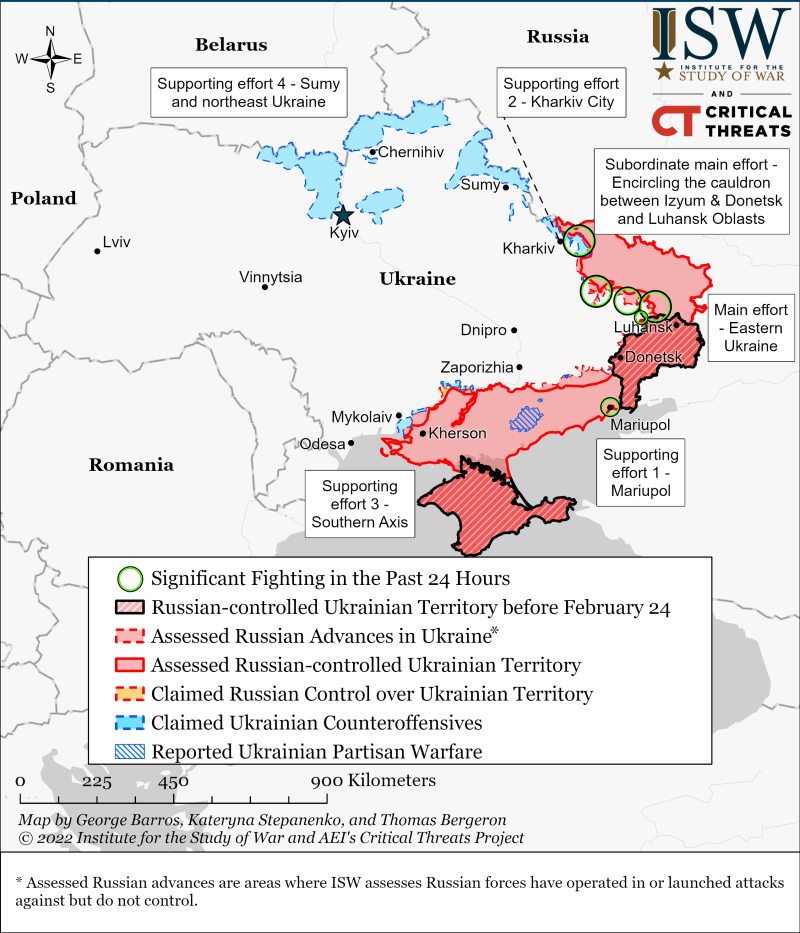
    In the current scenario, the second phase of Russian Military operation in the East and South has shown us the larger vulnerabilities Moscow has which are being countered through control of certain points in the region. By liberating the Donbass region in the east, Russia plans to create a buffer zone between itself and the west to stop future aggression and keep enemies at bay. But the extension of this buffer zone all the way to Odessa is indicative of other strategic considerations. Mariupol in the south of Ukraine is one of the many extended strategic points Russia now controls leading us to ask just why Mariupol is a game-changer in this conflict?

    The port city of Mariupol is a small area geographically, but it provides the land bridge for the Russian forces in the Crimean Peninsula to join the Military operation in the Donbas region. Moreover, it gives Russia a land bridge to Crimea from the Russian Mainland. According to General Sir Richard Barrons, former Commander of UK Joint Forces Command, Mariupol is crucial to Russia’s offensive movement, – “When the Russians feel they have successfully concluded that battle, they will have completed a land bridge from Russia to Crimea and they will see this a major strategic success.” [18]

    Source: ISW (Assessment on 09 May, 2022)

    If the port city of Mariupol is important for the creation of a land corridor, then the Sea of Azov which is adjacent to it is even more important due to its strategic position. [19] The three geopolitical reasons why this sea is important are as follows:

    1. The Sea of Azov is a major point for the economic and military well-being of Ukraine. Proximity to the frontlines of the Donbass region where the fighting between Ukrainian forces and Pro-Russian separatists is taking place makes the control of this sea vital to the Russian military as it helps weaken Ukrainian defence in the region via control of the Kerch Strait.
    2. Controlling the Sea of Azov is strategically important for Russia, to maintain its control in the Crimean Peninsula, which allows Moscow to resupply its forces through the Strait of Kerch.
    3. Finally, it also involves Eurasian politics into why Russia needs to control this region and here the discussion of the Volga-Don canal which links the Caspian Sea with the Sea of Azov comes to the fore. Russia has always used this canal to move warships between the Caspian Sea to the Black Sea and project its power in both regions. Moreover, Russia sees this connection as a significant strategic advantage in any future crisis.

    If Mariupol and the Sea of Azov are considered the most important strategically valuable features by Russia, there also exists the crucial points of Kherson and Odessa which will give Russia complete dominance of the Ukrainian coast line, thus giving larger access and control in the Black Sea region that has the potential to be militarised in the future in conflicts with the West. Moreover, it gives Russia a land corridor to Transnistria which is a Pro-Russian separatist area in Moldova and an opening into the Romanian border through Odessa, thus balancing the build-up of NATO forces in the region. 

    Conclusion

    The Ukrainian crisis is as much the West’s doing as Russia’s and an ear sympathetic to the Russian narrative might even say that the West took advantage of Russia when it was vulnerable immediately following the collapse of the Soviet Union in negotiations regarding the German state reunification and NATO enlargement.

    The bottom line is that, presently, Putin views NATO as an existential security threat to the Russian state and sees the US and its allies’ support of Ukraine as a challenge. Ukraine’s membership in the EU and NATO is a non-starter for Russia and pitting a Ukraine, that has a symbiotic relationship with Russia at all levels, against a slightly diminished but still formidable great power will have consequences for the security architecture and geopolitics of the region.  The Ukrainian crisis is as much the West’s doing as Russia’s and an ear sympathetic to the Russian narrative might even say that the West took advantage of Russia when it was vulnerable immediately following the collapse of the Soviet Union in negotiations regarding the German state reunification and NATO enlargement. On some level, NATO countries recognize the fact that Ukraine and Georgia can never be allowed membership into the North Atlantic alliance because the alternative of wilfully ignoring Russia’s security and national interests is just a recipe for disaster and might just launch the region into the single biggest armed conflict since World War 2. 

    References:

    [1] The White House. (2022, January 20). Remarks by president Biden in the press conference. https://www.whitehouse.gov/briefing-room/speeches-remarks/2022/01/19/remarks-by-president-biden-in-press-conference-6/

    [2] Savranskaya, S., Blanton, T. S., & Zubok, V. (2010). Masterpieces of history: The peaceful end of the Cold War in Europe, 1989. Central European University Press.

    [3] Putin, Vladimir. “Rossiya na Rubezhe Tysyacheletii,” Nesavisimaya Gazeta, December 30, 1999, quoted in D’Anieri, Paul (2019). Ukraine and Russia: From Civilized Divorce to Uncivil War. Cambridge University Press.

    [4] Ibid

    [5] Rettie, J. and James Meek, “Battle for Soviet Navy,” The Guardian, January 10, 1992

    [6] Ibid, no. iii

    [7] Solchanyk, R., Ukraine and Russia: The Post-Soviet Transition. Rowman and Littlefield Publishers. 2000.

    [8] Goldgeier, J. and Michael McFaul. “Power and Purpose: U.S. Policy Toward Russia after the Cold War”, Brookings Institution Press, 2003

    [9] Ibid, no. iii

    [10]  The comment was made by Gleb Pavlovskii, a Russian Political Scientist. quoted in Ben Judah (2013), Fragile Empire: How Russia Fell In and Out of Love with Vladimir Putin. New Haven, CT: Yale University Press, p. 85.

    [11] Ibid, no. iii

    [12] Wigell, M. and  A. Vihma, Geopolitics versus geoeconomics: the case of Russia’s geostrategy and its effects on the EU. International Affairs, 92: 605-627. May 6, 2016

    [13] Ibid, no. iii

    [14] Harper, J. (2021, December 23). Nord stream 2: Who wins, who loses? Deutsche Welle. https://www.dw.com/en/nord-stream-2-who-wins-who-loses/a-60223801

    [15] Ukraine: Nord stream 2 a ‘dangerous geopolitical weapon’. (2021, August 22). DW.COM. https://www.dw.com/en/ukraine-nord-stream-2-a-dangerous-geopolitical-weapon/a-58950076

    [16] Pifer, S. “Nord Stream 2: Background, Objectives and Possible Outcomes”, Brookings, April 2021 https://www.brookings.edu/research/nord-stream-2-background-objections-and-possible-outcomes/

    [17] WikiLeaks. (2008, August 14). UKRAINE, MAP, AND THE GEORGIA-RUSSIA CONFLICT, Canonical ID:08USNATO290_ahttps://wikileaks.org/plusd/cables/08USNATO290_a.html

    [18] Gardner, F. (2022, March 21). Mariupol: Why Mariupol is so important to Russia’s plan. BBC News. https://www.bbc.com/news/world-europe-60825226

    [19] Blank, S. (2018, November 6). Why is the Sea of Azov so important? Atlantic Council. https://www.atlanticcouncil.org/blogs/ukrainealert/why-is-the-sea-of-azov-so-important/

    Featured Image Credits: Financial Times

    [powerkit_button size="lg" style="info" block="true" url="https://admin.thepeninsula.org.in/2022/03/29/tpf-analysis-series-on-russia-ukraine-conflict/" target="_blank" nofollow="false"]
    TPF Analysis Series on Russia – Ukraine Conflict #1
    [/powerkit_button]

  • Divided World: The UN Condemnation of Russia is endorsed by Countries run by the richest, oldest, Whitest people on Earth but only 41% of the World’s population

    Divided World: The UN Condemnation of Russia is endorsed by Countries run by the richest, oldest, Whitest people on Earth but only 41% of the World’s population

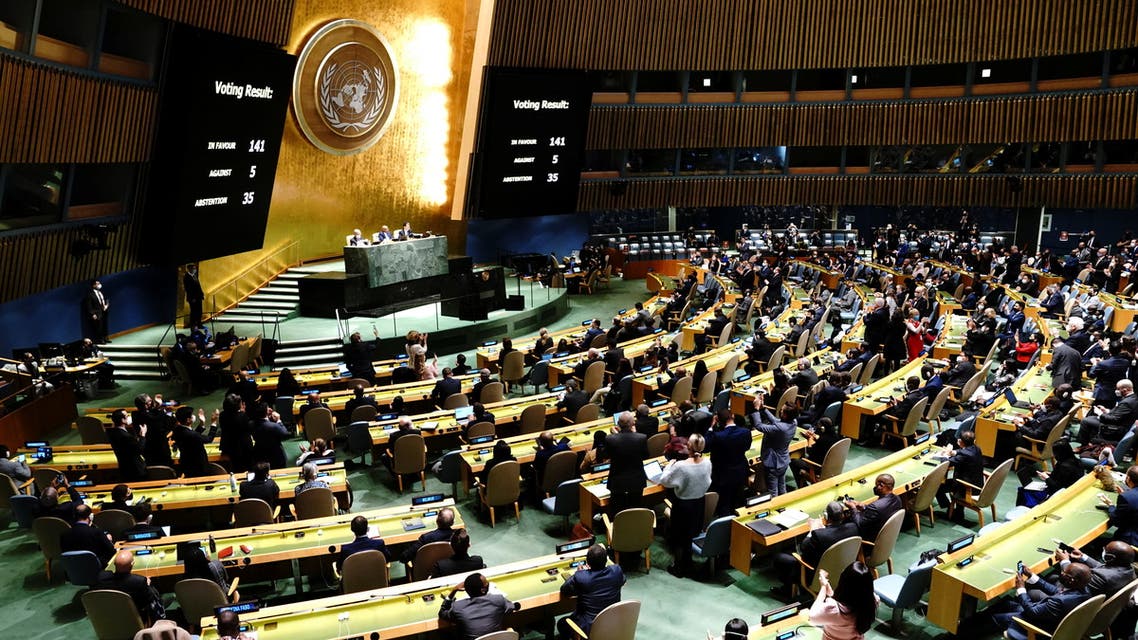
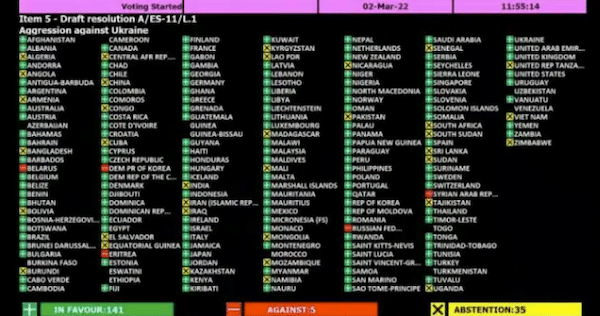
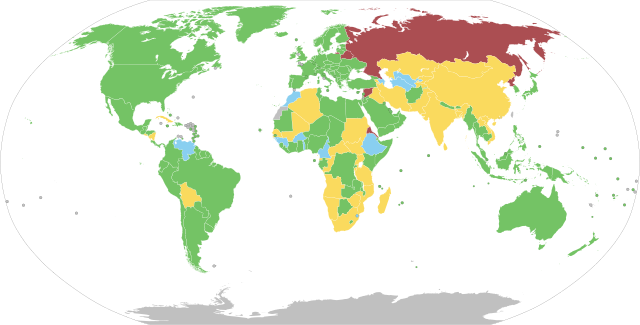
    On March 2 of this year the UN General Assembly met in an Emergency Session to pass a non-binding resolution condemning Russia’s February 24 intervention in Ukraine.1 141 countries voted for the resolution, 5 voted against, 35 abstained, and 12 did not vote. (Reported: Guardian, Al Jazeera, iNews)

    although the war is nominally a conflict between two developed and ethnically white nations, Russia and Ukraine, this UN vote suggests the war may be viewed by much of the world as a fight over the global political and economic system that institutionalizes the imperial hierarchy, the distribution of nations between rich and poor, and global white supremacy


    In the absence of any reliable opinion poll of the world’s 7.9 billion people, this vote may indicate that the majority of humanity sympathizes with Russia in Ukraine. The statistics presented below show that only 41% of the world’s people live in countries that joined the U.S. in voting for the UN resolution.

    This lopsided vote is even more striking if you consider the demographics. Populations represented by governments that did not vote for the resolution are much more likely to include the world’s poorest nations, nations with younger populations, “nations of color,” nations of the Global South, and nations in the periphery of the world economic system.

    To put it another way, although the war is nominally a conflict between two developed and ethnically white nations, Russia and Ukraine, this UN vote suggests the war may be viewed by much of the world as a fight over the global political and economic system that institutionalizes the imperial hierarchy, the distribution of nations between rich and poor, and global white supremacy.


    The UN vote by population

    41% or 34% amounts to a resounding, humiliating defeat for the U.S. on this non-binding UN resolution. Instead it is reported in the west as a U.S. victory and an “overwhelming” worldwide condemnation of Russia.

    Of the world’s 7,934,000,000 people, 59% live in countries that did not support the resolution and only 41% live in countries that did.2 But that last figure drops to 34% outside of the immediate belligerents and their allies: Ukraine, U.S., and NATO countries, and on the other side, Russia, Armenia, Belarus, Kazakhstan, Kyrgystan, and Tajikistan (all the countries of the Collective Security Treaty Organization).

    41% or 34% amounts to a resounding, humiliating defeat for the U.S. on this non-binding UN resolution. Instead it is reported in the west as a U.S. victory and an “overwhelming” worldwide condemnation of Russia.

    The UN vote and GDP per capita

    All the countries in the top third of the GDP per capita (nominal) rankings, including Japan and all the countries of Western Europe and North America, voted for the resolution, Venezuela being the only country in the top third that did not.

    Of the countries that did not vote for the resolution, most are ranked the poorest in the world, and almost none came above the approximate midpoint rank of 98. The exceptions were: Venezuela (58), Russia (68), Equatorial Guinea (73), Kazakhstan (75), China (76) Cuba (82), Turkmenistan (92), South Africa (95), Belarus (97).3

    The UN vote and the core/periphery divide

    Another way to show the wealth divide in the UN vote is by distinguishing core and peripheralcountries. In world-systems theory the surplus value of labor flows disproportionately to the core countries: “The countries of the world can be divided into two major world regions: the ‘core’ and the ‘periphery.’ The core includes major world powers and the countries that contain much of the wealth of the planet. The periphery has those countries that are not reaping the benefits of global wealth and globalization.” (Colin Stief, ThoughtCo.com, 1/21/20)

    The countries usually considered in the core are: Australia, Austria, Belgium, Canada, Denmark, Finland, France, Germany, Greece, Iceland, Ireland, Italy, Japan, Luxembourg, Netherlands, New Zealand, Norway, Portugal, Singapore, Spain, Sweden, Switzerland, United Kingdom, United States.

    The difference here is stark. Every single core country voted for the resolution and every country that did not is either in the periphery or in some cases, like Russia or China, in the semi-periphery.


    The UN vote and median age

    All the countries ranked in the top third of median age rankings, from Monaco (51.1 years) to Iceland (36.5 years), voted for the resolution, with the following exceptions: China (37.4), Russia (39.6), Belarus (40), Cuba (41.5).

    Of the twenty entries with the lowest median ages (15.4 to 18.9), only half voted for the resolution.

    The UN vote and “countries of color”

    Of the 7,934,000,000 people in the world, 1,136,160,000 live in what are usually recognized as “white countries” (consistently or not) with about 14% of the world’s population. Yet “white countries,” by population, represent about 30% of the total vote in favor of the resolution. This “white vote” accounts for every one of the core countries (except Singapore and Japan). Compare: 97% of the population in the countries that did not vote for the resolution live in “countries of color.” Only Russia, Belarus and Armenia (which did not vote for the resolution) have dominant populations classed as “white.”

    Therefore “white countries” are overrepresented in the group that voted for the resolution (30% vs. 14%), and underrepresented in the group that did not (3% vs. 14%).

    Before the intervention

    What follows is a brief sketch of events leading to the February 24 Russian intervention that prompted the UN resolution. It is a history seldom mentioned in the mainstream media, though it is easily found in selected alternative and now-suppressed media. It is presented here as a possible, partial explanation of why the UN resolution had so little support measured by population.

    U.S./NATO has directed aggression toward Russia for decades, advancing NATO forces ever closer to Russia’s western border, ringing Russia with military bases, placing nuclear weapons at ever closer range, and breaching and discarding treaties meant to lessen the likelihood of nuclear war. The U.S. even let it be known, through its planning documents and policy statements, that it considered Ukraine a battlefield on which Ukrainian and Russian lives might be sacrificed in order to destabilize, decapitate and eventually dismember Russia just as it did Yugoslavia. Russia has long pointed out the existential security threat it sees in Ukrainian territory, and it has made persistent, peaceful, yet fruitless efforts over decades to resolve the problem (See Monthly Review’s excellent editors’ note).

    Recent history includes the 2014 U.S.-orchestrated coup in Ukraine, followed by a war of the central government against those in the eastern regions of Donetsk and Lugansk resisting the coup government and its policies. Those policies include a ban on the Russian language, the native tongue of the region and a significant part of the country (ironically, including President Zelensky).

    By the end of 2021 the war had taken 14,000 lives, four-fifths of them members of the resistance or civilian Russian speakers targeted by the government. Through years of negotiations Russia tried and failed to keep the Donetsk and Lugansk regions inside a united Ukraine. After signing the Minsk agreements that would do just that, Ukraine, under tight U.S. control, refused to comply even with step one: to talk with the rebellion’s representatives.

    As to why the intervention happend now, Vyacheslav Tetekin, Central Committee member of Russia’s largest opposition party, the Communist Party of the Russian Federation, explains:

    Starting from December, 2021 Russia had been receiving information about NATO’s plans to deploy troops and missile bases in Ukraine. Simultaneously an onslaught on the Donetsk (DPR) and Lugansk People’s Republics (LPR) was being prepared. About a week before the start of Russia’s operation the plan was uncovered of an offensive that envisaged strikes by long-range artillery, multiple rocket launchers, combat aircraft, to be followed by an invasion of Ukrainian troops and Nazi battalions. It was planned to cut off Donbas from the border with Russia, encircle and besiege Donetsk, Lugansk and other cities and then carry out a sweeping “security cleanup” with imprisonment and killing of thousands of defenders of Donbas and their supporters. The plan was developed in cooperation with NATO. The invasion was scheduled to begin in early March. Russia’s action pre-empted Kiev and NATO, which enabled it to seize strategic initiative and effectively save thousands of lives in the two republics.

    All this may have informed the world’s overwhelming rejection of the U.S.-backed UN resolution condemning Russia, which western media perversely considers a U.S. victory simply because the resolution passed. Never mind that it passed in a voting system where Liechtenstein’s vote carries the same weight as China’s.

    The Global South also knows from bitter experience that unlike the West, neither Russia nor its close partner China habitually engage in bombings, invasions, destabilization campaigns, color revolutions, coups and assassinations against the countries and governments of the Global South. On the contrary, both countries have assisted the development and military defense of such countries, as in Syria, Venezuela, Nicaragua, Cuba, Iran and elsewhere.

    Conclusion

    Just as the imperial core of North America, Europe and Japan does not represent the world in their population numbers, demographics, wealth, or power, neither does the imperial core speak for the world on crucial issues of war, peace, justice, and international law. Indeed the Global South has already spoken to the Global North so many times, in so many ways, with patience, persistence and eloquence, to little avail. Since we in the North have not been able to hear the words, perhaps we can listen to the cry of the numbers.


    Notes:

    1. The resolution “Deplores in the strongest terms the aggression by the Russian Federation against Ukraine in violation of Article 2 (4) of the Charter.” (Article 2 (4) reads: “All Members shall refrain in their international relations from the threat or use of force against the territorial integrity or political independence of any state, or in any other manner inconsistent with the Purposes of the United Nations.”) The resolution also “[d]eplores the 21 February 2022 decision by the Russian Federation related to the status of certain areas of the Donetsk and Luhansk regions of Ukraine as a violation of the territorial integrity and sovereignty of Ukraine and inconsistent with the principles of the Charter.” Beyond Russia, the resolution “[d]eplores the involvement of Belarus in this unlawful use of force against Ukraine, and calls upon it to abide by its international obligations.”
    2. The population of countries voting for the UN resolution is 3,289,310,000. The population of countries voting against the resolution, abstaining, or not voting is 4,644,694,000 (Against: 202,209,000; abstaining: 4,140,546,000; not voting: 301,939,000).
    3. Here are the countries that did not vote for the resolution, with their GDP per capita rankings (the higher the GDP the higher the rank). 5 countries voted against the resolution: Russia 68, Belarus 97, North Korea 154, Eritrea 178, Syria 147. 35 countries abstained: Algeria 119, Angola 128, Armenia 115, Bangladesh 155, Bolivia 126, Burundi 197, Central African Republic 193, China 76, Congo 143, Cuba 82, El Salvador 121, Equatorial Guinea 73, India 150, Iran 105, Iraq 103, Kazakhstan 75, Kyrgyzstan 166, Laos 140, Madagascar 190, Mali 174, Mongolia 118, Mozambique 192, Namibia 102, Nicaragua 148, Pakistan 162, Senegal 160, South Africa 95, South Sudan 168, Sri Lanka 120, Sudan 171, Tajikistan 177, Tanzania 169, Uganda 187, Vietnam 138, Zimbabwe 144. 12 countries did not vote: Azerbaijan 110, Burkina Faso 184, Cameroon 158, Eswatini 117, Ethiopia 170, Guinea 175, Guinea-Bissau 179, Morocco 130, Togo 185, Turkmenistan 92, Uzbekistan 159, Venezuela 58.


    This article was published earlier in MRonline and is republished under the Creative Commons License 4.0.

    Feature Image Credit: Alarabianews.

    Map and Table: Wikipedia