Category: Europe

  • An Asia-Pacific NATO: fanning the flames of war

    An Asia-Pacific NATO: fanning the flames of war


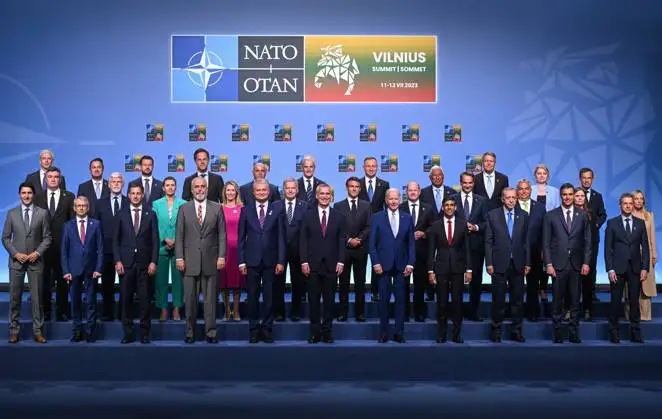
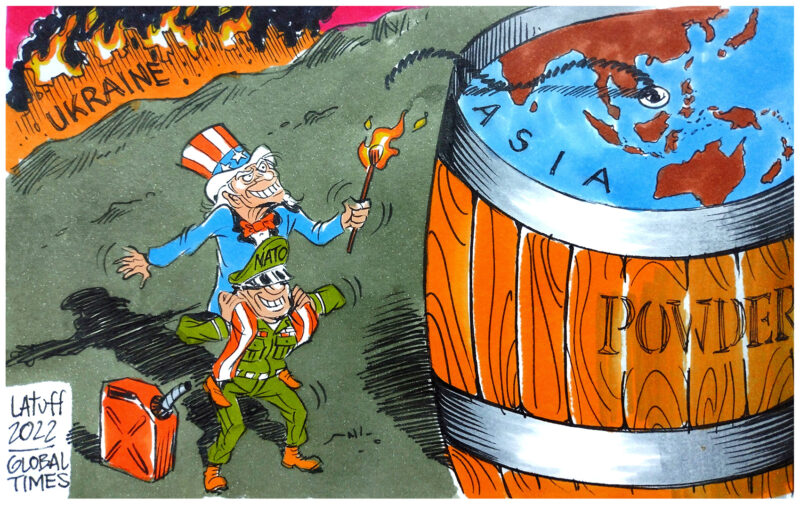
    Former President Trump sidelined NATO to such an extent that European members were disillusioned with American leadership and NATO was in a state of fragmentation. With Biden’s presidency unleashing its Ukraine strategy and war against Russia, NATO has solidified with blind subservience to American leadership. Building on imagined threats from Russia and China, the US is now seeking to make a NATO alliance format for security across Asia as well. On the eve of the 33rd summit at Vilnius on 11-12 July 2023, Türkiye dropped its objections for Sweden to become the 33rd member of NATO, abandoning its 150-year tradition of proud neutrality and peace in favour of war-mongering. With an eye on Asia, the summit invited four Asian countries – Japan, South Korea, Australia, and New Zealand – as observers at the summit. The summit statement is, as expected, replete with anti-Russian rhetoric but more importantly extensive in its focus on the ‘China threat’ thus paving the way for NATO’s role in Asia. Jeffrey Sachs, in a speech in Australia in early July (reproduced below), has warned forcefully about the peril that NATO poses to global peace and security.                                           – TPF Editorial Team

    “My country, the U.S., is unrecognisable. I’m not sure who runs the country. I do not believe it is the president.”, says Jeffrey Sachs in a speech at a Saving Humanity and Planet Earth (SHAPE) seminar, Melbourne, Australia. “U.S. actions are putting us on a path to war with China in the same way that U.S. actions did in Ukraine.”

    “the idea of opening NATO offices in Asia is mind-boggling in its foolishness. Please tell the Japanese to stop this reckless action.”

    Jeffrey Sachs
    Speech to Shape (Saving Humanity and Planet Earth)
    July 5, 2023

    Good afternoon to everybody. I want to thank you for inviting me and to thank SHAPE for its leadership. I just had the privilege to listen to Alison Broinowski and Chung-in Moon. We have been treated to brilliant and insightful statements. I absolutely agree with all that has been said. The world has gone mad but especially the Anglo-Saxon world, I’m afraid. I don’t know whether there is any sense in our little English-speaking corner of the world. I’m of course speaking of the United States, UK, Canada, Australia and New Zealand.

    There’s something profoundly disheartening about the politics of our countries right now. The deep madness, I’m afraid, is British Imperial thinking that has been taken over by the United States. My country, the U.S., is unrecognisable now compared even to 20 or 30 years ago. I’m not sure, to tell you the truth, who runs the country. I do not believe it is the president of the United States right now. We are run by generals, by our security establishment. The public is privy to nothing. The lies that are told about foreign policy are daily and pervasive by a mainstream media that I can barely listen to or read anymore. The New York Times, Washington Post, Wall Street Journal and the main television outlets are 100 per cent repeating government propaganda by the day, and it’s almost impossible to break through.

    it’s about a madness of the United States to keep U.S. hegemony, a militarised foreign policy dominated by the thinking of generals who are mediocre intellects, personally greedy, and without any sense because their only modus operandi is to make war.

    What is this about? Well, as you’ve heard, it’s about a madness of the United States to keep U.S. hegemony, a militarised foreign policy dominated by the thinking of generals who are mediocre intellects, personally greedy, and without any sense because their only modus operandi is to make war.

    And they are cheer-led by Britain, which is unfortunately, in my adult life, increasingly pathetic in being a cheerleader for the United States for U.S. hegemony and for war. Whatever the U.S. says, Britain will say it ten times more enthusiastically. The U.K. leadership could not love the war in Ukraine more. It is the great Second Crimean War for the British media and for the British political leadership.

    Now, how Australia and New Zealand fall for this idiocy is really a deep question for me and for you. People should know better. But I’m afraid that it is the Five Eyes and the security establishment that told the politicians, to the extent that the politicians are involved in this, ‘well this is how we have to do it’. This is our Security State and I don’t think our politicians necessarily have much role in this. By the way, the public has no role in U.S. foreign policy at all. We have no debate, no discussion, no deliberation, no debates over voting the hundred, now $113 billion, but in fact much more money spent on the Ukraine War.

    So far there’s not been an hour of organised debate even in the Congress on this, much less in the public, but my guess is that your security establishment is really the driver of this in Australia, and they explain to the Prime Minister and others: ‘you know this is the utmost National Security, and this is what America has told us. Let us, your security apparatus, explain what we’re seeing. Of course, you cannot divulge this to the broader public, but this is, at the essence, a struggle for survival in the world’.

    Everything I see myself, and I’m now 43 years in this activity as an economic advisor all over the world, suggests that this message is nonsense. One thing that would be interesting for people to look at, in order to understand these developments, is a very telling article by a former colleague of mine at Harvard, Ambassador Robert Blackwell and Ashley Tellis, written for the Council on Foreign Relations in March 2015. I want to read a couple excerpts from it because it laid out the plan of what’s happening right now pretty directly. This is how things work in the U.S., in which future plans are laid out to the establishment in such reports.

    “Since its founding, the United States has consistently pursued a grand strategy focused on acquiring and maintaining preeminent power over various rivals. First on the North American continent, then in the Western Hemisphere, and finally, globally. Preserving U.S. primacy in the global system ought to remain the central objective of U.S. grand strategy in the 21st century.”    

     – Robert Blackwill and Ashley Tellis in a March 2015 article for Council on Foreign Relations.

    We’re basically told in 2015 what’s going to happen in US-China relations. The deterioration of relations was planned — it’s not ad hoc. So, here’s what Blackwell and Tellis wrote in 2015. First, “Since its founding, the United States has consistently pursued a grand strategy focused on acquiring and maintaining preeminent power over various rivals. First on the North American continent, then in the Western Hemisphere, and finally, globally.” And then they argue that “preserving U.S. primacy in the global system ought to remain the central objective of U.S. grand strategy in the 21st century.”

    So, what’s the U.S. goal? The goal is very straightforward, it is the primacy of the United States globally. Blackwell and Tellis lay out the game plan for China. They tell us what to do.

    Here’s the list, though I’m only excerpting: “Creating new preferential trading arrangements among U.S. friends and allies to increase their mutual gains through instruments that consciously exclude China.” This is the game that Obama already started with TPP, though he couldn’t get it through domestic political opposition. Second, “create, in partnership with U.S. allies, a technology control regime vis-à-vis Beijing,” to block China’s strategic capabilities. Third, build up “power-political capacities of U.S. friends and allies on China’s periphery,” and “improving the capability of U.S. military forces to effectively project power along the Asian rimlands despite any Chinese opposition.”

    This foreshadowing of US policies by way of the Council on Foreign Relations (CFR) is well-known in recent history.

    What I find especially remarkable about this list is that it was made in 2015. It’s the step-by-step plan of action actually being carried out. This foreshadowing of US policies by way of the Council on Foreign Relations (CFR) is well-known in recent history. In 1997 in the CFR’s journal Foreign Affairs, Zbigniew Brzezinski laid out with precision the intended timeline for NATO enlargement and specifically the intention to include Ukraine in that NATO enlargement. Of course, that NATO enlargement plan has led us directly to the Ukraine War, which is indeed a proxy Russia-US war over NATO enlargement.

    Now the friends and geniuses that brought you the Ukraine War are on their way to bringing you a new war in your neighbourhood. As Professor Moon noted, the North Atlantic Treaty Organization is starting to open its offices in East Asia, which is not exactly the North Atlantic.

    So, this is where we are. It’s not absolutely simple to see through for one main reason, at least in the U.S. I’m not sure what it’s like in Australia but I expect that it’s pretty much the same as in the U.S., where we have no honesty or public deliberation about any of this. The policies are owned entirely by the security establishment, the military-industrial complex, the network of “think tanks” which are in fact non-think tanks in Washington, with almost all funded by the military-industrial complex.

    The military-industrial complex and its corporate lobby have taken over the East Coast universities where I teach. I taught at Harvard for more than 20 years, and now I teach at Columbia University. The influence of the intelligence agencies on the campuses is unprecedented, in my experience. All of this has happened without much public notice, almost a silent coup. There is no debate, no public politics, no honesty, no documents revealed. Everything is secret, confidential and a bit mysterious. Since I happen to be an economist who engages with the heads of state and ministers around the world, I hear a lot of things and see a lot of things that help me to pierce through the official “narratives” and pervasive lies.

    You will not find any of this in our public discourse. And just a word, if I may, about the Ukraine War. The war was completely predictable, and resulted from a U.S. plan for hegemony based on NATO enlargement that dates back to the early 1990’s. The U.S. strategy was to bring Ukraine into the U.S. military orbit. Brzezinski, again in 1997 in his book The Global Chess Board, laid out the strategy. Russia without Ukraine is nothing, he argued. Ukraine, he wrote, is the geographical pivot for Eurasia. Interestingly, Brzezinski warned American policymakers to ensure that they don’t push Russia and China into an alliance. In fact, that would be so antithetical to U.S. interests that Brzezinski clearly believed that it would never happen. But it has, because U.S. foreign policy is incompetent as well as profoundly dangerous and misconceived.

    During 1990-91, I happen to have been an advisor to Gorbachev, and during 1991-94, to Boris Yeltsin and Leonid Kuchma, spanning the late days of perestroika and the early days of Russian and Ukrainian independence after the dissolution of the Soviet Union. I watched very closely what was happening. I saw that the United States was absolutely uninterested in any way in helping Russia to stabilise.

    The idea of the U.S. security establishment from the early 1990s was U.S.-led unipolarity or U.S. hegemony. In the early 1990s, the U.S. rejected measures to help stabilise the Soviet economy and then the Russian economy, while it also began planning NATO enlargement, in direct contradiction to what the U.S. and Germany had promised Gorbachev and Yeltsin. So, the issue of NATO enlargement, including to Ukraine, is part of a U.S. game plan that started in the early 1990s, and eventually led to the Ukraine war.

    By the way, the U.S. was deeply involved in the overthrow of Ukraine’s pro-Russian president in 2014. Yes, this was a coup, and to an important extent, a regime change operation of the United States. I happen to have seen a part of it, and I know that U.S. money poured into supporting the Maidan. Such U.S. meddling was disgusting and destabilising, and all part of the game plan to enlarge NATO to Ukraine and Georgia.

    When one looks at the map it’s indeed Brzezinski’s 1997 idea: surround Russia in the Black Sea region. Ukraine, Romania, Bulgaria, Turkey and Georgia would all be members of NATO. That would be the end of Russian power projection in the Eastern Mediterranean and the Middle East. So it went for these “security” geniuses.

    Putin put forward diplomatic responses that were repeatedly rejected by the U.S. and its NATO allies, including the Minsk II Agreement endorsed by the U.N Security Council, but then ignored by Ukraine.

    On December 17, 2021, Putin put on the table a perfectly reasonable document as the basis for negotiation, A Draft U.S.-Russia Security Agreement. At the core was Russia’s call for an end to NATO expansion. Tragically, the U.S. blew it off. I called the White House at the end of December 2021, spoke with one of our top security officials, and pleaded, “Negotiate. Stop the NATO enlargement. You have a chance to avoid war.” Of course, to no avail. The United States’ formal response to Putin was that NATO enlargement was non-negotiable with Russia, a matter in which Russia has absolutely no say.

    This is a mind-boggling way to pursue foreign affairs because it is a direct road to war. I hope everybody understands this war in Ukraine was close to ending as early as March 2022 with a negotiated agreement just one month after Russia invaded on February 24th. The negotiated agreement was stopped by the U.S. because it was based on Ukraine’s neutrality. The U.S. told Ukraine to fight on, end negotiations, and reject neutrality.

    And so we are in a war that continues to escalate towards possible nuclear war, which is what would happen if Russia were to suffer deep defeats on the battlefield. Russia is not losing on the battlefield just now, but if it did, it would likely escalate to nuclear war. Russia is not going to be pushed out of the Donbas and Crimea and meekly go home with apologies. Russia is going to escalate if it needs to escalate. So, we are right now in a spiral that is extremely dangerous.

    Japan plays utterly into this spiral. And Australia does as well. It’s so sad to watch Australia accepting to be used in this reckless way. To pay a fortune for new military bases in a reckless, provocative, and costly way, that will feed the U.S. military-industrial complex while weighing heavily on Australia.


    Such U.S. actions are putting us on a path to war with China in the same way that U.S. actions did in Ukraine. Only an Asia-Pacific war would be even more disastrous. The whole idea of the U.S. and its allies fighting China is mind-boggling in its implications, its stupidity and its recklessness. All of this is utterly divorced from Australia’s real security interests. China is not a threat to Australia. It is not a threat to the world.

    I don’t know of a single Chinese overseas invasion in its history, by the way, except when the Mongols briefly ruled China and tried to invade Japan. Other than the Mongol invasion, defeated by a typhoon, China has not launched overseas wars. It’s just not part of China’s statecraft, nor would such wars be in China’s national interest.

    What worries me about the world is a deeply neurotic United States (in)security leadership that aims to be number one, but that can’t be number one in the way that it believes. This is pathetic, yet is applauded each day in London, a place that still dreams of the glory of global empire from a long bygone era.

    RCEP is the correct concept for the region to bring together China, Korea, Japan, the ten ASEAN countries, Australia and New Zealand in a coherent framework, especially around the climate challenge, energy policy, trade policy, and infrastructure and investment policy. A well-functioning RCEP would do a world of good, not only for the 15 countries in RCEP but for the entire world.

    Permit me, in conclusion, to take one minute to say what should be done.

    First, the war in Ukraine could end the day Biden steps up and says NATO will not enlarge to Ukraine. The basis for a negotiated security arrangement has been there for 30 years, but has been rejected so far by the U.S.

    Second, the idea of opening NATO offices in Asia is mind-boggling in its foolishness. Please tell the Japanese to stop this reckless action.

    Third, the U.S. approach to arming Taiwan is profoundly dangerous, provocative and deliberately so.

    Fourth, what is needed most in the Asia-Pacific is regional dialogue amongst Asia-Pacific nations.

    Fifth, the Asia-Pacific should build on RCEP [Regional Comprehensive Economic Partnership Agreement]. RCEP is the correct concept for the region to bring together China, Korea, Japan, the ten ASEAN countries, Australia and New Zealand in a coherent framework, especially around the climate challenge, energy policy, trade policy, and infrastructure and investment policy. A well-functioning RCEP would do a world of good, not only for the 15 countries in RCEP but for the entire world.

    Sorry to have run on so long but it’s so important what SHAPE is doing. You’re completely on the right track and all best wishes to your efforts.


    This transcript of Jeffrey Sach’s speech was published earlier in Pearls and Irritations.

    Feature Image Credit: bnn.network

    Cartoon Credit: Global Times

  • Killing in War – Between Striving for Power and Self-Preservation

    Killing in War – Between Striving for Power and Self-Preservation

    [powerkit_button size=”lg” style=”info” block=”false” url=”https://admin.thepeninsula.org.in/wp-content/uploads/2022/10/TPF-Research-Paper-Killing-in-War-1.pdf” target=”_blank” nofollow=”false”]
    Download
    [/powerkit_button]

    Introduction:

    How does it come about that humans kill each other en masse in wars? Within the animal kingdom, they seem to have a special position in this respect. Many animal species have a killing taboo within the species, but at the same time, there is a displacement competition, which is often decided by fights. This displacement of conspecifics corresponds to the formation of communities as well as processes of belonging to or exclusion from them. If the displaced conspecifics do not succeed in forming or joining their own communities, they usually perish, for example, because they are denied access to food sources. The displacement of conspecifics serves their own survival and the formation of a group that enables this survival directly or in the transmission of the biological heritage.

    Living and surviving in the community, exclusion and displacement of conspecifics not belonging to the community – this can be considered as a basic pattern of conflicts within a species. In the animal kingdom, such conflicts are usually ritualized rank fights in which the killing of the opponent is usually avoided. However, this cannot hide the fact that killing also takes place here – for example, when the inferior is forced into a territory where he has no chance of survival (Eibl-Eibesfeldt, 1984). While in the animal kingdom the right of the physically stronger is almost unrestricted, there is a special feature in humans. Because of their intelligence, they are able to recognize that displacement from the community means immediate death and makes biological reproduction impossible (Orywal et al., 1995).

    Recognition of the connection between displacement from the community (or displacement of one’s own by competing communities) and personal death or restriction of reproductive opportunity is the decisive reason for the skipping of the killing taboo within the human species.

    Recognition of the connection between displacement from the community (or displacement of one’s own by competing communities) and personal death or restriction of reproductive opportunity is – according to my central hypothesis – the decisive reason for the skipping of the killing taboo within the human species. In addition, there is in the human being the ability, also developed by his mind, that the weakest or a group of weaker can kill the strongest. This happens with the help of tools, above all weapons, but also by “cunning and trickery”, i.e. by the use of intelligence. At the same time, this basic constellation also gives rise to the possible realization that a fight to the death can lead to the downfall of one’s own community. At a certain point in the conflict, it may therefore be more advisable to abandon the struggle and secure one’s own survival through other efforts – e.g., through improved food production, development of new technical processes, etc. (this is the core idea of Hegel’s struggle for recognition; Herberg-Rothe, 2007).

    Defensive also appears in cases where the militant preservation of one’s identity is not a reaction to an attack from outside but means an attempt to prevent the internal disintegration of one’s community. When a community is threatened by internal tensions, war may serve to stabilize it by fighting an external enemy. Paradigmatic for this is the well-known dictum of Kaiser Wilhelm II at the beginning of World War I that he no longer knew any parties, he only knew Germans.

    Likewise, wars are waged in order to establish a community with its own identity in the first place. Here, the war is supposed to constitute the political greatness through whose anticipated existence it legitimizes itself. This motif emerges most clearly in the national-revolutionary liberation movements, whose strategy is to establish in the struggle the nation for which the war is waged. The talk of the purifying power of war (Ernst Jünger) or the purifying function of violence (Frantz Fanon) acquires its political content here. In the struggle, the community is to be “forged together” (Münkler calls this the existential dimension of war; Münkler, 1992).

    This keeps people in its clutches by no means exclusively because war is essentially determined by feelings (van Creveld, 1998 and Ehrenreich, 1997), but because it subjectively or objectively serves the material as well as ideal self-preservation of communities internally and externally. It is true that feelings play an essential, if not often even decisive role within wars – but the respective decision to go to war is in the rarest cases dominated by feelings alone.  With this determination, however, only one side is mentioned. Defence and self-preservation appear as the real core of war only insofar as it is determined by the aspect of fighting. If, on the other hand, we take more account of its “original violence”, the first moment of Clausewitz’s “whimsical trinity”, and the membership of the combatants in a comprehensive community, war remains equally determined by the aspect of the violent “wanting to have more” (Plato) of material or ideal goods as by the preservation (or creation) of one’s own identity in the struggle, in the displacement competition of communities.

    Let us recapitulate why this cut-throat competition is violent. In a non-violent competition between communities, one of them can be defeated. In order to preserve its physical or symbolic existence, the side that subjectively or objectively sees itself as the loser resorts to violent means. This is the fear of the physical or symbolic death of one’s own community, which can be maintained solely by struggle and, in the last resort, by war. Contrary to the assumption of Thomas Hobbes, the founder of modern political theory, according to my hypothesis, the fear of one’s own death does not lead to the abandonment of the struggle for life and death, but rather to its unleashing.

    While Hobbes’s assumption may be largely plausible with respect to single individuals, although it underestimates the momentum of self-definition through violence (Sofsky, 1996), it is fundamentally wrong with respect to communities. Here, many individuals put their lives on the line precisely because they thereby enable the “survival of the community” and thus their own symbolic or biological survival. The same mechanism of displacement competition, however, can also lead to the insight that the preservation and strengthening of one’s own community can be promoted much better by cooperative behaviour than by a violent conflict.

    If we apply this hypothesis to the interstate sphere, all those approaches fail that derive causes of war only from a single essence, for example from violent struggle (Hondrich, 2002), from the apparently aggressive nature of man or from the struggle for survival (sociobiological theories). The same is true, conversely, for attempts at explanation that see human beings as basically peaceable and seek the causes of wars solely in structures that have taken on an independent existence, such as the state, “capitalism,” the arms industry, dictatorships, or the lack of democratic participation.

    Rather, violence and war are a possibility of self-preservation inherent in human action and, at the same time, of self-delimitation (“wanting more” of material as well as ideal things) of communities. Since this possibility can never be completely excluded, the decisive task of political action is the limitation of violence and war in world society.

    Abolishing proximity and creating distance

    In his study on killing, former Colonel Dave Grossman describes his experiences with U.S. Army training programs that teach soldiers how to kill. He sees the decisive approach in switching off the soldiers’ thinking and automating their actions. Using historical examples, Grossman tries to prove that in a battle only 15-25% of soldiers actually have the willingness to kill others. Grossman concludes that there is an anthropological inhibition to kill others “eye to eye” (Grossman, 1995).  But 15-25 of those involved in war who kill, rape, maim are, in this perspective, either mentally ill to an even lesser degree or subject to a process of violence taking on a life of its own.  Violence is perhaps the drug that is most quickly addictive and considered “normal” by its practitioners.

    According to Grossman, there is an inhibition to killing due to the perceived anthropological sameness and the resulting proximity to the respective opponent, it is precisely this proximity that leads to explosive excesses of violence in mixed settlement areas.

    While, according to Grossman, there is an inhibition to killing due to the perceived anthropological sameness and the resulting proximity to the respective opponent, it is precisely this proximity that leads to explosive excesses of violence in mixed settlement areas. The conclusions drawn from this are extremely contradictory. While in cases of great (spatial or interpersonal) distance the killing inhibition is eliminated by the fact that the opponent is no longer perceived in his sameness as a human being, the use of force in complex and confusing civil war situations can contribute to the creation of distance between people. Last, however, distance can also lead to the limitation of violence. Proximity and distance thus structure the occurrence of violence in very different ways.

    Eliminating proximity between opponents to reduce the inhibition to kill can be done in very different ways. Systematically, three methods can be distinguished that have also played a major role historically: first, the creation of spatial distance, second, social distance, and third, the integration of the combatants into tightly knit communities in which it is no longer the individual who acts, but the group. Belonging to a group and its courses of action are then stronger than the individual’s inhibition to kill.

    One instrument for creating social distance is the degradation of the opponent by denying him his humanity. The demonization of the opponent is the prerequisite for his destruction.

    The creation of spatial distance between combatants is above all a characteristic of modern warfare and the development of distance weapons. The extent of interpersonal distance appears to be directly proportional to the range of the weapons. In the case of bows and arrows, the distance is still relatively small, as it was in the early development of rifles. Only in connection with another distancing principle, the integration into firmly established formations, did these weapons attain their historical significance. The situation is already different with weapons that have an effect at a greater distance, such as artillery in the Napoleonic Wars and World War I or the modern use of aircraft and rocket-propelled grenades. Bomber pilots can no longer see their opponent and perceive him as a human being. They drop their bombs on illuminated squares or leave target acquisition to the sensors of their weapons systems. In the most modern form of spatial distance, the enemy no longer appears as a human being at all, but only as a number and a diagram on computer screens.

    One instrument for creating social distance is the degradation of the opponent by denying him his humanity. The demonization of the opponent is the prerequisite for his destruction. Thus, in the metaphoric of the Nazi regime, political opponents mutated into vermin and rats. In the political propaganda between the world wars, the ideological opponent was also assigned animal characteristics (“Russian bear”). The stigmatization of the opponent as a “machine being” also belongs to this category. In all these cases, the humanity of the opponent is negated, on the one hand, in order to strengthen the sense of belonging to one’s own community by spreading fear and terror, and on the other hand, in order to lift anthropological inhibitions against killing.

    The Nazi concentration camps played a special role in the creation of social distance. In them, two mechanisms of action were applied: on the one hand, the organized and purposeful dehumanization of people, who were degraded to mere numbers by systematic terror. Their individuality was erased by pain and hunger to such an extent that in the end, they were only walking skeletons, “Muselmanen” (Sofsky, 1993, 229 ff.). On the other hand, a sophisticated form of “division of labour” was developed, especially in the pure extermination camps.

    Inhibition to kill was also lowered in groups whose coherence and inner structure had a stronger effect than individuality. The importance of group cohesion was particularly evident in World War I. For many men, the war was the only place “where men could love passionately” (Stephan, 1998, 34 f.) What is meant, however, is not primarily homosexual love (although it always played a major role in men’s alliances), but the intoxicating, emotional bond with the community (ibid.). These men did not fight out of fear of their superiors or of punishment, but primarily out of comradely feelings: Just as they could rely on their comrades, the comrades should be able to rely on them. Possibly, this bond to the group through stress and practiced movements is more important and obvious than abstract ideals or interests for which the individual goes into battle. The decisive factor then is the community on a small scale, which must be defended.

    The fear of one’s own death, the fear of being killed by another person, can only be countered in hopeless situations by killing the other person. The fear of one’s own death or the death of a member of the group leads directly to wanting to kill the cause of this fear of oneself. Fear of death and killing are directly related. The subjective impression arises, as if only the opponent brings one to kill oneself. In this case, the opponent seems to be responsible for the painful overcoming of one’s own inhibition to kill. This creates a boundless rage against him, because it is he through whose behaviour one’s own killing inhibition has been lifted. In the direct fight (“eye to eye”) for life and death, the fear of one’s own death becomes the furore of immoderate violence.

    This “automatic killing” out of fear of one’s own death is described most vividly in Erich Maria Remarque’s novel Nothing New in the West. It says: “I think nothing, I make no decision – I thrust furiously and feel only how the body twitches and then softens and slumps.” And further: “If we were not automata at this moment, we would remain lying, exhausted, will-less. But we have pulled forward again, will-less and yet madly furious, wanting to kill, for that there are our mortal enemies now, their guns and shells aimed at us. We are numb dead men who can still run and kill by a dangerous spell” (Remarque, 1998).

    If one assumes an anthropologically conditioned inhibition of killing in humans, one can furthermore interpret the mutilation of the opponent as a reaction to the fact that precisely despite the prohibition of killing “the other” was killed. The mutilation mitigates the guilt of killing a conspecific by the fact that this conspecific is no longer identifiable as a human being. In the act of killing a conspecific, its mutilation restores the distance between the opponents.

    Whether the “lust” for killing described by Remarque is the result of a drive remains to be seen. It is more likely that the feelings felt in the existential situation of struggle are an expression of triumph over death because one’s own fear of death had to be held down in order to be able to act (Sofsky, 2002). If one assumes an anthropologically conditioned inhibition of killing in humans, one can furthermore interpret the mutilation of the opponent as a reaction to the fact that precisely despite the prohibition of killing “the other” was killed. The mutilation mitigates the guilt of killing a conspecific by the fact that this conspecific is no longer identifiable as a human being. In the act of killing a conspecific, its mutilation restores the distance between the opponents. Especially in the desecration of the dead, as often occurs in massacres, the motive of one’s own “apology” is revealed in the attempt to rob the opponent of even the last vestige of humanity.

    Killing and proximity

    In the case of groups and communities that are closely connected spatially and through neighbourhood relations, emerging socio-economic, religious-cultural, ethnic or political conflicts that are no longer negotiable can turn into extreme mutual anger.

    So far, the creation of spatial and social distance has been discussed as a prerequisite for the individual as well as mass killing. In contrast, in situations characterized by great proximity, killing is often a means of re-establishing distance. It is a well-known fact that most murders committed by private individuals occur in the immediate social environment of the perpetrators. It is also no coincidence that the cruellest ethnic persecutions and exterminations take place between neighbouring or closely related population groups, as the example of Serbs, Croats and Bosniaks teach us. Sigmund Freud, the founder of psychoanalysis, spoke of the “narcissism of small differences” (Freud, 2001): The closer individuals and groups of people are to each other, the more disappointed expectations of love and happiness, unfulfilled claims, and hurt feelings of self-esteem play a decisive role in the mutual relationship. One cannot be as disappointed and hurt by “strangers,” by those who are not the same as by those who are closest to one (Mentzos, 2002).

    Particularly in the case of groups and communities that are closely connected spatially and through neighbourhood relations, emerging socio-economic, religious-cultural, ethnic or political conflicts that are no longer negotiable can turn into extreme mutual anger. Because of manifold mutual dependencies, it may be necessary for such conflict situations to reassure oneself of one’s own identity by distancing oneself from the other group. One’s own self or that of the group finally experiences its own power and independence in a violent struggle, in which, precisely because of the dangerous proximity to other people or to the other group, not least one’s own elementary recognition is at stake (Altmeyer, 2002).

    Victims

    For Martin van Creveld, war does not begin when groups of people kill and murder others. Rather, a war begins at the point when the former risk being killed themselves. For van Creveld, those who kill for “base motives” are not belligerents, but butchers, murderers, and assassins (van Creveld 1998, 234-238). Despite all commonalities, the opinions of the theorists of the “New Wars” diverge widely at this point. While some emphasize the independence of violence, the excesses and irregularity of warfare, and pursue a culturally pessimistic approach (especially Sofsky), others primarily stress the aspect of the victim. War is understood here as an almost “sacred act” in defense of the existence of communities (van Creveld, 1998) and civilization (Keegan), characterized essentially by the soldierly willingness to sacrifice for the community (Ehrenreich, 1997 and Stephan, 1998). By considering only one side of the pair of opposites of victims and perpetrators, these theories transfigure war into a pure act of sacrifice, ultimately the most selfless of human activities (van Creveld, 1998).

    The blurring of the contrast between victims and perpetrators in war is summarized by Thomas Kühne in the concept of the victim myth. In modern military life, this myth takes on the task of making an active killing in war socially acceptable, and of dissolving the contradiction between killing and being killed in a sacred aura.

    The question, however, is who is a victim and who is a perpetrator in combat in wars. And when and where do the lines between the two blur? There is a long tradition of the myth of sacrifice, in which even the most barbaric destruction of the other was passed off as self-sacrifice for a higher cause. Heinrich Himmler, for example, spent some effort convincing his subordinates that the extermination of Jews in the gas chambers was in fact a heroic act. A distinguishing criterion obviously lies in whether one’s violent act is directed against the defenseless or against persons who have an opportunity for self-defense or escape. The blurring of the contrast between victims and perpetrators in war is summarized by Thomas Kühne in the concept of the victim myth. In modern military life, this myth takes on the task of making an active killing in war socially acceptable, and of dissolving the contradiction between killing and being killed in a sacred aura. The myth of sacrifice created a symbolic order in the moral and emotional conflict between the experience of death and killing, between feelings of omnipotence and powerlessness (Kühne, 1999 and 2001).

    We will not abolish war in the 21st century, but we must limit it for reasons of self-preservation.

    If we summarize, violence in war is possible because the other is no longer seen as equal, but a spatial or social distance makes it possible in the first place. Through our intelligence, even the physically weakest can defeat a stronger one and does not have to succumb to cut-throat competition. In part, violence also creates social distance in the first place, an aspect we find especially in civil wars. I am unsure whether violence has tended to increase or decrease in wars. Steven Pincker argued that, regardless of media portrayals, violence has decreased to a significant degree worldwide (Pinker, 2013) – to what extent the Ukraine war heralds a contrary trend is impossible to predict. What is likely, however, is that the wars of the future will revolve around ideas of order, around the resurgence of empires and civilizations that have been submerged in colonization and European-American hegemony and that are pushing onto the world stage (Herberg-Rothe & Son, 2018). Whether the possibility of overcoming violence or intensifying it follows from this will remain contested. A positive example could be the end of the Cold War, in which the countless overkill capabilities themselves overcame the antagonistic opposition between capitalism and communism, because the threat of the planet’s self-destruction made people realize not to fight a war with nuclear weapons. The other possibility remains that a new thirty-year war for recognition and order is looming. To be sure, war is not the “father of all things,” as Heraclitus opined. But its horrible destructiveness is nevertheless integrated with the dialectic of self-preservation – on the one hand through the increase of power and material, on the other hand, the preservation of an own physical or symbolic identity.  This dialectical development can also contribute to the self-preservation of humankind, as it succeeded in the nuclear arms race of the Cold War, albeit with great luck in some cases. War as a means of self-preservation is abolished in the nuclear age. Even at the micro level, unleashing violence would endanger humanity’s self-preservation. We will not abolish war in the 21st century, but we must limit it for reasons of self-preservation.

    References

    Altmeyer, Martin (2000), Narzissmus und Objekt, Göttingen.

    Ehrenreich, Barbara (1997), Blutrituale. Ursprung und Geschichte der Lust am Krieg, München.

    Creveld, Martin van (1998), Die Zukunft des Krieges, München.

    Eibl-Eibesfeldt, Irenäus (1984), Krieg und Frieden aus der Sicht der Verhaltensforschung, München.

    Gray, Chris Habbles (1997), Postmodern War, London.

    Grossman, Dave (1995), On Killing. The Psychological Costs of Learning to Kill in War and Society, Boston.

    Herberg-Rothe, Andreas (2007), Clausewitz’s puzzle. Oxford.

    Herberg-Rothe, Andreas (2017), Der Krieg. 2. Aufl. Frankfurt.

    Herberg-Rothe, Andreas and Son, Key-young (2018), Order wars and floating balance. How the rising powers are reshaping our worldview in the twenty-first century. New York.

    Hondrich, Klaus (2002), Wieder Krieg, Frankfurt.

    Kühne, Thomas (1999), Der Soldat. In: Frevert, Ute/Haupt, Heinz-Gerhard (Hrsg.), Der

    Mensch des 20. Jahrhunderts, Frankfurt New York, 344-372.

    Kühne, Thomas (2001), Lust und Leiden an der kriegerischen Gewalt.

    Traditionen und Aneignungen des Opfermythos, ungedruckter Vortragstext zur Jahrestagung des Arbeitskreises Historische Friedensforschung “Vom massenhaften gegenseitigen Töten – oder: Wie die Erforschung des Krieges zum Kern kommt”, Ev. Akademie Loccum, 2.-4. Nov. 2001.

    Mentzos, Stavros (2002), Der Krieg und seine psychosozialen Kosten, Göttingen.

    Münkler, Herfried (1992), Gewalt und Ordnung, Frankfurt.

    Orywal, Erwin u.a. (Hrsg.), (1995),, Krieg und Kampf. Die Gewalt in unseren Köpfen, Berlin.

    Pinker, Steven (2013), Gewalt. Eine neue Geschichte der Menschheit. Frankfurt

    Remarque, Erich Maria (1998), Im Westen nichts Neues, Köln.

    Sofsky, Wolfgang (2002), Zeiten des Schreckens, Frankfurt.

    Sofsky, Wolfgang (1993), Die Ordnung des Terrors, Frankfurt.

    Sofsky, Wolfgang (1996), Traktat über die Gewalt, 2. Aufl., Frankfurt.

    Stephan, Cora (1998), Das Handwerk des Krieges, Berlin.

    [powerkit_button size=”lg” style=”info” block=”true” url=”https://admin.thepeninsula.org.in/wp-content/uploads/2022/10/TPF-Research-Paper-Killing-in-War-1.pdf” target=”_blank” nofollow=”false”]
    Download
    [/powerkit_button]

  • Beyond Unipolarity and the Euro–American Horizons of IR Thought: Reflections on the Emergent World Order

    Beyond Unipolarity and the Euro–American Horizons of IR Thought: Reflections on the Emergent World Order

    Abstract

    Amidst the continuing conflict in Ukraine, Russian President Vladimir Putin made a notable pronouncement of the end of the US-led unipolar world and the rise of multipolar world order. Against this backdrop of the debate on polarity, my research paper seeks to address the following questions. To what extent have global institutions, mainstream IRT (International Relations Theory) and academia as well as policies reflected if not reinforced Euro-American norms and interests? Does this purported shift to multipolarity require a shift in institutional and theoretical practices reflecting the broad concerns of the Global South? Using global and regional case studies like India (especially in regard to the representation within academia and the glass ceiling affecting institutional practices like Young Professionals Programme), I draw from critical and post-colonial theoretical IR frameworks to argue for a comprehensive reform of the prevalent global institutional and theoretical structures. 

    Introduction

    The Euro-American hegemony runs very deep, pervading a range of institutions, norms, global practices, knowledge and even academic teaching practices.

    The month of February this year witnessed one of the most defining moments of the post-Cold war era. Marking a major escalation of the simmering conflict that began with the insurgency in Eastern Ukraine in 2014, Russia invaded Ukraine resulting in thousands of casualties and millions of refugees.[1] This conflict inevitably has given rise to a wide range of debates in the global arena, including global governance, institutions, conflict and security. In this regard, one of the most interesting debates that have seen a resurgence is the question of the future of the world order. 

    The notion of a shift to multipolar world order has emerged as a prominent theme in the wake of this crisis. This is best exemplified by Vladimir Putin in his address to the St Petersburg International Economic Forum Plenary session, “a multipolar system of international relations is now being formed. It is an irreversible process; it is happening before our eyes and is objective in nature.” It is indeed widely recognised that the brief period of unipolarity, dominated by the US, following the end of the Cold War, has given way to the era of multipolar world order, characterised by ‘new powerful and increasingly assertive centres.’ [2] However, even as this shift to multipolarity seems almost deterministic, there persist legitimate questions on the conduciveness of the current world order to the emergence of these multiple power-centres. 

    Against this backdrop, my work shall be organised as follows. I commence with a discussion on the shift towards multipolarity, providing the conceptual capital of notions like power and polarity. This shall be followed by my argument that the current global order, exemplified in its norms, institutions, and intellectual resources, fall severely short of the expectations required of the multipolar world order. To illustrate this point, I draw from the case study of India, in particular. I conclude by providing some prescriptions necessary for the transition to multipolarity to be meaningful. Towards this pursuit, I draw from critical post-colonial theoretical frameworks, employing secondary literature review as the overarching method.

    Shifts towards multipolarity

    Before proceeding to the premise of the shift towards multipolarity, a few conceptual clarifications are in order. Polarity in this context is understood as the modes of distribution of power in the international system. Typically, it is classified as unipolar (e.g. US hegemony in the post-Cold-War era), bipolar (e.g. Russia-US dominance during the Cold War era) and multipolar (e.g. Europe during the pre-World War era). [3] While there are myriad debates on what constitutes power in the global landscape, I draw from the useful typology provided most famously by Joseph Nye – hard, soft, and smart power. Hard power is often described as the typical carrot and stick approach, involving coercion and is often measured in terms of “population size, territory, geography, natural resources, military force, and economic strength.” On the other hand, soft power is described as the ability to influence state preference using intangible attributes like “attractive personality, culture, political values, institutions, and policies” resulting in the perception of legitimacy or moral authority. Smart power is often understood as the instrumental deployment of a combination of both to secure political ends.[4] 

    The end of the Cold War era, prematurely lauded as the end of history by a scholar, resulted in a brief unipolar moment of US hegemony. As Putin puts it, the US was the predominant power with a limited group of allies which resulted in “all business practices and international relations … interpreted solely in the interests of this power.”[2]  However, a range of factors in the twenty-first century led to a crisis in American leadership. The interventionist atrocities carried out in the wake of the September 11 attacks as well as the crisis of global capitalism during the financial crisis of 2008 led to a crisis in American leadership.[5] This period also saw the emergence of new powers like the BRICS nations, who posed a serious challenge to the notion of unipolarity.[3] 

    As Amitav Acharya and Burry Buzan argue, this diffusion of power has resulted in the ‘rise of the rest’ characterised by the absence of a single superpower. Instead, a number of great and regional powers have emerged with their respective institutions and models of growth. Such a world order is also shaped by a greater role accorded to non-state actors including global organisations, corporations, and social movements as well as non-state actors.[6] Thus, the current global landscape is often termed as multipolar, multi-civilizational and multiplex offering myriad opportunities and benefits for states.[7] The crisis in Ukraine has only bolstered this multipolar moment even further. Consider India as a case in point. The likes of the U.S. (and even China) have competed for India’s affection and India’s seemingly pro-Russia stance has not prevented Delhi’s deeper engagement with her counterparts in the West. These initiatives can only enhance India’s great power status, resulting in potentially a higher degree of multipolarity.[8]

    Thus, even as there is an increasing scholarly and policy-based consensus on the shift towards multipolarity, there remain important reservations on whether the current global arena is equipped to deal with the seismic shifts posed by the emergent world order. In other words, does this purported shift to multipolarity require a shift in institutional and theoretical practices reflecting the broad concerns of the Global South? In the next section, I answer in the affirmative, arguing that the dominant norms, institutions, and intellectual resources are broadly skewed towards the preservation of Euro-American hegemony. 

    The maintenance of Euro-American hegemony: norms, institutions, and academia

    The exercise of U.S. hegemonic power involved the projection of a set of norms and their embrace by elites in other nations.

    Drawing from Persaud, I argue that dominant powers forge an “academic/foreign policy/security ‘complex’ dedicated to the maintenance of a hegemonic world order.” [9] Such a complex is constituted by an intricate network of norms, institutions and theoretical/ intellectual practices which seek to uphold the status quo. In this section, I examine each of these aspects in detail.

    Consider norms, in the first instance. Norms can be defined broadly as the “collective expectations for the proper behaviour of actors.”[10] When certain norms which serve certain interests are considered as general interests, it results in hegemony. The dominant powers socialise and hegemonise other countries into an ideological worldview that best serves their interests. In other words, actors have to orient themselves according to a ‘logic of appropriateness’ framed by these intersubjective notions. In the post World War era, the Roosevelt-led US administration projected a series of norms and principles guided by liberal multilateralism, to shape the post-war international order. Such a form of ‘institutional materiality’ posited a clear separation between the political and the economic realm. The embrace of these norms outside the US occurred through various modes of socialisation including external inducement (e.g. Britain and France), direct intervention and internal reconstruction (e.g. Germany and Japan) as well as military and economic dominance.[11] 

    The exercise of U.S. hegemonic power involved the projection of a set of norms and their embrace by elites in other nations. Socialisation did occur since U.S. leaders were largely successful in inducing other nations to buy into this normative order. But the processes through which socialisation occurred varied from nation to nation. In Britain and France, shifts in norms were accomplished primarily by external inducement; in Germany and Japan, they resulted from direct intervention and internal reconstruction. In all cases, the spread of norms of liberal multilateralism was heavily tied to U.S. military and economic dominance. [11]

    Such norms are often manipulated (and flouted) to their advantage. For example, consider the liberal norm of conditional sovereignty, linked to human rights, spearheaded by the likes of the US and many countries in Western Europe. Assuming the primacy of the individual over the state, it has legitimised intervention on ‘humanitarian’ grounds. However, the execution of these norms has been far more uniform as best exemplified in their differential application in the wake of the atrocities in Kosovo and Rwanda. An intra-state conflict resulting in a humanitarian crisis in Kosovo precipitated a successful multilateral intervention. However, the same decisiveness was starkly absent with regard to a similar (if not greater) conflict in Rwanda which resulted in almost 800,000 casualties and more than two million refugees. Multiple studies have traced the rationale of intervention to the “strategic interests in Europe’s future and the NATO alliance.” Rwanda on the other hand was considered peripheral to the national interests of either Western Europe or the US.[12] This substantiates the argument that the norm of ‘humanitarian intervention’ is often tied more to brutal national interests rather than the protection of human rights.

    A range of global norms, ranging from economic norms, dealing with the management of finance, to those dealing with water governance has been shown to be skewed towards the interests of great powers rather than participative in nature.

    Consider another instance. The Liberal International Order (LIO) asserts the concept of ‘conditional sovereignty’ where sovereign nation-states are bound to look after their entire populations. A failure to that end invites interference and comments from other nation-states and external agencies. This norm has been pushed forward and spearheaded by first-world countries like the US and Western Europe, much to their advantage. Contrary to this, the neo-Westphalian order is a proponent of the ‘classical sovereignty’ model where nation-states are sovereign within their own territory to administer in any manner they want, obviously with a necessary reverence to human rights, but others are not authorized to interfere in the same. China and other authoritarian regimes have been advocating for the same. So, while the LIO talks about the equality of every individual, the neo-Westphalian order focuses more on the equality of all nation-states.[13] Similarly, a range of global norms, ranging from economic norms, dealing with the management of finance, to those dealing with water governance has been shown to be skewed towards the interests of great powers rather than participative in nature. 

    Similarly, Cox and Gill have argued how global governance through institutions play a critical role in maintaining hegemony.[14] The multilateral institutions which the US had created both in the political and economic realm have played a critical role in the sustenance of Euro-American (and especially the U.S.) dominance. In other words, even as the international world order shifts to a multipolar one, it has not exactly been accompanied by multilateralism.[15] While multilateralism puts forward the interests of multiple states, most so-called multilateral institutions reflect and reinforce prevailing power configurations. 

    Consider the United Nations, for instance. It cannot be a mere coincidence that the UN has been ineffectual against most of the contemporary global challenges like climate change, the pandemic etc. when it has not been responsive to the reality of the increasing number of power centres in the multipolar world order.[16] The most glaring evidence is the UNSC. Despite an increasing number of voices on the rise of Asia, Africa, and Latin America, the P5 includes only one representative from Asia (which is China) and no members from either Africa or Latin America. In addition, while there has been more than a threefold rise in UN membership, the number of non-permanent seats has only risen from 11 to 15. Even at the administrative levels, the lack of non-western representation is indeed a concern. Besides the absence of a UNSC permanent seat, it is also disheartening to see that it has been years since the Young Professionals Program has been held for the likes of India.

    These same institutions are often undermined by the likes of the US, under the facade of NATO. Consider the harrowing intervention in Libya. The NATO intervention on supposedly ‘humanitarian’ grounds in 2011 led to the death of Muamar Gaddafi, violating the legal structures of the UN charter in the process and resulting in a proxy war. The result has been a prolonged state of near-anarchy characterised by arbitrary detentions, executions, mass killings and kidnappings. [17]

    The WTO is plagued with similar issues. While it ostensibly reflects the ‘global’ norm of neoliberal free trade, it is “structured and ordered to promote monopolistic competition rather than genuine free trade. These institutional roadblocks include the exclusion of developing countries from several informal decision-making sessions, lack of transparency, coercive decision-making in meetings involving developing countries, astronomical costs involved in Dispute settlement Understanding and so on. The result is that the Western countries have an overwhelming advantage against their counterparts from the Global South. [18]

    Lastly, as highlighted earlier, the international policy making apparatus cannot be divorced from the intellectual resources churned by IR academia. Zvobgo, in an insightful piece, has argued how the big three of IR theory – realism, liberalism and constructivism – are built on Eurocentric, raced and racist foundations.[19] The role of imperial policymakers in shaping contemporary IR knowledge has been well acknowledged. Kwaku Danso and Kwesi Aninghave argued about the prevalence of methodological whiteness, which projects White experience as a universal experience.[20] It is no coincidence that the principles of the Westphalian treaty are not significantly different from those underlying the current UN charter. Acharya has argued that racism was integral to the emergence of the US-led world order exemplified in the scant focus on colonialism in UNDHR as well as the “privileging of sovereign equality’ over ‘racial equality.’[21] 

    These forms of methodological whiteness have had devastating impacts across the world. The projection and the forceful projection of the Weberian state as the fundamental unit of security and conflict management has resulted in disastrous policy-level consequences in Africa which have always been characterised by a range of hybrid political systems beyond the nation-state.[20] Similarly, much of the problematic policies carried out today based on the binaries of ‘developed’ v/s ‘developing’ nations have direct continuities with the legacy of empire and race reflected in dichotomies like ‘civilised v/s uncivilised’. 

    There also exists historical amnesia of racism in academia, whether in terms of representation or teaching practices. For example, in the US, only 8% of the faculty identify themselves as Black or Latino. Similarly, the configurations of colonialism and racism in building the modern world order are either glossed over or overlooked in most academia.[19] Indian academia is a case in point. As Behera argues, despite the strong tradition of Indian independent IR thought as well as the long history of colonialism, Indian IR has imbibed a definite set of givens including  “the infallibility of the Indian state modelled after the Westphalian nation-state as well as a thorough internalization of the philosophy of political realism and positivism.[22] Rohan Mukherjee, for instance, has highlighted an unpublished survey of IR faculty within India wherein the majority self-identified as either liberal or realist.[23]

    Thus, the Euro-American hegemony runs very deep, pervading a range of institutions, norms, global practices, knowledge and even academic teaching practices. In the next section, I conclude by outlining certain prescriptions for a future world order which responds to and is far more conducive to the inevitable multipolar shifts. 

    Conclusion

    India has umpteen intellectual resources from Gita and the Sangam literature to stellar modern political philosophers like Gandhi, Tagore and so on, which need to be strategically combined with contemporary IR notions and questions of security, justice and so on.

    This paper first established the backdrop of the shift towards multipolarity within the world order by outlining the myriad modes of power through which the ‘Rest’ has caught up with the ‘West.’ In the succeeding section, I demonstrated how a range of norms, institutions and intellectual practices had been historically constructed to maintain Euro-American hegemony as well as promote the interests of the West. In such a world order, certain parochial interests have masqueraded themselves as common or global interests. In the concluding section, I outline certain prescriptions which have become necessary for a more equitable, multi-civilisational world order. 

    Institutions like the UN require urgent and seismic reforms reflecting the interests of emerging power centres. The number of seats within the Permanent and non-permanent seats must be expanded to include more nation-states from Asia, Africa and Latin America. A revitalisation of the UNGA is highly overdue and requires a focussed and timely debate on the problems of the highest priority at any given time through rationalization of its agenda. [24] Similarly, the proposed WTO reforms, which seeks to move away from multilateralism to impose plurilateralism, should be opposed at all costs. [25]

    As Zvobjo puts it eloquently, how IR is taught perpetuates the inequalities which are detailed above. Besides the dominant IR triumvirate, there needs to be an increased focus on critical perspectives as well as increased engagement with the uncomfortable questions of race, empire, colour, and caste.[19] This should be complemented by more diversity in terms of representation within academia. In India specifically, there needs to be increased efforts to construct Indian or South Asian IR notions. India has umpteen intellectual resources from Gita and the Sangam literature to stellar modern political philosophers like Gandhi, Tagore and so on, which need to be strategically combined with contemporary IR notions and questions of security, justice and so on. However, as Mallavarapu reminds us, care needs to be taken to ensure they can address existing inequities in the world order without succumbing or falling prey to jingoism or nativism.[26]

    References

    [1] Alex Leeds Matthews, Matt Stiles, Tom Nagorski, and Justin Rood, ‘The Ukraine War in data’, Grid, August 4, 2022

    https://www.grid.news/story/global/2022/08/04/the-ukraine-war-in-data-12-million-people-driven-from-their-homes/

    [2] Address to participants of 10th St Petersburg International Legal Forum, President of Russia, June 30, 2022

    http://en.kremlin.ru/events/president/news/68785

    [3]Andrea Edoardo Varisco, ’Towards a Multi-Polar International System: Which Prospects for Global Peace?’, E-International Relations, June 3, 2013.

    https://www.e-ir.info/2013/06/03/towards-a-multi-polar-international-system-which-prospects-for-global-peace/

    [4]Aigerim Raimzhanova, ‘Power in IR: hard, soft and smart’, Institute for Cultural Diplomacy and the University of Bucharest, December 2015

    http://www.culturaldiplomacy.org/academy/content/pdf/participant-papers/2015-12_annual/Power-In-Ir-By-Raimzhanova,-A.pdf

    [5]Ashraf, N. (2020). Revisiting international relations legacy on hegemony: The decline of American hegemony from comparative perspectives. Review of Economics and Political Science

    [6] Kukreja, Veena. “India in the Emergent Multipolar World Order: Dynamics and Strategic Challenges.” India Quarterly 76, no. 1 (2020): 8-23.

    [7] Ashok Kumar Beheria, ‘Ask an Expert’, IDSA, April 1, 2020. 

    https://idsa.in/askanexpert/world-moving-towards-multipolarity-akbehuria

    [8]Derek Grossman, ‘Modi’s Multipolar Moment Has Arrived’, RAND blog, June 6, 2022

    https://www.rand.org/blog/2022/06/modis-multipolar-moment-has-arrived.html

    [9]Persaud, Randolph B. “Ideology, socialization and hegemony in Disciplinary International Relations.” International Affairs 98, no. 1 (2022): 105-123.

    [10]Shannon, Vaughn P. “International Norms and Foreign Policy.” Oxford Research Encyclopedia of Politics (2017).

    [11]Ikenberry, G. John, and Charles A. Kupchan. “Socialization and hegemonic power.” International organization 44, no. 3 (1990): 283-315.

    [12] Tracy Kuperus, ‘Kosovo And Rwanda: Selective Interventionism?’, Centre for Public Justice

    https://www.cpjustice.org/public/page/content/kosovo_and_rwanda

    [13] Falit Sijariya, ‘Democratizing Norms: Jaishankar’s Comments and the Challenge to US Hegemony’, April 22, 2022

    https://thegeopolitics.com/democratizing-norms-jaishankars-comments-and-the-challenge-to-us-hegemony/

    [14] Overbeek, Henk. “Global governance, class, hegemony.” Contending Perspectives on Global Governance: Coherence and Contestation 39 (2005).

    [15] Tourangbam, Monish. “The UN and the Future of Multilateralism in a Multipolar World.” Indian Foreign Affairs Journal 14, no. 4 (2019): 301-308.

    [16] The UN Turns Seventy-Five. Here’s How to Make it Relevant Again, Council on Foreign Relations, Sep 14, 2020.

    https://www.cfr.org/councilofcouncils/global-memos/un-turns-seventy-five-heres-how-make-it-relevant-again

    [17] Ademola Abbas, ‘Assessing NATO’s involvement in Libya’, United Nations University, 27 October 2011

    https://unu.edu/publications/articles/assessing-nato-s-involvement-in-libya.html

    Lansana Gberi, ‘Forgotten war: a crisis deepens in Libya but where are the cameras?’, Africa Renewal, December 2017 – March 2018

    https://www.un.org/africarenewal/magazine/december-2017-march-2018/forgotten-war-crisis-deepens-libya-where-are-cameras

    [18] Ed Yates, ‘The WTO Has Failed as a Multilateral Agency in Promoting International Trade’,E-International Relations, April 29, 2014

    https://www.e-ir.info/2014/04/29/the-wto-has-failed-as-a-multilateral-agency-in-promoting-international-trade/

    [19] Kelebogile Zvobgo, ‘Why Race Matters in International Relations’, Foreign Policy, June 19, 2020

    https://foreignpolicy.com/2020/06/19/why-race-matters-international-relations-ir/

    [20]Danso, Kwaku, and Kwesi Aning. “African experiences and alternativity in International Relations theorizing about security.” International Affairs 98, no. 1 (2022): 67-83.

    [21]Acharya, Amitav. “Can Asia lead? Power ambitions and global governance in the twenty-first century.” International affairs 87, no. 4 (2011): 851-869.

    [22]Behera, Navnita Chadha. “Re-imagining IR in India.” In Non-Western international relations theory, pp. 102-126. Routledge, 2009.

    [23]Rohan Mukherjee https://mobile.twitter.com/rohan_mukh/with_replies

    [24]United Nations Reform: Priority Issues for Japan, Ministry of Foreign Affairs Japan, January 2006

    https://www.mofa.go.jp/policy/un/reform/priority.html

    [25]Abhijit Das, ‘Reform the WTO: do not deform it’, the Hindu Business Line, December 1, 2021

    https://www.thehindubusinessline.com/opinion/reform-the-wto-do-not-deform-it/article37792701.ece

    [26]Shahi, Deepshikha, and Gennaro Ascione. “Rethinking the absence of post-Western International Relations theory in India:‘Advaitic monism’as an alternative epistemological resource.” European Journal of International Relations 22, no. 2 (2016): 313-334.

    Feature Image Credits: Foreign Affairs

  • TPF Analysis Series on Russia – Ukraine Conflict #2

    TPF Analysis Series on Russia – Ukraine Conflict #2

    [powerkit_button size="lg" style="info" block="true" url="https://admin.thepeninsula.org.in/2022/03/29/tpf-analysis-series-on-russia-ukraine-conflict/" target="_blank" nofollow="false"]
    The First Paper of the Series – TPF Analysis Series on Russia – Ukraine Conflict #1
    [/powerkit_button]

    What’s in Ukraine for Russia? 

    In a press conference marking his first year in office, President Biden, on the question of Russia invading Ukraine, remarked that such an event would, “be the most consequential thing that’s happened in the world, in terms of war and peace, since World War Two”. [1] It has now been two months since Russia officially launched its “special military operation” in Ukraine, which the US and its allies consider an unjustified invasion of a sovereign state. The conflict in the Eurasian continent has drawn global attention to Europe and US-Russia tensions have ratcheted to levels that were prevalent during the Cold War. The conflict has also raised pertinent questions on understanding what exactly are Russian stakes in Ukraine and the latter’s role in the evolving security architecture of Europe. The second paper in this series will delve into these questions.

    The current Russian position stems from the experience that Russia, and Putin, gained while dealing with the West on a host of issues, not least of which was NATO expansion.

    The Ties that Bind

    An examination of post-Soviet history reveals that Russian preoccupation with security threats from NATO is not embedded in Russian geopolitics; instead, it has been reported that, early on, Russia was even agreeable to joining the military alliance. The current Russian position stems from the experience that Russia, and Putin, gained while dealing with the West on a host of issues, not least of which was NATO expansion. A line of argument sympathetic to Russia is President Putin’s contention that terms dictated to Russia during the post-Cold War settlements were unfair. The claim is a reference to Secretary of State James Baker’s statement on the expansion of NATO, “not an inch of NATO’s present military jurisdiction will spread in an eastern direction”, in 1990 in a candid conversation with Mikhael Gorbachev on the matter of reunification of Germany. [2] It could be argued that it is this commitment and subsequent violation through expansions of NATO is one of the main causes of the current conflict. 

    At the root of the problem was Russia’s security concerns – regarding both traditional and hybrid security – that ultimately led to the centralisation of power after a democratic stint under Yeltsin. Accordingly, Putin had put it in late 1999, “A strong state for Russia is not an anomaly, or something that should be combated, but, on the contrary, the source and guarantor of order, the initiator and the main driving force of any changes”. [3]

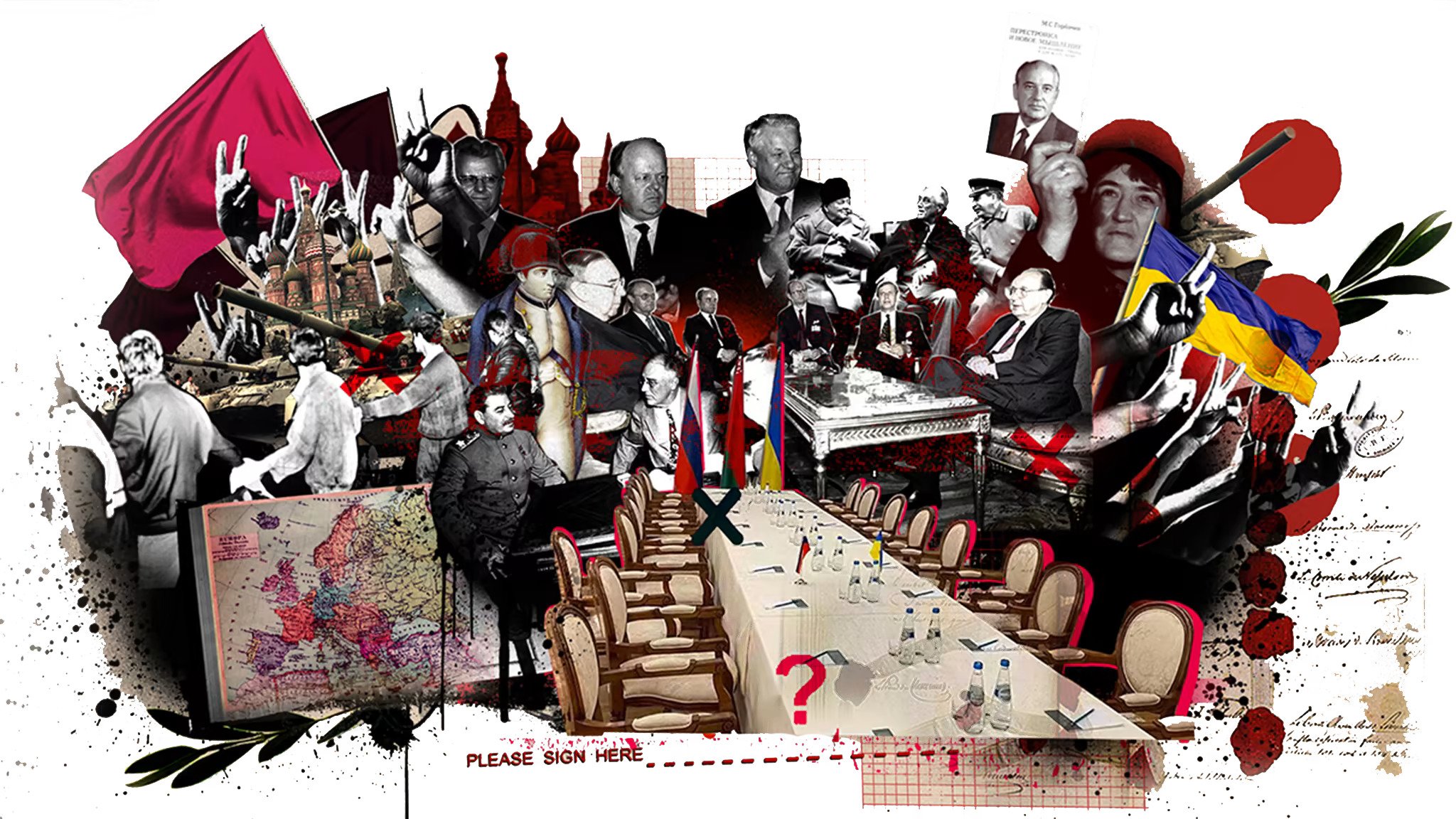
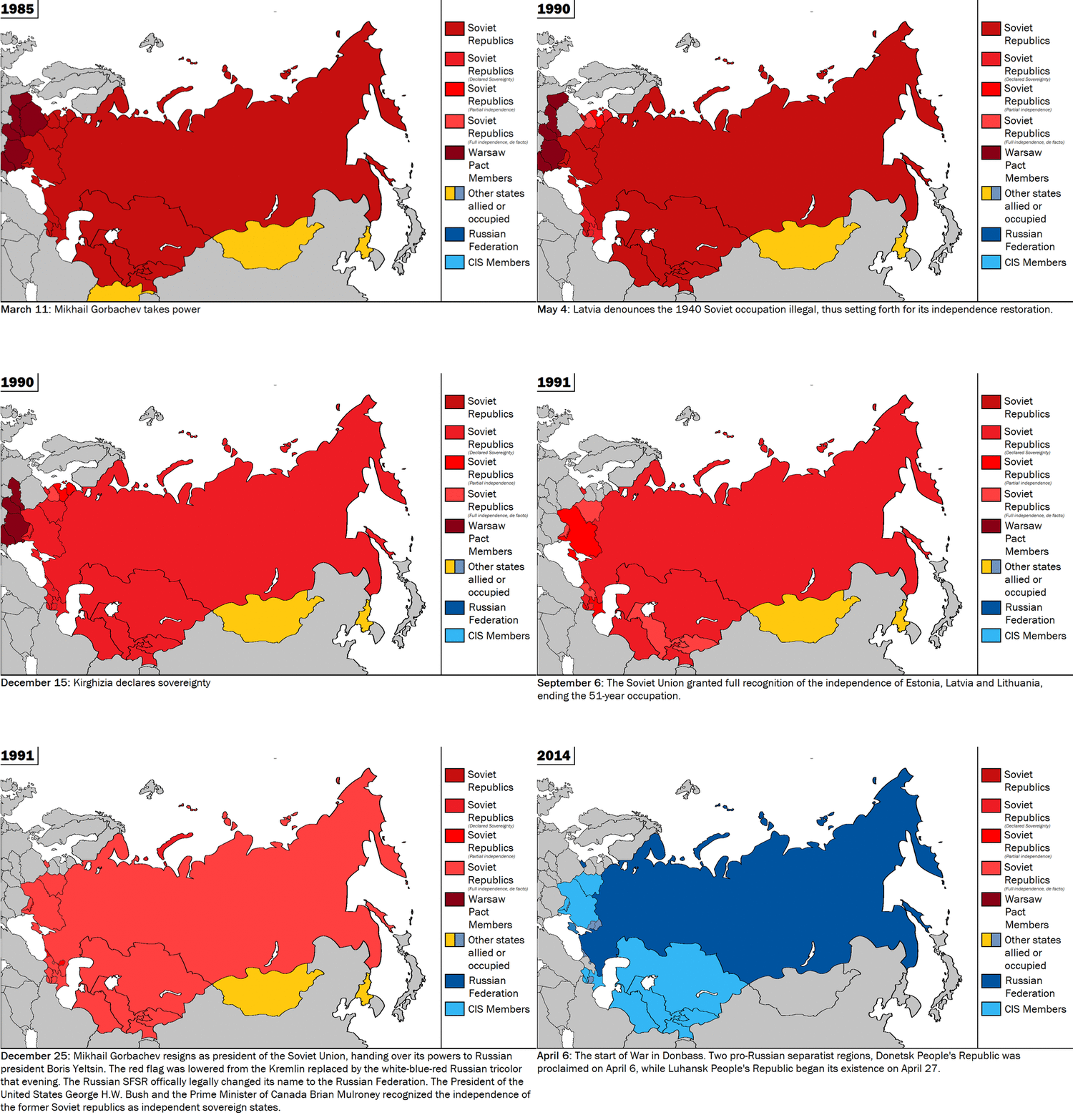
    Historically being a land power, Russia has viewed Ukraine as a strategically critical region in its security matrix. However, as the central control of Moscow weakened in the former USSR, the nationalist aspirations of the Ukrainian people began to materialise and Ukraine played a crucial role, along with the Russian Federation and Belarus, in dissolving the former Soviet Union. The two countries found themselves on opposite sides on extremely fundamental issues, such as security, economic partnership, post-Soviet order, and, not least, sovereignty. In Belovezh, in early December of 1991, when Russian President Boris Yeltsin, Ukrainian President Leonid Kravchuk and Belarusian leader Stanislav Shushkevich met to dissolve the USSR, major disagreements regarding the transitional phase and future of the republics erupted. Yeltsin expressed his desire for some sort of central control of the republics, whereas Kravchuk was vehemently opposed to any arrangement that might compromise his country’s sovereignty. Later, at the foundational ceremony of the Commonwealth of Independent States (CIS), he stressed a common military, the most potent rejection of which came from Kravchuk. [4]

    Source: Wikimedia Commons

    The elephant in the room, however, was the status of Sevastopol, which housed the headquarters of the Black Sea Fleet. Yeltsin was quoted saying that “The Black Sea Fleet was, is and will be Russia’s. No one, not even Kravchuk will take it away from Russia”. [5] Though the issue was soon temporarily resolved –with the two countries dividing the fleet equally amongst themselves, it continued to dominate and sour their relationship. Russia, as the successor state of the USSR, wanted the base and the entire fleet in its navy. Yeltsin even offered gas at concessional rates to Ukraine if it handed over the city and nuclear weapons to Russia. The issue remained unresolved until the 1997 Friendship Treaty under which Ukraine granted Moscow the entire fleet and leased Sevastopol to Russia until 2017 (later extended).

    Ukraine, under Kravchuk and, later, Leonid Kuchma, struggled to tread a tightrope between Russia and the European Union. On one hand, it was economically knit with former Soviet Republics, and on the other, it was actively looking to get economic benefits from the EU. However, soon a slide towards the west was conspicuous. In 1994, it preferred a Partnership and Cooperation Agreement with the EU over CIS Customs Union, which was a Russian initiative. Later, in 1996, it declined to join a new group consisting of former Soviet Republics ‘On Deepening Integration’, scuttling the initiative, since its purpose was to bring Ukraine back into the Russian fold. [6] By 1998, the Kuchma government had formulated a ‘Strategy of Integration into the European Union’. [7]

    Nuclear weapons were another point of contention between the two. Ukraine was extremely reluctant to give up its arsenal, citing security threats from Russia. Kravchuk received a verbal ‘security guarantee’ from the US which forced Russia to “respect the independence, sovereignty, and territorial integrity of each nation” [8] in exchange for surrendering Ukraine’s nuclear weapons. 

    Notwithstanding the disputes, there was a great deal of cooperation between the two, especially after Kuchma’s re-election in 1999. Kuchma’s hook-up with authoritarianism distanced Kyiv from Brussels and brought it closer to Moscow. Ukraine agreed to join Russian initiatives of the Eurasian Economic Community as an observer and Common Economic Space as a full member. At home as well, his support in the eastern parts of the country, where ethnic Russians dwelled, increased dramatically, as evident in the 2002 Parliamentary Elections. [9] However, the bonhomie was soon disrupted by a single event.

    The Orange Revolution was Russia’s 9/11. [10] It dramatically altered Russian thinking on democracy and its ties with the West. It raised the prospect in Russia that Ukraine might be lost completely. It further made them believe the colour revolutions in former Soviet republics were CIA toolkits for regime change. More importantly, it made the Russians apprehensive of a similar revolution within their borders. As a result, the distrust between Russia and the West, and Russia and Ukraine grew considerably. As a nationalist, Victor Yushchenko formulated policies that directly hurt Russian interests. The two countries fought ‘Gas Wars’ in 2006 and 2009, which made both the EU and Russia uncomfortable with Ukraine as a gas transit country. Furthermore, Yushchenko bestowed the title of ‘Hero of Ukraine’ upon Stepan Bandera, a Nazi collaborator and perpetrator of the Holocaust, a decision that surely did not go well with Moscow.

    Geoeconomics: Ukraine as a Gas Transit Country

    The current war is the worst in Europe since the Second World War. Still, Ukraine continues to transit Russian gas through its land, Russia continues to pay for it, and Western Europe continues to receive the crucial resource. The war has shattered all the big bets on Russian dependence on Ukraine for delivering gas to Western Europe and has renewed the discourse on reducing European energy dependence on Russia. Since the EU imports 40% of its gas from Russia, almost a quarter of which flows through Ukraine, Kyiv has had leverage in dealing with Russians in the past. It has been able to extract favourable terms by either stopping or diverting gas for its own domestic use at a time of heightened tensions between Ukraine and Russia. As a result, the EU was directly drawn into the conflict between them, infructuating Moscow’s pressure tactics for a long.

    Moscow has made numerous attempts in the past to bypass Ukraine by constructing alternate pipelines. Nord Stream, the most popular of them, was conceived in 1997, as an attempt to decrease the leverage of the transit states. The pipeline was described as the “Molotov-Ribbentrop Pipeline” by Polish Defence Minister Radoslaw Sirkosi for the geoeconomic influence it gave to Russia. [11] Another project – the South Stream – was aimed at providing gas to the Balkans, and through it to Austria and Italy. The pipeline was conceived in the aftermath of the Orange Revolution and its construction was motivated by geoeconomics, rather than economic viability. It would have led to Russia bypassing Ukraine in delivering gas to the Balkans and Central Europe, thus seizing its significant leverage, and relegating it to vulnerable positions in which Moscow could have eliminated the gas subsidies Ukraine was being provided. [12]As a result of economic unviability, the project was abandoned in 2014.

    To a certain extent, the European Union has been complicit in making matters worse for Russia. For instance, during the 2009 ‘Gas War’ – that began due to Ukraine’s non-payment of gas debt to Russia – instead of holding Ukraine accountable, the EU countries blamed Russia for the gas crisis in Europe and asked Russia to resume gas supply to Ukraine. Later, realising the importance of Ukraine as a transit country, it reached an agreement with Kyiv that “recognized the importance of the further expansion and modernization of Ukraine’s gas transit system as an indispensable pillar of the common European energy infrastructure, and the fact that Ukraine is a strategic partner for the EU gas sector”. The agreement excluded Russia as a party, which saw it as undermining the collaboration between itself and Ukraine, and injuring its influence on the country. [13] The Russian grievance becomes even more palpable when we view the significant gas subsidies it has provided to Ukraine for more than two decades. 

    Similarly, the EU countries viewed Nord Stream 2 from a geostrategic and geo-economic perspective. In December last year, German Economic Affairs Minister Robert Habeck warned Russia of halting Nord Stream 2 if it attacks Ukraine. German Chancellor Olaf Scholz was quoted saying that he would do ‘anything’ to ensure that Ukraine remains a transit country for Russian gas. [14] In fact, the pipeline – that is set to double the capacity of gas delivered to the EU – has faced opposition from almost all Western European countries, the US, the EU as well as Ukraine, which has described it as ‘A dangerous Geopolitical Weapon’. [15] The pipeline had raised concerns amongst Ukrainians of losing a restraining factor on Moscow’s behaviour. [16] However, with the pipeline still inoperable, the Kremlin has already made the restraining factor ineffective.

    The Security Objective

    The Russian Federation is a country which spreads from the European Continent to Asia. In this giant nation, the hospitable region where people live is mainly on the European side, which also comprises main cities like St. Petersburg, Volgograd and the Capital City Moscow. Throughout history, Russia has seen invasions by Napoleon as well as Hitler, and the main area through which these invasions and wars happened was through Ukrainian land which gave them direct access to Russia – due to the lack of any geographical barriers. It was certainly a contributing factor towards the initial success of these invasions. Today, we might understand these events as Russia’s sense of vulnerability and insecurity if history is any indicator. 

    The Russian Federation also follows a similar approach to ensuring its security, survival and territorial integrity. Russia’s interest in Ukraine is as much geopolitical as cultural. Since Russians and Ukrainians were intrinsically linked through their culture and language, Ukraine quickly came to be seen as Russian land, with Ukrainians being recognized as ‘Little Russians’ (Kubicek, 2008), as compared to the “Great Russians”. They were consequently denied the formation of a distinct Ukrainian identity. Putin gave substance to this sentiment as, according to a US diplomatic cable leak, he had “implicitly challenged the territorial integrity of Ukraine, suggesting that Ukraine was an artificial creation sewn together from the territory of Poland, the Czech Republic, Romania, and especially Russia in the aftermath of the Second World War” during a Russia-NATO Council meeting. [17]

    Crimea and much of eastern Ukraine are ethnically Russian and desire closer ties with Russia. But moving further west, the people become increasingly cosmopolitan and it is mostly this population that seeks greater linkage with the Western European countries and membership into the EU and NATO. This in addition to the Euro Maidan protests is what Putin has used to justify the annexation of Crimea in 2014. The other security consideration was the threat it faced from the likelihood of NATO establishing a base in Crimea given its own presence in Sevastopol in the Black Sea. 

    In the current scenario, the second phase of Russian Military operation in the East and South has shown us the larger vulnerabilities Moscow has which are being countered through control of certain points in the region. By liberating the Donbass region in the east, Russia plans to create a buffer zone between itself and the west to stop future aggression and keep enemies at bay. But the extension of this buffer zone all the way to Odessa is indicative of other strategic considerations. Mariupol in the south of Ukraine is one of the many extended strategic points Russia now controls leading us to ask just why Mariupol is a game-changer in this conflict?

    The port city of Mariupol is a small area geographically, but it provides the land bridge for the Russian forces in the Crimean Peninsula to join the Military operation in the Donbas region. Moreover, it gives Russia a land bridge to Crimea from the Russian Mainland. According to General Sir Richard Barrons, former Commander of UK Joint Forces Command, Mariupol is crucial to Russia’s offensive movement, – “When the Russians feel they have successfully concluded that battle, they will have completed a land bridge from Russia to Crimea and they will see this a major strategic success.” [18]

    Source: ISW (Assessment on 09 May, 2022)

    If the port city of Mariupol is important for the creation of a land corridor, then the Sea of Azov which is adjacent to it is even more important due to its strategic position. [19] The three geopolitical reasons why this sea is important are as follows:

    1. The Sea of Azov is a major point for the economic and military well-being of Ukraine. Proximity to the frontlines of the Donbass region where the fighting between Ukrainian forces and Pro-Russian separatists is taking place makes the control of this sea vital to the Russian military as it helps weaken Ukrainian defence in the region via control of the Kerch Strait.
    2. Controlling the Sea of Azov is strategically important for Russia, to maintain its control in the Crimean Peninsula, which allows Moscow to resupply its forces through the Strait of Kerch.
    3. Finally, it also involves Eurasian politics into why Russia needs to control this region and here the discussion of the Volga-Don canal which links the Caspian Sea with the Sea of Azov comes to the fore. Russia has always used this canal to move warships between the Caspian Sea to the Black Sea and project its power in both regions. Moreover, Russia sees this connection as a significant strategic advantage in any future crisis.

    If Mariupol and the Sea of Azov are considered the most important strategically valuable features by Russia, there also exists the crucial points of Kherson and Odessa which will give Russia complete dominance of the Ukrainian coast line, thus giving larger access and control in the Black Sea region that has the potential to be militarised in the future in conflicts with the West. Moreover, it gives Russia a land corridor to Transnistria which is a Pro-Russian separatist area in Moldova and an opening into the Romanian border through Odessa, thus balancing the build-up of NATO forces in the region. 

    Conclusion

    The Ukrainian crisis is as much the West’s doing as Russia’s and an ear sympathetic to the Russian narrative might even say that the West took advantage of Russia when it was vulnerable immediately following the collapse of the Soviet Union in negotiations regarding the German state reunification and NATO enlargement.

    The bottom line is that, presently, Putin views NATO as an existential security threat to the Russian state and sees the US and its allies’ support of Ukraine as a challenge. Ukraine’s membership in the EU and NATO is a non-starter for Russia and pitting a Ukraine, that has a symbiotic relationship with Russia at all levels, against a slightly diminished but still formidable great power will have consequences for the security architecture and geopolitics of the region.  The Ukrainian crisis is as much the West’s doing as Russia’s and an ear sympathetic to the Russian narrative might even say that the West took advantage of Russia when it was vulnerable immediately following the collapse of the Soviet Union in negotiations regarding the German state reunification and NATO enlargement. On some level, NATO countries recognize the fact that Ukraine and Georgia can never be allowed membership into the North Atlantic alliance because the alternative of wilfully ignoring Russia’s security and national interests is just a recipe for disaster and might just launch the region into the single biggest armed conflict since World War 2. 

    References:

    [1] The White House. (2022, January 20). Remarks by president Biden in the press conference. https://www.whitehouse.gov/briefing-room/speeches-remarks/2022/01/19/remarks-by-president-biden-in-press-conference-6/

    [2] Savranskaya, S., Blanton, T. S., & Zubok, V. (2010). Masterpieces of history: The peaceful end of the Cold War in Europe, 1989. Central European University Press.

    [3] Putin, Vladimir. “Rossiya na Rubezhe Tysyacheletii,” Nesavisimaya Gazeta, December 30, 1999, quoted in D’Anieri, Paul (2019). Ukraine and Russia: From Civilized Divorce to Uncivil War. Cambridge University Press.

    [4] Ibid

    [5] Rettie, J. and James Meek, “Battle for Soviet Navy,” The Guardian, January 10, 1992

    [6] Ibid, no. iii

    [7] Solchanyk, R., Ukraine and Russia: The Post-Soviet Transition. Rowman and Littlefield Publishers. 2000.

    [8] Goldgeier, J. and Michael McFaul. “Power and Purpose: U.S. Policy Toward Russia after the Cold War”, Brookings Institution Press, 2003

    [9] Ibid, no. iii

    [10]  The comment was made by Gleb Pavlovskii, a Russian Political Scientist. quoted in Ben Judah (2013), Fragile Empire: How Russia Fell In and Out of Love with Vladimir Putin. New Haven, CT: Yale University Press, p. 85.

    [11] Ibid, no. iii

    [12] Wigell, M. and  A. Vihma, Geopolitics versus geoeconomics: the case of Russia’s geostrategy and its effects on the EU. International Affairs, 92: 605-627. May 6, 2016

    [13] Ibid, no. iii

    [14] Harper, J. (2021, December 23). Nord stream 2: Who wins, who loses? Deutsche Welle. https://www.dw.com/en/nord-stream-2-who-wins-who-loses/a-60223801

    [15] Ukraine: Nord stream 2 a ‘dangerous geopolitical weapon’. (2021, August 22). DW.COM. https://www.dw.com/en/ukraine-nord-stream-2-a-dangerous-geopolitical-weapon/a-58950076

    [16] Pifer, S. “Nord Stream 2: Background, Objectives and Possible Outcomes”, Brookings, April 2021 https://www.brookings.edu/research/nord-stream-2-background-objections-and-possible-outcomes/

    [17] WikiLeaks. (2008, August 14). UKRAINE, MAP, AND THE GEORGIA-RUSSIA CONFLICT, Canonical ID:08USNATO290_ahttps://wikileaks.org/plusd/cables/08USNATO290_a.html

    [18] Gardner, F. (2022, March 21). Mariupol: Why Mariupol is so important to Russia’s plan. BBC News. https://www.bbc.com/news/world-europe-60825226

    [19] Blank, S. (2018, November 6). Why is the Sea of Azov so important? Atlantic Council. https://www.atlanticcouncil.org/blogs/ukrainealert/why-is-the-sea-of-azov-so-important/

    Featured Image Credits: Financial Times

    [powerkit_button size="lg" style="info" block="true" url="https://admin.thepeninsula.org.in/2022/03/29/tpf-analysis-series-on-russia-ukraine-conflict/" target="_blank" nofollow="false"]
    TPF Analysis Series on Russia – Ukraine Conflict #1
    [/powerkit_button]

  • The Military Situation in Ukraine

    The Military Situation in Ukraine

    Understanding the war in Ukraine is a challenge as all the available information is mired in Western Propaganda. However, there are sane voices of scholars like John Mearsheimer and a small group of excellent professionals and military veterans who provide extremely accurate analysis to ensure we get the true picture of this geopolitical contest between Russia and the US and NATO. Jacques Baud is a former Colonel of the General Staff, intelligence expert in NATO, and ex-member of the Swiss intelligence, and specialist on Eastern countries.

    In this excellent analysis, Jacques Baud brings out how the US and NATO have created conditions for the war and are using Ukraine as the sacrificial pawn in their proxy war against Russia. Jacques Baud demolishes the West’s propaganda about Russia’s invasion of Ukraine on Feb 24th and traces the start of the war to Feb 16th by the US and NATO.  Contrary to the American propaganda, he sees Putin as the master strategist. The end of this conflict will usher in a new multi-polar world order, in which the West may cease to be the rule maker.

    TPF is immensely happy to republish this article through the gracious courtesy of Centre Francaise de Recherche sure le Renseignement

    Capitulation – 1946 painting by Soviet Artist Pyotr Aleksandrovich Krivonogov, a veteran of The Great Patriotic War


    PART ONE: ON THE ROAD TO WAR

    For years, from Mali to Afghanistan, I worked for peace and risked my life for it. It is therefore not a question of justifying the war, but of understanding what led us to it. I note that the “experts” who take turns on the television sets analyze the situation based on dubious information, most often hypotheses turned into facts, and therefore we no longer manage to understand what is happening. That’s how you create panic.

    The problem is not so much who is right in this conflict, but how our leaders make their decisions.

    Let’s try to examine the roots of the conflict. It starts with those who for the past eight years have been talking to us about “separatists” or “independence” from the Donbas. It’s wrong. The referendums conducted by the two self-proclaimed republics of Donetsk and Luhansk in May 2014 were not ”  independence ” (независимость) referendums, as some unscrupulous journalists claimed, but ”  self-determination  ” or ”  autonomy (самостоятельность). The term “pro-Russian” suggests that Russia was a party to the conflict, which was not the case, and the term “Russian speakers” would have been more honest. Moreover, these referendums were conducted against the advice of Vladimir Putin.

    In fact, these republics did not seek to separate from Ukraine, but to have a statute of autonomy guaranteeing them the use of the Russian language as an official language. Because the first legislative act of the new government resulting from the overthrow of President Yanukovych, was the abolition, on February 23, 2014, of the Kivalov-Kolesnichenko law of 2012 which made Russian an official language. A bit as if putschists decided that French and Italian would no longer be official languages ​​in Switzerland.

    This decision causes a storm in the Russian-speaking population. This resulted in fierce repression against the Russian-speaking regions (Odesa, Dnepropetrovsk, Kharkov, Lugansk and Donetsk) which began in February 2014 and led to a militarization of the situation and a few massacres (in Odesa and Mariupol, for the most important). At the end of summer 2014, only the self-proclaimed republics of Donetsk and Lugansk remained.

    At this stage, too rigid and stuck in a doctrinaire approach to the operational art, the Ukrainian staff suffered the enemy without succeeding in imposing themselves. Examination of the course of the fighting in 2014-2016 in the Donbas shows that the Ukrainian general staff systematically and mechanically applied the same operational plans. However, the war waged by the autonomists was then very close to what we observed in the Sahel: very mobile operations carried out with light means. With a more flexible and less doctrinaire approach, the rebels were able to exploit the inertia of the Ukrainian forces to “trap” them repeatedly.

    In 2014, I am at NATO, responsible for the fight against the proliferation of small arms, and we are trying to detect Russian arms deliveries to the rebels in order to see if Moscow is involved. The information that we receive then comes practically all from the Polish intelligence services and does not “match” with the information from the OSCE: in spite of rather crude allegations, we do not observe any delivery of arms and materials Russian military.

    The rebels are armed thanks to the defections of Russian-speaking Ukrainian units which cross over to the rebel side. As the Ukrainian failures progressed, the entire tank, artillery or anti-aircraft battalions swelled the ranks of the autonomists. This is what drives the Ukrainians to commit to the Minsk Accords.

    But, just after signing the Minsk 1 Accords, Ukrainian President Petro Poroshenko launched a vast anti-terrorist operation (ATO/Антитерористична операція) against Donbas. Bis repetita placent: poorly advised by NATO officers, the Ukrainians suffered a crushing defeat at Debaltsevo which forced them to commit to the Minsk 2 Agreements…

    It is essential to recall here that the Minsk 1 (September 2014) and Minsk 2 (February 2015) Agreements provided for neither the separation nor the independence of the Republics, but their autonomy within the framework of Ukraine. Those who have read the Accords (they are very, very, very few) will find that it is written in full that the status of the republics was to be negotiated between Kyiv and the representatives of the republics, for an internal solution in Ukraine.

    This is why since 2014, Russia has systematically demanded their application while refusing to be a party to the negotiations, because it was an internal matter for Ukraine. On the other side, the Westerners – led by France – have systematically tried to replace the Minsk Accords with the “Normandy format”, which put Russians and Ukrainians face to face. However, let us remember, there were never any Russian troops in the Donbas before February 23-24, 2022. Moreover, OSCE observers have never observed the slightest trace of Russian units operating in the Donbas. Thus, the US intelligence map published by the Washington Post on December 3, 2021, does not show Russian troops in Donbas.

    In October 2015, Vasyl Hrytsak, director of the Ukrainian Security Service (SBU), confessed that only 56 Russian fighters had been observed in the Donbas. It was even comparable to that of the Swiss going to fight in Bosnia during the weekends, in the 1990s, or the French who are going to fight in Ukraine today.

    The Ukrainian army was then in a deplorable state. In October 2018, after four years of war, Ukraine’s chief military prosecutor Anatoly Matios said that Ukraine had lost 2,700 men in the Donbas: 891 from disease, 318 from traffic accidents, 177 from other accidents, 175 from poisoning (alcohol, drugs), 172 from careless handling of weapons, 101 from breaches of safety rules, 228 from murder and 615 from suicide.

    In fact, the army is undermined by the corruption of its cadres and no longer enjoys the support of the population. According to a UK Home Office report, when reservists were called up in March-April 2014, 70% did not show up for the first session, 80% for the second, 90% for the third and 95% for the fourth. In October/November 2017, 70% of callers did not show up during the “  Autumn 2017  ” callback campaign. This does not include suicides and desertions(often for the benefit of the autonomists) which reach up to 30% of the workforce in the ATO zone. Young Ukrainians refuse to go and fight in the Donbas and prefer emigration, which also explains, at least partially, the country’s demographic deficit.

    The Ukrainian Ministry of Defense then turned to NATO to help it make its armed forces more “attractive”. Having already worked on similar projects within the framework of the United Nations, I was asked by NATO to participate in a program intended to restore the image of the Ukrainian armed forces. But it’s a long process and the Ukrainians want to go quickly.

    Thus, to compensate for the lack of soldiers, the Ukrainian government resorted to paramilitary militias. They are essentially made up of foreign mercenaries, often far-right activists. As of 2020, they constitute around 40% of Ukraine’s forces and number around 102,000 men according to Reuters. They are armed, financed and trained by the United States, Great Britain, Canada and France. There are more than 19 nationalities – including Swiss.

    Western countries have therefore clearly created and supported Ukrainian far-right militias. In October 2021, the Jerusalem Post sounded the alarm by denouncing the Centuria project. These militias have been operating in the Donbas since 2014, with Western support. Even if we can discuss the term “Nazi”, the fact remains that these militias are violent, convey a nauseating ideology and are virulently anti-Semitic. Their anti-Semitism is more cultural than political, which is why the adjective “Nazi” is not really appropriate. Their hatred of the Jew comes from the great famines of the years 1920-1930 in Ukraine, resulting from the confiscation of crops by Stalin in order to finance the modernization of the Red Army. However, this genocide – known in Ukraine as the Holodomor – was perpetrated by the NKVD (predecessor of the KGB) whose upper echelons of leadership were mainly made up of Jews. That is why, today, Ukrainian extremists are asking Israel to apologize for the crimes of communism, as the Jerusalem Post reports. We are therefore a long way from a “  rewriting of history  ” by Vladimir Putin.

    These militias, stemming from the far-right groups that led the Euromaidan revolution in 2014, are made up of fanatical and brutal individuals. The best known of these is the Azov regiment, whose emblem is reminiscent of that of the 2nd SS Das Reich Panzer Division, which is the object of real veneration in Ukraine, for having liberated Kharkov from the Soviets in 1943, before perpetrating the massacre of Oradour-sur-Glane in 1944, in France.

    Among the famous figures of the Azov regiment was the opponent Roman Protassevich, arrested in 2021 by the Belarusian authorities following the case of RyanAir flight FR4978. On May 23, 2021, there is talk of the deliberate hijacking of an airliner by a MiG-29 – with Putin’s agreement, of course – to arrest Protassevich, although the information then available does not confirm this scenario in any way.

    But it must then be shown that President Lukashenko is a thug and Protassevich a “journalist” in love with democracy. However, a rather edifying investigation produced by an American NGO in 2020, highlighted Protassevich’s far-right militant activities. Western conspiracy then sets in motion and unscrupulous media “groom” his biography. Finally, in January 2022, the ICAO report is published and shows that despite some procedural errors, Belarus acted in accordance with the rules in force and that the MiG-29 took off 15 minutes after the RyanAir pilot decided to land in Minsk. So no Belarus plot and even less with Putin. Ah!… One more detail: Protassevich,cruelly tortured by Belarusian police, is now free. Those who would like to correspond with him can go to his Twitter account.

    The labelling of “Nazi” or “neo-Nazi” given to Ukrainian paramilitaries is considered Russian propaganda. Perhaps; but that is not the opinion of The Times of Israel, the Simon Wiesenthal Center or the Counterterrorism Center at West Point Academy. But this remains debatable, because, in 2014, Newsweek magazine seemed to associate them with… the Islamic State. A choice!

    So the West supports and continues to arm militias that have been guilty of numerous crimes against civilian populations since 2014: rape, torture and massacres. But while the Swiss government has been very quick to impose sanctions against Russia, it has not adopted any against Ukraine, which has been slaughtering its own population since 2014. In fact, those who defend the rights of the men in Ukraine have long condemned the actions of these groups, but have not been followed by our governments. Because, in reality, we are not trying to help Ukraine, but to fight Russia.

    The integration of these paramilitary forces into the National Guard was not at all accompanied by a “denazification”, as some claim. Among the many examples, that of the insignia of the Azov Regiment is edifying:
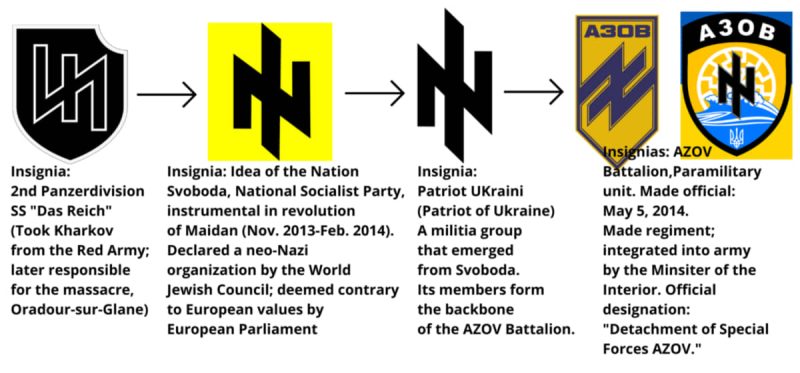
     

    In 2022, very schematically, the Ukrainian armed forces fighting the Russian offensive are structured as:

    – Army, subordinate to the Ministry of Defence: it is articulated in 3 army corps and composed of manoeuvre formations (tanks, heavy artillery, missiles, etc.).

    – National Guard, which depends on the Ministry of the Interior and is articulated in 5 territorial commands.

    The National Guard is therefore a territorial defence force that is not part of the Ukrainian army. It includes paramilitary militias, called ”  volunteer battalions” (добровольчі батальйоні), also known by the evocative name of ”  retaliatory battalions  “, composed of infantry. Mainly trained for urban combat, they now ensure the defence of cities such as Kharkov, Mariupol, Odesa, Kyiv, etc.

    PART II: THE WAR

    The former head of the Warsaw Pact forces in the Swiss strategic intelligence service, I observe with sadness – but not astonishment – ​​that our services are no longer in a position to understand the military situation in Ukraine. The self-proclaimed “experts” who parade across our screens wirelessly relay the same information modulated by the assertion that Russia – and Vladimir Putin – is irrational. Let’s take a step back.

    • THE OUTBREAK OF WAR

    Since November 2021, the Americans have constantly brandished the threat of a Russian invasion against Ukraine. However, the Ukrainians do not seem to agree. Why?

    We have to go back to March 24, 2021. On that day, Volodymyr Zelensky issued a decree for the reconquest of Crimea and began to deploy his forces towards the south of the country. Simultaneously, several NATO exercises were conducted between the Black Sea and the Baltic Sea, accompanied by a significant increase in reconnaissance flights along the Russian border. Russia then conducts a few exercises to test the operational readiness of its troops and show that it is following the evolution of the situation.

    Things calm down until October-November with the end of the ZAPAD 21 exercises, whose troop movements are interpreted as a reinforcement for an offensive against Ukraine. However, even the Ukrainian authorities refute the idea of ​​Russian preparations for a war and Oleksiy Reznikov, Ukrainian Minister of Defense declares that there has been no change on its border since the spring.

    In violation of the Minsk Accords, Ukraine is conducting aerial operations in Donbas using drones, including at least one strike against a fuel depot in Donetsk in October 2021. The American press points this out, but not the Europeans and no one condemns these violations.

    In February 2022, events rush. On February 7, during his visit to Moscow, Emmanuel Macron reaffirms to Vladimir Putin his attachment to the Minsk Accords, a commitment he will repeat after his interview with Volodymyr Zelensky the next day. But on February 11, in Berlin, after 9 hours of work, the meeting of the political advisers of the leaders of the ”  Normandy format  “ ends, without a concrete result: the Ukrainians still and always refuse to apply the Accordsof Minsk, apparently under pressure from the United States. Vladimir Putin then notes that Macron has made empty promises to him and that the West is not ready to enforce the Accords, as they have been doing for eight years.

    Ukrainian preparations in the contact zone continue. The Russian Parliament is alarmed and on February 15 asks Vladimir Putin to recognize the independence of the Republics, which he refuses.

    On February 17, President Joe Biden announces that Russia will attack Ukraine in the coming days. How does he know? Mystery… But since the 16th, the artillery shelling of the populations of Donbas has increased dramatically, as shown by the daily reports of OSCE observers. Naturally, neither the media, nor the European Union, nor NATO, nor any Western government reacts and intervenes. We will say later that this is Russian disinformation. In fact, it seems that the European Union and some countries purposely glossed over the massacre of the people of Donbas, knowing that it would provoke Russian intervention.

    At the same time, there are reports of acts of sabotage in the Donbas. On January 18, Donbas fighters intercept saboteurs equipped with Western equipment and speaking Polish seeking to create chemical incidents in Gorlivka. They could be CIA mercenaries, led or “advised” by Americans and made up of Ukrainian or European fighters, to carry out sabotage actions in the Donbas Republics.
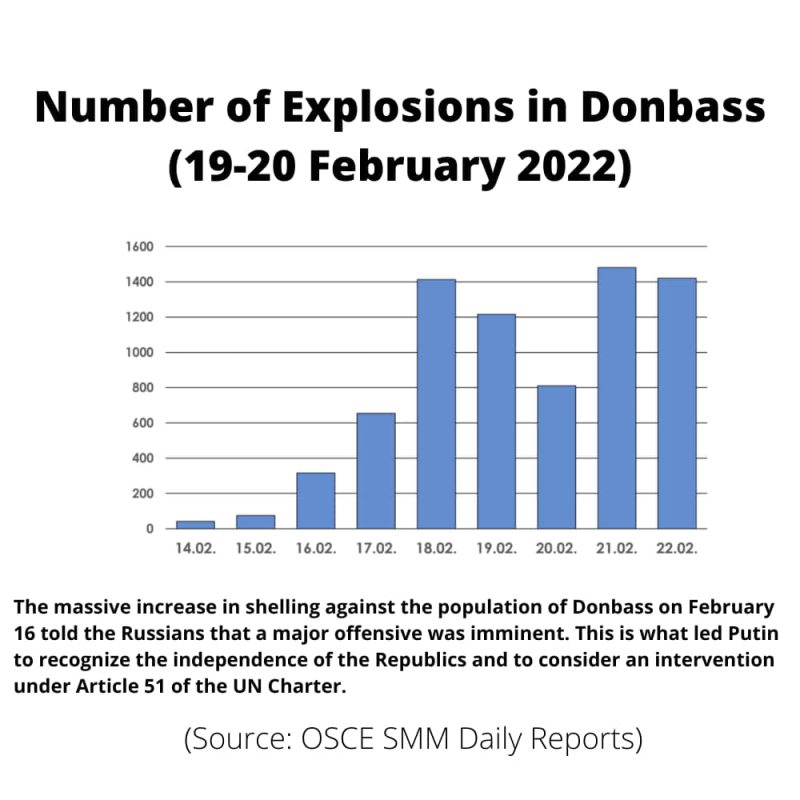
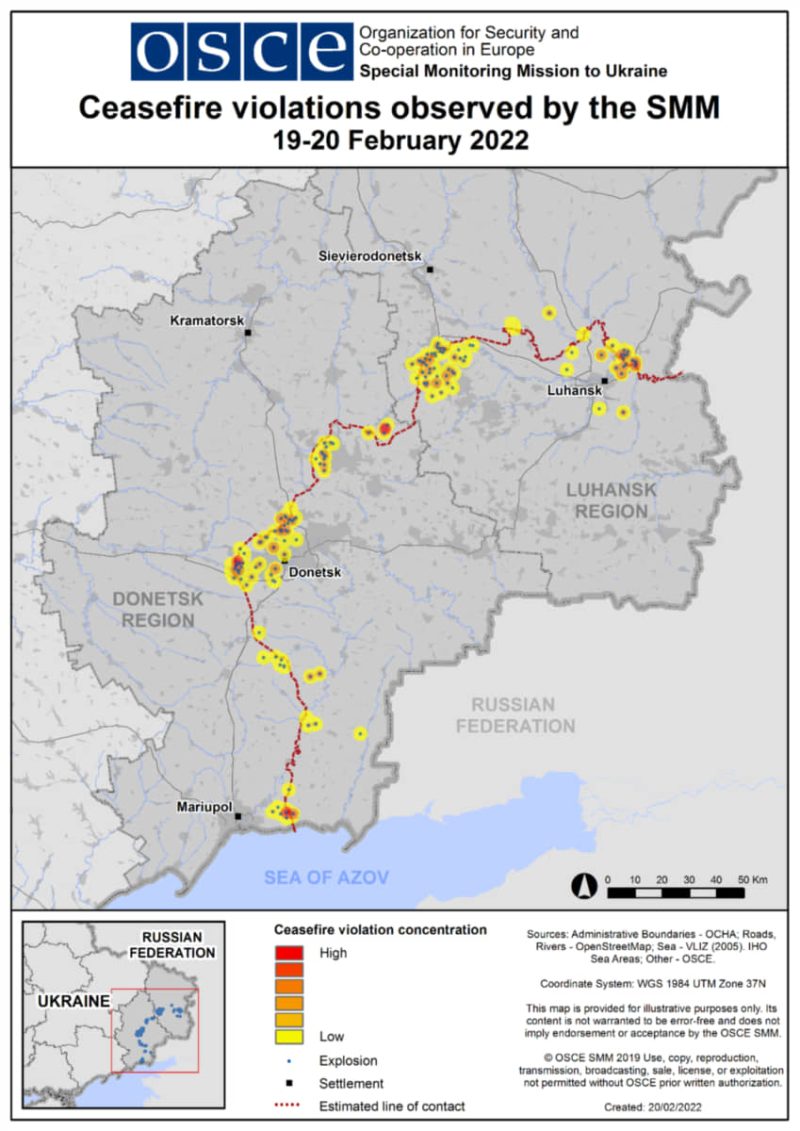
    In fact, as early as February 16, Joe Biden knows that the Ukrainians have begun to shell the civilian populations of Donbas, putting Vladimir Putin in front of a difficult choice: to help Donbas militarily and create an international problem or to sit idly by and watch the Russian speakers. from the Donbas being run over.

    If he decides to intervene, Vladimir Putin can invoke the international obligation of “  Responsibility To Protect  ” (R2P). But he knows that whatever its nature or scale, the intervention will trigger a shower of sanctions. Therefore, whether its intervention is limited to the Donbas or whether it goes further to put pressure on the West for the status of Ukraine, the price to be paid will be the same. This is what he explains in his speech on February 21.

    That day, he acceded to the request of the Duma and recognized the independence of the two Republics of Donbas and, in the process, he signed treaties of friendship and assistance with them.

    The Ukrainian artillery bombardments on the populations of Donbas continued and, on February 23, the two Republics requested military aid from Russia. On the 24th, Vladimir Putin invokes Article 51 of the United Nations Charter which provides for mutual military assistance within the framework of a defensive alliance.

    In order to make the Russian intervention totally illegal in the eyes of the public, we deliberately obscure the fact that the war actually started on February 16th. The Ukrainian army was preparing to attack the Donbas as early as 2021, as certain Russian and European intelligence services were well aware… The lawyers will judge.

    In his speech on February 24, Vladimir Putin stated the two objectives of his operation: to “demilitarize” and “denazify” Ukraine. It is therefore not a question of seizing Ukraine, nor even, in all likelihood, of occupying it and certainly not of destroying it.

    From there, our visibility on the progress of the operation is limited: the Russians have excellent security of operations (OPSEC) and the detail of their planning is not known. But fairly quickly, the course of operations makes it possible to understand how the strategic objectives were translated into the operational plan.

    – Demilitarization:

    . ground destruction of Ukrainian aviation, air defence systems and reconnaissance assets;

    . neutralization of command and intelligence structures (C3I), as well as the main logistics routes in the depth of the territory;

    . encirclement of the bulk of the Ukrainian army massed in the southeast of the country.

    – Denazification:

    . destruction or neutralization of volunteer battalions operating in the cities of Odesa, Kharkov and Mariupol, as well as in various facilities on the territory.

    • THE “DEMILITARIZATION”

    The Russian offensive proceeds in a very “classic” manner. At first – as the Israelis had done in 1967 – with the destruction on the ground of the air forces in the very first hours. Then, we witness a simultaneous progression on several axes according to the principle of “flowing water”: we advance wherever resistance is weak and we leave the cities (very voracious in troops) for later. To the north, the Chernobyl plant is occupied immediately to prevent acts of sabotage. The images of Ukrainian and Russian soldiers jointly guarding the plant are naturally not shown…

    The idea that Russia is trying to take over Kyiv, the capital, to eliminate Zelensky, typically comes from the West: this is what they did in Afghanistan, Iraq, Libya and what they wanted to do in Syria with the help of the Islamic State. But Vladimir Putin never intended to take down or overthrow Zelensky. On the contrary, Russia seeks to keep him in power by pushing him to negotiate by encircling Kyiv. He had refused to do so far to apply the Minsk Accords, but now the Russians want to obtain Ukraine’s neutrality.

    Many Western commentators marvelled that the Russians continued to seek a negotiated solution while conducting military operations. The explanation is in the Russian strategic conception, since Soviet times. For Westerners, war begins when politics ceases. However, the Russian approach follows a Clausewitzian inspiration: war is the continuity of politics and one can pass fluidly from one to the other, even during combat. This creates pressure on the opponent and pushes him to negotiate.

    From an operational point of view, the Russian offensive was an example of its kind: in six days, the Russians seized a territory as vast as the United Kingdom, with a speed of advance greater than what the Wehrmacht made in 1940.

    The bulk of the Ukrainian army was deployed in the south of the country for a major operation against Donbas. This is why the Russian forces were able to encircle it from the beginning of March in the “cauldron” between Slavyansk, Kramatorsk and Severodonetsk, by a thrust coming from the east via Kharkov and another coming from the south from the Crimea. The troops of the Republics of Donetsk (DPR) and Lugansk (RPL) complete the action of the Russian forces with a push from the East.

    At this stage, the Russian forces are slowly tightening the noose, but are no longer under time pressure. Their objective of demilitarization is practically achieved and the residual Ukrainian forces no longer have an operational and strategic command structure.

    The “slowdown” that our “experts” attribute to poor logistics is only the consequence of having achieved the objectives set. Russia does not seem to want to engage in an occupation of the whole Ukrainian territory. In fact, it seems rather that Russia is trying to limit its advance to the country’s linguistic border.

    Our media speak of indiscriminate bombardments against civilian populations, particularly in Kharkov, and Dantesque images are broadcast on a loop. However, Gonzalo Lira, a Latin American who lives there, presents us with a calm city on March 10, and on March 11. Admittedly, it’s a big city and you can’t see everything, but that seems to indicate that we are not in the total war that we are being served continuously on our screens.

    As for the Republics of Donbas, they have “liberated” their own territories and are fighting in the city of Mariupol.

    • “DENAZIFICATION”

    In cities like Kharkov, Mariupol and Odesa, defence is provided by paramilitary militias. They know that the objective of “denazification” is aimed primarily at them.

    For an attacker in an urbanized area, civilians are a problem. This is why Russia seeks to create humanitarian corridors to empty the cities of civilians and leave only the militias in order to fight them more easily.

    Conversely, these militias seek to keep civilians in the cities in order to dissuade the Russian army from coming to fight there. This is why they are reluctant to implement these corridors and do everything so that Russian efforts are in vain: they can thus use the civilian population as “human shields”. Videos showing civilians trying to leave Mariupol and being beaten up by fighters from the Azov regiment are naturally carefully censored here.

    On Facebook, the Azov group was considered in the same category as the Islamic State and subject to the platform’s ”  dangerous individuals and organizations policy  “. It was therefore forbidden to glorify him, and the “posts” that were favourable to him were systematically banned. But on February 24, Facebook changed its policy and allowed posts favourable to the militia. In the same spirit, in March, the platform authorizes, in the former Eastern European countries, calls for the murder of Russian soldiers and leaders. So much for the values ​​that inspire our leaders, as we will see.

    Our media propagate a romantic image of popular resistance. It is this image that has led the European Union to finance the distribution of arms to the civilian population. It is a criminal act. In my role as chief of doctrine for peacekeeping operations at the UN, I worked on the issue of the protection of civilians. We then saw that violence against civilians took place in very specific contexts. Especially when weapons abound and there are no command structures.

    Now, these command structures are the essence of armies: their function is to channel the use of force according to an objective. By arming citizens in a haphazard fashion as is currently the case, the EU turns them into combatants, with the attendant consequences: potential targets. Moreover, without command, without operational goals, the distribution of arms inevitably leads to settling of scores, banditry and actions that are more deadly than effective. War becomes a matter of emotions. Force becomes violence. This is what happened in Tawarga (Libya) from August 11 to 13, 2011, where 30,000 black Africans were massacred with weapons parachuted (illegally) by France. Moreover, the British Royal Institute for Strategic Studies(RUSI) sees no added value in these arms deliveries.

    Moreover, by delivering arms to a country at war, one exposes oneself to being considered as a belligerent. The Russian strikes on March 13, 2022, against the Mykolaiv airbase follow Russian warnings that weapons transports would be treated as hostile targets.

    The EU repeats the disastrous experience of the Third Reich in the last hours of the Battle of Berlin. War should be left to the military and when one side has lost, it should be admitted. And if there is to be resistance, it must imperatively be led and structured. However, we are doing exactly the opposite: we are pushing citizens to go and fight and at the same time, Facebook is allowing calls for the murder of Russian soldiers and leaders. So much for the values ​​that inspire us.

    In some intelligence services, this irresponsible decision is seen as a way of using the Ukrainian population as cannon fodder to fight Vladimir Putin’s Russia. This kind of murderous decision had to be left to the colleagues of Ursula von der Leyen’s grandfather. It would have been wiser to engage in negotiations and thus obtain guarantees for the civilian populations than to add fuel to the fire. It’s easy to be combative with other people’s blood…

    • MARIUPOL MATERNITY

    It is important to understand beforehand that it is not the Ukrainian army that ensures the defence of Mariupol, but the Azov militia, composed of foreign mercenaries.

    In its summary of the situation on March 7, 2022, the Russian UN mission in New York states that ”  Residents report that the Ukrainian armed forces have expelled the personnel of the Natal Hospital No. 1 from the city of Mariupol and have installed a shooting station inside the establishment. »

    On March 8, the independent Russian media Lenta.ru published the testimony of civilians from Mariupol who said that the maternity hospital was taken over by the militias of the Azov regiment, and chased out the civilian occupants, threatening them with their weapons. They thus confirm the statements of the Russian ambassador a few hours earlier.

    The Mariupol hospital occupies a dominant position, perfectly adequate for installing anti-tank weapons and for observation. On March 9, Russian forces hit the building. According to CNN, there are 17 injured, but the footage shows no casualties on the premises and there is no evidence that the reported casualties are related to this strike. We talk about children, but in reality, we see nothing. It may be true, but it may be false… Which does not prevent EU leaders from seeing it as a war crime … Which allows Zelensky, just afterwards, to claim a no-fly zone over Ukraine…

    In reality, we don’t know exactly what happened. But the sequence of events tends to confirm that the Russian forces struck a position of the Azov regiment and that the maternity ward was then free of all civilians.

    The problem is that the paramilitary militias that ensure the defence of cities are encouraged by the international community not to respect the customs of war. It seems that the Ukrainians have re-enacted the scenario of the maternity hospital in Kuwait City in 1990, which had been completely staged by the firm Hill & Knowlton for the amount of 10.7 million dollars in order to convince the United Nations Security Council to intervene in Iraq for Operation Desert Shield/Storm.

    Western politicians have also accepted strikes against civilians in Donbas for eight years, without adopting any sanctions against the Ukrainian government. We have long since entered into a dynamic where Western politicians have agreed to sacrifice international law to their objective of weakening Russia .

    PART THREE: CONCLUSIONS

     As a former intelligence professional, the first thing that strikes me is the total absence of Western intelligence services in representing the situation for a year. In Switzerland, the services have been criticized for not having provided a correct picture of the situation. In fact, it seems that all over the Western world, the services have been overwhelmed by the politicians. The problem is that it is the politicians who decide: the best intelligence service in the world is useless if the decision-maker does not listen to it. This is what happened during this crisis.

    That said, while some intelligence services had a very precise and rational image of the situation, others clearly had the same image as that propagated by our media. In this crisis, the services of the countries of the “new Europe” played an important role. The problem is that, by experience, I found that they were extremely bad on the analytical level: doctrinaire, they do not have the intellectual and political independence necessary to appreciate a situation with a military “quality”. It is better to have them as enemies than as friends.

    Then, it seems that in some European countries, politicians have deliberately ignored their services to respond ideologically to the situation. This is why this crisis has been irrational from the start. It will be observed that all the documents that have been presented to the public during this crisis have been presented by politicians on the basis of commercial sources…

    Some Western politicians obviously wanted there to be a conflict. In the United States, the attack scenarios presented by Anthony Blinken to the Security Council were only the fruit of the imagination of a Tiger Team working for him  : he did exactly like Donald Rumsfeld in 2002, who thus “bypassed” the CIA and other intelligence services that were far less assertive about Iraqi chemical weapons.

    The dramatic developments we are witnessing today have causes we knew about, but refused to see:

    – on the strategic level, the expansion of NATO (which we have not dealt with here);

    – on the political level, the Western refusal to implement the Minsk Agreements;

    – and on the operational level, the continuous and repeated attacks on the civilian populations of Donbass for years and the dramatic increase at the end of February 2022.

    In other words, we can naturally deplore and condemn the Russian attack. But WE (that is to say: the United States, France and the European Union in the lead) have created the conditions for a conflict to break out. We show compassion for the Ukrainian people and the two million refugees . It’s good. But if we had had a modicum of compassion for the same number of refugees from the Ukrainian populations of Donbass massacred by their own government and who have been accumulating in Russia for eight years, none of this would probably have happened.
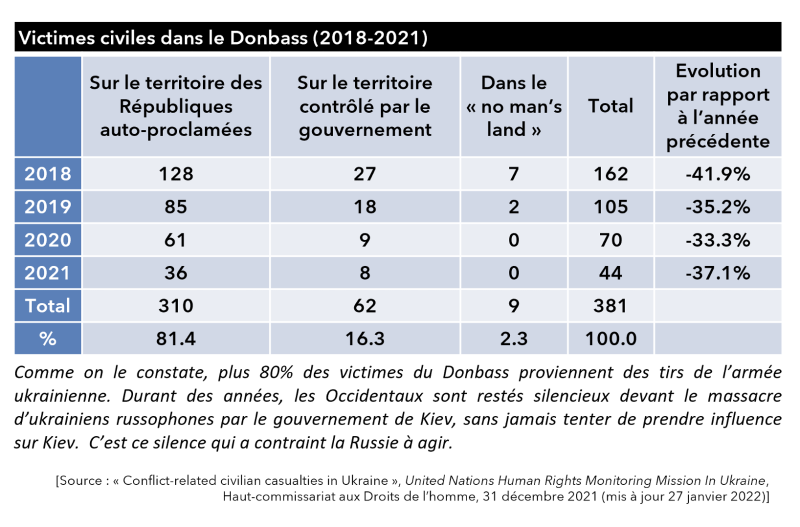
     

    Whether the term “genocide” applies to the abuses suffered by the populations of Donbass is an open question. This term is generally reserved for larger cases (Holocaust, etc.), however, the definition given by the Genocide Convention is probably broad enough to apply. Lawyers will appreciate.

    Clearly, this conflict has led us into hysteria. Sanctions seem to have become the preferred tool of our foreign policies. If we had insisted that Ukraine respect the Minsk Accords, which we negotiated and endorsed, none of this would have happened. The condemnation of Vladimir Putin is also ours. There is no point in whining after the fact, we had to act before. However, neither Emmanuel Macron (as guarantor and as a member of the UN Security Council), nor Olaf Scholz, nor Volodymyr Zelensky have respected their commitments. Ultimately, the real defeat is that of those who have no voice.

    The European Union was unable to promote the implementation of the Minsk agreements, on the contrary, it did not react when Ukraine bombarded its own population in the Donbass. Had she done so, Vladimir Putin would not have needed to react. Absent from the diplomatic phase, the EU distinguished itself by fueling the conflict. On February 27, the Ukrainian government agrees to start negotiations with Russia. But a few hours later, the European Union voted a budget of 450 million euros to supply arms to Ukraine, adding fuel to the fire. From there, the Ukrainians feel that they will not need to come to an agreement. The resistance of the Azov militias in Mariupol will even causea raise of 500 million euros for weapons .

    In Ukraine, with the blessing of Western countries, those who are in favor of a negotiation are eliminated. This is the case of Denis Kireyev, one of the Ukrainian negotiators, assassinated on March 5 by the Ukrainian secret service (SBU) because he is too favorable to Russia and is considered a traitor. The same fate is reserved for Dmitry Demyanenko, former deputy head of the main directorate of the SBU for Kiev and its region, assassinated on March 10 , because too favorable to an agreement with Russia: he is killed by the Mirotvorets militia (”  Peacemaker  “). This militia is associated with the Mirotvorets website which lists the ”  enemies of Ukraine”, with their personal data, address and telephone numbers, so that they can be harassed or even eliminated  ; a punishable practice in many countries, but not in Ukraine . The UN and some European countries have demanded its closure… refused by the Rada.

    Eventually, the price will be high, but Vladimir Putin will likely achieve the goals he set for himself. Its ties with Beijing have solidified. China emerges as a mediator of the conflict, while Switzerland enters the list of enemies of Russia. The Americans must ask Venezuela and Iran for oil to get out of the energy impasse in which they have gotten themselves: Juan Guaido leaves the scene definitively and the United States must pitifully reverse the sanctions imposed on their enemies.

    Western ministers who seek to collapse the Russian economy and make the Russian people suffer , even calling for the assassination of Putin, show (even if they partially reversed the form of their remarks, but not on bottom!) that our leaders are no better than those we hate. Because, sanctioning Russian athletes from the Para-Olympic Games or Russian artists has absolutely nothing to do with a fight against Putin.

    So, therefore, we recognize that Russia is a democracy since we consider that the Russian people are responsible for the war. If not, then why are we trying to punish an entire population for the fault of one? Remember that collective punishment is prohibited by the Geneva Conventions…

    The lesson to be drawn from this conflict is our sense of variable geometry humanity. If we were so attached to peace and to Ukraine, why didn’t we encourage her more to respect the agreements that she had signed and that the members of the Security Council had approved?

    Media integrity is measured by their willingness to work under the terms of the Munich Charter. They had succeeded in propagating hatred of the Chinese during the Covid crisis and their polarized message leads to the same effects against the Russians . Journalism is stripping itself more and more of professionalism to become militant…

    As Goethe said: “  The greater the light, the darker the shadow  ”. The more the sanctions against Russia are excessive, the more the cases where we have done nothing highlight our racism and our servility. Why has no Western politician reacted to the strikes against the civilian populations of Donbass for eight years?

    After all, what makes the conflict in Ukraine more blameworthy than the war in Iraq, Afghanistan or Libya? What sanctions have we adopted against those who have deliberately lied before the international community to wage unjust, unjustified, unjustifiable and murderous wars? Did we try to “make suffer” the American people who had lied to us (because it is a democracy!) before the war in Iraq? Have we even adopted a single sanction against the countries, companies or politicians who are fueling the conflict in Yemen, considered the ”  worst humanitarian disaster in the world  “? Have we sanctioned the countries of the European Union who practice the most abject torture on their territory for the benefit of the United States?

    To ask the question is to answer it… and the answer is not glorious.


    Feature Image Credit: Raising the Flag over Reichstag – iconic photo in 1945 by Yevegny Khaldei – kosmofoto.com 
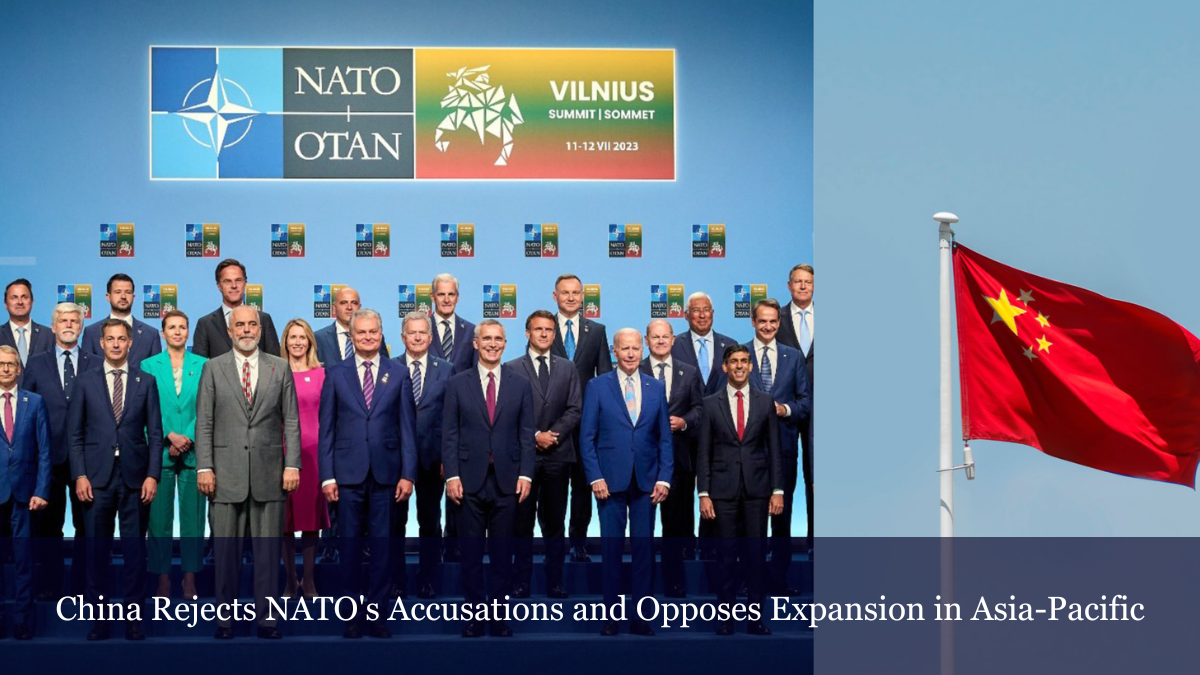
     

  • Environmental Impacts of the Belt And Road Initiative

    Environmental Impacts of the Belt And Road Initiative

    China’s Belt and Road Initiative (BRI), initially known as One Belt One Road (OBOR), was first announced in 2013 by President Xi Jinping. It aims to interconnect Asia, Europe, and Africa through two interlinked projects: the Belt as the land route, and the Road as the maritime route. The BRI aims to contribute significantly to overall economic or monetary development, as well as in the power generation area, it can further develop energy access and unwavering reliability in regions with quickly developing energy demand. Nonetheless, the BRI’s financial advantages and development of power frameworks might come at the cost of significant  environmental degradation. The sheer size of the BRI has ignited increasing global concerns about the potential environmental damage. These concerns include ecologically sensitive areas, concern about the large amounts of raw materials needed, and locking in of various environmentally detrimental forms of infrastructure, for example, non-renewable energy (fossil fuel) related framework.

    The BRI projects are instrumental in meeting the global CO2 emission targets; if all the BRI member states fail to reach the CO2 emission targets, that would result in a 2.7° C increase in the average global temperature.

    There are numerous BRI projects which would pass through ecologically sensitive areas, thus compromising on such fragile regions. Some have even described BRI as the “riskiest environmental project in history”. The BRI has far-reaching influence, and it is estimated that the BRI investments are impacting over 60 per cent of the global population. The BRI projects are instrumental in meeting the global CO2 emission targets; if all the BRI member states fail to reach the CO2 emission targets, that would result in a 2.7° C increase in the average global temperature.

    Securing and protecting the environment while encouraging financial advancement under the BRI will be extremely difficult and challenging, as the initiative crosses a different scope of fragile and delicate environments. Biophysical conditions range from woods and steppes in Russia; to ice, snow, and permafrost across the Tibetan Plateau; and tropical rainforests in Malaysia. Observers are worried about the natural threat that the BRI presents. Infrastructure advancement, trade, and investment ventures under the BRI could bring negative ecological impacts that might offset its economic gains. The possible effects of the BRI are complex and manifold. Foundation projects affect biological systems and wildlife, yet in addition aberrant impacts like logging, poaching, and settlement, adding to deforestation and other land related changes. The BRI could result in biodiversity loss because of fragmentation and debasement of various habitats, and cause increment in greenhouse gas emission due to the development and upkeep of transportation infrastructures and further Chinese interest in coal-terminated power plants. It could likewise speed up extraction of natural resources, like water, sand, and ferrous metal minerals and ores in nations along the BRI.

    One such danger from BRI is the Russia–China Amur Bridge transport corridor, which takes apart two nature reserves with old growth forests. BRI framework will influence practically all of Eurasia’s biggest stream frameworks. Also, numerous BRI courses, for example the Karakoram Highway, go through geo-dynamically active regions. The Karakoram Highway linking the Xinjiang province in China to Gwadar Port in Pakistan, goes through Himalayan areas known for “extremely high geodynamic action” like seismic tremors, avalanches, frigid disintegration and erratic storms, but alternative pathways are even worse. In the Aral Sea, Central Asia, combined effects from the socio-ecological communications between misadministration, over-water system and serious contamination causing water shortage are amplified by truly dysfunctional transboundary management which can possibly result in armed conflicts. Heavily polluting Chinese concrete plants migrating to Tajikistan has been referred to as one illustration of this. Also, a logging ban in China’s Heilongjiang area caused spill-over impacts for forests overseas. Additionally, trade changes methods of production and utilization, changing income and along these lines contamination levels. As indicated by the Kuznets curve, pollution increments at first as income develops, yet over a defining moment, contamination falls as higher earnings bring innovative upgrades and expanding interest for ecological conveniences. Financial development might build the modern contamination base, known as scale effects. Negative scale effects and positive effects for the climate are hard to separate observationally, and quantitative examinations differ on whether the scale or procedure impact is bigger. Various toxins likewise respond diversely to exchange related changes. For instance, a Chinese report joining scale and method effects proposed that trade expanded SO2, and dust fall, however, decreased substance oxygen interest, arsenic and cadmium.

    Arranging and resolving natural issues related with the BRI is colossally complex and multi-scaled. Understanding the attributes of the effects of BRI on the environment is the initial step for conceiving strategy and plans for addressing its effects on guaranteed sustainable development. The main mechanism to achieve the sustainability objectives of the BRI is cooperation, “characterized by governance guidance, business commitment, and social participation”. In any case, environmental governance accompanies different difficulties, first, BRI specific and related approaches are not unyielding, but rather dependent on intentional and corporate self-administrative instruments. China’s vision of a “green BRI” is probably not going to be acknowledged without any stricter approaches that set out concrete and substantial set of activities. Second challenge, for the environmental governance of the BRI is to address tele couplings.

    The Chinese government is taking a functioning, yet delicate way to deal with the environmental governance of the BRI. China utilizes the BRI as a stage to introduce itself as the rule-maker/rule-taker in global ecological administration as it further mobilizes existing environmental governance organisations and assembles new ones. Be that as it may, the environmental stability of the BRI doesn’t just rely on the environmental governance endeavours of Chinese actors, however, strikingly on the implementation, checking, and authorization of environmental laws and guidelines in BRI host nations. Finally, and most importantly the most significant errand for future research is to exactly explore whether environmental standards or norms be subject to California or Shanghai effects.


    References


    Callahan, William A. China dreams: 20 visions of China’s future Oxford University Press, 2013, p. 1

    Adolph, C., Quince, V., & Prakash, A. (2017). The Shanghai effect: Do exports to China affect labor practices in Africa? World Development, 89, 1–18. https://doi.org/10.1016/j.worlddev.2016.05.0091

    Andrews-Speed, P., & Zhang, S. (2018). China as a low-carbon energy leader: Successes and limitations. Journal of Asian Energy Studies, 2(1), 1–9. https://doi.org/10.24112/jaes.02010123

    Abbott, K. W. (2017). Orchestration: Strategic ordering in polycentric climate governance. In A. Jordan, D. Huitema, H. Van Asselt, & J. Forster (Eds.), Governing climate change (pp. 188–209). Cambridge: Cambridge University Press. https://doi.org/10.1017/9781108284646.01221

    Cefic 2011 Cefic (2011) Guidelines for Measuring and Managing CO2 Emission from Freight Transport Operations, http://www.cefic.org/Documents/RESOURCES/Guidelines/Transport-and-Logistics/Best%20Practice%20Guidelines%20-%20General%20Guidelines/Cefic-ECTA%20Guidelines%20for%20measuring%20and%20managing%20CO2%20emissions%20from%20transport%20operations%20Final%2030.03.2011.pdf?epslanguage=eni

    Randrianarisoa, Laingo M., Anming Zhang, Hangjun Yang, Andrew Yuen, and Waiman Cheung. “How ‘belt’and ‘road’are related economically: modelling and policy implications.” Maritime Policy & Management 48, no. 3 (2021): 432-460.

    Cockburn , Henry. “China’s $8 Trillion ‘Silk Road’ Construction Programme ‘Riskiest Environmental Project in History’.” The Independent. Independent Digital News and Media, May 20, 2018. https://www.independent.co.uk/climate-change/news/china-belt-and-road-initiative-silk-route-cost-environment-damage-a8354256.html.

    “Decarbonizing the Belt and Road Initiative: A Green Finance Roadmap.” Vivid Economics. Accessed October 1, 2021. https://www.vivideconomics.com/casestudy/decarbonizing-the-belt-and-road-initiative-a-green-finance-roadmap/.

    Ascensão, F.; Fahrig, L.; Clevenger, A.P.; Corlett, R.T.; Jaeger, J.A.G.; Laurance, W.F.; Pereira, H.M. Environmental challenges for the Belt and Road Initiative. Nat. Sustain. 2018, 1, 206–209.

    Teo, Hoong C., Alex M. Lechner, Grant W. Walton, Faith K.S. Chan, Ali Cheshmehzangi, May Tan-Mullins, Hing K. Chan, Troy Sternberg, and Ahimsa Campos-Arceiz. 2019. “Environmental Impacts of Infrastructure Development under the Belt and Road Initiative” Environments 6, no. 6: 72. https://doi.org/10.3390/environments6060072


    Feature Image Credit: USC US-China Institute

    Map Credit: Brookings Institution


  • Understanding the Catalonian Crisis through the Relative Deprivation theory

    Understanding the Catalonian Crisis through the Relative Deprivation theory

    On 1st October 2017, people in Catalonia, a semi-autonomous region in Spain, held a referendum in which 90 percent of those who participated sought to break away from the Spanish state and create the independent Republic of Catalonia. This referendum which endorsed independence was declared illegal by the Spanish government. This declaration was based on a ruling by the Constitutional Court, and the results of the referendum were also not taken seriously by the international community. Since then, Catalonia has remained politically deadlocked. While the Spanish government and the leaders of the separatist movement in Catalonia have participated in discussions and formal talks have been opened in 2020, there has been no resolution to this festering political crisis.

    A deep sense of relative deprivation has entered the minds of the Catalan people wherein they feel that the Spanish identity has been given more prominence in comparison to their Catalan identity.

    This desire for independence as expressed by the people of Catalonia did not emerge suddenly but had been simmering for an extended period. The social mobilisation occurred because of the frustration that they have as a result of a lack of representation of their culture and language within the Spanish state. The hostility shown to demands of more autonomy and representation has also led to more anger. A deep sense of relative deprivation has entered the minds of the Catalan people wherein they feel that the Spanish identity has been given more prominence in comparison to their Catalan identity.

    While there is a long history of oppression and centralisation, the recent turmoil, however, started in 2010 when the Spanish Constitutional Court quashed a law passed by the regional parliament of Catalonia which updated the autonomous government’s statute. This statute dating to 1979 mapped the relations between Catalonia and the rest of Spain. The court rejected articles in the statute that put the Catalan language above the Spanish language and any articles that referred to Catalonia as a nation rather than as a region.

    This article seeks to understand the reason behind the Catalonian crisis using the relative deprivation model put forth by Ted Gurr. This model has been used to clarify how cultural and linguistic suppression of the Catalan people has led to collective turmoil.

    Relative Deprivation Model of Gurr

    Gurr’s relative deprivation model states that when a sense of deprivation emerges in a group in relation to another group, then it can lead to collective violence or dissatisfaction. Gurr uses a psychological approach to explain why anger or frustration caused by a sense of deprivation is a motivating instrument that can make people more inclined towards aggression.

    The term relative deprivation is used by Gurr who defines it as “actor’s perception of discrepancy between their value expectations (the goods and conditions of the life to which they believe they are justifiably entitled) and their value capabilities (the amounts of those goods and conditions that they think they can get and keep)”. Thus, if there is a discrepancy between what people in a group believe they should get and what they do get then, it leads to frustration, disturbance, and a sense of deprivation. The greater the gap between the expectations of the people and reality, the higher the magnitude for aggression and civil strife. One important thing to note here is that the sense of deprivation is always in relation or comparison to another group.

    Gurr further states that the magnitude of the civil strife or dissatisfaction is dependent on the intensity of the sense of deprivation among the people of the group. As per the relative deprivation theory, there are certain factors or societal variables that have an impact on the relationship between deprivation and the ensuing civil strife. These societal variables include:  (a) coercive potential (of the government to put off the conflict), (b) institutionalisation (the extent to which societal structures may offer non-violent means for expressing dissatisfaction to the social group with the perceived deprivation), (c) social facilitation (that further facilitate strife) and lastly, (d) legitimacy of the political regime in which all this occurs.

    Applying the Relative Deprivation Model to the Catalonian situation

     By applying this theory to the Catalonian crisis, it is easy to see how the deprivation of the Catalan culture, language, and history frustrated the Catalan people and led to the unprecedented social mobilisation for independence from the Spanish state. The people of Catalonia are unsatisfied and angry with the way their culture and particularly, their language, is being slowly eroded as compared to the relevance and status accorded to the Spanish language.

    The Catalan people consider their language to be the principal element of their identity and believe that it is the ‘rallying cry of their solidarity’. The sidelining of their language is seen as an affront to their identity.

    Language is seen as a crucial distinguishing feature by the Catalan people and the speakers of Castilian Spanish. Many people living in Catalonia also want the Catalan language to be officially recognised by the European Union and put on par with the Spanish language even outside the country settings, which has not happened. The reversal of the statute that allowed for the exercise of Catalan language over the Spanish language in the region has brought the identity discord in the open. The Catalan people consider their language to be the principal element of their identity and believe that it is the ‘rallying cry of their solidarity’. The sidelining of their language is seen as an affront to their identity.

    The economic state of affairs further accentuates their anger over the under-representation of their language in museums, government offices, libraries, and all official channels of the central government in Madrid. Catalonia is one highly prosperous part of Spain but many in Catalonia feel that they are bearing the brunt of the high taxes and austerity measures for the rest of the country’s needs with whom they have little in common.

    Conclusion:

    Ted Gurr’s relative deprivation theory states that when a group of people feel that they are deprived of something, whether economically, socially or politically, in comparison to another group of people, they will feel frustrated and that frustration can lead to violence. The Catalonian crisis, when understood using this model, provides an incredibly accurate picture of how the suppression of one’s language and history can result in political strife.

    The Catalonian situation is quite similar to that of Scotland in the United Kingdom. People in Scotland are also quite proud of their distinct language (Gaelic), traditions and also have a strong sense of independent spirit which they believe is curtailed by the Westminster government. Scotland’s Prime Minister, Nicola Sturgeon, recently indicated that she would pursue another referendum for independence in the coming year as support for an independent government has increased steadfastly in 2020 with the pandemic exposing the cracks in the current system.

    For both Catalonia and Scotland, the model followed in the erstwhile USSR in terms of accommodation of identities can provide a way forward or represent a comparatively better model of governance. Under Lenin’s leadership, striking flexibility with respect to the various countries encompassed within the Soviet Union in terms of expression of their individual nationalities was displayed. Lenin used a degree of accommodation towards peripheral nationalist tendencies displayed by the non-Russian states as he believed it to be a pragmatic solution. While political autonomy remained elusive to the non-Russian states, the accommodation of their national identities meant that they were somewhat satisfied. The Soviet state itself encouraged the use of local languages in schools and universities and even in the local administrative offices.


    References:

    “A Year Later: An Update on the Catalonian Independence Movement.” Columbia Journal of Transnational Law, 27 Nov. 2018, jtl.columbia.edu/a-year-later-an-update-on-the-catalonian-independence-movement/.

    “Catalonia: From Secessionism to Secession?” E-International Relations, www.e-ir.info/2016/01/15/catalonia-from-secessionism-to-secession/.

    “Catalonia: Past and Future.” Jacobin, www.jacobinmag.com/2017/10/catalonia-independence-franco-spain-nationalism.

    Gurr, Ted. “A causal model of civil strife: A comparative analysis using new indices.” American political science review 62.4 (1968): 1104-1124.

    Gurr, Ted Robert. “Why Men Rebel Redux: How Valid Are Its Arguments 40 Years On?” E-international Relations 17 (2011).

    Huddleston, R. Joseph. “The Roots of the Catalan Independence Crisis.” Foreign Affairs, Foreign Affairs Magazine, 30 Oct. 2017, www.foreignaffairs.com/articles/spain/2017-10-30/roots-catalan-independence-crisis.

    Marinzel, Anastazia. “Catalonia: The quest for independence from Spain.” (2014).

    “Scotland: Nicola Sturgeon Aims for 2021 Independence Vote.” The Indian Express, 1 Dec. 2020, indianexpress.com/article/world/scotland-nicola-sturgeon-aims-for-2021-independence-vote-7075166/


    Image Credit: “Catalonia is not Spain” by SBA73 is licensed under CC BY-SA 2.0