Category: Economic Policy

  • The catastrophe of modern capitalism: Inequality as an aim in Neo-Liberal-Ideology

    The catastrophe of modern capitalism: Inequality as an aim in Neo-Liberal-Ideology

    Neoliberalism is the dominant form of capitalism that began in the 1980s as a way to promote global trade and grow all economies. That was a false promise, whereas in essence it supported individuals amassing massive wealth in the name of market forces, at the expense of common man by ensuring states minimise their role and eliminate welfare economics. It ensured least-developed and developing economies remained resource providers to developed economies, exemplifying extraction and exploitation. Neoliberalism is a top down economic policy that does not benefit those who are impoverished. The inequality we see on a global scale is mind-numbing. In 2006, the world’s richest 497 people were worth 3.5 trillion US dollars representing 7% of the world’s GDP. That same year, the world’s lowest income countries that housed 2.4 billion people were worth just 1.4 trillion US dollars, which only represents 3.3% of the world’s GDP. The situation today is far worse as Andreas Herberg-Rothe explains in his critical analysis below. The world is in urgent need of freeing itself from the clutches of neoliberal capitalism. 


    ..neoliberalism contains a general tendency towards an extensive economisation of society. Thus, inequality transcends the economy and becomes the dominant trend in society, as in racism, radical extremism, and hate ideologies in general: Us against the rest, whoever the rest may be.


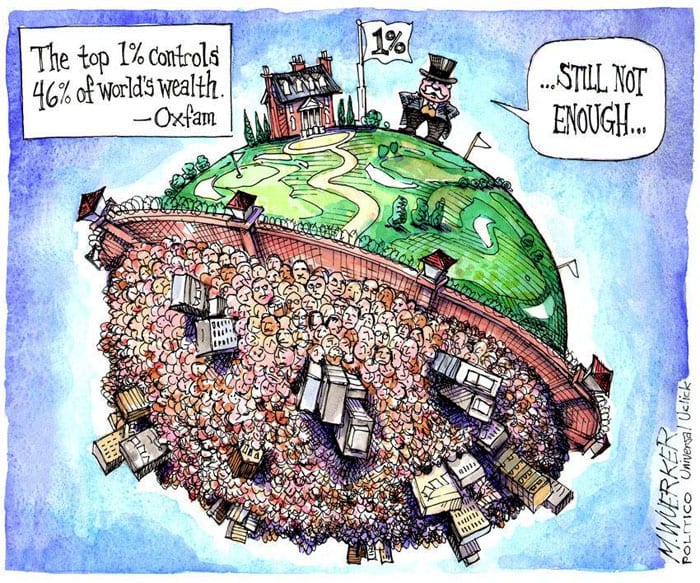
    Following on from the initial question about Hannah Arendt’s thesis that equality must be confined to the political sphere, we must ask how democracy and human rights can be preserved in the face of social inequality on an extraordinary scale. By the end of this century, 1% of the world’s population will own as much as the “rest” of the other 99%. And already today, only 6 people own more property than 3.6 billion. Let us take a closer look at some of the ideas of the currently dominant neo-liberalism, which sheds some light on the acceptance of these current obscene inequalities. For this ideology, social inequality is a means to greater wealth. However, since it sets no limits on social inequality, it can be used to legitimize even obscene inequalities. We argue that neoliberalism as an ideology is the result of the spread of a specific approach to economic thought that has its roots in the first half of the twentieth century, when Walter Lippmann’s seminal book “An Inquiry into the Principles of the Good Society” (1937), followed by Friedrich August von Hayek’s “The Road to Serfdom” (1944), gave rise to neoliberalism. During the Cold War period, neoliberals gained more and more ground in establishing a global system. With the support of Milton Friedman and his “Chicago Boys,” the first attempt to establish a pure neoliberal economic system took place in Chile under the military dictatorship of General Pinochet in the 1970s. In the last decade of the Cold War, neoliberal architects such as Margaret Thatcher and Ronald Reagan began to impose the new economic model. Since the end of the Cold War, the final development was that neoliberalism became THE hegemonic economic system, as capitalism was de jure allowed to spread unhindered worldwide, and neoliberalism continued on its way to becoming the dominant belief system.

    The critical message in this sense is the following: This process is not limited to an economic dimension – neoliberalism contains a general tendency towards an extensive economisation of society. Thus, inequality transcends the economy and becomes the dominant trend in society, as in racism, radical extremism, and hate ideologies in general: Us against the rest, whoever the rest may be.

    When we talk about global inequality in the era of neoliberalism, we are referring to two other major developments: To this day, inequality between the global North and South persists. While the total amount of poverty has decreased, as seen in the World Bank’s report (2016), there is still a considerable gap between those countries that benefit from the global economy and those that serve as cheap production or commodity areas. The second development takes place in countries that are more exposed to the neoliberal project. In this sense, societies are turning into fragmented communities where the “losers of neoliberalism” are threatened by long-term unemployment, a life of poverty, social and economic degeneration.

    After three decades of intense global neo-liberalism, the result has been a significant increase in social inequalities, polarization and fragmentation of societies (if not the entire world society), not to mention a global financial crisis in 2008 caused by escalating casino capitalism and the policies of a powerful global financial elite.

    We are witnessing a global and drastic discontent of peoples, fears and anger, feelings of marginalization, helplessness, insecurity and injustice. After three decades of intense global neo-liberalism, the result has been a significant increase in social inequalities, polarization and fragmentation of societies (if not the entire world society), not to mention a global financial crisis in 2008 caused by escalating casino capitalism and the policies of a powerful global financial elite. We witness a global and drastic dissatisfaction of the peoples, fears, and anger, the feelings of marginalization, helplessness, insecurity, and injustice. After three decades of intense worldwide Neo-Liberalism, the result significantly intensified social inequalities, polarization, and fragmentation of societies (if not the entire world society), not to mention a global financial crisis in 2008 caused by escalating casino capitalism and the policy of a powerful global finance elite.

    The central critique is that neoliberalism includes social inequality as part of its basic theory. Such capitalism emphasizes the strongest/fittest (parts of society) and uses inequality as a means to achieve more wealth.
    Remarkably and frighteningly, the situation outlined does not provoke the oppressed, marginalised, and disadvantaged populations to turn against their oppressors and their exploitation. These people tend to sympathize with ideological alternatives, either with more triumphant (right-wing) populist movements and parties or are attracted by radical/fundamentalist religious groups such as the Islamic State. The result is an increase in polarization and violence, and even more protracted wars and religious-ideological disputes. Europe is not exempt from the trend toward obscene social inequality. We also find a polarization between rich and poor, between those who have good starting conditions and those who have little chance of prosperity, between those who are included and those who feel excluded. The fact that Europe has so far largely avoided populist parties gaining administrative power (although we have already witnessed this process in France, Hungary and Poland) may be due to the remnants of the welfare state. In this respect, at least a minimum of financial security remains and limits the neoliberal trend. In the United States, on the other hand, a flawless populist could reach the highest office. The people, stuck in their misery, fear and insecurity, voted for a supposed alternative to the neoliberal establishment, but above all against other social outcasts whom they blamed for their misery. This brings us to the central critique of neoliberalism, a system that has caused fundamental social oddities, the impact of which as an ideology has been highlighted above. The central critique is that neo-liberalism includes social inequality as part of its basic theory. Such capitalism emphasizes the strongest/fittest (parts of society) and uses inequality as a means to achieve more wealth.

    In an interview with the German magazine Wirtschaftswoche, Hayek spoke bluntly about the neoliberal value system: He emphasizes that social inequality, in his view, is not at all unfortunate, but rather pleasant. He describes inequality as something simply necessary (Hayek, 1981). In addition, he defines the foundations of neo-liberalism as the “dethronement of politics” (1981). First, he points out the importance of protecting freedom at all costs (against state control and the political pressure that comes with it). The neoliberals see even a serious increase in inequality as a fundamental prerequisite for more economic growth and the progress of their project. One of the most renowned critics of neoliberalism in Germany, Christoph Butterwegge (2007), sees in this logic a perfidious reversal of the original intentions of Smith’s (reproduced in 2013) inquiry into the wealth of nations in the current precarious global situation. The real capitalism of our time – neoliberalism – sees inequality as a necessity for the functioning of the system. It emphasizes this statement: The more inequality, the better the system works. The hardworking, successful, and productive parts of society (or rather the economy) deserve their wealth, status, and visible advantage over the rest (the part of society that is seen as less strong or less ambitious). The deliberate production of inequality sets in motion a fatal cycle that leads to the current tense global situation and contributes to several intra-societal conflicts.

    The market alone is the regulating mechanism of development and decision-making processes within a society dominated by neo-liberalism, and as such is not politics at all. This brings us closer to the relationship between neoliberalism and democracy. The understanding of democracy in neoliberal theory is, so to speak, different. Principles such as equality or self-determination, which are prominent in the classical understanding of democracy, are rejected. Neo-liberalism strives for a capitalist system without any limits set by the welfare state and even the state as such, in order to shape, enforce and legitimize a society dominated only by the market economy. Meanwhile there are precarious tendencies recognizable, where others than the politically legitimized decision-makers dictate the actual political and social direction (e.g. the extraordinarily strong automobile lobby with VW, BMW and Mercedes in Germany or big global players in the financial sector like the investment company BlackRock). Neoliberalism only seemingly embraces democracy. The elementary democratic goals (protection of fundamental and civil rights and respect for human rights) can no longer be fully realized. Democracy cannot defend itself against neo-liberalism if political decision-makers do not resolutely oppose the neo-liberal zeal for expansion into all areas of society. The dramatic increase in inequality coincides with the failure of the state as an authority of social compensation and adjustment, as neoliberalism eliminates the state as an institution that mediates conflicts in society. To put it in a nutshell: Whereas in classical economic liberalism the state’s role is to protect and guarantee the functioning of the market economy, in neoliberalism the state must submit to the market system.

    Our discussion of neoliberalism here is not about this conceptualization and its history, which would require a separate article. Nevertheless, we want to emphasize that in neo-liberalism, social inequality is a means to achieve more wealth for the few. Therefore, we argue that there must be a flexible but specific limit to social inequality in order to achieve this goal, while excessive inequality is counterproductive.

    As noted above, moderate levels of inequality are not necessarily wrong per se. In a modern understanding, it also contributes to a just society in which merit, better qualifications, greater responsibility, etc. are rewarded. The principle of allowing differences, as used in the theory of the social market economy, is a remarkably positive one when such differentiation leads to the well-being of the majority of people in need. However, neo-liberalism adopts a differentiation that intensifies inequality to a very critical dimension. The current level of social inequality attacks our system of values, endangers essential democracy, and destroys the social fabric of societies. Even if we consider a “healthy” level of inequality to be a valuable instrument for a functioning market society, what has become the neoliberal reality has nothing to do with such an ideal. Neoliberalism implies an antisocial state of a system in which inequality is embedded in society as its driving mechanism. Consequently, we witness a division between rich and poor in times of feudalism. A certain degree of social equalization through the welfare state and a minimum of social security is no longer guaranteed. The typical prerequisites today are flexibility, performance, competitiveness, etc. – In general, we see the total domination of individualism within neo-liberalism, leading to the disintegration of society. In one part of the world, mainly in the Global South, we observe the decline of entire population groups. In contrast, in other parts of the world we see fragmented societies in hybrid globalization and increasing tendencies towards radical (religious) ideologies, violence and war.

    It must be acknowledged that neoliberalism was one of the causes of the rise of the newly industrialized nations, but the overemphasis on individual property also contributes to obscene inequality and thus to the decline of civilized norms.

    The Polish-British sociologist Zygmunt Bauman summed up this problem by comparing it to the slogan of the French Revolution: “Liberté, Egalité, Fraternité”. According to the proponents of the time, each element could only be realized if all three remained firmly together and became like a body with different organs. The logic was as follows: “Liberté could produce Fraternité only in company with Egalité; cut off this medium/mediating postulate from the triad – and Liberté will most likely lead to inequality, and in fact to division and mutual enmity and strife, instead of unity and solidarity. Only the triad in its entirety is capable of ensuring a peaceful and prosperous society, well integrated and imbued with the spirit of cooperation. Equality is therefore necessary as a mediating element of this triad in Bauman’s approach. What he embraces is nothing less than a floating balance between freedom and equality. It must be acknowledged that neoliberalism was one of the causes of the rise of the newly industrialized nations, but the overemphasis on individual property also contributes to obscene inequality and thus to the decline of civilized norms. When real socialism passed into history in 1989 (and rightly so), the obscene global level of social inequality could be the beginning of the end (Bee Gees) of neo-liberalism, centered on the primacy of individual property, which is destroying the social fabric of societies as well as the prospects for democratic development. Individual property is a human right, but it must be balanced with the needs of communities, otherwise it would destroy them in the end.


    Feature Image Credit: cultursmag.com

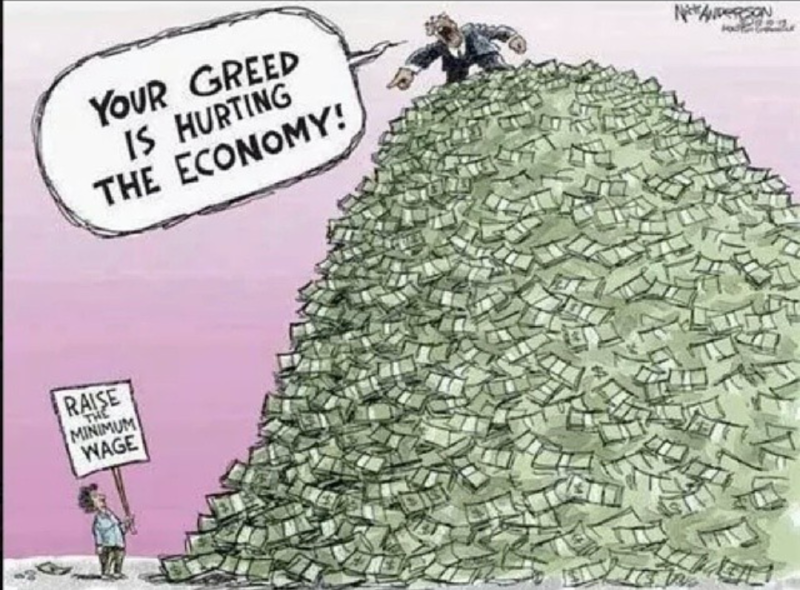
    Cartoon Image Credit: ‘Your greed is hurting the economy’ economicsocialogy.org
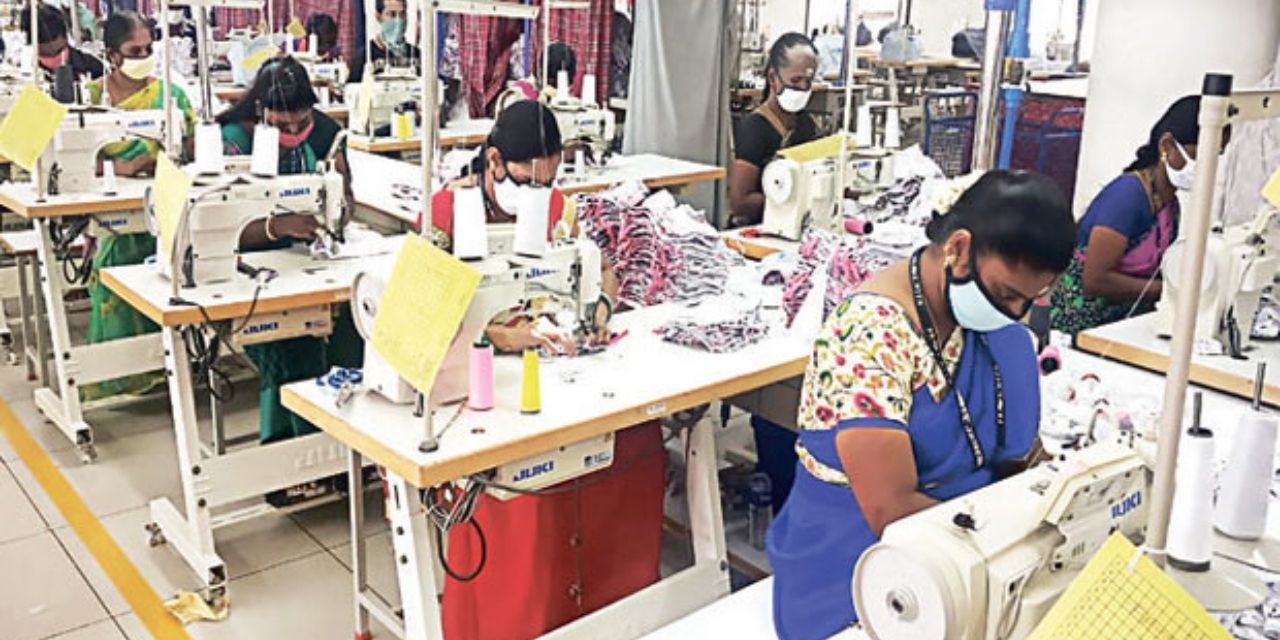
  • India’s Self-Inflicted Economic Catastrophe

    India’s Self-Inflicted Economic Catastrophe

    Noted economist Jayati Ghosh reviews India’s economic recovery from the impact of the pandemic. She asserts that the major economic problems of unemployment, poverty, and inadequate healthcare are due to poor strategies and policies implemented by the government. In her analysis, COVID-19’s devastating impact on India has been compounded by the BJP government’s disastrous decision to impose nationwide lockdowns without providing any support to workers. Instead, the BJP used the pandemic to consolidate its power and suppress dissent. Even with existing socio-political constraints, she says India can do much better as there is scope for different economic strategies.

    This article was published earlier in Project Syndicate. The views expressed are the author’s own.

                                                                                                                                                                          -TPF Editorial Team

    Nearly 80% of the estimated 70 million people around the world who fell into extreme poverty at the onset of COVID-19 in 2020 were from India, a recent World Bank report has revealed. But even this shocking figure could be an underestimate, as the lack of official data makes it difficult to assess the pandemic’s human costs.

    What accounts for this alarming rise in Indian poverty? COVID-19 was undoubtedly India’s worst health calamity in at least a century. But the pandemic’s economic and social consequences go beyond the direct effects on health and mortality. As I argue in my recent book, The Making of a Catastrophe: The Disastrous Economic Fallout of the COVID-19 Pandemic in India, very significant policy failures – owing to government action and inaction – were responsible for widespread and significant damage to Indian livelihoods and for the country’s decline in terms of many basic indicators of economic well-being.

    But the devastating impact of the pandemic on India has been compounded by economic policies that reflected the country’s deeply-embedded inequalities.

    This judgment may seem excessively harsh. After all, India’s government did not cause the pandemic, and many other countries experienced economic setbacks after they failed to control the virus. But the devastating impact of the pandemic on India has been compounded by economic policies that reflected the country’s deeply-embedded inequalities.

    To be sure, the pandemic did not create India’s many economic vulnerabilities. But it did highlight India’s many societal fissures and fault lines. And while the country already suffered from glaring inequalities of income, wealth, and opportunities long before COVID-19, the government’s pandemic response has taken them to unimaginable extremes.

    Even as Indian workers faced poverty, hunger, and ever-greater material insecurity due to the pandemic, money and resources continued to flow from the poor and the middle class to the country’s largest corporations and wealthiest individuals. The intersecting inequalities of caste, gender, religion, and migration status have become increasingly marked and oppressive. The result has been a major setback to social and economic progress.

    At the beginning of the pandemic, the central government imposed a prolonged nationwide lockdown with little notice. It then adopted containment strategies that were clearly unsuited to the Indian context, with immediately devastating effects on employment and livelihoods.

    The grim state of affairs reflects the priorities of the ruling Bharatiya Janata Party (BJP) response. At the beginning of the pandemic, the central government imposed a prolonged nationwide lockdown with little notice. It then adopted containment strategies that were clearly unsuited to the Indian context, with immediately devastating effects on employment and livelihoods.

    Instead of using the breathing space provided by the lockdown to bolster local health systems, the central government left state authorities to manage as best they could with minimal and inadequate resources. And when the resulting economic disaster threatened to spiral out of control, the government eased restrictions to “unlock” the economy even as the number of cases mounted, thereby putting more people at risk.

    At a time when governments worldwide were significantly increasing public spending to fight the pandemic and mitigate its economic impact, the Indian government preferred to control expenditures (after adjusting for inflation) as its revenues declined.

    But at the heart of India’s self-inflicted economic catastrophe is the government’s decision to provide very little compensation or social protection, even as COVID-19 lockdowns deprived hundreds of millions of their livelihoods for several months. At a time when governments worldwide were significantly increasing public spending to fight the pandemic and mitigate its economic impact, the Indian government preferred to control expenditures (after adjusting for inflation) as its revenues declined.

    But in a country where median wages are too low to provide more than the most basic subsistence, losing even a week’s income could lead millions to the brink of starvation. Given that more than 90% of all workers in India are informal – without any legal or social protection – and that around half of those are self-employed, the effect was immediate and devastating.

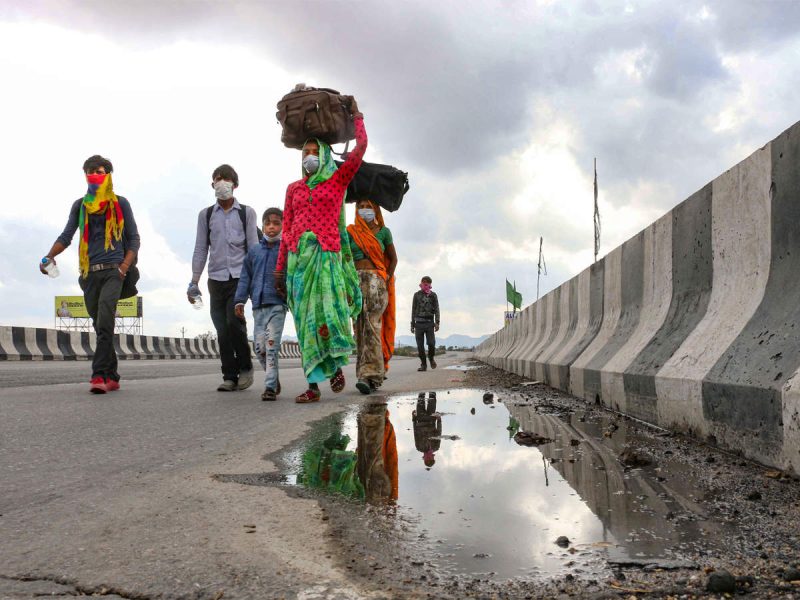
    The government’s decision not to increase spending aggravated the shock of the lockdown, generating a humanitarian crisis that disproportionately affected women and marginalized groups, including millions of migrant workers who were forced to return home under harrowing conditions.

    But the effects of the official response to the pandemic are only one side of the story. COVID-19 safety measures have been a natural fit for the country’s still-pervasive caste system, which has long relied on forms of social distancing to enforce the socioeconomic order and protect those at the top. It also further entrenched India’s persistent patriarchy.

    Instead of taking appropriate countermeasures, like providing greater support to the population, the BJP used the pandemic to consolidate its power and suppress dissent. This, in turn, limited the central government’s ability to generate the widespread social consensus and public trust needed to contain the virus.

    Even within India’s deep-seated social and political constraints, there is scope for a different economic strategy that would enable a just, sustainable, and more equitable recovery.

    None of this was inevitable. Even within India’s deep-seated social and political constraints, there is scope for a different economic strategy that would enable a just, sustainable, and more equitable recovery. To ensure that most Indians, not just the stock market or large companies, benefit from growth, India’s voters must reject the BJP’s policies, which threaten to impoverish them further.

    Feature Image Credit: textilevaluechain.in

  • Indian Economy at 75: Trapped in a Borrowed Development Strategy

    Indian Economy at 75: Trapped in a Borrowed Development Strategy

    In 1947, at the time of Independence, India’s socio-economic parameters were similar to those in countries of South East Asia and China. The level of poverty, illiteracy, and inadequacy of health infrastructure was all similar. Since then, these other countries have progressed rapidly leaving India behind in all parameters. ‘Why is it so?’ should be the big question for every Indian citizen in this time of our 75th anniversary celebrations.


    Introduction

    India at 75 is a mixed bag of development and missed opportunities. The country has achieved much since Independence but a lot remains to be done to become a developed society. The pandemic has exposed India’s deficiencies in stark terms. The uncivilized conditions of living of a vast majority of the citizens became apparent. According to a report by Azim Premji University, 90% of the workers said during the lockdown that they did not have enough savings to buy one week of essentials. This led to the mass migration of millions of people, in trying conditions from cities to the villages, in the hope of access to food and survival.

    Generally, technology-related sectors, pharmaceuticals and some producing essentials in the organized sectors have done well in spite of the pandemic. So, a part of the economy is doing well in spite of adversity but incomes of at least 60% of people at the bottom of the income ladder have declined (PRICE Survey, 2022). The great divide between the unorganized and organized parts of the economy is growing. The backdrop to these developments is briefly presented below.

    Structure and Growth of the Economy

    In 1947, at the time of Independence, India’s socio-economic parameters were similar to those in countries of South East Asia and China. The level of poverty, illiteracy, and inadequacy of health infrastructure was all similar. Since then, these other countries have progressed rapidly leaving India behind in all parameters. So, India has fallen behind relatively in spite of improvements in health services and education, diversification of the economy and development of the industry.

    In 1950, agriculture was the dominant sector with a 55% share of GDP which has now dwindled to about 14%. The share of the services sector has grown rapidly and by 1980 it surpassed the share of agriculture and now it is about 55% of GDP. The Indian economy has diversified production `from pins to space ships’.

    Agriculture grows at a trend rate of a maximum of 4% per annum while the services sector can grow at even 12% per annum. So, there has been a shift in the economy’s composition from agriculture to services, accelerating the growth rate. The average growth rate of the economy between the 1950s and the 1970s was around 3.5%. In the 1980s and 1990s, it increased to 5.4% due to the shift in the composition. There was no acceleration in the growth rate of the economy in the 1990s compared to the 1980s. This rate again increased in the period after 2003 only to decline in 2008-09 due to the global financial crisis. Subsequently, the rate of growth has fluctuated wildly both due to global events and the policy conundrums in India.

    There was the taper tantrum in 2012-13 which cut short the post-global financial crisis recovery. Demonetization in November 2016 adversely impacted growth. That was followed by the structurally flawed GST. These policies administered shocks to the economy. Then came the pandemic in 2020. The economy’s quarterly growth rate had already fallen from 8% in Q4 2017-18 to 3.1% in Q4 2019-20, just before the pandemic hit.

    1980-81 marked a turning point. Prior to that, a drought would lead to a negative rate of growth in agriculture and of the economy as a whole. For instance, due to the drought in 1979-80, the economy declined by 6%. But, that was the last one. After that, a decline in agriculture has not resulted in a negative growth rate for the economy. The big drought of 1987-88 saw the economy grow at 3.4%. After 1980-81, the economy experienced a negative growth rate only during the pandemic which severely impacted the services sector, especially the contact services.

    Employment and Technology Related Issues

    Agriculture employs 45% of the workforce though its share in the economy (14%) has now become marginal. It has been undergoing mechanisation with increased use of tractors, harvester combines, etc., leading to the displacement of labour. Similar is the case in non-agriculture. So, surplus labour is stuck in agriculture leading to massive disguised unemployment.

    India is characterized by disguised unemployment and underemployment.Recent data points to growing unemployment among the educated youth. They wait for suitable work. The result is a low labour force participation rate (LFPR) in India (in the mid-40s) compared to similar other countries (60% plus).The gender dimension of unemployment and the low LFPR is worrying with women the worst sufferers.

    India’s employment data is suspect. The reason is that in the absence of unemployment allowance, people who lose work have to do some alternative work otherwise they would starve. They drive a rickshaw, push a cart, carry a head load or sell something at the roadside. This gets counted as employment even though they have only a few hours of work and are underemployed. So, India is characterized by disguised unemployment and underemployment.

    Recent data points to growing unemployment among the educated youth. They wait for suitable work. The result is a low labour force participation rate (LFPR) in India (in the mid-40s) compared to similar other countries (60% plus). It implies that in India maybe 20% of those who could work have stopped looking for work. No wonder for a few hundred low-grade government jobs, millions of young apply. The gender dimension of unemployment and the low LFPR is worrying with women the worst sufferers.
    These aspects of inadequate employment generation are linked to automation and the investment pattern in the economy. New technologies that are now being used in the modern sectors are labour displacing. For instance, earlier in big infrastructure projects like the construction of roads, one could see hundreds of people working but now big machines are used along with a few workers.

    Further, the organized sectors get most of the investment so little is left for the unorganized sector. This is especially true for agriculture. Thus, neither the organized sector nor agriculture is generating more work. Consequently, entrants to the job market are mostly forced to join the non-agriculture unorganized sector, which in a sense is the residual sector, where the wages are a fraction of the wages in the organized sector. The unorganized sector also acts as a reserve army of labour keeping organized sector wages in check

    Lack of a Living Wage

    To boost profits, the organized sector is increasingly, employing contract labour rather than permanent employees. This is true in both the public and private sectors. So, not only the workers in the unorganized sector, even the workers in the organised sector do not earn a living wage. Thus, most workers have little savings to deal with any crisis. They are unable to give their children a proper education and cannot afford proper health facilities. Most of the children drop out of school and can only do menial jobs requiring physical labour. They cannot obtain a better-paying job and will remain poor for the rest of their lives.

    The Delhi socio-economic survey of 2018 pointed to the low purchasing power of the majority of Indians. It showed that in Delhi, 90% of households spent less than Rs. 25,000 per month, and 98% spent less than Rs. 50,000 per month. Since Delhi’s per capita income is 2.5 times the all India average, deflating the Delhi figures by this factor will approximately yield all India figures. So, 98 per cent of the families would have spent less than Rs.20,000 per month, and 90 per cent less than Rs.10,000 per month. This effectively implies that 90 per cent of families were poor in 2018, if not extremely poor (implied by the poverty line). During the pandemic, many of them lost incomes and were pauperized and forced to further reduce their consumption.

    Unorganized Sector Invisibilized

    In the unorganized sector, labour is not organized as a trade union and therefore, is unable to bargain for higher wages, when prices rise. It constitutes 94% of the workforce and has little social security. No other major world economy has such a huge unorganized sector. No wonder when such a large section of the population faces a crisis in their lives, the economy declines, as witnessed during the pandemic. India’s official rate of growth fell more sharply than that of any other G20 country.

    The micro sector has 99% of the units and 97.5% of the employment of MSME and is unlike the small and medium sectors. The benefits of policies made for the MSME sector do not accrue to the micro units.

    Policymakers largely ignore the unorganized sector. The sudden implementation of the lockdown which put this sector in a deep existential crisis points to that. The micro sector has 99% of the units and 97.5% of the employment of MSME and is unlike the small and medium sectors. The benefits of policies made for the MSME sector do not accrue to the micro units.

    Invisibilization of the unorganized sector in the data is at the root of the problem. Data on this sector become available periodically, called the reference years. In between, it is assumed that this sector can be proxied by the organized sector. This could be taken to be correct when there is no shock to the economy and its parameters remain unchanged.

    Demonetization and the flawed GST administered big shocks to the economy and undermined the unorganized sector. Its link with the organized sector got disrupted. Thus, the methodology of calculating national income announced in 2015 became invalid.

    The implication is that the unorganized sector’s decline since 2016 is not captured in the data. Worse, the growth of the organized sector has been at the expense of the unorganized sector because demand shifted from the latter to the former. It suited the policymakers to continue using the faulty data since that presented a rosy picture of the economy. This also lulled them into believing that they did not need to do anything special to check the decline of the unorganized sector.

    Policy Paradigm Shift in 1947

    Growing unemployment, weak socio-economic conditions, etc., are not sudden developments. Their root lies in the policy paradigm adopted since independence.
    In 1947, the leadership, influenced by the national movement understood that people were not to blame for their problems of poverty, illiteracy and ill-health and could not resolve them on their own. So, it was accepted that in independent India these issues would be dealt with collectively. Therefore, the government was given the responsibility of tackling these issues and given a key role in the economy.

    Simultaneously, the leadership, largely belonging to the country’s elite, was enamoured of Western modernity and wanted to copy it to make India an ’advanced country’. The two paths of Western development then available were the free market and Soviet-style central planning. India adopted a mix of the two with the leading role given to the public sector. This path was chosen also for strategic reasons and access to technology which the West was reluctant to supply. But, this choice also led to a dilemma for the Indian elite. It had to ally with the Soviet Union for reasons of defence and access to technology but wanted to be like Western Europe.

    Both the chosen paths were based on a top-down approach. The assumption was that there would be a trickle down to those at the bottom. People accepted this proposition believing in the wider good of all. Resources were mobilized and investments were made in the creation of big dams and factories (called temples of modern India) that generated few jobs. They not only displaced many people trickle down was minimal. For instance, education spread but mostly benefitted the well-off.

    The Indian economy diversified and grew rapidly. An economy that for 50 years had been growing at about 0.75% grew at about 4% in the 1950s. But, the decline in the death rate led to a spurt in the rate of population growth. So, the per capita income did not show commensurate growth, and poverty persisted. Problems got magnified due to the shortage of food following the drought of 1965-67 and the Wars in 1962 and 1965. The Naxalite movement started in 1967, there was BOP crisis and high inflation in 1972-74 due to the growing energy dependence and the Yom Kippur war. Soon thereafter there was political instability and the imposition of an Emergency in 1975. The country went from crisis to crisis.

    Planning failed due to crony capitalism. The prevailing political economy enabled the business community to systematically undermine policies for their narrow ends by fueling the growth of the black economy.

    The failure of trickle-down and the cornering of the gains of development by a narrow section of people led to growing inequality and people losing faith in the development process. Different sections of the population realized that they needed a share in power to deliver to their group. Every division in society — caste, region, community, etc. — was exploited. The leadership became short-termist and indulged in competitive populism by promising immediate gains.

    The consensus on policies that existed at independence dissipated quickly. Election time promises to get votes were not fulfilled. For instance, PM Morarji Desai said that promises in the Janata Dal manifesto in 1977 were the party’s programme and not the government’s. Such undermining of accountability of the political process has undermined democracy and trust and aggravated alienation.

    Black Economy and Policy Failure

    The black economy has grown rapidly since the 1950s with political, social and economic ramifications. Even though it is at the root of the major problems confronting the country, most analysts ignore it.

    So, the black economy controls politics and to retain power it undermines accountability and weakens democracy.

    It undermines elections and strengthens the hold of vested interests on political parties. The compromised leadership of political parties is open to blackmail both by foreign interests and those in power. When in power it is willing to do the bidding of the vested interests. So, the black economy controls politics and to retain power it undermines accountability and weakens democracy.

    The black economy controls politics and corrupts it to perpetuate itself. The honest and the idealist soon are corrupted as happened with the leadership that emerged from the anti-corruption JP movement in the mid-1970s. Many of them who gained power in the 1990s was accused of corruption and even prosecuted. Proposals for state funding of elections will only provide additional funds but not help clean up politics.

    The black economy can be characterized as ’digging holes and filling them’. It results in two incomes but zero output. There is activity without productivity with investment going to waste. Consequently, the economy grows less than its potential. It has been shown that the economy has been losing 5% growth since the mid-1970s. So, if the black economy had not existed, today the economy could have been 8 times larger and each person would have been that much better off. Thus, development is set back. In 1988, PM Rajiv Gandhi lamented that out of every rupee sent only 15 paisa reaches the ground. P Chidambaram as FM said, `expenditures don’t lead to outcomes’.

    The black economy leads to the twin problem of development. First, black incomes being outside the tax net reduce resource availability to the government. If the black incomes currently estimated at above 60% of GDP could be brought into the tax net, the tax/GDP ratio could rise by 24%. This ratio is around 17% now and is one of the lowest in the world. Further, as direct tax collections rise, the regressive indirect taxes could be reduced, lowering inflation.

    India’s fiscal crisis would also get resolved. The current public sector deficit of about 14% would become a surplus of 10%. This would eliminate borrowings and reduce the massive interest payments (the largest single item in the revenue budget). It would enable an increase in allocations to public education and health to international levels and to infrastructure and employment generation.

    In brief, curbing the black economy would take care of India’s various developmental problems, whether it be lack of trickle-down, poverty, inequality, policy failure, employment generation, inflation and so on. It causes delays in decision-making and a breakdown of trust in society.

    Due to various misconceptions about the black economy, many of the steps taken to curb it have been counterproductive, like demonetization. Dozens of committees and commissions have analysed the issues and suggested hundreds of steps to tackle the problem. Many of them have been implemented, like reduction in tax rates and elimination of most controls but the size of the black economy has grown because of a lack of political will.

    Policy Paradigm Shift in 1991

    Failure of policies led to crisis after crisis in the period leading up to 1990. The blame was put on the policies themselves and not the crony capitalism and black economy that led to their failure. The policies prior to 1990 have been often labelled as socialist. Actually, the mixed economy model was designed to promote capitalism. At best the policies may be labelled as state capitalist and they succeeded in their goal. Private capital accumulated rapidly pre-1990. The Iraq crisis of 1989-90 led to India’s BOP crisis and became the trigger for a paradigm change in policies in favour of capital. The earlier more humane and less unequal path of development was discarded.

    Marketization has led to the ’marginalization of the marginals’, greater inequality and a rise in unemployment.

    In 1991, a new policy paradigm was ushered in. Namely, ’individuals are responsible for their problems and not the collective’. Under this regime, the government’s role in the economy was scaled back and individuals were expected to go to the market for resolving their problems. This may be characterized as ’marketization’. This brought about a philosophical shift in the thinking of individuals and society.

    Marketization has led to the ’marginalization of the marginals’, greater inequality and a rise in unemployment. These policies have promoted ’growth at any cost’ with the cost falling on the marginalized sections and the environment, both of which make poverty more entrenched. So, the pre-existing problems of Indian society have got aggravated in a changed form.

    Poverty is defined in terms of the ’social minimum necessary consumption’ which changes with space and time. Marketization has changed the minimum due to the promotion of consumerism and environmental decay imposing heavy health costs.
    The highly iniquitous NEP is leading to an unstable development environment. The base of growth has been getting narrower leading to periodic crises. Additionally, policy-induced challenges like demonetization, GST, pandemic and now the war in Ukraine have aggravated the situation. These social and political challenges can only grow over time as divisions in society become sharper.

    Weakness in Knowledge Generation

    Why does the obvious not happen in India? No one disagrees that poverty, illiteracy and ill health need to be eliminated. In addition to the problems due to the black economy and top-down approach, India has lagged behind in generating socially relevant knowledge to tackle its problems and make society dynamic.

    Technology has rapidly changed since the end of the Second World War. It is a moving frontier since newer technologies emerge leading to constant change and the inability of the citizens to cope with it. The advanced technology of the 1950s is intermediate or low technology today.

    Literacy needs to be redefined as the ability to absorb the current technology so as to get a decent job. Many routine jobs are likely to disappear soon, like, driver’s jobs as autonomous (self-driving) vehicles appear on the scene. Most banking is already possible through net banking and machines, like, ATMs. Banks themselves are under threat from digital currency.

    So, education is no more about the joy of learning and expanding one’s horizon. No wonder, the scientific temper is missing among a large number of the citizens.

    India’s weakness in knowledge generation is linked to the low priority given to education and R&D. Learning is based substantially on `rote learning’ which does not enable absorption of knowledge and its further development. So, education is no more about the joy of learning and expanding one’s horizon. No wonder, the scientific temper is missing among a large number of the citizens. Dogmas, misconceptions and irrationalities rule the minds of many and they are easily misled. This is politically, socially and economically a recipe for persisting backwardness.

    In spite of policy initiatives regarding education, like, the national education policy in 1968 and 1986, there is deterioration. This is because the milieu of education is all wrong. Policy is in the hands of bureaucrats, politicians or academics with bureaucratized mindsets. So, policies are mechanically framed. Like the idea that ’standards can be achieved via standardization’.

    Learning requires democratization. So, institutions need to be freed from the present feudal and bureaucratic control. Presently, institutions treat dissent as a malaise to be eliminated rather than celebrated. Courses are sought to be copied from foreign universities. JNU is told to be like Harvard or Cambridge. This is a contradiction in terms; originality cannot be copied. Courses copied from abroad tend to be based on the societal conditions there and not Indian conditions. Gandhi had said that the Indian education system is alienating and for many it still is.

    The best minds mostly go abroad and even if they return, they bring with them an alien framework not suited to India. So, as a society, we need to value ideas, prioritize education and R&D and generate socially relevant knowledge.

    Learning is given low priority because ideas are sought to be borrowed from abroad. So, the rulers have little value for institutions that could generate new ideas and inadequate funds are allotted to them. The best minds mostly go abroad and even if they return, they bring with them an alien framework not suited to India. So, as a society, we need to value ideas, prioritize education and R&D and generate socially relevant knowledge.

    Conclusion

    The growth at any cost strategy has been at the expense of the workers and the environment. This has narrowed the base of growth and led to instability in society — politically, socially and economically.

    India is a diverse society and the Indian economy is more complex than any other in the world. This has posed serious challenges to development in the last 75 years but undeniably things are not what they were. The big mistake has been to choose trickle-down policies that have not delivered to a vast number of people who live in uncivilized conditions. Poverty has changed its form and the elite imply that the poor should be grateful for what they have got. They should not focus on growing inequality, especially after 1991, when globalization entered the marketization phase which marginalizes the marginals.

    The growth at any cost strategy has been at the expense of the workers and the environment. This has narrowed the base of growth and led to instability in society — politically, socially and economically. The situation has been aggravated by the recent policy mistakes — demonetization, flawed GST and sudden lockdown. The current war in Ukraine is likely to lead to a new global order which will add to the challenges. The answer to ’why does the obvious not happen’ in India is not just economic but societal. Unless that challenge is met, portents are not bright for India at 75.

    This paper is based substantially on, `Indian Economy since Independence: Persisting Colonial Disruption’, Vision Books, 2013 and `Indian Economy’s Greatest Crisis: Impact of Coronavirus and the Road Ahead’, Penguin Random House, 2020.

    This article was published earlier in Mainstream Weekly.

    Feature Image Credit: Financial Express

    Other Images: DNA India, news18.com,  economictimes, rvcj.com

  • Cryptos and CBDC: Is the RBI on the Right Track?

    Cryptos and CBDC: Is the RBI on the Right Track?

    “The history of money is entering a new chapter”. The RBI needs to heed this caution and not be defensive.

    Cryptocurrency will be discouraged by the government was the message from the FM during the budget discussion in parliament. There will be heavy taxation and no relief in capital gains for past losses. But, India has to contend with growing use of cryptos in these uncertain times. Russian kleptocrats are reportedly using cryptos to evade sanctions. Ukraine which has been a center for cryptos trading due to its lax rules is now using them to get funds.

    President Joe Biden recently signed an executive order requiring government agencies to assess use of digital currency and cryptos due to their growing importance. The Indian authorities have also been trying to bring legislation to deal with the issue since October 2021. Would the US clarifying its position help India also decide on cryptos?

    The SC has asked the government to clarify its position on the legality of cryptos. The FM in the Budget 2022-23 proposed taxing the capital gains and crypto transactions but did not declare them illegal. The RBI Governor was more expansive in February when he highlighted three things. First, “Private cryptocurrencies are a big threat to our financial and macroeconomic stability”. Second, investors are “investing at their own risk” and finally, “these cryptocurrencies have no underlying (asset)… not even a tulip”. Subsequently, a RBI Deputy Governor called cryptos worse than a Ponzi scheme and suggested that they not be “legitimized”. It is only recently that the RBI has announced that it will float Central Bank Digital Currency (CBDC)

    Difficult to Declare Cryptos Illegal

    The governor calling cryptos as cryptocurrency has unintentionally identified them as a currency. His statements indicate RBI’s worry about its place in the economy’s financial system as cryptos proliferate and become more widely used. This threat emerges from the decentralized character of cryptos based on the Blockchain technology which the Central Banks cannot regulate and which enables enterprising private entities (like, Satoshi Nakamoto initiated Bitcoins in 2009) to float cryptos which can function as assets and money.

    The total valuation of cryptos recently was upward of $2 trillion – more than the value of gold held globally. Undoubtedly, this impacts the financial systems and sovereignty of nations. So, the RBI rather than be defensive needs to think through how to deal with cryptos.

    Cryptos which operate via the net can be banned only if all nations come together. Even then, tax havens may allow cryptos to function defying the global agreement. They have been facilitating flight of capital and illegality in spite of pressures from powerful nations.

    The genie is out of the bottle. The total valuation of cryptos recently was upward of $2 trillion – more than the value of gold held globally. Undoubtedly, this impacts the financial systems and sovereignty of nations. So, the RBI rather than be defensive needs to think through how to deal with cryptos.

    Cryptos as Currency

    Source: Crypto-current.co

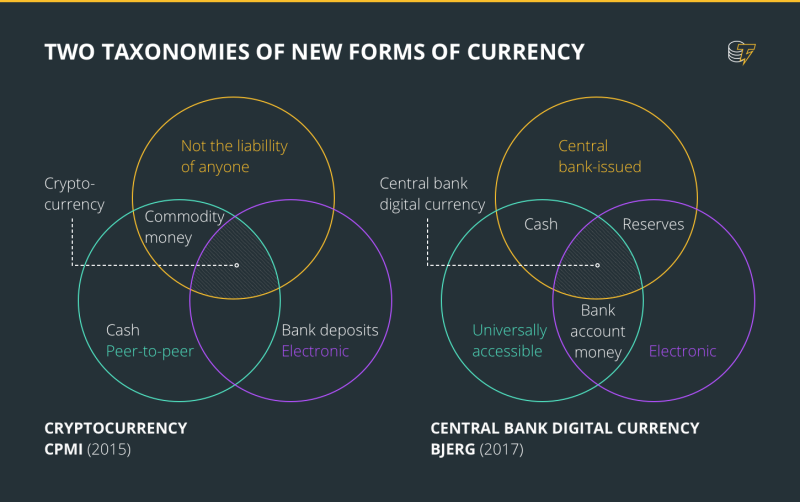
    Will a CBDC help tackle the emerging problem? Indeed not, since it can only be a fiat currency and not a crypto. However, cryptos can function as money. This difference needs to be understood.

    A currency is a token used in market transactions. Historically, not only paper money but cows and copper coins have been used as tokens since they are useful in themselves. But paper currency is useless till the government declares it to be a fiat currency. Everyone by consensus then accepts it at the value printed on it.

    So, paper currency with little use value derives its value from state backing and not any underlying commodity. Cryptos are a string of numbers in a computer programme and are even more worthless. And, without state backing. So, how do they become acceptable as tokens for exchange?

    Their acceptability to the rich enables them to act as money. Paintings with little use value have high valuations because the collectivity of the rich agrees to it. Cryptos are like that.

    Bitcoin, the most prominent crypto, has been designed to become expensive. Its total number is limited to 21 million and progressively it requires more and more of computer power and energy to produce (called mining like, for gold). As the cost of producing the Bitcoin has risen, its price has increased. This has led to speculative investment which drives the price higher, attracting more people to join. So, since 2009, in spite of wildly fluctuating prices, they have yielded high returns making speculation successful.

    Unlike the Tulip Mania

    The statement that cryptos have no underlying asset, not even a tulip refers to the time when tulip prices rose dramatically before they collapsed. But, tulips could not be used as tokens, while cryptos can be used via the internet. Also, the supply of tulips could expand rapidly as its price went up but the number of Bitcoins is limited.

    So, cryptos acquire value and become an asset which can be transacted via the net. This enables them to function as money. True, transactions using Bitcoins are difficult due to their underlying protocol, but other simpler cryptos are available.

    The different degrees of difficulties underlying cryptos arises from the problem of `double spending’. Fiat currency whether in physical or electronic form has the property that once it is spent, it cannot be spent again, except fraudulently, because it is no more with the spender. But, a software on a computer can be repeatedly used.

    Blockchain and encryption solved the problem by devising protocols like, the `proof of work’ and `proof of stake’. They enable the use of cryptos for transactions. The former protocol is difficult. The latter is simpler but prone to hacking and fraud. Today, thousands of different kinds of cryptos exist – Bitcoin like cryptos, Alt coins and Stable coins. Some of them may be fraudulent and people have lost money.

    CBDC, Unlike Cryptos

    Source: cointelegraph.com

    Blockchain enables decentralization. That is, everyone on the crypto platform has a say. But, the Central Banks would not want that. Further, they would want a fiat currency to be exclusively issued and controlled by them. But the protocols mentioned above theoretically enable everyone to `mine’ and create currency. So, for CBDC to be in central control, solve the `double spending’ problem and be a crypto (not just a digital version of currency) seems impossible.

    A centralized CBDC will require RBI to validate each transaction – something it does not do presently. Once a currency note is issued, RBI does not keep track of its use in transactions. Keeping track will be horrendously complex which could make the crypto like CBDC unusable unless new secure protocols are designed. No wonder, according to IMF MD, “… around 100 countries are exploring CBDCs at one level or another. Some researching, some testing, and a few already distributing CBDC to the public. … the IMF is deeply involved in it ..”

    Conclusion

    Issuing CBDCs will not only be complicated but presently cannot be a substitute for cryptos which will eventually be used as money. This will impact the functioning of the Central Banks and commercial banks. Further, it is now too late to ban cryptos unless there is global coordination which seems unlikely. The rich who benefit from cryptos will oppose banning them. Can the US work out a solution? The IMF MD has said, “The history of money is entering a new chapter”. The RBI needs to heed this caution and not be defensive.


    Slightly shortened version of this article was published earlier in The Hindu.

    Feature Image Credit: doralfamilyjournal.com


  • 2021-22 Q1 GDP Data Overestimates: Economic Shocks Question Methodology

    2021-22 Q1 GDP Data Overestimates: Economic Shocks Question Methodology

    2021-22 Q1 GDP Data Overestimates: Economic Shocks Question Methodology: The demonetisation shock impacted the unorganised sector far more adversely than it did the organised sector

    There are methodological errors in estimating annual and quarterly GDP data, especially when there is a shock to the economy, by using projections from the previous year, dividing the annual estimates into the four quarters and using production targets as if they have been achieved, explains Professor Arun Kumar


    The Reserve Bank of India (RBI) has maintained its growth projection for 2021-22 at 9.5% while the World Bank has retained it at 8.3%. These are based on the union government’s growth estimate of 20.1% for first quarter of 2021-22—an unprecedented growth rate based on the low base in the same quarter of 2020-21, which witnessed a massive decline of 24.1%.

    A sharp rise in growth after a steep fall in the preceding year is not a new phenomenon for the economy. Prior to 1999, only annual, not quarterly, data was available. Official data shows that the economy has risen sharply several times since independence: 1953-54 (6.2%), 1958-59 (7.3%), 1967-68 (7.7%), 1975-76 (9.2%) 1980-81 (6.8%), 1988-89 (9.4%) and 2010-11 (9.8%). The data after 2011-12 base revision was controversial. For instance, the new series shows a high growth rate of 8.3% for 2016-17 though it is well known that demonetisation devastated the economy

    Methodological Issues

    If the new series, using 2011-12 as the base year, shows a high growth rate for 2016-17, the methodology is not right. This has been extensively discussed since 2015, when the series was announced. A major change has been the use of the data provided by the union ministry of corporate affairs, called the MCA-21 database, since 2015. But it has been pointed out that many of the companies in this database are shell firms and the government shut down several of them in 2018. Further, many companies were found to be missing.

    Another problem pointed out, starting the year of demonetisation, is that the measurement of the contribution of the unorganised sector—which constitutes 45% of the GDP—is not based on independent data.

    The data for the non-agriculture sector is collected during surveys every five years. In between these years, the organised sector is largely used as a proxy and projections are made from the past. Both these features of estimation pose a problem when there is a shock to the economy.

    The demonetisation shock impacted the unorganised sector far more adversely than it did the organised sector. Hence, after demonetisation, the organised sector data should not have been used as a proxy to measure the contribution of the unorganised sector. Further, due to the shock, projections from the past will not be a valid procedure. This problem was accentuated by the implementation of the Goods and Services Tax (GST), which again impacted the unorganised sector more adversely

    Demand started to shift from the unorganised sector to the organized, making the situation even more adverse. For instance, e-commerce has severely impacted the neighbourhood stores and taxi aggregators have displaced the local taxi stands.

    Due to the shocks, the earlier procedure of calculating GDP becomes invalid and should have been changed. Since this has not been done, in effect, the GDP data is measuring the organised sector and agriculture.

    Thus, 31% of the economy is not being measured, and by all accounts, this part is declining, not growing. Therefore, GDP growth is far lower than what has been officially projected since 2016-17.

    The pandemic and the lockdown have administered the biggest shock to the economy. But the organised sector was hit far less than the unorganised sector. The split between the two sectors has been far greater than due to demonetisation or GST. Therefore, there is an urgent need to revise the method of calculating GDP—also, projections from the past do not make sense.

    Quarterly Data Issues

     The problem is even greater when projecting quarterly GDP growth. The data used is sketchier than the annual data. Not only most of the data for the unorganised sector is unavailable (except for agriculture), even the organised sector data is partial. For instance, the data for businesses is based on companies that declare their results in that quarter. Only a few hundred companies out of the thousands might be declaring such data.

    Worse, the estimation is based on a) projections for the same quarter in the preceding year same quarter, b) in many cases, the projection is not just for the quarter but for the year as a whole and then it is divided into four to get the data for one quarter and c) cases where targets, not actual production data. are used to estimate the contribution to GDP.

    Worse, the estimation is based on a) projections for the same quarter in the preceding year same quarter, b) in many cases, the projection is not just for the quarter but for the year as a whole and then it is divided into four to get the data for one quarter and c) cases where targets, not actual production data. are used to estimate the contribution to GDP.

    Fishing and aquaculture, mining and quarrying, and quasi-corporate and the unorganised sector are a few sectors which belong to the first group. Some sectors belonging to the second category are other crops, major livestock products, other livestock products and forestry and logging. Livestock belongs to the third category, where annual targets/projections are used.

    This procedure is clearly inadequate but maybe acceptable in a normal year. But when there is a shock to the economy, does it make sense? If there is a projection from the previous year, it is likely to give an upward bias since the economy was performing better in the preceding year. Further, projections have to be based on some indicators and the data on these indicators were only partially available due to the lockdown.

    Finally, how can the annual projection be made and then divided into four to obtain the quarterly estimate when the economy is highly variable from quarter to quarter. In 2020, each quarter was very different from the previous one.

    Next, if the data for 2020-21 is erroneous, when there was a massive slump in the economy, the shock continues into 2021-22. How can projections be made from the 2020-21 to 2021-22? Thus, there would be large errors in the quarterly data for the current year. This will then be fed into the data for 2022-23. Therefore, the shock to the economy will play itself out for several years.

    Impact on other Macro Variables

    Quarterly data are also published for other macro variables like consumption, and investment by public and private sectors. The government-related data is available in the Budget documents, but the private sector data poses a huge challenge. These estimates are, again, based on projections from the previous year, and in some cases, annual estimates are divided between quarters. Production data is also used to project consumption and investment by the private sector. So, if the former is incorrect, as pointed out above, then the estimates for the latter will also be erroneous.

    The RBI’s survey of the organised sector showed that capacity utilisation was down to 63% in January 2021, but the official quarterly data was showing a growth of 1.3% rather than a decline of 10%. Thus, the quarterly data was not representative of even the organised sector.

    Similarly, consumer sentiment was down to 55.5 compared to 105 a year back, implying that even the organised sector consumption had not recovered to the pre-pandemic levels. Both these variables were further dented in the second wave of COVID-19 in Q1 of 2021-22. The implication is that the data on these variables is also not reliable.

    If the production data is an overestimate due to the use of projections from the last year, the consumption and investment data would also be over projections. The further implication is that if the data for 2020-21 is not right, the quarterly data for 2021-22, projected from the previous year, will also be erroneous and overestimate.

    Analysis of Macro Variables for Q1 of 2021-22

    For the moment, let us analyse the Q1 data leaving aside the errors pointed out above. When the economy was in decline in the preceding year, comparing rates of growth makes less sense than comparing the level of GDP.

    On a low base of 2020-21 (-24.4%), the rate of growth for 2021-22 looks impressive (+20.1%). But it is 9.2% less than the pre-pandemic Q1 of 2019-20—i.e., the economy has not recovered to the pre-pandemic level.

    Further, if the economy was growing at the pre-pandemic rate, the economy would have expanded another 7.5% in two years. Thus, compared to the possible level of GDP in 2021-22, it is down by about 16%.

    Except for agriculture and the utilities sectors, data shows that none of the other sectors have recovered to the levels in 2019-20. Private final consumption expenditure is down by 11.9% and gross fixed capital formation by 17.1%. Government consumption expenditure and exports have increased compared to their levels in 2019-20. The former does give a boost to the economy by increasing demand but the latter does not since imports remain much higher than exports.

    Therefore, out of the four sources of demand, only government expenditure has increased—but this is not enough to compensate for the decline in the other three and that is why the economy is still down compared to 2019-20.

    It may be argued that over time, data undergoes revision as more data becomes available. But the situation now is unusual due to the pandemic. This necessitated a major revision in the methodology itself due to lack of data and consequent non-comparability across quarters and years.

     The views expressed are those of the author.

    This article was published earlier in NEWSCLICK.

    Image Credit: The Federal


  • Rethinking Monetary policy during a Crisis: Are Unconventional Policies here to Stay?

    Rethinking Monetary policy during a Crisis: Are Unconventional Policies here to Stay?

    With global crises such as the 2008 financial crisis and more recently the COVID-19 pandemic, monetary policy worldwide has increasingly ventured into uncharted territory. In the last 10 years alone, the world has seen 3 major crises that have affected financial markets extensively. Given the increasingly complex nature of economies and financial markets, central bankers have had to function under great uncertainty and shrinking policy space. Even as governments and policymakers worldwide leave no stone unturned in the fightback against crises, the traditional policy has often fallen short of its objectives. In light of growing limits of existing policy tools during a crisis, it has forced central banks to resort to unconventional measures such as negative interest rates (NIRP), quantitative easing, forward guidance and yield curve controls. Before the financial crisis of 2008, such unorthodox policies were relatively less commonplace. Today they are increasingly becoming key components of the monetary toolbox. However, much of these new policies is yet to be studied or tested in the real world. The long-term effect of such policies is still unclear. In this light, it becomes imperative to understand and analyse these unconventional policies to chart a course for monetary policy in the near to long term.

    What is Unconventional Monetary Policy?

    Under normal conditions, the most powerful weapon in a central banker’s toolkit is the policy interest rate. However, as global financial markets get more interconnected and complex, central bankers have to act under great uncertainty. As crises push traditional policy tools to their limits, central bankers have had to bank on more unconventional policies than ever before. As the governor of the Swedish central bank, Stefan Ingves puts it, “Monetary policy and the way we ‘do’ monetary policy has changed. All the time, we need to stand ready to develop new tools and make new kinds of analysis – If the world changes, we need to change with it”.


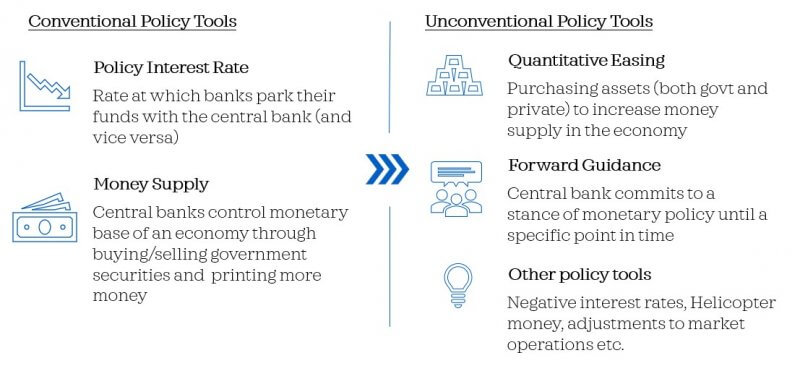
    Figure 1: Policy Tools Comparison

    Typically, interest rates and money supply are the two run-of-the-mill tools that central bankers resort to. Extreme versions of these policies, such as negative interest rates and quantitative easing, are termed unconventional monetary policies since they deviate from the traditional policy measures of a central bank. According to RBI’s Deepak Mohanty, “When central banks look beyond their traditional instrument of policy interest rate, the monetary policy takes an unconventional character”. Essentially, an Unconventional monetary policy is a set of measures taken by a central bank to bring an end to an exceptional economic situation. Central banks use these measures only in extraordinary situations when conventional monetary policy instruments cannot achieve the desired effect [1].

     Quantitative Easing

     Quantitative easing (QE) is a form of extreme and targeted control of the money supply in the economy. At its core, QE seeks to increase the money supply in the economy through the purchase of securities and bonds in the open market. When a central bank uses QE, it purchases large quantities of assets, such as government bonds, to lower borrowing costs, boost spending, support economic growth, and ultimately increase inflation.

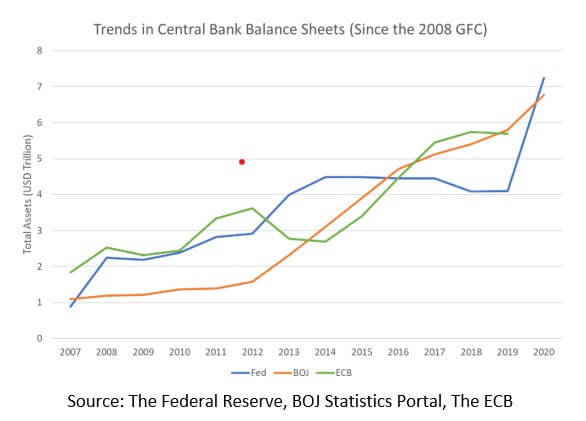
    Before the 2008 financial crisis, only one major economy, Japan, had implemented a significant Quantitative Easing program in the 1990s. Today, however, almost all major economies have some sort of QE or an asset purchase program. According to a report by Fitch Ratings, global QE asset purchases are set to hit $6 trillion in 2020 alone, which is more than half the cumulative global QE total seen over 2009 to 2018 [2]. As seen in the figure below, the balance sheets of major central banks have been expanding significantly since the financial crisis.


    Figure 2

    Quantitative Easing has been the cornerstone of the Fed’s crisis response since 2008. In the three rounds of QE post the 2008 crisis, the Fed balance sheets increased from $870 billion in August 2007 to $4.5 trillion in early 2015. Earlier this year, the Fed purchased a record $1.4 trillion worth of US treasuries in just six weeks in response to the COVID-19 crisis, speaking volumes of the role played by the unconventional policy during a period of crisis. Also, it’s not just the advanced economies that are resorting to extensive QE programs. Nearly 13 emerging market economies, including India, announced some form of a QE program following the crisis. In India, the RBI injected durable liquidity of ₹1.1 lakh crore through the purchase of securities under open market operations (OMOs) [3].

    Zero or Negative Interest Rates

    Quantitative easing was just the beginning of the long list of tricks central bankers pulled out of their sleeves. Closely accompanying QE policies were accommodative monetary regimes of ultra-low interest rates. In 2020 alone, interest rates have been slashed across the globe on 37 separate occasions [4]. Interest rates have been falling across the globe even before the crisis, and the current pandemic has only sped up this fall.

    While many economies have reached the theoretical zero lower-bound of rates, some have even dared to venture below the surface into negative territory. As of today, 5 economies in the world follow a Negative Interest Rate Policy. While the very concept of negative rates may seem baffling, it’s even more shocking to note that over $15 trillion worth of bonds is traded at negative yields globally [5]. This means that over 30% of the world’s investment-grade securities are traded in a manner such that lenders pay borrowers to use their funds. Central banks envisage that negative policy rates would induce increased spending and stimulate the economy in two ways – first, by forcing banks to hold lesser deposits with the central bank and channelling these funds into increased lending to households and businesses. Second, a cut in the policy rate would also lead to lower rates in the overall lending market, thus encouraging borrowing and spending.

    Forward Guidance

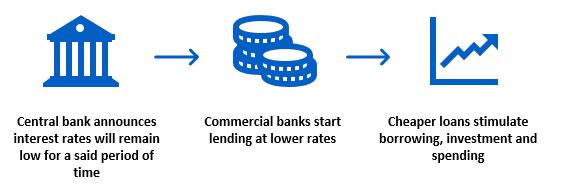
    Forward guidance refers to official communication from a central bank on the future course of monetary policy in the economy for a specific period. It is more of a monetary policy stance than a monetary policy tool. The key idea here is to keep markets informed and eliminate any form of uncertainty, which becomes especially imperative during times of crisis.


    Figure 3

    Gone are the days when central bank rate cuts and other announcements of secrets that were sprung upon the markets when they least expect it. With forward guidance, central banks provide communication well in advance about the likely future course of monetary policy in the economy, and this boosts the confidence of investors, consumers and companies. The US’s Fed was one of the major central banks to adopt this policy during the COVID crisis – providing clear forward guidance in June showing that it will probably keep rates low until at least 2022. The policy has been the cornerstone of the Eurozone’s crisis response since the sovereign debt crisis. In July 2012, at the height of the crisis, ECB President Mario Draghi adopted a form of Forward Guidance, stating that the ECB will do “whatever it takes” to save the euro. It is believed that these three words single-handedly turned around the eurozone crisis.

    Are Unconventional Policies Here to Stay?

    Apart from QE, NIRP and FG, there are several other unconventional policies in practice world over – Australia is experimenting with yield curve controls, the Fed is attempting to influence markets with forward guidance while Japan is considering printing helicopter money. There are so many extreme measures being adopted across the globe that policy commentators are now referring to these nations as swimming in an alphabet soup of unconventional policies (QE, NIRP, ZIRP, U-FX, NDR etc.). Post the 2008 crisis, when such policies were first being debated upon and economies were just dipping their toes in the ocean of unconventional policy, many warned of dire consequences such as hyperinflation and collapsing currencies. Luckily for central bankers, none of these predicaments came true. Most advanced economies are still struggling to combat deflation and extremely low levels of inflation despite adopting several unconventional policies. In this scenario, fears of hyperinflation seem to be unwarranted. While there have been studies documenting the potentially harmful effects of unconventional policies, economies still seem to stick with these policies. On one hand, central bankers have no better alternative tools, and second, the positive effects seem to fairly outweigh the negative externalities.

    Thus, unconventional policy tools are going to be around for the near future. As economies and global markets grow more complex, so will the policies and policy tools regulating them. Similar to how drastically monetary policy has changed within just 10 years after the financial crisis, it will keep evolving and adapting with time by developing new tools and analyses. Monetary toolbox a decade or two later will look radically different from what it is now. The important question then becomes not whether unconventional policies are here to stay, but how nations can make the most effective use of them.

    The new monetary tools, including QE and forward guidance, should become permanent parts of the monetary policy toolbox – Ben Bernanke, Ex-Fed Chair

    Need for Monetary Policy and Fiscal Policy to Work in Tandem

    While central bankers have no stone unturned in the fightback against crises, the success of unconventional policies has been fairly moderate. In Japan, for example, the NIRP has failed to stimulate spending and investment in the economy. Rather, negative rates have only forced a massive outflow of funds from the country in favour of foreign assets. In the Eurozone as well, the policy has achieved no significant impact, with banks continuing to pay billions of euros as negative fees to the ECB. While QE has fared slightly better than the rest as a policy tool, the experiences of various economies with it have been mixed.

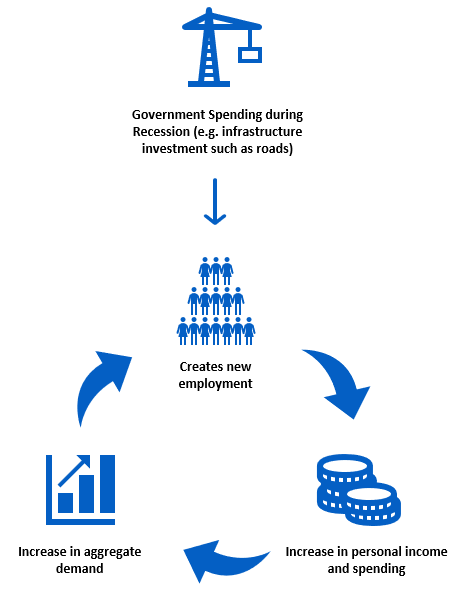
    The experiences of several economies have shown that while unconventional policies may work better than conventional ones during a crisis, there are limits to their performance as well. One of the key failures of unconventional policies (and conventional policies) has been the inability to stimulate healthy inflation in recessionary economies. Policies such as QE and NIRP, despite increasing the monetary base of economies, have failed to spur spending and investments. As we have seen in Japan, a standalone monetary policy, no matter how accommodative, is insufficient to pull economies out of downturns. In this light, it is imperative that monetary policy, conventional or unconventional, be accompanied by temporary fiscal stimulus during recessions. Public investment in infrastructure could give economies a much-needed boost in the absence of a private appetite for investments. Infrastructure is an enormous economic multiplier, and governments would do well to work in tandem with monetary regimes to provide the initial spur in economic activity. Several studies have shown that public investment during crises can generate employment and increase output. Originally theorised by British economist J.M. Keynes, the ‘Keynesian Multiplier’ of government spending could be the magic potion that makes unconventional policies go from good to great.

    How does the Keynesian Multiplier Work?

    During times of recession or economic downturn, government spending puts into action the Keynesian Multiplier. According to the Keynesian Multiplier, theorised by prominent economists such as Keynes, Kahn and Hicks, short term government spending boosts the economy by more than what is spent. Keynes was of the view that during a recession with a high level of unemployment, Governments should raise public spending to sustain effective demand and profits.


    Figure 4

    As seen from the figure above, an increase in government spending on large projects such as road building will lead to the creation of alternative employment. The increase in personal incomes and consequently aggregate demand in the economy will further stimulate economic activity and will create more employment than what was originally created by government spending. In effect, every unit of money spent by the government during a downturn increases GDP by a greater proportion than what was spent.

    Conclusion

    While unconventional policies are here to stay, they are a step in the dark. Economies are still experimenting and attempting to figure out the most effective use of these policies. Considering the fairly moderate performance of standalone unconventional policies, there is an established need for complementary fiscal policy to accompany monetary policy. An increase in infrastructure investment coupled with an accommodative monetary regime could help stimulate stagnant demand during a crisis. In developing economies, it can also help address structural bottlenecks subduing growth. These investments from the government, however, must be productive and efficient. Otherwise, they just end up adding on to already high levels of debt, especially during periods of crisis when governments have to borrow extensively for emergency requirements. It is also imperative that this investment is temporary and not permanent. Long-term government debt is unsustainable and can crowd out much-needed private investment.


    References


    [1] Central Charts. (2019). Definition of Unconventional Monetary Policy. Retrieved from

    https://www.centralcharts.com/en/gm/1-learn/9-economics/35-central-bank/976-definition-unconventional-monetary-policy

    [2] Fitch Ratings. (2020). Global QE Asset Purchases to Reach USD6 Trillion in 2020. Retrieved from

    https://www.fitchratings.com/research/sovereigns/global-qe-asset-purchases-to-reach-usd6-trillion-in-2020-24-04-2020

    [3] Reserve Bank of India. (2020). Policy Environment. Retrieved from

    https://www.rbi.org.in/scripts/PublicationsView.aspx?id=20269

    [4] Desjardins, J. (2020, March 17). The Downward Spiral in Interest Rates. Visual Capitalist.

    https://www.visualcapitalist.com/chart-the-downward-spiral-in-interest-rates/#:~:text=Global%20Rate%20Slashing,light%20of%20current%20oil%20prices.

    [5] Mullen, C. (2020, November 6). World’s Negative-Yield Debt Pile Has Just Hit a New Record. Bloomberg Quint.

    https://www.bloombergquint.com/onweb/negative-yielding-debt-hits-record-17-trillion-on-bond-rally#:~:text=The%20market%20value%20of%20the,it%20reached%20in%20August%202019.


    Image Credit: The Conversation

  • Examining the Policy Effectiveness of Negative Interest Rates: A Case Study on Japan

    Examining the Policy Effectiveness of Negative Interest Rates: A Case Study on Japan

    As a global health crisis ravages across the world, central bankers have rushed to lower rates to historic levels in an attempt to soften the economic blow of the pandemic. Since the crisis hit in early 2020, interest rates have been slashed across the globe on 37 separate occasions. Almost all major economies have cut their policy rates and many are at near-zero levels. In light of this economic climate, the debate on whether negative interest rates could prove effective in adverse conditions has come to the forefront again.

    As of today, 5 economies in the world follow a negative interest rate policy (NIRP).  In 2012, Denmark was the first country to announce negative rates, subsequently followed by the Eurozone, Switzerland, Sweden and Japan.

    The decrease in interest rates is not a new phenomenon, rates have been sliding globally for the last 30 years [1]. This trend has been more pronounced since the financial crisis of 2008. While many economies have reached the theoretical zero lower-bound of rates, some have even dared to venture below the surface into negative territory. As of today, 5 economies in the world follow a negative interest rate policy (NIRP).  In 2012, Denmark was the first country to announce negative rates, subsequently followed by the Eurozone, Switzerland, Sweden and Japan. While the very concept of negative rates may seem baffling, it’s even more shocking to note that over $15 trillion’ worth of bonds is traded at negative yields globally [2]. This means that over 30% of the world’s investment-grade securities are traded in a manner such that lenders pay borrowers to use their funds.

    Negative Interest Rates in Theory

    Interest rates have widely been regarded as the most powerful weapon in a central banker’s arsenal. Until very recently, their only limitation seemed to be the zero-lower bound beyond which bankers have had their hands tied. However, with Denmark’s policy rates going negative in 2012, this limit seems to have been breached. In theory, the NIRP is put in effect by central banks making the policy rate or repo rate (rate at which banks park their funds with the central bank) negative. While the negative rates directly apply only to banks, its effects are transmitted to the entire system by effectively lowering overall real interest rates. Central banks envisage that negative policy rates would induce increased spending and stimulate the economy in two ways – firstly, by forcing banks to hold lesser deposits with the central bank and channelling these funds into increased lending to households and businesses. Secondly, a cut in the policy rate would also lead to lower rates in the overall lending market, thus encouraging borrowing and spending.

    This policy, however, is riddled with several loopholes and works only under certain conditions. There has also been evidence of unwanted externalities associated with negative rates. The experience of the 5 economies which implemented the NIRP has been mixed and there is no consensus so far among economists and policymakers on the merits/demerits of the policy.

    Japan’s Tryst with Negative Rates: A Case Study

    In 2016 the Bank of Japan (BOJ), facing a relentless battle against deflation and a depreciating Yen, decided to venture into negative territory and has stayed there ever since.  The Japanese economy’s long downward spiral began with the real-estate asset bubble bursting in 1989-90. While Japan’s ‘lost decade’ is a widely known concept, many academics argue that Japan has lost more than a decade and has not fully recovered yet. The economy has been in first-gear ever since the crash – today, almost 30 years hence, the Nikkei 225 is still languishing at about 40% of its 1989 peak [3].

    Over the years, the BOJ has tried almost every trick in the trade – low rates, printing more money, rounds of quantitative easing, you name it and it has been done already. But much like a car stuck in the mud, the Japanese economy just seems to be spinning its wheels in one place. It is in this backdrop that the BOJ pulled out one last trick up its sleeve, announcing a negative interest rate regime.

    What Did Japan Hope to Achieve Through the NIRP?

    To combat deflation, the BOJ has long been involved in multiple rounds of aggressive bond-buying, hoping to inject more cash in the economy. According to data from the BOJ statistics portal, the central bank has been purchasing bonds worth 8-12 trillion Yen per month consistently. This has led to a mammoth increase in the bond holdings of the BOJ and also the monetary base of the Japanese economy. This has had two direct implications –

    • Japanese banks were now flush with money but this did not translate into increased lending activity. Rather banks were now parking this excess cashback with the central bank as reserves, thus defeating the purpose. It has been estimated that over 90% of the new money created by the BOJ since 2013 has ended up back with the central bank
    • The downside of this aggressive bond-buying policy was that Japan had now accumulated a mountain of debt. As of 2020, Japan was the most indebted nation in the world, with its debt accounting for over 234% of its GDP [4]

    The BOJ hoped that the NIRP would help address both these concerns. By announcing a 0.1% negative interest rate on excess reserves, it hoped to force banks to hold lesser reserves with the BOJ and use the money for lending purposes. On the other hand, negative rates would also help ease the burden of interest payments on the national debt.

    Reasons for Failure of NIRP in Japan

    While the NIRP did succeed in its immediate goal of reducing banks holdings with the BOJ, it has failed to stimulate bank lending. Instead, Japanese banks are now looking to park their funds elsewhere, to beat the low returns at home. With rates at historic lows in Japan and lacklustre borrowing sentiment from households and businesses, banks have turned to foreign investments to rake up profits. The NIRP, rather than stimulate the economy through increasing lending has instead spurred a massive outflow of funds in favour of overseas assets. As a result, Japanese banks hold nearly 20% of the world’s CLO’s (collateralized loan obligations) [5]. The foreign investments of the Japan Post Office Bank (owned by the government) alone stood at $630 billion as of 2020, showing glimpses into the outflow of reserves from the domestic economy.

    The NIRP, rather than stimulate the economy through increasing lending has instead spurred a massive outflow of funds in favour of overseas assets. As a result, Japanese banks hold nearly 20% of the world’s CLO’s (collateralized loan obligations).

    The failure of the NIRP to stimulate domestic spending and investments has shown that the Japanese economy faces several structural challenges that need to be addressed first. Given Japan’s ageing workforce, it will not be easy to discourage households from saving, especially in the current economic climate. Unless businesses and households are willing to spend or invest, the availability of cheap loans is redundant. No matter how low the BOJ pushes interest rates, the economy cannot be revived unless the structural bottlenecks subduing growth are addressed.

    Policy Shortcomings of the NIRP

    Japan’s case and the experiences of the other four economies have highlighted several loopholes in the NIRP. While it has been successful in reducing commercial bank holdings with central banks, it has not managed to translate this into lending activity. As in the case of Japan, banks can always find other ways to make use of excess funds. Even if banks manage to pass on the negative rates to the general public, households would continue to hoard cash in the form of mattress money, thus defeating the purpose of the policy. Take Sweden’s case for example – despite having negative rates, Sweden still has the 3rd highest household savings rate in the world.

    The NIRP has also been associated with several unwanted externalities –

    • Decreasing Bank Profitability

    Negative rates can destabilize the entire banking system by adversely affecting bank profits. In the Euro-zone alone, banks have transferred $24.2 billion to the European Central Bank (ECB) as negative fees in the five years since negative interest rates were introduced

    • Create asset bubbles

    A negative rate regime could also lead to the creation of property and other asset bubbles. Since rates are low (or negative) for cash holdings, people tend to invest in real estate or other tangible assets, thus driving up prices.

    • Erode Pension Funds

    Many academics believe that negative rates would hurt economies in the long run by eroding pension funds. This could potentially be a major cause for concern for countries like Japan which have an ageing population

    Is the NIRP here to stay?

    Despite its long list of flaws and potential side-effects, nations still seem to be sticking with the NIRP, with trends showing that even more may follow suit soon. Given the current economic climate, central bankers are left with no choice but to continue with low rates – that they do so despite its shortcomings speaks volumes of the precarious global economic conditions. The NIRP however, cannot be written off as a completely failed policy as it has shown that it can be successful under certain conditions. In Switzerland for example, the NIRP has been largely successful in helping depreciate the Franc (to keep exports competitive) and maintaining exchange rate parity in the face of large foreign inflows into the country. Switzerland’s experience is replicated in Sweden, with negative rates helping boost exports, although not substantially.

    Different nations have had different motives for venturing into negative territory – while countries like Japan wanted to stimulate inflation, others like Switzerland and Sweden were more interested in maintaining their exchange rates. Success or failure of the NIRP depends on the prevailing conditions of the economy and the desired end-goals that countries are after. Since it has been a relatively new policy, countries are still in the phase of experimenting with negative rates and it is too early to draw conclusions on their successes and failures.  On whether the NIRP is an effective policy tool, the jury is still out.


    References

    [1] Neufeld, D. (2020, February 4). Visualizing the 700-Year Fall of Interest Rates. Visual Capitalist. https://www.visualcapitalist.com/700-year-decline-of-interest-rates/

    [2] Mullen, C & Ainger, J. (2020, November 6). World’s Negative-Yield Debt Pile Has Just Hit a New Record. Bloomberg Quint. https://www.bloombergquint.com/onweb/negative-yielding-debt-hits-record-17-trillion-on-bond-rally#:~:text=The%20market%20value%20of%20the,it%20reached%20in%20August%202019.

    [3] Tamura, M. (2019, December 29). 30 years since Japan’s stock market peaked, climb back continues. Nikkei Asia. https://asia.nikkei.com/Spotlight/Datawatch/30-years-since-Japan-s-stock-market-peaked-climb-back-continues

    [4] World Population Review. (2020). Debt to GDP Ratio by Country 2020. Retrieved from https://worldpopulationreview.com/countries/countries-by-national-debt

    [5] Japanese banks own 20% of collateralized loans market – survey. (2020, June 2). Reuters. https://in.reuters.com/article/japan-economy-boj-loans/japanese-banks-own-20-of-collateralised-loans-market-survey-idUSL4N2DF1LP


    Image Credit: www.gulftoday.ae

  • Revamping PSUs in India – is Disinvestment the only way forward?

    Revamping PSUs in India – is Disinvestment the only way forward?

    Back in 1948 when India’s first Public Sector Unit (Indian Telephone Industries) was established, India was a newly independent agrarian economy with a weak industrial base. It was clear that the country needed to embark on a path of rapid industrialization if it was to improve the economic status and standards of living. The need was felt for large scale investment from the public sector that private players could not provide. It was in this backdrop that PSUs were first established in the country. It was envisioned that these state-run entities would jumpstart industrialization and spearhead development.

    Today, almost 70 years later, the country itself has come a long way. Once seen as the knights in shining armour come to rescue India’s economy, the same PSUs have come under fire for squandering crores of taxpayer money today. Far removed from their past glories, PSUs today are a cesspool of unproductivity where taxpayer money dies a slow painful death. The sorry state of PSUs in India has even warranted nicknames in the likes of ‘Zombie Companies’ and ‘Zombieland of Taxpayer Money’. While these nomenclatures may seem extreme, they are not without merit.

    The combined loss of these PSU’s amounts to over Rs. 31,635 crores in taxpayer money [1]. What’s more, this number is not inclusive of the losses reported by the dozen public sector banks, which would only add to the already huge mountain of debt.

    Current State of PSU’s in India

    Back in 1951, there were only 5 public sector enterprises in existence. Since then the government has gone on a spending spree, entering more and more businesses over the years. Today the government runs more than 300 PSUs across a plethora of industries ranging from hotels & watches to telecom and steel. It doesn’t come as a surprise that over 70 of these entities are running a net loss. The combined loss of these PSU’s amounts to over Rs. 31,635 crores in taxpayer money [1]. What’s more, this number is not inclusive of the losses reported by the dozen public sector banks, which would only add to the already huge mountain of debt. If the central public sector enterprises have fared poorly, the state-level public enterprises (SLPE) paint a bleaker picture. Barring certain states, the SLPEs of almost all the states in India report a net loss. The losses reported by these SLPEs are almost 3 times greater than the amount reported by their central counterparts.

    The PSUs which have not reported a net loss has not escaped public scrutiny either, with almost all of them losing value over the last decade. While some do report profits, their returns have been dwindling, save a few. The rate of return on capital employed (ROCE), widely used as a measure of profitability and efficiency, has been on a downward trend for PSUs. It has been reported that PSU efficiency has fallen by over 50% in the last decade [2]. In the last six years alone the total market cap of all public sector firms and banks fell by 36% even as the market cap of all BSE and NSE listed companies have almost doubled in the same period [3]. 

    The bad news is that this dismal performance of PSUs is only going to get worse, especially given the current economic climate. Despite years of turnaround efforts and crores of bailout money, these state-run entities have shown no signs of recovery, save a few. In this light, much of the discourse around PSUs has been focused on disinvestment. The government too seems to echo this sentiment as it has chosen to embark upon a long-drawn journey of divesting its holdings. Several sectors in India are already heading towards 100% privatization. With the sale of Air India, the civil aviation industry will become fully private. In the power sector, there has been a growing emphasis on private generation, with the centre reducing its stake in NTPC and BHEL. Sooner or later this sector is also headed for 100% privatization. In other sectors like telecom and health, the government has just a token presence, with much of the market being dominated by private players.

    Push for Privatization

    This push for privatization is welcome and much needed in sectors like civil aviation which lack strategic importance. The sorry state of Air India has made clear that the government simply cannot compete with private players in a highly commercialised industry like aviation. Air India in particular has been languishing for years and has eroded crores of taxpayer money in the process. This has been the case not just for India but for other developing economies like Brazil and Malaysia as well. Malaysia has been trying to turn around Malaysia Airlines for decades altogether with no end in sight. After years of struggle, it seems the government has finally decided to change tracks as it is now looking to give up its majority stake in the airline to private investors. The case with Brazil is no different – the failing national aerospace conglomerate Embraer was revived just in time with a dose of privatization.

    The Embraer turnaround model in particular offers some interesting lessons for India. What started off as a government entity in 1969 was privatised in 1994 in order to avoid bankruptcy [4]. Embraer then went from near bankruptcy to becoming the third-largest aircraft manufacturer in the world. What’s striking here is that the Brazilian government played its cards to near perfection – while it completely privatized the airline, the Brazilian government still holds a ‘golden share’ in Embraer giving it veto power over strategic decisions involving military programs and any change in its controlling interest. This model ensured a win-win situation for the Brazilian government and the rest, of course, is history. 

    Instead of divesting its bleeding PSU’s, the government is currently in the process of selling its 100% stake in 3 large profitable companies (BPCL, CCI, and the Shipping Corporation). While it’s tempting to believe this is a part of an extensive government masterplan, the stark reality is that the government has let fiscal pressures dictate its divestment strategy.

    The problem with the centre’s current disinvestment strategy, however, is that it is focused merely on balancing government books and lacks a long-term strategic vision. Instead of divesting its bleeding PSU’s, the government is currently in the process of selling its 100% stake in 3 large profitable companies (BPCL, CCI, and the Shipping Corporation). While it’s tempting to believe this is a part of an extensive government masterplan, the stark reality is that the government has let fiscal pressures dictate its divestment strategy. It appears the government is simply selling its stake in PSUs to make quick money and ease the fiscal books. There are also concerns that 100% privatization of entities like BPCL and HPCL will feed private monopoly and leave India’s energy security purely in the hands of private players. Even in the sale of loss-making entities the government has lacked a systematic plan, with divestment being carried out in penny packets. This sort of disinvestment just to stop the bleeding is a short term stop-gap measure and will surely have long term repercussions. 

    The case for Public Sector Presence

    While privatization plays are much needed in sectors like civil aviation, the same cannot be said for strategic sectors such as power, pharma, and health. A diluted public sector presence in strategic industries may not bode well for the economy, especially for a developing country like India. As the COVID-19 pandemic has shown, strong public systems are essential to absorbing global shocks. While proponents of disinvestment seek to cut the economic costs of bleeding PSUs, they often ignore the social costs involved in the process and the impact it will have on a developing economy like ours.

    In light of the current global economic climate, as more and more countries turn inward, the role of state-run entities has become all the more important. The experiences of other Asian economies like China and Singapore have shown that state-run units could be tools of economic growth if utilised effectively. Most of China’s industrial push, including the recent ‘Made in China 2025’ plan has been heralded by State-Owned Enterprises (SOE’s). Among the 124 Chinese companies in the Fortune Global 500 list, more than half were SOE’s [5]. Out of these, 3 of the Chinese SOE’s feature in the top 5 globally, speaking volumes of the role they have played in the growth of the country. China has effectively put SOE’s at the core of its vision to combat the challenges it currently faces, including the escalating trade war with the USA. China’s model is also noteworthy given the level of collaborative investments between SOE’s and private players. India can take a leaf or two out of China’s book on the successful use of SOE’s to drive its growth story.

    Turning around existing PSU’s – success stories 

    It is clear that the government simply cannot take the easy way out of simply divesting and washing its hands off the bleeding PSUs. In certain critical sectors (that first need to be recognized in line with the long-term strategy) the government still needs to work on repairing the damage and turning around its existing underperformers. While the task seems impossible given the current state of affairs, policymakers can take heart from the fact that it has been done before both in India and globally.

    One such global success story is that of the Kiwi national carrier Air New Zealand. In a world of post-privatization success stories, Air NZ stands out as one of the few lone dissenters to buck this trend. The NZ based company, privatised by the government in 1989, had to be re-nationalised again in 2001 after it ran into financial troubles. The fortunes of the New Zealand economy have been closely tied to that of Air NZ, with the country being heavily dependent on local and international tourism. Within just two years of nationalisation Air NZ was able to fashion a comeback from near ruin, and today is one of the biggest revenue earners for the NZ government. That a company that failed in private hands was able to be revived by the government offers a beacon of hope for struggling public enterprises worldwide.

    Back home in India as well such success stories do exist, albeit in a bygone era. Aptly recognised as one of the greatest public sector managers of India, Dr. V. Krishnamurthy is the mastermind behind these success stories. His unparalleled contributions to the public sector have earned him several monikers such as ‘the helmsman’ and ‘the man with the golden touch’. He has been largely credited with successfully turning around public sector giants like BHEL, SAIL, GAIL, and Maruti. At a time when public sector turnarounds were unheard of in India, Dr. Krishnamurthy managed to increase profits of BHEL from 17 crore rupees to 57 crores during his five-year tenure [6]. He also came to be widely regarded as the ‘Steel Man of India’ after his successful turnaround of SAIL in the late 1980s. 

    At Maruti he decided to take a different approach, inviting private sector participation through a JV. While many skeptics were against this move initially, the helmsman had the last laugh as Maruti went on to dominate the automobile market in India for decades. Maruti’s turnaround story is also a shining example of the merits of public-private collaboration – something which today’s policymakers have chosen to largely overlook. Maruti today is a 100% private company and is widely credited with creating the automobile industry revolution in India. 

    Way Forward – a two-pronged approach to fix PSU’s

    While such success stories may be scant and the field is mired with accounts of public failure, it is evident that such turnarounds are not impossible. As we have seen from the examples in India and elsewhere, with the right leadership any enterprise can be pulled out of the mud. What is clear is that there is no simple one size fits all answer to the woes of PSU’s in India. Several countries have taken different approaches to tackle this issue. While China has followed a model of strong public presence in several industries, countries like the USA hardly have a public sector presence. The United States government rather exercises its presence by closely regulating and monitoring the industry through effective policy mechanisms.  Other countries like Singapore have chosen to manage PSUs through sovereign funds and holding companies. Singapore plays in the public sector via its two sovereign funds, Temasek and GIC. The companies owned by these funds operate as commercial entities and are no different from private players. Such a model has ensured that the companies get the best of both worlds – public ownership but with private, commercial management.

    countries like Singapore have chosen to manage PSUs through sovereign funds and holding companies. Singapore plays in the public sector via its two sovereign funds, Temasek and GIC.

    While there are many such different models that India can take inspiration from, the verdict is clear that the government must stop the bleeding in the public sector quickly or face the wrath of taxpayers. Going forward, the government must adopt a two-pronged approach to fix PSUs – some need to be killed, while others deserve a chance at resurrection.

    Firstly, the government needs to shut down bleeding enterprises in sectors that have no strategic relevance. The government is present in sectors like biofuel, airlines, hotels, and watches despite making heavy losses every year. Public entities simply cannot compete in these industries nor is there any strategic need to do so. The logical step for the government would be to send these entities to the graveyard and stop the bleeding.

    The top 10 loss making PSU’s account for over 94% of the overall losses reported by all PSU’s together.

    Secondly, efforts must be made to turnaround/transform remaining entities in strategic sectors. The top 10 loss making PSU’s account for over 94% of the overall losses reported by all PSUs together. These large offenders would be the best places to start – the government would do well to either transform these entities in-house through fresh leadership or by inviting private partnerships.

    The above tasks are easier said than done and may take years of policy reform to become a reality. While the problem does seem formidable, it is not unique to India alone. Several economies around the world, developing and developed alike, are grappling with the issue of falling public sector productivity and the need to stay relevant. Indian policymakers and public sector managers have a long road ahead of them, especially given the current global socio-economic scenario. But they can definitely take inspiration (and some valuable lessons) from the several public sector turnaround stories globally and from India’s great helmsman himself.


    References

    [1] Department of Public Enterprises. (2019). Public Enterprises Survey 2018-19 (Volume 1, Statement 1). Retrieved from https://dpe.gov.in/public-enterprises-survey-2018-19

    [2] Rai, D. (2019, September 11). PSU returns fell 50% in the past decade; 44 new entities created. Business Today. https://www.businesstoday.in/current/corporate/in-depth-government-companies-almost-lost-half-of-their-efficiency-in-last-10-years/story/378508.html

    [3] How PSU’s market cap fell by 36% in 6 years under Modi govt, while stock market doubled theirs. (2020, October 30). The Print. https://theprint.in/opinion/how-psus-market-cap-fell-by-36-in-6-years-under-modi-govt-while-stock-market-doubled-theirs/533743/

    [4] Haynes, B & Boadle, A. Boeing willing to preserve Brazil’s ‘golden share’ in Embraer deal. (2018, January 19). Reuters. https://www.reuters.com/article/us-embraer-m-a-boeing-idUSKBN1F72XB

    [5] Fortune. (2020). Fortune Global 500 2020. Retrieved from https://fortune.com/global500/

    [6] Nayar, L. V. Krishnamurthy, SAIL, BHEL, Maruti. (20187, March 23). Outlook India. https://magazine.outlookindia.com/story/v-krishnamurthy-sail-bhel-maruti/298634


  • Living Next to China: India’s Economic Challenge

    Living Next to China: India’s Economic Challenge

    Abstract

    Hampered by declining economic growth, India needs to take bold and practical economic measures to overcome the adverse impact of the coronavirus pandemic, compounded by past economic blunders such as the demonetisation and the haphazard implementation of the GST regime. Mohan Guruswamy analyses that the seeds of the current economic slide were sown by the UPA II regime by its populist measures that were wasteful, unproductive, and reduced capital expenditure. Non action by the NDA governments on these issues has made it worse. He argues that India must not shy away from recourse to deficit financing to overcome the current unprecedented challenges faced by the economy on account of the Covid-19 disruption. India needs to increase its stimulus package from a mere 0.3% of the GDP to at least 10% to boost economic revival and growth. India’s reserves of $490 billion ($530 billion as of recent figures) is available to be tapped for economic revival. The measures must focus on addressing the severe impact on weaker sections of the society such as the poor, lower middle-class, and the farmers.

    The Covid2019 shock hit all world economies and has caused a serious contraction in all of them. Ironically, in the advanced economies like the USA, UK, Japan, and others, it exposed their intrinsic strengths with highly evolved social security systems by and large being able to absorb the labor displacement and the ability to quickly put together a fiscal fight back plan. Even China has been able to quickly recover its pole position as the worlds leading exporter and industrial production center. In India, Covid2019 exposed our co-morbidities, and has further opened the traditional faultlines, with the large unorganized labor cohort bearing the brunt of the costs. At last count the CMIE estimates over 130 million daily wagers in the urban centers being rendered jobless and homeless.[i] India’s economy which has been in distress for most of the last decade in now seriously stricken.

    When India’s economic history is written in some future date, and when a serious examination is done of when India lost its way to its ‘tryst with destiny’, the decade of 2010-20 will be highlighted.

    When India’s economic history is written in some future date, and when a serious examination is done of when India lost its way to its ‘tryst with destiny’, the decade of 2010-20 will be highlighted. The facts speak for themselves. India’s real GDP growth was at its peak in March 2010 when it scaled 13.3%.  The nominal GDP at that point was over 16.1%. The nominal GDP in September 2019 was at 6.3%, it’s lowest in the decade. Since then the downward trend is evident and we are now scraping the bottom at about a real GDP growth rate of 4.5%, this too with the push of an arguably inflationary methodology. Our previous CEA, Arvind Subramaniam, estimated that India’s GDP growth is overestimated by at least 2.5%. BJP MP and economist Subramaniam Swamy was even more pessimistic. He estimated it to be 1.5%.

    The decline in the promise is amply evident by the change in the make up of the economy during this decade.  In 2010 Agriculture contributed 17.5% of GDP, while Industry contributed 30.2% and Services 45.4%.  In 2019 that has become 15.6%, 26.5% and 48.5% respectively.  The share of industry has been sliding.  This is the typical profile of a post-industrial economy.  The irony of India becoming post-industrial without having industrialized must not be missed.

    Decline in Capital Investment

    The most significant cause for the decline of growth is the decline in capital investment.  It was 39.8% of GDP in 2010 and is now a good 10% lower.  Clearly without an increase of capital investment, one cannot hope for more industrialization and hence higher growth.  What we have seen in this decade is the huge increase in Services, which now mostly means increase in Public Administration and informal services like pakora sellers.

    In 2010 it seemed we were well on track.  But now we are struggling to get past $3 trillion, and the $5 trillion rendezvous that Modi promised by 2024 will have to wait longer.

    At the turn of the century, as China’s GDP began its great leap forward (from about $1.2 trillion in 2010 to $14.2 trillion in 2019), was also a heady moment for India whose GDP of $470 billion began a break from the sub 5% level of most of the 1990’s to the rates we became familiar with in the recent past (to hit a peak stride of 10.7% in 2010). At that point in time, if growth rates kept creeping up, we could have conceivably gone past $30 trillion by 2050. But for that the growth rate should consistently be above 7%. It seemed so feasible then.  In 2010 it seemed we were well on track.  But now we are struggling to get past $3 trillion, and the $5 trillion rendezvous that Modi promised by 2024 will have to wait longer.

    To be fair to Modi and the NDA, the decline began early in the second term of the UPA when capital expenditure growth had begun tapering off.  Dr. Manmohan Singh is too canny an economist to have missed that.  But UPA II also coincided with the increasing assertion of populist tendencies encouraged by the Congress President and her extra-Constitutional National Advisory Council. The decline in the share of capital expenditure was accompanied by a huge expansion in subsidies, most of them unmerited.  Instead of an increase in expenditure on education and healthcare, we saw a huge expansion in subsidies to the middle and upper classes like on LPG and motor fuels. Even fertilizer subsidies, which mainly flow to middle and large farmers with irrigated farmlands, saw a great upward leap.  Clearly the money for this came from the reduction in capital expenditure.  Modi’s fault in the years since 2014 is that he did nothing to reverse the trend, and only inflicted more hardship by his foolish demonetization and ill-conceived GST rollout.

    The realities are indeed stark.  The savings/GDP ratio has been in a declining trend since 2011 and Modi has been unable to reverse it.  Consequently, the tax/GDP ratio and the investment/GDP ratio have also been declining.  The rate of economic growth has been suspect and all objective indicators point to it being padded up. The drivers of economic growth such as capital expenditure is dismal.  Projects funded by banks have declined by over half since 2014 to less than Rs.600 billion in 2018-19.  Projects funded by the market have dropped to rock bottom.  Subsequently the manufacturing/GDP ratio is now at 15%.  Corporate profits/GDP ratio is now at a 15-year-old low at about 2.7%.  You cannot have adequate job creation if these are dipping.  Declining rural labor wage indices testify to this.

    Between October 2007 and October 2013 rural wages in the agricultural and non-agricultural sectors grew at 17% and 15%, respectively.  Since November 2014, however, agricultural and non-agricultural sector wages grew at only 5.6% and 6.5%, respectively. In 2019 average rural wage growth has further fallen to 3.1%.[ii]

    Bharat and India Divide

    It is very clear now that the urban lane has been moving well in India.  Indeed, so well that an Oxfam study revealed that that as much as 73% of the growth during the last five years accrued to just 1% of the population.[iii] This does not mean it is just the tycoons of Bombay and Delhi who are cornering the gains.  Government now employs close to 25 million persons, and these have now become a high-income enclave.  The number of persons in the private and organized sector is about another ten million. In all this high-income enclave numbers not more than 175-200 million (using the thumb rule of five per family).  Much of the consumption we tend to laud is restricted to just these.

    The simple fact that the share of Agriculture is now about 15.6% of GDP and falling, while still being the source of sustenance for almost 60% of the population reveals the stark reality.  A vast section of India is being left behind even as India races to become a major global economy.

    Agriculture is still the mainstay of employment.  Way back in 1880 the Indian Famine Commission “had observed that India had too many people cultivating too little land”.  This about encapsulates the current situation also.  While as a percentage the farmers and farmworkers have reduced as a part of the work force, in absolute terms they have almost tripled since 1947.  This has led to a permanent depression in comparative wages but has also led to a decline in per farmer production due to fragmentation of holdings.  The average farm size is now less than an acre and it keeps further fragmenting every generation.[iv] The beggaring of the farming community is inevitable.  The only solution to this is the massive re-direction of the workforce into less skilled vocations such as construction.

    The simple fact that the share of Agriculture is now about 15.6% of GDP and falling, while still being the source of sustenance for almost 60% of the population reveals the stark reality.  A vast section of India is being left behind even as India races to become a major global economy.

    As the decade ends, the Bharat and India divide have never been more vivid.  Our social scientists are still unable to fix a handle to this because the class, cultural and ethnic divides still eludes a neat theoretical construct.  Yet there can be little disagreement that there are two broad parts to this gigantic country and one part is being left behind.  The distance between the two only increased from 2010 to 2020.  This is indeed the lost decade.  Recovering from this will take long and will be painful.  If we take too long, we might have used up a good bit of the ‘demographic dividend’ and the demographic window of opportunity.  The ageing of India will be upon us by 2050[v].

    Covid-19 Impact – Increasing Economic Disparities 

    In the recent months the onslaught of the Covid2019 induced lockdown has been quite relentless.  From 2004-2014 India’s GDP grew at an average of 7.8%.  At its peak it went past 10% in 2010-11 Then it started slowing down.  The new government was unable to return to the old growth rates because it did not care to learn from the experiences of the previous regime, which began to spend more on giveaways, misguidedly thinking it was welfare economics, and took the accelerator off capital expenditure.  Even though capital expenditure is driven in India by government spending, this government spending is very different from subsidies and giveaways.  Subsidies generally tend to be misdirected with the already well-off garnering most of it.  Minimum Support Prices (MSP) are a huge annual subsidy[vi]and 90% of it accrues to the states of Punjab, Haryana, and the coastal region of Andhra Pradesh.  Fertilizer subsidies tend to accumulate to the advantage of large and medium farmers or to about a quarter of all land holdings.  Ditto for free power.  The only welfare expenditure to benefit farmers is investment in irrigation, rural infrastructure, and social welfare like education and health.  Unfortunately, this has been on the decline.  This has exacerbated disparities, both local and regional.  With capital expenditures declining, job creation suffered and the inevitable slowdown of GDP growth happened.  As we started diving, the government inflicted the so-called Demonetization adding to our woes.  Just as things began to look up, the Covid2019 pandemic overtook us.

    Now the only dispute on national income is how much will be the contraction.  The Finance Ministry hopes there won’t be any. The IMF has officially said it will be 4.5%.  The rating agencies predict a contraction of 6.8%, while many more are suggesting something closer to 10%.  How do we deal with is now?  The government of India has tended to be “conservative” in its outlook and has made no serious suggestion on economic stimulus.  What it calls a stimulus is actually not a stimulus. The problem is more philosophical.

    The divide between the Keynesians and the Chicago school is as intense and often antagonistic as the Sunni-Shia, Catholic-Protestant or Thenkalai-Vadakalai Iyengar divides.

    Keynesian economics is a theory that says the government should increase demand to boost growth. Keynesians believe consumer demand is the primary driving force in an economy.  As a result, the theory supports expansionary fiscal policy.  The Chicago School is a neoclassical economic school of thought that originated at the University of Chicago in the 1930s.  The main tenets of the Chicago School are that free markets best allocate resources in an economy and that minimal or zero government intervention is best for economic prosperity.  They abhor fiscal deficits.

    Inadequate Stimulus Package 

    The instruments used to beat countries like India into submission are ratings agencies such as Moody’s, which just downgraded India.  We shouldn’t lose too much sleep over it.  India is a hardly a borrower abroad and is more of a lender holding $490 billion as reserves.

    The only reason why the actual stimulus package is only Rs.63K crs is the obsession with fiscal deficits by Chicago economists such as Raghuram Rajan and his former student the hapless Krishnamurthy Subramaniam, the present CEA. They are true disciples of the Washington Consensus to judge countries like India by the fiscal deficit size.  The instruments used to beat countries like India into submission are ratings agencies such as Moody’s, which just downgraded India.  We shouldn’t lose too much sleep over it.  India is a hardly a borrower abroad and is more of a lender holding $490 billion as reserves.

    That is why the CEA when asked about a big stimulus said: “There are no free lunches!” That’s exactly what Milton Friedman said. But they quite happily ignore the biggest deficit financed economy in the world is the USA.  Raghuram Rajan told Rahul Gandhi on his videoconference that a stimulus of Rs.65K crores would suffice in the present situation[vii]. The Nobel Laureate Abhijit Bhattacharya and former CEA Arvind Subramaniam suggest a stimulus package like the USA or Japan[viii].  The USA has just announced a stimulus of over $3.5 trillion or over 15% of GDP.  Modi’s stimulus is a mere 0.3% of GDP.

    What is ‘Fiscal Deficit?’ A fiscal deficit occurs when a government’s total expenditures exceed the revenue that it generates, excluding money from borrowings.  Deficit differs from debt, which is an accumulation of yearly deficits.

    Many serious economists regard fiscal deficits as a positive economic event.  For instance, the great John Maynard Keynes believed that deficits help countries climb out of economic recession.  On the other hand, fiscal conservatives feel that governments should avoid deficits in favor of balanced budgets.

    India’s debt/GDP ratio is by contrast a modest 62% and yet it intends to pump in a mere 0.3% of GDP as stimulus.

    The fastest growing economies in the world, and now its biggest – USA, China, Japan and most of Western Europe – have the highest debt/GDP ratios.  Japan’s debt/GDP is over 253% before the latest stimulus of 20% of GDP.  China’s debt is now over 180% of its GDP.  The USAs debt/GDP is close to 105% yet it is raising $3 trillion as debt to get it out of the Covid2019 quagmire.  India’s debt/GDP ratio is by contrast a modest 62% and yet it intends to pump in a mere 0.3% of GDP as stimulus.

    Pump priming the economy by borrowing per se is not bad.  It is not putting the debt to good use that is bad.  Nations prosper when they use debt for worthwhile capital expenditure with assured returns and social cost benefits.  But we in India have borrowed to give it away as subsidies and to hide the high cost of government.  To give an analogy, if a family has to make a choice of borrowing money to fund the children’s education or to support the man’s drinking habit, the rational choice is obvious. The children’s education will have a long-term payback, while the booze gives instant gratification. But unfortunately, our governments have always been making the wrong choices.

    If borrowed money is used productively and creates growth and prosperity, it must be welcomed.  What we want to hear from the government is not about fiscal deficit targets, but economic growth, value addition, employment, and investment targets.  Our governments have hopelessly been missing all these targets.

    Modi’s Options – Need for Bold Decisions

    So, what can Modi do now to get us out of this quagmire?  If the regime abhors a stimulus financed by deficit financing there are other options that can be exercised.  But he is hamstrung with a weak economic management team with novices as the two key players, the Finance Minister and RBI governor.

    India has over $490 billion nesting abroad earning ridiculously low interest.  Even if a tenth of this is monetized for injection into the national economy, it will mean more than Rs.3.5 lakh crores.  At last count the RBI had about Rs.9.6 lakh crores as reserves.  This is money to be used in a financial emergency.  We are now in an emergency like we have never encountered or foresaw before. Even a third of this or about Rs.3.2 lakh crores is about five times the present plan.

    There is money in the trees, and all it needs is a good shake up to pick the fruits. The pain of the lockdown must not be borne by the poor alone.  The government can easily target 5% of GDP or about Rs.10L crores for the recovery fund as an immediately achievable goal.

    There are other sources of funds also, but tapping these will entail political courage and sacrifices. Our cumulative government wages and pension bill amounts to about 11.4% of GDP.  After exempting the military and paramilitary, which is mostly under active deployment, we can target 1% of GDP by just by cancelling annual leave and LTC, and rolling back a few DA increases.

    The government can also sequester a fixed percentage from bank deposits, say 5% of deposits between Rs.10-100 lakhs and 15-20% from bigger deposits for tax-free interest-bearing bonds in exchange.  The ten big private companies alone have cash reserves of over Rs.10 lakh crores[ix].

    There is money in the trees, and all it needs is a good shake up to pick the fruits. The pain of the lockdown must not be borne by the poor alone.  The government can easily target 5% of GDP or about Rs.10L crores for the recovery fund as an immediately achievable goal.

    This money can be used to immediately begin a Universal Basic Income scheme, by transferring a sum of Rs.5000 pm into the Jan Dhan accounts for the duration of the financial emergency; fund GST concessions to move the auto and engineering sectors in particular; begin emergency rural reconstruction projects to generate millions of new jobs and get our core infrastructure sectors like steel, cement and transportation moving again.

    Getting money to move India again is not a huge problem.  What comes in between are the philosophical blinkers.  Call it Chicago economics or the Gujarati mindset.

    Notes

    [i] https://www.businesstoday.in/sectors/jobs/india-unemployment-rate-hits-26-amid-lockdown-14-crore-lose-employment-cmie/story/401707.html

    [ii] https://www.financialexpress.com/economy/farm-wages-growth-fell-to-a-four-quarter-low-in-q3-fy-20/1789235/

    [iii] https://economictimes.indiatimes.com/news/economy/indicators/wealth-of-indias-richest-1-more-than-4-times-of-total-for-70-poorest-oxfam/articleshow/73416122.cms?from=mdr#:~:text=Wealth%20of%20India’s%20richest%201%25%20more%20than%204%2Dtimes%20of,total%20for%2070%25%20poorest%3A%20Oxfam&text=The%20Oxfam%20report%20further%20said,particularly%20poor%20women%20and%20girls.

    [iv] https://www.prsindia.org/policy/discussion-papers/state-agriculture-india

    140 million hectares of land is used as agricultural area, as of 2012-13.  Over the years, this area has been fragmented into smaller pieces of land.  As seen in Table 3, the number of marginal land holdings (less than one hectare) increased from 36 million in 1971 to 93 million in 2011.  Marginal and small land holdings face several issues, such as problems with using mechanization and irrigation techniques.

    [v] https://economictimes.indiatimes.com/news/politics-and-nation/demographic-time-bomb-young-india-ageing-much-faster-than-expected/articleshow/65382889.cms

    [vi] https://www.thehindubusinessline.com/opinion/all-you-wanted-to-know-about-minimum-support-price/article7342789.ece

    [vii] https://www.hindustantimes.com/india-news/in-video-conversation-with-rahul-rajan-suggests-65k-crore-aid-for-poor/story-CtrtvW6HErR16L9m1t9wHP.html

    [viii] https://economictimes.indiatimes.com/news/economy/policy/rahul-gandhi-in-conversation-with-abhijit-banerjee-india-needs-a-bigger-stimulus-package-like-us-japan-to-revive-economy/videoshow/75549770.cms

    [ix] https://www.screener.in/screens/2551/Cash-Rich-Companies/


    Image credit: Adobe Stock

  • Covid 19: India uses Crisis to bring-in Economic Reforms as Package

    Covid 19: India uses Crisis to bring-in Economic Reforms as Package

    India’s four-phase lockdown of 68 days to deal with the Covid-19 threat has, while slowing the spread of the virus, come at huge economic costs. The lockdown for a vast majority of the people is, undoubtedly, the harshest in the world.

    The coronavirus triggered lockdown and its ensuing series of extensions have disrupted more than 60 percent of economic activities in the country, posing a huge threat to the  economy. The crisis was underway when the global economy was slowing down and India, in particular, had to deal with a poor health care system and an economy already under distress. Unemployment rate is estimated to be around 27 percent post lockdown and has resulted in nearly 12.2 crore people losing their jobs. In addition, a  severe slump in consumer demand is expected to persist for the next few quarters. Almost 85 percent of India’s workforce is engaged in the informal sector – quite naturally the government is under stress to implement effective policy reforms to counter the downturn. 

    In response to the contraction in the economy, the Prime Minister has announced a second round of economic package that stands at roughly around 10 percent of the Gross Domestic Product. The USA and Japan have announced relief packages of 13 and 21 percent of their GDP respectively. In comparison, India has seemingly provided a substantial Rs 20 lakh crore stimulus- highlighting the concept of ‘self-reliance’ as a way forward to deal with the economy post the pandemic. The stimulus package includes previous steps taken by RBI such as moratorium on loan repayments, interest rate cut, etc. In the five tranches of the stimulus package, the Finance Minister has announced a slew of measures to address the structural issues of Indian economy. However, it is estimated that the immediate fiscal boost will be only around 1 percent of GDP and most of the fiscal and monetary policies will attract long term capital with medium run  stabilization of the economy.


    Micro Medium and Small Scale Enterprises 

    Focusing on reviving the small businesses and micro enterprises, under this tranche Rs 3 lakh crore is allocated for collateral free loans for business enterprises. This package is estimated to be around Rs 5.94 lakh crore including RBI measures to improve liquidity in the economy. However, the direct fiscal cost for the government is around Rs 16,500 crore. For the stressed MSME units, the central government is planning to facilitate Rs 20,000 crore as subordinate debt and Rs 50,000 crore through equity infusion. Non Banking Finance Companies (NBFC) that serve the MSMEs will receive Rs 30,000 crore under investment guarantee scheme. While the six broad measures look attractive, the MSME sector in India is dominated by micro enterprises that are largely unregistered. However, these measures will not immediately benefit the micro business units with necessary working capital. Most of the enterprises and small business units are cash strapped and are on the verge of disappearing. Ninety-nine percent of the sector comprises micro enterprises – businesses with less than 10 working employees.

    Most of the enterprises and small business units are cash strapped and are on the verge of disappearing. Ninety-nine percent of the sector comprises micro enterprises – businesses with less than 10 working employees. 

    While the government has taken supply side measures to incentivize businesses, two important challenges remain intact. One, the large number of unregistered micro businesses might not benefit from the credit line offered by the government. Two, if the demand recovers slowly, it is likely the business sector especially small enterprises will suffer despite credit being infused. It is important to note that the supply and demand side has to be revived at the same rate to ensure sustainability of the MSME business. 


    Migrant labourers and Farmers: 

    Second stimulus of the Finance minister’s announcement was focused on migrant labourers and farmers. Close to 150 million internal migrants are present in India according to the latest census report.  Rs 3500 crores is to be spent on migrant labourers not covered under the Public Distribution System (PDS). Rs 5000 crore is set aside to facilitate easy access to street vendors. Funds worth Rs 6000 crore is planned for enhancing employment among adivasis and tribal groups. For the next two months, around 8 crore migrant labourers not covered under PDS will be provided 5kgs of grains per person and 1 kg chana per family in a month. ‘One Nation One Ration Card’ is a welcome move given the leakages present in the PDS, but the national coverage of this scheme is expected only by March 2021.  Additionally, in the National Food Security Act, 2013 , based on the 2011 census data, it is estimated that around 100 million people do not fall under this safety net accounting for growth in population over the past decade. The initiative to record and track the data on unregistered labourers is important for fiscal stimulus response to a COVID hit economy. National portability of ration cards is important but the execution is time consuming and does not address the problem of people being excluded from the ration card system. Universalizing PDS and decentralizing decisions to achieve food security with an efficient supply chain should be an immediate intervention. States with higher migrant labourers and people with less access to PDS should be targeted to universalise food distribution.  Acknowledging the shortcomings of the PDS and food supply channel, an emergency plan to ensure food supply to people below poverty line for the next six months needs to be prioritised.


    ‘One Nation One Ration Card’ is a welcome move given the leakages present in the PDS, but the national coverage of this scheme is expected only by March 2021. 


    Agriculture and Allied activities:

    Under the third tranche of the economic stimulus package, the government has taken bold measures to invest in agriculture and allied activities. Total package announced was worth Rs 1.63 lakh crores – relatively less compared to earlier stimulus packages. The main focus was on enhancing agriculture infrastructure, financing farm gate produce and improving post harvest supply.  A series of other funds were allocated for disease control for animal husbandry, promotion of herbal products and fisheries. Rs 10,000 crore was unveiled to support 2 lakh Micro Food Enterprises on a cluster based approach. 

    Lack of cold storage and supply chain was identified by the government to create an Agriculture Infrastructure Fund of Rs 1 lakh crore. A big push for agriculture reforms was spelled out by the decision to deregulate six commodities including cereals, pulses, oil and vegetables by amending  the Essential Commodity Act, 1955.

    Many experts believe the reforms undertaken were long due for India to enhance productivity of the agriculture  sector. But deregulation of essential products during the time of lockdown with poor food supply chains might not be beneficial especially for marginal farmers.  Almost 92 percent of the Food Supply Chain is controlled by the private sector and most of the farmers are not informed about Minimum Support Price and adopt unscientific farming practices. With liquidity constraint in the economy, demand for essential food is substantial. Factoring the drawbacks of PDS in supplying food items to the bottom section – a high probability of market failure is underway potentially hurting both farmers and consumers. Except for concessional credit for farmers and agriculture loans, the package has  limited scope to reduce the distress faced by the agrarian sector in near future. As far as the reforms are concerned, there was a clear bias towards post harvest investment. However, the productivity and scale of production has been the biggest problem in India that requires effective land reforms. India’s agriculture sector also suffers without adequate investment in Technology and Research & Development. During an unprecedented crisis, Indian government is pushing for big reforms but the structural issues of marginal-land farming are largely ignored. Even as a reform package─it is evident that it is likely to benefit primarily large farmers in the medium term.

    Except for concessional credit for farmers and agriculture loans, the package has  limited scope to reduce the distress faced by the agrarian sector in near future.

     Infrastructure, Defence  & Aerospace 

    Under this package, eight key sectors: coal, minerals, defence production, aerospace management, airports, power distribution, space and atomic energy were in the spotlight. In an effort to boost employment, a proclamation of structural reforms was stated in the fourth  tranche. The coal and mining industry is expected to receive an infrastructure development fund – making the sector self-reliant in production. The Foreign Direct Investment limit in defence has been increased from 49 percent to 74 percent to encourage foreign investment in production. In the aviation industry, India decided to open up 6 airports for auction. Additionally, three airports are to be operated under the Public Private Partnership model. Optimization of air space, building a hub for aircraft maintenance and overhaul are some of the important measures covered under this package. 

    Privatization and Globalization (New Economic Policy, 1991)- COVID-19 crisis has offered a space for the government to initiate certain radical measures to privatise a few industries.

    Private partnerships in the areas of space exploration and atomic energy offers an immense potential for private companies to get incubated for research and development. Sharing an economic pressure similar to the 1991 Balance of Payment crisis that resulted in Liberalization, Privatization and Globalization (New Economic Policy, 1991)- COVID-19 crisis has offered a space for the government to initiate certain radical measures to privatise a few industries. The measures will undoubtedly help the business ecosystem in India to develop in the medium term.  Though there seems to be a claim about substantial job creation this is not likely to happen immediately. 

    Rural Employment & Public Health

    In the final announcement, Rs 40,000 crore was allotted to Mahatma Gandhi National Rural Employment Guarantee Scheme (MGNREGS) to replace direct transfer from central government to migrant workers. Inadequate data about inter state informal labourers has placed limitations on policy formulation during the time of crisis. Under the Pradhan Mantri Garib Kalyan Yojna, Rs 50 lakh per person insurance cover will be applicable for health professionals. To ensure ease of doing business, non adherence to the Companies’ Act will be decriminalised. The government also committed to increasing health expenditure to face pandemics in the future. The finance minister also encouraged companies to entertain the idea of digital India to conduct meetings and businesses online. 

    The last two announcements together accounted for Rs 48,500 crore and experts criticize that most of them do not provide immediate relief for the people in distress. 

    Conclusion

    India has evidently seized the opportunity during the crisis to introduce reforms to boost the economy in the long run. The reform package undoubtedly is impressive on paper but in terms of immediate support to various sectors in distress it offers little. For example, a large part of the package – Rs 8.04 lakh crore- is additional liquidity injected by monetary policy in the last three months.  An investment bank has predicted that India will face a deeper recession in the short term but the economic stimulus would help the economy after a few quarters. As a consequence the real growth rate is to drop down by 5 percent year-on-year in 2020. Even after a massive package, the situation of poor and middle-class people remains bleak. The reforms might bear fruits in future but deferring the policy response to address current challenges will manifest into huge burden on vulnerable sections of the people. Current economic crisis has undoubtedly offered the central government to take advantage of the weak bargaining power of the stakeholders to push reforms but low attention is paid to immediate distress.

    The author was supported by Ms S P Bharani, on summer internship at TPF.

    Image Credit: Adobe Stock